THE CATHOLIC ENCYCLOPEDIA
AN INTERNATIONAL WORK OF REFERENCE
ON THE CONSTITUTION, DOCTRINE,
DISCIPLINE, AND HISTORY OF THE
CATHOLIC CHURCH
EDITED BY
CHARLES G. HERBERMANN, Ph.D., LL.D.
EDWARD A. PACE, Ph.D., D.D. CONDE B PALLEN, Ph.D., LL.D.
THOMAS J. SHAHAN, D.D. JOHN J. WYNNE, S.J.
ASSISTED BY NUMEROUS COLLABORATORS
IN FIFTEEN VOLUMES
VOLUME 4
Clandestinity to Diocesan Chancery
New York: ROBERT APPLETON COMPANY
Imprimatur
JOHN M. FARLEY
ARCHBISHOP OF NEW YORK
Clandestinity (in Canon Law)
Strictly speaking, clandestinity signifies a matrimonial impediment introduced by the Council of Trent (Sess. XXIV, c. i) to invalidate marriages contracted at variance with the exigencies of the decree "Tametsi", commonly so called because the first word of the Latin text is tametsi. The decree reads: "Those who attempt to contract matrimony otherwise than in the presence of the parish priest or of another priest with leave of the parish priest or of the ordinary, and before two or three witnesses, the Holy Synod renders altogether incapable of such a contract, and declares such contracts null and void." The Council of Trent did not transmit any historical record of this question. While upholding the validity of clandestine marriages "as long as the Church does not annul them", the council asserts that "for weighty reasons the holy Church of God always abhorred and prohibited them" (Sess. XXIV, De reformatione matrimonii). That this sentence strikes the keynote of unending antipathy on the part of the Church towards clandestine marriages can be gathered by a brief review of the historical attitude of the Church. In the fifth chapter of his Epistle to Polycarp, St. Ignatius intimates how men and women about to marry should enter wedlock with the bishop's consent, so that their marriage may be in the Lord (Ante-Nicene Fathers, I, 100). Tertullian writes that matrimonial unions contracted without the intervention of ecclesiastical authority are liable to be judged tantamount to fornication and adultery (De pudicitiâ, iv, in Migne, P. L., II, 987). In another passage he extols the happiness of that union which is cemented by the Church, confirmed by oblation, sealed with blessing, which angels proclaim, and which the Father in heaven ratifies (Ad uxorem, in Migne, P. L., II, 9). The thirteenth canon of the so-called Fourth Council of Carthage requires parties contracting marriage to be presented to a priest of the Church by their parents or bridal attendants in order to receive the blessing of the Church (Hefele, History of the Councils, II, 412). Whatever may be the age of this canon, the custom therein enjoined had previously won the approval of St. Ambrose, who earnestly sought to have all marriages sanctified by the priestly pall and benediction (Epistle xix to Vigilius, in Migne, P. L., XVI, 984). The Code of Justinian bears evidence to the influence which this imperial legislator wielded to secure the public celebration of marriage according to some legitimate form ("Novellæ", or New Constitutions, xxii, lxiv, cxvii).
In the ninth century the Emperor Basil gave the force of written law to a widely observed custom of having a priest assist at marriages to bless and crown the married parties. Not long after, Leo the Philosopher declared that marriages celebrated without a priest's blessing were worthless. The replies of Pope Nicholas I (863) to the Bulgarians, the Pseudo-Isidorian Decretals, as well as the "Decretum" of Burchard and that of Gratian embody ample evidence to prove that, during the ninth century and thereafter, the public celebration of nuptials was prescribed and clandestine marriage condemned. Though Gratian alleges forged decretals to show the prohibition of clandestine marriages, it must be granted that he faithfully records the usage of his age concerning the validity of such marriages. Though Alexander III (1159-1181) maintained the validity of clandestine marriage when no other impediment intervened, he obliged parties contracting such marriages to undergo penance, and suspended for three years any priest assisting thereat. (Wernz, Jus Decretalium, IV, title III, no. 516.) Another step in advance was made when Innocent III, in the Fourth Lateran Council (1215), inaugurated the proclamation of the banns.
Finally, a turning-point in the history of this question was reached when the Council of Trent enacted the "Tametsi" as a measure destined to check abuses and to safeguard the sacredness of the marriage contract. The principal elements of this decree pertained to the sentence of nullification affecting marriages of Christians failing to enter wedlock in the presence of the parish priest or his legitimate representative and in that of two or more witnesses; to the ways and means of publishing the decree; and to the penalty awaiting transgressors thereof. A succinct comment concerning these points will elucidate the purport of the decree. In the first place, to attain the desired end more effectually, the Council of Trent decreed a singular method of promulgation. It ordered that the decree should be published in every parish, and that it should take effect only after thirty days from its publication. When a parish comprised many churches, publication in the parochial church was sufficient. The term "parochial church" comprehends missions attended by priests on whom the faithful depend for the ministrations of religion (Cong. of the Inquisition, 14 November, 1883). Publication of the decree in churches situated in such missions had the force of law. A new publication was not necessary when a newly-organized parish results from the dismemberment of a parish wherein the law already obtained. On the contrary, if a parish subject to the law should be united to one hitherto exempt, the former would remain bound by the law and the latter retain its immunity (Cong. of Inquis., 14 Dec., 1859).
For obvious reasons, the vernacular should be used in publishing the decree. The use of Latin would, according to the principles of canon law, render the act illicit but not invalid (Gasparri, Tractatus Canonicus de Matrimonio, II, v, 119). The publication would be worthless unless the decree were made known to the faithful as a Tridentine law or as an ordinance emanating from the Holy See. While one publication sufficed to induce obligation, the council suggested repeated publication during the first year of tenure. This publication might be made whenever a congregation assembled in church. The decree was sometimes published in a parish to bind parishioners speaking one language to the exclusion of those using a different tongue. Sometimes the law was intended to oblige none but Catholics residing within the parish lines. In a parish entirely Catholic, wherein heretics settled after the law was duly promulgated, the obligation applied to all, Catholics and heretics. In such cases the "Tametsi" declared null heretical marriages or clandestine mixed marriages (Pius VIII, 26 March, 1830). In a non-Catholic district containing only a few Catholic parishes, the marriage of a Protestant with another Protestant, or the clandestine marriage of a Protestant with a Catholic, would be valid although the number of Catholics in the neighbourhood should so increase as to warrant the actual publication of the decree (Pius VII to Napoleon I, 27 June, 1805; Cong. of Inquisition, 24 November and 29 November, 1852). Finally, populations once largely Catholic in whose parishes the decree was published might be supplanted by non-Catholics. Though canonists are not unanimous in their verdict regarding the application of the law in such conditions, Gasparri, among others, holds that in such cases the law would not bind non-Catholics. For this was, says he, the case when Benedict XIV issued his Declaration for Holland (Gasparri, op. cit., II, v, 202).
After these general considerations concerning the promulgation of this decree, it may not be amiss to note where the decree was actually published. In the United States this law was published in the province of New Orleans; in the province of San Francisco, together with Utah, except that part bordering the Colorado River; in the province of Santa Fé, except the northern part of Colorado; in the Diocese of Indianapolis; in St. Louis, St. Genevieve, St. Charles (Missouri), St. Ferdinand, Kaskaskia, French Village, and Prairie du Rocher. In Europe, the decree was published in Italy and adjacent islands; in the ecclesiastical province of the Upper Rhine; in Ireland, France, Spain, Portugal, Austria, German Empire (Pius X, 18 January, 1906), Poland, Belgium, Rotterdam, Geneva (Zitelli, Apparatus Juris Eccles., I, 428), and Malta (Cong. Inquis., 18 March, 1884). It is no easy matter to give accurate specifications for regions outside Europe and the United States (Lehmkuhl, Theologia Moralis, II, 563). The decree was not published in England, Scotland, Norway, Sweden, Denmark (Zitelli, op. cit., I, 430). In some localities circumstances paved the way towards a partial promulgation of the decree (Zitelli, op. cit., I, 437). Furthermore, although the decree might have been promulgated, the action of legitimate authority could limit its binding force. Thus Benedict XIV terminated the controversy concerning the marriages of heretics in Holland. The fact that many Dutch Catholics had abjured their faith paved the way for questioning the application of the decree already promulgated in that country. To solve this difficulty Benedict XIV ruled that henceforth heretical or mixed marriages, clandestinely contracted, would be valid, provided no other impediment intervened. This declaration was subsequently extended to other localities in which the Tridentine decree was not promulgated until heretics had organized their own congregations in such places. In this way the declaration of Benedict XIV found application in Canada, Trinidad, the dioceses of the United States with the exception of the San Francisco province, the German Empire, Belgium, Russian Poland, the Malabar Coast, the Coromandel Coast, Constantinople and suburbs, Diocese of Warsaw, Archdiocese of Bombay, Diocese of Culm, Duchy of Cleves, Pondicherry, Maastricht, and the suburb of St. Peter near Maastricht.
It may be well to note here the way in which the term heretic is to be understood in this declaration. It comprehended individuals baptized in the Catholic Church, but who subsequently adopted the tenets of some sect: Catholics who had reached the years of discretion and had been alienated from their Faith by the influence of Protestants whose religion they thereafter professed; apostates who allied themselves with some sect; heretics professing no religion whatever (Gasparri, op. cit., II, v, 208). Whenever the requirements of this decree were reduced to practice owing to legitimate usage, no further promulgation was necessary to render the measure effective (Cong. of Holy Office, 1 May, 1887). The decree once published in any parish, could be set aside by revocation on the part of the Holy See. It could also be abrogated by contrary usage or desuetude. Thus, Pius VII, in a letter to the Archbishop of Mainz, 8 October, 1803, decided that marriages contracted before a Protestant minister are valid where the Tridentine decree has lapsed into desuetude. In like manner, the Congregation of the Holy Office decided that the "Tametsi" had passed into desuetude in Japan (11 March, 1806). At the same time the Holy See repeatedly declared that the "Tametsi" did not lose its binding force in a given place because heretics residing there declined to observe it, no matter how long they refused to abide by its requirements (Cong. of Holy Office, 6 July, 1892).
Regarding the subjects of this law, it is necessary to note that the decree invalidating clandestine marriages was both local and personal (Cong. of Holy. Office, 14 December, 1859). In its local application the law comprehended all who contracted marriage in any place where the decree had been duly promulgated, whether they were residents, aliens, travellers, transients, or persons having no fixed abode, because those who come from an exempt territory are obliged to recognize and observe universal laws. Moreover, since jurists claim that territory governs contracts, it follows that residents, aliens, travellers, transients, and those without fixed abode, must observe laws circumscribing contracts in the place where such contracts are made. A decision of the Holy Office, dated 25 January, 1900, gave new weight to this accepted axiom of canonists. On account of the personal element embodied in this decree, the obligation of observing it applied to those thereunto subjected where-ever they might chance to be. For this reason parties having a domicile or quasi-domicile in a district where the law held remained liable to its obligation as often as they betook themselves to an exempt territory to evade the law. Those whose sole or whose chief object in such case was to enter wedlock, were considered guilty of evading the law. However, where one of the contracting parties had acquired a domicile or quasi-domicile in an exempt territory, their marriage, if contracted there, would be valid because the privilege enjoyed by one was here communicable to the other (Benedict XIV, De Synodo, VI, vi).
The better to complete this explanation, a word concerning the terms domicile and quasi-domicile is necessary. An ecclesiastical domicile involves two elements, namely, residence in a particular parish and an intention of abiding there for the greater part of a year. This intention is gauged by external acts whose manifestation marks the actual acquisition of a domicile which is retained thereafter notwithstanding protracted absence, provided the intention of returning perseveres. In like manner residence in a parish and an intention of dwelling there during a considerable portion of the year denote the elements giving consistency to a quasi-domicile. Hence, an individual may be domiciled in one parish and acquire a quasi-domicile in another. Six months' sojourn in the same parish entitled parties to invite the pastor of that parish to assist at their nuptials. Nevertheless, in answer to a petition made by the Fathers of the Third Plenary Council of Baltimore, the Holy See (22 May, 1886) granted for the United States to parties moving from a parish where the "Tametsi" obtained to another parish and residing there for a full month, the privilege of a quasi-domicile so far as the matrimonial contract was concerned. Nor would the privilege be forfeited in case the contracting parties should pass thirty days in such a place in order to enter wedlock there (Putzer, Commentarium in Facultates Apostolicas, no. 49). Although the decree involved a personal element, clandestine marriages were valid as often as the observance of the law was physically or morally impossible, provided such impossibility was general and continued for a month (Cong. of Inquis., 1 July, 1863; 14 November, 1883). Parties whose circumstances led them to profit by this interpretation of the law were obliged to seek the nuptial blessing at their earliest convenience, and to see that their marriage was entered in the proper register (Cong. of Inquis., 14 November, 1883).
To the pastor of either contracting party belonged the right of officiating at their nuptials. Vicars appointed to exercise the functions of pastor with the fullness of the pastoral ministry enjoyed the same right so long as they held office (Cong. of Inquis., 7 Sept., 1898). The Roman pontiff alone could counteract the exercise of this pastoral prerogative. The presence of the pastor in the capacity of witness satisfied the requirements of the Tridentine decree even though he was not formally invited for that purpose (Cong. of Inquis., 17 Nov., 1835). The consent of those about to marry had to be signified in the presence of the pastor and other witnesses required by the decree. Since the sovereign pontiff enjoys universal jurisdiction in the Church, he could validly assist at any marriage whatever. Cardinals had no longer the right of assisting at marriages in their titular churches. Legates of the Holy See were qualified to assist at marriages contracted within the confines of their legation. Bishops might minister at marriages in any portion of their respective dioceses. According to Gasparri (op. cit., II, v, 154), an archbishop might exercise this right for the subjects of his suffragans provided he visited their dioceses according to the requirements of canon law. To a vicar-general was accorded the right of officiating at any marriage in the diocese. Those in whom this right was vested were at liberty to delegate another priest to act in their stead. Such delegation might be special or general. As often as the delegation was special, little danger of invalidity was feared. On the contrary, when general jurisdiction is transmitted to delegates, the Holy See questions, not so much validity, as legitimacy of action. Hence, the Congregation of the Council (20 July, 1889) reproved the conduct of those parish priests who habitually interchanged the faculty of assisting at the marriages of their respective subjects, because such methods tended to render the "Tametsi" ineffectual so far as the presence of the parish priest is concerned. At the same time this Congregation (18 March, 1893) and the Congregation of the Inquisition (9 November, 1898) approved general delegation within judicious limits. Notification of his commission to assist at nuptials had to be given directly to the delegate, either by the individual authorizing him to act or by a messenger specially chosen for this purpose (Sanchez, De Matrimonio, disp. xxvi, no. 8). The commission might be granted orally or in writing. No priest would be justified in presuming permission to assist at marriages. So strict was this rule that a pastor had no power to ratify marriages whose invalidity was superinduced in this way. In like manner, the Congregation of the Inquisition (7 September, 1898) decided that the ordinary faculties granted by bishops to priests, empowering them to administer the sacraments, did not qualify them to assist at marriages. Sanchez (op. cit., disp. xxxv, no. 20) claims that tacit notification would be sufficient to justify a priest to assist at nuptials.
Besides the parish priest, at least two witnesses were required for the validity of a marriage contract. The use of reason and the possibility of actually testifying render any individual capable of exercising this particular function (Benedict XIV,De Synodo, xxiii, no. 6). The simultaneous presence of the pastor and witnesses was necessary to comply with the requirements of the "Tametsi" (Sanchez, op. cit., disp. xli, no. 3). Parish priests or others officiating at marriages without the necessary number of witnesses, or witnesses assisting without the pastor, rendered themselves, together with the contracting parties, liable to severe punishment at the hands of the bishop. Moreover, a parish priest, or any other priest, whether regular or secular, assisting without the pastor's consent at nuptials of parties belonging to his parish was suspended from priestly functions until absolved by the bishop of the pastor whose rights had been disregarded.
NEW LEGISLATION ON CLANDESTINE MARRIAGE
Through the decree "Ne Temere," issued 2 August, 1907, by the Congregation of the Council, in conjunction with the pontifical commission for the new canonical code, important modifications have been made regarding the form of betrothal and of marriage. This decree was issued to render easier for the universal Church the substantial form of matrimony, to prevent more efficiently the too numerous, hasty, and clandestine marriages, and to make it easier for ecclesiastical courts to decide as to the existence or non-existence of a previous engagement to marry (see ESPOUSALS). With the exception in regard to Germany noted below, this legislation went into effect at Easter (19 April), 1908, and is thenceforth binding on all Catholics throughout the world, any contrary law or custom being totally abolished. According to this decree, marriages of Catholics are henceforth null unless celebrated before a duly qualified priest (or the bishop of the diocese) and at least two witnesses. The same is true of marriages in which either of the parties is or has been a Catholic. The law, however, does not bind those who are not and never have been Catholics. Priests charged with the care of souls in the territory where a marriage is contracted, or any approved priest whom one charged with the care of souls or whom the bishop of the diocese delegates, are qualified to assist at nuptials. Marriages contracted in a parish, district, or diocese, other than the one to which the contracting parties belong, are valid so long as the pastor of the place or his delegate assists at such marriages. However, priests are forbidden to assist at such marriages unless one of two conditions is verified. Either, one of the parties must have resided a month in the territory where the marriage occurs, or else, one of the parties must have obtained the permission of the priest or bishop under whose jurisdiction such a party resides. In cases of serious necessity such permission is not required.
The following conditions are enjoined by the decree" Ne Temere", not for the validity of the marriages of Catholics, but to bring them into complete conformity with the demands of right order. Marriages ought to be celebrated in the parish of the bride. If the contracting parties wish to marry elsewhere, they must ask the pastor of the place, or some priest authorized by him or by the bishop, to assist at the marriage, and one of the parties must have resided there for a month. When parties find this procedure inconvenient, one of them must obtain permission from his or her parish priest or bishop to contract marriage elsewhere. In such cases the parties will be obliged to give the necessary assurance regarding their freedom to marry, and to comply with the usual conditions for receiving the Sacrament of Matrimony. When parties have no fixed abode and are travelling throughout the country, they can enter wedlock only before a priest authorized by the bishop to assist at their marriage.
The Sacred Congregation of the Council declared (11 February, 1908) that the dispensations granted in the Bull "Provida" of 18 January, 1906, for Germany will still remain in force. According to this Bull, while Catholic marriages in Germany were made subject to the decree "Tametsi", mixed marriages and those of Protestants among themselves were exempted. (See MARRIAGE; PARISH PRIEST; DOMICILE.)
Canones et Decreta Sacrosancti Œcumenici Concilii Tridentini (Rome, 1893); Decretum, "Ne Temere" (2 August, 1907); GASPARRI, Tractatus Canonicus de Matrimonio (Paris, 1904); WERNZ, Jus Decretalium (Rome, 1904), IV; OJETTI, Synopsis Rerum Moralium et Juris Pontificii (Prato, 1904); ZITELLI, Apparatus Juris Ecclesiastici (Rome, 1903); SMITH, Elements of Ecclesiastical Law (New York, 1887), I; DUCHESNE, Christian Worship (London, 1904); FEIJE, De imped. et disp. matrim. (4th ed., Louvain, 1893); JODER, Formulaire matrimonial (4th ed., Paris, 1897); BASSIBEY, De la clandestinité dans le mariage (Paris, 1903); LAURENTIUS, Institutiones juris eccl. (Freiburg, 1903) 443-51; TAUNTON, The Law of the Church (London, 1906). For a commentary on the decree "Ne Temere," see McNICHOLAS in Amer. Ecclesiastical Review (Philadelphia, February, 1908); O'NEILL, ibid. (April, 1908), and CRONIN, The New Matrimonial Legislation (Rome, 1908).
J. D. O'NEILL.
St. Clare of Assisi
Cofoundress of the Order of Poor Ladies, or Clares, and first Abbess of San Damiano; born at Assisi, 16 July, 1194; died there 11 August, 1253. She was the eldest daughter of Favorino Scifi, Count of Sasso-Rosso, the wealthy representative of an ancient Roman family, who owned a large palace in Assisi and a castle on the slope of Mount Subasio. Such at least is the traditional account. Her mother, Bl. Ortolana, belonged to the noble family of Fiumi and was conspicuous for her zeal and piety. From her earliest years Clare seems to have been endowed with the rarest virtues. As a child she was most devoted to prayer and to practices of mortification, and as she passed into girlhood her distaste for the world and her yearning for a more spiritual life increased. She was eighteen years of age when St. Francis came to preach the Lenten course in the church of San Giorgio at Assisi. The inspired words of the Poverello kindled a flame in the heart of Clare; she sought him out secretly and begged him to help her that she too might live "after the manner of the holy Gospel". St. Francis, who at once recognized in Clare one of those chosen souls destined by God for great things, and who also, doubtless, foresaw that many would follow her example, promised to assist her. On Palm Sunday Clare, arrayed in all her finery, attended high Mass at the cathedral, but when the others pressed forward to the altar-rail to receive a branch of palm, she remained in her place as if rapt in a dream. All eyes were upon the young girl as the bishop descended from the sanctuary and placed the palm in her hand. That was the last time the world beheld Clare. On the night of the same day she secretly left her father's house, by St. Francis's advice and, accompanied by her aunt Bianca and another companion, proceeded to the humble chapel of the Porziuncula, where St. Francis and his disciples met her with lights in their hands. Clare then laid aside her rich dress, and St. Francis, having cut off her hair, clothed her in a rough tunic and a thick veil, and in this way the young heroine vowed herself to the service of Jesus Christ. This was 20 March, 1212.
Clare was placed by St. Francis provisionally with the Benedictine nuns of San Paolo, near Bastia, but her father, who had expected her to make a splendid marriage, and who was furious at her secret flight, on discovering her retreat, did his utmost to dissuade Clare from her heroic proposals, and even tried to drag her home by force. But Clare held her own with a firmness above her years, and Count Favorino was finally obliged to leave her in peace. A few days later St. Francis, in order to secure Clare the greater solitude she desired, transferred her to Sant' Angelo in Panzo, another monastery of the Benedictine nuns on one of the flanks of Subasio. Here some sixteen days after her own flight, Clare was joined by her younger sister Agnes, whom she was instrumental in delivering from the persecution of their infuriated relatives. (See AGNES, SAINT, OF ASSISI.) Clare and her sister remained with the nuns at Sant' Angelo until they and the other fugitives from the world who had followed them were established by St. Francis in a rude dwelling adjoining the poor chapel of San Damiano, situated outside the town which he had to a great extent rebuilt with his own hands, and which he now obtained from the Benedictines as a permanent abode for his spiritual daughters. Thus was founded the first community of the Order of Poor Ladies, or of Poor Clares, as this second order of St. Francis came to be called.
The history of the Poor Clares will be dealt with in a separate article. Here it suffices to note that we may distinguish, during the lifetime of St. Clare, three stages in the complicated early history of the new order. In the beginning St. Clare and her companions had no written rule to follow beyond a very short formula vitae given them by St. Francis, and which may be found among his works. Some years later, apparently in 1219, during St. Francis's absence in the East, Cardinal Ugolino, then protector of the order, afterwards Gregory IX, drew up a written rule for the Clares at Monticelli, taking as a basis the Rule of St. Benedict, retaining the fundamental points of the latter and adding some special constitutions. This new rule, which, in effect if not in intention, took away from the Clares the Franciscan character of absolute poverty so dear to the heart of St. Francis and made them for all practical purposes a congregation of Benedictines, was approved by Honorius III (Bull, "Sacrosancta", 9 Dec., 1219). When Clare found that the new rule, though strict enough in other respects, allowed the holding of property in common, she courageously and successfully resisted the innovations of Ugolino as being entirely opposed to the intentions of St. Francis. The latter had forbidden the Poor Ladies, just as he had forbidden his friars to possess any worldly goods even in common. Owning nothing, they were to depend entirety upon what the Friars Minor could beg for them. This complete renunciation of all property was however regarded by Ugolino as unpractical for cloistered women. When, therefore, in 1228, he came to Assisi for the canonization of St. Francis (having meanwhile ascended the pontifical throne as Gregory IX), he visited St. Clare at San Damiano and pressed her to so far deviate from the practice of poverty which had up to this time obtained at San Damiano, as to accept some provision for the unforeseen wants of the community. But Clare firmly refused. Gregory, thinking that her refusal might be due to fear of violating the vow of strict poverty she had taken, offered to absolve her from it. "Holy Father, I crave for absolution from my sins", replied Clare, "but I desire not to be absolved from the obligation of following Jesus Christ".
The heroic unworldliness of Clare filled the pope with admiration, as his letters to her, still extant, bear eloquent witness, and he so far gave way to her views as to grant her on 17 September, 1228, the celebrated Privilegium Paupertatis which some regard in the light of a corrective of the Rule of 1219. The original autograph copy of this unique "privilege"--the first one of its kind ever sought for, or ever issued by the Holy See--is preserved in the archive at Santa Chiara in Assisi. The text is as follows: "Gregory Bishop Servant of the Servants of God. To our beloved daughters in Christ Clare and the other handmaids of Christ dwelling together at the Church of San Damiano in the Diocese of Assisi. Health and Apostolic benediction. It is evident that the desire of consecrating yourselves to God alone has led you to abandon every wish for temporal things. Wherefore, after having sold all your goods and having distributed them among the poor, you propose to have absolutely no possessions, in order to follow in all things the example of Him Who became poor and Who is the way, the truth, and the life. Neither does the want of necessary things deter you from such a proposal, for the left arm of your Celestial Spouse is beneath your head to sustain the infirmity of your body, which, according to the order of charity, you have subjected to the law of the spirit. Finally, He who feeds the birds of the air and who gives the lilies of the field their raiment and their nourishment, will not leave you in want of clothing or of food until He shall come Himself to minister to you in eternity when, namely, the right hand of His consolations shall embrace you in the plenitude of the Beatific Vision. Since, therefore, you have asked for it, we confirm by Apostolic favour your resolution of the loftiest poverty and by the authority of these present letters grant that you may not be constrained by anyone to receive possessions. To no one, therefore, be it allowed to infringe upon this page of our concession or to oppose it with rash temerity. But if anyone shall presume to attempt this, be it known to him that he shall incur the wrath of Almighty God and his Blessed Apostles, Peter and Paul. Given at Perugia on the fifteenth of the Kalends of October in the second year of our Pontificate."
That St. Clare may have solicited a "privilege" similar to the foregoing at an earlier date and obtained it vivâ voce, is not improbable. Certain it is that after the death of Gregory IX Clare had once more to contend for the principle of absolute poverty prescribed by St. Francis, for Innocent IV would fain have given the Clares a new and mitigated rule, and the firmness with which she held to her way won over the pope. Finally, two days before her death, Innocent, no doubt at the reiterated request of the dying abbess, solemnly confirmed the definitive Rule of the Clares (Bull, "Solet Annuere", 9 August, 1253), and thus secured to them the precious treasure of poverty which Clare, in imitation of St. Francis, had taken for her portion from the beginning of her conversion. The author of this latter rule, which is largely an adaptation mutatis mutandis, of the rule which St. Francis composed for the Friars Minor in 1223, seems to have been Cardinal Rainaldo, Bishop of Ostia, and protector of the order, afterwards Alexander IV, though it is most likely that St. Clare herself had a hand in its compilation. Be this as it may, it can no longer be maintained that St. Francis was in any sense the author of this formal Rule of the Clares; he only gave to St. Clare and her companions at the outset of their religious life the brief formula vivendi already mentioned.
St. Clare, who in 1215 had, much against her will been made superior at San Damiano by St. Francis, continued to rule there as abbess until her death, in 1253, nearly forty years later. There is no good reason to believe that she ever once went beyond the boundaries of San Damiano during all that time. It need not, therefore, be wondered at if so comparatively few details of St. Clare's life in the cloister "hidden with Christ in God", have come down to us. We know that she became a living copy of the poverty, the humility, and the mortification of St. Francis; that she had a special devotion to the Holy Eucharist, and that in order to increase her love for Christ crucified she learned by heart the Office of the Passion composed by St. Francis, and that during the time that remained to her after her devotional exercises she engaged in manual labour. Needless to add, that under St. Clare's guidance the community of San Damiano became the sanctuary of every virtue, a very nursery of saints. Clare had the consolation not only of seeing her younger sister Beatrix, her mother Ortolana, and her faithful aunt Bianca follow Agnes into the order, but also of witnessing the foundation of monasteries of Clares far and wide throughout Europe. It would be difficult, moreover, to estimate how much the silent influence of the gentle abbess did towards guiding the women of medieval Italy to higher aims. In particular, Clare threw around poverty that irresistible charm which only women can communicate to religious or civic heroism, and she became a most efficacious coadjutrix of St. Francis in promoting that spirit of unworldliness which in the counsels of God, "was to bring about a restoration of discipline in the Church and of morals and civilization in the peoples of Western Europe". Not the least important part of Clare's work was the aid and encouragement she gave St. Francis. It was to her he turned when in doubt, and it was she who urged him to continue his mission to the people at a time when he thought his vocation lay rather in a life of contemplation. When in an attack of blindness and illness, St. Francis came for the last time to visit San Damiano, Clare erected a little wattle hut for him in an olive grove close to the monastery, and it was here that he composed his glorious "Canticle of the Sun". After St. Francis's death the procession which accompanied his remains from the Porziuncula to the town stopped on the way at San Damiano in order that Clare and her daughters might venerate the pierced hands and feet of him who had formed them to the love of Christ crucified--a pathetic scene which Giotto has commemorated in one of his loveliest frescoes. So far, however, as Clare was concerned, St. Francis was always living, and nothing is, perhaps, more striking in her after-life than her unswerving loyalty to the ideals of the Poverello, and the jealous care with which she clung to his rule and teaching.
When, in 1234, the army of Frederick II was devastating the valley of Spoleto, the soldiers, preparatory to an assault upon Assisi, scaled the walls of San Damiano by night, spreading terror among the community. Clare, calmly rising from her sick bed, and taking the ciborium from the little chapel adjoining her cell, proceeded to face the invaders at an open window against which they had already placed a ladder. It is related that, as she raised the Blessed Sacrament on high, the soldiers who were about to enter the monastery fell backward as if dazzled, and the others who were ready to follow them took flight. It is with reference to this incident that St. Clare is generally represented in art bearing a ciborium.
When, some time later, a larger force returned to storm Assisi, headed by the General Vitale di Aversa who had not been present at the first attack, Clare, gathering her daughters about her, knelt with them in earnest prayer that the town might be spared. Presently a furious storm arose, scattering the tents of the soldiers in every direction, and causing such a panic that they again took refuge in flight. The gratitude of the Assisians, who with one accord attributed their deliverance to Clare's intercession, increased their love for the "Seraphic Mother". Clare had long been enshrined in the hearts of the people, and their veneration became more apparent as, wasted by illness and austerities, she drew towards her end. Brave and cheerful to the last, in spite of her long and painful infirmities, Clare caused herself to be raised in bed and, thus reclining, says her contemporary biographer "she spun the finest thread for the purpose of having it woven into the most delicate material from which she afterwards made more than one hundred corporals, and, enclosing them in a silken burse, ordered them to be given to the churches in the plain and on the mountains of Assisi". When at length she felt the day of her death approaching, Clare, calling her sorrowing religious around her, reminded them of the many benefits they had received from God and exhorted them to persevere faithfully in the observance of evangelical poverty. Pope Innocent IV came from Perugia to visit the dying saint, who had already received the last sacraments from the hands of Cardinal Rainaldo. Her own sister, St. Agnes, had returned from Florence to console Clare in her last illness; Leo, Angelo, and Juniper, three of the early companions of St. Francis, were also present at the saint's death-bed, and at St. Clare's request read aloud the Passion of Our Lord according to St. John, even as they had done twenty-seven years before, when Francis lay dying at the Porziuncula. At length before dawn on 11 August, 1253, the holy foundress of the Poor Ladies passed peacefully away amid scenes which her contemporary biographer has recorded with touching simplicity. The pope, with his court, came to San Damiano for the saint's funeral, which partook rather of the nature of a triumphal procession.
The Clares desired to retain the body of their foundress among them at San Damiano, but the magistrates of Assisi interfered and took measures to secure for the town the venerated remains of her whose prayers, as they all believed, had on two occasions saved it from destruction. Clare's miracles too were talked of far and wide. It was not safe, the Assisians urged, to leave Clare's body in a lonely spot without the walls; it was only right, too, that Clare, "the chief rival of the Blessed Francis in the observance of Gospel perfection", should also have a church in Assisi built in her honour. Meanwhile, Clare's remains were placed in the chapel of San Giorgio, where St. Francis's preaching had first touched her young heart, and where his own body had likewise been interred pending the erection of the Basilica of San Francesco. Two years later, 26 September, 1255, Clare was solemnly canonized by Alexander IV, and not long afterwards the building of the church of Santa Chiara, in honour of Assisi's second great saint, was begun under the direction of Filippo Campello, one of the foremost architects of the time. On 3 October, 1260, Clare's remains were transferred from the chapel of San Giorgio and buried deep down in the earth, under the high altar in the new church, far out of sight and reach. After having remained hidden for six centuries--like the remains of St. Francis--and after much search had been made, Clare's tomb was found in 1850, to the great joy of the Assisians. On 23 September in that year the coffin was unearthed and opened, the flesh and clothing of the saint had been reduced to dust, but the skeleton was in a perfect state of preservation. Finally, on the 29th of September, 1872, the saint's bones were transferred, with much pomp, by Archbishop Pecci, afterwards Leo XIII, to the shrine, in the crypt at Santa Chiara, erected to receive them, and where they may now be seen. The feast of St. Clare is celebrated throughout the Church on 12 August; the feast of her first translation is kept in the order on 3 October, and that of the finding of her body on 23 September.
The sources of the history of St. Clare at our disposal are few in number. They include (1) a Testament attributed to the saint and some charming Letters written by her to Blessed Agnes, Princess of Bohemia; (2) the Rule of the Clares, and a certain number of early Pontifical Bulls relating to the Order; (3) a contemporary Biography, written in 1256 by order of Alexander IV. This life, which is now generally ascribed to Thomas of Celano, is the source from which St. Clare's subsequent biographers have derived most of their information.
PASCHAL ROBINSON
St. Clare of Montefalco
Born at Montefalco about 1268; died there, 18 August, 1308. Much dispute has existed as to whether St. Clare of Montefalco was a Franciscan or an Augustinian; and while Wadding, with Franciscan biographers of the saint, contends that she was a member of the Third Order of St. Francis, Augustinian writers, whom the Bollandists seem to favour, hold that she belonged to their order. It seems, however, more probable to say that St. Clare, when she was still a very young girl, embraced the rule of the Third Order of St. Francis (secular), together with her older sister and a number of other pious young maidens, who wore the habit of the Third Order of St. Francis and followed that particular mode of life in community which their piety and fervour suggested. When later, however, they became desirous of entering the religous state in its strict sense, and of professing the three vows of religion, they petitioned the Bishop of Spoleto for an approved rule of life; and, the Third Order of St. Francis (regular) not being then in existence as an approved religious institute, the bishop imposed upon them in 1290 the rule of the Third Order (regular) of St. Augustine. From her very childhood, St. Clare gave evidence of the exalted sancity to which she was one day to attain, and which made her the recipient of so many signal favours from God. Upon the death of her older sister in 1295, Clare was chosen to succeed her in the office of abbess of the community at Santa Croce; but it was only in obedience to the command of the Bishop of Spoleto that she could be prevailed upon to accept this new dignity. Kind and indulgent towards others, she treated herself with the most unrelenting severity, multiplying her fasts, vigils, and other austeri ties to such an extent that at one time her life was even feared for. To these acts of penance she added the practice of the most profound humility and the most perfect charity, while the suffering of her Redeemer formed the continual subject of her meditation.
Shortly after the death of St. Clare, inquiry into her virtues and the miracles wrought through her intercession was instituted, preparatory to her canonization. It was not, however, until several centuries later that she was canonized by Pope Leo XIII in 1881.
STEPHEN M. DONOVAN
Blessed Clare of Rimini
(Chiara Agolanti), of the order of Poor Clares, born at Rimini in 1282; died there 10 February, 1346. Deprived at an early age of the support and guidance of her parents and of her pious husband, Clare soon fell a prey to the dangers to which her youth and beauty exposed her, and began to lead a life of sinful dissipation.
As she was one day assisting at mass in the church of the Friars Minor, she seemed to hear a mysterious voice that bade her say a Pater and an Ave at least once with fervour and attention. Clare obeyed the command, not knowing whence it came, and then began to reflect upon her life. Putting on the habit of the Third Order of St. Francis, she resolved to expiate her sins by a life of penance, and she soon became a model of every virtue, but more especially of charity towards the destitute and afflicted. When the Poor Clares were compelled to leave Regno on account of the prevailing wars, it was mainly through the charitable exertions of Clare that they were able to obtain a convent and means of sustenance at Rimini. Later, Clare herself entered the order of Poor Clares, along with several other pious women, and became superioress of the convent of Our Lady of the Angels at Rimini. She worked numerous miracles and towards the close of her life was favoured in an extraordinary manner with the gift of contemplation. Her body now reposes in the cathedral of Rimini. In 1782 the cult of Blessed Clare was approved by Pius VI, who permitted her feast to be celebrated in the city and Diocese of Rimini on the tenth of February.
STEPHEN M. DONOVAN
William Clark
English priest, date of birth unknown, executed at Winchester, 29 Nov., 1603. He was educated at Douai College, which he entered 6 August, 1587. Passing to the English College at Rome in 1589, He was ordained priest and returned to Engla nd in April, 1592. Active in the disputes between the seculars and the Jesuits on the appointment of Blackwell as archpriest, he was one of thirty-three priests who signed the appeal against Blackwell dated from Wisbeach Castle, 17 November, 1600. Conse quently he was included in the attack which Father Persons made against the characters of his opponents. When Clement VIII declared in favour of the appellant clergy (5 October,1602) and restored to them their faculties, an attempt was made, but in vain, to exclude Clark from participation in the privilege. At this time he was in the Clink prison. On Low Sunday he was discovered preparing to say Mass in the prison and was placed in still closer confinement. Shortly after this he became connected with the mysterious conspiracy known as the "Bye Plot". He was committed to the Gatehouse, Westminister, thence to the Tower, and finally to the Castle at Winchester. Nothing was proved against him in relation to the plot save various practices in favour of Catholic interests; nevertheless he was condemned to death 15 November, and executed a fortnight later. He protested that his death was a kind of martyrdom. He is the author of "A Replie unto a certain Libell latelie set foorth by Fa. Parsons", ect. (16 03, s.l.).
G.E. HIND
Claudia
(Klaudia), a Christian woman of Rome, whose greeting to Timothy St. Paul conveys with those of Eubulus, Pudens, Linus, "and all the brethren" (II Tim., iv, 21). Evidently, Claudia was quite prominent in the Roman communtiy. The Linus mentioned in the text is identified by St. Irenaeus (Adv. haer., III, iii, 3) with the successor of St. Peter as Bishop of Rome; and in the "Apost. Const." VII, 46, he is called the son of Claudia, Linos ho Klaudias, which seems to imply that Claudia was at least as well known as Linus. It has been attempted to prove that she was the wife of Pudens, mentioned by St. Paul; and, further, to identify her with Claudia Rufina, the wife of Aulus Pudens who was the friend of Martial (Martial, Epigr., IV, 13; XI, 54). According to this theory Claudia would be a lady of British birth, probably the daughter of King Cogidubnus. Unfortunately there is not sufficient evidence to make this identification more than possibly true.
W.S. REILLY
Claudianus Mamertus
(The name Ecdicius is unauthorized).
A Gallo-Roman theologian and the brother of St. Mamertus, Bishop of Vienne, d. about 473.
Descended probably from one of the leading families of the country, Claudianus Mamertus relinquished his worldly goods and embraced the monastic life. He assisted his brother in the discharge of his functions, and Sidonius Apollinaris describes him as directing the psalm-singing of the chanters, who were formed into groups and chanted alternate verses, whilst the bishop was at the altar celebrating the sacred mysteries. "Psalmorum hic modulator et phonascus ante altaria fratre gratulante instructas docuit sonare classes" (Epist., IV, xi, 6; V, 13-15). This passage is of importance in the history of liturgical chant. In the same epigram, which constitutes the epitaph of Claudianus Mamertus, Sidonius also informs us that this distinguished scholar composed a lectionary, that is, a collection of readings from Sacred Scripture to be made on the occasion of certain celebrations during the year.
According to the same writer, Claudianus "pierced the sects with the power of eloquence", an allusion to a prose treatise entitled "On the State of the Soul" or "On the Substance of the Soul". Written between 468 and 472, this work was destined to combat the ideas of Faustus, Bishop of Reii (Riez, in the department of Basses-Alpes), particularly his thesis on the corporeity of the soul. Plato, whom he perhaps read in Greek, Porphyry, and especially Plotinus and St. Augustine furnished Claudianus with arguments. But his method was decidedly peripatetic and fore tokened Scholasticism. Even his language had the same characteristics as that of some of the medieval philosophers: hence Claudianus used many abstract adverbs in ter (essentialiter, accidenter, etc.; forty according to La Broise). On the other hand he revived obsolete words and, in a letter to Sapaudus of Vienne, a rhetorician, sanctioned the imitation of Nævius, Plautus, Varro, and Gracchus. Undoubtedly his only acquaintance with these authors was through the quotations used by grammarians and the adoption of their style by Apuleius, whose works he eagerly studied. Of course this tendency to copy his predecessors led Claudianus to acquire an entirely artificial mode of expression which Sidonius, in wishing to compliment, called a modern antique (Epist., IV, iii, 3). Besides the treatise and the letter from Claudianus to Sidonius Apollinaris, found among the letters of the latter (IV, ii). Some poetry has also been ascribed to him, although erroneously. For instance, he has been credited with the "Pange, lingua", which is by Venantius Fortunatas (Carm., II, ii); "Contra vanos poetas ad collegam", a poem recommending the choice of Christian subjects and written by Paulinus of Nola (Carm., xxii); two short Latin poems in honour of Christ, one by Claudius Claudianus (Birt ed., p. 330; Koch ed., p. 248) and the other by Merobaudus (Vollmer ed., p. 19), and two other Greek poems on the same subject, believed to be the work of Claudius Claudianus.
Two facts assign Claudianus Mamertus a place in the history of thought: he took part in the reaction against Semipelagianism, which took place in Gaul towards the close of the fifth century and he was the precursor of Scholasticism, forestalling the system of Roscellinus and Abelard. The logical method pursued by Claudianus commanded the esteem and investigation of Berengarius of Tours, Nicholas of Clairvaux, secretary to St. Bernard, and Richard de Fournival.
SIDONIUS APOLLINARIS, Epistulæ, IV, iii, si, V, ii; Gennadius, GENNADIUS, De Viris illustribus, 83; R. DE LA BROISE, Mamerti Claudiani vita eiusque doctrina de anima hominis (Paris, 1890); the best edition is by ENGELBRECHT in the Corpus scriptorum ecclesiasticorum latinorum of the Academy of Vienna (Vienna, 1887); for supplementary information cf. CHEVALIER, Repertoire des sources historiques du moyen-age, Bio-bibliographie (Paris, 1905), II, 2977.
PAUL LEJAY
Claudiopolis
A titular see of Asia Minor. It was a city in Cilicia Tracheia or Byzantine Isauria. The old name is perhaps Kardabounda; under Claudius it became a Roman colony, Colonia Julia Augusta Felix Ninica Claudiopolis. None of its coins are known. It was situated at the lower end of the central Calycadnus valley, before the river enters the narrow gorge which conducts it to the coast lands. Laeke (Journal of a Tour in Asia Minor, 107 sq.) has identified it with Mut, the chief village of a caza in the vilayet of Adana, a view which has since been confirmed by epigraphical evidence (Hogarth, Supplem. Papers, Royal Geogr. Society, 1893, III, 651). It was a suffragan of Seleuceia. Only six bishops are mentioned by Lequien (II, 1027); the first, Ædesius, was present at Nicaea in 325; the last John, was present at Constantinople in 533, and is probably identical with the prelate who was a friend of Severus in 508-11 (Brooks, The Sixth Book of the Select Letters of Severus, II, 4, 7, 11). In the tenth century Claudiopolis is mentioned by Constantine Porphyrogenitus (Them., xxxvi), as one of the ten cities of Isaurian Decapolis. It figures still in the "Notitiae episcopatuum" in the twelfth or thirteenth century. Mut has about 900 inhabitants, and exhibits vast ruins.
Ramsay, Asia Minor, passim; Ruge in Pauly-Wissowa, Real-Encyk., III, 2662; Headlam, Eccl. Sites in Isauria. in Soc. For The Promotion Of Hellenic Studies, Supplem. Papers, I, 22 sq.; Cuinet, Turquie d'Asie, II, 78.
S. PÉTRIDÈS
Claudiopolis
A titular see of Bithynia, in Asia Minor. Strabo (XII, 4, 7) mentions a town, Bithynium (Claudiopolis), celebrated for its pastures and cheese. According to Pausanias (VIII, 9) it was founded by Arcadians from Mantinea. As is shown by its coins, it was commonly called Claudiopolis after Claudius. It was the birthplace of Antinous, the favourite of Hadrian, who was very generous to the city; afterwards his name was added to that of Claudius on the coins of the city. Theodosius II (408-50) made it the capital of a new province, formed at the expense of Bithynia and Paphlagonia, and called by him Honorias in honour of the Emperor honorius. Claudiopolis was the religious metropolis of the province (so in all "Notitiae episcopatuum"). Lequien (I, 567) mentions twenty titulars of the see to the thirteenth century; the first is St. Autonomus, said to have suffered martyrdom under Diocletian; we may add Ignatius, a friend and correspondent of Photius. The Turkish name for Claudiopolis is Bolou or Boli. It is now the chief town of a sanjak in the vilayet of Castamouni, with 10,000 inhabitants (700 Greeks, 400 Armenians, few Catholics). The town is on the Filias Sou (River Billaeus). There are no important ruins, but many ancient fragments of friezes, cornices, funeral cippi, and stelae.
Texier, Asie Mineure, 149; Perrot, Galatie et Bithynie, 42-45; Cuinet, Turrquie d'Asie, IV, 508 sq.; Smith, Dict. of Gr. and Rom. Geogr. (London, 1878), s.v. Bithynium.
S. PÉTRIDÈS
Francisco Saverio Clavigero
Born at Vera Cruz, Mexico, 9 September, 1731; d. at Bologna, Italy, 2 April, 1787. At the age of seventeen he entered the Society of Jesus. Father José Rafael Campoi, S.J., at the College of St. Peter and St. Paul in Mexico, directed his attention to the valuable collection of documents on Mexican history and antiquities deposited there by Siguenza y Gongora, and he became an enthusiastic investigator in these fields. When the Jesuits were expelled from Mexico in 1767, Father Clavigero went to Bologna, where he founded a literary academy and pursued diligently his documentary studies in Mexican aboriginal history. He complied there his "Historica antica del Messico (Cesena, 1780), in opposition to the works of De Pauw, Raynal, and Robertson. While the "Historia antica" is the principal work of Clavigero, he had already published in Mexico several writings of minor importance. After his death there appeared "Storia della California", less appreciated but still not to be neglected by students.
The "Ancient History of Mexico" made considerable impression and met with great favor. Following the book of the Cavaliere Boturini he included a list of sources, paying particular attention to the Indian pictographs, on tissue and other substances, forming part of the Boturini collection, and increasing the list by specimens then extant in various parts of Europe. The catalogue of Indian writers is also taken from Boturini, as Clavigero is careful to state. While materially enlarged since then, and though much additional information has been gained, his catalogue always remains of value. Finally he added a history of the conquest of Mexico. While other Jesuit writers on America, who wrote after the expulsion of the order, like Molina for instance, have maintained in their books an attitude of dignified impartiality, Clavigero has not been able to conceal his resentment for that measure. He does not allude to it, but criticizes the conquerors harshly, extolling at the same time, beyond measure, the character and culture of the Indians. The writings of de Pauw, Adair, and Robertson are severely criticized. The two former have, in their hypercritical tendencies, gone entirely too far in denying to the Indians of certain kind and degree of polity, but Robertson was much more moderate, hence nearer the truth, and more reliable than Clavigero himself. The later is an unsafe guide in American ethnology, on the account of his exaggeration of the culture of the Mexican sedentary tribes. But the systematic arrangement of his work, his style, and the sentimental interest taken in the conquered peoples insured to his book a popular sympathy that for a long time controlled the opinions of students as well as of general readers. The "Storia antica del Messico" was translated into English by Cullen (London, 1787); there is a German translation of the English version (Leipzig, 1789); Spanish editions (London, 1826; Mexico 1844 and 1853).
Beristain de Souza, Biblioteca hispano-americana septentrional (Mexico, 1816 and 1883); Diccinario universal de Historia y Geografia (Mexico, 1853).
AD. F. BANDELIER
Christopher Clavius
Christoph Clau, mathematician and astronomer, whose most important achievement related to the reform of the calendar under Gregory XIII; born at Bamberg, Bavaria, 1538; died at Rome, 12 February, 1612. The German form of his name was latinized into "Clavius". He entered the Society of Jesus in 1555 and his especial talent for mathematical research showed itself even in his preliminary studies at Coimbra. Called to Rome by his superiors as teacher of this branch of science at the well-known Collegium Romanum, he was engaged uninterruptedly there until his death. the greatest scholars of his time, such men as Tycho Brahe, Johann Kepler, Galileo Galilei, and Giovanni Antonio Magini, esteemed him highly. He was called the "Euclid of the sixteenth century"; and even his scientific opponents, like Scaliger, said openly that they would rather be censured by a Clavius than praised by another man. There has, however, been no lack of persistent disparagement of Catholic scholars even down to our own times; and therefore much that is inexact, false, and mythical has been put into circulation about Clavius, as for example that he was originally named "Schlüssel" (clavis, "key"), that he was appointed a cardinal, that he met his death by the thrust of a mad bull, etc. His relations with Galilei, with whom he remained on friendly terms until his death, have also been often misrepresented. The best evidence of the actual achievements of the great man is presented by his numerous writings, which at the end of his life he reissued at Mainz in five huge folio volumes in a collective edition under the title, "Christophori Clavii e Scoietate Jesu opera mathematica, quinque tomis distributa". The first contains the Euclidian geometry and the "Spheric" of Theodosius (Sphaericorum Libri III); the second, the practical geometry and algebra; the third is composed of a complete commentary upon the "Sphaera" of Joannes de Sacro Bosco (John Holywood), and a dissertation upon the astrolabe; the fourth contains what was up to that time the most detailed and copious discussion of gnomonics, i.e. the art of constructing all possible sun-dials; finally, the fifth contains the best and most fundamental exposition of the reform of the calendar accomplished under Gregory XIII.
Many of these writings had already appeared in numerous previous editions, especially the "Commentarius in Sphaeram Joannis de Sacro Bosco" (Rome, 1570, 1575, 1581, 1585, 1606; Venice, 1596, 1601, 1602, 1603, 1607, Lyons, 1600, 1608, etc.); likewise the "Euclidis Elementorum Libri XV" (Rome 1574, 1589, 1591, 1603, 1605; Frankfort 1612). After his death also these were republished in 1617, 1627, 1654, 1663, 1717, at Cologne, Frankfort, and Amsterdam, and were even translated into Chinese. In his "Geometria Practica" (1604) Clavius states among other things a method of dividing a measuring scale into subdivisions of any desired smallness, which is far more complete than that given by Nonius and must be considered as the precursor of the measuring instrument named after Vernier, to which perhaps the name Clavius ought accordingly to be given. The chief merit of Clavius, however, lies in the profound exposition and masterly defence of the Gregorian calendar reform, the execution and final victory of which are due chiefly to him. Cf. "Romani calendarii a Gregorio XIII restituti explicatio" (Rome, 1603); "Novi calendarii Romani apologia (adversus M. Maestlinum in Tubingensi Academiâ mathematicum)" (Rome, 1588). Distinguished pupils of Clavius were Grienberger and Blancanus, both priests of the Society of Jesus.
ADOLF MÜLLER
Claudius Clavus
(Or NICHOLAS NIGER.)
The latinized form of the name of the old Danish cartographer Claudius Claussön Swart, born in the village of Salling, on the Island of Fünen, 14 September, 1388; date of death unknown. He was the first man to make a map of North-Western Europe, which, moreover, included the first map of Greenland. He was apparently an ecclesiastic. In the course of his frequent journeys he went to Italy, where in 1424 he aroused much interest among the Humanists of Rome by announcing that in the Cistercian monastery of Soroe, near Roeskilde, he had seen three large volumes which contained the "Ten Decades" of Livy; according to his own statement he had read the titles of the chapters (decem Livii decades, quarum capita ipse legisset). Through his intercourse with the Humanists he became acquainted with the maps and descriptions of Ptolemy, and was thus led to supplement the work of Ptolemy by adding to it a chart and description of the North-West country. Clavus first turned his knowledge of Scandinavia and Greenland to account in the geographical drawing and description which has been preserved in the Ptolemy manuscript of 1427 of Cardinal Filiaster. The manuscript is now in the public library of Nancy. Descriptions of it have been repeatedly given by Waitz, Nordenskjold, Storm and others. The facsimile of Clavus's map and his description of the parts contained, which were published by Nordenkiold and Storm, show that he gave Greenland and Iceland the correct geographical position, namely, west of the Scandinavian Peninsula.
Far more important, however, for the history of cartography is the second map and description of North-Western Europe and Greenland that Clavus produced. As yet, unfortunately, the original of this work has not been found, nor does any copy contain both the map and the description. This second map has been preserved in the works of the German cartographers, Donnus Nicholas Germanus and Henricus Martellus Germanus, who lived at Florence in the second half of the fifteenth century. Until recently, second descriptive text belonging to the map has only been known by the citations of Schoner and Friedlieb (Irenicus); the complete text was not known until it was found by Bjornbo in two codices in the imperial library at Vienna. Bjornbo's discovery is especially important as it is now certain that Claudius Clavus was actually in Greenland and that he claims to have pushed his journey along the west coast as far as 70°10' N. lat. Another fact that lends importance to this discovery is that an explanation has at last been found for the incomprehensible names on the old maps of Greenland. Local names in Greenland and lceland, so entirely different from those that appear in the Icelandic sagas, for a long time served the defenders of the zeni as an argument that the map of Greenland was the work of the elder Zeno. It is now clear from the list of names given by Clavus that the Icelandic names on the map are not the real designations of places, but merely the names of Runic characters. In the same manner, when he came to Greenland, Claudius Clavus used the recessive words of the first stanza of an old Danish folk-song, the scene of which is laid in Greenland, to designate the headlands and rivers that seemed to him most worthy of note as he sailed from the north-east coast of coast. In the linguistic form of the words the dialect of the Island of Fünen is still evident. The discovery also makes clear how the younger Zeno was able to add to the forged story of a journey made in 1558 a comparatively correct map of the northern countries, and how he came to make use of the lines beginning: Thaer boer eeynh manh ij eyn Groenenlandz aa etc., which run in English:
The second map of Clavus exercised a great influence on the development of cartography. As Clavus in drawing his map of North-Western Europe and Greenland made use of all authorities to be had in his time, e.g. Ptolemy's portolanos (marine maps) and itineraries, so the map-makers of succeeding centuries adopted his map, either directly or indirectly: thus, in the fifteenth century, Donnus Nicholas Germanus and Henricus Martellus; in the sixteenth century, Waldseemuller, Nicolò Zeno, Rusclli, Moletius, Ramusio, Mercator, Ortelius; in the seventeenth century, Hondius, Blaeu, and others; in the eighteenth century, Homann and his successors. It is evident that scarcely any other map has exerted so permanent an influence as of Greenland by Claudius Clavus, "the first cartographer of America".
JOSEPH FISCHER
James Clayton
Priest, confessor of the faith, b. at Sheffield, England, date of birth not know; d. a prisoner in Derby gaol, 22 July, 1588. He was the son of a shoemaker, and, being apprenticed to a blacksmith for seven years, spent his leisure hours in educating himself, giving special attention to the study of Latin. His studies led him to embrace the Catholic religion, and he was sent to the English College at Reims (1582), where he was ordained priest in 1585, and immediately returned to England to labour in his native county. Four years later, while visiting the Catholic prisoners in Derby gaol, he was apprehended and condemned to death for exercising his priestly office. His brothers pleaded for his pardon and his execution was delayed, though he was still kept a prisoner. Prison life brought on a sickness of which he died.
FOLEY, Records S.J. (London, Roehampton, 1875-1879), III, 47, 230, 802, Douay Diaries, ed. KNOX (London, 1878), 12,29,184, 186, 200, 205, 262, 296; ELY, Certain Brief Notes, etc. (Paris, 1603), 206.
G.E. HIND
Clazomenae
A titular see of Asia Minor. The city had been first founded on the southern shore of the Ionian Sea (now Gulf of Smyrna), about 15 miles from Smyrna; it was one of the twelve cities of the Ionian Confederation, and reached the acme of its importance under the Lydian kings. After the death of Croesus its inhabitants, through fear of the Persians, took refuge on the island opposite their town (today St. John's Isle), which was joined to the mainland by Alexander the Great; the pier has been restored and is yet used as means of communication between the modern Vourla and the island, on which there is now an important quarantine hospital. Clazomenae is the birthplace of the philosophers Hermotimus and Anaxagoras. The see was a suffragan Ephesus. Lequien (I, 729) mentions two bishops: Eusebius, present at Ephesus and chalcedon, in 431 and 451; and Macarius, at the Eighth Ecumenical Council, in 869. When Smyrna was raised to the rank of a metropolis (perhaps as early as the sixth century) Clazomenae was attached to it, as is shown by Parthey's "Notitiae", 3 and 10. In 1387 it was given again to Ephesus by a synodal act of the patriarch Nilus (Miklosich and Müller, "Acta Patriarchatus Constantinopol.", II, 103). After this date there is no apparent trace of its history; nothing remains of the city except the ancient pier.
S. PÉTRIDÈS
Clean and Unclean
The distinction between legal and ceremonial, as opposed to moral, cleanness and uncleanness which stands out so prominently in Mosaic legislation (q.v.).
Jan Van Cleef
A Flemish painter, b. in Guelderland in 1646, d. at Ghent, 18 December, 1716. He was a pupil of Luigi Primo (Gentile) and Gaspard de Craeyer. When Craeyer died, Cleef was commissioned to complete his master's work in the churches and to finish the cartoons for the tapestry ordered by Louis XIV. The churches and convents in Flanders and Brabant are rich in his paintings.
He was a splendid draughtsman, a good colourist celebrated for his management of drapery and for his charming portrayal of children's heads and the attractive faces of his women. In a school pre-eminent in portraiture Jan held a high place. He accomplished a vast amount of work, all showing the influence of his masters and tending more to Italian than Flemish methods. His favourite subjects were Scriptural and religious, and his treatment of them was simple and broad. His masterpiece, "Nuns Giving Aid during the Plague", in the convent of the Black Nuns, at Ghent, rivals the work of Van Dyck.
For bibliography, see CLEEF, Joost Van.
LEIGH HUNT
Joost van Cleef
(JOSSE VAN CLEVE).
The "Madman", a Flemish painter born in Antwerp c. 1520, died c. 1556. He was one of twenty van Cleefs who painted in Antwerp, but whether the well-known Henry, Martin, and William (the younger) were kin of his cannot be determined. Of his father, William (the elder), we know only that he was a member of he Antwerp Academy, which body Joost joined. Joost was a brilliant and luminous colourist, rivalling, in this respect, the Italians, whose methods he followed. Severity and hardness of outline somewhat marred his otherwise fine draughtsmanship. Portraiture in the sixteenth century was represented by Joost van Cleef; and Kugler places him, artistically, between Holbein and Antonio Moro, his "Portrait of a Man" in Munich (Pinakotheck) being long attributed to Holbin. He painted in France, England, and Germany. The celebrated portrait painter of Cologne, Bruyn, was a pupil. Imaging himself unappreciated, he went to Spain and was presented to Phillip II by Moro, the court painter.
Because Henry VIII, according to English authorities chose Titian's pictures in preference to his, van Cleef became infuriated, and his frenzy later developed into permanent insanity. The French contend that it was Philip, in Spain, who gave Titian the preference. The most distressing feature of Joost insanity was that he retouched and ruined his finished pictures whenever he could gain access to them, and his family finally had to place him under restraint. Beautiful altar-pieces by van Cleef are found in many Flemish churches, notably "The Last Judgment" (Ghent). Perhaps the most celebrated of his works is the "Baccus" (Amsterdam), whose young face is crowned with prematurely grey hair. "A Virgin" (Middleburg) is noteworthy as having a charming landscape for the background, a combination rare in those days. Other works are: "Portrait of the Painter and his wife", at Windor Castle; "Portrait of a Young Man", at Berlin; and "Portrait of a Man", at Munich.
LEIGH HUNT
Martin Van Cleef
A Flemish painter, born at Antwerp in 1520; died in 1570; was the son of the painter William (the younger William) and was throughout his life closely associated with his brother Henry, who exerted great influence over his artistic career. Deschamps asserts that Martin and Joost were brothers, but the majority of writers on Flemish art agree that Joost was the son of the elder William. Martin studied under Franz Floris, "the incomparable Floris", and at first exhibited a strong predilection for landscape work. Later on, however, persuaded by Henry, devoted himself wholly to figure-painting. Historical subjects were his favourites, but he also achieved great success in genre painting. The latter has been stigmatized as vulgar and suggestive, but while coarse, and reflecting the peasant life of the Flemings, it differed but little in this respect from canvases of the great Dutchmen. After a few early attempts in large compositions after the Italian manner of Floris, he painted small pictures only, and these with great spirit and thorough technic. His work is delicate and refined in treatment, harmonious in colour, and excellent in draughtsmanship.
Martin van Cleef painted in the landscapes the figures of many eminent contemporaries, Gilles and Franz Floris among them, and he continually collaborated with his brother Henry in that way. Henry reciprocated and added to Martin's s figure-pieces landscape backgrounds charming in colour and design, and harmonizing well with the rest of the picture. On many of his works Martin painted, as a mark, a small ape -- playing thus on his name -- and in consequence is frequently called the "Master of the Ape". He was admitted to the Antwerp Academy, and in 1551 became a member of the St. Luke's Guild of Artists. He never travelled from his native Flanders, and died of gout at the age of fifty, leaving four sons -- all of them painters.
LEIGH HUNT
Mathieu-Nicolas Poillevillain de Clémanges
(Or CLAMANGES)
A French Humanist and theologian, b. in Champagne about 1360; d. at Paris between 1434 and 1440. He made his studies in the College of Navarre at Paris, and in 1380 received the degree of Licentiate, later on that of Master of Arts. He studied theology under Gerson and Pierre d'Ailly, and received the degree of Bachelor of Theology in 1393. He had begun to lecture at the university in 1391 and was appointed its rector in 1393, a position he filled until 1395. The Church was then agitated by the Western Schism, and three methods were proposed to re-establish peace: compromise, concession, and a general council. From 1380 to 1394 the University of Paris advocated a general council. In 1394 another tendency was manifest; i.e. both Boniface IX and Clement VII were held responsible for the continuance of the schism, and their resignations decreed to be the means of obtaining peace. To this end a letter was written to King Charles VI by three of the most learned masters of the university, Pierre d'Ailly, Gilles des Champs, and Clémanges. The two first prepared the content, to which Clémanges gave a Ciceronian elegance of form. The letter was unsuccessful, and the university was ordered to abstain from further discussion. Clémanges, forced to resign the rectorship of the university, then became canon and dean of Saint-Clodoald (1395), and later on canon and treasurer of Langres. The antipope Benedict XIII, who admired his Latin style, took him for his secretary in 1397, and he remained at Avignon until 1408, when he abandoned Benedict because of the latter's conflict with Charles VI. Clémanges now retired to the Carthusian monastery of Valfonds and later to Fontain-du-Bose. In these two retreats he wrote his best treatises, "De Fructu eremi" (dedicated to Pierre d'Ailly), "De Fructu rerum adversarum", "De novis festivitatibus non instituendis", and "De studio theologico", in which latter work he exhibits his dislike for the Scholastic method in philosophy. In 1412 he returned to Langres, and was appointed Archdeacon of Bayeux. His voice was heard successively at the Council of Constance (1414), and at Chartres (1421), where he defended the "liberties" of the Gallican Church. In 1425 he was teaching rhetoric and theology in the College of Navarre, where, most probably, he died. Clémanges is also credited with the authorship of the work "De corrupto Ecclesiae statu", first edited by Cordatus (possibly Hutten) in 1513, a violent attack on the morality and discipline of the contemporary Church; hence he is sometimes considered a Reformer of the type of Wyclif and Hus. Schubert, however, in his book "Ist Nicolaus von Clémanges der Verfasser des Buches De corrupto Ecclesiae statu?" (Grossenhain, 1882; Leipzig, 1888) has shown that, although a contemporary, Clémanges was not the author of the book. His works were edited in two volumes by J. Lydius, a Protestant minister of Frankfort (Leyden, 1613). His letters are in d'Achery (below) I, 473 sqq.
J.B. DELAUNAY
Charles Clémencet
Benedictine historian, b. at Painblanc, in the department of Côte-d'Or, France, 1703; d. at Paris, 5 August, 1778. Clémencet entered the Congregation of Saint-Maur at an early age; for a short time he was lector of rhetoric at Pont-le-Voy, but, on account of his great abilities, was soon called to Paris. Here he took part in almost all of the important literary labours of his congregation, showing a marked preference for historical research. At first his superiors commissioned him to edit the "bibliotheca" (Myriobiblion) of Photius. Clémencet soon retired from this task and devoted all his powers to a chronological work for which Dantine, another member of the congregation, had made the preparatory studies. This chronology, Clémencet's principal work, had the very prolix title: "l'art de vérifier les dates où faits historiques des chartes, des chroniques, et anciens monuments depuis la naissance de Jésus-Christ, par le moyen d'une table chronologique, ou l'on trouve les années de Jésus-Christ et de l'Ere d'Espagne, les Indictions, le Cycle pascal, les Pâques de chaque année, les Cycles solaires et lunaires. Avec un Calendrier perpétuel, l'Histoire abrégée des conciles, des papes, des empereurs romains, grecs, français, allemands et tures; des rois de France, d'Espagne et d'Angleterre, d'Ecosse, de Lombardie, de Sicile, de Jérusalem, etc., des duccs de Bourgogne, de Normandie, de Bretagne; des Comtes de Toulouse, de Champagne et de Blois par des religieux bénédictins de la congrégation de Saint Maur" (Paris, 1750). The work was compiled with extraordinary industry, and contains, as the title shows, a large amount of historical material. In its judgment of persons and facts, however, it betrayed a strong bias to Jansenism and Gallicanism, and was, consequently, frequently attacked, one opponent in particular being the Jesuit Patouillet. The assertion was made, and not without reason, that the title out to read: "L'art de vérifier les dates et falsifier les faits".
Clémencet also wrote volumes X and XI, issued at Paris, 1756 and 1759, of the monumental work "Histoire littéraire de la France". The volumes prepared by Clémencet are a rich collection of authorities and are of importance not only for the literary history of France but also for the history of the development of all the nations of the Middle Ages. It was intended that he should edit volume XII of the "Histoire littéraire", preparing for it the life of St. Bernard of Clairvaux, but he gave up the undertaking and wrote instead an independent work entitled: "Histoire des vies et écrits de Saint-Bernard et de Pierre le Vénérable" (Paris, 1773). His strong predilection for Jansenism is shown in two of his writings, namely: "Histoire générale de Port-Royal depuis la reforme de cette abbaye jusqu'à son entiere destruction (10 vols., Amsterdam, 1755-1757), and "Conferences de la Mère Angélique de Saint-Jean, Abbesse de Port-Royal" (3 vols., Utrecht, 1760). Of the former of these two works only the first half could be published, as the second part contained too strong a defence of Jansenism. On account of his leaning to Jansenism, Clémencet was a bitter opponent of the Jesuits. He attacked them in several exceedingly sharp pamphlets and worked for the suppression of the Society. Among his literary labours should also be mentioned his share in an excellent edition of the works of St. Gregory of Nazianzus. Prudentius Maranus, another member of the Congregation of Saint-Maur, had begun the task. Clémencet issued the first volume under the title: "Gregorii Theologi opera quae extant omnia" (Paris, 1778). This edition is still valuable and far surpasses all the earlier editions.
PATRICIUS SCHLAGER
Franz Jacob Clemens
A German Catholic philosopher, b. 4 October, 1815, at Coblenz; d. 24 February, 1862, at Rome. After spending some time in an educational institutional at Metz, he entered, at the age of sixteen, the Jesuit College of Fribourg, Switzerland, attended the Gymnasium at Coblenz, and thence passed to the University of Bonn. In 1835 he matriculated at the University of Berlin, where he devoted special attention to the study of philosophy and received the doctorate in philosophy (1839). At the end of a literary journey through German and Italy, he became, in 1843, instructor in philosophy at the University of Bonn, and taught there with great success until 1856. In 1848 he was elected a member of the Frankfort Parliament, and attended, at Mainz, the first General Congress of German Catholics, at which he suggested the foundation of the St. Vincent de Paul Society in Germany. In 1856 he was appointed professor of philosophy in the Academy of Munster. So great was his popularity as a teacher at Bonn that, when he removed to Munster, he was followed by some seventy students. The attendance at his lectures in the Westphalian capital was an extraordinarily large one; but his health failed after a few years. In 1861, upon the advice of his physicians, he sought relief in a southern climate; he died at Rome in the beginning of the following year and was buried at the Gesù.
Clemens was a layman of sound Catholic principles, who ably defended the Church even on theological questions. He published his first great work, "Giordano Bruno und Nikolaus von Cusa", in 1847, at Bonn. He also wrote in defence of the Holy Coat of Trier, "Der heilige Rock zu Trier und die protestantische Kritik" (1845), against Gildemeister and von Sybel. His other principal writings were connected with two controversies in which he became involved. His book, "Die speculative Theologie A. Günthers" (Cologne, 1853), a clear demonstration of the contradiction between Catholic doctrine and the views of Günther, elicited answers from Professors Baltzer and Knoodt, to which Clemens replied. His "De Scholasticorum sententiâ, philosophiam esse theologiae ancillam, commentatio" (Münster, 1856) treated of the subordinate position which philosophy should occupy in regard to theology. It brought him into conflict with Professor Kuhn of Tübingen, against whom he published, in defence of his position: "Die Wahrheit etc." (Münster, 1860) and "Über das Verhältniss, etc." (Mainz, 1860).
Der Katholic (1862), I, 257-80; Lit. Handweiser (1862), 88-89; Stockl in Allg. deut. Biog. (Leipzig, 1876), IV, 315-17; Dublin Rev. (1862-63), LII, 417-18).
N.A. WEBER
Clemens non Papa
(Jacques Clement).
Representative of the Flemish or Netherland School of music of the sixteenth century; d. 1558. All that is known with reasonable certainty of his life is that he preceded Nicolas Gombert (1495-1570) as choirmaster at the court of Charles V. An indication of his fame is his nickname non Papa, given to distinguish him from the contemporaneous Pope Clement VII (1523-34). While his style is always noble and fluent, he shows the fault of his time and school of elaborating contrapuntal forms at the expense of a clear and distinct declamation of the text. Clemens was, nevertheless, one of the chief forerunners of Palestrina and Orlandus Lassus, who alone were able to overshadow him. Some of his more important works are: ten masses, one for six, five for five, and four for four voices, published by Petrus, Phalesius at Louvain (1555-80), a large number of motets, and four volumes of "Souter Liedekens", that is psalms set to familiar Netherland melodies, published by Tylmann Susato at Antwerp (1556-57). Ambros, Gesch. der Musik (Leipzig, 1881); Riemann, Handbuch der Musikgeschichte (Leipzig, 1907).
JOSEPH OTTEN
Pope St. Clement I
Pope Clement I (called CLEMENS ROMANUS to distinguish him from the Alexandrian), is the first of the successors of St. Peter of whom anything definite is known, and he is the first of the "Apostolic Fathers ". His feast is celebrated 23 November. He has left one genuine writing, a letter to the Church of Corinth, and many others have been attributed to him.
I. THE FOURTH POPE
According to Tertullian, writing c. 199, the Roman Church claimed that Clement was ordained by St. Peter (De Praescript., xxxii), and St. Jerome tells us that in his time "most of the Latins" held that Clement was the immediate successor of the Apostle (De viris illustr., xv). St. Jerome himself in several other places follows this opinion, but here he correctly states that Clement was the fourth pope. The early evidence shows great variety. The most ancient list of popes is one made by Hegesippus in the time of Pope Anicetus, c. 160 (Harnack ascribes it to an unknown author under Soter, c. 170), cited by St. Epiphanius (Haer., xxvii, 6). It seems to have been used by St. Irenaeus (Haer., III, iii), by Julius Africanus, who composed a chronography in 222, by the third- or fourth-century author of a Latin poem against Marcion, and by Hippolytus, who see chronology extends to 234 and is probably found in the "Liberian Catalogue" of 354. That catalogue was itself adopted in the "Liber Pontificalis". Eusebius in his chronicle and history used Africanus; in the latter he slightly corrected the dates. St. Jerome's chronicle is a translation of Eusebius's, and is our principal means for restoring the lost Greek of the latter; the Armenian version and Coptic epitomes of it are not to be depended on. The varieties of order are as follows:
- Linus, Cletus, Clemens (Hegesippus, ap. Epiphanium, Canon of Mass).
Linus, Anencletus, Clemens (Irenaeus, Africanus ap. Eusebium).
Linus, Anacletus, Clemens (Jerome). - Linus, Cletus, Anacletus, Clemens (Poem against Marcion),
- Linus, Clemens, Cletus, Anacletus [Hippolytus (?), "Liberian Catal."- "Liber. Pont."].
- Linus, Clemens, Anacletus (Optatus, Augustine).
At the present time no critic doubts that Cletus, Anacletus, Anencletus, are the same person. Anacletus is a Latin error; Cletus is a shortened (and more Christian) form of Anencletus. Lightfoot thought that the transposition of Clement in the "Liberian Catalogue" was a mere accident, like the similar error "Anicetus, Pius" for "Pius Anicetus", further on in the same list. But it may have been a deliberate alteration by Hippolytus, on the ground of the tradition mentioned by Tertullian. St. Irenaeus (III, iii) tells us that Clement "saw the blessed Apostles and conversed with them, and had yet ringing in his ears the preaching of the Apostles and had their tradition before his eyes, and not he only for many were then surviving who had been taught y the Apostles ". Similarly Epiphanius tells us (from Hegesippus) that Clement was a contemporary of Peter and Paul. Now Linus and Cletus had each twelve years attributed to them in the list. If Hippolytus found Cletus doubled by an error (Cletus XII, Anacletus XII), the accession of Clement would appear to be thirty-six years after the death of the Apostles. As this would make it almost impossible for Clement to have been their contemporary, it may have caused Hippolytus to shift him to an earlier position. Further, St. Epiphanius says (loc. cit.): "Whether he received episcopal ordination from Peter in the life-time of the Apostles, and declined the office, for he says in one of his epistles 'I retire, I depart, let the people of God be in peace', (for we have found this set down in certain Memoirs), or whether he was appointed by the Bishop Cletus after he had succeeded the Apostles, we do not clearly know." The "Memoirs" were certainly those of Hegesippus. It seems unlikely that he is appealed to only for the quotation from the Epistle, c. liv; probably Epiphanius means that Hegesippus stated that Clement had been ordained by Peter and declined to be bishop, but twenty-four years later really exercised the office for nine years. Epiphanius could not reconcile these two facts; Hippolytus seems to have rejected the latter.
Chronology
The date intended by Hegesippus is not hard to restore. Epiphanius implies that he placed the martyrdom of the Apostles in the twelfth year of Nero. Africanus calculated the fourteenth year (for he had attributed one year too little to the reigns of Caligula and Claudius), and added the imperial date for the accession of each pope; but having two years too few up to Anicetus he could not get the intervals to tally with the years of episcopate given by Hegesippus. He had a parallel difficulty in his list of the Alexandrian bishops.
| Hegesippus | Africanus (from Eusebius) | Interval | Real Dates A.D. | ||||
|---|---|---|---|---|---|---|---|
| Linus | 12 | Nero | 14 | 12 | Nero | 12 | 66 |
| Cletus | 12 | Titus | 2 | 12 | Vesp | 10 | 78 |
| Clemens | 9 | Dom | 12 | (7) | Dom | 10 | 80 |
| Euaristus | 8 | Trajan | 2 | (10) | Tajan | 2 | 99 |
| Alexander | 10 | Trajan | 12 | 10 | Trajan | 10 | 107 |
| Sixtus | 10 | Hadrian | 3 | (9) | Hadrian | 1 | 117 |
| Telesphorus | 11 | Hadrian | 12 | (10) | Hadrian | 11 | 127 |
| Hyginus | 4 | Anton | 1 | 4 | Anton | 1 | 138 |
| Pius | 15 | Anton | 5 | 15 | Anton | 5 | 142 |
| Anicetus | Anton | 20 | Anton | 20 | 157 |
If we start, as Hegesippus intended, with Nero 12 (see last column), the sum of his years brings us right for the last three popes. But Africanus has started two years wrong, and in order to get right at Hyginus he has to allow one year too little to each of the preceding popes, Sixtus and Telesphorus. But there is one inharmonious date, Trajan 2, which gives seven and ten years to Clement and Euaristus instead of nine and eight. Evidently he felt bound to insert a traditional date -- and in fact we see that Trajan 2 was the date intended by Hegesippus. Now we know that Hegesippus spoke about Clement's acquaintance with the Apostles, and said nothing about any other pope until Telesphorus, "who was a glorious martyr." It is not surprising, then, to find that Africanus had, besides the lengths of episcopate, two fixed dates from Hegesippus, those of the death of Clement in the second year of Trajan, and of the martyrdom of Telesphorus in the first year of Antoninus Pius. We may take it, therefore, that about 160 the death of St. Clement was believed to have been in 99.
Identity
Origen identifies Pope Clement with St. Paul's fellow-labourer, Phil., iv, 3, and 80 do Eusebius, Epiphanius, and Jerome -- but this Clement was probably a Philippian. In the middle of the nineteenth century it was the custom to identity the pope with the consul of 95, T. Flavius Clemens, who was martyred by his first cousin, the Emperor Domitian, at the end of his consulship. But the ancients never suggest this, and the pope is said to have lived on till the reign of Trajan. It is unlikely that he was a member of the imperial family. The continual use of the Old Testament in his Epistle has suggested to Lightfoot, Funk, Nestle, and others that he was of Jewish origin. Probably he was a freedman or son of a freedman of the emperor's household, which included thousands or tens of thousands. We know that there were Christians in the household of Nero (Phil., iv, 22). It is highly probable that the bearers of Clement's letter, Claudius Ephebus and Valerius Vito, were of this number, for the names Claudius and Valerius occur with great frequency in inscriptions among the freedmen of the Emperor Claudius (and his two predecessors of the same gens) and his wife Valeria Messalina. The two messengers are described as "faithful and prudent men, who have walked among us from youth unto old age unblameably", thus they were probably already Christians and living in Rome before the death of the Apostles about thirty years earlier. The Prefect of Rome during Nero's persecution was Titus Flavius Sabinus, elder brother of the Emperor Vespasian, and father of the martyred Clemens. Flavia Domitilla, wife of the Martyr, was a granddaughter of Vespasian, and niece of Titus and Domitian; she may have died a martyr to the rigours of her banishment The catacomb of Domitilla is shown by existing inscriptions to have been founded by her. Whether she is distinct from another Flavia Domitilla, who is styled "Virgin and Martyr", is uncertain. (See FLAVIA DOMITILLA and NEREUS AND ACHILLEUS) The consul and his wife had two sons Vespasian and Domitian, who had Quintilian for their tutor. Of their life nothing is known. The elder brother of the martyr Clemens was T. Flavius Sabinus, consul in 82, put to death by Domitian, whose sister he had married. Pope Clement is rep resented as his son in the Acts of Sts. Nereus and Achilleus, but this would make him too young to have known the Apostles.
Martyrdom
Of the life and death of St, Clement nothing is known. The apocryphal Greek Acts of his martyrdom were printed by Cotelier in his "Patres Apost." (1724, I, 808; reprinted in Migne, P. G., II, 617, best edition by Funk, "Patr. Apost.", II, 28). They relate how he converted Theodora, wife of Sisinnius, a courtier of Nerva, and (after miracles) Sisinnius himself and four hundred and twenty-three other persons of rank. Trajan banishes the pope to the Crimea, where he slakes the thirst of two thousand Christian confessors by a miracle. The people of the country are converted, seventy-five churches are built. Trajan, in consequence, orders Clement to be thrown into the sea with an iron anchor. But the tide every year recedes two miles, revealing a Divinely built shrine which contains the martyr's bones. This story is not older than the fourth century. It is known to Gregory of Tours in the sixth. About 868 St. Cyril, when in the Crimea on the way to evangelize the Chazars, dug up some bones in a mound (not in a tomb under the sea), and also an anchor. These were believed to be the relics of St. Clement. They were carried by St. Cyril to Rome, and deposited by Adrian II with those of St. Ignatius of Antioch in the high altar of the basilica of St. Clement in Rome. The history of this translation is evidently quite truthful, but there seems to have been no tradition with regard to the mound, which simply looked a likely place to be a tomb. The anchor appears to be the only evidence of identity but we cannot gather from the account that it belonged to the scattered bones. (See Acta SS., 9 March, II, 20.) St. Clement is first mentioned as a martyr by Rufinus (c. 400). Pope Zozimus in a letter to Africa in 417 relates the trial and partial acquittal of the heretic Caelestius in the basilica of St. Clement; the pope had chosen this church because Clement had learned the Faith from St. Peter, and had given his life for it (Ep. ii). He is also called a martyr by the writer known as Praedestinatus (c. 430) and by the Synod of Vaison in 442. Modern critics think it possible that his martyrdom was suggested by a confusion with his namesake, the martyred consul. But the lack of tradition that he was buried in Rome is in favour of his having died in exile.
The Basilica
The church of St. Clement at Rome lies in the valley between the Esquiline and Coelian hills, on the direct road from the Coliseum to the Lateran. It is now in the hands of the Irish Province of Dominicans. With its atrium, its choir enclosed by a wall, its ambos, it is the most perfect model of an early basilica in Rome, though it was built as late as the first years of the twelfth century by Paschal II, after the destruction of this portion of the city by the Normans under Robert Guiscard. Paschal II followed the lines of an earlier church, on a rather smaller scale, and employed some of its materials and fittings The marble wall of the present choir is of the date of John II (533-5). In 1858 the older church was unearthed, below the present building, by the Prior Father Mulooly, O. P. Still lower were found chambers of imperial date and walls of the Republican period. The lower church was built under Constantine (d. 337) or not much later. St. Jerome implies that it was not new in his time: "nominis eius [Clementis] memoriam usque hodie Romae exstructa ecclesia custodit" (De viris illustr., xv). It is mentioned in inscriptions of Damasus (d. 383) and Siricius (d. 398). De Rossi thought the lowest chambers belonged to the house of Clement, and that the room immediately under the altar was probably the original memoria of the saint. These chambers communicate with a shrine of Mithras, which lies beyond the apse of the church, on the lowest level. De Rossi supposed this to be a Christian chapel purposely polluted by the authorities during the last persecution. Lightfoot has suggested that the rooms may have belonged to the house of T. Flavius Clemens the consul, being later mistaken for the dwelling of the pope; but this seems quite gratuitous. In the sanctuary of Mithras a statue of the Good Shepherd was found.
II. PSEUDO-CLEMENTINE WRITINGS
Many writings have been falsely attributed to Pope St. Clement I:- The "Second Clementine Epistle to the Corinthians", discussed under III.
- Two "Epistles to Virgins", extant in Syriac in an Amsterdam MS. of 1470. The Greek originals are lost. Many critics have believed them genuine, for they were known in the fourth century to St. Epiphanius (who speaks of their being read in the Churches) and to St. Jerome. But it is now admitted on all hands that they cannot be by the same author as the genuine Epistle to the Corinthians. Some writers, as Hefele and Westcott, have attributed them to the second half Or the second century, but the third is more probable (Harnack, Lightfoot). Harnack thinks the two letters were originally one. They were first edited by Wetstein, 1470, with Latin translation, reprinted by Gallandi, "Bibl. vett. Patr.", I, and Migne, P. G., I. They are found in Latin only in Mansi, "Concilia", I, and Funk "Patres Apost.", II. See Lightfoot, "Clement of Rome" (London, 1890), I Bardenhewer, "Gesch. der altkirchl. Litt." (Freiburg im Br., 1902), I; Harnack in "Sitzungsber. der k. preuss. Akad. der Wiss." (Berlin, 1891), 361 and "Chronol." (1904), II, 133.
- At the head of the Pseudo-Isidorian decretals stand five letters attributed to St. Clement. The first is the letter of Clement to James translated by Rufinus (see III); the second is another letter to James, found in many MSS. of the "Recognitions". The other three are the work of Pseudo-Isidore (See FALSE DECRETALS.)
- Ascribed to Clement are the "Apostolical Constitutions", "Apostolic Canons", and the "Testament of Our Lord", also a Jacobite Anaphora (Renaudot, Liturg. Oriental. Coll., Paris, 1716, II; Migne, P.G., II). For other attributions see Harnack, "Gesch. der altchr. Lit." I, 777-80. The "Clementines' or Pseudo-Clementines. (q.v.)
III. THE EPISTLE TO THE CORINTHIANS
The Church of Corinth had been led by a few violent spirits into a sedition against its rulers. No appeal seems to have been made to Rome, but a letter was sent in the name of the Church of Rome by St. Clement to restore peace and unity. He begins by explaining that his delay in writing has been caused by the sudden calamities which, one after another, had just been falling upon the Roman Church. The reference is clearly to the persecution of Domitian. The former high reputation of the Corinthian Church is recalled, its piety and hospitality, its obedience and discipline. Jealousy had caused the divisions; it was jealousy that led Cain, Esau, etc., into sin, it was jealousy to which Peter and Paul and multitudes with them fell victims. The Corinthians are urged to repent after the example of the Patriarchs, and to be humble like Christ himself. Let them observe order, as all creation does. A curious passage on the Resurrection is somewhat of an interruption in the sequence: all creation proves the Resurrection, and so does the phoenix, which every five hundred years consumes itself, that its offspring may arise out of its ashes (23-6). Let us, Clement continues, forsake evil and approach God with purity, clinging to His blessing, which the Patriarchs so richly obtained, for the Lord will quickly come with His rewards, let us look to Jesus Christ, our High-Priest, above the angels at the right hand of the Father (36). Discipline and subordination are necessary as in an army and in the human body, while arrogance is absurd for man is nothing. The Apostles foresaw feuds, and provided for a succession of bishops and deacons; such, therefore cannot be removed at pleasure. The just have always been persecuted. Read St. Paul's first epistle to you, how he condemns party spirit. It is shocking that a few should disgrace the Church of Corinth. Let us beg for pardon- nothing is more beautiful than charity; it was shown by Christ when He gave His Flesh for our flesh, His Soul-for our souls; by living in this love, we shall be in the number of the saved through Jesus Christ, by Whom is glory to God for ever and ever, Amen (58). But if any disobey, he is in great danger; but we will pray that the Creator may preserve the number of His elect in the whole world.--Here follows a beautiful Eucharistic prayer (59-61). The conclusion follows: "We have said enough, on the necessity of repentance, unity, peace, for we have been speaking to the faithful, who have deeply studied the Scriptures, and will understand the examples pointed out, and will follow them. We shall indeed be happy if you obey. We have sent two venerable messengers, to show how great is our anxiety for peace among you" (62-4). "Finally may the all-seeing God and Master of Spirits and Lord of all flesh, who chose the Lord Jesus Christ and us through Him for a peculiar people, grant unto every soul that is called after His excellent and holy Name faith, fear, peace, patience, long-suffering, temperance, chastity, and soberness, that they may be well-pleasing unto His Name through our High Priest and Guardian. Jesus Christ, through whom unto Him be glory and majesty, might and honour, both now and for ever and ever, Amen. Now send ye back speedily unto us our messengers Claudius Ephebus and Valerius Bito, together with Fortunatus also, in peace and with joy, to the end that they may the more quickly report the peace and concord which is prayed for and earnestly desired by us, that we also may the more speedily rejoice over your good order. The grace of our Lord Jesus Christ be with you and with all men in all places who have been called by God and through Him, through whom is glory and honour, power and greatness and eternal dominion, unto Him, from the ages past and for ever and ever. Amen." (64-5.)The style of the Epistle is earnest and simple, restrained and dignified, and sometimes eloquent. The Greek is correct, though not classical. The quotations from the Old Testament are long and numerous. The version of the Septuagint used by Clement inclines in places towards that which appears in the New Testament, yet presents sufficient evidence of independence; his readings are often with A, but are less often opposed to B than are those in the New Testament; occasionally he is found against the Septuagint with Theodotion or even Aquila (see H. B. Swete, Introd. to the 0. T. in Greek, Cambridge 1900). The New Testament he never quotes verbally. Sayings of Christ are now and then given, but not in the words of the Gospels. It cannot be proved, therefore, that he used any one of the Synoptic Gospels. He mentions St. Paul's First Epistle to the Corinthians, and appears to imply a second. He knows Romans and Titus, and apparently cites several other of St. Paul's Epistles. But Hebrews is most often employed of all New Testament books. James, probably, and I Peter, perhaps, are referred to. (See the lists of citations in Funk and Lightfoot, Westcott and Zahn on the Canon, Introductions to Holy Scripture, such as those of Cornely, Zahn, etc., and "The New Test. in the Apost. Fathers", by a Committee of the Oxford Society of Hist. Theology, Oxford, 1906.) The tone of authority with which the letter speaks is noteworthy, especially in the later part (56, 58, etc.): "But if certain persons should be disobedient unto the words spoken by Him through us let them understand that they will entangle themselves in no slight transgression and danger; but we shall be guiltless of this sin" (59). "It may, perhaps, seem strange", writes Bishop Lightfoot, "to describe this noble remonstrance as the first step towards papal domination. And yet undoubtedly this is the case." (I, 70.)
Doctrine
There is little intentional dogmatic teaching in the Epistle, for it is almost wholly hortatory. A passage on the Holy Trinity is important. Clement uses the Old Testament affirmation "The Lord liveth", substituting the Trinity thus: "As God liveth, and the Lord Jesus Christ liveth and the Holy Spirit -- the faith and hope of the elect, so surely he that performeth", etc. (58). Christ is frequently represented as the High-Priest, and redemption is often referred to. Clement speaks strongly of justification by works. His words on the Christian ministry have given rise to much discussion (42 and 44): "The Apostles received the Gospel for us from the Lord Jesus Christ; Jesus Christ was sent from God. So then Christ is from God, and the Apostles from Christ. Both [missions] therefore came in due order by the will of God..... So preaching everywhere in country and town, they appointed their first-fruits, having proved them by the Spirit, to be bishops and deacons for those who should believe. And this in no new fashion, for it had indeed been written from very ancient times about bishops and deacons; for thus saith the Scripture: 'I will appoint their bishops in justice and their deacons in faith"' (a strange citation of Is., lx, 17). . . . "And our Apostles knew through our Lord Jesus Christ that there would be strife over the name of the office of bishop. For this cause therefore, having received complete foreknowledge, they appointed the aforesaid persons, and afterwards they have given a law, so that, if these should fall asleep, other approved men should succeed to their ministration." Rothe, Michiels (Origines de l'episcopat, Louvain, 1900, 197), and others awkwardly understand "if they, the Apostles, should fall asleep". For epinomen dedokasin, which the Latin renders legem dederunt, Lightfoot reads epimonen dedokasin, "they have provided a continuance ". In any case the general meaning is clear, that the Apostles provided for a lawful succession of ministers. Presbyters are mentioned several times, but are not distinguished from bishops. There is absolutely no mention of a bishop at Corinth, and the ecclesiastical authorities there are always spoken of in the. plural. R. Sohm thinks there was as yet no bishop at Corinth when Clement wrote (so Michiels and many other Catholic writers; Lightfoot leaves the question open), but that a bishop must have been appointed in consequence of the letter; he thinks that Rome was the origin of all ecclesiastical institutions and laws (Kirchenrecht 189). Harnack in 1897 (Chronol., I) upheld the paradox that the Church of Rome was so conservative as to be governed by presbyters until Anicetus; and that when the list of popes was composed, c. 170, there had been a bishop for less than twenty years; Clement and others in the list were only presbyters of special influence.
The liturgical character of parts of the Epistle is elaborately -discussed by Lightfoot. The prayer (59-61) already mentioned, which reminds us of the Anaphora of early liturgies, cannot be regarded, says Duchesne, "as a reproduction of a sacred formulary but it is an excellent example of the style of solemn prayer in which the ecclesiastical leaders of that time were accustomed to express themselves at meetings for worship" (Origines du culte chret., 3rd ed., 50; tr., 50). The fine passage about Creation, 32-3, is almost in the style of a Preface, and concludes by introducing the Sanctus by the usual mention of the angelic powers: "Let us mark the whole host of the angels, how they stand by and minister unto His Will. For the Scripture saith: Ten thousand times ten thousand stood by Him, and thousands of thousands ministered unto Him, and they cried aloud: Holy holy, holy is the Lord of Sabaoth; all creation is full of His glory. Yea, and let us ourselves then being gathered together in concord with intentness of heart, cry unto Him." The combination of Daniel, Vii, 10, with Is., vi, 3, may be from a liturgical formula. It is interesting to note that the contemporary Apocalypse of St. John (iv, 8) shows the four living creatures, representing all creation, singing the Sanctus at the heavenly Mass.
The historical references in the letter are deeply interesting: "To pass from the examples of ancient days, let us come to those champions who lived very near to our time. Let us set before us the noble examples which belong to our generation. By reason of jealousy and envy the greatest and most righteous pillars of the Church were persecuted, and contended even until death. Let us set before our eyes the good Apostles. There was Peter, who by reason of unrighteous jealousy endured not one or two, but many labours, and thus having borne his testimony went to his appointed Place of glory. By reason of jealousy and strife Paul by his example pointed out the prize of patient endurance. After that he had been seven times in bonds, had been driven into exile, had been stoned, had preached in the East and in the West, he won the noble renown which was the reward of his faith having taught righteousness unto the whole world and having reached the farthest bounds of the West; and when he had borne his testimony before the rulers, so he departed from the world and went unto the holy place having been found a notable pattern of patient endurance (5). It is obvious that these two Apostles are mentioned because they suffered at Rome. It seems that St. Paul went to Spain as he intended (Rom., xv, 28) and as is declared by the spurious Acts of Peter and by the Muratorian fragment. "Unto these men of holy lives was gathered a vast multitude of the elect who through many indignities and tortures, being the victims of jealousy, set a brave example among ourselves. By reason of jealousy women being persecuted, after that they had suffered cruel and unholy insults as Danaids and Dircae, safely reached the goal in the race of faith, and received a noble reward, feeble though they were in body" (6). The "vast multitude" both of men and women "among ourselves" at Rome refers to the horrible persecution of Nero, described by Tacitus, "Ann.", XV, xliv. It is in the recent past, and the writer continues: "We are in the same lists, and the same contest awaits us" (7)- he is under another persecution, that of Domitian, covertly referred to as a series of "sudden and repeated calamities and reverses", which have prevented the letter from being written sooner. The martyrdom of the Consul Clement (probably patron of the pope's own family) and the exile of his wife will be among these disasters.
Date and authenticity
The date of the letter is determined by these notices of persecution. It is strange that even a few good scholars (such as Grotius Grabe, Orsi, Uhlhorn, Hefele, Wieseler) should have dated it soon after Nero. It is now universally acknowledged, after Lightfoot, that it was written about the last year of Domitian (Harnack) or immediately after his death in 96 (Funk). The Roman Church had existed several decades, for the two envoys to Corinth had lived in it from youth to age. The Church of Corinth is called archai (47). Bishops and deacons have succeeded to bishops and deacons appointed by the Apostles (44). Yet the time of the Apostles is "quite lately" and "our own veneration" (5). The external evidence is in accord. The dates given for Clement's episcopate by Hegesippus are apparently 90-99, and that early writer states that the schism at Corinth took place under Domitian (Eusebius, Hist. Eccl., III, xvi, for kata ton deloumenon is meaningless if it is taken to refer to Clement and not to Domitian; besides, the whole of Eusebius's account of that emperor's persecution, III, xvii-xx, is founded on Hegesippus). St. Irenaeus says that Clement still remembered the Apostles, and so did many others, implying an interval of many years after their death. Volkmar placed the date in the reign of Hadrian, because the Book of Judith is quoted, which he declared to have been written in that reign. He was followed by Baur, but not by Hilgenfeld. Such a date is manifestly impossible, if only because the Epistle of Polycarp is entirely modelled on that of Clement and borrows from it freely. It is possibly employed by St. Ignatius, c. 107, and certainly in the letter of the Smyrnaeans on the martyrdom of St. Polycarp, c. 156.
The Epistle is in the name of the Church of Rome but the early authorities always ascribe it to Clement. Dionysius, Bishop of Corinth, wrote c. 170 to the Romans in Pope Soter's time: "To-day we kept the holy day, the Lord's day, and on it we read your letter- and we shall ever have it to give us instruction, even as the former one written through Clement" (Eusebius, Hist. Eccl., IV, xxx). Hegesippus attributed the letter to Clement. Irenaeus, c. 180-5 perhaps using Hegesippus, says: "Under this Clement no small sedition took place among the brethren at Corinth and the Church of Rome sent a most sufficient letter to the Corinthians, establishing them in peace, and renewing their faith, and announcing the tradition it had recently received from the Apostles" (III, iii). Clement of Alexandria, c. 200, frequently quotes the Epistle as Clement's, and so do Origen and Eusebius. Lightfoot and Harnack are fond of pointing out that we hear earlier of the importance of the Roman Church than of the authority of the Roman bishop. If Clement had spoken in his own name, they would surely have noted expressly that he wrote not as Bishop of Rome, but as an aged "presbyter" who had known the Apostles. St. John indeed was still alive, and Corinth was rather nearer to Ephesus than to Rome. Clement evidently writes officially, with all that authority of the Roman Church of which Ignatius and Irenaeus have so much to say.
The Second Letter to the Corinthians
An ancient homily by an anonymous author has come down to us in the same two Greek MSS. as the Epistle of Clement, and is called the Second Epistle of Clement to the Corinthians. It is first mentioned by Eusebius (Hist. Eccl., III, xxxvii), who considered it spurious, as being unknown to the ancients; he is followed (perhaps not independently) by Rufinus and Jerome. Its inclusion as a letter of Clement in the Codex Alexandrinus of the whole Bible in the fifth century is the earliest testimony to a belief in its authenticity; in the sixth century it is quoted by the Monophysite leaders Timothy of Alexandria and Severus of Antioch, and it was later known to many Greek writers. This witness is a great contrast to the very early veneration paid to the genuine letter. Hilgenfeld's theory that it is the letter of Pope Soter to the Corinthians, mentioned by Dionysius in the fragment quoted above, was accepted by many critics, until the discovery of the end of the work by Bryennios showed that it was not a letter at all, but a homily. Still Harnack has again and again defended this view. An apparent reference to the Isthmian Games in ~7 suggests that the homily was delivered at Corinth; but this would be in character if it was a letter addressed to Corinth. Lightfoot and others think it earlier than Marcion, c. 140, but its reference to Gnostic views does not allow us to place it much earlier. The matter of the sermon is a very general exhortation, and there is no definite plan or sequence. Some citations from unknown Scriptures are interesting.
The editio princeps of the two "Epistles to the Corinthians" is that of Patrick Young, 1633 (2d ed., 1637), from the famous Codex Alexandrinus (A) of the whole Bible in Greek. A number of editions followed in the seventeenth and eighteenth centuries (enumerated by Funk, Gebhardt, and Lightfoot). in the nineteenth we may notice those of C. J. Hefele (Tubingen, 1st ed., 1839), Jacobson (Oxford, 1st ed., 1840, etc.), Dressel (Leipzig, 1857), in the editions of the Apostolic Fathers by these writers. An edition by Bishop J. B. Lightfoot appeared in 1869 (London and Cambridge), one by J. C. M. Laurent in 1870 (Leipzig), and one by 0. von Gebhardt and A. Harnack in 1875 (Leipzig). All these editions are founded on the one MS., which gives both letters incompletely, and not always legibly. On its doubtful readings Tischendorf wrote in 1873 (Clementis Rom. Epistulae, Leipzig), and he gave a so-called facsimile in 1867 (Appendix codicum celeberrimorum Sinaitici et Vaticani, Leipzig). A photographic reproduction of the whole codex was published at the British Museum in 1879. In 1875 the complete text of both Epistles was published by Bryennios at Constantinople, from-a MS. in the Patriarchal library of that city. It was used in Hilgenfeld's "Clementis Romani Epistulae" (2d ed., Leipzig, 1876), in the second edition of Gebhardt and Harnack (1876). In Lightfoot's edition of 1877 (London) a Syriac version was also used for the first time. The MS. was written in 1170, and is in the Cambridge University Library. It has been published in full by R. L. Bensley and R. H. Kennett, "The Epistles of St. Clement to the Corinthians in Syriac" (London,1899). Dr. Funk's "Opera Patrum Apostolicorum" first appeared in 1878-81 (Tubingen). The greut and comprehensive posthumous edition of Lightfoot's "Clement of Rome" (which contains a photographic facsimile of the Constantinople MS.) was published in 1890 (2 vols. London). The Greek text and English translation are reprinted by Lightfoot, "The Apostolic Fathers" (1 vol., London, 1891). In 1878 Dom Germain Morin discovered a Latin translation of the genuine Epistle in an eleventh-century MS. in the library of the Seminary of Namur (Anecdota Maredsolana, 2 vols., "S. Clementis ad Corinthios Epistulae versio antiquissima", Maredsous, 1894). The version is attributed to the second century by Harnack and others. It has been employed to correct the text in Funk's latest edition (1901), and by R. Knopf, "Der erste Clemensbrief" (in "Texte und Unters.", New Series, Leipzig, 1899). Besides Lightfoot's excellent English rendering, there is a translation of the two Epistles in "Ante-Nicene Chr. Lit." (Edinburgh, 1873, I).
JOHN CHAPMAN
Pope Clement II
(Suidger.)
Date of birth unknown; enthroned 25 December, 1046; d. 9 October, 1047. In the autumn of 1046 the King of Germany, Henry III, crossed the Alps at the head of a large army and accompanied by a brilliant retinue of the secular and ecclesiastical princes of the empire, for the twofold purpose of receiving the imperial crown and of restoring order in the Italian Peninsula. The condition of Rome in particular was deplorable. In St. Peter's, the Lateran, and St. Mary Major's, sat three rival claimants to the papacy. (See Benedict IX.) Two of them, Benedict IX and Sylvester III, represented rival factions of the Roman nobility. The position of the third, Gregory VI, was peculiar. The reform party, in order to free the city from the intolerable yoke of the House of Tusculum, and the Church from the stigma of Benedict's dissolute life, had stipulated with that stripling that he should resign the tiara upon receipt of a certain amount of money. That this heroic measure for delivering the Holy See from destruction was simoniacal, has been doubted by many; but that it bore the outward aspect of simony and would be considered a flaw in Gregory's title, consequently in the imperial title Henry was seeking, was the opinion of that age.
Strong in the consciousness of his good intentions, Gregory met King Henry at Piacenza, and was received with all possible honours. It was decided that he should summon a synod to meet at Sutri near Rome, at which the entire question should be ventilated. The proceedings of the Synod of Sutri, 20 December, are well summarized by Cardinal Newman in his "Essays Critical and Historical" (II, 262 sqq.). Of the three papal claimants, Benedict refused to appear; he was again summoned and afterwards pronounced deposed at Rome. Sylvester was "stripped of his sacerdotal rank and shut up in a monastery". Gregory showed himself to be, if not an idiota, at least a man miræ simplicitatis, by explaining in straightforward speech his compact with Benedict, and he made no other defence than his good intentions, and deposed himself (Watterich, Vitæ Rom. Pont., I, 76); an act by some interpreted as a voluntary resignation, by others (Hefele), in keeping with the contemporary annals, as a deposition by the synod. The Synod of Sutri adjourned to meet again in Rome 23 and 24 December. Benedict, failing to appear, was condemned and deposed in contumaciam, and the papal chair was declared vacant. As King Henry was not yet crowned emperor, he had no canonical right to take part in the new election; but the Romans had no candidate to propose and begged the monarch to suggest a worthy subject.
Henry's first choice, the powerful Adalbert, Archbishop of Bremen, positively refused to accept the burden and suggested his friend Suidger, Bishop of Bamberg. In spite of the latter's protests, the king took him by the hand and presented him to the acclaiming clergy and people as their spiritual chief. Suidger's reluctance was finally overcome, though he insisted upon retaining the bishopric of his beloved see. He might be pardoned for fearing that the turbulent Romans would ere long send him back to Bamberg. Moreover, since the king refused to give back to the Roman See its possessions usurped by the nobles and the Normans, the pope was forced to look to his German bishopric for financial support. He was enthroned in St. Peter's on Christmas Day and took the name of Clement II. He was born in Saxony of noble parentage, was first a canon in Halberstadt, then chaplain at the court of King Henry, who on the death of Eberhard, the first Bishop of Bamberg, appointed him to that important see. He was a man of strictest integrity and severe morality. His first pontifical act was to place the imperial crown upon his benefactor and the queen- consort, Agnes of Aquitaine. The new emperor received from the Romans and the pope the title and diadem of a Roman Patricius, a dignity which, since the tenth century, owing to the uncanonical pretensions of the Roman aristocracy, was commonly supposed to give the bearer the right of appointing the pope, or, more exactly speaking, of indicating the person to be chosen (Hefele). Had not God given His Church the inalienable right of freedom and independence, and sent her champions determined to enforce this right, she would now have simply exchanged the tyrrany of Roman factions for the more serious thraldom to a foreign power. The fact that Henry had protected the Roman Church and rescued her from her enemies gave him no just claim to become her lord and master. Short-sighted reformers, even men like St. Peter Damiani (Opusc., VI, 36) who saw in this surrender of the freedom of papal elections to the arbitrary will of the emperor the opening of a new era, lived long enough to regret the mistake that was made. With due recognition of the prominent part taken by the Germans in the reformation of the eleventh century, we cannot forget that neither Henry III nor his bishops understood the importance of absolute independence in the election of the officers of the Church. This lesson was taught them by Hildebrand, the young chaplain of Gregory VI, whom they took to Germany with his master, only to return with St. Leo IX to begin his immortal career. Henry III, the sworn enemy of simony, never took a penny from any of his appointees, but he claimed a right of appointment which virtually made him head of the Church and paved the way for intolerable abuses under his unworthy successors.
Clement lost no time in beginning the work of reform. At a great synod in Rome, January, 1047, the buying and selling of things spiritual was punished with excommunication; anyone who should knowingly accept ordination at the hands of a prelate guilty of simony was ordered to do canonical penance for forty days. A dispute for precedence between the Sees of Ravenna, Milan, and Aquileia was settled in favour of Ravenna, the bishop of which was, in the absence of the emperor, to take his station at the pope's right. Clement accompanied the emperor in a triumphal progress through Southern Italy and placed Benevento under an interdict for refusing to open its gates to them. Proceeding with Henry to Germany, he canonized Wiborada, a nun of St. Gall, martyred by the Huns in 925. On his way back to Rome he died bear Pesaro. That he was poisoned by the partisans of Benedict IX is a mere suspicion without proof. He bequeathed his mortal remains to Bamberg, in the great cathedral of which his marble sarcophagus is to be seen at the present day. He is the only pope buried in Germany. Many zealous ecclesiastics, notably the Bishop of Liège, now exerted themselves to reseat in the papal chair Gregory VI, whom, together with his chaplain, Henry held in honourable custody; but the emperor unceremoniously appointed Poppo, Bishop of Brixen, who took the name of Damasus II. (See Gregory VI; Benedict IX.)
Baronius, Annales Eccl., ad ann. 1046, 1047; Lafiteau, La vie de Clément II (Padua, 1752); Will, Die Anfänge der Restauration der Kirche im XI. Jahrhundert (Marburg, 1859); Wittmasnn, Clemens II. in Archiv. f. kathol. Kirchenrecht (1884), LI, 238; Von Reumont, Gesch. d. Stadt Rom (Berlin, 1867), II, 339-44; Artaud de Montor, History of the Roman Pontiffs (New York, 1867); Heinemann, Der Patriziat d. deutschen Könige (Halle, 1887); Hefele, Conciliengesch., IV, 7606-14.
James F. Loughlin
Pope Clement III
(Paolo Scolari).
Date of birth unknown; elected 19 December, 1187; d. 27 March, 1191. During the short space (1181-1198) which separated the glorious pontificates of Alexander III and Innocent III, no less than five pontiffs occupied in rapid succession the papal chair. They were all veterans trained in the school of Alexander, and needed only their earlier youthful vigour and length of reign to gain lasting renown in an age of great events. Gregory VIII, after a pontificate of two months, died on 17 December, 1187, at Pisa, whither he had gone to expedite the preparations for the recovery of Jerusalem; he was succeeded two days later by the Cardinal-Bishop of Palestrina, Paolo Scolari, a Roman by birth. The choice was particularly acceptable to the Romans; for he was the first native of their city who was elevated to the papacy since their rebellion in the days of Arnold of Brescia, and his well-known mildness and love of peace turned their thoughts towards a reconciliation, more necessary to them than to the pope. Overtures led to the conclusion of a formal treaty, by which the papal sovereignty and the municipal liberties were equally secured; and in the following February Clement made his entry into the city amid the boundless enthusiasm of a population which never seemed to have learned the art of living either with or without the pope.
Seated in the Lateran, Pope Clement turned his attention to the gigantic task of massing the forces of Christendom against the Saracens. He was the organizer of the Third Crusade; and if that imposing expedition produced insignificant results, the blame nowise attaches to him. He dispatched legates to the different courts, who laboured to restore harmony among the belligerent monarchs and princes, and to divert their energy towards the reconquest of the Holy Sepulchre. Fired by the example of the Emperor Barbarossa and of the Kings of France and England, a countless host of Christian warriors took the road which led them to Palestine and death. At the time of Clement's death, just before the capture of Acre, the prospects, notwithstanding the drowning of Barbarossa and the return of Philip Augustus, still seemed bright enough.
The death of the pope's chief vassal, William II of Sicily, precipitated another unfortunate quarrel between the Holy See and the Hohenstaufen. Henry VI, the son and successor of Barbarossa, claimed the kingdom by right of his wife Constanza, the only legitimate survivor of the House of Roger. The pope, whose independence was at an end, if the empire and the Two Sicilies were held by the same monarch, as well as the Italians who detested the rule of a foreigner, determined upon resistance, and when the Sicilians proclaimed Tancred of Lecce, a brave but illegitimate scion of the family of Roger, as king, the pope gave him the investiture. Henry advanced into Italy with a strong army to enforce his claim; an opportune death reserved the continuation of the contest to Clement's successor, Celestine III. By a wise moderation Clement succeeded in quieting the disturbances caused by contested elections in the Dioceses of Trier in Germany and St. Andrews in Scotland. He also delivered the Scottish Church from the jurisdiction of the Metropolitan of York and declared it directly subject to the Holy See. Clement canonized Otto of Bamberg, the Apostle of Pomerania (d. 1139), and Stephen of Thiers in Auvergne, founder of the Hermits of Grammont (d. 1124).
JAMES F. LOUGHLIN
Pope Clement IV
(Guido Le Gros).
Born at Saint-Gilles on the Rhone, 23 November, year unknown; elected at Perugia 5 February, 1265; d. at Viterbo, 29 November, 1268. After the death of Urban IV (2 October, 1264), the cardinals, assembled in conclave at Perugia, discussed for four monthe the momentous question whether the Church should continue the war to the end against the House of Hohenstaufen by calling in Charles of Anjou, the youngest brother of St. Louis of France, or find some other means of securing the independence of the papacy. No other solution offering itself, the only possible course was to unite upon the Cardinal-Bishop of Sabina, by birth a Frenchman and a subject of Charles. Guido Le Gros was of noble extraction. When his mother died, his father, the knight Foulquois, entered a Carthusian monastery where he ended a saintly life. Guido married, and for a short time wielded the spear and the sword. Then devoting himself to the study of law under the able direction of the famous Durandus, he gained a national reputation as an advocate. St. Louis, who entertained a great respect and affection for him, took him into his cabinet and made him one of his trusted councillors. His wife died, leaving him two daughters, whereupon he imitated his father to the extent that he gave up worldly concerns and took Holy orders.
His rise in the Church was rapid; 1256, he was Bishop of Puy; 1259, Archbishop of Narbonne; December, 1261, Cardinal-Bishop of Sabina. He was the first cardinal created by Urban IV (Babel, Hierarchia Catholica, 7). He was in France, returning from an important legation to England, when he received an urgent message from the cardinals demanding his immediate presence in Perugia. Not until he entered the conclave, was he informed that the unanimous vote of the Sacred College had confided into his hands the destinies of the Catholic Church. He was astonished; for only a man of his large experience could fully realize the responsibility of him whose judgment, at this critical juncture, must irrevocably shape the course of Italian and ecclesiastical history for centuries to come. His prayers and tears failing to move the cardinals, he reluctantly accepted the heavy burden, was crowned at Viterbo, 22 February, and, to honour the saint of his birthday, assumed the name of Clement IV. His contemporaries are unanimous and enthusiastic in extolling his exemplary piety and rigorously ascetic life. He had a remarkable aversion to nepotism. His first act was to forbid any of his relatives to come to the Curia, or to attempt to derive any sort of temporal advantage from his elevation. Suitors for the hands of his daughters were admonished that their prospective brides were "children not of the pope, but of Guido Grossus", and that their dowers should be extremely modest. The two ladies preferred the seclusion of the convent.
The Neapolitan question occupied, almost exclusively, the thoughts of Clement IV during his short pontificate of 3 years, 9 months, and 25 days, which, however, witnessed the two decisive battles of Benevento and Tagliacozzo (1268), and the execution of Conradin. The negotiations with Charles of Anjou had progressed so far under the reign of Urban IV that it is difficult to see how the pope could now well draw back, even were he so inclined. But Clement had no intention of doing so. The power of Manfred and the insecurity of the Holy See were increasing daily. Clement had already, as cardinal, taken an active part in the negotiations with Charles and now exerted himself to the utmost in order to supply the ambitious but needy adventurer with troops and money. Papal legates and mendicant friars appeared upon the scene, preaching a formal crusade, with the amplest indulgences and most lavish promises. Soldiers were obtained in abundance among the warlike chivalry of France; the great difficulty was to find money with which to equip and maintain the army. The clergy and people failed to detect a crusade in what they deemed a personal quarrel of the pope, a "war hard by the Lateran, and not with Saracens nor with Jews" (Dante, Inf., canto xxvii); though, in reality, Saracens, implanted in Italy by Frederick II, made up the main strength of Manfred's army. Although reduced at times to utter destitution, and forced to pledge everything of value and to borrow at exorbitant rates, the pope did not despair; the expedition arrived, and from the military point of view achieved a brilliant success.
Charles, preceding his army, came to Rome by sea, and upon the conclusion of a treaty, by which the liberties of the Church and the overlordship of the Holy See seemed to be most firmly secured, he received the investiture of his new kingdom. On 6 January, 1266, he was solemnly crowned in St. Peter's; not, as he had wished, by the pope, who took up his residence in Viterbo and never saw Rome, but by cardinals designated for the purpose. On 22 February was fought the battle of Benevento, in which Charles was completely victorious; Manfred was found among the slain. Naples opened her gates and the Angevin dynasty was established. Though a good general, Charles had many weaknesses of character that made him a very different ruler from his saintly brother. He was harsh, cruel, grasping, and tyrannical. Clement was kept busy reminding him of the terms of his treaty, reproving his excesses and those of his officials, and warning him that he was gaining the enmity of his subjects. Nevertheless, when a little later, young Conradin, disregarding papal censure and anathemas, advanced to the conquest of what he deemed his birthright, Clement remained faithful to Charles and prophesied that the gallant youth, received by the Ghibelline party everywhere, even in Rome, with unbounded enthusiasm, "was being led like a lamb to the slaughter", and that "his glory would vanish like smoke", a prophecy only too literally fulfilled when, after the fatal day of Tagliacozzo (23 August, 1268), Conradin fell into Charles' merciless hands and was beheaded (29 October) on the marketplace of Naples. The fable that Pope Clement advised the execution of the unfortunate prince by saying "The death or life of Conradin means the life or death of Charles", is of a later date, and opposed to the truth. Even the statement of Gregorovius that Clement became an accomplice by refusing to intercede for Conradin, is equally groundless; for it has been shown conclusively, not only that he pleaded for his life and besought St. Louis to add the weight of his influence with his brother, but, moreover, that he sternly reproved Charles for his cruel deed when it was perpetrated. Clement followed "the last of the Hohenstaufen" to the grave just one month later, leaving the papacy in a much better condition than when he received the keys of St. Peter. He was buried in the church of the Dominicans at Viterbo. Owing to divergent views among the cardinals, the papal throne remained vacant for nearly three years. In 1268, Clement canonized St. Hedwig of Poland (d. 1243).
Jordan, Le registres de Clément IV (Paris, 1893, sqq.); Life and Letters in Mansi, XIV, 325; Heidemann, Papst Klemens IV. (Münster, 1903, pt. 1); Hefele, Concilieng. VI, 1-265; HergenrÖther - Kirsch, Kirchengesch., 4th ed. (Freiburg, 1904), II, 566; Priest, Hist. de la Conquéte de Naples par Charles d'Anjou (Paris, 1841); Brayda, La risponsabilitá di Clemente IV e di Carlo X d'Anjou nella morte di Corradino di Soevia (Naples, 1900).
James F. Loughlin
Pope Clement V
(Bertrand de Got.)
Born at Villandraut in Gascony, France, 1264; died at Roquemaure, 20 April, 1314. He was elected, 5 June, 1305, at Perugia as successor to Benedict XI, after a conclave of eleven months, the great length of which was owing to the French and Italian factions among the cardinals. Ten of the fifteen (mostly Italian) cardinals voting elected him. Giovanni Villani's story (Hist. Florent., VIII, 80, in Muratori, SS. RR. Ital., XIII, 417; cf. Raynald, Ann. Eccl., 1305, 2-4) of a decisive influence of Philip the Fair, and the new pope's secret conference with and abject concessions to that king in the forest of Saint-Jean-d'Angély, is quite unhistorical; on the other hand, the cardinals were willing to please the powerful French king whom the late Benedict XI had been obliged to placate by notable concessions, and it is not improbable that some kind of a mutual understanding was reached by the king and the future pope. As Archbishop of Bordeaux, Bertrand de Got was actually a subject of the King of England, but from early youth he had been a personal friend of Philip the Fair. Nevertheless, he had remained faithful to Boniface VIII. The new pope came from a distinguished family. An elder brother had been Archbishop of Lyons, and died (1297) as Cardinal-Bishop of Albano and papal legate in France. Bertrand studied the arts at Toulouse and canon and civil law at Orléans and Bologna. He had been successively canon at Bordeaux, vicar-general of the Archbishop of Lyons (his aforesaid brother), papal chaplain, Bishop of Comminges under Boniface VIII, and eventually Archbishop of Bordeaux, then a difficult office because of the persistent conflict between England and France for the possession of Normandy. The cardinals besought him to come to Perugia and go thence to Rome for his coronation, but he ordered them to repair to Lyons, where he was crowned (14 November, 1305) in presence of Philip the Fair and with great pomp. During the usual public procession the pope was thrown from his horse by a falling wall; one of his brothers was killed on that occasion, also the aged Cardinal Matteo Orsini who had taken part in twelve conclaves and seen thirteen popes. The most precious jewel in the papal tiara (a carbuncle) was lost that day, an incident prophetically interpreted by German and Italian historians, and the next day another brother was slain in a quarrel between servants of the new pope and retainers of the cardinals. For some time (1305- 1309), Pope Clement resided at different places in France (Bordeaux, Poitiers, Toulouse), but finally took up his residence at Avignon, then a fief of Naples, though within the County of Venaissin that since 1228 acknowledged the pope as overlord (in 1348 Clement VI purchased Avignon for 80,000 gold gulden from Joanna of Naples). Strong affection for his native France and an equally influential fear of the quasi-anarchical conditions of Italy, and in particular of the States of the Church and the city of Rome, led him to this fateful decision, whereby he exposed himself to the domination of a civil ruler (Philip the Fair), whose immediate aims were a universal French monarchy and a solemn humiliation of Pope Boniface VIII in return for the latter's courageous resistance to Philip's cunning, violence, and usurpations (Hergenröther).
STATES OF THE CHURCH
The government of the States of the Church was committed by Clement to a commission of three cardinals, while at Spoleto his own brother, Arnaud Garsias de Got, held the office of papal vicar. Giacomo degli Stefaneschi, a senator and popular chief, governed within the city in a loose and personal way. Confusion and anarchy were prevalent, owing to the implacable mutual hatred of the Colonna and Orsini, the traditional turbulence of the Romans, and the frequent angry conflicts between the people and the nobles, conditions which had been growing worse all through the thirteenth century and had eventually driven even the Italian popes to such outside strongholds as Viterbo, Anagni, Orvieto, and Perugia. No more graphic illustration of the local conditions at Rome and in the Patrimony of Peter could be asked than the description of Nicholas of Butrinto, the historiographer of Emperor Henry VII, on his fateful Roman expedition of 1312 [see Von Raumont, Geschichte der Stadt Rom, Berlin, 1867, II (1), 745-65]. Among the untoward Roman events of Pope Clement's reign was the conflagration 6 May, 1308, that destroyed the church of St. John Lateran, soon rebuilt, however, by the Romans with the aid of the pope. Clement did not hesitate to try the conclusions of war with the Italian state of Venice that had unjustly seized on Ferrara, a fief of the Patrimony of Peter. When excommunication, interdict, and a general prohibition of all commercial intercourse failed, he outlawed the Venetians, and caused a crusade to be preached against them; finally his legate, Cardinal Pélagrue, overthrew in a terrific battle the haughty aggressors (28 August, 1309). The papal vicariate of Ferrara was then conferred on Robert of Naples, whose Catalonian mercenaries, however, were more odious to the people than the Venetian usurpers. In any case, the smaller powers of Italy had learned that they could not yet strip with impunity the inheritance of the Apostolic See, and an example was furnished which the greatest soldier of the papacy, Gil d'Albornoz (q.v.), would better before the century was over.
PROCESS OF BONIFACE VIII
Almost at once King Philip demanded from the new pope a formal condemnation of the memory of Boniface VIII; only thus could the royal hate be placated. The king wished the name of Boniface stricken from the list of popes as a heretic, his bones disinterred, burned, and the ashes scattered to the winds. This odious and disgraceful step Clement sought to avert, partly by delay, partly by new favours to the king; he renewed the absolution granted the king by Benedict XI, created nine French cardinals out of a group of ten, restored to the Colonna cardinals their places in the Sacred College, and accorded the king titles of church property for five years. Finally, he withdrew the Bull "Clericis Laicos", though not the earlier legislation on which it was based, and declared that the doctrinal Bull "Unam Sanctam" affected in no disadvantageous manner the meritorious French king, and implied for him and his kingdom no greater degree of subjection to the papal see than formerly existed. The pope was also helpful to Charles of Valois, the king's brother, and pretender to the imperial throne of Constantinople, by granting him a two years' tithe of church revenues; Clement hoped that a crusade operating from a reconquered Constantinople would be successful. In May, 1307, at Poitiers, where peace was made between England and France, Philip again insisted on a canonical process for condemnation of the memory of Boniface VIII, as a heretic, a blasphemer, an immoral priest, etc. Eventually, the pope made answer that so grave a matter could not be settled outside of a general council, and the king for a while seemed satisfied with this solution. Nevertheless, he returned frequently and urgently to his proposition. It was in vain that the pope exhibited a willingness to sacrifice the Templars (see below); the merciless king, sure of his power, pressed for the opening of this unique trial, unheard of since the time of Pope Formosus. Clement had to yield, and designated 2 February, 1309, as the date, and Avignon as the place for the trial of his dead predecessor on the shameful charges so long colported about Europe by the Colonna cardinals and their faction. In the document (citation) that called (13 September, 1309) for the witnesses, Clement expressed his personal conviction of the innocence of Boniface, at the same time his resolution to satisfy the king. Though the pope had soon (2 February, 1310) to protest against a false interpretation of his own words, the process was really begun in a consistory of 16 March, 1310, at Avignon. Much delay followed, on one side and the other, apropos chiefly of methods of procedure. Early in 1311, witnesses were examined outside of Avignon, in France, and in Italy, but by French commissaries and mostly on the above-mentioned charges of the Colonna (see BONIFACE VIII). Finally, in February, 1311, the king wrote to Clement abandoning the process to the future council (of Vienne) or to the pope's own action, and promising to cause the withdrawal of the charges; at the same time he protested that his intentions had been pure. One price of these welcome concessions was a formal declaration by Pope Clement (27 April, 1311) of the king's innocence and that of his friends; these representatives of France, the "Israel of the New Alliance", had acted, said the pope, in good faith and with a pure zeal, nor should they fear in the future any canonical detriment from the events of Anagni. William Nogaret was excepted, but on his protestation of innocence, and at the intercession of Philip, a penance was imposed on him and he too received absolution. Only those who detained ecclesiastical property were finally excluded from pardon. The religious zeal of Philip was again acknowledged; all papal acts detrimental to him and his kingdom since November, 1302, were rescinded; the erasures are yet visible in the "Regesta" of Boniface VIII, in the Vatican Archives (see Tosti, "Storia di Bonifazio VIII", Rome, 1886, II, 343-44). This painful situation was closed for Clement V by the Council of Vienne (16 October, 1311), most of whose members were personally favourable to Boniface. It is not certain that the council took up formally the question of the guilt or innocence of Boniface. In their present shape the official Acts of the council are silent, nor do all contemporary writers mention it as a fact. It is true that Giovanni Villani describes Philip and his counsellors as urgent for the condemnation of Boniface by the council, but, he says, the memory of the pope was formally purged from all adverse charges by three cardinals and several jurists; moreover, three Catalonian knights offered to defend with their swords the good name of the Gaetani pope against all comers, whereupon the king yielded, and demanded only that he be declared guiltless of any responsibility for the turn affairs had taken. With the death of his personal enemies, opposition to Boniface diminished, and his legitimacy was no longer denied even in France (Balan, "Il processo di Bonifazio VIII", Rome, 1881).
CLEMENT V AND THE TEMPLARS
Since the final expulsion (1291) of the crusading forces from the Holy Land, the ecclesiastico-military orders in Europe had aroused much adverse criticism, partly because to their jealousies (Templars, Hospitallers or Knights of St. John, Teutonic Order) was attributed the humiliating defeat, partly because of the vast wealth they had acquired in their short existence. The Templars (so-called from the Temple of Jerusalem, pauperes commilitones Christi Templique Solomonici, i.e. poor fellow-soldiers of Christ and of the Temple of Solomon) were the richest. Their fortress-like monasteries, known as Temples, arose in every European land, and by the end of the thirteenth century sheltered the chief banking- system of Europe; the knights were trusted by popes and kings and by persons of wealth because of their uprightness, the good management of their affairs, and their solid credit based on the countless estates of the order and its widespread financial relations. Already before the accession of Pope Clement, their status was growing perilous; apart from the envy aroused by their riches, accusations of pride, exclusiveness, usurpation of episcopal rights, etc. were raised against them. They had resisted several attempts to unite their order with the Hospitallers, and while it is no longer easy to fix the degree of their popularity with the common people, it is certain that in many quarters of Europe they had aroused the cupidity of princes and the jealousy of many higher ecclesiastics, especially in France; without the co-operation of the latter they could never have fallen in so tragic a manner. Their story is told in full in the article Templars; hence, to avoid repetition, it will suffice to mention here the principal facts. In the first year of the pontificate of Clement V the French king began to demand from the pope the suppression of this ecclesiastical order and to set afoot a campaign of violence and calumny such as had so far succeeded in the case of Boniface VIII. If the pope, as was naturally to be feared, refused finally to yield in the matter of the process against his predecessor's memory, he would surely be glad to buy relief with the sacrifice of the Templars. Owing to the weakness and irresolution of Pope Clement, the royal plan succeeded. After an unsuccessful attempt of the pope (in August, 1307) to unite the Templars and the Hospitallers, he yielded to the demands of King Philip and ordered an investigation of the order, against which the king brought charges of heresy (renunciation of Christ, immorality, idolatry, contempt of the Mass, denial of the sacraments, etc.). Philip, however, did not wait for the ordinary operation of the Inquisition, but, with the aid of his confessor, Guillaume de Paris (the inquisitor of France), and his clever, unscrupulous jurists (Nogaret, de Plaisians, Enguerrand de Marigny) struck suddenly at the whole order, 12 October, 1307, by the arrest at Paris of Jacques de Molay, the Grand Commander, and one hundred and forty knights, followed by the inquisitor's mandate to arrest all other members throughout France, and by royal sequestration of the property of the order. Public opinion was cunningly and successfully forestalled by the aforesaid jurists. It was also falsely made to appear that the pope approved, or was consentingly aware, of the royal action, while the co-operation of French inquisitors and bishops put the seal of ecclesiastical approval on an act that was certainly so far one of gross injustice.
While Philip invited the other princes of Europe to follow his example, Clement V protested (27 October) against the royal usurpation of the papal authority, demanded the transfer to his own custody of the prisoners and their property, and suspended the inquisitional authority of the king's ecclesiastic and the French bishops. Philip made an apparent submission, but in the meantime Clement had issued another Bull (22 November) commanding an investigation of the anti-Templar charges in all European countries. (It may be said at once that the results were generally favourable to the order; nowhere, given the lack of torture, were confessions obtrained like those secured in France.) The feeble efforts of Clement to obtain for the order strict canonical justice (he was himself an excellent canonist) were counteracted by the new Bull that dignified and seemed to confirm the charges of the French king, neither then nor later supported by any material evidence or documents outside of his own suborned witnesses and the confessions of the prisoners, obtained by torture or by other dubious methods of their jailers, none of whom dared resist the well-known will of Philip. The alleged secret Rule of the Templars, authorizing the aforesaid charges, was never produced. In the meantime William Nogaret had been busy defaming Pope Clement, threatening him with charges not unlike those pending against Boniface VIII, and working up successfully an anti- Templar public opinion against the next meeting (May, 1308) of the States-General. In July of that year it was agreed between the pope and the king that the guilt or innocence of the order itself should be separated from that of its individual (French) members. The former was reserved to a general council, soon to be convoked at Vienne in Southern France, and to prepare evidence for which, apart from the examinations now going on through Europe, and a hearing before the pope of seventy-two members of the order brought from the prisons of Philip (all of whom confessed themselves guilty of heresy and prayed for absolution), there were appointed various special commissions, the most important of which began its sessions at Paris in August, 1309. Its members, acting in the name and with the authority of the pope, were opposed to the use of torture, hence before them hundreds of knights maintained freely the innocence of the order, while many of those who had formerly yielded to the diocesan inquisitors now retracted their avowals as contrary to truth. When Nogaret and de Plaisians saw the probable outcome of the hearings before the papal commissions, they precipitated matters, caused the Archbishop of Sens (brother of Enguerrand de Marigny) to call a provincial council (Sens was then metropolitan of Paris and seat of the local inquisition tribunal), at which were condemned, as relapsed heretics, fifty-four knights who had recently withdrawn before the papal commissioners their former confessions on the plea that they had been given under torture and were quite false. That same day (12 May, 1310), all these knights were publicly burned at Paris outside the Porte StAntoine. To the end all protested their innocence.
There could no longer be any question of liberty of defence; the papal commission at Paris suspended tits sessions for six months, and when it met again found before it only knights who had confessed the crimes they were charged with and had been reconciled by the local inquisitors. The fate of the Templars was finally sealed at the Council of Vienne (opened 16 October, 1311). The majority of its three hundred members were opposed to the abolition of the order, believing the alleged crimes unproven, but the king was urgent, appeared in person at the council, and finally obtained from Clement V the practical execution of his will. At the second session of the council, in presence of the king and his three sons, was read the Bull "Vox in excelsis", dated 22 March, 1312, in which the pope said that though he had no sufficient reasons for a formal condemnation of the order, nevertheless, because of the common weal, the hatred borne them by the King of France, the scandalous nature of their trial, and the probable dilapidation of the order's property in every Christian land, he suppressed it by virtue of his sovereign power, and not by any definitive sentence. By another Bull of 2 May he vested in the Hospitallers the title to the property of the suppressed order. In one way or another, however, Philip managed to become the chief legatee of its great wealth in France. As to the Templars themselves, those who continued to maintain their confessions were set free; those who withdrew them were considered relapsed heretics and were dealt with as such by the tribunals of the Inquisition. It was only in 1314 that the Grand Master, Jacques de Molay and Geoffroy de Charnay, Grand Preceptor of Normandy, reserved to the judgment of the pope, were condemned to perpetual imprisonment. Thereupon they proclaimed the falsity of their confessions, and accused themselves of cowardice in betraying their order to save their lives. They were at once declared relapsed heretics, turned over to the secular arm by the ecclesiastical authority, and were burned that same day (18 March, 1314). Of Pope Clement it may be said that the few measures of equity that appear in the course of this great crime were owing to him; unfortunately his sense of justice and his respect for the law were counterbalanced by a weak and vacillating character, to which perhaps his feeble and uncertain health contributed. Some think he was convinced of the Templars' guilt, especially after so many of the chief members had admitted it to himself; they explain thus his recommendation of the use of torture, also his toleration of the king's suppression of all proper liberty of defence on the part of the accused. Others believe that he feared for himself the fate of Boniface VIII, whose cruel enemy, William Nogaret, still lived, attorney-general of Philip, skilled in legal violence, and emboldened by a long career of successful infamy. His strongest motive was, in all probability, anxiety to save the memory of Boniface VIII from the injustice of a formal condemnation which the malice of Nogaret and the cold vindictiveness of Philip would have insisted on, had not the rich prey of the Temple been thrown to them; to stand for both with Apostolic courage might have meant intolerable consequences, not only personal indignities, but in the end the graver evil of schism under conditions peculiarly unfavourable for the papacy. (See Philip the Fair; Vienne, Council of; Templars.)
CLEMENT V AND EMPEROR HENRY VII
In pursuance of the vast ambitions of the French monarchy (Pierre Dubois, "De recuperatione terræ sanctæ", ed. Langlois, Paris, 1891), King Philip was anxious to see his brother Charles of Valois chosen King of Germany in succession tot he murdered Adolph of Nassau, of course with a view of obtaining later the imperial crown. Pope Clement was apparently active in favour of Philip's plan; at the same time he made it known to the ecclesiastical electors that the selection of Count Henry of Lützelburg, brother of the Archbishop of Trier, would be pleasing to him. The pope was well aware that further extension of French authority could only reduce still more his own small measure of independence. Though elected, 6 January, 1309, as Henry VII, and soon assured of the papal agreement to his imperial consecration, it was only in 1312 that the new king reached Rome and was consecrated emperor in the church of St. John Lateran by cardinals specially delegated by the pope. Circumstances forced Henry VII to side with the Italian Ghibellines, with the result that in Rome itself he found a powerful Guelph party in possession of St. Peter's and the greater part of the city, actively supported also by King Robert of Naples. The new emperor, after the humiliating failure of his Italian expedition, undertook to compel the Angevin king to recognize the imperial authority, but was crossed by the papal action in defence of King Robert as a vassal of the Roman Church, overlord of the Two Sicilies. On the eve of a new Italian campaign in support of the imperial honour and rights Henry VII died suddenly near Siena, 24 August, 1313. He was the last hope of Dante and his fellow-Ghibellines, for whom at this time the great poet drew up in the "De Monarchiâ" his ideal of good government in Italy through the restoration of the earlier strong empire of German rulers, in whom he saw the ideal overlords of the European world, and even of the pope as a temporal prince.
CLEMENT V AND ENGLAND
Ambassadors of Edward I assisted at the coronation of Clement V. At the request of King Edward, the pope freed him from the obligation of keeping the promises added to the Charter in 1297 and 1300, though the king afterwards took little or no advantage of the papal absolution. Moreover, to satisfy the king, he suspended and called to the papal court (1305) the Archbishop of Canterbury, Robert of Winchelsea, who had previously suffered much for adhering to the side of Boniface VIII, and whom Edward I was now pursuing with unproved charges of treason. (See Clericis Laicos.) It was only in 1307, after the accession of Edward II, that this great churchman, at the royal request, was permitted by Clement to return from Bordeaux to his See of Canterbury, whose ancient right to crown the kings of England he successfully maintained. Clement excommunicated (1306) Robert Bruce of Scotland for his share in the murder of the Red Comyn, and he deprived of their sees Bishops Lambarton and Wishart for their part in the subsequent national rising of the Scots. The Lords and Commons at the Parliament of Carlisle (1307) exhibited a strong anti- papal temper, apropos, among other complaints, of the granting of rich English benefices to foreigners, and though no positive action followed, the later Statutes of Provisors and Præmunire look back to this event as indicative of English temper. (See Gasquet, "The Eve of the Reformation", essay on "Mixed Jurisdiction", and for other items of English interest the "Regestra" of Clement V, and Bliss, "Calendar of Ecclesiastical Documents relating to England", London, 1893 sqq., Rolls series.)
CLEMENT V AND THE CANON LAW
He completed the medieval "Corpus Juris Canonici" by the publication of a collection of papal decretals known as "Clementineæ", or "Liber Clementinarum", sometimes "Liber Septimus" in reference tothe "Liber Sextus" of Boniface VIII. It contains decretals of the latter pope, of Benedict XI, and of Clement himself. Together with the decrees of the Council of Vienne it was promulgated (21 March, 1314) at the papal residence of Monteaux near Carpentras. It follows the method of the "Decretals" of Gregory IX and the "Liber Sextus" of Boniface VIII, i.e. five books with subdivision into titles and chapters. As the pope died (20 April) before this collection had been generally published, its authenticy was doubted by some, wherefore John XXII promulgated it anew, 25 October, 1317, and sent it to the University of Bologna as a genuine collection of papal decretals to be used in the courts and the schools. (Laurin, "Introd. in corpus juris canonici", Freiburg, 1889; cf. Ehrle, "Archiv f. Litteratur und Kirchengesch.", IV, 36 sqq.)
Clement's official correspondence is found in the nine folio volumes of the Regesta Clementis V (Benedictine ed., Rome, 1885-92); Baluze, Vita paparum Avenionensium (Paris, 1693), I; Raynauld, Ann Eccl., ad ann. 1303-13; Hefele, Conciliengesch. (2d ed.), VI, 393 sqq.; Ehrle, Archiv f. Litt. u. Kirchengesch. (1867-89); Christophe, Hist. de la papaauté pendant le quatorziéme siécle (Paris, 1853), I; Souchon, Papstwahlen von Bonifaz VIII. bis Urban VI. (1888); Rabanis, Clément V et Philippe le Bel (Paris, 1858); Boutaric, La France sous Philippe le Bel (Paris, 1861); Renan, Etudes sur la politique de Philippe le Bel (Paris, 1899); Wenck, Clement V. und Heinrich VII. (1882); Lacoste, Nouvelles études sur Clément V (Paris, 1896); Berchon, Hist. du Pape Clément V (Paris, 1896); Berchon, Hisat. du Pape Clément V (Bordeaux, 1898), and the exhaustive bibliography in Chevalier, Bio-Bibl. For the literature of the Templars, see Templars . It will suffice to mention here: Lavocat, Le procés des frères de l'ordre du Temple (Paris, 1888); SchottmÜller, Der Untergang des TemplerOrdens (1893); Ch. Langlois, Histoire de France, ed. Lavisse (Paris, 1901), III (ii), 174-200; Lea, History of the Inquisition (New York, 1887), III, 238-334; Delaville Le Roulx, La suppression des Templiers in Revue des questions historiques (1890), XLVII, 29; and Grange, The Fall of the Knights of The Temple in Dublin Review (1895), 329-46.
Thomas J. Shahan
Pope Clement VI
(Pierre Roger)
Born 1291 in the castle of Maumont, departmentof Corrèze, France, elected pope, 7 May, 1342, at Avignon, where he died 6 December, 1352. At the age of ten he entered the Benedictine monastery of La Chaise-Dieu (Haute- Loire), where he made his religious profession. After devoting some time to study at Paris, he graduated as doctor and became professor in that city. Subsequent to his introduction to Pope John XXII by Cardinal Pierre Grouin de Mortemart, he rapidly rose from one ecclesiastical dignity to another. At first prior of Saint-Baudile at Nimes, then Abbot of Fécamp in Normandy, he became Bishop of Arras and Chancellor of France in 1328, was promoted to the Archbishopric of Sens in 1329, and to that of Rouen the following year. In the latter city a provincial council, which promulgated several disciplinary decrees, was held under his presidency in 1335. He was created cardinal (1338) by Benedict XII, whom he succeeded as pontiff. One of the characteristic traits of his policy as head of the Universal Church was his excessive devotion to the interests of France and those of his relatives. His French sympathies impeded his efforts to restore and maintain peace between England and France, although his mediation led to the conclusion of a short general truce (Malestroit, 1343). Most of the twenty-five cardinals whom he crreated were French, and twelve of them were related to him. The King of France was given permission (1344) to Communicate under both kinds. Clement accepted the senatorial dignity offered him as "Knight Roger" by a Roman delegation, which numbered Petrarch as one of its members. He also granted their request for the celebration of a jubilee every fifty, instead of every hundred, years (Bull "Unigenitus", 1343), but declined their invitation to return to Rome. Greater permanency seemed to be assured to the papal residence abroad by his purchase of the sovereignty of Avignon for 80,000 florins from Joanna of Naples and Provence (9 June, 1348). About the same time he also declared this princess innocent of complicity in the murder of her husband. The pope's success in Roman affairs is evidenced by his confirmation of the ephemeral but then unavoidable rule of Cola di Mienzi (20 May to 15 Dec., 1347). His later condemnation of this arrogant tribune was largely instrumental in bringing about his fall from power. Shortly after these events the jubilee year of 1350 brought an extraordinarily large number of pilgrims to the Eternal City. In his attempt to strengthen the Guelph party in Italy the pope met with failure, and was constrained to cede the city of Bologna to the Archbishop of Milan for a period of twelve years.
Clement took up with ardour the long-standing conflict between the Emperor Louis the Bavarian and the papacy. The former had offended the religious feelings of many of his adherents by arbitrarily annulling the marriage of Marguerite Maultasch, heiress of Tyrol, and John Henry, Prince of Bohemia. The popular discontent was still further intensified when the emperor authorized his own son to marry the same princess. Louis consequently was ready to make the greatest concessions to the pope. In a writing of September, 1343, he acknowledged his unlawful assumption of the imperial title, declared his willingness to annul all his imperial acts and to submit to any papal penalty, but at the same time wished to be recognized as King of the Romans. Clement demanded as further conditions that no law should be enacted in the empire without papal sanction, that the binding force of Louis's promulgated royal decrees should be suspended until confirmation by the Holy See, that he should depose all bishops and abbots named by himself, and waive all claim to the sovereignty of the Papal States, Sicily, Sardinia, and Corsica. Louis submitted the pope's demands to the consideration of the German princes, at a time when anti-papal feeling ran very high in Germany, as a result of the separation of the Archbishopric of Prague from the ecclesiastical province of Mainz (30 April, 1344). The princes declared them unacceptable, but also spoke of the necessity of electing a new king in place of Louis, whose rule had been so disastrous to the empire. The pope on 7 April, 1346, deposed Henry of Virneburg, Archbishop of Mainz and an ardent partisan of the reigning emperor, and named the twenty-year-old Gerlach of Nassau to the see. On 13 April of the same year he launched a severe Bull against the emperor, in which he requested the electors to give him a successor. Charles of Luxemburg, the pope's candidate and former pupil, was elected King of Germany (11 July, 1346), by his father, John of Bohemia, by Rudolf of Saxony, and the three ecclesiastical electors. Charles IV (1346- 78) substantially accepted the papal demands, but his authority was not immediately recognized throughout Germany. The country was on the verge of civil war, when Louis the Bavarian suddenly died while engaged in a boar-hunt near Munich (11 October, 1347). The opposition of Günther of Schwartzenburg (d. 14 June, 1349) to Charles was but of short duration. Left without a protector, through the death of Louis, William of Occam and the schismatical Friars Minor now made their submission to the pope. About 1344 Clement VI granted the sovereignty of the Canary Islands to the Castilian Prince Louis de la Cerda, on condition that no other Christian ruler had acquired any right to their possession. The new sovereign, who was accorded the title of Prince of Fortunia, agreed to introduce Christianity into the islands and to pay tribute to the Holy See. He could not, however, take effective possession of the territory, which was not permanently converted at this time, even though a special bishop (the Carmelite Bernard) was named for the islands in 1351. the pope's attempts to reunite the Greeks and Armenians with the Roman Church led to no definite results. The East desired not so much a return to doctrinal unity as assistance against the Turks. A crusade against the latter, which was undertaken in 1344, ended in a barren truce.
More of a temporal prince than an ecclesiastical ruler, Clement was munificent to profusion, a patron of arts and letters, a lover of good cheer, well-appointed banquets and brilliant receptions, to which ladies were freely admitted. The heavy expenses necessitated by such pomp soon exhausted the funds which the economy of Benedict XII had provided for his successor. To open up new sources of revenue, in the absence of the ordinary income from the States of the Church, fresh taxes were imposed and an ever-increasing number of appointments to bishoprics and benefices was reserved to the pope. Such arbitrary proceedings led to resistance in several countries. In 1343 the agents of two cardinals, whom Clement had appointed to offices in England, were driven from that country. Edward III vehemently complained of the exactions of the Avignon Court, and in 1351 was passed the Statute of Provisors, according to which the king reserved the right of presentation in all cases of papal appointments to benefices. The memory of this pope is clouded by his open French partisanship and by the gross nepotism of his reign. Clement VI was nevertheless a protector of the oppressed and a helper of the needy. His courage and charity strikingly appeared at the time of the Great Pestilence, or Black Death, at Avignon (1348-49). While in many places, numerous Jews were massacred by the populace as being the cause of the pestilence, Clement issued Bulls for their protection and afforded them a refuge in his little State. He canonized St. Ivo of Tréguier, Brittany (d. 1303), the advocate of orphans (June, 1347), condemned the Flagellants, and in 1351 courageously defended the Mendicant friars against the accusations of some secular prelates. Several sermons have been preserved of this admittedly learned pope and eloquent speaker. He died after a short illness, and, according to his desire, was interred at La Chaise-Dieu. In 1562 his grave was desecrated and his remains burned by some Huguenots.
Baluze, Vitæ Paparum Avenion. (Paris, 1693), I, 243- 322, 829-925; Christopher, Hist. de la papauté pendant le XIV e siècle (Paris, 1853); HÖfler, Die avignonensichen Päpste (Vienna, 1871); MÜntz, L'argent et le luze à la cour pontif. in Rev. des quest. hist. (Paris, 1879), v, 378; Werunsky, Excerpta ex registris Clementis VI et Innocentii VI (Innsbruck, 1885); Idem, Gesch. Karls IV. (Innsbruck, 1889-92); Desprez, Lettres closes patentes et curiales des papes d'Avignon se rapportant à la France, Clément VI (Paris, 1901); BÖhmer, Fontes rerum germanicarum (Stuttgart, 1843, 1868), I, IV; Klicman, Monumenta Vaticana res gestas Bohemicas illustrantia, I, Acta Clementis VI; Gay, Le Pape Clément VI et les affaires d'Orient (Paris, 1904); Kirsch, Die Verwaltung der Annaten unter Klemens VI, in Römische Quartalschrift (1902), 125-51; Hefele- KnÖpfler, Conciliengesch. (Freiburg, 1890), VI, 663-75, passim; Pastor, Gesch. der Päpste (Freiburg, 1901), I, 89-95, passim, tr. Antrobus (London, 1891), I, 85-92; Creighton, Hist. of the Papacy (London, 1892), I, 44-48; BerliÈre, Suppliques de Clèment VI (Paris, 1906), Chevalier, Bio-Bibl. (Paris, 1905), I, 954-55; HergenrÖther- Kirsch, Kirchengesch. (4th ed., 1904), II, 735-37.
N.A. Weber
Pope Clement VII
(Giulio de’ Medici).
Born 1478; died 25 September, 1534. Giulio de' Medici was born a few months after the death of his father, Giuliano, who was slain at Florence in the disturbances which followed the Pazzi conspiracy. Although his parents had not been properly married, they had, it was alleged, been betrothed per sponsalia de presenti, and Giulio, in virtue of a well-known principle of canon law, was subsequently declared legitimate. The youth was educated by his uncle, Lorenzo the Magnificent. He was made a Knight of Rhodes and Grand Prior of Capua, and, upon the election of his cousin Giovanni de' Medici to the papacy as Leo X, he at once became a person of great consequence. On 28 September, 1513, he was made cardinal, and he had the credit of being the prime mover of the papal policy during the whole of Leo's pontificate. He was one of the most favoured candidates in the protracted conclave which resulted in the election of Adrian VI; neither did the Cardinal de' Medici, in spite of his close connection with the luxurious regime of Leo X, altogether lose influence under his austere successor. Giulio, in the words of a modern historian, was "learned, clever, respectable and industrious, though he had little enterprise and less decision" (Armstrong, Charles V., I, 166). After Adrian's death (14 September, 1523) the Cardinal de' Medici was eventually chosen pope, 18 November, 1523, and his election was hailed at Rome with enthusiastic rejoicing. But the temper of the Roman people was only one element in the complex problem which Clement VII had to face. The whole political and religious situation was one of extreme delicacy, and it may be doubted if there was one man in ten thousand who would have succeeded by natural tact and human prudence in guiding the Bark of Peter through such tempestuous waters. Clement was certainly not such a man. He had unfortunately been brought up in all the bad traditions of Italian diplomacy, and over and above this a certain fatal irresolution of character seemed to impel him, when any decision had been arrived at, to hark back upon the course agreed on and to try to make terms with the other side.
The early years of his pontificate were occupied with the negotiations which culminated in the League of Cognac. When Clement was crowned, Francis I and the Emperor Charles V were at war. Charles had supported Clement's candidature and hoped much from his friendship with the Medici, but barely a year had elapsed after his election before the new pope concluded a secret treaty with France. The pitched battle which was fought between Francis and the imperial commanders at Pavia in February, 1525, ending in the defeat and captivity of the French king, put into Charles' hands the means of avenging himself. Still he used his victory with moderation. The terms of the Treaty of Madrid (14 January, 1526) were not really extravagant, but Francis seems to have signed with the deliberate intention of breaking his promises, though confirmed by the most solemn of oaths. That Clement, instead of accepting Charles' overtures, should have made himself a party to the French king's perfidy and should have organized a league with France, Venice, and Florence, signed at Cognac, 22 May, 1526, must certainly have been regarded by the emperor as almost unpardonable provocation. No doubt Clement was moved by genuine patriotism in his distrust of imperial influence in Italy and especially by anxiety for his native Florence. Moreover, he chafed under dictation which seemed to him to threaten the freedom of the Church. But though he probably feared that the bonds might be drawn tighter, it is hard to see that he had at that time any serious ground of complaint. We cannot be much surprised at what followed. Charles' envoys, obtaining no satisfaction from the pope, allied themselves with the disaffected Colonna who had been raiding the papal territory. These last peretended reconciliation until the papal commanders were lulled into a sense of security. Then the Colonna made a sudden attack upon Rome and shut up Clement in the Castle of Sant’ Angelo while their followers plundered the Vatican (20 September, 1526). Charles disavowed the action of the Colonna but took advantage of the situation created by their success. A period of vacillation followed. At one time Clement concluded a truce with the emperor, at another he turned again despairingly to the League, at another, under the encouragement of a slight success, he broke off negotiations with the imperial representatives and resumed active hostilities, and then again, still later, he signed a truce with Charles for eight months, promising the immediate payment of an indemnity of 60,000 ducats.
In the mean time the German mercenaries in the north of Italy were fast being reduced to the last extremities for lack of provisions and pay. On hearing of the indemnity of 60,000 ducats they threatened mutiny, and the imperial commissioners extracted from the pope the payment of 100,000 ducats instead of the sum first agreed upon. But the sacrifice was ineffectual. It seems probable that the Landsknechte, a very large proportion of whom were Lutherans, had really got completely out of hand, and that they practically forced the Constable Bourbon, now in supreme command, to lead them against Rome. On the 5th of May they reached the walls, which, owing to the pope's confidence in the truce he had concluded, were almost undefended. Clement had barely time to take refuge in the Castle of Sant’ Angelo, and for eight days the "Sack of Rome" continued amid horrors almost unexampled in the history of war. "The Lutherans", says an impartial authority, "rejoiced to burn and to defile what all the world had adored. Churches were desecrated, women, even the religious, violated, ambassadors pillaged, cardinals put to ransom, ecclesiastical dignitaries and ceremonies made a mockery, and the soldiers fought among themselves for the spoil" (Leathes in "Camb. Mod. History", II, 55). It seems probable that Charles V was really not implicated in the horrors which then took place. Still he had no objection against the pope bearing the full consequences of his shifty diplomacy, and he allowed him to remain a virtual prisoner in the Castle of Sant’ Angelo for more than seven months. Clement's pliability had already given offence to the other members of the League, and his appeals were not responded to very warmly. Besides this, he was sorely in need of the imperial support both to make head against the Lutherans in Germany and to reinstate the Medici in the government of Florence from which they had been driven out. The combined effect of these various considerations and of the failure of the French attempts upon Naples was to throw Clement into the emperor's arms. After a sojourn in Orvieto and Viterbo, Clement returned to Rome, and there, before the end of July, 1529, terms favourable to the Holy See were definitely arranged with Charles. The seal was set upon the compact by the meeting of the emperor and the pope at Bologna, where, on 24 February, 1530, Charles was solemnly crowned. By whatever motives the pontiff was swayed, this settlement certainly had the effect of restoring to Italy a much-needed peace.
Meanwhile events, the momentous consequence of which were not then fully foreseen, had been taking place in England. Henry VIII, tired of Queen Catherine, by whom he had no heir to the throne, but only one surviving daughter, Mary, and passionately enamoured of Anne Boleyn, had made known to Wolsey in May, 1527, that he wished to be divorced. He pretended that his conscience was uneasy at the marriage contracted under papal dispensation with his brother's widow. As his first act was to solicit from the Holy See contingently upon the granting of the divorce, a dispensation from the impediment of affinity in the first degree (an impediment which stood between him and any legal marriage with Anne on account of his previous carnal intercourse with Anne's sister Mary), the scruple of conscience cannot have been very sincere. Moreover, as Queen Catherine solemnly swore that the marriage between herself and Henry's elder brother Arthur had never been consummated, there had consequently never been any real affinity between her and Henry but only the impedimentum publicæ honestatis. The king's impatience, however, was such that, without giving his full confidence to Wolsey, he sent his envoy, Knight, at once to Rome to treat with the pope about getting the marriage annulled. Knight found the pope a prisoner in Sant’ Angelo and could do little until he visited Clement, after his escape, at Orvieto. Clement was anxious to gratify Henry, and he did not make much difficulty about the contingent dispensation from affinity, judging, no doubt, that, as it would only take effect when the marriage with Catherine was concelled, it was of no practical consequence. On being pressed, however, to issue a commission to Wolsey to try the divorce case, he made a more determined stand, and Cardinal Pucci, to whom was submitted a draft instrument for the purpose, declared that such a document would reflect discredit upon all concerned. A second mission to Rome organized by Wolsey, and consisting of Gardiner and Foxe, was at first not much more successful. A commission was indeed granted and taken back to England by Foxe, but it was safeguarded in ways which rendered it practically innocuous. The bullying attitude which Gardiner adopted towards the pope seems to have passed all limits of decency, but Wolsey, fearful of losing the royal favour, egged him on to new exertions and implored him to obtain at any cost a "decretal commission". This was an instrument which decided the points of law beforehand, secure from appeal, and left only the issue of fact to be determined in England. Against this Clement seems honestly to have striven, but he at last yielded so far as to issue a secret commission to Cardinal Wolsey and Cardinal Campeggio jointly to try the case in England. The commission was to be shown to no one, and was never to leave Compeggio's hands. We do not know its exact terms; but if it followed the drafts prepared in England for the purpose, it pronounced that the Bull of dispensation granted by Julius for the marriage of Henry with his deceased brother's wife must be declared obreptitious and consequently void, if the commissioners found that the motives alleged by Julius were insufficient and contrary to the facts. For example, it had been pretended that the dispensation was necessary to cement the friendship between England and Spain, also that the young Henry himself desired the marriage, etc.
Camapeggio reached England by the end of September, 1528, but the proceedings of the legatine court were at once brought to a standstill by the production of a second dispensation granted by Pope Julius in the form of a Brief. This had a double importance. Clement's commission empowered Wolsey and Campeggio to pronounce upon the sufficiency of the motives alleged in a certain specified document, viz., the Bull; but the Brief was not contemplated by, and lay outside, their commission. Moreover, the Brief did not limit the motives for granting the dispensation to certain specified allegations, but spoke of "aliis causis animam nostram moventibus". The production of the Brief, now commonly admitted to be quite authentic, though the king's party declared it a forgery, arrested the proceedings of the commission for eight months, and in the end, under pressure from Charles V, to whom his Aunt Catherine had vehemently appealed for support as well as to the pope, the cause was revoked to Rome. There can be no doubt that Clement showed much weakness in the concessions he had made to the English demands; but it must also be remembered, first, that in the decision of this point of law, the technical grounds for treating the dispensation as obreptitious were in themselves serious and, secondly, that in committing the honour of the Holy See to Campeggio's keeping, Clement had known that he had to do with a man of exceptionally high principle.
How far the pope was influenced by Charles V in his resistence, it is difficult to say; but it is clear that his own sense of justice disposed him entirely in favour of Queen Catherine. Henry in consequence shifted his ground, and showed how deep was the rift which separated him from the Holy See, by now urging that a marriage with a deceased husband's brother lay beyond the papal powers of dispensation. Clement retaliated by pronouncing censure against those who threatened to have the king's divorce suit decided by an English tribunal, and forbade Henry to proceed to a new marriage before a decision was given in Rome. The king on his side (1531) extorted a vast sum of money from the English clergy upon the pretext that the penalties of præmunire had been incurred by them through their recognition of the papal legate, and soon afterwards he prevailed upon Parliament to prohibit under certain conditions the payment of annates to Rome. Other developments followed. The death of Archbishop Warham (22 August, 1532) allowed Henry to press for the institution of Cranmer as Archbishop of Canterbury, and through the intervention of the King of France this was conceded, the pallium being granted to him by Clement. Almost immediately after his consecration Cranmer proceeded to pronounce judgment upon the divorce, while Henry had previously contracted a secret marriage with Anne Boleyn, which marriage Cranmer, in May, 1533, declared to be valid. Anne Boleyn was consequently crowned on June the 1st. Meanwhile the Commons had forbidden all appeals to Rome and exacted the penalties of præmunire against all who introduced papal Bulls into England. It was only then that Clement at last took the step of launching a sentence of excommunication against the king, declaring at the same time Cranmer's pretended decree of divorce to be invalid and the marriage with Anne Boleyn null and void. The papal nuncio was withdrawn from England and diplomatic relations with Rome broken off. Henry appealed from the pope to a general council, and in January, 1534, the Parliament pressed on further legislation abolishing all ecclesiastical dependence on Rome. But it was only in March, 1534, that the papal tribunal finally pronounced its verdict upon the original issue raised by the king and declared the marriage between Henry and Catherine to be unquestionably valid. Clement has been much blamed for this delay and for his various concessions in the matter of the divorce; indeed he has been accused of losing England to the Catholic Faith on account of the encouragement thus given to Henry, but it is extremely doubtful whether a firmer attitude would have had a more beneficial result. The king was determined to effect his purpose, and Clement had sufficient principle not to yield the one vital point upon which all turned.
With regard to Germany, though Clement never broke away from his friendship with Charles V, which was cemented by the coronation at Bologna in 1530, he never lent to the emperor that cordial co-operation which could alone have coped with a situation the extreme difficulty and danger of which Clement probably never understood. In particular, the pope seems to have had a horror of the idea of convoking a general council, foreseeing, no doubt, grave difficulties with France in any such attempt. Things were not improved when Henry, through his envoy Bonner, who found Clement visiting the French king at Marseilles, lodged his appeal to a future general council on the divorce question.
In the more ecclesiastical aspects of his pontificate Clement was free from reproach. Two Franciscan reforms, that of the Capuchins and that of the Recollects, found in him a sufficiently sympathetic patron. He was genuinely in earnest over the crusade against the Turks, and he gave much encouragement to foreign missions. As a patron of art, he was much hampered by the sack of Rome and the other disastrous events of his pontificate. But he was keenly interested in such matters, and according to Benvenuto Cellini he had excellent taste. By the commission given to the last-named artist for the famous cope-clasp of which we hear so much in the autobiography, he became the founder of Benvenuto's fortunes. (See Cellini, Benvenuto.) Clement also continued to be the patron of Raphael and of Michelangelo, whose great fresco of the Last Judgment in the Sistine Chapel was undertaken by his orders.
In their verdict upon the character of Pope Clement VII almost all historians are agreed. He was an Italian prince, a de’ Medici, and a diplomat first, and a spiritual ruler afterwards. His intelligence was of a high order, though his diplomacy was feeble and irresolute. On the other hand, his private life was free from reproach, and he had many excellent impulses, but despite good intention, all qualities of heroism and gtreatness must emphatically be denied him.
Pastor, Geschichte der Päpste (Freiburg, 1907), IV, pt. II; Fraiken, Nonciatures de Clément VII (Paris, 1906–); Idem in Mélanges de l'école française de Rome (1906); Gairdner, The New Light on the Divorce of Henry VIII in English Histor. Rev. (1896-1897); Ehses, Römische Dokumente zur Geschichte der Ehescheidung Heinrichs VIII. (Paderborn, 1893); Thurston, The Canon Law of the Divorce in Eng. Histor. Rev. (Oct., 1904); Am. Cath. Quart. (April, 1906); Hemmer in Dict. de théol. cath., in which and in Pastor a fuller bibliography will be found.
Herbert Thurston
Pope Clement VIII
(IPPOLITO ALDOBRANDINI).
Born at Fano, March, 1536, of a distinguished Florentine family; died at Rome, 5 March, 1605. He was elected pope 30 January, 1592, after a stormy conclave graphically described by Ranke (Geschichte der ršmischen PŠpste, 9th ed., II, 150 sqq.). In his youth he made excellent progress in jurisprudence under the direction of his father, an able jurist. Through the stages of consistorial advocate, auditor of the Rota and the Datary, he was advanced in 1585 to the dignity of Cardinal-Priest of the Title of St. Pancratius and was made grand penitentiary. He won the friendship of the Hapsburgs by his successful efforts, during a legation to Poland, to obtain the release of the imprisoned Archduke Maximilian, the defeated claimant to the Polish throne. During the conclave of 1592 he was the unwilling candidate of the compact minority of cardinals who were determined to deliver the Holy See from the prepotency of Philip II of Spain. His election was greeted with boundless enthusiasm by the Italians and by all who knew his character. He possessed all the qualifications needed in the Vicar of Christ. Blameless in morals from childhood, he had at an early period placed himself under the direction of St. Philip Neri, who for thirty years was his confessor. Upon Clement's elevation to the papacy, the aged saint gave over this important office to Baronius, whom the pope, notwithstanding his reluctance, created a cardinal, and to whom he made his confession every evening. The fervour with which he said his daily Mass filled all present with devotion. His long association with the Apostle of Rome caused him to imbibe the saint's spirit so thoroughly, that in him St. Philip himself might be said to have ascended the papal chair. Though vast political problems clamoured for solution, the pope first turned his attention to the more important spiritual interests of the Church. He made a personal visitation of all the churches and educational and charitable institutions of Rome, everywhere eliminating abuses and enforcing discipline. To him we owe the institution of the Forty Hours' Devotion. He founded at Rome the Collegio Clementino for the education of the sons of the richer classes, and augmented the number of national colleges in Rome by opening the Collegio Scozzese for the training of missionaries to Scotland. The "Bullarium Romanum" contains many important constitutions of Clement, notably one denouncing duelling and one providing for the inviolability of the States of the Church. He issued revised editions of the Vulgate (1598), the Breviary, the Missal, also the "Cæremoniale", and the "Pontificale".
The complicated situation in France presented no insuperable difficulties to two consummate statesmen like Henry of Navarre and Clement VIII. It was clear to Henry that, notwithstanding his victories, he could not peacefully retain the French Crown without adopting the Catholic Faith. He abjured Calvinism 25 July, 1593. It was equally clear to Pope Clement that it was his duty to brave the selfish hostility of Spain by acknowledging the legitimate claims of Henry, as soon as he convinced himself that the latter's conversion was something more than a political manoeuvre. In the autumn of 1595 he solemnly absolved Henry IV, thus putting an end to the thirty years' religious war in France and winning a powerful ally in his struggle to achieve the independence of Italy and of the Holy See. Henry's friendship was of essential importance to the pope two years later, when Alfonso II, Duke of Ferrara, died childless (27 Oct., 1597), and Pope Clement resolved to bring the stronghold of the Este dynasty under the immediate jurisdiction of the Church. Though Spain and the empire encouraged Alfonso's illegitimate cousin, Cesare d'Este, to withstand the pope, they were deterred from giving him aid by Henry's threats, and the papal army entered Ferrara almost unopposed. In 1598 Pope Clement won still more credit for the papacy by bringing about a definite treaty of peace between Spain and France in the Treaty of Vervins and between France and Savoy. He also lent valuable assistance in men and money to the emperor in his contest with the Turks in Hungary. He was as merciless as Sixtus V in crushing out brigandage and in punishing the lawlessness of the Roman nobility. He did not even spare the youthful patricide Beatrice Cenci, over whom so many tears have been shed. (Bertolotti, Francesco Cenci e la sua famiglia, Florence, 1879.) On 17 Feb., 1600, the apostate Giordano Bruno (q.v.) was burned at the stake on the Piazza dei Fiori. The jubilee of 1600 was a brilliant witness to the glories of the renovated papacy, three million pilgrims visiting the holy places. In 1595 was held the Synod of Brest, in Lithuania, by which a great part of the Ruthenian clergy and people were reunited to Rome (Likowski, Union zu Brest, 1094). Although Clement, in spite of constant fasting, was tortured with gout in feet and hands, his capacity for work was unlimited, and his powerful intellect grasped all the needs of the Church throughout the world. He entered personally into the minutest detail of every subject which came before him, e.g., in the divorce between Henry IV and Margaret of Valois, yet more in the great controversy on grace between the Jesuits and the Dominicans (see BAÑEZ, MOLINA). He was present at all the sessions of the Congregatio de auxiliis (q.v.), but wisely refrained from issuing a final decree on the question. Clement VIII died in his seventieth years after a pontificate of thirteen years. His remains repose in Santa Maria Maggiore, where the Borghesi, who succeed the Aldobrandini in the female line, erected a gorgeous monument to his memory.
Vita Clem. VIII in LABBE AND COSSART, Coll. Conc., XXI, 1323; WADDING, Vita Clem. VIII (Rome, 1723); VON RANKE, The Roman Popes in the Last Four Centuries (1834-37); PELESZ, Gesch. der Union der ruthenischen Kirche mit Rom (WŸrzburg, 1881); ROSSI, Di una controversia tra la republica di Venezia e Clem. VIII in Archivio Veneto (1889), fasc. 74; SERRY, Hist. controv. de auxiliis (Antwerp, 1709); RƒGNON, Ba–ez et Molina (Paris, 1883); DE MONTOR, Lives of the Roman Pontiffs (New York, 1857).
JAMES F. LOUGHLIN
Pope Clement IX
(GIULIO ROSPIGLIOSI)
Born 28 January, 1600, at Pistoja, of an ancient family originally from Lombardy; elected 20 June, 1667; d. at Rome, 9 December, 1669. He made a brilliant course of studies at the Roman Seminary, and the University of Pisa, where he received the doctorate in his twenty-third year and was made professor of philosophy. His talents and virtuous life brought him rapid promotion in the Roman Court at a period when Tuscan influence under Tuscan pontiffs was everywhere predominant. He enjoyed the special favour of Urban VIII, like himself fond of literature and poetry, and was made titular Archbishop of Tarsus and sent as nuncio to the Spanish Court. He lived in retirement during the pontificate of Innocent X, who disliked the Barberini and their adherents, but was recalled to office by Alexander VII and by him appointed secretary of state and Cardinal-Priest of the Title of San Sisto (1657). Ten years later, one month after the death of Alexander, Cardinal Rospigliosi was elected to the papacy by the unanimous vote of the Sacred College. He was the idol of the Romans, not so much for his erudition and application to business, as for his extreme charity and his affability towards great and small. He increased the goodwill of his subjects by buying off the monopolist who had secured the macinato, or privilege of selling grain, and as his predecessor had collected the money for the purpose, Clement had the decree published in the name of Alexander VII. Two days each week he occupied a confessional in St. Peter's church and heard any one who wished to confess to him. He frequently visited the hospitals, and was lavish in his alms to the poor. In an age of nepotism, he did little or nothing to advance or enrich his family. In his aversion to notoriety, he refused to permit his name to be placed on the buildings erected during his reign. On 15 April, 1668, he declared blessed, Rose of Lima, the first American saint. On 28 April, 1669, he solemnly canonized S. Maria Maddalena dei Pazzi and St. Peter of Alcantara. He reorganized the Church in Portugal, after that nation had achieved its independence from Spain. By a mild compromise in the affair of French Jansenism, known as the Clementine Peace, (Pax Clementina), he procured a lull in the storm, which, unfortunately, owing to the insincerity of the sectaries, was but temporary. He brought about, as arbiter, the Peace of Aix-la-Chapelle between France and Spain, and gravely admonished Louis XIV against the aggressive career upon which he was setting forth. By strict economy he brought the papal finances into good order, and was able to furnish material aid to Venice for the defence of Crete, then besieged by the Turks. Had the European powers listened to his exhortations, that important island would not have been lost to Christendom. The news of its fall, after a gallant resistance of twenty years, hastened the pope's death. He died after a pontificate of two years, five months, and nineteen days. He ordered his remains to be buried under the pavement of Santa Maria Maggiore, with the simple inscription Clementis IX, Cineres, but his successor, Clement X, erected in his honour the sumptuous monument which stands at the right-hand side of the nave, near the door. The death of the beloved pontiff was long lamented by the Romans, who considered him, if not the greatest, at least the most amiable of the popes.
FABRONI, Vita Clem. X, in Vitae Italorum doctrinâ excellentium, II, 1; DE MONTOR, Lives of the Roman Pontiffs (New York, 1867), II; GƒRIN, Louis XIV et Clément IX dans l'affaire des deux mariages de Marie de Savoie (1666-68) in Rev. des quest. hist. (1880).
JAMES F. LOUGHLIN
Pope Clement X
(EMILIO ALTIERI).
Born at Rome, 13 July, 1590; elected 29 April, 1670, and died at Rome, 22 July, 1676. Unable to secure the election of any of the prominent candidates, the cardinals finally, after a conclave of four months and twenty days, resorted to the old expedient of electing a cardinal of advanced years; they united upon Cardinal Altieri, an octogenarian, whose long life had been spent in the service of the Church, and whom Clement IX, on the eve of his death, had raised to the dignity of the purple. The reason a prelate of such transcendent merits received the cardinalate so late in life seems to have been that he had waived his claims to the elevation in favour of an older brother. He protested vigorously against this use of the papal robes as a funeral shroud, but at length was persuaded to accept, and out of gratitude to his benefactor, by ten years his junior, he assumed the name of Clement X. The Altieri belonged to the ancient Roman nobility, and since all but one of the male scions had chosen the ecclesiastical career, the pope, in order to save the name from extinction, adopted the Paoluzzi, one of whom he married to Laura Caterina Altieri, the sole heiress of the family.
During previous pontificates the new pope had held important offices and had been entrusted with delicate missions. Urban VIII gave him charge of the works designed to protect the territory of Ravenna from the unruly Po. Innocent X appointed him nuncio to Naples; and he is credited with no slight share in the re-establishment of peace after the stormy days of Masaniello. Under Alexander VII he was made secretary of the Congregation of Bishops and Regulars. Clement IX named him superintendent of the papal exchequer. On his accession to the papacy, he gave to his new kinsman, Cardinal Paoluzzi-Altieri, the uncle of Laura's husband, the office of cardinal nephew, and with advancing years gradually entrusted to him the management of affairs, to such an extent that the biting Romans said he had reserved to himself only the episcopal functions of benedicere et sanctificare, resigning in favour of the cardinal the administrative duties of regere et gubernare. Nevertheless, the Bullarium Romanum contains many evidences of his religious activity, among which may be mentioned the canonization of Sts. Cajetan, Philip Benitius, Francis Borgia, Louis Bertrand, and Rose of Lima; also the beatification of Pope Pius V, John of the Cross, and the Martyrs of Gorcum in Holland. He laboured to preserve the peace of Europe, menaced by the ambition of Louis XIV, and began with that imperious monarch the long struggle concerning the régale, or revenues of vacant dioceses and abbeys. He supported the Poles with strong financial aid in their hard struggle with their Turkish invaders. He decorated the bridge of Sant' Angelo with the ten statues of angels in Carrara marble still to be seen there. To Clement we owe the two beautiful fountains which adorn the Piazza of St. Peter's church near the tribune, where a monument has been erected to his memory.
ARISIO, Memorie sulla vita di Clemente X (Rome, 1863); VON REUMONT, Gaesch. d. Stadt Rom (Berlin, 1867), III, ii, 635-36; CERROTI, Bibliografia Romana (Rome, 1893), 226, 563; NOVAES, Elementi della storia de' romani pontefici da S. Pietro fino a Pio VI (Rome, 1821-25); DE MONTOR, History of the Roman Pontiffs (New York, 1867), II.
JAMES F. LOUGHLIN
Pope Clement XI
(GIOVANNI FRANCESCO ALBANI).
Born at Urbino, 23 July, 1649; elected 23 November, 1700; died at Rome 19 March, 1721. The Albani (q.v.) were a noble Umbrian family. Under Urban VIII the grandfather of the future pope had held for thirteen years the honourable office of Senator of Rome. An uncle, Annibale Albani, was a distinguished scholar and was Prefect of the Vatican Library. Giovanni Francesco was sent to Rome in his eleventh year to prosecute his studies at the Roman College. He made rapid progress and was known as an author at the age of eighteen, translating from the Greek into elegant Latin. He attracted the notice of the patroness of Roman literati, Queen Christina of Sweden, who before he became of age enrolled him in her exclusive Accademia. With equal ardour and success, he applied himself to the profounder branches, theology and law, and was created doctor of canon and civil law. So brilliant an intellect, joined with stainless morals and piety, secured for him a rapid advancement at the papal court. At the age of twenty-eight he was made a prelate, and governed successively Rieti, Sabina, and Orvieto, everywhere acceptable on account of his reputation for justice and prudence. Recalled to Rome, he was appointed Vicar of St. Peter's, and on the death of Cardinal Slusio succeeded to the important position of Secretary of Papal Briefs, which he held for thirteen years, and for which his command of classical latinity singularly fitted him. On 13 February, 1690, he was created cardinal-deacon and later Cardinal-Priest of the Title of San Silvestro, and was ordained to the priesthood.
The conclave of 1700 would have terminated speedily with the election of Cardinal Mariscotti, had not the veto of France rendered the choice of that able cardinal impossible. After deliberating for forty-six days, the Sacred College united in selecting Cardinal Albani, whose virtues and ability overbalanced the objection that he was only fifty-one years old. Three days were spent in the effort to overcome his reluctance to accept a dignity the heavy burden of which none knew better than the experienced curialist (Galland in Hist. Jahrbuch, 1882, III, 208 sqq.). The period was critical for Europe and the papacy. During the conclave Charles II, the last of the Spanish Hapsburgs, had died childless, leaving his vast dominions a prey to French and Austrian ambition. His will, making Philip of Anjou, grandson of Louis XIV, sole heir to the Spanish Empire, was contested by the Emperor Leopold, who claimed Spain for his second son Charles. The late king, before making this will, had consulted Pope Innocent XII, and Cardinal Albani had been one of the three cardinals to whom the pontiff had entrusted the case and who advised him to pronounce secretly in its favour. This was at the time unknown to the emperor, else Austria would have vetoed the election of Albani. The latter was finally persuaded that it was his duty to obey the call from Heaven; on 30 November he was consecrated bishop, and on 8 December solemnly enthroned in the Vatican. The enthusiasm with which his elevation was greeted throughout the world is the best evidence of his worth. Even Protestants received the intelligence with joy and the city of Nuremberg struck a medal in his honour. The sincere Catholic reformers greeted his accession as the death-knell of nepotism; for, though he had many relatives, it was known that he had instigated and written the severe condemnation of that abuse issued by his predecessor. As pontiff, he did not belie his principles. He bestowed the offices of his court upon the most worthy subjects and ordered his brother to keep at a distance and refrain from adopting any new title or interfering in matters of state. In the government of the States of the Church, Clement was a capable administrator. He provided diligently for the needs of his subjects, was extremely charitable to the poor, bettered the condition of the prisons, and secured food for the populace in time of scarcity. He won the good will of artists by prohibiting the exportation of ancient masterpieces, and of scientists by commissioning Bianchini to lay down on the pavement of Sta Maria degli Angioli the meridian of Rome, known as the Clementina.
His capacity for work was prodigious. He slept but little and ate so sparingly that a few pence per day sufficed for his table. Every day he confessed and celebrated Mass. He entered minutely into the details of every measure which came before him, and with his own hand prepared the numerous allocutions, Briefs, and constitutions afterwards collected and published. He also found time to preach his beautiful homilies and was frequently to be seen in the confessional. Though his powerful frame more than once sank under the weight of his labours and cares, he continued to keep rigorously the fasts of the Church, and generally allowed himself but the shortest possible respite from his labours.
In his efforts to establish peace among the powers of Europe and to uphold the rights of the Church, he met with scant success; for the eighteenth century was eminently the age of selfishness and infidelity. One of his first public acts was to protest against the assumption (1701) by the Elector of Brandenburg of the title of King of Prussia. The pope's action, though often derided and misinterpreted, was natural enough, not only because the bestowal of royal titles had always been regarded as the privilege of the Holy See, but also because Prussia belonged by ancient right to the ecclesiastico-military institute known as the Teutonic Order. In the troubles excited by the rivalry of France and the Empire for the Spanish succession, Pope Clement resolved to maintain a neutral attitude; but this was found to be impossible. When, therefore, the Bourbon was crowned in Madrid as Philip V, amid the universal acclamations of the Spaniards, the pope acquiesced and acknowledged the validity of his title. This embittered the morose Emperor Leopold, and the relations between Austria and the Holy See became so strained that the pope did not conceal his satisfaction when the French and Bavarian troops began that march on Vienna which ended so disastrously on the field of Blenheim. Marlborough's victory, followed by Prince Eugene's successful campaign in Piedmont, placed Italy at the mercy of the Austrians. Leopold died in 1705 and was succeeded by his oldest son Joseph, a worthy precursor of Joseph II. A contest immediately began on the question known as Jus primarum precum, involving the right of the crown to appoint to vacant benefices. The victorious Austrians, now masters of Northern Italy, invaded the Papal States, took possession of Piacenza and Parma, annexed Comacchio and besieged Ferrara. Clement at first offered a spirited resistance, but, abandoned by all, could not hope for success, and when a strong detachment of Protestant troops under the command of the Prince of Hesse-Cassel reached Bologna, fearing a repetition of the fearful scenes of 1527, he finally gave way (15 Jan., 1709), acknowledged the Archduke Charles as King of Spain "without detriment to the rights of another", and promised him the investiture of Naples. Though the Bourbon monarchs had done nothing to aid the pope in his unequal struggle, both Louis and Philip became very indignant and retaliated by every means in their power (see Louis XIV). In the negotiations preceding the Peace of Utrecht (1713) the rights of the pope were studiously neglected; his nuncio was not accorded a hearing; his dominions were parcelled out to suit the convenience of either party. Sicily was given to Victor Amadeus II of Savoy, with whom from the first days of his pontificate Clement was involved in quarrels on the subjects of ecclesiastical immunities and appointments to vacant benefices. The new king now undertook to revive the so-called Monarchia Sicula, an ancient but much-disputed and abused privilege of pontifical origin which practically excluded the pope from any authority over the church in Sicily. When Clement answered with bann and interdict, all the clergy, about 3000 in number, who remained loyal to the Holy See were banished the island, and the pope was forced to give them food and shelter. The interdict was not raised till 1718, when Spain regained possession, but the old controversy was repeatedly resumed under the Bourbons. Through the machinations of Cardinal Alberoni, Parma and Piacenza were granted to a Spanish Infante without regard to the papal overlordship. It was some consolation to the much-tried pope that Augustus of Saxony, King of Poland, returned to the Church. Clement laboured hard to restore harmony in Poland, but without success. The Turks had taken advantage of the dissensions among the Christians to invade Europe by land and sea. Clement proclaimed a jubilee, sent money and ships to the assistance of the Venetians, and granted a tithe on all benefices to the Emperor Charles VI. When Prince Eugene won the great battle of Temesvár, which put an end to the Turkish danger, no slight share of the credit was given by the Christian world to the pope and the Holy Rosary. Clement sent the great commander a blessed hat and sword. The fleet which Philip V of Spain had raised at the instigation of the pope, and with subsidies levied on church revenues, was diverted by Alberoni to the conquest of Sardinia; and though Clement showed his indignation by demanding the dismissal of the minister, and beginning a process against him, he had much to do to convince the emperor that he was not privy to the treacherous transaction. He gave a generous hospitality to the exiled son of James II of England, James Edward Stuart, and helped him to obtain the hand of Clementina, John Sobieski's accomplished granddaughter, mother of Charles Edward.
Clement's pastoral vigilance was felt in every corner of the earth. He organized the Church in the Philippine Islands and sent missionaries to every distant spot. He erected Lisbon into a patriarchate, 7 December, 1716. He enriched the Vatican Library with the manuscript treasures gathered at the expense of the pope by Joseph Simeon Assemani in his researches throughout Egypt and Syria. In the unfortunate controversy between the Dominican and the Jesuit missionaries in China concerning the permissibility of certain rites and customs, Clement decided in favour of the former. When the Jansenists provoked a new collision with the Church under the leadership of Quesnel, Pope Clement issued his two memorable Constitutions, "Vineam Domini", 16 July, 1705, and "Unigenitus", 10 September, 1713 (see UNIGENITUS; VINEAM DOMINI; JANSENISM). Clement XI made the feast of the Conception of the B.V.M. a Holy Day of obligation, and canonized Pius V, Andrew of Avellino, Felix of Cantalice, and Catherine of Bologna.
This great and saintly pontiff died appropriately on the feast of St. Joseph, for whom he entertained a particular devotion, and in whose honour he composed the special Office found in the Breviary. His remains rest in St. Peter's. His official acts, letters, and Briefs, also his homilies, were collected and published by his nephew, Cardinal Annibale Albani (2 vols., Rome, 1722-24).
POLIDORI, De vita et rebus gestis Clementis XI libri sex (Urbino, 1724), also in FASSINI, Supplemento to NATALIS ALEXANDER, Historia Ecclesiastica (Bassano, 1778); REBOULET, Histoire de Clément XI (Avignon, 1752); LAFITEAU, Vie de Clément XI (Padua, 1752); BUDER (non-Catholic), Leben und Thaten des klugen und beržhmten Papstes Clementis XI. (Frankfort, 1721); NOVAES, Elementi della storia deÕ sommi pontefici da S. Pietro fino a Pio VI (Rome, 1821-25); LANDAU, Rom, Wien, Neapel wâhrend des spanischen Erbfolgekrieges (Leipzig, 1885); HERGENR…THER-KIRSCH, Kirschengeschichte (4th ed., Freiburg, 1907), III. See also on the Albani, VISCONTI in Famiglie di Roma (I), and VON REUMONT in Beitrâge zur ital. Geschichte, V, 323 sqq., and Gesch. d. Stadt Rom (Berlin, 1867), III, ii, 642 sqq. Cf. ARTAUD DE MONTOR, History of the Roman Pontiffs (New York, 1867), II.
JAMES F. LOUGHLIN
Pope Clement XII
(LORENZO CORSINI).
Born at Florence, 7 April, 1652; elected 12 July, 1730; died at Rome 6 February, 1740. The pontificate of the saintly Orsini pope, Benedict XIII, from the standpoint of the spiritual interests of the Church, had left nothing to be desired. He had, however, given over temporal concerns into the hands of rapacious ministers; hence the finances of the Holy See were in bad condition; there was an increasing deficit, and the papal subjects were in a state of exasperation. It was no easy task to select a man who possessed all the qualities demanded by the emergency. After deliberating for four months, the Sacred College united on Cardinal Corsini, the best possible choice, were it not for his seventy-eight years and his failing eyesight.
A Corsini by the father's side and by the mother's a Strozzi, the best blood of Florence coursed through his veins. Innumerable were the members of his house who had risen to high positions in Church and State, but its chief ornament was St. Andrew Corsini, the canonized Bishop of Fiesole. Lorenzo made a brilliant course of studies, first in the Roman College, then at the University of Pisa, where, after five years, he received the degree of Doctor of Laws. Returning to Rome, he applied himself to the practice of law under the able direction of his uncle, Cardinal Neri Corsini, a ma of the highest culture. After the death of his uncle and his father, in 1685, Lorenzo, now thirty-three years old, resigned his right of primogeniture and entered the ecclesiastical state. From Innocent XI he purchased, according to the custom of the time, for 30,000 scudi (dollars) a position of prelatial rank, and devoted his wealth and leisure to the enlargement of the library bequeathed to him by his uncle. In 1691 he was made titular Archbishop of Nicomedia and chosen nuncio to Vienna. He did not proceed to the imperial court, because Leopold advanced the novel claim, which Pope Alexander VIII refused to admit, of selecting a nuncio from a list of three names to be furnished by the pope. In 1696 Corsini was appointed to the arduous office of treasurer-general and governor of Castle Sant' Angelo. His good fortune increased during the pontificate of Clement XI, who employed his talents in affairs demanding tact and prudence. On 17 May, 1706, he was created Cardinal-Deacon of the Title of Santa Susanna, retaining the office of papal treasurer. He was attached to several of the most important congregations and was made protector of a score of religious institutions. He advanced still further under Benedict XIII, who assigned him to the Congregation of the Holy Office and made him prefect of the judicial tribunal known as the Segnatura di Giustizia. He was successively Cardinal-Priest of S. Pietro in Vincoli and Cardinal-Bishop of Frascati.
He had thus held with universal applause all the important offices of the Roman Court, and it is not surprising that his elevation to the papacy filled the Romans with joy. In token of gratitude to his benefactor, Clement XI, and as a pledge that he would make that great pontiff his model, he assumed the title of Clement XII. Unfortunately he lacked the important qualities of youth and physical strength. The infirmities of old age bore heavily upon him. In the second year of his pontificate he became totally blind; in his later years he was compelled to keep his bed, from which he gave audiences and transacted affairs of state. Notwithstanding his physical decrepitude, he displayed a wonderful activity. He demanded restitution of ill-gotten goods from the ministers who had abused the confidence of his predecessor. The chief culprit, Cardinal Coscia, was mulcted in a heavy sum and sentenced to ten years' imprisonment. Clement surrounded himself with capable officials, and won the affection of his subjects by lightening their burdens, encouraging manufacture and the arts, and infusing a modern spirit into the laws relating to commerce. The public lottery, which had been suppressed by the severe morality of Benedict XIII, was revived by Clement, and poured into his treasury an annual sum amounting to nearly a half million of scudi (dollars), enabling him to undertake the extensive buildings which distinguish his reign. He began the majestic façade of St. John Lateran and built in that basilica the magnificent chapel of St. Andrew Corsini. He restored the Arch of Constantine and built the governmental palace of the Consulta on the quirinal. He purchased from Cardinal Albani for 60,000 scudi the fine collection of statues, inscriptions, etc. with which he adorned the gallery of the Capitol. He paved the streets of Rome and the roads leading from the city, and widened the Corso. He began the great Fontana di Trevi, one of the noted ornaments of Rome.
In order to facilitate the reunion of the Greeks, Clement XII founded at Ullano, in Calabria, the Corsini College for Greek students. With a similar intent he called to Rome Greek-Melchite monks of Mt. Lebanon, and assigned to them the ancient church of Santa Maria in Domnica. He dispatched Joseph Simeon Assemani to the East for the twofold purpose of continuing his search for manuscripts and presiding as legate over a national council of Maronites. We make no attempt to enumerate all the operations which this wonderful blind-stricken old man directed from his bed of sickness. His name is associated in Rome with the foundation and embellishment of institutions of all sorts. The people of Ancona hold him in well-deserved veneration and have erected on the public square a statue in his honour. He gave them a port which excited the envy of Venice, and built a highway that gave them easy access to the interior. He drained the marshes of the Chiana near Lake Trasimeno by leading the waters through a ditch fourteen miles long into the Tiber. He disavowed the arbitrary action of his legate, Cardinal Alberoni, in seizing San Marino, and restored the independence of that miniature republic. His activity in the spiritual concerns of the Church was equally pronounced. His efforts were directed towards raising the prevalent low tone of morality and securing discipline, especially in the cloisters. He issued the first papal decree against the Freemasons (1738). He fostered the new Congregation of the Passionists and gave to his fellow-Tuscan, St. Paul of the Cross, the church and monastery of Sts. John and Paul, with the beautiful garden overlooking the Colosseum. He canonized Sts. Vincent de Paul, John Francis Regis, Catherine Fieschi Adorni, Juliana Falconieri, and approved the cult of St. Gertrude. He proceeded with vigour against the French Jansenists and had the happiness to receive the submission of the Maurists to the Constitution Unigenitus. Through the efforts of his missionaries in Egypt 10,000 Copts, with their patriarch, returned to the unity of the Church. Clement persuaded the Armenian patriarch to remove from the diptychs the anathema against the Council of Chalcedon and St. Leo I. In his dealings with the powers of Europe, he managed by a union of firmness and moderation to preserve or restore harmony; but he was unable to maintain the rights of the Holy See over the Duchies of Parma and Piacenza. It was a consequence of his blindness that he should surround himself with trusted relatives; but he advanced them only as they proved their worth, and did little for his family except to purchase and enlarge the palace built in Trastevere for the Riarii, and now known as the Palazzo Corsini (purchased in 1884 by the Italian Government, and now the seat of the Regia Accademia dei Lincei). In 1754, his nephew, Cardinal Neri Corsini, founded there the famous Corsini Library, which in 1905 included about 70,000 books and pamphlets, 2288 incunabula or works printed in the first fifty or sixty years after the discovery of printing, 2511 manuscripts, and 600 autographs. Retaining his extraordinary faculties and his cheerful resignation to the end, he died in the Quirinal in his eighty-eighth year. His remains were transferred to his magnificent tomb in the Lateran, 20 July, 1742.
FABRONIUS, De vita et rebus gestis Clementis XII (Rome, 1760), also in FASSINI, Supplemento to the Historia Ecclesiastica of NATALIS ALEXANDER (Bassano, 1778); PASSERINI, Genealogia e Storia della famiglia Corsini (Florence, 1858); VON REUMONT, Gesch. d. Stadt Rom (Berlin, 1867), III, iii, 653-55; NOVAES, Elementi della storia de' sommi pontefici (Rome, 1821-25); HERGENR…THER-KIRSCH, Kirchengeschichte (4th ed., Freiburg, 1907) III (bibliography); ARTAUD DE MONTOR, History of the Roman Pontiffs (New York, 1867), II.
JAMES F. LOUGHLIN
Pope Clement XIII
(Carlo della Torre Rezzonico).
Born at Venice, 7 March, 1693; died at Rome, 2 February, 1769. He was educated by the Jesuits at Bologna, took his degrees in law at Padua, and in 1716 was ppointed at Rome referendary of the two departments known as the "Signatura Justitiæ" and the "Signatura Gratiæ". He was made governor of Rieti in 1716, of Fano in 1721, and Auditor of the Rota for Venice in 1725. In 1737 he was made cardinal-deacon, and in 1743 Bishop of Padua, where he distinguished himself by his zeal for the formation and sanctification of his clergy, to promote which he held a synod in 1746, and published a very remarkable pastoral on the priestly state. His personal life was in keeping with his teaching, and the Jansenist Abbé Clément, a grudging witness, tells us that "he was called the saint (by his people), and was an exemplary man who, notwithstanding the immense revenues of his diocese and his private estate, was always without money owing to the lavishness of his alms-deeds, and would give away even his linen". In 1747 he became cardinal-priest, and on 6 July, 1758, he was elected pope to succeed Benedict XIV. It was with tears that he submitted to the will of the electors, for he gauged well the force and direction of the storm which was gathering on the political horizon.
Regalism and Jansenism were the traditional enemies of the Holy See in its government of the Church, but a still more formidable foe was rising into power and using the other two as its instruments. This was the party of Voltaire and the Encyclopedists, the "Philosophers" as they liked to call themselves. They were men of talent and highly educated, and by means of these gifts had drawn over to themselves many admirers and adherents from among the ruling classes, with the result that by the time of Clement XIII, they had their representatives in power in the Portugese and in all the five Bourbon Courts. Their enmity was radically against the Christian religion itself, as putting a restraint on their licence of thought and action. In their private correspondence they called it the Infâme (the infamous one), and looked forward to its speedy extinction through the success of their policy; but they felt that in their relations with the public, and especially with the sovereigns, it was necessary to feign some kind of Catholic belief. In planning this war against the Church, they were agreed that the first step must be the destruction of the Jesuits. "When we have destroyed the Jesuits", wrote Voltaire to Helvétius in 1761, "we shall have easy work with the Infâme." And their method was to persuade the sovereigns that the Jesuits were the chief obstacle to their Regalist pretensions, and thereby a danger to the peace of their realms; and to support this view by the diffusion of defamatory literature, likewise by inviting the co-operation of those who, whilst blind to the character of their ulterior ends, stood with them for doctrinal or other reasons in their antipathy to the Society of Jesus. Such was the political situation with which Clement XIII saw himself confronted when he began his pontificate.
PORTUGAL
His attention was called in the first instance to Portugal, where the attack on the Society had already commenced. Joseph I, a weak and voluptuous prince, was a mere puppet in the hands of his minister, Sebastião Carvalho, afterwards Marquis de Pombal, a secret adherent of the Voltairian opinions, and bent on the destruction of the Society. A rebellion of the Indians in the Uruguay Reductions gave him his first opportunity. The cause of the rebellion was obvious, for the natives had been ordered to abandon forthwith their cultivated lands and migrate into the virgin forest. But, as they were under the care of the Jesuit missionaries, Carvalho declared that those must have instigated the natives. Moreover, on 3 September, 1758, Joseph I was shot at, apparently by the injured husband of a lady he had seduced. Pombal held a secret trial in which he pronounced the whole Tavora family guilty, and with them three Jesuit Fathers, against whom the sole evidence was that they had been friends of the Tavoras. Then, on the pretext that all Jesuits thought alike, he imprisoned their superiors, some hundred in number, in his subterranean dungeons, and wrote in the king's name to Rome for permission from the Holy See to punish the guilty clerics. Clement did not see his way to refuse a request backed by the king's assurances that he had good grounds for his charges, but he begged that the accused might have a careful trial, and that the innocent might not be included in a punishment they had not deserved. The pope's letter was written with exquisite courtesy and consideration, but Pombal pronounced it insulting to his master and returned it to the sender. Then he shipped off all the Jesuits from Portugal and its colonies, save the superiors who were still detained in their prisons, and sent them to Civitavecchia, "as a present to the pope", without a penny from their confiscated funds left to them for their maintenance. Clement, however, received them kindly, and provided for their needs. It was to be expected that diplomatic relations would not long continue after these events; they were severed in 1760 by Pombal, who sent back the nuncio, Acciajuoli, and recalled his own ambassador; nor were these relations restored till the next pontificate. Pombal had seen the necessity of supporting his administrative measures by an endeavour to destroy the good name of his victims with the public. For this purpose he caused various defamatory publications to be written, chief among which was the "Brief Relation", in which the American Jesuits were represented as having set up an independent kingdom in South America under their own sovereignty, and of tyrannizing over the Indians, all in the interest of an insatiable ambition and avarice. These libels were spread broadcast, especially through Portugal and Spain, and many bishops from Spain and elsewhere wrote to the pope protesting against charges so improbable in themselves, and so incompatible with their experience of the order in their own jurisdictions. The text of many of their letters and of Clement XIII's approving replies may be seen in the "Appendices" to Père de Ravignan's "Clément XIII et Clément XIV".
FRANCE
It was to be expected that the Society's many enemies in France would be stimulated to follow in the footsteps of Pombal. The attack was opened by the Parlement, which was predominantly Jansenist in its composition, in the spring of 1761. Taking advantage of the financial difficulties into which the French Jesuits had been driven over the affair of Father Lavalette, they proceeded to examine the constitutions of the Society in which they professed to find grave improprieties, and to demand that, if the Jesuits were to remain in the country, these constitutions should be remodelled on the principle of reducing the power of the general and practically substituting for him a commisioner appointed by the Crown. They also drew up a famous document, named the "Extraits des assertions", made up entirely of garbled extracts from Jesuit writers, and tending to show that their method was to establish their own domination by justifying almost every form of crime and licentiousness, particularly tyrannicide. Louis XV, like Joseph I, had a will enervated by lust, but unlike him, was by no means a fool, and had besides an underlying respect for religion. Thus he sought, in the first instance, to save a body of men whom he judged to be innocent, and for that purpose he referred their constitutions to the French bishops assembled at Paris in December, 1761. Forty-five of these bishops reported in favour of the constitutions, and of the Jesuits being left as they were, twenty-seven or more, not then in Paris, sending in their adhesion; but the king was being drawn the other way by his Voltairian statesmen and Madame de Pompadour, and accordingly preferred the advice of the one bishop who sided with the Parlement, Bishop FitzJames of Soissons. He therefore issued an edict in March, 1762, which allowed the Society to remain in the kingdom, but prescribed some essential changes in their institute with the view of satisfying the Parlement.
Clement XIII intervened in various ways in this crisis of the French Jesuits. He wrote to the king in June, 1761, and again in January, 1762, on the former occasion to implore him to stay the proceedings of his Parlement, on the latter to protest against the scheme of setting a French vicar- general, independent of the general in Rome, over the French provinces; it was likewise on this latter occasion that, whilst blaming their general for the compliance of some of his French subjects, he used the famous words "Sint ut sint aut non sint". To the French bishops who wrote to him protesting against the doings of the Parlement, he replied in words of thankfulness and approval, e.g. to the Bishop of Grenoble on 4 April, 1762, and to the Bishop of Sarlat (with special reference to the "Extraits des assertions") on 14 November. 1764; and to the bishops collectively in June, 1762, exhorting them to use all their influence with the king to induce him to resist his evil counsellors. To the arrét of 2 August, 1762, by which the Parlement suppressed the Society in France, and imposed impossible conditions on any of its members wishing to remain in the country, Clement replied by an Allocution of 3 September, in which he protested against the invasion of the Church's rights, and annulled the arréts of the Parlement against the Society. Finally, when the king, weakly yielding to the pressure of his entourage, suppressed the French provinces by his edict of November, 1764, the Holy Father felt it his duty, besought as he was by so many bishops from all parts, to publish the Bull "Apostolicum", of 9 January, 1765. Its object was to oppose to the current misrepresentations of the Society's institute, spiritual exercises, preaching missions, and theology, a solemn and formal approbation, and to declare that the Church herself was assailed in these condemnations of what she sanctioned in so many ways.
SPAIN
The statesmen who had the ear of Charles III were in regular correspondence with the French Encyclopedists, and had for some years previously been projecting a proscription of the Society on the same lines as in Portugal and France. But this was not known to the public, or to the Jesuits, who believed themselves to have a warm friend in their sovereign. It came then as a surprise to all when, on the night of 2-3 April, 1767, all the Jesuit houses were suddenly surrounded, the inmates arrested and transferred to vehicles ordered to take them to the coast, thence to be shipped off for some unknown destination–forbidden to take anything with them beyond the clothes which they wore. Nor was any other explanation vouchsafed to the outer world save that contained in the king's letter to Clement XIII, dated 31 March. There it was stated that the king had found it necessary to expel all his Jesuit subjects for reasons which he intended to reserve for ever in his royal breast, but that he was sending them all to Civitavecchia that they might be under the pope's care, and he would allow them a maintenance of 100 piastres (i.e. Spanish dollars) a year–a maintenance, however, which would be withdrawn for the whole body, should any one of them venture at any time to write anything in self-defence or in criticism of the motives for the expulsion. The pope wrote back on 16 April a very touching letter in which he declared that this was the cruelest blow of all to his paternal heart, beseeching the king to see that if any were accused they should not be condemned without proper trial, and assuring him that the charges current against the institute and the whole body of its members were misrepresentations due to the malice of the Church's enemies. But nothingh could be extracted from the king, and it is now known that this idea of a royal secret was merely a pretext devised in order to prevent the Holy See from having any say in the matter.
Foreseeing the difficulty of so large an influx of expelled religious into his states, Clement felt compelled to refuse them permission to land, and after various wanderings they lhad to settle down in Corsica, where they were joined by their brethren who had been similarly sent away from Spanish America. When, a year and a half later, they were forced to move again, the pope's compassion overcame his administrative prudence, and he permitted them to take refuge in his territory. On the throne of Naples was seated a son of Charles III, and on that of Parma his nephew. Both were minors, and both had Voltairian ministers through whose instrumentality their policy was directed from Madrid. Accordingly the Jesuits in their dominions were similarly banished, and their banishment drew similar remonstrances from the pope. But in the case of Parma there was a complication, for this state having been for centuries regarded as a fief of the Holy See, the pope had felt himself bound to condemn by his Monitorium of 30 January, 1768, some laws passed by the duke to the detriment of the Church's liberties. The Bourbon Courts thereupon united in demanding the withdrawal of the Monitorium, threatening, if refused to deprive the pope by armed force of his territories of Avignon and the Vanaissin in France, and of Benevento and Montecorto in Italy. Finally, on 18, 20, 22 January, 1769, the ambassadors of France, Spain, and Naples presented to him identical notes demanding the total and entire suppression of the Society of Jesus throughout the world. It was this that killed him. He expired under the shock on the night of 2-3 February. In one sense, no doubt, his pontificate was a failure, and he has been blamed for a lack of foresight which should have made him yield to the exigencies of the times. But in a higher sense it was a splendid success. For he had the insight to see through the plausible pretences of the Church's enemies, and to discern the ultimate ends which they were pursuing. He viewed the course of events ever in the light of faith, and was ever faithful to his trust. He always took up sound positions, and knew how to defend them with language conspicuous for its truth and justice, as well as for its moderation and Christian tenderness. His pontificate, in short, afforded the spectacle of a saint clad in moral strength contending alone against the powers of the world and their physical might; and such a spectacle is an acquisition forever.
There were other aspects under which Clement XIII had to contend with the prevailing errors of Regalism and Jansenism in France, Germany, Holland, Poland, and Venice, but these by comparison were of minor moment. Among the pernicious books condemned by him were the "Histoire du peuple de Dieu" of the Jesuit Berruyer, the "Esprit" of Helvétius, the "Exposition de la doctrine chrétienne" of Mésenguy, the "Encyclopédie" of D'Alembert and Diderot, and the "De Statu Ecclesiæ" of Febronius. He greatly encouraged devotion to the Sacred Heart, and ordered the Preface of the Blessed Trinity to be recited on Sundays.
Barberi and Spetia, Bullarii Romani Continuatio (Rome, 1835); Cordara, Commentarii in DÖllinger, Beitrage zur politischen, kirchlichen und Kulturgeschichte (1882), III; Procés-verbaux du clergé français (1882), VIII; Novaes, Elementi della storia de' sommi pontefici (Rome, 1822), XV; de Montor, Histoire de souverains pontifes romains (Paris, 1851); da Ranke, Die römischen Päpste, III; CrÉtineau- Joly, Clément XIV et les Jésuites (Paris, 1847); Idem, Histoire de la compagnie de Jésus (Paris, 1851), V; Theiner, Histoire du Pontificat de Clément XIV (Paris, 1852); Ravignan, Clément XIII et Clément XIV (Paris, 1854); Ferrer del Rio, Historia del Reinado de Carlos III (Madrid, 1857); DÁvila y Collado, Reinado de Carlos III in CÁnovas de Castillo, Historia General de España (Madrid, 1893); Smith, The Suppression of the Society of Jesus articles in the Month (1902, 1903); Rousseau, Expulsion des Jésuites en Espagne in the Revue des questiones historiques (Jan., 1904).
Sydney Smith
Pope Clement XIV
(Lorenzo–or Giovanni Vincenzo Antonio– Ganganelli).
Born at Sant’ Arcangelo, near Rimini, 31 October, 1705; died at Rome, 22 September, 1774.
At the death of Clement XIII the Church was in dire distress. Gallicanism and Jansenism, Febronianism and Rationalism were up in rebellion against the authority of the Roman pontiff; the rulers of France, Spain, Naples, Portugal, Parma were on the side of the sectarians who flattered their dynastic prejudices and, at least in appearance, worked for the strengthening of the temporal power against the spiritual. The new pope would have to face a coalition of moral and political forces which Clement XIII had indeed manfully resisted, but failed to put down, or even materially to check. The great question between Rome and the Bourbon princes was the suppression of the Society of Jesus. In France, Spain, and Portugal the suppression had taken place de facto; the accession of a new pope was made the occasion for insisting on the abolition of the order root and branch, de facto and de jure, in Europe and all over the world.
The conclave assembled 15 February, 1769. Rarely, if ever, has a conclave been the victim of such overweening interference, base intrigues, and unwarranted pressure. The ambassadors of France (d’Aubeterre) and Spain (Azpuru) and the Cardinals de Bernis (France) and Orsini (Naples) led the campaign. The Sacred college, consisting of forty-seven cardinals, was divided into Court cardinals and Zelanti. The latter, favourable to the Jesuits and opposed to the encroaching secular, were in a majority. "It is easy to foresee the difficulties of our negotiations on a stage where more than three-fourths of the actors are against us." Thus wrote Bernis to Choiseul, the minister of Louis XV. The immediate object of the intriguers was to gain over a sufficient number of Zelanti. D’Aubeterre, inspired by Azpuru, urged Bernis to insist that the election of the future pope be made to depend on his written engagement to suppress the Jesuits. The cardinal, however, refused. In a memorandum to Choiseul, dated 12 April, 1769, he says: "To require from the future pope a promise made in writing or before witnesses, to destroy the Jesuits, would be a flagrant violation of the canon law and therefore a blot on the honour of the crowns." The King of Spain (Charles III) was willing to bear the responsibility. D’Aubeterre opined that simony and canon law had no standing against reason, which claimed the abolition of the Society for the peace of the world. Threats were now resorted to; Bernis hinted at a blockade of Rome and popular insurrections to overcome the resistance of the Zelanti. France and Spain, in virtue of their right of veto, excluded twenty-three of the forty-seven cardinals; nine or ten more, on account of their age or for some other reason, were not papabili; only four or five remained eligible. Well might the Sacred College, as Bernis feared it would, protest against violence and separate on the plea of not being free to elect a suitable candidate. But d’Aubeterre was relentless. He wished to intimidate the cardinals. "A pope elected against the wishes of the Courts", he wrote, "will not be acknowledged"; and again, "I think that a pope of that [philosophical] temper, that is without scruples, holding fast to no opinion and consulting only his own interests, might be acceptable to the Courts". The ambassadors threatened to leave Rome unless the conclave surrendered to their dictation. The arrival of the two Spanish cardinals, Solis and La Cerda, added new strength to the Court party. Solis insisted on a written promise to suppress the Jesuits being given by the future pope, but Bernis was not to be gained over to such a breach of the law. Solis, therefore, supported in the conclave by Cardinal Malvazzi and outside by the ambassadors of France and Spain, took the matter into his own hands. He began by sounding Cardinal Ganganelli as to his willingness to give the promise required by the Bourbon princes as an indispensable condition for election. -- Why Ganganelli? This cardinal was the only friar in the Sacred College. Of humble birth (his father had been a surgeon at Sant' Arcangelo), he had received his education from the Jesuits of Rimini and the Piarists of Urbino, and, in 1724, at the age of nineteen, had entered the Order of Friars Minor of St. Francis and changed his baptismal name (Giovanni Vincenzo Antonio) for that of Lorenzo. His talents and his virtues had raised him to the dignity of definitor generalis of his order (1741); Benedict XIV made him Consultor of the Holy Office, and Clement XIII gave him the cardinal's hat (1759), at the instance, it is said, of Father Ricci, the General of the Jesuits. During the conclave he endeavoured to please both the Zelanti and the Court party without committing himself to either. At any rate he signed a paper which satisfied Solis. Crétineau-Joly, the historian of the Jesuits, gives its text; the future pope declared "that he recognized in the sovereign pontiff the right to extinguish, with good conscience, the Company of Jesus, provided he observed the canon law; and that it was desirable that the pope should do everything in his power to satisfy the wishes of the Crowns". The original paper is, however, nowhere to be found, but its existence seems established by subsequent events, and also by the testimony of Bernis in letters to Choiseul (28 July, and 20 November, 1769). Ganganelli had thus secured the votes of the Court cardinals; the Zelanti looked upon him as indifferent or even favourable to the Jesuits; d’Aubeterre had always been in his favour as being "a wise and moderate theologian"; and Choiseul had marked him as "very good" on the list of papabili. Bernis, anxious to have his share in the victory of the sovereigns, urged the election. On 18 May, 1769, Ganganelli was elected by forty-six votes out of forty-seven, the forty-seventh being his own which he had given to Cardinal Rezzonico, a nephew of Clement XIII. He took the name of Clement XIV.
The new pope's first Encyclical clearly defined his policy: to keep the peace with Catholic princes in order to secure their support in the war against irreligion. His predecessor had left him a legacy of broils with nearly every Catholic power in Europe. Clement hastened to settle as many as he could by concessions and conciliatory measures. Without revoking the constitution of Clement XIII against he young Duke of Parma's inroads on the rights of the Church, he refrained from urging its execution, and graciously granted him a dispensation to marry his cousin, the Archduchess Amelia, daughter of Maria Theresa of Austria. The King of Spain, soothed by these concessions, withdrew the uncanonical edict which, a year before, he had issued as a counterblast to the pope's proceedings against the infant Duke of Parma, the king's nephew; he also re-established the nuncio's tribunal and condemned some writings against Rome. Portugal had been severed from Rome since 1760; Clement XIV began his attempt at reconciliation by elevating to the Sacred College Paulo de Carvalho, brother of the famous minister Pombal; active negotiations terminated in the revocation, by King Joseph I, of the ordinances of 1760, the origin and cause of the rupture between Portugal and the Holy See. A grievance common to Catholic princes was the yearly publication, on Holy Thursday, of the censures reserved to the pope; Clement abolished this custom in the first Lent of his pontificate. But there remained the ominous question of the Jesuits. The Bourbon princes, though thankful for smaller concessions, would not rest till they had obtained the great object of their machinations, the total suppression of the Society. Although persecuted in France, Spain, Sicily, and Portugal, the Jesuits had still many powerful protectors: the rulers, as well as the public conscience, protected them and their numerous establishments in the ecclesiastical electorates of Germany, in the Palatinate, Bavaria, Silesia, Poland, Switzerland, and the many countries subject to the sceptre of Maria Theresa, not to mention the States of the Church and the foreign missions. The Bourbon princes were moved in their persecution by the spirit of the times, represented in Latin countries by French irreligious philosophism, by Jansenism, Gallicanism, and Erastianism; probably also by the natural desire to receive the papal sanction for their unjust proceedings against the order, for which they stood accused at the bar of the Catholic conscience. The victim of a man's injustice often becomes the object of his hatred; thus only the conduct of Charles III, of Pombal, Tanucci, Aranda, Moniño can be accounted for.
An ever-recurring and almost solitary grievance against the Society was that the Fathers disturbed the peace wherever they were firmly established. The accusation is not unfounded: the Jesuits did indeed disturb the peace of the enemies of the Church, for, in the words of d’Alembert to Frederick II, they were "the grenadiers of the pope's guard". Cardinal de Bernis, now French ambassador in Rome, was instructed by Choiseul to follow the lead of Spain in the renewed campaign against the Jesuits. On the 22nd of July, 1769, he presented to the pope a memorandum in the name of the three ministers of the Bourbon kings, "The three monarchs", it ran, "still believe the destruction of the Jesuits to be useful and necessary; they have already made their request to Your Holiness, and they renew it this day." Clement answered that "he had his conscience and honour to consult"; he asked for a delay. On 30 September he made some vague promises to Louis XV, who was less eager in the fray than Charles III. This latter, bent on the immediate suppression of the order, obtained from Clement XIV, under the strong pressure of Azpuru, the written promise "to submit to His Majesty a scheme for the absolute extinction of the Society" (30 November, 1769). To prove his sincerity the pope now commenced open hostilities against the Jesuits. He refused to see their general, Father Ricci, and gradually removed from his entourage their best friends; his only confidants were two friars of his own order, Buontempo and Francesco; no princes or cardinals surrounded his throne. The Roman people, dissatisfied with this state of things and reduced to starvation by maladministration, openly showed their discontent, but Clement, bound by his promises and caught in the meshes of Bourbon diplomacy, was unable to retrace his steps. The college and seminary of Frascati were taken from the Jesuits and handed over to the bishop of the town, the Cardinal of York. Their Lenten catechisms were prohibited for 1770. A congregation of cardinals hostile to the order visited the Roman College and had the Fathers expelled; the novitiate and the German College were also attacked. The German College won its cause, but the sentence was never executed. The novices and students were sent back to their families. A similar system of persecution was extended to Bologna, Ravenna, Ferrara, Modena, Macerata. Nowhere did the Jesuits offer any resistance; they knew that their efforts were futile. Father Garnier wrote: "You ask me why the Jesuits offer no defence: they can do nothing here. All approaches, direct and indirect, are completely closed, walled up with double walls. Not the most insignificant memorandum can find its way in. There is no one who would undertake to hand it in" (19th Jan., 1773).
On 4 July, 1772, appeared on the scene a new Spanish ambassador, Joseph Moniño, Count of Florida Blanca. At once he made an onslaught on the perplexed pope. He openly threatened him with a schism in Spain and probably in the other Bourbon states, such as had existed in Portugal from 1760 to 1770. On the other hand, he promised the restitution of Avignon and Benvento, still held by France and Naples. Whilst Clement's anger was roused by this latter simoniacal proposal, his good, but feeble, heart could not overcome the fear of a widespread schism. Moniño had conquered. He now ransacked the archives of Rome and Spain to supply Clement with facts justifying the promised suppression. Moniño must be held responsible for the matter of the Brief "Dominus ac Redemptor", i. e. for its facts and provisions; the pope contributed little more to it than the form of his supreme authority. Meanwhile Clement continued to harass the Jesuits of his own dominions, perhaps with a view to preparing the Catholic world for the Brief of suppression, or perhaps hoping by his severity to soothe the anger of Charles III and to stave off the abolition of the whole order. Until the end of 1772 he still found some support against the Bourbons in King Charles Emmanuel of Sardinia and in the Empress Maria Theresa of Austria. But Charles Emmanuel died, and Maria Theresa, giving way to the importunate prayers of her son Joseph II and her daughter the Queen of Naples, ceased to plead for the maintenance of the Society. Thus left to himself, or rather to the will of Charles III and the wiles of Moniño, Clement began, in November, 1772, the composition of the Brief of abolition, which took him seven months to finish. It was signed 8 June, 1773; at the same time a congregation of cardinals was appointed to administer the property of the suppressed order. On 21 July the bells of the Gesù rang the opening of the annual novena preceding the feast of St. Ignatius; the pope, hearing them, remarked: "They are not ringing for the saints but for the dead". The Brief of suppression, signed on 8 June, bears the date 21 July, 1773. It was made known at the Gesù to the general (Father Ricci) and his assistants on the evening of 16 August; the following day they were taken first to the English College, then to Castel Sant’ Angelo, where their long trial was commenced. Ricci never saw the end of it. He died in prison, to his last moment protesting his innocence and that of his order. His companions were set free under Pius VI, their judges having found them "not guilty".
The Brief, "Dominus ac Redemptor" opens with the statement that it is the pope's office to secure in the world the unity of mind in the bonds of peace. He must therefore be prepared, for the sake of charity, to uproot and destroy the things most dear to him, whatever pains and bitterness their loss may entail. Often the popes, his predecessors, have made use of their supreme authority for reforming, and even dissolving, religious orders which had become harmful and disturbed the peace of the nations rather than promoted it. Numerous examples are quoted, then the Brief continues: "Our predecessors, in virtue of the plenitude of power which is theirs as Vicars of Christ, have suppressed such orders without allowing them to state their claims or to refute the grave accusations brought against them, or to impugn the motives of the pope." Clement has now to deal with a similar case, that of the Society of Jesus. Having enumerated the principal favours granted it by former popes, he remarks that "the very tenor and terms of the said Apostolic constitutions show that the Society from its earliest days bore the germs of dissensions and jealousies which tore its own members asunder, led them to rise against other religious orders, against the secular clergy and the universities, nay even against the sovereigns who had received them in their states". Then follows a list of the quarrels in which the Jesuits had been engaged, from Sixtus V to Benedict XIV. Clement XIII had hoped to silence their enemies by renewing the approbation of their Institute, "but the Holy See derived no consolation, the Society no help, Christianity no advantage from the Apostolic letters of Clement XIII, of blessed memory, letters which were wrung from him rather than freely given". At the end of this pope's reign "the outcry and the complaints against the Society increasing day by day, the very princes whose piety and hereditary benevolence towards it are favourably known of all nations -- our beloved Sons in Jesus Christ the Kings of France, Spain, Portugal, and the two Sicilies -- were forced to expel from their kingdoms, states and provinces, all the religious of this Order, well knowing that this extreme measure was the only remedy to such great evils." Now the complete abolition of the order is demanded by the same princes. After long and mature consideration the pope, "compelled by his office, which imposes on him the obligation to procure, maintain, and consolidate with all his power the peace and tranquillity of the Christian people -- persuaded, moreover, that the Society of Jesus is no longer able to produce the abundant fruit and the great good for which it was instituted -- and considering that, as long as this order subsists, it is impossible for the Church to enjoy free and solid peace", resolves to "suppress and abolish" the Society, "to annul and abrogate all and each of its offices, functions, and administrations". The authority of the superiors was transferred to the bishops; minute provisions were made for the maintenance and the employment of the members of the order. The Brief concludes with a prohibition to suspend or impede its execution, to make it the occasion of insulting or attacking anyone, least of all the former Jesuits; finally it enhorts the faithful to live in peace with all men and to love one another.
The one and only motive for the suppression of the Society set forth in this Brief is to restore the peace of the Church by removing one of the contending parties from the battlefield. No blame is laid by the pope on the rules of the order, or the personal conduct of its members, or the orthodoxy of their teaching. Moreover, Father Sydney Smith, S. J. (in "The Month", CII, 62, July 1903), observes: "The fact remains that the condemnation is not pronounced in the straightforward language of direct statement, but is merely insinuated with the aid of dexterous phrasing"; and he contrasts this method of stating grounds for the suppression of the Society with the vigorous and direct language used by former popes in suppressing the Humiliati and other orders. If Clement XIV hoped to stop the storm of unbelief raging against the Bark of Peter by throwing its best oarsmen overboard, he was sorely mistaken. But is unlikely that he entertained such a fallacy. He loved the Jesuits, who had been his first teachers, his trusty advisers, the best defenders of the Church over which he ruled. No personal animosity guided his action; the Jesuits themselves, in agreement with all serious historians, attribute their suppression to Clement's weakness of character, unskilled diplomacy, and that kind of goodness of heart which is more bent on doing what is pleasing than what is right. He was not built to hold his head above the tempest; his hesitations and his struggles were of no avail against the enemies of the order, and his friends found no better excuse for him than that of St. Alphonsus: What could the poor pope do when all the Courts insisted on the suppression? The Jesuit Cordara expresses the same mind: "I think we should not condemn the pontiff who, after so many hesitations, has judged it his duty to suppress the Society of Jesus. I love my order as much as any man, yet, had I been in the pope's place I should probably have acted as he did. The Xompany, founded and maintained for the good of the Church, perished for the same good; it could not have ended more gloriously."
It should be noted that the Brief was not promulgated in the form customary for papal Constitutions intended as laws of the Church. It was not a Bull, but a Brief, i. e. a decree of less binding force and easier of revocation; it was not affixed to the gates of St. Peter's or in the Campo di Fiore; it was not even communicated in legal form to the Jesuits in Rome; the general and his assistants alone received the notification of their suppression. In France it was not published, the Gallican Church, and especially Beaumont, Archbishop of Paris, resolutely opposing it as being the pope's personal deed, not supported by the whole Church and therefore not binding on the Church of France. The King of Spain thought the Brief too lenient, for it condemned neither the doctrine, nor the morals, nor the discipline of his victims. The court of Naples forbade its publication under pain of death. Maria Theresa allowed her son Joseph II to seize the property of the Jesuits (some $10,000,000) and then, "reserving her rights", acquiesced in the suppression "for the peace of the Church". Poland resisted a while; the Swiss cantons of Lucerne, Fribourg, and Solothurn never allowed the Fathers to give up their colleges. Two non-Catholic sovereigns, Frederick of Prussia and Catherine of Russia, took the Jesuits under their protection. Whatever may have been their motives, whether it was to spite the pope and the Bourbon Courts or to please their Catholic subjects and preserve for them the services of the best educators, their intervention kept the order alive until its complete restoration in 1804. Frederick persevered in his opposition only for a few years; in 1780 the Brief was promulgated in his dominions. The Jesuits retained possession of all their colleges and of the University of Breslau until 1806 and 1811, but they ranked as secular priests and admitted no more novices. But Catherine II resisted to the end. By her order the bishops of White Russia ignored the Brief of suppression and commanded the Jesuits to continue to live in communities and to go on with their usual work. Clement XIV seems to have approved of their conduct. The empress, in order to set at rest the scruples of the Fathers, engaged in several negotiations with the pope and had her will. In France, too, the persecuted Jesuits were not altogether without friends. Madame Louise de France, daughter of Louis XV, who had entered the Carmelite Order and was, with her sisters, the leader of a band of pious women at the court of her royal father, had worked out a scheme for re-establishing the Jesuits in six provinces under the authority of the bishops. Bernis, however, defeated their good intentions. He obtained from the pope a new Brief, addressed to himself and requesting him to see that the French bishops conformed, each in his diocese, to the Brief "Dominus ac Redemptor".
After the death of Clement XIV it was rumoured that he had retracted the Brief of abolition by a letter of 29 June, 1774. That letter, it was said, had been entrusted to his confessor to be given to the next pope. It was published for the first time in 1789, at Zurich, in P. Ph. Wolf's "Allgemeine Geschichte der Jesuiten". Although Pius VI never protested against this statement, the authenticity of the document in question is not sufficiently established (De la Serviére).
The first and almost the only advantage the pope reaped from his policy of concessions was the restoration to the Holy See of Avignon and Benevento. These provinces had been seized by the Kings of France and Naples when Clement XIII had excommunicated their kinsman the young Duke of Parma (1768). The restitution, following so closely on the suppression of the Jesuits, seemed the price paid for it, although, to save appearances, the duke interceded with the two kings in favour of the pope, and Clement, in the consistory of 17 January, 1774, took occasion from it to load the Bourbon princes with praises they little deserved. The hostile and schismatical manœ;uvres against the Church continued unabated in many Catholic countries. In France a royal commission for the reformation of the religious orders had been at work for several years, notwithstanding the energetic protests of Clement XIII; without the pope's consent it had abolished in 1770 the congregations of Grandmont and of the exempt Benedictines; it had threatened the Premonstratensians, the Trinitarians, and the Minims with the same fate. The pope protested, through his nuncio to Paris, against such abuses of the secular power, but in vain. The Celestines and the Camaldolese were secularized that same year, 1770. The only concessions Louis XV deigned to make was to submit to Clement the general edict for the reformation of the French religious before its publication. This was in 1773. The pope succeeded in obtaining its modification in several points.
In 1768 Genoa had ceded the Island of Corsica to France. At once a conflict arose as to the introduction of "Gallican usages". The pope sent a visitor Apostolic to the island and had the gratification of preventing the adoption of usages in opposition to the Roman practice. Louis XV, however, revenged himself by absolutely refusing to acknowledge the pope's suzerainty over Corsica. Louis XV died in 1774, and one is rather surprised at the eulogy which Clement XIV pronounced in a consistory on "the king's deep love for the Church, and his admirable zeal for the defence of the Catholic religion". He also hoped that the penitent death of the prince had secured his salvation. It may be surmised that he was prompted by a desire to please the king's youngest daughter, Madame Louise de France, Prioress of the Carmelites of SaintDenis, for whom he had always shown a great affection, attested by numerous favours granted to herself and to her convent.
During Clement XIV's pontificate the chief rulers in German lands were Maria Theresa, of Austria, and Frederick the Great, of Prussia. Frederick, by preserving the Jesuits in his dominions, rendered the Church a good, though perhaps unintended, service. He also authorized the erection of a Catholic church in Berlin; the pope sent a generous contribution and ordered collections for the same purpose to be made in Belgium, the Rhineland, and Austria. Maria Theresa lived up to the title of Regina Apostolica bestowed on her by Clement XIII. But the doctrines of Febronius were prevalent at her court, and more than once she came into conflict with the pope. She refused to suppress a new edition of Febronius, as Clement XIV requested; she lent a willing ear to the "Grievances of the German nation", a scheme of reforms in the Church making it more dependent on the prince than on the pope; she legislated for the religious orders of her dominions without consulting Rome. She maintained her edict on the religious against all the pope's remonstrances, but withdrew her protection from the authors of the "Grievances", the Electors of Cologne, Mainz, and Trier. She also obtained from Clement in 1770 the institution of a Ruthenian bishop for the Ruthenian Catholics of Hungary. In other parts of Germany the pope had to face similar difficulties. The number and wealth of the religious houses, in some instances their uselessness, and occasionally thier disorders, tempted the princes to lay violent and rapacious hands on them. Numerous houses were to be suppressed in Bavaria for the endowment of the new University of Ebersberg, in the Palatinate the reception of new religious was to be stopped; Clement opposed both measures with success. Westphalia is indebted to him for the University of Münster, erected 27 May, 1773.
In Spain Clement approved the Order of the Knights of the Immaculate Conception, instituted by Charles III. The king also desired him to define the dogma of the Immaculate Conception, but France blocked the way. Portugal, whilst it made a certain outward show of goodwill towards Rome, continued to interfere in ecclesiastical affairs and to impose on colleges and seminaries an education more in accord with French philosophism than with the spirit of the Church. At Naples the minster Tanucci hindered the recruitment of religious orders; episcopal acts required the royal placet; the anti- religious press enjoyed high protection. Poland and Russia were another source of deep grief for Clement XIV. Whilst, politically, Poland was preparing its own ruin, the Piarists openly taught the worst philosophism in their schools and refused to have their houses visited by the papal nuncio at Warsaw. King Stanislaus planned the extinction of the religious orders and favoured the Freemasons. The pope was powerless; the few concessions he obtained from Catherine II for the Catholics of her new province were set at naught by that headstrong woman as soon as it suited her politics. Of her own authority she created for the annexed Catholic Ruthenians a new diocese (Mohileff) administered by a bishop (Siestrencewicz) of schismatic temper. Clement XIV had the satisfaction of seeing his nuncio, Caprara, favourably received at the Court of England, and of initiating measures for the emancipation of English Catholics. This turn in the relations between Rome and England was due to the granting of royal honours to the king's brother when he visited Rome in 1772; the same honours being refused to the Pretender. In the East, the Nestorian Patriarch, Mar Simeon, and six of his suffragans, were reunited to Rome. In Rome the pope found little favour with either the Roman patriciate or the Sacred College; none of the many measures he took for the betterment of his people could atone, in their eyes, for his subserviency to the Bourbon Courts and for the suppression of the Jesuits. The last months of his life were embittered by the consciousness of his failures; at times he seemed crushed under the weight of sorrow. On the 10th of September, 1774, he took to his bed, received Extreme Unction on the 21st and died piously on the 22nd of the same month. Many witnesses in the process of canonization of St. Alphonsus of Liguori attested that the saint had been miraculously present at the death-bed of Clement XIV to console and fortify him in his last hour. The doctors, who opened the dead body in presence of many spectators, ascribed death to scorbutic and hæmorrhoidal dispositions of long standing, aggravated by excessive labour and by the habit of provoking artificial perspiration even during the greatest heat. Notwithstanding the doctors' certificate, the "Spanish party" and historical romancers attributed death to poison administered by the Jesuits. The mortal remains of Clement XIV rest in the church of the Twelve Apostles. (See also Society of Jesus.)
Bullarium Romanum: Clementis XIV epistolæ et brevia, ed. Theiner (Paris, 1852); Cordara, Memoirs on the suppression of the Jesuits, published by DÖllinger in Beitrage zur politischen, kirchlichen u. Culturgeschichte (Vienna, 1882). -- As to the Lettres intéressantes de Clément XIV, published by the Marchese Caracciolo in 1776, Father Sydney Smith, S. J., says, in a note to one of the articles in The Month (CI, 180, Feb., 1903) referred to below: "There has been much discussion about these letters. The Marchese Caracciolo in his Preface is suspiciously reticent as to the channels through which he obtained them, and gives them in a French translation instead of in the original Italian. On this account, and because it is difficult to believe that some of the contents come from Fra Lorenzo [as Clement XIV was called in religion], many critics have rejected the entire collection as spurious. But da Reutmont thinks (Ganganelli–Papst Clement–seine Briefe und seine Zeit, 1847, Preface 40-42) that it is in substance a genuine collection, though some of the letters are spurious and interpolated. Von Reumont argues very justly that it would hardly be possible to fabricate so many letters, addressed to correspondents most of whom were alive at the time of the publication, and yet impart to them the unity, distinctness, and spontanedity of a living character."– Chretineau Joly, Clément XIV et les Jésuites (Paris, 1847); Le Pape Clément XIV, Lettres au P. Theiner; Masson, Le Cardinal de Bernis (Paris, 1884); Rousseau, Expulsion des Jésuites en Espagne (Paris, 1907); De la ServiÉre in Vacant, Dict. de théol. cath. (Paris, 1907), s. v. Clément XIV; The Dublin Review (1855), XXXIX, 107; Smith, The Suppression of the Society of Jesus, articles in The Month (London, 1902-3), XCIX, C, CI, CII; Ravignan, Clément XIII et Clément XIV (Paris, 1854).
J. Wilhelm
Cæsar Clement
Date of birth uncertain; died at Brussels 28 Aug., 1626, great-nephew of Sir Thomas More's friend, Dr. John Clement. He was a student at Douai when in 1578 the college was removed to Reims, but was shortly sent to the English College, Rome, being admitted 5th September, 1579. He was ordained priest in 1585, but remained in Rome till Oct., 1587. He took the degree of Doctor of Theology in Italy, probably in Rome itself. Though originally destined for the English mission, he never went to England. but held the important positions of Dean of St. Gudule's, Brussels, and vicar-general of the King of Spain's army in Flanders. He was a great benefactor to all English exiles, especially the Augustinian Canonesses of Louvain. In 1612 he, with the Rev. Robert Chambers, was commissioned from Rome to make a visitation of Douai College so as to put an end to the dissatisfaction with the administration there. (See Dodd, "Church Hist. of Eng.", Tierney ed., V, 3 sqq.)
DODD, Church History of England (London, 1737), II, 388; MORRIS, Troubles of our Cath. Forefathers (London, 1872), I, 40, 41, 47, 57; Douay Diaries (London. 1877); FOLEY, Records Eng. Prov. S. J. (London. 1880), VI, 138; GILLOW, Bibl. Dict. Eng. Cath. (London, 1885), I, 497-8; COOPER in Dict. Nat. Biog. (London, 1887). XI, 32; HAMILTON, Chronicles of the English Augustinian Canonesses of Louvain (London, 1904-6).
EDWIN BURTON.
François Clément
A member of the Benedictine Congregation of Saint-Maur and historian; born at Bèze in the department of Côte-d'Or, France, 1714; died at Paris, 29 March, 1793. He made his first studies at the college of the Jesuits at Dijon. Soon after his profession in 1731 his superiors sent him to the monastery of the "Blancs-Manteaux" at Paris to assist in the learned labours of the congregation. To great intellectual gifts Clément added scientific acumen and an unflagging industry which especially fitted him for his task. He knew no fatigue and at night gave barely two or three hours to sleep. He first busied himself with the preparations for volumes XI and XII of the "Histoire littéraire de la France"; these volumes covered the years 1141-1167 and were edited by Clémencet. He then edited, in collaboration with Dom Brial, a fellow-Benedictine, volumes XII and XIII of the work begun by Bouquet in 1738, "Recueil des historiens des Gaules et de la France" (Paris, 1786), or as the title is generally given "Scriptores rerum gallicarum et francicarum". These volumes contain altogether 439 original documents, accompanied by exhaustive introductions, numerous explanatory remarks, and acute critical notes. Clément's chief work is a revised edition of the chronology first issued by Clémencet in one volume, entitled: "L'art de vérifier les dates des faits historiques". The new edition in which the original work appeared in an entirely changed form was published at Paris in 1770. A third edition (Paris, 1783-1787) embraced three folio volumes; in this the original underwent even greater alterations, and the labour on it cost Clément more than ten years of toil. In contrast to Clémencet he treated his matter objectively, and was influenced neither by prejudices against the Jesuits nor by a blind predilection for the Jansenists. His position met with the approval of scholars and he was made a member of the "Académie des Inscriptions". The work is still of value, and it has been well called "the finest memorial of French learning of the eighteenth century". Clément was engaged in the preparation of a fourth and much enlarged edition when a stroke of apoplexy caused his death. The unfinished work was completed by Viton de Saint-Allais and appeared with additional matter in eighteen volumes (Paris, 1818-19). Viton de Saint-Allais also published from the literary remains of Clément the treatise "L'art de vérifier les dates des faits historiques avant l'ère chrétienne" (Paris, 1820). A work of less importance was one begun by Dom Poncet and edited by Clément, entitled: "Nouveaux éclaircissements sur l'origine et le Pentateuque des Samnaritains" (Paris, 1760). Clément's industry in collecting material is shown by the "Catalogus manuscriptorum codicum Collegii Claramontani, quem excipit catalogus domus professæ Parisiensis, uterque digestus et notis ornatus" (Paris, 1764). For information concerning his letters see the "Revue bénédictine", XII, 508.
DE LAME, Bibliothéque des écrivains de la congrégation de Saint-Maur, 484.
PATRICIUS SCHLAGER.
John Clement
President of the College of Physicians and tutor to St. Thomas More's children, born in Yorkshire about 1500; died 1 July, 1572, in the Blocstrate, St. John's parish, Mechlin. Educated at St. Paul's School and Oxford, St. Thomas More admitted Clement as one of his household to help in the education of his children and to assist him in linguistic studies. In 1519 we find Clement at Corpus Christi College, Oxford, when Wolsey constituted him the Rhetoric Reader in the university; later he became professor of Greek there. About 1526 he married the daughter of a Norfolk gentleman, Margaret Gibbs, who lived and studied with More's family. Applying himself to the study of medicine, he was admitted a Fellow of the College of Physicians (1 Feb., 1528), and was chosen by Henry VIII to attend Wolsey when the latter was dangerously ill at Esher (1529). He was consiliarius of the college from 1529 to 1531, in 1547, and again from 1556 to 1558. He held the office of president in 1544, and that of censor in 1555. After the accession of Edward VI he retired to Louvain to escape religious persecution; so obnoxious was he to the Protestant authorities that he was exempted from the general pardon granted by Edward VI. He returned to England in Mary's reign and practised his profession in Essex, but fled abroad again when Elizabeth came to the throne. Mechlin was his last place of exile. He lies buried in the cathedral church of St. Rumbold in that city. He wrote: "Epigrammatum et aliorum carminum liber"; and also translated from Greek into Latin:
- (1) "The Epistles of St. Gregory Nazianzen";
- (2) "The Homilies of Nicephorus Callistus concerning the Greek Saints";
- (3) "The Epistles of Pope Celestine I to Cyril, Bishop of Alexandria".
DODD, Church History (Brussels, 1737-1742), I, 202; PITS, De Angliœ Scriptoribus (Paris, 1619), 767; WOOD, Athenœ Oxonienses, ed. BLISS (London, 1813-1820), I, 401; ROBINSON, Registers of St. Paul's School (London, s. d.), 19; MUNK, College of Physicians (London, 1878), I, 26.
G. E. HIND.
Clementines
(Klementia; Clementine Pseudo- Writings)
Clementines is the name given to the curious religious romance which has come down to us in two forms as composed by Pope St. Clement I. The Greek form is preserved only in two Manuscripts and consists of twenty books of homilies. The Latin form is a translation made from the Greek by Rufinus, who died in 410. It is called the "Recognitions". Two later epitomes of the Homilies exist also, and there is a partial Syriac translation, embracing Recog. i-iii, and Hom. x-xiv, preserved in two British Museum Manuscripts, one of which was written in the year 411. Some fragments are known in Arabic and in Slavonic. The writings are curious rather than admirable, and their main interest lies in the extraordinary theories which they have been made to support during the nineteenth century. The existence of the Clementine Homilies was first made known in 1572 and 1578 by the Jesuit Turrianus, who was a diligent searcher of libraries. He seems to have found a Manuscript of quite a different version from that which we possess. The first edition was that of G. B. Cotelier, 1672, from the Paris Manuscript, in which the 20th book and part of the 19th are wanting. This was re-edited in 1847 by Schwegler. The complete Vatican Manuscript was first used in Dressel's edition, 1853, reprinted in Migne, P. G., II; another edition by Lagarde, 865. The "Recognitions" are found in numerous Manuscripts, for they were very popular in the Middle Ages: indeed the strange history of Clement and his father Faustus, or Faustinianus, is said to have originated the Faust legend (cf. Richardson, "Papers of Amer. Soc. of Ch. Hist.", VI, 1894). The first edition, by Faber Stapulensis, appeared in 1504; Migne, P. G., I, gives a reprint of Gersdorf's edition of 1838. A new and much-needed edition is expected from E. C. Richardson. To the Homilies are prefixed two letters and an account of the reception of one of them. That from Clement to James was translated by Rufinus at an earlier date than the Recognitions (best edition by Fritzsche, 1873).
CONTENTS
Large portions of the Homilies (H.) and Recognitions (R.) are almost word for word the same. Yet larger portions correspond in subject and more or less in treatment. Other parts contained only in one of the two works appear to be referred to or presupposed in the other. The two works are roughly of the same length, and contain the same framework of romance. H. was considered to be the original by Neander, Baur, Schliemann, Schwegler, and others. Lehmann thought the first three books of R. to be original, and H. for the remainder. Uhlhorn argued that both were recensions of an earlier book, "Preachings of Peter", R. having best preserved the narrative, H. the dogmatic teaching. Cave, Whiston, Rosenmüller, Ritschl, Hilgenfeld, and others held R. to be the original. It is now almost universally held (after Hort, Harnack, Waitz) that H. and R. are two versions of an original Clementine romance, which was longer than either, and embraced most of the contents of both. Sometimes H., sometimes R., is the more faithful to the archetype. With the eLaborate philosophical and dogmatic discourse which forms the bulk of both works is interwoven a story which, when we consider its date, may he described as positively exciting and romantic. It differs slightly in the two books. The narrative is addressed to St. James, the Bishop of Jerusalem, and is related in the person of Clement himself. He begins by detailing his religious questionings, his doubts about immortality, etc. He hears at Rome the preaching of a man of Judea who relates the miracles of Christ. This man (R.) was Barnabas; Clement defends him from the mob, and follows him to Palestine. (In H., evidently the original form, no name is given. Clement sets out for Palestine, but is driven by storms to Alexandria; there he is directed by philosophers to Barnabas, whom he defends from the mob and follows to Cæsarea.) At Cæsarea Clement hears that Peter is there and is about to hold a disputation with Simon Magus. At Peter's 1odging he finds Barnabas, who introduces him. Peter invites Clement to accompany him from city to city, on his way to Rome, in order to hear his discourses. Clement (so R., or Peter himself, H.) sends a report of this to James, from whom Peter has an order to transmit to him accounts of all his teaching.
So far H. i. and R. i., 1-21. Then the two recensions vary. The original order may have been as follows: Clement arises at dawn (H. ii, 1) and finds Peter, who continues to instruct him (2-18, cf. R. ii, 33 and iii, 61). Peter sends for two of his disciples, Nicetas and Aquila, whom he describes as foster-sons of Justa, the Syro-Phœnician woman who was healed by Christ. They had been educated from boyhood by Simon Magus, but had been converted by Zacchæus, another disciple of Peter (19-21). Aquila relates Simon's parentage and his Samaritan origin, and declares that he claims to be greater than the God who created the world (H. ii, 22, R. ii, 7). He had been a disciple of St. John the Baptist, who is represented in H. as the head of a sect of "daily baptizers"; Dositheus succeeded John as head of it, and Simon supplanted Dositheus (23-4). In R. the Baptist has been omitted, and the sect is that of Dositheus. The woman, Helena, whom Simon took about with him, is described (in R. she is called the moon — R. ii, 12, H. ii, 26), and the sham miracles he claimed to do (H. ii, 32, R. ii, 10). He can make himself visible or invisible at will, can pass through rocks as if they were clay, throw himself down from a mountain unhurt, loose himself when bound; he can animate statues, make trees spring up; he can throw himself into the fire without harm, can appear with two faces: "I shall change myself into a sheep or a goat. I shall make a beard to grow upon little boys. I shall ascend by flight into the air, I shall exhibit abundance of gold. I shall make and unmake kings. I shall be worshipped as God, I shall have divine honours publicly assigned to me, so that an image of me shall be set up, and I shall be adored as God." (R. ii, 9.) Next day at noon Zacchæus announces that Simon has put off the promised dispute (H. ii, 35-7, R. ii, 20-1). Peter instructs Clement till evening (H. ii, 38-53). [Probably before this should come a long passage of R. (i, 22-74) in which Peter speaks of Old Testament history (27-41) and then gives an account of the coming of the true Prophet, His rejection, Passion, and Resurrection, and relates the preaching to the Gentiles. The Church at Jerusalem having been governed by James for a week of years, the Apostles return from their travels, and at James's request state what they have accomplished. Caiphas sends to ask if Jesus was the Christ. Here Peter, in a digression, explains why the true Prophet is called Christ and describes the Jewish sects. Then we are told how the Apostles argued before Caiphas, and refuted successively the Sadducees, Samaritans, Scribes, Pharisees, disciples of John, and Caiphas himself. When Peter foretells the destruction of the Temple, the priests are enraged, but Gamaliel quells the tumult, and next day makes a speech. St. James preaches for seven days, and the people are on the point of being baptized, when an enemy (not named, but obviously Simon) excites them against James, who is thrown down the steps of the Temple and left for dead. He is carried to Jericho, with 5000 disciples. On recovering he sends Peter to Cæsarea to refute Simon. He is welcomed by Zacchæus, who relates Simon's doings to him. The author of H. probably thought all this story inconsistent with Acts, and omitted it.] Next morning before dawn Peter arouses his disciples (H. iii, 1, R. ii, 1), who are enumerated (H. ii, 1, R. ii, 1). Peter gives a private preparatory discourse (H.) and then goes out to the public discussion with Simon. Only one day of it is related in H. (iii, 38-57), but the whole matter of the three days is given in R. (ii, 24-70, iii, 12-30, 33-48). But what H. has omitted R. gives largely, though in a different form, in xvi, xvii, xviii, and partly in xix, as another discussion with Simon in Laodicea. It is clear that R. has the original order. Simon, being worsted, flies in the night to Tyre. Peter determines to follow, leaving Zaccæus as bishop at Cæsarea (H. iii, 58-72, R. iii, 63-6). H. adds that Peter remained seven days longer and baptized 10,000 people, sending on Nicetas and Aquila to stay at Tyre with Bernice, daughter of their stepmother, Justa (iii, 73). But R. relates that seven other disciples were sent on, while Clement remained at Cæsarea for three months with Peter, who repeated in private at night the public instructions he gave during the day. All this Clement wrote down and sent to James. In ch. 74 are described the contents of the ten books of these sermons as sent to Jerusalem. H. now makes Clement, Nicetas, and Aquila go on to Tyre. Bernice tells them how Simon has been raising ghosts, infecting the people with diseases, and bringing demons upon them, and has gone to Sidon. Clement has a discussion with Simon's disciple Appion (H. v, 7 — vi, 25). All this is omitted by R., but the same subjects are discussed in R. x, 17-51. Peter goes on northward by Tyre, Sidon, Berytus, and Byblus to Tripolis (H. vii, 5-12). (R. adds Dora and Ptolemais, omitting Byblus, iv, 1.) Peter's discourses to the multitude at Tripolis are detailed in H. viii, ix, x, xi, and in R. (three days only) iv, v, vi, with considerable differences. Clement is baptized (H. xi, 35, R. vi, 15). After a stay of three months he goes through Ortosias to Antaradus (H. xii, 1, R. vii, 1).
At this point Clement recounts his history to the Apostle. He was closely related to the emperor. Soon after his birth his mother had a vision that unless she speedily left Rome with her twin elder sons, she and they would perish miserably. His father therefore sent them with many servants to Athens, but they disappeared, and nothing could be learned of their fate. At last, when Clement was twelve years old, his father himself set out upon the search; and he too was no more heard of (H. xii, 9-11, R. vii, 8-10). In the island of Aradus, opposite the town, Peter finds a miserable beggar woman, who turns out to be Clement's mother. Peter unites them, and heals the woman (H. xii, 12-23, R. vii, 11-23). H. adds a discourse by Peter on philanthropy (25-33). The party now leave Aradus (Mattidia, Clement's mother, journeying with Peter's wife) and go by Balaneæ, Palates, and Gable to Laodicea of Syria. Nicetas and Aquila receive them, and hear Clement's story with amazement; they declare themselves to be Faustus and Faustinianus, the twin sons of Mattidia and brothers of Clement. They had been saved on a fragment of wreck, and some men in a boat had taken them up. They had been beaten and starved, and finally sold at Cæsarea Stratton to Justa, who had educated them as her own sons. Later they had adhered to Simon, but were brought by Zacchæus to Peter. Mattidia is now baptized, and Peter discourses on the rewards given to chastity (H. xii, R. vii, 24-38). Next morning Peter is interrupted at his prayers by an old man, who assures him that prayer is a mistake, since all things are governed by genesis or fate. Peter replies (H. xiv, 1-5 — in R. Nicetas); Aquila and Clement try also to refute him (viii, 5 — ix, 33; cf. H. xv, 1-5), but without success, for the old man had traced the horoscope of himself and his wife, and it caine true. He tells his story. Clement, Nicetas, and Aquila guess that this is their father. Peter asks his name and those of his children. The mother rushes in, and all embrace in floods of tears. Faustus is then converted by a long series of discourses on evil and on mythology (R. x, 1-51, to which correspond H. xx, 1-10 and iv, 7 — vi, 25 — the discussion between Clement and Appion at Tyre. The long discussions with Simon before Faustus in H. xvi, xvii, xviii were in their right place in R. as part of the debate at Cæsarea). Simon is driven away by the threats of Cornelius the Centurion, but first he changes the face of Faustus into his own likeness by smearing it with a magic juice, in hopes that Faustus will be put to death instead of himself. Peter frightens away Simon's disciples by what are simply lies, and he sends Faustus to Antioch to unsay in the person of Simon all the abuse Simon has been pouring on the Apostle there. The people of Antioch in consequence long for Peter's coming, and nearly put the false Simon to death. Peter restores him to his proper form, and thenceforth they all live happily.
A letter from Clement to James forms an epilogue to H. In it Clement relates how Peter before his death gave his last instructions and set Clement in his own chair as his successor in the See of Rome. James is addressed as "Bishop of bishops, who rules Jerusalem, the holy Church of the Hebrews, and the Churches everywhere". To him Clement sends a book, "Clement's Epitome of the Preachings of Peter from place to place". Another letter, that of Peter to James, forms an introduction. The Apostle urges that the book of his teachings is not to be committed to anyone before initiation and probation. A note follows the letter, relating that James on receipt of the letter called the elders and read it to them. The book is to be given only to one who is pious, and a teacher, and circumcised, and even then only a part at a time. A form of promise (not an oath, which is unlawful) is prescribed for the reader, by heaven, earth, water, and air, that he will take extraordinary care of the writings and communicate them to no one; he invokes upon himself terrible curses in case he should be unfaithful to this covenant. The most curious passage is: "Even if I should come to acknowledge another God, I now swear by him, whether he exist or not." After the adjuration he shall partake of bread and salt. The elders, on hearing of this solemnity, are terrified, but James pacifies them. The whole of this elaborate mystification is obviously intended to explain how the Clementine writings came to be unknown from Clement's time until the date of their unknown author. Many parallels can be found in modern times; Sir Walter Scott's prefaces — the imaginary Mr. Oiled and his friends — will occur to everyone. Nevertheless a good many modern critics accept the "adjuration" with the utmost gravity as the secret rite of an obscure and very early sect of Judaizers.
DOCTRINE
The central and all-important doctrine of the Clementines is the Unity of God. Though transcendent and unknowable, He is the Creator of the World. Though infinite, He has (according to the Homilies) shape and body, for He is the Archetype of all beauty, and in particular the exemplar after which man was fashioned. He, therefore, even has members, in some eminent way. He is the self-begotten or unbigoted, from whom proceeds His Wisdom like a hand. To His Wisdom He said: "Let us make man", and He is the "Parents" (i. e., Father and Mother) of men.
The Homilies also explain that the elements proceed from God as His Child. From them the Evil One proceeded by an accidental mingling. He is therefore not the Son, nor even to be called brother of the Son. God is infinitely changeable, and can assume all forms at will. The Son proceeds from the most perfect of these modifications of the Divine nature and is conceptional with that modification, but not with the Divine nature itself. The Son is not God, therefore, in the full sense, nor has He all the power of God. He cannot change Himself, though He can be changed at will by God. Of the Holy Ghost we learn nothing definite. The whole of this extraordinary teaching is omitted in R., except the accidental generation of the devil. Instead we find a long passage, R. iii, 2-11, in corrupt and unintelligible Latin, preserved also in the early Syriac Manuscripts. Rufinus in his preface tells us that he omitted it, and in his work on the adulteration of the books of Origin he declares that it is so Origin in doctrine that one seems to hear Enemies himself speaking. It is naturally not found in the best Manuscripts of R., but as preserved in many Manuscripts it is an interpolation by some Arian editor, who seems to have translated it, from the original Greek without always understanding the meaning. The doctrine is, as Rufinus says, the Arianism of the second half of the fourth century. The Son is a creature; the Holy Ghost the creature of the Son.
Of demons much is said. They have great power over the self-indulgent, and are swallowed with food by those who eat too much. Magic is constantly mentioned, and its use reprobated. Idolatry is argued against at length. The immorality of the Greek stories of the gods is ridiculed, and attempts at mystical explanation are refuted. Various virtues are praised: temperance, kindness or philanthropy, chastity in the married state; asceticism of a most rigorous kind is practised by St. Peter. The introduction after the Deluge of eating meat, according to the Book of Genesis, is violently denounced, as having naturally led to cannibalism. The use of meat is, however, not forbidden as a sin, and is probably permitted as a bad, but ineradicable, custom. There is no trace of any Judaistic observance, for though the letter of Peter and the speech of James allow the books to be given to none who is not "a circumcised believer", this is only a part of the mystification, by which the number of adepts is limited as far as possible.
It is now becoming recognized by all critics that the original writings were not intended for the use of baptized Christians of any sect. Most of the latest critics say they are meant for catechumens, and indeed the office of a teacher is highly commended; but it would be more exact to say that the arguments are adapted to the needs of inquiring heathens. Of baptism much is said, but of repentance little. There is little characteristically Christian doctrine to be found; atonement and the sacrifice of the Cross, sin and its penalty, forgiveness, grace, are far to seek. Once the Eucharist is mentioned by name: "Peter broke the Eucharist" (H. xi, 36, R. vi, 15). Christ is always spoken of as "the true Prophet.", as the revealer to men of God, of truth, of the answers to the riddle of life. The writer knows a complete system of ecclesiastical organization. Peter sets a bishop over each city, with priest and deacons under him; the office of bishop is well defined. It was principally this fact which prevented critics of the TUBING School from dating H. and R. earlier than the middle of the second century. The writer was not an Ebonite, since he believes in the pre-existence of the Son, His Incarnation and miraculous conception, while he enjoins no Jewish observances.
Antagonism to St. Paul is commonly asserted to be a characteristic of the Clementines. He is never mentioned, for the supposed date of the dialogues is before his conversion, and the writer is very careful to avoid anachronisms. But his Epistles are regularly used, and the grounds for supposing that Simon always or sometimes represents St. Paul are exceedingly feeble. The latest critics, who still admit that St. Paul is occasionally combated, do not attribute this attitude to the Clementine writer, but only to one of some presumed sources. In fact, there is a clear prophetic reference to St. Paul as the teacher of the nations in R. iii, 61. But it is not safe to admit any polemic against. St. Paul's person in any part of the writings, for the simple reason that there is nowhere any trace of antagonism to his doctrines.
It seems to be universally held that the Clementines are based upon the doctrines of the Book of Elchasai or Helga, which was much used by the Ebonites. The contents of it were said to have been revealed by an angel ninety-six miles high to a holy man Elchasai in the year 100, and this is gravely accepted by Hilgenfeld and Waitz as its real date. It does not however, seem to have been known until it was brought to Rome about the year 220, by a certain Allahabad of Apia. We know its doctrines from the "Philosophers" and from Epiphanies. It taught a second baptism (in running streams with all the clothes on) for the remission of sins, to be accompanied by an adjuration of seven elements; the same process was recommended as a cure for the bite of mad dogs and for similar evils. This is not particularly like the calling of four (not seven) elements to witness a solemn promise by the side of water (without bathing) in the Clementines. For the rest, Elchasai taught magic and astrology, made marriage compulsory, celebrated the Eucharist with bread and water, caused all believers to be circumcised and to live by the Jewish law, held that Christ was born of a human father. All this is contradictory to the Clementines. The only point of resemblance seems to be that the Homilies represent Christ as having been in Adam and Moses, while Elchasai said He had been frequently incarnate in Adam and since, and would be again. The Clementine writer is fond of pairs of antitheses, or syzygia, such as Christ and the tempter, Peter and Simon. But these have no connexion with any Gnostic or Marcionite antitheses, nor is there any trace of the Gnostic genealogies. He is simply airing his own pseudo-philosophic speculations. Polemic against Marcionism has often been pointed out. But the denial of two Gods, a transcendental God and a Creator, is directed against popular neo-Platonism, and not against Marcion. Again, replies are made to objections to Christianity drawn from immorality or anthropomorphism in the Old Testament, but these objections are not Marcionite. The writer is fond of citing sayings of Christ not found in Scripture. His Scripture text has been analyzed by Hilgenfeld, Waltz, and others. He never cites a book of the N. T. by name, which would be an anachronism at the date he has chosen.
EARLY USE OF THE CLEMENTINES
It was long believed that the early date of the Clementines was proved by the fact that they were twice quoted by Origen. One of these quotations occurs in the "Philocalia" of Sts. Gregory of Nazianzus and Basil (c. 360). Dr. Armitage Robinson showed in his edition of that work (1893) that the citation is an addition to the passage of Origen made by the compilers, or possibly by a later editor. The other citation occurs in the old Latin translation of Origen on Matthew. This translation is full of interpolations and alterations, and the passage of Pseudo-Clement is apparently an interpolation by the translator from the Arian "Opus imperfectum in Matt." (See Journal of Theol. Studies, III, 436.) Omitting Origen, the earliest witness is Eusebius. In his "Hist. Eccl.", III, xxxviii (a.d. 325) he mentions some short writings and adds: "And now some have only the other day brought forward other wordy and lengthy compositions as being Clement's, containing dialogues of Peter and Appion, of which there is absolutely no mention in the ancients." These dialogues need not have been the complete romance, but may have been an earlier draft of part of it. Next we find the Clementines used by Ebionites c. 360 (Epiphanius, Hær., xxx, 15). They are quoted as the "Periodi" by St. Jerome in 387 and 392 (On Gal., i, 18, and "Adv. Jovin.", i, 26). Two forms of the "Recognitions" were known to Rufinus, and one of them was translated by him c. 400. About 408 St. Paulinus of Nola, in a letter to Rufinus, mentions having himself translated a part or all, perhaps as an exercise in Greek. The "Opus imperfectum" above mentioned has five quotations. It is apparently by an Arian of the beginning of the fifth century, possibly by a bishop called Maximus. The Syriac translation was made before 411, the date of one of the Manuscripts. After this time citations occur in many Byzantine writers, and from the commendation given by Nicephorus Callisti (fourteenth century) we may gather that an orthodox version was current. In the West the translation by Rufinus became very popular, and citations are found in Syriac and Arabic writings.
MODERN THEORIES OF ORIGIN AND DATE
Baur, the founder of the "Tübingen School" of New Testament criticism, rested his ideas about the New Testament on the Clementines, and his ideas about the Clementines on St. Epiphanius, who found the writings used by an Ebionite sect in the fourth century. This Judæo-Christian sect at that date rejected St. Paul as an apostate. It was assumed that this fourth-century opinion represented the Christianity of the Twelve Apostles; Paulinism was originally a heresy, and a schism from the Jewish Christianity of James and Peter and the rest; Marcion was a leader of the Pauline sect in its survival in the second century, using only the Pauline Gospel, St. Luke (in its original form), and the Epistles of St. Paul (without the Pastoral Epistles). The Clementine literature had its first origin in the Apostolic Age, and belonged to the original Jewish, Petrine, legal Church. It is directed wholly against St. Paul and his sect. Simon Magus never existed; it is a nickname for St. Paul. The Acts of the Apostles, compiled in the second century, have borrowed their mention of Simon from the earliest form of the Clementines. Catholicism under the presidency of Rome was the result of the adjustment between the Petrine and Pauline sections of the Church in the second half of the second century. The Fourth Gospel is a monument of this reconciliation, in which Rome took a leading part, having invented the fiction that both Peter and Paul were the founders of her Church, both having been martyred at Rome, and on the same day, in perfect union.
Throughout the middle of the nineteenth century this theory, in many forms, was dominant in Germany. The demonstration, mainly by English scholars, of the impossibility of the late dates ascribed to the New Testament documents (four Epistles of St. Paul and the Apocalypse were the only documents generally admitted as being of early date), and the proofs of the authenticity of the Apostolic Fathers and of the use of St. John's Gospel by Justin, Papias, and Ignatius gradually brought Baur's theories into discredit. Of the original school, Adolf Hilgenfeld may be considered the last survivor (died 1907). He was induced many years ago to admit that Simon Magus was a real personage, though he persists that in the Clementines he is meant for St. Paul. To a priori critics it counts as nothing that Simon holds no Pauline doctrine and that the author shows no signs of being a Judæo-Christian. In 1847 Hilgenfeld dated the original nucleus (Preachings of Peter) soon after the Jewish war of 70; successive revisions of it were anti-Basilidian, anti-Valentinian, and anti-Marcionite respectively. Baur placed the completed form, H., soon after the middle of the second century, and Schliemann (1844) agreed, placing R., as a revision, between 211 and 230. This writer sums up the opinions of his predecessors thus:
- R. 2nd century: Sixtus Senensis, Blondellus, Nourri, Cotelerius, Natalis Alexander, Cave, Oudin, Heinsius, Rosenmüller, Flügge, Gieseler, Tholuck, Bretschneider, Engelhardt, Gfrörer.
- R. 2nd or 3rd century: Schröck, Stark, Lumper, Krabbe, Locherer, Gersdorf.
- R. 3rd century: Strunzius (on Bardesanes, 1710), Weismann (17l8), Mosheim, Kleuker, Schmidt (Kirchengesch.).
- R. 4th century: Corrodi, Lentz (Dogmengesch.).
- H. 2nd century (beginning): Credner, Bretschneider, Kern, Rothe.
- H. 2nd century: Clericus, Beausobre, Flügge, Münscher, Hoffmann, Döllinger, Hilgers; (middle of 2nd) Hase.
- H. end of 2nd century: Schröck, Cölln, Gieseler (3rd ed.), Schenkel, Gfrörer, Lücke.
- H. 3rd century: Mill, Mosheim, Gallandi, Gieseler (2nd ed.).
- H. 2nd or 3rd century: Neander, Krabbe, Baur, Ritter, Paniel, Dähne.
- H. 4th century: Lentz.
Uhlhorn in his valuable monograph (1854) placed the original document, or Grundsrhrift, in East Syria. after 150; H. in the same region after 160; R. in Rome after 170. Lehmann (1869) put the source (Preaching of Peter) very early, H. and R. i-ii before 160, the rest of R. before 170. In England Salmon set R. about 200. H. about 218. Dr. Bigg makes H. the original, Syrian, first half of second century, R. being a recasting in an orthodox sense. H. was originally written by a Catholic, and the heretical parts belong to a later recension. Dr. Headlam, in a very interesting article, considers that the original form was rather a collection of works than a single book, yet all products of one design and plan, coming from one writer, of a curious, versatile, unequally developed mind. While accepting the dependence on the Book of Elchasai, Dr. Headlam sees no antagonism to St. Paul, and declares that the writer is quite ignorant of Judaism. Under the impression that the original work was known to Origen, he is obliged to date it at the end of the second century or the beginning of the third. In 1883 Bestmann made the Clementines the basis of an unsuccessful theory which, as Harnack puts it. "claimed for Jewish Christianity the glory of having developed by itself the whole doctrine, worship. and constitution of Catholicism, and of having transmitted it to Gentile Christianity as a finished product which only required to be divested of a few Jewish husks" (Hist. of Dogma, I, 310).
Another popular theory based upon the Clementines has been that it was the Epistle of Clement to James which originated the notion that St. Peter was the first Bishop of Rome. This has been asserted by no lesser authorities than Lightfoot, Salmon, and Bright, and it has been made an important point in the controversial work of the Rev. F. W. Puller, "Primitive Saints and the Roman See". It is acknowledged that in St. Cyprian's time (c. 250) it was universally believed that St. Peter was Bishop of Rome, and that he was looked upon as the type and origin of episcopacy. Modern criticism has long since put the letter of Clement too tate to allow this theory to be tenable, and now Waitz places it after 220, and Harnack after 260. We shall presently see that it probably belongs to the fourth century.
The "Old Catholic" Professor Langen in 1890 elaborated a new theory. Until the destruction of Jerusalem in 135, he says, that city was the centre of the Christian Church. A new pivot was then needed. The Church of the capital made a bold bid for the vacant post of pre-eminence. Shortly after 135 was published the original form of the Clementine romance. It was a Roman forgery, claiming for the Church of Peter the succession to a part of the headship of the Church of James. James indeed had been "bishop of bishops", and Peter's successor could not claim to be more than Peter was among the Apostles, primus inter pares. The Roman attempt was eventually successful, but not without a struggle. Cæsarea, the metropolis of Palestine. also claimed the succession to Jerusalem. The monument of this claim is H., a recension of the Roman work made at Cæsarea before the end of the second century in order to fight Rome with her own weapons. (The intention must be admitted to have been closely veiled.) In the beginning of the third century the metropolis of the Orient, Antioch, produced a new edition, R., claiming for that city the vacant primacy. Langen's view has found no adherents.
Dr. Hort complained that the Clementines have left no traces in the eighty years between Origen and Eusebius, but he felt obliged to date them before Origen, and placed the original c. 200 as the work of a Syrian Heixaïte. Harnack, in his "History of Dogma", saw that they had no influence in the third century; he dated R. and H. not earlier than the first half of that century, or even a few decades later. All the foregoing writers presupposed that the Clementines were known to Origen. Since this has been shown to be not proven (1903), Waitz's elaborate study has appeared (1904), but his view was evidently formed earlier. His view is that H. is the work of an Aramæan Christian after 325 (for he uses the word homoousios) and earlier than 411 (the Syriac Manuscript). R. probably after 350, also in the East. But the Grundschrift, or archetype, was written at Rome, perhaps under the syncretistic system of cult in favour at the court of Alexander Severus, probably between 220 and 250. Harnack, in his "Chronologie" (II), gives 260 or later as the date, but he thinks H. and R. may he ante-Nicene. Waitz supposes two earlier sources to have been employed in the romance, the "Preachings of Peter" (origin in first century, but used in a later anti-Marcionite recension) and the "Acts of Peter" (written in a Catholic circle at Antioch c. 210). Harnack accepts the existence of these sources, but thinks neither was earlier than about 200. They are carefully to be distinguished from the well-known second-century works, the "Preaching of Peter" and "Acts of Peter", of which fragments still exist. These are quoted by many early writers, whereas the supposed sources of the Clementines are otherwise unknown and therefore probably never existed at all. A long passage from Pseudo-Bardesanes "De Fato" occurs in R. ix, 19 sqq. Hilgenfeld, Ritschl, and some earlier critics characteristically held that Bardesanes used the Clementines. Merx, Waitz, and most others hold that R. cites Bardesanes directly. Nau and Harnack are certainly right, that R. has borrowed the citation at second hand from Eusebius (Præp. Evang., vi, 10, 11-48, a.d. 313).
PROBABLE DATE OF THE CLEMENTINES
We now know that the Clementine writer need not have lived before Origen. Let us add that there is no reason to think he was a Judæo-Christian, an Elchasaïte, or anti-Pauline, or anti-Marcionite, that he employed ancient sources, that he belonged to a secretive sect. We are free, then, to look out for indications of date without prejudice.
R. is certainly post-Nicene, as Waitz has shown. But we may go further. The curious passage R. iii. 2-11, which Rufinus omitted, and in which he seemed to hear Eunomius himself speaking, gives in fact the doctrine of Eunomius so exactly that it frequently almost cites the Apologeticus" (c. 362-3) of that heretic word for word. (The Eunomian doctrine is that the essence of God is to be unborn, consequently the Son Who is begotten is not God. He is a creature, the first-born of all creation and the Image of God. The Holy Ghost is the creature of the Son.) The agreement with Eunomius's ekthesis pisteos of 381-3 is less close. As the Eunomian passage was found by Rufinus in both the recensions of Clement known to him, we may suppose that the interpolation was made in the original work by a Eunomian about 365-70, before the abridgment R. was made about 370-80. (The word archiepiscopus used of St. James suggests the end of the fourth century. It occurs in the middle of that century in some Meletian documents cited by Athanasius, and then not till the Council of Ephesus, 431.)
H. has also a disquisition on the generation of the Son (xvi, 15-18, and xx, 7-8). The writer calls God autopator and autogennetos, and both Mother and Father of men. His idea of a changeable God and an unchangeable Son projected from the best modification of God has been mentioned above. This ingenious doctrine enables the writer to accept the words of the Nicene definition, while denying their sense. The Son may be called God, for so may men be, but not in the strict sense. He is homoousios to Patri, begotten ek tes ousias, He is not treptos or alloiotos. Apparently He is not ktistos, nor was there a time when He was not, though this is not quite distinctly enunciated. The writer is clearly an Arian who manages to accept the formula of Nicea by an acrobatic feat, in order to save himself. The date is therefore probably within the reign of Constantine (died 337), while the great council was still imposed on all by the emperor — say, about 330.
But this is not the date of H., but of the original behind both H. and R.; for it is clear that the Eunomian interpolator of R. attacks the doctrine we find in H. He ridicules autopator and autogennetos, he declares God to be unchangeable, and the Son to be created, not begotten from the Father's essence and consubstantial. God is not masculo-femina. It is clear that the interpolator had before him the doctrine of H. in a yet clearer form, and that he substituted his own view for it (R. iii, 2-11). But it is remarkable that he retained one integral part of H.'s theory, viz., the origin of the Evil One from an accidental mixture of elements, for Rufinus tells us (De Adult. libr. Origenis) that he found this doctrine in R. and omitted it. The date of the original is therefore fixed as after Nicæa, 325, probably c. 330; that of H. may be anywhere in the second half of the fourth century. The Eunomian interpolator is about 365-70, and the compilation of R. about 370-80.
The original author shows a detailed knowledge of the towns on the Phœnician coast from Cæsarea to Antioch. He was an Arian, and Arianism had its home in the civil diocese of the Orient. He uses the "Præp. Evang." of Eusebius of Cæsarea (written about 313). In 325 that historian mentions the dialogues of Peter and Appion as just published — presumably in his own region; these were probably the nucleus of the larger work completed by the same hand a few years later. Citations of Pseudo-Clement are by the Palestinian Epiphanius, who found the romance among the Ebionites of Palestine; by St. Jerome, who had dwelt in the Syrian desert and settled at Bethlehem; by the travelled Rufinus; by the "Apostolical Constitutions", compiled in Syria or Palestine. The work is rendered into Syriac before 411. The Arian author of the "Opus imperfectum" cited it freely. It was interpolated by a Eunomian about 365-70. All these indications suggest an Arian author before 350 in the East, probably not far front Cæsarea.
The author, though an Arian, probably belonged nominally to the Catholic Church. He wrote for the heathens of his day, and observed the stiff and often merely formal disciplina arcani which the fourth century enforced. Atonement, grace, sacraments are omitted for this cause only. "The true Prophet" is not a name for Christ used by Christians, but the office of Christ which the author puts forward towards the pagan world. He shows Peter keeping the evening agape and Eucharist secret from Clement when unbaptized; it was no doubt a Eucharist of bread and vine, not of bread and salt.
The great pagan antagonist of the third century was the neo-Platonic philosopher, Porphyry; but under Constantine his disciple Iamblichus was the chief restorer and defender of the old gods, and his system of defence is that which we find made the official religion by Julian (361-3). Consequently, it is not astonishing to find that Simon and his disciples represent not St. Paul, but Iamblichus. The doctrines and practices repelled are the theurgy and magic, astrology and mantic, absurd miracles and claims to union with the Divinity, which characterized the debased neo-Platonism of 320-30. It is not against Marcion but against Plato that Pseudo-Clement teaches the supremacy of the Creator of all. He defends the Old Testament against the school of Porphyry, and when he declares it to be interpolated, he is using Porphyry's own higher criticism in a clumsy way. The elaborate discussion of ancient history, the ridicule cast on the obscene mythology of the Greeks, and the philosophical explanations of a higher meaning are also against Porphyry. The refutation of the grossest idolatry is against Iamblichus.
It is perhaps mere accident that we hear nothing of the Clementines from 330 till 360. But about 360- 410 they are interpolated, they are revised and abridged in H., yet more revised and abridged in R., translated into Latin, translated into Syriac, and frequently cited. It seems, therefore, that it was the policy of Julian which drew them from obscurity. They were useful weapons against the momentary resurrection of polytheism, mythology, theurgy, and idolatry.
The principal editions have been mentioned above. The literature is so enormous that a selection from it must suffice. Somewhat fuller lists will be found in HARNACK, Chronologie, II, in BARDENHEWER, Patrologie and Geschichte der kirchlichen Litteratur and in CHEVALIER, Répertoire. — SCHLIEMANN, Die Clementinen (1844); HILGENFELD, Die Clem. Recogn. und Hom. nach ihrem Ursprung und Inhalt (Jena, 1848); Kritische Untersuchungen über die Evangelien Justins, der Clem. Hom. und Marcions (Halle, 1850); UHLHORN, Die Hom. und Recogn. des Clemens Romanus (Göttingen, 1854); LEHMANN, Die clementinischen Schriften (Gotha, 1869) LIPSIUS, Quellen der römischen Petrussage (1872) and Apokr. Apostelgeschichte (1887), II; SALMON in Dict. Chr. Biog. (1877); LANGEN, Die Clemensromane (Gotha, 1890): FUNK in Kirchenlex. (1884); BIGG, The Clementine Homilies in Studia Biblica (Oxford, 1890), II; BUSSELL, The Purpose of the World-Process and the Problem of Evil in the Clementine and Lactantian Writings in Studia Biblica (1806), IV; W. C[HAWNER], Index of noteworthy words and phrases found in the Clementine writings in Lightfoot Fund Public. (London, 1893); HORT, Clementine Recognitions (lectures delivered in 1884; pub. London, 1901); MEYBOOM De Clemens Roman (1902); HEADLAM, The Clementine Literature in Journ. Theol. Stud. (1903), III, 41; CHAPMAN, Origer and Pseudo-Clement in Journ. Theol. Stud., III, 436; HILGENFELD, Origenes und Pseudo-Clemens in Zeitschr. für Wiss. Theol. (1903), XLVI, 342; PREUSCHEN In HARNACK, Gesch. der altchristl. Literatur (1893), I, 212; and II, Chronologie, 518; WAITZ, Die Pseudoclementinen in Texte und Unters., New Series, X, 4; CHAPMAN, The Date of the Clementines in Zeitschr. für Neu-Test. Wiss. (1908). An English translation of the Recognitions, by the REV. T. SMITH, D. D., will be found in the Ante-Nicene Library. III, and of the Homilies, ibid., XVII (Edinburgh, 1871-2).
JOHN CHAPMAN.
Blessed Clement Mary Hofbauer
(JOHN DVORÁK)
The second founder of the Redemptorist Congregation, called "the Apostle of Vienna", born at Tasswitz in Moravia, 26 December, 1751; died at Vienna 15 March, 1821. The family name of Dvorak was better known by its German equivalent, Hofbauer. The youngest of twelve children, and son of a grazier and butcher, he was six years old when his father died. His great desire was to become a priest, but his family being unable to give him the necessary education he became a baker's assistant, devoting all his spare time to study. He was a servant in the Premonstratensian monastery of Bruck from 1771 to 1775, and then lived for some time as a hermit. When the Emperor Joseph II abolished hermitages he went to Vienna, where he worked once more as a baker. After two pilgrimages to Rome he again tried a hermit's life (1782-3), this time under the protection of Barnaba Chiaramonti, Bishop of Tivoli, afterwards Pope Pius VII, taking the name of Clement, by which he was ever afterwards known. He once more returned to Vienna, where at length by the generosity of benefactors he was enabled to go to the university and complete his studies; In 1784 he made a third pilgrimage on foot to Rome with a friend, Thaddäus Hübl, and the two were received into the Redemptorist novitiate at San Giuliano on the Esquiline. After a shortened probation they were professed on 19 March, 1785, and ordained priests a few days later. They were sent, towards the end of the same year, to found a house north of the Alps, St. Alphonsus. who was still alive, prophesying their success. It being impossible under Joseph II to found a house in Vienna, Clement and Thaddäus turned to Warsaw, where King Stanislaus Poniatowski, at the nuncio's request, placed St. Benno's, the German national church, at their disposal. Here, in 1795, they saw the end of Polish independence. The labours of Clement and his companions in Warsaw from 1786 to 1808 are wellnigh incredible. In addition to St. Benno's, another large church was reserved for them, where sermons were preached in French, and there were daily classes of instruction for Protestants and Jews. Besides this Clement founded an orphanage and a school for boys. His chief helper, Thaddäus Hübl, died in 1807; In the next year, on orders from Paris, the house at Warsaw and three other houses which Clement had founded were suppressed, anti the Redemptorists were expelled from the Grand Duchy. Clement with one companion went to Vienna, where for the last twelve years of his life he acted as chaplain and director at an Ursuline convent. During these years he exercised a veritable apostolate among all classes in the capital from the Emperor Francis downward. Unable to found a regular house of his congregation, which was however established, as he had predicted, almost immediately after his death, he devoted himself in a special way to the conversion and training of young men. "I know but three men of superhuman energy", his friend Werner had said, "Napoleon, Goethe, and Clement Hofbauer." "Religion in Austria", said Pius VII, "has lost its chief support." Indeed it was to Clement Hofbauer perhaps more than to any single individual that the extinction of Josephinism was due. He was beatified by Leo XIII, 29 January, 1888; (See AUSTRO-HUNGARIAN MONARCHY, II, 129.)
His life in German by HARINGER, translated into English by LADY HERBERT (New York, 1883). Another life by O. R. VASSALL PHILLIPS (New York, 1893); BERTHE, Saint Alphonse de Liguori (Paris, 1900), tr. Life of St. Alphonsus de Liguori (Dublin, 1905).
J. MAGNIER.
Clement of Alexandria
(Properly TITUS FLAVIUS CLEMENS, but known in church history by the former designation to distinguish him from Clement of Rome).
Date of birth unknown; died about the year 215. St. Clement was an early Greek theologian and head of the catechetical school of Alexandria. Athens is given as the starting-point of his journeyings, and was probably his birthplace. He became a convert to the Faith and travelled from place to place in search of higher instruction, attaching himself successively to different masters: to a Greek of Ionia, to another of Magna Graecia, to a third of Coele-Syria, after all of whom he addressed himself in turn to an Egyptian, an Assyrian, and a converted Palestinian Jew. At last he met Pantaenus in Alexandria, and in his teaching "found rest".
The place itself was well chosen. It was natural that Christian speculation should have a home at Alexandria. This great city was at the time a centre of culture as well as of trade. A great university had grown up under the long-continued patronage of the State. The intellectual temper was broad and tolerant, as became a city where so many races mingled. The philosophers were critics or eclectics, and Plato was the most favoured of the old masters. Neo-Platonism, the philosophy of the new pagan renaissance, had a prophet at Alexandria in the person of Ammonius Saccas. The Jews, too, who were there in very large numbers breathed its liberal atmosphere, and had assimilated secular culture. They there formed the most enlightened colony of the Dispersion. Having lost the use of Hebrew, they found it necessary to translate the Scriptures into the more familiar Greek. Philo, their foremost thinker, became a sort of Jewish Plato. Alexandria was, in addition, one of the chief seats of that peculiar mixed pagan and Christian speculation known as Gnosticism. Basilides and Valentinus taught there. It is no matter of surprise, therefore, to find some of the Christians affected in turn by the scientific spirit. At an uncertain date, in the latter half of the second century, "a school of oral instruction" was founded. Lectures were given to which pagan hearers were admitted, and advanced teaching to Christians separately. It was an official institution of the Church. Pantaenus is the earliest teacher whose name has been preserved. Clement first assisted and then succeeded Pantaenus in the direction of the school, about A.D. 190. He was already known as a Christian writer before the days of Pope Victor (188-199).
About this time he may have composed the "Hortatory Discourse to the Greeks" (Protreptikos pros Ellenas) It is a persuasive appeal for the Faith, written in a lofty strain. The discourse opens with passages which fall on the ear with the effect of sweet music. Amphion and Arion by their minstrelsy drew after them savage monsters and moved the very stones; Christ is the noblest minstrel. His harp and Iyre are men. He draws music from their hearts by the Holy Spirit: nay, Christ is Himself the New Canticle, whose melody subdues the fiercest and hardest natures. Clement then proceeds to show the transcendence of the Christian religion. He constrasts Christianity with the vileness of pagan rites and with the faint hope of pagan poetry and philosophers. Man is born for God. The Word calls men to Himself. The full truth is found in Christ alone. The work ends with a description of the God-fearing Christian. He answers those who urge that it is wrong to desert one's ancestral religion.
The work entitled "Outlines" (Hypotyposeis) is likewise believed to be a production of the early activity of Clement. It was translated into Latin by Rufinus under the title "Dispositiones". It was in eight books, but is no longer extant, though numerous fragments have been preserved in Greek by Eusebius, Oecumenius, Maximus Confessor, John Moschos, and Photius. According to Zahn, a Latin fragment, "Adumbrationes Clementis Alexandrini in epistolas canonicas", translated by Cassiodorus and purged of objectionable passages, represents in part the text of Clement. Eusebius represents the "Outlines" as an abridged commentary, with doctrinal and historical remarks on the entire Bible and on the non-canonical "Epistle of Barnabas" and "Apocalypse of Peter". Photius, who had also read it describes it as a series of explanations of Biblical texts especially of Genesis, Exodus, the Psalms, Ecclesiastes and the Pauline and Catholic Epistles. He declares the work sound on some points, but adds that it contains "impieties and fables", such as the eternity of matter, the creatureship of the Word, plurality of words (Logoi), Docetism, metempsychosis, etc. Conservative scholars are inclined to believe that Photius has thrown the mistakes of Clement, whatever they may have been, into undue relief. Clement's style is difficult, his works are full of borrowed excerpts, and his teaching is with difficulty reduced to a coherent body of doctrine. And this early work, being a scattered commentary on Holy Writ, must have been peculiarly liable to misconstruction. It is certain that several of the more serious charges can rest upon nothing but mistakes. At any rate, his extant writings show Clement in a better light.
Other works of his are the "Miscellanies" (Stromateis) and "The Tutor" (Paidagogos). The "Miscellanies" comprise seven entire books, of which the first four are earlier than "The Tutor". When he had finished this latter work he returned to the "Miscellanies", which he was never able to finish. The first pages of the work are now missing. What has been known as the eighth book since the time of Eusebius is nothing more than a collection of extracts drawn from pagan philosophers. It is likely, as von Annin has suggested, that Clement had intended to make use of these materials together with the abridgement of Theodotus (Excerpts from Theodotus and the Eastern School of Valentinus) and the "Eclogae Propheticae". Extracts from the Prophets (not extracts, but notes at random on texts or Scriptural topics) for the continuation of the "Miscellanies". In the "Miscellanies" Clement disclaims order and plan. He compares the work to a meadow where all kinds of flowers grow at random and, again, to a shady hill or mountain planted with trees of every sort. In fact, it is a loosely related series of remaks, possibly notes of his lectures in the school. It is the fullest of Clement's works. He starts with the importance of philosophy for the pursuit of Christian knowledge. Here he is perhaps defending his own scientific labours from local criticism of conservative brethren. He shows how faith is related to knowledge, and emphasizes the superiority of revelation to philosophy. God's truth is to be found in revelation, another portion of it in philosophy. It is the duty of the Christian to neglect neither. Religious science, drawn from his twofold source, is even an element of perfection, the instructed Christian -- "the true Gnostic" is the perfect Christian. He who has risen to this height is far from the disturbance of passion; he is united to God, and in a mysterious sense is one with Him. Such is the line of thought indicated in the work, which is full of digressions.
"The Tutor" is a practical treatise in three books. Its purpose is to fit the ordinary Christian by a disciplined life to become an instructed Christian. In ancient times the paedagogus was the slave who had constant charge of a boy, his companion at all times. On him depended the formation of the boy's character. such is the office of the Word Incarnate towards men. He first summons them to be HIS, then He trains them in His ways. His ways are temperate, orderly, calm, and simple. Nothing is too common or trivial for the Tutor's care. His influence tells on the minute details of life, on one's manner of eating, drinking, sleeping, dressing, taking recreation, etc. The moral tone of this work is kindly; very beautiful is the ideal of a transfigured life described at the close. In the editions of Clement "The Tutor" is followed by two short poems, the second of which, addressed to the Tutor, is from some pious reader of the work; the first, entitled "A Hymn of the Saviour Christ" (Hymnos tou Soteros Christou), is, in the manuscripts which contain it, attributed to Clement. The hymn may be the work of Clement (Bardenhewer). or it may be of as early a date as the Gloria in Excesis (Westcott).
Some scholars see in the chief writings of Clement, the "Exhortation", "The Tutor", the "Miscellanies", a great trilogy representing a graduated initiation into the Christian life -- belief, discipline, knowledge -- three states corresponding to the three degrees of the neo-Platonic mysteries -- purification, initiation, and vision. Some such underlying conception was doubtless before the mind of Clement, but it can hardly be said to have been realized. He was too unsystematic. Besides these more irnportant works, he wrote the beautiful tract, "Who is the rich man who shall be saved? (tis ho sozomenos plousios). It is an exposition of St. Mark, x, 17-31, wherein Clement shows that wealth is not condemned by the Gospel as intrinsically evil; its morality depends on the good or ill use made of it. The work concludes with the narrative of the young man who was baptized, lost, and again rewon by the Apostle St. John. The date of the composition cannot be fixed. We have the work almost in its entirety. Clement wrote homilies on fasting and on evil speaking, and he also used his pen in the controversy on the Paschal question.
Duchesne (Hist. ancienne de l'Eglise, I, 334 sqq.) thus summarizes the remaining years of Clement's life. He did not end his life at Alexandria. The persecution fell upon Egypt in the year 202, and catechumens were pursued with special intent of law. The catechetical school suffered accordingly. In the first two books of the "Miscellanies", written at this time, we find more than one allusion to the crisis. At length Clement felt obliged to withdraw. We find him shortly after at Caesarea in Cappadocia beside his friend and former pupil bishop Alexander. The persecution is active there also, and Clement is fulfillmg a ministry of love. Alexander is in prison for Christ's sake, Clement takes charge of the Church in his stead, strengthens the faithful, and is even able to draw in additional converts. We learn this from a letter written in 211 or 212 by Alexander to congratulate the Church of Antioch on the election Asclepiades to the bishopric. Clement himself undertook to deliver the letter in person, being known to the faithful of Antioch. In another letter written about 215 to Origen Alexander speaks of Clement as of one then dead.
Clement has had no notable influence on the course of theology beyond his personal influence on the young Origen. His writings were occasionally copied, as by Hippolytus in his "Chronicon", by Arnobius, and by Theodoret of Cyrus. St. Jerome admired his learning. Pope Gelasius in the catalogue attributed to him mentions Clement's works, but adds, "they are in no case to be received amongst us". Photius in the "Bibliotheca" censures a list of errors drawn from his writings, but shows a kindly feeling towards Clement, assuming that the original text had been tampered with. Clement has in fact been dwarfed in history by the towering grandeur of the great Origen, who succeeded him at Alexandria. Down to the seventeenth century he was venerated as a saint. His name was to be found in the martyrologies, and his feast fell on the fourth of December. But when the Roman Martyrology was revised by Pope Clement VIII his name was dropped from the calendar on the advice of Cardinal Baronius. Benedict XIV maintained this decision of his predecessor on the grounds that Clement's life was little known that he had never obtained public cultus in the Church, and that some of his doctrines were, if not erroneous, at least suspect. In more recent times Clement has grown in favour for his charming literary temper, his attractive candour, the brave spirit which made him a pioneer in theology, and his leaning to the claims of philosophy. He is modern in spirit. He was exceptionally well-read. He had a thorough knowledge of the whole range of Biblical and Christian literature, of orthodox and heretical works. He was fond of letters also, and had a fine knowledge of the pagan poets and philosophers; he loved to quote them, too, and has thus preserved a number of fragments of lost works. The mass of facts and citations collected by him and pieced together in his writings is in fact unexampled in antiquity, though it is not unlikely that he drew at times upon the florilegia, or anthologies, exhibiting choice passages of literature.
Scholars have found it no easy task to sum up the chief points of Clement's teaching. As has already been intimated, he lacks technical precision and makes no pretense to orderly exposition. It is easy, therefore, to misjudge him. We accept the discriminating judgment of Tixeront. Clement's rule of faith was sound. He admitted the authority of the Church's tradition. He would be, first of all, a Christian, accepting "the ecclesiastical rule", but he would also strive to remain a philosopher, and bring his reason to bear in matters of religion. "Few are they", he said, "who have taken the spoils of the Egyptians, and made of them the furniture of the Tabernacle." He set himself, therefore, with philosophy as an instrument, to transform faith into science, and revelation into theology. The Gnostics had already pretended to possess the science of faith, but they were, in fact, mere rationalists, or rather dreamers of fantastic dreams. Clement would have nothing but faith for the basis of his speculations. He cannot, therefore, be accused of disloyalty in will. But he was a pioneer in a diffficult undertaking, and it must be admitted that he failed at times in his high endeavour. He was careful to go to Holy Scripture for his doctrine; but he misused the text by his faulty exegesis. He had read all the Books of the New Testament except the Second Epistle of St. Peter and the Third Epistle of St. John. "In fact", Tixeront says, "his evidence as to the primitive form of the Apostolic writings is of the highest value." Unfortunately, he interpreted the Scripture after the manner of Philo. He was ready to find allegory everywhere. The facts of the Old Testament became mere symbols to him. He did not, howerer, permit himself so much freedom with the New Testament.
The special field which Clement cultivated led him to insist on the difference between the faith of the ordinary Christian and the science of the perfect, and his teaching on this point is most characteristic of him. The perfect Christian has an insight into "the great mysteries" of man, of nature, of virtue -- which the ordinary Christian accepts without clear insight. Clement has seemed to some to exaggerate the moral worth of religious knowledge; it must however be remembered that he praises not mere sterile knowledge, but knowledge which turns to love. It is Christian perfection that he extols. The perfect Christian -- the true Gnostic whom Clement loves to describe -- leads a life of unalterable calm. And here Clement's teaching is undoubtedly colored by Stoicism. He is really describing not so much the Christian with his sensitive feelings and desires under due control, but the ideal Stoic who has deadened his feelings altogether. The perfect Christian leads a life of utter devotion the love in his heart prompts him to live always in closest union with God by prayer, to labour for the conversion of souls, to love his enemies, and even to endure martyrdom itself.
Clement preceded the days of the Trinitarian controveries. He taught in the Godhead three Terms. Some critics doubt whether he distinguished them as Persons, but a careful reading of him proves that he did. The Second Terrn of the Trinity is the Word. Photius believed that Clement taught a plurality of Words, whereas in reality Clement merely drew a distinction between the Father's Divine immanent attribute of intelligence and the Personal Word Who is the Son. The Son is eternally begotten, and has the very attributes of the Father. They are but one God. So far, in fact, does Clement push this notion of unity as to seem to approach Modalism. And yet, so loose a writer is he that elsewhere are found disquieting traces of the very opposite error of Subordinationism. These, however, may be explained away. In fact, he needs to be judged, more than writers generally, not by a chance phrase here or there, but by the general drift of his teaching. Of the Holy Ghost he says little, and when he does refer to the Third Person of the Blessed Trinity he adheres closely to the language of Scripture. He acknowledges two natures in Christ. Christ is the Man-God, who profits us both as God and as man. Clement evidently regards Christ as one Person -- the Word. Instances of the interchange of idioms are frequent in his writings. Photius has accused Clement of Docetism. Clement, however, clearly admits in Christ a real body, but he thought this body exempt from the common needs of life, as eating and drinking, and the soul of Christ exempt from the movement of the passions, of joy, and of sadness.
EDITIONS
The works of Clement of Alexandria were first edited by P. Victorius (Florence,1550). The most complete edition is that of J. Potter, "Clementis Alexandrini opera quae extant omnia" (Oxford, 1715; Venice, 1757), reproduced in Migne, P.G. VIII, IX. The edition of G. Dindort (Oxford, 1869) is declared unsatisfactory by competent judges. A new complete edition by O. Stahlin is appearing in the Berlin "Griechisehen christlichen Schriftsteller", etc. So far (1908) two volumes have been published: the "Protrepticus" and the "Paedagogus" (Leipzig, 1905), and the "Stromata" (Bks. I -VI, ibid., 1906). The preface to the first volume (pp. 1-83) contains the best account of the manuscripts and editions of Clement. Among the separate editions of his works the following are noteworthy: Hort and Mayor, "Miscellanies", Bk. VII, with English translation (London, 1902); Zahn, "Adumbrationes" in "Forschungen zur Geschiehte des Neutestamentlichen Kanons", III, and "Supplementum Clementinum" (Erlangen, 1884); Köster, "Quis dives salvetur?" (Freiburg, 1893). The last-mentioned work was also edited by P.M. Barnard in "Cambridge Texts and Studies" by W. Wilson (1897), and translated by him in "Early Church Classics" for the S.P.C.K. (London, 1901). For an English translation of all the writings of Clement see Ante-Nicene Christian Library (New York).
FRANCIS P. HAVEY
St. Clement of Ireland
Also known as CLEMENS SCOTUS (not to be confounded with Claudius Clemens).
Born in Ireland, towards the middle of the eighth century, died perhaps in France, probably after 818. About the year 771 he set out for France. His biographer, an Irish monk of St. Gall, who wrote his Acts, dedicated to Charles the Fat (d. 888), says that St. Clement with his companion Albinus, or Ailbe, arrived in Gaul in 772, and announced himself as a vender of learning. So great was the fame of Clement and Ailbe that Charlemane sent for them to come to his court, where they stayed for some months. Ailbe was then given the direction of a monastery near Pavia, but Clement was requested to remain in France as the master of a higher school of learning. These events may have taken place in the winter of the year 774, after Charlemagne had been in Italy. St. Clement was regent of the Paris school from 775 until his death. It was not until 782 that Alcuin became master of the royal school at Aachen, but even the fame of Alcuin in no wise diminished the acknowledged reputation of Clement. No serious writer of today thinks of repeating the legend to the effect that St. Clement was founder of the University of Paris, but, as there is a substratum of truth in most legends, the fact remains that this remarkable Irish scholar planted the mustard seed which developed into a great tree of learning at Paris. Many anecdotes are related of St. Clement's life, especially as regards his success as a teacher of youth. Among his pupils were Bruno, Modestus, and Candidus, who had been placed under his care in 803 by Ratgar, Abbot of Fulda. When Alcuin retired to Tours in 796, his post as rector of the School of the Palace was naturally given to St. Clement. In 803, as an old man, Alcuin wrote from his retirement to Charlemagne, querulously commenting on "the daily increasing infuence of the Irish at the School of the Palace". Alcuin died 19 May 804, and Charlemagne survived till 28 January 814. St. Clement is probably identical with the person of this name who wrote the biography of Charlemagne, but the question has not been definitely settled. Colgan says that he was living in 818, and gives the date of Clement's death as 20 March and the place as Auxerre where he was interred in the church of Saint-Amator.
W.H. GRATTAN-FLOOD
Maurice Clenock
(Or Clynog.)
Date of birth unknown; died about 1580. He was b. in Wales and educated at Oxford, where he was admitted Bachelor of Canon Law in 1548. During Mary's reign he became almoner and secretary to Cardinal Pole, prebendary of York, rector of Orpington (Kent), and dean of Shoreham and Croydon, and chancellor of the prerogative court of Canterbury. In 1556 he was made rector or Corwen in the Diocese of St. Asaph, and on the death of the Bishop of Bangor in 1558 was nominated to the vacant see, but was never consecrated, owing to the change of religion under Elizabeth. Surrendering all his preferments, he accompanied Bishop Goldwell of St. Asaph to Rome, where they resided in the English hospital, of which Clenock was camerarius in 1567. In 1578 he was made its warden. At the sme time Gregory XIII ordered the hospital to be converted into a college until Englad should return to the Church. The warden was made the first rector of the college by the pope; but Cardinal Allen judged him unfit, thought he described him as "an honest and friendly man and a great advancer of the students' and seminaries' cause" (Letter to Dr. Lewis, 12 May 1579). Depsite his personal good qualities he did not prove a competent ruler. He was accused of unduly favouring his fellow-countrymen at the expense of the English students, who numbered thirty-three as against seven Welshmen. Feeling ran so high that, as Allen wrote, "Mischief and murder had like to have been committed in ipso collegio" (letter cited above). The students, having unsuccessfully appealed to the pope, left the college, and finally the pope, in April, 1579, appointed Father Agazzari, S. J., rector, leaving Dr. Clenock still warden of the hospital. He retired, however, in 1580 to Rouen, where he took ship for Spain, but was lost at sea. In contemporary documents he is frequently referred to as "Dr. Morrice".
Dodd, Church History (Brussels, 1737), I, 513, also Tierney's edition (London, 1839), II, 167 sqq.; Kirk, Catholic Miscellany (London, 1826), VI 255; Knox, Historical Introduction to Douay Diaries (London, 1878); Foley, Records Eng. Prov. S.J. (London, 1880), Introduction; Knox Letters and Memorials of Cardinal Allen (London, 1882); Gillow, Bibl. Dict. Eng. Cath. (London, 1885), I, 501; Cooper in Dict. Nat. Biog. (London, 1887), XI 37; Law, Jesuits and Seculars in the Reign of Elizabeth (London, 1889); Sander, Report to Cardinal Moroni in Cath. Record Soc. Miscellanea (London, 1905), I; Parsons, Memoirs in Cath. Record Soc. Miscellanea (London, 1906), II.
EDWIN BURTON
Cleophas
According to the Catholic English versions the name of two persons mentioned in the New Testament. In Greek, however, the names are different, one being Cleopas, abbreviated form of Cleopatros, and the other Clopas. The first one, Cleopas, was one of the two disciples to whom the risen Lord appeared at Emmaus (Luke, xxiv, 18). We have no reliable data concerning him; his name is entered in the martyrology on the 25th of September. (See Acta Sanctorum, Sept., VII, 5 sqq.) The second, Clopas, is mentioned in St. John, xix, 25, where a Mary is called Maria he tou Klopa, which is generally translated by "Mary the wife of Clopas". This name, Clopas, is thought by many to be the Greek transliteration of an Aramaic Alphaeus. This view is based on the identification of Mary, the mother of James etc. (Mark, xv, 40) with Mary, the wife of Clopas, and the consequent identity of Alphaeus, father of James (Mark, iii, 18), with Clopas. Etymologically, however, the identification of the two names offers serious difficulties: (1) Although the letter Heth is occasionally rendered in Greek by Kappa at the end and in the middle of words, it is very seldom so in the beginning, where the aspirate is better protected; examples of this, however, are given by Levy (Sem. Fremdwörter in Griech.); but (2) even if this difficulty was met, Clopas would suppose an Aramaic Halophai, not Halpai. (3) The Syriac versions have rendered the Greek Clopas with a Qoph, not with a Heth, as they would have done naturally had they been conscious of the identity of Clopas and Halpai; Alphaeus is rendered with Heth (occasionally Aleph). For these reasons, others see in Clopas a substitute for Cleopas, with the contraction of eo into w. In Greek, it is true, eo is not contracted into w, but a Semite, borrowing a name did not necessarily follow the rules of Greek contraction. In fact, in Mishnic Hebrew the name Cleopatra is rendered by Clopatra, and hence the Greek Cleopas might be rendered by Clopas. See also, Chabot, "Journ. Asiat.", X, 327 (1897). Even if, etymologically, the two names are different they may have been borne by one name, and the question of the identity of Alphaeus and Clopas is still open. If the two persons are distinct, then we know nothing of Clopas beyond the fact recorded in St. John; if, on the contrary, they are identified, Clopas' personality is or may be closely connected with the history of the brethren of the Lord and of James the Less. (See Brethren of the Lord; James The Less.)
Schegg, Jakobus der Bruder des Hern (Munich, 1883); Nicoll, Alphaeus and Klopas in The Expositor (1885), 79 sqq; Wetzel, Alphaeus u. Klopas in Theolog. Stud. u. Krit. (1883), 620 sq.; Jaquier in Vig, Dict. de la Bib., s.v. Alphee; also commentaries on John xix, 25.
R. BUTIN Mary Claire Lynch
Clerestory
A term formerly applied to any window or traceried opening in a church, e. g. in an aisle, tower, cloister, or screen, but now restricted to the windows in an aisled nave, or to the range of wall in which the high windows are set. Sometimes these windows are very small, being mere quatrefoils or spherical triangles. In Large buildings, however, they are important features both of beauty and utility. The clerestory is especially used in churches where the division into nave and side aisles permits the introduction of light into the body of the church from above the aisle roofs. According to Fergusson's theory, the interior of Greek temples was lighted by a clerestory, similar internally to that found in the great Egyptian temples, but externally requiring such a change of arrangement as was necessary to adapt it to a sloping instead of a flat roof. This seems to have been effected by countersinking into the roof, so as to make three ridges in those parts where the light was admitted, though the regular shape of the roof was retained between these openings. Thus, neither the ridge nor the continuity of the lines of the roof was interfered with. This theory is borne out by all the remains of Greek temples that now exist, and by all the descriptions that have been handed down from antiquity. Simpson, however, regards the theory as extremely improbable.
FLETCHER AND FLETCHER, A History of Architecture (London, New York, 1896), 690; GWILT, Encyc. of Arch. (London, 1881), 1648; PARKER, Glossary of Arch. (Oxford, 1850), I. 104; STURGIS, Dict. of Arch. and Building (London, 1904); FERGUSSON, A History of Architecture in all Countries (New York); SIMPSON, A history of Architectural Development (New York, 1905).
THOMAS H. POOLE.
Cleric
A person who has been legitimately received into the ranks of the clergy. By clergy in the strict sense is meant the entire ecclesiastical hierarchy. Consequently a cleric is one who belongs in some sense to the hierarchy. For this it is necessary that he have received at least the tonsure (see TONSURE). The clergy by Divine right form an order or state which is essentially distinct from that of the laity. (Conc. Trid., Sess. XXIV, De sac. ord., can. i, 6.) Christ did not commit the preaching of the Gospel and the administration of the sacraments to the faithful in general, but to certain carefully defined persons, as the Apostles and seventy-two Disciples. They also received the power of governing the flocks; which power is represented by the Keys, a well-known Oriental symbol for authority. That the distinction between clergy and laity was recognized in New Testament times is plain from St. Paul's statement that the bishops have been placed by the Holy Ghost to rule the Church (Acts, xx, 28), for the right to rule implies a correlative obligation to obey. Presbyters are continually distinguished from the laity throughout the Pualine Epistles.
The word cleric (Lat., clericus from clerus) is derived from the Greek kleros, a "lot". In the Septuagint, this word is used in the literal sense quite frequently, though not in its later technical sense. In the First Epistle of St. Peter (v, 3) it is applied to entire body of the faithful. The use of the word in its present restricted meaning occurs, however, as early as the third century. It is found in Tertullian (De idol., c. viii), Origen (Hom. in Jer., xi, 3) and Clement of Alexandria (Quis dives salvetur, c. xlii) in this sense. It is not easy to determine exactly how the word came to have its present determinate meaning. The "Pontificale Romanum" refers to clerics as being those whose "lot" is the Lord Himself, and St. Jerome explicitly derives the name from that fact. These statements do not give us, however, the steps by which kleros, "lot" became "clergy" or "cleric". Probably the best suggested explanation is, that from lot or portion, it came to mean a particular lot or office assigned to some one, and finally the person himself possessing the lot or office.
EXTENSION OF MEANING
While cleric in its strict sense means one who has received the ecclesiastical tonsure, yet in general sense it is also employed in canon law for all to whom clerical privileges have been extended. Such are the members of religious orders: Monks and nuns, and even lay brothers and novices. It is also applied to tertiaries of the mendicant orders. If they be men, however, they must live in community, but if they be women they many enjoy the privilege even when living at home. Hermits and virgins, or celibates whose vows are approved by the bishop, have likewise clerical immunities. Members of the military religious orders, such as formerly the Knights Templars, and at present the Teutonic Knights and Knights of Malta, rank as clerics. The meaning of the word has been so extended as to include even laics, men or women, who render service to a regular community, such as by begging, provided they wear a clerical dress and reside near the monastery or convent. The privileges enjoyed by thus obtaining the benefit of clergy were once great (see IMMUNITY), and were formerly recognized by secular governments. In modern times, however, these privileges in as far as they were guaranteed by the civil power have been almost entirely swept away in every country of the world. It is only when there is question of favours, or as canonists say, in a favourable sense, that cleric has this wide signification. When there is question of penalties, on the contrary, it becomes so restricted as to mean only the lower orders of the secular clergy. In England in medieval times the term clerk acquired in common parlance the significance of an educated man.
CLERICAL RELIGIOUS ORDERS
Among the regular orders in the strict sense, namely those whose members have solemn vows, is a large class designated as clerks regular (clerici regulares) because living according to a rule (regula). In contradistinction to the monastic orders, these clerical orders were instituted for the purpose of exercising a ministry similar to that of the secular clerics, by promotion of the Divine worship and procuring the salvation of souls. Their main object is the spiritual and temporal service of their neighbour in educating youth, preaching, serving the sick, etc. Orders of clerks regular were first founded in the sixteenth century. To this class belong the Jesuits, Theatines, Barnabites, and others. Many religious congregations, which are not orders in the strict sense, such as the Passionists and Redemptorists follow a similar mode of life.
REGIONARY CLERICS
Regionary clerics, who are also called clerici vagantes and acephali, were those who were ordained without title to a special church. They were received into the sacred ministry by the bishops for the purpose of supplying the dearth of the clergy in the outlying districts of the dioceses where no benefices existed. Here they were to act as missionaries and in course of time, if possible, to gather together congregations who would build and endow a church. Many of these clerics became mere wanderers without settled occupation or abode, sometimes supporting themselves by filling temporary chaplaincies in the castles of noblemen. In course of time, numbers of these untitled clerics returned to the settled portions of their dioceses and acted as assistants to such beneficed clergymen as chose to accept their help. Owing to the abuses arising from the unsettled state of these vagrant clerics, the Council of Trent (Sess, XXIII, c. xvi, De ref.) forbade the ordaining in future of any candidate who was not attached to a definite church or pious institute.
OBLIGATIONS OF CLERICS
(1) They must wear a costume suited to their state. While the common canon law does not determine in every detail what the dress of clerics should be, yet many and various prescriptions on the subject are found in the canons, the pontifical constitutions, and the decrees of councils. These ordain that the clerics are not to wear the dress of laymen. They must abstain from gaudy colours, unbecoming their state. The wearing of the soutane or cassock on all occasions, even in public, is prescribed for clerics living in Rome, and bishops may command the same in their dioceses. In non-Catholic countries, synods generally prescribe that for public use the dress of clerics should be such as to distinguish them from laymen; that is of black or of a sober colour, and that the so-called Roman collar be worn. In private, clergymen are commonly required to wear the soutane.
(2) Clerics are forbidden to engage in trade and secular business. In the early ages of the Church, it was allowable to seek necessary sustenance by labour, and that is not forbidden now if the cleric does not receive proper support from ecclesiastical sources. What is specially prohibited is to engage in trade for the sake of gain. The buying and selling, however, which is necessary in the administration of the lands or the goods of a benefice do not fall under the prohibition. Neither is it forbidden to clerics nowadays to place their money out at interest and receive the increment; for this is equivalent, allowing for modern circumstances, to the economic management of the lands of ecclesiastical benefices. Gambling in stocks, however, remains an illicit form of trade for clergymen (Lehmkuhl, Theol. Mor., II, n. 612).
(3) There are stringent laws concerning the relations of clerics with persons of the other sex. They must conform to the canons in all that regards allowing females to dwell in their houses. Above all must they avoid associating with those whose moral character causes the least suspicion.
(4) Unbecoming amusements are also forbidden to them, such as the frequenting of improper plays and spectacles, the visiting of taverns, indulgence in games of chance, carrying of arms, following the chase, etc. When in the above amusements, however, there is no necessary impropriety, lawful custom and synodal prescriptions may make a participation in them allowable.
(5) Clerics are bound to obey their diocesan bishops in all matters determined by the canon law. Various Roman decisions have declared that by his ordinary authority, the bishop cannot oblige clerics to render to him any service not expressed in the canons. While the obligation of obedience is binding on all clerics, it is strengthened for priests by the solemn promise made at ordination, and for all holders of benefices by the canonical oath. The obligation to be subject to the bishop in lawful matters is not, however, a vow.
LOSS OF CLERICAL PRIVILEGES
Although the sacramental character received in Sacred orders may not be obliterated, yet even the higher orders of clergy may be degraded from their dignity and reduced to what is technically called lay communion. The same holds, of course, likewise for the lower clergy. When, however, a cleric who has received only minor orders or even tonsure, after losing his privileges, has been restored to the clerical state, this restitution, even when solemn, is merely ceremonious and is not considered as a new conferring of tonsure or minor orders. Even minor clerics are therefore considered to have a stable connection with the hierarchical order. See MINOR ORDERS; DEACON; SUBDEACON; PRIEST; HIERARCHY; LAITY.
WERNZ, Jus Decretalium (Rome, 1899), II; FERRARIS, Prompta Bibl. (Rome, 1886), II; LAURENTIUS, Inst. Jur. Eccl. (Freiburg, 1903).
WILLIAM H.W. FANNING
Giovanni Clericato
Canonist, born 1633, at Padua; died 1717. He was of English descent, and the name is variously written CLERICATUS, CHERICATO, CHERICATI, and CHIERICATO, probably from CLARK, the original family name. The charity of a pious woman made it possible for him to satisfy his strong inclination for study; and, being raised to the priesthood he came to be considered one of the ablest men of his time in matters of ecclesiastical jurisprudence. Cardinal Barbarigo, whose life he afterwards wrote, made him Vicar-General of the Diocese of Padua. He wrote many works on civil and canon law; his "Decisiones Sacramentales" was published in 1727, and in 1757 in three volumes, and merited the encomiums of Benedict XIV (notific. 32, n. 6). His name is held in honour in Italian ecclesiastical literature.
MORÉRI, Gr. Dict. Hist. (Paris, 1759); SBERTI, Memorie (Padua, 1790); TIRABOSCHI, Storia della Lett. Ital. (Milan, 1825).
JOHN H. STAPLETON.
Clericis Laicos
The initial words of a Bull issued 25 Feb., 1296, by Boniface VIII in response to an earnest appeal of the English and French prelates for protection against the intolerable exactions of the civil power (see Boniface VIII.) The decree was inserted among the papal decretals and is found in Lib. Sextus, III, tit. 23. After a preamble in which the pope complains that the laity are, and have always been, bitterly hostile to the clergy; that, although they possess no authority over ecclesiastical persons or property, they impose all sorts of heavy burdens on the clergy and seek to reduce them to servitude; that several prelates and other dignitaries of the Church, more fearful of giving offence to their earthly rulers than to the majesty of God, acquiesce in these abuses, without having obtained authority or permission from the Apostolic See; he, therefore, wishing to put an end to these iniquitous proceedings, with the consent of his cardinals and by Apostolic authority decrees that all prelates or other ecclesiastical superiors who under whatsoever pretext or colour shall, without authority from the Holy See, pay to laymen any part of their income or of the revenue of the Church; also all emperors, kings, dukes, counts, etc. who shall exact or receive such payments incur eo ipso the sentence of excommunication from which, except in articulo mortis, no one can absolve them without special faculties from the pope; no privileges or dispensations to be of avail against the decree.
The two underlying principles of this Bull, viz. (1) that the clergy should enjoy equally with the laity the right of determining the need and the amount of their subsidies to the Crown, and (2) that the head of the Church ought to be consulted when there was question of diverting the revenues of the Church to secular purposes, were by no means strange or novel in that age of Magnæ Chartæ; and outside of France and England it was accepted without a murmur. But what excited the wrath of the two chief culprits, Philip the Fair and Edward I, was that from its fiery tone, from the express mention of sovereigns, and the grave ipso facto penalties attached, they felt that behind the decree there stood a new Hildebrand resolved to enforce it to the letter. The Bull has been criticized for the unconventional vehemence of its tone, for its exaggerated indictment of the hostile attitude of the laity of all ages towards the clergy, and for its failure to make clear the distinction between the revenues of the purely ecclesiastical benefices and the lay fees held by the clergy on feudal tenure. The unscrupulous advisers of Philip the Fair were quick to take advantage of the pope's hasty language and, by forcing him to make explanations, put him on the defensive and weakened his prestige.
For sources and literature, see BONIFACE VIII.
James F. Loughlin
John Clerk
Bishop of Bath and Wells; date of birth unknown; died 3 January, 1541. He was educated at Cambridge (B. A., 1499; M A., 1502) and Bologna, where he became Doctor of Laws. When he returned to England he attached himself to Cardinal Wolsey, and much preferment followed. He became Rector of Hothfield, Kent, 1508; Master of the Maison Dieu at Dover, 1509; Rector of Portishead (Somerset) 1513; Ivychurch (Kent), West Tarring (Sussex), and Charlton, all in 1514; South Molton (Devonshire) and Archdeacon of Colohester, 1519; Dean of Windsor and judge in the Court of Star Chamber, 1519. He was also Dean of the King's Chapel. He was useful in diplomatic commissions both to Wolsey and the king. In 1521 he was appointed ambassador to the Papal Court, in which capacity he presented King Henry's book against Luther to the pope in full consistory. He acted as Wolsey's agent in Rome in the conclave on the death of Leo X. He returned to England to be appointed Master of the Rolls in October, 1522, which office he held till 9 October, 1523. When Wolsey resigned the See of Bath and Wells, in 1523, Clerk was appointed bishop in his stead. As bishop-elect he went on another political embassy to Rome, where he received episcopal consecration, 6 December, 1523. He remained in Rome for two years and once more unsuccessfully represented Wolsey's interests at the conclave in which Clement VII was elected pope. He left Rome in November, 1525, but was so useful as a diplomatic agent that he was never long in England, and his diocese was administered by his two suffragan bishops. When the question of the royal divorce was raised Clerk was appointed as one of the queen's counsellors, but Wolsey persuaded him to agree on her behalf that she should withdraw from proceedings at Rome. Afterwards he joined in pronouncing sentence of divorce, and is believed to have assisted Cranmer in works on the supremacy and the divorce. His last embassy was in 1540, to the Duke of Cleves, to explain the king's divorce of Anne of Cleves. On his return he was taken ill at Dunkirk, not without suspicion of poison, but he managed to reach England, though only to die. He lies buried at St. Botolph's, Aldgate, not at Dunkirk, as sometimes stated.
Clerk wrote "Oratio pro Henrico VIII apud Leonem pontif. Max. in exhibitione operis regii contra Lutherum in consistonio habitam" (London, 1541), translated into English by T. W. (Thomas Warde?), 1687.
Letters and State Papers of Henry VIII (London, 1830-52); CHERBURY, Life and Reign of Henry VIII (London, 1714); HUNT in Dict. of Nat. Biogr., s. v.; DODD, Church Hist. (London, 1737), I, 181-2; COOPER, Athenæ. Cantab. (Cambridge, 1858), I, 77; GILLOW, Bibl. Dict. Eng. Cath. The account of PITTS, De Ang. Scriptoribus (Paris, 1619), is erroneous.
EDWIN BURTON.
Agnes Mary Clerke
Astronomer, born at Skibbereen, County Cork, Ireland, 10 February, 1842; died in London, 20 January 1907. At the very beginning of her study she showed a marked interest in astronomy, and before she was fifteen years old she had begun to write a history of that science. In 1861 the family moved to Dublin, and in 1863 to Queenstown. Several years later she went to Italy where she stayed until 1877, chiefly at Florence, studying at the public library and preparing for literary work. In 1877 she settled in London. Her first important article, "Copernicus in Italy", was published in the "Edinburgh Review" (October, 1877). She achieved a wold-wide reputation in 1885, on the appearance of her exhaustive treatise, "A Popular History of Astronomy in the Nineteenth Century". This was at once recognized as an authoritative work. Miss Clerke was not a practical astronomer; in 1888, however, she spent three months at the Cape Observatory as the guest of the director, Sir David Gill, and his wife. There she became sufficiently familiar with spectroscopic work to be enabled to write about this newer branch of the science with increased clearness and confidence. In 1892 the Royal Institution awarded to her the Actonian Prize of one hundred guineas. As a member of the British Astronomical Association she attended its meetings regularly, as well as those of the Royal Astronomical Society. In 1903, with Lady Huggins, she was elected an honorary member of the Royal Astronomical Society, a rank previously held only by two other women, Caroline Herschel and Mary Somerville. Her work is remarkable in a literary as well as in a scientific way. She compiled facts with untiring diligence, sifted them carefully, discussed them with judgment, and suggested problems and lines of future research. All this is expressed in polished, eloquent, and beautiful language. With this scientific temperament she combined a noble religious nature that made her acknowledge "with supreme conviction" the insufficiency of science to know and predict the possible acts of Divine Power. Her works, all published in London, include, "A Popular History of Astronomy in the Nineteenth Century" (1885, 4th revised ed., 1902); "The System of the Stars" (1890; 2nd ed., 1905); "The Herschels and Modern Astronomy" (1895); "The Concise Knowledge Astronomy" -- in conjunction with J. E. Gore and A. Fowler (1898); "Problems in Astrophysics" (1903); "Modern Cosmogonies" (1906). To the "Edinburgh Review" she contributed fifty-five articles, mainly on subjects connected with astrophysics. The articles on astronomers in the "Dictionary of National Biography"; on "Laplace" and some on other astronomers and astronomical subjects in the "Encyclopaedia Britannica"; and on "Astronomy" in The Catholic Encyclopedia were from her pen, as well as numerous contributions to "Knowledge", "The Observatory", the London "Tablet", and other periodicals.
The Tablet, files (London, March, 1906; January, 1907); Obituary in Monthly Notices of the R.A.S. (London, 1907); Macpherson in Popular Astronomy (London, March, 1907); The Messenger Magazine (New York, March, 1907).
WILLIAM FOX
Ellen Mary Clerke
Sister of preceding, journalist and novelist, b. at Skibbereen, County Cork, Ireland, 1840; d. in London, 2 March 1906. A gifted and accomplished writer, she was for many years an editorial writer for the London "Tablet". Her knowledge of the intricacies of the religious and political problems of Continental Europe was remarkable. A seven years' stay in Italy made her intimately familiar not only with its language and literature, but also with every phase of its public life. She contributed a series of stories, perfect in Italian phrase, idiom, and local colour, to periodicals in Florence. Her pamphlets, "Jupiter and His System" and "The Planet Venus", were valuable additions to the literature of popular astronomy. In 1899 she published "Fable and Song in Italy", a collection of essays and studies and specimens of Italian poetry rendered into English in the original metres. A novel, "Flowers of Fire" (1902), was her last work.
WILLIAM FOX
Clerks Regular
Canonical Status
By clerks regular are meant those bodies of men in the Church who by the very nature of their institute unite the perfection of the religious state to the priestly office, i.e. who while being essentially clerics, devoted to the exercise of the ministry in preaching, the administration of the sacraments, the education of youth, and other spiritual and corporal works of mercy, are at the same time religious in the strictest sense of the word, professing solemn vows, and living a community life according to a rule solemnly approved of by the sovereign pontiff. In the Corpus Juris Canonici the term clerks regular is often used for canons regular, and regular clerks are classed by authors as a branch or modern adaptation of the once world-famous family of regular canons (see CANONS AND CANONESSES REGULAR). This is because of the intimate connection existing between the two; for while separated from the secular clergy by their vows and the observance of a community life and a rule, they form a distinct class in the religious state, the clerical, in opposition to the monastic, which includes monks, hermits, and friars.
Clerks regular are distinguished from the purely monastic bodies, or monks, in four ways:
- They are primarily devoted to the sacred ministry; not so the monks, whose proper work is contemplation and the solemn celebration of the liturgy.
- They are obliged to cultivate the sacred sciences, which, if cultivated by the monks, are yet not imposed upon them by virtue of their state of life.
- Clerks regular as clerics must retain some appearance of clerical dress distinct from the habit and cowl of the monk.
- And lastly, because of their occupations, they are less given to the practice of austerity which is a distinct feature of the purely monastic life.
They are distinguished from the friars in this, that though the latter are devoted to the sacred ministry and the cultivation of learning, they are not primarily priests. Finally, clerks regular differ from canons regular in that they do not possess cathedral or collegiate churches, devote themselves more completely to ministerial work in place of choir-service, and have fewer penitential observances of rule.
History
The exact date at which clerks regular appeared in the Church cannot be absolutely determined. Regular clerks of some sort, i.e. priests devoted both to the exercise of the ministry and to the practice of the religious life, are found in the earliest days of Christian antiquity. Many eminent theologians hold that the clerks regular were founded by Christ Himself. In this opinion the Apostles were the first regular clerks, being constituted by Christ ministers par excellence of His Church and called by Him personally to the practice of the counsels of the religious life (cf. Suarez). From the fact that St. Augustine in the fourth century established in his house a community of priests, leading the religious life, for whom he drew up a rule, he has ordinarily been styled the founder of the regular clerks and canons, and upon his rule have been built the constitutions of the canons regular and an immense number of the religious communities of the Middle Ages, besides those of the clerks regular established in the sixteenth century. During the whole medieval period the clerks regular were represented by the regular canons who under the name of the Canons Regular or Black Canons of St. Augustine, the Premonstratensians or White Canons, Canons of St. Norbert, etc., shared with the monks the possession of those magnificent abbeys and monasteries all over Europe which, even though they are in ruins, compel the admiration of the beholder.
It was not until the sixteenth century that clerks regular in the modern and strictest sense of the word came into being. Just as the conditions obtaining in the thirteenth century brought about a change in the monastic ideal, so in the sixteenth the altered circumstances of the times called for a fresh development of the ever fecund religious spirit in the Church. This development, adapted to the needs of the times, was had in the various bodies of simple clerics, who, desirous of devoting themselves more perfectly to the exercise of their priestly ministry under the safeguards of the religious life, instituted the several bodies which, under the names of the various orders or regular clerics, constitute in themselves and in their imitators one of the most efficient instruments for good in the Church militant to-day. So successful and popular and well adapted to all modern needs were the clerks regular, that their mode of life was chosen as the pattern for all the various communities of men, whether religious or secular, living under rule, in which the Church has in recent times been so prolific. The first order of clerks regular to be founded were the Theatines (q.v.) established at Rome in 1524; then followed the Clerks Regular of the Good Jesus, founded at Ravenna in 1526, and abolished by Innocent X in 1651; the Barnabites (q.v.) or Clerks Regular of St. Paul, Milan, 1530; The Somaschi (q.v.) or Clerks Regular of St. Majolus, Somasca, 1532; the Jesuits or the Society of Jesus, Paris, 1534; the Regular Clerks of the Mother of God, Lucca, 1583; the Regular Clerks Ministering to the Sick, Rome, 1584; the Minor Clerks Regular, Naples, 1588; and the Piarists or Regular Clerks of the Mother of God of the Pious Schools, Rome, 1597. Since the close of the sixteenth century no new orders have been added to the number, though the name Clerks Regular has been assumed occasionally by communities that are technically only religious, or pious, congregations (see CONGREGATIONS, RELIGIOUS).
SUAREZ, De Religione, tr. 9: HUMPHREY, Elements of Religious Life (London, 1884); IDEM, The Religious State (London, 1903), II; ANDRE-WAGNER, Dict. de droit canonique (Paris, 1901); VERMEERSCH, De Religious Institutis et Personis (Bruges, 1904), I; WERNZ, Jus Decretalium (Rome, 1899), III; HELYOT, Dict. des ordres religieux (Paris, 1859), ed. MIGNE, III; HEIMBUCHER, Die Orden und Kong. der kath. Kirche (Paderborn, 1907), III.
JOHN F.X. MURPHY
Clerks Regular of Our Saviour
A religious congregation instituted in its present form in 1851, at Benoite-Vaux in the Diocese of Verdun, France. The constitutions and spirit of the congregation are those of the Canons Regular of Our Saviour, who were established as a reform among the various bodies of regular canons in Lorraine by St. Peter Fourier, canon of Chamousay in 1623, and confirmed by Urban VIII in 1628. The scope of the reformed order, as outlined in the "Summarium Constitutionum" of St. Peter, was the Christian education of youth and the exercise of the sacred ministry among the poor and neglected. The order flourished exceedingly throughout the Duchy of Lorraine and made its way into France and Savoy; but was completely destroyed by the French Revolution. In 1851 four zealous priests of the Diocese of Verdun, anxious to see revived the apostolic labours of the sons of Fourier, withdrew to the retired shrine of Our Lady of Cenoite-Vaux, and there began a religious life according to the rule given to his canons by St. Peter Fourier. Three years later they received the approbation of the Holy See, which changed their name from Canons Regular, the title of the earlier organization to Clerks Regular. During the next half century the congregation spread and it now numbers several houses, its special work being the education of youth. The members of the congregation are of three grades, priests, scholastics, and lay brothers. Though possessing the title "clerks regular" they are not such in the strict sense of the word, as their vows, though perpetual, are simple, according to the present practice of the Roman authorities of establishing no new institutes of solemn vows.
HEIMBUCHER, Die Orden und Kong. der kath. Kirche (Paderborn, 1907), II, 47 sq.; HELYOT, Dict. des ordres religieux, (Paris, 1859), ed. MIGNE, IV.
JOHN F.X. MURPHY
Clerks Regular of the Mother of God of Lucca
Clerks Regular of the Mother of God of Lucca, a congregation founded by the Blessed Giovanni Leonardi, son of middle-class parents, who was born in 1541 at Diecimo, a small township in the Republic of Lucca, though at that time the chief place of a fief of the same name held by the bishops of Lucca from the republic. At seventeen years of age he was sent to Lucca to learn the apothecary's trade, but having from a tender age been most piously inclined, he, after many difficulties, including the necessity of educating himself, embraced the sacerdotal state, and was ordained 22 December, 1572. His congregation may be said to have begun in 1574. Two or three young laymen, attracted by his sanctity and the sweetness of his character, had gathered round him to submit themselves to his spiritual guidance and help him in the work for the reform of manners and the saving of souls which he had begun even as a layman. Giovanni rented the beautiful little church of Santa Maria della Rosa, and in a quarter close by, something like community life was started. It was here, when it became evident that Giovanni's lay helpers were preparing for the priesthood and that something like a religious order was in process of formation, that a storm of persecution broke out against the devoted founder. The Fathers of the republic seem to have had a real fear that a native religious order, if spread over Italy, would cause the affairs of the little state to become too well known to its neighbours. The persecution, however, was so effective and lasting, that the Blessed Leonardi practically spent the rest of his life in banishment from Lucca, only being now and again admitted by special decree of the Senate, unwillingly extracted under papal pressure. In 1580 Giovanni acquired secretly the ancient church of Santa Maria Cortelandini (popularly known as Santa Maria Nera) which his sons hold to this day. In 1583 the congregation was canonically erected at the instigation of Pope Gregory XIII by Bishop Alessandro Guidiccioni, of Lucca, and confirmed by the Brief of Clement VIII "Ex quo divina majestas", 13 October, 1595.
The congregation at this time only took simple vows of chastity, perseverance, and obedience, and was known as the "Congregation of Clerks Secular of the Blessed Virgin". In 1596 Clement VIII nominated the Blessed Giovanni commissary Apostolic for the reform of the monks of the Order of Monte Vergine, and in 1601 the cardinal protector appointed him to carry out a similar work among the Vallombrosans. In 1601 he obtained the church of S. Maria in Portico in Rome. In the same year Cardinal Baronius became protector of the congregation. Giovanni died in Rome 9 October, 1609, aged sixty-eight, and was buried in Santa Maria in Portico. The present church of the congregation in Rome, obtained in 1662, is Santa Maria in Campitelli (called also Santa Maria in Portico) interesting to Englishmen as the first titular church of the Cardinal of York. The body of the founder was removed to this church and lies there under the altar of St. John the Baptist. Giovanni Leonardi was declared Venerable in 1701, and beatified by Pius IX in 1861. Leo XIII, in 1893, caused his name to be inserted in the Roman Martyrology and ordered the clergy of Rome to say his Mass and Office, an honour accorded to no other Blessed in that city except the beatified popes. In 1614 Paul V confided to the congregation the care of the so-called Pious Schools. It is in his Brief "Inter Pastoralis" that the congregation is first called "of the Mother of God", having until then been known by its original name of "Clerks Secular of the Blessed Virgin". The care of these schools being considered outside the scope of the congregation, it was relieved of their charge by the same pontiff in 1617.
It was not until 1621 (3 November) that Gregory XV, carrying out what was always in the founder's mind, erected the congregation into a religious order proper by permitting its members to take solemn vows, and it henceforth became the Clerks Regular of the Mother of God. The Blessed Leonardi received many offers of churches during his life, but with a view of conciliating the governing body of the republic thought it better to refuse them. In all its history the order has never had more than fifteen churches, and never more than seven at one time. It was introduced into Naples in 1632, Genoa 1669, and Milan 1709. The only churches of the order now existing are Santa Maria Cortelandini, Lucca; Santa Maria in Campitelli, Rome; Santa Maria in Portico di Chiaja, and Santa Brigida, Naples; the Madonna della Stella Migliano (1902); and the parish church of S. Carlo in Monte Carlo (1873), the only church of the order outside the borders of modern Italy. In the sacristy of Santa Maria Cortelandini is preserved a large portion of a hair-shirt of St. Thomas of Canterbury whose feast is celebrated there with considerable ceremony; in 1908 half of this relic was presented to the Benedictine Abbey of St. Thomas, Erdington, England. The former residence of the clerks, who kept a large boys' school until the suppression in 1867, is now the public library of Lucca. Two of the original companions of the holy founder, Cesare Franciotti and Giovanni Cioni, have been declared Venerable. The order justly enjoys great fame for its learning and its numerous scholars and writers. Suffice it to mention Giovanni Domenico Mansi, editor of the "Councils" and a hundred other works. The arms of the order are azure, Our Lady Assumed into Heaven; and its badge and seal the monogram of the Mother of God in Greek characters.
HÉLYOT, Hist. Ord. Rel., especially the Italian version by FONTANA, clerk of this congregation (Lucca, 1738), IV, 268-295; BONANNI, Cat. Ord. Relig., I; MARRACCI, Vita del V. P. Giovanni Leonardi (Rome, 1673); GUERRA, La Vita del B. Giov. Leonardi (Monza, 1895); BARBOSA, Jur. Eccl. Univ., I, xli, 162; Bullar. Rom., III; SARTESCHI, De Scriptoribus Cong. Cler. Matris Dei.
MONTGOMERY CARMICHAEL.
Diocese of Clermont
(CLERMONT-FERRAND; CLAROMONTENSIS)
Comprises the entire department of Puy-de-Dôme and is a suffragan of Bourges. Although at first very extensive, in 1317 the diocese lost Haute-Auvergne through the creation of the Diocese of Saint Flourandin 1822 the Bourbonnais, on account of the erection of the Diocese of Moulins. The first Bishop of Clermont was St. Austremonius (Stramonius). (See AUSTREMONIUS.) According to local tradition he was one of the seventy-two Disciples of Christ, by birth a Jew, who came with St. Peter from Palestine to Rome and subsequently became the Apostle of Auvergne, Berry, Nivernais, and Limousin. At Clermont he is said to have converted the senator Cassius and the pagan priest Victorinus, to have sent St. Sirenatus (Cerneuf) to Thiers, St. Marius to Salers, Sts. Nectarius and Antoninus into other parts of Auvergne, and to have been beheaded in 92. This tradition is based on a life of St. Anstremonius written in the tenth century in the monastery of Mozat, where the body of the saint had rested from 761, and rewritten by the monks of Issoire, who retained the saint's head. St. Gregory of Tours, born in Auvergne in 544 and well versed in the history of that country, looks upon Austremonius as one of the seven envoys who, about 250, evangelized Gaul; he relates how the body of the saint was first interred at Issoire, being there the object of great veneration.
Clermont counted amongst its bishops a large number of saints, as St. Urbicus (c. 312); St. Leoguntius; St. Illidius (Allyre), who, about 385, cured the daughter of the Emperor Maximus at Trier; the saint's name was given to the petrifying springs of Clermont, and his life was written by Gregory of Tours; St. Nepotianus (died 388); St. Artemius (died about 394); St. Venerandus (Veau, died about 423); St. Rusticus (424-46); St. Namatius (446-62), founder of the Clermont cathedral, where he deposited the relics of Sts. Vitalis and Agricola brought from Bologna; Sidonius Apollinaris (470-79), the celebrated Christian writer who brought to Clermont the priest St. Amabilis; St. Aprunculus (died about 491); St. Euphrasius (491-515); St. Quintianus (died about 527), whose life was written by Gregory of Tours; St. Gallus (527-51), of whom Gregory of Tours was the biographer and nephew; St. Avitus (second half of the sixth century), founder of Notre Dame du Port; St. Cæsarius (c. 627); St. Gallus II (c. 650); St. Genesius (c. 660); St. Præjectus (Prix), historian of the martyrs of Clermont and assassinated at Volvic 25 January, 676; St. Avitus II (676-91); St. Bonitus, intimate friend of Sigebert II (end of seventh century); St. Stabilis (823-60). and St. Sigo (866). Among the Bishops of Clermont should also be mentioned: Pierre de Cros (1301-04), engaged by St. Thomas Aquinas to complete his "Summa"; Etienne d'Albert (1340-42), later Pope Innocent VI (1352-62); Guillaume du Prat (1528-60), founder of the Clermont College at Paris and delegate of Francis I to the Council of Trent; and Massillon, the illustrious orator (1717-42). The Diocese of Clermont can likewise claim a number of monks whom the Church honours as saints, viz: St. Calevisus (Calais, 460-541), a pupil in the monastery of Menat near Riom, whence he retired to Maine, where he founded the Abbey of Anisole; St. Maztius (died 527), founder at Royat near Clermont of a monastery which became later a Benedictine priory; St. Portianus (sixth century), founder of a monastery to which the city of Saint-Pourçain (Allier) owes its origin; St. Etienne de Muret (1046-1124), son of the Viscount of Thiers and founder of the Order of Grandmont in Limousin, and St. Peter the Venerable (1092-1156), of the Montboissier family of Auvergue, noted as a writer and Abbot of Cluny.
Several famous Jansenists were natives of Clermont: Blaise Pascal, author of the "Pensées" (1623-62); the Arnauld family, and Soanen (1647-1740), Bishop of Senez, famous for his stubborn opposition to the Bull "Unigenitus". On the other hand the city of Riom was the birthplace of Sirmond, the learned Jesuit (1559-1651), confessor to Louis XIII and editor of the ancient councils of Gaul. Other natives worthy of mention in church history were the Abbé Delille, poet (1738-1813), and Montlosier, the publicist (1755-1838), famous for his memoir against the Jesuits and to whom Bishop Ferou refused ecclesiastical burial. Pope Urban II came to Clermont in 1095 to preside at the organization of the First Crusade; Pope Paschal II visited the city in 1106, Callistus II in 1120, Innocent II in 1130, Alexander III in 1164, and, in 1166, St. Thomas Becket. It was also at Clermont that, in 1262, in presence of St. Louis, the marriage of Philip the Bold and Isabella of Aragon was solemnized. The cathedral of Clermont, dating from the thirteenth and fourteenth centuries, is not of equal archæological importance with the church of Notre-Dame du Port, which stands to-day as it was rebuilt in the eleventh century, and is one of the most beautiful of Romanesque churches in the Auvergnese style. One of the capitals in Notre-Dame du Port, ascribed to the eleventh century, is among the most ancient sculptured representations of the Assumption of the Blessed Virgin. This cathedral is much frequented as a place of pilgrimage, as are also Notre Dame d'Orcival and Notre Dame de Vassivière at Besse. The "dry mass" (without Consecration or Communion) was celebrated in the Diocese of Clermont as late as the seventeenth century.
Before the Law of 1901 was carried into effect, there were in the Diocese: Capuchins, Jesuits, Marists, Fathers of the African Missions, Fathers of the Holy Ghost, and Sulpicians. Several local congregations of women are engaged in teaching, among them being the religious of Notre-Dame de Clermont, founded in 1835, with mother-house at Chamalières; the Sisters of St. Joseph of the Good Shepherd, founded by Massillon in 1723, with mother-house at Clermont; the Sisters of the Heart of the Infant Jesus, mother-house at Lezoux; and the Sisters of Mercy, founded in 1806, with mother-house at Billom. The diocese has the following religious institutions: 2 maternity hospitals, 40 infant schools, 1 school for the blind, 4 schools for deaf mutes, 3 boys' orphanages, 16 girls' orphanages, 2 houses of refuge and of protection, 23 hospitals and hospices, 35 houses for nursing sisters, and 1 insane asylum. Statistics for the end of 1905 (the close of the period under the Concordat) show a population of 529,181, with 54 parishes, 447 succursal parishes (mission churches), and 175 curacies remunerated by the State.
GREGORY OF TOURS, Historia Francorum; IDEM, Vitœ Patrum (nine out of twenty being devoted to saints of Auvergne); Gallia Christiana (nova) (1715), II, 222-316, 416-418; Instrumenta, 73-128; RÉSIE, Histoire de L'Eglise d'Auvergne (3 vols., Clermont-Ferrand, 1855); MORIN, L'Auvergne chrét. du premier siècle à 1880 (Roanne, 1880); DUCHESNE, Fastes épiscopaux, I, 20, II, 31-39, 117-22; DESDEVIZES DU DÉSERT, Bibliographie du centenaire des croisades à Clermont-Ferrand (Clermont-Ferrand, 1895); CHEVALIER, Rép. des sources hist., Topo-Bibl., s. v.
GEORGES GOYAU.
Pope St. Cletus
This name is only another form for Anacletus, the second successor of St. Peter. It is true that the Liberian Catalogue, a fourth-century list of popes, so called because it ends with Pope Liberius (d. 366), contains both names, as if they were different persons. But this is an error, owing evidently to the existence of two forms of the same name, one an abbreviation of the other. In the aforesaid catalogue the papal succession is: Petrus, Linus, Clemens, Cletus, Anacletus. This catalogue, however, is the only authority previous to the sixth century (Liber Pontificalis) for distinguishing two popes under the names of Cletus and Anacletus.
The "Carmen adv. Marcionem" is of the latter half of the fourth century, and its papal list probably depends on the Liberian Catalogue. The "Martyrologium Hieronymianum" (q. v.) mentions both "Aninclitus" and "Clitus" (23 and 31 December), but on each occasion these names are found in a list of popes; hence the days mentioned cannot be looked on as specially consecrated to these two persons. Apart from these lists, all other ancient papal lists, from the second to the fourth century, give as follows the immediate succession of St. Peter: Linos, Anegkletos, Klemes (Linus, Anencletus, Clemens), and this succession is certainly the right one. It is that found in St. Irenæus and in the chronicles of the second and third centuries. Both Africa and the Orient adhered faithfully to this list, which is also given in the very ancient Roman Canon of the Mass, except that in the latter Cletus is the form used, and the same occurs in St. Epiphanius, St. Jerome, Rufinus, and in many fifth- and sixth-century lists. This second successor of St. Peter governed the Roman Church from about 76 to about 88. The "Liber Pontificalis" says that his father was Emelianus and that Cletus was a Roman by birth, and belonged to the quarter known as the Vicus Patrici. It also tells us that he ordained twenty-five priests, and was buried in Vaticano near the body of St. Peter.
There is historical evidence for only the last of these statements. The feast of St. Cletus falls, with that of St. Marcellinus, on 26 April; this date is already assigned to it in the first edition of the "Liber Pontificalis". (See CLEMENT I, SAINT, POPE.)
L IGHTFOOT, Apostolic Fathers, Pt. I: St. Clement of Rome (2nd ed., London, 1890), 201-345; D UCHESNE, Liber Pontificalis, I, LXIX-LXX, 2-3, 52-53; H ARNACK, Gesch. der alt-christl. Lit. bis Eusebius, II-I, 144-202; Acta SS., April, III, 409-11; DE S MEDT, Dissertationes selectæ in hist. eccles. (Ghent, 1876), 300-04.
J.P. KIRSCH
Cleveland
The Diocese of Cleveland (Clevelandensis), established 23 April, 1847, comprises all that part of Ohio lying north of the southern limits of the Counties of Columbiana, Stark, Wayne, Ashland, Richland, Crawford, Wyandot, Hancock, Allen, and Van Wert, its territory covering thirty-six counties, an area of 15,032 square miles.
EARLY HISTORY
The Jesuit Fathers Potier and Bonnecamp were the first missionaries to visit the territory now within the limits of Ohio. They came from Quebec in 1749 to evangelize the Huron Indians living along the Vermilion and Sandusky Rivers in Northern Ohio. Two years later they received the assistance of another Jesuit, Father de la Richardie, who had come from Detroit, Michigan, to the southern shore of Lake Erie. Shortly after his arrival he induced a part of the Huron tribe to settle near the present site of Sandusky, where he erected a chapel -- the first place of Catholic worship within the present limits of Ohio. These Hurons assumed the name of Wyandots when they left the parent tribe. Although checked for a time by Father Potier, they took part in the Indian-French War. Soon they became implicated in the conspiracy of Pontiac, in consequence of which the Jesuits were unjustly forced in 1752 to leave the territory of Ohio, Father Potier being the last Jesuit missionary among the Western Hurons. The Indian missions, established and cared for by the Jesuits for nearly three years, had now to depend exclusively on the chance visits of the priests attached to the military posts in Canada and Southern Michigan. Despite the spiritual deprivation which this implied, the Hurons (Wyandots) kept the Faith for many years, although their descendants were ultimately lost to the Church through the successful efforts of Protestant missionaries. After the forced retirement of the Jesuits no systematic efforts were made to continue the missionary work begun by them until 1795, when the Rev. Edmund Burke, a secular priest from Quebec, came as chaplain of the military post at Fort Meigs, near the present site of Maumee. Father Burke remained at the post until February, 1797, ministering to the Catholic soldiers at the fort, and endeavouring though with little success, to Christianize the Ottawa and Chippewa Indians, in the neighbourhood.
In the meantime the See of Bardstown was erected (1810), embracing the entire State of Ohio, as well as Michigan and Kentucky. Bishop Flaget sent (1817) the Rev. Edward Fenwick, O.P. (later first Bishop of Cincinnati), from the Dominican monastery at Somerset, Ohio, to attend the few families who had settled in Columbiana and Stark Counties, in the north-eastern part of Ohio. From that time forward he and other Dominican Fathers, especially the Revs. Nicholas D. Young and John A. Hill, continued to visit at regular intervals the Catholic families in that section of Ohio (notably in Columbiana, Stark, Mahoning, and Wayne Counties), then very sparsely settled. It is, therefore, from this period that Catholicity in Northern Ohio really dates its beginning. In the course of time the Dominican Fathers gradually gave up to the secular clergy their pastoral charges in the above-named counties until, in 1842, they withdrew altogether. St. John's, Canton, was their last mission. Meanwhile the central portion of Northern Ohio (Huron, Erie, Sandusky, and Seneca Counties) had received a considerable influx of Catholic immigrants, principally from Germany. Similar conditions were obtaining elsewhere in the State, and the need of more compact organization to minister to growing wants made Cincinnati an episcopal see in 1822, with the entire State for its jurisdiction. Little seems to have been done, however, for the northern part of the State, and but little could be done, as Catholics were so few, until the advent of its second bishop, John B. Purcell. He succeeded (13 Oct., 1833) the saintly Bishop Fenwick, who, while engaged in a confirmation tour, died at Wooster, Ohio (26 September, 1832) of cholera, then raging in Ohio. In 1834 Bishop Purcell commissioned the Redemptorist Fathers, who had just arrived in America, to take charge of the widely scattered German missions then existing in these counties, and to organize others where needed. The Rev. Francis X. Tschenhens, C.SS.R., was the first priest assigned to this task. Later on he was assisted by other members of his community, among them the Revs. Peter Czakert, Francis Haetscher, Joseph Prost, Simon Saenderl, Louis M. Alig, and John N. Neumann (later Bishop of Philadelphia). The Redemptorists remained in Northern Ohio until November, 1842. They were succeeded, January, 1844, by seven Sanguinist Fathers, (the Revs. Francis S. Brunner, M.A. Meier, J. Wittmer, J. Van den Broek, P.A. Capeder, J. Ringele, and J.B. Jacomet), who came from Europe at that time at the solicitation of Bishop Purcell. They settled at St. Alphonsus church, Peru, Huron County, whence they attended all the missions formerly under the care of the Redemptorists. They also accepted charge of the scattered missions in Lorain, Medina, and Wayne Counties, besides attending the Catholic Germans in Cleveland. Their advent was hailed with delight wherever they went, and their priestly labours were signally blessed. Under their vigilant care religion flourished, so that the healthy growth of Catholicity in Northern Ohio may justly, under God, be ascribed in large measure to their untiring zeal and self-sacrifice.
The secular clergy are no less deserving of mention, as they, too, laboured in this part of the Lord's vineyard, amid trials and difficulties, often side by side with their brethren of the religious orders, and more often alone in the widespread missions of Northern Ohio. They did yeoman service, blazing the way for those who succeeded them, and laying the foundations for many missions, which have long since developed into vigorous and prosperous congregations. The first of these secular clergy was the Rev. Ignatius J. Mullen of Cincinnati. Between 1824 and 1834 he frequently attended the missions in Stark, Columbiana, Seneca, and Sandusky Counties. Other pioneer secular priests of prominence were the Revs. Francis Marshall (1827), John M. Henni (later Bishop and Archbishop of Milwaukee), resident pastor of Canton (1831-34), Edmund Quinn, at Tiffin (1831-35), William J. Horstmann, at Glandorf (1835-43), James Conlon, at Dungannon (1834-53), Matthias Wuerz, at Canton (1835-45), John Dillon, first resident pastor of Cleveland (1835-36), Basil Schorb, in charge of missions in Stark, Wayne, and Portage Counties (1837-43), Patrick O'Dwyer, second pastor of Cleveland (1836-38), where he built the first church in 1838, Michael McAleer, in Stark and Columbiana Counties (1838-40), Joseph McNamee, at Tiffin (1839-47), Projectus J. Machebeuf (later Bishop of Denver), at Tiffin and Sandusky (1839-51), Amadeus Rappe (later first Bishop of Cleveland), stationed at Maumee for a short time, and then, as first resident pastor, at Toledo (1840-47), Louis de Goesbriand (later Bishop of Burlington, Vermont), at Louisville, Toledo, and Cleveland (1840-53), Peter McLaughlin, resident pastor of Cleveland (1840-46), Maurice Howard, at Cleveland and later at Tiffin (1842-52), John J. Doherty, at Canton (1843-48), John H. Luhr, at Canton, and later at Cleveland (1844-58), John O. Bredeick, founder of Delphos and its first pastor (1844-58), Cornelius Daley, first resident pastor of Akron, and later stationed at Doylestown (1844-47), Philip Foley, at Massillon and Wooster (1847-48). The Rev. Stephen Badin, proto-priest of the thirteen original United States, and the Rev. Edward T. Collins occasionally came from Cincinnati, between 1835 and 1837, to attend the missions in Northern Ohio, the former those of Canton, Fremont, and Tiffin, and the latter those of Dungannon, Toledo, and along the Maumee River. The first permanent church in Northern Ohio was erected near the present village of Dungannon, in 1820, under the direction of the Rev. Edward Fenwick, O.P., the "Apostle of Ohio," and later the first Bishop of Cincinnati. Until 1847 churches of brick or wood were built in the following places: Canton (St. John's, 1823), Chippewa (1828), Randolph, Canal Fulton (1831), Tiffin (St. Mary's, 1832), Glandorf, Navarre, New Riegel (1833), Peru (1834), Louisville, La Porte (1835), Shelby Settlement (1836), McCutchenville (1837), Thompson (1839), Cleveland, East Liverpool (1840), Toledo, Maumee, New Washington, Norwalk (1841), Sandusky (Holy Angels), Landeck, Liberty, Liverpool, Sheffield (St. Stephen's, 1842), Delphos, Massillon (St. Mary's), Akron (St. Vincent's), Fremont (St. Anne's), French Creek (1844), Canton (St. Peter's), Harrisburg, New Berlin, Tiffin (St. Joseph's), Providence (1845), Sherman (1846), Poplar Ridge (1847).
From 1922 until October, 1847, Northern Ohio was part of the Diocese of Cincinnati, of which the first bishop was Edward Fenwick (1822-32), and its second bishop, John B. Purcell, who succeeded in October, 1833. He petitioned the Holy See, in 1846, for a division of his jurisdiction, then comprising the entire State of Ohio. The petition was granted (23 April, 1847), by the appointment of the Rev. Louis Amadeus Rappe as the first Bishop of Cleveland, and the assignment to his jurisdiction of "all that part of Ohio lying north of 40 degrees and 41 minutes, N.L." As this division intersected several counties it was changed in January, 1849, to the present limits, as described at the beginning of this article.
BISHOPS OF CLEVELAND
(1) LOUIS AMADEUS RAPPE, consecrated 10th October, 1847, was born 2 Feb., 1801, at Andrehem, France. He was ordained priest at Arras, France, 14 March, 1829. His cathedral church was St. Mary's on the "Flats," Cleveland, the first, and at that time the only, church in his episcopal city. In November, 1852, he completed the present cathedral, an imposing brick structure of Gothic architecture, still ranking with the many fine churches of the diocese. During his administration of the diocese, which ended in August, 1870, he convoked five diocesan synods (1848, 1852, 1854, 1857, 1868). He established the diocesan seminary (1848), St. John's College, Cleveland (1854), St. Louis College, Louisville (1866); these two colleges, however, being closed a few years later, owing to lack of patronage. Under his direction the following educational and charitable institutions were also established: in Cleveland, the Ursuline Academy; St. Vincent's Orphanage, for boys; St. Mary's Orphanage, for girls (1861); St. Joseph's Orphanage, for girls (1862); Charity Hospital (1865); House of the Good Shepherd (1869); Home for the Aged Poor (1870).
In Toledo, Ursuline Academy (1854), St. Vincent's Orphanage (1855); in Tiffin, Ursuline Academy (1863), St. Francis' Asylum and Home for the Aged (1867). He founded the community of Sisters of Charity of St. Augustine (1851), whose work is the care of orphans, waifs, and the sick. In 1869 he introduced into the diocese the Franciscan and Jesuit Fathers, giving to the former the care of St. Joseph's church, Cleveland, and to the latter St. Mary's, Toledo. Wherever possible he insisted on the support of parish schools. He was a strong advocate of total abstinence, which he practised from the time he was a missionary priest in North-Western Ohio until his death. He never spared himself in the discharge of his manifold and exacting duties. By his affability and disinterestedness he gained the love of his people, as also the respect of his fellow-citizens regardless of creed. He resigned his see in August, 1870, and retired to the Diocese of Burlington, Vermont, where he did missionary work almost to the day of his death (8 September, 1877). Between the time of Bishop Rappe's resignation and the appointment of his successor, the Very Rev. Edward Hannin administered the affairs of the diocese.
(2) RICHARD GILMOUR, consecrated 14 April, 1872. In November of the same year he convoked the Sixth Diocesan Synod, in which many of the statutes by which the diocese is at present governed were promulgated. It also embodied considerable of the legislature of previous synods, notably that of 1868. This synod made provision for a diocesan fund for the support of the seminary, bishop, etc., and another for the support of sick and disabled priests, by annual assessments on the parishes of the diocese. Among other diocesan statutes published then were those urging anew the support of parochial schools, regulating the financial affairs of parishes, and the manner of electing parish councilmen and of conveying church property. Bishop Gilmour established "The Catholic Universe," its first issue appearing 4 July, 1874. In 1875 he organized "The Catholic Central Association," composed of representatives from all the parishes and church societies in Cleveland; its influence for the betterment of social and religious conditions and for the defence of Catholic interests was soon felt not only in Cleveland, but elsewhere as well, and continued during almost its entire existence of nearly eighteen years. It also proved a tower of strength to its organizer in his forced contention for the civic rights of Catholics, in the face of bitter opposition from bigotry and a hostile press. In 1875 the Catholic school property in Cleveland was placed on the tax duplicate in spite of the decision (1874) of the Supreme Court of Ohio, that such property was not taxable. A suit of restraint was entered by the bishop, and finally carried to the Supreme Court, which reaffirmed its former decision. The present episcopal residence was begun in 1874 and completed two years later. It serves also as the residence of the cathedral clergy.
In 1872 the Sisters of St. Joseph, and in 1874 the Sisters of Notre Dame, were welcomed to the diocese. Both communities have flourishing academies in connexion with their convents, besides supplying many parish schools with efficient teachers. The same also is the case with the Ursulines of Cleveland, Tiffin, Toledo, and Youngstown, and the Sisters of the Humility of Mary.
The following institutions were established between 1873 and 1891: St. Anne's Asylum and House of Maternity, Cleveland (1873); Ursuline Convent, Youngstown (1874); St. Vincent's Hospital, Toledo (1876); St. Joseph's Franciscan College, Cleveland (1876-80); Convent of Poor Clares (1877); Ursuline Academy, Nottingham (1877); St. Alexis' Hospital, Cleveland (1884); St. Louis' Orphanage, Louisville (1884); Little Sisters of the Poor, Toledo (1885); St. Ignatius' College, Cleveland (1886); St. Joseph's Seminary, for young boys, Nottingham (1886). The diocesan seminary was remodelled and considerably enlarged in 1884-85. A diocesan chancery office was established (1877) for the transaction of the official business of the diocese. In 1878 the first attempt was made to gather historical data in connexion with every parish and institution in the diocese, and in a few years a great mass of matter, covering the history of Catholicity in Northern Ohio and the Diocese of Cleveland as far back as 1817, was collected and is now a part of the diocesan archives. In May, 1882, the Seventh Diocesan Synod was held, which resulted in the legislation at present in force. With the exception of about half a dozen of its 262 statutes, it is in perfect harmony with the decrees of the Third Plenary Council of Baltimore, held in November, 1884. Like his predecessor, Bishop Gilmour made it obligatory on every parish at all financially able to support a parochial school. In consequence, the Diocese of Cleveland has more parochial schools, in proportion to its number of churches and its population, than any other diocese in the United States, and many of its school buildings vie, in size, appointments, and beauty of architecture, with the public-school buildings. With very few exceptions the parish schools are in charge of teachers belonging to male and female religious communities, Bishop Gilmour had an eventful episcopate, lasting nineteen years. He left his strong, aggressive personality indelibly stamped, upon the diocese he had ruled. During the interim between his death (13 April, 1891) and the appointment of his successor, the Rev. Monsignor F.M. Boff was administrator of the diocese.
(3) IGNATIUS FREDERICK HORSTMANN, chancellor of the Archdiocese of Philadelphia, was appointed to succeed Bishop Gilmour. Born in Philadelphia, 16 December, 1840, after graduating from the Central High School, he attended St. Joseph's College and then entered the diocesan Seminary. In 1860 he was sent by Bishop Wood to the American College, Rome, where he was ordained priest, 10 June, 1865. In the following year he received the degree of Doctor of Divinity and returning to Philadelphia became a professor in St. Charles's Seminary where he remained eleven years and was then appointed rector of St. Mary's church, Philadelphia. In 1885 he was made chancellor. His consecration as Bishop of Cleveland took place in Philadelphia, 25 February, 1892. He died suddenly of heart disease on 13 May, 1908, while on an official visit to Canton, Ohio. He had proved himself a zealous pastor of souls, a wise and prudent ruler, a fearless defender of truth. Among the noteworthy accomplishments of his episcopate were the founding of Loyola High School, Cleveland (1902); St. John's College, Toledo (1898); and the establishment of the diocesan band of missionaries -- the first in any diocese of the United States. He was foremost in encouraging every missionary movement, and his zeal for Christian education was one of the dominant purposes of his life. He served as a trustee of the Catholic University and in spite of many duties found time to contribute to the "American Catholic Review" and other periodicals and to edit the American edition of "The Catholic Doctrine As Defined by the Council of Trent" and "Potter's Catholic Bible."
A few months before he died he asked for an auxiliary bishop, with jurisdiction over the growing foreign population, especially of the Slav races, in the diocese. The Rev. Joseph M. Koudelka, rector of St. Michael's church, Cleveland, was named, 29 Nov., 1907, and consecrated, 25 Feb., 1908, being the first auxiliary bishop of special jurisdiction appointed for the United States. He was born in Bohemia, 15 August, 1852, and emigrated to the United States when sixteen years of age. After making his studies at St. Francis's Seminary, Milwaukee, he was ordained priest, 8 October, 1875. He was for some time editor of "Hlas" (Voice), a Bohemian Catholic weekly paper, and compiled a series of textbooks for Bohemian Catholic schools.
RECENT TIMES
In 1894 the "St. Vincent's Union," composed of the laity who contribute towards the support of St. Vincent's Orphanage, Cleveland, was organized; and it has proved of great financial assistance to that institution. In 1893 Bishop Horstmann opened the Calvary Cemetery, which covers nearly 250 acres, near the southern limits of Cleveland. About fifty acres of the cemetery's whole area are improved. In 1892 the Cleveland Apostolate was established, an association of secular priests, having for its object the giving of lectures and missions to non-Catholics. Besides making many converts this association has removed much prejudice and brought about a kindlier feeling towards the Church and its members. The Golden Jubilee of the diocese was celebrated, 13 October, 1897. It was a memorable event, observed with great religious pomp in Cleveland, Toledo, and elsewhere. At the bishop's solicitation the Jesuit Fathers of Toledo opened (September, 1898) St. John's College. In the same city a home for fallen women was established (1906) by the Sisters of the Good Shepherd. A fine school building was erected (1906) in connexion with St. Vincent's Asylum, Cleveland, in which the boys have every facility for a thorough education. The diocese is in a prosperous condition, spiritually and financially, and healthy growth is apparent in every direction.
CAUSES OF GROWTH
The growth of the diocesan population down to 1860 was due chiefly to emigration from Ireland and Germany. Since 1870 it has been receiving other large accessions, but from quite another source. The Slav race, manifold in its divisions, has been pouring in, more notably since 1895. The early immigrants were drawn hither by the market for their labour which the opening of a new country offered. The Irish found employment on public works, such as the construction of canals and railroads; the Germans turned more to agriculture. The various branches of the Slav race are engaged in foundries, mills, and factories, and many are also employed as longshoremen and at common labour. The same holds also for the Italians, of whom there is a large percentage. Nearly all the recent immigration has settled in cities like Cleveland, Toledo, Youngstown, Lorain, and Ashtabula, where employment is had in abundance and at a fair wage.
STATISTICS
In December, 1907, the clergy numbered 388, of whom 315 were diocesan priests and 73 regulars (Sanguinists, Franciscans, and Jesuits). There were 21 Brothers of Mary and 5 Christian Brothers, teaching in 6 parochial schools. The Sisters (Sanguinists, Ursulines, Sisters of Charity of St. Augustine, Sisters of Notre Dame, Franciscans, Sisters of St. Joseph, Ladies of the Sacred Heart of Mary, Sisters of the Humility of Mary, Grey Nuns, Sisters of the Good Shepherd, Poor Clares, Little Sisters of the Poor, Dominicans, Sisters of St. Agnes, Sisters of Charity, Sisters of Loretto, Felician Sisters, Sisters of St. Benedict, Sisters-Servants of the Immaculate Heart of Mary) number 1141, of whom 684 teach in 138 parochial schools. The parishes with resident pastors number 241; mission churches, 60; parochial schools, 186; attendance, 43,544; 1 diocesan seminary with 96 students; diocesan students in colleges and other seminaries, 45; colleges and academies for boys, 4; attendance, 515 pupils; academies for girls, 11; attendance, 2113 pupils; 9 orphanages and one infant asylum, total number of inmates, 1251; hospitals, 9; homes for the aged, 3; Houses of Good Shepherd, 2.
The Catholic population is about 330,000, and is composed of 13 nationalities, exclusive of native Americans, viz., Irish, German, Slovak, Polish, Bohemian, Magyar, Slovenian, Italian, Lithuanian, Croatian, Rumanian, Ruthenian, Syrian.
SHEA, Catholic Missions (New York, 1854), 293, and in Catholic Universe (Cleveland, 13 September, 1881); IDEM, Hist. of the Catholic Church in the United States (New York, 1889, 1892); Leben u. Wirken des hochw. Franz Sales Brunner, C.PP.S.; The Catholic Miscellany (Charleston, S.C., 1824-30); The Catholic Telegraph (Cincinnati, 1831-47); HOUCK, A History of Catholicity in Northern Ohio and Diocese of Cleveland (Cleveland, 1902); IDEM, The Church in Northern Ohio (Cleveland, 1889); Reminiscences of the Right Rev. P.J. Machebeuf in the Catholic Universe (18 Oct., 1883, and 31 Jan., 1889); Reminiscences of the Right Rev. Louis de Goesbriand in The Catholic Universe (27 December, 1888.)
GEORGE F. HOUCK
Josse Clichtove
(Jodocus Clichtovaeus).
A theologian, b. 1472 at Nieuport (Flanders); d. 1543 at Chartres (France). He began his studies at Louvain and went to Paris for his philosophical and theological studies. After receiving the doctorate in theology (1506) he was appointed professor at the Sorbonne. In 1515 he was asked to direct the studies of Louis Guillard, the Bishop-elect of Tournai, and four years later accompanied him to this latter place. After a short stay there, he returned to Paris, and in 1527 to Chartres, whither Guillard had been transferred. He took an active part in the Council of Sens, convoked at Paris by Cardinal Duprat, and he gathered in a volume the various arguments brought forward against the Protestants. A champion of reform in philosophical and theological studies during the earlier part of his life, he devoted himself later almost exclusively to combating the doctrines of Luther. His works are numerous and belong to almost every department of theology and philosophy. He began with commentaries on many Aristotelean treatises: logic, natural philosophy, ethics, arithmetic, and geometry. He also wrote studies on several books of Holy Scripture, edited and commented the writings of some of the Fathers and Doctors of the Church. Among his original works must be mentioned "De verâ nobilitate opusculum" (Paris, 1512); "Elucidatorium ecclesiasticum" (Paris, 1516); "De vitâ et moribus sacerdotum" (Paris, 1519), and several other works of instruction and edification; "Antilutherus" (Paris, 1524); "Propugnaculum ecclesiae adversus Lutheranos" (Paris, 1516); "De Sacramento Eucharistiae contra AEcolampadium" (Paris, 1526); "Compendium veritatum ad fidem pertinentium contra erroneas Lutheranorum assertiones ex dictis et actis in concilio provinciali Senonensi apud Parisios celebrato" (Paris, 1529); "Sermones" (Paris, 1534); "Convulsio calumniarum Ulrichi Veleni quibus S. Petrum nunquam Romae fuisse cavillatur" (Paris, 1535).
Clerval, De Judoci Clichtovei. . .vita et operibus (Paris, 1895); Idem in Dict. de theol. cath., III, 236; Van Der Haeghen, Bibliographie des oeuvres de Josse Clichtove in Bibl. Belgica (Ghent, 1888).
C.A. DUBRAY
William Clifford
(Alias Mansell), divine, d. 30 April, 1670; he was the son of Henry Clifford, by his wife Elizabeth Thimelby, who as a widow joined the English Augustinian nuns at Louvain, and died, aged about seventy-seven, 3 September, 1642. Through humility Clifford never asserted his right to the Barony of Cumberland. After education and ordination at Douai, he came on the English mission. As vice-president, he helped the English College at Lisbon through difficult times, and became superior of Tournay College (Paris), assigned by Cardinal Richelieu to the English clergy. He evaded being made bishop in 1660, declined in 1670 the presidency of Douai, and closed his life in the Hopital des Incurables in Paris. Clifford's works are: "Christian Rules proposed to a vertuous Soule" (Paris, 1615), dedicated to Mrs Ursula Clifford; "The Spirituall Combat", translated by R.R. (Paris, 1656), dedicated to Abbot Montague; "Little Manual of Poore Man's Dayly Devotion" (2nd edition, Paris, 1670), often reprinted; "Observations upon Kings' Reigns since the Conquest" (MS.); "Collections concerning Chief Points of Controversy" (MS.)
Little Manual, 5th ed., preface; Dodd, Church History, III, 297; Gillow, Bibl. Dict. Eng. Catholics, I, 514, s.v.; Idem, Lisbon College, 9 and 189; Cooper in Dict. Of Nat. Biog., s.v.; Chronicle of St. Monica's, Louvain (Edinburgh, 1904), I, 127; Kirk, Biographies (London, 1908), s.v.
PATRICK RYAN
Clifton
(Cliftoniensis).
Diocese of England, consisting of Gloucestershire, Somersetshire, and Wiltshire. It was founded by Pius IX when he restored the English hierarchy in 1850. Previously to that the diocese formed part of the Western District, one of the four vicariates established by Innocent XI in 1688, and including Wales and the six south-western counties of England. In 1840 Wales became a separate vicariate, and thenceforth the district consisted of the English counties only. As the vicars Apostolic resided chiefly at Bath in Somerset, when the district was divided into the two dioceses of Clifton and Plymouth, it was fitting that the last Vicar Apostolic of the Western District, Dr. Joseph William Hendren, O.S.F. (1791-1866), consecrated in 1848, should become the first Bishop of Clifton. Thus the diocese is, in a special sense, the representative of the old vicariate. In this capacity the Bishop of Clifton retains possession of the archives of the Western District, one of the most important sources of information for the history of the Church in England from 1780 to 1850. The papers earlier in date perished during the Gordon Riots in 1780. Besides these valuable archives there is at Bishop's House an interesting series of portraits of the vicars Apostolic of the Western District and of the bishops of Clifton.
A year after the foundation of the new diocese Dr. Hendren was translated to the See of Nottingham and was succeeded by Dr. Thomas Burgess (1791-1854). On 28 June, 1852, a cathedral chapter, consisting of a provost and ten canons, was erected. On the death of Bishop Burgess, 27 Nov., 1854, there was a long vacancy, and the administration of the diocese was given provisionally to Archbishop Errington, coadjutor to Cardinal Wiseman. This arrangement lasted until Feb., 1857, when the Hon. and Rev. William Joseph Hugh Clifford (1823-1893), son of the seventh Lord Clifford, was appointed bishop, being consecrated by Pope Pius IX in person. His long pontificate lasted for thirty-six years, ending with his death, 14 Aug., 1893. His successor was Dr. William Robert Brownlow (1836-1901), famous as an archaeologist, and whose well-known work on the catacombs, written conjointly with Dr. James Spencer Northcote, is a classical work of reference. Dr. Brownlow died 9 Nov., 1901, and was succeeded by the Rt. Rev. George Ambrose Burton, consecrated 1 May, 1902. The diocese, which is under the patronage of "Our Lady Conceived without Sin" and Sts. Peter and Paul, is divided into six rural deaneries. There are 57 public churches and chapels, besides 24 private chapels belonging to communities. The clergy number about 50 secular priests and about 80 regulars, the latter including the Benedictines of the famous abbey and school at Downside. The Dominicans, Franciscans, Carmelites, Cistercians, and Jesuits are also represented in the diocese. The College of Sts. Peter and Paul, Prior Park, founded by Benedictines and afterwards conducted by secular priests, is now in the hands of the Fathers of the Society of the Holy Ghost.
Catholic Directories (1850-1907); Brady, Annals of the Catholic Hierarchy (1877).
EDWIN BURTON
José Climent
Spanish bishop, b. at Castellon de la Plana (Valencia), 1706; d. there 25 Nov., 1781. Distinguished for his charities, educational efforts, eloquence, and exemplary life, he studied and afterwards professed theology at the University of Valencia, laboured for several years as parish priest, and was consecrated Bishop of Barcelona in 1766; he resigned his see in 1775. His episcopal activity was directed to the founding of hospitals, the establishing of free schools, and the diffusion of knowledge among the people by means of low-priced publications. He translated into Spanish several works, among them Fleury's "Moeurs des Israelites et des Chrétiens". His pastoral instructions contributed largely to his fame. That of 1769, on the renewal of ecclesiastical studies, caused him to be denounced to the court of Charles III for having eulogized the Church of Utrecht; but a commission composed of archbishops, bishops, and heads of religious orders, appointed to examine his case, returned a decision favourable to the prelate. The sway he held over his people was shown by his success in quelling a dangerous uprising in Barcelona against military conscription; but this only served still further to render him obnoxious to a suspicious court. He refused, on conscientious grounds, a promotion to the wealthy See of Malaga, and withdrew to his native place. His life was published in Barcelona in 1785.
Michaud, Biog. Univers, (Paris, 1843-66).
JOHN H. STAPLETON
St. Margaret Clitherow
Martyr, called the "Pearl of York", born about 1556; died 25 March 1586. She was a daughter of Thomas Middleton, Sheriff of York (1564-5), a wax-chandler; married John Clitherow, a wealthy butcher and a chamberlain of the city, in St. Martin's church, Coney St., 8 July, 1571, and lived in the Shambles, a street still unaltered. Converted to the Faith about three years later, she became most fervent, continually risking her life by harbouring and maintaining priests, was frequently imprisoned, sometimes for two years at a time, yet never daunted, and was a model of all virtues. Though her husband belonged to the Established Church, he had a brother a priest, and Margaret provided two chambers, one adjoining her house and a second in another part of the city, where she kept priests hidden and had Mass continually celebrated through the thick of the persecution. Some of her priests were martyred, and Margaret who desired the same grace above all things, used to make secret pilgrimages by night to York Tyburn to pray beneath the gibbet for this intention. Finally arrested on 10 March, 1586, she was committed to the castle. On 14 March, she was arraigned before Judges Clinch and Rhodes and several members of the Council of the North at the York assizes. Her indictment was that she had harboured priests, heard Mass, and the like; but she refused to plead, since the only witnesses against her would be her own little children and servants, whom she could not bear to involve in the guilt of her death. She was therefore condemned to the peine forte et dure, i.e. to be pressed to death. "God be thanked, I am not worthy of so good a death as this", she said. Although she was probably with child, this horrible sentence was carried out on Lady Day, 1586 (Good Friday according to New Style). She had endured an agony of fear the previous night, but was now calm, joyous, and smiling. She walked barefooted to the tolbooth on Ousebridge, for she had sent her hose and shoes to her daughter Anne, in token that she should follow in her steps. She had been tormented by the ministers and even now was urged to confess her crimes. "No, no, Mr. Sheriff, I die for the love of my Lord Jesu", she answered. She was laid on the ground, a sharp stone beneath her back, her hands stretched out in the form of a cross and bound to two posts. Then a door was placed upon her, which was weighted down till she was crushed to death. Her last words during an agony of fifteen minutes, were "Jesu! Jesu! Jesu! have mercy on me!" Her right hand is preserved at St. Mary's Convent, York, but the resting-place of her sacred body is not known. Her sons Henry and William became priests, and her daughter Anne a nun at St. Ursula's, Louvain.
Her life, written by her confessor, John Mush, exists in two versions. The earlier has been edited by Father John Morris, S.J., in his "Troubles of our Catholic Forefathers", third series (London, 1877). The later manuscript, now at York Convent, was published by W. Nicholson, of Thelwall Hall, Cheshire (London, Derby, 1849), with portrait: "Life and Death of Margaret Clitherow the martyr of York". It also contains the "History of Mr. Margaret Ward and Mrs. Anne Line, Martyrs".
[ Note: St. Margaret Clitherow was canonized by Pope Paul VI in 1970.]
BEDE CAMM
Clogher
DIOCESE OF CLOGHER (CLOGHERENSIS)
A suffragan of Armagh, Ireland, which comprises the County Monaghan, almost the whole of Fermanagh, the southern portion of Tyrone, and parts of Donegal, Louth, and Cavan. It takes its name from Clogher, the seat of the Prince of Oriel, with whose territory the old Diocese of Clogher was, practically speaking, coextensive. The see was founded by St. Patrick, who appointed one of his household, St. Macarten, as first bishop. There does not seem to be any evidence that St. Patrick governed Clogher as a distinct diocese before taking up his residence at Armagh, as is stated by Jocelyn. There is great difficulty in tracing the succession of bishops in Clogher, as indeed in every Irish diocese from the sixth to the eleventh century, on account of the confusion of the bishops with the abbots of the monastic establishments; the difficulty is increased in Clogher in view of the diversity existing between the lists as given in the Irish Annals, and the "Register of Clogher", compiled by Patrick Culin, Bishop of Clogher (1519-34), and Roderick Cassidy, archdeacon of the diocese. The "Register of Clogher" is of very little historical value.
In 1241 Henry III ordered that Clogher should be united to Armagh, on account of the poverty of both dioceses, but this was not carried out, though under Bishop David O'Brogan large portions of Tyrone were cut off from Clogher and given to Ardstraw (now united with Derry), while the greater part of the present County Louth, including Dundalk, Drogheda, and Ardee, was taken over by Armagh. In 1535 Bishop Odo, or Hugh O'Cervallan, was appointed to the See of Clogher by Paul III, and on the submission of his patron Con O'Neill to Henry VIII, this prelate seems to have accepted the new teaching and was superseded by Raymond MacMahon, 1546. From his time there are two lines of bishops in Clogher, the Catholic and the Protestant. The apostate Miler Magrath was appointed Protestant bishop by Queen Elizabeth in 1570, but on his promotion to Cashel, resigned Clogher in the same year. Heber or Emer MacMahon (1643-50) took a prominent part in the war of the Irish Confederates, and on the death of Owen Roe O'Neill, was chosen general of the Confederate forces. He was defeated at Scariffhollis near Letterkenny, taken prisoner by Coote, and beheaded at Enniskillen. Owing to the persecutions of the Irish Catholics, Clogher was governed by vicars during the periods 1612-43, 1650-71, 1687-1707, 1713-27. The chapter of Clogher was allowed to lapse, but towards the end of the eighteenth century it was re-established by papal Brief.
A very important provincial synod was held at Clones in 1670 by Oliver Plunkett, Archbishop of Armagh (see Moran, Life of Plunkett). The most remarkable shrines of the diocese are at St. Patrick's, Lough Derg, near Pettigo, still frequented by thousands of pilgrims from all parts of the world (see ST. PATRICK'S PURGATORY); Devenish Island in Lough Erne (see McKenna, Devenish, its History and Antiquities, Dublin, 1897); Innismacsaint, also in Lough Erne, where the "Annals of Ulster" were composed; Lisgoole, Clones, and Clogher. The most celebrated works of ancient ecclesiastical art connected with the diocese are the Domnach Airigid, a shrine enclosing a copy of the Gospels, said to have been given by St. Patrick to St. Macarten, and the Cross of Clogher, both of them now in the National Museum in Dublin. The Catholic population of the diocese is 101,162, distributed in forty parishes and ministered to by about 100 priests.
JAMES MacCAFFREY
Cloister
The English equivalent of the Latin word clausura (from claudere, "to shut up"). This word occurs in Roman law in the sense of rampart, barrier, [cf. Code of Justinian, 1. 2 sec. 4; De officiis Praef. Praet. Africae (1, 27), 1. 4 De officiis mag. officiorum (I, 31)]. In the "Concordia Regularum" of St. Benedict of Aniane, c. xli, sec. 11, we find it in the sense of "case", or "cupboard" (Migne, P.L., CIII, 1057). In modern ecclesiastical usage, clausura signifies, materially, an enclosed space for religious retirement; formally, it stands for the legal restrictions opposed to the free egress of those who are cloistered or enclosed and to the free entry, or free introduction, of outsiders within the limits of the material clausura.
I. SYNOPSIS OF EXISTING LEGISLATION
The actual legislation distinguishes between religious orders and institutes with simple vows; institutes of men and those of women.
(1) RELIGIOUS ORDERS
(a) Male
Material Clausura.
According to the present common law every convent or monastery of regulars must, on its completion, be encloistered. A convent is defined as a building which serves as a fixed dwelling-place where religious live according to their rule. According to the common opinion of jurists (Piat, "'Praelectiones juris Regularis", I, 344, n, 4; Wernz, "Jus Decretalium" 658, n. 479) the houses where only two or three religious dwell permanently, and obseve their rule as they can, are subject to this law; it is not necessary that the religious be in a number which secures them the privilege of exemption from the bishop's jurisdiction. The Congregation of Propaganda seems to have in this opinion its own, in decreeing that, in missionary countries, the law of cloister applies to the religious houses which belong to the mission, and which serve as a fixed dwelling for even two or three regular missionaries of the Latin Rite (Collectanea Propagandae Fidei, Replies of 26 Aug., 1780, and of 5 March, 1787, n. 410 and 412, 1st edit., n. 545 and 587, 2d ed). On the other hand, the law of cloister does not apply to houses which are simply hired by religious, and which cannot therefore he looked upon as fixed and definitive homes, nor to the Villa-houses to which the religious go for recreation on fixed days or for a few weeks every year.
Strictly speaking, the whole enclosed space -- house and garden -- ought to be encloistered. Custom, however, allows the erection, at the entrance to the convent, of reception rooms to which women may be admitted. These reception rooms should he isolated from the interior of the convent, and the religious should not have free access to them. The church choir, and even the sacristy, when it is strictly contiguous to the church, are neutral territory, here women may enter, and the religious are free to go thither without special permission. It may be asked whether a strictly continuous material barrier is a necessary part of the clausura. Lehmkuhl (in Kirchenlex., s.v. Clausura) is of the opinion that a door which can be locked should separate the cloistered from the other parts of a house of religious. Passerini, however, thinks (De hominum statibus, III, 461, n. 376) that any intelligible sign suffices, provided it sufflciently indicates the beginning of the cloistered part. And even in the Roman law, the clausurae were sometimes fictitious. Finally, it may be added that it is for the provincial superior to fix the limits of the cloister and the point at which it begins, in comformity with the usages of his order and with the local needs; of course his power is limited by the dispositions of the law.
Formal Clausura.
Obstacle to the Free Egress of the Religious. The cloistered religious may not go outside their material cloister without permission, still, the religious man who transgresses this prohibition does not incur any ecclesiastical censure. In two cases, however, he would commit a grave sin: if his absence were prolonged (i.e. exceeding two or three days); and if he should go out by night. Going out at night without permission is usually a reserved case. But what constitutes going out by night? The present writer is of the opinion that the common estimation (which may vary in different countries) defines it. It consists in leaving the cloister without a good and serious motive, at a late hour, when people would be surprised to meet a religious outside his monastery. Canonical legislation carefully provides that religious, when not employed in the functions of the sacred ministry, shall reside in monasteries. The Council of Trent had already forbidden them to leave the monastery without permission under pretext of meeting their superiors. If they are sent to follow a university course, they must reside in a religious house. The bishop can and must punish the violators of this law of residence (Sess. XXIV, De Reg. et Mon., c. iv). Certain decrees of reform, primarily intended for Italy alone, but probably extended by usage, specially forbid religious to go to Rome without permission of the superior general.
Obstacle to the Entrance of Outsiders
Women are strictly forbidden to enter the encloistered portions of a house of male religious. In his "Apostolicae Sedis" (1869), sec. 2, n. 7, Pius IX renewed the sentence of excommunication against violators of this law. This excommunication is absolutely reserved to the Holy See; it affects the women who enter as well as the superior or religious who admits them. The penalty always supposes, of course, a serious sin on the offender's part, but the moralists are very severe in their appreciation of cases. The fact of having just fully crossed the boundary suffices, according to them, for the commission of a serious sin and incurs the penalty. Such severity is comprehensible when a continuous material barrier separates the cloistered and noncloistered parts of the monastery; still, the present writer is rather inclined to exonerate that person from a grievous sin who should just step over the boundary and retire immediately. Where there is no such barrier, somewhat more latitude may be allowed. The law makes exceptions for queens and women of like rank, as, for example, the wife of the president of a republic; such persons may also be accompanied by a suitable retinue. Exception is also sometimes made for notable benefactresses, who must, however, previously obtain a pontifical indult. It should be noted that young girls under twelve do not incur this excommunication, but the religious who should admit them would incur the penalty. It is not certain that young girls under seven come under the law; hence the religious who should admit them would not commit a grave fault or incur the excommunication.
(b) Female
Material Clausura
Those parts of the convent to which the nuns have access are all within the cloister, the choir not excepted. Here the law recognizes no neutral territory. If the convent church be public, the nuns cannot go into those parts accessible to the people. Further, the building should be so constructed that neither the sisters can look outside their enclosure, nor their neighbours see into the court-yards or gardens at the disposal of the sisters. Before establishing a women's convent with cloister, it is the desire of the Holy See -- if it be not a condition of validity -- that the beneplacitum Apostolicum should be obtained; this is a certain obligation for countries, like the United States, which are subject to the Constitution of Leo XIII "Romanos Pontifices", 8 May, 1881. (See also the Letter of 7 Dec., 1901, of the Congregation of Propaganda.)
Formal Clausura
Obstacle to Egress. Under no pretext may be sisters go outside their cloister without a legitimate cause approved of by the bishop. Such is the legislation of the Council of Trent (Sess. XXV, De. Reg. et Mon. c.v.) St. Pius V. restricting still more this law, recognized only three legitimate causes: fire, leprosy, and contagious malady. Without keeping rigorously to this enumeration, we may say that an analogous necessity is always required in order that the bishop may accord the permission. The nuns who transgress this law incur an excommunication reserved absolutely to the Holy See ("Apost. Sedis", see. 2, n. 6).
Obstacle to the Free Entrance of Outsiders.
The law is much more severe for female than for male houses; in fact, even women are rigorously excluded from the cloistered parts. The penalty for those who enter and for those who admit or introduce them is the same -- an excommunication absolutely reserved to the Holy See ("Apost. Sed.", sec. 2, n. 6). The penalty affects all those, and only those, who have reached the age of reason. Hence, in spite of the general terms of the law, it seems probable that the sister who should introduce a child under seven would not incur the ecclesistical censure. This regime, however, admits of exceptions; corporal or spiritual needs demand the physician's or the confessor's presence, the garden must be cultivated, the building kept in repair. Hence general permissions are given to doctors, confessors, workmen, and others. The confessor of the nuns has this permission in virtue of his offlce, so also the bishop who must make the canonical visitation, and the regular superior. If the convent be under the jurisdiction of regulars, outsiders who need to enter the cloister probably require only one permission, that of the regular superior, except where custom requires also the permission of the bishop or of his delegate (St. Alph., "Theol. mor." VII, 224). Benedict XIV, Lehmkuhl, and Piat, basing their view on the jurisprudence of the congregation of the Council, hold that the bishops permission is always required. This permission, whether coming from the bishop or from the regular superior, should be in writing, according to the wording of the law; but an oral permission is sufficient to avoid the censure (St. Alph., "Theol. mor.", VII, 223). We may follow the opinion of St. Alphonsus (loc cit), who maintains that when one has an evident reason for entering within the cloister, he avoids both the censure and the sin, even though he have only an oral permission. It should be observed that girl-boarders are subject to this legislation. Hence the solemnly professed nuns who wish to occupy themselves with the education of the young must be provided with a pontifical indult.
However, cloistered nuns are not absolutely forbidden all intercourse with the outside world. They may of course receive letters; they may also receive visitors in the convent parlour, provided that they they remain behind the grating, or grille, erected there. For such visits a reasonable cause and a permission from the bishop is usally needed . The permission, however, is not required in case of those who, by virtue of their office, are obliged to have relations with a convent, viz. the ecclesiastical superior, the confessor (for spiritual affairs), the canonical visitor, etc. Except in Advent and Lent, relatives and children are permitted once a week. The conditions for a visit by a male religious are very severe; according to some authors he can only receive permission if he is a blood relation to the first or second degree, and then only four times a year. Further, although an irregular visit on the part of a lay person or secular priest does not constitute a grave a fault, any visit without leave is a mortal sin for the religious. Such is the severity of the prohibition contained in the decree of the Congregation of the Council, dated 7 June, 1669. However, the conditions commonly required for a mortal sin must be present. For that reason some eminent theologians do not think there is a mortal sin if the conversation does not last for a quarter of an hour (C. d'Annibale, Summula theol., III, n. 228). It should be noted, at the same time, that certain usages have mitigated the rigour of the laws here mentioned. In Spain, for instance, the permission of the diocesan authority is never asked for making such visits. And of course the law itself affects only convents where the inmates pronounce solemn vows.
(2) INSTITUTES WITH SIMPLE VOWS ONLY
Generally speaking, in a convent or monastery where there are no solemn vows there is no cloister protected by the excommunication of the "Apostolicae Sedis"; further, women cannot make solemn vows except in a convent which has the clausura. Sometimes, however, this papal clausura is granted to convents of women who make only simple vows. Except in this case the institutes of simple vows are not subject to the laws above-described. As a matter of fact, the only female convents in the United States with either solemn vows or the papal clausura are those of the Visitation Nuns at Georgetown, Mobile, St. Louis, and Baltimore. (See Bizzarri, "Collectanea: Causa Americana", lst. edit. X, page 778, and the decree, page 791.) The fifth convent mentioned in the decree, Kaskaskia, no longer exists. The same is true of Belgium and France, with the exception of the districts of Nice and Savoy. In these countries, therefore, the nuns forming part of the old religious orders have only the cloister imposed by their rules or by such vows as that of perpetual enclosure taken by the religious of St. Clare. It is worth noting that this vow, although it forbids the inmates to leave the cloister, does not forbid them to receive people from outside. They are not, then, acting contrary to their vow which they admit secular persons to the inside of their convents. But in countries where the absence of solemn vows exempts convents of women from the papal enclosure, the bishop, whom the Council of Trent (Sess. xxv, De Reg. et Mon., c.v.) constitutes the guardian of nuns cloister, can censure and punish with ecclesiastical penalties infractions of cloister, and can thus establish an episcopal clausura (cf. Reply, "In Parisiensi", 1 Aug. l839). In the institutes of simple vows, there is nearly always a partial cloister which reserves exclusively to the religious certain arts of their convents. This partial cloister in the nuns' convents has been committed to the special vigilance of the bishops by the Constitution, "Conditae", 8 December, 1900, second part, and, if we may judge by the present action of the Congregation of Bishops and Regulars, the clausura in this form tends to become obligatory on all such Institutes. (See "Normae" of the Congreg. of Bishops and Regulars, 28 June, 1901.)
II. REASONS FOR THIS LEGISLATION
This legislation has for its principal object to safeguard the virtue of chastity. The religious consecrates his person to God, but he is not on that account impeccable in the matter of chastity; indeed, his very profession, if he does not live up to his ideal, exposes him to the danger of becoming a scandal and a source of the gravest harm to religion. To this principal reason inculcated in the Constitution "Periculoso" of Boniface VIII may be added others; for instance, the calm and recollection necessary for the religious life. The Church has therefore acted wisely in forestalling such dangers and protecting those who aim at leading a perfect life; and for this the external rigour is certainly not excessive. Moreover, this external rigour (as, e.g., the grille) varies much according to local needs and circumstances; and it seems that the recent institutes succeed admirably with their partial cloister, which is not protected by the severe penalties of the Church. The more perfect form, however, is undoubtedly better adapted to the mystic life.
III. SOURCES OF THE EXISTING LEGISLATION
(1) RELIGIOUS ORDERS
(a) Male
There is no pontifical constitution of universal application which prohibits the egress of the religious. The only written law that might be invoked is the decree of Clement VIII "Nullus Omnino", 25 June, 1599; and it would be difficult to prove that this Constitution is binding outside of Italy. Hence, this element of cloister results partly from usage, partly from special laws. A constitution of universal hearing was projected at the Vatican Council ("De Clausura", c. ii, "Collectio Lacensis", VII, 681). The interdict against the admission of women rests nowadays on the Constitution of Benedict XIV, "Regularis Disciplinae", 3 Jan., 1742, and on that of Pius IX, "Apostolicae Sedis", see. 2, n. 7, 12 Oct., 1869, which renews the censures against offenders.
(b) Female
Here the Apostolical Constitutions abound. We cite some of the more recent which sanction at the same time the two elements of cloister "Salutare", 3 Jan., 1742, and "Per binas alias", 24 Jan. 1747, of Benedict XIV; add also, for the censures, the "Apostolicae Sedis", see. 2, n. 6, of Pius IX.
(2) INSTITUTES WITH SIMPLE VOWS ONLY
For these institutes there is no other law of universal application besides the constitution, "Conditae a Christo", which indeed rather supposes than imposes a certain clausura.
IV. HISTORICAL DEVELOPMENT OF LEGISLATION
From the very first, the founders of monasteries and the masters of the spiritual life sought to guard against the dangers which commerce with the world and interaction with the other sex offered to those devoted to the life of perfection. So we find from the earliest times, both in the counsels and the rules of the initiators of the religious life, wise maxims of practical prudence. In the Synod of Alexandria (362) we find at the head of the minor ordinances a rule forbidding monks and religious celibates (continentes) to meet women, to speak to them, and, if it can be avoided, to see them, (Revillout, "Le Concile de Nicée", II, 475, 476). Still, cloister, as we understand it today, did not exist for the first Eastern monks. Their rules concerning monastic hospitality prove this; otherwise, how could St. Macrina have received the visits of which her brother, St. Gregory of Nyssa, speaks ("Vita S. Macrinae", in P.G., XLVI, 975)? St. Basil's rules, in recommending discretion in the relations between monks and nuns, prove indirectly the non-existence of a cloister properly so called ("Regulae fusius tractatae, Q. and R., XXX, P.G., XXXI, 997; "Regulae brevius tractatae", 106-11, P.G. XXXI, 1155-58). What seems stranger still in our eyes, in the East there existed double monasteries where, in contiguous houses, if not actually under the same roof sometimes also pious men and women observed the same rule; sometimes also pious women (agapetai) shared their their homes with monks. As regards Africa, in St. Augustine's day the visits of clerics or of monks to the "virgins and widows" were made only with permission, and in the company of irreproachable Christians (Conc. Carth. III, can. xxv, Hardouin, I, 963). but the cloister proper was unknown, so much so that the nuns themselves used to go out, though always accompanied (Aug., Epist., ccxi, P.L., XXXIII, 963).
In Europe, St. Caesarius of Arles (536) forbade women to enter men's monasteries, and even prevented them from visiting the interior part of a nun's convent (Regula ad monachos, xi; Ad virgines, xxxiv, P.L., LXVII, 1100, 1114); so also St. Aurelius, who further forbade nuns to go out except with a companion (Regula ad monachos, xv; Ad virgines, XL P.L., LXVIII, 390, 401). The Rule of St. Benedict says nothing about the cloister, and even the Rule of St. Francis only forbids monks to enter convents of nuns. It is worth noting that other religious so far surpassed in severity the authorizations of current law as to place their churches under cloister (Carthusians; see "Guigonis Consuetudines", c. xxi, P.L., CLIII, 681, 682), or to prohibit the introduction of foods which the monks were forbidden to use (Camaldolese). St. Gregory (P.L., LXXVII, 717) in his letter (594) to the Abbot Valentine (letter xlii or xl, bk. IV) complained that the said abbot used to admit women into his monastery frequently, and used to allow his monks to act as godfathers at baptisms, thus associating with the women who acted as godmothers. This last permission appeared to him more reprehensible than the former. In the middle of the fifth century (450-56) an Irish council presided over by St. Patrick forbade (can. ix) the religious and consecrated virgins to lodge in the same inn, ride in the same carriage, or frequently meet together (Hard, I, 1791). About the same time, the Fourth Ecumenical Council (451) subjected to the bishop's jurisdiction the monks who lived outside their monastery. In 517 the Council of Epao (a locality which has not been identified hitherto. See Hefele, "Conciliengeschichte", II, 681; Loning, "Geschichte des deutschen Kirchenrechts", I, 569, n. 2, identifies it with Albon, between Valence and Vienne; the "Mon. Germ. Hist.": Conc, I, l7, refer to Loning) prescribed measures (can. xxxviii) prohibiting any but women of known integrity or priests on duty from entering the monasteries of virgins (puellarum -- Hard., II, 1051). In the Constitution ("Novella") 133 of Justinian I, peri monachon 16 or 18 March, 539, we meet with a prescription which resembles much more closely our cloister. In the third chapter the emperor forbids women to enter men's monasteries even for a burial service, and vice versa. In the Council of Saragossa (69l) the Fathers assembled protested against the facility with which lay persons were admitted into monasteries (Hard., III,1780). Next come the Council of Freising (about 800), which forbids either laymen or clerics to enter nuns' convents (can. xxi in the collection reproduced in the "Mon. Germ. Hist: Capitularia Regum Francorum", I, 28), and the Council of Mainz (813), which forbids (can. xii) monks to go out without the abbot's leave, and which seems (can. xiii) to forbid absolutely all egress for nuns, even for the abbesses, except with the advice and permission of the bishop (Hard., IV, 1011, 1012). In the acts of the synods of 829 presented to Louis le Debonnaire, we find a measure to prevent monks from conversing with nuns without the bishop's permission ["Mon. Germ. Hist.: Capitularia", II, 42, n. 19 (53)]. The Second General Council of the Lateran (1139) forbade nuns to dwell in private houses (can. xxvi) and expressed the wish that they should not sing in the same choir with the canons or monks (Hard., VII, 1222). The Third Council of Lateran (1179) required a cause of clear necessity to justify clerics in visiting convents of nuns. We may add here the decree of Innocent III (1198) inserted in the Decretalia (I, 31, 7), which gives to the bishop the right to supplement the negligence of prelates who should not compel wandering monks to return to their convents.
Thus far we have surveyed the beginnings of the present legislation. In 1298 Boniface VIII promulgated his celebrated Constitution "Periculoso" (De Statu Regularium, in VI°, III, 16) in which he imposed the cloister on all nuns. According to this law all egress is forbidden to them; only persons of irreproachable life are admitted to see the sisters, and that only when there is a reasonable excuse previously approved of by the competent authorities. The bishops (in the convents which are subject to them, as well as in those which depend immediately on the Holy See) and the regular prelates (in other convents) are charged to watch over the execution of these dispositions. The Council of Trent (Sess. XXV, De Reg. et Mon., c.v.), confirming these measures, confided to the bishops all responsibility for the cloister of nuns; it further directed that no man might go out without a written permit from the bishop, and that outsiders, under pain of excommunication, might not enter without a written permit from the bishop or the regular superior, which permit might not be given except in case of necessity. St. Pius V, in his "Circa Pastoralis" (29 May, 1566), urged the execution of Boniface's law, and imposed the cloister even on the third orders. Shortly after, the same pontiff, in his "Decori" (1 February, 1570), defined the cases and the manner in which a professed nun might go outside of her cloister. In this connection may also be mentioned the "Ubi Gratiae" of Gregory XIII (13 June, 1575), explained by the Brief "Dubiis" (23 Dec., 1581). The decree of 11 May, 1669, and the declaration of 26 November 1679 of the congregation of the Council, forbid religious men to see nuns, even at the grating except within the limits referred to above.
This legislation is still further confirmed by the Constitutions of Benedict XIV, "Cum sacrarum", 1 June, 1741, "Salutare" of 3 Jan, 1742, concerning the entrance of outsiders; "Per binas alias", 24 Jan, I747, on the same subject; and the Letter "Gravissimo", 31 October, 1749, to the ordinaries of the pontifical territory on access of externs to the gripes, or gratings, through which they might communicate with cloistered religious; finally, by the constitution "Apostolicae Sedis", 12 October, 1869, which passed sentence of excommunication on all offenders, and abrogated all usages contrary to the Constitution of Pius V on the egress of cloistered nuns (cf. reply of Holy Office 22 December, 1880).
The Apostolical constitutions about the cloister of regulars, and notably the exclusion of women, are all posterior to the Council of Trent. As regards the entrance of women, we have to quote: Regularium", 24 Oct. 1566, and "Decet", 16 July, 1570, both of St. Pius V; "Ubi Gratiae", 13 June, 1575, of Gregory XIII; "Nullus", section 18, of Clement VIII, 25 June 1599; "Regularis Disciplinae", 3 Jan., 1742, of Benedict XIV, lastly, the "Apostoliae Sedis" of Pius IX (1869), for the censures. Concerning the egress of religious, the reader may refer to the following constitutions: "Ad Romanum spectat", sections 20 and 21, 21 Oct., 1588, of Sixtus V; "Decretum illud", 10 March, 1601, of Clement VIII (on the question of journeys to Rome); also the decree "Nullus omnino", 25 June, 1599, of Clement VIII (for Italy).
V. LEGISLATION IN THIS EASTERN CHURCH
In our historical survey we have already cited the Greek sources of legislation prior to the seventh century. In 693 the Trullan Council, so called from the hall of the palace at Constantinople where it was held, is more precise than which preceded it. The forty-sixth canon (Hard., III, 1679) forbade monks and nuns to go out, except during the day, for a necessary cause, and with the previous authorization of their superior; the forty-seventh canon forbade men to sleep in a convent of women, and vice-versa. The Second Council of Nicaea (787), which Photius cites in his "Nomocanon" (P.G. CIV, 1091), in its eighteenth canon forbids women to dwell in men's monasteries (Hard., iv, 497, 498), and in the twentieth it condemns double monasteries, occupied by both monks and nuns (Hard., IV, 499, 500). Neither Balsamon nor Aristenes, in their commentaries on the canons of the councils (P.G., CXXXVII), nor Blastaris (1332), in his alphabetical list of the canons (P.G., CXLV, under the titles, "Hermits", "Nuns", col. 45-48, 49-50), nor the Maronite council of 1736, has any more recent general law to cite. This Maronite council cites two other Maronite synods of 1578 and 1596 (Coll. Lac., II. 36). In an article like the present it would be impossible to follow the evolution of the Eastern legislation and the Eastern usages in this matter, owing to the multitude of rites and of communities into which the Orientals tend to split up.
We may cite two Catholic Maronite synods of Mt. Lebanon, held in 1736 ancl 1818. The former of these (De monasteriis et monachis, IV, c.ii) recalls the old canons forbids double monasteries, imposes on the monks a cloister similar to that of the Western regulars, penalizing women offenders with sentence of excommunication, reserved to the patriarch. In the third chapter, devoted to sisterhoods, the Fathers recognize that the strict cloister is not of obligation in their church. They allow the nuns to go out for the needs of their convent, but they desire that the nuns shall never go out alone. The execution of these decrees was very slow, and met with much difficulty; and the synod of 1818 had to be convened in order to finally separate the convents of men from those of women.(cf. Coll. Lac., II, 365-368; 374, 382, 490, 491,496, 576.)
The provincial synod of the Ruthenians of the United Greek Rite (1720) introduced what is practically the Roman clausura the excommunication protecting their cloister is reserved to the pope {Coll. Lac. II, 55,58). In the patriarchical council of the Greek Melchite United Church (1812), we find nothing but a simple prohibition to the monks to go on journeys without written permission from their superior, and to pass the night outside of their monastery, except when assisting the dying (Coll. Lac. II, 586). In the Coptic Catholic and Syrian Catholic Churches there are at present no religious whatever. It may be affirmed, as a matter of fact, that the cloister is often relaxed among Eastern monks, especially the schismatics; the exclusion of women, however, is very rigorous in the twenty convents of Mt. Athos and among the Egyptian monks. There we find even more than the ancient rigour of the Studists for no female animal of any kind is allowed to exist on the promontory (see St. Theodore the studiste, "Epistula Nicolao discipulo, et testamentum" section 5, in P.G. XCIX, 941, 1820). The Basilian nuns of Russian Church also observe a strict cloister.
For CLOISTER in the architectural sense, see under ABBEY.
ARTHUR VERMEERSCH
School of Clonard
Clonard (Irish, Cluain Eraird, or Cluain Iraird, Erard's Meadow) was situated on the beautiful river Boyne, just beside the boundary line of the northern and southern halves of Ireland. The founder of this school, the most famous of the sixth century, was St. Finnian, an abbot and great wonder-worker. He was born at Myshall, County Carlow, about 470. At an early age he was placed under the care of St. Fortchern, by whose direction, it is said, he proceeded to Wales to perfect himself in holiness and sacred knowledge under the great saints of that country. After a long sojourn there, of thirty years according to the Salamanca MS., he returned to his native land and went about from place to place, preaching, teaching, and founding churches, till he was at last led by an angel to Cluain Eraird, which he was told would be the place of his resurrection. Here he built a little cell and a church of clay and wattle, which after some time gave way to a substantial stone structure, and entered on a life of study, mortification, and prayer. The fame of his learning and sanctity was soon noised abroad, and scholars of all ages flocked from every side to his monastic retreat -- young laymen and clerics, abbots and bishops even, and those illustrious saints who were afterwards known as the "Twelve Apostles of Erin". In the Office of St. Finnian it is stated that there were no fewer than 3000 pupils getting instruction at one time in the school in the green fields of Clonard under the broad canopy of heaven. The master excelled in exposition of the Sacred Scriptures, and to this fact must be mainly attributed the extraordinary popularity which his lectures enjoyed. The exact date of the saint's death is uncertain, but it was probably 552, and his burial-place is in his own church of Clonard. For centuries after his death the school continued to be renowned as a seat of Scriptural learning, but it suffered at the hands of the Danes, especially in the eleventh century, and two wretched Irishmen, O'Rorke of Breifney and Dermod McMurrough, helped to complete the unholy work which the Northmen had begun. With the transference by the Norman Bishop de Rochfort, in 1206, of the See of Meath from Clonard to Trim, the glory of the former place departed forever. Irish Life in Book of Lismore; HEALY, Ireland's Ancient Schools and Scholars (Dublin, 1890).
JOHN HEALY
Clonfert
(Clonfertensis, in Irish Cluain-fearta Brenainn).
The Diocese of Clonfert, a suffragan see of the metropolitan province of Tuam, was founded in 557 by St. Brendan the Navigator, in a sheltered cluain or meadow near the Shannon shore, at the eastern extremity of the County Galway. The diocese was nearly coextensive with the tribe-land of the Hy Many or O'Kelly country. It still contains twenty-four parishes in the south-east of the County Galway, including one small parish east of the Shannon, which formed a part of the ancient Hy Many territory. The renown of Brendan as a saint and traveller by land and sea attracted from the very beginning many monks and students to his monastery of Clonfert, so that it became a very famous school of sanctity and learning, numbering at one time, it is said, no less than three thousand students. Brendan was not a bishop himself, but he had as coadjutor, his nephew, Moinenn, who, after his death, became an abbot-bishop and head of the monastic school. At a later period a still more celebrated man, Cummian Fada, or Cummian the Tall, presided over the school and Diocese of Clonfert. He took a leading part in the famous Paschal controversy and wrote a very learned work on the subject, known as his "Paschal Epistle", which fortunately still survives (P.L., LXXXVIII) and furnishes conclusive evidence of thevaried learning cultivated in the school of Clonfert.
Clonfert being on the highway of the Shannon suffered greatly from the ravages of the Danes, and also of some Irish chieftains who imitated their bad example; yet the school and monastery lived on through those stormy times, and we have a fuller list of bishops and abbots of Clonfert than we have of any other see, at least in the West of Ireland. It was richly endowed with large estates of fertile land, and hence we find that the Bishop of Clonfert, according to a scale fixed in 1392, paid to the papal treasury on his appointment three hundred florins in gold, the Archbishop of Tuam being taxed only at two hundred florins. At the general suppression of religious houses by Henry VIII, the Abbot O'Gormacan, with the help of Clanrickarde, contrived to hold the abbey lands of Clonfert until his death in spite of royal decrees. Roland de Burgo became bishop in 1534, and being an uncle of the Earl of Clanrickarde was able to keep his lands and his see for more than forty years under Henry, Edward VI, Mary, and Elizabeth. He was always a Catholic prelate, although it is probable that he took the Oath of Supremacy in order to get the temporalities from Henry VIII. Queen Elizabeth wrote to Sir H. Sydney suggesting the founding of a national university at Clonfert, on account of its central position on the highway of the lordly river, to be endowed with the abbey lands. But the project was never carried out.
The old cathedral of Clonfert still exists, and is one of the few ancient churches still used for religious worship, for it was seized by the Protestants in the reign of Elizabeth and has continued since in their hands. There is, however, practically no Protestant congregation. The church was small, being only fifty-four by twenty-seven feet in the clear, but its two characteristic features, the west doorway and the east windows, are very beautiful examples of the Irish Romanesque. Brash, and expert authority, has described the doorway with great minuteness, and declares that in point of design and execution it is not excelled by any similar work that he has seen in these islands. Of the east altar-window he says, "the design is exceedingly chaste and beautiful, the mouldings simple and effective, and the workmanship superior to any I have seen either of ancient or modern times." He attributes the building of this beautiful Romanesque church to Peter O'Mordha, a Cistercian monk, first Abbot of Boyle and afterwards Bishop of Clonfert. He belonged to a family of the highest artistic genius, to whom we also owe the noble arches of the old cathedral of Tuam, and the beautiful monastery of Cong.
In 1266, as we learn from the annals of Lough Ce', a certain John was sent over from Rome as Bishop-elect of the See of Clonfert. He must have received the sanction of the crown, and could not have been inducted to his see without the help of Walter de Burgo, Earl of Ulster. Hence we are told he was consecrated at the English town of Athenry as Bishop of Clonfert. This was on the Sunday before Christmas, 1266. He was also appointed papal nuncio, and we find (apud Theiner) a letter from Pope John XXI (1276) authorizing him to collect the crusaders' tax for the recovery of the Holy Land. This John, one of the few Italian prelates ever appointed to an Irish see, was a great benefactor to his cathedral church, and he is believed to have erected the statues and other carvings which decorate the western end of his cathedral. This can hardly be true, so far as the Romanesque doorway is concerned, for the Romanesque had then gone out for at least half a century as a feature in Irish architecture, and given place to the pointed style. It is said that he governed Clonfert for no less than 30 years, and was then transferred by the pope to the Archbishopric of Benvento in Italy, about 1296. It is doubtless true that John, with his artistic Italian tastes, finding in his diocese a cathedral of the best type of the Irish Romanesque, probably a hundred years old, did much to renovate and decorate with statuary the beautiful building. This no doubt would explain the ancient tradition that connects his name with the glories of the old cathedral. It is interesting to note in conclusion that Concors, an Abbot of Clonfert, was one of the three plenipotentaries who were sent by Roderick O'Connor, the last King of Ireland, to conclude the Treaty of Windsor, in the year 1175, by which Roderick renounced forever the sceptre and Kingdom of Ireland. The city of St. Brendan is now a vast solitude. The episcopal palace is falling into ruins; the beautiful church is there, but there is no resident clergyman, and only two houses -- that of the sexton and the police barrack.
O'DONOVAN, "Four Masters" (Dublin, 1856), passim; HEALY, "Ireland's Ancient Schools and Scholars" (Dublin, 1890); WARE-HARRIS, "Lives of the Bishops of Ireland (Dublin, 1739); ARCHDALL, "Monasticon Hibernicum", ed. MORAN (Dublin, 1873).
JOHN HEALY
Abbey and School of Clonmacnoise
Situated on the Shannon, about half way between Athlone and Banagher, King's County, Ireland, and the most remarkable of the ancient schools of Erin. Its founder was St. Ciaran, surnamed Mac an Tsair, or "Son of the Carpenter", and thus distinguished from his namesake, the patron saint of Ossory. He chose this rather uninviting region because he thought it a more suitable dwelling-place for disciples of the Cross than the luxuriant plains not far away. Ciaran was born at Fuerty, County Roscommon, in 512, and in his early years was committed to the care of a deacon named Justus, who had baptized him, and from whose hands he passed to the school of St. Finnian at Clonard. Here he met all those saintly youths who with himself were afterwards known as the "Twelve Apostles of Erin", and he quickly won their esteem. When Finnian had to absent himself from the monastery, it was to the youthful Ciaran that he deputed his authority to teach and "give out the prayers", and when Ciaran announced his intended departure, Finnian would fain resign to him his cathair, or chair, and keep him in Clonard. But Ciaran felt himself unripe for such responsibility, and he knew, moreover, he had work to do elsewhere.
After leaving Clonard, Ciaran, like most of the contemporary Irish saints, went to Aran to commune with holy Enda. One night the two saints beheld the same vision, "of a great fruitful tree, beside a stream, in the middle of Ireland, and it protected the island of Ireland, and its fruit went forth over the sea that surrounded the island, and the birds of the world came to carry off somewhat of its fruit". And when Ciaran spoke of the vision to Enda, the latter said to him:
The great tree which thou beholdest is thou thyself, for thou art great in the eyes of God and men, and all Ireland will be full of thy honour. This island will be protected under the shadow of thy favour, and multitudes will be satisfied with the grace of thy fasting and prayer. Go then, with God's word, to a bank of a stream, and there found a church.
Ciaran obeyed. On reaching the mainland he first paid a visit to St. Senan of Scattery and then proceeded towards the "middle of Ireland", founding on his way two monasteries, in one of which, on Inis Ainghin, he spent over three years. Going farther south he came to a lonely waste by the Shannon, and seeking out a beautiful grassy ridge, called Ard Tiprait, or the "Height of the Spring," he said to his companions: "Here then we will stay, for many souls will go to heaven hence, and there will be a visit from God and from men forever on this place". Thus, on 23 January, 544, Ciaran laid the foundation of his monastic school of Clonmacnoise, and on 9 May following he witnessed its completion. Diarmait, son of Cerball, afterwards High King of Ireland, aided and encouraged the saint in every way, promising him large grants of land as an endowment. Ciaran's government of his monastery was of short duration; he was seized by a plague which had already decimated the saints of Ireland, and died 9 September, 544.
It is remarkable that a young saint dying before he was thirty-three, should have been the founder of a school whose fame was to endure for centuries. But Ciaran was a man of prayer and fasting and labour, trained in all the science and discipline of the saints, humble and full of faith, and so was a worthy instrument in the hands of Providence for the carrying out of a high design. St. Cummian of Clonfert calls him one of the Patres Priores of the Irish Church, and Alcuin, the most illustrious alumnus of Clonmacnoise, proclaims him the Gloria Gentis Scotorum. His festival is kept on 9 September, and his shrine is visited by many pilgrims.
Ciaran left but little mark upon the literary annals of the famous school he founded. But in the character which he gave it of a seminary for a whole nation, and not for a particular tribe or district, is to be found the secret of its success. The masters were chosen simply for their learning and zeal; the abbots were elected almost in rotation from the different provinces; and the pupils thronged thither from all parts of Ireland, as well as from the remote quarters of France and England. From the beginning it enjoyed the confidence of the Irish bishops and the favour of kings and princes who were happy to be buried in its shadow. In its sacred clay sleep Diarmait the High King, and his rival Guaire, King of Connaught; Turlough O'Conor, and his hapless son, Roderick, the last King of Ireland, and many other royal benefactors, who believed that the prayers of Ciaran would bring to heaven all those who were buried there.
But Clonmacnoise was not without its vicissitudes. Towards the close of the seventh century a plague carried off a large number of its students and professors; and in the eighth century the monastery was burned three times, probably by accident, for the buildings were mainly of wood. During the ninth and tenth centuries it was harassed not only by the Danes, but also, and perhaps mainly, by some of the Irish chieftains. One of these, Felim MacCriffon, sacked the monastery three times, on the last occasion slaughtering the monks, we are told, like sheep. Even the monks themselves were infected by the bellicose spirit of the times, which manifested itself not merely in defensive, but some- times even in offensive warfare. These were evil days for Clonmacnoise, but with the blessing of Ciaran, and under the "shadow of his favour", it rose superior to its trials, and all the while was the Alma Mater of saints and sages.
Under date 794, is recorded the death of Colgu the Wise, poet, theologian, and historian, who is said to have been the teacher of Alcuin at Clonmacnoise (see Coelchu). Another alumnus of vast erudition, whose gravestone may still be seen there, was Suibhne, son of Maclume, who died in 891. He is described as the "wisest and greatest Doctor of the Scots", and the annals of Ulster call him a "most excellent scribe". Tighernach, the most accurate and most ancient prose chronicler of the northern nations, belongs to Clonmacnoise, and probably also Dicuil (q.v), the world-famed geographer. In this school were composed the "Chronicon Scotorum", a valuable chronicle of Irish affairs from the earliest times to 1135, and the "Leabhar na h-Uidhre", which, excepting the "Book of Armagh", is the oldest Irish historical transcript now in existence. In the twelfth century Clonmacnoise was a great school of Celtic art, architecture, sculpture, and metal work. To this period and to this school we owe the stone crosses of Tuam and Cong, the processional cross of Cong, and perhaps the Tara Brooch and the Chalice of Ardagh. The ruined towers and crosses and temples are still to be seen; but there is no trace of the little church of Ciaran which was the nucleus of Clonmacnoise.
JOHN HEALY
St. Clotilda
(Fr. CLOTILDE; Ger. CHLOTHILDE).
Queen of the Franks, born probably at Lyons, c. 474; died at Tours, 3 June, 545. Her feast is celebrated 3 June. Clotilda was the wife of Clovis I, and the daughter of Chilperic, King of Burgundians of Lyons, and Caretena. After the death of King Gundovic (Gundioch), the Kingdom of Burgundy had been divided among his four sons, Chilperic reigning at Lyons, Gondebad at Vienne, and Godegisil at Geneva; Gondemar's capital is not mentioned. Chilperic and probably Godegisil were Catholics, while Gondebad professed Arianism. Clotilda was given a religious training by her mother caretena, who, according to Sidonius Apollinaris and Fortunatus of Poitiers, was a remarkable woman. After the death of Chilperic, Caretena seems to have made her home with Godegisil at Geneva, where her other daughter, Sedeleuba, or Chrona, founded the church of Saint-Victor, and took the religious habit. It was soon after the death of Chilperic that Clovis asked and obtained the hand of Clotilda.
From the sixth century on, the marriage of Clovic and Clotilda was made the theme of epic narratives, in which the original facts vere materially altered and the various versions found their way into the works of different Frankish chroniclers, e. g. Gregory of Tours, Fredegarius, and the "Liber Historiae". These narratives have the character common to all nuptial poems of the rude epic poetry found among many of the Germanic peoples. Here it will suffice to summarize the legends and add a brief statement of the historical facts. Further information will be found in special works on the subject. The popular poems substituted for King Godegisil, uncle and protector of Clotilda, his brother Gondebad, who was represented as the persecutor of the young princess. Gondebad is supposed to have slain Chilperic, thrown his wife into a well, with a stone tied around her neck, and exiled her two daughters. Clovis, on hearing of the beauty of Clotilda, sent his friend Aurelian, disguised as a beggar, to visit her secretly, and give her a gold ring from his master; he then asked Gondebad for the hand of the young princess. Gondebad, fearing the powerful King of the Franks, dared not refuse, and Clotilda accompanied Aurelian and his escort on their return journey. They hastened to reach Frankish territory, as Clotilda feared that Aredius, the faithful counsellor of Gondebad, on his return from Constantinople whither he had been sent on a mission, would influence his master to retract his promise. Her fears were justified. Shortly after the departure of the princess, Aredius returned and caused Gondebad to repent to the marriage. Troops were despatched to bring Clotilda back, but it was too late, as she was safe on Frankish soil. The details of this recital are purely legendary. It is historically established that Chilperic's death was lamented by Gondebad, and that Cartena lived until 506: she died "full of days", says her epitaph, having had the joy of seeing her children brought up in catholic religion. Aurelian and Aredius are historical personages, though little is known of them in the legend is highly improbable.
Clotilda, as wife of Clovis, soon acquired a great ascendancy over him, of which she availed herself to exhort him to embrace the Catholic Faith. For a long time her efforts were fruitless, though the king permitted the baptism of Ingomir, their first son. The child died in his infancy which seemed to give Clovis an argument against the God of Clotilda, but notwithstanding this, the young queen again obtained the consent of her husband to the baptism of their second son, Clodomir. Thus the future of Catholicism was already assured in the Frankish Kingdom. Clovis himself was soon afterwards converted under highly dramatic circumstances, and was baptized at Reims by St. Remigius, in 496 (see CLOVIS). Thus Clotildas accomplished the mission assigned her by Providence; she was made the instrument in the conversion of a great people, who were to be for centuries the leaders of Catholic civilization. Clotilda bore Clovis five children: four sons, Ingomir, who died in infancy, and Kings Clodomir, Childebert, and Clotaire, and one daughter, named Clotilda after her mother. Little more is known of Queen Clotilda during the lifetime of husband, but it may be conjectured that she interceded with him, at the time of his intervention in the quarrel between the Burgundian kings, to win him to the cause of Godegisil as against Gondebad. The moderation displayed by Clovis in this struggle, in which, though victor, he did not seek to turn the victory to his own advantage, as well as the alliance which he afterwards concluded with Gondebad, were doubtless due to the influence of Clotilda, who must have viewed the fratricidal struggle with horror.
Clovis died at Paris in 511, and Clotilda had him interred on what was then Mons Lucotetius, in the church of the Apostles (later Sainte-Geneviève), which they had built together to serve as a mausoleum, and which Clotilda was left to complete. The widowhood of this noble woman was saddened by cruel trials. Her son Clodomir, son-in-law of Gondebad, made war against his cousin Sigismund, who had succeeded Gondebad on the throne of Burgundy, captured him, and put him to death with his wife and children at Coulmiers, near Orléans. According to the popular epic of the Franks, he was incited to this war by Clotilda, who thought to avenge upon Sigismund the murder of her parents; but, as has already been seen Clotilda had nothing to avenge, and, on the contrary, it was probably she who arranged the alliance between Clovis and Gondebad. Here the legend is at variance with the truth, cruelly defaming the memory of Clotilda, who had the sorrow of seeing Clodomir perish in his unholy war on the Burgundians; he was vanquished and slain in the battle of Veseruntia (Vezeronce), in 524, by Godomar, brother of Sigismund. Clotilda took under her care his three sons of tender age, Theodoald, Gunther, and Clodoald. Childebert and Clotaire, however, who had divided between them the inheritance of their elder brother, did not wish the children to live, to whom later on they would have to render an account. By means of a ruse they withdrew the children from the watchful care of their mother and slew the two eldest, the third escaped and entered a cloister, to which he gave his name (Saint-Cloud, near Paris).
The grief of Clotilda was so great that Paris became insupportable to her, and she withdrew to Tours where close to the tomb of St. Martin, to whom she had great devotion, she spent the remainder of her life in prayer and good works. But there were trials still in store for her. Her daughter Clotilda, wife of Amalaric, the Visigothic king, being cruelly maltreated by her husband, appealed for help to her brother Childebert. He went to her rescue and defeated Amalaric in a battle, in which the latter was killed, Clotilda, however, died on the journey home, exhausted by the hardships she had endured. Finally, as though to crown the long martyrdom of Clotilda, her two sole surviving sons, Childebert and Clotaire, began to quarrel, and engaged in serious warfare. Clotaire, closely pursued by Childebert, who had been joined by Theodebert, son of Thierry I, took refuge in the forest of Brotonne, in Normandy, where he feared that he and his army would be exterminated by the superior forces of his adversaries. Then, says Gregory of Tours, Clotilda threw herself on her knees before the tomb of St. Martin, and besought him with tears during the whole night not to permit another fratricide to afflict the family of Clovis. Suddenly a frightful tempest arose and dispersed the two armies which were about to engage in a hand-to-hand struggle; thus, says the chronicler, did the saint answer the prayers of the afflicted mother. This was the last of Clotilda's trials. Rich in virtues and good works, after a widowhood of thirty-four years, during which she lived more as a religious than as a queen, she died and was buried in Paris, in the church of the Apostles, beside her husband and children.
The life of Saint Clotilda, the principal episodes of which, both legendary and historic, are found scattered throughout the chronicle of St. Gregory of Tours was written in the tenth century, by an anonymous author, who gathered his facts principally from this source. At an early period she was venerated by the Church as a saint, and while popular contemporary poetry disfigures her noble personality by making her a type of a savage fury, Clotilda has now entered into the possession of a pure and untarnished fame, which no legend will be able to obscure.
GODEFROID KURTH
Clouet
The family name of several generations of painters.
Jean (Jean the Younger)
Born at Tours, France, 1485; died, probably at Paris, between 1541 and 1545. He was the son and pupil of Jean the Elder, a Flemish painter who went to Paris from Brussels in 1460 and afterwards settled at Tours. Francis I made the son court painter at Paris, and, in 1518, a valet de chambre, a post of distinction. The court called him familiarly "Janet", a name which became generic, comprising his father, his son François, and their numerous imitators. Ronsard sang:
Peins moy, Janet, peins moy je t'en supplie.
His numerous portraits of royalty and nobility are all in the antique, or Gothic, style, like that of the Van Eycks. His outlines are sharp and precise, all the lines are clear, and he gives great attention to details. Clouet painted his sitter with fidelity and avoided theatrical (Italian) effects, hence the result is a portrait, simple, reticent, and naive. Much of his work was until recently attributed to Holbein. In 1524 he painted the celebrated portrait of Francis I in full armour on horseback, and in 1528 another, a life-size bust (now at Versailles), long ascribed to Mabuse. Some authorities claim that of his many pictures only one is authentic: the portrait of Francis I in the Louvre. Other notable works of Clouet's are "Eleanor of Spain" (wife of Francis I) in Hampton Court, and "Margaret of Valois" in Liverpool.
François, called François Janet and Maitre Jehannet
Born probably at Tours, between 1500 and 1520; died at Paris, between 1570 and 1580. He was the son and pupil of Jean the Younger and was naturalized in 1541. At the age of thirty-five he succeeded his father as court painter to Francis I, to whom he was also appointed a valet de chambre. François was also court painter to Charles IX, at the close of whose reign all traces of him disappear. Clouet's work in oil, while Flemish in its scrupulous attention to details, is, however, distinctively French, and he carried to its highest the fame of "the Janets". He was the last of the French primitifs. His pictures are painted solidly, in pale, delicate tones, and without chiaroscuro. Clouet's portraits are true, accurate, and devoid of sentimentality; they show forth the moral and intellectual qualities of each sitter; and they "have the charm of intime painting" (Blanc). Two portraits of great brilliancy and distinction are the "Francis II as a Child" (1547) now at Antwerp, and "Henry II" (1553) in the Louvre; but Berlin possesses what are, perhaps, his masterpieces: "Francis II" and the "Duc d'Anjou" (Henry III). Clouet's office required him to depict every great court function, and as late as 1709 such a group of pictures was in existence. He made many sketches in black and red chalk, showing perfect draughtsmanship and splendid modelling. Castle Howard contains eighty-eight such drawings, all in the manner of Holbein. Clouet also painted miniatures; that of greatest historical interest is "Mary Queen of Scots" (Windsor Castle), which has never been out of royal possession since catalogued, in the time of Charles, as "by Jennet a French limner". It is probably the only authentic picture of the unhappy Mary. Clouet's work was highly valued during his lifetime, and he was a power at the courts of Francis I, Henry II, Francis II, and Charles IX. The brilliant men and women about these monarchs felt that "the Janets" had elevated art and France. To-day their pictures are so highly prized that many forgeries are made of them. Besides those mentioned, other great canvases by François are "Elizabeth of Austria", "Charles IX", both in the Louvre, and four portraits in Stafford House (London). Collections of his drawings are in the Louvre, British Museum, and Albertina Museum (Vienna).
LEIGH HUNT
Councils of Clovesho
Clovesho, or Clofeshoch, is notable as the place at which were held several councils of the Anglo-Saxon Church. The locality itself has never been successfully identified. It is supposed to have been in Mercia, and probably near London (Bede, ed. Plummer, II, 214). Lingard, in his appendix to the "Antiquities of the Anglo-Saxon Church", takes it to be Abingdon, and Kemble (Saxons in England, II, 191) to be Tewkesbury, and others have thought it might be Cliff-at-Hoo, in Kent, but Haddan and Stubbs (Councils, III, 121, n.) consider all these conjectures to be based upon unreliable evidence. Whatever uncertainty exists in determining the place which was known as Clovesho, there is no doubt as to the fact of the councils or to the authenticity of their Acts. When Archbishop Theodore held the Council of Hertford in 673, in which he declared to the assembled bishops that he had been "appointed by the Apostolic See to be Bishop of the Church of Canterbury", a canon was passed to the effect that in future yearly synods should be held every August "in the place which is called Clofeshoch". (Bede, H. E., IV, ch. v.) Notwithstanding this provision, ìt was not until seventy years later that the first Council of Clovesho of which we have an authentic record was assembled. It is true that in the Canterbury Cartulary there is a charter which says that the Privilege of King Wihtred to the churches was "confirmed and ratified in a synod held in the month of July in a place called Clovesho" in the year 716; but the authenticity of this document, though intrinsically probable, is held by Haddan and Stubbs to be dependent upon that of the Privilege of Wihtred. The councils of Clovesho of which we have authentic evidence are those of the years 742, 747, 794, 798, 803, 824, and 825.
- (1) The Council of Clovesho in 742 was presided Over by Ethelbald, King of Mercia, and Cuthbert, Archbishop of Canterbury. According to the record of its proceedings (given in Kemble's "Codex Diplomaticus Ævi Saxonici", 87), the council "diligently enquired into the needs of religion, the Creed as delivered by the ancient teaching of the Fathers, and carefully examined how things were ordered at the first beginning of the Church here in England, and where the honour of the monasteries according to the rules of justice was maintained". The privilege of King Wihtred assuring the liberty of the Church was solemnly confirmed. Beyond this, no mention is made of particular provisions.
(2) The Second Council of Clovesho, in 747, was one of the most important in the history of the Anglo-Saxon Church. Its acts were happily copied by Spelman (Councils, I, 240) from an ancient Cottonian Manuscript now lost. They are printed in Wilkins, I, 94; in Mansi, XII, 395; and in Haddan and Stubbs, III, 360. They state that the council was composed of "bishops and dignitaries of less degree from the various provinces of Britain", and that it was presided over by Cuthbert, Archbishop of Canterbury. According to the Manuscript preserved by William of Malmesbury, "King Ethelbald and his princes and chiefs were present". It was thus substantially representative of the Anglo-Saxon Church. The Acts relate that "first of all, the Metropolitan, as president, brought forth in their midst two letters of the Apostolic Lord, Pope Zachary, venerated throughout the whole world, and with great care these were plainly read, and also openly translated into our own language, according as he himself by his Apostolic authority had commanded". The papal letters are described as containing a fervent admonition to amendment of life, addressed to the English people of every rank and condition, and requiring that those who contemned these warnings and remained obstinate in their malice should be punished by sentence of excommunication. The council then drew up thirty-one canons dealing mostly with matters of ecclesiastical discipline and liturgy.
The thirteenth and fifteenth canons are noteworthy as showing the close union of the Anglo-Saxon Church with the Holy See. The thirteenth canon is: "That all the most sacred Festivals of Our Lord made Man, in all things pertaining to the same, viz.: in the Office of Baptism, the celebration of Masses, in the method of chanting, shall be celebrated in one and the same way, namely, according to the sample which we have received in writing from the Roman Church. And also, throughout the course of the whole year, the festivals of the Saints are to be kept on one and the same day, with their proper psalmody and chant, according to the Martyrology of the same Roman Church." The fifteenth canon adds that in the seven hours of the daily and nightly Office the clergy "must not dare to sing or read anything not sanctioned by the general use, but only that which comes down by authority of Holy Scripture, and which the usage of the Roman Church allows". The sixteenth canon in like manner requires that the litanies and rogations are to be observed by the clergy and people with great reverence "according to the rite of the Roman Church". The feasts of St. Gregory and of St. Augustine, "who was sent to the English people by our said Pope and father St. Gregory", were to be solemnly celebrated. The clergy and monks were to live so as to be always prepared to receive worthily the most holy Body and Blood of the Lord, and the laity were to be exhorted to the practice of frequent Communion (Canons xxii, xxiii). Persons who did not know Latin were to join in the psalmody by intention, and were to be taught to say, in the Saxon tongue, prayers for the living or for the repose of the souls of the dead (Can. xxvii). Neither clergy nor monks were in future to be allowed to live in the houses of the people (Can. xxix), nor were they to adopt or imitate the dress which is worn by the laity (Can. xxviii).
- (3) The record of the Council of Clovesho in 794 consists merely in a charter by which Offa, King of Mercia, made a grant of land for pious purposes. The charter states that it has been drawn up "in the general synodal Council in the most celebrated place called Clofeshoas". At or about the time when the papal legates presided at the Council of Chelsea in 787, Offa had obtained from Pope Adrian I that Lichfield should be created an archbishopric and that the Mercian sees should be subjected to its jurisdiction and withdrawn from that of Canterbury. Consequently at this Council of Clovesho in 794, Higbert of Lichfield, to whom the pope had sent the pall, signs as an archbishop.
- (4) A council was held at Clovesho in 798 by Archbishop Ethelheard with Kenulph, King of Mercia, at which the bishops and abbots and chief men of the province were present. Its proceedings are related in a document by Archbishop Ethelheard (Lambeth Manuscript 1212, p. 312; Haddan and Stubbs, III, 512). He states that his first care was to examine diligently "in what way the Catholic Faith was held and how the Christian religion was practised amongst them". To this inquiry, "they all replied with one voice: 'Be it known to your Paternity, that even as it was formerly delivered to us by the Holy Roman and Apostolic See, by the mission of the most Blessed Pope Gregory, so do we believe, and what we believe, we in all sincerity do our best to put into practice.'" The rest of the time of the council was devoted to questions of church property, and an agreement of exchange of certain lands between the archbishop and the Abbess Cynedritha.
- (5) The Council of Clovesho in 803 is one of the most remarkable of the series, as its Acts contain the declaration of the restitution of the Mercian sees to the province of Canterbury by the authority of Pope Leo III. In 798 King Kenulph of Mercia addressed to the pope a long letter, written as he says "with great affection and humility", representing the disadvantages of the new archbishopric which had been erected at Lichfield some sixteen years previously by Pope Adrian, at the prayer of King Offa. King Kenulph in this letter (Haddan and Stubbs, III, 521) submits the whole case to the pope, asking his blessing and saying: "I love you as one who is my father, and I embrace you with the whole strength of my obedience", and promising to abide in all things by his decision. "I judge it fitting to bend humbly the ear of our obedience to your holy commands, and to fulfil with all our strength whatever may seem to your Holiness that we ought to do." Ethelheard, Archbishop of Canterbury, went himself to Rome, and pleaded for the restitution of the sees. In 802 Pope Leo III granted the petition of the king and the archbishop, and issued to the latter a Bull in which by the authority of Blessed Peter he restored to him the full jurisdiction enjoyed by his predecessors. The pope communicated this judgment in a letter to King Kenulph (Haddan and Stubbs, III, 538). This decision was duly proclaimed in the Council of Clovesho held in the following year. Archbishop Ethelheard declared to the synod that "by the co-operation of God and of the Apostolic Lord, the Pope Leo", he and his fellow-bishops unanimously ratified the rights of the See of Canterbury, and that an archbishopric should never more be founded at Lichfield, and that the grant of the pallium made by Pope Adrian, should, "with the consent and permission of the Apostolic Lord Pope Adrian, be considered as null, having been obtained surreptitiously and by evil suggestion". Higbert, the Archbishop of Lichfield, submitted to the papal judgment, and retired into a monastery, and the Mercian sees returned to the jurisdiction of Canterbury.
- (6-7) In 824 and again in 825 synods were held at Clovesho, "Beornwulf, King of Mercia, presiding and the Venerable Archbishop Wulfred ruling and controlling the Synod", according to the record of the first, and "Wulfred the Archbishop presiding, and also Beornwulf, King of Mercia", according to the second. The first assembly was occupied in deciding a suit concerning an inheritance, and the second in terminating a dispute between the archbishop and the Abbess Cwenthrytha (Haddan and Stubbs, III, 593, 596).
It is evident from the records that the councils held at Clovesho and those generally of the Anglo-Saxon period were mixed assemblies at which not only the bishops and abbots, but the kings of Mercia and the chief men of the kingdom were present. They had thus the character not only of a church synod but of the Witenagemot or assembly fairly representative of the Church and realm. The affairs of the Church were decided by the bishops presided over by the archbishop, while the king, presiding over his chiefs, gave to their decisions the co-operation and acceptance of the State. Both parties signed the decrees, but there is no evidence of any ingerence of the lay power in the spiritual legislation or judgments of the Church. While it must be remembered that at this period the country was not yet united into one kingdom, the councils of Clovesho, as far as we may judge from their signatures, represented the primatial See of Canterbury and the whole English Church south of the Humber.
KEMBLE, Codex Diplomaticus Ævi Saxonici (London, 1839-48); THORPE ed., The Anglo-Saxon Chronicle (London, 1861); BEDE, Historia Eccl. Gentis Anglorum, ed. PLUMMER (Oxford, 1896); WILKINS, Concilia Magnœ Britanniœ (London, 1737); HADDAN AND STUBBS, Councils and Ecclesiastical Documents (Oxford, 1869-78); SPELMAN, Concilia, decreta, etc., in re ecclesiarum orbis Britannici (London, 1639-64).
J. MOYES.
Giorgio Clovio
(Also known as Giulio Clovio)
A famous Italian miniaturist, called by Vasari "the unique" and "little Michelangelo", b. at Grizani, on the coast of Croatia, in 1498; d. at Rome, 1578. His family appear to have come from Macedonia, and his original name was perhaps Glovic. Coming to Italy at the age of eighteen, he soon won renown, and became a protégé of Cardinal Grimani, for whom he engraved medals and seals. One of his first pictures was a Madonna after an engraving by Albert Durer. In 1524 Clovio was at Buda, at the court of King Louis II, for whom he painted the "Judgment of Paris" and "Lucretia". In 1526 he returned to Rome, and a year later, falling into the hands of the Constable Bourbon's banditti, he made a vow to enter religion if he could escape from them. He accordingly took orders at Mantua, and illustrated several manuscripts for his convent, adopting in religion the name Giulio, perhaps in memory of Giulio Romano, who had been one of his early advisers. Thanks to the intervention of Cardinal Grimani, he was soon released from his vows, and spent several years in the service of this prelate, for whom he executed some of his most beautiful works — a Latin missal, 1537 (in Lord Hertford's collection), and a Petrarch (in the Trivulzio Library at Milan). He was at Venice in 1538, but in 1540 was summoned to Rome by Pope Paul III. Cosimo II then lured him to Tuscany, and princes disputed over his achievements. Philip II ordered from Clovio a life of his father, Charles V, in twelve scenes, and John III or Portugal paid him 2000 ducats for a psalter, but a prayer book which he made for Cardinal Farnese, and which Vasari calls a "divine work", was considered Clovio's masterpiece. The binding was made after a design by Cellini. Clovio died in Rome at the age of eighty; his tomb is to be seen in the church of San Pietro in Vincoli, and his works are preserved in all the libraries of Europe, especially that of the Vatican.
This famous artist, although one of the most highly esteemed in his own line, was nevertheless among those who helped to injure it. By introducing into it the ideas and monumental style of the Renaissance and replacing rich costumes, delicate arabesques, and gothic foliage by the nude, by antique ornaments, trophies, medallions, festoons, etc., Clovio contributed largely to the decadence of the charming art of miniature-painting, and his example of extreme elaboration was imitated throughout Europe at a time when printing had not yet supplanted manuscripts for editions de luxe. However sumptuous his work, it lacked the quality which distinguished that done by the French illuminators at an earlier period for Charles V and the Duc de Berry.
LOUIS GILLET.
Clovis
(CHLODWIG, or CHLODOWECH)
Son of Childeric, King of the Salic Franks; born in the year 466; died at Paris, 27 November, 511. He succeeded his father as the King of the Franks of Tournai in 481. His kingdom was probably one of the States that sprang from the division of Clodion's monarchy like those of Cambrai, Tongres and Cologne. Although a Pagan, Childeric had kept up friendly relations with the bishops of Gaul, and when Clovis ascended the throne he received a most cordial letter of congratulation from St. Remigius, Archbishop of Reims. The young king early began his course of conquest by attacking Syagrius, son of Aegidius, the Roman Count. Having established himself at Soissons, he acquired sovereign authority over so great a part of Northern Gaul as to be known to his contemporaries as the King of Soissons. Syagrius, being defeated, fled for protection to Alaric II, King of the Visigoths, but the latter, alarmed by a summons from Clovis, delivered Syagrius to his conqueror, who had him decapitated in 486. Clovis then remained master of the dominions of Syagrius and took up his residence at Soissons. It would seem as if the episode of the celebrated vase of Soissons were an incident of the campaign against Syagrius, and it proves that, although a pagan, Clovis continued his father's policy by remaining on amicable terms with Gaulish episcopate. The vase, taken by the Frankish soldiers while plundering a church, formed part of the booty that was to be divided among the army. It was claimed by the bishop (St. Remigius?), and the king sought to have it awarded to himself in order to return it intact to the bishop, but a dissatisfied soldier split the vase with his battle-axe, saying to this king: "You will get only the share allotted you by fate". Clovis did not openly resent the insult, but the following year, when reviewing his army he came upon this same soldier and, reproving him for the the defective condition of his arms, he split his skull with an axe, saying: "It was thus that you treated the Soissons vase." This incident has often been cited to show that although in time of war a king has unlimited authority over his army, after the war his power is restricted and that in the division of booty the rights of the soldiers must be respected.
After the defeat of Syagrius, Clovis extended his dominion as far as the Loire. It was owing to the assistance given him by the Gaulish episcopate that he gained possession of the country. The bishops, it is quite certain mapped out the regime that afterwards prevailed. Unlike that adopted in other barbarian kingdoms founded upon the ruins of the Roman Empire, this regime established absolute equality between the Gallo-Roman natives and their Germanic conquerors all sharing the same privileges. Procopius, a Byzantine writer has given us an idea of this agreement, but we know it best by its results. There was no distribution of Gaulish territory by the victors; established in the Belgian provinces, they had lands there to which they returned after each campaign. All the free men in the kingdom of Clovis, whether they were of Roman or of Germanic origin, called themselves Franks, and we must guard against the old mistake of looking upon the Franks after Clovis as no more than Germanic barbarians.
Master of half of Gaul, Clovis returned to Belgium and conquered the two Salic kingdoms of Cambrai and Tongres (?), where his cousins Ragnacaire and Chararic reigned. These events have been made known to us only through the poetic tradition of the Franks which has singularly distorted them. According to this tradition Clovis called upon Chararic to assist him its his war against Syagrius, but Chararic's attitude throughout the battle was most suspicious, as he refrained from taking sides until he saw which of the rivals was to be victorious. Clovis longed to have revenge. Through a ruse he obtained possession of Chararic and his son and threw them into prison; he then had their heads shaved, and both were ordained, the father to the priesthood and the son to the diaconate. When Chararic bemoaned and wept over this humiliation his son exclaimed: "The leaves of a green tree have been cut but they will quickly bud forth again; may he who has done this perish as quickly!" This remark was reported to Clovis, and he had both father and son beheaded.
Tradition goes on to say that Ragnacaire King of Cambrai, was a man of such loose morals he hardly respected his own kindred, and Farron, his favourite, was equally licentious. So great was the king's infatuation for this man that, if given a present, he would accept it for himself and his Farron. This filled his subjects with indignation and Clovis, to win them over to his side before taking the field, distributed among them money, bracelets, and baldries, all in gilded copper in fraudulent imitation of genuine gold. On different occasions Ragnacaire sent out spies to ascertain the strength of Clovis's army, and upon returning they said: "It is a great reinforcement for you and your Farron." Meanwhile Clovis advanced and the battle began. Being defeated, Ragnacaire sought refuge in flight, but was overtaken; made prisoner, and brought to Clovis, his hands bound behind him. "Why", said his conqueror have you permitted our blood to be humiliated by allowing yourself to be put in chains? It were better that you should die." And, so saying, Clovis dealt him his death-blow. Then, turning to Richaire, Ragnacaire's brother, who had been taken prisoner with the king, he said: "Had you but helped your brother, they would not have bound him", and he slew Richaire also. After these deaths the traitors discovered that they had been given counterfeit gold and complained of it to Clovis, but he only laughed at them. Rignomir, one of Ragnacaire's brothers, was put to death at Le Mans by order of Clovis, who took possession of the kingdom and the treasure of his victims.
Such is the legend of Clovis; it abounds in all kinds of improbabilities, which cannot be considered as true history. The only facts that can be accepted are that Clovis made war upon Kings Ragnacaire and Chararic, put them to death and seized their territories. Moreover, the author of this article is of opinion that these events occurred shortly after the conquest of the territory of Syagrius, and not after the war against the Visigoths, as has been maintained by Gregory of Tours, whose only authority is an oral tradition, and whose chronology in this matter is decidedly misleading. Besides Gregory of Tours has not given us the name of Chararic's kingdom; it was long believed to have been established at Therouanne but it is more probable that Tongres was its capital city, since it was here that the Franks settled on gaining a foothold in Belgium.
In 492 or 493 Clovis, who was master of Gaul from the Loire to the frontiers of the Rhenish Kingdom of Cologne, married Clotilda, the niece of Gondebad, King of the Burgundians. The popular epic of the Franks has transformed the story of this marriage into a veritable nuptial poem the analysis of which will be found in the article on Clotilda. Clotilda, who was a Catholic, and very pious, won the consent of Clovis to the baptism of their son, and then urged that he himself embrace the Catholic Faith. He deliberated for a long time. Finally, during a battle against the Alemanni--which without apparent reason has been called the battle of Tolbiac (Zulpich)--seeing his troops on the point of yielding, he invoked the aid of Clotilda's God, promised to become a Christian if only victory should be granted him. He conquered and, true to his word was baptized at Reims by St. Remigius, bishop of that city, his sister Albofledis and three thousand of his warriors at the same time embracing Christianity. Gregory of Tours, in his ecclesiastical history of the Franks has described this event, which took place amid great pomp at Christmas, 496. "Bow thy head, O Sicambrian", said St. Remigius to the royal convert "Adore what thou hast burned and burn what thou hast adored." According to a ninth-century legend found in the life of St. Remigius, written by the celebrated Hinemar himself Archbishop of Reims, the chrism for the baptismal ceremony was missing and was brought from heaven in a vase (ampulla) borne by a dove. This is what is known as the Sainte Ampoule of Reims, preserved in the treasury of the cathedral of that city and used for the coronation of the kings of France from Philip Augustus down to Charles X.
The conversion of Clovis to the religion of the majority of his subjects soon brought about the union of the Gallo-Romans with their barbarian conquerors. While in all the other Germanic kingdoms founded on the ruins of the Roman Empire the difference of religion between the Catholic natives and Arian conquerers was a very active cause of destruction, in the Frankish kingdom, on the contrary, the fundamental identity of religious beliefs and equality of political rights made national and patriotic sentiments universal and produced the most perfect harmony between the two races. The Frankish Kingdom was thenceforth the representative and defender of Catholic interests throughout the West, while to his conversion Clovis owed an exceptionally brilliant position. Those historians who do not understand the problems of religious psychology have concluded that Clovis embraced Christianity solely from political motives, but nothing is more erroneous. On the contrary, everything goes to prove that his conversion was sincere, and the opposite cannot be maintained without refusing credence to the most trustworthy evidence.
In the year 500 Clovis was called upon to mediate in a quarrel between his wife's two uncles, Kings Gondebad of Vienne and Godegisil of Geneva. He took sides with the latter, whom he helped to defeat Gondebad at Dijon, and then, deeming it prudent to interfere no further in this fratricidal struggle, he returned home, leaving Godegisil an auxiliary corps of five thousand Franks. After Clovis's departure Gondebad reconquered Vienne, his capital in which Godegisil had established himself. This reconquest was effected by a stratagem seconded by treachery, and Godegisil himself perished on the same occasion. The popular poetry of the Franks has singularly misrepresented this intervention of Clovis, pretending that, at the instigation of his wife Clotilda, he sought to avenge her grievances against her uncle Gondebad (see CLOTILDA) and that the latter king, besieged in Avignon by Clovis, got rid of his opponent through the agency of Aredius, a faithful follower. But in these poems there are so many fictions as to render the history in them indistinguishable.
An expedition, otherwise important and profitable was undertaken by Clovis in the year 506 against Alaric II, King of the Visigoths of Aquitaine. He was awaited as their deliverer by the Catholics of that kingdom, who were being cruelly persecuted by Arian fanatics, and was encouraged in his enterprise by the Emperor Anastasius, who wished to crush this ally of Theodoric, King of the Ostrogoths. Despite the diplomatic efforts made by the latter to prevent the war, Clovis crossed the Loire and proceeded to Vouille, near Poitiers, where he defeated and slew Alaric, whose demoralized troops fled in disorder. The Franks took possession of the Visigoth Kingdom as far as the Pyrenees and the Rhone, but the part situated on the left bank of this river was stoutly defended by the armies of Theodoric, and thus the Franks were prevented from seizing Arles and Provence. Notwithstanding this last failure, Clovis, by his conquest of Aquitaine, added to the Frankish crown the fairest of its jewels. So greatly did the Emperor Anastasius rejoice over the success attained by Clovis that, to testify his satisfaction, he sent the Frankish conqueror the insignia of the consular dignity, an honour always highly appreciated by the barbarians.
The annexation of the Rhenish Kingdom of Cologne crowned the acquisition of Gaul by Clovis. But the history of this conquest, also, has been disfigured by a legend that Clovis instigated Chloderic, son of Sigebert of Cologne, to assassinate his father, then, after the perpetration of this foul deed, caused Chloderic himself to be assassinated, and finally offered himself to the Rhenish Franks as king, protesting his innocence of the crimes that had been committed. The only historical element in this old story, preserved by Gregory of Tours, is that the two kings of Cologne met with violent deaths, and that that Clovis, their relative, succeeded them partly by right of birth, partly by popular choice. The criminal means by which he is said to have reached this throne are pure creation of the barbarian imagination.
Master now of a vast kingdom, Clovis displayed the same talent in governing that he had displayed in conquering it. From Paris, which he had finally made his capital, he administered the various provinces through the agency of counts (comites) established in each city and selected by him from the aristocracy of both races, conformably to the principle of absolute equality between Romans and barbarians, a principle which dominated his entire policy. He caused the Salic Law (Lex Salica) to be reduced to written form, revised end adapted to the new social conditions under which his fellow barbaricans were subsequently to live. Acknowledging the Church as the foremost civilizing force, he protected it in every way possible, especially by providing for it the National Council of Orleans (511), at which the bishops of Gaul settled many questions pertaining to the relations between Church and state. Hagiographic legends attribute to Clovis the founding of a great many churches and monasteries throughout France, and although the accuracy of this claim cannot be positively established, it is nevertheless certain that the influence of the council in this matter must have been considerable. However, history has preserved the memory of foundation which was undoubtedly due to Clovis: the church of the Apostles, later of Sainte-Geneviève, on what was then Mons Lucotetius, to the south of Paris. The king destined it as a mausoleum for himself and his queen Clotilda, and before it was completed his mortal remains were there interred. Clovis died at the age of forty-five. His sarcophagus remained in the crypt of Sainte-Geneviève until the time of the French Revolution, when it was broken open by the revolutionists, and his ashes scattered to the winds, the sanctuary of the beautiful church being destroyed.
The history of this monarch has been so hopelessly distorted by popular poetry and so grossly disfigured by the vagaries of the barbarian imagination as make the portrayal of his character wellneigh impossible. However, from authentic accounts of him it may be concluded that his private life was not without virtues. As a statesman he succeeded in accomplishing what neither the genius of Theodoric the Great nor that of any contemporary barbarian king could achieve: upon the ruins of the Roman Empire he built up a powerful system, the influence of which dominated European civilization during many centuries, and from which sprang France, Germany, Belgium, Holland, and Switzerland, without taking into account that northern Spain and northern Italy were also, for a time, under the civilizing regime of the Frankish Empire.
Clovis left four sons. Theodoric, the eldest, was the issue of union prior to that contracted with Clotilda, who was, however, the mother of the three others, Clodomir, Childebert, and Clotaire. They divided their father's kingdom among themselves, following the barbarian principle that sought promotion of personal rather than national interests, and looked upon royalty as the personal prerogative of the sons of kings. After the death of Clovis his daughter Clotilda, named after her mother, married Amalric, king of the Visigoths. She died young, being cruelly abused by this Arian prince, who seemed eager to wreak vengeance on the daughter of Clovis for the tragic death of Alaric II.
ARNDT (ed.), GREGORY OF TOURS, Historia ecclesiastica Francorum in Mon. Germ. Hist:. Script. RR. Merovingicarum; JUNGHANS, Die Gesdichte der frankischen Konige Childerich und Chlodovich (Gottingen, 1857), tr. by MONOD as Histore critique de rois Childeric et Clovis (Paris, 1879); RAJNA, Le origini dell' epopea francese (Florence, 1884); KURTH, Histoire poetique des Merovingiens (Paris 1893): IDEM, Clovis (Tours, 1896, and Paris, 1901).
GODEFROID KURTH
Diocese of Cloyne
(Gaelic Cluain-uania, Cave-meadow. Latin Clonensis or Cloynensis.)
Comprises the northern half of County Cork. It has 140 priests, 47 parishes, 16 convents, 8 Bothers' schools, 235 primary schools, and, for higher education, St. Colman's College and Loreto Convent (Fermoy), besides high schools at Queenstown [Cobh] and elsewhere. St. Colman's Cathedral, Queenstown, begun in 1869 under Bishop Keane, continued under Bishop McCarthy, in 1908 near completion, is one of the most beautiful of modern Gothic cathedrals. The medieval diocesan cathedral, used by Protestants since the sixteenth century, still stands at Cloyne. St. Colman MacLenin (560-601), diverted from his profession of poet-historian by Sts. Ita and Brendan, became (560) first Bishop of Cloyne, where he got a royal grant of land. Some religious poems, notably a metrical life of St. Senan, are attributed to him.
Fergal, Abbot-Bishop of Cloyne, was massacred in 888 by the Danes. There are seven recorded devastations of Cloyne from 822 to 1137. The ecclesiastical records were destroyed, so that few prelates' names before 1137 are known; we have nearly all of them since that year. In 1152 (Synod of Kells) Cloyne was made one of Cashel's twelve suffragan sees. From 1265 to 1429 the bishops of Cloyne were mostly Englishmen. Effingham (1284-1320) probably built Cloyne cathedral. Swafham (1363-1376), who wrote "Contra Wicklevistas" and "Conciones", commenced the "Rotulus Pipæ Clonensis", the rent-roll of the see. Robbery of church property by nobles impoverished the Sees of Cloyne and Cork, which were united in 1429, by papal authority, under Bishop Purcell. Blessed Thaddeus MacCarthy was bishop from 1490 to 1492. The last Catholic bishop who enjoyed the temporalities was Benet (1523-1536). Tirry, appointed in 1536 by Henry VIII, and Tirry's successor, Skiddy, are ignored in the Consistorial Acts. Macnamara succeeded Benet; O'Heyne succeeded in 1540; Landes in 1568; Tanner in 1574; MacCreaghe in 1580; Tirry in 1622; Barry in 1647; Creagh in 1676; Sleyne in 1693; MacCarthy in 1712; MacCarthy (Thaddeus) in 1727. The bishops of penal times were ruthlessly persecuted, and some suffered cruel imprisonment or died in exile. John O'Brien, author of an Irish dictionary, poems, and tracts, was Bishop of Cloyne and Ross (1748-1769). He died in exile in Lyons. His successors were Matthew MacKenna, appointed in 1769; William Coppinger in 1791; Michael Collins in 1830; Bartholomew Crotty in 1833; David Walsh in 1847. Since the separation of Ross (1849) the bishops of Cloyne have been: Timothy Murphy, appointed in 1849; William Keane, 1857; John MacCarthy, 1874; Robert Browne, 1894.
Over a century ago, when persecution relaxed somewhat, the diocese, despoiled of all its ancient churches, schools, and religious houses, had to be fully equipped anew. About 100 plain churches were erected between 1800 and 1850. Recently a fourth of these have been replaced, especially in towns, and the new structures are admirably designed and finished. Between 1800 and 1907, notwithstanding great difficulties and loss by emigration, besides 103 parish churches, all the existing schools, colleges, religious and charitable institutions were built, and all are now doing useful and excellent work.
BRADY, Records of Cork, Cloyne, and Ross (Dublin, 1864); BRADY, Episcopal Succession in England, Scotland and Ireland (Rome, 1876); CAULFIELD, ed., Rotulus Pipæ Clonensis (Cork, 1869); ARCHDALL (ed. MORAN), Monasticon Hibernicum (Dublin, 1873); Irish Catholic Directory (Dublin, 1907).
JOHN O'RIORDAN
Congregation of Cluny
(CLUNI, CLUGNI, or CLUGNY)
The earliest reform, which became practically a distinct order, within the Benedictine family. It originated at Cluny, a town in Saone-et-Loire, fifteen miles north-west of Macon, where in 910 William the Pious, Duke of Aquitaine, founded an abbey and endowed it with his entire domain. Over it he placed St. Berno, then Abbot of Gigny, under whose guidance a somewhat new and stricter form of Benedictine life was inaugurated. The reforms introduced at Cluny were in some measure traceable to the influence of St. Benedict of Aniane, who had put forward his new ideas at the first great meeting of the abbots of the order held at Aachen (Aix-la-Chapelle) in 817, and their development at Cluny resulted in many departures from precedent, chief among which was a highly centralized form of government entirely foreign to Benedictine tradition. The reform quickly spread beyond the limits of the Abbey of Cluny, partly by the founding of new houses and partly by the incorporation of those already existing, and as all these remained dependent upon the mother-house, the Congregation of Cluny came into being almost automatically. Under St. Berno's successors it attained a very widespread influence, and by the twelfth century Cluny was at the head of an order consisting of some 314 monasteries. These were spread over France, Italy, the Empire, Lorraine, England, Scotland, and Poland. According to the "Bibliotheca Cluniacensis" (Paris, 1614) 825 houses owed allegiance to the Abbot of Cluny in the fifteenth century. Some writers have given the number as 2000, but there is little doubt that this is an exaggeration. It may perhaps include all those many other monasteries which, though no joining the congregation, adopted either wholly or in part the Cluny constitutions, such as Fleury, Hirschau, Farfa, and many others that were subject to their influence.
During the first 250 years of its existence Cluny was governed by a series of remarkable abbots, men who have left their mark upon the history of Western Europe and who were prominently concerned with all the great political questions of their day. Among these were Sts. Odo, Mayeul, Odilo, and Hugh, and Peter the Venerable. Under the last named, the ninth abbot, who ruled from 1122 to 1156, Cluny reached the zenith of its influence and prosperity, at which time it was second only to Rome as the chief centre of the Christian world. It became a home of learning and a training school for popes, four of whom, Gregory VII (Hildebrand), Urban II, Paschal II, and Urban V, were called from its cloisters to rule the Universal Church. In England the Cluniac houses numbered thirty-five at the time of the dissolution. There were three in Scotland. The earliest foundation was that of the priory of St. Pancras at Lewes (1077), the prior of which usually held the position of vicar-general of the Abbot of Cluny for England and Scotland. Other important English houses were at Castleacre, Montacute, Northampton, and Bermondsey.
After the twelfth century the power of Cluny declined somewhat, and in the sixteenth century it suffered much through the civil and religious wars of France and their consequences. The introduction also of commendatory abbots, the first of whom was appointed in 1528, was to some extent responsible for its decline. Amongst the greatest of its titular prelates were Cardinals Richelieu and Mazarin, who tried to restore it to some of its former greatness, though their efforts did not meet with much success. Claude de Vert, Prior of Saint-Pierre, Abbeville (d. 1708), was another would-be reformer of the congregation, inspired no doubt by the example of the Maurists.
The abbey-church of Cluny was on a scale commensurate with the greatness of the congregation, and was regarded as one of the wonders of the Middle Ages. It was no less than 555 feet in length, and was the largest church in Christendom until the erection of St. Peter's at Rome. It consisted of five naves, a narthex, or ante-church, and several towers. Commenced by St. Hugh, the sixth abbot, in 1089, it was finished and consecrated by Pope Innocent II in 1131-32, the narthex being added in 1220. Together with the conventual buildings it covered an area of twenty-five acres. At the suppression in 1790 it was bought by the town and almost entirely destroyed. At the present day only one tower and part of a transept remain, whilst a road traverses the site of the nave. The community of the abbey, which had numbered three hundred in the thirteenth century, dwindled down to one hundred in the seventeenth, and when it was suppressed, in common with all the other religious houses in France, its monks numbered only forty.
The spirit and organization of the congregation was a distinct departure from the Benedictine tradition, though its monks continued all along to be recognized as members of the Benedictine family. Previous to its inception every monastery had been independent and autonomous, though the observance of the same rule in all constituted a bond of union; but when Cluny began to throw out offshoots and to draw other houses under its influence, each such house, instead of forming a separate family, was retained in absolute dependence upon the central abbey. The superiors of such houses, which were usually priories, were subject to the Abbot of Cluny and were his nominees, not the elect of their own communities, as is the normal Benedictine custom. Every profession, even in the most distant monastery of the congregation, required his sanction, and every monk had to pass some years at Cluny itself. Such a system cut at the root of the old family ideal and resulted in a kind of feudal hierarchy consisting of one great central monastery and a number of dependencies spread over many lands. The Abbot of Cluny or his representative made annual visitations of the dependent houses, and he had for his assistant in the government of so vast an organization a coadjutor with the title Grand-Prior of Cluny. The abbot's monarchical status was somewhat curtailed after the twelfth century by the holding of general chapters, but it is evident that he possessed a very real power over the whole congregation, so long as he held in his own hands the appointment of all the dependent priors. (For the sources of information as to the rule, government, and conventual observance of the congregation, see bibliography at end of this article.) With regard to the Divine Office, the monks of Cluny conformed to the then prevailing custom, introduced into the monasteries of France by St. Benedict of Aniane, of adding numerous extra devotional exercises, in the shape of psalms (psalmi familiares, speciales, prostrati, and pro tribulatione) and votive offices (Our Lady, The Dead, All Saints, etc.) to the daily canonical hours prescribed by the Benedictine Rule.
The library of Cluny was for many centuries one of the richest and most important in France and the storehouse of a vast number of most valuable MSS. When the abbey was sacked by the Huguenots, in 1562, many of these priceless treasures perished and others were dispersed. Of those that were left at Cluny, some were burned by the revolutionary mob at the time of the suppression in 1790, and others stored away in the Cluny town hall. These latter, as well as others that passed into private hands, have been gradually recovered by the French Government and are now in the Bibliotheque Nationale at Paris. There are also in the British Museum, London, about sixty charters which formerly belonged to Cluny. The "Hotel de Cluny" in Paris, dating from 1334, was formerly the town house of the abbots. In 1833 it was made into a public museum, but apart from the name thus derived, it possesses practically nothing connected with the abbey.
For the rule, constitutions, etc., see BERNARD OF CLUNY, Ordo Cluniacensis in HERRGOTT, Vetus Disciplina Monastica (Paris, 1794); and UDALRIC OF CLUNY, Consuetudines Cluniacensis in P.L., CXLIX (Paris, 1882). For the history of the congregation, etc., DUCKET, Charters and Records of Cluni (Lewes, 1890); MAITLAND, Dark Ages (London, 1845); MABILLON, Annales O. S. B. (Paris, 1703-39), III-V; SAINTE-MARTHE, Gallia Christiana (Paris, 1728), IV, 1117; HELYOT, Hist. des ordres religieux (Paris, 1792), V; MIGNE, Dict. des abbayes (Paris, 1856); LAVISSE, Hist. de France (Paris, 1901), II, 2; LORAIN, Hist. de l'abbaye de Cluny (Paris, 1845); CHAMPLY, Hist. de Cluny (Macon, 1866); HEIMBUCHER, Die Orden und Kongregationen der katholischen Kirche (Paderborn, 1896), I; HERZOG AND HAUCK, Realencyklopadie (Leipzig, 1898), III; SACKUR, Die Cluniacenser (Halle a. S., 1892-94).
G. CYPRIAN ALSTON
John Clynn
(Or CLYN).
Irish Franciscan and annalist, b. about 1300; d., probably, in 1349. His place of birth is unknown, and the date given is only conjecture; but, as he was appointed guardian of the Franciscan convent at Carrick in 1336, it is concluded that he was then at least 30 years of age. He was afterwards in the Franciscan convent at Kilkenny, and there he probably died. He is credited by Ware, in "Writers of Ireland", with having written a work on the kings of England and another on the superiors of his own order; but these works have not been published, and his celebrity rests on his "Annals of Ireland", from the birth of Christ to the year 1349. Latin, the entries are at first meagre and uninteresting; but from 1315 Clynn deals with what he himself saw, and, though such things as the building of a choir and the consecration of an altar would interest only his own order and time, other entries throw much light on the general history of the country. Being Anglo-Irish, he speaks harshly of the native chiefs; but neither does he hesitate to condemn the Anglo-Irish lords, their impatience of restraint, their contempt for the Government at Dublin, their oppression of the poor. His account of the plague in 1348-9 is vivid. Surrounded by dead and dying, he laid down his pen, wondering if any of the sons of Adam would be spared, and the scribe who copied the work adds that at this date it seems the author died. His "Annals" were edited by Richard Butler for the Irish Archæological Society (December, 1849).
WARE-HARRIS, Writers of Ireland (Dublin, 1764); WEBB, Compendium of Irish Biography (Dublin, 1878).
E.A. D'ALTON
Bernabé Cobo
Born at Lopera in Spain, 1582; died at Lima, Peru, 9 October, 1657. He went to America in 1596, visiting the Antilles and Venezuela and landing at Lima in 1599. Entering the Society of Jesus, 14 October, 1601, he was sent by his superiors in 1615 to the mission of Juli, where, and at Potosí, Cochabamba, Oruro, and La Paz, he laboured until 1618. He was rector of the college of Arequipa from 1618 until 1621, afterwards at Pisco, and finally at Callao in the same capacity, as late as 1630. He was then sent to Mexico, and remained there until 1650, when he returned to Peru. Such in brief was the life of a man whom the past centuries have treated with unparalleled, and certainly most ungrateful, neglect. Father Cobo was beyond all doubt the ablest and most thorough student of nature and man in Spanish America during the seventeenth century. Yet, the first, and almost only, acknowledgement of his worth dates from the fourth year of the nineteenth century. The distinguished Spanish botanist Cavanilles not only paid a handsome tribute of respect to the memory of Father Cobo in an addressed delivered at the Royal Botanical Gardens of Madrid, in 1804, but he gave the name of Cobæa to a genus of plants belonging to the Bignoniaceæ of Mexico, Cobæa scandens being its most striking representative.
Cobo's long residence in both Americas (sixty-one years), his position as a priest and, several times, as a missionary, and the consequently close relations in which he stood to the Indians, as well as to Creoles and half-breeds, gave him unusual opportunities for obtaining reliable information, and he made the fullest use of these. We have from his pen, two works, one of which (and the most important) is, unfortunately, incomplete. It is also stated that he wrote a work on botany in ten volumes, which, it seems, is lost, or at least its whereabouts is unknown today. Of his main work, to which biographers give the title "Historia general de las Indias", and which he finished in 1653, only the first half is known and has appeared in print (four volumes, at Seville, 1890 and years succeeding). The remainder, in which he treats, or claims to have treated, of every geographical and political subdivision in detail, has either never been finished, or is lost. His other book appeared in print in 1882, and forms part of the "History of the New World" mentioned, but he made a separate manuscript of its in 1639, and so it became published as "Historia de la fundación de Lima", a few years before the publication of the principal manuscript. "The History of the New World" places Cobo, as a chronicler and didactic writer, on a plane higher than that occupied by his contemporaries not to speak of his predecessors. It is not a dry and dreary catalogue of events; man appears in it on a stage, and that stage is a conscientious picture of the nature in which man has moved and moves. The value of this work for several branches of science (not only history) is much greater than is believed. The book, only recently published, is very little known and appreciated. The "History of the New World" may, in American literature, be compared with one work only, the "General and Natural history of the Indies" by Oviedo. But Oviedo wrote a full century earlier than Cobo, hence the resemblance is limited to the fact that both authors seek to include all Spanish America -- its natural features as well as its inhabitants. The same may be said of Gomara and Acosta. Cobo enjoyed superior advantages and made good use of them. A century more of knowledge and experience was at his command. Hence we find in his book a wealth of information which no other author of his time imparts or can impart. And that knowledge is systematized and in a measure co-ordinated. On the animals and plants of the new continent, neither Nieremberg, nor Hernçndez, nor Monardes can compare in wealth of information with Cobo. In regard to man, his pre-Columbian past and vestiges, Cobo is, for the South American west coast, a source of primary importance. We are astonished at his many and close observations of customs and manners. His description of some of the principal ruins of South America are usually very correct. In a word it is evident from these two works of Cobo that he was an investigator of great perspicacity, and, for his time, a scientist of unusual merit.
Torres Saldamando, Antiguos Jesuitas del Perç (Lima, 1882); Cabanilles, Discures sobre algunos botçnicos espaûoles del siglo XVII in the Anales de historia natural (Madrid, 1804).
AD. F. BANDELIER
Viatora Coccaleo
A Capuchin friar, so called from his birthplace, Coccaglio in Lombardy, date of birth unknown; d. 1793. For a time he was lector in theology and wrote several works that give him a place among the noteworthy theologians in a period of theological decline. These are: "Tentamina theologico-scholastica" (Bergamo, 1768-74); "Tentaminum theologicorum in moralibus Synopsis" (Venice, 1791); "Instituta moralia" (Milan, 1760). His defence of papal supremacy, "Italus ad Justinum Febronium" (Lucca, 1768; Trent, 1774), is one of the principal apologies against Febronius. Besides writing several works against Jansenism, he took part in the discussion concerning the devotion to the Sacred Heart and the sanctification of Holy Days, made famous by the Synod of Pistoja (1786), and published: "Riflessioni sopra l'origine e il fine della divozione del S. Cuore di Gesù" (Naples, 1780); "Riposta sul dubbio, se la sola Messa basti a santificare le feste" (Bologna, 1781). To these may be added his studies on the text and meaning of the poem of Prosper of Aquitaine, "Contra Ingratos" (2 vols., Brescia, 1756 and 1763) and his work on the philosophic spirit of Prosper's epigrams (Brescia, 1760).
JOHN OF RATISBON, Appendix ad Bibliothec. Script. Capuccinorum (Rome, 1852), 40; SCHEEBEN, Dogmatik, I, 455.
JOHN M. LENHART
Cochabamba
(COCABAMBENSIS).
The city from which this diocese takes its name is the capital of the department of Cochabamba, Bolivia. Founded in 1563 it was called originally Oropesa. It is situated on the Rio de la Rocha and is the second largest city and one of the most important commercial centres of the republic. According to the census of 1902, the population is over 40,000, of whom practically all are Catholics.
The Diocese of Cochabamba was erected by a Bull of Pius IX, 25 June, 1847, and is a suffragan of Charcas (La Plata). It was the fourth diocese established in Bolivia, the Archdiocese of Charcas (La Plata) and the Dioceses of La Paz and Santa Cruz having been created early in the seventeenth century. It comprises the department of Cochabamba and part of the adjoining department of Beni. The population, mostly catholic, in 1902 was over 330,000. Besides a number of schools and charitable institutions the diocese has 55 parishes, 80 churches and chapels, and 160 priests.
Konversations-Lex. (St. Louis, Missouri, 1903), s. v.; Gerarchia Cattolica (Rome, 1908).
Martin of Cochem
A celebrated German theologian, preacher and ascetic writer, born at Cochem, a small town on the Moselle, in 1630; died in the convent at Waghäusel, 10 September, 1712. He came of a family devotedly attached to the Faith, and while still young entered the novitiate of the Capuchins, where he distinguished himself by his fervour and his fidelity to the religious rule. After his elevation to the priesthood, he was assigned to a professorship of theology, a position which for several years he filled most creditably. However, it was in another sphere that he was to exercise his zeal and acquire fame. Of the evils which befell Europe in consequence of the Thirty Years War, the plague was by no means the least, and when, in 1666, it made its appearance in the Rhenish country, such were its ravages that it became necessary to close the novitiates and houses of study. Just at this crisis, Father Martin was left without any special charge and, in company with his fellow monks, he devoted himself to the bodily and spiritual comfort of the afflicted. What most distressed him was the religious ignorance to which a large number of the faithful had fallen victims on account of being deprived of their pastors. To combat this sad condition, he resolved to compose little popular treatises on the truths and duties of religion, and in 1666 he published at Cologne a résumé of Christian doctrine that was very well received. It was a revelation to his superiors, who strongly encouraged the author to continue in this course.
Thenceforth Father Martin made a specialty of popular preaching and religious writing and, in the Archdioceses of Trier and Ingelheim, which he traversed thoroughly, multitudes pressed about him, and numerous conversions followed. The zealous priest continued these active ministrations up to the time of his death, and even when he had passed his eightieth year he still went daily to the chapel of his convent, where, with the aid of an ear-trumpet, he heard the confessions of the sinners who flocked to him. The intervals between missions he devoted to his numerous writings, the most voluminous of which is an ecclesiastical history in 2 vols, fol., composed for apologetic purposes and provoked by the attacks made upon the Church by Protestantism. However, the author brought it down only to the year 1100. Father Martin's other works embrace a great variety of subjects: the life of Christ, legends of the saints, edifying narratives, the setting forth of certain points in Christian asceticism, forms of prayer, methods to be followed for the worthy reception of the sacraments, etc. These widely different themes have as points of similarity a pleasing, graceful style, great erudition, and a truly seraphic eloquence. They bespeak for their author sincere piety and deep religious sentiment, coupled with an intimate knowledge of the popular heart and the special needs of the time. But the best known of all the learned Capuchin's works is unquestionably "Die heilige Messe", upon which, according to his own statement, he spent three entire years, perusing Holy Writ, the councils, Fathers and Doctors of the Church, and the lives of the saints, in order to condense into a small volume a properly abridged account of the Holy Sacrifice. As soon as it appeared this book proved a delight to the Catholics of Germany, nor has it yet lost any of its popularity, and, since its translation into several languages, it may be said to have acquired universal renown.
It demanded a great expenditure of energy on the part of the worthy religious to bring these undertakings to a successful issue. Even when in his convent he spent most of the day in directing souls and following the observances prescribed by the Capuchin Rule, hence it was time set aside for sleep that he was wont to give to his literary labours. Sometimes after the Office of Matins he would obtain permission of the superior to go to Frankfort to confer with his publisher and, this accomplished, he would return on foot to his convent at Königstein, catechizing little children, hearing confessions, and visiting the sick along the way. While still in the midst of his labours he was attacked by an illness to which he soon succumbed, at the age of eighty-two. The works published during Father Martin's lifetime are: "Die Kirchenhistorie nach der Methode des Baronius und Raynaldus bis 1100" (Dillingen, 1693): "Die christliche Lehre"; "Heilige Geschichten und Exempel"; "Wohlriechender Myrrhengarten" (Cologne, 1693); "Büchlein über den Ablass" (Dillingen, 1693); "Exorcismen und für Kranke" (Frankfort, 1695); "Goldener Himmelsschlüssel" (Frankfort, 1695); "Gebetbuch für Soldaten" (Augsburg, 1698); "Anmuthungen während der heiligen Messe" (Augsburg, 1697); "Die Legenden der Heiligen" (Augsburg, 1705); "Leben Christi" (Frankfort, 1689; Augsburg, 1708); "Gebete unter der heiligen Messe" (Augsburg, 1698); "Kern der heiligen Messe" (Cologne, 1699); "Liliengarten" (Cologne, 1699); "Gebetbuch für heilige Zeiten" (Augsburg, 1704); "Die heilige Messe für die Weitleute" (Cologne, 1704); "Traktat über die göttlichen Vortrefflichkeiten" (Mainz, 1707); "Geistlicher Baumgarten" (Mainz and Heidelberg, 1709); "Neue mystische Goldgruben" (Cologne, 1709); "Exemepelbuch" (Augsburg, 1712). This list does not include all the author's writings. In 1896 there appeared a small work never before published, "Das Gebet des Herzens", which at the end of its third year went into a seventh edition.
ILG, Geist des heiligen Franciscus Seraphicus (Augsburg, 1883); Etudes franciscaines (Paris), III, 448; Analecta Ord. Min. Cap., XXIII, 279; SISTER MARIA BERNARDINE, Martin von Cochem, sein Leben, sein Wirken, seine Zeit (Mainz, 1886).
F. CANDIDE.
Diocese of Cochin
(COCHINENSIS) on the Malabar coast, India.
The diocese was erected and constituted a suffragan of the Diocese of Goa, of which it had previously formed a part, by the Bull "Pro excellenti praeeminentia" of Paul IV, 4 February, 1558 (cf. Bullarium Patronatus Portugalliae Regum, I, 193). It was later reorganized according to the Concordat of 23 June, 1886, between Leo XIII and King Luiz of Portugal and the Constitution "Humanae Salutis Auctor" of the same pope, 1 September, 1886. It is suffragan to the patriarchal See of Goa (cf. Julio Biker, Collecçao de Tractados, XIV, 112-437). The diocese consists of two strips of territory along the sea-coast, the first about fifty miles long, by eight in its broadest part, the second thirty miles in length. There are two important towns, Cochin and Alleppi (Alapalli) in which the higher educational and charitable institutions of the diocese are situated.
I. HISTORY
The chief religions professed in Malabar at the arrival of the Portuguese were: Hinduism, Christianity (the Christians of St. Thomas or Nestorians), Islam, and Judaism, the last represented by a large colony of Jews. From these the Catholic community was recruited, mostly from the Nestorians and the Hindus. Islam also contributed a fair share, especially when Portugal was supreme on this coast; among the Jews conversions were rare. To Portugal belongs the glory of having begun regular Catholic missionary work in India, and Cochin has the honour of being the cradle of Catholicism in India. The first missionaries to India were eight Franciscan friars, who set sail from Lisbon on the fleet of Pedro Alvarez Cabral (q.v.), 9 March, 1500: Father Henrique de Coimbra, Superior; Fathers Gaspar, Francisco da Cruz, Simao de Guimaraens, Luiz do Salvador, Masseu, Pedro Netto, and Brother Joao da Vitoria. Three of them were slain at Calicut in the massacre of 16 November, 1500. The survivors arrived at Cochin on or about the 26th of that month, and settled there (except the superior, who went back with the fleet to obtain more help for the mission), thus laying the foundation of the Diocese of Cochin (Histor. Seraf. Chron. da Ordem de S. Francisco na Provincia de Portugal, III, 489, 494, 495). They were followed by large contingents of zealous missionaries, who worked from the city of Cochin as a centre. The harvest of souls was rich, the Christians multiplied along the coast and in the interior, and in course of time a bishop was assigned to them
The Nestorian Christians in the vicinity of Cochin naturally attracted the attention of the missionaries, and Fathers Simao de Guimaraens and Luiz do Salvador were soon occupied in refuting their errors and reforming their discipline and customs (Hist. Seraf., III, 497). These two missionaries were the pioneers of the Faith among the Nestorian Christians. Members of the same order continued this missionary work till the middle of the sixteenth century, when these missions were handed over to the Jesuits, who continued the good work with such earnestness and zeal that most of the Nestorian Christians were converted before 1600. The chief public record of their conversion is to be found in the Proces of the Synod of Diamper (of Udiamperur), held in June, 1599, by Alexio de Menezes, Archbishop of Goa, Metropolitan and Primate of the East ("Bull. Patron. Por. reg.", a collection of papal and royal documents pertaining to the Portughese missions in India, App. tom. I, 147 sqq.; see also "Subsidium ad Bull. Patr. Por.", Alleppi, 1903). In December, 1502, the Nestorian or Syrian Christians (they used the Syrian language in their liturgy) presented to Vasco da Gama, who had arrived at Cochin, the sceptre of their former kings, and applied to him for assistance against their Mohammedan neighhours. Gama formally accepted the sceptre in the name of the King of Portugal. The Syrian bishop of those Christians promised obedience to the pope through the Franciscan missioriaries and two Nestorian priests accompanied Gama to Lisbon en route for Rome. Thus began the protectorate of the Portuguese over the Syrian Christians, a protectorate which lasted for 160 years (cf. Joao de Barras, "Asia", Dec. I, bk. V, ch. viii; also "Historia Serafica"). Till 1542 the Franciscans were the only regular missionaries in India, though they had the cooperation of some secular priests, as Father Pedro Gonsalves, Vicar of Santa Cruz church in the city of Cochin, and father Miguel Vaz, a zealous preacher of the Faith, as well as of some isolated members of other religious communities, who had come out as chaplains to the fleets ("Commentarios do Grande Affonso d'Albuquerque", 3d ed., 1774, I, ch. v, 19-20), and "Ethiopia Oriental", II, bk. II, ch. i).
Among the pioneer priests of Cochin mention should be made of the Franciscans Joao d'Elvas and Pedro d'Amarante, who till 1507 preached the Gospel at Vypeen, Palliport, Cranganore, and other important places; Father Manuel de S. Mathias with his eleven companions, who laboured for the conversion of the pagans at Porroead, Quilon, Trivellam, and elsewhere. Father Vincent de Lagos, who in 1540 established the college of Cranganore to train the Nestorian Christians in the purity of Catholic Faith, a college highly praised by St. Francis Xavier, and the first built in India. In 1542 it had eighty students (Amado, Hist. da Egreja em Portugal e colonias, Vol. VlI, pt. II, 117-21).
After St. Francis Xavier's arrival in India, 6 May, 1542, the Society of Jesus quickly spread over India, and the members were always most successful in the missions under their charge. St. Francis often visited Cochin, where the citizens gave him the church of Madre de Deus, and asked him to establish in the city a residence of the Society. It was accordingly founded by Father Balthazar Gago, S.J., in l550. In the same year Father Nicolao Lancelot, S.J., built the residence and college of Quilon, and Affonso Cipriano, S.J., the residence of Mylapore, soon after the residence and college of Punicail were established, and the residence of Manar. In 1560 the King of Portugal built for the Society of Jesus the college of Cochin, and in 1562 a novitiate of the Society was established there. In 1601 the Jesuit Province of Malabar was founded, and Cochin was made the residence of the provincial. Among the early Jesuits must be mentioned in addition to St. Francis Xavier, foremost of missionaries, Fathers Mansilha, Criminal, B. Nunes, H. Henriques, F. Peres, F. Rodrigues; Brothers Adam Francisco, N. Nunes. Later, the Dominicans, Augustinians, and other orders followed the Society of Jesus to India. The Dominicans built their monastery and college at Cochin in 1553; some years later their example was followed by the Augustinians, and still later by the Capuchins. Cochin thus became the stronghold of the Faith, and it was the missionaries of Cochin who carried the Gospel throughout all Southern India and Ceylon, everywhere establishing missions, and building churches, charitable and educational institutions, all of which were endowed by the kings of Portugal.
Apart from the heroic zeal of the priests, the most powerful element in the propagation of the Faith was the protection the Portuguese Government always accorded to the converts. It provided them with good situations, employing them in civil offices, freed them the molestations of their masters, elevated them in the social scale, exempted them from the operation of Hindu law, appointed for them a judicial tribunal composed of Catholics, which in rural districts was presided over by the local priest. It induced the rajahs to treat the converts kindly, and obliged them to allow their converted subjects all the civil rights, e.g. of inheritance, which their Hindu relatives enjoyed. ("Collecçao de Tractados", treaties made with the rajahs of Asia and East Africa, passim in the first thirteen vols; also "Archivo Portuguez Oriental" Nova Goa, 1861, Fasc. III, parts I and II passim; "Oriente Conquistado", Bombay reprint, 1881, I, II, P. Jarric, S.J., "Thesaurus Rerum Indicarum", Cologne, 1615, I, III, on the Malabar Missions of the Society.)
The above-mentioned Bull of Paul IV, by which the diocese was constituted, raised the collegiate church of the Holy Cross (Santa Cruz), the parish church of Cochin, to the dignity of cathedral of the diocese, and established therein a chapter consisting of five dignitaries and twelve canons. At the same time the pope gave the patronage of the new diocese and see to the kings of Portugal (Bull. Patr. Port. Reg., I, 194).
Until 1506 Hindu law, which was rigorously observed, forbade the use of lime and stone in other constructions than temples. Hence the early Portuguese, to avoid displeasing the rajah, built their houses of wood. Finally the viceroy, Francisco de Almeida, induced the Rajah of Cochin to permit him the use of lime and stone, and on 3 May, 1506, the first stone for the fortress and city was laid by the viceroy with great pomp. It was the feast of the Finding of the Holy Cross, which thus became the patronal feast of the city, and gave to the parish church its title. The church of the Holy Cross (Santa Cruz) was begun in, or rather before, 1506, for in l505 we find Portuguese soldiers contributing towards the construction of the church of Cochin 1000 xerafins (about $150 a large sum four hundred years ago), the result of an auction of the rich booty of a naval combat (Gaspar Correa, "Lendas da India", I, 522; II, 182). Some years later this church was raised to collegiate rank, endowed by the king, and provided with a vicar and six beneficed ecclesiastics. It was a magnificent buildings the mother church of the ancient Diocese of Cochin, which the Malabar, Coromandel and Fishery boasts, and Ceylon once obeyed and under whose teaching and discipline they flourished. There are now not less than eleven bishoprics in the territory of the original Diocese of Cochin. The first Bishop of Cochin was Dominican, Father Jorge Tremudo, an illustrious missionary on this coast. The Brief "Pastoralis officii cura nos admonet" of Gregory XIII, 13 Dec., 1572, permited the Bishop of Cochin, on occasion of the vacancy of the See of Goa, to take possession of that see and administer it till the Holy See provided for the vacancy. This is why many bishops of Cochin were appointed archbishops of Goa.
In 1577 Brother Joao Gonsalves, S.J., engraved at Cochin, for the first time, the Malealam type, from which was printed the first Malealam book, "Outlines of Christian Doctrine", written in Portuguese by St. Francis Xavier for the use of children. In 1578 Fr. Joao de Faria, S.J., engraved at Punicail the Tamil type, with which the "Flos Sanctorum" was printed in Tamil for the Fishery Coast (Paulinus a S. Bartholomaeo, "India Orient. Christiana" Rome, 1794, 179 sqq.; "Oriente Conquistado", Vol. I, Pt. I, Cong. I, Div. I, section 23).
Cochin was taken, 6 Jan. 1663, by the Dutch, after a siege of six months. The city was reduced in size; the clergy were expelled; the monasteries and colleges, bishop's palace and 2 hospitals, 13 churches and chapels, were razed to the ground. The church of St. Francis of Assisi, belonging to the Franciscan monastery was spared by the conquerors and converted to their religious use. When the English expelled the Dutch, 20 October, 1795, they kept this church for the same purpose; it stands today a witness to the events of the past four centuries, and is considered the oldest existing church in India. The magnificent cathedral was turned by the Dutch into a warehouse for merchandise. In 1806 it was blown up by the English.
From 1663 until the diocese was reorganized in 1886, the bishops of Cochin resided at Quilon. In 1896 work was begun on the Cathedral of the Holy Cross of Cochin by Bishop Ferreira amid great sacrifices. In April, 1897, when almost complete, the building collapsed, entailing a heavy loss. Bishop Ferreira died at Goa, 4 May, the same year. Bishop Oliveira Xavier took charge of the diocese in March, 1898, removed the debris of the fallen building and successfully carried the work to completlon. The cathedral was opened for Divine Worship, 9 August, 1903. Brother Moscheni, the famous Italian painter of India, belonging to the Jesuit mission of Mangalore, was secured to decorate the church, but hardly finished the sanctuary when he died, 14 November, 1905. The cathedral was consecrated 19 November, 1905, by Bishop Pereira of Damaum, Archbishop ad honorem of Cranganore.
II. RELIGIOUS CONDITIONS
The Church of Cochin has suffered some rigorous persecutions. The most severe was that of 1780, commenced by Nagam Pillay, Dewan of Travancore, in which 20,000 converts fled to the mountains, to escape his cruelties, and many died as martyrs. Father Joao Falco S.J., was the only priest left to console the sufferers. There were other less severe persecutions in 1787, 1809, and 1829 (Paulinus a S. Bartholomaeo, "India Orient. Christiana", 165 sqq.: also "Church History of Travancore", Madras, 1903, lntroduction, 55). In a general way there has always been a kind of mild persecution or animosity on the part of Hindu Governments and authorities against Christians. The growth of the Catholic Church is at present affected especially by the "Law of Disability" in force in the Native States of Malabar, by which a convert becomes a stranger to his family, and forfeits all rights of inheritance. The government schools, in which the young are reared in religious indifferentism, form also a remarkable hindrance to conversions, especially among the higher classes.
III. STATISTICS
In all, twenty bishops of Cochin have actually taken possession of the see ("Mitras Lusitanas no Oriente", I, III; Annuario da Arch. de Goa", 1907). The total population of the diocese is 398,000; Catholics, 97,259. The number of conversions averages 300 a year. The diocese contains 30 parishes, 9 missions, 77 churches and chapels, 62 secular priests (58 natives of India), 4 Jesuits; Anglo-vernacular parochial schools, with an attendance of 480 boys and 128 girls, 77 vernacular parochial schools, with an attendance of 6592. The Sisters of the Canossian Congregation number 15 in two convents. The following educational and charitable institutions are at Cochin: Santa Cruz High School for boys, under the Jesuit Fathers, and St. Mary's High school for girls under the Canossian Sisters, both of which prepare students for the Indian universities; they have an average daily attendance respectively of 335 and 153; at Alleppi the Jesuit Fathers conduct the Leo XIII High School for boys, with an average daily attendance of 380, an orphanage with 16 orphans; a catechumenate with 5 catechumens, a printing office; an industrial school. They also have charge of the preparatory seminary of the diocese, in which 20 students are now enrolled. For philosophy and theology students are sent either to the patriarchal Seminary at Rachol, Goa, or to the papal seminary at Kandy, Ceylon; at the former there are now 6, at the latter 5, students from Cochin. The Canossian Sisters at Alleppi conduct the following institutions for girls: St. Joseph's Intermediate School, attendance 160, a normal training School, attendance 7; a technical School, attendance 29; an orphanage with 56 orphans; a catechumenate, attendance 21, and a dispensary for the benefit of the poor. The religious associations of the diocese are as follows: confraternities, 64, congregations of the Third Order of St Francis, 3; Association of the Holy Family, 1; Conferences of St. Vincent de Paul, 2; Society for the relief of the Souls in Purgatory, 2; Sodalities of the Children of Mary 6, Misericordia Confraternity, 1; The Apostleship of Prayer is established in all the parish churches, and the Association of Christian Doctrine in all churches and chapels of the diocese. (See GOA; PORTUGAL; INDIA.)
Besides documents mentioned above see also Madras Cath. Directory (1908); Mullbauer, Kahl. Miss. in Ostindien (Freiburg, 1852); De Silva, The Cath. in India (Bombay, 1885); Werner, Orb. Terrarum (Freiburg, 1890).
J. MONTEIRO D'AGUIAR
Jacques-Denis Cochin
A preacher and philanthropist, born in Paris, 1 January, 1726; died there 3 June, 1783. His father, Claude-Denis Cochin (d. 1786), was a famous botanist. Jacques-Denis followed a course of theological studies in the Sorbonne and was graduated with the degree of Doctor. In 1755 he was ordained priest. The next year he was given charge of the parish of Saint-Jacques-du-Haut-Pas. There he spent his whole life working for the material as well as the spiritual betterment of his people. He won great fame for the unction and strength of his preaching. His published works include: Four books of Sunday sermons (Paris, 1786-1808); "Exhortations on the Feasts, Fasts and Ceremonies of the Church" (Paris, 1778); "Retreat Exercises" (Paris, 1778); "Spiritual Writings", a posthumous work published by his brother (Paris, 1784). Cochin is noted especially for his philanthropy. The needs of his own parish suggested the foundation of a hospital. The idea, conceived in 1780, resulted in the completion of a building of which The Sisters of Charity took charge. The inscription on the building, Pauper clamavit et Dominus exaudivit eum, is an index of Cochin's intentions. He devoted his whole fortune to the work. The hospital was inaugurated with thirty-eight beds; today the number is nearly four hundred. It was originally called Hopital Saint-Jacques. In 1801 the General Council of the Paris hospitals gave it the name of its charitable founder, which it still preserves.
J.B. DELAUNAY
Pierre-Suzanne-Augustin Cochin
Born in Paris, 12 Dec., 1823; died at Versailles, 13 March, 1872. He took an early interest in economical and political questions and contributed articles to the "Annales de Charité" and "Le Correspondant". In 1850 he was elected vice-mayor, and in 1853 mayor of the tenth district of Paris. His publications won for him membership in the Académie des sciences morales et politiques (1864). He was at that time prominent among the "Liberal Catholics", an ardent friend of Montalembert and Lacordaire, and was supported by his party for the office of deputy of Paris. He received 6000 votes, but his democratic opponent won by an overwhelming majority. Among his many religious, pedagogical, and sociological works we may name: "Essai sur la vie, les méthodes d'instruction et d'éducation, et les établissements de Pestalozzi" (Paris, 1848); "Lettre sur l'état du paupérisme en Angleterre" (Paris, 1854); "Progrès de la science et de l'industrie au point de vue chrétien" (Paris, 1854); "Abolition de l'esclavage" (Paris, 1861), crowned by the French Academy; "Quelques mots sur la vie de Jésus de Renan" (1863); "Condition des ouvriers français" (1862); "Espérances chrétiennes" (posthumous publication).
J.B. DELAUNAY
Johann Cochlæus
(Properly Dobeneck), surnamed Cochlæus (from cochlea, a snail shell) after his birthplace Wendelstein, near Schwabach.
Humanist and Catholic controversialist, b. 1479; d. 11 Jan., 1552, in Breslau. His early education he received at the house of his uncle, Hirspeck. About 1500 he began his humanistic studies under Grienniger at Nuremberg. From 1504 he pursued his studies at Cologne and there relations sprang up between Cochlæus and the champions of humanism. In 1510 he obtained the rectorate in the Latin school of St. Lawrence in Nuremberg, where the "Quadrivium Grammatices" (1511 and repeatedly afterwards) and the "Tetrachordum Musices" appeared. At Nuremberg he became an intimate friend of Pirkheimer. With the latter's three nephews he went to Bologna to continue his humanistic and legal studies. His main object, however, was to pursue a course of theology, in which he obtained his doctorate in 1517, and then by the advice of Pirkheimer went to Rome. There, under the influence of the Oratorio del Divino Amore, Cochlæus turned his attention to the cultivation of a religious life. Ordained at Rome, he went to Frankfort, and after some hesitation, arising no doubt from consideration for his friends, he entered the arena as the opponent of the Lutheran movement. His first works were "De Utroque Sacerdotio" (1520) and several smaller writings published in rapid succession. In 1521 he met the nuncio Aleander at Worms and worked untiringly to bring about the reconciliation of Luther. During the following years he wrote tracts against Luther's principal theses on the doctrine of justification, on the freedom of the will, and on the teaching of the Church (especially the important work, "De Gratia Sacramentorum", 1522; "De Baptismo parvulorum", 1523; "A commentary on 154 Articles"; etc). Luther, to the vexation of Cochlæus wrote in answer only a single work, "Adversus Armatum Virum Cocleum".
After a short sojourn at Rome Cochlæus accompanied Compeggio to the negotiations at Nuremberg and Ratisbon. The Lutheran movement and the Peasants' War drove him to Cologne in 1525. From there he wrote against the rebellion and Luther, its real author. In 1526 he received a canonry at Mayence and accompanied Cardinal Albrecht of Brandenburg to the Diet of Speyer. After Emser's death Cochlæus took his place as secretary to Duke George of Saxony, whom he defended against an attack of Luther based on the false charge of an alliance between the Catholic princes at Breslau (cf. The Affaire of Otto v. Pack). Conjointly with Duke George he laboured strenuously in 1530, to refute the Augsburg Confession, and later directed against Melanchthon, its author, his bitter "Philippicae". Because of a pamphlet against Henry VIII of England he was transferred in 1535 to a canonry in Meissen. After the duke's death, owing to the advance of the Reformation, his further stay in Saxony became quite impossible. For the time being he found a refuge as canon first at Breslau and later at Eichstatt. With indomitable ardour he published pamphlet after pamphlet against Luther and Melanchthon, against Zwingli, Butzer, Bullinger, Cordatus, Ossiander, etc. Almost all of these publications, however, were written in haste and bad temper, without the necessary revision and theological thoroughness, consequently they produced no effect on the masses. His greatest work against Luther is his strictly historical "Commentaria de Actis et Sciptis M. Luther" (extending to his death), an armoury of Catholic polemics for all succeeding time. Forced to resign his benefice at Eichstatt in 1548, Cochlæus remained for a short time in Mayence to edit a work of Abbot Conrad Braun. In 1549, however, he returned to Breslau where he died shortly after. Naturally of a quiet and studious disposition he was drawn into the arena of polemics by the religious schism. There he developed a productivity and zeal unparalleled by any other Catholic theologian of his time. He did not, however, possess the other requisites for success in the same degree. Among his two hundred and two publications (catalogued in Spahn, p. 341 sq.) Are to be found, besides tracts bearing on the topics of the day, also editions of ecclesiastical writers and historical publications. Among these latter the work "Historiae Hussitarum XII Libri" (1549) is of great value even today because of the authorities used therein.
De Weldige-Kremer, De Joannis Cochlaei Vita at Scriptis (Münster, 1865); Otto, Johannes Cochlæus (Breslau, 1874); Gess, Johannes Cochlæus (Berlin, 1898); Schlecht, IV Cochlæusbriefe in Histor. Jahrbuch XX (1899), 768 sq.
JOSEPH SAUER
Co-consecrators
Co-consecrators are the bishops who assist the presiding bishop in the act of consecrating a new bishop. It is a very strict rule of the Church that there should be two such assistant bishops, or three bishops in all-though an exception is made for missionary countries where it is practically impossible to bring so many bishops together, the Holy See there allowing two priests to act as assistants to the consecrator. The part assigned by the Roman Pontifical in its present form to the assistant bishops is, after helping to place the book of the Gospels on the shoulders of the elect, to join the consecrator in laying hands on his head, and in saying over him the words Accipe Spiritum Sanctum. But it is the consecrator alone who, with extended hands, says the Eucharistic prayer, which constitutes the "essential form" of the rite. In the Oriental rites, Uniat and schismatic, no words of any kind are assigned to the assistant bishops; this was also the case with the ancient Western rites, the words Accipe Spiritum Sanctum being a late medieval addition.
HISTORY OF THE USAGE
The earliest times the ides was to Assemble as many bishops as possible for the election and consecration of a new bishop, and it became the rule that the comprovincials at least should participate under the presidency of the metropolitan or primate. But this was found impracticable in a matter of such frequency; so in thc Council of Nic a we find it enacted that "a bishop ought to be chosen by all the bishops of his province, but if that is impossible because of some urgent necessity, or because of the length of the journey, let three bishops at least assemble and proceed to the consecration, having the written permission of the absent" (can. iv). There was, indeed, one exception, which is referred to in the letter of Pope Siricius to the African bishops (386), "That a single bishop, unless he be the Bishop of Rome, must not ordain a bishop". This exception has long since been discontinued, but it bears witness to the reason for which the intervention of several bishops was ordinarily rerequired, a reason expressly stated by St. Isidore (about 601) in his "De Eccles. Off." (Bk. II, ch. v, no. 11 in P. L., LXXXIII, 785): "[The custom] that a bishop should not be ordained by one bishop, but by all the comprovincial bishops, is known to have been instituted on account of heresies, and in order that the tyrannical authority of one person should not attempt anything contrary to the faith of the Church." Such a consideration was not applicable to the case of the Bishop of Rome. In these provisions of the earlier councils the conditions of the time were presupposed. Gradually other conditions supervened, and the right of appointing to the episcopate was reserved to the metropolitans in the case of simple bishops, and to the Holy See in the case of metropolitans, and finally in all cases to the Holy See. But the practice of requiring at least three bishops for the consecration ceremony, though no longer needed for its ancient purpose, has always been retained as befitting the solemnity of the occasion.
THE MODE OF THEIR CO-OPERATION
The question has been raised, Do the co-consecrators equally with the consecrator impart the sacramental gift to the candidate? That they do has been contended on the ground of a well-known passage in Mart ne's "De Antiquis Ecclesi Ritibus" (II, viii, art. 10), in which he says that "beyond the possibility of a doubt they are not witnesses only but co-operators." But Mart ne's reference to Ferrandus's "Brevatio Canonum" (P. L., LXVII, 948), and through Ferrandus to the decree of Nic n and the words of St. Isidore already quoted, shows that his meaning is that they are not mere witnesses to the fact that the consecration has taken place, but, by taking part in it, make themselves responsible for its taking place. Moreover, though Gasparri (De Sacr . Ordinatione, II, 265) thinks otherwise, it is not easy to see how the assistant bishops can be said to comply with the essentials of a sacramental administration. They certainly do not in the use of the Oriental rites, nor did they in the use of the ancient Western rite, for they pronounced no words which partook of the nature of an essential form. And, though in the modern rite they say the words Accipe Spiritum Sanctum, which approximate to the requirements of such a form, it is not conceivable that the Church by receiving these words into her rite wished to transfer the office of essential form from the still-persisting Eucharistic Preface, which had held it previously and was perfectly definite, to new words which by themselves are altogether indefinite.
Besides the authors quoted, see THOMASSIN, Vetus et nova Ecclesi Disciplina, II, pt, II, Bk II. ch. iv; DUCHESNE, Origines du. culte chrétien (Paris, 1905); Pontificale Romanum, ed. CATALANI (Paris, 1801); MARTINUCCI. Manuale ss. C rimoniarum (Rome, 1869); KENRICK, Form of the Consecration of a Bishop (Baltimore, 1886); WOODS, Episcopal Consecration in the Anglican Church in The Messenger (New York, November, 1907); BERNARD, Cours de liturgie romaine: Le Pontifical (Paris, 1902), I, 318-22.
SYDNEY E. SMITH
Cocussus
(Cocusus, Cocussus, Cocusus).
A titular see of Armenia. It was a Roman station on the road from Cilicia to Caesarea, and belonged first to Cappadocia and later to Armenia Secunda. St. Paul the Confessor, Patriarch of Constantinople, was exiled thither by Constantius and put to death by the Arians in 350 (Socrates, Hist. Eccl., II, xxvi). It was also the place of exile to which St. John Chrysostom was banished by Arcadius; his journey, often interrupted by fever, lasted seventeen days (Sozomen, Hist., eccl., VIII, xxii). The great doctor was received most kindly by the bishop and a certain Dioscurus. He lived three years at Cocussus (404-407), and wrote thence many letters to the deaconess Olympias and his friends. The Greek panegyric of St. Gregory the Illuminator, Apostle of Armenia, attributed to St. John Chrysostom (Migne, P.G., LXIII, 943), is not authentic; an Armenian text, edited by Alishan (Venice, 1877), may be genuine. Cocussus appears in the "Synecdemus" of Hierccles and in the "Notitiae episcopatuum", as late as the twelfth century, as a suffragan of Melitene. The name of St. John Chrysostom's host is unknown. Bishop Domnus was represented at Chalcedon in 451. Longinus subscribed the letter of the bishops of Armenia Secunda to Emperor Leo in 458. John subscribed at Constantinople in 553 for his metropolitan. Another John was present at the Trullan Council in 692 (Lequien, I, 452). The army of the first crusaders passed by Cocussus. In the thirteenth and fourteenth centuries there were Armenian bishops of Cocussus. It is today a village called Guksun by the Turks, Kokison by the Armenians, in the caza of Hadjin, villayet of Adana. The site is most picturesque, but the climate is very severe during winter, owing to the altitude, 4000 feet above the level of the sea.
Ramsay, Hist. Geogr. Of Asia Minor, passim; Alishan, Sissouan (Venice, 1899), 217-21.
S. PÉTRIDÈS
Codex
The name given to a manuscript in leaf form, distinguishing it from a roll. The codex seems to have come into use about the beginning of the fourth century; the material ordinarily employed in it was parchment, but discovery has shown that papyrus was sometimes used in the making of codices, though really too brittle to be a satisfactory material. The great manuscripts of the Bible are in codex form and generally of parchment; hence the name, Codex Vaticanus etc. For convenience' sake, we group here the four great codices of the Greek Bible, Vaticanus, Sinaiticus, Alexandrinus, and Ephraemi, together with the Greek Codex Bezae, so remarkable for it's textual peculiarities; also, Codex Amiatinus, the greatest manuscript of the Vulgate. For other codices, see MANUSCRIPTS OF THE BIBLE, or the particular designation, as ARMAGH, BOOK OF; KELLS, BOOK OF; etc.
Codex Alexandrinus
A most valuable Greek manuscript of the Old and New Testaments, so named because it was brought to Europe from Alexandria and had been the property of the patriarch of that see. For the sake of brevity, Walton, in his polyglot Bible, indicated it by the letter A and thus set the fashion of designating Biblical manuscripts by such symbols. Codex A was the first of the great uncials to become known to the learned world. When Cyril Lucar, Patriarch of Alexandria, was transferred in 1621 to the Patriarchate of Constantinople, he is believed to have brought the codex with him. Later he sent it as a present to King James I of England; James died before the gift was presented, and Charles I, in 1627, accepted it in his stead. It is now the chief glory of the British Museum in its manuscript department and is on exhibition there.
Codex A contains the Bible of the Catholic Canon, including
therefore the deuterocanonical books and portions of books belonging to
the Old Testament. Moreover, it joins to the canonical books of
Machabees, the apocryphal III and IV Machabees, of very late origin. To
the New Testament are added the Epistle of St. Clement of Rome and the
homily which passed under the title of II Epistle of Clement -- the
only copies then known to exist. These are included in the list of New
Testament books which is prefixed and seem to have been regarded by the
scribe as part of the New Testament. The same list shows that the
Psalms of Solomon, now missing, were originally contained in the
volume, but the space which separates this book from the others on the
list indicates that it was not ranked among New Testament books. An
"Epistle to Marcellinus" ascribed to St. Athanasius is inserted as a
preface to the Psalter, together with Eusebius's summary of the Psalms;
The codex is the first to contain the major chapters with their titles, the Ammonian Sections and the Eusebian Canons complete (Scrivener). A new paragraph is indicated by a large capital and frequently by spacing, not by beginning a new line; the enlarged capital is placed in the margin of the next line, though, curiously, it may not correspond to the beginning of the paragraph or even of a word. The manuscript is written in uncial characters in a hand at once firm, elegant, simple; the greater part of Volume III is ascribed by Gregory to a different hand from that of the others; two hands are discerned in the New Testament by Woide, three by Sir E. Maunde Thompson and Kenyon -- experts differ on these points. The handwriting is generally judged to belong to the beginning or middle of the fifth century or possibly to the late fourth. An Arabic note states that it was written by Thecla the martyr; and Cyril Lucar the Patriarch adds in his note that tradition says she was a noble Egyptian woman and wrote the codex shortly after the Nicene Council. But nothing is known of such a martyr at that date, and the value of this testimony is weakened by the presence of the Eusebian Canons (d. 340) and destroyed by the insertion of the letter of Athanasius (d. 373). On the other hand, the absence of the Euthalian divisions is regarded by Scrivener as proof that it can hardly be later than 450. This is not decisive, and Gregory would bring it down even to the second half of the fifth century. The character of the letters and the history of the manuscript point to Egypt as its place of origin.
The text of Codex A is considered one of the most valuable witnesses to the Septuagint. It is found, however, to bear a great affinity to the text embodied in Origen's Hexapla and to have been corrected in numberless passages according to the Hebrew. The text of the Septuagint codices is in too chaotic a condition, and criticism of it too little advanced, to permit of a sure judgment on the textual value of the great manuscripts. The text of the New Testament here is of a mixed character. In the Gospels, we have the best example of the so-called Syrian type of text, the ancestor of the traditional and less pure form found in the textus receptus. The Syrian text, however, is rejected by the great majority of scholars in favour of the "neutral" type, best represented in the Codex Vaticanus. In the Acts and Catholic Epistles, and still more in St. Paul's Epistles and the Apocalypse, Codex A approaches nearer, or belongs, to the neutral type. This admixture of textual types is explained on the theory that A or its prototype was not copied from a single manuscript, but from several manuscripts of varying value and diverse origin. Copyist's errors in this codex are rather frequent.
Codex Alexandrinus played an important part in developing the textual criticism of the Bible, particularly of the New Testament. Grabe edited the Old Testament at Oxford in 1707-20, and this edition was reproduced at Zurich 1730-32, and at Leipzig, 1750-51, and again at Oxford, by Field, in 1859; Woide published the New Testament in 1786, which B. H. Cowper reproduced in 1860. The readings of Codex A were noted in Walton's Polyglot, 1657, and in every important collation since made. Baber published an edition of the Old Testament in facsimile type in 1816-28; but all previous editions were superseded by the magnificent photographic facsimile of both Old and New Testaments produced by the care of Sir E. Maunde Thompson (the New Testament in 1879, the Old Testament in 1881-83), with an introduction in which the editor gives the best obtainable description of the codex (London, 1879-80).
JOHN F. FENLON
Codex Amiatinus
The most celebrated manuscript of the Latin Vulgate Bible, remarkable as the best witness to the true text of St. Jerome and as a fine specimen of medieval calligraphy, now kept at Florence in the Bibliotheca Laurentiana. The symbol for it is written am or A (Wordsworth). It is preserved in an immense tome, measuring in height and breadth 19 1/4 inches by 13 3/8 inches, and in thickness 7 inches -- so impressive, as Hort says, as to fill the beholder with a feeling akin to awe. Some consider it, with White, as perhaps "the finest book in the world"; still there are several manuscripts which are as beautifully written and have besides, like the Book of Kells or Book of Lindisfarne, those exquisite ornaments of which Amiatinus is devoid. It contains 1029 leaves of strong, smooth vellum, fresh-looking today, despite their great antiquity, arranged in quires of four sheets, or quaternions. It is written in uncial characters, large, clear, regular, and beautiful, two columns to a page, and 43 or 44 lines to a column. A little space is often left between words, but the writing is in general continuous. The text is divided into sections, which in the Gospels correspond closely to the Ammonian Sections. There are no marks of punctuation, but the skilled reader was guided into the sense by stichometric, or verse-like, arrangement into coda and commata, which correspond roughly to the principal and dependent clauses of a sentence. This manner of writing the scribe is believed to have modelled upon the great Bible of Cassiodorus (q.v.), but it goes back perhaps even to St. Jerome; it may be shown best by an example:
It will be noticed that the section "ET IN" and the coda begin at about the same perpendicular line, the commata begin further in under the third or second letter, and so likewise does the continuation of a colon or comma which runs beyond a single line (see facsimile page). This arrangement, besides aiding the intelligence of the text, gave a spacious, varied, and rather artistic appearance to the page. The initial letter of a section was often written in ink of a different colour, and so also was the first line of a book. Beyond that there was no attempt at decorating the text.
The codex (or pandect) is usually said to contain the whole Bible; but it should be noted that the Book of Baruch is missing, though the Epistle of Jeremias, usually incorporated with it, is here appended to the Book of Jeremias. Besides the text of the Scriptural books, it contains St. Jerome's "Prologus Galeatus" and his prefaces to individual books; the capitula, or summaries of contents; and, in the first quaternion, certain materials which have been much discussed and have proved of the greatest service in tracing the history of the codex, among them dedicatory verses, a list of the books contained in the codex, a picture of the Tabernacle (formerly thought to be Solomon's Temple), a division of the Biblical books according to Jerome, another according to Hilary and Epiphanius, and a third according to Augustine. Part of Solomon's prayer (III K., viii, 22-30) in an Old Latin text is reproduced at the end of Ecclesiasticus. A Greek inscription at the beginning of Leviticus, recording that "the Lord Servandus prepared" this codex or part of it, has entered largely into the discussion of its origin.
The recovery of the history of Codex Amiatinus, which has important bearings upon the history of the Vulgate itself and of the text of the Bible, was due to the labours of many scholars and the insight of one man of genius, de Rossi. At the beginning of the pandect, as we have mentioned, there are certain dedicatory verses; they record the gift (of the codex) to the venerable convent of St. Saviour by a certain Peter who was abbot from the extreme territory of the Lombards. The Latin text is as follows:
St. Saviour's is the name of the monastery on Monte Amiata (whence Amiatinus) near Siena; here this codex was kept from the ninth century till the year 1786, when it was brought to Florence after the suppression of the monastery. Naturally, the codex was supposed to be a gift to this house, but nothing was known of the donor. Bandini, the librarian of the Laurentiana, into whose hands the codex came, noticed that the names of neither the donor nor the recipient belonged to the original dedication. They were written in a different hand over parts of the original inscription, as betrayed by evident signs of erasure. The letters italicized above were by the second hand, while the initial letter C of the first line and the E in the fifth were original. Bandini noticed, also, that cenobium replaced a shorter word and that the last five letters of salvatoris were written on parchment that had not been erased, and so that the ten letters of this word replaced five of the original word. The metre also was entirely at fault. The clue for reconstructing the original lines he found in the expression caput ecclesiæ, which he judged referred to St. Peter. And as in the Middle Ages a favourite title for the Apostolic See was culmen apostolicum, he reconstructed the line in this fashion:
CULMEN AD EXIMII MERITO VENERABILE PETRI
This conjecture produced a correct hexameter verse, retained the original initial C, supplied a word of proper length at the beginning and another at the end, and afforded a sense fitting in perfectly with the probabilities of the case. In the fifth line, instead of Petrus Langobardorum, Bandini suggested Servandus Latii, because of the inscription about Servandus mentioned above. This Servandus was believed to be a friend of St. Benedict, to whom he made a visit at Monte Cassino in 541; he was abbot of a monastery near the extremity of Latium.
These conjectures were accepted by the learned world; Tischendorf, for instance, writing seventy-five years later, said Bandini had so well proved his case that no doubt remained. Accordingly, it was settled that the Codex Amiatinus dated from the middle of the sixth century, was the oldest manuscript of the Vulgate, and was written in Southern Italy. A few protests were raised, however; that, for instance, of Paul de Lagarde. He had edited St. Jerome's translation of the Hebrew Psalter, using freely for that purpose a codex of the ninth century; Amiatinus he judged, with a not unnatural partiality, to be "in all probability" from the hand of the scribe of his ninth-century Psalter, written "at Reichenau on the Lake of Constance". But, to quote Corssen, it was G. B. de Rossi, "that great Roman scholar, whose never-failing perspicacity and learning discovered at once the birthplace of our famous manuscript" (Academy, 7 April, 1888).
De Rossi followed Bandini in his reconstruction of the first verse, but he thought it unlikely that an abbot, presenting a book to the pope at Rome, should speak of "the extreme limits of Latium", really but a short distance from Rome. Anzizni, the librarian of the Laurentiana, pointed out to him that the space erased to make room for Petrus Langobardorum was greater than called for by the conjecture of Bandini. De Rossi was at the time engaged on an inquiry into the ancient history of the Vatican library, and, recalling a passage of Bede, he divined that the lost name was Ceolfridus. The erasures, which were irregular, seeming to follow the letters very closely, corresponded perfectly to this conjecture. He proposed then the verse:
CEOLFRIDUS BRITONUM EXTREMIS DE FINIB. ABBAS
The phrase exactly suited an abbot from the end of the world, as England was then regarded and styled; and the story of Ceolfrid made de Rossi's conjectures acceptable at once, especially to English scholars. Ceolfrid was the disciple of Benedict Biscop (q.v.), who founded the monasteries of Wearmouth and Jarrow in Northumberland towards the end of the seventh century. England, in those days, was the most devoted daughter of the Roman See, and Abbot Benedict was enthusiastic in his devotion. His monasteries were dependent directly on Rome. Five times during his life he journeyed to Rome, usually bring back with him a library of books presented by the pope. Ceolfrid, who had accompanied him on one of these visits, became his successor in 686 and inherited his taste for books; Bede mentions three pandects of St. Jerome's translation which he had made, one of which he determined in his old age, in 716, to bring to the church of St. Peter at Rome. He died on the way, but his gift was carried to the Holy Father, then Gregory II. This codex de Rossi identified with Amiatinus.
This conjecture was hailed by all as a genuine discovery of great importance. Berger, however, objected to Britonum, suggesting Anglorum. Hort soon placed the matter beyond the possibility of doubt. In an anonymous life of Ceolfrid, the chief source of Bede's information, which, though twice published, had been overlooked by all, Hort found the story of Ceolfrid journeying to Rome and carrying the pandect inscribed with the verses:
etc. Despite the variations, there could be no doubt of their identity with the dedicatory verses of Amiatinus; Corpus was of course the original, not Culmen, and Anglorum, not Britonum; the other differences were perhaps due to a lapse of memory, or this version may represent the original draft of the dedication. De Rossi's chief point was proved right. It established that Amiatinus originated in Northumberland about the beginning of the eighth century, having been made, as Bede states, at Ceolfrid's order. It does not follow, however, that the scribe was an Englishman; the writing and certain peculiarities of orthography have led some to believe him an Italian. We know that these two monasteries had brought over a Roman musician to train the monks in the Roman chant, and they may also, for a similar purpose, have procured from Italy a skilled calligrapher. The handwriting of Amiatinus bears a strong resemblance to some fragments of St. Luke in a Durham manuscript, to New Testament fragments bound up with the Utrecht Psalter, and to the Stonyhurst St. John; these facts, together with Bede's statement that Ceolfrid had three pandects written, indicate that "there was a large and flourishing school of calligraphy at Wearmouth or Jarrow in the seventh and eighth centuries, of which till lately we had no knowledge at all" (White). This conclusion is confirmed by peculiarities in the text and in certain of the summaries.
The contents of the first quaternion of Amiatinus coincide so remarkably with descriptions of the celebrated Codex Grandior of Cassiodorus that it has been supposed that the leaves were transferred from it bodily; the conjecture has been rendered more credible by the fact that this codex was actually seen in England by Bede, perhaps before Amiatinus was carried to Rome. Moreover, the contents of our codex do not correspond exactly to the list prefixed which purports to give the contents. These reasons, however, would only prove that the Codex Grandior served as the model, which seems indubitable; while, on the other hand, weighty reasons have been urged against the other attractive hypothesis (see White and de Rossi).
Despite the lowering of its date by a century and a half, Amiatinus holds the first place for purity of text among the manuscripts of the Vulgate. Its excellence is best explained on the ground that its prototype was an ancient Italian manuscript, perhaps one of those brought from Rome by Benedict Biscop, perhaps one brought by Adrian, abbot of a monastery near Naples, when in 668 he accompanied Benedict and Theodore to England. It is remarkable that Amiatinus and the other Northumbrian codices are nearest in text to Italian manuscripts, especially to Southern Italian, and to manuscripts betraying Italian descent. The group to which it belongs bears the closest relationship to the best-esteemed Greek manuscripts extant, aleph, B. (Cf. MANUSCRIPTS OF THE BIBLE; CRITICISM, BIBLICAL, sub-title Textual.) In the Old Testament, the text is not of equal purity throughout; Berger, e.g., notes the inferiority of Wisdom and Ecclesiasticus, and Tischendorf of Machabees. The Psalter does not present the Vulgate text, but St. Jerome's translation from the Hebrew (cf. PSALTER; VULGATE). The excellence of the Amiatine text is not a new discovery: it was well known to the Sixtine revisers of the Vulgate, who used it constantly and preferred it, as a rule, to any other. To this is largely due the comparative purity of the official Vulgate text and its freedom from so many of the corruptions found in the received Greek text, which rests, as is well known, on some of the latest and most imperfect Greek manuscripts.
JOHN F. FENLON
Codex Bezae
(CODEX CANTABRIGIENSIS), one of the five most important Greek New Testament manuscripts, and the most interesting of all on account of its peculiar readings; scholars designate it by the letter D (see BIBLICAL CRITICISM, sub-title Textual). It receives its name from Theodore Beza, the friend and successor of Calvin, and from the University of Cambridge, which obtained it as a gift from Beza in 1581 and still possesses it. The text is bilingual, Greek and Latin. The manuscript, written in uncial characters, forms a quarto volume, of excellent vellum, 10 x 8 inches, with one column to a page, the Greek being on the left page (considered the place of honour), the parallel Latin facing it on the right page. It has been reproduced in an excellent photographic facsimile, published (1899) by the University of Cambridge.
The codex contains only the Four Gospels, in the order once common in the West, Matthew, John, Luke, Mark, then a few verses (11-15), in Latin only, of the Third Epistle of St. John, and the Acts. There are missing, however, from the manuscript of the original scribe, in the Greek, Matt., i, 1-20; [iii, 7-16]; vi, 20-ix, 2; xxvii, 2-12; John i, 16-iii, 26; [xviii, 14-xx, 13]; [Mk. xvi, 15-20]; Acts, viii, 29-x, 14; xxi, 2-10, 16-18; xxii, 10-20; xxii, 29-xxviii, 31; in the Latin, Matt., i, 1-11; [ii, 21-iii, 7]; vi,8-viii, 27; xxvi, 65-xxvii, 1; John, i, 1-iii, 16; [xviii, 2-xx, 1]; [Mk., xvi, 6-20]; Acts viii, 20-x, 4; xx, 31-xxi, 2, 7-10; xxii, 2-10; xxiii, 20- xxviii, 31. The passages in brackets have been supplied by a tenth-century hand. It will be noticed that St. Luke's Gospel alone, of the books contained, is preserved complete. The condition of the book shows a gap between the Gospels and Acts; and the fragment of III John indicates that, as in other ancient manuscript, the Catholic Epistles were placed there. The fact that the Epistle of Jude does not immediately precede Acts is regarded as pointing to its omission from the codex; it may, however, have been placed elsewhere. We cannot tell whether the manuscript contained more of the New Testament, and there is no indication that it was, like the other great uncial manucripts, ever joined to the text of the Old Testament. Besides the hand of the original scribe, there are corrections in several different hands, some probably contemporary with the original, later liturgical annotations and the sortes sanctorum, or formulae for telling fortunes; all these are important for tracing the history of the manuscript
Beza wrote in the letter accompanying his gift that the manuscript was obtained from the monastery of St. Irenaeus in Lyons, during the war in 1562. Lyons was sacked by the Huguenots in that year and this manuscript was probably part of the loot. The reformer said it had lain in the monastery for long ages, neglected and covered with dust; but his statement is rejected by most modern scholars. It is claimed, in fact, that this codex is the one which was used at the Council of Trent in 1546 by William Dupré (English writers persist in calling this Frenchman a Prato), Bishop of Clermont in Auvergne, to confirm a Latin reading of John, xxi, si eum volo manere, which is found only in the Greek of this codex. Moreover, it is usually identified with Codex beta, whose peculiar readings were collated in 1546 for Stephens' edition of the Greek Testament by friends of his in Italy. Beza himself, after having first denominated his codex Lugdunensis, later called it Claromontanus, as if it came not from Lyons, but from Clermont (near Beauvais, not Clermont of Auvergne). All this, throwing Beza's original statement into doubt, indicates that the manuscript was in Italy in the middle of the sixteenth century, and has some bearing upon the locality of the production.
It has commonly been held that the manuscript originated in Southern France around the beginning of the sixth century. No one places it at a later dare, chiefly on the evidence of the handwriting. France was chosen, partly because the manuscript was found there, partly because churches in Lyons and the South were of Greek foundation and for a long time continued the use of Greek in the Liturgy, while Latin was the vernacular- for some such community, at any rate, this bilingual codex was produced- and partly because the text of D bears a remarkable resemblance to the text quoted by St. Irenaeus, even, says Nestle, in the matter of clerical mistakes, so that it is possibly derived from his very copy. During the past five years, however, the opinion of the best English textual critics has been veering to Southern Italy as the original home of D. It is pointed out that the manuscript was used by a church practising the Greek Rite, as the liturgical annotations concern the Greek text alone; that these annotations date from the ninth to the eleventh century, exactly the period of the Greek Rite in Southern Italy, while it had died out elsewhere in Latin Christendom, and show that the Byzantine Mass-lections were in use, which cannot have been the case in Southern France. The corrections, too, which concern the Greek text but rarely the Latin, the spelling, and the calendar all point to Southern Italy. These arguments, however, touch only the home of the manuscript, not its birthplace, and manuscripts have travelled from one end of Europe to the other. Ravenna and Sardinia, where Greek and Latin influences also met, have likewise been suggested. It can only be said that the certainty with which till recently it was ascribed to Southern France has been shaken, and the probabilities now favour Southern Italy.
Following Scrivener, scholars universally dated it from the beginning of the sixth century, but there is a tendency now to place it a hundred years earlier.. Scrivener himself admitted that the handwriting was not inconsistent with this early date, and only assigned it a later date by reason of the Latinity of the annotations. But the corrupt Latin is not itself incompatible with an earlier date, while the freedom with which the Latin N.T. text is handled indicates a time when the Old Latin version was still current. It probably belongs to the fifth century. Nothing necessitates a later date.
The type of text found in D is very ancient, yet it has survived in this one Greek manuscript alone, though it is found also in the Old Latin, the Old Syriac, and the Old Armenian versions. It is the so-called Western Text, or one type of the Western Text. All the Fathers before the end of the third century used a similar text and it can be traced back to sub-Apostolic times. Its value is discussed elsewhere. D departs more widely than any other Greek codex from the ordinary text, compared with which as a standard, it is characterized by numerous additions, paraphrastic renderings, inversions, and some omissions. (For collation of text, see Scrivener, Bezae Codex, pp. xlix-lxiii; Nestle, Novi Test. Graeci Supplementum, Gebhardt and Tischendorf ed., Leipzig, 1896.) One interpolation is worth noting here. After Luke, vi, 5, we read :B3On the same day seeing some one working on the Sabbath, He said to him:8CO man, if you know what you do, blessed are you; but if you do not know, you are cursed and a transgressor of the law'." The most important omission, probably, is the second mention of the cup in Luke's account of the Last Supper.
The Latin text is not the Vulgate, nor yet the Old Latin, which it resembles more closely. It seems to be an independent translation of the Greek that faces it, though the fact that it contains two thousand variations from its accompanying Greek text have led some to doubt this. Of this number, however, only seven hundred and sixteen are said to be real variant readings, and some of these are derived from the Vulgate. If the translation be independent, both the Vulgate and Old Latin have influenced it greatly; as time went on, the influence of the Vulgate grew and probably extended even to modifications of the Greek text. Chase, however, traces many of the variants to an original Syriac influence. The text, which was in so great honour in the Early Church, possesses a fascination for certain scholars, who occasionally prefer its readings; but none professes to have really solved the mystery of its origin.
JOHN F. FENLON
Codex Ephraemi Rescriptus
(Symbol C).
The last in the group of the four great uncial manuscripts of the Greek Bible, received its name from the treatises of St. Ephraem the Syrian (translated into Greek) which were written over the original text. This took place in the twelfth century, the ink of the Scriptural text having become partially effaced through fading or rubbing. Several Biblical codices are palimpsests (see MANUSCRIPTS OF THE BIBLE), of which Codex Ephraemi is the most important. After the fall of Constantinople it was brought to Florence; thence it was carried to Paris by Catherine de' Medici, and has passed into the possession of the National Library.
Through Pierre Alix, Montfaucon, and Boivin, attention was called to the underlying text, and some of its readings given to the world. The first complete collation of the New Testament was made by Wetstein (1716). Tischendorf published the New Testament in 1843 and the Old Testament in 1845. The torn condition of many leaves, the faded state of the ink, and the covering of the original writing by the later made the decipherment an extremely difficult task; some portions are hopelessly illegible. Tischendorf, then a young man, won his reputation through this achievement. His results, however, have not been checked by other scholars, and so cannot yet be accepted without caution.
The codex, of good vellum, measures 12 1/4 inches by 9 inches; there is but one column to a page, C being the earliest example of this kind. The writing is a little larger than that of Codices Sinaiticus, Alexandrinus, and Vaticanus; the first hand inserted no breathings or accents, and only the occasional apostrophe. The period is marked by a single point. Large capitals are frequent, as in the Codex Alexandrinus. The margin of the Gospels contains the Ammonian Sections, but not the numbers of the Eusebian Canons, which were probably written in vermilion and have faded away. The Euthalian chapters are missing; the subscriptions are brief. From these indications and the character of the writing, Codex C is placed in the first half of the fifth century, along with A. Tischendorf distinguishes two scribes (contemporaries), one for Old Testament, the other for New Testament, and two correctors, one (C2) of the sixth, the other (C3) of the ninth century; he conjectured that Egypt was the place of origin. With the exception of Tischendorf no modern has really studied the manuscript.
Originally the whole Bible seems to have been contained in it. At present, of the Old Testament only some of the Hagiographa survive, in an imperfect state, namely nearly all of Ecclesiastes, about half of Ecclesiasticus and Wisdom, with fragments of Proverbs and Canticles -in all 64 leaves. About two-thirds of the New Testament (145 leaves) remain, including portions of all the books except II Thess. and II John; no book is complete. The text of C is said to be very good in Wisdom, very bad in Ecclesiasticus, two books for which its testimony is important. The New Testament text is very mixed; the scribe seems to have had before him manuscripts of different types and to have followed now one now another. "Sometimes", says Kenyon, "it agrees with the neutral group of manuscripts, sometimes with the Western, not unfrequently with the Alexandrian and perhaps oftenest with the Syrian". From certain displacements in the apocalypse, Hort infers that the book was copied from a codex of small leaves. Such an exemplar would not be used in church services and would have no guarantee of a good text. Possibly the rest of the manuscript was copied from similar codices.
JOHN F. FENLON
Codex Sinaiticus
(The symbol is the Hebrew character Aleph, though Swete and a few other scholars use the letter S.)
A Greek manuscript of the Old and New Testaments, of the greatest antiquity and value; found on Mount Sinai, in St. Catherine's Monastery, by Constantine Tischendorf. He was visiting there in 1844, under the patronage of Frederick Augustus, King of Saxony, when he discovered in a rubbish basket forty-three leaves of the Septuagint, containing portions of I Par. (Chron.), Jer., Neh., and Esther; he was permitted to take them. He also saw the books of Isaias and I and IV Machabees, belonging to the same codex as the fragments, but could not obtain possession of them; warning the monks of their value, he left for Europe and two years later published the leaves he had brought with him under the name of Codex Friderico-Augustanus, after his patron. They are preserved at Leipzig. On a second visit, in 1853, he found only two short fragments of Genesis (which he printed on his return) and could learn nothing of the rest of the codex. In 1859 he made a third visit, this time under the patronage of the Czar, Alexander II. This visit seemed likewise fruitless when, on the eve of his departure, in a chance conversation with the steward, he learned of the existence of a manuscript there; when it was shown to him, he saw the very manuscript he had sought containing, beyond all his dreams, a great part of the Old Testament and the entire New Testament, besides the Epistle of Barnabas, and part of the "Shepherd" of Hermas, of which two works no copies in the original Greek were known to exist. Thinking it "a crime to sleep", Tischendorf spent the night copying Barnabas; he had to leave in the morning, after failing to persuade the monks to let him have the manuscript. At Cairo he stopped at a monastery belonging to the same monks (they were of the Orthodox Greek Church) and succeeded i having the manuscript sent to him there for transcription; and finally, in obtaining it from the monks as a present to the Czar, Tischendorf's patron and the protector of their Church. Years later, in 1869, the Czar rewarded the two monasteries with gifts of money (7000 and 2000 roubles each) and decorations. The manuscript is treasured in the Imperial Library at St. Petersburg. Tischendorf published an account of it in 1860; and, under the auspices of the czar, printed it in facsimile in 1862. Twenty-one lithographic plates made from photographs were included in this edition, which was issued in four volumes. The following year he published a critical edition of the New Testament. Finally, in 1867, he published additional fragments of Genesis and Numbers, which had been used to bind other volumes at St. Catherine's and had been discovered by the Archimandrite Porfirius. On four different occasions, then, portions of the original manuscript have been discovered; they have never been published together in a single edition.
The Codex Sinaiticus, which originally must have contained the whole Old Testament, has suffered severely from mutilation, especially in the historical books from Genesis to Esdras (inclusive); the rest of the Old Testament fared much better. The fragments and books extant are: several verses from Gen., xxiii and xxiv, and from Num., v, vi, vii; I Par., ix, 27-xix, 17; Esdras, ix,9 to end; Nehemias, Esther, Tobias, Judith, Joel, Abdias, Jonas, Nahum, Habacuc, Sophonias, Aggeus, Zacharias, Malachias, Isaias, Jeremias, Lamentations, i, 1-ii, 20; I Machabees, IV Machabees (apocryphal, while the canonical II Machabees and the apocryphal III Machabees were never contained in this codex). A curious occurrence is that Esdras, ix, 9 follows I Par., xix, 17 without any break; the note of a corrector shows that seven leaves of I Par. were copied into the Book of Esdras, probably by a mistake in the binding of the manuscript from which Codex Sinaiticus was copied. Our Esdras is called in this codex, as in many others, Esdras B. This may indicate that it followed Esdras A, as the book called by Jerome III Esdras (see ESDRAS) is named in ancient codices; the proof is by no means sure, however, as IV Machabees is here designated Machabees D, as was usual, although the second and third books of Machabees were absent from the manuscript. The New Testament is complete, likewise the Epistle of Barnabas; six leaves following Barnabas are lost, which probably also contained uncanonical literature: the "Shepherd" of Hermas is incomplete, and we cannot tell whether other works followed. In all, there are 346 1/2 leaves. The order of the New Testament is to be noted, St. Paul's Epistles preceding Acts; Hebrews following II Thess. The manuscript is on good parchment; the pages measure about 15 inches by 13 1/2 inches; there are four columns to a page, except in the poetical books, which are written stichometrically in two columns of greater width; there are 48 lines to a column, but 47 in the Catholic Epistles. The four narrow columns give the page the appearance of an ancient roll; it is not impossible, as Kenyon says, that it was in fact copied from a papyrus roll. It is written in uncial characters, well formed, without accents or breathings, and with no punctuation except (at times) the apostrophe and the single point for a period. Tischendorf judged that there were four hands engaged in the writing of the manuscript; in this he has been generally followed. He has been less happy in obtaining acceptance of his conjecture that one of these scribes also wrote the New Testament of the Vatican Codex. He recognized seven correctors of the text, one of them contemporaneous with the writing of the manuscript. The Ammonian Sections and the Eusebian Canons are indicated in the margin, probably by a contemporary hand; they seem to have been unknown to the scribe, however, who followed another division. The clerical errors are relatively not numerous, in Gregory's judgment.
In age this manuscript ranks alongside the Codex Vaticanus. Its antiquity is shown by the writing, by the four columns to a page (an indication, probably, of the transition from the roll to the codex form of manuscript.), by the absence of the large initial letters and of ornaments, by the rarity of punctuation, by the short titles of the books, the presence of divisions of the text antedating Eusebius, the addition of Barnabas and Hermas, etc. Such indications have induced experts to place it in the fourth century, along with Codex Vaticanus and some time before Codex Alexandrinus and Codex Ephræmi Rescriptus; this conclusion is not seriously questioned, though the possibility of an early fifth-century date is conceded. Its origin has been assigned to Rome, Southern Italy, Egypt, and Caesarea, but cannot be determined (Kenyon, Handbook to the Textual Criticism of the New Testament, London, 1901, p. 56 sqq.). It seems to have been at one time at Caesarea; one of the correctors (probably of seventh century) adds this note at the end of Esdras: "This codex was compared with a very ancient exemplar which had been corrected by the hand of the holy martyr Pamphilus [d. 309]; which exemplar contained at the end of the subscription in his own hand: `Taken and corrected according to the Hexapla of Origen: Antonius compared it: I, Pamphilus, corrected it'." Pamphilus was, with Eusebius, the founder of the library at Caesarea. Some are even inclined to regard Codex Sinaiticus as one of the fifty manuscripts which Constantine bade Eusebius of Caesarea to have prepared in 331 for the churches of Constantinople; but there is no sign of its having been at Constantinople. Nothing is known of its later history till its discovery by Tischendorf. The text of Codex Sinaiticus bears a very close resemblance to that of Codex Vaticanus, though it cannot be descended from the same immediate ancestor. In general, Codex Vaticanus is placed first in point of purity by contemporary scholars and Codex Sinaiticus next. This is especially true, for the New Testament, of the Gospels. The differences are more frequent in the Old Testament where the codices Sinaiticus and Alexandrinus often agree.
JOHN F. FENLON
Codex Vaticanus
(CODEX B), a Greek manuscript, the most important of all the manuscripts of Holy Scripture. It is so called because it belongs to the Vatican Library (Codex Vaticanus, 1209).
This codex is a quarto volume written in uncial letters of the fourth century, on folios of fine parchment bound in quinterns. Each page is divided into three columns of forty lines each, with from sixteen to eighteen letters to a line, except in the poetical books, where, owing to the stichometric division of the lines, there are but two columns to a page. There are no capital letters, but at times the first letter of a section extends over the margin. Several hands worked at the manuscript; the first writer inserted neither pauses nor accents, and made use but rarely of a simple punctuation. Unfortunately, the codex is mutilated; at a later date the missing folios were replaced by others. Thus, the first twenty original folios are missing; a part of folio 178, and ten folios after fol. 348; also the final quinterns, whose number it is impossible to establish. There are extant in all 759 original folios.
The Old Testament (Septuagint Version, except Daniel, which is taken from the version of Theodotion) takes up 617 folios. On account of the aforementioned lacunae, the Old Testament text lacks the following passages: Gen., i-xlvi,28; II Kings, ii,5-7,10-13; Pss. cv,27-cxxxvii, 6. The order of the books of the Old Testament is as follows: Genesis to Second Paralipomenon, First and second Esdras, Psalms, Proverbs, Ecclesiastes, Canticle of Canticles, Job, Wisdom, Ecclesiasticus, Esther, Judith, Tobias, the Minor Prophets from Osee to Malachi, Isaias, Jeremias, Baruch, Lamentations and Epistle of Jeremias, Ezechiel, Daniel; the Vatican Codex does not contain the Prayer of Manasses or the Books of Machabees.The New Testament begins at fol. 618. Owing to the loss of the final quinterns, a portion of the Pauline Epistles is missing: Heb., ix,14-xiii,25, the Pastoral Letters, Epistle to Philemon; also the Apocalypse. It is possible that there may also be some extra-canonical writings missing, like the Epistle of Clement. The order of the New Testament books is as follows: Gospels, Acts of the Apostles, Catholic Epistles, St. Paul to the Romans, Corinthians (I-II), Galatians, Ephesians, Philippians, Thessalonians (I-II), Hebrews.
In the Vatican Codex we find neither the Ammonian Sections nor the Eusebian Canons (q.v.). It is, however, divided into sections, after a manner that is common to it with the Codex Zacynthius (Cod. "Zeta"), an eighth-century Scriptural manuscript of St. Luke. The Acts of the Apostles exhibits a special division into thirty-six chapters. The Catholic Epistles bear traces of a double division, in the first and earlier of which some believe that the Second Epistle of Peter was wanting. The division of the Pauline Epistles is quite peculiar: they are treated as one book, and numbered continuously. It is clear from this enumeration that in the copy of the Scriptures reproduced by the Vatican Codex the Epistle to the Hebrews was placed between the Epistle to the Galatians and the Epistle to the Ephesians.
The Vatican Codex, in spite of the views of Tischendorf, who held for the priority of the Codex Sinaiticus, discovered by him, is rightly considered to be the oldest extant copy of the Bible. Like the Codex Sinaiticus it represents what Westcott and Hort call a "neutral text", i.e. a text that antedates the modifications found in all later manuscripts, not only the modifications found in the less ancient Antiochene recensions, but also those met with in the Eastern and Alexandrine recensions. It may be said that the Vatican Codex, written in the first half of the fourth century, represents the text of one of those recensions of the Bible which were current in the third century, and that it belongs to the family of manuscripts made use of by Origen in the composition of his Hexapla.
The original home of the Vatican Codex is uncertain. Hort thinks it was written at Rome; Rendel Harris, Armitage Robinson, and others attribute it to Asia Minor. A more common opinion maintains that it was written in Egypt. Armitage Robinson believes that both the Vaticanus and the Sinaiticus were originally together in some ancient library. His opinion is based on the fact that in the margins of both manuscripts is found the same special system of chapters for the Acts of the Apostles, taken from the division of Euthalius, and found in two other important codices (Amiatinus and Fuldensis) of the Latin Vulgate. Tischendorf believed that three hands had worked at the transcription of the Vatican Codex. He identified (?) the first hand (B1), or transcriber, of the Old Testament with the transcriber of a part of the Old Testament and some folios of the New Testament in the Codex Sinaiticus. This primitive text was revised, shortly after its original transcription, with the aid of a new manuscript, by a corrector (B2 -- For the Old Testament B2 is quoted by Swete as Ba). Six centuries after (according to some), a third hand (B3,Bb) retraced the faded letters, leaving but very little of the original untouched. According to Fabiani, however, this retracing was done early in the fifteenth century by the monk Clemens (qui saeculo XV ineunte floruisse videtur). In modern times (fifteenth-sixteenth century) the missing folios were added to the codex, in order, as Tregelles conjectures, to prepare it for use in the Vatican Library. Old catalogues show that it was there in the fifteenth century. The addition to the New Testament was listed by Scrivener as Cod. 263 (in Gregory, 293) for the Epistle to the Hebrews, and Cod. 91 for the Apocalypse. Napoleon I had the codex brought to Paris (where Hug was enabled to study it), but it was afterwards returned to the Holy See, with some other remnants of Roman booty, and replaced in the Vatican Library. There are various collations, editions, and studies of the Vatican Codex. The collations are:
- that of Bartolocci (Giulio di S. Anastasia), formerly librarian of the Vatican; it was done in 1669 and is preserved in manuscript -- Gr. Suppl. 53 of the Bibliothèque Natonale -- at Paris (quoted under the sigla: Blc);
- that of Birch (Bch) published at Copenhagen in 1798 for the Acts of the Apostles and the Epistles, in 1800 for the Apocalypse, in 1801 for the Gospels;
- that executed for Bentley (Btly) by the Abbate Mico about 1720 on the margin of a copy of the Greek New Testament which was published at Strasburg, 1524, by Cephalaeus; this copy is among Bentley's books in the library of Trinity College, Cambridge -- the collation itself was published in Ford's appendix to Woide's edition of the Codex Alexandrinus in 1799;
- a list of the alterations executed by the original copyist or by his correctors, edited at the request of Bentley by the Abbate Rulotta with the aid of the Abbate de Stosch (Rlt); this list was supposed to have perished, but it is extant among the Bentley papers in the library of Trinity College, Cambridge, under the sigla: B. 17.20;
- in 1860 Alford, and in 1862 Cure, examined a select number of the readings of the Vatican Codex, and published the results of their labours in the first volume of Alford's Greek Testament.
Many other scholars have made special collations for their own purposes e.g. Tregelles, Tischendorf, Alford, etc. Among the works written on the Vatican Codex we may indicate: Bourgon, Letters from Rome" (London, 1861). In the second volume of the Catalogue of Vatican Greek manuscripts, executed according to the modern scientific method for the cataloguing of the Vatican Library, there is a description of the Codex Vaticanus.
As to the editions of this codex, the Roman edition of the Septuagint (1587) was based on the Vaticanus. Similarly, the Cambridge edition of Swete follows it regularly and makes use of the Sinaiticus and the Alexandrinus only for the portions that are lacking in the Vaticanus. The first Roman edition appeared in 1858, under the names of Mai and Vercellone, and, under the same names, a second Roman edition in 1859. Both editions were severely criticized by Tischendorf in the edition he brought out at Leipzig in 1867, "Novum Testamentum Vaticanum, post A. Maii aliorumque imperfectos labores ex ipso codice editum", with an appendix (1869). The third Roman edition (Verc.) appeared under the names of Vercellone (died 1869) and Cozza-Luzi (died 1905) in 1868-81; it was accompanied by a photographic reproduction of the text: "Bibliorum SS. Graecorum Cod. Vat. 1209, Cod. B, denou phototypice expressus, jussu et cura praesidum Bibliothecae Vaticanae" (Milan, 1904-6). This edition contains a masterly anonymous introduction (by Giovanni Mercati), in which the writer corrects many inexact statements made by previous writers. Until recently the privilege of consulting this ancient manuscript quite freely and fully was not granted to all who sought it. The material condition of the Vatican Codex is better, generally speaking, than that of its contemporaries; it is foreseen, however, that within a century it will have fallen to pieces unless an efficacious remedy, which is being earnestly sought for, shall be discovered.
U. BENIGNI
Thomas Codrington
(Died 1691?), Catholic divine, chiefly known for his attempt to introduce into England the "Institute of Secular Priests Living in Community", founded in Bavaria by Bartholomaus Holzhauser. He was educated and ordained priest at Douai, where he taught humanities for a time. Later on he lived with Cardinal Howard at Rome, acting as his chaplain and secretary. He returned to England in July, 1684, and on the accession of James II in the following year, he was appointed one of the royal chaplains and preachers in ordinary. While he was in Rome he had joined the institute above mentioned, in which Cardinal Howard took a great personal interest, and his return to England seemed to the superior, Father Hofer, a favourable opportunity for extending the institute. Accordingly Mr. Codrington and his companion, Mr. John Morgan, were appointed procurators to introduce the institute into England. The object of the society, the constitutions of which had been approved by Innocent XI in 1680, was to encourage community-life among the secular clergy. This was to be attained by priests residing together, and doing their work from a common centre, all being subject to the bishop. In this work he received much assistance from Cardinal Howard, who addressed letters both to the secular clergy and to the dean of the chapter, exhorting all English priests to join the institute. Even before leaving Rome he had been active in propagating the institute, and had, with his colleagues, endeavoured not only to introduce it into all the English colleges abroad, but even to make it obligatory on the superiors by a decree. Some progress was in fact made, but before much could be effected the Revolution took place, and in 1688 James II fled from England. Mr. Codrington followed his patron abroad to Saint-Germain, where he continued to act as chaplain until his death, which took place about 1691. For some years strenuous efforts were made to spread the institute in England, and in 1697 special constitutions, designed to meet the peculiar circumstances of English priests, were published with a preface, which shows that several of the leading missionaries had joined it. The chapter, however, were unrelenting, on the ground that it was unsuitable in England and would lead to dissentions among the clergy, and ultimately Bishop Giffard suppressed it. Mr. Codrington published a sermon preached before the king and queen, 28 November, 1686, and another preached before the queen-dowager, 6 February, 1687. The former of these was republished in the 1741 reprint entitled "Catholic Sermons".
EDWIN BURTON
Co-education
The term is now generally reserved to the practice of educating the sexes together; but even in this sense it has a variety of meanings.
- Mere juxtaposition; this implies the use of the same buildings and equipment under the same teaching staff for the education of both sexes, but does not oblige the sexes to follow the same methods or to live under the same regimen.
- Co-ordinate education; the students are taught by the same methods and the same teachers and are governed by the same general administration; but each sex has its own classes and, in the case of a university, its separate college.
- Identical education; both sexes are taught "the same things, at the same time, in the same place, by the same faculty, with the same methods and under the same regimen. This admits age and proficiency, but not sex, as a factor in classification" (Clarke, op. cit. below, p. 121). It is in this third and narrowest sense that co-education has been the subject of widespread discussion for some time past. In the United States especially the practice has grown rapidly during the last fifty years, while in European countries it has developed more slowly.
EXTENT
Elementary Schools
At present co-education is practically universal in the elementary grades of the public schools of the United States. It also prevails to a large extent in the elementary grades of private and denominational schools, including those which are under Catholic direction, notably the parochial schools.
Secondary Schools
According to the Commissioner's Report for 1905-6, there were in the United States 40 public high schools for boys only, with 22,044 students, and 29 schools for girls only, with 23,203 students; while the co-educational high schools numbered 7,962 having on their rolls 283,264 boys and 394,181 girls; the difference indicated by these last figures is noteworthy. During the same year there were under private direction 304 high schools for boys only, with 22,619 students; 500 high schools for girls only, with 27,081 students; while the private co-educational schools numbered 725 with an attendance of 26,487 boys and 25,568 gifts. From these statistics it appears that even in private high schools the number of boys is larger where co-education prevails than it is in schools exclusively for boys; and that the number of girls in co-educational schools is not very far below the number in schools exclusively for girls
Higher and Technical Educational Institutions
Of 622 universities, colleges, and technological schools reporting to the United States Bureau of Education for the year ended June, 1906, there were for men only, 158; for women only, 129; for both men and women, 335. Comparison with earlier statistics shows a decided advance in co-education. In 1889-90 the women in co-educational colleges numbered 8075, in schools of technology, 707, and in colleges for women only, 1979; the men in all colleges numbered 44,926. In 1905-6 there were 31,443 women in co-educational colleges and 6653 in colleges for women only; the number of men students was 97,738.
The tendency in Europe, generally speaking, is to admit women to university courses of study. but under restrictions which vary considerably from one country to another. In Germany, women, for the most part, attend the university as "hearers", not as matriculated students. The custom in England is that women should reside in colleges of their own while receiving the benefit of university education. There is also considerable variety in the regulations concerning the granting of degrees to women. Replies to an inquiry issued by the English Department of Education in 1897, with later revision (United States Commissioner's Report for 1904, chap. xx), showed that of 112 universities on the Continent, in Great Britain, and in the British colonies, 86 made no distinction between men and women students, 6 admitted women by courtesy to lectures and examinations, 20 permitted them to attend some lectures only; of these 20 universities, 14 were German and 6 Austrian. The proportion of women students to the total enrollment in the universities of Central Europe is shown in the following table:--
| Country | Total No.
of Students |
Women |
| Austria | 22,749 | 1,323 |
| France | 33,618 | 1,922 |
| Germany | 51,535 | 1,938 |
| Switzerland | 9,483 | 2,594 |
In England, provision for the higher education of women began with the founding of Queen's College, London (1848) and Bedford College (1849). In 1878 the University of London admitted women to examinations and degrees. The honour degree examinations of Cambridge were opened to women (students of Girton and Newnham colleges) in 1881; some of the Oxford examinations were opened to women (students of Somerville College and Lady Margaret Hall) in 1884; the Scottish universities admitted women in 1892; the University of Durham in 1895; the University of Wales from its foundation in 1893. In Ireland, both the Royal University and Trinity College, Dublin, receive women students. It should, however, be noted that the number of women following university courses in England is still comparatively small. In 1905-6 the colleges mentioned above in connexion with Oxford had in residence 136 students, and those at Cambridge, 316. On the other hand, the movement is stronger in some of the recently founded universities. Thus the institutions for women affiliated with the London University (Bedford, Halloway, Westfield, and Royal Free hospital) in 1905-6 numbered 628 students. It may therefore be said that co-education in Europe, though it has made a beginning, is by no means so prominent a feature of the schools as it is in the United States. Its growth and effects are for this reason best studied in American institutions; and in these the historical facts are the more important inasmuch as they are said to furnish ample justification of the policy.
CAUSES
The explanation of these facts is to be sought in a variety of conditions, some of which are naturally connected with the general development of the country while others may be called artificial, in the sense that they are the application of theories or policies rather than direct responses to needs, or final solutions of problems. Thus it is significant that co-education has found its stronghold in the Northern, Central, and Western States of the Union which profited most by the Congressional land grants of 1787 and 1862 and by similar grants on the part of the several States. It was easy to argue, on the basis of democratic principles, that institutions supported by public funds should offer the same advantages to all citizens. From the founding of Oberlin College, Ohio (1833), which was the first institution of its class to introduce co-education (1837). the policy spread at such a rate that by 1880 more than half the colleges, and by 1900 nearly three-fourths, had adopted it. In the more conservative East segregation was the general practice until the last quarter of the nineteenth century. But the precedent established by Boston University (1869) and by Cornell (1872) was soon followed by many other Eastern institutions.
A still more powerful factor has been the public high school, which since 1850 has held an important place in the educational system. Some schools of this class, notably those in the West were co-educational from the start; others were opened at first for boys only, but eventually they admitted girls on the same terms; this was the case in the larger cities of the East. In 1891, only 15 out of 628 leading cities of the country had separate high schools, in 1901 the number had fallen to 12. The growth of these schools coincided with the movement in favour of higher education for women. The leaders of this movement insisted on the right of women to have equal advantages with men in the line of education; they quite overlooked or disregarded the fact that equality in this case does not mean identity. But any defect in their reasoning on the subject was more than compensated for by their enthusiasm and perseverance. Their efforts, however, were in accordance with the demands made by industrial changes. The introduction of labour-saving machinery which gradually brought about the factory organization of industry, took from woman, one by one, her traditional employments in the home and compelled her to seek new occupations in fields hitherto occupied exclusive by man: hence the very natural demand for equal educational opportunities, not merely to secure the more complete development of woman's faculties, but also as a necessary means to equip her for her new position. The demand of course grew more imperative as the professions were opened to women. Once it was admitted that a woman might, for instance, take up the practice of medicine, it was quite obvious as a matter of public policy that she should receive the training given to every physician. How fully her claims have been recognized will appear from statistics given above of the growth of universities, colleges, and schools of technology since 1889.
The rapid spread of co-education aroused intense interest not only among educators but also in the mind of the public at large. The subject was discussed from every point of view, moral, medical, and economic, no less than educational. Special inquiries were sent out by school committees, State boards, and the United States Bureau of Education, with a view to obtaining statistics and expressions of opinion. Replies to these inquiries served as a basis for numerous reports, such as that of the Boston School Committee (Document 19, 1890) and that. of the Commissioner of Education based on the inquiry of 1891. (See Commissioner's Report for 1900-1901, chap. xxviii.) The outcome of the discussion may be summarized as follows:
- the tendency towards co-education as a universal policy was freely admitted by all parties;
- considerable divergence of opinion was manifested as to the wisdom of co-education, particularly in secondary schools;
- in many cases the issue was obscured by treating co-education as though it were synonymous with the higher education of women.
In order to set this phase of the question in a somewhat clearer light, it should be noted first of all that the reasons advanced in favour of the higher education of women, valid as they certainly are, do not of themselves require that this education shall be identical with that given to men. Passing over for the present the question whether both sexes should study the same subjects by identical methods for the same length of time, or even supposing that this question should be answered in the affirmative, one is not thereby compelled to admit that co-education is the only acceptable policy. The efficient work of those colleges which are exclusively for women tells strongly in favour of separate education. On the other hand, it should be remarked that the unification of the schools into a system does not necessarily imply co-education all the way through. While endorsing the practice in the elementary school for certain reasons and in the university for other reasons, one may consistently refuse to approve its introduction in the secondary school. A third consideration turns on the moral factor. This is, and always has been, of paramount importance in Catholic education. Whatever advantages of an intellectual sort may be claimed for the co-educational school, these must, from the Catholic point of view, be waived if they cannot be obtained without danger to morality. This view of course is shared by many non-Catholic parents and teachers, some of whom have made it the basis of their criticism of co-education. Doubtless, too, it would have counted for more in the discussion if the whole problem of moral education had received the attention bestowed in late years on everything pertaining to purely intellectual culture. Where that problem is overlooked or lightly dismissed, some of the most serious objections to co-education naturally lose their force, while too much weight is attached to some of the reasons on the opposite side.
PRACTICE AND ATTITUDE OF CATHOLIC SCHOOLS
As noted above co-education prevails in most of the Catholic elementary schools. That women should also share in the advantages of higher education is quite in keeping with Catholic policy. An instance of this is the authorization granted by Rome for women to follow, under requisite conditions, courses at the English universities (Decision of Propaganda, 13 July, 1907). Another is furnished by such institutions as the Anna-Stift, a university school for Catholic teaching sisters founded at the University of Münster in 1899 to meet the wishes of the German bishops. Instruction is given by university professors not in the halls of the university but in the institute itself, an arrangement that is equivalent to what has been mentioned above as co-ordinate education. (See Engelkemper in Cath. Univ. Bulletin, May, 1908.) But in secondary schools, the Catholic policy is decidedly Opposed to co-education. The high schools, academies, and colleges for boys are altogether separate from those for girls. Boys are taught by male teachers, girls by women, usually religious. Nothing in fact so strongly emphasizes the Catholic attitude in this matter as the work of various orders of men established to teach boys, and of no less various orders of women to teach girls. This is the century-old practice of the Church, and it is observed in all countries. Catholics, moreover, have followed with interest the discussions concerning co-education; and though in many other respects they have adopted in their own work the methods approved by experience in non-Catholic schools, they have not been convinced by the arguments advanced in favour of the co-educational plan.
From the viewpoint of economy co-education might seem the wiser plan; but as a matter of fact, by increasing the number of pupils in each class it throws a heavier burden on the teacher and it makes difficult if not impossible that individual instruction, the need of which is now so generally recognized. A saving that impairs the efficiency of the school is hardly desirable. The advantage also that is claimed on the score of improved discipline, is more apparent than real. While the boys probably part with some of their roughness it is by no means certain that the delicacy of feeling and the refinement of manner that are expected in girls, gain much by the association. Moreover, if there is a demand for better discipline, the right way to meet it is to train teachers more thoroughly in the art of school management. A skilful teacher will easily control a class either of boys or of girls by arousing and maintaining their interest in what is really the work of the school. On the other hand, it can do no harm to young people, especially boys, to cultivate betimes a spirit of obedience to law for its own sake, and not merely teach them to behave themselves out of deference for the opposite sex. There is no doubt a decided benefit to be gotten from social intercourse, provided this is accompanied by the proper conditions. The place for it is in the home, under the supervision of parents, who will see to it that their children have the right kind of associates, and will not leave them to the chance companionships which the mixed school affords. It has often been held that the co-educational system extends to the school the "good effects that flow from the mutual influence of mingling the sexes in the family circle"; but this contention evidently overlooks the profound difference between the home situation which associates children by natural ties of kindred, and the situation in school where these ties do not exist. And it further forgets, apparently, that the home influence itself has latterly been weakened in many ways and by various causes; how far co-education has contributed to this result is of course another question. At any rate, it avails nothing to argue that because boys and girls live together in the same family, it is more natural that they should be educated in the same classes. When appeal is taken to the "natural" order of things, the decision is plainly in favour of separate schools.
On physiological grounds, identical education presents serious difficulties. As no arrangement has been devised, and as none can be devised, to make the conditions of study exactly the same for both sexes, co-education really means that girls are subjected to a regimen intended and conducted for boys. To the physical strain which is thus imposed on them, girls as a rule are not equal; in particular they are apt to suffer from that very rivalry which is often cited as a desirable feature of the mixed school. If education is to take as its first principle conformity to nature, it must certainly make allowance for differences of organism and function. This need becomes the more imperative in proportion as the dependence of mind upon organic processes is more fully realized and turned to practical account in educational work. It then appears beyond question that from a psychological standpoint woman should have a different training from that which men receive. There is no question here as to the superiority or inferiority of either sex, nor will it profit to say that "soul has no gender". The fact is that each sex has its own mental constitution and its special capacities. To develop these is the work of education; but this does not mean that unlike natures shall be moulded into a superficial resemblance to each other. Even if it were desirable to have the finished product exactly the same in both sexes, it does not follow that this result is to be obtained by subjecting men and women to the same discipline. Educationists are agreed that the need of the developing mind is the first thing to be consulted in framing methods and in organizing the work of the school. They rightly condemn not only a system which treats the boy as though he were a man, but also any feature of method that fails to secure adaptation, even in detail, of the teaching to the present condition of the pupil's mind. Yet many of them, strangely enough, insist that the same training shall he given to boys and girls in the secondary schools, that is at a period which is chiefly characterized by the manifestation of profound mental differences between one sex and the other. The attempt now so generally made to obviate the physiological and psychological difficulties of co-education by adapting the work of the school to the capacities and requirements of girls, can evidently have but one result, and that not a desirable one, so far as boys are concerned.
It must further be pointed out on vocational grounds that, since woman's work in the world is necessarily different from man's, there should he a corresponding difference in the preparation. Here again it is singular that while the whole trend of our schools is towards specialization in view of the needs of after-life, no such consideration should be had for diversity of calling based on diversity of sex. The student is encouraged to take up as early as possible the special lines of work that fit him for his chosen career in business, in literary work, or in any of the professions; yet for the essential duties of life, widely different as these are, men and women receive an identical education. However great be the share which woman is to take in "the public expression of the ideal energies, for morality and religion, for education and social reforms, and their embodiment, not in the home, but in the public consciousness" -- it still remains true that her success as a supporter of these ideal endeavours is closely bound up with the right discharge of those duties which are at once the lot and the privilege of her sex. Any influence that tends to make those duties less sacred to her or less attractive, is a menace to her individual perfection and may lead to far-reaching calamity. The lowering of sex tension, which is the strongest argument brought forward to support Co-education from the view-point of morality, turns out on closer inspection to be a fatal objection; it proves too much. The "indifference" which it is said to produce has its consequences beyond the limit of school-life, and these if left to work out their own results would be, as they undoubtedly are in many instances, antagonistic to the essential interests of family and home, and eventually of the national life as well.
The element of religious instruction, essential to Catholic schools, has a peculiar significance in the present problem. It not only gives free scope to ideal and æsthetic tendencies, but it also provides effectual safeguards against the dangers to which adolescence is exposed. As President Hall has said, "every glow of æsthetic appreciation for a great work of art, every thrill aroused by an act of sublime heroism, every pulse of religious aspiration weakens by just so much the potential energy of passion because it has found its kinetic equivalent in a higher form of expression" (Pedagogical Seminary, March, 1908). The "prophylactic value" of religious training is, from the Catholic point of view, far greater than that of the conditions which co-education involves and on which it depends for the development of character and morals. But this value of course can be got only hr teaching religion with the same thoroughness and the same perfection of method that characterizes the teaching of other subjects, and in such a way as to make the duties which religion imposes on both the sexes not merely pleasing items of knowledge, but also vital elements in habit and action. (See Education; Schools.)
For extended bibliographies see U. S. Commissioner's Report for 1900-01, xxviii; ibid. for 1903, xx: CLARK, Sex in Education (Boston, 1873); VAN DE WACHER, Woman's Unfitness for higher Education (New York, 1903); BRONS, Ueber die gemeinsame Erziehung beider Geschlecter an den höheren Schulen (Hamburg, 1889); HARRIS, Co-education of the Sexes in Report on Public Schools of St Louis Mo., 1872-3; DE GARMO, Differentiation in the Higher education of Women in Educ. Rev., 25, 301; SHIELDS, The Education of Our Girls (New York, 1907).
THOMAS E. SHIELDS.
Nicolas Coeffeteau
Preacher and controversialist, born 1574, at Château-du-Loir, province of Maine, France; died Paris, 21 April, 1623. Ha entered the Dominican convent of Sens, 1588, and after his profession, 1590, was sent to St-Jacques, the house of studies at Paris. There in 1595 he began to teach philosophy. On 4 May, 1600, he received the doctorate and was appointed regent of studies, which position he filled until 1606 and again from 1609 to the spring of 1612. He also served two terms as prior and was vicar-general of the French congregation from 1606 to 1609. At this time Coeffeteau had already acquired distinction by his preaching at Blois, Chartres, Angers, and in Paris. Queen Margaret of Valois had made him her almoner in 1602, and in 1608 he received the appointment of preacher in ordinary to King Henry IV. In June, 1617, he was proposed by Louis XIII and confirmed by Pope Paul V as titular Bishop of Dardania and Administrator of the Diocese of Mets. By his vigilance and zealous preaching he checked the spread of Calvinistic errors, renewed and re-established Divine services, and restored ecclesiastical discipline, especially in the great abbeys of Mets and in the monasteries of the diocese. After four years he was transferred, 22 Aug., 1621, to the Diocese of Marseilles; but ill-health kept him from his see. He secured François de Loménie as his coadjutor, but he himself remained at Paris until his death. He was buried in St. Thomas's chapel of the convent of St-Jacques. Coeffeteau's writings are chiefly polemical. Five treatises on the Eucharist were occasioned by a controversy with Pierre du Moulin, Calvinist minister of Charenton. Another series on ecclesiastical and pontifical authority was prompted by the action of the Fremich Protestants in relation to political and religious disturbances in England. At the request of Gregory XV, Coeffeteau wrote a refutation of the "De Republicâ Christianâ" by the apostate Archbishop of Spalato, Marc' Antonio de Dominis. In all these writings, at a time in which partisanship was wont to be violent, Coeffeteau maintained an equable temper and a praiseworthy spirit of moderation, always handling his subjects objectively and dispassionately. His erudition was extraordinary and he was possessed of a rare and penetrating critical judgment. On the question of papal power and authority, Coeffeteau's position is described as that of a modified Gallicanism. He held that the infallibility of the pope or of an œcumenical council was restricted to matters of faith and did not bear upon questions of fact or of persons. A council, he held, was not superior to a pope except in the case of schism, when it could depose the doubtful incumbent to elect one whose right and authority would be beyond question. In this Coeffeteau differed from the Sorbonne, which asserted the council's superiority in all cases. Besides being called the father of French eloquence, Coeffeteau was a recognized master of the French language. He was the first to use it as a means of theological expression, and the purity of his diction, especially in his historical writings and translations, is admitted and commended by many excellent authorities.
QUÉTIF-ECHARD, Scriptores Ord. Prœd., II, 434; COULON in VACANT, Dict. de théol. cath. (Paris, 1906), fase. XVIII, col. 267; URBAIN, Nicolas Coeffeteau (Paris, 1894).
JOHN R. VOLZ.
Coelchu
Also COLGA, COLCU (Lat. Colcus)
A distinguished Abbot of the School of Clonmacnoise in Ireland, who flourished during the latter half of the eighth century. He had been a student of this school, and had devoted himself especially to the study of St. Paul, whom he looked upon as his special patron. Coelchu was remarkable for his learning, and was surnamed the Scribe, and also the Wise. Colgan (Acta Sanctorum Hiberniæ) mentions one tract from the pen of Coelchu which was then extant, and which was entirely of a devotional character. He is generally assumed to be the person with whom Alcuin apparently had some correspondence. A letter of Alcuin's to him has been published by Ussher (Sylloge, Ep. xviii) and republished by Colgan. It is headed "Albini Magistri ad Colcum lectorem in Scotia. Benedicto magistro et pio patri Colcu Alcuinus humilis levita salutem". There can hardly be any doubt that the Colcu spoken of was the Abbot of Clonmacnoise, and that the writer of the letter was Alcuin, not Albin the companion of Clement, though there is no reason for concluding from the style of the address that Alcuin had ever been a student of Coelchu's at Clonmacnoise. In this letter Alcuin gives Coelchu an account of the state of religion on the Continent, mentions Joseph, one of Coelchu's pupils then in France, speaks of disputes between King Charles and Offa of Mercia, on account of which he himself was likely to be sent as negotiator into England. This clearly proves that the letter was written shortly before 790. He sends Coelchu presents of money from King Charles and from himself for the monastery of Clonmacnoise and for other monks in Ireland, and asks their prayers for himself and the king. There is another reference to Coelchu in Alcuin's letter to Joseph, mentioned already in the letter to Coelchu. Though Coelchu was spoken of as the Scribe or Doctor of all the Irish, none of his writings have come down to us.
COLGAN, Acta SS. Hiberniœ Louvain, 1645), 20 Feb., 378; USSHER, Sylloge (Dublin, 1632), Ep. xviii; WARE-HARRIS, Writers of Ireland (Dublin, 1739-64), 511; MABILLON, Annales O. S. B., ad annum 790; LANIGAN, Ecclesiastical History of Ireland (Dublin, 1829) III, 228-232.
JAMES MacCaffrey.
Theodore Coelde
(THEODORE OF MÜNSTER; THEODORE OF OSNABRÜCK; DERICK, DEDERICK, or DIETERICH, CÖLDE)
Friar Minor and missionary, born at Münster, in 1435; died at Louvain, 11 December, 1515. He was a different person from the Dominican, Theodore of Münster, and from the Augustinian, Theodore of Osnabrück; and was called Theodore von Münster (Theodoricus a Monasterio) from the place of his birth; and Theodore von Osnabrück from his father's native town. Coelde made his first studies at Cologne, and entered the Order of the Hermits of St. Augustine at an early age. In 1454 he was received into the Franciscan Order in the Netherlands. When the plague broke out at Brussels in 1489, Coelde went about administering the last sacraments to the dying; and when the sacristan accompanying him fell a victim to the plague, Coelde attached the lantern to his girdle, and, with the pyx in one hand and the bell in the other, continued his ministrations. Before the end of the plague, more than thirty-two thousand had received the last rites of the Church from the heroic friar. In 1470 Coelde composed a brief, popular treatise on the truths of the Catholic Faith, entitled "Kerstenspiegel" or "Christenspiegel" (The Christian's Mirror), which is considered to be the first German catechism. It went through thirty-two editions in Low German and two in High German, and came to be used throughout Germany and the Netherlands as the principal work of popular instruction in religious matters. At the request of his friend and admirer, Archbishop Hermann, he wrote a series of meditations on the sufferings of Christ, which appeared probably about the same time as the "Christenspiegel". In 1618 the remains of Coelde were exhumed, and, after the suppression of the Franciscan convent at Louvain, were transferred to Saint-Trond, where they now repose behind the high altar.
SCHLAGER, Beiträge zur Geschichte der kölnischen Franziskaner-Ordensprovinz (Cologne, 1904), 190, passim; SCHOUTENS, Martyrologium Minoritico-Belgicum (Hoogstraeten, 1902), 211, 213.
STEPHEN M. DONOVAN.
St. Kevin (Coemgen)
Abbot of Glendalough, Ireland, b. about 498, the date being very obscure; d. 3 June, 618; son of Coemlog and Coemell. His name signifies fair-begotten. He was baptized by St. Cronan and educated by St. Petroc, a Briton. From his twelfth year he studied under monks, and eventually embraced the monastic state. Subsequently he founded the famous monastery of Glendalough (the Valley of the Two Lakes), the parent of several other monastic foundations. After visiting Sts. Columba, Comgall, and Cannich at Usneach (Usny Hill) in Westmeath, he proceeded to Clonmacnoise, where St. Cieran had died three days before, in 544. Having firmly established his community, he retired into solitude for four years, and only returned to Glendalough at the earnest entreaty of his monks. He belonged to the second order of Irish saints and probably was never a bishop. So numerous were his followers that Glendalough became a veritable city in the desert. His festival is kept throughout Ireland. Glendalough became an episcopal see, but is now incorporated with Dublin. St. Kevin's house and St. Kevin's bed of rock are still to be seen: and the Seven Churches of Glendalough have for centuries been visited by pilgrims.
O'HANLON, Lives of Irish Saints (Dublin, 1875), VI, 28 sqq.; HEALY, Ireland's Ancient Schools and Scholars (Dublin, 1890); LANIGAN, Ecclesiastical Hist. or Ireland (Dublin, 1829), II; OLDEN in Dict. Nat. Biog., s.v.
COLUMBA EDMONDS
Coenred
(Or CENRED, also COENRÆD, COINRED, KENRED, and CHRENRED)
King of Mercia (reigned 704-709); date of birth and death unknown. He was the son of King Wulfhere and his Queen Eormengild. When Wulfhere died, in 675, Coenred was probably too young to succeed, and his uncle Æthelred ascended the throne. The A. S. Chronicle speaks of Coenred becoming King of the Southumbrians (a name very rarely used) in 702, and succeeding to the throne of Mercia in 704, when Æthelred retired to the cloister. Southumbria probably designates the northern portion of Mercia, which Æthelred recovered from Northumbria. It is inferred that the people of this region rebelled against Æthelred and chose Coenred for their king, and later induced Æthelred to resign the whole of Mercia in favour of Coenred in 704. A reaction against the Southumbrians took place in 709, when Coenred abdicated in favour of Coelred, the son of Æthelred. Coenred then accompanied Offa, King of the East Saxons, to Rome, where he received the monastic habit from Pope Constantine. He was present at a council of the Mercian clergy in 705, and his name appears on several charters granting lands to Waldhere, Bishop of London, to Cuthswith, Abbess of Worcester, and also to the Abbey of Evesham. It does not appear that he was ever married. A great lover of peace, and of a pious disposition, he was more suited for the cloister than the throne. St. Bede tells us that he befriended St. Wilfrid when in exile, and relates in detail his efforts to convert to a better life one of his chief nobles, who finally died in despair.
LINGARD, Hist. of England, I. iii; Anglo-Saxon Chronicle ad ann. 702, 704, 709; BEDE, Eccl. Hist., bk. V, xiii, xix, xxiv; WILLIAM OF MALMESBURY, Gest. Reg. (Eng. Hist. Soc.), i, iii; IDEM, Gest. Pont., 239, 317, 351-2, 386; HADDAN AND STUBBS, Councils, III, 273.
G. E. HIND.
Coeur d'Alêne Indians
A small tribe of Salishan stock formerly ranging along the lake and river of the same name in Northern Idaho, U. S. A., and now residing upon a reservation established in 1873 within the same boundaries. The name by which they are commonly known, signifying "awl heart", is said, although doubtfully, to have been originally a nick-name given by the French traders to a chief of the tribe noted for his stinginess. They call themselves Skitswish. When first noticed by the American explorers, Lewis and Clark, in 1805, the Coeur d'Alêne were a wandering, poverty-stricken people, dwelling in mat-covered communal houses on the border of the lake, and subsisting chiefly upon fish and wild roots. In disposition they were peaceful, brave and honest, and at a later period, having acquired through the French and Iroquois employees of the Hudson Bay Company an idea of the Catholic religion, many of them, as well as the Flatheads, Nez Percés, and others, voluntarily adopted a system of Christian prayers and church forms. In 1841 the Jesuit, Nicholas Point, a companion of De Smet, established the Sacred Heart (now De Smet) mission among them, with such wonderful success that within ten years the entire tribe had become Christian, civilized, and comfortably self-supporting.
In his official report to the Indian Office in 1854, Governor Stevens of Washington says: "It is indeed extraordinary what the good fathers have done at the Coeur d'Alêne mission. They have a splendid church nearly finished by the labours of the fathers, laymen, and Indians; a large barn; a horse mill for flour; a small range of buildings for the accommodation of the priests and laymen; a store room; a milk or dairy room; a cook room, and good arrangements for their pigs and cattle. they are putting up a new range of quarters, and the Indians have some twelve comfortable log cabins. The church was designed by the superior of the mission, Père Avilé, a man of skill as an architect, and undoubtedly, judging from his well-thumbed books, of various accomplishments. Père Gazzoli showed me several designs for the altar, all of them characterized by good taste and harmony of proportion. The church, as a specimen of architecture, would do credit to anyone, and has been faithfully sketched by our artist, Mr. Stanley. The massive timbers supporting the altar were from larch trees five feet in diameter, and were raised to their place by the Indians, simply with the aid of a pulley and rope. They have a large cultivated field of some 200 acres, and a prairie of from 2000 to 3000 acres. They own a hundred pigs, eight yoke of oxen, twenty cows, and a liberal proportion of horses, mules, and young animals. The Indians have learned to plough, sow, till the soil generally, milk cows, and do all the duties incident to a farm. They are some of them expert wood cutters, and I saw some thirty or forty Indians at work getting in the harvest." All this in thirteen years in the heart of the wilderness, two thousand miles from the frontier town of St. Louis.
The mission still continues to mould the tribal life, and official reports show that the same high standard is maintained, each year showing an advance in prosperity and general intelligence. The tribe is increasing, and numbered 492 souls in 1906.
Annual Report of the Commission of Indian Affairs (Washington, 1831-1906); LEWIS AND CLARK, Original Journals (New York, 1905); MOONEY, art. Missions in Handbook of American Indians (Washington, 1907); SHEA, Catholic Missions (New York, 1855); DE SMET, Oregon Missions (New York, 1847); STEVENS, in Report of Commission of Indian Affairs (Washington, 1854).
JAMES MOONEY
Edward Coffin
(Alias HATTON.)
An English Jesuit and missionary, born at Exeter, 1570; died 17 April, 1626, at Saint-Omer's College. After studies at Reims and Ingolstadt he was ordained at the English College, Rome, and sent to England. In 1598 he entered the Society. On his way to the novitiate in Flanders, he was seized by the Dutch, near Antwerp, and taken to England, where he was imprisoned for five years. Banished from England in 1603, he acted for twenty years as confessor at the English College, Rome. He volunteered for England again, but died on the journey. He wrote the preface to Father Person's "Discussion of Mr. Barlowe's Answer" (Saint-Omer, 1612), Refutation of Hall, Dean of Worcester's "Discourse for the Marriage of Ecclesiastical Persons" (1619), "Art of Dying Well", from the Latin of Bellarmine (1621); "True Relation of Sickness and Death of Cardinal Bellarmine", by C.E. of the Society of Jesus (1622), tr. into Latin, "De Morte", etc. (Saint-Omer 1623 8vo.); "Marci Antonii de Dominis Palinodia" (Saint-Omer, 1623), tr. by Dr. Fletcher in 1827 as "My Motives for Renouncing the Protestant Religion"; "De Martyrio PP. Roberts, Wilson et Napper" (Stonyhurst MSS., Anglia, III, n. 103).
PATRICK RYAN
Robert Aston Coffin
An ecclesiastical writer and bishop, b. at Brighton, England, 19 July, 1819; d. at Teignmouth, Devonshire, 6 April, 1885. He received his secondary education at Harrow and in 1837 went to Christ Church, Oxford, where he took his B.A. degree with honours in 1840. He then prepared himself for the ministry and, having received Anglican orders from the Bishop of Oxford, he was appointed in 1843 vicar of St. Mary Magdalen, Oxford. While at Oxford he had become a follower of Dr. Newman, and like so many others who had joined the Oxford or Tractarian Movement he left the Anglican Church and was received into the Catholic Church at Prior Park on the feast of St. Francis Xavier, 3 December, 1845, two months after the reception of Dr. Newman. Having spent a year as tutor in the family of Mr. Ambrose de Lisle, he followed Newman to Rome to prepare himself for the priesthood, and was ordained 31 October, 1847, by the cardinal vicar. In the meantime Dr. Newman had been authorized by Pius IX to found the Oratory of St. Philip Neri in England. When, in June, 1848, the Oratory was established, Father Coffin with other convert priests joined it, and he was appointed superior of St. Wilfrid's, Cotton Hall. The next year he followed a strong attraction he had felt since his conversion for the Congregation of the Most Holy Redeemer, left the Oratory, and entered the Redemptorist novitiate at Saint-Trond, in Belgium. Having made his profession on 2 February, 1852, he returned to England and began his long and fruitful career as a zealous Redemptorist missionary. From 1850 to 1865 he was rector of St. Mary's, Clapham and from the latter year till 1882 he held the office of provincial of the English Redemptorists. These offices, however, did not prevent him from zealously labouring with pen and tongue, for, from 1852 to 1872, he was almost constantly engaged in giving missions and clergy retreats throughout England, Ireland, and Scotland, and in publishing many ascetical books.
After the death of Dr. Danell, the second Bishop of Southwark, Father Coffin was chosen as his successor, and was consecrated in Rome by Cardinal Howard, in the church of S. Alfonso, 11 June, 1882, taking possession of his see on 27 July. After an illness of several months, borne with great fortitude, Bishop Coffin died at Teignmouth, in the house of the Redemptorists which he himself had founded when provincial. "Although his name was at no time conspicuously before the world, his influence had been widely and deeply felt, and few ecclesiastics in England were held in greater esteem or affection. By the publication of many of the works of St. Alphonsus, by his labours as a preacher and missionary in his younger days, by his numerous retreats, especially to the clergy, and still more by his government of the Province of the Congregation of the Most Holy redeemer in England, Scotland, and Ireland during nearly twenty vears, he performed a quiet, solid and enduring work which will be felt for many generations" ("The Tablet", London). Among his publications are the following English translations of the Italian works of St. Alphonsus: "The Glories of Mary" (London, 1862, 1868), "The Mysteries of the Faith: The Incarnation" (London, 1854); "The Christian Virtues" (London, 1854), "The Mysteries of the Faith: The Eucharist" (London, 1855), "Visits to the Most Holy Sacrament" (London, 1855); "The Eternal Truths" (London, 1857); "A Devotion in Honour of St. Joseph" (London, I860); "The Mysteries of the Faith: The Redemption" (London, 1861); "Hymns and Verses on Spiritual Subjects" (London, 1863). He also published a translation of "The Oratory of the Faithful Soul" by Blosius (London, 1848), and several pastoral letters.
GILLOW, Bibl. Dict. of Eng..Cath., s. v.; The Tablet (London, 11 April, 1885).
B. GUIDNER
Cogitosus
An Irishman, an author, and a monk of Kildare; the date and place of his birth and of his death are unknown, it is uncertain even in what century he lived. In the one work which he wrote, his life of St. Brigid, he asks a prayer pro me nepote culpabili, from which both Ware and Ussher conclude that he was a nephew of St. Brigid, and, accordingly, he is put down by them among the writers of the sixth century. But the word nepos may also be applied to one who, like the prodigal, had lived riotously, and it may be, that Cogitosus, recalling some former lapses from virtue, so uses the word of himself. At all events, his editor, Vossius, is quite satisfied that Cogitosus was no nephew of St. Brigid, because in two genealogical menologies which Vossius had, in which were enumerated the names of fourteen holy men of that saint's family the name of Cogitosus is not to be found. Nor did the latter live in the sixth century because he speaks of a long succession of bishops and abbesses at Kildare, showing that he writes of a period long after the time of St. Brigid, who died in 525, and of St. Conleth, who died a few years earlier. Besides this, the description of the church of Kildare belongs to a much later time; and the author calls St. Conleth an archbishop, a term not usual in the Western church until the opening of the ninth century. On the other hand, he describes Kildare before it was plundered by the Danes, in 835, and before St. Brigades remains were removed to Down. The probability therefore is that he lived and wrote the life of St. Brigid about the beginning of the ninth century. His work is a panegyric rather than a biography. He gives so few details of the saint's life that he omits the date and place of her birth and the date of her death; nor does he make mention of any of her contemporaries if we except St. Conleth, the first Bishop of Kildare, an Macaille from whom she received the veil. He gives the names of her parents, but is careful to conceal the fact that she was illegitimate, and that her mother was a slave. On the other hand, he dwells with evident satisfaction on her piety, her humility, her charity, her zeal for religion, the esteem in which she was held by all. And he narrates at length the many miracles she wrought, and tells of the numbers who came as pilgrims to Kildare, attracted by her fame. In his anxiety to exalt her he says she had as abbess authority over all the abbesses of Ireland, although as a matter of fact she could govern only those who followed her rule; and his statement that she appointed the Bishop of Kildare could not, of course, mean that she conferred any jurisdiction. Cogitosus writes in fairly good Latin, much better indeed than might be expected in that age, and his description of the church of Kiildare with its interior decorations is specially interesting for the history of early Irish art and architecture.
E.A. D'ALTON
Diego López de Cogolludo
One of the chief historians of Yucatan. His work, the "Historia de Yucatan", which appeared at Madrid in 1688, and was reprinted in 1842 and 1867, is an important work, full of information personally gathered at a time when older sources, written and oral, that have now partly disappeared, were accessible. Cogolludo consulted and used the writings of Bishop Diego de Landa to a considerable extent, but many of his statements must be taken with cautious criticism. He was a native of Alcalá de Henares in Spain, and took the habit of St. Francis at the convent of San Diego, 31 March, 1629. He emigrated to Yucatan, where he became successively lector in theology, guardian, and finally provincial of his order.
AD. F. BANDELIER
Hermann Cohen
A Discalced Carmelite (Augustin-Marie of the Blessed Sacrament, generally known as Father Hermann), born at Hamburg, Germany, 10 November, 1820; died at Spandau, 20 January, 1871. The son of a Jewish merchant, he devoted himself to music, which he studied under Liszt at Paris, where he joined a brilliant but frivolous circle, to the detriment of his morals. One day, in May, 1847, while leading the choir at Benediction in the church of Sainte-Valérie, he felt himself touched by Divine grace, and, after a short sojourn at Ems, resolved to become a Christian. Baptized 28 August, he instituted with De la Bouillerie the pious practice of the nocturnal adoration; he entered the Carmelite novitiate at Broussey, made his profession 7 October 1850, and was ordained priest 19 April of the following year. His fiery eloquence and the stir caused by his conversion made him a favorite preacher, notwithstanding insufficient studies. He was instrumental in the foundation of convents at Bagnères-de-Bigorre (1853), Lyons (1857), the Desert of Tarasteix near Lourdes (1857), and in London (1862), where he had been known during his artistic career. After some years spent in England he went on a preaching tour through Germany and France and ultimately to Tarasteix. At the outbreak of the Franco-German War he fled to Switzerland, and later on took charge of the lazaretto at Spandau, where he contracted smallpox. He was buried in St. Hedwig's church, Berlin. Among his works are Le Catholicisme en Agnleterre, a speech delivered at Mechlin, also in English (Paris, 1864); Gloire à Marie (1849); Amour à Jésus (1851); Fleurs du Carmel; Couronnement de la Madonne; Thabor (1870), five collections of sacred songs with accompaniment, pious but somewhat shallow; this also holds good of his Mass (1856).
B. ZIMMERMAN
Diocese of Coimbatore
(KOIMBATUR; COIMBATURENSIS).
The City of Coimbatore is the capital of the district of Coimbatore in Madras, British India, situated on the River Noyel. Its population in 1901 was 53, 080 of these 3, 000 are Catholics. The diocese embraces the Collectorate of Coimbatore (except the Taluk of the Collegal), the Nilgiris with the south-eastern Wynaad, the Taluks of Palgat, Collancodoo, Tamalpuram, and part of Wallavanad, the Chittur Taluks, and the Nelliampathy Hills in the Cochin territoty. In 1846 Coimbatore was separated from the Vicariate Apostolic of Pondicherry, and in 1850 was made a vicariate Apostolic. On 1 Sept., 1886, it was constituted a diocese, and the Right Rev. Joseph Louis Bardon, Bishop of Telmessus, who had been vicar Apostolic, was chosen as its bishop.
The total population of the diocese is 2,500,000, of whom 37,080 are Catholics. There are 41 European and 13 native priests. In the ecclesiastical seminary are 14 students. The diocese has 2 religious communities of men and 3 of women. There are for boys a second-grade college, a middle school, and a high school; and for girls eighteen convent schools. There are also 67 elementary schools, with 4239 pupils. There are 2 hospitals, 4 orphanages, and an industrial school.
LEO A. KELLY Transcibed by Joseph P. Thomas
Diocese of Coimbra
(Conimbricensis).
In Portugal, suffragan of Braga, in the province of Beira. The cathedral city has 13,369 inhabitants. The first known bishop was Lucentius, who assisted (563) at the first council of Braga, the metropolitan See of Coimbra, until the latter was attached to the ecclesiastical province of Mérida (650-62). Titular bishops of Coimbra continued the succession under the Arab conquest, one of whom witnessed the consecration of the church of Santiago de Composotela in 876. The see was re-established in 1088, after the re-conquest of the city by the Christians (1064). The first bishop of the new series was Martin. Among the more famous bishops have been Pedro (1300), chancellor of King Diniz, and Manoel de Menezes (1573-78), rector of the university, who fell with Dom Sebastian on the field of Kassr-el-Kaber. The old cathedral of Coimbra, built in the first half of the twelfth century, partly at the expense of Bishop Miguel and his chapter, is a remarkable monument of Romanesque architecture; the new cathedral, a Renaissance building dating from 1580, is of little interest. The episcopal palace was also built in the eighteenth century. The principal monastery of the diocese is that of Santa Cruz, founded in 1131 by Alfonso VII, and for some time the most important in the kingdom by reason of its wealth and privileges. Its prior was authorized by Anastasius IV and Celestine III to wear the episcopal insignia. In 1904 the diocese had a population of 875,853, divided among 308 parishes.
Florez, Espaûa Segrada (Madrid, 1759), XIV, 71-96; Borges de Figueiredo, Coimbra antiga e moderna (Lisbon, 1886).
EDUARDO DE HINOJOSA
University of Coimbra
The earliest certain information concerning a university in Portugal dates from 1288, when the Abbott of Alcobaza, several priors of convents, and parish priests, made known to Nicholas IV that they had obtained from King Diniz the foundation of a "Studium Generale" at Lisbon and had arranged among themselves to defray the salaries of the doctors and masters from the revenues of their monasteries and churches; they besought the pope to confirm this agreement and to protect the work they were undertaking "for the service of God and the glory of their country". In a Bull of 9 August, 1290, addressed to the "University of the masters and students of Lisbon", the pope acceded to their request and expressed his satisfaction with the creation of this new seat of studies. This Bull sanctions taxation of lodgings in the Paris and Bologna fashion, grants dispensation from residence to masters and students and authorizes the Bishop of Lisbon (or, sede vacante, the Vicar-capitular), to confer the jus ubique docendi on all faculties except Theology. Frequent quarrels between the students and the citizens led the King of Portugal to request the pope to transfer the new school to Coimbra, a more tranquil place, and to grant at the same time to the new foundation, all of the "privileges" of the former one. The transfer took place 15 February, 1308, on which date King Diniz issued the charter of foundation, quite similar to that of Alfonso the wise for the University of Salamanca in Castile. The sciences then taught at Coimbra were canon and civil law, medicine, dialectic, and grammar. Theology was taught in the convents of the Dominicans and the Franciscans. For reasons unknown to us, the university was again moved to Lisbon in 1339, by order of Alfonso IV. In 1354 it returned to Coimbra, only to be transferred to Lisbon in 1377. From this time until its final transfer to Coimbra in 1537, the university enjoyed greater prosperity. At the beginning of the fifteenth century theology appears regularly as one of the sciences taught there.
During the reign of John III (1521-57) important reforms were carried out, and the university reached the acme of its career. The faculties hitherto widely scattered in different edifices were brought together under one roof in the "Palacio del Rey", new and illustrious professors were invited from Castile; for the faculty of theology, Alfonso de Prado and Antonio de Fonseca, the latter a doctor of Paris; for the faculty of law the famous canonist Martin de Aspilcueta (Doctor Navarrus), Manuel de Costa, and Antonio Suarez, all three from Salamanca; and for medicine Francisco Franco and Rodrigo Reinoso. The classical languages and literatures were taught in the Colegio de la Artes, as a preparation for the graver studies of the university; this college was at first quite independent of the latter, but was eventually incorporated with it and confided to the Jesuits. One of its first professors was the Scotch Latinist, George Buchanan, later a follower of John Knox and a reviler of Mary Stuart. The colleges of Sïo Pedro and Sïo Paolo were founded for graduates (doctors) who purposed to devote themselves to teaching; other colleges were founded for the students of various religious orders in which they might follow the common life while pursuing their studies at the university. New reforms were inaugurated in 1770, when (23 December) King José I, on the initiative of the Marquis de Pombal, appointed a commission to consider the reorganization of the university. The commission advised the creation of two new faculties, mathematics and natural philosophy, leaving intact the older faculties of theology, canon law, civil law, and medicine. New professors were brought from Italy, Michele Franzini for mathematics, and Dominican Vandelli for natural history. The former Jesuit college, confiscated at the time of the expulsion of the Society from Portugal, was turned over to the faculty of medicine for its clinics and laboratories. The laboratories for physics, chemistry, and natural history were also located there; finally a botanical garden was added. At the end of the eighteenth century, metallurgy was taught by José Bonifacio de Andrade, and hydraulics by Manoel Pedro de Mello, both scholars of repute. In 1907 the University of Coimbra had five faculties, theology, law, medicine, mathematics, and philosophy. Its professors numbered (1905-06) 68, and its students 2916. The library now contains about 100,000 volumes. (See Conimbricenses.)
Denifle, Die Entstehung der Universitèten des Mittelalters bis 1440 (Berlin, 1885), 519-534; Visconde de Villa-Major, Eposiïoa succinta da organisaïao actual da Universidade de Coimbra (Lisbon, 1892-1902), I-IV; Minerva, Jahrbuch des gelehrten Welt (Strasburg, 1907).
EDUARDO DE HINOJOSA
Jean-Baptiste Colbert
Marquis de Seignelay, statesman, b. at Rheims, France, 1619; d. at Paris, 1683. Noticed by Mazarin and recommended by him to Louis XIV he became at the latter's death, controller of finances. Through the control of finances he organized nearly every public service in France. Of him, Mme. de Sévigné said: "M. de Colbert thinks of finances only and never of religion." This should not, however, be taken too literally. Colbert was deeply religious, but his religion was tinctured with the evils of the day, Gallicanism and Jansenism. It was Colbert who suggested to Louis XIV the convening of the famous Assembly of the Clergy in 1682 which formulated the four propositions of Gallicanism. In the conflicts which arose between the court of France and Rome Colbert used his influence against Rome. Protestants looked to him as to their protector. The Jansenist De Bourseys was his evil genius as well as his informant on religious questions. Influenced by De Bourseys, he failed to see the real danger of Jansenism, and by treating it with levity, gave it encouragement. The Colbert family gave to the Church a number of nuns and ecclesiastics. Charles Gérin says: "His sisters controlled the great abbeys of Sainte-Marie de Challot, of Sainte-Claire de Reims and of the LeLys near Melun. One of his brothers (Nicolas, 1627-1676) Bishop of Luçon and afterwards of Auxerre, having died, he caused to be appointed in his place his cousin André (1647-1702) who was a member of the assembly of 1682, with another of his cousins, Colbert de St. Pouange, Bishop of Montauban." This passage omits the following three best known kinsmen of the great Colbert.
II. JACQUES-NICOLAS COLBERT (1655-1707)
Archbishop of Rouen. Fisquet (La France pontificale, Rouen, p. 253) describes him as a worthy and learned prelate giving his principal care to the training of his clerics. C. Gérin (loc. cit., p. 188), however, reproaches him for being worldly, a spendthrift, and, in spite of his pompous declarations of orthodoxy, no less sympathetic to Jansenism than his cousin, the Bishop of Montepellier.
III. CHARLES-JOACHIM COLBERT (1667-1738)
Bishop of Montepellier, and a militant Jansenist. He firt appeared to submit to the Bull "Vineam Domini" of Innocent XI, 1705, but when Clement XI issued the Bull "Unigenitus", 1713, he openly sided with the appellants Soanen of Senez, de la Broue of Mirepoix, and Langle of Boulogne. The works published under his name (Montepellier, 1740) are probably, at least in part, from the pen of his advisers, Gaultier and Croz, who are moreover charged with the perversion of their master. In 1702, one of his priests, the Oratorian Pouget, published, at his request, the "Catéchisme de Montpellier" a remarkable book but tinctured with Jansenism and condemned by the Holy See, 1712 and 1721.
IV. MICHEL COLBERT (1633-1702)
An ascetic writer and superior of the Premonstrants. His election was somewhat irregular and had to be validated by papal rescript. He is the author of "Lettres d'un Abbé à ses religieux" and "Lettre de Consolation".
FISQUET, La France pontificale (Paris, s. d.) under the various dioceses referred to above; G=C9RIN, Recherches sur l'assemblée du clergé de 1682 (Paris,1869); BESOIGNE, Vie des Quatre év=EAques engagés dans la cause de Port-Royal (Cologne, 1756); CLEMENT, Histoire de Colbert (Paris, 1875); RAPIN, Mémoires (Paris, 1865); JAL, Dict. critique (Paris, 1867); GAUCHIE in Rev. Hist. Eccl. (Louvain, 1903), III, 983; WAKEMAN, Europe (New York, 1905), 202.
J.F. SOLLIER
Henry Cole
A confessor of the Faith, b. at Godshill, Isle of Wight, about 1500; d. in the Fleet Prison, February, 1579 or 1580. He was educated at Winchester and New College Oxford, admitted a perpetual fellow there (1523), received the degree of B.C.L. (1525), and then went to Italy for seven years, residing chiefly at Padua. During his career he was successively prebendary of Yatminster (1539) rector of Chelmsford, Essex, prebendary of Holborn, sweting (1541), and Wenlakesbarn (1542), warden of New College (1542-51), and rector of Newton Longue-ville in Buckinghamshire. Created a D.C.L. at Oxford (1540), he resigned his fellowship the same year. At first he conformed to the Protestant religion but afterwards saw his error, returned to the Catholic Faith about 1547, and eventually resigned all his preferments. In Mary's reign he became Archdeacon of Ely, a canon of Westminster (1554), vicar-general of Cardinal Pole (1557), and a judge of the archiepiscopal Court of Audience. He was one of the commissioners who restored Tunstal and Bonner to their bishoprics, a disputant against Cranmer, Ridley, and Latimer at Oxford (1554), a delegate for the visitation of Oxford (1556), and Visitor of All Souls College in 1558, in which year he received the rectory of Wrotham, and was sent to Ireland with a commission for the suppression of heresy there. Cardinal Pole appointed Cole one of his executors. During Elizabeth's reign he remained true to the Catholic Faith and took part in the discussions begun at Westminster in 1559. Then began his sufferings: first, he was fined 500 marks ($1600), then deprived of all his preferments, committed to the Tower (20 May, 1560), and finally removed to the Fleet (10 June), where he remained for nearly twenty years, until his death. He wrote: letters to Dr. Starkey and Sir Richard Morysin from Padua, 1530, and Paris, 1537; "Disputation with Cranmer, Ridley and Latimer at Oxford", in Fox's "Acts and Monuments", "Sum and effect of his sermon at Oxford when Archbishop Cranmer was burnt", in Fox's "Acts and Monuments"; "Answer to the first proposition of the Protestants at the disputation before the Lords at Westminster 1559", in Burnet's "Hist. Reform. Records"; "Copie of a Sermon at Paule's Crosse 1560" (London, 1560), "Letters to John, Bishop of Sarum" (London, 1560); "Answers to certain parcels of the Letters of the Bishop of Sarum", in Jewel's works.
G.E. HIND
Edward Coleman
A controversialist, politician, and secretary of the Duchess of York, date of birth unknown; executed at Tyburn, 3 December, 1678. He was the son of a Suffolk clergyman and, after a distinguished career at Cambridge, became a Catholic and was employed by the Duchess of York. As her secretary he became acquainted with continental statesmen from whom he sought pecuniary help when in difficulties. In 1675 he offered his services in favour of Catholicism to Père La Chaise, the confessor of Louis XIV; again in 1676 he was in communication with Father Saint-Germain, offering his assistance to prevent a rupture between England and France. These attempts to procure money failed, but he succeeded later in obtaining £3500 from three successive French ambassadors whom he supplied with daily information regarding the proceedings of Parliament. He became a suspected character, and on the discovery of the Titus Oates Plot, conceived in 1678 for the ruin of the Duke of York whose Catholicity was suspected Coleman was named as one of the conspirators. Conscious of his innocence he took no steps to protect himself, allowed his papers to be seized, and gave himself up for examination. He was tried 28 Nov., 1678, being accused of corresponding with foreign powers for the subversion of the Protestant religion, and of consenting to a resolution to murder the king. His defense was that he had only endeavoured to procure liberty of conscience for Catholics constitutionally through Parliament, and had sought money abroad to further this object. He denied absolutely any complicity with the plot against the king's life. His foreign correspondence of 1675 and 1676, when examined, proved him to be an intriguer, but contained nothing that could connect him in any way with designs on the king's life. However, in spite of the flagrantly false testimony of Oates and Bedloe, he was found guilty, drawn to Tyburn, and there executed. He was a good linguist, writer, and controversialist. His controversy with Drs. Stillingfleet and Burnet resulted in the conversion of Lady Tyrwhit to the Catholic religion. His writings were: "Reasons for Dissolving Parliament", "Two Letters to M. La Chaise, the French King's Confessor" (London 1678, reprinted in Cobbett's "Parliamentary History"; "The Tryal of Edward Coleman" etc. (London, 1678); "Legacies; a Poem", etc. (London, 1679).
G.E. HIND
Henry James Coleridge
A writer and preacher, b. 20 September 1822, in Devonshire, England; d. at Roehampton, 13 April 1893. He was the son of Sir John Taylor Coleridge, a Judge of the King's Bench, and brother of John Duke, Lord Coleridge, Chief Justice of England. His grandfather, Captain James Coleridge, was brother to Samuel Taylor Coleridge, the poet and philosopher. He was sent to Eton at the age of thirteen and thence to Oxford, having obtained a scholarship at Trinity College. His university career was distinguished; in 1844 he took the highest honours in a fellowship at Oriel, then the blue ribbon of the university. In 1848 he received Anglican orders. The Tractarian movement being then at its height, Coleridge, with many of his tutors and friends, joined its ranks and was an ardent disciple of Newman till his conversion. He was one of those who started "The Guardian" newspaper as the organ of the High Church partly being for a time its Oxford sub-editor. Gradually various incidents, the secession of Newman, Dr. Hampden's appointment as Regius Professor of Theology, the condemnation and suspension of Dr. Pusey, the condemnation and deprivation of W.G. Ward, and the decision in the celebrated Gorham case, seriously shook his confidence in the Church of England. In consequence Dr. Hawkins, Provost of Oriel, declined to admit him as a college tutor, and he therefore accepted a curacy at Alphinton, a parish recently separated from that od Ottery St. Mary, the home of his family, where his father had built for him a house and school. Here, with most congenial work, he was in close connection with those to whom he was already bound by a singular affection. His doubts as to his religious position continued, however, to grow and early in 1852 he determined that he could no longer remain in the Anglican Communion.
On Quinquagesima Sunday (February 22) he bade farewell to Alphington, and in April, after a retreat at Clapham under the Redemptorist Fathers he was received into the Catholic Church. Determined to be a priest he proceeded in the following September to Rome and entered Accademia dei Nobili, where he had for companions several of his Oxford friends, and others, including the future Cardinals Manning and Vaughan. He was ordained in 1856 and six months later took the degree of D.D. In the summer of 1857 he returned to England, and on the 7th of September entered the Jesuit Novitiate, which was then at Beaumont Lodge, Old Windsor, his novice master being Father Thomas Tracy Clarke, for whom to the end of his life he entertained the highest admiration and esteem. In 1859 he was sent to the Theological College of St. Bruno's, North Wales, as a professor of Scripture, and remained there until, in 1865, he was called to London to become the first Jesuit editor of "The Month", a magazine started under other management in the previous year. Then cornmenced a course of indefatigable literary labour by as which he is best known. Besides the editorship of "The Month", to which, after the death of Father William Maher, in 1877, he added that of "The Messenger", and for which he was one of the most prolific writers, Father Coleridge projected and carried on the well known Quarterly Series to which he himself largely contributed, both with his great work "The Public Life of Our Lord" and others, such as "The Life and Letters of St. Francis Xavier" and "The Life and Letters of St. Teresa". Worthy of mention also is his Harmony of the Gospels, "Vita Vitae Nostrae", a favourite book for meditation, published also in an English version. Studies based on the New Testament were his work of predilection, a taste which seems to have been acquired, at least in part from his old Oxford tutor, Isaac Williams. For a time he was also superior of his religious brethren in Farm Street, London. In 1881 failing health obliged him to resign "The Month" to another Oxonian, Father Richard F. Clarke, but he continued to labour on "The Life of Our Lord" which he earnestly desired to finish. In 1890 a paralytic seizure compelled him to withdraw to the novitiate at Roehampton, where, with indomitable spirit, he succeeded in completing his magnum opus before passing away. The chief sources for his life are articles in The Month, June, 1893, by his friend James Patterson, Bishop of Emmaus, and Father Richard F. Clarke, S.J.
JOHN GERARD
John Colet
Dean of St. Paul's Cathedral and founder of St. Paul's School, London; b. in London, 1467; d. there 18 Sept., 1519. He was the eldest son of Sir Henry Colet, twice Lord Mayor of London. Having finished his schooling in London, he was sent to Oxford, but no particulars of his life there have been preserved, not even the name of his college. While at Oxford he determined to become a priest and even before ordination obtained through family influence much preferment, including the livings of St. Mary Dennington, Suffolk, St. Dunstan, Stepney, and the benefices in the counties of Huntingdon, Northamptos, York, and Norfolk. In 1493 he began a tour through France and Italy, studying as he went and acquiring that love of the new learning which marked his after-life. Returning to England in 1496, he prepared for ordination, and became deacon on 17 Dec., 1497, and priest on 25 March, 1497-8. He lectured at Oxford on St. Paul's Epistles, introducing a new treatment by abandoning the purely textual commentary then usual, in favour of a study of the personality of St. Paul and of the text as a whole. In 1498 he met Erasmus at Oxford, with whom he immediately became intimate, arousing in him especially a distrust of the later schoolmen. Colet's lectures on the New Testament continued for five years, until in 1504 he was made Dean of St. Paul's proceeding D.D before he left Oxford. In London he became the intimate friend and spiritual adviser of Sir Thomas More. At the death of his father in 1505 he inherited a fortune, which he devoted to public purposes. His administration of the cathedral was vigorous, and in 1509 he began the foundation of the great school with which his name will ever be associated. The cost of the buildings and endowments is estimated at forty thousand pounds in present value. The object was to provide a sound Christian education. Greek was to be at least of equal importance with Latin. William Lilly was the first head master, but Colet exercised a close personal supervision over the school, even composing some of the textbooks. In 1512 he was accused of advanced views and was in difficulties with his bishop, but on the trial Archbishop Warham dismissed the charges as frivolous. It may well be that Colet, irritated by obvious abuses and not seeing how far the reaction would go, used language on certain points which in the light of after-events is regrettable, but there can be no doubt as to his own orthodoxy and devotion. In 1518 he completed the revised statutes of his school. At his death the following year he was buried in St. Paul's Cathedral. His school remained on its original site until 1884, when it was removed to Hammersmith.
Colet's works are: "Convocation Sermon of 1512"; "A righte fruitfull admonition concerning the order of a good Christian man's life" (1534); "Joannis Coleti Theologi olim Decani Divi Pauli Aeditio" (1527 and often reprinted), the original of almost all Latin Grammars of the sixteenth and seventeenth centuries; "Opus de Sacramentis Ecclesiae" (1867), which with the following treatises, long preserved in MS., was finally edited by the Rev. J. H. Lupton, sur-master of the school; two treatises on the "Hierarchies" of Dionysius (1869); "An Exposition of St. Paul's Epistle to the Romans" (1873); "An Exposition of St. Paul's first Epistle to the Corinthians" (1874); "Letters to Radulphus" on the Mosaic account of the Creation, and some minor works (1876); "Statutes of St. Paul's School" (often reprinted). Pitts (de Ang. Scriptoribus, Paris, 1619) gives several additional works by Colet, none of which are extant. Many of his letters are in the works of Erasmus.
The account of Colet by Erasmus in "Epistolae" (Leyden, III, cccxxxv, tr. LUPTON (London, 1883), was the foundation of most of his biographies published before the end of the seventeenth century. Since then there have been several lives published, none by a Catholic writer.-KNIGHT, "Life of John Colet" (London, 1724; republished Oxford, 1823; written with strong Protestant bias); SEEBOHM, "Oxford Reformers: Colet, Erasmus and More" (London, 1867); LUPTON, "Life of John Colet" (London, 1887). For a bibliography see LUPTON, "Introduction to Colet's Letters to Radulphus"; GARDINER, "Register of St. Paul's School" (London, 1884); LEE in "Dict. Nat. Biog." (London, 1887), XI, 321-328, with account of various Colet MSS. Still existing.
EDWIN BURTON
Nicola Coleti
(COLETTI)
Priest and historian, b. at Venice, 1680; d. in the same city, 1765. He studied at Padua, where he received the degree of Doctor. He was sent to the church of San Mois=E8 at Venice, and there devoted himself to historical and antiquarian research. His first work of importance was a new edition of Ughelli's "Italia Sacra" published in ten volumes from 1717 to 1722. Besides correcting many errors, Coleti continued Ughelli's history to the beginning of the eighteenth century. Coleti then undertook the compilation of his large work entitled "Collectio Conciliorum". Up to this time there had been two standard histories of the councils, that of Labbe and Cossart (Paris, 1671-72), and that of Hardouin (Paris, 1715). Baluze had begun a similar work, but only the first volume had appeared. Coleti's collection was based on that of Labbe, though he availed himself of the labours of Baluze and Hardouin. The work was published by his brother Sebastiano at Venice from 1728 to 1733 in twenty-three volumes. The last two were called "Apparatus primus" and "Apparatus secundus", containing the indexes, for which the collection was especially valuable. Other works of Coleti's were "Series episcoporum Cremonensium aucta" (Milan, 1749); "Monumenta ecclesiæ Venetæ S. Moisis" (1758) — this is valuable to the historian for the ancient documents it makes known. Coleti also annotated a manuscript of Maffei now preserved in the Biblioteca Vallicellana at Rome and bearing the title: "Supplementum Acacianum monumenta nunquam edita continens, quæ marchio Scipio Maffeius a vetustissimis Veronesis capituli codicibus eruit atque illustravit, editum Venetiis apud Sebastianum Coleti anno 1728". In addition to the above, two posthumous dissertations, said to have been published by his brothers, have been attributed to Coleti, but the only mention of them is found in an old catalogue.
VACANT, Dict. de théol. cath., s. v.; HURTER, Nomenclator; RICHARD AND GIRAUD, Biblioteca Sacra, s. v.; DANDOLO, La caduta della republica di Venezia (Venice, 1855).
LEO A. KELLY
St. Colette
(Diminutive of NICOLETTA, COLETTA).
Founder of Colettine Poor Clares (Clarisses), born 13 January 1381, at Corbie in Picardy, France; died at Ghent, 6 March, 1447. Her father, Robert Boellet, was the carpenter of the famous Benedictine Abbey of Corbie; her mother's name was Marguerite Moyon. Colette joined successively the Bequines, the Benedictines, and the Urbanist Poor Clares. Later she lived for a while as a recluse. Having resolved to reform the Poor Clares, she turned to the antipope, Benedict XIII (Pedro de Luna), then recognized by France as the rightful pope. Benedict allowed her to enter to the order of Poor Clares and empowered her by several Bulls, dated 1406, 1407, 1408, and 1412 to found new convents and complete the reform of the order. With the approval of the Countess of Geneva and the Franciscan Henri de la Beaume, her confessor and spiritual guide, Colette began her work at Beaume, in the Diocese of Geneva. She remained there but a short time and soon opened at Besancon her first convent in an almost abandoned house of Urbanist Poor Clares. Thence her reform spread to Auxonne (1410), to Poligny, to Ghent (1412), to Heidelberg (1444), to Amiens, etc. To the seventeen convents founded during her lifetime must be added another begun by her at Pont-à-Mousson in Lorraine. She also inaugurated a reform among the Franciscan friars (the Coletani), not to be confounded with the Observants. These Coletani remained obedient to the authority of the provincial of the Franciscan convents, and never attained much importance even in France. In 1448 they had only thirteen convents, and together with other small branches of the Franciscan Order were suppressed in 1417 by Leo X. In addition to the strict rules of the Poor Clares, the Colettines follow their special constitutions sanctioned in 1434 by the General of the Franciscans, William of Casale, approved in 1448 by Nicholas V, in 1458 by Pius II, and in 1482 by Sixtus IV.
St. Colette was beatified 23 January, 1740, and canonized 24 May, 1807. She was not only a woman of sincere piety, but also intelligent and energetic, and exercised a remarkable moral power over all her associates. She was very austere and mortified in her life, for which God rewarded her by supernatural favours and the gift of miracles. For the convents reformed by her she prescribed extreme poverty, to go barefooted, and the observance of perpetual fast and abstinence. The Colettine Sisters are found to-day, outside of France, in Belgium, Germany, Spain, England, and the United States.
MICHAEL BIHL
John Colgan
Hagiographer and historian, b. in County Donegal, Ireland, about the beginning of the seventeenth century; d. probably in 1657. Having joined the Franciscan Order he was sent to study in the Irish Franciscan College of St. Anthony of Padua in Louvain. Here he is said to have acted as professor of theology for some time, but he soon forsook the professorial chair in order to devote himself to the Irish studies for which that college is justly famous. Father Hugh Ward (d. 1635) had projected a complete history of the Irish saints, and for this purpose had sent some of his brethren, notably Michael O'Clery, to Ireland to collect materials. Ward died before he could make any progress in his work, but the materials that had been gathered remained. Colgan, being a competent master of the Irish language, had thus ready at hand a collection of manuscripts unequalled in the department of Irish hagiology. He undertook a great work, to be published in six volumes, dealing with the whole range of Irish ecclesiastical history and antiquities. In 1645 he published at Louvain the third volume of this series (Acta Sanctorum Hiberniae, etc.), containing the lives of the Irish saints whose feasts occur in the calendar for the months of January, February, and March. The lives of the saints whose feasts occur in the succeeding months were to have been published in the last three volumes of the series. Wadding, in his "Annales Minorum", informs us that the volume dealing with the saints for April, May, and June was in the press at Colgan's death; this seems incorrect, since, if the work had been so far advanced, it would have been published by some one of the many competent colleagues who assisted Colgan.
The second volume of the series, entitled "Trias Thaumaturga", etc., appeared at Louvain in 1647. It deals with the three great national saints of Ireland, Patrick, Brigid, and Columbcille. In it are contained seven of the ancient lives of St. Patrick, five of St. Columba, and six of St. Brigid. For a long time the "Trias Thaumaturga" was nearly the only source of information on St. Patrick, and even since the Whitley Stokes edition of the "Vita Tripartita" (Rolls Series), Colgan's work cannot be dispensed with. It should be noted that Colgan gives a Latin version of the "Vita Tripartita" which represents a different text from that edited by Stokes; Colgan's manuscript seems to have entirely disappeared. Besides the "Lives" in the "Trias Thaumaturga", there are also contained in this volume many valuable "Appendices", dealing with the ecclesiastical antiquities of Ireland, and critical and topographical notes, which, though not always correct, are of invaluable assistance to the student. In 1655 he published at Antwerp a life of Duns Scotus, in which he undertook to prove that this great Franciscan doctor was born in Ireland, and not in Scotland, as was then frequently asserted. In the "Bibliotheca Franciscana" Colgan is said to have died in 1647, but this is evidently a mistake, as a note in his work on Duns Scotus proves clearly that he was alive in 1655.
Colgan's work on Irish hagiology is of undoubted value. Though unfortunately of very weak constitution, he was a man of great ability and industry, and with a sound critical sense. His knowledge of the Irish language enabled him to turn to good account the vast collection of manuscripts (now unfortunately for the greater part lost) which had been collected at the instigation of Ward, while his acquaintance with the traditions existing among the native Irish of his time, about the various names of persons and places, gave him an advantage over writers of the present day. It must be remembered, however, that Colgan, though a fluent Irish speaker, had not, and from the nature of things could not have, a knowledge of the grammatical forms of Old and Middle Irish. Hence his judgments about the dating of the manuscripts and about the meaning of certain difficult expressions ought not to be put forward as irreversible. In other words, Colgan should be judged by the criteria of his time; from this point of view his work on the ecclesiastical history of Ireland is unequalled. But his opinions are not decisive evidences of truth at the present day, especially when pitted against the view of the most skilled students of Old and Middle Irish grammar and texts. His principal works are: "Acta Sanctorum veteris et majoris Scotix seu Hibernix, Sanctorum Insulx, partim ex variis per Europam MS. Codicibus exscripta, partim ex antiquis monumentis et probatis Auctoribus eruta et congesta; omnia Notis et Appendicibus illustrata. Tomus primus qui de Sacris Hibernix Antiquitatibus est tertius, Januarium, Februarium et Martium complectens" (Louvain, 1645); "Triadis Thaumaturgx, seu Divorum Patricci Columbx et Brigidx, trium Veteris et Majoris Scotix, seu Hibernix, Sanctorum Insulx, communium Patronorum Acta, Tomus Secundus Sacrarum ejusdem Insulx Antiquitatum" (Louvain, 1647); "Tractatus de Vita, Patria, Scriptis Johannis Scoti, Doctoris Subtilis" (Antwerp, 1655). Besides these he left in manuscript "De Apostolatu Hibernorum inter exteras Gentes cum Dice Alphabetico de exteris santis" (852 pages); "De Sanctis in Anglia, Britannia, Aremorica, in reliqua Gallia, in Belgio" (1068 pages); "De Sanctis in Lotharingia et Burgundia, in Germania ad senestram et dexteram Rheni, in Italia" (920 pages). Some of these invaluable manuscripts, though eagerly sought for, have not yet been traced (see Gilbert, National MSS. of Ireland, London, 1884; or Doherty, op. cit. below, 81-82).
WADDING-SBARALEA, Scriptores Ordinis Minorum (ed. Rome, 1806; Quaracchi, 1908 sqq.); Bibliotheca Universa Franciscana (Madrid, 1732); WARE-HARRIS, Writers of Ireland (Dublin, 1746); DOHERTY, Inis-Owen and Tirconnell, being some account of Antiquities and Writers of the County of Donegal (Dublin, 1895), 49-52, 71-106; HYDE, A Literary History of Ireland (New York, 1902).
JAMES MACCAFFREY
Colima
(COLIMENSIS).
The city of Colima, the capital of the State of the same name in Mexico, is situated on the Colima River, at an altitude of 1400 feet, and was founded in the year 1522 by Gonzalo de Sandoval. Its population in 1900 was 20,698. The Diocese of Colima was erected by Leo XIII, 11 December, 1881, by the Constitution "Si principum". Before its erection as a diocese, Colima formed part of the Archdiocese of Guadalajara (Guadalaxara), of which it is now a suffragan. It includes all the State of Colima and the southern part of the State of Jalisco. The population in 1901 numbered 72,500, many of whom are Indians.
Gerarchia Catt. (Rome, 1908); Konversations-Lex. (St. Louis, Missouri, 1903), s.v.
Frédéric-Louis Colin
Superior of the Sulpicians in Canada, b. at Bourges, France, in 1835; d. at Montreal, 27 November, 1902. After pursuing a course of scientific studies he entered the Seminary of Saint-Sulpice at Paris where he was ordained priest in 1859. Transferred to Canada in 1862 he at first took up parochial work; later he became successively professor of theology and director of the higher seminary at Montreal. From 1881 until his death he was superior of the priests of Saint-Sulpice in Canada. Colin distinguished himself both as an orator and as a man of action. Many of his sermons have been printed; among them are one to the papal zouaves returning from Rome (1871), and a funeral oration on Mgr. Bourget (1885). For twenty years Father Colin was the promoter in Montreal of higher education for the clergy and laity. For the clergy he founded the Canadian College at Rome (1885), intended to enable young Canadian priests to pursue a higher course of ecclesiastical studies by attending the Roman universities; besides this he established the seminary of philosophy at Montreal (1892).
For the benefit of laymen Colin established, despite many obstacles, the Laval University. Aided by Ferdinand Brunetière, on whom he exercised a salutary influence, he advocated the erection of a chair of French literature to be occupied by a lecturer from France, and he himself defrayed the costs. In this way he quickened interest in the French language and literature among the intelligent classes of Canada and introduced the custom of calling on French and Belgian specialists for the higher scientific and commercial instruction of young French-Canadians. To Father Colin is also due the practice of inviting a preacher from abroad to deliver the Lenten sermons at Notre-Dame of Montreal. His wise advice was also much sought for by the ecclesiastical and civil authorities.
L'Univers (Paris, 15 Jan., 1903); BRUNETIÈRE in Le Gaulois (30 Dec., 1902); Bulletin trimestriel des anciens élèves de Saint-Sulpice (February, 1903); Semaine religieuse de Montréal (6 and 13 Dec., 1902).
A. FOURNET
Jean-Claude-Marie Colin
A French priest, founder of the Marists, b. at Saint-Bonnet-le-Troncy, now in the Diocese of Lyons, 7 Aug., 1790; d. at Notre-Dame-de-la-Neylière (Rhône) 28 Feb., 1875. After his preliminary studies at St-Jodard, Alix, and Verrières, he entered the Grand-Séminaire de Saint-Irénée, at Lyons, and was ordained priest in 1816. The idea of a religious society dedicated to the Blessed Virgin originated with a group of seminarians at Saint-Irénée. Although the most retiring and modest of the group, Colin became the real founder. While serving as assistant pastor at Cerdon, then in the Diocese of Lyons, he drew up provisional rules which met the warm approval of such men as Bigex, Bishop of Pignerol, Bonald, Bishop of Puy, Frayssinous, minister of ecclesiastical affairs, etc. The town of Cerdon having passed to the newly reorganized Diocese of Belley, Colin obtained from its bishop, Mgr. Devie, permission to take a few companions and preach missions in the neglected parts of the diocese. Their number increased, and in spite of the opposition of the bishop, who wished to make the society a diocesan congregation, Colin obtained (1836) from Gregory XVI the canonical approbation of the Society of Mary as an order with simple vows. In the same year Father Colin was chosen superior general.
During the eighteen years of his administration (1836-1854) Colin showed great activity, organizing the different branches of his society, founding in France missionary houses and colleges, and above all sending to the various missions of Oceanica, which had been entrusted to the Marists, as many as seventy-four priests and forty-three brothers, several of whom gave up their lives in the attempt to convert the natives. In 1854 he resigned the office of superior general and retired to Notre-Dame-de-la-Neylière, where he spent the last twenty years of his life revising and completing the constitutions of the Society, impressing on them the spirit of the Blessed Virgin, a spirit of humility, self-denial, and unwavering loyalty to the Holy See, of which he was himself a perfect model. Two years before his death he had the joy of seeing the Constitutions of the Society of Mary definitively approved by the Holy See, 28 Feb., 1873. The cause of beatification of Father Colin is now (1908) before the Congregation of Rites.
Le Très-Révérend Père Colin (Lyons, 1898); Le Très-Révérend Père Colin (Lyons, 1900); Summarium processus ordinarii in causâ J. C. M. Colin (Rome, 1905).
J.F. SOLLIER
The Coliseum
The Coliseum, known as the Flavian Amphitheatre, commenced A.D. 72 by Vespasian, the first of the Flavian emperors, dedicated by Titus A.D. 80. The great structure rises in four stories, each story exhiting a different order of architecture; the first Doric, the second Ionic, the third Corinthian, the fourth composite. The material is the famous travertine. The site was originally a marshy hollow, bounded by the Caelian, the Oppian, the Velian and the Palatine Hills, which Nero had transformed into the fishpond of his Golden House. Its form is that of an ellipse 790 feet in circumference, its length 620, its width 525, and its height 157 feet. The arena, in which took place the gladiatorial combats (ludi gladiatori) and with the wild beasts, for which the Coliseum was erected, was of wood, covered with sand. Surrounding the arena was a low wall, surmounted by a railing high enough to protect the audience from danger of invasion by the furious, non-human contestants. As an additional security against this peril, guards patrolled the passageway between this stall and the podium, or marble terrace, on which were the seats of the senators, the members of the sacred colleges, and other privileged spectators. From the southern side of the podium projected the suggestum, or imperial gallery, for the accommodation of the emperor and his attendants. Next to these sat the Vestals. Back of the podium twenty tiers of seats were reserved for the three divisions of the equestrian order; the upper tiers of seats were occupied by the ordinary citizens. Last of all was a Corinthian colonnade in which the lower orders were accommodated with standing room only. The Coliseum, according to the "Chronographia" of 354, could contain 87,000 spectators. Professor Huelsen (quoted by Lanciani), however, has calculated that it will seat not more than 45,000 people. From the external cornice projected a circle of pine masts, from which awnings could readily be suspended over parts of the audience for the moment exposed to the sun's rays; the imperial gallery was covered with a special canopy. The arena was never shaded. Nothing is known of the architect of the Coliseum, although an inscription, afterwards shown to be a forgery, attributed its design to a Christian.
THE COLISEUM IN THE MIDDLE AGES
Although seriously damaged by two earthquakes in the fifth century, it is generally held that the Coliseum was practically intact in the eighth century when Bede wrote the well-known lines:
Lanciani attributes the collapse of the western portion of the shell to the earthquake of September, 1349, mentioned by Petrarch. Towards the end of the eleventh century it came into the hands of the Frangipani family, with whose palace it was connected by a series of constructions. During the temporary eclipse of the nobility in the fourteenth century, while the popes resided in Avignon, it became the property of the municipality of Rome (1312). The last shows seen in the Coliseum were given in the early part of the sixth century, one by Eutaricus Cilia, son-in-law of Theodoric, in 519, and a second in 523 by Anicius Maximus. The story of a bullfight in 1332, in which eighteen youths of the Roman nobility are said to have lost their lives, is apocryphal (Delehaye, L'Amphithéâtre Flavien, 5). In 1386 the municipality presented a third of the Coliseum to the "Compagnia del Salvatore ad sancta sanctorum" to be used as a hospital, which transaction is commemorated by a marble bas-relief bust of Our Saviour, between two candles, and the arms of the municipality, above the sixty-third and sixty-fifth arches. During the next four centuries the enormous mass of stone which had formed the western part of the structure served as a quarry for the Romans. Besides other buildings, four churches were erected in the vicinity from this material. One document attests that a single contractor in nine months of the year 1452 carried off 2522 cartloads of travertine from the Coliseum. This contractor was not the first, however, to utilize the great monument of ancient Rome as a quarry; a Brief of Eugenius IV (1431-47), cited by Lanciani, threatens dire penalties against those who would dare remove from the Coliseum even the smallest stone (vel minimum dicti colisei lapidem). The story of Cardinal Farnese who obtained permission from his uncle, Paul III (1534-49), to take from the Coliseum as much stone as he could remove in twelve hours is well known; his eminence had 4000 men ready to take advantage of the privilege on the day appointed. But a new tradition, which gradually took hold of the public mind during the seventeenth century, put an end to this vandalism, and effectually aided in preserving the most important existing monument of imperial Rome.
THE COLISEUM AND THE MARTYRS
Pope St. Pius (1566-72) is said to have recommended persons desirous of obtaining relics to procure some sand from the arena of the Coliseum, which, the pope declared, was impregnated with the blood of martyrs. The opinion of the saintly pontiff, however, does not seem to have been shared by his contemporaries. The practical Sixtus V (1585-90) was only prevented by death from converting the Coliseum into a manufactory of woollen goods. In 1671 Cardinal Altieri regarded so little the Coliseum as a place consecrated by the blood of Christian martyrs that he authorized its use for bullfights. Nevertheless from the middle of the seventeenth century the conviction attributed to St. Pius V gradually came to be shared by the Romans. A writer named Martinelli, in a work published in 1653, put the Coliseum at the head of a places sacred to the martyrs. Cardinal Carpegna (d. 1679) was accustomed to stop his carriage when passing by the Coliseum and make a commemoration of the martyrs. But it was the act of Cardinal Altieri, referred to above, which indirectly effected a general change of public opinion in this regard. A pious personage, Carlo Tomassi by name, aroused by what he regarded as desecration, published a pamphlet calling attention to the sanctity of the Coliseum and protesting against the intented profanation authorized by Altieri. The pamphlet was so completely successful that four years later, the jubilee year of 1675, the exterior arcades were closed by order of Clement X; from this time the Coliseum became a sanctuary. At the instance of St. Leonard of Port Maurice, Benedict XIV (1740-58) erected Stations of the Cross in the Coliseum, which remained until February, 1874, when they were removed by order of Commendatore Rosa. St. Benedict Joseph Labre (d. 1783) passed a life of austere devotion, living on alms, within the walls of the Coliseum. "Pius VII in 1805, Leo XII in 1825, Gregory XVI in 1845, and Pius IX in 1852, contributed liberally to save the amphitheatre from further degradation, by supporting the fallen portions with great buttresses" (Lanciani). Thus at a moment when the Coliseum stood in grave danger of demolition it was saved by the pious belief which placed it in the category of monuments dearest to Christians, the monuments of the early martyrs. Yet, after an exhaustive examination of the documents in the case, the learned Bollandist, Father Delehave, S.J., arrives at the conclusion that there are no historical grounds for so regarding it (op. cit.). In the Middle Ages, for example, when the sanctuaries of the martyrs were looked upon with so great veneration, the Coliseum was completely neglected; its name never occurs in the itineraries, or guide-books, compiler for the use of pilgrims to the Eternal City. The "Mirabilia Romae", the first manuscripts of which date from the twelfth century, cites among the places mentioned in the "Passions" of the martyrs the Circus Flaminius ad pontem Judaeorum, but in this sense makes no allusion to the Coliseum. We have seen how for more than a century it served as a stronghold of the Frangipani family; such a desecration would have been impossible had it been popularly regarded as a shrine consecrated by the blood, not merely of innumerable martyrs, but even of one hero of the Faith. The intervention of Eugenius IV was based altogether on patriotism; as an Italian the pope could not look on passively while a great memorial of Rome's past was being destroyed. "Nam demoliri urbis monumenta nihil aliud est quam ipsius urbis et totius orbis excellentiam diminuere."
Thus in the Middle Ages no tradition existed in Rome which associated the martyrs in any way with the Coliseum; it was only in the seventeenth century and in the manner indicated, that it came to he regarded with veneration as a scene of early Christian heroism. Indeed, little attention was paid by the Christians of the first age to the actual place of a martyr's sufferings; the sand stained with his blood was, when possible gathered up and treasured as a precious relic, but that was all. The devotion of the Christian body centred wholly around the place where the martyr was interred. Father Delehaye calls attention to the fact that although we know from trust-worthy historical sources of the execution of Christians in the garden of Nero, yet popular tradition preserved no recollection of all event so memorable (op. cit., 37). The Acts of Roman Martyrs, it is true, contain indications as to the places where various martyrs suffered: in amphitheatro, in Tellure, etc. But these Acts are often merely pious legends of the fifth, sixth, and following centuries built up by unknown writers on a feast reliable historical facts. The decree formerly attributed to Pope Gelasius (492-96) bears witness to the slight consideration in which this class of literature was held in the Roman Church; to read it in the churches was forbidden, and it was attributed to unknown writers, wholly unqualified for their self-imposed task (secundum antiquam consuetudinem, leguntur, quia et eorum qui conscripsere nomina penitus ignorantur, et ab infidelibus et idiotis superflua aut minus apta quam rei ordo fuerit esse putantur.-- Thiel. Epist. Rom. Pont., I, 458). The evidence, therefore, which we possess in the Roman Acts in favour of certain martyrs suffering in the Coliseum is, for these reasons among others, regarded by Father Delehaye as inconclusive. He does not deny that there may have been martyrs who suffered in the Coliseum, but we know nothing on the subject one way or the other. (Je ne veux pas nier qu'il y ait eu des martyrs de l'amphithéâtre Flavien; mais nous ne savons pas non plus s'il y en a eu, et en tout cas leurs noms nous sont inconnus.--Op. cit., 37.) It is, of course, probable enough that some of the Christians condemned ad bestias suffered in the Coliseum, but there is just as rnuch reason to suppose that they met their death in one of the other places dedicated to the cruel amusements of imperial Rome; for instance, in the Circus Flaminius, the Gaianum, the Circus of Hadrian, the Amphitheatrum Castrense, and the Stadium of Domitian. Even as regards St. Ignatius of Antioch, the evidence that he was martyred in the Coliseum is far from decisive, the terms employed by St. John Chrysostom and Evagrius in reference to this matter convey no precise meaning (Delehaye, op. cit. 43). The same is true of the term used by Theodoret in reference to the death of St. Telemachus, who sacrificed his life to put an end to the bloody spectacles which, as late as the early fifth century, took place in Rome. There is no reason to doubt the fact of the heroic death of St. Telemachus, but there is, on the other hand, no clear proof that its scene was the Coliseum. Theodoret, the only writer who records the incident, says that it happened eis to stadio (in the stadium), a different place from the Coliseum.
MAURICE M. HASSET
Diego Collado
A missionary, born in the latter part of the sixteenth century at Miajadas, in the province of Estremadura, Spain. He entered the Dominican Order at Salamanca about 1600, and in 1619 went to Japan, where the Christians were suffering persecution. After the martyrdom of Luis Flóres, a fellow-Dominican, in 1622, Collado repaired to Rome, and later to Spain, in the interest of Oriental missions. He obtained important concessions, though not without incuring some animosity. Bearing Apostolic and royal letters, he returned to the Orient in 1635. The following year he endeavoured to establish in the Philippines an independent convent devoted solely to the Chinese and Japanese missions, but, owing to the opposition of the Spanish civil authorities, his effort was unsuccessful. Recalled to Spain, he was shipwrecked, in1638, on his way to Manila. He could have saved himself, but he remained with the unfortunates among his fellow-voyagers, hearing their confessions and preparing them for death. The following are his more important writings: "Ars grammatica japonicae linguae" (Rome, 1631, 1632); "Dictionarium sive thesauri linguae japonicae compendium" (Rome, 1632); "Modus confitendi et examinandi paenitentem japonensem formula suamet lingua japonica", (Rome 1631, 1632); " Formula protestandae fidei", (Rome); "Historia eclesiástica de los sucesos de la cristianidad del Japón desde el año de MDCII, que entró en él la orden de predicadores hasta el de MDCXXI por el P. Hiacintho Orfanel, anadida hasta el fin del ano MDCXXII por el Padre Fray Diego Collado" (Madrid, 1632, 1633); "Dictionarium linguae sinensis cum explicatione latina et hispanica charactere sinensi et latino" (Rome, 1632).
JOHN R. VOLZ
Collect
The name now used only for short prayers before the Epistle in the Mass, which occur again at Lauds, Terce, Sext, None, and Vespers. The word collecta corresponds to the Greek synaxis. It is a noun, a late form for collectio (so missa for missio, oblata for oblatio, ascensa, in the Gelasian Sacramentary, for ascensio, etc.). The original meaning seems to have been this: it was used for the service held at a certain church on the days when there was a station somewhere else. The people gathered together and became a "collection" at this first church; after certain prayers had been said they went in procession to the station-church. Just before they started the celebrant said a prayer, the oratio ad collectam (ad collectionem populi); the name would then be the same as oratio super populum, a title that still remains in our Missal, in Lent for instance after the Post-Communion. This prayer, the collect, would be repeated at the beginning of the Mass at the station itself (Bona, Rer. liturg., II, 5). Later writers find other meanings for the name. Innocent III says that in this prayer the priest collects together the prayers of all the people (De Sacr. altaris myst., II, 27; see also Benedict XIV, De SS. Missæ sacr., II, 5). The Secret and Post-Communion are also collects, formed on the same model as the one before the Epistle. Now the name is only used for the first of the three. Originally there was only one collect (and one Secret and Post-Communion) for each Mass. The older sacramentaries never provide more than one. Amalarius of Metz (d. 857) says (De officiis eccl., in P.L., CV, 985 sqq.) that in his time some priests began to say more than one collect, but that at Rome only one was used. Micrologus [De eccl. observ., probably by Bernold of Constance (d.1100), in P.L., CLI, 973 sqq.] defends the old custom and says that "one Prayer should be said, as one Epistle and one Gospel". However, the number of collects was multiplied till gradually our present rule was evolved.
The way in which our collects are now said at Mass is the fragment of a more elaborate rite. Of this longer rite we still have a vestige on Good Friday. The celebrant, after greeting the people (Dominus vobiscum), invited them to pray for some intention: Oremus, dilectissimi nobis, etc. The deacon said: Flectamus genua, and all knelt for a time in silent prayer. The subdeacon then told them to stand up again (Levate), and, all standing, the celebrant closed the private prayers with the short form that is the collect. Of this rite -- except on Good Friday -- the shortening of the Mass, which has affected all its parts, has only left the greeting Oremus and the collect itself. Here, as always, it is in Holy Week that we find the older form. It should be noted, then, that the Oremus did not refer immediately to the collect, but rather to the silent prayer that went before it. This also explains the shortness of the older collects. They are not the prayer itself, but its conclusion. One short sentence summed up the petitions of the people. It is only since the original meaning of the collect has been forgotten that it has become itself a long petition with various references and clauses (compare the collects for the Sundays after Pentecost with those for the modern feasts). On all feast-days the collect naturally contains a reference to the event whose memory we celebrate. Its preparation is the kissing of the altar and the Dominus vobiscum. Before inviting the people to make this prayer the celebrant greets them, and, before turning his back to the altar in order to do so, he salutes it in the usual way by kissing it. The form Dominus vobiscum is the common greeting in the West. It occurs in the Gallican, Milanese, and Mozarabic Liturgies under the form: Dominus sit semper vobiscum. Germanus of Paris notes it as the priest's (not bishop's) greeting (P.L., LXXVII, 89). It is taken from the Bible. When Booze came from Bethlehem he said, "The Spirit be with you", to the reapers (Ruth, ii, 4), and St. Gabriel used the same form to Our Lady at the Annunciation (Luke, i, 28; cf. II Thess., iii, 16). A bishop here says, Pax vobis, unless the Mass has no Gloria, in which case his greeting is the same as that of the priest (Ritus celebr., V, I). This distinction is as old as the tenth century (Ordo Rom., XIV, 79, notes it). The Pax is a joyful and solemn greeting to be left out on days of penance. Its connection with the Gloria, that has just gone before (et in terra pax hominibus), is obvious. The greeting of peace (eirene pasin) is the common one in the Eastern liturgies. In either case the answer is: Et cum spiritu tuo. This is a Hebraism that occurs constantly in both the Old and the New Testament. "Thy spirit" simply means "thee" (Cf. e.g. Dan., iii, 86; Gal., vi, 18; Phil., iv, 23; Philem., 25). Nefesh (Heb.), Nafs (Ar.), with a pronominal suffix, in all Semitic languages means simply the person in question. The Eastern liturgies have the same answer, kai meta tou pneumatos sou (and with thy spirit), as in the Apostolic Constitutions (Brightman, Eastern Lit. 3, 13), or kai to pneumati sou (ibid., 49, 137, etc.).
At the Dominus vobiscum the celebrant, facing the people, extends and then again joins his hands. It is here a gesture of greeting. With folded hands he turns back to the altar and goes to the Missal at the Epistle side. Here, again extending and joining the hands and bowing towards the cross, he sings or says Oremus, and then, with uplifted hands (not above the shoulder, Ritus Celebr., V, 1), goes on at once with the collect or collects. The present rule about the collects is this: on doubles only one collect is said (that of the feast), unless any other feast be commemorated, or the pope or bishop order an oratio imperata. The imperata is, moreover, omitted on doubles of the first class, Palm Sunday, Maundy Thursday, the eves of Christmas, Easter, and Whitsunday, in Requiems, and solemn votive Masses. On doubles of the second class it is left out in high and sung Masses, and may be said at the others or not, at the celebrant's discretion. For a very grave cause an imperata may be ordered to be said always, even on these occasions. It always comes last (De Herdt, I, 72). The collect of the Blessed Sacrament, to be said when it is exposed, and that for the pope or bishop on the anniversary of their election, coronation, or consecration, are particular cases of imperatæ. The rules for commemoration of feasts, octaves, ember days, and ferias of Advent and Lent are given in the rubrics of the Missal (Rubr. Gen., VII; cf. De Herdt, I, 70-71). On semi-doubles, Sundays, and days within an octave, three collects must be said; but on Passion Sunday, on Sundays within an octave and throughout the octaves of Easter and Whitsunday there are only two (Rubr. Gen., IX; De Herdt, I, 75, where the rules for these collects will found). But in these cases the number may be greater, if there are commemorations. On simples, ferias, and in Requiems and (not solemn) votive Masses, the celebrant may also add collects, as he chooses, provided the total number be an uneven one and do not exceed seven (Rubr. Gen., IX, 12; De Herdt, I, 83).
The rule about the uneven numbers, on which the S. Congr. Rit, has insisted several times (2 December, 1684; 2 September, 1741; 30 June, 1896), is a curious one. The limit of seven prevents the Mass from being too long. In any case the collect of the day always comes first. It has Oremus before it and the long conclusion (Per Dominum, etc.). The second collect has a second Oremus, and all that follow are joined together without intermediate ending nor Oremus till the last, which again has the long conclusion. This separates the collect of the day from the others and gives it a special dignity, as a remnant of the old principle that it alone should be said. The conclusions of the collects vary according to their form and references (Rubr. Gen., IX, 17). The people (choir or server answer Amen. During the conclusions the celebrant folds his hands and bows towards the cross at the words Dominum nostrum Jesum Christum. It should be noted that the great majority of the collects are addressed to God the Father (so all the old ones; the common form is to begin: Deus, qui); a few later ones (as on Corpus Christi, for example) are addressed to God the Son, none to the Holy Ghost. At low Mass collects are said aloud so that they can be heard by the people, at high (or sung) Mass they are sung to the festive tone on doubles, semi-doubles, and Sundays. On simples, ferias, and in Masses for the dead, they have the simple ferial tone (entirely on one note, fa). The rules of the tones, with examples, are in the "Cæremoniale Episcoporum" I, xxvii. At high Mass the deacon and subdeacon stand in a straight line behind the celebrant (the deacon on the top step, the subdeacon in plano) with joined hands. At the collects, in high Mass, the people should stand. This is the old position for public prayer; originally the subdeacon explicitly told them to do so (Levate). The custom of standing during the collects, long neglected, is now being happily revived. At low Mass they kneel all the time except during the Gospel (Rubr. Gen., XVII, 2).
"Rubricæ generales Missalis," VII, IX, XVI, XVII; "Ritus celebrandi," V"; Cæremoniale Episcoporum," I, xxvii; BENEDICT XIV, "De SS. Missæ Sacrificio", II, v; GIHR, "Das heilige Messopfer" (Freiburg im Br., 1897), II §39, 374-399. See also the sacramentaries, texts, and commentaries quoted in the article Canon of the Mass.
ADRIAN FORTESCUE
Collectarium
(Sometimes COLLECTARIUS, COLLECTANEUM, ORATIONALE, CAPITULARE), the book which contains the Collects. In the Proprium de Tempore of the Roman Missal the title Statio, with the name of some saint or mystery, is frequently prefixed to the Introit of the Mass. It signifies that in early times, probably down to the fourteenth century, the clergy and people celebrated on those days the Divine mysteries in the churches dedicated in honour of that saint or mystery. Before going in procession to the statio they assembled in some nearby church to receive the pontiff, who recited a prayer which was called the Collect. This name was given to the prayer either because it was recited for the assembled people, or because it contained the sum and substance of all favours asked by the pontiff for himself and the people, or because in an abridged form it represented the spirit and fruit of the feast or mystery. In course of time it was used to signify the prayers, proper, votive, or prescribed by the ecclesiastical superiors (imperatæ), recited before the Epistle, as well as the Secrets and the Post-Communions. Later it was applied to the prayers said at Divine Office or any liturgical service.
ZACCARIA, Bibliotheca Ritualis (Rome, 1776), I; BERNARD, Cours de Liturgie Romaine: La Messe (Paris, 1898), II; VAN DER STAPPEN, Sacra Liturgia (Mechlin, 1902), II; CARPO, Compendiosa Bibliotheca Liturgica (Bologna, 1879); GIHR, The Holy Sacrifice of the Mass, tr. (St. Louis, Missouri, 1903).
A.J. SCHULTE
Collections
The offerings of the faithful in their special relation to the Holy Sacrifice of the Mass will claim fuller and more general treatment under Offertory and Mass (Pt. B, §(1), (c); text p. 20). We will confine ourselves here to the particular development which took the form of a contribution in money, corresponding particularly to what is conveyed by the French word quête. Of collections for general church purposes we find mention already in the days of St. Paul, for we read in I Cor., xvi, 1-2: "Now concerning the collections that are made for the saints, as I have given order to the churches of Galatia, so do ye also. On the first day of the week let every one of you put apart with himself, laying up what it shall well please him; that when I come, the collections be not then to be made." This seems to imply that on every Sunday (the first day of the week) contributions were made, probably when the faithful assembled for "the breaking of bread" (Acts, xx, 7), and that then contributions were put by, if not required for some immediate and local need, e. g. the relief of the poor, in order that St. Paul might assign them for the use of other more destitute churches at a distance (cf. II Cor., viii and ix). How far such offerings were allocated to the support of the clergy and how far to the poor there is nothing to tell us, but it is plain that as a matter of principle the claims both of the clergy and of the poor were recognized from the very first. (For the clergy see I Cor., ix, 8-11; II Thess., iii, 8; I Tim., v, 17-18; and for the poor see Acts, iv, 34-35, vi, 1, xi, 29-30; I Tim., v, 16, etc.) Again there can be no doubt that from an early date such alms were administered according to some organized system. The very institution of deacons and deaconesses proves this, and we can appeal to the existence in certain places, for example at Jerusalem, of a roll (breve ecclesiasticum, see the recently recovered "Life of St. Melania", § 35) bearing the names of those in receipt of relief. Gregory of Tours gives the name of matricularii (De Mirac. B. Martin., iii, 22) to those who were entered on this roll. Speaking generally, the allocation of all offerings was recognized as belonging to the bishop (i. e. in the period before the modern system of parishes and parish priests had evolved itself with any clearness), and the rule was formally enunciated in the West that all offerings were to be divided by the bishop into four parts: the first for the clergy, the second for the poor, the third for the fabric and up-keep of the churches, and the last part for the bishop himself, that he might the better exercise the hospitality which was expected of him. This arrangement seems to date back at least to the time of Pope Simplicius (475), and a hundred years later it is stated by Pope Gregory the Great in the following form when he was consulted by St. Augustine about the English Church which he had just founded: "It is the custom of the Apostolic See to deliver to ordained bishops precepts that of every oblation which is made there ought to be four portions, one, to wit, for the bishop and his household, on account of hospitality and entertainment, another for the clergy, a third for the poor, a fourth for the repairing of churches" (Bede, Hist. Eccles., I, xxvi).
At a latter date we find some modification of this rule for in the Capitularies of Louis the Pious a third of the offerings are assigned to the clergy and two-thirds to the poor in more prosperous districts, while a half is to be given to each in poorer ones. During all this earlier period offereings in money do not seem to have been connected with the Sacrifice of the Mass, but they were either put into an alms-box permanently set up in the church or they were given in collections made on certain specified occasions. With regard to the former Tertullian already speaks (Apol., xxxix, Migne, P. L., I, 470) of "some sort of chest" which stood in the church and to which the faithful contributed without compulstion. It seems to have been commonly called gazophylacium or corbona (Cyprian, "De op. et eleemos."; Jerome, Ep. xxvii, 14). The collections on the other hand probably took place on days of which notice was given beforehand. Apart from a mention in the "Apology" of Justin Martyr (I, lxvii), from which we should suppose that a collection was made every Sunday, our principal source of information is the series of six sermons "De Collectis", delivered by St. Leo the Great in different years of his pontificate (Migne, P. L., LIV, 158-168). All these, according to the brothers Bullerini, probably have reference to a collection annually made on 6 July, on which day in pagan times certain games were held in honour of Apollo, at which a collection took place. The Church seems to have continued the custom and converted it into an occastion of almsgiving for pious purposes upon the octave day of the feast of Sts. Peter and Paul. It may be noted that both Tertullian (De Jejun., xiii, Migne, P. L., II, 972) and St. Leo seem to regard such contributions of money as a form of mortification, and consequently sanctification, closely connected with fasting. That similar collections were everywhere common in the Early Church and that considerable pressure was sometimes brought to bear to extort contributions we learn from a letter of St. Gregory the Great (Migne, P. L., LXXVII, 1060).
As already noted, these methods of gathering alms seem to have had nothing directly to do with the liturgy. The offerings which were invariably made by the faithful during the Holy Sacrifice were long confined to simple bread and wine, or at least to such things as wax, candles, oil, or incense which had a direct relation to the Divine service. According to the so-called Apostolic Canons (see APOSTOLIC CANONS) other forms of produce which might be offered for the support of the clefgy were to be taken to the residence of the bishop, where he lived a sort of community life with his priests (See Funk, Didascalia et Constitutiones Apostolorum, I, 564). However, the bread and wine which were brought tot he altar at the Offertory of the Mass were commonly presented in quantities far in excess of what was needed for the Holy Sacrifice, and they thus formed, and were intended to form, a substantial contribution towards the maintenance of those who served in the sanctuary. Various enactments were passed during the Carlovingian period with the object of urging the people to remain faithful to this practice, but it seems gradually to have died out, save in certain functions of solemnity, e. g. the Mass celebrated at the consecration of a bishop, when two loaves and two small casks of wine are presented to the celebrant at the Offertory. On the other hand, this oblation of bread and wine seems to have been replaced in many localities by a contribution in money. At what period the substitution began is not quite clear. Some have thought that a trace of this practice is to be recognized as early as St. Isidore of Seville (595) who speaks of the archdeacon "receiving the money collected from the communion" (Ep. ad Leudof., xii). A less ambiguous example may be found in a letter of St. Peter Damian (c. 1050) where there is mention of gold coins being offered by the wives of certain princes at his Mass (Migne, P. L., CXLIV, 360). In any case it is certain that from the twelfth to the fifteenth century a money offering, known in England as the "mass-penny", was commonly made at the Offertory all over the Western Church. Kings and personages of high rank often had a special coin which they presented at Mass each day and then redeemed it afterwards for a specified sum. Chaucer says of his Pardoner:–
The offering was voluntarily, and each one brought what he had to give to the altar-rail. Burckard at the beginning of the sixteenth century gives this direction: "If there be any who wish to offer, the celebrant comes to the epistle corner and there standing bareheaded with his left side turned towards the altar, he removes the maniple from his left arm and taking it in his right hand, he presents the end of it to kiss to those who offer, saying to each: 'May thy sacrifice be acceptable to God Almighty', or 'Mayst thou receive a hundredfold and possess eternal life'." This rubric was not retained in the first official and authoritative edition of the Roman Missal, printed in 1570. Possibly the struggle for precedence in going up to make the offering, of which we read in Chaucer, tended to bring this method of contributing into disfavour and led to the carrying round of an alms-dish or bag from bench to bench as is commonly done at present. Collections for special objects, e. g. the building of a church, the construction of a bridge, the relief of certain cases of distress, etc. have at all times been common in the Church, and during the Middle Ages the people were constantly stimulated to give more generously to particular funds for pious purposes, e. g. the Crusades, by the grant of special Indulgences. These grants of Indulgence were often entrusted to preachers of note ("Pardoners") who carried them from town to town, collecting money and using their eloquence to recommend the good work in question and to enhance the spiritual privileges attached to it. This led to many abuses. The Council of Trent frankly recognized them and abolished all grants of Indulgence which were conditional upon a pecuniary contribution towards a specified object. Other collections during the Middle Ages were associated with special objects of piety–for example, noteworthy shrines, statues, or relics. Some few specimens still remain of stone alms-boxes joined to a bracket upon which some statue formerly stood, or united to Easter sepulchres, shrines, etc. One collection, that for the Holy Places, was commonly associated with the creeping to the Cross on Good Fridays, as it still is to-day.
The strain put upon the charity of the lay-folk in the Middle Ages by the large number of mendicant orders was often severely felt. Some remedy was provided by confining the appeals of those who solicited alms to certain assigned districts. The mendicants so licensed were in England often known as "limitours". A like difficulty is not unfamiliar in our own day, and the principle has consequently been recognized that a bishop has a right to prohibit strangers from collecting alms in his diocese without authorization. Although it is not always easy to exercise adequate control over these appeals, a certain check may be put upon importunate ecclesiastics by withholding permission to say Mass in the diocese. This method of exercising pressure, to be followed by complaint to the Congregation of Propaganda in case such prohibitions are neglected, is indicated in a strongly worded decree drawn up by the Third Plenary Council of Baltimore (n. 295). Similar regulations requiring that the bishop's authorization should be obtained before strangers can be allowed to collect money for charitable purposes in the diocese also prevail in England. Restrictions are further commonly imposed, eiher by synodal decrees or by the command of the bishop, upon certain methods of collecting money which may be judged according to local circumstances to be likely to give scandal or to be attended with danger to souls. The sometimes intricate and delicate questions arising from the collection of money by religious when entrusted with quasi-parochial functions have been legislated for in the Apostolic Constitution "Romanos Pontifices" of 8 May, 1881.
There is a short article s. v. Collecten in the Kirchenlexikon, but there seems to be no one source of information which brings together in moderate compass the facts discussed above. The reader may, however, be referred for various points to different treatises, of which the following are the most noteworthy: Fourneret in Dict. de théol. cath. (1905), s. v. Biens ecclesiastiques; Thalhofer, Liturgik (Freiburg, 1893), Vol. II, Pt. I; Gihr, The Mass (tr. Freiburg, 1902), 496-514; Haddan, Scudamore, and Armfield in Dict. Christ. Antiq., s. vv. Alms; Oblations; Poor; Scudamore, Notitia Eucharistica (London, 1876), 346 sq.; Bondroit, De Capacitate Possidendi Ecclesiæ (Louvain, 1900); Biederlack, De Bonis Ecclesiæ Temporalibus (Innsbruck, 1892); Wernz, Jus Decretalium (Rome, 1908), III, 134 sq.; Laurentius, Institutiones Juris Ecclesiastici (Freiburg, 1908), 631-657.
Herbert Thurston
Collectivism
The term Collectivism is sometimes employed as a substitute for socialism. It is of later origin, and is somewhat more precise in use and content. Socialism, while sufficiently definite in the minds of those who have a right to class themselves as socialists, is frequently employed in a loose way by others. The single-tax theory government ownership of public utilities such as railways and telegraphs, stricter public regulation of industry, and even moderate measures of social reform, are sometimes called socialism by individuals and newspapers. Collectivism is scarcely ever used except to designate that system of industry in which the material agents of production may be earned and managed by the public, the collectivity. And it usually indicates merely the economic side of socialism, without reference to any philosophical, psychological, ethical, or historical assumptions. Socialism means primarily an ideal industrial order as just described, but it is also quite properly used to characterize the entire idealogical foundation upon which International or Marxian socialists build as well as the concrete movement that is actively strirving the realization of this ideal order. Hence economic determinism, the class struggle and the catastrophic concentration of industry would be called socialist rather than collectivist theories. Notwithstanding these advantages of definiteness, the word collectivism has not been widely employed, even in France and Belgium; nor does it promise to supplant the older term in the future.
While collectivism implies the substitution of collective for private property in the means of production, it is susceptible of considerable diversity in its application throughout the realm of industry. One of the most thoroughgoing of the German socialists, Karl Kautsky, in his forecast of what might be expected to happen the day after the industrial revolution, suggests that when the State has taken a possession of the capitalistic industries it could sell a portion of them to the labourers who work them, another portion to co-operative associations, another to muncipalities, and still another to provincial subdivisions of the nation (in America, the several States). All industries that had already become monopolized by the nation, and the national form of industry would probably be the predominant one ultimately. Land would be collectively owned, but not always collectively operated. According to Kautsky, the small non-capitalistic farms (embracing by far the greater part of all agricultural land) might well remain in the hands of individual farmers. While not owning the ground that he tilled, and while -- in all probability -- paying rent to the State in proportion to the value of the land, the small farmer would own and manage his agricultural business, the machinery, seeds, horses etc., that he used, and the product that he produced. Thus his position would approximate that of a farmer under the single-tax system. He would not be a wage-receiver in the employ of State. Finally there are certain non-agricultural small industries which could continue to be privately owned and managed. This is especially true of those in which hand labour predominates, and which produce for immediate consumption, for example, the work of barbers, artists, custom-tailors and dressmakers. Since the supreme aim of collectivism is the abolition of that capitalistic regime which enables one man or one corporation arbitrarily to exploit the labour and the necessities of many men, it obviously does not -- in theory at least -- imply equal compensation for all individuals, nor the destruction of individual initiative, nor the establishment of a bureaucratic despotisrn. Hence the theoretical possibility of different rates of pay, of many and diverse industrial units, of a considerable member of small industries, and of private property in the goods that minister to immediate enjoyment. As the American socialist John spargo puts it, "we want social ownership only of those things which cannot be controlled by private owners except as means of exploiting the labour of others and making them bondsmen" (Capitalist and Labor. etc., 120). As in the matter of the ownership and operation of the means of production, so with regard to the ultimate directive power, the governmental functions, collectivism does not theoretically necessitate the depotic supremacy of a highly centralized State. Indeed, the Continental socialists, who detest the military governments under which they live, favour decentralization rather than the opposite; hence so many of them lay stress upon the development of the local political unit, and the inevitable increase of provincial and municipal functions in the collectivist State. Their ideal, and the ideal of collectivists generally, is a State organized on industrial lines, in which each industry whether local or national, and its workers will be substantially autonomous, and in which government of persons will be replaced by an administration of things.
From this outline of what may be regarded as the prevailing theory of collectivism, it appears that many of the arguments against collectivism have lost something of their former strength and pertinency. This is particularly true of those objections which assume a completely centralized management of industry, equal compensation for all workers, and the entire absence of individual initiative in production. On the other hand, the very diversity of industrial direction, the vast scope given to local and provincial autonomy, and the very small part assigned to coercive and repressive activity in the collectivist system would undoubtedly prove fatal to its efficiency and stability. To suppose that the local industrial unit, say, the municipal gas works, or the local branch of the national shoe manufacture, could be operated effectively on a basis of complete industrial democracy, requires a faith surpassing that of children. The workers would lack the incentive to hard work that comes from fear of discharge, would be under constant temptation to assume that they were more active and more efficient than their equally paid fellows in other workshops of the same class. Hence sufficient centralization to place the of industry outside of the local unit or branch would seem to be indispensable. This means a combination of industrial and political power that could easily put an end to freedom of action, speech, and writing. Since the form of authority would be democratic, the people could no doubt vote such a government out of power; but in the concrete the people means the majority, and a majority might continue for a long series of years to impose intolerable conditions on a minority almost equal in numbers. For collectivism there seems to be no middle ground between inefficiency and despotism. An industrial system which would increase rather than lessen social ills is obviously contrary to the interests of morality and religion. Furthermore, any collectivist regime which should seize private land or capital without compensation is condemned by Catholic doctrine concerning the lawfulness of private ownership and unlawfulness of theft. Setting aside these questions of feasibility and compensation are we obliged to say, or permitted to say, that collectivism as described in this article has formally been condemned by the Catholic Church? In the Encyclical "Rerum Novarum" (On the condition of labour), Pope Leo XIII clearly denounced those extreme forms of socialism and communism which aim at the abolition of all or practically all private property. Perhaps the nearest approach to an official pronouncement on the subject of essential and purely economic collectivism is Holy Father declares that man's welfare demands private ownership of "stable possessions" and of "lucrative property". (See SOCIALISM.)
JOHN A. RYAN
Colle di Val d'Elsa
(Collis Hetruscus)
A Diocese of (Collensis), suffragan to Florence. Colle is situated in the province of Siena, Tuscany, on the top of the lofty hill which overlooks the River Elsa. It is said to have been built by the inhabitants of Gracchiano, who had suffered greatly in the frequent wars between Forence and Siena. The Gospel is supposed to have been preached there by St. Martial, a reputed disciple of St. Peter. Colle had at first a collegiate church, exempt from the ordinary jurisdiction of the neighbouring bishop, and widely known through the merits of its archpriest, St. Albert, who flourished about 1202. In 1598, Clement VIII, at the request of Grand Duke Ferdinand of Tuscany erected the Diocese of Colle, the first bishop being Usimbardo Usimbardi. The Diocese has 72 parishes, 117 churches and chapels, 115 secular and 20 regular priests, 3 religious houses of men and 3 of women.
U. BENIGNI
College
(Fr. collège, It. collegio, Sp. colegio)
The word college, from the Latin collegium, originally signified a community, a corporation, an organized society, a body of colleagues, or a society of persons engaged in some common pursuit. From ancient times there existed in Rome corporations called collegia, with various ends and objects. Thus the guilds of the artisans were known as collegia or sodalica; in other collegia persons associated together for some special religious worship, or for the purpose of mutual assistance. This original meaning of the word college is preserved in some modern corporations, as the College of Physicians, or the College of Surgeons (London, Edinburgh). There were in Rome other, more official bodies which bore the title collegium, as the Collegium tribunorum, Collegium augurum, Collegium pontificum, etc. In a similar sense the word is now used in such terms as the College of Cardinals (or the Sacred College), the College of Electors, the College of Justice (in Scotland), the College of Heralds (in England).
From the fourteenth century on the word college meant in particular "a community or corporation of secular clergy living together on a foundation for religious service". The church supported on this endowment was called a collegiate church, because the ecclesiastical services and solemnities were performed by a college, i. e. a body or staff of clergymen, consisting of a provost, or dean, canons, etc.; later, the term "collegiate" or "college church" was usually restricted to a church connected with a large educational institution. Some of these institutions, besides carrying out the Divine service in their church, were required to take charge of an almshouse, or a hospital, or some educational establishment. It is here that we find the word college introduced in connexion with education, a meaning which was to become the most prominent during succeeding centuries. It seems that in the English universities the term was first applied to the foundations of the so-called second period, typified by New College, Oxford, 1379; from these the name gradually spread to the earlier foundations (Merton, Balliol) which originally were designated by the term aula or domus; then it was taken by the foundations of the third period, the colleges of the Renaissance. As used in educational history, college may be defined, in general, as "a society of scholars formed for the purposes of study or instruction"; and in particular as "a self-governing corporation, either independent of a university, or in connexion with a university, as the College of the Sorbonne in the ancient University of Paris, and the colleges of Oxford and Cambridge". In some instances, where in a university only a single college was founded or survived, the terms "college" and "university" are co-extensive and interchangeable. This is the case in Scotland and, to a great extent, in the United States. Although in the United States many small institutions claim the ambitious title of university, it is more appropriate to apply this term to those institutions which have several distinct faculties for professional study and thus resemble the universities of Europe. They differ, however, from the continental universities in one important point, namely, in the undergraduate department which is connected with the university proper. In some places, as in Harvard, the term "college" is now in a special sense applied to the undergraduate school. This is the most common and most proper acceptation of the term: an institution of higher learning of a general, not professional, character, where after a regular course of study the degree of Bachelor of Arts, or, in recent years, some equivalent degree, e. g. Bachelor of Philosophy, or Bachelor of Science, is given. (See ARTS, BACHELOR OF, and DEGREES, ACADEMIC.) It is this meaning of college which will be treated in this article; all professional schools called colleges are excluded, such as teachers' colleges (training schools for teachers), law and medical colleges, colleges of dentistry, pharmacy, mechanical engineering, agriculture, business, mines, etc. Nor will colleges be included which are divinity schools or theological seminaries, as the numerous colleges in Rome, e. g. the Collegium Germanicum, Collegium Latino-Americanum, Collegium Græcum, or the English, Irish, Scotch, North-American Colleges, and many other similar institutions.
As the origin and evolution of the college, or of its equivalent, have not been the same in different countries, it will be necessary, in order to avoid confusion, to treat separately of the colleges peculiar to England. These deserve special attention for the further reason that the American college is an outgrowth of the English college. Even at the present day the distinguishing characteristic of the Universities of Oxford and Cambridge is the existence of the colleges. Nothing like it is to be found in any other country, and the relation between these colleges and the university is very puzzling to foreigners. The colleges are distinct corporations, which manage their own property and elect their own officers; the university has no legal power over the colleges, although it has jurisdiction over the individual members of the colleges, because they are members also of the university. Mr. Bryce has used the relation between the university and the colleges as an illustration of the relations between the Federal Government and the separate States of the American Union. But one great difference has been pointed out by Mr. Rashdall: "in place of the strict limitation of spheres established by the American Constitution, the jurisdiction of both University and College, if either chose to exercise them, is legally unlimited. Expulsion from a College would not involve expulsion from the University, unless the University chose so to enact; nor could expulsion from the University prevent a man from continuing to be a member or even a Fellow of a College. The University's monopoly of the power of granting degrees is the only connecting link which ensures their harmonious co-operation" (Universities of Europe, II, 793). The professors at Oxford are university officials; tutors and lecturers are college officials; these two bodies form two different systems. The majority of students receive the greater part of their education from the tutors and lecturers. (For further details see "The University of Oxford" in "Ir. Eccl. Rec.", Jan., 1907.)
Although at the present day the collegiate system is peculiar to the Universities of Oxford and Cambridge, it was not so formerly, nor can England claim the honour of having had the first colleges. This distinction belongs to the University of Paris, the greatest school of medieval Europe. To understand the origin of the colleges and their character, it is necessary to know the social conditions in which the medieval students lived. Large numbers of youths flocked to the famous university towns; there may have been 6000 or 7000 students at Paris, 5000 at Bologna, 2000 at Toulouse, 3000 at Prague, and between 2000 and 3000 at Oxford. Writers of the latter part of the Middle Ages have, it is true, asserted that in preceding centuries Paris had over 30,000, and Oxford from 20,000 to 30,000 students; some popular writers of our days have repeated these statements, but the foremost historians who have dealt with this subject, as Rashdall, Brodrick, Paulsen, Thorold Rogers, and many others, have proved that these fabulous numbers are gross exaggerations (Rashdall, op. cit., II, 581 sqq.). Still the numbers were large, many students very young, some not more than fourteen or fifteen years old; many lived in private houses, others in halls or hostels; the discipline was lax, and excesses and riots were frequent; above all, the poorer students were badly lodged and badly fed, and were at the mercy of unscrupulous and designing men and women. Generous persons, inspired by the spirit of active charity, which was very pronounced during these centuries, sought to alleviate the lot of the poor students. The result was the foundation of the "houses of scholars", later called colleges. Originally they were nothing but endowed hospicia, or lodging and boarding-houses for poor students; the idea of domestic instruction was absent in the early foundations. The first Parisian colleges were homes for ecclesiastical students, "academical cloisters specially planned for the education of secular clergy". About 1180 the College of the Eighteen was founded (so called from the number of students); then Saint-Thomas de Louvre (1186), and several others in the first half of the thirteenth century. The most famous of the colleges in Paris was the Sorbonne (see SORBONNE, COLLEGE OF THE) founded about 1257, and intended for sixteen, later for thirty-six, students of theology. In succeeding centuries the Sorbonne came to stand for the whole theological faculty of the University of Paris. In the course of time the university set aside the original autonomy of the colleges and gained complete control over them; in this the colleges of Paris differed widely from the English colleges. Another difference lay in the fact that most English colleges admitted students for faculties other than the theological. The first English college, Balliol, founded about 1261, at Oxford, was largely an imitation of the earlier foundations of Paris, and differed from the general type of English colleges. The real beginning of the English college system was the foundation of Walter de Merton, who afterwards became Bishop of Rochester. Merton College, established 1263 or 1264, became the archetype of the colleges of Oxford and Cambridge. The scholars were to begin the study of the arts, and then to proceed to theology, a few to the study of canon and civil law. Besides the thirteen full members of the society (the socii, or Fellows), a number of young boys were to be admitted (twelve at first), as "secondary scholars", who were to be instructed in "grammar" until they were enabled to begin the study of arts.
The foundation of the secular colleges was greatly stimulated by the presence of the regular colleges, i. e. the establishments of the religious orders in connexion with the universities. The religious orders early profited by the advantages offered in these educational centres, and in their turn had a considerable share in the further development of the universities, particularly the Dominicans and Franciscans. (See UNIVERSITY.) The Dominicans established a house of study in the University of Paris in 1218, the Franciscans 1219, the Benedictines 1229, the Augustinians in 1259. At Oxford the Dominicans opened a house 1220, the Franciscans 1224. Their example was followed by the Benedictines, who founded Gloucester Hall and Durham College. These religious houses formed each a miniature Studium in the midst of a great university. The young members of the orders lived in well-organized communities which gave freedom from cares and favoured quiet study, whereas other students were left to contend with the many hardships and temptations which surrounded them on all sides. It was natural that men who realized the advantages of such a well-regulated life should endeavour to adapt this system to the needs of students who had no intention of entering religious communities. "The secular college would never perhaps have developed into the important institution which it actually became but for the example set by the colleges of the mendicants" (Rashdall, op. cit., I, 478). An erroneous view has been expressed by some writers, viz., that the foundation of the colleges was a symptom of the growing opposition to ecclesiastical control of education, and especially a sign of hostility to the religious orders. The majority of secular colleges were founded by zealous ecclesiastics, in England especially by bishops, most of whom were very friendly to the religious orders. Mr. Bass Mullinger admits that Trinity Hall, Cambridge, seems to have been founded with the intention of furthering "Ultramontane interests" (Hist. of Un. of Cambridge, 41). Hugh de Balsham, a Benedictine, was the founder of Peterhouse, the first college at Cambridge (1284); the third Cambridge college, Pembroke Hall, was founded in 1347 by Marie de Valence, a friend of the Franciscans; one of two rectors was to be a Friar Minor, and the foundress adjured the fellows to be kind, devoted, and grateful to all religious, "especially the Friars Minor". Gonville hall, Cambridge, was founded in 1350 by Edmund Gonville, an equally warm friend of the Dominicans, for whom he made a foundation at Thetford. The same can be shown with regard to Oxford. To give an instance, according to the statutes of Balliol, one of the outside "procurators" was to be a Franciscan. The indirect influence of religious institutions is discernible also in the semi-monastic features of colleges, some of which have survived to our own times, as the common life and obligatory attendance at chapel. With regard to the latter point it is surprising to learn that the earlier colleges enjoined attendance at Mass only on Sundays, Holy Days, and vigils. At Oxford, the statutes of New College are, as far as is known, the first which require daily attendance at Mass; towards the end of the fifteenth century this daily attendance was enforced also on the students living in the Halls (Rashdall, op. cit., II, 506, 651).
The members of a college were one another's socii or "Fellows". In the beginning the terms "Scholars" and "Fellows" were interchangeable, but gradually the term "Fellows" was restricted to the senior or governing members, the term "Scholars" to the junior members. The Senior Scholars or Fellows were largely employed in looking after college business, in later times particularly in teaching the Junior Scholars. In the early foundations it was understood that the inmates should receive most of their instruction outside the walls of the college; but where younger members were admitted, it was necessary to exercise supervision over their studies, and give some instruction supplementing the public lectures. This supplementary teaching gradually became more prominent; although it is not known exactly when this important educational revolution took place, it seems to belong chiefly to the fifteenth century; finally the colleges practically monopolized instruction. The number of students living in the colleges was small at first; most statutes provided only for between twelve and thirty or forty, a few for seventy or more. Most of the students continued to live outside the colleges in licensed halls or private lodgings. The lodging-house system was checked in the fifteenth century, and later the colleges absorbed most of the student population. But from the first the colleges reacted favourably on the whole student body and exercised a most salutary influence on the manners and morals of the university towns. As Cardinal Newman has said: "Colleges tended to break the anarchical spirit, gave the example of laws, and trained up a set of students who, as being morally and intellectually superior to other members of the academical body became the depositaries of academical power and influence" (Hist. Sketches, III, 221). Thus the university itself was largely benefited by the colleges; it derived from them order, strength, and stability. It is true, at a much later date, the university was sacrificed to the colleges, and the colleges themselves became inactive; contrary to the intention of the founders, who had established them for the maintenance of the poor, they were occupied by the wealthy, especially after the paying boarders, "commoners", or "pensioners", became numerous. They were at times sinecures and clubs rather than places of serious study.
William of Wykeham, Bishop of Winchester, founded the first college outside a university, namely Winchester College, in 1379, for seventy boys who were to be educated in "grammar", i. e. literature. Grammar colleges had indeed existed before, in connexion with universities and cathedrals; but Winchester was the first elaborate foundation for grammatical education, independent of either a cathedral or a university. From Winchester College the students were to enter New College, Oxford founded by the same patron of education. The example of Winchester was imitated in the foundations of Eton (1440), and in the post-Reformation schools of Harrow, Westminster (both on older foundations), Rugby, Charterhouse, Shrewsbury, and Merchant Taylors. These institutions developed into the famous "public schools". During this period, as for a long time after there was no such hard and fast line between the higher and more elementary instruction as exists at the present day. Many grammar schools of England did partly college work. Contrary to the common opinion, as voiced by Green, Mullinger, and others, the number of grammar schools before the Reformation was very great. Mr. Leach states that "three hundred grammar schools is a moderate estimate of the number in the year 1535, when the floods of the great revolution were let loose. Most of them were swept away either under Henry or his son; or if not swept away, they were plundered and damaged" (English Schools at the Reformation, 5-6). Be it remembered that the term "grammar school" is used in the sense common in England, denoting a higher school where the classical languages form the staple subject of instruction.
A most powerful influence on the further development of the colleges was exercised by the humanistic movement. It cannot be denied that during the twelfth and thirteenth centuries the study of the classics had been comparatively neglected, as men's minds were absorbed in scholastic studies. John of Salisbury and Roger Bacon complained bitterly about the neglect of the study of the languages. (Cf. Sandys, Hist. of Class. Scholarship, 568 sqq.) This was completely changed when the enthusiasm for the ancient classics began to spread from Italy throughout Western Christendom. The "new learning" gradually made its victorious entry into the old seats of learning, while new schools were established everywhere, until, about the year 1500, "Catholic Europe presented the aspect of a vast commonwealth of scholars" (Professor Hartfelder, in Schmid's "Geschichte der Erziehung", II, ii, 140). The schools of Vittorino da Feltre, "the first modern schoolmaster", and of Guarino da Verona, became the models for schools in other countries. English scholars had early come in contact with Italian humanists and schools; Grocyn, Linacre, William Latimer, William Lily, Dean Colet were humanists, and tried to introduce the new learning into the English schools. The influence of the Renaissance is most clearly noticed in St. Paul's School, founded by Dean Colet in 1512, and in the statutes of Corpus Christi College, Oxford, 1516, where greater stress is laid on the study of Latin and Greek than in any previous foundation. When humanism had gained the day, largely through the encouragement and influence of men like Bishop John Fisher, Thomas More, and Cardinal Wolsey, English college education had assumed the form and character which were to remain for centuries. The medieval curriculum of the trivium and quadrivium (see ARTS, THE SEVEN LIBERAL) had not been entirely abandoned; it survived in the new scheme of education, but greatly changed and modified. Henceforth the classical languages were the principal subject of instruction, to which mathematics formed the most important addition. "Letters" were the essential foundation; the rest were considered accessory, subsidiary. This humanistic type of schools lasted longer in England than in any other country.
In the medieval universities outside of France and England there existed colleges, but nowhere did they obtain the importance and the influence which they gained in Paris, and most of all in Oxford and Cambridge. The colleges in the German universities, e.g. at Prague, Vienna, Cologne, as well as the Scotch colleges, were primarily intended for the teachers, and only secondarily, if at all, for the students. For the students hostels, called bursœ, were established which were merely lodging-houses. The colleges of the Netherlands, especially those of Louvain, came nearer the English type. The most famous college was the Collegium Trilingue at Louvain, founded in 1517 by Busleiden, after the model of the College of the Three Languages at Alcalá, the celebrated foundation of Cardinal Ximenes for the study of Latin, Greek, and Hebrew. At present, there is, on the European continent, no exact equivalent of the English colleges, but as far as the subjects of instruction are concerned, the French lycée and collège, the German gymnasium, and similar institutions, in their higher classes, resemble the English colleges. Many celebrated gymnasia of Teutonic countries developed from pre-Reformation schools. In Schmid's "Geschichte der Erziehung" (V, i, 50 sqq.) there is a long list of such schools which grew out of medieval institutions, e. g. the Elbing gymnasium (Protestant), established in 1536, which developed from a Senatorial school founded in 1300; the Marienburg gymnasium, from a Latin school established by the Teutonic Knights in the fourteenth century; the Berlin gymnasium (1540), formerly St. Peter's School (1276); the Mary Magdalen Gymnasium of Breslau, a Protestant school (1528), which grew out of City School (1267); the Gymnasium Illustre of Brieg (1569), a combination of the ancient Cathedral School and the City School; the Lutheran school of Sagan (1541), originally a Franciscan school (1294). During the Renaissance and Reformation period a few institutions of this kind went by the name of Collegium, but more were styled Gymnasium, Lyceum, Athenœum, Pœdagogium, or Academia, although these names in some cases were given to schools which were rather universities. Institutions of collegiate rank were also termed Studia Particularia, to distinguish them from a Studium Generale, or university. In its character the gymnasium was a humanistic school, the classical languages being the main subject of instruction. Not only the Catholic colleges of the post-Reformation period, but also the Protestant school systems, were based on the pre-Reformation schools, particularly those of the Netherlands. The famous school of Zwickau in Saxony was organized between 1535 and 1546 by Plateanus, a native of Liège, on the model of the school of the Brethren of the Common Life in Liège. John Sturm had studied in the same school at Liège, in the Collegium Trilingue at Louvain, and in the University of Paris, and from these schools he derived most of the details of his gymnasium at Strasburg, which was one of the most typical and most celebrated of early Protestant schools. Sturm's ideas in turn largely influenced another class of German institutions, the famous Fürstenschulen of Grimma, Pforta, etc. Again, Melanchthon, honoured by the title of "founder of the German gymnasium", based his system on the educational principles of Erasmus and other humanists.
Many features of college life are legacies of the past; some have already been pointed out, namely attendance at chapel and the common life in the great boarding-schools. Various forms of distinctly academical dress have grown out of college practices; no particular form of garment was prescribed by university authority in medieval institutions, but in colleges they soon began to wear a "livery" of uniform colour and material. The modern viva voce examination is the successor of the former oral disputation, the examiners now taking the place of the "opponents" of olden times. As has been shown, the support of poor and deserving scholars was the root idea of the foundation of colleges; the scholarships in English and American schools, the bursarships and stipendia in the schools of Germany and other countries, have sprung from, and perpetuate, the same idea. In the provision for the Senior Scholars, in the fellowships of the medieval colleges, and in the practice of endowing professorships with prebends, there was an early systematic attempt at solving the question of professors salaries. In these and other features, modern college systems are intimately linked with the Catholic past.
THE AMERICAN COLLEGE
The continuity of educational ideals, and the diversity of their application, according to national needs and characteristics, is well illustrated by the American college. As regards its origin, it is an outgrowth of the English college, in particular of Emmanuel College, Cambridge, where John Harvard had been educated. In more than one respect, especially in the fundamental idea of liberal training as the proper preparation for the higher or professional studies, it perpetuates the educational traditions which spread from Paris, and later from the humanistic schools of Italy, to Oxford and Cambridge, and thence were transplanted to the New World. However, the elements derived from Europe were modified from the very beginning and have been still more changed since the foundation of Harvard, so much so that at present there is no exact counterpart of the American college in any other country. There are at present (1908) in the United States over four hundred and seventy institutions which confer degrees and are called universities or colleges, not counting those which are for women exclusively. In some cases, as has well been said, the name "university" is but a "majestic synonym for college", and some of the colleges are only small high schools. Before the American Revolution 11 colleges were founded, chief among them Harvard (1636), William and Mary (1693), Yale (1701), Princeton (1746), University of Pennsylvania (1751), Columbia (1754), Brown (1764), Dartmouth (1770); from the Revolution to 1800, 12, one of them Catholic, at Georgetown, District of Columbia; 33 from 1800 to 1830; 180 from 1830 to. 1865; and about 240 from 1865 to 1908. The older foundations in the East are independent of State control, but possess charters sanctioned by legislation. Many of the more recent foundations, especially in Western and Southern States, are supported and controlled by the State; on the other hand, denominational control has largely disappeared from the old colleges and is excluded from most new foundations. At present about one-half of the colleges are registered as non-sectarian. From the early part of the nineteenth century efforts were made to offer to women the same educational opportunities as to men. Mount Holyoke Seminary, Massachusetts (1837), and Elmira College (1855), were nearly equivalent to the colleges for men. Vassar College, Poughkeepsie, New York (1865), however, has been styled the "legitimate parent" of the colleges for women, as it established the same standard as that of colleges for men. Vassar College, Wellesley College (1876), Smith College (1875), Mount Holyoke College (1893), Bryn Mawr (1885), and the Woman's College, Baltimore (1885), are the most important women's colleges in the United States. Others are affiliated with colleges or universities for men, as Radcliffe, with Harvard. Many Western and Southern colleges are co-educational.
The American college has been the main repository of liberal education, of an advanced education of general, not technical or professional, character. The "old-fashioned" college had a four-year course of prescribed studies: Latin and Greek, the inheritance of the humanistic period, and mathematics, to which had been added in the course of time natural sciences, the elements of philosophy, and still later, English literature. Modern languages, especially French, were taught to some small extent. Since the Civil War changes have been introduced which are truly revolutionary. Some colleges have grown into universities with different faculties after the model of European, especially German, universities; these institutions have two principal departments, the university proper, for graduate, or professional work, and the collegiate department in the stricter sense of the word. But this very collegiate course has undergone a far-reaching transformation; the line of separation between university and college proper has been largely effaced, so that the college is a composite institution, of a secondary and higher nature, giving instruction which in Europe is given partly by the secondary schools, partly by the universities. the causes of this and other changes are manifold. The nineteenth century saw the extraordinary development of the "high school", a term, which in the United States, means a secondary school with a four-year course between the elementary (public) school and the college. In 1900, there were over 6000 public and nearly 2000 private schools of this grade with over 630,000 pupils, more than one-half of these being female students. Part of the work of these schools was formerly done in the college. The result of this separation and development of the secondary schools was, first, an increase of the age of applicants for college, and, secondly, higher entrance requirements. In consequence of the increase of age, many students now pass directly from the high school to professional studies, as few professional schools require a college diploma for admission. On the other hand, in order to gain a year or two, some colleges have shortened the course from four to three years (Johns Hopkins); others have kept the four-year college course, but allow the students to devote the last year, or even the last two years partly to professional work (Harvard, Columbia).
A second cause of the modifications mentioned, and one that affected the college seriously was the excessive expansion of the college curriculum, the pressure of many new subjects for recognition, some of which pertain rather to professional schools. The advance in, and enthusiasm for, the natural sciences during the nineteenth century effected changes in the schools of all civilized countries. In many quarters there was a clamour for "practical" studies, and the old classical course was decried as useless, or merely ornamental; its very foundation, the theory of mental or formal discipline, well expressed in the term gymnasium for classical schools in Germany, has been vigorously assailed, but not disproved. At present the pendulum seems to swing away from the utilitarian views of Spencer and others, and the conviction gains ground that the classics, although they can no longer claim the educational monopoly, are after all a most valuable means of liberal culture and the best preparation for professional studies. To meet the difficulty arising from the multitude of new studies and the growing demand for "practical" courses, the elective system was introduced. This system, in its more extreme form, is by many regarded as detrimental to serious work; few students are able to make a wise choice; many are tempted to choose subjects, not for their intrinsic value, but because they are more easy or agreeable; they follow the paths of least resistance and avoid the harder studies of greater educational value. To avoid these evils a compromise has been invented in some colleges in the form of a modified election, the group system, which allows the choice of a certain field of studies, of groups of subjects regulated by the faculty. Some choice in certain branches has been found profitable, but it is now a very general opinion that the elective system can be employed in the college only with many limitations and safeguards, and that certain valuable literary, or "culture" studies in the best sense of the term, should be obligatory. American educators of the highest repute have come to regard early specialization as a dangerous pedagogical error, and they maintain that the elective principle has its proper place in the university. Another result of the encroachment of the university on the college is the disappearance of the old-fashioned teacher with a good general knowledge and practical skill as an educator; his place is taken by the specialist, who more resembles the university professor, who lectures rather than teaches, and comes little in contact with the individual student; the classes are broken up, and courses take their place. This means the loss of an important educational factor, namely, the personal influence of the teacher on the pupil. The larger colleges are particularly exposed to this danger; in the smaller colleges there is more personal intercourse between the faculty and the students, generally also stricter discipline.
The American college is, at the present time, in a state of transition, in a condition of unrest and fermentation. The questions of the length of the college course, of the proper function of the college, of its relation to university work, of the elective system, of the relative value of classics and modern languages, natural and social sciences — all these are topics of general discussion and matters of vital importance and, at the same time, questions beset with great difficulties. Hence it is not surprising to find prominent educators ranged on different sides, some advocating far-reaching changes, others, more conservative, warning against hazardous experiments. Modern conditions undoubtedly demand changes in the college; it would be most desirable if the old literary curriculum and instruction in sciences and other new subjects could be combined into a harmonious system. The present tendency of the college seems to be to undertake too much in subjects and methods, instead of remaining the culmination of secondary training, the final stage of general education.
RASHDALL, The Universities of Europe in the Middle Ages (Oxford, 1895), I, II; BRODRICK, History of the University of Oxford (London, 1886); MULLINGER, The University of Cambridge (2 viols., Cambridge, 1883); IDEM, History of the University of Cambridge (London, 1888); DENIABLE AND CHATELAINE, Chartering Universalism Parisians (Paris, 1889-1896); BOUZOUKI, The University of Paris in Catholic University Bulletin (July, Oct., 1895, Jan., 1896); BROTHER ACACIAS, University Colleges in Am. Cathy. Q. Rev. (Oct., 1893., Jan., 1804); WOODWARD, Vittorino da Feltre and other Humanist Educators (Cambridge, 1897); IDEM, Studies in Education during the Age of the Renaissance (Cambridge, 1906); EINSTEIN, The Italian Renaissance in England (New York, 1902); RUSSELL, German Higher Schools (New York, 1899); PAULSEN, Geisha. des gilchrist Underprices au den deutsche Schoolmen undo Universities (2nd ed., 2 viols., Leipzig, 1896); SCHMIDT, Geschichte der Erziehung (Stuttgart, 1889 and 1901), II, ii and V, i; NEWMAN, Historical Sketches, III: Rise and Progress of Universities (charmingly written, but with no great value as history). — For the history of the word: New English Dictionary on Historical Principles, ed. MURRAY (Oxford, 1893), II.
Monographs on Education in the United States, ed. NICHOLAS MURRAY BUTLER, particularly WEST, The American College (Albany, 1899); SCHWICKERATH, Jesuit Education (St. Louis, 1905), with special reference to American college conditions, chapter x: The Intellectual Scope; xi: Prescribed Courses or Elective Studies?; xii: Classical Studies; Special Report on Educational Subjects (London. 1902), IX-XI; Educational Review (New York, Jan., 1901; May, 1902; Sept., 1906, etc.); articles in The Atlantic Monthly and in The Forum.
ROBERT SCHWICKERATH.
College (in Canon Law)
A collection (Lat. collegium) of persons united together for a common object so as to form one body. The members are consequently said to be incorporated, or to form a corporation. Colleges existed among the Romans and Greeks from the earliest times. The Roman laws required at least three persons for constituting a college. Legal incorporation was made, at least in some cases, by decrees of the Senate, edicts of the emperor, or by special laws. There were, however, general laws under which colleges could be formed by private persons, and if the authorities judged that the members had conformed to the letter and spirit of these laws, they had incontestable rights as collegia legitima; if the requisites were not adhered to they could be suppressed by administrative act. The Colleges could hold property in common and could sue and be sued. In case of failure this common property could be seized, but that of the individual members was not liable to seizure. The Roman collegium was never instituted as a corporation sole; still, when reduced to one member, that individual succeeded to all the rights of the corporation and could employ its name (J. F. Keating, "Roman Legislation on Collegia and Sodalicia" in "The Agape", London, 1901, p. 180 sqq.). Colleges were formed among the ancient Romans for various purposes. Some of these had a religious object, as the college of the Arval Brothers, of the Augurs, etc.; others were for administrative purposes, as of quæstors, tribunes of the people; others again were trade unions or guilds, as the colleges of bakers, carpenters. The early Roman Christians are said to have sometimes held church property during times of persecution under the title of collegium. For the evidence of this, see H. Leclercq, Manuel d'Archéolog. Chrét. (Paris, 1907, I, 261-66). It is not admitted by Mgr. Duchesne, Hist. anc. de l'Eglise (Paris 1906, I).
Canon Law
Most of the prescriptions of the ancient civil law were received into the church law and they are incorporated in the "Corpus Juris". By canonists, a college has been defined as a collection of several rational bodies forming one representative body. Some authors consider university and community as synonymous terms with college, but others insist that there are points of difference. Thus, there are canonists who define university as a collection of bodies distinct from one another, but employing the same name specially conferred upon them. Pirhing remarks that a community of priests attached to the same church do not form a college unless they are members of one body whose head is a prelate elected by that body. According to canon law three persons are required to form a college. Some authors maintained that two were sufficient for the purpose, because Pope Innocent, alluding to St. Matthew, xviii, 20, says that no presbyter is to be chosen for a church where two or three form the congregation, except by their canonical election. As congregation here evidently means college, these writers contend that two can therefore form a college. As a matter of fact, however, the pontiff is simply affirming that the right of election will remain with an already constituted college even though only two of its members remain after the death of the prelate. Pirhing gives as the reason why two cannot constitute a college, that though it be not necessary that the college actually have a head, yet it must be at least capable of giving itself a presiding officer, or rector of the college. If, then, there be only two members and one be constituted the head, the other can not form the body, for the body requires several members, and the head is distinct from the body. He does not mean to assert, however, that if a college be reduced to two members, it can not preserve its corporate rights. On the contrary, the canon law explicitly affirms that one surviving member can conserve the privileges of the corporate body, not for himself personally, but for the college. When a legally constituted college has been reduced to two members, one can elect the other as prelate. If the college be reduced to one member, it becomes a virtual, not an actual, corporation. The single remaining member can exercise the acts belonging to the college, and although he can not elect himself prelate, yet he can choose or nominate some other proper person to the prelacy. He may also commit the election to other persons, or even to one, as the bishop.
The ancient canonists, when stating that three constitute a college, give also the numbers requisite for other canonical bodies, thus: five are necessary to form a university, two a congregation, more than two a family, and ten a parish. Among conspicuous ecclesiastical colleges may be mentioned the Sacred College of Cardinals (see CARDINAL) and cathedral and collegiate chapters (see CHAPTER and COLLEGIATE). The name college is specially applied also to corporate educational bodies within the Church, as without it. Before the Reformation, and even in the first years of Queen Elizabeth, the colleges of Oxford and Cambridge were always spoken of as ecclesiastical corporations. By the present English law they are purely lay corporations, even though all their members be clergymen. The title "Apostolic College" is applied in Rome to those institutions which are immediately subject to and controlled by the Holy See, and are consequently exempt from any other spiritual or temporal authority; the students are declared to be under the direct protection of the pope. Such institutions are, among others, the College of the Propaganda, the German, English, Irish, and Scotch Colleges, and the North and South American Colleges. (For the Apostles of Jesus Christ as a collective authority, see APOSTOLIC COLLEGE.)
PIRHING, Jus Canonicum Universum (Venice, 1759), I; FERRARIS, Biblioth. Canon. (Rome, 1886), II; SMITH, Dictionary of Greek and Roman Antiquities (London, 1901).
WILLIAM H. W. FANNING.
Apostolic College
This term designates The Twelve Apostles as the body of men commissioned by Christ to spread the kingdom of God over the whole world and to give it the stability of a well-ordered society: i.e. to be the founders, the foundation, and pillars of the visible Church on earth. The name "apostle" connotes their commission. For an Apostle is a missionary, sent by competent authority, to extend the Gospel to new lands: a tradition, beginning with the sending of The Twelve, has consecrated this meaning of the term to the exclusion of all others which it might derive from its etymology. When we speak of the Apostles as a "college", we imply that they worked together under one head and for one purpose. Referring the reader to the article APOSTLES for the Scriptural and positive treatment of the question, we may now deal with its dogmatic aspects.
It is evident, a priori, that Revelation must be transmitted and communicated by means of envoys and teachers accredited by God. The consideration of the nature of revelation and its object shows that no other theory is practically possible. In fact, Christ founded a teaching, governing, and ministering Apostolate, whose charter is contained in Matthew, xxviii, 18-20.
All power is given to Me in Heaven and in earth. Going therefore [in virtue of, and endowed with, this My sovereign power: "As the Father hath sent Me, I also send you" (John, xx, 21)], teach ye [matheteusate -- make to yourselves disciples, teach as having power -- Mark, i, 22] all nations; baptizing them in the name of the Father, and of the Son, and of the Holy Ghost. Teaching them [didaskontes] to observe all things whatsoever I have commanded you [eneteilamen] and behold I am with you all days, even to the comsummation of the world.
This college of rulers, teachers, and ministers of the sacraments was placed under the headship of St. Peter, the rock upon whom the foundations of the Church were established. The many texts refering to this subject (see APOSTLES) may be summarized as follows: After accomplishing His own mission, Jesus Christ, in virtue of His power and authority, sent into the world a body of teachers and preachers presided over by one head. They were His representatives, and had for their mission to publish to the world all revealed truth until the end of time. Their mission was not exclusively personal; it was to extend to their successors. Mankind were bound to receive them as Christ Himself. That their word might be His word, and might be recognized as such, He promised them His presence and the aid of the Holy Ghost to guarantee the infallibility of their doctrine; He promised external and supernatural signs as vouchers of its authenticity; He gave their doctrine an effective sanction by holding out an eternal reward to those who should faithfully adhere to it, and by threatening with eternal punishments those who should reject it. This conception of the Apostolate is set forth in the writings of St. Paul and realized in the practice of all the Apostles (Rom., x, 8-l9; Eph., iv, 7-14). It runs through the whole Catholic tradition, and is the very soul of the Church at the present day. The College of the Apostles lives forth in the episcopate, which gradually took its place and filled its functions. There are, however, between the attributes of the original Apostles and those of the succeeding hierarchy some differences arising from the circumstance that the Apostles were personally chosen and trained by Christ to lay the foundation of the Church. That circumstance creates for them an exceptional and intransmissible eminence over their successors.
(1) Although both, bishops and Apostles, are appointed by Divine authority, yet the Apostles received their commission immediately from Christ, whereas the bishops receive theirs but mediately, i.e. through the medium of human authority. The power of order and jurisdiction is the same in the Apostles and in their successors, but, whereas the Apostles receive it from the Divine Founder Himself, the bishops receive it through the channel of other bishops. Immediate commission implies, in the missionary, the power to produce, at first hand, credentials to prove that he is the envoy of God by doing works which God alone can work. Hence the charisma, or gift, of miracles granted to the Apostles, but withheld from the generality of their successors whose mission is sufficiently accredited through their connection with the original Apostolate.
(2) Another prerogative of the Apostles is the universality of their mission. They were sent to establish the Church wherever men in need of salvation were to be found. Their field of action had no limits but those of their own convenience and choice, at least if we take them collectively; directions by the chief Apostle are not excluded, for on them may have depended the good order and the success of their work.
(3) A third Apostolic prerogative is the plenitude of power. As planters of the Church the Apostles required and possessed the power to speak with full authority in their own name, without appealing to higher authorities; also the power to found and organize local churches, to appoint and consecrate bishops and to invest them with jurisdiction. The limit to their powers in this respect was: not to undo the work already done by their colleagues. Such power, if needed, could have been exercised only by the head of the Church.
(4) A fourth privilege of the Apostles is their personal infallibility in preaching the Gospel. Their successors in the hierarchy owe what infallibility they possess to the Divine assistance watching, with unfailing care, over the magisterium, or teaching office as a whole, and over its head; the Apostles received each personally, the Holy Ghost, Who revealed to them all the truth they had to preach. This Pentecostal gift was necessary in order to establish each particular church on the solid foundation of unshakable truth.
The prerogatives of the Apostles as founders of the Church were, of course, personal; they were not to be transmitted to their successors because to these they were not necessary. What was passed on is the ordinary powers of order and jurisdiction. The Apostolate was an extraordinary and only temporary form of the episcopate; it was superseded by an ordinary and permanent hierarchy as soon as its constitutional work was done. There is, however, one Apostle has a successor of equal powers in the Roman pontiff. Above the prerogatives of his colleagues St. Peter had the unique distinction of being the principle of the Church's unity and cohesion. As the Church has to endure to the end of time, so has the unifying and preserving office of St. Peter. Without such a principle, without a head, the body of the Bride of Christ would be no better than a disjointed congeries of members, unworthy of the Divine Bridegroom. In fact the connection of the Church with Christ and the Apostles would be loosened and weakened to the breaking-point. The history of Churches separated from Rome affords abundant proof of this statement. In the Roman pontiffs, then, the Apostolate is still living and acting. Hence from the earliest times the office of the pope has been honoured with the title of Apostolate, as continuing the functions of the Apostolate; the Roman See has, in the same order of ideas, been styled the Apostolic See, and the reigning pope, in the Middle Ages, used to be addressed Apostolatus vester and Apostolicus. In the Litany of Saints we pray; "That thou wouldst vouchsafe to preserve our apostolic prelate [ domnum nostrum apostolicum] and all orders of the Church in holy religion".
The difference between the Apostolate of St. Peter and that of his successors bears on two points only:
- St. Peter was chosen and appointed directly by Our Lord; the pope receives the same Divine appointment through the channel of men; the electors designate the person or whom God bestows the office.
- The papal infalliltility also differs from that of St. Peter. The pope is only infallible when, in the full exercise of his authority, ex cathedra, he defines a doctrine concerning faith and morals to be held by the whole Church. His infallibility rests on the Divine assistance, on the permanent presence of Christ in the Church. The infallibility of St. Peter and the Apostles relied on their being filled and penetrated by the light of the indwelling Holy Spirit of truth.
The charisma of working miracles, granted to the Apostles, is not continued in the popes. If it was necessary to convince the first believers that the hand of God was laying the foundations of the Church, it ceases to be so when the strength, the beauty, and the vastness of the structure proclaims to the world that none but the Father in Heaven could have erected it for the good of His children.
SCHEEBEN, Manual of Catholic Theology, tr. WILHELM AND SCANNEL (London, 1906), 1, 8, 9, 11.
J. WILHELM
The Collège de France
The Collège de France was founded in the interest of higher education by Francis I. He had planned the erection of this college as far back as 1517, but not until 1530, and then under the inspiration of Budé and Jean du Bellay, did he realize his idea. As the University of Paris taught neither Hebrew nor Greek, he established chairs of these two languages, and secured for them the best teachers obtainable, Paradisi and Guidacerio Vatable for Hebrew, and Peter Danes and Jacques Toussaint for Greek. Their salaries were paid from the king's coffers, and they were to receive students gratuitously, a ruling which caused great rivalry on the part of the professors of the University of Paris, who depended on tuition fees; The professors of the college were accused before Parliament by Noël Beda, on the plea that the Vulgate would lose its authority since Hebrew and Creek were taught publicly. G. de Marcillac defended the "Royal Lectors", as they were called, and won their case. Later on they were accused of a leaning towards Calvinism, and the Parliament forbade them to read or interpret any of the Sacred Books in Hebrew or Greek; however, the protection of the king prevented the execution of the sentence.
In 1534 a chair of Latin eloquence was added to the college. The succeeding kings favoured the college. During the Revolution the courses were unmolested; the Convention even raised the salaries, by decree, from one and two thousand francs to three thousand. The Collège de France was first ruled by the Grand Aumônier de France, who appointed the professors until 1661, when it became a part of the University of Paris, from which it was afterwards separated for a time, and finally reaffiliated in 1766. In 1744 the king himself took it under his direct authority. In 1795 the minister of the interior was in charge; in 1831 the minister of public works; in 1832 the minister of public instruction, who has retained the charge to the present day. It is independent of the university, and administered by its own faculty. The college has been known by different names: in 1534 it was called the "College of the Three Languages"; under Louis XIII, the "Collège Royal"; during the Revolution, the "Collège National"; Napoleon called it the "Collège Impérial", and under the Restoration, it bore the name of "Collège Royal". Through the munificence of kings and governments the college grew steadily. In 1545 Francis added to the three chairs of language already established another with two teachers for mathematics, one teacher for medicine, and one for philosophy. Charles IX introduced surgery; Henry III gave it a course in Arabic languages; Henry IV, botany and astronomy; Louis XIII gave it canon law and Syriac; Louis XV, French literature; Louis XVIII endowed it for the Sanskrit and Chinese literatures. In 1831 political economy was introduced, and since then the progress of the sciences has necessitated new chairs, such as those of organic chemistry, physio-psychology, etc.
Renan clearly characterized the tendencies and methods of the Collège de France. In comparing them with those of the University of Paris. he wrote: "The Sorbonne guards the deposit of acquired knowledge — it does not receive sciences before they have shown the life in them — on the contrary the Collège de France favours the sciences in the process of formation. It favours scientific research;" An edict of 1572 forbade any but Catholics to teach in the Collège de France. This law was strictly obeyed as long as the college remained under Catholic authority, but in recent times it has had among its professors such enemies of Catholicism as Michelet, Renan, and Havet. On the whole, however, the faculty of the Collège de France has counted in its ranks brilliant men irrespective of creed, such as Aubert, Lalande, Daubenton, Delille, Cuvier, Vauquelin, Ampère, Biot, Rollin, Sylvestre de Sacy, Abel Rémusat, Boissonade, Daunou, Burnouf, Tissot, etc. In 1907 there were fifty-nine professors and instructors.
DUVAL, Le Collège de France (Paris, 1644); GOUGET, Mémoire historique et littéraire sur le Collège royal de France (3 vols., Paris, 1753); BOUCHON AND BRANDELY, Le Collège de France (Paris, 1873); LEFRANC, Histoire du Collège de France (Paris, 1892); RENAN, Questions contemporaines (Paris, 1868), 143 sqq.; LEFRANC, Les Origines de Collège de France in Revue intern. de l'Enseign. (15 May, 1890).
J.B. DELAUNAY.
Collegiate
(Lat. collegiatus, from collegium)
An adjective applied to those churches and institutions whose members form a college (see COLLEGE). The origin of cathedral and collegiate chapters, springing from the common life of clerics attached to cathedrals and other important churches, has been treated in the article CHAPTER, where special attention is given to what regards cathedral capitulars (see CHAPTER). Collegiate churches were formed on the model of cathedral churches, and the collegiate canons have rights and duties similar to the capitulars of a cathedral, except that they have no voice in the government of the diocese, even when the see is vacant. Their main object is the solemn celebration of the Divine Office in choir. Already in the time of Charlemagne many wealthy collegiate churches had been founded throughout his empire, especially in Germany and France, of which that at Aachen was the most celebrated. In England there was also a large number of these institutions, and at the Reformation, when they were dissolved, the revenues of some of them were used for founding public schools. The founding of a collegiate church gives the founder no right to nominate its members unless he have received a special papal indult to that effect.
For the erection of collegiate institutions, the authority of the Holy See is necessary. The pope refers the matter to the consideration of the Congregation of the Council, which makes a favourable report if certain conditions are found fulfilled, such as: the dignity of the city, the large number of clergy and people, the size and beauty of the church structure, the splendour of its belongings, and the sufficiency of the income. Although the bishop cannot erect a collegiate church, yet, if the college, owing to the death of canons or other similar cause, should cease as an active corporation but still retain, de jure, its status as a college, the bishop can restore it, for this would not be a canonical erection. As the ordinary cannot erect a collegiate church, so neither can he reduce it to a merely parochial status, and still less has he the power to suppress one. Only the pope can formally dissolve a collegiate foundation. A church loses its collegiate dignity by the will of the members, or the act of the supreme ecclesiastical authority, or the death of all the canons. When the right of an institution which claims the collegiate dignity is disputed, the question is to be decided by certain signs which create a presumption in its favour. These are, among others, an immemorial reputation as a collegiate institution, a common seal proper to a college, capitular meetings of the members under the presidency of a dean, the making of contracts in the name of the college, the right of electing a prelate, the cure of souls dependent on the chapter.
Although collegiate churches are ordinarily under the jurisdiction of the bishop, yet its members are not obliged to render any service to the ordinary outside of their own churches, except in case of necessity or through contrary custom. Neither can the cathedral chapter interfere with the chapter of a collegiate church when the latter remains within its own right and privileges. Collegiate churches are distinguished into insignes (famous) and non insignes. There are, however, no rules given in canon law to discern one from the other. Canonists declare that a church is insignis if it be the mother church of the locality, have right of precedence in solemn functions, be of ancient foundation, and conspicuous by its structure and the number of its dignitaries and members, and likewise be situated in a famous or well-populated city. The canons of a church which is insignis have precedence over the canons of other collegiate institutions at Synods and in public processions. When a parochial church is elevated to collegiate rank, the right to the cure of souls does not necessarily pass to the chapter, but may remain with the parish priest. When the chapter has the right of presentation and its votes are equally divided, the bishop may decide as to which part of the canons has presented a candidate of superior merit to the other. If, however, the merits of the candidates be equal, the decision must be referred to the pope, if the chapter cannot agree after taking two ballots. The chapters of collegiate churches, by common law, have the right of electing or presenting candidates for the dignities and canonries of their chapter. The rights of confirmation and installation belong to the bishop. Many innovations on these rights have been made by special decrees or customs, and, according to the prevailing discipline, account must be taken of the so-called pontifical reservations, or the rights which the pope has reserved to himself, especially as regards the highest dignity of the chapter, and also of the legitimate privileges possessed by patrons in Spain, Austria, Bavaria, etc. of nominating and presenting candidates. These privileges are still in force in many instances.
WERNZ, Jus Decretalium (Rome, 1899) II; DE LUCA, Prœlectiones Jur. Can. (Rome, 1897), II; FERRARIS. Bibliotheca Canonica (Rome, 1886), II; LUCIDI, De Visit. S. Liminum (Rome, 1899), III.
WILLIAM H. W. FANNING.
St. Colman
Bishop and patron of Kilmacduagh, born at Kiltartan c. 560; died 29 October, 632. He lived for many years as a hermit in Arranmore, where he built two churches, both forming the present group of ruins at Kilmurvy. Thence he sought greater seclusion in the woods of Burren, in 592, and at length, in 610, founded a monastery, which became the centre of the tribal Diocese of Aidhne, practically coextensive with the present See of Kilmacduagh. Although the "Martyrology of Donegal" assigns his feast to 2 February, yet the weight of evidence and the tradition of the diocese point to 29 October, on which day his festival has been kept from time immemorial, and which was fixed by a rescript of Pope Benedict XIV, in 1747, as a major double.
Martyrology of Donegal, ed. TODD AND REEVES (Dublin, 1864); Customs of Hy-Fiachrach, ed. O'DONOVAN; LANIGAN, Ecclesiastical History of Ireland (Dublin, 1829); II; COLGAN, Acta Sanct. Hib. (Louvain, 1645); PETRIE, Round Towers (Dublin, 1845); FAHEY, Hist. and Ant. of Kilmacduagh (1893).
W. H. GRATTAN-FLOOD.
St. Colman
Saint Colman of Templeshambo was a Connacht saint, and has been confounded with the patron of Kilmacduagh, but he lived somewhat earlier, and the sphere of his ministry lay in the present County Wexford. He Was a contemporary of Saint Aidan, who appointed him Abbot of Templeshambo, the mother church of Enniscorthy. Many legends are told of Saint Colman and of his holy well with its sacred ducks, but certain it is that he laboured zealously at the foot of Mount Leinster, his monastery being known as Temple Sean Bothe. He died c. 595 on 27 October, on which day his feast is recorded in the "Martyrology of Donegal".
Customs of Hy-Fiachrach; COLGAN, Acta. Sanct. Hib.; Martyrology of Donegal; FAHEY, Hist. and Ant. of Kilmacduagh (1893); GRATTAN-FLOOD, Hist. of Enniscorthy (1898); SHEARMAN, Loca Patriciana (Dublin, 1882).
W. H. GRATTAN-FLOOD.
St. Colman Mac Lenine
Saint Colman Mac Lenine, founder and patron of the See of Cloyne, born in Munster, c. 510; died 24 November, 601. He was endowed with extraordinary poetic powers, being styled by his contemporaries "Royal Bard of Munster". The Ardrigh of Ireland gave him Cloyne, in the present County Cork, for his cathedral abbey, in 560, and he laboured for more than forty years in his extensive diocese. Several of his Irish poems are still extant, notably a metrical panegyric on St. Brendan. Colgan mentions a metrical life of St. Senan by him. His feast is observed on 24 November. Another St. Colman is also venerated on the same day, as recorded by St. Aengus in his "Felire": —
Mac Lenine the most excellent
With Colman of Duth-chuilleann.
ARCHDALL, Monasticon Hibernicum, ed. MORAN (1873); COLGAN, Acta Sanct. Hib.; HYDE, Literary History of Ireland (New York, 1901); SMITH, History of Cork; OLDEN, Some Notices of St. Colman of Cloyne (1881); STOKES, Anecdota Oxon. (1890).
W. H. GRATTAN-FLOOD.
St. Colman
Founder of the Abbey and Diocese of Mayo, born in Connacht, c. 605; died 8 August, 676. He became a monk of Iona, and so famous were his virtues and learning, as testified by St. Bede, that on the death of St. Finan, in 661, he was appointed Bishop of Lindisfarne. During his brief episcopacy, the Synod of Whitby was held, in 664, as a result of which (St. Colman being a determined protagonist of the old Irish computation), owing to the decision of King Oswy on the Paschal controversy, he resigned his see. Between the years 665 and 667 St. Colman founded several churches in Scotland, and, at length, accompanied by thirty disciples, sailed for Ireland, settling down at Innisboffin, County Mayo, in 668. Less than three years later he erected an abbey, exclusively for the English monks in Mayo, subsequently known as "Mayo of the Saxons". His last days were spent on the island of Innisboffin. His feast is celebrated 8 August.
HEALY, Insula Sanctorum et Doctorum (1902); O'HANLON, Lives of the Irish Saints, VIII; MORAN, Irish Saints in Great Britain (1903); KNOX, Notes on the Dioceses of Tuam (1904); BEDE, Ecclesiastical History of England, ed. PLUMMER (London, 1907).
W. H. GRATTAN-FLOOD.
St. Colman
Born in Dalaradia, c. 450; date of death uncertain. His feast is celebrated 7 June. He founded the See of Dromore, of which he is patron and over which he presided as bishop. He studied at Noendrum (Mahee Island), under St. Mochae or Coelan, one of the earliest disciples of St. Patrick. Many interesting stories are told of his edifying life at Noendrum and the miracles he worked there. To perfect his knowledge of the Scriptures St. Colman went to the great school of Emly, c. 470 or 475, and remained there some years. At length he returned to Mahee Island to see his old master, St. Mochae, and remained under his guidance for a long period, acting as assistant in the school. Among his many pupils at Mahee Island, in the first quarter of the sixth century, was St. Finian of Moville.
COLGAN, Acta Sanct. Hib.; HEALY, Insula Sanctorum et Doctorum (4th ed.); O'LAVERTY, Down and Connor, I; O'HANLON, Lives of the Irish Saints, VI; BUTLER, Lives of the Saints.
W. H. GRATTAN-FLOOD.
St. Elo Colman
Famed in Irish hagiology. He was founder and first Abbot of Muckamore, and from the fact of being styled "Coarb of MacNisse", is regarded as Bishop of Connor. He was born c. 555 in Glenelly, in the present County Tyrone, and died at Lynally in 611, 26 September, on which day his feast is celebrated. He studied under his maternal uncle, St. Columcille, who procured for him the site of a monastery now known as Lynally (Lann Elo). Hence his designation of Colmanellus or Colman Elo. Subsequently he founded the Abbey of Muckamore, and was appointed Bishop of Connor. He is also known as St. Colman Macusailni.
W. H. GRATTAN-FLOOD.
St. MacCathbad Colman
Famed in Irish hagiology. He was distinguished as MacCathbad, whence Kilmackevat, County Antrim, was Bishop of Kilroot, a minor see afterwards incorporated in the Diocese of Connor. He was a contemporary of St. Ailbe, and his feast has been kept from time immemorial on 16 October.
W. H. GRATTAN-FLOOD.
St. Colman
Saint Colman, one of the patrons of Austria, was also an Irish saint, who, journeying to Jerusalem, was martyred near Vienna, in 1012, 13 October, on which day his feast is observed. His life, written by Erchenfrid of Melk, is in "Acta SS.", VI, 357 and "Mon. Germ. Hist.: Script.", IV, 647.
ADAMNAN, Life of St. Columba; O'LAVERTY, Down and Connor, V; Calendar of Donegal; COLGAN, Acta Sanct. Hib.: O'HANLON, Lives of the Irish Saints, IX; BUTLER, Lives of the Saints; HOGAN, St. Colman of Austria; URWALEX. Der königliche Pilgen St. Colomann (Vienna, 1880)).
W. H. GRATTAN-FLOOD.
Walter Colman
Walter Colman, Friar Minor and English martyr: date of birth uncertain; died in London, 1645. He came of noble and wealthy parents and when quite young left England to study at the English College at Douai. In 1625 he entered the Franciscan Order at Douai, receiving in religion the name of Christopher of St. Clare, by which he is more generally known. having completed his year of novitiate, he returned to England at the call of the provincial, Father John Jennings, but was immediately imprisoned because he refused to take the Oath of Allegiance. Released through the efforts of his friends, he went to London, where he was employed in the duties of the sacred ministry and where, during his leisure moments, he composed "The Duel of Death" (London, 1632 or 1633), an elegant metrical treatise on death, which be dedicated to Queen Henrietta Maria, consort of Charles I. When the persecution broke out anew in 1641, Colman returned to England from Douai, whither he had gone to regain his health. On 8 Dec. of the same year he was brought to trial, together with six other priests, two of whom were Benedictines and four members of the secular clergy. They were all condemned to be hanged, drawn, and quartered on 13 Dec., but through the interposition of the French ambassador the execution was stayed indefinitely. Colman lingered on in Newgate for several years until he died, exhausted by starvation and the hardships of the dungeon where he was confined.
THADDEUS, The Franciscans in England (London, 1898), 62, 72, 106; COOPER in Dict. Nat. Bioq., s. v. Colman; HOPE, Franciscan Martyrs in England (London, 1878), xi, 123 sqq; MASON, Certamen Seraphicum (Quaracchi, 1885), 211, 228; LEO, Lives of the Saints and Blessed of the Three Orders of St. Francis (Taunton, 1887), IV, 368.
STEPHEN M. DONOVAN.
Joseph Ludwig Colmar
Bishop of Mainz; born at Strasburg, 22 June, 1760; died at Mainz, 15 Dec., 1818. After his ordination (20 Dec., 1783) he was professor of history and Greek at the Royal Seminary, and curate at St. Stephen's, Strasburg. During the reign of terror, brought about at Strasburg by the apostate monk, Eulogius Schneider, he secretly remained in the city, and under various disguises administered the sacraments. After the fall of Robespierre he went about preaching and instructing, and worked so successfully for the restoration of religion in the city of Strasburg that Napoleon appointed him Bishop of Mainz; he was consecrated at Paris, 24 August, 1802. The metropolitan see of St. Boniface had been vacant for ten years; the cathedral had been profaned and partially destroyed in 1793; a new diocese had been formed under the old title of Mainz, but subject to the Archbishop of Mechlin; revolution, war, and secularization of convents, monasteries, and the property of the former archdiocese had ruined his new diocese spiritually and financially. Colmar worked like a true apostle; he rebuilt and reconsecrated the profaned cathedral, and by his influence saved the cathedral of Speyer which was about to be destroyed by order of the Government. After many difficulties he opened a seminary (1804), which he placed under the direction of the Venerable Libermann; he visited every parish and school, and reorganized the 1iturgical services, confraternities, devotions, and processions, which the Revolution had swept away. His principal aim was to organize a system of catechetical instruction, to inspire his priests with apostolic zeal, and to guard them against the false enlightenment of that age. He was an active adversary of Wessenberg and the rationalistic liberal tendencies represented by him and the Illuminati. He tried to reintroduce several religious communities in his diocese, but accomplished, however, only the restoration of the Institute of Mary Ward (Dames Anglaises). Shortly before his death he established the sisters of Divine Providence in the Bavarian part of his diocese (the former Diocese of Speyer). During the epidemic of 1813 and 1814, after the battle of Leipzig, he personally served the sick and dying. Colmar edited a collection of old German church hymns (1807) and several excellent prayer books. His sermons were published in seven volumes (Mainz, 1836; Ratisbon, 1879).
SELBST, J. L. Colmar (1902); REMLING, Gesch. der Bischöfe von Speyer (Speyer, 1867); see also life by SAUSEN in both editions of Colmar's sermons.
FREDERICK G. HOLWECK.
Cologne
(Ger. KÖLN or CÖLN), German city and archbishopric.
THE CITY
Cologne, in size the third city of Prussia, and the capital of the district (Regierungsbezirk) of Cologne, is situated in the lowlands of the lower Rhine on both sides of the river. Its area is 45 square miles; its population (1 December, 1905), 428,722, of whom 339,790 are Catholics, 76,718 Protestants, 11,035 of other sects.
The history of Cologne goes back to the first century before Christ. After Marcus Agrippa transplanted the Ubii from the right to the left bank of the Rhine (38 B.C.), Ara Ubiorum, the centre of the civil and religious life of this tribe, occupied the site of the modern Cologne. In A.D. 50 Agrippina, the daughter of Germanicus, founded here a colony of veterans called Colonia Agrippina; the inhabitants of the two settlements mingled freely with each other, while the Germans gradually assumed Roman customs. After the revolt of the Batavians, Cologne was made the capital of a Roman province and was repeatedly the residence of the imperial court. At an early date Christianity came to Cologne with the Roman soldiers and traders; according to Irenaeus of Lyons, it was a bishop's see as early as the second century. However, Saint Maternus, a contemporary of Constantine, is the first historically certain Bishop of Cologne. As a result of its favourable situation, the city survived the stormy period of the migrations of the Teutonic tribes. When the Ripuarian Franks took possession of the country in the fifth century, it became the residence of their king. On account of the services of the Bishops of Cologne to the Merovingian kings, the city was to have been the metropolitan see of Saint Boniface, but Mainz was chosen, for unknown reasons, and Cologne did not become an archbishopric until the time of Charlemagne. The city suffered heavily from invasions of the Northmen, especially in the autumn of 881, but recovered quickly from these calamities, especially during the reign of the Saxon emperors and of such vigorous archbishops as Bruno, Heribert, Piligrun, and others.
In the course of the twelfth and thirteenth centuries Cologne attained great prosperity. The basis of this prosperity was the commercial activity of the city, which placed it in relation not only with Northern Europe, but also with Hungary, Venice, and Genoa. The local crafts also flourished; the spinners, weavers, and dyers, the woollen-drapers, goldsmiths, sword-cutlers, and armour-makers of Cologne were especially celebrated. The ecclesiastical importance of the city was equally great; no city north of the Alps was so rich in great churches, sanctuaries, relics, and religious communities. It was known as the "German Rome," and was annually visited by pilgrims, especially after Rainald of Dassel, Archbishop of Cologne (1159-67), brought thither the remains of the Three Magi from Milan. Learning was zealously cultivated in the cathedral school, in the collegiate chapters, and the cloisters; famous philosophers taught here, among them Rupert of Deutz, Caesarius of Heisterbach, Duns Scotus, and Blessed Albertus Magnus. The arts also flourished, on account of the numerous churches and civil buildings. With the growth of the municipal prosperity, the pride of the citizens and their desire for independence also increased, and caused them to feel more dissatisfied with the sovereignty of the archbishop. This resulted in bitter feuds between the bishops and the city, which lasted for two centuries with varying fortunes. The first uprising occurred under Anno II, at Easter of the year 1074; the citizens rose against the archbishop, but were defeated within three days, and severely punished. They received important concessions from Archbishop Henry I of Molenark (1225-38) and his successor, the powerful Conrad of Hostaden (1238-1261), who laid the corner-stone of the cathedral. The bloody battle of Worringen in 1288, in which the citizens of Cologne allied with Brabant took prisoner Archbishop Siegfried of Westerburg (1274-97), resulted in an almost complete freedom for the city; to regain his liberty, the archbishop recognized the political independence of Cologne, but reserved certain rights, notably the administration of justice.
A long period of peace with the outside world followed. Cologne joined the Hanseatic League in the thirteenth century, and became an imperial free city in the fourteenth. On the other hand internal dissensions frequently disturbed the city. After the close of the twelfth century the government of the city was in the hands of patrician families, who filled all the offices in the city government with members of their own order. In time the craft organizations (guilds) increased in strength and demanded a share in the government. As early as 1370, in the uprising of the weavers, they gained the upper hand for a short time, but it was not until 1396 that the rule of the patricians was finally abolished. On 14 September of that year the new democratic constitution was adopted, in accordance with which only representatives of the guilds sat in the city council. The last act of the patricians was the foundation of the university (1388), which rapidly began to prosper. By their firmness and wisdom the new rulers maintained themselves against the patricians, against Archbishop Dietrich of Mörs (1419), and against Charles the Bold, who, in alliance with Archbishop Ruprecht, sought to bring the city again under archiepiscopal rule. It also suppressed domestic uprisings (for instance in 1481 and 1512). Throughout this period the city retained its place as the first city of the German Empire, in which learning, the fine arts, and the art of printing were vigorously cultivated.
In the religious upheavals of the sixteenth century Cologne remained true to Catholic doctrine, thanks chiefly to the activity of the university, where such men as Cochlaeus, Ortwin Gratianus, Jacob of Hoogstraeten, and others taught. Under their influence, the city council held fast to Catholic tradition and energetically opposed the new doctrines, which found many adherents among the people and the clergy. Cologne remained a stronghold of the old beliefs, and gave active support to the Counter-Reformation, which found earnest champions in Johannes Gropper, the Jesuits, Saint Peter Canisius, and others. The seventeenth and eighteenth centuries were a time of decadence for the city; its importance diminished especially after the Thirty Years War (1618-48) in which it was loyal to the emperor and the empire, and was never captured. The university eventually lost its prestige, because through over-caution it opposed the most justifiable reforms; trade was diverted to other channels; only its ecclesiastical glory remained to the city, which was governed by a narrow-minded class of tradesmen and often suffered from the dissensions between council and citizens (in 1679-86 and the bloody troubles caused by Nicholas Guelich). The outbreak of the French Revolution found it a community with but slight power of resistance. The French entered Cologne, 26 October, 1794, and the citizens were soon severely oppressed by requisitions, forced loans, and contributions. On 27 September, 1797, the old city constitution was finally annulled, the French administrative organization established, and the city made a part of the French department of the Roer of which Aix-la-Chapelle (Aachen) was the capital. The university was discontinued in 1798; it had dragged out a miserable existence owing to the establishment of the University of Bonn and the confused policy of the last archbishop. After the downfall of French domination in Germany, Cologne was apportioned by the Congress of Vienna to the Kingdom of Prussia. It was made neither the seat of the government of the Rhenish Province, nor the seat of the university, but it was restored to its rank of metropolitan see, and in the nineteenth century, under Prussian rule became the third largest city of Prussia and attained unusual prosperity, economic, intellectual, and ecclesiastical.
Only brief ecclesiastical statistics can be given here. In 1907, besides the archbishop and assistant bishop, there were in Cologne 214 priests, of whom 24 were members of the cathedral chapter and 38 were parish priests, and 128 others engaged in pastoral occupations. There are 12 Dominicans and 9 Franciscans. The two deaneries of the city embrace 39 parish and 3 military churches; in addition to the 39 parish churches, there are 22 lesser churches and 26 chapels. Religious societies are numerous and powerful among more than 400 religious societies and brotherhoods we may mention: Societies of Saint Vincent, Saint Elizabeth, and Saint Charles Borromeo, Marian congregations for young men and for young women, rosary confraternities, Associations the Holy Childhood, Holy Family, of Christian Mothers, etc. Among the trades organization the most powerful are the four Catholic Gesellenvereine, with 4 hospices and 18 Catholic workingmens' unions. The male religious orders and congregations are represented by Dominicans, Franciscans, Alexian Brothers, Brothers of Charity, and Brothers of Saint Francis; the female orders and congregations by Sisters of Saint Benedict, the Borromean Sisterhood, the Cellites, Sisters of Saint Dominic, Sisters of Saint Francis, Sisters of the Good Shepherd, Sisters of the Holy Child Jesus, the Ursuline Sisters, and Sisters of Saint Vincent; a total of 43 religious houses with about 1140 inmates. The Alexian Brothers, the Brothers of Charity, and the Brothers of Saint Francis, as well as almost all the female religious orders, conduct numerous charitable and educational institutions.
Among the churches of Cologne, the foremost is the cathedral, the greatest monument of Gothic architecture in Germany. Its cornerstone was laid by Archbishop Conrad of Hostaden, 14 August, 1248; the sanctuary was dedicated in 1322; the nave made ready for religious services in 1388; the southern tower was built to a height of about 180 feet in 1447; then the work of building was interrupted for almost four hundred years. During the French Revolution the cathedral was degraded to a hay barn. In the nineteenth century the work of building was resumed, thanks above all to the efforts of Sulpice Boisseree, who excited the enthusiasm of the Crown Prince, afterwards King Frederick William IV, for the completion of the work. The restoration was begun in 1823; in 1842 the Cathedral Building Society was founded, and generous contributions from all parts of Germany resulted. The interior was finished, 15 October, 1863, and opened for Divine service; and 15 October, 1880, the completion of the entire cathedral was appropriately celebrated in the presence of the German emperor. The whole edifice covers an area of about 7370 square yards; it has a nave 445 feet long, five aisles, and a transept 282 feet wide with three aisles; the height of the nave is about 202 feet, that of the two towers, 515 feet. Among the numerous works of art, the most famous are the picture (Dombild) painted by Stephen Lochner about 1450, the triptych over the high altar, the 96 choir seats of the sanctuary, and the shrine in which are kept the relics of the Three Kings in the treasury of the sacristy. The last is considered the most remarkable medieval example of the goldsmith's art extant. Among the other churches of the city, the most noteworthy of those dating from the Romanesque period are Saint Gereon, Saint Ursula, Saint Mary in the Capitol, Saint Pantaleon, and the church of the Apostles; from the Transition and the Gothic periods, Saint Cunibert, Saint Mary in Lyskirchen, the church of the Minorites; from more recent times, the Jesuit church, Saint Mary Pantaleon, and Saint Mauritius. The city contains about 25 charitable institutions under Catholic management.
THE ARCHBISHOPRIC
According to ancient legend a disciple of Saint Peter was the first Bishop of Cologne, but the first historically authenticated bishop was Saint Maternus, who was present in 314 at the Synod of Arles. Among the earliest bishops the most prominent are: Euphrates, who took part in the Council of Sardica (344) and in 346 was deposed as a heretic by a general synod of Gaul; Saint Severinus (347-400), Saint Cunibert (623-63?), councillor of the Frankish kings Dagobert and Sigibert; Anno I (711-15), who brought the remains of Saint Lambert from Maastricht to Liège; Saint Agilulfus (747-51); Hildebold (785-819), chancellor under Charlemagne and, in 799, first metropolitan of Cologne, whose suffragan sees were Liège, Utrecht, Muenster, Bremen, Osnabrueck, and, after 829, Minden. During the vacancy of the archiepiscopal office (842-50) Bremen was cut off from the Archdiocese of Cologne, in spite of the protests of Gunthar (850-71). Willibert (870-89) assisted Ludwig the German to overcome Charles the Bald, by which action the archbishopric became finally a part of the German Empire. Under Hermann I (890-924) Bremen was definitively separated from Cologne. In 954 Bruno I (953-65) was made Duke of Lorraine by his brother, the Emperor Otto the Great; in this way the foundation was laid for the temporal power of the archbishopric of Cologne. For though Bruno's successors did not inherit the ducal rank, they retained a considerable territory (the Kölngau, or district of Cologne), in time increased by the family possessions and acquisitions of many archbishops. Saint Heribert (999-1021) was very active in promoting the welfare of his diocese, was made chancellor for Italy by Otto III, and aided Henry II at the time of his expedition to Rome in 1004. Piligrim (1021-36), who accompanied Henry II and Conrad II on their expeditions to Italy, obtained for himself and for his successors the office of imperial chancellor for Italy. Hermann II (1036-56) was followed by Saint Anno II, who did much for the authority and honour of the See of Cologne; at the same time he was the first archbishop to come into open conflict with the city, now rapily growing in numbers and wealth.
As princes of the German Empire, the archbishops were very frequently involved in dissensions between popes and emperors, often to the injury of their Church, since they were frequently in opposition to the pope. Frederick I (1100-31) was the last Archbishop of Cologne to be invested with the episcopal ring and crosier; in 1111, during the three-days fight in the streets of Rome, he saved the Emperor Henry V from defeat, after his imprisonment of Pope Paschal II, but in 1114 abandoned the imperial party. His successor, Bruno II (1132-37), was again imperial chancellor for Italy, which office, after the incumbency of Arnold II of Wied (1151-56), was permanently attached to the Archbishop of Cologne. Rainald of Dassel (1159-67), the chancellor of Frederick Barbarossa, and Philip I of Heinsberg (1167-91) increased the prestige of the see; the latter prelate, after the fall of Henry the Lion, obtained as a fief for himself and his successors the western part of the Duchy of Saxony, under the title of Duke of Westphalia and Engern. One of the most energetic archbishops in the following years was Saint Engelbert. In his short reign (1216-21) he furthered the moral and religious life by several synods, and by the favour he showed the new orders of Franciscans and Dominicans; he also restored order within the limits of his see, and successfully opposed the continued efforts for civic independence. The long political conflict between the archbishops and the city, during which Conrad of Hostaden (1238-61) and Engelbert II of Falkenburg (1261-74) made many concessions was finally, as above stated, settled in favour of the city, under Siegfried of Westerburg (1274-97). The reconciliation of the archbishops with the city effected by Wikbold of Holte (1297-1304) brought with it increasing influence in the affairs of the German Empire. To the injury of his see, Henry II of Virneburg (1304-32) allied himself with Frederick the Handsome, while Walram of Juelich (1332-49) obtained many privileges from the Emperor Charles IV, whom he had raised to the imperial dignity against Louis of Bavaria. In his time the Black Death spread over Germany and entailed great misery. In 1356, under William of Gennep (1349-62), the dignity of imperial elector, recognized since about the middle of the thirteenth century as belonging to the archiepiscopal office, was formally acknowledged by the Golden Bull. Kuno of Falkenstein (1366-71), also Archbishop of Trier, added (1370) to the temporalities of the see the County of Arnsberg. After his resignation he was succeeded by Frederick III of Saarwerden (1370-1414), who adhered to Urban VI on the occasion of the Western Schism; after Urban's death he followed a vacillating policy. His successor, Dietrich II of Mörs (1414-63), sought to make Cologne the strongest territorial power in Western Germany, but he was unfortunate in his political enterprises, and brought a heavy burden of debt on his see. Under him the city of Soest was lost to Cologne. After his death, and before the appointment of a new archbishop, the cathedral chapter, the nobility (Ritterschaft) and the cities of the archiepiscopal state (Erzstift) concluded an agreement (Erblandsvereinigung) with regard to the archbishop's hereditary lands, whereby the prelate's rights as temporal lord were considered limited in the archepiscopal State, whose territory, it must be remembered, did not coincide with the ecclesiastical limits of the archdiocese. This agreement was henceforth sworn to by each archbishop at his election. Ruprecht von der Pfalz (1463-80) squandered the revenues of the see, sought by force to gain control of the cities and castles previously mortgaged, and thereby entered into conflicts with the holders of the mortgages. Violence, arson, and devastation visited the diocese in consequence. In 1478 Ruprecht was captured and remained a prisoner until his death. His successor, Hermann IV of Hesse, devoted his energy to the restoration of order, paid a part of the public debt, and, by the diocesan synod of 1483, whose decrees he vigorously enforced, furthered the intellectual and moral elevation of clergy and people. Philip II of Daun (1508-15) walked in the footsteps of his predecessor.
The government of Hermann V of Wied (1515-47) brought trouble and disaster on his see. At the Diet of Worms he at first opposed the religious doctrines of Luther. He urged the banning of the Reformer and held a provincial synod in 1536; gradually, however, he turned away from the Catholic Faith, chose adherents of Luther for his counsellors, and allowed the new doctrines to be preached in his diocese. When he openly favoured the spread of Protestantism, he was suspended in 1546, and forced to resign (1547). By the advice of excellent men, such as Gropper, Billick, and others, Adolph III of Schauenburg (1546-56) took strong measures against the preachers brought in by Hermann, and published vigorous decrees against immoral priests. His brother Anton (1556-58) followed a similar course. Under Johann Gebhard of Mansfeld (1558-62) Utrecht ceased to be a suffragan of Cologne, and the Deanery of Zyfflich was incorporated with the newly founded See of Roermond. After the brief reign of Frederick IV of Wied (1562-67) and that of the vigorous Salentin of Isenburg (1567-77), who resigned because he did not wish to take priest's orders, Gebhard II Truchsess of Waldburg, succeeded to the office. He followed the evil course of Hermann of Wied. At first loyal to the Church, he became a Calvinist in 1582, owing to his passion for Agnes von Mansfeld, and sought to Protestantize the see in 1583; he was put under the ban of the empire and deposed, and Duke Ernest of Bavaria chosen as his successor. With Protestant aid Gebhard sought to keep possession of his diocese. But the War of Cologne (Kölnischer Krieg), which lasted five years, and brought untold misery on the land, ended in victory for the Catholic party. These attempts of Hermann of Wied and Gebhard to alienate the archdiocese from the Catholic Faith led to the establishment of a permanent papal nunciature in Cologne which existed from 1584 to the extinction of the archiepiscopal State at the end of the eighteenth century (see NUNCIO; SECULARIZATION).
Ernest of Bavaria (1583-1612) was the first of the five princes of the house of Wittelsbach who held the Electorate of Cologne until 1761. Ferdinand of Bavaria (1612-50), Maximilian Henry (1650-88), Joseph Clemens (1688-1723), and Clemens Augustus I (1727-61) succeeded him. Following the tradition of their princely house, these five archbishops were intensely loyal to the Church, and upheld Catholicism in the archdiocese, which, however, had lost 122 parishes in consequence of the Reformation. However, in consequence of the repeated union of several bishoprics in the hands of these Bavarian prelates, the political administration of the territory was held to be of primary, its religious government of secondary, importance. Moreover, the foreign policy of these five Bavarian archbishops was not always fortunate. By their alliance with France, especially during the Spanish and Austrian Wars of Succession, they furthered the political dissolution of the old German Empire (begun in the Thirty Years War) and encouraged the anti-Hapsburg policy of France which aimed at the final overthrow of the German imperial power. Similarly, their friendly relations to France favoured the introduction of rationalism into Cologne. This spirit of opposition to the Church and to the authority of the popes had a still stronger hold upon Archbishop Maximilian Frederick of Königseck (1761-84). In 1771 he founded an academy at Bonn in opposition to the loyal Catholic University of Cologne, and in 1781 issued in favour of the new academy an order according to which attendance at the University of Cologne was punished by inability to hold any office, either ecclesiastical or civil, in the diocese. The last Elector of Cologne, Maximilian Francis of Austria (1785-1801), took part in the anti-papal Congress of Ems (q. v.), nominated Eulogius Schneider as professor in the Academy of Bonn, which he raised to the rank of a University in 1786, and instituted reforms similar to those enacted by his brother, the Emperor Joseph II, in Austria. As brother of Marie Antoinette, he was at first opposed to the French Revolution, but soon adopted a policy of inactivity which ultimately resulted in the loss of independence both by the city and the electorate. At the approach of the victorious French army the elector left his residence at Bonn, never to see it again. The French entered Cologne, 26 October, 1794, and Bonn, 8 November. The conquered territory between the Meuse, the Rhine, and the Moselle was divided into four departments governed by a civil commissioner at Mainz, and incorporated with France by the Peace of Luneville in 1801. In 1796 all the ecclesiastical property in the part of the archdiocese held by the French was seized by the civil authority; in 1802 all religious orders and congregations were suppressed, and their property confiscated. By the Concordat of 1801 between the Apostolic See and Napoleon I, nearly all of the former archdiocese on the left bank of the Rhine was given to the newly founded See of Aachen. The old ecclesiastical organization remained undisturbed in the archdiocesan territory on the right bank of the Rhine. After the death of Maximilian Francis (1801), the cathedral chapter, which had taken refuge in Arnsberg, chose the Austrian Archduke Anthony as his successor, but he never occupied his see, owing to Prussian opposition. In 1803 the remainder of the electorate was secularized, an inglorious end for the ancient Archbishopric of Cologne. The loss to the Catholic Church in Germany was great. The archbishopric, i.e., the territory in which the archbishop was also temporal ruler, included in its Rhenish territory alone (without Westphalia) 60 square miles and about 199,000 inhabitants (in 1797), of whom 180,000 were on the left bank of the Rhine.
In 1750 the archdiocese contained 860 parishes with as many parish churches, 300 benefices, 400 chapels, 42 collegiate chapters, 21 abbeys (10 Benedictine, 4 Premonstratensian, 7 Cistercian), 5 Benedictine provostships, 18 Minorite and 24 Franciscan monasteries, 2 Franciscan houses of the Third Order. There were also 20 Capuchin houses, 6 Dominican, 3 Carthusian, 11 Augustinian, 8 of Knights of the Cross, 9 Jesuit (suppressed in 1773), 2 Servite, and 2 Alexian. The Brothers of Saint Anthony, the Carmelites, the Zionites, the Brothers of Saint Martin had each one house. There were five establishments of the Teutonic Order and nine of the Knights of Malta. The female orders had a total of 146 nunneries (see below, Mooren, II1, 426 sqq.). The loss in costly gold and silver church plate, vestments and the treasures of the libraries and archives, is incalculable. When the disorders of the Napoleonic regime had passed, the archdiocese was re-established by Pius VII. Its territory had previously been made a part of Prussia by the Congress of Vienna, in 1815. On 16 July, 1821, by the Bull "De Salute animarum" the Archdiocese of Aachen was abolished, the church of St. Peter in Cologne was again made a metropolitan church, and the territories of the Archdiocese of Cologne defined anew, with its present boundaries, except for a few unimportant changes. It then included 44 deaneries and 685 parishes (536 on the left bank of the Rhine and 149 on the right bank). On the 20th of December, 1824, Ferdinand August von Spiegel was named by the pope as the first archbishop of the new see; on 20 May, 1825, he took charge of the ecclesiastical government, which had been carried on by the vicar capitular, Johann Hermann Joseph von Caspars zu Weiss, from 1801 till his death (1822), and after that time by Prothonotary Johann Wilhelm Schmitz. Archbishop von Spiegel's administration (1824-35) was in many ways beneficial. He alleviated many evils which had crept in during the previous years and made serious efforts for the education of the clergy and for the reorganization of his diocese; nevertheless, he was too subservient to the Prussian Government, and entered into a secret agreement with it in regard to mixed marriages, contrary to the spirit of the ecclesiastical marriage laws. His successor, Clemens Augustus, Freiherr von Droste zu Vischering, who vigorously opposed the spread of the Hermesian heresy, soon came into conflict with the Prussian Government on the question of mixed marriages, as a result of which he was taken prisoner, 20 November, 1837, and confined in the castle of Minden. This event caused great excitement throughout Germany, and helped to revive the religious life and activity of the German Catholics. When Frederick William IV came to the throne, the archbishop resigned his office in favour of his coadjutor, Johann von Geissel, Bishop of Speyer. As archbishop (1845-64), he displayed a most auspicious activity and infused fresh religious vigour into his diocese. Great injury was done the Church of Cologne by the Prussian Kulturkampf. During its course Archbishop Paul Melchers (1866-85) was imprisoned by the Government in 1874 (till 9 October), and then was forced to leave his diocese. The number of priests fell from 1947 to about 1500, and many parishes remained for years without a priest. After the conclusion of peace between Rome and Prussia, Archbishop Melchers abdicated his see. His successors, Philip Krementz (1885-99; cardinal, 1893), Hubert Simar (1899-1902), and Anton Fischer (since 6 November, 1902; cardinal since 22 June, 1903) devoted themselves to repairing the evil done by the Kulturkampf and developing to a prosperous state the religious and ecclesiastical life of the diocese.
STATISTICS
The Archdiocese of Cologne includes the Prussian administrative districts of Cologne and Aachen, the greater part of the district of Düsseldorf and small portions of the districts of Coblenz, Trier, and Arnsberg, altogether, 4219 square miles, with about 2,700,000 Catholics (census of 1 December, 1900, 2,522,648). The parishes in 1907 numbered 917, with 51 deaneries; the priests included 1934 secular priests (of whom 214 were stationed in the cathedral city), 208 regulars, and about 60 priests from other dioceses. The metropolitan chapter consists of 1 cathedral, provost (Domprobst), 1 cathedral dean (Domdechant), 10 residential, and 4 honorary canons. The archbishop is chosen by the cathedral chapter, the Bishops of Trier, Münster, and Paderborn are his suffragans. Within the city of Cologne there are 39 parishes and 3 military churches grouped in two deaneries. In addition to the cathedral chapter there is a collegiate chapter at Aachen. The educational institutions under ecclesiastical control include the archiepiscopal seminary for priests at Cologne, with 83 students (1906-07), the Collegium Albertinum at Bonn (175 students), the Collegium Leoninum at Bonn (104 students), the archiepiscopal seminaries for boys at Neuss, Muenstereifel, Rheinbach, and Opladen, 4 high schools and boarding-colleges for boys, and 26 boarding-schools for girls (the latter conducted by female orders). For the higher education of the clergy there is the Catholic faculty of theology at the University of Bonn, with 14 ecclesiastical professors, in addition to the (Cologne) seminary for priests already mentioned. Ecclesiastical teachers are also employed at 102 secondary schools (gymnasia, technical gymnasia, high schools, academies, and Latin schools, etc.), and 5 Catholic teachers' seminaries, at 42 Catholic girls' high schools and 5 Catholic training schools for women teachers. The total attendance at all the intermediate and higher schools of the archdiocese averages almost 17,400 Catholic boys and 11,700 Catholic girls. The total attendance at the primary schools (Volksschulen) is 428,000 children in 11,560 classes. (For the educational relations between the Church and the State see PRUSSIA.)
The religious orders of men in the archdiocese have 42 establishments with about 1100 members, and the orders and congregations of women have 401 with 6200 sisters, there being in the cathedral city alone 43 religious houses with 1140 inmates. The following orders or congregations are represented: Benedictines (1 establishment), Dominicans (2), Franciscans (9), Camillians (1), Capuchins (2), Carthusians (1), Redemptorists (2), Trappists (1), Fathers of the Holy Ghost and Immaculate Heart of Mary (2), Alexian Brothers (9), Brothers of Charity (6), Brothers of Saint Francis (6), Benedictine Sisters of Perpetual Adoration (3), Borromean Sisters (18), Cellites (86) Sisters of Christ (4), Congregation of the Blessed Virgin Mary of Saint Peter Fourier (1), Handmaids of Christ (69), Sisters of Saint Dominic (10), Order of Saint Elizabeth (35), Sisters of Saint Francis (96), Ladies of the Good Shepherd (3), Sisters of the Holy Child Jesus (10), Carmelite Sisters (3), Daughters of the Holy Cross (15), Sisters of Christian Charity (4), Penitent Recollects (1), School Sisters of Notre Dame (2), Ursulines (9), Sisters of Saint Vincent (31). The orders of men are devoted partly to pastoral and mission work, partly to charitable work; the orders of women devote themselves almost entirely either to educational work (instruction and care of young girls in various establishments, sewing schools, girls' high schools, and boarding-schools) or to charitable work in refuges, working-women's homes, servant-girls' homes, the care of the sick in hospitals, hospices, etc.
It is impossible to mention here all the numerous charities and organizations found within the limits of the archdiocese; complete statistics are given in M. Brandt's book, "Die katholischen Wohlthätigkeits-Anstalten und Vereine sowie das katholischsociale Vereinswesen ins besondere in der Erzdiöcese Köln" (Cologne, 1896). In the cathedral city alone there are more than 400 religious societies and brotherhoods. The most important of the organizations and charitable institutions in the archdiocese which are not limited to a single parish are as follows: 182 congregations and 71 societies for young men, 160 Catholic working-men's clubs, 74 Catholic journeymen's associations (Gesellenvereine), 26 miners' associations, 29 congregations and societies of merchants, 10 societies for women employed in stores, 55 homes and schools for working-women, 22 homes for the insane and idiots, 10 homes for servant girls, 9 refuges for fallen women, 90 orphanages; also the Elizabeth societies and 225 conferences of the Society of Saint Vincent de Paul, the Saint Regis societies, and others.
The most important churches are the cathedral (Dom) of Cologne (see above), the cathedral of Aachen, the churches at Cologne mentioned above, the cathedral churches at Bonn and Essen, the church of Saint Quirinus in Neuss, the churches of the former Abbots of Werden, Knechtsteden, Cornelimünster, and Steinfeld, the double church in Schwarz-Rheindorf, etc.
A complete bibliography of the city by KRUDEWIG is given in Die Kunstdenkmaeler der Stadt Köln (Düsseldorf, 1906), I, Pt. I The most important works are: BIANCO, Die alte Universitaet Köln (Cologne, 1855), I; KEUSSEN, Die Matrikel der Universitaet Köln (Bonn, 1892); ENNEN, Frankreich und der Niederrhein oder Geschichte von Stadt und Kurstaat Köln siet dem 30 jahrigen Kriege (2 vols., Cologne, 1855-56); IDEM, Geschichte der Stadt Köln (5 vols., Cologne and Neuss, 1863-80); Quellen zur Geschichte der Stadt Köln, ed. by EENNEN and ECKERTZ (6 vols., Cologne, 1860-79); Chronikender deutschen Staedte, vols. XII-XIV (Leipzig, 1875-77); Mitteilungen aus dem Stadtarchiv von Köln (32 vols., Cologne, 1883-1904); Kölner Schreinsurkunden des 12. Jahrhunderts, ed. by HOENIGER (2 vols., Bonn, 1884-94); HOEHLBAUM-LAU, Das Buch Weinsberg, Kölner Denkwuerdigkeiten aus den 16. Jahrhundert (4 vols., Leipzig and Bonn, 1886-98); Köln und seine Bauten (Cologne, 1888); MOHR, Die Kirchen von Köln (Berlin, 1889); KORTH, Köln in Mittelalter (Cologne, 1891), good bibliography; STEIN, Akten zur Geschichte der Verfassung und Verwaltung der Stadt Köln in 14. und 15. Jahrhundert (2 vols., Bonn, 1893-95); MERLO, Kölnische Kuenstler in alter und neuer Zeit (Düsseldorf, 1895); SCHIEBLER AND ALDENHOVEN, Geschichte der Kölner Malerschule (2 vols.. with 100 photogravures, Luebeck, 1894-96); KNIPPING, Die Kölner Stadtrechnungen des Mittelalters (2 vols., Bonn, 1897-98); LAU, Die Entwicklung der kommunalen Verfassung und Verwaltung der Stadt Köln bis zum Jahre 1396 (Bonn, 1898); HELMKEN, Köln und seine Sehenswuerdigkeiten (20th ed., Cologne, 1903); H. v. LOESCH, Kölner Zunfturkunden (2 vols., Bonn, 1905); KEUSSEN, Historische Topographie der Stadt Köln in Mittelalter (Bonn, 1906); STEFFENS, Kölner Kirchenkalender fuer das Jahr 1907 (Cologne, 1907). For the cathedral consult: BOISSEREE, Geschichte und Beschreibung des Doms zu Köln (2nd ed., Munich, 1842); BOCK, Der Kunst- und Reliquienschatz des Kölner Doms (Cologne and Neuss, 1870); SCHMITZ, Der Dom zu Köln (150 tables, with text by ENNEN, Cologne, 1868-76); WIETHASE, Der Dom zu Köln (40 plates with text, Frankfurt, 1884-1889); HELMKEN, Der Dom zu Köln (4th ed., Cologne, 1899); LINDNER, Der Dom zu Köln (plates, Haarlem, 1904).
The older sources and works that treat of the Archdiocese of Cologne are given by WALTER in Das alte Erzstift und die Reichsstadt Köln (Bonn, 1866), 3-18. Full bibliographical references, especially for the individual archbishops, are found in the Handbuch der Erzdioecese Keoln (4th ed., Cologne, 1905), also the list of the assistant bishops, general vicars, and nuncios of Cologne. The most important works of reference are: BINTERIM AND MOOREN, Die alte und neue Erzdioecese Köln (4 vols., Mainz, 1828-30; 2d ed. in 2 vols., Düsseldorf, 1892-93); LACOMBLET, Urkundenbuch fuer die Geschichte des Niederrheins (4 vols., Düsseldorf, 1840-58); LACOMBLET, Archiv fuer die Geschichte des Niederrheins (7 vols., Düsseldorf, 1832-70); SIEBERTZ, Urkundenbuch fuer Landes- und Rechtsgeschichte des Herzogtums Westfalen (3 vols., Arnsberg, 1839-54); MERING AND REISCHERT, Die Bischoefe und Erzbischoefe von Köln (2 vols., Cologne, 1842-44); BINTERIM, Die geistlichen Gerichteinder Erzdioecese Köln (Düsseldorf, 1849); ENNEN, Geschichte der Reformation im Bereiche der alten Erzdioecese Köln (Cologne, 1849); KAMPSCHULTE, Kirchlich-politische Statistik des vormals zur Erzdioecese Köln gehoerigen Westfalen (Lippstadt, 1869); PODLECH, Geschichte der Erzdioecese Köln (Mainz, 1879); DUMONT, Descriptio Archidioecesis Coloniensis (Cologne, 1879); IDEM, Geschichte der Pfarreien der Erzdioecese Köln (Cologne, 1883- 1900), I-X; LEY, Die koelnische Kirchengeschichte im Anschluss an die Geschichte der koelnischen Bischoefe und Erzbischoefe (Cologne, 1883); Geschichtlicher Atlas der Rheinprovinz (Bonn, 1894-1901); KLEINERMANNS, Die Heiligen auf den bishoeflichen bzw. erzbischoeflichen Stuhle von Köln (Cologne, 1895), I; JANSEN, Die Herzogsgewalt der Erzbischoefe von Köln in Westfalen (Munich, 1895); KNIEPING, Die Regesten der Erzbischoefe von Köln im Mittelalter (vol. II., Bonn, 1900; vol. III in press, 1907); SAUERLAND, Urkunden und Regesten zur Geschichte der Rheinlande aus dem vatikanischen Archiv (vol. I-III., Bonn, 1902-05; vol. IV in press, 1907); KORTH, Die Patrocinien der Kirchen und Kapellen im Erzbistum Köln (Düsseldorf, 1904); Kunstdenkmaeler der Rheinproivinz (Düsseldorf, 1891-); Bau- und Kunstdenkmaeler von Westfalen (Paderborn, 1893-); WOLF, Aus Kurkoeln im 16. Jahrhundert (Berlin, 1906); EWALD, Die Siegel der Erzbischoefe von Köln 948-1795 (Bonn, 1906); Westfaelisches Urkundenbuch, vol. III, Die Urkunden des kolnischen Westfalen vom Jahre 1200- 1300 (Muenster, 18__-1907). For the Reformation period see: DROUVEN, Die Reformation in der koelnischen Kirchenprovinz zur Zeit Hermanns V. von Wied (Bonn, 1876); LOSSEN, Der koelnische Krieg (I, Gotha, 1882; II, Munich, 1897), also Nuntiaturberichte aus Deutschland (Pt. I, Paderborn, 1895 and 1899; Pt. III, vols. I and II, Berlin, 1892 and 1894). The most important periodicals are: Annalen des historischen Vereins fuer den Niederrhein ins besondere die alte Erzdioecese Köln (at present 83 vols., Cologne, 1855-). Jahrbuecher des Vereins von Altertumsfreunden im Rheinland (Bonn, 1842-); Westdeutsche Zeitschrift fuer Geschichte und Kunst (Trier, 1882-), with supplementary volumes.
JOSEPH LINS
University of Cologne
Though famous all through the Middle Ages for its cathedral and cloister schools and for eminent scholars -- Albertus Magnus, St. Thomas Aquinas, and Duns Scotus -- Cologne had no university until near the end of the fourteenth century, when Urban VI, at the instance of the Town Council, issued (21 May, 1388) the Bull of foundation. The university was inaugurated the following year with twenty-one magistri and 737 matriculated students. Further privileges were granted by Boniface IX (1389, 1394), Duke Wilhelm von Geldern (1396), and Emperor Frederick III (1442); while special favour was shown the university by Gregory XII (1406), Nicholas V (1447), and Pius II; the last-named Pope addressed his "Bull of Retractation" (In minoribus agentes) to the Rector and University of Cologne (26 April, 1463). The university was represented at the Councils of Constance and Basle, and was involved in the controversy regarding the authority of council and pope. It took sides with the antipope Felix V, but eventually submitted to Nicholas V. The Renaissance movement met with opposition at Cologne, though among its professors were the humanists Caesarius, Buschius, Glareanus, Gratius, Phrissemius, and Sobius. During the same period may be mentioned the theologians Arnold of Tongres and Hoogstraaten, O.P. All these were involved in the conflict which centred about Reuchlin (q.v.) and which did the university great harm. The "Epistolae obscurorum virorum" were directed against the theologians of Cologne. At the time of the Reformation, but few of the professors joined the Protestant movement; the university as a whole was strong in its defence of the Catholic Faith and some of its students, as Cochlaeus and Eck, were afterwards foremost champions of the Church. Failing on the other hand to introduce the reforms needed in its own work and organization, the university declined rapidly during the sixteenth century. The vicissitudes of war, lack at means, and withdrawal of its students reduced it to a nominal existence in the seventeenth and eighteenth centuries. In 1786 the founding of the University of Bonn (q.v.) decided the fate of Cologne, which was unable to withstand its more vigorous rival. The French troops entered Cologne in October, 1794; in April, 1796, the university was closed.
RASHDALL, Universities of Europe in the Middle Ages (Oxford, 1895, II, 25); BIANCO, Die alte Universitaet Koeln (Cologne, 1855), KEUSSEN, Die Matrikel d. Universitaet Koeln 1389 bis 1559 (Bonn, 1892); DENIFLE, Die Universitaeten des Mittelalters (Berlin, 1885).
E.A. PACE
Blessed Colomba of Rieti
Born at Rieti in Umbria, Italy, 1467; died at Perugia, 1501. Blessed Colomba of Rieti is always called after her birthplace, though she actually spent the greater part of her life away from it. Her celebrity is based -- as it was eve n in her lifetime -- mainly on two things: the highly miraculous nature of her career from its very beginning, and her intense devotion to the Blessed Sacrament. She was one amongst a number of saintly Dominican women who seem to have been expressly raised up by God in protest against, and as a sharp contrast to, the irreligion and immorality prevalent in Italy during the fifteenth and sixteenth centuries. These women, nearly all of the Third Order, had an intense devotion to St. Catherine of Siena, and ma de it their aim to imitate her as nearly as possible. Many seculars, men as well as women, shared this devotion, amongst these being Ercole I, Duke of Ferrara, who had a deep admiration for Colomba and for some other holy Dominican religious, her contemp oraries, the most notable of whom were Blessed Osanna of Mantua and Blessed Lucy of Narni. For the latter Ercole's veneration was so great that he never rested until he had got her to come with some of her nuns to live in Ferrara, where he built her a co nvent and where she died after many troubles. She began when quite a girl to practise austere penances and to subsist almost entirely on the supernatural food of the Holy Eucharist, and continued this for the greater part of her life. At nineteen she jo ined the Dominican Tertiaries, of whom there were many in town, though still living at home; and she soon won the veneration of her fellow townspeople by her personal holiness as well as by some miracles that she worked. But Colomba was not destined to r emain in Rieti. In 1488 she left home and went to Perugia, where the inhabitants recieved her as a saint, and in the course of time built her the convent of St. Catherine, in which she assembled all the Third Order Dominicanesses, who desired her as superior in spite of her youth. In 1494, when a terrible plague was raging in Perugia, she offered herself as victim for the city. The plague was stayed, but Colomba herself was struck down by the scourge. She recovered only to save her sanctity severly tried by widely spread calumnies, which reached Rome, whence a commssion was sent to examine into her life. She was treated for some time as an imposter, and desposed from her office of prioress; but finally her innocence triumphed. In 1495 Alexander VI, having heard of Colomba's holiness and miracles from his son the Cardinal Caesar Borgia, who had been living in Perugia, went himself to the city and saw her. She is said to have gone into ecstasy at his feet, and also to have boldy told him of all personal sin s. The pope was fully satisfied of her great sanctity, and set the seal of approval on her mode of life. In the year of 1499 she was consulted, by authorities who were examining into the manner, concerning the stigmata of Blessed Lucy of Narni, and spok e warmly in favour of their being genuine, and of her admiration for Blessed Lucy's holiness. Her relics are still venerated at Perugia, and her feast is kept by her order on 20 May.
F.M. CAPES
Colombia
(Republic of Colombia; formerly United States of Colombia)
Colombia forms the north-west corner of the South American Continent. It is bounded on the north by the Caribbean Sea, on the east by Venezuela, on the south by Brazil and Peru, on the south-west by Ecuador. The Pacific Ocean bounds it on the west and on the north-west the Republic of Panama and the Gulf of Darien. Its area is variously calculated at from 450,000 to about 500,000 square miles, but exact data are not obtainable. Colombia has at least eleven active or dormant volcanoes, the tallest of which, Huila, rises to about 19,000 feet and seems to be the highest point in the country. Almost on the Caribbean shores are the mud-volcanoes of Turbaco. The republic is highly favoured by nature in most parts of its territory, and capable of producing nearly every staple. It is very rich in useful tropical plants. The animal kingdom, too, is far better represented than farther south along the Pacific coast. The climate shows all possible varieties, from the moist heat of the lowlands to the bitter cold of the mountain wastes.
Since 1870 no census of the population has been attempted. To-day the number of inhabitants is variously estimated, four millions being a likely conjecture. One estimate (made in 1904) gives 3,917,000 souls; another, two years later, 4,680,000, of which 4,083,000 for the sixteen departments, 120,000 for the federal district, and 427,000 for the intendancies. Four-fifths at least of this population resides in the mountainous western half, the eastern lowlands being mostly held by wild Indian bands. The number of aborigines is given at about 150,000, without reliable basis, however, for this estimate. The most populous city is Bogotá, situated at an altitude of 9000 feet above the sea, with 85,000 inhabitants; Medellin, in the department of Antioquia (4600 feet above the sea) comes next, with 50,000 souls, then Barranquilla, Colombia's most active seaport, with 32,000 (later accounts say 55,000). Negroes and mulattoes are numerous, and mestizos form a large proportion of the people. In the mountains the pure Indian has been reduced by amalgamation to a small proportion of the inhabitants and most of the aboriginal stocks have completely disappeared as such. Near the Gulf of Maracaibo the Goajiros still maintain autonomy, but the Tayronas, Panches, Musos, are practically extinct. Around Bogotá there are descendants of the Chibchas (q.v.), a sedentary tribe once of considerable numerical importance, for aborigines.
HISTORY
The earliest information concerning the territory which was to become in the nineteenth century the Republic of Colombia goes back to the year 1500 and comes down to us from Rodrigo de Bastidas and Alonzo de Ojeda. But even a few months before these explorers, Christoval Guerra and Pero Alonzo Nino had coasted Venezuela and, possibly, the northern shores of Colombia, gathering pearls and gold. Bastidas saw the snowy range of Santa Marta in 1500, and Ojeda settled on the coast near by. The Spanish colonies on the Isthmus of Darien (since 1903, the Republic of Panama, but previously a province of Colombia) and the discovery of the South Sea by Balboa directed the course of explorations of Colombia to its north-western and Pacific sections. The banks of large rivers, Atrato, Cauca, and Magdalena, were also explored and conquered at an early period. The valleys, especially that of the Cauca, were inhabited by comparatively numerous agricultural tribes, who also gathered gold by washing and worked it into figures, ornaments, and sometimes vessels. Much of the precious metal was found in graves. The Indians of Antioquia, Ancerma, Cali, and Lile, though living in villages, were cannibals, and wars of extermination had to be waged against them. The languages of these peoples have wellnigh disappeared, as well as the tribes themselves, and their classification in four principal groups, Catios, Nutabes, Tahamies, and Yamacies (of which the first two held both banks of the Cauca), requires confirmation. In western Colombia the Spaniards penetrated to the northern confines of Ecuador (Pasto, Popayan) comparatively early, and there met other explorers from their own people coming up from Quito. This led to strife and even to bloodshed.
The valley of the Magdalena formed the natural route to the interior. The Indian tribes around, and to the south of, the Santa Marta Mountains (Chimilas, Panches, Tayronas, Musos) were of a sedentary and warlike character, and offered a protracted resistance. It seems that they belonged to the linguistic stock of the Chibcha (or Muysca), and considerable gold was found among them, chiefly in burial places. Up to 1536, Tamalameque (about 9 degrees N. lat.) had been the most southern point reached from Santa Marta. In the beginning of that year, however, an important expedition was set on foot under the command of Pedro Fernandez de Lugo, with the object of penetrating into the unknown mountains to the south. Lugo soon died, but his lieutenant Gonzalo Ximenes de Quesada persevered, and reached the plateau, where he found the numerous tribes of the Chibcha established in formal settlements, and rich in gold and in emeralds obtained from the country of the Musos where they are still obtained. By August, 1538, Cundinamarca (by which name the Chibcha range is mostly known) was occupied by Quesada after considerable warfare with the natives, and the city of Santa Fé de Bogotá was founded as capital of the "Kingdom of New Granada", which continued the official designation of Colombia until its independence was achieved. Upon the conquest of the Chibcha country followed expeditions to the east and south-east, in quest of the "Gilded Man" (el Dorado) with little more than geographical results. These expeditions led towards the region now forming the Republic of Venezuela.
The establishment of a German administration in Venezuela, by the Welser family, in 1529, also led the Spaniards and Germans into Colombia from the East. Ambrosius Dalfinger (1529-32) reached Tamalameque and, in 1538, when Quesada was beginning to organize his recent conquest at Bogotá, he was surprised by the arrival of a force from Venezuela commanded by the German leader Nicolas Federmann. Shortly after this another body of Spaniards reached the plateau of Cundinamarca from the Cauca Valley. This was the expedition headed by Sebastian Belalcazar of Quito. Each of the three commanders having acted independently, each claimed the territory as his conquest, but Quesada succeeded in buying his rivals off, and remained master of the field, thus avoiding bloodshed.
New Granada, under its own audiencia established in 1563, formed part of the Spanish viceroyalty of Peru until 1718, was then severed from Peru for four years, then again placed under an audiencia, and finally, in 1751, constituted a separate viceroyalty. During the seventeenth century, the ports of the Colombian coast were exposed to the formidable attacks of pirates. In 1671 the notorious Morgan took Panama and sacked it, and the most horrible cruelties were committed upon its inhabitants. Two years later it was the turn of Santa Marta. In 1679 the French Baron de Pointe took and pillaged Cartagena (founded 1510). Religious strife, too, between the secular and some of the regular clergy, and between the bishops and the civil authorities, troubled Cartagena, Popayan, and other dioceses. Extreme measures of taxation, exorbitant duties, provoked a popular uprising in 1781. The country remained in a state of ferment, which was aggravated by the downfall of Spain before the power of Napoleon. Miranda made in 1806 an attempt at insurrection, directed in the first instance against Venezuela, but threatening New Granada as well, had it succeeded. On 20 July, 1810, a revolutionary junta met at Bogotá, and in the following year "The United Provinces of New Granada" were proclaimed. These embraced also Venezuela and Ecuador, and soon two parties appeared, among the revolutionists, so that, previous to 1816, three civil wars had taken place. Bolivar, who appeared on the scene in 1810, was unable to establish harmony. Spain could do almost nothing to recover its colonies until 1815, when a respectable force under General Morillo landed in Venezuela. this united the factions again, and for five years a war of extermination was carried on in the three states. During that period the Republic of Colombia was proclaimed, in 1819. The revolutionists suffered many reverses, for Morillo was an able military leader. Of the actions fought in this bloody war, that at Sogamoso (12 June, 1819) decided the fate of the remnants of the Spanish army, and the engagement at Carabobo, near Valencia in Venezuela (24 June, 1821), was the last of any consequence. The Republics of Colombia, Ecuador, and Venezuela became united under the name of Colombia. In 1829, however, Ecuador and Venezuela seceded, and Colombia was left alone.
In 1831 Colombia became "The Republic of New Granada". Thirty years later it called itself "United States of Colombia". In 1886, the "sovereign states" were reduced to departments of a "centralized republic" styled "The Republic of Colombia", under which name it is known to exist to-day. No country of Spanish America has been, since its independence, so often and so violently disturbed, internally, as Colombia. With a single exception (Parra, 1876-80), every presidential term has been marked by one or more bloody revolutions. Panama seceded for a while, in 1856. The events of 1903 made the separation between Colombia and Panama definitive. Since 1904, conditions seem to have at last become more settled. Reorganization, after so many periods of disruption and anarchy, seems to be the aim of the present Government of Colombia.
Hardly was the territory now known as the Republic of Colombia discovered, when the Church, working in accord with the King of Spain, hastened to the natives. In spite of the honest intentions of the Spanish kings, their agents were in many cases obstacles to the religious progress of the country. What progress was attained was due to the efforts of the Dominican, Franciscan, Jesuit, and other missionaries. This great work was often opposed by the colonists and government officials who looked solely to their own worldly prosperity. The religious of the Society of Jesus, with whose history the name of the Colombian city of Cartagena is so gloriously associated (see PETER CLAVER, SAINT), were also the first during the colonial period to found colleges for secondary instruction; eight or ten colleges were opened in which the youth of the country, and the sons of the Spaniards, were educated. In the Jesuit College of Bogotá the first instruction in mathematics and physics was given. In the expulsion of the Jesuits by Charles III the Church in New Granada lost her principal and most efficacious aid to the civilization of the country, which was practically paralysed for many years. To this day the traveller may see the effects of this arbitrary act in the immense plains of the regions of the Casanare, converted in the space of one century into pasture lands for cattle, but which were once a source of great wealth, and which would have been even more so.
It is only within the last ten years that the Catholic Church, owing to the peace and liberty which she now enjoys, has turned her eyes once more to Casanare; a vicariate Apostolic has been erected there, governed by a bishop of the Order of St. Augustine, who with the members of his order labours among the savages and semi-savages of these plains.
PRESENT CONDITIONS
The legislative power of the nation is vested in a Congress consisting of the Senate and the House of Representatives. Senators are elected for six years. Each senator had two substitutes elected with him. Every department is entitled to three senators, and the whole body is renewed, upon the completion of the term of service of one-third of its members, every two years. One representative and two substitutes correspond to a population of 50,000, and their term of office is four years. Congress, besides legislation, has power to interfere with the action of the executive in matters of contracts and treaties. The executive is headed by the president, who has a vice-president and a substitute (or designado); the last takes office in case both president and vice-president become incapacitated. While the presidential term has varied from six to four years, the actual incumbent (1908), Rafael Reyes, is in possession of the office for ten years. There is a cabinet of ministers and a consultative body called the "Council of State", composed of six members with the vice-president at its head. The president appoints the members of the Supreme Court for life, or during good behaviour. The judicial districts have their superior as well as inferior courts. Courts of Commerce may be instituted when necessary, and trial by jury obtains in criminal cases. The Constitution of 1886, amended in 1904 and 1905, explicitly provides (Art. 38) that "the Catholic Apostolic Roman Religion is that of the Nation; the public authorities will protect it and cause it to be respected as an essential element of the social order. It being understood that the Catholic Church is not and shall not be official, and shall preserve its independence". The next following article guarantees to all persons freedom from molestation "on account of religious opinions", and Art. 40 lays it down that "the exercise of all cults not contrary to Christian morality or the laws is permitted". A concordat, entered into between the Holy See and the Republic of Colombia in 1887, now regulates in detail the relations between Church and State. These relations are at present (1908) thoroughly cordial, while dissenters are in no way interfered with on account of their religious peculiarities. The ecclesiastical organization of Colombia consists of four provinces: Bogotá, with four suffragans, Ibague, Nueva Pamplona, Socorro, and Tunja; Cartagena, with two suffragans, Santa Marta and Panama; Medellin, with two suffragans, Antioquia and Manziales; and Popayan, with two suffragans, Garzon and Pasto. There are also two vicariates Apostolic: Casanare and Gajira; and three prefectures Apostolic: Caqueta, Piani di S. Martino, and Intendenza Orientale. (see BOGOTÁ, CARTAGENA, etc.)
Article 41 of the Constitution provides that "public education shall be organized and directed in accordance with the Catholic Religion. Primary instruction at the expense of the public funds shall be gratuitous and not obligatory." There are no educational statistics attainable of any recent date. In 1897 it was stated there were 2026 colleges and primary schools with 143,076 pupils. Of private educational establishments no data exist. Only the faculties of medicine and natural sciences are in operation at the national capital. A School of Arts and Trades is conducted by the Salesians, and there are normal schools in five departments. Secondary institutions are almost exclusively in the hands of the Catholic clergy and religious corporations. The minister of public instruction is the official head of the department of education.
The material development of Colombia has necessarily been much retarded by the political disturbances which have occurred since the first quarter of the nineteenth century and have made its history a continuous succession of civil wars. In 1898 Colombia had 8600 miles of telegraph, but the service is very defective. Railroad lines are in operation with an aggregate length of 411 miles, the longest being only 65 miles. The metric system has been in use for weights and measures since 1857. Metallic currency has nearly disappeared, incontrovertible paper forming the circulate medium. The re-establishment of gold coinage has lately been proposed. The paper currency, in 1906, had lost 99 per cent of its nominal value, 10,000 Colombian pesos (paper currency) being equal to 100 dollars. It is hoped, however, that with internal peace these unfortunate conditions will rapidly change for the better, since Colombia has unlimited natural resources. The history of the foreign debt of this republic is a series of borrowings and attempted settlements of accumulated capital and interest, rendered impossible by political disturbances. The budget for 1905-1906 amounted to £4,203,823. There are no official or general statistics of either exports or imports. Partial data, however, may give some general idea of the principal articles of Colombian produce. The Colombian gold mines up to 1845 yielded £71,200,000. Another source states it at £115,000,000 up to 1886. The same authority (Restrepo) estimates the silver-production during the same period at £6,600,000. The average output of rock-salt from 1883 to 1897 has been 11,000 tons per year. The exploitation of the emerald mines in the Province of Musos yielded the Government, in 1904, £10,000, but the production was not always so high in former times. Among vegetable products coffee takes the first rank for export, but the annual figures have varied according to the political state of the country. Thus, in 1899, before the revolution, 254,410 bags of coffee were exported from Barranquilla. In the year following only 86,917. Peace being restored, 574,270 bags could be shipped from the same port in 1904. In the same year 24,000 tons of bananas left Barranquilla for the United States, and tobacco and india-rubber may soon figure largely in Colombian export lists.
For the periods embracing the struggle for independence see the bibliography to the articles: BOLIVIA, ECUADOR, and VENEZUELA, to which we add: BENEDETTI, Historia de Colombia (Lima, 1887); also a concise but quite fair sketch in the vol. Bresil of the Univers pittoresque (1838) by FAMIN, Colombie et Guyanes; PETRE, The Republic of Colombia (London, 1906); SCRUGGS, The Colombian and Venezuelan Republics (Boston, 1902).
On the protracted negotiations as to the Colombia - Costa Rica boundaries see FERNANDEZ, Coleccion de Documentos para la historia de Costa Rica (San Jose, 1881-1886). The North American Review (New York) for 1902 contains a paper by MORALES, The Political and Economical Situation of Colombia.
On the volcanoes of Colombia, STUBEL, Die Vulkanberge von Colombia (Dresden, 1906).
On the Panama question, JOHNSON, Four Centuries of the Panama Canal (New York, 1906). Of the numerous books of travels in Colombia in the first half of the last century may be mentioned HUMBOLDT, Relation historique de voyage aux regions equinoxiales du nouveau continent (Paris, 1816-22); Vues des Cordilleres, et monuments des peuples indigenes de l'Amerique (Paris, 1816); MOLLIEN, Voyage dans la republique de Colombia (Paris, 1824). For the political history of the past century, Constitucion del estado de Cartagena de Indias sancionada en 14 de Junie del ano de 1812, segundo de su Independencia (Cartagena, 1812); Constitucion de la republica de Colombia (Bogotá, 1888). In Spanish literature from the sixteenth century early exploration and colonization of Colombia is extensively treated, notably in ENCISO, Suma de geografia (1519, 1530, and 1549); GOMARA, Historia general de las Indias (Antwerp, 1554); HERRERA, Historia general &ca. (Madrid, 1601-15 and 1726-30; Antwerp, 1728). Colombian writers from the sixteenth century: DE QUESADA, Tres ratos de Suezca (1568); CASTELLANOS, Elegias de varones ilustres de Indias; PIEDRAHITA, Historia general de las conquistas del Nuevo Reyno de Granada (Antwerp, 1688); DE ZAMORA, Historia de la prouincia de San Antonio del Nuevo Reyno de Granada del orden de Predicadores (Barcelona, 1701); CASSANI, Historia de la provincia de la compania de Jesus del Nueva Reyno de Granada (Madrid, 1741); JULIAN, La Perla de la Merica (Madrid, 1787) — important especially on the Goajiros Indians. From the nineteenth century: Docum. ineditos de Indias and Documentos para la historia de Espana. Of the highest value for the extinct Indian tribes of the Rio Cauca and its valleys as well as for the west coast of Colombia in general, CIEZA DE LEON, Cronica del Peru (Part I, Antwerp, 1554); ANDAGOYA, Relacion de los sucesos de Pedrarias Davila, tr. in Hackluyt Soc., XXXIV.
AD. F. BANDELIER
Colombo
The Archdiocese of Colombo, situated on the western seaboard of the Island of Ceylon, includes two of the nine provinces into which the island is divided, viz. the Western and the Northwestern. The history of the see begins in 1518, when Christianity was introduced by the Franciscans. The religion spread rapidly, the town and the surrounding districts were soon erected into a diocese, and Don Juan de Monteiro was created first Bishop of Colombo. This prelate received into the church Don Juan Dharmapala, the grandson of the Cingalese King Buwenekabahu VII. The young prince succeeded his grandfather in 1542. Six years after his accession, Colombo contained a Catholic population of 12,000, with two parish churches, Our Lady's and St. Laurence's, four monasteries or convents under the Cordeliers, Dominicans, Augustinians, and Capuchins, and a college conducted by the Jesuits.
In 1597 Don Juan Dharmapala died. By that time the Portuguese had established their authority throughout the whole island except in the Kingdom of Kandy in the centre of the island, and religion was free to develop in Jaffna and in the other parts of Ceylon. But peace was of short duration, for the Dutch arrived in the island and, after a struggle of more than fifty years, succeeded in obtaining possession of all the territory that had been held by the Portuguese; Colombo fell in 1656 and Jaffna in 1658. The new rulers made no secret of their attitude towards the Church, for in 1642 they concluded with the King of Kandy a treaty by which "all priests, friars and clergymen" were to be banished from Ceylon. The Reformed Church of Holland was declared established, and a series of severe penal enactments against Catholics followed. Catholic education was forbidden, Catholic worship abolished, and harbouring a priest was declared a capital offence. In 1796 Colombo was taken by the English, and one of their first acts was to repeal all the Dutch laws against the Catholics (1806); soon afterwards the rights restored to the Catholics of the United Kingdom by the Emancipation Act were conceded to their coreligionists in Ceylon.
During the Dutch period the ecclesiastical administration of the island had been in the hands of the Bishop of Cochin on the neighbouring continent; but in 1830 Gregory XVI constituted Ceylon a vicariate Apostolic and the first vicar Apostolic, Don Vicente de Rozario, was consecrated in 1836. In 1845 Propaganda found it necessary to increase the number of missionaries in the island, and sent the Sylvestrine Benedictines for that purpose. In 1847 Jaffna in the north of the island, was severed from the Vicariate of Colombo, and erected into a separate vicariate with Bishop H. Bettachini as vicar Apostolic. At his death in 1857, the northern vicariate was given over to the Oblates of Mary Immaculate who had arrived in Ceylon two years after the Benedictines. Bishop Semeria, O. M. I., was appointed Vicar Apostolic of Jaffna, while Bishop Bravi, O. S. B., succeeded Bishop Caetano Antonio (1843-57) as Vicar Apostolic of Colombo.
A further partition was made in 1883, when the southern vicariate was divided into two, Colombo and Kandy. The Benedictines retained the latter, the former being given to the Oblates, in whose hands it has since remained, and Bishop C. Bonjean, O. M. I., was transferred from Jaffna to Colombo. Three years later (1886) the hierarchy was established in Ceylon, and the above-mentioned Bishop of Colombo, Dr. Bonjean, was made metropolitan with two suffragan sees, Jaffna and Kandy. In 1893 two new dioceses were created and entrusted to the Jesuits, Galle in the South being severed from Colombo, and Trincomali in the East, separated from Jaffna. In the same year Bishop Melizan, O. M. I., was transferred from Jaffna to Colombo as successor to Bishop Bonjean who had died in 1892; Bishop Melizan was succeeded in 1905 by Bishop Antoine Coudert, O. M. I., from 1898 coadjutor, with right of succession.
According to the last census returns the total population of the archdiocese is 1,274,000, of whom 206,000 are Catholics. There are 100 missionaries, 91 Oblates and 9 secular priests, and 295 churches and chapels. The Cathedral of Santa Lucia, a fine building in the Renaissance style, has accommodations for 6000. Attached to the cathedral are an English school for boys and one for girls, the former with over a thousand pupils, being taught by the Brothers of the Christian Schools, while in the latter, the Sisters of the Good Shepherd give instruction to 500 girls. All the charitable institutions in the archdiocese, and many educational institutions of the archdiocese are in the hands of religious congregations. These are as follows: Brothers of Christian Schools, 47 engaged in teaching; native Brothers of St. Vincent de Paul, 20, teaching; Sisters of the Good Shepherd, 23, over schools and orphanages; Sisters of the Holy Family, 23, schools, orphanages, and hospitals; Franciscan Sisters (Missionaries of Mary), 49, school, orphanages, and hospitals; native Sisters of St. Francis Xavier, 117, teaching; native Sisters of St. Peter, 108, teaching. Three of the principal government hospitals have been entrusted to the sisters. A government reformatory for youthful offenders is in charge of the Oblates, the number of boys varying from 150 to 200. About the same number of old people are provided with a home by the Little Sisters of the Poor in Colombo. In the 397 schools of the archdiocese 35,520 children are educated. Of these schools 202 are for boys, with 20,826 pupils, and 195 for girls with 14,694 pupils. The management of the schools is entirely in the hands of the missionaries; but there is a government examination every year, on the results of which a grant is paid to the superintendent of schools. The archdiocese maintains for teachers of both sexes normal schools recognized by the Government. Higher education in English is provided for girls at the various convents in Colombo, and for boys at St. Joseph's College (800 students) conducted by the Oblate Fathers. The training of aspirants for the priesthood is carried on in two seminaries: the preparatory seminary of St. Aloysius with 24 students and St. Bernard's theological seminary with 20 students. There are 9 orphanages, 1 for boys and 8 for girls, which provide education for 673 orphans (104 boys and 569 girls). Two papers, both bi-weekly are published at the Colombo Catholic Press, the "Ceylon Catholic Messenger" in English, and the "Nanartha Pradipaya" in Cingalese. The management and editorial control of both papers are in the hands of the missionaries. A Cingalese monthly of a religious character is issued from the press of the boys' orphanage. Colombo has conferences of St. Vincent de Paul and of the Ladies of Charity. The Bonjean Memorial Hall is the head-quarters of the Ceylon Catholic Union, established in 1902, with branches in all the principal parts of the island. A Catholic Club was opened in 1900.
Battandier, Ann. Pont. Cath. (1908); Catholic Directory (Madras, 1908); Ceylon Handbook and Directory (Colombo, 1908); Tennent, A History of Ceylon (London, 1860).
ANTOINE COURDERT
Mateo Realdo Colombo
Italian anatomist and discoverer of the pulmonary circulation, b. at Cremona in 1516; d. at Rome, 1559. He studied medicine at Padua with Vesalius, became his assistant, and in 1544 his successor as lecturer on surgery and anatomy. In 1545 Cosimo de'Medici, who was reorganizing the University of Pisa, held out such inducements to Colombo that he became the first professor of anatomy there. Colombo occupied this post until 1548, when he received a call to the chair of anatomy in the Papal University at Rome. This he held until his death. During all his years of teaching at Padua, Pisa, and Rome, he continued to make original researches in anatomy. The results of his investigation were published under the title, "De Re Anatomicâ Libri XV" (Venice, 1559). The most important feature of this book is an accurate and complete description of the pulmonary circulation. Colombo say: "The blood is carried by the artery-like vein to the lungs, and being there made thin is brought back thence together with air by the vein-like artery to the left ventricle of the heart." Colombo know that this was an original observation, for he adds: "This fact no one has hitherto observed or recorded in writing; yet, it may be most readily observed by any one." Harvey, in his work, "On the Motion of the Heart and Blood in Animals", quotes Colombo more than once and gives him credit for many original observations in anatomy. Apparently lest there should be any diminution of Harvey's glory, English writers on the history of medicine have, as a rule, failed to give Colombo the credit which he deserves and which Harvey so readily accorded him. Colombo made as many as fourteen dissections in one year at Rome. Several hundred people sometimes attended his anatomical demonstrations, and cardinals, archbishops, and other high ecclesiastics were often present. Colombo is famous as a teacher of anatomy and physiology, and first used living animals to demonstrate various functions, especially the movements of the heart and lungs. He said one could learn more in an hour in this way than in three months from Galen. His book was dedicated to Pope Paul IV, of whom he was an intimate personal friend.
The best authority for Colombo's work in anatomy is his De Re Anatomicâ (Venice, 1559; Paris, 1562). The most complete life is that by TOLLIN in Pflügers Archiv. XXI-XXII. In English there is a good sketch by FISHER, Annals of Anatomy and Surgery (Brooklyn, 1880).
JAMES J. WALSH
Colonia
A titular see of Armenia. Procopius (De Ædif., III, iv) informs us that Justinian restored a fortress which had been captured by Pompey, then fortified it and called it Colonia. This city figures in the "Syneedemus" of Hierocles and in the "Notitiæ episcopatuum" as a suffragan of Sebaste, metropolis of Armenia Prima. Lequien (I, 429) mentions five bishops: Euphronius, later transferred to Nieopolis, a friend and correspondent of St. Basil; Eustathius in 458; St. John the Silent, who died a monk at St. Sabas, near Jerusalem, in 557; Proclus, exiled by the Emperor Justin in 518 as a Severian; Callinicus in 680 and 692. Bénay published in "Echos d'Orient" (IV, 93) a curious Byzantine inscription concerning a drungarius of Colonia. In the ninth century the city was the capital of a Byzantine theme. Its modern name is Koilu Hissar; it is the chief town of a caza in the vilayet of Sivas, and has about 1800 inhabitants, among them 600 Greeks, 200 Armenians, and a few Protestant and Catholic Armenians (Cuinet, Turquie d'Asie, I, 792). Another Colonia, later Taxara, situated in Cappadocia Tertia, was a suffragan of Mocessus; seven bishops are mentioned by Lequien (I, 413).
S. PÉTRIDÈS
Colonna
A celebrated family which played an important rôle in Italy during medieval and Renaissance times, and which still flourishes in several branches in Rome and Naples. It is commonly supposed to have been originally an offshoot of the Counts of Tusculum, deriving the family name from the castle of Colonna situated on a spur of the Alban hills, some five miles from Tusculum. The name makes its first appearance in authentic history in the person of Petrus de Columna, owner of Colonna, Monte Porzio, and Zagarolo, and claimant of Palestrina, whose castles were seized by Paschal II, a.d. 1101, in punishment of his lawless depradations. With the destruction of Tusculum by the Romans in 1191, the name of the ancient counts disappears forever, whilst the Colonna come prominently to the front. From the first their policy was anti-papal and Ghibelline, not so much from love of the emperors as from the desire to maintain towards the popes an attitude of quasi-independence. They exercised plenary jurisdiction over their vassals in matters civil and criminal and frequently contracted alliances with foreign potentates without consulting the wishes or interests of their sovereign. They were in perpetual feud with their Guelph neighbours, in particular with the rival house of the Orsini. They so frequently incurred the papal censures on account of their rebellious conduct, that it became the general but erroneous opinion of the Roman people that they yearly excommunication of the Colonna was one of the main purposes of the Bull "In Cœna Domini". Nevertheless, members of the family were quite often appointed by friendly pontiffs to high offices of Church and State. Rarely were they without at least one representative in the Sacred College, and at one of the most critical junctures in the annals of the Church, the election to the papacy of Cardinal Odo Colonna, Martin V, put an end to the disastrous Western Schism. Twice in the course of its history this powerful house was threatened with annihilation (see Boniface VIII; Alexander VI), but on both occasions the restoration of its members was as speedy as their fall.
The long line of Colonnese cardinals was opened in 1192 when Giovanni the Elder was created Cardinal-Priest of S. Prisca by Celestine III. He was made Bishop of Sabina by Innocent III, and was employed on important legations to Germany, Spain, Sicily, and France. He was the powerful friend of St. Francis, and was largely instrumental in obtaining from the pope the approval of the Franciscan Rule. He is remembered at Amalfi for his munificence in building and endowing a spacious hospital. He died at Rome, 1209. Three years later Pope Innocent elevated to the cardinalate a nephew of the cardinal, known as Giovanni the Younger, Cardinal-Priest of S. Prassede. He was sent to the Orient as legate in 1217 and returned to Rome in 1222 bringing with him the Pillar of the Scourging, which remains to the present day in the chapel he built for it in his titular church. He also built and endowed two hospitals near the Lateran for the relief of the poor and of pilgrims. In 1240, after a fuitle attempt to reconcile Pope Gregory IX and Frederick II, the cardinal, as head of his family, together with the other Ghibellines of Rome, went over to the emperor and openly rebelled against the Holy See. He died in 1245. Matthew Paris (ad. an. 1244) describes him as "a vessel filled with pride and insolence; who, as he was the most illustrious and powerful in secular possessions of all the cardinals, was the most efficacious author and fosterer of discord between the emperor and the pope".
As a punishment of their Ghibellinism, no scion of the house was admitted into the Sacred College until 1278, when the magnanimous Orsini pope, Nicholas III, the son of that Matteo Rosso who had razed all the Colonna strongholds in Rome, in token of amnesty elevated to the dignity of the purple Giacomo Colonna with the title of Cardinal-Deacon of S. Maria in Via Lata. About ten years later, Honorius IV created Pietro, nephew of Giacomo, Cardinal-Deacon of the Title of S. Eustachio. These were the two cardinals whose bitter quarrel with Boniface VIII ended so disastrously for that pontiff and for the prestige of the medieval papacy. Deposed and degraded in 1297, they were reinstated in their dignities and possessions by Clement V in 1305. Both died at Avignon, Giacomo in 1318, Pietro in 1326. These unruly cardinals continued the deeply religious traditions of their family, founding and endowing the hospital of S. Giacomo for incurables and the Franciscan convent of S. Silvestro in Capite, in which they deposed the remains of the saintly sister of Giacomo, the nun Beata Margarita. Their munificence as patrons of art is attested by many masterpieces in the Roman churches, notably Turrita's mosaics in S. Maria Maggiore, pronounced by Gregorovius "the finest work of all the mosaic paintings in Rome". The learned Cardinal Egidio Colonna well deserves a special article (see Colonna, Egidio). One year after Pietro's death, his nephew Giovanni, a son of the noble Senator Stefano, whose immediate family remained faithful to the Holy See during the troublous times of Louis the Bavarian, whilst his kinsman Sciarra, led the schismatical party, was raised to the cardinalate by John XXII, with the title of S. Angelo. He was universally esteemed, especially by men of letters. He wrote the "Lives of the Roman Pontiffs from St. Peter to Boniface VIII". At his death, 1348, his intimate friend, Petrarch, wrote the beautiful sonnet, "Rotta è l'alta Colonna". At the beginning of the Great Schism Urban created two Colonna cardinals, Agapito and Stefano, but they both died shortly after. Then followed Odo Colonna, later Pope Martin V, who, in 1430 bestowed the purple upon his youthful nephew Prospero. The latter, becoming involved in the rebellion of his family against Eugene IV, was deprived of his benefices and sentenced to perpetual exile, but was reinstated by Nicholas V, and died in 1463, lauded by the Humanists as a Mæcenas of arts and letters. In the heated conclave of 1458 it was Prospero Colonna who decided the election of Piccolomini in the famous words, "I also vote for the Cardinal of Siena, and make him pope".
Prospero's nephew, Giovanni, was the representative of his family during the pontificates of Sixtus IV, Innocent VIII, Alexander VI, Pius III, and Julius II. Created Cardinal-Deacon of S. Maria in Aquiro in his twenty-fourth year by Pope Sixtus, he was committed to the Castle of Sant' Angelo two years later, when that pontiff and the Colonna began their bitter feud. After an imprisonment of over a year, he regained his liberty. One cannot feel much sympathy with him in his misfortunes during the pontificate of the Borgia pope, who could not have been elected without his vote. When Alexander VI began his war of extermination against the Roman barons, Colonna, more fortunate than Cardinal Orsini, made his escape and did not return to Rome till the pope had passed away. He himself died in 1508. Although Julius II restored to the Colonna their possessions and dignities, and by the Pax Romana, 1511, put an end to the hereditary feuds of the rival houses, yet, their old-time position of quasi-independence was never again attained. The two secular heads of the family, Prospero and Fabrizio, acquired great fame as generals in the armies of the Church and of Charles V. Fabrizio's daughter was the highly gifted Vittoria. Prospero's nephew, Pompeo, was chosen to represent the family in the Church. He consented very reluctantly, for the sword was more congenial to him than the Breviary. He received a large accumulation of benefices, was created cardinal by Leo X, in 1517, and vice-chancellor by Clement VII. In return, he took the side of the emperor in his quarrel with the pope. On 20 Sept., 1526, took place the onslaught on Rome, and the desecration of St. Peter's and the Vatican, which covers his memory with eternal infamy. He also joined with Constable Bourbon in the capture of Rome, May, 1527; but, horrified by the brutality of the sack of his native city, he did his best to shield his unfortunate countrymen within the walls of the Cancellaria. The indulgent Clement absolved and reinstated him three years later. He became viceroy of Naples and died in 1532. The good name of the house was redeemed by the next Colonnese cardinal, Marcantonio, who was carefully trained in piety and learning by the Franciscan friar, Felice Peretti, later Sixtus V. He was created Cardinal-Priest of SS. XII Apostoli, in 1565, closely imitated St. Charles Borromeo in establishing seminaries and restoring discipline, was librarian of the Vatican, fostered learning, and was extremely charitable to the poor. Before his death in 1597, his kinsman Ascanio Colonna was elevated to the purple by Sixtus V in 1586. Although he owed his cardinalate largely to the favour of Philip II, yet he did not permit his gratitude to extinguish his patriotism. It was his defection from the Spanish ranks at a critical moment during the conclave of 1592 that defeated the aspirations of Philip's candidate, Cardinal Sanseverina and led to the election of Clement VIII. In his well-inown exclamation: "I see that God will not have Sanseverina, neither will Ascanio Colonna", breathes the haughty spirit of his race. He died in 1608, making the Lateran his heir. Succeeding cardinals of the house of Colonna were Girolamo, created by Urban VIII in 1628, d. 1666; Carlo, created by Clement XI in 1706, d. 1739; Prospero, created by Clement XII in 1739, d. 1746; Girolamo, created by Benedict XIV 1743, d. 1763; Prospero, of the Sciarra branch, created simultaneously with his kinsman in 1743, d. Prefect of the Propaganda in 1765; finally, Marcantonio, created by Clement XIII in 1759, d. in 1803. Though all were conspicuous for learning and piety and for filling high office at the Roman court or in the most important dioceses of Italy, they need only a passing notice. The most illustrious lay prince of the Colonna was Marcantonio, who at the great sea-fight of Lepanto, 7 Oct., 1571, commanded the papal galleys and on his return to Rome was awarded a memorable triumph. To cement the friendship between the houses of Colonna and Orsini, Sixtus V married their chiefs to his nieces and ordained that they and their descendants should enjoy the dignity of Assistant Princes at the Pontifical Throne.
Litta, Famiglie celebri italiane, s. v.; Coppi, Memorie Colonnesi (Rome, 1857), with genealogical tables; Von Reumont, Beiträge zur ital. Gesch. (1857), V, 3-117, an excellent account; the histories of the city of Rome by da Reumont, Gregorovius, Grisar, etc.
James F. Loughlin.
Egidio Colonna
(Ægidius a Colonna)
A Scholastic philosopher and theologian, b. about the middle of the thirteenth century, probably 1247, in Rome; hence the name Ægidius Romanus, or Giles of Rome, by which name he is generally known; d. at Avignon, 22 Dec., 1316.
Having entered the Order of the Hermits of St. Augustine at Rome, he was sent to Paris for his philosophical and theological studies, and became there the disciple of Thomas Aquinas. Egidio Colonna was the first Augustinian appointed to teach in the University of Paris, and his deep learning earned for him the title of Doctor fundatissimus. In 1281, at the Thirty-sixth Council of Paris, in which several differences between bishops and mendicant orders were arranged, the he sided with the bishops against the regulars. Referring to this, a contemporary philosopher, Godfrey of Fontaines, mentioned him as the most renowned theologian of the whole city (qui modo melior de totâ villâ in omnibus reputatur). King Philip III entrusted to him the education of his son, who later, in 1285, ascended the throne as Philip IV. When the new king, after his coronation at Reims, entered Paris, Egidio gave the address of welcome in the name of the university, insisting on justice as the most important virtue of a king. (For the text, see Ossinger, in work cited below.) Some time before this several of his opinions had been found reprehensible by Archbishop Etienne Tempier of Paris, and in 1285 Pope Honorius IV asked him for a public retractation. This, however, was far from lessening his reputation, for in 1287 a decree of the general chapter of the Augustinians held in Florence, after remarking that Egidio's doctrine "shines throughout the whole world" (venerabilis magistri nostri Ægidii doctrina mundum universum illustrat), commanded all members of the order to accept and defend all his opinions, written or to be written. After filling several important positions in his order he was elected superior-general in 1292. Three years later Pope Boniface VIII appointed him Archbishop of Bourges, France, although Jean de Savigny had already been designated for this see by Pope Celestine V. The French nobility protested on the ground that Colonna was an Italian, but his appointment was maintained and approved by the king. He was present at the Council of Vienne (1311-1312) in which the Order of Knights Templars was suppressed.
The writings of Egidio Colonna cover the fields of philosophy and theology. There is no complete edition of his works, but several treatises have been published separately. In Holy Scripture and theology he wrote commentaries on the "Hexaemeron", the "Canticle of Canticles", and the "Epistle to the Romans"; several "Opuscula" and "Quodlibeta", various treatises, and especially commentaries on Peter the Lombard's "Four Books of Sentences". In philosophy, besides commentaries on almost all the works of Aristotle, he wrote several special treatises. But his main work is the treatise "De regimine principum", written for, and dedicated to, his pupil, Philip IV. It passed through many editions (the first, Augsburg, 1473) and was translated into several languages. The Roman edition of 1607 contains a life of Egidio. The work is divided into three books: the first treats of the individual conduct of the king, the nature of his true happiness, the choice and acquisition of virtues, and the ruling of passions; the second deals with family life and the relations with wife, children, and servants; the third considers the State, its origin, and the proper mode of governing in times of peace and war. Egidio's pedagogical writings have been published in German by Kaufmann (Freiburg, 1904).
The attitude of Egidio Colonna in the difficulties between Pope Boniface VIII and King Philip IV was long believed to have been favourable to the king. But the contrary is now certain, since it has been proved that he is the author of the treatise "De potestate ecclesiasticâ", in which the rights of the pope are vindicated. The similarity between this treatise and the Bull "Unam Sanctam" seems to support the view taken by some writers that Egidio was the author of the Bull. He had already taken an active part in ending the discussions and controversies concerning the validity of Boniface's election to the papacy. In his treatise "De renunciatione Papæ sive Apologia pro Bonifacio VIII" he shows the legitimacy of Celestine's resignation and consequently of Boniface's election. In philosophy and theology he generally follows the opinions of his master, St. Thomas, whose works he quotes as scripta communia; The "Defensorium seu Correctorium corruptorii librorum Sancti Thomæ Acquinatis" against the Franciscan William de la Mare of Oxford is by some attributed to Egidio; but this remains uncertain. Nevertheless, on many points he holds independent views and abandons the Thomistic doctrine to follow the opinions of St. Augustine and of the Franciscan School. He even errs in asserting that, before the fall, grace had not been given to Adam, an opinion which he wrongly attributes to St. Augustine. After the decree of the general chapter of 1287, mentioned above, the opinions of Egidio Colonna were generally accepted in the Augustinian Order. He thus became the founder of the Ægidian School. Among the most prominent representatives of this school must be mentioned Giocamo Capoccio of Viterbo (d. 1307) and Augustinus Triumphus (d. 1328), both contemporaries of Egidio, andd also students and professors in the University of Paris; Prosper of Reggio, Albert of Padua, Gerard of Siena, Henry of Frimar, Thomas of Strasburg–all in the first half of the fourteenth century. For some time after this other opinions prevailed in the Augustinian Order. But as late as the seventeenth century should be mentioned Raffaello Bonherba (d. 1681) who wrote "Disputationes totius philosophiæ … in quibus omnes philosophicæ inter D. Thomam et Scotum controversiæ principaliter cum doctrinâ nostri Ægidii Columnæ illustrantur" (Palermo, 1645, 1671); and Augustino Arpe (d. 704) who wrote "Summa totius theologiæ Ægidii Columnæ" (Bologna, 1701, and Genoa, 1704). Federico Nicolò Gavardi (d. 1715), the most important interpreter of Colonna, composed "Theologia exantiquata iuxta orthodoxam S. P. Augustini doctrinam ab Ægidio Columnâ doctoræ fundatissimo expositam …" (6 vols. fol., Naples and Rome, 1683-1696); this work was abridged by Anselm Hörmannseder in his "Hecatombe theologica" (Presburg, 1737). Benignus Sichrowsky (d. 1737) wrote also "Philosophia vindicata ad erroribus philosophorum gentilium iuxta doctrinam S. Augustini et B. Ægidii Columnæ" (Nuremberg, 1701).
Ossinger, Bibl. Augustiniana (Ingolstadt and Vienna, 1768); Denifle and Chatelain, Chart. Univ. Parisiensis (Paris, 1889–), I, II, see Index; FÉrret, La faculté de théol. de Paris et ses doct. les plus célèbres au moyen âge (Paris, 1896), III, 459-475; Hurter, Nomenclator (3d ed., Innsbruck, 1906), II, 481-486 and passim for Ægidian School; Lazard, Gilles de Rome in Hist. litt. de la France (Paris, 1888), XXX, 423-566; Mattiolo, Studio critico sopra Egidio Romano Colonna in Antologia Agostiniana (Rome, 1896), I; Scholz, Ægidius von Rom (Stuttgart, 1902); Werner, Die Scholastik des spät. M. A., III, Der Augustinismus des spät. M. A. (Vienna, 1863); Scheeben in Kirchenlex., s. v. See also Chevalier, Rép. des sources hist. (2d ed., Paris, 1905), s. v. Gilles.
C.A. Dubray
Giovanni Paolo Colonna
Born at Bologna, 1637; died in the same city, 28 November, 1695. After studying under Agostino Fillipucci in his native city, Antonio Abbatini and Oragio Benevoli in Rome, Colonna became organist at the church of S. Apollinaris in the latter city. In 1659 he accepted the post of choir-master at the church of S. Petronio in Bologna. He not only was a charter member of the Accademia Filarmonica but founded a school of his own which has produced distinguished musicians, among them Giovanni Maria Buononcini. Colonna was one of the most noted church composers of the seventeenth century and has left a large number of works (masses, psalms, motets, litanies, antiphons, requiems, lamentations) for from one to eight voices with either organ or orchestra accompaniment. These compositions are but seldom performed at present, both on account of their not having the form or the spirit of the great period of church music, the fifteenth and sixteenth centuries, and because of the elaborate apparatus required for their performance.
RIEMANN, Musik Lexikon; ROCKSTRO, History of Music (New York, 1886); KORNMÜLLER, Kirchenmusikalisches Lexikon; WOOLDRIDGE, The Oxford History of Music (Oxford, 1901-05); GASPARI, Dei musicisti Bolognesi (Bologna, 1876-80).
JOSEPH OTTEN.
Vittorio Colonna
Italian poet, born at Marino, 1490; died at Rome, February 25, 1547. She was the daughter of Fabrizio Colonna, lord of various Roman fiefs and grand constable of Naples. Her mother, Agnese da Montefeltro, was a daughter of Federigo da Montefeltro, first Duke of Urbino. In 1509 Vittorio was married to Ferrante Francesco d'Avalos, Marquis of Pescara, a Neapolitan nobleman of Spanish origin, who was one of the chief generals of the Emperor Charles V. Pescara's military career culminated in the victory of Pavia (24 February, 1525), after which he became involved in Morone's conspiracy for the liberation of Italy, and was tempted from his allegiance to the emperor by the offer of the crown of Naples. Vittoria earnestly dissuaded him from this scheme, declaring (as her cousin, Cardinal Pompeo Colonna, tells us) that she "preferred to die the wife of a most brave marquis and a most upright general, than to live the consort of a king dishonoured with any stain of infamy". Pescara died in the following November, leaving his young heir and cousin, Alfonso d'Avalos, Marchese del Vasto, under Vittorio's care.
Vittoria henceforth devoted herself entirely to religion and literature. We find her usually in various monasteries, at Rome, Viterbo, and elsewhere, living in conventual simplicity, the centre of all that was noblest in the intellectual and spiritual life of the times. She had a peculiar genius for friendship, and the wonderful spiritual tie that united her to Michelangelo Buonarroti made the romance of that great artist's life. Pietro Bembo, the literary dictator of the age, was among her most fervent admirers. She was closely in touch with Ghiberti, Contarini, Giovanni Morone, and all that group of men and women who were working for the reformation of the Church from within. For a while she had been drawn into the controversy concerning justification by faith, but was kept within the limits of orthodoxy by the influence of the beloved friend of her last years, Cardinal Reginald Pole, to whom she declared she owed her salvation. Her last wish was to be buried among the nuns of S. Anna de' Funari at Rome; but it is doubtful whether her body ultimately rested there, or was removed to the side of her husband at San Domenico in Naples.
Vittoria is undoubtedly greater as a personality than as a poet. Her earlier "Rime", which are mainly devoted to the glorification of her husband, are somewhat monotonous. Her later sonnets are almost exclusively religious, and strike a deeper note. A longer poem in terza-rima, the "Trionfo di Cristo" shows the influence of Dante and Savonarola, as well as that of Petrarch. Her latest and best biographer, Mrs. Jerrold, to whom we are indebted for a number of beautiful and faithful translations of Vittoria's poetry, has drawn a suggestive analogy between it and the work of Christina Rossetti. Many of Vittoria's letters, and a prose meditation upon the Passion of Christ, have also been preserved.
VISCONTI, Rime di Vittoria Colonna (Rome, 1840); LUZIO, Vittoria Colonna (Mantua, 1884); FERRERO AND MÜLLER, Carteggio di Vittoria Colonna, Marchesa di Pescara (Florence, 1892); REUMONT, tr. by MÜLLER AND FERRERO, Vittorio Colonna, Vita, Fede, e Poesia nel secolo decimosesto (Turin, 1892); TORDI, Vittoria Colonna in Orvieto (Perugia, 1895); JERROLD), Vittoria Colonna, with some account of her Friends and her Times (London and New York, 1906).
EDMUND G. GARDNER.
Colonnade
A number of columns symmetrically arranged in one or more rows. It is termed monostyle when of one row, polystyle when of many. If surrounding a building or court, it is called a peristyle; when projecting beyond the line of the building a portico. Sometimes it supports a building, sometimes a roof only. For ecclesiastical architecture the most famous specimen is the colonnade of St. Peter's, erected 1665-67 by Bernini, with 284 columns and 162 statues of saints on balustrades (see THE CATHOLIC ENCYCLOPEDIA, II, s. v. BERNINI).
ANDERSON AND SPIERS. The Architecture of Greece and Rome (London, 1903); GWILT, Encyclopedia of Architecture (London, 1881).
THOMAS H. POOLE.
Colophon
A titular see of Asia Minor. It was one of the twelve Ionian cities, between Lebedos (ruins near Hypsili-Hissar) and Ephesus (Aya-Solouk). In Greek antiquity two sons of Codrus, King of Athens, established a colony there. It was the birthplace of the philosopher Xenophanes and the poet Mimnermus. It was destroyed by Lysimachus, one of the successors of Alexander. Notium served as the port, and in the neighbourhood was the village of Clarus, with its famous temple and oracle of Apollo Clarius, where Calchas vied with Mopsus in divinatory science. The cavalry of Colophon was renowned. Its pine-trees supplied a rosin or colophony highly valued for the strings of musical instruments. In Roman times Colophon lost its importance; the name was transferred to the site of Notium, and the latter name disappeared between the Peloponnesian War and the time of Cicero. The "Notitiæ episcopatuum" mentions Colophon or Colophone, as late as the twelfth or thirteenth century, as a suffragan of Ephesus. Lequien (I, 723) gives the names of only four Bishops: St. Sosthenes (I Cor., i, 1) and St. Tychicus (Tit., iii, 12) are merely legendary; Euthalius was present at the Council of Ephesus in 431, and Alexander was alive in 451. The ruins of the city are at the Castro of Ghiaour-Keui, an insignificant village in the vilayet or Smyrna, caza of Koush-Adasi.
CHANDLER, Travels in Asia Minor, XXXI; ARRUNDEL, Seven Churches in Asia, 303; TEXIER, Asie Mineure, 356; FONTRIER, in Musœon and Library of the Evangelical School at Smyrna (Greek), III, 187; SCHUCHHARDT, in Athen. Mitteil. (1886), 398.
S. PÉTRIDÈS.
Colorado
The thirty-fifth, in point of admission, of the United States of America. It lies between the 37th and 41st degrees of N. latitude and the 102nd and 109th degrees of W. longitude, the meridian lines making its shape a parallelogram as exact as the curvature of the earth will allow. When its original territorial limits were discussed it was suggested that the crest of the Rocky Mountains was a natural boundary, and it was on the reply of Colonel William Gilpin, who became its first governor, that railroads and political unity had superseded natural boundaries, that it was placed squarely across the divide and so has its mountain centre with a slope to either ocean.
After the Cliff-dwellers, its Indian tribes were the Utes and Arapahoes. It became part of French and Spanish America, and was covered by the Louisiana Purchase (1803), the Texas cession (1850), and the cession from Mexico by the treaty of Guadalupe-Hidalgo (1848). Its area is 103,900 square miles.
The third of the State east of Denver is a part of the great plains, level and arid; The altitude at the base of the State capitol is exactly one mile; going east, it falls to about 4000 feet at the State line. Through the centre, north and south, runs the main Rocky Mountain range containing the highest peaks of these mountains, thirty-two of which exceed 14,000 feet and several so nearly the same height that it is a matter of dispute as to which is the highest, probably Mount Massive, 14,498 feet; On their western slope they form a plateau country. Between encircling ranges are natural parks (South, Middle, North, San Luis, Estes) at an altitude of about 9000 feet, which are notable stock-raising lands. The Rio Grande, Arkansas, and Platte Rivers all rise in this State, flowing south and east, and the Great Colorado River flowing west has its headwaters here. The Grand Cañon of the Arkansas, Mount of the Holy Cross, and the Garden of the Gods, are the principal scenic attractions.
Climate
The climate is exceptionally dry, healthful, and invigorating. The summers are cool and the winters moderate; There is an average of 181 clear days out of 365. Manitou, Glenwood, and Sulphur Springs are noted sanatoria. The annual rainfall is low, but so widely variant in localities that no intelligible average can be stated; Extremes are 12 and 29 inches.
Population
By the census of 1900 the population was 539,700: whites, 529,046; negroes, 8570; Indians, 1437; Chinese, 599. The estimate by the State Board of Health for 1906 was 615,570. The greatest number of immigrants are from States on the same parallel. There are many native-born citizens of Spanish descent in the southern counties. Representatives from every country in Europe are included among the population, but none localized in colonies to any extent; 88 per cent of the population are native-born; 4 per cent are illiterate; Denver, the State capital and largest city, has a population approximating 200,000. Pueblo, Colorado Springs, Leadville, Trinidad, and Greeley are the larger cities.
Resources
Mining and agriculture are the principal industries. The manufacture of steel has been started, and commerce is incident to all other industries, hut the mine and ranch are the exploited features of the commonwealth; In both gold and silver, Colorado is the largest producer of any of the States. In 1906, gold to the value of $23,506,069, and 13,381,575 ounces of silver were mined. There was also a heavy production of lead, zinc, and iron. Coal underlies a very large area, much larger than in Pennsylvania; the output for 1906 being 11,240,078 tons bituminous and 68,343 tons anthracite. Cripple Creek, Ouray, and Leadville are the most active mining camps, but the mineral belt covers every mountain county from Routt in the north-west corner to the New Mexico line. The Georgetown district claims to produce the highest grade of silver ore mined in the United States.
The average wheat yield is about twenty-one bushels to the acre. East of the foothills is a deep loam overlying a gravel subsoil, and wherever water can be got the land is very productive. The western slope, including the valleys between the mountain ranges, has an even richer soil, especially adapted to fruit production. All the grains and fruits of the temperate zone are produced, but those crops which seem best adapted to local conditions are wheat, apples, potatoes, cantaloupes, and the sugar-beet. The value of the output of agriculture, dairy, and poultry for 1906 was $72,600,000; fruit, $7,000,000. Until recently no land not under ditch was considered safe to farm, the annual rainfall not ensuring a crop. But such land is now cultivated under scientific methods called "dry farming", so that the value of this land in Eastern Colorado has doubled within the last three years. Nevertheless irrigation is the specific incident of Colorado farming; It has been studied to secure the most economic results, and ultimately no water will leave the State, all being caught and stored in reservoirs. In 1900 there were 7374 miles of main ditches covering by laterals 390 acres to the mile; The estimated value of the manufactures, outside of smelting, for 1906 is $15,000,000. Six railroad lines enter the State from the east and two cross its western boundary. Every town of any size in the State has railroad connexion. The railway mileage in 1905 was 5081.
Education
Public education with compulsory attendance is provided for the whole State, with a high school in every large town; The university, located at Boulder, is supported by an annual two-fifths of a mill State tax which gives it an ample foundation. It gives law, medical, engineering, and academic courses. In 1906 it had 840 students, besides 525 in the preparatory school. There are also the University of Denver (Methodist), Colorado College at Colorado Springs (secular), the Jesuit College of the Sacred Heart, and the Loretto Heights Academy at Denver. The State Normal School is at Greeley. Other schools are the Agricultural College at Fort Collins and the School of Mines at Golden, with special State institutions for the deaf and blind, The principal school support comes from the ownership of the 16th and 36th sections of each non-mineral township, the value of which is beyond accurate approximation, besides school district ownership of over $9,000,000. The total number of pupils enrolled in 1906 was 144,007. The teachers numbered 4600 and the schoolhouses 2010. The expenditure for that year was $4,486,226.78. The pupils attending parochial schools number 5905 students; in Catholic colleges, 261; girls in academies, 595; total youth under Catholic care 7574. There is a total of 537 sisters in charge of hospitals and schools.
History
Coronado probably crossed the south-east corner of the State in his celebrated expedition of 1541-2, and Francisco Escalante explored its southern border in 1776. The first immigration was Spanish from New Mexico, at Pueblo, Trinidad, and other places south of the Arkansas River. In 1806 Zebulon M. Pike crossed the plains on an official exploration and gave his name to Pike's Peak. Long's expedition was in 1819. John C. Fremont and Kit Carson explored the mountain passes in the forties. In 1858 gold was discovered in Cherry Creek, which led to the Pike's Peak excitement and immigration of 1859. That year is the date of the first real settlement of the country by English-speaking people. Colorado was organized as a Territory in 1861, and admitted as a State in 1876, with a constitution formed in that year. This explains its sentimental title of "The Centennial State". The State motto is Nil Sine Numine.
Colorado coming in as an organized territory just as the Civil War broke out, the question of loyalty or secession agitated the population, but the Union men were in overwhelming majority. The Territory contributed two regiments to the Union Army. Since 1876 the State has generally gone Republican, but being so large a producer of silver it supported the Democratic ticket so long as the double standard of money remained an issue. There have been two or three occasions since admission when the State has paid the price for encouraging innovations parading themselves as reforms. In 1894 Governor Davis H. Waite, elected as a Populist but really a Socialist, ordered out the State troops in opposition to the armed police of Denver; cannon were trained on the City Hall and only his yielding at the last moment prevented what threatened to be a serious civil revolution. Under his administration the militia were ordered out in the interest of the striking miners at Cripple Creek, and later in 1904 they were ordered to the same district under Governor Peabody in support of the mine-owners. Drastic deportations and vigilance-committee violence were committed by the State authorities, excusable, as they alleged, owing to the extreme conditions. This led to an exciting election in the fall of that year, in which Alva Adams, the Democratic candidate for governor, was undoubtedly elected and received his certificate, but was allowed to hold office only until a recount by the legislature was decided against him and Jesse McDonald, the Republican candidate for lieutenant-governor, was given the seat.
Woman suffrage was adopted by popular vote in 1893. It has since been in full operation, but its results for good have been nil. Only during the first few sessions were one, two, and, at most, three women elected to the legislature out of its 100 members. No woman has been elected to any State office except to that of superintendent of public instruction. Instead of being represented in conventions by nearly half, women delegates now are scarcely seen in such bodies. As a political factor they have not made either of the great parties stronger or weaker.
Religious Factors
The State constitutes one diocese, with its see at Denver. Citizens of Spanish descent, about 20,000, are practically all Catholics, and there are 8,000 to 10,000 Catholic Austrians and Poles at Trinidad, Denver, and Pueblo. The Catholic population is estimated (1908) at about 100,000. Among the Catholics prominent in the development of Colorado may be mentioned Gen. Bela M. Hughes. the Democratic candidate for governor at the first State election; Casimiro Barela and James T. Smith. both in the legislature or executive departments of the State Government for over thirty years; Peter W. Breene and Francis Carney, who held the lieutenant-governorship; Senator H. A. W. Tabor, Hon. Bernard J. O'Connell of Georgetown, Martin Currigan, and John K. Mullen of Denver. John H. Reddin, an attorney of Denver, was the organizer of the Knights of Columbus in this State. The Catholic Church numerically exceeds any one of the Protestant denominations. The next in numbers is the Methodist, and then comes the Presbyterian. Although the State adjoins Utah there are very few Mormons.
Absolute freedom of worship is guaranteed by the Constitution, and there is apparently no disposition to infringe this law. In no State is there better feeling between the Church and non-Catholic denominations. The common law of Sunday prevails with no specific statutory change. In the cities the matter is left to local ordinance. Stores in all towns large and small are generally closed. In nearly all the cities liquor is sold under licence. In Colorado Springs, Boulder, and Greeley it is prohibited. In 1907 a local option law was passed allowing any city, ward, or precinct to prohibit all sales of liquor except by druggists on prescription. Little or no attempt is made in the large cities and the mountain towns to enforce the Sunday liquor law; but the reverse is the rule in most of the smaller towns in Eastern Colorado.
Legal Oaths
A statutory form of oath is prescribed: the affiant shall with his or her hand uplifted swear "by the ever living God". It has been unchanged since the first revision of the statutes. Any person having conscientious scruples against taking an oath is allowed to solemnly affirm. Interrupting religious meetings by profane swearing is made a misdemeanour by statute. The use of profane language is everywhere prohibited by city or town ordinance.
The State Penitentiary is at Cañon City. Each county has its jail for confinement of persons held for trial or convicted of misdemeanours. There is a State School of Reform for boys and another for girls. The latter was created by an Act providing substantially that all its officers must be women, and has been as conspicuous for mismanagement as the school for boys has been for successful results. The legislature in 1907 created a Juvenile Court for the care of neglected children.
Charitable Institutions and Bequests
Charitable Institutions of any sort may be incorporated under the Acts relating to corporations not organized for profit. Barring the question whether the old English statutes of mortmain would be held in force under a Colorado statute adopting, with limitations, the common law and Acts of the British Parliament prior to the fourth year of James I (1607), which point has never been decided in this State, there is no limitation on the power of such institutions to take property by deed or will and no limitations on the power of a testator to bequeath his property to them, except that neither husband nor wife can by will deprive the survivor of one half of his or her estate.
Church Property Exemptions
Any church organization may incorporate under provisions relating to religious societies (Rev. Stats. of 1908, §§ 1018 to 1033); but title to Catholic Church property as a rule is held by the bishop and the parishes have ordinarily no need to organize under these laws. Churches, schools, hospitals, and cemeteries not organized for profit are exempt from taxation. Public aid to any sectarian purpose is prohibited by the Constitution. Clergymen are not in terms exempt from jury duty, but are always excused as a matter of custom; They are specifically exempt from military duty; Each branch of the legislature selects a chaplain who opens sessions with prayer; Christmas is a legal holiday; Good Friday is not; Confessions made to any clergyman or priest are protected against disclosure.
Marriage and Divorce
Marriage is a civil contract but may be performed by a clergyman of any denomination; The law of divorce is extremely loose. It may be granted for any of the usual statutory reasons, but the greatest abuse of the law is under the phrase called the sentimental cruelty clause, where the statute says it may be granted where either party has been guilty of acts of cruelty and that "such acts of cruelty may consist as well in the infliction of mental suffering as of bodily violence". Under this clause any discontented man or wife can frame a complaint which will state a case for divorce. The number of divorces has greatly increased since the adoption of woman suffrage. No one thing has done more to strengthen the moral influence of the Catholic Church in this State and command respect and gather converts from the denominations than its firm stand against divorce.
The ratio of deaths by suicide in 1900 was one in every 84, or 1.18 per cent, and the statistics of the State Board of Health do not indicate any notable increase since 1900.
ROBERT S. MORRISON.
Colossæ
A titular see of Phrygia in Asia Minor, suppressed in 1894. Little is known about its history. The later name, Colassæ, is probably the old Phrygian form. Colossæ was at one time the chief city of South-Western Phrygia, lying on the trade-route from Sardis to Celænæ; it produced fine wool, the colour of which was called colossinus. The ruin of the city was brought about by the change of road system, the foundation of Laodicea, eleven miles distant, and severe earthquakes. It retained municipal independence, but at the time of Strabo (XII, viii, 4) it was "a small town". It had its own coinage under the empire. St. Paul (probably about 61) addressed an epistle from Rome to the inhabitants of Colossæ, who had perhaps been evangelized by him. Colossæ was the home of his companions, Archippus and Philemon of his very dear sister, Appia, and of Onesimus and Epaphras, who probably founded the Church of Colossæ. The ruins of the city are visible near Chonæ, in the vilayet of Smyrna, on the left bank of the Lycus (Tehuruk Su); they include the acropolis, an aqueduct, theatre, etc. There is also a curious petrifying river, the Ak Su. Under the Byzantine Empire the territory of Colossæ rose again to importance, and a strong fortress was built (perhaps by Justinian) at Chonæ, three miles south-south-east of Colossæ. The centre of population long remained at the old site, but about the eighth century it was moved to a shelf of land beneath the castle. Chonæ (vulgar Greek Khonés, Turk. Honas) is still a little village, twelve miles east of Denizli; it has been rendered famous by its miraculous church of St. Michael. Colossæ was a suffragan of Laodicea in Phrygia Pacatiana. Besides St. Epaphras, two bishops are mentioned: Epiphanius in 451 and Cosmas in 692; Archippus and Philemon, especially the latter, are very doubtful. Chonæ was made an archbishopric about 858-60, and in some later "Notitiæ episcopatuum" appears as a metropolis without suffragans. Many titulars are known: Dositheus at Nicæ, in 787; Samuel, a friend of Photius, who sent him to Rome, was present at the Council of Constantinople in 866; Constantine, in 1028; Nicholas, in 1066 and 1080; in 1143 Nicetas, the godfather of the historian Nicetas Acominatus, who was born at Chonæ, as was his brother Michael, the famous Metropolitan of Athens.
LEQUIEN, I. 813; HAMILTON, Researches in Asia Minor (London, 1842), I, 507-14; RAMSAY, The Cities and Bishoprics of Phrygia, 208-34; IDEM, The Letters to the Seven Churches of Asia (London and New York, 1905); LE CAMUS, Voyage aux sept Eglises; BONNET, Narratio de miraculo a Michaele archangelo Chonis patrato (Paris, 1880).
S. PÉTRIDÈS.
Epistle to the Colossians
One of the four Captivity Epistles written by St. Paul during his first imprisonment in Rome -- the other three being Ephesians, Philemon and Philippians. That they were written in prison is stated in the Epistles themselves. The writer mentions his "chain" and his "bonds" (Eph., vi, 20, Coloss., iv, 3; 18; Philip., i, 7, 13, 17); he names his fellow prisoners (Coloss., iv, 10; Philem., 23) he calls himself a prisoner (Eph., iii, 1; iv, 1; Philem., 9): "Paul an old man, and now a prisoner". It was supposed by some that these letters were written during the two years' captivity at Cæsarea; but it is now generally acknowledged (by all who admit their authenticity) that they were written during the years immediately following in Rome, during the time that "Paul was suffered to dwell by himself, with a soldier that kept him . . . And he remained two whole years in his own hired lodging; and he received all that came in to him" (Acts, xxviii, 16-30). As St. Paul had appealed to the emperor, he was handed over, to await his trial, to the prefect of the Prætorian Guard, who was at that time probably the famous Burrhus, the friend of Seneca. He allowed the Apostle to live near the imperial palace in what was known as custodia militaris, his right wrist being connected day and night, by means of a chain, to the left arm of a soldier, who was relieved at regular intervals (Conybeare, Howson, Lewin). It was in such circumstances that these Epistles were written, some time between A.D. 61 and 63. It cannot be objected that there is no mention in them of the earthquake spoken of by Tacitus and Eusebius as having destroyed Laodicea; for there is no evidence that its effects reached Colossæ, and Eusebius fixes the date later than these letters. Colossians, Ephesians, and Philemon were written and dispatched at one and the same time, while Philippians was composed at a somewhat different period of the captivity. The first three are an very closely connected. Tychicus is the messenger in Eph., vi, 21 and Coloss., iv, 7, 8, 9. In the latter he is accompanied by Onesimus, in whose favour the Epistle to Philemon was written. In both Colossians and Philemon greetings are sent from Aristarchus, Mark, Epaphras, Luke, and Demas and there is the closest literary affinity between Ephesians and Colossians (see AUTHENTICITY OF THE EPISTLE below).
READERS ADDRESSED
Three cities are mentioned in Colossians, Colossæ (i, 2), Laodicea, and Hierapolis (iv, 13.) These were situated about 120 miles east from Ephesus in Phrygia, in Western Asia Minor, Colossæ and Laodicea being on the banks of the Lycus, a tributary of the Mæander. All three were within two or three hours' walk from one another. Sir William Ramsay has shown that these towns lay altogether outside the routes followed by St. Paul in his missionary journeys; and it is inferred from Coloss., i, 4, 6, 7, 8 and ii, 1, that they were never visited by the Apostle himself. The great majority of the Colossian Christians appear to have been Gentile converts of Greek and Phrygian extraction (i, 26, 27; ii, 13), though it is probable that there was a small proportion of Jews living amongst them, as it is known that there were many scattered over the surrounding districts (Josephus, Ant., XII, iii, 4, and Lightfoot).
WHY WRITTEN
Colossians was written as a warning against certain false teachers, about whom St. Paul had probably heard from Epaphras, his "fellow-prisoner" and the founder of the Church of the Colossians. The most diverse opinions have been held regarding these seducers. They were called philosophers by Tertullian, Epicureans by St. Clement of Alexandria, Jews by Eichhorn, heathen followers of Pythagoras by Grotius. They have also been called Chaldean magicians, Judaizing Christians, Essenes, Ebionites, Cabbalists, Gnostics, or varying combinations of all these (see Jacquier, Histoire, I, 316; Cornely, Introduction, III, 514). The main outlines of their errors are, however, stated with sufficient clearness in the Epistle, which contains a two fold refutation of them: first, by a direct statement of the true doctrine on Christ, by which the very foundations of their erroneous teaching are shown to be baseless; and secondly, by a direct polemic in which is laid bare the hollowness of what they put forth under the specious name of "philosophy". Here, philosophy in general is not condemned, but only the philosophy of those false teachers (Hort, Jud. Chr., 118). This was not "according to Christ", but according to the "tradition of men", and was in keeping only with the very alphabet of worldly speculation (kata ta stoicheia tou kosmou -- see Gal, iv, 3). Josephus and Philo apply the word "philosophy" to Jewish teaching, and there can be no doubt that it was applied so in Coloss., ii; some of its details are given in 16-23: (1) The false teachers wished to introduce the observance of Sabbaths, new moons, and other such days. (2) They forbade the eating and drinking and even the very tasting and touching of certain things. (3) Under the false pretence of humility they inculcated the worship (threskeia) of angels, whom they regarded as equal or superior to Christ. The best modern commentators, Catholic and non-Catholic agree with St. Jerome that all these errors were of Jewish origin. The Essenes held the most exaggerated ideas on Sabbath observance and external purism, and they appear to have employed the names of the angels for magical purposes (Bel. Jud. II, vii, 2-13, Lightfoot, Col. and Dissertations). Many scholars are of opinion that the "elements of this world" (stoicheia tou kosmou) mean elemental spirits; as, at that time, many Jews held that all material things had special angels. In the Book of Henoch and the Book of Jubilees we read of angels of the stars, seasons months, days of the year, heat, cold, frost, hail, winds, clouds etc. Abbott (Eph. and Coloss., p. 248) says that "the term properly used of the elements ruled by these spirits might readily be applied to the spirits themselves, especially as there was no other convenient term". At any rate angels play an important part in most of early apocryphal books of the Jews, e.g. in the two books just mentioned, the Book of the Secrets of Henoch, the Testament of the Twelve Patriarchs, etc.
It may be noted in passing, that the words of the Epistle against the superstitious worship of angels cannot be taken as condemning the Catholic invocation of angels. Dr. T.K. Abbott, a candid non-Catholic scholar, has a very pertinent passage which bears on this point (Eph. and Coloss. p. 268): "Zonaras . . . says there was an ancient heresy of some who said that we should not call on Christ for help or access to God, but on the angels. . . . This latter view, however, would place Christ high above the angels, and therefore cannot have been that of Colossians, who required to be taught the superiority of Christ." The objection sometimes brought from a passage of Theodoret on the Council of Laodicea, is clearly and completely refuted by Estius (Comm. in Coloss., II, 18). Another difficulty may be mentioned in connection with this portion of the Epistle. The statement that the vain philosophy was in accordance with "the tradition of men" is not any disparagement of Apostolic traditions, of which St. Paul himself speaks as follows: "Therefore brethren, stand fast; and hold the traditions which you have learned, whether by word or by our Epistle" (II Thess., ii, 14). "Now I praise you, brethren that in all things you are mindful of me: and keep my ordinances as I have delivered them to you" (I Cor., xi, 2. -- See also II Thess., iii, 6; I Cor., vii, 17; xi, 23; xiv, 33; II Cor., i, 18; Cal., i, 8; Coloss., ii, 6, 7; II Tim., i, 13, 14; ii, 2; iii, 14; II John, i, 12; III John, 13). Finally, the very last verse, dealing with the errors (ii, 23) is considered one of the most difficult passages in the whole of the Scriptures. "Which things have indeed a shew of wisdom in superstition and humility, and not sparing the body; not in any honour to the filling of the flesh." The last words of this verse have given rise to a multitude of the most conflicting interpretations. They have been taken as a condemnation of bodily mortification, and as an exhortation to it. Modern commentators devote much space to an enumeration of the many opinions and to an exhaustive study of these words without any satisfactory result. There can be little doubt that the opinion of Hort, Haupt, and Peake (Exp. Greek Test., 535) is the right one, viz. that the correct reading of this verse became irrevocably lost, in transcription, in very early times.
CONTENTS
First Part (1-2)
The Epistle consists of two parts the first two chapters being dogmatico-polemical and the last two practical or moral. In the first part the writer shows the absurdity of the errors by a direct statement of the supereminent dignity of Christ, by Whose blood we have the redemption of sins. He is the perfect image of the invisible God, begotten before all creatures. By Him and for Him were created all things in heaven and on earth, visible and invisible, spiritual as well as material, and by Him are all things upheld. He is the Head of the Church and He has reconciled all things through the blood of His cross, and the Colossians "also he hath reconciled . . . through death". St. Paul, as the Apostle of the Gentiles and a prisoner for their sakes, exhorts them to hold fast to Christ in Whom the plenitude of the Godhead dwells, and not to allow themselves under the plausible name of philosophy, to be re-enslaved by Jewish traditions based on the Law of Moses, which was but the shadow of which Christ was the reality and which was abrogated by His coming. They are not to listen to vain and rudimentary speculations of the false teachers, nor are they to suffer themselves to be deluded by a specious plea of humility to put angels or demons on a level with Christ, the creator of all, the master of angels, and conqueror of demons.
Second Part (3-4)
In this portion of the Epistle St. Paul draws some practical lessons from the foregoing teaching. He appeals to them that as they are risen with Christ they should mind the things that are above; put off the old man and put on the new. In Christ there is to be neither Gentile nor Jew, barbarian nor Scythian, bond nor free. The duties of wives and husbands, children and servants are next given. He recommends constant prayer and thanksgiving, and tells them to walk with wisdom towards them that are without, letting their speech be always in grace seasoned with salt, that they may know how to answer every man. After the final greeting the Apostle ends with: "The salutation of Paul with my own hand. Be mindful of my bands. Grace be with you. Amen".
AUTHENTICITY OF THE EPISTLE
External Evidence
The external evidence for the Epistle is so strong that even Davidson has gone to the extent of saying that "it was unanimously attested in ancient times". Considering its brevity, controversial character, and the local and ephemeral nature of the errors dealt with, it is surprising how frequently it was used by early writers. There are traces of it in some of the Apostolic Fathers and it was known to the writer of the Epistle of Barnabas, to St. Polycarp, and Theophilus of Antioch. It was quoted by Justin Martyr, Irenæus, Tertullian, Clement of Alexandria, etc. From the Muratorian Fragment and early versions it is evident that it was contained in the very first collections of St. Paul's Epistles. It was used as Scripture early in the second century, by Marcion, the Valentinians, and by other heretics mentioned in the "Philosophoumena"; and they would not have accepted it had it originated among their opponents after they broke away from the Church.
Internal Evidence
The Epistle claims to have been written by St. Paul, and the internal evidence shows close connection with Philippians (von Soden) and Philemon, which are admitted to be genuine letters of St. Paul. Renan concedes that it presents several traits which are opposed to the hypothesis of its being a forgery, and of this number is its connection with the Epistle to Philemon. It has to be noted, too, that the moral portion of the Epistle, consisting of the last two chapters has the closest affinity with similar portions of other Epistles, while the whole admirably fits in with the known details of St. Paul's life, and throws considerable light upon them.
OBJECTIONS
As the historical evidence is much stronger than that for the majority of classical writings, it may be asked why its genuineness was ever called in question. It was never doubted until 1838, when Meyerhoff, followed by others, began to raise objections against it. It will be convenient to deal with these objections under the following four heads: (1) Style; (2) Christology; (3) Errors dealt with; and (4) Similarity to Ephesians.
(1) Style
(a) In general, on comparing the Epistle with Corinthians, Romans, and Galatians, it will be seen that the style, especially in the earlier part, is heavy and complicated. It contains no sudden questions, no crushing dilemmas, no vehement outbursts of sweeping Pauline eloquence. Some of the sentences are long and involved, and though the whole is set forth in a lofty and noble strain, the presentment is uniform and not quite in the manner, say, of Galatians. Hence it is objected that it could not have been written by St. Paul. But all this can be very naturally explained when it is borne in mind that the Epistle was written after several years of monotonous confinement, when Christianity had taken firm root, when the old type of Judaizer had become extinct and St. Paul's position securely established. His advancing years also should be taken into account. It is unfair, moreover, to compare this Epistle, or but parts of it, with only certain portions of one or two of the earlier ones. There are long and involved sentences scattered throughout Romans, I and II Corinthians, and Galatians, and the generally admitted Epistle to the Philippians. It has also to be observed that many of the old Pauline expressions and methods of reasoning are most naturally and inextricably interwoven with the very tissue and substance of the Epistle. Ample proofs for all these statements and others throughout this article, are given in works mentioned in the bibliography. Dr. Sanday has voiced the opinion of fair-minded critics when he says that nobody can view the Epistle as a whole, without being impressed by its unbreakable unify and genuine Pauline character.
(b) Many of St. Paul's favourite expressions are wanting. From eight to a dozen words not unfrequently used by him in earlier writings are absent from this short Epistle and about a dozen connecting particles, which he employs elsewhere, are also missing. One or two instances will show how such objections may readily be solved, with the aid of a concordance. The words dikaios, soteria and soteria are not found in the Epistle. Therefore, etc. -- But dikaios is wanting both in I Cor. and I Thess.; nomos is not contained either in I Cor. or Gal.; nomos is not found at all in I Thess. or II Cor. In the same way (with regard to connecting particles) ara, which is not in this Epistle, is not found either in Philipp. or the first hundred verses of I Cor., a space much longer than the whole of the Epistle; ara oun, which is frequent in Romans, is not met with in I and II Cor. and only once in Gal. (See the details of the argument in Abbott and Jacquier.)
(c) It is objected that the Epistle contains many strange words, nowhere else used by St. Paul. That, however, is precisely what we should expect in an Epistle of St. Paul. Every Epistle written by him contains many words employed by him nowhere else. Alford gives a list of thirty-two apax legomena in this Epistle, and of these eighteen occur in the second chapter, where the errors are dealt with. The same thing occurs in the earlier Epistles, where the Apostle is speaking of new subjects or peculiar errors, and there apax legomena most abound. This Epistle does not show more than the ordinary proportion of new words and in this respect compares favourably with the genuine II Cor. Furthermore, the compound words found in the Epistle have their analogues in similar passages of the authentic Epistle to the Romans. It would be most absurd to bind down to a narrow and set vocabulary a writer of such intellectual vigour and literary versatility as St. Paul. The vocabulary of all writers changes with time, place, and subject-matter. Salmon, Mahaffy, and others have pointed out that similar changes of vocabulary occur in the writings of Xenophon, who was a traveller like St. Paul. Compare the earlier and later letters of Lord Acton (edited by Abbot Gasquet) or of Cardinal Newman.
(2) Chrisiology
It has objected that the exalted idea of Christ presented in the Epistle could not have been written by St. Paul. In answer to this it will be sufficient to quote the following passage from the genuine Epistle to the Philippians: "Who [Christ Jesus] being in the form of God, thought it not robbery to be equal with God: but emptied himself, taking the form of a servant" (ii, 6, 7, etc. See Romans, i, 3, 4; Gr. text, viii, 3;I Cor., vii, 6; II Cor., viii, 9; Gal., iv, 6, etc.). That the Christology of the Epistle does not differ in any essential point from that of St. Paul's other Epistles is seen from an impartial study of these latter. The subject has been scientifically worked out by Père Rose (Rev. bibl. 1903), M. Lépin (Jésus Messie, 341), Sanday (Criticism of the Fourth Gospel, lect. vii, Oxford, 1905), Knowling (The Testimony of St. Paul to Christ, London, 1905), Lacey (The Historic Christ, London 1905), etc. Nor can the words (i, 24): I . . . "fill up those things that are wanting of the sufferings of Christ in my flesh, for his body, which is the church", present any difficulty when it is remembered that he had just said that Christ had reconciled all through the blood of His cross, and that the correct meaning of antanaplero ta hysteremata ton thlipseon tou Christou en te sarki mou hyper tou somatos autou, ho estin he ekklesia is: "I am filling up those Christian sufferings that remain for me to endure for the sake of the Church of Christ", etc. Compare II Cor., i, 5, "For as the sufferings of Christ abound in us" (ta pathemata tou Christou).
(3) Errors dealt with
The objection under this heading need not detain us long. Some years ago it was frequently asserted that the errors combated in this Epistle were Gnostic errors of the second century, and that the Epistle was therefore written many years after St. Paul's death. But this opinion is now considered, even by the most advanced critics, as exploded and antiquated. Nobody can read the writings of these Gnostics without becoming convinced that terms employed by them were used in a quite different sense from that attached to them in the Epistle. Baur himself appears to have had considerable misgivings on the point. The errors of Judaic Gnosticism, condemned in the Epistle, were quite embryonic when compared with the full-blown Greek Gnosticism of the second century (see Lightfoot, Coloss., etc.).
(4) Similarity to Ephesians
The principal objection to the Epistle is its great similarity to Ephesians. Davidson stated that out of 155 verses in the latter Epistle 78 were identical with Colossians. De Wette held that Ephesians was but a verbose amplification of Colossians. Baur thought Ephesians the superior letter, and Renan asked how can we suppose the Apostle spending his time in making a bald transcription of himself. But as Dr. Salmon pointed out, an Apostle might write a circular letter, that is, he might send to different places letters couched in identical words. Many theories have been elaborated to explain these undoubted resemblances. Ewald maintained that the substance was St. Paul's, while the composition was left to Timothy. Weiss and Hitzig had recourse to a theory of interpolations. But the theory that has gained the greatest amount of notoriety is that of H.J. Holtzmann. In his "Kritik der Epheser- und Kolosser-Briefe" (1872) he instituted a most elaborate and exhaustive comparison between the two Epistles. He took a number of passages which seemed to prove the priority of Ephesians and an equal number which were just as conclusive that Colossians was the earlier. The natural conclusion would be that all these similarities were due to the same author writing and dispatching these Epistles at one and the same time. But Holtzmann's explanation was quite different. He supposed that St. Paul wrote a short epistle to the Colossians. From the study of this epistle a later writer composed the Epistle to the Ephesians. Then taking St. Paul's short Epistle to the Colossians he made interpolations and additions to it from his own composition to the Ephesians and thus built up our present Epistle to the Ephesians, and that with such success that the thing was never suspected until the nineteenth century. This intricate and complicated theory did not gain a single adherent, even amongst the most advanced critical school. Hilgenfeld rejected it in 1873; but its best refutation is von Soden's detailed criticism of 1885. He held that only about eight verses could be regarded as interpolations. Sanday in Smith's "Dict. of the Bible" (I, 625) pointed out that von Soden's lines of demarcation were purely imaginary, and Pfleiderer showed the inconsistency involved in his rejection of these verses. The results of these criticisms and of further study convinced von Soden, in 1891, that the whole Epistle was genuine, with the exception of a single verse -- a verse now generally held to be genuine. In 1894 Jülicher stated that the best solution was to admit the authenticity of both Epistles, though he speaks more hesitatingly in "Encyc. Bibl." 1889. J. Weiss made an abortive attempt to resuscitate Holtzmann's moribund theory in 1900.
Whilst Holtzmann's facts are incontestable, and only go to prove the community of authorship, his explanation (in which he seems to have lost faith) is rejected by scholars as artificial and unreal. It affords no explanation of many things connected with these Epistles. It does not explain how the early Christians allowed a genuine letter of St. Paul to become completely lost without trace or mention, for the sake of two forgeries of much later date. Each Epistle, taken by itself, shows such unity and connection of argument and language, that if the other were not in existence no one would have suspected the slightest degree of interpolation. The parts rejected as interpolations break the unity of argument and flow of ideas. Why should a forger, capable of writing the bulk of both Epistles, take the trouble to interpolate verses and half of his own production from one Epistle into the other, and that in quite a different connection? Besides, as Principal Salmond observes, there is not a dull sameness of style in both Epistles. Ephesians is round, full, rhythmical; Colossians more pointed, logical and concise. Ephesians has several references to the Old Testament; Colossians only one. There are different new words in each, and there are whole passages in the one and nothing like them found in the other.
The expressions supposed to have come from Colossians occur quite naturally in Ephesians, but by no means in the same context and connection, and vice versa. As Holtzmann's hypothesis has completely broken down, his study of the Epistles shows such close relationship between them that there can be only one other possible explanation: that both are the genuine writings of one man, and that man was St. Paul. Paley, who wrote his "Horæ Paulinæ" in 1790, set forth this side of the argument long before these objections were thought of; and the fact that he can still be quoted, without qualification, in this connection, is the best proof of the futility of all such objections. He says (Horæ Paulinæ, London, 1790, 215):
Whoever writes two letters or discourses nearly upon the same subject and at no great distance of time but without any express recollection of what he had written before will find himself repeating some sentences in the very order of the words in which he had already used them; but he will more frequently find himself employing some principal terms, with the order inadvertently changed, or with the order disturbed by the intermixture of other words and phrases expressive of ideas rising up at the time, or in many instances repeating not single words, nor yet whole sentences, but parts and fragments of sentences. Of all these varieties the examination of our two epistles will furnish plain examples, and I should rely on this class of instances more than on the last, because although an impostor might transcribe into a forgery entire sentences and phrases, yet the dislocation of words, the partial recollection of phrases and sentences, the intermixture of new terms and new ideas with terms and ideas before used, which will appear in the examples that follow, and which are the natural products of writing produced under the circumstances in which these epistles are represented to have been composed -- would not, I think, have occurred to the invention of a forger, nor, if they had occurred would they have been so easily executed. This studied variation was a refinement in forgery which I believe did not exist, or if we can suppose it to have been practised in the instances adduced below, why, it may be asked, was not the same art exercised upon those which we have collected in the preceding class?
He then goes on to illustrate all these points by numerous examples taken from all parts of these Epistles.
ST. JEROME, Ep. cxxi, Ad Algas., q. x in Opera (Venice, 1766), I Pt. I, 878; CORNELY, Introd. (Paris, 1897), III; SALMON, Intro. to New Test. (London, 1897); JACQUIER, Histoire des Livres du Nouveau Test. (Paris, 1906), I; ESTIUS, Commentarius (Mainz, 1844); BISPING, Erklärung der Briefe an die Eph., Philip., Kol. (Münster, 1855); MCEVILLY, Exposition (Dublin, 1860); ALFORD, New Test. Critical and Exegetical Commentary (London, 1856); ELLICOTT, Critical and Grammatical Comm. (London, 1857); LIGHTFOOT, Colossians and Philemon (London, 1879); IDEM, Dissertations on the Apostolic Age (London, 1875); SANDAY in SMITH, Dict. of the Bible (London, 1893); VON SODEN, Die Briefe an die Kolosser, etc. (Leipzig, 1893); SALMOND, Ephesians; PEAKE, Colossians in Exp. Greek Test. (London, 1903). One of the best books on the subject is ABBOTT, Ephesians and Colossians. See also The International Critical Commentary, ed. CLARK (Edinburgh, 1907); HORT, Judaic Christianity (London, 1898).
C. AHERNE
Liturgical Colours
By a law of her liturgy the Church directs that the vestments worn by her sacred ministers, and the drapery used in the decoration of the altar should correspond in colour to that which is prescribed for the Office of the day. The colours thus sanctioned by the Church in connection with her public worship are called the liturgical colours. Here it will be enough to examine (1) their number; (2) the drapery and vestments affected by them; (3) their obligation; (4) their antiquity, and (5) their symbolism.
I. NUMBER
In the Roman Rite, since Pius V, colours are five in number, viz.: white, red, green, violet, and black. Rose colour is employed only on Lætare and Gaudete Sundays. Blue is prescribed in some dioceses of Spain for the Mass of the Immaculate Conception.
White is the colour proper to Trinity Sunday, the feasts of Our Lord, except those of His Passion, the feasts of the Blessed Virgin, angels, confessors, virgins and women, who are not martyrs, the Nativity of St. John the Baptist, the chief feast of St. John the Evangelist, the feast of the Chains and of the Chair of St. Peter, the Conversion of St. Paul, All Saints, to consecration of churches and altars, the anniversaries of the election and coronation of the pope and of the election and consecration of bishops; also for the octaves of these feasts and the Offices de tempore from Holy Saturday to the vigil of Pentecost; it is used for votive Masses when the feasts have white, and for the nuptial Mass; also in services in connection with the Blessed Sacrament, at the burial of children, in the administration of baptism, Holy Viaticum, and matrimony.
Red is used the week of Pentecost, on the feasts of Christ's Passion and His Precious Blood, the Finding and Elevation of the Cross, the feasts of Apostles and martyrs; and in votive Masses of these feasts. It is used on Holy Innocents if the feast occur on Sunday and always on its octave.
Green is employed in Offices de tempore from the octave of the Epiphany to Septuagesima, and from the octave of Pentecost to Advent, except on ember-days and vigils during that time, and on Sundays occurring within an octave.
Violet is used during Advent and from Septuagesima to Easter, on vigils that are fast days, and on ember-days, except the vigil of Pentecost and the ember-days during the octave of Pentecost. Violet is also used for Mass on rogation-days, for votive Masses of the Passion and of penitential character, at the blessing of candles and of holy water. The stole used in the administration of penance and of extreme unction and in the first part of the baptismal ceremonies must be violet.
Black is used in offices for the dead, and on Good Friday.
II. AFFECTED VESTMENTS
The drapery and vestments affected by the law of liturgical colours are (a) the antependium of the altar, and as a matter of appropriateness, the tabernacle veil; (b) the burse and chalice veil; (c) maniple, stole, chasuble, cope, and humeral veil; (d) maniple, stole, tunic, and dalmatic of the sacred ministers, and also the broad stole and folded chasuble when employed. All these must correspond with the rules prescribing the use of each colour. The rubrical prescriptions regard the main or constitutive portion of each vestment, so that the borders or other ornamental accessories do not determine the quality of colour. Neither does the lining, but the Roman practice is to have it in harmony with the vestment itself, yellow however being generally adopted instead of pure white.
III. OBLIGATION
The obligation of using any particular colour begins with the First Vespers of the Office of which it is characteristic, or with the Matins if the Office has no First Vespers, and ceases as soon as the following Office begins. Vestments made of pure cloth of gold may be employed for red, white, and green colours (Decret. Authent., nn. 3145, 3646, ed. 1900); cloth of silver may be used instead of white. Multicoloured vestments cannot be used except for the predominant colour.
IV. ANTIQUITY
Benedict XIV (De Sacro Sacrificio Missæ I, VIII, n. 16) says that up to the fourth century white was the only liturgical colour in use. Other colours were introduced soon afterwards. Innocent III (d. 1216) is among the first to emphasize a distinction. He mentions four principal colours, white, red, green, black (De Sac. Alt. Mys., I, lxv) as of general use, and one, viz. violet, as occasionally employed. This latter was regularly used from the thirteenth century. An "Ordo Romanus" of the fourteenth century enumerates five. Between the twelfth and sixteenth centuries blue and yellow were common but they may not be used without very special authorization (Cong. of Rites, Sept., 1837).
V. SYMBOLISM
Outside of Rome uniformity of observance was effected in the second quarter of the nineteenth century by the abrogation of other uses. In the Western Church only the Ambrosian Rite (q.v.) retains its peculiar colours. Most of the Oriental rites have no prescribed liturgical colours. The Greek Rite (q.v.) alone has a fixed usage but even among them it is not of strict obligation. The Ruthenians follow the Roman regulation since 1891. The variety of liturgical colours in the Church arose from the mystical meaning attached to them. Thus white, the symbol of light, typifies innocence and purity, joy and glory; red, the language of fire and blood, indicates burning charity and the martyrs' generous sacrifice; green, the hue of plants and trees, bespeaks the hope of life eternal; violet, the gloomy cast of the mortified, denotes affliction and melancholy; while black, the universal emblem of mourning, signifies the sorrow of death and the sombreness of the tomb.
LEGG, Notes on History of Liturgical Colours (London, 1882); VAN DER STAPPEN, De Cebratione Missæ (Mechlin. 1902),120-133; MACALISTER, Ecclesiastical Vestments (London, 1896): pp. 223-28; BRAUN, Die liturgirsche Gewandung (Freiburg im Br. 1907), pp. 728-60; GIHR, The Holy Sacrifice of the Mass (tr., St. Louis, 1902), 297-312; ROCK, Church of Our Fathers (2nd edition, London 1904), II, 213 sq.; WILPERT, Gewandung der Christen (Freiburg, 1898).
PATRICK MORRISROE
St. Columba of Terryglass
A son of Crinthainn and a disciple of St. Finnian of Clonard. When the latter was in extremis, from the plague, Columba administered Holy Viaticum. Having completed his studies, he took charge of Caemban, Fintan, and Mocumin, who are numbered among the saints. He founded the celebrated monastery of Tirdaglas, or Terryglass, 548. It is said that he visited Tours and brought thence relics of St. Martin. He died of the plague, 13 December, 552, and was buried within the precincts of his own monastery at Terryglass. Some fifteen other saints of Ireland, bearing the name Columba, are mentioned in the Martyrology of Gorman.
COLUMBA EDMONDS
St. Columba of Sens
Suffered towards the end of the third century, probably under the Emperor Aurelian. She is said to have been beheaded near a fountain called d'Azon; and the tradition is that her body was left by her murderers on the ground, until it was buried by a man called Aubertus, in thanksgiving for his restoration to sight on his invoking her. A chapel was afterwards built over her relics; and, later on, rose the Abbey of Sens, which at one time was a place of pilgrimage in her honour. She is also said to have been patroness of the parish church of Chevilly in the Diocese of Paris, but her whole his history is somewhat legendary.
F.M. CAPES
St. Columba (of Spain)
A Spanish nun, of whom it is related that she was beheaded by the Moors at the monastery of Tabanos in 853. Her body is said to have been thrown into the Guadalquivir, but was rescued by the Christians. Her relics were kept and venerated in Old Castile at two churches, the priory of St. Columba and the royal Abbey of Our Lady at Nagara.
F.M. CAPES
St. Columba
Abbot of Iona, b. at Garten, County Donegal, Ireland, 7 December, 521; d. 9 June, 597. He belonged to the Clan O'Donnell, and was of royal descent. His father's name was Fedhlimdh and that of his mother Eithne. On his father's side he was great-great-grandson of Niall of the Nine Hostages, an Irish king of the fourth century. His baptismal name was Colum, which signifies a dove, hence the latinized form Columba. It assumes another form in Colum-cille, the suffix meaning "of the Churches". He was baptized at Tulach-Dubhglaise, now Temple-Douglas, by a priest named Cruithnechan, who afterwards became his tutor or foster-father. When sufficiently advanced in letters he entered the monastic school of Moville under St. Finnian who had studied at St. Ninian's "Magnum Monasterium" on the shores of Galloway. Columba at Moville monastic life and received the diaconate. In the same place his sanctity first manifested itself by miracles. By his prayers, tradition says, he converted water into wine for the Holy Sacrifice (Adam., II, i). Having completed his training at Moville, he travelled southwards into Leinster, where he became a pupil of an aged bard named Gemman. On leaving him, Columba entered the monastery of Clonard, governed at that time by Finnian, a remarkable, like his namesake of Moville, for sanctity and learning. Here he imbibed the traditions of the Welsh Church, for Finnian had been trained in the schools of St. David. Here also he became one those twelve Clonard disciples known in subsequent history as the Twelve Apostles of Ireland. About this same time he was promoted to the priesthood by bishop Etchen of Clonfad. The story that St. Finnian wished Columba to be consecrated bishop, but through a mistake only priest's orders were conferred, is regarded by competent authorities as the invention of a later age (Reeves, Adam., 226).
Another preceptor of Columba was St. Mobhi, whose monastery at Glasnevin was frequented by such famous men as St. Canice, St. Comgall, and St. Ciaran. A pestilence which devastated Ireland in 544 caused the dispersion of Mobhi's disciples, and Columba returned to Ulster, the land of his kindred. The following years were marked by the foundation of several important monasteries, Derry, Durrow, and Kells. Derry and Durrow were always specially dear to Columba. While at Derry it is said that he planned a pilgrimage to Rome and Jerusalem, but did not proceed farther than Tours. Thence he brought a copy of those gospels that had lain on the bosom of St. Martin for the space of 100 years. This relic was deposited in Derry (Skene, Celtic Scotland, II, 483). Columba left Ireland and passed over into Scotland in 563. The motives for this migration have been frequently discussed. Bede simply says: "Venit de Hibernia . . . praedicaturus verbum Dei" (H. E., III, iv); Adarnnan: "pro Christo perigrinari volens enavigavit" (Praef., II). Later writers state that his departure was due to the fact that he had induced the clan Neill to rise and engage in battle against King Diarmait at Cooldrevny in 561. The reasons alleged for this action of Columba are: (1) The king's violation of the right of sanctuary belonging to Columba's person as a monk on the occasion of the murder of Prince Curnan, the saint's kinsman; (2) Diarmait's adverse judgment concerning the copy Columba had secretly made of St. Finnian's psalter. Columba is said to have supported by his prayers the men of the North who were fighting while Finnian did the same for Diarmait's men. The latter were defeated with a loss of three thousand. Columba's conscience smote him, and he had recourse to his confessor, St. Molaise, who imposed this severe penance: to leave Ireland and preach the Gospel so as to gain as many souls to Christ as lives lost at Cooldrevny, and never more to look upon his native land. Some writers hold that these are legends invented by the bards and romancers of a later age, because there is no mention of them by the earliest authorities (O'Hanlon, Lives of the Ir. Saints, VI, 353). Cardinal Moran accepts no other motive than that assigned by Adamnan, "a desire to carry the Gospel to a pagan nation and to win souls to God". (Lives ot Irish Saints in Great Britain, 67). Archbishop Healy, on the contrary, considers that the saint did incite to battle, and exclaims: " O felix culpa . . . which produced so much good both for Erin and Alba (Schools and Scholars, 311).
IONA
Columba was in his forty-fourth year when he departed from Ireland. He and his twelve companions crossed the sea in a currach of wickerwork covered with hides. They landed at Iona on the eve of Pentecost, 12 May, 563. The island, according to Irish authorities, was granted to the monastic colonists by King Conall of Dalriada, Columba's kinsman. Bede attributes the gift to the Picts (Fowler, p. lxv). It was a convenient situation, being midway between his countrymen along the western coast and the Picts of Caledonia. He and his brethren proceeded at once to erect their humble dwellings, consisting of a church, refectory, and cells, constructed of wattles and rough planks. After spending some years among the Scots of Dalriada, Columba began the great work of his life, the conversion of the Northern Picts. Together with St. Comgall and St. Canice (Kenneth) he visited King Brude in his royal residence near Inverness. Admittance was refused to the missionaries, and the gates were closed and bolted, but before the sign of the cross the bolts flew back, the doors stood open, and the monks entered the castle. Awe-struck by so evident a miracle, the king listened to Columba with reverence; and was baptized. The people soon followed the example set them, and thus was inaugurated a movement that extended itself to the whole of Caledonia. Opposition was not wanting, and it came chiefly from the Druids, who officially represented the paganism of the nation.
The thirty-two remaining years of Columba's life were mainly spent in preaching the Christian Faith to the inhabitants of the glens and wooded straths of Northern Scotland. His steps can be followed not only through the Great Glen, but eastwards also, into Aberdeenshire. The "Book of Deer" (p. 91) tells us how he and Drostan came, as God had shown them to Aberdour in Buchan, and how Bede, a Pict, who was high steward of Buchan, gave them the town in freedom forever. The preaching of the saint was confirmed by many miracles, and he provided for the instruction of his converts by the erection of numerous churches and monasteries. One of his journeys brought him to Glasgow, where he met St. Mungo, the apostle of Strathclyde. He frequently visited Ireland; in 570 he attended the synod of Drumceatt, in company with the Scottish King Aidan, whom shortly before he had inaugurated successor of Conall of Dalriada. When not engaged in missionary journeys, he always resided at Iona. Numerous strangers sought him there, and they received help for soul and body. From Iona he governed those numerous communities in Ireland and Caledonia, which regarded him as their father and founder. This accounts for the unique position occupied by the successors of Columba, who governed the entire province of the Northern Picts although they had received priest's orders only. It was considered unbecoming that any successor in the office of Abbot of Iona should possess a dignity higher than of the founder. The bishops were regarded as being of a superior order, but subject nevertheless to the jurisdiction of the abbot. At Lindisfarne the monks reverted to the ordinary law and were subject to a bishop (Bede, H.E., xxvii).
Columba is said never to have spent an hour without study, prayer, or similar occupations. When at home he was frequently engaged in transcribing. On the eve of his death he was engaged in the work of transcription. It is stated that he wrote 300 books with his own hand, two of which, "The Book of Durrow" and the psalter called "The Cathach", have been preserved to the present time. The psalter enclosed in a shrine, was originally carried into battle by the O' Donnells as a pledge of victory. Several of his compositions in Latin and Irish have come down to us, the best known being the poem "Altus Prosator", published in the "Liber Hymnorum", and also in another form by the late Marquess of Bute. There is not sufficient evidence to prove that the rule attributed to him was really his work.
In the spring of 597 he knew that his end was approaching. On Saturday, 8 June, he ascended the hill overlooking his monastery and blessed for the last time the home so dear to him. That afternoon he was present at Vespers, and later, when the bell summoned the community to the midnight service, he forestalled the others and entered the church without assistance. But he sank before the altar, and in that place breathed forth his soul to God, surrounded by his disciples. This happened a little after midnight between the 8th and 9th of June, 597. He was in the seventy-seventh year of his age. The monks buried him within the monastic enclosure. After the lapse of a century or more his bones were disinterred and placed within a suitable shrine. But as Northmen and Danes more than once invaded the island, the relics of St. Columba were carried for purposes of safety into Ireland and deposited in the church of Downpatrick. Since the twelfth century history is silent regarding them. His books and garments were held in veneration at Iona, they were exposed and carried in procession, and were the means of working miracles (Adam., II, xlv). His feast is kept in Scotland and Ireland on the 9th of June. In the Scottish Province of st Andrews and Edinburgh there is a Mass and Office proper to the festival, which ranks as a double of the second class with an octave. He is patron of two Scottish dioceses Argyle and the Isles and Dunkeld. According to tradition St. Columba was tall and of dignified mien. Adamnan says: "He was angelic in appearance, graceful in speech, holy in work" (Praef., II). His voice was strong, sweet, and sonorous capable at times of being heard at a great distance. He inherited the ardent temperament and strong passions of his race. It has been sometimes said that he was of an angry and vindictive spirit not only because of his supposed part in the battle of Cooldrevny but also because of irritant related by Adamnan (II, xxiii sq.) But the deeds that roused his indignation were wrongs done to others, and the retribution that overtook the perpetrators was rather predicted than actually invoked. Whatever faults were inherent in his nature he overcame and he stands before the world conspicuous for humiiity and charity not only towards has brethren, but towards strangers also. He was generous and warm-hearted, tender and kind even to dumb creatures. He was ever ready to sympathize with the joys and sorrows of others. His fasts and vigils were carried to a great extent. The stone pillow on which he slept is said to be still preserved in Iona. His chastity of body and purity of mind are extolled by all his biographers. Notwithstanding his wonderful austerities, Adamnan assures us he was beloved by all, "for a holy joyousness that ever beamed from his countenance revealed the gladness with which the Holy Spirit filled his soul". (Praef., II.)
INFLUENCE, AND ATTITUDE TOWARDS ROME
He was not only a great missionary saint who won a whole kingdom to Christ, but he was a statesman, a scholar, a poet, and the founder of numerous churches and monasteries. His name is dear to Scotsmen and Irishmen alike. And because of his great and noble work even non-Catholics hold his memory in veneration. For the purposes of controversy it has been maintained some that St. Columba ignored papal supremacy, because he entered upon his mission without the pope's authorization. Adamnan is silent on the subject; but his work is neither exhaustive as to Columba's life, nor does it pretend to catalogue the implicit and explicit belief of his patron. Indeed, in those days a mandate from the pope was not deemed essential for the work which St. Columba undertook. This may be gathered from the words of St. Gregory the Great, relative to the neglect of the British clergy towards the pagan Saxons (Haddan and Stubbs, III, 10). Columba was a son of the Irish Church, which taught from the days of St. Patrick that matters of greater moment should be referred to the Holy See for settlement. St. Columbanus, Columba's fellow-country-man and fellow-churchman, asked for papal judgment (judicium) on the Easter question; so did the bishops and abbots of Ireland. There is not the slightest evidence to prove that St. Columba differed on this point from his fellow-countryrnen. Moreover, the Stowe Missal, which, according to the best authority, represents the Mass of the Celtic Church during the early part of the seventh century, contains in its Canon prayers for the pope more emphatic than even those of the Roman Liturgy. To the further objection as to the supposed absence of the cultus of Our Lady, it may be pointed out that the same Stowe Missal contains before its Canon the invocation "Sancta Maria, ora pro nobis", which epitomizes all Catholic devotion to the Blessed Virgin. As to the Easter difficulty Bede thus sums up the reasons for the discrepancy: "He [Columba] left successors distinguished for great charity, Divine love, and strict attention to the rules of discipline following indeed uncertain cycles in the computation of the great festival of Easter, because, far away as they were out of the world, no one had supplied them with the synodal decrees relating to the Paschal observance" (H.E., III, iv). As far as can be ascertained no proper symbolical representation of St. Columba exists. The few attempts that have been made are for the most part mistaken. A suitable pictorial representation would exhibit him, clothed in the habit and cowl usually worn by the Basilian or Benedictine monks, with Celtic tonsure and crosier. His identity could be best determined by showing him standing near the shell-strewn shore, with currach hard by, and the Celtic cross and ruins of lona in the background.
COLUMBA EDMONDS
St. Columbanus
Abbot of Luxeuil and Bobbio, born in West Leinster, Ireland, in 543; died at Bobbio, Italy, 21 November, 615.
His life was written by Jonas, an Italian monk of the Columban community, at Bobbio, c. 643. This author lived during the abbacy of Attala, Columbanus's immediate successor, and his informants had been companions of the saint. Mabillon in the second volume of his "Acta Sanctorum O.S.B." gives the life in full, together with an appendix on the miracles of the saint, written by an anonymous member of the Bobbio community.
Columbanus, whose birth took place the year St. Benedict died, was from childhood well instructed. He was handsome and prepossessing in appearance, and this exposed him to the shameless temptations of several of his countrywomen. He also had to struggle with his own temptations. At last he betook himself to a religious woman, who advised him thus:
Twelve years ago I fled from the world, and shut myself up in this cell. Hast thou forgotten Samson, David and Solomon, all led astray by the love of women? There is no safety for thee, young man, except in flight.
He thereupon decided to act on this advice and retire from the world. He encountered opposition, especially from his mother, who strove to detain him by casting herself before him on the threshhold of the door. But, conquering the feelings of natures he passed over the prostrate form and left his home forever. His first master was Sinell Abbot of Cluaninis in Lough Erne. Under his tuition he composed a commentary on the Psalms. He then betook himself to the celebrated monastery of Bangor on the coast of Down, which at that time had for its abbot St. Comgall. There he embraced the monastic state, and for many years led a life conspicuous for fervour, regularity, and learning. At about the age of forty he seemed to hear incessantly the voice of God bidding him preach the Gospel in foreign lands. At first his abbot declined to let him go, but at length he gave consent.
Columbanus set sail with twelve companions; their names have thus come down to us: St. Attala, Columbanus the Younger, Cummain, Domgal, Eogain, Eunan, St. Gall, Gurgano, Libran, Lua, Sigisbert and Waldoleno (Strokes, "Apennines", p. 112). The little band passed over to Britain, landing probably on the Scottish coast. They remained but a short time in England, and then crossed over to France, where they arrived probably in 585. At once they began their apostolic mission. Wherever they went the people, were struck by their modesty, patience, and humility. France at that period needed such a band of monks and preachers. Owing partly to the incursions of barbarians, and partly due to the remissness of the clergy, vice and impiety were prevalent. Columbanus, by his holiness, zeal, and learning, was eminently fitted for the work that lay before him. He and his followers soon made their way to the court of Gontram, King of Burgundy. Jonas calls it the court of Sigisbert, King of Austrasia and Burgundy, but this is manifestly a blunder, for Sigisbert had been slain in 575. The fame of Columbanus had preceded him. Gontram gave him a gracious reception, inviting him to remain in his kingdom. The saint complied, and selected for his abode the half-ruined Roman fortress of Annegray in the solitudes of the Vosges Mountains. Here the abbot and his monks led the simplest of lives, their food oftentimes consisting of nothing but forest herbs, berries, and the bark of young trees. The fame of Columbanus's sanctity drew crowds to his monastery. Many, both nobles and rustics, asked to be admitted into the community. Sick persons came to be cured through their prayers. But Columbanus loved solitude. Often he would withdrew to a cave seven miles distant, with a single companion, who acted as messenger between himself and his brothren. After a few years the ever-increasing number of his disciples oblige him to build another monastery. Columbanus accordingly obtained from King Gontram the Gallo-Roman castle named Luxeuil, some eight miles distant from Annegray. It was in a wild district, thickly covered with pine forests and brushwood. This foundation of the celebrated Abbey of Luxueil, took place in 590. But these two monasteries did not suffice for the numbers who came, and a third had to be erected at Fontaines. The superiors of these houses always remained subordinate to Columbanus. It is said this time, he was able to institute a perpetual service of praise, known as Laus perennis, by which choir succeded choir, both day and night (Montalembert, Monks of the West II, 405). For these flourishing communities he wrote his rule, which embodies the customs of Bangor and other Celtic monasteries.
For wellnigh twenty years Columbanus resided in France and during that time observed the unreformed paschal computation. But a dispute arose. The Frankish bishops were not too well disposed towards this stranger abbot, because of his ever-increasing influence, and at last they showed their hostility. They objected to his Celtic Easter and his exclusion of men as well as women from the precincts of his monasteries. The councils of Gaul held in the first half of the sixth century had given to bishops absolute authority over religious communities, even going so far as to order the abbots to appear periodically before their respective bishops to receive reproof or advice, as might be considered necessary. These enactments, being contrary to the custom of the Celtic monasteries, were readily accepted by Columbanus. In 602 the bishops assembled to judge him. He did not appear, lest, as he tells us, "he might contend in words", but instead addressed a letter to the prelates in which he speaks with a strange mixture of freedom, reverence, and charity. In it he admonishes them to hold synods more frequently, and advises that they pay attention to matters equally important with that of the date of Easter. As to his paschal cycle he says: "I am not the author of this divergence. I came as a poor stranger into these parts for the cause of Christ, Our Saviour. One thing alone I ask of you, holy Fathers, permit me to live in silence in these forests, near the bones of seventeen of my brethren now dead." When the Frankish bishops still insisted that the abbot was wrong, then, in obedience to St. Patrick's canon, he laid the question before Pope St. Gregory. He dispatched two letters to that pontiff, but they never reached him, "through Satan's intervention". The third letter is extant, but no trace of an answer appears in St. Gregory's correspondence, owing probably to the fact that the pope died in 604, about the time it reached Rome. In this letter he defends the Celtic custom with considerable freedom, but the tone is affectionate. He prays "the holy Pope, his Father", to direct towards him "the strong support of his authority, to transmit the verdict of his favour". Moreover, he apologizes "for presuming to argue as it were, with him who sits in the chair of Peter, Apostle and Bearer of the Keys". He directed another epistle to Pope Boniface IV, in which he prays that, if it be not contrary to the Faith, he confirm the tradition of his elders, so that by the papal decision (judicium) he and his monks may be enabled to follow the rites of their ancestors. Before Pope Bonifice's answer (which has been lost) was given, Columbanus was outside the jurisdiction of the Frankish bishops. As we hear no further accusation on the Easter question -- not even in those brought against his successor, Eustasius of Luxeuil in 624 -- it would appear that after Columbanus had removed into Italy he gave up the Celtic Easter (cf. Acta SS. O.S.B., II, p. 7).
In addition to the Easter question Columbanus had to wage war against vice in the royal household. The young King Thierry, to whose kingdom Luxeuil belonged, was living a life of debauchery. He was completely in the hands of his grandmother, Queen Brunehault (Brunehild). On the death of King Gontram the succession passed to his nephew, Childebert II, son of Brunehault. At his death the latter left two sons, Theodebert II and Thierry II, both minors. Theodebert succeeded to Austrasia, Thierry to Burgundy, but Brunehault constituted herself their guardian, and held in her own power the governments of the two kingdoms. As she advanced in years she sacrificed everything to the passion of sovereinity, hence she encouraged Thierry in the practice concubinage in order that there might be no rival queen. Thierry, however, had a veneration for Columbanus, and often visited him. On these occasions the saint admonished and rebuked him, but in vain. Brunehault became enraged with Columbanus, stirred up the bishops and nobles to find fault with his rules regarding monastic enclosure. Finally, Thierry and his party went to Luxeuil and ordered the abbot to conform to the usages of the country. Columbanus refused, whereupon he was taken prisoner to Besancon to await further orders. Taking advantage of the absence of restraint he speedily returned to his monastery. On hearing this, Thierry and Brunehault sent soldiers to drive him back to Ireland. None but Irish monks were to accompany him. Accordingly, he was hurried to Nevers, made to embark on the Loire, and thus proceed to Nantes. At Tours he visited the tomb of St. Martin and sent a message to Thierry that within three years he and his children would perish. At Nantes, before the embarkation, he addressed a letter to his monks, full of affection. It is a memorial of the love and tenderness which existed in that otherwise austere and passionate soul. In it he desires all to obey Attala, whom he requests to abide with the community unless strife should arise on the Easter question. His letter concludes thus "They come to tell me the ship is ready. The end of my parchment compels me to finish my letter. Love is not orderly; it is this which has made it confused. Farewell, dear hearts of mine; pray for me that I may live in God." As soon as they set sail, such a storm arose that ship was driven ashore. The captain would have nothing more to do with these holy men; they were thus free to go where they pleased. Columbanus made his way to the friendly King Clothaire at Soissons in Neustria where he was gladly welcomed. Clothaire in vain pressed him to remain in his territory. Columbanus left Neustria in 611 for the court of King Theodebert of Austrasia. At Metz he received an honourable welcome, and then proceeding to Mainz, he embarked upon the Rhine in order to reach the Suevi and Alamanni, to whom he wished to preach the Gospel. Ascending the river and its tributaries, the Aar and the Limmat, he came to the Lake of Zurich. Tuggen was chosen as a centre from which to evangelize, but the work was not successful. Instead of producing fruit, the zeal of Columbanus only excited persecution. In despair he resolved to pass on by way of Arbon to Bregenz on Lake Constance, where there were still some traces of Christianity. Here the saint found an oratory dedicated to St. Aurelia, into which the people had brought three brass images of their tutelary deities. He commanded St. Gall, who knew the language, to preach to the inhabitants, and many were converted. The images were destroyed, and Columbanus blessed the little church, placing the relics of St. Aurelia beneath the altar. A monastery was erected, and the brethren forthwith observed their regular life. After about a year, in consequence of another rising against the community, Columbanus resolved to cross the Alps into Italy. An additional reason for his departure was the fact that the arms of Thierry had prevailed against Theodebert, and thus the country on the banks of the Upper Rhine had become the property of his enemy.
On his arrival at Milan in 612, Columbanus met with a kindly welcome from King Agilulf and Queen Theodelinda. He immediately began to confute the Arians and wrote a treatise against their teaching, which has been lost. At the request of the king, he wrote a letter to Pope Boniface on the debated subject of "The Three Chapters". These writings were considered to favour Nestorianism. Pope St. Gregory, however, tolerated in Lombardy those persons who defended them, among whom was King Agilulf. Columbanus would probably have taken no active part in this matter had not the king pressed him so to do. But on this occasion his zeal certainly outran his knowledge. The letter opens with all apology that a "foolish Scot" should be charged to write for a Lombard king. He acquaints the pope with the imputations brought against him, and he is particularly severe with the memory of Pope Vigilius. He entreats the pontiff to prove his orthodoxy and assemble a council. He says that his freedom of speech accords with the usage of his country. "Doubtless", Montalembert remarks, "some of the expressions which he employs should be now regarded as disrespectful and justly rejected But in those young and vigorous times, faith and austerity could be more indulgent" (II, 440). On the other hand, the letter expresses the most affectionate and impassioned devotion to the Holy See. The whole, however, may be judged from this fragment: "We Irish, though dwelling at the far ends of the earth, are all disciples of St. Peter and St. Paul . . . Neither heretic, nor Jew, nor schismatic has ever been among us; but the Catholic Faith, Just as it was first delivered to us by yourselves, the successors of the Apostles, is held by us unchanged . . . we are bound [ devincti] to the Chair of Peter, and although Rome is great and renowned, through that Chair alone is she looked on as great and illustrious among us . . .On account of the two Apostles of Christ, you [the pope] are almost celestial, and Rome is the head of the whole world, and of the Churches". If zeal for orthodoxy caused him to overstep the limits of discretion, his real attitude towards Rome is sufficiently clear. He declares the pope to be: "his Lord and Father in Christ", "The Chosen Watchman", "The Prelate most dear to all the Faithful", "The most beautiful Head of all the Churches of the whole of Europe", "Pastor of Pastors", "The Highest", "The First", "The First Pastor, set higher than all mortals", "Raised near into all the Celestial Beings", "Prince of the Leaders", "His Father", "His immediate Patron", "The Steersman", "The Pilot of the Spiritual Ship" (Allnatt, "Cathedra Petri", 106).
But it was necessary that, in Italy, Columbanus should have a settled abode, so the king gave him a tract of land called Bobbio, between Milan and Genoa, near the River Trebbia, situated in a defile of the Apennines. On his way thither he taught the Faith in the town of Mombrione, which is called San Colombano to this day. Padre della Torre considers that the saint made two journeys into Italy, and that these have been confounded by Jonas. On the first occasion he went to Rome and received from Pope Gregory many sacred relics (Stokes, Apennines, 132). This may possibly explain the traditional spot in St. Peter's, where St. Gregory and St. Columba are supposed to have met (Moran, Irish SS. in Great Britain,105). At Bobbio the saint repaired the half-ruined church of St. Peter, and erected his celebrated abbey, which for centuries was stronghold of orthodoxy in Northern Italy. Thither came Clothaire's messengers inviting the aged abbot to return, now that his enemies were dead. But he could not go. He sent a request that the king would always protect his dear monks at Luxeuil. He prepared for death by retiring to his cave on the mountain-side overlooking the Trebbia, where, according to a tradition, he had dedicated an oratory to Our Lady (Montalembert, "Monks of the West", II, 444). His body has been preserved in the abbey church at Bobbio, and many miracles are said to have been wrought there through his intercession. In 1482 the relics were placed in a new shrine and laid beneath the altar of the crypt, where they are still venerated. But the altar and shrine are once more to be restored, and for this end in 1907 all appeal was made by Cardinal Logue, and there is every prospect of the work being speedily accomplished. The sacristy at Bobbio possesses a portion of the skull of the saint, his knife, wooden cup, bell, and an ancient water vessel, formerly containing sacred relics and said to have been given him by St. Gregory. According to certain authorities, twelve teeth of the saint were taken from the tomb in the fifteenth century and kept in the treasury, but these have now disappeared (Stokes, Apennines, p. 183). St. Columbanus is named in the Roman Martyrology on 21 November, but his feast is kept by the Benedictines and throughout Ireland on 24 November. Among his principal miracles are: (1) procuring of food for a sick monk and curing the wife of his benefactor; (2) escape from hurt when surrounded by wolves; (3) obedience of a bear which evacuated a cave at his biddings; (4) producing a spring of water near his cave; (5) repletion of the Luxeuil granary when empty; (6) multiplication of bread and beer for his community; (7) curing of the sick monks, who rose from their beds at his request to reap the harvest; (8) giving sight to a blind man at Orleans; (9) destruction by his breath of a cauldron of beer prepared for a pagan festival; (10) taming a bear, and yoking it to a plough.
Like other men, Columbanus was not faultless. In the cause of God he was impetuous and even head-strong, for by nature he was eager, passionate, and dauntless. These qualities were both the source of his power and the cause of mistakes. But his virtues were very remarkable. He shared with other saints a great love for God's creatures. As he walked in the woods, the birds would alight upon his shoulder that he might caress them and the squirrels would run down from the trees and nestle in the folds of his cowl. The fascination of his saintly personality drew numerous communities around him. That he possessed real affection for others is abundantly manifest in his letter to his brethren. Archbishop Healy eulogises him thus: "A man more holy, more chaste, more self-denying, a man with loftier aims and purer heart than Columbanus was never born in the Island of Saints" (Ireland's Ancient Schools, 378). Regarding his attitude towards the Holy See, although with Celtic warmth and flow of words he could defend mere custom, there is nothing in his strongest expressions which implies that, in matters of faith, he for a moment doubted Rome's supreme authority. His influence in Europe was due to the conversions he effected and to the rule that he composed. What gave rise to his apostolate? Possibly the restless energy of the Celtic character, which, not finding sufficient scope in Ireland, directed itself in the cause of Christ to foreign lands. It may be that the example and success of St. Columba in Caledonia stimulated him to similar exertions. The example, however, of Columbanus in the sixth century stands out as the prototype of missionary enterprise towards the countries of Europe, so eagerly follows up from England and Ireland by such men as Killian, Virgilius, Donatus, Wilfrid, Willibrord, Swithbert, and Boniface. If Columbanus abbey in Italy became a citadel of faith and learning, Luxeuil in France became the nursery of saints and apostles. From its walls went forth men who carried his rule, together with the Gospel, into France, Germany, Switzerland, and Italy. There are said to have been sixty-three such apostles (Stokes, Forests of France, 254). These disciples of Columbanus are accredited with founding over one hundred different monasteries (ib., 74). The canton and town still bearing the name of St. Gall testify how well one disciple succeeded.
Columbanus has left us his own writings. They demonstrate that his attainments were of no mean order. He continued his literary studies till the very eve of his death. His works (Migne P.L. LXXX) include: (1) "Penitencial" which prescribes penances according to guilt, a useful guide in the absence of elaborate treatises on moral theology; (2) "Seventeen short Sermons"; (3) "Six Epistles"; (4) "Latin Poems"; (5) "A Monastic Rule". This Last is much shorter than that of St. Benedict, consisting of only ten chapters. The first six of these treat of obedience, silence, food, poverty, humility, and chastity. In these there is much in common with the Benedictine code, except that the fasting is more rigorous. Chapter vii deals with the choir Offices. Sunday Martins in winter consisted of sevent-five psalms and twenty-five antiphone--three psalms to each antiphone. In spring and autumn these were reduced to thirty-six, and in summer to twenty-four, Fewer were said on week days. The day hours consisted of Terce, Sext, None, and Vespers. Three psalms were said at each of these Offices, except Vespers, when twelve psalms were said. Chapter x regulates penances for offences, and it is here that the Rule of St. Columbanus differs so widely from that of St. Benedict. Stripes or fasts were enjoined for the smallest faults. The habit of the monks consisted of a tunic of undyed wool, over which was worn the cuculla, or cowl, of the same material. A great deal of time was devoted to various kinds of manual labour. The Rule of St: Columbanus was approved of by the Council of Macon in 627, but it was destined before the close of the century to be superseded by that of St. Benedict. For several centuries in some of the greater monasteries the two rules were observed conjointly. In art St. Columbanus is represented bearded bearing the monastic cowl, he holds in his hand a book with an Irish satchel, and stands in the midst of wolves. Sometimes he is depicted in the attitude of taming a bear, or with sunbeams over his head (Husenheth, "Emblems", p. 33).
COLUMBA EDMONDS
Christopher Columbus
(Italian Cristoforo Colombo; Spanish Cristoval Colon.)
Born at Genoa, or on Genoese territory, probably 1451; died at Valladolid, Spain, 20 May 1506.
His family was respectable, but of limited means, so that the early education of Columbus was defective. Up to his arrival in Spain (1485) only one date has been preserved. His son Fernando, quoting from his father's writings says that in February, 1467, he navigated the seas about "Tile" (probably Iceland). Columbus himself in a letter to King Ferdinand says that he began to navigate at the age of fourteen, though in the journal of his first voyage (no longer in existence), in 1493, he was said to have been on the sea twenty-three years, which would make him nineteen when he first became a mariner.
The early age at which he began his career as a sailor is not surprising for a native of Genoa, as the Genoese were most enterprising and daring seamen. Columbus is said in his early days to have been a corsair, especially in the war against the Moors, themselves merciless pirates. He is also supposed to have sailed as far south as the coast of Guinea before he was sixteen years of age. Certain it is that while quite young he became a thorough and practical navigator, and later acquired a fair knowledge of astronomy. He also gained a wide acquaintance with works on cosmography such as Ptolemy and the "Imago Mundi" of Cardinal d'Ailly, besides entering into communication with the cosmographers of his time. The fragment of a treatise written by him and called by his son Fernando "The Five Habitable Zones of the Earth" shows a degree of information unusual for a sailor of his day. As in the case of most of the documents relating to the life of Columbus the genuineness of the letters written in 1474 by Paolo Toscanelli, a renowned physicist of Florence, to Columbus and a member of the household of King Alfonso V of Portugal, has been attacked on the ground of the youth of Columbus, although they bears signs of authenticity. The experiences and researches referred to fit in satisfactorily with the subsequent achievements of Columbus. For the rest, the early part of Columbus's life is interwoven with incidents, most of which are unsupported by evidence, though quite possible. His marriage about 1475 to a Portuguese lady whose name is given sometimes as Doña Felipa Moniz and sometimes as Doña Felipa Perestrella seems certain.
Columbus seems to have arrived in Portugal about 1471, although 1474 is also mentioned and supported by certain indications. He vainly tried to obtain the support of the King of Portugal for his scheme to discover the Far East by sailing westward, a scheme supposed to have been suggested by his brother Bartholomew, who is said to have been earning a livelihood at Lisbon by designing marine charts. Columbus went to Spain in 1485, and probably the first assistance he obtained there was from the Duke of Medina Celi, Don Luis de la Cerda, for whom he performed some services that brought him a compensation of 3000 maravedis in May, 1487. He lived about two years at the home of the duke and made unsuccessful endeavors to interest him in his scheme of maritime exploration. His attempts to secure the help of the Duke of Medina Sidonia were equally unproductive of results. No blame attaches to the noblemen for declining to undertake an enterprise which only rulers of nations could properly carry out. Between 1485 and 1488 Columbus began his relations with Doña Beatriz Enriquez de Arana, or Harana, of a good family of the city of Cordova, from which sprang his much beloved son Fernando, next to Christopher and his brother Bartholomew the most gifted of the Colombos.
Late in 1485 or early in 1486, Columbus appeared twice before the court to submit his plans and while the Duke of Medina Celi may have assisted him to some extent, the chief support came from the royal treasurer, Alonzo de Quintanilla, Friar Antonio de Marchena (confounded by Irving with Father Perez of La Rábida), and Diego de Deza, Bishop of Placencia. Columbus himself declared that these two priests were always his faithful friends. Marchena also obtained for him the valuable sympathy of Cardinal Gonzalez de Mendoza. Through the influence of these men the Government appointed a junta or commission of ecclesiastics that met at Salamanca late in 1486 or early in 1487, in the Dominican convent of San Esteban to investigate the scheme, which they finally rejected. The commission had no connection with the celebrated University of Salamanca, but was under the guidance of the prior of Prado. It seems that Columbus gave but scant and unsatisfactory information to the commission, probably through fear that his ideas might be improperly made use of and he be robbed of the glory and advantages that he expected to derive from his project. This may account for the rejection of his proposals. The prior of Prado was a Hieronymite, while Columbus was under the especial protection of the Dominicans. Among his early friends in Spain was Luis de Santangel, whom Irving calls "receiver of the ecclesiastical revenues of Aragon", and who afterwards advanced to the queen the funds necessary for the first voyage. If Santangel was receiver of the church revenues and probably treasurer and administrator, it was the Church that furnished the means (17,000 ducats) for the admiral's first voyage.
It would be unjust to blame King Ferdinand for declining the proposals of Columbus after the adverse report of the Salamanca commission, which was based upon objections drawn from Seneca and Ptolemy rather than upon the opinion of St. Augustine in the "De Civitate Dei". The king was then preparing to deal the final blow to Moorish domination in Spain after the struggle of seven centuries, and his financial resources were taxed to the utmost. Moreover, he was not easily carried away by enthusiasm and, though we now recognize the practical value of the plans of Columbus, at the close of the fifteenth century it seemed dubious, to say the least, to a cool-headed ruler, wont to attend first to immediate necessities. The crushing of the Moorish power in the peninsula was then of greater moment than the search after distant lands for which, furthermore, there were not the means in the royal treasury. Under these conditions Columbus, always in financial straits himself and supported by the liberality of friends, bethought himself of the rulers of France and England. In 1488 his brother Bartholomew, as faithful as sagacious, tried to induce one or the other of them to accept the plans of Christopher, but failed. The idea was too novel to appeal to either. Henry VII of England was too cautious to entertain proposals from a comparatively unknown seafarer of a foreign nation, and Charles VIII of France was too much involved in Italian affairs. The prospect was disheartening. Nevertheless, Columbus, with the assistance of his friends, concluded to make another attempt in Spain. He proceeded to court again in 1491, taking with him his son Diego. The court being then in camp before Granada, the last Moorish stronghold, the time could not have been more inopportune. Another junta was called before Granada while the siege was going on, but the commission again reported unfavourably. This is not surprising, as Ferdinand of Aragon could not undertake schemes that would involve a great outlay, and divert his attention from the momentous task he was engaged in. Columbus always directed his proposals to the king and as yet the queen had taken no official notice of them, as she too was heart and soul in the enterprise destined to restore Spain wholly to Christian rule.
The junta before Granada took place towards the end of 1491, and its decision was such a blow to Columbus that he left the court and wandered away with his boy. Before leaving, however, he witnessed the fall of Granada, 2 January, 1492. His intention was to return to Cordova and then, perhaps, to go to France. On foot and reduced almost to beggary, he reached the Dominican convent of La Rábida probably in January, 1492. The prior was Father Juan Perez, the confessor of the queen, frequently confounded with Fray Antonio Marchena by historians of the nineteenth century, who also erroneously place the arrival of Columbus at La Rábida in the early part of his sojourn in Spain. Columbus begged the friar who acted as door-keeper to let his tired son rest at the convent over night. While he was pleading his cause the prior was standing near by and listening. Something struck him in the appearance of this man, with a foreign accent, who appeared to be superior to his actual condition. After providing for his immediate wants Father Perez took him to his cell, where Columbus told him all his aspirations and blighted hopes. The result was that Columbus and his son stayed at the convent as guests and Father Perez hurried to Santa Fe near Granada, for the purpose of inducing the queen to take a personal interest in the proposed undertaking of the Italian navigator.
Circumstances had changed with the fall of Granada, and the Dominican's appeal was favourably received by Isabella who, in turn, influenced her husband. Columbus was called to court at once, and 20,000 maravedis were assigned him out of the queen's private resources that he might appear in proper condition before the monarch. Some historians assert that Luis de Santangel decided the queen to espouse the cause of Columbus, but the credit seems rather to belong to the prior of La Rábida. The way had been well prepared by the other steadfast friends of Columbus, not improbably Cardinal Mendoza among others. At all events negotiations progressed so rapidly that on 17 April the first agreement with the Crown was signed, and on 30 April the second. Both show an unwise liberality on the part of the monarchs, who made the highest office in what was afterwards the West Indies hereditary in the family of Columbus. Preparations were immediately begun for the equipment of the expedition. The squadron with which Columbus set out on his first voyage consisted of three vessels--the Santa Maria, completely decked, which carried the flag of Columbus as admiral, the Pinta, and the Niña, both caravels, i.e. undecked, with cabins and forecastles. These three ships carried altogether 120 men. Two seamen of repute, Martín Alonso Pinzon and his brother Vicente Yanez Pinzon, well-to-do-residents of Palos commanded, the former the Pinta. the latter the Niña, and experienced pilots were placed on both ships. Before leaving, Columbus received the Sacraments of Penance and Holy Eucharist, at the hands (it is stated) of Father Juan Perez, the officers and crews of the little squadron following his example. On 3 August, 1492, the people of Palos with heavy hearts saw them depart on an expedition regarded by many as foolhardy.
Las Casas claims to have used the journal of Columbus's first voyage, but he admits that he made an abridged copy of it. What and how much he left out, of course, is not known. But it is well to bear in mind that the journal, as published, is not the original in its entirety. The vessels touched at the Canaries, and then proceeded on the voyage. Conditions were most favourable. Hardly a wind ruffled the waters of the ocean. The dramatic incident of the mutiny, in which the discouragement of the crews is said to have culminated before land was discovered, is a pure invention. That there was dissatisfaction and grumbling at the failure to reach land seems to be certain, but no acts of insubordination are mentioned either by Columbus, his commentator Las Casas, or his son Fernando. Perhaps the most important event during the voyage was the observation, 17 September, by Columbus himself, of the declination of the magnetic needle, which Las Casas attributes to a motion of the polar star. The same author intimates that two distinct journals were kept by the admiral, "because he always represented [feigned] to the people that he was making little headway in order that the voyage should not seem long to them, so that he kept a record by two routes, the shorter being the fictitious one, and the longer the true one". He must therefore either have kept two log-books, or he must have made two different entries in the same book. At any rate Las Casas seems to have had at his command both sets of data, since he gives them almost from day to day. This precautionary measure indicates that Columbus feared insubordination and even revolt on the part of the crews, but there is no evidence that any mutiny really broke out. Finally, at ten o'clock, p.m., 11 October, Columbus himself described a light which indicated land and was so recognized by the crew of his vessel. It reappeared several times, and Columbus felt sure that the shores so eagerly expected were near. At 2 a.m. on 12 October the land was seen plainly by one of the Pinta's crew, and in the forenoon Columbus landed on what is now called Watling's Island in the Bahama group, West Indies. The discoverers named the island San Salvador. The Indians inhabiting it belonged to the widespread Arawak stock and are said to have called the island Guanahani. Immediately after landing Columbus took possession of the island for the Spanish sovereigns.
The results of the first voyage, aside from the discovery of what the admiral regarded as being approaches to India and China, may be summed up as follows: partial recognition of the Bahamas; the discovery and exploration of a part of Cuba, and the establishment of a Spanish settlement on the coast of what is now the Island of Haiti or Santo Domingo. Cuba Columbus named Juana, and Santo Domingo, Hispaniola.
It was on the northern coast of the large island of Santo Domingo that Columbus met with the only serious mishap of the first voyage. Having established the nucleus of the first permanent Spanish settlement in the Indies, he left about three score men to hold it. The vicinity was comparatively well peopled by natives, Arawaks like those of the Bahamas, but slightly more advanced in culture. A few days previous to the foundation Martin Alonso Pinzon disappeared with the caravel Pinta which he commanded and only rejoined the admiral on 6 January, 1493, an act, to say the least, of disobedience, if not of treachery. The first settlement was officially established on Christmas Day, 1492, and hence christened "La Navidad". On the same day the admiral's ship ran aground. It was a total loss, and Columbus was reduced for the time being to the Niña, as the Pinta had temporarily deserted. Happily the natives were friendly. After ensuring, as well as he might, the safety of the little colony by the establishment of friendly relations with the Indians, Columbus left for Spain, where, after weathering a frightful storm during which he was again separated from the Pinta, he arrived at Palos, 15 March, 1493.
From the journal mentioned we also gather (what is not stated in the letters of Columbus) that while on the northern shores of Santo Domingo (Hispaniola) the admiral "learned that behind the Island Juana [Cuba] towards the South, there is another large island in which there is much more gold. They call that island Yamaye. . . . And that the island Española or the other island Yamaye was near the mainland, ten days distant by canoe, which might be sixty or seventy leagues, and that there the people were clothed [dressed]". Yamaye is Jamaica, and the mainland alluded to as sixty or seventy leagues distant to the south (by south the west is meant), or 150 to 175 English miles (the league, at that time, being counted at four millas of 3000 Spanish feet), was either Yucatan or Honduras. Hence the admiral brought the news of the existence of the American continent to Europe as early as 1493. That he believed the continent to be Eastern Asia does not diminish the importance of his information.
Columbus had been careful to load his ship with all manner of products of the newly discovered countries and he also took some of the natives. Whether, among the samples of the vegetable kingdom, tobacco was included, is not yet satisfactorily ascertained. Nor is it certain that, when upon his return he presented himself to the monarchs at Barcelona, an imposing public demonstration took place in his honour. That he was received with due distinction at court and that he displayed the proofs of his discovery can not be doubted. The best evidence of the high appreciation of the King and Queen of Spain is the fact, that the prerogatives granted to him were confirmed, and everything possible was done to enable him to continue his explorations. The fact that Columbus had found a country that appeared to be rich in precious metals was of the utmost importance. Spain was poor, having been robbed, ages before, of its metallic wealth by the Romans. As gold was needed the discovery of a new source of that precious metal made a strong impression on the people of Spain, and a rush to the new regions was inevitable.
Columbus started on his second voyage to the Indies from Cadiz, 25 September, 1493, with three large vessels and thirteen caravels, carrying in all about 1500 men. On his first trip, he had heard about other, smaller islands lying some distance south of Hispaniola, and said to be inhabited by ferocious tribes who had the advantage over the Arawaks of being intrepid seafarers, and who made constant war upon the inhabitants of the Greater Antilles and the Bahamas, carrying off women and children into captivity. They were believed to practice cannibalism. These were the Caribs and the reports about them were true, outside of some exaggerations and fables like the story of the Amazons. Previous to the arrival of Columbus the Caribs had driven the Arawaks steadily north, depopulated some of the smaller islands, and were sorely pressing the people of Hispaniola, parts of Cuba, Porto Rico, and even Jamaica. Columbus wished to learn more about these people. The helpless condition of the Arawaks made him eager to protect them against their enemies. The first land sighted, 3 November, was the island now known as Dominica, and almost at the same time that of Marie Galante was discovered. Geographically the second voyage resulted in the discovery of the Caribbean Islands (including the French Antilles), Jamaica, and minor groups. Columbus having obtained conclusive evidence of the ferocious customs of the Caribs, regarded them as dangerous to the settlements he proposed to make among the Arawaks and as obstacles to the Christianization and civilization of these Indians. The latter he intended to make use of as labourers, as he soon perceived that for some time to come European settlers would be too few in numbers and too new to the climate to take advantage of the resources of the island. The Caribs he purposed to convert eventually, but for the time being they must be considered as enemies, and according to the customs of the age, their captors had the right to reduce them to slavery. The Arawaks were to be treated in a conciliatory manner, as long as they did not show open hostility. Before long, however, there was a change in these relations.
After a rapid survey of Jamaica, Columbus hastened to the northern coast of Haiti, where he had planted the colony of La Navidad. To his surprise the little fort had disappeared. There were to be seen only smouldering ruins and some corpses which were identified as Spanish. The natives, previously so friendly, were shy, and upon being questioned were either mute or contradictory in their replies. It was finally ascertained that another tribe, living farther inland and hostile to those on the coast, had fallen upon the fort, killed most of the inmates, and burnt most of the buildings. Those who escaped had perished in their flight. But it also transpired that the coast people themselves had taken part in the massacre. Columbus, while outwardly on good terms with them, was on his guard and, in consequence of the aversion of his people to a site where only disaster had befallen them, moved some distance farther east and established on the coast the larger settlement of Isabella. This stood ten leagues to the east of Cape Monte Cristo, where the ruins are still to be seen.
The existence of gold on Haiti having been amply demonstrated on the first voyage, Columbus inaugurated a diligent search for places where it might be found. The gold trinkets worn by the Indians were washings or placeres, but mention is also made, on the first voyage, of quartz rock containing the precious metal. But it is likely that the yellow mineral was iron pyrites, probably gold-bearing but, in the backward state of metallurgy, worthless at the time. Soon after the settlement was made at Isabella the colonists began to complain that the mineral wealth of the newly discovered lands had been vastly exaggerated and one, who accompanied the expedition as expert in metallurgy, claimed that the larger nuggets held by the natives had been accumulated in the course of a long period of time. This very sensible supposition was unjustly criticized by Irving, for since Irving's time it has been clearly proved that pieces of metal of unusual size and shape were often kept for generations by the Indians as fetishes.
A more important factor which disturbed the Spanish was the unhealthiness of the climate. The settlers had to go through the slow and often fatal process of acclimatization. Columbus himself suffered considerably from ill-health. Again, the island was not well provided with food suitable for the newcomers. The population, notwithstanding the exaggerations of Las Casas and others, was sparse. Isabella with its fifteen hundred Spanish immigrants was certainly the most populous settlement. At first there was no clash with the natives, but parties sent by Columbus into the interior came in contact with hostile tribes. For the protection of the colonists Columbus built in the interior a little fort called Santo Tomas. He also sent West Indian products and some Carib prisoners back to Spain in a vessel under the command of Antonio de Torres. Columbus suggested that the Caribs be sold as slaves in order that they might be instructed in the Christian Faith. This suggestion was not adopted by the Spanish monarchs, and the prisoners were treated as kindly in Spain as the friendly Arawaks who had been sent over.
The condition of affairs on Hispaniola (Haiti) was not promising. At Isabella and on the coast there was grumbling against the admiral, in which the Benedictine Father Buil (Boil) and the other priests joined, or which, at least, they did not discourage. In the interior there was trouble with the natives. The commander at Santo Tomas, Pedro Margarite, is usually accused of cruelty to the Indians, but Columbus himself in his Memorial of 30 January, 1494, commends the conduct of that officer. However, he had to send him reinforcements, which were commanded by Alonzo de Ojeda.
Anxiously following up his theory that the newly discovered islands were but outlying posts of Eastern Asia and that further explorations would soon lead him to the coast of China or to the Moluccas, Columbus, notwithstanding the precarious condition of the colony, left it in charge of his brother Diego and four counsellors (one of whom was Father Buil), and with three vessels set sail towards Cuba. During his absence of five months he explored parts of Cuba, discovered the Isle of Pines and several groups of smaller islands, and made the circuit of Jamaica, landing there almost every day. When he returned to Isabella (29 September, 1494), he was dangerously ill and in a stupor. Meanwhile his brother Bartholomew had arrived from Spain with a small squadron and supplies. He proved a welcome auxiliary to the weak Diego, but could not prevent serious trouble. Margarite, angered by interference with his administration in the interior, returned to the coast, and there was joined by Father Buil and other malcontents. They seized the three caravels that had arrived under the command of Bartholomew Columbus, and set sail in them for Spain to lay before the Government what they considered their grievances against Columbus and his administration.
That there was cause for complaint there seems to be no doubt, but it is almost impossible now to determine who was most at fault, Columbus or his accusers. He was certainly not as able an administrator as he was a navigator. Still, taking into consideration the difficulties, the novelty of the conditions, and the class of men Columbus had to handle, and placing over against this what he had already achieved on Haiti, there is not so much ground for criticism. The charges of cruelty against the natives are based upon rather suspicious authority, Las Casas being the principal source. There were errors and misdeeds on both sides, which, however, might not have brought about a crisis had not disappointment angered the settlers, who had based their expectations on the glowing reports of Columbus himself, and disposed them to attribute all their troubles to their opponents.
Before the return of Columbus to Isabella, Ojeda had repulsed an attempt of the natives to surprise Santo Tomas. Thereupon the Indians of various tribes of the interior now formed a confederation and threatened Isabella. Columbus, however, on his return, with the aid of firearms, sixteen horses, and about twenty blood-hounds easily broke up the Indian league. Ojeda captured the leader, and the policy of kindness hitherto pursued towards the natives was replaced by repression and chastisement. According to the customs of the times the prisoners of war were regarded as rebels, reduced to slavery, and five hundred of these were sent to Spain to be sold. It is certain that the condition of the Indians became much worse thereafter, that they were forced into unaccustomed labours, and that their numbers began to diminish rapidly. That these harsh measures were authorized by Columbus there can be no doubt.
While the Spanish monarchs in their dispatches to Columbus continued to show the same confidence and friendliness they could not help hearing the accusations made against him by Father Buil, Pedro Margarite, and the other malcontents, upon their return to Spain. It was clear that there were two factions among the Spaniards in Haiti, one headed by the admiral, the other composed of perhaps a majority of the settlers including ecclesiastics. Still the monarchs enjoined the colonists by letter to obey Columbus in everything and confirmed his authority and privileges. The incriminations, however, continued, and charges were made of nepotism and spoliation if royal revenue. There was probably some foundation for these charges, though also much wilful misrepresentation. Unable to ascertain the true condition of affairs, the sovereigns finally decided to send to the Indies a special commissioner to investigate and report. Their choice fell upon Juan de Aguado who had gone with Columbus on his first voyage and with whom he had always been on friendly terms. Aguado arrived at Isabella in October, 1495, while Columbus was absent on a journey of exploration across the island. No clash appears to have occurred between Aguado and Bartholomew Columbus, who was in charge of the colony during his brother's absence, much less with the admiral himself upon the latter's return. Soon after, reports of important gold discoveries came from a remote quarter of the island accompanied by specimens. The arrival of Aguado convinced Columbus of the necessity for his appearance in Spain and that new discoveries of gold would strengthen his position there. So he fitted out two ships, one for himself and one for Aguado, placing in them two hundred dissatisfied colonists, a captive Indian chief (who died on the voyage), and thirty Indian prisoners, and set sail for Spain on 10 March, 1496, leaving his brother Bartholomew at Isabella as temporary governor. As intercourse between Spain and the Indies was now carried on at almost regular intervals. Bartholomew was in communication with the mother country and was at least tacitly recognized as his brother's substitute in the government of the Indies. Columbus reached Cadiz 11 June, 1496.
The story of his landing is quite dramatic. He is reported to have gone ashore, clothed in the Franciscan garb, and to have manifested a dejection which was wholly uncalled for. His health, it is true, was greatly impaired, and his companions bore the marks of great physical suffering. The impression created by their appearance was of course not favourable and tended to confirm the reports of the opponents of Columbus about the nature of the new country. This, as well as the disappointing results of the search for precious metals, did not fail to have its influence. The monarchs saw that the first enthusiastic reports had been exaggerated, and that the enterprise while possibly lucrative in the end, would entail large expenditures for some time to come. Bishop Fonseca, who was at the head of colonial affairs, urged that great caution should be exercised. What was imputed to Bishop Fonseca as jealousy was only the sincere desire of an honest functionary to guard the interests of the Crown without blocking the way of an enthusiastic but somewhat visionary genius who had been unsuccessful as an administrator. Later expressions (1505) of Columbus indicate that the personal relations to Fonseca were at the time far from unfriendly. But the fact that Columbus had proposed the enslaving of American natives and actually sent a number of them over to Spain had alienated the sympathy of the queen to a certain degree, and thus weakened his position at court.
Nevertheless, it was not difficult for Columbus to organize a third expedition. Columbus started on his third voyage from Seville with six vessels on 30 May, 1498. He directed his course more southward than before, owing to reports of a great land lying west and south of the Antilles and his belief that it was the continent of Asia. He touched at the Island of Madeira, and later at Gomera, one of the Canary Islands, whence he sent to Haiti three vessels. Sailing southward, he went to the Cape Verde Islands and, turning thence almost due west, arrived on 31 July 1498, in sight of what is now the Island of Trinidad which was so named by him. Opposite, on the other side of a turbulent channel, lay the lowlands of north-eastern South America. Alarmed by the turmoil caused by the meeting of the waters of the Orinoco (which empties through several channels into the Atlantic opposite Trinidad) with the Guiana current, Columbus kept close to the southern shore of Trinidad as far as its south-western extremity, where he found the water still more turbulent. He therefore gave that place the name of Boca del Drago, or Dragon's Mouth. Before venturing into the seething waters Columbus crossed over to the mainland and cast anchor. He was under the impression that this was an island, but a vast stream of fresh water gave evidence of a continent. Columbus landed, he and his crew being thus the first Europeans to set foot on South American soil. The natives were friendly and gladly exchanged pearls for European trinkets. The discovery of pearls in American waters was important and very welcome.
A few days later, the admiral, setting sail again, was borne by the currents safely to the Island of Margarita, where he found the natives fishing for pearls, of which he obtained three bags by barter.
Some of the letters of Columbus concerning his third voyage are written in a tone of despondency. Owing to his physical condition, he viewed things with a discontent far from justifiable. And, as already said, his views of the geographical situation were somewhat fanciful. The great outpour opposite Trinidad he justly attributed to the emptying of a mighty river coming from the west, a river, so large that only a continent could afford its space. In this he was right, but in his eyes that continent was Asia, and the sources of that river must be on the highest point of the globe. He was confirmed in this idea by his belief that Trinidad was nearer the Equator than it actually is and that near the Equator the highest land on earth should be found. He thought also that the sources of the Orinoco lay in the Earthly Paradise and that the great river was one of the four streams that according to Scripture flowed from the Garden of Eden. He had no accurate knowledge of the form of the earth, and conjectured that it was pear-shaped.
On 15 August, fearing a lack of supplies, and suffering severely from what his biographers call gout and from impaired eyesight, he left his new discoveries and steered for Haiti. On 19 August he sighted that island some distance west of where the present capital of the Republic of Santo Domingo now stands. During his absence his brother Bartholomew had abandoned Isabella and established his head-quarters at Santo Domingo so called after his father Domenico. During the absence of Columbus events on Haiti had been far from satisfactory. His brother Bartholomew, who was then known as the adelantado, had to contend with several Indian outbreaks, which he subdued partly by force, partly by wise temporizing. These outbreaks were, at least in part, due to a change in the class of settlers by whom the colony was reinforced. The results of the first settlement far from justified the buoyant hopes based on the exaggerated reports of the first voyage, and the pendulum of public opinion swung back to the opposite extreme. The clamour of opposition to Columbus in the colonies and the discouraging reports greatly increased in Spain the disappointment with the new territorial acquisitions. That the climate was not healthful seemed proved by the appearance of Columbus and his companions on his return from the second voyage. Hence no one was willing to go to the newly discovered country, and convicts, suspects, and doubtful characters in general who were glad to escape the regulations of justice were the only reinforcements that could be obtained for the colony on Hispaniola. As a result there were conflicts with the aborigines, sedition in the colony, and finally open rebellion against the authority of the adelantado and his brother Diego. Columbus and his brothers were Italians, and this fact told against them among the malcontents and lower officials, but that it influenced the monarchs and the court authorities is a gratuitous charge.
As long as they had not a common leader Bartholomew had little to fear from the malcontents, who separated from the rest of the colony, and formed a settlement apart. They abused the Indians, thus causing almost uninterrupted trouble. However, they soon found a leader in the person of one Roldan, to whom the admiral had entrusted a prominent office in the colony. There must have been some cause for complaint against the government of Bartholomew and Diego, else Roldan could not have so increased the number of his followers as to make himself formidable to the brothers, undermining their authority at their own head-quarters and even among the garrison of Santo Domingo. Bartholomew was forced to compromise on unfavourable terms. So, when the admiral arrived from Spain he found the Spanish settlers on Haiti divided into two camps, the stronger of which, headed by Roldan, was hostile to his authority. That Roldan was an utterly unprincipled man, but energetic and above all, shrewd and artful, appears from the following incident. Soon after the arrival of Columbus the three caravels he had sent from Gomera with stores and ammunition struck the Haitian coast where Roldan had established himself. The latter represented to the commanders of the vessels that he was there by Columbus's authority and easily obtained from them military stores as well as reinforcements in men. On their arrival shortly afterward at Santo Domingo the caravels were sent back to Spain by Columbus. Alarmed at the condition of affairs and his own importance, he informed the monarchs of his critical situation and asked for immediate help. Then he entered into negotiations with Roldan. The latter not only held full control in the settlement which he commanded, but had the sympathy of most of the military garrisons that Columbus and his brothers relied upon as well as the majority of the colonists. How Columbus and his brother could have made themselves so unpopular is explained in various ways. There was certainly much unjustifiable ill will against them, but there was also legitimate cause for discontent, which was adroitly exploited by Roldan and his followers.
Seeing himself almost powerless against his opponents on the island, the admiral stooped to a compromise. Roldan finally imposed his own conditions. He was reinstated in his office and all offenders were pardoned; and a number of them returned to Santo Domingo. Columbus also freed many of the Indian tribes from tribute, but in order still further to appease the former mutineers, he instituted the system of repartimientos, by which not only grants of land were made to the whites, but the Indians holding these lands or living on them were made perpetual serfs to the new owners, and full jurisdiction over life and property of these Indians became vested in the white settlers. This measure had the most disastrous effect on the aborigines, and Columbus has been severely blamed for it, but he was then in such straits that he had to go to any extreme to pacify his opponents until assistance could reach him from Spain. By the middle of the year 1500 peace apparently reigned again in the colony, though largely at the expense of the prestige and authority of Columbus.
Meanwhile reports and accusations had reached the court of Spain from both parties in Haiti. It became constantly more evident that Columbus was no longer master of the situation in the Indies, and that some steps were necessary to save the situation. It might be said that the Court had merely to support Columbus whether right or wrong. But the West Indian colony had grown, and its settlers had their connections and supporters in Spain, who claimed some attention and prudent consideration. The clergy who were familiar with the circumstances through personal experience for the most part disapproved of the management of affairs by Columbus and his brothers. Queen Isabella's irritation at the sending of Indian captives for sale as slaves had by this time been allayed by a reminder of the custom then in vogue of enslaving captive rebels or prisoners of war addicted to specially inhuman customs, as was the case with the Caribs. Anxious to be just, the monarchs decided upon sending to Haiti an officer to investigate and to punish all offenders. This visitador was invested with full power, and was to have the same authority as the monarchs themselves for the time being, superseding Columbus himself, though the latter was the Viceroy of the Indies. The visita was a mode of procedure employed by the Spanish monarchs for the adjustment of critical matters, chiefly in the colonies. The visitador was selected irrespective of rank or office, solely from the standpoint of fitness, and not infrequently his mission was kept secret from the viceroy or other high official whose conduct he was sent to investigate; there are indications that sometimes he had summary power over life and death. A visita was a much dreaded measure, and for very good reasons.
The investigation in the West Indies was not called a visita at the time, but such it was in fact. The visitador chosen was Francisco de Bobadilla, of whom both Las Casas and Oviedo (friends and admirers of Columbus) speak in favourable terms. His instructions were, as his office required, general and his faculties, of course, discretionary; there is no need of supposing secret orders inimical to Columbus to explain what afterwards happened. The admiral was directed, in a letter addressed to him and entrusted to Bobadilla, to turn over to the latter, at least temporarily, the forts and all public property on the island. No blame can be attached to the monarchs for this measure. After an experiment of five years the administrative capacity of Columbus had failed to prove satisfactory. Yet, the vice-regal power had been vested in him as an hereditary right. To continue adhering to that clause of the original contract was impracticable, since the colony refused to pay heed to Columbus and his orders. Hence the suspension of the viceregal authority of Columbus was indefinitely prolonged, so that the office was reduced to a mere title and finally fell into disuse. The curtailment of revenue resulting from it was comparatively small, as all the emoluments proceeding from his other titles and prerogatives were left untouched. The tale of his being reduced to indigence is a baseless fabrication.
A man suddenly clothed with unusual and discretionary faculties is liable to be led astray by unexpected circumstances and tempted to go to extremes. Bobadilla had a right to expect implicit obedience to royal orders on the part of all and, above all, from Columbus as the chief servant of the Crown. When on 24 August, 1500, Bobadilla landed at Santo Domingo and demanded of Diego Columbus compliance with the royal orders, the latter declined to obey until directed by the admiral who was then absent. Bobadilla, possibly predisposed against Columbus and his brothers by the reports of others and by the sight of the bodies of Spaniards dangling from gibbets in full view of the port, considered the refusal of Diego as an act of direct insubordination. The action of Diego was certainly unwise and gave colour to an assumption that Columbus and his brothers considered themselves masters of the country. This implied rebellion and furnished a pretext to Bobadilla for measures unjustifiably harsh. As visitador he had absolute authority to do as he thought best, especially against the rebels, of whom Columbus appeared in his eyes as the chief.
Within a few days after the landing of Bobadilla, Diego and Bartholomew Columbus were imprisoned and put in irons. The admiral himself, who returned with the greatest possible speed, shared their fate. The three brothers were separated and kept in close confinement, but they could hear from their cells the imprecations of the people against their rule. Bobadilla charged them with being rebellious subjects and seized their private property to pay their personal debts. He liberated prisoners, reduced or abolished imposts, in short did all he could to place the new order of things in favourable contrast to the previous management. No explanation was offered to Columbus for the harsh treatment to which he was subjected, for a visitador had only to render account to the king or according to his special orders. Early in October, 1500, the three brothers, still in fetters, were placed on board ship, and sent to Spain, arriving at Cadiz at the end of the month. Their treatment while aboard seems to have been considerate; Villejo, the commander, offered to remove the manacles from Columbus's hands and relieve him from the chains, an offer, however, which Columbus refused to accept. It seems, nevertheless, that he did not remain manacled, else he could not have written the long and piteous letter to the nurse of Prince Juan, recounting his misfortunes on the vessel. He dispatched this letter to the court at Granada before the reports of Bobadilla were sent.
The news of the arrival of Columbus as a prisoner was received with unfeigned indignation by the monarchs, who saw that their agent Bobadilla had abused the trust placed in him. The people also saw the injustice, and everything was done to relieve Columbus from his humiliating condition and assure him of the royal favour, that is, everything except to reinstate him as Governor of the Indies. This fact is mainly responsible for the accusation of duplicity and treachery which is made against King Ferdinand. Critics overlook the fact that in addition to the reasons already mentioned no new colonists could be obtained from Spain, if Columbus were to continue in office, and that the expedient of sending convicts to Haiti had failed disastrously. Moreover, the removal of Columbus was practically implied in the instructions and powers given to Bobadilla, and the conduct of the admiral during Aguado's mission left no room for doubt that he would submit to the second investigation. He would have done so, but Bobadilla, anxious to make a display and angered at the delay of Diego Columbus, exceeded the spirit of his instructions, expecting thereby to rise in royal as well as in popular favour.
In regard to the former he soon found out his mistake. His successor in the governorship of Haiti was soon appointed in the person of Nicolas de Ovando. Bobadilla was condemned to restore to Columbus the property he had sequestered, and was recalled. The largest fleet sent to the Indies up to that time sailed under Ovando on 13 February, 1502. It is not without significance that 2500 people, some of high rank, flocked to the vessels that were to transport the new governor to the Indies. This shows that with the change in the administration of the colony faith in its future was restored among the Spanish people. By this time the mental condition of Columbus had become greatly impaired. While at court for eighteen months vainly attempting to obtain the restoration to a position for which he was becoming more and more unfitted, he was planning new schemes. Convinced that his third voyage had brought him nearer to Asia, he proposed to the monarchs a project to recover the Holy Sepulchre by the western route, that would have led him across South America to the Pacific Ocean. He fancied that the large river he had discovered west of Trinidad flowed in a direction opposite to its real course, and thought that by following it he could reach the Red Sea and thence cross over to Jerusalem. So preoccupied was he with these ideas that he made arrangements for depositing part of his revenue with the bank of Genoa to be used in the reconquest of the Holy Land. This alone disposes of the allegations that Columbus was left without resources after his liberation from captivity. He was enabled to maintain a position at court corresponding to his exalted rank, and favours and privileges were bestowed on both of his sons. The project of testing the views of Columbus in regard to direct communication with Asia was seriously considered, and finally a fourth voyage of exploration at the expense of the Spanish Government was conceded to Columbus. That there were some misgivings in regard to his physical and mental condition is intimated by the fact that he was given as companions his brother Bartholomew, who had great influence with him, and his favourite son Fernando. Four vessels carrying, besides these three and a representative of the Crown to receive any treasure that might be found, about 150 men, set sail from San Lucar early in May, 1502. Columbus was enjoined not to stop at Haiti, a wise measure, for had the admiral landed there so soon after the arrival of Ovando, there would have been danger of new disturbances. Disobeying these instructions, Columbus attempted to enter the port of Santo Domingo, but was refused admission. He gave proof of his knowledge and experience as a mariner by warning Ovando of an approaching hurricane, but was not listened to. He himself sheltered his vessels at some distance from the harbour. The punishment for disregarding the friendly warning came swiftly; the large fleet which had brought Ovando over was, on sailing for Spain, overtaken by the tempest, and twenty ships were lost, with them Bobadillo, Roldan, and the gold destined for the Crown. The admiral's share of the gold obtained on Haiti, four thousand pieces directly sent to him by his representative on the island, was not lost, and on being delivered in Spain, was not confiscated. Hence it is difficult to see how Columbus could have been in need during the last years of his life.
The vessels of Columbus having suffered comparatively little from the tempest, he left the coast of Haiti in July, 1502, and was carried by wind and current to the coast of Honduras. From 30 July, 1502, to the end of the following April he coasted Central America beyond Colon to Cape Tiburon on the South American Continent. On his frequent landings he found traces of gold, heard reports of more civilized tribes of natives farther inland, and persistent statements about another ocean lying west and south of the land he was coasting, the latter being represented to him as a narrow strip dividing two vast seas. The mental condition of Columbus, coupled with his physical disabilities, prevented him from interpreting these important indications otherwise than as confirmations of his vague theories and fatal visions. Instead of sending an exploring party across the isthmus to satisfy himself of the truth of these reports, he accepted this testimony to the existence of a sea beyond, which he firmly believed to be the Indian Ocean, basing his confidence on a dream in which he had seen a strait he supposed to be the Strait of Malacca. As his crews were exasperated by the hardships and deceptions, his ships worn-eaten, and he himself emaciated, he turned back towards Haiti with what he thought to be the tidings of a near approach to the Asiatic continent. It had been a disastrous voyage; violent storms continually harassed the little squadron, two ships had been lost, and the treasure obtained far from compensated for the toil and the suffering endured. This was all the more exasperating when it became evident that a much richer reward could be obtained by penetrating inland, to which, however, Columbus would not or perhaps could not consent.
On 23 June, 1503, Columbus and his men, crowded on two almost sinking caravels, finally landed on the inhospitable coast of Jamaica. After dismantling his useless craft, and using the material for temporary shelter, he sent a boat to Haiti to ask for assistance and to dispatch thence to Spain a vessel with a pitiful letter giving a fantastic account of his sufferings which in itself gave evidence of an over-excited and disordered mind.
Ovando to whom Columbus's request for help was delivered at Jaragua (Haiti) cannot be acquitted of unjustifiable delay in sending assistance to the shipwrecked and forsaken admiral. There is no foundation for assuming that he acted under the orders or in accordance with the wishes of the sovereigns. Columbus had become useless, the colonists in Haiti would not tolerate his presence there. The only practical course was to take him back to Spain directly and remove him forever from the lands the discovery of which had made him immortal. In spite of his many sufferings, Columbus was not utterly helpless. His greatest trouble came from the mutinous spirit of his men who roamed about, plundering and maltreating the natives, who, in consequence, became hostile and refused to furnish supplies. An eclipse of the moon predicted by Columbus finally brought them to terms and thus prevented starvation. Ovando, though informed of the admiral's critical condition, did nothing for his relief except to permit Columbus's representative in Haiti to fit out a caravel with stores at the admiral's expense and send it to Jamaica; but even this tardy relief did not reach Columbus until June, 1504. He also permitted Mendez, who had been the chief messenger of Columbus to Haiti, to take passage for Spain, where he was to inform the sovereigns of the admiral's forlorn condition. There seems to be no excuse for the conduct of Ovando on this occasion. The relief expedition finally organized in Haiti, after a tedious and somewhat dangerous voyage, landed the admiral and his companions in Spain, 7 November, 1504.
A few weeks later Queen Isabella died, and grave difficulties beset the king. Columbus, now in very feeble health, remained at Seville until May, 1505, when he was at last able to attend court at Valladolid. His reception by the king was decorous, but without warmth. His importunities to be restored to his position as governor were put off with future promises of redress, but no immediate steps were taken. The story of the utter destitution in which the admiral is said to have died is one of the many legends with which his biography has been distorted. Columbus is said to have been buried at Valladolid. His son Diego is authority for the statement that his remains were buried in the Carthusian Convent of Las Cuevas, Seville, within three years after his death. According to the records of the convent, the remains were given up for transportation to Haiti in 1536, though other documents placed this event in 1537. It is conjectured, however, that the removal did not take place till 1541, when the Cathedral of Santo Domingo was completed, though there are no records of this entombment. When, in 1795, Haiti passed under French control, Spanish authorities removed the supposed remains of Columbus to Havana. On the occupation of Cuba by the United States they were once more removed to Seville (1898).
Columbus was unquestionably a man of genius. He was a bold, skilful navigator, better acquainted with the principles of cosmography and astronomy than the average skipper of his time, a man of original ideas, fertile in his plans, and persistent in carrying them into execution. The impression he made on those with whom he came in contact even in the days of his poverty, such as Fray Juan Perez, the treasurer Luis de Santangel, the Duke of Medina Sidonia, and Queen Isabella herself, shows that he had great powers of persuasion and was possessed of personal magnetism. His success in overcoming the obstacles to his expeditions and surmounting the difficulties of his voyages exhibit him as a man of unusual resources and of unflinching determination.
Columbus was also of a deeply religious nature. Whatever influence scientific theories and the ambition for fame and wealth may have had over him, in advocating his enterprise he never failed to insist on the conversion of the pagan peoples that he would discover as one of the primary objects of his undertaking. Even when clouds had settled over his career, after his return as a prisoner from the lands he had discovered, he was ready to devote all his possessions and the remaining years of his life to set sail again for the purpose of rescuing Christ's Sepulchre from the hands of the infidel.
OTHER MEMBERS OF THE COLUMBUS FAMILY
Other members of the Columbus family also acquired fame:
Diego. Diego, the first son of Christopher and heir to his titles and prerogatives, was born at Lisbon, 1476, and died at Montalvan, near Toledo, 23 February, 1526. He was made a page to Queen Isabella in 1492, and remained at court until 1508. Having obtained confirmation of the privileges originally conceded to his father (the title of viceroy of the newly discovered countries excepted) he went to Santo Domingo in 1509 as Admiral of the Indies and Governor of Hispaniola. The authority of Diego Velazquez as governor, however, had become too firmly established, and Diego was met by open and secret opposition, especially from the royal Audiencia. Visiting Spain in 1520 he was favourably received and new honours bestowed upon him. However, in 1523, he had to return again to Spain to answer charges against him. The remainder of his life was taken up by the suit of the heirs of Columbus against the royal treasury, a memorable legal contest only terminated in 1564. Diego seems to have been a man of no extraordinary attainments, but of considerable tenacity of character.
Ferdinand. Ferdinand, better known as Fernando Colon, second son of Christopher, by Doña Beatriz Enriquez, a lady of a noble family of Cordova in Spain, was born at Cordova, 15 August, 1488; died at Seville, 12 July 1539. As he was naturally far more gifted than his half-brother Diego, he was a favourite with his father, whom he accompanied on the last voyage. As early as 1498 Queen Isabella had made him one of her pages and Columbus in his will (1505) left him an ample income, which was subsequently increased by royal grants. Fernando had decided literary tastes and wrote well in Spanish. While it is stated that he wrote a history of the West Indies, there are now extant only two works by him: "Descripción y cosmografía de España", a detailed geographical itinerary begun in 1517, published at Madrid in the "Boletin de la Real Sociedad geográfica" (1906-07); and the life of the admiral, his father, written about 1534, the Spanish original of which has been lost. It was published in an Italian translation by Ulloa in 1571 as "Vita dell' ammiraglio", and re-translated into Spanish by Barcia. "Historiadores primitivos de Indias" (Madrid, 1749). As might be expected this biography is sometimes partial, though Fernando often sides with the Spanish monarchs against his father. Of the highest value is the report by Fray Roman Pane on the customs of the Haitian Indians which is incorporated into the text. (See ARAWAKS.) Fernando left to the cathedral chapter of Seville a library of 20,000 volumes, a part of which still exists and is known as the Biblioteca Columbina.
Bartholomew. Bartholomew, elder brother of Christopher, born possibly in 1445 at Genoa; died at Santo Domingo, May, 1515. Like Christopher he became a seafarer at an early age. After his attempts to interest the Kings of France and England in his brother's projects, his life was bound up with that of his brother. It was during his time that bloodhounds were introduced into the West Indies. He was a man of great energy and some military talent, and during Christopher's last voyage took the leadership at critical moments. After 1506 he probably went to Rome and in 1509 back to the West Indies with his nephew Diego.
Diego. Diego, younger brother of Christopher and his companion on the second voyage, born probably at Genoa; died at Santo Domingo after 1509. After his release from chains in Spain (1500) he became a priest and returned to the West Indies in 1509.
The tract of CHRISTOPHER COLUMBUS, De prima in mari Indico lustratione, was published with the Bellum Christianorum principum of ROBERT ABBOT OF SAINT-REMI (Basle, 1533).--Codice diplomatico-Colombo-Americano, ossia Raccolia di documenti spettanti a Cr. Col., etc. (Genoa, 1823); ANON., Cr. Col. aiutato dei minorite nella scoperta del nuovo mondo (Genoa, 1846); SANGUINETTI, Vita di Colombo (Genoa, 1846); BOSSI, Vita di Cr. Col. (Milan, 1818); SPOTORNO, Della origine e della patria di Cr. Col. (Geonoa, 1819); NAVARRETE, Coleccion de los viajes y descubrimientas. . .desde fines del siglo XV (Madrid, 1825), I, II; AVEZAC-MACAYA, Annee veritable de la naissance de Chr. Col. (Paris, 1873); ROSELLY DE LORGNES, Vie et voyages de Chr. Col. (Paris, 1804), from which was compiled by BARRY, Life of Chr. Col. (New York, 1869); COLUMBUS, FERDINAND, French tr. by MULLER, Hist. de la vie et des decouvertes de Chr. Col. (Paris, s.d.); MAJOR (tr.), Select Letters of Chr. Col. (London, 1847 and 1870); HARRISSE, Fernando Colon historiador de du padre (Seville, 1871); VIGNAUD, La maison d'Alba et les archives colombiennes (Paris, 1901); l'HAGON, La Patria dr Colon segun los documentos de las ordenes militares (Madrid, 1892); UZIELLO in Congresso geografico italiano; Atti for April, 1901, Tascanelli, Colombo e Vespucci (Milan, 1902); WINSOR, Christopher Columbus (Boston, 1891); ADAMS, Christopher Columbus, in Makers of America (New York, 1892); DURO, Colon y la Historia Postuma (Madrid, 1885); THACHER, Christopher Columbus: His Life, His Work, His Remains (3 vols., New York, 1903-1904); IRVING, Life and Voyages of Christopher Columbus (3 vols., New York, 1868); PETER MARTYR, Dr orbe nova (Alcala, 1530); LAS CASAS, Historia de las Indias in Documentas para la historia de Espana; OVIEDO, Hist. general (Madrid, 1850). The last three authors had personal intercourse with Columbus, and their works are the chief source of information concerning him. CLARKE, Christopher Columbus in The Am. Cath. Quart. Rev. (1892); SHEA, Columbus, This Century's Estimate of His Life and Work (ibid.); U.S. CATH. HIST. SOC., The Cosmographier Introductio of Martin Waldseemuller (New York, 1908).
AD. F. BANDELIER
Diocese of Columbus
The Diocese of Columbus comprises that part of the State of Ohio, south of 40§41', lying between the Ohio River on the east and the Scioto River on the west, and also the Counties of Delaware, Franklin, and Morrow, twenty-nine counties of the eighty-eight into which the State of Ohio is divided; it contains 13,685 square miles. This portion of the State belonged originally to the Diocese of Cincinnati, and was recommended to Rome for erection as a see by the Fathers of the Second Plenary Council, of Baltimore, held in 1866. It was not until 3 March, 1868, that the official documents were issued erecting the diocese and naming as its first bishop Sylvester Horton Rosecrans who had been consecrated Auxiliary Bishop of Cincinnati and Titular Bishop of Pompeiopolis, 25 March, 1862. The portion of Ohio assigned to this diocese was in 1868 to a large extent but sparsely populated; no railroad had as yet penetrated some of the counties, and the bishop was forced to make many of the journeys on his visitations by stage, wagon, or steamboat. The Dominican Fathers were the earliest missionaries in Ohio, locating at St. Joseph's, Perry County, in the early part of the nineteenth century, and from their number was chosen the first Bishop of Cincinnati, Edward Fenwick. The first place of Catholic worship in Ohio was at St. Joseph's, Perry County. This chapel was built of logs and was blessed 6 December, 1818, by Rev. Edward Fenwick and his nephew, Rev. N.D. Young, both natives of Maryland, and receiving their jurisdiction from Bishop Flaget, who was then the only bishop between the Alleghenies and the Mississippi. The congregation consisted of ten families. An humble convent was built nearby, and its inmates were one American, N.D. Young, one Irishman, Thos. Martin, and one Belgian, Vincent De Rymacher. The second chapel erected in Ohio was also in this diocese, blessed in 1822, near what is now Danville. Knox County, then known as Sapp's Settlement, a colony from near Cumberland, Maryland, many of its members direct descendants of the colonists of Lord Baltimore. This chapel was built of logs and was blessed by Dominican Fathers and the humble congregation ministered to by them. Within a few miles of this second Catholic settlement in Ohio is the college town of Gambier, seat of Kenyon College and the Episcopalian Seminary of the Diocese of Ohio, over which in 1868 presided, before his conversion, Dr. James Kent Stone, afterwards Father Fidelis of the Congregation of St. Paul of the Cross. From its walls have gone forth many illustrious men who in after-life turned their eyes to the Church, among them Bishop Rosecrans and his brother, General Rosecrans, Henry Richards, father of Rev. James Havens Richards, S.A., and William Richards.
In its early days the diocese was largely an agricultural district, the first settlers from Pennsylvania and Maryland being tillers of the soil. Later came the emigrants from Ireland and Germany, who were followed by priests of their native lands. At the present time mining and manufacturing have so far advanced as to predominate and control. Immigration has also added to the variety of races among the Catholic population, notably Poles, Hungarians, Greeks, Lithuanians, and Slavs may be found among the mining populations of the eastern and southern parts of the diocese; while Belgians are numerous among the workmen employed in the manufacture of glass, an industry that has risen of late years to prominence in Ohio, owing to the discovery of natural gas, which is an important feature in this business. The native-born descendants of the pioneer Catholics have taken a notable place in the walks of business and professional life, especially in the larger centres of population. The bishop and a large number of the clergy are natives of the State. All this has worked a decided change in the attitude of non-Catholics towards the Church and their Catholic fellow citizens.
Sylvester Horton Rosecrans, the first bishop, died 21 October, 1878. He was succeeded by John Ambrose Watterson, who was consecrated 8 August, 1880, and died 17 April, 1890. The next bishop was Henry Moeller, consecrated 25 August, 1900, promoted to the Archiepiscopal See of Areopolis and made Coadjutor to the Archbishop of Cincinnati, 27 April, 1903. The fourth bishop, James Joseph Hartley, was consecrated 25 February, 1904.
There are 142 priests--105 secular and 37 regular--in the diocese, with 34 brothers and 450 sisters. The total population of the diocese is about 1,000,000; of this number 80,000 are Catholics. The parishes number 75, with 45 parochial schools and 9361 pupils, 4520 boys and 4841 girls. There are two orphan asylums, with 460 orphans; a Convent of the Good Shepherd with 207 inmates; four hospitals, treating 4000 patients annually; a preparatory seminary, with 22 students; a theological seminary, "The Pontifical College Josephinum of the Sacred Congregation for the Propagation of the Faith", with 161 students; a college, with 100 students; and three academies, with 430 pupils.
The Diocese of Columbus has given to the Church two bishops, Fitzgerald of Little Rock and Gallagher of Galveston; while the names of Henni, Archbishop of Milwaukee, Lamy, Archbishop of Santa Fé, De Goesbriand, Bishop of Burlington, Vermont, may be found on the baptismal registers of the early mission churches of the diocese. The State and nation also have received many a notable service, both in war and peace, from sons of the diocese. General Philip H. Sheridan was in his boyhood a resident of Somerset, Perry Co., the cradle of Catholicity in Ohio. General W. S. Rosecrans, brother of the first bishop of the diocese, both converts, General Don Carlos Buell, Generals Hugh and Charles Ewing of the Ewing family of Lancaster; Frank Hunt, Constitutional lawyer, Representative in Congress, and free trade advocate, J. A. MacGahan, Bulgaria's liberator, whose remains were brought by the United States Government from Constantinople to Perry County, are a few of the names on the diocesan roll of honour.
HOWE, Historical Collections of Ohio (cincinnati, Ohio, 1900); American Catholic Historical Researches (Philadelphia, July, 1896); files of Catholic Telegraph (Cincinnati), and Catholic Columbian (Columbus); U.S. Catholic Magazine (Baltimore, January, 1847), The Catholic Church in Ohio.
L.W. MULHANE
Column
In architecture a round pillar, a cylindrical solid body, or a many-sided prism, the body of which is sometimes reeded or fluted, but practically cylindrical in shape, and which supports another body in a vertical direction. A column has, as its most essential portion, a long solid body, called the shaft, set vertically on a stylobate, or on a congeries of mouldings which forms its base, the shaft being surmounted by a more or less bulky mass, which forms its capital. Columns are distinguished by the names of the styles of architecture to which they belong; thus there are Hindu, Egyptian, Grecian, Roman, and Gothic columns. In classic architecture they are further distinguished by the name of the order to which they belong, as Doric, Ionic, Composite, or Tuscan columns. They may also be characterized by some pecularity of position, of construction, of form, or of ornament, as attached, twisted, cabled, etc. Columns are either insulated or attached. They are said to be attached or engaged when they form part of a wall, projecting one-half or more, but not the whole of their substance. Cabled or rudented columns are such as have their flutings filled with cables or astragals to about the third of the height. Carolitic columns have their shafts foliated. In the earliest columnar architecture, that of the Egyptians, and in the Greek Doric, there were no bases. Capitals, however, are universal, but are mainly decorative in character. In Grecian and Roman architecture the proportions are settled, and vary according to the order. The term is sometimes applied to the pillars or piers in Norman and Gothic architecture. In modern usage the term is applied to supports of iron or wood.
THOMAS H. POOLE
Comacchio
(COMACLENSIS)
Diocese; suffragan of Ravenna. Comacchio is a town in the province of Ferrara in the Romagna, Italy, situated on islands near the mouths of the Po, and connected with the sea by a canal built by Cardinal Palotta. The ancient name of the town was Cymaclum. The first known Bishop of Comacchio was Pacatianus, present in 503 at a synod held in Rome under Pope Symmachus. St. Gregory the Great reckons the see among the suffragans of Ravenna. In 708 a certain Vincentius is mentioned as Bishop of Comacchio. In the seventh century Gregory, the youthful son of Isaac, Exarch of Ravenna, died at Comacchio in a monastery dedicated to St. Maurus, as is recorded in a Greek inscription. During the fifteenth century the town was held by the Venetians, but was retaken in 1509 by Alfonso II, Duke of Ferrara, and fortified by him. At the death of Alfonso in 1597, Comacchio, with the rest of the Duchy of Ferrara passed under the control of the Holy See. One of its bishops, Alfonso Pandolfo (1631), was a polished writer and poet, and established the Accademia dei Fluttuanti. In the vicinity of Comacchio is the ancient shrine of Santa Maria in Aula Regia, approached by a long portico of 142 arches, built in 1647 by the papal legate, Cardinal Giovanni Stefano Dongo. In 1708 Emperor Joseph I, on the pretence of having an ancient claim on the city seized Comacchio, which was, however, restored in 1724. In 1796 the town was occupied by the French. The famous Benedictine Abbey of Pomposa is in the Diocese of Comacchio. The diocese has a population of 40,630, with 114 parishes, 24 churches and oratories, 26 secular and 6 regular priests, 1 religious house of men, and 1 of women.
CAPPELLETTI, Le chiese d'Italia (Venice, 1844), II, 579; CORRADINUS, Relatio jurium sedis apost. in civit. Comaclensem (ROME, 1741); CHEVALIER, Topo-Bibl. (Paris, 1894-99), s. v.; Ann. eccl. (Rome, 1907).
U. BENIGNI
Comana
A titular see of Asia Minor. According to ancient geographers, Comana was situated in Cappadocia (Cataonia). Eustathius (Comment. ad Dionys., 694) surnames it Chryse, "Golden". Another surname in epigraphy is Hieropolis, owing to a famous temple of the Syrian goddess Enyo or Ma. Strabo and Caesar visited it; the former (XI, 521; XII, 535, 537) enters into long details about its position on the Sarus (Seihoun), the temple and its hieroduli. St. Basiliscus was put to death at Comana and was buried there; according to Palladius, the historian of St. Chrysostom, he was bishop of the city, but this is very doubtful. Its bishop, Elpidius, was present at the Council of Nicaea, in 325. Leontius, a Semi-Arian, held the see in the time of the Emperor Jovian. Heraclius appeared at Chalcedon in 451: Comana was then a suffragan of Militene, the metropolis of Armenia Secunda; since then it figures as such in most of the "Notitiae episcopatuum" to the twelfth century. Two other bishops are known: Hormizes, or Mormisdas, about 458 (letter to the Emperor Leo; see also Photius, Biblioth., Cod. 51) and Theodorus at the Fifth Ecumenical Council, in 553. The ruins of Comana are visible ten miles north-west of Guksun (Cocussus), in the vilayet of Adana (Lequien, I, 447; Ramsay, Hist. Geogr. of Asia Minor, passim). Another Comana, suffragan of Neocaesarea, was situated in Pontus Polemiacus; it had also a temple of Ma and was surnamed Hierocaesarea. It was captured by Sulla, 83 B.C. Six bishops are mentioned by Lequien (I, 517); the first is St. Alexander the Charcoal-Seller, consecrated by St. Gregory the Wonder-Worker. This town is to-day Gomenek, or Gomanak, a village south-west of Neocaesarea (Niksar), in the vilayet of Sivas. Lequien (I, 1009) gives another Comana in Pamphylia Prima, suffragan of Side; the true name is Conana. Zoticus, who lived at the time of Montanus, was Bishop of Conana, or of Comama, not of Comana in Cappadocia. Cosmas of Conana appeared at Constantinople in 680. Conana is to-day Gunen, in the vilayet of Adana.
S. PÉTRIDÈS
Comayagua
The Diocese of Comayagua, suffragan to Guatemala, includes the entire Republic of Honduras in Central America, a territory of about 46,250 square miles, and a population (1902), exclusive of uncivilized Indians, of 684,400, mostly baptized Catholics. It also includes a group of islets in the Bay of Honduras (Ruatan, Bonacca, Utila, Barbareta, and Moret). The surface is mountainous, with many fertile plains and plateaux. Communication is difficult, as there are few good roads, but a railroad from Puerto Cortez to La Pimienta (sixty miles) is destined to reach the Pacific. The mineral wealth is great, and the trade in bananas very lucrative. The climate in the interior is usually healthy, but fevers are frequent along the low coast. The capital of the State, Tegucigalpa, has 17,000 inhabitants. The first missionaries were Franciscans, though the records of their labours have disappeared in the disastrous conflagrations that the wars of the nineteenth century visited on Comayagua, and in which the archives of the cathedral perished. The diocese was established in 1527 by Clement VII, and confirmed in 1539 by Paul III. It is supposed that Bishop Pedrasa, who went in that year to Trujillo, was the first bishop. Under the fourth, Jeronimo de Corella, Pius IV transferred (1561) the see to Nueva Valladolid, now Comayagua. The prosperous missions among the savage Indians on the north coast were broken up in 1601 by English pirates; colonists and missionaries were scattered, and the Indians (now about 90,000) relapsed into their original savagery. The revolution of 1821 did great damage to the Church. Before that time there were more than 300 ecclesiastical foundations, and public worship was everywhere carried on with dignity. The revolutionary Government confiscated the ecclesiastical property to the value of more than a million pesos, according to a presidential message of 1842. Since then parishes depended for public worship on precarious alms, and the clergy diminished in number. Nevertheless, tithes were still paid to the Church, and from them the bishop, the cathedral services, and the seminary were supported. The latter was open only to externs and only the sciences were taught; ecclesiastics and young men destined for the law were educated there together.
Between 1878 and 1880 the new president of Honduras, imposed by Guatemala, confiscated anew the ecclesiastical resources put together by the faithful, the parochial properties, residences of clergy and churches, abolished the tithes, and, to complete the ruin of the ecclesiastical order, suppressed in the university the courses of canon law and moral theology, and in the colleges even the study of Latin. These oppressive acts hampered greatly the proper formation of the clergy, public worship, and the administration of the diocese. Lately the seminary has been reopened, but despite the separation of Church and State the former is subject to many restrictions. The civil government is no longer hostile, but in its name provincial and local authorities exhibit no little hostility to the parish priests. The episcopal city, which has 8000 inhabitants, suffered much from the civil wars of the period of federation (1823-39) and has never regained its former size or prosperity. Bishop Joseph Maria Martinez Cabanas (1908) is the twenty-eighth or twenty-ninth of the line. The five parish priests of the Department of Comayagua represent the former cathedral canons, and assist the bishop on occasions; at his death they elect the vicar capitular. There are seventy secular priests, and no regulars; the Government has never tolerated the return of the latter since their expulsion (1821). There is a missionary on the northern coast and at Comayagua a Salesian Father. The wealthier classes of the diocese, with very few exceptions, are indifferent to religion. There are no parochial schools, as the people of the pueblos are unable to support them, after paying taxes for the public schools; moreover the clergy are unable to conduct them, being obliged at all times to move about from one small town to another and among the widely scattered villages and the mountains. (See HONDURAS; GUATEMALA.)
FELICIANO HERRERA
François Combefis
Patrologist, b. November, 1605, at Marmande in Guyenne; d. at Paris, 23 March, 1679. He made his preliminary studies in the Jesuit College at Bordeaux, and joined the Dominican Order in 1624. After finishing his theological course, he became professor of theology, and taught in several houses of his order. In 1640 he was transferred to Paris where the opportunities for research afforded by the libraries led him to abandon teaching and to undertake the publication of patristic texts. He published successively the works of Amphilochius of Iconium, of Methodius of Patara, and of Andreas of Crete, together with some hitherto unedited writings of St. John Chrysostom. In 1648 appeared his "Novum Auctarium Graeco-Latinae Bibliothecae Patrum" in two parts, exegitical and historico-dogmatic. The "Historia haeresis monothelitarum sanctaeque in cam sextae synodi actorum vindiciae", which formed part of the historical section of this work, met with much opposition in Rome, principally because it was at variance with the opinions of Bellarmine and Baronius. The character of the work in which Combefis was engaged met so thoroughly the approval of the French clergy that in an assembly of the French bishops held in Paris, 1655, an annual subsidy was voted to enable him to carry on his publications, the sum voted being subsequently doubled. This generous action produced the most fruitful results, and the number of his publications increased every year. In 1656 he edited St. John Chrysostom's "De educandis Liberis", in 1660 a collection of Acts of the martyrs. In 1662 there appeared the "Bibliotheca Patrum Concionatoria", or "Preachers' Library of the Fathers", a rich and comprehensive work, prepared in the most painstaking manner from all the available manuscripts, and containing a short historical account of all the authors whose names appeared in the work. Another important work, "Auctarium Novissimum Bibliothecae Patrum", appeared at Paris in 1672. The three following years saw many publications from the pen of Combefis. In 1674 appeared "Ecclesiastes Graecus, i.e. illustrium Graecorum Patrum ac oratorum digesti sermones ac tractatus", etc. In 1675 appeared "Theodoti Ancyrani adv. Nestorium liber et S. Germani patriarchae Constantinop. in S. Mariae Dormitionem et Translationem oratio historica", and in the same year an edition of the works of Maximus Confessor in two volumes with a Latin translation. A third volume of the works of Maximus Confessor was ready when Combefis died. Perhaps the most important of the works of Combefis is his edition of St. Basil in two volumes, "Basilius magnus ex integro recensitus, textus ex fide optimorum codicum ubique castigatus, auctus, illustratus, haud incerta quandoque condectura emendatus. Versiones recognitae", etc. (Paris, 1679). This is a work of the highest merit and shows the critical skill of Combefis at its best, though later surpassed by the famous Maurist edition (Paris, 1721-30). Besides these and several other critical editions of works of the Fathers, there are in existence some polemical works of Combefis which have little value for the present time. Though known to all the learned men of his time, and widely celebrated even in his lifetime for his great learning, Combefis always remained a mild and obedient monk.
PATRICK J. HEALY
Daniel Comboni
Missionary, b. 15 March, 1831 in Limone San Giovanni near Brescia, Italy; d. 10 Oct., 1881, at Khartoum. Educated in Mazza's Institute, Verona, he learned, in addition to theology, several languages and medicine. Ordained priest in 1854, he was sent (1857) by Don Mazza to Central Africa, but returned (1859) because of ill health. After teaching in Mazza's Institute from 1861-64 he published "Piano per la rigenerazione dell' Africa" (Turin, 1864) and visited France, Spain, England, Germany, and Austria to collect funds. In Verona Comboni established (1867) his Istituto delle Missioni per la Nigrizia to educate priests and brothers for the missions, and the Istituto delle Pie Madri to supply female help; he also opened similar institutions in Cairo, Egypt, to acclimatize missionaries for the fever-stricken regions of Central Africa. Appointed (1872) Pro-vicar Apostolic of Central Africa (vicariate since 1846), embracing Nubia, Egyptian Sudan, and the territory south to the Lakes (with nearly 100,000,000 inhabitants) Comboni began his great work with only two missions, El-Obeid (Kordofan) and Khartoum. Others rapidly followed: Berber, Delen, Malbes (near El-Obeid). In 1877 Comboni was made Vicar Apostolic of Central Africa and titular Bishop of Claudiopolis. His death was pronounced a "great loss" by Leo XIII.
Comboni aroused the interest of Europe in negro missions, and journeyed five times from Africa to Europe to secure missionaries and funds. By means of his intimate acquaintance with the khedive and the Governor of the Sudan he effectually checked the slave-trade. Besides his "Quadro storico delle Scoperte Africane" (1880) he contributed material for scientific works, notably on geography. Mitterrutzner's works on the Dinka and Bari dialects (Brixen, 1866, 1867) are based on Comboni's manuscripts. He was a "language genius" (Cardinal Simeoni), master of six European tongues, of Arabic, and the dialects of the Dinka, Bari, and Nuba negroes. His "Istituto", since 1894 the Congregation of the Sons of the Sacred Heart, continues his work in Central Africa. Mgr. Geyer (appointed vicar Apostolic in 1903) was assisted in 1907 by 29 priests, 23 brothers, and 35 sisters ministering to 11 churches, 9 schools, and 6 orphanages.
JOHN M. LENHART
St. Comgall
Founder and abbot of the great Irish monastery at Bangor, flourished in the sixth century. The year of his birth is uncertain, but according to the testimony of the Irish annals it must be placed between 510 and 520; his death is said to have occurred in 602 ("Annals of Tighernach" and "Chronicon Scotorum"), or 597 (Annals of Innisfallen). He was born in Dalaradia in Ulster near the place now known as Magheramorne in the present County Antrim. He seems to have served first as a soldier, and on his release from military service he is said to have studied at Clonard with St. Finnian, and at Clonmacnoise with St. Ciaran, who died in 549. We next find him in Ulster in an island on Lough Erne accompanied by a few friends following a very severe form of monastic life. He intended to go to Britain, but was dissuaded from this step by Lugidius, the bishop who ordained him, at whose advice he remained in Ireland and set himself to spread the monastic life throughout the country. The most famous of the Comgall is Bangor, situated in the present County Down, on the Southern shore of Belfast Lough and directly opposite to Carrickfergus. According to the Irish annals Bangor was founded not later than 552, though Ussher and most of the later writers on the subject assign the foundation to the year 555. According to Adamnan's "Life of Columba", there was a very close connection between Comgall and Columba though there does not appear to be sufficient authority for stating that Comgall was the disciple of Columba in any strict sense. He is said to have been the friend of St. Brendan, St. Cormac, St. Cainnech, and Finbarr of Moville. After intense suffering he received the Eucharist from St. Fiacra and expired in the monastery at Bangor.
Comgall belonged to what is known as the Second Order of Irish Saints. These flourished in the Irish Church during the sixth century. They were for the most part educated in Britain, or received their training from those who had grown up under the influence of the British Schools. They were the founders of the great Irish monastic schools, and contributed much to the spread of monasticism in the Irish Church. It is an interesting question how far Comgall, or men like him, had advanced in their establishments at Bangor and elsewhere in introducing the last stages of monasticism then developed on the Continent by St. Benedict. In other words, did St. Congall give his monks at Bangor a strict monastic rule resembling the Rule of St. Benedict? There has come down to us a Rule of St. Comgall in Irish, but the evidence would not warrant us in saying that as it stands at present it could be attributed to him. The fact, however, that Columbanus, a disciple of Comgall and himself a monk of Bangor, drew up for his Continental monasteries a "Regula Monachorum" wound lead us to believe that there had been a similar organization in Bangor in his time. This, however, is not conclusive, since Columbanus might have derived inspiration from the Benedictine Rule then widely spread over South-Western Europe. St. Comgall is mentioned in the "Life of Columbanus" by Jonas, as the superior of Bangor, under whom St. Columbanus had studied. He is also mentioned under 10 May, his feast-day in the "Felire" of Oengus the Culdee published by Whitley Stokes for the Henry Bradshaw Society (2nd ed.), and his name is commemorated in the Stowe Missal (MacCarthy), and in the Martyrology of Tallaght.
JAMES MACCAFFREY
Commandments of God
Called also simply THE COMMANDMENTS, THE TEN COMMANDMENTS, or THE DECALOGUE (Gr. deka, ten, and logos, a word), the Ten Words of Sayings, the latter name generally applied by the Greek Fathers.
The Ten Commandments are precepts bearing on the fundamental
obligations of religion and morality and embodying the revealed
expression of the Creator's will in relation to man's whole duty to God
and to his fellow-creatures. They are found twice recorded in the
Pentateuch, in
There is no numerical division of the Commandments in the Books of Moses, but the injunctions are distinctly tenfold, and are found almost identical in both sources. The order, too, is the same except for the final prohibitions pronounced against concupiscence, that of Deuteronomy being adopted in preference to Exodus. A confusion, however, exists in the numbering, which is due to a difference of opinion concerning the initial precept on Divine worship. The system of numeration found in Catholic Bibles is based on the Hebrew text, was made by St. Augustine (fifth century) in his book of "Questions of Exodus" ("Quæstionum in Heptateuchum libri VII", Bk. II, Question lxxi), and was adopted by the Council of Trent. It is followed also by the German Lutherans, except those of the school of Bucer. This arrangement makes the First Commandment relate to false worship and to the worship of false gods as to a single subject and a single class of sins to be guarded against--the reference to idols being regarded as mere application of the precept to adore but one God and the prohibition as directed against the particular offense of idolatry alone. According to this manner of reckoning, the injunction forbidding the use of the Lord's Name in vain comes second in order; and the decimal number is safeguarded by making a division of the final precept on concupiscence--the Ninth pointing to sins of the flesh and the Tenth to desires for unlawful possession of goods. Another division has been adopted by the English and Helvetian Protestant churches on the authority of Philo Judæus, Josephus Origen, and others, whereby two Commandments are made to cover the matter of worship, and thus the numbering of the rest is advanced one higher; and the Tenth embraces both the Ninth and Tenth of the Catholic division. It seems, however, as logical to separate at the end as to group at the beginning, for while one single object is aimed at under worship, two specifically different sins are forbidden under covetousness; if adultery and theft belong to two distinct species of moral wrong, the same must be said of the desire to commit these evils.
The Supreme Law-Giver begins by proclaiming His Name and His Titles to the obedience of the creature man: "I am the Lord, thy God. . ." The laws which follow have regard to God and His representatives on earth (first four) and to our fellow-man (last six).
- Being the one true God, He alone is to be adored, and all rendering to creatures of the worship which belongs to Him falls under the ban of His displeasure; the making of "graven things" is condemned: not all pictures, images, and works of art, but such as are intended to be adored and served (First).
- Associated with God in the minds of men and representing Him, is His Holy Name, which by the Second Commandment is declared worthy of all veneration and respect and its profanation reprobated.
- And He claims one day out of the seven as a memorial to Himself, and this must be kept holy (Third).
- Finally, parents being the natural providence of their offspring, invested with authority for their guidance and correction, and holding the place of God before them, the child is bidden to honour and respect them as His lawful representatives (Fourth).
The precepts which follow are meant to protect man in his natural rights against the injustice of his fellows.
- His life is the object of the Fifth;
- the honour of his body as well as the source of life, of the Sixth;
- his lawful possessions, of the Seventh;
- his good name, of the Eighth;
- And in order to make him still more secure in the enjoyment of his rights, it is declared an offense against God to desire to wrong him, in his family rights by the Ninth;
- and in his property rights by the Tenth.
This legislation expresses not only the Maker's positive will, but the voice of nature as well--the laws which govern our being and are written more or less clearly in every human heart. The necessity of the written law is explained by the obscuring of the unwritten in men's souls by sin. These Divine mandates are regarded as binding on every human creature, and their violation, with sufficient reflection and consent of the will, if the matter be grave, is considered a grievous or mortal offense against God. They have always been esteemed as the most precious rules of life and are the basis of all Christian legislation.
JOHN H. STAPLETON
Commandments of the Church
We shall consider:
I. the nature of the Commandments of the Church in general;
II. the history of the Commandments of the Church;
III. their classification.
I. NATURE OF THESE COMMANDMENTS
The authority to enact laws obligatory on all the faithful belongs to the Church by the very nature of her constitution. Entrusted with the original deposit of Christian revelation, she is the appointed public organ and interpreter of that revelation for all time. For the effective discharge of her high office, she must be empowered to give to her laws the gravest sanction. These laws, when they bind universally, have for their object:
- the definition or explanation of some doctrine, either by way of positive pronouncement or by the condemnation of opposing error;
- the prescription of the time and manner in which a Divine law, more or less general and indeterminate, is to be observed, e.g. the precept obliging the faithful to receive the Holy Eucharist during the paschal season and to the Holy Eucharist during the paschal season and to confess their sins annually;
- the defining of the sense of the moral law in its application to difficult cases of conscience, e.g. many of the decisions of the Roman Congregations;
- some matter of mere discipline serving to safeguard the observance of the higher law, e.g. the Commandments to contribute to the support of oneUs pastors (Vacant, Dict. de theol. cath., s.v.).
All these laws when binding on the faithful universally are truly commandments of the Church. In the technical sense, however, the table of these Commandments does not contain doctrinal pronouncements. Such an inclusion would render it too complex. The Commandments of the Church (in this restricted sense) are moral and ecclesiastical, and as a particular code of precepts are necessarily broad in character and limited in number.
II. HISTORY OF THE COMMANDMENTS
We outline here only in a general way the history of the form and number of the precepts of the Church. The discussion of the content of the several Commandments and of the penalties imposed by the Church for violation of these Commandments will be found under the various subjects to which they refer. We do not find in the early history of the Church any fixed and formal body of Church Commandments. As early, however, as the time of Constantine, especial insistence was put upon the obligation to hear Mass on Sundays and Holy Days, to receive the sacraments and to abstain from contracting marriage at certain seasons. In the seventh-century Penitentiary of Theodore of Canterbury we find penalties imposed on those who contemn the Sunday and fail to keep the fasts of the Church as well as legislation regarding the reception of the Eucharist; but no reference is here made to any precepts of the Church accepted in a particular sense. Neither do we discover such special reference in one of the short sermons addressed to neophytes and attributed to St. Boniface, but probably of later date, in which the hearers are urged to observe Sunday, pay tithes to the Church, observe the fasts, and receive at times the Holy Eucharist. In German books of popular instruction and devotion from the ninth century onwards special emphasis was laid on the obligation to discharge these duties. Particularly does this appear in the forms prepared for the examination of conscience. According to a work written at this time by Regino, Abbot of Prüm (d. 915), entitled "Libri duo de synodalibus causis et disciplinis", the bishop in his visitation is, among other inquiries, to ask
if anyone has not kept the fast of Lent, or of the ember-days, or of the rogations, or that which may have been appointed by the bishop for the staying of any plague; if there by any one who has not gone to Holy Communion three time in the year, that is at Easter, Pentecost and Christmas; if there by any one who has withheld tithes from God and His saints; if there by anyone so perverse and so alienated from God as not to come to Church at least on Sundays; if there be anyone who has not gone to confession once in the year, that is at the beginning of Lent, and has not done penance for his sins (Hafner, Zur Geschichte der Kirchengebote, in Theologische Quartalschrift, LXXX, 104).
The insistence on the precepts here implied, and the fact that they were almost invariably grouped together in the books already referred to, had the inevitable effect of giving them a distinct character. They came to be regarded as special Commandments of the Church. Thus in a book of tracts of the thirteenth century attributed to Celestine V (though the authenticity of this work has been denied) a separate tractate is given to the precepts of the Church and is divided into four chapters, the first of which treats of fasting, the second of confession and paschal Communion, the third of interdicts on marriage, and the fourth of tithes. In the fourteenth century Ernest von Parduvitz, Archbishop of Prague, instructed his priests to explain in popular sermons the principal points of the catechism, the Our Father, the Creed, the Commandments of God and of the Church (Hafner, loc. cit., 115). A century later (1470) the catechism of Dietrick Coelde, the first, it is said, to be written in German, explicitly set forth that there were five Commandments of the Church. In his "Summa Theologica" (part I, tit. xvii, p. 12) St. Antoninus of Florence (1439) enumerates ten precepts of the Church universally binding on the faithful. These are: to observe certain feasts, to keep the prescribed fasts, to attend Mass on Sundays and Holy Days, to confess once a year, to receive Holy Communion during paschal time, to pay tithes, to abstain from any act upon which an interdict has been placed entailing excommunication, to refrain also from any act interdicted under pain of excommunication latæ sententiæ, to avoid association with the excommunicated, finally not to attend Mass or other religious functions celebrated by a priest living in open concubinage. In the sixteenth century the Spanish canonist, Martin Aspilcueta (1586), gives a list of five principal precepts of obligation, to fast at certain prescribed times, to pay tithes, to go to confession once a year and to receive Holy Communion at Easter (Enchiridion, sive manuale confessariorum et poenitentium, Rome, 1588, ch. xxi, n. 1). At this time, owing to the prevalence of heresy, there appeared many popular works in defence of the authority of the Church and setting forth in a special manner her precepts. Such among others were the "Summa Doctrinæ Christianæ" (1555) of St. Peter Canisius and the "Doctrina Christiana" of Bellarmine (1589). It is plain, however, that the precepts of the Church, as a particular and distinct body of laws, were recognized long before the sixteenth century; the contention that they were first definitely formulated by St. Peter Canisius is unwarranted.
III. CLASSIFICATION
The Church is her supreme authority has defined nothing regarding the form and number of the Commandments of the Church. The Council of Trent while recommending in a general way in its twenty-fifth session the observance of these precepts says nothing regarding them as a particular body of laws. Neither is any specific mention made of them in the "Catechismus ad parochos" published by order of the council and known as the "Catechism of the Council of Trent" or "Roman Catechism". We have seen that St. Antoninus of Florence enumerates ten such commandments while Martin Aspilcueta mentions only five. This last number is that given by St. Peter Canisius. According to this author the precepts of the Church are: To observe the feast days appointed by the Church; to hear Mass reverently on these feast days; to observe the fasts on the days during the seasons appointed; to confess to oneUs pastor annually; to receive Holy Communion at least once a year and that around the feast of Easter. Owing undoubtedly to the influence of Canisius, the catechisms generally used at present throughout Germany and Austria-Hungary have adopted the above enumeration. The fourth precept has, however, been amended so as to allow of confession being made to any duly authorized priest.
In Spanish America the number of church precepts is also five; this being the number as we have seen, set down by Aspilcueta in the sixteenth century. Here, however, the First and Second commandment in the table of Canisius are combined into one, and the precept to pay tithes appears. It is to be noted, also, that the precept of annual confession is more specific; it enjoins that this confession be made in Lent, or before, if there be danger of death. (Synod of Mexico, 1585, Lib. I, tit. i, in Hardouin, Conc., X, 1596.) French and Italian catechists reckon six precepts of the church, the enumeration given by Bellarmine. According to this writer the Commandments of the Church are: To hear Mass on Sundays and Holy Days; to fast during Lent, on prescribed vigils, and the ember-days; to abstain from meat on Fridays and Saturdays; to go to confession once a year; to receive Holy Communion at Easter; to pay tithes; and finally not to solemnize marriage during the prohibited times.
The French catechisms, following that of Bossuet, omit the last two precepts, but retain the same number as that given by Bellarmine. This they do by making two Commandments cover the obligations to observe Sunday and the Holy Days, and two also regarding the obligations of fast and abstinence. It will be readily observed that the omission by French writers of the Commandment to pay tithes was owing to local conditions. In a "Catechism of Christian Doctrine" approved by Cardinal Vaughan and the bishops of England, six Commandments of the Church are enumerated. These are:
- to keep the Sundays and Holy Days of obligation holy, by hearing Mass and resting from servile work;
- to keep the days of fasting and abstinence appointed by the Church;
- to go to confession at least once a year;
- to receive the Blessed Sacrament at least once a year and that at Easter or thereabouts;
- to contribute to the support of our pastors;
- not to marry within a certain degree of kindred nor to solemnize marriage at the forbidden times.
This list is the same as that which the Fathers of the Third Plenary Council of Baltimore (1886) prescribed for the United States.
JOHN WEBSTER MELODY
Commemoration (in Liturgy)
The recital of a part of the Office or Mass assigned to a certain feast or day when the whole cannot be said. When two Offices fall on the same day and when, according to the rules of the rebrics, one of them cannot be transferred to another day, it is in part celebrated by way of a commemoration. Offices have different degrees of importance (doubles, semi-doubles, etc.) assigned them at their institution, and it is this that mainly determines precedence in cases of conflict.
At Mass a commemoration consists in saying the collect, Secret, and Post-Communion proper to the feast or day which is being commemorated. In the Office commemorations occur at Lauds and Vespers and consist in reciting the antiphons, with their versicles and responses, of the Benedictus and Magnificat respectively, adding in each case an oremus with the oration proper. These are called special commemorations as distinguished from the common, which are in the Office when the latter is of an inferior rite. These commemorative prayers of the Mass vary according to the season of the year. When two or more special commemorations have to be made, the order is determined by the rank or relative importance of the feasts and Offices. When two Offices fall on the same day there is said to be "occurrence"; and when the second Vespers of a preceding Office coincides with the first Vespers of the following there is "concurrence." When one of the two occurring, or concurring, Offices is very solemn and the other relatively unimportant, all mention of the latter is omitted.
PATRICK MORRISROE
Commendatory Abbot
An ecclesiastic, or sometimes a layman, who holds an abbey in commendam, that is, who draws its revenues and, if an ecclesiastic, may also have some jurisdiction, but does not exercise any authority over its inner monastic discipline. Originally only vacant abbeys, or such as were temporarily without an actual superior, were given in commendam, in the latter case only until an actual superior was elected or appointed. An abbey is held in commendam, i.e. provisorily, in distinction to one held in titulum, which is a permanent benefice.
As early as the time of Pope Gregory the Great (590-604) vacant abbeys were given in commendam to bishops who had been driven from their episcopal sees by the invading barbarians. The practice began to be seriously abused in the eighth century when the Anglo-Saxon and Frankish kings assumed the right to set commendatory abbots over monasteries that were occupied by religious communities. Often these commendatory abbots were laymen, vassals of the kings, or others who were authorized to draw the revenues and manage the temporal affairs of the monasteries in reward for military services. While the notorious Marozia was influential in Rome and Italy, and during the reigns of Henry IV of Germany, Philip I of France, William the Conqueror, William Rufus, Henry I and II of England, the abuse reached its climax. The most worthless persons were often made commendatory abbots, who in many cases brought about the temporal and spiritual ruin of the monasteries. When in 1122 the dispute concerning investiture was settled in favour of the church, the appointment of laymen as commendatory abbots and many other abuses were abolished. The abuses again increased while the popes resided at Avignon (1309-1377) and especially during the schism (1378-1417), when the popes, as well as the antipopes, gave numerous abbeys in commendam in order to increase the number of their adherents.
After the eighth century various attempts were made by popes and councils to regulate the appointment of commendatory abbots. Still, the abuses continued. Boniface VIII (1294-1303) decreed that a benefice with the cure of souls attached should be granted in commendam only in great necessity or when evident advantage would accrue to the Church, but never for more than six months (c. 15, VI, De elect., 1, 6). Clement V (1305-14) revoked benefices which had been granted by him in commendam at an earlier date (Extr. comm., c. 2, De praeb., 3, 2). The Council of Trent (Sess. XXV, cap. xxi, de Regularibus) determined that vacant monasteries should be bestowed only on pious and virtuous regulars, and that the principal or motherhouse of an order and the abbeys and priories founded immediately therefrom should no longer be granted in commendam. The succeeding Bull "Superna" of Gregory XIII, and the Constitution "Pastoralis" of Innocent X greatly checked the abuses, but did not abolish them entirely. Especially in France they continued to flourish to the detriment of the monasteries. Finally, the French Revolution and the general secularization of monasteries in the beginning of the eighteenth century destroyed the evil with the good. Since that time commendatory abbots have become very rare, and the former abuses have been abolished by wise regulations. There are still a few commendatory abbots among the cardinals; Pope Pius X himself was Commendatory Abbot of the Benedictine monastery at Subiaco near Rome.
The powers of a commendatory abbot are as follows: If the monastery is occupied by a religious community where there is a separate mensa abbatialis, i.e. where the abbot and the convent have each a separate income, the commendatory abbot, who must then be an ecclesiastic, has jurisdiction in foro externo over the members of the community and enjoys all the rights and privileges of an actual abbot, and if, as is generally the case, the monastery has a special superior, he is subject to the commendatory abbot as a claustral prior is subject to his actual abbot. If there is no separate mensa abbatialis, the power of the commendatory abbot extends only over the temporal affairs of the monastery. In case of vacant monasteries the commendatory abbot generally has all the rights and privileges of an actual abbot.
MICHAEL OTT
Giovanni Francesco Commendone
Cardinal and Papal Nuncio, born at Venice, 17 March, 1523; died at Padua, 26 Dec., 1584 After receiving a thorough education in the humanities and in jurisprudence at the University of Padua, he came to Rome in 1550. The ambassador of Venice presented him to Pope Julius III, who was so favourably impressed by the unusual learning of the youthful scholar that he appointed him one of his secretaries. After successfully performing various papal missions of minor importance, he accompanied Cardinal Legate Dandino to the Netherlands, whence Pope Julius III sent him in 1553 on an important mission to Queen Mary Tudor, who had just succeeded Edward VI on the English throne. He was to treat with the new queen concerning the restoration of the Catholic Faith in England. Accompanied by Penning, a servant and confidant of Cardinal Reginald Pole, Commendone arrived in London on 8 Aug., 1553. Though Mary Tudor was a loyal Catholic, she was surrounded at court by numerous opponents of papal authority, who made it extremely difficult for Commendone to obtain a secret interview with her. By chance he met John Lee, a relation of the Duke of Norfolk and an attendant at court, with whom he had become acquainted in italy, and Lee succeeded in arranging the interview. Mary received Commendone kindly, and expressed her desire to restore the Catholic Faith and to acknowledge the spiritual authority of the pope, but considered it prudent to act slowly on account of her powerful opponents, Commendone hastened to Rome, arriving there on 11 September, and informed the pope of the joyful news, at the same time handing him a personal letter from the queen. Commendone continued to hold the office of papal secretary under Paul IV, who esteemed him very highly and in return for his services appointed him Bishop of Zante in 1555. In the summer of 1556 he accompanied Cardinal Legate Scipione Rebiba on a papal mission to the Netherlands, to the courts of Emperor Charles V and King Philip II, the consort of Queen Mary of England. Commendone had received instructions to remain as nuncio at the court of Philip, but he was recalled to Rome soon after his arrival in the Netherlands. On 16 September of the same year the pope sent him as extraordinary legate to the Governments of Urbino, Ferrara, Venice, and Parma in order to obtain help against the Spanish troops who were occupying the Campagna and threatening Rome.
In 1560, when Pius IV determined to reopen the Council of Trent, Commendone was sent as legate to Germany to invite the Catholic and Protestant Estates to the council. He arrived in Vienna on 3 Jan., 1561, and after consulting with Emperor Ferdinand, set out on 14 January for Naumburg, where the Protestant Estates were holding a religious convention, He was accompanied by Delfino, Bishop of Lesina, who had been sent as papal nuncio to Ferdinand four months previously and was still at the imperial court. Having arrived at Naumburg on 28 January, they were admitted to the convention on 5 February and urged upon the assembled Protestant Estates the necessity of a Protestant representation at the Council of Trent in order to restore religious union, but all their efforts were of no avail. From Naumburg, Commendone traveled northward to invite the Estates of Northern Germany. He went by way of Leipzig and Magdeburg to Berlin, where he arrived on 19 February and was well received by Joachim of Münsterberg, the Elector of Brandenburg. Joachim spoke respectfully of the pope and the Catholic Church and expressed his desire for a religious reconciliation, but did not promise to appear at the council. Here Commendone met also the son of Joachim, the young Archbishop Sigismund of Magdeburg, who promised to appear at the council but did not keep his word. Leaving Berlin, Commendone visited Beeskow, Wolfenbüttel, Hanover, Hildesheim, Iburg, Paderborn, Cologne, Cleves, the Netherlands, and Aachen, inviting all the Estates he met in these places. From Aachen he turned to Lubeck with the intention of crossing the sea to invite Kings Frederick II of Denmark and Erie XIV of Sweden. The King of Denmark, however, refused to receive the legate, while the King of Sweden invited him to England, whither he had planned to go in the near future. Queen Elizabeth of England had forbidden the papal nuncio Hieronimo Martinengo to cross the English Channel when he was sent to invite the queen to the council, hence it was very improbable that she would allow Commendone to come to England. He therefore repaired to Antwerp, awaiting further instructions from Rome. Being recalled by the pope, he returned to Italy in Dec., 1561, by way of Lorraine and Western Germany. Although his mission was without any results as regards Protestant representation at the Council of Trent, still his spotless character and his strong and unselfish pleas for a return to Catholic unity made a deep impression upon many Protestant Estates. The numerous letters which Commendone wrote during this mission to St. Charles Borromeo present a sad but faithful picture of the ecclesiastical conditions in Germany during those times. These and others were published in "Miscellanea di Storia Italiana" (Turin, 1869, VI, 1-240).
In Jan., 1563, the legates of the Council of Trent sent Commendone to Emperor Ferdinand at Innsbruck, to treat with him regarding some demands which he had made upon the council in his "Libel of Reformation". In October of the same year Pius IV sent him as legate to King Sigismund of Poland with instruction to induce this ruler to give political recognition to the Tridentine decrees. Yielding to the requests of Commendone and of Hosius, Bishop of Ermland, Sigismund not only enforced the Tridentine reforms, but also allowed the Jesuits, the most hated enemies of the Reformers, to enter Poland. While still in Poland, on the recommendation of St. Charles Borromeo, Commendone was created cardinal on 12 March, 1565. He remained in Poland until the death of Pius IV (9 Dec., 1565), and before returning to Italy he went as legate of the new pope, Pius V. to the Diet of Augsburg, which was opened by Maximilian II on 23 March, 1566. He had previously warned the emperor under pain of excommunication not to discuss religion at the diet. He also seized the opportunity to exhort the assembled Estates to carry into execution the Tridentine decrees. In Sept., 1568. Pius V sent him a second time as legate to Maximilian II. In muon with Biglia, the resident nuncio at Vienna, he was to induce the emperor to make no new religious concessions to the Protestant Estates of Lower Austria and to recall several concessions which he had already made. While engaged in this mission, Commendone was also empowered by a papal Brief dated 10 Oct., 1568, to make an apostolic visitation of the churches and monasteries of Germany and the adjacent provinces. An account of this visitation in the Dioceses of Passau and Salzburg in the year 1569 is published in "Studien und Mittheilungen aus dem Benedictiner und Cistercienser Orden" (Brünn, 1893, XIV, 385-398 and 567-589). In Nov., 1571, Pius V sent him as legate to the emperor and to King Sigismund of Poland in the interest of a crusade. After the death of King Sigismund, in 1572, he promoted the election of Henry, Duke of Anjou, as King of Poland, thereby incurring the displeasure of the emperor. Upon his return to Italy in 1573, Gregory XIII appointed him a member of the newly founded Congregatio Germanica, the purpose of which was to safeguard Catholic interests in Germany. He was so highly esteemed by the Sacred College that, when Gregory XIII fell dangerously ill, it was generally believed that Commendone would be elected pope, but he was outlived by Gregory.
GRAZIANI. Vita Commendoni Cardinalis (Paris, 1669), Fr. tr. by FLECHIER (Paris, 1671, and Lyons, 1702); The Cambridge Modern History (London and New York, 1907), II and (1905), III, passim; PALLAVICINO Istoria del Concilio di Trento (Rome, 1846), II, 13, 15, III, 24; PRISAC, Die Legaten Commendone und Capacini in Berlin (Neuss, 1846); REIMAN, Die Sendung des Nunzius Commendone nach Deutschl. im Jahre 1561 in Forschungen zur deutsch. Gesch. (Göttingen, 1867), 237-80; SUSTA, Die römische Kurie und das Konzil von Trient unter Pius IV. (Wien, 1904). I; SCHWARZ, Der Briefwechsel des K. Maximilian II mit Papst Pius V. (Paderborn, 1889); GRAZIANI. De scriptis invita Minerva, cum adnotationibus H. Lagomarsini (Florence, 1745-6).
MICHAEL OTT.
Commentaries on the Bible
"To write a full history of exegesis", says Farrar, "would require the space of many volumes." Nor is this surprising when it is borne in mind that the number of commentaries on such a recent writer as Dante reached the grand total of thirteen hundred at the beginning of the twentieth century. As the ground to be covered is so extensive, only the barest outline can be given here. The bibliography at the end will enable the reader to pursue the subject further. We touch upon the salient points of Jewish, patristic, medieval, and modern (Catholic and non-Catholic) commentaries. We begin with the Jewish writers, and deal briefly with the Targums, Mishna, and Talmuds; for, though these cannot be regarded as Bible commentaries in the proper sense of the word, they naturally lead up to these latter. Those who require further information on this head may be referred to the special articles in THE CATHOLIC ENCYCLOPEDIA, and to the works mentioned in the bibliography. Special attention is directed to the list of the best modern non-Catholic commentaries in English [V (3)]. The article is divided as follows:
I. Jewish Commentaries
II. Patristic
III. Medieval
IV. Modern Catholic
V. Non-Catholic
I. JEWISH COMMENTARIES
(1) Philo
There was a story among the Jews in the Middle Ages to the effect that Aristotle accompanied Alexander the Great to Jerusalem, and, with characteristic Greek craftiness, obtained possession of the wisdom of Solomon, which he subsequently palmed off on his countrymen as his own. This accounted for everything that was good in Aristotle; the defects were the only thing peculiar to the philosopher. That Greek literature, in general, got its inspiration from Moses was an uncritical idea that dated back as far as Philo, the great Jewish writer of Alexandria. A visitor to Alexandria at the time when Christ was preaching in Galilee would find there and in its vicinity a million Jews using the Septuagint as their Bible, and could enter their magnificent Great Synagogue of which they were justly proud. Whoever had not seen it was not supposed to have beheld the glory of Israel. The members of their Sanhedrin, according to Sukkah, were seated on seventy-one golden thrones valued at tens of thousands of talents of gold; and the building was so vast that a flag had to be waved to show the people when to respond. At the head of this assembly, on the highest throne, was seated the alabarch, the brother of Philo. Philo himself was a man of wealth and learning, who mingled with all classes of men and frequented the theatre and the great library. Equally at home in the Septuagint and the Greek classics, he was struck and perplexed by the many beautiful and noble thoughts contained in the latter, which could bear comparison with many passages of the Bible. As this difficulty must have frequently presented itself to the minds of his coreligionists, he endeavoured to meet it by saying that all that was great in Socrates, Plato, etc. originated with Moses. He set about reconciling Pagan philosophy with the Old Testament, and for this purpose he made extensive use of the allegorical method of interpretation. Many passages of the Pentateuch were not intended to be taken literally. They were literally false, hut allegorically true. He did not hit upon the distinction, made later by St. Thomas Aquinas and other Catholic thinkers, between natural and revealed religion. The Bible contains not only revealed but also natural religion, free from error and with Divine sanction. Pagan systems may have natural religion highly developed, but with much concomitant error. Though this distinction did not occur to Philo, his exegesis served to tide over the difficulty for the time amongst the Hellenistic Jews, and had great influence on Origen and other Alexandrian Christian writers.
(2) The Targums
In order to get on the main lines of Jewish interpretation it is necessary to turn to the Holy Land. Farrar, in his "Life of Christ", says that it has been suggested that when Christ visited the Temple, at twelve years of age, there may have been present among the doctors Jonathan ben Uzziel, once thought the author of the Yonathan Targum, and the venerable teachers Hillel and Shammai, the handers-on of the Mishna. The Targums (the most famous of which is that on the Pentateuch erroneously attributed to Onkelos, a misnomer for Aquila, according to Abrahams) were the only approach to anything like a commentary on the Bible before the time of Christ. They were interpretative translations or paraphrases from Hebrew into Aramaic for the use of the synagogues when, after the Exile, the people had lost the knowledge of Hebrew. It is doubtful whether any of them were committed to writing before the Christian Era. They are important as indicating the character of the Hebrew text used, and because they agree with the New Testament in interpreting certain passages Messianically which later Jews denied to have any Messianic bearing.
(3) The Mishna and Talmuds
Hillel and Shammai were the last "pair" of several generations of "pairs" of teachers. These pairs were the successors of the early scribes who lived after the Exile. These teachers are said to have handed down and expanded the Oral Law, which, according to the uncritical view of many Jews, began with Moses. This Oral Law, whose origin is buried in obscurity, consists of legal and liturgical interpretations and applications of the Pentateuch. As no part of it was written down, it was preserved by constant repetition (Mishna). On the destruction of Jerusalem several rabbis, learned in this Law, settled at Jamnia, near the sea, twenty-eight miles west of Jerusalem. Jamnia became the head-quarters of Jewish learning until 135. Then schools were opened at Sepphoris and Tiberias to the west of the Sea of Galilee. The rabbis comforted their countrymen by teaching that the study of the Law (Oral as well as Written) took the place of the sacrifices. They devoted their energies to arranging the Unwritten Torah, or Law. One of the most successful at this was Rabbi Akiba who took part in the revolt of Bar-Kokba, against the Romans, and lost his life (135). The work of systematization was completed and probably committed to writing by the Jewish patriarch at Tiberias, Rabbi Jehudah ha-Nasi "The Prince" (150-210). He was of noble birth, wealthy, learned, and is called by the Jews "Our Master the Saint" or simply Rabbi par excellence. The compilation made by this Rabbi is the Mishna. It is written in New Hebrew, and consists of six great divisions or orders, each division containing, on an average, about ten tractates, each tractate being made up of several chapters. The Mishna may be said to be a compilation of Jewish traditional moral theology, liturgy, law, etc. There were other traditions not embodied in the work of Rabbi, and these are called additional Mishna.
The discussions of later generations of rabbis all centred round the text of the Mishna. Interpreters or "speakers" laboured upon it both in Palestine and Babylonia (until 500), and the results are comprised in the Palestinian and Babylonian Talmuds. The word Talmud means teaching, doctrine. Each Talmud consists of two parts, the Mishna (in Hebrew), in sixty-three tractates, and an explanation of the same (Gemara), ten or twelve times as long. The explanatory portion of the Palestinian Talmud is written in Western Aramaic and that of the Babylonian Talmud in Eastern Aramaic, which is closely allied to Syriac or Mandaic. The passages in the Gemara containing additional Mishna are, however, given in New Hebrew. Only thirty-nine tractates of the Mishna have Gemara. The Talmud, then, consists of the Mishna (traditions from 450 b.c. till a.d. 200), together with a commentary thereon, Gemara, the latter being composed about a.d. 200-500. Next to the Bible the Babylonian Talmud is the great religious book of orthodox Jews, though the Palestinian Talmud is more highly prized by modern scholars. From the year 500 till the Middle Ages the rabbis (geonim) in Babylonia and elsewhere were engaged in commenting on the Talmud and reconciling it with the Bible. A list of such commentaries is given in "The Jewish Encyclopedia".
(4) The Midrashim
Simultaneously with the Mishna and Talmud there grew up a number of Midrashim, or commentaries on the Bible. some of these were legalistic, like the Gemara of the Talmud but the most important were of an edifying, homiletic character (Midrash Haggadah). These latter are important for the corroborative light which they throw on the language of the New Testament. The Gospel of St. John is seen to be steeped in early Jewish phraseology, and the words of Ps. cix, "The Lord said to my Lord", etc. are in one place applied to the Messias, as they are in St. Matthew, though Rashi and later Jews deprived them of their Messianic sense by applying them to Abraham.
(5) Karaite Commentators
When the nature of the Talmud and other such writings is considered, it is not surprising that they produced a violent reaction against Rabbinism even among the Jews themselves. In spite of the few gems of thought scattered through it at long intervals, there is nothing in any literature so entirely uninviting as the Talmud. The opposition to these "traditions of men" finally took shape. Anan ben David, a prominent Babylonian Jew in the eighth century, rejected Rabbinism for the written Old Testament and became the founder of the sect known a Karaites (a word indicating their preference for the written Bible). This schism produced great energy and ability on both sides. The principal Karaite Bible commentators were Mahavendi (ninth century); Abul-Faraj Harun (ninth century), exegete and Hebrew grammarian; Solomon ben Yerucham (tenth century); Sahal-ben Mazliach (died 950), Hebrew grammarian and lexicographer; Joseph al-Bazir (died 930); Japhet ben Ali, the greatest Karaite commentator of the tenth century; and Judah Hadassi (died 1160).
(6) Middle Ages
Saadiah of Fayûm (died 892), the most powerful writer against the Karaites, translated the Bible into Arabic and added notes. Besides commentaries on the Bible, Saadiah wrote a systematic treatise bringing revealed religion into harmony with Greek philosophy. He thus became the forerunner of Maimonides and the Catholic Schoolmen. Solomon ben Isaac, called Rashi (born 1040) wrote very popular explanations of the Talmud and the Bible. Abraham Ibn Ezra of Toledo (died 1168) had a good knowledge of Oriental languages and wrote learned commentaries on the Old Testament. He was the first to maintain that Isaias contains the work of two prophets. Moses Maimonides (died 1204), the greatest Jewish scholar of the Middle Ages, of whom his coreligionists said that "from Moses to Moses there was none like Moses", wrote his "Guide to the Perplexed", which was read by St. Thomas. He was a great admirer of Aristotle, who was to him the representative of natural knowledge as the Bible was of the supernatural. There were the two Kimchis, especially David (died 1235) of Narbonne, who was a celebrated grammarian, lexicographer, and commentator inclined to the literal sense. He was followed by Nachmanides of Catalonia (died 1270), a doctor of medicine who wrote commentaries of a cabbalistic tendency; Immanuel of Rome (born 1270); and the Karaites Aaron ben Joseph (1294), and Aaron ben Elias (fourteenth century).
(7) Modern
Isaac Abarbanel (born Lisbon, 1437; died Venice, 1508) was a statesman and scholar. None of his predecessors came so near the modern ideal of a commentator as he did. He prefixed general introductions to each book, and was the first Jew to make extensive use of Christian commentaries. Elias Levita (died 1549) and Azarias de Rossi (died 1577) have also to be mentioned. Moses Mendelssohn of Berlin (died 1786), a friend of Lessing, translated the Pentateuch into German. His commentaries (in hebrew) are close, learned, critical, and acute. He has had much influence in modernizing Jewish methods. Mendelssohn has been followed by Wessely, Jaroslaw, Homberg, Euchel, Friedlander, Hertz, Herxheimer, Philippson, etc., called "Biurists", or expositors. The modern liberal school among the Jews is represented by Munk, Luzzato, Zunz, Geiger, Fürst, etc. In past ages the Jews attributed both the Written and the Unwritten Torahs to Moses; some modern Jews seem disposed to deny that he had anything to do with either.
II. PATRISTIC COMMENTARIES
The history of Christian exegesis may be roughly divided into three periods: the Age of the Fathers, the Age of Catenæ and Scholia (seventh to sixteenth century), and the Age of Modern Commentaries (sixteenth to twentieth century). Most of the patristic commentaries are in the form of homilies, or discourses to the faithful, and range over the whole of Scripture. There are two schools of interpretation, that of Alexandria and that of Antioch.
(1) Alexandrian School
The chief writers of the Alexandrian School were Pantænus, Clement of Alexandria, Origen, Dionysius of Alexandria, Didymus the blind priest, Cyril of Alexandria, and Pierius. To these may be added St. Ambrose, who, in a moderate degree, adopted their system. Its chief characteristic was the allegorical method. This was doubtless, founded on passages in the Gospels and the Epistles of St. Paul, but it received a strong impulse from the writings of Alexandrian Jews, especially of Philo. The great representative of this school was Origen (died 254). From his very earliest years Origen manifested such extraordinary marks of piety and genius that he was held in the very highest reverence by his father, himself a saint and martyr. Origen became the master of many great saints and scholars, one of the most celebrated being St. Gregory Thaumaturgus; he was known as the "Adamantine" on account of his incessant application to study, writing, lecturing, and works of piety. He frequently kept seven amanuenses actively employed; it was said he became the author of 6000 works (Epiphanius, Hær., lxiv, 63); according to St. Jerome, who reduced the number to 2000 (Contra. Rufin., ii, 22), he left more writings than any man could read in a lifetime (Ep. xxxiii, ad Paulam). Besides his great labours on the Hexapla he wrote scholia, homilies, and commentaries on the Old and the New Testament. In his scholia he gave short explanations of difficult passages after the manner of his contemporaries, the annotators of the Greek classics. Most of the scholia, in which he chiefly sought the literal sense, are unfortunately lost, but it is supposed that their substance is embodied in the writings of St. John Chrysostom and other Fathers. In his other works Origen pushed the allegorical interpretation to the utmost extreme. In spite of this, however, his writings were of great value, and with the exception of St. Augustine, no writer of ancient times had such influence. It is lamentable that this great man fell into serious error on the origin of souls, the eternity of hell, etc.
(2) Antiochene School
The writers of the Antiochene School disliked the allegorical method, and sought almost exclusively the literal, primary, or historical sense of Holy Scripture. The principal writers of this school were St. Lucian, Eusebius of Nicomedia, Maris of Chalcedon, Eudoxius, Theognis of Nicæa, Asterius, Arius the heresiarch, Diodorus of Antioch (Bishop of Tarsus), and his three great pupils, Theodore of Mopsuestia, Theodore's brother Polychromius, and St. John Chrysostom. With these may be counted St. Ephraem on account of his preference for the literal sense. The great representatives of this school were Diodorus, Theodore of Mopsuestia, and St. John Chrysostom. Diodorus, who died Bishop of Tarsus (394), followed the literal to the exclusion of the mystical or allegorical sense. Theodore was born at Antioch, in 347, became Bishop of Mopsuestia, and died in the communion of the Church, 429. He was a powerful thinker, but an obscure and prolix writer. He felt intense dislike for the mystical sense, and explained the Scriptures in an extremely literal and almost rationalistic manner. His pupil, Nestorius, became a founder of heresy; the Nestorians translated his books into Syriac and regarded Theodore as their great "Doctor". This made Catholics suspicious of his writings, which were finally condemned after the famous controversy on The Three Chapters. Theodore's commentary on St. John's Gospel, in Syriac, has recently been published, with a Latin translation, by a Catholic scholar. Dr. Chabot. St. John Chrysostom, priest of Antioch, became Patriarch of Constantinople in 398. As an interpreter of Holy Scripture he stands in the very first rank of the Fathers. He left homilies on most of the books of the Old and the New Testament. There is nothing in the whole of antiquity to equal his writings on St. Matthew's Gospel and St. Paul's Epistles. When St. Thomas Aquinas was asked by one of his brethren whether he would not like to be the owner of Paris, so that he could dispose of it to the King of France and with the proceeds promote the good works of his order, he answered that he would prefer to be the possessor of Chrysostom's "Super Matthæum". This reply may be taken as the true expression of the high admiration in which the writings of St. Chrysostom have ever been held in the Church. St. Isidore of Pelusium said of him that if the Apostle St. Paul could have used Attic speech he would have explained his own Epistles in the identical words of St. John Chrysostom.
(3) Intermediate School
The other Fathers combined what was best in both these systems, some learning more to the allegorical and some to the literal sense. The principal were Isidore of Pelusium, Theodoret, St. Basil, St. Gregory of Nazianzus, St. Gregory of Nyssa, St. Hilary of Poitiers, Ambrosiaster, St. Jerome, St. Augustine, St. Gregory the Great, and Pelagius. St. Jerome, perhaps the greatest Biblical scholar of ancient times, besides his famous translations of the Scripture, and other works, left many useful commentaries, some of great merit. In others he departed too much from the literal meaning of the text. In the hurry of composition he did not always sufficiently indicate when he was quoting from different authors. and this, according to Richard Simon, accounts for his apparent discrepancies.
III. MEDIEVAL COMMENTARIES
The medieval writers were content to draw from the rich treasures left them by their predecessors. Their commentaries consisted, for the most part, of passages from the Fathers, which they connected together as in a chain, catena (q. v.). We cannot give more than the names of the principal writers, with the century after each. Though they are not all known as catenists they may be regarded as such, for all practical purposes.
(1) Greek Catenists
Procopius of Gaza (sixth century) was one of the first to write a catena. He was followed by St. Maximus, Martyr (seventh), St. John Damascene (eighth), Olympiodorus (tenth), Œcumenius (tenth), Nicetas of Constantinople (eleventh), Theophylactus, Archbishop in Bulgaria (eleventh), Euthymius Zigabenus (twelfth), and the writers of anonymous catenæ edited by Cramer and Cardinal Mai.
(2) Latin Catenists, Scholiasts, etc.
The principal Latin commentators of this period were the Venerable Bede, Walafrid Strabo, Anselm of Laon, Hugh of Saint-Cher, St. Thomas Aquinas, and Nicholas de Lyra. The Venerable Bede (seventh to eighth century), a good Greek and Hebrew scholar, wrote a useful commentary on most of the books of the Old and the New Testament. It is in reality a catena of passages from Greek and Latin Fathers judiciously selected and digested. Walafrid Strabo (ninth century), a Benedictine, wrote the "Glossa Ordinaria" on the entire Bible. It is a brief explanation of the literal and mystical sense, based on Rabanus Maurus and other Latin writers, and was one of the most popular works during the Middle Ages, being as well known as "The Sentences" of Peter Lombard. Anselm, Dean of Laon, and professor at Paris (twelfth century), wrote the "Glossa Interlinearis", so called because the explanation was inserted between the lines of the Vulgate. The Dominican cardinal, Hugh of Saint-Cher (Hugo de Sancto Caro, thirteenth century), besides his famous "Concordance", composed a short commentary on the whole of the Scriptures, explaining the literal, allegorical, analogical, and moral sense of the text. His work was called "Postillæ", i. e. post illa (verba textus), because the explanation followed the words of the text. St. Thomas Aquinas (thirteenth century) left commentaries on Job, Psalms, Epistles of St. Paul, and was the author of the well-known "Catena Aurea" on the Gospels. This consists of quotations from over eighty Greek and Latin Fathers. He throws much light on the literal sense and is most happy in illustrating difficult points by parallel passages from other parts of the Bible. Nicholas de Lyra (thirteenth century), a converted Jew, joined the Franciscans in 1291, and brought to the service of the Church his great knowledge of Hebrew and rabbinical learning. He wrote short notes or "Postillæ" on the entire Bible, and set forth the literal meaning with great ability, especially of the books written in Hebrew. This work was most popular, and in frequent use during the late Middle Ages, and Luther was indebted to it for his display of learning. A great impulse was given to exegetical studies by the Council of Vienne which decreed, in 1311, that chairs of Hebrew, Chaldean, and Arabic should be established at Paris, Oxford, Bologna, and Salamanca.
Besides the great writers already mentioned the following are some of the principal exegetes, many of them Benedictines, from patristic times till the Council of Trent: Cassiodorus (sixth century); St. Isidore of Seville (seventh); St. Julian of Toledo (seventh); Alcuin (eighth); Rabanus Maurus (ninth); Druthmar (ninth); Remigius of Auxerre (ninth); St. Bruno of Würzburg, a distinguished Greek and Hebrew scholar; St. Bruno, founder of the Carthusians (eleventh); Gilbert of Poirée; St. Rupert (twelfth); Alexander of Hales (thirteenth); Albertus Magnus (thirteenth); Paul of Burgos (fourteenth to fifteenth); Alphonsus Tostatus of Avila (fifteenth); Ludolph of Saxony; and Dionysius the Carthusian, who wrote a pious commentary on the whole of the Bible; Jacobus Faber Stapulensis (fifteenth to sixteenth); Gagnæus (fifteenth to sixteenth). Erasmus and Cardinal Cajetan (sixteenth) wrote in a scientific spirit, but have been justly blamed for some rash opinions.
IV. MODERN CATHOLIC COMMENTARIES
The influx of Greek scholars into Italy on the fall of Constantinople, the Christian and anti-Christian Renaissance, the invention of printing, the controversial excitement caused by the rise of Protestantism, and the publication of polyglot Bibles by Cardinal Ximenes and others, gave renewed interest to the study of the Bible among Catholic scholars. Controversy showed them the necessity of devoting more attention to the literal meaning of the text, according to the wise principle laid down by St. Thomas in the beginning of his "Summa Theologica".
It was then that the sons of St. Ignatius, who founded his order in 1534, stepped into the front rank to repel the attacks on the Church. The Ratio Studiorum of the Jesuits made it incumbent on their professors of Scripture to acquire a mastery of Greek, Hebrew, and other Oriental languages. Salmeron, one of the first companions of St. Ignatius, and the pope's theologian at the Council of Trent, was a distinguished Hebrew scholar and voluminous commentator. Bellarmine, one of the first Christians to write a Hebrew grammar, composed a valuable commentary on the Psalms, giving an exposition of the Hebrew, Septuagint, and Vulgate texts. It was published as part of Cornelius a Lapide's commentary on the whole Bible. Cornelius a Lapide, S. J. (born 1566), was a native of the Low Countries, and was well versed in Greek and Hebrew. During forty years he devoted himself to teaching and to the composition of his great work, which has been highly praised by Protestants as well as Catholics. Maldonatus, a Spanish Jesuit, born 1584, wrote commentaries on Isaias, Baruch, Ezechiel, Daniel, Psalms, Proverbs, Canticles (Song of Solomon), and Ecclesiastes. His best work, however, is his Latin commentary on the Four Gospels, which is generally acknowledged to be one of the best ever written. When Maldonatus was teaching at the University of Paris the hall was filled with eager students before the lecture began, and he had frequently to speak in the open air. Great as was the merit of the work of Maldonatus, it was equalled by the commentary on the Epistles by Estius (born at Gorcum, Holland, 1542), a secular priest, and superior of the College at Douai. These two works are still of the greatest help to the student. Many other Jesuits were the authors of valuable exegetical works, e. g.: Francis Ribera of Castile (born 1514); Cardinal Toletus of Cordova (born 1532); Manuel Sa (died 1596); Bonfrère of Dinant (born 1573); Mariana of Talavera (born 1537); Alcazar of Seville (born 1554); Barradius "the Apostle of Portugal"; Sáhchez of Alcalá (died 1628); Serarius of Lorraine (died 1609); Lorinus of Avignon (born 1559); Tirinus of Antwerp (born 1580); Menochius of Pavia; Pereira of Valencia (died 1610); and Pineda of Seville.
The Jesuits were rivalled by Arias Montanus (died 1598), the editor of the Antwerp Polyglot Bible; Sixtus of Siena, O. P. (died 1569); John Wild (Ferus), O. S. F.; Dominic Soto, O. P. (died 1560); Masius (died 1573); Jansen of Ghent (died 1576); Génébrard of Cluny (died 1597); Agellius (died 1608); Luke of Bruges (died 1619); Calasius, O. S. F. (died 620); Malvenda, O. P. (died 1628); Jansen of Ypres; Simeon de Muis (died 1644); Jean Morin, Oratorian (died 1659); Isaac Le Maistre (de Sacy); John Sylveira, Carmelite (died 1687); Bossuet (died 1704); Richard Simon, Oratorian (died 1712); Calmet, Oratorian, who wrote a valuable dictionary of the Bible, of which there is an English translation, and a highly esteemed commentary on all the books of Scripture (died 1757); Louis de Carrières, Oratorian (died 1717); Piconio, Capuchin (died 1709); Lamy, Oratorian (died 1715); Guarin, O. S. B. (died 1729); Houbigant, Oratorian (died 1783); Smits, Recollect (1770); Le Long, Oratorian (died 1721); Brentano (died 1797). During the nineteenth century the following were a few of the Catholic writers on the Bible: Scholz, Hug, Jahn, Le Hir, Allioli, Mayer, van Essen, Glaire, Beelim Haneberg, Meignan, Reithmayr, Patrizi, Loch, Bisping (his commentary on the New Testament styled "excellent" by Vigouroux), Corluy, Fillion, Lesêtre, Trochon (Introductions and Comm. on Old and New Test., "La Sainte Bible", 27 vols.), Schegg, Bacuez, Kenrick, McEvilly, Arnauld, Schanz (a most valuable work, in German, on the Gospels), Fouard, Maas, Vigouroux (works of Introduction), Ward, McIntyre, etc. Catholics have also published important scientifical books. There is the great Latin "Cursus" on the whole of the Bible by the Jesuit Fathers, Cornely, Knabenbauer, and Hummelauer. The writings of Lagrange (Les Juges), Condamin (Isaïe), Calmes (Saint Jean), Van Hoonacker (Les Douze Petits Prophètes), etc., are all valuable works. For a list of modern Catholic publications on the Scripture, the reader may be referred to the "Revue biblique", edited by Lagrange (Jerusalem and Paris), and the "Biblische Zeitschrift', published by Herder (Freiburg im Breisgau). For further information concerning the principal Catholic commentators see respective articles.
V. NON-CATHOLIC COMMENTARIES
(1) In General
The commentaries of the first Reformers, Luther, Melanchthon, Calvin, Zwingli, etc., are mostly controversial, and are now seldom quoted by scholars. Their immediate successors were too energetically engaged in polemics among themselves to devote much time to regular works of exegesis. The following wrote on Holy Scripture during the 17th and 18th centuries. Lutherans: Gerhard; Geier; Calov; S. Schmid; J. H. Michaelis; Lange. Calvinists: Drusius; Louis de Dieu (great Oriental scholar); Cappel; Bochart; Cocceius; Vitringa. Socinians: John Crell and Jonas Schlichting. Arminians: Hugo Grotius (a man of great erudition); Limbroch; John le Clerc (rationalistic). English Writers: Brian Walton (London Polyglot), John Lightfoot (Horæ Heb. et Talm.), both mines of learning; Pearson, etc., editors of "Critici Sacri" (compiled from the best Continental writers, Catholic and Protestant); Mayer; S. Clarke (brief judicious notes); Wells; Gill; John Wesley; Dodd; W. Lowth; R. Lowth; and the editors of the Reformer's Bible. During the nineteenth century: Priestly (1803); Burder (1809); D'Oyly and Mant (1820); A. Clarke (1826, learned); Boothroyd (1823, Hebrew scholar); Thomas Scott (1822, popular); Matthew Henry (1827, a practical comm. on Old and New Test.); Bloomfield (Greek Test., with Eng. notes, 1832, good for the time); Kuinoel (Philological Comm. on New Test., 1828); Oldshausen (1839); Haevernick (1845); Baumgarten (1859); Tholuck (1843); Trench (Parables, Sermon on the Mount, Miracles, N. T. Syn. — very useful); "The Speakers Commentary" (still valuable); Alford (Greek Test., with critical and exeg. comm., 1856, good); Franz Delitzsch (1870), Ebrard Hengstenberg (1869); Wordsworth (The Greek Test., with notes, 1877); Keil; Ellicott (Epp. of St. Paul, highly esteemed); Conybeare and Howson (St. Paul, containing much useful information); Lange, together with Schroeder, Fay, Cassel, Bacher, Zoeckler, Moll, etc. (Old and N. Test., 1864-78); Lewin (St. Paul, 1878); Beet; Cook; Gloag; Perowne; Bishop Lightfoot (Epp. of St. Paul); Westcott. There were many commentaries published at Cambridge, Oxford, London, etc. (see publishers' catalogues, and notices in "Expositor", "Expository Times", and "Journal of Theological Studies"). Other writers are Farrar, A. B. Davidson, Fausset, Plummer, Plumptre, Salmon, Swete, Bruce, Dods, Stanley, Driver, Kirkpatrick, Sanday, Green, Hovey, Robinson, Schaff, Briggs, Moore, Gould, etc. "The International Critical Commentary" is a work by many distinguished American and English scholars. There are also the Bible dictionaries of Kitto, Smith, and Hastings. Many of these works, especially the later ones, are valuable for their scientific method, though not of equal value for their views or conclusions. [See below (3) The best modern (non-C.) Commentaries in English.]
(2) Rationalistic Commentaries
The English deists, Lord Herbert of Cherbury (died 1648), Hobbes, Blount, Toland, Lord Shaftesbury (died 1713), Mandeville, Collins, Woolston (1731), Tindal, Morgan, Chubb, Lord Bolingbroke (died 1751), Annet, and David Hume (died 1776), while admitting the existence of God, rejected the supernatural, and made desperate attacks on different parts of the Old and the New Testament. They were ably refuted by such men as Newton, Cudworth, Boyle, Bentley, Lesley, Locke, Ibbot, Whiston, S. Clarke, Sherlock, Chandler, Gilbert West, George Lord Lytton, Waterland, Foster, Warburton, Leland, Law, Lardner, Watt, Butler. These replies were so effective that in England deism practically died with Hume. In the meantime, unfortunately, the opinions of the English rationalists were disseminated on the Continent by Voltaire and others. In Germany the ground was prepared by the philosophy of Christian Wolff and the writings of his disciple Semler. Great scandal was caused by the posthumous writings of Raimarus, which were published by Lessing between 1774-78 (The Fragments of Wolfenbüttel). Lessing pretended that he discovered the manuscript in the ducal library of Wolfenbüttel and that the author was unknown. According to the "Fragments", Moses, Christ, and the Apostles were impostors. Lessing was vigorously attacked, especially by Götze; but Lessing, instead of meeting his opponent's arguments, with great literary skill turned him to ridicule. The rationalists, however, soon realized that the Scriptures had too genuine a ring to be treated as the results of imposture. Eichhorn, in his "Introd. to the Old Test." (1789), maintained that the Scriptures were genuine productions, but that, as the Jews saw the intervention of God in the most ordinary natural occurrences, the miracles should be explained naturally, and he proceeded to show how. Paulus (1761-1850), following the lead of Eichhorn, applied to the Gospels the naturalistic method of explaining miracles. When Paulus was a boy, his father's mind became deranged, he constantly saw his deceased wife and other ministering angels, and he perceived miracles everywhere. After a time the young Paulus began to shake off this nightmare and amused himself by taking advantage of his father's weakness, and playing practical jokes upon him. He grew up with the most bitter dislike for everything supernatural, and his judgment became almost as warped as that of his father, but in the opposite direction. The Apostles and early Christians appeared to him to be people just like his worthy parent, and he thought that they distorted natural facts through the medium of their excited imaginations. This led him to give a naturalistic explanation of the Gospel miracles.
The common sense of the German rationalists soon perceived, however, that if the authenticity of the Sacred Books were admitted, with Eichhorn and Paulus, the naturalistic explanation of these two writers was quite as absurd as the impostor system of Raimarus. In order to do away with the supernatural it was necessary to get rid of the authenticity of the books; and to this the observations of Richard Simon and Astruc readily lent themselves. G. L Bauer, Heyne (died 1812), and Creuzer denied the authenticity of the greater portion of the Pentateuch and compared it to the mythology of the Greeks and Romans. The greatest advocate of such views was de Wette (1780-1849), a pupil of Paulus, of the hollowness of whose method he soon became convinced. In his "Introd. to the Old Test." (1806) he maintained that the miraculous narratives of the Old Testament were but popular legends, which, in passing from mouth to mouth, in the course of centuries, became transformed and transfused with the marvellous and the supernatural, and were finally committed to writing in perfectly good faith. Strauss (1808-74), in his "Das Leben Jesu" (1835) applied this mythical explanation to the Gospels. He showed most clearly, that if with Paulus the Gospels are allowed to be authentic, the attempt to explain the miracles naturally breaks down completely. Strauss rejected the authenticity and regarded the miraculous accounts in the Gospels as naive legends, the productions of the pious imaginations of the early generations of Christians. The views of Strauss were severely criticized by the Catholics, Kuhn, Mack, Hug, and Sepp, and by the Protestants Neander, Tholuck, Ullman, Lange, Ewald, Riggenbach, Weiss, and Keim. Baur especially, the founder of the Tübingen School, proved that Strauss ran counter to the most clearly established facts of early Christian history, and showed the folly of denying the historical existence of Christ and His transcendent personality. Even Strauss lost all confidence in his own system. Baur, unfortunately, originated a theory which was for a time in great vogue, but which was afterwards abandoned by the majority of critics. He held that the New Testament contains the writings of two antagonistic parties amongst the Apostles and early Christians. His principal followers were Zeller, Schwegler, Planck, Köslin, Ritsch, Hilgenfeld, Volkmar, Tobler, Keim, Hosten, some of whom, however, emancipated themselves from their master.
Besides the writers already mentioned, the following wrote in a rationalistic spirit: Ernesti (died 1781), Semler (1791), Berthold (1822), the Rosenmüllers, Crusius (1843), Bertheau, De Wette, Hupfeld, Ewald, Thenius, Fritzsche, Justi, Gesenius (died 1842), Longerke, Bleek, Bunsen (1860), Umbreit, Kleinert, Knobel, Nicolas, Hirzel, Kuenen, J. C. K. von Hoffmann, Hitzig (died 1875), Schulz (1869), B. Weiss, Renan, Tuch, H. A. W. Meyer (and his continuators Huther, Luneman, Dusterdieck, Brückner, etc.), Wellhausen, Wieseler, Jülicher, Beyschlag, H. Holtzmann, and his collaborators Schmiedel, von Soden, etc. Holtzmann, while practically admitting the authenticity of the Gospels, especially of St. Mark, endeavours to explain away the miracles. He approaches the subject with his mind made up that miracles do not happen, and he tries to get rid of them by cleverly attempting to show that they are merely echoes of Old Testament miracle stories. In this he is quite as unsuccessful as Paulus, who saw in them only the counterpart of the distorted imaginings of his unfortunate father. Holtzmann is severely taken to task by several writers in the "International Critical Commentary". The attempt to get rid of the supernatural has completely failed; but the activity of so many acute minds has thrown great light on the language and literature of the Bible.
(3) The Best Modern (non-Catholic) Commentaries in English
There is a very useful list of such commentaries in "The Expository Times" (vol. XIV, Jan. and Feb., 1903, 151, 203), by Henry Bond, Librarian of Woolwich. It is the result of opinions which he obtained from many of the most renowned English scholars. The number of votes given for the different works is printed after each name; but no name appears on the list unless it received more than five votes. The editor, Dr. James Hastings, added judicious notes and observations (270, 358). The following list is based, in great measure, on these papers, supplemented from other sources. The works are distinguished as follows: (e) excellent; (g) good; (f) fair. Some of those marked (g) and (f) were excellent for the time in which they were published; and they may still be regarded as serviceable. The characterization of each is, of course, from the non-Catholic point of view.
Old Testament
Introduction: Driver, "Introd. to the Literature of the Old Test.", written from a "Higher Critical" standpoint; on the other side is the powerful book by Orr, "The Problem of the Old Testament" (London, 1906). Both contain ample literatures. — Genesis: Skinner, in "International Critical Commentary"; Spurrell (g) (notes on the text); Delitzsch (g), and Dillmann (g); Dods in "Handbook Series". — Exodus: There is, at present, no first-class commentary on Exod.; Kennedy in "Int. Crit. Comm."; Chadwick (g). — Leviticus: Stenning in "Int. Crit. Comm."; Kalish (g) the best in English; Driver and White (f) in Polychrome Bible; Ginsburg (London); Kellog (f) (London). — Numbers: Buchanan Gray (e) in "Int. Crit. Comm."; Kittell, "History of the Hebrews"; there is little else to refer to, as the others are out of date. — Deuteronomy: Driver (e) in "Int. Crit. Comm."; Harper (g). — Josue: Smith in "Int. Crit. Comm."; Maclear (f). — Judges: Moore (e) in "Int. Crit. Comm."; Watson (f); Lias (f). — Ruth: Briggs in "Int. Crit. Comm.". — Samuel: Smith (e) in "Int. Crit. Comm."; Kirkpatrick (e). — Kings: Brown in "Int. Crit. Comm."; Lumby, an excellent popular work. — Chronicles (Paralip.): Curtis in "Int. Crit. Comm."; also his article in Hastings, "Dict. of the Bible"; Bennett (g); Barnes (g). — Esdras and Nehemias: Batten in "Int. Crit. Comm."; Ryle's is an excellent popular commentary; Adeney (f). — Esther: Paton in "Int. Crit. Comm."; Lange (f); Adeney (f). — Job: There appears to be no first-rate students' commentary on Job; Davidson's is an excellent popular book; earlier works of Driver, Gibson, and Cox are fair. — Psalms: Briggs (e) in "Int. Crit. Comm."; Delitzsch (e); Kirkpatrick (e); Perowne (g); Cheyne (f). — Proverbs: Toy (e) in "Int. Crit. Comm". — Ecclesiastes: Barton (e) in "Int. Crit. Comm."; Strong (e); Tyler (g); Plumptre, a good popular comm.; Delitzsch (f); Wright (f). — Song of Solomon (Canticles): Briggs in "Int. Crit. Comm."; Harper, a valuable work; Ginsburg (f). — Isaias: Driver and Gray in "Int. Crit. Comm."; Smith (e); Delitzsch (g); Cheyne (f). — Jeremias: Kirkpatrick in "Int. Crit. Comm."; Streane an excellent popular work; that of Ball and Bennett is good; Orelli (f). — Lamentations: Briggs in "Int. Crit. Comm."; Streane and Adeney, good popular books. — Ezechiel: Cooke and Burney in "Int. Crit. Comm."; Cobern (g); Toy (f) in "Polychrome Bible"; Davidson (e), an excellent popular commentary. — Daniel: Peters in "Int. Crit. Comm."; Kennedy (g); Bevan (g); Driver has a first-class popular commentary. — Amos and Osee: Harper (e) in "Int. Crit. Comm."; three excellent popular works are by Smith, Driver, and Cheyne. — Other Minor Prophets: Smith, etc., in "Int. Crit. Comm."; Smith (e); Davidson (g), and Perowne (g); Orelli (f); Dods, "Post-exilian Prophets", in Handbook Series; Low (g); Zechariah (g); Pusey (f).
New Testament
Introduction: Salmon, "Introd. to the New Test.", an excellent book; Westcott, "Canon of the New Test." (7th ed., 1896); Lightfoot. "Essays on Supernatural Religion" (1893), a powerful reply to the attacks of an anonymous rationalist on the New Test.; also his "Dissertations on the Apostolic Age", and Biblical Essays; Ramsay, "St. Paul the Traveller", "Was Christ born in Bethlehem?", etc.; Harnack, "St. Luke the Physician", defends the authenticity of the Gospel and Acts; Hawkins, "Horæ Synopticæ". Text: "Variorum New Test."; Weymouth, "The Resultant Greek Test.", showing the Greek readings of eleven great editions; Westcott and Hort, "The New Test. in Greek", vol. II, Introd.; Salmon, "Some Criticism of the Text" (1897), a criticism of Westcott and Hort; "The Oxford Debate on the Textual Criticism of the New Test." (Oxford, 1897); Kenyon, "Our Bible and the Ancient Manuscripts", an invaluable book; also his "Handbook of the Textual Criticism of the New Test." (1901); Hammond, "Outlines of Text. Crit. applied to N. Test." (Oxford); Nestle (also tr.), and the exhaustive work by von Soden (both in German). — St. Matthew's Gospel: Allen (e) in "Int. Crit. Comm."; Meyer (e), one of the older works, but still used, Dr. Hastings says, by some of the finest scholars, who keep it always near at hand; Bruce (g) in "Exp. Greek Test."; Alford (f); Morison (g); Carr (g); "Camb. Greek Test." — St. Mark: Swete (e); Gould (g) in "Int. Crit. Comm."; Hort (g) Lindsay, an excellent little book. — St. Luke: Plummer (e) in "Int. Crit. Comm."; Wright (g), "St. Luke's Gospel in Greek"; Godet (g); Farrar (g). — St. John: Westcott (e) in "Speaker's Comm.", the most highly praised of all the commentaries on St. John's Gospel; Bernard in "Int. Crit. Comm."; Godet (g); Milligan and Moulton (g); Dods in "Exp. Gr. Test." (g); Reith (g).
Acts: Knowling (e), "Exp. Gr. Test.", one of the best commentaries on Acts in any language; Turner in "Int. Crit. Comm."; Rendall (g); Lumby (g); Rackham (g); Page (g). — Romans: Sanday and Headlam (e) in "Int. Crit. Comm.", one of the best commentaries in existence on Romans, rendering all other English commentaries superfluous. — I Corinthians: Robertson and Walker in "Int. Crit. Comm."; Evans (g) in "Speaker's Comm."; Findlay (g) in "Exp. Greek Test."; Edwards (g); Ellicott (g); Godet (f); Massie in Century Bible (g). — II Corinthians: Meyer (g), in "Int. Crit. Comm."; Bernard (g) in "Exp. Greek Test."; Waite (g) in "Speaker's Commentary". — Galatians: Lightfoot (e) (London, 1874), a masterpiece of exegesis; Burton in "Int. Crit. Comm."; Rendall (g) in "Exp. Greek. Test."; ELlicott (g); Ramsay (g); Sanday (g). — Ephesians: Abbott (e) in "Int. Crit. Comm." (Edinburgh); Armitage Robinson (e); Macpherson (g); Ellicott (g); Salmond (g) in" Exp. Greek Test."; Alford (f) (London); Meyer (f); Miller, good but daring. — Philippians and Philemon: Lightfoot (e), another masterpiece; Vincent (e) in "Int. Crit. Comm."; Ellicott (f); Moule (g), "Philippian Studies", and in "Camb. Greek Test." — Colossians: Lightfoot (e), another great work; Abbott (e) in "Int. Crit. Comm." (in the same volume as Ephesians); Peake (g) in "Exp. Greek Test."; Maclaren (g); Ellicott (f); Findlay (f) in "Pulpit Comm."; Moule (g), "Colossian Studies" — Thessalonians: Milligan (e), highly esteemed; Frame in "Int. Crit. Comm."; Ellicott (e); Meyer and Alford (f); Findlay (e); Denney (g); Mason (g). — Pastoral Epistles: Lock in "Int. Crit. Comm."; Ellicott (e); Bernard (g) in "Camb. Greek Test."; Meyer (f); Lilley (g) in "Handbook Series"; to these must be added the valuable book by James, "The Genuineness and Authorship of the Pastoral Epistles" (1906). — Hebrews: Westcott (e), on a level with Lightfoot, the greatest work on Hebrews; Nairne in "Int. Crit. Comm." Davidson (g); Farrar (g). — Ep. of St. James: Mayor (e); Ropes in "Int. Crit. Comm."; Alford and Meyer (f); Plumptre (g). — Epp. of St. Peter and St. Jude: Bigg (e) in "Int. Crit. Comm."; Hort (e), a splendid fragment; Masterman (g), "I Peter "; Salmon (g), "I Peter" in "Popular Commentary". — Epp. of St. John: Westcott (e), another of his great works; Haupt (g) and Huther (g); Watson (g), "I John". — Revelation (Apocalypse): Swete (e), the greatest commentary on the Apocalypse; Charles in "Int. Crit. Comm."; Mulligan (e); Simeox (g); Hort (e).
Jewish Commentators. ABRAHAMS, Short History of Jewish Literature (London, 1906); GRAETZ, History of the Jews (Philadelphia, 1891-98); OESTERLEY AND BOX, The Religion and Worship of the Synagogue (London, 1907); BACHER, Bible Exegesis in Jewish Encyc.; SCHECHTER, Talmud in Hist. Dict. Bib.; FARRAR, History of Interpretation (London, 1886); VON SCHÜRER, The Jewish People in the Time of Jesus Christ (Edinburgh, 1902). Patristic Commentaries. — BARDENHEWER, Gesch. der altkirchlichen Litteratur (Freiburg, 1902-3); IDEM, Patroloqie (1894: Fr. tr., Paris, 1899); TURNER in HAST., Dict. of the Bible, extra vol.; EHRHARD, Altchr. Litteratur (Freiburg, 1900). Later Commentators. — CALMET, Dict. Bib., I; DIXON, General Introd. to the S. Scriptures (Dublin, 1872), II; GIGOT, General introd. to the Holy Scriptures (New York, 1900); RICHARD SIMON, Histoire critique des principaux commentateurs du N. T. (Rotterdam. 1689); HORNE, Introd. to the Scriptures (London, 1834), II; HURTER, Nomenclator; VIGOUROUX, Manuel biblique (Paris, 1882); IDEM, Les Livres saints et la critique rationaliste (Paris, 1886), II.
C. AHERNE
Philippe de Commines
(Also Comines or Comynes).
French historian and statesman, b. in Flanders probably before 1447; d. at the Château d'Argenton, France, about 1511. He was the son of Colard van den Clyte, chief bailiff of Flanders for the Duke of Burgundy, and of Marguerite d'Armuyden. His family owned the signiory of Commines on the Lys, and some of his ancestors had been aldermen of Ypres. He was brought up as a knight, spoke Flemish and French, but complains that he had never learned Latin–in the course of his travels he had learned Italian. In 1464 Commines was presented at the court of the Duke of Burgundy in Lille and became squire to the duke's son, the Count of Charolais, afterwards Charles the Bold. From 1464 to 1472 he was in the service of Charles, took part in his expeditions, and in 1465 was present at the battle of Monthéry. After the death of Philip the Good he was made chamberlain to the new Duke of Burgundy (1467). During the interview held at Péronne (1468) Commines was taken into Charles the Bold's confidence and then turned to Louis XI whom he secretly informed of his master's intentions. He nevertheless remained in the service of Charles who entrusted him with various missions to the governor of Calais (1470), to Brittany, and to Spain (1471). Nevertheless, on 8 August, 1472, he suddenly abandoned Charles the Bold during the duke's expedition in Normandy and went to Ponts-de-Cé to join Louis XI. The latter loaded him with favours and estates, and in 1473 arranged his marriage with Hèléne de Chambes, a wealthy heiress whose dowry was the seigniory of Argenton in Poitou. Commines now became one of the king's confidants and chief diplomatic agents.
However, after the death of Charles the Bold, the frankness with which Commines urged moderation upon the king aroused passing disfavour, but in 1478 Louis XI appointed him to conduct some difficult negotiations with the princes of Italy. After the conspiracy of the Pazzi he saved the power of the Medici, allies of France, who were threatened by the pope and the dukes of Milan; in 1479 he protected the young Duke of Savoy against Lodovico il Moro, and in 1481 succeeded in maintining French influence in Savoy. Upon the death of Louis XI, however, in 1483, at which event he was present, Commines permitted himself, however, to be drawn into the faction of the Duke of Orleans and conspired against the regent, Anne of Beaujeu. In 1487 he was arrested, confined at Loches in one of the iron cages used by Louis XI, and afterwards banished by Parliament to his own estates; he was also deprived of his principality of Talmont which was reclaimed by the La Trémoille family. In 1491 he returned to court and, although opposed to the expedition of Charles VIII into Italy, he nevertheless accompanied it and was sent to Venice, where he was utterly powerless to prevent the intrigues that culminated in the league against Charles VIII (1495). After the battle of Fornovo, he returned to Venice and Milan, where he was totally unsuccessful.
On the accession of Louis XII in 1498, Commines, for some unknown reason, lost caste at court and only reappeared there in 1505, thanks to the influence of Anne of Brittany. His "Mémoires" give but meagre information as to himself and leave many points in doubt; even the exact dates of his birth and death are uncertain, and but little is known of the part he played at Péronne, of his defection in 1472, his retirement at the accession of Louis XII, and of other matters. The "Mémoires" constitute a political history of Europe from 1464 to 1498 and, according to the preface, are material intended exclusively for the use of Angelo Cato, Archbishop of Vienne, who was to write a Latin history of Louis XI. The first part of the work, dealing with the period between 1464 and 1483, was prepared between 1489 and 1491, that containing the account of the reign of Charles VIII being completed in 1498. Commines is rather analytic than graphic, devotes himself more to ascertaining the causes of events than to describing the events themselves; his language seems inferior to his thought and his style is abrupt and periphrastic. The thought bears the impress of the realistic politics of the Renaissance, but the manner of expression is still medieval. The work has been preserved in manuscript and in sixteenth-century editions, the first edition being that of Galliot du Pré (Paris, 1524, fol.). A manuscript, written about 1530, and recovered by de Mandrot, is the only one containing the complete text. The chief editions are those of Mlle Dupont in the publications of the Societé de l'Histoire de France (Paris, 1847, 3 vols.), Chantelauze (Paris, 1881), and de Mandrot (Paris, 1903, 2 vols). Commines' tomb, on which is a kneeling figure of him and also one of his wife, Hélène de Chambes, is preserved in the Louvre.
Introduction to the editions of Mlle Dupont and de Maudrot; Kervyn de Lettenhove, Lettres et négotiations de Philippe de Commines (Brussels, 1874); Fierville, Documents inedits sur Philippe de Commines (Paris, 1881); Chantelauze, Philippe de Commynes in the Correspondant (1880-81); Scoble, tr. in Bohn's Library of French Memoirs (London, 1865), I, II. Commines' tomb is reproduced in Petit de Julleville, Histoire de la littérature française (Paris, 1896), II, 330.
Louis BrÉhier
Commissariat of the Holy Land
In the Order of Friars Minor the territory or district assigned to a commissary, whose duty it is to collect alms for the maintenance of the Holy Places in Palestine committed to the care of the Friars Minor; also, in a more restricted sense, the convent where the aforesaid commissary resides. The commissary, who is always a member of the order, receives his appointment by letters patent from the minister general, to whom he is bound to transmit every year a detailed account of the alms received. These aims may not, under any circumstances, without express permission of the Holy See, be applied to other purposes, however pious and meritorious, under grave ecclesiastical penalties. The alms taken up by the bishops at the annual collections for the Holy Land are conveyed to the custos in Jerusalem through the commissary in whose district the dioceses of the bishops are situated. There are at present forty commissariats throughout the Christian world. The most ancient is that of Naples, founded in 1333, when Robert of Anjou redeemed the Holy Places from the Sultan of Egypt. In English-speaking countries there are seven — three in the united States, one in Canada, one in Great Britain, one in Ireland, and one in Australia. The Commissariat of the United States was founded in 1882, and the commissary resides in the new convent of Mount St. Sepulchre, Washington, D. C. In 1902, commissariats were erected in California and at St. Louis.
Conspectus Omnium Missionum Ord. FF. Minorum exhibitus Capitulo Gererali Romœ habito die 30 Maii, 1903 (Rome, 1903); Regula et Constitutiones Generales Fratr. Minorum (Rome, 1897); several Bulls and Briefs issued at different periods by the Holy See, of which the following are the principal SIXTUS V, Nostri pastoralis (13 Dec., 1589); PAUL V. Cœlestis Regis (22 Jan., 1618); URBAN VIII, Alias a felicis (18 June, 1634) in Bull. Rom., XV, 320 sqq.; BENEDICT XIV, Emanarunt nuper (20 Aug., 1743) in Bullar. Benedict. XIV (Prato, 1845), I, 313; Pius VI, Inter cœtera (31 July, 1778) in Bull. Rom. Cont. (Turin), VI, pt. I 505; LEO XIII, Salvatoris (26 Dec., 1887). See also S. C. S. Officii (28 June, 1876); S. C. Prop. Fide (20 Feb., 1891) in Collectanea S. C. Prop., n. 1632, 1638.
GREGORY CLEARY.
Commissary Apostolic
(Lat. Commissarius Apostolicus)
A commissary Apostolic is one who has received power from a Legitimate superior authority to pass judgment in a certain cause or to take informations concerning it. When such a delegate has been appointed by the pope, he is called a commissary Apostolic. The custom of appointing such commissaries by the Holy See is a very ancient one. A noteworthy instance is the commission issued to St. Cryil of Alexandria by Pope Celestine I, in the early part of the fifth Century, by which that holy patriarch was empowered to judge Nestorius in the pope's name. English history furnishes, among other instances, that of the commission which constituted Cardinals Wolsey and Campeggio papal representatives for the judicial hearing of the divorce case of Henry VIII. Sometimes Apostolic commissions are constituted permanently by the Holy See. Such are the various Roman congregations presided over by the cardinals. The full extent of the authority of commissaries Apostolic must be learnt from the diploma of their appointment. The usual powers which they possess, however, are defined in the common law of the Church. Commissaries are empowered not only for judicial but also for executive purposes. When a papal commission mentions explicitly certain persons and certain things as subject to the authority of a commissary, and then adds in general that "other persons and other things" (quidam alii et res aliœ) are also included, it is understood that the latter phrase refers only to persons and things of equal or lower importance than those that are expressly named, and under no circumstances can the commissary's power extend to what is higher or more dignified (Cap. xv, de rescript.). If a bishop be appointed commissary Apostolic in matters that already belong to his ordinary jurisdiction, he does not thereby receive a delegated jurisdiction superadded to that which he already possessed; such an Apostolic commission is said to excite, not to alter, the prelate's ordinary jurisdiction.
As a commissary Apostolic is a delegate of the Holy See, an appeal may be made to the pope against his judgments or administrative acts. When several commissaries have been appointed for the same case, they are to act together as one; but if, owing to death or any other cause, one or other of the commissaries should be hindered from acting, the remaining members have full power to execute their commission. In case the commissaries be two in number and they disagree in the judgment to be given, the matter must be decided by the Holy See. A commissary Apostolic has the power to subdelegate another person for the cause committed to him, unless it has been expressly stated in his diploma that, owing to the importance of the matter at issue, he is to exercise jurisdiction personally. By the plenitude of his power, the pope can constitute a layman commissary Apostolic for ecclesiastical affairs, but according to the common law only prelates or clerics of the higher orders should receive such a commission (Lib. Sext., c. II, de rescr., 1, 3). The Council of Trent (Sess. XXV, c. xvi, de Ref.) prescribes that each bishop should transmit to the Holy See the names of four persons capable of receiving such delegation for his diocese. It has consequently become customary for the pope to choose commissaries Apostolic from the locality where they are to investigate or pass judgment or execute a mandate.
HUMPHREY, Urbs a Orbis (London, 1899); ANDRÉ-WAGNER, Dict. de droit canon. (Paris, 1901), I; PIGNATELLI, Consult. Canon. (Venice, 1894), IX.
WILLIAM H. W. FANNING.
Ecclesiastical Commissions
Ecclesiastical Commissions are bodies of ecclesiastics juridically established and to whom are committed certain specified functions or charges. They are:
II. Roman Prelatitial;
III. Diocesan.
I. Pontifical commissions are special committees of cardinals created by the pope for some particular purpose, e. g. for the proper interpretation and defence of Sacred Scripture (see BIBLICAL COMMISSION), for historical studies (see ECCLESIASTICAL HISTORY), for the codification of the canon law (see LAW), for the supervision, correction, etc. of the liturgical books of the Roman Church, e. g. the Breviary, Missal, Pontifical, Ritual, etc. (see BREVIARY; LITURGY), for the restoration and perfection of ecclesiastical music (see GREGORIAN CHANT), for the reunion of dissenting churches (see EASTERN CHURCH), for the preservation of the Faith (see ITALY; ROME).
II. Prelatitial commissions are composed of Roman prelates, secretaries, consultors, etc., and may be presided over by a cardinal. Such, e. g., are the Commission of Sacred Archæology (see ARCHÆOLOGY), for the preservation and illustration of the Christian antiquities of Rome, the commission for the administration of Peter's-pence (q.v.), and the Palatine Commission (established by Leo XIII) for the settlement of controversies or lawsuits between the personnel of the Vatican or other papal residences. Most of these commissions, however, are attached to the Roman Congregations, as special departments or sections, and are described in the article CONGREGATIONS, ROMAN, e. g. the Liturgical Commission attached to the Congregation of Rites; the commissions for the examination of episcopal reports, for the revision and correction of the liturgical books of the Eastern Church (q. v.), and for the examination of religious institutes in Propaganda territory, all three attached to the Congregation of Propaganda; for the examination of new religious institutes attached to the Congregation of Bishops and Regulars; for the selection of bishops in Italy (now suppressed and its attributions vested in the Congregation of the Inquisition).
III. The diocesan commissions provided for by general ecclesiastical law are four: the commission for seminaries (in two sections for spiritual and temporal concerns, respectively), according to the Council of Trent (Sess. XXIII, cap. xviii, De ref.), for which see SEMINARY, ECCLESIASTICAL; the commission of examiners of the clergy (see EXAMINERS, SYNODAL), to aid in the control of all competition for vacant parochial benefices; the commission on sacred music (Motu proprio of Pius X, 22 Nov., 1903) for the improvement of the character and execution of ecclesiastical music in the churches; a vigilance committee (Consilium a vigilantia) for the repression of modernism (Pius X, "Pascendi Dominici Gregis", 8 Sept., 1907). In many dioceses of England there exist diocesan school commissions or associations. There exists also in England (since 1853) for each diocese a commission of investigation for criminal and disciplinary causes of ecclesiastics (Taunton, 210-213); a similar commission for the dioceses of the United States, established by Propaganda in 1878, was abrogated in 1884 in favour of a new form of procedure, detailed in the Instruction of that year, "Cum Magnopere". For Ireland see "Acta et Decreta", by the Synod of Maynooth (1900), p. 75; and for Scotland, Taunton, op. cit., 214-20. The scope, authority, and attributions of these bodies are described either in the pontifical documents that create them, or in the legislation pertaining to the Roman congregations, or in the common ecclesiastical law and its authoritative interpretations.
BATTANDIER, Ann. pont. cath. (Paris 1899); BAUMGARTEN, Der Papst, die Regierung und Verwaltung der heiligen Kirche in Rom (Munich, 1904); TAUNTON, The Law of the Church (London, 1906), 209-22.
THOMAS J. SHAHAN.
Commodianus
A Christian poet, the date of whose birth is uncertain, but generally placed at about the middle of the third century, or between the end of Diocletian's persecution and the issuing of the edict of Maxentius (305-11). It has lately been asserted, however, that Commodianus lived under Julian or even in the middle of the fifth century. He is not known outside of his own writings except through a notice by Gennadius, "De Viris Illustribus" (ch. xv), and the condemnation of Pseudo-Gelasius, who prohibits the reading of his books ("De Libris recipiendis et non recipiendis", in Migne, P. L., LIX, 163) Gennadius seems to draw his information chiefly from the works themselves, and claims that Commodianus imitated Tertullian, Lactantius, and Papias. From two passages in his manuscripts it was gleaned that Commodianus came from Gaza in Palestine and had been invested with the episcopal dignity, but the first of these passages has a very uncertain meaning, and the second has been attributed to the mistake of a copyist. Commodianus declares that he is not a "doctor", which has led to the belief that he was a layman. He styles himself "mendicant of Christ", mendicus Christi, but that could also mean "one who implores Christ" or "one who begs for Christ". What is certain, however, is that, after various religious experiences, such as associating with pagans and practising the occult sciences, and probably conforming to the religious doctrines and rites of the Jews, he adopted Christianity, having been converted by reading the Bible.
His works are a collection of 'Instructions" and a "Carmen apologeticum". The former consists of eighty acrostic, or abecedarian, essays, divided into two books. The plan of this work and the Biblical quotations introduced therein reveal the influence of St. Cyprian's "Testimonia". The first book is against the Jews and pagans, the second being addressed to different categories of the faithful: catechumens, baptized Christians, penitents, matrones, clerks, priests, and bishops. In parts its tone is decidedly satirical. The author is manifestly engrossed with ethics, and recommends alms-deeds above all else. The "Carmen apologeticum" has a misleading title, thanks to Pitra, its first editor (1852). It may be divided into four parts: a preamble (1-88); a résumé of the doctrine on God and Christ (89-578); a demonstration of the necessity of faith for salvation (379-790); and a description of the end of the world (791-1060). It is principally this picture that has made the name of Commodianus famous. According to it the Christians are a prey to a seventh persecution — the number is symbolical and indicates the last persecution. The Goths surprise and destroy Rome. Suddenly Nero, the Antichrist of the West, reappears, recaptures Rome from the Goths, associates himself with two Cæsars and maltreats the Christians for three and a half years. Then a second Antichrist, the man from Persia, comes from the East, conquers Nero, burns Rome, establishes himself in Judea, and works wonders. But God, with an army of the blessed. advances from beyond Persia in a triumphal march; Antichrist is overcome, and Christ and His saints settle in Jerusalem. To learn what follows we must consult the "Instructions" (II, 1-4). First of all the elect rise from the dead and for 1000 years lead lives of pleasure and happiness. At the end of that time the world is destroyed by fire, Christ appears, and all the dead arise for the Last Judgment, which leads either to the joys of Paradise or the pains of Hell.
The sources of Commodianus's information were the Bible — principally the Apocalypse, the Prophets, and the Fourth Book of Esdras — the Sibylline oracles, Tertullian, Minucius Felix, Cyprian, and Lactantius. From Terence, Lucretius, Horace, Cicero, and most of all from Virgil, he borrows modes of expression. His theology is not reliable; besides Millenarianism, he seems to profess Monarchianism and Patripassianism, two heresies in regard to the Trinity. His language is not only crude, but incorrect, and it would be a mistake to seek in Commodianus the origin of versification based on accent. Although unacquainted with prosody, he tries to write in dactylic hexameter, and succeeds in only 63 out of more than 2000 verses. However, his shortcomings are somewhat atoned for by his use of parallelism, rhyme, and the acrostic, and the regular division of his verses; moreover, in spite of its defects, his work is decidedly energetic. He has well-defined formulæ, he conjures up magnificent pictures, and among the many artists and writers who have attempted a portrayal of the end of the world, Commodianus occupies a prominent place. His works have been edited by Ludwig (Leipzig, 1877-78) and by Dombart (Vienna, 1877, in "Corpus scriptorum eccles. latinorum", XV). The poem against Marcio, attributed by some critics to Commodianus, is the work of an imitator.
SCHANZ, Geschichte der römischen Literatur in the Handbuch der klassischen, Altertumswissenschaft of VON MÜLLER (Munich, 1905), VIII, pt. III, 427-36; MONCEAUX, Histoire littéraire de l'Afrique chrétienne (Paris, 1905), III, 451-89; BREWER, Kommodian von Gaza, ein arelatensischer Laiendichter aus der Mitte des fünften Jahrhunderts (Paderborn, 1906) — the thesis implied in this title is very uncertain, see Revue critique d'histoire et de littérature (Paris, 1907), II, 199.
PAUL LEJAY.
Commodus
(Marcus Aurelius Commodus Antoninus).
Roman Emperor, born 161; died at Rome, 31 December, 192. He was the son of Marcus Aurelius and Anna Faustina, and was the first among the Roman emperors to enjoy the distinction of being born in the purple.
His reign, 180-193, was the turning-point in the greatness of Rome. Some historians have attempted to exonerate Commodus from the charge of innate depravity and to attribute the failure of his career to weakness of character and vicious associates. It is, however, undeniable that a condition, which resulted in the slow but inevitable destruction of the Roman power, was brought about by the lack of capacity and evil life of Commodus, coupled with the overcentralization in Roman administration by which, since the time of Augustus, the most absolute power in the State and religious affairs had been gradually vested in the person of the emperor.
Every stage in the career of Commodus was marked by greed and suspicion, producing, as might be expected in those times, wholesale confiscation and numerous murders. One result of his cruel policy was to divert attention for a time from the Christians and to lead to a partial cessation of persecution. No edicts were issued against the Christians who, though persecuted by the proconsuls in some provinces, enjoyed a period of respite and comparative immunity from pursuit. There were many Christians at the court of Commodus and in the person of Marcia, the concubine or morganatic wife of the emperor, they had a powerful advocate through whose kind offices on one occasion many Christian prisoners were released from the mines in Sardinia. Commodus was murdered by strangling, one of the conspirators being Marcia. There is no evidence that the Christians were in any way connected with his death.
The works of Dio Cassius, Herodian, Aurelius Victor, and Eutropius, and the Scriptores Historiæ Augustæ are the principal pagan sources. Tertullian, Hippolytus, and Eusebius are the principal Christian sources. The Roman histories of Gibbon, Merivale, Duruy, and Schiller should also be consulted.
Patrick J. Healy
Brethren of the Common Life
A community founded by Geert De Groote, of rich burgher stock, born at Deventer in Gelderland in 1340; died 1384. Having read at Cologne, at the Sorbonne, and at Prague, he took orders and obtained preferment -- a canon's stall at Utrecht and another at Aachen. His relations with the German Gottesfreunde and the writings of Ruysbroek, who later became his friend, gradually inclined him to mysticism, and on recovering from an illness in 1373 he resigned his prebends, bestowed his goods on the Carthusians of Arnheim, and lived in solitude for seven years. Then, feeling himself constrained to go forth and preach, he went from place to place calling men to repentance, proclaiming the beauty of Divine love, and bewailing the relaxation of ecclesiastical discipline and the degradation of the clergy. The effect of his sermons was marvellous; thousands hung on his lips. "The towns", says Moll, "were filled with devotees; you might know them by their silence, their ecstasies during Mass, their mean attire, their eyes, flaming or full of sweetness." A little band of these attached themselves to Groote and became his fellow-workers, thus becoming the first "Brethren of the Common Life". The reformer, of course, was opposed by the clerks whose evil lives he denounced, but the cry of heresy was raised in vain against one who was no less zealous for purity of faith than for purity of morals. The best of the secular clergy enrolled themselves in his brotherhood, which in due course was approved by the Holy See. Groote, however, did not live long enough to perfect the work he had begun. He died in 1384, and was succeeded by Florence Radewyns, who two years later founded the famous monastery of Windesheim which was thenceforth the centre of the new association.
The Confraternity of the Common Life resembled in several respects the Beghard and Beguine communities which had flourished two centuries earlier and were then decadent. The members took no vows, neither asked nor received alms; their first aim was to cultivate the interior life, and they worked for their daily bread. The houses of the brothers and sisters alike occupied themselves exclusively with literature and education, and priests also with preaching. When Groote began, learning in the Netherlands was as rare as virtue; the University of Louvain had not yet been founded, and the fame of the schools of Liège was only a memory. Save for a clerk here and there who had studied at Paris or Cologne, there were no scholars in the land; even amongst the higher clergy there were many who were ignorant of Latin, and the burgher was quite content if when his children left school they were able to read and write. Groote determined to change all this, and his disciples accomplished much. Through their unflagging toil in the scriptorium and afterwards at the press they were able to multiply their spiritual writings and to scatter them broadcast throughout the land, instinct with the spirit of the "Imitation". Amongst them are to be found the choicest flowers of fifteenth-century Flemish prose. The Brethren spared no pains to obtain good masters, if necessary from foreign parts, for their schools, which became centres of spiritual and intellectual life; amongst those whom they trained or who were associated with them were men like Thomas à Kempis, Dierick Maertens, Gabriel Biel, and the Dutch Pope Adrian VI.
Before the fifteenth century closed, the Brethren of the Common Life had studded all Germany and the Netherlands with schools in which the teaching was given for the love of God alone. Gradually the course, at first elementary, embraced the humanities, philosophy, and theology. The religious orders looked askance at these Brethren, who were neither monks nor friars, but the Brethren found protectors in Popes Eugenius IV, Pius II, and Sixtus IV. The great Cardinal Nicholas of Cusa had been their pupil and became their stanch protector and benefactor. He was likewise the patron of Rudolph Agricola, who in his youth at Zwolle had sat at the feet of Thomas à Kempis; and so the Brethren of the Common Life, through Cusa and Agricola, influenced Erasmus and other adepts in the New Learning. More than half of the crowded schools -- in 1500 Deventer counted over two thousand students -- were swept away in the religious troubles of the sixteenth century. Others languished until the French Revolution, while the rise of universities, the creation of diocesan seminaries, and the competition of new teaching orders gradually extinguished the schools that regarded Deventer and Windesheim as their parent establishments. A life of De Groote is to be found among the works of Thomas à Kempis.
DELPRAT, Over de Broederschap van Groot (Utrecht, 1830); KETTLEWELL, Thomas à Kempis and the Brothers of the Common Life (London, 1882).
ERNEST GILLIAT-SMITH
Philosophy of Common Sense
The term common sense designates (1) a special faculty, the sensus communis of the Aristotelean and Scholastic philosophy; (2) the sum of original principles found in all normal minds; (3) the ability to judge and reason in accordance with those principles (recta ratio, good sense). It is the second of these meanings that is implied in the philosophy of common sense -- a meaning well expressed by Fenelon when he identifies common sense with "those general ideas or notions which I can neither contradict nor examine, but according to which I examine and decide on everything; so that I smile rather than answer whenever anything is proposed to me that obviously runs counter to those unchangeable ideas" (De l'existence de Dieu, p. XXII, c. ii). The philosophy of common sense sometimes called Scottish philosophy from the nationality of its exponents (though not all Scottish philosophers were adherents of the Common Sense School), represents one phase of the reaction against the idealism of Berkeley and Hume which in Germany was represented by Kant. The doctrine of ideas, which Locke had adopted from Descartes, had been made use of by Berkeley as the foundation of his theory of pure idealism, which resolved the external world into ideas, without external reality, but directly impressed on the mind by Divine power. Hume, on the other hand, had contended that there was no ground for assuming the existence of any mental substance as the subjective recipient of impressions and ideas, all that we know of mind being a succession of states produced by experience. Thus, between the two, both subject and object disappeared, and philosophy ended in mere scepticism.
Thomas Reid (1710-1796), whose dissent from Locke's doctrine of ideas had been to some extent anticipated by Francis Hutcheson (1694-1746), set out to vindicate the common sense, or natural judgement, of mankind, by which the real existence of both subject and object is held to be directly known (natural realism). He argued that if it cannot be proved that there is any real external world or continuously existing mind, the true conclusion is not that these have no existence or are unknowable, but that our consciousness of them is an ultimate fact, which neither needs nor is capable of proof, but is itself the ground of all proof. "All knowledge and all science must be built upon principles that are self-evident; and of such principles every man who has common sense is a competent judge" (Works, ed. 1863, p. 422). Dugald Stewart (1753-1828), who followed Reid's method without serious modification, was more precise, and gave greater prominence than Reid to his doctrine of "suggestion", or the association of ideas. Dr. Thomas Brook (1778-1820), while accepting Reid's main principal, carried the analysis of the phenomena of perception further than either Reid or Stewart, resolving some of their first principles into elements of experience, particularly in his treatment of the notion of causality. Sir James Mackintosh (1765-1832) adopted the principles of common sense, but accepted the utilitarian criterion of morality, held by the school of Hartly, and applied the analytic method to the moral faculty which Reid had taken to be "an original power in man". Sir William Hamilton (1788-1856) illustrated the prin- ciple of common sense with wider learning and greater philosophical acumen than any of his predecessors. He was much influenced by Kant, and he introduced into his system distinctions which the Common Sense School had not recognized. While professing himself a natural realist, he held a somewhat extreme doctrine of the relativity of knowledge. His comments on Reid indicate many ambiguities and inaccuracies on the part of that author. James Oswald (l727-1793) made use of Reid's principles in support of religious belief, and James Beattie (1735-1803) in defence of the existence of a moral faculty.
The common sense philosophy, adopting the Baconian method of "interrogation", or analysis, rejects, as contrary to the universal convictions of mankind, the notion of ideas as a tertium quid intervening between the object perceived and the perceiving subject. All knowledge comes by way of sensation; and the reality of the external object is implied in sensation, together with the metaphysical principle of the existence of bodily and mental substance, of causality, and of design and intelligence in causation. What sensation is in itself it is impossible to say; it is an ultimate fact, and cannot be described or defined. But sensations are clearly not images or ideas of the objects which cause them; there is no resemblance between the pain of a wound and the point of a sword. Reid and his successors insist on the distinction between primary and secondary qualities, the former (extension, figure, hardness, etc.) being "suggested" by sensations as essentially belonging to the object perceived, and the latter (as colour, taste, smell, etc.) being no more than sensations in the subject arising from qualities of the object which are only accidental or contingent. Hamilton, however, subdivides secondary qualities into secondary and secundo-primary, a distinction now generally considered to be ill-founded. The mental powers are divided into intellectual and active, a distinction corresponding to the peripatetic classification of cognitive and appetitive. All cognition has thus an intellectual element, and takes place by way of suggestion, or association (a theory in which Reid was anticipated by Hutcheson). In cognition the mind is partly active and partly passive; the notion that it is a mere receptacle for ideas is rejected. Consciousness is regarded by Reid as a separate faculty, somewhat resembling the scholastic sensus communis; Brown and Hamilton dissent from this view, holding "consciousness" to be merely a general expression for the fundamental condition of all mental activity. The idea of causality, which implies the universal necessity of causation, cannot be educed from experience, since necessity (as opposed to mere invariableness) cannot be known by experience; it is therefore an original principle in the mind. In like manner, the will is known immediately as free; its freedom is not susceptible of proof but is intuitively recognized; and it is from the consciousness of will-power in ourselves that we derive our notion of causation. Brown, however, while accepting Reid's intuitional view of the idea of causality, inclines towards Hume in his definition of causation as no more than invariable sequence; he also differs from Reid in making will a modification of desire or appetite. The belief in the uniformity of nature, on which all scientific discovery is based, is held by Reid to be an original principle in the mind. Conscience, or the moral sense, is taken to be an original faculty by the Common Sense School in general, with the exception of Mackintosh, who derives the so-called faculty in great measure from the influence of social experience upon the will.
The psychological analysis of this school is valuable; but its main principle has been considerably weakened by contact with Kantian criticism and the evolutionist doctrine, and with Hamilton lost much of its polemical effectiveness. "The philosophy of Common Sense, devised by Reid as a safeguard against Scepticism and Idealism, was so transmuted by Hamilton as to lead back again to the conclusion that nothing can be known, and consequently that nothing can be affirmed or denied, beyond the fleeting phenomena of consciousness" (Laurie, Scottish Philosophy, p. 291). In France, Royer-Collard (1763-1845) introduced the principles of the Scottish School; Jouffroy (1796-1842) translated the works of Reid; and Cousin (1792-1867) in his "Philosophie ecossaise" praised Reid's philosophy in the highest terms. It may be safely said that the materialistic tendency of French speculation was checked by the influences derived from the philosophy of common sense.
Hutchenson, Essay on the Passions and Affections (London, 1728). Idem, Metaphysical Synopsis (London, 1742). Idem, System of Moral Phil. (Glasgow, 1755). Reid, Works, with preface, notes, and dissertation by Hamilton (Edinburgh, 1846); new ed. by Mansel (1863). Buffier, Premieres Verites (tr. London, 1781), "with a detection of the plagiarism, concealment, and ingratitude of Drs. Reid, Beattie, and Oswald". Jouffroy, Oeuvres completes de Reid (Paris, 1829). Oswald, Appeal to Common Sense (Edinburgh, 1768). Beattie, Essay on Truth (Aberdeen, 1770). Idem, Elements of Moral Science (1790). Priestly, Examination of Reid, etc. (London, 1774). Stewart, Complete Works (Cambridge, Mass., 1829-31); ed. with additions and memoir by Sir W. Hamilton and completed by Veitch (Edinburgh, 1858). Brown, Inquiry into Relation of Cause and Effect (Edinburgh, 1804). Idem, Lectures on the Phil. of the Human Mind (Edinburgh, 1820). Mackintosh, On the Progress of Ethical Philosophy in Encyc. Brit. (1830); ed. with preface by Whewell (Philadelphia, 1832). Idem, two papers in Edinburgh Review, XXVII, XXXVI. Hamilton, Lectures, ed. Mansel and Veitch (London, Edinburgh, and Boston, 1860). Idem, Essays in Edinburgh Review (1829-30-32). Idem, Metaphysics, ed. Bowen (Cambridge, Mass., 1870); see Mill, Exam. of Hamilton's Philosophy (London, 1865). McCosh, Scottish Philosophy (London, 1875). Seth (A. S. Pringle-Pattison), Scottish Philosophy (Edinburgh and London, 1885 and 1900). Ferrier, Reid and the Philosophy of Common Sense (1847) in Ferrier's Works (Edinburgh and London, 1883), III, 407; see also Maher, Psychology (London, 1903), 33, 49, 102 sqq. James, Pragmatism (London and New York, 1907), lect v. Laurie, Scottish Philosophy in its National Development (London and Glasgow, 1902).
A.B. SHARPE
Martyrs of the Paris Commune
The secular priests and the religious who were murdered in Paris, in May 1871, on account of their sacred calling. They may be divided into three groups:
- those who on the 24th of May were executed within the prison of La Roquette;
- the Dominican Fathers, who, on the following day, were shot down at the Barrière d' Italie;
- the priests and religious who, on the 26th of May were massacred at Belleville.
The revolutionary party which took possession of the city after the siege of Paris by the Prussians began, in the last days of March, to arrest the priests and religious to whom personal character or official position gave a certain prominence. No reason was given for these arbitrary measures, except the hatred with which the leaders of the Commune regarded the Catholic Church and her ministers.
(1) At the head of the first group of martyrs is the Archbishop of Paris, Monseigneur Georges Darboy, to whom the discomforts of his prison life were peculiarly trying on account of his feeble health. His fellow sufferers were: the Abbé Duguerry, curé of the important parish of La Madeleine, an old man, well-advanced in years, but bright and vigorous; the Abbé Allard, a secular priest, who had rendered good service to the wounded during the siege, and two Jesuit Fathers Ducoudray and Clerc. The first was rector of the Ecole Sainte-Geneviève, a well known preparatory school for the army: the second had been a distinguished naval officer; both were gifted and holymen. To these five ecclesiastics was added a magistrate, Senator Bonjean. After several weeks of confinement, first in the prison or Mazas, then at La Roquette, these six prisoners were executed on 24 May. There was no pretense made of judging them, neither was any accusation brought against them. This revolutionary party still held possession of the east of Paris, but the regular army, whose headquarters were at Versailles, was fast approaching, and the leaders of the Commune, made desperate by failure, wished to inflict what evil they could on an enemy they no longer hoped to conquer. The priests had, one and all, endured their captivity with patience and dignity the Jesuits, their letters prove it, had no illusions as to their probable fate, Archbishop Darboy and the Abbé Deguerry were more sanguine. "What have they to gain by killing us? What harm have we done them?" often said the latter. The execution took place in the evening. The archbishop absolved his companions who were calm and recollected. They were told to stand against a wall, within the precincts of the prison, and here they were shot down at close quarters by twenty men, enlisted for the purpose. The archbishop's hand was raised to give a last blessing: "Here take my blessing", said one of the murders and by discharging his gun he give the signal for the execution.
(2) The Dominican Fathers, who perished the following day 25 May, belonged to the College of Arcueil, close to Paris. Their superior was Father Captier, who founded the college and under whose government it had prospered. With him were for religious of his order: Fathers Bourard, Delhorme Cottrault, and Chatagneret, and eight laymen, who belonged to the college, either as professors or as servants. They were arrested on the 19th of May and imprisoned in the outlying fort of Bicêtre, where they suffered from hunger and thirst. On the 25th of May they were transferred from Bicêtre to a prison within the city, situated on the Avenue d' Italie. The excitement and anarchy that reigned in Paris, and the insults that were levelled at the prisoners as they were led from one prison to another prepared them for the worst; they made their confession and prepared for death. Towards five in the afternoon, they were commanded to go into the street one by one: Father Captier, whose strong faith sustained his companion's courage, turned to them: "Let us go, my friends, for the sake of God". The street was filled with armed men who discharged their guns at the prisoners as they passed. Father Captier was mortally wounded; his companions fell here and there; some were killed on the spot; others lingered on till their assassins put them out of their pain. Their dead bodies remained for twenty-four hours on the ground, exposed to an insult; only the next morning, when the troops from Versailles had conquered the Commune, were they claimed by the victims' friends and conveyed to Arcuil.
(3) The third group of martyrs perished on the 26th of May; the revolutionists were now driven back by the steady advance of the regular troops, and only the heights of Belleville were still in the possession of the Commune. Over fifty prisoners were taken from the prison of La Roquette and conducted on foot to this last stronghold of the revolution. Among them were eleven ecclesiastics: three Jesuits, four members of the Congregation of the Sacred Heart and Mary, three secular priests, and one seminarist. All displayed heroic courage, the best known among them was Father Olivaint, rector of the Jesuit house of the Rue de Sèvres, who thirsted for martyrdom. After a painful journey through the streets, which were filled with an infuriated rabble, the prisoner were into an enclosure, called the cite Vincennes, on the height os Belleville. Here they were hacked to pieces by a crowd of men, women, and even children. There was no attempt to organize a regular execution like the one at La Raquette; the massacre lasted an hour, and most of the bodies were disfigured beyond recognition. Only a few hours later the regular troops forced their way to La Roquette, delivered the prioners that still remained there, and took possession of Belleville, the stronghold of Commune.
BARBARA DE COURSON
Communicatio Idiomatum
("Communication of Idioms").
A technical expression in the theology of the Incarnation. It means that the properties of the Divine Word can be ascribed to the man Christ, and that the properties of the man Christ can be predicated of the Word. The language of Scripture and of the Fathers shows that such a mutual interexchange of predicates is legitimate; in this article its source and the rules determining its use will be briefly considered.
I. SOURCE
The source of the communicatio idiomatum is not to be found in the close moral union between Christ and God as maintained by the Nestorians, nor in Christ's fullness of grace and supernatural gifts, nor, again, in the fact that the Word owns the human nature of Christ by right of creation. God the Father and the Holy Ghost have the same right and interest as the Son in all created things except in the human nature of Jesus Christ. This the Son by Assumption has made His own in a way that is not theirs, i.e., by the incommunicable property of personal union. In Christ there is one person with two natures, the human and the Divine. In ordinary language all the properties of a subject are predicated of its person; consequently the properties of Christ's two natures must be predicated of his one person, since they have only one subject of predication. He Who is the Word of God on account of His eternal generation is also the subject of human properties; and He Who is the man Christ on account of having assumed human nature is the subject of Divine attributes. Christ is God; God is man.
II. USE
The communicatio idiomatum is based on the oneness of person subsisting in the two natures of Jesus Christ. Hence it can be used as long as both the subject and the predicate of a sentence stand for the person of Jesus Christ, or present a common subject of predication. For in this case we simply affirm that He Who subsists in the Divine nature and possesses certain Divine properties is the same as He Who subsists in the human nature and possesses certain human properties. The following considerations will show the application of this principle more in detail:
(1) In general, concrete terms stand for the person: hence, statements interchanging the Divine and human properties of Christ are, generally speaking, correct if both their subjects and predicates be concrete terms. We may safely say, "God is man", though we must observer certain cautions:
- The concrete human names of Christ describe His person according to His human nature. They presuppose the Incarnation, and their application to Christ previously to the completion of the hypostatic union would involve the Nestorian view that Christ's human nature had its own subsistence. Consequently, such expressions as "man became God" are to be avoided.
- Concrete terms used reduplicatively emphasize the nature rather than the person. The statement "God as God has suffered" means that God according to His Divine nature has suffered; needless to say, such statements are false.
- Certain expressions, though correct in themselves, are for extrinsic reasons, inadmissible; the statement "One of the Trinity was crucified" was misapplied in a Monophysite sense and was therefore forbidden by Pope Hormisdas; the Arians misinterpreted the words "Christ is a creature"; both Arians and Nestorians misused the expressions "Christ had a beginning" and "Christ is less than the Father" or "less than God"; the Docetists abused the terms "incorporeal" and "impassible".
- Aside from the personal relations in God there is no real distinction admissible in Him. Hence abstract names and attributes of God, though standing formally for the Divine nature, imply really also the Divine persons. Absolutely speaking, we may replace a concrete Divine name by its corresponding abstract one and still keep the communication idiomatum. Thus we may say "Omnipotence was crucified", in the sense that He Who is omnipotent (Omnipotence) is the same as He Who was crucified. But such expressions are liable to be misunderstood and great care must be exercised in their use.
- There is less danger in the use of those abstract terms which express attributes appropriated to the Second person of the Trinity. We may say "Eternal Wisdom became man".
- There is no communicatio idiomatum between the two natures of Christ, or between the Word and the human nature as such or its parts. The fundamental error of the Ubiquitists consists in predicating of the human nature or of humanity the properties of the Divine nature. We cannot say that "the Word is the humanity", and still less that "the Word is the soul" or "the body of Christ".
- In negative sentences: though it be true that Christ did not die according to His Divine nature, we cannot say, "Christ did not die", without impairing His human nature;
- in exclusive sentences: if we say "Christ is only God" or "Christ is only man", we destroy either His human or His Divine nature;
- in the use of ambiguous terms: the Arians, the Nestorians, and the Adoptionists misused the term "servant", inferring from the expression, "Christ is the servant of God", conclusions agreeing with their respective heresies.
A.J. MAAS
Communion Antiphon
The term Communion (Communio) is used, not only for the reception of the Holy Eucharist, but also as a shortened form for the antiphon (Antiphone ad Communionem) that was originally sung while the people were receiving the Blessed Sacrament, but which has now been displaced, so as to follow that moment. In the Ambrosian Rite this antiphon is called the Transitorium, apparently because the celebrant after Communion goes over (transit) to the Epistle side of the altar to read it. It is the fourth and last of the changeable parts of the Mass (Proprium) sung by the choir (Introit, Gradual, Offertory, Communion), and is at least as old as the fourth century. In St. Augustine's time (d. 430), together with the Offertory Antiphon, it had lately been introduced into Africa; he wrote a treatise (Contra Hilarium) to defend their use (Duchesne, Origines, 166, 179). But the present Communion is only a fragment of the older chant. It was originally a psalm, with the Gloria Patri, preceded and concluded by an antiphon. The First Roman Ordo (about 770) contains the direction: "As soon as the pontiff begins to give Communion in the Senatorium [where the most distinguished people stood] at once the choir begins the antiphon for the Communion, singing it alternately with the subdeacons; and they go until all the people have received Communion. Then the pontiff makes a sign to them to sing the Gloria Patri; and so, when they have repeated the antiphon [ repetito versu] they stop" (ed. Atchley, 144). This is the first definite rubric we have about the Communio. It shows us that it was to be sung while the celebrant goes around to Communicate the people; and that it consisted of a psalm, sung alternately with its antiphon, as were, at that time, also the Introit and Offertory. So also Micrologus (Bernold of Constance, d. 1100) says that when the people Communicate, "meanwhile the antiphon is sung which takes its name from the Communion, to which a psalm must be added with its Gloria Patri if need be" (ch. xviii in Migne, P.L., CLI, 973 sq.). It was, then, like the other three parts that make up the Proprium of the choir, a chant to be sung so as to fill up the time while the clergy were engaged in some action.
The two changes in its history are that it has been removed to its place after the Communion and has been shortened. Its postponement began in the twelfth century. Abbot Rupert of Deutz (d. 1135) says: "The chant that we call the Communion, which we sing after the heavenly food, is a thanksgiving" (De div. off., II, xviii, in Migne, P.L., CLXX, 13 sq.), and Durandus: "The antiphon, which is called Post-communion by many because it is sung after the Communion . . ." (Rationale, IV, 56). But he goes on to describe the final collect as that which "is properly called Post-communion" (ib., 57) There are other instances of this antiphon occasionally being called Post-Communion. The reason of its removal seems to have been, on the one hand, the place of the Agnus Dei, which at that time began to be sung during the Communion, and to be repeated thrice, thus taking up more time (Gihr, Messopfer, 671); on the other hand, the gradual lessening of the number of communicants at high Mass. Its shortened form is part of the curtailing of all the prayers of the Mass that was the result of the multiplication of low Masses. Only in requiems have we a remnant of the older form. Here after the first verse (Lux æterna) follows an antiphon (Cum sanctis tuis), then the "Requiem æternam" -- last vestige of the psalm -- and the antiphon is repeated. Otherwise the Communion is always one short antiphon, sung by the choir immediately after the Agnus Dei, and said by the celebrant after the Communion. It is generally a verse from Holy Scripture, referring, not to the Holy Eucharist, but rather to the feast which is celebrated or to the special season (de tempore) or to the purpose (in votives) for which the Mass is offered. But not seldom it is a text taken from some other source, or specially composed for this use. It is always said by the priest at the altar. Since the common use of low Mass, in which he substitutes the choir's part himself, the rule is that the priest also says whatever is sung by them. As soon as he has arranged the chalice and paten in the middle of the altar (at high Mass the subdeacon does this, and takes them to the credence-table) he goes with joined hands to the Missal, which has been replaced at the Epistle side, and there, the hands still joined, reads the Communion from the Proprium. He then comes back to the middle for the Dominus vobiscum before the Post-Communion.
"Rubricæ Generales", XIII, 1; "Ritus cel"., XI, 1; ATCHLEY, "Ordo Romanus Primus" (London, 1905); BENEDICT XIV, "De SS. Missæ Sacrificio", II, xxiv; GIHR, "Das heilige Messopfer" (Freiburg im Br., 1897), II, §71,706-708; DUCHESNE, "Origines du culte chrétien" (2nd ed., Paris, 1898), 166, 179; DE HERDT, "S. Liturgie Praxis" (9th ed., Louvain, 1894), 389-390, 480-483; MORAN, "Essays on the Origin, Doctrine" and "Discipline of the Early Irish Church" (Dublin 1864) 165-66; also "P.L". LXX, 580.
ADRIAN FORTESCUE
Communion Bench
An adaptation of the sanctuary guard or altar rail. Standing in front of this barrier, in a space called the chancel, or pectoral, the faithful were wont in early times to receive Holy Communion, the men taking the Consecrated Bread into their hands and the women receiving it on a white cloth, called the domenical, while deacons administered the Precious Blood which each took through a reed of gold or silver. About the twelfth century when the custom arose of receiving under one kind only, the priests placed the small Hosts on the tongues of the communicants at the chancel-rail. Later on, about the fifteenth century the practice was introduced of receiving Holy Communion kneeling, and so the altar-rail gradually came to assume a form better suited to its modern use, and like what it is at present (Bourassé, Dict. D'Arch. Paris, 1851). When large crowd approach the altar on special occasions so that the ordinary accommodation for receiving is not adequate, a row of prie-Dieu or benches provided with Communion cloths or cards, with a lighted candle at the end of each row, may be arranged around the chancel. (Cong. of Rites, Decr. 3086, Nov. ed.)
PATRICK MORRISROE
Communion of Children
In order to get some insight into the historical aspect of this subject it will be useful to dwell upon (1) the ancient practice, and (2) the present discipline of the Church in regard to the Communion of children.
I. ANCIENT PRACTICE
It is now well established that in the early days of Christianity it was not uncommon for infants to receive Communion immediately after they were baptized. Among others St. Cyprian (Lib. de Lapsis, c. xxv) makes reference to the practice. In the East the custom was pretty universal, and even to this day exists in some places, but in the West infant Communion was not so general. Here, moreover, it was restricted to the occasions of baptism and dangerous illness. Probably it originated in a mistaken notion of the absolute necessity of the Blessed Eucharist for salvation, founded on the words of St. John (vi, 54). In the reign of Charlemagne an edict was published by a Council of Tours (813) prohibiting the reception by young children of Communion unless they were in danger of death (Zaccaria, Bibl. Rit., II, p. 161) and Odo, Bishop of Paris, renewed this prohibition in 1175. Still the custom died hard, for we find traces of it in Hugh of St. Victor (De Sacr., I, c. 20) and Martène (De Ant. Ecc. Rit., I bk., I, c. 15) alleges that it had not altogether disappeared in his own day. The manner of Communicating infants was by dipping the finger in the consecrated chalice and then applying it to the tongue of the child. This would seem to imply that it was only the Precious Blood that was administered, but evidence is not wanting to show that the other Consecrated Species was also given in similar circumstances (cf. Sebastiano Giribaldi, Op. Mor., I, c. 72). That infants and children not yet come to the use of reason may not only validly but even fruitfully receive the Blessed Eucharist is now the universally received opinion, but it is opposed to Catholic teaching to hold that this sacrament is necessary for their salvation (Council of Trent, Sess. XXI, can. iv).
II. PRESENT DISCIPLINE
The existing legislation with regard to the Communion of children has been definitely settled by the Fourth Lateran Council, which was afterwards confirmed by the authority of the Council of Trent. According to its provisions children may not be admitted to the Blessed Eucharist until they have attained to years of discretion, but when this period is reached then they are bound to receive this sacrament. When may they be said to have attained the age of discretion? In the best-supported view of theologians this phrase means, not the attainment of a definite number of years, but rather the arrival at a certain stage in mental development, when children become able to discern the Eucharistic from ordinary bread, to realize in some measure the dignity and excellence of the Sacrament of the Altar, to believe in the Real Presence, and adore Christ under the sacramental veils. De Lugo (De Euch., disp. xiii, n. 36, Ben. XIV, De Syn., vii) says that if children are observed to assist at Mass with devotion and attention it is a sign that they are come to this discretion.
Thus it is seen that a keener religious sense, so to speak, is demanded for the reception of Communion than for confession. Moreover, it is agreed that children in danger of death ought to be admitted to Communion even though they may not have the same degree of fitness that would be required in ordinary circumstances. In answer to a question as to whether a certain episcopal ordinance should be upheld that fixed a definite age-limit under which children could not be admitted to First Communion, the Congregation of the Council replied in the affirmative, provided, however, that those children adjudged to have reached the discretion required by the Councils of Lateran and Trent might not be excluded (21 July, 1888). This reply bears out the interpretation already given of "the years of discretion" and it may be said in the words of the Catechism of the Council of Trent (pt. II, c. iv, q. 63) that "no one can better determine the age at which the sacred mysteries should be given to young children than their parents and confessor".
The duty of preparing candidates for First Communion is the most important that can fall to the lot of a pastor (O'Kane, Rubrics of Rom. Rit., p. 391). This is amply recognized by the Church in every country, for almost every diocese has its statutes regulating with scrupulous exactness all the preliminaries of this sacred and solemn event (cf. Decr. of III Plen. Balt., no. 217, 218, etc.). A long course of religious instruction is usually prescribed while the moral training and virtuous formation of the mind is also urgently insisted upon. In regard to First Communion it may he observed:
(2) that it should be received as a rule in the parochial church, unless the consent of the pastor is had for receiving it elsewhere;
(3) that no effort should be spared to fix the occasion indelibly on the mind of the young communicant; and
(4) that for this purpose the Mass at which it is received should be celebrated with special solemnity, boys and girls being suitably attired and assigned to separate sections of the church.
A short address may be given in this case immediately before the distribution of Communion (De Herdt, Praxis Lit., I, 277; Rom. Rit., De Euch., t. XXIII). The decree "Sacra Tridentina Synodus", published Dec., 1905, about daily Communion applies to all persons, young and old, who have made their First Communion (Anal. Eccl., 1906, p. 833).
In addition to the ordinary handbooks on Christian doctrine, see also: De LUGO, De Sanct. Euch. Sacr., disp. xiii; LIGUORI, Theol. Mor., I, lib. VI; LEHMKUHL, Theol. Mor. Comp., II; GASPARRI, Tract. Can. de Euch., II; GIHR, L'Eucharistie.
PATRICK MORRISROE.
The Communion of Saints
(communo sanctorum, a fellowship of, or with, the saints).
The doctrine expressed in the second clause of the ninth article in the received text of the Apostles' Creed: "I believe . . . the Holy Catholic Church, the Communion of Saints". This, probably the latest, addition to the old Roman Symbol is found in:
- the Gallican Liturgy of the seventh century (P.L., LXXII, 349, 597);
- in some letters of the Pseudo-Augustine (P. L., XXXIX, 2189, 2191, 2194), now credited to St. Caesarius of Arles (c. 543);
- in the "De Spiritu Sancto" (P. L., LXII, 11), ascribed to Faustus of Riez (c. 460);
- in the "Explanatio Symboli" (P. L., LII, 871) of Nicetas of Remesiana (c. 400); and
- in two documents of uncertain date, the "Fides Hieronymi", and an Armenian confession.
On these facts critics have built various theories. Some hold the addition to be a protest against Vigilantius, who condemned the veneration of the saints; and he connects that protest with Faustus in Southern Gaul and probably also with Nicetas in Pannonia, who was influenced by the "Catecheses" of St. Cyril of Jerusalem. Others see in it at first a reaction against the separatism of the Donatists, therefore an African and Augustinian conception bearing only on church membership, the higher meaning of fellowship with the departed saints having been introduced later by Faustus. Still others think that it originated, with an anti-Donatist meaning, in Armenia, whence it passed to Pannonia, Gaul, the British Isles, Spain, etc., gathering new meanings in the course of its travels till it finally resulted in the Catholic synthesis of medieval theologians. These and many other conjectures leave undisturbed the traditional doctrine, according to which the communion of saints, wheresoever it was introduced into the Creed, is the natural outgrowth of Scriptural teaching, and chiefly of the baptismal formula; still the value of the dogma does not rest on the solution of that historical problem.
Catholic Doctrine
The communion of saints is the spiritual solidarity which binds together the faithful on earth, the souls in purgatory, and the saints in heaven in the organic unity of the same mystical body under Christ its head, and in a constant interchange of supernatural offices. The participants in that solidarity are called saints by reason of their destination and of their partaking of the fruits of the Redemption (I Cor., i, 2-Greek Text). The damned are thus excluded from the communion of saints. The living, even if they do not belong to the body of the true Church, share in it according to the measure of their union with Christ and with the soul of the Church. St. Thomas teaches (III:8:4) that the angels, though not redeemed, enter the communion of saints because they come under Christ's power and receive of His gratia capitis. The solidarity itself implies a variety of inter-relations: within the Church Militant, not only the participation in the same faith, sacraments, and government, but also a mutual exchange of examples, prayers, merits, and satisfactions; between the Church on earth on the one hand, and purgatory and heaven on the other, suffrages, invocation, intercession, veneration. These connotations belong here only in so far as they integrate the transcendent idea of spiritual solidarity between all the children of God. Thus understood, the communion of saints, though formally defined only in its particular bearings (Council of Trent, Sess. XXV, decrees on purgatory; on the invocation, veneration, and relics of saints and of sacred images; on indulgences), is, nevertheless, dogma commonly taught and accepted in the Church. It is true that the Catechism of the Council of Trent (Pt. I, ch. x) seems at first sight to limit to the living the bearing of the phrase contained in the Creed, but by making the communion of saints an exponent and function, as it were, of the preceding clause, "the Holy Catholic Church", it really extends to what it calls the Church's "constituent parts, one gone before, the other following every day"; the broad principle it enunciates thus: "every pious and holy action done by one belongs and is profitable to all, through charity which seeketh not her own".
In this vast Catholic conception rationalists see not only a late creation, but also an ill-disguised reversion to a lower religious type, a purely mechanical process of justification, the substitution of impersonal moral value in lieu of personal responsibility. Such statements are met best, by the presentation of the dogma in its Scriptural basis and its theological formulation. The first spare yet clear outline of the communion of saints is found in the "kingdom of God" of the Synoptics, not the individualistic creation of Harnack nor the purely eschatological conception of Loisy, but an organic whole (Matt., xiii, 31), which embraces in the bonds of charity (Matt., xxii, 39) all the children of God (Matt., xix, 28; Luke, xx, 36) on earth and in heaven (Matt., vi, 20), the angels themselves joining in that fraternity of souls (Luke, xv, 10). One cannot read the parables of the kingdom (Matt., xiii) without perceiving its corporate nature and the continuity which links together the kingdom in our midst and the kingdom to come. The nature of that communion, called by St. John a fellowship with one another ("a fellowship with us"--I John, i, 3) because it is a fellowship with the Father, and with his Son", and compared by him to the organic and vital union of the vine and its branches (John, xv), stands out in bold relief in the Pauline conception of the mystical body. Repeatedly St. Paul speaks of the one body whose head is Christ (Col., i, 18), whose energizing principle is charity (Eph., iv, 16), whose members are the saints, not only of this world, but also of the world to come (Eph., I, 20; Heb., xii, 22). In that communion there is no loss of individuality, yet such an interdependence that the saints are "members one of another" (Rom., xii, 5), not only sharing the same blessings (I Cor., xii, 13) and exchanging good offices (ibid., xii, 25) and prayers (Eph., vi, 18), but also partaking of the same corporate life, for "the whole body . . . by what every joint supplieth . . . maketh increase . . . unto the edifying of itself in charity" (Eph., iv, 16).
Recent well-known researches in Christian epigraphy have brought out clear and abundant proof of the principal manifestations of the communion of saints in the early Church. Similar evidence, is to be found in the Apostolic Fathers with an occasional allusion to the Pauline conception. For an attempt at the formulation of the dogma we have to come down to the Alexandrian School. Clement of Alexandria shows the "gnostic's" ultimate relations with the angels (Strom., VI, xii, 10) and the departed souls (ibid., VIII, xii, 78); and he all but formulates the thesaurus ecclesiae in his presentation of the vicarious martyrdom, not of Christ alone, but also of the Apostles and other martyrs (ibid., IV, xii, 87). Origen enlarges, almost to exaggeration, on the idea of vicarious martyrdom (Exhort. ad martyr., ch. 1) and of communion between man and angels (De orat., xxxi); and accounts for it by the unifying power of Christ's Redemption), ut caelestibus terrena sociaret (In Levit., hom. iv) and the force of charity, stranger in heaven than upon earth (De orat., xi). With St. Basil and St. John Chrysostom the communion of saints has become an obvious tenet used as an answer to such popular objections as these: what, need of a communion with others? (Basil, Ep. cciii) another has sinned and I shall atone? (Chrysostom, Hom. i, de poenit.). St. John Damascene has only to collect the sayings of the Fathers in order to support the dogma of the invocation of the saints and the prayers for the dead.
But the complete presentation of the dogma comes from the later Fathers. After the statements of Tertullian, speaking of "common hope, fear, joy, sorrow, and suffering" (De poenit., ix and x); of St. Cyprian, explicitly setting forth the communion of merits (De lapsis, xvii); of St. Hilary, giving the Eucharistic Communion as a means and symbol of the communion of saints (in Ps. lxiv, 14), we come to the teaching of Ambrose and St. Augustine. From the former, the thesaurus ecclesiae, the best practical test of the reunion of saints, receives a definite explanation (De poenit., I, xv; De officiis, I, xix). In the transcendent view of the Church taken by the latter (Enchir., lvi) the communion of saints, though never so called by him, is a necessity; to the Civitas Dei must needs correspond the unitas caritatis (De unitate eccl., ii), which embraces in an effective union the saints and angels in heaven (Enarr. in Psalmos, XXXVI, iii, 4), the just on earth (De bapt., III, xvii), and in a lower degree, the sinners themselves, the putrida membra of the mystic body; only the declared heretics, schismatics, and apostates are excluded from the society, though not from the prayers, of the saints (Serm. cxxxvii). The Augustinian concept, though somewhat obscured in the catechetical expositions of the Creed by the Carlovingian and later theologians (P. L., XCIX, CI, CVIII, CX, CLII, CLXXXVI), takes its place in the medieval synthesis of Peter Lombard, St. Bonaventure, St. Thomas, etc.
Influenced no doubt by early writers like Yvo of Chartres (P. L., CLXII, 606l), Abelard (P. L. CLXXXIII, 630), and probably Alexander of Hales (III, Q. lxix, a, 1), St. Thomas (Expos. in symb. 10) reads in the neuter the phrase of the Creed, communio sanctorum (participation of spiritual goods), but apart from the point of grammar his conception of the dogma is thorough. General principle; the merits of Christ are communicated to all, and the merits of each one are communicated to the others (ibid.). The manner of participation: both objective and intentional, in radice operis, ex intentione facientis (Supp., 71:1). The measure: the degree of charity (Expos. in symb., 10). The benefits communicated: not the sacraments alone but, the superabundant merits of Christ and the saints forming the thesaurus ecclesia (ibid. and Quodlib., II, Q. viii, a. 16). The participants: the three parts of the Church (Expos. in symb., 9); consequently the faithful on earth exchanging merits and satisfactions (I-II:113:6, and Suppl., 13:2), the souls in purgatory profiting by the suffrages of the living and the intercession of the saints (Suppl., 71), the saints themselves receiving honour and giving intercession (II-II:83:4, II-II:83:11, III:25:6), and also the angels, as noted above. Later Scholastics and post-Reformation theologians have added little to the Thomistic presentation of the dogma. They worked rather around than into it, defending such points as were attacked by heretics, showing the religious, ethical, and social value of the Catholic conception; and they introduced the distinction between the body and the soul of the Church, between actual membership and membership in desire, completing the theory of the relations between church membership and the communion of saints which had already been outlined by St. Optatus of Mileve and St. Augustine at the time of the Donatist controversy. One may regret the plan adopted by the Schoolmen afforded no comprehensive view of the whole dogma, bur rather scattered the various components of it through a vast synthesis. This accounts for the fact that a compact exposition of the communion of saints is to be sought less in the works of our standard theologians than in our catechetical, apologetic, pastoral, and even ascetic literature. It may also partly explain, without excusing them, the gross misrepresentations noticed above.
In the Anglo-Saxon Church
That the Anglo-Saxons held the doctrine of the communion of saints may be judged from the following account given by Lingard in his "History and Antiquities of the Anglo-Saxon Church." They received the practice of venerating the saints, he says, together with the rudiments the Christian religion; and they manifested their devotion to them both in public and private worship: in public, by celebrating the anniversaries of individual saints, and keeping annually the feast of All-Hallows as a solemnity of the first class; and in their private devotions, by observing the instructions to worship God and then to "pray, first to Saint Mary, and the holy apostles, and the holy martyrs, and all God's saints, that they would intercede for them to God". In this way they learned to look up to the saints in heaven with feelings of confidence and affection, to consider them as friends and protectors, and to implore their aid in the hour of distress, with the hope that God would grant to the patron what he might otherwise refuse to the supplicant.
Like all other Christians, the Anglo-Saxons held in special veneration "the most holy mother of God, the perpetual virgin Saint Mary" (Beatissima Dei genitrix et perpetua virgo.-Bede, Hom. in Purif.). Her praises were sung by the Saxon poets; hymns in her honour were chanted in the public service; churches and altars were placed under her patronage; miraculous cures were ascribed to her; and four annual feasts were observed commemorating the principal events of her mortal life: her nativity, the Annunciation, her purification, and assumption. Next to the Blessed Virgin in the devotion was Saint Peter, whom Christ had chosen for the leader of the Apostles and to whom he had given the keys of the kingdom of Heaven, "with the chief exercise of judicial power in the Church, to the end that all might know that whosoever should separate himself from the unity of Peter's faith or of Peter's fellowship, that man could never attain absolution from the bonds of sin, nor admission through the gates of the heavenly kingdom" (Bede). These words of the Venerable Bede refer, it is true, to Peter's successors as well as to Peter himself, but they also evidence the veneration of Anglo-Saxons for the Prince of the Apostles, a veneration which they manifested in the number of churches dedicated to his memory, in the pilgrimages made to his tomb, and by the presents sent to the church in which his remains rested and to the bishop who sat in his chair. Particular honours were paid also to Saints Gregory and Augustine, to whom they were chiefly indebted for their knowledge of Christianity. They called Gregory their "foster-father in Christ" and themselves "his foster-children in baptism"; and spoke of Augustine as "the first to bring to them the doctrine of faith, the sacrament of baptism, and the knowledge of their heavenly country". While these saints were honoured by the whole people, each separate nation revered the memory of its own apostle. Thus Saint Aidan in Northumbria, Saint Birinus in Wessex, and Saint Felix in East Anglia were venerated as the protectors of the countries which had been the scenes of their labours. All the saints so far mentioned were of foreign extraction; but the Anglo-Saxons soon extended their devotion to men who had been born and educated among them and who by their virtues and zeal in propagating Christianity had merited the honours of sanctity.
This account of the devotion of the Anglo-Saxons to those whom they looked up to as their friends and protectors in heaven is necessarily brief, but it is amply sufficient to show that they believed and loved the doctrine of the communion of saints.
Protestant Views
Sporadic errors against special points of the communion of saints are pointed out by the Synod of Gangra (Mansi, II, 1103), St. Cyril of Jerusalem (P. G., XXXIII, 1116), St. Epiphanius (ibid., XLII, 504), Asteritis Amasensis (ibid., XL, 332), and St. Jerome (P. L., XXIII, 362). From the forty-second proposition condemned, and the twenty-ninth question asked, by Martin V at Constance (Denzinger, nos. 518 and 573), we also know that Wyclif and Hus had gone far towards denying the dogma itself. But the communion of saints became a direct issue only at the time of the Reformation. The Lutheran churches, although commonly adopting the Apostles' Creed, still in their original confessions, either pass over in silence the communion of saints or explain it as the Church's "union with Jesus Christ in the one true faith" (Luther's Small Catechism), or as "the congregation of saints and true believers" (Augsburg Confession, ibid., III, 12), carefully excluding, if not the memory, at least the invocation of the saints, because Scripture "propoundeth unto us one Christ, the Mediator, Propitiatory, High-Priest, and Intercessor" (ibid., III, 26). The Reformed churches generally maintain the Lutheran identification of the communion of saints with the body of believers but do not limit its meaning to that body. Calvin (Inst. chret., IV, 1, 3) insists that the phrase of the Creed is more than a definition of the Church; it conveys the meaning of such a fellowship that whatever benefits God bestows upon the believers should mutually communicate to one another. That view is followed in the Heidelberg Catechism, emphasized in the Gallican Confession, wherein communion is made to mean the efforts of believers to mutually strengthen themselves in the fear of God. Zwingli in his articles admits an exchange of prayers between the faithful and hesitates to condemn prayers for the dead, rejecting only the saints' intercession as injurious to Christ. Both the Scotch and Second Helvetic Confessions bring together the Militant and the Triumphant Church, but whereas the former is silent on the signification of the fact, the latter says that they hold communion with each other: "nihilominus habent illae inter sese communionem, vel conjunctionem".
The double and often conflicting influence of Luther and Calvin, with a lingering memory of Catholic orthodoxy, is felt in the Anglican Confessions. On this point the Thirty-nine Articles are decidedly Lutheran, rejecting as they do "the Romish Doctrine concerning Purgatory, Pardons, Worshipping and Adoration as well of Images as of Relics, and also Invocation of Saints", because they see in it "a fond thing, vainly invented, and grounded upon no warranty of Scripture, but rather repugnant to the Word of God". On the other hand, the Westminster Confession, while ignoring the Suffering and the Triumphant Church, goes beyond the Calvinistic view and falls little short of the Catholic doctrine with regard to the faithful on earth, who, it says, "being united to one another in love, have communion in each other's gifts and graces". In the United States, the Methodist Articles of Religion, 1784, as well as the Reformed Episcopal Articles of Religion, 1875, follow the teachings of the Thirty-nine Articles, whereas the teaching of the Westminster Confession is adopted in the Philadelphia Baptist Confession, 1688, and in the Confession of the Cumberland Presbyterian Church, 1829. Protestant theologians, just as Protestant confessions, waver between the Lutheran and the Calvinistic view.
The cause of the perversion by Protestants of the traditional concept of communion of saints is not to be found in the alleged lack of Scriptural and early Christian evidence in favour of that concept; well-informed Protestant writers have long since ceased to press that argument. Nor is there any force in the oft-repeated argument that the Catholic dogma detracts from Christ's mediatorship, for it is plain, as St. Thomas had already shown (Suppl., 72:2, ad 1), that the ministerial mediatorship of the saints does not detract from, but only enhances, the magisterial mediatorship of Christ. Some writers have traced that perversion to the Protestant concept of the Church as an aggregation of souls and a multitude of units bound together by a community of faith and pursuit and by the ties of Christian sympathy, but in no way organized or interdependent as members of the same body. This explanation is defective because the Protestant concept of the Church is a fact parallel to, but in no way causative of, their view of the communion of saints. The true cause must be found elsewhere. As early as 1519, Luther, the better to defend his condemned theses on the papacy, used the clause of the Creed to show that the communion of saints, and not the papacy, was the Church: "non ut aligui somniant, credo ecclesiam esse praelatum . . . sed . . . communionem sanctorum". This was simply playing on the words of the Symbol. At that time Luther still held the traditional communion of saints, little dreaming that he would one day give it up. But he did give it up when he formulated his theory on justification. The substitution of the Protestant motto, "Christ for all and each one for himself". In place of the old axiom of Hugh of St. Victor, "Singula sint omnium et omina singulorum" (each for all and all for each--P. L., CLXXV. 416), is a logical outcome of their concept of justification; not an interior renovation of the soul, nor a veritable regeneration from a common Father, the second Adam, nor yet an incorporation with Christ, the head of the mystical body, but an essentially individualistic act of fiducial faith. In such a theology there is obviously no room for that reciprocal action of the saints, that corporate circulation of spiritual blessings through the members of the same family, that domesticity and saintly citizenship which lies at the very core of the Catholic communion of saints. Justification and the communion of saints go hand in hand. The efforts which are being made towards reviving in Protestantism the old and still cherished dogma of the communion of saints must remain futile unless the true doctrine of justification be also restored.
J. F. SOLLIER
Communion of the Sick
This differs from ordinary Communion as to the class of persons to whom it is administered, as to the dispositions with which it may be received, and as to the place and ceremonies of administration. In her anxious solicitude for the spiritual welfare of her children the Church earnestly desires that those who are unable through illness to receive the Blessed Eucharist in the usual way at the altar, should not be deprived of the consolations of this sacrament, and, accordingly, she exhorts her pastors to satisfy always the pious desires, not only of all who are stricken with a dangerous sickness and require strength to prepare them for the final struggle, but also of those who may wish to comply with the paschal precept and cannot do so in church, and, in fine, of everyone who hungers after this life-giving bread even from mere devotion. When Communion is administered to persons in danger of death and likely to receive it for the last time it is called the Viaticum. With this form of Communion there is no need to deal at present, as everything concerning it will be treated afterwards in its own place (see VIATICUM). The present article is concerned with Communion which is given to persons in their own houses who, though not dangerously ill, yet are so physically indisposed that they cannot without very grave inconvenience go to church to receive in the ordinary way. In the first place, then, the pastor is bound to minister Communion in their homes to such as have to fulfil their paschal duty and cannot do so in church owing to illness. The pastor's obligation in the matter is not, of course, purely personal, and hence it can be discharged vicariously. Again he is bound, though not so strictly, to satisfy the reasonable desires of all sick persons who are confined to their homes by infirmity of any kind and who wish to receive the Blessed Eucharist. The Roman Ritual observes that these pious wishes should be especially gratified on the occasion of a solemn festival or other celebration of the kind (Tit. IV, cap. iv).
DISPOSITIONS
The sick who desire to receive Communion out of mere devotion were hitherto bound to receive it before tasting any food or drink. Even those who had to fulfil their paschal duty and who could not fast up to a suitable hour in the morning would not be exempted from the obligation of fasting, according to many theologians. A recent Instruction of the Congregation of the Council, dated 7 December, 1906, has modified very considerably the regulations hitherto prevailing in regard to the obligation of observing the natural fast from the previous midnight, as far at least as the sick are concerned. In accordance with the provisions of this new decree all persons confined to their homes by reason of indisposition may be Communicated even though not fasting, provided (1) that they have been sick for a month; (2) that they have medical testimony as to their inability to fast; (3) that there is no certain hope of a speedy recovery; and (4) that only liquid food is taken. When these specified conditions are present Communion may be given once or twice a week to those who live in houses where Mass is celebrated daily, as in convents, and once or twice a month to others not so placed. It is unnecessary to observe that the same dispositions of soul are required in the sick as in all other persons for the fruitful reception of Holy Communion.
CEREMONIES
The Roman Ritual (Tit. IV, c. iv) prescribes, in detail, all the ceremonies to be observed when Communion is given to the sick. The manner of carrying the Blessed Sacrament and of administering it is accurately described. The Consecrated Species should be borne with all due honour, reverence, and dignity, in solemn procession, with lights, and all the other customary formalities. This, however, is according to the general law of the Church. Many countries, at the present day, in which this solemn and public conveyance of the Blessed Sacrament is not possible, have obtained an Apostolic indult in virtue of which the Sacred Species may be carried privately and without any pomp or external ceremonial (Second Plen. Counc. of Balt., n. 264), but it must always be enclosed in a silver box or pyx, which should be securely fastened around the person. Other cases of exception are also recognized (Ben. XIV, "Inter Unigenas"). Whilst carrying the Blessed Sacrament in this private manner, the priest need not wear any sacred vestment, but in the actual administration he should wear at least a stole, soutane, and surplice (cong. Of Rites, n. 2650). The sick chamber should be neatly and chastely arranged. Near the bed there ought to be a table covered with a white cloth, with a crucifix, two candles, small vessel of clean water, Holy Water and sprinkler, and communion-card. It only remains to say that the form used in giving Communion in private houses should be the usual one, the Accipe frater or soror, etc. being restricted to the administration of the Viaticum.
Rit. Rom., De Com. Inf., Tit. IV, Cap. iv; CATALANI, Commentarium in Rit. Rom. (Rome, 1850), I; BARUFFALDI, Rit. Rom. Com. Inf. (Florence, 1847); O'KANE, Notes on Rubrics of Rom. Rit. (Dublin, 1867); VAN DER STAPPEN, De Adm. Sacr. (Mechlin, 1902); GASPARRI, Tract. Can. de Euch. (Freiburg, 1896), II; GIHR, L'Eucharistic.
PATRICK MORRISROE
Communion under Both Kinds
Communion under one kind is the reception of the Sacrament of the Eucharist under the species or appearance of bread alone, or of wine alone, Communion under two or both kinds, the distinct reception under the two or both species, sub utraque specie, at the same time. In the present article we shall treat the subject under the following heads:
I. Catholic Doctrine and Modern Discipline;
II. History of Disciplinary Variations;
III. Theological Speculation.
I. CATHOLIC DOCTRINE AND MODERN DISCIPLINE
(1) Under this head the following points are to be noted: (a) In reference to the Eucharist as a sacrifice, the communion, under both kinds, of the celebrating priest belongs at least to the integrity, and, according to some theologians, to the essence, of the sacrificial rite, and may not therefore be omitted without violating the sacrificial precept of Christ: "Do this for a commemoration of me" (Luke, xxii, 19). This is taught implicitly by the Council of Trent (Sess. XXI, c. i; XXII, c. i). (b) There is no Divine precept binding the laity or non-celebrating priests to receive the sacrament under both kinds (Trent, sess. XXI, c. i.) (c) By reason of the hypostatic union and of the indivisibility of His glorified humanity, Christ is really present and is received whole and entire, body and blood, soul and Divinity, under either species alone; nor, as regards the fruits of the sacrament, is the communicant under one kind deprived of any grace necessary for salvation (Trent, Sess. XXI, c., iii). (d) In reference to the sacraments generally, apart from their substance, salva eorum substantia, i.e. apart from what has been strictly determined by Divine institution or precept, the Church has authority to determine or modify the rites and usages employed in their administration, according as she judges it expedient for the greater profit of the recipients or the better protections of the sacraments themselves against irreverence. Hence "although the usage of Communion under two kinds was not infrequent in the early ages [ ab initio] of the Christian religion, yet, the custom in this respect having changed almost universally [ latissime] in the course of time, holy mother the Church, mindful of her authority in the administration of the Sacraments, and influenced by weighty and just reasons, has approved the custom of communicating under one kind, and decreed it to have the force of a law, which may not be set aside or changed but by the Church's own authority" (Trent, Sess. XXI, c. ii). Not only, therefore, is Communion under both kinds not obligatory on the faithful, but the chalice is strictly forbidden by ecclesiastical law to any but the celebrating priest. These decrees of the Council of Trent were directed against the Reformers of the sixteenth century, who, on the strength of John, vi, 54, Matt., xxvi, 27, and Luke, xxii, 17, 19, enforced in most cases by a denial of the Real Presence and of the Sacrifice of the Mass, maintained the existence of a Divine precept obliging the faithful to receive under both kinds, and denounced the Catholic practice of withholding the cup from the laity as a sacrilegious mutilation of the sacrament. A century earlier the Hussites, particularly the party of the Calixtines, had asserted the same doctrine, without denying, however, the Real Presence or the Sacrifice of the Mass, and on the strength principally of John, vi, 54; and the Council of Constance in its thirteenth session (1415) had already condemned their position and affirmed the binding force of the existing discipline in terms practically identical with those of Trent (see decree approved by Martin V, 1418, in Denzinger, Enchiridion, n. 585). It is to be observed that neither council introduced any new legislation on the subject; both were content with declarirg that the existing custom had already acquired the force of law. A few privileged exceptions to the law and a few instances of express dispensation, occurring later, will be noticed betow (II).
(2) Regarding the merits of the Utraquist controversy, if we assume the doctrinal points involved -- viz. the absence of a Divine precept imposing Communion under both kinds, the integral presence and reception of Christ under either species, and the discretionary power of the Church over everything connected with the sacraments that is not divinely determined the question of giving or refusing the chalice to the laity becomes purely practical and disciplinary, and is to be decided by a reference to the two fold purpose to be attained, of safeguarding the reverence due to this most august sacrament and of facilitating and encouraging its frequent and fervent reception. Nor can it be doubted that the modern Catholic discipline best secures these ends. The danger of spilling the Precious Blood and of other forms of irreverence; the inconvenience and delay in administering the chalice to large numbers -- the difficulty of reservation for Communion outside of Mass: the not unreasonable objection on hygienic and other grounds, to promiscuous drinking from the same chalice, which of itself alone would act as a strong deterrent to frequent Communion in the case of a great many otherwise well-disposed people; these and similar "weighty and just reasons" against the Utraquist practice are more than sufficient to justify the Church in forbidding it. Of the doctrinal points mentioned above, the only one that need be discussed here is the question of the existence or non-existence of a Divine precept imposing Communion sub utraque. Of the texts brought forward by Utraquists in proof of such a precept, the command, "Drink ye all of this" (Matt., xxvi, 27), and its equivalent in St. Luke (xxii, 17, i.e. supposing the reference here to be to the Eucharistic and not to the paschal cup), cannot fairly be held to apply to any but those present those on the occasion, and to them only for that particular occasion. Were one to insist that Christ's action in administering Holy Communion under both kinds to the Apostles at the Last Supper was intended to lay down a law for all future recipients, he should for the same reason insist that several other temporary and accidental circumstances connected with the first celebration of the Eucharist (e.g. the preceding paschal rites, the use of unleavened bread, the taking of the Sacred Species by the recipients themselves) were likewise intended to be obligatory for all future celebrations. The institution under both kinds, or the separate consecration of the bread and wine, belongs essentially, in Catholic opinion, to the sacrificial, as distinct from the sacramental, character of the Eucharist; and when Christ in the words "Do this for a commemoration of me" (Luke, xxii, 19), gave to the Apostles both the command and the power to offer the Eucharistic sacrifice, they understood Him merely to impose upon them and their successors in the priesthood the obligation of sacrificing sub utraque. This obligation the Church has rigorously observed.
In John, vi, 54, Christ says: "Except you eat the flesh of the Son of man and drink his blood, you shall not have life in you" but in verses 52 and 59 he attributes life eternal to the eating of "this bread" (which is "my flesh for the life of the world", without mention of the drinking of His blood: "if anyone eat of this bread he shall live forever". Now the Utraquist interpretation would suppose that in verse 54 Christ meant to emphasize the distinction between the mode of reception "by eating" and the mode of reception "by drinking", and to include both modes distinctly in the precept He imposes. But such literalism, extravagant in any connection, would result in this case in putting verse 54 in opposition to 52 and 59, interpreted in the same rigid way. From which we may infer that whatever special significance attached to the form of expression employed in verse 54, Christ did not have recourse to that form for the purpose of promulgating a law of Communion sub utraque. The twofold expression is employed by Christ in order to heighten the realism of the promise -- to emphasize more vividly the reality of the Eucharistic presence, and to convey the idea that His Body and Blood were to be the perfect spiritual aliment, the food and drink, of the faithful. In the Catholic teaching on the Eucharist this meaning is fully verified. Christ is really and integrally received under either kind; and from the sacramental point of view it is altogether immaterial whether this perfect reception takes place after the analogy in the natural order of solid or of liquid food alone, or after the analogy of both combined (cf. III below). In I Cor., xi, 28, to which Utraquists sometimes appeal, St. Paul is concerned with the preparation required for a worthy reception of the Eucharist. His mention of both species, "the bread and chalice", is merely incidental, and implies nothing more than the bare fact that Communion under both kinds was the prevailing usage in Apostolic times. From the verse immediately preceding (27) a difficulty might be raised against the dogmatic presuppositions of the great majority of Utraquists, and an argument advanced in proof of the Catholic doctrine of the integral presence and reception of Christ under either species. "Whosoever", says the Apostle, "shall eat this bread or drink the chalice of the Lord unworthily, shall be guilty of the body and of the blood of the Lord" i.e. whoever receives either unworthily is guilty of both. But it is unnecessary to insist on this argument in defence of the Catholic position. We are justified in concluding that the N.T. contains no proof of the existence of a Divine precept binding the faithful to Communicate under both kinds. It will appear, further, from the following historical survey, that the Church has never recognized the existence of such a precept.
II. HISTORY OF DISCIPLINARY VARIATIONS
From the First to the Twelfth Century
It may be stated as a general fact, that down to the twelfth century, in the West as well as in the East, public Communion in the churches was ordinarily administered and received under both kinds. That such was the practice in Apostolic times is implied in I Cor., xi, 28 (see above), nor does the abbreviated reference to the "breaking of bread" in the Acts of the Apostles (ii, 46) prove anything to the contrary. The witness to the same effect for the sub-Apostolic and subsequent ages are too numerous, and the fact itself too clearly beyond dispute, to require that the evidence should be cited here. But side by side with the regular liturgical usage of Communion sub utraque, there existed from the earlist times the custom of communicating in certain cases under one kind alone. This custom is exemplified (1) in the not infrequent practice of private domestic Communion, portion of the Eucharistic bread being brought by the faithful to their homes and there reserved for this purpose; (2) in the Communion of the sick, which was usually administered under the species of bread alone; (3) Communion of children which was usually given, even in the churches under the species of wine alone, but sometimes under the species of bread alone but sometimes under the species of bread alone; (4) in the Communion under the species of bread alone at the Mass of the Presanctified, and as an optional practice, in some churches on ordinary occasions. To these examples may be added (5) the practice of the intinctio panis, i.e. the dipping of the consecrated bread in the Precious Blood and its administration per modum cibi. We will notice briefly the history of each of these divergent practices.
(1) During the third century, in Africa at least, as we learn from Tertullian and St. Cyprian, the practice on the part of the faithful of bringing to their homes and reserving for private Communion a portion of the Eucharistic bread, would appear to have been universal. Tertullian refers to this private domestic Communion as a commonplace in Christian life, and makes it the basis of an argument, addressed to his wife against second marriage with an infidel in case of his own death: "Non sciet maritus quid secreto ante omnem cibum gustes et si sciverit esse panem, non illum credet esse qui dicitur?" (Ad Uxor. c. v, P.L. I, 1296). There can be question here only of the species of bread, and the same is true of the two stories told by St. Cyprian: the one of a man who before Communion, had attended an idolatrous function, and on retiring from the altar and opening his hand in which he had taken and carried the Sacred Species, found nothing in it but ashes; the other of a woman who "cum arcam suam, in qua Domini sanctum fuit, manibus indignis tentasset aperire igne inde surgente deterrita est" (De Lapsis, 26, P.L., IV, 486). This custom owed its origin most probably to the dangers and uncertainties to which Christians were subject in times of persecution, but we have it on the authority of St. Basil (Ep. xciii, P.G., XXXII, 485) that in the fourth century, when the persecutions had ceased, it continued to be a general practice in Alexandria and Egypt; and on the authority of St. Jerome (Ep. xlviii, 15, P.L. XXII, 506) that it still existed at Rome towards the end of same century. It is impossible to say at what precise period the practice disappeared. The many obvious objections against it would seem to have led to its abolition in the West without the need of formal legislation. The third canon attributed to the Council of Saragossa (380) and the fourteenth canon of the Council of Toledo (400), excommunicating those who do not consume in the church the Eucharist received from the priest (Hefele, Conciliengesch., I, 744; II, 79), were directed against the Priscillianists (who refused to consume any portion of the Eucharistic bread in the church), and do not seem to have been intended to prohibit the practice of reserving a portion for private Communion at home. In the East the practice continued long after its disappearance in the West, and in the eighth century the faithful were able to avail themselves of it as a means of avoiding association with the Iconoclastic heretics (Pargoire, L'Eglise byzantine, Paris, 1905, p. 339 sq.). It had already been adopted by the anchorites, as St. Basil (loc. cit.) tells us, and continued to be a feature of anchoretic life as late as the ninth century (see Theodore Studita (d. 826), Ep. i, 57, ii, 209, in P.G. XCIX, 1115, 1661).
(2) That Communion of the sick under the species of bread alone was the ordinary usage at Alexandria in the middle of the third century is proved by the account of the death-bed Communion of the old man Serapion as told by Eusebius (H.E., VI, xliv, in P.G. XX, 629), on the authority of Dionysius of Alexandria (d. 264). It is recorded of St. Basil that he received Holy Communion several times on the day of his death, and under the species of bread alone, as may be inferred from the biographer's words (Vita Basilii, iv, P.G. XXIX, 315). We have it on the authority of Paulinus, secretary and biographer of St. Ambrose, that the saint on his death bed received from St. Honoratus of Vercelli "Domini corpus, quo accepto, ubi glutivit, emisit spiritum, bonum viaticum secum ferens" (Vita Ambr., 47, P.L., XIV, 43). These testimonies are sufficient to establish the fact that, in the early centuries, reservation of the Eucharist for the sick and dying, of which the Council of Nicaea (325) speaks (can. xiii) as "the ancient and canonical rule", was usual under one kind. The reservation of the species of wine for use as the Viaticum would have involved so many practical difficulties that, in the absence of clear evidence on the subject, we may feel sure that it was never the general practice. We are told by St. Justin Martyr (Apol., I, 67, P.G., VI, 429) that on Sundays, after the celebration of the Sacrifice, the Eucharistic elements were received by all present and carried by the deacons to those absent. But this would have been possible only in small and compact communities, and that it was not a general custom and did not long survive may be inferred from the fact that no subsequent mention of it is to be found. St. Jerome (Ep. cxxv, 20, P.L., XXII, 1085) speaks of St. Exuperitus of Toulouse, "qui corpus Domini canistro vimineo, sanguinem portat in vitro", but this example of a private devotional practice, which is also exceptional in its way, throws no light on the usage of communion for the sick. It is recorded in the life of St. Mary of Egypt (21 sq., P.L. LXXIII, 686) that the Abbot Zosimos brought Communion under both kinds to her solitary retreat in the desert, and in later times there are several examples of dying persons communicating sub utraque. But everything leads us to suppose that such Communions, as a rule, were administered in connection with Mass, celebrated in the house of the sick person or in the immediate vicinity and this supposition is strongly confirmed by the well-known fact that the sick were sometimes carried to the church for the purpose of receiving both the Eucharist and Extreme Unction (see Chardon, Hist. Du Sacrem. de l'Eucharistie, c. v, Migne, Theol. Cursus Completus, XX, 282). It is to be noted, finally, that the sick who could not consume the Host were allowed to receive under the species of wine alone (Council of Toledo, 675, can. ii, Mansi, XI, l43-4).
(3) It was the practice in the Early Church to give the Holy Eucharist to children even before they attained the use of reason. It is implied by St. Cyprian (De Lapsis, 25, P.L., IV, 484) that the chalice alone was offered to them; and St. Augustine, in his incidental references to child Communion, speaks of it as administered under either species (Ep. ccxvii, 5, P.L. XXXIII, 984 sq.), or under the species of wine alone (Opus Imp., II, 30, P.L., XLV, 1154). St. Paulinus of Nola, speaking of newly-baptized children, states that the priest "cruda salutiteris imbuit ora cibis" (Ep. xxxii, 5, P.L., LXI, 333), which is applicable only to the species of wine. In the East also, in some churches at least, children, especially suckling infants, communicated under the species of wine alone (see Dom Martene, De Antiq. Eccl. Ritibus, I, xiv, Gasparri, Tract. canon. SS. Eucharista, II, n. 1121). There are examples, on the other hand, both in the Western and Eastern Churches, of Communion administered to children under the species of bread alone. Thus the Council of Macon (586) decreed that the fragments of consecrated bread remaining over after the Sunday communion were to be consumed by children (innocentes) brought to the church for that purpose on the following Wednesday or Friday (Labbe-Cossart VI, 675); and Evagrius (d. 594) tells us that a similar custom existed at Constantinople from ancient times (Hist. Eccl., IV, 36, P.G., LXXXVI. 2769).
(4) The Mass of the Presanctified, in which the essence of the sacrifice as such is wanting, admits of Communion only under the species of bread. The custom of celebrating in this manner was introduced in the East by the Council of Laodicea in the fourth century (can. xlix) and confirmed by the Second Council in Trullo in 692 (Hefele, op. cit., I, 772). It was the rule for all fast days during Lent, and the faithful were in the habit of receiving at it (Pargoire, op. cit, p. 341 sq.). This custom is still maintained in the East (Gasparri, op. cit., n. 68). In the West the Mass of the Presanctified, celebrated only on Good Friday, is mentioned in the Gelasian Sacramentary (P. L, LXXIV, 1105) and in later sources, and in the beginning the faithful used to communicate at it. Apart from the Class of the Presanctified the faithful were sometimes allowed to receive under the species of bread alone, even at the public Communion in the church. From an incident recorded by Sozomen (H.E., VIII, v, P.L., LXVII, 1528 sq.) as having occurred at Constantinople in the time of St. John Chrysostom, it would seem to follow that the reception of the consecrated bread alone was sufficent to satisfy the requirements of the then existing discipline. The point of the story is, that the unconverted wife of a converted Macedonian heretic, being compelled by her husband to communicate in the Catholic Church, secretly substituted at the moment of reception a piece of ordinary bread, which her servant had brought for the purpose, but was balked in her deceitful design by a miracle, which petrified the bread with the marks of her teeth upon it. In the West, as is clear from St. Leo the Great (Serm. xlii, 5, P.L., LIV, 279 sq.), the Manichaeans at Rome, towards the middle of the fifth century, sometimes succeeded in communicating fraudulently in the Catholic Church: "ore indigno corpus Christi accipiunt, sanguinem autem redemptionis nostrae haurire omnino declinant". This sacrilega simulatio on the part of the heretics would have been impossible, unless it was customary at the time for at least some of the faithful to receive under one kind alone. That those detected in this simulatio are ordered by St. Leo to be excluded altogether from Communion, implies no reprobation on the merits of Communion under one kind; and the same is true of the decree attributed by Gratian to Pope Gelasius, "aut integra sacramenta percipiant, aut ab integris arceantur" (De Consec., D. II, c. xii, P.L., CLXXXVII, 1736). In the monastic rule attributed to St. Columbanus (d. 615) it is prescribed that novices and those not properly instructed "ad calicem non accedant" (P.L., LXXX, 220). This also seems to imply the usage in some cases of Communion under one kind; and, as a further instance of divergence in this direction from Communion strictly sub utraque, may be mentioned the practice, introduced about this time, of substituting for consecrated wine, in the Communion of the faithful, ordinary wine into which a few drops of the consecrated wine had been poured. According to the "Ordo Romanus Primus", which in its present form dates from the ninth century, this usage was followed at the pontifical Mass in Rome (see Mabillon, P.L., LXXVIII, 875, 882, 903). It was adopted also in several other churches (Dom Martène, op. cit., I, ix). Some theologians of the period held with Amalarius of Metz; (d. 837) (De Eccl. off., I, 15, P.L., CV, 1032) that in this case the common wine received a certain consecration by the infusion of the consecrated drops; but the majority, including St. Bernard (Ep. lxix, 2, P.L., CLXXXII, 181), denied that there was any consecration in the proper sense, or that the reception of this chalice was strictly speaking the reception of the Precious Blood.
(5) The practice of the intinctio Panis, mentioned above, which is the last disciplinary variation to be noticed during this period, was already forbidden by the Council of Braga in 675 (Mansi, XI, 155), but, as from the "Micrologus" (xix, P.L., CLI, 989 sq.), was reintroduced in the eleventh century. It was condemned once more by the Council of Clermont (1095) under the presidency of Urban II, but with the limitation "nisi per necessitatem et per cautelam" (Mansi, XX, 818). The exception "per cautelam" allows the intinctio when it might be necessary as a precaution against the spilling of the Precious Blood, but the later prohibition of Paschal II (Ep. 535, P.L..CLXIII, 442) makes an exception only in "parvulis ac omnino infirmis qui panem absorbere non possunt". Notwithstanding these prohibitions the practice survived in many places, as we learn from Robert Pulleyn (d. 1146; Sent. VIII, iii, P.L., CLXXXVI, 964), who condemns it. Its prohibition is renewed as late as 1175 by a Council of London or Westminster (Hefele, op. cit., v, 688). There is no evidence of the intinctio in the East during the first ten centuries, but its existence in the eleventh century is one of the grounds of reproach advanced by Cardinal Humbert (d. 1061) against the Greeks. (Adv. Grec. calumnias, 33, B.L., CXLII, 967 sq.). According to Dom Martène (d.1739) the practice still existed in the East in his own time (op. cit., I, 13); while th custom of pouring some of the Precious Blood on the consecrated bread, which was then dried by heating and reserved during a whole year for the Communion of the sick, may be considered as a kind of intinctio. This latter custom was prohibited by Benedict XIV for the Italo-Greeks in 1752, but the usage, where it existed among them, of receiving the Host on a spoon with some drops of the Precious Blood, was allowed to be retained (Gasparri, op. cit., II, 1177).
It is abundantly clear from this brief survey of disciplinary variations during the first twelve centuries that church never regarded Communion under both kinds as a matter of Divine precept.
Since the Twelfth Century
The final suppression of intinctio was followed in the thirteenth century by the gradual abolition for the laity of Communion under the species of wine. The desuetude of the chalice was not yet universal in St. Thomas' time (d. 1274): "provide in quibusdam ecclesiis observatur", he says "ut populo sanguis sumendus non detur, sed solum a sacerdote sumatur" (Summa, III, Q. lxxx, a. 12). The Council of Lambeth (1281) directs that wine is to be received by the priest alone, and non-consecrated wine is to be received by the faithful (Mansi, XXIV, 405). It is impossible to say exactly when the new custom became universal or when, by the Church's approval, it acquired the force of law. But such was already the case long the outbreak of the Hussite disturbances, as is clear from the decree of the Council of Constance (see I above). The Council of Basle granted (1433) the use of the chalice to the Calixtines of Bohemia under certain conditions, the chief of which was acknowledgment of Christ's integral presence under either kind. This concession, which had never been approved by any pope, was positively revoked in 1462 by the Nuncio Fantini on the order of Pius II. The Council of Trent while defining the points already mentioned, referred to the pope the decision of the question whether the urgent petition of the German emperor to have the use of the chalice allowed in his dominions be granted; and in 1564 Pius IV authorized some German bishops to permit it in their dioceses, provided certain conditions were fulfilled. But, owing to the inconveniences that were found to result, this concession was withdrawn in the following year. Benedict XIV states (De Missae Sacrif. II, xxii. n. 32) that in his time the kings of France had the privilege of communicating sub utraque at their coronation and on their death-bed. In the eighteenth century the deacon and subdeacon officiating at High Mass in the Church of Saint-Denis, Paris, on Sundays and solemn feasts, and at Cluny on all feasts of obligation, were allowed to receive sub utraque (Benedict XIV, loc. cit.) The only surviving example of this privilege is in the case of the deacon and subdeacon officiating in the solemn Mass of the pope.
III. THEOLOGICAL SPECULATION
The definition of the Council of Trent, to the effect that the communicant under one kind is deprived of no grace necessary for salvation (see I), was intended merely to negative the Utraquist contention, and is not to be understood as implying that Communion under one kind involves incompleteness of sacramental causality or a curtailment of sacramental grace. The council had no thought of deciding this point, which had been held to be an open question by theologians since the twelfth century and has continued to be treated as such down to our own day. Without attempting to sketch the history of the discussion, we will state here very briefly the ultimate form which the question has assumed and the opposing answers that have been given.
It is a recognized principle in sacramental theology that the sacraments cause what they signify, and the present discussion turns upon the interpretation of this principle in reference to the Holy Eucharist. Does the principle mean, not merely that the external rites are intended to signify, in a sufficiently distinctive way, the special graces they were instituted to confer, but that their efficiency in the production of grace is measured by the decree of clearness (where decrees are admissible) with which the sacramental signification is expressed? In the Eucharist grace is symbolized as spiritual refection or aliment, after the analogy of corporal nourishment; and this signification is admittedly expressed with greater clearness in the distinct reception of both species than in Communion in one kind. Are we to hold, therefore, that Communion sub utraque, being a more perfect symbol of a complete refection, conters a fuller degree of sacramental grace than Communion under one kind, or in other words, that by Divine institution there is a twofold causality or two distinct lines of causality in the Eucharist, corresponding to the two modes of reception, and that both lines of causality are required for the complete production of its fruits? A minority of the great theologians have answered this question in the affirmative, e.g. Vasquez (in III, Q. lxxx, a.12, disp. ccxv, c.ii), De Lugo (De Sac Euch. disp. xii, iii, 68 sq.), the Salmanticenses (De. Euch. Sac., disp. x, 52 sq.) Arguing on the lines indicated these theologians hold that per se Communion under both kinds confers more grace than Communion under one kind, and admit that the modern discipline of the Church withdraws this opportunity of more abundant grace from the faithful. But in doing so it inflicts they maintain, no notable spiritual privation, withholding no grace that is even remotely necessary for salvation; while, indirectly, the many advantages resulting from this discipline, particularly the increased reverence for the sacrament which it secures and the additional opportunities for frequent Communion which it provides, more than make up for whatever loss is involved. The majority of the theologians, however, rightly deny that Communion under one kind involves per se any loss or curtailment of sacramental grace. St. Thomas (III, Q. lxxx, a. 12, ad 3) and St. Bonaventure (In Sent. IV, XI, punct. ii, a. 1, q. 2) may fairly be claimed for this view, which is defended by Cajetan (In III, q. lxxx, a. 12, II), Dominicus Soto (In Sent. IV, XII, q. i.a. l2, II), Bellarmine (De Sac. Euch., IV, 33), Suarez (In III, q. lxxix, a. 8, disp. lxiii, VI, 8, sq.), Sylvius (In III, q. lxxx, a. 12, q. 2), Gonet (De Sac. Euch. disp. viii, 4, 11, 69), and a host of later writers. While admitting that the sacraments cause what they signify, these theologians deny that the extent of their causality is dependent on the mode or degree of perfection in which this signification is realized, or that there is any ground for distinguishing a twofold causality in the Eucharist depending on the twofold manner of reception. There is all the more reason for denying this in the case of the Holy Eucharist, since both the Body and Blood of Christ are really present and the complete refection intended by Christ are really received, under either species alone; and since, moreover, in the production of whatever grace is given, in additon to the grace of mere presence the more important cause is Christ Himself in His sacred humanity personally present in the recipient. Must we hold that Christ limited the grace-giving efficacy of His invisible presence so as to make it dependent on the accidental mode in which that presence is visibly symbolized rather than on the presence itself? Or that He curtailed the spiritually nutritive effects of what is de facto complete as an aliment and, as such, is sufficiently symbolized by either species, merely because the physical analogy in the manner of reception is not reproduced as literally and completely as it might be? Even in the natural order we do not always insist on the distinction between eating and drinking in reference to our bodily refection, and in the spiritual and supernatural sphere, where there is question of the soul's refection by Divine grace, it is surely an overstraining of the law of sacramental symbolism to urge that distinction as insistently as do theologians of the first opinion. Such briefly is the line of argument by which the common opinion is supported. It only remains to add that in this opinion the reception of the chalice may augment, per accidens, the grace of the sacrament, by securing a longer continuance of the species and thereby of the Real Presence, and by helping to prolong or renew the fervent dispositions of the recipient.
P.J. TONER
Communism
(Lat. communis.)
In its more general signification communism refers to any social system in which all property, or at least all productive property, is owned by the group, or community, instead of by individuals. Thus understood it comprises communistic anarchism, socialism, and communism in the strict sense. Communistic anarchism (as distinguished from the philosophic variety) would abolish not only private property, but political government. Socialism means the collective ownership and management not of all property, but only of the material agencies of production. Communism in the strict sense demands that both production-goods, such as land, railways, and factories, and consumption-goods, such as dwellings, furniture, food, and clothing, should be the property of the whole community. Previous to the middle of the nineteenth century the term was used in its more general sense, even by socialists. Marx and Engels called the celebrated document in which they gave to socialism its first "scientific" expression, the "Communist Manifesto". They could scarcely do otherwise, since the word Socialism was used for the first time in the year 1833, in England. Before long, however, most of the followers of the new movement preferred to call their economic creed Socialism and themselves Socialists. To-day no socialist who believes that individuals should be allowed to retain ownership of consumption-goods would class himself as a communist. Hence the word is at present pretty generally employed in the narrower sense. Its use to designate merely common ownership of capital is for the most part confined to the uninformed, and to those who seek to injure socialism by giving it a bad name.
Communism in the strict sense is also distinguished from socialism by the fact that it usually connotes a greater degree of common life. In the words of the Rev. W.D.P. Bliss, "socialism puts its emphasis on common production and distribution; communism, on life in common" ("Handbook of Socialism", p. 12). Communism aims, therefore, at a greater measure of equality than socialism. It would obtain more uniformity in the matter of marriage, education, food, clothing, dwellings, and the general life of the community. Hence the various attempts that have been made by small groups of persons living a common life to establish common ownership of industry and common enjoyment of its products, have generally been described as experiments in communism. In fact socialism, in its proper sense of ownership and operation of capital-instruments by the entire democratic State, has never been tried anywhere. This calls to mind the further distinction that communism, even as a present-day ideal, implies the organization of industry and life by small federated communities, rather than by a centralized State. William Morris thus distinguishes them, and hopes that socialism will finally develop into communism ("Modern Socialism", edited by R.C.K. Ensor, p. 88). Combining all these notes into a formal definition, we might say that complete communism means the common ownership of both industry and its products by small federated communities, living a common life.
HISTORY
The earliest operation of the communistic principle of which we have any record, took place in Crete about 1300 b.c. All the citizens were educated by the State in a uniform way, and all ate at the public tables. According to tradition, it was this experiment that moved Lycurgus to set up his celebrated regime in Sparta. Under his rule, Plutarch informs us, there was a common system of education, gymnastics, and military training for all the youth of both sexes. Public meals and public sleeping apartments were provided for all the citizens. The land was redistributed so that all had equal shares. Although marriage existed, it was modified by a certain degree of promiscuity in the interest of race-culture. The principles of equality and common life were also enforced in many other matters. As Plutarch says, "no man was at liberty to live as he pleased, the city being like one great camp where all had their stated allowance". In several other respects, however, the regime of Lycurgus fell short of normal communism: though the land was equally distributed it was privately owned; the political system was not a democracy but a limited monarchy, and later an oligarchy; and the privileges of citizenship and equality were not enjoyed by the entire population. The Helots, who performed all the disagreeable work, were slaves in the worst sense of that term. Indeed, the purpose of the whole organization was military and political rather than economic and social. As Lycurgus was inspired by the Cretan experiment, so Plato was impressed by the achievement of Lycurgus. His "Republic" describes an ideal commonwealth in which there was to be community of property, meals, and even of women. The State was to control education, marriage, births, the occupation of the citizens, and the distribution and enjoyment of goods. It would enforce perfect equality of conditions and careers for all citizens and for both sexes. Plato's motive in outlining this imaginary social order was individual welfare, not State aggrandizement. He wanted to call the attention of the world to a State which was unique in that it was not composed of two classes constantly at war with each other, the rich and the poor. But his model commonwealth was to have slaves.
The communistic principle governed for a time the lives of the first Christians of Jerusalem. In the fourth chapter of the Acts of the Apostles we learn that none of the brethren called anything that he possessed his own; that those who had houses and lands sold them and laid the price at the feet of the Apostles, who distributed "to everyone according as he had need". Inasmuch as they made no distinction between citizens and slaves, these primitive Christians were in advance of the communism of Plato. Their communism was, moreover, entirely voluntary and spontaneous. The words of St. Peter to Ananias prove that individual Christians were quite free to retain their private property. Finally, the arrangement did not long continue, nor was it adopted by any of the other Christian bodies outside of Jerusalem. Hence the assertion that Christianity was in the beginning communistic is a gross exaggeration. And the claim that certain Fathers of the Church, notably Ambrose, Augustine, Basil, Chrysostum, and Jerome, condemned all private property and advocated communism, is likewise unwarranted. Most of the religious, that is, ascetic and monastic orders and communities which have existed, both within and without the Christian fold, exhibit some of the features of communism. The Buddhist monks in India, the Essenes in Judea, and the Therapeutæ in Egypt, all excluded private ownership and led a common life. The religious communities of the Catholic Church have always practised common ownership of goods, both productive (whenever they possessed these) and non-productive. Their communism differs, however, from that of the economic communists in that its primary object is not and never has been social reform or a more just distribution of goods. The spiritual improvement of the individual member and the better fulfilment of their charitable mission, such as instructing the young or caring for the sick and infirm, are the ends that they have chiefly sought. These communities insist, moreover, that their mode of life is adapted only to the few. For these reasons we find them always apart from the world, making no attempt to bring in any considerable portion of those without, and observing celibacy. One important feature of economic communism is wanting to nearly all religious communities, namely, common ownership and management of the material agents of production from which they derive their sustenance. In this respect they are more akin to wage-earning bodies than to communistic organizations.
During the Middle Ages communism was held, and in various degrees practised, by several heretical sects. In this they professed to imitate the example of the primitive Christians. Their communism was, therefore, like that of the monastic orders, religious rather than economic. On the other hand, the motive of the religious orders was Christ's counsel to seek perfection. Chief among the communistic heretical sects were: the Catharists, the Apostolics, the Brothers and Sisters of the Free Spirit, the Hussites, the Moravians, and the Anabaptists. None of them presents facts of any great importance to the student of communism. The next notable event in the history of communism is the appearance of St. Thomas More's "Utopia" (1516). The purpose of this romantic account of an ideal commonwealth was economic, not military or religious. The withdrawal of large tracts of land from cultivation to be used for sheep-raising, the curtailment of the tenant's rights to the common, and the rise in rents had already begun to produce that insecurity, poverty, and pauperism which later on became so distressing in England, and which still constitute a most perplexing problem. By way of contrast to these conditions, More drew his ideal picture of the State of Utopia. In his conception of industrial conditions, needs, and tendencies, More was ages ahead of his time. "I can have", he says, "no other notion of all the other governments that I see or know than that they are a conspiracy of the rich, who on pretence of managing the public only pursue their private ends, and devise all the ways and arts they can find out: first, that they may without danger preserve all that they have so ill acquired, and then that they may engage the poor to toil and labour for them at as low rates as possible, and oppress them as much as they please." This reads more like an outburst from some radical reformer of the twentieth century than the testimony of a state chancellor of the early sixteenth. In "Utopia" all goods are held and enjoyed in common, and all meals are taken at the public tables. But there is no community of wives. The disagreeable work is done by slaves, but the slaves are all convicted criminals. Concerning both the family and the dignity and rights of the individual, "Utopia" is, therefore, on higher ground than the "Republic". There are several other descriptions of ideal States which owe their inspiration to "Utopia". The most important are: "Oceana" (1656) by James Harrington; "The City of the Sun" (1625) by Thomas Campanella (q.v.); and Francis Bacon's "New Atlantis" (1629). None of them has been nearly so widely read nor so influential as their prototype. Campanella, who was a Dominican monk, represents the authorities of "The City of the Sun" as compelling the best-developed women to mate with the best-developed men, in order that the children may be as perfect as possible. Children are to be trained by the State not by the parents, for they "are bred for the preservation of the species and not for individual pleasure".
The comprehensive criticism of, and revolt against social institutions carried on by French writers in the eighteenth century naturally included theories for the reconstruction of the economic order. Gabriel de Mably (Doutes proposés aux philosophes économiques, 1768) who seems to have borrowed partly from Plato and partly from Rousseau, declared that community of goods would secure equality of condition and the highest welfare of the race; but he shrank from advocating this as a practical remedy for the ills of his own time. Morelly (Code de la nature, 1755) agreed with Rousseau that all social evils were due to institutions, and urged the ownership and management of all property and industry by the State. Both de Mably and Morelly were apostate priests. Morelly's views were adopted by one of the French Revolutionists, F. N. Baboeuf, who was the first modern to take practical steps toward the formation of a communistic society. His plans included compulsory labour on the part of all, and public distribution of the product according to individual needs. To convert his theories into reality, he founded the "Society of Equals" (1796) and projected an armed insurrection; but the conspirators were soon betrayed and their leader guillotined (1797). Count Henri de Saint-Simon, whose theories received their final shape in his "Nouveau Christianisme" (1825), did not demand common ownership of all property. Hence he is looked upon as the first socialist rather than as a communist. He was the first to emphasize the division of modern society into employers and workingmen, and the first to advocate a reconstruction of the industrial and political order on the basis of labour and in the particular interest of the working classes. According to his view, the State should become the directer of industry, assigning tasks in proportion to capacity and rewards in proportion to work. He is also a socialist rather than a communist in his desire that reforms should be brought about by the central Government, instead of by local authority or voluntary associations. Charles Fourier (Traité de l'association domestique-agricole, 1822) did not even ask for the abolition of all capital. Yet he was more of a communist than Saint-Simon because his plans were to be carried out by the local communities, to which he gave the name of "phalanxes", and because the members were to live a common life. All would dwell in one large building called the "phalansterie". Tasks were to be assigned with some regard to the preferences of the individual, but there were to be frequent changes of occupation. Every worker would get a minimum wage adequate to a comfortable livelihood. The surplus product would be divided among labour, capital, and talent, but in such a way that those doing the most disagreeable work would obtain the highest compensation. Marriage would be terminable by the parties themselves. An attempt to establish a phalanx at Versailles in 1832 resulted in complete failure.
Etienne Cabet drew up a communistic programme in his "Voyage en Icarie" (1840), which was modelled upon the work of Sir Thomas More. He would abolish private property and private education, but not marriage nor the family life. Goods were to be produced and distributed by the community as a whole, and there was to be complete equality among all its members. In 1848 he emigrated with a band of his disciples to America, and established the community of Icaria in Texas. In 1849 they moved to the abandoned Mormon settlement of Nauvoo, Illinois. Here the community prospered for several years, until the usual solvent appeared in the shape of internal dissension. In 1856 the small minority that sided with Cabet settled at Cheltenham, near St. Louis, while the greater number moved to Southern Iowa, where they established a new community to which they gave the old name of Icaria. The latter settlement flourished until 1878, when there began a final series of disruptions, secessions, and migrations. The last band of Icarians was dissolved in 1895. At that time the community numbered only twenty-one members; in Nauvoo there were five hundred. Icaria has been called "the most typical experiment ever made in democratic communism" and "more wonderful than any other similar colony, in that it endured so long without any dogmatic basis". The Icarians practised no religion. In his "Organisation du travail" (1840) Louis Blanc demanded that the State establish national workshops, with a view to ultimate State ownership and management of all production. After the Revolution of 1848 the French Government did introduce several national workshops, but it made no honest effort to conduct them according to the ideas of M. Blanc. They were all unsuccessful and short-lived. Like Saint-Simon, Louis Blanc was a socialist rather than a communist in his theories of social reorganization, property, and individual freedom. From his time forward all the important theories and movements concerning the reorganization of society, in the other countries of Europe as well as in France, fall properly under the head of socialism. The remainder of the history of communism describes events that occurred in the United States. In his "American Communities" William A. Hinds enumerates some thirty-five different associations in which communistic principles were either partially or wholly put into operation.
COMMUNISTIC SOCIETIES IN THE UNITED STATES
The Ephrata Community (Pennsylvania) was, with two unimportant exceptions, the earliest. It was founded in 1732 by Conrad Beissel, a German, who had for some years led the life of a religious hermit. Three men and two women who shared his views on the Sabbath were permitted to join him, and thus the six became a community. The members held property in common, laboured in common, lived in common, and observed complete equality of conditions. They regarded celibacy as preferable to the wedded state, and during the early years of the community the majority remained unmarried. Their primary aim, therefore, was religious and spiritual instead of social and economic. The community never had more than three hundred members; in 1900 it had only seventeen.
The most important communistic organization in the United States is that of the Shakers. Their first community was founded at Mt. Lebanon, N. Y., in 1787. At present there are thirty-five separate communities with a total membership of one thousand; once they aggregated five thousand. Like the Ephratans, the Shakers are a religious sect and live a community life for a religious purpose. The founders of their first American settlement were a band of English Quakers to whom the name Shakers was given because of their bodily agitations under the supposed influence of spiritual forces in their religious meetings. In the Shaker communities property is held in common (except in the ease of members who have not reached the Third, or Senior Order), meals are taken in common, there is a common hour for rising, modes of dress are uniform, and there are minute rules governing manners and conduct generally. While all members are on a footing of equality, the government is hierarchical rather than democratic. They make confession of sin before entering, observe celibacy, abstain from alcoholic drinks, discourage the use of tobacco, and endeavour to avoid "all worldly usages, manners, customs, loves and affections, which interpose between the individual citizen of the heavenly kingdom and his duties and privileges therein". Owing to its principles and practices, Shaker communism is as little suited to the generality of men as monasticism. Their membership is recruited mostly through religious revivals and the reception of homeless children. Nevertheless the community has not been a complete failure as regards those who have remained faithful to its life. "For more than a hundred years", they maintain, "they have lived prosperous, contented, happy lives, making their land bloom like the fairest garden; and during all these years have never spent among themselves a penny for police, for lawyers, for judges, for poor-houses, for penal institutions or any like 'improvements' of the outside world."
Two communities that had a considerable resemblance to each other were the Harmonists, established in Pennsylvania in 1805 by George Rapp, and the Separatists of Zoar, founded in 1818 by Joseph Baumeler in Ohio. Both communities were German, were religious rather than economic, held the same religious views, and practised celibacy. Early in their history the Separatists abandoned celibacy, but continued to regard it as a higher state than marriage. The Harmonists had at one time one thousand members, but by the year 1900 dissensions had reduced them to nine. The Separatists never numbered more than five hundred. They ceased to exist as a community in 1898. The New Harmony Community was established in 1825 on land in Indiana that had once been occupied by the Harmonists. Its founder was Robert Owen, a Welshman, who had managed with remarkable success the New Lanark mills in Scotland. He was the first to introduce the ten-hour day into factories and to refuse to employ very young children and pauper children. He also established the first infant schools in England. He made the village of New Lanark a model of good order, temperance, thrift, comfort, and contentment. He was a humanitarian and reformer who did not shrink from large sacrifices on behalf of his theories. Encouraged by the success of his efforts at New Lanark, and believing that men were good by nature and needed only the proper environment to become virtuous, strong, intelligent, and contented, he began to dream of a communism that should be world-wide. He would have all persons gathered into villages of between three hundred and two thousand souls, each of whom was to have from one-half to one and one-half acres of land. The dwellings of each village would be arranged in a parallelogram, with common kitchens, eating-houses, and schools in the centre. Individual property was to be abolished. Such were the plans that he intended to try for the first time in the community of New Harmony. Before the end of its first year this community had nine hundred souls and thirty thousand acres of land. Before two years had passed dissensions had arisen, two new communities had been formed by seceders, and the original community had been dissolved. Several other communistic settlements which owed their existence to the teaching and example of Owen, were established in different States, but none of them outlived New Harmony. Like the latter, they all expressly rejected any religious basis. This seems to have been one of the chief reasons for their early dissolution. Toward the end of his life Owen gave up his materialistic notions, and admitted the supreme importance of spiritual forces in the formation of sound character.
The Oneida Community of Oneida, N. Y., was founded in 1848 by J. H. Noyes. Its purpose was primarily religious, "the establishment of the kingdom of God". At one period it had five hundred members. For more than thirty years its members practised not only community of property and of life generally, but also of women, through their so-called "complex marriages". The rearing of children was partly a parental but chiefly a community function. In deference to public sentiment outside, the practice of "complex marriage" was in 1879 discontinued. They then divided themselves into two classes, "the married and the celibate, both legitimate but the last preferred". However, nearly all of them got married within a very short time. In 1881 the community was converted into a joint-stock company, the members owning individual shares. Financially, the new corporation has been a success, but most of its common-life features disappeared with "complex marriage".
Between 1840 and 1850 some thirty communities modelled upon the phalanxes of Fourier were established in different parts of the United States. Only one lasted longer than six years, and the great majority disappeared within three years. Their rise was due chiefly to the writings and efforts of an exceptionally able, cultured, and enthusiastic group of writers which included Horace Greeley, Albert Brisbane, George Ripley, Parke Goodwin, William Henry Channing, Charles A. Dana, Nathaniel Hawthorne, and Elizabeth Peabody. The most notable of these experiments was the one at Brook Farm. Although it took the form of a joint-stock company, paying five per cent interest, it exemplified the principles of communism in many particulars. The industries were managed by the community and all the members took turns at the various tasks; all received the same wages, all were guaranteed support for themselves and their dependents, and all enjoyed the same advantages in the matter of food, clothing, and dwellings. For the first two years (1841-43) the life was charming; but the enterprise was not a success financially. In 1844 the organization was converted into a Fourieristic phalanx, which had an unsuccessful existence of a few brief months. Brook Farm failed thus early because it had too many philosophers and too few "hard-fisted toilers".
The Amana Community (Iowa) was begun in 1855 by a band of Germans who called themselves "True Inspirationists", on account of their belief that the inspiration of the Apostolic age is still vouchsafed to Christians. Their distinctive religious tenets reach back to the Pietists of the seventeenth century, but as an organization they began at Hesse, Germany, in 1714. They came to America to escape religious persecution, not to practise communism. According to their own testimony, the communistic feature was introduced solely as a means to a better Christian life. The community tolerates marriage but prefers celibacy. Those who marry suffer a decline in social standing, and are compelled to wait for some time before they can regain their former position. One of their "Rules for Daily Life" reads thus: "Fly from the society of woman-kind as much as possible, as a very highly dangerous magnet and magical fire." The families live separately, but eat in groups of from thirty-five to fifty. All property belongs to the community. In order the better to achieve their supreme purpose— and the imitation of Christ— life is very simple, and barren not only of luxury but of any considerable enjoyment. The Amana Community has for a long time been the largest community in existence, numbering between seventeen and eighteen hundred members. During sixty years the members of this community have lived in peace, comfort, and contentment, having neither lawyers, sheriffs, nor beggars.
None of the other communistic settlements of America presents features worthy of special mention. Of all the experiments made only the Amana Community and the Shakers survive. Societies like the Co-operative Brotherhood and the Equality Commonwealth of the State of Washington are examples of co-operation, or at most of socialism. Besides, they are all very young and very small.
GENERALIZATIONS DRAWN FROM COMMUNISTIC EXPERIMENTS
The history of communistic societies suggests some interesting and important generalizations.
First:
All but three of the American communities, namely those founded by Robert Owen, the Icarians, and the Fourieristic experiments, and absolutely all that enjoyed any measure of success, were organized primarily for religious ends under strong religious influences, and were maintained on a basis of definite religious convictions and practices. Many of their founders were looked upon as prophets. The religious bond seems to have been the one force capable of holding them together at critical moments of their history. Mr. Hinds, who is himself a firm believer in communism, admits that there must be unity of belief either for or against religion. The importance of the spiritual and ascetic elements is further shown by the fact that nearly all the more successful communities either enjoined, or at least preferred, celibacy. If communism needs the ascetic element to this extent it is evidently unsuited for general adoption.
Second:
It would seem that where religion and asceticism are not among the primary ends, community of wives as well as of property easily suggests itself to communists as a normal and logical feature of their system. Even Campanella declared that "all private property is acquired and improved for the reason that each one of us by himself has his own home and wife and children". Speaking of the decline of the Oneida Community, Mr. Hinds says: "The first step out of communism was taken when 'mine and thine' were applied to husband and wife; then followed naturally an exclusive interest in children; then the desire to accumulate individual property for their present and future use." The founder of this community was of opinion that if the ordinary principles of marriage are maintained, communistic associations will present greater temptations to unlawful love than ordinary society. Communism therefore seems to face the Scylla of celibacy and the Charybdis of promiscuity.
Third:
All the American communities except those founded by Owen, were composed of picked and select souls who were filled with enthusiasm and willing to make great sacrifices for their ideal. Owen admitted recruits indiscriminately, but keenly regretted it afterwards; for he recognized it as one of the chief causes of premature failure. Moreover, the other communities separated themselves from and discouraged contact with the outside world. Most of the deserters were members who had violated this injunction, and become enamoured of worldly ways.
Fourth:
The success attained by the American communities was in a very large measure due to exceptionally able, enthusiastic, and magnetic leaders. As soon as these were removed from leadership their communities almost invariably began to decline rapidly. This fact and the facts mentioned in the last paragraph add weight to the conclusions drawn from the first two, namely that communism is utterly unsuited to the majority.
Fifth:
It is possible for small groups of choice spirits, especially when actuated by motives of religion and asceticism, to maintain for more than a century a communistic organization in contentment and prosperity. The proportion of laziness is smaller and the problem of getting work done simpler than is commonly assumed. And the habit of common life does seem to root out a considerable amount of human selfishness.
Finally:
The complete equality sought by communism is a well-meant but mistaken interpretation of the great moral truths, that, as persons and in the sight of God, all human beings are equal; and that all have essentially the same needs and the same ultimate destiny. In so far as they are embodied in the principle of common ownership, these truths have found varied expressions in various countries and civilizations. Many economic historians maintain that common ownership was everywhere the earliest form of land tenure. It still prevails after a fashion in the country districts of Russia. Within the last half-century, the sphere of common or public ownership has been greatly extended throughout almost all of the Western world, and it is certain to receive still wider expansion in the future. Nevertheless, the verdict of experience, the nature of man, and the attitude of the Church, all assure us that complete communism will never be adopted by any considerable section of any people. While the Church sanctions the principle of voluntary communism for the few who have a vocation to the religious life, she condemns universal, compulsory, or legally enforced communism, inasmuch as she maintains the natural right of every individual to possess private property. She has reprobated communism more specifically in the Encyclical "Rerum Novarum" of Pope Leo XIII. For the theories condemned in that document under the name of socialism certainly include communism as described in these pages. See COLLECTIVISM, SOCIALISM; PROPERTY.
PLATO, Republic (London, 1892); CATHREIN, Socialism, tr. from the German by GETTELMANN (New York, 1904); PÖHLMANN, Geschichte des antiken Communismus und Sozialismus (Munich, 1893-1901); CAPART, La propriété individuelle et le collectivisme (Namur, 1898); KAUTSKY, Communism in Central Europe at the Time of the Reformation (London. 1897); MORLEY, Ideal Commonwealths (London, 1885), comprising PLUTARCH'S Lycurgus, MORE'S Utopia, BACON'S New Atlantis, CAMPANELLA'S, City of the Sun, and HALL'S Mundus alter et idem; HARRINGTON, Commonwealth of Oceana (London, 1887); LICHTENBERGER, Le socialisme au XVIIIe siècle (Paris, 1895); ELY, French and German Socialism (New York, 1883); NORDHOFF, Communistic Societies of the United States (New York, 1875); WOOLSEY, Communism and Socialism (New York, 1880); HINDS, American Communities (Chicago, 1902); STAMHAMMER, Bibl. des Sozialismus und Communismus (Jena, 1893-1900).
JOHN A. RYAN
Como
DIOCESE OF COMO (COMENSIS).
Como is an important town in the province of Lombardy (Northern Italy), picturesquely situated on Lake Como, the ancient Lacus Larius. The city is of Celtic origin and was called Comum. In 195 B.C. it became a Romany colony. Destroyed by the Rhaetian Gauls, it was reconstructed by Pompeius Strabo and called Novocomm. It shared the vicissitudes of the surrounding region. In the tenth century the Bishops of Como were also its temporal lords. In the eleventh century the city became a free commune. In 1153 Como was devastated by the Milanese on account of its attachment to Frederick Barbarossa, who rebuilt the city in 1158. Then followed the rule of the Rusca family. In 1355 Franchin Rusca freely ceded the town to the Visconti, from which time it shared the fortune of the Duchy of Milan. Como is now the centre of the silk industry in Italy, and according to the census of 1901 had a population of 38,902. It has been the birthplace of many famous men, among them the elder and the younger Pliny, the historian Paulus Jovius, Pope Innocent XI, and the physicist Volta. Local legend credits the conversion of Como to the apostolate of St. Hermagoras of Aquileia (died c. 70). Until 1528 Como was, indeed, a suffragan of Aquileia (later of Venice) and followed the Aquileian Rite. The first known bishop was St. Felix, ordained by St. Ambrose in 379, and it is not improbable that he was the first bishop. Many Bishops of Como are venerated as saints: St. Probinus (391); St. Amantius (420); St. Abundius (450), sent as legate to the Council of Chalcedon by St. Leo the Great; St. Consul (469); St. Exuperantius (495); St. Eusebius (512); St. Eutychius (525); St. Euplius (532); St. Flavianus (535); St. Prosper (560); St. John Orcus (565); St. Agrippinus (568); St. Rubianus (586); St. Martinianus (615); St. Victorinus (628), opponent of Arianism as propagated by the Lombards; Alberico (1010), founder of the Abbey of Sant'Abondio; Rainaldo (1061), expelled by Henry IV for his loyalty to Gregory VII; Guglielmo della Torre (1204), builder of many churches and founder of a hospital; Benedetto Asinaga (1328), who fled from the persecution of the Rusca, Lords of Como; Lucchino Borsano (1396), who began the new cathedral; the learned reformer, Gian Antonio Volpi (1559). The cathedral of Como is a splendid monument of Christian art. It was begun in 1396, and was completed only in 1595; later the cupola and some small chapels were added (1730-44). In 1528 Como was placed under the jurisdiction of the Archbishop of Milan. The diocese has a population of 340,000, has 325 parishes, 3 religious houses of men and 12 of women.
U. BENIGNI
Compagnie du Saint-Sacrement
A Catholic secret society which included among its members many Catholic celebrities of the seventeenth century. It was founded in March, 1630, at the Convent of the Capuchins in the Faubourg Saint-Honore by Henri de Levis, Duc de Ventadour, who had just escorted his wife to the Convent of Mont-Carmel; Henri de Pichery, officer of Louis XIII's household; Jacques Adhemar de Monteil de Grignan, a future bishop, and Philippe d'Angoumois, the Capuchin. Amongst those who soon joined it, should be mentioned Pere Suffren, a Jesuit, confessor to Louis XIII and Marie de' Medici; the son and grandson of Coligny, the Protestant admiral, and Charles de Condren, General of the Oratorians. In 1631 this association was called the Company of the Most Blessed Sacrament. It was organized under the authority of a board composed of nine members, changed every three months, and which included a superior, usually a layman, and a spiritual director who was a priest. The associates met weekly and their organization was simultaneously a pious confraternity, a charitable society, and a militant association for the defence of the Church.
The company was an absolutely secret one. Louis XIII covertly encouraged it but it never wished to have the letters patent that would have rendered it legal. Archbishop Gondi of Paris refused his blessing to the company although, in 1631, Louis XIII wrote him a personal letter requesting him to confer it. The Brief obtained from the pope in 1633 by the Count de Brassan, one of the members, was of no importance and the company, eager to secure a new one, was granted only a few indulgences which it would not accept, as it did not wish to be treated as a simple confraternity. Guido Bagni, nuncio from 1645 to 1656 often attended the sessions of the company but its existence was never regularly acknowledged by an official document from Rome. The rule of secrecy obliged members "not to speak of the company to those who do not belong to it and never to make known the names of the individuals composing it. New members were elected by the board and it was soon decided that no congréganiste, i.e. member of a lay congregation directed by ecclesiastics, could be eligible. Matters of an especially delicate nature were not discussed at the weekly meetings, these being frequently attended by a hundred members, but were reserved for the investigation of the board. The company printed nothing and the keeping of written minutes was conducted with the utmost caution. There were fifty important branches outside of Paris, about thirty being unknown even to the bishops. Among other members were the Prince de Conti, the Marechal de Schomberg, the Baron de Renty, Magistrates Lamoignon, de Mesnes, and Le Fèvre d'Ormesson; Alain de Solminihac, Bishop of Cahors, now declared Venerable; St. Vincent de Paul, Olier, and Bossuet. The association laboured zealously to correct abuses among the clergy and in monastery to insure good behaviour in the churches, to procure missions for country parishes, and it had the honour of urging the establishment of a Seminary of Foreign Missions for the evangelizing of infidels. It also endeavoured to reform the morals of the laity by encouraging effective crusade of the Marquis de Salignae-Fénelon against duelling. Moreover, it was interested in the care of the poor, the improvement of hospitals, and the administration of galleys and prisons; and that the poor might have legal advice, it created today known as the secrétariats du peuple. It protected the fraternities of shoemakers and tailors organized by the Baron de Renty and assisted St. Vincent de Paul in most of his undertakings. In 1652 when Louis XIV, conqueror of the Fonde re-entered Paris and the city was flood with peasants, fugitive religious, hungry priests, the members of the company multiplied their generous deeds, demanded alms from their fellow-members outside of Paris, sent priests to hear the confessions of the sick decimated by war, founded parish societies for the relief of the poor, and established at Paris a general storehouse stocked with provisions, clothing, and agricultural implements to be distributed among the impoverished peasants. At that time the company spent 380,000 livres (equal 300,000 dollars) in charity each year. Finally, it was instrumental in bringing about the ordinance establishing the General Hospital where Christophe du Plessis, the magistrate, and St. Vincent de Paul organized the hospitals for mendicants.
Even those historians to whom the secret character of this association is obnoxious, give due credit to its admirable charities, but they attack its action in regard to Protestants. The company laboured diligently to increase conversions and organized the preaching of missions for Protestants in Lorraine, Dauphine, and Limousin and founded establishments in Paris, Sedan, Metz, and Puy for young converts from Protestantism. Moreover, it strove to suppress the outrages perpetrated by Protestants against the Catholic religion and opposed the oppression of Catholics by Protestants in a Protestant city like La Rochelle. Finally, without seeking the revocation of the Edict of Nantes, the Company nevertheless remained constantly on the alert, lest any concession be made to Protestants beyond what the formal text of the edict demanded and its members sent documents to Jean Filleau, a Poitiers lawyer, who for twenty-five years issued "Catholic decisions" from a juridical point of view, on the interpretation of the Edict of Nantes. The protestation of the general assembly of the clergy in 1656 against the infringement of the edict by Protestants, was the outgrowth of a long documental work prepared by the members. In 1660, Lechassier who was Maître des Comptes and also one of the company, forwarded to all the country branches a questionnaire, i.e. a series of questions soaked with a view to helping the inquiry, of thirty-one articles on the infringement of the Edict of Nantes by Protestants. The answers were collected by Forbin-Janson, Bishop of Digne, who took active part in the assembly of clergy, the result being that commissaries were sent into the provinces for the purpose of setting right these abuses. But, in its own turn, the company violated the Edict of Nantes (of which Art. 27 declared Huguenots wholly eligible to public office), and, by secret manoeuvring, one day prevented twenty-five young Protestants from being received as attorneys at the Parlement of Paris. "The members thought they were doing right", explained Père de la Briere "nevertheless, if we consider not their intention, but the very nature of their act and of their procedure, it is impossible to doubt that they were guilty of an iniquity". According to the testimony of Père Rapin and the Count d'Argenson, these proceedings of the Company were the starting-point of the policy that was to culminate in 1685 in the revocation of the Edict of Nantes.
The year 1660 witnessed the decline of the company. In consequence of incidents that had occurred at Caen, it was vigorously attacked in a libel by Charles du Four, Abbot of Aulnay, and denounced to Cardinal Mazarin by François Harlay de Champvallon Archbishop of Rouen. On 13 December, 1660, the members held a last general meeting at which, amid expressions of regret and deep emotion, it was decided to suspend their Thursday sessions and to add "ten or twelve elders" to the members of the board so that the company might continue to act provisionally; then these elders and the board selected eight individuals who were to correspond with the country branches one of the eight being Bossuet. On 13 December, 1660, Parliament issued a decree prohibiting all illicit assemblies, confraternities, congregations, and communities but Lamoignon, a member of the company and the first president, succeeded in preventing it from being designated by name. It seems that the meeting of the board and the elders held regularly enough in 1664 to be instrumental in obtaining the interdiction of "Tartuffe", ceased almost altogether in 1665. The General Hospital and the Seminary of Foreign Missiors continued to exist as magnificent legacies of this association which Mazarin and many hostile historians who came after him, scornfully called the "Cabal of Devotees".
GEORGES GOYAU
Compensation
Compensation, as considered in the present article denotes the price paid for human exertion or labour. Wherever men have been free to sell their labour they have regarded its compensation as a matter that involved questions of right and wrong. This conviction has been shared by mankind generally, at least in Christian countries. At the beginning of the fourth century, the Emperor Diocletian issued an edict which fixed the maximum prices for the sale of all goods, and appointed a legal schedule of wages for nineteen different classes of workingmen. In the preamble of the edict the emperor declares that his motive is to establish justice among his people (Levasseur, "Classes ouvrières avant 1789", I, 112-114). Throughout the Middle Ages and down almost to the beginning of the nineteenth century, there was considerable legal regulation of wages in most of the countries of Europe. This practice indicated a belief that the compensation of labour ought to be brought under the rule of law and fairness, as these legislators conceived fair dealing.
The Fathers of the Church implicitly asserted the right of the labourer to sufficient compensation for the maintenance of his life when they declared that God wished the earth to be the common heritage of all men, and when they denounced as robbers the rich who refused to share their surplus goods with the needy. The theologians and canonists of the Middle Ages held that all commodities should be sold at that price which the social estimate regarded as just; but they insisted that in arriving at this estimate the community ought to take into account the utility, the scarcity, and the cost of production of the commodity. Inasmuch as the cost of production at that time was chiefly labour-cost, or wages, a just price for goods would necessarily include a just price for the labour that produced the goods. St. Thomas reflects the common view when he says that labour as well as goods should bring a just price (Summa Theologica, I-II, Q. cxiv, a. 1). Langenstein, in the fourteenth century, is more specific; for he declares that anyone can ascertain the just price of the wares that he has to sell by referring to the cost of living of one in his station in life (De Contractibus, Pt. I, cap. xii). Since the seller of the goods was generally the maker of them also, Langenstein's rule was equivalent to the doctrine that the compensation of the master-workman should be sufficient to furnish him a decent livelihood. And we know that his remuneration did not differ greatly from that of the journeyman. From the meagre accounts that have come down to us, we are probably justified in concluding, with Professor Brants, that these standards of compensation and the methods of enforcing them generally secured to the medieval labourer a livelihood which the notions of the time regarded as becoming (Théories économiques aux xiii e et xiv e siècles, p. 123). At the beginning of the seventeenth century we find such writers as Molina and Bonacina asserting that the customary compensation of a place is, generally speaking, just compensation, and assuming that the worker has a right to a living from his labour.
To-day Catholic teaching on compensation is quite precise as regards the just minimum. It may be summarized in these words of Pope Leo XIII in the famous Encyclical "Rerum Novarum" (15 May, 1891), on the condition of the working classes: "there is a dictate of nature more ancient and more imperious than any bargain between man and man, that the remuneration must be sufficient to support the wage-earner in reasonable and frugal comfort. If through necessity or fear of a worse evil the workman accepts harder conditions, because an employer or contractor will give him no better, he is the victim of fraud and injustice." Shortly after the Encyclical appeared, Cardinal Goossens, the Archbishop of Mechlin, asked the Holy See whether an employer would do wrong who should pay a wage sufficient for the sustenance of the labourer himself but not for that of his family. An unofficial response came through Cardinal Zigliara, saying that such conduct would not be contrary to justice, but that it might sometimes violate charity, or natural righteousness — i. e. reasonable gratitiide. As a consequence of the teaching of Leo XIII, there has been widespread discussion, and there exists an immense literature among the Catholics of Europe and America concerning the minimum just wage. The present Catholic position may be summarized somewhat as follows: First, all writers of authority agree that the employer who can reasonably afford it is morally obliged to give all his employees compensation sufficient for decent individual maintenance, and his adult male employees the equivalent of a decent living not only for themselves but for their families; but not all place the latter part of the obligation under the head of strict justice. Second, some writers base this doctrine of a minimum just wage upon the principle of just price, according to which compensation should be equivalent to labour, while others declare that it is implicitly contained in the natural right of the labourer to obtain a decent livelihood in the only way that is open to him, namely, through his labour-contract and in the form of wages. The latter is undoubtedly the view of Leo XIII, as is evident from these words of the Encyclical: "It follows that each one has a right to procure what is required in order to live; and the poor can procure it in no other way than by work and wages."
Authoritative Catholic teaching does not go beyond the ethical minimum, nor declare what is completely just compensation. It admits that full and exact justice will frequently award the worker more than the minimum equivalent of decent living, but it has made no attempt to define precisely this larger justice with regard to any class of wage-earners. And wisely so; for, owing to the many distinct factors of distribution involved, the matter is exceedingly complicated and difficult. Chief among these factors are from the side of the employer, energy expended, risk undergone, and interest on his capital; from the side of the labourer, needs, productivity, efforts, sacrifices, and skill; and from the side of the consumer, fair prices. In any completely just system of compensation and distribution all these elements would be given weight; hut in what proportion? Should the man who produces more than his fellow-worker always receive a larger reward, regardless of the effort that he has made? Should skill be more highly compensated than work that is degrading and disagreeable? Even if all men were agreed as to the different factors of distribution and their relative importance, from the side of capital and labour, there would remain the problem of justice to the consumer. For example, ought a part of the benefits arising from improvements in the productive processes to go to him? or should they all be appropriated by the agents of production? Pope Leo XIII showed is practical wisdom when, instead of dealing in detail with this question, he insisted strongly on the practice of arbitration. When wage-disputes are submitted to fair arbitration, all the criteria and factors of distribution above enumerated are usually taken into account, and accorded weight in conformity with practical justice. This is not, indeed, the same as ideal justice but in most cases it will approximate that goal as closely as is feasible in a world that is not absolutely perfect.
LEVASSEUR, Les classes Ouvrières en France avant 1789 (Paris, 1900); CAPART, La propriété individuelle et le collectivisme (Namur, 1898); BRANTS, Les théories économiques aux xiii e et xiv e siècles (Paris, 1895); GARNIER, De l'idée du juste prix (Paris, 1900); ASHLEY, English Economic History (London, 1893); PALGRAVE, Dictionary of Political Economy (New York, 1891), s. v. Government Regulation of Industry; LEO XIII, Encyclical, Rerum Novarum; VERMEERSCH, Quœstiones de Justitiâ (Bruges, 1901); POTTIER, De Jure et Justitiâ (Liège, 1900); MEYER ET AL., Die soziale Frage, reprinted from the Stimmen aus Maria-Laach; RYAN, A Living Wage (New York, 1906).
JOHN A. RYAN.
Occult Compensation
An extra-legal manner of recovering from loss or damage; the taking, by stealth and on one's private authority, of the value or equivalent of one's goods from a person who refuses to meet the demands of justice.
Considered strictly from the standpoint of commutative justice, although this proceeding may have on the surface all the appearance of theft, it is in reality the farthest removed from such. As defined, it implies a debtor who is able, but unwilling, to restore what he holds unjustly and a creditor who has an opportunity to recover possession of what is his own certain due. Since the effect as well as the purpose is solely to make a wrong cease, the transfer brought about by this method of self-protection is manifestly in keeping with equity and right. Thus occult compensation is based on the right of self-defence. It is clear that such dealing-out of justice to oneself without the sanction of public authority may become a course gravely prejudicial to public and social order and open to all manner of abuses and dangers. But the evil is no less real and pernicious, if, while avoiding this extreme, one runs to the opposite, and denies principles which safeguard natural rights of the individual and protect the weak against the constant danger of oppression from the strong. Catholic moralists steer clear of these two extremes and teach that it is licit, under certain conditions and with certain precautions, to have recourse to occult compensation.
In Doctor Bouquillon's scholarly article in the "Catholic University Bulletin" (1896), II, 50-61, it is proved not only that the doctrine is sound and reasonable, but that "it has been accepted by philosophers and jurists, as far, even, as the terminology in which it has been formulated by our theologians; that it has always been substantially the same since the days of St. Irenæus and Clement of Alexandria, though in the course of time it has gained in clearness, and that when writings capable of pernicious influence have appeared they have been carefully weeded out."
The requisite conditions may be reduced to three. First, the right of the creditor must be certain. Then respect for law and order demands that the authority of the law should be invoked whenever it is possible and recourse to established justice does not involve difficulties and losses out of all proportion with the gain to be derived. When laws operating through the regular channels fail to protect and are helpless to remove the evil of injustice, respect for them should not prevent one from taking one's own by extraordinary means. Finally, provision should be made against the event of a later settlement by the debtor or his lawful heirs, which would necessitate restitution; and every reasonable effort should be made to avoid scandal or other evils of accusations, distrust, etc., to which cause may be given through ignorance of the moral value of such methods. When the danger to the community is thus minimized as far as it is humanly possible, legal justice honoured as far as it is entitled to honour, and the necessity of justice and right urgent, it is lawful in conscience, according to our accredited moralists, to avail oneself of the theory of occult compensation. It remains, however, that such cases are rare, that it is still more rarely within the competence of the ordinary individual to decide his own case without the advice of a prudent and disinterested counsellor, and that occult compensation should never be advised save in exceptional circumstances, on account of its potency for havoc in the hands of the ignorant or unscrupulous. But disregard for any or all of these precautions, while offending against legal, does not violate commutative justice, nor entail the duty of restitution, if the essential right is present.
LIGUORI, Theol. Mor. (Paris, 1845), Lib. IV, 521; DE LUGO, Disputat. de just. et jure (Paris, 1868), 16; SCAVINI, Theol. Mor. Univers., de Restitut. (Paris, 1867); BALLERINI, Opus Theol. Mor., De just. et jure (Prato, 1890); LEHMKUHL, Theol. Mor. Spec., De virtut. mor. (Freiburg, 1896); NOLDIN, Summa Theol. Mor., De sept. Decal. Prœc. (Innsbruck, 1906); GENICOT, Theol. Mor. Institut., De just. et jure (Louvain, 1905); SABETTI-BARRETT, Theol. Mor., De just. et jure (New York, 1906); KONINGS, Theol. Mor., De jure et just. (New York, 1877).
JOHN H. STAPLETON.
Privilege of Competency
(Lat. Privilegium Competentiœ)
(1) The competency of a cleric means his right to proper sustenance. When a parochial church has been incorporated with a collegiate institution or monastery and a vicar has been appointed to the cure of souls in the parish, the possessors of the benefice are obliged to give him the needful salary. Nor can the right to this competency be done away with by agreement. If a private contract be made by which a less sum is to be accepted, it will not bind the successor of the contracting vicar. Even if the contract be approved by public authority, it is not binding unless an amount sufficient for the proper support of the pastor be stipulated. The right to competency also has place when several simple benefices are united with a parish church. If the endowment is not sufficient for the necessary number of pastors, then recourse is to be had to firstfruits, tithes, and collections among the parishioners (Council of Trent, Sess. XXIV, c. xiii, de Ref.). It is the duty of the bishop to see that those who have the care of souls be provided with proper support. By the privilege of competency, the goods of a cleric, burdened with debt, cannot be attached or sold without leaving him sufficient means of support (Cap. 3, x., III, 23). A cleric loses this privilege, however, if he fraudulently contracts unnecessary debts, in abuse of the privilege. The civil law in some countries recognizes this right of competency. In Austria, while the property of a benefice cannot be attached, the revenues can, but only to such an extent that at least 300 or 210 florins, according to the rank of the benefice, must remain intact. In Germany, whatever is necessary for exercising the ministry is free from attachment. The civil laws of the United States and Great Britain make no exception for clerics.
(2) The term competency is also used for the sum total of the rights belonging to any ecclesiastical dignitary, as of the pope, bishops, etc. Objectively, such competency is determined by the various functions to which it extends, such as ordination, matrimony, and so forth.
AICHNER, Compend. Jur. Eccl. (Brixen, 1895); FERRARIS, Biblioth. Prompta Canon. (Rome, 1886), II; LAURENTIUS, Instit. Jur. Eccl. (Freiburg, 1903).
WILLIAM H. W FANNING.
Complin
The term Complin (Compline) is derived from the Latin completorium, complement, and has been given to this particular Hour because Complin is, as it were, the completion of all the Hours of the day: the close of the day. The word was first used in this sense about the beginning of the sixth century by St. Benedict in his Rule (cc. xvi, xvii, xviii, and xlii), and he even uses the verb complere to signify Complin: "Omnes ergo in unum positi compleant"; "et exuentes a completorio" (xlii). The Hour of Complin, such as it now appears in the Roman Breviary, may be divided into several parts, viz.: the beginning or introduction, the psalmody, with its usual accompaniment of anthems, the hymn, the capitulum, the response, the evangelical canticle, the prayer, and the benediction.
The origin of Complin has recently given rise to considerable discussion among liturgists. General opinion, which is also that of Bäumer and Batiffol, ascribes the origin of this Hour to St. Benedict, in the beginning of the sixth century. It was St. Benedict who first gave it this name; he decided also that this Hour should consist of three psalms (4, 90, and 133) to be said without anthems, the hymn, the lesson, the versicle Kyrie eleison, the benediction, and the dismissal (ch. xvii and xviii). But Father Pargoire and, later still, A. Vandepitte oppose this opinion and seek a more ancient origin for this Hour. A text in Callinicus (between 447 and 450), first introduced in Father Pargoire's argument, informs us that between Vespers and the night Office there was celebrated in the East a canonical Hour called in this text prothypnia, because it preceded the first sleep, being nothing but what the Greeks of to-day call apodeipnon, on account of the meal it follows. However, in the thirty-seventh question of his rules, St. Basil, also, speaks of an intermediate Hour between Vespers and the night Office. Father Pargoire therefore disputes the assertion that St. Benedict was the originator of Complin, being rather disposed to trace its source to St. Basil. In the article mentioned Father Vandepitte confirms these conclusions; nevertheless he states, in the clearest terms, that it was not in Cæsarea in 375, but in his retreat in Pontus (358-362), that Basil established Complin, which Hour did not exist prior to his time, that is, until shortly after the middle of the fourth century. Dom Plaine also traced the source of Complin back to the fourth century, finding mention of it in a passage in Eusebius and in another in St. Ambrose, and also in Cassian. These passages have been critically examined, and Fathers Pargoire and Vandepitte have proved that before St. Basil's time the custom of reciting Complin was unknown. At any rate, even if these texts do not express all that Dom Plaine says they do, at least they bear witness to the private custom of saying a prayer before retiring to rest. If this was not the canonical Hour of Complin, it was certainly a preliminary step towards it. The same writers reject the opinion of Ladeuze and Dom Besse, both of whom believe that Complin had a place in the Rule of St. Pachomius, which would mean that it originated still earlier in the fourth century. It is not necessary to enter into this discussion, but it might be possible to conciliate these different sentiments by stating that, if it be an established fact that St. Basil instituted and organized the Hour of Complin for the East, as St. Benedict did for the West, there existed as early as the days of St. Cyprian and Clement of Alexandria the custom of reciting a prayer before sleep, in which practice we find the most remote origin of our Complin. But let the result of this discussion be what it may, it cannot be denied that St. Benedict invested the Hour of Complin with its liturgical character and arrangement, which were preserved in the Benedictine Order and almost completely adopted by the Roman Church; it is hardly to be believed, as Dom Plaine maintains, that the Hour of Complin, at least such as it now exists in the Roman Breviary, antedated the Benedictine Office. In default of other proof, it may be noted that the Benedictine Office gives evidence of a less advanced liturgical condition, as we have seen that it consists of a few very simple elements. The Roman Office of Complin is richer and more complicated. To the simple Benedictine psalmody--modified, however, by the insertion of a fourth psalm (30), "In te Domine speravi"--it adds the solemn introduction of a benediction with a reading [perhaps the spiritual reading which, in St. Benedict, precedes Complin (ch. xlii of the Rule)], and the confession and absolution of faults. But what endows the Roman Complin with a distinctive character and greater solemnity is, to say nothing of the ending, the addition of the beautiful response, In manus tuas, Domine, with the evangelical canticle Nunc Dimittis and its anthem, which is very characteristic. It is really difficult to understand why St. Benedict, whose liturgical taste favoured solemnity in the Office, should have sacrificed these elements, especially the evangelical canticle. By way of liturgical variety the service of initium noctis may also be studied in the Celtic Liturgy (see CELTIC RITE), such as it is read in the Bangor Antiphonary, its plan being set forth by Warren and by Bishop. Under the title of Apodeipnon (after meals), the Greeks have an Hour that corresponds to our Latin Complin; it is very long and complicated, and its description may be seen in Father Pétridès' article, cited below. This Apodeipnon, or Grand Apodeipnon, appears in an abridged form, or Small Apodeipnon.
Notes
PARGOIRE, Prime et complies in Rev. d'hist. et de littér. relig. (1898), III, 281-288, 456-467; VANDEPITTE, Saint Basile et l'origine de complies in Rev. Augustinienne (1903), II, 258-264; PARGOIRE and PÉTRIDÈS in Dict. d'arch. et de liturgie, s. v. Apodeipnon, I, 2579-2589; DOM PLAINE, La Génèse historique des Heures in Rev. Anglo-romaine, I, 593; IDEM, De officii seu cursus Romani origine in Studien u. Mittheilungen (1899), X, 364-397; BÄUMER, Histoire du Bréviaire, tr. BIRON, I, 135, 147-149 and passim; BATIFFOL, Histoire du bréviaire romain, 35; LADEUZE, Etude sur le cénobitisme pakhomien pendant le IVe siècle et la première moitié du Ve (Louvain, 1898), 288; BESSE, Les Moines d'Orient antérieurs au concile de Chalcédoine (Paris, 1900), 333; BISHOP, A Service Book of the Seventh Century in The Church Quarterly Review (January, 1894), XXXVII, 347; CABROL, Le Livre de la Prière antique, 224.
FERNAND CABROL
Compostela
A famous city of Spain, situated on an eminence between the Sar (the Sars of Pomponius Mela) and Sarela. At a very remote period this hill was crowned by a Celtic castle, known as Liberum Donum, according to twelfth century, "Historia Compostelana" (cf. Welsh llwybr, "way", and don, "tower", "castle". Compostela overlooks two Roman roads; the Celto-Roman name was probably Liberodunum). It has been an archiepiscopal see since 1120, but as the successor to the ancient See of Iria its episcopal rank dates certainly from the fourth, probably from the first, century of our era.
ETYMOLOGY
The name Compostela does not appear before the tenth century. In a document of 912 it is said of the monastery of St. Martin, near the cathedral: quod situm est in urbe Compostella. King Ferdinand I in a privilege of 10 March, 1063, apropos of St. James the Great, says: cujus corpus requiescit Gallecia in urbe Compostella. Three years previous a council held in the cathedral is called Compostellanum. From this the name is in frequent use and gradually usurps the names familiar to previous centuries; locus sanctus, arcis marmoreis, ecclesia, or civitas sancti Jacobi. The name seems to be a diminutive of composta, "established", in reference to the stronghold (civitatella) of the city. Similar diminutives abound in the Middle Ages. The cité of Paris, the city of London, the Tolétula of Toledo, the Almudena, diminutive of Almedina, in Madrid and in Palma (Majorca), recall the former distinction between the territory without the walls and the city (civitas) properly so called. The episcopal city of the Island of Minorca (in Romano-Punic, Iamo) yet retains its medieval name Ciutadilla.
THE SEE OF COMPOSTELA
Its history may be divided into two periods, before and after its elevation (1120) to the metropolitan dignity.
The Bishopric
The Sar swollen by the Sarela flows onward from Com- postela some fifteen or sixteen miles until it joins the Ulla, and empties into the sea at Padron (Patronus), a hamlet which has borne that name since the ninth century in memory of the fact that it was the landing - place of the galley which bore to Gallicia the body of the Apostle St. James the Great. Here stood in those days the city of Iria, capital of the Gallician Caporos, as may be seen from its Roman ruins, especially the inscriptions, some of which are contemporary with the beginning of the Christian Era. Pomponius Mela, who lived in the reign of Emperor Claudius, i. e at the time of St. James's martyrdom, says that the Sar enters the ocean near the Tower of Augustus (Turris Augusti); the foundations of the latter are still recognizable an the outer harbour of Iria. In the reign of Vespasian the cognomen Flavia was added; as Iria Flavia it appears in the Geography of Ptolemy. According to a very probable tradition, it was here that the Apostle St. James the Great preached the Christian religion and founded an episcopal see. This tradition was already widespread in the year 700, when St. Aldhelm, Abbot of Malmesbury, later Bishop of Sherborne, wrote as follows (P.L., LXXXIX, 293):
(Here also James, born of an ancient sire, protects the lofty shrine with a holy roof--he who, when dear Christ called him from the Seashore, left his own father with the curved ship. He, at the first did convert the Spanish peoples by his teaching, turning towards God's word the barbarous hordes that had long practised primitive rites and worshipped at the shrines of darkness, being deceived by the craft of the evil one. Here did the wonderful bishop perform many portents, which are now set down in order upon our fourfold chart.) The list of the bishops of Iria known to us from their presence at councils and from other authentic sources begins with the year 400. They are: Ortigius. . ., Andreas (572), Dominicus, Samuel, . . ., Gotumarus (646), Vincibilis, Ildulfus Felix (683), Selva, Leosindus . . ., Theudemirus (808?), Adaulfus I (843), and Adaulfus II (851-79). Under the last-named the city was destroyed by Norman pirates, on which occasion both bishop and chapter took refuge behind the strong walls of Compostela. Soon they petitioned King Ordono II and Pope Nicholas I to permit them to transfer the see from Iria to Compostela, near the sepulchre and church of St. James. Both pope and king consented on condition, however, that the honour of the see should be divided between the two places. From the second half of the ninth century therefore the bishops of this see are known indiscriminately as Irienses or Sancti Jacobi, even ecclesiae apostolicae sancti Jacobi, finally as Compostellani. At the end of the eleventh century, through reverence for the body and the sepulchre of St James, Urban II withdrew from Iria its episcopal rank and transferred the see in its entirety to Compostela. At the same time he exempted it from the authority of the metropolitan and made it immediately subject to the Holy See.. This is evident from the Bull of 5 Dec., 1095, in favour of the Cluniac bishop, Dalmatius, present at the famous Council of Clermont.
The Metropolitan See
Thenceforth the see grew in importance, likewise its magnificent Romanesque church, modelled on that of Puy in France, and frequented by pilgrims from all parts of Christendom. Like the cathedral of Toledo after the reconquest (1085), it became the principal centre of the political renaissance of Catholic Spain and its self-assertion against Moslem power. Pope Callistus II recognized the great merits of Diego Gelmírez, Bishop of Compostela, and in view of the reconquest of much Portuguese territory, and the near recovery of its freedom by Merida, the ancient metropolis of Lusitania (Portugal), confided to him the perpetual administration of that archdiocese, whereby Compostela became a metropolitan see. Since then it has been occupied by many illustrious men, not a few of whom were raised to the cardinalitial dignity (Gams,("Series episcoporum ecclesiae Catholicae", Ratisbon, 1873; Eubel, "Hierarchia catholica medii aevi", Munster, 1898). The Bull of Callistus II (26 Feb., 1120) clothed the metropolitan of Compostela with authority over the following dioceses of the ancient Provincia Lusitana: Salamanca, Avila, Coria, Ciudad Rodrigo, Plasencia, Badajoz -- (in Spain); Idanha (Guarda), Lamego, Lisbon, Evora, Osonova (Silves)--in Portugal beyond the Duero. Though Compostela lost the Portuguese dioceses, 10 Nov., 1399, when Lisbon was made an archbishopric, it acquired in return Astorga, Lugo, Mondonedo, Orense, Tuy, and Zamora. The Concordat of 1851 left it with only five: Lugo, Mondonedo, Orense, Oviedo and Tuy. The list of the councils of Compostela may be seen in the aforesaid work of Gams, and their text in Mansi or Aguirre. One of the most important is the provincial council which asserted the innocence of the Templars within its jurisdiction; another, held 29 Oct., 1310, anticipated in its fourth canon the action of the Council of London (Oct., 1329) under Simon of Mepham, Arcbbishop of Canterbury in decreeing the yearly celebration of the feast of the Conception of the Blessed Virgin throughout the province of Compostela on the eighth of December. Among those who have occupied the See of Compostela may be mentioned: St. Rosendus (970-77); St. Peter de Mononcio (986-1000) probably the author of the Salve Regina; Diego Peláez (1070-88), who began the reconstrucion of the cathedral; Diego Gelmírez (1100-42?), the first Archbishop of Compostela, and who continued the work of Bishop Peláez; Pedro Muñoz (1207-11), who finished the cathedral; Cardinal Miguel Payá y Rico (1874-85), who had the honour of discovering in a crypt behind the high altar of the cathedral the sepulchre and the relics of the Apostle St. James.
The sepulchre of St. James and questions relating thereto are treated in the article ST. JAMES THE GREATER. It will suffice to mention here the document which confirms better than any other the history and the authenticity of this sacred relic of the primitive Christian life of Spain, i.e. the solemn Bull of Leo XIII (1 Nov., 1884) in which he confirms the declaration of Cardinal Payá, Archbishop of Compostela, concerning the identity of the bodies of the Apostle St. James the Greater and his disciples Athanasius and Theodorus.
F. FITA
Compromise (in Canon Law)
Compromise, in a general sense, is a mutual promise or contract of two parties in controversy to refer their differences to the decision of arbitrators. Compromise (Lat. Compromissum) may take place either in elections or in other matters in which dispute arises. In the latter case it may be effected either by law or by option. If the arbiter holds his positiOn by prescription of law, ex jure, the compromise is by law or necessary; if by agreement of the parties, the compromise is by option or voluntary (arbiter compromissarius). In compromise by law the arbiter juris is compelled to take the office; his sentence can be appealed from; but he has coercive power over all and can examine and punish. Whereas in compromise by option the voluntary arbiter is free to undertake the office; there is no appeal from his decision, for the parties freely bind themselves to abide by it; he can only take cognizance of the case; and his duties and powers are defined, conferred and imposed by the parties who have freely chosen him. According to Roman law, and also the old canon law (jus vetus), there was no appeal from the decision of the voluntary arbiter. Later canon law, however, admits of an extrajudicial appeal (provocatio ad causam), especially if there be manifest injustice in the decision. If more than one arbiter be appointed, the number should be an odd one. The subject of compromise can only be such matter as lies within the disposition of the contesting parties. Hence causes beyond the disposal of private parties cannot be made the subject of compromise, as, e. g., criminal causes, matrimonial causes properly so called, causes reserved by law to the supreme courts.
Compromise in elections consists in a commission given by the body of electors to one or several persons to designate the elected person in the place of all. This compromise, in order to be valid, must be the act of all the electors, unless it results from a pontifical declaration. It is not necessary that the compromissarii thus chosen belong to the chapter (q. v.) or to the body of electors; they must, however, be clerics, as laymen cannot exercise ecclesiastical jurisdiction and are expressly excluded from elections by law. The electors can posit conditions which must be fulfilled by the arbiters, if they are not against the general canon law. If such conditions are legitimate, they must be fulfilled under penalty of nullity of the compromise or of the election thus performed. In all absolute and unconditioned compromise the arbiters are bound only by the general laws of procedure to be observed in elections. If the person thus designated by the compromissarii be qualified and worthy, and the form and the limits of the compromise be observed, the electors must abide by the result of this decision.
PERMANEDER in Kirchenlex., III, 778; FERRARIS, Prompta Bibliotheca (Rome, 1885), I, s. v. Arbiter, Arbitrator; TAUNTON, The Law of the Church (London, 1906), s. v. Arbiter.
LEO GANS.
St. Conal
(Or Conall).
An Irish bishop who flourished in the second half of the fifth century and ruled over the church of Drum, County Roscommon, the place being subsequently named Drumconnell, after St. Conal. Colgan and his copyists inaccurately locate his church at Kilconnell in County Galway, but is is now certain that the church of which St. Conal was bishop was south of Boyle, and, as a matter of fact, the saint is known as "Blessed Conal of Drum". The error of ascribing Kilconnell and Aughrim, County Galway, as foundations of St. Conal can also be dissipated by a reference to the life of St. Attracta, wherein it is recorded that she came to the neighbourhood of Boyle in order to build a cell near the church of her uterine brother, St. Conal, but was dissuaded from her project by St. Dachonna of Eas Dachonna, now Assylin, at the bidding of the saint. We read that St. Attracta prophesied that the episcopal churches of St. Conal (Drumconnell) and St. Dachonna (Eas Dachonna) would in after days be reduced to poverty, owing to the fame of a new monastic establishment. This prophecy was strikingly fulfilled, inasmuch as Drum and Assylin soon after ceased to be episcopal sees, while in 1148 the great Cistercian Abbey of Boyle (q.v.) was founded St. Conal died about the year 500, and his feast is celebrated on 18 March, though some assign 9 February as the date.
W.H. GRATTAN-FLOOD
St. Conan
Bishop of the Isle of Man, died January, 684; an Irish missionary, also known as Mochonna. He is not to be confounded with St. Conindrius, who is said to have been a disciple of St. Patrick, and to have lived to be a very advanced age (17 November, 560). The Bollandists place St. Conan amongst the early bishops of Man, and Colgan gives an account of his life and labours. Unfortunately the history of the Isle of Man in the fifth and sixth centuries is very obscure, and it is difficult to get at definite facts, yet St. Conan, or Mochonna, who is also described as "Bishop of Inis-Patrick" left a distinct impress of his zeal for souls in Manxland. Some authorities give the date of his death as 26 January, but Colgan, quoting from the ancient Irish martyrologies, gives 13 January, on which day St. ConanUs feast is observed. There are also several minor Irish saints of the same name, including St. Conan of Assaroe (8 March), and St. Conan of Ballinamore (26 April).
W. H. GRATTAN-FLOOD
Concelebration
Concelebration is the rite by which several priests say Mass together, all consecrating the same bread and wine. It was once common in both East and West. As late as the ninth century priests stood around their bishop and "consented to his sacrifice" (Corp. Jur. Can., Decr. Grat., Pars III, dist. I, cap. 59). The rite of Concelebration was modified at Rome (perhaps in the time of Pope Zephyrinus, 202-218) so that each priest should consecrate a separate host (the deacons holding these in patens or corporals); but they all consecrated the same chalice ("Ordo Rom. I", 48; see also Dechusne, "Liber Pont.", I, 139 and 246). In the sixth century this rite was observed on all station days; by the eighth century it remained only for the greatest feasts, Easter, Christmas, Whitsunday, and St. Peter ("Ordo Rom. I", 48; Duchesne, "Origines", 167). On other days the priests assisted but did not concelebrate. Innocent III (1198-1216) says that in his time the cardinals concelebrate with the pope on certain feasts (De Saer. Altar. Myst. in Migne, P.L., CCXVII, IV, 25). Durandus, who denied the possibility of such a rite (Rationale Div. Off., IV, d. xiii, q. 3) is refuted by Cardinal Bona (Rer. Liturg., I, xviii, 9). St. Thomas defends its theological correctness (Summa Theol., III:82:2). Concelebration is still common in all the Eastern Churches both Catholic and schismatic. In these, on any greater feast day, the bishop says the holy liturgy surrounded by his priests, who consecrate with him and receive Holy Communion from him, of course under both kinds. So also, at any time, if several priests wish to celebrate on the same day, they may do so together.
In the Latin Church the rite survives only at the ordination of priests and bishops. [ Note: Concelebration was fully restored to the Latin Church after the Second Vatican Council.] The newly-ordained priests say the Offertory prayers and the whole Canon, including the words of consecration, aloud with the bishop, kneeling around him. The words of consecration especially must be said "slowly and rather loud" and "at the same moment with the pontiff" (Pont. Rom., do Ord. Presb., rubric). They must say the words significative, that is with the intention of consecrating (Benedict XIV, de SS. Missæ Sacr., III, xvi, 6), and must be careful not to say them before, but exactly with, the bishop (op. cit., loc. cit., 7). They receive Holy Communion under one kind. The same rite is used at a bishopUs consecration, except that in this case the new bishop communicates with the consecrator under both kinds (Pont. Rom., de Cons. Electi in Episc., rubric in the text).
ADRIAN FORTESCUE
Diocese of Concepción
(SANCTISSIMÆ CONCEPTIONIS DE CHILE)
Located in the Republic of Chile, suffragan to Santiago de Chile. The diocese embraces the provinces of Aranco, Bío-Bío, Concepción, Nuble, Maule, Linares, and Malleco, comprising an area of 27,901 square miles. The Bull of erection was issued by Pius IV, 22 May, 1563, since which time, with the exception of the period between 1818-32 when the see was vacant, a bishop has always had his seat at Concepción. Among the institutions of the diocese may be mentioned an orphan asylum and a missionary college under the Capuchins.
In the diocese there are represented ten religious congregations of men and seven of women, among the latter the Sisters of Providence, Sisters of Mercy, Sisters of Christian Charity, who have a novitiate and college, Sisters of the Good Shepherd, and Sisters of the Sacred Heart; they number in all 393. The diocese has a Catholic population of 835,790, with 52 parishes, 190 priests, 91 secular and 99 regular, 135 churches and chapels. In addition to the college and seminary there are nine Catholic schools with an attendance of 2550 pupils. (See (CHILE)
BATTANDIER, Ann. pont. Cath. (Paris, 1908); Ann. Eccl. (Rome, 1908).
F. M. RUDGE.
Conceptionists
A branch of the Order of Saint Clare, founded by Beatriz de Silva. Isabel, the daughter of Edward, King of Portugal, having married John II (1406-1454) of Castile, took her kinswoman, Beatriz de Silva, sister of James I, Count of Portalegre, with her. The beautiful Beatriz, however, aroused the suspicion and jealousy of the queen, and was imprisoned. Escaping, she fled to the Sisters of St. Dominic at Toledo, where she lived about forty years. Her veneration for the Immaculate Conception of Mary inspired her to found, with twelve companions, a special order in honour of Mary's privilege. Queen Isabella gave her the castle of Galliana in 1484. The sisters followed the Cistercian rule, reciting the Office of the Blessed Virgin in addition. Beatriz died 1 Sept., 1490, at the age of sixty-six.
Through the influence of Ximnenes de Cisneros, the famous Archbishop of Toledo, the Conceptionists were subordinated to the Franciscans, and in 1501 they adopted the rules of the Order of Saint Clare, modified with the authorization of Alexander VI. Julius II sanctioned them anew in 1506; Quiñonez, provincial of the Franciscans of Castile, and later general of the entire order, drew up their constitution in 1516. The second convent was founded at Torrigo, another at Madrid in 1512, and one at Assisi in the same year. Maria Theresa of Austria, daughter of Philip IV of Spain, summoned them to the Faubourg Saint-Germain at Paris, where the Sisters of Saint Clare adopted their rules, which were again modified by a Brief of Clement X. The Conceptionists wear a white habit and scapular with a blue cloak, and an image of the Blessed Virgin on their habit. The celebrated Maria de Agreda (q. v), author of "The Mystical City of God", was a Conceptionist. The Conceptionist congregation is at present spread widely throughout Spain and Belgium.
HÉLYOT, Hist. des ordres monastiques, VII, 334-39; WADDING, Annales Min. (Rome, 1736), XV, 451, XVI; HEIMBUCHER, Die Orden und Kongregationen der kath. Kirche (Paderborn, 1907), II, 488 sqq.; Acta Ordinis Min. (1907), XVI, 347 sqq.; Hist. abrégée de l'ordre de Ste Claire d'Assise (Lyons and Paris, 1906), II, 259 sqq.
MICHAEL BIHL.
Industrial Conciliation
Industrial Conciliation is the discussion and adjustment of mutual differences by employers and employees or their representatives. Arbitration (q. v.) implies the submission of such differences to a body in which the authoritative decision is rendered by a disinterested person. In mediation a disinterested person strives either to bring the parties together for conciliation or to induce them to make such mutual concessions as will lead to an agreement. The term, "boards of conciliation", describes not merely committees of employers and employees, but also those appointed by the civil authority, and by private associations. The two latter are primarily concerned with the work of mediation.
In France conciliation has been practised since 1806 by the conseils de prudhommes, or committees of experts. These are composed of equal numbers of employers and employees, and are legally authorized to interpret existing labour contracts and adjust minor grievances. Within this limited field they have been quite successful. Five-sixths of the strikes that were settled by the French Conciliation and Arbitration Act of 1892, during the first ten years of its existence, were disposed of by the method of conciliation. For the last thirty-five years conciliation has practically eliminated strikes from the manufactured iron and steel trade in the north of England. Recourse was had to conciliation in 506 of the 788 disputes that were adjusted by boards of conciliation and arbitration throughout England in the year 1903. In the United States about half the States have boards of conciliation and arbitration, while the chairman of the Interstate Commerce Commission and the Commissioner of Labour are directed by the federal law of 1898 to endeavour to bring about conciliation or arbitration whenever they are appealed to by one of the parties to any dispute which threatens seriously to interfere with interstate commerce. Only five of the State boards have accomplished anything worthy of notice, and these five have settled relatively few disputes — mostly by conciliation. The national board has recently given promise of a considerable measure of usefulness. Boards of conciliation composed jointly of employers and employees have adjusted a large number of important differences in many industries — for example, in the shoe industry, the building trades, and the coal mines of the East and the Middle West. Conciliation has also had considerable success through the mediation of prominent citizens, and of bodies like the Civic Federation.
The importance of conciliation finds recognition in the recommendation of Pope Leo XIII (Encyclical on the Condition of Labour, "Rerum Novarum", 15 May, 1891) that masters and workmen should unite in joint associations, and select capable committees for the decision of disputes. This method is highly consonant with Christian peace and Christian charity. Its chief advantages over arbitration are that it brings the two parties together in friendly and informal discussion, teaches each to appreciate the position and rights of the other, and results in a decision that is more willingly accepted and more faithfully observed. There are, however, two important situations in which conciliation can have but slight success: first, where compulsory arbitration is in vogue; second, where the employees have not sufficient economic strength to inflict considerable damage upon their employer through the alternative of a strike. The experience of Western Australia and New Zealand seems to prove the first contention (cf. Clark, The Labour Movement in Australasia, p. 161), while the second seems established by the fact that conciliation was practically unknown before the era of labour unions, and that it has still very little application in unorganized trades. On the other hand, the first step towards conciliation, namely, discussion of differences on an equal plane, becomes quite feasible as soon as each side realizes the strength of the other. When they treat each other as equals and as reasonable men, they easily reach an agreement. Conciliation then becomes much more frequent than voluntary arbitration indeed, it renders the latter method almost superfluous. The labour unions are committed to it, and seem to prefer it to arbitration. John Mitchell sees in the trade agreement, which is essentially the method of conciliation, the greatest hope for industrial peace in America (Organized Labour, p. 354), and Professor T. S. Adams thinks that America will follow the same line of development as England, where conciliation has already produced conditions of industrial peace which are almost entirely satisfactory (Labour Problems, pp. 312, 314, 319). Not the least of the influences making for the extension of conciliation in the United States is public sentiment, which threatens to establish the alternative of compulsory arbitration.
HATCH, Bulletin of the U. S. Bureau of Labor, No. 60; ADAMS AND SUMNER, Labor Problems (New York, 1905), viii; BOLEN. Getting a Living (New York, 1903), xxvii; MITCHELL, Organized Labor (Philadelphia, 1903), xxxix; WEBB, Industrial Democracy (London, New York, and Bombay, 1897), pt. I, iii; Final Report of U. S. industrial Commission, pp. 833-847; GILMAN, Methods of Industrial Peace (New York, 1904); ANTOINE, Cours d'économie sociale (Paris, 1899), 467-470; TURMAN, Activitis sociales (Paris, 1907).
JOHN A. RYAN.
Daniello Concina
Dominican preacher, controversialist and theologian, b. at Clauzetto or San Daniele, small places in the Italian province of Friuli, 20 October, 1687; d. at Venice, 21 February, 1756. On the completion of his early studies at the Jesuit college at Görz Austria, he entered the Dominican Order making his religious profession in March 1708, in the convent of Sts. Martin and Rose. After studying philosophy three years, he was sent to study theology in the convent of the Holy Rosary at Venice, where he spent eight years under the direction of the fathers of his order, Andruisso and Zanchio. In 1717 he was appointed to the chair of philosophy, and later to that of theology, in the convent of Forli. About this time he began to attract attention as a preacher. He confined himself at first to the smaller places, but his success soon brought him to the pulpits of the chief cities of Italy; and he preached the Lenten sermons seven times in the principal churches of Rome.
Concina's literary activity was confined chiefly to moral topics. His career as a theologian and controversialist began with the publication of his first book, "Commentarius historico apologeticus", etc. (Venice, 1736, 1745), in which be refuted the opinion, then recently adopted by the Bollandists, that St. Dominic had borrowed his ideas and form of religious poverty from St. Francis. While engaged in the sharp controversy aroused by this work, he entered into another concerning the Lenten fast, which was not closed until Benedict XIV issued (30 May, 1741) the Encyclical, "Non ambigimus" which was favourable to Concina's contention. Shortly afterwards he published his "Storia del probabilismo e rigorismo" (Venice, 1743), a work composed of theological, moral, and critical dissertations. Being directed against the Jesuits, it naturally gave rise to a large controversial literature. The work was highly praised by some notably by Benedict XIV, but among others it met with a very unfavourable reception. The Fathers of the Society of Jesus, the recognized champions of probable opinions in matters of conscience, were not slow in defending their position. The controversy reached a climax when Concina published under the auspices of Benedict XIV, his "Theologia christiana dogmatico-moralis" (12 vols. in 4 to, Rome and Venice, 1749-51). The Jesuits appealed to the pope to have it condemned on the ground that it contained errors and was very injurious to the Society. A commission of theologians was then appointed to examine the work, with the result that Concina was requested to prefix to the subsequent edition a declaration dictated by the pope. This declaration, which was practically a summary of the petition of condemnation made by his opponents, appeared in the edition of 1752, but that work itself showed no changes of importance, except the addition of one chapter to the preface in which the author protested that he had always entertained the sincerest regard for the Society of Jesus, that as private theologian he refuted opinions which he considered lax, regardless of authorship, and that if he had erred in any way or done any wrong, he was ready to make a full retractation (cf. Theol. Christ., ch. xiii in praef. t. 1, p. cxxiv).
In his "Theologia christiana" Concina found occasion to pay to the Society as a whole a glowing tribute. Many of its writers are spoken of by him in terms of high esteem. In Italy he promoted the publication of a moral theology by the French Jesuit Gabriel Antoine, which Benedict XIV ordered to be taught in the College of the Propaganda. The truth is, he was an ardent probabiliorist, and from his point of view many of the opinions of the probabilists were lax and pernicious. In refuting them he at times undoubtedly censured their authors too severely and spoke with an excessive asperity. It must be admitted, however, that he placed a salutary, if disagreeable, restraint upon the new thought of the time. Today it is readily seen that some of the authors whom he attacked favoured a dangerous laxism. On the other hand, it cannot be denied that many of his views are now considered severe, some classing him among the rigorists. That Concina was a theologian of no mean order is evidenced by the fact that Benedict XIV appointed him consultor of several Congregations. Moreover, in his work "De Synodo Dioecesana", as also in his Encyclical "Libentissime" of 10 June 1745, the pope refers to Concina as an authority on the question of the Lenten fast. Concina is the author of about forty works, several of which are believed to be still in Italian libraries awaiting an editor.
COULON in Dict. de théol. cath., III, 675-707; PUNKES in Kirchenlex., III, 811; SANDELLIUS, De Danielis Concinae vitâ et scriptis commentarius in Introd. to Theol. christ. (Rome, 1773); Koch, Dan. Concina und die sogennanten reinen Pönalgesetze in Theologische Quartalschrift, 1904, 401-424; DE CONCINA, Vita del Padre Daniello Concina in Monum. Ord. Praed. Hist., XIV, 298.
JOSEPH SCHROEDER
Conclave
[ NOTE: For current procedures regarding the conclave, see Pope John Paul II's 1996 Apostolic Constitution UNIVERSI DOMINICI GREGIS. See also PAPAL ELECTIONS and ELECTION OF THE POPES.]
(Lat. cum, with, and clavis, key; a place that may be securely closed)
The closed room or hall specially set aside and prepared for the cardinals when electing a pope; also the assembly of the cardinals for the canonical execution of this purpose. In its present form the conclave dates from the end of the thirteenth century. Earlier methods of filling the See of Peter are treated in the article Papal Elections. In this article will be considered: (I) the history of the actual method of papal election; (II) the ceremonial itself.
I. HISTORY OF THE CONCLAVE
In 1271 the election that ended with the choice of Gregory X at Viterbo had lasted over two years and nine months when the local authorities, weary of the delay, shut up the cardinals within narrow limits and thus hastened the desired election (Raynald, Ann. Eccl., ad ad. 1271). The new pope endeavoured to obviate for the future such scandalous delay by the law of the conclave, which, almost in spite of the cardinals, he promulgated at the fifth session of the Second Council of Lyons in 1764 (Hefele, Hist. des Conciles, IX, 29). It is the first occasion on which we meet with the word conclave in connection with papal elections. (For its use in English literature see Murray's "Oxford Dictionary", s. v., and for its medieval use Du Cange, Glossar. med. et infimæ Latinitatis, s. v.) The provisions of his Constitution "Ubi Periculum" were stringent. When a pope died, the cardinals with him were to wait ten days for their absent brethren. Then, each with a single servant, lay or cleric, they were to assemble in the palace where the pope was at his death, or, if that were impossible, the nearest city not under interdict, in the bishop's house or some other suitable place. All were to assemble in one room (conclave), without partition or hanging, and live in common. This room and another retired chamber, to which they might go freely, were to be so closed in that no one could go in or out unobserved, nor anyone from without speak secretly with any cardinal. And if anyone from without had aught to say, it must be on the business of the election and with the knowledge of all the cardinals present. No cardinal might send out any message, whether verbal or written, under pain of excommunication. There was to be a window through which food could be admitted. If after three days the cardinals did not arrive at a decision, they were to receive for the next five days only one dish at their noon and evening meals. If these five days elapsed without an election, only bread, wine, and water should be their fare. During the election they might receive nothing from the papal treasury, nor introduce any other business unless some urgent necessity arose imperilling the Church or its possessions. If any cardinal neglected to enter, or left the enclosure for any reason other than sickness, the election was to go on without him. But his health restored, he might re-enter the conclave and take up the business where he found it. The rulers of the city where the conclave was held should see to it that all the papal prescriptions concerning enclosure of the cardinals were observed. Those who disregarded the laws of the conclave or tampered with its liberty, besides incurring other punishments, were ipso facto excommunicated.
The stringency of these regulations at once aroused opposition; yet the first elections held in conclave proved that the principle was right. The first conclave lasted only a day and the next but seven days. Unfortunately there were three popes in the very year succeeding the death of Gregory X (1276). The second, Adrian V, did not live long enough to incorporate in an authoritative act his openly expressed opinion of the conclave. Pope John XX lived only long enough to suspend officially the "Ubi Periculum". Immediately the protracted elections recommenced. In the eighteen years intervening between the suspension of the law of the conclave in 1276 and its resumption in 1294 there were several vacancies of from six to nine months; that which preceded the election of Celestine V lasted two years and nine months. About the only notable act of the latter pope was to restore the conclave. Boniface VIII confirmed the action of his predecessor and ordered the "Ubi Periculum" of Gregory X to be incorporated in the canon law (c. 3, in VI°, I, 6), since which time all papal elections have taken place in conclave. Pope Gregory XI in 1378 empowered the cardinals (for that occasion only) to proceed to an election outside of conclave, but they did not do so. The Council of Constance (1417) modified the rules of the conclave to such an extent that the cardinals of the three "obediences" took part in it as well as six prelates from each of the five nations. This precedent (which however resulted happily in the election of the Roman, Martin V) is perhaps the reason why Julius II (1512), Paul III (1542), Pius IV (1561), and Pius IX (1870) provided that in case of their death during an ecumenical council the election of the new pope should be in the hands of the cardinals, not in those of the council. Pius IV by the Bull "In Eligendis" (1562) provided that the election might take place either in or out of the conclave, but this was revoked by Gregory XIII. This liberty of action is found again in the legislation (1798) of Pius VI (Quum nos superiore anno) which leaves it in the power of the cardinals to modify the rules of the conclave touching enclosure, etc. Again Pius IX by the Bull "In hac sublimi" (23 August, 1871) allowed a majority of the cardinals to dispense with the traditional enclosure. Other important documents of Pius IX dealing with the conclave are his Constitutions "Licet per Apostolicas Litteras" (8 September, 1874) and "Consulturi" (10 October, 1877), also his "Regolamento da osservarsi dal S. Collegio in occasione della vacanza dell'Apostolica Sede" (10 January, 1878).
As a matter of fact these precautions, taken in view of the danger of interference by secular governments, have so far been unnecessary, and elections of popes take place as they always did since the law of the conclave became finally effective. Many popes have legislated on this subject, either to confirm the actions of their predecessors or to define (or add to) previous legislation. Clement V decreed that the conclave must take place in the diocese in which the pope dies (Ne Romani, 1310) and also that all cardinals, whether excommunicated or interdicted, provided they were not deposed, should have the right to vote. Clement VI (1351) permitted a slight amelioration in the fare and in the strict practice of common life. In the sixteenth century Julius II (1505) by the Bull "Cum tam divino" declared invalid any simoniacal election of a pope. Following the example of Pope Symmachus (499), Paul IV, by the Bull "Cum Secundum" (1558), denounced and forbade all cabals and intrigues during the lifetime of a pope. The aforesaid Constitution of Pius IV "In Eligendis" (1562) is a codification and re-enactment of all the laws pertaining to the conclave since the time of Gregory X. In it he insists forcibly on the enclosure, which had come to be rather carelessly observed. The finally directive legislation on the conclave is that of Gregory XV. In his short reign (1621-1623) he published two Bulls, "Æterni Patris" (1621), and "Decet Romanum Pontificem" (1622), followed by a Cæremoniale for the papal election (Bullar. Luxemb., III, 444 sqq.). Every detail of the conclave is described in these documents. Subsequent legislation has either confirmed these measures, e.g. the "Romani Pontificis" of Urban VIII (1625), or regulated the expenditure of money on the papal obsequies, e.g. the Brief of Alexander VIII (1690), or determined their order, e.g. the "Chirografo" of Clement XII (1732). The more recent legislation of Pius VI, Pius VII, and Pius IX provides for all contingencies of interference by secular powers. Pius VI (who designated a Catholic country in which the majority of the cardinals happened to be) and Pius IX (who left the matter to the judgment of the Sacred College) allowed the widest liberty as to the place of the conclave.
II. CEREMONIAL OF THE CONCLAVE
Immediately on the death of a pope the cardinal camerlengo who, as representative of the Sacred College, assumes charge of the papal household, verifies by a judicial act the death of the pontiff. In the presence of the household he strikes the forehead of the dead pope three times with a silver mallet, calling him by his baptismal name. The fisherman's ring and the papal seals are then broken. A notary draws up the act which is the legal evidence of the pope's death. The obsequies last nine days. Meanwhile the cardinals have been notified of the impending election and those resident in Rome (in Curia) await their absent brethren, assisting in the meantime at the functions for the deceased pontiff. All cardinals, and they alone, have the right to vote in the conclave; they must, however, be legitimately appointed, have the use of reason, and be present in person, not through a procurator or by letter. This right is acknowledged even if they are subject to ecclesiastical censures (e.g. excommunication), or if the solemn ceremonies of their "creation" have yet to be performed. During the aforesaid nine days, and until the election of a successor, all cardinals appear with uncovered rochets, just as all have canopies over their seats at the conclave, to show that the supreme authority is in the hands of the whole College. The cardinal camerlengo is assisted by the heads of the three cardinalitial orders, known as the "Capita Ordinum" (cardinal-bishops, -priests, -deacons). There are frequent meetings, or "congregations", of these four cardinals to determine every detail both of the obsequies of the pope and of the preparations for the conclave. All matters of importance are referred to the general congregations, which since 1870 are held in the Vatican. The cardinal dean (always the Bishop of Ostia) presides over these congregations, in which the cardinals take rank and precedence from the date of their elevation to the purple. Formerly they had also to provide for the government of the Papal States and to repress frequent disorders during the interregnum. In the first of these congregations the various Constitutions which govern the conclave are read and the cardinals take an oath to observe them. Then, in the following days, the various officers of the conclave, the conclavists, confessors, and physicians, servants of various kinds, are examined or appointed by a special commission. Each cardinal has a right to take into the conclave a secretary and a servant, the secretary being usually an ecclesiastic. In case of illness a third conclavist may be allowed, with agreement of the general congregation. All are equally sworn to secrecy and also not to hinder the election. After the conclave certain honorary distinctions and pecuniary emoluments are awarded to the conclavists.
Meanwhile a conclave, formerly a large room, now a large part of the Vatican palace, including two or three floors, is walled off, and the space divided into apartments, each with three or four small rooms or cells, in each of which are a crucifix, a bed, a table and a few chairs. Access to the conclave is free through one door only, locked from without by the Marshal of the Conclave (formerly a member of the Savelli, since 1721 of the Chigi, family), and from within by the cardinal camerlengo. There are four openings provided for the passage of food and other necessaries, guarded from within and without, on the exterior by the authority of the marshal and major-domo, on the interior by the prelate assigned to this duty by the three cardinals mentioned above, representative of the three cardinalitial orders. Once the conclave begins the door is not again opened until the election is announced, except to admit a cardinal who is late in arriving. All communication with the outside is strictly forbidden under pain of loss of office and ipso facto excommunication. A cardinal may leave the conclave in case of sickness (certified under oath by a phisician) and return; not so a conclavist. It may be noted at once, with Wernz, that a papal election held outside of a properly organized conclave is canonically null and void.
Within, the cardinals live with their conclavists in the cells. Formerly every cardinal had to provide his own food, which was carried in state by his men-in-waiting to one of the four openings nearest the cell of the prelate. Since 1878 the kitchen is a part of the conclave. Though all meals are taken in private they are served from a common quarter, but great care is taken to prevent written communication by this way. The cells of the cardinals are covered with cloth, purple if they are of the last pope's "creation", green if not. When they wish to be undisturbed they close the door of their cell, the frame-work of which is in the shape of a St. Andrew's cross. The conclave opens officially on the evening of the tenth day after the pope's decease, unless another day has been assigned. Every precaution is observed to exclude those who have no right within the enclosure, and also unnecessary communication with the outside. Papal legislation has long since forbidden the once customary "capitulations", or ante-election agreements binding on the new pope; it is also forbidden to cardinals to treat of the papal succession among themselves during the pope's lifetime; the pope may, however, treat of the matter with the cardinals. Absolutely necessary modifications of the conclave legislation, during the conclave itself, are temporary only. All true cardinals, as stated, may enter the conclave, but those only who have received deacon's orders have a right to vote, unless they have received a special indult from the late pope. Cardinals who have been preconized, but not yet elevated to the purple, are entitled by a decision of St. Pius V (1571) both to be present and to vote.
Including the cardinals, prelates, and conclavists, there are perhaps two hundred and fifty persons in the enclosure. The government of the conclave is in the hands of the cardinal camerlengo and of the three representative cardinals who succeed one another in order of seniority every three days. About seven or eight o'clock on the morning of the eleventh day the cardinals assemble in the Pauline Chapel and assist at the Mass of the cardinal dean. Formerly they wore the special garment of the conclave, called the crocea. They receive Communion from the hands of the cardinal dean, and listen to a Latin allocution on their obligations to select the most worthy person for the Chair of Peter. After Mass they retire for a few moments, and then assemble in the Sistine Chapel, where the actual voting takes place. There six candles are lighted on the altar on which rest the paten and chalice to be used in voting. Over the chair of each cardinal is a baldachinum. The papal throne is removed. Before each chair is also a small writing desk. When ready to vote they enter the Sistine Chapel accompanied by their conclavists bearing their portfolios and writing materials. Prayers are said by the bishop sacristan; the ballots are distributed and then all are excluded except the cardinals, one of whom bolts the door.
Though since Urban VI (1378-89) none but a cardinal has been elected pope, no law reserves to the cardinals alone this right. Strictly speaking, any male Christian who has reached the use of reason can be chosen -- not, however, a heretic, a schismatic, or a notorious simonist. Since 14 January, 1505 (Julius II, "Cum tam divino") a simoniacal election is canonically invalid, as being a true and indisputable act of heresy (Wernz, "Jus Decret.", II, 658, 662; see "Hist. Pol. Blätter", 1898, 1900, and Sägmüller, "Lehrbuch d. Kirchenrechts", 1900, I, 215).
There are four possible forms of election: scrutinium, compromissum, accessus, quasi-inspiratio. The usual form is that of scrutinium, or secret ballot, and in it the successful candidate requires a two-thirds vote exclusive of his own. When there is a close vote, and only then, the ballot of the pope-elect, which, like all the others, is distinguishable by a text of Scripture written on one of its outside folds, is opened to make sure that he did not vote for himself. Each cardinal deposits his vote in the chalice on the altar and at the same time takes the prescribed oath: "Testor Christum Dominum qui me judicaturus est me eligere quem secundum Deum judice eligi debere et quod idem in accessu præstabo"–"I call to witness the Lord Christ, Who will be my judge, that I am electing the one whom according to God I think ought to be elected", etc. (For the form of the oath see Lucius Lector, "Le Conclave", 615, 618.) The ballot reads: "Ego, Cardinalis N., eligo in summum Pontificem R. D. meum D. Card. N."
For this election by secret ballot three cardinals (scrutatores) are chosen by lot each time to preside over the operation of voting, three others (revisores) to control the count of their colleagues, and still three others (infirmarii) to collect the ballots of the sick and absent cardinals. If the sick cardinals cannot attend the balloting, then the three infirmarii go to their cells and bring back their votes in a box to the three cardinals presiding, who count them and put them in the chalice with the others. Then, all the ballots having been shaken up and counted, if the number agrees with the number of electors, the chalice is brought to the table and the ballots, on the outside of which appear the names of the candidates, are passed from hand to hand to the third cardinal who reads the names aloud. All present are provided with lists on which the names of all the cardinals appear, and it is customary for the cardinals to check off the votes as they are read. Then the three cardinal revisors verify the result which is proclaimed as definite.
If, upon the first ballot, no candidate receives the necessary two-thirds vote, recourse is often had to the form of voting known as accessus. At the election of Pius X (Rev. des Deux Mondes, 15 March, 1904, p. 275) the cardinal dean did not allow the accessus, though it is a recognized usage of conclaves, regulated by Gregory XI, designed primarily to hasten elections, and usually considered to favour the chances of the candidate who has the most votes. It consists practically of a second ballot. All use the ordinary blanks again, with this difference, that if the elector wishes his vote to count for his first choice he writes Accedo nomini; if he changes his vote he introduces the name of his latest choice. Then the two series of ballots have to be compared and identified by the text on the reverse face of the ballot, so as to prevent a double vote for the same candidate by any elector. When the required two-thirds are not obtained, the ballots are consumed in a stove whose chimney extends through a window of the Sistine Chapel. When there is no election, straw is mixed with the ballots to show by its thick smoke (sfumata) to those waiting outside that there has been no election. There are always two votes taken every day, in the morning and in the evening; they occupy from two to three hours each. When the voting is over one of the cardinals opens the door outside of which are gathered the conclavists, and all retire to their cells. Other forms of election, made almost impossible by the legislation of Gregory XV, are known as quasi-inspiration and compromise. The former supposes that before a given session there had been no agreement among the cardinals and that then one of the cardinals, addressing the assembly, proposes the name of a candidate with the words Ego eligo (I elect, etc.), whereupon all the cardinals, as though moved by the Holy Spirit, proclaim aloud the same candidate, saying Ego eligo, etc. An election by compromise supposes that after a long and hopeless contest the cardinals unanimously delegate a certain number of their body to make a choice. It has not been employed since the fourteenth century.
When a candidate has obtained the required two-thirds vote in a scrutiny or ballot (the choice, since Adrian VI, 1522, falling on one present and invariably on an Italian cardinal), the cardinal dean proceeds to ask him whether he will accept the election and by what name he wishes to be known. Since the time of John XII (955-64; Sägmüller says Sergius IV, 1009-1012) each pope takes a new name in imitation of St. Peter's change of name (see Knöpfler, "Die Namensänderung der Päpste" in "Compte rendu du congrés internat. cath. à Fribourg", 1897, sec. v, 158 sqq.). The doors have previously been opened by the secretary of the conclave; the masters of ceremonies are present, and formal cognizance is taken of the pope's answers. Immediately the masters of ceremonies lower the canopies of all the cardinals' chairs save that of the pope-elect, and he is conducted to a neighbouring room where he is clothed in the papal garments (immantatio). The cardinals then advance and pay him the first "obedience", or homage (adoratio). The pope then either confirms or appoints the cardinal camerlengo, who puts upon his finger the Fisherman's Ring. Then follows the proclamation to the people made by the senior cardinal-deacon, formerly from the central balcony of St. Peter's overlooking the great Piazza, but since 1870 in St. Peter's itself. The conclave then usually terminates, the masons remove the temporary walls, and the cardinals retire to their various lodgings in the city, awaiting a reassembling for the second and third adoratio and for the solemn enthroning. If the pope happens not to be a bishop, he must be consecrated at once and, according to immemorial tradition, by the Cardinal-Bishop of Ostia. If already a bishop, there takes place only the solemn benedictio or blessing. However, he enjoys full jurisdiction from the moment of his election. On the following Sunday or Holy Day takes place, at the hands of the senior cardinal-deacon, the papal "coronation" from which day the new pope dates the years of his pontificate. The last act is the formal taking possession (possessio) of the Lateran Church, omitted since 1870. For the so-called Veto, occasionally exercised in the past by the Catholic Powers (Spain, Austria, France), see RIGHT OF EXCLUSION.
The actually valid legislation concerning the conclave is found in all manuals of canon law, e.g. Wernz, Jus. Decret. (Rome, 1899), II, 653-665; SÄgmÜller, Lehrbuch des Kirchenrechts (Freiburg, 1900), 313-19; HergenrÖther- Holweck, Lehrbuch des cath. Kirchenrechts (Freiburg, 1903), 268-73; Laurentius, Instit. jur. eccl. (Freiburg, 1903), nos. 99-103; cf. Bouix, De Curiâ Romanâ, 120, and De Papâ, III, 341-44.–The history of the conclave and its ceremonial use fully described in the (illustrated) work of Lucius Lector (Mgr. Guthlin), Le Conclave (Paris, 1894). It replaces advantageously the earlier work of Vanel on the history of the conclaves (Paris, 1689; 3rd ed., Cologne, 1703). English descriptions like those of Trollope (London, 1876) and Cartwright (Edinburgh, 1868) are generally unreliable, being largely inspired by the anti-papal histories of conclaves written by the mendacious and inexact Gregorio Leti (s. l., 1667, 1716), and the inaccurate and maliciously gossipy Petruccelli della Gattina (Brussles, 1865). See Dublin Reviewd (1868), XI, 374-91, and Civiltá Cattolica (1877), I, 574-85; also Creighton in Academy (1877), XI, 66. See La nouvelle législation du conclave in Université cath. (Lyons, 1892), 5-47, and Teeling, The Development of the Conclave in The Dolphin (Philadelphia, 1908). For a catalogue of studies (often documentary) on special conclaves, see Cleroti, Bibliografia di Roma papale e medievale (Rome, 1893). The conclave that elected Pius X is described by an eyewitness (Un Témoin), said to be Cardinal Mathieu, in Revue des Deux Mondes, 15 March, 1904. See other valuable recent literature in the articles Papal Elections, and RIGHT OF EXCLUSION.
Austin Dowling
Concordances of the Bible
Concordances of the Bible are verbal indexes to the Bible, or lists of Biblical words arranged alphabetically with indications to enable the inquirer to find the passages of the Bible where the words occur. Some simply indicate the passages; but a really good concordance quotes enough of a passage to recall it to the memory of one familiar with it. Sometimes concordance is used in reference to alphabetical indexes of Biblical subjects, which guide one to all the passages of the Bible referring to the subject in question; but as commonly employed in English the word denotes a purely verbal concordance, a text-finder. Such a work is a useful and, in fact, indispensable, help to every student of the Bible. Its principal use is to enable him to locate any text he remembers, or to locate and get accurately any text vaguely remembered, if but one important word of it be recalled. Concordances in the original tongues are ever in the hand of the expert student in his exegetical and critical studies, aiding him indirectly by their indications to ascertain the various shades of meaning which the same or cognate words may take on, and thus, for example, to prove helpful in the construction of the theology of a writer or an epoch; to trace the history of words and thus obtain a clue to the development of the doctrines connected with them, or the changes of thought and feeling that have taken place; to collate the vocabulary of a writer or a document, and thus to gather evidence for determining the authorship or date of disputed writings; to trace the history of a character, a race, a town, etc.; and for various other purposes which each student discovers for himself in the course of his studies. This article aims to be historical, but also, in part, practical, by indicating the best helps of this kind.
I. LATIN
Verbal concordances of the Bible are the invention of the Dominican friars. The text which served as basis of their work was naturally that of the Vulgate, the Bible of the Middle Ages. The first concordance, completed in 1230, was undertaken under the guidance of Hugo, or Hugues, de Saint-Cher (Hugo de Sancto Charo), afterwards a cardinal, assisted, it is said, by 500 fellow-Dominicans. It contained no quotations, and was purely an index to passages where a word was found. These were indicated by book and chapter (the division into chapters had recently been invented by Stephen Langton, Archbishop of Canterbury) but not by verses, which were only introduced by Robert Estienne in 1545. In lieu of verses, Hugo divided the chapters into seven almost equal parts, indicated by the letters of the alphabet, a, b, c, etc. This beginning of concordances was very imperfect, as it gave merely a list of passages, and no idea of what the passages contained. It was of little service to preachers, therefore; accordingly, in order to make it valuable for them, three English Dominicans added (1250-1252) the complete quotations of the passages indicated. This completeness of quotation is not aimed at in the present concordances, for lack of space; it is likely, therefore, that the passages indicated were far fewer than those found in a complete concordance of to-day. The work was somewhat abridged, by retaining only the essential words of a quotation, in the concordance of Conrad of Halberstadt, a Dominican (1310), which obtained great success on account of its more convenient form. The first concordance to be printed, it appeared in 1470 at Strasburg, and reached a second edition in 1475. The larger work from which it was abridged was printed at Nuremberg in 1485. Another Dominican, John Stoicowic, or John of Ragusa, finding it necessary in his controversies to show the Biblical usage of nisi, ex, and per, which were omitted from the previous concordances, began (c. 1435) the compilation of nearly all the indeclinable words of Scripture; the task was completed and perfected by others and finally added as an appendix to the concordance of Conrad of Halberstadt in the work of Sebastian Brant published at Basle in 1496. Brant's work was frequently republished and in various cities. It served as the basis of the concordance published in 1555 by Robert Estienne (Stephens), the distinguished French Protestant scholar and printer. Estienne added proper names, supplied omissions, mingled the indeclinable words with the others in alphabetical order, and gave the indications to all passages by verse as well as by chapter, in all these respects bringing his work much closer to the present model. Since then many different Latin concordances have been published of which it will suffice to mention Plantinus' "Concordantiæ Bibliorum juxta recognitionem Clementinam" (Antwerp, 1599), which was the first made according to the authorized Latin text; "Repertorium Biblicum . . . studio. . . Patrum Ordinis S. Benedicti, Monasterii Wessofontani" (Augsburg, 1751); "Concordantiæ Script. Sac.", by Dutripon, in two immense volumes, the most useful of all Latin concordances, which gives enough of every text to make complete sense (Paris, 1838; seventh ed. 1880; an edition of the same by G. Tonini, at Prado, 1861, recognized as nearly complete); Coornaert's, intended for the use of preachers (Bruges, 1892); the "Concordantiarum S. Scripturæ Manuale", by H. de Raze, Ed. de Lachaud, and J.-B. Flandrin (13th ed., Paris, 1895), which, however, gives rather a choice of texts than a complete concordance; "Concordantiarum Universæ Scripturæ Sacræ Thesaurus", by Fathers Peultier, Etienne, and Gantois (Paris, 1902). No Latin concordance gives the Hebrew or Greek equivalent of the Latin words but Peter Mintert's "Lexicon Græco-Latinum" of the N. T. is a concordance as well as a lexicon, giving the Latin equivalent of the Greek and, in the case of Septuagint words, the Hebrew equivalent also (Frankfort, 1728).
II. HEBREW
The first Hebrew concordance was the work of a Jew, Mordecai or Isaac Nathan, begun in 1438 and finished in 1448. It was inspired by the Latin concordances to aid in defence of Judaism, and was printed in Venice in 1523. An improved edition of it by a Franciscan monk, Marius de Calasio, was published in 1621 and 1622 in four volumes. Both these works were several times reprinted, while another Hebrew concordance of the sixteenth century, by Elias Levita, said to surpass Nathan's in many respects, remained in manuscript. Nathan and Calasio arranged the words according to the Hebrew roots, the derivatives following simply according to the order in which they occur in the Hebrew books; the Buxtorfs, father and son, introduced order into the derivatives by a grammatical classification of the verbs and nouns. Their work (Basle, 1632) also contained many new words and passages previously omitted, and an appendix of all the Chaldaic words in the O. T.; Baer's edition of Buxtorf (1847) added certain particles. Fürst's concordance (Leipzig, 1840) was for a long time the standard. It corrected Buxtorf and brought it nearer to completeness, printed all Hebrew words with the vowel-points, and perfected the order of the derivatives. Every word is explained in Hebrew and Latin. Fürst excludes, however, the proper nouns, the pronouns, and most of the indeclinable particles, and makes many involuntary omissions and errors; his classification of roots is sometimes fanciful. "The Englishman's Hebrew and Chaldaic Concordance" (London, 1843; third edition, 1866) is still very useful. The most comprehensive Hebrew concordance ever published is that of Mandelkern (Leipzig, 1896), who rectified the errors of his predecessors and supplied omitted references. Though his own work has been shown to be frequently imperfect, still it is almost complete, and by far the best of Hebrew concordances. An abridged edition of it was published in 1900.
III. GREEK SEPTUAGINT
The first was that of Conrad Kircher (Frankfort, 1607); Tromm's, published at Amsterdam, 1718, had reference not only to the Sept., but also to the versions of Aquila, Symmachus, and Theodotion; it remained the standard till our own day, when it gave way to Hatch and Redpath's "Concordance to the Septuagint and other Greek Versions of the Old Testament" (Oxford, 1892-97). This is a beautiful work and is commonly considered about as perfect as present scholarship permits. It includes a concordance to the deutero-canonical books and the O. T. Apocrypha, and to the remains of the versions which form part of Origen's Hexapla. The Hebrew equivalents of the Greek, when known, are also given. References to proper names are omitted, which, however, are added in a supplement published in 1900. We must await a truly critical edition of the Sept., nevertheless, before we can have the final, perfect concordance. Bagster's "Handy Concordance to the Septuagint" (London, 1887) gives simply the references, without quotations.
IV. GREEK NEW TESTAMENT
The earliest concordances to the Greek New Testament are those of Birken or Betulius (Basle, 1546), Henry Estienne (Paris, 1594), and Erasmus Schmid (Wittenberg, 1638), whose work was twice revised and republished. During the latter half of the nineteenth century the standard N. T. concordance was that of Bruder (Leipzig, 1842; 4th ed., 1888). Its main defect is that it was practically based on the textus receptus, though it aims, in its latest editions to give also the chief variants. The best, beyond doubt, is Moulton and Geden's "Concordance to the Greek Testament", according to the text of Westcott and Hort, Tischendorf, and the English Revisers (Edinburgh and New York, 1897). This includes all the marginal readings. In the ease of a reading being in dispute among these authorities, the fact is pointed out. The Hebrew equivalents of all quotations in the N. T. are given; the relation of the Greek N. T. words to the Septuagint and other O. T. Greek versions, as well as to classical usage, is indicated. Two other useful concordances, especially for those not very familiar with the Greek, are "Englishman's Greek Concordance to the New Testament", by G. V. Wigram (London, 1839, 2d ed. 1844), and Hudson's "Critical Greek and English Concordance of the N. T." (Boston, 1875), which contains references to the chief variant readings.
V. SYRIAC
Charles Schaaf's "Lexicon Syriacum" (Leyden, 1709) practically serves the purpose of a concordance to the Peshito version.
VI. ENGLISH
The earliest concordances in English were published in the middle of the sixteenth century, the first by T. Gybson in 1535 (for N. T. only), and the second in 1550 by John Marbeck. The most famous belongs to the eighteenth century and is the work of Alexander Cruden. First published in 1738, it reached several editions in his own lifetime and has been re-edited and reprinted repeatedly till the present day. Abridgments have been published which sometimes endeavour to pass for the complete work. Cruden's work is not really a complete concordance, and omits especially many references to proper names, but his last edition had one virtue, lacking in the best concordances of our day, which commends it to Catholics especially, namely, its concordance to the deutero-canonical, or so-called apocryphal, books of the Old Testament, which, however, is usually not reprinted. With this exception, it is far surpassed by the three great concordances of our own day, those of Young, Strong, and Walker. R. Young's "Analytical Concordance to the Bible" (Edinburgh, 1879-84), an almost complete concordance, has the great virtue of indicating the Hebrew, Chaldaic, or Greek original of the English word, and distinguishing the various meanings that may underlie the same word. Strong's "Exhaustive Concordance of the Bible" (New York, 1894) has reference only to the English text; for that it can hardly be improved, as it is extremely rare to find a text missing from Strong. As a text-finder, it is unsurpassed; but it lacks the special advantages of Young's signalized above. It contains also a comparative concordance between the Authorized and Revised English versions, useful for a study of the changes introduced. Its real bulk and weight, however, render it a rather formidable book to handle. Walker's "Comprehensive Concordance to the Holy Scriptures" (Boston, 1894) is a volume of convenient size, and almost as complete as Strong's. An excellent "Complete Concordance to the Revised Version of the New Testament", by J. A. Thoms, was published in London, 1884. The works of Wigram and Hudson on the Greek N. T. are also very useful to the English reader.
No concordance to the English Catholic Bible has been published, and it can hardly be said that one is much needed, except for the deutero-canonical books; the late concordances in English suffice, with the exception noted, for the needs of any intelligent reader. For concordances in other modern languages, consult the articles of Mangenot and Kaulen.
MANGENOT in VIGOUROUX, Dict. de La Bible (Paris, 1897), s. v. Concordances de La Bible; KAULEN in Kirchenlex., s. v. Bibelconcordanzen, prints specimens of many concordances. To these two articles we are indebted for most of our facts regarding the earlier concordances. HAZARD, Introduction to WALKER, Comprehensive Concordance (Boston, 1894); BACHER in Jewish Encyclopedia (New York, 1903), s. v. Concordances.
JOHN F. FENLON.
Concordat
Definition
Canonists and publicists do not agree about the nature of a concordat and, consequently, vary much in the definition they give. The various theories will be explained later, but for the sake of orderly discussion at least a nominal definition will be premised. In general, a concordat means an agreement, or union of wills, on some matter. But as soon as we attempt to define this general notion more clearly a difficulty arises. Agreement of wills may be had in many ways: in friendship, in regard to privileges, in a bilateral contract, etc. Prescinding for the present from the exact nature of a concordat, and without giving an exact definition, we may say that a concordat is a law, ecclesiastical and civil, made for a certain country in regard to matters which in some way concern both Church and State, a law, moreover, possessing the force of a treaty entered into by both the ecclesiastical and civil power and to a certain extent binding upon both. The full meaning of the terms employed will be explained below.
Purpose
The purpose of a concordat is to terminate, or to avert, dissension between the Church and the civil powers. This is evident from history. During the first three centuries, when the civil authority was bent upon the total ruin and destruction of the Church, concordats were out of the question. After the era of persecution was over, and, with the exception of some temporary usurpations and outrages, the Christian Emperors of Rome generally recognized and defended the rights of the Church, concordats were unnecessary. This state of affairs continued until the end of the eleventh century, when there arose the strife about investitures which was settled in 1122 by the Concordat of Worms, or Pactum Callixtinum, between Callistus II (q. v.) and Henry V. This may be called the first concordat, unless the agreement of London (1107) is reckoned, as it may be, among the number of concordats. The contest between Boniface VIII and Philip the Fair, at the end of the thirteenth century, opened the way for still further disagreements between the Church, which strove to preserve its rights inviolate, and those civil powers which sought to usurp them. These disagreements gave rise to various concordats. Before the eighteenth century there were six (or seven if the London agreement of 1107 be counted); during the eighteenth century there were fifteen, and in the nineteenth century a much larger number (see SUMMARY OF PRINCIPAL CONCORDATS, below).
It is to be noted that De Angelis, who is followed by Giobbio and in part by Cavagnis, does not consider the Pactum Callixtinum a concordat, because in it Callistus II made no concession of any importance to the emperor. This reason, however, as Wernz well observes, is false. For, according to the best authorities on the Pactum Callixtinum, the pope granted to Henry V several important concessions, permitting the emperor to assist at episcopal elections and to exact from bishops-elect in Germany and from consecrated bishops in other parts of the empire (i. e. in Burgundy and Italy) not merely the oath of simple loyalty but even that of vassalage, by which the rights and liberties of the Church were considerably restricted. Cavagnis likewise remarks about the first concordat with Portugal, in 1288, that it is rather a decree of the pope in which, after hearing the bishops and the royal plenipotentiaries, he decided what should be allowed, what denied, out of the powers which the King claimed on the ground either of privilege or of custom. Granting all this, it does not seem to follow that such an act could not be called a concordat; for it is by no means evident that mutual concessions are essential to the very nature of a concordat. An agreement may very well exist without mutual concessions—a principle especially in accord with the view of those authorities (including Cavagnis) who see in every concordat a strictly bilateral contract; for the due rights of either party can properly be recognized and established by any contract properly so called. Hence it is plain that concordats have in general been made in order to end a disagreement and restore harmony. Not always, however; for concordats have at times been made when there was no actual disagreement to be settled—solely for the purpose of preventing disagreements in the future and of rendering more secure and permanent the welfare of the Church in some State. This was done between Pius IX and Garcia Morena, President of Ecuador in 1862.
With regard to the necessity of concordats two extreme opinions are to be avoided. Concordats are not absolutely necessary; neither are they harmful to the Church or civil society. Assuredly it were to be desired that the Church should never need concordats, and should always find in civil rulers devoted children, or at least such as would use all diligence in caring for the spiritual welfare of their Catholic subjects, and would religiously respect their rights. But, unfortunately, the contrary too often occurs. Hence the Church, to avoid a greater evil, has often had to promise to forego this or that natural right of her own in order to secure from the State a promise to refrain from further encroachment upon ecclesiastical rights.
Matter or Object of a Concordat
The matter, or the objects, treated of in a concordat may be spiritual, mixed, or temporal.
Spiritual matters are those that belong purely to the spiritual order, or are connected with it: for example, matters pertaining to the liturgy. Thus, in some concordats there has been question of inserting the name of the emperor in the Canon (q. v.) and of singing after the Divine Office the formula: "Domine, salvam fac rempublicam", or "Domine, salvos fac consules", or "Domine, salvos fac præsides eius" (cf. art. 8, of the Concordat of 1801; arts. 23, 24 of the Concordat with Costa Rica and Guatemala, 1853; arts. 15, with Haiti, 1860; art. 21, with Ecuador, 1862; arts. 22, 23, with Nicaragua and San Salvador, 1863). In like manner there is frequent mention of nominating bishops, of the establishment and bestowal of parishes, or of prescribing special regulations for the promotion of clerics to Holy orders or to ecclesiastical dignities, so as to prevent, for example, the number of clerics from becoming too large (cf. art. 5, Concordat with Spain, 1737; C. iv, Concordat with Sicily, 1741), and so on.
Mixed matters are those which belong, though under different aspects, both to the temporal and spiritual orders, and are subject to both authorities, such as public education, marriage, etc.
Temporal matters are such as of their own nature do not belong to the spiritual order. In some concordats the Church has allowed rulers to impose taxes not only on the private possessions of clerics, but also on ecclesiastical property; so the Roman Pontiff has at times given up his claims on account of certain ecclesiastical properties damaged in the course of civil or religious turmoil. Examples of each of these occur in the Concordat with Columbia, in 1887. It is to be noted that, when the pope absolutely surrenders temporal possessions of the Church, as in art. 29 of this concordat, such possessions no longer remain under the ownership or jurisdiction of the Church or subject to it. When, however, he merely permits such property to be taxed (as in art. 6 of the Colombian Concordat, art. 18 or art. 19 of that with Costa Rica, in 1853) then the property remains in the ownership of the Church, which does not acknowledge in the State any inherent right to impose taxes of this kind, but rather implies the contrary by the very concession.
The Contracting Parties
It is clear that only those persons in Church or State are competent to enter into a concordat who in their respective spheres have the right of making treaties, and indeed of enacting laws. Hence, absolutely speaking, bishops, as true rulers of the Church vested with authority to make laws strictly so called, can also make concordats on all matters falling within their jurisdiction. In past ages they have often exercised this right; a concordat was made between the bishops of Portugal and King Diniz in 1288, and confirmed by Nicholas IV in 1289. In 1273 one was made between the bishops of Norway and Magnus VI (IV), by which the bishops renounced the right of electing the king as long as there were legitimate heirs of the blood, and the king on his part bound himself to prevent the royal officials from interfering with the free exercise of ecclesiastical authority. This concordat was confirmed in the following year by Gregory X in the Second Council of Lyons. Many other concordats made by bishops might be mentioned; for example, between the bishops of Portugal and King Manuel, confirmed by Leo X in 1516. Candido Mendes de Almeida, in his "Jus Civile Ecclesiasticum Brasilicum Vetus et Recens", enumerates eighteen concordats made between the thirteenth and fourteenth centuries by the Kings of Portugal with the clergy of the kingdom, for the settlement of serious controversies. At the present time bishops do not possess the power of making concordats; it is reserved to the pope. The reason for this reservation is that concordats deal not with one question only, but with the settlement of all ecclesiastical matters in a particular country; such a wide field of affairs manifestly constitutes a causa major, and as such is reserved exclusively for the judgment of the Roman Pontiff. Moreover, in recent concordats concessions have almost always been made contrary to the ordinary canon law, and such concessions can be made only by the pope. It should also be noted that governments desirous of entering into a concordat with the Church prefer to deal with the pope, so as to have a regulation by which all the bishops will be bound. The Roman Pontiff in making a concordat acts in his capacity as pontiff, and not as a civil ruler; and this was the case even before he was despoiled of his temporal sovereignty. Hence, in making a concordat, he acts as pope and, as Supreme Ruler and Pastor of the Universal Church, exercises the supreme and full authority of his primacy.
On the part of the State those competent to make concordats are supreme legislators or chief magistrates—an emperor, king, or president, acting alone, where the supreme authority is plenary and unrestricted; acting with the consent of the representative body, where such consent is constitutionally necessary for legislation. Wernz (Jus Decret., I, 166) remarks: "The Apostolic See, to avoid the risk of open mockery, usually enters into solemn undertakings only where a civil government is under no obligation to seek the consent of a representative body, or where there can be no reasonable doubt that such consent will be granted." It is also to be remembered that the Roman Pontiff makes concordats with governments only in their civil capacity, even when such governments are non-Catholic. Hence it cannot be supposed that a concordat with the Tsar of Russia or the King of Prussia is made with either of these potentates as with the supreme spiritual head of a schismatic or Protestant sect.
Nature of Concordats
To explain the nature of concordats three theories have been proposed:
(b) The compact theory, which regards a concordat as a bilateral contract;
(c) The privilege theory, according to which a concordat has the force of a privilege on the part of the Roman Pontiff, but of an obligation on the part of the civil ruler.
Before explaining and examining these theories in detail, it is well to note first of all that the name given to each theory should not be understood as if the authors of the various opinions considered all the articles of a concordat as possessing equal force. Those who defend the privilege theory do not maintain that no article in any concordat ever imposed an obligation of justice on the Roman Pontiff. On the other hand, those who defend the compact theory do not assert that the Roman Pontiff is bound in the same way by all the articles of every concordat. These theories have been named, as Wernz points out, from the feature most prominent in each. It is clear, then, that authors who defend the privilege theory maintain, in the last resort, no more than this: that, in respect to the greater part of their matter, concordats must be classed as privileges granted by the Roman Pontiff. Nevertheless, as this subject matter of a concordat is not necessarily homogeneous (the unity of a concordat being merely extrinsic and accidental) it follows that although the term privilege may be applied to a concordat taken as a whole, it cannot necessarily be used of every clause in the same.
(a) The Legalist Theory does not admit that concordats have the force of a bilateral contract, because the State is above the Church and, being the supreme society, cannot make such an agreement with an inferior or subordinate body. Concordats are valid, however, because they are civil laws passed by the State in regard to the Church. It follows from this view that concordats may always be revoked by the State, but not by the Pontiff; as far as the Church is concerned they are mere privileges revocable at the will of the civil ruler. This theory is held in our days more or less strictly by various governments and many writers, chief of whom is Hinschius.
p>(b) The Compact Theory, as we have said, makes of the concordat a bilateral compact. It must be observed, however, that the advocates of this view are divided among themselves. Some hold strenuously that the Roman Pontiff can make no change whatsoever, not even validly, in regard to anything which he has conceded in a concordat. The chief writer of this school is Schulte, an ex-Catholic, who openly bases his views of concordats on his assumption of the perfect co-ordination and equality of Church and State, just as the legalist theory is founded on the subordination of the ecclesiastical and the civil power. Others, among whom we may enumerate De Angelis, Cavagnis, and Fink, while upholding the compact theory, so explain it as to fully accord with strict Catholic teaching on the constitution of the Church. A concordat, in their opinion, is a bilateral compact, but not in the strict sense of the term. Indeed they so limit and weaken the force of a contract as applied to a concordat that at times they seem to be maintaining the view of those who hold that a concordat is to be considered as a privilege rather than a real contract.
(c) The Privilege Theory, according to which concordats, if we regard their general character and the bulk of their contents, lack for the most part the force of a true contract, and are to be considered as imposing an obligation on the civil power alone, while on the part of the Church they are merely privileges or concessions granted by the Roman Pontiffs.
This view, which counts among its recent staunch defenders Cardinal Tarquini, seems to rest upon surer grounds than the others. Before advancing the arguments in its favour, it would be well to examine the position of its opponents. It is evident that the advocates of the first, or legalist, theory build all their arguments upon the supposition that the Church is subject to the State, of which it forms but a department, just as any other body is subject to the whole of which it is a part and from which, consequently, it depends. This view we find expressly maintained by Hinschius, who says: "The theory that asserts that a concordat possesses the force of a contract seems untenable, notwithstanding the vast numbers of its followers. According to the modern civil law the authority of the State over all matters falling within its sphere is omnipotent, and Christian Churches which exist within the territory of any State are subject to that State in just the same manner as are private corporations or individuals." Hammerstein, in his clever refutation of these errors (De Ecclesiâ et Statu juridice consideratis, Trier, p. 211) says that this "sphere", within which the State is said to be omnipotent, may be understood in a juridical or a geographical sense, i. e. as signifying the limits either of the State's rights or of its geographical possessions. If taken in the first sense, the grandiose words of Hinschius become puerile, if in the second sense, then Hinschius is advocating a legal enormity. For if the word sphere be taken to signify "extent of authority", the assertion of Hinschius means nothing more than that the State can, within the limits of its own rights and authority, do what it will. And it needed no philosopher to proclaim this, since it is abundantly evident that anyone can do all whatsoever he can do. If, on the other hand, sphere be taken in the sense of "geographical extension", Hinschius is maintaining that the State may, within the bounds of its own territory, perpetrate any crime it chooses. To quote Hammerstein, "We have said that the phrase, 'the State's sphere', can be understood to mean geographical extension. In this case, the teaching of the Prussian canonist, Hinschius, when taken in the concrete, practically comes to this,—that within the territory of the Kingdom of Prussia the Prussian government can, without any injustice whatever, behead, burn alive, or spoil of their property all whomsoever it pleases and because it pleases; and why? Because the Prussian government is—omnipotent! Surely a wonderful system of jurisprudence!" Moreover, it is noteworthy that the very principle which this school of writers assume as the basis of their argument, namely that no true compact can exist between a sovereign power and its subordinates (whence they argue that between the civil and the ecclesiastical authorities no compact can exist entailing strict obligations upon the former), this fundamental principle is not only false in itself but is contradicted by their own theories. For they maintain that a strict compact can be made between ruler and ruled, whereby the authority of the former may be diminished, or even partially or wholly abolished.
Those who claim that concordats are to be considered as bilateral contracts in the strictest sense of the word experience in trying to maintain their assertion the same difficulty as the followers of the legalist theory. They, too, have recourse to a false principle, that of the perfect co-ordination and equality of Church and State. It does not fall within the scope of this article to show the falsity of this assumption; suffice to say in passing, that the co-ordination or subordination of societies among themselves is to he determined by the co-ordination or subordination of the ends for the attainment of which said societies were instituted; now the end the Church has to attain is superior to that of any other society.
The arguments of those who hold that concordats are bilateral contracts, though only in the broad sense of the term, are based upon their language and diplomatic form. For they argue that these clearly show that the popes themselves regarded concordats as concessions to which were annexed the binding force of a compact, and that in making them they intended to bind themselves by them sometimes to the extent of declaring null and void whatever they themselves or their successors should do in contravention of anything contained in their concordats. An example in point is the concordat between Leo X and Francis I of France. Furthermore, it is claimed that the popes often have referred to concordats, directly or equivalently, as bilateral contracts, or agreements carrying with them a strict obligation. Thus Fink, in his work "De Concordatis" (Louvain, 1879), when summing up his argument says: "In the estimation of the Holy See, concordats are solemn agreements with regard to the management of ecclesiastical affairs, entered into by the supreme authorities, ecclesiastical and civil, of the respective countries; they are possessed of the full efficacy of a strict obligation, and have the force of a compact binding both contracting parties, after the manner of international treaties. Besides the obligation of justice, the binding force of a concordat is strengthened by a solemn promise made by each party for himself and his successors to observe forever faithfully and inviolably all that has been agreed upon. Unless, then, by mutual consent, no concordat can be broken without violating every principle of justice and jeopardizing all other private and public contracts." Other arguments are drawn from expressions occurring in the diplomatic correspondence of the Papal Secretary of State. As a matter of fact, much of what we have just given from Fink is to be found not in papal documents themselves, but in the correspondence of the Secretariate of State. Lastly, the advocates of this form of the compact theory assert that the common opinion among canonists is also in their favour. But, with all due respect to the learned scholars who hold and defend the opinion, the argument drawn from the form of the concordat has but little weight. For it is not at all rare for an act to be clothed with a form which, though, perhaps, less adapted to the nature of the act itself, yet in no way changes that nature. For example, the formula of absolution in the Greek Church is deprecatory, yet this form of entreaty in no way changes the judicial nature of the pronouncement. So, too, Gregory VII deposed Henry IV by a form of deprecation, yet it cannot be denied that the judgment passed was truly condemnatory. So also a religious before his solemn profession may renounce all his possessions under the form of a will, which form endures even after his profession, while the nature of the act is essentially changed, since there no longer exists that voluntas ambulatoria which a last will and testament of its nature requires. Nor are the arguments drawn now and then from solemn promises any stronger. For the pope often calls certain concessions mentioned in concordats "privileges", "indults", etc., etc., and at times speaks even more precisely, asserting that he will in no way interfere in the doing of this or that. If at times the stricter formulæ are employed, as in the concordat between Leo X and Francis I (a formula which seems to be the strictest of all and decrees as null and void whatever to the contrary is attempted by subsequent pontiffs), they are employed, as Palmieri notes in the first edition of his treatise "De Romano Pontifice", first, that the pope may testify to his firm purpose of observing, in as far as he may, the points mentioned in the concordat: secondly, because of the scope of the instrument itself, which is similar to an agreement entered into by a father and his disobedient children. In such reconciliations it often happens that a formula is used between a father and a child still under his jurisdiction which verbally signifies a bilateral contract, but which in point of fact is employed for the sole purpose of manifesting the leniency and liberality of the father. Thirdly, very often such formulæ are employed because of the unity of the act itself. That this is true, is evident because at times there are articles which bind the pope in justice, and also because by a concordat a civil ruler (i. e. in the case of a concordat drawn up with a Catholic prince) is really and truly bound by obedience to the Roman Pontiff. Hence, although the latter is bound to his promise only through fidelity to his word, it was deemed advisable to use a common form which, as in the case of bilateral contracts, implies a mutual obligation, the nature and interpretation of which is sufficiently evident from the nature and tenor of the concordat itself. It is also to be noted that emphatic phrases such as those above mentioned, employed with a view to express the firm determination of the legislator, are not at all rare; so, for instance, there is sometimes attached to a code of laws a clause derogatory of all future laws, v. g. "by virtue of this unchangeable constitution which is to endure forever". Yet no one claims that a subsequent legislator is bound by such a clause, nor that he cannot abrogate the constitution in whole or in part. That the popes admit that concordats are identical with bilateral contracts, is not wholly true. For they are rarely called such, the ordinary expression being that they have the force of a bilateral contract—something entirely different. For (as Baldi notes in his excellent work on concordats, "De Naturâ et Indole Concordatorum) all such technical phrases as, "to have the same binding force as a treaty", "to be a species of contract", "to partake of the nature of a privilege", "to resemble a gift"—all these signify nothing else than participation in, and not identity with, the nature of all of these. Just as when the law declares, "The admission of postulation has the force of confirmation", it is legitimate to conclude, "therefore admission of postulation is not confirmation but participates in and approaches to, as far as its nature allows, the nature of confirmation. Again, it argues nothing against the opinion held in the article that concordats are sometimes expressly designated bilateral agreements or contracts (perhaps once: to wit, in the letter of Leo XIII, dated 16 Feb., 1892, to the bishops and faithful of France), since in such cases it is evident that the pope wished only to observe all the conventionalities of concordats—in so far at least as duty permitted. It was not the pope's intention to define and determine the exact essence of a concordat, but rather to manifest his mind on the matter in question, and give assurance that he, on his part, would not violate the articles agreed upon. Relative to this matter Wernz says: "Pius X praised Bonald because he brought to his notice the nature and peculiar characteristic of these agreements or indults." Then, too, Leo XIII earnestly recommended that the question of concordats be seriously and thoroughly looked into. Surely the praise of Pius and the recommendation of Leo would have been utterly foolish if the theory of bilateral contracts had been evidently and unquestionably adopted by the Apostolic See.
Of less value is the argument drawn from individual phrases occurring occasionally in diplomatic correspondence. For, apart from the fact that never, perhaps, in these diplomatic notes is a concordat said to be identical with a bilateral contract, it must also be granted, and that without evasion, that the weakest kind of argument is that drawn from one or another phrase used by some Cardinal Secretary of State, or some Apostolic Nuncio in a single diplomatic note. For the admission is not forced upon us that these phrases are the best that under the circumstances could be chosen. It is also false that the treaty theory is more commonly held by theologians and canonists. For neither is this true of the modern canonists, while it is absolutely false of those of earlier date, very many of whom (as Baldi clearly proves in his erudite commentary on concordats already cited) held the opinion advanced in this paper. This opinion, it must be noted, is based on two principles: first, that ecclesiastical and civil society are not co-ordinate; secondly, that the power of the Roman Pontiff can be neither alienated nor diminished. On this point Wernz wisely remarks: "If the co-ordination of Church and State be urged as an argument, then the treaty theory is founded either on an error, or on a pure fiction lacking all objective reality." (Cf. Sägmuller, "Lehrbuch des kath. Kirchenrechts", 89 sqq.) Hence it follows that it is utterly impossible to call a concordat an international treaty in the real and true sense of the word (cf. a pamphlet anonymously edited in Rome, 1872, under the title: "Della Natura e carattere essenziale dei Concordati", whose author was Cardinal Cagiano de Azevedo). Neither can the concordat be classed with international treaties, since the latter are entered upon by two societies each perfect in itself and both equal. The Church, on the other hand, is neither subordinate to, nor equal to, the State, but is in a true sense its superior. Hence, also, it follows that concordats are not bilateral contracts; since for such a contract three things are essentially required:
(b) which imposes upon each an obligation of commutative justice;
(c) so that the obligation of one party is the cause of a right in the other, and one obligation is to the other as effect to cause.
But a strict right arising from commutative justice is altogether independent not only of the other contracting party, but also, generally speaking, of public authority. Hence, no one can lawfully or validly take such a right away from me against my will. Moreover, it cannot be said that concordats impose on the pontiff an obligation which is the cause of a right in the other party, and of such a right as can be neither lawfully nor validly recalled. For certainly, in this hypothesis, a succeeding pontiff could not do as much as his predecessor; he would receive a lessened power, not that which Peter received from Christ to be transmitted to his successors for the government of the church. And this surely cannot be, since each succeeding pontiff receives his power not from his dead predecessor, but from God himself, who always gives the selfsame, as he has said once for all to Peter and his successors: "Thou art Peter and upon this rock I will build my church . . . Feed my lambs . . . I will give to thee the keys". Therefore a succeeding pontiff is not bound by the compacts of his predecessor as by a bilateral contract giving such a strict right of commutative justice that if he violate the agreement without cause his act is invalid. And neither is the pontiff who has made such compacts so bound by them, for he is not the master of that fullness of power which is the primacy, but only its administrator, so that he cannot alienate or lessen it. Nor can you argue that by concordats, which are bilateral contracts, not the power of the supreme pontiff, but only its exercise, is diminished. For what is that power which can never be exercised, or which, if exercised, remains without effect? And such would be the case, for even if the pontiff wished he could not act validly, and therefore his power would be lessened. And hence the Roman pontiff must retain the fullness of power and jurisdiction over those questions which are settled in a concordat. This is what Cardinal Antonelli, Secretary of State, maintained in his diplomatic correspondence, when the Kingdom of Portugal complained that the pontiff had violated the concordat.
Does the pontiff then contract no obligation in concordats? Assuredly he contracts an obligation; and they do an injury to Cardinal Tarquini who think that he held the opposite. For, although he does not mention this obligation in his definition of concordats, he certainly admits it when explaining his meaning. But this obligation is one of fidelity, not of justice, an obligation which makes a violation of the concordat without just cause an unlawful act, but not an invalid act. His Eminence Cardinal Francis Satolli explains with his usual depth and clearness the nature of the obligation which a pontiff is under of observing a concordat. His little work, of great authority, bears the title, "Prima principia de Concordatis". The learned author begins his investigation with the following reasoning from St. Thomas, I, xxi, 1, ad 3. The Angelic Doctor, asking whether justice exists in God, puts this objection to himself: The act of justice consists in the payment of a debt; but God is a debtor to no one, therefore it would seem that justice does not exist in God. To solve this difficulty the Holy Doctor first lays down the principle: to every one is due what is his own. He then inquires what one may call his own, and establishes that one's own is that which is for him, as a slave is his master's, precisely because, inasmuch as he is a slave, he is for his master. In the name debt, therefore, concludes the Angelic Doctor, is simplified a relation of exigency or necessity in a thing referring it to that for which it exists. Considering this relation more thoroughly, you will see that it is twofold: a relation by which a creature is for another creature and all creatures for God. Since this relation is twofold, there is also a twofold debt in the Divine plan; one by which a thing is due to God, the other by which a thing is due to the creature, and in both ways, says St. Thomas, God can make payment. For it is due to God that what the wisdom of his will has decreed should be fulfilled in creatures, as it is due to the creature that what has been ordained for it it should possess. Thus it is due to man that other animals should supply his needs. But this second debt depends on the first, since a thing is due to creatures because it is ordained for them through the relations established by the Divine wisdom. Wherefore, since God pays a debt to his creatures in this way only, he does not become his creatures' debtor, but the justice of God always looks to His own propriety, and by it he renders to himself what is His due. The author then passes to the Church and applies to her this argument. For to the Church also is due that the mission of her infallible and holy teaching power and manifestation of the saving quality of Christ's religion be accomplished in every State throughout the world. It is likewise due to the various States and their rulers that they have what is properly theirs. But this debt depends on the first in every relation between the Church, or Holy See, and a State; for it would be absurd were not all things ordered according to the relations established by the Divine wisdom, that is, to maintain religion, and to further the last end of all human life. The debt which the Church pays in tending to her supernatural end is one of justice, but of a justice which looks to the propriety of the Church herself, that is of the Holy See, a justice which renders to itself what is its due. In purely temporal matters the Church must observe the debt of justice such as temporal matters require, for in these she is not a superior nor is her spiritual end in question. But in all matters which pertain to the supernatural end of the Church, she can be under no obligation of strict debt to the State, but rather her obligation is to herself and to the spiritual purpose of her existence. And thus, generally speaking, she will be a debtor to States, through compact, since she owes to herself what her wisdom and never-failing desire for the spiritual good of mankind has shown her to be necessary.
But to present briefly what can certainly be said about concordats; concordats, as they have in fact often been agreed upon, often impose upon the Roman Pontiff a true obligation of commutative justice towards the state. This happens when a concordat is concluded about purely temporal matters, for instance, when the Church cedes some of her temporal possessions, or when she renounces some temporal or historical right. Such was the case in the concordat concluded between Urban VIII and the emperor, Ferdinand II, King of Bohemia; for in this instance the pope ceded some ecclesiastical possessions upon receiving others from Ferdinand in compensation; such, too, was the concordat with Colombia, in 1887, art. 29. But we must bear in mind that in such concordats the pope follows the common laws of contracts; therefore, if a contract be extorted from him by fraud or intimidation, or if the matter of the concordat be illicit, he or his successor can annul that contract, and such action is quite licit and valid. Moreover, if the matter of the concordat is illicit, the pope is evidently obliged to rescind the contract. Thus when Henry V had, by means of fear and fraud, urged Paschal II into certain points of agreement, this pope recalled those concessions in the First Council of the Lateran, on the 18th of March of the year 1112, because the entire council proclaimed that the concessions made to Henry were illicit—not a privilegium, but a pravilegium, as the council expressed it. Thus, too, if a pope should make over to someone temporal possessions without a just cause, his successor can evidently cancel such a contract validly, because a pope is only the administrator, and not the owner, of ecclesiastical possessions.
In concordats the Roman pontiff often grants secular rulers real privileges and indults; for the pontiff expressly declares that he is granting an indult, a privilege—that he is conceding this or that particular point, that he is making such or such a concession, or granting a favour. Instances of this kind may be found in the concordat with the Two Sicilies, of the year 1741, c. viii, art. 1, in another with the Two Sicilies of 1818, art. 28, in a concordat with Costa Rica, of 1853, art. 7; in a concordat with Haiti, of 1860, art. 4; in a concordat with Austria, of 1855, art. 25; with Ecuador, of 1863, art. 13, etc. Now if, as the "Corpus Juris Canonici", regula juris 16 in Sexto, has it, it is becoming that no favour granted by a sovereign should be recalled, it is fully evident from what we said above that this rule should hold good all the more when a privilege is granted in a form so solemn as that used in concordats; nor is it merely becoming for the pope not to recall such concessions, but he has an obligation of observing those very articles which contain the privileges. This follows from what we said already, and this the popes themselves affirm, sometimes, indeed, in rather stringent terms. Nevertheless, from the explanations given above it is evident that these terms of affirmation must be understood to signify merely that the pope is binding himself in so far as he is capable of binding himself; but whilst, in such concordats, he can bind himself in fidelity, he cannot bind himself in commutative justice; therefore, in those terms in which he affirms his obligation he binds himself in fidelity, but not in justice. And in fact, the popes have been much more scrupulously faithful in keeping these promises than the civil rulers themselves were, although the latter had taken upon themselves a real obligation of justice.
In the second edition of his celebrated work "De Romano Pontifice" (Prato, 1891), Palmieri maintains that, even if concordats were strictly bilateral contracts, nevertheless the power of the pope over them would not be lessened on that account. But although Palmieri is quite justly acknowledged as easily the foremost authority on ecclesiastical matters, both on account of his universal experience and his intellectual acumen, nevertheless, in this case his position seems to be untenable. In the first edition of the same work (Rome, 1877) he maintained that concordats are not bilateral contracts in the strict sense of the term; and he bases his argument for the opinion laid down in the second edition on the supposition that the obligation of a bilateral contract impedes, or renders illicit, any action of the pope against the provisions of the contract, but that, nevertheless, such action would still be valid. But this supposition is not true, unless we use the term bilateral contract in its widest sense; but this would be a question about the meaning of words, and would not touch the point at issue. But if we really mean to use the term, bilateral contract, in its obvious meaning, we must certainly hold that such a contract renders any action against its provisions null and void. The learned author adduces two instances, taken from the contract of buying and selling and from the engagement to marry, to prove his assertion; but neither of these two cases is to the point. For the engagement to marry, as Palmieri himself admits, is a bilateral contract, consisting in the mutual promise of future marriage; and yet, if, for instance, the bridegroom marries some other woman, his action is merely illicit, but not invalid. A sale of goods is likewise a bilateral contract, and it is completed only by handing over the article in question to the buyer; and yet, if the seller hands over to someone else the article that was already sold, the transfer of the article in question remains valid, even though the seller is bound to make good the damages caused to the first buyer. Therefore the two cases adduced by Palmieri prove nothing; for a bilateral contract renders invalid those actions merely which have the same subject-matter, and in so far only as they have the same subject-matter, as the contract itself. Thus it is evident that the engagement to marry, being a bilateral contract, renders null and void any new espousals, because the subject-matter is the same; but it does not render invalid a marriage with some other person, because marriage is quite another kind of contract. The case is similar in the contract of buying and selling: even if the buyer and seller have agreed and concluded the sale, so long as no transfer has taken place, that contract does certainly not render the seller incapable of making a valid transfer of the goods in question to some other buyer; but it undoubtedly deprives the seller of the power of selling the goods validly a second time, unless the transfer of the goods follows the sale. (Cf. De Lugo, "De justitiâ et iure", disp. xxvi, 163 sqq.)
So far we have been considering concordats in their relation to the pope; the secular rulers on their part are bound in commutative justice by many articles of a concordat, unless an exception be proved. But on Christian rulers all the articles of a concordat impose an additional obligation of obedience; for, as Tarquini testifies, a concordat may be rightly defined as "a particular ecclesiastical law for a certain country, enacted by the authority of the sovereign pontiff at the request of the ruler of that country, and strengthened by the special obligation, which that ruler takes upon himself, to observe its provisions forever."
Effect of Concordats
From all this it follows naturally that, since an obligation devolves upon the contracting parties, the terms of the concordat should be faithfully carried out and rigidly adhered to. Neither party, then, may without consulting the other refuse, except for grave reasons, to abide by the terms agreed upon. Moreover, in view of the fact that concordats have the force of ecclesiastical laws, they at once annul all laws and special customs that make for the contrary. All other laws, however, i. e. those which do not clash with the letter or spirit of the particular concordats, still hold; for concordats, barring of course those provisions which are especially mentioned, so far from making the jus commune inoperative, re-establish its validity. This is clear from the fact that the intention of the Sovereign Pontiff, when at the urgent request of a civil ruler he yields a point, or waives in certain cases the claims of the law of the Church, is obviously to insist on the duty of respecting and observing the ecclesiastical laws in all other details. Further, just as all other laws when properly promulgated bind the people, so concordats, inasmuch as they take on the form of civil laws are binding on the citizens of the country, and particularly the state officials; so much so that any infringement of them is equivalent to a violation of the civil laws. And rightly so, for concordats are promulgated as laws emanating from the power vested in the State as well as that in the Church. The sovereign Pontiff gives publicity to the terms through his cardinals assembled in consistory, and through a special Bull; the civil authority through the customary channels, i. e. in the legal way in which other state laws should and usually are promulgated.
Interpretation and Annulment of Concordats
Since it may very easily happen that from time to time a dispute or a disagreement may arise between the contracting parties as to the meaning that should be assigned to the articles agreed upon in the concordat, it seems advisable to determine how the controversy should be settled in the event of such a difficulty.
In the first place there can be no question that every effort should be made to settle the dispute amicably, a precaution that is founded upon the motives that lead to the formation of a concordat—namely, that of terminating if not forestalling all disputes. Consequently, it would be in direct opposition to the nature of the concordat if it should itself prove a fresh reason for misunderstandings. Its very nature, then, makes it imperative that in the event of a disagreement arising touching the meaning to be attached to the concordat, the question should as far as possible be settled without any rupture of friendly relations; and assuredly the Church has never been found wanting in her efforts to further this end. This precaution, it should be added, has often been taken in framing the concordats themselves. For example, in the concordat drawn up by Pius IX with the Emperor Francis Joseph I of Austria, in the year 1855, the following words were appended to art. 35: "Should, however, any difficulty arise in the future, His Holiness and His Imperial Majesty shall consult with each other that the question may be amicably decided." The very same words occur in the 13th art. of the concordat drawn up by the same pope with William I of Würtemberg, in the year 1857; so, too, in the 24th art. of that entered into by the same pope with Frederick I, Grand Duke of Baden in 1859; and again in the 24th art. of the concordat ratified with the President of Ecuador. Other instances of a similar nature could be cited. Since this clause, once it is subjoined to a concordat, becomes a part of the agreement and consequently assumes the nature of a papal as well as a civil law, it must be kept to the letter, so long, of course, as it is normally possible to do so.
True as all this is, it would be erroneous to maintain that both parties must concur in determining the meaning of a given clause or article. For he is the lawful interpreter who in the matter in question is the authoritative lawgiver. Now the pope always retains his jurisdiction and legislative power over matters that are wholly or partially of a spiritual nature, nor can he transmit the power to another. Consequently, the Sovereign Pontiff always remains the authoritative interpreter. It is plain, then, that should a discussion arise, and the civil authorities refuse their consent to a reasonable adjustment, the Church, in virtue of her higher judicial power, may exercise this right of annulling the concordat. It is clear, too, that, should the Church at any time pledge herself in the event of some future misunderstanding to discuss the situation with the civil authorities in order to bring about an amicable settlement, such an act must be looked upon as supererogatory; for when the Church waives any of her claims she makes a concession to the State, seeing that the highest community enjoys the right of settling a discussion even though the inferior body withholds its consent.
It may be well to subjoin a few canons that shall serve as guides in interpreting the various articles of a concordat. Evidently, the meaning of those articles which import a bilateral or unilateral contract must be judged by the laws that determine the exact scope of contracts, while the meaning of clauses that bear upon the granting of a privilege must be decided by an appeal to the laws for the interpretation of privileges. In its workings, however, the competent judge of a concordat is nowadays the Sacred Congregation of Extraordinary Ecclesiastical Affairs. Far less, of course, is the State justified in rescinding concessions granted at the time the concordat was drawn up. For it frequently happens that the State promises to do only what it is already bound to by some pre-existing obligation; or at times the discussion turns on certain matters which the Church, by virtue of the indirect power she has over the State, enjoins, or again on temporal affairs of which the State had handed over to the Church full and absolute dominion. In the last case this forfeiture of dominion cannot be revoked, and for two reasons: first, because these gifts are usually compensatory for confiscated property—e. g., governments which had seized upon a considerable amount of ecclesiastical property have time and again promised in the concordats to endow seminaries, church fabrics, etc.—and secondly, because any gift once bestowed on an equal or a superior, even though it be purely gratuitous, may not be revoked, as such an act would be an exercise of jurisdiction which it cannot employ except against a subject. All, however, acknowledge that the Church may lawfully and justly refuse to abide by a concordat in all those circumstances which would permit or even oblige one to break a contract. Should there be question of privileges or indults granted by the pope in a concordat, it follows logically from what we have said that, given a just and adequate reason, they may validly and licitly be rescinded; if there be no reason, then such an action would still be valid, though not licit. It must be remembered, though, that the popes exercise their authority only for the gravest reasons, and after all the solemn formalities of the Roman Curia have been duly observed. Yet, should the pope rescind these privileges, he would not ordinarily be bound to make any compensation to the State, as compensation is strictly obligatory only where the privileges revoked are those technically called onerosa (see PRIVILEGE). Concordats, however, are not of this nature. All this applies with greater force to concessions wrung from the pope through chicanery, threats, or open violence, or which exceed the papal prerogative. Again, if it is a question of dominion over temporal goods that has passed from the Church to the State, the Church, it is clear, may not revoke this concession, although a spontaneous grant may be withdrawn.
SUMMARY OF PRINCIPAL CONCORDATS
Before the Eighteenth Century (1) The Concordat of Worms, or Pactum Calixtinum, 23 September, 1122, between Pope Callistus II and the Emperor Henry V, confirmed by the First Lateran Council, terminated the long investiture quarrel. The following were its chief provisions:
(b) Contested elections, according to one opinion, should be decided by the emperor, who had only to ask the advice of the metropolitan and his suffragans; according to another opinion, the decision rested with the provincial synod, the emperor merely assuring the execution of the synod's judgment.
(c) The emperor renounced the right of spiritual investiture with ring and crosier and received instead the right of lay investiture with the sceptre, a sign of temporal, but not of spiritual, authority. In Germany the prelate should receive investiture with the sceptre before consecration, but in other countries after consecration.
(d) The emperor promised to protect the Roman Church and restore the possessions of the Holy See.
(e) The pope agreed not to disturb those who had been on the side of the emperor during the controversy.
(2) Concordats with Portugal: one in 1288 between the bishops of Portugal and King Diniz after a violent persecution of the Church in that country, and ratified by Nicholas IV in 1289; another in 1516, between the Portuguese bishops and King Manuel the Fortunate, afterwards confirmed by Pope Leo X.
(3) The Concordat of 1516 between Leo X and Francis I of France, confirmed by the Fifth Lateran Council, was a result of the long controversy between the Holy See and the French Government over the Pragmatic Sanction of Bourges. Besides abolishing the Pragmatic Sanction, the terms of this concordat;
(b) the concordat, however, maintained the pope's right of confirmation, devolution (i. e. the right to appoint of his own choice, if the king did not present a candidate within the required time), and the reservation of bishoprics made vacant by the death of the incumbents while at the papal court.
(c) It contained also stipulations concerning the anuates and other matters.
(4) The Concordat of Vienna was the outcome of the efforts on the part of the princes of the German Empire to put an end, at least in Germany, to the conflict between Eugene IV and the Council of Basle. After some negotiations Eugene issued four Bulls (Feb., 1447) which together constitute the so-called Concordat of the Princes. The first was a promise of a new council; the second contained a provisional acceptance of certain decrees of the Council of Basle; and the third and fourth dealt with the details of the agreement. Eugene IV died shortly after this and Nicholas V, his successor, confirmed the four Bulls. But a certain number of the princes being still unsatisfied, Frederick III thought it time to intervene. At a diet held at Aschaffenburg, he ordered the universal recognition of Nicholas V as lawful pope, and on 17 February, 1448, the Concordat of Vienna was agreed upon by the emperor and the papal legate, Carvajal. It was confirmed by Nicholas V on 19 March of the same year, and was subsequently recognized as the ecclesiastical code for Germany. Its principal terms were the following:
(b) In the six odd months of the year vacant canonries and non-elective benefices were at the disposal of the pope; at other times these vacancies should be filled by the ordinary.
(c) The concordat also treated of the amount and payment of the annates.
(5) The Concordat with Bohemia in 1630 was negotiated for that country between Urban VIII and the Emperor Ferdinand II; it followed on the re-establishment of the Catholic religion in Bohemia after the campaign directed by Ferdinand against the heretics. By its terms the Church renounced the goods that had been alienated during the progress of the heresy and received compensation from the revenues derived from a tax on salt which was levied for her benefit,
Eighteenth Century
Twelve concordats were made during the eighteenth century. Five of these with Sardinia: the first, in 1727, between Pope Benedict XIII and Victor Amadeus II confirmed the right possessed by the House of Savoy of immediate nomination to ecclesiastical offices; three between Benedict XIV and King Charles Emmanuel III (1741, 1742, 1750); the fifth in 1770 between Clement XIV and Charles Emmanuel III. Two were made with Spain, one in 1737 between Clement XII and Philip V, another in 1753 between Benedict XIV and King Ferdinand VI; one with the Two Sicilies in 1741, between Benedict XIV and Charles III; one with the Duchy of Milan in 1757, between Benedict XIV and the Empress Maria Teresa; one with Milan and Mantua in 1784, between Pius VI and the Emperor Joseph II; one in 1778 with Portugal; and one with Poland in 1736 between Clement XII and King Augustus Ill.
Nineteenth Century
The following were the most important concordats of the nineteenth century:
(1) The Concordat of 1801, to which a special article is devoted.
(2) The concordat between Louis XVIII and Pius VII in 1817, intended to re-establish the Concordat of 1516, abrogate the Organic Articles, and re-erect the suppressed bishoprics, but never carried out.
(3) The Concordat of Bavaria in 1817, concluded for Pius VII and Maximilian Joseph by Cardinal Consalvi and Baron von Höffelin. It dealt with the administration of church property, a new circumscription of dioceses, the erection of chapters, and especially nominations to ecclesiastical offices. An addition made by the State, and bearing a relation to the Bavarian concordat similar to that of the Organic Articles to the Concordat of 1801, gave rise to much dispute. In 1871 the Liberals tried in vain to have this concordat rejected.
(4) The Concordat with Sardinia in 1817, between Pope Pius VII and King Victor Emmanuel I. It reduced the number of bishoprics to three (Turin, Genoa, Vercelli), and contained regulations concerning the establishment of seminaries and chapters, etc.
(5) The Concordat with Prussia in 1821, concluded with the Holy See through Prince von Hardenberg, the chancellor. King Frederick William III on 23 August, 1821, recognized it as a law binding on Prussian Catholics. It contains the circumscription of the archbishoprics and bishoprics, and regulations concerning the erection of dioceses and chapters, the qualities of candidates, the taxation of episcopal and archiepiscopal churches by the Apostolic Camera, etc.
(6) The Concordat of the Upper Rhine Provinces in 1821, consisting of a papal Bull issued by Pius VII and accepted by the King of Würtemberg, the Grand Duke of Baden, the Elector of Hesse, the Grand Duke of Hesse, the Duke of Nassau, the free city of Frankfort, the Grand Duke of Mainz, the Dukes of Saxony and Oldenburg, the Prince of Waldeck, and the Hanseatic cities, Bremen and Lübeck. By this concordat the bishoprics were divided among the provinces as follows: Freiburg im Breisgau, the metropolis, was the see for Baden; Rottenburg for Würtemberg; Mains for Hesse-Darmstadt; Fulda for Kurhesse and Saxe-Weimar; Limburg for Nassau; and Frankfort.
(7) The Concordat with Belgium in 1827. It extended the provisions of the Concordat of 1801 (q. v.) to Belgium.
(8) The Concordat with the Upper Rhine Provinces in 1827 between Leo XII and the above-mentioned provinces. It contained agreements on the election of bishops, the processus informativus, the holding of a second election when the first had not been canonical or the person elected had not the necessary qualities, the institution of chapters, the establishment of seminaries, etc.
(9) The Concordat of Hanover, agreed upon between Pius VII and George IV, King of England and of Hanover, but published 26 August, 1824, by Leo XII in the Bull "Impensa Romanorum Pontificum sollicitudo". It contained decisions concerning the erection and support of the bishopric and chapter of Hildesheim, and the suspension of the state support of the Bishopric of Osnabrück. Both of these dioceses were placed directly under the Holy See; the concordat dealt also with the election and consecration of the bishop, the processus informativus, the institution of the cathedral chapter, and taxation by the Apostolic Camera.
(10) The Concordat of Oldenburg, arranged 5 January, 1830, between the Prince-Bishop of Ermeland as executor of the papal Bull "De salute animarum" and von Brandenstein, the Minister of State. It dealt with the distribution of parishes, the founding of certain canonries by the grand duke, and the establishment of a special ecclesiastical court in the Diocese of Münster.
(11) A concordat with Austria, concluded 18 August, 1855, b y Cardinal Viale Prela and the Prince-Bishop Joseph Othmar von Rauscher. It was ratified by the emperor 25 September and by the pope 3 November, but in 1870 was rejected by the Government.
(12) A concordat with Austria, 8 July, 1881, concerning the establishment of the hierarchy in Bosnia-Hersegovina.
(13) A concordat with Russia, concluded 3 August, 1847, published by Pius IX on 3 July, 1848. It was concerned with the dioceses of Russia and Poland and the episcopal rights;
(14) A concordat with Spain, 16 March, 1851, on the support of the Catholic religion, protection of episcopal rights, circumscription of dioceses, abolishment of exempt dioceses, constitution of chapters, establishment of seminaries, the right of the monarch to appoint to ecclesiastical offices, and the right of the Church to acquire property.
(15) A concordat with Spain, 25 November, 1859, supplementary to the Concordat of 1851.
(16) Concordat with Switzerland, 26 March, 1828. The episcopal see was transferred from Basle to Soleure.
(17) Concordat with Switzerland, 7 November, 1845, relative to the Diocese of St. Gall;
(18) Concordat with the Two Sicilies, 1834, between Pope Gregory XVI and King Ferdinand II, on the personal immunity of clerics.
(19) Concordat with Sardinia 1841, also on the immunity of clerics.
(20) Concordat with Tuscany, 1851, on ecclesiastical jurisdiction and the administration of church property,
(21) Concordat with San Salvador, 22 April, 1862. Among other provisions, the Catholic religion was declared the State religion, but other cults permitted; education was placed under the supervision of the bishops; the censorship of books by the bishop was recognized and upheld by the State; unrestricted communication with the pope was guaranteed to clergy and laity; tithes were abolished, the expenses of worship to be defrayed by the State; the president was given the right of patronage and of nominating to all bishoprics, and of appointing to six canonries; new dioceses should be erected by the pope and new parishes by the bishop. The bishop might introduce religious orders and communities; the vicar capitular should be chosen by the chapter according to the provisions of the Council of Trent; the ecclesiastical courts were recognized only for purely spiritual matters, temporal matters to be subject to the civil jurisdiction; the right to acquire and possess property was guaranteed to the Church; the confiscation of church property and the arbitrary union or suppression of benefices by the State was forbidden; the right to tax church property was ceded to the State; the prayer for the republic was granted, also the so-called privilegia castrensia, In matters not mentioned in the concordat the ordinary discipline of the Church should be observed.
(22) The concordat with Guatemala, 7 Oct., 1852, that with Honduras, 22 April, 1862, that with Nicaragua, 2 November, 1861, were similar to the concordat with San Salvador.
(23) Concordat with Venezuela, 26 July, 1862.
(24) Concordat with Ecuador, 29 May, 1851, similar to the Concordat with San Salvador.
(25) Concordat with Hayti and the West Indies, 28 March, 1860.
(26) Concordat with Colombia, 1887.
TARQUINI, Institutiones juris can., I, tit. iv: Appendix de concordatis; PHILLIPS, Kirchenrecht (Ratisbon, 1850), III, 58; SCHULTE, Die Lehre von den Quellen etc. 435 sqq.; WERNZ, Jus Decr. (Rome, 1905), I, 166 sq.; MOULART, L'Eglise et l'Etat (Louvain, 1887), 583 sqq; AZEVEDO, Della natura e carattere essenziale dei Concordati (Rome, 1872); FINK De Concordatis (Louvain, 1879); RADINI-TEDESCHI, Chiesa e Stato in ordine ai Concordati (Milan, 1887); TURINAZ, Les Concordats et l'obligation réciproque qu'ils imposent (Paris, 1888); SATOLLI, Prima principia . . . de Concordatis (Rome, 1888); ONCLAIR, La question des Concordats in Rev. Cath. des Institutions et du Droit for Oct., 1889; CAVAGNIS, Institutiones juris publici eccl. (Freiburg im Br., 1903); HAMMERSTEIN, De Ecclesiâ et Statu juridice consideratis (Trier, 1886); DE BONALD, Deux questions sur le Concordat de 1801 (Paris, 1801); LIBERATORE, La Chiesa e lo Stato (Naples, 1872), iii, arts. 13, 14; ID., Del diritto pubblico eccl. (Prato, 1887), iv, art. 8; DE LUISE, De jure publico Eccl. Cath. (Paris, 1877), V; BALDI, De nativâ et peculiari indole Concordatorum (Rome, 1883); GIOBBIO, I Concordati (Monza, 1900); SMITH, Elements of Eccl. Law (New York, 1878), 51 sqq.
RENARD in Dict. de théol. catholique, s. v.; HERGENRÖTHER in Kirchenlex., s. v.—For concordats with Spain: HERGENRÖTHER, Spaniens Verhandlungen mit dem römischen Stuhle in Archiv f. katholischen Kirchenrecht, X.—For concordats with Central America: SENTIS, Die Concordate des römischen Stuhles mit den Republiken Centralamerikas in Archiv f. katholischen Kirchenrecht, XII, 225; NUSSI, Quinquaginta Conventiones de Rebus Ecclesiasticis inter S. Sedem et Civilem Potestatem variis formis init (Rome, 1869); IDEM, Conventiones . . . init sub Pontificatu . . . Leonis PP. XIII (Rome, 1893).
LEO A. KELLY & BENEDETTO OJETTI
The French Concordat of 1801
This name is given to the convention of the 26th Messidor, year IX (July 16, 1802), whereby Pope Pius VII and Bonaparte, First Consul, re-established the Catholic Church in France. Bonaparte understood that the restoration of religious peace was above all things necessary for the peace of the country. The hostility of the Vendeans to the new state of affairs which resulted from the Revolution was due chiefly to the fact that their Catholic consciences were outraged by the Revolutionary laws. Of the 136 sees of ancient France a certain number had lost their titulars by death; the titulars of many others had been forced to emigrate. In Paris the Cathedral of Notre-Dame and the church of St-Sulpice were in the possession of "constitutional" clergy; Royer, a "constitutional" bishop, had taken the place of Mgr. de Juigné, the lawful Archbishop of Paris, an émigré; even in the churches which the Catholics had recovered, the rites of the "Theophilanthropists" and those of the "Decadi" were also celebrated. The nation suffered from this religious anarchy, and the wishes of the people coincided with Bonaparte's projected policy to restore the Catholic Church and Catholic worship to their normal condition in France.
I. THE FIRST ADVANCES
On the 25th of June, 1800, Bonaparte, after his victory at Marengo, passed through Vercelli, where he paid a visit to Cardinal Martiniana, bishop of that city. He asked that prelate to go to Rome and inform Pius VII that Bonaparte wished to make him a present of thirty million French Catholics; that the first consul desired to reorganize the French dioceses, while lessening their number; that the émigré bishops should be induced to resign their sees; that France should have a new clergy untrammelled by past political conditions; that the pope's spiritual jurisdiction in France should be restored. Martiniana faithfully reported these words to Pius VII. It was only a few months before that Pius VI had died at Valence, a prisoner of revolutionary France. Pius VII, when elected at Venice, had announced his accession to the legitimate government of Louis XVIII, not to that of the Republic; and now Bonaparte, the representative of this de facto government, was making overtures of peace to the Holy See on the very morrow of his great victory. His action naturally caused the greatest surprise at Rome. The difficulties in the way, however, were very serious. They arose, chiefly;
(1) from the susceptibilities of the émigré bishops, from the future Louis XVIII, and from Cardinal Maury, who was suspicious of any attempt at reconciliation between the Roman Church and the new France;
(2) from the susceptibilities of the former revolutionaries, now the courtiers of Napoleon, but still imbued with the irreligious philosophy of the eighteenth century.
The distinctive mark of the negotiations, taken as a whole, is the fact that the French bishops, whether still abroad or returned to their own country, had no heart whatever in them. The concordat as finally arranged practically ignored their existence.
II. THE THREE PHASES OF THE NEGOTIATIONS
First Phase (5 November, 1800-10 March, 1801)
Spina, titular Archbishop of Corinth, accompanied by Caselli, General of the Servites, arrived in Paris, on 5 November, 1800. Bernier, who had been parish priest of Saint-Laud, at Angers, and famous for the part he had played in the wars of La Vendée, was instructed by Bonaparte to confer with Spina. Four proposals for a concordat were submitted in turn to the pope's representative, who felt that he had no right to sign them without referring them to the Holy See. Finally, after numerous delays, for which Talleyrand was responsible, a fifth proposal, written by Napoleon himself, was brought to Rome, on 10 March, by the courier Palmoni.
Second Phase (10 March, 1801-6 June, 1801)
Cacault, member of the Corps Legislatif, appointed as minister plenipotentiary to the Holy See, reached Rome on 8 April, 1801. He had received instructions from Napoleon to treat the pope as if he had 200,000 men. He was a good Christian, and anxious to bring the work of the concordat to a successful issue. What Bonaparte wished, however, was the immediate acceptance by Rome of his plan of the concordat; on the other hand, the cardinals to whom Pius VII had submitted it took two months to study it. On 12 May, 1801, the very day on which Napoleon, at Malmaison, was complaining to Spina of the slowness of the Holy See, the cardinals to whom the proposed concordat had been submitted sent yet another proposal to Paris. But, before this last proposal had reached its destination, Cacault received an ultimatum from Talleyrand, to the effect that he must leave Rome if, after an interval of five days, the concordat proposed by Bonaparte had not been signed by Pius VII. All might, even then, have been broken off, had the situation not been saved by Cacault. He left Rome, leaving his secretary Artaud there, but suggested to the Holy See the idea of sending Consalvi himself, Secretary of State to Pius VII, to treat with Bonaparte. On 6 June, 1801, Artaud and Consalvi left Rome in the same carriage.
Third Phase (6 June, 1801-15 July, 1801)
Consalvi, after an audience with Bonaparte, discussed the various points of the proposed concordat with Bernier, and on 12 July they had reached an agreement. Bonaparte thereupon instructed his brother Joseph, Cretet, councillor of state, and Bernier to sign the concordat with Consalvi, Spina, and Caselli. During the day of the 13th, Bernier sent Consalvi a minute, adding: "Here is what they will propose to you at first; read it well, examine everything, despair of nothing." Between this minute and the proposal concerning which Consalvi and Bernier had come to the agreement of the day before, there were certain remarkable differences with regard to the publicity of worship; a clause relative to married priests, and always rejected by Consalvi, was inserted; the clauses relating to seminaries, to chapters, and that of the profession of the Catholic Faith by the consuls, to which the Holy See attached great importance were suppressed. Consalvi received the impression -- he expresses it in his "Memoirs", written in 1812 -- that the French Government intended to deceive him by substituting a fresh text for the text he had accepted; and d'Haussonville, in his book, "The Roman Church and the First Empire", has formally impugned the good faith of Bonaparte's representatives. Bernier's aforementioned note of 13 July, recently discovered by Cardinal Mathieu, asking Consalvi to "read" and "examine" carefully, proves that the French Government did not intend any deception; nevertheless, the presentation of this new draft reopened the whole question. Talleyrand had taken the initiative in this matter; for twenty consecutive hours Bonaparte's three plenipotentiaries and those of the Holy See carried on their discussion. The plan on which they finally agreed was thrown into the fire by Bonaparte, who that evening, at dinner, gave way to a violent fit of anger against Consalvi. Finally, on 15 July, a conference of twelve hours ended in a definite agreement; on the 16th Bonaparte approved of it. Pius VII, on his part, after consultation with the cardinals, sanctioned this arrangement, 11 August; on 10 September the signatures were exchanged, and on 18 April, 1802, Bonaparte caused the publication of the concordat and the reconciliation of France with the Church to be solemnly celebrated in the cathedral of Notre-Dame at Paris.
III. THE STIPULATIONS OF THE CONCORDAT
The French Government by the concordat recognized the Catholic religion as the religion of the great majority of Frenchmen. The phrase was no longer as in former times, the religion of the State. But it was a question of a personal profession of Catholicism on the part of the Consuls of the Republic. The Holy See had insisted on this mention, and it was only on this condition that the pope agreed to grant to the State police power in the matter of public worship. This question had been one of the most troublesome that arose during the course of the deliberations. In the matter of these police powers it had been agreed after many difficulties that the following should stand as Article I of the concordat: "The Catholic, Apostolic and Roman Religion shall be freely exercised in France. Its worship shall be public while conforming to such police regulations as the government shall consider necessary to public tranquillity." The pope agreed to a fresh circumscription of the French dioceses. When this subsequently took place, of the 136 sees only 60 were retained. The pope promised to inform the actual titulars of the dioceses that he should expect from them every sacrifice, even that of their sees.
According to Articles 4 and 5 the French Government was to present the new bishops, but the pope was to give them canonical institution. (See PRESENTATION; INSTITUTION, CANONICAL; NOMINATION.) The bishops were to appoint as parish priests such persons only as were acceptable to the Government (Art. 9); the latter, in turn, stipulated that such churches as had not been alienated, and were necessary for worship, would be placed "at the disposition" of the bishops (Art. 12).
The Church agreed not to trouble the consciences of those citizens who, during the Revolution, had become possessed of ecclesiastical property (Art. 13); on the other hand the Government promised the bishops and parish priests a fitting maintenance (sustentationem, Art. 14).
Such were the principal stipulations of the concordat. Certain of its articles have been fully discussed, particularly by canonists and jurists, notably Articles 5, 12, and 14, relating to the nomination of bishops, the use of churches, and the maintenance of the clergy. Moreover, the law known as "The Organic Articles" (see ARTICLES, THE ORGANIC), promulgated in April, 1802, and always upheld by later French governments in spite of the protest of the pope, made immediately after its publication, has in various ways infringed on the spirit of the concordat and given rise during the nineteenth century to frequent disputes between Church and State in France.
IV. RESULT OF THE CONCORDAT
The concordat, notwithstanding the addition of the Organic Articles, must be credited with having restored peace to the consciences of the French people on the very morrow of the Revolution. To it also was due the reorganization of Catholicism in France, under the protection of the Holy See. It was also of great moment in the history of the Church. Only a few years after Josephinism and Febronianism had disputed the pope's rights to govern the Church, the Papacy and the Revolution, in the persons of Pius VII and Napoleon, came to an understanding which gave France a new episcopate and marked the final defeat of Gallicanism.
V. FATE OP THE CONCORDAT
The French law of 9 December, 1905, on the Separation of Church and State, against which Pius X protested in his Allocution of 11 December, 1905, was based on the principle that the State of France should no longer recognize the Catholic Church, but only distinct associations cultuelles, i. e. associations formed in each parish for the purpose of worship "in accordance with the rules governing the organization of worship in general". In case of the non-formation of such associations destined to take over the property, real and personal, of the churches or fabriques (see BUILDINGS, ECCLESIASTICAL; FABRICA ECCLESIÆ), this property was to be forever lost to the Church and to be turned over by decree to the charitable establishments of the respective communes. By the Encyclical "Gravissimo Officii", of 10 August, 1906, the pope forbade the formation of these associations cultuelles or associations for worship. Rome feared that they would furnish the State with a pretext for interfering with the internal life of the Church, and would offer to the laity a constant temptation to control the religious life of the parish. Thereupon, the State applied strictly the aforementioned law, considered the fabriques, i. e. the hitherto legally-recognized churches, as no longer existing, and, in the absence of associations cultuelles to take up their inheritance, gave over all their property to charitable establishments (établissements de bienfaisance). Exception was made for the church edifices actually used for worship; at the same time nothing was done concerning the numberless legal questions that arise apropos of these edifices, e. g. right of ownership, right of use, repairs, etc. At the present writing, therefore (end of 1908), the Church of France, stripped of all her property, is barely tolerated in her religious edifices, and has only a precarious enjoyment of them. On the other hand, since ecclesiastical authority has forbidden the only kind of corporations (associations cultuelles) which the State recognizes as authorized to collect funds for purposes of worship, the Church has no means of putting together in a legal and regular way such funds or capital as may be required for the ordinary needs of public worship. Thus the churches of France live from day to day; neither the parish nor the diocese can own any fund, however small, which the parish priest or the bishop is free to hand down to his successors; all this because the State stubbornly insists that only the above-described associations cultuelles (which it knows are impossible for French Catholics) shall be clothed with the right of ownership for purposes of worship. Though the present condition is necessarily a transitory one, it appears, unfortunately, to offer one permanent element, i. e. the certain loss of all the property once belonging to the fabriques. The worst enemies of the French clergy must admit that, in order to safeguard its principles, the Church which they accuse of avarice has sacrificed without hesitation all its temporal goods. (See CONCORDAT; FRANCE; CONSALVI, ERCOLE; PIUS VII; NAPOLEON BONAPARTE.)
SECHÉ, Les origines du Concordat (2 vols., Paris, 1894); SICARD, L'Ancien clergé de France (Paris, 1903), III; GOYAU, Les origines populaires du Concordat in Autour du catholicisme social (Paris, 1906); LANZAC LABORIE, Paris sous Napoléon (Paris,1905 and 1907); BOULAY DE LA MEURTHE, Documents sur la négociation du Concordat (Paris, 1891-97); MATHIEU, Le Concordat de 1801 (Paris, 1903); RINIERI, La diplomatie Pontificale au XIXe siècle; Le Concordat entre Pie VII et le Premier Consul, tr. into Fr. by VERDIER (Paris, 1903). -- The last two works have really given an entirely new version of the history of the third phase of the negotiations, thanks to the fresh documents unknown to former historians, D'HAUSSONVILLE, CRÉTINEAU-JOLY, and THEINER. -- OLLIVIER, Nouveau manuel de droit ecclésiastique français (Paris, 1886); CROUZIL, Le Concordat de 1801 (Paris, 1904); BAUDRILLART, Quatre cents ans de Concordat (Paris, 1905); DE BROGLIE, Le Concordat (Paris, 1893); PERRAUD, La discussion concordataire (Paris, 1892); SÉVESTRE, Le Concordat (2d ed., Paris, 1906), the best documentary work. -- D'HAUSSONVILLE, Après la séparation (Paris, 1906); GABRIEL AUBRAY, La solution libératrice (Paris 1906); JENOUVRIER, Exposé de la situation légale de l'église en France (Paris, 1906); LAMARZELLE ET TAUDIÈRE, Commentaire de la loi du 9 Décembre, 1905 (Paris 1906); see also HOGAN, Church and State in France in Am. Cath. Quart. Rev. (1892), 333 sqq.; PARSONS, The Third French Republic as a Persecutor of the Church, ibid. (1899), 1 sqq.; BODLEY, The Church in France (London, 1906).
GEORGES GOYAU
Diocese of Concordia
(CONCORDIA VENETA, or JULIA; CONCORDIENSIS).
Suffragan of Venice. Concordia is an ancient Venetian city, called by the Romans Colonia Concordia, and is situated between the Rivers Tagliamento and Livenza, not far from the Adriatic. Today there remain of the city only ruins and the ancient cathedral. During the fifth century the city was destroyed by Attila and again in 606 by the Lombards, after which it was never rebuilt. The eighty-nine martyrs of Concordia, who were put to death under Diocletian, are held in great veneration. Its first known bishop is Clarissimus, who, at a provincial synod of Aquileia in 579, helped to prolong the Schism of the Three Chapters; this council was attended by Augustinus, later Bishop of Concordia, who in 590 signed the petition presented by the schismatics to Emperor Mauricius. Bishop Johannes transferred the episcopal residence to Caorle (606), retaining, however, the title of Concordia. The medieval bishops seem to have resided near the ancient cathedral, and to have wielded temporal power, which, however, they were unable to retain. In 1587, during the episcopate of Matteo Sanudo, the episcopal residence was definitely transferred to Portogruaro. The diocese has a population of 258,315, with 129 parishes, 231 churches and chapels, 264 secular and 2 regular priests, 9 religious houses of women, and a Collegio di Pio X for African missions.
CAPPELLETTI, Le chiese d'Italia (Venice, 1844), X, 417-75; Ann. eccl. (Rome, 1907), 418-23: DEGANI, La Diocesi di Concordia, notizie e documenti (San Vito, 1880); ZAMBALDI, Monumenti storici di Concordia (San Vito, 1840).
U. BENIGNI.
Diocese of Concordia
(CONCORDIENSIS IN AMERICA.)
The Diocese of Concordia was erected 2 August, 1887, and is situated in the northwestern part of Kansas, U.S.A. It is bounded on the west by Colorado; on the north, by Nebraska; east, by the east lines of Washington, Riley, Geary, Dickinson; on the south, by the south lines of Dickinson, Saline, Ellsworth, Russell, Ellis, Trego, Gove, Logan, and Wallace Counties. Area, 26,685 sq. miles.
In 1886 the Diocese of Leavenworth, Kansas, was divided into three new sees, Leavenworth, Wichita, and Concordia. On 9 August, 1887, the Rev. Richard Scannell of Nashville, Tennessee, was nominated first Bishop of Concordia; and governed the see until 30 January, 1891, when he was transferred to Omaha. The Bishop of Wichita, Kansas, then became administrator of Concordia, and it was not until 1897 that a bishop was again appointed in the person of the Rev. T.J. Butler of Chicago, who died in Rome, however, 17 July, 1897, before receiving episcopal consecration. On 21 September, 1898, the Very Rev. John F. Cunningham, Vicar-General of the Diocese of Leavenworth, was consecrated in that city, Bishop of Concordia. Born in 1842, in the County Kerry, Ireland, he made his studies at St. Benedict's College, Atchison, Kansas, and at St. Francis' Seminary, Milwaukee, Wisconsin, and was ordained priest at Leavenworth, 8 August, 1865. After his consecration he devoted himself to the multiplication of schools and institutions of learning and charity. The cathedral of Concordia, a stone structure of Gothic architecture, dedicated in 1902, took the place of a modest little church erected by the Rev. Louis Mollier in 1874.
In 1884 a boarding-school for young ladies under the supervision of the Sisters of St. Joseph was established near the cathedral. It has since moved to the imposing edifice known as the Nazareth Academy. It is the mother-house and novitiate of these sisters, who have branch houses, missions, and schools in Kansas, Illinois, Nebraska, Michigan, and Missouri. The old academy has been turned into a hospital. The Capuchin Fathers, who settled early in the western part of the diocese in and about Victoria, have built many churches and schools and have monasteries at Hays City, Munjor, and Victoria. They have also worked efficiently among the Russian immigrants of that portion of the diocese, aided by the Sisters of St. Agnes.
From 1898 to 1907, 45 churches and 20 schools were built, exclusive of the opening of many new missions and stations. There are 51 secular and 15 religious priests, attending 91 churches, 30 stations, and 4 chapels. The children in the parochial schools number about 2482. Two academies, at Concordia and Abilene, have about 135 pupils. The Catholic population of the diocese is 26,125.
A.T. ENNIS
Concubinage
At the present day, the state -- more or less permanent -- of a man and woman living together in illicit intercourse. In its strict sense it is used of those unions only in which the man and the woman are free from any obligation arising from a vow, the state of matrimony or Holy Orders, or the fact of relationship or affinity; it is immaterial whether the parties dwell together or not, the repetition or continuance of illicit relations between the same persons being the essential element.
However, the meaning conveyed by the term has not always been the
same; in the Old Testament, for instance, a legitimate spouse, if of an
inferior social grade, or a bondwoman, is often given the appellation
of concubine, not to call in question the validity of her marriage, but
to indicate that she did not share in her husband's rank or property
nor in the administration of the household to the same extent as the
principal wife. From
The meaning of the term in Roman law, and consequently in early ecclesiastical records and writings, was much the same; a concubine was a quasi-wife, recognized by law if there was no legal wife. She was usually of a lower social grade than her husband, and her children, though not considered the equals of those of the legal wife (uxor) were nevertheless termed natural (naturales) to distinguish them from spurious offsprings (spurii). For this legitimate concubinage the Roman law did not require the intention of the two parties to remain together until death as man and wife; the Lex Julia and the Papia Poppæa allowing both temporary and permanent concubinage. The former was always condemned as immoral by the Church, who excluded from the ranks of her catechumens all who adopted this mode of living, unless they abandoned their illicit temporal, or converted it into lawful permanent, wedlock. Permanent concubinage, though it lacked the ordinary legal forms and was not recognized by the civil law as a legal marriage, had in it no element of immorality. It was a real marriage, including the intention and consent of both parties to form a lifelong union. This the Church allowed from the beginning, while Pope Callistus I broke through the barrier of state law, and raised to the dignity of Christian marriage permanent unions between slave and free, and even those between slave and slave (contubernium).
The Council of Toledo, held in 400, in its seventeenth canon legislates as follows for laymen (for ecclesiastical regulations on this head with regard to clerics see CELIBACY): after pronouncing sentence of excommunication against any who in addition to a wife keep a concubine, it says: "But if a man has no wife, but a concubine instead of a wife, let him not be refused communion; only let him be content to be united with one woman, whether wife or concubine" (Can. "Is qui", dist. xxxiv; Mansi, III, col. 1001). The refractory are to be excommunicated until such time as they shall obey and do penance.
With the destruction of the Roman Empire and the consequent decline of knowledge of the Roman law, its institution of legitimate concubinage fell into disuse, and concubinage came more and more to have only the modern significance, that of a permanent illicit union, and as such was variously proceeded against by the Church. The clandestine marriages which gradually came to be tolerated in the Middle Ages, as they lacked the formality of a public sanction by the Church, can be considered as a species of legitimate concubinage. The Council of Trent (1545-1563), Sess. XXIV, chap. i, not only renewed the old ecclesiastical penalties against concubinage, but added fresh ones, also forbade and rendered null and void all clandestine unions, thus forever doing away with even the appearance of legitimate concubinage. From that time the modern invidious idea of the term alone obtains. The decrees of Trent, however, were in force only in countries strictly Catholic; the new marriage law (Ne temere) of Pius X (1908) extends the prohibition against clandestine marriages to Catholics the world over.
NOLDIN, Summa theologi moralis: de sexto (6th ed., Innsbruck, 1906); Dict. de droit canonique, s. v. Concubinage (Paris, 1901); Canones et Decreta Concilii Tridentini, ed. RICHTER (Leipzig, 1853); WANDINGER in Kirchenlex (2nd ed., Freiburg, 1891); DOLHAGARAY in Dict. de théol cath. (Paris, 1906).
H.A. GAYNOR
Concupiscence
In its widest acceptation, concupiscence is any yearning of the soul for good; in its strict and specific acceptation, a desire of the lower appetite contrary to reason. To understand how the sensuous and the rational appetite can be opposed, it should be borne in mind that their natural objects are altogether different. The object of the former is the gratification of the senses; the object of the latter is the good of the entire human nature and consists in the subordination of reason to God, its supreme good and ultimate end. But the lower appetite is of itself unrestrained, so as to pursue sensuous gratifications independently of the understanding and without regard to the good of the higher faculties. Hence desires contrary to the real good and order of reason may, and often do, rise in it, previous to the attention of the mind, and once risen, dispose the bodily organs to the pursuit and solicit the will to consent, while they more or less hinder reason from considering their lawfulness or unlawfulness. This is concupiscence in its strict and specific sense. As long, however, as deliberation is not completely impeded, the rational will is able to resist such desires and withhold consent, though it be not capable of crushing the effects they produce in the body, and though its freedom and dominion be to some extent diminished. If, in fact, the will resists, a struggle ensues, the sensuous appetite rebelliously demanding its gratification, reason, on the contrary, clinging to its own spiritual interests and asserting it control. "The flesh lusteth against the spirit, and the spirit against the flesh."
From the explanation given, it is plain that the opposition between appetite and reason is natural in man, and that, though it be an imperfection, it is not a corruption of human nature. Nor have the inordinate desires (actual concupiscence) or the proneness to them (habitual concupiscence) the nature of sin; for sin, being the free and deliberate transgression of the law of God, can be only in the rational will; though it be true that they are temptations to sin, becoming the stronger and the more frequent the oftener they have been indulged. As thus far considered they are only sinful objects and antecedent causes of sinful transgressions; they contract the malice of sin only when consent is given by the will; not as though their nature were changed, but because they are adopted and completed by the will and so share its malice. Hence the distinction of concupiscence antecedent and concupiscence consequent to the consent of the will; the latter is sinful, the former is not. The first parents were free from concupiscence, so that their sensuous appetite was perfectly subject to reason; and this freedom they were to transmit to posterity provided they observed the commandment of God. A short but important statement of the Catholic doctrine on this point may be quoted from Peter the Deacon, a Greek, who was sent to Rome to bear witness to the Faith of the East: "Our belief is that Adam came from the hands of his Creator good and free from the assaults of the flesh" (Lib. de Incarn., c. vi). In our first parents, however, this complete dominion of reason over appetite was no natural perfection or acquirement, but a preternatural gift of God, that is, a gift not due to human nature; no was it, on the other hand, the essence of their original justice, which consisted in sanctifying grace; it was but a complement added to the latter by the Divine bounty. By the sin of Adam freedom from concupiscence was forfeited not only for himself, but also for all his posterity with the exception of the Blessed Virgin by special privilege. Human nature was deprived of both its preternatural and supernatural gifts and graces, the lower appetite began to lust against the spirit, and evil habits, contracted by personal sins, wrought disorder in the body, obscured the mind, and weakened the power of the will, without, however, destroying its freedom. Hence that lamentable condition of which St. Paul complains when he writes:
I find then a law, that when I have a will to do good, evil is present with me. For I am delighted with the law of God, according to the inward man: but I see another law in my members, fighting against the law of my mind, and captivating me in the law of sin, that is in my members. Unhappy man that I am, who shall deliver me from the body of this death? (Rom., vii, 21-25)
Christ by His death redeemed mankind from sin and its bondage. In baptism the guilt of original sin is wiped out and the soul is cleansed and justified again by the infusion of sanctifying grace. But freedom from concupiscence is not restored to man, any more than immortality; abundant grace, however, is given him, by which he may obtain the victory over rebellious sense and deserve life everlasting.
The Reformers of the sixteenth century, especially Luther, proposed new views respecting concupiscence. They adopted as fundamental to their theology the following propositions:
- Original justice with all its gifts and graces was due to man as an integral part of his nature;
- concupiscence is of itself sinful, and being the sinful corruption of human nature caused by Adam's transgression and inherited by all his descendants, is the very essence of original sin;
- baptism, since it does not extinguish concupiscence, does not really remit the guilt of original sin, but only effects that it is no longer imputed to man and no longer draws down condemnation on him. This position is held also by the Anglican Church in its Thirty-nine Articles and its Book of Common Prayer.
The Catholic Church condemns these doctrines as erroneous or heretical. The Council of Trent (Sess. V, e.v.) defines that by the grace of baptism the guilt of original sin is completely remitted and does not merely cease to be imputed to man. As to concupiscence the council declares that it remains in those that are baptized in order that they may struggle for the victory, but does no harm to those who resist it by the grace of God, and that it is called sin by St. Paul, not because it is sin formally and in the proper sense, but because it sprang from sin and incites to sin. Later on Pius V, by the Bull "Ex omnibus affictionibus" (1 Oct., 1567), Gregory XIII, by the Bull "Provisions Nostrae" (29 Jan., 15798), Urban VIII, by the Bull "In eminenti" (6 March, 1641), condemned the propositions of Bajus (21, 23, 24, 26), Clement XI, by the Constitution "Unigenitus", those of Quesnel (34, 35); and finally Pius VI, by the Bull "Auctorem fidei" (28 Aug., 1794), those of the Synod of Pistoja (16), which maintained that the gifts and graces bestowed on Adam and constituting his original justice were not supernatural but due to human nature. (See GRACE, JUSTIFICATION, SIN.)
JOHN J. MING
Concursus
Concursus is a special competitive examination prescribed in canon law for all aspirants to certain ecclesiastical offices to which is attached the cure of souls. There were no parish priests, properly speaking, during the first three hundred years of the Christian Era. A single church erected in the residential city of the bishop was the centre to which people living in city and country repaired on Sundays and festivals to hear Mass, receive instruction, and approach the Sacraments. Gradual growth in church-membership called for the erection of additional churches to accommodate the faithful. In these churches sacred functions were conducted by priests residing at the cathedrals. Consequently, the cathedral was the only parish in each diocese and the bishop, as chief pastor, exercised the care of souls throughout the diocese. A similar reason led to the organization of rural parishes during the course of the fourth century. With one or two exceptions, parishes were not organized in cities before the year 1000. The first step towards the establishment of city parishes, was taken in the Council of Limoges (1032). The amicable settlement of disputes involving a departure from the old regime paved the way for the organization of city parishes in France. Italy was not slow in following the example of France. (Lupi, "De parochis ante annum Christi millesimum", Bergamo, 1788; Muratori, "Dissert. de parœciis et plebibus" in "Antiq. Ital.", VI, 359; Nardi, "Dei parrochi, opera di antichità sacra", Pesaro, 1829-30; Drouyn, "L'histoire paroissiale" in "Rev. Cath. de Bordeaux", 1881, III, 233, and "Bull. hist. arch. du dioc. Dijon", 1887, V, 225; Zorell, "Die Entwickelung des Parochialsystems" in "Archiv für kath. Kirchenrecht", 1902-3.) Departures from traditional methods gradually took place in other countries until the organization of city and country parishes became general throughout the Church (see PARISH).
The new regime paved the way for the admission of a general principle whereby ecclesiastical benefices, especially those of major importance, with cure of souls or parochial responsibility attached, were conferred on none save those duly qualified to hold them (see BENEFICE). Conscientious recognition of this principle was repeatedly inculcated, e. g. by Alexander III, Innocent III, and Gregory X. So long as ecclesiastics were not ordained absolutely, but for some specific office in each diocese, the canonical examinations for orders served naturally as a criterion to determine appointments to benefices. In time, however, this ancient method of ordination fell into decay, and under Innocent III (1198-1216) separate examinations were inaugurated as the most satisfactory method of making appointments to benefices that carried with them the cure of souls (beneficia curata). In order to attain greater security in providing for the salvation of souls, the Council of Trent (Sess. XXIV, ch. xviii) obliged bishops to assign to each parish a permanent parish priest who would know his parishioners. The better to realize this design, the same council instituted the concursus, a competitive examination given to candidates seeking appointment as pastors of (canonical) parishes. According to the Tridentine legislation, bishops must designate a day for this examination. At the specified time, such as have signified their intention of undergoing this test are examined by the bishop or his vicar-general and by no less than three synodal examiners (q. v.). The bishop is required to appoint the one he judges most worthy among those passing a satisfactory examination.
Though the Tridentine regulations are quite clear, some canonists claimed that failure to observe them rendered appointments illicit, not invalid, while others held that bishops were not bound to appoint the most worthy candidate, but merely one passing a creditable examination. To dissipate such errors Pius V issued the Constitution "In conferendis" (18 May, 1567). Later on, to forestall the possibility of groundless appeals on the part of dissatisfied competitors, as well as to ensure strict justice to candidates, Clement XI issued (18 Jan., 1721) a decree regarding the manner of conducting examinations, and the manner of dealing with those entering appeals against the decision of the examiners or the appointment of the bishop. However, Clement XI's regulations occasioned various complaints, and to remedy these difficulties, as well as to complete ecclesiastical legislation concerning the concursus, Benedict XIV issued the important Constitution, "Cum illud" (14 Dec., 1742). A survey of the various stages of ecclesiastical legislation on this question will naturally exhibit a fair summary of its leading points.
In the first place, appointments to canonically erected parishes are null when no concursus has been held, unless the Tridentine legislation has been abrogated by long usage or special permission of the Holy see. Questions and answers pertaining to a concursus must be committed to writing. The matter of the examination is taken from theology (moral and dogmatic), liturgy, and ecclesiastical law, and is chiefly of a practical character. A Lesson in catechism and a brief sermon may be prepared by the candidates. All competitors are examined in the same place and at the same time. The bishop is not justified in appointing simply a worthy competitor, but is obliged to choose the candidate he deems the most worthy among those approved by the examiners, whose office is exhausted when they have attested the worthiness (idoneitas) of the various competitors. The examiners, however, are bound to consider, not only the learning, but also the age, prudence, integrity, past services, and other qualifications of competitors. Candidates not appointed are at liberty to enter an appeal to the metropolitan, and then to the Holy See, but this does not suspend meanwhile the execution of the episcopal decision. The judge to whom such an appeal is made must base his decision on the proceedings of the concursus already held; this precludes a second concursus or the introduction of additional evidence. While this is the general ecclesiastical law, certain exceptions must be noted. This law does not cover appointments to parishes where the incumbent is not permanently installed nor to parishes whose revenues are not sufficient to justify such proceedings as a concursus involves. Nor, according to the common law, is a concursus advisable when the bishop, after hearing the advice of the synodal examiners, apprehends serious disorders in case a concursus were to take place.
The Third Plenary Council of Baltimore (1884) decreed that in the United States one in every ten parishes of a diocese should become a permanent rectorship. To inaugurate this plan, the council ruled that the establishment of such rectorships, and the appointment of incumbents thereunto should take place no later than three years after the promulgation of its decrees. Bishops were allowed to name permanent rectors for the first time without a concursus, though they were required to seek the advice of their consultors. Thereafter the appointments of such rectors are null unless a concursus takes place. In a special case the bishop may waive the concursus in favour of an ecclesiastic whose learning is well known or whose services to religion are noteworthy, provided the advice of the synodal or pro-synodal examiners is taken. (Conc. Plen. Balt. III, ch. vi, nos. 40 sqq.) The method of conducting a concursus in this country is substantially the same as that prescribed by the general law of the Church. Candidates for admission to a concursus must have creditably exercised the ministry in a diocese no less than ten years, and, during that time, must have given evidence of ability to direct the temporal and spiritual affairs of a parish. Bishops are obliged to appoint the most worthy of the competitors. Examiners should approve all worthy candidates. The right of determining the most worthy of those approved is vested in the bishop. Appeals (q. v.) and the method of treating them are subject to the general ecclesiastical law. Finally, where circumstances militate against the feasibility of a concursus as often as a permanent rectorship is to be filled, the Holy See has tolerated or allowed the holding, under the conditions already specified, of general annual examinations, to determine the standing of candidates in ecclesiastical science, while judgment concerning the other necessary qualifications is given whenever a permanent rectorship is vacated. Those passing the examination once are counted worthy, in point of learning, for appointment to any permanent rectorship falling vacant within a given period, usually not more than six years, after such an examination. Should they wish to enjoy a like title after that period, success in another examination is required.
Canada has no permanent rectorship. As a consequence, the manner of appointing rectors of parishes is subject to the discretion of the bishops. (Gignac, Comp. Juris eccl. ad usum cleri Canadensis, Quebec, 1901, De Personis, p. 355.) In England no concursus is held to determine appointments to permanent rectorships (Taunton, The Law of the Church, London, 1906, p. 231). According to the decree of the Synod of Maynooth held in 1900, legislation similar to that of the Third Plenary Council of Baltimore was adopted for determining appointments to parishes in the various dioceses of Ireland. Since 1895 the law of the concursus obtains also in the Commonwealth of Australia (Second Plen. Council of Australia, No. 47 sqq.). The acts of diocesan and provincial councils, sessions of Roman Congregations, and papal conclaves testify that the Tridentine legislation concerning the concursus has long prevailed in Italy. The same regulations were introduced into Spain and Portugal in the sixteenth century; they obtain also in South America. While the observance of the law was general throughout France before the middle of the seventeenth century, changed conditions long since led to its abrogation in that country (Duballet, Journal de droit canon., 1891, 452-74). In Belgium the Synod of Mechlin (1570) adopted the Tridentine regulations, but since then, save for Liège, the earlier freedom of episcopal collation has returned (Vering, 471). At present, German, Austrian, Hungarian, and Prussian bishops base their appreciation of a candidate's learning on the results of general examinations at regular intervals. Exception being made for minor differences, the above-described regulations govern the examinations in those countries. The consideration of other necessary qualifications is made whenever a vacancy occurs and an appointment follows. While in other places bishops may use their own discretion in appointing rectors, the Holy See bespeaks even in such places all possible conformity to the spirit of the Tridentrne law. It may be added that in Austria, since Joseph II, the State has insisted on the parochial concursus, and has embodied it in art. 24 of the Concordat.
SMITH, Elements of Ecclesiastical Law (New York, 1887), I, 647; BAART Legal Formulary (New York, 1898), 100 sqq.; TAUNTON, The Law of the Church (London, 1906), 227-31; OJETTI, Synopsis Rerum Moralium et juris pontificii (Prato, 1904); LESÊTRE, La paroisse (Paris, 1906); DIENDORFER in Kirchenlex., s. v. Concurs; LINGG, Gesch. des tridentinischen Pfarrconcurses (Bamberg, 1880); BOUIX, De Parocho (Paris, 1855), 355; Analecta juris pontif. (Paris, 1867), 969; Archiv f. kath. Kirchenrecht, II, 385; VERING, Lehrbuch des Kirchenrechts.
J. D. O'NEILL.
Charles-Marie de la Condamine
Explorer and physicist, b. at Paris, 28 January, 1701; d. there 4 February, 1774. After a brief military career he turned to scientific pursuits and explored the coasts of Africa and Asia Minor on the Mediterranean. In 1735, he was selected to direct an expedition to the equatorial regions of South America in order to determine the form of the earth by measuring a meridian and thus establishing the flattening of our globe towards the poles. His companions were Pierre Bouguer and Louis Godin des Odonais. Two officers of the Spanish marine, Jorge Juan and Antonio de Ulloa, represented the Government of Spain on the voyage and also made independent observations in the interior. Condamine went to Ecuador and there began his labours, making a fairly accurate triangulation of the mountainous parts and the western sections of Ecuador. On this occasion he discovered that tall mountains deflect the pendulum by their attraction. He remained eight years in South America, then returned to France, where he was chosen member of the Academy of Sciences and of the French Academy and received the cross of Saint Lazarus. While Condamine on account of his ambition and inclination to controversy was a disagreeable character, as an explorer and physicist he stands very high. The topographical work performed by him or under his direction suffered from the relative imperfections of the instruments in use in his time, but the results obtained were astonishing. Not only in physiography and physical geography, but in other branches also his expedition opened a new perspective to investigation. It was the starting point for more extensive explorations of tropical America. The countries he visited became and remained thereafter, classical ground in the annals of natural science. It is claimed that he introduced caoutchouc into Europe, and he also tried to introduce inoculation for smallpox in France.
Interest in Condamine centring in his South American work, books on that expedition become the prominent source of information regarding the most important period of his life; especially his own writings, chief of which were: Journal du voyage fait par ordre du Roi à l'équateur (Paris, 1751); Relation abrégée d'un voyage dans l'intérieur de l'Amérique méridionale (Paris, 1745; 2d ed., 1778); Histoire des pyramides de Quito (Paris, 1751). Frequent references are found in the works of HUMBOLDT, also, DE ULLOA AND JUAN, Relación histórica del viage á la América Meridional hecho de orden de S. Mag. para medir algunos grados de meridiano terrestre (Madrid, 1748).
AD. F. BANDELIER
Etienne Bonnot de Condillac
A French philosopher, born at Grenoble, 30 September, 1715; died near Beaugency (Loiret), 3 August, 1780. He was the brother of the Abbé de Mably and was himself Abbé of Mureaux. Thanks to the resources of his benefice, he was able to follow his natural inclinations and devote himself wholly to study, for which purpose he retired into solitude. About 1755 he was chosen preceptor of the Duke of Parma, the grandson of Louis XV, for whom he wrote his "Cours d'études". The education of the prince being completed, Condillac was elected in 1768 to succeed the Abbé d'Olivet as a member of the French Academy. He was present but once at the sessions--on the day of his reception--and then retired to his estate of Flux near Beaugency where he spent the remainder of his days.
From an intellectual point of view, Condillac's life may be divided into two periods. During the first he simply developed the theories of Locke. He published in 1746 his "Essai sur l' origine des connaissances humaines" which is a summary of Locke's "Essay Concerning Human Understanding", and in 1749 his "Traité des systemes" wherein he attacks the innate ideas and abstract systems of Descartes, Malebranche, Leibniz, Spinoza, and Boursier. The latter period, devoted to more original work, begins with the "Traité des sensations" in 1754, the central idea of which is to renew the human understanding by a fundamental analysis of the first data of mental experience in man's conscious life. In 1755 he published his "Traité des animaux", a sequel to the "Traité des sensations"; and then his "Cours d'études" which includes "Grammaire", "L'Art d'écrire", "L'Art de raisonner", "L'Art de penser", "L'histoire générale des hommes et des empires", edited in 13 vols., Parma, 1769-1773. This was placed on the Index in 1836. In 1776 appeared his book on "Le commerce et le gouvernement considérés relativement l'un à l'autre" in which he exposes his principles of the right to property and his theory of economics. In 1780, a few months before his death, he published his "Logique", an elementary treatise composed at the request of the council of public instruction of Poland. His "Langue des calculs" was published unfinished only after his death in the first complete edition of his works (23 vols., Paris, 1798).
Condillac starts with Locke's empiricism, but Locke, he thinks, did not go deeply enough into the problem of the origin of human knowledge. According to Locke our knowledge has a two-fold source, sensation and reflection; according to Condillac, not only all our ideas, but even all our mental operations and faculties spring from sensation alone as their ultimate source; all are merely different stages or forms in the development of sensation (sensations transformées). He illustrates his theory by the hypothesis of a statue, which, inert at the beginning, is supposed to acquire, one by one, the senses, from the most elementary, smell, to the most perfect, touch. With this last sense and its impression of resistance, the stature which had been previously mere odour, taste, colour, etc., now acquires the distinction between the self and non-self. When it has all the senses, it has also the whole mental life. From sensation considered as representative spring all the faculties of the understanding. Attention is nothing but an exclusive sensation. When the object is present the impression is called actual sensation; the impression which remains after the disappearance of the object is called memory. Comparison is nothing more than a double attention; we cannot compare two objects or perceive two sensations without remarking that they are similar or dissimilar; to perceive similarities or differences is to judge; to reason is to draw a judgment from another judgment wherein it was contained. Moreover, all sensation is essentially affective, that is, painful or pleasant; under this aspect it is the source of all our active faculties. Need is the pain which results from the privation of an object whose presence is demanded by nature or habit; need directs all our energies towards this object; this very direction is what we call desire; desire as a dominant habit or passion; will is nothing but absolute desire, a desire made more energetic and more permanent through hope. What we call substance is simply the collection of sensations. What we call the ego is simply the collection of our sensations. Is there behind these sensations a something which supports them? We do not know. We express and summarize our sensations by means of words; we give the same name to all the individual object which we judge to be similar; this name is what we call a general idea. Through general ideas or names we bring order into our knowledge; and this is precisely the purpose of reasoning and it is what constitutes science. Good reasoning, therefore, consists essentially in speaking well. Ultimately the work of human thought is to pass from the confused and complex content of the primitive sensations to clear and simple concepts; the essential and the unique method is analysis based on the principle of identity, and the perfect analytical method is the mathematical method. To reason is to calculate; what we call progress in ideas is only progress in expression. A science is only a well-constructed language, une langue bien faite, that is, simple, with signs precisely determined according to the laws of analogy. The primitive form of language is the language of action which is innate in us, synthetical and confused. Under pressure of the need of communication between men, these actions are interpreted as signs, decomposed, analyzed, and the spoken language takes the place of the language of action.
Condillac's theory of education is based on the idea that the child in its development must repeat the various states through which the race has passed--an idea which, with certain modifications, still survives. Another of his principles, more widely received at present, is that the educative process must be shaped in accordance with natural development. He also insists on the necessity of establishing a connection between the various items of knowledge, and of training the judgment rather than burdening the memory. The study of history holds a large place in his system, and religion is of paramount importance. He insists that the prince, for whom the "Course d'études" was written shall be more thoroughly instructed in matters of religion than the subjects whom he is later to govern. On the other hand, Condillac has been justly criticized for his attempt to make the child a logician and psychologist, even a metaphysician, before he has mastered the elements of grammar--a mistake which is obviously due to his error concerning the origin of ideas. The system of Condillac ends, therefore, in sensualistic empiricism, nominalism, and agnosticism.
If Condillac's works evince a certain precision of thought and vigour of reasoning they clearly betray a lack of observation and of the sense of reality. Most of the time he is blinded by the tendency to reduce all processes of thought to a single method, all ideas and principles to a single source. This tendency is well exemplified in his hypothesis of the statue. He supposes it to be mere passivity; and by this very supposition, instead of a man he makes it a machine or, as Cousin says, a sensible corpse. He attempts to reduce everything to mere sensation or impression, and in reality every step in what he calls a transformation is made under the influence of an activity and a principle which dominate and interpret this sensation, but which Condillac confounds with it. It is the operation of this activity and principle essentially distinct from sensation, that enables him to speak of attention, comparison, judgment, and personality. An attempt has been made to show that Condillac was the forerunner, in psychology, ethics, and sociology of the English school represented by Mill, Bain, and Spencer (Dewaule, Condillac et la psychologie anglaise contemporaine, Paris, 1892); but this view seems to overlook the influence of Locke upon his successors in England and the traditional tendency of English philosophical thought (cf. Picavet in Revue philosophique, XXXIX, p. 215).
G. M. SAUVAGE
Condition
(Lat. conditio, from condo, to bring, or put, together; sometimes, on account of a somewhat similar derivative from condicere, confused with this) is that which is necessary or at least conducive to the actual operation of a cause, though in itself, with respect to the particular effect of which it is the condition, possessing in no sense the nature of causality. Thus the notion of a condition is not that of a real principle such as actually gives existence to the effect produced (which is the case in the notion of cause); but rather of a circumstance, or set of circumstances, in which the cause readily acts, or in which alone it can act. Thus a sufficient light is a condition of my writing, though it in no sense is, as I myself am, the cause of the act of writing. The writing is the effect of the writer, and not of the light by which it was performed. A condition is also to be distinguished from an occasion, which latter imports no more than an event, or thing, by reason of the presence of which any other event, or thing, takes place--as, for example, the passage of the king in state is the occasion of my removing my hat--while the action, or actual operation, of the cause is absolutely dependent upon the presence of this particular one, or of some condition. Condition is, for this reason, distinguished, with respect to the operation of any particular cause,
- as the condition sine quâ non, or condition without the presence of which this cause is wholly inoperative, and
- as the condition simply such--when some one of several possible ones is necessary to the actual operation of the cause.
To the former class belong such conditions as can be supplied by no others, such as, for example, that of the combustion of wood. A fire will not burn wood unless applied to it. The application of the fire to the wood is said to be a condition sine quâ non of the burning of the wood by the fire. A condition may further be considered in one of two different forms, either as preparing, disposing, or applying the causality of a cause towards its exercise in the production of an effect, or as removing some obstacle that hinders the action of the cause. This latter form of condition is sometimes known as the causa removens prohibens. The blinds of a room must be drawn up in order that the sunlight may enter and illuminate the objects in it. It is to be noted that this is really a condition, and not a cause, of the event considered. The illumination of the objects in the room is the effect of the sunlight entering it. This same distinction appears in the "necessary", or "sufficient" conditions, much employed in mathematical science. A sufficient condition is one in which, when the antecedent is present, it is always followed by the consequent. A necessary condition is one in which the consequent never exists unless this particular antecedent be given.
Some modern systems of Philosophy regard condition in the sense of what in the Scholastic view would be called accidental modification. Thus Kant upholds the assertion that time and space condition, or are the conditions of, our experience, as a priori forms. In this sense also, Hegel makes the conditioned entity equivalent to the finite entity; as it would indeed also be considered in Scholastic thought. That which has accidents, or is conditioned in the sense of limitations or definition, is necessarily, as contingent, in sharp distinction to the absolute. John Stuart Mill would have the framework, or complete setting in which anything exists accounted as its conditions; and all the necessary antecedents, or conditions, the cause of the thing. Thus it would be conditioned by its complex relationships--again an accidental modification in the Scholastic sense. We consequently find, in modern philosophical usage generally, and especially since Hamilton's theory of the Unconditioned was formulated, that the "conditioned" and the "unconditioned" are used as equivalents of the "necessary" and "contingent" of the Schoolmen, in the sense that the "necessary" entity is conceived of as absolute of all determination other than its own aseity, while all "contingent" entity is defined and limited by a composition in which one of the factors is potentiality. Hamilton's philosophy of the Unconditioned works out curiously in the department of ontology. His views were first given to the world in the form of an article in the Edinburgh Review (October, 1829), in which he criticized the philosophy of Cousin with regard to the knowledge of the Absolute. Victor Cousin maintained that we possess an immediate knowledge of the Unconditioned, Absolute, or Infinite in consciousness. According to Hamilton, the Unconditioned is either the unconditionally limited or the unconditionally unlimited. In either case the Unconditioned is unthinkable. For all human knowledge is relative, in that, "of existence, absolutely and in itself, we know nothing" (Met., Lect. viii). As a consequence of this doctrine of the relativity of knowledge, it follows that we are incapable of knowing that which is unconditioned by relativity. "The mind can conceive, and consequently can know only the limited, and the conditionally limited". "Conditional limitation", he says again (Logic, Lect. v) "is the fundamental law of the possibility of thought." Hence, while the Unconditioned may exist, we cannot know it by experience, intuition, or reasoning. Hamilton undertakes to explain his doctrine by the illustration of the whole and the part. It is impossible to conceive a whole to which addition may not be made, a part from which something may not be taken away. Hence the two extreme unconditionates are such, that neither can be conceived as possible, but one of them must be admitted as necessary. Of this, the Unconditioned, we have no notion either negative or positive. It is not an object of thought. From such considerations it follows that we cannot conclude either as to the existence or non-existence of the Absolute. On the other hand, while our knowledge is of the limited, related, and finite, our belief may go out to that which has none of these characteristics. Though we cannot know, we may believe--and, by reason of a supernatural revelation, if such be given, must believe--in the existence of the Unconditioned as above and beyond all that which is conceivable by us. Mill very carefully examines Hamilton's use of the word inconceivable, and finds that it is applied in three senses, in one of which all that is inexplicable, including the first principles, is held to be inconceivable. The same doctrine was advanced, in a slightly modified form, by Dean Mansel, in the Bampton Lecture of 1858. Whatever knowledge we are capable of acquiring of the Unconditioned is negative. As we can rationally, therefore, form no positive notion or concept of God, our reason must be helped and supplemented by our faith in revelation. Both Mansel's and Hamilton's expositions of the doctrine of relativity are in reality assertions of rational, or philosophical, agnosticism.
Thus, while professing to be theists, writers of this stamp are not properly to be accounted such in the strictly philosophical sense. The rational agnosticism that lies at the base of their theistic system, necessitating, as it does, an appeal to faith and revelation, vitiates it as a philosophy. The thesis advanced by them may, however, be criticized and amended in the following manner. It is true that the entire content of the Universe must be regarded, in comparison with its Creator, as limited or conditioned. It does not therefore follow that no rational inference can be drawn from the conditioned to the Absolute. On the contrary, the nerve of the theistic inference, tacitly, if not expressly, presupposed in all forms of the theistic argument, lies in the Thomistic distinction between the Necessary and the possible (or contingent). The existence of contingent beings, limited or conditioned things, postulates the existence of the Necessary Being, the one Unlimited and Unconditioned Thing. The argument in its developed form may be seen in the article THEISM. But it may be here pointed out that the inference from the contingent to the Necessary--necessitated, as it is, by the normal psychological action of the discursive reason--presupposes certain principles which are not always kept clearly in view. The Scholastic synthesis recognizes the reality of the contingent. It asserts that the human intelligence can rise above the phenomena of sense-perception to the actual substance that provides a basis and offers a rational explanation, at the same time psychological and ontological, of and for these. And it is in the changes and alterations of "substance" (see HYLOMORPHISM) that it perceives the essential contingency of all created things. From this perception it rises, by a strictly argumentative process, to the assertion of the Necessary or Unconditioned--and this with no appeal either to revelation or to faith. The knowledge of the Unconditioned thus reached is of two kinds: firstly, that the Unconditioned is, and that its existence is necessarily to be inferred from the existence of the possible or contingent (conditioned); secondly, that, as Unconditioned, or Necessary, the conceptions that we possess of it are to be found principally by the way of the negation of imperfections. Thus the Unconditioned, with regard to time, is Eternal; with regard to space, Unlimited, Infinite, Omnipresent; with regard to power, Omnipotent; and so on through the categories, removing the imperfections and asserting the plenitude of perfection. The argument may be found stated in the "Summa Theologica" of St. Thomas (I:2:3) where it is given as the third way of knowing Utrum Deus sit.
FRANCIS AVELING
Thomas Conecte
Carmelite reformer, b. at Rennes towards the end of the fourteenth century; d. at Rome, 1433. He joined the Carmelites and distinguished himself by indiscreet zeal. He preached with much success at Cambrai, Tournai, Arras, etc., in his sermons vehemently denouncing the prevailing fashions in female headgear, with the result that those who dressed thus at his sermons despoiled themselves forthwith of their ornaments; gamblers also burned their playing cards and dices. Having inveighed against the disedifying life of certain priests, he had to seek safety in flight. He now strove to reform his own order, for which purpose he went to Italy, where with some others he introduced a strict observance in the convent near Florence, which gradually developed into the Congregation of Mantua. He visited this latter convent in 1432 and thence proceeded to Venice, and finally to Rome, where the manners of the Curia provoked anew his violent language and occasioned a charge of conspiracy against the pope. Apprehended at the instigation of the procurator and of Cardinal de la Roche-Taille, protector of the order, he was condemned as a heretic and publicly burned. It was said that Eugene IV was afterwards sorry for this sentence, which, if not unjust, was certainly too severe; but this does not justify certain Carmelite authors considering him a saint, as several whom Bale quotes have done.
Conecte is supposed to have written De Reformationequoedam Monita, alluded to by NICHOLAS KENTON; cf. ARGENTRÆUS, Histor. Britanniæ minoris, II, cap. xlii; DE S. ETIENNE, Bibliotheca Carmel., S.V.
B. ZIMMERMAN
Ecclesiastical Conferences
Ecclesiastical Conferences are meetings of clerics for the purpose of discussing, in general, matters pertaining to their state of life, and, in particular, questions of moral theology and liturgy.
HISTORICAL SKETCH
The origin of ecclesiastical conferences has been sought in the assemblies of hermits of the Egyptian deserts. As early as the third century, it was customary for these anchorites to meet together to discuss matters relating to asceticism and the eremitical life. When, later on, monasteries were instituted, somewhat similar conferences were held among the monks. There seems, however, to be little in common between these monastic assemblies and the pastoral collations, or conferences, of the present time. The more direct source of the latter are the quasi-synodal meetings of the clergy ordained by various decrees of the ninth century. such as those of Hincmar of Reims and Riculfus of Sion in Switzerland, and the Capitularies of Charlemagne. Such assemblies were looked upon as supplements of, or pendants to, the diocesan synods, and were intended principally for those of the clergy who found it difficult or impossible to assist at the regular synods. These clerics were ordered to meet at a convenient place, in their various districts, under the presidency of the dean or archdeacon, and their assemblies were called Calendœ, because held on the first of the month. Other terms applied to such meetings were consistories, sessions, and capitular conferences. We find them prescribed in England by the Council of Exeter in 1131 and the Council of London in 1237. In the sixteenth century ecclesiastical conferences received a new impulse. St. Ignatius Loyola prescribed them in his constitution (1540) for members of his order. Later, Clement VIII and Urban VIII commanded that all houses of the regular clergy have conferences twice a week on matters pertaining to moral theology and Holy Scripture. The main promoter of conferences among the secular clergy was St. Charles Borromeo, Archbishop of Milan, who treated of them specifically in a synod at Milan in 1565, when introducing the reforms decreed by the Council of Trent. Cardinal Borromeo ordered that the conferences be held monthly, and that they be presided over by the vicar forane or dean. Gradually the custom spread through the various ecclesiastical provinces; and at present these meetings are held in accordance with laws promulgated in plenary or provincial councils or synods. Many of the popes have strongly urged on the bishops of various countries the necessity and utility of the conferences, and Innocent XIII commanded that when bishops make their visit to Rome (ad limina) they should report, among other things. whether clergy conferences are held in their dioceses. There seems, howevcr, to be no general law of the Church which makes these ecclesiastical meetings obligatory.
DIOCESAN LAWS
The holding of conferences has been introduced among the clergy of all English-speaking countries, in virtue of ordinances promulgated at councils or synods. Thus the Second Plenary Council of Baltimore (1866) declares: "As an adjunct to diocesan synods and in lieu of their frequent celebration, let there be theological conferences of the priests, which will preserve the rudiments of the sacred science in the minds of all, promote a healthy and uniform method for the direction of souls, dispel mental inertia, and afford an opportunity for eliminating abuses. We greatly desire that these conferences he held four times a year by priests who can conveniently meet; and in the rural districts at least twice a year. All who have care of souls, whether seculars or regulars, should attend them" (No. 68). The Third Plenary Council (1884) treats in title v of the education of the clergy and devotes the fifth chapter to theological collations or conferences. It quotes the words of Pope Benedict XIV: "Some priests who are at first admirable directors of souls later lose their previous knowledge of moral theology, by neglect of study. so that from being masters of the science they can scarcely be called novices in it, since they retain only confused and imperfect recollections of its first rudiments." In consequence, the Fathers of Baltimore renew the decree of the previous plenary council as to the frequency of these conferences, and, after declaring them obligatory on all having care of souls, they add: "Nor can those confessors consider themselves exempt, who, although not attached to any certain church, hear the confessions of religious women in their convents or of laymen in public churches. those who frequently absent themselves without legitimate cause and the permission of the Ordinary should be punished." The Second Council of Quebec (1854) declares (Decr. 14): "Ecclesiastical conferences will promote zeal and love for study. Every one knows how useful they are for increasing mutual charity among priests and for instructing and confirming them in sacred doctrine. We desire all, especially those who have pastoral duties to assist at them faithfully according to the method and time prescribed by their bishops."
For Ireland the National Synod of Thurles (1850) ordained: "Since what the pastors have learnt as scholars can easily be forgotten, unless it be called to memory by use, we recommend that theological conferences be held according to custom, at least four times a year. In them such questions as pertain to practice should be especially treated." We find the following decree (No. 6) emanating from the First provincial Council of Australia (1844): "We ordain that theological conferences be held in every deanery, at least three times a year, where it can be done without great inconvenience." In 1852, the First Provincial Council of Westminster (Decr. 24) made the following rules for England: "We desire most earnestly that conferences on moral questions or on other theological or liturgical matters be held in all dioceses at certain stated times. According to locality, let the bishops determine, whether the whole clergy of the diocese should convene together under the bishop's presidency, or whether a number of conferences be held in different vicariates under the presidency of the vicars forane. The obligation to attend these conferences and take part in them is binding on all secular priests and on all regulars (saving their rights) having cure of souls." As to regulars, we have the following provision in the "Romanos Pontifices" of Leo XIII: "We declare that all rectors of missions, by reason of their office, must assist at the conferences of the clergy; and we also decree and command that there be present likewise the vicars and other regulars, having the usual missionary faculties, who reside in small communities." It will be noticed that the pope simply "declares" religious rectors to have an obligation to assist at the conferences, for this is in accordance with common law; but as he derogates from that law in prescribing that other regular missionaries who dwell in small communities should also attend, he uses the words decree and command. The pope gives the reason why he makes the distinction between regulars inhabiting large and small communities; the former have their own domestic conferences, the latter either do not have them at all, or they are not likely to be fruitful.
SUBJECT MATTER OF CONFERENCES
Among the questions to be answered by bishops at the visit ad limina is: "Are conferences held on moral theology or cases of conscience, and also on sacred rites? How often are they held, who attend them, and what results are obtained from them?" It is evident from this question that the main matters to be discussed are those pertaining to moral theology and liturgy. If these be given proper consideration, other subjects may also be considered, such as questions of dogmatic theology, canon law, Biblical science, and similar things. According to the prescriptions of St. Charles Borromeo, a case of conscience should be proposed at these meetings and each one present should, in turn, be asked his opinion. After this, the presiding officer makes a short summary and gives his decision. The Third Council of Baltimore wishes that questions be proposed by the bishops on matters of discipline and doctrine. Cases of conscience are to be solved in writing by all who attend: but only two, chosen by lot, are to read their solutions. Questions on Sacred Scripture, dogmatic theology, canon law, and sacred liturgy are to be answered by those who have been appointed for the purpose at the previous conference. The Provincial Council of Tuam, Ireland (1817), obliges all who cannot attend the meeting to send their solution of the cases in writing. The First Council of Quebec made a similar decree. The Council of Westminster requires that all who come should be prepared to respond to questions concerning the matters proposed. The Provincial Council of the English, Dutch, and Danish colonies (1854) prescribes that the dean send the solution of the cases either to the bishop or to some priest whom the latter shall designate. Among the decrees of the First Council of Westminster (No. 24) is the following: "The conferences are obliged to send to the bishop the solutions of the cases or the conclusions reached, to be examined and corrected by him. Each bishop in his own diocese is to determine the method to be observed and the matters to be considered in the conferences." Pius IX wrote as follows to the bishops of Austria in 1856: "Let conferences, especially concerning moral theology and sacred rites, be instituted by you, which all the priests should attend and bring in writing the explanation of a question proposed by you. They should also discuss, for such length of time as you may prescribe, matters connected with moral theology and ritual practice, after some one of the priests has delivered a discourse on the particular obligations of the sacerdotal order."
Acta et Decreta Conc. Recentior. Coll. Lacensis (Freiburg, 1875), III, s. v. Collationes; LUCIDI, De Visit. S. Liminum (Rome, 1899), I; ANDRÉ-WAGNER, Dict. du droit Canon. (Paris, 1901), I; THOMASSIN, Vetus ac nova eccl. discipl., pt. II, bk. III, ch. lxxiv and lxxvi; SCHNEEMANN in Kirchenlex., s. v.
WILLIAM H. W. FANNING.
Confession
(Lat. confessio).
Originally used to designate the burial-place of a confessor or martyr (known also as a memoria or martyrion), this term gradually came to have a variety of applications: the altar erected over the grave; the underground cubiculum which contained the tomb; the high altar of the basilica erected over the confession; later on in the Middle Ages the basilica itself (Joan. Bar., De invent. s. Sabini); and finally the new resting-place to which the remains of a martyr had been transferred (Ruinart, II, 35). In case of translation the relics of a martyr were deposited in a crypt below the high altar, or in a hollow space beneath the altar, behind a transenna or pierced marble screen such as were used in the catacombs. Thus the tomb was left accessible to the faithful who wished to touch the shrine with cloths brandea) to be venerated in their turn as "relics". In the Roman church of St. Clemente the urn containing the remains of St. Clement and St. Ignatius of Antioch is visible behind such a transenna. Later still the term confession was adopted for the hollow reliquary in an altar (Ordo Rom. de dedic. altaris). The oil from the numerous lamps kept lighted in a confession was considered as a relic. Among the most famous subterranean confessions of Rome are those in the churches of S. Martino al Monti; S. Lorenzo fuori le Mure, containing the bodies of St. Laurence and St. Stephen; S. Prassede containing the bodies of the two sisters Sts. Praxedes and Pudentiana. The most celebrated confession is that of St. Peter. Over the tomb of the Apostle Pope St. Anacletus built a memoria, which Constantine when building his basilica replaced with the Confession of St. Peter. Behind the brass statues of Sts. Peter and Paul is the niche over the grated floor which covers the tomb. In this niche is the gold coffer, the work of Benvenuto Cellini which contains the palliums to be sent to archbishops de corpore b. Petri according to the Constitution "Rerum ecclesiasticarum" of Benedict XIV (12 Aug., 1748). All through the Middle Ages the palliums after being blessed were let down through the grating on to the tomb of the Apostle, where they remained for a whole night (Phillips, Kirchenrecht, V, 624, n. 61). During the restoration of the present basilica in 1594 the floor gave way, revealing the tomb of St. Peter and on it the golden cross weighing 150 pounds placed there by Constantine, and inscribed with his own and his mother's names.
F.M. RUDGE
Confessor
(1) Etymology and primitive meaning
The word confessor is derived from the Latin confiteri, to confess, to profess, but it is not found in writers of the classical period, having been first used by the Christians. With them it was a title of honour to designate those brave champions of the Faith who had confessed Christ publicly in time of persecution and had been punished with imprisonment, torture, exile, or labour in the mines, remaining faithful in their confession until the end of their lives. The title thus distinguished them from the martyrs, who were so called because they underwent death for the Faith. The first clear evidence of the distinction just spoken of is found in an epitaph which is recorded by De Rossi (Bullettino di archeologia cristiana, 1864, p. 30): "A Domino coronati sunt beati confessores comites martyrum Aurelius Diogenes confessor et Valeria Felicissima vivi in Deo fecerunt" [The blessed confessors, companions of the martyrs, have been crowned by the Lord. Aurelius Diogenes, confessor, and Valeria Felicissima, put up (this monument) during their lifetime]. Among writers St. Cyprian is the first in whose works it occurs (Ep. xxxxvii): "Is demum confessor illustris et verus est de quo post-modum non erubescit Ecclesia sed gloriatur" (That confessor, indeed, is illustrious and true for whom the Church does not afterwards blush, but of whom she boasts); he shows in the passage that suffering alone for the Faith did not merit the title of confessor unless perseverance to the end had followed. In this meaning the title is of more frequent occurrence in the Christian writers of the fourth century. Sidonius Apollinaris (Carmen, xvii), to quote one instance, writes, "Sed confessorem virtutum signa sequuntur" (But signs of power follow the confessor). A similar use may be verified in Lactantius, "De morte persecut.", xxxv; St. Jerome, Ep. Ixxxii, 7; Prudentius, Peri steph., 55, etc.
(2) Later meaning
After the middle of the fourth century we find confessor used to designate those men of remarkable virtue and knowledge who confessed the Faith of Christ before the world by the practice of the most heroic virtue, by their writings and preachings, and in consequence began to be objects of veneration, had chapels (martyria) erected in their honour, which in the previous centuries had been the especial privilege of the martyrs. In the Eastern Church the first confessors who received a public cultus were the abbots St. Anthony and St. Hilarion, also St. Philogonus and St. Athanasius. In the West Pope St. Silvester was so venerated even before St. Martin of Tours, as can be shown from the "Kalendarium" published by Fouteau--a document which is certainly of the time of Pope Liberius (cf. "Praenotata" in the aforesaid "Kalendarium", iv).
(3) Modern meaning
Since the time when the Roman pontiffs reserved to themselves definite decision in causes of canonization and beatification, the title of confessor (pontiff, non-pontiff, doctor) belongs only to those men who have distinguished themselves by heroic virtue which God has approved by miracles, and who have been solemnly adjudged this title by the Church and proposed by her to the faithful as objects of their veneration. (See MARTYRS; PERSECUTIONS; BEATIFICATION AND CANONIZATION. For the office of confessor in the Sacrament of Penance see PENANCE, SACRAMENT OF.)
CAMILLUS BECCARI
Confirmation
A sacrament in which the Holy Ghost is given to those already baptized in order to make them strong and perfect Christians and soldiers of Jesus Christ.
It has been variously designated: bebaiosis or confirmatio, a making fast or sure; teleiosis or consummatio, a perfecting or completing, as expressing its relation to baptism. With reference to its effect it is the "Sacrament of the Holy Ghost", the "Sacrament of the Seal" (signaculum, sigillum, sphragis). From the external rite it is known as the "imposition of hands" (epithesis cheiron), or as "anointing with chrism" (unctio, chrismatio, chrisma, myron). The names at present in use are, for the Western Church, confirmatio, and for the Greek, to myron.
I. PRESENT PRACTICE AND DOCTRINE
Rite
In the Western Church the sacrament is usually administered by the bishop. At the beginning of the ceremony there is a general imposition of hands, the bishop meantime praying that the Holy Ghost may come down upon those who have already been regenerated: "send forth upon them thy sevenfold Spirit the Holy Paraclete." He then anoints the forehead of each with chrism saying: "I sign thee with the sign of the cross and confirm thee with the chrism of salvation, in the name of the Father and of the Son and of the Holy Ghost." Finally. he gives each a slight blow on the cheek saying: "peace be with thee". A prayer is added that the Holy Spirit may dwell in the hearts of those who have been confirmed, and the rite closes with the bishop's blessing.
The Eastern Church omits the imposition of hands and the prayer at the beginning, and accompanies the anointing with the words: "the sign [or seal] of the gift of the Holy Ghost." These several actions symbolize the nature and purpose of the sacrament: the anointing signifies the strength given for the spiritual conflict; the balsam contained in the chrism, the fragrance of virtue and the good odor of Christ; the sign of the cross on the forehead, the courage to confess Christ, before all men; the imposition of hands and the blow on the cheek, enrollment in the service of Christ which brings true peace to the soul. (Cf. St. Thomas, III:72:4).
Minister
The bishop alone is the ordinary minister of confirmation. This is expressly declared by the Council of Trent (Sess. VII, De Conf., C. iii). A bishop confirms validly even those who are not his own subjects; but to confirm licitly in another diocese he must secure the permission of the bishop of that diocese. Simple priests may be the extraordinary ministers of the sacrament under certain conditions. In such cases, however, the priest cannot wear pontifical vestments, and he is obliged to use chrism blessed by a Catholic bishop. In the Greek Church, confirmation is given by simple priests without special delegation, and their ministration is accepted by the Western Church as valid. They must, however, use chrism blessed by a patriarch.
Matter and Form
There has been much discussion among theologians as to what constitutes the essential matter of this sacrament. Some, e.g. Aureolus and Petavius, held that it consists in the imposition of hands. Others, with St. Thomas, Bellarmine, and Maldonatus, maintain that it is the anointing with chrism. According to a third opinion (Morinus, Tapper) either anointing or imposition of hands suffices. Finally, the most generally accepted view is that the anointing and the imposition of hands conjointly are the matter. The "imposition", however, is not that with which the rite begins but the laying on of hands which takes place in the act of anointing. As Peter the Lombard declares: Pontifex per impositionem manus confirmandos ungit in fronte (IV Sent., dist. xxxiii, n. 1; cf. De Augustinis, "De re sacramentaria", 2d ed., Rome, 1889, I). The chrism employed must be a mixture of olive oil and balsam consecrated by a bishop. (For the manner of this consecration and for other details, historical and liturgical, see CHRISM.) The difference regarding the form of the sacrament, i.e. the words essential for confirmation, has been indicated above in the description of the rite. The validity of both the Latin and the Greek form is unquestionable. Additional details are given below in the historical outline.
Recipient
Confirmation can be conferred only on those who have already been baptized and have not yet been confirmed. As St. Thomas says:
Confirmation is to baptism what growth is to generation. Now it is clear that a man cannot advance to a perfect age unless he has first been born; in like manner, unless he has first been baptized he cannot receive the Sacrament of Confirmation (ST III:72:6).
They should also be in the state of grace; for the Holy Ghost is not given for the purpose of taking away sin but of conferring additional grace. This condition, however, refers only to lawful reception; the sacrament is validly received even by those in mortal sin. In the early ages of the Church, confirmation was part of the rite of initiation, and consequently was administered immediately after baptism. When, however, baptism came to be conferred by simple priests, the two ceremonies were separated in the Western Church. Further, when infant baptism became customary, confirmation was not administered until the child had attained the use of reason. This is the present practice, though there is considerable latitude as to the precise age. The Catechism of the Council of Trent says that the sacrament can be administered to all persons after baptism, but that this is not expedient before the use of reason; and adds that it is most fitting that the sacrament be deferred until the child is seven years old, "for Confirmation has not been instituted as necessary for salvation, but that by virtue thereof we might be found well armed and prepared when called upon to fight for the faith of Christ, and for this kind of conflict no one will consider children, who are still without the use of reason, to be qualified." (Pt. II, ch. iii, 18.) Such, in fact, is the general usage in the Western Church. Under certain circumstances, however, as, for instance, danger of death, or when the opportunity of receiving the sacrament is but rarely offered, even younger children may be confirmed. In the Greek Church and in Spain, infants are now, as in earlier times, confirmed immediately after baptism. Leo XIII, writing 22 June, 1897, to the Bishop of Marseilles, commends most heartily the practice of confirming children before their first communion as being more in accord with the ancient usage of the Church.
Effects
Confirmation imparts
- an increase of sanctifying grace which makes the recipient a "perfect Christian";
- a special sacramental grace consisting in the seven gifts of the Holy Ghost and notably in the strength and courage to confess boldly the name of Christ;
- an indelible character by reason of which the sacrament cannot be received again by the same person.
A further consequence is the spiritual relationship which the person confirming and the sponsor contract with the recipient and with the recipient's parents. This relationship constitutes a diriment impediment (see IMPEDIMENTS) to marriage. It does not arise between the minister of the sacrament and the sponsor nor between the sponsors themselves.
Necessity
Regarding the obligation of receiving the sacrament, it is admitted that confirmation is not necessary as an indispensable means of salvation (necessitate medii).
On the other hand, its reception is obligatory (necessitate præcepti) "for all those who are able to understand and fulfill the Commandments of God and of the Church. This is especially true of those who suffer persecution on account of their religion or are exposed to grievous temptations against faith or are in danger of death. The more serious the danger so much greater is the need of protecting oneself". (Conc. Plen. Balt. II, n. 250.) As to the gravity of the obligation, opinions differ, some theologians holding that an unconfirmed person would commit mortal sin if he refused the sacrament, others that the sin would be at most venial unless the refusal implied contempt for the sacrament. Apart, however, from such controversies the importance of confirmation as a means of grace is so obvious that no earnest Christian will neglect it, and in particular that Christian parents will not fail to see that their children are confirmed.
Sponsors
The Church prescribes under pain of grievous sin that a sponsor, or godparent, shall stand for the person confirmed. The sponsor should be at least fourteen years of age, of the same sex as the candidate, should have already received the Sacrament of Confirmation, and be well instructed in the Catholic Faith. From this office are excluded the father and mother of the candidate, members of a religious order (unless the candidate be a religious), public sinners, and those who are under public ban of interdict or excommunication. Except in case of necessity the baptismal godparent cannot serve as sponsor for the same person in confirmation. Where the opposite practice obtains, it should, according to a decree of the Sacred Congregation of the Council, 16 Feb., 1884, be gradually done away with. The Second Plenary Council of Baltimore (1866) declared that each candidate should have a sponsor, or that at least two godfathers should stand for the boys and two godmothers for the girls (n. 253). See also prescriptions of the First Council of Westminster. Formerly it was customary for the sponsor to place his or her right foot upon the foot of the candidate during the administration of the sacrament; the present usage is that the sponsor's right hand should be placed upon the right shoulder of the candidate. The Holy Office decreed, 16 June, 1884, that no sponsor could stand for more than two candidates except in case of necessity. The custom of giving a new name to the candidate is not obligatory; but it has the sanction of several synodal decrees during the fifteenth and sixteenth centuries. The Fifth Council of Milan, under St. Charles Borromeo, insisted that a candidate whose name was "vile, ridiculous, or quite unbecoming for a Christian" should receive another at Confirmation" (cf. Martène).
It is clear from the diversity of practice at the present day, that there is much uncertainty as to the doctrine concerning confirmation. It is certain that the sacrament is validly and lawfully administered in the Church; but this does not solve the theological questions regarding its institution, matter, form, and minister. At the time of the Council of Trent the difficulty was felt to be so great that the assembled Fathers contented themselves with only a few canons on the subject. They defined that confirmation was not "a vain ceremony but a true and proper sacrament"; and that it was not "in olden days nothing but a sort of catechism in which those who were entering upon youth gave an account of their faith in the face of the Church" (can. i). They did not define anything specific about the institution by Christ; though in treating of the sacraments in general they had already defined that "all the sacraments of the New Law were instituted by Christ our Lord" (Sess. VII, can. i). Nothing whatever was said about the form of words to be used; and regarding the matter they merely condemned any one who should maintain "that they who ascribe any virtue to the sacred chrism of confirmation offer an outrage to the Holy Ghost" (can. ii). The third and last canon defined that the "ordinary" minister of the sacrament is a bishop only, and not any simple priest. This guarded language, so different from the definite canons on some of the other sacraments, shows that the council had no intention of deciding the questions at issue among theologians regarding the time and manner of the institution by Christ (direct or indirect institution), the matter (imposition of hands or anointing, or both), the form ("I sign thee", etc., or "the seal", etc.), and the minister (bishop or priest). Elsewhere (Sess. VII, can. ix) the council defined that in confirmation a character is imprinted in the soul, that is, a certain spiritual and indelible sign on account of which the sacrament cannot be repeated; and again (Sess. XXIII) the council declared that "bishops are superior to priests; they administer the Sacrament of Confirmation; they ordain the ministers of the Church; and they can perform many other things over which functions others of an inferior rank have no power". Concerning the administration of the sacrament from the earliest times of the Church, the decree of the Inquisition (Lamentabili sane, 3 July, 1907) condemns the proposition (44): "There is no proof that the rite of the Sacrament of Confirmation was employed by the Apostles; the formal distinction, therefore, between the two sacraments, Baptism and Confirmation, does not belong to the history of Christianity". The institution of the sacrament has also been the subject of much discussion as will appear from the following account.
II. HISTORY
The Sacrament of Confirmation is a striking instance of the development of doctrine and ritual in the Church. We can, indeed, detect much more than the mere germs of it in Holy Scripture; but we must not expect to find there an exact description of the ceremony as at present performed, or a complete solution of the various theological questions which have since arisen. It is only from the Fathers and the Schoolmen that we can gather information on these heads.
(1) Confirmation in the Bible
We read in the Acts of the Apostles (viii, 14-17) that after the Samaritan converts had been baptized by Philip the deacon, the Apostles "sent unto them Peter and John, who, when they were come, prayed for them, that they might receive the Holy Ghost; for he was not yet come upon any of them, but they were only baptized in the name of the Lord Jesus; then they laid their hands upon them, and they received the Holy Ghost". Again (xix, 1-6): St. Paul "came to Ephesus, and found certain disciples; and he said to them: Have you received the Holy Ghost since ye believed? But they said to him: We have not so much as heard whether there be a Holy Ghost. And he said: In what then were you baptized? Who said: In John's baptism. Then Paul said: John baptized the people with the baptism of penance . . . Having heard these things, they were baptized in the name of the Lord Jesus. And when Paul had imposed his hands on them, the Holy Ghost came upon them, and they spoke with tongues and prophesied". From these two passages we learn that in the earliest ages of the Church there was a rite, distinct from baptism, in which the Holy Ghost was conferred by the imposition of hands (dia tes epitheseos ton cheiron ton Apostolon), and that the power to perform this ceremony was not implied in the power to baptize. No distinct mention is made as to the origin of this rite; but Christ promised the gift of the Holy Ghost and conferred it. Again, no express mention is made of anointing with chrism; but we note that the idea of unction is commonly associated with the giving of the Holy Ghost. Christ (Luke, iv, 18) applies to Himself the words of Isaias (lxi, 1): "The Spirit of the Lord is upon me, wherefore he hath anointed me to preach the gospel". St. Peter (Acts, x, 38) speaks of "Jesus of Nazareth: how God anointed him with the Holy Ghost". St. John tells the faithful: "You have the unction (chrisma) from the Holy One, and know all things"; and again: "Let the unction [ chrisma], which you have received from him, abide in you" (I Ep., ii, 20, 27). A striking passage, which was made much use of by the Fathers and the Schoolmen, is that of St. Paul: "He that confirmeth [ ho de bebaion] us with you in Christ, and hath anointed us, is God, who also hath sealed [ sphragisamenos] us, and given us the pledge [ arrabona] of the Spirit in our hearts" (II Cor., i, 20, 21). No mention is made of any particular words accompanying the imposition of hands on either of the occasions on which the ceremony is described; but as the act of imposing hands was performed for various purposes, some prayer indicating the special purpose may have been used: "Peter and John . . . prayed for them, that they might receive the Holy Ghost". Further, such expressions as "signing" and "sealing" may be taken as referring to the character impressed by the sacrament: "You were signed [ esphragisthete] with the holy Spirit of promise"; "Grieve not the holy Spirit of God, whereby you are sealed [ esphragisthete] unto the day of redemption" (Eph., i, 13; iv, 30). See also the passage from II Cor. quoted above. Again, in the Epistle to the Hebrews (vi, 1-4) the writer reproaches those whom he addresses for falling back into their primitive imperfect knowledge of Christian truth; "whereas for the time you ought to be masters, you have need to be taught again what are the first elements of the words of God" (Heb., v, 12). He exhorts them: "leaving the word of the beginning of Christ, let us go on to things more perfect, not laying again the foundation . . . of the doctrine of baptisms, and imposition of hands", and speaks of them as those who have been "once illuminated, have tasted also the heavenly gift, and were made partakers of the Holy Ghost". It is clear that reference is made here to the ceremony of Christian initiation: baptism and the imposition of hands whereby the Holy Ghost was conferred, just as in Acts, ii, 38. The ceremony is considered to be so well known to the faithful that no further description is necessary. This account of the practice and teaching of the Apostles proves that the ceremony was no mere examination of those already baptized, no mere profession of faith or renewal of baptismal vows. Nor was it something specially conferred upon the Samaritans and Ephesians. What was done to them was an instance of what was generally bestowed. Nor was it a mere bestowal of charismata; the Holy Ghost sometimes produced extraordinary effects (speaking with divers tongues, etc.), but these were not necessarily the result of His being given. The practice and teaching of the Church at the present day preserve the primitive type: the imposition of hands, the gift of the Holy Ghost, the privileges of the episcopate. What further elements were handed down by tradition will be seen presently.
(2) Church Fathers
In passing from Holy Scripture to the Fathers we naturally expect to find more definite answers to the various questions regarding the sacrament. From both their practice and their teaching we learn that the Church made use of a rite distinct from baptism; that this consisted of imposition of hands, anointing, and accompanying words; that by this rite the Holy Ghost was conferred upon those already baptized, and a mark or seal impressed upon their souls; that, as a rule, in the West the minister was a bishop, whereas in the East he might be a simple priest. The Fathers considered that the rites of initiation (baptism, confirmation, and the Holy Eucharist) were instituted by Christ, but they did not enter into any minute discussion as to the time, place, and manner of the institution, at least of the second of these rites. In examining the testimonies of the Fathers we should note that the word confirmation is not used to designate this sacrament during the first four centuries; but we meet with various other terms and phrases which quite clearly refer to it. Thus, it is styled "imposition of hands" (manuum impositio, cheirothesia), "unction", "chrism", "sealing", etc. Before the time of Tertullian the Fathers do not make any explicit mention of confirmation as distinct from baptism. The fact that the two sacraments were conferred together may account for this silence. Tertullian (De Bapt., vi) is the first to distinguish clearly the three acts of initiation: "After having come out of the laver, we are anointed thoroughly with a blessed unction [ perungimur benedictâ unctione] according to the ancient rule . . . The unction runs bodily over us, but profits spiritually . . . . Next to this, the hand is laid upon us through the blessing, calling upon and inviting the Holy Spirit [ dehinc manus imponitur per benedictionem advocans et invitans Spiriturn Sanctum]," Again (De resurr, carnis, n, 8): "The flesh is washed that the soul may be made stainless. The flesh is anointed [ungitur] that the soul may be consecrated. The flesh is sealed [signatur] that the soul may be fortified. The flesh is overshadowed by the imposition of hands that the soul may be illuminated by the Spirit, The flesh is fed by the Body and Blood of Christ that the soul may be fattened of God." And (Adv, Marcion., i, n. 14): "But He [Christ], indeed even at the present time, neither rejected the water of the Creator with which He washes clean His own, nor the oil with which He anoints His own; . . . nor the bread with which He makes present [ repræsentat] His own very body, needing even in His own sacraments the beggarly elements of the Creator," Tertullian also tells how the devil, imitating the rites of Christian initiation, sprinkles some and signs them as his soldiers on the forehead (signat illic in frontibus milites suos -- De Præscript., xl).
Another great African Father speaks with equal clearness of confirmation, "Two sacraments", says St, Cyprian, "preside over the perfect birth of a Christian, the one regenerating the man, which is baptism, the other communicating to him the Holy Spirit" (Epist, lxxii), "Anointed also must he be who is baptized, in order that having received the chrism, that is the unction, he may be anointed of God" (Epist, lxx), "It was not fitting that [the Samaritans] should be baptized again, but only what was wanting, that was done by Peter and John; that prayer being made for them and hands imposed, the Holy Ghost should be invoked and poured forth upon them. Which also is now done among us; so that they who are baptized in the Church are presented to the bishops [prelates] of the Church, and by our prayer and imposition of hands, they receive the Holy Ghost and are perfected with the seal [signaculo] of the Lord" (Epist, lxxiii), "Moreover, a person is not born by the imposition of hands, when he receives the Holy Ghost, but in baptism; that being already born he may receive the Spirit, as was done in the first man Adam. For God first formed him and breathed into his face the breath of life. For the Spirit cannot be received except there is first one to receive it. But the birth of Christians is in baptism" (Epist, lxxiv). Pope St, Cornelius complains that Novatus, after having been baptized on his sickbed, "did not receive the other things which ought to be partaken of according to the rule of the Church--to be sealed, that is, by the bishop [ sphragisthenai ypo tou episkopou] and not having received this, how did he receive the Holy Ghost?" (Euseb., H.E., vi, xliii). In the fourth and fifth centuries the testimonies are naturally more frequent and clear. St. Hilary speaks of "the sacraments of baptism and of the Spirit"; and he says that "the favor and gift of the Holy Spirit were, when the work of the Law ceased, to be given by the imposition of hands and prayer" (In Matt., c. iv, c. xiv). St. Cyril of Jerusalem is the great Eastern authority on the subject, and his testimony is all the more important because he devoted several of his "Catecheses" to the instruction of catechumens in the three sacraments which they were to receive on being initiated into the Christian mysteries. Nothing could be clearer than his language: "To you also after you had come up from the pool of the sacred streams, was given the chrism [unction], the emblem of that wherewith Christ was anointed; and this is the Holy Ghost. . . This holy ointment is no longer plain ointment nor so as to say common, after the invocation, but Christ's gift; and by the presence of His Godhead, it causes in us the Holy Ghost, This symbolically anoints thy forehead, and thy other senses; and the body indeed is anointed with visible ointment, but the soul is sanctified by the Holy and life-giving Spirit . . . . To you not in figure but in truth, because ye were in truth anointed by the Spirit" (Cat. Myst., iii). And in the seventeenth catechesis on the Holy Ghost, speaks of the visit of Peter and John to communicate to the Samaritans the gift of the Holy Ghost by prayer and the imposition of hands. Forget not the Holy Ghost", he says to the catechumens, "at the moment of your enlightenment; He is ready to mark your soul with His seal [ sphragisai] . . . He will give you the heavenly and divine seal [ sphragisai] which makes the devils tremble; He will arm you for the fight; He will give you strength." Christ, says St, Optatus of Mileve, "went down into the water, not that there was what could be cleansed in God, but the water ought to go before the oil that was to supervene, in order to initiate and in order to fill up the mysteries of baptism; having been washed whilst He was held in John's hands, the order of the mystery is followed . . . . Heaven is opened whilst the Father anoints; the spiritual oil in the image of the Dove immediately descended and rested on His head, and poured on it oil, whence He took the name of Christ, when He was anointed by God the Father; to whom that the imposition of hands might not seem to have been wanting, the voice of God is heard from a cloud, saying, This is my Son, of whom I have thought well; hear ye him" (De schism, Donat., I, iv, n. 7).
St. Ephraem Syrus speaks of "the Sacraments of Chrism and Baptism" (Serm. xxvii); "oil also for a most sweet unguent, wherewith they who already have been initiated by baptism are sealed, and put on the armour of the Holy Spirit" (In Joel.) St. Ambrose addressing the catechumens who had already been baptized and anointed, says: "Thou hast received the spiritual seal, the Spirit of wisdom and of understanding . . . . Keep what thou hast received. God the Father has sealed thee; Christ the Lord has confirmed thee; and the Spirit has given the pledge in thy heart, as thou hast learned from what is read in the Apostle" (De myst., c. vii, n. 42). The writer of the "De Sacramentis" (Inter Op. Ambros., lib. III, c. ii, n. 8) says that after the baptismal immersion "the spiritual seal [signaculum] follows . . . when at the invocation of the bishop [sacerdotis] the Holy Ghost is infused". The Council of Elvira decreed that those who had been baptized privately in case of necessity should afterwards be taken to the bishop "to be made perfect by the imposition of hands" (can. xxxviii, Labbe, I, 974). And the Council of Laodicea: "Those who have been converted from the heresies . . . are not to be received before they anathematize every heresy . . . and then after that, those who were called faithful among them, having learned the creeds of the faith, and having been anointed with the holy chrism, shall so communicate of the holy mystery" (can. vii). "Those who are enlightened must after baptism be anointed with the heavenly chrism, and be partakers of the kingdom of Christ" (can. xlviii, Labbe, I, col. 1497). The Council of Constantinople (381): "We receive the Arians, and Macedonians . . . upon their giving in written statements and anathematizing every heresy . . . . Having first sealed them with the holy ointment upon the forehead, and eyes, and nostrils, and mouth, and ears, and sealing them we say, ' The seal of the gift of the Holy Ghost"' (can. vii, Labbe, II, col. 952). St. Augustine explains how the coming of the Holy Ghost was companied with the gift of tongues in the first ages of the Church. "These were miracles suited to the times . . . .
Is it now expected that they upon whom hands are laid, should speak with tongues? Or when we imposed our hand upon these children, did each of you wait to see whether they would speak with tongues? and when he saw that they did not speak with tongues, was any of you so perverse of heart as to say 'These have not received the Holy Ghost?"' (In Ep, Joan., tr, vi), He also speaks in the same way about anointing: the sacrament of chrism "is in the genus of visible signs, sacrosanct like baptism" (Contra litt, Petil., II, cap, civ, in P. L., XLI, col. 342; see Serm, ccxxvii, Ad Infantes in P, L., XXXVII, col. 1100; De Trin., XV, n, 46 in P. L., XL, col. 1093); "Of Christ it is written in the Acts of the Apostles, how God anointed Him with the Holy Ghost, not indeed with visible oil, but with the gift of grace, which is signified by that visible unction wherewith the Church anoints the baptized". The most explicit passage is in the letter of Pope Innocent I to Decentius: "As regards the sealing of infants, it is clear that it is not lawful for it to be done by anyone but a bishop [non ab aliis quam ab episcopo fieri licere]. For presbyters, though they be priests of the second rank (second priests), have not attained to the summit of the pontificate. That this pontificate is the right of bishops only--to wit: that they may seal or deliver the Spirit, the Paraclete is demonstrated not merely by ecclesiastical usage, but also by that portion of the Acts of the Apostles wherein it is declared that Peter and John were sent to give the Holy Ghost to those who had already been baptized. For when presbyters baptize, whether with or without the presence of the bishop, they may anoint the baptized with chrism, provided it be previously consecrated by a bishop, but not sign the forehead with that oil, which is a right reserved to bishops [episcopis] only, when they give the Spirit, the Paraclete. The words, however, I cannot name, for fear of seeming to betray rather than to reply to the point on which you have consulted me," Saint Leo in his fourth sermon on Christ's Nativity says to the faithful: "Having been regenerated by water and the Holy Ghost, you have received the chrism of salvation and the seal of eternal life" (chrisma salutis et signaculum vitae æternæ, -- P. L., LIV, col. 207), The Blessed Theodoret commenting on the first chapter of the Canticle of Canticles says: "Bring to thy recollection the holy rite of initiation, in which they who are perfected after the renunciation of the tyrant and the acknowledgment of the King, receive as a kind of royal seal the chrism of the spiritual unction (sphragida tina basiliken . . . tou pneumatikou myron to chrisma) as made partakers in that typical ointment of the invisible grace of the Holy Spirit" (P. G., LXXXI, 60).
Among the homilies formerly attributed to Eusebius of Emesa, but now admitted to be the work of some bishop of Southern Gaul in the fifth century, is a long homily for Whitsunday: "The Holy Ghost who comes down with a life-giving descent upon the waters of baptism, in the font bestows beauty unto innocence, in confirmation grants an increase unto grace. Because we have to walk during our whole life in the midst of invisible enemies and dangers, we are in baptism regenerated unto life, after baptism we are confirmed for the battle; in baptism we are cleansed, after baptism we are strengthened . . . . confirmation arms and furnishes weapons to those who are reserved for the wrestlings and contests of this world" (Bib. Max., SS. PP., VI, p. 649), These passages suffice to show the doctrine and practice of the Church during the patristic age,
(3) Early Middle Ages
After the great Trinitarian and Christological controversies had been decided, and the doctrine of Divine grace had been defined, the Church was able to devote attention to questions regarding the sacraments, the means of grace. At the same time, the sacramentaries were being drawn up, fixing the various rites in use, With precision of practice came greater precision and completeness of doctrine. "Chrisma", says St. Isidore of Seville, "is in Latin, called 'unctio' and from it Christ receives His name, and man is sanctified after the laver [lavacrum]; for as in baptism remission of sins is given, so by anointing [unctio] the sanctification of the Spirit is conferred. The imposition of hands takes place in order that the Holy Spirit, being called by the blessing, may be invited [per benedictionem advocatus invitetur Spiritus Sanctus]; for after the bodies have been cleansed and blessed, then does the Paraclete willingly come down from the Father" (Etym., VI, c.xix in P.L., LXXXII, col. 256). The great Anglo-Saxon lights of the early Middle Ages are equally explicit. "The confirmation of the newly baptized", says Lingard (Anglo-Saxon Church, I, p. 296), "was made an important part of the bishop's duty. We repeatedly read of journeys undertaken by St. Cuthbert chiefly with this object . . . . Children were brought to him for confirmation from the secluded parts of the country; and he ministered to those who had been recently born again in Christ the grace of the Holy Spirit by the imposition of hands, 'placing his hand on the head of each, and anointing them with the chrism which he had blessed (manum imponens super caput singulorum, liniens unctione consecratâ quam benedixerat; Beda, "Vita Cuth.", c. xxix, xxxii in P.L., XCIV, Oper. Min., p. 277)." Alcuin also in his letter to Odwin describes how the neophyte, after the reception of baptism and the Eucharist, prepares to receive the Holy Spirit by the imposition of hands. "Last of all by the imposition of the hands by the chief priest [summo sacerdote] he receives the Spirit of the seven-fold grace to be strengthened by the Holy Spirit to fight against others" (De bapt. cæremon. in P.L., CI, col. 614). It will be observed that in all these passages imposition of hands is mentioned; St. Isidore and St. Bede mention anointing also. These may be taken as typical examples; the best authorities of this age combine the two ceremonies. As to the form of words used the greatest variety prevailed. The words accompanying the imposition of hands were generally a prayer calling upon God to send down the Holy Ghost and confer upon the neophytes the seven gifts. In the Gregorian Sacramentary no words at all are assigned to the anointing; but it is clear that the anointing must be taken in connection with the words belonging to the imposition of hands. Where special words are assigned they sometimes resemble the Greek formulary (signum Christi in vitam æternam, etc.), or are indicative, like the present formula (signo, consigno, confirmo), or imperative (accipe signum, etc.), or deprecatory (confirmet vos Pater et Filius et Spiritus Sanctus, etc.). St. Isidore is clearly in favor of a prayer: "We can receive the Holy Ghost, but we cannot give Him: that He may be given, we call upon God" (De Off. Eccl., II, c. xxvi in P.L., LXXXIII, col. 823). In contrast with this diversity as to the form there is complete agreement that the sole minister is a bishop. Of course this refers only to the Western Church. The writers appeal to the Acts of the Apostles (e.g. St. Isidore, "De Off. Eccl.", II, c. xxvi; St. Bede, "In Act. Apost." in P.L., XCII, col. 961; "Vit. Cuth.", c. xxix); but they do not examine the reason why the power is reserved to the bishops, nor do they discuss the question of the time and mode of the institution of the sacrament.
(4) Scholastic Theology
The teaching of the Schoolmen shows a marked advance upon that of the early Middle Ages. The decision as to the number of the sacraments involved the clear distinction of confirmation from baptism; and at the same time the more exact definition of what constitutes a sacrament led to the discussion of the institution of confirmation, its matter and form, minister, and effects, especially the character impressed. We can follow the development through the labors of Lanfranc, Archbishop of Canterbury, St. Anselm his successor, Abelard, Hugh of St. Victor, Peter Lombard (Sent., IV, dist. vii); then branching out into the two distinct schools of Dominicans (Albertus Magnus and St. Thomas) and Franciscans (Alexander of Hales, St. Bonaventure, and Duns Scotus). As we shall see, the clearness with which the various questions were set forth by no means produced unanimity; rather it served to bring out the uncertainty with regard to them all. The writers start from the fact that there was in the Church a ceremony of anointing with chrism accompanied with the words: "I sign thee with the sign of the cross", etc.; this ceremony was performed by a bishop only, and could not be repeated. When they came to examine the doctrine underlying this practice they all admitted that it was a sacrament, though in the earlier writers the word sacrament had not yet acquired a distinct technical meaning. So strongly did they insist upon the principle Lex orandi, lex credendi, that they took for granted that the anointing must be the matter, and the words "I sign thee", etc., the form, and that no one but a bishop could be the valid minister. But when they came to justify this doctrine by the authority of Scripture they encountered the difficulty that no mention is made there either of the anointing or of the words; indeed nothing is said of the institution of the sacrament at all. What could be the meaning of this silence? How could it be explained?
(a) The institution of the sacrament
Regarding the institution there were three opinions. The Dominican School taught that Christ Himself was the immediate author of confirmation. Earlier writers (e.g. Hugh of St. Victor, "De Sacram.", ii, and Peter Lombard," Sent.", IV, dist. vii) held that it was instituted by the Holy Ghost through the instrumentality of the Apostles. The Franciscans also maintained that the Holy Ghost was the author, but that He acted either through the Apostles or through the Church after the death of the Apostles. St. Thomas says,
Concerning the institution of this sacrament, there are two opinions: some say that it was instituted neither by Christ nor by His Apostles, but later on in the course of time at a certain council [Meaux, 845; this was the opinion of Alexander of Hales, Summ., iv, q. 9, m.], whereas others said that it was instituted by the Apostles. But this cannot be the case, because the institution of a sacrament belongs to the power of excellence which is proper to Christ alone. And therefore we must hold that Christ instituted this sacrament, not by showing it [ exhibendo] but by promising it, according to the text (John, xvi, 7), "If I go not, the Paraclete will not come to you; but if I go, I will send Him to you." And this because in this sacrament the fullness of the Holy Ghost is given, which was not to be given before Christ's resurrection and ascension, according to the text (John, vii, 39), "As yet the Spirit was not given, because Jesus was not yet glorified." ((ST III:72:1).
It will be noticed that the Angelic Doctor hesitates a little about the direct institution by Christ (non exhibendo, sed promittendo). In his earlier work (In Sent., IV, dist. vii, q. 1) he had said plainly that Christ had instituted the sacrament and had Himself administered it (Matt., xix). In this opinion the saint was still under the influence of his master, Albert, who went so far as to hold that Christ had specified the chrism and the words, "I sign thee", etc. (In Sent., IV, dist. vii, a. 2). The opinion of Alexander of Hales, referred to by St. Thomas, was as follows: the Apostles conferred the Holy Ghost by mere imposition of hands; this rite, which was not properly a sacrament, was continued until the ninth century, when the Holy Ghost inspired the Fathers of the Council of Meaux in the choice of the matter and form, and endowed these with sacramental efficacy (Spiritu Sancto instigante et virtutem sanctificandi præstante), He was led to this extraordinary view (which he states as merely personal) by the fact that no mention is made in Holy Scripture either of the chrism or of the words; and as these were undoubtedly the matter and the form they could only have been introduced by Divine authority His disciple, St. Bonaventure, agreed in rejecting the institution by Christ or His Apostles, and in attributing it to the Holy Ghost; but he set back the time to the age of "the successors of the Apostles" (In Sent., IV, dist. vii, art. 1). However, like his friendly rival St. Thomas, he also modified his view in a later work viloquium, p. vi. c. 4) where he says that Christ instituted all the sacraments, though in different ways; "some by hinting at them and initiating them [ insinuando et initiando], as confirmation and extreme unction". Scotus seems to have felt the weight of the authority of the Dominican opinion, for he does not express himself clearly in favor of the views of his own order. He says that the rite was instituted by God (Jesus Christ? the Holy Ghost?); that it was instituted when Christ pronounced the words, "Receive ye the Holy Ghost", or on the day of Pentecost, but this may refer not to the rite but to the thing signified, viz. the gift of the Holy Ghost (In Sent., IV, dist. vii, q. 1; dist. ii, q. 1). The Fathers of the Council of Trent, as said above, did not expressly decide the question, but as they defined that all the sacraments were instituted by Christ, the Dominican teaching has prevailed. We shall see. however, that this is capable of many different meanings.
(b) The question of matter and form
The question of the institution of the sacrament is intimately bound up with the determination of the matter and form. All agreed that these consisted of the anointing (including the act of placing the hand upon the candidate) and the words, "I sign thee", or "I confirm thee", etc. Were this action and these words of Divine, or of Apostolic, or of merely ecclesiastical origin? St. Albertus held that both were ordained by Christ Himself; others that they were the work of the Church; but the common opinion was that they were of Apostolic origin. St. Thomas was of opinion that the Apostles actually made use of chrism and the words, Consigno te, etc., and that they did so by Christ's command. The silence of Scripture need not surprise us, he says, "for the Apostles observed many things in the administration of the sacraments which are not handed down by the Scriptures" (ST III:72:3).
(c) The reservation of the rite to the bishops
In proof of the reservation of the rite to bishops the Schoolmen appeal to the example of Acts, viii; and they go on to explain that as the sacrament is a sort of completion of baptism it is fitting that it should be conferred by "one who has the highest power [ summam potestatem] in the Church" (St. Thomas, III:72:11). They were aware, however, that in the primitive Church simple priests sometimes administered the sacrament. This they accounted for by the fewness of bishops, and they recognized that the validity of such administration (unlike the case of Holy orders) is a mere matter of ecclesiastical jurisdiction. "The pope holds the fullness of power in the Church, whence he can confer upon certain of the inferior orders things which belong to the higher orders . . . . And out of the fullness of this power the blessed pope Gregory granted that simple priests conferred this sacrament" (St. Thomas, III:72:11).
(5) The Council of Trent
The Council of Trent did not decide the questions discussed by the Schoolmen. But the definition that "all the sacraments were instituted by Christ" (Sess. VII, can. i), excluded the opinion that the Holy Ghost was the author of confirmation. Still, nothing was said about the mode of institution--whether immediate or mediate, generic or specific. The post-Tridintine theologians have almost unanimously taught that Christ Himself was the immediate author of all the sacraments, and so of confirmation (cf. De Lugo, "De Sacram. in Gen.", disp. vii, sect. 1; Tournely, "De Sacram. in Gen.", q. v, a. 1). "But the historical studies of the seventeenth century obliged authors to restrict the action of Christ in the institution of the sacraments to the determination of the spiritual effect, leaving the choice of the rite to the Apostles and the Church." (Pourrat, La théologie sacramentaire, p. 313.) That is to say, in the case of confirmation, Christ bestowed upon the Apostles the power of giving the Holy Ghost, but He did not specify the ceremony by which this gift should be conferred; the Apostles and the Church, acting under Divine guidance, fixed upon the imposition of hands, the anointing, and the appropriate words. Further information on this important and difficult question will be found in the article SACRAMENTS.
III. CONFIRMATION IN THE BRITISH AND IRISH CHURCHES
In his famous "Confession" (p. clxxxiv) St. Patrick refers to himself as the first to administer confirmation in Ireland. The term here used (populi consummatio; cf. St. Cyprian, ut signaculo dominico consummentur, Ep. lxxiii, no. 9) is rendered by nocosmad, cosmait (confirmabat, confirmatio) in a very ancient Irish homily on St. Patrick found in the fourteenth century, "Leabar Breac". In the same work (II, 550-51) a Latin preface to an ancient Irish chronological tract says: Debemus scire quo tempore Patriacius sanctus episcopus atque præceptor maximus Scotorum inchoavit . . . sanctificare et consecrare . . . et consummare, i.e. "we ought to know at what time Patrick, the holy bishop and greatest teacher of the Irish, began to come to Ireland . . . to sanctify and ordain and confirm". From the same "Leabar Breac" Sylvester Malone quotes the following account of confirmation which exhibits an accurate belief on the part of the Irish Church: "Confirmation or chrism is the perfection of baptism, not that they are not distinct and different. Confirmation could not be given in the absence of baptism; nor do the effects of baptism depend on confirmation, nor are they lost till death. Just as the natural birth takes place at once so does the spiritual regeneration in like manner, but it finds, however, its perfection in confirmation" (Church History of Ireland, Dublin, 1880, I, p. 149). It is in the light of these venerable texts, which quite probably antedate the year 1000, that we must interpret the well-known reference of St. Bernard to the temporary disuse of confirmation in Ireland (Vita Malachiæ), c. iv, in Acta SS., Nov., 1I, 145). He relates that St. Malachy (b. about 1095) introduced the practices of the Holy Roman Church into all the churches of Ireland, and mentions especially "the most wholesome usage of confession, the sacrament of confirmation and the contract of marriage, all of which were either unknown or neglected". These Malachy restored (de novo instituit). The Welsh laws of Hywel Dda suppose for children of seven years and upwards a religious ceremony of laying on of hands that can hardly be anything else than confirmation. Moreover, the Welsh term for this sacrament, Bedydd Esgob, i.e. bishop's baptism, implies that it was always performed by a bishop and was a complement (consummatio) of baptism. Gerald Barry notes that the whole people of Wales were more eager than any other nation to obtain episcopal confirmation and the chrism by which the Spirit was given.
The practice in England has already been illustrated by facts from the life of St. Cuthbert. One of the oldest ordines, or prescriptions for administering the sacrament, is found in the Pontifical of Egbert, Archbishop of York (d. 766). The rite is practically the same as that used at present; the form, however, is: "receive the sign of the holy cross with the chrism of salvation in Christ Jesus unto life everlasting." Among the rubrics are: modo ligandi sunt, i.e. the head of the person confirmed is to be bound with a fillet; and modo communicandi sunt de sacrificio, i.e. they are to receive Holy Communion (Martène). It was especially during the thirteenth century that vigorous measures were taken to secure the proper administration of the sacrament. In general, the councils and synods direct the priests to admonish the people regarding the confirmation of their children. The age limit, however, varies considerably. Thus the Synod of Worcester (1240) decreed that parents who neglected to have their child confirmed within a year after birth should be forbidden to enter the church. The Synod of Exeter (1287) enacted that children should be confirmed within three years from birth, otherwise the parents were to fast on bread and water until they complied with the law. At the Synod of Durham (12177? Cf. Wilkins, Ioc. cit. below) the time was extended to the seventh year. Other statutes were: that no one should be admitted to Holy Communion who had not been confirmed (Council of Lambeth, 1281); that neither father nor mother nor stepparent should act as sponsor (London, 1200); that children to be confirmed must bring "fillets or bands of sufficient length and width", and that they must be brought to the church the third day after confirmation to have their foreheads washed by the priest out of reverence for the holy chrism (Oxford, 1222); that a male sponsor should stand for the boys and a female sponsor for the girls (Provincial Synod of Scotland, 1225); that adults must confess before being confirmed (Constitution of St. Edmund of Canterbury, about 1236). Several of the above-named synods emphasize the fact that confirmation produces spiritual cognation and that the sacrament cannot be received more than once. The legislation of the Synod of Exeter is especially full and detailed (see Wilkins, Concilia Magnæ Brittanniæ et Hiberniæ, London, 1734). Among the decrees issued in Ireland after the Reformation may be cited: no one other than a bishop should administer confirmation; the Holy See had not delegated this episcopal function to any one (Synod of Armagh, 1614); the faithful should be taught that confirmation cannot be reiterated and that its reception should be preceded by sacramental confession (Synod of Tuam, 1632).
IV. IN THE AMERICAN COLONIES
Previous to the establishment of the hierarchy, many Catholics in North America died without having received confirmation. In some portions of what is now the United States the sacrament was administered by bishops from the neighboring French and Spanish possessions; in others, by missionary priests with delegation from the Holy See. Bishop Cabezas de Altimirano of Santiago de Cuba, on his visitation of Florida, confirmed (25 March, 1606) a large number, probably the first administration of the sacrament in the United States territory. In 1655, Don Diego de Rebolledo, Governor of Florida, urged the King of Spain to ask the pope to make St. Augustine an episcopal see, or to make Florida a vicariate Apostolic so that there might be a local superior and that the faithful might receive the Sacrament of Confirmation; but nothing came of the petition. Bishop Calderon of Santiago visited Florida in 1647 and confirmed 13,152 persons, including Indians and whites. Other instances are the visitations of Bishop de Velasco (1735-6) and Bishop Morel (1763). Subsequently, Dr. Peter Camps, missionary Apostolic, received from Rome special faculties for confirmation. In New Mexico, during the seventeenth century, the custos of the Franciscans confirmed by delegation from Leo X and Adrian VI. In 1760, Bishop Tamaron of Durango visited the missions of New Mexico and confirmed 11,271 persons. Bishop Tejada of Guadalajara administered (1759) confirmation at San Fernando, now San Antonio, Texas, and Bishop de Pontbriand at Ft. Presentation (Ogdensburg, N.Y.) in 1752. The need of a bishop to administer the sacrament in Maryland and Pennsylvania was urged by Bishop Challoner in a report to the Propaganda, 2 Aug., 1763. Writing to his agent at Rome, Rev. Dr. Stonor, 12 Sept., 1766, he says: "there be so many thousands there that live and die without Confirmation"; and in another letter, 4 June, 1771: "It is a lamentable thing that such a multitude have to live and die always deprived of the Sacrament of Confirmation." Cardinal Castelli wrote, 7 Sept., 1771, to Bishop Briand of Quebec asking him to supply the need of the Catholics in Maryland and Pennsylvania. In 1783 the clergy petitioned Rome for the appointment of a superior with the necessary faculties "that our faithful living in many dangers, may be no longer deprived of the Sacrament of Confirmation . . . . " On 6 June, 1784, Pius VI appointed Rev. John Carroll as superior of the mission and empowered him to administer confirmation (Shea, Life and Times of Archbishop Carroll, New York, 1888; cf. Hughes in Am. Eccl. Review, XXVIII, 23).
V. CONFIRMATION AMONG NON-CATHOLICS
The Protestant Reformers, influenced by their rejection of all that could not be clearly proved from Scripture and by their doctrine of justification by faith only, refused to admit that confirmation was a sacrament (Luther, De Capt. Babyl., VII, p. 501). According to the Confession of Augsburg, it was instituted by the Church, and it has not the promise of the grace of God. Melanchthon (Loci Comm., p. 48) taught that it was a vain ceremony, and was formerly nothing but a catechism in which those who were approaching adolescence gave an account of their faith before the Church; and that the minister was not a bishop only, but any priest whatsoever (Lib. Ref. ad Colonien.). These four points were condemned by the Council of Trent (supra I; cf. A. Theiner, Acta Genuina SS. OEcum. Conc. Trid., I, p. 383 sqq.). Nevertheless the Lutheran Churches retain some sort of confirmation to the present day. It consists of the examination of the candidate in Christian doctrine by the pastors or members of the consistory, and the renewal by the candidate of the profession of faith made for him at the time of his baptism by his godparents. How the pastors properly ordained can alone be said to "give" confirmation does not appear. The Anglican Church holds that "Confirmation is not to be counted for a sacrament of the Gospel . . . for it has not the like nature of sacraments [ sacramentorum eandem rationem] with Baptism and the Lord's Supper, for it has not any visible sign or ceremony ordained of God" (Art. xxv). But, like the Lutheran Churches, it retains "the Confirmation of children, by examining them of their knowledge in their articles of faith and joining thereto the prayers of the Church for them" (Homily on Common Prayer and Sacraments, p. 300). The rite of confirmation has undergone various changes in the different prayer books (see BOOK OF COMMON PRAYER). From these it can be seen how the Anglican Church has varied between the complete rejection of the Catholic doctrine and practice, and a near approach to these. Testimonies could easily be quoted for either of these opinions. The wording of Art. xxv left a loophole which the Ritualistic party has made good use of. Even some Catholics, as stated above, have admitted that confirmation "has not any visible sign or ceremony ordained of God"; the imposition of hands, the anointing, and the words used being all of them "ordained of" the Apostles of the Church.
T.B. SCANNELL
Confiteor
The Confiteor (so called from the first word, confiteor, I confess) is a general confession of sins; it is used in the Roman Rite at the beginning of Mass and on various other occasions as a preparation for the reception of some grace.
HISTORY OF THE CONFITEOR
It is first heard of as the preparation for sacramental confession and as part of the preparation for Mass. Both the original Eastern liturgies begin with a confession of sin made by the celebrant (for the Antiochene Rite see Brightman, Eastern Liturgies, p.31, and for the Alexandrine Rite, ibid.,116). The first Roman sacramentaries and ordos tell us nothing about this preparation; they all describe the Mass as beginning at the Introit. The Confiteor in some form was probably from an early date one of the private prayers said by the celebrant in the sacristy before he began Mass. But the "Sixth Roman Ordo" (Mabillon, Museum Italicum, II, 70-76), written apparently in the tenth or eleventh century, tells us that at the beginning of Mass the pontiff "bowing down prays to God for forgiveness of his sins" (ibid., p.71). So by the eleventh century the preparation is already made at the altar. In the "Canonical Rule" of Chrodegang of Metz (d. 743) the questions put by the priest to the penitent before confession contain a form that suggests our Confiteor: "First of all prostrate yourself humbly in the sight of God . . . and pray Blessed Mary with the holy Apostles and Martyrs and Confessors to pray to the Lord for you (Chrodeg. Met., "Reg. Canon.", cap. xxxii, in P.L., LXXXIX, 1072). So also Egbert of York (d. 766) gives a short form that is the germ of our present prayer: "Say to him to whom you wish to confess your sins: through my fault that I have sinned exceedingly in thought, word, and deed." In answer the confessor says almost exactly our Misereatur (Bona, "Rerum liturg.", Bk. II, ii, v). But it is in Micrologus (Bernold of Constance, d. 1100) that we first find the Confiteor quoted as part of the introduction of the Mass. The form here is: "Confiteor Deo omnipotenti, istis Sanctis et omnibus Sanctis et tibi frater, quia peccavi in cogitatione, in lucutione, in opere, in pollutione mentis et corporis. Ideo precor te, ora pro me." The Misereatur and Indulgentiam follow, the former slightly different, but the latter exactly as we have it now (De eccl. observ., xxiii, in P.L., CLI, 992). In the "Ordo Romanus XIV" (by Cardinal James Cajetan in the fourteenth century, Mabillon, op. cit., II, 246-443) we find our Confiteor exactly, but for the slight modification: "Quia peccavi nimis cogitatione, delectatione, consensu, verbo et opere" (ib., p. 329). The Third Council of Ravenna (1314, Hardouin, Coll. Conc., VII, 1389) orders in its Rubric xv our Confiteor, word for word, to be used throughout that province. The form, and especially the list of saints invoked, varies considerably in the Middle Ages. Cardinal Bona (Rerum liturg. libri duo, II, 5-7) quotes a number of such forms. In many Missals it is shorter than ours: "Confiteor Deo, beatae Mariæ, omnibus sanctis et vobis" (so the Sarum Missal, ed. Dickinson Burntisland, 1861- 1883). In the Missal of Paul III (1534-1549) it is: "Confiteor Deo omnipotenti, B. Mariæ semper Virgini, B. Petro et omnibus Sanctis et vobis Fratres, quia peccavi, meâ culpâ: precor vos orare pro me" (Bona, loc. cit.). Since the edition of Pius V (1566-1572) our present form is the only one to be used throughout the Roman Rite, with the exceptions of the Carthusian, Carmelite, and Dominican Offices, whose Missals, having been proved to have existed for more than 200 years, are still allowed. These three forms are quite short, and contain only one "meâ culpâ"; the Dominicans invoke, besides the Blessed Virgin, St. Dominic. Moreover, some other orders have the privilege of adding the name of their founder after that of St. Paul (the Franciscans for instance), and the local patron is inserted at the same place in a few local uses. Otherwise the Confiteor must always be said exactly as it is in the Roman Missal (S.R.C.,13 February, 1666, Benedict XIV, De SS. Missae Sacr., II, iii, 11,12).
USE OF THE CONFITEOR
The prayer is said sometimes as a double form of mutual confession, first by the celebrant to the people and then by the people to him, and sometimes only once, as a single form. As a double form it is used:
- as part of the introductory prayers of Mass said before the priest goes up to the altar, after the Psalm "Judica me" (Ritus celebrandi, III, 7-9);
- in the public recital of the Divine Office as part of the Preces at Prime (so that it is omitted on doubles and in octaves), and always in the beginning of Complin (Rubr. Gen. Brev., XV, 2, and XVIII, 1).
As a single form it occurs:
- during Mass, a second time, if anyone receives Holy Communion besides the celebrant;
- when Holy Communion is given outside of Mass (Rituale Rom., Tit. I, ch. ii, 1);
- before the administration of extreme unction (when it may be said in Latin or in the vulgar tongue. -- Rituale Rom., Tit. V, ch. ii, 6);
- before the Apostolic blessing is given to a dying person (ibid., Tit. V, ch. vi, 6);
- the Ritual further directs that penitents should begin their confession by saying the Confiteor either in Latin or in their own language, or at least begin with these words: "Confiteor Deo omnipotenti et tibi pater" (Tit. III, ch. i, 14);
- lastly the "Cæremoniale Episcoporum" ordains that when a bishop sings high Mass, the deacon should sing the Confiteor after the sermon; the preacher then reads out the Indulgence given by the bishop, and the bishop adds a modified form of the Misereatur (in which he again invokes the saints named in the Confiteor), the Indulgentiam, and finally his blessing. This is the normal ceremony for the publication of Indulgences (Cær. Episc., I, ch. xxii, 4; II, ch. xxxix, 1-4).
RITE OF THE CONFITEOR
The form of words is too well known to need quotation. When it is used as a double form, the celebrant first makes his confession, using the words vobis fratres and vos fratres, the servers or ministers say the Misereatur in the singular (tui, peccatis tuis), and then make their confession addressed to the priest (tibi pater, te pater). He says the Misereatur in the plural (Misereatur vestri, etc.), and finally, making the sign of the cross, adds the short prayer Indulgentiam. Both the Misereatur and the Indulgentiam are answered with "Amen". When used as a single form the priest's confession is left out, the deacon, or server, says the Confiteor (tibi pater, etc.), the celebrant responds with the Misereatur and Indulgentiam. A person saying the prayer alone (for instance, in the private recital of the Divine Office says the Confietor leaving out the clauses tibi pater or vobis fratres, etc., altogether, and changes the answer to Misereatur nostri and peccatis nostris. Before Communion at high Mass and before the promulgation of Indulgences the Confiteor is sung by the deacon to the tone given in the "Cæremoniale Episcoporum" (II, ch. xxxix, 1). The Misereatur and Indulgentiam are never sung. "Roman Missal, Breviary, Ritual Cæremoniale Episcoporum," loc. cit.; MABILLON, "Museum Italicum" (Paris, 1689) loc. cit.: BONA, "Rerum Liturgicarum Libri Duo" (Rome, 1671). Bk. II ch. ii, pp. 288-292; BENEDICT XIV, "De SS. Missæ Sacrificio",. Bk. II, ch. iii, 4-11; GIHR, "Das heilige Messopfer "(Freiburg im Br., 1897), II §34, pp. 326-334, tr. "The Holy Sacrifice of the Mass" (St. Louis, 1902).
ADRIAN FORTESCUE
Confraternity (Sodality)
(Lat. confraternitas, confratria)
A confraternity or sodality is a voluntary association of the faithful, established and guided by competent ecclesiastical authority for the promotion of special works of Christian charity or piety. The name is sometimes applied to pious unions, but the latter differ from confraternities inasmuch as they need not be canonically erected and they regard rather the good of the neighbour than the personal sanctification of the members. Confraternities are divided into those properly so called and those to which the name has been extended. Both are erected by canonical authority, but the former have a more precise organization, with rights and duties regulated by ecclesiastical law, and their members often wear a peculiar costume and recite the Office in common. When a confraternity has received the authority to aggregate to itself sodalities erected in other localities and to communicate its advantages to them, it is called an archconfraternity.
Pious associations of laymen existed in very ancient times at Constantinople and Alexandria. In France, in the eighth and ninth centuries, the laws of the Carlovingians mention confraternities and guilds. But the first confraternity in the modern and proper sense of the word is said to have been founded at Paris by Bishop Odo who died in 1208. It was under the invocation of the Blessed Virgin Mary. Various other congregations, as of the Gonfalon, of the Holy Trinity, of the Scapular, etc., were founded between the thirteenth and sixteenth centuries. From the latter century onwards, these pious associations have multiplied greatly. Indulgences are communicated to confraternities either directly by the pope or through the bishops, unless the association be aggregated to an archconfraternity (it may not be aggregated to more than one) through which it participates in the latter's privilege. If the aggregation be not made according to the prescribed formula, the Indulgences are not communicated. The directors of confraternities are appointed or approved by the bishop, or in the churches of regulars by the regular superior. Only after such appointment can the director apply the Indulgences to the objects which he blesses, and he cannot subdelegate this power without special faculty. The reception of members must be carried out by the appointed person. The observance of the rules is not binding in conscience nor does their neglect deprive a person of membership, though in the latter case the Indulgences would not be obtained. The loss of all its members for a short time does not dissolve a confraternity, and by the reception of new members the Indulgences may again be gained. The dissolution, translation, and visitation of confraternities belong to the ordinary. The canon law governing these associations is found in the Constitution of Clement VIII (7 Dec., 1604) with some modification made later by the Sacred Congregation of Indulgences.
LAURENTIUS, Institutiones Juris Ecclesiastici (Freiburg, 1903); BERINGER, Les Indulgences (Fr. tr., Paris, 1905): BOUIX, De Episcopo (Paris, 1889), II.
WILLIAM H. W. FANNING.
Confucianism
By Confucianism is meant the complex system of moral, social, political, and religious teaching built up by Confucius on the ancient Chinese traditions, and perpetuated as the State religion down to the present day. Confucianism aims at making not simply the man of virtue, but the man of learning and of good manners. The perfect man must combine the qualities of saint, scholar, and gentleman. Confucianism is a religion without positive revelation, with a minimum of dogmatic teaching, whose popular worship is centered in offerings to the dead, in which the notion of duty is extended beyond the sphere of morals proper so as to embrace almost every detail of daily life.
I. THE TEACHER, CONFUCIUS
The chief exponent of this remarkable religion was K'ung-tze, or K'ung-fu-tze, latinized by the early Jesuit missionaries into Confucius. Confucius was born in 551 B.C., in what was then the feudal state of Lu, now included in the modern province of Shan-tung. His parents, while not wealthy, belonged to the superior class. His father was a warrior, distinguished no less for his deeds of valour than for his noble ancestry. Confucius was a mere boy when his father died. From childhood he showed a great aptitude for study, and though, in order to support himself and his mother, he had to labour in his early years as a hired servant in a noble family, he managed to find time to pursue his favourite studies. He made such progress that at the age of twenty-two years he opened a school to which many were attracted by the fame of his learning. His ability and faithful service merited for him promotion to the office of minister of justice. Under his wise administration the State attained to a degree of prosperity and moral order that it had never seen before. But through the intrigues of rival states the Marquis of Lu was led to prefer ignoble pleasures to the preservation of good government. Confucius tried by sound advice to bring his liege lord back to the path of duty, but in vain. He thereupon resigned his high position at the cost of personal ease and comfort, and left the state. For thirteen years, accompanied by faithful disciples, he went about from one state to another, seeking a ruler who would give heed to his counsels. Many were the privations he suffered. More than once he ran imminent risk of being waylaid and killed by his enemies, but his courage and confidence in the providential character of his mission never deserted him. At last he returned to Lu, where he spent the last five years of his long life encouraging others to the study and practice of virtue, and edifying all by his noble example. He died in the year 478 B.C., in the seventy-fourth year of his age. His lifetime almost exactly coincided with that of Buddha, who died two years earlier at the age of eighty.
That Confucius possessed a noble, commanding personality, there can be little doubt. It is shown by his recorded traits of character, by his lofty moral teachings, by the high-minded men that he trained to continue his life-work. In their enthusiastic love and admiration, they declared him the greatest of men, the sage without flaw, the perfect man. That he himself did not make any pretension to possess virtue and wisdom in their fullness is shown by his own recorded sayings. He was conscious of his shortcomings, and this consciousness he made no attempt to keep concealed. But of his love of virtue and wisdom there can be no question. He is described in "Analects", VII, 18, as one "who in the eager pursuit of knowledge, forgot his food, and in the joy of attaining to it forgot his sorrow". Whatever in the traditional records of the past, whether history, lyric poems, or rites and ceremonies, was edifying and conducive to virtue, he sought out with untiring zeal and made known to his disciples. He was a man of affectionate nature, sympathetic, and most considerate towards others. He loved his worthy disciples dearly, and won in turn their undying devotion. He was modest and unaffected in his bearing, inclined to gravity, yet possessing a natural cheerfulness that rarely deserted him. Schooled to adversity from childhood, he learned to find contentment and serenity of mind even where ordinary comforts were lacking. He was very fond of vocal and instrumental music, and often sang, accompanying his voice with the lute. His sense of humour is revealed in a criticism he once made of some boisterous singing "Why use an ox-knife", he said, "to kill a fowl?"
Confucius is often held up as the type of the virtuous man without religion. His teachings, it is alleged, were chiefly ethical, in which one looks in vain for retribution in the next life as a sanction of right conduct. Now an acquaintance with the ancient religion of China and with Confucian texts reveals the emptiness of the assertion that Confucius was devoid of religious thought and feeling. He was religious after the manner of religious men of his age and land. In not appealing to rewards and punishments in the life to come, he was simply following the example of his illustrious Chinese predecessors, whose religious belief did not include this element of future retribution. The Chinese classics that were ancient even in the time of Confucius have nothing to say of hell, but have much to say of the rewards and punishments meted out in the present life by the all-seeing Heaven. There are numbers of texts that show plainly that he did not depart from the traditional belief in the supreme Heaven-god and subordinate spirits, in Divine providence and retribution, and in the conscious existence of souls after death. These religious convictions on his part found expression in many recorded acts of piety and worship.
II. THE CONFUCIAN TEXTS
As Confucianism in its broad sense embraces not only the immediate teaching of Confucius, but also the traditional records customs, and rites to which he gave the sanction of his approval, and which today rest largely upon his authority, there are reckoned among the Confucian texts several that even in his day were venerated as sacred heirlooms of the past. The texts are divided into two categories, known as the "King" (Classics), and the "Shuh" (Books). The texts of the "King", which stand first in importance, are commonly reckoned as five, but sometimes as six.
The first of these is the "Shao-king" (Book of History), a religious and moral work, tracing the hand of Providence in a series of great events of past history, and inculcating the lesson that the Heaven-god gives prosperity and length of days only to the virtuous ruler who has the true welfare of the people at heart. Its unity of composition may well bring its time of publication down to the sixth century B.C., though the sources on which the earlier chapters are based may be almost contemporaneous with the events related.
The second "King" is the so-called "She-king" (Book of Songs), often spoken of as the "Odes". Of its 305 short lyric poems some belong to the time of the Shang dynasty (1766-1123 B.C.), the remaining, and perhaps larger, part to the first five centuries of the dynasty of Chow, that is, down to about 600 B.C.
The third "King" is the so-called "Y-king" (Book of Changes), an enigmatic treatise on the art of divining with the stalks of a native plant, which after being thrown give different indications according as they conform to one or another of the sixty-four hexagrams made up of three broken and three unbroken lines. The short explanations which accompany them, in large measure arbitrary and fantastic, are assigned to the time of Wan and his illustrious son Wu, founders of the Chow dynasty (1122 B.C.). Since the time of Confucius, the work has been more than doubled by a series of appendixes, ten in number, of which eight are attributed to Confucius. Only a small portion of these, however, are probably authentic.
The fourth "King" is the "Li-ki" (Book of Rites). In its present form it dates from the second century of our era, being a compilation from a vast number of documents, most of which date from the earlier part of the Chow dynasty. It gives rules of conduct down to the minute details for religious acts of worship, court functions, social and family relations, dress--in short, for every sphere of human action. It remains today the authoritative guide of correct conduct for every cultivated Chinese. In the "Li-ki" are many of Confucius's reputed sayings and two long treatises composed by disciples, which may be said to reflect with substantial accuracy the sayings and teachings of the master. One of these is the treatise known as the "Chung-yung" (Doctrine of the Mean). It forms Book XXVIII of the "Li-ki", and is one of its most valuable treatises. It consists of a collection of sayings of Confucius characterizing the man of perfect virtue. The other treatise, forming Book XXXIX of the "Li-ki", is the so-called "Ta-hio" (Great Learning). It purports to be descriptions of the virtuous ruler by the disciple Tsang-tze, based on the teachings of the master. The fifth "King" is the short historical treatise known as the "Ch'un-ts'ew" (Spring and Autumn), said to have been written by the hand of Confucius himself. It consists of a connected series of bare annals of the state of Lu for the years 722-484 B.C. To these five "Kings" belongs a sixth, the so-called "Hiao-king" (Book of Filial Piety). The Chinese attribute its composition to Confucius, but in the opinion of critical scholars, it is the product of the school of his disciple, Tsang-tze.
Mention has just been made of the two treatises, the "Doctrine of the Mean" and the "Great Learning", embodied in the "Li-ki". In the eleventh century of our era, these two works were united with other Confucian texts, constituting what is known as the "Sze-shuh" (Four Books). First of these is the "Lun-yu" (Analects). It is a work in twenty short chapters, showing what manner of man Confucius was in his daily life, and recording many of his striking sayings on moral and historical topics. It seems to embody the authentic testimony of his disciples written by one of the next generation.
The second place in the "Shuh" is given to the "Book of Mencius". Mencius (Meng-tze), was not an immediate disciple of the master. He lived a century later. He acquired great fame as an exponent of Confucian teaching. His sayings, chiefly on moral topics, were treasured up by disciples, and published in his name. Third and fourth in order of the "Shuh" come the "Great Learning" and the "Doctrine of the Mean".
For our earliest knowledge of the contents of these Confucian texts, we are indebted to the painstaking researches of the Jesuit missionaries in China during the seventeenth and eighteenth centuries, who, with an heroic zeal for the spread of Christ's kingdom united a diligence and proficiency in the study of Chinese customs, literature, and history that have laid succeeding scholars under lasting obligation. Among these we may mention Fathers Prémare, Régis, Lacharme, Gaubil, Noël, Ignacio da Costa, by whom most of the Confucian texts were translated and elucidated with great erudition. It was but natural that their pioneer studies in so difficult a field should be destined to give place to the more accurate and complete monuments of modern scholarship. But even here they have worthy representatives in such scholars as Father Zottoli and Henri Cordier, whose Chinese studies give evidence of vast erudition. The Confucian texts have been made available to English readers by Professor Legge. Besides his monumental work in seven volumes, entitled "The Chinese Classics" and his version of the "Ch'un ts'ew", he has given the revised translations of the "Shuh", "She", "Ta-hio", "Y", and "Li-Ki" in Volumes III, XVI, XXVII, and XXVIII of "The Sacred Books of the East".
III. THE DOCTRINE
A. Religious Groundwork
The religion of ancient China, to which Confucius gave his reverent adhesion was a form of nature-worship very closely approaching to monotheism. While numerous spirits associated with natural phenomena were recognized--spirits of mountains and rivers, of land and grain, of the four quarters of the heavens, the sun, moon, and stars--they were all subordinated to the supreme Heaven-god, T'ien (Heaven) also called Ti (Lord), or Shang-ti (Supreme Lord). All other spirits were but his ministers, acting in obedience to his will. T'ien was the upholder of the moral law, exercising a benign providence over men. Nothing done in secret could escape his all-seeing eye. His punishment for evil deeds took the form either of calamities and early death, or of misfortune laid up for the children of the evil-doer. In numerous passages of the "Shao-" and "She-king", we find this belief asserting itself as a motive to right conduct. That it was not ignored by Confucius himself is shown by his recorded saying, that "he who offends against Heaven has no one to whom he can pray". Another quasi-religious motive to the practice of virtue was the belief that the souls of the departed relatives were largely dependent for their happiness on the conduct of their living descendants. It was taught that children owed it as a duty to their dead parents to contribute to their glory and happiness by lives of virtue. To judge from the sayings of Confucius that have been preserved, he did not disregard these motives to right conduct, but he laid chief stress on the love of virtue for its own sake. The principles of morality and their concrete application to the varied relations of life were embodied in the sacred texts, which in turn represented the teachings of the great sages of the past raised up by Heaven to instruct mankind. These teachings were not inspired, nor were they revealed, yet they were infallible. The sages were born with wisdom meant by Heaven to enlighten the children of men. It was thus a wisdom that was providential, rather than supernatural. The notion of Divine positive revelation is absent from the Chinese texts. To follow the path of duty as laid down in the authoritative rules of conduct was within the reach of all men, provided that their nature, good at birth, was not hopelessly spoiled by vicious influences. Confucius held the traditional view that all men are born good. Of anything like original sin there is not a trace in his teaching. He seems to have failed to recognize even the existence of vicious hereditary tendencies. In his view, what spoiled men was bad environment, evil example, an inexcusable yielding to evil appetites that everyone by right use of his natural powers could and ought to control. Moral downfall caused by suggestions of evil spirits had no place in his system. Nor is there any notion of Divine grace to strengthen the will and enlighten the mind in the struggle with evil. There are one or two allusions to prayer, but nothing to show that daily prayer was recommended to the aspirant after perfection.
B. Helps to Virtue
In Confucianism the helps to the cultivation of virtue are natural and providential, nothing more. But in this development of moral perfection Confucius sought to enkindle in others the enthusiastic love of virtue that he felt himself. To make oneself as good as possible, this was with him the main business of life. Everything that was conducive to the practice of goodness was to be eagerly sought and made use of. To this end right knowledge was to be held indispensable. Like Socrates, Confucius taught that vice sprang from ignorance and that knowledge led unfailingly to virtue. The knowledge on which he insisted was not purely scientific learning, but an edifying acquaintance with the sacred texts and the rules of virtue and propriety. Another factor on which he laid great stress was the influence of good example. He loved to hold up to the admiration of his disciples the heroes and sages of the past, an acquaintance with whose noble deeds and sayings he sought to promote by insisting on the study of the ancient classics. Many of his recorded sayings are eulogies of these valiant men of virtue. Nor did he fail to recognize the value of good, high-minded companions. His motto was, to associate with the truly great and to make friends of the most virtuous. Besides association with the good, Confucius urged on his disciples the importance of always welcoming the fraternal correction of one's faults. Then, too, the daily examination of conscience was inculcated. As a further aid to the formation of a virtuous character, he valued highly a certain amount of self-discipline. He recognized the danger, especially in the young, of falling into habits of softness and love of ease. Hence he insisted on a virile indifference to effeminate comforts. In the art of music he also recognized a powerful aid to enkindle enthusiasm for the practice of virtue. He taught his pupils the "Odes" and other edifying songs, which they sang together to the accompaniment of lutes and harps. This together with the magnetism of his personal influence lent a strong emotional quality to his teaching.
C. Fundamental Virtues
As a foundation for the life of perfect goodness, Confucius insisted chiefly on the four virtues of sincerity, benevolence, filial piety, and propriety. Sincerity was with him a cardinal virtue. As used by him it meant more than a mere social relation. To be truthful and straightforward in speech, faithful to one's promises, conscientious in the discharge of one's duties to others--this was included in sincerity and something more. The sincere man in Confucius's eyes was the man whose conduct was always based on the love of virtue, and who in consequence sought to observe the rules of right conduct in his heart as well as in outward actions, when alone as well as in the presence of others. Benevolence, showing itself in a kindly regard for the welfare of others and in a readiness to help them in times of need, was also a fundamental element in Confucius's teaching. It was viewed as the characteristic trait of the good man. Mencius, the illustrious exponent of Confucianism, has the remarkable statement: "Benevolence is man" (VII, 16). In the sayings of Confucius we find the Golden Rule in its negative form enunciated several times. In "Analects", XV, 13, we read that when a disciple asked him for a guiding principle for all conduct, the master answered: "Is not mutual goodwill such a principle? What you do not want done to yourself, do not do to others". This is strikingly like the form of the Golden Rule found in the first chapter of the "Teaching of the Apostles"--"All things soever that you would not have done to yourself, do not do to another"; also in Tobias, iv, 16, where it appears for the first time in Sacred Scripture. He did not approve the principle held by Lao-tze that injury should be repaid with kindness. His motto was "Requite injury with justice, and kindness with kindness" (Analects, XIV, 36). He seems to have viewed the question from the practical and legal standpoint of social order. "To repay kindness with kindness", he says elsewhere, "acts as an encouragement to the people. To requite injury with injury acts as a warning" (Li-ki, XXIX, 11). The third fundamental virtue in the Confucian system is filial piety. In the "Hiao-king", Confucius is recorded as saying: "Filial piety is the root of all virtue."--"Of all the actions of man there are none greater than those of filial piety." To the Chinese then as now, filial piety prompted the son to love and respect his parents, contribute to their comfort, bring happiness and honour to their name, by honourable success in life. But at the same time it carried that devotion to a degree that was excessive and faulty. In consequence of the patriarchal system there prevailing, filial piety included the obligation of sons to live after marriage under the same roof with the father and to give him a childlike obedience as long as he lived. The will of the parents was declared to be supreme even to the extent that if the son's wife failed to please them he was obliged to divorce her, though it cut him to the heart. If a dutiful son found himself compelled to admonish a wayward father he was taught to give the correction with the utmost meekness; though the parent might beat him till the blood flowed he was not to show any resentment. The father did not forfeit his right to filial respect, no matter how great his wickedness. Another virtue of primary importance in the Confucian system is "propriety". It embraces the whole sphere of human conduct, prompting the superior man always to do the right thing in the right place. It finds expression in the so-called rules of ceremony, which are not confined to religious rites and rules of moral conduct, but extend to the bewildering mass of conventional customs and usages by which Chinese etiquette is regulated. They were distinguished even in Confucius's day by the three hundred greater, and the three thousand lesser, rules of ceremony, all of which had to be carefully learned as a guide to right conduct. The conventional usages as well as the rules of moral conduct brought with them the sense of obligation resting primarily on the authority of the sage-kings and in the last analysis on the will of Heaven. To neglect or deviate from them was equivalent to an act of impiety.
D. Rites
In the "Li-ki", the chief ceremonial observances are declared to be six: capping, marriage mourning rites, sacrifices, feasts, and interviews. It will be enough to treat briefly of the first four. They have persisted with little change down to the present day. Capping was a joyous ceremony, wherein the son was honoured on reaching his twentieth year. In the presence of relatives and invited guests, the father conferred on his son a special name and a square cornered cap as distinguishing marks of his mature manhood. It was accompanied with a feast. The marriage ceremony was of great importance. To marry with the view of having male children was a grave duty on the part of every son. This was necessary to keep up the patriarchal system and to provide for ancestral worship in after years. The rule as laid down in the "Li-ki" was, that a young man should marry at the age of thirty and a young woman at twenty. The proposal and acceptance pertained not to the young parties directly interested, but to their parents. The preliminary arrangements were made by a go between after it was ascertained by divination that the signs of the proposed union were auspicious. The parties could not be of the same surname, nor related within the fifth degree of kindred. On the day of the wedding the young groom in his best attire came to the house of the bride and led her out to his carriage, in which she rode to his father's home. There he received her, surrounded by the joyous guests. Cups improvised by cutting a melon in halves were filled with sweet spirits and handed to the bride and groom. By taking a sip from each, they signified that they were united in wedlock. The bride thus became a member of the family of her parents-in-law, subject, like her husband, to their authority. Monogamy was encouraged as the ideal condition, but the maintenance of secondary wives known as concubines was not forbidden. It was recommended when the true wife failed to bear male children and was too much loved to be divorced. There were seven causes justifying the repudiation of a wife besides infidelity, and one of these was the absence of male offspring. The mourning rites were likewise of supreme importance. Their exposition takes up the greater part of the "Li-ki". They were most elaborate, varying greatly in details and length of observance, according to the rank and relationship of the deceased. The mourning rites for the father were the most impressive of all. For the first three days, the son, clad in sackcloth of coarse white hemp, fasted, and leaped, and wailed. After the burial, for which there were minute prescriptions, the son had to wear the mourning sackcloth for twenty-seven months, emaciating his body with scanty food, and living in a rude hut erected for the purpose near the grave. In the "Analects", Confucius is said to have condemned with indignation the suggestion of a disciple that the period of the mourning rites might well be shortened to one year. Another class of rites of supreme importance were the sacrifices. They are repeatedly mentioned in the Confucian texts, where instructions are given for their proper celebration. From the Chinese notion of sacrifice the idea of propitiation through blood is entirely absent. It is nothing more than a food-offering expressing the reverent homage of the worshippers, a solemn feast to do honour to the spirit guests, who are invited and are thought to enjoy the entertainment. Meat and drink of great variety are provided. There is also vocal and instrumental music, and pantomimic dancing. The officiating ministers are not priests, but heads of families, the feudal lords, and above all, the king. There is no priesthood in Confucianism.
The worship of the people at large is practically confined to the so-called ancestor-worship. Some think it is hardly proper to call it worship, consisting as it does of feasts in honour of dead relatives. In the days of Confucius, as at present, there was in every family home, from the palace of the king himself down to the humble cabin of the peasant, a chamber or closet called the ancestral shrine, where wooden tablets were reverently kept, inscribed with the names of deceased parents, grandparents, and more remote ancestors. At stated intervals offerings of fruit, wine, and cooked meats were set before these tablets, which the ancestral spirits were fancied to make their temporary resting-place. There was, besides, a public honouring by each local clan of the common ancestors twice a year, in spring and autumn. This was an elaborate banquet with music and solemn dances, to which the dead ancestors were summoned, and in which they were believed to participate along with the living members of the clan. More elaborate and magnificent still were the great triennial and quinquennial feasts given by the king to his ghostly ancestors. This feasting of the dead by families and clans was restricted to such as were united with the living by ties of relationship. There were, however, a few public benefactors whose memory was revered by all the people and to whom offerings of food were made. Confucius himself came be to honoured after death, being regarded as the greatest of public benefactors. Even today in China this religious veneration of the master is faithfully maintained. In the Imperial College in Peking there is a shrine where the tablets of Confucius and his principal disciples are preserved. Twice a year, in spring and autumn, the emperor goes there in state and solemnly presents food-offerings with a prayerful address expressing his gratitude and devotion.
In the fourth book of the "Li-ki" reference is made to the sacrifices which the people were accustomed to offer to the "spirits of the ground", that is to the spirits presiding over the local fields. In the worship of spirits of higher rank, however, the people seem to have taken no active part. This was the concern of their highest representatives, the feudal lords and the king. Each feudal lord offered sacrifice for himself and his subjects to the subordinate spirits supposed to have especial care of his territory. It was the prerogative of the king alone to sacrifice to the spirits, both great and small, of the whole realm, particularly to Heaven and Earth. Several sacrifices of this kind were offered every year. The most important were those at the winter and summer solstice in which Heaven and Earth were respectively worshipped. To account for this anomaly we must bear in mind that sacrifice, as viewed by the Chinese, is a feast to the spirit guests, and that according to their notion of propriety the highest deities should be feted only by the highest representatives of the living. They saw a fitness in the custom that only the king, the Son of Heaven, should, in his own behalf and in behalf of his people, make solemn offering to Heaven. And so it is today. The sacrificial worship of Heaven and Earth is celebrated only by the emperor, with the assistance, indeed, of a small army of attendants, and with a magnificence of ceremonial that is astonishing to behold. To pray privately to Heaven and burn incense to him was a legitimate way for the individual to show his piety to the highest deity, and this is still practised, generally at the full moon.
E. Politics
Confucius knew but one form of government, the traditional monarchy of his native land. It was the extension of the patriarchal system to the entire nation. The king exercised an absolute authority over his subjects, as the father over his children. He ruled by right Divine. He was providentially set up by Heaven to enlighten the people by wise laws and to lead them to goodness by his example and authority. Hence his title, the "Son of Heaven". To merit this title he should reflect the virtue of Heaven. It was only the high-minded king that won Heaven's favour and was rewarded with prosperity. The unworthy king lost Divine assistance and came to naught. The Confucian texts abound in lessons and warnings on this subject of right government. The value of good example in the ruler is emphasized most strongly. The principle is asserted again and again, that the people cannot fail to practise virtue and to prosper when the ruler sets the high example of right conduct. On the other hand the implication is conveyed in more than one place that when crime and misery abound, the cause is to be sought in the unworthy king and his unprincipled ministers.
IV. HISTORY OF CONFUCIANISM
It is doubtless this uncompromising attitude of Confucianism towards vicious self-seeking rulers of the people that all but caused its extinction towards the end of the third century B.C. In the year 213 B.C., the subverter of the Chow dynasty, Shi Hwang-ti, promulgated the decree that all Confucian books, excepting the "Y-king", should be destroyed. The penalty of death was threatened against all scholars who should be found possessing the proscribed books or teaching them to others. Hundreds of Confucian scholars would not comply with the edict, and were buried alive. When the repeal came under the Han dynasty, in 191 B.C., the work of extermination was wellnigh complete. Gradually, however, copies more or less damaged were brought to light, and the Confucian texts were restored to their place of honour. Generations of scholars have devoted their best years to the elucidation of the "King" and "Shuh", with the result that an enormous literature has clustered around them. As the State religion of China, Confucianism has exercised a profound influence on the life of the nation. This influence has been little affected by the lower classes of Taoism and Buddhism, both of which, as popular cults, began to flourish in China towards the end of the first century of our era. In the gross idolatry of these cults the ignorant found a satisfaction for their religious cravings that was not afforded by the religion of the State. But in thus embracing Taoism and Buddhism they did not cease to be Confucianists. These cults were and are nothing more than accretions on the Confucian beliefs and customs of the lower classes, forms of popular devotion clinging like parasites to the ancestral religion. The educated Chinese despises both Buddhist and Taoist superstitions. But while nominally professing Confucianism pure and simple, not a few hold rationalistic views regarding the spirit world. In number the Confucianists amount to about three hundred millions.
V. CONFUCIANISM VERSUS CHRISTIAN CIVILIZATION
In Confucianism there is much to admire. It has taught a noble conception of the supreme Heaven-god. It has inculcated a remarkably high standard of morality. It has prompted, as far as it knew how, the refining influence of literary education and of polite conduct. But it stands today encumbered with the serious defects that characterize the imperfect civilization of its early development. The association of T'ien with innumerable nature-spirits, spirits of sun, moon, and stars, of hills and fields and rivers, the superstitious use of divination by means of stalks and tortoise shells, and the crude notion that the higher spirits, together with the souls of the dead, are regaled by splendid banquets and food-offerings, cannot stand the test of intelligent modern criticism. Nor can a religion answer fully to the religious needs of the heart which withdraws from the active participation of the people the solemn worship of the deity, which has little use of prayer, which recognizes no such thing as grace, which has no definite teaching in regard to the future life. As a social system it has lifted the Chinese to an intermediate grade of culture, but has blocked for ages all further progress. In its rigid insistence on rites and customs that tend to perpetuate the patriarchal system with its attendant evils of polygamy and divorce, of excessive seclusion and repression of women, of an undue hampering of individual freedom, Confucianism stands in painful contrast with progressive Christian civilization.
CHARLES F. AIKEN
Congo
(CONGO INDEPENDENT STATE AND CONGO MISSIONS)
[EDITOR'S NOTE: The following account of the Congo Independent State was written before the annexation of the State by the Belgian Government. Belgium's right to take over the Congo and the successive steps which have led up to the annexation will be found treated under sections II and VII. On 20 August, 1908, the Chamber of Deputies approved the treaty of annexation, and on 9 September following the treaty was adopted by the Belgian Senate. By this agreement the Belgian Government took over the Independent State, including the Domaine de la Couronne, with all its rights and obligations. Among other trusts the government guaranteed certain allowances to Prince Albert and Princess Clementine, and created two funds, one, $9,100,000 to be expended in Belgium for public works, and another of $10,000,000 to be paid to the king and his successors in fifteen annuities and used for objects connected with the Congo. The present article deals with the Independent State -- both in its interior organization and international position -- as it was down to the time of the annexation.]
I. EXPLORATION; FOUNDING OF THE STATE
America has not been without a share in the discovery of the Congo Free State. It was James Gordon Bennett, the proprietor of the "New York Herald", who (October, 1879) engaged (Sir) Henry Morton Stanley to undertake his voyage through Africa to find the lost explorer, David Livingstone. Americans, therefore, may a claim a part in the honour of a discovery which has changed our geographical notions and opened a new country to civilization. Congo had been considered an arid, uninhabited desert; Stanley found there rich forests, an immense river, vast lakes, and millions of human being to be civilized. Further, the United States was the first power (22 April, 1884) that recognized the flag of the International Association as that of a friendly state. There are (1908) in Africa four Congo states: the French German, Portuguese, and the Independent, or Free, State. It is this last which, more than the others, deserves particular attention. It was here that the plenipotentiaries, gathered at Berlin (24 Feb., 1885), hoped to see realized their ideal of generous freedom and civilizing humanity. Leopold II ascended the throne of Belgium in 1865. A man of undoubted genius and erudition, of large ideas and tenacious will, he was also inspired with great ambitions. Even before becoming king, in his speeches to the Senate (9 Apr., 1853; 7 Feb., 1860; 31 March, 1861) he expressed the desire to see his country rely on her own resources and extend her empire beyond the seas. Ascending to the throne, he found himself ruler of a country that was so small that it was scarcely visible on the map of the world, and it was only natural that he should conceive the hope of one day ruling a more extended dominion. He therefore set his heart on obtaining the Congo for his people; nor was this his first effort to realize his ambition; it was perhaps the seventh or eighth attempt he had made a Belgian colonization. Briefly, the successive stages of the foundation of the Congo Free State were as follows: As a consequence of the expeditions (1840; 1 May, 1873) of Livingstone and Stanley, public attention began to be drawn to Central Africa, and Leopold II divined the greatest possibilities of the newly-discovered country. On 12 Sept., 1876, he called a Conférence Géographique at Brussels, which gave birth to the association for the exploration and civilization of Central Africa commonly called the International African Association. This was divided into different national committees, each charged with the task of promoting the common cause. The Belgian committee was founded on 6 Nov., 1876; King Leopold assisted at its foundation and delivered a remarkable speech. The Belgian was the only committee which displayed any serious activity. It collected a sum of 100,000 dollars, five times as great as the united collections of all the others, and took the leading part in the organization of the first expedition. The expedition naturally followed the route which had already been traced by Livingstone, i. e., it moved from east to west. It was a failure, however, and many lives were sacrificed in vain. In January, 1878, the news came that Stanley had crossed right through Central Africa, from the Zanzibar Coast to the mouth of the Congo River, whose upper course he was the first to discover during the course of the journey. It was then that Leopold conceived an idea of sending out an expedition which should start from the western coast and explore the country. While others were content to applaud Stanley or to listen to his interesting narratives, the King of Belgium resolved to employ the explorer to further his designs, which were not merely commercial or political, but sincerely humanitarian as well. At the very moment Stanley set foot on European ground, envoys were waiting for him at Marseilles. The king succeeded in gaining him for his purpose, and then proceeded to found (Nov., 1878) a society afterwards called the International Congo Association. In the name of this association, in which Leopold was the principal through hidden agent, Stanley's little party, counting only thirteen white men, set out. It was not the only expedition intent on planting a European flag on this virgin soil; at the same time a French and a Portuguese mission were also on their way. Toward the end of 1879 Stanley reached a non-Portuguese territory on the right bank of the Congo River and founded there the post of Vivi. Moving slowly up the river he came at last to the Pool. The Brazza mission was already there, and the French flag was planted on the right bank. The French had not crossed the river, however, and the Portuguese expedition had stopped at the Upper Kwango, thus leaving the country to the interior open to the future colony. During this journey, Stanley concluded many treaties with the native chiefs, by which they were to submit to the suzerainty of the Association, founded a certain number of ports in the north toward the equator, and in the south in the Kassai district, and actually set up a government which was soon semi-officially recognized. In Oct., 1882, France tacitly acknowledged the capacity of the Association to enjoy international rights (see letter of M. Duclerc, president of the Council, to Leopold II). The United States (22 April, 1884) and Germany (8 Nov., of the same year) recognized in a more explicit manner the flag of the Association as that of a friendly State. A week later (15 Nov. 1884) the famous Berlin Conference was opened. The object of this conference, which included delegates from fourteen nations, is stated clearly in the heading which serves as preamble to the act containing the collection of decisions and called "l'Act Général de Berlin". It runs as follows: "Wishing to regulate, in a spirit of mutual good understanding, the conditions most favourable to the development of commerce and civilization in certain parts of Africa, and to assure to all nations the advantage of free navigation on the two principal African rivers [Congo and Niger] which flow into the Atlantic; desirous on the other hand of forestalling any misunderstandings or disputes which new acts of occupation on the African coast might cause in the future; concerned also with the measures to be taken for increasing the welfare both material and moral of the native races . . . " During the intervals between the meetings of the conference M. Strauch worked had to win for the flag of the International Association official recognition by all the powers represented; his efforts were successful, and Leopold, as founder of the association, was able to officially communicate the fact to the conference at its second last meeting (23 Feb., 1885). The plenipotentiaries then expressed their high appreciation of the work done by the king; at the same time they welcomed the birth of the new state, thus founded. At the final meeting of the conference, the Berlin Act was accepted by the Association, which was then hailed by Bismark as "one of the principal guardians of the work which they had in view". The moment had now arrived for Leopold to show himself. Hitherto he had worked through various societies which had finally developed into the International Association; he was the moving spirit of them all. He now came forward in the name of this Association, and receiving from the Belgian Chamber (vote of Chamber of Representatives, 28 April, 1885; vote of the Senate, 30 April, 1885) the necessary authorization he announced to the various powers on 1 August, 1885, and the days following, "that the possessions of the International Association would henceforth form and be called the Independent State of Congo". He further declared himself sovereign of this State. It was understood that the only constitutional bond of union between Belgium and the Independent State of Congo was the person of the king. Thus was founded the Independent State. Leopold can justly regard it as his own creation. Nevertheless it is only fair to recognize the part taken in the work by some Belgian statesmen. Without the recognition of the Powers the Independent Congo State could not have won a secure position, and this recognition was obtained through the brilliant diplomacy of Mr. E. Banning and of Baron Lambermont at Berlin. Without the authorization of the Belgian Chambers Leopold could not have occupied a new throne; it was M. Beernaert, then prime minister, who obtained this authorization, and he is therefore justly regarded as "one of the statesmen who have contributed most to unite the destinies of Congo and of Belgium" (Leroy-Beaulieu, "De la colonisation", 352).
II. INTERNATIONAL AND POLITICAL SITUATION
Recognition by the Powers
The international position held by the Independent State results directly from the friendly recognition of the powers accorded by treaty to the International Association, from which sprang the Independent State. Following, in chronological order, are the names of the contracting Powers and the dates of the treaties: United States of America (22 April, 1884); German Empire (8 Nov., 1884); Austria-Hungary (24 Dec., 1884); The Netherlands (27 Dec., 1884); Spain (7 Jan., 1885); France and Russia (5 Feb., 1885); Sweden and Norway (10 Feb., 1885); Portugal (14 Feb., 1885); Belgium and Denmark (28 Feb., 1885); Turkey (25 Jun., 1885); Switzerland, (19 Nov., 1885); Republic of Liberia (15 Dec., 1885); Japan (9 July., 1900).
Neutrality of the Congo
By the General Act of Berlin (ch. iii) the Powers has agreed to respect a political neutrality in the Congo Basin. They allowed all Powers having possessions there to put their territories under the power of this neutrality. Availing itself of this privilege, the Independent State, 1 Aug., 1885, declared its perpetual neutrality. This declaration was afterwards repeated, 19 Dec., 1894, on the occasion of certain changes of frontier.
Obligations Imposed by the Act of Berlin
In declaring its adhesion to the Act of Berlin (24 Feb., 1885), the Independent State contracted certain commercial, political, and other obligations which we shall briefly describe.
(a) Freedom of Commerce.-- All nations were to have perfect freedom in commercial enterprise; the subjects of all flags were to be treated with perfect equality and be at liberty to engage in all kinds of transport; there was to be freedom of traffic on all coasts, rivers, and lakes of the Congo, and the harbours were to be open; free transport and free transit were to be allowed to merchandise, save only such taxes or duties as might be required to defray the expense entailed in the interest of commerce (subsequently, by an agreement made at Brussels, 2 July, 1890, an import duty of ten percent maximum might be imposed); finally no monopoly or privilege or a commercial nature might be granted.
(b) Protection of Natives, Missionaries, Travellers.-- The powers signing the Act bound themselves to care for the native peoples, their moral and material welfare, and co-operate in suppressing slavery and especially the slave trade. They bound themselves to protect and assist, "without regard to distinctions of nationality or of creed, all religious, scientific, philanthropic establishments or enterprises, formed or organized for such ends, or calculated to instruct the inhabitants and make them understand and appreciate the advantages of civilization". In particular, Christian missionaries, men with scientific ends in view, and explorers, together with their escorts, were to be the objects of special protection (Article 6).
(c) Freedom of Religious Worship.-- "Liberty of conscience and religious toleration are expressly guaranteed to natives as well as to other subjects and to foreigners. The free and public exercise of all forms of worship, the right of erecting religious edifices, and of organizing missions belonging to all creeds shall not be submitted to any restriction or restraint" (ibidem).
(d) Postal Conventions.-- The terms of the Universal postal union, revised at Paris, 1 Jan., 1878 (Art. 7) were to be observed in the Congo Basin; there were officially accepted by the Independent State, 17 Sept., 1885. In like manner, 13 Sept., 1886, the additional Postal Act of Lisbon was adopted, on 19 June, 1892, the Universal Postal Convention of Washington, and on 26 May, 1906, that of Rome.
(e) Mediation and Arbitration.-- In case serious disagreements should occur over the territories where commercial freedom was allowed, the Powers signing the act bound themselves "before having recourse to arms, to seek the intervention of one or several friendly Powers". In such a case the Powers reserved to themselves the right of having recourse to arbitration (Art. 12).
Conditions of the Act of Brussels
The Slave Trade and Traffic in Spirits.-- On 2 July, 1890, on proposal of England, an international conference met at Brussels. A general act was proposed and signed by all the Powers that formerly had passed the Berlin Act, and also by the Independent State. By this the signatory Powers bound themselves to take measures to prevent the slave trade and to restrict the traffic in spirits in the zone lying between 20° N. lat. and 22° S. lat. Within this territory the distillation of liquor or importation thereof was forbidden in regions where the use of such liquor was not yet common. In the other parts where it was already in use a heavy import duty was imposed. This duty was fixed by the convention of 8 June, 1899, at seventy francs per hectolitre, fifty percent alcohol (about $1.57 a gallon), for a period of six years; an equivalent excise duty was laid on the manufacture of such liquors.
Right of Preference of France
Apart from the general provisions which govern its dealings with the Powers, the Independent State, owing to certain conventions, has special relations with France and Belgium. We shall treat first of those concerning France, comprised in the famous, but often badly explained, "Right of Preference". On 23 April, 1884, Colonel Strauch, President of the International Association, declared in a letter to Jules Ferry that if, owing to unseen circumstances and contrary to its intention, the Association was compelled in the future to sell its possessions, it would consider itself obliged to give preference of purchase to France. On the following day the French minister officially acknowledged the letter and added that in the name of the French government he bound himself to respect the established relations and the free territories of the Association. Thus the right was constituted. Writing, however, on 22 April, 1887, to Bourée, minister of France at Brussels, Baron von Eetvelde declared that the Association never meant or intended that this right accorded to France should be to the prejudice of Belgium of which Leopold II was king. In his letter of 29 April, Bourée replied that this interpretation had come to his notice, but said nothing more. When in 1895 the question of the cession of the Independent State to Belgium was raised, it seemed prudent to negotiate with France. As a consequence the convention of 5 Feb., 1895, was made between France and Belgium; France, on the one hand, agreed not to oppose the cession, and on the other secured a favourable determination of borders in Congo. On the same date, by another convention, the Belgian Government, already acting as a successor to the Independent State, recognized the right of preference of France to the purchase of these territories, in case of a complete or partial exchange, concession, or lease to another Power. It declared besides that it would never give up gratuitously either the whole or a part of these said possessions. It is quite clear, therefore, (1) that the right of preference is simply one of pre-emption, i. e., in case of alienation on terms of sale, negotiations must first be entered into with France; (2) that France recognized in 1895 the priority of Belgium in this respect, or at least consented not to deny Belgium the right of preference.
Belgium's Right to Take Over the Congo
The Belgian Act of 28 April, 1885, had declared: "the union between Belgium and the new state of Congo will be exclusively personal". This could not, however, prevent the subsequent gift on the part of the king, nor could it take from Belgium the right of accepting such a donation. By his will, dated 2 August, 1889, which was placed in the hands of M. Beernaert, who communicated it to the Chambers, Leopold II was to leave as a legacy to his country all sovereign rights over the Independent State of the Congo. He added, besides, that should the Belgian Government wish to take over the Congo before this time, he would be happy to see it accomplished during his lifetime. An agreement was next entered into, 3 July, 1890, by which Belgium was to advance to the Congo twenty-five million francs, five millions at once and the remaining twenty at the rate of two millions a year. Six months after the expiration of the ten years (18 Feb., 1901) Belgium might, if it wished, annex the Independent State, with all the possessions, rights, and emoluments belonging to this sovereignty, providing it assumed the outstanding obligations of the State to third parties, "the king expressly refusing all indemnification for the personal sacrifices he had made". On 5 Aug., 1894, the king-sovereign announced that he was prepared to put at the immediate disposal of Belgium his possessions in the Congo. Following this announcement a treaty of annexation was concluded, 8 Jan., 1895, between the Belgian government and the independent state, subject to the approval of the Chambers. This was given 12 Feb., 1895, but was withdrawn, 19 June, and the treaty annulled by mutual consent, 12 Sept., 1895. However, a new loan confirmed Belgium's option for 1901.
When this date arrived, Baron Van Eetvelde, minister of the State of Congo, addressed (28 March, 1901) a dispatch to the chief minister of the Belgian cabinet, Count de Smet de Naeyer, to the effect that possibly the moment had not yet arrived for Belgium to take over the Congo State; and that if this were so, in view of the letter of 5 August, 1889, and the existing ties between Belgium and the Congo, it would, perhaps, be neither politic nor useful to fix a new term for the right of option. A further communication, 22 May, 1901, emphasized the right held by Belgium, in virtue of the above-mentioned letter and the legacy of the king. It added that in case the right of annexation were unexercised, but not relinquished, Belgium ought to renounce, during such extension of her option, the payment of interest and the repayment of capital due to her. At the same time the Independent State declared its readiness to submit to annexation. M. Beernaert now proposed to annex the Congo, thus opposing the Government project of 28 March, 1901, namely, to suspend the repayment of the capital lent, and the payment of the interest. The king, by letter addressed 11 June, 1901, to M. Woeste, member of the Chamber, personally took part in the question. Only three items of this letter are public: the first clearly pointed out that the moment was inopportune for annexation; the second stated that in relation to the Congo Belgium should remain in the position she held in consequence of the Convention of 1890; the third enumerated the proofs of the attachment which the king had for his country. Thus came about the Belgian law of 14 Aug., 1901, which renounced the repayment of the loans and the interest thereon until such a time as Belgium should surrender the right of annexation -- a right which she declared she wished to preserve. From the examination of these acts it seems certain that Belgium has an incontestable right to take over the Congo during the lifetime of the king. That certain prominent politicians, in a preliminary discussion in 1906, seemed to have ignored this right, was doubtless only the effect of a surprise. When, however, as on 3 June, 1906, the king-sovereign in a letter to the secretaries-general of the Independent State, added to his will a codicil which seemed to impose on Belgium the obligation of respecting (besides the engagements entered into with third parties) certain royal foundations, the amendment was not acceptable to the Chambers. The minister then stated that these wishes on the part of the king were not imposed as conditions, but were only earnest recommendations. On 14 Dec., 1906, the house moved that while it desired for the Congo the advantages of civilization it was not unmindful of Belgium's rights; furthermore, that the question of taking over the Congo should be settled with the least possible delay.
The Territory
The declarations of neutrality, together with the friendly treaties by which the united Powers of Germany, France, Portugal, etc., recognized the State, determined roughly its frontiers. Greater precision resulted from the treaty with England of 12 May, 1894. With France, owing to some difficulties which arose, five treaties were made, the last being signed 25 May, 1894. Treaties still have to be made with Germany to settle the Lake Kivu question and with Portugal about the Lake Dilolo region. With the exception of a narrow border-zone to the east near Lake Albert Edward, situated in the Nile Basin, nearly all the territory in the State belongs to the Congo Basin, which is about 1,158,300 sq. m., which is equivalent to a square having a side of three hundred leagues, or to seventy-five times the area of Belgium, or five times that of France. It is bounded on the north and north-west by French Congo and the Anglo-Egyptian Sudan; on the east by British East Africa (Uganda Protectorate) and German East Africa; on the south-east and south by Rhodesia and Portuguese Angola; and on the west by the Atlantic Ocean (which gives it about twenty-two miles of coastline) and the Portuguese territory of Cabinda. The State stretches from a little above 5° N. lat. to below 13° S. lat. and from 12° to between 31°-32° E. Long., the most easterly point being on the Upper Nile.
III. DESCRIPTION OF THE INDEPENDENT STATE
Physical Geography
The general aspect of the State has often been compared to a huge cup. To the west lie the Crystal Mountains; to the south-east, the long chain of the Mituba bordering on the plateaux of Ka-Tanga, from which descend the streams of Lualaba, Luapala, etc., whose waters unite to form the Congo River. This vast central depression, divided into several terraces, rests on alternate strata of granite and gneiss. Lacustral settings (grit and clayey schists) are often found, as well as laterite. The innumerable rivers of the Congo are rocky in their upper courses and cut their way by rapids from one terrace to another, until, on the great alleuvial plains of the centre, they form an immense network of from 9,000 to 11,000 miles of navigable water-ways and spread out fan-like from Leopoldville. The principle tributaries of the Congo are the Ubanghi and Welle to the north; the Kassai-Sankuru, Lomami, etc., to the south. Beyond Stanley Pool are the famous falls, which, by preventing continuous river-traffic necessitated the railroad (about 270 miles, a journey of two day), binding Leopoldville to the seaport of Matadi (the highest point of the Congo Estuary reached by streamers). The falls of the Upper River will likewise be doubled by railroads. In fact, a trunk line to Stanley Falls has been completed, and another, to the "Gates of Hell" commenced. Others in the direction of the Nile, of the Katanga, and of the English and Portuguese railways have been determined upon.
There are two seasons in the Lower Congo, the dry and the rainy. In the centre the climate, always warm and rainy, produced a vast equatorial forest of green trees and jungle. In these regions much cocoa, coffee, copal, nut- and palm-oil, and above all, caoutchouc are produced. Besides the elephant, hunted to excess, the fauna of the country include the antelope, monkey, zebra (which is hoped to domesticate), okapi, hippopotamus, and crocodile. There are also found termites, ants, mosquitoes, and the terrible tsé-tsé which causes the sleeping sickness. With regard to mineral wealth, Katanga gives promise of an immense amount of malachite copper (2 million tons, valued at $800,000,000, according to the official report of Jan., 1908), much tin (20 million tons, valued at $16,000,000 along the Lualaba): also iron magnitite and oligist. Gold also has been found in the mines of Kambobe, while those of Kilo (Aruwimi) produced 8841.25 oz. Troy ($170,000) in 1905.
Ethnography and Population
Three indigenous races are found in the Congo Basin. The Azandé, who seem to belong to the Nigritian races, inhabit the north-east frontier. The aboriginal pygmies are found in the centre, mingled with the rest, but especially in the region of the great forest. The larger part of the peoples belong to the Bantu family.The population is probably about 20 millions, although other estimates from twelve to thirty millions have been given.
Language
The language of the Blacks is, radically, the agglutinative speech of the Bantu peoples, i. e., it forms its words without fusion or alteration. It is divided into over forty very different dialects. The language is rich, rational, philosophic, and betokens a much higher level of civilization than do the morals and customs of this wretched race. In Lower Congo contact with the Portuguese has influenced the ideas and habits of the Blacks; it has taught them the commercial value of certain products, such as caoutchouc, and brought them under the enervating influence of alcohol; here the race has degenerated. In Upper Congo the Arab influence has introduced by violence both slavery and habits of industry. The pernicious practice of inhaling the fumes of hemp has come also with Arab domination. In the centre of the country the race remains more pure.
Political Organization
Present native customs show traces of a former supremacy of one chief over the others. There are unmistakable signs both of vassalage and of suzerainty. The tribes are ruled by a chief (mfumu), whose authority, however, is checked by the presence of a council of elders. The succession to the chieftaincy is hereditary, but not in the direct line of male descent. While only males can occupy the throne, the succession passes not to the son, but in the collateral line to the brother and then to the son of the daughter. Other information on ethnographic questions is given under VIII. MISSIONS IN THE CONGO.
Commerce
Some figures with regard to the commerce of the Congo may be given here. In 1887 when a total of the exportations of the Independent State was first made, the figure was about $396,088. This we may compare with the figures of subsequent years: -- 1890, $1,648,439; 1895, $2,188,603; 1900, $9,475,480; 1905, $10,000,432; 1906, $11,655,566. Caoutchouc represents the greater part of this output. Its value was, in 1905, $8,751,180 (19,938,975 lbs.). The value of ivory (472,260 lbs)for the same year was $967,554; palm nuts (11,355,529 lbs), $302,817; palm oil (4,335,229 lbs.), $220,678. Import statistics date only from the establishment of import duties in the second quarter of 1892. We append some dates and figures: -- 1893, $1,835,020; 1895, $2,137,169; 1900, $4,944,821; 1905, $4,015,072; 1906, $4,295,517. These figures represent largely Belgian commerce. In 1906 the Congo's exports to Belgium reached $10,860,939; the imports from Belgium were $3,057,058. Imports from the United States did not exceed $6000.
IV. WHEN AND BY WHAT RIGHT THE CONGO STATE WAS CREATED
How did the Congo State arise? The question is not an easy one to answer. Certain authors, the mouthpieces of the State, regard the Independent State as the natural heir of the petty chiefs who governed the various Congolese tribes. They maintain that through the treaties made with these chiefs the supreme power passed from native to European hands. This is a thesis easy to formulate, but impossible to defend. For in fact an international treaty supposes the existence of two nations. Now it may be admitted that the Congolese had, at the period in question, a political organization -- though this point has been doubted by some; at any rate the International Association was at the time surely nothing more than a private company. Again, when the native chiefs agreed to put their mark on the bottom of a treaty in exchange for a few pieces of cloth, did they realize what they were doing? Did they realize that they were veritably abdicating, and not simply authorizing some European to settle on their land? A recent defender of the position stated above has gone so far as to imagine that Stanley improvised on the Congo coast a course of international law for the use of the native chiefs. For this Stanley had neither time nor means at his disposal, and he would have found it difficult to do so through an interpreter. Further, even if the chiefs did wish to transfer their authority, could they have done so without the consent of their tribes? Lastly, the treaties in question were nearly all made with chiefs who inhabited the present French Congo; they affected only a very small part of the present Congo State.
Others say that the Independent State was created by the Berlin Conference. This hypothesis is also unacceptable. What right had this Conference over the Congo Basin? The plenipotentiaries claimed none; what they wished to do was not created new states, but to make the Powers, present and future, holding interests in central Africa, accept a regime of free trade. As a matter of fact it was during the intervals between the meetings of the Conference that the Independent State had its flag recognized by the different Powers one after another. The Conference, as such, only congratulated the State. It supplied the means of existence, but it did not create it. M. Cattier (Droit et administration de l'Etat Indépendant, p. 43) is rightly of the opinion that the Independent State owes its origin to an act of occupation. but was this lawful? Doubtless it was. First the land was a prey to the most revolting savage cruelties, even to cannibalism; second, it was ravaged by ceaseless intestine wars and by the slave trade; third, it denied strangers the protection of the jus gentium, or law of nations. In such a case the common good of mankind sanctioned the imposition of a state of order and security, and hence the creation of a civilizing power. The Powers represented at the Berlin Conference gave the king-sovereign a free hand in the political occupation of the Congo Basin, while the treaties made with the native chiefs and the victories won over the Arabs likewise contributed to this end. But it was only when this occupation grew sufficiently effective (about 1895) that the embryonic polity of 1885 became in a true sense the Independent State. It is carefully to be noted that the occupation above referred to did nothing more than transfer the political authority; it did not modify or affect any private rights, e. g., property rights.
V. INTERIOR ORGANIZATIONS
Legislative and Administrative Power
Leopold II exercises over his Congolese subjects a sovereignty which makes him the most absolute monarch in the world; he governs them by his sole and uncontrolled will. He gives all important orders, constitutes the whole administration, and is the source of all authority in his African kingdom. He has established the Congo Central Government at Brussels. While reserving himself the supreme legislative power, he has, since 1 Sept., 1894, confided to the secretary of state the direction of the Central Government. This official can enact measures (Arrêtés du Secrétaire d'Etat) which have the force of laws. When he is absent his place is taken by three secretaries-general, who, acting in concert, possess his power; as a matter of fact, since the period of office of Baron Van Eetvelde there has been no secretary of state. Further, the sovereign-king instituted (16 April, 1889) at Brussels a Conseil Supérieur, which acts as a high court of justice and gives advice on such questions as the king submits for consideration. His Majesty names the members of this council. In the Congo territory itself a governor-general is at the head of the administration. He possesses a restricted legislative power and can make police regulations and the like. The state capital is at Boma. The country is divided into fourteen districts, governed by the commissaires, and these are subdivided into zones and secteurs which are under the authority of the chefs de zone, chefs de secteur.
Judicial Power
For the administration of civil and criminal cases there are five lower courts, each composed of a judge, and officier du ministère public (procureur d'Etat) to represent the people, and a greffier; there is also a court of appeal composed of a president, two judges, an officier du ministère public (procureur général), and a greffier. In places where there is no regular court the officier du ministère public (who must be a doctor in law) can, within certain limits, exercise a summary jurisdiction. Finally, the native chiefs (mfumu) have certain judicial powers over their own peoples. The repression of crimes, or, in the terminology of Congo law, infractions, which include even such offenses as that of murder (see Code Pénal d l'Etat Indép.), is further confided to local courts, appointed by the governor-general and composed (at least normally) of a judge, who need not have have studied law (very often he is the commissaire), and an officier du ministère public (substitute) who must be a doctor in law. There are also military courts (conseil de guerre, conseil de guerre d'appel). At the head of this administration of justice is the conseil supérieur de Bruxelles, which constitutes the cour de cassation. The judges and officers of justice are not appointed for life, but are all removable; the governor-general possesses a sort of supremacy both in their nomination and supervision.
Domanial Policy
At first (1885-1891) the State favoured private initiative and claimed for itself no monopoly. Later on (since 1892), anxious to increase its resources, and hearing of the vast wealth of rubber and ivory in the Upper Congo, it inaugurated a regime of monopoly. Invoking an ordinance of 5 July, 1885, which had declared that "the unoccupied lands must be considered as belonging to the State", it invalidated all acts of occupation made, whether by natives or strangers, after this date. It then put in practice a system of proprietorship and exploitation of the soil and its products. We add here a short resumé of the extremely complex legislation now in force:
(a) Concerning the Natives. -- The decrees profess respect for all native occupation "such as it existed before 5 July, 1885". Hitherto no adequate or serious inquiry has determined the rights which the natives possessed in virtue of this occupation. Does the State admit that they now have a true proprietary right to any part whatever of the soil? It is impossible to say. At any rate, they may not, without authorization of the governor-general, dispose of their lands to a third party. The natives may continue, then, to inhabit their plots of land where they plant msnioc; in addition by virtue of the reform decrees of 1906 each village has been allotted an area triple the size of that which it previously inhabited and cultivated. The natives are full possessors of the products of the lands thus cultivated. Further, if they formerly enjoyed any certain use of any woods or forests they may still retain that use.
(b) Concerning the Non-Natives. -- The rights above-mentioned being safeguarded, all the rest of the Congo State has been declared property of the State; it is consequently at the absolute disposition of the sovereign-king, who has distributed it thus: (1) One-third constitutes the Domaine National, administered by a council of six charged with the task of developing its revenues. These revenues are intended to cover the ordinary budget expenses, to pay off the public debt, to form a reserve fund, and to serve certain purposes of public utility for the Congo State and for Belgium. (2) One-ninth, selected in the richest part of the country, forms the Domaine de la Courone. It is the private property of the king who, however, has the intention of giving it eventually to some institutions of public utility, and in the meantime desires that its revenues should create and subsidize certain works and institutions for the general good, whether in the State or in Belgium. Six mines, hereafter to be selected, also belong to the Domaine, which is administered by a committee. Hitherto both of these territories have been administered (en régie) by the employees of the State. (3) The rest of the territory constitutes the Terres Domaniales, which the state reserves to itself to sell, to let, or to grant as it pleases. All alienation or letting of these lands must, to avoid nullity, be ratified within six months by the king. Of these public lands about one third have been granted or alienated, principally to concessionary companies. The grants of use, however, far exceed the alienations, and they give to the companies in question the monopoly of exploitation. In the greater number of these companies the state owns half the stock.
Fiscal System
(1) The State subjects non-natives to direct and personal taxes similar to those in Europe. As a consequence of the Brussels Conference (2 July, 1890), a customs duty was laid on all imports. The exports custom duty on rubber (0.65 franc per kilogram -- about 6 cents per pound) and ivory (1 to 2.1 francs per kilogram -- about 9 cts to 17 cts per pound) forms one of the principal sources of revenue of the State.
(2) The natives are subject to conscription. Since the reforms of 1906 the annual contingent to be supplied is divided into two sections, one of which goes to the army and the other furnishes labourers for the public works. The soldiers serve for seven years, the workmen for five. Further, the natives who are not so engaged are subject to a poll tax affecting every adult, male or female. This tax varies from 6 to 24 fr. (about $1.20 to $4.80) a year; it may be paid in money, in kind (food-stuffs as a rule), or in personal labour. Every year the commissaire draws up for the different villages tables of equivalence between money, kind, and labour, which must, since the last reforms, be publicly exhibited. The personal labour demanded may not exceed in duration a total of forty hours a month -- hence the phrase "forty hours' tax". For this labour the natives receive a certain remuneration -- by "an act of pure condescension" according to the latest decrees. The annual income and outlay of the State are about $30,000,000 fr. (roughly $6,000,000. The products of the Domaine National together with taxes paid in kind represent 16,500,000 fr. The remuneration paid (in kind) to the natives amounts to 2,500,000 to 3,000,000 fr.
VI. CRITICISMS OF THE CONGO
For some years past the Independent State has been the object of very severe criticism, particularly on the part of the Congo Reform Association, directed by Mr. E. D. Morel. We do not presume to judge intentions; nevertheless, this hostility, directed against only one of the four Congos, and that one dependent on a people powerless to defend itself, creates in Belgium painful feelings of surprise. Grave accusations have been made against the French Congo; the German Parliament in the name of humanity has heard earnest protests against excesses in the German Congo; and it is not likely, if a commission were to traverse Rhodesia, that it would have nothing but eulogies to record. Why then single out one country, and that a defenseless one? It seems but fair, also, to remark that one cannot justly compare a colony in its beginnings with a colony established more than a century ago. The early history of the colonies has ever been a sad one, as is instanced by Macaulay's account of Warren Hastings and the British occupation of India. On the other hand wrong does not justify wrong. The standard of a government should be absolute justice, and it is from this point of view that the wrongs imputed to the Congo administration will be considered. The accusations fall under two heads: (1) infidelity to the promises given to the civilized Powers; (2) injustice toward the Congolese.
(1) Breach of Faith
The land system inaugurated in 1891 is said to be incompatible with the commercial freedom stipulated for at Berlin, in particular with Article 5, which forbade the granting of monopolies, and any privileges in commercial matters. The Independent State denies the charge of infidelity: "There is no 'commerce' in selling the product of one's own land. We do no more than that. The monopolies we accord are not commercial." In support of this view the opinions of jurists of different countries are adduced. These were consulted, especially in 1892, and included professor Westlake and Sir Horace Davy, the latter an English judge and member of the Privy Council.
(2) Inhuman Treatment of the Natives
This accusation appeals to Christian people; it touches the principles of humanity. The Congo State is accused of oppressing, instead of civilizing, the Congo, and charges of atrocious cruelty have been brought. So grave were these that King Leopold thought it wise to establish an International Commission of Inquiry with unlimited authority to investigate the condition of the natives. The decree of 23 July, 1904, entrusted this important duty to M. Janssens (General Advocate of the Court of Cassation of Belgium) as president of the commission, Baron Nisco, an Italian (Temporary President of the Boma Tribunal of Appeal), and Doctor de Schumacher (Counsellor of State and Chief of the Department of Justice of the Canton of Lucerne, Switzerland). The commission arrived at Boma, 5 October, 1904. They concluded their investigation 13 Feb., 1905, and on the 21st of the same month embarked for Europe. The report was made public, 5 Nov., 1905, in the official bulletin of the Independent State, and is obviously the most serious item in the question we are now discussing. We must except, however, the chapter dealing with the missionaries. In this the commission departed from their habitual prudence and their expressions here -- as is commonly stated -- do not accurately represent their judgment. According to this report one cannot directly charge the Independent State with responsibility for cruelties inflicted upon individuals. There are doubtless isolated crimes, but these are punished. There are also in involuntary consequences of governmental measures, but these unhappy effects were not foreseen. Such were the delegation of powers to the agents of companies; the giving of firearms to black sentinels; the failure to distinguish between military demonstrations to prevent rebellion and war operations to repress a revolt. Moreover the report drew attention to grave abuses in the recruiting of laborers, in the imposition of compulsory labour on the native, in the land regime, and in the organization of justice.
Following the publication of this, the king named a Reform Commission, whose work resulted in certain recommendations drawn up by the Secretaries-General of the State. These the king accepted and embodied in the Reform Decrees of 3 June, 1906.
It would be premature at this time to forecast the probable influence of these reforms on the general situation in the Congo; we are too near the events. Impartial history will distinguish the good from the evil, and fix the responsibilities. It may be said that the Report recognized, on the part of the Independent State, the splendid campaign against the Arabs, signalized by many deeds of heroism, which put an end to the slave trade, and rendered its resuscitation almost impossible. To the intestine wars between the chiefs have succeeded, almost everywhere, peace and security. The use of the flail and of alcohol have been rigorously prohibited, and the cannibal tribes can but very rarely find an opportunity of indulging their savage instincts. Finally it may be observed that in this whole affair Belgium is in no way responsible; this is an opinion expressed by two ministers of the British Government (see debates of the British Parliament for 27 Feb. and 3 March, 19808). Belgium as a whole has remained aloof from the African project, and the methods adopted were not known to it. If, indeed, the Congo Government had appealed with more simplicity and frankness to the religious sentiments of the Belgian people; if it had taken care to proclaim a programme of Christian civilization, it would have kindled more enthusiasm among them, and evoked more sympathy. In that case also it would have found more easily the men capable of contributing to a work of such supreme moral importance.
VII. FUTURE OF THE CONGO STATE
By a vote of 14 Dec., 1906, the Belgian Chamber of Representatives expressed its willingness to consider as soon as possible the question of annexation. A commission of eighteen was immediately charged with making a draft of proposed colonial law. When M. de Trooz succeeded M. de Smet de Naeyer as prime minister, he announced his intention of rapidly brining about the transfer of the Congo State to Belgium. During August, 1907, the Belgian and the Congo Governments each named four plenipotentiaries to draw up the treaty of annexation. A praiseworthy activity was displayed. The commission of eighteen adopted on first reading a tentative body of laws: the plenipotentiaries agreed to sign a treaty. The treaty however was not well received by the public; the Liberal Left unanimously declared they could not accept it. The principal difficulty, it seems, was the clause in the Treaty of Cession which assures the perpetuity of the Domaine de la Couronne. It is true that the revenues of this Domaine were to be disposed in a generous way; yet many representatives refused to bind the mother country to the maintenance of a foundation which had merely been earnestly recommended. In the meantime M. de Trooz died. M. Schollaert, his successor, pronounced in favour of annexation, and his declaration before the Chamber gave promise of more acceptable conditions of annexation. An additional clause introduced by his into the treaty greatly improved the situation.
VIII. MISSIONS IN THE CONGO
Ancient
The evangelization of the Congo began as early as 1484, when Diego Cam discovered the mouth of the Congo River, known as Zaire until the seventeenth century. Cam's naval chaplain set himself at once to preach the "good news" to the natives, and won to the Faith the chief of the Sogno, a village on the right bank of the Congo, where he first landed. Some of the inhabitants of this village accompanied Cam on his return voyage and were solemnly baptized at the court of John II of Portugal. Later, the head chief of the Banza-Congo (Outeiro, the present San Salvador) asked King John for missionaries. Three were sent (whether they were Dominicans or Franciscans or members of a Lisbon chapter we do not know); they finally baptized the head chief and many other subordinate ones at Banza-Congo, in a wooden structure called the Church of the Holy Cross. In 1518, a grandson of this chief, known as Henry, who had been ordained in Portugal, was made titular bishop of Utica, and appointed by Leo X Vicar Apostolic of Congo. Unfortunately, he died before quitting Europe. He is the only native bishop Congo has ever had.
From the beginning the Portuguese undertook to introduce Portuguese customs in Congo. The petty chiefs became kings with Portuguese names; their secretaries of state headed public documents thus: "We, Alphonso [or Diego] by the grace of God king of Congo and of Ilungo, of Cacongo, of Ngoyo, of the lands above and below the Zaire, Lord of the Amboados and of Angola . . . and of the Conquest [sic] of Parizon. . ." The chiefs for the most part could do no more than put their mark on these documents. One of them imitated the feudal system and divided his kingdom into seigniories, duchies, etc. At the beginning of the seventeenth century, a native chief, Alvarez II, sent one of his relatives, a marquis, as his representative to the papal court. The ambassador arrived in Rome in a dying condition, and expired the day after his arrival, the eve of the Epiphany, 1608. Paul V, who personally assisted the ambassador in his last moments, gave him a magnificent state funeral, and erected to his memory a monument at St. Mary Major's. Later, Urban VIII had a superb mausoleum erected to him by Bernini; it still stands at the entrance to the choir of the basilica. The Dominicans, Franciscans, Carmelites, and Jesuits were the first missionaries of the Congo. In spite of the promising beginnings, their labours, though trying, were rather fruitless. In the seventeenth century, the Jesuits had two colleges, one at Loanda, another, of minor importance, at San Salvador. On the whole, religion never took firm root, and was early brought into discredit by the vices and the slave-trading of the Portuguese. It has managed, however, to linger on in Portuguese Congo to our days. While the Portuguese always confined themselves to the Lower Congo, as early as the seventeenth century the missionaries had traversed the course of the Zaire, and a seventeenth-century map has been discovered which traces the river according to data supplied by them. From this it would seem that Stanley has not the distinction of being the first white man to explore the Upper Congo.
Modern
French and Portuguese Congo On 20 May, 1716, Clement XI created the episcopal see of Santa Cruz do Reino de Angola. The residence was at first at San Salvador, but later on was transferred to Loanda. The Portuguese bishop of this town has under his jurisdiction about twenty priests. It is through this see that the ancient and modern missions of Congo are united (see ANGOLA). The first modern missionaries were the Fathers of the Holy Ghost (mother-house at Paris). Towards the middle of the nineteenth century this flourishing congregation of missionaries had the spiritual care of all the West African coast from the Senegal to the Orange River, with the exception of the Diocese of Loanda. They still have charge of all French Congo and of Portuguese Congo (Loanda excepted).
(1) French Congo.-- The Fathers of the Holy Ghost have here three vicariate:-- (a) Gabon, founded in 1842 and confided to them in 1845. Mgr. Adam is vicar Apostolic; 12 residences; mission staff, 42 priests, 21 brothers, 1 native priest, 7 native brothers and 41 catechists. (b) Loango River (Lower French Congo), founded, 24 Nov., 1886; pro-vicar Apostolic, Mgr. Dérouet; 6 residences; mission staff, 18 priests, 11 brothers, 1 native priest, 8 native seminarians, 17 native brothers, and 60 catechists. (c) Ubanghi (Upper French Congo), founded, 14 Oct., 1890; vicar Apostolic, is Mgr. Augouard; 7 residences; mission staff, 24 priests, 16 brothers, and 14 catechists. The Christians of these three vicariate number about 40,000, of whom more than half are catechumens.
(2) Portuguese Congo.-- This has a prefecture Apostolic dating from 26 June, 1640. The Capuchins administered it until 1834, when the mission was abandoned. A pontifical decree of 1 Sept., 1865, re-estabished it and entrusted it to the Fathers of the Holy ghost; 4 residences, 11 priests, 11 brothers, 12 native seminarists, 10 native brothers, and 24 catechists; Christians about 7,000. These figures represent the condition of the missions of the Congregation of the Holy Ghost in March, 1906.
(3) The Free State.-- Charles George Gordon, the hero of Khartoum, a Presbyterian, was among the first to draw the attention of Leopold II to the need of establishing numerous Catholic missions in his African kingdom. At the beginning of 1884, some days before his departure for the Sudan, Gordon was chosen General Administrator of the Stations of the International Association, and in this quality had an interview with Leopold, towards the end of which Gordon remarked: "Sire, we have forgotten the principle thing -- the missionaries." "Oh, I have already considered the question," said Leopold. "The Association gives help and protection to all missionaries; further, it has given a subsidy to the missionaries of the Bible Society, to the Baptists, . . ." "Yes," replied Gordon, "but you must also send Roman missionaries, many Roman missionaries" (Revue Générale, 1185, P. 116). From 24 Feb., 1878, there was at the extreme east of the Congo State a pro-vicariate Apostolic for the Upper Congo. This became, in 1880, a vicariate, and was served by the White Fathers of Cardinal Lavigerie (q. v.). But after the establishment of the new State in 1885, Leopold persuaded the Holy See to reserve the Catholic evangelization of his African dominion to Belgian missionaries. Cardinal Lavigerie did not, however, abandon this post of honour but founded a Belgian branch of his institute which, by pontifical Brief of 30 Dec., 1886, was placed in charge of the vicariate of the Upper Congo. Its activities are confined to the Independent State, vicar Apostolic, Mgr. Roelens. An African seminary was founded at Louvain (1886) and was placed under the direction of Canon Forget, professor of theology at the University of Louvain. The difficulties attached to such an enterprise soon made themselves felt, and it was found impossible to carry it on without the help of some religious institute. The aid of the young but already flourishing Congregation of the Missionaries of the Sacred Heart of Mary (known as the Congregation of Scheutveld, after the mother-house at Scheutveld, near Brussels), had already been sought in 1876, and they were again appealed to in 1884. Though the mission in China and Mongolia absorbed nearly all their strength, they determined (1886-87) to assist the Congo. In 1888 they took over the African seminary and on 11 May of the same year Leo XIII created the immense vicariate Apostolic (present incumbent, Mgr. Van Ronslé) of the Belgian Congo, which he committed to their care. On 26 July, 1901, a part of this territory was detached, though still left in their charge, to form a new prefecture Apostolic of the Upper Kassai; pref. Ap. (1908) is Mgr. Henri Cambier.
Towards the end of 1891, the Belgian Jesuits, already overburdened with two foreign missions, undertook to send a body of missionaries to the Congo. They were placed in charge of a portion of the Belgian Congo vicariate; on 31 Jan., 1903, their mission became the prefecture Apostolic of Kwango. The superior and pref. Ap. (1908) is the Rev. Julian Banchaert, S. J. There are also a prefecture Apostolic: Welle, founded 12 May, 1898, Premonstratensians of the Abbey of Tongerloo (pref. Ap., Rev. M. I. Derikx), and a vicariate Apostolic: Stanley Falls, founded as a prefecture, 3 Aug., 1904, Priests of the Sacred Heart (vic. Ap. Rev. G. Grison). There are other missionaries in the Belgian vicariate who, although having no autonomous territory, nevertheless render very important service in the evangelization of the country. Among these are the Trappists and the Redemptorists. The former went from the Abbey of Westmalle in 1894, hoping to acquire in Africa, by the foundation of agricultural colonies, a civilizing influence similar to that of the medieval Benedictines. Their first efforts in the Lower Congo were fruitless; later they established themselves in the Upper Congo beyond the confluence of the Congo and the Ruki, almost on the Equator. Their principles post is at Bamania. The Redemptorists have succeeded the secular priests at Matadi in the evangelization of the town and of the railway employees. In 1905-06, the Mill Hill missionaries (English) accepted two posts in the Upper Congo. The Vicariate Apostolic at Sudan administered by the White Fathers, has under its jurisdiction a portion of the Congo State; vicar Apostolic Mgr. H. L. Bozin. In May, 1907, the Fathers of the Holy Ghost were engaged as chaplains to the second railway section of the Great Lakes.
The numerous sisters of various religious institutes who have devoted their fortunes and their lives to the moral education of the Congolese women do an amount of good beyond all praise. The Sisters of Charity of Jesus and Mary (Ghent Institute) were the first to enter on this arduous mission. They are found in the districts evangelized by the Fathers of Scheutveld and are assisted by the Franciscan Sisters from Gooreind, Antwerp province. The Missionary Sisters of the Precious Blood (Natal, Holland) are employed in the mission of the Trappist fathers. The Congregation of Our Lady of Africa (White Sisters) devote themselves to the natives in the Vicariate of Upper Congo. In the Prefecture of Kwango the Notre Dame Sisters (Namur) are established; in Welle, the Sisters of the Sacred Heart of Mary (Berlaerlez-Lierre). For statistics see below the table of Catholic missions.
(4) German East Africa.-- The German possessions occupy but a very small part of the Congo Basin. There are three vicariates in charge of the White Fathers: South Nyanza under Mgr. J. J. Hirth; Unymuezi under Mgr. F. Gerboin; Tanganyika under Mgr. L. Le Chaptois. In addition, there is the vicariate of Central Zanzibar, in charge of the Fathers of the Holy Ghost, under Mgr. F. X. Vogt. Finally, the Vicariate of South Zanzibar, or Dar es Salaam, in charge of the Bavarian Congregation of St. Odile, under Mgr. T. Spreiter.
Non-Catholic Missions.-- There are very few of these in the French Congo. We may mention the two missions of Ogowe, formerly held by the American Presbyterians, and now by the Paris Evangelical Missions. Quite recently a Swedish mission has been established in Loango. In Portuguese Congo, the Methodists have nine missions. Six missionary societies devote themselves to the evangelization of German East Africa, viz: the Evangelical Missionary Society for German East Africa, the Pagan Missionary Society, the Community of Brothers, and the Evangelical Missionary Society of Leipzig; and two English, viz.: the Universities Mission to Central Africa and the Church Missionary Society. In the Congo Independent State there are many Protestant Missions. The longest established is the English Baptist Missionary Society, Lower Congo (1877). In 1879 there followed the Livingstone Inland Mission; Lutheran Svenska or Swedish Mission (1883); Bishop Taylor's Self-Supporting Mission (1886); Congo Balolo Mission (1889); International Missionary Alliance (1889); American Southern Presbyterian Mission (1891); Arnot Scotch Presbyterian Mission (1891); Seventh Day Baptist (1893). In 1897 there were 56 stations with 221 mission workers of both sexes.
The Natives
The irreligion and ignorance of the Congolese have often been exaggerated and misrepresented. They are not so debased as many pretend. They recognize a supreme God, Creator of all things, but they seem very largely to ignore His immediate Providence and His interventions in the affairs of this world. They believe in the existence of spirits, and admit to a metempsychosis more or less happy in a future life. Their worship is a species of gross fetishism, propagated by the sorcerers, whose influence is very great and often most pernicious. These sorcerers are the "wise men" of the Congo; they are consulted about everything. If misfortune comes or crime is committed, it is to them that recourse must be had, and whoever is designated by them as the cause of the evil must pass through the test of fire or of casque (poison drink). The State forbids such tests under most severe penalties. Superstitious fears and slavish attachments to amulets are the chief obstacles to conversion. Others are the practice of polygamy, largely due to the custom which prevents the wife from having any relations with her husband during the period of lactation -- from two to three years -- lest she should make her child unhappy; the cannibalism which exists in certain parts; ingrained habits of idleness; gross egoism; the worship of might as confounded with right -- in short that sum of differences which separates, as by an abyss, the essentially pagan soul of the Congolese from the Christian conception of right and wrong which the missioners try to impart. The excesses and the evil example of the Europeans themselves render the missionary's even more difficult. Add to this the abuse which, in the district where the rubber trade flourishes, or in the neighbourhood of towns, imposes a hard task of from fifteen to twenty days per month of forced labour instead of the forty hours fixed by the law; the unfortunate division between the Christian churches and the acts of petty opposition consequent thereon -- and the problem is still further complicated. Nor is all ended when the Congolese is converted; he must be continually urged to hold fast to the gift he has received, for his fickleness is very great. Often he imagines that his obligation to remain a Christian ceases with the contract which binds him to a mission or to the service of Europeans. In the eastern part of Upper Congo the Arabs, who frequently make slave raids, have managed to win over to their religion many of the intelligent tribes of the Bakusus. These proselytes regard all their workmen as slaves for life; they are immoral, fanatic, and very hostile to the Gospel.
The noble work of evangelization in the Congo, however, is far from being fruitless. As formerly under the Portuguese rule, so today the missionaries find souls in which their teaching takes firm root. Mgr. Augougard gives the example of a catechist of the tribe of Babois who, seeing the resources of the mission failing, undertook to feed and clothe the children of his school with the profits of his sewing-machine. The most intelligent part of the population inhabits the Domaine de la Couronne and is well disposed toward Christianity. Until 1908 these people were shut off from all immediate missionary influence; they were evangelized, however, by some of their countrymen who had become Christians while serving in the army. Many travelled long distances to see and speak with Catholic missionaries, and both men and women, nothing daunted, undertook perilous journeys in order to reach the missionary stations. It is not surprising therefore that the missionaries have been received everywhere with enthusiasm, and that the natives have offered to build their simple habitations and schools.
The Manner of Evangelizing
Guided by experience, the present missionaries confer baptism only on those who have been well-instructed and well-tested. Their chief reliance is placed on the education of the young. Hence in the stations they have founded schools where religion is taught along with the trades. For the Catholics it is the religious, both men and women, who have devoted themselves to this work; among the Protestants, Mrs. Bentley deserves the highest praise for the intelligent direction she has given to the trade instruction. The fermes-chapelles, of which mention is often made, are rural schools where, under the guidance of certain picked pupils, the young Congolese are taught agriculture. The missionary who regularly visits these posts supplies the farm implements and the seeds; the chief who grants the use of his plot of ground still retains his title to the property; while the pupils, who form a sort of community around a little chapel, have the usufruct. A wise law of the State places at the disposal of charitable and philanthropic institutions the orphans and abandoned children, who are very numerous in the Congo. Hitherto the Catholics (with the exception of one Protestant mission) have been the only missioners to claim them. The catechists render very valuable service to the missionaries; they are always selected from among the cleverest and best trained of the young native Christians. The sleeping-sickness has given rise to several hospitals, or lazarettes, conducted by the missionaries. Both Protestant and Catholic missions have established printing presses; that of the Catholics is at Kisantu. To facilitate transportation the Protestants have four steamers, and the Catholics two. In respect to the relations between the missions and the civil power we may cite the convention concluded May, 1906, between the Holy See and the State. The latter agreed to grant certain lands to the missions, in return for which it stipulated for the opening and maintenance of schools and religious services in the principle centres. Both agreed to maintain harmony between their respective subjects, and to regulate amicably all differences. In 1907 the White Fathers possessed a school for catechists with 73 pupils, a petit séminaire with 14 pupils, and a grand séminaire with one pupil. The resources of the Catholic missionaries are mostly derived from private charity. Many Protestant missions are every richly endowed.
I-VII. -- FOR THE HISTORY OF THE CONGO BEFORE THE ESTABLISHMENT OF THE STATE. -- PIGAFETTA, Le Congo, La véridique description du royaume Africain, from the Latin ed. of 1598 (Brussels, 1883); CAVAZZI, Historische Beschreibung der in dem unternoccidentalischen Mohrenland legende drei Konigreichen Congo, Mataba und Angola und der jetzigen Apostolichen Missionen, So von denen PP. Capucinen, daselbst verzichtet wurden (München, 1694); MILNE EDWARDS, Investigacões geographicas das portuguezes (Lisbon, 1879); STANLEY, Through the Dark Continent (1879); Idem, The Congo: Its Past History, Present Development, and Future Commercial Prospects (1884); Idem, England and the Congo and Manchester Trade, and the Works and Aims of the International Association (Manchester, 1884); Idem, Cinq années au Congo (Fr. tr. GERARD, Brussels, 1886); de SANTOS e SILVA, Esbaco historico da Congo e Loanau nos tempos modernos. Contenda uma resenha das costumes e vocabulario dos indigenos Cabinda (Lisbon, 1888); WERNER, A Visit to Stanley's Rear-Guard at Major Bartley's camp on the Aruhwini, with an Account of River Life on the Congo (London, 1889); LIVINGSTONE, Missionary Travels and Researchers in South Africa, including a Sketch of Sixteen Years Residence in the Interior of Africa (London); HORE, Tanganyka, Eleven Years in Central Africa (London, 1892); JUNKER, Travels in Africa, tr. by Keene (London, 1890, 1892); Glave, Six Years of Adventure in Congoland, preface by STANLEY (London, 1893); STANLEY, In Darkest Africa (1890).
SINCE THE ESTABLISHMENT OF THE INDEPENDENT STATE. -- (a) Impartial:-- WAUTERS, Resumé des principaux faits de l'histoire de l'oeuvre africaine (Brussels, 1878-87); Alexis, Le Congo Belge illustré ou l'Etat Indépendant du Congo (Liège, 1892); LALLEMAND, L'oeuvre Congolaise. Esquisse historique et geographique (Brussels, 1897); Etudes ethnologiques et ethnographiques sur les populations du Congo. Questionnaire ethnographique, published by the Museum of the Independent State (Brussels, 1898); Questionnaire ethnographique et sociologique, published by the Museum of the Indep. State (Brussels, 1898); MILLE, Au Congo Belge, avec des notes et des documents récents relatifs au Congo Français (Paris, 1899); PHILIPS, An Account of the Congo Independent State (Philadelphia, 1899); BLANCHARD, Formation et constitution l'Etat Indépendant du Congo (Paris, 1899); WAUTERS L'Etat Indépendant du Congo (Brussels, 1899); Manuel du voyaguer et du résident au Congo, rédigé sous la direction du Colonel Donny (Brussels, 1900); SPEYER, Comment nous gouvernerons le Congo (Brussels, 1902); VERMEERSCH, La Question Congolaise; Les destinées du Congo Belge (Brussels, 1906); LOUWERS, Eléments du droit de l'Etat Indépendant du Congo; BOULGER, The Congo State, or the Growth of Civilization in Central Africa (Londom, 1898); CATTIER, Droit et administration de l'Etat Indépendant du Congo (Brussels, 1898); Bulletin officiel de l'Etat Indépendant du Congo; Rapport au Roi Souverain (June, 1906); Rapport de la Commission d'enquête (Oct., 1905); MAC DOUNEL, King Leopold II (London, 1905); GEIL, A Yankee in Pygmyland (LONDON, 1905); Etat Indépendant du Congo. Département de l'Intérieur. Recuil administratif (Brussels, 1907); STARR, The Truth about the Congo (Chicago, 1907).
(b) Favourable to the State: -- DROOGMANS, Le Congo. 4 Conférences publiques (Brussels, 1894); L'Etat Indépendant du Congo à l'exposition de Bruxelles--Tervueren (1897); GILSON, GOFFERT, etc., L'oeuvre coloniale du roi en Afrique, résultats de 20 ans (Brussels, 1898); GOFFART, Traité méthodique de géographie du Congo, etc. (Antwerp, 1898). The reviews: La Belgique Coloniale; La Belgique Maritime, et Coloniale; Le Congo Belge (Brussels. See also NYS, The Independent State of the Congo and the International Law (Brussels, 1903); DESCHAMPS, New Africa (London, 1903); La Vérité sur le Congo (Brussels, 1902-06); WACK, The Story of the Congo Free State (New York, 1905); Histoire militaire du Congo (Brussels, 1906); CASTELEIN, L'Etat du Congo (1907).
(c) Rather Hostile: -- ETIENNE, Le Congo et l'acte général de Berlin in Revue Politique, XXXVIII; MOREL, Affairs of West Africa (London, 1902); MARK TWAIN, King Leopold's Soliloquy; A Defense of His Congo Rule (Boston, 1905); BOURNE, Civilisation in Congoland (London, 1903); MILLE, Le Congo Léopoldien (Paris, 1906); CATTIER, Etude sur le situation de l'Etat Indépendant du Congo (Brussels); MOREL, Red Rubber: The Story of the Red Rubber Slave Trade Flourishing in the Year of Grace, 1906 (London, 1906).
VIII. -- FOR MISSIONS: BENTLEY, Pioneering on the Congo (London, 1900); de PIERPONT, Au Congo et aux Indes (Brussels, 1906); de DEKKEN, Deux and au Congo (1900); BETHUNE, Les missions cath. d'Afrique (1889); NAYZAN, Fetishism in West Africa (London, 1904); Les missions cath. d'Afrique; Dark Africa and the Way Out; A Scheme for Civilizing and Evangelizing the Dark Continent (London, 1902); BURCKHARDT, Les missions évangéliques (Lausanne, 1888); BAESTEN, Les jésuites au Congo (1548-1759) in Précis historiques (Brussels, 1892, 1893, 1895, 1896); Missions catholiques du Congo. Aperçu sur certaines questions traitées dans la réunion tenue à Leopoldville en Fév, 1907 (Kisantu); Missiones catholicae curâ S. Congregationis de Prop. Fidei descriptae (Rome, 1907); VAN STRAELEN, Missions cath. et protest. au Congo (Brussels, 1898); See also the reviews: Les Missions belges (Brussels, 1898--); Missions en chine et au Congo (Scheut-lez-Bruxelles, 1898--); Le mouvement des missions cath. au Congo (Brussels, 1888--).
A. VERMEERSCH
Congregatio de Auxiliis
A commission established by Pope Clement VIII to settle the theological controversy regarding grace which arose between the Dominicans and the Jesuits towards the close of the sixteenth century. Vast as was the subject of that controversy, its principle question, and the one that gave its name to the whole dispute, concerned the help (auxilia) afforded by grace; while the crucial point was the reconciliation of the efficacy of grace with human freedom. We know on the one hand that the efficacious grace given for the performance of an action obtains, infallibly, man's consent and that action takes place. On the other hand it is certain that in so acting, man is free. Hence the question: How can these two things--the infallible result and liberty--be harmonized? The Dominicans solved the difficulty by their theory of physical premotion and predetermination; grace is efficacious when, in addition to the assistance necessary for an action, it gives a physical impulsion by means of which God determines and applies our faculties to the action. The Jesuits found the explanation in that mediate knowledge (scientia media) whereby God knows, in the objective reality of things what a man, in any circumstances in which he might be placed, would do. Foreseeing, for instance, that a man would correspond freely with grace A, and that he, freely, would not correspond with grace B, God, desirous of man's conversion, gives him grace A. This is efficacious grace. The Dominicans declared that the Jesuits conceded too much to free will, and so tended toward Pelagianism. In turn, the Jesuits complained that the Dominicans did not sufficiently safeguard human liberty, and seemed in consequence to lean towards Calvinism.
The controversy is usually supposed to have begun in the year 1581, when the Jesuit Prudencio de Montemayor defended certain theses on grace which were vigorously attacked by the Dominican Domingo Baûez. That this debate took place is certain, but the text of the Jesuit's these have never been published. As to those which were reported to the Inquisition, neither Montemayer nor any other Jesuit ever acknowledged them as his. The controversy went on for six years, passing through three phases -- in Louvain, in Spain, and in Rome. At Louvain was the famous Michel Baius, whose propositions were condemned by the Church. The Jesuit (afterwards Cardinal) Francisco de Toledo, authorized by Gregory XIII, had obliged Baius, in 1580, to retract his errors in presence of the entire university. Baius thereupon conceived a deep aversion for the Jesuits and determined to have revenge. During the Lent of 1597, he, with some of his colleagues, extracted from the notebooks of certain students who were disciples of the Jesuits, thirty-four propositions, many of them plainly erroneous, and asked the university to condemn "these Jesuit doctrines". Learning of this scheme, Leonard Lessius, the most distinguished theologian of the Society in the Low Countries and the special object of Baius' attacks, drew up another list of thirty-four propositions containing the genuine doctrine of the Jesuits, presented them to the dean of the university, and asked for a hearing before some of the professors, in order to show how different his teaching was from that which was ascribed to him. The request was not granted. The university published, 9 September, 1587, a condemnation of the first thirty-four propositions. At once, throughout Belgium, the Jesuits were called heretics and Lutherans. The university urged the bishop of the Low Countries and the other universities to endorse the censure, and this in fact was done by some of the prelates and in particular the University of Douai. In view of these measures, the Belgian provincial of the Society, Francis Coster, issued a protest against the action of those who, without letting the Jesuits be heard, accused them of heresy. Lessius also published a statement to the effect that the university professors had misrepresented the Jesuit doctrine. The professors replied with warmth. To clear up the issues Lessius, at the insistence of the Archbishop of Mechlin, formulated six antitheses, or brief statements, embodying the doctrine of the Jesuits relative to the matter of the condemned propositions, the third and fourth antithesis bearing upon the main problem, i.e., efficacious grace. The discussion was kept up on both sides for a year longer, until the papal nuncio succeeded in softening its asperities. He reminded the contestants that definitive judgment in such matters belonged to the Holy see and he forwarded to Sixtus V the principal publications of both parties with a petition for a final decision. This however, was not rendered; a controversy on the same lines had been started at Salamanca, and attention now centered on Spain, where the two discussions were merged into one.
In 1588 the Spanish Jesuit Luis de Molina published at Lisbon his "Concordia liberi arbitrii cum gratiæ donis", in which he explained efficacious grace on the basis of scientia media. Baûez, the Dominican professor at Salamanca, informed the Archduke Albert, Viceroy of Portugal, that the work contained certainly thirteen provisions which the Spanish Inquisition had censured. The archduke forbade the sale of the book and sent a copy to Salamanca. Baûez examined it and reported to the archduke that out of the thirteen propositions nine were held by Molina and that in consequence the book ought not to be circulated. He also noted the passages which, as he thought, contained the errors. Albert referred his comments to Molina who drew up the rejoinder. As the book had been approved by the Inquisition in Portugal, and its sale permitted by the Councils of Portugal and of Castille and Aragon it was thought proper to print at the end the replies of Molina; with these the work appeared in 1589. The Dominicans attacked it on the grounds that Molina and all the Jesuits denied efficacious grace. The latter replied that such a denial was impossible on the part of any Catholic. What they, the Jesuits, attacked, was the Dominican theory of predetermination, which they regarded as inc ompatible with human freedom. The debates continued for five years and, in 1594, became public and turbulent at Valladolid, where Antonio de Padilla, S.J., and Diego Nuûo, O.P., defended their respective positions. Similar encounters took place at Salamanca, Saragossa, Cordova, and other Spanish cities. In view of the disturbances thus created, Clement VIII took the matter into his own hands and ordered both parties to refrain from further discussion and await the decision of the Apostolic See.
The pope then asked an expression of opinion from various universities and distinguished theologians of Spain. Between 1594 and 1597 twelve reports were submitted; by the three universities of Salamanca, Alcalç, and Sigüenza; by the bishops of Coria, Sigovia, Plasencia, Cartagena and Mondoñedo, by Serra, Miguel Salon (Augustinian Friar), Castro (Canon of Toledo), and Luis Coloma, Prior of the Augustinians at Valladolid. There were also forwarded to Rome some statements in explanation and defense of the Jesuit and of the Dominican theory. Clement VIII appointed a commission under the presidency of Cardinals Madrucci and Aragone, which began its labours 2 Jan., 1598, and on 19 March handed in the result condemning Molina's book. Displeased at their haste in treating a question of such importance, the pope ordered them to go over the work again, keeping in view the documents sent from Spain. Though the examination of these would have required several years, the commission reported again in November and insisted on the condemnation of Molina. Thereupon Clement VIII ordered the generals of the Dominicans and the Jesuits, respectively, to appear with some of their theologians before the commission, explain their doctrines, and settle their differences. In obedience to this command both general began (22 February, 1599) before the commission a series of conferences which lasted through that year. Bellarmine, created cardinal in March, was admitted to the sessions. Little, however, was accomplished, the Dominicans aiming at criticism of Molina rather than exposition of their own views. The death of Cardinal Madrucci interrupted these conferences, and Clement VIII, seeing that no solution was to be reached on these lines, determined to have the matter discussed in his presence. At the first debate, 19 March, 1602, the pope presided, with Cardinal Borghese (later Paul V) and Arragone assisting, as well as the members of the former commission and various theologians summoned by the pope. Sixty-eight sessions were thus held (1602-1605).
Clement VIII died 5 March, 1605, and after the brief reign of Leo IX, Paul V ascended the papal throne. In his presence seventeen debates took place. The Dominicans were represented by Diego Alvarez and Tomçs de Lemos; the Jesuits by Gregoria de Valencia, Pedro de Arrubal, Fernando de Bastida and Juan de Salas. Finally, after twenty years of discussion public and private, and eighty-five conferences in the presence of the popes, the question was not solved but an end was put to the disputes. The pope's decree communicated (5 September, 1607) to both Dominicans and Jesuits, allowed each party to defend its own doctrine, enjoined each from censoring or condemning the opposite opinion, and commanded them to await, as loyal sons of the Church, the final decision of the Apostolic See. That decision, however, has not been reached, and both orders, consequently, maintain their respective theories, just as any other theological opinion is held. The long controversy has aroused considerable feeling, and the pope, aiming at the restoration of peace and charity between the religious orders, forbade by a decree of the Inquisition (1 December, 1611) the publication of any book concerning efficacious grace until further action by the Holy See. The prohibition remained in force during the greater part of the seventeenth century. (See also Augustine of Hippo; Baius; Baûez; Grace, Controversies on; Molina; Thomism.)
Aug. Leblanc (pseudon. of Hyacinthe Serry, O.P.), Historia Congregationum de auxiliis divinæ gratiæ sub Summis Pontificibus Clement VIII et Paulo V (Louvain, 1700); Theodorus Eleutherius (pseudon. of Livinius de Meyer, S.J.), Historia controversarium de divinæ gratiæ auxiliis sub Summis Pontificibus Clement VIII et Paulo V (Venice, 1742); Schneeman, Die Entstehung u. weitere Entwicklung der thomischtisch-molinistischen Controverse (Freiburg, 1789; also in Latin, tr. Freiburg, 1881); de Régnon, Baûez et Molina (Paris, 1883); Billuart, Le thomisme triomphant; Apologie du thomisme triomphant (Liege, 1731); Gaurad, Thomisme et Molinisme (Toulouse, 1890); Dummermuth, S. Thomas et doctrina praemotionis physicæ (Paris, 1886); Frins, S. Thomæ Aquin. doctrina de cooperatione Dei (Paris, 1892); Dummermuth, Defensio doctinæ S. Thomæ, a reply to Frins (Louvain 1895).
ANTONIO ASTRAIN
Congregationalism
The retention by the Anglican State Church of the prelatical form of government and of many Catholic rites and ceremonies offensive to genuine Protestants resulted in the formation of innumerable Puritan factions, with varying degrees of radicalism. The violent measures adopted by Elizabeth and the Stuarts to enforce conformity caused the more timid and moderate of the Puritans to remain in communion with the State Church, though keeping up to the present day an incessant protest against "popish tendencies"; but the more advanced and daring of their leaders began to perceive that there was no place for them in a Church governed by a hierarchy and enslaved to the civil power. To many of them, Geneva was the realization of Christ's kingdom on earth, and, influenced by the example of neighbouring Scotland, they began to form churches on the model of Presbyterianism (q.v.). Many, however, who had withdrawn from the "tyranny" of the episcopate, were loath to submit to the dominion of presbyteries and formed themselves into religious communities acknowledging "no head, priest, prophet or king save Christ". These dissenters were known as "Independents" and in spite of fines, imprisonments, and the execution of at least five of their leaders, they increased steadily in numbers and influence, until they played a conspicuous part in the revolution that cost Charles I his crown and life. The earliest literary exponent of Independence was Robert Brown, from whom the dissenters were nicknamed Brownists. Brown was born in 1550, of a good family, in Rutlandshire, and studied at Cambridge. About 1580 he began to circulate pamphlets in which the State Church was denounced in unmeasured terms and the duty was inculcated of separating from communion with it. The godly were not to look to the State for the reform of the Church; they must set about it themselves on the Apostolic model. Brown defines the Church as a "company or number of Christians or believers, who, by a willing covenant made with their God, are under the government of God and Christ, and keep his laws in one holy communion". This new gospel attracted numerous adherents. A congregation was formed in Norwich which grew rapidly. Summoned before the bishop's court, Brown escaped the consequences of his zeal through the intervention of his powerful relation, Lord Burghley, and, with his followers, migrated to Holland, the common refuge of the persecuted reformers of all Europe. The Netherlands were soon flooded with refugees from England, and large congregations were established in the principal cities. The most flourishing Independent Church was that of Leyden under the direction of John Robinson. It was to this congregation that the "Pilgrim Fathers" belonged, who in 1620 set sail in the Mayflower for the New World.
The successful establishment of the New England colonies was an event of the utmost importance in the development of Congregationalism, a term preferred by the American Puritans to Independency and gradually adopted by their coreligionists in Great Britain. Not only was a safe haven now opened to the fugitives from persecution, but the example of orderly communities based entirely on congregational principles, "without pope, prelate, presbytery, prince or parliament", was a complete refutation of the charge advanced by Anglicans and Presbyterians that Independency meant anarchy and chaos, civil and religious. In the Massachusetts settlements, "the New England way", as it was termed, developed, not indeed without strifes and dissensions, but without external molestation. They formed, from the Puritan standpoint, the veritable kingdom of the saints; and the slightest expression of dissent from the Gospel was punished by the ministers was punished with scourging, exile, and even death. The importance of stamping out Nonconformity in the American colonies did not escape the vigilance of Archbishop Laud; he had concerted measures with Charles I for imposing the episcopacy upon them, when war broke out between the king and the Parliament. During the Civil War in England, though few in number compared with the Presbyterians, they grew in importance through the ability of their leaders, notably of Oliver Cromwell who gained for them the ascendency in the army and the Commonwealth. In the Westminster Assembly convened by the Long Parliament in 1643, Independency was ably represented by five ministers, Thomas Goodwin, Philip Nye, Jeremiah Burroughs, William Bridge and Sidrach Simpson, known as "The Five Dissenting Brethren", and ten or eleven laymen. They all took a prominent part in the debates of the Assembly, pleading strongly for toleration at the hands of the Presbyterian majority. They adopted the doctrinal articles of the Westminster Confession with slight modifications; but as there could be no basis of agreement between them and the Presbyterians regarding church government, a meeting of "elders and messengers" of "the Congregational churches" was held at the Savoy in 1658 and drew up the famous "Savoy Declaration", which was also accepted in New England and long remained as authoritative as such a document could be in a denomination which, theoretically, rejected all authority. From this Declaration we obtain a clear idea of the Congregationalist notion of the Church.
The elect are called individually by the Lord, but "those thus called (through the ministry of the word by His Spirit) he commandeth to walk together in particular Societies or Churches, for their mutual edification and the due performance of that Public Worship which He requireth of them in this world". Each of these particular churches is the Church in the full sense of the term and is not subject to any outside jurisdiction. The officers of the church, pastors, teachers, elders, and deacons, are "chosen by the common suffrage of the church itself, and solemnly set apart by fasting and prayer, with imposition of hands of the eldership of that church, if there be any before constituted therein"; the essence of the call consists in election by the Church. To preserve harmony, no person ought to be added to the Church without the consent of the Church itself. The Church has power to admonish and excommunicate disorderly members, but this power of censure "is to be exercised only towards particular members of each church as such". "In case of difficulties or differences, either in point of doctrine or administration, wherein either the churches in general are concerned, or any one church, in their peace, union, and edification, or any member or members of any church are injured in or by any proceeding in censures not agreeable to truth and order, it is according to the mind of Christ that many churches holding one communion together do by their messengers meet in a Synod or Council to consider and give their advice in or about that matter in difference, to be reported to all the churches concerned: Howbeit, these Synods so assembled are not entrusted with any church power properly so called, or with any jurisdiction over the churches themselves, to exercise any censures, either over any churches or persons, or to impose their determination on the churches or officers." If any person, for specified reasons, be dissatisfied with his church, "he, consulting with the church, or the officer or officers thereof, may peaceably depart from the communion of the church wherewith he hath so walked, to join himself to some other church". Finally it is stated that "churches gathered and walking according to the mind of Christ, judging other churches (though less pure) to be true churches, may receive unto occasional communion with them such members of these churches as are credibly testified to be godly and to live without offense".
Such are the main principles of Congregationalism regarding the constitution of the church; in doctrine the Congregational teachers were, for the most part, strictly Calvinistic. Independent ascendency came to an abrupt close at the death of Cromwell and the restoration of Charles II. The Presbyterians, who had seated the Stuart on his throne, might hope for his favour; there was slight prospect that he would tolerate the democratic tenets of Congregationalism. As a matter of fact Charles and his servile parliament persecuted both forms of dissent. A succession of severe edicts, the Corporation Act, 1661, the Act of Uniformity, 1662, the Conventicle Act, 1663, renewed, 1670, the Five-Mile Act, 1665, and the Test Act, 1673, made existence almost impossible to Nonconformists of all shades of belief. Yet in spite of persecution, they held out until the eighteenth century brought toleration and finally freedom. It is characteristic of the Puritans that, notwithstanding the sufferings they had undergone they spurned the indulgence offered by James II, because it tolerated popery; in fact, they were more zealous than the rest of the nation in driving James from the throne. The exclusion of Dissenters from the British universities created a serious problem for the Congregationalists as well as for the Catholics; to the sacrifices which these and other denominations out of communion with the State Church made for the maintenance of academies and colleges conducted according to their respective principles, England, like America, owes that great boon so essential to the well-being of civilized nations, freedom of education. During the eighteenth century, while the clergy of the Established Church, educated and maintained by the State, were notoriously incapable and apathetic, whatever there was of spiritual energy in the nation emanated from the denominational colleges.
Congregational Unions
The Congregational churches were at their best while the pressure of persecution served to cement them; this removed, the absence of organization left them an easy prey to the inroads of rationalism and infidelity. Before the end of the eighteenth century many of them lapsed into Unitarianism, alike in England and America. A new problem was thus forced upon them, viz. how to maintain the unity of the denomination without consciously violating their fundamental doctrine of the entire independence of each particular church. "A Congregational Union of England and Wales", formed in 1833 and revised in 1871, issued a "Declaration of the Faith, Church Order, and Discipline of the Congregational or Independent Dissenters", and provided for annual meetings and a president who should hold office for a year. American Congregationalism has always been of a more organic character. While persisting in emphasizing the complete independence of particular churches, it has made ample provision, at the expense of consistency, for holding the denomination together. No minister is admitted except upon approval of the clerical "association" to which he must belong. To be acknowledged as Congregationalist, a new community must be received into fellowship by the churches of its district. Should a church fall into serious error, or tolerate and uphold notorious scandals, the other churches may withdraw their fellowship, and it ceases to be recognized as Congregationalist. If a minister is found guilty of gross heresy or evil life, a council summoned to examine his case may, if necessary, withdraw from him the fellowship of the churches. The statements of Henry M. Dexter, D.D., the historian of his sect ("American Encyclopedia", s.v. "Congregationalism"), prove that there is a marked contrast between Congregational theory and practice. The Congregationalists have been very active in home and foreign mission work and possess eight theological seminaries in the United States, viz. Andover, Massachusetts; Atlanta, Georgia; Bangor, Maine; New Haven and Hartford, Connecticut; Oberlin, Ohio; Chicago, Illinois; and the Pacific, Berkeley, California. Since 1871 national councils, composed of delegates from all the States of the Union, are convened every third year. "The Congregational Handbook for 1907" gives the following statistics of the denomination in America: Churches 5931; ministers 5933; members 668,736. Included in this count are Cuba with 6 ministers and 636 members and Porto Rico with 3 ministers and 50 members. In England and Wales the statistics for 1907 were: sittings 1,801,447; communicants 498,953; ministers 3197; local preachers 5603. The efforts made in recent years to find a basis for some kind of corporate union between the Congregationalists, the Methodist Protestants, and the United Brethren in Christ have not been successful.
Walker, A History of the Congregational Churches in the United States (New York, 1894); Idem, The Creeds and Platforms of Congregationalism (ibid., 1893); Dexter, The Congregationalism of the last 300 years, as seen in its Literature (ibid., 1880). Each of these works contains a good bibliography.
J.F. LOUGHLIN
Congregational Singing
In his Instruction on sacred music, commonly referred to as the Motu Proprio (22 Nov., 1903), Pius X says (no. 3): "Special efforts are to be made to restore the use of Gregorian chant by the people, so that the faithful may again take a more active part in ecclesiastical offices, as was the case in ancient times". These words suggest a brief treatment of congregational singing with respect to (a) its ancient use, (b) its formal prohibition and gradual decay, (c) its present-day revival, (d) the character which that revival may assume.
(a) The first testimony is found in the Epistle of St. Paul to the Ephesians (v, 19): "Speaking to yourselves in psalms, and hymns, and spiritual canticles, singing and making melody in your hearts to the Lord". Cardinal Bona finds in these words a witness to the fact that "from the very beginnings of the Church, psalms and hymns were sung in the assembly of the faithful", and understands them to refer to an alternated chant (mutuo et alterno cantu). McEvilly in his "Commentary" applies them to public and private meetings. St Augustine (Ep. cxix, ch. xviii) says: "As to the singing of psalms and hymns, we have the proofs, the examples, and the instructions of the Lord Himself, and of the Apostles". (Cf. also Col., iii, 16; I Cor., xiv, 26.) In the ancient congregational singing both sexes took part; the words of St. Paul imposing silence on women in church being interpreted to refer only to exhorting or instructing. Duchesne describes how the earliest worship of the Christians was parallel to that, not of the Temple of the Jews at Jerusalem, but of the local synagogues, the Christians borrowing thence their four elements of Divine service-the lections, the chants (of the Psalter), the homilies, and the prayers. In treating of the Syrian Liturgy of the fourth century, he makes up a composite picture from the 23rd catechetical discourse of St. Cyril of Jerusalem (about the year 347), the Apostolic Constitutions (II, 57; VIII, 5-15), and the homilies of St. John Chrysostom, and describes the Divine service (Christian Worship: Its Origin and Evolution, London, 1903, p. 57-64), and incidentally shows the part the congregation took in the singing.
(b) A council held at Laodicea in the fourth century decreed (can. xv), that "besides the appointed singers who mount the ambo and sing from the book, others shall not sing in the Church". Cardinal Bona (Rerum Liturg., Bk. I, ch. xxv, sec. 19) explains that this canon was issued because the unskillful singing of the people interfered with the decorous performance of the chant. The decree was not accepted everywhere, as Bona shows. With respect to France, he also remarks that the custom of popular (congregational) song ceased a few years after Caesarius; for the Second Synod of Tours decreed "that the laity, whether in vigils or at Masses, should not presume to stand with the clergy near the altar whereon the Sacred Mysteries are celebrated, and that the chancel should be reserved to the choirs of singing clerics". Hereupon Sala notes (no. 4) that "this custom still obtains, nevertheless, in the Eastern Church; and in many places in the Western Church, very remote from cities, and therefore tenacious of older customs and less influenced by newer ones, the people learn the ecclesiastical chant and sing it together with the clergy". Many causes, doubtless, combined to bring about the present lamentable silence of our congregations, amongst which the most prominent was probably the one mentioned by Bona as having occasioned the decree of the Council of Laodicea. That the cause was not, as Dickinson thinks, "the steady progress of ritualism and the growth of sacerdotal ideas", which "inevitably deprived the people of all initiative in the worship, and concentrated the offices of public devotion, including that of song, in the hands of the clergy" (Music in the History of the Western Church, New York, 1902, p. 48), may be inferred from the efforts of ecclesiastical authority to revive the older custom of congregational singing, as well be seen under (c).
(c) The Second Plenary Council of Baltimore (1866) expressed (no. 380) its earnest wish that the rudiments of Gregorian chant should be taught in the parish schools, in order that "the number of those who can sing the chant well having increased more and more, gradually the greater part, at least, of the people should, after the fashion still existing in some places of the Primitive Church, learn to sing Vespers and the like together with the sacred ministers and the choir". The Third Plenary Council of Baltimore (1884) repeats (no. 119) the words of the Second Council, prefacing them with denuo confirmemus.
(d) The words of the quoted councils and of the pope imply a restoration of congregational singing through instruction in Gregorian chant, and therefore clearly refer to the strictly liturgical offices such as solemn or high Mass, Vespers, Benediction (after the Tantum Ergo has begun). Congregational singing at low Mass and at other services in the church, not strictly "liturgical" in ceremonial character, has always obtained, more or less, in our churches. With respect to the strictly liturgical services, it is to be hoped that the congregation may be instructed sufficiently to sing, besides the responses to the celebrant (especially those of the Preface), the ordinary (i.e. the Kyrie, Gloria, Credo, Sanctus, Benedictus, Agnus Dei) of the Mass in plain chant; leaving the Introit, Gradual or Tract, sequence (if there be one), Offertory, and Communion to the choir; the Psalms and hymns at Vespers, leaving the antiphons to the choir. The singing might well be made to alternate between congregation and choir. Perosi made a strong plea to the musical congress of Padua (June, 1907) for such congregational singing of the Credo (cf. Civilta Cattolica, 6 July, 1907). (See CHOIR; MUSIC; SINGING, CHORAL.)
WAGNER, Origine et Developpement du Chant Liturgigue, tr. BOUR (Tournai, 1904). 14 sqq. Gives a good summary of the history of the earliest congregational singing. Two articles in the American Ecclesiastical Review (July, 1892, 19-29, and August, 1892, 120-133) give history, references, limits of vernacular singing, and methods of training. See also Manual Church Music (quarterly) (December, 1905), 21-33 for methods; also DICKINSON, Music in the History of the Western Church, 223, 242, 376 for congregational singing in Protestant churches.
H.T. HENRY
Catholic Congresses
One of the remarkable and important manifestations of the social and religious life of the present day are gatherings of Catholics in general public conferences. This is the case both when these assemblies consist of delegates representing the entire Catholic population of a country or nation meeting to express opinions concerning matters close to its heart; or when they consist simply of the members of some one Catholic association who have come together for the advancement of the particular aims of the society. Taken collectively, these congresses prove that the life of the Catholic Church of the present day is not confined to Church devotions; that not merely individual classes and circles, but all Catholics, men of every rank and of every degree of culture, of all callings, all ages, and of all nations have been quickened to an unheard-of extent by the ecclesiastical movement of the nineteenth century, and gladly co-operate with it. This movement in Catholic life has been made possible by the development of travelling facilities, the multiplication of social interests, and also by the political freedom of modern nations. But Catholics would probably not have made use of these aids in such large measure if they had not been stirred up by extraordinary zeal.
I. HISTORY
The first large Congress was held by the Catholics of Germany. In the year of political revolutions, 1848, they founded throughout Germany local Catholic associations, called "Piusvereine" after Pope Pius IX, the Catholics of Mainz taking the lead. Their object was to stimulate Catholics to make use of the favourable moment to free the Church from dependence on the State. In accordance with an agreement made by a number of distinguished Catholics at the festivities held to celebrate the completion of a portion of the cathedral of Cologne, August, 1848, these associations met in convention at Mainz, 3-6 October of the same year. In the neighbouring city of Frankfort the German Diet was in session. Only a few weeks before, this body had decided to separate the schools from the Church, in spite of the opposing votes of the Catholic deputies, and had filled the Catholic people with a deep distrust of the Frankfort Assembly. A large part of the Catholic members of the Diet went to Mainz, and expressed their views, thus directing widespread attention to the convention and arousing the enthusiasm of its members, which reached its highest pitch when one of the deputies, Wilhelm Emanuel von Ketteler, the parish priest of Hopsten, arose and urged the Congress to give their attention to social as well as religious questions. Thenceforth the General German Catholic Congresses had a distinctive character impressed upon them. It became their mission to prove and intensify the devotion of German Catholics to their Church, to defend the rights of the Church and the liberties of Catholics as citizens, to preserve the Christian character of the schools, and to further the Christian spirit in society. At first the congress met semi-annually; after 1850, it met annually in a German or Austrian city. From the start it regarded the development of German Catholic societies into a power in national affairs as one of the most important means of gaining its ends. Consequently the Congress gave its attention not only to the "Piusvereine" but also interested itself in all other Catholic societies, e. g. the St. Vincent de Paul Conferences, the Gesellenvereine (journeymen's unions), the reading-circles, the students' corps, etc., and also encouraged the founding of important new associations, such as the societies in aid of German emigrants, the St. Boniface Association, the St. Augustine Association for the development of the Catholic press, and others. The end sought was to combine the general assemblies of as many of these societies as possible with that of the "Piusvereine", or to secure their convening at the same time and place. Thus the Catholic Congress became in a few years and is still an annual general meeting for the majority of German Catholic societies. This appears from the programme of every German Catholic Congress. As long as the Catholic Congress was principally a representative general meeting of Catholic societies, its proceedings were chiefly discussions and debates and the number of those who attended was relatively small. This was the case in the first decade of its existence. Still even at this time one or more public mass-meetings were held at each Congress, in order to arouse the interest of the Catholic population of the place of assembly and its vicinity. The most celebrated address of the first decade was made in 1849 at Ratisbon by Dollinger on the "Independence of the Church." The most important of the early German Catholic Congresses was the session held at Vienna, 1853.
Owing to epidemics and political difficulties up to 1858 the congress met irregularly and the attendance decreased so that its future appeared doubtful. After 1858, however, the congress rose again in importance while at the same time its character gradually changed. It became a general assembly of German Catholics, and the attendance greatly increased. In these changed conditions the public sessions devoted to oratorical addresses from distinguished speakers as well as the private sessions for deliberation grew in importance. In these years Catholic Germany could boast of several very eloquent orators, the best among whom were Moufang, Heinrich, and Haffner, theologians of Mainz, and after these Lindau, a merchant of Heidelberg. The participation by the Catholic nobility in the meetings made them socially more impressive. The most striking speech of this period was made at Aachen in 1862 by Moufang on the "Duties of Catholic Men." Among the subjects debated the school and education aroused the most feeling; in connexion with these great discussions great attention was given, under the guidance of Dr. Hülskamp, editor of "The Literarischer Handweiser", to the development of the press and popular literature. Since the Frankfort Congress of 1863 the labour question has occupied more and more of the attention of the assembly.
The hope awakened in the hearts of Catholics by the apparently victorious progress of the Catholic movement in Western Europe gave special inspiration to the gatherings of these years. A similar congress was held by the Swiss Catholics; a more important development was the resolve of the Belgian Catholics, instigated by the success of the German Catholic Congress near them at Aachen, to hold Catholic congresses for Belgium and to invite the most distinguished Catholic men of the entire world to participate. The intention was to form a central point for the Catholic movement of Western Europe and to give it a perpetual organization, making it an international movement, so that in the future Catholics of all nations could work together. The chief organizer of the preparatory plans was Ducpétiaux. The first Belgian congress was held at Mechlin, 18-22 August, 1863, and was a great success. The most prominent champions of the Church in Europe attended the Belgian Congresses: Montalembert, Prince Albert de Broglie, Cardinals Wiseman and Manning, the two Reichenspergers (August and Peter) and Kölping, the Abbé Mermillod; representing the United States were Bishop Fitzpatrick, of Boston, and L. Silliman Ives, of New York. Reports on the Catholic life and work of every country were presented: much time was devoted to the discussion of social questions, and decided differences of opinion were expressed. The most brilliant success was achieved by two discourses by Montalembert on "A Free Church in a Free State." A second congress took place in September of the next year, and the intention was to hold yearly meetings; but already the first clouds of internal conflict among Catholics began to appear. According to their views on political liberalism and modern science, men's minds drifted apart. Henceforth Catholics could not be gathered together for a common meeting. The only later congress was held at Mechlin in 1867; the Swiss assemblies also ceased after a short time, so that soon the German Catholic Congresses were the only large assemblies of the kind. At the Bamberg Congress, 1868, a standing Central Committee was formed, which gave a permanent form of organization to the German Catholic gathering.
Development in France
Towards the end of the sixties a third period of progressive development began, due to the increasing interest of Catholics in social problems and the growth of the spirit of association among Catholic workmen. In Belgium, in 1867, it was decided to form a union of all workmen's associations in order to systematize their development and growth. A standing committee was formed, and a first congress was called to meet at Mons in 1871. Its object was to strengthen and aid the movement for organization among workingmen, and at the same time to give it a Christian character and to enable workingmen to make their views and wishes effective. The work grew rapidly in importance; up to 1875 the president was Clément Bivort, and over 50,000 workingmen were connected with it. The most successful congress was that held in 1875 at Mechlin. After this, the organization declined, partly it would seem, because, instead of following purely practical economic ends, under French influence politics were introduced; so much weight was raid on the religious element that social interests did not receive their due, because the members were not agreed as to the intervention of the State in socio-economic activities, and because sufficient consideration was not given to the growing independence of workingmen. A Catholic workingmen's movement also sprang up in the great German industrial region of the Lower Rhine; this did not grow into a national convention, but it exerted its influence at the meetings of the general Catholic Congress, especially at the one held at Düsseldorf, 1869. In France there was formed an "Union des associations ouvrières catholiques" for the purpose of promoting all Catholic efforts and "to develop a race of Christian workingmen's families for the Church and State".
The first congress of this association was held at Nevers, 1871, but it never grew to much importance, although a permanent central office was founded, and special committees were appointed to encourage sports, clubs for study, etc. The association laid undue stress on the cultivation of religious life, and did nothing to develop social economics in connexion with politics and but little for the class interests of workingmen; it was hardly more than a confraternity. In Northern France it succeeded owing to personal influence. The "Cercles d'ouvriers catholiques", founded by the Comte de Mun in 1873, were much more successful. De Mun desired to unite in these cercles the best mechanical and agricultural labourers, to bring them under the influence of educated practical Catholic gentlemen, so that, led by the latter, the workingmen might exert a social and political influence in the world of labour. At the same time he wished the organization to frame and advocate a distinct plan of social reforms. From 1875 the work of advocating reforms fell chiefly to the annual sessions which were composed of the delegates of the "Secretariates" of the circles, the deputies from all the circles of the province, and Catholic dignitaries who were interested in social questions. The sessions for deliberation had an average attendance of from three to four hundred members, and the public meetings were often attended by several thousand persons. The assemblies were managed by the Comte de Mun, assisted by the Marquis de la Tour du Pin, M. de la Guillonnière, and M. Florroy. These meetings and the work of the various circles first spread among French Catholics correct conceptions of social problems. The practical social results became, however, gradually smaller. With the help of the congress De Mun gradually worked out a complete social programme; by means of industrial associations, with perfect freedom of organization, laws were to be obtained granting to the working classes proper representation in the political bodies of the country, effective measures were to be taken to aid workmen by means of insurance and the regulation of wages, their corporal and mental well-being were to be protected by Sunday rest, limitation of working-hours, etc.; compulsory arbitration in disputes between masters and workmen was to be legally enforced. The programme is noteworthy because it included reform of taxation, and also because it aimed to aid agricultural labourers as well as mechanics. De Mun's main mistake was, that he refused on principle to allow the workingmen to organize independently, and permitted only organizations common to workingmen and employers. Although apparently the congresses just described and the societies connected with them were the proofs of the growth in strength of the economic movement, yet in their first development they did not advance far enough to be able to impress their character upon the Catholic congresses of the third period. This was defined by the further growth of the general Catholic conventions. After the successful settlement of the differences in the Church by the Vatican Council, in consequence of the Kulturkampf, the German Catholic Congresses regained their former importance with a religious enthusiasm never before witnessed. At the same time the French Catholics also started general congresses.
During the siege of Paris by the Germans, a committee had been formed in the city to protect Catholic interests against the danger from anti-religious and revolutionary sects. In a circular of 25 August, 1872, this committee proposed that all forms of Catholic associations of the country and all French Catholic organizations should create a general representative body for the purpose of defending their common interests. This circular led to the convening of the first "Congrès des comités catholiques" at Paris, 1872, and the sessions of this body were held annually until 1892. They were originally presided over by M. Bailloud, their founder, afterwards by Senator Chesnelong. The congress, divided into different sections, busied itself with purely religious questions, with teaching, education, the press, and social subjects. A large part of the attention of these assemblies was given to the non-governmental schools, and much was done for them. On the other hand, the incessant and vehement agitation of the assemblies against free, obligatory, lay instruction had no apparent effect. The French, like the German congresses, received strong encouragement from the pope, and the bishops ardently promoted them. Nevertheless, owing to its composition, the French congress never attained the importance of the German assemblage. Although intended to be a union of all the Catholic forces of France, it drew together only the Monarchists. For although its constitution excluded politics, nevertheless, as the circular of August, 1872, said, it supported the Conservative candidates as a matter of course. The connexion with the Royalists made the congress unfruitful also in social questions; its social political position was not sufficiently advanced, and it offended the classes that were fighting their way up. When it became evident that the Royalist party had failed, the congress declined with it. The sessions ceased when Leo XIII, on receiving the congratulatory telegram of the congress of 1892, expressed the hope that, following his wishes, they should uphold the Republican constitution. The place of the former organization was taken by the "Congrès nationaux catholiques". The first session, held at Reims, was a preparatory one; this was followed by two congresses at Paris, 1897 and 1898. Both their organization and aim were the same as those of the congress of the "Comités catholiques", but the political views held were different; the meetings were gatherings or "Ralliés", that is, of Royalists who had become Republicans and of Christian Democrats. The history of this organization is, briefly, that of the "Ralliés" movement, and it went to pieces with the latter. A working together in the congress of those who were democrats from honest conviction, the politically indifferent "New Catholics", and the "Ralliés", or "Constitutional Righters", who obeyed the papal command against inclination and conviction, proved to be impossible. The "Christian Democrats" met separately, in 1896 and 1897, at Lyons and received the blessing of Leo XIII. But it was found that the views of the members were too divergent to make a continuation of these assemblies profitable. The meetings of the "Cercles d'ouvriers" also came to an end through the failure of the "Ralliés" or "Constitutional Right". From the decade 1880-90 these circles, like those of the "Union des associations ouvrières", were gradually transformed by their leaders into pious confraternities, and the clergy sought to control them more than was wise, making the members feel like irresponsible children. Most of the members of the circles were Royalists, and few of them obeyed the suggestion of the pope as sincerely as did De Mun. In 1892 the congress assembled for the last time; but even before this, of the 1200 still existing circles, a part had combined with the new diocesan organizations, and a part with the "Association catholique de la jeunesse française".
Fourth Period of Development
The fourth and latest period in the development of the Catholic Congresses dates from the last years of the nineteenth century. About 1890, the year when the "People's Union [ Volksverein] of Catholic Germany" was founded, the Catholic social movement reached its full strength and became the leading factor among German Catholic societies. Its influence was well shown by the multiplying of Catholic societies in all directions; it shaped the form and aims of organization, checked the spirit of particularism, induced the societies to combine in a united body, and brought thousands of new members into the branch associations, while directing Catholic organization more and more toward practical social work. The meetings of the congresses are the tangible sign of this social movement; their increase in strength and influence is furthered by the growing interest of the civilized world in all kinds of congresses. It is owing to the centralized, many-sided propaganda of the well-organized "Volksverein", with its 600,000 members, that the German Catholic Congresses have been so successful. The aims of the societies are limited to social work of a practical character, and the annual meetings are held on one of the five days of the session of the Catholic Congress and at the same place. Since the Mannheim Congress of 1892 the meetings of the congresses have been attended by larger numbers of workmen than any other such conventions in Europe, from twenty-five thousand to forty thousand being present at the sessions, the number at a single session often reaching ten thousand persons. In Austria after two decades of hard struggle Christian socialism finally reached success. After 1867 it was for a long time almost impossible to hold a Catholic convention in Austria; now a General Catholic Congress is held every other year, while numerous assemblies convene in the different states forming the Austro-Hungarian Monarchy; the general congress of November, 1907, attained nearly as much influence over public opinion as the German Congress; a speech of Burgomaster Luegers of Vienna started the "high-school movement" which has since greatly agitated Austria. Since 1900 a Catholic Congress has been held annually in Hungary; in Spain since 1889 Catholic assemblies have met from time to time; in Switzerland, after suspension for a generation, the first general congress was held in 1903 on the basis of an excellent organization. In 1908 the Danish Catholics of the Copenhagen district met for the first time to discuss their school interests. Before this, in 1886 and 1889, they had met for anniversary celebrations, the first time, in 1886, in conjunction with representatives from Sweden and Norway. About the close of the nineteenth century a congress was held in Italy representing all the Catholic organizations of that country. Not only among the above-named great nations of Europe has Catholic zeal led to the meeting of general congresses, but on both sides of the ocean hardly a year passes in which the Catholics of some country do not unite in a public congress.
However numerous and large these assemblies, whether general or special, have been, they do not represent the whole number of Catholics who take an interest in social reorganization. Catholics have taken a prominent part in many movements which have an interdenominational, universal Christian, or neutral character, because this form of organization can lead to better results. Among these may be mentioned the "Christian Trade Unions" of Germany, the "Christian Farmers' Unions" of Germany and Austria, and the "Société d'économie sociale et union de la paix sociale" of France, founded by Le Play, in 1856, with annual congresses since 1882. A German branch is the "Gesellschaft für sozial Reform" (founded 1890), which gives its attention largely to scientific investigations, but has at times also had much influence on legislation; besides these may be cited the "Workingmen's Gardens", founded in 1897 by Abbé Lemire, with international congresses in 1903 and 1906; the work of the "Raiffeisen Bank" (international assemblies at Tarbes, 1897, and Paris, 1900); the "Anti-Duelling Society", founded by Prince Löwenstein, the last international convention being held at Budapest, 1908; and the association for suppressing public vice, which held an international congress in 1908.
II. INTERNATIONAL CONGRESSES
The forerunner of the international congresses of the present was the Mechlin general congress of 1863-64. Since then international Catholic congresses of general scope have been abandoned as unlikely to be profitable, and it has been sufficient, especially as between Germany, Austria, and Switzerland, to invite a few foreign representatives. It was only by limiting the scope of discussion to a few topics, especially religious, that it has been possible to hold Catholic congresses of an international character. Among the best known of these assemblies is the "Eucharistic Congress", the aim of which is to increase and deepen the love of Christ in every way tolerated by the Church: by general communions, general adoration of the Blessed Sacrament, and discussion of the best means of increasing devotion to the Blessed Sacrament. Between its sessions the Eucharistic League endeavours to promote and intensify Eucharistic devotion in the various dioceses in which it is organized. Nineteen of these meetings have been held since the first in Lille in 1881, most of them being preponderatingly French, the inspiration of the first coming from Mgr. de Ségur. The first to attract the attention of the Catholic world was that held at Jerusalem in 1893, and they have since grown more solemn and influential. A general congress was held at Rome, 1905, another at Metz, 1907, and one in London 9-13 September, 1908. Both Leo XIII and Pius X manifested great interest in these congresses. Less successful, however, was the attempt of Leo XIII, by means of international congresses, to make the Third Order of St. Francis once more a great socio-religious influence. After he had indicated his plan of Christian social politics in his encyclical "Novarum rerum", he hoped to change the Third Order of St. Francis from a purely pious organization into an instrument for the regeneration of society such as it had been in the thirteenth century. For a time efforts were made, especially in France, to carry out this ambition of the pope. A committee met at Valdes-Bois, July, 1893, at the call of the Minister-General of the Franciscans, and under the presidency of Léon Harmel a plan of action was drawn up: several meetings were held in France, and in 1900 an international congress met at Rome. After this the movement came to an end. The political-social scientists, who were too much absorbed in their political schemes, were unable to grasp the grandeur of the pontiff's idea, and the Tertiaries clung to their accustomed exercises and preferred to remain a pious confraternity rather than to transform themselves into a world-wide religious and social organization.
For a time the Congress of Catholic Savants had nearly as successful a career as the Eucharistic Congress. This was also of French origin, and founded by Mgr. d'Hulst, rector of the Institut Catholique at Paris, in pursuance of a suggestion of Canon Duilhé de Saint-Projet. The founders meant to prove to mankind that Catholics, instead of being opposed to science, were vigorously active in scientific work; to show the harmony of faith and science, and to stimulate the slackened interest of Catholics in science. The plan of the congress was, therefore, largely apologetic; it received the approval of Leo XIII, and from 1888 the sessions were triennial. The first two meetings, at Paris, had an attendance, respectively, of 1605 and 2494 persons; the third congress, at Brussels, 2518; the fourth, at Fribourg, in Switzerland, 3007; the fifth, at Munich, 3367; a sixth was to be held at Rome, 1903, but it did not take place. Originally this congress was divided into six sections; theology, philosophy, law, history, natural sciences, anthropology; four more were added later; exegesis, philology, biology, and Christian art. The character of the international congress of Catholic physicians which met at Rome, 1900, was largely religious.
International meetings are also held by the "Association catholique internationale pour la protection de la jeune flue", a society that looks after young girls who are seeking employment, guards them from dangers, and aids in their training and secures employment for them. It was founded by a Swiss lady, Frau von Reynold, 1896-97. Up to 1897 the sessions were at Fribourg, Switzerland; 1900, at Paris; 1902, at Munich; and in 1906, again at Paris. Fribourg, Switzerland, is the headquarters of the society. Ten countries are represented in it, among them Argentina, South America. Each national society holds its own annual meeting; the French branch, formed in 1898, alternately in the provinces and at Paris; the German, founded 1905, at the session of the Strasburg Catholic Congress in connexion with the Charities Congress. Among national Catholic assemblages may be also included the so-called "Social Week" started by the "Volksverein" (People's Union) of Catholic Germany. Its sessions were held annually, 1892-1900, with the exception of 1897, in different places. About a week was given to an introduction to practical social work. The original attendance of 582 in time rose to about 1000. The sessions were devoted not to discussions, but to instructive lectures and the answering of questions, thus making what might be called a popular travelling school. But a week was too short a period of instruction, and the constant change of place made it difficult to obtain good teachers, consequently a permanent home was given to the association at München-Gladbach, and the annual session was made a two months' course in political economy. A limited number of men and women selected by a committee of the "Volksverein" assisted at these lectures. Since 1904 the shorter courses, in improved form, have been resumed in addition to the longer ones, and the attendance has largely increased. The French Catholics were the first to imitate this example, holding a similar assembly at Lyons in 1904; since then sessions have been held at various places, that of 1907 being at Amiens, and the next at Marseilles. The best of their national economists give their assistance; the programme differs from the German in as much as the topics treated are not exclusively practical, but that the lectures include the philosophical and religious premises of modern social politics, and the part Christians should take in political life. The movement spread to the other Romance countries during 1906-08, and also to Belgium and Holland, and made great progress, thanks to the efforts of Professor Toniolo in organizing a social-science week at Pisa, followed by a larger meeting at Pistoja in October and another at Valencia in December, 1907. In France, Spain, and Italy, this social-science week will hereafter be held according to a joint programme.
III. NATIONAL CATHOLIC CONGRESSES
France
Since 1898 the French Catholics have held provincial conventions in place of general congresses, and since the separation of Church and State, these have given place to diocesan conferences. Such gatherings have been held in about half of the dioceses, the most important being those of the Archdiocese of Paris. Their aim is to unite all Catholic social societies, especially those for the young which in many dioceses have a large membership. In results they are not as effective as general Catholic congresses, but they seem rather to tend to supply what has hitherto been lacking in France, a steady and even attention to details, as the Volksverein has done in Germany, eloquent orations giving place to quiet, practical work. This would be an important result. On the other hand, it is possible that the inclination of the French to overburden even socio-political societies with religious issues, to give them a denominational aspect, and place them under strict clerical control, may be kept alive by the diocesan societies. Before this the impulse to permanent organization came from a congress, whereas now the bishop or an ecclesiastic commissioned by him is the head of the diocesan committee, and the parish priest of the parish committee.
Religious Congresses
In certain French dioceses e. g. at Paris, 1902-1908, special diocesan Eucharistic Congresses have been held. A "Congrès national de l'œuvre des Catéchismes" was held at Paris under the presidency of Mgr. Amette, Archbishop of Paris, 24-26 February, 1908. Seventy dioceses were officially represented, and the attendance was over 2000. It was reported that 20,000 lay catechists, chiefly women, voluntarily assisted the French clergy in the religious instruction of the young. These teachers are united in an archconfraternity, publish a periodical, and receive special preparatory training. Charitable and social care of the families of the pupils is united with the catechetical work.
Sociological Congresses
The "Union des associations ouvrières catholiques" has held, since 1871, annual meetings attended by about 500 delegates. The "Association catholique de la jeunesse française", founded in 1886 by Robert de Roquefeuil, which aims to gather together the Catholic youth of the country, in order to strengthen them in their Faith and to train them to do their duty in the struggle for the reorganization of French society in a Christian spirit, has held several hundred interesting meetings. They have served in part to spread a more thorough knowledge of certain social truths or of certain important problems of religious life; but they have principally made known the work of the "Jeunesse catholique" throughout France. Their assemblies which took up the first mentioned class of subjects were held at Châlons, 1903, where trusts were discussed; at Arras, 1904, which discussed mutual benefit schemes; at Albi, 1905, regulations governing the labour of youthful workmen was the topic; and at Angers, 1908, the agrarian movement. The treatment of these problems at these conventions was excellent. The meetings held to amuse interest in the membership were chiefly provincial, only a few being national assemblies. The growth of the association is best shown by the national conventions: Angers, 1887, 17 groups having 782 members were represented; Besançon, 1898, 25 groups with 16,000 members; Bordeaux, 1907, 180 groups with 75,000 members. There has been a great increase since the meeting at Besançon, chiefly by the admission of young mechanics and farm labourers as well as of the student class. The association has placed itself in all things under the guidance of the Church authorities, consequently, its social as well as its religious activities rest on a denominational basis without any further enunciation of principles, and it has always been very favourably regarded both by the bishops and the Roman authorities. The "Jeunesse catholique" has not been undisturbed by the political troubles of French Catholics. At the congress of Grenoble, 1892, it accepted unconditionally the advice of Leo XIII, but declared at the same time that, in accordance with its statutes, the association had nothing to do with party conflicts. Some of the groups, however, still adhere to the Monarchists. Fortunately, these differences of opinion have not checked the development of the society, the religious and social influence of which on the youth of France is not equalled by that of any other organization.
About the close of the nineteenth century Marc Sangnier and some of his friends founded the society called the "Sillon" (the Furrow). Convinced that in future democracy, which they took as their ideal, would rule the State and society, and desiring to prevent its degeneration under bad and godless leaders, while hoping to keep it from turning against the Church, these young men resolved to build up a democratic constituency of high-minded Christians devoted to the Church and well-informed on political and social questions. The idealism characteristic of the "Sillon" has gained for it the respect of the working-classes. In the beginning the tendencies of the society were not clear, as was shown in the first four general meetings: Paris, 1902; Tours, 1903; Lyons, 1904; Paris, 1905. More definiteness of plan was evident at the later gatherings, Paris, 1906; Orléans, 1907; and especially at Paris, 1908, giving promise that the "Sillon" would develop into a socio-political party taking an active part in national politics. This explains why it asserted its independence of the bishops and intention always to support any political measure that may aid in improving the condition of the working-classes, and especially all efforts aiming at thorough social regeneration and a genuinely democratic form of society and government. Only in this way, it is held, will the workman be able to obtain an equal share of the material, intellectual, and moral possessions belonging to the whole nation. Collectivism is absolutely rejected by the association. The growth of the "Sillon" into an independent socio-political party, its refusal to be "avant tout catholique" aroused the distrust of some of the bishops. Consequently the clergy held back from it. Nevertheless, the membership did not fall off. The first congress represented 45 members; the second, 300; the third, 800; the fourth, 1100; the fifth, 1500; the sixth, 1896. The "Fédération gymnastique et sportive des patronages catholiques de France" intended to aid all Catholic societies in honour of a local saint by arranging sports for the members of the patronage has held annual meetings since 1898 when the federation began in a union of 13 patronages; the number is now 450, representing 50,000 young people in all parts of France.
Political Congresses
The "Action libérale populaire", founded by M. Piou on the basis of the Associations Law of 1901, is a political association led by him with much skill and energy. Its task is to defend civil rights derived from the Constitution in all legal ways, to promote reform in law-making by energetic work at elections, to develop or create anew sociological influence and methods, and to improve the lot of the workingman. Only Catholics are members, but it claims that it is not a "Catholic party." Its first general session convened at Paris, December, 1904, with 900 delegates representing 648 comitiés or branches and 150,000 members. The statistics for the following years are as follows: Paris, 1905, 1400 delegates from 1000 comités with 200,000 members; Lyons, 1906, 1600 delegates representing 1500 comités and 225,000 members: Bordeaux, 1907, 1740 comités with 250,000 members. The proceedings of all four congresses were of great interest. The society, conducted by a central committee, is divided into provincial and town committees which, though controlled by the general committee, are allowed much independence of action. Besides assiduous efforts to educate the voter the society has turned its attention more and more to practical sociological work, as the discussions held at the various congresses show. The reactionary methods which so greatly damaged the Monarchists have never been adopted. However, the growth of the association has not equalled expectations, because at the first election which took place after its establishment (1906), while the "Action libérale" did not disappoint its friends, the parties of the Right, without the aid of which it could not succeed, were completely defeated at the polls. Besides, the distrust of many Frenchmen was aroused because in order to gain numerical strength it admitted as members many who, until their reception into its ranks, had been known as opponents of the Republic.
The Women's Movement
The "Ligue patriotique des Françaises", formed in 1901, to collect funds for the election expenses of the candidates of the "Action libérale populaire", aims to arouse interest among women in the efforts of the "Action" to defend civil liberty and to promote sociological activity. Since then the league has declared that it does not pursue political ends. The movement had as its leaders such able women as the Baroness Reille, Mademoiselle Frossard, Mademoiselle de Valette, and others, and in 1908 the league numbered 700 branches with 328,000 members, 28,000 more than in 1906. The league holds numerous district sessions and an annual general meeting. At the last two annual sessions at Lourdes, 2000 women attended. The addresses and discussions at these conventions show that the attention of the league is more and more fixed on attaining practical social ends. This, however, is made more difficult by the mistaken conception that all Catholic Frenchwomen, because they are Catholics, should belong to the league; consequently, the programme lacks definiteness, and many problems are taken up in a hesitating and incomplete manner. Moreover, this policy prevents a correct perception of the sociological character of the organizations in question and their accommodation to the needs of the workingman. They are turned too much into the direction of charitable and benevolent activities. The work of the league in social economics is as yet only in its infancy. The "Jeanne d'Arc" Federation aims to unite all Catholic women of France who take up questions of social betterment, in an annual assembly for exchange of views and combined effort. Since 1901 a well-attended annual meeting has been held at Paris, but so far has resulted only in an interchange of opinion and resolutions. This is due to the fact that the federation has no regular and recognized authority over the manifold associations affiliated in it.
Educational Congresses
Up to 1908 three congresses of French priests had been held: Saint-Quentin, 1895; Reims, 1897; Bourges, 1898. The first, which differed in aims from those following, met at the suggestion of Léon Harmel and confined itself to considering the share the clergy should take in the efforts to better present social conditions. The attendance was about two hundred. The two following congresses called by the Abbé Lemire, supported by the Abbés Dabry, Naudet., Gibier, Lacroix, had an attendance of from six hundred to eight hundred persons. Questions touching the sacerdotal life were discussed: training of the clergy; continuation of clerical studies; activity in the cure of souls; organization to secure a continuous succession of clergy; priests' unions; mutual aid societies, etc. The conventions were presided over by bishops, Leo XIII sent his blessing, and the influence on the younger clergy was excellent. There was much opposition to them, however, on the part of some of the bishops and some of the older clergy, and especially on the part of the Conservatives in politics. The "Congrès de l'Alliance des grands-séminaires" met at Paris, 21-22, July, 1908, the questions taken up were mainly the preparatory training of the clergy in letters and in ascetic life. Conventions of delegates of the teachers of higher and elementary schools not under State control, the "Syndicats et associations de l'enseignement libre", met: at Bordeaux, 1906; Poitiers, 1907; Paris, 1908. At Paris, the delegates represented 2300 teachers belonging to teachers' unions and 3000 not connected with such organizations, from a teaching force of 20,000. Among the subject discussed were pedagogical questions, school-organization, instruction in industrial and high schools, matters of professional interest. The association of Catholic Lawyers has met yearly since 1876, the first session being held at Lyons, that of 1907 at Angers. Those legal questions are taken up which, at the moment, are of practical importance for the continuance of the Church as an organized society, for its endowment sand institutions. The "Alliance des maisons d'éducation chrétienne" aims to secure for independent schools those advantages which a centralized organization confers on those under State control. Up to 1908 the annual sessions were organized by Abbé Ragon, Professor at the Catholic Institute of Paris. The subjects discussed are methods of instruction and school organization. The Alliance originally represented 75 schools; the number rose to 600, but on account of the law of 1901, which reduced the number of schools independent of the State, those in the Alliance fell to 500 in 1908.
Germany
Up to 1908, fifty-five congresses have been held, the last, 1908, at Düsseldorf, those previous met at: Mannheim, 1902; Cologne, 1903; Ratisbon, 1904; Strasburg, 1905; Essen, 1906; Würzburg, 1907. The Central Committee, formed in 1868, superintends the preparations for the sessions and directs the conventions. When the Kulturkampf began the committee was dissolved, and its work was done by Prince Karl Löwenstein-Wertheim-Rosenberg, the "Standing commissioner of the Catholic Congress". In 1898 a new committee was formed, Count Clemens Droste-Vischering being chairman. The president of the congress changes every year, and the most distinguished representatives of Catholicism in Germany and the leading members of the nobility are regularly selected for the presidency, which office is always held by a layman. On the other hand the chairman of the committee of arrangements is always the bishop of the diocese in which the coming session is to be held. Each congress lasts five days, the meeting being held in August. A number of Catholic societies, especially the Volksverein, founded 1901, the St. Augustine Association for the Development of the Catholic Press, founded 1877, at the second Catholic congress at Würzburg, and the Catholic Students' societies, founded 1867, take advantage of the occasion to hold their own conventions at the same time and place. In addition to the sessions of the General Catholic Congress, in 1850 arrangements were made for diocesan conventions; these, however, seldom meet. Conventions are more common for the various Prussian provinces and the different states of the confederation, e. g. for Silesia, Bavaria, and the last held for Würtemberg at Ulm, 1901. Early in 1904, by order of the Archbishop of Cologne, all the charitable societies and those for social betterment of the diocese were federated, the first convention of this general organization meeting in May, 1904. The first congress of the "Bonifacius Association" was held 8-9 July, 1908, at Paderborn; the object of the society is to collect funds for Catholic churches and schools among Germans scattered abroad, for the Scandinavian mission, and to aid the religious needs of the Catholics.
Social Congresses
General conventions are held of the "Arbeiterwohl" (Society for Bettering the Condition of the Working-Classes); "Society of Catholic Manufacturers and Friends of Workingmen", founded in 1905; and "Society for Social Culture and Communal Betterment", founded 1880 with the aid of Franz Brandts, Hitze, etc. At the last-named general assembly held annually all members can take part in the discussions of the questions brought up. A congress of the "Volksverein" has been held annually since 1890 in connexion with the General Catholic Congress. At these sessions, open to all, annual reports and explanation of the object of the union are given. The president of these annual congresses was generally Franz Brandts of München-Gladbach, and the chief speakers Gröber, Trimborne, and Lieber. Under the direction and leadership of Mgr. Werthmann of Freiburg, Baden, the Association for Charitable Work has met annually as a national assembly since 1896, when it convened at Schwäbisch-Gmünd. The session of 1907 was at Hildesheim, the next, the thirteenth, at Ravensburg. Reports of committees and addresses are alternately made at the sessions. The Congress for Charitable Work came into existence through the sociological activity of the "Volksverein"; its aim being to show that Catholic charities should be more extensively guided by sociological considerations, and that they stand in need of closer union and greater zeal. In 1897 a "Union of Charitable Societies" grew out of this congress; the Union is divided into local and provincial societies under the direction of a well-organized central management which, without interfering with the subordinate organizations, exerts on them a beneficial influence. Especially important are its training courses; the local and provincial societies also frequently bold district and diocesan conventions. A reorganization of the St. Vincent de Paul societies has been broached, the societies for the protection of young girls, and the women's movement have also received encouragement from this charitable organization. The United Catholic Workingmen's Union has its head-quarters at Berlin. Although the greater number of organized Catholic workmen are members of trade unions not denominational in character, an effort has been made, since the end of the nineteenth century, to unite other Catholic workmen in a denominational union. This work has been done chiefly among the East German workmen and in the Diocese of Trier. Conventions of delegates have been held annually since 1898, the eleventh having taken place in 1908. The Union of the Associations of Catholic Wage-earning Women and Girls is a branch of the one just mentioned. Four congresses have been held, the fourth in 1908. The Catholic Association for German Young Men was formed to exert religious influence on boys who have left school and are apprentices until they are prepared to enter a workingmen's union. So far, not over twenty per cent of Catholic apprentices have joined the union. To remedy this it has been proposed to give a more social character to the union, and to form diocesan and a national union, and to convene the presidents of all the branch unions throughout Germany in a general meeting. The first of these general conventions was held in 1896; followed by four others, up to 1899; then the assemblies lapsed until 1905, when, through the efforts of the "Arbeiterwohl" (Society for Bettering the Condition of the Working-Classes) the union was reorganized, and a general meeting held at Cologne. Future sessions are to be held triennially.
The "Association of Catholic Women" was founded at the Congress for Charitable Work held at Frankfort, 1903. Two meetings have been held: Frankfort, 1904; Munich, 1906. Its weakness, so far, has been a lack of definiteness in its aims, for, although an offshoot of the "Charitasverband" (Charitable Union), it has been influenced, more or less, by the general women's movement in Germany and its tendencies, which deal less with sociological problems than with the general interests of the sex. It works for sociological improvement through charity; for the education of women; and in the interests of wage-earning women and women outside of the family circle.
The "Catholic Teachers' Union" in Germany, comprising male teachers of primary and middle schools, was founded in 1899, at Bochum. It numbers 19,000 members, and thirteen conventions, semi-annual as a rule, have been held; latterly it has met at Strasburg, Berlin, and Breslau. The union is made up of sixteen branches which meet, generally, once a year. Würtemberg has formed a union of its own. The "Union of Catholic Women Teachers of Germany", founded in 1885, developed slowly until 1891. Thirteen conventions have been held, the last three in Strasburg, Bochum, and Munich. It is composed of teachers, both of the primary and higher schools for girls; in 1903 it organized a section of the teachers in middle and higher girls' schools which holds special sessions during the meeting of the general convention. The "Union of the Associations of Catholic Merchants", with head-quarters at Essen, founded in 1877, has 20,000 members; its delegates hold a meeting a few days before the General Catholic Congress and at another place. The union of the Catholic Students' Corps who do not wear colours, has held regular annual conventions since 1866, the sessions convened in a different university town each year with the exception of 1906, when Wiesbaden was chosen. Some sixty societies are thus united; as many societies belong to the union of Catholic Students' Corps in which are included also some Swiss and Austrian organizations. The St. Cecilia Society was founded in 1868 to promote interest in Church music. The eighteenth general assembly took place at Eichstätt in 1908.
Political Congresses
As political congresses, up to 1907, should be mentioned the general meetings of the "Windthorstbund", the first session of which was held at Essen, 1895. Their object was to interest young Catholics in politics so as to insure constant recruits for the Centre Party. The membership increasing, it was formed into unions. Since 1897 an annual convention of delegates has met. At Wiesbaden, 1907, it was decided that, in accordance with its statutes and the party it represented, the local unions could not have a denominational character, consequently some of them withdrew from the association.
Educational Congresses
The Association of Catholic Lawyers, held two meetings without achieving success, and was merged, 1907, with the "Görres Association" for the encouragement of science in Catholic Germany, founded 1876, at Coblenz. Since this first general session, the latter society has held annual sessions in other cities. Its importance lies in the discussions of its different sections. At first, these treated topics in philosophy and history, only of late other sections have been added for the natural sciences, law, and archæology. At times, there are two meetings with lectures for larger audiences, which are attended by members and their guests. A general meeting of the "Association for Christian Art" has taken place annually, the object of which is to encourage Catholic artists and develop religious art. The "Catholic Press Club", largely a Bavarian association is intended to encourage Catholic journals, Catholic popular libraries, and Catholic culture. Its annual meetings are held at Munich.
Denmark
In 1886 various Catholic communities, with delegates from Norway and Sweden, united to celebrate the eight-hundredth anniversary of the martyrdom of King Canute (Knut) by a festival at Odense. Some two hundred persons attended, and the exercises were largely religious. In 1889 a meeting was held at Randers to celebrate the seven hundredth anniversary of the canonization of St. Kjeld, the attendance being entirely Danish. In 1908 the Catholics of Copenhagen and its vicinity met to discuss questions concerning the Church and schools for all Denmark. Seven conferences of the Society of St. Vincent de Paul have been held since 1885.
Switzerland
Besides the general assemblies of the nineteenth century mentioned above, two sessions of a General Catholic Congress, in imitation of the German Congress, have been held in Switzerland: Lucerne, 27-29 September, 1903; Freiburg, 22-25 September, 1906. At Lucerne it was resolved to unite all Catholic associations into one organization, of which the Swiss "Volksverein" (People's Union) was to be the nucleus. This arrangement held until 1905. The central committee of the "Volksverein" now forms the standing committee of the Catholic Congresses, and all Catholic societies of Switzerland, charitable, social, and religious, societies to further education, culture, women's, and trades' unions are affiliated with it. The general organization is divided into cantonal unions, of which several meet annually. Special mention should be made of the first Swiss congress of the Sacred Heart of Jesus at Einsiedeln, 20-21 August, 1907. At the suggestion of Bishop Mermillod international conferences of those interested in political movements for social betterment met annually at Freiburg, Switzerland, 1883-93, to discuss the principles underlying modern political economy. A similar meeting was held here, 20-22 October, 1903; the discussions concerned Christian Socialism in the different countries, trade unions, women's work, and the international protection of labourers. Practical courses in sociology were held at: Lucerne, 1896; Zurich, 1898, and 1904; in 1894 a "Congrès d'étude et de propagande" was held at Freiburg for the French Swiss; after this, these assemblies were adopted by the French Catholics.
Austria (including Bohemia)
Up to 1867 the Austrian General Congress formed part of the German Congress; since this date six independent Austrian congresses have met, the last at Vienna, 16-19 November, 1907. The organization is similar to the German, consequently, the annual meetings of various other societies are held at the same time as the important "Pius Verein" for the development of the Catholic press. Besides the General Congress there are various national congresses:
- (1) The first congress for Northern Bohemia was held in 1887; the fourth, 1890; after a long intermission the fifth, 1904; the sixth, 1906.
- (2) The first congress for Lower Austria met, 1894; the second, 1898; the third, 1903; this was followed, 1905, by a meeting of delegates of the Catholic societies of the crown lands; a national assembly was held in 1908.
- (3) The first Slovenian congress was held in 1892; the second, 1900.
- (4) A Czech congress wa held in 1907 with an attendance of about 30,000 persons.
In 1903 the "Union of Catholic Benevolent Societies of the Austrian Empire" was founded; a charity congress met at Vienna, 1901; a second at Graz, 1903; a third at Linz, 1906. The second assembly brought about the formation of the Charity Union for the whole empire. This union includes the benevolent associations of the different crown lands without, however, lessening their independence, and the latter include the individual societies of each part of the empire. Besides the general congress, the imperial organization, in accordance with its statutes, holds semi-annually a convention to which the provincial unions send delegates. During the last decade a number of various other assemblies have been held in Austria, among them a congress for priests, one session; a congress for the veneration of the Blessed Virgin, St. Poelten, 1901; Prague, 1905, etc.
Hungary
Six Catholic congresses have been held in Hungary since 1900, the first at Stuhlweissenburg, the four following at Budapest, the last, 1907, at Fünfkirchen. The language used is Magyar, but the language spoken at the place of meeting receives recognition. The perpetual president is Count Johanni Zichy, Jr., president of the Central Union of the Catholic Societies of Hungary. Up to 1908 the meetings of the congress mainly discussed the press and the needs of Catholic young men. At the last meeting a Catholic Federation, similar to the Volksverein of Germany, was founded. Some of the bishops are greatly interested in the congresses and their results.
Belgium
In Belgium a large number of societies hold conventions, but owing to the many divisions of Catholic associations statistics are not available.
Holland
Each diocese of Holland holds a convention from time to time of all its Catholic organizations; the agricultural associations as well as societies for schools, religious or social purposes, are included, but each society holds its own sessions and also joins in a general meeting of all. The "Sociological Week" has been held three times in the last few years. The bishop of the diocese controls the organization.
Spain
Since 1889 six Catholic congresses have been held, the last in 1903. Lately more attention has been paid to social improvement, especially by means of sociological associations; consequently, the scheme of the Sociological Week is developing. The International Marian Congress met at Lyons, 1900, at Einseideln, 1906, and at Saragossa, Sept., 1908.
Argentina
Up to 1908 two Catholic congresses were held at Buenos Aires, one, 15-30 August, 1884; the other, 20-28 October, 1907. The first aroused great enthusiasm, but the results were meagre. The second had an attendance of about 350 delegates, the president being Dr. Emil Lamarca. Its chief aim was to found a Catholic daily newspaper. Besides this a Catholic Education League was organized to reform the school-laws.
IV. IN ENGLISH-SPEAKING COUNTRIES
In English-speaking countries the term "congress" is usually applied only to gatherings of an important national character, hence the assemblies in the United States of such bodies as the Federation of Catholic Societies, the Central Verein, the Staats-verbund, the Catholic Young Men's National Union, the Catholic Total Abstinence Union, and other associations are treated under their separate titles.
In England, meetings are held annually of the Catholic Truth Society, founded in 1872 by Cardinal Vaughan, at which paper are read on various subjects connected with Catholic interests. The Catholic Truth Society of Ireland, organized in 1903, has also done excellent work by its conventions and the diffusion of sound Catholic literature in popular form (see TRUTH SOCIETIES, CATHOLIC). Federations for the defence of Catholic interests have been formed in the dioceses of Salford, Westminster, and Leeds. This federation movement has done much to organize the Catholic forces, and has been characterized by the number of popular gatherings which it has promoted especially in connexion with the defence of Catholic education. The Catholic Union of Great Britain which represents an influential body of English Catholics; the Catholic Association, to promote Catholic organization and organizes social gatherings; the Catholic Young Men's Society (founded in 1854); the Catholic Education Council, established by the bishops of Great Britain in 1905; the Conference of Catholic Colleges, founded by Cardinal Vaughan in 1896, and other bodies representing Catholic education hold annual or occasional conventions. Conferences for specific social or religious purposes are held by such bodies as the Catholic Guardians Association (charitable), the League of the Cross (temperance), the Guild of Our Lady of Ransom (conversion of England). Diocesan or local conventions are found especially in London and Lancashire. The Catholics of Birmingham have held an annual reunion for over half a century. Catholic women are being effectively organized by the Catholic Women's League, founded by Miss Fletcher, London, 1907, with branches in the provinces.
The most imposing religious convocation England has seen since pre-Reformation times was the international congress of the Eucharistic League held in London, 9-13 September, 1908. Vincenzo Vannutelli, Cardinal-Bishop of Palestrina, presided as the legate of the pope — the first occasion on which so exalted a representative of the Holy See had appeared in England since the days of Reginald Pole. France and Germany, as well as all the English-speaking countries, were represented by such a gathering of cardinals as is seldom seen outside of Rome. More than one hundred archbishops, bishops, and mitred abbots, from all parts of the world — even the great missionary fields of Central Africa, Cape Colony, India, Burma, with thousands of the laity, were also in attendance. The religious functions took place in Westminster Cathedral, where, on one of the mornings during the congress, by special permission of the pope, a high Mass according to the Greek Rite was sung.
The United States
There have been two congresses of Catholic laymen held in the United States. In conjunction with the celebration of the centenary of the establishment of the hierarchy of the United States by Pius VII in 1789, and the dedication of the Catholic University, at Washington, the first Catholic Congress of the United States met in Baltimore, Maryland, on November 11 and 12, 1889. The delegates were selected by the bishops of the various dioceses and were in the main representative of a certain percentage of the Catholic population in each. About twelve hundred delegates were present. In preparation for the gathering a meeting had been held in Chicago the previous May attended by Archbishop Ireland of St. Paul and Messrs. Henry J. Spaunhorst, of St. Louis, William J. Onahan, of Chicago, and Henry F. Brownson, of Detroit. The objects proposed for the congress were the closer union of all the members of the Catholic body in the country, increased activity of the laity in aid of the clergy in religious work, and a declaration of views on the important questions of the hour, and for the assistance and relief of the poorer classes of society. Cardinal Gibbons, considering the congress as in some sense part of the religious function taking place at the centenary celebration in Baltimore, deemed it desirable that the papers to be read during its sessions should first be submitted to an advisory committee of the hierarchy and named as such committee: Archbishop Ireland (chairman) and Bishops Gilmour, of Cleveland, Maes of Covington, Ryan, of Buffalo, Harkins, of Providence, and Foley, of Detroit. A committee on Organization, consisting of Messrs. Onahan, Spaunhorst, D. A. Rudd, of Cincinnati, J. D. Keiley, of Brooklyn, and Dr. John Gilmary Shea, the historian, was authorized to issue a call for the congress and to organize it; and a Committee on Papers — Messrs. Brownson, Peter L. Foy, of St. Louis, and M. J. Harson, of Providence — to prepare the work for the several sessions.
Beginning with a solemn pontifical Mass at the cathedral on the morning of 11 November, celebrated by Archbishop Corrigan of New York, and at which Archbishop Gross of Oregon preached, the sessions of the congress were opened in the Concordia Opera House, former Governor John Lee Carroll, of Maryland, presiding. The Most Rev. Archbishop Francesco Satolli, representing the pope, Cardinals Taschereau of Quebec, Gibbons of Baltimore, with representatives of the English and Irish hierarchy, and from Mexico, with many of the bishops of the United States, in addition to the lay delegates, were present. The pope, through Cardinal Rampolla, sent his blessing to the congress, and at the first session addresses were made by Cardinal Gibbons, the Rev. James Nugent of Liverpool, England, Daniel Dougherty, Francis Kernan, Honoré Mercier, Premier of Quebec, followed by the formal papers of the programme: "Catholic Congresses", by Dr. John Gilmary Shea; "Lay Action of the Church", by Henry F. Brownson; and "The Independence of the Holy See", by Charles J. Bonaparte. On the second day, the first paper, "Archbishop Carroll as a Statesman", was read by Honoré Mercier, Premier of Quebec, and at its conclusion a formal resolution sending greetings to the people of Quebec was adopted. Mgr. Gadd who represented Cardinal Manning, Archbishop of Westminster, then tendered the greetings of that prelate and the English hierarchy to the congress, and Peter L. Foy, of St. Louis, read the fourth regular paper, "The New Social Order," which dealt with philanthropic movements in general. Other papers read were "Education: the rights and duties of the State, the Church, and the Parent in that Regard", by Edmund F. Dunne, of Florida; "The Catholic Periodical Press", by George Deering Wolf of Norristown, Pennsylvania; "Societies", by Henry J. Spaunhorst, of St. Louis; "Catholic American Literature", by Condé B. Pallen, of St. Louis; "Temperance", by John H. Campbell, of Philadelphia; "Sunday Observance", by Manly Tello, of Cleveland; "Labour and Capital", by William Richards, of Washington; "What Catholics have Done in the Last Hundred Years", by Richard H. Clarke, of New York; "Church Music", by Heman Allen, of Chicago.
The resolutions adopted rejoiced in the progress of the Church, advocated sound Catholic education, denounced Mormonism, divorce, and secret societies; Nihilism, Socialism, and Communism; commended Catholic charitable, social, and benevolent societies, the support of the Catholic press, Sunday observance; and pledged loyalty and devotion to the pope and demanded the temporal freedom of the Holy See. It was resolved to hold the next congress during the Columbian celebration of 1892, and in the concluding address of the congress Archbishop Ireland said: — "I am overjoyed to see so many laymen, overjoyed to listen to such magnificent discourses and such grand papers, and to have realized that there is among our Catholics in America so much talent, so much strong faith. As one of your bishops I am ashamed of myself that I was not conscious before this of the power existing in the midst of the laity, and that I have not done anything to bring it out. But one thing I will do with God's help. In the future I shall do all I can to bring out this power."
Second Congress
The sessions of the Second Catholic Congress of the United States were held at Chicago on 4, 5, and 6 September, 1893, as incidental to the World's Congresses Auxiliary of the Columbus Exposition and World's Fair of that year. Archbishop Feehan of Chicago and William J. Onahan were president and secretary of the committee on organization, by which it was decided that three topics should be treated during the sessions: "The Social Question as outlined by Leo XIII in his encyclical 'Rerum Novarum", "Catholic Education", and "The Independence of the Holy See". No discussion of the papers was allowed, but each was submitted to its proper section for consideration. Archbishop Feehan opened the congress, and President Bonney, of the World's Congress Auxiliary, welcomed the delegates "on behalf of the World's Exposition and the fifty million non-Catholics who loved justice and religious liberty". Cardinal Gibbons also spoke, and on the second day Archbishop Satolli, who represented the pope at the World's Exposition, greeted the congress in the name of the Holy Father. Other visitors were Archbishop Redwood of Australia, and Count de Kaefstein of Austria. Letters from Cardinals Vaughan and Logue were read.
Judge Morgan J. O'Brien, of New York, presided over the sessions during which these papers were read: "The Relations of the Catholic Church in the Social, Civil, and Political Institutions of the United States", Edgar H. Gans, of Baltimore; "Civil Government and the Catholic Citizen", Walter George Smith, of Philadelphia; "The Independence of the Holy See", Martin P. Morris, of Washington; "Columbus, His Mission and Character", Richard H. Clarke, of New York; "Isabella the Catholic", Mary J. Onahan, of Chicago; "The Colonization of the American Continent", George Parsons Lathrop, of New York; "The Encyclical of Pope Leo XIII on the Condition of Labor", H. C. Semple, of Montgomery, Alabama; "The Rights of Labour and the Duties of Capital", Edward O. Brown, of Chicago, and the Rev. Dr. William Barry of Dorchester, England; "Pauperism, the Cause and the Remedy", Dr. Thomas Dwight, of Boston, and Miss M. T. Elder of New Orleans; "Public and Private Charities", Charles A. Wingerer, of Wheeling, Thomas F. Ring of Boston, R. R. Elliott of Detroit, and the Rev. Francis Maguire of Albany; "Workingmen's Organizations and Societies for Young Men", Warren T. Mosher of Youngstown; "Trade Combinations and Arbitration", Robert M. Douglas, Greensboro; "Temperance", the Rev. James M. Cleary; "Women's Work in Religious Communities", F. M. Edselas; "Women in the Middle Ages", Anna T. Sadlier; "Life Insurance and Pension Funds for Wage Workers", John P. Lauth, of Chicago; "Immigration and Colonization", the Rev. M. J. Callahan, of New York; "The Need of Catholic Colleges", Maurice Francis Egan.
Australia
Two congresses have been held by the Catholics of Australasia, the first at Sydney in September, 1900, and the second at Melbourne in October, 1904. The first congress followed immediately after the dedication of St. Mary's cathedral, Sydney, on 9 September, 1900, at which Cardinal Moran presided, and three archbishops, eight bishops, two hundred priests, with the Governors of New South Wales, Queensland, New Guinea, and a great congregation of the laity were present. The congress received its impetus from Rome, as affording Catholics an opportunity to manifest their faith and devotion at the close of the nineteenth century; to make non-Catholics understand more about their religion; to answer calumnies such as were made current in the Dreyfus case; to urge a reform of divorce laws; and to promote harmonious relations between capital and labour. In opening the congress Cardinal Moran spoke on "The Catholic Church in the Nineteenth Century", using the progress of Catholicism in the United States as an illustration. The sessions of the congress, which lasted a week, were held in the cathedral and the topics treated included social questions, Catholic apologetics, education, science, and sacred art, ethnology and statistics, history and the Catholic missions.
The second congress met in Cathedral Hall, Melbourne, 24 to 31 October, 1904, the Most Rev. Thomas J. Carr, Archbishop of Melbourne, presiding, and the gathering was made one of the details of the local celebration of the golden jubilee of the proclamation of the dogma of the Immaculate Conception. Its delegates included bishops, priests, and laymen not only from all the States of the Commonwealth, but also from New Zealand and the islands of the Pacific. The topics discussed in the various sections were Marian and religious: Education, History, and Missions, Charitable Organizations, Social Questions, Sacred Art, Science, Christian Woman, Medical Questions, and the Catholic Newspaper. Perhaps the most practical outcome of the gathering was the establishment of the Catholic Truth Society of Australia.
Souvenir Volume of the Centennial Celebration and Catholic Congress (Detroit, 1889); Benziger's Catholic Family Almanac (New York, 1894); Catholic News (New York); Freeman's Journal (Sydney); Advocate (Melbourne), contemporaneous files; Proceedings of the Second Australasian Catholic Congress (Melbourne, 1894).
MAY, Geschichte der general Versammlungen der katholischen Deutschlands (Cologne, 1904); BRIÜK, Geschichte der katolischen Kirche im neunzehnten Jahrhundert (Münster, 1905); Catholic Social Work in Germany in The Dublin Review (London, July, 1908).
MARTIN SPAHN THOMAS F. MEEHAN
Congrua
Congrua (i. e. CONGRUA PORTIO), a canonical term to designate the lowest sum proper for the yearly income of a cleric. It is sometimes used in the same sense as competency (q. v.). Owing to the many charges to which a benefice is liable, it became necessary for the ecclesiastical authority to decree that first and foremost the proper sustenance of the holder of the benefice should be provided for, and that a minimum revenue should be determined, below which his income was not to fall. This was all the more necessary in cases where benefices had been incorporated with monasteries or collegiate churches. Very often the curate of such incorporated benefices received only one-sixteenth of the revenue. To remedy this abuse a number of ordinances were passed which reserved to the person having cure of souls a decent subsistence. The Council of Trent (Sess. XXI, c. iv, de Ref.) leaves the determination of the congrua to the judgment of the bishop. This sum must, of course, vary with the fluctuation of values at different times. It must not be so parsimoniously fixed as to provide for the beneficiary the mere necessaries of life. To be a proper income in accordance with the dignity of his state, it should likewise be sufficient to enable him to dispense moderate hospitality and almsgiving and supply himself with books, etc. The Council of Trent did not determine the amount of the congrua. It suggested, however, that about one-third of the revenue of the benefice should be assigned to the vicar. When the benefice can not furnish a proper sustenance, it is the duty of the bishop to see that several benefices be united or that the deficit be made up from other sources, as tithes, collections, etc. If these means fail, the benefice must be suppressed. It is to be noted that in determining the congrua the bishop can not take into consideration emoluments that are uncertain, such as offerings at funerals or marriages, or Mass stipends; nor what the vicar might earn by his labour; nor what he receives from his patrimony; for these are not fruits of the benefice. When the congrua has been fixed for a certain benefice, it is always presumed to be sufficient, unless it be proved to have been lessened. Hence, if the beneficiary declare the congrua to be insufficient, especially when it has sufficed for his predecessors, the burden of proof rests on him. If the congrua had been sufficient at the time a pension was reserved to another from the fruits of the benefice and later became insufficient, the amount necessary to provide proper sustenance must be taken from the pension, for those who have cure of souls are to be preferred to pensioners. Even a curate who is removable and a temporary vicar are to have a congrua assigned to them. Although, in speaking of the congrua, authors generally limit the question to the inferior clergy, yet all rectors of churches, hence also bishops, are entitled to it. The Council of Trent (Sess. XXIV, cap. xiii) declared that a cathedral church whose revenue did not exceed one thousand scudi (about one thousand dollars) should not be burdened with pensions or reservations. The bishop is entitled to an income that will allow him to live according to his dignity. If he have a coadjutor, the ordinary must provide a congrua for him. In many European countries, where church property has passed into the possession of the State, the civil laws have determined the congrua of the clergy more or less liberally. Such laws are yet in force in Austria and Germany, and until the end of 1905 existed in France. The salary for rectors of churches in the United States, fixed by plenary or diocesan synods, has nothing in common with the canonical congrua.
FERRARIS, Bibliotheca Canonica (Rome, 1886), II; MARTINI, Zur Congrua-Frage in =8Csterreich (Graz, 1883); ANDRÉ-WAGNER, Dict. du Droit Can. (Paris, 1901); VERING, Lehrbuch des kath. orient. und prot. Kirchenrechts (Freiburg, 1893). 424, 647, 793; BUCHBERGER, Kirchl. Handlex. (Munich, 1908), s. v.
WILLIAM H. W. FANNING
Congruism
(congrua, suitable, adapted)
Congruism is the term by which theologians denote a theory according to which the efficacy of efficacious grace (see GRACE) is due, at least in part, to the fact that the grace is given in circumstances favourable to its operation, i. e. "congruous" in that sense. The distinction between gratia congrua and gratia incongrua is found in St. Augustine where he speaks of the elect as congruenter vocati (Ad Simplicianum, Bk. I, Q. ii, no. 13). The system known as Congruism was developed by eminent Jesuit theologians at the close of the sixteenth century and the beginning of the seventeenth. All Molinists regard actual grace as being really identified with supernatural action, actual grace of will, technically called inspiration, being an act of will. This act invariably begins necessarily, and may become free at a certain point in its duration; so, however, that, should it become free, there will be no complete break in the individuality, but only a modification of the action; the original necessary motion continuing in a modified form after the point where freedom commences has been reached. An actual grace of will which is merely sufficient never gets beyond this point. Whenever the motion does get beyond and become free, it is called an efficacious grace; the term being applied, not merely to the second stage of the action, wherein it is free, but even to the first stage, wherein it was necessary, with a tendency, however, to continue after the crucial point where freedom begins. This tendency to continue as a free act is found in the grace which remains merely sufficient, in the sense that the second, or free, stage may be, but is not, reached in that case; whereas, in the case of efficacious grace, the second or free stage is actually attained.
Hereupon the question arises: what is the precise reason why, of two motions which may be supposed to be similar in every respect as far as their intrinsic constitution is concerned— be of the same intensity as well as of the same kind— does not last beyond the critical point where freedom begins, whereas the other does? It is of the essence of Molinism that this is due in part to the will itself continuing to act under the Divine grace or not continuing. To which Bellarmine adds that grace which proves efficacious is given by God to one who, He foresees, will use it freely; whereas He foresees no less surely, when giving a grace which remains merely sufficient, that it will not last in the recipient beyond the initial or necessary stage of its duration. Congruism further insists that the motion passes into the free stage when the circumstances are comparatively favourable (congruous) to it; but when they are comparatively adverse (not congruous), it will not continue, at least as a rule. The circumstances are to be deemed favourable or unfavourable not absolutely, but comparatively, that is, in proportion to the intensity of the grace; for it is plain that, no matter how adverse they may be, God can overcome them by a strong impulse of grace such as would not be needed in other less stubborn cases; and, vice versa, very powerful Divine impulses may fail where the temptation to sin is very great. Not that in the necessary stage of the motion there is not sufficient energy, as we may say, to continue, always supposing freedom; or that it is not within the competence of the will, when the crucial point has been reached, to discontinue the motion which is congruous or to continue that which is not so. The will can continue to act or can abstain in either case; as a rule, however, it continues to act when the circumstances are favourable to that precise form and intensity of motion, thereby becoming efficacious; and does not continue when the circumstances are unfavourable, thereby proving a merely sufficient grace.
To anyone who reflects on the way in which the will is influenced by motives it must be obvious that any movement or tendency that may arise towards a particular object, whether good or evil, is more or less likely to continue according as it harmonizes or conflicts with other motions or tendencies towards objects which are incompatible with the first. The whole theory of reflection or meditation is based on this truth. Concomitant states, in sympathy with the motions of grace, make the favourable or congruous circumstances in which these motions operate; just as a tendency towards vice, if accompanied by other appetites favourable to its working, must be deemed congruous or fortunate as regards the circumstances in which it intervenes. Jansenists, Augustinians, Molinists, Determinists, all should and do agree, therefore, in admitting the strengthening influence of a number of confluent motions and, conversely, the weakening effect on any tendency of a simultaneous tendency in an opposite direction. So far all are Congruists; the difference being that whereas Jansenists and Determinists do not admit that the will is free to resist the stronger combination of motives; and while Augustinians proclaim this in words but seem to deny it in reality; all Molinists maintain that the will can effectually cease to tend towards an object, even though it should be proposed as more perfect than what is seen to be incompatible with it; provided always this more perfect object is not presented as absolutely or infinitely perfect in every way. The will is likely to be drawn, and almost invariably is drawn, by the stronger, i. e. more congruous, motive; it is not, however, drawn of necessity, nor even quite invariably, if Molinism is true. In this, which is the only psychologically intelligible sense of Congruism, Molina, Lessius, and all their followers were Congruists just as much as Suarez or Bellarmine.
All true Molinists admit and contend that, antecedently to the concession of grace, whether merely sufficient or efficacious, God knows by scientia media whether it will actually result in the free action for which it is given, or will remain inefficacious though sufficient. All likewise admit and proclaim that a specially benevolent Providence is exercised towards the recipient of grace when, with His knowledge of conditional results, God gives graces which He foresees to be efficacious, rather than others which He foresees would be inefficacious and which He is free to give. Bellarmine (De Gratiâ et Lib. Arbitrio, Bk. I, ch. xii) seems to accuse Molina, unjustly, of not admitting this latter point. Difference of opinion among Molinists is manifested only when they proceed to inquire into the cause of the Divine selection: whether it is due to any antecedent decree of predestination which God means to carry out at all costs, selecting purposely to this end only such graces as He foresees to prove efficacious, and passing over or omitting to select, no less purposely, such as he foresees would be without result if given. Suarez holds that the selection of graces which are foreseen to prove efficacious is consequent on and necessitated by such an antecedent decree, whereby all, and only, those who will actually be saved were infallibly predestined to salvation, and this antecedently to any foreknowledge, whether of their actual or merely conditional correspondence with the graces they may receive. The great body of the theologians of the Society of Jesus, as well as of other followers of Molina, while admitting that individuals, such as St. Paul, may be, and have been, predestined in that way, do not regard it as the only, or even the ordinary, course of Divine Providence. (See PREDESTINATION.)
Though this difference of opinion has really nothing to do with Congruism, it is probably the main reason why Billuart and other opponents of Molinism have maintained that Suarez and Bellarmine differ from Molina and Lessius not merely as regards predestination, but also as regards the nature of efficacious grace; that the opinion of Suarez is the only true Congruism as distinguished from the pure Molinism of the others; and that Congruism in this sense was made obligatory on all the schools of the Society by Acquaviva, the fifth general (1613). The precise bearing of his decree has been rather hotly disputed, Father Schneemann, Cardinal Mazella, and others maintaining that it did not in any way command a departure from the teaching of Molina. Père de Regnon candidly, and rightly, admits that it did; not as regards the nature of efficacious grace but only as regards predestination. (See CONGREGATIO DE AUXILIIS; GRACE; PREDESTINATION; MOLINA; SUAREZ.)
On Congruism proper the best author is probably SUAREZ, De Gratiâ, Bk. V, ch. xxi, nos. 4 sqq.; IDEM, ibid., Appendix Prior, De verâ intelligentiâ, etc.; IDEM, Opusc. I de auxiliis, etc., Bk. III, ch. xiv. Of recent writers see MAZZELLA, De Gratiâ Christi (3rd ed., Rome, 1882), nos. 677 sqq.; CH. PESCH, De Gratiâ (Freiburg, 1897), Prop. xxii; SCHNEEMANN, Controversiarum de Div. Gratiâ, etc. (Freiburg, 1881), sect. 1, no. 16; LAHOUSSE, De Gratiâ Divinâ, nos. 213 sqq.; DE REGNON, Bañez et. Molina (Paris, 1883), Bk. II, sect. 8.— the predestination aspect see FRANZELIN, De Deo Uno (Rome, 1876), Th. lv, lix-lxvi; BILLOT, De Deo (Prato, 1893), pp. 268 sqq.— to whether Congruism is or implies a departure from the principles of Molina, and on the bearing of Acquaviva's decree see on the one side BELLARMINE, De Gratiâ et Lib. Arb., Bk. I, ch. xii, xiii; BILLUART, De Gratiâ, diss. v, art. 2, sect. 3; GRAVESON, )Epistolœ theol.-hist.-polemicœ (Bassano, 1785), Classis I, n. l, pp. 5 sqq.; GAZZANIGA, De Gratiâ, Pt. I, diss. v, ch. ii, no. 110. For the views of the other side see MAZELLA, op. cit., nos. 717 sqq.; SCHIFFINI, De Gratiâ (Freiburg, 1901), IV, no. 275; SCHNEEMANN, Controversiarum, etc., sect. 16; DE REGNON, op. cit., loc. cit.
WALTER McDONALD.
Conimbricenses
(Or Collegium Conimbricenses).
The name by which Jesuits of the University of Coimbra in Portugal were known. On the register of the college at various times appeared the names of two hundred Jesuits including professors and students. Toward the end of the sixteenth century and the beginning of the seventeenth, voluminous commentaries on the philosophical writings of Aristotle went forth from the university. These commentaries were dictations to the students by the professors and as such were not intended for publication. Still they were actually published, but fraudulently. In order to interpret and disown incorrect and unauthorized editions, Father Claudius Acquaviva, the General of the Society of Jesus, assigned Father Peter Fonseca, the provincial of the Portuguese province, the task of supervising the revision of these commentaries for publication. Father Fonseca was widely known as the Aristotle of Portugal. The different treatises appeared in the following order:
- "Commentarii Collegii Conimbricensis Societatis Jesu in octo libros physicorum Aristotelis Stagyritæ" (Coimbra, 1591);
- "Commentarii Collegii Conimbricensis Societatis Jesu in quattuor libros physicorum Aristotelis de Coelo" (Coimbra, 1592);
- Commentarii etc. in libros meteorum Aristotelis Stagyritæ (Coimbra, 1592);
- Commentarii etc. in libros Aristotelis qui parva naturalia appelantur (Coimbra, 1592);
- Commentarii etc. in libros Ethicorum Aristotelis ad Nichomachum aliquot Cursus Conimbricensis disputationes in quibus præcipua quaedam Ethicæ disciplinæ capita continentur (Coimbra, 1595);
- Commentarii etc. in duos libros Aristotelis de generatione et coruptione" (Coimbra, 1595);
- Commentarii etc. in tres libros Aristotelis de Animâ (Coimbra, 1592). This treatise was published after the death of Father Emmanuel Golz (whom Father Fonseca had commissioned to publish the earlier volumes by Father Comas Maggalliano (Magalhæns). To it he added a treatise of Father Balthazaar Alvarez "De Animâ Separatâ" and his own work "Tractatio aliquot problematum ad quinque Sensus Spectantium".
- Commentarii etc. in universam dialecticam nunc primum (ed. Venice, 1606).
To this last treatise was prefixed a forward disowning any connection whatever with the work published at Frankfurt in 1604 and claiming to be the "Commentarii Conimbricenses". The portion of the preface referred to is substantially the following: "Before we could finish the task entrusted to us of editing our Logic, to which we were bound by many promises, certain German publishers fraudulently brought out a work professing to be from us, abounding in errors and inaccuracies which were really their own. They also substituted for our commentaries certain glosses gotten furtively. It is true these writings thrity years previously were the work of one of our professors not indeed intended for publication. They were the fruit of his zeal and he never dreamed they would appear in print. The last treatise was prepared fro printing by Father Sebastian Couto. The entire eight parts formed five qaurto volumes, enjoyed a wide circulation, and appeared in many editions, the best known being those of Lyon, Lisbon, and Colgne. The Commentaries are in flowing Latin and are supplemented by reliable explanations of the text and exhaustive discussion of the system of Aristotle. Karl Werner says that the Jesuits of Coimbra gave the world a masterpiece, whose equal is yet to be seen and which has received the admiration it deserves. Father de Backer gives an exact list of all the editions. The later ones have added the Greek text of Aristotle.
Langhorst in Kirchenlex., s.v.; Sommervogel, Bibl. de la c. de J., II; Braga, Historia da Universidade de Coimbra (Lisbon, 1892-1902).
JOHN J. CASSIDY
Giles de Coninck
(Also called Regius).
Jesuit theologian, b. 20 Dec., 1571, at Bailleul in French Flanders; d. 31 May, 1633, at Louvain. At the age of twenty-one he entered the Society of Jesus. During his course of studies at Louvain he had Lessius among his professors, and became the worthy successor of his illustrious teacher in the chair of scholastic theology, which he held for eighteen years. St. Alphonsus considers Coninck a moral theologian of distinction. Though de Lugo impugned his views on many questions, he is acknowledged to have rendered considerable services to moral theology. His style is concise, clear, and direct: on several points his writings are exhaustive. Coninck's principal works are:
- "Commentariorum ac disputationum in universam doctrinam D. Thomæ", etc. (Antwerp, 1616; enlarged and revised 1619, 1624; Lyons 1619, 1624, 1625, 1643; Rouen, 1630. The last edition was among the Jesuit works condemned to be torn and burnt by an act of parliament of Rouen, 12 Feb., 1762).
- "De Moralitate, naturâ et effectibus actuum supernaturalium". etc. (Antwerp, 1623; Lyons, 1623; Paris, 1624. The author is said to have left very ample additions intended to appear in the subsequent editions of the work. Father Müllendorff assures his readers that this treatise may be recommended to the theologians even of today).
- "Responsio ad dissertationem impugnantem absolutionem moribundi sensibus destituti", etc. (Antwerp, 1625):
- Disputationes theolgicæ" (Antwerp, 1645, published posthumously, though finished twelve years before the author's death).
Hurter, Nomenclator (Innsbruck, 1892), I, 361; Müllendorff in Kirchenlex., III, 947; Sommervogel, Bibliothèque de la c. de J., II, 1369 sq.
A.J. MAAS
Connecticut
This State, comprising an area of substantially 5000 square miles, was one of the thirteen colonies which, in 1776, declared their independence from England. It was among the first to ratify the Federal Constitution under which, in 1789, the republic known as the United States of America established its present form of government. The population enrolled in the census of 1900 was 908,420, and in 1908 undoubtedly exceeded 1,000,000, the increase being in the cities, while the rural communities barely held their own. Manufacturing industries, rather than agricultural or commercial, are the principal resources of the State.
EARLY SETTLERS
The first English settlement was established on the Connecticut River at Windsor by traders from the Plymouth Colony in 1633. In the same year the Dutch from New Amsterdam had sailed up the river and erected a trading house and fort where the city of Hartford now stands, a few miles below Windsor. The Dutch soon after withdrew, leaving the English to establish the first permanent settlements within the boundaries of Connecticut. Saybrook, at the mouth of th Connecticut River, was settled by the English in 1636, and New Haven by colonists from Massachusetts Bay in 1638. In 1664 the New Haven Colony, then comprising the various settlements along the coast, was forced to unite with those in the Connecticut valley, thus forming one commonwealth thereafter known as Connecticut.
On 24 January, 1639, settlers of Windsor, Hartford, and Wethersfield then "cohabiting and dwelling in and upon the River of Connectecotte and the lands thereunto adjoining" united in the adoption of the first written constitution known in history. The "Fundimental Orders", as they were called, established a Christian commonwealth, and provided for the election of a governor and other magistrates, together with a General Court having both legislative and judicial powers. This General Court consisted of deputies who were to be Freemen elected from the several towns. The towns named above were each to send four deputies, and other towns thereafter added to the jurisdiction were to send such numbers as the court should judge meet, to be reasonably proportioned to the number of Freemen in each town. In 1661 Governor Winthrop was sent to England to petition the king for a charter confirming such privileges and liberties as were necessary for the permanent welfare of the colony. He secured from the reigning sovereign, Charles II, a most liberal charter which remained the organic law of the commonwealth until the adoption of the present State Constitution in 1818, almost half a century after the State had severed its allegiance to the English Crown. This charter conferred upon the people of the colony the right to elect their own governor and other officers, and the largest measure of self-government. It is of interest to note the territorial boundaries of the colony set forth in the charter. It was bounded on the east by Narragansett Bay, on the north by the line of the Massachusetts Plantation, and on the south by the sea. It was to extend to the west in longitude with the line of the Massachusetts Colony to the South Sea "on the west part with the islands there adjoining".
In 1786 Connecticut ceded to the United States all its public land, reserving, however, about three and a half million acres in what is now the State of Ohio. This was known for many years as the "Connecticut Reserve" or "Western Reserve". The legislature granted some five hundred thousand acres of the reservation to the citizens of the towns of Danbury, Fairfield, Norwalk, New London, and Groton to indemnify them for special losses during the War of the Revolution when these towns were burned by the British troops. The grant was afterwards known as the "Fire Lands". In 1795 a committee was appointed to dispose of the reservation. It was sold to a syndicate organized to effect the purchase for $1,200,000. The income from this fund is devoted to the support of common schools, and the State Constitution declares it shall never be directed to any other purpose.
The present Constitution was adopted in 1818. Under its provisions the town is the basis of representation in the lower house of the legislature rather than population. This has brought about, by the growth of the larger cities and towns, a most undemocratic form of government. The cities of New Haven, Hartford and Bridgeport, each having a population of more than 100,000, have only two representatives in the lower house, while a large number of towns with a population of less than 1000 have the same number of representatives. In 1902 a constitutional convention was held in the hope that this inequitable system of representation would be corrected. The convention was so constituted, however, as to make any hope of a radical change of the system of representation impossible. The convention numbered 167 delegates, one from each town. The constitution finally proposed by this convention made but a slight change in the basis of representation, and was rejected by the people when submitted for their ratification.
The early settlers of Connecticut were for the most part English of the upper middle class. Their ministers, many of them, had been clergymen of the Established Church who had been deprived of their English livings for non-conformity. Their devoted congregations followed them across the Atlantic and founded the settlement at Massachusetts Bay. From thence came chiefly the first emigrants, attracted by the fertile soil of the Connecticut valley and the sequestered harbours along the Sound. Before the War of the Revolution, however, Ireland had contributed quite a noticeable percentage to the population of the various settlements. This seems to be established from the considerable number of Irish names disclosed in the official military documents of that period. The vast majority of the population, however, remained distinctively English of Puritan origin until the great emigration set in from Ireland, prompted by the disastrous famine in 1846. There is also a considerable German element distributed pretty evenly throughout the State. Since the close of the Civil War French Canadians have come down from the Province of Quebec, and have settled more numerously in the eastern part of the State where they have found employment in the manufacturing towns. More recently the Italians, in large numbers, have located in the cities and larger towns. New Haven, alone, it is estimated, has an Italian population of upwards of 20,000. Russian Jews have also become very numerous, principally in the cities, while Scandinavians, Lithuanians, and Greeks are becoming an increasingly prominent element of the urban population. In common with all the other States of the Atlantic seaboard, while the language and customs of the Anglo-Saxon are still overwhelmingly dominant, the strain of English blood is becoming more and more attenuated with the passing of each decade. In colonial times and during the earlier days of the Republic, Connecticut occupied a place of distinction and commanding influence among her sister commonwealths. At the close of the War of the Revolution she was the eighth in respect to population among the thirteen States that formed the Union, having by the census of 1790, 238,141 souls. She furnished, however, 31,959 soldiers to armies of the Revolution, thus exceeding by 5281 the number furnished by Virginia, then the most populous of all the States, and having at that time more than three times the population of Connecticut. In this respect Connecticut was surpassed only by Massachusetts, which furnished 67,097 soldiers, from a population of 475,257 souls.
RELIGIOUS POLITY
The planters of the Connecticut River towns, in formulating their first constitution in 1639, were all of them Puritans of the sect subsequently known throughout all of the New England States as Congregationalists. The distinctive theory of their ecclesiastical polity regarded each congregation as a self-governing body, with power to formulate its own creed and prescribe its own conditions of membership. They repudiated all allegiance to any central ecclesiastical authority, and the various congregations or churches, as they were then called, were independent and self-governing, bound to each other by ties of fellowship and community of interest, rather than by canons prescribed by any superior ecclesiastical authority. (See CONGREGATIONALISM.) There was from the very first, however, the most intimate relation between the churches and the civil authority. Church membership was an indispensable qualification for civil office, and for the exercise of the rights of Freemen. In the preamble of their first constitution they declared that they were entering into a combination or confederation "to maintain and preserve the liberty and purity of the Gospel of our Lord Jesus which we now profess, as also the discipline of the churches which according to the truth of the said Gospel is now practiced among us". Freedom of religious worship, as now understood and demanded everywhere in America, was a principle to which they accorded but scant and reluctant acceptance. For a century and a half Congregationalism was the established religion supported by public taxation. Other Christian sects were merely tolerated. Not until the adoption of the Constitution of 1818 did the principle of true religious freedom receive governmental recognition. It was then declared that it being the duty of all men to worship the Supreme Being, and to render their worship in the mode most consistent with the dictates of their consciences, that no person should by law be compelled to join or support, be classed with, or associated to any congregation, church or religious association. It was further declared that every society or denomination of Christians should have and enjoy the same and equal powers, rights, and privileges. Among such powers was specified authority in such denominations to support and maintain ministers or teachers, and to build and repair houses for public worship by a tax on the members of such society only, to be laid by a majority vote of the legal voters assembled at any society meeting warned and held according to law or in any mariner. It was further provided that any person might separate himself from the society or denomination of Christians to which he belonged by leaving a written notice to that effect with the clerk of the society, and should thereupon cease to be liable for any future expenses incurred by such society. This power of taxation has for many years ceased to be exercised by the constituent societies of any of the denominations, which are now usually maintained by pew rents, voluntary offerings, and the income of specific charitable trusts where such exist.
The observance of Sunday has always been strictly provided for by law. The statutes now in force had their origin about the beginning of the eighteenth century. They forbid any secular business or labour, except works of necessity or mercy, the keeping open of any shop, warehouse, or manufacturing establishment, the exposing of any property for sale, or the engaging in any sport on Sunday, and the person offending may be fined not to exceed fifty dollars. These statutes also provide that any person who is present at any concert of music, dancing, or other public diversion on Sunday, or the evening thereof, may be fined not more than four dollars. The keeping open of saloons and sale of liquor on Sunday is also prohibited under severe penalties. These laws still have public opinion strongly in their favour, and are in consequence pretty generally respected and enforced. Special laws allow the running of railway trains and trolley cars on Sundays during such hours and with such frequency as the State railroad commissioners may, from time to time, prescribe.
All judges and magistrates, clerks of courts, and certain other officials in special cases are empowered by statute to administer oaths. An oath of faithful performance is usually required from the incumbent before entering upon the duties of any public office. Administrators and others when making return of the duties they have performed are required to make oath that the duties have been faithfully performed or that the return they make thereof is true and correct. The ceremonial of the oath universally employed is by raising the right hand in the presence of the magistrate administering it, who recites the statutory form, always beginning with the words "You solemnly swear", and ending with the invocation "So help you God". For many years the statutes have permitted any person having conscientious scruples to affirm in lieu of being sworn. Such persons "solemnly and sincerely affirm and declare", "upon the pains and penalties of perjury". If the authority administering the oath shall have reason to believe that any other ceremony will be more binding upon the conscience of a witness, he may permit or require any other ceremony to e used.
Statutes against blasphemy and profanity have been in existence since the settlement of the colony, and in the seventeenth century these crimes were severely punished. The statutes now in force are traced to legislation of 1642 and 1650, and provide that one who shall blaspheme against God, either person of the Holy Trinity, the Christian religion, or the holy Scriptures, shall be fined not more than one hundred dollars and imprisoned not more than one year, and bound to his good behaviour. One who shall use any profane oath or wickedly curse another shall be fined one dollar.
It has always been the custom to open each daily session of both houses of the General Assembly with prayer, and chaplains are appointed by each body whose salaries are fixed by law. It is still the custom to open each term of the Supreme and Superior courts with prayer. The clerk invites some clergyman to perform that office, and pays him an honorarium which is taxed in the regular expenses of the court. The great festival of Christmas received little recognition among the Congregationalists of Connecticut and the other New England States until the latter half of the nineteenth century. Almost from the settlement of the colony it was the custom for the governor to proclaim a day of thanksgiving in the late autumn to be observed as a religious holiday. It was originally intended to be and is still considered as a sort of harvest festival, and has long been esteemed in Connecticut as a day for family reunions and feasting. It was not until Episcopalians or, still later, Catholics became such prominent factors in the population that the 25th of December was declared by statute to be a legal holiday. Good Friday, as such, has never been made a legal holiday. The earlier settlers and their descendants were accustomed to observe a day in the early spring, proclaimed by legal authority as a day of fasting and prayer. For many years now it has been the custom for the governor to select Good Friday for the annual spring fast. Thus Christmas and Good Friday have in recent years received somewhat indirectly the recognition of civil authority. No statutes have been enacted, however, to compel their observance, and the statutes relating to Sunday observance are in no way applicable to these days. No other holy days of the Church are recognized in any manner by the law.
No privilege under the law attaches in any way to communications made to a priest under the seal of confession. As yet such privilege extends only to communications between a lawyer and his client, which the common law of England has always protected. It may be doubted if a law extending such privilege to priests or indeed to clergymen of any denomination could be passed through the legislature as at present constituted. No instance, however, exists, certainly in recent years, where an attempt has been made in any court of justice to compel a priest to disclose any knowledge which came to him through the confessional, and it is quite certain that public opinion would strongly disapprove any such attempt.
ECCLESIASTICAL CORPORATIONS
The statutes of Connecticut contain quite elaborate provisions regulating ecclesiastical societies and the incorporation of churches. Many of those still in force were originally passed when the Congregational denomination was practically the State religion, and its various ecclesiastical societies had power to lay taxes for their support. Originally such a society was distinct from the church, constituting a separate organization. Individuals might be legal members of the society and not members of the church. This condition still remains in many communities, although, as before stated, one may escape liability of taxation by withdrawing from the society. It would be legally possible for an ecclesiastical society to be incorporated under these laws for the purpose of maintaining a church in communion with the Catholic Church. In early times before statutes were enacted for the organization and government of these societies, the several towns had the functions of ecclesiastical societies.
In recent years special statutory provisions have been made for the government of other denominations. Prior to 1866, when a law was passed having special reference to the Catholic Church, the title to most of its property was vested in the bishop and his successors. In that year an act was passed by the legislature providing for the organization of a corporation in connexion with any Catholic church or congregation. Such corporation consists of the bishop and vicar-general of the diocese, the pastor and two laymen of the congregation. The lay members are appointed annually by the ex-officio or clerical members. Such corporation is empowered to hold all property conveyed to it for the purpose of maintaining religious worship according to the doctrine, discipline, and ritual of the Catholic Church, and for the support of the educational or charitable institutions of that church. A restriction exists to the effect that no one incorporated church or congregation may possess an amount of property, except church buildings, parsonages, school-houses, asylums and cemeteries, the annual income of which exceeds three thousand dollars. Such corporation shall at all times be subject to the general laws and discipline of the Catholic Church, and shall hold and enjoy its franchise solely for the purposes above mentioned. Upon a forfeiture of its franchise or surrender of its charter its property vests in the bishop and his successors, in trust for such congregation. This law has in the main worked with entire satisfaction. Property of various religious orders is usually legally vested in a corporation either specially chartered or organized under the general laws of the State where the mother-house of the community is located.
TAX EXEMPTION
In the general statute providing for exemption from taxation are included buildings exclusively occupied as colleges, academies, churches, public school-houses, or infirmaries, and parsonages of any ecclesiastical society to the value of five thousand dollars, while used solely as such. So also are buildings belonging to and used exclusively for scientific, literary, benevolent or ecclesiastical societies. Clergymen are not exempt under the law from liability to perform jury duty or rendering military service. They are, however, rarely if ever found in a jury panel, for the reason that it is not customary to place their names on the lists from which jurors are drawn.
MARRIAGE AND DIVORCE
The laws relating to marriage require that no persons shall be married until one of them under oath shall inform the registrar of the town in which the marriage is to be celebrated of the name, age, colour, occupation, birthplace, residence and condition (whether single, widowed, or divorced) of each. The registrar thereupon issues a certificate that the parties have complied with the provisions of law, which certificate is a license to any person authorized to celebrate marriage, to join them in marriage in that town. No such certificate shall be issued if either party is a minor without the written consent of the parent or guardian of such minor. The person celebrating the marriage is required to certify that fact upon the license, stating the time and place of such marriage, and return the same to the registrar before or during the first week of the month following the marriage. If be fails to do so he is liable to a fine of ten dollars. All judges and justices of the peace and ordained or licensed clergymen belonging to the State or any other State, so long as they continue in the work of the ministry, may join persons in marriage. A clergyman in solemnizing marriage is regarded in the law as a public officer, and his acts in that capacity are prima facie evidence of his character. Any person who attempts to join persons in marriage, knowing that he is not authorized so to do, may be fined not more than $500 or imprisoned not more than one year, or both.
Divorces are granted by the superior court on any of the following grounds: adultery; fraudulent contract; wilful desertion for three years with total neglect of duty; seven years' absence, whereabouts unknown, habitual intemperance; intolerable cruelty; sentence to imprisonment for life, or for any infamous crime involving a violation of conjugal duty punishable by imprisonment in the State's prison. The General Assembly may pass an act dissolving a marriage so far as its civic relation is concerned, but in recent years applications to that body have been regarded with disfavour and are very exceptional. Notwithstanding the fact that the judges have in recent years been increasingly vigilant in requiring strict proof of the facts upon which, under the law, a divorce may be adjudged, the number of divorces has alarmingly increased.
CHARITIES AND EXCISE
The State is well supplied with hospitals and orphan asylums. The former, located in all of the principal cities, are, most of them, controlled by secular corporations, but in Hartford, Bridgeport, and New Haven, Catholic hospitals have been established in recent years. All hospitals, secular and Catholic, receive liberal annual grants from the State. Several orphan asylums are supported by the charity of non-Catholics, while the St. Francis Asylum, located in New Haven, provides for the needs of the Catholic population. County houses for dependent children who would otherwise have to be committed to the town poorhouses are established by law in each county and supported by public grants.
For many years the sale of spirituous and intoxicating liquors has been regulated by a law which secures local option to each city and town. On petition of twenty-five legal voters of any town a secret ballot must be held at the next annual election on the question of licence or no licence. Unless the vote is in the affirmative the sale of liquor in that town is absolutely prohibited, except by a public agent for limited purposes of necessity. Licences are granted by the county commissioners. The licence fee in towns of over 3000 inhabitants is $450, and in other towns $250. The business of the licencees is very strictly regulated by law, and their places must be closed from twelve o'clock at night until five the next morning, and on Sundays and all days on which any public election is held.
There is one State prison, located at Wethersfield, a reformatory for boys at Meriden, and an industrial school for girls at Middletown. No reformatory for adult convicts has yet been established in the State, though the matter has received legislative sanction, and the establishment of such a reformatory will doubtless be accomplished.
The statute of wills has been in force from the establishment of the colony. All persons of sound mind above eighteen years of age may dispose of their estate by will. A will must be in writing, subscribed by the testator, and attested by three witnesses, each of them subscribing in his presence.
The common law of public and charitable uses has always been in force in Connecticut. Grants for the "maintenance of the ministry of the Gospel", of schools of learning, the relief of the poor, the maintenance of any cemetery or lot therein, or monuments thereon, are especially declared to be within the law of charitable uses.
EDUCATIONAL FACILITIES
New Haven, the principal city, having a population in 1900 of 108,027, and in 1908 estimated to be upwards of 125,000, is chiefly noted as being the seat of Yale University. The college from which this university has grown was chartered as a collegiate school by the Colonial Assembly in 1701, and first opened at Saybrook a town at the mouth of the Connecticut River. Its promoters were the leading Congregational ministers of the colony, nearly all of whom had been graduated at Harvard College which had been founded at Cambridge by the General Court of the Colony of Massachusetts Bay in 1636. In 1718 the college was transferred to New Haven where the first building was erected, and where it took the name of Yale College on account of a donation of books and money of the value of about £800, made by Elihu Yale. Yale was born near Boston in 1648, but on his maturity removed to England where he died in 1721, never having returned to the colonies. The declared intention of the founders of the College was to educate young men for the ministry of the Congregational sect, then, and for many years after, the established religion of the colony. It received from time to time substantial grants from the Colonial Assembly, and the only one of its ancient group of buildings still remaining, and recently restored, was erected with funds granted for that purpose by the legislature. In 1715 it received a new charter.
To the original college other faculties and departments have from time to time been added. In 1812 a school of medicine was established; in 1822, theology; in 1824, law; in 1847, a school of science, now known as the Sheffield Scientific School; in 1868, a school of fine arts; in 1894, a department of music, and in 1900, a forest school. These several schools and departments, together with the Peabody Museum of Natural History, founded in 1866, and the Winchester Observatory in 1871, together constitute Yale University. More than 3,000 students are enrolled in all of its departments, and its various faculties number 320 professors and instructors. Its libraries contain about 500,000 volumes. In 1907 its property and funds amounted to nearly nine millions of dollars in value, and it expended in that year more than one million dollars in its operations. Yale has long since ceased to be denominational or sectarian in its character and influence, and has become substantially a secular institution. Upwards of 300 Catholics are numbered among its students, and several among the instructors.
Other colleges in the State are Trinity, established in Hartford, the capital of the State, by the Episcopalians in 1824, which has 200 students, and Wesleyan University at Middletown, chartered in 1831, and under the control of the Methodist Episcopalians. This institution has about 350 students, and thirty-five professors and instructors. There is no State university, as such, although a school of agriculture was established by the State in the town of Mansfield in 1881, upon the bequest of Augustus Storrs. This institution now receives the income of the various grants from the United States to Connecticut for the maintenance of colleges for instruction in agriculture and the mechanic arts, and is duly incorporated as the Connecticut Agricultural College. It has an enrollment of about 140 students, with twenty-eight professors and instructors. The Sheffield Scientific School of Yale University maintains advanced courses in civil, mechanical, electrical, and mining engineering, which are pursued by large numbers of students.
In the State system of public schools, high schools are maintained in all cities and considerable towns, and district or grammar schools are conveniently accessible to every child in the State. The public schools have a total enrollment of 163,141 pupils, with 4,281 teachers. The total amount expended for the maintenance of these schools, including expenditures for new buildings and repairs, was for the year 1905, $3,795,259. Besides the State schools, good schools of the grammar grade are maintained in most of the larger Catholic parishes. There are 75 of these parochial schools in the State, with 31,877 pupils, and 714 teachers. The teachers are almost exclusively members of various sisterhoods. The establishment of these parochial schools has cost the Catholic population of the State $3,290,700, and the annual cost of their maintenance has reached the sum of $475,355. These schools receive no aid from the State or other public funds.
CHURCH STATISTICS
The See of Hartford was erected 18 September, 1843, with jurisdiction over the States of Connecticut and Rhode Island. These States had formerly been included in the Diocese of Boston. The first Bishop of Hartford was the Right Reverend William Taylor, who, with his successors, maintained the episcopal residence in the city of Providence until 1872, when Rhode Island was set apart as the Diocese of Providence, and Bishop McFarland then took up his residence in Hartford. In 1835 a census taken by Bishop Fenwick of Boston found about 720 Catholics in Connecticut, and in 1844 Catholics numbered 4817. In 1890 they had increased to 152,945, outnumbering the communicants of all Protestant denominations by more than 5000. In 1899 the Catholic population in Connecticut exceeded 250,000, and in 1908 had reached 395,354, with a remaining non-Catholic population of 725,000. Neither the coloured nor the Indian races contribute appreciably to this number. For the most part the Catholics of Connecticut are of Irish ancestry, largely augmented by the German, Italian, French Canadian, and Polish immigrations of recent years. Comparatively few trace their ancestry to the early settlers of the colony, and these generally are converts or belong to the families of converts. The number of conversions has been slowly but steadily increasing, but the enormous growth of the Catholic Church in Connecticut is still chiefly due to the great tide of immigration from European countries during the last half-century.
The Congregationalists are the most numerous of the Protestant denominations, having, according to the religious census taken in 1890, 59,154 members. The same census disclosed 26,652 Protestant Episcopalians, 29,411 Methodists, and 22,372 Baptists. It is notable that of Presbyterians, probably in other parts of the United States one of the most numerous of the Protestant bodies, there were in Connecticut at the time of the taking of this census only 1680 communicants.
HOLLISTER, History of Connecticut (New Haven, 1855), II; LIVERMORE, Republic of New Haven (Baltimore, 1886); BARBER, Connecticut Historical Collections (New Haven, 1836); TRUMBULL, History of Connecticut (New London, 1898), II; Colonial Records of Connecticut, eds. TRUMBULL and HOADLEY (Hartford, 1850-1890), XV; New Haven Colonial Records ed. HOADLEY (Hartford, 1857-8), II; O'DONNELL, History of the Diocese of Hartford (Boston, 1900).
JAMES HENRY WEBB
John Connolly
Second Bishop of New York, U.S.A., b. at Slane, Co. Meath, Ireland, 1750; d. New York, 6 February, 1825. He joined the Dominican Order in early youth and was sent to Rome, where, after ordination to the priesthood, he became professor at St. Clement's, theologian of the Minerva, agent of the Irish Bishops, and Prior of St. Clement's. Both Pius VI and Pius VII held him in high esteem. By his influence he saved the Irish, Scotch, and English colleges and his own convent, church, and library from being plundered by the French invaders. He was nominated Bishop of New York as successor to Bishop Concanen, who had desired his appointment in the first instance. He was consecrated in Rome, 6 November, 1814, but did not reach New York until 24 November, 1815. Despite advanced years and untoward circumstances, he did the fruitful work of both bishop and missionary almost to the day of his death. The diocese then included all New York and part of New Jersey, for which there were only four priests. He built several churches, founded an orphan asylum, and introduced the Sisters of Charity. Actively interested in religious progress throughout the country, he advocated the idea of a diocese in every state as the best means of promoting the cause of the Church.
BAYLEY, A Brief Sketch of the Hist. of the Cath. Ch. on the Island of New York (New York, 1853); DE COURCY AND SHEA, History of the Cath. Ch. in the U.S. (New York, 1856); CLARKE, Lives of the Deceased Bishops (New York, 1872), I, 192; Catholic Miscellany (Charleston), files 1824 and 1825 passim.
VICTOR F. O'DANIEL
Pope Conon
Date of birth unknown; d., after a long illness, 21 September, 687. The son, seemingly, of an officer in the Thracesian troop, he was educated in Sicily and ordained priest at Rome. His age, venerable appearance, and simple character caused the clergy and soldiery of Rome, who were in disagreement, to put aside their respective candidates and to elect him as pope. He was consecrated (21 October, 686) after notice of his election had been sent to the Exarch of Ravenna, or after it had been confirmed by him (see BENEDICT I-X, POPES, under BENEDICT II). He received the Irish missionaries, St. Kilian and his companions, consecrated Kilian bishop, and commissioned him and the others to preach the Faith in Franconia. (Vita S. Kiliani, in Canisius, Lect. Antiquæ, III, 175-180.) He was in favour with the savage Emperor Justinian II who informed him that he had recovered the Acts of the Sixth General Council, by which, he wrote, it was his intention to abide. Justinian also remitted certain taxes and dues owing to the imperial exchequer from several papal patrimonies.
Acta SS., 8 July, II, 612 sq.; DUCHESNE ed., Liber Pontificalis, I, 368 sq.; MANN, Lives of the Popes, I, pt. II, 72 sq.
HORACE K. MANN
Conradin of Bornada
(Or CONRADIN OF BRESCIA)
Dominican preacher, b. in the latter part of the fourteenth century; d. at Bologna, 1 November, 1429. His parents, noble and wealthy Brescians, were devoted adherents of the Church in a time of many ills, including the great Western Schism. They gave their son a careful education and sent him, at the age of sixteen, to study civil and canon law at the University of Padua. There for five years amid the perils of the unbridled licence and moral disorders of the times, the youth was conspicuous for both talent and virtue, winning the esteem of his masters and compelling the respect of his fellow-students. He entered the Dominican Order at Padua in 1419, and was speedily found to be a model of religious observance. After his ordination his zeal found fruitful expression in his eloquent preaching. He was made prior of Brescia and shortly afterwards, by appointment of the master general, prior of the convent of St. Dominic at Bologna, where he was to restore strict observance. During a visitation of the black plague he displayed heroic zeal and intrepidity in ministering to the stricken people. Amid political upheavals, when bologna under the influence of the Bentivogli had revolted against papal authority, Conradin took a firm stand against the conduct of the misguided populace. For publishing the papal interdict, which they had incurred but which they had disregarded, he was twice seized and imprisoned, suffering many indignities and cruelties. His courageous bearing and constant mediation finally prevailed, however, and peace was restored. Pope Martin V, in recognition of his services, sought to create him a cardinal, but the humble servant of God resolutely declined the honour. The plague breaking out anew, Conradin fell a victim to his charity and died in the midst of his heroic ministrations. His early biographers generally refer to him as Blessed.
JOHN R. VOLZ
Bl. Conrad of Ascoli
Friar Minor and missionary, b. at Ascoli in the March of Ancona in 1234; d. there, 19 April, 1289. He belonged to the noble family of Milliano and from his earliest years made penance the predominating element of his life. He entered the Order of Friars Minor at Ascoli together with his townsman and lifelong friend, Girolamo d'Ascoli, afterwards minister general, and later pope under the title of Nicholas IV. Having completed his studies at Perugia, Conrad was sent to Rome to teach theology. Later he obtained permission to go to Africa, where he preached with much fruit through the different provinces of Libya and worked numerous miracles. He was recalled from Africa to go on a mission to the King of France, then at war with Spain, and subsequently he became lector of theology at Paris. When not engaged in teaching, Conrad preached to the people or ministered to the sick in hospitals. In 1288 he was summoned to Rome by the new pope, Nicholas IV, who wished to make him cardinal, but Conrad died on the way after reaching his native city, being then fifty-five years of age. Nicholas IV was deeply grieved at the loss of his saintly friend, on whose counsel and zeal he had counted so much, and declared that Conrad's death was a great loss to the Church. The people of Ascoli erected a splendid tomb over the remains of Blessed Conrad. In 1371, when his body was removed to the new church of the Franciscans, it was found incorrupt and gave forth a sweet odour. Pius VI approved the cultus of Blessed Conrad. His feast is kept in the Order of Friars Minor on 19 April.
STEPHEN M. DONOVAN
Conrad of Hochstadt
(CONRAD OF HOSTADEN)
Archbishop of Cologne and Imperial Elector (1238-1261), and son of Count Lothar of Hochstadt and Mathilde of Vianden, date of birth unknown; d. 28 September, 1261. Nothing is known of his early youth. In 1216 he became beneficiary of the parish of Wevelinghoven near Dusseldorf; in 1226 he was canon and, some years later, provost of the cathedral of Cologne. After the death of Henry of Molenark (26 March, 1238) the cathedral chapter elected Conrad Archbishop of Cologne. He received the archiepiscopal insignia from the Emperor Frederic II at Brescia in August of the same year. The following year, 28 October, he was ordained priest and consecrated archbishop by Ludolf of Munster.
During the first few months of his reign the new archbishop was on the side of the emperor in his conflict with Pope Gregory IX, but for unknown reasons went over to the papal party shortly after the emperor's excommunication (12 March, 1239). The whole temporal administration of Conrad was a series of struggles with some neighbouring princes and with the citizens of Cologne, who refused to acknowledge the temporal sovereignty of the archbishop over their city. Conrad was generally victorious, but his often treacherous manner of warfare has left many dark spots on his reputation. When Pope Innocent IV deposed Frederic II (17 July, 1245), it was chiefly due to the influence of Conrad that the pope's candidate, Henry Raspe, Landgrave of Thuringia, was elected king, and when Henry died after a short reign of seven months (17 February, 1247), it was again the influence of Conrad that placed the crown on the head of the youthful William of Holland.
In recognition of these services, Pope Innocent made him Apostolic legate in Germany (14 March, 1249), an office which had become vacant by the death of Archbishop Sifrit of Mainz, five days previously. The clergy and laity of Mainz desired to have the powerful Conrad of Cologne as their new archbishop. Conrad seems to have secretly encouraged them, but for diplomatic reasons referred them to the pope, who kindly but firmly refused to place the two most important ecclesiastical provinces of Germany under the power of one man. Shortly after this decision the hitherto friendly relations between Pope Innocent IV and the archbishop ceased, and in April, 1250, the Apostolic legation in Germany was committed to Peter, Bishop of Albano. At the same time began Conrad's estrangement from King William, which finally led to open rebellion. With all the means of a powerful and unscrupulous prince, Conrad attempted to dethrone William and would probably have been successful had not the king's premature death made the intrigues of the archbishop unnecessary. After the death of King William (28 January, 1256), Conrad played an important but despicable role in the election of the new king. For a large sum he sold his vote to Richard of Cornwall, brother of Henry III of England, and crowned him at Aachen, 17 May, 1257. This was the last important act of Conrad. He is buried in the cathedral of Cologne, of which he laid the corner-stone, 15 August, 1248.
MICHAEL OTT
Conrad of Leonberg
(Leontorius)
A Cistercian monk and Humanist, b. at Leonberg in Swabia in 1460; d. at Engenthal near Basle after 1520. He took vows at the Cistercian monastery of Maulbronn in the Neckar district, which, unlike most other Cistercian monasteries of those times, was then enjoying its golden age. In 1490 he became secretary to the general of his order. When the German Humanists began to revive the study of the Latin and Greek classics, as Conrad deplored the barbarous Latin in which the scholastic philosophers and theologians of Germany were expounding the doctrine of their great masters, he was in full accord with their endeavours to restore the classical Latinity of the Ciceronian Age. He also, by word and example, encouraged the study of Greek, but was especially attracted by the great Hebrew scholar Reuchlin (d. 1522) who inspired Conrad with his own enthusiasm for the study of Hebrew. Like Reuchlin, his friend and teacher, Conrad was convinced of the necessity of Hebrew for a thorough understanding of the Holy Scriptures, and became one of the few great Hebrew scholars of his time. He was in correspondence with the best writers in sacred and profane literature, and was highly esteemed by the learned men of his period. For a time he appears to have been engaged as proof-reader in the celebrated printing-office of Amerbach at Basle. Besides writing numerous Latin poems, orations, and epistles, he published (Basle, 1506-8) the Latin Bible with the "Postilla" and "Moralitates" of the Oxford Franciscan Nicolas de Lyra, together with the "Additiones" of Paul of Burgos (d. 1435) and the "Replicæ" of Mathias Thoring (d. 1469).
WION, Lignum Vitæ (Venice, 1595), I, 78; HURTER, Nomenclator (Innsbruck, 1907), II, 949; HAGEN, Deutschlands literarische Verhältnisse im Reformations-Zeitalter (Erlangen, 1841), I, 151.
MICHAEL OTT
Conrad of Marburg
Confessor of Saint Elizabeth of Thuringia and papal inquisitor, b. at or near Marburg, Germany, in the second half of the twelfth century; d. 30 July, 1233. His contemporaries called him Magister, a proof that he had finished the course of studies at some university, perhaps Paris or Bologna. According to the Thuringian court-chaplain Berthold, and Cæsarius of Heisterbach, he was probably a secular priest, therefore neither a Dominican, as Hausrath states, nor a Franciscan, as is asserted by Henke and others. Papal letters and contemporary chroniclers describe Conrad as a man of much ability, large theological learning, great eloquence, ardent zeal in defence of the purity of Catholic Faith, and a severe ascetic. They also agree as to the sternness of his character. He is first heard of as a vigorous preacher of the crusade proclaimed in 1213 by Innocent III. The death of Innocent and the consequent relaxation of interest in the crusade, did not dampen the ardour of Conrad, while, in addition, he was charged with various important commissions. Honorius III authorized him (1219) to adjust the differences of the convent of Nihenburg with the Duke of Saxony and the Count of Askanien. The abbot of Hayna, the provost of St. Stephen, Mainz, and Conrad were appointed in 1227 papal commissioners for the separation of Marburg from the parish of Oberweimar. The synod of Mainz (1225) had issued several decrees for the improvement of the clergy and Conrad was intrusted with their execution; he was also charged with the reform of certain convents, as Nordhausen. In 1232 he describes himself as visitator monasteriorum in Alemanniâ. In the course of these labours Conrad became acquainted with the Landgrave Ludwig of Thuringia and his wife, St. Elizabeth. The prince held Conrad in high esteem, and the latter exercised great influence at the Thuringian court, being authorized by Ludwig to appoint to all ecclesiastical offices in the gift of the landgrave. This power of appointing to ecclesiastical livings was confirmed (12 June, 1227) by Gregory IX (Mon. Germ. Hist.: Epistolæ Sæc XIII, ed. Rodenberg, I, 276, n. 361).
In 1225, after the recall of the Franciscan Rodeger, Conrad became the spiritual director and confessor of the pious landgravine. He treated her with the same severity that he used against himself, a procedure in accordance with her own wishes. At times, however, he checked her pious zeal and forbade excessive mortifications. Conrad has been often blamed, quite unjustly, for the direction, in keeping with the custom of the time, which he imparted to the soul of St. Elizabeth. After the death of St. Elizabeth on 19 November, 1231, Conrad was deputed, with the Archbishop of Mainz and the Abbot of Eberbach, to examine witnesses concerning her life and the miracles attributed to her intercession. He also wrote for the process of canonization a short life of St. Elizabeth. In his later years Conrad was very active in Germany as papal inquisitor. The heresies of the Catharists and the Waldenses were spreading throughout the land; to Catharism, in particular, was owing the fantastic sect of the Luciferians (see Michael, Geschichte des deutschen Volkes, II, 266). From the beginning fo the thirteenth century the German ecclesiastical authority, in union with the civil power, had proceedeed vigorously against all heresies. The conflict in which Conrad had so large a share was waged according to the medieval views of public right and welfare. The first process in which he took part was that directed against Heinrich Minnike, Provost of Goslar. In 1224 after a trial that lasted two years, Minnike was declared guilty of heresy, delivered to the secular arm, and perished at the stake. In the following years Conrad preached with great vigour against the heretics and was warmly praised and encouraged to greater zeal by Gregory IX in a letter of 1227. The Archbishops of Trier and of Mainz both wrote to the pope in 1231 in praise of the extraordinary activity of Conrad and reported his triumphs over several heretical leaders. Thereupon Pope Gregory conferred on Conrad (11 October, 1231) the extensive authority of papal inquisitor, the first such officer appointed in Germany. At the same time the pope released Conrad from the obligation of following the ordinary canonical procedure (te a cognitionibus causarum habere volumus excusatum) and authorized him to proceed resolutely against heretics as he throught best, but with due observance of the papal decrees on the subject.
In the exercise of this authority, even according to the sympathetic accounts of contemporary annalists, Conrad proved too severe and harsh. His assistants, Conrad Dorso, a Dominican lay brother, and John, a layman, were ignorant fanatics unqualified for such work. Conrad believed too easily the declarations of persons accused of heresy; on the strength of their statements, and without further investigation, others were arrested and treated as heretics. The accused either confessed their guilt and had their heads shaved for penance, or denied their guilt, were delivered as obstinate heretics to the secular arm, and perished at the stake. How great was the number of victims cannot now be ascertained. In western Germany a general panic followed the appearance of this severe judge of heretics, who did not fear to summon before his tribunal powerful nobles, suspected of heresy, among such the Count of Sayn. The count appealed to the Archbishop of Mainz who convened a synod of his suffragans (25 July, 1233), at which King Henry also assisted. Both the bishops and the influential nobles were generally ill-disposed towards Conrad, who was present at the synod, and it was found impossible to prove the charge of heresy against the Count of Sayn. Thereupon Conrad undertook, in the exercise of his papal commission, to preach a crusade against heretic nobles. Shortly afterwards (30 July, 1233) both he and his companion, the Franciscan Gerhard Lutzelkolb, were murdered while returning to Marburg. He was buried in Marburg near St. Elizabeth. Despite the unfavourable action of the synod of Mainz, Gregory IX extended his protection to the memory of the deceased inquisitor and insisted that severe punishment be meted out to his murderers.
Henke, Konrad von Marburg, Beichtvater der hl. Elisabeth und Inquisitor (Marburg, 1861); Hausrath, Der Ketzermeister Konrad von Marburg, in Kleine Schriften (Leipzig, 1883), 137-233; Beck, Konrad von Marburg, Inquisitor in Deutschland (Breslau, 1871); Kalter, Konrad von Marburg und die Inquisition in Deutschland (Prague, 1882); Michael, Gesch. das deutschen Volkes (Freiburg, 1899), II, 109, 206 sqq.; 318 sqq.; Huyskens, zum 700. Geburtstage der hl. Elisabeth von Thüringen, Studien über die Quell. ihrer Gesch. in Histor. Jahrb. (1907), XXVIII, 499 sqq., 729 sqq.
J.P. Kirsch
Blessed Conrad of Offida
Friar Minor, b. at Offida, a little town in the March of Ancona, c. 1241; d. at Bastia in Umbria, 12 December, 1306. When barely fourteen years old he entered the Order of Friars Minor at Ascoli, and was making rapid progress in the study of sacred sciences, when an internal voice called him to humbler offices of the religious life. He therefore abandoned his studies with the consent of his superiors, and for many years was employed as cook and questor. His superiors subsequently had him ordained and sent him forth to preach. His impassioned sermons touched the hearts of the most hardened. Conrad modelled his life after that of his seraphic father, St. Francis. He was especially zealous for the observance of poverty. During his long religious life he always wore the same habit and always went barefoot, without sandals. The early legend declares that Conrad's guardian angel was the same that had formerly fulfilled this office for St. Francis, and that Blessed Giles came back to earth to teach him the mysteries of contemplation. When Brother Leo, the companion and confessor of St. Francis, was dying, he sent for Conrad and made him the depositary of his writings. Conrad was allied with Angelo Clareno and intimately united with John of La Penna, John of Parma, Peter of John Olivi, Peter of Monticello, and others of the "Spirituals". In 1294 he obtained permission from Celestine V to separate from the main body of the order and found the Celestines by whom the rule of St. Francis was observed in all its purity. When this congregation was suppressed by Boniface VIII, Conrad immediately returned under the authority of the superiors of the order. The letter written in 1295 by Peter of John Olivi to Blessed Conrad in which the legitimacy of Boniface VIII's election is defended, has been edited by Ignatius Jeiler (Historisches Jahrbuch, III, 649). During a course of missions he was giving at Bastia, he passed away at the age of about sixty-five years and was buried in that place. Fifty-six years later his remains were carried off by the Perugians and buried at San Francesco. They now repose beside those of Blessed Giles in the choir of the cathedral at Perugia. Pius VII in 1817 ratified the cultus of Blessed Conrad. His feast is kept in the Order of Friars Minor on 19 December.
STEPHEN M. DONOVAN
St. Conrad of Piacenza
Hermit of the Third Order of St. Francis, date of birth uncertain; died at Noto in Sicily, 19 February, 1351. He belonged to one of the noblest families of Piacenza, and having married when he was quite young, led a virtuous and God-fearing life. On one occasion, when he was engaged in his usual pastime of hunting, he ordered his attendants to fire some brushwood in which game had taken refuge. The prevailing wind caused the flames to spread rapidly, and the surrounding fields and forest were soon in a state of conflagration. A mendicant, who happened to be found near the place where the fire had originated, was accused of being the author. He was imprisoned, tried, and condemned to death. As the poor man was being led to execution, Conrad, stricken with remorse, made open confession of his guilt; and in order to repair the damage of which he had been the cause, was obliged to sell all his possessions. Thus reduced to poverty, Conrad retired to a lonely hermitage some distance from Piacenza, while his wife entered the Order of Poor Clares. Later he went to Rome, and thence to Sicily, where for thirty years he lived a most austere and penitential life and worked numerous miracles. He is especially invoked for the cure of hernia. In 1515 Leo X permitted the town of Noto to celebrate his feast, which permission was later extended by Urban VIII to the whole Order of St. Francis. Though bearing the title of saint, Conrad was never formally canonized. His feast is kept in the Franciscan Order on 19 February.
STEPHEN M. DONOVAN Chris Cobb
Conrad of Saxony
(Also called CONRADUS SAXO, CONRAD OF BRUNSWICK, or CONRADUS HOLYINGER).
Friar Minor and ascetical writer, date and place of birth uncertain; d. at Bologna in 1279. Holyinger is perhaps his family name. The error has been made by some of confounding Conrad of Saxony with another person of the same name who suffered for the Faith in 1284, whereas it is certain that they were two distinct individuals, though belonging to the same province of the order in Germany. Conrad became provincial minister of the province of Saxony in 1245, and for sixteen years ruled the province with much zeal and prudence. While on his way to the general chapter of 1279, he was attacked with a grievous illness and died at Bologna in the same year.
The writings of Conrad of Saxony include several sermons and the "Speculum Beatæ Mariæ Virginis"; the latter, at times erroneously attributed to St. Bonaventure, has recently been edited by the Friars Minor at Quaracchi. The preface to this excellent edition of the "Speculum" contains a brief sketch of the life of Conrad of Saxony and a critical estimate of his other writings.
Speculum B. M. V. Fr. Conradi a Saxonia (Quaracchi, 1904); Analecta Franciscana (Quaracchi, 1887), II, 69, 83.
STEPHEN M. DONOVAN
Conrad of Urach
Cardinal-Bishop of Porto and Santa Rufina; born about 1180; d. 1227. At an early age he became canon of the church of St. Lambert, the cathedral of Liège. In 1199 he entered the Cistercian monastery of Villers in Belgium, of which he soon became prior and, in 1209, abbot. In 1214 he was chosen Abbot of Clairvaux and, in 1217, Abbot of Cîteaux and general of his order. Pope Honorius III created him cardinal, 8 January, 1219, and charged him with two important legations, one in France (1220-23), to suppress the Albigenses; the other in Germany (1224-26), to preach and arrange the crusade which Frederick II had vowed to undertake. After the death of Honorius III the cardinals agreed to elect him pope, but he refused the dignity. The Cistercians venerate him as Blessed (30 September).
MICHAEL OTT
Conrad of Utrecht
Bishop; born in Swabia at an unknown date; killed at Utrecht, 14 April, 1099. Before becoming bishop he was chamberlain of Archbishop Anno II of Cologne and, for a time, tutor of Prince Henry, the future Emperor Henry IV. When the excommunicated Bishop William of Utrecht died in 1076, the emperor gave the episcopal See of Utrecht to Conrad, who, like his predecessor, sided with Henry IV in his conflicts with Gregory VII, and at the Synod of Brixen in 1080 even condemned the pope as a heretic. The contemporary annalist, Lambert of Hersfeld, calls Conrad a schismatic bishop, unworthy of holding an episcopal see. In a battle with Robert, Count of Flanders, Conrad was defeated, afterwards taken captive and compelled to yield part of South Holland to Robert. This territorial loss of the bishop was compensated by the emperor, who, in 1077, gave him the district of Stavoren in Friesland, and in 1086 added the two other Frisian districts, Ostergau and Westergau. Conrad is the founder and architect of the collegiate church of Notre-Dame at Utrecht. He was assassinated, shortly after completing the Holy Sacrifice, by his Frisian architect whom he had discharged, and who, in the opinion of some, was instigated by a certain nobleman whose domains Conrad held unjustly. He is said to have written the discourse "Pro Imperatore contra Papam", and to have delivered it at the Synod of Gerstungen in 1085. It is inserted by Aventinus (d. 1534) in his "Vita Henrici IV" and by Goldast (d. 1606) in his "Pro Henrico IV imperatore". Hefele (Conciliengeschichte, V, 180, note) is of the opinion that the discourse is falsely attributed to Conrad of Utrecht, and that Aventinus himself is the author.
Ruperti Chronicon in Mon. Germ. Hist.: Script., VIII, 278.
MICHAEL OTT
Florence Conry
Or Florence Conroy; in Irish Flaithri O'Maolconaire (O'Mulconry).
Archbishop of Tuam, patriot, theologian and founder of the Irish (Franciscan) College of St. Anthony at Louvain, born in Galway, 1560; died at Madrid, 18 Nov., 1629. His early studies were made on the Continent, in the Netherlands, and in Spain; at Salamanca he joined the Franciscans. In 1588 he was appointed provincial of the order in Ireland and as such sailed with the Spanish Armada; we have no details as to the manner of his escape from the disaster which overtook that ill-fated expedition. At all times active in the interest of his native land he was again sent to Ireland, this time by Clement VIII, to aid with counsel and influence the Irish and their Spanish allies during the last struggle of Hugh O'Neill (Tyrone's Rebellion) for the independence of Ireland. After the disaster of Kinsale (1601) he accompanied Hugh Roe O'Donnell (Prince of Tyrconnell) to Spain in the hope of interesting anew the Spanish Court. But the great chieftain soon died at Simancus, being assisted on his death-bed by Father Conry (Four Masters, ad an. 1602) who also accompanied the remains to their last resting place in the Franciscan church at Valladolid. Conry was deeply interested in the welfare of the Irish College at Salamanca (q. v.). When the native Irish chieftains, the Earl of Tyrone (Hugh O'Neill) and the Earl of Tyrconnell (Rory O'Donnell, brother of Hugh Roe), fled from Ireland in 1607, Conry proved a devoted friend in their exile and accompanied them to Rome. For the so-called "Revelations" of Christopher St. Laurence, Baron of Howth, implicating Father Conry and the principal Irish in an imaginary plot to seize Dublin Castle and raise a new rebellion just previous to the "Flight of the Earls" see Meehan (cited below), pp. 67-73. At Rome Father Conry was consecrated Archbishop of Tuam in 1609 by Cardinal Maffeo Barberini (later Urban VIII), always a warm friend of the persecuted Irish Catholics. In 1614 Conry wrote from Vallidolid a vigorous remonstrance to the Catholic members of the Irish parliament for their cowardly adhesion to the Bill of Attainder that deprived of their estates the fugitive Irish earls and their adherents and vested six whole counties of Ulster in the English Crown. Meehan says of this document that it is "stamped in its every line with the impress of a great mind" (Fate and Fortunes of the Earls of Tyrone and Tyrconnell, Dublin, 1886, 3d ed., pp.262, 395).
In 1616 Archbishop Conry founded at Louvain for Irish Franciscan youth the College of St. Anthony of Pauda, principally with means furnished by Princess Isabella, wife of Archduke Albert, and the daughter of Philip the Second. The archbishop was himself the foremost member of this famous Irish Franciscan house of studies whence came a long line of erudite and virtuous historians and archaeologists (O'Clery, Colgan, Hugh Ward, Francis Walsh, and others: cf. V. DeBuck, "L'archeologie, irlandaise, au couvent de Saint-Antoine de Padoue a Louvain", Paris, 1869), and where the most active Irish printing press on the Continent was long in operation. One of the earliest works of Conry was a translation form Spanish into very pure Irish of a catechism known as "The Mirror of Christian Life", printed at Louvain in 1626, but probably current in manuscript at an earlier date, both in Ireland and among the Irish troops in the Netherlands; this was composed, as he says himself, "out of charity for the souls of the Gael". As Archbishop of Tuam, Conry never took possession of his see, owing to the royal proclamations of 1606, 1614, 1623, commanding all bishops and priests, under the gravest penalties, to quit the kingdom. But he governed Tuam through vicars-general and continued to live principally at St. Anthony's in Louvain, not improbably on the bounty of the King of Spain, as was the case of many Irish ecclesiastics of the time. His influence in Irish matters at the royal court was always considerable; thus, as late as 1618 we find him presenting to the Council of Spain Philip O'Sullivan Beare's "Relation of Ireland and the number of Irish therein", and in the following year his own "Statement of the Severities Practised by England against the Irish Catholics". Like his fellow-Franciscan, Luke Wadding, and Peter Lombard, Archbishop of Armagh, he was ever at the disposition of his exiled countrymen. He communicated (1610) to the Council of Spain, a translation of the original (Irish) statement of one Francis Maguire concerning his observations in the "State of Virginia", between 1608 and 1610, a curious and unique document of the earliest English settlements in the New World and the life and habits of the Indian tribes (Alexander Brown, The Genesis of the United States, Boston, 1890, I, 392-99).
Archbishop Conry was a profound scholastic theologian, very learned especially in the writings of St. Augustine, all of whose works he read seven times, while those pertaining to grace he read some twenty times. In the interpretation of the more difficult passages he frequently had recourse to prayer and fasting. At Louvain he sat at the feet of Baius, and was also a friend of Jansenius (died 1638). He had, however, by his own efforts arrived independently at conclusions concerning the teaching of St. Augustine on grace andble character of the sufferings of such unbaptized children. His "Peregrinus Jerichontinus, h. e. de natura humana feliciter instituta, infeliciter lapsa, miserabiter vulnerata, misericorditer restaurata" (ed. Thady MacNamara, Paris, 1641) treats of original sin, the grace of Christ, free will, etc., the "Pilgrim of Jerico" being human nature itself, the robber Satan, the good Samaritan, Our Lord. Hunter says that this edition was owing to Arnauld, and that the same ardent Jansenist is possibly the author of the (Paris, 1645) French version. Conry wrote also other works expository of the teaching and opinions of the great Doctor of Grace, e.g. "de gratia Christi" (Paris, 1646); "De flagellis justorum" (Paris, 1644); "De Augustini sensu circa b. Mariae Virginis conceptionem" (Antwerp, 1619). In 1654 his body was brought back from Madrid and buried in the collegiate chapel of St. Anthony's, near the high altar, where an epitaph by Nicolas Aylmer recorded his virtues, learning and love of country:--
Thomas Darcey Magee says of this patriotic scholar: "He is the leading figure in a class of exiled Catholic churchmen who were of a great service to religion and letters and not seldom powerful allies of their country. From the founding of a college to the composition of a catechism he shrank from no labour that could, according to his convictions, benefit the people of his native land."
Ware-Harris, Writers of Ireland (Dublin, 1739-45), Rapin, Hist. du Jansenisme ed. Domenech (Paris, 1861); Hurter, Nomenclator, 253; Meehan, The Fate and Fortunes of Hugh O'Neill, Earl of Tyrone, and Rory O'Donel, Earl of Tyrconnel, their Flight from Ireland and Death in the Exile (Dublin, 1886); Harold, Life of Luke Wadding, preface to the Epitome Annalium (Rome, 1662); Renehan, Collections of Irish Church History (Dublin, 1861), I, 399, 400; O'Cleary, Life of Hugh Roe O'Donnell, ed. Murphy (Dublin, 1895), cxlv, cxlix, cliii; Jeiler in Kirchenlex., III, 949; Moran, Spicilegium, Ossorience (Dublin, 1874-85), I, 162; Magee, Lives of the Irish Writers of the Seventeenth Century (Dublin, 1848), 13-24.
STEPHEN M. DONOVAN
Ercole Consalvi
Cardinal and statesman, b. in Rome, 8 June, 1757; d. there, 24 January, 1824.
Family
His ancestors belonged to the noble family of the Brunacci in Pisa, one of whom settled in the town of Toscanella in the Papal States about the middle of the seventeenth century. The grandfather of the cardinal, Gregorio Brunacci, inherited from Ercole Consalvi of Rome a large fortune on condition of taking the name and arms of the Consalvi family. In this way Gregorio Brunacci became Marchese Gregorio Consalvi, with residence in Rome.
Education (1766-1782)
At the age of nine, Ercole Consalvi was placed in the college of the Scolopii or Brothers of the Pious Schools at Urbino, where he remained from 1766 to 1771. From 1771 to 1776 he was in the seminary of Frascati, where he finished his studies in rhetoric, philosophy and theology; it was there also that he gained the powerful protection of the Cardinal, Duke of York, Bishop of Frascati. The years from 1776 to 1782 were devoted to the studies of jurisprudence and ecclesiastical history in the Academia Ecclesiastica of Rome, where he had among other professors the Jesuit scholar, Zaccaria.
Service under Pius VI (1783-1799)
He then entered on his public career. Named private chamberlain by Pius VI in April, 1783, in 1786 he was made Ponente del buon governo, i.e. member of a congregation charged with the direction of municipal affairs. Appointed in 1787 secretary of the congregation commissioned to administer the Ospizio of San Michele a Ripa, in 1790 he became Votante di Segnatura, or member of a high court of appeals, and in 1792 obtained the nomination of Uditore di Rota, or member of the high court of justice. He was made assessor in 1796 of a military commission established by Pius VI for the purpose of preventing revolutionary disturbances and intervention of the French Directory in the Papal States. In this latter capacity he accomplished his work with such tact, prudence, and foresight that no serious troubles arose, which could have served as an excuse for an invasion of Rome by the armies of the French Republic.
Unfortunately on 28 December, 1797, the French general Duphot was killed in Rome; he was himself largely to blame, and the event took place without the slightest fault of the Papal Government. Still it was used as a pretext for the occupation of the city. On 10 February, 1798, General Berthier entered Rome with an army, and five days afterwards the pope was deprived of his temporal sovereignty, and a Roman republic proclaimed. Consalvi, having been assessor of the military commission, was placed first on the list of those who were to be handed over to the French Government. He was arrested, imprisoned in the fortress of Sant' Angelo, sent to Civitavecchia en route to Cayenne, French Guiana, brought back to the castle of Sant' Angelo, and then sent to Terracina, whence he was finally permitted to repair to Naples.
Consalvi thus recovered his personal liberty; but he disliked to remain in Naples, and wished rather to join Pius VI, who shortly after the occupation of Rome was taken from his capital and held a captive in a Carthusian monastery near Florence. Having obtained permission from the Neapolitan Government, he went by sea to Leghorn and thence to Florence, where he made two visits to the pope; his wish to remain with the pontiff was frustrated by the French envoy at Florence. Towards the end of September, 1798, he took up his residence in Venice.
Service under Pius VII (1799-1823)
After the death of Pius VI at Valence in France, 29 August, 1799, the cardinals assembled in Venice for the conclave, and Consalvi was chosen secretary by an almost unanimous vote. He had a large share in securing the election of Cardinal Chiaramonti, Bishop of Imola (14 March, 1800). The new pope, Pius VII (1800-23), soon appointed Consalvi pro-secretary of state; and thus Consalvi accompanied the pope to Rome, where they arrived 3 July, 1800. Shortly before, the pope had recovered possession of the Papal States, which were then partly under the control of Austria and partly under that of Naples.
On 11 August, 1800, Consalvi was made cardinal and appointed definitively secretary of state. In this capacity he first endeavoured to restore better conditions in the Papal States. He abolished the custom of furnishing food to the people at low prices, introduced free trade, withdrew from circulation all depreciated money, and admitted a large number of laymen to Government offices. He did much to embellish Rome and to make it an art-centre by designing public promenades along the Tiber, restoring the ancient monuments, and filling the museums with statues unearthed by excavations made under his direction.
In his negotiations with the various courts or Governments of Europe he was ever watchful in safeguarding the interests of the Holy See, both temporal and spiritual, the latter especially, in which the pope as the head of Christendom was primarily concerned. In this respect he rendered an incalculable service to religion in signing the French Concordat. The negotiations commenced for that purpose by Monsignor Spina, Archbishop of Corinth, and Father Caselli, former Superior General of the Servites, seemed to lag; in order not to interrupt them completely Consalvi was sent to Paris in June, 1801. Long and painful discussions followed with Napoleon Bonaparte, then First Consul of the French Republic, or his commissioners, until finally, on the 15th of July, the Concordat was signed by the papal and the French commissioners, and afterwards ratified by the pope and the French Government.
Consalvi left immediately for Rome, where he arrived on the 6th of August. With what are known as the "Organic Articles", added by the French Government to the Concordat, Consalvi had nothing to do; on the contrary he condemned them unequivocally as destructive of the Concordat, of which they pretended to be commentaries. He was also prominent in the negotiations that preceded the Italian Concordat, concluded with the Cisalpine Republic on the 16th of September, 1803.
When Napoleon was proclaimed emperor in 1804, Consalvi urged Pius VII to accept Bonaparte's invitation to crown him as the new sovereign of France and during the pope's absence (November, 1804, to May, 1805) Consalvi acted as his representative to the entire satisfaction of his master. When the discussions between Napoleon and Pius VII commenced, Consalvi was blamed for the refusal of the pope to consider himself a vassal of the French emperor. The suspicions of Napoleon were confided to Cardinal Fesch, then French ambassador at Rome; and the dismissal of Consalvi was insisted upon. Consalvi, hoping to secure peace for his master, asked repeatedly to be relieved; but only after long hesitation did the pope consent to the demand. Consalvi left the secretariate of state on 17 June, 1806, but was often consulted privately on matters of importance.
The imperial persecution of the pope reached its climax with the annexation of the Papal States to the French Empire (20 June, 1809) and the deportation of the pope to Savona during the night of 5-6 July. Consalvi was forced to depart from Rome, 10 December following; in company with Cardinal di Pietro he journeyed to Paris, where he arrived 20 February, 1810. There he lived in retirement as much as possible, and refused a pension of 30,000 francs assigned to him by the French Government.
On the occasion of Napoleon's marriage to the Archduchess Marie Louise of Austria, Consalvi with twelve other cardinals declined to assist at the civil and religious ceremony, held 1-2 April, 1810, though he was present at the semi-solemn reception at Saint-Cloud, 31 March, and went also to the Tuileries in Paris for the great reception, on 3 April. He did not wish to appear as approving the second marriage of Napoleon, as long as the pope had not pronounced on the validity of the first. Napoleon was so incensed at his action, that he expelled him with the other cardinals of like sentiments from the Tuileries on 3 April, and in the first moment of passion gave orders to have him shot. However, he modified his rash judgment and decreed that Consalvi and the twelve other cardinals should be deprived of their property and of their cardinalitial dignity. From that moment these princes of the Church were compelled to wear black garments, whence their name of "black cardinals", and on 11 June they were all banished to various cities of France. Consalvi was sent to Reims; it was there in his enforced retirement that he wrote his memoirs.
Set free on 26 January, 1813, he hastened to Pius VII, then at Fontainebleau. At his suggestion the pope retracted (24 March) the concessions made to Napoleon in a Brief from Savona and in a new concordat agreed upon at Fontainebleau; as a consequence Consalvi was restricted in his free intercourse with the pope. When Pius VII left Fontainebleau for Italy (23 January, 1814) Consalvi followed a few days afterwards, at first under a military escort as far as Beziers. Having heard of Napoleon's abdication in Fontainebleau (11 April, 1814) he asked for a passport and rejoined Pius VII in Italy. He was at once reappointed secretary of state by papal letter written from Foligno, 19 May, 1814.
Before taking office Consalvi went to Paris for the purpose of claming from the allied Powers of Europe the restoration of the Papal States under the sovereignty of the pope. With the same object in view he went also to England, and assisted afterwards at the Congress of Vienna (September, 1814, to June, 1815). He was successful in his negotiations, and obtained the restitution of all papal territory such as it had been before the French Revolution, with the exception of Avignon, Venaissin, and a small strip of land in the legation of Ferrara.
After his return to Rome Consalvi continued to work for the welfare of the Papal States and of the Church. He abolished the ancient privileges of the nobility and of the papal cities, devised a new plan of administration for the papal territory, readjusted the finances, prepared a new civil and criminal code of laws, reorganized the system of education, and provided for public safety. He continued the elaboration of his plans for the embellishment of Rome and the improvement of the Campagna; he endeavoured, as already said, to make Rome a centre of art, and extended his protection to such famous artists as Canova and Thorwaldsen. At the same time he maintained with firmness the rights and sovereignty of the pope.
When in 1817 the Carbonari tried to bring about a rebellion, a few of their leaders were prosecuted, banished, or imprisoned; and in 1821 a Bull was issued against these disturbers. During this period several concordats or similar agreements were concluded with foreign Powers: with Bavaria in 1817, with Prussia and the princes of the Upper Rhine in 1821, with Hanover in 1823, with Victor Emmanuel of Sardinia in 1817, with King Ferdinand I of the Two Sicilies in 1818. The French Concordat concluded in 1817 with King Louis XVIII never received legal force in France; hence that of 1801 continued in existence.
Retirement and Death (1823-1824)
The career of Consalvi came to an end with the death of Pius VII (20 August, 1823). After his retirement his thoughts were devoted to the erection of a monument at St. Peter's in honour of his former master; only a few months afterwards he was carried himself to his tomb in San Lorenzo, while his heart was taken to the Pantheon. Appropriate monuments were erected to his memory in both places.
Appreciation
Ercole Consalvi is to be regarded as one of the greatest statesmen who has ever served the papal court; his eminent qualities were at all times apparent during the great trials of the papacy. If not always successful in his enterprises, it was largely because of the scarcity of means at his disposal and the prejudices of his age. The purity of his life was the more admired because in his position he had to mingle much with a worldly society. He was devoted to works of charity and religion; the poor knew him as their friend, and in his exercises of devotion he was most punctual.
Finally he was very unselfish and disinterested. He served the pope and the Church loyally without looking for personal advantage. He never asked for a position, except for that of Uditore di Rota, which appeared desirable owing to the studies he had made and the great opportunities it offered for travelling during the vacation months. The many gifts, pensions, or legacies, offered him, and at times persistently, by friends, admirers, and patrons, were invariably declined. All in all, both for the work he accomplished and for his personal character, Consalvi is one of the purest glories of the Church of Rome.
CRÉTINEAU-JOLY, Mémoires du Cardinal Consalvi, ed. DROCHON (Paris, 1895); WISEMAN, Recollections of the Last Four Popes (London, 1858); RINIERI, La diplomazia pontificia nelsecolo XIX (Rome, 1902); IDEM, Il congresso di Vienna e la Santa Sede (Rome, 1904); THEINER, Histoire des deux concordate (Paris, 1869); ARTAUD, Histoire du Pape Pie VII (Paris, 1837); WERNER in Kirchenlex. (Freiburg, 1884), s.v.; NIELSEN in Realencyk. f. prof. Theol., s.v.
FRANCIS J. SCHAEFER
Consanguinity (in Canon Law)
Consanguinity is a diriment impediment of marriage as far as the fourth degree of kinship inclusive. The term consanguinity here means, within certain limitations defined by the law of nature, the positive law of God, or the supreme authority of State or Church, the blood-relationship (cognatio naturalis), or the natural bond between persons descended from the same stock. In view of the recognized descent of all men from one common stock, there is a general blood-relationship between all men; hence the limitation mentioned has reference to the nearest root or source of consanguinity. This bond or union of blood takes place in one case through the descent of one person from the other; this is called the direct line. In another case it takes place because the common blood is drawn from a common root, the same ancestor, from whom both persons descend, though they do not descend one from the other, and are therefore not in a direct but in a transverse or collateral line. By the law of nature, it is universally conceded, marriage is prohibited between parent and child, for the reverential relation between them is recognized as incompatible with the equality of relations engendered by the bond of marriage. The universal sentiment of peoples is likewise opposed to marriage between all persons related in any degree in the direct line, thus between grandparent and grandchild.
HISTORY OF IMPEDIMENT
Because of the acknowledged derivation of the human race from the common progenitors, Adam and Eve, it is difficult to accept the opinion of some theologians that the marriage of brother and sister is against the law of nature; otherwise the propagation of the human race would have begun by violation of the natural law. It is readily understood that, considering the freedom of intercourse between such persons, some effort would soon be made (in the interest of the social welfare) to prevent early corruption within the close family circle by placing a bar to the hope of marriage. Hence among all peoples there has arisen a natural repugnance to the marriage of brother and sister. Some theologians suppose herein a positive Divine law, but it is not easy to point out any such early Divine enactment. Abraham married Sarah who was his sister by his father, though of a different mother (Gen., xi; cf. Gen. xx, 12). Marriage was allowed at Athens with half-sisters by the same father (Plutarch, Cim., iv; Themist., xxxii), with half-sisters by the same mother at Sparta (Philo, De Special. Leg., tr. Yonge, III, 306), and with full-sisters in Egypt (Diodorus Siculus, I, 27) and Persia, as illustrated in the well-known instances of the Ptolemies in the former, and of Cambyses in the latter, country (Herodian, III, 31). For a good summary of non-Christian customs in this respect see Melody, "Marriage of Near Kin" in "Catholic University Bulletin" (Washington, Jan., 1903, pp. 40-60).
In the earlier history of the human race there was a tendency in a family group to keep marriages of its members within the group. Of this we have examples in the marriage of Isaac and Rebecca (Gen., xxiv) and Jacob and Lia-Rachel (ibid., xxix). We know from Exodus, vi, 20, that Amram took Jochabed, his father's sister, to wife, and she bore him Aaron and Moses. The Mosaic Law, however, introduced important modifications into the arrangements of marriage or carnal intercourse between near relations by blood as also by affinity; these modifications were founded mainly upon the sharpened instincts of human nature and the importance of guarding against the dangers of corruption from the intimacy of very near relations, which prompted the cutting off all hope of covering past impurity by subsequent marriage. Undoubtedly this danger increased the instinctive natural repugnance to marriage between those connected by the closest ties of blood and family affection. These prohibitions relating to consanguinity, between a man and the "flesh of his flesh", are contained mainly in Lev., xviii, 7-13, and xx, 17, 19. Specific prohibitions are here made with regard to marriage or carnal intercourse with a mother, granddaughter, aunt by blood on either side, sister, or half-sister, whether "born at home or abroad". This expression has generally been understood as equivalent to "in or out of wedlock". Yet, as late as David's time, the language of Thamar towards her half-brother Amnon (II K., xiii, 13) seems to imply the possibility of their union with consent of their father, perhaps because he was also king (for a contrary opinion see Wernz, Jus. Decretalium, Rome, 1894, II, 634). Some theologians held the daughters of Lot (Gen., xix, 30-38) somewhat excusable because they thought that the human race had been swallowed up by fire, and could be continued through their father alone (Kenrick, De Imped. Matr., ch. v, p. 318).
In early Roman times marriage of cousins was not allowed, though it was not infrequent after the Second Punic War. Marriage between uncle and niece was unlawful among Romans. Consanguinity in the direct line, to any extent, was recognized by the Church as an impediment to marriage. Worthy of notice is the declaration by Nicholas I (858-67) in his letter to the Bulgarians, that "between those persons who are related as parents and children marriage cannot be contracted, as between father and daughter, grandfather and granddaughter, or mother and son, grandmother and grandson, and so on indefinitely". Billuart, however, calls attention to the fact that Innocent III, without distinction of lines, allows indiscriminately infidels converted to Christianity to retain their wives who are blood-relations in the second degree. Other theologians take it for granted that this declaration of Innocent III has no reference to the direct line. In the early ages the Church accepted the collateral degrees put forward by the State as an impediment to marriage. St. Ambrose (Ep. lx in P. L., XVI, 1185) and St. Augustine (De Civ. Dei, XV, xvi) approved the law of Theodosius which forbade (c. 384) the marriage of cousins. This law was retained in the Western Church, though it was revoked (400), at least in the East, by Arcadius, for which reason, doubtless, the text of the law has been lost. The Code of Justinian permitted the marriage of first cousins (consobrini), but the Greek Church in 692 (Second Trullan Synod, can. liv) condemned such marriages, and, according to Balsamon, even those of second cousins (sobrini).
This discipline continued throughout the Church till the eighth century. We then meet with the canon (c. 16, C. 55, q. 2), attributed to various popes and embodied in a letter of Gregory III (732), which forbids marriage among the Germans to the seventh degree of consanguinity. Wernz (Jus Decretal., IV, p. 624), says that at this date so severe a prohibition cannot be based on the canonical computation, but rather on that of the Roman law; it is, therefore, no proof of so early an acceptance by the Church of the Germanic computation. For a fuller exposition of the theory that the canonical computation is borrowed from the Germanic system see Von Scherer, "Handbuch des Kirchenrechts" (Graz, 1898), II, 291, and the excellent exposé of Wernz, "Jus Decretalium", IV, 616-25, especially p. 621, where he sets forth with moderation both the free and original action of the Church in establishing the degrees within which it was forbidden relations to marry and her natural tendency, so often exhibited in other matters, to accept whatever was good or useful in the manners and institutions of newly converted peoples. Von Scherer calls attention (op. cit., II, 296-9) to the influence of the ninth-century Pseudo-Isidore (and the canonical collections based on him, e. g. the "Decretum" of Burchard) in familiarizing the West with the Germanic computation, and says that it does not appear in any genuine papal decretals before Alexander II, and that its exact character is not yet thoroughly ascertained. The Roman canonist De Angelis (Prælectiones Jur. Can., Bk. III, tit. xiv) holds rightly that the computation of degrees was originally the same as that of the Roman civil law for inheritance. He states that in the eleventh century Alexander II (c. 2, C. 35, q. 5) adopted the now usual system of computation, which established for collateral consanguinity the principle that persons were remote from one another by as many degrees as they are remote from the common stock, omitting the common stock (Wernz, however, op. cit., IV, 623, believes that this system, de facto the Germanic computation was adopted at some earlier period, though doubtless not so early as Gasparri maintains). In this way the degrees of relationship were determined by the number of generations on one side only; while in the Roman civil system the number of degrees resulted from the sum of the generations on both sides. In the Roman system (computatio Romana civilis) first cousins would be in the fourth degree, while in the new computation they would be in the second degree of consanguinity. This, as is seen, would extend the impediment of consanguinity.
Some have called the new computation Germanic (computatio Germanica) because it has a similarity to the peculiar Germanic system of determining inheritance, and whose technical terms were borrowed from the seven joints of the body (on both sides) from the neck to the finger-tips. But Santi-Leitner calls attention (ed. 1905, III, 241, against Gasparri) to various discrepancies between the ecclesiastical (computatio canonica) and the Germanic systems which often led the newly-converted Franks and other Germans to oppose the system of the Church. The latter system was more directly connected with the natural relations of marriage, and Alexander II (1061-73) treated it as peculiarly ecclesiastical law (c. 2, C. 35, q. 5) and threatened severely all advocates of a return to the Roman, or civil, calculation. The reception and extension of this severe discipline regarding the impediment of consanguinity came about gradually and by custom, says Wernz, from the sixth and seventh centuries (when first the third and then the fourth degree, i. e. respectively second and third cousins was the limit) to the eleventh and twelfth centuries; in the eleventh century the controversy of St. Peter Damian ("De parentelæ gradibus" in P. L., XLIV, 191 sqq.) with the Roman legists of Ravenna, decided in his favour by Alexander II, helped to fix the popular view in the sense of extreme strictness. It is, however, doubtful whether the sixth and seventh degrees of consanguinity were ever a diriment impediment, at least everywhere. It is not improbable that even the fifth was only a preventive impediment (Wernz, op. cit., IV, 626). While in the twelfth century the theory of the remote degrees was strictly maintained by canonists, councils, and popes, in practice marriages ignorantly contracted within them were healed by dispensation or dissimulation (Wernz, loc. cit.). Finally, in the Fourth Lateran Council (1215) Innocent III restricted consanguinity as a diriment impediment to the fourth degree. He explains that it was found difficult to carry out the extension to further degrees. in those days of imperfect registration it was, of course, often impossible to ascertain the distant degrees of relationship. (For a defence of his illustrative reference to the current theory of the "four bodily humours", borrowed from the ancient physiology, see Santi-Leitner, op. cit. III, 248; cf. Wernz, op. cit., IV, 629.)
Gregory I (590-604), if the letter in question be truly his, granted to the newly converted Anglo-Saxons restriction of the impediment to the fourth degree of consanguinity (c. 20, C. 35, qq. 2, 3); Paul III restricted it to the second degree for American Indians (Zitelli, Apparat. Jur. Eccl., 405), and also for natives of the Philippines. Benedict XIV (Letter "Æstas Anni", 11 Oct., 1757) states that the Roman pontiffs have never granted dispensation from the first degree of collateral consanguinity (brothers and sisters). For converted infidels it is recognized that the Church does not insist upon annulment of marriages beyond this first degree of consanguinity. (For further details of the history of ecclesiastical legislation concerning this impediment see Esmein, "Le mariage en droit canonique", Paris, 1891, I, 335-56; II, 258, 345; Santi-Leitner, op. cit. below, 247-48; and Wernz, "Jus Decretal", II, 614 sqq.)
MOTIVES OF IMPEDIMENT
The Church was prompted by various reasons first to recognize the prohibitive legislation of the Roman State and then to extend the impediment of consanguinity beyond the limits of the civil legislation. The welfare of the social order, according to St. Augustine (De Civ. Dei, XV, xvi) and St. Thomas (Suppl. Q. liii, a. 3), demanded the widest possible extension of friendship and love among all humankind, to which desirable aim the intermarriage of close blood-relations was opposed; this was especially true in the first half of the Middle Ages, when the best interests of society required the unification of the numerous tribes and peoples which had settled on the soil of the Roman Empire. By overthrowing the barriers between inimical families and races, ruinous internecine warfare was diminished and greater peace and harmony secured among the newly-converted Christians. In the moral order the prohibition of marriage between near relations served as a barrier against early corruption among young persons of either sex brought habitually into close intimacy with one another; it tended also to strengthen the natural feeling of respect for closely related persons (St. Thomas, II-II, Q. cliv, a. 9; St. Augustine, De Civ. Dei, XV, x). Nature itself seemed to abhor the marriage of close kin, since such unions are often childless and their offspring seem subject to grave physical and mental weakness (epilepsy, deaf-muteness, weak eyes, nervous diseases), and incur easily and transmit the defects, physical or moral, of their parents, especially when the interbreeding of blood-relations is repeated (Santi-Leitner, op. cit., IV, 252; Huth, "The Marriage of Near Kin, considered with respect to the Law of Nations, the results of Experience and the teachings of Biology", London, 1875; Surbled, "La morale dans ses rapports avec la médecine et l'hygiène", Paris, 1892, II, 245-55; Eschbach, "Disputat. physiologico-theolog.", 99 sqq.; Luckock, "The History of Marriage, Jewish and Christian, in relation to divorce and certain forbidden degrees", London, 1894; Esmein, "Le mariage en droit canonique", Paris, 1891, I, 337, sqq.; see also Wernz, op. cit. IV, 686-37, and the Encyclical of Gregory XVI, 22 Nov., 1836).
MODE OF CALCULATION
In calculating the degree of consanguinity special attention must be paid to three things, the line, the degree, and the stock or root. The stock, or root, is the common ancestor, or the person, male or female, from whom descend as from the nearest common bond the persons whose blood-relationship is to be determined. The degree is the distance of one person from the other in regard to blood-relationship. The line is the classified series of persons descending from the common stock through one or more generations. The line is direct when the series of persons descend one from the other, as father and son, grandfather and grandchild. The line is transverse, or collateral, when the blood-relations spring from a common stock, yet do not descend one from the other but form different branches side by side, as two brothers, two nephews. This collateral line is equal or unequal according as these persons derive equally or unequally from the same stock or root. The blood-relationship is computed according to the distance from the stock whence it is derived, and this is the rule by which the degrees or steps of consanguinity are determined.
In the direct line the Roman civil and the canon law agree on the principle that there are as many degrees as generations; hence as many degrees as there are persons, omitting the stock or root. A son is one degree from his father, a grandchild two degrees from the grandfather. In the computation of the degrees of the transverse or collateral line there is a serious difference between the Roman civil and the canon law. The civil law founded its degrees upon the number of generations, the number of degrees being equal to the number of generations; thus between brothers there are two degrees as there are two generations; between first cousins four degrees, corresponding to the four generations. The degrees are calculated easily in the civil law by summing up the number of persons in each line, omitting the common ancestor. Except for marriage, the canon law follows regularly the computation of the civil law, e. g. in the question of inheritance. But the Canon law, in the collateral line of consanguinity, computes for marriage one series only of generations, and if the series are unequal, only the longer one. Hence the principle of canon law that in the transverse or collateral line there are as many degrees of consanguinity as there are persons in the longer series, omitting the common stock or root. If the two series are equal, the distance is the number of degrees of either from the common stock. Thus brother and sister are in the first degree, first cousins in the second degree; uncle and niece in the second degree because the niece is two degrees from the grandfather who is the common stock. Thus if Caius has two sons, Titius and Sempronius, and Sempronius has a son and grandchild, the relationship of the grandchild of Sempronius to Titius is in the third degree, because this grandchild is distant three degrees from the common stock, Caius. This rule holds if the common stock should only be one person; thus half-brothers and half-sisters, that is from either father or mother, are in the first degree. Children of the same father and mother are called german, as from the common germ; those of the same mother and not of the same father are called uterine, as from the same womb; and children of the same father and different mother are called blood-children. The legitimacy or illegitimacy of any member of the series does not modify the relationship as a bar to marriage.
For civil effects the civil law's computation of degrees must be known. In most European countries the law follows mainly the computation of the Roman civil law. In England, since the Reformation, the Levitical law has been recognized as the standard by which to determine the prohibitions of marriage. For Catholics everywhere, as Alexander II decreed (c. 2, C. 35, q. 5), the ecclesiastical calculation (computatio canonica) must be followed for the direct question of the lawfulness of marriage. Clement V, in the Council of Vienne (1311), decreed that any one who knowingly contracted marriage within the forbidden degrees should by the fact incur excommunication, though not reserved; this penalty has ceased since the Bull "Apostolicæ Sedis" of Pius IX (1869). The Council of Trent (1563) required the absolute separation of those who knowingly contracted marriage within the prohibited degrees, and denied all hope of obtaining a dispensation, especially if the attempted marriage had been consummated. But in this regard the practice of the Church, probably on account of the recognition of such marriages by the State, and the consequent difficulty of enforcing the dissolution of illicit unions, has tended towards greater leniency. The Council of Trent, it is true (Sess. XXIV, c. v, De ref., matr.), made no changes in the existing legislation, despite the wishes of many for a reduction of the limits of the impediment (Theiner, Acta Conc. Trid., Leipzig, 1874, 336, 342). Such reduction would in all probability have been discussed at the Vatican Council (1870), had it not been interrupted (Lämmer, Zur Codification des can. Rechts, Freiburg, 1899, 137, sqq., and Martin, Coll. docum. Conc. Vat., p. 162 sqq.).
In the Uniat Eastern Churches, the marriage of blood-relations is forbidden in the collateral line to the seventh civil degree, 1. e. second cousins touching third, but in that degree is only preventive, not diriment (Wernz, IV, 627). Among the Italo-Greeks, however, the Maronites, and the Syrians the legislation of the Roman Church obtains (Benedict XIV, Etsi Pastorails, 26 May, 1742; Synod of Mount Lebanon, 1736; Synod. Sciarf. Syror., 1888). In the schismatic Churches of the East all marriages of relations in the direct line are prohibited; in the collateral line the seventh (civil) degree is the limit of prohibition; the remotest degree, however, is only a preventive impediment. In the National Greek Church, since 1873, marriage is forbidden within the sixth (civil) degree, i. e. second cousins; in Russia, since 1870, within the fourth (civil) degree, i. e. first cousins (cf. Zhishman, Eherecht d. oriental. Kirche, Vienna, 1864, and Milas, Das Kirchenrecht der morgenländ. Kirche, Mostar, 1897).
DISPENSATION FROM THE IMPEDIMENT
Whatever dispensing power is available resides principally in the supreme authority of the Church, namely the Apostolic See. The pope generally exercises his power of dispensing through the Roman Congregations. For public dispensations (in foro externo) the Dataria (see ROMAN CURIA) is the ordinary medium for so-called Catholic countries; the Sacra Penitentiaria for cases of conscience (occult impediments) and of late for the cases of the poor. The Congregation of Propaganda is the medium for countries dependent on it, e. g. Great Britain and its dependencies and the United States. This power of dispensation with the right to subdelegate is often delegated to bishops, vicars Apostolic, and others having pastoral authority over souls. In whatever is forbidden by the law of nature there is no dispensation. In the direct line of consanguinity Nicholas I supposes that there is no room for dispensation. However, in cases of infidels when one or both are converted, while it is to be held that marriages within the first degree of the direct line are invalid, in all others the Holy See has to be consulted. The Holy See has the supreme right in doubtful cases to determine what may or may not be forbidden by the law of nature or by the Divine positive law. Benedict XIV, as already said, emphasized the fact that the popes had never granted a dispensation for a marriage between brother and sister, even where the union might have occurred without a knowledge of the relationship on the part of the contracting persons.
Consanguinity may be duplicated as arising from two sources: first, from two roots, e. g. two brothers marrying two women who are cousins; the children of each brother will be related to those of the other in the second degree on the father's side, and in the third degree on the mother's side; second, from one root, but when the descendants intermarry. hence, where there is a double consanguinity, there is a double impediment which must be expressed in the petition for dispensation; and should there be a more extensive duplication by still further intermarriages, all the forbidden degrees resulting from the blood-relationship should be mentioned in seeking dispensation. In the petition for dispensation, both series in the collateral consanguinity must be mentioned, though this is not necessary for validity of the dispensation. A special proviso is made when dispensation is sought from collateral consanguinity. It must be mentioned, even for validity, if the one part is next of kin to the root or common ancestor and the other within the forbidden degrees; the sex of the next of kin should also be mentioned, because of the greater difficulty of the dispensation for a nephew to marry his aunt. If the farthest should be in the fifth degree, there is even in that case no prohibition of marriage. The impediment of marriage arises also from any carnal intercourse, even outside of marriage, to the fourth degree of consanguinity. To consanguinity within the prohibited degrees may he added the gravamen of the crime of incest. If the incest were committed in the hope of facilitating the grant of a dispensation, this circumstance must be mentioned in the petition for dispensation; mention is also required if an attempt at marriage had been made, even if not consummated.
CIVIL LEGISLATION
In the Eastern Church the Quinisext Council (692) forbade, as we have seen, marriages between first cousins. In the eighth century Emperors Leo and Constantine confirmed this decree and forbade alliances between persons in the sixth degree of consanguinity according to the computation of the Roman civil law, i. e. between the grandchildren of brothers and sisters, and still later in the seventh degree of the same computation. This holds to-day in the Greek Church. The question of consanguinity is important in determining civil rights, which are mainly under control of the State, though illegitimacy often produces ecclesiastical disbarments (see Birth). The hindrances to marriage based on consanguinity vary considerably in different States. In Germany consanguinity is a bar only in the direct line, and between brothers and sisters. In France uncle and niece, aunt and nephew, are forbidden to intermarry, but dispensation may be granted by the head of the State. The prohibition does not extend to this relationship arising from an illegitimate union. Even in the most conservative Catholic countries, there is a tendency to limit the impediment of consanguinity. In England the statutes of Henry VIII, repealed in part by Edward VI and wholly by Phillip and Mary, were revived in Elizabeth's first year, the provision being that "no prohibition, God's law except, shall trouble or impeach any marriage outside Levitical law". The ecclesiastical interpretation was that consanguinity was an impediment to marriage as far as the third degree of civil computation. A man might not marry his aunt, or his niece, but might marry his first cousin. Relationship by the half-blood was put on the same footing as the full-blood, and illegitimate consanguinity was treated as equivalent to legitimate blood relationship. The courts regarded marriages within the forbidden degree as voidable rather than void, but such marriages were declared void by an act of 5 and 6 William IV (1835). In the United States all the States prohibit marriage between lineal descendants; most of them prohibit marriages between uncle and niece, nephew and aunt, and between first cousins (Desmond, The Church and the Law, Chicago, 1898, C. X).
GENEALOGICAL TABLE
We subjoin a genealogical table which exhibits the various degrees of consanguinity according to a custom in use in the Western Church since the seventh century (Isidore of Seville). This will be a useful guide in determining the extent of the impediment of affinity. Affinity from a true marriage is a diriment impediment to the fourth degree of consanguinity of the deceased spouse; according to the ecclesiastical law a widower may not marry any of his deceased wife's blood-relations as far as the fourth degree inclusively, nor a widow her deceased husband's blood-relations. There is a modification if the affinity be one arising from illicit intercourse.
| ——————————————————————————————————————— | ||||||||
|---|---|---|---|---|---|---|---|---|
| TABLE OF CONSANGUINITY | ||||||||
| ——————————————————————————————————————— | ||||||||
| ON THE FATHER'S SIDE | ON THE MOTHER'S SIDE | |||||||
|
4 —— Their great- grand- children 4 —— Their great- grand- children 4 —— Their children 4 —— Great- grand- nephew/ niece |
—— 4 —— Their grand- children —— 3 —— Their grand- children —— 3 —— Second cousins —— 3 —— Grand- nephew/ niece |
—— 4 —— Their children —— 3 —— Their children —— 2 —— First cousins —— 2 —— Nephew Niece |
—— 4 —— Great- great- uncle/ aunt —— 3 —— Great- uncle/ aunt —— 2 —— Uncle Aunt —— 1 —— Brother Half- brother |
—— 4 —— Great- great- grand- father/ mother | —— 3 —— Great- grand- father/ mother | —— 2 —— Grand- father/ mother | —— 1 —— Father Mother | John Mary | 1 Son Daughter | 2 Grandson Grand- daughter | 3 Great- grand- children | 4 Great- great- grand- children |
—— 4 —— Great- great- uncle/ aunt —— 3 —— Great- uncle/ aunt —— 2 —— Uncle Aunt —— 1 —— Sister Half- sister |
—— 4 —— Their children —— 3 —— Their children —— 2 —— First cousins —— 2 —— Nephew Niece |
—— 4 —— Their grand- children —— 3 —— Their grand- children —— 3 —— Second cousins —— 3 —— Grand- nephew/ niece |
—— 4 Their great- grand- children —— 4 Their great- grand- children —— 4 Their children —— 4 Great- grand- nephew/ niece |
| ——————————————————————————————————————— | ||||||||
FEIJE, De Impedim. et Dispens. Matrin, (Louvain, 1885), ch. xiii, xxx, xxxi; SCAVINI, Theol. Mor., Bk. III, De Imped. Matr., art. 2 (Milan, 1858); DE ANGELIS, Prœl. Jur. Can., vol. III, pt. I, tit. xiv (Rome, 1880); TAUNTON, The Law of the Church (London, 1906) s. v.; ZITELLI, Apparat. Juris Eccl., Bk. II, ch. ii, art. 7, p. 439 (Rome, 1888); SANTI-LEITNER, Prœl. Jur. Can. (4th ed., New York, 1905), III, 245-61; KENRICK, Theol. Mor., Tract. xxi De Matr., ch. v. (Mechlin, 1861); ADDIS AND ARNOLD, Catholic Dictionary (London, 1903), s. v.; CRAISSON, Man. Jur. Can., vol. III, Bk. II, ch. viii, De Imped. Cognat. (Poitiers, 1880); LAURENTIUS, Inst. Jur. Can. (Freiburg, 1903), =A7 151; ANDRÉ-WAGNER, Dict. de droit canon. (Paris, 1901), s. v.; D'AVINO, Enciclopedia dell' Ecclesiastico, s. v. Imped. del Matr. (Turin, 1878); HASTINGS. Dict. of the Bible (New York, 1902), s. v. Marriage; CHEYNE, Encyclopœdia Biblica (New York, 1899), s. v. Marriage.
RICHARD L. BURTSELL.
Conscience
I. THE NAME
In English we have done with a Latin word what neither the Latins nor the French have done: we have doubled the term, making "conscience" stand for the moral department and leaving "consciousness" for the universal field of objects about which we become aware. In Cicero we have to depend upon the context for the specific limitation to the ethical area, as in the sentence: "mea mihi conscientia pluris est quam omnium sermo" (Att., XII, xxviii, 2). Sir W. Hamilton has discussed how far we can be said to be conscious of the outer objects which we know, and how far "consciousness" ought to be held a term restricted to states of self or self-consciousness. (See Thiele, Die Philosophie des Selbstbewusstseins, Berlin, 1895.) In the two words Bewusstsein and Gewissen the Germans have made a serviceable distinction answering to our "consciousness" and "conscience". The ancients mostly neglected such a discrimination. The Greeks often used phronesis where we should use "conscience", but the two terms are far from coincident. They also used suneidesis, which occurs repeatedly for the purpose in hand both in the Old and the New Testament. The Hebrews had no formal psychology, though Delitzsch has endeavoured to find one in Scripture. There the heart often stands for conscience.
II. ORIGIN OF CONSCIENCE IN THE RACE AND IN THE INDIVIDUAL
Of anthropologists some do and some do not accept the Biblical account of man's origin; and the former class, admitting that Adam's descendants might soon have lost the traces of their higher descent, are willing to hear, with no pledge of endorsing, what the latter class have to say on the assumption of the human development even from an animal ancestry, and on the further assumption that in the use of evidences they may neglect sequence of time and place. It is not maintained by any serious student that the Darwinian pedigree is certainly accurate: it has the value of a diagram giving some notion of the lines along which forces are supposed to have acted. Not, then, as accepting for fact, but as using it for a very limited purpose, we may give a characteristic sketch of ethical development as suggested in the last chapter of Dr. L. T. Hobhouse's "Morals in Evolution". It is a conjectural story, very like what other anthropologists offer for what it is worth and not for fully certified science.
Ethics is conduct or regulated life; and regulation has a crude beginning in the lowest animal life as a response to stimulus, as reflex action, as useful adaptation to environment. Thus the amoeba doubles itself round its food in the water and lives; it propagates by self-division. At another stage in the animal series we find blind impulses for the benefit of life and its propagation taking a more complex shape, until something like instinctive purpose is displayed. Useful actions are performed, not apparently pleasurable in themselves, yet with good in the sequel which cannot have been foreseen. The care of the animal for its young, the provision for the need of its future offspring is a kind of foreshadowed sense of duty. St. Thomas is bold to follow the terminology of Roman lawyers, and to assert a sort of morality in the pairing and the propagating of the higher animals: "ius naturale est quod natura omnia animalia docuit". (It is the natural law which nature has taught all animals.--"In IV Sent.", dist. xxxiii, a. 1, art. 4.) Customs are formed under the pressures and the interactions of actual living. they are fixed by heredity, and they await the analysis and the improvements of nascent reason. With the advent of man, in his rudest state--however he came to be in that state, whether by ascent or descent--there dawns a conscience, which, in the development theory, will have to pass through many stages. At first its categories of right and wrong are in a very fluid condition, keeping no fixed form, and easily intermixing, as in the chaos of a child's dreams, fancies, illusions, and fictions. The requirements of social life, which becomes the great moralizer of social action, are continually changing, and with them ethics varies its adaptations. As society advances, its ethics improves. "The lines on which custom is formed are determined in each society by the pressures, the thousand interactions of those forces of individual character and social relationship, which never cease remoulding until they have made men's loves and hates, their hopes and fears for themselves and their children, their dread of unseen agencies, their jealousies, their resentments, their antipathies, their sociability and dim sense of mutual dependence all their qualities good and bad, selfish and sympathetic, social and anti-social." (Op. cit., Vol. II, p. 262.) The grasp of experience widens and power of analysis increases, till, in a people like the Greeks, we come upon thinkers who can distinctly reflect on human conduct, and can put in practice the gnothi seauton (know thyself), so that henceforth the method of ethics is secured for all times, with indefinite scope left for its better and better application. "Here we have reached the level of philosophical or spiritual religions, systems which seek to concentrate all experience in one focus, and to illuminate all morality from one centre, thought, as ever, becoming more comprehensive as it becomes more explicit". (ibid., p. 266.)
What is said of the race is applied to the individual, as in him customary rules acquire ethical character by the recognition of distinct principles and ideals, all tending to a final unity or goal, which for the mere evolutionist is left very indeterminate, but for the Christian has adequate definition in a perfect possession of God by knowledge and love, without the contingency of further lapses from duty. To come to the fullness of knowledge possible in this world is for the individual a process of growth. The brain at first has not the organization which would enable it to be the instrument of rational thought: probably it is a necessity of our mind's nature that we should not start with the fully formed brain but that the first elements of knowledge should be gathered with the gradations of the developing structure. In the morally good family the child slowly learns right conduct by imitation, by instruction, by sanction in the way of rewards and punishments. Bain exaggerates the predominance of the last named element as the source whence the sense of obligation comes, and therein he is like Shaftesbury (Inquiry, II, n. 1), who sees in conscience only the reprover. This view is favoured also by Carlyle in his "Essay on Characteristics", and by Dr. Mackenzie in his "Manual of Ethics" (3rd ed., III, 14), where we read: "I should prefer to say simply that conscience is a feeling of pain accompanying and resulting from our non-conformity to principle." Newman also has put the stress on the reproving office of conscience. Carlyle says we should not observe that we had a conscience if we had never offended. Green thinks that ethical theory is mostly of negative use for conduct. (Prolegomena to Ethics, IV, 1.) It is better to keep in view both sides of the truth and say that the mind ethically developed comes to a sense of satisfaction in right doing and of dissatisfaction in wrongdoing, and that the rewards and the punishments judiciously assigned to the young have for their purpose, as Aristotle puts it, to teach the teachable how to find pleasure in what ought to please and displeasure in what ought to displease. The immature mind must be given external sanctions before it can reach the inward. Its earliest glimmering of duty cannot be clear light: it begins by distinguishing conduct as nice or as nasty and naughty: as approved or disapproved by parents and teachers, behind whom in a dim way stands the oft-mentioned God, conceived, not only in an anthropomorphic, but in a nepiomorphic way, not correct yet more correct than Caliban's speculations about Setebos. The perception of sin in the genuine sense is gradually formed until the age which we roughly designate as the seventh year, and henceforth the agent enters upon the awful career of responsibility according to the dictates of conscience. On grounds not ethical but scholastically theological, St. Thomas explains a theory that the unbaptized person at the dawn of reason goes through a first crisis in moral discrimination which turns simply on the acceptance or rejection of God, and entails mortal sin in case of failure. (I-II:89:6)
III. WHAT CONSCIENCE IS IN THE SOUL OF MAN?
It is often a good maxim not to mind for a time how a thing came to be, but to see what it actually is. To do so in regard to conscience before we take up the history of philosophy in its regard is wise policy, for it will give us some clear doctrine upon which to lay hold, while we travel through a region perplexed by much confusion of thought. The following points are cardinal:
- The natural conscience is no distinct faculty, but the one intellect of a man inasmuch as it considers right and wrong in conduct, aided meanwhile by a good will, by the use of the emotions, by the practical experience of living, and by all external helps that are to the purpose.
- The natural conscience of the Christian is known by him to act not alone, but under the enlightenment and the impulse derived from revelation and grace in a strictly supernatural order.
- As to the order of nature, which does not exist but which might have existed, St. Thomas (I-II:109:3) teaches that both for the knowledge of God and for the knowledge of moral duty, men such as we are would require some assistance from God to make their knowledge sufficiently extensive, clear, constant, effective, and relatively adequate; and especially to put it within reach of those who are much engrossed with the cares of material life. It would be absurd to suppose that in the order of nature God could be debarred from any revelation of Himself, and would leave Himself to be searched for quite irresponsively.
- Being a practical thing, conscience depends in large measure for its correctness upon the good use of it and on proper care taken to heed its deliverances, cultivate its powers, and frustrate its enemies.
- Even where due diligence is employed conscience will err sometimes, but its inculpable mistakes will be admitted by God to be not blameworthy. These are so many principles needed to steady us as we tread some of the ways of ethical history, where pitfalls are many.
IV. THE PHILOSOPHY OF CONSCIENCE CONSIDERED HISTORICALLY
(1) In pre-Christian times
The earliest written testimonies that we can consult tell us of recognized principles in morals, and if we confine our attention to the good which we find and neglect for the present the inconstancy and the admixture of many evils, we shall experience a satisfaction in the history. The Persians stood for virtue against vice in their support of Ahura Mazda against Ahriman; and it was an excellence of theirs to rise above "independent ethics" to the conception of God as the rewarder and the punisher. They even touched the doctrine of Christ's saying, "What doth it profit a man if he gain the whole world, and lose his own soul?" when to the question, what is the worth of the whole creation displayed before us, the Zend-Avesta has the reply: "the man therein who is delivered from evil in thought, word, and deed: he is the most valuable object on earth." Here conscience was clearly enlightened. Of the moral virtues among the Persians truthfulness was conspicuous. Herodotus says that the youth were taught "to ride and shoot with the bow", and "to speak the truth". The unveracious Greeks, who admired the wiles of an Odysseus, were surprised at Persian veracity (Herodotus, I, 136, 138); and it may be that Herodotus is not fair on this head to Darius (III, 72). The Hindus in the Vedas do not rise high, but in Brahminism there is something more spiritual, and still more in the Buddhist reform on its best side, considered apart from the pessimistic view of life upon which its false asceticism was grounded. Buddhism had ten prohibitive commandments: three concerning the body, forbidding murder, theft, and unchastity; four concerning speech, forbidding lying, slander, abusive language, and vain conversation; and three concerning the mind internally, covetousness, malicious thoughts, and the doubting spirit. The Egyptians show the workings of conscience. In the "Book of the Dead" we find an examination of conscience, or rather profession of innocence, before the Supreme Judge after death. Two confessions are given enunciating most of the virtues (chap. cxxv): reverence for God; duties to the dead; charity to neighbours; duties of superiors and subjects; care for human life and limb; chastity, honesty, truthfulness, and avoidance of slander; freedom from covetousness. The Assyro-Babylonian monuments offer us many items on the favourable side; nor could the people whence issued the Code of Hammurabi, at a date anterior to the Mosaic legislation by perhaps seven hundred years, be ethically undeveloped. If the Code of Hammurabi has no precepts of reverence to God corresponding with the first three Commandments of the Mosaic Law, at least its preface contains a recognition of God's supremacy. In China Confucius (c. 500 B. C.), in connection with an idea of heaven, delivered a high morality; and Mencius (c. 300 B. C.) developed this code of uprightness and benevolence as "Heaven's appointment". Greek ethics began to pass from its gnomic condition when Socrates fixed attention on the gnothi seauton in the interests of moral reflection. Soon followed Aristotle, who put the science on a lasting basis, with the great drawback of neglecting the theistic side and consequently the full doctrine of obligation. Neither for "obligation" nor for "conscience" had the Greeks a fixed term. Still the pleasures of a good conscience and the pains of an evil one were well set forth in the fragments collected by Stobaeus peri tou suneidotos. Penandros, asked what was true freedom, answered: "a good conscience" (Gaisford's Stobaeus, vol. I, p. 429).
(2) In the Christian Fathers
The patristic treatment of ethics joined together Holy Scripture and the classical authors of paganism; no system was reached, but each Father did what was characteristic. Tertullian was a lawyer and spoke in legal terms: especially his Montanism urged him to inquire which were the mortal sins, and thus he started for future investigators a good line of inquiry. Clement of Alexandria was allegoric and mystic: a combiner of Orientalism, Hellenism, Judaism, and Christianity in their bearing on the several virtues and vices. The apologists, in defending the Christian character, dwelt on the marks of ethical conduct. St. Justin attributed this excellence to the Divine Logos, and thought that to Him, through Moses, the pagan philosophers were indebted (Apol., I, xliv). Similarly Origen accounted for pre-Christian examples of Christian virtue. As a Roman skilled in legal administration St. Ambrose was largely guided by Latin versions of Greek ethics, as is very well illustrated by his imitation in style of Cicero's "De Officiis", which he made the title of his own work. He discusses honestum et utile (I, ix); decorum, or to prepon as exhibited in Holy Scripture (x); various degrees of goodness, mediocre and perfect, in connection with the text, "if thou wilt be perfect" (xi); the passions of hot youth (xvii). Subsequent chapters dwell on the various virtues, as fortitude in war and its allied quality, courage in martyrdom (xl, xli). The second book opens with a discussion of beatitude, and then returns to the different virtues. It is the pupil of St. Ambrose, St. Augustine, who is, perhaps, the most important of the Fathers in the development of the Christian doctrine of conscience, not so much on account of his frequent discourses about moral subjects, as because of the Platonism which he drank in before his conversion, and afterwards got rid of only by degrees. The abiding result to the Scholastic system was that many writers traced their ethics and theology more or less to innate ideas, or innate dispositions, or Divine illuminations, after the example of St. Augustine. Even in St. Thomas, who was so distinctly an Aristotelean empiricist, some fancy that they detect occasional remnants of Augustinianism on its Platonic side.
Before leaving the Fathers we may mention St. Basil as one who illustrates a theorizing attitude. He was sound enough in recognizing sin to be graver and less grave; yet in the stress of argument against some persons who seemed to admit only the worst offenses against God to be real sins, he ventured without approving of Stoic doctrine, to point out a sort of equality in all sin, so far as all sin is a disobedience to God (Hom. de Justitia Dei, v-viii). Later Abelard and recently Dr. Schell abused this suggestion. But it has had no influence in any way like that of St. Augustine's Platonism, of which a specimen may be seen in St. Bonaventure, when he is treating precisely of conscience, in a passage very useful as shedding light on a subsequent part of this article. Some habits, he says, are acquired, some innate as regards knowledge of singulars and knowledge of universals. "Quum enim ad cognitionem duo concurrant necessario, videlicet praesentia cognoscibilis et lumen quo mediante de illo judicamus, habitus cognoscitivi sunt quodammodo nobis innati ratione luminis animo inditi; sunt etiam acquisiti ratione speciei"--"For as two things necessarily concur for cognition, namely, the presence of something cognoscible, and the light by which we judge concerning it, cognoscitive habits are in a certain sense innate, by reason of the light wherewith the mind is endowed; and they are also acquired, by reason of the species." ("Comment. in II Lib. Sent.", dist. xxxix, art. 1, Q. ii. Cf. St. Thomas, "De Veritate", Q. xi, art. 1: "Principia dicuntur innata quae statim lumine intellectus agentis cognoscuntur per species a sensibus abstractas".--Principles are called innate when they are known at once by the light of the active intellect through the species abstracted from the senses.) Then comes the very noticeable and easily misunderstood addition a little later: "si quae sunt cognoscibilia per sui essentiam, non per speciem, respectu talium poterit dici conscientia esse habitus simpliciter innatus, utpote respectu upote respectu hujus quod est Deum amare et timere; Deus enim non cognoscitur per similitudinem a sensu, immo `Dei notitia naturaliter est nobis inserta', sicut dicit Augustinus"--"if there are some things cognoscible through their very essence and not through the species, conscience, with regard to such things, may be called a habit simply innate, as, for example, with regard to loving and serving God; for God is not known by sense through an image; rather, 'the knowledge of God is implanted in us by nature', as Augustine says" ("In Joan.", Tract. cvi, n. 4; "Confess.", X, xx, xxix; "De Lib. Arbitr.", I, xiv, xxxi; "De Mor. Eccl.", iii, iv; "De Trin.", XIII, iii, vi; "Joan. Dam. de Fide", I, i, iii). We must remember that St. Bonaventure is not only a theologian but also a mystic, supposing in man oculus carnis, oculus rationis and oculus contemplationis (the eye of the flesh, the eye of reason, and the eye of contemplation); and that he so seriously regards man's power to prove by arguments the existence of God as to devote his labour to explaining that logical conviction is consistent with faith in the same existence (Comm. in III Sent., dist. xxiv, art. 1, Q. iv). All these matters are highly significant for those who take up any thorough examination of the question as to what the Scholastics thought about man having a conscience by his very nature as a rational being. The point recurs frequently in Scholastic literature, to which we must next turn.
In Scholastic times
It will help to make intelligible the subtle and variable theories which follow, if it be premised that the Scholastics are apt to puzzle readers by mixing up with their philosophy of reason a real or apparent apriorism, which is called Augustinianism, Platonism, or Mysticism.
- As a rule, to which Durandus with some others was an exception, the Schoolmen regarded created causes as unable to issue in any definite act unless applied or stimulated by God, the Prime Mover: whence came the Thomistic doctrine of proemotio physica even for the intellect and the will, and the simple concursus of the non-Thomists.
- Furthermore they supposed some powers to be potential and passive, that is, to need a creative determinant received into them as their complement: of which kind a prominent example was the intellectus possibilis informed by the species intelligibilis, and another instance was in relation to conscience, the synteresis. (St. Thomas, De Verit., Q. xvi, art. 1, ad 13.)
- First principles or habits inherent in intellect and will were clearly traced by St. Thomas to an origin in experience and abstraction; but others spoke more ambiguously or even contradictorily; St. Thomas himself, in isolated passages, might seem to afford material for the priorist to utilize in favour of innate forms. But the Thomistic explanation of appetitus innatus, as contrasted with elicitus, saves the situation.
Abelard, in his "Ethics", or "Nosce Teipsum", does not plunge us into these depths, and yet he taught such an indwelling of the Holy Ghost in virtuous pagans as too unrestrictedly to make their virtues to be Christian. He placed morality so much in the inward act that he denied the morality of the outward, and sin he placed not in the objectively disordered deed but in contempt for God, in which opinion he was imitated by Prof. Schell. Moreover he opened a way to wrong opinions by calling free will "the free judgment about the will". In his errors, however, he was not so wholly astray as careless reading might lead some to infer. It was with Alexander of Hales that discussions which some will regard as the tedious minutiae of Scholastic speculation began. The origin lay in the introduction from St. Jerome (in Ezech., I, Bk. I, ch. 1) of the term synteresis or synderesis. There the commentator, having treated three of the mystic animals in the Prophecy as symbolizing respectively three Platonic powers of the soul -- to epithumetikon (the appetitive), to thumikon (the irascible), and to logikon (the rational) -- uses the fourth animal, the eagle, to represent what he calls sunteresis. The last, according to the texts employed by him to describe it, is a supernatural knowledge: it is the Spirit Who groans in man (Rom., viii, 26), the Spirit who alone knows what is in man (I Cor., ii, 11), the Spirit who with the body and the soul forms the Pauline trichotomy of I Thess., v, 23. Alexander of Hales neglects this limitation to the supernatural, and takes synteresis as neither a potentia alone, nor a habitus alone but a potentia habitualis, something native, essential, indestructible in the soul, yet liable to be obscured and baffled. It resides both in the intelligence and in the will: it is identified with conscience, not indeed on its lower side, as it is deliberative and makes concrete applications, but on its higher side as it is wholly general in principle, intuitive, a lumen innatum in the intellect and a native inclination to good in the will, voluntas naturalis non deliberativa (Summa Theologica I-II:71 to I-II:77). St. Bonaventure, the pupil, follows on the same lines in his "Commentarium in II Sent." (dist. xxxix), with the difference that he locates the synteresis as calor et pondus in the will only distinguishing it from the conscience in the practical intellect, which he calls an innate habit--"rationale iudicatorium, habitus cognoscitivus moralium principiorum"-- "a rational judgment, a habit cognoscitive of moral principles". Unlike Alexander he retains the name conscience for descent to particulars: "conscientia non solum consistit in universali sed etiam descendit ad particularia deliberativa" --"conscience not only consists in the universal but also descends to deliberative particulars". As regards general principles in the conscience, the habits are innate: while as regards particular applications, they are acquired (II Sent., dist xxxix, art. 1, Q; ii).
As forming a transition from the Franciscan to the Dominican School we may take one whom the Servite Order can at least claim as a great patron, though he seems not to have joined their body, Henry of Ghent. He places conscience in the intellect, not in the affective part--"non ad affectivam pertinet"--by which the Scholastics meant generally the will without special reference to feeling or emotion as distinguished in the modern sense from will. While Nicholas of Cusa described the Divine illumination as acting in blind-born man (virtus illuminati coecinati qui per fidem visum acquirit), Henry of Ghent required only assistances to human sight. Therefore he supposed:
- an influentia generalis Dei to apprehend concrete objects and to generalize thence ideas and principles;
- a light of faith;
- a lumen speciale wherewith was known the sincera et limpida veritas rerum by chosen men only, who saw things in their Divine exemplars but not God Himself;
- the lumen gloriæ to see God.
For our purpose we specially note this: "conscientia ad partem animae cognitivam non pertinet, sed ad affectivam"--"conscience belongs not to the cognitive part of the mind, but to the affective" (Quodlibet., I, xviii). St. Thomas, leading the Dominicans, places synteresis not in the will but in the intellect, and he applies the term conscience to the concrete determinations of the general principle which the synteresis furnishes: "By conscience the knowledge given through synteresis is applied to particular actions". ("De Verit.", Q. xvii, a. 2.; Cf. Summa Theologica, Q. lxxix, a. 13; "III Sent.", dist. xiv, a. 1, Q. ii; "Contra Gent.", II, 59.) Albertus agrees with St. Thomas in assigning to the intellect the synteresis, which he unfortunately derives from syn and hoerere (haerens in aliquo) (Summa Theol., Pt. II, Q. xcix, memb. 2, 3; Summa de Creaturis, Pt. II, Q. lxix, a. 1). Yet he does not deny all place to the will: "Est rationis practicae . . . non sine voluntate naturali, sed nihil est voluntatis deliberativae (Summa Theol., Pt. II, Q. xcix, memb. 1). The preference of the Franciscan School for the prominence of will, and the preference of the Thomistic School for the prominence of intellect is characteristic. (See Scotus, IV Sent., dist. xlix, Q. iv.) Often this preference is less significant than it seems. Fouillée, the great defender of the idée force-- idea as the active principle--allows in a controversy with Spencer that feeling and will may be involved in the idea. Having shown how Scholasticism began its research into conscience as a fixed terminology, we must leave the matter there, adding only three heads under which occasion was given for serious errors outside the Catholic tradition:
- While St. Augustine did excellent service in developing the doctrine of grace, he never so clearly defined the exact character of the supernatural as to approach the precision which was given through the condemnation of propositions taught by Baius and Jansenius; and in consequence his doctrine of original sin remained unsatisfactory. When Alexander of Hales, without distinction of natural and supernatural, introduced among the Scholastics the words of St. Jerome about synteresis as scintilla conscientia, and called it lumen innatum, he helped to perpetuate the Augustinian obscurity.
- As regards the intellect, several Scholastics inclined to the Arabian doctrine of intellectus agens, or to the Aristotelean doctrine of the Divine nous higher than the human soul and not perishable with it. Roger Bacon called the intellectus agens a distinct substance. Allied with this went Exemplarism, or the doctrine of archetypic ideas and the supposed knowledge of things in these Divine ideas. [Compare the prolepseis emphutoi of the Stoics, which were universals, koinai ennoiai]. Henry of Ghent distinguished in man a double knowledge: "primum exemplar rei est species eius universalis causata a re: secundum est ars divina, continens rerum ideales rationes" --"the first exemplar of a thing is universal species of it caused by the thing: the second is the Divine Art containing the ideal reasons (rationes) of things" (Theol., I, 2, n. 15). Of the former he says: "per tale exemplar acquisitum certa et infallibilis notitia veritatis est omnino impossibilis"--"through such an acquired exemplar, certain and infallible knowledge of truth is utterly impossible" (n. 17); and of the latter: "illi soli certam veritatem valent agnoscere qui earn in exemplari (aeterno) valent aspicere, quod non omnes valent"--"they alone can know certain truth who can behold it in the (eternal) exemplar, which not all can do" (I, 1, n. 21;). The perplexity was further increased when some, with Occam, asserted a confused intuition of things singular as opposed to the clearer idea got by the process of abstraction: "Cognitio singularis abstractiva praesupponit intuitivam ejusdem objecti"--"abstractive cognition of a singular presupposes intuitive cognition of the same object" (Quodlib., I, Q. xiii). Scotus also has taught the confused intuition of the singulars. Here was much occasion for perplexity on the intellectual side, about the knowledge of general principles in ethics and their application when the priority of the general to the particular was in question.
- The will also was a source of obscurity. Descartes supposed the free will of God to have determined what for conscience was to be right and what wrong, and he placed the act of volition in an affirmation of the judgment. Scotus did not go thus far, but some Scotists exaggerated the determining power of Divine will, especially so as to leave it to the choice of God indefinitely to enlarge a creature's natural faculties in a way that made it hard to distinguish the natural from the supernatural. Connected with the philosophy of the will in matters of conscience is another statement open to controversy, namely, that the will can tend to any good object in particular only by reason of its universal tendency to the good. This is what Alexander of Hales means by synteresis as it exists in the will, when he says that it is not an inactive habit but a habit in some sense active of itself, or a general tendency, disposition, bias, weight, or virtuality. With this we might contrast Kant's pure noumenal will, good apart from all determinedly good objects.
Anti-Scholastic Schools
The history of ethics outside the Scholastic domain, so far as it is antagonistic, has its extremes in Monism or Pantheism on the one side and in Materialism on the other.
Spinoza
Spinoza is a type of the Pantheistic opposition. His views are erroneous inasmuch as they regard all things in the light of a fated necessity, with no free will in either God or man; no preventable evil in the natural course of things; no purposed good of creation; no individual destiny or immortality for the responsible agent: indeed no strict responsibility and no strict retribution by reward or punishment. On the other hand many of Spinoza's sayings if lifted into the theistic region, may be transformed into something noble. The theist, taking up Spinoza's phraseology in a converted sense, may, under this new interpretation, view all passionate action, all sinful choice, as an "inadequate idea of things", as "the preference of a part to the detriment of the whole", while all virtue is seen as an "adequate idea" taking in man's "full relation to himself as a whole, to human society and to God". Again, Spinoza's amor Dei intellectualis becomes finally, when duly corrected, the Beatific Vision, after having been the darker understanding of God enjoyed by Holy men before death, who love all objects in reference to God. Spinoza was not an antinomian in conduct; he recommended and practiced virtues. He was better than his philosophy on its bad side, and worse than his philosophy on its good side after it has been improved by Christian interpretation.
Hobbes
Hobbes stands for ethics on a Materialistic basis. Tracing all human action to self-love, he had to explain the generous virtues as the more respectable exhibitions of that quality when modified by social life. He set various schools of antagonistic thought devising hypotheses to account for disinterested action in man. The Cambridge Platonists unsatisfactorily attacked him on the principle of their eponymous philosopher, supposing the innate noemata to rule the empirical aisthemata by the aid of what Henry More called a "boniform faculty", which tasted "the sweetness and savour of virtue". This calling in of a special faculty had imitators outside the Platonic School; for example in Hutcheson, who had recourse to Divine "implantations" of benevolent disposition and moral sense, which remind us somewhat of synteresis as imperfectly described by Alexander of Hales. A robust reliance on reason to prove ethical truth as it proved mathematical truths, by inspection and analysis, characterized the opposition which Dr. Samuel Clarke presented to Hobbes. It was a fashion of the age to treat philosophy with mathematical rigour; but very different was the "geometrical ethics" of Spinoza, the necessarian, from that of Descartes, the libertarian, who thought that God's free will chose even the ultimate reasons of right and wrong and might have chosen otherwise. If Hobbes has his representatives in the Utilitarians, the Cambridge Platonists have their representatives in more or less of the school of which T. H. Green is a leading light. A universal infinite mind seeks to realize itself finitely in each human mind or brain, which therefore must seek to free itself from the bondage of mere natural causality and rise to the liberty of the spirit, to a complete self-realization in the infinite Self and after its pattern. What this pattern ultimately is Green cannot say; but he holds that our way towards it at present is through the recognized virtues of European civilization, together with the cultivation of science and art. In the like spirit G.E. Moore finds the ascertainable objects that at present can be called "good in themselves" to be social intercourse and aesthetic delight.
Kant
Kant may stand midway between the Pantheistic and the purely Empirical ethics. On the one side he limited our knowledge, strictly so called, of things good to sense-experiences; but on the other he allowed a practical, regulative system of ideas lifting us up to God. Duty as referred to Divine commands was religion, not ethics: it was religion, not ethics, to regard moral precepts in the light of the commands of God. In ethics these were restricted to the autonomous aspect, that is, to the aspect of them under which the will of each man was its own legislator. Man, the noumenon, not the phenomenon, was his own lawgiver and his own end so far as morality went: anything beyond was outside ethics proper. Again, the objects prescribed as good or forbidden as bad did not enter in among the constituents of ethical quality: they were only extrinsic conditions. The whole of morality intrinsically was in the good will as pure from all content or object of a definite kind, from all definite inclination to benevolence and as deriving its whole dignity from respect for the moral law simply as a moral law, self-imposed, and at the same time universalized for all other autonomous individuals of the rational order. For each moral agent as noumenal willed that the maxim of his conduct should become a principle for all moral agents.
We have to be careful how in practice we impute consequences to men who hold false theories of conscience. In our historical sketch we have found Spinoza a necessarian or fatalist; but he believed in effort and exhortation as aids to good life. We have seen Kant assert the non-morality of Divine precept and of the objective fitness of things, but he found a place for both these elements in his system. Similarly Paulsen gives in the body of his work a mundane ethics quite unaffected by his metaphysical principles as stated in his preface to Book II. Luther logically might be inferred to be a thorough antinomian: he declared the human will to be enslaved, with a natural freedom only for civic duties; he taught a theory of justification which was in spite of evil deeds; he called nature radically corrupt and forcibly held captive by the lusts of the flesh; he regarded divine grace as a due and necessary complement to human nature, which as constituted by mere body and soul was a nature depraved; his justification was by faith, not only without works, but even in spite of evil works which were not imputed. Nevertheless he asserted that the good tree of the faith-justified man must bring forth good works; he condemned vice most bitterly, and exhorted men to virtue. Hence Protestants can depict a Luther simply the preacher of good, while Catholics may regard simply the preacher of evil. Luther has both sides.
V. CONSCIENCE IN ITS PRACTICAL WORKING
The supremacy of conscience
The supremacy of conscience is a great theme of discourse. "Were its might equal to its right", says Butler, "it would rule the world". With Kant we could say that conscience is autonomously supreme, if against Kant we added that thereby we meant only that every duty must be brought home to the individual by his own individual conscience, and is to this extent imposed by it; so that even he who follows authority contrary to his own private judgment should do so on his own private conviction that the former has the better claim. If the Church stands between God and conscience, then in another sense also the conscience is between God and the Church. Unless a man is conscientiously submissive to the Catholic Church his subjection is not really a matter of inner morality but is mechanical obedience.
Conscience as a matter of education and perfectibility
As in all other concerns of education, so in the training of conscience we must use the several means. As a check on individual caprice, especially in youth, we must consult the best living authorities and the best traditions of the past. At the same time that we are recipient our own active faculties must exert themselves in the pursuit with a keen outlook for the chances of error. Really unavoidable mistakes will not count against us; but many errors are remotely, when not proximately, preventable. From all our blunders we should learn a lesson. The diligent examiner and corrector of his own conscience has it in his power, by long diligence to reach a great delicacy and responsiveness to the call of duty and of higher virtue, whereas the negligent, and still more the perverse, may in some sense become dead to conscience. The hardening of the heart and the bad power to put light for darkness and darkness for light are results which may be achieved with only too much ease. Even the best criteria will leave residual perplexities for which provision has to be made in an ethical theory of probabilities which will be explained in the article PROBABILISM. Suffice it to say here that the theory leaves intact the old rule that a man in so acting must judge that he certainly is allowed thus to act, even though sometimes it might be more commendable to do otherwise. In inferring something to be permissible, the extremes of scrupulosity and of laxity have to be avoided.
The approvals and reprovals of conscience
The office of conscience is sometimes treated under too narrow a conception. Some writers, after the manner of Socrates when he spoke of his doemon as rather a restrainer than a promoter of action, assign to conscience the office of forbidding, as others assign to law and government the negative duty of checking invasion upon individual liberty. Shaftesbury (Inquiry II, 2, 1) regards conscience as the consciousness of wrongdoing, not of rightdoing. Carlyle in his "Essay on Characteristics" asserts that we should have no sense of having a conscience but for the fact that we have sinned; with which view we may compare Green's idea about a reasoned system of ethics (Proleg., Bk. IV, ch. ii, sect. 311) that its use is negative "to provide a safeguard against the pretext which in a speculative age some inadequate and misapplied theories may afford our selfishness rather than in the way of pointing out duties previously ignored". Others say that an ethics of conscience should no more be hortatory than art should be didactic. Mackenzie (Ethics, 3rd ed., Bk. III, ch. I, sect. 14) prefers to say simply that "conscience is a feeling of pain accompanying and resulting from nonconformity to principle". The suggestion which, by way of contrary, these remarks offer is that we should use conscience largely as an approving and an instigating and an inspiring agency to advance us in the right way. We should not in morals copy the physicists, who deny all attractive force and limit force to vis a tergo, a push from behind. Nor must we think that the positive side of conscience is exhausted in urging obligations: it may go on in spite of Kant, beyond duty to works of supererogation. Of course there is a theory which denies the existence of such works on the principle that every one is simply bound to the better and the best if he feels himself equal to the heroic achievement. This philosophy would lay it down that he who can renounce all and give it to the poor is simply obliged to do so, though a less generous nature is not bound, and may take advantage --if it be an advantage--of its own inferiority. Not such was the way in which Christ put the case: He said hypothetically, "if thou wilt be perfect", and His follower St. Peter said to Ananias "Was not [thy land] thine own? and after it was sold, was it not in thine own power? . . . Thou hast not lied unto men, but unto God." (Acts, v, 4.) We have, then, a sphere of duty and beyond that a sphere of free virtue, and we include both under the domain of conscience. It is objected that only a prig considers the approving side of his conscience, but that is true only of the priggish manner, not of the thing itself; for a sound mind may very well seek the joy which comes from a faithful, generous heart, and make it an effort of conscience that outstrips duty to aim at higher perfection, not under the false persuasion that only after duty has been fulfilled does merit begin, but under the true conviction that duty is meritorious, and that so also is goodness in excess of duty. Not that the eye is to be too narrowly fixed on rewards: these are included, while virtue for virtue's sake and for the sake of God is carefully cultivated.
JOHN RICKABY
Hendrik Conscience
A Flemish novelist, b. at Antwerp, 3 December, 1812; d. at Brussels, 10 September, 1883. His father was French and his mother Flemish. Until the age of seven Conscience was a cripple, and was constantly under the care of his mother who used to tell him wonderful tales of fairies and angels. Little by little, however, he grew stronger, and was able to take part in the games of other children, but, as soon as he could read, books were his favourite companions. In fact, it was by reading that he mainly educated himself, for his schooling was limited to what would be considered to-day as the elementary grade. In 1830 he was a tutor in the Delin School, to some degree a fashionable institution of Antwerp, but at the very beginning of the struggle for independence he resigned his position and entered the army as a private.
His military service, which lasted six years, brought him into contact with the peasants of the northern part of Belgium, and gave him an opportunity to study their manners, their customs, and to see the attractive sides of their character, rough as it is on the surface. After leaving the army he was successively connected with the local administration of Antwerp, the academy of the same city, and, in 1857, with the local administration of Courtrui. In 1868 he was appointed commissioner of the royal museums of painting and sculpture. He had taught Flemish to the sons of King Leopold I, and in 1868 refused the chair of Flemish literature in the University of Ghent. In 1869 he became a member of the Royal Academy of Belgium.
While in the army Conscience began to write, but in French. In 1837, following the advice of his friend Jan Delaet, he made up his mind to write in Flemish, an idiom which was then considered too rude for literary composition. In this language he published his first novel, "The Wonderful Year", and six months later a volume of verse and prose, "Phantazij". These two highly romantic productions, where everything, romance, style, and even language, lay open to criticism, were failures. Conscience, however, was in no way dismayed and took in hand another work. This time his efforts were crowned with success. When, in 1838, "The Lion of Flanders" appeared, it enriched Flemish literature with a masterpiece. After this success he never ceased writing. His complete works embrace more than a hundred volumes.
Conscience got his inspiration from three main sources: the fatherland, the family, and loyalty to the Church. His conception of art is an idealistic one, though he gives a vivid account of the realities of life. His avowed purpose was always to inspire the people with a love for the good and the beautiful. He possesses to a high degree the sense of the dramatic and pathetic; he has a wonderful power of grasping the picturesque side of things, and often renders it with a rare felicity of expression. His works enjoyed a great vogue, and have been translated into most of the European languages. Several English editions appeared in London, Edinburg, and Baltimore. Among his historical novels "The Lion of Flanders" and "Jacob van Artevelde" are considered his best achievements; among his studies of life and manners the most successful were "Siska van Roosemael" and "The Blessing of Being Rich"; among his village tales the best known are "The Conscript" and "Baas Gasendonck". The city of Antwerp raised a monument to this famous son, which was unveiled some weeks before his death.
P.J. MARIQUE
Consciousness
(Lat. conscientia; Ger. Bewusstsein) cannot, strictly speaking, be defined. In its widest sense it includes all our sensations, thoughts, feelings, and volitions--in fact the sum total of our mental life. We indicate the meaning of the term best by contrasting conscious life with the unconscious state of a swoon, or of deep, dreamless sleep. We are said to be conscious of mental states when we are alive to them, or are aware of them in any degree. The term self-conscious is employed to denote the higher or more reflective form of knowledge, in which we formally recognize our states as our own. Consciousness in the wide sense has come to be recognized in modern times as the subject-matter of a special science, psychology; or, more definitely, phenomenal or empirical psychology. The investigation of the facts of consciousness, viewed as phenomena of the human mind, their observation, description, and analysis, their classification, the study of the conditions of their growth and development, the laws exhibited in their manifestation, and, in general, the explanation of the more complex mental operations and products by their reduction to more elementary states and processes, is held to be the business of the scientific psychologist at the present day.
HISTORY
The scientific or systematic study of the phenomena of consciousness is modern. Particular mental operations, however, attracted the attention of acute thinkers from ancient times. Some of the phenomena connected with volition, such as motive, intention, choice, and the like, owing to their ethical importance, were elaborately investigated and described by early Christian moralists; whilst some of our cognitive operations were a subject of interest to the earliest Greek philosophers in their speculations on the problem of human knowledge. The common character, however, of all branches of philosophy in the ancient world, was objective, an inquiry into the nature of being and becoming in general, and of certain forms of being in particular. Even when epistemological questions, investigations into the nature of knowing, were undertaken, as e. g. by the School of Democritus, there seems to have been very little effort made to test the theories by careful comparison with the actual experience of our consciousness. Accordingly, crude hypotheses received a considerable amount of support. The great difference between ancient and modern methods of investigating the human mind will be best seen by comparing Aristotle's "De Anima" and any modern treatise such as William James' "Principles of Psychology." Although there is plenty of evidence of inductive inquiry in the Greek philosopher's book, it is mainly of an objective character; and whilst there are incidentally acute observations on the operations of the senses and the constitution of some mental states, the bulk of the treatise is either physiological or metaphysical. On the other hand the aim of the modern inquirer throughout is the diligent study by introspection of different forms of consciousness, and the explanation of all complex forms of consciousness by resolving them into their simplest elements. The Schoolmen, in the main, followed the lines of the Greek philosophers, especially Aristotle. There is a striking uniformity in the tractate "De Anima" in the hands of each successive writer throughout the whole of the Middle Ages. The object and conditions of the operations of the cognitive and appetitive faculties of the soul, the constitution of species, the character of the distinction between the soul and its faculties, the connexion of soul and body, the inner nature of the soul, its origin and destiny are discussed in each treatise from the twelfth to the sixteenth century; whilst the method of argument throughout rests rather on an ontological analysis of our concepts of the various phenomena than on painstaking introspective study of the character of our mental activities themselves.
However, as time went on, the importance of certain problems of Christian theology, not so vividly realized by the ancients, compelled a more searching observation of consciousness and helped on the subjective movement. Free will, responsibility, intention, consent, repentance, and conscience acquired a significance unknown to the old pagan world. This procured an increasingly copious treatment of these subjects from the moral theologians. The difficulties surrounding the relations between sensuous and intellectual knowledge evoked more systematic treatment in successive controversies. Certain questions in ascetical and mystical theology also necessitated more direct appeal to strictly psychological investigation among the later Schoolmen. Still, it must be admitted that the careful inductive observation and analysis of our consciousness, so characteristic of modern psychological literature, occupies a relatively small space in the classical De animâ of the medieval schools. The nature of our mental states and processes is usually assumed to be so obvious that detailed description is needless, and the main part of the writer's energy is devoted to metaphysical argument. Locke's "Essay Concerning Human Understanding" (1690) and the writings of Thomas Hobbes (1588- 1679), both of which combine with confused and superficial metaphysics much acute observation and genuinely scientific attempts at analysis of various mental states, inaugurated the systematic inductive study of the phenomena of the mind which has grown into the modern science of consciousness, the empirical or phenomenal psychology of the present day. In Great Britain the idealism of Berkeley, which resolved the seemingly independent material world into a series of ideas awakened by God in the mind, and the scepticism of Hume, which professed to carry the analysis still farther, dissolving the mind itself into a cluster of states of consciousness, focused philosophical speculation more and more on the analytic study of mental phenomena, and gave rise to the Associationist School. This came at last virtually to identify all philosophy with psychology. Reid and Stewart, the ablest representatives of the Scotch School, whilst opposing Hume's teaching with a better psychology, still strengthened by their method the same tendency. Meantime, on the Continent, Descartes' system of methodic doubt, which would reduce all philosophical assumptions to his ultimate cogito, ergo sum, furthered the subjective movement of speculation from another side, for it planted the seed of the sundry modern philosophies of consciousness, destined to be evolved along various lines by Fichte, Schelling, and Hartmann.
Such being in outline the history of modern speculation in regard to human consciousness, the question of primary interest here is: Viewed from the standpoint of Catholic theological and philosophical teaching, what estimate is to be formed of this modern psychological method, and of the modern science of the phenomena of consciousness? It seems to the present writer that the method of careful industrious observation of the activities of the mind, the accurate description and classification of the various forms of consciousness, and the effort to analyse complex mental products into their simplest elements, and to trace the laws of the growth and development of our several faculties, constitute a sound rational procedure which is as deserving of commendation as the employment of sound scientific method in any other branch of knowledge. Further, since the only natural means of acquiring information respecting the inner nature of the soul is by the investigation of its activities, the scientific study of the facts of consciousness is a necessary preliminary at the present day to any satisfactory metaphysics of the soul. Assuredly no philosophy of the human soul which ignores the results of scientific observation and experiment applied to the phenomena of consciousness can to-day claim assent to its teaching with much hope of success. On the other hand, most English-speaking psychologists since the time of Locke, partly through excessive devotion to the study of these phenomena, partly through contempt for metaphysics, seem to have fallen into the error of forgetting that the main ground for interest in the study of our mental activities lies in the hope that we may draw from them inferences as to the inner constitution of the being, subject, or agent from which these activities proceed. This error has made the science of consciousness, in the hands of many writers, a "psychology without a soul". This is, of course, no necessary consequence of the method. With respect to the relation between the study of consciousness and philosophy in general, Catholic thinkers would, for the most part, hold that a diligent investigation of the various forms of our cognitive consciousness must be undertaken as one of the first steps in philosophy; that one's own conscious existence must be the ultimate fact in every philosophical system; and that the veracity of our cognitive faculties, when carefully scrutinized, must be the ultimate postulate in every sound theory of cognition. But the prospect of constructing a general philosophy of consciousness on idealistic lines that will harmonize with sundry theological doctrines which the Church has stamped with her authority, does not seem promising. At the same time, although much of our dogmatic theology has been formulated in the technical language of the Aristotelean physics and metaphysics, and though it would be, to say the least, extremely difficult to disentangle the Divinely revealed religious element from the human and imperfect vehicle by which it is communicated, yet it is most important to remember that the conceptions of Aristotelean metaphysics are no more part of Divine Revelation than are the hypotheses of Aristotelean physics; and that the technical language with its philosophical associations and implications in which many of our theological doctrines are clothed, is a human instrument, subject to alteration and correction.
QUANTITATIVE SCIENCE OF CONSCIOUSNESS
The term psychophysics is employed to denote a branch of experimental psychology which seeks to establish quantitative laws describing the general relations of intensity exhibited in various kinds of conscious states under certain conditions. Elaborate experiments and ingenious instruments have been devised by Weber, Fechner, Wundt, and others for the purpose of measuring the strength of the stimulus needed to awaken the sensations of the several senses, the quantity of variation in the stimulus required to produce a consciously distinguishable sensation, and so to discover a minimum increment or unit of consciousness: also to measure the exact duration of particular conscious processes, the "reaction-time" or interval between the stimulation of a sense-organ and the performance of a responsive movement, and similar facts. These results have been stated in certain approximate laws. The best established of these is the Weber-Fechner generalization, which enunciates the general fact that the stimulus of a sensation must be increased in geometrical progression in order that the intensity of the resulting sensation be augmented in arithmetical progression. The law is true, however, only of certain kinds of sensation and within limits. Whilst these attempts to reach quantitative measurement-- characteristic of the exact sciences--in the study of consciousness have not been directly very fruitful in new results, they have nevertheless been indirectly valuable in stimulating the pursuit of greater accuracy and precision in all methods of observing and registering the phenomena of consciousness.
SELF-CONSCIOUSNESS
A most important form of consciousness from both a philosophical and a psychological point of view is self-consciousness. By this is understood the mind's consciousness of its operations as its own. Out of this cognition combined with memory of the past emerges the knowledge of our own abiding personality. We not only have conscious states like the lower animals, but we can reflect upon these states, recognize them as our own, and at the same time distinguish them from the permanent self of which they are the transitory modifications. Viewed as the form of consciousness by which we study our own states, this inner activity is called introspection. It is the chief instrument employed in the building up of the science of psychology, and it is one of the many differentiae which separate the human from the animal mind. It has sometimes been spoken of as an "internal sense", the proper object of which is the phenomena of consciousness, as that of the external senses is the phenomena of physical nature. Introspection is, however, merely the function of the intellect applied to the observation of our own mental life. The peculiar reflective activity exhibited in all forms of self-consciousness has led modern psychologists who defend the spirituality of the soul, increasingly to insist on this operation of the human mind as a main argument against materialism. The cruder form of materialism advocated in the nineteenth century by Broussais, Vogt, Moleschott, and at times by Huxley, which maintained that thought is merely a "product", "secretion", or "function" of the brain, is shown to be untenable by a brief consideration of any form of consciousness. All "secretions" and "products" of material agents of which we have experience, are substances which occupy space, are observable by the external senses, and continue to exist when unobserved. But all states of consciousness are non-spatial; they cannot be observed by the senses, and they exist only as we are conscious of them--their esse is percipi. Similarly "functions" of material agents are, in the last resort, resolvable into movements of portions of matter. But states of consciousness are not movements any more than they are "secretions" of matter. The contention, however, that all states of consciousness, though not "secretions" or "products" of matter, are yet forms of activity which have their ultimate source in the brain and are intrinsically and absolutely dependent on the latter is not disposed of by this reasoning.
To meet this objection, attention is directed to the form of intellectual activity exhibited in reflective self-consciousness. In this process there is recognition of complete identity between the knowing agent and the object which is known; the ego is at once subject and object. This feature of our mental life has been adduced in evidence of the immateriality of the soul by former writers, but under the title of an argument from the unity of consciousness it has been stated in perhaps its most effective form by Lotze. The phrase "continuity of consciousness" has been employed to designate the apparent connectedness which characterizes our inner experience, and the term "stream" of consciousness has been popularized by Professor James as an apt designation of our conscious life as a whole. Strictly speaking, this continuity does not pertain to the "states" or phenomena of consciousness. One obviously large class of interruptions is to be found in the nightly suspension of consciousness during sleep. The connecting continuity is really in the underlying subject of consciousness. It is only through the reality of a permanent, abiding principle or being which endures the same whilst the transitory states come and go that the past experience can be linked with the present, and the apparent unity and continuity of our inner life be preserved. The effort to explain the seeming continuity of our mental existence has, in the form of the problem of personal identity, proved a hopeless crux to all schools of philosophy which decline to admit the reality of some permanent principle such as the human soul is conceived to be in the Scholastic philosophy. John Stuart Mill, adhering to the principles of Hume, was driven to the conclusion that the human mind is merely "a series of states of consciousness aware of itself as a series". This has been rightly termed by James "the definite bankruptcy" of the Associationist theory of the human mind. James' own account of the ego as "a stream of consciousness" in which "each passing thought" is the only "thinker" is not much more satisfactory.
ABNORMAL FORMS OF CONSCIOUSNESS
In processes of self-conscious activity the relative prominence of the self and the states varies much. When the mind is keenly interested in some external event, e. g. a race, the notice of self may be diminished almost to zero. On the other hand, in efforts of difficult self-restraint and deliberate reflection, the consciousness of the ego reaches its highest level. Besides this experience of the varying degrees of the obtrusiveness of the self, we are all conscious at times of trains of thought taking place automatically within us, which seem to possess a certain independence of the main current of our mental life. Whilst going through some familiar intellectual operation with more or less attention, our mind may at the same time be occupied in working out a second series of thoughts connected and coherent in themselves, yet quite separate from the other process in which our intellect is engaged. These secondary "split-off" processes of thought may, in certain rare cases, develop into very distinct, consistent, and protracted streams of consciousness; and they may occasionally become so complete in themselves and so isolated from the main current of our mental life, as to possess at least a superficial appearance of being the outcome of a separate personality. We have here the phenomenon of the so-called "double ego". Sometimes the sections or fragments of one fairly consistent stream of consciousness alternate in succession with the sections of another current, and we have the alleged "mutations of the ego", in which two or more distinct personalities seem to occupy the same body in turn. Sometimes the second stream of thought appears to run on concomitantly with the main current of conscious experience, though so shut off as only to manifest its existence occasionally. These parallel currents of mental life have been adduced by some writers in support of an hypothesis of concomitant "multiple personalities". The psychological literature dealing with these phenomena is very large. Here it suffices to observe in passing that all these phenomena belong to morbid mental life, that their nature and origin are admittedly extremely obscure, and that the cases in which the ego or subject of one stream of consciousness has absolutely no knowledge or memory of the experiences of the other, are extremely few and very doubtful. The careful and industrious observations, however, which are being collected in this field of mental pathology are valuable for many purposes; and even if they have not so far thrown much light on the problem of the inner nature of the soul, at all events they stimulate effort towards an important knowledge of the nervous conditions of mental processes, and they ought ultimately to prove fruitful for the study of mental disease.
Reverie, dreams, and somnambulistic experiences are forms of consciousness mediating between normal life and the eccentric species of mentality we have just been discussing. One particular form of abnormal consciousness which has attracted much attention is that exhibited in hypnotism (q. v.). The type of consciousness presented here is in many respects similar to that of somnambulism. The main feature in which it differs is that the hypnotic state is artificially induced and that the subject of this state remains in a condition of rapport or special relation with the hypnotizer of such a kind that he is singularly susceptible to the suggestions of the latter. One feature of the hypnotic state in common with some types of somnambulism and certain forms of the "split-off" streams of consciousness consists in the fact that experiences which occurred in a previous section of the particular abnormal state, though quite forgotten during the succeeding normal consciousness, may be remembered during a return of the abnormal state. These and some other kindred facts have given rise to much speculation as to the nature of mental life below the "threshold" or "margin" of consciousness. Certain writers have adopted the hypothesis of a "subliminal", in addition to our ordinary "supraliminal", consciousness, and ascribe a somewhat mystic character to this former. Some assume a universal, pantheistic, subliminal consciousness continuous with the subliminal consciousness of the individual. Of this universal mind they maintain that each particular mind is but a part. The question, indeed, as to the existence and nature of unconscious mental operations in individual minds has been in one shape or another the subject of controversy from the time of Leibniz. That during our normal conscious existence obscure, subconscious mental processes, at best but faintly recognizable, do take place, is indisputable. That latent activities of the soul which are strictly unconscious, can be truly mental or intellectual operations is the point in debate. Whatever conclusions be adopted with respect to those various problems, the discussion of them has established beyond doubt the fact that our normal consciousness of everyday life is profoundly affected by subconscious processes of the soul which themselves escape our notice. (See PERSONALITY; PSYCHOLOGY; SOUL.)
MICHAEL MAHER
Consecration
Consecration, in general, is an act by which a thing is separated from a common and profane to a sacred use, or by which a person or thing is dedicated to the service and worship of God by prayers, rites, and ceremonies. The custom of consecrating persons to the Divine service and things to serve in the worship of God may be traced to the remotest times. We find rites of consecration mentioned in the early cult of the Egyptians and other pagan nations. Among the Semitic tribes it consisted in the threefold act of separating, sanctifying, or purifying, and devoting or offering to the Deity. In the Hebrew Law we find it applied to the entire people whom Moses, by a solemn act of consecration, designates as the People of God. As described in the Book of Exodus (xxiv), the rite used on this occasion consisted
- of the erection of an altar and twelve memorial stones (to represent the twelve tribes);
- of the selection of twelve youths to perform the burnt-offering of the holocaust;
- Moses read the covenant, and the people made their profession of obedience;
- Moses sprinkled upon the people the blood reserved from the holocaust.
Later on we read of the consecration of the priests -- Aaron and his sons (Exod., xxix) -- who had been previously elected (Exod., xxviii). Here we have the act of consecration consisting of purifying, investing, and anointing (Lev., viii) as a preparation for their offering public sacrifice. The placing of the meat in their hands (Exod., xxix) was considered an essential part of the ceremony of consecration, whence the expression filling the hand has been considered identical with consecrating. As to the oil used in this consecration, we find the particulars in Exodus (xxx, 23, 24; xxxvii, 29).
Distinct from the priestly consecration is that of the Levites (Num., iii, 6) who represent the first-born of all the tribes. The rite of their consecration is described in Numbers, viii. Another kind of personal consecration among the Hebrews was that of the Nazarites (Num., vi). It implied the voluntary separation from certain things, dedication to God, and a vow of special sanctity. Similarly, the rites of consecration of objects -- such as temples, altars, firstfruits, spoils of war, etc. -- are minutely described in the Old Testament. Among the Romans whatever was devoted to the worship of their gods (fields, animals, etc.) was said to be consecrated, and the objects which pertained intimately to their worship (temples, altars, etc.) were said to be dedicated. These words were, however, often used indiscriminately, and in both cases it was understood that the object once consecrated or dedicated remained sacred in perpetuum.
The Church distinguishes consecration from blessing, both in regard to persons and to things. Hence the Roman Pontifical treats of the consecration of a bishop and of the blessing of an abbot, of the blessing of a corner-stone and the consecration of a church or altar. In both, the persons or things pass from a common, or profane, order to a new state, and become the subjects or the instruments of Divine protection. At a consecration the ceremonies are more solemn and elaborate than at a blessing. The ordinary minister of a consecration is a bishop, whilst the ordinary minister of a blessing is a priest. At every consecration the holy oils are used; at a blessing customarily on holy water. The new state to which consecration elevates persons or things is permanent, and the rite can never be repeated, which is not the case at a blessing; the graces attached to consecration are more numerous and efficacious than those attached to a blessing; the profanation of a consecrated person or thing carries with it a new species of sin, namely sacrilege, which the profanation of a blessed person or thing does not always do.
Of consecration proper the Roman Pontifical contains one of persons, that is of a bishop, and four of things, that is, of a fixed altar, of an altar-stone, of a church, and of a chalice and paten. The consecration of a church is also called its dedication (q.v.) in accordance with the distinction between consecration and dedication among the ancient Romans pointed out above. To these might be probably added confirmation and Holy orders, for which, however, the Roman Pontifical, because they are distinct sacraments, has retained their proper names. If we except the consecration of a bishop, which is a sacrament -- although there is a question among theologians, whether the sacrament and the character imprinted by it are distinct from the sacrament and character of the priesthood, or only a certain extension of the sacerdotal sacrament and character -- all the other consecrations are sacramentals. These are inanimate things which are not susceptible of Divine grace, but are a medium of its communication, since by their consecration they acquire a certain spiritual power by which they are rendered in perpetuum fit and suitable for Divine worship. (St. Thomas Aquinas, Summa theol., III:83:3, ad 3 and 4.)
In the Eastern Churches the prayers at the consecration of altars and sacred vessels are of the same import as those used in the Latin Church, and they are accompanied by the sign of the cross and the anointing with holy oils (Renaudot, "Liturgiarum Orient. Collectio", I, Ad benedictiones). At the consecration of a bishop, the Orientals hold, with the Latins, that the essence consists in the laying-on of hands, and they entirely omit the anointing with holy oils (Morinus, De sacris Ecclesiæ ordinationibus, Pars III, Appendis).
When we speak of consecration without any special qualification, we ordinarily understand it as the act by which, in the celebration of Holy Mass, the bread and wine are changed into the body and blood of Christ. It is called transubstantiation, for in the Sacrament of the Eucharist the substance of bread and wine do not remain, but the entire substance of bread is changed into the body of Christ, and the entire substance of wine is changed into His blood, the species or outward semblance of bread and wine along remaining. This change is produced in virtue of the words: This is my body and This is my blood, or This is the chalice of my blood, pronounced by the priest assuming the person of Christ and using the same ceremonies that Christ used at the Last Supper. That this is the essential form has been the constant belief and teaching of both the Eastern and Western Churches (Renaudot, "Liturgiarum Orientalium Collection", I, i).
I. CONSECRATION OF A BISHOP
The consecration of a bishop marks the plenitude of the priesthood, and it is probable that on this account the "Pontificale Romanum" places the ceremony of episcopal consecration immediately after that of the ordination of priests, Tit. XIII, "De consecratione electi in Episcopum". Episcopal jurisdiction is acquired by the act of election and confirmation or by definite appointment, whilst the fullness of the priestly power itself is obtained in consecration, as the completion of hierarchical orders. Formerly the consecration of a suffragan bishop was performed jure communi by the metropolitan of the province, who could delegate another bishop. An archbishop was consecrated by one of his suffragans, the senior being usually selected. If the bishop-elect was not a suffragan of any ecclesiastical province, the nearest bishop performed the ceremony. According to the present discipline of the Church the office of consecrator is reserved to the Roman pontiff, who performs the consecration in person or delegates it to another (Benedict XIV, Const. "In postremo", 10 October 1756, sect. 17). If the consecration takes place in Rome, and the bishop-elect receives the permission to choose the consecrator, he must select a cardinal who is a bishop, or one of the four titular Latin patriarchs residing in Rome. If they refuse to perform the ceremony, he may choose any archbishop or bishop. A suffragan, however, is obliged to select the metropolitan of his province, if the latter be in Rome (ibidem). In Rome the consecration takes place in a consecrated church or in the papal chapel (Cong. Sac. Rit., Decr. V of the lates idit., no date). If the consecration is to take place outside of Rome, and Apostolic commission is sent to the bishop-elect, in which the Roman pontiff grants him the faculty of choosing any bishop having communion with the Holy See to consecrate him and administer the oath, a pledge of obedience and respect to the Apostolic See. Besides the consecrator, the ancient canons and the general practice of the Church require two assistant bishops. This is not of Divine but of Apostolic institution (Santi, "Praelectiones Juris Canonici", Vol. I, Tit. vi, n. 49), and hence in cases of necessity, when it is impossible to procure three bishops, the places of the two assistant bishops may, by Apostolic favour, be filled by priests, who should be dignitaries (Cong. Sac. Rit., 16 July, 1605). These priests must observe the rubrics of the "Pontificale Romanum" with regard to the imposition of hands and the kiss of peace (Cong. Sac. Rit., 9 June, 1853). Benedict XIV (De Synod. Cioec., Lib. XIII, cap. xiii, n. 2sqq.) holds that the consecration of a bishop, when the consecrator is assisted by one priest, although the Apostolic Brief required two assistant priests, is valid although illicit. In missionary countries the consecrator may perform the ceremony without the assistance even of priests (Zitelli, "Apparatus Juris Ecclesiastici", Lib. I, Tit. i, sect. iv). The selection of the assistant bishops or priests is left to the consecrator, whose choice is, however, understood to be in harmony, with the wishes of the bishop-elect (Martinucci, Lib. VII, cap. iv, n. 5).
The day of consecration should be a Sunday or the feast of an Apostle, that is to say a dies natalitia, and not merely a day which commemorates some event of his life, e.g. the Conversion of St. Paul. Since in liturgy Evangelists are regarded as Apostles (Cong. Sac. Rit., 17 July, 1706) their feast days may be selected. The choice of any other day must be ratified by special indult of the Holy See. Outside of Rome the consecration out to be performed, if it can be conveniently done, in the cathedral of the diocese, and within the province of the bishop-elect; the latter may, however, select any church or chapel for the ceremony. A bishop must be consecrated before the expiration of three months after his election or appointment. If it is delayed beyond this time without sufficient reason, the bishop is obliged to relinquish the revenues to which he is entitled; if it is delayed six months, he may be deprived of his episcopal see (Conc. Trid., Sess. XXIII, cap. ii, De Reform). Titular bishops forfeit their right of episcopal dignity unless they are consecrated within six months of their appointment (Benedict XIV, Const. "Quum a nobis", 4 Aug., 1747, sect. Hæc sane). According to the ancient canons, both the consecrator and the bishop-elect are expected to observe the day preceding the consecration as a fast day.
The ceremony of consecration of a bishop is one of the most splendid and impressive known to the Church. It may be divided into four parts: The preludes, the consecration proper, the presentation of the insignia, and the conclusion. It takes place during mass celebrated by both the consecrator and the bishop-elect. For this purpose a separate altar is erected for the bishop-elect near the altar at which the consecrator celebrates Mass, either in a side chapel, or in the sanctuary, or just outside of it.
Preludes
The consecrator is vested in full pontificals of the colour of the Mass of the day; the assistant bishops, in amice, stole, and cope of the same colour, and a white linen or damask mitre; the bishop-elect in amice, alb, cincture, white stole crossed on the breast, and cope and biretta. The consecrator is seated on a faldstool placed on the predella of the altar, facing the bishop-elect, who sits between the assistant bishops, upon a seat placed on the sanctuary floor. The senior assistant bishop presents the elect to the consecrator, after which the Apostolic commission is called for and read. Then the elect, kneeling before the consecrator, takes an oath in which he promises to be obedient to the Holy See, to promote its rights, honours, privileges, and authority, visit the City of Rome at stated times, render an account of his whole pastoral office to the pope, execute all Apostolic mandates, and preserve inviolable all the possessions of his Church. Then follows the examination, in which seventeen questions concerning the canons of the Church and articles of faith are proposed, to which the elect answers, "I will", and "I do believe", respectively, each time rising slightly and uncovering his head. Mass is now begun at the foot of the consecratorUs altar and continued down to "Oremus. Aufer a nobis" inclusively. The elect is then led by the assistant bishop to the side altar, at which, having been clad in his pontifical vestments, he continues the Mass, simultaneously with the consecrator, down to the last verse of the Gradual, Tract, or Sequence exclusively, without any change in the liturgy, except that the collect for the elect is added to the prayer of the day under one conclusion. The elect is again presented to the consecrator, who sets forth the duties and powers of a bishop: "It behooves a bishop to judge, interpret, consecrate, offer, baptize and confirm." The clergy and the faithful are then invited to pray that God may bestow the abundance of His grace on the elect. The Litany of the Saints is now recited or chanted, while the elect lies prostrate on the floor of the sanctuary and all the others knell.
Consecration
The consecrator, aided by the assistant bishops, takes the book of the Gospels and, opening it, places it on the neck and shoulders of the elect, so that the bottom of the page be next to the electUs head, and the book is held in this manner by one of the clergy until it is to be given to the elect after the presentation of the ring. This rite is found in all the ancient rituals -- Latin, Greek and Syriac -- though in early times it seems not to have been universal among the Latins. Now follows the imposition of hands, which, according to the common opinion, is the essence of the consecration. Both the consecrator and the assistant bishops place both hands, to express the plenitude of the power conferred and of the grace asked for, on the head of the elect, saying, "Receive the Holy Ghost" -- without restriction and with all His gifts, as the simple formula indicates. Theologians do not agree as to whether the communication of the gift of the Holy Ghost is directly implied in these words, but the prayers which follow seem to determine the imposition of hands by which the grace and power of the episcopacy is signified and conferred. In the Greek ritual the prayer which accompanies the imposition of hands is clearly the form. The "Veni, Creator Spiritus" is sung, during which the consecrator first makes the sign of the cross with holy chrism on the crown or tonsure of the new bishop and then anoints the rest of the crown. That this unction is to symbolize the gifts of the Holy Ghost with which the Church desires a bishop to be filled, is evident from the prayer which follows, "May constancy of faith, purity of love, sincerity of peace abound in him". The anointing of the hands of the bishop in the form of a cross, and afterwards of the entire palms, then follows. This unction indicates the powers that are given to him. The consecrator then makes thrice the sign of the cross over the hands thus anointed and prays: "Whatsoever thou shalt bless, may it be blessed; and whatsoever thou shalt sanctify may it be sanctified; and may the imposition of this consecrated hand and thumb be profitable in all things to salvation." The hands of the bishop are then joined, the right resting on the left, and placed in a linen cloth which is suspended from his neck.
Presentation of the episcopal insignia
The crosier is then blessed and handed to the bishop, who receives it between the index and middle fingers, the hands remaining joined. The consecrator at the same time admonishes him, as the Ritual indicates, that the true character of the ecclesiastical shepherd is to temper the exercise of justice with meekness, and not to neglect strictness of discipline through love of tranquility. The consecrator then blesses the ring and places it on the third finger of the bishopUs right hand, reminding the latter that it is the symbol of fidelity which he owes to Holy Church. The book of the Gospels is taken from the bishopUs shoulders and handed to him, with the command to go and preach to the people committed to his care. He then receives the kiss of peace from the consecrator and the assistant bishops, and the latter conduct him to his altar, where the crown of his head is cleansed with crumbs of bread, and his hair is adjusted. Afterwards the bishop washes his hands, and both he and the consecrator, at their respective altars, continue the Mass as usual, down to the prayer of the Offertory inclusively. After the Offertory the new bishop is led to the consecratorUs altar where he presents to the latter two lighted torches, two loaves of bread, and two small barrels of wince. This offering is a relic of ancient discipline, according to which the faithful made their offerings on such occasions for the support of the clergy and other purposes connected with religion. From the Offertory to the Communion the bishop stands at the Epistle side of the consecratorUs altar and recites the acts together with the latter everything as indicated in the Missal. After the consecrator has consumed one-half of the Host which he consecrated at Mass, and partaken of one-half of the Precious Blood together with the particle of the consecrated Host that was dropped into the chalice, he Communicates the bishop by giving him, first, the other half of the consecrated Host, and then the Precious Blood remaining in the chalice. Both take the ablutions from different chalices, after which the new bishop goes to the Gospel side of the consecratorUs altar, and with the consecrator continues the Mass down to the blessing inclusively. The consecrator then blesses the mitre and places it on the head of the bishop, referring to its mystical signification and a helmet of protection and salvation, that the wearer of it may seem terrible to the opponents of truth and be their sturdy adversary. The gloves are then blessed and put on the hands of the bishop, referring to the action of Jacob, who, having his hands covered with the skins of kids, implored and received the paternal blessing. In like manner the consecrator prays that the wearer of the gloves may deserve to implore and receive the blessings of Divine grace by means of the saving Host offered by his hands.
Conclusion
The new bishop is then enthroned on the faldstool on the predella, from which the consecrator has risen, or, if the ceremony be performed in the cathedral of the new bishop, on the usual episcopal throne. The Te Deum is now intoned by the consecrator, and while the hymn is being sung the new bishop is led by the assistant bishops through the church, that he bay bless the people. Having returned to the altar -- or to the throne of his own cathedral -- the bishop gives the final solemn blessing as usual. The consecrator and assistant bishops move toward the Gospel corner of the altar and face the Epistle side; the new bishop goes to the Epistle corner, and there, with mitre and crosier, facing the consecrator, makes a genuflection and chants "Ad multos annos". He proceeds to the middle of the predella and performs the same ceremony, chanting in a higher tone of voice. After this the consecrator and assistant bishops receive him to the kiss of peace. Accompanied by the assistant bishops, he returns to his altar, reciting the Gospel of St. John. All then lay aside their vestments and depart in peace.
II. CONSECRATION OF A FIXED ALTAR
At the consecration of a church at least one fixed altar must be consecrated. Altars, permanent structures of stone, may be consecrated at other times, but only in churches that have been consecrated or at least solemnly blessed. We have instances in which a simply priest has performed this rite. Walafridus Strabo, in the Life of St. Gall (ch. vi), says that St. Columban, at that time being a priest, having dedicated the church of St. Aurelia at Bregenz on the Lake of Constance, anointed the altar, deposited the relics of St. Aurelia under it, and celebrated Mass on it. But according to the present discipline of the Church, the ordinary minister of its consecration is the diocesan bishop. Without the permission of the ordinary, a bishop of another diocese cannot licitly consecrate an altar, although without such permission the consecration would be valid. One and the same bishop must perform the rite from the beginning to the end. An altar may be consecrated on any day of the year, but a Sunday or feast day is to be preferred (Pontificale Romanum). It is difficult to determine when the rite used at present was introduced. To the essentials of consecration reference is made as early as the sixth century by the Council of Agde (506): "Altars are to be consecrated not only by the chrism, but with the sacerdotal blessing"; and by St. Caesarius of Arles (d. about 542) in a sermon delivered at the consecration of an altar: "We have today consecrated an altar, the stone of which was blessed or anointed" (Migne, P.L., LXVII, Serm. ccxxx).
The ceremonies of the exposition of the relics on the evening before the day of consecration, the keeping of the vigil, the blessing of the Gregorian water, the sprinkling of the altar, and the translation of the relics to the church are the same as those described at the consecration of a church (see IV, below). When the relics have been carried to the church, the consecrator anoints with holy chrism, at the four corners, the sepulchre of the altar (see ALTAR), in which the relics are to be enclosed, thereby sanctifying the cavity in which the venerated remains of the martyrs are to rest, and then reverently places therein the case containing the relics and incenses them. Having anointed with holy chrism the nether side of the small slab that is to cover the sepulchre, he spreads blessed cement over the ledge of the sepulchre on the inside and fits the slab into the cavity, after which he anoints the upper side of the slab and the altar-table near it. He then incenses the altar, first, on every side -- right, left, front and on top -- whilst the chanters sing the antiphon "Stetit angelus"; secondly, in the form of a cross on the top, in the middle, and at the four corners, thirdly, whilst going round the altar three times. After the third incensation, the censer is given to a priest, vested in surplice, who, till the end of the consecration, continues going around the altar, incensing it on all sides, save when the bishop uses the censer. The incense symbolizes the sweet odour of prayer which is to ascend from the altar to heaven, whilst the fullness of the grace of the Holy Ghost, which is to descend on the altar and the faithful, is indicated by the prayers recited after the three unctions which follow. The consecrator then anoints the table of the altar at the middle of the four corners, twice with the oil of catechumens, and the third time with holy chrism. After each unction he goes round the altar once, incensing it continuously, the first and second time passing by the Epistle side, and third time by the Gospel side. Finally, as if to indicate the complete sanctification of the altar, he pours and spreads over its table the oil of catechumens and holy chrism together, rubbing the holy oils over it with his right hand, whilst the chanters sing the appropriate antiphon, "Behold the smell of my son is as the smell of a plentiful field", etc. (Gen., xxvii, 27, 28). When the church is consecrated at the same time, the twelve crosses on the inner walls are now anointed with holy chrism and incensed. The consecrator then blesses the incense and sprinkles it with holy water. Then he forms it into five crosses, each consisting of five grains, on the table of the altar, in the middle and at the four corners. Over each cross of incense he places a cross made of thin wax taper. The ends of each cross are lighted and with them the incense is burned an consumed. This ceremony symbolizes the true sacrifice which is thereafter to be offered on the altar; and it indicates that our prayers must be fervent and animated by true and lively faith if they are to be acceptable to God and efficacious against our spiritual enemies. Finally, the bishop traces with holy chrism a cross on the front of the altar and on the juncture of the table and the base on which it rests at the four corners, as if to join them together, to indicate that this altar is to be in future a firmly fixed and constant source of grace to all who with faith approach it. Then follow the blessings of the altar-cloths, vases, and ornaments of the altar, the celebration of Mass, and the publication of the Indulgences, as at the end of the consecration of a church.
Loss of Consecration
An altar loses its consecration: (1) when the table of the altar is broken into two or more large pieces; (2) when at the corner of the table that portion which the consecrator anointed with holy oil is broken off; (3) when several large stones of the support of the table are removed; (4) when one of the columns which support the table at the corners is removed; (5) if for any reason whatever the table is removed from the support, or only raised from it -- e.g., to renew the cement; (6) by the removal of the relics, or by the fracture or removal, by chance or design, of the small cover, or slab, placed over the cavity containing the relics. (See also HISTORY OF THE CHRISTIAN ALTAR.).
III. CONSECRATION OF AN ALTAR-STONE
Mass must be celebrated either on an altar which has been consecrated or on a consecrated altar-stone, or portable altar (Rubr. Gen. Miss., XX). Its consecration is a less solemn function than the consecration of an altar. It may take place on any day of the year in the morning, as, after its consecration. Mass must be celebrated upon it the same day. If several stones are consecrated, it suffices to celebrate Mass on one of the altars so consecrated. The ceremony may take place in the church, sacristy, or any other suitable place.
The cavity for the relics is made on the top of the stone, usually near its front edge. It may be in the centre of the stone, but never on its front edge (Cong. Sac. Rit., 13 June, 1899). Relics of two martyrs with three grains of incense, are placed immediately (i.e. without a reliquary) in its cavity, which is closed with a small slab of natural stone fitting exactly upon the opening. The Cong Sac. Rit (16 Feb., 1906) declared that for valid consecration it suffices to have enclosed in the cavity the relics of one martyr. The Pontifical makes no mention of the blessing of the cement with which the slab is secured, but the Cong. Sac. Rit. (10 May, 1890) prescribes it.
Ordinarily, only a bishop may consecrate an altar-stone, but by pontifical privilege some abbots have this faculty for altar-stones used in their own churches. The Holy See frequently grants this privilege to priests labouring in missionary countries. The bishops of the United States have the faculty of delegating priests to perform the function by virtue of the "Facultates Extraordinariae", C, VI. The relics are not exposed, nor are Matins and Lauds recited on the evening before the consecration; neither is the vigil kept. The ceremonies are similar to those used at the consecration of an altar. Hence the blessing of the Gregorian water, the sprinkling and incensation, the anointing with holy chrism and the oil of catechumens, the burning of incense and the offering of the Holy sacrifice, take place; and the symbolical meanings of these ceremonies are the same as those given at the consecration of an altar.
IV. CONSECRATION OF A CHURCH
By a decree of the Council of Trent (Sess. XXII), Mass should not be celebrated in any place except a consecrated or blessed church. Hence it is the wish of the Church that at least cathedrals and parish churches be solemnly consecrated, and that smaller churches be blessed (Cong. Sac. Rit., 7 Aug., 1875), but any church and public or semi-public oratory may be consecrated (Cong. Sac. Rit., 5 June, 1899). Both by consecration and by blessing a church is dedicated to Divine worship, which forbids its use for common or profane purposes. Consecration is a rite reserved to a bishop, who by the solemn anointing with holy chrism, and in the prescribed form, dedicates a building to the service of God, thereby raising it in perpetuum to a higher order, removing it from the malign influence of Satan, and rendering it a place in which favours are more graciously granted by God (Pontificale Romanum). The blessing of a church is a less solemn rite, which may be performed by a priest delegated by the diocesan bishop. It consists in the sprinkling with holy water and the recital of prayers, thus making it a sacred place, though not necessarily in perpetuum. Consecration differs from mere blessing in this, that it imprints an indelible mark (St. Thomas, II-II:34:3) on the building by reason of which it may never be transferred to common or profane uses.
The consecration of churches dates probably from Apostolic times and is, in a sense, a continuation of the Jewish rite instituted by Solomon. Some authors attribute its origin to Pope St. Evaristus (d. 105), but it is more probable that he merely promulgated formally as a law what had been the custom before his time, or prescribed that a church cannot be consecrated without the celebration of the Holy Sacrifice. That churches were consecrated before peace had been granted to the Church would appear not only from the life of St. Cecilia (Roman Breviary, 22 November), who prayed for a cessation from hostilities against the Christians in order that her home might be consecrated as a church by St. Urban I (222-230), but also from the life of St. Marcellus (308-309), who appears to have actually consecrated a church in the home of St. Lucina (Roman Breviary, 16 January). Before the time of Constantine the consecration of churches was, on account of the persecutions, necessarily private, but after the conversion of that emperor it became a solemn public rite, as appears from Eusebius of Cæsarea (Hist. Eccl., X): "After these things a spectacle earnestly prayed for and much desired by us all appeared, viz. the solemnization of the festival of the dedication of churches throughout every city, and the consecration of newly-built oratories." The passage clearly indicates that churches were consecrated before, and that accordingly the anniversaries of the dedication might now be publicly celebrated.
It is difficult to determine in what the rite of consecration consisted in early times. Many sermons preached on these occasions are still extant, and we find occasional notices of the vigil kept before the consecration, of the translation of the relics, and of the tracing of the Greek and the Latin alphabet on the pavement of the church. The relics were not always the whole body of a saint or even large portions of it, but sometimes merely articles with which the martyr came in contact. Churches were sometimes consecrated without depositing relics. Some ancient forms of consecration prescribe that the Host consecrated by the bishop be deposited. Often only the Greek alphabet or the Latin was written twice; and sometimes to the Greek and Latin the Hebrew alphabet was added (Martène, De Antiquis Ecclesiæ Ritibus, II). The rite does not appear to have always been one and the same, but the essential element of the ceremony--namely, the actual separation of any building from common to a sacred use, which would be the first religious act in the process of initiating and appropriating it to a Divine use--was always called its consecration. In allusion to this fact the first beginning of anything is often styled its dedication (Bingham, Origines sive Antiquit. Eccles., VIII, ix, sect. 1), which word the Roman Pontifical uses in this place only--"De Ecclesiæ Dedicatione seu Consecratione"--elsewhere the word consecratio only is used. It cannot be definitely decided when the rite of consecration in use at present began to be employed. The Pontifical of Egbert, Archbishop of York (733-767), bears a striking resemblance to it.
The ordinary minister of consecration is the diocesan bishop. He may, however, delegate another bishop to perform this function. A bishop of another diocese cannot licitly consecrate a church without the permission of the diocesan bishop, although without such permission the church would be validly consecrated. A priest cannot perform this rite unless he be delegated in a special manner by the Roman pontiff (Benedict XIV, Const. "Ex tuis precibus", 16 November 1748, xxx2). To consecrate a church licitly it is necessary to consecrate a fixed altar in the same church, which altar ordinarily ought to be in the main on (Cong. Sac. Rit., 19 Sept., 1665). If this altar is already consecrated, one of the side altars may be consecrated (Cong. Sac. Rit., 31 Aug., 1872). If all the altars of a church are already consecrated, it cannot be licitly consecrated except by special Apostolic indult. One and the same bishop must consecrate both the church and the altar (Cong. Sac. Rit., 3 March, 1866). Although the consecration of the altar may for some reason be invalid, yet the church remains consecrated (Cong. Sac. Rit., 17 June, 1843). The essence of the consecration of a church consists in the anointing of the twelve crosses on the inner walls with the form: "Sancificetur et consecretur hoc templum", etc. If before this ceremony the consecrator should become incapacitated for finishing the function, the whole rite must be repeated from the beginning (Cong. Sac. Rit., 12 April, 1614). The church should stand free on all sides so that the bishop may pass around it. If there be obstructions at only some points, the church may be consecrated (Cong. Sac. Rit., 19 September, 1665), but if the obstructions be of such a nature that the exterior walls cannot be reached, the church may not be consecrated without a special Apostolic indult (Cong. Sac. Rit., 22 February, 1888). On the walls inside the church twelve crosses must be painted, or (if they are made of stone or metal) attached to the walls. These crosses are not to be of wood or of any fragile material. They must never be removed (Cong. Sac. Rit., 18 February, 1696), and documents failing, they serve to prove that the church has been consecrated. Under each cross a bracket holding a candle is affixed.
The consecration may take place on any day of the year, but a Sunday or feast day is to be preferred (Pontificale Romanum). The consecrator and those who ask for the consecration (Van der Stappen, III, quæst. 32, iii, says, "all the parishioners, if it be a parish church"; Bernardk, "Le Pontifical", II, p. 7, only the clergy attached to the church; Marc, "Institutiones Morales", I, n. 1221 nota 2!, only the parish priest, if he alone asked) are obliged to observe the day before the consecration as a day of fasting and abstinence. If the consecration takes place on Monday, the fast is observed on the preceding Saturday. On the evening preceding the day of consecration, the consecrating bishop places in a reliquary the relics of the martyrs, which are to be placed in the altar, three grains of incense, and an attestation written on parchment. The Cong. Sac. Rit., 16 February, 1906, declared that for the valid consecration it suffices to have enclosed the relics of one martyr. The reliquary is then placed in an urn or in the tabernacle of an altar in a nearby church or oratory, or in an adjacent room or the sacristy. At least two candles are kept burning before these relics during the night, and Matins and Lauds de communi plurimorum martyrum or of the proper Office of the martyrs whose relics have been placed in the reliquary, are sung or recited. At the beginning of the consecration on the next day the candles under the crosses on the walls are lighted. After this the bishop and the clergy go to the place in which the relics of the martyrs were deposited the evening before, the church meanwhile being left in charge of a deacon. Whilst the bishop is being vested the Seven Penitential Psalms are recited, after which all proceed to the main entrance of the church, where, remaining outside, the bishop blesses the water. The bishop then goes three times round the outside of the church, the first time sprinkling the upper part of the walls, the second time the lower part, and the third time on a level with his face. After each circuit the bishop strikes the door with the base of his crosier and says, "Lift up your gates, ye princes, and be ye lifted up, ye everlasting doors, and the King of Glory shall come in." Three times the deacon within the church asks, "Who is this King of Glory?" Twice the bishop answers, "The Lord, strong and mighty; the Lord mighty in battle"; and the third time he says, "The Lord of Armies, He is the King of Glory". This triple sprinkling and circuit of the walls, according to Bl. Yves of Chartres (Sermo de Sacramentis Dedicationis), symbolizes the triple immersion at holy baptism, the consecration of the soul as the spiritual temple of God, to which the material bears a certain analogy.
The bishop and his attendants now enter the church, leaving the clergy and the people outside, and the door is closed. The chanters sing the "Veni, Creator Spiritus" and chant or recite the Litany of the Saints. After this, whilst the canticle "Benedictus" is being chanted, the bishop traces with the point of his crosier, in the ashes spread on the floor, first, the Greek alphabet, beginning at the left side of the church door and proceeding to the Epistle corner of the church near the altar, then the Latin alphabet, beginning at the right side of the church door and proceeding to the Gospel corner of the church near the altar. The "Liber Sacramentorum" of St. Gregory I and the "Pontifical" of Egbert, Archbishop of York, attest the antiquity of this ceremony, which symbolized the instruction given to the newly baptized in the elements of faith and piety. The crossing of the two lines points to the cross, that is Christ crucified, as the principal dogma of the Christian religion. The Greek and Latin languages represent the Jews and Gentiles respectively. The Greek alphabet is written first because the Jews were first called to the Christian Faith. The bishop then blesses the Gregorian water, a mixture of water, salt, ashes, and wine, prescribed by St. Gregory I to be used at the consecration of a church (P.L., LXXVIII, 152 sqq.). After this he goes to the main door of the church and with the point of the crosier traces a cross on the upper part and another on the lower part of the door inside. The ingredients of this water are to recall to our mind the legal purifications and the sacrifices of the Jewish people, the wine taking the place of the blood. The symbolism of this mixture is explained by authors in various manners. The cross traced on the door is to be, as it were, a guard lest the work of redemption in the church be thwarted by the malignant influences from without. The bishop now traces, with the Gregorian water, five crosses on the altar and then sprinkles the support and tables of the altar seven times, passing round it seven times, whilst the chanters sing or recite the Psalm "Miserere". He then sprinkles the walls in the interior of the church three times, first the lower part, then on a level with his face, and lastly, the upper part, after which he sprinkles the floor of the church in the form of a cross, passing from the altar in the middle of the church. Having returned to the middle of the church, he sprinkles with one swing each time the floor before him, behind him, at his left, and at his right.
The bishop, clergy, and laity then go to the place in which the relics repose and in solemn procession carry them to the church. Before entering the relics are borne round the outside of the church, whilst the clergy and people repeat "Lord, have mercy on us". Having returned to the church door, the bishop gives a suitable exhortation to the people and addresses the founder of the church. Then one of the clergy reads the two decrees of the Council of Trent from the Pontifical. The bishop next anoints with holy chrism, three times, the pillar on each side of the door, after which the clergy and the laity enter the church, and the consecration of the altar takes place. (See II above.) Finally, the twelve crosss on the interior walls are anointed with holy chrism and incensed by the bishop; the altar-cloths, vases, and ornaments of the church and altar are blessed, and solemn or low Mass is celebrated by the bishop. If he be too fatigued, he may appoint a priest to celebrate a high Mass in his stead. If more than one altar has been consecrated, it will suffice to celebrate Mass on the principal one (Cong. Sac. Rit., 22 February, 1888). At the end of the Mass an Indulgence of one year is published, which may be gained by all who visit the church on the day of consecration. At the same time another Indulgence which may be gained in the same manner on the anniversary of the consecration is published. If the latter Indulgence is granted by a cardinal in his titular church or in his diocese, it may be of two hundred days; if by an archbishop, of one hundred days; if by a bishop, of fifty days, in their respective dioceses. (S.C. Indulg., 28 Aug., 1903).
The anniversary of the consecration is kept solemnly as a double of the first class with an octave each recurring year, until the church falls into ruin or is profaned. In order to avoid the inconveniences likely to arise from its clashing with other solemnities, the bishop is empowered to appoint, in the act of consecration, another day for the anniversary, provided such day be not a double feast of the first or second class in the Universal Church, a privileged Sunday, or a local feast of the first class (Cong. Sac. Rit., 4 Feb., 1896), or a day of Advent or Lent (Cong. Sac. Rit., 12 June, 1660). Should the bishop fail to do so, or defer making such arrangement, the anniversary must be kept on the recurring actual day, or recourse must be had to the Apostolic See (Gardellini, Adnot. super Decr. dat. 6 Sept., 1834).
Besides the anniversary of the consecration of individual or parish churches, the anniversary of the consecration of the cathedral of a diocese is celebrated as a double of the first class with an octave by the secular clergy living within the limits of the cathedral city; the secular clergy living outside the cathedral city celebrate it as a double of the first class without an octave, the regular clergy living within the limits of the cathedral city celebrate it as a double of the second class without an octave; the regular clergy outside the cathedral city are not obliged to celebrate it in any manner (Cong. Sac. Rit., 9 July, 1895). In some dioceses the simultaneous celebration on a fixed day of the consecration of all the churches of a diocese, irrespective of the fact that some of the churches are not consecrated, is granted by special indult. In this case individual consecrated churches are not allowed to celebrate the anniversary of the consecration of their respective churches. This day of common celebration is a double of the first class for all the clergy in the diocese, with this distinction, that it is a primary feast for those attached to consecrated churches and a secondary feast for the others (Cong. Sac. Rit., 24 March, 1900).
Loss of Consecration
From the axiom in cannon law "Consecratio adhæret parietibus Eccelesiæ", it follows that a church loses its consecration (1) when the walls of the church are totally or in greater part simultaneously demolished; (2) when the inner walls are totally or in greater part simultaneously destroyed by fire; (3) when an addition is made to the walls of the church in length, breadth, or height, greater than the original walls.
V. CONSECRATION OF A CHALICE AND PATEN
The ordinary minister of the consecration of the chalice and paten used at Mass is a bishop. In missionary countries some priests, by Apostolic indult, have the privilege of consecrating these sacred vessels. The bishops of the United States have the faculty of delegating priests for performing this rite by virtue of the Facultates Extraordinariæ, C, VI. These two altar vessels must be consecrated before they can be used at the altar. They are always consecrated at the same time, because both are indispensable at the celebration of Mass, the paten for holding the Body of Christ and the chalice for containing the Precious Blood. Chalices which were formerly used for the offerings of wine made by the faithful, for the ornamentation of the altar, and at the administration of baptism, to give to the newly baptized a symbolical beverage composed of milk and honey, were not consecrated. The same is true of the patens used at present at the Communion of the faithful to prevent consecrated Particles from falling to the floor.
Chalices and patens may be consecrated on any day of the year and at any hour, without solemnity, although in many places this rite takes place after Mass and at the altar. First the paten is consecrated, probably because it is to hold the Sacred Host, which is consecrated before the Precious Blood, and because the species of bread is always mentioned before the species of wine. The function begins with an address to the faithful, or at least to the attendants, exhorting them to implore the blessing of God on the action the consecrator is about to perform. This is followed by a prayer that God may render the rite efficacious, after which the consecrator anoints the paten twice with holy chrism, from rim to rim, in the form of a cross, and rubs the oils over the whole upper side of it, reciting at the same time the consercratory form. The same ceremony with a special address, prayer, and form, is performed over the chalice, except that the consecrator anoints the inside of the chalice twice from rim to rim, and rubs the oil all over the inside of the cup. The consecrator then recites a prayer in which allusion is made to the symbolical meaning of the chalice and paten, the former of which, according to Benedict XIV (De Sacrificio Missæ, Sect. i, n 31), represents the tomb in which the body of Christ was laid, and the latter the stone with which the tomb was closed. Finally, he sprinkles both vessels with holy water, saying nothing.
It is difficult to determine when the Church began to consecrate chalices and patens. Some liturgists are of the opinion that the custom of doing so goes back to the time of St. Sixtus I (d. 127), who, by a decree, forbade any other than those constituted in Sacred orders to touch the sacred vessels (Rom. Breviary, 16 April). Even if this decree is authentic, it would probably only prove that the prohibition was made out of respect due to the vessels which contained the Sacred Species. Other refer to a passage of St. Ambrose (d. 397) in which he says that the vasa Ecclesiæ initiata may be sold for the relief of the poor. Commentators interpret initiata to mean not consecrata, but rather usa, or vessels which had been used for the sacred mysteries. The ancient canons and decrees decide the material of which chalices and patens must be made, but they do not say a word of the consecration, although they treat the consecration of churches, altars, bishops, etc.; hence we may conclude that chalices and patens were not consecrated by a special form before the thirteenth century.
Loss of Consecration
The chalice and paten lose their consecration (1) when they are regilt; (2) when they become battered or broken to such an extent that it would be unbecoming to use them; (3) when the slightest slit or break appears in the chalice near the bottom; not so, however, if the break be near the upper part, so that without fear of spilling its contents consecration can take place in it; (4) when a break appears in the paten so large that particles may fall through it.
A.J. SCHULTE
Consent (in Canon Law)
Consent is the deliberate agreement required of those concerned in legal transactions in order to legalize such actions. Words, deeds, writing, or silence hear witness to the existence of this consent. Completeness of consent is gauged not so much by the preliminaries of transactions as by their ratification, which is the psychological development of incipient consent, and gives consistency to legal transactions. The consent necessary to constitute contracts must be internal, external, mutual, and deliberate. Some authorities claim that contracts formed without any intention on the part of the contracting parties to oblige themselves are valid; others more rightly maintain the contrary, since the very essence of contracts embodies obligation. Consequently, whoever is unprepared to admit this obligation is in no position to make a contract. Two possible suppositions here present themselves. In the first the promise and intention of not assuming any obligation concern the same object under the same respect. Promises made in this way are utterly meaningless. In the second supposition the promise and intention of waiving the obligation refer to the same object under different respects. In such cases it is necessary to ascertain which of these two contrary tendencies of the will is dominant. If the intention of making a contract possess greater efficacy, the obligation thereunto corresponding unquestionably holds good. On the contrary, if the intention of accepting no obligation prevail, no contract can be formed. Finally, if one intention is just as efficacious as another, the formation of a contract would then involve quest for an unattainable result. Contracts made by individuals having absolutely no intention of abiding by the obligation connected therewith are altogether invalid, and the parties thus fictitiously contracting are bound to indemnify those whose interests thereby suffer. The contract in question must always be capable of begetting an obligation. It is not impossible to find genuine consent which is worthless for giving consistency to contracts either because it is nullified beforehand by positive law or because it is the result of error, fraud, or fear (see CONTRACT).
Error affecting the very nature of the contract, or concerning the substance of the object in question or a naturally substantial quality of the object, or one considered indispensable by the contracting parties, vitiates consent and invalidates contracts. Error regarding an accidental quality of the contract, or pertaining to the motive underlying the contract, or to its material object, is insufficient to vitiate consent or nullify contracts. In like manner fraud, whether introduced by one of the contracting parties or by an extern, for the sake of provoking consent in the other party, counteracts consent as often as such fraud circumscribes the nature of the contract, the substance of the object at stake, or a quality naturally substantiated in that object or esteemed as substantial by the one upon whom the fraud is perpetrated. As often as accidental fraud induces another, in some measure, to consent, he is at liberty to rescind the contract, provided it is naturally dissoluble. In general, grave fear lawfully superinduced does not militate against consent in the will, and therefore renders contracts neither invalid nor rescindable. On the other hand, while fear unlawfully superinduced to extort consent does not invalidate contracts, it gives the intimidated party the liberty of rescinding them. According to the civil law of the United States, no contract is binding without the mutual assent of both parties. They must assent at the same time and to the same thing. This mutual assent consists of an offer by one party and its acceptance by another. When the offer is verbal, and the time allowed for acceptance is not mentioned, the offer must be immediately accepted to constitute a contract. In case the offer and acceptance are written and pass through the mail, the contract is complete when the acceptance is mailed, provided the party accepting has received no notice of the withdrawal of the offer before mailing his letter. As far as the validity of matrimony is concerned, genuine, internal, personal consent of both parties, covering the present and indicated by external signs, is unquestionably required. While internal consent must be complemented by some external manifestation, words are by no means necessary. The Congregation of the Inquisition (22 August, 1860) decided that marriages are entirely valid when the ceremony takes place in the presence of witnesses and according to the custom of the country in a manner which indicates that the contracting parties here and now mutually agree to enter wedlock. At the same time, if one or both contracting parties have no present intention of marrying in circumstances such as those outlined, they can make no marriage contract. The required matrimonial consent signified by proxy does not militate against the validity of the marriage contract. This consent must include the material object of the matrimonial contract, which material object is the mutual right of one party to the body of the other, a right that carries with it every prerogative vested therein by the laws of nature. It is not necessary, however, that the intention of parties to a marriage contract should be explicitly directed to all its conditions or circumstances. On the contrary, an intention implicitly thereunto directed is entirely sufficient for all practical intents and purposes. Hence, as often as marriageable parties intend to contract marriage in the way in which men and women ordinarily understand that agreement, or according to the way in which it was instituted by the Author of this sacrament, they exhibit consent sufficient to render their marriage contract entirely valid, provided nothing essential is positively excluded by a counter intention usurping the place of the chief, indispensable intention in entering matrimony. While marriage contracts are null unless based on the consent of those concerned, it is usually very difficult to establish the actual absence of this consent so as to satisfy the judge in a matrimonial court, once the marriage ceremony has really taken place. (For the renewal of consent in the case of invalid marriages, see REVALIDATION, and for the consent requisite for espousals, see ESPOUSALS.) While in canon law the consent of parents is not necessary to validate the marriages of their children, it is usually required to render such marriages legitimate. [For the civil law concerning the consent of parents in France (modified 1907), Germany, Austria, Switzerland, Canada, etc., see MARRIAGE.]
In the United States the common law exacts no solemnity to validate matrimonial consent. In many of the States, however, special statutes carrying a penalty require certain conditions for the legitimacy of such consent. Common law regards marriage as a civil contract for which consent alone is essential. It demands no legal forms, nor religious solemnities, nor special mode of proof. According to common law, consent indicated by words covering the present, whether consummation follows or not, or by words pertaining to the future together with consummation, constitutes a valid marriage. In New York, Illinois, and Rhode Island words pertaining to the future, even with subsequent consummation, no longer render a marriage valid. Even without explicit proof of words implying consent, cohabitation, acknowledgment of a marriage by the parties concerned, reception of such parties as husband and wife by relatives, friends, or society, are sufficient to establish a valid marriage.
Canon law requires the consent of cathedral chapters to lend validity to certain official acts of bishops. In general, this consent is necessary in such matters as usually involve a serious obligation or the possibility of a notable damage, or in matters which simultaneously pertain to bishops and their chapters. Nevertheless, unwritten law can narrow the rights of chapters and widen the liberty of bishops in these matters unless circumstances conspire to stamp particular measures as unreasonable. In like manner, unwritten law may exact the consent of chapters in matters of secondary importance, a requirement sometimes enjoined by special statutes. When immediate action is necessary, and it is impossible to convoke their chapters, bishops may proceed validly without the chapters' consent. Inasmuch as there are no cathedral chapters in the United States, diocesan consultors constitute the advisory board of the bishops. The Third Plenary Council of Baltimore specifies several instances in which the bishops, though not obliged to abide by the advice of their consultors, are bound to seek such advice, else their acts in such cases are liable to nullification.
For consent in its relation to sinful acts, see SIN, and for the consent of the legislative authority in the formation of consuetudinary law, see CUSTOM.
OJETTI, Synopsis rerum moralium et juris pontificii (Prato, 1904); Instructio Pastoralis Eyestettensis (Freiburg, 1902), index, s. v. Consensus; HEINER, Grundriss des kath. Eherechts (Münster, 1905), index, s. v. Konsens; HERGENRÖTHER-HOLLWECK, Lehrbuck des kath. Kirchenrechts (Freiburg, 1905), index, s. v. Consensus; PERMANEDER in Kirchenlex., III, 956 sqq., and in general all manuals and dictionaries of canon, civil (Roman), and national legislations. For the history of consent in all that pertains to the marriage contract, ESMEIN, Le Mariage en droit canonique (Paris, 1891), II, in index s. v. Consentement.
J. D. O'NEILL.
Consentius
The name of a fifth-century Gallo-Roman family, three of whose representatives are known in history:
(1) CONSENTIUS OF NARBONNE, clarissimus, "who combined the honour of a prefecture with philosophy", was a correspondent of Sidonius Apollinaris, who dedicated to him a poem on Narbonne. He used all metres — iambic, elegiac, hendecasyllabic, and the hexameter — and wrote in Greek as well as in Latin. His poems are redolent of flowers and thyme (Sidonius, Carm., xxiii, 20, and 234-240; Epist., III, 6; VIII, 4; IX, 15). However, these praises must not he taken too literally, as Sidonius counted among his friends thirty men who were similarly gifted. The authors of the "Histoire littéraire de la France" make a distinction between the Consentius to whom the poem was dedicated and Consentius the epistolary author, maintaining the former to have been the father of the latter.
(2) CONSENTIUS, father of the former, a native of Narbonne and a poet, a contemporary of Valentinian, and son-in-law of Flavius Valens Jovinus, consul in 367.
(3) CONSENTIUS, a Gallic grammarian, was the author of two treatises, which are perhaps the fragments of a complete grammar: one on the noun and the verb, much used during the Carlovingian period, and the other on barbarisms and metaplasm. An edition of these treatises has been published by Keil in "Grammatici Latini" (Leipzig), vol. V, p. 336.
Histoire littéraire de la France (Paris. 1735), II, 249-50, 431- 33, 653-56; TEUFFEL, Geschichte der römischen Literatur (Leipzig, 1890); KEIL, Grammatici Latini (1885), V. 338, 404.
PAUL LEJAY.
Conservator
(From Lat. conservare)
A Conservator is a judge delegated by the pope to defend certain privileged classes of persons — as universities, religious orders, chapters, the poor — from manifest or notorious injury or violence, without recourse to a judicial process. Conservators were appointed as early as the thirteenth century. Innocent IV presupposes their existence in the decree (c. 15, de off. et pot. jud., del. I, 14, in VIº) from which we first learn their power. Owing to abuses and complaints the Council of Trent (Sess. XIV, c. v, de ref.) limited their jurisdiction, but new controversies, often recurring, caused Clement VIII, Gregory XV, and Innocent X to define their privileges more precisely. Troubles continuing to arise, especially concerning the conservators of religious orders, Clement XIII (23 April, 1762) decreed that in missionary countries such officials should no longer be chosen, but that all controversies should be referred to the Holy See. From that time forth conservators fell into practical desuetude. According to law, these officials were to be chosen from among the prelates or dignitaries of cathedral and collegiate churches; later from the synodal judges. When a conservator had been chosen by regulars he could not be removed for five years without cause. He had no jurisdiction in cases that required juridical examination. While he took cognizance of all complaints against regulars, he had no authority to receive those of the regulars against others unless they were notorious. In the latter case the conservator decided the question summarily. He could punish with ecclesiastical penalties even high church dignitaries who interfered with his duties. His power was limited, however, to the one diocese in which be had been elected, nor could the same conservator have power in several dioceses.
ANDRÉ-WAGNER, Dict. de droit can. (3d ed., Paris, 1901), I; WERNZ. Jus Decretalium (Rome, 1899), II; BOUIX, De Jure Regular. (3d ed., Paris, 1883), II.
WILLIAM H. W. FANNING.
Papal Consistory
I. DEFINITION
During the Roman imperial epoch the term consistorium (Lat. con-sistere, to stand together) was used to designate the sacred council of the emperors. In time it came to designate the senate of the Roman pontiff, that is, "the assemblage of the Cardinals in council around the Pope" (Innocent III to the Bishop of Ely and the Archdeacon of Norwich, in 1212; see Gonzalez, "Commentaria in textus decretalium Gregorii IX", III, vii, 108).
II. ORIGIN AND HISTORICAL DEVELOPMENT
The origin of the papal consistory is closely connected with the history of the Roman presbytery or body of the Roman clergy. In the old Roman presbyterium there were deacons, in charge of the ecclesiastical temporalities in the various regions of Rome; priests, at the head of the principal churches of the city, called tituli; and (at least by the eighth century) the bishops of the dioceses in the neighborhood of Rome. The cardinals of today (divided likewise into the three orders of bishops, priests, and deacons) have succeeded the members of the ancient presbytery not only in the offices attaching to these three grades, though with somewhat different functions, but also, and chiefly, in the capacity of assisting the pope in the management of ecclesiastical affairs.
From the earliest Christian times the popes were wont to confer with the Roman presbytery on matters affecting the interests of the Church. From a letter of Pope Cornelius (254-255) to St. Cyprian we learn that he had summoned his presbytery before agreeing to the reconciliation of three schismatics. Likewise, Pope Liberius (352-363) informed the Roman clergy about the course of action he had deemed advisable to take during his exile. Pope Siricius (384-398) condemned the heresy of Jovinian after having convoked his presbytery. How far the more prominent members of the Roman clergy, eventually called cardinals, were being gradually entrusted with the management of ecclesiastical affairs is shown by the action of Leo IV and John VIII in the ninth century. The former ordered that the Roman cardinals should meet twice a week in the Sacred Palace to provide for the administration of the churches, look after the discipline of the clergy, and decide the cases of laymen. The latter ordered them to meet at least twice a month in order to take cognizance of and decide cases of clerics and laymen brought before the pope's tribunal. For many centuries, however, the Roman presbytery did not form the senate of the popes to the exclusion of all other clerics, at least in matters of greater importance. These matters were discussed and decided in the Roman council, which, though admitting the Roman clergy to an active part, consisted chiefly of bishops summoned by the pope from the greater part of Italy, as well as of other bishops who happened to be in Rome at the time. These councils were very frequent until the beginning of the twelfth century. Thenceforth, the popes held them more rarely finding it difficult to convoke them as often as the ever increasing volume of business demanded. In their stead the popes transacted the affairs brought before their court in the presence and with the assistance of the Roman cardinals, who about the same time had grown in dignity and importance, owing to the fact that the right o electing the pope now rested in them exclusively. Thus the Sacred College of Cardinals, assembled in consistory, became the chief organ of the supreme and universal government of the Church.
At first, matters of judicial as well as of administrative character were referred to the consistory. In course of time, however, the former were transferred to the Tribunal of the Sacred Rota. The "Corpus Juris" contains many of the decisions given by the popes in consistory, as is evidenced by the frequent formula de fratrun nostrorum consilio (with the advice of our brethren). The papal consistory has continued ever since to act as the supreme council of the popes, though it lost much of its importance when in the fifteenth and sixteenth centuries the Roman Congregations were instituted. The amount of business brought before the Holy See had gradually increased to such a vast extent that it had to be divided among several particular committees of cardinals. These committees were at first temporary but gradually became permanent, and to each of them a definite kind of ecclesiastical affairs was assigned. These permanent committees came to be known as congregations. The first of them was instituted by Paul III, others by Pius IV and Pius V, but most of them owe their origin to Sixtus V. Once the Roman Congregations, embracing in their scope almost the whole range of ecclesiastical affairs, were instituted, it was but natural that the papal consistory should lose in importance. However, it did not go into desuetude altogether; it continued to be held, but more rarely, and only in the form which me proceed to describe.
III. PRESENT PRACTICE
Consistories are of three kinds: secret or ordinary, public or extraordinary and semi-public.
(1) The secret consistory is so called because no one save the pope and the cardinals is present at its deliberations. Formerly it was customary for the pope, soon after entering the hall of consistory, to confer singly with the cardinals on such personal matters as they wished to bring before him, and it was only after this audience was over that nobles and prelates were excluded from the hall. But at the present day this audience is omitted. The consistory is frequently opened with an address, or allocution, in which the pope often reviews the condition of the Church in general or in some particular country, pointing out what deserves praise or needs to be condemned. Such allocutions are afterwards given to the public in order that the world at large may know the mind of the pope on these matters. At the end of the allocution the creation of new cardinals takes place. The pope announces the names of those whom he intends to raise to the cardinalate, and asks the cardinals for their opinion; the cardinals remove their caps as a sign of consent, and the pope proceeds immediately to the formal appointment. It is also in the secret consistory that the cardinals receive from the pope the cardinal's ring, are appointed to some titular church or deaconry, exercise the option of passing from one titular church to another, and of ascending from the order of deacons and priests to the order of priests and bishops respectively. It is also here that the pope appoints the camerlengo and the Vice-Chancellor of the Holy Roman Church, and performs the ceremony of "closing" and "opening" the mouth of the new cardinals. To this consistory belong also the appointments of bishops, archbishops, and patriarchs, the transfers of these dignitaries from one see to another, the appointments of coadjutors, the creation and announcement of new dioceses, the division and union of dioceses already existing. But the etails are not discussed in the consistory itself. All the previous consultations that are required in order that the pope may come to a prudent conclusion have taken place in a congregation called consistorial, and the pope in the consistory itself only gives his decision. There are some sees whose bishops are appointed through a Brief outside the consistory. Such are those in territories depending on the Sacred Congregation of Propaganda, and others as necessity may require. These appointments are merely promulgated in the secret consistory. At the end of the consistory the advocates called consistorial are admitted to request, with the usual formalities, the pallium for newly appointed archbishops; their petition is granted immediately, but the conferring of the pallium takes place later.
(2) The public consistory is so called because persons foreign to the Sacred College of Cardinals, such as Apostolic prothonotaries, the auditors of the Sacred Rota, and other prelates are called to it. Laymen also, who have made previous application, are permitted to be present. Formerly, in this consistory the pope used to give solemn reception to kings, princes, and ambassadors; but this is no longer the custom. In the public consistory the pope performs the ceremony of delivering the red hat to the newly created cardinals. Moreover, the consistorial advocates plead here the causes of beatification and canonization. These pleadings are of two kinds. In the first permission is asked that the ordinary process of beatification or canonization may be introduced, or continued, or brought to completion. The second has reference only to causes of canonization. For in accordance with the practice of the Holy See, even after it has been conclusively proved that the miracles required for canonization have been performed through the intercession of one declared blessed, the honours of a saint are not decreed to him, unless the question as to whether canonization should take place has been treated in three consistories: secret, public, and semi-public. In the secret consistory the pope asks the opinions of the cardinals, who express it singly by answering placet or non placet (aye or no). In the public consistory one of the consistorial advocates pleads the cause and a prelate answers in the pope's name, inviting all to pray in order that the pope may be enlightened on the subject. The final voting takes place in the semi-public consistory.
(3) The semi-public consistory is so called because, besides the cardinals, bishops also take part in it. To this consistory the bishops residing within one hundred miles of Rome are summoned, while invitations are sent to all the other bishops of Italy; moreover, titular patriarchs and archbishops and bishops who live in Rome, as well as bishops who happen to be sojourning there at the time, are likewise present. After all the Fathers have expressed their opinions on the subject, the pope closes the assembly with an address on the following canonization. With regard to the time for holding the consistories, the old practice of assembling them at fixed intervals has passed out of use and today they meet, as occasion demands, at the pope's wish.
Hilling, Procedure at the Roman Curia (New York, 1907); Baart, The Roman Court (New York, 1895); Humphrey, Urbs et Orbis; or The Pope as Bishop and as Pontiff (London, 1899); Smith, Elements of Ecclesiastical Law (New York, 1895), I, 270; Hergenr"ther-Hollweck, Lehrbuch des katholischen Kirchenrechts (Freiburg im Br., 1905), 292; Von Scherer, Handbuch des katholischen Kirchenrechts (Graz, 1886), I, 481; Andr‚-Wagner Dict. de Droit Canon. (Paris 1901), I, 555; Wernz, Jus Decretalium (Rome 1906), II, 394; Cohellius, Notitia Cardinalatus (Rome, 1653); Lega, De Judiciis Ecclesiasticis (Rome, 1898), II, 253.
Hector Papi
Cuthbert Constable
(Formerly TUNSTALL)
Date of birth uncertain; d. 27 March, 1746. He was the son of Francis Tunstall of Wycliffe Hall, Yorkshire, England, and Cicely, daughter of John Constable, second Viscount Dunbar. When in 1718 he succeeded, on the death of his uncle, the last Viscount Dunbar, to the estates of Burton Constable, he changed his surname from Tunstall to Constable. He was educated at Douai and subsequently studied medicine at Montpellier, where he took the degree of Doctor of Medicine. He formed a large collection of books and MSS. at Burton Constable, and in other ways was a constant patron of Catholic literature, assisting Bishop Challoner by lending him documents for the "Memoirs of Missionary Priests", and Dodd, by contributing to the expenses of the "History of the Church of England". He also maintained friendly relations with non-Catholic scholars; and among the Burton Constable papers are two volumes of his correspondence with Mr. Nicholson of University College, Oxford, and the well-known antiquary, Thomas Hearne. His correspondence with the former was chiefly concerned with particulars for the biography of Abraham Woodhead, for whom he had a great veneration. His only publication is a life of Woodhead prefixed to his edition of "The Third Part of the Brief Account of Church Government", written by that author (London, 1736). Gillow (Bibl. Dict. Eng. Cath., I, 549) states that even this was largely taken from Nicholson, but is valuable for the complete Woodhead bibliography. The other works enumerated by Gillow (loc. cit.) are not by Constable, but were MSS. in his collection. The collection itself was sold by auction in 1889, some of the MSS. being purchased by Lord Herries and added to his collection at Everingham. Constable was twice married, first to Amy, daughter of Hugh, third Lord Clifford, by whom he had three children, William, Cicely, and Winifred, and secondly to Elizabeth Heneage, by whom he had one son, Marmaduke, who inherited the estate of Wycliffe and resumed the family name of Tunstall.
EDWIN BURTON
John Constable
(Alias Lacey).
Controversialist (pen-name Clerophilus Alethes), b. in Lincolnshire, 10 November, 1676 or 1678; d. 28 March, 1743. In 1695 he entered the Society of Jesus. For many years he served the Fitzherbert family at Swinnerton, where he is buried. Constable's chief controversial opponents were:
- the Abbé Courayer (1681-1776; Dict. Nat. Biog. XII, 328) who championed Anglican orders, came over to England in 1728, was lionized, and eventually buried in the cloisters of Westminster; and
- Charles Dodd vere Hugh Tootell, who wrote with a prejudice against Jesuits.
The chief writings of Constable are:
- "Remarks on Courayer's Book in Defense of English Ordinations, wherein their invalidity is fully proved", an answer to Courayer's "Dissertations" of 1723;
- "The Stratagem Discovered to show that Courayer writes 'Booty', and is only a sham defender of these ordinations", by "Clerophilus Alethes" (8vo, 1729), against Rev. Trapp's "Defense of the Church of England";
- "Doctrine of Antiquity concerning the Eucharist" by "Clerophilus Alethes" (8vo, 1736);
- "Specimen of Amendments proposed to the Complier of 'The Church History of England'", by "Clerophilus Alethes" (12mo, 1741);
- "Advice to the Author of 'The Church History of England'", manuscript at Stonyhurst.
Gillow enumerates a few other writings by Constable.
Oliver, Collectanea S.J., 73; Foley, Records S.J., III, 207; VII (i), 159; Sommervogel, Bibliothèque de la C. de J., II col. 1374; Gillow, Dict. of Eng. Cath., I, 552, sqq.; Cooper in Dict. Nat. Biog., XII, 36.
PATRICK RYAN
Constance
(Lat. Constantia, Ger. Konstanz or Constanz, Czechic name Kostnitz).
Formerly the seat of a diocese. Constance, a very ancient town situated where the River Rhine flows out of the Bodensee (between the Bodensee and the Untersee) in the south-eastern part of the Grand Duchy of Baden, was originally a village of lake-dwellers which under Roman rule was fortified by Constantius Chlorus in 304. Christianity seems to have been introduced into Constance and the neighbouring country by Roman legionaries as early as the end of the second or the beginning of the third century. The episcopal see was first at Vindonissa, the present Windisch in the Canton of Aargau in Switzerland. It is not known when this see was erected. The first bishop of whom history has preserved any record is Bubulcus who was present at the Burgundian Synod of Epaon in 517. (Mansi, Ampl. Coll. Conc., VIII, 565.) He was succeeded by Grammatius, who attended a Frankish synod at Clermont in 535 (ibid., VIII, 863), one at Orléans in 541 (ibid., IX, 120), and a third at Orléans in 549 (ibid., IX, 136). After this time history makes no further mention of the Diocese of Vindonissa. Since, however, the neighbouring city of Constance is for the first time mentioned as an episcopal see about this time, it becomes almost a certainty that from Vindonissa the see was transferred to Constance. The episcopal catalogues of Constance designate Maximus as the first and Rudolph as the second bishop, but nothing further is known about them. Walafrid Strabo, in his "Vita S. Galli", speaks of certain Gaudentius as Bishop of Constance, after whose death (c. 613) the bishopric was offered to St. Gall who, however, refused the dignity and recommended his disciple John in his stead. The sermon which St. Gall preached at John's consecration is still extant (H. Canisius, "Antiquæ Lectiones", edited by Basnage, "Thesaurus monum. eccl. et hist.", Antwerp, 1725, I, 785). Nothing is known of Marcian, Boso, Gangolf, Fidelis, and Rudolph, who are generally designated as successors of John.
The limits of the Diocese of Constance were fixed during the seventh century. The river Iller separated it from the Diocese of Augsburg. From the influx of the Iller into the Danube the boundary turned towards the north-west past Gmünd, across the Neckar, north of Marbach, thence south-westerly till it reached the Rhine south of Breisach (Altbreisach). It followed the Rhine upward to the influx of the Aar, then up this river to the St. Gotthard, whence it turned north-easterly across Canton St. Gall to the source of the Iller. The dioceses surrounding it were Augsburg, Speyer, Strasburg, Basle, Lausanne, Chur, and (since 742) Würzburg. There was not a diocese in Germany which surpassed Constance either in area or population. It belonged to the province of Besançon until it became a suffragan of Mainz in 747. With few changes it retained the above-mentioned dimensions till the time of the Reformation. In the year 1435 the diocese had 17,060 priests, 1760 parishes, and 350 monasteries and convents. During the eighth and ninth centuries the bishops of Constance repeatedly infringed upon the rights of the Abbots of Reichenau and St. Gall and sometimes combined the abbatial with the episcopal dignity. Bishop Sidonius (746-760) was instrumental in the unjust deposition and imprisonment of St. Othmar, the Abbot of St. Gall, in 758 or 759 (Hefele, Conciliengeschichte, III, 596). Most bishops of the tenth century were great and holy men. Solomon III (890-919) had previously (885) been imperial chancellor and was equally beloved as Abbot of Reichenau and St. Gall and as Bishop of Constance. St. Conrad (934-975) was a great friend of the poor, made three pilgrimages to the Holy Land, built three new churches and renovated many old ones. He was canonized in 1123 and became patron of the diocese. St. Gebhard II (979-995) founded the Abbey of Petershausen in 983, began to be honoured as a saint soon after his death, and became patron of the city of Constance. During the conflict between Pope Gregory VII and Emperor Henry IV, concerning the right of investiture, the episcopal See of Constance was occupied by Otto I (1071-1086), who sided with the emperor and was excommunicated because he took part in the deposition of Gregory VII at the Synod of Worms (1076). His successor Gebhard III (1084-1110) was an intrepid defender of the papal rights against Henry V, became Vicar Apostolic for Germany under Urban II (Mansi, Ampl. Coll. Conc., XX, 666 and 715), consecrated the new cathedral at Constance in 1089, held a synod in 1094, at which wholesome ecclesiastical reforms were decreed, and with the consent of the pope freed Henry V from the ban in 1095. During the papal conflicts with the Emperors Frederick I and Frederick II the bishops sided with the emperors until Bishop Henry I, von Thann (1233-1248) returned to papal allegiance in 1246. Bishop Rudolph von Montfort (1322-1334) supported Pope John XXII in his struggle against Louis the Bavarian until 1332, when he joined the party of the emperor. His successor Nicholas, von Kreuzlingen (1334-1344), sided with the popes. While the Council of Constance was in session (1414-1418) the episcopal see of Constance was occupied by Otto III, von Hochberg (1411-1434). From the thirteenth century the bishops of Constance were princes of the German Empire. Their territory, as temporal rulers, extended over twenty-two German (about 482 English) square miles, with a population of about 50,000, and lasted until it was divided between Baden and Switzerland in 1802.
The decline of the diocese begins with the Protestant Reformation. The Swiss Cantons Zurich, Bern, St. Gall, Schaffhausen, and Thurgau were first to adopt the new doctrine (Zwinglianism). They were followed in 1526 by the city of Constance and in 1534 by the Duchy of Würtemberg. Baden became Protestant in 1556, but here the Catholic religion was restored in 1571. The old Faith was also slowly restored in the city of Constance from 1548 when that city came under Austrian rule. From 1526 the bishops of Constance resided at Meersburg. Despite the great losses sustained during the Reformation, the diocese in 1750 still numbered 3774 secular priests, 2764 monks, 3147 nuns, and a Catholic population of 891,948. In 1814 the portion of the diocese situated on Swiss territory was detached and apportioned to the Swiss dioceses of Chur, Basle, and St. Gall. After the death of Bishop Karl Theodor von Dalberg in 1817, the portion of the diocese lying in Würtemberg came under the jurisdiction of the vicar-general of Ellwangen-Rottenburg, and all the Bavarian territory was attached to the Diocese of Augsburg. In 1821 Pope Pius VII dissolved the Diocese of Constance and joined its remaining territory to the newly erected Archdiocese of Freiburg. The most important rulers of the diocese since the Reformation were: Cardinal Marcus Sitticus von Hohenems (Altemps), 1561-1589; Cardinal Andrew of Austria (1589-1600), Jacob Fugger (1604-1626), Karl Theodor von Dalberg (1810-1817) and his Vicar-General Heinrich Ignaz von Wessenberg. The last two espoused the doctrine of Febronius. Dalberg joined the Freemasons and the Illuminati, of whose real tendendcies he was ignorant, and Wessenberg was heart and soul for the anti-ecclesiastical reforms of Emperor Joseph II.
The city of Constance received municipal rights in 780, became a free imperial city in 1192 and was one of the largest and most flourishing cities of Germany during the Middle Ages. Its population is said to have exceeded 40,000. Here the famous Peace of Constance, a treaty between Barbarossa and the Lombard cities was declared in 1183 and an imperial diet was convened by Maximilian I in 1507. Commercially it was highly important on account of its manufacture of choice linen the famous tela di Costanza which was known throughout Europe. Its ecclesiastical renown it owes to the fact that it was the seat of perhaps the largest diocese in Germany and that from 1414-18 the Sixteenth Ecumenical Council was celebrated there. For joining the Smalkaldic League and refusing to accept the Interim of Augsburg in 1548, it was deprived of its privileges as a free and imperial city and given to Austria by Emperor Charles V. It was unsuccessfully besieged by the Swedes in 1633, pillaged by the French (1740-45), and finally joined to Baden in 1805. Its population in 1900 consisted of 15,917 Catholics, 711 Old Catholics, and 565 Jews.
Merck, Chronik des Bisthums Konstanz (Constance, 1627); Neugart, Episcopatus Constantiensis (to 1306), (St. Blasien, 1803 and Freiburg, 1862); Idem, Codex Diplomaticus (St. Blasien, 1791-5); Ladewig, Regesta Episcoporum Constantiensium (in German) von Bubulcus bis Thomas Berlower, 517-1496 (Innsbruck, 1886-90); Ludwig, Die Konstanzer Geschichtsschreibung bis zum 18. Jahrh. (Strasburg, 1894). For the city of Constance: Eiselein, Geschichte und Beschreibung der Stadt Konstanz (Constance 1851); Beyerle, Konstanz im 30-jährigen Krieg (1900); Idem, Grundeigenthumsverhältnisse und Bürgerrecht im mittelalterlichen Konstanz (1900-02).
MICHAEL OTT
Council of Constance
A (partly) ecumenical council held at Constance, now in the Grand Duchy of Baden, from 5 Nov., 1414, to 22 April, 1418. Its forty-five general sessions were devoted to three chief purposes:
(II) The Reformation of Ecclesiastical Government and Life;
(III) The Repression of Heresy.
The article will also take up:
(IV) Attendance at the Council; General Considerations.
I. THE EXTINCTION OF THE SO-CALLED WESTERN SCHISM
In its attempt to restore to the Church her immemorial unity of headship the Council of Pisa in 1409 had only added to the confusion and scandal that afflicted all Christendom since 1378 (see WESTERN SCHISM). There were now three popes, the two deposed by the council (Gregory XII and Benedict XIII) and its own creation, Alexander V; the latter soon died (3 May, 1410) and was succeeded by Cardinal Baldassare Cossa as John XXIII. Obedient to a decree of the Council of Pisa that ordered a general council every three years, this pope convoked such an assembly at Rome for April, 1412, but with so little success that it was prorogued and again convoked for the beginning of 1413; its only important decree was a condemnation of the writings of Wyclif. In the meantime the treachery and violence of Ladislaus of Naples made John XXIII quite dependent politically on the new Emperor-elect Sigismund whose anxiety for a general council on German territory was finally satisfied by the pope, then an exile from Rome. He convoked it from Lodi, 9 December, 1413, for 1 November, 1414, at Constance, a free city of the empire, on Lake Constance. It was solemnly opened 5 November in the cathedral of Constance, where all the public sessions were held. The first public session took place 16 November under the presidency of John XXIII, and for a while it considered itself a continuation of the Council of Pisa, and John XXIII the sole legitimate pope. It was soon evident, however, that many members of the new assembly (comparatively few bishops, many doctors of theology and of canon and civil law, procurators of bishops, deputies of universities, cathedral chapters, provosts, etc., agents and representatives of princes, etc.) favoured strongly the voluntary abdication of all three popes. This was also the idea of Emperor Sigismund (q. v;) present since Christmas Eve, 1414, and destined to exercise a profound and continuous influence on the course of the council in his character of imperial protector of the Church; The French deputies especially urged this solution of the intolerable crisis, under the leadership of Pierre d'Ailly (Cardinal and Bishop of Cambrai), Guillaume Fillastre (Cardinal and Bishop of San Marco), and Jean Charlier de Gerson, chancellor of the University of Paris, representative of the French king, and known with d'Ailly, as "the soul of the council". The Italian bishops who had accompanied John XXIII in large numbers and stood for his legitimacy were soon rendered helpless by new methods of discussion and voting. Early in January, 1415, envoys of Benedict XIII appeared, but only to propose a personal meeting at Nice of their pope and the emperor. Towards the end of the month Gregory XII (Angelo Corrario) offered, through his representatives, to resign, on condition that the other popes did the same. The execution of this project, henceforth the main object of the council, was long delayed for reasons that will appear below. Pressure was at once brought to bear on John XXIII by Emperor Sigismund and by the non-Italian members. His resistance was finally broken by the resolution of the members to vote by "nations" and not by persons. The legality of this measure, an imitation of the "nations" of the universities, was more than questionable, but during February, 1415, it was carried through and thenceforth accepted in practice, though never authorized by any formal decree of the council (Finke, Forschungen, 31-33) and opposed by d'Ailly and Fillastre, who wanted, indeed, a considerable enlargement of the voting body, by the inclusion of professors (doctors) of theology, parish priests, etc., but not the abandonment of the traditional individual vote; the former was willing to compromise on a vote according to ecclesiastical provinces. The vote by nations was in great measure the work of the English, German, and French members, but the Italians did not long resist, and on this basis the council's work was organized and executed as follows: By each of the four nations represented at the council, i.e. Germans (with whom were counted the few Poles, Hungarians, Danes, and Scandinavians), English, French, and Italians, several deputies, ecclesiastical and lay, were appointed to represent the entire membership of the nation present at Constance. These national deputies met separately under a president of their own choice, but changed from month to month. Their decisions were reached by a majority vote, and were then communicated to the General Congregation of all four nations in which the vote of a majority (three) was decisive; There seems also to have been (Finke, Forschungen, 36-37) an important general committee appointed by the nations to prepare the subjects of discussion for the individual nations, and to act generally as intermediary. At the seventh session (2 May, 1415) the right to vote apart was withdrawn from the cardinals; henceforth they could only vote like other individuai deputies in the meetings of their respective nations. The Roman Church, therefore, was not represented as such, while the small English nation (20 deputies, 3 bishops) was equal in influence to the entire Italian representation, as individuals about one-half the council. The decisions of the general congregations were presented at the public sessions of the council and there promulgated, unanimously, as conciliar decrees.
While these measures were being taken John XXIII grew daily more suspicious of the council. Nevertheless, and partly in consequence of a fierce anonymous attack, from an Italian source, on his life and character, he promised under oath (2 March, 1415) to resign. On 20 March, however, he secretly fled from Constance and took refuge at Schaffhausen on territory of his friend Frederick, Duke of Austria-Tyrol. This step filled the council with consternation, for it threatened both its existence and its authority. Emperor Sigismund, however, held together the wavering assembly. Then followed the public sessions (third to fifth) of 26 and 30 March and 5 April out of which came the famous decrees "Articles of Constance", long a chief argument of Gallicanism (q. v.). As finally adopted in the fifth session they were five in number and declared that the council, legitimately called in the Holy Spirit, is a general council, represents the whole Church Militant, has its authority directly from God; and that in all that pertains to faith, the extinction of the schism and reformation in head and members, every Christian, even the pope, is bound to obey it; that in case of refusal to obey the council all recalcitrant Christians (even the pope) are subject to ecclesiastical punishment and in case of necessity to other (civil) sanctions; that without the consent of the council Pope John cannot call away from Constance the Roman Curia and its officials, whose absence might compel the closing of the council or hinder its work; that all censures inflicted since his departure by the pope on members and supporters of the council are void, and that Pope John and the members of the council have hitherto enjoyed full liberty. In the meantime (29 March, 1415) the English, German, and French nations had agreed to four articles, in the first two of which was expressed the complete supremacy of the council over the pope; these two were incorporated in the aforesaid articles of the fifth session. It has been maintained that these decrees were meant only for the extraordinary situation which then faced the council; they express, nevertheless, the well-known persuasion of the majority of the peculiar ecclesiastical representation at Constance that the council, independently of the pope, was the final depository of supreme ecclesiastical authority; indeed, by virtue of these decrees they proceeded at once to judge and depose John XXIII, hitherto for them the legitimate pope. It is to be noted that of the twelve cardinals present at Constance only seven or eight assisted at the fifth session, and they solely to avoid scandal (among the absent was d'Ailly). Nor would any cardinal announce these decrees; that office fell to a bishop, Andrew of Posen. The emperor was present at their promulgation, also 200 members, mostly doctors, etc. These decrees it must be remembered, though adopted at Basle and often quoted by the disciples of Gallicanism and other opponents of papal supremacy, were formulated and accepted at Constance amid quite unusual circumstances, in much haste, and in quasi despair at the threatened failure of the long-desired general council; they ran counter to the immemorial praxis of the Church, and substituted for its Divine constitution the will of the multitude or at best a kind of theological parliamentarism. They were never approved by the Apostolic See (Funk, Kirchengeschichtliche Studien, Paderborn, 1897, I, 489-98) and were almost at once implicitly rejected by Martin V (Mansi, Coll. Conc., XXVIII, 200). The rest of March, and the months of April and May were consumed in a tragic conflict of the council with John XXIII. He did not withdraw his resignation, but posited conditions that the council refused; he called away from Constance several cardinals and members of the Curia, who were soon, however, obliged to return; put forth a plea of lack of liberty; complained to the King of France concerning the method of voting, as well as his treatment by the council and the emperor; and finally fled from Schaffhausen to Lauenburg, giving the council reason to fear either his final escape from imperial reach or the withdrawal of the Italian representatives. The pope soon fled again, this time to Freiburg in the Breisgau, and thence to Breisach on the Rhine, but was soon compelled to return to Freiburg, whence eventually (17 May) he was brought by deputies of the council to the vicinity of Constance, and there held prisoner, while the council proceeded to his trial. He had exhausted all means of resistance, and was morally vanquished. Unwilling to undergo the ordeal of the impending trial he renounced all right of defence and threw himself on the mercy of the council. He was deposed in the twelfth session (29 Mar, 1415), not for heresy but for notorious simony, abetting of schism, and scandalous life, having already been suspended by the council in the tenth session (14 May). Two days later he ratified under oath the action of the council and was condemned to indefinite imprisonment in the custody of the emperor. He was held successively in the castles of Gottlieben, Heidelberg, and Mannheim, but was eventually released, for a heavy ransom, with the help of Martin V, and in 1419 died at Florence as Cardinal-Bishop of Tusculum. (For a fuller treatment of the charges against him, see JOHN XXIII.) The promised resignation of Gregory XII was now in order, and was accomplished with the dignity to be expected from the pope usually considered by Catholic historians the legitimate occupant of. the See of Peter, though at this time his obedience had practically vanished, being confined to Rimini and a few German dioceses. Through his protector and plenipotentiary, Carlo Malatesta, Lord of Rimini, he posited as conditions that the council should be reconvoked by himself, and that in the session which accepted his resignation neither Baldassare Cossa nor any representative of him should preside. The council agreed to these conditions. The fourteenth session (4 July, 1415) had, therefore, for its president the Emperor Sigismund, whereby it appeared, as the supporters of Gregory wished it to appear, that hitherto the council was an assembly convoked by the civil authority. The famous Dominican Cardinal John of Ragusa (Johannes Dominici), friend and adviser of Gregory XII, and since 19 Dec., 1414, the pope's representative at Constance, convoked anew the council in the pope's name and authorized its future acts. The reunion of both obediences (Gregory XII and John XXIII) was then proclaimed, whereupon the Cardinal-Bishop of Ostia (Viviers) assumed the presidency, and Malatesta pronounced, in the name of Gregory, the latter's abdication of all right whatsoever to the papacy. Gregory confirmed these acts in the seventeenth session (14 July) and was himself confirmed as Cardinal-Bishop of Porto, Dean of the Sacred College and perpetual Legate of Ancona, in which position he died (18 Oct., 1417) at Recanati, in his ninetieth year in the odour of sanctity. From the fourteenth session, in which he convoked the council, it is considered by many with Phillips (Kirchenrecht, I, 256) a legitimate general council.
There remained now to obtain the resignation of Benedict XIII (Pedro de Luna). For this purpose, and because he insisted on personal dealings with himself, Emperor Sigismund and deputies of the council went to Perpignan, then Spanish territory, to confer with him, but the stubborn old man, despite his pretended willingness to resign, was not to be moved (Sept.-Oct., 1415) from the claims he had so persistently and amid so great vicissitudes defended. Soon, however, he was abandoned by the Rings of Aragon, Castile, and Navarre, hitherto his chief supporters. By the Treaty of Narbonne (13 Dec., 1415), they bound themselves to co-operate with the Council of Constance for the deposition of Benedict and the election of a new pope. St. Vincent Ferrer (q. v.) hitherto the main support of Benedict, and his confessor, now gave him up as a perjurer; the council confirmed (4 Feb., 1416) the articles of Narbonne, the immediate execution of which was retarded, among other causes, by the flight of Benedict (13 Nov., 1415) from the fortress of Perpignan to the inaccessible rock of Peñiscola on the sea-coast near Valencia, where he died in 1423, maintaining to the end his good right (see LUNA, PEDRO DE).
Various causes, as just said, held back the appearance of the Spanish deputies at the council. Finally they arrived at Constance for the twenty-first session (15 Oct., 1416) and were thenceforth counted as the fifth nation (Fromme, Die spanische Nation und das Konzil von Konstanz, Münster, 1896). The next eight months were largely taken up with complicated canonical procedure destined to compel the abdication or justify the deposition of Benedict XIII, who in the meantime had excommunicated solemnly his former royal adherents and with a courage worthy of a better cause maintained that Holy Church, the Ark of Noe, was now on the wave-worn peak of Peñiscola, in the little group of a few thousand souls who yet clung to his shadowy authority, and not at Constance. He was finally deposed in the thirty-seventh session (26 July, 1417) as guilty of perjury, a schismatic, and a heretic; his private life and priestly character, unlike those of John XXIII, were never assailed. The Western Schism was thus at an end, after nearly forty years of disastrous life; one pope (Gregory XII) had voluntarily abdicated; another (John XXIII) had been suspended and then deposed, but had submitted in canonical form; the third claimant (Benedict XIII) was cut off from the body of the Church, "a pope without a Church, a shepherd without a flock" (Hergenröther-Kirsch). It had come about that, whichever of the three claimants of the papacy was the legitimate successor of Peter, there reigned throughout the Church a universal uncertainty and an intolerable confusion, so that saints and scholars and upright souls were to be found in all three obediences. On the principle that a doubtful pope is no pope, the Apostolic See appeared really vacant, and under the circumstances could not possibly be otherwise filled than by the action of a general council.
The canonical irregularities of the council seem less blameworthy when to this practical vacancy of the papal chair we add the universal disgust and weariness at the continuance of the so-called schism, despite all imaginable efforts to restore to the Church its unity of headship, the justified fear of new complications, the imminent peril of Catholic doctrine and discipline amid the temporary wreckage of the traditional authority of the Apostolic See, and the rapid growth of false teachings equally ruinous to Church and State.
Election of Martin V
Under the circumstances the usual form of papal election by the cardinals alone (see CONCLAVE) was impossible, if only for the strongly inimical feeling of the majority of the council, which held them responsible not only for the horrors of the schism, but also for many of the administrative abuses of the Roman Curia (see below), the immediate correction of which seemed to not a few of no less importance, to say the least, than the election of a pope. This object was not obscured by minor dissensions, e.g. concerning the rightful rank of the Spanish nation, the number of votes of the Aragonese and Castilians, respectively, the right of the English to constitute a nation, etc. The French, Spanish, and Italian nations desired an immediate papal election; a Church without a head was a monstrosity, said d'Ailly. Under Bishop Robert of Salisbury the English held stoutly for the reforms that seemed imperative in the administration of the papacy and the Curia; Emperor Sigismund was foremost among the Germans for the same cause, and was ready to take violent measures in its interest. But Robert of Salisbury died, and curiously enough, it was by another English bishop, Henry of Winchester, then on his way to Palestine, and a near relative of the King of England, that the antagonistic measures of papal election and curial reform were reconciled in favour of the priority of the former, but with satisfactory assurance, among other points, that the new pope would at once undertake a serious reform of all abuses; that those reforms would be at once proclaimed by the council on which all the nations agreed; and that the manner of the imminent papal election should be left to a special commission. Among the five reform decrees passed at once by the council in its thirty-ninth session (9 Oct., 1417) was the famous "Frequens" which provided for a general council every ten years; the next two, however, were to be convoked by the pope after five and seven years respectively, the first of them at Pavia.
In the fortieth session finally (30 Oct.) was discussed the manner of the new papal election. The council decreed that for this occasion to the twenty-three cardinals should be added thirty deputies of the council (six from each nation) making a body of fifty-three electors. Another decree of this session provided for the immediate and serious attention of the new pope to eighteen points concerning reformatio in capite et Curia Romana. The forty-first session (8 Nov.) provided for the details of the election and for this purpose had the Bull of Clement VI (6 Dec., 1351) read. That afternoon the electors assembled in conclave and after three days chose for the pope the Roman Cardinal Odo Colonna, who took the name of Martin V (q. v.). He was only a subdeacon, and so was successively made deacon, priest, and bishop (Fromme, "Die Wahl Martins V.", in "Röm. Quartalschrift", 1896). His coronation took place 21 November, 1417. At its forty-fifth session he solemnly closed the council (22 April, 1418), whereupon, declining invitations to Avignon or to some German city, he returned to Italy and after a short stay in Florence, entered Rome, 28 Sept., 1420, and took up his residence in the Vatican, thereby restoring to the See of Peter its ancient rights and prestige in Christendom.
II. REFORMATION OF ECCLESIASTICAL GOVERNMENT AND LIFE
The long absence of the popes from Rome in the fourteenth century, entailing the economical and political ruin of the ancient Patrimony of Peter; the many grave abuses directly or indirectly connected with the administration of French popes at Avignon; the general civil disorders of the time (Hundred Years War, Condottieri, etc.), and other causes, had created, long before the Council of Constance, an earnest demand for a reformation of ecclesiastical conditions. The writings of theologians and canonists and the utterances of several popular saints (St. Bridget of Sweden, St. Catherine of Siena) are alone enough to show how well justified was this universal demand (Rocquain). In the minds of many members of the council this reformation, as already stated, was of equal importance with the closing of the schism; and to some, especially to the Germans, it seemed to overshadow even the need of a head for the Church. It was precisely the pope and the cardinals, they argued, whose administration most needed reform, and now, when both were weakest and for the first time in their history had felt the mastery of the theologians and canonists, seemed to this party the psychological moment to write these reforms into the common ecclesiastical law, whence they could not easily be expunged. Since July, 1415, there had been a reform commission of thirty-five members; a new one of twenty-five members had been appointed after the entry of the Spanish nation in October, 1416. During its long career many memorials were presented to the council concerning every imaginable abuse. In its general congregations and sessions bitter reproaches were often uttered on the same themes. The academic equality of many of the members, the prostrate condition of ecclesiastical headship, the peculiar freedom of discussion in the "nation" meetings, and other causes made this council a unique forum for the discussion of all points and methods of reformation. More would certainly have been accomplished had the learned men and the zealous preachers been able to reach some degree of unanimity as to the importance and order of the reforms called for, and had there been more general anxiety for personal reformation and less passion in denouncing the past abuses of papal and curial administration. The Germans (Avisamenta nationis germanicæ) and the English were ardent for a reformation of the Roman Curia, so that a new, holy, and just pope would find his way made straight before him. The former asserted that for 150 years the popes had ceased to govern with that justice which for twelve centuries had characterized them. The cardinals, they said, had loved riches too much, and ecclesiastical synods had been neglected. These were the true causes, according to them, of the corruption of the clergy, the decay of good studies, the ruin of churches and abbeys. Reforms had been promised at Pisa, but what had become of these promises? As a matter of fact, however, the reforms most loudly called for meant the restoration to the bishops of their ancient freedom in the collation of benefices, also a notable diminution in the various dues and assessments payable to Rome from the ecclesiastical properties and revenues of the various nations, which for several reasons had been growing in number and size during the previous century, and were not always unjustified or inequitable. We have already seen that it was much against their will that the Germans agreed to a papal election before receiving full satisfaction in the matter of the aforesaid reforms. The day after his coronation Martin V appointed a (third) reform commission, but its members showed no more unanimity than their predecessors in the same office. The new pope declared that he was ready to accept any propositions that were unanimously agreed on. Eventually, after much discussion and various suggestions seven points were agreed to in the forty-third session (21 March, 1418). All exemptions granted during the synod were withdrawn, and in the future should be granted with difficulty; unions and incorporations of benefices were likewise to be diminished; the pope agreed to renounce the revenues of vacant benefices; all simony was forbidden, likewise the custom of dispensing beneficed persons from the obligation of taking orders; the papal right to impose tithes on clergy and churches was sensibly restricted; ecclesiastics must henceforth wear the dress of their order (Mansi, Conc., XXVII, 1114-77). Other reforms were left to the initiative of each nation which provided for them by special concordats, a term said to have been here used for the first time. The German Concordat (including Poland, Hungary, and Scandinavia) and that with France, Spain, and Italy, ran for five years; the English Concordat was indefinite (for the details see Mansi, op. cit., XXVII, 1189 sqq., and Hübler, Die Konstanzer Reform und die Konkordate von 1418, Leipzig, 1867). The number of cardinals was fixed at twenty-four, and they were to be taken proportionately from the great nations. Stricter regulation was also agreed on for papal reservations, annates, commendams, Indulgences, etc. Nevertheless, in a papal consistory (10 March, 1418), Martin V rejected any right of appeal from the Apostolic See to a future council, and asserted the supreme authority of the Roman pontiff as Vicar of Jesus Christ on earth in all questions of Catholic Faith (Nulli fas est a supremo judice, videlicet Apostolicâ sede seu Rom. Pontif. Jesu Christi vicario in terris appellare aut illius judicium in causis fidei, quæ tamquam majores ad ipsum et sedem Apostolicam deferendæ sunt, declinare, Mansi, Conc., XXVIII, 200). Von Funk has shown (op. cit., 489 sqq.), that the oft-maintained confirmation of the decrees of Constance by Martin V, in the last session of the council (omnia et singula determinata et decreta in materiis fldei per præsens concilium conciliariter et non aliter nec alio modo) must be understood only of a specific case (Falkenberg, see below), and not of any notable part of, much less of all, the decrees of Constance. It is true that in the Bull "Inter Cunctas", 22 Feb., 1418, apropos of the Wycliffites and Hussites, he calls for a formal approval of the decrees of Constance in favorem fidet a salutem animarum, but these words are easily understood of the council's action against the aforesaid heresies and its efforts to restore to the Church a certain head. In particular the famous five articles of the fifth session, establishing the supremacy of the council, never received papal confirmation (Hergenröther-Kirsch, II, 862, and Baudrillart, in Dict. de théol. cath., II, 1219-23). For a refutation of the Gallican claim that these decrees possess a dogmatic character, see GALLICANISM. Nevertheless, the Council of Constance is usually reckoned the Sixteenth General Council; some, as stated above, acknowledge it as such after the fourteenth session (reconvocation by Gregory XII); others again (Salembier) after the thirty-fifth session (adherence of the Spanish nation); Hefele only in the final sessions (forty-second to forty-fifth) under Martin V. No papal approbation of it was ever meant to confirm its anti-papal acts; thus Eugene IV (22 July, 1446) approved the council, with due reserve of the rights, dignity, and supremacy of the Apostolic See (absque tamen præjudicio juris dignitatis et præeminentiæ Sedis Apostolicæ). See Bouix, "De papa, ubi et de concilio oecumenico" (Paris, 1869), and Salembier (below), 313-23.
III. THE REPRESSION OF HERESY
At various times the council dealt with current heresies, among them those of John Wyclif and John Hus.
Condemnation of Forty-five Wycliffite Propositions
In the eighth session it was question of Wyclif, whose writings had already been condemned at the Council of Rome (1412-13) under John XXIII. In this session forty-five propositions of Wyclif, already condemned by the universities of Paris and Prague, were censured as heretical, and in a later session another long list of 260 errors. All his writings were ordered to be burned and his body was condemned to be dug up and cast out of consecrated ground (this was not done until 1428 under Bishop Robert Fleming of Lincoln). In 1418 Martin V, by the aforesaid Bull "Inter Cunctas", approved the action of the council (Mansi, op. cit., XXVII, 1210 sq.; see WYCLIFFITES).
Condemnation and Execution of John Hus
Since 1408 John Hus, an eloquent preacher of Prague, had openly taught the Wycliffite heresies. By his ardent zeal for ecclesiastical reforms on the basis of Wyclif's teachings, his patriotic insistence on the purity of Bohemian faith and his assertion of Bohemian nationalism, he had gone rapidly to the front as a leader of his nation, then deeply embittered against the Germans dominant in the political and academic life of Bohemia. Since 1412 he had been banished from Prague, but was only the more dangerous, by his fiery discourse and his writings, among the highly excited Bohemians, who mostly saw in him the flower of their national genius, and were otherwise embittered against a clergy which then offered too many elements of weakness to the attacks of such reformers as John Hus and his friend and admirer Jerome (Hieronymus) of Prague. The errors of Hus concerned chiefly the nature of the Church (only the predestined), the papal headship, the rule of faith (Scripture and the law of Christ), Communion under both kinds (q. v. also HUSSITES), auricular confession (unnecessary), civil authority (dependent among Christians on state of grace). More than once (e. g. 1411) Hus had appealed to a general council, and when at the opening of the Council of Constance Emperor Sigismund and King Wenceslaus of Bohemia urged him to present himself, he was not unwilling; it was made up, he knew, of ardent reformers, and he could hope by his eloquence to convert them to his own intense faith in the ideas of Wyclif. He left Prague, 11 October, 1414, in the company of three Bohemian nobles and assured of a safe-conduct (salvus conductus) from Emperor Sigismund. They entered Constance 3 November, where Hus took up his residence in a private house, and where (5 November) the safe-conduct was delivered to him. The day after his arrival he appeared before John XXIII, who treated him courteously, removed the censures of excommunication and interdict, but forbade him to say Mass or to preach, also to appear at public ecclesiastical functions (his thoroughly heretical and even revolutionary doctrines were long notorious and, as said above, had already been condemned at Rome). He appeared again before the pope and the cardinals, 28 November, declared himself innocent of a single error, and said he was ready to retract and do penance if convicted of any. He had continued, however, to violate the papal prohibition, said Mass daily and preached to the people present. Consequently he was the same day arrested, by order of the Bishop of Constance, and a little later (6 December) placed in the Dominican convent. On complaining of the unsanitary condition of his place of confinement he was transferred to the castle of Gottlieben, and later to the Franciscan convent at Constance (June, 1415). His examination went on during April and May, and was conducted by d'Ailly and Fillastre; in the meantime he carried on an extensive correspondence, wrote various treatises, and replied to the charges of his opponents. His Bohemian friends protested against the arrest of Hus, and exhibited the emperor's safe-conduct (but only after the arrest). Sigismund was at first wroth over the arrest, but later (1 Jan., 1415) declared that he would not prevent the council from dealing according to law with persons accused of heresy. The aforesaid condemnation (4 May) of the forty-five propositions of Wyclif fore-shadowed the fate of Hus, despite the protests of Bohemians and Poles against his severe incarceration, the slanders against Bohemian faith, the delay of justice, secrecy of the proceedings, and the violation of the imperial safe-conduct (Raynaldus, ad an. 1414, no. 10). The public trial took place on 5, 7, and 8 June, 1415; extracts from his works were read, witnesses were heard. He denied some of the teachings attributed to him, defended others, notably opinions of Wyclif, declared that no Bohemian was a heretic, etc. He refused all formulæ of submission, again declared himself conscious of no error, nor, as he said, had any been proved against him from the Scriptures. He declared that he would not condemn the truth, nor perjure himself. His books were burned by order of the council (24 June). New efforts to obtain a retractation proved fruitless. He was brought for final sentence before the fifteenth session (6 July, 1415), at which the emperor assisted, and on which occasion thirty propositions, taken mostly from the work of Hus "On the Church" (De Ecclesiâ), were read publicly. He refused to retract anything and so was condemned as a heretic, deposed, and degraded, and handed over to the secular arm, which in turn condemned him to perish at the stake, at that time the usual legal punishment of convicted heretics. He suffered that cruel death with self-possession and courage and when about to expire cried out, it is said: "Christ, Son of the living God, have mercy on us!" His ashes were thrown into the Rhine. Owing largely to the dramatic circumstances of his death, he became at once the hero of Bohemian patriotism and the martyr-saint of multitudes in Bohemia and elsewhere who shared his demagogic and revolutionary principles. They were surely incompatible with either the ecclesiastical or the civil order of the time, and would at any period have bred both religious and civil anarchy, had they been put into practice. As to the safe-conduct of the emperor, we must distinguish, says Dr. von Funk (Kirchengeschichte, 3d ed., Freiburg, 1902, p. 495, and the more recent literature there quoted; also "Der Katholik", 1898, LXXVIII, 186-90, and K. Müller, non-Catholic, in the "Hist. Vierteljahrschrift", 1898, 41-86) between the arrest of Hus at Constance and his execution. The former act was always accounted in Bohemia a violation of the safe-conduct and a breach of faith on the emperor's part; on the other hand they knew well, and so did Hus, that the safe-conduct was only a guarantee against illegal violence and could not protect him from the sentence of his legitimate judges. (On the death penalty for heresy, see Ficker, "Die gesetzliche Einführung der Todestrafe für Häresie" in "Mittheil. d. Inst. f. oest. Geschichtsforschung", 1888, 177 sqq., and Havet, "L'hérésie et le bras séculier au moyen âge jusqu'au XIIIe siècle", Paris, 1881; see also Gosselin, "Temporal Power of the Pope in the Middle Ages", I, 85-89). In the medieval German codes known as the Sachsenspiegel (about 1225) and the Schwabenspiegel (about 1275), heresy is already punishable with the stake. It is not true that the council declared that no faith should be kept with a heretic (see Pallavicino, "Hist. Conc. Trid.", XII, 15, 8; Höfler in "Hist. polit. Blätter", IV, 421, and Hefele, "Conciliengesch.", VII, 227, also Baudrillart, op. cit., II, 1217). In the following year Jerome (Hieronymus) of Prague, the friend of Hus, suffered the same fate at Constance. He had come voluntarily to the council in April, 1415, but soon fled the city; afterwards, mindful of the fate of Hus, he obtained from the council a safe-conduct to return for his defence. He did not appear, however, and was soon seized in Bavaria and brought in chains to Constance. In September, 1415, he abjured the forty-five propositions of Wyclif and the thirty of Hus, but did not regain his freedom, as his sincerity was suspected, and new charges were made against him. Finally, he was brought before the council, 23 May, 1416, one year after his arrest. This time he solemnly withdrew his abjuration as a sinful act and compelled by fear, and proclaimed Hus a holy and upright man. He was forthwith condemned as a heretic in the twenty-first session (30 May, 1416) and perished at the stake with no less courage than Hus. The humanist Poggio was an eyewitness of his death, and his letter to Leonardo of Arezzo, describing the scene, may be seen in Hefele, "Conciliengesch.", VII, 280 sqq. The death of both Hus and Jerome of Prague affected strongly other humanists of the time; Æneas Sylvius (later Pius II) said that they went to their deaths as men invited to a banquet. The immediate consequences were grave enough, i. e. the long Utraquist wars. For an equitable criticism of the defects in the trials of both Hus and Jerome see Baudrillart in "Dict. de théol. cath.", II, 1216-17. (See also HUSSITES.)
Jean Petit (Johannes Parvus) and Johann von Folkenberg
The question of the licity of tyrannicide occupied the attention of the council. The Franciscan Jean Petit (Parvus) had publicly defended (in nine theses) the Duke of Burgundy for his share in the murder of Louis d'Orléans (23 Nov., 1407), on the ground that any subject might kill or cause to be killed a tyrannical ruler (Kervyn de Lettenhove, Jean sans peur et l'apologie du tyrannicide, Brussels, 1861). After several years of discussion this thesis was condemned at Paris in 1414 by the bishop, the inquisitor, and the university. The Duke of Burgundy appealed to the Roman See. At Constance the matter was discussed in the fifteenth session (6 July, 1415); many French doctors were eager for the formal condemnation of Petit and his theses, but his Franciscan brethren defended him in a common memorial; the council finally was content with condemning in a general way the proposition that, regardless of his oath and without awaiting a judicial sentence, any vassal or subject might licitly kill, or cause to be killed, a tyrant. Quite similar was the case of Johann von Falkenberg, a German Dominican, who had maintained in a violent work against the King of Poland that it was allowed to kill him and all other Poles (Mansi, Conc., XXVII, 765). Many demanded with much earnestness the condemnation of Falkenberg, but no definite sentence was pronounced, despite the ardent discussions (see TYRANNICIDE), not even in the forty-fifth (last) session when the Poles urged it on Martin V; he declared that in matters of faith he would approve only what had been decided by the holy general council conciliariter, i. e. by the whole council and not by one or more nations. As noted above, these words of the pope refer only to the particular (Falkenberg) matter before him and not to all the decrees of the council, even in matters of faith.
IV. ATTENDANCE AT THE COUNCIL; GENERAL CONSIDERATIONS
Owing to its long duration the attendance at the council varied much. The highest figures reached were: 29 cardinals, 3 patriarchs, 33 archbishops, 150 bishops, 100 abbots, 50 provosts, 300 doctors (mostly of theology). It was calculated that some 5000 monks and friars were present and in all about 18,000 ecclesiastics. The visitors are variously reckoned from 50,000 to 100,000 or more. Many European sovereigns and princes were present, invited by the emperor, among them (besides Emperor Sigismund and his suite) the Electors Ludwig von der Pfalz and Rudolph of Saxony, the Dukes of Bavaria, Austria, Saxony, Schleswig, Mecklenburg, Lorraine, and Teck, the Margrave of Brandenburg, also the ambassadors of the Kings of France, England, Scotland, Denmark, Poland, Naples, and the Spanish kingdoms. Towards the end the Greek emperor, Michael Palæologus, was also present (19 Feb., 1418, with 19 Greek bishops). In some respects the council resembled more a modern Catholic congress than a traditional ecclesiastical synod. The numerous princes and nobles by their tournaments and splendid amusements; the merchants by their rich and curious wares; the travellers by their number and importance; the fringe of fakirs and mountebanks found at all popular gatherings, made Constance for the time the cynosure of all Europe and even of the Greek world. There is, of course, no reason to wonder that in so motley a throng, suddenly gathered from all quarters, moral disorders and loose living should have manifested themselves. Quite apart from the reliability or animus of some gossipy chroniclers, the council was directly responsible only for its own acts and not for the life of the city of Constance. It must also be remembered that in one way or another unforeseen events and situations protracted the council beyond all ordinary prevision. Among these were: the flight of John XXIII; the lengthy process of Benedict XIII; the general jealousy and dislike of the cardinals, and in turn, the natural efforts of the latter to save the ecclesiastical constitution from thorough ruin at the unhappiest moment for the papal authority, hitherto its corner-stone; the passionate longing for a public canonical purification of Catholicism from its acknowledged abuses and excrescences (in the head and in the Roman Curia). We need not wonder that at the end of his remarkable diary of the council, Cardinal Guillaume Fillastre wrote as follows (Finke ed., Forschungen und Quellen, p. 242): "Hoc Constantiense concilium ... omnibus quæ precesserunt generalibus conciliis fuit in congregando difficilius, in progressu singularius, mirabilius et periculosius, et tempore diuturnius", i. e. no previous council was gotten together with so much difficulty, or ran a career so unique, marvellous and perilous, or lasted so long. From an ecclesiastical point of view, the Council of Constance may truly be said to close the medieval and to open the modern period. It was an anti-climax for the all-dominant medieval papacy, while in Sigismund (Emperor-elect, King of Hungary, heir of Bohemia, etc.) for the last time appears a pale image of the ideal office of the medieval empire. The language of its orators and its "Acta" exhibits a certain dawn of Humanism (Finke) while there for the first time modern nationalism, quite different from its medieval prototype, comes to the front, dominates the entire situation, menaces even the immemorial unity of the Church, and begins its long career of discordant relations with the central administration of Catholicism (see GALLICANISM; JOHANN HONTHEIM). Not a few elements of the later ecclesiastical revolution under Luther are already visibly present at Constance. The German nation in particular remained grievously discontented with the local results of the second of the great reform councils (Pisa, Constance, Basle), and throughout the fifteenth century sought variously, but with little success, to realize the demands put forth at the Council of Constance. [See EUGENE IV; MARTIN V; SIGISMUND, EMPEROR; F. Rocquain, "La cour de Rome et l'esprit de réforme avant Luther" (Paris, 1900), also Pastor (see below), and Janssen, "Hist. of the German People", etc. POPE; PRIMACY; REFORMATION; CHURCH; TRENT, COUNCIL OF; VATICAN, COUNCILS OF THE.]
Acts of the Council— chief collection of the Acts of the council and pertinent documents is that of VON DER HARDT, in six folio volumes, Magnum oecumenicum Constantiense concilium (Frankfort and Leipzig, 1692-1700), whence they passed into HARDOUIN (VIII) and MANSI (XXVII-XXVIII). All former editions, however, of these Acts and documents are in many ways imperfect and uncritically edited, and must give way to the (partly finished) edition of HEINRICH FINKE, Acta Concilii Constantiensis I. (Münster, 1896), from 1410 to 1414; Acta Aragonensia (1907); cf. Zur Kritik der Akten, etc., in his Forschungen und Quellen (below), 52-68; also NOËL VALOIS, in preface to Vol. III of La France et le grand schisme d'Occident (Paris, 1901). Many important documents are in RAYNALDUS, Ann. Eccl., ad ann. 1414-18; see also for important correspondence and other documents MARTÈNE AND DURAND, Thesaurus novus anecd., II, and DÖLLINGER, Beiträge zur Gesch. des XV-XVI. Jahrhunderts (Munich, 1863), II. Cf. Deutsche Reichstagsakten, IV-XI, from 1400 to 1438 (Munich and Gotha, 1878-1900), a very important collection of civil and ecclesiastical interest; also the writings of PIERRE D'AILLY and GERSON.
Modern Histories of the Council— (Calvinist), Hist. du Concile de Constance (2nd ed., Amsterdam, 1727); ROYKO (Josephinist), Gesch. der grossen allg. Kirchenversammlung zu Costnitz (Prague and Vienna 1782); WESSENBERG (Febronian), Die grossen Kirchenversammlungen des XV. und XVI. Jahrhunderts (Constance, 1840); CREIGHTON (non-Catholic), A History of the Papacy during the Period of the Reformation, I: The Great Schism and the Council of Constance (London, 1882). Excellent Catholic accounts: TOSTI, Storia del Concilio di Costanza (Naples, 1883); HEFELE, Conciliengeseh., VII. 26, 66 sqq.; PASTOR, History of the Popes, Vol. I, bk. II; SALEMBIER, Le grand schisme d'Occident (Paris, 1902). 291-416, has good literature of the subject; MARMOR, Das Konzil zu Constanz (ibid., 1898): BLIEMETZRIEDER, Das Generalkonzil zu Constanz (1904).
Diaries and Chronicles— most important of the contemporary accounts of the council is the Diary of GUILLAUME FILLASTRE, Cardinal, of San Marco, and a leading spirit during the entire council. Dr. Finke says (p. 77) that it is throughout trustworthy and exact (it has been edited by him from Vatican Manuscripts 4173 and 4175, in Forschungen und Quellen (below), 163-242). Among the chroniclers of the council are THEODORICUS (DIETERICH) DE VRIE, an Osnabrück Augustinian, De consolations Ecclesiae, seu Hist. Conc. Const., in the first volume of VON DER HARDT; THEODORICUS (DIETERICH) VON NIEM, a well-informed but partial and vindictive writer, De schismate libri III ed. ERLER (Leipzig, 1890), ID., Nemus unionis (Basle, 1566). and ID., Historia de vitâ Johannis XXIII, in the second volume of VON DER HARDT; ULRICH VON RICHENTHAL, Chronik des Konstanzer Konzils, ed. M. R. BUCK, in Bibl. d. litterär. Vereins in Stuttgart (Tübingen, 1882). Vol. CLVIII.
Lives of Prominent Participants— Geschichte Kaiser Sigismunds (Hamburg, 1838-45); JEEP, Gerson, Wicliff und Hess (Göttingen, 1857); LOSERTH, J. Huss und Wiciif (Prague, 1884); SCHWAB, Johannes Gerson (Würzburg, 1858); MASSON, Jean Gerson (Lyons, 1894); SALEMBIER, Petrus de Alliaco (Lille. 1886); TSCHACKERT, Peter von Ailli (Gotha, 1877); FAGES, Hist. de Saint Vincent Ferrier (2nd ed., Louvain, 1901).
Special Dissertations—, Die Entstehung der konziliaren Theorie (Rome, 1893); BESS, Studien z. Gesch. des Konstanzer Koncils (1891), I; DENIFLE, Les délégués des universités françaises au Concile de Constance in Revue des Bibliothèques (Paris, 1892); also his Désolation des églises, des monastères et des hôpitaux de France durant la guerre de cent ans (Paris, 1889); FINKE, Forschungen und Quellen zur Geschichte des Konstanzer Konzils (Paderborn, 1889); IDEM, Bilder vom Konstanzer Konzil in the Almanach of the Bad. Hist. Commission for 1903; KEPPLER, Die Politik des Kardinalskollegiums in Konstanz (Münster, 1899); F. MÜLLER, Der Kampf um die Autorität auf dem Konzil zu Konstans (Berlin, 1860); SIEBEKING, Die Organisation u. Geschäftsordnung des Costnitzer Konsils (Leipzig, 1875), and STUHR, Die Organisation u. Geschäftsordnung des Pisaner u. Konst. Konsils (Schwerin, 1891); TRUTTMANN, Das Konklave auf dem Konzil zu Constanz (Freiburg, 1899).
Encyclopedia Articles—ÜPPER in Kirchenlex. VII 978-1006; VOIGT-BESS in HAUCK, Realencykl. XI, 30-34; ZELLER in Kirckliches Handlexikon (Munich, 1908), II, 470 sqq., BAUDRILLART in Dict. de théol. cath. (Paris, 1908), II, 1200-24.
THOMAS J. SHAHAN
Constantia
A titular see of Arabia and suffragan of Bostra. It figures in Hierocles' "Synecdemus" about 533, in the "Notitiæ episcopatuum" of Anastasius I, Patriarch of Antioch, in the sixth century, and in Georgius Cyprius' "Descriptio orbis Romani" in the beginning of the seventh century. Two bishops only are known: Chilon, present at Constantinople in 381 (Mansi, Coll. Con., III, 569; Lequien, II, 865, says wrongly at Nicæa in 325), and Solemus at Chalcedon in 451 (Mansi, VII, 168). Eubel mentions (I, 211) three Latin bishops of Constantia in Ph nicia during the fourteenth century; this city is otherwise unknown and may be our Arabian see. Waddington (Inscriptions grecques et latines . . . Syrie, 575) has identified with much likelihood Constantia with Brâk, north of Ledja, in Trachonitis. Brâk had a special era, and inscriptions prove that it had been embellished by Constantine, whence it took its name Constantia (also Constantine, or Constantiana). The ruins are rather important. There have recently settled on this site some Circassian immigrants. Constantia in Arabia is not to be confounded with Constantia, a suffragan see of Amida in Mesopotamia; Constantia, or Tella, a renowned Jacobite bishopric whose ruins are at Viran-Shehir, half-way between Mardin and Edessa; nor with Constantia, or Salamis, metropolis of Cyprus.
Revue biblique (1898), VII, 96-100, 283-285.
S. VAILHÉ
Pope Constantine
Consecrated 25 March, 708; d. 9 April, 715; a Syrian, the son of John, and "a remarkably affable man". The first half of his reign was marked by a cruel famine in Rome, the second by an extraordinary abundance. For some time he had trouble with Felix, Archbishop of Ravenna, whom he had himself consecrated. Relying on the secular power, the new bishop refused to offer the pope due obedience. It was only after he had tasted of dire misfortune that Felix submitted. Constantine received as pilgrims two Anglo-Saxon kings, Coenred of Mercia and Offa of the East Saxons. They both received the tonsure in Rome and embraced the monastic life. (Bede, Hist. eccl., V, xix, xx.) St. Egwin, Bishop of Worcester, went to Rome along with them and obtained from the pope various privileges for his monastery of Evesham. ("Chron. Abbat. de Evesham", in R. S.; "St. Egwin and his Abbey of Evesham", London, 1904.) The extant documents regarding this monastery which bear this pope's name are all spurious. (They are to be found in Haddan and Stubbs, "Councils", III, 281.) But his privilege for the monasteries of Bermondsey and Woking (ibid., 276) may be genuine.
In 692 the Emperor Justinian II had caused to assemble the so-called Quinisext or Trullan Council. At this assembly, which was attended only by Greek bishops, 102 canons were passed, many of which established customs opposed to those of Rome. By canon xiii the celibacy of the Greek secular clergy became a thing of the past; and by canon xxxvi, a further step was taken in the direction of rendering the Patriarch of constantinople quite independent of the Holy See. Justinian made every effort to secure the adhesion of the popes to these decrees. But one after another they all refused. At length he sent an order to Constantine to repair to Constantinople. Leaving behind him, according to the custom at the time, the archpriest, the archdeacon, and the Primicerius, or chief of the notaries, to govern the Church in his absence, he set sail for the East (709) with a number of bishops and clergy. Wherever his vessel touched, he was, by Justinian's orders, received with as much honour as the emperor himself. He entered Constantinople in triumph, and at Justinian's request crossed over to Nicomedia, where he was then residing. Strange to say, this cruel prince received the pope with the greatest honour, prostrating himself before him and kissing his feet. After receiving Holy Communion at the hands of the pope, he renewed all the privileges of the Roman Church. Exactly what passed between them on the subject of the Quinisext Council is not known. It would appear, however, that Constantine approved those canons which were not opposed to the true Faith or to sound morals, and that with this qualified approval of his council the emperor was content.
Soon after Constantine's return to Rome (Oct., 711), Justinian II was dethroned by Philippicus Bardanes. The new emperor strove to revive Monothelism, and sent a letter to the pope which the latter caused to be examined in a synod and condemned. Further, as the emperor burnt the Acts of the Sixth General Council, restored to the diptychs the names which that council had caused to be erased, re-erected their images, and removed the representation of the council which was hanging in front of the palace, the pope and the people of Rome placed in the portico of St. Peter's a series of representations of the six general councils, and refused to place the new emperor's name on their charters or their money. They also declined to place his statue, according to custom, in the official chapel of St. Cæsarius on the Palatine, the site of which has just been discovered (1907), or to pray for him in the Canon of the Mass. To punish the Romans for these daring measures, a new duke was sent to Rome, and they would no doubt have had much to suffer but for the opportune deposition of Philippicus by the orthodox Anastasius (Whitsun Eve, 713). The new emperor made haste to dispatch to Rome, through the Exarch Scholasticus, a letter in which he professed his orthodoxy and his adhesion to the Sixth General Council, which had condemned Monothelism. Constantine also received a letter from John, the Patriarch of Constantinople, acknowledging that the "apostolical pre-eminence of the Pope is to the whole Church, what the head is to the body", and that "according to the canons he is the head of the Christian priesthood". John assured the pope that, while cooperating with the Emperor Philippicus, he had always been orthodox at heart, and that the decree, drawn up at the council in which the heretical emperor had hoped to re-establish Monothelism (712), was really orthodox in sense, although not apparently so in words. (See John's letter in the epilogue of the Deacon Agatho, in Mansi, "Coll. Conc.", XII, 192.)
Among other distinguished men who came to Rome in the days of Constantine was Benedict, Archbishop of Milan. He came not only to pray at the shrines of the Apostles, for he was a man of such remarkable holiness that he was distinguished for it in all Italy (Paul the Deacon, Hist., VI, xxix), but also to discuss with the pope as to whose immediate jurisdiction belonged the Church of Pavia. At one time, certainly in the fifth century, the bishops of Pavia were subject to the bishops of Milan and were consecrated by them. For some reason, perhaps because the Lombards made Pavia their capital, its bishops had ceased to be dependent on those of Milan, and had become directly subject to the popes. Accordingly, when it had been proved to Benedict that for some long time at least they had been consecrated at Rome, he definitely surrendered his claim to jurisdiction over them. The visit of a pope to a city at any distance from Rome being so comparatively rare, the people of several places at which Constantine touched in his journey to and from Constantinople were only too pleased to be able to avail themselves of the opportunity of getting him to consecrate a bishop for them. It is on record that he consecrated twelve in this way, and, at the customary times and places, no less than sixty-four.
Lib. pontificalis, ed. Duchesne, 389; Mann, Lives of the Popes (London, St. Louis, 1902), I, pt. II, 127 sqq.
Horace K. Mann
Constantine (Cirta)
DIOCESE OF CONSTANTINE (CONSTANTINIANA).
Comprises the present arrondissement of Constantine in Algeria. It was separated from the Diocese of Algiers 25 July, 1866. A pontifical Brief, dated 1867, authorized its bishop to adopt the title of Bishop of Constantine and Hippo.
The city of Cirta, which took in the fourth century the name of its restorer, Constantine, and in which this emperor built two churches, was an episcopal see from the second century up to the time of the Mussulman invasion. The Bishops Agapius and Secundinus, the soldier AEmilianus, and the virgins Tertulla and Antonia were martyred there under Valerian (253-60). A Latin inscription cut in the rocks at the entrance to the Rummel Pass (Corpus Inscriptionum Latinarum: Africa, 7924) mentions Sts. Marian and James as martyrs either at Cirta or Lambesa during the same persecution. Within the territory now comprising the Diocese of Constantine there were, in the fifth century, 195 dioceses, whose titles and episcopal lists have been published by Mgr. Toulotte, among them the Diocese Of Hippo, governed by St. Augustine in the fifth century. On 30 August, 1842, Mgr. Dupuch, Bishop of Algiers, brought the right arm of St. Augustine from Pavia to Hippo, and the anniversary of the translation of this precious relic is celebrated annually. A new basilica erected on the hill of Hippo, purchased by Mgr. Lavigerie in 1880, was consecrated 11 March, 1900. Prior to the enforcement of the law of 1901, there were in the diocese Lazarists, the Little Brothers of Mary, and the White Fathers; at present only the latter remain. In 1900 the diocese contained 2 foundling asylums, 22 infant asylums, 2 boys' orphanages, 4 girls' orphanages, 3 industrial schools, 2 houses of shelter, 13 hospitals and hospices, 7 dispensaries, and 15 houses of religious who care for the sick. At the close of 1905 (end of the period under the Concordat) the diocese had a population of 137,041; 5 pastorates, 67 succursal parishes (mission churches), and 17 curacies remunerated by the State.
GEORGES GOYAU
Constantine Africanus
A medieval medical writer and teacher; born c. 1015; died c. 1087. His name, Africanus, comes from the place of his nativity, Carthage in Africa. Early in life he devoted himself to the study of medicine, and as was the custom of the times made distant journeys, some of which brought him into the Far East. He became familiar with the Oriental languages and studied Arabian literature very deeply. His studies in Arabian medicine taught him many things unknown to his Western contemporaries. On his return to Cartage this led to great jealousy on the part of his professional brethren and to so much unpleasantness, for he is even said to have been accused of practicing magic, that he gladly accepted the position of secretary of the Emperor Constantine Monomachus in Reggio, a small town near Byzantium. While in Salerno Constantine became a professor of medicine and attracted widespread attention. He remained but a few years in this position, however, and gave up his honors and his worldly goods to become a Benedictine in the monastery of Monte Cassino. He was received with open arms by the Abbot Desiderius, one of the most learned men o the time, who afterwards became Pope Victor III. Nearly twenty years of Constantine's life were spent at Monte Cassino. He occupied himself with the writing of books, being stimulated thereto by Desiderius who was his most intimate friend. His best-known work is the so-called "Liber Pantegni", which is really a translation of the "Khitaab el Maleki" of Ali Ben el-Abbas. This book he dedicated to Desiderius. He also wrote some original works, but it has been found so difficult to separate what is undoubtedly genuine from what came to be attributed to him in time, that there is no certainty as to his original contributions to medicine. With Constantine begins the second epoch of the Salernitan School of Medicine, especially notable for its translation of all the great writes on medicine, Greek as well as Arabian, and for original work of a high order. Many of the distinguished professors of the twelfth century at Salerno were proud to proclaim Constantine as their master. Of the Many editions of his works the chief is that of Basle (in fol., 1536).
JAMES J. WALSH
Constantine the Great
Life
His coins give his name as M., or more frequently as C., Flavius Valerius Constantinus. He was born at Naissus, now Nisch in Servia, the son of a Roman officer, Constantius, who later became Roman Emperor, and St. Helena, a woman of humble extraction but remarkable character and unusual ability. The date of his birth is not certain, being given as early as 274 and as late as 288. After his father's elevation to the dignity of Caesar we find him at the court of Diocletian and later (305) fighting under Galerius on the Danube. When, on the resignation of his father Constantius was made Augustus, the new Emperor of the West asked Galerius, the Eastern Emperor, to let Constantine, whom he had not seen for a long time, return to his father's court. This was reluctantly granted. Constantine joined his father, under whom he had just time to distinguish himself in Britain before death carried off Constantius (25 July, 306). Constantine was immediately proclaimed Caesar by his troops, and his title was acknowledged by Galerius somewhat hesitatingly. This event was the first break in Diocletian's scheme of a four-headed empire (tetrarchy) and was soon followed by the proclamation in Rome of Maxentius, the son of Maximian, a tyrant and profligate, as Caesar, October, 306.
During the wars between Maxentius and the Emperors Severus and Galerius, Constantine remained inactive in his provinces. The attempt which the old Emperors Diocletian and Maximian made, at Carmentum in 307, to restore order in the empire having failed, the promotion of Licinius to the position of Augustus, the assumption of the imperial title by Maximinus Daia, and Maxentius' claim to be sole emperor (April, 308), led to the proclamation of Constantine as Augustus. Constantine, having the most efficient army, was acknowledged as such by Galerius, who was fighting against Maximinus in the East, as well as by Licinius.
So far Constantine, who was at this time defending his own frontier against the Germans, had taken no part in the quarrels of the other claimants to the throne. But when, in 311, Galerius, the eldest Augustus and the most violent persecutor of the Christians, had died a miserable death, after cancelling his edicts against the Christians, and when Maxentius, after throwing down Constantine's statues, proclaimed him a tyrant, the latter saw that war was inevitable. Though his army was far inferior to that of Maxentius, numbering according to various statements from 25,000 to 100,000 men, while Maxentius disposed of fully 190,000, he did not hesitate to march rapidly into Italy (spring of 312). After storming Susa and almost annihilating a powerful army near Turin, he continued his march southward. At Verona he met a hostile army under the prefect of Maxentius' guard, Ruricius, who shut himself up in the fortress. While besieging the city Constantine, with a detachment of his army, boldly assailed a fresh force of the enemy coming to the relief of the besieged fortress and completely defeated it. The surrender of Verona was the consequence. In spite of the overwhelming numbers of his enemy (an estimated 100,000 in Maxentius' army against 20,000 in Constantine's army) the emperor confidently marched forward to Rome. A vision had assured him that he should conquer in the sign of the Christ, and his warriors carried Christ's monogram on their shields, though the majority of them were pagans. The opposing forces met near the bridge over the Tiber called the Milvian Bridge, and here Maxentius' troops suffered a complete defeat, the tyrant himself losing his life in the Tiber (28 October, 312). Of his gratitude to the God of the Christians the victor immediately gave convincing proof; the Christian worship was henceforth tolerated throughout the empire (Edict of Milan, early in 313). His enemies he treated with the greatest magnanimity; no bloody executions followed the victory of the Milvian Bridge. Constantine stayed in Rome but a short time after his victory. Proceeding to Milan (end of 312, or beginning of 313) he met his colleague the Augustus Licinius, married his sister to him, secured his protection for the Christians in the East, and promised him support against Maximinus Daia. The last, a bigoted pagan and a cruel tyrant, who persecuted the Christians even after Galerius' death, was now defeated by Licinius, whose soldiers, by his orders, had invoked the God of the Christians on the battle-field (30 April, 313). Maximinus, in his turn, implored the God of the Christians, but died of a painful disease in the following autumn.
Of all Diocletian's tetrarchs Licinius was now the only survivor. His treachery soon compelled Constantine to make war on him. Pushing forward with his wonted impetuosity, the emperor struck him a decisive blow at Cibalae (8 October, 314). But Licinius was able to recover himself, and the battle fought between the two rivals at Castra Jarba (November, 314) left the two armies in such a position that both parties thought it best to make peace. For ten years the peace lasted, but when, about 322, Licinius, not content with openly professing paganism, began to persecute the Christians, while at the same time he treated with contempt Constantine's undoubted rights and privileges, the outbreak of war was certain, and Constantine gathered an army of 125,000 infantry and 10,000 cavalry, besides a fleet of 200 vessels to gain control of the Bosporus. Licinius, on the other hand, by leaving the eastern boundaries of the empire undefended succeeded in collecting an even more numerous army, made up of 150,000 infantry and 15,000 cavalry, while his fleet consisted of no fewer than 350 ships. The opposing armies met at Adrianople, 3 July, 324, and Constantine's well disciplined troops defeated and put to flight the less disciplined forces of Licinius. Licinius strengthened the garrison of Byzantium so that an attack seemed likely to result in failure and the only hope of taking the fortress lay in a blockade and famine. This required the assistance of Constantine's fleet, but his opponent's ships barred the way. A sea fight at the entrance to the Dardanelles was indecisive, and Constantine's detachment retired to Elains, where it joined the bulk of his fleet. When the fleet of the Licinian admiral Abantus pursued on the following day, it was overtaken by a violent storm which destroyed 130 ships and 5000 men. Constantine crossed the Bosporus, leaving a sufficient corps to maintain the blockade of Byzantium, and overtook his opponent's main body at Chrysopolis, near Chalcedon. Again he inflicted on him a crushing defeat, killing 25,000 men and scattering the greater part of the remainder. Licinius with 30,000 men escaped to Nicomedia. But he now saw that further resistance was useless. He surrendered at discretion, and his noble-hearted conqueror spared his life. But when, in the following year (325), Licinius renewed his treacherous practices he was condemned to death by the Roman Senate and executed.
Henceforth, Constantine was sole master of the Roman Empire. Shortly after the defeat of Licinius, Constantine determined to make Constantinople the future capital of the empire, and with his usual energy he took every measure to enlarge, strengthen, and beautify it. For the next ten years of his reign he devoted himself to promoting the moral, political, and economical welfare of his possessions and made dispositions for the future government of the empire. While he placed his nephews, Dalmatius and Hannibalianus in charge of lesser provinces, he designated his sons Constantius, Constantine, and Constans as the future rulers of the empire. Not long before his end, the hostile movement of the Persian king, Shâpûr, again summoned him into the field. When he was about to march against the enemy he was seized with an illness of which he died in May, 337, after receiving baptism.
Historical Appreciation
Constantine can rightfully claim the title of Great, for he turned the history of the world into a new course and made Christianity, which until then had suffered bloody persecution, the religion of the State. It is true that the deeper reasons for this change are to be found in the religious movement of the time, but these reasons were hardly imperative, as the Christians formed only a small portion of the population, being a fifth part in the West and the half of the population in a large section of the East. Constantine's decision depended less on general conditions than on a personal act; his personality, therefore, deserves careful consideration.
Long before this, belief in the old polytheism had been shaken; in more stolid natures, as Diocletian, it showed its strength only in the form of superstition, magic, and divination. The world was fully ripe for monotheism or its modified form, henotheism, but this monotheism offered itself in varied guises, under the forms of various Oriental religions: in the worship of the sun, in the veneration of Mithras, in Judaism, and in Christianity. Whoever wished to avoid making a violent break with the past and his surroundings sought out some Oriental form of worship which did not demand from him too severe a sacrifice; in such cases Christianity naturally came last. Probably many of the more noble-minded recognized the truth contained in Judaism and Christianity, but believed that they could appropriate it without being obliged on that account to renounce the beauty of other worships. Such a man was the Emperor Alexander Severus; another thus minded was Aurelian, whose opinions were confirmed by Christians like Paul of Samosata. Not only Gnostics and other heretics, but Christians who considered themselves faithful, held in a measure to the worship of the sun. Leo the Great in his day says that it was the custom of many Christians to stand on the steps of the church of St. Peter and pay homage to the sun by obeisance and prayers (cf. Euseb. Alexand. in Mai, "Nov. Patr. Bibl.", 11, 523; Augustine, "Enarratio in Ps. x"; Leo I, Serm. xxvi). When such conditions prevailed it is easy to understand that many of the emperors yielded to the delusion that they could unite all their subjects in the adoration of the one sun-god who combined in himself the Father-God of the Christians and the much-worshipped Mithras; thus the empire could be founded anew on unity of religion. Even Constantine, as will be shown farther on, for a time cherished this mistaken belief. It looks almost as though the last persecutions of the Christians were directed more against all irreconcilables and extremists than against the great body of Christians. The policy of the emperors was not a consistent one; Diocletian was at first friendly towards Christianity; even its grimmest foe, Julian, wavered. Caesar Constantius, Constantine's father, protected the Christians during a most cruel persecution.
Constantine grew up under the influence of his father's ideas. He was the son of Constantius Chlorus by his first, informal marriage, called concubinatus, with Helena, a woman of inferior birth. For a short time Constantine had been compelled to stay at the court of Galerius, and had evidently not received a good impression from his surroundings there. When Diocletian retired, Constantius advanced from the position of Caesar to that of Augustus, and the army, against the wishes of the other emperors, raised the young Constantine to the vacant position. Right here was seen at once how unsuccessful would be the artificial system of division of the empire and succession to the throne by which Diocletian sought to frustrate the overweening power of the Praetorian Guard. Diocletian's personality is full of contradictions; he was just as crude in his religious feelings as he was shrewd and far-seeing in state affairs; a man of autocratic nature, but one who, under certain circumstances, voluntarily set bounds to himself. He began a reconstruction of the empire, which Constantine completed. The existence of the empire was threatened by many serious evils, the lack of national and religious unity, its financial and military weakness. Consequently the system of taxation had to be accommodated to the revived economic barter system. The taxes bore most heavily on the peasants, the peasant communities, and the landed proprietors; increasingly heavy compulsory service was also laid on those engaged in industrial pursuits, and they were therefore combined into state guilds. The army was strengthened, the troops on the frontier being increased to 360,000 men. In addition, the tribes living on the frontiers were taken into the pay of the State as allies, many cities were fortified, and new fortresses and garrisons were established, bringing soldiers and civilians more into contact, contrary to the old Roman axiom. When a frontier was endangered the household troops took the field. This body of soldiers, known as palatini, comitatenses, which had taken the place of the Praetorian Guard, numbered not quite 200,000 men (sometimes given as 194,500). A good postal service maintained constant communication between the different parts of the empire. The civil and military administration were, perhaps, somewhat more sharply divided than before, but an equally increased importance was laid on the military capacity of all state officials. Service at court was termed militia, "military service". Over all, like to a god, was enthroned the emperor, and the imperial dignity was surrounded by a halo, a sacredness, a ceremonial, which was borrowed from the Oriental theocracies. The East from the earliest times had been a favourable soil for theocratic government; each ruler was believed by his people to be in direct communication with the godhead, and the law of the State was regarded as revealed law. In the same manner the emperors allowed themselves to be venerated as holy oracles and deities, and everything connected with them was called sacred. Instead of imperial, the word sacred had now always to be used. A large court-retinue, elaborate court-ceremonials, and an ostentatious court-costume made access to the emperor more difficult. Whoever wished to approach the head of the State must first pass through many ante-rooms and prostrate himself before the emperor as before a divinity. As the old Roman population had no liking for such ceremonial, the emperors showed a constantly increasing preference for the East, where monotheism held almost undisputed sway, and where, besides, economic conditions were better. Rome was no longer able to control the whole of the great empire with its peculiar civilizations.
In all directions new and vigorous national forces began to show themselves. Only two policies were possible: either to give way to the various national movements, or to take a firm stand on the foundation of antiquity, to revive old Roman principles, the ancient military severity, and the patriotism of Old Rome. Several emperors had tried to follow this latter course, but in vain. It was just as impossible to bring men back to the old simplicity as to make them return to the old pagan beliefs and to the national form of worship. Consequently, the empire had to identify itself with the progressive movement, employ as far as possible the existing resources of national life, exercise tolerance, make concessions to the new religious tendencies, and receive the Germanic tribes into the empire. This conviction constantly spread, especially as Constantine's father had obtained good results therefrom. In Gaul, Britain, and Spain, where Constantius Chlorus ruled, peace and contentment prevailed, and the prosperity of the provinces visibly increased, while in the East prosperity was undermined by the existing confusion and instability. But it was especially in the western part of the empire that the veneration of Mithras predominated. Would it not be possible to gather all the different nationalities around his altars? Could not Sol Deus Invictus, to whom even Constantine dedicated his coins for a long time, or Sol Mithras Deus Invictus, venerated by Diocletian and Galerius, become the supreme god of the empire? Constantine may have pondered over this. Nor had he absolutely rejected the thought even after a miraculous event had strongly influenced him in favour of the God of the Christians.
In deciding for Christianity he was no doubt also influenced by reasons of conscience--reasons resulting from the impression made on every unprejudiced person both by the Christians and by the moral force of Christianity, and from the practical knowledge which the emperors had of the Christian military officers and state officials. These reasons are, however, not mentioned in history, which gives the chief prominence to a miraculous event. Before Constantine advanced against his rival Maxentius, according to ancient custom he summoned the haruspices, who prophesied disaster; so reports a pagan panegyrist. But when the gods would not aid him, continues this writer, one particular god urged him on, for Constantine had close relations with the divinity itself. Under what form this connection with the deity manifested itself is told by Lactantius (De mort. persec., ch. xliv) and Eusebius (Vita Const., I, xxvi-xxxi). He saw, according to the one in a dream, according to the other in a vision, a heavenly manifestation, a brilliant light in which he believed he descried the cross or the monogram of Christ. Strengthened by this apparition, he advanced courageously to battle, defeated his rival and won the supreme power. It was the result that gave to this vision its full importance, for when the emperor afterwards reflected on the event it was clear to him that the cross bore the inscription: HOC VINCES (in this sign wilt thou conquer). A monogram combining the first letters, X and P, of the name of Christ (CHRISTOS), a form that cannot be proved to have been used by Christians before, was made one of the tokens of the standard and placed upon the Labarum (q. v.). In addition, this ensign was placed in the hand of a statue of the emperor at Rome, the pedestal of which bore the inscription: "By the aid of this salutary token of strength I have freed my city from the yoke of tyranny and restored to the Roman Senate and People the ancient splendour and glory." Directly after his victory Constantine granted tolerance to the Christians and next year (313) took a further step in their favour. In 313 Licinius and he issued at Milan the famous joint edict of tolerance. This declared that the two emperors had deliberated as to what would be advantageous for the security and welfare of the empire and had, above all, taken into consideration the service which man owed to the "deity". Therefore they had decided to grant Christians and all others freedom in the exercise of religion. Everyone might follow that religion which he considered the best. They hoped that "the deity enthroned in heaven" would grant favour and protection to the emperors and their subjects. This was in itself quite enough to throw the pagans into the greatest astonishment. When the wording of the edict is carefully examined there is clear evidence of an effort to express the new thought in a manner too unmistakable to leave any doubt. The edict contains more than the belief, to which Galerius at the end had given voice, that the persecutions were useless, and it granted the Christians freedom of worship, while at the same time it endeavoured not to affront the pagans. Without doubt the term deity was deliberately chosen, for it does not exclude a heathen interpretation. The cautious expression probably originated in the imperial chancery, where pagan conceptions and pagan forms of expression still lasted for a long time. Nevertheless the change from the bloody persecution of Christianity to the toleration of it, a step which implied its recognition, may have startled many heathens and may have excited in them the same astonishment that a German would feel if an emperor who was a Social Democrat were to seize the reins of government. The foundations of the State would seem to such a one to rock. The Christians also may have been taken aback. Before this, it is true, it had occurred to Melito of Sardes (Eusebius, Hist. Eccl., IV, xxxiii) that the emperor might some day become a Christian, but Tertullian had thought otherwise, and had written (Apol., xxi) the memorable sentence: "Sed et Caesares credidissent super Christo, si aut Caesares non essent saeculo necessarii, aut si et Christiani potuissent esse Caesares" (But the Caesars also would have believed in Christ, if either the Caesars had not been necessary to the world or if Christians too could have been Caesars). The same opinion was held by St. Justin (I, xii, II, xv). That the empire should become Christian seemed to Justin and many others an impossibility, and they were just as little in the wrong as the optimists were in the right. At all events, a happy day now dawned for the Christians. They must have felt as did the persecuted in the time of the French Revolution when Robespierre finally fell and the Reign of Terror was over. The feeling of emancipation from danger is touchingly expressed in the treatise ascribed to Lactantius (De mortibus persecut., in P. L., VII, 52), concerning the ways in which death overtook the persecutors. It says: "We should now give thanks to the Lord, Who has gathered together the flock that was devastated by ravening wolves, Who has exterminated the wild beasts which drove it from the pasture. Where is now the swarming multitude of our enemies, where the hangmen of Diocletian and Maximian? God has swept them from the earth; let us therefore celebrate His triumph with joy; let us observe the victory of the Lord with songs of praise, and honour Him with prayer day and night, so that the peace which we have received again after ten years of misery may be preserved to us." The imprisoned Christians were released from the prisons and mines, and were received by their brethren in the Faith with acclamations of joy; the churches were again filled, and those who had fallen away sought forgiveness.
For a time it seemed as if merely tolerance and equality were to prevail. Constantine showed equal favour to both religious. As pontifex maximus he watched over the heathen worship and protected its rights. The one thing he did was to suppress divination and magic; this the heathen emperors had also at times sought to do. Thus, in 320, the emperor forbade the diviners or haruspices to enter a private house under pain of death. Whoever by entreaty or promise of payment persuaded a haruspex to break this law, that man's property should be confiscated and he himself should be burned to death. Informers were to be rewarded. Whoever desired to practise heathen usages must do so openly. He must go to the public altars and sacred places, and there observe traditional forms of worship. "We do not forbid", said the emperor, "the observance of the old usages in the light of day." And in an ordinance of the same year, intended for the Roman city prefects, Constantine directed that if lightning struck an imperial palace, or a public building, the haruspices were to seek out according to ancient custom what the sign might signify, and their interpretation was to be written down and reported to the emperor. It was also permitted to private individuals to make use of this old custom, but in following this observance they must abstain from the forbidden sacrificia domestica. A general prohibition of the family sacrifice cannot be deduced from this, although in 341 Constantine's son Constantius refers to such an interdict by his father (Cod. Theod., XVI, x, 2). A prohibition of this kind would have had the most severe and far-reaching results, for most sacrifices were private ones. And how could it have been carried out while public sacrifices were still customary? In the dedication of Constantinople in 330 a ceremonial half pagan, half Christian was used. The chariot of the sun-god was set in the market-place, and over its head was placed the Cross of Christ, while the Kyrie Eleison was sung. Shortly before his death Constantine confirmed the privileges of the priests of the ancient gods. Many other actions of his have also the appearance of half-measures, as if he himself had wavered and had always held in reality to some form of syncretistic religion. Thus he commanded the heathen troops to make use of a prayer in which any monotheist could join, and which ran thus: "We acknowledge thee alone as god and king, we call upon thee as our helper. From thee have we received the victory, by thee have we overcome the foe. To thee we owe that good which we have received up to now, from thee do we hope for it in the future. To thee we offer our entreaties and implore thee that thou wilt preserve to us our emperor Constantine and his god-fearing sons for many years uninjured and victorious." The emperor went at least one step further when he withdrew his statue from the pagan temples, forbade the repair of temples that had fallen into decay, and suppressed offensive forms of worship. But these measures did not go beyond the syncretistic tendency which Constantine had shown for a long time. Yet he must have perceived more and more clearly that syncretism was impossible.
In the same way religious freedom and tolerance could not continue as a form of equality, the age was not ready for such a conception. It is true that Christian writers defended religious liberty; thus Tertullian said that religion forbids religious compulsion (Non est religionis cogere religionem quae sponte suscipi debet non vi.--"Ad Scapulam", near the close); and Lactantius, moreover, declared: "In order to defend religion man must be willing to die, but not to kill." Origen also took up the cause of freedom. Most probably oppression and persecution had made men realize that to have one's way of thinking, one's conception of the world and of life, dictated to him was a mischief-working compulsion. In contrast to the smothering violence of the ancient State, and to the power and custom of public opinion, the Christians were the defenders of freedom, but not of individual subjective freedom, nor of freedom of conscience as understood today. And even if the Church had recognized this form of freedom, the State could not have remained tolerant. Without realizing the full import of his actions, Constantine granted the Church one privilege after another. As early as 313 the Church obtained immunity for its ecclesiastics, including freedom from taxation and compulsory service, and from obligatory state offices--such for example as the curial dignity, which was a heavy burden. The Church further obtained the right to inherit property, and Constantine moreover placed Sunday under the protection of the State. It is true that the believers in Mithras also observed Sunday as well as Christmas. Consequently Constantine speaks not of the day of the Lord, but of the everlasting day of the sun. According to Eusebius, the heathen also were obliged on this day to go out into the open country and together raise their hands and repeat the prayer already mentioned, a prayer without any marked Christian character (Vita Const., IV, xx). The emperor granted many privileges to the Church for the reason that it took care of the poor and was active in benevolence. Perhaps he showed his Christian tendencies most pronouncedly in removing the legal disabilities which, since the time of Augustus, had rested on celibacy, leaving in existence only the leges decimarioe, and in recognizing an extensive ecclesiastical jurisdiction. But it should not be forgotten that the Jewish communities had also their own jurisdiction, exemptions, and immunities, even if in a more limited degree. A law of 318 denied the competence of civil courts if in a suit an appeal was made to the court of a Christian bishop. Even after a suit had begun before the civil court, it would still be permissible for one of the parties to transfer it to the bishop's court. If both parties had been granted a legal hearing, the decision of the bishop was to be binding. A law of 333 commanded the state officials to enforce the decisions of the bishops, a bishop's testimony should be considered sufficient by all judges and no witness was to be summoned after a bishop had testified. These concessions were so far-reaching that the Church itself felt the great increase of its jurisdiction as a constraint. Later emperors limited this jurisdiction to cases of voluntary submission by both parties to the episcopal court.
Constantine did much for children, slaves, and women, those weaker members of society whom the old Roman law had treated harshly. But in this he only continued what earlier emperors, under the influence of Stoicism, had begun before him, and he left to his successors the actual work of their emancipation. Thus some emperors who reigned before Constantine had forbidden the exposure of children, although without success, as exposed children or foundlings were readily adopted, because they could be used for many purposes. The Christians especially exerted themselves to get possession of such foundlings, and consequently Constantine issued no direct prohibition of exposure, although the Christians regarded exposure as equal to murder; he commanded, instead, that foundlings should belong to the finder, and did not permit the parents to claim the children they had exposed. Those who took such children obtained a property right in them and could make quite an extensive use of this; they were allowed to sell and enslave foundlings, until Justinian prohibited such enslaving under any guise. Even in the time of St. Chrysostom parents mutilated their children for the sake of gain. When suffering from famine or debt, many parents could only obtain relief by selling their children if they did not wish to sell themselves. All later laws against such practices availed as little as those against emasculation and pandering. St. Ambrose vividly depicts the sad spectacle of children being sold by their fathers, under pressure of creditors, or by the creditors themselves. All the many forms of institutions for feeding and supporting children and the poor were of little avail. Constantine himself established asylums for foundlings; yet he recognized the right of parents to sell their children, and only excepted older children. He ruled that children who had been sold could be bought back in contradistinction to children who had been exposed; but this ruling was of no avail if the children were taken into a foreign country. Valentinian, therefore, prohibited the traffic in human beings with foreign lands. The laws forbidding such practices continually multiplied, but the greater part of the burden of saving the children fell on the Church.
Constantine was the first to prohibit the abduction of girls. The abductor and those who aided him by influencing the girl were threatened with severe punishment. In harmony with the views of the Church, Constantine rendered divorce more difficult, he made no changes where the divorce was agreed to by both parties, but imposed severe conditions when the demand for separation came from one side only. A man could put away his wife for adultery, poisoning, and pandering, and retain her dowry, but if he discarded her for any other cause, he was to return the dowry and was forbidden to marry again. If, nevertheless, he remarried, the discarded wife had the right to enter his house and take everything which the new wife had brought him. Constantine increased the severity of the earlier law forbidding the concubinage of a free woman with a slave, and the Church did not regard this measure with disfavour. On the other hand, his retention of the distinctions of rank in the marriage law was clearly contrary to the views of the Church. The Church rejected all class distinctions in marriage, and regarded informal marriages (the so-called concubinatus) as true marriages, in so far as they were lasting and monogamous. Constantine, however, increased the difficulties of the concubinatus, and forbade senators and the higher officials in the State and in the pagan priesthoods to contract such unions with women of lower rank (feminoe humiles), thus making it impossible for them to marry women belonging to the lower classes, although his own mother was of inferior rank. But in other respects the emperor showed his mother, Helena, the greatest deference. Other concubinatus besides those mentioned were placed at a disadvantage in regard to property, and the rights of inheritance of the children and the concubines were restricted. Constantine, however, encouraged the emancipation of slaves and enacted that manumission in the church should have the same force as the public manumission before State officials and by will (321). Neither the Christian nor the heathen emperors permitted slaves to seek their freedom without authorization of law, the Christian rulers sought to ameliorate slavery by limiting the power of corporal punishment; the master was allowed only to use a rod or to send a slave to prison, and the owner was not liable to punishment even if the slave died under these circumstances. But if death resulted from the use of clubs, stones, weapons or instruments of torture, the person who caused the death was to be treated as a murderer. As will be seen below, Constantine was himself obliged to observe this law when he sought to get rid of Licinianus. A criminal was no longer to be branded in the face, but only on the feet, as the human face was fashioned in the likeness of God.
When these laws are compared with the ordinances of those earlier emperors who were of humane disposition, they do not go far beyond the older regulations. In everything not referring to religion Constantine followed in the footsteps of Diocletian. In spite of all unfortunate experiences, he adhered to the artificial division of the empire, tried for a long time to avoid a breach with Licinius, and divided the empire among his sons. On the other hand, the imperial power was increased by receiving a religious consecration. The Church tolerated the cult of the emperor under many forms. It was permitted to speak of the divinity of the emperor, of the sacred palace, the sacred chamber and of the altar of the emperor, without being considered on this account an idolater. From this point of view Constantine's religious change was relatively trifling; it consisted of little more than the renunciation of a formality. For what his predecessors had aimed to attain by the use of all their authority and at the cost of incessant bloodshed, was in truth only the recognition of their own divinity; Constantine gained this end, though he renounced the offering of sacrifices to himself. Some bishops, blinded by the splendour of the court, even went so far as to laud the emperor as an angel of God, as a sacred being, and to prophesy that he would, like the Son of God, reign in heaven. It has consequently been asserted that Constantine favoured Christianity merely from political motives, and he has been regarded as an enlightened despot who made use of religion only to advance his policy. He certainly cannot be acquitted of grasping ambition. Where the policy of the State required, he could be cruel. Even after his conversion he caused the execution of his brother-in-law Licinius, and of the latter's son, as well as of Crispus his own son by his first marriage, and of his wife Fausta. He quarrelled with his colleague Licinius about their religious policy, and in 323 defeated him in a bloody battle; Licinius surrendered on the promise of personal safety; notwithstanding this, half a year later he was strangled by order of Constantine. During the joint reign Licinianus, the son of Licinius, and Crispus, the son of Constantine, had been the two Caesars. Both were gradually set aside; Crispus was executed on the charge of immorality made against him by Constantine's second wife, Fausta. The charge was false, as Constantine learned from his mother, Helena, after the deed was done. In punishment Fausta was suffocated in a superheated bath. The young Licinianus was flogged to death. Because Licinianus was not the son of his sister, but of a slave-woman, Constantine treated him as a slave. In this way Constantine evaded his own law regarding the mutilation of slaves After reading these cruelties it is hard to believe that the same emperor could at times have mild and tender impulses; but human nature is full of contradictions.
Constantine was liberal to prodigality, was generous in almsgiving, and adorned the Christian churches magnificently. He paid more attention to literature and art than we might expect from an emperor of this period, although this was partly due to vanity, as is proved by his appreciation of the dedication of literary works to him. It is likely that he practiced the fine arts himself, and he frequently preached to those around him. No doubt he was endowed with a strong religious sense, was sincerely pious, and delighted to be represented in an attitude of prayer, with his eyes raised to heaven. In his palace he had a chapel to which he was fond of retiring, and where he read the Bible and prayed. "Every day", Eusebius tells us, "at a fixed hour he shut himself up in the most secluded part of the palace, as if to assist at the Sacred Mysteries, and there commune with God alone ardently beseeching Him, on bended knees, for his necessities". As a catechumen he was not permitted to assist at the sacred Eucharistic mysteries. He remained a catechumen to the end of his life, but not because he lacked conviction nor because, owing to his passionate disposition, he desired to lead a pagan life. He obeyed as strictly as possible the precepts of Christianity, observing especially the virtue of chastity, which his parents had impressed upon him; he respected celibacy, freed it from legal disadvantages, sought to elevate morality, and punished with great severity the offenses against morals which the pagan worship bad encouraged. He brought up his children as Christians. Thus his life became more and more Christian, and thus gradually turned away from the feeble syncretism which at times he seemed to favour. The God of the Christians was indeed a jealous God who tolerated no other gods beside him. The Church could never acknowledge that she stood on the same plane with other religious bodies, she conquered for herself one domain after another.
Constantine himself preferred the company of Christian bishops to that of pagan priests. The emperor frequently invited the bishops to court, gave them the use of the imperial postal service, invited them to his table, called them his brothers, and when they had suffered for the Faith, kissed their scars. While he chose bishops for his counsellors, they, on the other hand, often requested his intervention-- e. g. shortly after 313, in the Donatist dispute. For many years he worried himself with the Arian trouble, and in this, it may be said, he went beyond the limits of the allowable, for example, when he dictated whom Athanasius should admit to the Church and whom he was to exclude. Still he avoided any direct interference with dogma, and only sought to carry out what the proper authorities--the synods--decided. When he appeared at an oecumenical council, it was not so much to influence the deliberation and the decision as to show his strong interest and to impress the heathen. He banished bishops only to avoid strife and discord, that is, for reasons of state. He opposed Athanasius because he was led to believe that Athanasius desired to detain the corn-ships which were intended for Constantinople; Constantine's alarm can be understood when we bear in mind how powerful the patriarchs eventually became. When at last he felt the approach of death he received baptism, declaring to the bishops who had assembled around him that, after the example of Christ, he had desired to receive the saving seal in the Jordan, but that God had ordained otherwise, and he would no longer delay baptism. Laying aside the purple, the emperor, in the white robe of a neophyte, peacefully and almost joyfully awaited the end.
Of Constantine's sons the eldest, Constantine II, showed decided leanings to heathenism, and his coins bear many pagan emblems; the second and favourite son, Constantius, was a more pronounced Christian, but it was Arian Christianity to which he adhered. Constantius was an unwavering opponent of paganism; he closed all the temples and forbade sacrifices under pain of death. His maxim was: "Cesset superstitio; sacrificiorum aboleatur insania" (Let superstition cease; let the folly of sacrifices be abolished). Their successors had recourse to religious persecution against heretics and pagans. Their laws (Cod. Theod., XVI, v) had an unfavourable influence on the Middle Ages and were the basis of the much-abused Inquisition. (See PERSECUTIONS; CONSTANTINOPLE; ROMAN EMPIRE.)
CHARLES G. HERBERMANN & GEORG GRUPP
Constantinople
(Gr. Konstantinoupolis; city of Constantine)
Capital, formerly of the Byzantine, now of the Ottoman, Empire.
THE MODERN CITY
Constantinople occupies one of the most beautiful and advantageous sites in the world, uniting as it does Europe with Asia and putting in communication the Black Sea and all Southern Russia with the greater part of Europe and Asia, and even with distant America. It is surrounded by water on all sides except the west, which is protected by walls. Its sea front is about eight miles in length. The air is generally pure, and the climate very temperate. Constantinople forms a special district (sanitary cordon) divided into three principal sections, two in Europe and one in Asia. The two European sections are Stamboul (ancient Byzantium), whose suburbs border the Sea of Marmora; Galata and Pera, more or less Europeanized quarters, with many villages rising in rows along the green hills that look down on the Golden Horn and the Bosporus. The Asiatic section is Scutari (Turk. Uskudar; Chrysopolis) and Kadi-Keui (Chalcedon), with their extensive suburbs on the Asiatic shore of the Bosporus, the pleasant coasts of the Gulf of Nicomedia, and the Isles of the Princes. The city is divided into ten quarters or circles, each with its own municipality. The population is estimated (1908) at 1,200,000 inhabitants, four-fifths of whom are in Europe. There are about 600,000 Turks or other Mussulmans; the remainder include, in order of numerical importance, Greeks, Armenians, Jews, and foreigners of various nationalities.
The Bosporus separates Europe from Asia; it is about eighteen miles long and varies in width from about half a mile to a mile and a half. The Golden Horn separates Stamboul from Galata and Pera, extends inland for about four and one-half miles and ends abruptly at the Valley of the Sweet Waters beyond Eyoub. Two wooden bridges unite Galata with Stamboul, which latter section is mostly inhabited by Turks, and still preserves its ancient ramparts with their towers and gates.
The chief monuments of the city are: St. Sophia, the magnificent church built in the first half of the sixth century by the Emperor Justinian, now a mosque; about 2000 other mosques (e.g. the Suleimanieh, the Ahmedieh, the Bayazidieh, Mohammed's mosque, etc.); many ancient churches; beautiful fountains; imposing "turbés", or tombs of sultans and other great personages; the Seraskierat or war office, with its enormous tower; the Tcharshi, or bazaar (more than 10,000 merchants); Yedi-Kouleh or the Seven Towers Castle, where ambassadors and other men of note were often imprisoned; the palace of the public debt; the large post office; the old seraglio of the sultans. The imperial museum has a remarkable collection of sarcophagi and another of cuneiform texts. In the Galata section the Genoese Tower (over 150 feet) attracts attention, as in Pera the residences of the ambassadors. Beyond, on the European shore of the Bosporus are the large palaces of Dolma-Baghtché and Tcheragan, also the Yildiz Kiosk, the residence of the reigning sultan. On the Asiatic shore are the palace of Beylerbey, many beautiful mosques, and the great Mussulman cemetery at Scutari, the Selimieh barracks (largest in the world), the magnificent new school of medicine, quite close to which is the little port of Haïdar-Pasha, whence starts the railway line to Bagdad.
EARLY HISTORY OF BYZANTIUM
Constantinople was founded c. 658 b.c. by a Greek colony from Megara; the site was then occupied by the Thracian village of Lygos. The chief of the Megarian expedition was Byzas, after whom the city was naturally called Byzantion (Lat. Byzantium). Despite its perfect situation, the colony did not prosper at first; it suffered much during the Medic wars, chiefly from the satraps of Darius and Xerxes. Later on, its control was disputed by Lacedæmonians and Athenians; for two years (341-339 b.c.) it held out against Philip of Macedon. It succeeded in maintaining its independence even against victorious Rome, was granted the title and rights of an allied city, and its ambassadors were accorded at Rome the same honours as those given to allied kings; it enjoyed, moreover, all transit duties on the Bosporus. Cicero defended it in the Roman Senate, and put an end to the exactions of Piso. Later on, the Roman emperors entrusted the government of the city to prætors, at once civil and military magistrates, who maintained, however, the earlier democratic forms of government. For a while Vespasian placed it under the Governor of Mæsia. The city continued prosperous to the reign of Septimius Severus, when it sided with his rival, Peseennius Niger. After a siege of three years (193-196) Severus razed to the ground its walls and public monuments, and made it subject to Perinthus or Heraclea in Thrace. But he soon forgave this resistance, restored its former privileges, built there the baths of Zeuxippus, and began the hippodrome. It was devastated again by the soldiers of Gallienus in 262, but was rebuilt almost at once. In the long war between Constantine and Licinius (314-323) it embraced the fortunes of the latter, but, after his defeat at Chrysopolis (Scutari), submitted to the victor.
THE CHRISTIAN CITY
It has quite lately been established that Byzantium received its new name of Constantinople as early as the end of 324 (Centénaire de la société nationale des antiquaires de France, Paris, 1904, p. 281 sqq.). Nevertheless, the solemn inauguration of the new city did not occur until 11 May, 330; only after this date did the Court and Government settle permanently in the new capital. It was soon filled with sumptuous edifices like those of Rome; like the latter it was situated on seven hills and divided into fourteen regions; in the matter of privileges also it was similar to Rome. Among the new public buildings were a senate house, forums, a capitol, circuses, porticoes, many churches (particularly that of the Holy Apostles destined to be the burial-place of the emperors). The most beautiful statues of antiquity were gathered from various parts of the empire to adorn its public places. In general the other cities of the Roman world were stripped to embellish the "New Rome", destined henceforth to surpass them all in greatness and magnificence. Traces of Christianity do not appear here before the end of the second or the beginning of the third century. In 212 Tertullian commemorates the joy of the Christians at the defeat of Pescennius Niger ("Ad Scapulam", iii: "Cæcilius Capella in illo exitu Byzantino: Christiani gaudete"). About 190, an Antitrinitarian heretic, Theodotus the Currier, a native of Byzantium, was expelled from the Roman Church ("Phiosophoumena, VIII, xxxv; St. Epiphanius, "Adv. Hær.," liv). A probably reliable tradition makes the Byzantine Church a suffragan of Heraclea in Thrace at the beginning of the third century. In the fifth century we meet with a spurious document attributed to a certain Dorotheus, Bishop of Tyre at the end of the third century, according to which the Church of Byzantium was founded by the Apostle St. Andrew, its first bishop being his disciple Stachys (cf. Rom., xvi, 9). The intention of the forger is plain: in this way the Church of Rome is made inferior to that of Constantinople, St. Andrew having been chosen an Apostle by Jesus before his brother St. Peter, the founder of the Roman Church.
The first historically known Bishop of Byzantium is St. Metrophanes (306-314), though the see had perhaps been occupied during the third century. It was at first subject to the metropolitan authority of Heraclea, and remained so, at least canonically, until 381, when the Second Ecumenical Council (can. iii) gave the Bishop of Constantinople the first place after the Bishop of Rome. (For the exact meaning of this canon see Hefele, Hist. des Counciles, tr., Leclercq, Paris, 1908, II, 24-27.) Fuller details are given in Fischer, "De patriarcharum Constantinopolitanorum" catalogis (Leipzig, 1894); Schermann, "Prophetenund Apostellegenden nebst Jüngerkatalogen des Dorotheus und verwandter Texte" (Leipzig, 1907); Vailhé, "Origines de l'Eglise de Constantinople" in "Echos d'Orient" (Paris, 1907), 287-295.
Constantine had chosen this city as the new capital of the Roman Empire, but owing to his wars and the needs of the State, he rarely resided there. His successors were even more frequently absent. Constantius, Julian, Jovian, and Valens are found more habitually on the Danube or the Euphrates than on the Bosporus; they reside more regularly in Antioch than in New Rome. It was only under Theodosius the Great (379-95) that Constantinople assumed definitive rank as capital of the Eastern Roman Empire. However, its ambitious prelates did not wait so long to forecast the future greatness of the new city. In 339 Eusebius, and in 360 Eudoxius, quitted the great Sees of Nicomedia and Antioch for what was yet, canonically, a simple bishopric. Both the city and its inhabitants suffered much during the Arian controversies; the Arian heretics held possession of the Church for forty years. Honourable mention is due to two of its bishops: St. Alexander, whose resistance and prayers were crowned by the sudden death of Arius in Constantinople; and St. Paul the Confessor, a martyr for the Faith. We must add the eighty martyrs put to death simultaneously by Emperor Valens. St. Gregory of Nazianzus restored religious peace in this Church early in the reign of the aforesaid Theodosius. From the council of 381 may be said to date the ecclesiastical fortunes of Constantinople. Its bishop began thenceforth to claim and to exercise ecclesiastical jurisdiction over the six provinces of Thrace, hitherto subject to Heraclea, and soon over the twenty-two provinces of Asia Minor and Pontus, originally subject to Ephesus and Cæsarea. These rights of supremacy, though usurped, were acknowledged by the twenty-eighth canon of the Council of Chalcedon (451), from which time the bishops of Constantinople ruled over about 420 dioceses. In 431 began an almost continuous conflict with the Roman Church, that was crowned with success in 733, when an Iconoclast emperor withdrew from the jurisdiction of Rome all ecclesiastical Illyricum, i. e. more than a hundred dioceses. About the end of the ninth century, when Photius broke with the Roman Church, his own patriarchate included 624 dioceses (51 metropolitan sees, 51 exempt archbishoprics, and 522 suffragan bishoprics). At that time the Roman Church certainly did not govern so great a number of sees. At this period, moreover, by its missionaries and its political influence, Constantinople attracted to Christianity the Slav nations, Serbs, Russians, Moravians, and Bulgars, and obtained in these northern lands a strong support against the Roman and Frankish West.
This ecclesiastical prosperity coincided with the political and municipal grandeur of the city. At the death of Theodosius the Great (395), when the Roman Empire was divided into two parts, Constantinople remained the centre and capital of the Eastern Empire. The Western Empire was destined soon to fall before the onslaughts of the barbarians. While its provinces were held by uncouth German tribes, Constantinople alone remained to represent Christian civilization and the greatness of the Roman name. Simultaneously the city was enlarged and embellished, particularly under Theodosius II, Justinian, Heraclius, and Basil the Macedonian. In 413 it reached its actual (1908) size on the right bank of the Golden Horn, under the city prefect, Anthemius. In 625 Heraclius added the famous quarter of Blachernæ with its venerated church of the Blessed Virgin, whose image was considered as the palladium of the city. The circumference of the walls was then (and still is) eleven or twelve miles. They were often rebuilt, especially under Tiberius III (c. 700), Anastasius II (714), Leo III (740), Nicephorus I (803), Theophilus (831), Michael VIII (1262), Andronicus II (1316), John VII (between 1431-1444). To protect the territory of Thrace from the invasions of the barbarians, Anastasius I, in the early part of the sixth century, built a great wall about fifty miles in length and about twenty feet in breadth from Silistria to the Lake of Derkoi. The ramparts of Constantinople had many gates: the principal one was the Golden Gate, the terminus of the Triumphal Way. On the Sea of Marmora numerous havens gave shelter to boats and barques; the present unique port of the Golden Horn had not yet been created. The strongly fortified Great Palace was a real town. Other splendid palaces adorned the city (Boucoleon, Chalké, Blachernæ); many graced the European and Asiatic suburbs. Hundreds of churches and monasteries, thousands of clerics, of monks, and nuns, attested an intensely religious life. The church of St. Sophia alone, the glory of Justinian's reign, owned 365 estates. How vast these domains were may be judged from a law of Heraclius (627) that established 625 clerics as the number necessary for the service of St. Sophia. The little church of Blachernæ had 75 endowed clerics. The names of at least 463 churches are known, 64 of which were dedicated to the Blessed Virgin. As early as 536, 68 superiors of local monasteries were present at a council in the city.
So many rich churches and monasteries, imperial or private palaces, not to speak of the luxury of the court and the great imperial dignitaries, naturally excited the covetousness of barbarian peoples. Constantinople had, therefore, to sustain numberless sieges; it was attacked in 378 by the Goths, by the Avars and Persians during the reign of Heraclius (610-41), by the Arabs during the reign of Constantine Pogonatus (668-85), and again by the Arabs under Moslemeh in 717; many times also by Bulgarians, Patzinaks, Russians, and Khazars. But the city always defied its besiegers, thanks to the solidity of its walls, often to the valour of its soldiers, but chiefly to the gold that it distributed in profusion. More grievous, perhaps, were the domestic conflicts that broke out in almost every new reign: the quarrels between the Blue and Green factions that clamoured for imperial favour in the races of the hippodrome; the conflagrations and earthquakes that sometimes levelled the city with the ground, e.g. the conflagration that broke out during the Nika revolt (532), on which occasion Justinian nearly lost his throne, more than 80,000 persons were killed, and fire destroyed the greater part of the city.
HERESY AND SCHISM
When Photius (d. 891) began the schism consummated by Michael Cærularius in 1054, the Byzantine Church had, since the death of Emperor Constantine in 337, been formally out of communion with the Roman Church during 248 years (55 years on account of Arianism, 11 on account of the condemnation of St. John Chrysostom, 35 on account of Zeno's Henoticon, 41 on account of Monothelism, 90 on account of Iconoclasm, 16 on account of the adulterous marriage of Constantine VI). On the whole, therefore, Constantinople had been out of communion with the Apostolic See one out of every two years. During this period nineteen patriarchs of Constantinople were open heretics, some of them quite famous, e.g. Eusebius of Nicomedia, Eudoxius, Macedonius, Nestorius, Acacius, Sergius, Pyrrhus. On the other hand must be mentioned several orthodox bishops, e.g. St. Gregory of Nazianzus, St. John Chrysostom, St. Flavian, St. Germanus, St. Tarasius, St. Methodius, and St. Ignatius, the opponent of Photius, whose virtues and literary fame compensate for the scandalous heterodoxy of their confrères. Nor can we omit illustrious monks and hymnographers like St. Romanus (Melodus), the greatest liturgical poet of the Byzantine Church, St. Maximus Confessor, St Theodore, the noble abbot of the famous monastery of Studium (Stoudion), and many others who suffered martyrdom during the reigns of Iconoclast emperors.
Many councils were held in Constantinople, sometimes against heresies, sometimes in favour of them. Chief among these councils are: the ecumenical councils of 381, 553, 681, and 869; the Trullan Council (692), very important for the history of canonical legislation; the councils of 712 and 878 which ratified, respectively, Monothelism and the revolt of Photius against Rome. The schism of Photius was not at once followed by its worst consequences. The learned but ambitious patriarch was yet living when union with the Roman Church was re-established by Emperor Leo the Wise in 886; he obliged Photius to quit the patriarchal throne. From that time to the patriarchate of Michael Cærularius (1043-1049), in spite of the Filioque question, relations with the papacy were generally cordial. There were indeed, at the beginning of the tenth century, some difficulties caused by the emperor's fourth marriage, but in this conflict both the opposing patriarchs attempted to obtain from the Roman Church justification of their conduct. It was only under Michael Cærularius that the schismatic condition was finally confirmed, almost without any apparent motive and only through the bad will of this patriarch. After long and sharp disputes between the two Churches, the pope's legates, with the approbation of the imperial court, deposited, 15 July, 1054, on the altar of St. Sophia the Bull of excommunication against the patriarch. This act resulted in a popular revolution. Five days later Michael Cærularius replied by excommunicating the pope and the "azymite" Latins. The weak-minded and lewd emperor, Constantine Monomachus, dared not resist the all-powerful patriarch. It must be noted, however, that, unhappily, the idea of schism had long been familiar to the minds and hearts of the Greeks. The first period of the schism was coeval, especially at Constantinople, with a remarkable literary revival, inaugurated as early as the tenth century by the Macedonian dynasty and carried to its perfection under the Comneni and the Palæologi. This revival, unfortunately, did not affect favourably the morality of the population, being chiefly an unconscious return to models of antiquity, indeed a kind of neo-paganism. We owe to it, however, beautiful works in literature, architecture, and painting.
IMPERIAL SUCCESSION; CRUSADES; LATIN EMPIRE OF CONSTANTINOPLE
After the division of the Roman Empire in 395, Constantinople beheld the passage of many great dynasties: that of Theodosius, prolonged by adoption until 602; that of Heraclius, from 610 to 711, with intrusion of several usurpers; that of Leo the Isaurian, from 717 to 802; the Amorium dynasty from 820 to 867; that of Basil the Macedonian from 867 to 1057; finally from 1081 to the Frankish conquest in 1204, that of the Comneni and the Angeli. Succession, of course, was not always regular; even in the legitimate dynasties murder and cruelty, it is well known, often marked the accession of an emperor. Sometimes the streets of the capital were on the same day decked with flowers and drenched with blood. Nevertheless, till the middle of the eleventh century, the empire held its own in Asia Minor against the Arabs. The latter were now gradually supplanted by their coreligionists, the Turks, who, towards the end of that century, occupied most of the Asiatic peninsula and set up their capital at Nicæa, not far from Constantinople. Then began the Crusades, that great overflow of the West towards the East, started by the pious wish of all Christian Europe to deliver the Holy Sepulchre. Constantinople saw the crusaders for the first time in 1096. The contact between the two civilizations was not cordial; the Greeks gave generally to the crusaders an unkindly reception. They looked on them as enemies no less than the Turks, except that the crusaders, marching in the name of Christ and backed by all the strength of the West, appeared much more dangerous than the Mussulman Turks. On the other hand the Franks were only too ready to treat the Greeks as mere unbelievers, and, but for the opposition of the popes, would have begun the Crusades with the capture of Constantinople.
These sad quarrels and the fratricidal conflicts of Christian nations lasted nearly a century, until in 1182 Emperor Andronicus Comnenus, a ferocious tyrant, ordered a general massacre of the Latins in his capital. In 1190 the Greek patriarch, Dositheus, solemnly promised indulgences to any Greek who would murder a Latin. These facts, together with the selfish views of the Venetians and the domestic divisions of the Greeks, were enough to provoke a conflict. The Greek Emperor Alexius III had dethroned his brother and stripped his nephew of all rights (1195); the latter sought a shelter in the West (1201), and, together with his brother-in-law, Emperor Philip of Swabia, with Venice, and Boniface of Montferrat (chief of the projected crusade), he turned aside the Fourth Crusade and directed the knights, first to the siege of Zara in Dalmatia, and afterwards to Constantinople. In spite of the formal veto of Innocent III, the crusaders laid siege to the city, which soon surrendered (17 July, 1203). Emperor Alexius III took flight. His brother, Isaac Angelus, was taken from prison and crowned emperor, with his son Alexius IV. The crusaders had hoped that the new emperors would keep their promises and reunite the two Churches; confident of this they wrote to Innocent III (August, 1203) to justify their behaviour. But the imperial promise was not kept; indeed, it could not be executed. In November, 1205, Alexius IV broke off all relations with the crusaders. Thereupon the hostility between the Greeks and the Latins was in almost daily evidence; brawls and conflagrations were continually taking place. Alexius IV and his father were dethroned and put to death (February, 1204) by a usurper who took the name of Alexius V Murtzuphlos. The latter made haste to put his capital in a state of defence, whereupon the crusaders began a second siege. After several onslaughts the city was taken (12 and 13 April, 1204) amid scenes of great cruelty; the slaughter was followed by an unbridled plunder of the countless treasures heaped up during so many centuries by the Byzantine emperors. The holy relics especially excited the covetousness of the Latin clerics; Villehardouin asserts that there were but few cities in the West that received no sacred booty from this pillage. The official booty alone, according to the same historian, amounted to about eleven millions of dollars whose purchasing power was then of course much greater than at this day. The following 9 May, Baldwin, Count of Flanders, became emperor; Boniface of Montferrat obtained Thessalonica and Macedonia; the knights, various feudal fees; Venice, the islands and those regions of the empire that assured her maritime supremacy. This new Latin Empire, organized according to feudal law, never took deep root. It was unable to hold its own against the Greeks (who had immediately created two empires in Asia, at Nicæa and at Trebizond, a despotate in Epirus and other small States) nor against the Bulgarians, Comans, and Serbs. After a much-disturbed existence it disappeared in 1261, and Constantinople became again the centre of Greek power with Michael Palæologus as emperor.
LATIN PATRIARCHATE
Together with the Latin Empire a Latin patriarchate had been established in 1204 at Constantinople, on which occasion the Greek patriarch took refuge at Nicæa. Notwithstanding the missions of Cardinal Benedict a Sancta Susanna (1205-1207) and Pelagius of Albano (1213), negotiations, and even persecutions, the Latins failed to induce all their Greek subjects to acknowledge the authority of the pope. In its best days the Latin patriarchate never numbered more than twenty-two archbishoprics and fifty-nine suffragan bishoprics, situated in Europe, in the islands, and even in Asia Minor. However, the Latin Patriarchate of Constantinople outlived the Latin Empire, after the fall of which the Latin patriarchs resided in Greece or in Italy. From 1302 the Holy See reserved to itself the appointment to this office and united with the patriarchate first the Archbishopric of Candia, later the Bishopric of Negropont; this was still the situation as late as 1463. A consistorial decree of 1497 reserved this high title to cardinals; the rule, however, was subject to many exceptions. In modern times a contrary practice has prevailed; the Latin titular Patriarch of Constantinople ceases to bear this title only on entrance to the Sacred College. Of course, after the fall of the Latin or Frankish Empire in 1261, the Latin patriarch could not deal directly with the Catholics of Constantinople; they were committed to the care of patriarchal vicars, simple priests chosen usually among the superiors of religious orders resident in the city, Observantine or Conventual Franciscans, and Dominicans. This lasted until 1651, when the Latin patriarch was allowed by the sultan to have in Constantinople a patriarchal suffragan bishop, who was free to administer the diocese in the name of the patriarch. Finally, in 1772, the Holy See suppressed the office of patriarchal suffragan an appointed patriarchal vicars Apostolic, which system is yet in existence.
RESTORATION OF GREEK EMPIRE; EFFORTS AT REUNION OF THE CHURCHES
Having anticipated a little we may here take up the thread of our narrative. By the recovery of Constantinople in 1261, Michael Palæologus had drawn on himself the enmity of some Western princes, especially of Charles of Anjou, brother of St. Louis and heir to the rights of the aforesaid Latin emperors of Constantinople. To forestall the crusade with which he was threatened, the Greek emperor opened negotiations with the pope and accepted the union of the Churches. It was proclaimed at the Ecumenical Council of Lyons in 1274, and was confirmed at Constantinople by several particular councils held under the Greek patriarch, John Beccus, a sincere Catholic. It was not, however, accepted by the Greek people who remained always inimical to the West, and, on the emperor's death in 1282, it was rejected at a council held in the Blachernæ church. Thenceforth the rulers of Constantinople had to reckon with the ambitious claims of Charles of Valois, brother of Philip the Fair, and of other Latin pretenders to the imperial crown. The city itself was remit by the theological disputes of Barlaamites and Palamists arising from Hesychasm (q. v.), also by the domestic dissensions of the imperial family during the reigns of the two Andronici, John Palæologus, and John Cantacuzene. With the aid of Turkish mercenaries John Cantacuzene (the hope of the Palamists) withstood the legitimate emperor and conquered the city.
The Byzantine Empire was now in face of its last and greatest peril. The smaller Greek Empire of Trebizond controlled since 1204 a part of its Asiatic provinces. The Fourth Crusade had caused almost all the islands and a great part of its possessions in Europe to fall into the hands of the Venetians, Genoese, Pisans, and local dynasts. It feared most, however, the new empire of the Osmanlis that was rapidly overflowing all Asia Minor. The Osmanlis were originally a small Turkish tribe of Khorassan; in the thirteenth century they had settled near Dorylæum (Eski-Shehir), whence they gradually annexed all the sultanates and principalities of the Seljuk Turks and others. As early as 1326 Brusa in Bithynia had become the centre of their power. A Genoese fleet soon conveyed their army into Europe, where they took Gallipoli in 1397. Thenceforth, while the popes were especially anxious to save the Greek East and Constantinople, the Byzantines, excited by their priests and monks, appeared daily more hostile to the West and exhausted their opportunities in useless theological disputes. The memorable defeat of the Serbs and Bulgarians at Kossovo in 1389, and that of the crusaders at Nicopolis in 1396, seemed to indicate the hopelessness of the Byzantine cause, when the Mongol invasion of Timur-Leng (Tamerlane) and the defeat of Sultan Bayazid at Angora in 1402 combined to assure another half-century of existence to the doomed empire.
Scarcely had Manuel II heard of the Turkish disaster when he pulled down the mosque in his capital and abandoned his negotiations at Rome, where he had initiated proposals of peace, but only for political reasons. However, the Turkish power had not been destroyed on the plain of Angora. From June to September, 1422, Sultan Murad II laid siege to Constantinople, which he nearly captured. Though finally repulsed, the Turks tightened daily their control over all approaches to the city, which only a new crusade could have relieved. At the Council of Florence, therefore (1439), the Greeks again declared themselves Catholics. This formal reunion, however, imposed by the emperor and again rejected by the Greek nation, could not in the beginning be proclaimed even at Constantinople, in spite of the election of a patriarch favourable to Rome, and of Western promises to help the Greeks with men and money. Mark of Ephesus and after him Gennadius Scholarius were omnipotent with clergy and people, and infused into them fresh hatred of the Latins. Nevertheless, the promised crusade took place under the direction of Cardinal Giuliano Cesarini. János Hunyady and Iskender-Beg (Scanderbeg) performed miracles of valour, but in vain. The crusaders were completely defeated at Varna in 1444, and nothing was left to Constantinople but to perish honourably. The reunion with Rome, as accepted at Florence, was at last proclaimed officially in St. Sophia by Cardinal Isidore, Metropolitan of Kiev (12 Dec., 1452). It was thus fated that Emperor Constantine Dragases, the last heir of the great Constantine, was to die in the Catholic Faith.
FALL OF CONSTANTINOPLE; CAPITAL OF OTTOMAN EMPIRE
When the tragic hour struck, the emperor had only about 7000 men, including all foreign succour. Since March, 1453, the Turks, to the number of 200,000, had invested the city; the preceding year they had built on the Bosporus the redoubtable fortress of Rumeli-Hissar. Their fleet also held the entrance to the Dardanelles, but was prevented from entering the Golden Horn by a strong iron chain that barred its mouth. But Mohammed II caused seventy of his ships to slide on greased planks behind Galata; in this way they entered the Golden Horn (22 April). He then cast across it a bridge of boats broad enough to allow the passage of five soldiers abreast, while his troops, constantly renewed, kept up without ceasing their attacks by land. Eventually the defenders were exhausted by the toils of a continuous and hopeless conflict, while their ranks grew steadily thinner through death or wounds. The population gave no help and was content to taunt the Latins, while waiting for the miracle of Heaven that was to save them. Finally, 29 May, 1453, about 4 o'clock in the morning, a furious assault of the Turks broke down the walls and gates of the city, and the besiegers burst in from every side. Emperor Constantine fell like a hero at the gate of St. Romanus. St. Sophia was immediately transformed into a mosque, and during three days the unhappy city was abandoned to unspeakable excesses of cruelty and debauchery. The next year, at the demand of the sultan himself, Gennadius Scholarius, Rome's haughty adversary, was appointed Patriarch of Constantinople, and soon the Greek Church was reestablished, almost in its former position.
Thus was granted the sacrilegious prayer of so many Greeks, blinded by unreasoning hate, that henceforth, not the tiara, but the turban should rule in the city of Constantine. Even the name of the city was changed. The Turks call it officially (in Arabic) Der-es-Saadet, Door of Happiness, or (chiefly on coins) Konstantinieh. Their usual name for it is Stamboul, or rather Istamboul, a corruption of the Greek expression eis ten polin (pronounced stimboli), perhaps under the influence of a form, Islamboul, which could pass for "the city of Islam". Most of the churches, like St. Sophia, were gradually converted into mosques. This was the fate of SS. Sergius and Bacchus -- a beautiful monument built by Justinian, commonly called "the little St. Sophia"; of the church of the monastery of Khora, whose splendid mosaics and pictures, mostly of the fourteenth century, are among the principal curiosities of the city; of the churches of the celebrated Pantocrator and Studium monasteries, etc. Other churches were demolished and replaced by various buildings; thus the church of the Holy Apostles gave way to the great mosque built by the conquering Sultan Mohammed II. The imperial tombs in this church were violated; some of their gigantic red porphyry sarcophagi were taken to the church of St. Irene. The latter is the only church taken from the Greeks that has not been changed into a mosque or demolished; it became, and is yet an arsenal, or rather a museum of ancient weapons.
The sultans in turn endowed their new capital with many beautiful monuments. Mohammed II built the castle of Yedi-Kouleh, the Tchinili-Kiosk (now a museum), the mosques of Cheik Bokhari, of the Janizaries, of Kassim-Pasha, of Eyoub, where every sultan at his accession is obliged to be girt with the sword of Othman, etc. Bayazid II built the Bayazidieh (1458). Soliman the Magnificent built the Suleimanieh, the most beautiful Turkish monument in Constantinople. His architect Sinan constructed fifty other mosques in the empire. Ahmed I built (1610) the Ahmedieh on the foundations of the imperial Great Palace, a pretty fountain near St. Sophia, etc. The buildings of the old seraglio at Seraglio Point are also of Turkish origin; nothing is left of the Byzantine imperial palaces that once stood there. The Blachernæ palace has also disappeared; its church was accidentally burned in the seventeenth century. Not far distant are the important ruins of the palace of the Porphyrogenitus. When the Turks took Constantinople, the hippodrome was already in ruinous decay. There remain yet three precious monuments of ancient imperial splendour: the Egyptian obelisk brought thither by Theodosius the Great, the Serpentine Column brought from Delphi by Constantine, and the Byzantine monument known as the Walled-up Column. Near them has been constructed, on the plans and at the expense of the German Emperor, William II, a fountain in Byzantine style. The Turks have also respected some other relics of antiquity, especially the columns of Constantine, Marcian, Theodosius, and Arcadius, the aqueduct of Valens, and many of the great subterraneous cisterns.
THE TURKISH CITY
This is not the place to narrate the later history of the city, so often the scene of sanguinary events, revolts of the Janizaries, palace-revolutions, etc. In 1826 Mahmud II suppressed the redoubtable prætorians, but the tragic domestic revolutions go on as before. In 1807 a British fleet threatened the city, which was courageously defended by Sultan Selim III and the French ambassador, General Sebastiani. In 1854 Anglo-French armies encamped at Constantinople before and after the Crimean expedition against Russia. In 1878 the Russians advanced to San Stefano, a little village in the European suburbs, and dictated there the treaty of that name. In 1821 the Greek patriarch, Gregory V, with many bishops and laymen, was hanged on the occasion of the outbreak of the Greek War for Independence. In 1895-1896 the capital, as well as the provinces, saw many Armenians massacred by the Kurds, with the complicity, or rather by order of the Government. Even the dreadful physical catastrophes of former times have been renewed; great conflagrations in 1864 and 1870 destroyed entire quarters at Stamboul and Pera. In the latter place many thousands of lives were lost (most of the houses are built of timber). In 1894 an earthquake laid low a great part of the Bazaar and killed several thousand persons. The city is now undergoing a slow process of cleansing; it is lit by gas, and there are some tramways in its streets, most of which are still very narrow and dirty, and are at all times obstructed by vagrant dogs. A cable railway joins Galata to Pera.
NATIONAL AND RELIGIOUS STATISTICS
The population, we have already said, is (1908) at least 1,000,000, perhaps 1,200,000; Turkish statistics are very uncertain. The Turks seem to form about three-fifths of this population. There are more than 2000 mosques, near which are generally found elementary schools for boys and even for girls; often also medressehs or Mussulman theological schools. The tekkés are Mussulman monasteries for dervishes of various orders. Superior instruction is given at the Lyceum of Galata Seraglio. It has about 1200 pupils (mostly Mussulmans), and instruction is given in both Turkish and French. Efforts are being made to transform this college into a university. There are also about 20 secondary schools, a university of law, a school of medicine, military schools, and other professional and special schools. The libraries annexed to the great mosques contain precious Eastern manuscripts. There are many Turkish hospitals, several of which are in charge of Catholic Sisters of Charity, an asylum for the poor, a Pasteur institute, and other charitable foundations. The Persian Mussulmans, generally Shiites, have their own religious organization, with a hospital at Stamboul, conducted by Sisters of Charity. The Jewish population increases rapidly, and is of two kinds: the Spanish Jews who came to Turkey in the sixteenth century when expelled from Spain, and still speak a bad Spanish; others, who came and still come from Russia, Rumania, Austria, Germany, etc. The latter often obtain good situations; not so the former, whose social status is low and unhappy. There is also among the Jews of the city a diversity of rites, synagogues, schools. and works of beneficence. The Christians seem to number over 300,000. If we except an insignificant body of Jacobites and their bishop, the rest may be divided as Monophysites, Protestants, Orthodox Greeks, and Catholics. The Monophysites are Armenians, who call themselves Gregorians, after their apostle, St. Gregory Illuminator. They number about 100,000, with a patriarch resident at Koum-Kapou (Stamboul), many churches, 53 elementary schools, 2 colleges, a large charitable establishment at Yédi-Kouleh, etc.
Protestantism is represented by English, American, German, and other foreign colonies, also by about one thousand Armenian converts. Its chief institutions, apart from several churches, are the Bible house at Stamboul with its branches (homes for sailors and foreign girls), Robert College at Rumeli-Hissar on the Bosporus (a large American school founded in 1863, with about 600 pupils), and a high school for girls at Scutari. There are also some elementary Protestant schools and a special mission for the Jews, finally an English and a German hospital. The Schismatic Greeks who call themselves Orthodox, number about 150,000, some thousands of whom are Hellenes, i. e. subjects of the Kingdom of Greece. The Ecumenical patriarch, who resides in the Fanar (Greek quarter, along the Golden Horn), is the bishop of the diocese (there are metropolites at Kadi-Keui and at Makri-Keui, the latter with the title of Derki). He is aided in the administration of his office by the Great Protosyncellus. There are 40 parishes, 12 of which are first class, 11 second class, and 17 third class. The principal churches prefer instead of a simple priest, a titular bishop or chorepiscopus: they are five in number. Recent statistics show 72 schools, 64 of which give elementary and middle, and 8 superior teaching. Amon the higher schools are included the so-called Great National School in the Fanar (said to date from the Middle Ages), the commercial and theological schools at Halki, etc. The theological school is a seminary for future bishops of the Greek Church. These Greek schools have 398 teachers and 13,217 pupils; the elementary schools have 10,665 pupils, and the superior schools 2562. We may add that many Greek boys and girls, also Armenians, are taught in foreign schools, chiefly in those of the French religious congregations and at Robert College. The Greeks have a large charitable establishment at Balekli and an orphanage. Quite important also are their various associations (syollogi), the principal one being the important learned body known as the Literary Greek Society, with a rich library. The libraries of the Metochion, of the Holy Sepulchre, and the theological school at Halki are also remarkable for their manuscripts. For the general organization of the Greek Schismatics, see GREEK CHURCH. The Russians have at Constantinople 3 monasteries, a school, a hospital, and an archæological institute, with a rich library. The Serbs and Rumanians have also their national establishments. There are in the capital about 15,000 Bulgarians. They are considered schismatics by the Greek Church, from which they have completely separated. Their exarch, who has jurisdiction over all native Bulgarians and those of European Turkey, resides at Chichli (pronounced shishli), where there are also a seminary, a school, and a hospital for Bulgarians. His cathedral is at Balata, Stamboul.
CATHOLIC LIFE AND STATISTICS
The Catholics include those of the Roman or Latin Rite, and others of Eastern rites often called Uniats. Among the latter, the Catholic Armenians deserve most attention; they number about 5000. Their patriarch resides at Pera, and to their special organization belong: 6 elementary and 3 middle schools, also a large charitable establishment for orphans and for poor or sick people. They have four congregations conducted as follows: The Mechitarists of Vienna have 2 residences, 19 monks; the Mechitarists of Venice, 1 residence, 8 monks; the Antonines, 1 residence, 8 monks; Sisters of the Immaculate Conception, 3 residences, about 100 nuns. The Melchites or Arabic-speaking Syrians of Byzantine Rite have a church with 3 priests, one of whom acts as vicar of his patriarch for all affairs of the "nation" that come before the Sublime Porte. The Catholic patriarchs of the Chaldeans and the Syrians are similarly represented by vicars to whom are subject the few faithful of their rites present in the city. The Catholic Greeks, few in number as yet, are subject to the Apostolic delegate; they have two parishes, at Koum-Kapou (Stamboul) and Kadi-Keui, conducted by the Assumptionists, and a mission at Pera, conducted by the Fathers of the Holy Trinity. The former have also missions for the Greeks at Cæsarea in Cappadocia and at Peramos in the Peninsula of Cyzicus; the latter at Malgara and Daoudili in Thrace. The Catholic Bulgarians have at Galata their archbishop and one priest. The Catholic Georgians are few and are subject to the Apostolic delegate; most of them belong to the Latin or the Armenian Rite.
The Catholics of the Latin Rite, as already stated, are ruled by an Apostolic vicar. Though a titular archbishop he enjoys ordinary jurisdiction and since 1868 is Apostolic delegate for the Catholics of Eastern Rites. He resides at Pancaldi and has there his procathedral. His authority is not acknowledged by the Sublime Porte and he is obliged to use the French embassy in his relations with the Turkish Government. The limits of his vicariate are: in Europe the Vicariate of Sofia, the Archdioceses of Uscub and Durazzo, and the Apostolic Delegation of Athens; in Asia, the Diocese of Tiraspol, the Apostolic Delegations of Mesopotamia and Aleppo, and the Archbishopric of Smyrna. The Latin Catholics subject to him must number (1908) between 30,000 and 35,000, about 22,000 of whom are at Constantinople. Other principal centres are, in Europe: Salonica, Gallipoli, Cavalla, Monastir, Rodosto, Dede-Aghatch, and Adrianople, with about 6000 souls; in Asia: Brusa, Ismid, Adampol, Zongoul-Dagh, Dardanelles, Eski-Shehir, Angora, Trebizond, Samsoun, and Erzeroum with about 3000 souls. Most Latin Catholics are of foreign nationalities and come from Greece, Italy, France, Austria, etc.
Almost all the religious works of the Apostolic vicariate are conducted by religious orders or congregations. The secular clergy counts only about ten members; they possess the two parishes of Pancaldi (pro-cathedral) and the Dardanelles. There are fourteen parishes (five principal) in Constantinople and its suburbs. Outside the capital, the vicariate comprises 7 other parishes and 23 missionary stations. There are several seminaries, but none for the vicariate itself: a Greek preparatory seminary at Koum-Kapou (Stamboul), a Bulgarian preparatory seminary at Kara-Aghatch (Adrianople), a Greek-Bulgarian theological seminary at Kadi-Keui, conducted by the Assumptionists, with respectively 30, 35, and 10 pupils; the Eastern Seminary, preparatory and theological, founded at Pera in 1889 by French Capuchins for Latin and Eastern Rite pupils of every Eastern diocese, with 45 to 50 pupils; the preparatory Seraphic Seminary conducted since 1894 at San Stefano by Austrian Capuchins, 30 pupils; a Bulgarian preparatory and theological seminary at Zeitenlik (Salonica), conducted by the Lazarists, 58 pupils. Eighty elementary or middle schools are conducted by the aforesaid religious congregations. There are 74 primary and boarding schools, for boys or girls, with 11,400 pupils (7030 girls and 4370 boys), 6 (properly so called) colleges for boys with 1410 pupils and a commercial institute. Moreover, 600 male and female orphans are trained in 6 orphanages. A professional school has just been founded. More than half of these schools are situated in Constantinople or its suburbs. Many of the pupils are not Catholics, and many are Mussulmans or Jews. There is at Feri-Keui a large and beautiful cemetery.
CATHOLIC ORDERS AND CONGREGATIONS
Orders of Men
Augustinians of the Assumption, 13 residences, 51 priests (including 6 of Greek and 6 of Slav Rite), and 28 students or lay brothers, 3 seminaries, 6 parishes, 7 schools. French Capuchins, 2 residences, 59 monks (25 students and 10 lay brothers). 1 seminary, 1 scholasticate, and the church of St. Louis, parish of the French embassy. Austrian Capuchins, 1 residence, with 1 parish, 1 seminary and 1 novitiate, 10 monks. Italian Capuchins, 3 residences, 8 priests, and 4 lay brothers. Conventuals, 6 residences, 5 parishes, 21 priests, and 10 lay brothers. Franciscans, 4 residences, 2 parishes, with 10 priests and 6 lay brothers. Dominicans, 3 residences, 1 parish, 9 priests, and 3 lay brothers. Georgian Benedictines of the Immaculate Conception, 3 residences, 2 parishes 1 school, with 13 religious (2 priests of Georgian Rite). Jesuits, 6 residences, 42 religious, about 20 priests, 9 schools. Austrian Lazarists, 1 residence, 1 college, 12 religious. French Lazarists, 7 residences, 71 religious (56 priests), 2 colleges, 1 seminary, several schools, 1 parish. Greek Fathers of the Holy Trinity of Pera, 3 residences, 6 priests, 3 schools. Polish Resurrectionists, 3 residences, about 30 religious (12 priests, several of the Slav Rite), 1 college. Brothers of the Christian Schools, 150 brothers, 10 residences, 1 college, 1 commercial and 10 elementary schools. Brothers of Ploermel, 10 brothers, aiding the Assumptionists in their schools. Marist Brothers, 8 residences, 4 schools, 46 brothers, aid other religious in 4 more schools. Italian Salesians of Dom Bosco, 1 technical school.
Orders of Women
Carmelites, 6 nuns. Dominican Sisters of Mondovi, 2 schools, 14 nuns. Sisters of Charity, 17 establishments, 210 nuns; they conduct among others three Turkish hospitals, the Persian, French, Italian, and Austrian hospitals, 2 asylums, 7 orphanages, 13 schools. Franciscan Sisters of Calais, 1 residence, 10 sisters for care of sick people at home. Franciscan Sisters of Gemona (Italy), 4 residences, 30 sisters, 5 schools. Sisters of the Immaculate Conception of Ivrea (Italy), 3 residences, 35 sisters, 1 hospital, 2 schools. Sisters of the Immaculate Conception of Lourdes, 1 residence, 14 sisters, for the adoration of the Most Blessed Sacrament and care of sick people. Oblates of the Assumption, 8 residences, 94 sisters, 7 schools, 1 hospital, 1 novitiate for native girls. Oblates of the Assumption of Nîmes, 15 sisters, 3 schools. Little Sisters of the Poor, 1 asylum, 16 sisters. Sisters of St. Joseph of the Apparition, 2 residences, 30 sisters, 2 schools. Sisters of St. Joseph of Lyons, 3 residences, 39 sisters, 3 schools, 1 hospital. Sisters of Our Lady of Sion, 120 sisters, 2 residences, 2 boarding, and 2 elementary schools. Georgian Servants of Our Lady, 2 residences, 2 schools, 15 sisters. Bulgarian Eucharistine Sisters, 5 residences with schools, 30 sisters. Resurrectionist Sisters, 5 sisters, 1 school. Missionary Sisters of the Most Holy Heart of Mary, 8 sisters, 1 hospital. Most of these residences have dispensaries, with a physician, where remedies are supplied gratuitously to the poor. To the works of these congregations must be added pious works conducted by lay persons: St. Vincent de Paul Conferences (6 at Constantinople); the Sympnia, an association which conducts a school for Catholic Hellenes, with 90 pupils, various associations and brotherhoods, etc.
THE CHRISTIAN CITY
COUSIN,
Histoire de Constantinople depuis Justinien jusqu'à la fin de
l'empire (8 vols., Paris, 1671-1674); HUTTON,
Constantinople (London 1900); BARTH,
Constantinople (Paris, 1903); DU CANGE,
Constantinopolis christiana in De Byzantin histori scriptoribus
(Paris, 1687), XXII; BANDURI,
Imperium orientale sive antiquitates Constantinopolitan (2 vol.
fol., Venice, 1729); MORDTMANN,
Esquisse topographique de Constantinople (Lille, 1892); VON
HAMMER,
Constantinopolis und der Bosporos (Budapest, 1822); BYZANTIOS,
Constantinople (Greek, Athens, 1851); CONSTANTIOS,
Constantiniade ou description de Constantinople ancienne et
moderne (Constantinople, 1846); RICHTER,
Quellen der byzantinischen Kunstgeschichte (Vienna, 1897);
GEDEON,
Constantinople in BOUTYRAS (Greek),
Dictionary of History and Geography (Constantinople, 1881), III,
929-1121; RIANT
Exuvi sacr Constantinopolitan (Geneva, 1877); BOUVY,
Souvenirs chrétiens de Constantinople (Paris, 1896);
CUPERUS,
Tractatus pr liminaris de patriarchis Constantinopolitanis in
Acta SS., ed. PALMÉ, August, I, vi-ix, 1-272; LEQUIEN,
Oriens christianus (Paris, 1740), I, 1-350, III, 793-836;
GEDEON,
Patriarchikoi pinakes (Constantinople, 1887).
SIEGES OF CONSTANTINOPLE
GERLAND,
Geschichte des lateinischen Kaiserreiches von Konstantinopel
(Hamburg, 1904); KRAUSE,
Die Eroberungen von Konstantinopel im 13. und 15. Jahrhundert
(Halle, 1850); PEARS,
The Fall of Constantinople, being the Story of the Fourth
Crusade (London, 1885); IDEM,
The Destruction of the Greek Empire and the Story of the Capture of
Constantinople by the Turks (London, 1903); STAMATIADES,
History of the Capture of Byzantium by the Franks and of Their
Domination (Greek, Athens, 1885); KALLIGAS,
Essays on Byzantine History from the Former to the Latter Capture of
Constantinople (Greek, Athens, 1894); VLASTO,
Les derniers jours de Constantinople en 1453 (Paris, 1883);
POUJOULAT,
Histoire de La conquête et de l'occupation de Constantinople
par les Latins (Tours, 1855); D'OUTREMANN,
Constantinopolis Belgica sive de rebus gestis a Balduino et Henrico,
imperatoribus Constantinopolis (Tournai, 1643); MORDTMANN,
Belagerung und Eroberung Konstantinopels durch die Turken im Jahre
1453 (Stuttgart, 1858); VAST,
Le siège et la prise de Constantinople d'après des
documents nouveaux in
Revue historique, XIII 1-40.
MODERN RELIGIOUS STATISTICS
VAILHÉ,
Constantinople in
Dict. de théol. cath., III, 1307-1519; CUINET,
La Turquie d'Asie (Paris, 1894), IV, 589-705;
Missiones catholic (Rome, 1907), pp. 137-140; PIOLET,
Les missions catholiques françaises au XIXe siècle, I.
39-142, 149-184; BELIN,
Histoire de la Latinité de Constantinople (Paris, 1904);
HILAIRE DE BARANTON,
La France catholique en Orient (Paris, 1902);
Almanach à l'usage des familles catholiques de
Constantinople (1901-1906).
For extensive bibliographies see: CHEVALIER,
Topo-bibl. (Montbéliard, 1904), I, 780-787; KRUMBACHER,
Geschichte der byzantinischen Litteratur (Munich, 1897),
1068-1144; VAILHÉ in
Dict. de théol. cath., III, 1515-1519.
S. VAILHÉ
First Council of Constantinople
(SECOND GENERAL COUNCIL.)
This council was called in May, 381, by Emperor Theodosius, to provide for a Catholic succession in the patriarchal See of Constantinople, to confirm the Nicene Faith, to reconcile the semi-Arians with the Church, and to put an end to the Macedonian heresy.
Originally it was only a council of the Orient; the arguments of Baronius (ad an. 381, nos. 19, 20) to prove that it was called by Pope Damasus are invalid (Hefele-Leclercq, Hist. des Conciles, Paris, 1908, II, 4). It was attended by 150 Catholic and 36 heretical (Semi-Arian, Macedonian) bishops, and was presided over by Meletius of Antioch; after his death, by the successive Patriarchs of Constantinople, St. Gregory Nazianzen and Nectarius.
Its first measure was to confirm St. Gregory Nazianzen as Bishop of Constantinople. The Acts of the council have almost entirely disappeared, and its proceedings are known chiefly through the accounts of the ecclesiastical historians Socrates, Sozomen, and Theodoret. There is good reason to believe that it drew up a formal treatise (tomos) on the Catholic doctrine of the Trinity, also against Apollinarianism; this important document has been lost, with the exception of the first canon of the council and its famous creed (Nicaeano-Constantinopolitanum). The latter is traditionally held to be an enlargement of the Nicene Creed, with emphasis on the Divinity of the Holy Spirit. It seems, however, to be of earlier origin, and was probably composed (369-73) by St. Cyril of Jerusalem as an expression of the faith of that Church (Bois), though its adoption by this council gave it special authority, both as a baptismal creed and as a theological formula. Recently Harnack (Realencyklopadie fur prot. Theol. und Kirche, 3rd ed., XI, 12-28) has maintained, on apparently inconclusive grounds, that not till after the Council of Chalcedon (451) was this creed (a Jerusalem formula with Nicene additions) attributed to the Fathers of this council. At Chalcedon, indeed, it was twice recited and appears twice in the Acts of that council; it was also read and accepted at the Sixth General Council, held at Constantinople in 680. The very ancient Latin version of its text (Mansi, Coll. Conc., III, 567) is by Dionysius Exiguus.
The Greeks recognize seven canons, but the oldest Latin versions have only four; the other three are very probably (Hefele) later additions.
- The first canon is an important dogmatic condemnation of all shades of Arianism, also of Macedonianism and Apollinarianism.
- The second canon renews the Nicene legislation imposing upon the bishops the observance of diocesan and patriarchal limits.
- The fourth canon declares invalid the consecration of Maximus, the Cynic philosopher and rival of St. Gregory of Nazianzus, as Bishop of Constantinople.
- The famous third canon declares that because Constantinople is New Rome the bishop of that city should have a pre-eminence of honour after the Bishop of Old Rome. Baronius wrongly maintained the non-authenticity of this canon, while some medieval Greeks maintained (an equally erroneous thesis) that it declared the bishop of the royal city in all things the equal of the pope. The purely human reason of Rome's ancient authority, suggested by this canon, was never admitted by the Apostolic See, which always based its claim to supremacy on the succession of St. Peter. Nor did Rome easily acknowledge this unjustifiable reordering of rank among the ancient patriarchates of the East. It was rejected by the papal legates at Chalcedon. St. Leo the Great (Ep. cvi in P.L., LIV, 1003, 1005) declared that this canon has never been submitted to the Apostolic See and that it was a violation of the Nicene order. At the Eighth General Council in 869 the Roman legates (Mansi, XVI, 174) acknowledged Constantinople as second in patriarchal rank. In 1215, at the Fourth Lateran Council (op. cit., XXII, 991), this was formally admitted for the new Latin patriarch, and in 1439, at the Council of Florence, for the Greek patriarch (Hefele-Leclercq, Hist. des Conciles, II, 25-27). The Roman correctores of Gratian (1582), at dist. xxii, c. 3, insert the words: "canon hic ex iis est quos apostolica Romana sedes a principio et longo post tempore non recipit."
At the close of this council Emperor Theodosius issued an imperial decree (30 July) declaring that the churches should be restored to those bishops who confessed the equal Divinity of the Father, the Son, and the Holy Spirit, and who held communion with Nectarius of Constantinople and other important Oriental prelates whom he named. The ecumenical character of this council seems to date, among the Greeks, from the Council of Chalcedon (451). According to Photius (Mansi, III, 596) Pope Damasus approved it, but if any part of the council were approved by this pope it could have been only the aforesaid creed. In the latter half of the fifth century the successors of Leo the Great are silent as to this council. Its mention in the so-called "Decretum Gelasii", towards the end of the fifth century, is not original but a later insertion in that text (Hefele). Gregory the Great, following the example of Vigilius and Pelagius II, recognized it as one of the four general councils, but only in its dogmatic utterances (P.G., LXXVII, 468, 893).
THOMAS J. SHAHAN
Second Council of Constantinople
(FIFTH GENERAL COUNCIL).
This council was held at Constantinople (5 May-2 June, 553), having been called by Emperor Justinian. It was attended mostly by Oriental bishops; only six Western (African) bishops were present. The president was Eutychius, Patriarch of Constantinople. This assembly was in reality only the last phase of the long and violent conflict inaugurated by the edict of Justinian in 543 against Origenism (P.G., LXXXVI, 945-90). The emperor was persuaded that Nestorianism continued to draw its strength from the writings of Theodore of Mopsuestia (d. 428), Theodoret of Cyrus (d. 457), and Ibas of Edessa (d. 457), also from the personal esteem in which the first two of these ecclesiastical writers were yet held by many. The events which led to this council will be narrated more fully in the articles POPE VIGILIUS and in THREE CHAPTERS; only a brief account will be given here.
From 25 January, 547, Pope Vigilius was forcibly detained in the royal city; he had originally refused to participate in the condemnation of the Three Chapters (i.e. a brief statement of anathema upon Theodore of Mopsuestia and his writings, upon Theodoret of Cyrus and his writings, against St. Cyril of Alexandria and the Council of Ephesus, and upon the letter written by Ibas of Edessa to Maris, Bishop of Hardaschir in Persia). Later (by his "Judicatum", 11 April, 548) Vigilius had condemned the Three Chapters (the doctrine in question being really censurable), but he expressly maintained the authority of the Council of Chalcedon (451) wherein Theodoret and Ibas- but after the condemnation of Nestorius- had been restored to their places; in the West much discontent was called forth by this step which seemed a weakening before the civil power in purely ecclesiastical matters and an injustice to men long dead and judged by God; it was all the more objectionable as the Western mind had no accurate knowledge of the theological situation among the Greeks of that day. In consequence of this Vigilius had persuaded Justinian to return the aforesaid papal document and to proclaim a truce on all sides until a general council could be called to decide these controversies. Both the emperor and the Greek bishops violated this promise of neutrality; the former, in particular, publishing (551) his famous edict, Homologia tes pisteos, condemning anew the Three Chapters, and refusing to withdraw the same.
For his dignified protest Vigilius thereupon suffered various personal indignities at the hands of the civil authority and nearly lost his life; he retired finally to Chalcedon, in the very church of St. Euphemia where the great council had been held, whence he informed the Christian world of the state of affairs. Soon the Oriental bishops sought reconciliation with him, induced him to return to the city, and withdrew all that had hitherto been done against the Three Chapters; the new patriarch, Eutychius, successor to Mennas, whose weakness and subserviency were the immediate cause of all this violence and confusion, presented (6 Jan., 5530 his professor of faith to Vigilius and, in union with other Oriental bishops, urged the calling of a general council under the presidency of the pope. Vigilius was willing, but proposed that it should be held either in Italy or in Sicily, in order to secure the attendance of Western bishops. To this Justinian would not agree, but proposed, instead, a kind of commission made up of delegates from each of the great patriarchates; Vigilius suggested that an equal number be chosen from the East and the West; but this was not acceptable to the emperor, who thereupon opened the council by his own authority on the date and in the manner mentioned above. Vigilius refused to participate, not only on account of the overwhelming proportion of Oriental bishops, but also from fear of violence; moreover, none of his predecessors had ever taken part personally in an Oriental council. To this decision he was faithful, though he expressed his willingness to give an independent judgment on the matters at issue. Eight sessions were held, the result of which was the final condemnation of the Three Chapters by the 165 bishops present at the last session (2 June, 553), in fourteen anathematisms similar to the thirteen previously issued by Justinian.
In the meantime Vigilius had sent to the emperor (14 May) a document known as the first "Constitutum" (Mansi, IX, 61-106), signed by himself and sixteen, mostly Western, bishops, in which sixteen heretical propositions of Theodore of Mopsuestia were condemned, and, in five anathematisms, his Christological teachings repudiated; it was forbidden, however, to condemn his person, or to proceed further in condemnation of the writings or the person of Theodoret, or of the letter of Ibas. It seemed indeed, under the circumstances, no easy task to denounce fittingly the certain errors of the great Antiochene theologian and his followers and yet uphold the reputation and authority of the Council of Chalcedon, which had been content with obtaining the essentials of submission from all sympathizers with Nestorius, but for that very reason had never been forgiven by the Monophysite opponents of Nestorius and his heresy, who were now in league with the numerous enemies of Origen, and until the death (548) of Theodora had enjoyed the support of that influential empress.
The decisions of the council were executed with a violence in keeping with its conduct, though the ardently hoped-for reconciliation of the Monophysites did not follow. Vigilius, together with other opponents of the imperial will, as registered by the subservient court-prelates, seems to have been banished (Hefele, II, 905), together with the faithful bishops and ecclesiastics of his suite, either to Upper Egypt or to an island in the Propontis. Already in the seventh session of the council Justinian caused the name of Vigilius to be stricken from the diptychs, without prejudice, however, it was said, to communion with the Apostolic See. Soon the Roman clergy and people, now freed by Narses from the Gothic yoke, requested the emperor to permit the return of the pope, which Justinian agreed to on condition that Vigilius would recognize the late council. This Vigilius finally agreed to do, and in two documents (a letter to Eutychius of Constantinople, 8 Dec., 553, and a second "Constitutum" of 23 Feb., 554, probably addressed to the Western episcopate) condemned, at last, the Three Chapters (Mansi, IX, 424-20, 457-88; cf. Hefele, II, 905-11), independently, however, and without mention of the council. His opposition had never been based on doctrinal grounds but on the decency and opportuneness of the measures proposed, the wrongful imperial violence, and a delicate fear of injury to the authority of the Council of Chalcedon, especially in the West. Here, indeed, despite the additional recognition of it by Pelagius I (555-60), the Fifth General Council only gradually acquired in public opinion an ecumenical character. In Northern Italy the ecclesiastical provinces of Milan and Aquileia broke off communion with the Apostolic See; the former yielding only towards the end of the sixth century, whereas the latter (Aquileia-Grado) protracted its resistance to about 700 (Hefele, op. cit., II, 911-27). (For an equitable appreciation of the conduct of Vigilius see, besides the article VIGILIUS, the judgment of Bois, in Dict. de théol. cath., II, 1238-39.) The pope was always correct as to the doctrine involved, and yielded, for the sake of peace, only when he was satisfied that there was no fear for the authority of Chalcedon, which he at first, with the entire West, deemed in peril from the machinations of the Monophysites.
The original Greek Acts of the council are lost, but there is extant a very old Latin version, probably contemporary and made for the use of Vigilius, certainly quoted by his successor Pelagius I. The Baluze edition is reprinted in Mansi, "Coll. Conc.", IX, 163 sqq. In the next General Council of Constantinople (680) it was found that the original Acts of the Fifth Council had been tampered with (Hefele, op. cit., II, 855-58) in favour of Monothelitism; nor is it certain that in their present shape we have them in their original completeness (ibid., pp. 859-60). This has a bearing on the much disputed question concerning the condemnation of Origenism at this council. Hefele, moved by the antiquity and persistency of the reports of Origen's condemnation, maintains (p. 861) with Cardinal Noris, that in it Origen was condemned, but only en passant, and that his name in the eleventh anathema is not an interpolation.
THOMAS J. SHAHAN
Third Council of Constantinople
(SIXTH GENERAL COUNCIL.)
The Sixth General Council was summoned in 678 by Emperor Constantine Pogonatus, with a view of restoring between East and West the religious harmony that had been troubled by the Monothelistic controversies, and particularly by the violence of his predecessor Constans II, whose imperial edict, known as the "Typus" (648-49) was a practical suppression of the orthodox truth. Owing to the desire of Pope Agatho to obtain the adhesion of his Western brethren, the papal legates did not arrive at Constantinople until late in 680. The council, attended in the beginning by 100 bishops, later by 174, was opened 7 Nov., 680, in a domed hall (trullus) of the imperial palace and was presided over by the (three) papal legates who brought to the council a long dogmatic letter of Pope Agatho and another of similar import from a Roman synod held in the spring of 680. They were read in the second session. Both letters, the pope's in particular, insist on the faith of the Apostolic See as the living and stainless tradition of the Apostles of Christ, assured by the promises of Christ, witnessed by all the popes in their capacity of successors to the Petrine privilege of confirming the brethren, and therefore finally authoritative for the Universal Church.
The greater part of the eighteen sessions was devoted to an examination of the Scriptural and patristic passages bearing on the question of one or two wills, one or two operations, in Christ. George, Patriarch of Constantinople, soon yielded to the evidence of the orthodox teaching concerning the two wills and two operations in Christ, but Macarius of Antioch, "almost the only certain representative of Monothelism since the nine propositions of Cyrus of Alexandria" (Chapman), resisted to the end, and was finally anathematized and deposed for "not consenting to the tenor of the orthodox letters sent by Agatho the most holy pope of Rome", i.e., that in each of the two natures (human and Divine) of Christ there is a perfect operation and a perfect will, against which the Monothelites had taught that there was but one operation and one will (mia energeia theandrike) quite in consonance with the Monophysite confusion of the two natures in Christ. In the thirteenth session (28 March, 681) after anathematizing the chief Monothelitic heretics mentioned in the aforesaid letter of Pope Agatho, i.e. Sergius of Constantinople, Cyrus of Alexandria, Pyrrhus, Paul, and Peter of Constantinople, and Theodore of Pharan, the council added: "And in addition to these we decide that Honorius also, who was Pope of Elder Rome, be with them cast out of the Holy Church of God, and be anathematized with them, because we have found by his letter to Sergius that he followed his opinion in all things and confirmed his wicked dogmas." A similar condemnation of Pope Honorius occurs in the dogmatic decree of the final session (16 Sept., 681), which was signed by the legates and the emperor. Reference is here made to the famous letter of Honorius to Sergius of Constantinople about 634, around which has arisen (especially before and during the Vatican Council) so large a controversial literature. It had been invoked three times in previous sessions of the council in question by the stubborn Monothelite Macarius of Antioch, and had been publicly read in the twelfth session together with the letter of Sergius to which it replied. On that occasion a second letter of Honorius to Sergius was also read, of which only a fragment has survived. (For the question of this pope's orthodoxy, see HONORIUS I; INFALLIBILITY; MONOTHELITES.)
There has been in the past, owing to Gallicanism and the opponents of papal infallibility, much controversy concerning the proper sense of this council's condemnation of Pope Honorius, the theory (Baronius, Damberger) of a falsification of the Acts being now quite abandoned (Hefele, III, 299-313). Some have maintained, with Pennacchi, that he was indeed condemned as a heretic, but that the Oriental bishops of the council misunderstood the thoroughly orthodox (and dogmatic) letter of Honorius; others, with Hefele, that the council condemned the heretically sounding expressions of the pope (though his doctrine was really orthodox); others finally, with Chapman (see below), that he was condemned
because he did not, as he should have done, declare authoritatively the Petrine tradition of the Roman Church. To that tradition he had made no appeal but had merely approved and enlarged upon the half-hearted compromise of Sergius...Neither the pope nor the council consider that Honorius had compromised the purity of the Roman tradition, for he had never claimed to represent it. Therefore, just as today we judge the letters of Pope Honorius by the Vatican definition and deny them to be ex cathedra, because they do not define any doctrine and impose it upon the whole Church, so the Christians of the seventh century judged the same letters by the custom of their day, and saw that they did not claim what papal letters were wont to claim, viz., to speak with the mouth of Peter in the name of Roman tradition. (Chapman)
The letter of the council to Pope Leo, asking, after the traditional manner, for confirmation of its Acts, while including again the name of Honorius among the condemned Monothelites, lay a remarkable stress on the magisterial office of the Roman Church, as, in general, the documents of the Sixth General Council favour strongly the inerrancy of the See of Peter. "The Council", says Dom Chapman, "accepts the letter in which the Pope defined the faith. It deposes those who refused to accept it. It asks [the pope] to confirm its decisions. The Bishops and Emperor declare that they have seen the letter to contain the doctrine of the Fathers. Agatho speaks with the voice of Peter himself; from Rome the law had gone forth as out of Sion; Peter had kept the faith unaltered." Pope Agatho died during the Council and was succeeded by Leo II, who confirmed (683) the decrees against Monothelism, and expressed himself even more harshly than the council towards the memory of Honorius (Hefele, Chapman), though he laid stress chiefly on the neglect of that pope to set forth the traditional teaching of the Apostolic See, whose spotless faith he treasonably tried to overthrow (or, as the Greek may be translated, permitted to be overthrown).
THOMAS J. SHAHAN
Fourth Council of Constantinople
(EIGHTH GENERAL COUNCIL.)
The Eighth General Council was opened, 5 October, 869, in the Cathedral of Saint Sophia, under the presidency of the legates of Adrian II. During the preceding decade grave irregularities had occurred at Constantinople, among them the deposition of the Patriarch Ignatius and the intrusion of Photius, whose violent measures against the Roman Church culminated in the attempted deposition (867) of Nicholas I. The accession that year of a new emperor, Basil the Macedonian, changed the situation, political and ecclesiastical. Photius was interned in a monastery; Ignatius was recalled, and friendly relations were resumed with the Apostolic See. Both Ignatius and Basil sent representatives to Rome asking for a general council. After holding a Roman synod (June, 869) in which Photius was again condemned, the pope sent to Constantinople three legates to preside in his name over the council. Besides the Patriarch of Constantinople there were present the representatives of the Patriarchs of Antioch and Jerusalem and, towards the end, also the representatives of the Patriarch of Alexandria. The attendance of Ignatian bishops was small enough in the beginning; indeed there were never more than 102 bishops present.
The legates were asked to exhibit their commission, which they did; then they presented to the members of the council the famous formula (libellus) of Pope Hormisdas (514-23), binding its signatories "to follow in everything the Apostolic See of Rome and teach all its laws . . . in which communion is the whole, real, and perfect solidity of the Christian religion". The Fathers of the council were required to sign this document, which had originally been drawn up to close the Acacian schism. The earlier sessions were occupied with the reading of important documents, the reconciliation of Ignatain bishops who had fallen away to Photius, the exclusion of some Photian prelates, and the refutation of the false statements of two former envoys of Photius to Rome. In the fifth session Photius himself unwillingly appeared, but when questioned observed a deep silence or answered only in a few brief words, pretending blasphemously to imitate the attitude and speech of Christ before Caiphas and Pilate. Through his representatives he was given another hearing in the next session; they appealed to the canons as above the pope. In the seventh session he appeared again, this time with his consecrator George Asbestas. They appealed, as before, to the ancient canons, refused to recognize the presence or authority of the Roman legates, and rejected the authority of the Roman Church, though they offered to render an account to the emperor. As Photius would not renounce his usurped claim and recognize the rightful patriarch Ignatius, the former Roman excommunications of him were renewed by the council, and he was banished to a monastery on the Bosporus, whence he did not cease to denounce the council as a triumph of lying and impiety, and by a very active correspondence kept up the courage of his followers, until in 877 the death of Ignatius opened the way for his return to power. Iconoclasm, in its last remnants, and the interference of the civil authority in ecclesiastical affairs were denounced by the council. The tenth and last session was held in the presence of the emperor, his son Constantine, the Bulgarian king, Michael, and the ambassadors of Emperor Louis II.
The twenty-seven canons of this council deal partly with the situation created by Photius and partly with general points of discipline or abuses. The decrees of Nicholas I and Adrian II against Photius and in favour of Ignatius were read and confirmed, the Photian clerics deposed, and those ordained by Photius reduced to lay communion. The council issued an Encyclical to all the faithful, and wrote to the pope requesting his confirmation of its Acts. The papal legates signed its decrees, but with reservation of the papal action. Here, for the first time, Rome recognized the ancient claim of Constantinople to the second place among the five great patriarchates. Greek pride, however, was offended by the compulsory signature of the aforesaid Roman formulary of reconciliation, and in a subsequent conference of Greek ecclesiastical and civil authorities the newly-converted Bulgarians were declared subject to the Patriarchate of Constantinople and not to Rome. Though restored by the Apostolic See, Ignatius proved ungrateful, and in this important matter sided with the other Eastern patriarchs in consummating, for political reasons, a notable injustice; the territory henceforth known as Bulgaria was in reality part of the ancient Illyria that had always belonged to the Roman patriarchate until the Iconoclast Leo III (718-41) violently withdrew it and made it subject to Constantinople. Ignatius very soon consecrated an archbishop for the Bulgarians and sent thither many Greek missionaries, whereupon the Latin bishops and priests were obliged to retire. On their way home the papal legates were plundered and imprisoned; they had, however, given to the care of Anastasius, Librarian of the Roman Church (present as a member of the Frankish embassy) most of the submission-signatures of the Greek bishops. We owe to him the Latin version of these documents and a copy of the Greek Acts of the council which he also translated and to which is due most of our documentary knowledge of the proceedings. It was in vain that Adrian II and his successor threatened Ignatius with severe penalties if he did not withdraw from Bulgaria his Greek bishops and priests. The Roman Church never regained the vast regions she then lost. (See PHOTIUS; IGNATIUS OF CONSTANTINOPLE; NICHOLAS I.)
THOMAS J. SHAHAN
Council of Constantinople (A.D. 382)
In the summer of 382 a council of the oriental bishops, convoked by Theodosius, met in the imperial city. We still have its important profession of faith, often wrongly attributed to the Second General Council (i.e. at Constantinople in the preceding year), exhibiting the doctrinal agreement of all the Christian churches; also two canons (5 and 6) wrongly put among the canons of the Second General Council. In the summer of the next year (383) Theodosius convoked another council, with the hope of uniting all factions and parties among the Christians on the basis of a general acceptance of the teachings of the Ante-Nicene Fathers. He met with a qualified success (Socrates, V, 10); among the most stubborn of those who resisted was Eunomius (see EUNOMIANISM).
THOMAS J. SHAHAN
Council in Trullo
This particular council of Constantinople, held in 692 under Justinian II, is generally known as the Council in Trullo, because it was held in the same domed hall where the Sixth General Council had met (see above). Both the Fifth and the Sixth General Councils had omitted to draw up disciplinary canons, and as this council was intended to complete both in this respect, it also took the name of Quinisext (Concilium Quinisextum, Eunodos penthekte), i.e. Fifth-Sixth. It was attended by 215 bishops, all Orientals. Basil of Gortyna in Illyria, however, belonged to the Roman patriarchate and called himself papal legate, though no evidence is extant of his right to use a title that in the East served to clothe the decrees with Roman authority. In fact, the West never recognized the 102 disciplinary canons of this council, in large measure reaffirmations of earlier canons. Most of the new canons exhibit an inimical attitude towards Churches not in disciplinary accord with Constantinople, especially the Western Churches. Their customs are anathematized and "every little detail of difference is remembered to be condemned" (Fortescue). Canon iii of Constantinople (381) and canon xxviii of Chalcedon (451) are renewed, the heresy of Honorius is again condemned (can. i), and marriage with a heretic is invalid because Rome says it is merely unlawful; Rome had recognized fifty of the Apostolic Canons, therefore the other thirty-five obtain recognition from this council, and as inspired teaching (see CANONS, APOSTOLIC).
In the matter of celibacy the Greek prelates are not content to let the Roman Church follow its own discipline, but insist on making a rule (for the whole Church) that all clerics except bishops may continue in wedlock, while they excommunicate anyone who tries to separate a priest or deacon from his wife, and any cleric who leaves his wife because he is ordained (can. iii, vi, xii, xiii, xlviii).
The Eastern Orthodox churches holds this council an ecumenical one, and adds its canons to the decrees of the Fifth and Sixth Councils. in the West St. Bede calls it (De sexta mundi aetate) a "reprobate" synod, and Paul the Deacon (Hist. Lang., VI, p. 11) an "erratic" one. Dr. Fortescue rightly says (op. cit. below, p. 96) that intolerance of all other customs with the wish to make the whole Christian world conform to its own local practices has always been and still is a characteristic note of the Byzantine Church. For the attitude of the popes, substantially identical, in face of the various attempts to obtain their approval of these canons, see Hefele, "Conciliengesch." (III, 345-48).
THOMAS J. SHAHAN
Council of Constantinople (A.D. 754)
In 754 the Iconoclast Emperor Constantine V called in the imperial city a council of 338 bishops. Through cowardice and servility they approved the heretical attitude of the emperor and his father Leo III, also the arguments of the Iconoclast party and their measures against the defenders of the sacred images. They anathematized St. Germanus of Constantinople and St. John Damascene, and denounced the orthodox as idolaters, etc.; at the same time they resented the spoliation of the churches under pretext of destroying images (see ICONOCLASM).
Photian Synods of Constantinople (861, 867, 879)
For the three Photian synods of 861 (deposition of Ignatius), 867 (attempted deposition of Nicholas I), and 879 (recognition of Photius as lawful patriarch), recognized by the Greeks as Eighth General Council in opposition to the council of 869-70, which they continue to abominate, see PHOTIUS.
Councils of Constantinople (1639, 1672)
In 1639 and 1672 councils were held by the Orthodox Greeks at Constantinople condemnatory of the Calvinistic confession of Cyril Lucaris and his followers. [See Semnoz, "Les dernières années du patr. Cyrille Lucar" in "Echos d'Orient" (1903), VI, 97-117, and Fortescue, "Orthodox Eastern Church" (London, 1907), 267].
THOMAS J. SHAHAN
The Rite of Constantinople
(Also BYZANTINE RITE.)
The Liturgies, Divine Office, forms for the administration of sacraments and for various blessings, sacramentals, and exorcisms, of the Church of Constantinople, which is now, after the Roman Rite, by far the most widely spread in the world. With one insignificant exception -- the Liturgy of St. James is used once a year at Jerusalem and Zakynthos (Zacynthus) -- it is followed exclusively by all Orthodox Churches, by the Melkites (Melchites) in Syria and Egypt, the Uniats in the Balkans and the Italo-Greeks in Calabria, Apulia, Sicily, and Corsica. So that more than a hundred millions of Christians perform their devotions according to the Rite of Constantinople.
I. HISTORY
This is not one of the original parent-rites. It is derived from that of Antioch. Even apart from the external evidence a comparison of the two liturgies will show that Constantinople follows Antioch in the disposition of the parts. There are two original Eastern types of liturgy: that of Alexandria, in which the great Intercession comes before the Consecration, and that of Antioch, in which it follows after the Epiklesis. The Byzantine use in both its Liturgies (of St. Basil and St. John Chrysostom) follows exactly the order of Antioch. A number of other parallels make the fact of this derivation clear from internal evidence, as it is from external witness. The tradition of the Church of Constantinople ascribes the oldest of its two Liturgies to St. Basil the Great (d. 379), Metropolitan of Cæsarea in Cappadocia. This tradition is confirmed by contemporary evidence. It is certain that St. Basil made a reformation of the Liturgy of his Church, and that the Byzantine service called after him represents his reformed Liturgy in its chief parts, although it has undergone further modification since his time. St. Basil himself speaks on several occasions of the changes he made in the services of Cæsarea. He writes to the clergy of Neo-Cæsarea in Pontus to complain of opposition against himself on account of the new way of singing psalms introduced by his authority (Ep. Basilii, cvii, Patr. Gr., XXXII, 763). St. Gregory of Nazianzos (Nazianzen, d. 390) says that Basil had reformed the order of prayers (euchon diataxis -- Orat. xx, P. G., XXXV, 761). Gregory of Nyssa (died c. 395) compares his brother Basil with Samuel because he "carefully arranged the form of the Service" (Hierourgia, In laudem fr. Bas., P. G., XLVI, 808). Prokios (Proclus) of Constantinople (d. 446) writes: "When the great Basil . . . saw the carelessness and degeneracy of men who feared the length of the Liturgy -- not as if he thought it too long -- he shortened its form, so as to remove the weariness of the clergy and assistants" (De traditione divinæ Missæ, P. G., XLV, 849).
The first question that presents itself is: What rite was it that Basil modified and shortened? Certainly it was that used at Cæsarea before his time. And this was a local form of the great Antiochene use, doubtless with many local variations and additions. That the original rite that stands at the head of this line of development is that of Antioch is proved from the disposition of the present Liturgy of St. Basil, to which we have already referred; from the fact that, before the rise of the Patriarchate of Constantinople, Antioch was the head of the Churches of Asia Minor as well as of Syria (and invariably in the East the patriarchal see gives the norm in liturgical matters, followed and then gradually modified by its suffragan Churches); and lastly by the absence of any other source. At the head of all Eastern rites stand the uses of Antioch and Alexandria. Lesser and later Churches do not invent an entirely new service for themselves, but form their practice on the model of one of these two. Syria, Palestine, and Asia Minor in liturgical matters derive from Antioch, just as Egypt, Abyssinia, and Nubia do from Alexandria. The two Antiochene liturgies now extant are;
(2) parallel to it in every way, the Greek Liturgy of St. James (see ANTIOCHENE LITURGY).
These are the starting-points of the development we can follow. But it is not to be supposed that St. Basil had before him either of these services, as they now stand, when he made the changes in question. In the first place, his source is rather the Liturgy of St. James than that of the Apostolic Constitutions. There are parallels to both in the Basilian Rite; but the likeness is much greater to that of St. James. From the beginning of the Eucharistic prayer (Vere dignum et justum est, our Preface) to the dismissal, Basil's order is almost exactly that of James. But the now extant Liturgy of St. James (in Brightman, "Liturgies Eastern and Western", 31-68) has itself been considerably modified in later years. Its earlier part especially (the Liturgy of the Catechumens and the Offertory) is certainly later than the time of St. Basil. In any case, then, we must go back to the original Antiochene Rite as the source. But neither was this the immediate origin of the reform. It must be remembered that all living rites are subject to gradual modification through use. The outline and frame remain; into this frame new prayers are fitted. As a general rule liturgies keep the disposition of their parts, but tend to change the text of the prayers. St. Basil took as the basis of his reform the use of Cæsarea in the fourth century. There is reason to believe that that use, while retaining the essential order of the original Antiochene service, had already considerably modified various parts, especially the actual prayers. We have seen, for instance, that Basil shortened the Liturgy. But the service that bears his name is not at all shorter than the present one of St. James. We may, then, suppose that by his time the Liturgy of Cæsarea had been considerably lengthened by additional prayers (this is the common development of Liturgies). When we say, then, that the rite of Constantinople that bears his name is the Liturgy of St. James as modified by St. Basil, it must be understood that Basil is rather the chief turning-point in its development than the only author of the change. It had already passed through a period of development before his time, and it has developed further since. Nevertheless, St. Basil and his reform of the rite of his own city are the starting-point of the special use of Constantinople.
A comparison of the present Liturgy of St. Basil with earlier allusions shows that in its chief parts it is really the service composed by him. Peter the Deacon, who was sent by the Scythian monks to Pope Hormisdas to defend a famous formula they had drawn up ("One of the Trinity was crucified") about the year 512, writes: "The blessed Basil, Bishop of Cæsarea, says in the prayer of the holy altar which is used by nearly the whole East: Give, oh Lord, strength and protection; make the bad good, we pray, keep the good in their virtue; for Thou canst do all things, and no one can withstand Thee; Thou dost save whom Thou wilt and no one can hinder Thy will" (Petri diac. Ep. ad Fulgent, vii, 25, in P. L., LXV, 449). This is a compilation of three texts in the Basilian Liturgy: Keep the good in their virtue; make the bad good by thy mercy (Brightman, op. cit., pp. 333-334); the words: Give, O Lord, strength and protection come several times at the beginning of prayers; and the last words are an acclamation made by the choir or people at the end of several (Renaudot, I, p. xxxvii). The Life of St. Basil ascribed to Amphilochios (P.G., XXIX, 301, 302) quotes as composed by him the beginning of the Introduction-prayer and that of the Elevation exactly as they are in the existing Liturgy (Brightman, 319, 341). The Second Council of Nicæa (787) says: "As all priests of the holy Liturgy know, Basil says in the prayer of the Divine Anaphora: We approach with confidence to the holy altar . . . ". The prayer is the one that follows the Anamnesis in St. Basil's Liturgy (Brightman, p. 329. Cf. Hardouin, IV, p. 371).
From these and similar indications we conclude that the Liturgy of St. Basil in its oldest extant form is substantially authentic, namely, from the beginning of the Anaphora to the Communion. The Mass of the Catechumens and the Offertory prayers have developed since his death. St. Gregory Nazianzen, in describing the saint's famous encounter with Valens at Cæsarea, in 372, describes the Offertory as a simpler rite, accompanied with psalms sung by the people but without an audible Offertory prayer (Greg. Naz., Or., xliii, 52, P. G., XXXVI, 561). This oldest form of the Basilian Liturgy is contained in a manuscript of the Barberini Library of about the year 800 (MS., III, 55, reprinted in Brightman, 309-344). The Liturgy of St. Basil now used in the Orthodox and Melkite (or Melchite) Churches (Euchologion, Venice, 1898, pp. 75-97; Brightman, 400-411) is printed after that of St. Chrysostom and differs from it only in the prayers said by the priest, chiefly in the Anaphora; it has received further unimportant modifications. It is probable that even before the time of St. John Chrysostom the Liturgy of Basil was used at Constantinople. We have seen that Peter the Deacon mentions that it was "used by nearly the whole East". It would seem that the importance of the See of Cæsarea (even beyond its own exarchy), the fame of St. Basil, and the practical convenience of this short Liturgy led to its adoption by many Churches in Asia and Syria. The "East" in Peter the Deacon's remark would probably mean the Roman Prefecture of the East (Præfectura Orientis) that included Thrace. Moreover, when St. Gregory of Nazianzos came to Constantinople to administer that diocese (381) he found in use there a Liturgy that was practically the same as the one he had known at home in Cappadocia. His Sixth Oration (P. G., XXXV, 721 sq.) was held in Cappadocia, his Thirty-eighth (P. G., XXXVI, 311) at Constantinople. In both he refers to and quotes the Eucharistic prayer that his hearers know. A comparison of the two texts shows that the prayer is the same. This proves that, at any rate in its most important element, the liturgy used at the capital was that of Cappadocia -- the one that St. Basil used as a basis of his reform. It would therefore be most natural that the reform too should in time be adopted at Constantinople. But it would seem that before Chrysostom this Basilian Rite (according to the universal rule) had received further development and additions at Constantinople. It has been suggested that the oldest form of the Nestorian Liturgy is the original Byzantine Rite, the one that St. Chrysostom found in use when he became patriarch (Probst, "Lit. des IV. Jahrhts.", 413).
The next epoch in the history of the Byzantine Rite is the reform of St. John Chrysostom (d. 407). He not only further modified the Rite of Basil, but left both his own reformed Liturgy and the unreformed Basilian one itself, as the exclusive uses of Constantinople. St. John became Patriarch of Constantinople in 397; he reigned there till 403, was then banished, but came back in the same year; was banished again in 404, and died in exile in 407. The tradition of his Church says that during the time of his patriarchate he composed from the Basilian Liturgy a shorter form that is the one still in common use throughout the Orthodox Church. The same text of Proklos (Proclus) quoted above continues: "Not long afterwards our father, John Chrysostom, zealous for the salvation of his flock as a shepherd should be, considering the carelessness of human nature, thoroughly rooted up every diabolical objection. He therefore left out a great part and shortened all the forms lest anyone . . . stay away from this Apostolic and Divine Institution", etc. He would, then, have treated St. Basil's rite exactly as Basil treated the older rite of Cæsarea. There is no reason to doubt this tradition in the main issue. A comparison of the Liturgy of Chrysostom with that of Basil will show that it follows the same order and is shortened considerably in the text of the prayers; a further comparison of its text with the numerous allusions to the rite of the Holy Eucharist in Chrysostom's homilies will show that the oldest form we have of the Liturgy agrees substantially with the one he describes (Brightman, 530-534). But it is also certain that the modern Liturgy of St. Chrysostom has received considerable modifications and additions since his time. In order to reconstruct the rite used by him we must take away from the present Liturgy all the Preparation of the Offerings (Proskomide), the ritual of the Little and Great Entrances, and the Creed. The service began with the bishop's greeting, "Peace to all", and the answer, "And with thy spirit." The lessons followed from the Prophets and Apostles, and the deacon read the Gospel. After the Gospel the bishop or a priest preached a homily, and the prayer over the catechumens was said. Originally it had been followed by a prayer over penitents, but Nektarios (381-397) had abolished the discipline of public penance, so in St. Chrysostom's Liturgy this prayer is left out. Then came a prayer for the faithful (baptized) and the dismissal of the catechumens. St. Chrysostom mentions a new ritual for the Offertory: the choir accompanied the bishop and formed a solemn procession to bring the bread and wine from the prothesis to the altar (Hom. xxxvi, in I Cor., vi, P. G., LXI, 313). Nevertheless the present ceremonies and the Cherubic Chant that accompany the Great Entrance are a later development (Brightman, op. cit., 530). The Kiss of Peace apparently preceded the Offertory in Chrysostom's time (Brightman, op. cit., 522, Probst, op. cit., 208). The Eucharistic prayer began, as everywhere, with the dialogue: "Lift up your hearts" etc. This prayer, which is clearly an abbreviated form of that in the Basilian Rite, is certainly authentically of St. Chrysostom. It is apparently chiefly in reference to it that Proklos says that he has shortened the older rite. The Sanctus was sung by the people as now. The ceremonies performed by the deacon at the words of Institution are a later addition. Probst thinks that the original Epiklesis of St. Chrysostom ended at the words "Send thy Holy Spirit down on us and on these gifts spread before us" (Brightman, op. cit., 386), and that the continuation (especially the disconnected interruption: God be merciful to me a sinner, now inserted into the Epiklesis; Maltzew, "Die Liturgien" etc., Berlin, 1894, p. 88) are a later addition (op. cit., 414). The Intercession followed at once, beginning with a memory of the saints. The prayer for the dead came before that for the living (ibid., 216-415). The Eucharistic prayer ended with a doxology to which the people answered, Amen; and then the bishop greeted them with the text, "The mercy of our great God and Saviour Jesus Christ be with all of you" (Tit., ii, 13), to which they answered: "And with thy spirit", as usual. The Lord's Prayer followed, introduced by a short litany spoken by the deacon and followed by the well-known doxology: "For thine is the kingdom" etc. This ending was added to the Our Father in the Codex of the New Testament used by St. Chrysostom (cf. Hom. xix in P. G., LVII, 282). Another greeting (Peace to all) with its answer introduced the manual acts, first an Elevation with the words "Holy things for the holy" etc., the Breaking of Bread and the Communion under both kinds. In Chrysostom's time it seems that people received either kind separately, drinking from the chalice. A short prayer of thanksgiving ended the Liturgy. That is the rite as we see it in the saint's homilies (cf. Probst., op. cit., 156-202, 202-226). It is true that most of these homilies were preached at Antioch (387-397) before he went to Constantinople. It would seem, then, that the Liturgy of St. Chrysostom was in great part that of his time at Antioch, and that he introduced it at the capital when he became patriarch. We have seen from Peter the Deacon that St. Basil's Rite was used by "nearly the whole East". There is, then, no difficulty in supposing that it had penetrated to Antioch and was already abridged there into the "Liturgy of Chrysostom" before that saint brought this abridged form to Constantinople.
It was this Chrysostom Liturgy that gradually became the common Eucharistic service of Constantinople, and that spread throughout the Orthodox world, as the city that had adopted it became more and more the acknowledged head of Eastern Christendom. It did not completely displace the older rite of St. Basil, but reduced its use to a very few days in the year on which it is still said (see below, under II). Meanwhile the Liturgy of St. Chrysostom itself underwent further modification. The oldest form of it now extant is in the same manuscript of the Barberini Library that contains St. Basil's Liturgy. In this the elaborate rite of the Proskomide has not yet been added, but it has already received additions since the time of the saint whose name it bears. The Trisagion (Holy God, Holy Strong One, Holy Immortal One, have mercy on us) at the Little Entrance is said to have been revealed to Proklos of Constantinople (434-47, St. John Dam., De Fide Orth., III, 10); this probably gives the date of its insertion into the Liturgy. The Cherubikon that accompanies the Great Entrance was apparently added by Justin II (565-78, Brightman, op. cit., 532), and the Creed that follows, just before the beginning of the Anaphora, is also ascribed to him (Joannis Biclarensis Chronicon, P. L., LXXII, 863). Since the Barberini Euchologion (ninth cent.) the Preparation of the Offerings (proskomide) at the credence-table (called prothesis) gradually developed into the elaborate rite that now accompanies it. Brightman (op. cit., 539-552) gives a series of documents from which the evolution of this rite may be traced from the ninth to the sixteenth century.
These are the two Liturgies of Constantinople, the older one of St. Basil, now said on only a few days, and the later shortened one of St. Chrysostom that is in common use. There remains the third, the Liturgy of the Presanctified (ton proegiasmenon). This service, that in the Latin Church now occurs only on Good Friday, was at one time used on the aliturgical days of Lent everywhere (see ALITURGICAL DAYS and Duchesne, Origines, 222, 238). This is still the practice of the Eastern Churches. The Paschal Chronicle (see CHRONICON PASCHALE) of the year 645 (P. G., XCII) mentions the Presanctified Liturgy, and the fifty-second canon of the Second Trullan Council (692) orders: "On all days of the fast of forty days, except Saturdays and Sundays and the day of the Holy Annunciation, the Liturgy of the Presanctified shall be celebrated." The essence of this Liturgy is simply that the Blessed Sacrament that has been consecrated on the preceding Sunday, and is reserved in the tabernacle (artophorion) under both kinds, is taken out and distributed as Communion. It is now always celebrated at the end of Vespers (hesperinos), which form its first part. The lessons are read as usual, and the litanies sung; the catechumens are dismissed, and then, the whole Anaphora being naturally omitted, Communion is given; the blessing and dismissal follow. A great part of the rite is simply taken from the corresponding parts of St. Chrysostom's Liturgy. The present form, then, is a comparatively late one that supposes the normal Liturgies of Constantinople. It has been attributed to various persons -- St. James, St. Peter, St. Basil, St. Germanos I of Constantinople (715-30), and so on (Brightman, op. cit., p. xciii). But in the service books it is now officially ascribed to St. Gregory Dialogos (Pope Gregory I). It is impossible to say how this certainly mistaken ascription began. The Greek legend is that, when he was apocrisiarius at Constantinople (578), seeing that the Greeks had no fixed rite for this Communion-service, he composed this one for them.
The origin of the Divine Office and of the rites for sacraments and sacramentals in the Byzantine Church is more difficult to trace. Here too we have now the result of a long and gradual development; and the starting-point of that development is certainly the use of Antioch. But there are no names that stand out as clearly as do those of St. Basil and St. Chrysostom in the history of the Liturgy. We may perhaps find the trace of a similar action on their part in the case of the Office. The new way of singing psalms introduced by St. Basil (Ep. cvii, see above) would in the first place affect the canonical Hours. It was the manner of singing psalms antiphonally, that is alternately by two choirs, to which we are accustomed, that had already been introduced at Antioch in the time of the Patriarch Leontios (Leontius, 344-57; Theodoret, H. E., II, xxiv). We find one or two other allusions to reforms in various rites among the works of St. Chrysostom; thus he desires people to accompany funerals by singing psalms (Hom. iv, in Ep. ad Hebr., P. G., LXIII, 43) etc.
With regard to the Divine Office especially, it has the same general principles in East and West from a very early age (see BREVIARY). Essentially it consists in psalm-singing. Its first and most important part is the Night-watch (pannychis, our Nocturns); at dawn the orthros (Lauds) was sung; during the day the people met again at the third, sixth, and ninth hours, and at sunset for the hesperinos (Vespers). Besides the psalms these Offices contained lessons from the Bible and collects. A peculiarity of the Antiochene use was the "Gloria in excelsis" sung at the Orthros (Ps.-Athan., De Virg., xx, P. G., XXVIII, 276); the evening hymn, Phos ilaron, still sung in the Byzantine Rite at the Hesperinos and attributed to Athenogenes (in the second cent.), is quoted by St. Basil (De Spir. Sancto, lxxiii, P. G., XXXII, 205). Egeria of Aquitaine, the pilgrim to Jerusalem, gives a vivid description of the Office as sung there according to Antioch in the fourth century ["S. Silviæ (sic) peregrin.", ed. Gamurrini, Rome, 1887]. To this series of Hours two were added in the fourth century. John Cassian (Instit., III, iv) describes the addition of Prime by the monks of Palestine, and St. Basil refers (loc. cit.) to Complin (apodeipnon) as the monks' evening prayer. Prime and Complin, then, were originally private prayers said by monks in addition to the official Hours. The Antiochene manner of keeping this Office was famous all over the East. Flavian of Antioch in 387 softened the heart of Theodosius (after the outrage to the statues) by making his clerks sing to him "the suppliant chants of Antioch" (Sozom., H. E., VII, xxiii). And St. John Chrysostom, as soon as he comes to Constantinople, introduces the methods of Antioch in keeping the canonical Hours (16, VIII, 8). Eventually the eastern Office admits short services (mesoorai) between the day Hours, and between Vespers and Complin. Into this frame a number of famous poets have fitted a long succession of canons (unmetrical hymns); of these poets St. Romanos the singer (sixth cent.), St. Cosmas the singer (eighth cent.), St. John Damascene (c. 780), St. Theodore of Studion (d. 826), etc., are the most famous (see BYZANTINE LITERATURE, sub-title IV. Ecclesiastical etc.). St. Sabas (d. 532) and St. John Damascene eventually arranged the Office for the whole year, though, like the Liturgy, it has undergone further development since, till it acquired its present form (see below).
II. THE BYZANTINE RITE AT THE PRESENT TIME
The Rite of Constantinople now used throughout the Orthodox Church does not maintain any principle of uniformity in language. In various countries the same prayers and forms are translated (with unimportant variations) into what is supposed to be more or less the vulgar tongue. As a matter of fact, however, it is only in Rumania that the liturgical language is the same as that of the people. Greek (from which all the others are translated) is used at Constantinople, in Macedonia (by the Patriarchists), Greece, by Greek monks in Palestine and Syria, by nearly all Orthodox in Egypt; Arabic in parts of Syria, Palestine, and by a few churches in Egypt; Old Slavonic throughout Russia, in Bulgaria, and by all Exarchists, in Czernagora, Servia, and by the Orthodox in Austria and Hungary; and Rumanian by the Church of that country. These four are the principal languages. Later Russian missions use Esthonian, Lettish, and German in the Baltic provinces, Finnish and Tatar in Finland and Siberia, Chinese, and Japanese. (Brightman, op. cit., LXXXI-LXXXII). Although the Liturgy has been translated into English (see Hapgood, op. cit. in bibliography), a translation is never used in any church of the Greek Rite. The Uniats use Greek at Constantinople, in Italy, and partially in Syria and Egypt, Arabic chiefly in these countries, Old Slavonic in Slav lands, and Rumanian in Rumania. It is curious to note that in spite of this great diversity of languages the ordinary Orthodox layman no more understands his Liturgy than if it were in Greek. Old Slavonic and the semi-classical Arabic in which it is sung are dead languages.
The Calendar
It is well known that the Orthodox still use the Julian Calendar (Old Style). By this time (1908) they are thirteen days behind us. Their liturgical year begins on 1 September, "the beginning of the Indict, that is of the new year". On 15 November begins the first of their four great fasts, the "fast of Christ's birth" that lasts till Christmas (25 December). The fast of Easter begins on the Monday after the sixth Sunday before Easter, and they abstain from flesh-meat after the seventh Sunday before the feast (our Sexagesima). The fast of the Apostles lasts from the day after the first Sunday after Pentecost (their All Saints' Day) till 28 June, the fast of the Mother of God from 1 August to 14 August. Throughout this year fall a great number of feasts. The great cycles are the same as ours -- Christmas, followed by a Memory of the Mother of God on 26 December, then St. Stephen on 27 December, etc. Easter, Ascension Day, and Whitsunday follow as with us. Many of the other feasts are the same as ours, though often with different names. They divide them into three categories, feasts of our Lord (heortai despotikai), of the Mother of God (theometrikai), and of the saints (ton hagion). They count the "Holy meeting" (with St. Simeon, 2 February), the Annunciation (25 March), the Awakening of Lazarus (Saturday before Palm Sunday), etc., as feasts of Our Lord. The chief feasts of Our Lady are her birthday (8 September), Presentation in the Temple (21 November), Conception (9 December), Falling-asleep (koimesis, 15 August), and the Keeping of her Robe at the Blachernæ (at Constantinople, 2 July). Feasts are further divided according to their solemnity into three classes: great, middle, and less days. Easter of course stands alone as greatest of all. It is "The Feast" (he heorte, al-id); there are twelve other very great days and twelve great ones. Certain chief saints (the Apostles, the three holy hierarchs -- Sts. Basil, Gregory of Nazianzus, and John Chrysostom -- 30 January, the holy and equal-to-the-Apostles Sovereigns, Constantine and Helen, etc.) have middle feasts; all the others are lesser ones. The Sundays are named after the subject of their Gospel; the first Sunday of Lent is the feast of Orthodoxy (after Iconoclasm), the Saturdays before Meatless Sunday (our Sexagesima) and Whitsunday are All Souls' days. Our Trinity Sunday is their All Saints. Wednesdays and Fridays throughout the year are days of abstinence (Fortescue, "Orth. Eastern Church", 398-401).
Service-books
The Byzantine Rite has no such compendiums as our Missal and Breviary; it is contained in a number of loosely arranged books. They are: the Typikon), a perpetual calendar containing full directions for all feasts and all possible coincidences. The (Euchologion) contains the priest's part of the Hesperinos, Orthros, the three Liturgies, and other sacraments and sacramentals. The Triodion contains the variable parts of the Liturgy and Divine Office (except the psalms, Epistles, and Gospels) for the movable days from the tenth Sunday before Easter to Holy Saturday. Tbe Pentekostarion continues the Triodion from Easter Day to the first Sunday after Pentecost (All Saints' Sunday). The Oktoechos gives the Offices of the Sundays for the rest of the year (arranged according to the eight modes to which they are sung -- okto echoi) and the Parakletike is for the weekdays. The twelve Menaias, one for each month, contain the Proper of Saints; the Menologion is a shortened version of the Menaia, and the Horologion contains the choir's part of the day Hours. The Psalter (psalterion), Gospel (enaggelion), and Apostle (apostolos -- Epistles and Acts) contain the parts of the Bible read (Fortescue, "Orth. E. Ch.", 401-402; Nilles, "Kal. Man.", XLIV-LVI; Kattenbusch, "Confessionskunde", I, 478-486).
The altar, vestments and sacred vessels
A church of the Byzantine Rite should have only one altar. In a few very large ones there are side-chapels with altars, and the Uniats sometimes copy the Latin multitude of altars in one church; this in an abuse that is not consistent with their rite. The altar (he hagia trapeza) stands in the middle of the sanctuary (ierateion); it is covered to the ground with a linen cloth over which is laid a silk or velvet covering. The Euchologion, a folded antimension, and perhaps one or two other instruments used in the Liturgy are laid on it; nothing else. [See ALTAR (IN THE GREEK CHURCH).] Behind the altar, round the apse, are seats for priests with the bishop's throne in the middle (in every church). On the north side of the altar stands a large credence-table (prothesis); the first part of the Liturgy is said here. On the south side is the diakonikon, a sort of sacristy where vessels and vestments are kept; but it is in no way walled off from the rest of the sanctuary. The sanctuary is divided from the rest of the church by the ikonostasis (eikonostasis, picture-screen), a great screen stretching across the whole width and reaching high up to the roof (see sub-title The Iconostasis s.v. HISTORY OF THE CHRISTIAN ALTAR). On the outside it is covered with a great number of pictures of Christ and the saints, arranged in a more or less determined order (Christ always to the right of the royal doors and the Bl. Virgin on the left), before which rows of lamps are hung. The ikonostasis has three doors, the "royal door" in the middle, the deacon's door to the south (right hand as one enters the church), and another door to the north. Between the royal door and the deacon's door the bishop has another throne facing the people. Immediately outside the ikonostasis is the choir. A great part of the services take place here. In the body of the church the people stand (there are no seats as a rule); then comes the narthex, a passage across the church at the west end, from which one enters by doors into the nave. Most of the funeral rites and other services take place in the narthex. Churches are roofed as a rule by a succession of low cupolas, often five (if the church is cross-shaped). In Russia there is generally a belfry. The vestments were once the same as the Latin ones, though now they look very different. It is a curious case of parallel evolution. The bishop wears over his cassock the sticharion our alb; it is often of silk and coloured; then the epitrachelion, a stole of which the two ends are sewn together and hang straight down in front, with a loop through which the head is passed. The sticharion and epitrachelion are held together by the zone (girdle), a narrow belt of stuff with clasps. Over the wrists he wears the epimanikia, cuffs or gloves with the part for the hand cut off. From the girdle the epigonation, a diamond-shaped piece of stuff, stiffened with cardboard, hangs down to the right knee. Lastly, he wears over all the sakkos, a vestment like our dalmatic. Over the sakkos comes the omophorion. This is a great pallium of silk embroidered with crosses. There is also a smaller omophorion for some rites. He has a pectoral cross, an enkolpion (a medal containing a relic), a mitre formed of metal and shaped like an imperial crown, and a dikanikion, or crosier, shorter than ours and ending in two serpents between which is a cross. To give his blessing in the Liturgy he uses the trikerion in his right and the dikerion in his left hand. These are a triple and double candlestick with candles. The priest wears the sticharion, epitrachelion, zone, and epimanikia. If he is a dignitary he wears the epigonation and (in Russia) the mitre also. Instead of a sakkos he has a phainolion, our chasuble, but reaching to the feet behind and at the sides, and cut away in front (see CHASUBLE and illustrations). The deacon wears the sticharion and epimanikia, but no girdle. His stole is called an orarion; it is pinned to the left shoulder and hangs straight down, except that he winds it around his body and over the right shoulder at the Communion. It is embroidered with the word "HAGIOS" three times. A very common abuse (among Melkites too) is for other servers to wear the orarion. This is expressly forbidden by the Council of Laodicea (c. 360, can. xxii). The Byzantine Rite has no sequence of liturgical colours. They generally use black for funerals, otherwise any colours for any day. The vessels used for the holy Liturgy are the chalice and paten (diskos), which latter is much larger than ours and has a foot to stand it (it is never put on the chalice), the asteriskos (a cross of bent metal that stands over the paten to prevent the veil from touching the holy bread), the spoon (labis) for giving Communion, the spear (logche) to cut up the bread, and the fan (hripidion) which the deacon waves over the Blessed Sacrament -- this is a flat piece of metal shaped like an angel's head with six wings and a handle. The antimension) is a kind of corporal containing relics that is spread out at the beginning of the Liturgy. It is really a portable altar. The Holy Bread (always leavened of course) is made as a flat loaf marked in squares to be cut up during the Proskomide with the letters IC. XC. NI. KA. (Iesous Christos nika). In the diakonikon a vessel is kept with hot water for the Liturgy (Fortescue, op. cit., 403-409; "Echos d'Orient", V, 129-139; R. Storff, "Die griech. Liturg.", 13-14).
Church music
The singing in the Byzantine Rite is always unaccompanied. No musical instrument of any kind may be used in their churches. They have a plain chant of eight modes that correspond to ours, except that they are numbered differently; the four authentic modes (Doric, Phrygian, Lydian, and Mixolydian -- our 1st, 3rd, 5th, and 7th) come first, then the Plagal modes (our 2nd, 4th, 6th, and 8th). But their scales are different. Whereas our plainsong is strictly diatonic, theirs is enharmonic with variable intervals. They always sing in unison and frequently change the mode in the middle of a chant. One singer (generally a boy) sings the dominant (to ison) of the mode to the sound of A continuously, while the rest execute their elaborate pneums (see PLAIN CHANT). The result is generally -- to our ears -- unmelodious and strange, though in some cases a carefully trained choir produces a fine effect. One of the best is that of St. Anne's (Melkite) College at Jerusalem, trained by the French Pères Blancs. One of these, Père Rebours, has written an exhaustive and practical treatise of their chant ("Traité de psaltique" etc.; see bibliography). In Russia and lately, to some extent, in the metropolitan church of Athens they sing figured music in parts of a very stately and beautiful kind. It is probably the most beautiful and suitable church music in the world.
The Holy Liturgy
The present use of the Byzantine Rite confines the older Liturgy of St. Basil to the Sundays in Lent (except Palm Sunday), Maundy Thursday, and Holy Saturday, also the eves of Christmas and the Epiphany, and St. Basil's feast (1 January). On all other days on which the Liturgy is celebrated they use that of St. Chrysostom. But on the weekdays in Lent (except Saturdays) they may not consecrate, so they use for them the Liturgy of the Presanctified. An Orthodox priest does not celebrate every day, but as a rule only on Sundays and feast-days. the Uniats, however, in this, as in many other ways, imitate the Latin custom. They also have a curious principle that the altar as well as the celebrant must be fasting, that is to say that it must not have been used already on the same day. So there is only one Liturgy a day in an Orthodox Church. Where many priests are present they concelebrate, all saying the Anaphora together over the same offerings. This happens nearly always when a bishop celebrates; he is surrounded by his priests, who celebrate with him. The Liturgy of St. Chrysostom, as being the one commonly used, is always printed first in the Euchologia. It is the framework into which the others are fitted and the greater part of the Liturgy is always said according to this form. After it are printed the prayers of St. Basil (always much longer) which are substituted for some of the usual ones when his rite is used, and then the variants of the Liturgy of the Presanctified. The Liturgies of Basil and Chrysostom, then, differing only in a certain number of the prayers, may be described together.
The first rubric directs that the celebrant must be reconciled to all men, keep his heart from evil thoughts, and be fasting since midnight. At the appointed hour (usually immediately after None) the celebrant and deacon (who communicates and must therefore also be fasting) say the preparatory prayers before the ikonostasis (Brightman, op. cit., 353-354), kiss the holy ikons, and go into the diakonikon. Here they vest, the celebrant blessing each vestment as it is put on, say certain prayers, and wash their hands, saying verses 6-12 of Ps. xxv ("Lavabo inter innocentes" etc., op. cit., 354-356). Then the first part of the Liturgy, the Preparation of the Offering (proskomide) begins at the credence table (prothesis). The loaves of bread (generally five) are marked in divisions as described above under the caption Altar, etc. The celebrant cuts away with the holy lance the parts marked IC. XC. NI. KA., and says: "The Lamb of God is sacrificed." These parts are then called the Lamb. The deacon pours wine and warm water into the chalice. Other parts of the bread are cut away in honour of the All-holy Theotokos, nine for various saints, and others for the bishop, Orthodox clergy, and various people for whom he wishes to pray. This rite is accompanied by many prayers, the particles (prosphorai) are arranged on the diskos (paten) by the Lamb (that of the Theotokos on the right, because of the verse "The Queen stands at thy right hand". A long rubric explains all this), covered with the asteriskos and veils, and the offerings are repeatedly incensed. The deacon then incenses the prothesis, altar, sanctuary, nave, and the celebrant. (A detailed account of the now elaborate rite of the Proskomide is given in the "Echos d'Orient", III, 65-78.) They then go to the altar, kiss the Gospel on it and the deacon holding up his orarion says: It is time to sacrifice to the Lord. Here begin the Litanies (ektenai or synaptai). The doors of the ikonostasis are opened, and the deacon goes out through the north door. Standing before the royal doors he chants the Great Litany, praying for peace, the Church, the patriarch or synod (in Orthodox countries for the sovereign and his family), the city, travellers, etc., etc. To each clause the choir answer "Kyrie eleison". Then follows the first antiphon (on Sundays Ps. cii), and the celebrant at the altar says a prayer. The Short Litany is sung in the same way (the clauses are different, Brightman, op. cit., 362-375) with an antiphon and prayer, and then a third litany; on Sundays the third antiphon is the Beatitudes.
The Little Entrance
Here follows the Little Entrance. The deacon has gone back to the celebrant's side. They come out through the north door in procession, the deacon holding the book of the Gospels, with acolytes bearing candles. The troparia (short hymns) are sung, ending with the Trisagion: "Holy God, Holy Strong One, Holy Immortal One, have mercy on us" (three times); then "Glory be to the Father", etc. "As it was in the beginning", etc. -- and again "Holy God", etc. Meanwhile the celebrant says other prayers. A reader sings the Epistle; a Gradual is sung; the deacon sings the Gospel, having incensed the book; more prayers follow. Then come prayers for the catechumens, and they are dismissed by the deacon: "All catechumens go out. Catechumens go out. All catechumens go away. Not one of the catechumens [shall stay]." -- Of course nowadays there are no catechumens. The prayers for the catechumens bring us to the first variant between the two Liturgies. The one said by the celebrant is different (and, as an exception, shorter) in St. Basil's rite (Brightman, op. cit., 374 and 401). The deacon says, "All the faithful again and again pray to the Lord in peace", and repeats several times the curious exclamation "Wisdom!" (sophia) that occurs repeatedly in the Byzantine Rite -- before the Gospel he says "Wisdom! Upright!" -- sophia. orthoi., meaning that the people should stand up.
The Liturgy of the Faithful
The Liturgy of the Faithful begins here. Prayers for the faithful follow (different in the two rites, Brightman, op. cit., 375-377 and 400-401); and then comes the dramatic moment of the Liturgy, the Great Entrance. The celebrant and deacon go to the prothesis, the offerings are incensed. The deacon covers his shoulders with the great veil (see AER) and takes the diskos (paten) with the bread; the thurible hangs from his hand; the celebrant follows with the chalice. Acolytes go in front and form a solemn procession. Meanwhile the choir sings the Cherubic Hymn (Cheroubikos hymnos): "Let us, who mystically represent the Cherubim, and who sing to the Life-giving Trinity the thrice holy hymn, put away all earthly cares so as to receive the King of all things [here the procession comes out through the north door] escorted by the army of angels. Alleluia, alleluia, alleluia." The procession goes meanwhile all round the church and enters the sanctuary by the royal doors. The Cherubic Hymn has a very elaborate and effective melody (Rebours, op. cit., 156-164) with almost endless pneums. This ceremony, with its allusion to the entrance of the "King of all things" before the offerings are consecrated, is a curious instance of a dramatic representation that anticipates the real moment of the Consecration. After some more prayers at the altar, different in the two liturgies, the deacon cries out, "The doors! The doors! Let us attend in wisdom", and the doors of the ikonostasis are shut. The Creed is then sung.
The Anaphora (Canon)
Here begins the Anaphora (Canon). There is first a dialogue, "Lift up your hearts" etc., as with us, and the celebrant begins the Eucharistic prayer: "It is meet and just to sing to Thee, to bless Thee, praise Thee and give thanks to Thee in all places. . . ." The form in St. Basil's Rite is much longer. It is not said aloud, but at the end he lifts up his voice and says: "Crying, singing, proclaiming the hymn of victory and saying:" -- and the choir sings "Holy, Holy, Holy" etc., as in our Mass. Very soon, after a short prayer (considerably longer in St. Basil's Rite) the celebrant comes to the words of Institution. He lifts up his Voice and sings: "Take and eat: this is my Body that is broken for you for the forgiveness of sins"; and through the Ikonostasis the choir answers "Amen". Then: "Drink ye all of this, this is my Blood of the New Testament that is shed for you and for many for the forgiveness of sins." R. Amen -- as before. The Orthodox, as is known, do not believe that these words consecrate, so they go straight on to the Anamnesis, and a special rubric in their Euchologion (ed. Venice, 1898, p. 63) warns them not to make any reverence here. The Uniats, on the other hand, make a profound reverence after each form. The Anamnesis (our "Unde et memores") again is longer in the Basilian Liturgy. The Epiklesis follows. The deacon invites the celebrant in each case: "Bless, sir, the holy bread [or wine]." The two forms (of Basil and Chrysostom) may stand as specimens of the principle of abbreviation that distinguishes the later rite. In St. Basil's Liturgy it is: "We pray and beseech thee, O Holy of Holy ones, that according to the mercy of thy favour thy Holy Spirit come down on us and on these present gifts to bless them, sanctify them and to make...." (Chrysostom: "Send down thy Holy Spirit on us and on these present gifts...."). Then, after an irrelevant interpolation, with two verses from Ps. l about the celebrant's own soul, he continues (Basil): "this bread the precious Body itself of our Lord and God and Saviour Jesus Christ" (Chrys.: "and make this bread the precious Body of thy Christ"). Deacon: "Amen. Bless, Sir, the holy chalice." Celebrant (Basil): "But this chalice the Precious Blood itself of our God and Saviour Jesus Christ" (Chrys.: "And what it is in this Chalice the precious Blood of Thy Christ"). Deacon: "Amen. Bless, Sir, both." Celebrant (Basil): "That was shed for the life and salvation of the world" (Chrys.: "Changing it by thy Holy Spirit"). Deacon: "Amen. Amen. Amen." Both then make a deep prostration, and the deacon waves the ripidion (fan) over the Blessed Sacrament. This ceremony, now interpreted mystically as a symbol of adoring angels, was certainly once a practical precaution. They have no pall over the chalice and there is a danger of flies. The waving of the ripidion occurs several times during the Liturgy. In the Byzantine Rite, as in all the Antiochene family of liturgies, the Intercession follows at this point. First comes a memory of saints; the deacon then reads the Diptychs of the Dead, and the celebrant says a prayer into which he may introduce the names of any of the faithful departed for whom he wishes to pray. Prayers for the living follow (in Russia for the second time occur the names of "Our Orthodox and Christ-loving Lord Nicholas, Czar and Autocrat of all the Russias" and of all his "right-believing and God-fearing" family), with the names of the patriarch (or Synod) and metropolitan, and the ending; "and all [masc.] and all [fem.]" kai panton kai pason. The deacon then reads the Diptychs of the Living; more prayers for them follow. Here ends the Anaphora. The celebrant blesses the people: "The mercy of our great God and Saviour Jesus Christ be with all of you." Choir: "And with thy spirit." And the deacon goes out to his place before the ikonostasis and reads a litany, praying for various spiritual and temporal favours, to each clause of which the choir answers: "Kyrie eleison ", and at the last clause -- "Having prayed in the union of faith and in the communion of the Holy Ghost, let us commend ourselves and one another and our whole life to Christ, our God." To Thee, O Lord (Soi, Kyrie). -- Meanwhile the celebrant says a long prayer silently. The people sing the Lord's Prayer, and the celebrant adds the clause: For Thine is the Kingdom" etc. The Inclination follows. The deacon says, "Bow your heads to the Lord" (our "Humiliate capita vestra Domino"); they answer, "To Thee, O Lord", and the celebrant says the Prayer of Inclination (different in the two Liturgies). The preparation for Communion begins here. The deacon winds his orarion (stole) around his body, the curtain of the royal doors (they have besides the doors a curtain that is continually drawn backward and forward during the Liturgy) is drawn back, and the celebrant elevates the Holy Eucharist saying, "Holy things for the holy", to which the answer is: "One only is holy, one only is Lord, Jesus Christ in the glory of God the Father. Amen." The Communion hymn (koinonikon) of the day is sung, and the Communion begins. While the clergy Communicate in the Sanctuary a sermon is sometimes preached. The celebrant breaks the Holy Bread into four parts, as it is marked, and arranges them on the diskos thus: --
I S
N I K A
X S(Where I=Iota, S=Sigma)
He puts the fraction marked (IOTA-SIGMA) into the chalice, and the deacon again pours into it a little warm water (the use of warm water is a very old peculiarity of this rite).The part marked (CHI-SIGMA) is divided into as many parts as there are priests and deacons to Communicate. Meanwhile, prayers are said; those about to Communicate ask pardon of their offences against each other. The celebrant says, "Behold I draw near to our immortal King" etc., and receives Holy Communion in the form of bread, saying: The precious and all-holy Body of Our Lord and Saviour Jesus Christ is given to me N. priest [or bishop] for the forgiveness of my sins and for life everlasting." Then he says, "Deacon, approach". and gives him Communion with the same form (To thee N. deacon etc.). The celebrant then drinks of the chalice with a corresponding form -- The precious and all-holy Blood -- and communicates the deacon as before. After Communion each says silently a very beautiful prayer -- I believe, Lord, and I confess that Thou art in very truth Christ, the Son of the living God etc. (Brightman, op. cit., 394.) The rest of the clergy are Communicated from the portion marked (IOTA-SIGMA), that has been put into the chalice and is therefore soaked in the consecrated wine, with one form (The precious and all-holy Body and Blood). The celebrant divides the portions marked NI and KA, and the deacon puts them into the chalice with a sponge. The doors are opened and the deacon says, "Draw near in the fear of God and with faith". The celebrant comes down to the doors with the chalice and the spoon and communicates the people with the Holy Bread dipped in the chalice, and with one form, as before. The people stand to receive Communion (the Byzantine Rite knows practically no kneeling at all). Finally, the deacon puts all the remaining particles into the chalice and carries it back to the prothesis. Those other particles (prosphora) originally cut off from the bread have lain on the diskos (paten) since the proskomide. It has been a great question whether they are consecrated or not. The Orthodox now say that they are not, and the deacon puts them into the chalice after the Communion. It is obviously a question of the celebrant's intention. The Uniat priests are told to consecrate them too, and in their Liturgy the people receive in Communion (Fortescue, op. cit., 417; "Echos d'Orient", III, 71-73).
Dismissal
Here begins the Dismissal. The deacon unwinds his orarion, goes back to the choir before the ikonostasis, and says a short litany again with the choir. He then goes to the prothesis and consumes all that is left of the Holy Eucharist with the prosphora. Meanwhile, some of the bread originally cut up at the Prothesis has remained there all the time. This is now brought to the celebrant, blessed by him, and given to the people as a sacramental (the French pain bénit -- see ANTIDORON). After some more prayers the celebrant and deacon go to the diakonikon, the doors are shut, they take off their vestments, and the Liturgy is over. The whole service is very much longer than our Mass. It lasts about two hours. It should be noted that all the time that the choir are singing or litanies being said the priest is saying other prayers silently (mystikos). The Byzantine Rite has no provision for low Mass. As they say the Liturgy only on Sundays and feast-days, they have less need for such a rite. In cases of necessity, where there is no deacon, the celebrant supplies his part as best he can. The Uniats, who have begun to celebrate every day, have evolved a kind of low Liturgy; and at the Greek College at Rome they have a number of little manuscript books containing an arrangement for celebrating with a priest and one lay server only. But in the Levant, at any rate, the Liturgy is always sung, and incense is always used; so that the minimum of persons required for the Liturgy is a celebrant, server, and one other man who forms the choir.
Liturgy of the Presanctified
The Liturgy of the Presanctified is fitted into the general framework of St. Chrysostom's Rite. It is usually celebrated on Wednesdays and Fridays in the first six weeks of Lent, and on all the days of Holy Week, except Maundy Thursday and Easter Eve which have the real Liturgy (of St. Basil). On other days in Lent there is no liturgical service at all. On the Sunday before more loaves (prosphorai) are used than otherwise. The same rite of preparation is made over all. After the Elevation the celebrant dips the other prosphoras into the chalice with the spoon, and places it in another chalice in the tabernacle (artophorion) kept for this purpose. The Liturgy of the Presanctified is said after Vespers (hesperinos), which forms its first part. There is of course no further Proskomide, but the preparatory prayers are said by celebrant and deacon as usual. The Great Litany is introduced into the middle of Vespers. The hymn phos ilaron (see below) is sung as usual, and the lessons are read. The prayers for catechumens and their dismissal follow. The Great Entrance is made with the already consecrated offerings, and a changed form of the Cherubic Hymn is sung (Maltzew, "Die Liturgien", 149). The curtain of the royal doors is half-drawn across, the whole Anaphora is omitted, and they go on at once to the Short Litany before the Lord's Prayer. The Lord's Prayer, Inclination, and Elevation with the form: "The presanctified Holy Things to the holy" follow. Wine and warm water are poured into the chalice, but not, of course, consecrated. Communion is given with one form only. The Blessed Sacrament already dipped in consecrated wine is now dipped in unconsecrated wine. The celebrant drinks of this wine after his Communion without any prayer. The Liturgy ends as usual (with different forms in some parts), and the deacon consumes what is left of the Holy Eucharist (unless some of it is again reserved for the next Presanctified Liturgy and the wine in the Chalice. This is the merest outline of the rite. Its earlier part is inextricably joined to the Vespers (Maltzew, op. cit., 121-158).
The Divine Office
The Divine Office is very long and complicated. When sung in choir it lasts about eight hours. It is said entirely only by monks. Secular priests say part of it, as their devotion dictates. The Uniats frequently apply to Rome to know what to do, and the answer is always: Servetur consuetudo, by which is meant that their secular clergy should say as much of the Office as is customary. It is impossible for them to say it all. The Office is divided into the hours named above (under Service-books) which correspond to ours, with additional short hours (mesoora) intermediate between Prime, Terce, Sext, None, and Vespers. It is made up of psalms, lessons, prayers, and especially of a great number of hymns in rhythmical prose. The Psalter is divided into twenty parts called kathismata, each of which is made up of three sections (staseis). The whole Psalter is sung every week. The most important of the many kinds of hymns are the following: A canon (kanon) is made up of nine odes corresponding to the nine canticles (of Moses, Ex., xv, 1-19; Deut., xxxii, 1-43; of Anna, I Kings, ii, 1-10; Hab., iii, 2-19; Is., xxvi, 9-20; Jonas, ii, 2-10; the Benedicite, Magnificat, and Benedictus) sung at Lauds. Of these canticles the second is sung only in Lent; therefore most canons have no second ode. Each ode is supposed to correspond more or less to its canticle. Thus the sixth ode will generally contain a reference to Jona's whale. Otherwise the canon is always about the feast on which it is sung, and much ingenuity is expended in forcing some connexion between the event of the day and the allusions in the canticles. The odes are further divided into a heirmos and troparia of any number, from three to twenty or more. The heirmos sets the tune for each ode (see PLAIN CHANT), and the troparia follow it. The last troparion of each ode always refers to Our Lady and is called theotokion. The odes often make an acrostic in their initial letters; sometimes they are alphabetic. In long canons a poem is intercalated in the middle during which people may sit (they stand for nearly the whole Office); it is called theotokion. Three troparia form an kathisma ("house", cf. Italian stanza). The canons for the weekdays are in the Oktoechos, those for immovable feasts in the Menaias, for movable ones in the Triodion and Pentekostarion (see above under Service-books). One of the most famous of all is St. John Damascene's Golden Canon for Easter Day (translated by Dr. J. M. Neale in his "Hymns of the Eastern Church", 4th ed., London, pp. 30-44). Other kinds of chant are the kontakion, a short poem about the feast, the stichos a versicle, generally from a psalm (like our antiphons), which introduces a sticheron, or hymn sung at Matins and Vespers. An idiomelon is a troparion that has its own melody, instead of following a heirmos (for other kinds of chant see Nilles, "Kalend. Man.", pp. lvii-lxix, and the example he gives from the feast of the Transfiguration, 6 August). The Great Doxology (doxologia) is our "Gloria in excelsis", the small one our "Gloria Patri". The Hymnos Akathistos ("standing hymn") is a complete Office in honour of Our Lady and of her Annunciation. It has all the Hours and is made up of psalms, odes, etc., like other Offices. It is sung very solemnly on the Saturday before the second Sunday before Easter; and they sing parts of it every Friday evening and Saturday morning in Lent. It is always sung standing. The Hymnos Akathistos is printed at the end of the Horologion. P. de Meester, O.S.B., has edited it with an Italian translation (Akolouthia tou akathistou hymnou. -- Officio dell' inno acatisto, Rome, 1903). At the end of Vespers every day is sung the famous phos ilaron, as the evening light disappears, and the lamps are lit: --
-- Keble's translation in the "Hymns, Ancient and Modern", No. 18.
The Seven Great Mysteries (Sacraments)
There are, lastly, services for the administration of the Seven Great Mysteries (the Seven Sacraments) that are printed in the Euchologion after the liturgies (ed. cit., pp. 136-288).
Baptism
Baptism is always conferred by immersion (the Orthodox have grave doubts as to the validity of baptism by infusion. See Fortescue, Orth. E. Church, p. 420). The child is anointed all over its body and dipped three times with its face towards the east. The form is: "The servant of God N. is baptized in the name of the Father, Amen, and of the Son, Amen, and of the Holy Ghost, Amen."
Confirmation
Confirmation follows at once and is conferred by priests (the Holy See recognizes this confirmation as valid and neither rebaptizes nor reconfirms converts from Orthodoxy). The whole body is again anointed with chrism (to hagion hyron) prepared very elaborately with fifty-five various substances by the cumenical patriarch on Maundy Thursday (Fortescue, op. cit., 425-426). The form is: "The seal of the gift of the Holy Ghost" (Euch., 136-144). The Orthodox never rebaptize when they are sure of the validity of former baptism; but they reconfirm continually. Confirmation has become the usual rite of admittance into their Church, even in the case of apostates who have already been confirmed orthodoxly.
Holy Communion
The pious Orthodox layman Communicates as a rule only four times a year, at Christmas, Easter, Whitsunday, and the Falling Asleep of the Mother of God (15 August). The Blessed Sacrament is reserved for the sick in the artophorion, (or ierophylakion) under both kinds more or less, that is to say it has been dipped into the chalice and allowed to dry. It is given to the sick with a spoon and with the usual form (see above under Holy Liturgy). They have no tradition of reverence for the reserved Eucharist.
Penance
Penance (metanoia) is administered rarely, usually on the same occasions as Holy Communion. They have no confessionals. The ghostly father (pneumatikos) sits before the ikonostasis under the picture of Our Lord, the penitent kneels before him (one of the rare cases of kneeling is in this rite), and several prayers are said, to which the choir answers "Kyrie eleison". The "choir" is always the penitent himself. Then the ghostly father is directed to say "in a Cheerful voice: Brother, be not ashamed that you come before God and before me, for you do not confess to me but to God who is present here." He asks the penitent his sins, says that only God can forgive him, but that Christ gave this power to his Apostles saying: "Whose sins ye shall forgive", etc., and absolves him with a deprecatory form in a long prayer in which occur the words: "May this same God, through me a sinner, forgive you all now and for ever." (Euch., pp. 221-223.)
Holy Order
Holy Order (cheirotonia) is given by laying on the right hand only. The form is (for deacons): "The grace of God, that always strengthens the weak and fills the empty, appoints the most religious sub-deacon N. to be deacon. Let us then pray for him that the grace of the Holy Ghost may come to him." Long prayers follow, with allusions to St. Stephen and the diaconate; the bishop vests the new deacon, giving him an orarion and a ripidion. For priests and bishops there is the same form, with the obvious variants, "the most religious deacon N. to be priest", or "the most religious elect N. to be Metropolitan of the holy Metropolis N." (nearly all their bishops have the title Metropolitan), and the subjects receive their vestments and instruments. Priests and bishops concelebrate at once with the ordainer (Euch., 160-181). The Orthodox believe that the grace of Holy orders may perish through heresy or schism, so they generally reordain converts (the Russian Church has officially refused to do this, Fortescue, op. cit., 423-424).
Matrimony
Matrimony (gamos) is often called the "crowning" (stephanoma) from the practice of crowning the spouses (Euch., 238-252). They wear these crowns for a week, and have a special service for taking them off again (Euch., 252).
The Anointing of the Sick
The Anointing of the Sick (euchelaion) is administered (when possible) by seven priests. The oil contains as a rule wine, in memory of the Good Samaritan. It is blessed by a priest just before it is used. They use a very long form invoking the all-holy Theotokos, the "moneyless physicians" Sts. Cosmas and Damian, and other saints. They anoint the forehead, chin, cheeks, hands, nostrils, and breast with a brush. Each priest present does the same (Euch., 260-288). The service is, as usual, very long. They anoint people who are only slightly ill, (they very much resent our name: Extreme Unction), and in Russia on Maundy Thursday the Metropolitans of Moscow and Novgorod anoint everyone who presents himself, as a preparation for Holy Communion (Echos d'Orient, II, 193-203).
Sacramentals
There are many Sacramentals. People are sometimes anointed with the oil taken from a lamp that burns before a holy icon (occasionally with the form for confirmation: "The seal of the gift of the Holy Ghost"). They have besides the antidoron another kind of blessed bread -- the kolyba eaten in honour of some saint or in memory of the dead. On the Epiphany ("The Holy Lights" -- ta hagia phota) there is a solemn blessing of the waters. They have a great number of exorcisms, very stern laws of fasting (involving abstinence from many things besides flesh meat), and blessings for all manner of things. These are to be found in the Euchologion. Preaching was till lately almost a lost art in the Orthodox Church; now a revival of it has begun (Gelzer, Geistliches u. Weltliches, etc., 76-82). There is a long funeral service (Euch., ed. cit., 393-470). For all these rites (except the Liturgy) a priest does not wear all his vestments but (over his cassock) the epitrachelion and phainolion. The high black hat without a brim (kalemeukion) worn by all priests of this rite is well known. It is worn with vestments as well as in ordinary life. Bishops and dignitaries have a black veil over it. All clerks wear long hair and a beard. For a more detailed account of all these rites see "Orth. Eastern Church", pp. 418-428.
The Orthodox Service-books in Greek are published at their official press (ho phoinix) at Venice (various dates: the Euchologion quoted here, 1898); the Uniat ones at Rome (Propaganda). There is also an Athenian edition; and the Churches that use translations have published their versions. Provost ALEXIOS MALTZEW (of the Russian Embassy church at Berlin) has edited all the books in Old Slavonic with a parallel German translation and notes (Berlin, 1892); RENAUDOT, Liturgiarum orientalium collectio (2d ed., 2 vols., Frankfort, 1847); NEALE, The Liturgies of St. Mark, St. James, St. Clement, St. Chrysostom, St Basil (London, 1875, in Greek); another volume contains The Translations of the Primitive Liturgies of St. Mark, etc.; ROBERTSON, The Divine Liturgies of Our Fathers among the Saints John Chrysostom, Basil the Great and that of the Presanctified (Greek and English, London 1894); DE MEESTER, La divine liturgie de S. Jean Chrysostome (Greek and French, Paris, 1907); i He theia leitourgia, periechousa ton esperinon, k.t.l. (Athens, 1894); CHARON, Les saintes et divines Liturgies, etc. (Beirut, 1904); STORFF, Die griechiechen Liturgien, XLI of THALHOFER, Bibliothek der Kirchenväter (Kempten, 1877); Kitãb al-liturgiãt al-ilahiyyeh (Melchite Use in Arabic, Beirut, 1899); GOAR, Euchologion, sive Rituale Gr corum (2nd ed., Venice, 1720); PROBST, Liturgie der drei ersten christlichen Jahrhunderte (Tübingen, 1870); ANON., Liturgie des vierten Jahrhunderts und deren Reform (Münster, 1893); KATTENBUSCH, Lehrbuch der vergleichenden Konfessionskunde: Die orthodoxe anatolische Kirche (Freiburg im Br., 1892); NILLES, Kalendarium manuale utriusque ecclesi (2nd ed., Innsbruck, 1896-97); PRINCE MAX OF SAXONY, Pr lectiones de Liturgiis orientalibus (Freiburg im Br., 1908), I; HAPGOOD, Service-Book of the Holy Orthodox-Catholic Apostolic (Gr co-Russian) Church (Boston and New York, 1906); ALLATIUS, De libris et rebus eccl. Gr corum (Cologne, 1646); CLUGNET, Dictionnaire grec-français des noms liturgiques en usage dans l'église grecque (Paris, 1895); ARCHATZIKAKI, Etudes sur les principales Fêtes chrétiennes dans l'ancienne Eglise d'Orient (Geneva, 1904); DE MEESTER, Officio dell' inno acatisto (Greek and Italian, Rome, 1903); GELZER, Geistliches und Weltliches aus dem türkisch-griechischen Orient (Leipzig, 1900); GAISSER, Le système musical de l'Eglise grecque (Maredsous, 1901); REBOURS, Traitê de psaltique. Théorie et pratique du chant dans l'Eglise grecque (Paris, 1906); FORTESCUE, The Orthodox Eastern Church (London, 1907).
ADRIAN FORTESCUE
Ecclesiastical Constitutions
The term constitution denotes, in general, the make-up of a body, either physical or moral. Used in reference to civil or religious societies, the word, in the singular, signifies the fundamental law determining their governing, legislative, and executive organism; in the plural it denotes the enactments, ordinances, and laws issued by the supreme authority to further the object of the society. In legal language the term constitutiones denotes only church ordinances, civil ordinances being termed leges, laws. The constitutiones ecclesiastic have in common with the leges civiles the binding power derived from the authority of their framers, but they differ from them as the Church differs from civil society, viz, in their origin, object, and Sanction. Civil laws are enactments of a power directly human and only Divine in its first cause; their primary object is the furtherance of temporal welfare; and their sanction, temporal penalties. Ecclesiastical constitutions, on the other hand, emanate from an authority directly of Divine institution; their ultimate object is to promote the salvation of souls in the Kingdom of God on earth; their sanction consists in spiritual penalties.
In the total complex of laws bearing on matters spiritual, ecclesiastical constitutions stand midway between the Divine and the natural law. The Divine law is contained in the Scriptures interpreted by living, authoritative tradition, e.g. the Ten Commandments, the constitutions of the Church, the administration of the sacraments. Natural law rests on the dictates of human reason, e.g. the law of Self-preservation, obedience to authority, Divine worship. Both the Divine and the natural laws are often insufficiently determined; the Church expounds them and adapts them to particular times, places, and persons. Chief among ecclesiastical constitutions are the ordinances emanating from general councils (see COUNCILS, GENERAL, X, XI) and from the Apostolic See (see CONSTITUTIONS, PAPAL); these are the constitutiones ecclesiastic in the strictest sense of the term. Episcopal constitutions are issued by bishops either Singly or assembled in synods, e.g. the constitutions of the ten provincial and three plenary councils of Baltimore, which have adapted the ancient constitutions of the Universal Church to the peculiar national and political situation of the United States of America.
J. WILHELM
Papal Constitutions
(Latin constituere, to establish, to decree.)
Papal Constitutions are ordinations issued by the Roman pontiffs and binding those for whom they are issued, whether they be for all the faithful or for special classes or individuals. From the earliest times, the Christians of the whole world have consulted the popes on all matters pertaining to faith, morals, and discipline. The earliest instance is the well-known appeal from Corinth to Pope Clement I, during the lifetime of St. John the Apostle, in the first century of the Christian Era. From that time on, requests for decisions on various ecclesiastical matters were addressed to the Holy See from all parts of the known world, and the answers that were received were reverenced as proceeding from the mouth of Christ's chief Apostle and His vicar on earth. The fact that the decrees of Church councils, whether general, provincial, or even diocesan, were anciently as a rule forwarded to the pope for his revision or confirmation, gave occasion for many papal constitutions during the early ages. After the time of Constantine the Great, owing to the greater liberty allowed to the Church, such intercourse with the Apostolic See became more frequent and more open. St. Jerome, in the fourth century (Ep. cxxiii), testifies to the number of responses requested of the sovereign pontiff from both the Eastern and the Western Church during the time he acted as secretary to Pope Damasus. That these papal responses soon began to constitute an important section of canon law, is evident from statements in the letters of various Roman pontiffs. The decretalia and constituta of the Apostolic See were recognized as laws or as interpretations of existing canons binding the particular Churches to their observance. The fact that cumenical councils required the papal confirmation before their decrees were valid (a principle expressly admitted by the early councils themselves) tended not a little to direct the attention of all Christians to the fullness of jurisdiction residing in the successor of St. Peter. Hence the professions of faith sent to the popes by newly elected bishops and by emperors on their succession to the throne.
Turning to the strictly canonical aspect of the case, the word constitution is derived from con (cum) and statuendo, and therefore means a common statute. It is consequently synonomous in most respects with law. In fact, a papal constitution is a legal enactment of the ruler of the Church, just as a civil law is a decree emanating from a secular prince. Reiffenstuel declares that the difference of name between ecclesiastical and civil statutes is very proper, since a secular ruler derives his authority immediately from the people, and hence it is really the people who make the laws, while the pope receives his power immediately from God and is himself the source whence all Church regulations proceed. As a matter of fact, however, while it is true that ecclesiastical laws are generally denominated "constitutions", yet they are occasionally designated as "laws" in canonical jurisprudence (e. g. Can. Leges Ecclesiæ, 3, Q. 6). It must not be supposed, however, that even in ecclesiastical usage the word constitution is restricted to papal ordinances; it is also employed for conciliar, synodal, and episcopal mandates, though more rarely in later times. The name canon is generally, though not exclusively, given to conciliar decrees (see CANONS, ECCLESIASTICAL). Letters emanating from the pope, though all designated constitutions, receive more specific names according to their form and their subject matter. As to their form, pontifical constitutions may be either Bulls or Briefs. The former are used for the more important and permanent decrees and begin: Pius (or name of pope) Episcopus, Servus servorum Dei; the latter are headed by the name of the ruling pontiff: Pius PP. X. Pope Leo XIII (29 Dec., 1878) made some changes in the exterior form of papal Bulls (see BULLS AND BRIEFS). As to subject-matter, the term constitution, if used in a restricted sense, denotes some statute which the Vicar of Christ issues in solemn form either to the whole Christian world or to part of it, with the intention of permanently binding those to whom it is addressed. When the papal letters are addressed to the bishops of the entire Church, they are denominated Encyclicals. This is the most usual form employed by the popes for treating questions of doctrine and discipline. When pontifical enactments take the form of responses they are called decretal epistles. If they be issued motu proprio (that is without a request having been made to the Holy See), they are called decreta, though this name has also a more general significance (see DECREES). Ordinances issued to individuals concerning matters of minor or transient importance are called Rescripts (see RESCRIPTS, PAPAL).
Before issuing constitutions the pope usually takes counsel with his advisers. These counsellors have varied in the different stages of church history. During the first eleven centuries, the Roman presbyterate and the suburbicarian bishops were formed into councils by the pope whenever he wished to investigate matters of doctrine or discipline. The synodal letters, or constitutions, issuing from these assemblies owed their importance and binding force to the primatial jurisdiction of the throne of Peter, for these gatherings were not cumenical councils in any sense of the word. History records a long list of these Roman councils from the second to the eleventh century. The papal constitutions issued at the close of their celebration were as various as the subject-matter of the councils. The paschal question, the baptism of heretics, the heresies of Sabellius, Nestorius, Eutyches, and others, the restoration of patriarchs and bishops to their sees, ordinances concerning the monastic state, the election of the pope, the right of investiture -- all found treatment and decision in these Roman councils and gave occasion to important pontifical constitutions. These rulings were reverenced as law throughout the Universal Church, East and West, and constitute an important witness to the primacy of the Bishop of Rome. After the eleventh century, these Roman councils grew more infrequent and finally ceased altogether. This was owing to the importance gradually accruing to the cardinals, who succeeded the Roman presbyterate as the senate of the pope. Consistories of the cardinal-bishops, -priests, and -deacons were held twice and then thrice a week in the Apostolic Palace; and to these consistories the pontiff proposed the questions submitted to the Holy See before he drew up his constitution deciding them. The consistory was the ordinary tribunal and audience of the pope for the transaction of all the business of the Universal Church. (See CARDINAL) From the sixteenth century to our own time, a third period in the methods of government and counsel is to be distinguished. The rise of the Sacred Roman Congregations, with their separate tribunals, their consultors, and trained officials, has brought about a change in the preparation of papal constitutions. It is to these congregations that the pope looks for aid in preparing the subject-matter of his letters to the Church. (See ROMAN CONGREGATIONS.)
The binding force of pontifical constitutions, even without the acceptance of the Church, is beyond question. The primacy of jurisdiction possessed by the successor of Peter comes immediately and directly from Christ. That this includes the power of making obligatory laws is evident. Moreover, that the popes have the intention of binding the faithful directly and immediately is plain from the mandatory form of their constitutions. Bishops, therefore, are not at liberty to accept or refuse papal enactments because, in their judgment, they are ill-suited to the times. Still less can the lower clergy or the civil power (see EXEQUATUR; PLACET) possess any authority to declare pontifical constitutions invalid or prevent their due promulgation. The Gallican opinions to the contrary are no longer tenable after the decrees of the Council of the Vatican (Sess. IV, ch. iii). If a papal constitution, published in Rome for the whole Church, were not formally promulgated in a particular region, the faithful would nevertheless be bound by it, if it concerned faith or morals. If it referred to matters of discipline only, its observance would not be urgent, not because of any defect in its binding force, but solely because in such circumstances the pope is presumed to have suspended the obligation for the time being. This leads to the question of the proper promulgation (q. v.) of papal laws (see LAW). The common teaching now is that promulgation in Rome makes them obligatory for the whole world. The method employed is to affix the decrees at the portals of St. Peter's, of St. John Lateran, of the Apostolic Chancery and in the Piazza de' Fiori.
SMITH, Elem. of Eccl. Law (New York, 1895), I; AICHNER, Comp. Jur. Eccl. (Brixen, 1895); REIFFENSTUEL, Jus Can. Universum (Paris, 1864).
WILLIAM H.W. FANNING
Consubstantiation
This heretical doctrine is an attempt to hold the Real Presence of Christ in the Holy Eucharist without admitting Transubstantiation. According to it, the substance of Christ's Body exists together with the substance of bread, and in like manner the substance of His Blood together with the substance of wine. Hence the word Consubstantiation. How the two substances can coexist is variously explained. The most subtle theory is that, just as God the Son took to Himself a human body without in any way destroying its substance, so does He in the Blessed Sacrament assume the nature of bread. Hence the theory is also called "Impanation", a term founded on the analogy of Incarnation.
The subject cannot be treated adequately except in connection with the general doctrine of the Holy Eucharist. Here it will be sufficient to trace briefly the history of the heresy. In the earliest ages of the Church Christ's words, "This is my body", were understood by the faithful in their simple, natural sense. In the course of time discussion arose as to whether they were to be taken literally or figuratively; and when it was settled that they were to be taken literally in the sense that Christ is really and truly present, the question of the manner of this presence began to be agitated. The controversy from the ninth to the twelfth century, after which time the doctrine of Transubstantiation, which teaches that Christ is present in the Eucharist by the change of the entire substance of bread and wine into His Body and Blood, was fully indicated as Catholic dogma. In its first phase it turned on the question whether the Body was the historical body of Christ, the very body which was born, crucified, and risen. This is maintained by Paschasius Radbert and denied by Ratramnus in the middle of the ninth century. What concerns us here more closely is the next stage of the controversy, when Berengarius (1000-1088) denied, if not the Real Presence, at least any change of the substance of the bread and wine into the substance of the Body and Blood. He maintained that "the consecrated Bread, retaining its substance, is the Body of Christ, that is, not losing anything which it was, but assuming something which it was not" (panis sacratus in altari, salvâ suâ substantiâ, est corpus Christi, non amittens quod erat sed assumens quod non erat-Cf. Martène and Durand, "Thesaurus Novus Anecd.", IV, col 105). It is clear that he rejected Transubstantiation; but what sort of presence he admitted would seem to have varied at different periods of his long career. His opinions were condemned at various councils held at Rome (1050, 1059, 1078, 1079), Vercelli (1050), Poitiers (1074), though both Pope Alexander II and St. Gregory VII treated him with marked consideration. His principal opponents If were Lanfranc, afterwards Archbishop of Canterbury (De Corpore et Sanguine Domini adversus Berengarium Turonensem), Durandus of Troarn (q. v.), Guitmundus of Aversa, and Hugh of Langres. Although it cannot be said that Berengarius found many adherents during his lifetime, yet his heresy did not die with him. It was maintained by Wyclif (Trialog, IV, 6, 10) and Luther (Walch, XX 1228), and is the view of the High Church party among the Anglicans at the present time. Besides the councils above-mentioned, it was condemned by the Fourth Lateran Council (1215), the Council of Constance, (1418 -- "The substance of the material bread and in like manner the substance of the material wine remain in the Sacrament of the altar", and the first of the condemned propositions of Wyclif), and the Council of Trent (1551).
Berengarius and his modern followers have appealed chiefly to reason and the Fathers in support of their opinions. That Transubstantiation is not contrary to reason, and was at least implicitly taught by the Fathers, is shown in the article TRANSUBSTANTIATION. In the discussions of the Father about the two natures in the one Person the analogy between the Incarnation and the Eucharist was frequently referred to, this led to the expression of views favoring Impanation. But after the definitive victory of St. Cyril's doctrine, the analogy was seen to be deceptive. (See Batiffol, Etudes d'histoire, etc., 2nd series, p. 319 sqq.) The great Schoolmen unanimously rejected Consubstantiation, but they differed in their reasons for doing so. Albertus Magnus, St. Thomas, and St. Bonaventure, maintained that the words, "This is my body", disproved it; while Alexander of Hales, Scotus, Durandus, Occam, and Pierre d'Ailly declared that it was not inconsistent with Scripture, and could only be disproved by the authority of the Fathers and the teaching of the Church (Turmel, Hist. de la théol. posit., I, 313 sqq.). This line of argument has been a stumbling block to Anglican writers, who have quoted some of the Schoolmen in support of their erroneous opinions on the Eucharist; e.g. Pusey, "The Doctrine of the Real Presence" (1855).
In addition to the works mentioned, see HARPER, Peace through the Truth, (London, 1866), I; FRANZELIN, De SS Euch. (Rome, 1873), thes. xiv; SCWANE, Dogmengeschichte (Freiburg im Br., 1882), III; VERNET in Dict. de théol. cath. s.v. Bérénguer de Tours; STREBER in Kirchenlex, s.v. Consubstantatio; HEDLEY, The Holy Eucharist (1907); WAGGETT, The Holy Eucharist (Anglican, London, 1906); GORE, The Body of Christ (London, 1907).
T.B. SCANNELL
Diocesan Consultors
Diocesan consultors are a certain number of priests in each diocese of the United States who act as official advisers of the bishop in certain matters pertaining to the administration of the diocese. As a body they take the place of the cathedral chapter as established elsewhere by the general law of the Church. Their appointment was recommended (1866) by the Second Plenary Council of Baltimore. The Third Plenary Council (1884) decreed that they should be constituted a diocesan council, and defined their particular rights and duties.
MANNER OF APPOINTMENT
The diocesan consultors, it was decreed (n. 18), should be six, or at least four, in number. Where neither number is possible, there should be at least two. They hold office for three years; but they may be reappointed or selected at the expiration of each term. The manner of their election consists in the appointment by the bishop alone of half of their number, and of the other half by the bishop also, after having taken the vote of the clergy. All the clergy exercising the sacred ministry in the diocese send, in writing, to the bishop three names for every consultor to be elected. From the names thus proposed the bishop selects those whom he judges most fit for the office. At stated periods they are convened and presided over by the bishop, four times, or at least twice, a year, and, as occasion requires, monthly. In case of the death resignation, or removal of a consultor, the bishop appoints his successor with the advice of the other consultors.
RIGHTS AND DUTIES
The diocesan council has certain rights and duties: (A) when the see is filled, and (B) when it is vacant.
(A) When the see is filled, the bishop is bound to ask the advice of the diocesan consultors:
- (1) For convoking and promulgating a diocesan synod;
- (2) for dividing missions or parishes;
- (3) for giving over a mission or parish to a religious community;
- (4) for appointing deputies for the diocesan seminary;
- (5) for appointing a new diocesan consultor and synodal examiners to conduct the examination for vacant parishes;
- (6) for alienating church property, when the sum exceeds five thousand dollars;
- (7) for determining what missions are to be made parishes with irremovable rectors and appointing the first irremovable rectors in the diocese;
- (8) for fixing the pension of an irremovable rector who has resigned or who has been removed for cause;
- (9) for determining, out of synod, the salary of rectors.
In all these cases the consultors give their opinion collectively, i. e. in a body, and by secret ballot if they deem proper. The bishop, however, although bound to seek their advice in these matters, is not obliged to follow it.
(B) When the see is vacant:
- (1) the administrator must follow the same procedure, i. e. he must ask the opinion of the diocesan consultors in the above-stated cases.
- (2) The expiration of the three-year term of the consultors within the period of the vacancy does not affect their tenure of office. They remain in office until the accession of the new bishop who, within six months from his consecration, should hold a new election of diocesan consultors.
- (3) In the election of a new bishop the council of 1884 conceded a voice to the consultors, as representatives of the clergy of the diocese. Together with the irremovable rectors they meet within thirty days after the vacancy occurs under the presidency of the archbishop of the province, or, if he be hindered, of a suffragan deputed by him. If the vacancy be that of the archbishopric the senior suffragan presides, or one deputed by him. The voting is by secret ballot. Three candidates are selected whose names are sent to the S. Cong. de Propagandâ Fide, and to the other bishops of the province, who meet, within ten days, to approve or disapprove of the candidates presented by the consultors and irremovable rectors. The bishops send their own list to Rome. The pope may reject both lists and appoint as bishop some one who is on neither.
- (4) When there is a question of selecting a coadjutor with the right of succession the consultors with the irremovable rectors have a voice just as in the election of a new bishop.
- (5) This is also the case where a new diocese is formed out of one or more existing dioceses. In that case, only the irremovable rectors within the limits of the new diocese join with the consultors of the older diocese or dioceses. (See BALTIMORE, PLENARY COUNCILS OF.)
Second Plenary Council of Baltimore (Baltimore, 1866); Third Plenary Council of Baltimore (Baltimore, 1884), nos. 17-22; SMITH, Elements of Ecclesiastical Law (New York, 1886); MEEHAN, Comp. Jur. Canonici (Rochester, New York, 1899); NILLES, Comment. in Conc. Plen. Balt. (Innsbruck. 1888), III.
JOSEPH F. MOONEY.
Philippe du Contant de la Molette
Theologian and Biblical scholar, born at Côte-Saint-André, in Dauphiné, France, 29 August, 1737; died on the scaffold during The Terror, 1793. He studied at the Sorbonne, and, in 1765, defended a thesis on Job, in six languages. Louis XV was so well pleased that he allowed him to pass the examinations for the licentiate without the required delays, a privilege, however, which de la Molette did not use. Later on, he became Vicar-General of the Diocese of Vienne, France. As a Biblical author, he shows great erudition and is well versed in the Oriental languages, but be lacks originality, and his criticism is often misleading. His works, all published in Paris, are the following. "Essai sur l'Ecriture Sainte, ou Tableau historique des avantages que l'on peut tirer des langues orientales pour la parfaite intelligence des Livres Saints" (1775); "Nouvelle méthode pour entrer dans le vrai sens de l'Ecriture sainte" (1777); "La Genèse expliquée d'après les textes primitifs", etc. (1777), 3 vols., a work intended especially as a refutation of Voltaire; "L'Exode expliqué", 3 vols. (1780); the thesis that he had defended in 1765 is printed in the beginning of this work; "Les Psaumes expliqués", etc., 3 vols. (1781); "Traité sur la poésie et la musique des Hébreux" (1781), a continuation of the preceding; "Le Lévitique expliqué", 2 vols. (1785). He had also done considerable work as a preparation for a "Nouvelle Bible polyglotte", but it is doubtful whether he ever published it.
FELLER, Biog. Univ., s. v.; MANGENOT in VIGOUROUX, Dict. de la Bible, s. v.
R. BUTIN.
Gasparo Contarini
Venetian statesman and cardinal, born 16 October, 1483, of an ancient and noble family in Venice; died at Bologna, 24 August, 1542. He received his elementary training in his native city; and afterwards, from 1501 to 1509, he frequented the University of Padua, where he studied Greek, mathematics, Aristotelean philosophy, and theology. He was a close student and acquired the reputation of a great philosopher. After his return to Venice he became, like all the sons of patrician families, a member of the Great Council, and afterwards was named to a commission which administered the debt of the republic. In September, 1520, he was appointed orator or ambassador to the court of the Emperor Charles V (1519-56), with instructions to defend the alliance of his Government with Francis I of France (1515-47), and to prevent all hostile measures of the emperor. In Worms, where he arrived in April, 1521, he heard much about Luther and his errors; but, not being concerned with the matter, he refrained from all interference, and never saw Luther nor spoke to him. From Worms he went with the imperial court to the Netherlands, thence to England, and finally to Spain. In August, 1525, he returned to Venice. A report of his experiences was presented to the Senate 16 November following. During his absence he was named "Savio di terra ferma", i. e. president of a commission charged with the affairs of the Continental possessions of Venice, and he assumed the duties of this office. In 1527 he represented the Republic of Venice in the Congress of Ferrara, where the Duke of Ferrara joined the league, formed against the Emperor Charles V, between France and several states of Italy. In 1528 he was sent as ambassador to the court of Clement VII (1523-34), with instructions to retain the pope in the above-mentioned league, and to defend the action of the republic in withholding from the pope the cities of Ravenna and Cervia, seized during the late invasion of the Constable Bourbon. Contarini failed in both objects. Venice was forced not only to surrender the aforesaid cities, but also to make peace with the emperor; it was concluded through Contarini in January, 1530, at Bologna. On 24 February following, Contarini assisted at the solemn coronation of Charles V in Bologna, and then returned to Venice, where he presented the usual report to the Senate on 9 March. In compensation for his services he was appointed to several high positions in the government of the republic, and ultimately became a member of the Senate.
Contarini was created cardinal by Paul III in 1535. He accepted the honour and went to Rome (Oct., 1535). He used his influence with the pope to suppress abuses in the papal government and to secure virtuous men for the Sacred College. Contarini was the president of a commission appointed by the pope in 1536 to submit plans for a reform of evils in the Roman Curia or in other parts of the Church. It was largely due to him that, early in 1537, the commission could present its programme, the "Consilium de emendandâ ecclesiâ". He advised the pope not to abuse the great jurisdiction placed in his hands; and encouraged his friends among the bishops to take appropriate measures for discipline and good order in their dioceses, setting an example in his own Diocese of Cividale di Belluno, to which he was appointed in October, 1536. St. Ignatius acknowledged that Contarini was largely responsible for the papal approbation of his society (1540). At the desire of Charles V, Contarini was sent as papal legate to Germany in 1541, and took part in the conference held at Ratisbon between Catholics and Protestants in hope of conciliating the latter. As it gradually became evident that the differences in doctrine could not be bridged over, the conference was broken off; Contarini remitted the final decision of all articles of faith to the pope, and returned to Rome. In January, 1542, he was appointed cardinal legate at Bologna, where, after a few months, death put an end to his career. His remains were interred, first in the church of San Petronio, then transferred to the church of the monastery of San Proculo, and finally, in December, 1565, to the family tomb in a chapel of the church of Santa Maria dell' Orto in Venice.
Contarini's principal works are the following:
- (1) "Libri duo de immortalitate animæ';
- (2) "De officio episcopi libri duo";
- (3) "De magistratibus et republicâ Venetorum libri V";
- (4) "Compendii primæ philosophiæ libri VIII";
- (5) "De potestate Pontificis";
- (6) "De elementis libri V";
- (7) "Confutatio articulorum seu quæstionum Lutheri";
- (8) "De libero arbitrio";
- (9) "Conciliorum magis illustrium summa";
- (10) "De Sacramentis christianæ legis et catholicæ ecclesiæ libri IV";
- (11) "De justificatione";
- (12) "Cathechismus";
- (13) "De Prædestinatione";
- (14) "Scholia in epistolas divi Pauli".
In many of these writings Contarini touched upon the questions raised by Luther and other Reformers; in stating the Catholic view, however, he was not always fortunate. Thus, in describing the process of justification, he attributes the result largely to faith — not to faith with incipient charity in the Catholic sense, but to faith in the sense of confidence. However, he departs again from the Protestant view by including in the preparatory stage a real breaking away from sin and turning to good, a repentance and detestation of sin. Thus also, in describing the essence or the causa formalis of justification, he requires not only the supernatural quality inherent in the soul, by which man is constituted just, but, in addition to that, the outward imputation of the merits of Christ, believed to be necessary owing to the deficiency of our nature. It would be unjust, nevertheless, to class Contarini among the partisans of the Reformation. The above-mentioned views were taken only in part from the teaching of the Protestants; as yet the Church had given no definite decision on these matters. Moreover, Contarini wished always to remain a Catholic; at the Conference of Ratisbon he protested repeatedly, that he would sanction nothing contrary to the Catholic teaching, and he left the final decision of all matters of faith to the pope.
DITTRICH, Regesten und Briefe des Cardinals Gasparo Contarini (Braunsberg, 1881); IDEM, Gasparo Contarini, eine Monographie (Braunsberg, 1885); PASTOR in Kirchenlex. (Freiburg im Br., 1884), s. v.
FRANCIS J. SCHAEFER.
Giovanni Contarini
Italian painter of the Venetian School, born at Venice about 1549; died in 1605. Contarini was a contemporary of Jacopo Palma called Palma Giovine. He was a great student of the works of Tintoretto and Titian and is declared to have been an exact imitator of Titian. According to an old story he was so extremely accurate in his portraits that on "sending home one he had taken of Marco Dolce his dogs began to fawn upon it mistaking it for their master". Contarini's work is extremely mannered, soft and sweet, but distinguished by beautiful, rich colouring and executed very much on the lines of Titian's painting. His finest picture is in the Louvre, having been removed from the ducal palace at Venice, and represents the Virgin and Child with St. Mark and St. Sebastian, and the Doge of Venice, Marino Grimani, kneeling before them. Other paintings of his are in the galleries at Berlin, Florence, Milan, and Vienna, and in many of the churches at Venice. He painted easel-pictures of mythological subjects, which are treated with propriety and discretion but are peculiarly lacking in force and strength; in many of the palaces in Venice he decorated ceilings. Some years of his life were passed at the court of the Emperor Rudolf II, with whom he was a great favourite and by whom he was knighted. His work has been described by one writer as a "combination of sugar, cream, mulberry juice, sunbeam and velvet", but the criticism is a little unjust and one or two of his works, for example the "Resurrection" in the church of San Francesco di Paolo at Venice, can claim to be masterly. This picture is certainly a fine piece of colouring, well composed and well carried out.
The chief authority is CARLO RIDOLFI, Venetian Artists (Venice, 1648); BRINTON, The Renaissance in Italian Art (London, 1898); KUGLER, The Italian Schools of Painting (London, 1900).
GEORGE CHARLES WILLIAMSON.
Contemplation
The idea of contemplation is so intimately connected with that of mystical theology that one cannot be clearly explained independent of the other; hence we shall here set forth what mystical theology is.
PRELIMINARY DEFINITIONS
Those supernatural acts or states which no effort or labour on our part can succeed in producing, even in the slightest degree or for a single instant, are called mystical. The making of an act of contrition and the reciting of a Hail Mary are supernatural acts, but when one wishes to produce them grace is never refused; hence they are not mystical acts. But to see one's guardian angel, which does not in the least depend on one's own efforts, is a mystical act. To have very ardent sentiments of Divine love is not, in itself, proof that one is in a mystical state, because such love can be produced, at least feebly and for an instant, by our own efforts. The preceding definition is equivalent to that given by St. Teresa in the beginning of her second letter to Father Rodriquez Alvarez. Mystical theology is the science that studies mystical states; it is above all a science based on observation. Mystical theology is frequently confounded with ascetic theology; the latter, however, treats of the virtues. Ascetical writers discuss also the subject of prayer, but they confine themselves to prayer that is not mystical.
Mystical states are called, first, supernatural or infused, by which we mean manifestly supernatural or infused; secondly, extraordinary, indicating that the intellect operates in new way, one which our efforts cannot bring about; thirdly, passive, to show that the soul receives something and is conscious of receiving it. The exact term would be passivo-active, since our activity responds to this reception just as it does in the exercise of our bodily senses. By way of distinction ordinary prayer is called active. The word mystical has been much abused. It has at length come to be applied to all religious sentiments that are somewhat ardent and, indeed, even to simple poetic sentiments. The foregoing definition gives the restricted and theological sense of the word.
Ordinary prayer and acquired contemplation
First of all, a word as to ordinary prayer, which comprises these four degrees:
- vocal prayer;
- meditation, also called methodical prayer, or prayer of reflection, in which may be included meditative reading;
- affective prayer;
- prayer of simplicity, or of simple gaze.
Only the last two degrees (also called prayers of the heart) will be considered, as they border on the mystical states.
Mental prayer in which the affective acts are numerous, and which consists much more largely of them than of reflections and reasoning, is called affective. Prayer of simplicity is mental prayer in which, first, reasoning is largely replaced by intuition; second, affections and resolutions, though not absent, are only slightly varied and expressed in a few words. To say that the multiplicity of acts has entirely disappeared would be a harmful exaggeration, for they are only notably diminished. In both of these states, but especially in the second, there is one dominant thought or sentiment which recurs constantly and easily (although with little or no development) amid many other thoughts, beneficial or otherwise. This main thought is not continuous but keeps returning frequently and spontaneously. A like fact may be observed in the natural order. The mother who watches over the cradle of her child thinks lovingly of him and does so without reflection and amid interruptions. These prayers differ from meditation only as greater from lesser and are applied to the same subjects. Nevertheless the prayer of simplicity often has a tendency to simplify itself, even respect to its object. It leads one to think chiefly of God and of His presence, but in a confused manner. This particular state, which is nearer than others to the mystical states, is called the prayer of amorous attention to God. Those who bring the charge of idleness against these different states always have an exaggerated idea of them. The prayer of simplicity is not to meditation what inactive is to action, though it might appear to be at times, but what uniformity is to variety and intuition to reasoning.
A soul is known to be called to one of these degrees when it succeeds therein, and does so with ease, and when it derives profit from it. The call of God becomes even clearer if this soul have first, a persistent attraction to this kind of prayer; second, a want of facility and distaste for meditation. Three rules of conduct for those who show these signs are admitted by all authors:
- When, during prayer, one feels neither a relish nor facility for certain acts one should not force oneself to produce them, but be content with affective prayer or the prayer of simplicity (which, by hypothesis, can succeed); to do otherwise would be to thwart Divine action.
- If, on the contrary, during prayer, one feels the facility for certain acts, one should yield to this inclination instead of obstinately striving to remain immovable like the Quietists. Indeed, even the full use of our faculties is not superfluous in helping us to reach God.
- Outside of prayer, properly so called, one should profit on all occasions either to get instruction or to arouse the will and thus make up what prayer itself may lack.
Many texts relative to the prayer of simplicity are found in the works of St. Jane de Chantal, who, together with St. Francis of Sales, founded the Order of the Visitation. She complained of the opposition that many well-disposed minds offered to this kind of prayer. By ancient writers the prayer of simplicity is called acquired, active, or ordinary contemplation. St. Alphonsus Liguori, echoing his predecessors, defines it thus: "At the end of a certain time ordinary meditation produces what is called acquired contemplation, which consists in seeing at a simple glance the truths which could previously be discovered only through prolonged discourse" (Homo apostolicus, Appendix I, No. 7).
Higher contemplation
To distinguish it from acquired contemplation mystical union is called intuitive, passive, extraordinary, or higher contemplation. St. Teresa designates it simply as contemplation, without any qualification. Mystical graces may be divided into two groups, according to the nature of the object contemplated. The states of the first group are characterized by the fact that it is God, and God only, who manifests Himself; these are called mystical union. In the second group the manifestation is of a created object, as, for example, when one beholds the humanity of Christ or an angel or a future event, etc. These are visions (of created things) and revelations. To these belong miraculous bodily phenomena which are sometimes observed in ecstatics.
There are four degrees or stages of mystical union. They are here taken just as St. Teresa has described them with the greatest clearness in her "Life" and principally in her "Interior Castle":
- incomplete mystical union, or the prayer of quiet (from the Latin quies, quiet; which expresses the impression experienced in this state);
- the full, or semi-ecstatic, union, which St. Teresa sometimes calls the prayer of union (in her "Life" she also makes use of the term entire union, entera unión, ch. xvii);
- ecstatic union, or ecstasy; and
- transforming or deifying union, or spiritual marriage (properly) of the soul with God.
The first three are states of the same grace, viz. the weak, medium, and the energetic. It will be seen that the transforming union differs from these specifically and not merely in intensity.
Mystical union
The preceding ideas may be more precisely stated by indicated the easily discernible lines of demarcation. Mystical union will be called
- spiritual quiet when the Divine action is still too weak to prevent distractions: in a word, when the imagination still retains a certain liberty;
- full union when its strength is so great that the soul is fully occupied with the Divine object, whilst, on the other hand, the senses continue to act (under these conditions, by makeing a greater or less effort, one can cease from prayer);
- ecstasy when communications with the external world are severed or nearly so (in this event one can no longer make voluntary movement nor energy from the state at will).
Between these well-defined types there are imperceptible transitions as between the colours blue, green, and yellow. Mystics use many other appellations: silence, supernatural sleep, spiritual inebriation, etc. These are not real degrees, but rather ways of being in the four preceding degrees. St. Teresa sometimes designates the weak prayer of quiet as supernatural recollection.
Transforming union
As regards transforming union, or spiritual marriage, it is here sufficient to say that it consists in the habitual consciousness of a mysterious grace which all shall possess in heaven: the anticipation of the Divine nature. The soul is conscious of the Divine assistance in its superior supernatural operations, those of the intellect and the will. Spiritual marriage differs from spiritual espousals inasmuch as the first of these states is permanent and the second only transitory.
CHARACTERS OF MYSTICAL UNION
The different states of mystical union possess twelve characters. The first two are the most important; the first because it denotes the basis of this grace, the other because it represents its physiognomy.
First character: The presence felt
(a) The real difference between mystical union and the recollection of ordinary prayer is that, in the former, God is not satisfied with helping us to think of Him and reminding us of that presence.
(b) However, in the lower degrees (spiritual quiet) God does this in a rather obscure way. The more elevated the order of the union the clearer the manifestation. The obscurity just mentioned is a source of interior suffering to beginners. During the period of spiritual quiet they instinctively believe in the preceding doctrine, but afterwards, because of their preconceived ideas, they begin to reason and relapse into hesitation and the fear of going astray. The remedy lies in providing them with a learned director or a book that treats these matters clearly. By experimental knowledge it is understood that which comes from the object itself and makes it known not only as possible but as existing, and in such and such conditions. This is the case with mystical union: God is therein perceived as well as conceived. Hence, in mystical union, we have experimental knowledge of God and of His presence, but it does not at all follow that this knowledge is of the same nature as the Beatific Vision. The angels, the souls of the departed, and devils know one another experimentally but in an inferior way to that in which God will be manifested to us in heaven. Theologians express this principle by saying that it is a knowledge by impressed or intelligible species.
Second character: Interior possession
(a) In states inferior to ecstasy one cannot say that he sees God, unless indeed in exceptional cases. Nor is one instinctively led to use the word see.
(b) On the contrary, what constitutes the common basis of all the degrees of mystical union is that the spiritual impression by which God manifests His presence makes that presence felt in the way of an interior something with which the soul is penetrated; it is a sensation of absorption, of fusion, of immersion.
(c) For the sake of greater clearness the sensation one experiences may be designated as interior touch. This very clear expression of spiritual sensation is used by Scaramelli (Directoire mystique, Tr. iii, no. 26) and had already been resorted to by Father de la Reguera (Praxis theologiae mysticae, vol. I, no. 735). The following comparison will aid us in forming an exact idea of the physiognomy of mystical union. We may say that it is in a precisely similar way that we feel the presence of our body when we remain perfectly immobile and close our eyes. If we know that our body is present, it is not because we see it or have been told of the fact. It is the result of a special sensation (coenaesthesis), an interior impression, very simple and yet impossible to analyse. Thus it is that in mystical union we feel God within us and in a very simple way. The soul absorbed in mystical union that is not too elevated may be said to resemble a man placed near one of his friends in an impenetrably dark place and in utter silence He neither sees nor hears his friend whose hand he holds within his own, but through means of touch, he feels his presence. He thus remains thinking of his friend and loving him, although amid distractions.
The foregoing statements concerning the first two characters always appear unquestionably true to those who have received mystical grace but, on the contrary, they are often a source of amazement to the profane. For those who will admit them, at least provisionally the difficulties of mystical union are overcome and what is to follow will not be very mysterious.
The ten characters remaining are the consequences or concomitants of the first two.
Third character
Mystical union cannot be produced at will. It is this character that was useful above in defining all mystical states. It may also be added that these states cannot be augmented nor their manner of being changed. By remaining immobile and being content with interior acts of the will one cannot cause these graces to cease. It will be seen farther on that the only means to this end lies in resuming bodily activity.
Fourth character
The knowledge of God in mystical union is obscure and confused; hence the expression to enter into Divine obscurity or into Divine darkness. In ecstasy one has intellectual visions of the Divinity, and the loftier these become, the more they surpass our understanding. Then is reached blinding contemplation, a mixture of light and darkness. The great darkness is the name given tot he contemplation of such Divine attributes are never shared by any creature, for instance, infinity, eternity, immutability, etc.
Fifth character
Like all else that borders on the Divine nature this mode of communication is only half comprehensible and it is called mystical because it indicates a mystery. This character and the preceding one are a source of anxiety to beginners, as they imagine that no state is Divine and certain unless they understand it perfectly and without anyone's help.
Sixth character
In mystical union the contemplation of God is produced neither by reasoning nor by the consideration of creatures nor still by interior images of the sensible order. We have seen that it has an altogether different cause. In the natural state our thinking is always accompanied by images, and it is the same in ordinary prayer, because supernatural operations of an ordinary character resemble those of nature. But in mystical contemplation a change takes place. St. John of the Cross is constantly reverting to this point. It has been said that the acts of the imagination are not the cause of the contemplation; however, they may at least accompany it. Most frequently it is in distractions that the imagination manifests itself, and St. Teresa declared that for this evil she found no remedy (Life, ch. xvii). We shall designate as constitutive acts of mystical union those which necessarily belong to this state, such as thinking of God, relishing Him and loving Him; and by way of distinction we shall denote as additional acts such acts, other than distractions, as are not proper to mystical union, that is to say, are neither its cause nor its consequences. This term indicates that an addition, whether voluntary or not, is made to Divine action. Thus, to recite a Hail Mary during spiritual quiet or to give oneself up to a consideration of death would be to perform additional acts, because they are not essential to the existence of spiritual quiet. These definitions will prove useful later on. But even now they will permit us to explain certain abbreviations of language, often indulged in by mystics, of which many erroneous interpretations have been made, misunderstanding having resulted from what was left unexpressed. Thus it has been said: "Often in supernatural prayer there are no more acts"; or "One must not fear therein to suppress all acts"; whereas what should have been said was this: "There are no more additional acts". Taken literally, these abridged phrases do not differ from those of the Quietists. St. Teresa was suddenly enlightened in her way of perfection by reading in a book this phrase, though it is inaccurate: "In spiritual quiet one can think of nothing" (Life, ch. xxiii). But others would not have discerned the true value of the expression. In like manner it was said: "The will only is united"; by which was meant that the mind adds no further reasoning and that thenceforth it makes itself forgotten or else that it retains the liberty of producing additional acts; then it seems as if it were not united. But in future these expressions that require long explanations will be avoided.
Seventh character
There are continual fluctuations. Mystical union does not retain the same degree of intensity for five minutes, buts its average intensity may be the same for a notable length of time.
Eighth character
Mystical union demands much less labour than meditation, and the more elevated the state the less the effort required, in ecstasy there being none whatever. St. Teresa compares the soul that progresses in these states to a gardener who takes less and less trouble to water his garden (Life, ch. xi). In the prayer of quiet the labour does not consist in procuring the prayer itself; God alone can give that, but first in combating distractions; second, in occasionally producing additional acts; third, if the quiet be weak, in suppressing the ennui caused by incomplete absorption which very often one is disinclined to perfect by something else.
Ninth character
Mystical union is accompanied by sentiments of love, tranquillity, and pleasure. In spiritual quiet these sentiments are not always very ardent although sometimes the reverse is the case and there is spiritual jubilation and inebriation.
Tenth character
Mystical union is accompanied, and often in a very visible manner, by an impulse towards the different virtues. This fact (which St. Teresa constantly repeats) is the more sensible in proportion as the prayer is more elevated. In private, far from leading to pride these graces always produce humility.
Eleventh character
Mystical union acts upon the body. This fact is evident in ecstasy (q.v.) and enters into its definition. First, in this state the senses have little or no action; second, the members of the body are usually motionless; third, respiration almost ceases; fourth, vital heat seems to disappear, especially from the extremities. In a word, all is as if the soul loses in vital force and motor activity all that it gains on the side of Divine union. The law of continuity shows us that these phenomena must occur, although in a lesser degree, in those states that are inferior to ecstasy. At what moment do they begin? Often during spiritual quiet, and this seems to be the case mainly with persons of weak temperament. Since this spiritual quiet is somewhat opposed to bodily movements the latter must react reciprocally in order to diminish this quiet. Experience confirms this conjecture. If one begins to walk read, or look to right and left, one feels the Divine action diminishing; therefore to resume bodily activity is a practical means of ending the mystical union.
Twelfth character
Mystical union to some extent hinders the production of some interior acts which, in ordinary prayer, could be produced at will. This is what is known as the suspension of the powers of the soul. In ecstasy this fact is most evident and is also experienced in actual quiet, one of those states inferior to ecstasy, being one of the phenomena that have most occupied mystics and been the cause of the greatest anxiety to beginners. Those acts which have been termed additional, and which would likewise be voluntary, are what are hampered by this suspension, hence it is usually an obstacle to vocal prayers and pious reflections.
To sum up: as a general rule, the mystical state has a tendency to exclude all that is foreign to it and especially whatever proceeds from our own assiduity, our own effort. Sometimes, however, God makes exceptions. Concerning suspension there are three rules of conduct identical with those already given for the prayer of simplicity (see above). If a director suspects that a person has attained unto the prayer of quiet he can most frequently decide the case by questioning him on the twelve characters just enumerated.
THE TWO NIGHTS OF THE SOUL
There is an intermediate state not yet mentioned, a frequent transition between ordinary prayer and spiritual quiet. St. John of the Cross, who was the first to describe it clearly, called it the night of sense or first night of the soul. If we abide by appearances, that is to say, by what we immediately observe in ourselves, this state is a prayer of simplicity but with characteristics, two especially, which make it a thing apart. It is bitter, and it is almost solely upon God that the simple gaze is incessantly riveted. Five elements are included in this distressing state: there is first, an habitual aridity; second, an undeveloped, confused idea of God, recurring with singular persistency and independently of the will; third, the sad and constant need of a closer union with God; fourth, a continual action of God's grace to detach us from all sensible things and impart a distaste for them, whence the name, "night of sense" (the soul may struggle against this action of grace); fifth, there is a hidden element which consists in this: God begins to exercise over the soul the action characteristic of the prayer of quiet, but He does it so gently that one may be unconscious of it. Hence it is spiritual quiet in the latent, disguised state, and it is only by verifying the analogy of effects that one comes to know it. St. John of the Cross speaks of the second night of the soul as the night of the mind. It is nothing more than union of the mystical states inferior to spiritual marriage but regarded as including the to spiritual marriage but regarded as including the element of gloom and therefore as producing suffering.
We can now form a compact idea of the development of mystical union in the soul. It is a tree the seed of which is first concealed in the earth and the roots that are secretly put forth in darkness constitute the night of sense. Fro these a frail stem springs up into the light and this is spiritual quiet. The tree grows and becomes successively full union and ecstasy. Finally, in spiritual marriage it attains the end of its development and then especially it bears flowers and fruit. This harmony existing between the states of mystical union is a fact of noteworthy importance.
REVELATIONS AND VISIONS (OF CREATURES)
There are three kinds of speech: exterior, which is received by the ear, and interior, which is subdivided into imaginative and intellectual. The last is a communication of thoughts without words.
There are three similar kinds of visions. Many details of these different graces will be found in the works of St. Teresa. What are known as private and particular revelations are those contained neither in the Bible nor in the deposit of Apostolic tradition. The Church does not oblige us to believe in them, but it is prudent not to reject them lightly when they are affirmed by saints. Nevertheless it is certain that many saints were deceived and that their revelations contradict one another. What follows will explain the reason of this. Revelations and visions are subject to many illusions which shall be briefly set forth. First, like Jonas at Ninive, the seer may regard as absolute a prediction that was only conditional, or commit some other error in interpreting it. Second, when the vision represents a scene from the life or Passion of Christ, historic accuracy is often only approximate; otherwise God would lower Himself to the rank of a professor of history and archeology. He wishes to sanctify the soul, not to satisfy our curiosity. The seer, however, may believe that the reproduction is exact; hence the want of agreement between revelations concerning the life of Jesus Christ. Third, during the vision personal activity may be so mingled with the Divine action that answers in the sense desired seemed to be received. In fact, during prayer vivid imaginations may go so far as to produce revelations and visions out of whole cloth without any evil intent. Fourth, sometimes, in his desire to explain it, the seer afterwards unconsciously alters a genuine revelation. Fifth, amanuenses and editors take deplorable liberties in revising, so that the text is not always authentic. Some revelations are even absolutely false because: first, in describing their prayer, certain persons lie most audaciously; second, amongst those afflicted with neuropathy there are inventors who, in perfectly good faith, imagine to be real facts things that have never occurred; third, the devil may to a certain degree, counterfeit Divine visions; fourth, amongst writers there are genuine forgers who are responsible for political prophecies, hence the profusion of absurd predictions.
Illusions in the matter of revelations often have a serious consequence, as they usually instigate to exterior acts, such as teaching a doctrine, propagating a new devotion, prophesying, launching into an enterprise that entails expense. There would be no evil to fear if these impulses came from God, but it is entirely otherwise when they do not come from God, which is much more frequently the case and is difficult of discernment. On the contrary there is naught to fear from mystical union. It impels solely towards Divine love and the practice of solid virtue. There would be equal security in the impossible supposition that the state of prayer was only an imitation of mystical union, for then the tendencies would be exactly the same. This supposition is called impossible because St. Teresa and St. John of the Cross keep repeating that the devil cannot imitate nor even understand mystical union. Neither can our mind and imagination reproduce the combination of the twelve characters described above.
What has been said shows us the importance of not confounding mystical union with revelations. Not only are these states of a different nature but they must also be differently estimated. Because ignorant of this distinction many persons fall into one of these two extremes: first, if they know the danger of revelations, they extend their severe judgment to mystical union and thus turn certain souls from an excellent path; second, if on the contrary, they are reasonably persuaded of the security and tranquillity of mystical union, they wrongly extend this favourable judgment to revelations and drive certain souls into a dangerous path.
When God so wills He can impart to him who receives a revelation the full certainty that is real and wholly Divine. Otherwise one would not have had the right to believe the Prophets of the Old Testament. Scripture ordained that they distinguished from false prophets. For instance, the envoys of God performed miracles or uttered prophecies the realization of which was verified. In order to judge private revelations in a more or less probable way, two kinds of information must be obtained. First, one should ascertain the qualities or defects, from a natural, ascetic, or mystical point of view, of the person having revelations. When the one in question has been canonized the investigation has already been made by the Church. Second, one should be acquainted with the qualities and defects of the revelation itself and with its various circumstances, favourable or otherwise. To judge of ecstasies one should be actuated by the same principles, the two chief points to settle being: first, in what the soul is absorbed whilst thus deprived of the senses, and whether it is captivated by knowledge of a higher order and transported by an immense love; second, what degree of virtue it possessed before reaching this state and what great progress it made afterwards. If the result of the investigation be favourable the probabilities are on the side of Divine ecstasy, as neither the devil nor disease can work the imagination up to this pitch.
There are several rules of conduct in connection with revelations but we shall give only the two most important.
The first relates to the director. If the revelation or the vision has for its sole effect the augmenting of the love of the seer for God, Christ, or the saints, nothing prevents these facts from being provisionally considered Divine; but if, on the contrary, the seer be impelled to certain undertakings or if he wish that his prediction should be firmly believed, he should be told: "You must admit that you cannot be believed simply upon your word, consequently give signs that your revelations come from God and from Him alone." As a rule this request remains unanswered. Note the prudence of the Church in regard to certain feasts of devotions which she has instituted in consequence of private revelations. The revelation was only the occasion of the measure taken. The Church declares that such a devotion is reasonable but she does not guarantee the revelation that suggested it.
The second rule concerns the seer. In the beginning, at least, he is gently to do his utmost to repulse the revelations and to turn his thoughts away from them. He is to accept them only after a prudent director will have decided that he may place a certain amount of confidence n them. This doctrine, which seems severe, is nevertheless taught forcibly by many saints, such as St. Ignatius (Acta SS., 31 July, Préliminaires, no. 614), St. Philip Neri (ibid., 26 May, 2nd life, no. 375), St. John of the Cross (Assent, Bk. II, ch. xi, xvi, xvii, and xxiv), St. Teresa, and St. Alphonsus Ligouri (Homo Apost., Appendix I, no. 23), for the reason that there is danger of illusions. With even greater reason, revelations and visions (of created objects) should be neither desired nor requested. On the other hand, many passages in St. Teresa and other mystics prove that mystical union may be desired and asked for, provided it be done humbly and with resignation to God's will. The reason is that this union has no disadvantages but presents great advantages for sanctification (see THEOLOGY, under sub-title Mystical).
St. Teresa far excels all writers that preceded her on the subject of contemplation. In their descriptions those prior to her confined themselves to generalities. Exception must be made in favour of Blessed Angela de Foligno, Ruysbroeck and the Venerable Marina d'Escobsar as regards the subject of ecstasies. St. Teresa was likewise the first to give a clear, accurate, and detailed classification. Before her time hardly anything was described except ecstasies and revelations. The lower degrees required ore delicate observation than had been devoted to them before her day. After St. Teresa the first place for careful observation of these matters belongs to St. John of the Cross. But his classifications are confused. St. Teresa and St. John of the Cross are also greatly superior to subsequent authors who have been satisfied to repeat them, with comments.
AUG. POULAIN
Contemplative Life
A life ordered in view of contemplation; a way of living especially adapted to lead to and facilitate contemplation, while it excludes all other preoccupations and intents. To seek to know and love God more and more is a duty incumbent on every Christian and should be his chief pursuit, and in this wide sense the Christian and the contemplative lives are synonymous. This duty, however, admits of various degrees in its fulfillment. Many give into it only a part of their time and attention, either from lack of piety or because of other duties; others attempt to blend harmoniously the contemplative life with active ministry, i.e. the care of souls, which, undertaken from a motive of supernatural charity, can be made compatible with the inner life. Others again, who have the will and the means, aim at accomplishing the duty of contemplation to the utmost perfection, and give up all occupations inconsistent with it, or which, on account of man's limited abilities, of their nature would impede it. The custom has prevailed of applying the term "contemplative" only to the life led by the latter.
Contemplation, the object of contemplative life, is defined as the complacent, loving gaze of the soul on Divine truth already known and apprehended by the intellect assisted and enlightened by Divine grace. This definition shows the two chief differences between the contemplation of the Christian ascetic and the merely scientific research of the theologian.
- The contemplative, in his investigation of Divine things, is actuated by love for those things, and to increase this love is his ultimate purpose, as well as the firstfruits of his contemplation; in other words the theological virtue of charity is the mainspring as well as the outcome of the act of contemplation.
- Again, the contemplative does not rely on the natural powers of his intellect in his endeavors to gain cognizance of the truth, but knowing that human reason is limited and weak, especially when inquiring into things supernatural, he seeks aid from above by prayer, and by the practice of all Christian virtues and strives to fit his soul for the grace he desires.
The act of contemplation, imperfect as it needs be, is of all human acts one of the most sublime, one of those which render the greatest honor to God, bring the greatest good to the soul, and enable it most efficaciously to become a means of salvation and manifold blessing to others. According to St. Bernard (De Consider., lib. I, c. vii), it is the highest form of human worship, as it is essentially an act of adoration and of utter self-surrender of man's whole being. The soul in contemplation is a soul lying prostrate before God, convinced of and confessing its own nothingness, and His worthiness to receive all love and glory and honor and blessings from those He has created. It is a soul lost in admiration and love of the Eternal Beauty, the sight of which though but a feeble reflection, fill it with a joy naught else in the world can give -- a joy which, far more eloquently than speech, testifies that the soul rates that Beauty above all other beauties, and finds in It the completion of all its desires. It is the jubilant worship of the whole heart, mind, and soul, the worship "in spirit and in truth" of the "true adorers", such as the Father seeks to adore Him (John, iv, 23). By contemplative life, however, is not meant a life passed entirely in contemplation. On earth an act of contemplation cannot be of long duration, except in the case of an extraordinary privilege granted by Divine power. The weakness of our bodily senses and the natural instability of our minds and hearts, together with the exigencies of life, render it impossible for us to fix our attention for long on one object. This is true with regard to earthly or material things; it is still more true in matters pertaining to the supernatural order. Only in Heaven shall the understanding be strengthened so as to waver no more, but adhere unceasingly to Him who made it.
Hence it is rare to find souls capable of leading a life of contemplation without occasionally engaging their mental or physical activity in earthy or material things. The combination, of the two lives, of which Catholic hagiology affords such striking and glorious examples, is, as a general rule, and for persons of ordinary attainments, a matter of considerable difficulty. Exterior action, with the solicitude and cares attendant on it, tends naturally to absorb the attention; the soul is thereby hampered in its efforts to ascend to the higher regions of contemplation, as its energy, capacity, and power of application are usually too limited to allow it to carry on together such different pursuits with success. If this is true with regard to those even who are working for God and are engaged in enterprises undertaken for the furtherance of His interests, it is all the more true of those who are toiling with no other direct end than to procure their subsistence and their temporal well-being. This is why those who have wished to give themselves up to contemplation and reach an eminent degree of mystical union with God have habitually withdrawn from the crowd and have abandoned all other pursuits, to lead a retired life entirely consecrated to the purpose of contemplation. It is evident that such a life can be led nowhere so safely and so easily as in those monastic orders which make it their special object. The rules of those orders supply their members with every means necessary and useful for the purpose, and safeguard them from all exterior obstacles. Foremost among these means must be reckoned the vows, which are great barriers raised against the inroads of the three great evils devastating the world (I John, ii, 16). Poverty frees the contemplative from the cares inherent to the possession and administration of temporal goods, from the moral dangers that follow in the wake of wealth, and from that insatiable greed for gain which so lowers and materializes the mind. Chastity frees him from the bondage of married life with its solicitude so "dividing" to the heart and mind, to use the Apostle's expression (I Cor., vii, 33), and so apt to confine man's sympathy and action within a narrow circle. By the same virtue also he obtains that cleanness of heart which enables him to see God (Matth., v, 8). Obedience, without which community-life is impossible, frees him from the anxiety of having to determine what course to take amidst the ever-shifting circumstances of life. The stability which the vow gives to the contemplative's purpose by placing him in a fixed state with set duties and obligations is also an inestimable advantage, as it saves him from natural inconsistency, the blight of so many undertakings.
Silence is of course the proper element of the contemplative soul, since to converse with God and men at the same time is hardly possible. Moreover, conversing unnecessarily is apt to give rise to numberless thoughts, fancies, and desires alien to the duties and purpose of contemplative life, which assail the soul at the hour of prayer and distract it from God. It is no wonder, then, that monastic legislators and guardians of regular discipline should always have laid such stress on the enforcing of silence, strenuously enforcing its observance and punishing transgression with special severity. This silence, if not perpetual, must embrace at least the greatest part of the contemplative's life. Solitude is the home of silence, and its surest safeguard. Moreover, it cuts to the root of one of the strongest of man's selfish propensities, the desire to make a figure before the world, to win admiration and applause, or at least to attract attention, to be thought and spoken of. "Manifest thyself to the world" (John, vii, 4) says the demon of vainglory; but the Spirit of God holds another language (Matt., vi). Solitude may be twofold: the seclusion of the cloister, which implies restriction of intercourse with the outer world; and the eremitic confinement of the cell, a practice which varies in different orders.
Religious life, being essentially a life of self-denial and self-sacrifice, must provide an effectual antidote to every form of self-seeking, and the rules of contemplative orders especially are admirably framed so as to thwart and mortify every selfish instinct; vigils, fasts, austerity in food, clothing, etc., and often manual labour tame the flesh, and thus help the soul to keep in subjection its worst enemy. Contemplatives, in short, forego many transient pleasures, many satisfactions sweet to nature, all that the world holds most dear; but they gain in return a liberty for the soul which enables it to rise without hindrance to the thought and love of God. Though God Himself is the chief object and study of their meditation, He is not the only one. His works, His dealings with men, all that reveals Him in the province of grace or of nature is lawfully open to the contemplative's investigation. The development of the Divine plan in the growth of the Church and in the history of nations, the wondrous workings of grace and the guidance of Providence in the lives of individual souls, the marvels and beauty of creation, the writings of the saints and sages of Christendom, and above all, the Holy Scriptures form an inexhaustible storehouse, whence the contemplative can draw food for contemplation.
The great function assumed by contemplatives, as has already been said, is the worship of God. When living in community, they perform this sacred office in a public, official way, assembling at stated hours of the day and night to offer to the Almighty "the sacrifice of Praise" (Psalm. xlix, 14, 23; see Office, Divine). Their chief work then is what St. Benedict (Rule, xliii) Call emphatically God's work (opus Dei), i.e. the solemn chanting of Divine praise, in which the tongue gives utterance to he admiration of the intellect and to the love of the heart. And this is done in the name of the Church and of all mankind. Not only does contemplation glorify God, but it is most beneficial to the soul itself. Nothing brings the soul into such close union with God, and union with God is the source of all saintliness. Never so well as when contemplating the perfections of God and the grandeur of His works does man see his own imperfections and failings, the vileness of sin, and the paltriness and futility of so many of his labours and undertakings; and thus nothing so grounds him in humility, the prop and the bulwark of every other virtue.
Love for God necessarily breeds love for our fellow-men, all children of the same Father; and the two loves keep pace with each other in their growth. Hence it follows that contemplative life is eminently conducive to increase of charity for others. The heart is enlarged, affection is deepened, sympathy becomes more keen, because the mind is enlightened as to the worth of an immortal soul in God's eyes. And although of the two great commandments given by Christ (Matt., xxii, 37 sqq.) -- love of God and love for our neighbor -- the first is exemplified more markedly in contemplative orders, and the second in active orders, contemplatives must and do have in their hearts a strong and true love for others, but they realize that love in their deeds. The principal means contemplatives have of proving their love for others are prayer and penance. By prayer they draw down from Heaven on struggling and suffering humanity manifold graces, light, strength, courage and comfort, blessings for time and for eternity. By penance they strive to atone for the offenses of sinful humanity, to appease God's wrath and ward off its direful effects, by giving vicarious satisfaction to the demands of His justice. Their lives of perpetual abnegation and privation, of hardship cheerfully endured, of self-inflicted suffering, joined to the sufferings of their Divine Master and Model help to repair the evil men do and obtain God's mercy for the evildoers. They plead and make reparation for all men. This twofold ministry carried on within the narrow precincts of a monastery knows no other limits to its effects than the bounds of earth and the needs of mankind. Or rather that ministry extends further still its sphere of action, for the dead as well as the living benefit by it. (See also MONASTICISM).
ST. THOMAS, Summa Theol., II-II, Q. clxxix-clxxxii; SUAREZ, Tract. de Oratione, lib II, c, ix sqq; IDEM, De varietate religionum, lib., I, c.v, vi; DENYS THE CARTHUSIAN, De contemplatione; La vie contemplative: son role apostolique (Montreuil-sur-Mer, 1898); DIVINE, Manual of Mystical Theology (London, 1903).
EDMUND GURDON
Vincent Contenson
Dominican theologian and preacher, born at Altivillare (Gers), Diocese of Condon, France, 1641; died Creil-sur-Oise, 26 December, 1674. His epitaph in the church of that place described him as "in years a youth, mature in wisdom and in virtue venerable". Despite his short life, he gave proof in his writings of considerable learning and won remarkable popularity by his pulpit utterances. He was seventeen years old when he entered the Order of Preachers. After teaching philosophy for a time at Albi, and theology at Toulouse, he began a career of preaching as brilliant as it was brief. He was stricken in the pulpit at Creil, where he was giving a mission. His reputation as a theologian rests on a work entitled "Theologia Mentis et Cordis", published posthumously at Lyons in nine volumes, 1681; second edition, 1687. His life is found in the fifth volume of the "Histoire des hommes illustres de l'ordre de Saint Dominique", by Père Touron. The peculiar merit of his theology consists in an attempt to get away from the prevailing dry reasoning of Scholasticism and, while retaining the accuracy and solidity of its method, to embellish it with illustrations and images borrowed from the Fathers, that appeal to the heart as well as the mind. This pious and learned compilation has not yet lost its value and utility for students and preachers.
ROSE. New Gen. Biogr. Dict. (London, 1848); MORERI, Gr. Dict. Hist. (Paris, 1759). JOHN H. STAPLETON
Continence
Continence may be defined as abstinence from even the licit gratifications of marriage. It is a form of the virtue of temperance, though Aristotle did not accord it this high character since it involved a conflict with wrong desires--an element, in the mind of the philosopher, foreign to the content of a virtue in the strict sense. Continence, it is seen, has a more restricted significance than chastity, since the latter finds place in the condition of marriage. The abstinence we are discussing, then, belongs to the state of celibacy, though clearly the notion of this latter does not necessarily involve that of continence.
Practice
In considering its practice we regard continence as a state of life. Though among savages and barbarians every one, as a rule, seeks to contract an early marriage, yet even among these peoples continence is frequently practiced by those who discharge the public duties of religion. Thus according to authorities cited by Westmarck, the male wizards of Patagonia embraced a life of continence, as did the priests of the Mosquito Islands and of ancient Mexico. According to Chinese law such condition of abstinence is made obligatory upon all priests, Buddhist or Taoist. Among the Greeks continence was required of several orders of priests and priestesses, as it was of the vestals among the Romans. The continence extensively observed among the Essenes, the Manichaeans, and some of the Gnostics, though not confined to a priestly class, was reckoned the means to a greater sanctification. Such widespread practice offers evidence of an instinctive feeling that the indulgence of our sensual nature is in a measure degrading, and that it is particularly incompatible with the perfect purity that should characterize one consecrated to the worship of the All Holy. That the attitude of a number of sects towards the lower side of human nature has taken on a character of unreasonable, and even absurd, severity is clear. This is observed especially in the case of the Manichaeans and branches of the Gnostics in the past and of the Shakers and other unimportant communities in our time. The law of the Catholic Church imposing a state of continence upon its ministers and upon its religious orders of men and women is set forth in the articles CELIBACY OF THE CLERGY; RELIGIOUS LIFE; and VIRGINITY.
Two general objections are frequently urged against the state of continence. First, it is said that the condition of continence is detrimental to the well-being of the individual. In such a statement, it will be frequently found, continence is understood as an unchaste celibacy, and such surely is not only a moral but a physical evil most pernicious. Certain it is, however, that the self-sacrifice and control involved in true continence finds fruitage in a greater measure of moral power. The words of Jesus Christ (Matt., xix, 12) may be here appealed to. Moreover, the abstinence of which we speak is a condition of increased physical vigor and energy. Of this many savages are not unmindful; for among a number of these continence is imposed upon the braves during times of war as a means of fostering and strengthening their daring and courage. A second objection rests upon considerations of the social good. It is contended that a state of continence means failure to discharge the social obligation of conserving the species. But such an obligation falls, not upon every member of the community, but upon society at large, and is amply discharged though there be individual exceptions. Indeed the non-fulfillment of this duty is never threatened by a too general observance of sexual abstinence. On the contrary it is only the unlawful gratification of carnal passion that can menace the due growth of population. But it may be said that the practice of continence withdraws form the function of reproduction the worthier members of society-those whose possible offspring would be the most desirable citizens of the State. This contention, however, overlooks the social service of the example set by such observance-a service which, in view of the duty incumbent upon every individual of society of observing absolute chastity for periods of greater or less duration, is of highest value.
JOHN WEBSTER MELODY
Contingent
(Lat. contingere, to happen)
Aside from its secondary and more obvious meaning (as, for instance, its qualification of the predicable accident, of a class of modal propositions, and so on), the primary and technically philosophical use of the term is for one of the supreme divisions of being, that is, contingent being, as distinguished from necessary being. In this connexion the meaning of the term may be considered objectively, and the genesis of the idea subjectively.
Objectively
Objectively (ontologically) the contingent may be viewed:
- (1) in the purely ideal or possible order, and it is then the conceptual note or notes between which and existence in the actual order there is no contradiction, and which consequently admits of, though it does not demand, actualization. It is thus coextensive with possible being and is called the absolutely contingent.
- (2) Considered in the order of actual existence, the contingent is that being whose essence, as such, does not include existence and which, therefore, does not, as such, demand existence but is indifferent to be or not to be. This is called relatively contingent and the term is usually employed in this sense. Every finite existent being is thus contingent, though likewise hypothetically necessary, in that having existence it cannot at the same time and under the same aspect not have it; inasmuch, too, as it is determined by proximately, and hence relatively, necessitated antecedents.
- (3) In regard to its subject — be this substance or accident — contingency may relate to action as well as to existence, and it then signifies that the subject (agent) is as yet undetermined, either intrinsically, as in the free agent, or extrinsically, as are necessitated causes.
- (4) Since the essence of the contingent does not contain the reason of its existence, that reason must be sought in an outside efficient cause, which cause, if in turn contingent, must show reason for its existence in some other antecedent cause, and so on until ultimately a being is reached whose essence includes existence, a first cause whose existence is underived, a being which is necessary and absolute.
This argument from contingent to the necessary being is not, as Kant maintained, the well-known ontological argument formulated by St. Anselm and others to prove the existence of God. The latter argument passes illogically from the ideal concept of the infinite to the objective actual existence of the infinite, while the argument from contingent (finite) to the necessary (infinite) being, proceeds from the objective actual contingent (dependent, conditioned) to the existence of an adequate cause thereof. The inference is based on an objective application of the principle of causality and involves no leap from a subjective phenomenon (idea) to an objective realized content. The argument supposes, it is true, the real existence of contingent being and that existence is denied by many thinkers, notably by pantheists. materialists, and determinists generally. Kant reduces both contingency and necessity to mere mental forms or categories under which the mind views the world of phenomena but which it has no means of knowing to be objective. Necessary being, therefore, ontologically and objectively precedes the contingent, since the latter has the sole ultimate reason both of its intrinsic consistency (possibility) and of its actual existence in the former — actus absolute prœcedit potentiam. In the order, however, of man's knowledge, the contingent falls primarily under experience.
Subjectively
Like every other concept, that of the contingent is originally derived from external and internal experience. Adverting to the changes occurring in the world of sensuous phenomena and to the interdependencies thereof, the intellect easily, almost intuitively, discerns that, while the given events are the necessitated consequences of similarly necessitated antecedents, each number of the series, by the very fact of its being thus conditioned, does not contain within itself the adequate ground of its existence. The intellect having spontaneously abstracted this note of dependence and ontologically reflecting thereon sees its application to every finite subject not only existent but likewise possible; sees, at least by an easy process of reasoning, that no such subject contains within itself the reason why it exists, under the precise limitations of substance and accidents which it actually possesses. However, to assure this concept and to discern precisely and explicitly the contingency of the finite and the consequent indifference of its essence to exist or not to exist, the sciences, physical and biological, are called to testify; and each declares the dependence and conditionality of its respective object-sphere and attests that all things observed and searched into have a borrowed existence. This idea of contingency is then further assured by the witness of consciousness to the conditioned, and hence contingent, character of its own states, a testimony which is reconfirmed by the facts of birth and death.
Against this statement of the genesis of the contingency-concept it may be objected that experience does not extend beyond the field of sensuous phenomena. On the other hand, however, the intellect, motived by the principle of sufficient reason, discerns the underlying noumenon, or essence of things material, Kant to the contrary notwithstanding, at least sufficiently to pronounce with certitude on their essential conditionateness and contingency. But it is urged by materialistic monists that the underlying substrate of the sensuous world is one homogeneous, eternal, necessary being, essentially involving existence. To this objection it may be answered that no finite thing, much less a finite material being, can contain the ultimate reason of its existence. The definite limitations, spatial, integral, positional, etc., and the inertia of the hypothetical primordial matter shows that it is conditioned by some limiting and determining cause, while its passage from the homogeneous to the heterogeneous state, into which it is supposed to have evolved in the actual universe, equally demands an extraneous active agency. It should, however, be noted that the argument from contingent to necessary being does not explicitly prove the existence of God. A further analysis of the objective concept is necessarily required in order to show that the latter concept includes that of underivedness (aseitas) and that this in turn includes completeness, absence of any potentiality for further perfection (actus purus), hence infinitude. The failure to note this limitation of the argument seems to have led Kant to deny its validity.
BALMES, Fundamental Philosophy (New York, 1864); DRISCOLL, Christian Philosophy — God (New York, 1904); AVELING, The God of Philosophy (St. Louis and London, 1906); EISLER, Würterbuch der phil. Begriffe (Berlin, 1904); BLANC, Dictionnaire de philosophie (Paris, 1906); URRABURU, Institutiones Phil. (Valladolid, 1899).
F. P. SIEGFRIED.
Contract
(Latin contractus; Old French contract; Modern French contrat; Italian contratto).
I. THE CANONICAL AND MORALIST DOCTRINE
The canonical and moralist doctrine on this subject is a development of that contained in the Roman civil law. In Roman law a mere agreement between two parties to give, do, or refrain from doing something was a nude pact (pactum nudum) which gave rise to no civil obligation, and no action lay to enforce it. It needed to be clothed in some investitive fact which the law recognized in order to give rise to a civil obligation which should be enforced at law. Not that the nude pact was considered to be destitute of all binding force; it gave rise to a natural obligation, and it might afford ground for a legal exception. A man of honour would keep his engagements even if he knew that the law could not be invoked to compel him to do so. Moral theology, being the science of Christian conduct, could not be satisfied with the mere legal view of the effect of an agreement. If the agreement had all other requisites for a valid contract, moral theology must necessarily consider it to be binding, even though it was a nude pact and could not be enforced in the courts of law. Canon law made this moral attitude its own. In the Decretals of Gregory IX it is expressly laid down that pacts, however nude, must be kept, and that a strenuous endeavour must be made to put in execution what one has promised. It thus came to pass that nude pacts could be enforced in the Christian courts, and the Church's legislation served eventually to break down the rigid formalism of Roman law, and to prepare the way for the more equitable law of contract which all Christian nations now possess.
In the canonical and moral doctrine there is hardly room for the distinction between a nude pact, or mere agreement, and a contract. The Roman jurist's definition of the former is frequently used by canonists to define contract. They say that a contract is the consent of two or more persons to the same proposal; or, bringing out a little more definitely the effect and object of a contract, they define it to be an agreement by which two or more persons mutually bind themselves to give, do, or abstain from something. From the moralist's point of view, then, every agreement seriously entered into by those who are capable of contracting with reference to some lawful object is a contract, whether such agreement can be enforced in the civil courts or not. The intention of the parties is looked at, and if they seriously intended to bind themselves, there is a contractual relation between them. This doctrine, however, gives rise to a question of some importance. The Church fully admits and defends the right of the State to make laws for the temporal well-being of its citizens. All States require certain formalities for the validity of certain actions. Last wills and testaments are a familiar example, and although they are not strictly contracts, yet the principle is the same and they will serve for an example of what is meant. A deed, the only formal contract of English law, is another example. A will destitute of the requisite formalities is null and void at law; but what is the effect of such a voiding law in the forum of conscience? This question has been much debated among moralists. Some have maintained that such a law is binding in the internal as well as in the external forum, so that a formal contract, destitute of the formalities required by law, is null and void in conscience as it is in law. Others adopted the contrary opinion, and held that the want of formality only affected the external forum of civil law, and left intact the natural obligation arising from a contract. The common opinion takes a middle course. It holds that the want of formality, though it makes the contract void in the eyes of the law, renders it only voidable in the forum of conscience; so that, until one of the parties moves to set the contract aside, it remains valid, and anyone deriving benefit under it may enjoy his benefit in peace. If, however, the party interested moves to set it aside, and does so effectively by having recourse to the court of law if necessary, both must then abide by the law which makes the contract void and of no effect.
There are four essential elements in a contract:
- consent of the parties,
- contractual capacity in them,
- determinate and lawful subject-matter, and
- a lawful consideration.
The contract is formed by the mutual consent of the parties, which must be real, not feigned, and manifested so that each may know that the other party consents. There is no difficulty about the outward manifestation of consent when the parties enter into the contract in each other's presence. But when the parties are not present to each other, and the contract is made by letter or telegraph, it sometimes becomes a question of importance as to when and how the contract is effected. Is the contract entered into when the offeree signifies his consent by posting a letter of acceptance to the offeror, or is the knowledge of his acceptance required to complete the contract? All that is required by the nature of a contract is that there should be mutually manifested agreement of the two wills. There will be such agreement when one of the parties makes an offer to the other, and this one manifests his acceptance of the offer by posting a letter or by sending a telegram. There is then consent of two wills to the proposal, and so there is a contract. Mutual consent to the same proposal may be hindered by a mistake of one of the parties. Such mistakes are not infrequently caused by the fraud or misrepresentation of the other party. If the mistake is substantial, so that at least one of the parties thinks that the subject-matter of the contract is quite other than it really is, there will be no true consent, and no contract. Similarly, if there be a mistake about the nature of the contract proposed (as, if one party intends to sell while the other only means to borrow) there is no agreement of wills. Mistake about the mere quality of the subject-matter of the contract is accidental, not substantial, and in spite of it there may be substantial agreement between the parties. If, however, such a mistake has been caused by the fraud or misrepresentation of the other party to the contract, and the party deceived would not otherwise have entered into it, it is only fair that the deceived party should be able to protect himself from injury by retiring from the agreement. Contracts, then, entered into because of accidental mistake which was induced by the fraud or misrepresentation of the other party, will be rescindable at the option of the party deceived.
The consent of the parties must be deliberate and free, for a perfect and grave obligation cannot arise from consent which is not deliberate or free. Hence we must see what the influence of fear is upon the validity of a contract. If the fear goes to the length of depriving one of the parties of the use of reason, he cannot, while in that state, give a valid consent, and the contract will be null and void. Fear, however, does not ordinarily produce such extreme effects; it leaves a man with the natural use of his reason and capable of consenting or withholding his consent. Even grave fear, then, does not of itself invalidate a contract, but if it is unjustly caused by the other party to the contract with a view to forcing him who is under its influence to consent, the injured party may withdraw from the contract. Some contracts, such as marriage, thus entered into under the influence of grave fear unjustly caused by the other party to the contract with the intention of compelling consent, are made invalid by canon law. Some authorities even hold that all such contracts are invalid by natural law, but the opinion is at most only probable. A person must have the use of reason in order to give valid consent to a contract, and his contractual capacity must not have been taken away by law. Those who have not yet attained the use of reason, imbeciles, and those who are perfectly drunk so that they do not know what they are doing, are incapable of contracting by the law of nature. Minors are to a certain extent restricted in their contractual capacity by English and American law. Practically, their contracts are voidable except those for necessaries. Married women were formerly incapable of entering into a valid contract, but in England since 1882 their disability has been removed, and in most of the States of the Union the same doctrine begins to prevail. Religious persons are to a greater or less extent, according as they are under solemn or simple vows, incapable of entering into a binding contract. Corporations and companies are limited in their contractual capacity by their nature or by the articles of association.
The subject-matter of a contract must be definite and certain, it must be possible, and it must be honest. A contract cannot be a bond of iniquity, and so an agreement to commit sin is null and void. Some theologians maintain that when, in execution of a contract, a sinful action has been performed, a right is acquired to receive the price agreed upon. The opinion seems at any rate probable. If the contract is not sinful in itself, but voided by positive law, it will be valid until it is set aside by the party interested, as was said above concerning informal contracts. When persons enter into a contract, each party promises to give, do, or forbear something in favour of the other. The benefit which thus immediately arises from the contract, and which is the cause of it, is called the consideration in English law. It is a necessary element in a contract, and if it is wanting the contract is null on account of the failure of a necessary condition in the agreement. The courts of civil law will not enforce a simple contract unless there be a valuable consideration in it; mere motives of affection or moral duty will not suffice. This rule, however, only affects legal obligations; it has nothing to do with obligations in conscience. A valid contract imposes on the contracting parties an obligation of justice to act conscientiously according to the terms of the agreement. They will be bound to perform not only what they expressly agreed to do, but whatever the law, or custom, or usage prescribes in the circumstances. The obligation arising from a contract will cease when the contract has been executed, when a new one has been substituted for the old one by the free consent of the parties, when the parties mutually and freely withdraw from the contract. When one of the parties fails in what he promised, the other will, as a rule, be free. A contract may be concluded not absolutely but conditionally on the happening of some uncertain and future event. In this case the conditional contract imposes on the parties the obligation of waiting for the event, and in case it happens the contract becomes binding on them without renewal of consent. On the other hand, a contract is sometimes entered into and begins to bind at once; but the parties agree that it shall cease to bind on the happening of a certain event. This is called a condition subsequent, while the former is a condition precedent.
II. IN CIVIL JURISPRUDENCE
In civil law, a contract is defined as the union of several persons in a coincident expression of will by which their legal relations are determined. This "co-incident expression" consists of an agreement and promise enforceable in law, and "on the face of the matter capable of having legal effects", "an act in the law" "whereby two or more persons capable of contracting", "of doing acts in the law", "declare their consent as to any act or thing to be done or forborne by some or one of those persons for the use of the others or other of them" (Pollock, "Principles of Contract", 3rd Amer. ed., New York, 1906, 58, 1, 2, 3), the intention implied by the consent being that from the agreement and promise shall arise "duties and rights which can be dealt with by a court of justice" (ibid.). Thus, while every contract is an agreement, not every agreement is a contract. A mutual consent of two persons to walk out together, or to dine together, would be an agreement, and yet not what in jurisprudence is known as a contract. For such consent contemplates the producing of no legal right, or of any duty which is a legal obligation. Subject only to these or similar explanations may be properly adopted the time-honoured definition of contract as understood in English law, a definition commended by Chancellor Kent ("Commentaries on American Law", II, 449, note b) for its "neatness and precision", namely, "an agreement of two or more persons upon sufficient consideration to do or not to do a particular thing".
Kinds of Contract
The Roman civil law defined contracts as real (re), verbal (verbis), literal (litteris), or consensual (consensu). A real contract was one, such as loan or pledge, which was not perfected until something had passed from one of the parties to the other. A verbal contract (verborum obligatio), or stipulation, was perfected by a spoken formula. This formula consisted of a question by one of the parties and an exactly corresponding answer by the other. Thus: Quinque aureos mihi dare spondes? Spondeo, or Promittis? Promitto, i.e. "Do you agree (or promise) to give me five pieces of gold?" "I agree," or "I promise." The similarity may be noted of this to the modern form for administering an affidavit or for taking the acknowledgment of a written legal instrument. A literal contract was perfected by a written acknowledgment of debt and was used chiefly in the instance of a loan of money. Consensual contracts were those of which sale would be an example, which might be perfected by consent, and to which no particular form was essential. In the English law the principal division of contracts is into those by writing under seal (called specialties), and those known as simple contracts; and there are also "contracts by matter of record", such as a recognizance or judgment by confession, contracts in court, which need no further description. Simple contracts include all contracts written, but not under seal or of record, and all verbal contracts.
A person may contract in person or by an agent. "The tendency of modern times", remarks Holland (op. cit., 118), "is towards the fullest recognition of the principles proclaimed in the canon law, potest quis per alium quod potest facere per se ipsum, qui facit per alium est perinde ac si faciat per se ipsum," i.e. one may do through another whatever one is free to do by himself, or an act done through another is equivalent to an act done by oneself.
Requisites of Contract
According to Roman law, such a contract as that of sale required a justa causa, namely, a good legal reason. According to English law, simple contracts require a valuable consideration, in like manner as by Roman law there was needed a justa causa. By that law, informal contracts which had no justa causa were ineffectual (Poste, op. cit., 334). Stipulations irregular in form were termed nuda pacta, i. e. mere agreements, to which the ancient law attached no obligation. The Roman jurisprudence let some engagements rest on the mere integrity of the parties who contracted them, thinking it more conducive to the cultivation of virtue to leave some things to the good faith and probity of mankind than to subject everything to the compulsory authority of the law.
As the civil-law jurist admitted the moral obligation of good faith and probity, so an eminent English judge concedes that "by the law of nature" every man ought to fulfil his engagements. But it is equally true", he continues, "that the law of this country supplies no means nor affords any remedy to compel the performance of any agreement made without sufficient consideration." "Such agreement", he adds, "is nudum pactum ex quo non oritur actio", a mere agreement giving rise to no action at law, the learned judge conceding that this understanding of the maxim may (as it certainly does) differ from its sense in the Roman law. A moral consideration has been said to be "nothing in law." The moral obligation of a contract is of "an imperfect kind", to quote an eminent American jurist, "addressed to the conscience of the parties under the solemn admonitions of accountability to the Supreme Being" (Story, "Commentaries on the Constitution of the United States", 5th ed., Boston, 1891, Section 1380), but not to an earthly court of justice. With these doctrines of the Roman and of the English law we may compare the Scottish law, according to which no consideration is essential to a legal obligation, "an obligation undertaken deliberately though gratuitously being binding". "This", adds Mackenzie (op. cit., 233) "is in conformity with the canon law by which every paction produceth action et omne verbum de ore fideli cadit in debitum", i.e. every word of a faithful man is equivalent to a debt.
In the Roman law, fulfilment of the legal solemnities of the verbal contract was deemed to indicate such an intention of contracting a valid and effectual obligation, as to dispense with proof of any justa causa. In the English law it is not any verbal formality, but the solemnity of writing and sealing which dispenses with proof of that valuable consideration in modern English law analogous to the old Roman justa causa, and, as a general proposition, essential to the validity of simple contracts, although in the exceptional instance of negotiable paper always presumed, and in favour of certain holders conclusively. This consideration is described generally as the matter accepted or agreed upon as the equivalent for which the promise is made. And one promise would be a legal consideration for another. But the English law infers what a man chooses to bargain for to be of some value to him, and therefore does not allow the adequacy of the consideration to be inquired into. The consideration must, however, "be of some value in contemplation of law". A promise, for instance, to abstain from doing what the promisor has no right to do, is a promise of no value, and therefore no consideration for a contract. No obligation can by English law result from an agreement "immoral in a legal sense". By this is meant not only that it is morally wrong, but that according to the common understanding of reasonable men it would be a scandal for a court of justice to treat it as lawful or indifferent, though it may not come within any positive prohibition or penalty. The civil-law authority, Pothier, instances a promise by an officer to pay a soldier for fighting "a soldier of another regiment". If the officer pay, he has no legal claim for recovery of this consideration given and received for a wrongful act, and, on the other hand, the soldier, if he fight before receiving the agreed consideration, acquires no legal claim for it against the officer (Pothier, op. cit., 23). No one is under a legal duty to fulfil a promise to do an act opposed to the policy of the law. But there are not wanting instances of contracts opposed to the policy of the law which yet conflict with no moral law.
A contract induced by what in law is deemed to be fraud may be rescinded at the election of the party defrauded. But "general fraudulent conduct", or "general dishonesty of purpose", or mere "intention and design to deceive" is not sufficient unless these evil acts and qualities have been connected with a particular transaction, were the ground on which it took place, and gave rise to the contract. In the instance of a sale, the seller was, by the Roman civil law, held to an implied warranty that the thing sold was "free from such defects as made it unfit for the use for which it was intended" (Mackenzie, op. cit., 236). By the English law there is, if the thing be sold for a fair price and be at the time of sale in the possession of the seller, an implied warranty of title, but of quality there is no implied warranty, except as to food sold for domestic use. "The writers of the moral law," observes Chancellor Kent, "hold it to be the duty of the seller to disclose the defects which are within his knowledge. But the common law is not quite so strict. If the defects in the article sold be open equally to the observation of both parties, the law does not require the vendor to aid and assist the observation of the vendee" (Kent, op. cit., II, 484).
Respecting what may be termed generally "motives and inducements" (ibid., 487) of a contract, the same authority cites Pothier as in accord with the doctrine of English law, "that though misrepresentation or fraud will invalidate the contract of sale, the mere concealment of material knowledge which the one party has touching the thing sold and which the other does not possess, may affect the conscience, but will not destroy the contract, for that would unduly restrict the freedom of commerce; and parties must at their own risk inform themselves of the commodities they deal in" (op. cit., 491). In a note, Cicero is referred to as favouring the view that conscience forbids the concealment, the commentator adding, "It is a little singular, however, that some of the best ethical writers, under the Christian Dispensation should complain of the moral lessons of Cicero, as being too austere in their texture, and too sublime in speculation for actual use" (ibid., note d). As fraud, so coercion, termed in English law duress, or the threat of it, constitutes a valid defense to fulfilment of a contract.
Statutory Restrictions
A certain French ordonnance of 1667 has been thought to have, perhaps, suggested the English statute of 1689, which recites its purpose to be "prevention of many fraudulent practices which are commonly endeavoured to be upheld by perjury and subornation of perjury". Accordingly, the statute requires that certain contracts be in writing, and those for sales of "goods, wares or merchandise of over ten pounds price" in writing, or that there be a part-delivery or part-payment. This enactment, known as the Statute of Frauds, has, with numerous variations, been embodied in statutes in the United States (except in Louisiana), carrying, to quote from the American commentator, "its influence through the whole body of our civil jurisprudence" (Kent, op. cit., 494, note a).
By the early Roman law many contracts were enforceable by legal action after any lapse of time however long. But, to quote the Institutes, "Sacrae constitutiones....actionibus certos fines dederunt" (the imperial constitutions assigned fixed limits to actions), so that, after certain prescribed periods, no legal remedy would be provided to enforce the obligation of contracts ("The Institutes of Justinian", Bk. IV, tit. xii; Bk. II, tit. vi). Such positive restrictions on the legal remedy are in English law contained in enactments known as Statutes of Limitation (Blackstone, op. cit., Bk. III, 307). One ancient English statute fixed for limitation of certain actions the time of the coming of King John from Ireland, another statute the coronation of Henry III (Blackstone, op. cit., Bk. III, 188). But modern statutes, as well in England as throughout the United States, limit the remedy to certain periods from the time of entering into contracts, adopting the manner of the Roman constitutions. The legal maxim Leges vigilantibus non dormientibus subveniunt (the laws aid the vigilant, not the careless) is applicable to private suitors (Blackstone, op. cit.). But nullum tempos occurrit regi (no time runs against the king), and therefore, unless specially mentioned, the government is not included within the restrictions of a statute of limitations. According to ancient English legal conceptions these statutes ought not to bind the king, for the reason that he "is always busied for the public good, and therefore has not leisure to assert his right within the times limited to subjects" (ibid., Bk. I, 247).
Inviolability of Contracts
To secure inviolability of contracts, the Constitution of the United States (Art. 1, Sect. 10) provides that no State shall pass a "law impairing the obligation of contracts". By obligation is meant that legal obligation which exists "wherever the municipal law recognizes an absolute duty to perform a contract". And the word contract being used in this clause of the Constitution without qualification, the protection of the Constitution is not confined to executory contracts, but embraces also executed contracts, such as a grant which, because it amounts to an extinguishment of the right of the party, implies a contract not to reassert the right. And the Constitution also protects even state charters granted to private persons for private purposes, whether these be literary, charitable, religious, or commercial. (See also DONATION.)
T. SLATER & CHARLES W. SLOANE
The Social Contract
Du Contrat Social, ou Principes du droit politique, is the title of a work written by J.J. Rousseau and published in 1762. From the time of his stay at Venice, about 1741, Rousseau had in mind a large treatise dealing with "Les institutions politiques". The Contrat Social is but a fragment of this treatise.
CONTENTS OF THE BOOK
Book I
The Contrat Social is divided into four books. The first treats of the formation of societies and the social contract. Social order is a sacred right which is at the foundation of all other rights. It does not come from nature. The family is the most ancient and the most natural of all societies; but this association of parents and children, necessary as long as these cannot provide for themselves, is maintained afterwards only by convention. Some philosophers have said that among men some are born for slavery, others for domination; but they confound cause and effect; if some are slaves by nature, it is because there have been slaves against nature. Again, social order is not based on force, for the strongest is not strong enough to retain at all times his supremacy unless he transforms force into right, and obedience into duty. But in that case right would change places with force. If it is necessary to obey because of force, there is no need of obeying because of duty; and if one is not forced to obey there is no longer any obligation.
All legitimate authority among men is based on an agreement. This argument, according to Grotius, has its foundation in the right of a people to alienate its freedom. But to alienate is to give or to sell. A man does not give himself; at most he sells himself for a living; but for what should a people sell itself. To give itself gratuitously would be an act of folly and therefore null and void. Moreover, even if a man has the right to give himself, he has no right to give his children who are born men and free. Grotius, again, in order to legitimize slavery, appeals to the right of the conqueror to kill the conquered or to spare his life at the price of his freedom. But war is a relation between State and State, and not between man and man. It gives the right to kill soldiers so long as they are armed, but, once they have laid down their arms, there remain only men and no one has the right to kill them; besides, no one has the right to enslave men. The words slavery and right are contradictory.
The social order originates in an altogether primitive and unanimous agreement. When men in the state of nature have reached that stage where the individual is unable to cope with adverse forces, they are compelled to change their way of living. They cannot create new forces, but they can unite their individual energies and thus overcome the obstacles to life. The fundamental problem is, then, "to find a form of association which defends and protects with the whole common energy, the person and property of each associate, and by which each individual associate, uniting himself to all, still obeys only himself and remains as free as before". The solution is a contract by which each one puts in common his person and all his forces under the supreme direction of the "general will". Where results a moral and collective body formed of as many members as there are persons in the community. In this body the condition is equal for all, since each gives himself wholly; the union is perfect, since each gives himself unreservedly; and finally, each, giving himself to all, gives himself to nobody. This body is called the "State or Sovereign"; the members, who, taken together, form "the people" are the "citizens" as participating in the supreme authority, and "subjects" as subjected to the laws. By this contract man passes from the natural to the civil state, from instinct to morality and justice. He loses his natural freedom and his unlimited right to all that he attempts or is able to do, but he gains civil liberty and the ownership of all that he possesses by becoming the acknowledged trustee of a part of the public property.
Book II
The second book deals with sovereignty and its rights. Sovereignty, or the general will, is inalienable, for the will cannot be transmitted; it is indivisible, since it is essentially general; it is infallible and always right. It is determined and limited in its power by the common interest; it acts through laws. Law is the decision of the general will in regard to some object of common interest. But though the general will is always right and always desires what is good, its judgment is not always enlightened, and consequently does not always see wherein the common good lies; hence the necessity of the legislator. But the legislator has, of himself, no authority; he is only a guide. He drafts and proposes laws, but the people alone (that is, the sovereign or general will) has authority to make and impose them.
Book III
The third book treats of government and its exercise. In the State it is not sufficient to make laws, it is also necessary to enforce them. Although the sovereign or general will has the legislative power, it cannot exercise by itself the executive power. It needs a special agent, intermediary between the subjects and the sovereign, which applies the laws under the direction of the general will. This is precisely the part of the Government which is the minister of the sovereign and not sovereign itself. The one or the several magistrates who form the Government are only the trustees of the executive powers; they are the officers of the sovereign, and their office is not the result of a contract, but a charge laid upon them; they receive from the sovereign the orders which they transmit to the people, and the sovereign can at will limit, modify, or revoke this power.
The three principal forms of government are: democracy, a government by the whole, or the greater part, of the people; aristocracy, government by a few; monarchy, government by one.
- Democracy is in practice impossible. It demands conditions too numerous and virtues too difficult for the whole people. "If there were a people of gods, its government would be democratic, so perfect a government is not for men."
- Aristocracy may be natural, hereditary, or elective. The first is found only among simple and primitive people; the second is the worst of all governments; the third, where the power is given to the wisest, to those who have more time for public affairs, is the best and the most natural of all governments whenever it is certain that those who wield power will use it for the public welfare and not for their own interest.
- No government is more vigorous than monarchy; but it presents great dangers; if the end is not the public welfare, the whole energy of the administration is concentrated for the detriment of the State. Kings seek to be absolute, and offices are given to intriguers.
Theoretically, a government simple and pure in form is the best; practically, it must be combined with, and controlled by, elements borrowed from other forms. Also, it is to be remarked that not every form of government is equally suitable to every country; but the government of each country must be adapted to the character of its people. "All things being equal, the best form of government for a country is the one under which the citizens, without any outside means, without naturalization or colonies, increase and multiply." In order to prevent any usurpation on the part of the government, some fixed and periodical meetings of the people must be determined by law, during which all executive power is suspended, and all authority is in the hands of the people. In these meetings the people will decide two questions: "Whether it pleases the sovereign to preserve the present form of government, and whether it pleases the people to continue the administration in the hands of those who are actually in charge." Intermediary between the sovereign authority and the Government there is sometimes another power, that of the deputies or representatives. The general will, however, cannot be represented any more than it can be alienated; the deputies are not representatives of the people, but its commissioners; they cannot decide anything definitively; hence, any law which is not ratified by the people is null. The institution of the Government, therefore, is not based on a contract between the people and the magistrates; it is a law. Those who hold power are the officers, not the masters, of the people; they have not to make a contract, but to obey; by fulfilling their functions they simply discharge their duties as citizens.
Book IV
In the fourth book, Rousseau speaks of certain social institutions. The general will is indestructible; it expresses itself through elections. As to different modes of elections and institutions, such as tribunate, dictatorship, censure, etc., the history of the ancient republics of Rome and Greece, of Sparta especially, can teach us something about their value. Religion is at the very foundation of the State. At all times it has occupied a large place in the life of the people. The Christianity of the Gospel is a holy religion, but by teaching detachment from earthly things it conflicts with the social spirit. It produces men who fulfil their duties with indifference, and soldiers who know how to die rather than how to win. It is important for the State that each citizen should have a religion that will help him to love his duty; but the dogmas of this religion are of no concern to the State except in so far as they are related to morality or duties towards others. There must be, therefore, in the State a religion of which the sovereign shall determine the articles, not as dogmas of religion, but as sentiments of sociability. Whosoever does not accept them may be banished, not as impious, but as unsociable; and whosoever, after having accepted them, will not act according to them shall be punished by death. These articles shall be few and precise; existence of the Divinity, powerful, intelligent, good, and provident; future life, happiness of the just; chastisement of the wicked; sanctity of the social contract and the laws; these are the positive dogmas. There is also one negative dogma: Whosoever shall say, "Outside of the Church there is no salvation", ought to be banished from the State.
CRITIQUE OF THE BOOK
The influence of this book was immense. Rousseau owes much indeed to Hobbes and Locke, and to Montesquieu's Esprit des lois, published fourteen years before; but, by the extreme prominence given to the ideas of popular sovereignty, of liberty and equality, and especially by his highly coloured style, his short and concise formula, he put within the common reach principles and concepts which had hitherto been confined to scientific exposition. The book gave expression to ideas and feelings which, at a time of political and social unrest, were growing in the popular mind. It would be interesting to determine how far Rousseau influenced the framing of various modern constitutions; at any rate, he furnished the French Revolution with its philosophy, and his principles direct the actual political life of France. His book, says Mallet du Pan, was "the Koran of the Revolutionists", and Carlyle rightly calls Rousseau "the Evangelist of the French Revolution". The orators of the Constituante quoted its sentences and formulae, and if it may be believed that Rousseau would have condemned the massacres and violences of 1793, the Jacobins, nevertheless, looked to his principles for the justification of their acts.
It is quite intelligible that the Contrat Social should have come to be considered by some as the gospel of freedom and democracy, by others as the code of revolution and anarchy. That it contains serious contradictions is undeniable. For instance, Rousseau assigns as the essential basis of the general will the unanimous consent of the people, yet he assumes that this general will is expressed in the plurality of suffrages; he affirms that parents have no right to engage their children by a contract, and yet children from their birth will be subject to the primitive contract; he affirms that a man has no right to alienate himself, yet he bases the social contract essentially on the total alienation of personal rights and personality in favour of the community. If there are some true considerations and reflections in this book--as, for instance, on slavery and the dignity of man, on the adaptation of the divers forms of government to the character of the people, etc.--its fundamental principles--the origin of society, absolute freedom and absolute equality of all--are false and unnatural.
He bases society on a convention, ignoring the fact and truth so clearly shown both by psychology and history that man is a being essentially social, and that, as Bonald says, the "law of sociability is as natural to man as the law of gravitation to physical bodies". He affirms as a first principle that all men are born free. He calls the natural state a state of instinct, and he defines natural freedom as the unlimited right of each to do whatever he can. He opposes to this natural state and freedom the civil state which he calls the state of justice and morality, and civil liberty, which is freedom limited by the general will. This evidently implies that man is born an animal with force as its power and instinct as its guide, and not an intelligent and free being. Rousseau forgets that, if natural freedom is power to act, it is at the same time an activity subjected to a rule and discipline determined by the very object and conditions of human life; that if all men are born with a right to freedom, they are also born with a duty to direct this freedom; that, if all are born equally free--in the fundamental sense that all have the same essential right to live a human life and to attain human perfection--still, this very right is determined in its mode of exercise for each individual by special laws and conditions; in a word, that the natural state of man is both freedom and discipline in the individual as well as in the social life. Rousseau's conception of freedom leads him directly to an individualism and a naturalism which have no limits save those of brute force itself.
Again, he declares that all men are born naturally equal. Now this principle is true if it is understood in the sense of a specific equality, the foundation of human dignity. Every man has the right, equal in all, to be treated as a man, to be respected in his personal dignity as a man, to be protected and helped by authority in his effort towards perfection. But the principle is fundamentally false, if, as interpreted by Rousseau, it means individual equality. The son is not individually equal to his father, nor the infant to the adult, nor the dull to the intelligent, nor the poor to the rich, in individual needs, rights, or special duties. The natural relations between individual men, their reciprocal duties and rights, involve both equality and hierarchy. The basis of social relations is not absolute individual independence and arbitrary will, but freedom exercised with respect for authority. By his interpretation of this principle, Rousseau leads to a false individualism which ends in anarchy.
Rousseau maintains that society arises through the total alienation of the personality and rights of each associate; hence, for the absolute individualism of nature he substitutes an absolute socialism in the civil state. It is the general will which is the ultimate source and supreme criterion of justice, morality, property, and religion. Then we have, in spite of all the explanations advanced by Rousseau, the suppression of personality, the reign of force and caprice, the tyranny of the multitude, the despotism of the crowd, the destruction of true freedom, morality, and society. The French Revolution was the realization of these principles. Society has not its foundation in the free alienation of personality and rights, but in the natural union of all personalities, or, rather, families, with a view to reach their perfection. Society is not the source of duties and rights of families or individuals, but the protector and helper of families and individuals in the fulfilment of their duties and rights; its existence is commanded, its authority is limited, by this very end. Society is not formed from elements all individually equal, but is organized from graduated elements. These degrees of authority, however, in the social organization are not by nature the exclusive possession of anybody, but accessible to the capacities and the efforts of all. Society is made up of authority and subjects; and this authority, while it may be determined in its subject and manner of exercise by the people, has not its foundation in their will, but in human nature itself as God created it.
G.M. SAUVAGE
Contrition
(Lat. contritio--a breaking of something hardened).
In Holy Writ nothing is more common than exhortations to repentance:
"I desire not the death of the wicked, but that the wicked turn from
his way and live" (Ezech., xxxiii, 11); "Except you do penance you
shall all likewise perish" (Luke, xiii, 5; cf. Matt., xii, 41). At
times this repentance includes exterior acts of satisfaction (Ps. vi, 7
sqq.); it always implies a recognition of wrong done to God, a
detestation of the evil wrought, and a desire to turn from evil and do
good. This is clearly expressed in
NATURE OF CONTRITION
This interior repentance has been called by theologians
"contrition". It is defined explicitly by the Council of Trent (Sess.
XIV, ch. iv de Contritione): "a sorrow of soul and a hatred of sin
committed, with a firm purpose of not sinning in the future". The word
contrition itself in a moral sense is not of frequent occurrence
in Scripture (cf.
NECESSITY OF CONTRITION
Until the time of the Reformation no theologian ever thought of denying the necessity of contrition for the forgiveness of sin. But with the coming of Luther and his doctrine of justification by faith alone the absolute necessity of contrition was excluded as by a natural consequence. Leo X in the famous Bull "Exsurge" [Denzinger, no. 751 (635)] condemned the following Lutheran position: "By no means believe that you are forgiven on account of your contrition, but because of Christ's words, 'Whatsoever thou shalt loose', etc. On this account I say, that if you receive the priest's absolution, believe firmly that you are absolved, and trulyabsolved you will be, let the contrition be as it may." Luther could not deny that in every true conversion there was grief of soul, but he asserted that this was the result of the grace of God poured into the soul at the time of justification, etc. (for this discussion see Vacant, Dict. de théol. cath., s.v. Contrition.) Catholic writers have always taught the necessity of contrition for the forgiveness of sin, and they have insisted that such necessity arises (a) from the very nature of repentance as well as (b) from the positive command of God. (a) 'They point out that the sentence of Christ in Luke, xiii, 5, is final: "Except you do penance", etc., and from the Fathers they cite passages such as the following from Cyprian, "De Lapsis ", no. 32: "Do penance in full, give proof of the sorrow that comes from a grieving and lamenting soul . . . they who do away with repentance for sin, close the door to satisfaction." Scholastic doctors laid down the satisfaction' principle, "No one can begin a new life who does not repent him of the old" (Bonaventure, In Lib. Sent. IV, dist. xvi, Pt. II, art. 1, Q. ii, also ex professo, ibid., Pt. I, art. I, Q. iii), and when asked the reason why, they point out the absolute incongruity of turning to God and clinging to sin, which is hostile to God's law. The Council of Trent, mindful of the tradition of the ages, defined (Sess. XlV. ch. iv de Contritione) that "contrition has always been necessary for obtaining forgiveness of sin". (b) The positive command of God is also clear in the premises. The Baptist sounded the note of preparation for the coming of the Messias: "Make straight his paths"; and, as a consequence "they went out to him and were baptized confessing their sins". The first preaching of Jesus is described in the words: "Do penance, for the kingdom of heaven is at hand"; and the Apostles, in their first sermons to the people, warn them to "do penance and be baptized for the remission of their sins" (Acts, ii, 38). The Fathers followed up with like exhortation (Clement in P.G., I, 341; Hermas iii P.G., II, 894; Tertullian in P.L., II).
PERFECT AND IMPERFECT CONTRITION
Catholic teaching distinguishes a twofold hatred of sin; one, perfect contrition, rings from the love of God Who has been grievously offended; the other, imperfect contrition, arises principally from some other motives, such as loss of heaven, fear of hell, the heinousness of sin, etc. (Council of Trent, Sess. XIV, ch. iv de Contritione). For the doctrine of imperfect contrition see ATTRITION.
QUALITIES
In accord with Catholic tradition contrition, whether it be perfect or imperfect, must be at once (a) interior, (b) supernatural, (c) universal, and (d) sovereign.
(a) Interior
Contrition must be real and sincere sorrow of heart, and not merely an external manifestation of repentance. The Old Testament Prophets laid particular stress on the necessity of hearty repentance. The Psalmist says that God despises not the "contrite heart" (Ps. I, 19), and the call to Israel was, "Be converted to me with all your heart . . . and rend your hearts, and not your garments" (Joel, ii, 12 sq). Holy Job did penance in sackcloth and ashes because he reprehended himself in sorrow of soul (Job, xiii, 6). The contrition adjudged necessary by Chris and his Apostles was no mere formality, but the sincere expression of the sorrowing soul (Luke, xiv, 11-32; Luke, xviii, 13); and the grief of the woman in the house of the Pharisee merited forgiveness because "she loved much". The exhortations to penance found everywhere in the Fathers have no uncertain sound Cyprian, De Lapsis, P.L., IV; Chrysostom, De compunctione, P.G., XLVII, 393 sqq.), and the Scholastic doctors from Peter Lombard on insist on the same sincerity in repentance (Peter Lombard, Lib. Sent. IV, dist. xvi, no. 1).
(b) Supernatural
In accordance with Catholic teaching contrition ought to be prompted
by God's grace and aroused by motives which spring from faith, as
opposed to merely natural motives, such as loss of honour, fortune, and
the like (Chemnitz, Exam. Concil. Trid., Pt. II, De Poenit.). In th e
Old Testament it is God who gives a "new heart" and who puts a "new
spirit)" into the children of Israel (Ezech., xxxvi, 25-29); and for a
clean heart the Psalmist prays in the Miserere (
(c) Universal
The Council of Trent defined that real contrition includes "a firm purpose of not sinning in the future"; consequently he who repents must resolve to avoid all sin. This doctrine is intimately bound up with the Catholic teaching concerning grace and repentance. There is no forgiveness without sorrow of soul, and forgiveness is always accompanied by God's grace; grace cannot coexist with sin; and, as a consequence, one sin cannot be forgiven while another remains for which their is no repentance. This is the clear teaching of the Bible. The Prophet urged men to turn to God with their whole heart (Joel, ii, 12 sq.), and Christ tells the doctor of the law that we must love God with our whole mind, our whole strength (Luke, x, 27). Ezechiel insists that a man must "turn from his evil ways" if he wish to live. The Scholastics inquired rather subtly into this question when they asked whether or not there must be a special act of contrition for every serious sin, and whether, in order to be forgiven, one must remember at the moment all grievous transgressions. To both questions they answered in the negative, judging that an act of sorrow which implicitly included all his sins would be sufficient.
(d) Sovereign
The Council of Trent insists that true contrition includes the firm will never to sin again, so that no mater what evil may come, such evil must be preferred to sin. This doctrine is surely Christ's: "What shall it profit a man if he gain the whole world and suffer the loss of his soul?" Theologians have discussed at great length whether or not contrition which must be sovereign appretiative, i.e., in regarding sin as the greatest possible evil, must also be sovereign in degree and in intensity. The decision has generally been that sorrow need not be sovereign "intensively", for intensity makes no change in the substance of an act (Ballerini, Opus Morale: De Contritione; Bonaventure, In Lib. Sent. IV, dist. xxi, Pt. I, art. II, Q. i).
CONTRITION IN THE SACRAMENT OF PENANCE
Contrition is not only a moral virtue, but the Council of Trent defined that it is a "part", nay more, quasi materia, in the Sacrament of Penance. "The (quasi) matter of this sacrament consists of the acts of the penitent himself, namely, contrition, confession, and satisfaction. These, inasmuch as they are by God's institution required in the penitent for the integrity of the sacrament and for the full and perfect remission of sin, are for this reason called parts of penance. "In consequence of this decree of Trent theologians teach that sorrow for sin must be in some sense sacramental. La Croix went so far as to say that sorrow must be aroused with a view of going to confession, but this seems to be asking too much; most theologians think with Schieler-Heuser (Theory and Practice of Confession, p. 113) that it is sufficient if the sorrow coexist in any way with the confession and is referred to it. Hence the precept of the Roman Ritual, "After the confessor has heard the confession he should try by earnest exhortation to move the penitent to contrition" (Schieler-Heuser, op. cit., p. 111 sqq.).
PERFECT CONTRITION WITHOUT THE SACRAMENT
Regarding that contrition which has for its motive the love of God, the Council of Trent declares: "The Council further teaches that, though contrition may sometimes be made perfect by charity and may reconcile men to God before the actual reception of this sacrament, still the reconciliation is not to be ascribed to the contrition apart from the desire for the sacrament which it includes." The following proposition (no. 32) taken from Baius was condemned by Gregory XIII: "That charity which is the fullness of the law is not always conjoined with forgiveness of sins." Perfect contrition, with the desire of receiving the Sacrament of Penance, restores the sinner to grace at once. This is certainly the teaching of the Scholastic doctors (Peter Lombard in P.L., CXCII, 885; St. Thomas, In Lib. Sent. IV, ibid.; St. Bonaventure, In Lib. Sent. IV, ibid.). This doctrine they derived from Holy Writ. Scripture certainly ascribes to charity and the love of God the power to take away sin: "He that loveth me shall be loved by My Father"; "Many sins are forgiven her because she hath loved much". Since the act of perfect contrition implies necessarily this same love of God, theologians have ascribed to perfect contrition what Scripture teaches belongs to charity. Nor is this strange, for in the Old Covenant there was some way of recovering God' grace once man had sinned. God wills not the death of the wicked, but that the wicked turn from his way and live (Ezech., xxxiii, 11). This total turning to God corresponds to our idea of perfect contrition; and if under the Old Law love sufficed for the pardon of the sinner, surely the coming of Christ and the institution of the Sacrament of Penance cannot be supposed to have increased the difficulty of obtaining forgiveness. That the earlier Fathers taught the efficacy of sorrow for the remission of sins is very clear (Clement in P.G., I, 341 sqq.; and Hermas in P.G., II, 894 sqq.; Chrysostom in P.G., XLIX, 285 sqq.) and this is particularly noticeable in all the commentaries on Luke, vii, 47. The Venerable Bede writes (P.L., XCII, 425): "What is love but fire; what is sin but rust? Hence it is said, many sins are forgiven her because she hat loved much, as though to say, she hath burned away entirely the rust of sin, because she is inflamed with the fire of love." Theologians have inquired with much learning as to the kind of love that justifies with the Sacrament of Penance. All are agreed that pure, or disinterested, love (amor benevolentiæ, amor amicitiæ) suffices; when there is question of interested, or selfish, love (amor concupiscentia) theologians hold that purely selfish love is not sufficient. When on furthermore asks what must be the formal motive in perfect love, there seems to be no real unanimity among the doctors. Some say that where there is perfect love God is loved for His great goodness alone; other, basing their contention on Scripture, think that the love of gratitude (amor gratitudinis) is quite sufficient, because God's benevolence and love towards men are intimately united, nay, inseparable from His Divine perfections (Hurter, Theol. Dog., Thesis ccxlv, Scholion iii, no 3; Schieler-Heuser, op. cit., pp. 77 sq.).
OBLIGATION OF ELICITING THE ACT OF CONTRITION
In the very nature of things the sinner must repent before he can be reconciled with God (Sess. XIV, ch. iv, de Contritione, Fuit quovis tempore, etc.). Therefore he who has fallen into grievous sin must either make an act of perfect contrition or supplement the imperfect contrition by receiving the Sacrament of Penance; otherwise reconciliation with God is impossible. This obligation urges under pain of sin when there is danger of death. In danger of death, therefore, if a priest be not at hand to administer the sacrament, the sinner must make an effort to elicit an act of perfect contrition. The obligation of perfect contrition is also urgent whensoever one has to exercise some act for which a state of grace is necessary and the Sacrament of Penance is not accessible. Theologians have questions how long a man may remain in the state of sin, without making an effort to elicit an act of perfect contrition. They seem agreed that such neglect must have extended over considerable time, but what constitutes a considerable time they find it hard to determine (Schieler-Hauser, op. cit., pp. 83 sqq.). Probably the rule of St. Alphonsus Liguori will aid the solution: "The duty of making an act of contrition is urgent when one is obliged to make an act of love" (Sabetti, Theologia Moralis: de necess. contritionis, no. 731; Ballerine, Opus Morale: de contritione).
CHRISTIAN PESCH, Prælectiones Dogmaticæ (Freiburg, 1897), VII; HUNTER, Outlines of Dogmatic Theology (New York, 1896); St. Thomas, In Sent. IV, dist. xvii, Q. ii, a 1, sol. 1; SUAREZ, De Pænitentiâ, disp. iv, sect. iii, a,2; BELLARMINE, De Controversiis, Bk. II, De sacramento pænitentiæ; SALMATICENSES, Cursus Theologicus: de pænitientiâ (Paris, 1883), XX; DENIFLE, Luther und Luthertum in der ersten Entwicklung (Mainz, 1906), I, 229 sqq., II, 454, 517, 618 sq.; COLLET in MIGNE, Theologiæ Cursus Completus (Paris, 1840), XXII; PALMIERI, De Pænitentiâ (Rome, 1879; Prato, 1896); PETAVIUS, Dogmata Theologica: de pænitentiâ (Paris, 1867).
EDWARD J. HANNA
Contumacy (in Canon Law)
Contumacy, or contempt of court, is an obstinate disobedience of the lawful orders of a court. Simple disobedience does not constitute contumacy. Such crime springs only from unequivocal and stubborn resistance to the reiterated or peremptory orders of a legitimate court, and implies contempt or denial of its authority. The general law of the Church demands that the citation, or order to appear, be repeated three times (in the United States twice) before proceedings declaratory of contumacy take place. A peremptory citation, stating that the one replaces the three, satisfies the law. Contumacy may arise not only from disobedience to the citation proper, but also from contempt of any order of a lawful court. Contumacy is commonly divided into true and presumptive. True contumacy takes place when it is certain that the citation was served, and the defendant without just cause fails to obey the terms of such citation. Presumptive contumacy occurs when there is a strong presumption, though it is not certain, that the citation was served. The law holds this presumption equivalent to a moral certitude of service of citation. The defendant becomes guilty of contumacy if, when lawfully cited, he fails to appear before the judge, or if he secludes himself, or in any way prevents the service of citation. The plaintiff incurs the guilt of contumacy by failure to appear before the court at the specified time. And the defendant or plaintiff may be proceeded against on the charge of contempt, if either rashly withdraws from the trial, or disobeys a special precept of the judge, or refuses to answer the charges of the other party. A witness becomes guilty of contumacy by disobeying the summons or by refusal to testify in the cause at issue.
All causes excusing appearance in court exempt from contempt of court. The following, among others, produce such effects:
- (1) ill-health;
- (2) absence on public affairs;
- (3) summons to a higher court;
- (4) inclement weather;
- (5) unsafety of place to which cited.
These and like causes, if known to the judge, render null and void any sentence pronounced by him in such circumstances. But if they be unknown to the judge at the time of sentence, the condemned, on motion, must be reinstated in the position held by him prior to the sentence. Contumacy should never be held equivalent to a juridical confession of guilt. It cannot therefore dispense with the trial, but only makes it lawful to proceed in the absence of the party guilty of contumacy as though he were present (Third Plenary Council of Baltimore, no. 313). Contempt of court, being an act of resistance to legitimate authority, is a crime, and therefore punishable. The chief penalties are:
- (1) The trial proceeds in the absence of the contumacious person, and presumably to his detriment;
- (2) presumption of guilt, but not sufficient for conviction;
- (3) a pecuniary fine at the discretion of the judge;
- (4) suspension;
- (5) excommunication may be inflicted, and if the contumacious party be not absolved within one year he may be proceeded against as suspected of heresy (Council of Trent, Sess. XXV, ch. iii de Ref.);
- (6) loss of the right of appeal from a definitive sentence, in all cases of true contumacy.
Presumptive contumacy does not carry this penalty. Before inflicting penalties the guilt of contumacy must be established by legal proof. The accused must be cited to answer the charge of contumacy, which must be prosecuted according to the procedure established and laid down in the law.
SANTI-LEITNER, Prœlectiones Juris Canonici (New York, 1905); SMITH, Ecclesiastical Trials (New York, 1887), II, 1010-1025; BAART, Legal Formulary (New York, 1898). 324-330; FERRARIS, Prompta Bibliotheca, s. v.; ANDRÉ-WAGNER, Dict. de droit can. (3rd ed., Paris, 1901), I, 563; TAUNTON, The Law of the Church (London, 1906). s. v.
JAMES H. DRISCOLL.
Adam Contzen
Economist and exegete, b. in 1573 (according to Sommervogel in 1575), at Montjoie in the Dutchy of Jülich, which is now part of the Rhine province of Prussia; d. 19 June, 1635, at Munich. He entered the Society of Jesus at Trier in 1595, was professor of philosophy in the University of Würzburg in 1606, and was transferred to the University of Mainz in 1610, where he occupied the chair of Holy Scripture for more than ten years. He had a share in the organization of the University of Molsheim, in Alsace, of which he was chancellor, 1622-1623. Contzen was a learned and versatile writer in theological controversy, in political economy, and in the interpretation of Scriptures. He defended the controversial works of Cardinal Bellarmine against the attacks of Professor Pareus of Heidelberg, and when the latter sought to unite the Calvinists and the Lutherans against the Catholics, Contzen demonstrated the impractical nature of the project in his work, "De unione et synodo Evangelicorum", and showed the only way of restoring peace to the German nation in his important work "De Pace Germaniæ libri duo, prioe de falsâ, alter de verâ" (Mainz, 1616). This work was twice reprinted in Cologne, in 1642 and in 1685. His ideas on the restoration of peace were further developed in the works occasioned by the centenary of the Reformation, one of which, Jubilum Jubilorum" was published (1618) in Latin and German. His most interesting work, which marks him as a thinker in advance of his age, "Politicorum lib. X", was published in Mainz in 1621 and 1629. The book has been called an "Anti-Macchiavelli" because the author describes the ruler of a Christian commonwealth in accordance with the principals of Revelation. In the questions of political and national economy which he discusses he advocates the reform of taxation, the freeing of the soil from excessive burdens, state ownership of certain industries for the purposes of revenue, indirect taxation of objects of luxury, a combination of the protective system with free trade, and state aid for popular associations. The Elector Macmillan of Bavaria was so impressed by the ability shown in this work that he chose Contzen for his confessor. During his residence in Munich, which began in 1623, he completed and published his commentary on the four Gospels, and on the Epistles of St. Paul to the Romans, the Corinthians, and the Galatians. He also wrote a political novel, "Methodus doctrinæ civilis, seu Abissini regis Historia", in which he showed the practical working of his political theories.
Brischar, P. Adam Contzen, ein Ireniker und Nationalökonom des 17 Jahrhunderts (Würzburg, 1879); Sommervogel, Bibliothèque de la c. de J., II, s.v.; Striber in Kirchenlex., s.v.
B. GUILDNER
Convent
(Lat. conventus).
Originally signified an assembly of Roman citizens in the provinces for purposes of administration and justice. In the history of monasticism the word has two distinct technical meanings:
- A religious community of either sex when spoken of in its corporate capacity. The word was first used in this sense when the eremitical life began to be combined with the cenobitical. The hermits of an Eastern laura, living in separate cells grouped around that of their common superior, when spoken of collectively, were called a conventus. In Western monasticism the term came into general use from the very beginning and the technical phrase abbas et conventus signifies to this day the entire community of a monastic establishment.
- The buildings in which resides a community of either sex. In this sense the word denotes more properly the home of a strictly monastic order, and is not correctly used to designate the home of what is called a congregation. In addition to these technical meanings, the word has also a popular signification at the present day, by which it is made to mean in particular the abode of female religious, just as monastery denotes that of men, though in reality the two words are interchangeable. In the present article the word is taken chiefly in its popular sense. The treatment, moreover, is limited to those features which are common to all, or nearly all, convents, while peculiarities due to the special purpose, rule, or occupation of each religious order are explained in the pertinent article.
CONVENT LIFE
The life lived by the inmates of a convent naturally varies in its details, according to the particular object for which it has been founded, or the special circumstances of time and place by which it is affected. Convents are often roughly divided into two classes, strictly enclosed and unenclosed, but with regard to the convents existing at the present day this division, though correct as far as it goes, it not a very satisfactory one, because both classes are capable of subdivision, and, on account of the varied kinds of work undertaken by the nuns, these subdivisions overlap one another. Thus, of the strictly enclosed communities, some are purely contemplative, other mainly active (i.e. engaged in educational or rescue work), while other again combine the two. Similarly, of the unenclosed orders, some are purely active (i.e. undertaking educational, parochial, hospital, or other work), and others unite the contemplative with the active life, without, however, being strictly enclosed. As a general deduction it may be stated that the contemplative life, in which women are actuated by a desire to save their own souls and the souls of other by their lives of prayer, seclusion, and mortification, was the idea of the older orders, while the distinctive note of the more modern congregations is that of active work amongst others and the relief of their bodily wants.
With regard to the educational work of the convents, it may here be stated that this includes the teaching of both elementary and secondary schools, as well as the training of teachers for such schools and higher education. The hospital and nursing work comprises the management of hospitals, bother general and for special classes of patients, as well as the nursing of both rich and poor in their own homes. Rescue work includes the conduct of penitentiaries, orphanages, and homes for the aged poor. A few convents make special provision for the reception of guests, for retreats and other spiritual purposes, and a large proportion of them receive boarders at moderate charges. Some, mostly of enclosed communities, have undertaken the work of Perpetual Adoration, while others devote themselves to ecclesiastical embroidery and the making of church vestments. This particular kind of work has always been characteristic of English nuns, whose embroidery, known as the opus anglicanum, was famous in medieval times (Matthew Paris, Rolls, ed., IV, an. 1246). The ordinary routine of life in a nunnery has always corresponded approximately with that of a monastery. The nunUs day is divided between the choir, the workroom, the schoolroom, the refectory, the recreation room, the cell, and, with the active orders, the outside work, in periodical rotation. Idleness or lack of occupation is never permitted. The earliest rules for nuns, as well as the most modern, all prescribe labour of some useful kind. The medieval nuns could always read and write Latin, and they also employed themselves in transcribing and illuminating sacred books, and in many of the fine arts, the cultivation of which they consecrated to the service of God. The convents thus were always homes of industry, and just as formerly they played no small part in the spread of civilization, so now they are almost indispensable handmaids to the cause of the Catholic Church.
UNFOUNDED CALUMNIES
It is not necessary here to refute the many base and vile charges that have from time to time been brought against the conventual system; a mere general reference to them is sufficient, for the evidence of the salutary work done by convents and the gruits of the lives of the nuns are in themselves ample refutation. In the past there have been "anti-convent" and "convent-inspection" societies, as well as the lectures of "escaped nuns" and literature in abundance of the "Maria Monk" type, and they may be expected to crop up again periodically in the future. These may and do for a time hamper the work of the nuns and cause a certain amount of disquietude in some quarters, but it is a significant fact that, whatever excitement they may raise for the time being, the agitation always dies down again as suddenly as it arises, and its harmful effects never appear to leave behind them any lasting results, except perhaps an increased interest in, and respect for, the conventual life that has been vilified.
LEGISLATION AS TO CONVENTS
Canon law contains a large and important section relating to the establishment and government of convents. The privileges of such as are exempt from episcopal jurisdiction, the appointment of confessors for the nuns, and the duties of the same, the regulations of the Church concerning enclosure, and the admission and testing of candidates, the nature and obligations of the vows, the limits of the powers of superiors, and the conditions regarding the erection of new convents are among the many points of detail legislated for. One or two points may be alluded to here. The law of the Church requires that no new convent be established, whether it be one that is exempt from episcopal jurisdiction or not, without the consent of the bishop of the diocese; for what is technically called canonical erection further formalities, including approbation from Rome, have to be complied with. All confessors for nuns must be specially approved by the bishop, even those of convents that are exempt from his ordinary jurisdiction, and the bishop has also to provide that all nuns can have access two or three times in the year to an "extraordinary" confessor, other than their usual one. The bishop also is obliged periodically to visit and inspect all the convents in his diocese, excepting those that are exempt, at the time of which visitation every nun must be free to see him privately in order to make any complaints or suggestions that she may wish. With regard to the admission of postulants the law provides for every precaution being taken, on the one hand, to prevent coercion and, on the other, to safeguard the community from being obliged to receive those about whose vocation there may be any doubt. Physical fitness on the part of a candidate is in most orders an indispensable condition, thought there are some which admit women of delicate health; but, once admitted and professed, the tract becomes reciprocal, and while the nun undertakes to keep her vows, the convent, on its side, is bound to provide her with lodging, food, and clothing, and to maintain her in sickness or in health (see NOVITIATE; VOW).
DOWRY
With regard to the dowry required of a nun, the customs and rules of the different orders vary much according to circumstances. Some convents, on account of their poverty, are obliged to insist upon it, and, generally speaking, most expect their members to bring some contribution to the general fund. A convent that is rich will often dispense with the dowry in the case of a highly promising candidate, but it must always depend upon particular circumstances. The minimum amount of the dowry required is generally fixed by the rule or constitutions of the convent or order.
OFFICE
In most of the older contemplative orders the choir nuns are bound to rthe whole Divine Office in choir. In only a very few of the English convents, e.g. Cistercians, Dominicans, and Poor Clares, do the nuns rise in the night for Matins and Lauds; in the others these Offices are generally said in the evening "by anticipation". In some there are other additional offices recited daily; thus the Cistercians and the Poor Clares say the Office of Our Lady and that of the Dead every day, and the Brigittines say the latter thrice in the week, as well as an Office of the Holy Ghost. Almost all the active orders, both enclosed and unenclosed, use the Office of Our Lady, but some, like the Sisters of Charity, are not bound to the recitation of any Office at all.
LAY SISTERS
In most orders the nuns are divided into choir sisters and lay sisters. The latter are usually employed in the household duties and other manual work. They take the usual vows and are as truly religious as the choir nuns, but they are not bound to the choir Office, though they often attend the choir at the time of Office and recite certain prayers in the vernacular. There is always a distinction between their habit and that of the choir nuns, sometimes very slight and sometimes strongly marked. In some orders where the choir sisters are enclosed the lay sisters are not; but in others they are as strictly enclosed as the choir nuns. Several orders have, by their rule, no lay sisters, among them being the Sisters of Notre Dame, the Sisters of Charity, the Sisters of Bon Secours, the Little Sisters of the Poor, and the Poor Servants of the Mother of God.
CONVENTUAL BUILDINGS
The internal arrangement of a properly constituted convent is, for the most part, similar to that of a monastery for men (see ABBEY and MONASTERY), but from poverty and other obvious causes, many convents have had to be established in already-existing ordinary dwelling-houses, which do not always lend themselves to ideal adaption. (See CLOISTER; DOWER OF RELIGIOUS; NUN; OFFICE; SCHOOLS.)
G. CUPRIAN ALSTON
Convent Schools (Great Britain)
Convent education is treated here not historically but as it is at the present day, and, by the way of introduction, it may be briefly stated that the idea of including the education of the young amongst the occupations of a religious community is practically as old as that of the religious life for women itself. From the earliest times it was customary in England for children to be educated in convents, and we know that the nuns who went forth from Wimborne in the eighth century to help St. Boniface in his work of evangelizing Saxony, established convent schools wherever they went, in which a very high standard of scholarship was attained. Stray remarks in Chaucer and other medieval writers likewise reveal the fact that the English convent schools of the Middle Ages compared favourably with schools for the other sex. But all this came to an end at the Reformation, so far as England was concerned; and, save for one notable exception, English convent education had practically to start afresh in the nineteenth century. The exception referred to was the bar Convent at York, belonging to the Institute of the Blessed Virgin Mary, whose foundress, Mary Ward, was the pioneer of religious congregations devoted to the education of English girls. The bar Convent was established in 1686, and in spite of penal laws, Protestant persecution, no-popery riots, and even, on more than one occasion, the imprisonment of the nuns for their faith, the work of the convent has continued from that day to this, and with its hundred and eighty houses in different parts of the English-speaking world, the Institute of the B. V. M. has long held a foremost place amongst the teaching orders of the Church.
The opening of numerous convents in England during the latter half of the nineteenth century has produced correspondingly numerous convent schools, in many of which, be it noted, Protestant as well as Catholic girls (especially in day and elementary schools) have been and are still being educated. The foundation of training colleges for Catholic teachers, the demand for teachers with academic qualifications, the move in favour of Government inspection with the consequent official recognition of convent schools, and the more recent advance in the way of higher education for Catholic women, have all combined to raise the standard of convent education; and the leading teaching orders have proved equal to the demand made upon their capabilities and energy. The convents stand foremost in the work they have done for religion and education, and they have turned out hundreds of girls, not only educated in the highest sense of the word but also truly religious.
Although in its widest sense the term "Convent Schools" may be taken to include all those, of whatever kind, in which the work of education is undertaken by female religious - such as primary or elementary schools (whether mixed or for girls only), reformatory and industrial schools - it is only proposed in this article to deal with secondary schools, i.e. day or boarding schools for the upper and middle classes, training colleges for Catholic schoolmistresses, and colleges for the higher education of women, these being more closely connected with convent life itself.
SECONDARY EDUCATION
Almost all convent secondary schools are under Government inspection. This gives them the status of being "recognized" by the Board of Education, regulates their course of studies, and ensures unity of method and efficiency. Some are also in receipt of a State aid-grant, which places certain restrictions upon their methods of management. Where no grant is accepted the nuns are more independent as regards the admission and refusal of pupils. The aim of all religious orders engaged in secondary education for girls is, whilst making every effort to keep abreast of modern requirements with regard to scholastic efficiency, to give also the additional advantage of a thorough religious training, so that parents may have no reason to fear that by securing the latter for their children they are sacrificing the greater temporal advantages that might be obtained at a Protestant school. The system of Government inspection and recognition by the Board of Education, with or without the State aid-grant, secures the necessary degree of efficiency, whilst he general character and reputation of the various communities by which the schools are conducted sufficiently guarantees the religious side of their educational work. Government inspectors and public examiners have frequently testified to the excellent moral tone and atmosphere of convent schools and to the cordial relations existing between teachers and pupils, no less than to the high teaching ability of the nuns themselves. The fact that education in its truest sense means something more than mere book-learning is nowhere more fully realized than in the convent school, and results all tend to prove that the religious and moral training imparted in such establishments has in no way acted as a hindrance to the more technical side of educational work. It has sometimes been said that the standard of scholarship attained is not so high in Catholic as in non-Catholic schools of the same class, but however true this may have been in the past, the general levelling up that has taken place during the last ten or twenty years has rendered the reproach an idle one now. The public examination lists of recent years afford ample proof that the leading convent schools are equal in efficiency to all others.
The range of studies pursued in convent secondary schools is a wide one. It includes religious knowledge, English in all its branches, French, Latin, mathematics, science, drawing, needlework, class-singing, and drilling, while such subjects as music, singing, dancing, Greek, German, Italian, elocution, shorthand, book-keeping, dressmaking, cooking, etc., are generally taught as optional extras. Pupils are entered for the Oxford and Cambridge Local Examinations, the Higher Locals, the Higher and Lower Certificates of the Oxford and Cambridge Joint Examination Board, the Matriculation Examinations of the London and Liverpool Universities, as well as for those of the College of Preceptors, the Incorporated Society of Musicians, the Royal academy of Music, and the South Kensington School of Art. School buildings and accommodations are of the most up-to-date pattern - one of the necessary conditions for Government recognition. Physical development is provided for by means of hockey, croquet, tennis, cycling, swimming, and gymnastics, according to the particular circumstances of each school.
All the leading educational communities make a special point of having their teachers properly trained and fully qualified. This again is a sine quâ non for official recognition, and the Order in Council of 1902, concerning the registration of secondary teachers, gave fresh impetus to the work of training teachers for convent schools. The principal teaching orders send their subjects usually to one or other of the two Catholic training colleges for secondary teachers (St. Mary's Hall, Liverpool, and Cavendish Squar e, London), or else have them qualify by obtaining one or more of the following: the teaching diploma of the Cambridge Teachers' Training Syndicate, the Oxford diploma for teachers, Women's Honours in Modern Languages (Oxford), the Women's diploma for the Oxford B. A. degree, the LL. A. diploma of St. Andrew's University, the Licentiateship of the College of Preceptors, the Higher Certificate of the Oxford and Cambridge Joint Board, the Higher Local Certificate of Oxford or Cambridge, or a degree at one of the universities that grant degrees to women, e.g. London, Liverpool, or Dublin. Foreign languages are in most cases taught by natives, and in the teaching of many of the special subjects the religious are assisted by extern professors holding the highest qualifications. From these few facts it will be evident that the convent schools of England are adequately keeping pace with the times and that in point of efficiency they are in no way behind non-Catholic schools of the same class, while the facilities that have ben recently brought into existence for the advanced education of Catholic women, religious as well as secular, at the Universities of Oxford and Cambridge point to a still higher degree of efficiency for the future.
There are at the present over two hundred Catholic secondary schools in England under the care of representatives of about sixty different religious orders. Chief among these may be mentioned the English Institute of the B. V. M., with six such schools, the Sisters of the Holy Child Jesus (eight schools), the Faithful Companions of Jesus (fourteen), the Sisters of Notre Dame of Namur (eighteen), the Religious of St. Andrew (One), the Religious of the Sacred Heart (eight), the Sisters of Mercy (eleven), the Servites (three), and the Ursulines of different congregations (twenty-three). Some of the best known and most successful of these schools are those at York and Cambridge (Inst. Of B. V. M.); Mayfield, St. Leonard's, Preston, Harrogate, and Cavendish Square, London (Sisters of the Holy Child Jesus); Isleworth, Liverpool, Birkenhead, and Clarendon Square, London (Faithful Companions); Liverpool (Mount Pleasant), Northampton, and Norwich (Notre Dame); Streatham (St. Andrew's); Stamford Hill (Servites); and St. Ursula's, Oxford. Many of these secondary schools have attached to them pupil teachers' centres, where valuable preliminary work in the training of elementary schoolmistresses is done, and many of them serve also as "practising schools" in which the students of Catholic and other training colleges give their model lessons in the presence of their instructors and the Government inspectors. The pass and honours lists of the various public examinations in recent years show a very high percentage of candidates from the convent schools and prove conclusively that as far as results go they are fully equal to the best secondary schools under non-Catholic management.
TRAINING COLLEGES
The training colleges are of two kinds - those for the training of primary or elementary schoolmistresses, and those for teachers in secondary schools. Both kinds are under the care of the religious orders. All the Catholic training colleges are recognized by government, and in those for primary teachers the students whose expenses are assisted by a Government grant are known as "King's Scholars", their selection as such being dependent upon a competitive examination under Government auspices. There are six recognized training colleges for primary teachers, Mount Pleasant, Liverpool (under the Sisters of Notre Dame); St. Charles' Square, London and Newcastle-on-Tyne (Religious of the Sacred Heart); Southampton (Nuns of La Sainte Union); Salford (Faithful Companions); and Hull (Sisters of Mercy). In all of these the Government syllabus is followed and the Board of Education certificate is granted after two years' successful teaching in one school, subsequent to the completion of the course at the college. An important part of the training consists in the "criticism lessons", which are given by the students in some secondary school connected with the training college under the direction of the "Mistress of Method", and which are criticized then and there by her as well as by the other students in turn. The best known and largest of these training colleges, which was also the first to be established, is that of Mount Pleasant, Liverpool, under the Sisters of Notre Dame of Namur. It was opened in 1856 with twenty-one students and now numbers one hundred and sixty King's Scholars. It has been (1905) officially affiliated to the Liverpool University and a limited number of its students are allowed to follow the arts or science degree course of the university after the usual two years' Government course has been completed. The whole of the preliminary and certain subjects of the intermediate course can be done at Mount Pleasant under the sisters, which reduces the time of residence required for obtaining the degree. Although this is quite an innovation, it speaks well for the college that five out of the first six sent in obtained the B. A. degree in the minimum period of time.
The training colleges for secondary teachers are St. Mary's Hall, Liverpool, attached to Notre Dame, Mount Pleasant, and established in 1898; and Cavendish Square, London, under the Sisters of the Holy Child Jesus, opened in 1895. Both of these are recognized by the Board of Education as well as by the Teachers, Syndicate of the Cambridge University; and the teachers' diploma of that university, necessary for "registration", is granted to successful students at the end of the course. Many of the other teaching orders send their subjects to these colleges, where while following the usual course with other students, special arrangements are made for them to carry out the duties of their religious life and to follow their own rule as far as possible. The theoretical studies include history and methods of education, logic, psychology, ethics, school management, and hygiene, tested by a written examination; and the practical work, taken in the secondary schools attached to the two colleges, is awarded the diploma after one year's practice and a test lesson given before a Government inspector. The syllabus of the Cambridge Syndicate is followed in all subjects except philosophy, for which a course of Catholic philosophy is allowed to be substituted.
Hitherto only Catholic students have been admitted to these colleges, but regulations issued by the Board of Education (which came into force September 1908) require that no qualified student applying for admission may be rejected, if there is room, on the score of religion. The Catholic hierarchy have protested against this and memorialized the prime minster, but the authorities adhere to their decision and rule that no training college failing to comply with these regulations will in future be recognized. The Catholic training colleges had therefore to face the alternative of the introduction of non-Catholic students to the exclusion of Catholics, where numbers are limited, or serious monetary loss through the withdrawal of the State-aided King's Scholars.
HIGHER EDUCATION FOR WOMEN
The higher education of women, in connection with convents, is hardly out of the experimental stage. The university class in the Notre Dame Training College and its affiliation to the Liverpool University have already been mentioned. Up to 1895 Catholics were prohibited (by ecclesiastical authority) from entering the older residential universities of Oxford and Cambridge, and the removal in that year of the prohibition favoured men only. Women had to wait still longer; but this restriction was taken away in June 1907, by a decree from Rome, which sanctions under certain condition the opening of houses for women, both secular and religious, at Oxford and Cambridge, to enable them to secure the advantages of a university education. The Sisters of the Holy Child Jesus were the first community to avail themselves of this concession. They have opened a convent at Oxford, recognized and licensed by the University authorities, where twenty secular students and an unlimited number of religious may reside whilst following the university course. St. Ursula's convent, also at Oxford, likewise receives ladies and religious desirous of reading for honours in modern languages or for the B. A. degree examination, which they may do either by attending the university lectures, or by means of private tuition in the convent itself. Women are not eligible for degrees, either at Oxford or at Cambridge, but they are allowed to attend almost all the university lectures and sit for the degree examinations, receiving if successful a diploma instead of the degree itself. It is proposed to establish at Cambridge a college for Catholic women, similar to those of Newnham and Girton, which will probably, in accordance with the desires of Propaganda, be placed under the charge of one of the principal teaching orders. A committee to carry out the project has the Archbishop of Westminster at its head.
SECONDARY EDUCATION IN IRELAND AND SCOTLAND
The convent schools of Ireland and Scotland compare favourably with those of England, and their general character, scope, and conditions being practically similar, they need no further description here. There are in Scotland about ten different orders engaged in secondary education, with upwards of twenty schools under their care, besides two training colleges - one at Glasgow for primary teachers, under the Sisters of Notre Dame, and the other at Edinburgh for secondary teachers, conducted by the Sisters of Mercy. In Ireland the chief teaching orders are the Institute of the B. V. M. (with thirteen convent schools), the Faithful Companions of Jesus (with three schools), the Dominicans, Ursulines, and the St. Louis Nuns, each with several prominent secondary schools. The equivalent in Ireland of recognition and inspection by the Board of Education is the "Intermediate system", introduced in 1878, which produces practically the same results and has been adopted by most of the religious institutes engaged in secondary education. This system arranges examinations and awards medals, money prizes, and exhibitions. Catholic girls wishing to pursue a higher course after completing that of the Intermediate System, have had to take the examinations and degrees of the "Royal University of Ireland". To meet the demand several orders have colleges under their care in Dublin, the most prominent and successful being Loreto College, belonging to the Institute of the B. V. M., and the Dominican college. The Irish educational authorities do not insist on the formal training of secondary teachers; consequently each religious institute is responsible for the training of its own members. The results, however, of their work prove that this is no less thorough and efficient than that obtainable at one of the recognized English training colleges.
There is very little published literature on this subject, but scattered information can be had in ECKENSTEIN, Women under Monasticism (Cambridge, 1896), for the educational work of medieval convents, and STEELE, The Convents of Great Britain (London, 1902), for particulars as to the teaching orders of the present day. Some information may also be found in various articles in The Crucible (Oxford, quarterly, 1905-08) and in the Catholic Directory (London, 1908). The foregoing article has been compiled chiefly from unpublished information supplied by the superiors of the principal teaching orders working in England.
G. CYPRIAN ALSTON
Order of Friars Minor Conventuals
This is one of the three separate bodies, forming with the Friars Minor and the Capuchins what is commonly called the First Order of St. Francis. All three bodies to-day follow the rule of the Friars Minor, but whereas the Friars Minor and the Capuchins profess this rule pure and simple, differing only accidentally in their particular constitutions, the Conventuals observe it with certain dispensations lawfully accorded.
There has been some difference of opinion as to the origin of the name "Conventual". Innocent IV decreed (Bull "Cum tamquam veri", 5 April, 1250) that Franciscan churches where convents existed might be called Conventual churches, and some have maintained that the name "Conventual" was first given to the religious residing in such convents. Others, however, assert that the word Conventualis was used to distinguish the inmates of large convents from those who lived more after the manner of hermits. In any event it seems safe to assert that the term Conventual was not used to signify a distinct section of the Order of Friars Minor in any official document prior to 1431. Since that time, and more especially since 1517, this term has been employed to designate that branch of the Franciscan Order which has accepted dispensations from the substantial observance of the rule in regard to poverty. It may be noted, however, that the name "Conventual" has not been restricted to the Franciscan Order. Thus the statutes of the Camaldolese approved by Leo X distinguish between the Conventuals and the Observants in that order, and St. Pius V (Bull "Superioribus mensibus", 16 April, 1567) says: "That which we have decreed for the Conventuals of the Order of St. Francis we decree likewise for the Conventuals of other orders".
Although all the religious professing the rule of the Friars Minor continued to form one body under the same head for over three hundred years (1209-10 to 1517), it is well known that even during the lifetime of St. Francis a division had shown itself in the ranks of the friars, some favouring a relaxation in the rigour of the rule, especially as regards the observance of poverty, and others desiring to adhere to its literal strictness. The tendency towards relaxation became more marked after the death of the Seraphic founder (1226), and was encouraged by his successor, Brother Elias. The latter, a man of great ability, but whose religious ideals differed vastly from those of St. Francis, even oppressed such as opposed his views. The long and deplorable controversy which followed–a controversy which called forth a mass of remarkable writings and even affected imperial politics–resulted in two parties being formed within the order, the Zelanti, who were zealous for the strict observance of the rule and who were afterwards named Observants, and the fratres de communitate who had adopted certain mitigations and who gradually came to be called Conventuals. In spite of the fact that a cleavage had been gradually developing between these two branches from at least the middle of the fourteenth century, it was only in 1415 at the Council of Constance that the Church authoritatively recognized this division in the order. Hence the Holy See decreed that all the friars who died before that council may not be termed either Observants or Conventuals, but simply Friars Minor (see Decrees of 25 Sept., 1723; 11 Dec., 1723; and 26 Feb., 1737). Notwithstanding this division of the order formally sanctioned in 1415 by the Council of Constance, both Observants and Conventuals continued to form one body under the same head until 1517.
In the latter year Leo X called a general chapter of the whole order at Rome, with a view to effecting a complete reunion between the Observants and Conventuals. The former acceded to the wish of the sovereign pontiff but requested permission to observe the rule without any dispensation; the latter declared they did not wish for the union if it entailed their renouncing the dispensations they had received from the Holy See. Leo X thereupon incorporated with the Observants (Bull "Ite et vos in vineam meam", 29 May, 1517) all the Franciscan friars who wished to observe the rule without dispensation, abolishing the different denominations of Clareni, Colletani, etc.; he decreed that the members of the great family thus united should be called simply Friars Minor of St. Francis, or Friars Minor of the Regular Observance, and should have precedence over the Conventuals; he moreover conferred upon them the right of electing the minister general, who was to bear the title of Minister General of the Whole Order of Friars Minor, and to have the exclusive use of the ancient seal of the order as the legitimate successor of St. Francis. On the other hand, those who continued to live under dispensations were constituted a separate body with the name of Conventuals (Bulls "Omnipotens Deus", 12 June, 1517, and "Licet Alias", 6 Dec., 1517) and given the right to elect a master general of their own, whose election, however, had to be confirmed by the Minister General of the Friars Minor. The latter appears never to have availed himiself of this right, and the Conventuals may be regarded as an entirely independent order from 1517, but it was not until 1580 that they obtained a special cardinal protector of their own. Some years later the masters general of the order began to call themselves "Ministers General". Father Evangelist Pelleo, elected fifteenth master general in 1587, was the first to take this title, which has been generally accorded to his forty-nine successors even in Apostolic letters, though the ordinance of Leo X was neverally formally revoked. Under Sixtus V (1587) the Conventuals attempted to dispute the right of the Minister General of the Friars Minor to the title "Minister General of the Whole Order", but were unsuccessful. They renewed their efforts under Clement VIII (1593 and 1602) but with no greater success. In 1625 they again reopened the question, which was discussed for nearly six years. On 22 March, 1631, the right of the Minister General of the Friars Minor to the title in dispute was solemnly confirmed by the Sacred Congregation of Rules, and Benedict XIII by a Bull of 21 July, 1728, imposed perpetual silence upon the contestants.
In 1565 the Conventuals accepted the Tridentine indult allowing mendicant orders to own property corporately, and their chapter held at Florence in that year drew up statutes contining several important reforms which Pius IV subsequently approved (Bull "Sedis Apostolicæ", 17 Sept., 1565). Three years later St. Pius V (Bull "Ad Extirpandos", 8 June, 1568) sought to enforce a stricter observance of the vow of poverty and of the community life among the Conventuals, and the superiors of the order immediately enacted statutes conformable to his desires, which the pope approved "Bull "Illa nos cura", 23 July, 1568). In 1625 new constitutions were adopted by the Conventuals which superseded all preceding ones. These constitutions, which were subsequently promulgated by Urban VIII (Bull "Militantes Ecclesiæ", 5 May, 1628), are known as the "Constitutiones Urbanæ" and are of primary importance, since at their profession the Conventuals vow to observe the Rule of St. Francis in accordance with them, that is to say, by admitting the duly authorized dispensations therein set forth (see "Constitutiones Urbanæ ordinis fratrum Minorum Sti. Francisci Conventualium", Assisi, 1803). It would therefore be no less false than unjust to regard the Conventuals as less observant of the obligations contracted by their profession than the Friars Minor and Capuchins, since they are not bound by all the obligations assumed by either of the latter. The institution of several communities and even provinces of Reformed Conventuals, more especially between 1562 and 1668 (see "Constituzioni generali de’ frati riformati de’ Minori Conventuali da osservarsi per tutta la riforma, fatte per ordine del Capitulo generale de’ Minori Conventuali celebrato in Orvieto Panno 1611"), affords interesting proof of the vitality of the order, which for the rest has possessed many men of eminent virtue and has rendered important services to the Church.
St. Joseph of Cupertino (d. 1663), one of the greatest saints of the seventeenth century, and Bl. Bonaventure of Potenza (d. 1711) were both Conventuals, and the beatification of several other members of the order is now under way. The Conventuals have, moreover, given three popes to the Church: Sixtus IV (1471-84), Sixtus V (1585-90), and Clement XIV (1769-74), besides a number of cardinals and other distinguished prelates. Among the eminent theologians and scholars the order has produced, the names of Mastrius, Pagi, Brancati, Papini, Sbaralea, and Eubel are perhaps most familiar. The Conventuals enjoy the privilege of guarding the tomb of St. Francis at Assisi and that of St. Anthony at Padua, and they furnish the penitantiaries to the Vatican Basilica and to the sanctuary at Loreto. At Rome they possess the famous church and convent of the Twelve Apostles, and it is here that their general resides. The habit of the Conventuals which was formerly gray is now black–whence they are sometimes called by the people the "Black Franciscans", in contrast to the Friars Minor and Capuchins, whose habit is brown; it consists of a serge tunic fastened around the waist with a thin white cord with three knots; to the large cape, which is round in front and pointed behind, a small hood is attached. Unlike the Friars Minor and the Capuchins, the Conventuals wear birettas and shoes.
In 1517 the Conventuals formed only about a sixth part of the order. After their separation from the Friars Minor, the number of Conventuals diminished considerably. In Spain Cardinal Ximenes was instrumental in depriving them of their convents, which were given to the Friars Minor. Clement VII, 11 June, 1524, ordered the Provincial of the Friars Minor of Burgos to bring back to the Regular Observance all the Conventuals in the Kingdom of Navarre, and St. Pius V, 16 April, 1567, commanded all the Conventuals in Spain to embrace the Regular Observance. Like measures were adopted, 30 October, 1567, in regard to Portugal, where as in Flanders and in Denmark all the Conventuals gradually passed over to the Friars Minor. In France all their provinces save three joined the main branch of the order. Nevertheless the Conventuals continued to prosper in other countries. In Italy and Germany they suffered fewer losses than elsewhere. During the seventeenth and eighteenth centuries they increased very much, for in 1770 they possessed some 31 provinces with 966 convents. In France alone they had 48 convents and numbered 330 religious. In 1771, 8 convents in France including the great convent in Paris, which had since 1517 been subject to the Minister General of the Friars Minor, passed over to the Conventuals, giving them a total of 2620 religious in France alone, but twenty years later their number there had fallen to 1544. Since the revolutionary epoch the order lost more than 1000 houses, principally in France, Italy, Switzerland, and Germany. At present (1907) it is divided into 26 provinces. Of these 12 are in Italy, the others being those of Malta; Gallicia, Russia and Lithuania; Strasburg, comprising Bavaria and Switzerland; Liège, comprising Belgium and Holland; Austria and Styria; Bohemia, with Moravia and Silesia; Hungary and Transylvania; Spain; the United States; Rumania, with the mission of Moldavia; and the Orient, with the mission of Constantinople. The mission of Moldavia, which is one of the oldest in the Seraphic Order, comprises 10 convents with parishes, in which there are 28 missionaries governed by an archbishop belonging to the order. There are also 10 convents and 28 missionaries connected with the mission at Constantinople, where the Apostolic delegate is a Conventual. The order has recently made new foundations in England and Denmark. According to the latest available official statistics (1899), the Conventuals numbered in all some 1500 religious.
At least two Conventual missionaries were labouring in the United States in the early forties, but the establishment of the order there may be said to date from 1850. In 1907 there were two flourishing provinces of the order in the United States, the province of the Immaculate Conception which numbers thirteen convents and houses, those at Syracuse, Louisville, Trenton, Camden, Hoboken, Albany, and Terre Haute being the most important; and the province of St. Anthony of Padua, the members of which are Poles, and which has ten convents and houses in the Dioceses of Baltimore, Brooklyn, Buffalo, Detroit, Harrisburg, Hartford, and Springfield.
The Conventuals were not affected by the Apostolic Constitution "Felicitate quâdam" of Leo XIII (4 Oct., 1897) by which the different special reforms into which the Observants had become divided since 1517 were reunited under the name of Friars Minor, but like the Capuchins (who were constituted a separate body in 1619) they still remain an independent order. Leo XIII, however, expressly confirmed the right of precedence accorded to the Friars Minor by Leo X.
Wadding, Annales Min. (Rome, 1736), XVI, 41-69; Sbaralea, Bullarium Franciscanum (Rome, 1759), I, 338-39; HÉlyot, Dict. des ordres religieux (Paris, 1859) in Migne, Encycl., 1st series, XX, 1104-12; Tossinianensi, Hist. Seraph. Religionis libri tres (Venice, 1580) II, 149; De Gubernatis, Orbis Seraphicus (Lyons, 1685), II, lib. IX; Van den Haute, Brevis Hist. Ord. Min. (Rome, 1777), Tr. ii; Patrem, Tableau synoptique de l'hist. de tout l'Ordre Séraphique (Paris, 1879), ch. ii, 48-51; Heimbucher, Die Orden und Kongregationen (Paderborn, 1907), II, 380-87; Palomes, Dei Frati Minori e delle loro denominazioni (Palermo, 1897), 1-60; De Kerval, S. Francois d'Assise et l'Ordre Séraphique (Paris, 1898), Pt. II, ch. ii; Carmichael, The Franciscan Families in Irish Eccles. Record (March, 1904), 235-254.
Paschal Robinson.
Conversano
DIOCESE OF CONVERSANO (CUPERSANENSIS)
Suffragan to Bari. Conversano, situated in the province of Bari, in Apulia (Southern Italy), is the ancient Cupersanum, a city of the Peucetians. Its history is practically that of Apulia. After the invasion of the Normans, it was for a while the seat of a duchy; later, however, it became a fief of the dukes of Atri. The first bishop whose date is certain was Hilarius, present at the Roman synod of 501. Local tradition, however, preserves the name of a previous bishop, Simplicius, who died in 492. No other names are recorded up to the episcopate of Leo, mentioned in a document of 1088. Other bishops worthy of mention were: the Cistercian Stefano (c. 1266); Giovanni de Gropi (c. 1283); Antonio Guidotti (d. 1433); Paolo de Torcoli, who died in the odour of sanctity in 1482; Romolo de' Valenti (d. 1579); Giuseppe Palermo (who was appointed 1658), Andrea Brancaccia (1681). The diocese has a population of 95,521, with 7 parishes, 130 churches and chapels, 132 secular and 8 regular priests, 2 religious houses of men and 8 of women.
CAPPELLETTI, Le chiese d'Italia (Venice, 1844), XXI, 40-45; Ann. Eccl. (Rome, 1907), 423-24; MOREA, Il Chartularium di San Benedetto di Conversano (Monte Cassino, 1893), 815-1266
U. BENIGNI
Conversi
Lay brothers in a religious order. The term was originally applied to those who, in adult life, voluntarily renounced the world and entered a religious order to do penance and to lead a life of greater perfection. The renouncing of the world was known as the conversio a sæculo, which had as its object a reform or change of life, the conversio morum, hence conversi or the "converted". The conversi were thus distinguished from the oblati or those who, as children, were presented or offered (oblati) by their parents to the religious life and were placed in a monastery to receive proper religious instruction and to be educated in profane knowledge. In the eleventh century St. John Gualbert, founder of the Benedictine congregation known as the Vallisumbrosani, introduced for the first time a distinction between the fratres conversi, or lay brothers, and priests, or choir religious. For among the conversi there were not seldom those who were either entirely illiterate, or who in the world had led a life of public scandal, or had been notorious criminals, and while on the one hand it was unjust that such should be debarred from the means of doing penance in the cloister and from the other benefits of the religious life, they were at the same time hardly to be considered fit subjects for the reception of Sacred orders. They were thus received into the order for the purpose of engaging in manual labour and occasionally for directing the temporal affairs of the monastery. In modern canonical usage the term conversus is synonymous, or nearly so, with that of lay brother. What has been said of religious orders of men can, in general, be applied equally to those of women, though the distinction between conversæ, or lay sisters, and choir religious does not appear to have been introduced before the twelfth century. As a rule, the conversi wear a habit different from that of the choir religious; but the essential obligations of the vows and of the monastic life in general are alike for all. (See LAY BROTHER and OBLATI.)
KAULEN in Kirchenlex., s. v. For the large share of these conversi, or lay brothers, in the development of medieval agriculture, monastic administration, etc. see HOFFMANN, Das Konverseninstitut des Cisterzienserordens (Freiburg, Switzerland, 1905).
STEPHEN M. DONOVAN
Conversion
(From the classical Latin converto, depon. convertor, whence conversio, change, etc.).
In the Latin Vulgate (
Every man is bound by the natural law to seek the true religion, embrace it when found, and conform his life to its principles and precepts. And it is a dogma of the Church defined by the Vatican Council that man is able by the natural light of reason to arrive at the certain knowledge of the existence of the one true God. our Creator and Lord. The same council teaches that faith is a gift of God necessary for salvation, that it is an act of the intellect commanded by the will, and that it is a supernatural act. The act of faith then is an act of the understanding, whereby we firmly hold as true whatever God has revealed, not because of its intrinsic truth perceived by the natural light of reason, but because God, who can neither deceive nor be deceived, has revealed it. It is in itself an act of the understanding, but it requires the influence of the will which moves the intellect to assent. For many of the truths of revelation, being mysteries, are to some extent obscure. Yet, it is not a blind act, since the fact that God has spoken is not merely probable but certain. The evidences for the fact of revelation are not, however. the motive of faith; they are the grounds which render revelation credible, that is to say, they make it certain that God has spoken. And since faith is necessary for salvation, that we may comply with the duty of embracing the true Faith and persevering in it, God by His only-begotten Son has instituted the Church and has adorned it with obvious marks so that it may be known by all men as the guardian and teacher of revealed truth. These marks (or notes) of credibility belong to the Catholic Church alone. Nay, the Church itself by its admirable propagation, sublime sanctity, and inexhaustible fecundity, by its Catholic unity and invincible stability, is a great and perpetual motive of credibility and irrefragable testimony of its Divine mission (see Conc. Vatic., De Fide, cap. 3).
The first step, therefore, in the normal process of conversion is the investigation and examination of the credentials of the Church, which often is a painful labor lasting for years. The external grace which draws a man's attention to the Church and causes him to begin his inquiry is as various and manifold as there are individual inquirers. It may even be something to one's temporal advantage, which was the case with Henry IV of France. It may be the interest aroused in a great historical personage, such as Innocent III, in the case of Friedrich von Hurter. Whatever may have been the initial motive. if the study be pursued with an open mind, we hold that it will lead to the knowledge of the true Church, i.e. to this certain conclusion: The Catholic Church is the true Church. This intellectual conviction. however, is not yet the act of faith. One may hesitate, or refuse to take the next step, which is the "good will to believe" (pius credulitatis affectus). And this leads to the third and final act, the act of faith itself: I believe what the Church teaches because God has revealed it. These three acts, especially the last, are, in accordance with Catholic teaching, supernatural acts. Then follows baptism by which the believer is formally received into the body of the Church. (See BAPTISM, VII, VIII.)
Since the duty of embracing the true religion is of natural and positive Divine right, it is evident that no civil law can forbid the fulfilling of this duty, nor should any temporal considerations be allowed to interfere with a duty on which depends the soul's salvation. And because all are bound to enter the Church, it follows that the Church has a right to receive all who apply for reception, of whatever age, sex, or condition they may be. Nay, in virtue of the Divine command to preach the Gospel to every creature, the Church is strictly bound to receive them, and no earthly authority can forbid the exercise of this duty. To the Church alone it belongs to lay down the conditions for reception and to inquire into the interior dispositions of him who presents himself for admission into her bosom. The conditions are, knowledge and profession of the Catholic Faith and the resolve to live in accordance with it. The right to admit converts into the Church belongs strictly speaking to the bishop. Usually all priests exercising the sacred ministry receive faculties for reconciling heretics. When conditional baptism is administered, sacramental confession is also required from the convert. It is the law clearly laid down in the Acts of the Second Plenary Council of Baltimore. The order of proceedings is as follows:
- first, abjuration of heresy or profession of faith;
- second, conditional baptism;
- third, sacramental confession and conditional absolution. (Tit. V, Cap. II, n. 240.)
Force, violence, or fraud may not be employed to bring about the conversion of an unbeliever. Such means would be sinful. The natural law, the law of Christ, the nature of faith, the teaching and practice of the Church forbid such means. Credere voluntatis est, to believe depends upon the free will, says St. Thomas (II-II:10:8), and the minister of baptism, before administering the sacrament, is obliged to ask the question, "Wilt thou be baptized"? And only after having received the answer, "I will", may he proceed with the sacred rite. The Church also forbids the baptism of children of unbaptized parents without the consent of the latter, unless the children have been cast away by their parents, or are in imminent danger of death. For the Church has no jurisdiction over the unbaptized, nor does the State possess the power of using temporal means in spiritual things. The punishments formerly decreed against apostates were not intended to coerce men to accept outwardly what they did not believe in their hearts, but to atone for a crime (see the article of St. Thomas, loc. cit.). The medieval legislation, both ecclesiastical and secular, clearly distinguished between the punishment to be inflicted for the crime of apostasy and the means of instruction to be used in order to bring about the resipiscence of the apostate. As Bishop von Ketteler says, "The punishment inflicted by the Church upon heretics in comparatively few cases was not based upon the false principle that conviction could be forced upon the mind by external means, but upon the truth that by baptism the Christian has assumed obligations the fulfillment of which could be insisted upon. This punishment was only inflicted in particular cases and upon public and formal heretics." Convert parents like other Catholics are obliged to have their children baptized and educated in the Catholic religion.
The Constitution of the United States of America proclaims complete separation of Church and State and guarantees full liberty of conscience. In consequence the laws of these States place no hindrance whatever in the way of conversions. It may also be said that on the whole the American people are socially tolerant towards converts. No wonder that in this country's conversions are comparatively more numerous than in most others. In the British Empire too, since the days of Catholic Emancipation in 1829, liberty of conscience prevails in theory as well as in practice, although there exists both in England and Scotland an established Church. Catholic disabilities have been almost entirely removed. Catholics are only excluded from the throne and from a few of the highest offices of the State. In Germany after the Reformation the tyrannical principle cujus regio, illius religio was proclaimed, in virtue of which the sovereign for the time being could impose his religion upon his subjects. He exercised the power both to forbid conversions to the Catholic Church, and to compel apostasy from it. In present-day Germany, liberty of conscience is the law of the land. And although some union of Church and State exists, conversion does not involve any disabilities or the loss of any civil or political rights. Formerly, however, most of the states prescribed the age before which conversions were not lawful, which was either fourteen or sixteen, or even eighteen. In Saxony, Brunswick, and Mecklenburg, the public exercise of the Catholic religion historically was subjected to vexatious interference. In Russia the Orthodox Church is the State religion. Other denominations are only tolerated. Under the czars, conversion from the Orthodox Church to Catholicism was followed by grievous disabilities. By the ukase of 1905 certain rights and liberties were granted to other denominations. The publication of the ukase was immediately followed by the return to the Catholic Church of many Eastern Catholics who had been forced into schism by persecution. The Scandinavian countries were very intolerant till about the middle of the nineteenth century. Denmark gave liberty to the Catholic Church in 1849, Sweden and Norway in 1860.
B. GULDNER
Convocation of the English Clergy
The technical name given in the Church of England to what corresponds in some respects to a provincial synod, though in other respects it differs widely from it. The two ecclesiastical provinces of Canterbury and York have each their Convocation, but that of Canterbury is the more important, and is spoken of as "Convocation" par excellence. The history of its external constitution is continuous down to the present time and is bound up with the development of English constitutional history; its powers and independence, however, were lost at the Reformation; its organization, retained as a mere form for many years, has been utilized of late to give expression to the opinions entertained by the clergy as a body upon questions of the day. Thus it exercises influence, but has no power. The authority of the Crown asserted at the Reformation is still supreme and intact.
The history of Convocation may be divided into five periods: (1) Before 1295; (2) From 1295 until the Reformation; (3) The Reformation period; (4) The post-Reformation period; (5) Modern times.
(1) Before 1295
Previous to 1295 the Church in England had assembled in diocesan and provincial synods to regulate disciplinary and other matters interesting the body of the clergy. Moreover the archbishops, bishops, abbots, and priors used to take their place in the national council on account of the estates they held in chief (in capite) of the Crown. But the beneficed clergy took no part in it. The increasing frequency of royal appeals for money grants and the unwillingness of the bishops to be responsible for allowing them had brought Stephen Langton, as early as 1225, to summon proctors of cathedral, collegiate, and conventual churches to attend his provincial synod, and gradually that representative principle became part of the system of Convocation. The failure of the irregular attempt of Edward I to convoke the clergy at Northampton led him to issue (1283) a writ to the Archbishop with a view to Convocation meeting in London in that same year, and at that meeting a "benevolence" was duly voted. The form of writ used in 1283 is the same in form as that still in use, and the instructions issued on that occasion by the Archbishop of Canterbury, John Peckham, still embody the existing constitution of Convocation, so that, with the exception of the disappearance of the monastic representatives, the external organization of Convocation remains unchanged.
(2) After 1295
In addition to the Baronage and Commons of the realm we find, after 1295, a representative body of the beneficed clergy summoned to attend personally in Parliament, the summons being conveyed by the insertion, in the bishop's writ of summons to Parliament, of the proemunientes clause. That summons was the beginning of a new phase in the long struggle waged by the Crown on the subject of the taxation of the clergy. It was to facilitate the obtaining of money grants that Edward I endeavoured once more to unite representatives of the clergy and laity in one deliberative assembly, composed on the basis of temporal property. To have countenanced the attempt would have been to recognize the Crown's claim to tax church property, and the clergy insisted upon their constitutional right of making their money grants in Convocation. The struggle between the Crown and the clergy continued until 1337, when the Crown gave way, though retaining the proemunientes clause in the bishop's writ of summons. Authorities differ as to whether the Parliamentary proctors of the clergy sat in the Lower House or in the Upper House; most probably they sat and voted in the Lower House.
The question of the exact relation of Convocation to the newer Parliamentary representatives of the clergy is obscure; nor is the obscurity lessened by the fact that the proctors of the clergy for Convocation were frequently the same persons as the proctors of the clergy for Parliament. Two opinions have found defenders: the first, that the older ecclesiastical council fused with the Parliamentary representatives of the clergy; the other, that by the process of gradual decay of Parliamentary representation of the clergy, part of their rights passed to the ecclesiastical councils, thus giving rise to the historical connexion between the Convocations and Parliament. The latter view, ably advocated by Stubbs, at present holds the field.
The division of Convocation into an Upper and a Lower House came about gradually, and was not formed, as is sometimes supposed, on the model of the two Houses of Parliament. In 1296 the members of Convocation resolved themselves for deliberative purposes into four groups: bishops, monastic representatives, dignitaries, and proctors of the clergy. Eventually Convocation came to open with a joint session presided over by the archbishop, after which the bishops and abbots remained to deliberate as the Upper House, while the rest withdrew to deliberate as the Lower House.
The objection of the clergy to sitting in Parliament lessened indeed their influence over that body; at the same time they secured the right of meeting when Parliament met, and that right of meeting involved the right of petitioning and to some extent of legislating for themselves. That idea of Convocation as the clerical parliament had important consequences; the right to tax church property was successfully maintained; but the clergy could neither elect nor be elected to the House of Commons, and to this day a person in Holy orders is ineligible for Parliament. At the same time the legislation of Convocation was binding on the clergy only and not upon the laity.
(3) The Reformation Period
Convocation lost its independence and most of its powers by the Act of Submission [25 Hen. VIII (1533-4), c. 19], which enacts that Convocation can only meet by royal command, and that without royal leave and licence no new canons, constitutions, or ordinances may be made. This act was repealed in Queen Mary's reign, but revived by 1 Eliz. (1558-9), and still remains in full force. The climax of Convocation's degradation was reached when, after the Act of Supremacy (1534), Thomas Cromwell, the representative of Henry VIII, though a layman, asserted his right to preside, a right never subsequently exercised.
(4) Post-Reformation Period
The Act of Submission of Henry VIII was stringently interpreted by the judges at a committee before the Lords in Parliament (in 8 Jac., 1) as forbidding, even after obtaining royal assent, any canon (a) against the prerogative of the king; (b) against common law; (c) against any statute law; or (d) against any custom of the realm. The loss of legislative independence paved the way for the loss of taxing powers, which were finally renounced in 1665, the right of voting at Parliamentary elections being obtained in return. The power of Convocation of dealing with cases of heresy has been exercised but rarely, and then to no purpose. It continued to be convoked at the beginning of each Parliament, but its sittings were interrupted from 1640 to 1660, to be resumed after the Restoration. In 1689, in view of the opposition of the clergy to the Toleration Act of William and Mary, no summons was issued to Convocation. The Commons, however, protested against the innovation, and their petition had its effect; at the same time Archbishop Tillotson, and to some extent his successor Tenison, met the difficulties of the situation by refusing to allow any deliberations. Convocation was summoned, met, and was prorogued. Parties were formed, and claims were made, insisting upon the independence of the Lower House on the analogy of the House of Commons. Atterbury led the malcontents; Wake, afterwards Archbishop of Canterbury, Kennet, Hoadley, and Gibson led the defence. The question was really a political one. Toryism dominated the Lower House; Liberalism, alike in politics and theology, pervaded the Upper House. Permission to deliberate led to trouble in 1701, and prorogation followed. The Bangorian Controversy arising out of Hoadly's sermon led to similar results in 1717. The opposition of the Lower House was worn out by repeated prorogations immediately following the opening session, and with the exception of the discussions allowed in 1741 and 1742, Convocation ceased to be a deliberative body until 1854.
(5) Modern Times
The old organization had survived, and many earnest Anglicans of the early nineteenth century, anxious to revive the synodal life of the Anglican Church, sought and obtained the relaxation of the customary immediate prorogation. A brief session was authorized in 1854. (The example was followed by York in 1859.) The action of Convocation as a deliberative body began in 1861, when, at its own request, the Crown licensed it to amend the twenty-ninth of the canons of 1603 on the subject of sponsors, and although no result followed, new canons were passed in 1865, 1887, and again in 1892.
Apart from such general authorizations the Crown also possesses the right to submit definite business to the consideration of Convocation. This is done by "Special Letters of Business", a method used in 1872, and again in 1907, in submitting the reports of the ritual commissioners to its consideration.
The House of Laymen, which first met in connexion with the Convocation of Canterbury in 1886 (York, 1892), is an assembly unknown to law. As at present constituted the two Convocations of Canterbury and York are summoned by the archbishops on the instruction of the king when Parliament is summoned. Each possesses an Upper and a Lower House; the Upper House, presided over by the archbishops, consists of the diocesan bishops; the Lower House is composed of deans, archdeacons, a proctor for each chapter, and proctors for the beneficed clergy, two from each diocese in the province of Canterbury, two from each archdeaconry in the province of York. The Lower House elects a prolocutor who, on being presented to the archbishop and approved by him, presides over the deliberations of the Lower House, and communicates the results to the Upper house. The stately ceremonial of Catholic days has been preserved for the opening session of Convocation, together with the use of the Latin tongue.
GIBSON, Synodus Anglicana (1702), ed. CARDWELL (London, 1854); WAKE, The Authority of Christian Princes over their Ecclesiastical Synods (London, 1697); KENNET, Ecclesiastical Synods (London, 1701); HOADLEY, A History of English Councils and Convocation and of the Clergy sitting in Parliament (London, 1701); TREVOR, The Convocation of the Two Provinces (London, 1852); LATHBURY, A History of the Convocation of the Church of England (2nd ed., London, 1853); JOYCE, England's Sacred Synods (London, 1853); LINGARD, History of England, passim; STUBBS, The Constitutional History of England (London, 1878); IDEM, Select Charters (8th ed., London, 1895); MAKOWER, The Constitutional History and Constitution of the Church of England, tr. from German (London, 1895); PHILLIMORE, The Ecclesiastical Law of the Church of England (2nd ed, London, 1895) GEE AND HARDY, Documents Illustrative of English Church History (London, 1896); HENSON, Our National Church (London, 1908).
EDWARD MYERS
Henry Conwell
Second Bishop of Philadelphia, U.S.A., b. at Moneymore, County Derry, Ireland, in 1745; d. at Philadelphia, 22 April, 1842. After the death of Bishop Egan, in 1814, the Bishopric of Philadelphia was offered successively to the Rev. Ambrose Marechal and to the Very Rev. Louis de Barth, the administrator, but both these clergymen, deterred by the contumacious attitude of the trustees of St. Mary's church, returned the Bulls; whereupon the Holy See appointed (26 Nov., 1819) Henry Conwell, parish priest of Dungannon and Vicar-General of Armagh, Ireland, who imprudently accepted a task too heavy for his seventy four years. He had made his studies in the Irish College at Paris, where his family had founded a burse. He was universally beloved by his people and the clergy, and an ineffectual attempt was made to retain him in Ireland. He was consecrated in London by Bishop Poynter, 24 Aug., 1820, and arrived in Philadelphia, 2 Dec., bringing with him a young priest named Keenan, subsequently for many years pastor at Lancaster. The seeds of future troubles had been sown during the vacancy, when the administrator, without demanding credentials, stationed at St. Mary's the brilliant but demagogic and unpriestly Rev. William Hogan, who had so ingratiated himself with the board of trustees that when, on 12 Dec., the bishop revoked his faculties, a schism ensued which lasted for many years. For details of the quarrel, the reader is referred to J. Gilmary Shea's "History of the Catholic Church in the United States" (see below). Bishop Conwell conducted the controversy with dignity, but in the course of it, through desire of peace, committed two errors of judgment. The first was the recalling to the diocese and appointing as vicar-general of William Vincent Harold, a Dominican whom his predecessor had dismissed. Contrary to the bishop's expectation, the return of Harold complicated the situation. It was a more serious mistake that on 9 Oct., 1826, he capitulated to the trustees, yielding to them the right of determining salaries and of vetoing his appointments. Highly displeased at this surrender of episcopal rights, the Holy See appointed an administrator and summoned the bishop to Rome. His explanations were pronounced unsatisfactory and he was forbidden to return to his see. He did return to Philadelphia and received permission to perform episcopal functions, without interfering in matters of administration. In 1830 Francis Patrick Kenrick arrived as coadjutor and administrator, and Bishop Conwell spent his remaining years in seclusion and prayer.
JAMES F. LOUGHLIN
Conza
(Compsana)
Archdiocese with the perpetual administration of Campagna (Campaniensis). Conza, a city of the province of Avellino, Southern Italy, on the River Ofanto (the ancient Aufidus), was formerly called Compsa, and belonged to the Hirpini, allies of the Samnites during their wars with the Romans. It was captured in 213 B.C. by Fabius Maximus and was made a Roman colony. During the Second Punic War it was betrayed to Hannibal (214 B.C.) and opened the way to Capua. The city was twice destroyed by earthquakes (980, 1694), and was at one time nearly abandoned. The first known Bishop of Conza is Pelagius, who was present at the Roman synod of 743 held under Pope Zachary. The see was raised to the rank of an archbishopric under Alexander II or Gregory VII (i.e. between 1061 and 1085), having previously been a suffragan of Salerno. Among the bishops worthy of mention is the Blessed Erberto (1169). The bishops resided either in their feudal stronghold of San Menna, at Campagna, or at Sant' Angelo de' Lombardi, the present episcopal residence. The Diocese of Campagna was erected by Clement VII, 19 June, 1525; the see was vacant from 1793 to 1818, when it was placed under Conza. The dioceses together have a population of 123,000, with 37 parishes, 230 churches and chapels, 232 secular and 10 regular priests, 3 religious houses of men and 5 of women.
CAPELLETTI, Le chiese d'Italia (Venice, 1844), XX, 531; Ann. eccl. (Rome, 1907), 424-26.
U. BENIGNI
Cooktown
The Vicariate Apostolic of Cooktown comprises North Queensland, Australia, from 16°30' south latitude to Cape York, and from the Pacific Coast to the boundary of Northern Territory. It was formed out of the Diocese of Brisbane, as a pro-vicariate in 1876, was first entrusted to Italian priests, who subsequently withdrew, and, in 1882, to the Irish Augustinians (Father John Hutchinson, Pro-Vicar). In 1887 the mission was created a vicariate apostolic, and Dr. Hutchinson was appointed its first vicar. He died 28 October, 1897, and was succeeded by the Right Rev. James D. Murray, consecrated 3 July, 1898. The administrative centre of the vicariate is at Cairns.
Statistics to close of 1907
Parochial districts, 7; stations, 32; churches, 18; regular priests, 11; nuns, 24; boarding school, 1; primary schools, 3; children attending Catholic schools, 470; Catholic population, about 6000.
MORAN, History of the Catholic Church in Australasia (Sydney, s.d.): Australasian Catholic Directory (Sydney, 1908).
HENRY W. CLEARY
William Henry Coombes
Born 8 May, 1767; died 15 November, 1850. He passed his early years at Meadgate, Somersetshire, England, the property and for many years the residence of his uncle, Rev. William Coombes (d. 18 April, 1822), of Douai College, Grand-Vicar of the Western District. Young Coombes went to Douai at the age of twelve, was ordained in 1791, and during the French Revolution escaped (October, 1793) from Dourlens to England. He was a doctor of theology and co-operated earnestly with Bishop Douglass at Old Hall seminary as professor and vice-president. From 1810 he served the mission of Shepton Mallet till 1849, when he retired to Downside monastery, where he died. He is described as a spiritual and self-denying priest, an eminent scholar and theologian. His chief works are: "Sacred Eloquence; being Discourses from the Writings of Sts. Basil and Chrysostom, with the Letters of St. Eucherius of Lyons" (London, 1798); "Escape from France; with an account of the English Poor Clares from Aire, and a narrative of the sufferings and death of Pius VI" (London, 1799); "Life of St. Francis de Sales, from the French of Marsollier" (Shepton Mallet, 1812); "Spiritual Entertainments of St. Francis de Sales" (Taunton, 1814); "The Essence of Religious Controversy" (1827); "Life of St. Jane Frances de Chantal" (London, 1830). There survive certain other writings by Coombes on religious and political themes.
OLIVER, Collectanea, 272; GILLOW, Bibl. Dict. Eng. Cath., I. 558; COOPER in Dict. Nat. Biog., XII, 109.
PATRICK RYAN
Copacavana
(Also called COPACABANA)
A village of about four hundred people, Indians chiefly, on the shore of Lake Titicaca, province of Omasuyos, in northern Bolivia. It is the location of a famous sanctuary dedicated to Our Lady of Carmel, and of a convent of Franciscan Recollects. During the wars of independence it was despoiled of most of its rich ornaments and gifts, and ruthless plundering by faithless custodians in the course of political disturbances has further contributed to impoverish it. The edifices, originally very handsome, are in a state of sad neglect. It is a shrine for pilgrims from Bolivia and southern Peru, and on 6 August the feast of its patron saint is frequented by thousands. Before 1534 Copacavana was an outpost of Inca occupation and perhaps the only one on Bolivian soil of any prominence. The Incas held it as the key to the very ancient shrine and oracle on the Island of Titicaca, which they had adopted as a place of worship, yielding to the veneration in which it stood among the Aymara from time almost immemorial. There were at Copacavana minor shrines, in which the ceremonial of the Incas was observed with that of the original inhabitants. When the Spaniards first visited the Islands of Titicaca and Loati, in 1534 and 1538, the primitive cults were abandoned and the Dominicans made Copacavana the centre of their missions. Secular priests then replaced them at the instigation of the Viceroy Francisco de Toledo, and finally the mission and its annexes were entrusted to the Augustinians in 1589.
In 1582 an Indian from Copacavana, struck by the sight of the statues of the Blessed Virgin which he saw in some of the churches at La Paz, tried to make one himself, and after many failures, succeeded in producing one of fair workmanship for an untrained native, and it was placed at Copacavana as the statue of the tutelar protectress of the community. Many miracles have been attributed to it, and its fame has spread far beyond the limits of its surroundings. It is kept in a special chapel, where the Indians are untiring in their devotions. The jewels with which it is adorned are perhaps the only ones in the church that have not been replaced by modern imitations. During the uprising of the Indians in 1781, while the church itself was desecrated, the "Camarin", as the chapel is called, remained untouched and exempt from spoliation. Copacavana is the scene of often repulsively boisterous Indian celebrations. On the 2d of February and 6th of August, Church festivals furnish the pretext for Indian dances that the clergy have not yet been able entirely to reform. The mixture of the old Pagan with the Christian is interesting, although a source of mortification to the Bolivian clergy, who are as yet unable to modify it. Copacavana is surrounded by pre-Columbian ruins of considerable interest.
AD. F. BANDELIER
Cope
(Known in Latin as pluviale or cappa), a vestment which may most conveniently be described as a long liturgical mantle, open in front and fastened at the breast with a band or clasp. As existing monuments show, whether we look at pictorial representations or at the copes of early date which still survive, there has been remarkably little change in the character of the vestment from the earliest ages. Then as now it was made of a piece of silk or cloth of semicircular shape, and, as it is important to note, it differed from the earlier form of chasuble only in this, that in the chasuble the straight edges were sewn together in front while in the cope they were left open. The most conspicuous external modification which the cope has undergone, during the past thousand years and more, lies in a certain divergence in the shape of the hood, a feature which, after all, is not in any way an essential part of the vestment. In some early examples we find only a triangular hood, which was no doubt intended to of practical utility in covering the head in processions, etc. But with the lapse of time the hood has into a mere ornamental appendage, and it is quite commonly represented by a sort of shield of embroidery, artificially stiffened and sometimes adorned with a fringe, the whole being fastened by buttons or by some other device to the back of the below the broad orphrey which usually forms an upper border to the whole. The fact that in many early chasubles, as depicted in the drawings of the eighth and ninth centuries, we see clear traces of a primitive hood, thus bearing out the explicit statement upon the point of Isidore of Beville, strongly confirms the view that in their origin cope and chasuble were identical, the chasuble being only a cope with its edges sewn together.
History
The earliest mention of a cappa seems to meet us in Gregory of Tours, and in the "Miracula" of St. Furseus where it seems to mean a cloak with a hood. So from a letter written in 787 by Theodemar, Abbot of Monte Cassino, in answer to a question of Charlemagne about the dress of the monk (see Mon. Germ. Hist.: Epist. Carol., II, 512) we learn that what in Gaul was styled cuculla (cowl) was known to the Cassinese monks as cappa. Moreover the word occurs more than once in Alcuin's correspondence, apparently as denoting a garment for everyday wear. When Alcuin twice observes about a casula which was sent him, that he meant to wear it always at Mass, we may probably infer that such garments at this date were not distinctively liturgical owing to anything in their material or construction, but that they were set aside for the use of the altar at the choice of the owner, who might equally well have used them as part of his ordinary attire. In the case of the chasuble the process of liturgical specialization, if we may so call it, was completed at a comparatively early date, and before the end of the ninth century the maker of a casula probably knew quite well in most cases whether he intended his handiwork for a Mass vestment or for an everyday outer garment. But in the case of a cappa, or cope, this period of specialization seems to have been delayed until much later. The two hundred capp or cope, which we read in a Saint-Riquier inventory in the year 801, a number increased to 377 by the year 831, were, we believe, mere cloaks, for the most part of rude material and destined for common wear. It may be that their use in choir was believed to add to the decorum and solemnity of the Divine Office, especially in the winter season. In 831 one of the Saint-Riquier copes is specially mentioned as being of chestnut colour and and embroidered with gold. This, no doubt, implies use by a dignitary, but it does not prove that it was as yet regarded as a sacred vestment. In fact, if we follow the conclusions of Mr. Edmund Bishop (Dublin Review, Jan., 1897), who was the first to sift the evidence thoroughly, it was not until the twelfth century that the cope, made of rich material, was in general use in the ceremonies of the Church, at which time it had come to be regarded as the special vestment of cantors. Still, an ornamental cope was even then considered a vestment that might be used by any member of the clergy from the highest to the lowest, in fact even by one who was only about to be tonsured. Amongst monks it was the practice to vest the whole community, except, of course, the celebrant and the sacred ministers, in copes at high Mass on the greatest festivals, whereas on feasts of somewhat lower grade, the community were usually vested in albs. In this movement the Netherlands, France, and Germany had taken the lead, as we learn from extant inventories. For example, already in 870, in the Abbey of Saint Trond we find "thirty-three precious copes of silk" as against only twelve chasubles, and it was clearly the Cluny practice in the latter part of the tenth century to vest all the monks in copes during high Mass on the great feasts, though in England the regulations of St. Dunstan and St. Æthelwold show no signs of any such observance. The custom spread to the secular canons of such cathedrals as Rouen, and cantors nearly everywhere used copes of silk as their own peculiar adornment in the exercise of their functions.
Meanwhile the old cappa nigra, or cappa choralis, a choir cope of black stuff, open or partly open in front, and commonly provided with a hood, still continued in use. It was worn at Divine Office by the clergy of cathedral and collegiate churches and also by many religious, as, for example, it is retained by the Dominicans during thc winter months down to the present day. (See COSTUME, CLERICAL.) No doubt the "copes" of the friars, to which we find so many references in the Wycliffite literature and in the writings of Chaucer and Langland, designate their open mantles, which were, we may say, part of their full dress, though not always black in colour. On the other hand we may note that the cappa clausa, or close cope, was simply a cope or cape sewn up in front for common outdoor use. "The wearing of this", says Mr. Bishop, (loc. cit., p. 24), "instead of the 'cappa scisssa', the same cope not sewn up, is again and again enjoined on the clergy by synods and statutes during the late Middle Ages." The cappa magna, now worn according to Roman usage by cardinals, bishops, and certain specially privileged prelates on occasions of ceremony, is not strictly a liturgical vestment, but is only a glorified cappa choralis, or choir cope. Its colour for cardinals is ordinarily red, and for bishops violet. It is ample in volume and provided with a long train and a disproportionately large hood, the lining of which last, ermine in winter and silk in summer, is made to show like a tippet across the breast. Further we must note the papal mantum, which differs little from an ordinary cope except that it is red in colour and somewhat longer. In the eleventh and twelfth centuries the immantatio, or bestowal of the mantum on the newly elected pope, was regarded as specially symbolical of investiture with papal authority. "Investio te de-papatu romano ut pr sis urbi et orbi" were the words used in conferring it (I invest thee with the Roman papacy, that thou rule over the city and the world).
Modern Use
Under all these different forms the cope has not substantially changed its character or shape. It was a vestment for processions, and one worn by all ranks of the clergy when assisting at a function, but never employed by the priest and his sacred ministers in offering the Holy Sacrifice. At the present day it is still, as the "Cæremoniale" directs, worn by cantors on certain festal occasions in the solemn Office; but it is also the vestment assigned to the celebrant, whether priest or bishop, in almost all functions in which the chasuble is not used, for example in processions, in the greater blessings and consecrations, at solemn Vespers and Lauds, in giving Benediction of the Blessed Sacrament, at the absolutions and burial of the dead, at the Asperges before Mass, etc. At a pontifical high Mass it is worn by the assistant priest who especially attends upon the bishop. As regards colour the cope follows that of the day, and it may be made of any rich or becoming material. Owing to its ample dimensions and unvarying shape, ancient copes are preserved to us in proportionately greater numbers than other vestments and provide the finest specimens of medieval embroidery we possess. Among these the Syon Cope in the South Kensington Museum, London, and the Ascoli Cope are remarkable as representing the highest excellence of that specially English thirteenth-century embroidery known as the opus anglicanum. We are also indebted to the use of copes for some magnificent specimens of the jeweller's craft. The brooch or clasp, meant to fasten the cope in front, and variously called morse, pectoral, bottone, etc., was an object often in the highest degree precious and costly. The work which was the foundation of all the fortunes of Benvenuto Cellini was the magnificent morse which he made for Pope Clement VII. (See CELLINI, BENVENUTO.) Some admirable examples of these clasps still survive.
Besides the minor articles which are devoted to this subject in the ecclesiastical encyclopedias and works on archeology, we may note the exhaustive work of BRAUN, Die liturgische Gewandung (Frieburg, 1907), 306-358, also the very thorough discussion of EDMUND BISHOP in Dublin Review (Jan., 1897), 17-38; and THALHOFER, Lilurgik, I, 887. For some magnificent illustrations of copes, see especially DE FARCY, La Broderie, (Angers, 1890), and also ROHAULT DE FLEURY, La Messe (Paris, 1889), 1889), VIII, 1-17.
HERBERT THURSTON
University of Copenhagen
It was founded by a Bull which Sixtus IV issued 19 June, 1475, at the request of King Christian I. This Bull authorized the primate, the Archbishop of Lund, to establish a university in any place selected by the king; and the latter, by letters patent of 4 Oct., 1478, laid the foundation at Copenhagen. The Bishop, Dean, and Provost of Roskild and the Dean of Copenhagen were appointed conservators. The statutes, drawn up by the Archbishop of Lund and promulgated 28 Nov., 1479, followed closely those of Cologne. From Cologne also the new university received its first professors. The most distinguished among these, before the Reformation, was the Carmelite, Povel Helgesen (Paul Helia, q. v.) writer of important controversial and historical works. Both he and Bishop Lage Urne, chancellor of the university, vigorously opposed the advances of Protestantism in Denmark. The university suffered severely during the religious upheaval, but was reorganized under King Christian III by the Lutheran theologian, Johann Bugenhagen (1539), called for that purpose from Wittenberg. In the conflagration of 1728 the university buildings were almost totally destroyed, but were at once restored by King Christian VI (1732). Notable among the professors during the modern period are Holberg, Oehlenschlager, Rask, Madvig, and Oersted. The university comprises at present the faculties of theology, law, medicine, philosophy, and sciences, with 97 professors and about 2000 students. The library contains 350,000 volumes and 6500 manuscripts.
RASHDALL, The Universities of Europe in the Middle Ages (Oxford, 1895), II, 291; MATZEN, Kiobenhavns Universitets, Retshistorie (Copenhagen, 1879); RORDAM, Kiobenhavns Universitets historie fra 1537 til 1621 (Copenhagen, 1868-74).
E. A. PACE.
Nicolaus Copernicus
Latinized form of Niclas Kopernik, the name of the founder of the heliocentric planetary theory; born at Torun (Thorn), 19 February, 1473, died at Frauenburg, 24 May, 1543.
Early life
Whether the family came originally from Silesia or from Poland, certain it is that his father Niclas, a merchant, emigrated from Krakow to Torun, and married the sister of Lucas Watzelrode, later Prince-Bishop of Ermland. Of the four children the oldest and youngest, Andreas and Nicolaus, adopted the clerical career, while the older girl became a Cistercian nun and Abbess of Culm, and the younger married. The whole family belonged to the Third Order of St. Dominic. Nicolaus was hardly ten years old when his father died. His uncle, Lucas, however, took charge of the children and gave the boys a university training.
Nicolaus Nicolai de Thorunia was matriculated in Krakow in 1491, where he studied classics, mathematics, drawings, and perspective. Professor Blar, who represented astronomy, belonged to the school of Ptolemy. The bishop, himself a former student of Bologna, sent the boys to Italy. In 1497 Nicolaus was enrolled in the University of Bologna as of German nationality and a student in canon law. He also studied Greek and became a disciple of Novara, then professor of astronomy. To obtain for his nephews the necessary support, the bishop procured their election as canons by the chapter of Frauenburg (1497-1498).
In the spring of 1500 the brothers went from Bologna to Rome for the jubilee. According to George Joachim, surnamed "Rheticus" (because a native of Feldkirch, in ancient Rhaetia) and his friend Achilles Gasser, Copernicus gave astronomical lectures in the Eternal City, and it was there that he awoke to his vocation of founding a new astronomy. The brothers obtained from the chapter of Frauenburg a two years' leave of absence to continue their studies. From 1501 to 1503 Nicolaus was in Padua and Ferrara studying medicine and jurisprudence. In Ferrara he took his degree of Doctor of Canon Law but no document is found of his graduating in medicine. His proficiency in that profession was, however, later evinced by his renown as a physician at the episcopal court of Heilsberg, where his uncle resided.
After his university studies Copernicus practised medicine for six years (1506-1512) at Heilsberg, being sought by bishops and princes, but especially by the poor, whom he served gratis. There is no document to show that Copernicus ever received higher orders. His medical practice, which was only private, would not speak against him being a priest, and the fact that in 1537 King Sigismund of Poland put his name on the list of four candidates for the vacant episcopal seat of Ermland, makes it probable that, at least in later life, he had entered the priesthood. After the death of his uncle, in 1512, Copernicus went to Frauenburg for the election of the new bishop, and remained there until 1516, when he was nominated administrator of the diocesan castle of Allenstein. His term of four years being over, he returned to the chapter in Frauenburg. Three years later the bishop died, and Copernicus became administrator of the diocese. While the quiet life at Heilsberg had left him enough leisure to publish a Latin translation of the Greek letters of Theophylactus (1509), his public offices gradually drew him into the study of finance. In 1522 he wrote a memorandum on monetary reforms, which five years later grew into a Latin treatise. It was so highly thought of that the King of Poland substantially accepted it (1528), and Copernicus was nominated deputy counsellor on the financial regulations of Prussia (1522-29).
Copernicus as astronomer
These various offices, however, could not distract the genius of Copernicus from the main thought of his life. The towers of Heilsberg, of Allenstein, and of Frauenburg became so many observatories, and his great work "on the Revolutions of the Celestial Bodies" bears testimony to his unremitting observations of sun, moon, and planets. His reputation was such that as early as 1514 the Lateran Council, convoked by Leo X, asked through Bishop Paul of Fossombrone, for his opinion on the reform of the ecclesiastical calendar. His answer was, that the length of the year and of the months and the motions of the sun and moon were not yet sufficiently known to attempt a reform. The incident, however, spurred him on as he himself writes to Paul III, to make more accurate observations; and these actually served, seventy years later, as a basis for the working out of the Gregorian calendar.
Twenty-five years after his university career, he had finished his great work, at least in his own mind, but hesitated a long time, whether to publish it or to imitate the Pythagoreans, who transmitted the mysteries of their philosophy only orally to their own disciples for fear of exposing them to the contempt of the multitude. His friends who had become interested in the new theory prevailed on him to write at least an abstract for them, manuscript copies of which have been discovered in Vienna (1873) and Stockholm (1878). In this commentary Copernicus stated his theory in the form of seven axioms, reserving the mathematical part for the Principal work. This was in 1531, or twelve years before his death. From this on the doctrine of the heliocentric system began to spread. In 1533 Albert Widmanstadt lectured before Pope Clement VII on the Copernican solar system. His reward consisted in a Greek codex which is preserved in the State library of Munich. Three years later Copernicus was urged by Cardinal Schonberg, then Archbishop of Capua, in a letter, dated at Rome, 1 November, 1536, to publish his discovery, or at least to have a copy made at the cardinal's expense. But all the urging of friends was in vain, until a younger man was providentially sent to his side.
It was George Joachim Rheticus who quitted his chair of mathematics in Wittenberg in order to spend two years at the feet of the new master (1539-41). Hardly ten weeks after his arrival in Frauenburg he sent a "First Narration" of the new solar system to his scientific friend Schöner in Nuremberg, in the form of a letter of sixty-six pages, which was soon after printed in Danzig (1540) and Basle (1541). Rheticus next obtained for publication the manuscript of a preliminary chapter of the great work on plane and spherical trigonometry. Finally Copernicus, feeling the weight of his sixty-eight years, yielded, as he writes to Paul III, to the entreaties of Cardinal Schonberg, of Bishop Giese of Culm, and of other learned men to surrender his manuscripts for publication. Bishop Giese charged Rheticus, as the ablest disciple of the great master, with the task of editing the work. The intention of the latter was to take the manuscript to Wittenberg and have it published at the university but owing to the hostility prevailing there against the Copernican system, only the chapter on trigonometry was printed (1542). The two copies of the "First Narration" and of the treatise on trigonometry, which Rheticus presented to his friend Dr. Gasser, then practising medicine in Feldkirch, may be seen in the Vatican Library (Palat. IV, 585) Rheticus then turned to Schöner in Nuremberg, who, together with Osiander, accepted the charge and engaged the printing-house of Petreius in the same city. In the meanwhile Rheticus tried to resume his chair in Wittenberg, but on account of his Copernican views had to resign (1542) and turned to Leipzig (1543). He was thus prevented from giving his personal attention to the edition, nor was the author himself able to superintend it. Copernicus became paralyzed on the right side and weakened in memory and mind many days before his death. The first copy of the "Six Books on the Revolutions of the Celestial Orbits" was handed to him the very day he died. Fortunately for him, he could not see what Osiander had done. This reformer, knowing the attitude of Luther and Melanchthon against the heliocentric system, introduced the word "Hypothesis" on the title page, and without adding his own name, replaced the preface of Copernicus by another strongly contrasting in spirit with that of Copernicus. The preface of Osiander warns the reader not to expect anything certain from astronomy, nor to accept its hypothesis as true, ne stultior ab hac disciplinâ discedat, quam accesserit. The dedication to Pope Paul III was, however, retained, and the text of the work remained intact, as was ascertained later when access was had to the original manuscript, now in the family library of the Counts Nostitz in Prague.
Opposition was first raised against the Copernican system by Protestant theologians for Biblical reasons and strange to say it has continued, at least sporadically, to our own days. A list of many of their Pamphlets is enumerated by Beckmann. On the Catholic side opposition only commenced seventy-three years later, when it was occasioned by Galileo. On 5 March, 1616, the work of Copernicus was forbidden by the Congregation of the Index "until corrected", and in 1620 these corrections were indicated. Nine sentences, by which the heliocentric system was represented as certain, had to be either omitted or changed. This done, the reading of the book was allowed. In 1758 the book of Copernicus disappeared from the revised Index of Benedict XIV. New editions were issued in Basle (1566) by Rheticus; in Amsterdam (1617) by Müller of Göttingen, in Warsaw (1854) an edition de luxe with Polish translation and the real preface of Copernicus; and the latest (5th) in Torun (1873) by the Copernicus Society, on the four hundredth anniversary of the author's birthday, with all the corrections of the text, made by Copernicus, given as foot-notes. A monument by Thorwaldsen was erected to Copernicus in Warsaw (1830), and another by Tieck at Torun (1853). Rheticus, Clavius, and others called Copernicus the second Ptolemy, and his book the second "Almagest." His genius appears in the fact that he grasped the truth centuries before it could be proved. If he had precursors they are to be compared to those of Columbus. What is most significant in the character of Copernicus is this, that while he did not shrink from demolishing a scientific system consecrated by a thousand years' universal acceptance, he set his face against the reformers of religion. For supplementary information see the article GALILEO.
J.G. HAGEN
François Edouard Joachim Coppée
Poet, dramatist and novelist, b. at Paris, 26 January, 1842; d. 23 May, 1908. His father, a clerk in the war department, gave him the example of a true Christian life. He studied for a few years at the Lycée Saint-Louis, but his family being in straightened circumstances, he left the school before graduating to aid in their support. He completed his education by private study, spending long hours in the Library Ste-Genevieve, after a hard day's work. In 1863, he joined the group of poets later celebrated under the name of the "Parnassiens", and three years later published his first collection of verses, "le Reliquaire", soon followed by "Intimités". His first play "Le Passant", was produced in 1869. Through the influence of Princesse Mathilde, he was appointed assistant-librarian at the senate, a sinecure which allowed him to devote himself to literature. From 1871 to 1885 he was librarian at the Comédie Française. In 1876 he received the cross of the Legion of Honour, and was elected to the French Academy in 1884, succeeding Laprade, another poet whose talent did no little honour to the Catholic Faith. The works of Coppée come under four classes: narrative poems, dramas, novels and short stories. The narrative poems, including "Le Reliquaire" (1866), "Intimites" (1868), "Les Humbles" (1872), "Contes en Vers" (1880), and "Les Poèmes Modernes" (1867-69), present picturesque studies of contemporary life, the sentimental realism of which is entirely free from coarseness or triviality. He wrote a great number of plays in verse, chief among which are: "Le Passant" (1869), "Le Luthier de Cremone" (1876), "Severo Torelli" (1883), which is regarded as his dramatic masterpiece, "Les Jacobites" (1885), "Pour La Couronne" (1895), "Fais ce que Dois" (1871), and "Le Pater", a play dealing with an episode of the Commune; long forbidden by the Government, it obtained a great success in 1890. His drama is remarkable for its lofty and generous ideals, while its technique shows a constant effort to combine the theory of romanticism with the demands of modern theories. His works in prose comprise several novels: "Henriette" (1889); "Une idylle pendant le siege" (1874); "Les vrais riches" (1898); "Rivales" (1893); "le Coupable" (1897), and many short stories "Contes en prose" (1882); "Vingt contes nouveaux" (1883); "Contes rapides" (1889). The short stories are the most popular part of his works. Simplicity, truth and vividness in the portrayal of familiar scenes, constitute the charm that has so endeared the author to readers the world over. In "La Bonne Souffrance", written in 1898, after a serious illness that brought him back to the religious faith of his childhood, there are elements of great strength and sweetness. The last years of his life were saddened by cruel sufferings endured with patience. He was a modest man and led a quiet simple life. He was always ready to help those who struggle through life in obscurity. He gave to the French Academy, in 1907, a sum yielding $200 annually to be used as a prize for young poets.
LOUIS N. DELAMARRE
Coptos
A titular see of Upper Egypt. It was the chief town of the Nomos of Harawî (Two Hawks), and was once politically important, but under the eleventh dynasty it was overshadowed by Thebes. Its principal god was Manou, with an Isis and an Horus infant; the remains of their temple were explored by Flinders Petrie in 1894. Coptos was at the starting-point of the two great routes leading to the coast of the Red Sea, the one towards the port Tââou (Myoshormos), the other more southerly, towards the port of Shashirît (Berenice). Under the Pharaohs the whole trade of southern Egypt with the Red Sea passed over these two roads; under the Ptolemies, and in Roman and Byzantine times, merchants followed the same roads for purposes of barter with the coasts of Zanzibar, Southern Arabia, India, and the Far East. Coptos was most prosperous under the Antonines; it was captured in 292 by Diocletian after a long siege, but soon recovered its former standing. In the sixth century it was called Justinianopolis. The see was suffragan of Ptolemais in Thebais Secunda. Five bishops are known (Lequien, II, 607): Theodorus, a partisan of Meletius; Phoebammon in 431; Sabinus in 451; Vincent, author of the "Canonical Solutions", preserved in an Arabic translation and highly esteemed by the Copts; Moyses, who wrote the panegyric of Vincent. Under the caliphs and the sultans Koptos remained one of the chief cities of Said. In 1176 its Christian inhabitants raised the standard of revolt against the Mussulmans, but were promptly suppressed by El Adel, brother of Saleh ed-Din (Saladin), who hanged nearly 3000 on the trees around the city. In the thirteenth century there were still in this region numerous monasteries. Coptos was ruined in the sixteenth century by the Turkish conquest. It is to-day a village called Kebt, or Keft, with about 2500 inhabitants, subject to the mudirieh of Keneh; it is situated near the right bank of the Nile, between Denderah (Tynteris) and Karnak (Thebes), about 620 miles from Cairo.
SMITH, Dict. of Gr. and Rom. Geogr. (London, 1878), I, 666.
S. VAILHÉ
Claude-Godefroi Coquart
Missionary and army chaplain, b. in Pays de Caux, France, 20 February, 1706; d. at Chicoutini, Canada, 4 July, 1765. He began his novitiate in the Jesuit college at Paris, 20 May, 1726, studied at the College of Louis le Grand and at La Flèch, and was professor at Arras and Hesdin. In 1740 he set out for Canada, and in the following year, journeyed with Verendrye to Fort La Reine. He probably returned with Verendrye when that explorer was compelled to resign his position as commandant in the North-West. From 1746 to 1757 Father Coquart laboured on the Saguenay mission and later at Quebec. After the conquest of Canada, he attempted to settle a few Jesuits in Acadia, but the English authorities forced them to leave. He then resumed his labors in the Saguenay region, where he closed his missionary career. He has left an Abnaki grammar and dictionary. In the Jesuit Relations (Thwaites ed., LXIX) is a memoir written by him for the Intendant of Canada, in which he describes the so-called "King's Posts" of Eastern Canada with practical observations and suggestions that make it a valuable document for economic study.
Rochemonteix, Les Jésuites de la Nouvelle-France au XVIIIe siècle (Paris, 1906), I, iii; Thwaites, ed., Jesuit Relations (Cleveland, 1896-1901), LXIX, 289,290. Pilling, Bibliography of the Algonquian Languages (Washington, 1891), 94; Bois, Notice sur Rév. Claude Godfroid Coquart (copy in library of Wis. Hist. Society); Sadlier, An Historic Spot on the Catholic World (1893), LIX, 309, seq.; Prud'homme, Revue Canadienne (1897), 81-92; Brown, The Two Missionary Priests at Mackinac; Idem, St. Anne's Parish Register at Michillimackinac (Chicago, 1889).
EDWARD P. SPILLANE
Coracesium
A titular see of Asia Minor. According to Ptolemy (V, 5, 3), this town was not in Cilicia Tracheia, but in Roman Pamphylia. It had belonged to Isauria according to the pre-Roman ethnic system, and from A.D. 74 was probably included in Lycia-Pamphylia. Its port was the chief centre of the famous Cilician pirates: there Diodorus Tryphon was killed by Antiochus VII, and the pirates utterly destroyed by Pompey, who levelled their fortress. Coracesium became a suffragan of Side, metropolis of Pamphylia Prima. Lequien (I, 1007) mentions only four bishops, the first having been present at the Council of Constantinople (381), the last at the Council of Constantinople in 681; but the see is still mentioned in the "Notitiæ episcopatuum" as late as the twelfth or thirteenth century. Coracesium is now a little town with about 2000 inhabitants (500 Greeks), the chief centre of a caza in the vilayet of Konia. Its Turkish name is Alaya. The Armenians have completely disappeared, though the town was a very important one in the time of the Rupens. There are curious ruins, walls, ancient tombs, and other remains of antiquity, and many romantic stories are associated with it.
BEAUFORT, Caramania (London, 1847); CUINET, Turquie d'Asie, I, 867-870; ALISHAN, Sissouan (Venice, 1899), 368 sq., with illustrations.
S. PÉTRIDÈS
Ambrose Corbie
(Corby or Corbington).
Born near Durham, 7 Dec., 1604; d. at Rome, 11 April, 1649. He was the fourth son of Gerald Corbie and his wife Isabella Richardson, exiles for the Faith. Of their children, Ambrose, Ralph, and Robert, having become Jesuits (Richard died as a student at St-Omers, and the two surviving daughters, Mary and Catherine, became Benedictine nuns at Brussels), the parents by mutual agreement entered religion. The father entered the Society of Jesus as a lay brother in 1628, and having reconciled his father Ralph (aged 100) to the Church, died at Watten, 17 Sept., 1637. The mother, in 1633, was professed a Benedictine at Ghent and died a centenarian, 25 Dec., 1652. Ambrose at the age of 12 entered St-Omers, going thence (1622) to the English college, Rome. He entered the Society of Jesus at Watten in 1627, and in 1641 was professed. Having taught with some success for some years at St-Omers, and been minister at Ghent in 1645, he was appointed confessor at the English college, Rome, where he died in his forty-fifth year. His works are;
- "Certamen Triplex" etc., the history of the martyrdom of three English Jesuit priests: Thomas Holland, his own brother Ralph Corbie (see below), and Henry Morse (Antwerp, 1645, 12mo), with three engraved portraits; reprinted, Munich, 1646, 12mo); English translation by E. T. Scargill under the title of "The Threefold Conflict" etc.; ed. W. T. Turnbull (London, 1858, 8vo).
- Account of his family; English version in Foley, "Records", III, 64.
- "Vita et morte del Fratello Tomaso Stilintono [i.e. Stillington alias Olgethorpe] novitio Inglese della Compagnia de Gesu morto in Messina, 15 Sept., 1617"; (manuscript at Stonyhurst College; see Hist. MSS. Comm.",
3rd Report, 338, tr. and ed. Foley, "Records", III, 15 sqq. Sommervogel, Bibliothèque de la c. de J., II, 1410; Gillow, Bibl. Dict. Eng. Cath., I, 563.
Venerable Ralph Corbie
(Called at times Corrington).
Brother of Ambrose Corbie; martyr-priest, b. 25 March, 1598, near Dublin; d. 7 September, 1644. From the age of five he spent his childhood in the north of England, then going over seas he studied at Saint-Omer, Seville, and Valladolid, where he was ordained. Having become a Jesuit about 1626, he came to England about 1631 and laboured at Durham. He was seized by the Parliamentarians at Hamsterley, 8 July, 1644, when clothed in his Mass vestments, conveyed to London, and committed to Newgate (22 July) with his friend John Duckett, a secular priest. At their trial (Old Bailey, 4 September), they both admitted their priesthood, were condemned to death, and executed at Tyburn, 7 September. Stonyhurst has a relic of Father Corbie; for the Duke of Gueldres' attestation in 1650 of other relics, see Foley's "Records S.J.", I, 564; the "Certamen" portrait is reproduced in "Records", VII, (I), 168; for his letters see vol. III, 69 sqq., of the same work. The Corbie alias, according to Foley [op. cit., VII (II), 898] was Carlington or Carlton.
Tanner, Societas Jesu militans, 122; Challoner, Missionary Priests (1742), II, 278; Dodd, Church History, III, 111; Oliver, Collectanea S.J., 674; Foley, Records S.J., III, 59-98, 151 sqq; VI, 299; VII (I), 167; Gillow, Bibl. Dict. Eng. Cath., I, 564; Cooper in Dict. Nat. Biog., XII, 209; Certamen Triplex (Antwerp, 1645).
PATRICK RYAN
Monastery of Corbie
(Also CORBEY)
A Benedictine abbey in Picardy, in the Diocese of Amiens, dedicated to Sts. Peter and Paul. It was founded in 657 by Saint Bathilde, widow of Clovis II, and both she and her son Clotaire III endowed it richly with lands and privileges. The latter were subsequently confirmed by Popes Benedict III and Nicholas I. The first monks came from Luxeuil, Theodefrid being the first abbot. Under St. Adelhard, the ninth abbot, the monastic school of Corbie attained great celebrity and about the same time it sent forth a colony to found the abbey of Corvey in Saxony. In 1137 a fire destroyed the monastic buildings but they were rebuilt on a larger scale. Commendatory abbots were introduced in 1550, amongst those that held the benefice being Cardinal Mazarin. The somewhat drooping fortunes of the abbey were revived in 1618, when it was one of the first to be incorporated into the new Congregation of Saint-Maur. At its suppression in 1790 the buildings were partly demolished, but the church remains to this day, with its imposing portal and western towers. One of the most famous scholars produced by Corbie was Paschasius Radbert (d. 865), the first to write a comprehensive treatise on the Blessed Sacrament. In the controversy to which this work gave rise, his chief opponent was Ratramnus, one of his own monks, whose views, however, are at variance with Catholic teaching; both treatises are printed in Migne, P. L., CXX-CXXI. The library of Corbie, rich and extensive, was removed to Saint-Germain-des-Prés in 1624.
MABILLON, Lives of St. Bathilde and Bl. Theodefrid in Acta Sanctorum O.S.B sæc. II. (Venice, 1733); SAINTE-MARTHE, Gallia Christiana (Paris, 1728), X, 1263; MIGNE, Dict. des abbayes (Paris, 1856); SEITERS in Kirchenlex, III, 1088-89; CHEVALIER, Topo-bibliogr. (Paris, 1894-99), 793-94, good bibliography. A view of the abbey, as it was before suppression, is given in DELACOURT AND DELISLE, Monasticon Gallicanum (Paris, 1871), II, pl. 76.
G. CYPRIAN ALSTON
St. Corbinian
Bishop of Freising, in Bavaria, born about 680 at Chatres near Melun, France; died 8 September, 730. His feast is celebrated 8 September, translation, 20 November; emblem, a bear. Nothing is known of his youth. His father, Waldekiso, died before the birth of Corbinian. After the death of his mother, Corbiniana, he lived as a hermit at the church of Saint-Germain at Chatres. With some of his disciples he went to Rome in 716 (709). Here he was consecrated bishop, given the pallium, and sent to preach, which he did with great success in the vicinity of his former home. In 723 (716) he again visited Rome, with the intention of resigning. The pope would not listen to his request. On his return trip Corbinian came to Mais in Tyrol, where he was induced by messengers of Duke Grimoald to go to Bavaria, and settle at Freising. The dates of the Roman journeys are somewhat confused, but the people of Freising seem to consider 724 as the date of CorbinianUs arrival, for in 1724 was celebrated the tenth, and in 1824 the eleventh centenary of the existence of the diocese. On account of the incestuous marriage of Grimoald, his apparent repentance, and subsequent relapse, Corbinian left Freising, but returned in 729 (725), on the invitation of Huebert, CrimoaldUs successor, and continued his apostolic labours. His body was buried at Freising, then transferred to Mais, and in 769 brought back to Freising by Bishop Aribo, who also wrote his life. St. Corbinian was a man of zeal, and of strong feeling, not to say temper, and exercised great influence over all with whom he came in contact.
FRANCIS MERSHMAN
James Andrew Corcoran
Theologian, editor, and Orientalist, b. at Charleston, South Carolina, U.S.A., 30 March, 1820; d. at Philadelphia, 16 July, 1889. In his fourteenth year he was sent to the College of Propaganda, Rome, where he made a brilliant course and was ordained priest 21 December, 1842. He was the first native of the Carolinas who received priestly orders. He remained a year longer in Rome to complete his studies and was made doctor in sacred theology. He read with ease the literatures and dialects of Western and Northern Europe, spoke Latin as fluently as his native tongue, and acquired that thorough mastery of the idiom which distinguishes the text of the Second Plenary Council of Baltimore. In addition, he was a profound Semitic scholar, with a special predilection for Syriac. On the death of Bishop England in 1842 he was recalled to Charleston, where he taught in the seminary, doing parochial work in the meantime, and in conjunction with Dr. Lynch edited the "United States Catholic Miscellany", the first distinctively Catholic literary periodical published in the United States. His position as a Catholic editor naturally involved him in many controversies, one being on the life and teachings of Martin Luther, for which Dr. Corcoran procured from Europe an abundance of Lutherana. He had made great headway with the preparation of a life of Luther, when in 1861 his manuscript and library were destroyed by fire. During the Civil War his sympathies were with the South, and the end of the struggle found him rector of a parish at Wilmington, North Carolina, where he proved his fidelity to pastoral duty during an epidemic of cholera which decimated his little flock. He was made secretary to the Baltimore Provincial Councils of 1855 and 1858; also secretary in chief at the Second Plenary Council of 1866. He was one of the editors of the complete works of Bishop England. In 1868 he was chosen by the unanimous voice of the American hierarchy as their theologian on the commission preparatory to the Vatican Council. He was assigned to the doctrinal commission presided over by Cardinal Billio. During the debates on papal infallibility, a doctrine which he firmly held, he drew up for Archbishop Spalding the famous "Spalding Formula", destined as an olive-branch, in which the doctrine is rather implied than flatly stated. But those were no days for compromises. While at the council, Bishop Wood of Philadelphia, his school-fellow at the Propaganda, perfected arrangements by which Dr. Corcoran took a theological chair in the newly-opened seminary at Overbrook, near Philadelphia. This position he retained until death, declining, on the plea of advancing years, a call to the Catholic University at Washington. In 1876 the "American Catholic Quarterly Review" was founded, and Dr. Corcoran was made chief editor. His able articles and book notices were the principal source of its success. (For a list of his contributions see General Index of the Review, Philadelphia, 1900, p. 15.) In 1883, when the archbishops of the United States were invited to Rome to prepare for the Third Plenary Council of Baltimore, they took Dr. Corcoran with them as secretary, and, at their request, he was permitted to be present and take notes at the sessions held with the three cardinals appointed by Pope Leo XIII as a special commission. The following year he was made a domestic prelate and assisted as secretary at the Plenary Council. That Monsignor Corcoran did not bequeath to posterity works of any great size is explained by the circumstances of his life. He was too busy a man to devote himself to literary pursuits. A great part of his time was occupied with his immense correspondence. He may be said to have been weighted down with "the solicitude of all the Churches", for such was the confidence which the bishops and clergy reposed in his judgment, that they sought his counsel on all difficult points of theology and canon law. He was apparently unconscious of his great gifts, claiming no superiority, and was extremely affable. His love for the Church, and his loyal adhesion to all her doctrines, were patent in all he said or wrote.
JAMES F. LOUGHLIN
Michael Corcoran
Soldier, b. at Carrowkeel, County Sligo, Ireland, 21 September, 1827; d. at Fairfax Court House, Virginia, U.S.A., 22 December, 1863. His father was an army pensioner, and he himself joined the Royal Irish Constabulary when nineteen years of age. He resigned after three years' service and emigrated to New York in August, 1849. Here he soon became a leader among his fellow-countrymen. He enlisted as a private in the Sixty-Ninth Regiment of the State Militia, a command composed of Catholics of Irish birth or descent, and rose from rank to rank until he was elected colonel, 25 August, 1859. The next year the Prince of Wales (afterwards King Edward VII of England) visited New York, and in the military parade given in his honour Colonel Corcoran refused to order the Sixty-Ninth Regiment to join. For this act of military disobedience he was placed under arrest by the State authorities and ordered before a court martial. The trial created much excitement all over the country, his Irish countrymen enthusiastically applauding his course, and the case was pending when the Civil War broke out. The proceedings were immediately quashed, and the Sixty-Ninth, with overflowing ranks, was one of the first regiments to march, with Corcoran at its head, 23 April, 1861, to the defence of the Union. It participated with special gallantry in the first Battle of Bull Run, 21 July, 1861, in which action Colonel Corcoran was wounded and taken prisoner. He was kept in the Confederate prisons for thirteen months and then exchanged in August, 1862. His return to the North brought him a series of popular ovations and testimonials. He was commissioned a brigadier-general, at once raised a brigade of four regiments, which was called the Irish Legion, and, taking command of it, rejoined the army in Virginia in November, 1862. During the following year the Legion participated in several minor engagements, and while in camp at Fairfax Court House, Virginia, General Corcoran was thrown from his horse and died the same day from the effects of the accident.
CONYNGHAM, The Irish Brigade and Its Campaigns (Boston, 1869); CRIMMINS, Irish American Historical Miscellany (New York, 1905); The Irish American (New York), The Pilot (Boston); contemporary files; CAVANAGH, Memoirs of Gen. Thomas Francis Meagher (Worcester, 1892).
THOMAS F. MEEHAN
Confraternities of the Cord
Pious associations of the faithful, the members of which wear a cord or cincture in honour of a saint, to keep in mind some special grace or favour which they hope to obtain through his intercession. Among Oriental peoples, and especially among the Jews, whose priests and prophets wore a cincture, the wearing of a belt or girdle dates back to very ancient times. Christ himself commanded his Apostles to have their loins girded. In the early Church virgins wore a cincture as a sign and emblem of purity, and hence it has always been considered a symbol of chastity as well as of mortification and humility. The wearing of a cord or cincture in honour of a saint is of very ancient origin, and we find the first mention of it in the life of St. Monica. In the Middle Ages cinctures were also worn by the faithful in hounour of saints, though no confraternities were formally established, and the wearing of a cincture in honour of St. Michael was general throughout France. Later on, ecclesiastical authority set apart special formulae for the blessing of cinctures in honour of the Most Precious Blood, Our Lady, St. Francis of Paul, and St. Philomena. There are in the Church three archconfraternities and one confraternity the members of which wear a cord or cincture.
(1) The Archconfraternity of Our Lady of Consolation, or of the Black Leathern Belt of St. Monica, St. Augustine, and St. Nicholas of Tolentino
According to an old tradition, St. Monica in a vision received a black leathern belt from the Blessed Virgin, who assured the holy widow that she would take under her special protection all those who wore it in her honour. St. Monica related this vision to St. Ambrose and St. Simplicianus; both saints put on a leathern belt, and St. Ambrose is said to have girded St. Augustine with it at his baptism. Later on it was adopted by the Hermits of St. Augustine as a distinctive part of their habit. When, after the canonization of St. Nicholas of Tolentino, it came into general use among the faithful, Eugene IV in 1439 erected the Confraternity of the Cincture of St. Monica, St. Augustine, and St. Nicholas of Tolentino, in the church of St. James at Bologna. In 1590 Thaddeus of Perugia, General of the Augustinians, united this confraternity and that of Our Lady of Consolation (founded in 1318 or, according to others, in 1495) into one confraternity, which union was confirmed by Gregory XIII in his Bull "Ad ea" (15 July, 1575). The same pope raised this confraternity to the rank of an archconfraternity and enriched it with many Indulgences. He further ordained that all confraternities of the black leathern belt should be aggregated to the archconfraternity at Bologna, in order to share its privileges and Indulgences. The principal feast of this confraternity is the Sunday within the octave of the feast of St. Augustine (28 August). The members are obliged to wear a black leathern belt, to recite daily thirteen Paters and Aves and the Salve Regina, and to fast on the vigil of the feast of St. Augustine. For the erection of and reception into this archconfraternity special faculties must be had from the general of the Sugustinians.
(2) Archconfraternity of the Cord of St. Francis
After his conversion St. Francis girded himself with a rough cord in memory of the cords with which Christ had been bound during His Passion, and a white girdle with three knots cam subsequently to form part of the Franciscan habit. According to Wadding, St. Dominic received the cord from St. Francis and always wore it under his habit out of devotion to the saint, his example being followed by many of the faithful. In his Bull "Ex supernae dispositionis" (19 November, 1585), Sixtus V erected the Archconfraternity of the Cord of St. Francis in the basilica of the Sacro Convento at Assisi, enriching it with many Indulgences, and conferred upon the minister general of the Conventuals the power of erecting confraternities of the Cord of St. Francis in the churches of his own order and of aggregating them to the archconfraternity at Assisi. The same pope, in his Bull "Divinae caritatis" (29 August, 1587), granted new Indulgences to the archconfraternity and empowered the minister general of the Friars Minor to erect confraternities of the Cord of St. Francis in the churches of his own order in those places where they are no Conventuals. Paul V, in his Bull "Cum certas" (2 March, 1607), and "Nuper archiconfraternitati" (11 March, 1607) revoked all spiritual favours hitherto conceded to the archconfraternity and enriched it with new and more ample Indulgences. Both these Bulls were confirmed by the Brief of Clement X, "Dudum felicis" (13 July, 1673). Finally, Benedict XIII in his Constitution "Sacrosancti apostolatus" (30 September, 1724), conceded to the minister general of the Conventuals authority to erect confraternities of the Cord of St. Francis in churches not belonging to his own order in those places where there are no Franciscans. New privileges and Indulgences were conceded to the archconfraternity by two decrees of the Sacred Congregation of Indulgences dated 22 March, 1879, and 26 May, 1883. Besides the ordinary requirements necessary for the gaining of all plenary and partial Indulgences, the wearing of the cord and enrollment in the records of the archconfraternity are the only conditions imposed on the members.
(3) Archconfraternity of the Cord of St. Joseph
The miraculous cure of an Augustinian nun at Antwerp in 1657 from a grievous illness, through the wearing of a cord in honour of St. Joseph gave rise to the pious practice of wearing it to obtain the grace of purity through his intercession. The devotion soon spread over many countries of Europe, and in the last century was revived at Rome in the church of San Rocco and in that of San Nicolo at Verona. Pius IX, in a rescript dated 19 September, 1859, approved a special formula for the blessing of the Cord of St. Joseph, and in his Brief "Expositum nobis nuper" (14 March, 1862) enriched the confraternity with many indulgences. In 1860 several new Indulgences were granted to the confraternity erected in the church of San Nicolo at Verona and by the Brief "Universi Dominici gregis", 23 September, 1862, the Confraternity of the Cord of St. Joseph was raised to an archconfraternity. The members are obliged to wear a cord having seven knots, and are exhorted to recite daily seven Glorias in honour of St. Joseph. Confraternities of the Cord of St. Joseph much be aggregated to the archconfraternity in the church of San Rocco at Rome in order to enjoy its spiritual favours and Indulgences.
(4) Confraternity of the Cord of St. Thomas
It is related in the life of St. Thomas Aquinas that, as a reward for his overcoming a temptation against purity, he was girded with a cord by angels, and that in consequence he was never again tempted against this virtue. This cord is still preserved in the church at Chieri near Turin. Soon after the saint's death many of the faithful began to wear a cord in honour of St. Thomas, to obtain the grace of purity through his intercession. In the seventeenth century societies were formed at different universities, the student members of which wore a cord in honour of St. Thomas, hoping through his intercession to be protected from the dangers to which youth is generally exposed. The first Confraternity of the Cord of St. Thomas was erected at the University of Louvain by the Belgian Dominican Francis Deuwerders, and numbered among its members all the professors and students of the faculty of theology and many of the faithful. Thence it spread to Maastricht, Vienna, and many other cities of Europe. Innocent X sanctioned this new confraternity by a Brief dated 22 March, 1652. The members are required to have their names enrolled, to wear a cord with fifteen knots, and to recite daily fifteen Ave Marias in honour of St. Thomas. For the erection of and reception into this confraternity special faculties must be had from the superior general of the Dominicans. Its Indulgences and privileges are contained in the great Bull of Benedict XIII, "Pretiosus" (26 April, 1727, sect. 9) and in the decree of the Sacred Congregation of Indulgences (8 May, 1844). (See ARCHCONFRATERNITY.)
MOCCHEGIANI, Collectio Indulgentiarum (Quaracchi, 1897), 1018-24, 1026-35; BERINGER, Die Ablasse (11th ed., Paderborn, 1895), 722-23, 712-14; SCHNEIDER, Rescripta Authentica S. Cong. Indulg. (Ratisbon, 1885), 505 sqq. 432-35; IDEM, Decreta Authentica S. Cong. Indulg. ab a. 1669-1882) Ratisbon, 1883); IDEM, Die Ablasse, ihr Wesen und Gebrauch (8th ed., Paderborn, 1884), 479-481, 540, 579, 705, 730; LOCHERER, Vollstandiger Inbegriff der Gnaden und Ablasse der Erzbruderschaft Mariae vom Troste (10th ed., Ratisbon, 1890); PRENDERGAST, The Cord of St. Francis (12th ed., Dublin, 1885); GAUDENTIUS, Ablass-und Bruderschaftsbuch (2nd ed., Innsbruck, 1687), 300-307; SEGUR, Der seraphische Gurtel (2nd ed., Mainz, 1878); DEUWERDERS, Militia angelica S. Thomae (Louvain, 1679); La milice angelique, sa nature, ses conseils, pratiques, prieres (Paris, 1869); SCUPOLI, Il giglio della purita (3rd ed., Rome, 1878): ESSER, Der hl. Thomas als Patron der Unschuld in der ihm geweihten Gurtelbruderschaft (Ratisbon, 1883); Entstehung und Zweck der Erzbruderschaft vom Gurtel des hl. Joseph (Innsbruck, 1875); S. Josephs Gurtel (3rd ed., Vienna, 1881).
FERDINAND HECKMANN
Guilo Cesare Cordara
Historian and littérateur, b. at Alessandra in Piedmont, Italy, 14 Dec., 1704; died there 6 March, 1785. The scion of an illustrious and ancient family that came originally from Nice, young Cordara studied at Rome under the Jesuits, and became a Jesuit himself at the age of fourteen. Subsequently he taught in various colleges of the order, soon acquiring a great reputation not only for knowledge of general literature, but especially for proficiency in poetry, rhetoric, and history. A brilliant discourse on Pope Gregory XIII, the founder of the Roman College, and a satire on the Cabalists of the day, won for him admission into the Academy of the Arcadians. Several poetical works of his appeared under the pen name of Pameno Cassio. He was in high favor with the exiled Stuarts, then residing in Rome, on account of an allegorical drama, "La Morte di Nice", which he composed in honor of the titular King James III, and a history in Latin of the expedition into Scotland of Charles Edward Stuart, Prince of Wales, which some of his admirers look upon as his most finished production. His satires on "The Literary Spirit of the Times", published in 1737, are of a high order of merit. In them he pillories a class of contemporary writers who arrogated to themselves the literary censorship of their day, condemned the classification of the sciences and the methods of instruction then in vogue, and even the accepted principles of taste. A seventh and revised edition was brought out at Augsburg in 1764. But the work by which he is perhaps best known is "The History of the Society of Jesus", Sixth Part, in two volumes, the first published in Rome in 1750, the second posthumously, by Father Raggazzini in 1859, over a century later. This work was a continuation of the history of the Society of Jesus by Orlandini, Saccini, and Juvency, and embraced the period of Mutius Vitelleschi, 1616-1633. It is in Latin and remarkable for the elegance, purity, and dignity of its style. He is also the author of a history of the German College in Rome, which contains a list of its distinguished alumni (Rome, 1770). When the Society of Jesus was suppressed, Cordara, who had been a member for more than half a century, withdrew from Rome to Turin, and later to Alessandria, where the King of Sardinia had allowed some members of the Society to live unmolested. Notwithstanding his advanced age and his new mode of life, Cordara continued his literary labours and published much in prose and verse. Sommervogel enumerates more than sixty works, large and small, of which he is the author. The citizens of his native town erected a marble statue to his memory, in the church of the Barnabites where he was interred.
Sommervogel, Bibl. de la c. de J., II, 1411-1432; de Backer, I, 369-74; III, 2097-8; Michaud, Biog. Univ. (Paris, nouvelle éd., s.d.), IX, 90; Hurter, Nomenclator (Innsbruck, 1895), V, 376; Carayon, Bibliographie Historique de la c. de J. (Paris, 1864, 249.
EDWARD P. SPILLANE
Charles Cordell
English missionary priest, b. 5 October, 1720; d. at Newcastle-on-Tyne, 26 January, 1791. He was the son of Charles Cordell and Hannah Darrell, of the well-known family of Scotney Castle and Calehill, Kent, and was educated first at "Dame Alice's School", Fernyhalgh, afterwards at Douai, where, in 1739, he began his course of philosophy. Having been ordained priest, he left the college 10 June, 1748, for England, where he served the mission at Arundel (1748-55), Rounday, in Yorkshire, the Isle of Man, and finally Newcastle-on-Tyne (1765-91). In 1778 the presidency of the English college at Saint-Omer was offered to him, but he would not accept it. He was a scholarly, book-loving man, of some note as a preacher. In politics he remained a stanch Jacobite. He published many translations and one original pamphlet, "A Letter to the Author of a Book called 'A Candid and Impartial Sketch of the Life and Government of Pope Clement XIV'" (1785). The translations include "The Divine Office for the Use of the Laity" (4 vols., Sheffield, 1763; 2d ed., 2 vols., Newcastle, 1780); Bergier's "Deism Self-refuted" (1775); Caraccioli's "Life of Pope Clement XIV" (1776); Letters of Pope Clement XIV (2 vols., 1777); Fronsletin's "Travels of Reason" (1781); Fleury's "Manners of the Christians" (1786) and "Manners of the Israelites" (1786); "Larger Historical Catechism" (1786); and "Short Historical Catechism" (1786).
KIRK, Biographies (Early Nineteenth Cent.) (London, 1908); Catholic Miscellany (1826), VI, 387; Notes and Queries, 3d series, X, 330, 383; GILLOW, Bibl. Dict. Eng. Cath. (London, 1885), I, 565; COOPER in Dict. Nat. Biog. (London, 1887). XII, 213.
EDWIN BURTON
Balthasar Cordier
(Corderius)
Exegete and editor of patristic works, b. at Antwerp, 7 June, 1592; d. at Rome, 24 June, 1650. He entered the Society of Jesus in 1612, and after teaching Greek, moral theology, and Sacred Scripture, devoted himself to translating and editing MSS. of Greek catenæ and other works of the Greek Fathers, for which he searched the libraries of Europe.
He published the following: (1) Catena sexaginta quinque Patrum græcorum in S. Lucam" (Antwerp, 1628); (2) Catena Patrum græcorum in S. Joannem" (Antwerp, 1630); (3) Joannis Philoponi in cap. I Geneseos . . . libri septem" (Antwerp, 1630); (4) S. Cyrilli apologiæ morales" (Vienna, 1630);(5) Opera S. Dionysii Areopagitæ cum S. Maximi scholiis" (Antwerp, 1634); (6) Expositio Patrum græcorum in Psalmos" (Antwerp, 1643-46); (7) Symbolæ in Matthæum" (2 vols., of which, however, only the second is by him; Toulouse, 1646-47); (8) S. Dorothei archimandritæ institutiones asceticæ" (Antwerp, 1646); (9) S. P. N. Cyrilli archiepiscopi Alexandini homiliæ XIX in Jeremiam" (Antwerp, 1648) — in this case as in a few others, his critical acumen was at fault; these homilies are Origen's.He is also the author of a commentary on the Book of Job, "Job Illustratus" (Antwerp, 1646; reprinted in Migne's Cursus S. Scripturæ". XIII and XIV, and in Campon's edition of Cornelius a Lapide).
Sommervogel, Biblioth. de la c. de J., II, 1438, s. v.; Hurter, Nomenclator.
F. BECHTEL
Cordova
DIOCESE OF CORDOVA (CORDUBENSIS)
Diocese in Spain, formerly suffragan of Toledo, since 1851 of Seville. It includes the province of the same name, with the exception of a few parishes that pertain to the Archdiocese of Seville, while in return Cordova takes a portion of the civil province of Badajoz. The Gospel, it is believed, was preached there in the Apostolic period, it being very probable that Apostles St. James the Greater and St. Paul, while preaching in various cities of Spain may have sent thither some of their disciples; Cordova (Colonia Patricia) was then the chief city of Bætica, and the centre of Andalusian life. The name of the apostolic founder the of the See of Cordova is unknown, as the oldest extant documents do not antedate the third century. The conditions of the Christian religion in this early period were quite similar to those which obtained elsewhere in the Roman Empire — persecution, suspicion, denunciation, enforced profession of idolatry, etc. Many illustrious martyrs, Faustus, Januarius, and others, suffered at Cordova; their relics were afterwards eagerly sought by the other churches of Spain, and even in Gaul and elsewhere. The earliest known bishop (though not the founder of the see) is Severus, about 279; he was followed by Gratus and Berosus. In 294 the famous Hosius became Bishop of Cordova and immortalized it by his resistance to Arianism. Fifteen bishops governed the see from the death of Hosius in 357 to 693, from which period to 839 no bishops are known. All ecclesiastical records, doubtless, perished in the course of the Arab domination that began in 711. During this time, the faithful could, it is true, worship freely, and retained their churches and property on condition of paying a tribute for every parish, cathedral, and monastery; frequently such tribute was increased at the will of the conqueror, and often the living had to pay for the dead. Many of the faithful then fled to Northern Spain; others took refuge in the monasteries of Sierras, and thus the number of Christians shrank eventually to small proportions.
In 786 the Arab caliph, Abd-er Rahman I, began the construction of the great mosque of Cordova, now the cathedral, and compelled many Christians to take part in the preparation of the site and foundations. Though they suffered many vexations, the Christians continued to enjoy freedom of worship, and this tolerant attitude of the ameers seduced not a few Christians from their original allegiance. Both Christians and Arabs co-operated at this time to make Cordova a flourishing city, the elegant refinement of which was unequalled in Europe. Under Abd-er Rahman II there came a change in the attitude of the Arab rulers, and a fierce persecution ensued, during which many Christians were accused of abusing the memory of Mohammed, of entering mosques, and of conspiracy against the Government. Saracen fanaticism ran high. Among the martyrs of this period are Perfectus, Flora, Maria, numerous nuns of the monastery of Tabana in the Sierras, also Aurelius, Sabiniana, Abundius, Amator, and others; the names of more than thirty are known. The most famous of these martyrs is St. Eulogius, priest and abbot, who was in 858 chosen Archbishop of Toledo. For his encouragement of the confessors by his writings, "Memoriale sanctorum", "Apologeticus sanctorum martyrum", "Documentum martyrii", "Epistolæ", he was eventually put to death in 859. His life was written (P.L., CXV, 705-32) by Paulus Alvarus, a Scriptural scholar and theologian, who was not a martyr, Baudissin notwithstanding (Eulogius und Alvarus, Leipzig, 1872). With slight interruptions this persecution continued under succeeding bishops, Saul (850) and Valentius (662); it co-operated with the Anthropomorphite heresy of Hostegesis and other causes to bring about a gap of a century and a half in the list of the bishops of Cordova. In 962 Abd-er Rahman III was succeeded by his son Al-Hakim. Owing to the peace which the Christians of Cordova then enjoyed, some knowledge of their condition has been preserved, among other things the name of their bishop, Joannes, also the fact that, at that period, the citizens of Cordova, Arabs, Christians, and Jews, enjoyed so high a degree of literary culture that the city was known as the New Athens. From all quarters came students eager to drink at its founts of knowledge. Among the men afterwards famous who studied at Cordova were the scholarly monk Gerbert, destined to sit on the Chair of Peter as Sylvester II (999-1003), the Jewish rabbis Moses and Maimonides, and the famous Spanish-Arabian commentator on Aristotle, Averroes (Bourret, De Scholâ Cordubæ christianâ sub Omiaditarum imperio, Paris, 1853). On account of the wretched administration of the successors of Add-er Rahman III, the invasion of the Almohades (1097), and the continuous peninsular warfare between Moslem and Christian, little is known of the episcopal succession in Cordova from the time of Bishop Joannes (988) to the reconquest of the city by the Christians under St. Ferdinand III (1236). The long period (524 years) of humiliation of the Church of Cordova now came to an end, and a new epoch of prosperity and Christian religious service began which was inaugurated by the piety and generosity of the saintly conquistador (Haines, Christianity and Islam in Spain, London, 1889, 756-1031). Reference has already been made to the conversion of the mosque into a cathedral; several parishes were also established, and spacious convents were built for various religious orders, Dominicans, Franciscans, Mercedarians. A cathedral chapter was established, some of the earlier Christian churches were restored, and some mosques were converted into churches. The diocese, that in the earlier Hispano-Roman period had been very large, began to expand again and had added to it many cities of the Archdiocese of Seville, which was yet in the power of the Moors. The newly acquired territory was soon occupied by Christian knights and Christian families, owing to the privileges and franchises granted by St. Ferdinand to such colonists. Bishop Lope de Fitero, who was consecrated about 1237, began a new episcopal series which has remained unbroken, the bishop consecrated in 1898 being his seventy-third successor.
Since the expulsion of the Moriscos and Jews at the end of the fifteenth century, the Catholic worship alone has been exercised in the diocese, if individuals belonging to a few sects are excepted. It is true that since the eighteenth century the religious fervour of the Catholics of Cordova has considerably diminished, owing to the assimilation by the civil laws of the liberal principles of the French Revolution, the legalized usurpation of ecclesiastical property, and a positivism nourished by the literature, the theatre, and the free press of the day. There remains, nevertheless, much of the Catholic charity and zeal which distinguished the centuries after the reconquest, when bishops, clergy, and faithful rivalled one another in generous endowment of hospitals, asylums, and schools, and placed at the disposal of the Church a rich patrimony capable of supporting a numerous clergy and a continuous and splendid public worship. A steady sectarian propaganda, a lowering of the moral tone, and religious ignorance have made many Cordovans quite lax in their Catholic practice; nevertheless, they do not at all wish to appear as deserting the Catholic Faith. The palace of the bishop faces the former mosque, and in it are located ed all the administrative offices of the diocese. The cathedral clergy is composed of twenty canons, fifteen beneficed clergymen, and five ecclesiastics charged with various duties. There are 124 parishes, about 500 priests, and 269 churches and chapels. The population of the diocese is about 430,000; that of the city in 1900 was 58,275. The following religious orders and congregations have houses in the city: Jesuits, Carmelites, Capuchins, Dominicans, Trinitarians, Salesians, and Diocesan Missionaries of the Sacred Heart of Mary, the last named founded in 1876. In four or five other places in the diocese there are also religious houses, among them convents of Franciscans and Augustinians.
In the near vicinity of Cordova is the solitude (desierto) of Our Lady of BelÈn, a monastery of (fourteen) anchorites under a common rule and leading a very austere life; they do not take sacred orders, and are governed by a brother superior (hermano mayor); their spiritual director is a secular priest. The Salesian Fathers alone are engaged in teaching; the other orders devote themselves to the contemplative life or conduct public worship. There are seventy-seven religious communities of women, of which twenty-seven are in Cordova and the rest scattered throughout the diocese. They number in all 1106 sisters. Some lead the contemplative life, others devote themselves to teaching or to works of charity. The twelve charitable institutions are cared for by 145 Sisters of Charity; among such institutions in the city are four homes for the aged, two refuges for young girls, a hospital for the insane, a hospital for chronic diseases with 239 patients, a boys' orphan asylum with 425 inmates, and a foundling asylum containing 131 children. There is also a charitable restaurant (Comedor de la Caridad) in charge of six brothers, which provides good and abundant food for workingmen and poor families at very modest prices. The religious educational institutes of the city for both sexes number twelve, and the pupils attending them 2023. The college of the Salesian Fathers has 325 boys. Outside of Cordova there are several educational and charitable institutions. The Grand Seminary of San Pelagio at Cordova was founded in the sixteenth century of Dr. Maurticio Pazos y Figueroa, and enlarged in the eighteenth by Cardinal Salazar. It has fifteen professors and 125 ecclesiastical students. Attached to the various parishes are many lay confraternities devoted to works of charity, or to the support of public worship. Of the early synods held at Cordova, two are important, those of 839 and 852. The Acts of the former were first printed by Flórez (España sagrada, XV; Hefele, IV, 99). It was held against fanatical heretics, probably from Northern Africa, and known as "Casiani", who professed loose doctrines regarding marriage, rejected veneration of relics, demanded more rigour in fasting, declared unclean certain foods, insisted on receiving the Eucharistic Host each in his own hand, etc. The synod of 852 reproved those Christians who voluntarily sought the occasion of martyrdom and declared that such had no right to the veneration due to martyrs (Mansi, XIV, 970; Hefele, IV, 179).
DE LA FUENTE, Hist. ec.ca de España (Madrid, 1872-75); GAMS, Kirchengeschichte von Spanien (Ratisbon, 1862 sqq.); GOMEZ BRAVO, Catálogo de los obispos de Córdoba (Cordova, 1778); SANCHEZ DE FERIA, Palestra sagrada, etc. (Cordova, 17820; RAMIREZ DE LAS CASAS-DEZA, Indicador CordobÈs, etc. (Cordova, 1837); RUANO, Hist. general de Córdoba (Cordova, 1761) 1 vol.; two in manuscript; MORALES (ed.), Eulogi Cordubensis Opera (Alcalá, 1574) in P.L., CXV, 703-960; Boletin ec.co de la diócesis de Córdoba (Cordova, 1858-1907); REDEL, San Rafael en Córdoba (Cordova, 1889); RAMIREZ DE ARELLANO, Paseos por Córdoba (Cordova, 1875).
MANUEL GARCIA OSUNA
Cordova
(CORDUBENSIS IN AMERICA).
Diocese in the Argentine Republic, suffragan of Buenos Aires. It was created in 1570, but was vacant from 1819 to 1830, and again from 1841 to 1858. It has 46 parishes, 49 churches and chapels, and, by reason of its vast extent (it includes the two states of Cordova and Rioja, which in 1895 had about 570,000 souls), has two auxiliary bishops. The population of the episcopal city is 53,000; one of the two national universities, the second oldest in the New World (1573), is located there, also a national observatory, and a meteorological bureau.
Juan de Cordova
Born 1503, at Cordova in Andalusia, Spain, of noble parents; d. 1595 at Oaxaca, Mexico. It is not certain whether Córdova was his family name, or whether he assumed it from his native city after he became a Dominican. He first embraced a military career, serving in Flanders as ensign. He then went to Mexico, and accompanied Coronado to New Mexico in 1540-42. In 1543 he entered the Dominican Order at Mexico, and was sent to Oaxaca in 1548, where he acquired the Zapotecan idiom and ministered to the Indians. He was named provincial in 1568. Brought up under military discipline, he administered as provincial with such rigour and severity, that there were many complaints against him to the chapter that congregated at Yanhuitlan in 1570. He refused to comply with the admonitions of his superiors and change his methods, and was accordingly suspended. With the exclamation: "Benedictus Deus!" he received the notification of his deposition, and, declining the interference of the Viceroy Enr=EDquez in his favour, retired to his convent at Tlacochauaya in Oaxaca, where he died after twenty-five years spent in retirement and in the study of the Zapotecan language and the customs of the natives. His knowledge of the language was thorough, and he composed a "Vocabulario de la Lengua Zapoteca, ó Diccionario Hispano-Zapoteco" (Mexico, 1571, or, according to Ycazbalceta, 1578). The "Arte en Lengua Zapoteca" appeared in 1578 at Mexico. Besides the linguistic part, this book contains a short but valuable note on the rites and superstitions of the Zapotecan Indians, and an equally important account of their method of reckoning time, which has been republished by Manuel Orozco y Berra.
DAVILA PADILLA, Hist. de la Fundacion y Discurso &ca. (Madrid,1596); BURGOA, Geográfica Descripcion(Mexico,1674); LEON Y PINELO, Epitome &ca. (Madrid, 1737-1738); ANTONIO, Bibliotheca hispana nova (Madrid, 1733-1738); BERISTAIN, Biblioteca &ca. (1883); YCAZBALCETA, Bibliografia mexicana (Mexico, 1886).
AD. F. BANDELIER
Core, Dathan, and Abiron
Leaders of a revolt against Moses and Aaron (Num., xvi). Core was the son of Isaar, of the Caathite family of Levites; Dathan and Abiron were the sons of Eliab, the son of Phallu, of the tribe of Ruben. A fourth leader is mentioned, Hon, the son of Pheleth, likewise a Rubenite; but as the name does not again appear, a corruption of the text is rightly suspected. Core was the head of the rebellion, whence it is called the sedition of Core (Num., xvi, 49; xxvi, 9; xxvii, 3; Jude, 11), and the rebels are styled the congregation of Core (Num., xvi, 40; Ecclus., xlv, 22). The rebel faction consisted of three parties with different motives and different aims. Many of the people were not yet reconciled to the exclusive priesthood instituted at Sinai, and desired the restoration of the old order, in which the priestly functions were exercised by the oldest member of each family. The non-Aaronic Levites bore it ill that the prerogatives of the priesthood should be confined to the family of Aaron, while they occupied the position of mere servants, and they demanded that they also be admitted to exercise priestly functions. Lastly the Rubenites were aggrieved because their tribe was deprived of the leadership, which naturally should belong to it as being descended from the oldest son of Jacob. But all were animated by jealousy of the power of the house of Amram, in which the civil and religious authority was concentrated, and all aimed at its overthrow. The two first parties, however, desired the removal of Moses from power, only in so far as he was an obstacle to the realization of their claims, whereas with the Rubenites this removal was the main object. In the account of the revolt neither time nor place is mentioned. But it must have occurred shortly after leaving Sinai, when the Aaronic priesthood was still a recent institution. It probably took place at Cades, after the attempt to penetrate into the Promised Land had ended disastrously near Horma (Num., xiv, 40 sqq.), and the people had begun to realize that there was no escape from the sentence condemning them to wander forty years in the desert. The taunting words of Dathan and Abiron (Num., xvi, 13, 14) point to such a situation. Core and two hundred and fifty leading men of different tribes (cf. Num., xxvii, 3) — Dathan and Abiron for some unknown reason were not with them — went to Moses and demanded the abolition of the exclusive priesthood. "Enough for you", they said; "all the congregation consisteth of holy ones, and the Lord is with them: why lift you up yourselves above the people of the Lord?" Moses directed them to bring their censers (fire-pans) on the morrow to offer incense with Aaron before the Lord; the Lord would choose between them. When the next day Core and his two hundred and fifty companions offered incense before the door of the tabernacle, they were destroyed by fire from the Lord. In the meanwhile Moses went to the dwellings of Dathan and Abiron, who had refused to obey his summons to appear before him, and warned the people to depart from the tents of Core, Dathan, and Abiron, lest they should share the dreadful punishment about to be inflicted on the two last. Hardly had he done speaking when the earth broke asunder and swallowed Dathan and Abiron and their households and all the men that appertained to Core. The sons of Core did not perish, however (Num., xxvi, 10, 11), and later we find their descendants among the singers (I Par., vi, 37; II Par., xx, 19; Pss. xli, xliii, xlviii, lxxxiii, lxxxiv, lxxxvi, lxxxvii), or among the door-keepers of the temple (I Par., ix, 19; xxvi, 1, 19). Moses ordered the censers of Core and his companions to be beaten into plates and fastened to the altar as a warning to those who would usurp the priesthood.
The critical school sees in the story of this rebellion a clumsy combination of three distinct narratives; one relating a revolt under Dathan and Abiron against the civil authority of Moses; another containing an account of a rising of representatives of the people under Core, who is not a Levite, against the ecclesiastical authority of the tribe of Levi; and a third, which is merely a retouched version of the second, telling of the struggle of the non-Aaronic Levites under Core, who is now a Levite, against the exclusive priesthood vested in the family of Aaron. But it may be asked what possible object a redactor could have had in combining the narrative of a rebellion against civil authority with another having for its moral to warn against usurpation of the priesthood. The story presents nothing improbable. We need not search deeply into history to find similar examples of parties with different, or even conflicting interests, uniting for a common end. It may, it is true, be resolved into two fairly complete narratives. But many an historical account can thus be divided by using the arbitrary methods here applied, picking out sentences or parts of sentences here and there and rejecting as later additions whatever militates against division. The literary argument is too weak and too uncertain to base a theory upon it.
HUMMELAUER, Comm. in Num. (Paris, 1899), 129 sq.; PALIS in Dict. de la Bib., II, 969. For the critical view: SELBIE, in HASTINGS, Dict. of the Bib., III, 11 sq.; GRAY, Comm. Num. (New York, 1903), 186 sq.; DRIVER, Lit. Old Test. (6th ed., New York, 1897), 63 sq.
F. BECHTEL
Corea
Vicariate apostolic, coextensive with the Empire of Corea; it was created a distinct vicariate Apostolic, 9 September, 1831. But for nearly half a century before that time Corea had many fervent Catholics. In a manner perhaps unique in the annals of the Church, the Faith was introduced there without preaching and before any missionaries had penetrated the country. The educated people, more eager for new knowledge the more their country was jealously closed, procured through the annual embassy to Peking all the books possible upon science, literature, etc. Some Christian books fell into their hands, and, the grace of God aiding, they recognized the truth. One of them, Ni-seung-houn, undertook in 1784 the journey to Peking and was baptized there, under the name of Peter. Upon his return he baptized his companions, who, like himself, were men of learning and high position. That their faith was firm, events proved. In 1791 Paul Youn and Jacques Kouen sealed their belief with their blood for having refused to offer sacrifice upon the occasion of the death of their relatives. Connected by reason of its origin with the Church of Peking, Corea was dependent upon that vicariate until 1831. About the year 1794, a Chinese priest, Father Jacques Tjyou, was sent to Corea. Upon his arrival he found about 4000 faithful. After seven years of a heroic and fruitful ministry he was arrested and put to death, 31 May, 1801. Before and after him numerous Christians suffered martyrdom with admirable fortitude. Among them particular mention is due to the married couple, Jean Ryou and Luthgarde Ni. Shaken and decimated by the tempest, and deprived of its priests, the Christian religion was preserved by the zeal of the fervent people, voluntary catechists, who rallied the dispersed, and made unheard-of efforts to obtain pastors from the Bishop of Peking or the sovereign pontiff. It was at this time that the vicariate Apostolic was established, and confided to the Society of Foreign Missions of Paris. The first vicar Apostolic named, Mgr. Bruguière, came from the mission of Siam. He started upon his journey in 1832, suffered incredible hardships in passing through China and Mongolia, and died in Tatary, just as he was completing arrangements to enter the country of his mission. His companion, Father Maubant, succeeded in crossing the northern frontier by way of Eui-tjyou, and in January, 1836, entered the closed country. The following year Father Chasten joined him there, and, a little later, the new vicar Apostolic, Mgr. Imbert. Under their ministration Christianity soon flourished. All this went on with the greatest secrecy; the least indiscretion would have caused all to be lost. The edicts proscribing Christianity remained as rigorous as ever, and all, both pastors and flock, lived as upon the eve of battle, preparing themselves for martyrdom.
The persecution broke out in 1839, many Christians were arrested, tortured, and put to death; the missionaries were hunted without mercy. Mgr. Imbert was the first to be taken, and, thinking that the capture of his two companions would cause the persecution to cease, he directed them to deliver themselves up; they responded heroically to the call, and all three were beheaded, 21 September, 1839. It was not until 1845 that a new bishop, Mgr. Ferréol, succeeded in entering Corea; he brought with him a young missionary and also the first Corean priest, André Kim, who had made his studies at Macao, and who was taken and executed the following year. His cause, and those of the Venerable Mgrs. Imbert, Maubant, and Chastan, and of the principal Corean martyrs, eighty-two in all, were introduced in the Roman Court by a decree of 24 September, 1857. The country remained more firmly closed than ever, the Christian religion more severely proscribed, and the entrance of apostolic workers more perilous and difficult. Admission to Corea was most often accomplished by way of the sea, a Chinese barque bringing the missionaries with great secrecy to the coast of Corea, where a Corean ship, under cover of the darkness, would go to meet them. Father Maistre spent ten years in vain attempts and useless expeditions before he was able to set foot in Corea. Notwithstanding these difficulties, and numerous local persecutions, during twenty years the mission prospered. In 1866 it counted upwards of 25,000 faithful, two bishops, and ten missionaries. A terrible persecution then broke out, the two bishops and seven missionaries were taken and executed: Mgr. Berneux, vicar Apostolic, with Fathers Beaulieu, Dorie, and de Bretenières (8 March); Father Pourthié, pro-vicar, and Father Petitnicolas (10 March); and Mgr. Daveluy, the coadjutor, with Fathers Aumaître and Huin (30 March). Numbers of the laity also suffered martyrdom, while other perished of distress and hunger in the mountains. The process, or formal declaration, of the martyrdom of the two bishops, of the seven missionaries, and of twenty of the principal Christians, was sent in 1901 to the Sacred Congregation of Rites. The three surviving missionaries, unable to maintain themselves in the country, were obliged to return to China. This persecution, which occurred during the second year of the reign of the emperor who abdicated in 1907, was not precisely his fault. During his minority the power was exercised by his father, known under the name of Tai-ouen-koun, prince-regent. Of a suspicious and violent character, the regent believed that the extermination of the Catholics in Corea was the best policy to follow. Later he recognized his mistake and repented of it.
A French attempt, known as the Kang-hoa expedition, made to avenge the murder of the French missionaries, was not prosecuted with sufficient vigour, and merely served to revive the persecution which lasted as long as the regent remained in power. In 1876, after an interval of ten years, the new vicar Apostolic, Mgr. Ridel, succeeded in sending two missionaries to Corea; he himself entered the following year with two others. But after some months of sojourn in Seoul his retreat became known and he was thrown into prison. Upon the demand of the French minister to Peking, the Corean Government consented to send him back to China; in 1879, Father Deguette, arrested in turn, was also sent back after several months of captivity. The bloody era was closed; nevertheless the missionaries were obliged to continue their life of seclusion. Liberty came to them only with the treaty of commerce, concluded with the different Powers towards the year 1884. Upon their return in 1876 they found but 10,000 Christians; since then this number has grown from year to year. The Catholic Coreans numbered in 1885, 14,039; 1890, 17,577; 1895, 25,998; 1900, 42,441; 1905, 58,593; and in 1907, 63,340. From 1876 dates the spread of the ordinary mission-labours which the persecution had not permitted to develop.
In 1888 the Sisters of St. Paul of Chartres were called to take charge of the orphanages. In each district some chapels have been built, with residences for the missionaries. In 1892 a seminary was built at Ryong-saun near Seoul. The quasi-cathedral church of Seoul was solemnly consecrated 29 May, 1898. The parish schools have been opened anew, or organized upon a better footing. It has even been possible to open in the great centres a few schools for girls, a thing which Corean usage would never before have permitted. In 1875 the missionaries published a dictionary and a grammar in French and Corean. The movable type then cast has served as a standard for all that is used to-day. The mission possesses a printing-house for the publication of Corean Catholic books, and of a weekly Corean Catholic newspaper, founded in 1906, which counts more than 4000 subscribers. As a striking event of this period may be noted the conversion to Catholicism of the princess, the mother of the emperor and the true wife of the terrible regent. Christian in her heart even before the persecution of 1866, she was baptized and confirmed 11 October, 1896, but in great secrecy and unknown even to those about her. The following year she received, under the same conditions, the Sacraments of Penance and of Holy Eucharist, and died piously 8 January, 1898. The Vicars Apostolic of Corea have been: Barthélémy Bruguière (1831-35); Laurent-Marie-Joseph Imbert (1837-39); Jean-Joseph Ferréol (1843-53); Siméon-François Berneux (1854-66); Marie-Antoine Nicolas Daveluy (1857-66); Félix Clair Ridel (1870-84); Jean-Marie-Gustave Blanc (1884-90); Gustave-Charles-Marie Mutel (1890-).
The following statistics show the state of the missions in 1907: 1 bishop; 46 French missionaries; 10 Corean priests; 11 French sisters; 41 Corean sisters; 72 schools for boys, with 1,014 pupils; 6 schools for girls, with 191 pupils; 2 orphanages, with 28 boys and 261 girls; 379 orphans placed in families; 2 pharmacies; 1 seminary, with 22 preparatory students and 9 theological students; 48 churches or chapels; 48 districts; 931 Christian parishes; 63,340 baptized Christians; 5,503 catechumens under instruction.
(See map of China.)
DALLET, Hist. de l'Église de Corée (Paris, 1874); PICHON, Vie de Mgr. Berneux (Le Mans, 1868); SALMON, Vie de Mgr. Daveluy (Paris, 1883); D'HULST, Vie de Just de Bretenières (Paris, 1895); BAUDRY, Vie de Henri Dorie (1867); DEYDOU, Bernard Louis Beaulieu (Bordeaux, 1894); DÉSIRÉ, Vie de M. A. Petitnicolas (1891); RAMAYET, Vie de M. L. Huin (Langres, 1893); PIACENTINI, Mgr. Ridel (Lyons, 1890); RIDEL, Ma captivité; Annals of the Propagation of the Faith (annual); PIOLET, Les missions catholiques françaises, III.
G. MUTEL
Corfu
ARCHDIOCESE OF CORFU.
Corfu is one of the Ionian Islands, at the entrance of the Adriatic, opposite the Albanian coast, from which it is separated by a narrow channel. Its modern name is an Italian corruption for Korphoi (pronounced Corfu), the Byzantine Greek name for the chief town of the island. The ancient name for both island and city was Cercyra or Corcyra. This has been identified with the Homeric Scheria, where reigned Alcinous, king of the Phaeacians, the host of Ulysses, and Nausicaa's father. In 735 B.C. the island received Corinthian colonists led by Chersicrates. Its navy and trade increased to such an extent that as early as 664 B.C. it could wage war upon Corinth. During the Peloponnesian War, when allied with the Athenians, Corfu fitted out 120 ships and overcame its suzerain. But internal strife soon caused the decay of its power; while the people sided with the Athenians, the aristocracy were helped by the Corinthians. From the rule of the Macedonians Corfu passed to that of the Romans. Under the Byzantines it became practically the capital of the Ionian Islands and of the neighbouring cities in Epirus (Preveza, Buthrotum, etc.), and signalized itself by courageous conflicts with Dalmatians, Bulgars, and Saracens. About the end of the twelfth century it formed a duchy under the despots of Epirus. Charles of Anjou, King of Naples, conquered it in 1274. It recovered its independence by expelling the Neapolitan garrison and took refuge in the protectorate of Venice. After the capture of Constantinople, Mohammed II sent an army which laid unsuccessful siege to Corfu to punish it for having helped Buthrotum. Solyman II was equally unsuccessful, though he took away 16,000 prisoners. In 1716 Ahmed III was also driven back, the inhabitants being helped by the Saxon general Matthias Schulenburg and inspired by a monk who led the way bearing an uplifted cross. For a brief while, together with Venice (1791), Corfu came under French rule, and was then successively conquered by the Turks and the Russians (1799). The Seven Islands were united in a republic under a Turkish and Russian protectorate. The Treaty of Tilsit gave them again to the French in 1807, but in 1809 the islands, with the exception of Corfu, fell into the power of England. In 1815 the United States of the Ionian Islands were put under the protectorate of Great Britain, with Corfu as capital and residence of the governor. On 8 March, 1864, the islands were annexed to Greece, and since this time Corfu (Gr. Kerkyra), with Paxos, Santa Maura (Leukas), and Ithaca, etc. have formed a nomarchy or province of the kingdom.
The island has a mild, salubrious climate. It is hilly, with rather barren valleys, and produces corn and oil. Brimstone and marble are among its exports. The whole population is about 70,000. Italian is still much used, together with Greek, chiefly among the Catholic population. The city of Corfu is situated on the eastern coast and boasts of a broad and good port. It exhibits ruins of a temple of Poseidon, a cenotaph of Menecrates, and a statue of Schulenburg. In 1861 the late Empress Elizabeth of Austria built there, in the purest Greek style, her magnificent palace, the Achilleion, named after a colossal statue of Achilles on one of the terraces of the park; this palace has been bought by the Emperor of Germany. The population of the city is about 17,000; 5000 Jews, 4000 Catholics, the rest orthodox Greeks.
According to legend the Church of Corfu was founded by St. Jason, a disciple of St. Paul, but the first known bishop is Apollodorus, present at Nicaea in 325. It was at first a suffragan of Nicopolis in Epirus Vetus, but in the Middle Ages was made a metropolis. Since 1900 it has again become a simple bishopric. (See "Echos d'Orient", III, 285 sqq.) Among its distinguished prelates were St. Arsenius, a tenth-century author of homilies, and Georgius Bardanes, in the thirteenth century, a fiery adversary of the Latins. (See Lequien, II, 145.) The island honours as its patron the celebrated St. Spyridon, whose relics lie in the Greek cathedral. Since the thirteenth century Corfu has also been a Catholic archiepiscopal see. The archdiocese includes Paxos, Antipaxos, other islets, and several localities in Epirus, between Parga and Sasino; the Catholics, however, have almost completely disappeared except in Corfu. There is but one parish, with six churches or chapels, and some ten priests. The Sisters of Our Lady of Compassion conduct a school and an orphanage. (For the episcopal list see Lequien, III, 877, completed by Gams, 399, and Eubel, I, 217, II, 152.) Among the archbishops, the famous Benedictine Cardinal, Angelo Maria Quirini, who died in Italy in 1759, deserves mention.
MARMORA, Historia di Corfù (Venice, 1672); QUIRINI, Primordia Corcyrae (Lecce, 1725; Briscia, 1738); MOUSTOXYDES, Illustrazioni Corciresi (Milan, 1811); Delle cose Corciresi (Corfu, 1848); RIEMANN, Corfou (Paris, 1879); LAMPROS, kerkyraika anekdota (Athens, 1882); HIDROMENOS, Synoptike historia tes anekdota (Corfu, 1895); JERVIS, History of Corfu (London, 1852); CLAPARÈDE, Corfou et les Corfiotes (Paris, 1900).
S. PÉTRIDÈS
Coria
(Cauria; Cauriensis)
Diocese in Spain, suffragan of Toledo; it includes nearly the entire province of Céceres, with the exception of a few parishes that belong to the Diocese of Salamanca. The first mention of a Diocese of Coria is in 589 when its bishop, Jacintus, subscribed the acts of the Third Council of Toledo. Under Visigothic rule Coria was a suffragan of Merida. During the Arab conquest the episcopal list was continued by means of titular bishops; one of them, Jacobus, appears among the prelates who assisted at the consecration of the church of Compostela in 876. After the reconquest of the city (1142) Alfonso VII turned the mosque into a cathedral, and had it reconstructed in honour of the Blessed Virgin and all the saints.
The first bishop of the new series was Iñigo Navarrón. The statistics for 1906 were: Catholics, 171,041; priests, 250; parishes, 124; churches, 159; chapels, 186.
FLÓREZ. España Sagr. (Madrid, 1759), XIV, 52-61; DÁVILA in Teatro de las Iglesias de España (Madrid, 1647), II, 433-76.
EDUARDO DE HINOJOBA
Corinth
(CORINTHUS)
A titular archiepiscopal see of Greece. The origin of Corinth belongs to prehistoric legend. About 1100 B.C. this city, delivered from the Argives by the Dorian invasion, became the centre of the Heracleid rule in Peloponnesus; at this time it waged successful wars against neighbouring cities, including Athens. A little later, under the tyranny of the Bacchiadae (750-657 B.C.), it founded many colonies, among them Corcyra and Syracuse. About 657 B.C. a revolution substituted for tyranny a government based on popular election; from that time Corinth took no great part in Greek history, except as the scene of the Isthmian games and by the transit duty it imposed on all goods passing by its citadel. Its name is scarcely mentioned during the Medic wars, and after beginning the Peloponnesian war (432-404) it handed the direction of it over to Sparta and later on abandoned its ally. The foreign policy of this submissive vassal of Philip (later the federal centre, but not the inspirer, of the Achaean league) was never positive and domestic; its true glory was its luxury, riches, and artistic culture. It gave its name to the third and most ornamental of the orders of Greek architecture. Corinth was captured and plundered by Mummius (146 B.C.), restored and embellished again by Caesar and Hadrian, and ravaged in turn by the Heruli, Visigoths, and Slavs. In 1205 it was captured by the French, who gave it up to the Venetians, by whom it was held, excepting brief intervals, until 1715. The Turks left it in 1821, and in 1858, after a severe earthquake, it was transferred to the western shore of the gulf. The new town, in the provinces of Argolis and Corinthia, has about 4500 inhabitants, and exports dried currants, oil, corn, and silk. The ancient site is now occupied by a wretched village, Palaeo-Corinthos, or Old Corinth, with five churches, probably built where temples had formerly stood. Near by are the lofty Acropolis (Acro-Corinthus) and ruins of a temple and amphitheatre. The ship canal between the bay of Corinth and the gulf of AEgina, about four miles in length, was opened 8 November, 1893; it had been begun by Nero, and is in great part cut through the solid rock.
St. Paul preached successfully at Corinth, where he lived in the house of Aquila and Priscilla (Acts, xviii, 1), where Silas and Timothy soon joined him. After his departure he was replaced by Apollo, who had been sent from Ephesus by Priscilla. The Apostle visited Corinth at least once more. He wrote to the Corinthians in 57 from Ephesus, and then from Macedonia in the same year, or in 58. The famous letter of St. Clement of Rome to the Corinthian church (about 96) exhibits the earliest evidence concerning the ecclesiastical primacy of the Roman Church. Besides St. Apollo, Lequien (II, 155) mentions forty-three bishops: among them, St. Sosthenes (?), the disciple of St. Paul, St. Dionysius; Paul, brother of St. Peter, Bishop of Argos in the tenth century; St. Athanasius, in the same century; George, or Gregory, a commentator of liturgical hymns. Corinth was the metropolis of all Hellas. After the Byzantine emperors had violently withdrawn Illyricum from Papal direction, Corinth appears as a metropolis with seven suffragan sees; at the beginning of the eighteenth century there were only two united in one title. Since 1890 Corinth, for the Greeks, has been a simple bishopric, but the first in rank, Athens being the sole archbishopric of the Kingdom of Greece. Lequien (III, 883) mentions twenty Latin prelates from 1210 to 1700, the later ones being only titular. But Eubel (I, 218; II, 152) mentions twenty-two archbishops for the period from 1212 to 1476.
LEBAS AND FOUCART, Inscriptions du Péloponnèse; BEULÉ, L'art grec avant Périclès; PERROT AND CHIPIEZ, Hist. de l'art dans l'antiquité; SPON, Voyage d'Italie, de Dalmatie, de Grèce et du Levant (Amsterdam, 1679), II, 223 sq.; SMITH, Dictionary of Greek and Roman Geography (London, 1878), I, 674-86.
S. PÉTRIDÈS
Epistles to the Corinthians
INTRODUCTORY
St. Paul Founds the Church at Corinth
St. Paul's first visit to Europe is graphically described by St. Luke (Acts, xvi-xviii). When he reached Troas, at the northwest corner of Asia Minor, on his second great missionary journey in company with Timothy and Silvanus, or Silas (who was a "prophet" and had the confidence of The Twelve), he met St. Luke, probably for the first time. At Troas he had a vision of "a man of Macedonia standing and beseeching him, and saying: Pass over in to Macedonia and help us." In response to this appeal he proceeded to Philippi in Macedonia, where he made many converts, but was cruelly beaten with rods according to the Roman custom. After comforting the brethren he travelled southward to Thessalonica, where some of the Jews "believed, and of those that served God, and of the Gentiles a great multitude, and of noble women not a few. But the Jews, moved with envy, and taking unto them some wicked men of the vulgar sort set the city in an uproar. . . And they stirred up the people and the rulers of the city hearing these things. But the brethren immediately sent away Paul and Silas by night to Ber£a. Who, when they were come thither, went into the synagogue of the Jews, and many of them believed, and of honourable women that were Gentiles and of men not a few." But unbelieving Jews from Thessalonica came to Ber£a "stirring up and troubling the multitude". "And immediately the brethren sent away Paul to go to the sea; but Silas and Timothy remained there. And they that conducted Paul brought him as far as Athens" -- then reduced to the position of an old university town. At Athens he preached his famous philosophical discourse in the Areopagus. Only a few were converted, amongst these being St. Dionysius the Areopagite. Some of his frivolous hearers mocked him. Others said that that was enough for the present; they would listen to more another time.
He appears to have been very disappointed with Athens He did not visit it again, and it is never mentioned in his letters. The disappointed and solitary Apostle left Athens and travelled westwards, a distance of forty-five miles, to Corinth, then the capital of Greece. The fearful scourging at Philippi coming not very long after he had been stoned and left for dead at Lystra, together with his ill-treatment by the Jews, as described in II Cor., must have greatly weakened him. As we are not to suppose that he, any more than his Master, was miraculously saved from pain and its effects, it was with physical pain, nervousness, and misgiving that the lonely Apostle entered this great pagan city, that had a bad name for profligacy throughout the Roman world. To act the Corinthian was synonymous with leading a loose life. Corinth, which had been destroyed by the Romans, was re-established as a colony by Julius Cesar 46 B.C., and made the capital of the Roman Province of Achaia by Augustus. It was built on the southern extremity of the isthmus connecting the mainland with the Morea, and was on the great line of traffic between East and West. Its two magnificent harbours, one at each side of the isthmus, were crowded with shipping and were the scenes of constant bustle and activity. Corinth was filled with Greeks, Romans, Syrians, Egyptians, and Jews, many of the last having lately come from Rome on account of their expulsion by Claudius; and its streets were thronged by tens of thousands of slaves. Crowds, too, came from all parts every four years to be present at the Isthmian games. On the summit of the hill to the south of the city was the infamous temple of Venus, with its thousand female devotees dedicated to a life of shame.
It was to this centre of traffic, excitement, wealth, and vice that St. Paul came, probably about the end of A.D. 51; and here he spent upwards of eighteen months of his Apostolic career. He took up his residence with two Christian Jews, Aquila and his wife Priscilla (refugees from Rome), because they were of the same trade as himself. Like all Jews he had learnt a trade in his youth, and in their house he supported himself by working at this trade, viz., that of tentmaker, as he had determined not to receive any support from the money-loving Corinthians. He began by preaching in the synagogue every Sabbath; "and he persuaded the Jews and the Greeks ". Of this period he says that he was with them "in weakness, and fear, and much trembling". The ill-usage he had received was still fresh in his memory, as, writing a month or two later to the Thessalonians, he recalls how he had been "shamefully treated at Philippi". But when he was joined by Silas and Timothy, who brought him pecuniary aid from Macedonia, he became more bold and confident, and "was earnest in testifying to the Jews that Jesus is the Christ. But they gainsaying and blaspheming, he shook his garments and said to them: "Your blood be upon your own heads; I am clean: from henceforth I will go unto the Gentiles." He then began to preach in the house of Titus Justus, adjoining the synagogue. Crispus, the ruler of the synagogue, and his family, and several of the Corinthians were converted and baptized. Amongst these were Caius, Stephanas, and his household, and the house of Fortunatus and Achaicus, "the firstfruits of Achaia" (I Cor., i, 14, 16, xvi, 15). The growing opposition of the Jews, however, and the wicked state of the city had a depressing influence upon him; but "the Lord said to Paul in the night, by a vision: Do not fear, but speak; and hold not thy peace, because I am with thee; and no man shall set upon thee to hurt thee; for I have much people in this city. And he stayed there a year and six months, teaching among them the word of God" (Acts, xviii, 9-11). Many were converted; some of them noble, wealthy, and learned, but the great majority neither learned, nor powerful, nor noble (I Cor., i, 26). During this long period the Faith was planted not only in Corinth but in other portions of Achaia, especially in Cenchreæ, the eastern port. At length the unbelieving Jews, seeing the ever-increasing crowd of Christians frequenting the house of Titus Justus, next door to their synagogue, became furious, and rose up with one accord and dragged St. Paul before the newly-appointed Proconsul of Achaia, Gallio, the brother of Seneca (A.D. 54). Gallio, perceiving that it was a question of religion, refused to listen to them. The crowd, seeing this and supposing that it was a dispute between Greeks and Jews, fell upon the ring-leader of the latter (Sosthenes, who succeeded Crispus as ruler of the synagogue) and gave him a sound beating in the very sight of the judgment seat; but Gallio pretended not to notice. His treatment must have cowed the Jews, and St. Paul "stayed yet many days". Cornely is of opinion that at this time he made his journey as far as Illyricum, and that his first visit to them "in sorrow" was when he returned. Others with greater probability place it later. St Paul, at last taking leave of the brethren, travelled as far as Ephesus with Priscilla and Aquila. Leaving them there he went on to Jerusalem and came back by Antioch, Galatia, and Phrygia, where he confirmed all the disciples. After having thus traversed the "upper coasts" he returned to Ephesus, which he made his head-quarters for nearly three years. It was towards the end of that period that the First Epistle was written.
Authenticity of the Epistles
Little need be said on this point. The historical and internal evidence that they were written by St. Paul is so overwhelmingly strong that their authenticity has been frankly admitted by every distinguished writer of the most advanced critical schools. They were contained in the first collections of St. Paul's Epistles, and were quoted as Scripture by early Christian writers. They were referred to as authorities by the early heretics and translated into many languages in the middle of the second century. The unique personality of St. Paul is impressed upon their every page. Baur, the rationalistic founder of the Tübingen School, and his followers, held the two to the Corinthians, Galatians, and Romans to be unassailable. One or two hypercritical writers, of little weight, brought some futile objections against them; but these were scarcely meant to be taken seriously; they were refuted and brushed aside by such an ultra writer as Kuenen. Schmiedel, one of the most advanced modem critics, says (Hand-Kommentar, Leipzig, 1893, p. 51) that unless better arguments can be adduced against them the two Epistles must be acknowledged to be genuine writings of St. Paul. The Second Epistle was known from the very earliest times. There is a trace of it in that portion of "The Ascension of Isaiah" which dates back to the first century (Knowling, "The Testimony of St. Paul to Christ", p. 58; Charles, "The Ascension of Isaiah", pp. 34, 150). It was known to St Polycarp, to the writerof the Epistle to Diognetus, to Athenagoras, Theophilus, the heretics Basilides and Marcion. In the second half of the second century it was so widely used that it is unnecessary to give quotations.
THE FIRST EPISTLE
Why Written
During the years that St. Paul was at Ephesus he must have frequently heard from Corinth, as it was distant only 250 miles, and people were constantly passing to and fro. A ship sailing at the rate of four miles an hour would cover the distance in three days, though on one unpropitious occasion it took Cicero over a fortnight (Ep. vi, 8, 9). By degrees the news reached Ephesus that some of the Corinthians were drifting back into their former vices. Alford and others infer from the words of II Cor., xii, 20, 21; xiii, 1, "Behold this is the third time that I come to you", that he made a flying visit to check these abuses. Others suppose that this coming meant by letter. Be this as it may, it is generally held that he wrote them a brief note (now lost) telling them "not to associate with fornicators", asking them to make collection for the poor brethren at Jerusalem, and giving them an account of his intention of visiting them before going on to Macedonia, and of returning to them again from that place. News which he heard later from the household of Chloe and others made him change his plan, and for this he was accused by his enemies of want of steadiness of purpose (II Cor., i, 17). The accounts which he received caused him great anxiety. Abuses, bickerings, and party strife had grown up amongst them. The party cries were: "I am of Paul; I am of Apollo [Apollos]; I am of Cephas; I am of Christ." These parties, in all likelihood, originated as follows: During St. Paul's circular tour from Ephesus to Jerusalem, Antioch, Galatia, Phrygia, and back to Ephesus, "a certain Jew, named Apollo, born at Alexandria, an eloquent man, came to Ephesus, one mighty in the scriptures, and being fervent in spirit, spoke, and taught diligently the things that are of Jesus, knowing only the baptism of John." Priscilla and Aquila fully instructed him in the Christian Faith. In accordance with his desire he received letters of recommendation to the disciples at Corinth. "Who, when he was come, helped them very much who had believed. For with much vigor he convinced the Jews openly, shewing by the scriptures that Jesus is the Christ" (Acts, xviii, 27, 28). He remained at Corinth about two years, but, being unwilling to be made the centre of strife, he joined St. Paul at Ephesus. From the inspired words of St. Luke, no mean judge, we may take it that in learning and eloquence Apollo was on a par with the greatest of his contemporaries, and that in intellectual powers he was not inferior to Jews like Josephus and Philo. He is likely to have known the latter, who was a prominent member of the Jewish community in his native city of Alexandria, and had died only fourteen years before; and his deep interest in Holy Scripture would certainly have led him to study the works of Philo. The eloquence of Apollo, and his powerful applications of the Old Testament to the Messias, captivated the intellectual Greeks, especially the more educated. That, they thought, was true wisdom. They began to make invidious comparisons between him and St. Paul who on account of his experience at Athens, had purposely confined himself to what we should call solid catechetical instruction. The Greeks dearly loved to belong to some particular school of philosophy; so the admirers of Apollo laid claim to a deeper perception of wisdom and boasted that they belonged to the Christian school of the great Alexandrian preacher. The majority, on the other hand, prided themselves on their intimate connection with their Apostle. It was not zeal for the honour of their teachers that really prompted either of these parties, but a spirit of pride which made them seek to put themselves above their fellows, and prevented them from humbly thanking God for the grace of being Christians. About this time there came from the East some who had possibly heard St. Peter preach. These regarded the others as their spiritual inferiors; they themselves belonged to Cephas, the Prince of the Apostles. Commentators are of opinion that this party spirit did not go so deep as to constitute formal schism or heresy. They all met together for prayer and the celebration of the Sacred Mysteries; but there were hot disputes and many breaches of fraternal charity. The Fathers mention only three parties; but the text obviously implies that there was another party the members of which said, "I am of Christ". This view is now held by several Catholics, and by many non-Catholics. What was the nature of this party it is difficult to determine. It has been suggested that a few of those who were specially endowed with spiritual gifts, or charismata, boasted that they were above the others, as they were in direct communication with Christ. Another explanation is that they had seen Christ in the flesh, or that they claimed to follow His example in their reverence for the Law of Moses. At any rate, the statement, "I am of Christ", seemed to make Christ a mere party name, and to imply that the others were not Christians in the genuine and perfect sense of the word.
St. Paul, hearing of this state of things, sent Timothy together with Erastus (probably the "treasurer of the city" of Corinth - Rom., xvi, 23) round by Macedonia, to put things in order. Soon after they left, Stephanas and other delegates came with a letter from the Corinthians. This letter contained some self-glorification and requested the Apostle to give a solution to several serious difficulties which they proposed to him; but it made no mention of their shortcomings. By this time he had become fully aware of the grave state of affairs amongst them. Besides party strife, some made light of sins of impurity. One man had gone to the extent of marrying his stepmother, his father being still alive, a crime unheard of amongst the pagans. So far were they from showing horror that they treated him in a friendly manner and allowed him to be present at their meetings. As matters were too pressing to wait for the arrival of Timothy, St. Paul at once wrote the First Epistle to the Corinthians and sent it by Titus about Easter A.D. 57.
Importance of the First Epistle
This is generally regarded as the greatest of the writings of St. Paul by reason of the magnificence and beauty of its style and the variety and importance of its contents. So splendid is its style that it has given rise to the conjecture that St. Paul took lessons in oratory at Ephesus; but this is highly improbable. St. Paul's was not the type of eloquence to be moulded by mechanical rules; his was the kind of genius that produces literature on which rules of rhetoric are based. If the Corinthians were impressed by the eloquence of Apollo, they could not help feeling, when they heard and read this Epistle, that here was an author capable of bearing comparison not only with Apollo, but with the best that they could boast in Greek literature, of which they were so justly proud. Scholars of all schools are loud in its praise. The striking similes, figures of speech, and telling sentences of the Epistle have passed into the literatures of the world. Plummer, in Smith's "Dict. of the Bible", says that chapters xiii and xv are among the most sublime passages, not only in the Bible, but in all literature.
But this Epistle is great not only for its style but also for the variety and importance of its doctrinal teaching. In no other Epistle does St. Paul treat of so many different subjects; and the doctrines which are touched upon (in many eases only incidentally) are important as showing what he and Silvanus, a disciple and trusted delegate of the older Apostles, taught the early Christians. In some of his letters he had to defend his Apostolate and the freedom of Christians from the Law of Moses against heretical teachers; but be never had to defend himself against his bitterest enemies, the judaizers, for his teaching on Christ and the principal points of doctrine contained in these two Epistles, the obvious reason being that his teaching must have been in perfect harmony with that of The Twelve. He distinctly states in ch. xv, 11, "For whether I, or they [The Twelve Apostles], so we preach, and so you have believed."
Divisions of the First Epistle
Instead of giving a formal summary of the contents of the Epistle, it may be more useful to give the teaching of the Apostle, in his own words, classified under various heads, following, in general, the order of the Creed. With regard to arrangement, it may be stated, in passing, that the Epistle is divided into two parts. In the first six chapters he rebukes them for their faults and corrects abuses: (1) He shows the absurdity of their divisions and bickerings; (2) deals with the scandalous case of incest; (3) their lawsuits before pagans; and (4) the want of sufficient horror of impurity in some of them. In the second part (the remaining ten chapters) he solves the difficulties which they proposed to him and lays down various regulations for their conduct. He deals with questions relating to (1) marriage, (2) virginity, (3) the use of things offered to idols, (4) proper decorum in church and the celebration of the Eucharist, (5) spiritual gifts, or Charismata, (6) the Resurrection, (7) the collections for the poor of Jerusalem.
Its Teaching
God the Father (passim)
"Yet there is but one God, the Father, of whom are all things, and we unto him; and one Lord Jesus Christ, by whom are all things and we by him" (viii, 6). Compare II Cor., xiii, 13: "The grace of our Lord Jesus Christ, and the charity of God, and the communication of the Holy Ghost be with you all." (Bengel, quoted by Bernard, calls this an egregium testimonium to the Blessed Trinity.)
Jesus Christ
(1) "Grace to you and peace from God our Father, and from the Lord Jesus Christ" (i, 3). "You are called unto the fellowship of his Son, Jesus Christ our Lord" (i, 9). "Christ the power of God and the wisdom of God" (i, 24). "We speak the wisdom of God in a mystery, a wisdom which is hidden, which God ordained before the world, unto our glory, which none of the princes of this world knew; for if they had known it, they would never have crucified the Lord of glory" (ii, 7, 8). "But you are washed, but you are sanctified, but you are justified in the name of our Lord Jesus Christ and the Spirit of our God" (vi, 11 -- see also i, 2, 4, 7, 9 13; iii, 5, 11; vi, 11; xii, 4-6). (2) "The word of the cross to them that are saved is the power of God" (i, 18). "We preach Christ crucified, unto them that are called Christ the power of God and the wisdom of God" (i, 23, 24). "But of him are you in Christ Jesus, who of God is made unto us wisdom, and justice, and sanctification and redemption" (i, 30). "For I judged myself not to know any thing among you, but Jesus Christ, and him crucified" (ii, 3). "For Christ our pasch is sacrificed" (v, 7). "For you are bought with a great price" (vi, 20 - cf. i, 13, 17; vii, 23; viii, 11, 12.) (3) The following passage probably contains fragments of an early creed: "The gospel which I preached to you, which also you have received. . . . For I delivered unto you first of all, which I also received: how that Christ died for our sins, according to the scriptures: and that he was buried, and that he rose again the third day, according to the scriptures: and that he was seen by Cephas; and after that by the eleven. Then was he seen by more than five hundred brethren at once: of whom many remain until this present, and some are fallen asleep. After that, he was seen by James, then by all the apostles. And last of all, he was seen also by me, as by one born out of due time" (xv, 1-8). "Have not I seen Christ Jesus our Lord?" (ix, 1). "And if Christ be not risen again, then is our preaching vain, and your faith is also vain" (xv, 14). "But now Christ is risen from the dead, the first fruits of them that sleep" (xv, 20 - cf. vi, 14). (4) "Waiting for the coming of our Lord Jesus Christ" (i, 7). "That the spirit may be saved in the day of our Lord Jesus Christ" (v, 5). "He that judgeth me is the Lord. Therefore judge not before the time; until the Lord come, who both will bring to light the hidden things of darkness, and will make manifest the counsels of the hearts; and then shall every man have praise from God" (iv, 4, 5).
The Holy Ghost
"Now there are diversities of graces, but the same Spirit; and there are diversities of ministries, but the same Lord; and there are diversities of operations, but the same God" (xii, 4-6). "But to us God hath revealed them, by his Spirit. The Spirit searcheth all things, yea, the deep things of God . . . the things that are of God no man knoweth, but the Spirit of God" (ii, 10, 11 -- cf. ii, 12-14, 16). "Know you not, that you are the temple of God, and that the Spirit of God dwelleth in you?" (iii, 16). "But you are washed, but you are sanctified . . . in the name of our Lord Jesus Christ, and the Spirit of our God" (vi, 11). "Or know you not, that your members are the temple of the Holy Ghost, who is in you, whom you have from God; and you are not your own? . . . Glorify and bear God in your body" (vi, 19, 20). "But all these things one and the same Spirit worketh, dividing to every one according as he will" (xii, 11). "For in one Spirit were we all baptized unto one body" (xii, 13). "Yet by the Spirit he speaketh mysteries" (xiv, 2).
The Holy Catholic Church
"The head of every man is Christ" (xi, 3).
Unity
"Is Christ divided?" (i, 13). "Now I beseech you, brethren, by the name of our Lord Jesus Christ, that you all speak the same thing, and that there be no schisms among you; but that you be perfect in the same mind, and in the same judgment" (i, 10). He devotes four chapters to the reprehension of their divisions, which did not really amount to anything constituting formal schism or heresy. They met in common for prayer and the participation of the Blessed Eucharist. "Know you not that you [the Christian body] are the temple of God . . . but if any man violate the temple of God [by pulling it to pieces], him shall God destroy. For the temple of God is holy, which you are" (iii, 16, 17). "For as the body is one, and hath many members, and all the members of the body, whereas they are many, yet are one body, so also is Christ. For in one Spirit were we all baptized into one body, whether Jews or Gentiles, whether bond or free" (xii, 12, 13). [Here follows the allegory of the body and its members, xii, 14-25.] "Now you are the body of Christ, and members of member" (xii, 27). "And God hath set some in the church; first apostles, secondly prophets . . . Are all apostles?" (xii, 28-31). "For God is not the God of dissension, but of peace: as also I teach in all the Churches of the saints" (xiv, 33). "I have sent you Timothy, who is my dearest son and faithful in the Lord, who will put you in mind of my ways, which are in Christ Jesus: as I teach everywhere in every church" (iv, 17). "But if any man seem to be contentious, we have no such custom, nor the church of God" (xi, 16). "The gospel which I preached to you . . . and wherein you stand; by which also you are [being] saved, if you hold fast after the manner I preached unto you, unless you have believed in vain" (xv, 1-2). "For whether I, or they [The Twelve Apostles], so we preach, and so you have believed" (xv, 11). "The churches of Asia salute you" (xvi, 19).
Old Testament Types
"Now all these things happened to them in figure: and they are written for our correction" (x, 11).
Authority
"What will you? shall I come to you with a rod; or in charity, and in the spirit of meekness?" (iv, 21). "Now concerning the collections. . . . as I have given order to the churches of Galatia, so do ye also" (xvi, 1).
Power of excommunication
"I indeed, absent in body, but present in spirit, have already judged, as though I were present, him that hath so done. In the name of our Lord Jesus Christ, you being gathered together, and my spirit, with the power of our Lord Jesus Christ, to deliver such a one to Satan for the destruction of the flesh, that the spirit may be saved" (v, 3-5).
Jews and pagans exempt from Church's jurisdiction
"For what have I to do to judge them that are without . . . For them that are without, God will judge" (v, 12, 13).
Sanctity
"For the temple of God is holy, which you are" (iii, 17). "Know you not that your bodies are the members of Christ" (vi, 15). "Your members are the temple of the Holy Ghost . . . Glorify and bear God in your body" (vi, 19, 20 -- cf. vi, 11, etc.).
Grace
"God is faithful, who will not suffer you to be tempted above that which you are able, but will make also with temptation issue, that you may be able to bear it" (x, 13). "Grace be to you . . . " (i, 3). "But by the grace of God, I am what I am; and his grace in me hath not been void, but I have laboured more abundantly than all they: yet not I, but the grace of God with me" (xv, 10).
Virtuous life necessary for salvation
"Know you not that the unjust shall not possess the kingdom of God? Do not err: neither fornicators, nor idolaters, nor adulterers, nor the effeminate . . . nor thieves, nor covetous, nor drunkards, . . . shall possess the kingdom of God" (vi, 9, 10). This, like a dominant note, rings clear through all the Epistles of St. Paul as in the teaching of his Divine Master. "But I chastise my body, and bring it into subjection: lest perhaps when I have preached to others, I myself should become a castaway" (ix, 27). "Wherefore he that thinketh himself to stand, let him take heed lest he fall" (x, 12). "Therefore, my beloved brethren, be ye steadfast and unmoveable; always abounding in the work of the Lord, knowing that your labour is not in vain in the Lord" (xv, 58). "Watch ye, stand fast in the faith, do manfully, and be strengthened" (xvi, 13). "Do all to the glory of God" (x, 31). "Be without offence to the Jews, and to the Gentiles, and to the church of God" (x, 32). "Be ye followers of me as I am of Christ" (xi, 1).
Resurrection of the body and life everlasting
"For God hath raised up the Lord, and he will raise us up also by his power" (vi, 14). "And as in Adam all die, so also in Christ all shall be made alive." "For star differeth from star in glory. So also is the resurrection of the dead. It is sown in corruption, it shall rise in incorruption. It is sown in dishonour, it shall rise in glory." "Behold, I tell you a mystery. We shall all indeed rise again." "In a moment, in the twinkling of an eye, at the last trumpet: for the trumpet shall sound, and the dead shall rise again incorruptible." (See all of ch. xv.) "We see now through a glass in a dark manner; but then face to face. Now I know in part; but then I shall know even as I am known" (xiii, 12).
Baptism
"Were you baptized in the name of Paul?" (i, 13). "I baptized also the household of Stephanus" (I, 16). "For in one Spirit were we all baptized into one body" (xii, 13). "But you are washed [ apelousasthe] but you are sanctified, but you are justified in the name of our Lord Jesus Christ, and the Spirit of our God" (vi, 11).
Eucharist
"The chalice of benediction, which we bless, is it not the communion of the blood of Christ? And the bread, which we break, is it not the partaking of the body of the Lord? . . . But the things which the heathens sacrifice, they sacrifice to devils . . . You cannot drink the chalice of the Lord and the chalice of devils" (x, 16-21). "For I have received of the Lord that which also I delivered unto you, that the Lord Jesus, the same night in which he was betrayed, took bread, and giving thanks, said: Take ye, and eat: this is my body . . . In like manner also the chalice; etc. . . . Therefore whosoever shall eat this bread, or drink the chalice of the Lord unworthily, shall be guilty of the body and of the blood of the Lord. . . . For he that eateth and drinketh unworthily eateth and drinketh judgment to himself, not discerning the body of the Lord" (xi, 23-29). On the words of consecration see the two able articles by Dr. A.R. Eagar in "The Expositor", March and April, 1908.
Marriage
Its use. Marriage good, but celibacy better. -- The marriage of divorced persons forbidden. -- Second marriage allowed to Christians; but single state preferable for those who have the gift from God. (vii, 1-8.) Pauline Dispensation: a Christian is not bound to remain single if his pagan partner is unwilling to live with him (vii, 12-15).
Virginity
It is not wrong to marry; but preferable to remain single -- St. Paul's example -- "He that giveth his virgin in marriage doth well; and he that giveth her not doth better. (vii, 25-40.)
Principles of moral theology
In ch. vii; and following chapters St. Paul solves several difficult cases of conscience, some of them of a very delicate nature, falling under what we should now call the tractatus de sexto (sc. præcepto decalogi). He would, doubtless, have preferred to be free from the necessity of having to enter into such disagreeable subjects; but as the welfare of souls required it, he felt it incumbent upon him, as part of his Apostolic office, to deal with the matter. It is in the same spirit that pastors of souls have acted ever since. If so many difficulties arose in a few years in one town, it was inevitable that numerous complicated cases should occur in the course of centuries amongst peoples belonging to every degree of barbarism and civilization; and to these questions the Church was rightly expected to give a helpful answer; hence the growth of moral theology.
THE SECOND EPISTLE
The Second Epistle was written a few months after the First, in which St. Paul had stated that he intended to go round by Macedonia. He set out on this journey sooner than he had anticipated, on account of the disturbance at Ephesus caused by Demetrius and the votaries of Diana of the Ephesians. He travelled northwards as far as Troas, and after waiting some time for Titus, whom he expected to meet on his way back from Corinth, whither he had carried the First Epistle, he set sail for Macedonia and went on to Philippi. Here he met Titus and Timothy. The news that Titus brought him from Corinth was for the most part of a cheering character. The great majority were loyal to their Apostle. They were sorry for their faults; they had obeyed his injunctions regarding the public sinner, and the man himself had deeply repented. We hear no more of the parties of Paul, Apollo, and Cephas, though the letter appears to contain one reference to the fourth party. His friends, who had expected a visit from himself, were deeply grieved at his not coming as he had promised; a few who were his enemies, probably judaizers, sought to take advantage of this to undermine his authority by discovering in this a clear proof of fickleness of mind and instability of purpose; they said that his unwillingness to receive support betrayed want of affection; that he used threatening language when at a safe distance, but was in fact a coward who was mild and conciliating when present; that they were foolish to let themselves be led by one who made the rather enormous pretension to be an Apostle of Christ, when he was nothing of the kind, and was in reality, both naturally and supernaturally, inferior to men they could name. This news filled the soul of St. Paul with the deepest emotion. He purposely delayed in Macedonia, and sent them this Epistle to prepare them better for his coming and to counteract the evil influence of his opponents. It was sent by Titus and two others, one of whom, it is almost certain, was St. Luke. The circumstances under which the Epistle was written can be best gathered from the text itself. We can easily imagine the effect produced when it was read for the first time to the assembled Christians at Corinth, by Titus, or in the sonorous tones of the Evangelist St. Luke. The news that their great Apostle had sent them another letter rapidly spread through the city; the previous one had been such a masterly production that all were eager to listen to this. The great bulk of the expectant congregation were his enthusiastic admirers, but a few came to criticize, especially one man, a Jew, who had recently arrived with letters of recommendation, and was endeavouring to supplant St. Paul. He said he was an Apostle (not of The Twelve, but of the kind mentioned in the Didache). He was a man of dignified presence, as he spoke slightingly of St. Paul's insignificant appearance. He was skilled in philosophy and polished in speech, and he insinuated that St. Paul was wanting in both. He knew little or nothing of St. Paul except by hearsay, as he accused him of want of determination, of cowardice, and unworthy motives, things belied by every fact of St. Paul s history. The latter might terrify others by letters, but he would not frighten him. This man comes to the assembly expecting to be attacked and prepared to attack in turn. As the letter is being read, ever and anon small dark clouds appear on the horizon; but when, in the second part, the Epistle has quieted down into a calm exhortation to almsgiving, this man is congratulating himself on his easy escape, and is already picking holes in what he has heard. Then, suddenly as upon the army of Sisara, the storm breaks upon him; lightnings strike, thunder upbraids. He is beaten down by the deluge, and his influence is swept out of existence by the irresistible torrent. At any rate, he is never heard of again. These two Epistles as effectively destroyed St. Paul's opponents at Corinth, as the Epistle to the Galatians annihilated the judaizers in Asia Minor.
Style
This Epistle, though not written with the same degree of care and polish as the First, is more varied and spontaneous in style. Erasmus says that it would take all the ingenuity of a skilled rhetorician to explain the multitude of its strophes and figures. It was written with great emotion and intensity of feeling, and some of its sudden outbursts reach the highest levels of eloquence. It gives a deeper insight than any other of his writings into the character and personal history of St. Paul. With Cornely, we may call it his "Apologia pro Vitâ Suâ", a fact which makes it one of the most interesting of the writings of the New Testament. Erasmus described it as follows: "Now it bubbles up as a limpid fountain; soon it rushes down as a roaring torrent carrying all before it; then it flows peacefully and gently along. Now it widens out as into a broad and tranquil lake. Yonder it gets lost to view, and suddenly reappears in quite a different direction, when it is seen meandering and winding along, now deflecting to the right, now to the left; then making a wider loop and occasionally doubling back upon itself.
Divisions of the Epistle
It consists of three parts. In the first of these (chapters i to vii, incl.), after (1) introduction, (2) the Apostle shows that his change of plan is not due to lightness of purpose but for the good of the people, and his teaching not mutable; (3) he did not wish to come again in sorrow. The repentant sinner, the cause of his sorrow, to be now reconciled. (4) His great affection for them. (5) He does not require, like others, letters of recommendation. They, as Christians, are his commendatory letters. (6) He writes with authority, not on account of arrogance, but because of the greatness of the ministry with which he was entrusted, as compared with the ministry of Moses. Those who refuse to listen have the veil over their hearts, like the carnal Jews. (7) He endeavours to please Christ Who showed His love by dying for all, and will reward His servants. (8) Moving exhortation.
The second part (chapters viii and ix) relates to the collections for the poor Christians at Jerusalem. (1) He praises the Macedonians for their ready generosity in giving out of their poverty. He exhorts the Corinthians to follow their example in imitation of Christ Who, being rich, became poor for our sakes. (2) He sends Titus and two others to make the collections and to remove all grounds of calumny that he was enriching himself. (3) He has boasted of them in Macedonia that they began before others. (4) A man shall reap in proportion as he sows. God loves the cheerful giver and is able to repay. Giving not only relieves the poor brethren but causes thanksgiving to God and prayers for benefactors.
The third part (last four chapters) is directed against the pseudo-Apostles. (1) He is bold towards some who think he acts from worldly motives. He has powerful arms from God for humbling such and punishing their disobedience. Some say he terrifies by letters which are weighty and strong; but has bodily presence is weak, and his speech contemptible". Let such a one understand that such as he is in his Epistle, so will he be when present. (2) He will not pretend, as they do, to be greater than he is, nor wilt he exalt himself by other men's labours. (3) He asks pardon for talking like a worldly-minded man. It is to counteract the influence of the pseudo-Apostles. He jealously guards the Corinthians lest they be deceived as Eve was by the serpent. (4) If the new-comers brought them anything better in the way of religion, he could understand their submission to their dictatorship. (5) He is not inferior to those superlative Apostles. If his speech is rude, his knowledge is not. He humbled himself amongst them, and did not exact support in order to gain them. The false Apostles profess a like disinterestedness; but they are deceitful workmen transforming themselves into Apostles of Jesus Christ. And no wonder: for Satan transformed himself into an angel of light, and they imitate their master. They make false insinuations against the Apostle. (6) He, too, will glory a little (speaking like a foolish worldly person, in order to confound them). They boast of natural advantages. He is not inferior to them in any; but he far surpasses them in his sufferings for the propagation of the Gospel, in his supernatural gifts, and in the miraculous proofs of his Apostleship at Corinth, "in all patience, in signs, and wonders, and mighty deeds". The Corinthians have all that other Churches had except the burden of his support. He asks them to pardon him that injury. Neither he nor Titus nor any other of his friends over-reached them. He writes thus lest he should come again in sorrow. He threatens the unrepentant.
Unity of the Second Epistle
Whilst the Pauline authorship is universally acknowledged, the same cannot be said for its unity. Some critics hold that it consists of two Epistles, or portion of Epistles, by St. Paul; that the first nine chapters belong to one Epistle, and the last four to another. As these two sections are held to have been written by St. Paul, there appears to be nothing in this view that can be said to be in opposition to the Catholic doctrine of inspiration. But the hypothesis is very far from being proved. Nay more, on account of the arguments that can be alleged against it, it can scarcely be regarded as probable. The principal objection against the unity of the Epistle is the difference of tone in the two sections. This is well stated and answered by the Catholic scholar Hug ("Introduction", tr. by Wait, London, 1827 p. 392): "It is moreover objected how different is the tone of the first part, mild, amiable, affectionate, whereas the third part is severe, vehement, and irrespectively castigatory. But who on this account would divide Demosthenes' oration De Coronâ into two parts, because in the more general defence placidity and circumspection predominate while on the other hand, in abashing and chastising the accuser, in the parallel between him and Æschines, words of bitter irony gush out impetuously and fall like rain in a storm." This argument is referred to with approval by Meyer, Cornely, and Jacquier. Others save explained the difference of tone by supposing that when the first nine chapters were finished fresh news of a disagreeable kind arrived from Corinth, and that this led St. Paul to add the last four chapters. In the same way the parenthetical section (vi, 14, vii, 2), which seems to have been inserted as an afterthought, can be explained. It was added, according to Bernard, to prevent a misconception of the expression used in vi, 11, 13, "our heart is enlarged . . . be you also enlarged", which in the O. T. had the bad meaning of being too free with infidels. St. Paul's manner of writing has also to be taken into account. In this, as in his other Epistles he speaks as a preacher who now addresses one portion of his congregation, now another, as if they were the only persons present, and that without fear of being misunderstood. Dr. Bernard thinks that the difference of tone can be sufficiently accounted for on the supposition that the letter was written at different sittings, and that the writer was in a different mood owing to ill-health or other circumstances. The other objections brought against the unity of the Epistle are ably refuted by the same author, whose argument may be briefly summarized as follows: the last section, it is said, begins very abruptly, and is loosely connected with the previous one by the particle de. But there are several other instances in the Epistles of St. Paul where transition is made in precisely the same way. On the last part, it is objected, people in open rebellion are denounced, whereas that is not the case in the first portion. Still, there is clear reference in the first section to persons who accused him of being fickle, arrogant, brave at a distance, etc. One of the strongest arguments against the integrity is that there are several verses in the first nine chapters which seem to presuppose an equal number of passages in the second, and the contention is that the last section is a portion of an earlier Epistle. But on closer examination of each passage this connection is seen to be only apparent. On the other hand, there are at least as many passages in the last part which clearly and unmistakably look back to and presuppose verses in the first. It is remarkable, moreover, that the only extant fragments of the supposed two Epistles should fit so well. It has also been urged that the First Epistle is not "painful" enough to account for statements in the Second. But a close examination of i, 11, 14; ii, 6; iii, 1, 2, 3, 4, 18; iv, 8, 9, 10, 18, 19; v, etc., of the First Epistle, will show that this objection is quite unfounded. The linguistic unity between the two portions of the Epistle is very great; and many examples can be given to show that the two sections were always integral portions of one whole. The evidence afforded by early manuscripts, translations, and quotations points strongly in the same direction.
ORGANIZATION OF THE CHURCH AT CORINTH AS EXHIBITED IN THE TWO EPISTLES
There is nothing in either Epistle which enables us to say what was the precise nature of the organization of the Church at Corinth. In I Cor., xii, 28, we read: "And God indeed hath set some in the church; first apostles, secondly prophets, thirdly doctors; after that [the gift of] miracles; then the graces [ charismata] of healings, helps, governments [or wise counsels], kinds of tongues, interpretations of speeches. Are all apostles? . . . Are all workers of miracles? Have all the grace of healing?" From the whole context it is clear that this passage is nothing else than an enumeration of extraordinary gifts, and that it has no bearing whatsoever on church government. The word apostle is probably used here in its broad sense, not as meaning the Apostles of Jesus Christ, but the apostles of the Church. If it is meant to include the former, then the reference is not to their ruling power, but to their supernatural gifts, upon which the whole argument turns. St. Paul thanked God that he spoke with all their tongues Barnabas is called an apostle (Acts, xiv, 4, 13). In II Cor., viii, 23, St. Paul calls his messengers "the apostles of the churches". (Compare Rom., xvi, 7; Apoc., ii, 2.) The Didache, or "Teaching of the Twelve Apostles", which is probably a work of the first century, has the statement that if an apostle remains till the third day claiming support, he is to be regarded as a false prophet. It also says that every true teacher and true prophet is worthy of his support; and it gives one of the rules for detecting a false prophet. "Prophets and doctors" are referred to in Acts, xiii, 1. It is extremely probable that St. Paul had organized the Church at Corinth during his long stay there as carefully as he had previously done in Galatia ("and when they had ordained to them priests in every church" -- Acts, xiv, 22) and in Ephesus "wherein the Holy Ghost hath placed you bishops" -- Acts, xx, 7, 28). We have these statements on the authority of the author of the Acts, now admitted, even by Harnack, to be St. Luke, the companion of the Apostle. St. Paul had spent six or eight times as long at Corinth as he had at Philippi, yet we find him writing to the latter place: "Paul and Timothy . . . to all the saints in Christ Jesus who are at Philippi, with the bishops and deacons" (Phil., i, 1 -- cf. I Thess., v, 12). The principal office of the bishops and deacons was, according to the Didache, to consecrate the Blessed Eucharist. It is only by accident, as it were, on account of abuses, that St. Paul speaks, in the First Epistle, of the form of consecration used at Corinth, and which is substantially the same as that given in the Gospels. Had the abuses not arisen, it seems clear that he would not have referred to the Eucharist. He says nothing of it in the Second Epistle. In that case there would not be wanting those who would have loudly asserted that the Corinthians "knew nothing of it", and, by implication, that the Apostle's mind had not yet developed to that extent. But as he speaks so clearly we may take it as certain, too, that the ministers of the Eucharist were the same as in other places. There is no evidence that it was ever consecrated without a bishop or priest. These, with the deacons, were the regular ministers in each place, under the immediate jurisdiction of the Apostles of Jesus Christ. From all this we may conclude that the Church in Achaia was as regularly organized as the earlier Churches of Galatia, Ephesus, and the neighbouring Province of Macedonia, or as in the Church of Crete (Tit., i, 5). There were "bishops" (which word certainly meant priests and perhaps also our modern bishops) and deacons. Later on, Timothy, and Titus, and others were appointed over these "bishops", priests, and deacons, and were monarchical bishops in the modern sense of the word. Other such bishops succeeded the Apostles. (See BISHOP.)
The usual Introductions such as CORNELY, JACQUIER, SALMON, BELSER, ZAHN; BERNARD, Second Corinthians in Expositor's Greek Testament (London, 1903); FINDLAY, First Epistle to the Corinthians in Exp. Gr. Test. (London, 1900); RICKABY, Romans, Corinthians, Galatians (London, 1898); KENNEDY, Second and Third Corinthians (London, 1900); ALFORD, The Greek Test. (London, 1855), II; ROBERTSON in HASTINGS, Dict. of the Bible; Lives of St. Paul by FARRAR, CONYBEARE and HOWSON, LEWIN, FOUARD; MCEVILLY, An Exposition of the Epistles of St. Paul (3rd ed., Dublin, 1875) CORNELY, Commentarius (Paris, 1890). See also the commentaries of ESTIUS, BISPING, MAIER, LOCH, REISCHL, DRACH, STEENKISTE. The critical commentary of SCHMIEDEL, Die Briefe an die Korinther in Hand Kommentar (Leipzig, 1893); LIGHTFOOT, Biblical Essays, Notes on Epistles of St. Paul (notes on seven chapters of First Cor. -- London, 1895); ROBERTSON, Corinthians in The International Critical Commentary (Cambridge, 1908).
C. AHERNE
Gaspard-Gustave de Coriolis
French mathematician, born at Paris, in 1792; died in the same city, 1843. He entered the Ecole Polytechnique in 1808, and later continued his studies at the Ecole des Ponts et Chaussées. Though determined to become an engineer, he did not enter upon the practice of his profession, but became instead, in the year 1816, a tutor in mathematical analysis and mechanics at the Ecole Polytechnique. In 1838 he succeeded Dulong as director of studies in the same school. He became a member of the Académie des Sciences in 1836. Coriolis was a man of much ability, but his delicate health prevented him from doing justice to his powers. He was a successful educator and together with Gen. Poncelet was one of the pioneers of reform in the methods of teaching mechanics. While engaged in teaching, he at the same time carried on his researches in theoretical and applied mechanics. The theorem enunciated by him regarding relative motions has found numerous applications, particularly in the case of motions taking place on the surface of the earth: as, for example, the deviation towards the east of falling bodies, the apparent rotation of the plane of vibration of a pendulum, etc. Coriolis was the author of "Calcul de l'effet des machines" (1829), which was reprinted in 1844 with the title "Traité de la mécanique des corps solides", and of "Théorie mathématique du jeu de billard" (1835). He also published a number of articles, notably in the "Dictionnaire de l'industrie".
MARIE, Hist. des sciences math. et phys. (Paris, 1888), XII, 190.
HENRY M. BROCK
Diocese of Cork
(Corcagia, Corcagiensis).
In Ireland, suffragan of Cashel. St. Finbarr was the founder and first bishop of this see. He was born about the middle of the sixth century at Rathculleen, six miles north of Bandon, and educated in Leinster. Having spent some time on "a green island" in Gougane Barra, he founded a monastery and a school at Lough Eirc, the name given to the marshy expansion of the river Lee, on which the city is built, and from which both city and diocese derive the name Cork (corcagh, "marsh"). This monastery seems to have been erected on the elevated plateau to the south of the city, now known as the Rock, close by the palace of the Protestant bishop. Soon many students flocked thither from various parts. They and those interested in them rapidly took possession of the large island in the marsh beneath, built on it and so gave birth to a city which now numbers over 70,000 inhabitants, and is the residence of the saint's episcopal successor.
The limits of the territory over which St. Finbarr ruled cannot be accurately defined today. A fact, however, not generally recognized by historians enables us to conclude that the boundaries were sufficiently clear even in the most ancient times. Finbarr's father was chief metal-worker to Tigherneach, chief of Ui Eachach Mumhan. As the saint advanced in years he was venerated as a patron by the entire sept, and so obtained spiritual jurisdiction over their wide territories. The eastern and western limits were respectively Cork and Mizzen Head, and there are arguments to show that the northern and southern were the Avonmore (Blackwater) and the ocean. In the Synod of Rathbreasail (1110) these are also named as the limits of the Diocese of Cork, whence it would appear that the sept lands and the diocese were coterminous, as was the case with St. Faughnan's Diocese of Ross, which coincides with the lands of the O'Driscolls; and that of St. Munchin, Limerick, with those of Ui Fighente, in later times O'Donovans. At some period after the twelfth century part of the territory between the Lee and Blackwater to the north was detached in favour of the neighbouring Diocese of Cloyne; the land of the O'Driscolls had been already erected into the Diocese of Ross; and today Cork is approximately bounded on the north by the city and suburbs, and the River Lee as far as Gougane Barra, on the east by Cork Harbour, on the south by the Diocese of Ross and the ocean, and on the west by Bantry Bay.
The church and monastery founded by St. Finbarr were naturally the centre of the diocese till the sixteenth century. For many years the successor to the first abbot was also bishop of the diocese. Other churches and monasteries, however, grew up in the city itself and in the territories over which he ruled. In a document dated 1199, in which Innocent III confirms to the Bishop of Cork his various privileges, mention is made of eight churches in the city, the first being Sancta Maria in Monte, doubtless St. Mary's, Shandon, close by which stands the Catholic cathedral of today. Two centuries later (1309), in the will of John de Wychedon, we find the names of no fewer than fifteen churches, all in the city, four of them bearing names such as "Lepers of Dilby", "Lepers of Glenamore"; but a hundred years after this (1462), in a charter of Edward IV, we find only eleven churches mentioned of the churches in country districts during this long period we have no definite account. The Carmelites were introduced into Kinsale in 1334 by Robert Balrain; much earlier, in the seventh century, we find mention of Saint Gobban, abbot of a monastery of regular canons in the same town. In Bantry Dermot O'Sullivan Beare built a convent for Franciscans about 1463, and McCarthy Lauder had done likewise at Balymacadane on the Bandon Road in 1460. Tracton Abbey, two miles west from Carrigaline, was begun in 1224, and the great monastery of Kilcrea, five miles west of Cork, was founded by MacCarthy Mor in 1466, who is interred in the middle of the choir.
At the Reformation, when Bishop Bennett was deprived of the temporalities of the see (1535), such of the churches as remained passed into Protestant hands. Among others the old church of St. Finbarr, called Gill Abbey, after a famous bishop of the twelfth century (1152-72), seems to have remained in some form till 1725. At that date it was removed to make room for a more modern building, which in turn has been succeeded by the present Protestant cathedral. After the Sequestration the Catholics had perforce to rest contented with very humble "Mass-houses", as contemporary accounts describe them. In the reports given by government officials in 1731 we find many of them put down as huts; and the addition "built since George the 1st" applied to the names of many more. The existing churches of the diocese have been erected in recent years on, or near, the sites of these last monuments of persecution. In the five parishes into which the city is divided there are thirteen public churches, besides private oratories and chapels attached to institutions. In each of the thirty parishes in country districts there are one, two, or three churches, according to the population, all of recent erection, and built in a manner that befits the great mysteries they enclose. Of the city parishes two--that called the North, or St. Mary's, and that of Sts. Peter and Paul--are held by the bishop. In the former stands the pro-cathedral, begun by Dr. Moylan in 1729, a red sandstone structure, overlooked by a magnificent tower of the same material, due to the energy of a well-known Cork priest.
The lists of successors to St. Finbarr in the bishopric vary considerably with the different authorities. The present (1908) occupant of the see is described as the 59th, or the 105th, from the first bishop. The latter number seems to be the more correct, though somewhat too large. Two have been raised to the altars of the Church--St. Nessan and Blessed Thaddeus McCarthy. The veneration of the former dates from ancient times, that of the latter from 1492, when he died a pilgrim at Ivrea in Piedmont, Italy. First appointed Bishop of Ross, and expelled therefrom on a false charge, he was nominated to the united Dioceses of Cork and Cloyne. Unable to occupy the see owing to the opposition of the Geraldines, etc., he journeyed to Rome, won his cause, but died amid wonderful evidences of sanctity on the return journey. The decree of his beatification was published in 1895. Giolla Aedh O'Muighin (1152-72) was a famous bishop. He practically refounded the old monastery of St. Finbarr; like his great predecessor he belonged to a Connacht clan. The Four Masters speak of him as "the tower of the virginity and wisdom of the time".
Three centuries after his death (1430), at the instance of the Bishop of Cloyne, the two Dioceses of Cork and Cloyne were united, and remained thus for three hundred years (1747). During the seventeenth century the united bishoprics were more than once governed by vicars apostolic. This occurred in 1614-22, and again in 1666-76. During the same period Catholic citizens of Cork were more than once expelled for their religion; frequently the Catholics of the province were forbidden to live in walled towns or fortified places (1644, 56, 72). In 1693, on the representation of King James, the administration of Ross was given to the reigning Bishop Sleyne. It seems to have remained in the hands of his successors until 1747, when it passed into the jurisdiction of the newly enfranchised Bishopric of St. Colman.
The Diocese of Cork possessed a chapter, with twelve prebendaries and the usual dignitaries. Though re-established by Dr. Delaney in 1858-59, it dates from the twelfth century; naturally it ceased to exist during the years of persecution. The religious orders and congregations in the diocese are eight in number: Augustinians (second foundation, Red Abbey, in fifteenth century); Dominicans (first foundation Abbey of the Island, 1229); Friars Minor (first foundation near Wise's Hill, 1214); Carmelites (Kinsale); Franciscan Capuchins; Vincentians; Fathers of Charity; Society of African Missions, the last four being quite modern foundations. There are in addition two teaching orders of men, the Christian and Presentation Brothers, besides 11 communities of nuns; the latter are: Presentation (4 houses), Ursulines (2 houses), Sisters of Mercy (4 houses), Sisters of Charity (4 houses), Good Shepherd (1 house), French Sisters of Charity (2 houses), Sisters of Marie Réparatrice (1 house), Bon Secours (1 house), Sisters of the Poor (1 house), Sisters of the Assumption (1 house), the last nursing the poor in their own homes.
At the census of 1891 the Catholic population of the diocese numbered 178,461. They are attended by one bishop and 114 priests, who administer 35 parishes, of which 5 are in the city. Kilcrea Abbey and Gougane Barra are the best preserved among the early monuments of the diocese. A great part of the former still stands. The latter is an island on which are the ruins of a square court, with walls fourteen feet thick, in which are eight cells or cloisters rudely arched over. Each of the cells is ten feet deep by seven broad, and the court fifty feet square. It was here that St. Finbarr prepared himself by prayer and seclusion in the lonely shadows of the mountains that surround the lake for the great work of founding a city and a diocese.
BRADY, Episcopal Succession in England, Ireland, and Scotland (Rome, 1876), II, 78-98; Archæolopical Journal (Cork), passim; SMITH, Cork (1750, new ed. 1815), with Notes by CROKER and CAULFIELD (Cork, 1893); TUCKEY, Cork Remembrances (Cork, 1837); LYNCH, Cambrensis Eversus (1662), passim; O'DONOVAN (ed.), Annals of the Four Masters, passim; CUSACK, History of the City and County (Dublin, 1875); GIBSON, Hist. of the County and City of Cork (London, 1861).
P. SEXTON
School of Cork
The monastic School of Cork had a wide reputation, especially in the seventh and eighth centuries. The name is derived from the Irish corcagh, which means a marsh, for in ancient times the floods of the River Lee covered the low ground on which most of the present city of Cork was afterwards built. The founder of the School and Diocese of Cork was Barra or Bairre (Barry), more commonly called Finbarr the Fair-haired. His family belonged to the Hy Brinin Ratha, a tribe that dwelt on the eastern shore of Lough Corrib, in the County Galway; but his father, a skilful cerd, or certified worker in brass, was forced to migrate to Hy Liathain, in the west of the County Cork, where the saint was born about the middle of the sixth century. His chief teacher was a certain MacCuirp, or Curporius, who himself, it is said, had been a student under St. Gregory the Great in Rome. To perfect himself in the science of the saints, Barra retired to a hermitage in a small island of the lonely lake which still bears his name, Gougane Barra. Callanan's splendid poem in praise of the romantic beauty of this lake has made its name familiar to all Irishmen. From Gougane Barra, it would appear, Barra returned to his native territory, where he founded some dozen churches before he finally established himself near the marsh of Lough Eirc (Eirce), which appears to have been the original name of the place. There he founded a monastic school about 620, which in a short time attracted a multitude of students and produced many great scholars. The Irish "Life of Finbarr" gives the names of a dozen of these holy and learned men, who in turn became founders of churches and schools in the South of Ireland. The most distinguished of them was St. Colman Mac Ua Cluasaigh, Ferlegind or professor in the School of Cork about the year 664.
At that time all Ireland was devastated by a terrible yellow plague which carried off two-thirds of the population. There was a prevalent idea that the pestilence could not, or at least did not, extend beyond nine waves from the shore. So Colman and his pupils wisely resolved to migrate from their monastery in the marshes of Cork to one of the islands in the high sea. Being a poet and a holy man he composed a poem, mostly in Irish, committing himself and his pupils to the protection of God and His saints, especially the patron saints of Erin. As they sought their island refuge the students chanted the poem verse by verse, each one reciting his own stanza until it was finished, and then they began again. Fortunately most of this poem still survives, and is printed in the "Leabhar Imuin" or "Book of Hymns" (edited by J. H. Todd, Dublin, 1855-69). The language is of the most archaic type of Gaelic, and is interspersed here and there with phrases mostly taken from Scripture but made to rhyme with each other as the Gaelic lines themselves do. The School of Cork continued to flourish for many centuries, even after the Danes had established themselves there, in 874 we find recorded the death of a "Scribe of Cork", and in 891 we are told of the death of a certain son of Connudh, "a scribe, wise man, bishop and abbot of Cork". In 1134 the ancient monastery and School of Cork, which had fallen into decay, were refounded by the celebrated Cormac MacCarthy, King of Munster. (See FINBARR, SAINT.)
TODD, Book of Hymns (Dublin, 1869), II; HEALY, Ireland's Ancient Schools and Scholars (Dublin, 1890); Latin Lives of St. Finbarr, ed. CAULFIELD (London, 1864); O HANLON, Lives of the Irish Saints, 25 Sept.; FORBES in Dict. of Christ. Biog., I, 266 sq.; LANIGAN, Eccl. Hist. of Ireland (Dublin, 1829), II, 314 sqq.
JOHN HEALY
Maurus Corker
An English Benedictine, born in 1636 in Yorkshire; died 22 December, 1715, at Paddington near London. His baptismal name, James, he exchanged for Maurus when he entered the order. On 23 April, 1656, he took vows at the English Benedictine Abbey of Lamspringe near Hildesheim, in Germany, and returned to England as missionary in 1665. Being accused by Titus Oates of implication in "the Popish Plot" he was imprisoned in Newgate, but was acquitted of treason by a London jury, 18 July, 1679. Hereupon he was arraigned for being a priest and sentenced to death, 17 January, 1680. Through influential friends he was granted a reprieve and detained in Newgate. While thus confined he is said to have reconciled more than a thousand Protestants to the Faith. One of his fellow-prisoners at Newgate was the saintly Oliver Plunket, Archbishop of Armagh, with whom he formed an intimate friendship, and whom he prepared for his martyrdom, which took place, 15 June, 1681. Some very interesting correspondence which was carried on in prison between these two confessors of the Faith was published in the "Irish Ecclesiastical Record" (Sept., 1883). On the accession of James II in 1685, Father Corker was released and kept at the court as resident ambassador of Prince-Bishop Ferdinand of Bavaria, the Elector of Cologne. In 1687 he erected the little convent of St. John at Clerkenwell, where religious services were held for the public, but which was destroyed by a mob, 11 November, 1688, during the revolt against King James. Father Corker himself was obliged to seek refuge on the continent. In 1691 he was made Abbot of Cismar near Lübeck and, two years later, of Lamspringe, where he had made his religious profession. In 1696 he resigned as abbot and returned to England to continue his missionary labours. He is the author of various pamphlets proving the innocence of those condemned for implication in the fictitious "Popish Plot."
GILLOW, Bibl. Dict. of Eng. Cath. s. v.; WELDON, Chronicle of the English Benedictine Monks (London, 1881), 219, etc.; CHALLONER, Memoirs of Missionary Priests (Derby, 1843) II; MORAN, in Irish Eccl. Record, IV, 613 sq.; TAUNTON, The English Black Monks of St. Benedict (London, 1898), II, passim; SPILLMANN, Die Blutzeugen aus den Tagen der Titus Oates Verschwörung (Freiburg im Br., 1901), 135 sq.
MICHAEL OTT
Cormac MacCuilenan
(836-908).
An Irish bishop and King of Cashel, Cormac MacCquilenan was of the race of Eoghanact, of Southern Ireland, and in his early years received a good education in one of the Irish schools. He was ordained priest, and afterwards appointed Bishop of Cashel. In the year 900 he became, on account of his descent, King of Cashel, and thus were combined in his person the two offices of spiritual and temporal ruler of Leth Moga, as the southern portion of Ireland was called. The ardri (high king), Flann, assisted by the King of Leinster, led his forces into the Southern Province (906), and was met by the Munstermen under Cormac at Moylena (Tullamore). The ardri suffered a signal defeat. Later on, however (908) Flann, assisted by Ceorbhall, King of Leinster, and Cathal, King of Connaught, returned to the attack, apparently because Cormac, instigated by Flaherty, Abbot of Inniscathay, had claimed tribute from Leinster, and had even signified his intention of assuming the position of ardri. The battle was fought at the present Ballymoon; the Munstermen suffered a complete defeat and Cormac was killed in the battle. An Irish Glossary called "Sanas Chormaic", containing etymologies and explanations of over 1400 Irish words has come down to us. Though, etymologically, the work is of little value, yet on account of the light it throws upon many ancient Irish customs and institutions it is of great importance to the historian. The "Glossary of Cormac" is said to be only a part of the "Saltair Chaisil", also attributed to Cormac. This work, if it ever existed, has disappeared, or, as W. Stokes thinks, it is more likely that at best the "Saltair Chaisil" was only a collection of transcripts of manuscripts from the hands of different writers. The above-mentioned "Sanas Chormaic", or "Cormac's Glossary", was translated and annotated by John O'Donovan and edited by W. Stokes (Calcutta, 1868). See Stokes, "Three Irish Glossaries" (London, 1862).
O'DONOVAN, The Annals of Ireland (Dublin), I, II; O'CURRY, Manuscript Materials of Irish History (Dublin, 1873); O'DONOVAN ed., Books of Rights in Publications of Celtic Society; WEBB, Compendium of Irish Biography (Dublin, 1878); D'ALTON, History of Ireland (Dublin, 1903), I.
JAMES MACCAFFREY
Elena Lucrezia Piscopia Cornaro
A learned Italian woman of noble descent, born at Venice, 5 June, 1646; died at Padua, 26 July, 1684. Her father, Giovanni Battista Cornaro, was Procurator of St. Mark's. At the age of seven she began the study of Latin and Greek under distinguished instructors, and soon became proficient in these languages. She also mastered Hebrew, Spanish, French, and Arabic, earning the title of "Oraculum Septilingue". Her later studies included mathematics, philosophy, and theology. In 1665 she took the habit of a Benedictine Oblate without, however, becoming a nun. In compliance with her father's wishes she entered the University of Padua and after a brilliant course of study received the doctorate in philosophy. The degree was conferred 25 June, 1678, in the cathedral of Padua in presence of many persons eminent for learning and rank. Elena was a member of various academies and was esteemed throughout Europe for her attainments and virtues. The last seven years of her life were devoted to study and charity. She was buried in the church of Santa Giustina at Padua and her statue was placed in the university. Her writings, published at Parma in 1688, include academic discourses, translations, and devotional treatises. In 1685 the University of Padua caused a medal to be struck in her honour. In 1895 Abbess Mathilda Pynsent of the English Benedictine Nuns in Rome had Elena's tomb opened, the remains placed in a new casket, and a suitable tablet inscribed to her memory.
Biographies (in Italian) by DEZA (Venice, 1686); LUPIS (Venice, 1689); BACCHINI (Parma, 1688); more recently, DE SANTI (Rome, 1899); ABBESS PYNSENT, Life of Helen Lucretia Cornaro (Rome, 1896). For an account of the bibliography see Civiltà Cattolica (Rome, 1898-1899), 17th series vols. IV, V; BAILEY, A Daughter of the Doges in Amer. Cath. Quart. Review (Philadelphia, 1896), XXI, 820.
E. A. PACE
Jean-Baptiste Corneille
French painter, etcher, and engraver, b. at Paris between 1646 and 1649; d. there, 12 April, 1695. He was the youngest son of Michel Corneille of Orléans, and brother of the younger Michel. He is known as "the younger, Corneille". His devoted father was his teacher and painstakingly prepared the youth for his future successes as an historical painter. In 1664 he won the second prize and in 1668 the first prize of the academy. He then went to study in Rome and, on his return in 1675 was received into the Royal Academy, painting for his reception-picture the "Punishment of Busiris by Hercules", now one of the notable canvases in the Louvre. He painted in some of the Paris churches and in 1679 finished his "Deliverance of St. Peter from Prison" for the Cathedral of Notre-Dame. With Jacques Vouet he was employed on the decorations of the Tuileries. In 1692 he was appointed professor in the academy.
His style, like his brother's, was that of the school of the Desiderosi, but Jean was somewhat inferior to the younger Michel in composition and drawing. Many of the paintings of this excellent artist were engraved by contemporaries, a few by the great Mariette, and Jean himself engraved and etched plates after his own designs and finished pictures, and after the Carracci. His work with acid and the burin was spirited and exhibited his thorough mastery of technic. He commenced and finished his plates after the manner of Agostino Carracci. His most important plates were: "Bust of Michelangelo", "St. Bernard", "Mercury in the Air", and "St. John in the Wilderness" (after Annibale Carracci).
For bibliography, see article CORNEILLE, MICHEL (the Younger).
LEIGH HUNT
Michel Corneille (the Younger)
French painter, etcher and engraver, b. in Paris in 1642; d. at the Gobelins manufactory at Paris, 16 August, 1708. He was the son of an artist, Michel Corneille of Orléans, and on this account is sometimes called the "younger Michel". He is also and more commonly known as the "elder Corneille" (Corneille l'Aîné), to distinguish him from a younger brother, Jean-Baptiste Corneille, also a painter. His father was the first and the most indefatigable of his teachers; his other masters were Mignard and the celebrated Lebrun. Devoting himself wholly to historical painting, Michel won the Academy Prize and went to Rome on the king's pension; but feeling his genius hampered by the restrictions of the prize, he gave up the money so that he might study the antique in his own way. Coming under the then powerful influence of the Eclectics, he studied with the Carracci and modelled his style on theirs. In 1663 he returned to Paris and was elected a member of the Royal Academy, his picture on entering being "Our Lord's Appearance to St. Peter after His Resurrection". In 1673 he became an adjunct, and, in 1690, a full, professor in the Academy.
Corneille painted for the king at Versailles, Meudon, and Fontainebleau, and decorated in fresco many of the great Paris churches, notably Notre-Dame, the church of the Capuchins, and the chapel of Saint-Grégoire in the Invalides. His style, reminiscent of the old masters, is the conventional style of the Eclectics; his drawing is remarkably careful and exact, the expression on the faces of his religious subjects is dignified and noble, the management of chiaroscuro excellent, and the composition harmonious, but suggestive of the Venetian School. From his insufficient knowledge of the composition of pigments, the colour in many of his pictures has suffered such a change that it is to-day disagreeable; but the artist possessed a good colour-sense, and contemporary records go to prove that his colour was refined and pleasing. He etched and engraved over a hundred plates in a bold and free style, for he was a master of the line; but he subsequently spoiled the effect by too much and too precise work with the graver. A dishonest dealer put Raphael's name on some of Michel Corneille's plates, and for a long time no one disputed their attribution to the great master. For many years Corneille resided at the Gobelins manufactory, and was sometimes called "Corneille des Gobelins". Among his paintings are a "Repose in Egypt", now in the Louvre, and a "Baptism of Constantine", in the museum at Bordeaux. Among his more important etched and engraved works are: "The Nativity"; "Flight into Egypt"; "Abraham journeying with Lot" (wrongly ascribed to Raphael), and "Jacob wrestling with the Angel", a plate after Annibale Caracci.
Mémoires inédits sur la vie et les ouvrages de l'Académie royale de peinture (Paris, 1884); Allgemeines Künstlerlexikon (Berlin, 1870); DURRIEN, La peinture à l'exposition de primitifs français (Paris, 1904).
LEIGH HUNT
Michel Corneille (the Elder)
French painter, etcher, and engraver, b. in Orléans about 1601; d. at Paris, 1664. He was one of many who studied with that celebrated master, Simon Vouet, who exerted a despotic influence over the French School, and impressed his artistic personality so strongly on all his pupils. Michel devoted himself to historical paintings, and was one of the twelve original members of the Royal Academy at its foundation in 1648. He became its rector in 1656. He was an excellent colourist — in this more Venetian than French — and his early style resembled that of Simon Vouet; later his work had all the merits and all the faults of the post-Raphaelite, or decadent, "sweet", school of Italian art, showing the far-reaching influence of the Carracci. He was long employed in the decoration of churches in Paris, his masterpiece being the celebrated "St. Paul and St. Barnabas at Lystra", painted for the Cathedral of Notre-Dame. His etched and engraved work differed very little from that of the Carracci and of his two sons. It was chiefly reproductive. Notable examples are the "Murder of the Innocents", after Raphael, and the "Virgin Suckling the Infant Jesus", after Lodovico Carracci.
MEYER, Geschichte der französischen Malerei (Leipzig, 1867); see, also, bibliography under CORNEILLE, MICHEL (the Younger).
LEIGH HUNT
Pierre Corneille
A French dramatist, b. at Rouen, 6 June, 1606; d. at Paris, 1 October, 1684. His father, Pierre Corneille, was avocat du roi and maître des eaux et forêts in the Vicomté of Rouen. His mother, Marthe Lepesant, belonged to an old family of Normandy. He was educated at the Jesuit college in Rouen, studied law at Caen, and was admitted to the Bar in 1624. Four years later he was granted the office of Advocate to the Admiralty. Although the duties of his charge allowed him leisure enough to follow his poetical vocation, he soon quitted the Bar and went to Paris, in 1629. The first comedy he produced, "Mélite" (1629), met with so great a success that he resolved to write for the stage. Other plays followed rapidly: "Clitandre" (1632), "La Veuve", "La galerie du palais" (1633), "La suivante", "La place royale" (1634), "Méée" (1635), "L'illusion comique" (1636). Cardinal Richelieu, who took a great interest in dramatic matters and was even the writer of several plays, realized that the young author had some talent and enrolled him, in 1633, among "the five authors", whose functions consisted in revising and polishing the plays written by the great politician. Corneille was too independent a genius to get along with the autocratic playwright; he was dismissed, in 1635, because he had no esprit de suite, and returned to Rouen.
The year 1636 saw the production of "Le Cid", which marked the beginning of a new epoch in the French drama. Its remarkable success aroused Richelieu's anger and jealousy to such a degree that the French Academy, which was so much indebted to the great cardinal, was obliged to crtiicize the play in a public pamphlet, known as "Les sentiments de l'Académie sur le Cid", written, under command, by Chapelain. The public, however, admired "Le Cid" none the less, and, as Boileau said, "all Paris saw Rodrigue with the same eyes as Chimène". After a silence of four years Corneille brought out "Horace" and "Cinna" (1640). The poet was then in full possession of his talent and from this time to the year 1651 produced a series of plays, most of which are masterpieces: "Polyeucte", a Christian tragedy, perhaps the most perfect of Corneille's plays; "Pompée"; "Le Menteur" (1643), a comedy; "Théodore, vierge et martyre", a very poor drama which failed; "La suite du menteur" (1645); "Rodogune" (1646); "Héraclius" (1647); "Andromède" (1650); "Don Sanche d'Aragon" (1650); "Nicomède" (1651).
Corneille was elected to the French Academy in 1647. After "Pertharite" (1653), which was a decided failure, he resolved to quit the stage, and in his retreat at Rouen began to translate the "Imitation of Christ" at the solicitation of Queen Anne of Austria. A few years later, yielding to Fouquet's entreaties, he began again to write plays: "Œdipe" (1659), "Sertorius" (1662), "Sophonisbe" (1663), "Othon" (1664), "Agésilas" (1666), "Attila" (1667), "Tite et Bérénice" (1670), "Pulchérie" (1672), "Suréna" (1674), which, in spite of a few sparks of genius, show too well the decline of a once powerful playwright. Besides his plays Corneille wrote in prose "Discours sur l'art dramatique et examens" (1660), and contributed several poems to the "Guirlande de Julie". Corneille was a true Christian. For years he served as churchwarden of the church of Saint-Sauveur in Rouen, and discharged his duties most religiously. Towards the end of his life he sold the house in which he was born to give a dowry to his daughter, who entered the Order of Saint Dominic. In all his dramas he constantly pursued a lofty ideal, showing men "as they should be", and representing characters whose heroism, sense of duty, and readiness to self-sacrifice contain lessons of highest morality. The standard text of Corneille's works is the edition of Marty-Laveaux (2 vols., Paris, 1862-68).
PICOT, La bibliographie cornélienne (Paris, 1876); TASCHEREAU, Histoire de la vie et des ouvrages de Pierre Corneille (Paris, 1855); SAINTE-BEUVE, Portraits littéraires (1829), I; NISARD, Histoire de la littérature française (1844), II; GUIZOT, Corneille et son temps (1852); GODEFROY, Lexique comparé de la langue de Corneille (Paris, 1862); FAGUET, Le dix-septième siècle (1880); BRUNETIÈRE in La grande encyc., s.v.; IDEM, Les époques du théâtre français; PETIT DE JULLEVILLE, Histoire de la langue et de la littérature française (Paris, 1897), IV, 863-945.
LOUIS N. DELAMARRE
Jacob Cornelisz
Also called Jacob van Amsterdam or van Oostzann, and at times confounded with a Walter van Assen, a Dutch painter of the first third of the sixteenth century. Nothing certain is known regarding the life of Cornelisz nor of his relations to other artists. He was one of the last painters of the Netherlands who showed no traces of Italian influence; however, his pupil, Jan van Scorel, is regarded as the first "Romanist". In composition Cornelisz was natural and expressed agreeable feeling in the manner of the old Flemish school; his colours are rich and warm; his backgrounds display an attractive landscape. But besides mistakes in drawing, an ugly realism often detracts from his work. Pictures are extant which it is certain he painted in the years 1506-30. A small yet attractive altar-piece in Berlin represents in the foreground the Madonna and Child with angels playing musical instruments, while the background shows a landscape; on the wings are depicted St. Augustine, St. Barbara, and the donor; the outer sides of the wings show St. Anne and St. Elizabeth. An altar-piece in the Belvedere at Vienna, representing St. Jerome, is full of force, variety, and religious feeling. St. Jerome is drawing a thorn out of the foot of a lion; the landscape in the background shows scenes from the life of the saint; on the outside of the doors is the Mass of St. Gregory. One of the most important works of Cornelisz is the "Triumph of Religion", or the "Adoration of the Trinity", at Cassel. At Antwerp there is an altar-piece of the Virgin with angels; another, representing the Crucifixion, is at Cologne. A "Nativity" at Naples and an "Adoration of the Magi" at Verona are carefully executed paintings. Both Berlin and the archiepiscopal museum at Antwerp possess canvases representing the Adoration of the Magi; a painting of the same subject is in private possession at The Hague. The figure of Christ and the drapery of Mary Magdalen are not pleasing in a picture at Cassel of the Risen Christ, painted by Cornelisz in his earliest period. Another canvas of a later date shows Saul and the Witch of Endor.
WAAGEN, Handbuch der deutschen und niederländischen Malerschulen (Stuttgart, 1862), I; SCHMIDT, Kunstchronik, XV; BODE, Repertorium, IV; SCHEIBLER, Gemälde des Jakob Cornelisz von Amsterdam in Jahrbuch der preussischen Kunstsammlungen (1882); FRANTZ, Geschichte der christlichen Malerei (Freiburg im Br., 1894), II.
G. GIETMANN
Cornelius
(Kornelios)
A centurion of the Italic cohort, whose conversion at Cæsarea
with his household is related in
The description of Cornelius as "a religious man, and fearing God .
. . ., giving much alms to the people" [i.e. the Jews (cf. 10:22)],
shows that he was one of those gentiles commonly, though incorrectly,
called proselytes of the gate, who worshipped the one true God and
observed some of the prescriptions of the Mosaic Law, but who were not
affiliated to the Jewish community by circumcision. He was certainly
not a full proselyte (
The baptism of Cornelius is an important event in the history of the
Early Church. The gates of the Church, within which thus far only those
who were circumcised and observed the Law of Moses had been admitted,
were now thrown open to the uncircumcised Gentiles without the
obligation of submitting to the Jewish ceremonial laws. The innovation
was disapproved by the Jewish Christians at Jerusalem (
According to one tradition Cornelius became Bishop of Cæsarea; according to another, Bishop of Scepsis in Mysia.
RAMSAY, Cornelius and the Italic Cohort in Expositor (1896), 194 sq.; Acta SS., Feb., I, 279 sq.; BARONIUS, Annales ad an. 41, n. 2; P. G., I, 1049; CXIV, 1287; P. L., XXIII, 265.
F. BECHTEL
Pope Cornelius
Martyr (251 to 253).
We may accept the statement of the Liberian catalogue that he reigned two years, three months, and ten days, for Lipsius, Lightfoot, and Harnack have shown that this list is a first-rate authority for this date. His predecessor, Fabian, was put to death by Decius, 20 January, 250. About the beginning of March, 251 the persecution slackened, owing to the absence of the emperor, against whom two rivals had arisen. It was possible to assemble sixteen bishops at Rome, and Cornelius was elected though against his will (Cyprian, Ep. lv, 24), "by the judgment of God and of Christ, by the testimony of almost all the clergy, by the vote of the people then present, by the consent of aged priests and of good men, at a time when no one had been made before him, when the place of Fabian, that is the place of Peter, and the step of the sacerdotal chair were vacant". "What fortitude in his acceptance of the episcopate, what strength of mind, what firmness of faith, that he took his seat intrepid in the sacerdotal chair, at a time when the tyrant in his hatred of bishops was making unspeakable threats, when he heard with far more patience that a rival prince was arising against him, than that a bishop of God was appointed at Rome" (ibid., 9). Is he not, asks St. Cyprian, to be numbered among the glorious confessors and martyrs who sat so long awaiting the sword or the cross or the stake and every other torture?
A few weeks later the Roman priest Novatian made himself antipope, and the whole Christian world was convulsed by the schism at Rome. But the adhesion of St. Cyprian secured to Cornelius the hundred bishops of Africa, and the influence of St. Dionysius the Great, Bishop of Alexandria, brought the East within a few months to a right decision. In Italy itself the pope got together a synod of sixty bishops. (See Novatian.) Fabius, Bishop of Antioch, seems to have wavered. Three letters to him from Cornelius were known to Eusebius, who gives extracts from one of them (Hist. Eccl., VI, xliii), in which the pope details the faults in Novatian's election and conduct with considerable bitterness. We incidentally learn that in the Roman Church there were forty-six priests, seven deacons, seven subdeacons, forty-two acolytes, fifty-two ostiarii, and over one thousand five hundred widows and persons in distress. From this Burnet estimated the number of Christians in Rome at fifty thousand, so also Gibbon; but Benson and Harnack think this figure possibly too large. Pope Fabian had made seven regions; it appears that each had one deacon, one subdeacon and six acolytes. Of the letters of Cornelius to Cyprian two have come down to us, together with nine from Cyprian to the pope. Mgr. Merrati has shown that in the true text the letters of Cornelius are in the colloquial "vulgar-Latin" of the day, and not in the more classical style affected by the ex-orator Cyprian and the learned philosopher Novatian. Cornelius sanctioned the milder measures proposed by St. Cyprian and accepted by his Carthaginian council of 251 for the restoration to communion, after varying forms of penance, of those who had fallen during the Decian persecution (see Cyprian).
At the beginning of 252 a new persecution suddenly broke out. Cornelius was exiled to Centumcellæ (Civita Vecchia). There were no defections among the Roman Christians; all were confessors. The pope "led his brethren in confession", writes Cyprian (Ep. lx, ad Corn.), with a manifest reference to the confession of St. Peter. "With one heart and one voice the whole Roman Church confessed. Then was seen, dearest Brother, that faith which the blessed Apostle praised in you (Rom., i, 8); even then he foresaw in spirit your glorious fortitude and firm strength." In June Cornelius died a martyr, as St. Cyprian repeatedly calls him. The Liberian catalogue has ibi cum gloriâ dormicionem accepit, and this may mean that he died of the rigours of his banishment, though later accounts say that he was beheaded. St. Jerome says that Cornelius and Cyprian suffered on the same day in different years, and his careless statement has been generally followed. The feast of St. Cyprian was in fact kept at Rome at the tomb of Cornelius, for the fourth century "Depositio Martirum" has "XVIII kl octob Cypriani Africæ Romæ celebratur in Callisti". St. Cornelius was not buried in the chapel of the popes, but in an adjoining catacomb, perhaps that of a branch of the noble Cornelii. His inscription is in Latin: CORNELIUS* MARTYR* whereas those of Fabian and Lucius are in Greek (Northcote and Brownlow, "Roma sotteranea", I, vi). His feast is kept with that of St. Cyprian on 14 September, possibly the day of his translation from Centumcellæ to the catacombs.
The two Latin letters will be found in all editions of Cyprian. A better text is in Mercati, D'alcuni muori sussidi per la critica del texto di S. Cipriano (Rome, 1899). They will be found with the fragments in Coustant, Epp. Rom. Pontt. and in Routh, Reliquæ Sacræ. There is a spurious letter to St. Cyprian in the appendix to his works, another to Lupicinus of Vienne, and two more were forged by Pseudo-Isidore. All these will be found in the collections of councils and in Migne. The pseudo-Cyprianic Ad Novatianum is attributed to Cornelius by Nelke, Die Chronol. der Correspondenz Cyprians (Thorn, 1902); but it is by an unknown contemporary. On Cornelius see Tillemont, III; Acta SS. 14 Sept.; Benson, Cyprian (London, 1897). The Acta of St. Cornelius are valueless.
John Chapman
Peter Cornelius
Later when ennobled, da Cornelius
Born at Düsseldorf, 23 September, 1783; died at Berlin, 6 March, 1867. In 1811 he went to Rome, where he stayed until 1819. Returning home he became director of the Academy of Fine Arts at Düsseldorf; while at Düsseldorf he also executed works on a large scale for the Crown-Prince of Bavaria, later Louis I. In 1825 Cornelius was appointed director of the Academy at Munich, and for a long time Louis I of Bavaria was his liberal patron. After fifteen years, however, misunderstandings and the envy of detractors obliged Cornelius to accept the position offered him by Frederick IV of Prussia as director of the Academy of Fine Arts at Berlin, which office he retained until his death. Cornelius early developed poetic imagination, great energy, courage for large undertakings, and technical skill. He felt himself called to accomplish great tasks, and soon occupied himself with a large theme, the illustration of Goethe's "Faust". The publication of the first six sheets furnished Cornelius with the means for his first visit to Rome. Here he joined the Italian colony of German artists, the so-called "Nazarene painters", and was powerfully stimulated both by working with them and by their enthusiasm for a new school of German-Christian art. This intercourse, however, entailed no loss of his independence and native force. He drew the remaining six pictures for "Faust", illustrated the "Romeo and Juliet" of Shakespeare, whose works just at this period were becoming better known in Germany, and filled by the rising national spirit of his country made drawings for the old German epic, the "Niebelungenlied".
While at Rome his longing to express great conceptions in fresco-painting on a large scale had its first opportunity of fulfilment. The Prussian ambassador, Bartholdy, gave a commission to the German painters for the decoration of his house on Monte Pincio with frescoes from the Old-Testament story of Joseph; through Bartholdy's influence the same painters received an order from the Marchese Massimi to paint frescoes from the works of Ariosto, Tasso, and Dante in his villa near the Lateran. Some of these frescoes have a deservedly high reputation, as: "Joseph before Pharao", "Joseph and his Brethren", "Dante before Peter, James, and John", as well as other groups in the cartoons for scenes in Paradise. Three of the Dante cartoons were completed, but one of them has since vanished. The superiority of Cornelius to the entire circle of his artist-friends, Overbeck included, became so clear to men like Niebuhr and Prince Louis of Bavaria that the two positions above-mentioned, at Düsseldorf and Munich, were offered him. No longer hampered by material cares or artistic limitations, Cornelius had now full opportunity and a fine field for the carrying out of his ideals. A commanding place in the artistic world of his own country was a long time assured him, and the attainment of his hopes for the development of art on a heroic scale in Germany seemed near. The first ten years of his life in Düsseldorf and Munich as a professor and working artist formed a period of great renown and success.
As director Cornelius took up with vigour the reorganization of the art academies of Munich and Düsseldorf, but his influence in the latter city was not permanent. After he had made Munich his permanent residence and most of his friends had followed him there, the academy at Düsseldorf, under the direction of Schadow, pursued other aims, one of the main differences being that the scheme of developing painting in fresco on a heroic scale was abandoned. At the same time Cornelius did not find at Munich all the assistants he had wished; above all Overbeck had not followed him. Besides this the pupils did not meet the great problems of painting in fresco with skill equal to his; he was also not able to obtain in every case competent teachers for the theoretical instruction in the subsidiary sciences which at that time he held to be absolutely essential. Moreover, the favour of the king was too extreme to be permanent, nor could it fail to arouse envy. After 1820 Cornelius and his pupils decorated two halls and an entrance chamber of the Glyptothek at Munich, a building intended for the exhibition of ancient sculpture. The subjects were, for the two halls, the gods and heroes of classic antiquity and, for the entrance chamber, the history of primitive man, the compositions being based on Greek mythology. The selection gave the artist the opportunity of presenting beautiful forms, strong action, and lofty ideals; at the same time he could make use of symbolical allusions as they are conceived by Dante.
Cornelius has been called a poet and thinker; the loftiness and unity of conception displayed by these frescoes justify the assertion. The mastery of the difficult proportion of space shown is astonishing; the surfaces seem to have been planned for the frescoes and not the frescoes for the spaces. On the other hand, the inequality of execution especially in regard to colour is very striking. Cornelius allowed great liberty to his unequally gifted pupils; still much of the work, especially what he painted himself, is excellently carried out, as: "The Fall of Troy", "The Judges of the Lower World", "Eros with an Eagle", and "Eros with Cerberus". It must be acknowledged that Cornelius was not strong in colour, although his frescoes from the life of Joseph in the Villa Bartholdy are in all particulars satisfactory. King Louis I allowed him to make only the drawings for the loggias of the Pinakothek; the execution of the work was entrusted to Clemens Zimmermann. In these designs Cornelius gave in an unconstrained manner, yet one full of thought and imagination, the history of German and Italian painting. He hoped to have an opportunity in the new church, the "Ludwigskirche", to create a Christian epic which should be a Divine Comedy in colour, but to his bitter disappointment he was only commissioned to decorate the choir and transept. The subject chosen for delineation was the Christian conception of the Creation, Redemption, and the Last Judgment; the gigantic fresco of the Judgment, containing 2500 square feet, was painted by Cornelius himself (1836-39). Parts of the fresco show great merit in composition and drawing; a reverent composure and the avoidance of repellent nudity distinguish the painting from Michelangelo's "Judgment" on the altar wall of the Sistine Chapel. The colour scheme, it must be acknowledged, is somewhat lacking in harmony, and the light in the church is unfavourable. King Louis saw the fresco under peculiarly unfortunate circumstances, and Cornelius fell into disgrace.
In 1841 he went to Berlin where the art-loving Frederick William IV became his unwavering patron. While at Berlin he drew for the royal mausoleum planned by the king the celebrated cartoons: "Christ Conquering Sin", intended for the east wall of a cloister designed in connexion with a new cathedral; "Christ Conquering Death", for the west wall of the cloister; "Christ in His Church", for the south wall, and "Christ at the End of the World", taken from the imagery of the Apocalypse, for the north wall. In harmony with the scheme of the cartoons is the painting for the apse of the intended cathedral, "Mankind Awaiting the Day of Judgment", completed by Cornelius in 1856. During his residence at Berlin Cornelius produced his most mature work as a draughtsman; his designs were at all times so complete that they were not certain to gain by execution in colour. The cartoons for the royal mausoleum, of which the one for the north wall was on the scale of the intended fresco, met fairly undisputed approval. His work as head of the German School at Rome and as leader in Germany of aspiring artists gives Cornelius the position of a pioneer of the nineteenth century in asserting high ideals and in developing technic on the heroic scale.
H. GRIMM, Neue Essais (Berlin, 1865); VON WOLZOGEN, Peter von Cornelius (Berlin, 1867); RIEGEL, Cornelius, der Meister der deutschen Malerei (Hanover, 1870); FÖRSTER, Peter von Cornelius, ein Gedenkbuch (Berlin, 1874); CARRIÈRE, in Neuer Plutarch (Leipzig, 1880); ECKERT, Peter Cornelius (Bielefeld, 1906), gives on p. 131 a complete bibliography.
G. GIETMANN
Cornelius Cornelii a Lapide
(Cornelis Cornelissen van den Steen)
Flemish Jesuit and exegete, b. at Bocholt, in Flemish Limburg, 18 December, 1567; d. at Rome, 12 March, 1637. He studied humanities and philosophy at the Jesuit colleges of Maestricht and Cologne, theology first, for half a year, at the University of Douai, and afterwards for four years at Louvain; he entered the Society of Jesus, 11 June, 1592, and, after two years' noviciate and another year of theology, was ordained priest 24 December, 1595. After teaching philosophy for half a year, he was made professor of Holy Scripture at Louvain in 1596 and next year of Hebrew also. Twenty years later, in 1616, he was called to Rome in the same capacity, where, on the 3rd of November, he assumed the office which he filled with such renown for many years after. The latter years of his life, however, he seems to have devoted exclusively to finishing and correcting his celebrated commentaries. He was a sincerely pious and zealous priest and an exemplary religious. During his professorship at Louvain he liked to spend his holidays preaching and administering the sacraments, especially at the pilgrimage of Scherpenheuvel (Montaigu). With moving simplicity and truth he portrayed himself in an emotional prayer to the Prophets at the end of his commentary on Daniel: "For nearly thirty years I suffer with and for you with gladness the continual martyrdom of religious life, the martyrdom of illness, the martyrdom of study and writing; obtain for me also, I beseech you, to crown all, the fourth martyrdom, of blood. For you I have spent my vital and animal spirits; I will spend my blood too." With his brethren in religion at Rome he enjoyed so high a reputation for sanctity that, when he died, they gave him a separate burial place, in order to be the more certain of finding his bones when eventually, as they hoped, he should receive the honour of beatification.
Cornelius a Lapide wrote ample commentaries on all the books of the Catholic Canon of Scripture, with the exception only of Job and the Psalms. Even before leaving Flanders, he edited the "Commentaries in omnes divi Pauli epistolas" (1614) and, "in Pentateuchum" (1616), both at Antwerp. The commentaries on the Greater and Lesser Prophets, on the Acts of the Apostles, the Canonical Epistles and the Apocalypse, Ecclesiasticus and the Proverbs, followed later on. The rest were edited only after his death; but all of them have been several times re-edited, both separately and collectively. Of the Commentary on the Epistles of St. Paul he himself was permitted to see at least eleven editions. The complete series, with Job and the Psalms added by other hands, appeared at Antwerp, 1681, 1714; at Venice, 1717, 1740, 1798; at Cologne, 1732; at Turin, 1838; at Lyons, 1839-42, 1865 and 1866; at Malta, 1843-46; at Naples, 1854; at Lyons and Paris, 1855 and 1856; at Milan, 1857; at Paris, 1859-63. The best-mentioned edition has been enriched by Crampon and Péronne with annotations from more recent interpreters. All these commentaries are on a very large scale. They explain not only the literal, but also the allegorical, tropological, and anagogical sense of the sacred text, and furnish a large number of quotations from the Fathers and the later interpreters of Holy Writ during the Middle Ages. Like most of his predecessors and contemporaries, a Lapide intends to serve not only the historical and scientific study of the Bible, but, even more, the purposes of pious meditation, and especially of pulpit exposition. An extract from the commentary on the Acts appeared in 1737 at Tyrnau, under the title: "Effigies Sancti Pauli, sive idea vitæ apostolicæ". A large work in 4 vols., "Les trésors de Cornelius a Lapide: extraits de ses commentaires de l'écriture sainte à l'usage des prédicateurs, des communautés et des familles chrétiennes", by the Abbé Barbier, was published at Le Mans and Paris, 1856, re-edited at Paris, 1859, 1872, 1876, 1885, 1896; and an Italian translation of the same by F. M. Faber, appeared at Parma, 1869-70, in 10 vols., 16 mo.
These numerous editions show how highly these works are estimated by Catholics. But Protestant voices have joined in the appreciation. G. H. Goetzius (Leipzig, 1699) wrote an academical dissertation, "Exercitatio theologica de Cornelii a Lapide Commentariis in Sacram Scripturam", in which he praises the Jesuit author as the most important of Catholic Scriptural writers. An English translation of the complete commentaries was undertaken by the Rev. Thomas W. Moseman, an Anglican clergyman, under the title, "The great Commentary of Cornelius a Lapide" (London, 1876–). A manuscript in the Vatican Library contains an Arabic translation of the Commentary on the Apocalypse, by Yusuf ibn Girgis (beginning of the eighteenth century). The same Maronite writer is said to have translated the Commentary on the Epistles of St. Paul.
Terwecoren, Cornelius a Lapide in Collection de précis historiques (Brussels, 1857), 610-14, 636-45; De Backer and Sommervogel, Bibl. de la c. de J. (Brussels and Paris, 1893), IV, 1511-26; IX (1900), 573.
John P. van Kasteren
Karl Josef Rudolph Cornely
German biblical scholar and Jesuit, b. 19 April, 1830, at Breyell in Germany; d. at Treves, 3 March, 1908. On the completion of his classical studies he matriculated at Münster in Westphalia to study philosophy and theology. In 1852 he joined the Society of Jesus. Recognizing his abilities, his superiors determined to give him the best possible training both practical and theoretical. Consequently, his novitiate finished, he took a two years' course of scholastic philosophy at Paderborn and Bonn and another year of sacred and profane oratory. Then he was sent to Feldkirch to teach Latin, Greek, and German, and to preside at the disputations of the students of philosophy from 1857 to 1859. After this practical experience he returned to Paderhorn to go through the necessary course of dogmatic and moral theology previous to his ordination in 1860. The next years he devoted to special study of the Scriptural sciences in Germany, at Ghazir near Beirut, in Egypt and in Paris, and by dint of hard labour acquired an extensive knowledge of Syriac, Arabic, Samaritan, and Aramaic. After five years thus spent in special work he was recalled to Maria-Laach, the theologate of the Society, to review his varied acquirements in the light of dogmatic theology and to prepare his theses for the final examination and the degree of Doctor in the Society. After the customary third year spent in study and the practice of the exercises and the Institute of St. Ignatius, he was appointed professor of scripture and Oriental languages at Maria-Laach.
When the Jesuits founded the periodical "Stimmen aus Maria-Laach", Father Cornely became at first a regular contributor and then its editor from 1872 to 1879. His style is remarkable for clearness and vigor and compares favorably with the great German classics. The ring in indignation and irony in his articles against the Old Catholics, on the Protestant Association, and on political hypocrisy finds its explanation in the unwarranted attacks and in the relentless persecution of the Church and of the order to which he belonged. The expulsion of the Jesuits from Germany in 1872 interrupted his career as a professor and rendered the task of the editor extremely difficult. With three or four of his brethren he took up his residence at Terveuren near Brussels, and although many of his collaborators and the rich library of Maria-Laach were scattered about in different places, he succeeded not only in maintaining the periodical on its former level but also strengthening and widening its influence on Catholic Germany. Most of the men who contributed from that time on to the "Stimmen" were won and trained by the magnetic personality of Cornely, who frequently inspired and always carefully revised the papers, thus securing uniformity of tone and tendency. An important stage in the development of the "Stimmen" was marked by the appearance of the first supplements (Ergänzungshefte), in 1876. This new departure was occasioned by the numerous philosophic writings of Father Tilman Pesch. They could not all be published in the "Stimmen" without altering the general character of the periodical and sacrificing the interest of some classes of readers. They might, of course, have been published separately in book form. But Cornely was of the opinion that a series of supplements to a widely read review would reach larger numbers and would in a manner offset the numerous non-Catholic publications of a similar character. The supplements embody the most varied scholarship: theology, philosophy, literature, and science.
To quicken the interest of his countrymen in the missionary work of the Church, Father Cornely founded in 1873 "Die katholischen Missionen". Intended for German readers this magazine was above all to describe the labours and successes of the German missionary and to give the history, the geography, and the ethnographic features of the German missions in foreign countries. In the beginning Cornely took the lion's share of work upon himself. Soon, however, the labour was thus divided: Cornely wrote the reports on Europe and Australia; Baumgartner reported on Asia; Kreiten on Africa; and von Hummelauer on America. In 1879 Cornely was appointed professor of exegesis at the Gregorian university in Rome. Here he planned and wrote the first volumes of the "Cursus Scripturæ Sacræ", a complete biblical encyclopedia, the largest publication of its kind in modern Catholic literature. To carry out a plan so vast required the combined efforts of many scholars. Cornely himself undertook to write the general and special introductions and the commentaries on the Epistles of St. Paul. Even this task he could not complete, although he discontinued lecturing in 1889 to devote all his energies to the greatest work of his laborious life. Among his writings are:- Introductio generalis in U. T. libros sacros" (Paris, 1893);- Introductio specialis in historicos V. T. libros" (Paris, 1897);- Introductio specialis in didacticos et propheticos V. T. libros" (Paris, 1897);- Introductio specialis in singulos N. T. libros" (Paris, 1897);- Historicæ et criticæ Introductionis in U. T. libros Compendium" (Paris, 1900);- Synopses omnium librorum sacrorum" (Paris, 1899);- Psalmorum synopses" (Paris, 1899); - Analyses librorum sacrorum N. T." (Paris, 1888);- Commentarium in priorem ep. ad Corinthios" (Paris, 1890);- Commentarius in epistolas ad Cor. alterum et ad Galatas" (Paris, 1892);- Commentarius in ep. ad Romanos" (Paris, 1896);- Leben des sel. Petrus Faber" (Freiburg, 1900);- Leben des sel. Spinola" (Mainz, 1868).
Baumgartner, Stimmen aus Maria-Laach, LXXXIV, IV, 357.
PETER SCHWEITZER
Nicolas Cornet
French theologian, born at Amiens, 1572; died at Paris, 1663. He studied at the Jesuit college of his native place, took the doctorate of theology at the University of Paris, 1626, and soon became president of the Collège de Navarre and syndic of the Sorbonne or faculty of theology. In this latter capacity he reported to the assembly of the Sorbonne, 1649, seven propositions, two taken from Arnauld's "Fréquente Communion" and five from the "Augustinus" of Jansenius. In spite of strong opposition created by members of the faculty who, with Saint-Amour, appealed to Parliament and by Jansenists like De Bourseis in "Propositiones de gratiâ in Sorbonnæ facultate prope diem examinandæ, propositæ Cal. Junii 1649", and Arnauld in "Considérations sur l'entreprise faite par M. Cornet, syndic de la faculté, en l'assemblée de Juillet 1649", he succeeded in having the Assembly of the Clergy of 1650 denounce the five propositions of the "Augustinus" to Pope Innocent X, who condemned them, 31 May, 1653 (Denzinger, Enchiridion, nos. 1092 (966) sqq.). Maligned by Jansenist writers like Hermant, Cornet was held in high esteem by Richelieu and Mazarin. His eulogy was pronounced by no less a personage than Bossuet himself (Oraison funèbre de Messire Nicolas Cornet). He left no writings, but is said to have collaborated with Richelieu on the "Méthodes de controverse".
RAPIN, Mémoires (Paris, 1865); SAINTE-BEUVE, Port-Royal (Paris, 1871); ROHRBACHER, Histoire universelle (Paris, 1885), XI, 9, 150.
J. F. SOLLIER.
Cornice
A cornice is the uppermost division of the entablature, the representative of the roof, of an order, consisting of projecting mouldings and blocks, usually divisible into bed-moulding, corona, and gutter. In classic architecture each of the orders has its peculiar cornice. Any moulded projection which crowns or finishes the part to which it is affixed, as the coping of a facade, the moulding that runs round an apartment under the ceiling, or surmounts a door, window, etc.
ANDERSON AND SPIERS, Arch. of Greece and Rome (London, 1903); ROSENGARTEN, Architectural Styles (New York, 1901); REBER, Ancient Art (New York, London, 1904); STURGIS, Dict. of Arch. and Building (New York, 1904); PARKER, Glossary of Arch. (London, 1845); GWILT, Ency. of Arch. (New York, Bombay, 1903).
THOMAS H. POOLE.
Abbey of Cornillon
Founded by Albero, Bishop of Liége, in 1124, three years after St. Norbert had formed the Premonstratensian Order. The abbey was intended for Canons Regular of Prémontré who had been sent from the Abbey of Floreffe near Namur; it stood on the right bank of the Meuse on an elevation called Mont Cornillon which overlooked the city of Liége. In the early years of the order all Norbertine abbeys were double abbeys, that is to say, the canons lived on one side of the church and the Norbertine nuns, who had charge of the hospital for women, dwelt on the other side. Where an abbey stood on an elevation, as was the case at Cornillon, both the nunnery and the hospital were erected at the foot of the hill. St. Juliana of Cornillon (born 1193; died 1258), whose name is connected with the institution of the feast of Corpus Christi was a nun of this convent. The first abbot of Cornillon was Blessed Lucas, one of St. Norbert's disciples, a learned and holy religious, some of whose writings have been published in the "Bibliotheca Magna Patrum", and also by Migne. The Bishop of Liége, wishing to build a fortress on the heights of Cornillon, gave in 1288, in exchange to the Norbertine canons, another Place in his episcopal city where the abbey, now called Beaurepart (Bellus Reditus), stood until it was suppressed by the French Republic in 1796. All the religious refused to take the oath of allegiance to the Republic; some were exiled and one was put to death. The abbey was declared to be of public utility, consequently it was not sold; for a time it served as an arsenal and for other government purposes, but by decree of 11 June, 1809, Napoleon gave the abbey to the Bishop of Liége, as the bishop's residence and diocesan seminary. Where the Abbey of Mont Cornillon originally stood the Little Sisters of the Poor have erected a home for old people, and close to the home, but below, at the foot of the hill, the former convent is now inhabited by Carmelite nuns. Part of the church of the nuns has remained as it was when St. Juliana of Cornillon prayed in it and was favoured with visions which led to the institution of the feast of Corpus Christi.
HUGO, Annal. Prœm. (Nantes, 1734-36); DARIS, Histoire de Liège (Liege, 1868-85).
F. M. GEUDENS.
Giovanni Maria Cornoldi
Professor, author, and preacher, born at Venice, 29 Sept., 1822; d. at Rome, 18 Jan., 1892. He entered the Society of Jesus in 1840 and taught philosophy at Bressanone and Padua for many years. From 1880 until his death he belonged to the editorial staff of the "Civiltà Cattolica", at Rome and often preached at the church of the Gesù. He was an ardent disciple of St. Thomas and wrote many works in explanation of his doctrine and in refutation of Rosminianism. His "Lezioni di Filosofia" (Rome 1872) was translated into Latin by Cardinal Agostini under the title "Institutiones Philosophicæ ad mentem divi Thomæ Aquinatis". In addition to his purely philosophical writings he published a commentary on the "Divina Commedia" of Dante, illustrated from philosophy and theology. He founded academies in honour of St. Thomas at Bologna and at Rome and established two periodicals, "La Scienza Italiana" and the journal of the "Accademia di. S. Tommaso". He was a man of great amiability, zealous and fervent in religious life.
Civilità Cattolica, 1892, I, 348-352, gives a full list of his writings; Hurter, Nomenclator.
JOHN CORBET
Francisco Vasquez de Coronado
Explorer, b. at Salamanca, Spain, 1500; d. in Mexico, 1553. He went to Mexico before 1538, and is said to have been a favourite of the viceroy Don Antonio de Mendoza, who appointed him Governor of New Galicia in 1538. In the year following, on the strength of the statements of Cabeza de Vaca and other vague reports, the viceroy sent Father Marcos of Nizza with the negro or Moor Estévanico to reconnoitre towards the north. The friar coming back with the news that sedentary Indians had been met beyond what are now the limits of Mexico, an expedition was determined upon and Coronado was made commander.
One of the chief objects of this expedition seems to have been to free Mexico from an idle and unruly element. Hence exaggerated accounts of the northern regions, of the culture of their inhabitants, and of their mineral resources, were purposely spread abroad. Whether or not Coronado knew of this object is not stated. The expedition collected at Compostella on the Pacific coast, and consisted of about 300 Spaniards and 1000 Indians, with 1000 horses and six swivel guns (pedereros). There were also a number of sheep and some cattle, and everything indicated that the intention was not only to explore but to colonize. In the course of two years Coronado visited almost every New Mexico pueblo then inhabited. The first of the pueblo groups touched was what is now called Zuñi, which had become known to the Spaniards through Father Marcos of Nizza the year previous under the name of "Cibola". The first engagement took place about 7 July, at the village of Hauicu of the Zuñi group. Coronado was wounded, but the pueblo taken. After that, only one other conflict with Pueblo Indians occurred, viz., near Bernalillo, in New Mexico, on the Rio Grande, in March, 1541. The conduct of Coronado towards the Indians during the whole campaign was humane and he secured their respect and sympathy. New Mexico and Arizona (which he explored as far as the Colorado River) disappointed the expectations of the Spaniards. The wealth in metals supposed to exist there was not found, the inhabited regions were partly barren, and the population less numerous than it had been represented. While Coronado was establishing himself at Zuñi, another expedition, by sea, under the command of Hernando de Alarçon, reached the mouth of the Colorado and explored the course of the river for about two hundred miles inland, but found it impossible to communicate with Coronado, and returned to the Mexican coast.
While at the pueblo of Pecos, south-east of the present city of Santa Fé, the Spaniards had been told glowing stories of metallic riches among a tribe called Quivira, said to dwell beyond the great eastern plains. These tales were reported by an Indian from the plains, a captive among the Pecos tribe. Coronado set out for Quivira on 23 April, 1541, with part of his forces, and wandered as far as the confines of Arkansas, then northward as far as southern Nebraska, finding none but nomadic Indians, except at the farthest point reached by him, where the Quivira Indians lived in more stable settlements of houses, round in shape and built of wood, with roofs of grass. They cultivated corn, and the only trace of metal was a piece of native copper which they had obtained from afar. After an absence of six months Coronado returned to New Mexico on the Rio Grande, and while there suffered a fall from his horse, which injured his head seriously. Henceforward he lost energy. His people also were discouraged and, while some were in favour of remaining in New Mexico, the majority clamoured to return to New Spain. In April, 1542, the homeward march was resumed. There remained in the country only Fray Juan de Padilla, a lay brother, Fray Luis, and a Portugese soldier, Docampo. Coronado reported to the Viceroy Mendoza, who was highly incensed at the failure of his plan to rid New Spain of undesirable elements. Although Coronado was not punished for what was looked upon as disobedience to orders, he fell into a mild disgrace and died in comparative obscurity, leaving a widow and eight children. The reports on his expedition are of the greatest importance for the geography, and more particularly ethnography, of the south-western part of North America. They were not so well appreciated at the time as they are now, when the "March" of Coronado is looked upon as one of the most important explorations in America during the sixteenth century.
For documentary material see Winship in Fourteenth Annual Repdort of the U. S. Bureau of Ethnology (Washington, 1906), with Sp. texts and tr.; Idem, The Journal of Coronado in The Trailmakers (New York, 1904); Gomara, Historia general de las Indias (Medina del Campo, 1553); Oviedo, Historia general y natural (Madrid, 1850); Herrera, Historia general (Madrid, 1601); Mota Padilla, Historia de la Nueva Galicia (Mexico, 1870, though written in 1742); Davis, Coronado's March; Bandelier, Introduction to Studies Among the Sedentary Indians of New Mexico; Idem, Report on the Ruins of the Pueblo of Pecos (Boston, 1883); Idem, Final Report (Boston, 1888 and 1890); Idem, Documentary History of Zuñi
Ad. F. Bandelier
Coronation
The subject will be treated under the following headings:
(II) Visigothic and Celtic Elements;
(III) The English Coronation Orders;
(IV) The Western Empire and the Roman Pontifical;
(V) Other Ceremonials.
I. THE EMPERORS AT CONSTANTINOPLE
"A coronation rite", it has been well said, "is ideally the process of the creation of the monarch, even though in course of time, through a change in the theory of succession, it may come to be rather the ratification of an accomplished fact than the means of its accomplishment" (Brightman, Byzantine Coronations, 359). In the light of this very true remark it will be needful to trace the coronation ceremonies back to a time earlier than the introduction of any ecclesiastical ritual. Down to the reign of Constantine it may be said that coronation, properly speaking, there was none, for it was he who first brought the regal diadem into prominence. Yet certain features about the accession of the emperors in this early period deserve attention. In the first place, theoretically at least, the emperor was elected. Normally, the senate voted and the people, or more commonly the army, acclaimed and in that way ratified the choice. No doubt this procedure was often anticipated and the result was assured before any forms were gone through. But the forms were not dispensed with, and even when the senate or the army had exercised an influence which was decisive, the people met and acclaimed in more or less formal comitia. In spite, however, of the principle of election, the emperor was often able to exercise a predominant voice in the election of his successor or his colleague, as he could also create his wife "Augusta". At this period the more distinctive imperial insignia were "the purple", that is the paludamentum (or chlamys) of the general in the field, emblematic of the supreme military authority, for the emperor was sole imperator; and secondly, the laurel wreath. The more or less violent clothing of the new emperor in the paludamentum often constituted a sort of investiture. On his part the promise of a largess to the soldiers, and sometimes to the people, became the equivalent of a formal acceptance of the election.
A new order of things was brought about by Constantine's assumption of the diadem (see Sickel, in Byzantinische Zeitschrift, VII, 513-534). Constantine wore it habitually during life (caput exornans perpetuo diademate, says Aurelius Victor, Ep. lx), and after death it adorned his corpse. In this way the diadem became the primary symbol of sovereignty, but without at first any prescription of forms according to which it should be conferred. When Julian was proclaimed emperor by his troops in 360, they hoisted him standing upon a shield, a ceremony they seemed to have learned from the German recruits in their ranks, and then a standard-bearer took off the torque, or gold necklace, which he wore and set it upon Julian's head. No other crowning seems to have taken place, but soon after we find the emperor at Vienne wearing a gorgeous diadem set with jewels. In the case of Valentinian (364) and his son Gratian (367) we have equally mention of a crown assumed amid profuse acclamations of the assembled army. In each ease, also, the newly-elected sovereign made a speech and promised a largess to the troops, which Julian fixed at five gold pieces and a pound of silver to each man. Informal as the proceedings in all these cases seem to have been, most of the elements so far mentioned took a permanent place in the coronation ceremonial which was ultimately evolved. Even the Teutonic practice of hoisting upon a buckler (see Tacitus, Ann., XV, 29) though rarely mentioned explicitly, was probably maintained for a considerable time, for it certainly was observed in the election of Anastasius (491) and Justin II (565), and the miniature of the election of David in a tenth-century psalter at Paris, in which he is represented standing upon a buckler supported by young men while another sets a diadem on his head, implies that this ceremony was generally familiar at a later date. The diadem, though the military torque after the analogy of Julian's election was often retained as well, was and continued to be the symbol of supreme power, and along with it, from the time of Constantine onward, went the ceremony of "adoration" of the monarch by prostration.
The next epoch-making change seems to have been the introduction of the Patriarch of Constantinople to set the diadem upon the head of the elected sovereign. The date at which this first took place is disputed, for we cannot altogether ignore the alleged dream of Theodosius I who saw himself crowned by a bishop (Theodoret, Hist. Eccl., VI, vi), but Sickel (loc. cit., p. 517; cf. Gibbon, ch. xxxvi) holds that the Patriarch Anatolius in 450 crowned Marcian and by that act originated a ceremony which became of the greatest possible significance in the later conception of kingship. At first there seems to have been no idea of lending any religious character to this investiture; and the selection of the patriarch may possibly have been due simply to the desire to preclude jealousy and to avoid giving offence to more powerful claimants of the honour. But already in 473, when Leo II was crowned in the lifetime of his grandfather, we find the Patriarch Acacius not only figuring in the ceremony but reciting a prayer before the imposition of the diadem. If it was Leo's grandfather and not Acacius who actually imposed it, that is only on account of the accepted rule, that the reigning emperor in his lifetime is alone the fount of honour whenever he chooses to commit any portion of his authority to colleague or consort. Following close upon the first intervention of the patriarch, the ecclesiastical element in the coronation ceremonial rapidly develops. At the election of Anastasius (491) the patriarch is present at the assembly of the senate and notables when they make their formal choice, and the book of the Holy Gospels is exposed in their midst (Const. Porph., De Cær., I, 92). The coronation does not take place in a sacred building, but an oath is taken by the emperor to govern justly and another written oath is exacted of him by the patriarch that he will keep the Faith entire and introduce no novelty into the Church. Then after the emperor had donned a portion of the regalia, the patriarch made a prayer, and the "Kyrie eleison" (possibly an ektene or litany) being said, put upon his sovereign the imperial chlamys and the jewelled crown. The acclamations also which accompany and follow the emperor's speech with its promises of the usual largess, are pronouncedly religious in character; for example "God will preserve a Christian Emperor! These are common prayers! These are the prayers of the world! Lord help the pious! Holy Lord uplift Thy world! . . . God be with you!" Moreover at the conclusion of the ceremony the emperor went straight to St. Sophia, putting off his crown and offering it at the altar.
The first emperor to be crowned in church was Phocas in 602, and although our records of procedure are somewhat defective, no doubt can be felt that from this time forth the whole ceremonial assumed a formal and religious character. The rite is contained in the "Euchologium", the earliest extant manuscript, dating from about 795. There is a partial clothing with the insignia in the metatorium before the ceremony begins, but the ritual centres in the conferring of the chlamys and crown. Before each of these is imposed the patriarch reads in silence an impressive prayer closely analogous in spirit to what we find in the Western orders at a later date. For example the prayer over the chlamys begins thus: "O Lord, our God, the King of kings and Lord of lords, who through Samuel the prophet didst choose David Thy servant to be king over Thy people Israel; do Thou now also hear the supplication of us unworthy and behold from Thy dwelling place Thy faithful servant N. whom Thou hast been pleased to set as king over Thy holy nation, which Thou didst purchase with the precious blood of Thine only-begotten Son: vouchsafe to anoint him with the oil of gladness, endue him with power from on high, put upon his head a crown of pure gold, grant him long life," etc. After the crowning the people cry out, "Holy, holy, holy" and "Glory to God in the highest and on earth peace", three times. Then Holy Communion is given to the emperor from the reserved Sacrament, or perhaps even the Mass of the Presanctified is celebrated. After which all the standards and halberds are dipped and raised again, and the senators and clergy prostrate in adoration.
One cannot help suspecting that the choice of this particular moment, when the emperor has just received the Sacred Host, for the act of adoration may have been motived by some foresight of possible conscientious objections about performing such adoration merely to the emperor's person. The rite of prostration, though introduced by Constantine, was probably not unaffected by lingering memories of the pagan apotheosis of the Cæsars. Finally, after the adoration came the laudes (see ACCLAMATIONS) or acta as they were called in the East aktoleogein was the technical word). The cantors cried "Glory be to God in the highest. . . . This is the great day of the Lord. This is the day of the life of the Romans", and so on for many verses, the people repeating each once or thrice. After which "Many, many, many". R. "Many years, for many years". "Long years to you, N. and N., autocrats of the Romans". R. "Many years to you" and so forth with much repetition. Finally, the emperor leaves the church wearing his crown and going to the metatorium seats himself upon his throne while the dignitaries (axiomata) come and do homage by kissing his knees. Although the prayer over the chlamys begs God to "anoint him with the oil of gladness" the early euchologia contain no mention of any rite of unction, and it seems tolerably certain that this was not introduced in the East until the twelfth century (Brightman, loc. cit., 383-386). Even when adopted, the unction was confined to making the sign of the cross with chrism upon the monarch's head. The introduction of this new feature seems to have been accompanied with other changes which are found in the later Byzantine coronations. The investiture with the purple chlamys altogether disappears, but two distinct prayers or blessings are retained, between which are inserted both the unction and the crowning. Finally, we may notice that the emperor is to some extent treated as an ecclesiastic, for he wears a mandyas, or cope, and discharges the functions of a deputatus, which is, or was, the Greek equivalent of one of our minor orders.
II. VISIGOTHIC AND CELTIC ELEMENTS
Turning now to the inauguration rite of early kingships in the West the first traces of a coronation order seem to be found in Spain and in Great Britain. Some of the Spanish councils speak copiously, though vaguely, of the election of kings (Migne, P. L., LXXXIV, 385, 396, 426), and while in the first half of the seventh century there is no mention of unction but only of a profession of faith and promise of just government on the part of the king with a corresponding oath of fealty on the art of his subjects, towards the close of the same century we have the clearest evidence that the Visigothic kings on their accession were solemnly anointed by the Bishop of Toledo. When in 672 the oil was poured upon the head of the kneeling King Wamba a cloud of vapour arose (evaporatio quædam fumo similis in modum columnæ, Julian, Historia, c. iv; Migne, P. L., XCVI, 766) which was regarded by those present as a supernatural portent. For the rest we know little of this early Spanish coronation rite beyond the fact that it was a religious ceremony and that the king undertook certain obligations towards his people. It is chiefly interesting as supplying the earliest known examples of the unction. Whether this ceremony was instituted by the Spanish bishops in imitation of what they read in the Old Testament concerning the unction of Saul, David, and Solomon (I Kings, x and xvi; III Kings, i) or whether they themselves derived it from some early Christian tradition it seems impossible now to decide.
In view of what has been written of late about the close liturgical relations between Spain and England, via Celtic, i. e. probably Irish, channels (see Bishop in Journ. of Theol. Stud., VIII, 278), it is natural to pass from Spain to the earliest coronations in the British Isles. The statement of Gildas (c. 530?) cannot be ignored, when, speaking of the desolation and corruption of manners in Britain, he says: "ungebantur reges non per Deum, sed qui ceteris crudeliores exstarent, et paulo post ab unctoribus non pro veri examinatione trucidabantur, aliis electis trucioribus" (De Excidio, ch. xxi; Mommsen, 37). Again, in his commentary on the First Book of Kings (x, 1) St. Gregory the Great certainly seems to speak as if the rite of the unction of kings was practised in his time (Migne, P. L., LXXIX, 278). "Ungatur caput regis", he says, "quia spirituali gratiâ mens est replenda doctoris". It may conceivably be that these passages are only metaphorical, but they at least show a familiarity with the conception which might at any moment find expression in actual practice. At the same time no record exists of the use of unction in the earliest Scottish coronations. Gathering up scattered traditions, the Marquess of Bute gives the following ceremonial as representing in all probability the rite of "ordination" of a Celtic king, say the Lord of the Isles, in the seventh and eighth centuries. There was a gathering of the principal people of the nation including, if possible, seven priests. The new ruler was elected unless a tanist (a lieutenant with right of succession) had been elected already. The king was clad in white and Mass was celebrated down to the Gospel. After the Gospel the king was made to set his right foot in the foot-print of Fergus Mor Mac Erca, the impression of which was cut in stone; there he took an oath to preserve all the ancient customs of the country and to leave the succession to the tanist. His father's sword or some other sword was then placed in one of his hands and a white rod in the other, with suitable exhortations. After this a bard or herald rehearsed his genealogy. Re-entering the church seven prayers were recited over him by, if possible, as many priests, one at least of these prayers being called the Benediction, during which he who offered it laid his hand upon the king's head. The Mass was then finished and the king probably Communicated. At the conclusion of the whole he gave a feast and distributed a largess (Bute, Scottish Coronations, 34). It will be noticed that here, as in the earlier Spanish ritual, there is no mention of a crown or diadem, and though the unction which is so prominent a feature in the Spanish ceremony is apparently lacking, still our information is too fragmentary to enable us to speak with confidence, more especially in view of the casual utterance of Gildas.
III. THE ENGLISH CORONATION ORDERS
But of all detailed ceremonials for the investiture of a monarch the earliest which has been preserved to us in a complete form is one of English origin. It is known as the Egbertine Order, because the best-known manuscript in which it is contained is an Anglo-Saxon codex which professes to be a copy of the Pontifical of Archbishop Egbert of York (732-766). We cannot in such a case be secure against the possibility of subsequent interpolations, for the Egbert Pontifical, now at Paris (Manuscript Latin 10, 575), is only of the tenth century, but the character of the coronation order itself is quite consistent with an early date. Moreover the same ritual occurs in other early manuscripts, and fragments of it are found embedded in Continental orders such as that for the coronation of Queen Judith (856). Nearly everything in this Egbertine Order is of interest and we may analyse it rather closely. At the head we find the title: Missa pro regibus in die benedictionis ejus (sic). Being, as the title says, a Mass, it begins with a "proper" Introit, collect, lesson from Leviticus (xxvi, 6-9), Gradual, and Gospel (Matt., xxii, 15 sq.). Then occurs the rubric: "the blessing upon a newly-elected king", upon which follow three prayers of moderate length beginning respectively: "Te invocamus, Domine sancte", etc.; "Deus qui populis tuis", etc.; and "In diebus ejus oriatur omnibus æquitas", etc. The second of these prayers, which still remains practically unchanged in the coronation order used at the accession of King Edward VII, may be quoted here as a specimen: --
"O God, who providest for Thy people by Thy power and rulest over them in love; grant unto this Thy servant Edward our King, the spirit of wisdom and government, that being devoted unto Thee with all his heart, he may so wisely govern this kingdom, that in his time Thy Church and people may continue in safety and prosperity, and that, persevering in good works unto the end, he may through Thy mercy come to Thine everlasting Kingdom; through Jesus Christ Thy Son our Lord. Amen."
It is worth noting that we have no reason to believe that this prayer or others occurring in the Egbertine Order is necessarily of English origin. On the contrary it seems to have been adapted out of one for the pope occurring in the Gregorian Sacramentary which begins: Deus qui populis tuis indulgentiâ consulis, and an intermediate form was used at the coronation of Charles the Bald as King of Lotharingia in 869. After the three prayers we meet the rubric: "Here he shall pour oil upon his head from a horn, with the antiphon: Unxerunt Salomonem, etc., and the Psalm Domine in virtute tuâ, etc. (Ps. xx). Let one of the bishops say the prayer while the others anoint him."
The prayer referred to is the Deus electorum fortitudo, some phrases of which still remain in the prayer now said immediately before the unction. The same Deus electorum fortitudo is found in the coronation order of Queen Judith, who was anointed queen by Hincmar, Bishop of Reims, in 856. It contains allusions to the olive-branch brought by the dove to the ark and to the anointing of Aaron and of the kings of Israel and thus shows itself to have been originally designed for some such purpose as a prayer of unction. Then follows another rubric: "Here all the bishops with the magnates [ principibus] put the sceptre into his hand." Some of the texts, however, omit this last rubric and write simply Benedictio; and to say the truth the short sentences which follow are very much of the nature of acclamations of benediction, such as we have already quoted from some of the Byzantine orders, though they are a little longer in form and could certainly not have been repeated in Latin by the Anglo-Saxon populace or even the magnates. The people's share in this function is probably indicated by the simple "Amen" which follows each clause. There are sixteen of these brief clauses and then the rubric announces: "Here a staff is put into his hand", whereupon another prayer of moderate length is said which is followed by a prayer of blessing, vague and somewhat extravagant in language, preceded by the rubric: "Here let all the bishops take the helmet and set it upon his head." The simultaneous crowning by several hands is rather a noteworthy feature in the ceremony and it is curious that although in the later "Liber Regalis" and other orders the archbishop is named as alone imposing the crown, the illuminations in medieval chronicles and romances almost invariably represent the crown as being put on by at least two bishops standing on either side. After this prayer follows what is perhaps the most interesting rubric of the whole order, though unfortunately even with the aid of our three different manuscripts we cannot restore the text of the latter part with any great degree of confidence. "And all the people shall say three times with the bishops and priests: 'May King N. live for ever. Amen, Amen, Amen.' Then shall the whole people come to kiss the prince; and he shall be strengthened on his throne by this [i. e. the following] blessing." Accordingly before the Mass is suffered to proceed another solemn prayer is said, Deus perpetuitatis auctor, which in the Egbert Pontifical is emphasized by a preceding rubric: "Let them say the seventh prayer over the King." Now the prayer in question is really the eighth, and undoubtedly this fact coupled with traces of marginal numbering which reveal themselves in the Egbert Pontifical lends probability to Lord Bute's theory that this series of prayers betrays Celtic influences and was originally destined for the seven priests whose presence was supposed in the Celtic ritual. The eighth prayer, as he thinks that of the unction, is shown on this hypothesis to be an interpolation of somewhat later date. After this last prayer, Deus perpetuitatis auctor, the Mass is resumed. The Mass prayers are Roman and the same Mass prayers are attached to the very early coronation order which Mgr. Magistretti has printed from an Ambrosian pontifical of the ninth century and which he pronounces to be also indisputably Roman. It seems probable enough that we are here again in the presence of the same sort of compromise between Celtic and Roman elements which we find in the Stowe Missal (see CELTIC RITE). At the conclusion of the Mass we find the following rubric -- it may perhaps be an interpolation of later date than the rest of the order -- and we may here see the King's first proclamation to his people: --
"It is rightful conduct in a king newly ordained to make these three behests [ præcepta] to his people.
"First, that the Church of God and all Christian folk should keep true peace at all times. Amen.
"The second is that he should forbid all robbery and all unrighteous things to all orders. Amen.
"The third is that he should enjoin in all dooms justice and mercy, that the gracious and merciful God, of His everlasting mercy, may show pardon to us all. Amen."
It is probable that in this triple division of the primitive oath we have the explanation of a feature which still survives in the English coronation service. Before the king three naked swords are carried, two pointed and one without a point, which is hence known as curtana, the sword cut short. The first two swords were known to medieval writers as the sword of the clergy and the sword of justice. They represent the king's two promises, to defend the Church (not, as certain Anglican writers have unwarrantably supposed, to coerce and punish the Church) and to punish evildoers. The third, without a point, most aptly symbolizes the mercy with which, as the sovereign himself is taught to hope for mercy, all his justice is to be tempered. We have evidence that these three swords were known in English ceremonial as early as Richard I (1189), while the form of oath just cited remained in use until a century later. Upon this oath something more will need to be said.
Towards the end of the tenth century we find that a new coronation order was in use in England. It incorporated most of the Egbertine Order but it added much new matter. Various considerations show that it was an attempt to imitate the imperial coronation of the Carlovingian monarchs on the Continent, and our knowledge of the imperial state assumed by King Eadgar strongly suggests that it is to be assigned to the date of his deferred coronation (973). Another modification took place shortly after the Conquest and is probably to be traced to Norman influences which made themselves felt in Church and State. But the most important English order is that introduced at the coronation of Edward II, in 1307, and known as that of the "Liber Regalis". It lasted practically unaltered through the Reformation period and though translated into English upon the accession of James I it was not substantially modified until the coronation of his grandson James II, and it may be said even at the present day to form the substance of the ritual by which the monarchs of Great Britain are crowned. While it contained many prayers in common with those used in the imperial coronation of the Western Empire and those of the existing "Pontificale Romanum" it also preserved many distinctive features. A short synopsis of it will be serviceable.
After the sovereign had been solemnly brought to Westminster Abbey church and had made an offering at the altar, he was conducted to a raised platform erected for the purpose and there he was presented to the people, who, on a short address from one of the bishops, signified by acclamations their assent to the coronation. Then the king was interrogated by the archbishop as to his willingness to observe the laws, customs, and liberties granted by St. Edward the Confessor, and he was required to promise peace to the Church and justice to his people, all which he confirmed by an oath taken upon the altar. Next they proceeded to the unction, which was introduced by the Veni Creator and the litanies, during which the king remained prostrate on his face. For the unction the king was seated and his hand, breast, shoulder-blades, and joints of the arms were all anointed with the oil of catechumens, an anthem and several long prayers being recited the while. Finally his head was anointed, first with the oil of catechumens and afterwards with chrism. The next stage in the ceremony was the dressing and investiture of the monarch. A tunic (colobium sindonis) was put upon him with sandals upon his feet and spurs. Then he was girded with a sword and received the armillæ, a sort of stole put about the neck and tied to his arms at the elbows. These were followed by the pallium, or cloak, formerly the equivalent of the chlamys, or purple paludamentum, and fastened by a clasp over the right shoulder, but now represented in English coronations by a sort of mantle like a cope. Then the crown was blessed by a special prayer, Deus tuorum corona fidelium, and imposed by the archbishop with two other prayers. This was followed by the blessing and conferring of the ring and finally the sceptre and rod were presented, also with prayers. A further long blessing was pronounced when the king was conducted to the throne there to receive the homage of the peers. Then if there was no queen consort to be crowned, Mass began immediately, a Mass with "proper" prayers and preface and a special benediction given by the archbishop before the Agnus Dei. After the Credo the king again went to the altar and offered bread and wine and a mark of gold. The kiss of peace was brought to the king at his throne but he went humbly to the altar to Communicate, after which he received a draught of wine from St. Edward's stone chalice. At the end the king was conducted to the shrine of St. Edward where he made an offering of his crown.
As already remarked, the service for the coronation of the King of England even in modern times remains substantially the same, though English has been substituted for Latin and though many transpositions and modifications have been introduced in the prayers and ceremonies, all distinctively Roman expressions being studiously suppressed. The Mass of course gives place to the communion service of the Book of Common Prayer, but the sovereign still offers bread and wine as well as gold, and down to the coronation of Queen Victoria even the "proper" preface was retained. Indeed its omission and other omissions and changes introduced for the first time in the coronation of King Edward VII were prompted only by the desire to abbreviate a very long service. The most serious alteration in the medieval form is of course in the oath. Since the time of William III the king has sworn to maintain "the Protestant Reformed Religion established by Law" -- a phrase which has always been a thorn in the side of those advanced Ritualists who contend that the Church of England has never been Protestant. Moreover since the interrogative form is used, this description is uttered by the Archbishop of Canterbury before the Lords and Commons and the representatives of the whole English Church. On the other hand one clause in the interrogation still stands as it did. The king is asked, "Will you to your power cause Law and Justice in mercy to be executed in all your judgments?" To which he replies, "I will" -- a promise which differs but slightly from the undertaking made in the oldest Egbertine Order. After the archbishop's questions have all been answered the king advances to the "Altar", as it is still called, and takes this solemn oath upon the Bible lying there: "The things which I have here before promised I will perform and keep, so help me God." The coronation oath, it should be noticed, must be carefully distinguished from "the Protestant Declaration", which the sovereign by a still unrepealed clause of the Bill of Rights (1689) is required to make on the first day of his first Parliament. In this declaration Transubstantiation and other Catholic doctrines are repudiated and the Mass declared idolatrous. When, as sometimes has happened, the coronation ceremony precedes the first meeting of Parliament, the declaration against Transubstantiation has to be made in the course of the coronation ceremony. The only new element introduced into the English rite since the Reformation is the presenting of the Bible to the sovereign. This like the Protestant Declaration dates from the coronation of William and Mary.
IV. THE WESTERN EMPIRE AND THE ROMAN PONTIFICAL
There is so much general similarity between the English coronation order in its perfected form and that used for the coronation of the Emperor and the King of the Romans that it will not be necessary to treat this section in great detail. The fact undoubtedly is, though Anglican liturgists ignore it as far as possible, that at each of the early modifications of the English ritual, more especially that under King Eadgar, the imperial ceremonial was freely imitated (see Thurston, Coronation Ceremonial, 18-23 sqq.). But owing to the accidental preservation of so many English documents there is no coronation ceremonial in the world the history of which is so well known to us as that of England and we have consequently given it the preference in order of treatment. Apart from Spanish examples, the earliest definite instance of unction of a Christian sovereign seems to be that of Pepin, who was first crowned by St. Boniface, the papal legate at Soissons in 752, and again, together with his sons Charles and Carloman and his wife Bertha, by Pope Stephen at St-Denis, Sunday, 28 July, 754. Charlemagne was solemnly crowned at St. Peter's in Rome by Pope Leo III, on Christmas Day, 800. The statement of a Greek chronicler that he was anointed from head to foot is probably a mere blunder or gross exaggeration. Despite the efforts of Dr. Diemand (Das Ceremoniell der Kaiserkrönungen) to classify the various Ordines for the coronation of the emperor and to trace the stages of their development, the subject remains intricate and obscure. We may be content to note rapidly the elements of its complete form.
The ceremony was assumed to take place at Rome, as by right it should, and the first incident was the solemn entry of the emperor into Rome, which should if possible take place on a Sunday or festival. He was met in state outside the walls and escorted to St. Peter's. Next came the reception by the pope, who sat enthroned and surrounded by his cardinals at the head of the steps before St. Peter's, and there the emperor, after kissing the pope's foot, took the coronation oath (Diemand, 108-123), which in its earliest form ran as follows: "In the name of Christ I, N., the Emperor, promise, undertake and protest in the presence of God and Blessed Peter the Apostle, that I will be the protector and defender of the Holy Roman Church in all ways that I can be of help [ in omnibus utilitatibus] so far as I shall he supported by the Divine aid, according to my knowledge and ability." This undertaking, which at first was clearly not an oath in form, was afterwards strengthened by a number of added clauses, for instance by the words, "I swear upon these Holy Gospels", or again by an explicit promise of fealty to the reigning pope by name and to his successors. There was here also perhaps a prayer of blessing spoken as the emperor was escorted into the church. At one time this was followed by a sort of examination into the fitness of the candidate (scrutinium), but this disappeared in the later Ordines. He was then received and in a sense enrolled among the canons of St. Peter's and prepared for the anointing. The unction was introduced by the litany and performed by the Bishop of Ostia, who only anointed the right arm and the back between the shoulders with the oil of catechumens. Two prayers follow, both of which have found their way into the English order, though one of them occurs in a contracted form and is used only for conferring the ring. All this took place before the beginning of Mass, but in the later forms of the imperial ordo the next item of the coronation service, the bestowal of the insignia and notably of the crown, took place after the Gradual, being thus inserted in the Mass itself. The order in which the insignia were delivered varied much, and in the later forms a mitre was given to the emperor before the crown, and the sceptre was accompanied with an orb. This last had no place in the medieval English ceremony. After the giving of the insignia the Laudes, or acclamations, were sung and then the Gospel was chanted and the Mass resumed its course. The whole ceremony concluded with a solemn procession to the Lateran and a state banquet.
The form used in Germany for the coronation of the King of the Romans retains much in common with the imperial order, but it bears a still closer resemblance to what is known as the "second" English ritual, viz.: that used for the Anglo-Saxon King Eadgar. The fact, as Dr. Diemand points out, seems to have been that the Egbertine Order was reinforced by imperial elements borrowed from abroad, and thus acquired a certain reputation as the most elaborate form for the crowning of a king. Hence it came to be largely copied on the Continent and in that way we find unmistakable traces of prayers originally written for Anglo-Saxon kings travelling into Central Europe and even as far south as Milan. The ordo inscribed "De Benedictione et Coronatione Regis", which is still extant in the "Pontificale Romanum", bears much resemblance to the forms just described used for the coronation of the emperor. For example the scrutinium occurs in this form: The king is presented to the consecrating archbishop by two bishops, who petition that he may be crowned, and who, when themselves interrogated as to his fitness, reply that they know him to be a worthy and proper person. The oath follows, also the litany with prostration, and then the anointing on the arm and between the shoulders. Then, after Mass has been begun and brought as far as the Gradual, the king kneeling at the altar-steps receives successively sword, crown, and sceptre, each accompanied with appropriate prayers. Finally the king is solemnly enthroned, the Te Deum sung, and the remainder of the Mass follows. A similar, but generally somewhat shorter, rite is observed in the coronation of a queen consort. The prayers often differ from those used for the king and the insignia are naturally fewer.
V. OTHER CEREMONIALS
In earlier ages almost every country under monarchical government had a coronation ceremony of its own and this was nearly always distinguished by some peculiar features. For example in Aragon the king was expected to pass the preceding night in the church with a purpose which was evidently analogous to that of the knight's vigil spent in the watching of his arms. In Scotland again the right of regal unction and coronation was accorded (1329) in a Bull of Pope John XXII (the crown having previously been regarded rather as a civil ornament) in which the privilege was burdened with the condition that the king should take an oath that he would do his utmost to extirpate from his dominions all whom the Church should denounce as heretics. As a remote consequence of this James VI, the infant son of Queen Mary, or rather Morton, the Regent, in his name, took an oath "to root out all heresy and enemies to the true worship of God that shall be convicted by the true kirk of God of the aforesaid crimes"; the principal among these crimes being the "ydolatre of the odious and blasphemous mass". At present, however, the investiture of sovereigns with the insignia of their office by a religious ceremony is by no means universal, and it is curious that in Spain, a most Catholic country in full diplomatic relations with the Holy See, no such religious ceremony is now in use. Of European countries we may note that the rite followed in France in the fourteenth and subsequent centuries was almost identical in substance with that of the English "Liber Regalis" (see the careful comparison in Dewick's "The Order of Coronation of Charles V", pp. xvi sqq.). The most important differences were first the privilege of the French king, a privilege not shared by his consort, of Communicating under both species, and secondly the use of the oil from the Sainte Ampoule, an oil which according to universal belief had been miraculously brought from heaven by an angel, or a dove, for the baptism of Clovis. This oil down to the Revolution was kept in the Abbey of Reims. The abbot brought the Sainte Ampoule to the coronation and by means of a golden needle a drop of its contents was extracted and mixed with chrism. With this mixture the king was anointed first on the head, then on the breast, and finally on the back and on the joints of the arms. It seems clear that this privilege of the French king provoked imitation in England, and a letter of Pope John XXII has recently been brought to light returning a guarded answer to an application of Edward II who wished to be anointed with certain oil said to have been revealed by Our Blessed Lady to St. Thomas of Canterbury.
It would take us too far to enter into any details as to the ceremonial formerly observed in the coronation of the Kings of Hungary, Bohemia, and Poland, but a word may be added about one of the most splendid of the coronation orders still maintained, namely that of the czar, which always takes place at Moscow. The service begins after the Proscomedy, or Offertory, by a solemn procession in which the emperor enters the church and is conducted to his throne. The lifting upon a shield which was long retained in the old Greek ritual of Constantinople is not now used at Moscow. After the emperor has recited the Nicene Creed as a profession of faith, and after an invocation of the Holy Ghost and litany, the emperor assumes the purple chlamys and then the crown is presented to him. He takes it and puts it on his head himself, while the metropolitan says, "In the name of the Father and of the Son and of the Holy Ghost, Amen", and then the metropolitan makes the following short address: "Most God-fearing, absolute and mighty Lord, Emperor of all the Russias, this visible and tangible adornment of thy head is an eloquent symbol that thou as the head of the whole Russian people art invisibly crowned by the King of kings, Christ, with a most ample blessing, seeing that He bestows upon thee entire authority over His people." This is followed by the delivery of the sceptre and orb, each with addresses. Then the queen is crowned, the emperor for a moment putting his own crown on the head of the empress before he invests her with that which properly belongs to her. This is followed by the proclamation of the emperor's style and by a general act of homage. The Liturgy is then celebrated, and after the Communion hymn (koinonikon) the royal gates of the sanctuary are opened, the emperor is invited to approach, and there, near the entrance, standing on the cloth of gold, the emperor and empress are anointed. In the case of the emperor the forehead, eyes, nostrils, mouth, ears, breast, and the hands on both sides, are all touched with oil but in the case of the empress the unction is confined to the forehead only. Then the emperor passes within the royal gates and receives both the Eucharistic species as a priest does, separately. The empress, however, remains outside, and receives only, as the Greek laity usually do, by intinction.
General.--THALHOFER in Kirchenlex., s. v. Krönung; VENABLES in Dict. Christ. Ant., s. vv. Coronation and Crown. MARTÈNE, De Antiquis Ecclesiæ Ritibus (Venice, 1783), II, 201-241; CATALANI, Cæremoniale Romanum (Rome, 1750), I, 85-145; Pontificale Romanum (Rome, 1736) I 369-417.
Particular Rites. -- Byzantine. -- SICKEL, Das byzantinische Krönungsrecht bis zum 10. Jahrhundert in Byzantinische Zeitschrift (Leipzig, 1898) VII; BRIGHTMAN, Byzantine Imperial Coronations in Journ. of theol. Studies (1901), II, 359-392. Spanish. -- FÉROTIN, Monumenta Ecclesiæ Liturgica (Paris, 1904), IV, 498-505. Celtic. -- BUTE, Scottish Coronations (London, 1902); COOPER Four Scottish Coronations (Aberdeen, 1902, Eccles. Society); KINLOCH, Scottish Coronations in The Dublin Review (1902). English. -- MASKELL, Monumenta Ritualia Ecclesiæ Anglicanæ (Oxford, 1882), II; WORDSWORTH, The Manner of Coronation of King Charles I (London, 1892). The vast number of publications produced on the coronation of Edward VII cannot be mentioned here but among the more important are WICKHAM-LEGG, English Coronation Records (London, 1901); WORDSWORTH, Three English Coronation Orders (London, 1901); MACLEANE, The Great Solemnity (London, 1902); THURSTON, The Coronation Ceremonial (London, 1902), and in Nineteenth Century (March. 1902), and in The Month (June, July, 1902); WILSON, The English Coronation Orders in Jour. of Theol. Studies (July, 1901). Imperial Coronations. -- DIEMAND, Das Ceremoniell der Kaiserkrönungen (Munich, 1894); WAITZ, Die Formeln der deutschen Königs- und der römischen Kaiserkrönung (Göttingen, 1871); SCHWARZER, Die Ordines der Kaiserkrönung. Miscellaneous. -- DEWICK, The Order of Coronation of Charles V (Henry Bradshaw Society, 1899); MALTZEW, Bitt- Dank- und Weihe-Gottesdienste (Berlin, 1897). 1-61; HAASE, Die Königs-Krönungen in Oberitalien (Strasburg, 1901); MAGISTRETTI, Pontificale Ambrosianum (Milan, 1897).
HERBERT THURSTON
Gregorio Nuñez Coronel
A distinguished theologian, writer, and preacher, b. in Portugal, about 1548; d. about 1620. At an early age he entered the Order of St. Augustine in one of its many houses in his native land. He manifested, during the course of his studies, great powers of research and a ready grasp of the most abstruse problems of philosophy and theology. Soon after his ordination to the priesthood he became famous as a profound theologian and master of sacred eloquence. When his fame was at its zenith, he left Portugal and was appointed by the Duke of Savoy chaplain and preacher to his court. He came to Rome by order of his superiors, and there took the degree of Doctor of Divinity. Coronel taught theology for many years in the Eternal City with credit to himself and honour to his order. At this time the controversy about the efficacy of Divine grace and free will between the Jesuits and Dominicans was at its height. The reigning pontiff, Clement VIII, established the famous Congregatio de Auxiliis to decide the points at issue, and Coronel was appointed by the pope to the onerous and invidious position of secretary. He was continued in this office by Pope Clement's successor, Paul V. As a reward for his services to the congregation, he was offered a bishopric. This he declined, saying that at his age - he was then sixty - honours and responsibilities were rather to be laid down than assumed. He attended the general chapter of his order, held at Rome in 1620, as definitor of the Sardinian province. Coronel's principal works are: "Libri decem de verâ Christi Ecclesiâ" (Rome, 1594); "Libri sex de optimo reipublicæ statu" (Rome, 1597); "De traditionibus apostolicis" (Rome, 1597). A history of the Congregatio de Auxiliis, in manuscript, is preserved in the Angelica Library in Rome.
ELSSIUS, Encomiasticon Augustinianum (Brussels, 1654); OSSINGER, Bibliotheca Augustiniana (Ingoldstadt, 1768); LANTERI, Postrema sæcula sex religionis Augustinianæ (Rome, 1860); BARBOSA AND NARDUCCI, Catalogus manuscriptorum Bibliothecæ Angelicæ (Rome, 1893); BARDON, Monastici Augustiniani Crusenii continuatio (Valladolid, 1903).
J.A. KNOWLES
Juan Coronel
Born 1569, in Spain; died 1651, at Mérida, Mexico. He made his academic studies at the University of Alcalá de Henares, and joined the Franciscans of the province of Castile. He was sent to Yucatan, Mexico, in 1590, and there so familiarized himself with the Maya language that he was able to teach it, the historian Cogolludo being one of his pupils. Cogolludo says he wrote a Maya grammar (Arte) that was printed in Mexico, of which, however, nothing else is known. A catechism in Maya: "Doctrina cristiana en lengua Maya", was published at Mexico in 1620, and in the same year there appeared in print, also at Mexico, "Discursos predicables y tratados espirituales en lengua Maya". Both are exceedingly rare. Father Coronel was one of the foremost teachers of the Indians of Yucatan in the seventeenth century. He was a strict Observant for sixty-seven years, always travelling barefooted. His great austerity impeded his election to the office of Provincial of the Franciscan Order in Yucatan.
COGOLLUDO, Historia de Yucatan (Madrid, 1688; Mérida, 1842); BERISTAIN, Biblioteca hispano-americana (Mexico, 1816; Amecameca, 1883); SQUIER, Monograph, etc. (New York, 1861); he merely copies BERISTAIN.
AD. F. BANDELIER
Corporal
(From Latin corpus, body).
A square white linen cloth, now usually somewhat smaller than the breadth of an altar, upon which the Sacred Host and chalice are placed during the celebration of Mass. Although formal evidence is wanting, it may fairly be assumed that something in the nature of a corporal has been in use since the earliest days of Christianity. Naturally it is difficult in the early stages to distinguish the corporal from the altar-cloth, and a passage of St. Optatus (c. 375), which asks, "What Christian is unaware that in celebrating the Sacred Mysteries the wood [of the altar] is covered with a linen cloth?" (ipsa ligna linteamine cooperiri, Optatus, VI, ed. Ziwsa, p. 145), leaves us in doubt which he is referring to. This is probably the earliest direct testimony; for the statement of the "Liber Pontificalis", "He [Pope Sylvester] decreed that the Sacrifice should not be celebrated upon a silken or dyed cloth, but only on linen, sprung from the earth, as the Body of our Lord Jesus Christ was buried in a clean linen shroud" (Mommsen, p. 51), cannot be relied upon. Still, the ideas expressed in this passage are found in an authentic letter of St. Isidore of Pelusium (Ep. i, 123) and again in the "Expositio" of St. Germanus of Paris in the sixth century (P. L., LXXII, 93). Indeed they lasted through the Middle Ages, as the verses attributed to Hildebert (P. L., CLXXI, 1194) sufficiently show:
It is quite probable that in the early centuries only one linen cloth was used which served both for altar-cloth and corporal, this being of large size and doubled back to cover the chalice. Much doubt must be felt as to the original use of certain cloths of figured linen in the treasury of Monza which Barbier de Montault sought to identify as corporals. The corporal was described as palla corporalis, or velamen dominic mens, or opertorium dominici corporis, etc.; and it seems generally to have been of linen, though we hear of altar-cloths of silk (Greg. of Tours, "Hist. Franc.", VII, 22; X, 16), or of purple (Paulus Silentiarius, "Descr. S. Sophi ", p. 758; a coloured miniature in the tenth-century Benedictional of St. thelwold also seemns to show a purple altar-covering), or of cloth-of-gold (Chrysostom in Matt., Hom. l). In some of these cases it seems difficult to decide whether altar-cloth or corporal is meant. However, there is no doubt that a clear distinction had established itself in Carlovingian times or even earlier. Thus, in the tenth century, Regino of Pr m (De Disc. Eccl., cap. cxviii) quotes a council of Reims as having decreed "that the corporal [ corporale] upon which the Holy Sacrifice was offered must be of the finest and purest linen without admixture of any other fibre, because Our Saviour's Body was wrapped not in silk, but in clean linen". He adds that the corporal was never to remain on the altar, but was to be put in the Missal [ Sacramentorum libro] or shut up with the chalice and paten in some clean receptacle. And when it was washed, it was to be washed first of all by a priest, deacon, or subdeacon in the church itself, in a place or a vessel specially reserved for this, because it had been impregnated with the Body and Blood of Our Lord. Afterwards it might be sent to the laundry and treated like other linen. The suggestion as to keeping the corporal between the leaves of the Missal is interesting because it shows that it cannot, even in the tenth century, have always been of that extravagant size which might be inferred from the description in the "Second Roman Ordo" (cap. ix), where the deacon and an assistant deacon are represented as folding it up between them. Still it was big enough at this period to allow of its being bent back to cover the chalice, and thus serve the purpose of our present pall. This is done by the Carthusians to this day, who use no pall and have no proper elevation of the chalice. As regards the size of the corporal, some change may have taken place when it ceased to be usual for the people to bring loaves to the altar, for there was no longer need of a large cloth to fold back over them and cover them. Anyway, it is in the eleventh and twelfth centuries that the practice, of doubling the corporal over the chalice gave place to a new plan of using a second (folded) corporal to cover the mouth of the chalice when required. The question is debated in some detail in one of the letters of St. Anselm, who quite approves of the arrangement (P. L., CLVIII, 550); and a hundred years later we find Pope Innocent III stating, "there are two kinds of palls or corporals, as they are called [ duplex est palla qu dicitur corporale] one which the deacon spreads out upon the altar, the other which he places folded upon the mouth of the chalice" (De Sacrif. Miss, II, 56). The essential unity of the pall and the corporal is further shown by the fact that the special blessing which both palls and corporals must always receive before use designates the two as "linteamen ad tegendum involvendumque Corpus et Sanguinem D.N.J.C.", i.e. to cover and enfold the Body and Blood of Christ. This special blessing for corporals and palls is alluded to even in the Celtic liturgical documents of the seventh century, and the actual form now prescribed by the modern Roman Pontifical is found almost in the same words in the Spanish "Liber Ordinum" of about the same early date.
According to existing liturgical rules, the corporal must not be ornamented with embroidery, and must be made entirely of pure white linen, though there seem to have been many medieval exceptions to this law. It is not to be left to lie open upon the altar, but when not in use is to be folded and put away in a burse, or "corporas-case", as it was commonly called in pre-Reformation England. Upon these burses much ornamentation is lavished, and this has been the case since medieval times, as many existing examples survive to show. The corporal is now usually folded twice in length and twice in breadth, so that when folded it still forms a small square. At an earlier period, when it was larger and was used to cover the chalice as well, it was commonly folded four times in length and thrice in breadth. This practice is still followed by some of the older religious orders. The corporal and pall have to pass through a triple washing at the hands of a priest, or at least a subdeacon, before they may be sent to a laundry. Also, when they are in use they may not be handled by any but the clergy, or sacristans to whom special permission is given.
STREBER in Kirchenlexikon, III, 11O5-11O7; THALHOFER, Liturgik, I, 777-781; VAN DER STAPPEN, Sacra Liturgia (Mechlin, 1902), III, 102-110; GIHR, The Mass, tr. (Freiburg, 1902), 281-264; BARBIER DE MONTAULT, Le Mobilier Eccl siastique; ROHAULT DE FLEURY, La Messe (Paris, 1888), VI, 197-204; Dict. Christ. Antiq., s.v. Corporal; ATCHLEY in St. Paul's Eccles. Soc. Transactions (1900), IV, 156-160; BARBIER DE MONTAULT in Bulletin Monumental (1882). 583-630.
HERBERT THURSTON
Corporation
(Lat. corpus, a body)
A corporation is an association recognized by civil law and regarded in all ordinary transactions as an individual. It is an artificial person. Chief Justice Marshall of the Supreme Court of the United States of America, in the course of a formal judicial utterance, thus defined the term corporation: "A corporation is an artificial being, invisible, intangible, and existing only in contemplation of law. Being the mere creature of law, it possesses only those properties which the charter of its creation confers upon it, either expressly or as incidental to its very existence. These are such as are supposed best calculated to effect the object for which it was created. Among the most important are immortality, and, if the expression may be allowed, individuality; properties by which a perpetual succession of many persons are considered as the same, and may act as a single individual. They enable a corporation to manage its own affairs, and to hold property without the perplexing intricacies, the hazardous and endless necessity of perpetual conveyances for the purpose of transmitting it from hand to hand. It is chiefly for the purpose of clothing bodies of men, in succession, with qualities and capacities, that corporations were invented, and are in use. By these means, a perpetual succession of individuals are capable of acting for the promotion of the particular object, like one immortal being."
Chancellor Kent of New York, one of the most famous jurists of modern times, defines a corporation as "a franchise possessed by one or more individuals, who subsist, as a body politic, under a special denomination, and are vested, by the policy of the law, with the capacity of perpetual succession, and of acting in several respects, however numerous the associations may he, as a single individual. The object of the institution is to enable the members to act by one united will, and to continue their joint powers and property in the same body, undisturbed by the change of members, and without the necessity of perpetual conveyances, as the rights of members pass from one individual to another. All the individuals composing a corporation and their successors, are considered in law as but one person, capable, under an artificial form, of taking and conveying property, contracting debts and duties, and of enjoying a variety of civil and political rights. One of the peculiar properties of a corporation is the power of perpetual succession; for, in judgment of law, it is capable of indefinite duration. The rights and privileges of the corporation do not determine, or vary upon the death or change of any of the individual members. They continue as long as the corporation endures."
ANCIENT CORPORATIONS
Among the ancient Greeks a kind of association called etairia corresponded in its characteristics very closely with the modern corporation. Solon is said to have encouraged the formation of such bodies, and in his legislation permitted them to be instituted freely and to engage in any transactions not contrary to law. The Roman prototype of the corporation as it came into existence under the common law of England, and from England was transplanted into America, was the collegium. This kind of association, called also corpus, was required to consist of at least three persons (Dig., L, tit. xvi), and persons who had regularly and legally constituted a collegium were said corpus habere (to have a body), i. e. to have been, as we say, duly incorporated. The persons who formed a collegium were called collegœ or sodales. The word collegium derived from con, "with", and lego, "to select", had the literal meaning of an aggregation of persons united in any office or for any common purpose. In the later days of the Roman Republic corporation was used in documents relating to public law in the same sense as collegium. The word societas seems to have been used as a term corresponding to our word partnership. A collegium possessed the legal right of holding property in common. Its members had a common treasury and could sue and be sued by their syndicus or actor. According to the Roman law, that which was due to the collegium was not due to individuals composing it; that which was an indebtedness of the collegium was not the debt of individuals. The property of the collegium was liable to be seized and sold for its debts. The term universitas is used by the Roman law writers in the same sense as collegium. The application of universitas to an academic or literary institution is first found in a Decretal of one of the popes establishing a medieval university for the teaching of religion, literature, science, and the arts. A collegium or universitas was, under the Roman law, managed by its officers and agents under regulations established by the corporate body itself, and these regulations might be such as were agreed upon by the members, subject only to the limitation that they were not contrary to the public law.
A lawfully constituted collegium was termed legitimum. Associations attempting to act as a collegium, when not duly authorized, were called collegia illicita. It seems that no particular Roman law defined the mode in which collegia were regularly to be formed. They appear to have been formed by the voluntary association of individuals according to some general legal authority. Some of these ancient Roman corporations resembled the guilds of medieval times, such as the collegia fabrorum, collegia pistorum, etc.; others were of a religious nature such as the collegia pontificum, augurum. According to Ulpian a universitas, though reduced to a single member, was still considered a universitas; for the remaining member thereof possessed all the rights and privileges of the universitas, and used the name by which it was originally known. When a new member was taken into a collegium, he was said co-optari, and the members of an association into which he was introduced were said, with respect to him, recipere in collegium. The chief public corporation of ancient Rome was the municipium. Municipia possessed all of the characteristic powers of ordinary corporations together with the right of local government. It is stated by Plutarch that corporations were introduced into the Roman system of legislation by Numa. That sovereign, upon his accession to the throne, noted that great public disorder existed in the city of Rome by reason of the contentions between the rival factions of Sabines and Romans; and for the purpose of protecting the State against tumult, divided each of these factions into many smaller ones by creating collegia for each of the professions and for each of the manual occupations.
CLASSIFICATION
Under the English law corporations are distinguished in the first place as being either aggregate or sole. A corporation aggregate consists of several persons united in a society and maintained by a perpetual succession of members. A corporation sole consists of one person only, and the successors of that person in some particular station or office. The King of England is a corporation sole; so is a bishop; and in the Church of England every parson and vicar is, in view of the law, a corporation sole. The laws of the United States have rarely recognized any sole corporation, but "the Catholic Bishop of Chicago", now Archbishop, was, many years ago, created a corporation sole by a special act of the legislature of the State of Illinois. In Maryland the Archbishop of Baltimore holds all Church property as a corporation sole. Similarly in the several Catholic dioceses of California, the bishop or archbishop is a corporation sole, and since 1897 such is the case in Massachusetts for the Archdiocese of Boston (H. J. Desmond, The Church and the Law, Chicago. 1898, 72, 73). Under certain circumstances the Third Plenary Council of Baltimore (Acta et Decreta, no. 267) urged each bishop and archbishop of the United States to have himself constituted a corporation sole (see PROPERTY, ECCLESIASTICAL).
A further division of corporations, either sole or aggregate, recognized by the law of England, is that of ecclesiastical corporations and lay corporations. Ecclesiastical corporations are those whose members are persons devoted to spiritual affairs, such as bishops, archdeacons, parsons, and vicars. Prior to the reign of Edward VI, deans and chapters, priors and convents, abbots and monks were ecclesiastical corporations aggregate. Lay corporations are of two kinds, civil and eleemosynary. Civil are such as exist for the safeguarding and administration of temporal affairs. As Blackstone says, the king is made a corporation to prevent in general the possibility of an interregnum and to preserve the possessions of the Crown entire; for immediately upon the demise of one king his successor is considered in law as having full possession of the regal dignity and privileges. Examples of other lay corporations are those which are created to govern towns or districts such as the corporation known as the City of London; others have been created for the conduct of manufacturing and commercial enterprises, for the diffusion of learning, and for scientific research. The Universities of Oxford and Cambridge are examples of corporations created for the advancement of learning. Eleemosynary corporations are defined by Blackstone to be such as are constituted for the perpetual distribution of free alms or bounty of the founder thereof to such persons as such founder may have designated. Of this kind are all hospitals for the maintenance of the poor, sick, and impotent.
CREATION
Under the common law of England corporations depended for their existence upon a charter (Lat. charta, a paper) granted by the king. Corporations which had existed so long a time that "the memory of man ran not to the contrary" were said to exist by prescription; but that considerate doctrine was based upon the theory that the corporation had at one time received a charter, which, in course of time and by reason of the vicissitudes of human affairs, had been lost. When the religious revolution of the sixteenth century occurred, most of the religious houses of England were corporations by prescription, because they were so ancient that their original charters, if there were any, had disappeared. The rights of a corporation by prescription, however, are quite as valid at common law as are the rights of those which can exhibit a charter. Instances of corporations interesting to American people are those created by letters patent from the King of England to the London Company, under which the original settlements of the New England coast were made; and the charter to the Virginia Company, under which the shores of Virginia were first colonized by Englishmen.
NAME
Under the Roman law as well as under the English common law a corporation must, necessarily, have a name, and by that name alone it must appear in court and must conduct all of its transactions. Such a name is said by Blackstone to be for a corporation, "the very being of its constitution". The name of incorporation is said by Sir Edward Coke to be its proper name or name of baptism.
ECCLESIASTICAL CORPORATIONS
Ecclesiastical corporations as such, are not recognized by the laws of the United States or of the several States constituting the Union. Under the American system of law, corporations are either public or private, public corporations being those that are erected for the purposes of local government, such as municipal corporations for the government of cities. The term private corporations includes all others, religious, literary, charitable, manufacturing, insurance, banking, and railroad corporations. In the various States of the Union corporations were formerly created by charter granted by the legislature. In the greater number of the States at the present time private corporations are created by the voluntary act of individuals who associate themselves together and make a public declaration of their intention to become a body corporate and take such action in conformity with general rules laid down by legislation. Charters of incorporation granted by the legislatures of the States to private corporations are considered as executed contracts within the protection of Article 1, Section 10, of the Constitution of the United States, by which it is declared that "no State shall pass any law impairing the obligation of contracts". This was decided by the Supreme Court of the United States in the case entitled "The Trustees of Dartmouth College vs. Woodward" (Wheaton's Reports, Vol. 4, p. 518). In many States the right to amend, modify, or repeal a charter was usually reserved in the charter itself. Such a provision is now incorporated into the constitutions of many of the States.
POWER OF CORPORATIONS
The principal characteristic of a corporation at common law was that it was vested with the privilege of perpetuity, that is, it was said to have perpetual succession. At the present time in the greater number of American States the general legislation providing for the creation, of corporations expressly designates a fixed term during which a corporation may exist. The second of the original powers of corporations which is still maintained, is to sue or to be sued, implead, or to be impleaded, grant or receive, by its corporate name and to do all other acts as natural persons may. The third privilege was to purchase lands and to hold them for the benefit of the members of the corporation and their successors. This right was largely modified by the statutes of mortmain (q. v.) in England and has been strictly regulated and greatly limited by American legislation. The fourth original power possessed by corporations was that of having a common seal. As was said by the ancient law writers of England, a corporation, being an invisible body, cannot manifest its intentions by any personal act or by speech, and therefore can act and speak only by its common seal. In modern times many corporations are expressly authorized by legislation to act without using a seal, and the decisions of the courts have generally held, at least in modern times, that a corporation was bound by implication in many cases where its acts had not been attested by the corporate seal. The fifth privilege of a corporation, which has existed from time immemorial and still exists, is that of making by-laws or providing statutes for the regulation of its own affairs; and these are binding upon the corporation and its members unless contrary to the law of the land. This right was allowed by the Law of the Twelve Tables at Rome.
PRIVILEGES AND DISABILITIES
A corporation must always appear by attorney or agent (the actor or syndicus of the Roman law) for it cannot appear in person; being, as Sir Edward Coke says, invisible and existing only in contemplation of the law. Under the strict construction of its legal quality the courts of England originally held that a corporation could not be held liable for any action based upon tortious conduct; that is, a corporation could not be held liable for personal injuries inflicted by the wrongful act or culpable neglect of its agents. It is now held however, both in England and America, that a corporation is liable in damages for any wrong committed by its servants or agents when acting within the scope of the duties which properly devolve upon them. The doctrine designated by the term ultra vires is that which governs the courts in limiting the liability of a corporation to acts which are expressly authorized by its charter, or acts which are defined by its original articles of institution to be within the scope of its corporate operations. This doctrine is sound because it would be contrary to public policy to hold that a corporation had the right to do any act or to undertake any course of transactions which was not within the scope of the powers which it originally declared itself as possessing. However, the application of this doctrine is so restricted by the courts as not to allow corporate officers to use the doctrine as a cloak for deeds not equitable in their nature. It is construed strictly by the courts as a shield and is not allowed to operate as a sword.
VISITATION
The necessity of supervision over corporate acts being generally acknowledged, it was held at common law that every corporation had, necessarily, a visitor. As Blackstone well says, "Corporations, being composed of individuals, subject to human frailties, are liable as well as private persons, to deviate from the end of their institution. And for that reason the law has provided proper persons to visit, inquire into and correct all irregularities that arise in such corporations, either sole or aggregate, and whether ecclesiastical, civil or eleemosynary". Prior to the religious revolution of the sixteenth century the pope was the visitor of the archbishops and metropolitans. In respect to all lay corporations, the founder, his heirs, or assigns are the visitors under the English system. In the various States of the American Union visitors of corporations are practically unknown; the supervision of private corporations being vested in courts of equity. In England the king is considered as the visitor for all civil corporations, and this jurisdiction is exercised through the Court of King's Bench.
DISSOLUTION
Any member of a corporation may be disfranchised, that is, he may lose his membership in the corporation by acting in such manner as to forfeit his rights under a provision of the by-laws; or he may resign from the corporation by his own voluntary act. A resignation by parole, if entered upon the records and accepted by the corporation, is sufficient. The corporation itself may be dissolved and in such case, at common law, debts due from a corporation were wholly extinguished ipso facto by such dissolution; and in this respect the common law concurred with the maxim of the civil law which declared that the members of a corporation in respect to its property rights and credits had no individual rights therein: "si quid universitati debetur; singulis non debetur; nec, quod debet universitas, singuli debent" (Pandects, III, 4, 7).
The method of dissolution under the common law was;
- (1) by an act of Parliament;
- (2) in the case of a corporation aggregate, by the death of all its members;
- (3) by surrender of its franchise into the hands of the king through voluntary action of the corporation;
- (4) by the forfeiture of its corporate rights through negligence or through non-user or abuse of its franchise.
The franchises, as the English law termed the privileges which corporations enjoyed, were considered a trust lodged in the corporation for the general benefit of society, and to allow such privileges to be abused or to discontinue the exercise of such franchise was held to be a fault punishable according to its degree and, in extreme cases, punishable by extinction of corporate existence. The regular course adopted for the punishment of corporations or their dissolution is to proceed by what is termed a writ of quo warranto, which means that a representative of the State presents to some competent tribunal a petition reciting abuses, wrongs, or culpable non-action of a corporate body, prays for its dissolution, and demands that a writ issue from the court requiring the corporation to show "by what warrant" it presumes to exist and to act as a corporation. Upon a proper showing by petition, the court issues its writ quo warranto; that is, the court issues a document requiring the corporation to present to such court the facts which the corporation deems sufficient to warrant its continued existence. Upon a trial of the issues involved, if it be found that the corporation is amenable to public discipline, it may be amerced or its extinction may be decreed. Proceedings by quo warranto still have a place in the law of England and also in the laws of the various American States, although such proceedings have been greatly modified by statute. Students of history will recall the great public agitation caused during the reign of King Charles II by the institution of proceedings in quo warranto against the city of London. Judgment, however, was rendered by a competent tribunal against the city of London, and it is probable that, according to a strict construction of the law, the proceedings were justified. After the English revolution which seated William and Mary upon the throne, the judgment against the city of London was reversed by an Act of Parliament. In all civilized countries bodies politic, similar in nature and quality to English and American corporations, exist. As these have many special characteristics imparted to them by the legislation of the various countries in which they exist, no attempt to describe them is made in this article.
BALDWIN, Modern Political Institutions (Boston, 1898), 141 sqq.; BLACKSTONE, Commentaries upon the Laws of England, ed. SHARSWOOD, (Philadelphia, 1875), I, xviii; KENT, Commentaries upon American Law (Boston, 1854), I, 526, and note, II, 268 sq.; MOMMSEN, History of Rome (New York, 1896), II, 65, V, 374; MACKENZIE, Roman Law (London, 1898), 160-163; SOHM, Institutes of Roman Law (Oxford, 1892), 106; Decision of U. S. Supreme Court, Dartmouth College v. Woodward in IV Wheatons Reports (New York, 1819), 518, 636; MINOR, Institutes (Charlottesville, Virginia, 1882), I, 541; ELLIOTT, Corporations (Indianapolis, Indiana, 1900), i; SMITH, Dict. of Greek and Roman Antiq. (London, 1875).
JOHN W. WILLIS.
Corporation Act of 1661
The Corporation Act of 1661 belongs to the general category of test acts, designed for the express purpose of restricting public offices to members of the Church of England. Though commonly spoken of as one of the "Penal Laws", and enumerated by Butler in his "Historical Account of the Laws against the Roman Catholics of England", it was not directly aimed against them, but against the Presbyterians. It was passed in December, 1661, the year after the Restoration, technically 13 Charles II. Parliament was at that time entirely reactionary. The Cavaliers were in power, and they aimed at nothing short of restoring England to its state before the time of the Commonwealth. It required all the prudence of the Earl of Clarendon, the chancellor, to restrain them. The Corporation Act represents the limit to which he was prepared to go in endeavouring to restrict the power of the Presbyterians. They were influentially represented in the government of cities and boroughs throughout the country, and this act was designed to dispossess them. It provided that no person could be legally elected to any office relating to the government of a city or corporation, unless he had within the previous twelve months received the sacrament of "the Lord's Supper" according to the rites of the Church of England. He was also commanded to take the Oaths of Allegiance and Supremacy, to swear belief in the Doctrine of Passive Obedience, and to renounce the Covenant. In default of these requisites the election was to be void. A somewhat similar act passed twelve years later, known as the Test Act, prescribed for all officers, civil and military, further stringent conditions, including a declaration against Transubstantiation. These two acts operated very prejudicially on Catholics, forming an important part of the general Penal Code which kept them out of public life. In later times the number, even of non-Catholics, who qualified for civil and military posts in accordance with their provisions was very small, and an "Act of Indemnity" used to be passed annually, to relieve those who had not done so from the penalties incurred. There was no expression in this act limiting its operation to the case of Protestants; yet on the only occasion when a Catholic ventured to ask for a share in the Indemnity, it was refused on the ground of the act not being applicable to him. (Butler, op. cit., 19.) The Corporation Act remained nominally in force throughout the eighteenth century. It was eventually repealed in 1828, the year before Catholic Emancipation.
BERNARD WARD.
Feast of Corpus Christi
(Feast of the Body of Christ)
This feast is celebrated in the Latin Church on the Thursday after Trinity Sunday to solemnly commemorate the institution of the Holy Eucharist.
Of Maundy Thursday, which commemorates this great event, mention is made as Natalis Calicis (Birth of the Chalice) in the Calendar of Polemius (448) for the 24th of March, the 25th of March being in some places considered as the day of the death of Christ. This day, however, was in Holy Week, a season of sadness, during which the minds of the faithful are expected to be occupied with thoughts of the Lord's Passion. Moreover, so many other functions took place on this day that the principal event was almost lost sight of. This is mentioned as the chief reason for the introduction of the new feast, in the Bull "Transiturus."
The instrument in the hand of Divine Providence was St. Juliana of Mont Cornillon, in Belgium. She was born in 1193 at Retines near Liège. Orphaned at an early age, she was educated by the Augustinian nuns of Mont Cornillon. Here she in time made her religious profession and later became superioress. Intrigues of various kinds several time drove her from her convent. She died 5 April, 1258, at the House of the Cistercian nuns at Fosses, and was buried at Villiers.
Juliana, from her early youth, had a great veneration for the Blessed Sacrament, and always longed for a special feast in its honour. This desire is said to have been increased by a vision of the Church under the appearance of the full moon having one dark spot, which signified the absence of such a solemnity. She made known her ideas to Robert de Thorete, then Bishop of Liège, to the learned Dominican Hugh, later cardinal legate in the Netherlands, and to Jacques Pantaléon, at that time Archdeacon of Liège, afterwards Bishop of Verdun, Patriarch of Jerusalem, and finally Pope Urban IV. Bishop Robert was favourably impressed, and, since bishops as yet had the right of ordering feasts for their dioceses, he called a synod in 1246 and ordered the celebration to be held in the following year, also, that a monk named John should write the Office for the occasion. The decree is preserved in Binterim (Denkwürdigkeiten, V, 1, 276), together with parts of the Office.
Bishop Robert did not live to see the execution of his order, for he died 16 October, 1246; but the feast was celebrated for the first time by the canons of St. Martin at Liège. Jacques Pantaléon became pope 29 August, 1261. The recluse Eve, with whom Juliana had spent some time, and who was also a fervent adorer of the Holy Eucharist, now urged Henry of Guelders, Bishop of Liège, to request the pope to extend the celebration to the entire world. Urban IV, always an admirer of the feast, published the Bull "Transiturus" (8 September, 1264), in which, after having extolled the love of Our Saviour as expressed in the Holy Eucharist, he ordered the annual celebration of Corpus Christi in the Thursday next after Trinity Sunday, at the same time granting many indulgences to the faithful for the attendance at Mass and at the Office. This Office, composed at the request of the pope by the Angelic Doctor St. Thomas Aquinas, is one of the most beautiful in the Roman Breviary and has been admired even by Protestants.
The death of Pope Urban IV (2 October, 1264), shortly after the publication of the decree, somewhat impeded the spread of the festival. Clement V again took the matter in hand and, at the General Council of Vienne (1311), once more ordered the adoption of the feast. He published a new decree which embodied that of Urban IV. John XXII, successor of Clement V, urged its observance.
Neither decree speaks of the theophoric procession as a feature of the celebration. This procession, already held in some places, was endowed with indulgences by Popes Martin V and Eugene IV.
The feast had been accepted in 1306 at Cologne; Worms adopted it in 1315; Strasburg in 1316. In England it was introduced from Belgium between 1320 and 1325. In the United States and some other countries the solemnity is held on the Sunday after Trinity.
In the Greek Church the feast of Corpus Christi is known in the calendars of the Syrians, Armenians, Copts, Melchites, and the Ruthenians of Galicia, Calabria, and Sicily.
GUÉRANGER, The Liturgical Year (tr. Worcester, s.d.); BUTLER, Feast and Fasts; KELLNER, Heortologie (2nd ed., Freiburg, 1906); Der Katholic (Aug., 1898), 151; BÄUMER Gesch. des Breviers (Freiburg, 1895).
FRANCIS MERSHMAN
Corpus Juris Canonici
I. DEFINITION
The term corpus here denotes a collection of documents; corpus juris, a collection of laws, especially if they are placed in systematic order. It may signify also an official and complete collection of a legislation made by the legislative power, comprising all the laws which are in force in a country or society. The term, although it never received legal sanction in either Roman or canon law, being merely the phraseology of the learned, is used in the above sense when the "Corpus Juris Civilis" of the Roman Christian emperors is meant. The expression corpus juris may also mean, not the collection of laws itself, but the legislation of a society considered as a whole. Hence Benedict XIV could rightly say that the collection of his Bulls formed part of the corpus juris (Jam fere sextus, 1746). We cannot better explain the signification of the term corpus juris canonici than by showing the successive meanings which were assigned to it in the past and which it usually bears at the present day. Under the name of "corpus canonum" were designated the collection of Dionysius Exiguus and the "Collectio Anselmo dedicata" (see below). The "Decree" of Gratian is already called "Corpus Juris Canonici" by a glossator of the twelfth century, and Innocent IV calls by this name the "Decretals" of Gregory IX (Ad expediendos, 9 Sept., 1253). Since the second half of the thirteenth century, Corpus Juris Canonici in contradistinction to Corpus Juris Civilis, or Roman law, generally denoted the following collections:
- (1) the "Decretals" of Gregory IX;
- (2) those of Boniface VIII (Sixth Book of the Decretals);
- (3) those of Clement V (Clementinæ) i. e. the collections which at that time, with the "Decree" of Gratian, were taught and explained at the universities.
At the present day, under the above title are commonly understood these three collections with the addition of the "Decree" of Gratian, the "Extravagantes" of John XXII, and the "Extravagantes Communes".
Thus understood, the term dates back to the sixteenth century and was officially sanctioned by Gregory XIII (Cum pro munere, 1 July, 1580). The earliest editions of these texts printed under the now usual title of "Corpus Juris Canonici", date from the end of the sixteenth century (Frankfort, 8vo, 1586; Paris, fol., 1587). In the strict sense of the word the Church does not possess a corpus juris clausum, i. e. a collection of laws to which new ones cannot be added. The Council of Basle (Sess. XXIII, ch. vi) and the decree of the Congregation "Super statu regularium" (25 Jan., 1848) do not speak of a corpus clausum; the first refers to reservationibus in corpore juris expresse clausis, that is, reservations of ecclesiastical benefices contained in the "Corpus Juris", especially in the "Liber Sextus" of Boniface VIII, to the exclusion of those held in the "Extravagantes" described below, and at that time not comprised in the "Corpus Juris Canonici"; the second speaks of cuilibet privilegio, licet in corpore juris clauso et confirmato, i. e. of privileges not only granted by the Holy See but also inserted in the official collections of canon law.
II. PRINCIPAL CANONICAL COLLECTIONS
We shall briefly sketch the history of the earliest collections of canons, and shall add a brief description of the "Corpus Juris Canonici" as it is now understood. The history of canon law is generally divided into three periods. The first extends to the "Decree" of Gratian, i. e. to the middle of the twelfth century (jus antiquum); the second reaches to the Council of Trent (jus novum); the third includes the latest enactments since the Council of Trent inclusively (jus novissimum).
(1) Jus antiquum
The most ancient collections of canonical legislation are certain very early pseudo-Apostolic documents: for instance, the Didache ton dodeka apostolon or "Teaching of the Twelve Apostles", which dates from the end of the first or the beginning of the second century; the Apostolic Church Ordinance; the "Didascalia", or "Teaching of the Apostles" (third century); the Apostolic Canons (see CANONS, APOSTOLIC); and Apostolic Constitutions. These collections have never had any official value, no more than any other collection of this first period. It was in the East, after the Edict of Milan (313), that arose the first systematic collections. We cannot so designate the chronological collections of the canons of the councils of the fourth and fifth centuries (314-451); the oldest systematic collection, made by an unknown author in 535, has not come down. The most important collections of this epoch are the Synagoge kanonon, or the collection of John the Scholastic (Joannes Scholasticus), compiled at Antioch about 550, and the Nomocanons, or compilations of civil laws affecting religious matters (nomos) and ecclesiastical laws (kanon). One such mixed collection is dated in the sixth century and has been erroneously attributed to John the Scholastic; another of the seventh century was rewritten and much enlarged by the schismatical patriarch Photius (883). In the Western Church three collections of canons have exercised an influence far beyond the limits of the country in which they were composed; they are the "Collectio Dionysiana", the lengthy Irish collection (Hibernensis), and the "Decretals" of Pseudo-Isidore. The "Dionysiana", also called "Corpus canonum", "Corpus codicis canonum", was the work of Dionysius Exiguus who died between the years 540 and 555; it contains his Latin translation of the canons of the councils of the Eastern Church and a collection of (38) papal letters (Epistolæ decretales) dating from the reign of Pope Siricius (384-398) to that of Anastasius II (died 498). The authority of this Italian collection, at once quite considerable at Rome and in Italy, was greatly increased after Adrian I had sent to Charlemagne (774) a modified and enlarged copy of the collection, thenceforth known as the "Collectio Dionysio-Hadriana", and the Synod of Aachen (802) accepted it as the "Codex Canonum" of the immense Empire of the Franks.
The lengthy Irish collection of canons, compiled in the eighth century, influenced both Gaul and Italy. The latter country possessed, moreover, two fifth-century Latin translations of the Greek synods (the collection erroneously called "Isidoriana" or "Hispana", and the "Collectio Prisca"); also an important collection of pontifical and imperial documents (the "Avellana", compiled in the pontificate of Gregory the Great, 590-604). Africa possessed a collection of 105, or more exactly 94, canons, compiled about 419; also the "Breviatio Canonum", or digest of the canons of the councils by Fulgentius Ferrandus (died c. 546), and the "Concordia Canonum" of Cresconius, an adaptation of the "Dionysiana" (about 690). In Gaul are found, at the beginning of the sixth century, the "Statuta Ecclesiæ antiqua", erroneously attributed to Africa, and, among many other collections the "Quesnelliana" (end of the fifth or beginning of the sixth century) and the "Dacheriana" (about 800), both so called from the names of their editors, Paschase Quesnel and d'Achéry. Spain possessed the "Capitula Martini", compiled about 572 by Martin, Bishop of Braga, and a "Codex canonum" or "Collectio Hispana" dating from about 633, attributed in the ninth century to St. Isidore of Seville. In the ninth century arose several apocryphal collections, viz, those of Benedictus Levita, of Isidorus Mercator (also Peccator or Mercatus), and the "Capitula Angilramni". An examination of the controversies which these three collections give rise to will be found elsewhere (see FALSE DECRETALS). The Pseudo-Isidorian collection, the authenticity of which was for a long time admitted, has exercised considerable influence on ecclesiastical discipline, without however modifying it in its essential principles. Among the numerous collections of a later date, we may mention the "Collectio Anselmo dedicata", compiled in Italy at the end of the ninth century, the "Libellus de ecclesiasticis disciplinis" of Regino of Prum (died 915); the "Collectarium canonum" of Burchard of Worms (died 1025); the collection of the younger St. Anselm of Lucca, compiled towards the end of the eleventh century; the "Collectio trium partium", the "Decretum" and the "Panormia" of Yves of Chartres (died 1115 or 1117); the "Liber de misericordiâ et justitiâ" of Algerus of Liège, who died in 1132 — all collections which Gratian made use of in the compilation of his "Decretum". The aforesaid collections and others are described more fully in the article CANONS, COLLECTIONS OF ANCIENT.
(2) Jus novum and Corpus juris canonici
It was about 1150 that the Camaldolese monk, Gratian, professor of theology at the University of Bologna, to obviate the difficulties which beset the study of practical, external theology (theologia practica externa), i. e. canon law, composed the work entitled by himself "Concordia discordantium canonum", but called by others "Nova collectio", "Decreta", "Corpus juris canonici", also "Decretum Gratiani", the latter being now the commonly accepted name. In spite of its great reputation the "Decretum" has never been recognized by the Church as an official collection. It is divided into three parts (ministeria, negotia, sacramenta). The first part is divided into 101 distinctions (distinctiones), the first 20 of which form an introduction to the general principles of canon Law (tractatus decretalium); the remainder constitutes a tractatus ordinandorum, relative to ecclesiastical persons and function. The second part contains 36 causes (causœ), divided into questions (quœstiones), and treat of ecclesiastical administration and marriage; the third question of the 33rd causa treats of the Sacrament of Penance and is divided into 7 distinctions. The third part, entitled "De consecratione", treats of the sacraments and other sacred things and contains 5 distinctions. Each distinction or question contains dicta Gratiani, or maxims of Gratian, and canones. Gratian himself raises questions and brings forward difficulties, which he answers by quoting auctoritates, i. e. canons of councils, decretals of the popes, texts of the Scripture or of the Fathers. These are the canones; the entire remaining portion, even the summaries of the canons and the chronological indications, are called the maxims or dicta Gratiani. It is to be noted that many auctoritates have been inserted in the "Decretum" by authors of a later date. These are the Paleœ, so called from Paucapalea, the name of the principal commentator on the "Decretum". The Roman revisers of the sixteenth century (1566-82) corrected the text of the "Decree" and added many critical notes designated by the words Correctores Romani.
the "Decretum" is quoted by indicating the number of the canon and that of the distinction or of the cause and the question. To differentiate the distinctions of the first part from those of the third, question of the 33rd cause of the second part and those of the third part, the words de Pœn., i. e. de Pœnitentiâ, and de Cons., i. e. de Consecratione are added to the latter. For instance, "c. 1. d. XI" indicates the first part of the "Decree". distinction XI, canon 1; "c. 1., de Pœn., d. VI," refers to the second part, 33rd cause, question 3, distinction VI, canon 1; "c. 8, de Cons., d. II" refers to the third part, distinction II, canon 8; "c. 8, C. XII, q. 3" refers to the second part, cause XII, question 3, canon 8. Sometimes, especially in the case of well-known and much-quoted canons, the first words are also indicated, e. g., c. Si quis suadente diabolo, C. XVII, q. 4, i. e. the 29th canon of the second part, cause XVII, question 4. Occasionally the first words alone are quoted. In both cases, to find the canon it is necessary to consult the alphabetical tables (printed in all editions of Gratian) that contain the first words of every canon.
The general laws of a Later date than the "Decree" of Gratian have been called "Extravagantes", i. e. laws not contained in Gratian's "Decree" (Vagantes extra Decretum). These were soon brought together in new collections, five of which (Quinque compilationes antiquæ) possessed a special authority. Two of them, namely the third and the fifth, are the most ancient official compilations of the Roman Church (see DECRETALS, PAPAL). Among other compilations at the end of the twelfth and the beginning of the thirteenth century the following deserve special attention: "Appendix concilii Lateranensis III"; the collections known as "Bambergensis" (Bamberg), "Lipsiensis" (Leipzig), "Casselana" (Cassel) "Halensis" (Halle), and "Lucensis" (Lucca), so named from the libraries it which the manuscripts of these collections were found; the collection of the Italian Benedictine Rainerus Pomposianus, that of the English canonist Gilbert (Collectio Gilberti), that of his countryman Alanus, professor at Bologna (Collectio Alani), and that of the Spaniard Bernard of Compostella. But soon the new era of official collections began to dawn. In 1230 Gregory IX ordered St. Raymund of Pennafort to make a new collection, which is called the "Decretals of Gregory IX" (Decretales Gregorii IX). To this collection he gave force of law by the Bull "Rex pacificus", 5 Sept., 1234. This collection is also known to canonists as the "Liber extra", i. e. extra Decretum Gratiani. Boniface VIII published a similar code 3 March, 1298, called the "Sixth Book of the Decretals" (Liber Sextus). John XXII added to it the last official collection of Canon law, the "Liber septimus Decretalium", better known under the title of "Constitutiones Clementis V", or simply "Clementinæ" (Quoniam nulla, 25 Oct., 1317). Later on the canonists added to the manuscripts of the "Decretals" the most important constitutions of succeeding popes. These were soon known and quoted as "Extravagantes", i. e. twenty constitutions of John XXII himself, and those of other popes to 1484. In the Paris edition of the canonical collections (1499-1505) Jean Chappuis drew them up in the form since then universally accepted, and kept for the first the name "Extravagantes Joannis XXII", and called the others, "Extravagantes communes", i. e. commonly met with in the manuscripts of the "Decretals" (see DECRETALS, PAPAL).
The "Corpus Juris Canonici" was now, indeed, complete, but it contained collections of widely different juridical value. Considered as collections, the "Decree" of Gratian, the "Extravagantes Joannis XXII", and the "Extravagantes communes" have not, and never had, a legal value, but the documents which they contain may possess and, as a matter of fact, often do possess, very great authority. Moreover, custom has even given to several apocryphal canons of the "Decree" of Gratian the force of law. The other collections are official, and consist of legislative decisions still binding, unless abrogated by subsequent legislation. The collections of Gregory IX (Libri quinque Decretalium) and of Boniface VIII (Liber Sextus) are moreover exclusive. The former, indeed, abrogated all the laws contained in the aforesaid compilations subsequent to the "Decree" of Gratian. Several authors, however, have maintained, but wrongly, that it abrogated also all the ancient laws which had not been incorporated in Gratian. The second abrogated all the laws passed at a later date than the "Decretals" of Gregory IX and not included in itself. Each of these three collections is considered as one collection (collectio una), i. e. one of which all the decisions have the same value, even if they appear to contain antinomies. It is to be noted, however, that, in cases of contradiction, the decisions of the collections of later date invalidate those found in a collection of an earlier date.
The "Decretals" of Gregory IX, those of Boniface VIII, and the "Clementinæ' are divided uniformly into five books (liber), the books into titles (titulus), the titles into chapters (caput), and treat successively of jurisdiction (judex), procedure (judicium), the clergy (clerus), marriage (connubium), and delinquencies (crimen). The rubrics, i. e. the summaries of the various titles, have the force of law, if they contain a complete meaning; on the other hand, the summaries of the chapters have not this juridical value. It is customary to quote these collections by indicating the number of the chapter, the title of the collection, the heading of the title, the number of the book and the title. The "Decretals" of Gregory IX are indicated by the letter "X", i. e. extra Decretum Gratiani; the "Sixth Book" or "Decretals" of Boniface VIII by "in VIº" i. e. "in Sexto"; the "Clementines" by "in Clem.", i. e. "in Clementinis". For instance: "c. 2, X, De pactis, I, 35", refers to the second chapter of the "Decretals" of Gregory IX, first book, title 35; "c. 2, in VIº, De hæreticis, V, 2", refers to the second chapter of the "Decretals" of Boniface VIII, fifth book, title. 2; "c. 2, in Clem., De testibus, II, 8", refers to the second chapter of the "Clementines", second book, title 8. If there is only one chapter in a title, or if the last chapter is quoted, these passages are indicated by "c. unic.", and "c. ult.", i. e. "caput. unicum" and "caput ultimum". Sometimes also the indication of the number of the chapters is replaced by the first words of the chapter, as for instance: c. Odoardus. In such cases the number of the chapter may be found in the index-tables printed in all the editions. The "Extravagantes Communes" are divided and quoted in the same manner as the "Decretals", and the collection is indicated by the abbreviation: "Extrav. Commun." For instance: "c. 1 (or unicum, or Ambitiosæ), Extrav. Commun., De rebus Ecclesiæ non alienandis, III, 4", refers to the first chapter (the only chapter) in book III, title 4 of the "Extravagantes Communes". This collection omits the usual "Liber IV" which treats of marriage. The "Extravagantes of John XXII" are divided only into titles and chapters. They are indicated by the abbreviation, "Extrav. Joan. XXII". For instance: "c. 2, Extrav. Joan. XXII, De verborum significatione XIV" refers to the second chapter of the fourteenth title of this collection.
Principal editions
Very soon after the invention of printing editions of the "Corpus Juris", with or without the gloss (comments of canonists) were published. We have already mentioned the importance of the Paris edition (1499-1505) for the two collections of "Extravagantes". This edition includes the gloss. The last edition with the gloss is that of Lyons. (1671). Though the Council of Trent did not order a revision of the text of the canonical collections, St. Pius V appointed (1566) a commission to prepare a new edition of the "Corpus Juris Canonici". This commission devoted itself especially to the correction of the text of the "Decree" of Gratian and of its gloss. Gregory XIII ("Cum pro munere", 1 July, 1580; "Emendationem", 2 June, 1582) decreed that no change was to be made in the revised text. This edition of the "Corpus" appeared at Rome in 1582, in œdibus populi Romani, and serves as exemplar for all subsequent editions. The best-known, previous to the nineteenth century, are those of the brothers Pithou (Paris, 1687), Freiesleben (Prague, 1728), and the Protestant canonist Böhmer (Halle-Magdeburg, 1747). It is to be noted that the text of the latter edition differs from that of the Roman edition of 1582, and does not therefore possess practical utility. The edition of Richter (Leipzig, 1833-39) avoids this defect and is valuable for its critical notes. The edition of Friedberg (Leipzig, 1879-81) does not reproduce the text of the Roman edition for the "Decree" of Gratian, but gives the Roman text of the other collections. it is the best and most critical edition.
(3) Jus novissimum
After the Council of Trent, an attempt to secure a new official collection of church laws was made about 1580, when Gregory XIII charged three cardinals with the task. The work continued during the pontificate of Sixtus V, was accomplished under Clement VIII, and was printed (Rome, 1598) as: "Sanctissimi Domini nostri Clementis papæ VIII Decretales", sometimes also "Septimus liber Decretalium". This collection, never approved either by Clement VIII or by Paul V, was recently edited (Freiburg, 1870) by Sentis. In 1557 an Italian canonist, Paul Lancelottus, attempted unsuccessfully to secure from Paul IV, for the four books of his "Institutiones juris canonici" (Rome, 1563), an authority equal to that which its model, the "Institutiones" of Emperor Justinian, once enjoyed in the Roman Empire. A private individual, Pierre Mathieu of Lyons, also wrote a "Liber septimus Decretalium", inserted in the appendix to the Frankfort (1590) edition of the "Corpus Juris Canonici". This work was put on the Index. The sources of modern Canon law must be looked for in the disciplinary canons of the Council of Trent (see TRENT, COUNCIL OF), in the collections of papal Bulls (see BULLARIUM), of general and local councils, and in the collections of the decisions and answers of the Roman Congregations (see CONGREGATIONS, ROMAN). However, the ancient "Corpus Juris Canonici" forms yet the basis of the actual canonical legislation. The present position is not without grave inconveniences. At the Vatican Council several bishops asked for a new codification of the canon law, and since then several canonists have attempted to compile treatises in the form of a full code of canonical legislation, e. g. de Luise (1873), Pillet (1890), Pezzani (1894), Deshayes (1894), Collomiati (1898-1901). Finally Pius X determined to undertake this work by his decree "Arduum sane munus" (19 March, 1904), and named a commission of cardinals to compile a new "Corpus Juris Canonici" on the model of the codes of civil law. (See LAW.)
LAURIN, Introductio in corpus juris canonici (Freiburg, 1889); SCHNEIDER, Die Lehre von den Kirchenrechtsquellen (2nd ed., Ratisbon, 1892); TARDIF, Histoire des sources du droit canonique (Paris, 1887); GALLANDI, De vetustis canonum collectionibus dissertationum sylloge (Mentz, 1790); VOELLUS AND JUSTELLUS, Bibliotheca juris canonici veteris (Paris, 1661); MAASSEN, Geschichte der Quellen und der Literatur des kanonischen Rechts im Abendlande bis zum Ausgang des Mittelalters (Graz, 1870); SCHULTE, Geschichte der Quellen und Literatur des canonischen Rechts von Gratian bis auf die Gegenwart (Stuttgart, 1875-1880); SMITH, Elements of Ecclesiastical Law (New York, 1881), I, 62 sqq.; SCHERER, Handbueh des Kirchenrechts (Graz, 1886), I, 178 sq.; WERNZ, Jus Decretalium (Rome, 1898), I, 272, seq.; SÄGMÜLLER, Lehrbuck des katholischen Kirchenrechts (Freiburg, 1900-1904), 104 sqq.; TAUNTON, The Law of the Church (London, 1906), 258, 274, 336, 354, 355, etc.
A. VAN HOVE.
Fraternal Correction
Fraternal correction is here taken to mean the admonishing of
one's neighbor by a private individual with the purpose of reforming
him or, if possible, preventing his sinful indulgence. This is clearly
distinguishable from an official disciplining, whose mouthpiece is a
judge or other like superior, whose object is the punishment of one
found to be guilty, and whose motive is not so directly the individual
advantage of the offender as the furtherance of the common good. That
there is, upon occasion and with due regard to circumstances, an
obligation to administer fraternal correction there can be no doubt.
This is a conclusion not only deducible from the natural law binding us
to love and to assist one another, but also explicitly contained in
positive precept such as the inculcation of Christ: "If thy brother
shall offend against thee, go, and rebuke him between thee and him
alone. If he shall hear thee, thou shalt gain thy brother" (
- the delinquency to be corrected or prevented is a grievous one;
- there is no good reason to believe that the sinner will adequately provide for himself;
- there is a well-founded expectation that the admonition will be heeded;
- there is no one else just as well fitted for this work of Christian charity and likely to undertake it;
- there is no special trouble or disadvantage accruing to the reformer as a result of his zeal.
Practically, however, individuals without any official capacity are seldom impeachable as having seriously transgressed the law in this matter because it is but rarely one finds the coalition of circumstances just enumerated.
Of course the reproof is to be administered privately, i.e. directly to the delinquent and not in the presence of others. This is plainly the method appointed by Christ in the words just cited and only as a remedy for obduracy is any other contemplated by Him. Still there are occasions upon which one might lawfully proceed in a different way. For instance
- when the offence is a public one;
- when it makes for the prejudice of a third party or perhaps even the entire community;
- when it can only be condignly dealt with by the authority of a superior paternally exercised;
- when a public rebuke is necessary to preclude scandal: sitness the withstanding of Peter by Paul mentioned in the Epistle to the Galatians (2:11-14);
- when the offender has already in advance relinquished whatever right he possessed to have his good name safeguarded, as is the custom in some religious bodies.
The obligation of fraternal correction, so far as private persons go, does not obtain, generally speaking, for the case of one who violates a law through invincible ignorance. The obvious reason is that there is then no immunity for it is their duty to instruct their subordinates. Every one, however, whether having an official competency or not, is bound to give the admonition when the sin, committed though it be from ignorance, is hurtful to the offender or a third party or is the occasion of scandal.
JOSEPH F. DELANY
Correctories
Correctories are the text-forms of the Latin Vulgate resulting from the critical emendation as practised during the course of the thirteenth century. Owing to the carelessness of transcribers, the conjectural corrections of critics, the insertion of glosses and paraphrases, and especially to the preference for readings found in the earlier Latin versions, the text of St. Jerome was corrupted at an early date. About 550 Cassiodorus made an attempt at restoring the purity of the Latin text. Charlemagne entrusted the same labour to Alcuin, who presented his royal patron with a corrected copy in 801. Similar attempts were repeated by Theodulphus Bishop of Orleans [787(?)- 821], Lanfranc, Archbishop of Canterbury (1070-1089), Stephen Harding, Abbot of Cîteaux (1109-1134), and Deacon Nicolaus Maniacoria (about the beginning of the thirteenth century). At this period the need of a revised Latin text of the Vulgate became more imperative than ever. When, towards the end of the twelfth century, the schools of Paris were organized into the university and its various faculties adopted the same reference texts, the faculty of theology, too, adhered to a uniform text of the Latin Bible. It cannot be ascertained at present whether this adoption was owing to the chance prevalence of a certain manuscript or to the critical work of theologians, whether it was the effect of an official choice of the university or of a prevailing custom; at any rate, the almost general adoption of this text threw into oblivion a great number of genuine readings which had been current in the preceding centuries, and perpetuated a text, uniform, indeed, but very corrupt. This is the so-called "Biblia Parisiensis", or Paris Bible; no copy is known to exist in our days. The thirteenth century reacted against this evil by a series of correctories. Father Denifle enumerates as many as thirteen groups, but it is more convenient to reduce then to three classes: the Dominican, the Franciscan, and the allied correctories.
Dominican Correctories
The general chapter of the Dominicans held in 1236 connects a corrected text of the Latin Bible with the members of the province of France; it ordained that all Bibles should be conformed to this. Little more is known of this work but the following correctories are more noted:
- (1) The "Biblia Senonensis", or the Bible of Sens, is not the Paris Bible as approved of by the Archbishop of Sens, nor is it a particular text adopted by the ecclesiastical authority of that city, but it is a correction of the Paris Bible prepared by the Dominican Fathers residing there. Whatever be the value of this correctory, it did not meet with the approval of the Dominican Order, as may be inferred from an ordination of the general chapter held in Paris, 1256. Quotations from it found in the "Correctorium Sorbonicum" resemble the readings of the Latin manuscript No. 17 in the National Library, Paris. The fathers of Sens failed to produce a satisfactory text because they were too sparing in their emendation of the Paris Bible.
- (2) Hugues of Saint-Cher tried to restore the primitive text of the Latin Vulgate, which in his day was practically identical with the Paris Bible, by removing its glosses and all foreign accretions. But instead of having recourse to the manuscripts of St. Jerome's text he compared the Paris Bible with the original Hebrew and Greek readings, thus furnishing a new version rather than a correctory. Roger Bacon calls his work "the worst corruption, the destruction of the text of God". Eight manuscripts of Hugues' correctory are still extant.
- (3) Theobald is the name of the Dominican Father who is usually connected with the next correction of the Latin Vulgate text, which appeared about 1248. The text of this too resembles that of the Latin manuscript No. 17 in the National Library, Paris, and is thus related to the "Correctorium Senonense". It may be identical with the "Correctio Parisiensis secunda", quoted in the "Correctorium Sorbonicum".
- (4) Another correctory was prepared about 1256 in the Dominican convent of Saint-Jacques, Paris. The manuscript thus corrected contains a text as bad as, if not worse than the Bible of Paris, the readings of which were carried into the new correctory. The principles of Hugues of Saint-Cher were followed by the correctors, who marked in red the words to be omitted, and added marginal notes to explain changes and suggest variants. They are more copious in the Old Testament than in the New. The autograph is preserved in the National Library, Paris, Manuscripts lat. 16,719-16,722.
Franciscan Correctories
The great Franciscan writer, Roger Bacon, was the first to formulate the true principles which ought to guide the correction of the Latin Vulgate; his religious brethren endeavoured to apply them, though not always successfully.
- (1) The "Correctorium Sorbonicum", probably the work of William of Brittany, derives its name from the fact that the thirteenth-century manuscript in which the emendations were made belonged to the Library of the Sorbonne, though at present it is kept in the National Library, Paris, Manuscript lat. 15554, fol. 147-253. The marginal and interlinear glosses are derived from the Paris Bible and the correctory of the Dominican Father Theobald; the make-up of the work imitates the Dominican correctories.
- (2) The "Correctorium Vaticanum" owes its name to the circumstance that its first known manuscript was the Cod. Vaticanus lat. 3466, though at present eight other copies are known, belonging to the thirteenth or the beginning of the fourteenth century. Its author is William de Mara, of Oxford, a disciple of Roger Bacon, whose principles and methods he follows. Though acquainted with several Latin and Hebrew manuscripts, the Targum, the commentaries of Rashi, and the original texts, he relied more on the authority of the early manuscripts of St. Jerome's text. There are some faults in the correctory, resulting mainly from the author's limited knowledge of Greek.
- (3) Gérard de Huy was a faithful follower of Roger Bacon's principles; the old Latin manuscripts and the readings of the Fathers are his first authority, and only when they disagree does he have recourse to the original texts. Unfortunately he knew no Latin manuscripts older than those of the ninth and tenth centuries containing a text of Alcuin's recension. But Gérard knew the history of the versions and the origin of the textual corruptions of the Sacred Scriptures. He corrected the Paris Bible and gave an account of his emendations in his marginal notes.
- (4) Two more Franciscan correctories must be noted: Manuscript 61 (Toulouse), of the fifteenth century, reproduces the correctory of Gérard de Buxo, of Avignon, a work rather exegetical than critical in character; Manuscript 28 (Einsiedeln), of the beginning of the fourteenth century, contains the work of John of Cologne.
Allied Correctories
Mangenot mentions six other groups of correctories which have not been fully investigated as yet. Two of them are allied to the Dominican correctory of the convent of Saint-Jacques; one is represented by the Manuscript lat. 15,554, fol. 1-146, National Library, Paris; the other by Cod. Laurent., Plut., XXV, sin., cod. 4, fol. 101-107 (Florence), and by Manuscript 131, fol. 1, Arsenal, Paris. Two other groups are allied to the Franciscan correctories; one, represented by Cod. 141, lat. class. I, fol. 121-390, Marciana (Venice), depends on William de Mara and Gérard de Huy; the other, found in Manuscript 82, Borges. (Rome), depends on Gérard de Huy. Finally two very brief correctories are to be found in Manuscript 492, Antoniana, Padua, and in Manuscript Cent. I, 47, fol. 127, Nürenberg.
MANGENOT in VIG., Dict. de la Bible, s. v. Correctoires; DENIFLE, Die Handschriften der Bibel-Correctorien des 13. Jahrhunderts in Archiv für Literatur und Kirchengeschichte des Mittelalters (Freiburg, 1888), IV, 263-311, 471-601; SAMUEL BERGER, Histoire de la Vulgate pendant les premiers siècles du moyen âge (Paris, 1893); IDEM, Quam notitiam linguœ hebraicœ habuerint Christiani medii œvi temporibus in Gallia (Paris, 1893); DÖDERLEIN, Von Correctoriis biblicis in Literarisches Musœum (Altdorf, 1778), I. 1; II, 177; III, 344; VERCELLONE, Dissertazioni academiche (Rome, 1864); KAULEN, Geschichte der Vulgata (Mainz, 1868), 244-278; GREGORY, Prolegomena (Leipzig, 1904), III, 973.
A. J. MAAS.
Michael Augustine Corrigan
Third Archbishop of New York, b. 13 August, 1839, at Newark, New Jersey, d. at New York, 5 May, 1900. His parents were natives of Ireland. After graduating at Mt. St. Mary's College, Emmittsburg, Md, in 1859, he entered the College of the Propaganda at Rome, and was one of the twelve students with whom the North American College was opened there, 8 December, 1859. He was ordained priest at Rome, 19 September, 1863, and received there the degree of Doctor of Divinity in 1864. Returning to his native diocese in September, 1864, he was successively professor of dogmatic theology and of Scripture, vice-president and president of Seton Hall College and Seminary, and vicar-general of the diocese until 1873, when on 4 May he was consecrated Bishop of Newark. His administration, during the seven years of its continuance, was characterized by unceasing and successful efforts to bring the regulation of the spiritual and temporal affairs of the diocese into strict accordance with the prescriptions and recommendations of the plenary councils of the Church in the United States that had been held previous to his accession to the episcopacy.
The declining health of Cardinal McCloskey, Archbishop of New York, requiring the appointment of a coadjutor, the young Bishop of Newark was named, 1 October, 1880, titular Archbishop of Petra, with the right of succession for New York, and on the death of Cardinal McCloskey in October, 1885, he assumed charge. Having taken an active part in the proceedings of the Third Plenary Council of Baltimore (1884) as the representative of the cardinal, his first important act as archbishop was to convoke a synod of the diocese, in November, 1886, to carry into effect the decrees of the council. The considerable changes made by the council in the status of the clergy and its provisions for the administration of the dioceses of the United States as to their subordinate officials, were adopted. A new theological seminary, to replace that of St. Joseph's, Troy, was built at Dunwoodie, and opened September, 1896. The unfinished towers of St. Patrick's Cathedral were completed. The Orphan Asylums on Fifth and Madison Avenues were transferred to a new suburban location at Kingsbridge. The construction of the Lady Chapel of the cathedral, through funds donated by a generous Catholic family, was begun.
During the municipal election of 1886 Archbishop Corrigan deemed it his duty to disapprove the socialistic character of the writings and addresses of one of the candidates for the mayoralty. This brought about the most disturbing incident, perhaps, of the archbishop's administration, the difference between himself and a prominent member of his clergy, the Rev. Dr. Edward McGlynn, rector of St. Stephen's Church, New York city, occasioned by the latter's advocacy of opinions which the archbishop believed were not in accord with Catholic teaching on the subject of the rights of property. The controversy began in 1886 with the clergyman's appearance on the public platform, in behalf of one of the candidates for mayor, who stood for certain novel economic theories, and led to the privation of his pastoral office. Not complying afterwards with the order of the Pope, Leo XIII, to proceed to Rome, he incurred the sentence of excommunication.
There resulted some commotion in ecclesiastical and other circles, accentuated later (1892) by a new phase which the Catholic School question assumed in its relation to the State. A period of much public discussion and excitement followed which, however, began to subside rapidly when Dr. McGlynn was relieved of the censure by the Apostolic Delegate, then Archbishop Satolli, and obeyed the summons of the Holy Father. In 1894 Archbishop Corrigan appointed Dr. McGlynn pastor of St. Mary's Church, Newburgh, where he remained until his death in 1901.
On May 4th, 1898, Archbishop Corrigan celebrated the twenty-fifth anniversary of his episcopal consecration. Laymen, priests, and many prominent Catholics assembled to testify to his virtues as an ecclesiastic and as a citizen. He made his last ad limina Apostolorum in 1900. Two years afterwards, returning from a confirmation visit to the Bahamas, he contracted a cold, which, aggravated by an accident, caused his death on May 5th of the same year. The manifestation of sentiments of respect and affection on that event was not only local but national. From the beginning of his episcopate in New York, he was obliged to face the problem of the great influx of foreign, especially Italian, immigration and its religious requirements. He had to guide and direct the charitable and educational interests of his diocese which rapidly and widely expanded during his administration. Through the seventeen years of his rule he was instrumental in the increase of the churches, chapels, and stations of the archdiocese by one hundred and eighty-eight, of the clergy by two hundred and eighty-four, of schools by seventy-five. His scholarship was deep and wide extending to every branch of ecclesiastical learning; his piety marked but unobtrusive; his methods gentle but firm. His devotion, his zeal, and his unceasing labours in behalf of religion make him a conspicuous figure in the history of the American Church of the nineteenth century. The only literary production that his busy life as a priest and bishop permitted him to publish was a "Register of the Clergy laboring in the Archdiocese of New York from early missions to 1885", which he compiled for the "Historical Records and studies" of the United States Catholic History Society (Jan., 1889, sqq.).
Cathedral Library Association, Memorial of Most Rev. Archbishop Corrigan, Third Archbishop of New York (New York, 1902); Flynn, The Cath. Ch. In New Jersey (Morristown, 1904); Smith, The Cath. Ch. In New York (New York, 1908); Reuss, Biog. Cycl. Of the Cath. Hierarchy of U.S. (Milwaukee, 1898) Farley, The History of St. Patrick's Cathedral (New York, 1908).
JOSEPH F. MOONEY
Sir Dominic Corrigan
Physician, b. 1802, in Dublin, Ireland; d. there, 1880; distinguished for his original observations in heart disease, a special type of pulse being named after him. The son of a poor shopkeeper, his early education was obtained at Maynooth, which then had a department for secular students apart from the ecclesiastical seminary. He was attracted to the study of medicine by the physician in attendance. After several years of medical study in Dublin he followed the prevailing custom of the time and went to Edinburgh where he received his degree as M.D. in 1825. After his return to Dublin he was appointed physician to the Jervis Street Hospital, which had but six medical beds. During the next four years he studied certain forms of heart disease to such good purpose that he recast the teaching of diseases of the aortic valves. His article on "Permanent Patency of the Aortic Valves" appeared in the Edinburgh "Medical and Surgical Journal" for April, 1832. He was eminently successful as a teacher of medicine. In 1842 the London College of Surgeons conferred on him its diploma. In 1849 he received from the University of Dublin the honorary degree of M. D. He was known as a very hard-working physician, and his self-sacrificing devotion during the famine fever years made him famous. His "Lectures on Fevers" (Dublin, 1853) are a valuable contribution to our knowledge of this subject. He was created a baronet partly as a reward for his services as Commissioner of Education for many years. He was a member of Parliament in the Liberal interest for five years after 1869. He was defeated for re-election in 1874 by the liquor interest which he had antagonized by supporting the Sunday Closing Bill. He was President of the Royal Zoological Society of Dublin, of the Dublin Pathological Society, of the Dublin Pharmaceutical Society, and was five times elected President of the College of Physicians in Dublin, an unprecedented honour. His work on heart disease stamps him as a great original investigator in medicine. Trousseau, the French clinician, proposed that aortic heart disease should be called Corrigan's disease.
Sketches in Brit. Med. Journal and The Lancet (1880); WALSH, Makers of Modern Medicine (New York, 1907).
JAMES J. WALSH
Corsica
The third island of the Mediterranean in point of size, only Sicily and Sardinia being of greater extent. The distance from the French seaport Antibes, on the Riviera, to Calvi, the port of Corsica nearest to France, is one hundred and eleven miles. There is a brisk commerce between Leghorn, in Italy, and Bastia, in Corsica, the voyage being made in five hours.
The island is mountainous and well watered, a large part being covered with forests and almost impenetrable thickets called maquis. The climate is mild on the coast, but cold in elevated regions. The area of Corsica is 3367 square miles, the population 300,000. Both the natives of the interior and those of the coast, whose ancestors were Italians, are nearly all Catholics. The island was early visited by the Phoenicians and the Phocians who established colonies there. For a time it belonged to Carthage, but was taken by the Romans, who retained possession from 260 B. C. to the end of the fifth century of the Christian Era. But they never subdued the mountain tribes of the interior, and even in the time of Gregory I (590-604) there were many heathens in Corsica, which long retained its early reputation as a wild and unhospitable island. On the fall of the Western Empire (476) Corsica was taken by the Vandals, but was recovered by Belisarius, only to be captured by the Goths under Totila. Eventually, however, it became subject to the exarchs of Ravenna, and remained a Byzantine possession until the eighth century. At the end of the sixth and the beginning of the seventh century the Roman Church owned large landed estates in Corsica. By the Donation of Pepin the Short (754-55) the island came under the civil sovereignty of the popes (Liber Pontif., ed. Duchesne, I, 498; II, 104, note 35). From the eighth to the eleventh century it was frequently plundered by Saracen pirates. Pisa then set up a claim of overlordship which was soon disputed by Genoa. In 1300 the latter made good its claim to the civil and ecclesiastical influence hitherto exercised by Pisa, and despite numerous revolutions (Sampiero, 1567; Baron Neuhof, 1729; Paoli, 1755) held at least a nominal authority until 1768. In that year Genoa ceded Corsica to France, since which time the island has remained a French province. Ajaccio, its chief town, is historically famous as the birthplace of Napoleon Bonaparte.
It has been asserted that Christianity was introduced into Corsica in Apostolic times. Ughelli, in his "Italia Sacra", says of Mariana, one of the oldest settlements: "It received the Catholic Faith, and has had its own pastors, ever since the times of the Apostles"; but this would be difficult to establish. Another tradition which finds favour with historians is, that Christianity was spread in the island by confessors of the Faith exiled thither (Hergenröther, I, in French tr., Paris, 1901, p. 297). The Bollandists say the country was entirely Christian in A. D. 439. It gave saints and martyrs to the Church; Mgr. de la Foata, in his "Recherches" (see bibliography infra), cites the names of three Corsican Friars Minor of the Observance, Bernardino Alberti, Franceschino Mucchieli. Teofilo Designorio, whose virtues had been authoritatively declared heroic, and also claims as Corsicans St. Laurina, virgin and martyr, whose festival was celebrated as a first-class feast in the ancient Diocese of Aleria, St. Parthoeus, martyr, saint Vindemialis and St. Florentius. It is said, also, that St. Julia was a Corsican.
We have seen that before and after 600 Corsica was in close dependence on the Apostolic See, and always remained so, (see Cappelletti, Le Chiese d'Italia, XVI, 307 sqq.). In 1077 Gregory VII named as his vicarius for Corsica the Bishop of Pisa. In 1092 Pope Urban II made its bishops suffragans of the Archbishop of Pisa. In 1133 Innocent II, having granted the pallium to the Archbishop of Genoa, gave him for suffragans the Corsican Bishops of Mariana, Nebbio, and Accia, the Archbishop of Pisa retaining as suffragans the sees of Ajaccio, Aleria, and Sagona. The Bishoprics of Mariana and Accia were united, 30 January, 1563. About 1580 the Blessed Alexander Sauli (q. v.), known as the "Apostle of Corsica" awoke the islanders to a more earnest religious life and founded a seminary on the model of those decreed by the Council of Trent. At the time of the French Revolution there were five dioceses in Corsica: Mariana and Accia, Nebbio, Aleria, Sagona, and Ajaccio. A decree of 12 July, 1790, of the National Assembly at Paris, whose members had voted the Civil Constitution of the Clergy, reduced these five bishoprics to one, giving to Bastia the pastoral care of the whole island. On 8 May, 1791, the election of the Constitutional bishop took place. The choice of the electors fell upon the canon Ignatius Francis Guasco, Vicar-General of Mariana, and Provost of the Cathedral. He, however, made a public and solemn recantation 22 December, 1794. The Concordat of 1801, between the Holy See and the French Republic, which officially restored Catholic worship in France, made of Corsica a single diocese with Ajaccio as its episcopal city. St. Euphrasius, bishop and martyr, is the patron of the diocese. Sts. Julia and Devota were declared patronesses of the island by decree of the S. C. of Rites, 5 August, 1809, and 14 March, 1820. The "Directorium Cleri" of the diocese for 1907 states that there are in Corsica one bishop and five hundred and ninety-seven priests, professors, directors, and chaplains. There are one vicar-general, eight titular canons, twenty-nine honorary canons, five archpriests, thirteen parishes of the first class, forty-eight of the second class, and three hundred and thirty-three chapels. Parochial councils, composed of members of the laity, assist the parish priests, since the suppression of the former boards of trustees by the separation of Church and State. In Ajaccio there was, until recently, a diocesan seminary, but the students were dispersed on account of the non-acceptance by Pope Pius X of the so-called "Law of Separation". At the time it ceased to exist, it had thirty-eight students and ten candidates for the priesthood. Every newly ordained priest is required to present himself yearly for five consecutive years for examination in ecclesiastical sciences before a special committee. The degrees in theology may dispense from several or all of these examinations, but a young priest is never admitted to the parish ministry without having passed an examination of this kind. In Corsica there are numerous charitable and pious brotherhoods, founded in the days of Italian rule. Several of these associations assemble in their own chapels. The churches are usually of the Italian style of architecture and sometimes richly adorned. The Society for the Propagation of the Faith is directed by a diocesan committee instituted 13 February, 1859. The St. Vincent de Paul Society has two conferences. An Association for free Catholic schools is supported by the subscriptions of the faithful, who also provide for the needs of Catholic worship. Before the suppression of the religious orders there were in Corsica one house of the Jesuits, six Franciscan, one Dominican, and five Capuchin monasteries, and one house of the Oblates of Mary. These, as well as the schools of the Christian Brothers and all convent schools, have been closed by the Government. There are still six convents of nuns. In consequence of the new laws of France, the Catholic Church in Corsica, a poor country, is confronted with a crisis: the people, habituated to look to the State for the support of public worship, must now adopt new methods and make many sacrifices for the maintenance of religion.
PIETRO FELCE (or PETRUS CYRNOEUS), Chronicle of the year 1490 in MURATORI, Italicarum Rerum Scriptores, by DELLA GROSSA, CECCALDI, and MONTEGGIANI, Chronicles, continued to 1590 by FILIPPINI, and tr. into French by LETTERON (Bastia); GAUDIN, Voyage en Corse (latter half of the eighteenth century); RENUCCI, Storia di Corsica (Bastia, 1834); ROBIQUET, Recherches . . . sur la Corse (Paris, 1835); FRIESS, Histoire des Corses (Bastia, 1852); GREGOROVIUS, Histoire des Corses, a French tr. of the German work (Stuttgart and Tübingen, 1854), by LUCCIANA; GIAMARCHI, Vita politica di Pasquale Paoli (Bastia, 1858); GALETTI, Histoire illustrée de la Corse (Paris, 1863); BOURDE, En Corse; Correspondance de 1887 (Paris); D'ORNANO, La Corse militaire (Paris); Bulletin de la Société des Sciences historiques et naturelles de la Corse (periodical, Bastia; a magazine of valuable documents for Corsican history); DE LA FOATA, Recherches et notes diverses sur l'histoire de l'église de Corse (Bastia, 1895); ORTOLAN, Diplomate et Soldat; Mgr. Casanelli d'Istria, Evêque d'Ajaccio (Paris, 1900); CORTONA, Hist. de la Corse (Paris, 1906); POLI, La Corse dans l'antiquité et dans le haut moyen âge (Paris, 1907).
ALEXANDRE GUASCO
Hernando Cortés
Conqueror of Mexico, born at Medellin in Spain c. 1485; died at Castilleja de la Cuesta near Seville, 2 December, 1547.
He was married first to Catalina Xuares, from which marriage there was no issue, and, after her death, to Doña Juana de Zuñiga, niece of the Duke of Bejar. From this union there sprang four children, one son (Martín) and three daughters. His parents were Martín Cortés de Monroy and Catalina Pizarro Altamirano, both of honourable extraction, belonging to the middle class of nobility, but not wealthy.
They sent their son to school at Salamanca when he was fourteen years of age, but study was irksome to him, his restless and ambitious temper chafed under restraint, and he returned home much to the displeasure of his parents. As he was the only son, they looked upon him as their hope and future support, and had wished that he would adopt the profession of the law. Dissatisfied at home Cortés turned his eyes to the newly discovered Western world, and after an unsuccessful attempt to embark for the West Indies with Ovando, succeeded in reaching Española in a craft commanded by one Quintero, who signalized himself during the voyage by trying to deceive his superiors and reach the New World before them in order to secure personal advantages. It may be that the example of Quintero was a school for Cortés in his subsequent career. The life Cortés led in the Antilles was that of the military man of his time, with intervals of rest on such estates as he gradually acquired. He was a favourite of both Ovando and Velazquez, but he quarrelled with the latter, deceived him and made him a mortal enemy. The consequences were very serious, for Velazquez was Governor of Cuba and a man of influence at court. The conduct of Cortés during his stay in the Antilles (1504-1519) revealed, besides military aptitude (which he had small opportunity of displaying), shrewdness, daring (in his dealings with Velazquez), and no excess of scruples in morals.
In 1517 Cordova reached the coast of Yucatan, while commanding a modest expedition despatched by Velazquez. He was mortally wounded and only a remnant of his crew reached Cuba again, bringing back news of the superior culture of the people they had met. Another expedition was determined upon, and was carried out the year following under the leadership of Grijalva. It touched the coast of Mexico, and brought home metallic objects and evidences of superior culture. Ere Grijalva had come back, Velazquez determined to send a third and more numerous squadron to the Mexican coast. Cortés, then one of Velazquez's favourites, was named as the commander, a choice which created no little envy. Cortés entered into the enterprise with zeal and energy, sacrificing with too much ostentation a considerable part of his fortune to equip the expedition. Eleven vessels were brought together, manned with well-armed men, and horses and artillery were embarked. At the last moment Velazquez, whose suspicions were aroused by the action of Cortés, instigated by his surroundings, attempted to prevent the departure. It was too late; Cortés, after the example set by Quintero, slipped away from the Cuban coast and thus began the conquest of Mexico. His life from the time he sailed on his momentous undertaking in 1519 is so intimately linked with the history of Mexico, that the reader may be referred for additional details to the articles MEXICO, AZTECS, and PEDRO DE ALVARADO.
As a soldier Cortés put to use in Mexico the Indian mode of warfare he had observed in the Antilles, and it enabled him to achieve an unbroken success in the open field. Indian defensive tactics from buildings and walls were new to him, but he quickly saw both their strong and their weak points, and his reduction of the island settlement of Tonochtitlan was no small feat. He recognized at an early date the Indian method of proceeding by decoy and ambush, and this led to his success against the tribe of Tlaxcals. He was very quick in detecting devices and stratagems, even in time of apparent peace, and in adapting and executing measures to defeat them. One of the most remarkable instances is what has been called the "massacre of Cholula". When Cortés was at the large Indian settlement of Tlaxcals and had perfected an alliance with that people, some Indians from the neighbouring tribe of Cholula urged him to visit their home. He was warned not to go, since the visitors did not express the wish of their kindred, who were bitterly opposed to dealing with the Spaniards. Though unacquainted with the character of the natives, he marched to Cholula, but noticed that a trap was being set for him. He prevented the outbreak by an attack on the Indians, and after a short struggle forced them into submission.
The most daring of his exploits, and one that may be qualified as absolutely reckless although successful, was his march on Narvaez who, with a more superior force of Spaniards, had landed on the gulf coast with orders from Velazquez, not only to supersede Cortés, but to capture him and bring him to trial in Cuba for disobedience and treason towards the governor. Leaving only one hundred and forty men under Alvarado to hold an Indian settlement of twenty thousand souls, he set out against Narvaez, who had nine hundred soldiers, while Cortés, reinforced as he approached the coast, mustered about two hundred and sixty. With these he surprised his antagonist and took him prisoner. The move was a desperate one, as the sequel proved. But the secret of his success lay in his marvellously quick movements, for which Narvaez was not prepared, as well as in his rapid return to the plateau, by which he surprised the Indians who held Alvarado and his people at their mercy. The desperate defense of the Spaniards in the absence of Cortés would have been unavailing had the latter not moved with such celerity. In contrast with that lightning- like quickness, but equally well adapted to the necessities of the case, was the methodical investment and capture of the lake settlement, showing the fertility of the conqueror's mind in suiting his tactics to altered conditions.
To these military accomplishments Cortés joined an unusual perspicacity in penetrating the general situation in aboriginal Mexico. He saw, soon after landing at Vera Cruz, the looseness of the bonds by which the Indian tribes were connected, and yet his keen perception remained at fault in that he did not appreciate (nor could he, from the standpoint of the times, understand) Indian tribal organization. The sway the tribes of the table-land and interior lake-basin held over many of their neighbours appeared to him (judging from European and Asiatic models) as an evidence of a consolidated empire; the offices of superior rank held by chiefs, as parts of an organized hierarchy or feudal lordships; and the head war-chief a hereditary autocrat. Of the nature of tribal society he had not, and could not have, any idea. While, therefore, his attempts at winning tribes leagued with the Mexican confederacy over to the Spanish cause were usually successful, he was less fortunate in his relations with the Mexicans themselves. His seizure of the person of Montezuma, the head war-chief of the confederates, did not have the expected result. Led by the belief that Montezuma was a supreme ruler, hence the pivot of a state, Cortés confidently hoped to control the Mexican tribe and its confederates through his captive. The seizure itself appears as an act of singular daring, and Cortés and his men were astonished at the ease with which it was executed, and the lack of opposition on the part of the Indians; but they did not know that their prisoner was of so little importance. He was an elected officer, who could be replaced without trouble, and the tribal council, supported by the medicine men and gtuided by their oracular utterances, were the real heads of the confederacy. The general outbreak against the Spaniards began after Montezuma's successor had been installed; until then hostile manifestations were limited to blockading Alvarado.
For the sake of policy, Cortés was, in general, far from cruel towards the Indians. He allowed Cuauhtemotzin to be tortured in order to force him to reveal the whereabouts of his supposed hidden treasures. Such acts were not uncommon at that period, and every nation was at times guilty of them. This cruelty was, however, useless, because the greater part of the Mexican treasures had already passed into the hands of the Spaniards. The execution of Cuauhtemotzin on the journey to Honduras was another instance of the misconception by Cortés of Indian conditions. It is not at all unlikely that the Mexican chieftain was party to a plan to exterminate the Spaniards while they were floundering through the forests and swamps, but even if this were so, his execution was not necessary. By restraint the same object might have been achieved. But Cortés had an exaggerated conception of the power and influence of Cuauhtemotzin's office, as he had in the case of Montezuma. To the Indians as a mass he was kind. He recognized that their preservation would insure eventual prosperity for the Spaniards, provided the Indians gradually accepted European ideas. Therefore he regarded the Church as the main instrument for the education of the Indian. But he was far from sharing in the dreams of Las Casas. His relations with the clergy were very cordial, he did all he could to introduce missionaries, and even Las Casas mentions him favourably. It has been intimated that the kind treatment of the Mexican natives by Cortés was part of a deeply-laid plan to use his conquest of Mexico for selfish and treasonable purposes, for Cortés was not always the faithful subject. This leads us to consider his relations to the Crown of Spain and a few points of his private character.
The impression has prevailed that Cortés was treated by the Spanish Government with base ingratitude. It is true that a few years after 1521 an unfavourable change took place in his relations with the Emperor Charles V and his government. The change never led to an absolute break, but it caused a gradual curtailing of his power which Cortés felt very keenly. While lavishly contributing his own means at the outset, Cortés made his conquest avowedly as a Spanish subject, for and in behalf of Spain and its monarch. Mexico became a Spanish colony through his instrumentality, but it was the duty of the Spanish Government to care for it. Cortés personally was not ungenerously rewarded, but he speedily complained of insufficient compensation to himself and his comrades. Thinking himself beyond reach of restraint, he disobeyed many of the orders of the Crown, and, what was more imprudent, said so in a letter to the emperor, dated 15 October, 1524 (Ycazbalceta, "Documentos para la Historia de México", Mexico, 1858, I). In this letter Cortés, besides recalling in a rather abrupt manner that the conquest of Mexico was due to him alone, deliberately acknowledges his disobedience in terms which could not fail to create a most unfavourable impression. Soon after the capture of the Indian settlement the Crown, as was its prerogative, in 1522 sent to Mexico officers to investigate the condition of affairs, and to report on the conduct of Cortés. To this he could not obaject, as it was an established custom. The commissioner, Tapia, charged with the investigation, was so hampered, however, by the officers of Cortés that he did not even reach the valley of Mexico, but returned without carrying out his orders. Cortés himself, while keeping at a distance, treated him with the utmost courtesy, but rendered all action on his part impossible. A second commissioner, Luis Ponce de León, was sent in 1526 with discretionary and very dangerous powers. He died at Mexico soon after his arrival, in a manner that leaves little doubt of foul play, although Prescott discredits it. But Prescott had not then the documentary material since unearthed. A number of minor charges were brought against the conqueror, and they appear to have been substantiated. They could not fail to create grave suspicion, because they presented the picture of a conspiracy, the object of which was to make Cortés the independent ruler of Mexico. Under such circumstances the least that could be expected was the elimination of Cortés from the government of the new province. The situation was a very critical one for the Crown. Cortés held the country and its resources, and controlled a body of officers and men who had, in 1520, expressed to the emperor in writing their admiration for their captain, and dwelt in the strongest terms on the obligations under which his achievements had placed the mother country. It is true, in case of a clash, Spain might have counted upon the support of the inhabitants of the Antilles, but the military reputation of Cortés had become so great that the selection of a leader against him would have been very embarrassing. Hence a conflict had to be avoided as long as possible. Cortés' position was gradually undermined, titles and honours were conferred upon him, but not the administrative authority he coveted. At the same time his attention was insensibly directed to explorations outside of America, to the much-desired Moluccas or Spice Islands.
At a time when there was almost a certainty, in court circles in Spain, of an intended rebellion by Cortés, a charge was brought against him that cast a fatal blight upon his character and plans. He was accused of the murder of his first wife. Prescott makes light of the accusation, but his opinion has little weight because, as above stated, evidence has since been discovered which was beyond his reach. This evidence leaves no doubt that Catalina Xuarez was strangled by her husband. The proceedings of the investigation were kept secret. No report, either exonerating or condemning Cortés, was published. Had the Government declared him innocent, it would have greatly increased his popularity; had it declared him a criminal, a crisis would have been precipitated by the accused and his party. Silence was the only safe policy. But that silence is a strong indication that grave danger was apprehended from his influence. It is curious that, after the conquest of the Mexicans had been consummated, but more particularly after the sinister deeds above mentioned, success seems to have abandoned his banner. Excluded from the government of Mexico, his eyes were turned to further exploration. Don Antonio de Mendoza, first viceroy of New Spain, was looked upon by Cortés as his enemy, but the accusation that he opposed and hampered Cortés in nearly every one of his new interprises is not justified. It was the latter who, at once, opened a violent campaign against everybody who approached what he considered his new domain. He found grave faults with every measure, and resorted to statements that were utterly baseless. Thus his attack upon Father Marcos of Nizza, charging him with having attributed to himself the discovery of New Mexico while in reality he, Cortés, had been the discoverer, is so groundless that it appears almost ridiculous. Every expedition set on foot by Cortés in the Pacific either failed absolutely or produced meagre, unsatisfactory results. Soured by these failures which stood in flagrant contrast to the brilliant success of his early efforts, Cortés became a chronic complainant. He saw his influence gone, his prestige waning. The Government could not forget the proofs of unreliability which the conqueror of Mexico had given when he thought himself master of the situation. The emperor finally permitted him to join the great expedition against Algiers in 1541. It may be that had the advice of Cortés been followed that undertaking would have had a less disastrous end; but he was not even consulted. The enterprise failed, and the conqueror of Mexico did not long survive the failure.
Cortés was a good writer. His letters to the emperor, on the conquest, deserve to be classed among the best Spanish documents of the period. They are, of course, coloured so as to place his own achievements in relief, but, withal, he keeps within bounds and does not exaggerate, except in matters of Indian civilization and the numbers of population as implied by the size of the settlements. Even there he uses comparatives only, judging from outward appearances and from impressions. His first letter is lost, and the one from the municipality of Vera Cruz has to take its place. It was published for the first time in volume IV of "Documentos para la Historia de España", and subsequently reprinted. The "Segunda Carta de Relacion", bearing the date of 30 Oct., 1520, appeared in print at Seville in 1522. The "Carta tercera", 15 May, 1522, appeared at Seville in 1523. The fourth, 20 October, 1524, was printed at Toledo in 1525. The fifth, on the Honduras expedition, is contained in volume IV of the "Documentos para la Hist. de España". The important letter mentioned in the text has been published under the heading of "Carta inédita de Cortés" by Ycazbalceta. A great number of minor documents, either by Cortés or others, for or against him, are dispersed through the voluminous collection above cited and through the "Colección de Documentos de Indias", as well as in tyhe "Documentos para la Historia de México" of Ycazbalceta. Of his letters on the conquest there are a number of reprints and translations into various languages.
See articles on Aztecs and Mexico for the bulk of literature on the conquest of Mexico and the part played by Cortés in it. Peter Martyr and especially Oviedo were contemporaries; their statements therefore deserve particular attention, although absolute impartiality and reliability cannot be expected. On the sinister occurrence of the death of Ponce de León and of Catalina Xuarez the Documentos de Indias contain the authentic investigations. The early life of Cortés is described at length in a fragment from the sixteenth century, De Rebus Gestiis Ferdinand Cortesii, author unknown, published by Ycazbalceta in his Documentos, I, first series. Bernal Diaz del Castillo gives many very valuable data on Cortés, but he must be classed among writers on the conquest.
Ad. F. Bandelier
Giovanni Andrea Cortese
(His name in the Benedictine Order was Gregorio).
Cardinal and monastic reformer, b. 1483 at Modena; d. 21 Sept., 1548. After receiving a training in the Humanities at Modena under the learned Cistercian Varino of Piacenza, he devoted himself to the study of jurisprudence for five years, first at Bologna, then at Padua, and was graduated as doctor of laws at the early age of seventeen. His thorough knowledge of the Latin and Greek languages induced Cardinal Giovanni de' Medici, the future Pope Leo X, to take him into his service and afterwards appoint him legal auditor in the Curia. Desirous of leading a more quiet life, Cortese resigned this office and in 1507 entered the Benedictine monastery of Polirone near Mantua, one of the most flourishing abbeys of the recently founded Cassinese Congregation. When Cardinal Giovanni de' Medici heard that his former auditor had become a monk, he addressed a letter to him expressing his surprise and his displeasure at the step which Cortese had taken and urging him to leave the monastery and resume his former occupation in Rome. In his answer to the cardinal's letter Cortese points out the great dangers which beset his soul when he was still engaged in worldly pursuits, and speaks of the interior happiness which he experienced while chanting the Divine praises and applying himself to the study of Holy Scripture. When in 1513 Giovanni de' Medici ascended the papal throne as Leo X,Cortese sent him a letter of congratulation in which, however, he did not omit to remind the new pontiff of his duty to begin at last that general reform of which the Church stood in extreme need. Like many other saintly and learned men of the time, Cortese was deeply grieved at the indifference manifested by many ecclesiastical dignitaries towards a wholesome internal reform of the Church. It is due to his untiring zeal that the Benedictine reform, which had recently been inaugurated in Italy by the Cassinese Congregation, was carried through, and that, with the return of monastic discipline, the Benedictine monasteries of Italy again became seats of that learning for which they had been so famous in the past.
In 1516 Augustin de Grimaldi, Bishop of Grasse and abbot of the monastery of Lérins, united his monastery with the Cassinese Congregation, and, upon the bishop's request, Cortese and a few others were sent thither to assist in introducing the Cassinese reform. Here Cortese devoted himself to literary pursuits, and in order to promote the study of the Humanities he founded an academy where he and other learned members of the monastery educated the French youth, thus becoming instrumental in transplanting to French soil the literary Humanistic movement. The moral and literary reform of Lérins was assured when in 1524 Cortese was elected its abbot. His health, however, was greatly impaired during his sojourn at Lérins, so that in 1527 he considered a change of climate indispensable and asked the superior of the congregation for permission to return to Italy. As a result, he was appointed Abbot of St. Peter's at Modena; a year later, Abbot of St. Peter's at Perugia; and in 1537 Abbot of the famous San Giorgio Maggiore at Venice. Cortese was now considered one of the most learned men in Italy and had regular correspondence with the greatest scholars in Europe. He counted among his friends Gasparo Contarini, Reginald Pole, Jacopo Sadoleto, Pietro Bembo, Gian Matteo Giberti, and many other Humanists and ecclesiastical dignitaries. The garden of San Giorgio was the place where these pious and learned discussions were held to which the Florentine scholar Brucciolo refers in his dialogues on moral philosophy. In 1536 Pope Paul III made him a member of the committee of nine ecclesiastics who were to draw up a statement of those ecclesiastical abuses which called most loudly for reform. Soon after, he was appointed Apostolic visitor for the whole of Italy and, somewhat later, was sent to Germany to take part in the theological disputation at Worms in 1540, but became sick on the journey and was obliged to remain in Italy. Meanwhile (1538) he became Abbot of San Benedetto in Polirone, then the most important monastery of the Cassinese Congregation. A few times, moreover, he was chosen visitor general of his congregation. Finally, 2 June, 1542, Pope Paul III created him cardinal-priest and appointed him a member of the committee of cardinals for the preparation of the Council of Trent. Towards the end of the same year he became Bishop of Urbino. During the five years of his cardinalate he was an esteemed friend and adviser of Paul III, and used all his influence to bring about that reform of the Church for which the better sort of ecclesiastics had been clamouring many years.
Cortese was one of the best-known writers of his times. He was master of such a finished style that the classically trained Cardinal Bembo and others did not hesitate to class him among the most elegant Latin writers of this Humanistic period. His principal works are epistles, poems, a treatise proving that St. Peter was in Rome, a Latin translation of the New Testament from the Greek texts, a historical work on the destruction of Genoa, etc. All his extant works were collected and edited with a biography of the author by the Benedictine Bishop Gradenigo of Ceneda in two volumes (Padua, 1774).
PRANDI, Elogio storico del Cardinale Gregorio Cortese (Pavia, 1788); ANSAR, Vie de Grégoire Cortes, bén., évêque d'Urbin et cardinal (Paris, 1786); DITTRICH in Kirchenlex.; ZIEGELBAUER, Hist. Lit. O. S. B., III, 339-344; CIACONIUS-OLDOINUS, Vitæ et res gestæ Pontificum Rom. et S. R. E. Cardinalium (Rome, 1677), III, 683 sqq.; HURTER, Nomenclator (Freiburg, 1899), IV, 1278 sq.
MICHAEL OTT
Cortona
DIOCESE OF CORTONA (CORTONENSIS)
Immediately subject to the Holy See. Cortona is a small city in the province of Arezzo, Tuscany, Central Italy, situated on a commanding hill, and overlooking the Lake of Perugia. Its cyclopean walls, still in great part preserved, are said to be 3000 years old. It is certainly very ancient, was one of the twelve cities of Etruria, and in its neighbourhood many ruins and Etruscan tombs are still to be found. Cortona took part in all the wars against Rome, until 310 B.C., when Fabius Rullianus defeated the Etruscans and took Perugia which, thereupon, with other cities, made peace with Rome. Later it was destroyed by the Lombards but was soon rebuilt. In the fourteenth century it was governed by the Casali, and became afterwards part of the great Duchy of Tuscany. Many famous men were born or lived in Cortona: Brother Elias (Elia Coppi), the famous companion of St. Francis of Assisi, and later Vicar-General of the Franciscan Order; Cardinals Egidio Boni and Silvio Passerini; the painter Luca Signorelli; the architect and painter Pietro Berrettini (Pietro da Cortona). One of the glories of the city is St. Margaret of Cortona (1248-97). She was born at Laviano (Alviano) in the Diocese of Chiusi, and formed an evil relation with a nobleman of the vicinity. On discovering his body after he had met a violent death, she repented suddenly, and after a public penance, retired to Cortona, where she took the habit of a Tertiary of St. Francis and devoted her life to works of penance and charity. There still exist at Cortona religious works due to her zeal. Leo X permitted her veneration at Cortona, and Urban VIII extended the privilege to the Franciscan Order. Benedict XIII canonized her in 1728. Her body rests in a beautiful sarcophagus in the church dedicated to her at Cortona. It is not known whether Cortona was an episcopal see previous to its destruction by the Lombards. From that time until 1325 it belonged to the Diocese of Arezzo. In that year, at the request of Guglielmo Casali, John XXII raised Cortona to episcopal rank, as a reward for the fidelity of its Guelph populace, Arezzo remaining Ghibelline. The first bishop was Rainerio Ubertini. Other bishops were Luca Grazio, who was a distinguished member of the Council of Florence (1438); Matteo Concini (1560) and Gerolamo Gaddi (1562) were present at the Council of Trent. The cathedral and the other churches of Cortona possess numerous works of art, especially paintings of the school of Luca Signorelli and of Fra Angelico. The diocese has 50 parishes, 60 churches and oratories, 85 secular and 36 regular priests, 30,200 inhabitants, 6 religious houses of men, and 6 of women.
U. BENIGNI
Abbey of Corvey
(Also called New Corbie)
A Benedictine monastery in the Diocese of Paderborn, in Westphalia, founded c. 820 from Corbie in Picardy, by the Emperor Louis the Pious and St. Adelhard, Abbot of the older Corbie, from which the new foundation derived its name. Corvey soon became famous, and its abbots ranked as princes of the empire. In its school were cultivated all the arts and sciences, and it produced many celebrated scholars. To it the world is indebted for the preservation of the first five books of the "Annals" of Tacitus. From its cloisters went forth a stream of missionaries who evangelised Northern Europe, chief amongst them being St. Ansgar, the Apostle of Scandinavia. Here, too, Widukind is believed to have written his history of the Saxons (see SAXONS), and the "Annales Corbenjenses", which issued from the same scriptorium, figure largely in the "Monumenta Germaniæ" collected by Pertz. (These "Annales" must not be confounded with the forged "Chronicon Corbejense" which appeared in the nineteenth century.) The school of Corvey declined after the fifteenth century, but the abbey itself continued until 1803, when it was secularized and given to the family of Oranje-Nassau. The famous abbey library has long since been dispersed.
WIGAND, Die corvey'schen Geschichtsquellen (Leipzig, 1841); ZIEGELBAUER, Hist. Lit. O.S.B. (Augsburg, 1754); PERTZ, Mon. Germ. Hist.: Scriptores (Hanover, 1839)III; MIGNE, Dict. des Abbayes (Paris, 1856); ENCK, Kirchenlex., III, 1143-51; CHEVALIER, Topo-bibl. (Paris, 1894-99); JANSEN, Wibald von Stablo und Corvey (Berlin, 1854).
G. CYPRIAN ALSTON
Corycus
A titular see of Cilicia Trachæa in Asia Minor. It was the port of Seleucia, where, in 191 B.C., the fleet of Antiochus the Great was defeated by the Romans. In the Roman times it preserved its ancient laws; the emperors usually kept a fleet there to watch over the pirates. Justinian restored the public baths and a hospital. Alexius Comnenus re-equipped the fortress, which had been dismantled. Soon after Corycus was conquered by the Armenians, who held it till the middle of the fourteenth century, when it was occupied temporarily by the Turks, and for a time played an important part. Peter I, King of Cyprus, captured it in 1361. From 1448 or 1454 it belonged alternately to the Karamanlis, the Egyptians, the Karamanlis a second time, and finally to the Osmanlis. The ruins of the city are at Ghorghos, twenty-eight miles north-east of Selefke (Seleucia), in the vilayet of Adana. Among them are a triumphal arch, a beautiful Christian tomb, sarcophagi, etc. The two medieval castles, one on the shore, the other in an islet, connected by a ruined pier, are partially preserved; the former was reputed impregnable. Three churches are also found, one decorated with frescoes. About two miles from the cape is the famous Corycian cavern, 886 feet long, 65 wide, from 98 to 228 high. Near this castle are many other smaller but curious grottoes, a temple of Zeus, and a little church with Byzantine paintings, converted into a mosque. About ten miles north of Ghorghos exists another large grotto with thirteen curious bas-reliefs hewn in the rock. The city figures in the "Synecdemus" of Hierocles, and about 840 in Parthey's "Notitia Prima"; it was suffragan of Tarsus. Lequien (II, 879) mentions five Greek bishops from 381 to 680; another is known from an inscription (Waddington, Inscriptions . . . d'Asie mineure, 341). One Latin Bishop, Gerardus, was present at a council of Antioch about 1136; four are known in the fourteenth century (Lequien, III, 1197; Eubel, I, 218).
CUINET, Turquie d'Asie, II, 73; ALISHAN, Sissouan (Venice, 1899), 393-409.
S. VAILHÉ
Corydallus
A titular see of Asia Minor. Korydallos, later also Korydalla, was a city in Lycia. In Roman times it struck coins. It figures in the "Notitiæ episcopatuum" as late as the twelfth or thirteenth century as a suffragan of Myra. Lequien (I, 979) mentions only four bishops: Alexander, spoken of in St. Basil's letter ccxviii, Palladius in 451 and 458, Leo in 787, and Eustratius in 879. Corydallus has not as yet been identified. There was a see of the same name in Pamphylia, suffragan to Perge (see Lequien, I, 1031).
S. PÉTRIDÈS
Juan de la Cosa
Navigator and cartographer, according to tradition b. in 1460 at Sta. Maria del Puerto (Santona), on the Bay of Biscay, Spain, and hence called JUAN BISCAYNO, d. on the coast of the Gulf of Uraba, 28 February, 1510. He passed his life from earliest childhood on the ocean. From the waters of his native country, which he knew thoroughly, he soon ventured onto the coast of Western Africa, which was at that time the goal of so many Spanish expeditions. When Columbus in 1492 made preparations for his voyage to the west, Juan de la Cosa had attained such reputation, that the great discoverer engaged him, together with his ship Santa Maria, and in spite of a passing estrangement between them, he secured de la Cosa's services as cartographer for his second expedition in 1493-96. In 1499 Juan de la Cosa joined as first pilot the expedition of Alonso de Ojeda and Vespucci, and was with them amongst the first to set foot on the South American Continent on the Gulf of Paria. At the same time the coast from Essequibo to the Cape Vela was explored. Immediately after his return he designed his chart of the whole world, which is of the utmost importance for the history of the discovery of America. Later in the same year, or early in 1501, he continued his discoveries along the South American coast to the Isthmus of Panama, and returned in 1502 to Haiti. When the Spanish court found soon afterwards that the Portuguese had made several incursions into the newly discovered country, Queen Isabella sent Juan de la Cosa at the head of a delegation to Portugal, to remonstrate. He was nominated alguazil major, and in 1504-05 was commander of an expedition to the Pearl Islands and the Gulf of Uraba to found settlements there. At the same time he visited Jamaica and Haiti. Another voyage undertaken 1507-08 with Martin de los Reyes and Juan Correa as pilots had the same object in view. In 1509 for the seventh and last time Juan de la Cosa started for the New World. He carried two hundred colonists on three ships and on reaching Haiti he placed himself under the command of Ojeda, who added another ship with one hundred settlers to the expedition. After having decided an old frontier-dispute between Ojeda and Nicuesa, they went with Pizarro into Ojeda's territory and landed at Cartagena against the warnings of Cosa, who proposed to disembark on the more peaceful coast of the Gulf of Uraba. They were attacked by the natives and de la Cosa was killed.
Juan de la Cosa made several charts of which one, the famous chart of the world is still preserved. It is the oldest representation of the New World. Of special interest is the outline of Cuba, which Columbus never believed to be an island. Walkenaer and Alexander von Humboldt were the first to point out the great importance of this chart. It is now in the Museo Naval in Madrid. Reproductions of it are given by Humboldt in his "Atlas géographique et physique"; by Jomard in his "Collection des Monuments", tab. XVI; by Winsor, in his "History of America", III (London, 1888), and by Kretschmer; "Die Entdeckung Americas" (Berlin, 1892), Atlas, table VII. A facsimile was published in Madrid, 1892.
OTTO HARTIG
Cosenza
(COSENTINA).
An archdiocese immediately subject to the Holy See. Cosenza is a city in the province of Calabria, Southern Italy, at the confluence of the Crati and the Busento. It was known to the ancients as Cosentia, and was the capital of Bruttium. It was conquered (338 B.C.) by Alexander of Epirus, uncle of Alexander the Great. Later it adhered to King Pyrrhus, when he invaded Italy. Between 278-176 B.C. both Lucania and Bruttium acknowledged the supremacy of Rome. Alaric besieged the city (A.D. 410), but died there the same year and was buried in the bed of the Busento at its confluence with the Crati. In 902 Cosenza was pillaged by the Saracens, who were later expelled by the Normans but regained possession of the city in 1004. In 1130 Cosenza became the capital of Calabria Citeriore, now Cosenza, and thenceforth shared the vicissitudes of the Kingdom of Naples. Among its famous citizens may be mentioned the savant Gian Vincenzo Gravina, co-founder with Queen Christina of Sweden of the Roman Academy of the Arcadia in 1656 (see ACADEMIES, ROMAN). The city suffered much from earthquakes, especially in 1184, 1658, and 1783.
The Gospel was first preached in Cosenza by missionaries from Reggio; its earliest known bishop is Palumbus, a correspondent (599) of St. Gregory the Great. Cosenza was raised to the dignity of an archbishopric about 1050. Among the best known Archbishops of Cosenza have been: Ruffo, who perished in the earthquake of 1184; the Cistercian Martino (1285), a prolific but uncritical writer; Pirro Caracciolo (1452), the friend of St. Francis of Paula; Bartolommeo Fleury, who died at Rome (1495) in Castle Sant' Angelo, where he had been imprisoned for forgery of pontifical documents; Taddeo, later Cardinal, Gaddi (1535), who obtained from Paul IV the privilege by which the cathedral canons of Cosenza wear the choir habit of the Vatican basilica; and Guiseppe Maria Sanfelice (1650), frequently charged by the Holy See with diplomatic missions.
The diocese has a population of 159,500, with 109 parishes, 264 churches and chapels, 200 secular and 16 regular priests, 2 religious houses of men and 5 of women.
CAPPELLETTI, La Chiese d'Italia (Venice, 1844), XXI, 285; SPIRITI, Memoire degli scrittori Cosentini (Naples, 1750); Ann. eccl. (Rome, 1907), 429.
U. BENIGNI
Henry Cosgrove
Second Bishop of Davenport, Iowa, U.S.A., born 19 December, 1834, at Williamsport, Pennsylvania; died at Davenport, 23 December, 1906. He was the first native of the United States appointed to a see west of the Mississippi. In 1845 he emigrated to Iowa with his parents from Pennsylvania. He was ordained a priest 27 August, 1857, and became pastor of St. Marguerite's church, Davenport, in 1861. After the death of Bishop McMullen of Davenport he was administrator of the see, for which he was consecrated 20 July, 1884.
REUSS, Biog. Encyc. of the Cath. Hierarchy of U.S. (Milwaukee, 1898); The Messenger (New York, Jan., 1907).
THOMAS F. MEEHAN
Edmund Cosin
(The name is also written COSYN.)
Vice-Chancellor of Cambridge University, England. The dates of his birth and death are uncertain. He was born in Bedfordshire and entered King's Hall, Cambridge, as a Bible clerk, receiving the degrees of B.A. early in 1535, M.A. in 1541, and B.S. in 1547. He held the living of Grendon, Northamptonshire, which was in the gift of King's Hall, from 21 September, 1538, to November, 1541, and successively, fellowships of King's Hall, St. Catharine's Hall, and of Trinity College. Early in Queen Mary's reign he was elected Master of St. Catharine's, which brought him as gifts from the Crown the Norfolk rectories of St. Edmund, North Lynn (1533), Fakenham (1555), and the Norfolk vicarages of Caistor Holy Trinity, and of Oxburgh (1554). He was presented to the rectory of Thorpland by Trinity College in the following year. He was also chaplain to Bishop Bonner of London and assistant to Michael Dunning, the Chancellor of the Diocese of Norwich. In 1558 he was elected Vice-Chancellor of Cambridge but being a Catholic he refused to conform to the Elizabethan heresies, and hence in 1560 was forced to resign all his preferments and went in 1564 to live in retirement in Caius College, Cambridge. Four years later, summoned to answer before the Lords of the Council to a charge of non-conformity, he went into exile rather than foreswear his faith. He was living on the Continent in 1576 but no further definite records of his career are available.
LEE in Dict. Nat. Biog., XII, s.v.; STRYPE, Memorials, III, i, 80; BLOMEFIELD, Norfolk.
THOMAS F. MEEHAN
Cosmas
(Called HAGIOPOLITES or COSMAS OF JERUSALEM).
A hymn-writer of the Greek Church in the eighth century, was the foster-brother of St. John of Damascus. The teacher of the two boys was an elderly Sicilian, also named Cosmas, who had been freed from slavery by St. John's father. St. John and Cosmas went from Damascus to Jerusalem, where both became monks in the monastery of St. Sabas near that city. Cosmas, however, left the monastery in 743, when he was appointed Bishop of Maiuma, the port of ancient Gaza on the southern coast of Phoenicia. The Greek Church observes his feast on 14 October. As a learned prose-author Cosmas wrote comments on the poems of Gregory of Nazianzus; as a poet he is regarded by the Greek Church with great admiration. It considers Cosmas and St. John of Damascus the best representatives of the later Greek classical ymnology, the most characteristic examples of which are the artistic liturgical chants known as "canons". The hymns of Cosmas were originally intended to add to the interest of he services at Jerusalem, but through the influence of Constantinople their use became universal in the Orthodox Greek Church. It is not certain, however, that all the hymns ascribed to Cosmas in the Greek liturgical books were really his compositions, especially as his teacher of the same name was also a hymn writer. Collections of hymns, varying in number, are attributed to Cosmas, and may be found in Migne, P.G., XCVIII, 459-524, and in Christ-Paranikas, "Anthologia graeca carminum christianorum" (Leipzig, 1871), 161-204. For the above-mentioned notes or scholia on the poems of Gregory of Nazianzus see Mai, "Spicilegium Romanum", II, Pt. II, 1-375, and Migne, P.G., XXXVIII, 339-679.
KRUMBACHER, Gesch. der byzantinischen Literatur (2d ed., Munich, 1896), 674 sqq.
ANTON BAUMSTARK
Sts. Cosmas and Damian
Early Christian physicians and martyrs whose feast is celebrated on 27 September. They were twins, born in Arabia, and practised the art of healing in the seaport Ægea, now Ayash (Ajass), on the Gulf of Iskanderun in Cilicia, Asia Minor, and attained a great reputation. They accepted no pay for their services and were, therefore, called anargyroi, "the silverless". In this way they brought many to the Catholic Faith. When the Diocletian persecution began, the Prefect Lysias had Cosmas and Damian arrested, and ordered them to recant. They remained constant under torture, in a miraculous manner suffered no injury from water, fire, air, nor on the cross, and were finally beheaded with the sword. Their three brothers, Anthimus, Leontius, and Euprepius died as martyrs with them. The execution took place 27 September, probably in the year 287. At a later date a number of fables grew up about them, connected in part with their relics. The remains of the martyrs were buried in the city of Cyrus in Syria; the Emperor Justinian I (527-565) sumptuously restored the city in their honour. Having been cured of a dangerous illness by the intercession of Cosmas and Damian, Justinian, in gratitude for their aid, rebuilt and adorned their church at Constantinople, and it became a celebrated place of pilgrimage. At Rome Pope Felix IV (526-530) erected a church in their honour, the mosaics of which are still among the most valuable art remains of the city. The Greek Church celebrates the feast of Saints Cosmas and Damian on 1 July, 17 October, and 1 November, and venerates three pairs of saints of the same name and profession. Cosmas and Damian are regarded as the patrons of physicians and surgeons and are sometimes represented with medical emblems. They are invoked in the Canon of the Mass and in the Litany of the Saints.
Acta SS., 27 Sept.; SCHLEYER in Kirchenlex.; ALOIS, Das Leben und Wurken d. hl. Cosmas und Damian, Patrone der Aerzte (Vienna, 1876); DEUBNER, Kosmas und Damian (Leipzig, 1907).
GABRIEL MEIER
Cosmas Indicopleustes
(COSMAS THE INDIAN VOYAGER)
A Greek traveller and geographer of the first half of the sixth century, b. at Alexandria, Egypt. Cosmas probably received only an elementary education, as he was intended for a mercantile life, and in his earlier years was engaged in business pursuits. It may be, however, that by further study he increased his knowledge, since his notes and observations show more than ordinary training. His business took him to the regions lying south of Egypt, the farthest point of his travels in this direction being Cape Guardafui. He traversed the Mediterranean, the Red Sea, and the Persian Gulf, and gathered information about lands lying far to the East; but it is not certain that he actually visited India. In his later years he entered the monastery of Raithu on the Peninsula of Sinai. If it be necessary to suppose, as some investigators assert, that Cosmas was at any time a Nestorian, it would appear from his work, the "Christian Topography", that, at least towards the close of his life, he returned to the orthodox faith. While an inmate of the monastery he wrote the "Topography" above mentioned, a work which gives him a position of importance among the geographers of the early Middle Ages.
The "Christian Topography" has been preserved in two manuscript copies, one in the Laurentian Library at Florence, and the other in the Vatican. In the second half of the seventeenth century Isaac Vossius, Emeric Bigot, and MelchisÈdech ThÈvenot first made the work known in a fragmentary way by publishing extracts from it. The first complete and critical edition, accompanied by a Latin translation, was issued by Bernard de Montfaucon in his "Collectio nova patrum et scriptorum græcorum (Paris, 1707), II, 113-345. The "Topography" was also printed by Galandi in his "Bibliotheca veterum patrum" (Venice, 1776), and in Migne, P.G. (Paris, 1864), LXXXVIII, 51-476. A French translation of the most important parts is found in Charton, "Voyageurs anciens et modernes" (Paris, 1855); a complete English translation, with notes and a critical introduction, was issued for the Hakluyt Society by J. W. McCrindle (London, 1897). The work is divided into twelve books and contains a description of the universe, as Cosmas constructed it in his imagination, and an account of those regions which he had visited, or concerning which he had gathered information. According to Cosmas the world is a rectangular structure in two sections, their length much greater than their breadth, and corresponding in form and proportions to the Tabernacle of the Old Testament. The base is formed by the surface of the earth, around which flows the ocean; on the other side of the ocean lies another — unknown — continent, from which rise the walls that support the firmament above. The stars are carried by the angels in a circle around the firmament. Above the firmament springs a vault which separates the heaven of the blessed from the world beneath. The theory that there is an antipodes, says Cosmas, is a doctrine to be rejected. The earth rises towards the north and ends in a cone-shaped mountain behind which the sun continues its wanderings during the night, and the nights are long or short according as the position of the sun is near the base or the summit of the mountain.
This curious attempt to harmonize a childish Biblical exegesis with ordinary phenomena and the current opinions of the time is at least superior to the extraordinary geographical hypotheses of that day. Aside from the fact that the theories of Cosmas exercised no influence, they are not of sufficient importance to affect the genuine worth of several portions of the "Topography". The value of these passages rests on the methodical conscientiousness of the simple merchant, as it is seen, for example, in the careful copy of the so-called Inscription of Adulis (Monumentum Adulitanum) which has been preserved to Greek epigraphy only in the copy of Cosmas. Cosmas, with the aid of his travelling companion, Menas, took a copy of it in 522 for the governor of the Christian king Elesbaan of Abyssinia, retaining a replica for himself. Of equal importance is the information he collected concerning Zanzibar and the Indian Ocean, and what he learned as to the trade of Abyssinia with the interior of Africa and of Egypt with the East. The best-known and most celebrated part of the "Topography" is the description, in the ninth book, of Ceylon and of the plants and animals of India. The work also gives much valuable information concerning the extension of Christianity in his day. The Vatican manuscript of the "Christian Topography" has explanatory maps and sketches, either made by Cosmas himself or prepared under his direction; they are of value as the first efforts of patristic geography. Four other writings of Cosmas are unfortunately lost: a cosmography, an astronomical treatise, and commentaries on the Canticles and the Psalms.
MARINELLI, La geografia e i padri della chiesa (Rome, 1883); GELZER, Kosmas der Indienfahrer in Jahrbuch für protestantische Theologie (Leipzig, 1883), IX, 105-141; KRETSCHMER, Die physische Erdkunde im christlichen Mittelalter (Vienna, 1889); BEAZLEY, The Dawn of Modern Geography (London, 1897); KRUMBACHER, Gesch. der byzantinischen Litt. (2nd ed., Munich, 1897), 412-14; STRZYGOWSKI, Der Bilderkreis des griech. Phnysiologus, des Kosmas Indicopleustes, etc., in Byzantinisches Archiv (Leipzig, 1899).
OTTO HARTIG
Cosmas of Prague
Bohemian historian, b. about 1045, at Prague, Bohemia; d. there, 21 October, 1125. He belonged to a knightly family, received his first instruction in the schools of Prague, and studied grammar and dialectics at Liège under the direction of a renowned master named Franco. At Liège he acquired good literary taste and that acquaintance with the classics which is evident throughout his work. While still young he entered ecclesiastical life at Prague, but was not ordained priest until 11 June, 1099, at Gran, Hungary. In due time he became a member of the cathedral chapter of St. Vitus in Prague, and ultimately its dean. According to a general custom of the age, while still a minor cleric, he was married to one Bozetecha, by whom he had a son named Henry or Zdic, afterwards Bishop of Olmütz. With the Bishops of Prague, Gebhard, Cosmas, and Hermann, he was on terms of great intimacy, and often accompanied them on their travels; he likewise enjoyed the esteem and the confidence of the rulers of Bohemia. Cosmas wrote in Latin a "Chronica Bohemorum", or historia of Bohemia from the earliest times to 1125. The work consists of three books; the first brings the narrative to 1038, the second to 1092, the third to 1125. For the early part he relied almost exclusively on popular tradition, since there was no previous work on the subject. For the other parts he drew from the testimony of eyewitnesses, from his own experience, or from monuments and written documents. As an historian, Cosmas is generally truthful and conscientious; he distinguishes between what is certain and what is based only on rumours or tradition. The style is pleasing, and the character-sketches are vivid. Owing to these qualities, and also to the fact that he was the first writer of Bohemian history, he is called the Herodotus of Bohemia. The work was edited repeatedly: Freher, "Scriptores rerum bohemicarum" (Hanover, 1602, 1607, 1620); Mencke, "Scriptores rerum Germ.: Saxon." (Leipzig, 1728), I; Pelzl and Dobrowsky; "Scriptores rerum bohemicarum" (Prague, 1783); Koepke, "Mon. Germ. Hist.: Script." (Hanover, 1851), IX; also in Migne, P.L., CLXVI; Emler and Tomek, "Fontes rerum bohemicarum" (Prague, 1874), II.
KOEPKE, Prolegomena to his edition of Cosmas in Mon. Germ. Hist., and MIGNE, P.L.; BOROWY in Kirchenlex. (Freiburg im Br., 1884), III; POTTHAST, Bibliotheca medii oevi (Berlin, 1896), I; CHEVALIER, Bio-bibl. (Paris, 1905), I.
FRANCIS J. SCHAEFER
Cosmati Mosaic
(Gr. kosmos)
A peculiar style of inlaid ornamental mosaic introduced into the decorative art of Europe during the twelfth century, by a marble-worker named Laurentius, a native of Anagni, a small hill-town thirty-seven miles east-south-east of Rome. Laurentius acquired his craft from Greek masters and for a time followed their method of work, but early in his career, freeing himself from Byzantine traditions and influences, he worked along original lines and evolved a new style of decorative mosaic, vigorous in colour and design, which he invariably employed in conjunction with plain or sculptored marble surfaces, making it a decorative accessary to some architectural feature. As a rule he used white or light-coloured marbles for his backgrounds; these he inlaid with squares, parallelograms, and circles of darker marble, porphyry, or serpentine, surrounding them with ribbons of mosaic composed of coloured and gold-glass tesseræ. These harlequinads he separated one from another with marble mouldings, carvings, and flat bands, and further enriched them with mosaic. His earliest recorded work was executed for a church at Fabieri in 1190, and the earliest existing example is to be seen in the church of Ara Coeli at Rome. It consists of an epistle and gospel ambo, a chair, screen, and pavement. In much of his work he was assisted by his son, Jacobus, who was not only a sculptor and mosaic-worker, but also an architect of ability, as witness the architectural alterations carried out by him in the cathedral of Cività Castellana, a foreshadowing of the Renaissance. This was a work in which other members of his family took part, and they were all followers of the craft for four generations. Those attaining eminence in their art are named in the following genealogical epitome: Laurentius (1140-1210); Jacobus (1165-1234); Luca (1221-1240); Jacobus (1213-1293); Deodatus (1225-1294); Johannes (1231-1303). Their noted Cosmatesque mosaics are to be seen in the Roman churches of SS. Alessio e Bonifacio, S. Sabba, S. Cesareo, S. Giovanni a Porta Latina, S. Maria in Cosmedin, S. Balbina, S. Maria sopra Minerva, S. Maria Maggiore, and in the cloister of S. Scholastica at Subiaco, the basilica of St. Magus at Anagni, the duomo of Cività Castellana, and the ruined shrine of St. Edward the Confessor in Westminster Abbey.
DE MONTAULT, Généalogie d'artistes italiens; COLEMAN, Cosmati Mosaicin The Architectural Record (New York, June, 1902), XII; PARKER, The Archæology of Rome (Oxford, 1876), Pt. XI; DE ROSSI, Delle altre famiglie di marmorarii romani (Rome, 1870).
CARYL COLEMAN
Cosmogony
By this term is understood an account of how the universe (cosmos) came into being (gonia — gegona = I have become). It differs from cosmology, or the science of the universe, in this: that the latter aims at understanding the actual composition and governing laws of the universe as it now exists; while the former answers the question as to how it first came to be. The Christian Faith accounts for the origin of the universe by creation ex nihilo of the matter out of which the universe arose, and the preservatio, or maintenance, of Providence according to which it developed into what it now is. Modern science has propounded many theories as to how the primieval gaseous substance evolved into the present harmony of the universe. These theories may be called scientific cosmogonies; and the account of the origin of the world given in Genesis, i and ii, is styled Mosaic cosmogony. The word cosmogony is, however, usually applied to mythic accounts of the world's origin current among the peoples of antiquity and the more modern races which have not been touched by recent scientific methods. In this article the word is understood only in this latter sense. In treating the strange admixture of psuedo-scientific speculations and religious ideas which the human mind, unassisted by revelation, elaborated to account for the existence and harmony of the universe, we are forced at first to follow only the chronological order. The different accounts given of the origin of the heavens and the earth are at first sight so irreconcilable, so fanciful that no other order of treatment seems possible; but an attempt will be made in the conclusion to sum up and systematize the various ideas enumerated, to trace the various lines along which past thought and fancy developed to some great central principles, and thus to show the unity which underlies even this confusing diversity. As modern scholarship seems to suggest the Euphrates valley as the cradle of all civilization, the cosmogonies there in vogue shall be treated first; although Egyptian ideas on this subject can be traced to an antiquity at least as remote as that of the earliest Babylonian cosmogonies known to us.
BABYLONIAN
Two different Assyro-Babylonian cosmogonies have come down to us. The longer one is known under the name of Creation Epos or "Enuma elish", the words with which it begins. The shorter one is commonly known as the Bilingual Account of creation because, on the fragmentary tablet on which it is written, the Semitic Babylonian is accompanied by a Sumerian version.
(a) The Creation Epos
A good summary of this cosmogony had been known since the sixth century of the Christian era, through Damascus (the Athenian neo-Platonist who emigrated to Persia when Justinian suppressed the schools of Athens), as follows: "The Babylonians, passing over in silence the one-principle of the universe, constitute two, Tauthe and Apason, making Apason the husband of Tauthe and calling her the mother of the gods. And from these proceeds an only-begotten son, Moumis, who, I consider, is nought else but the intelligible world proceeding from the two principles. From them another progeny is likewise produced, Dache and Dachos, and also a third, Kisaré and Assoros, from which last three other proceed, Anos, and Illinos, and Aos. And to Aos and Dauke a son is born called Belos of whom they say that he is the creator of the world [ demiurgus]."The Assyrian original upon which this summary is based was first discovered and published by G. Smith, in 1875, from seven fragmentary tablets in the British Museum. It has been translated by a number of scholars, and recently (London, 1903), with the addition of numerous fragments, by L. W. King of the same museum. it opens as follows:—
The Greek copyist had evidently mistaken LACHOS for DACHOS, but otherwise the two accounts tally exactly; Apason is Apsu the Ocean; Tauthe is Tiamtu, as Assyrian labializes the nasal; Lache and Lachos are likewise Lamu and Lahamu; Kissare, Assoras, Anos, Illinos, and Aos correspond to Kisar and Ansar, Anu, Enlil, and Ea or Ae. Damascius considered Moumis the son of Tiamtu. But in the Babylonian text Mummu seems to have Tiamat in apposition, and the particle muallidati is in the feminine, yet on a later fragment Mummu does figure as the son of Tiamat, and Damascius' statement seems correct. In any case, they began with a double, purely material, principle Apsu and Tiamet, male and female, probably personifying the mass of salt and sweet water "mixed together in one". Out of all these things even the gods arise, their birth is in reality the gradual differentiation of the as yet undifferentiated, undetermined, undivided watery ALL. The meaning of Ansar and Kisar is plain; they are personified ideals: Above and Below. The meaning of Lahmu and Lahamu is not so clear. Popular mythology speaks of the Lahmu as monsters and demons, spirits of evil, and their progeny sides with Tiamat as the mother of chaos; yet on the other hand, they cannot be evil in themselves, for the good gods, Anu, Bel, and Ea, are their children. It has been suggested with great probability that Lahmu and Lahamu are the personifications of Dawn and Twilight. — In the watery chaos, first the light breaks; an above and a below begin to be, and the result is Anu, Bel, and Ea — Sky, Earth, and Water. But this process of development is not to proceed unopposed, nor are the powers (gods) of order peacefully to conquer the power of Chaos. This war is mythologically described in the great Epos. Tiamat creates a brood of monsters to fight on her side, puts Kingu, her husband, at the head, gives him the tablets of fate in his bosom, thereby giving him supreme power. Ea hears of this plot, tells Ansar, his father, who asks Anu to interfere, but in vain. Ea is likewise applied to, but without result. At last Ea's son Marduk, at the request of the gods, becomes their champion and conquers the Dragon of Chaos. Cutting the lifeless body of the dragon in two he makes of the one half the expanse of the heavens, thereby preventing the waters above from coming down; out of the other the earth. He then firmly fixes the stars, arranging the constellations of the zodiac, creates the moon, "sets him as a creature of night, to make known the days monthly without failing". After this Marduk's "heart urged him, and he made cunning plans, and he opened his mouth and said to Ae: "Let me gather my blood and let me [take my] bone, let me set up a man, and let the man . . . let me make then men dwelling . . ." The gods praise Marduk's work and they applaud him with fifty names; each god transferring to Marduk his own function and dignity. Marduk, then, is the real Demiurgus or world-creator, a dignity, however, which was not originally his. The political success of Marduk's city, Babylon, necessitated this god's rise in rank in the Pantheon; this was ingeniously contrived by inventing the legend of all the gods voluntarily ceding their place to him because he had conquered the Dragon of Chaos, Tiamat. This part of the cosmogony, therefore, probably does not date back before 2000 B.C. It is quite likely, however, that some story of a struggle with a monster of evil and disorder is of much greater antiquity. In any case this cosmogony is sharply characterized because in it the cosmos arises out of a struggle between Chaos and Order, good and evil. It must, however, not be forgotten that both good and bad gods alike are the progeny of Apsu and Tiamat.
(b) The Bilingual Creation Story
The Bilingual Creation Story was found on a tablet in Sippar by Rassam in 1882. It consists of three columns, the central column being Semitic, the first and third being Sumerian, every line and sentence being cut in two by the intervening Semitic version. It is really an incantation, for purification; unfortunately this tablet is mutilated, and the connection of this temple ritual with an account of the origin of the world is not quite clear. At the end of the tablet, a second incantation beings, of which only the words, "The star . . . long chariot of heaven" are left — sufficient to show that these tablets belonged to an astronomical or scientific series. The cosmogony begins, as is usual with cosmogonies, by thinking away all things in the world. It is remarkable that the empty void is expressed by first thinking away civilization, temples, gardens, houses, cities; the ancient cities are even given by name: "Nippur had not been built, E-Kura [its temple] had not been constructed. Erech had not been built, E-ana had not been constructed." The Abyss had not been made; Eridu [the oldest of all cities, once in the Persian Gulf], with its foundation in the deep [the abyss], had not been constructed, the foundation of the house of the gods was not laid — the whole of the lands was sea. When within the sea there was a stream, on that day Eridu was made, Esagila [its temple] constructed — Esagila, which the god Lugalduazaga founded within the abyss — Babylon he built, Esagila [a counterpart of the Esagila of Eridu] was completed. He created the gods; the Anunnaki [tutelary spirits of the earth] created the glorious city together with him. The seat of their heart's journey he proclaimed on high. Marduk bound together a foundation [ amu] upon the waters. He made dust and cast it over the foundation, that the gods might sit in a pleasant place. He made mankind. Aruru [the goddess of Sippar] made the seed of mankind with him."Marduk then creates the animals, the plants, the city, the state, Nippur, Erech, and their temples. Lugalduazaga is considered to be another name for Marduk. In the text it is doubtful whether the Anunnaki were created by Marduk or whether they were assistant-creators with Marduk. The latter seems preferable. The meaning of "he bound together a foundation" because of the uncertainty about the word amu. The ancients thought the earth to be like a section of a hollow ball floating on the great waters, convex side upwards. Marduk is here forming his rough skeleton of the earth as a raft on the waters, and he fills it up with soil or clay dust according to the text. This cosmogony is probably not so ancient as that of the Creation Epos, because it makes Marduk sole creator without reference even to Anu or Ea. It is remarkable that man is created before animals and plants, and scholars have not failed to draw attention to a similar statement in Genesis ii, 7-9. Furthermore, the Tigris and the Euphrates are named in this cosmogony: "He made them and set them in their place — well proclaimed he their name.", which also reminds one of the mention of the rivers in the same chapter of Genesis. Some remote connection is of course possible.
EGYPTIAN
The fundamental ideas of Egyptian cosmogonies can be gathered from the Book of the Dead, chapter xvii, which goes back to the eleventh dynasty (c. 2560 B.C.). Cosmogonic speculations in greater detail can be found in the funeral inscriptions of Seti I, in the Valley of the Dead near Thebes (ca. 1400 B.C.), nor are they wanting in texts on monuments and papyri down to late in the Ptolemaic period. But according to Brugsch, Egyptian thought was but little subject to change even during the scores of centuries and more during which it is known to us. In the beginning there was neither heaven nor earth. Shoreless waters, covered with thick darkness, filled the world-space. These primeval waters are called Nun, and they were said to contain the male and female germs and the beginning of the future world. From the very first there dwelt in this watery proto-matter a divine source or proto-soul which pervaded and penetrated its as yet not differentiated parts. This penetration was so absolute that this soul became almost identical with the matter it pervaded. The divine proto-soul then felt a desire for creative activity and this will, personified as the god Thot, brought the universe into being; whereas the image of the universe had previously formed itself in the eyes of Thot. The word of Thot brought movement into the still watery substance of Nun — movement both conscious and purposeful. Nun now began to differentiate itself — i.e., its qualities became manifest in a cosmogonic ogdoad of deities (four pairs, male and female); Nun and Nunet, Heh and Hehet, Keke and Keket, Nenu and Nenut. Nun and Nunet represent the begetting and bearing Proto-Matter-Soul; Heh and Hehet are rather difficult ideas to grasp, perhaps active and passive infinity would be a good expression. This infinity is mostly conceived in relation to time, and is consequently equivalent to, and often described by the Greek Aion; as infinity of form it resembles Eros. Keke and Keket are the abysmal darkness, the Erebos of the Egyptians. Nenu and Nenut symbolize rest; the two other names or titles of Nenu, Gohr and Hems, embody the same idea — to settle or lie down, to cease from work. Contrary to the Babylonian idea of war with the Dragon of Chaos, tranquility is, in Egypt, a principle of progress. All united, these divinities of the ogdoad form the beginnings and are the fathers and mothers of all things. Pictorially, they are indicated by figures of four men and women; the men carry a frog; the women a serpent's head on their shoulders. The frog and serpent represent the first elements of animal creation; the unaccounted for appearance and disappearance of frogs in marshes seemed like a sort of spontaneous generation of animal life out of stagnant water; the serpent periodically shedding its skin was a symbol of the yearly renewal of nature. The male figures are colored blue, to signify water the begetter of all things; the female are flesh-colored to signify the life produced. These cosmognic gods then transform the invisible divine will of Thot into a visible universe, harmoniously welded together. The first act of a creation is the formation of an egg, which rises upon the hands of Heh and Hehet out of the proto-matter. Out of the egg arises the god of light, Râ, the immediate cause of life in this world. Now this universe was conceived as being both the house and the body of God, divinity not dwelling in, but being identical with, the cosmic All.
This universe, however, was formed by concurrence of nine divine things, i.e., the great Ennead of the Gods: (1) Shu, the dry air of the day; (2) Tafnut, the night air, pregnant with the rays of the waxing moon; (3) Keb, the god of the earth, or soil; (4) Nut, the goddess of the heavens above, (5) Osiris, the moist or fructifying element;(6) Isis, the maternal or conceiving force of the earth; (7) Set, the gods of evil and contradiction — the destructive force in nature, opposing the light, moisture and fertility of the earth — in popular mythology the brother-enemy of Osiris and Isis; (8) Horus, popularly conceived as the divine child of Isis and Osiris, living nature in the circle of perpetual rejuvenescence; (9) Nephthys, the boundary spirit or horizon, the world-limit or the strand of the endless sea.
Parallel with these quasi-scientific explanations of the universe, the popular mind attributed to its divinities a share in the cosmogony. In Upper Egypt, the egg-productive energy gave first rise to a divinity, Chnum, the potter who shapes the egg on his wheel; in lower Egypt, Ptah, the artificer, becomes the creator of the egg. Sometimes, however, a divine bird is required to lay it. Not unfrequently the cosmogonic functions of the egg are attributed to a lotus-bud. In one of the inscriptions of Denderah, Pharao hands a lotus flower to the solar deity, saying: "I hand thee the flower which arose in the beginning, the glorious lily on the great sea. Thou camest forth in the city of Chmun out of its leaves, and thou didst give light to the earth, till then wrapped in darkness."
On the one hand, Râ is not merely the enlightener, but the personal creator of the world, the Lord, infinite in his being, the Master Everlasting, who was before all things; none is like unto him. He suspended the heavens above that he might dwell therein; he laid the foundations of the earth that it might sustain his form; he created the deep, that he might be hidden in the lower spheres, he the noble youth, came forth out of Nun. This personification of the spirits of light in the sun-god Râ could evoke real sublimity of thought and expression, so much so that, for a little while, the idea reached a quasi-monotheism under Amenophis III and IV. On the other hand the amplitude of the divine titles of each local deity plays havoc with cosmogonic consistency, thus Ptah in Memphis is ruler of infinity (Heh) and Lord of Eternity (Tet), Mim Amum, Lord of Infinity, lasting for eternity; Hathor of Denderah, Mistress of Infinity and Creatrix of Eternity; Hathor and Horus are mother and father to Horsamuti, a phase of Râ the sun-god, and similar fancies.
IRANIAN
In considering these cosmogonies we must distinguish a threefold phase of development: (a) The ancient Iranian phase as given in the Avesta, the Yasnas, and the Vendidads. Without entering into the much-disputed question of the date of the Avesta, it may be safely said that these oldest cosmogonies go back to about 1000 B.C.(b) The later Iranian or early Persian phase, as contained in orthodox Pahlavi literature, the Bundahis and the Mainochired. (c) Heterodox Iranian opinion among schismatic sects, as the Zervanites, Gayomarthiya, Rivayets, and others. We shall find the dualism, which is the great characteristic of Iranian thought, showing a gradual tendency toward monism, and its primeval simplicity transformed into fanciful intricacy without, however, losing the loftiness of its first ideas.
Although we possess no full systematic expositions of the views of the ancient Iranians on the origins of the universe, yet scattered passages in the Avesta leave no doubt that at the beginning of all things they postulated a twofold principle: good and evil. At the head indeed of all creation stands Ahura Mazda, a purely spiritual being, who is distinctly and expressly styled "Creator of the World" of spirit and matter. Yet in the older books the idea of the unity of origin of the universe is far from having come to maturity; so in the Gathas a distinct dualism is taught. At the end of Yasna xviii, Zarathrustra asks: "Do thou, Ahura Mazda, teach me from thyself, that I may declare it forth, through what the primeval world arose." And in Yasna xxx comes the answer: "Thus are the primeval spirits who, as a pair — yet each independent in his action — have been formed of old. They are [these two spiritual principles] a better thing and a worse thing as to thought, word, and deed. When the two spirits came together at the first to make life and non-life, and to determine how the world a last should be made, [then there was] for the wicked the worst life and for the holy the best state of mind. He who was the evil one chose the evil, but the bountiful spirit chose righteous ness." Ahura Mazda, or, as the name later became abbreviated, Ormuzd, the Wise Lord, is the good spirit, or Spento Mainyu; the Evil One is Anro Mainyu, the destroying spirit later known as Ahriman. The absolute dualism of the above passage is unmistakable; in the beginning was Good and Evil; the good became as it were incarnate in Ormuzd, the evil in Ahriman. The name Ahriman, however, does not actually occur in this Yasna. This dualism gradually softened as centuries went on, and Ormuzd was repeatedly and emphatically designated as the Creator. Thus Yasna i, 1 (which is of considerably later date than Yasna, xxx): "I confess and I proclaim Ahura Mazda, the creator, the radiant, the glorious, who sends his joy-creating grace afar, who made us and who fashioned us, who nourished us and protected us, who is the Spento Mainyu." But whenever Ormuzd, the source of all good, produces what is good, the evil produces its opposite, therewith to destroy Ormuzd's creation. Ahriman, therefore, became only a secondary, or counter-creator. This is thus expressed in Fargardi of the Vendidad: "The first of good lands which I, Ahura Mazda created was Iran-Veg, thereupon came Anro Mainyu, who is all death, and he counter-created the serpent in the river, and the winter, the work of demons. The second of good lands which I created was the plain of Sogdiana. Thereupon came Anro Mainyu, who is all death, and he counter-created the locust, bringing death unto cattle and plants." No less than sixteen such creations and counter-creations are thus enumerated: Ahriman counter-creates plunder, sin, ants and ant-hills, unbelief, tears and wailing, idolatry, pride, impurity, burial of the dead, the cooking of corpses, abnormal issues, excessive heat, and bitter cold. From this enumeration of Ahriman's work one gathers that he and his good adversary were originally personified principles, and this personification led to their being accounted real spiritual beings. Sometimes this personification was so materialized as to lead to the ascription of a body to Ormuzd, but this was of some aerial substance invisible even to the celestials. Besides these two world-creators we meet in the Avesta four elementary beings, or rather attributes of Ormuzd, called Thwasha, or Infinite Space, Zrvan Akarana or Endless Time, Anaghra raocao and Temao, or Beginningless Light and Darkness. These personified abstractions — Space, Time, Light and Darkness — are co-eternal with Ormuzd and Ahriman; they do not create, but the constitute the receptacle, the source, and the twofold material of creation.
Later Parthian speculations on the origins of the universe are found in the Bumdahis, a Pahlavi commentary on the Avesta, which may date from the Sassanids, but in its present form cannot be earlier than the seventh century of the Christian Era. Ormuzd is here described as in endless light and all-wise; but Ahriman in endless darkness and lacking in knowledge. Light and darkness seem to have been identified with Ormuzd and Ahriman in an earlier period, according to Porphyrius and Plutarch. Ormuzd and Ahriman both produced their own creatures, which remain apart in a spiritual or ideal state for 3000 years; for Ahriman is unaware of the existence of Ormuzd and his good creation. After this begins Ahriman's opposition to the work of Ormuzd, with the understanding, however, that the period of the evil influence would not exceed 9000 years, and only the middle 3000 years would see Ahriman successful. By pronouncing a mysterious spell, Ormuzd throws Ahriman into a state of confusion for second 3000 years. Meanwhile, Ormuzd creates the archangels and the material universe with sun, moon, and stars; Ahriman produces the devas, or evil spirits, and helped by them, he throws himself upon the good creation to destroy it. The six divisions of creation — the sky, water, earth, plants, and animals, and men — suffer the attacks of the devas. The primeval ox, symbolizing the later animal world, is slain, and so is Gayomard, representing humanity. Yet, though Gayomard dies, his offsp[ring lives. After many purifications by archangels, the Rivas plant, begotten of him, grows up. This plant contains both man and woman; when their bodies have sufficiently developed they receive "the breath spiritually into them, which is the soul": for Ahura Mazda said that "the soul isw created before, and the body after, for him who was created". And Ahura Mazda said to them, you are man, you are the ancestry of the world". A story is told of that first pair, whether Mashya and Mashyana, or, as elsewhere given, Yima and his wife, similar to that of Adam's sin in paradise; a similarity can also be found in Ahura Mazda creating the world in six stages, but there is nothing to show that the Bible is the borrower, in fact the contrary is most probable. In the Mainochired a further stage in Persian cosmogonies is reached. There the light is distinctly named as the matter out of which the universe is created, and zrvan, or endless time, is no longer considered an attribute of Ormuzd, but is an independent fundamental being, which pronounces its blessings and joy over the creation which Ormuzd produces. So chapter vii: "The creator Ahura produced these creatures and creation, the archangels and the spirit of wisdom from that which is his own splendour and with the blessings of endless time. For this reason unlimited time is undecaying and immortal, painless and hungerless, thirstless and undisturbed; for ever and ever no one will be able to overpower it or make it not all-over-ruling in his own affairs. And Ahriman, the wicked, counter-created the devas and drugs [demons and fiends] and the rest of the things of corruption." He made a treaty with Ormuzd for 9000 years, during which things must remain as they are. But after 9000 years Ahriman will be utterly impotent. Srosh, the angel of obedience, will smite Aeshun, the attacking demon. Mithra, the angel of sunlight, and Zrvan Akarana, Time-without-end, and the angel of justice and providence, will smite the creation of Ahriman, and Ahura Mazda will again become undisturbed as in the beginning. Cosmology perhaps, rather than cosmogony, is contained in chapter xliv: Sky, and earth, and water, and what are contained therein are like the egg of a bird. By Ahura Mazda, the creator, the sky is arranged above the earth like an egg, and the semblance of the earth in the midst of the sky is just like the yolk within the egg; the water within the earth and the sky is such as the white of the egg." This of course must not be understood as a sort of early evolutionary theory; it merely indicates the shape of the universe as conceived by the Persians.
Iranian dualism then was never quite consistent, not even in the Avesta. In the Mainochired it makes indeed an attempt at monism in personifying Zrvan, out of which creation comes, and by which creation is blessed, but the inconsistencies of the system finally brought forth a number of unorthodox sects. Each of these sects solved the problem of unity versus plurality in its own way. Some, as the Gayomarthiya, those indicated in Firdosi's book of kings, and the author of the Vajarkart, practically believed in an eternal almighty creator of heaven and earth, much in the same sense as Christians do. Ahriman, at first a primeval being coeval with Ormuzd, is transformed into the Parsee equivalent for Satan. Other reached a sort of monism by making either Thwasha (Space) or Zrvan (Time) the origin of all things, even of Ormuzd and Ahriman. That Thwasha was once the head of the Iranian pantheon is perhaps indicated by so early a witness as Herodotus (I, cxxxi), and much later by Damascius. Zrvan, as the source of all things amongst the Persians, is attested by many of the Fathers (Theod. Mops, Moses of Chorene), by Elznik and Elisius. At this point the origin of all things was conceived in various fantastical ways. According to some (Rivajets, Cod. XII), Time created Water and Fire, and when these came together, Ormuzd arose. According to others, Time for 1000 years yearned to bring forth a son, and offered sacrifice for that purpose, but then doubted; Ormuzd was conceived as fruit of the sacrifice, Ahriman as fruit of the doubt — and similar fancies which strongly suggest Indian influence. It is remarkable, however, that Ormuzd remains throughout the foremost and immediate creator of the cosmos or world as it now is, and as far as it is good. It is remarkable also that Iranian cosmogonies are not devoid of a noble ethical strain, however much they may have changed during the course of ages.
INDIAN
These cosmogonies are so manifold and so bewildering in their fantastic variety that only the oldest and most purely Indian can be referred to, and the main outlines indicated. As ethical dualism is the characteristic of Iranian thought, so is idealistic pantheism of the thought of India. In Indian cosmogonies more than elsewhere we have to distinguish between philosophic speculation and popular religion, which each in its way influenced their conception of the origin of the world. The oldest cosmogonies must naturally be sought in the Rig-Veda. The age of these sacred books is largely a matter of controversy, but their origin can be roughly assigned to a date earlier than 1000 B.C. Among the 1028 hymns of the Rig-Veda, none is so famous as cxxix of Book X, of which a translation was given by Max Müller forty years ago. This translation, though metrical, is remarkably literal, and contains the best exposition of ancient Indian thought on this subject. It runs as follows:
If, however, we divest this and similar Indian effusions (Rig-V. X, cxc, lxxii) of their poetical garb and set aside the agnostic touch in the last line their cosmogony is philosophically conceived as follows: The first principle of all being is Tad (i.e., the absolutely indefinite That), this unites in itself all spiritual and material elements of the world. Tad is an idea obtained only by absolute abstraction, for it possesses only one quality, viz. that of vitality. From Tad the universe proceeds by evolution. This evolution is introduced by Tapas, i.e., the intensity of self-contemplation or introspection — self-love, one would almost translate. This is the spiritual progress by which Tad for the first time leaves his inaction. Then there arises in Tad, kama, or the desire, the will, the purpose to create. Tad has therefore evolved into a conscious act of the will, that is Manas has begun, thereby Tad has ceased to be unconscious and has completely left his state of inactivity. There further arises, in consequence of Tapas, Ritam, i.e., the highest law or causality. The production of the world through the intelligent will of a personal creator is, at least with regard to the first stages of evolution, unknown to these hymns. Yet a universe without any regular connection of phenomena seemed unthinkable, hence this principle of causality was postulated previous to all cosmic evolution, and in this sense Ritam was the first thing to arise out of Tad previous to the universe. But all Ritam must have its Satyam, or counterpart in actuality. In theistic phraseology this would mean that all creation must have its archetype in the Divine Mind, and that to create is nothing but the realization of this archetype as distinct from God. According to Indian thought the force of their ground principle, will or kama, was not blind activity, but bound by Ritam, or Supreme Law. The world therefore was not the result of chance and thus their philosophers culd establish connection between their spoeculation and popular religion. Now there arose out of Tad the lements of the material world: the moist primeval matter, the space to surround it, and darkness to fill the space. Time was not reckoned among the elements, as in some Iranian cosmogonies; it was but the measure of changing phenomena. material evolutions having so far proceeded, the first cosmic cycle of gods makes its appearance: Aditi and his Adityas. From Aditi, or Infinity, united to Daksha, or Spirit Force, the Adityas take their origin. The highest among them is Varuna (ouranos), the world-creator in popular religion. These work together to bring about the present cosmos. The first things produced by separating the primeval waters is light, then follow darkness, day and night; and thus time begins. By differentiation of the primeval matter, sun, moon, and earth arise; by differentiation of space, the realms of heaven, earth, and ether. Thus:—
Tad (intellectual process) = Protoplasm (material process)
Tapas = Darkness
Kama = Place
Manas = Alternation of Time
Ritam = Division of Space
Satyam = Great World Bodies
Another development, or rather another nomenclature for the same cosmological principles, makes Brahma the source of all things. Brahma is Tad, or the impersonal, unconscious All-Soul. This word Brahma, from meaning originally sacred sacrificial food, came to be used for the Supreme being out of which the universe comes and unto which it returns. In later days Atman, or Highest Self, becomes the starting point of Indian cosmogonies.
A curious feature, especially in later cosmogonic ideas, is the power of sacrifice, to which even the evolution of the universe is due; in fact sacrificial food is the very material out of which the world is made. This is brought out in one of the latest hymns of the Rig-Veda (Book X, xc, the so-called Song of Purusha) and often in the Upanishads. Purusha is one more designation of the Supreme Being. On his spiritual side he is often identified with Brahma and Atman, on his material side he is the proto-matter out of which the world is made. Out of Parusha's mouth proceed Indra and Agni. Indra in popular religion becomes the world-creator, as also Varuna the king. Some references to King Varuna are of singular sublimity (Artharva-Veda, IV, xvi): "If two persons sit together and scheme, King Varuna is there as a third, and knows it. Both this earth here belong to King Varuna and also yonder broad sky, whose boundaries are far away. The oceans are the loins of Varuna, yet he is hidden in a small drop of water. He that should flee beyond the heavens would not be free from King Varuna. King Varuna sees through all that is between heaven and earth and all that is beyond. He has counted the winkings of man's eyes; the world is in his hands as the dice in the hands of a player." In the mind of the people, the impersonal abstractions of pantheism became individual and conceived as an intensely personal creator. On the other hand, the most grotesque, and often coarse conceptions arose as to the physical process of the world's production. As intermediary being, or stages, were mentioned seed, or an egg, or a tree, or the lotus-bud; different animals such as a boar, a fish, a turtle; or sexual intercourse. The most common theory is that of the egg (Chand, br., V, xix): "This all was in the beginning non-existent, only Tad existed, Tad became transformed, it became an egg, this lay there for a year; then it divided itself in two, the two halves of the shell were silver and gold. The Gold is the Heaven, the Silver, the Earth, and what was born is the Sun. "Not infrequent are the incarnations of the deity in animals. Brahmanspati, the personification of the creative power of Brahma, or Prajapati, or Vishnu, became incarnate in a boar or a turtle; and similar fancies. In the Artharva-Veda, especially XIX, 53, 54, another fundamental cosmogonic being or personification enters, which is unknown to the earliest Indian speculations, viz.: Time; it occurs here and there in the Rig-Veda, but in Ath.-Veda, xix, Kala has risen to the first place of all, and even Brahma and Tapas proceed from it. The rise in Kala's dignity was prepared already in the Upanishads (Maitri-Up., VI, xiv), where Kala and Akala, time and not-time, are two forms of Brahma, after he had produced the world or rather the sun as the first thing in the universe.
PHOENICIAN
Almost all we know of Phoenician cosmogonies is derived from a late source, Philo Byblios (born A.D. 42), transmitted to us by Eusebius in his "Praeparatio Evangelica". Philo, however, only claimed to have translated a late copy of an ancient Phoenician author called Sanchoniathon. This statement, though believed by Eusebius and by Porphyrius before him (De abst., II, 56) is rejected as a literary fraud by many modern, especially German, scholars. Philo is supposed to have pretended to use an extremely ancient source merely to bolster up his theory that all mythology was deified ancient history. The great controversy that has raged round the name of Sanchoniathon cannot be gone into, but in reading this cosmogony it must throughout be borne in mind that, instead of being the exposition of very early Canaanitish ideas, it may possibly be a manipulated account of that cosmopolitan mixture of ideas which was current in Syria about A.D. 100. The beginning of all things, according to this account, was air moved by a breath of wind and dark chaos black as Erebus. This windy chaos was eternal, infinite. But when this breath yearned over its own elements, and confusion arose, this was called Desire. This Desire was the origin of all creation, and though it knew not its own creation, out of its self-embrace arose Mot, a slimy or watery substance out of which all created germs were produced. Animal life without sensation came first; out of this came being endowed with intelligence which were called Zophesamin, "overseers of heaven". Mot had a shape like that of an egg, out of which came forth sun, moon, and stars. The air being thus illumined, owing to the glow of the sea and land, winds were formed, and clouds and an vast downpour of the heavenly waters took place. By the heat of the sun, things were made to split off from one another and, being projected on high, clashed with one another, caused thunder and lightning, and thus awoke the above-mentioned intelligent beings, who took fright and began to stir on the earth, and in the sea as males and females. Not unlike this is the cosmogony given by Damscius on the authority of Eudemos. Before all things was Time, then Desire, then Darkness. Out of the union of Desire and Darkness was born Air (masc.) and Breath (fem.), Air representing pure thought, and Breath the prototype of life proceeding therefrom by motion. Out of Air and Breath came forth the cosmic egg. According to the cosmogony given by the same writer on the authority of Mochos, Ether and Air generated Oulomos (world-time, sæculum), Chousoros (artificer, creative energy), and the cosmic egg; and Damscius expressly states that, according to the Phoenicians, world-time is the first principle containing all in itself. The origin of mankind is described as the birth of Æon and Protogonos from the wind Colpias and the woman Baau, (said to mean "night").
GREEK
The cosmogonies are far too numerous and divergent to allow one simple description embracing all. Only some prominent cosmogonies can be indicated, and some of the points common to all. Homer seems to have taken the universe as he found it without inquiring further, but from Iliad XIV, verse 201, one gathers that Oceanus is origin, and Thetys mother of all; from verse 244 that Nyx (Night) has power even over Oceanus; hence Darkness, Water, and Motherhood seem the three stages of his cosmogony. The fragments of Orphic cosmogonies given by Eudemos, and Plato, and Lydus do not quite agree, but at least Night, Oceanus, and Thetys are elementary beings, and the first of them in order of existence was probably Night. A more detailed cosmogony of great antiquity is to be found in Hesiod's "Theogony" (about 800 B.C.) in verses 160 sqq., which C. A. Elton translated as follows:—
Chaos, then, is the starting-point of Hesiod's cosmogony. Chaos, however, must probably not be understood as "primeval matter" without harmony and order, but rather as the "empty void" or "place in the abstract". To Hesiod chaos cannot have lost its original meaning (from cha in chasko; chasma "chasm", etc). Hesiod, then, starts at infinite space; other Greeks take time, or chronos as a starting point. The cosmogony of Pherecydes (544 B.C.) claims a high place among Greek theories as to the origin of the world, because of the prominence given to Zeus, a personal spiritual being, as the origin of all things. Zeus and Chronos and Chthonia have always been and are the three first beginnings; but the One I would consider before the Two, and the Two after the One. Then Chronos produced himself out of fire, air, and water, these I take to be the Three Logical Elements and out of them arose a numerous progeny of gods divided into five parts or a pentecosmos. Pherecydes' cosmogony has come down to us in some other slightly modified forms but Zeus is ever at the head. He seems also to have known of a primeval battle between Chronos and Ophioneus, but how it fills in with his cosmogony we know not. Chthonia seems to be the moist Proto-matter, neither dry earth nor sea, out of which Ge, or the earth, is created. The stages of his cosmogony are therefore God, Time, Matter — all three first principles, yet God is in some sense first; God, when feeling a desire to create, changes himself into love so that he can bring forth a Cosmos, i. e, a well-ordered world, out of contraries, bringing its elements into agreement and friendship. A noble idea, truly, only falling short of the Christian idea in conceiving time and matter as eternal, Zeus thus being maker or fashioner, not creator, of heaven and earth.
A cosmogony of almost the same date is that of Epimenides, which seems in flat contradiction to that of Pherecydes, for it postulates two first principles not originating from Unity: Air and Night. Out of these arise Tartarus etc. Later Orphic chronologies begin some with Chronos, others with Water and Earth, some with Apeiros Hyle. In the last stage of the Greek cosmogony the egg plays an important part, either as evolutionary stage, as embryonic state of the earth, or merely to indicate the shape of the Cosmos.
We possess no ancient Etruscan or Latin cosmogonies, but it is certain that the god Janus was a cosmogonic deity; though Jupiter was summus, the highest god, Janus was primus, the first of the gods, and as such he received sacrifice before even Jupiter. This ancient reminiscence of Janus as creator is made use of in Ovid's "Metamorphoses", but in how far so late a writer represents early speculations we know not. Janus is perhaps the Latin equivalent of the Greek Chaos as the origin of all things. Janus is said to be not only initium mundi, but mundus itself, the all-embracing.
SUMMARY OF ANCIENT COSMOGONIES
Common to all is the effort to explain the origin of the world by as few elementary beings as possible. In order to arrive at the origin of all things, man began by abstraction from the actual differentiation of being which he saw around him to obtain some simple element underlying all. Mere abstractions, however, or reduction from the compound to the simple, did not suffice, but some intelligent causality was demanded by the intellect of man. Hence personification plays a great rôle in every cosmogony, and the actual function of creating, or rather forming and arranging the world as it now is, is ascribed to one intelligent personality; every people worshipped some deity, be he then Marduk or Varuna, or Bel or Ahura-Mazda, or Zeus or Janus. No ancient cosmogony, however, rose to the pure concept of creation out of nothing by an infinite spirit; for none succeeded in eliminating matter or its phenomena all together, and conceiving a subsistent Intelligence which could create both matter and spirit. The first steps in this process of abstraction are simple enough and common to most cosmogonies; once upon a time there were no men or beasts, nor plants; no stars nor sky, no mountains or valleys, and neither dry land nor sea. Then only proto-matter remained. Some cosmogonies stopped here and were frankly materialistic; it probably depended on climate surroundings what they conceived the proto-matter to be, whether clay or water, or air, or fire, or light (conceived as substances). Other cosmogonies carried the process of abstraction farther. The variations between light and darkness, day and night, season and season cannot always have been, hence these also were abstracted from; naught therefore remained except Darkness, Night, and Eternity. By thinking away all special localities in the universe, only Place remained in the abstract, or the Void. By thinking away all differences in the mental and spiritual sphere naught remained but force in general. Force, Place, Time, and Darkness became personified cosmogonic elements. Some were able to abstract even from Force; to them, only Place, Time, and Darkness remained. Some rightly argued that Time was but the measure of phenomena, and that by abstracting from phenomena, Time ceased to be. To them only Space and Darkness remained; but then Darkness was conceived as the fluid filling the vessel of Space, and therefore could be extracted from, and only the Void remained. All these ideas actually occur in different cosmogonies. Chaos is empty space; Chronos, Zrvan, Heh, abstract time; Nux, the unchangeable quintessence of time; Zeus, Tad, Ahura Mazda, Thot are spirit forces. Those cosmogonies which do not go so far as to personify space or time or darkness, but stopped short at the idea of some proto-substance, were faced by the problem whether this primeval substance was spirit, or matter, or both. Some answered, both, as the Egyptians (Nun) and later Indians (Purusha); some answered that spirit was first, as some Babylonian thinkers (Anu) most Indian thinkers (Tad, Brahma, Atman), and the Iranians (Ahura, Ahriman); some answered that matter was first, as Babylonians (Apsu Tiamat), Persians, and Egyptians (Light, Râ), Phoenicians (Air), Etruscans (Æther). Thus ancient thought wandered through the whole range of possible theories, not, however, guided by mere caprice, but forced to some conclusion which seemed to them inevitable. With regard to the immediate process according to which this world was produced, freer scope was given to unbridled fancy. Yet even here the analogy with the production of life in nature was the guiding principle, the world was produced as life comes from life by animal generation, or as the tree comes out of the seed, or as the egg is laid by the bird. These imaginations are often combined in a grotesque ensemble, against the complexity of which appear in greater relief the majesty and simplicity of the words: In the beginning God created the heavens and the earth.
COSMOGONIES OF MORE MODERN RACES
Amongst more modern myths of the world's origin the Norse and the American cosmogonies call for comment.
The Norse Cosmogonies
The Norse Cosmogonies are the only remnant of ancient German ideas on this subject, for the so-called "Prayer of Wessobrunn", a fragment ascribed to the eighth or ninth century, is too short to give us any information beyond the belief in the existence of one almighty god, and with him a multitude of divine spirits, before the world was. It is, moreover, uncertain whether the Wessobrunner fragment represents pure Germanic thought uninfluenced by Christianity. The Norse cosmogonies are contained in the Edda; the more ancient one in the Volupsa of the Poetic Edda, the younger one in the Gylfaginning of the Prose Edda. It is sometimes said that these cosmogonies so clearly betray the influence of arctic climate that they can in no sense belong to the Southern Germans. This, however, is unconvincing, as it is unknown where precisely the Germans lived previous to their immigration into Europe, and what was the climate of Northern Europe and Asia when these sagas first grew up. In the third verse of "The Sybil's Song", of Volupsa, the cosmogony begins:—
The Sybil further chants how Aesir met on Ida's plane, built altars and temples, lit the blazing furnace, and forged their tools. The creation of dwarves is then related in detail, and finally the creation of man. Three Aesir, great and kind, went to the world and found in utter weakness Ask and Embla, the first human pair. Spirits they possessed, but sense had none; No blood, nor strength to move, not goodly colour.Life gave Oden, Sense gave Hoenir, Blood gave Lodur and goodly colour. This cosmogony is explained, enlarged, and slightly modified in the Gylfaginning, of Gylfa's deception. The lengthy account can be summed up as follows:
There are three stages of development: (a) the rise of the three fundamental beings in times primeval, Muspelheim or the southern realm of Light; Niflheim or the northern realm of Darkness, and between them the Ginnunga Gap, or yawning cleft. Muspelheim existed first, and Niflheim is secondary in the order of being, but how either arose the cosmogony does not explain. In the northern realm there existed a well, called Hwergelmir, from which proceeded twelve torments, called together Elivagar, or ice stream. This stream, flowing into the Ginnunga Gap formed the cosmogonic being Ymir. At first this was a lifeless mass, but this mass develops under the influence of Adhumla, represented as a cow licking the ice, being a figure for the Thawing Warmth.(b) Out of Ymir, the Frost Giants, or Hrimturses, arise, and the fundamental gods; out of Adhumka arose Odin, Vili, and Ve; or Odin, Vili, and Ve were the sons of Bör, who married Bestla, daughter of the Frost Giant Bölthorn. (c) Odin, Vili, and Ve slay the monster Ymir, throw his body into the Ginnunga Gap, and out of his limbs form the visible universe, or the Midgard, out of his skull the vault of heaven, out of his brains, the clouds, out of his blood, the seas, and so on. Then they build the Burgh of the gods, Asgard; they order the course of the stars and create the Dwarfs. Lastly, the first man and woman are created, Ask and Embla, whom Odin found as weak and miserable being on the seashore.
These Norse cosmogonies differ from the more ancient cosmogonies in this: that they do not really go back to the first beginning of all things, but presuppose the existence of a twofold world — one South the other North — and only account for the formation of this present world in the space between both. They agree with most other cosmogonies in ascribing the actual formation of this cosmos to one (Odin) or more (Odin, with Vili and Ve as destroyers of Chaos) intelligent personal beings or gods.
American Cosmogonies
American Cosmogonies have been preserved in fair number. The early missionaries to America, especially those to Mexico, Central America, and South America were strongly impressed by the monotheistic character of Indian speculations, ascribing this world and its phenomena to one omnipresent spiritual being, called in one place the "Great Spirit", in another place Viracocha, in another Hunabku, elsewhere Quetzacoatl, etc. Yet, concurrently with these true religions and philosophic ideas, there existed a number of apparently puerile traditions concerning the beginning of things. But again these childish fancies were but the clothing of general cosmogonic ideas. According to the Ottawas and other northern Algonquins, a raft was floating on the shoreless waters. Upon this raft were a number of animals with Michabo, the Giant Rabbit, as their chief. As they were without land to live on, Michabo, the Giant Rabbit, made first the beaver, and then the otter, that they should dive and bring up a piece of mud. As they failed, Wajashk, the female muskrat, at her own request is allowed to dive. When she had remained below for a day and a night, she floated to the surface as dead, but they found in one of her claws a little clod of mud. Michabo, endowed with creative power, kneads this little bit of soil until he makes it grow into an island, a mountain, a country, nay this world in which we live. He shoots his arrows in the ground and transfixes them with other arrows, thus creating trees with stems and branches. Some say he created man from the dead bodies of certain animals, others that he married the muskrat and thus begat the ancestors of the human race. It has been suggested that in the name "Michabo", there lies concealed another word, viz. "Michi Waban", the great Dawn, or the great East. The word, Wajashk, likewise, probably contains the word "Ajishki", or mud. The story would then mean: When the great light in the east shone upon the primeval waters, dry land in ever-increasing extent appeared above the surface, and the rays of the sun, piercing the soil, brought forth the trees, and the action of the light on the slime brought forth man.
Closely similar to this cosmogony is that of the Iroquois. In the beginning the heavens above were peopled with celestial beings, and the wide ocean below with monsters of the deep. Then Ataensic, a divine being, fell through a rift ion the sky into the primeval waters. The turtle offered her his back as a resting place. Then some animal brought her a little clay, out of which she produced dry land. Ataensic gave birth to a daughter who, though a virgin, gave birth to twins, Tawiscara and Joskeha. This daughter having died in childbirth, the daughter, being buried, imparts fertility to the soil. A mortal battle is raged between the two brothers, Joskeha, the good, and Tawiscara, the evil one. The latter is overcome, flies to the West, and becomes the god of the dead. Joskeha creates first the animals and then man. Ataensic is said to mean "She-who-is-in-the-water", i.e., the dry land in the midst of the ocean; Joskeha is the growing light or dawn, Tawiscara, the growing twilight, or darkness. The Quiche of Guatemala have left us in their sacred book, "Popol Vuh" the most detailed cosmogony of central America. The universe consisted of the endless ocean and the twilight brooding over it. Then the creator took counsel with his helpmate to produce the world. Though described as pair of gods, male and female, this pair is conceived of as a unity of being, male and female being but different aspects of the Deity. This creator is called by every conceivable name, even with names proper to other deities. Thus he is called Heart of the Universe, which is a special title of the god Hurakan, or of Gukumatz, the feathered serpent. He is evidently conceived of as the All-in-one, as Hunabku, from whom men and gods descend. This Creator uttered the word Earth, and the land began to rise out of the waters. As often as God called a thing so often it entered into reality. Then God takes counsel with the lesser gods who, apparently, he has meanwhile created, how to fashion man. They first created him out of clay, then of wood, and finally out of maize. The first two attempts failed, the third succeeded. The monkeys are the surviving remnants of the second unsuccessful endeavor.
Very weird are the cosmogonies of the ancient Mexicans. They are characterized by the strong influence of dualism, the universe being in the throes of a perpetual contest of good and evil. The infinite deity has four sons, the black and the red Tezcatlipoca, and Quetzalcoatl, and Huitzilopochtli. These four brothers consulted together about the creation of things. The actual work fell to the lot of Quetzalcoatl and Huitzilopochtli. They made fire, then half the sun, the heavens, and the waters, and a certain great fish therein with the name Cipactli. From its flesh was formed the solid earth and the first man and woman, Cipactonal and Oxomuco. The half-sun created by Quetzalcoatl lighted the world but poorly, and the four gods consulted once more to add another half to it. Tezcatlipoca did not wait for their decision, but transformed himself into the sun. But after thirteen times fifty-two years, Quetzalcoatl seized a great stick, and with a blow knocked Tezcatlipoca from the sky into the waters, and became the sun himself. Four times the earth was destroyed in this struggle. Quetzalcoatl is at present triumphant, but Tezcatlipoca is only biding his time. This cosmogonic episode of war between brothers runs through other North American accounts as, e.g., Tawiscara and Joskeha amongst the Iroquois, and is prominent in the Egyptian cosmogony.
The noblest account of the world's origin was found amongst the Maya of Yucatan, who ascribed all to an immaterial, invisible god, Hunabku, father of Itzamna, the personification of the heavenly fire. Similarly, the ancient Aymara ascribed all to Viracocha (Foam-of-the-sea — the colour white, the Spaniards, as white-skins, being called viracochas). This Viracocha, or white one, was the creator and possessor of all things. All things were his, and he was everywhere, the Incas built him no temples. Ere son or moon was made, he rose from the bosom of the lake Titicaca and presided over the building of the ancient cities. He created the luminaries and placed them in the sky, and peopled the earth with inhabitants. But, journeying from the lake westward, he was attacked by the creatures he had made. Scorning the contest with the work of his own hands, he only hurled lightning over hillside and forest, and when his creatures repented he became reconciled and taught them all things. Viracocha was the divine light, symbolized by, but not identical with, the sun. One can hardly refrain from a comparison with Khu-n-Aten, the solar disk of Amenhotep's foreign worship introduced into Egypt some three thousand years before the religious revival of the Incas of Peru.
Lukas, Die grundideen in den Kosmogonien der alten Völker (1893); Lagrange, Etudes sur les religions sémitiques (2d ed., Paris, 1905), 366-441; Von Orelli, Algem. Religionsgeschichte (Bonn, 1899); Jensen, Die Kosmologie der Babylonier (Leipzig, 1891); Darmestetter, Ormuzd et Ahriman (Paris, 1877); Hopkins, The Religions of India, (Boston, 1895); Windelband, History of Ancient Philosophy, (tr. London, 1900); Meyer, Die eddische Kosmogonie (Freiburg im Br., 1891); Idem, Mythologie der Germanen (Strasburg, 1903); Häbler, Religion d. mittl. Amerika (Münster, 1899); Brinton, Religions of Prim. Peoples (Philadelphia, 1897); Idem, American Hero Myths, (Philadelphia, 1892); Idem, Myths of the New World, 1868).
J.P. ARENDZEN
Cosmology
- ORIGIN OF COSMOLOGY
- METHOD
- DIVISION OF COSMOLOGY
- The first cause of the material universe
- The constituent causes of the world
- The final cause of the material universe
From its Greek etymology (kósmos world; lógos, knowledge or science) the word cosmology means the science of the world. It ought, therefore, to include in its scope the study of the whole material universe: that is to say, of inorganic substances, of plants, of animals, and of man himself. But, as a matter of fact, the wide range indicated by the etymology of the word has been narrowed in the actual meaning. In our day cosmology is a branch of philosophical study, and therefore excludes from its investigation whatever forms the object of the natural sciences. While the sciences of physics and biology seek the proximate causes of corporal phenomena, the laws that govern them, and the wonderful harmony resulting therefrom, cosmology aims to discover the deeper and remoter causes which neither observation nor experiment immediately reveals. This special purpose restricts in many ways the field of cosmology. There is another limitation not less important. Man's unique position in the universe makes him the object of a special philosophical study, viz. psychology, or anthropology; and, in consequence, that portion of the corporeal world with which these sciences deal has been cut off from the domain of cosmology properly so called.
There is a tendency at present to restrict the field still further; and limit it to what is known as inorganic creation. Psychology being by its very definition the study of human fife considered in its first principle and in the totality of its phenomena, its investigations ought to comprise, it would seem, the threefold life of man, vegetative, animal, and rational. And, indeed, the inter-dependence of these three lives in the one living human being appears to justify the enlargement demanded nowadays by many authors of note for the psychological field. Hence for those who accept this view, cosmology has nothing to do with organic life but is reduced to "a philosophical study of the inorganic world". Such, in our opinion, is the best definition that can be given. At the same time it should be remarked that many philosophers still favour a broader definition, which would include not only the mineral kingdom but also living things considered in a general way. In German-speaking countries cosmology, as a rule, is known as Naturphilosophie, i.e. philosophy of nature.
Under this name, philosophers usually understand a study of the universe along the lines of one of the foregoing definitions. Scientists, on the other hand, give a more scientific turn to this philosophy of nature, transforming it into a sort of general physics with an occasional excursion into the realm of sensitive and intellectual life. A notable instance is the work of Prof. Ostwald, "Vorlesungen über Naturphilosophie" (Leipzig, 1902).
The word itself is of recent origin. It was first used by Wolff when, in 1730, he entitled one of his works "Cosmologia Generalis" (Frankfort and Leipzig). In this treatise the author studies especially the laws of motion, the relations that exist among things in nature, the contingency of the universe, the harmony of nature, the necessity of postulating a God to explain the origin of the cosmos and its manifestation of purpose. Because of the advance the natural sciences were then making, Wolff omitted from his philosophic study of nature the purely scientific portion which till then had been closely allied with it. The cosmology of the ancients and especially of Aristotle was simply a branch of physics. The "Physics" of Aristotle treats of corporeal beings in as far as they are subject to motion. The work is divided into two parts:
- General physics, which embraces the general principles governing corporeal being. It treats of local motion and its various kinds; the origin of substantial compounds; changes in quality; changes in quantity by increase and decrease; and changes arising from motion in place, on which Aristotle hinges our notions of the infinite, of time, and of space.
- Special physics which deals with the various classes of beings: terrestrial bodies, celestial bodies, and man.
It is the first part of this work that comes nearest to what we mean by cosmology. The Schoolmen of the Middle Ages, as a rule, follow the path marked out for them by Aristotle. Cosmological subjects, properly so called, have no reserved place in philosophical study, and are generally treated as a part of physics. In our own time, philosophers employ the words "cosmology" and "philosophy of nature" to designate the philosophic study of the corporeal world.
Cosmology is the natural complement of the special sciences. It begins where they leave off, and its domain is quite distinct from theirs. The scientist determines the immediate cause of the phenomena observed in the mineral or the organic world: he formulates their laws, and builds these into a synthesis with the help of certain general theories, such as those of light, of heat, and of electricity. The cosmologist, on the other hand, seeks the ultimate causes, not off this or that class of beings or of phenomena, but of the whole material universe. He inquires into the constituent nature of corporeal beings, their destiny, and their first cause. It is clear that these larger problems are quite beyond the range and purpose of the various sciences, each of which is by its method confined to its own particular subject. Nevertheless, cosmology must borrow, and borrow largely, from the data of science, since the causes which it studies are not directly perceptible; they can be known only through phenomena which are their more or less faithful manifestations. It is on these that cosmology must rest in order to pass upward from cause to cause till the ultimate cause is reached. Since, then, it is the role of the natural sciences to analyze and classify the properties and phenomena of nature, cosmology is obliged to draw very freely upon those sciences and to neglect none of their definitive results. In a word, the cosmological method is essentially a posteriori. Descartes and his school followed a different, even an opposite, course. Being a mathematician above all else, he applies to cosmology the principles of mathematics, and as mathematics sets out from the simplest propositions and travels along the road of deduction to the most complex truths, so Descartes, starting from extension as the primordial and universal property of matter, in fact its very essence, ends by ascribing to all bodies in nature whatever extension implies and by eliminating from them whatever it excludes. This a priori method, being essentially deductive is anti-scientific; and is based, moreover, on a false supposition, since extension is only one of the many properties of matter, not its essence. As Leibniz pointed out, extension presupposes something extended, just as a repetition presupposes something to be repeated. Philosophers, therefore, have almost entirely abandoned this method; with the exception perhaps of the Idealistic Pantheists of whom we shall speak presently.
Cosmology, as most philosophers understand it, has a threefold problem to solve: Whence this corporeal world? What is it? Why is it? Hence its three parts, concerned respectively with
- the primordial efficient cause of the cosmos;
- its actual constituent causes;
- its final cause.
The first cause of the material universe
Geology, go back as it may and as far as it may in the scientific history of the earth, must ever remain face to face with a fact that calls for explanation, viz. the existence of matter itself. Even if it could decisively prove Laplace's hypothesis, according to which all portions of this universe, earth, sun, and the whole stellar system, originally made up a single nebular class, there would still remain the very reasonable question, whence came this mass and what was its origin? Now this is precisely the question cosmology asks; and in seeking the answer it has riven rise to many systems which can always be brought under one of the following headings:
(a) Monism;
(b) the theory of Transitive Emanation;
(c) Creationism.
(a) Monism
The Monist theory is that all beings in the world are but one and the same necessary and eternal substance having within itself the sufficient reason of its existence; while the seeming diversity of things and their attributes, are but the various manifestations and evolutions of this single substance. Pantheism identifies the world with the Divine Being. This Being is ceaselessly in process of evolution; which, however, in no wise disturbs the universal identity of things. The Pantheist is either an Idealist or a Realist according to the view he takes of the nature and character of the original substance. If that substance is real he is styled a Realist, and such were Erigena, Amalric, David of Dinant, Giordano Bruno, and Spinoza. But if the original substance is something ideal, e.g. the Ego, the Absolute, the Concept, he is styled an idealist, and such were Hegel, Schelling, and Fichte. Kraus and Tiberghien support the Pantheistic view: God is in the world and the world is in God, although they are not identical. Schopenhauer devised a form of Pantheism which is known as Panthelism. According to his view the motive force of the whole universe is a single blind will. Hartmann goes a step farther and says the world is but the constant evolution of the unconscious: hence the name Panhylism. Modern Materialists, such as Büchner, Häckel, Baruch, as well as the old Greek Atomists, Leucippus, Democritus, and Epicurus, consider all the activities of the universe as so many purely material phenomena arising from one necessary and eternal substance. Lastly, according to the supporters of the Immanent Emanation theory, the Divine Being develops within itself so that it is continually identifying itself with the beings it evolves, or that come forth from it, just as the grub maintains its substantial identity throughout its transformation into chrysalis and butterfly. It is clear that such a theory hardly differs from Pantheism
(b) Transitive Emanation
In the Transitive Emanation theory all beings issue from the Divine Substance much in the same way as new fruits appear on the parent tree without changing its substance and without diminishing its productive power.
(c) Creationism
Creationism is the view held by the generality of spiritualistic philosophers. The universe through its endless transformations reveals its contingency: that is to say, its existence is not a necessity: therefore it must have received its existence from some other being. This first cause must be a necessary and independent one, unless we admit an infinite series of dependent causes and so leave unsolved the problem of the world's existence. God has, therefore, drawn all things from nothingness by the free act of His Almighty Will; in a word, He has made them out of nothing, since any other explanation, e.g. Emanationism, which implies a real intrinsic change in God, is incompatible with the immutability, necessity, and absolute perfection of the Divine Being.
The constituent causes of the world
The composition of corporeal beings is also the subject of much discussion. There are actually four systems of note, each promising to solve this delicate problem: Mechanism; Hylomorphism (the Scholastic system); Dynamic Atomism; and Dynamism proper.
(a) Mechanism
The characteristic tendency of Mechanism, i.e. of the mechanical theory, is to disregard all qualitative difference in natural phenomena and to emphasize their quantitative differences. That is to say, in this system the constituent matter of all corporeal beings is everywhere the same and is essentially homogeneous; all the forces animating it are of the same nature; they are simply modes of local motion. Furthermore, there is no internal principle of finality; in the world everything is determined by mechanical laws. To explain all cosmic phenomena, nothing is needed but mass and motion; so that all the differences observable between corporeal beings are merely differences in the amount of matter and motion. Mechanism appeals especially to the law of the correlation of forces in nature and of the mechanical equivalent of heat. Heat, we know, does work; but it consumes itself in proportion to its own activity. In like manner mechanical causes produce heat and grow weaker in proportion to the intensity of their effect. So it is with all corporeal energy; one form may be substituted for another, but the quantity of the new force will be always equivalent to the quantity of the force that has disappeared. Having in this way identified mechanical force with motion, the holders of this theory felt authorized to unify all forces and reduce them to local motion; and it was then an easy step to consider substance as homogeneous since its only use is to serve as a background for phenomena. Other arguments are drawn from chemistry, especially from the facts of isomerism, polymerism, and allotropism.
The mechanical theory is of ancient origin. Amongst its earliest partisans were Thales, Anaximander, and Heraclitus, whose chief concern was to prove the derivation of the world from one simple primitive substance. Empedocles, however, held out for four elements--air, earth, water, fire. But Democritus, and later Epicurus, suppressed this distinction between the elements, proclaimed the essential homogeneity of matter, and referred the variety of natural phenomena to differences of motion. After the time of Epicurus (270 B.C.), this system disappeared from philosophical thought for eighteen centuries. Restored by Descartes it soon won the favour of most scientists, and it is still dominant in scientific research. The Cartesian philosophy was a restatement of the two basic principles of the old theory, the homogeneity of nature and the reduction of all forces to terms of motion; but it got new vigour by contact with the natural sciences, especially physics and chemistry; hence the name Atomism (q.v.) by which it is usually known. It should, however, be noted that there are two Atomisms, the one purely chemical, the other philosophical. According to the former all simple bodies are made up of atoms, i.e. of particles so small that no chemical force known to us can divide them, but which have all the properties of visible bodies. Atoms form groups of two or four or sometimes more; these small tenacious groups, known as chemical molecules coalesce in physical molecules, and from these in turn are built up the material bodies we see around us. The material body thus results from a progressive aggregation of molecules, and the very smallest portion of it that is endowed with the properties of the compound contains many atoms of various species, since by definition the compound results from the union of numerous elements. On this atomic theory, independent as such of all philosophical systems, was grafted during the last century that philosophical Atomism which, while ascribing to all atoms the same nature, differentiates them only by varying amounts of mass and motion.
(b) Dynamism
Another explanation of the material world is offered by Dynamism. If Mechanism attributes extension to matter and complete passivity to corporeal substances, Dynamism sees in the world only simple forces, unextended, yet essentially active. There is nothing strange in the antithesis of these two systems. The Dynamism of Leibniz--it was he who propounded it--was but a reaction against the Mechanism of Descartes. To these two matrix-ideas of unextended, active forces the majority of Dynamists add the principle of actio in distans. They soon found out that points without extension can touch only by completely merging the one with the other, and on their own hypothesis the points in contact would amount to nothing more than a mathematical point which could never give us even the illusion of apparent extension. To avoid this pitfall, the Dynamists bethought them of considering all bodies as aggregates of force unextended indeed but separated by intervals from one another. Conceived by Leibniz, who held the monads to be dowered with all immanent activity, this system has been amended and modernized by Father Boscovich, Kant, Father Palmieri, Father Carbonelle, Hirn, and Father Leroy. On the whole it has found few supporters; scientists as a rule prefer the mechanical view. It would seem, however, that a reaction towards it has set in since the discovery of the radioactivity of matter. The property manifested by a considerable number of bodies of emitting at ordinary temperatures a seemingly inexhaustible quantity of electric rays suggests the idea that matter is a focus of energy which tends to diffuse itself in space. But in point of fact there are only two arguments in favour of Dynamism. One is drawn from the difficulties of grasping the concept of extension; the other from the fact that all we know of matter comes to us through its action on our organs of sense; hence the inference that force is the only thing existing apart from ourselves.
(c) Hylomorphism
Between these two extremes stands the Scholastic theory, known as Hylomorphism, or theory of matter and form (húle, matter; morphé, form), also as the Aristotelean theory, and later as the Thomistic theory from the name of its principal defender in the Middle Ages. Aristotle (384-322 B.C.), who was its author, gave it a large place in his treatises on physics and on metaphysics. It was discussed during centuries in the Peripatetic and neo-Platonic schools and in the schools of Constantinople and Athens; but from the sixth century to the twelfth, though its essential principles survived, it was an insignificant factor in philosophic thought. An exception, however, must be made in favour of Avicenna in the East (980-1037) and of Averroes in Spain (1126-1198), both famous commentators on the Aristotelean encyclopedia. In the thirteenth century, the Golden Age of Scholasticism, the system was restored, thanks to a number of Latin translations, and its long-forgotten treasures were brought to light by daring prospectors, such as Alexander of Hales, St. Albertus Magnus, St. Thomas Aquinas, St. Bonaventure, and Henry of Ghent. During the fourteenth and fifteenth centuries the cosmological theory, and indeed the whole Scholastic system, suffered a decline which lasted till the nineteenth century, though during the interval it found ardent supporters in some of the religious orders. The restoration movement began about the middle of the nineteenth century with the works of Kleutgen (1811-1883); Sanseverino (1811-1865), and Liberatore (1810-1892); but it was especially owing to the impulse given it by the famous Encyclical of Leo XIII, "Æterni Patris" (1879), that Scholasticism regained its place of honour beside the great modern systems.
The Scholastic theory can be summed up in the following propositions:
- Bodies both elementary and compound have an essential unity; they differ specifically, and are by their very nature extended;
- they possess powers or energies both passive and active which spring from their substantial nature and are inseparable from it;
- they have an immanent tendency toward certain special ends to be realized by the exercise of their native energies.
The basic principle of this cosmology is that of immanent finality. The corporeal world is a masterpiece of order and harmony. In spite of ceaseless transformations, every species of body, simple and composite alike, reappears again and again with its characteristic properties to further the well-being of the individual and of the universe as a whole. Now this constant and harmonious co-operation of innumerable causes acting under conditions the most diverse can only be explained, say the Scholastics, by admitting in the material agents themselves fixed and permanent principles of order. The universe must therefore be composed of specific natures, i.e. of beings which by their constitution and properties are really adapted to the ends they have to attain. Substance and its distinctive energies form a whole which is completely subordinated to its appointed destiny; so that if serious alterations, such as chemical combinations, succeed in affecting these properties and in marring the harmony that ought to exist between them and their substantial base, the being so affected must put on a new nature in harmony with its new state. There takes place, in other words, what the Scholastics call a substantial transformation. But this implies that an essential portion of the original being must persist throughout the change, and be carried over into the final result, otherwise transformation would involve the annihilation of the first being and the production of the second out of nothing. On the other hand, if we hold that during the process the being in question does not lose its own specific difference in exchange for another, it would be illogical to speak of a transformation, since a change which preserves the substantial integrity of the being can never have as its result the production of a new being. All bodies, then, that are subject to such a change must contain, in spite of their unity, two constituent principles. The one is a specifying or determining principle whence spring the actuality and distinguishing marks of the body itself; and it is this principle which is born and dies at every step in the deeper transformations of matter. It is called substantial form. The other, the indeterminate complement of this, is the substratum which receives the various essential forms; and it is called first matter. These are the fundamental ideas in the Scholastic theory.
As a system it is not at every point the direct antithesis of the two other systems outlined above. It is true that, while Mechanism claims that the properties of bodies are nothing but local motion, the Scholastics admit the existence of qualities properly so called in all bodies, i.e. accidental determinations, fixed and destined for action. These properties are generated with the new substance; they cling to it indissolubly during its existence and they are its natural manifestation. But, on the other hand, the Scholastics concede to the mechanical theory that local motion plays a large part in the world, that it is the accompaniment and the measure of every exertion of material force. Hence they give Mechanism credit for assigning a quantitative value to the phenomena of nature by measuring the movement proportionate to each; while, on their side, they explain the activity at work in each case by taking into account the qualitative elements as well as the kinetic. Again, with the mechanical theory the Scholastic recognizes in every corporeal being an essential principle of passivity, of inertia, divisibility, and extension--in a word, of all the properties so highly prized by Mechanism; this principle is first matter. But the Scholastic theory adds a substantial form, i.e. a determining principle and a root-cause of the activities and peculiar tendencies displayed by each individual body.
A similar partial agreement exists between Scholasticism and Dynamism. In the hylomorphic constitution of bodies the dynamic element has a preponderating role, represented by the substantial form; but since the corporeal being does not appear to be a source of energy pure and simple, the dynamic element is joined with first matter, of which passivity and extension are the natural outcome.
(d) Dynamic Atomism
A fourth and last system is called Dynamic Atomism. The only real difference between it and Mechanism lies in the fact that it attributes to bodies forces distinct from local motion; but at the same time it maintains that they are purely mechanical forces. Matter, it asserts, is homogeneous and the atom incapable of transformation. This theory, proposed by Martin and Tongiorgi, and upheld nowadays by certain scientists, is a transition between the mechanical and the Scholastic system. Its partisans, in fact, are persuaded that a theory which denies the reality of qualitative energies inherent in matter and reduces them to local motion thereby makes the true explanation of natural phenomena impossible and hands over the universe to the whims of chance. Some Dynamists, therefore, to meet the obvious requirements of order in the world, seek in substance itself the reasons of its secondary principles of activity. But in this hypothesis it seems rather hard not to admit, as the Scholastics maintain, that diversity of substance is the only explanation of the constancy observed in the accidental differences of things.
The final cause of the material universe
The last problem that cosmology attempts to solve is that of the final cause. It is intimately bound up with that of the first cause. Materialists like Hackel and Büchner, who refuse to see in the universe a plan or a purpose, can assign no goal to cosmic evolution. In their opinion, just as the world, during its eternal past, has undergone countless variations in form, so during its eternal future it is destined to ceaseless change. The laws of mechanics, the chance encounter of atoms and molecules, the capricious play of natural forces following no preconceived aim, will determine the number, nature, and form of the states through which matter is to pass. Pantheists and all who identify God with matter share as a rule the same view. For them the condition of the world is but the fatal result of purposeless evolution; so that the world is its own end or rather is itself the term of its existence and activity.
Those who believe in the existence of a personal God can never admit that an all-wise being created without a purpose. And since a perfect and independent being can have no other than himself as the final aim of his action, it follows that the ultimate end of creation is to manifest the glory of the Creator, man being the intermediary, and, as it were, the high-priest of the material world. The welfare of man himself is the secondary purpose of creation. According to St. Thomas the world is a vast hierarchy of which inorganic matter is the base and man the summit. The mineral order ministers to the vegetable and this in turn to the animal, while man finds in all these the satisfaction of his needs and the adornment of his earthly life. Above all he finds in the material universe and in the service it renders him a means of rising to perfect happiness in the possession of God.
D. NYS
Francesco Cossa
Known sometimes as DEL COSSA, Italian painter of the school of Ferrara, b. about 1430; d. probably at Ferrara, 1485. Cossa is noted especially for his fresco work. The first record we have of him is in 1456 when he was an assistant to his father, Cristofano del Cossa, at that time employed in painting the carvings and statues on the high altar in the chapel of the bishop's palace at Ferrara. Cossa after this worked in conjunction with Cosimo Tura, decorating the summer retreat known as the Schifanoia, and of the frescoes which remain, three can be safely ascribed to him. They illustrate the manners and dress of the period and are rich in architectural details, somewhat less decorative and less fantastic than those of Tura, but stronger and grander than the latter's work. Considering himself, however, insufficiently remunerated by Duke Borso, Cossa left Ferrara for Bologna in 1470, where he obtained many commissions under the Bentivogli. Here he painted his two masterpieces, one, the Virgin and Child with two saints and a portrait of Alberto de'Catanei, produced in 1474; the other, the fresco of the Madonna del Baracano, representing the Virgin and Child with the portraits of Giovanni Bentivoglio and Maria Vinziguerra, painted in 1472. In these works Cossa reveals himself as a painter of great power and originality, stately in his conceptions, grand and massive in portraiture, broad in modelling, simple and severe in composition. In the National Gallery there is a fine picture by him representing St. Vincent Ferrer, an "Annunciation", in the Dresden collection, which has been attributed to Pollajuolo, and a fine profile portrait at Locko Park near Derby, said to represent Duke Ercole I of Ferrara. He executed some glass paintings in Bologna, the best of which is a beautiful circular window, in the church of San Giovanni in Monte, representing St. John in Patmos; this bears his signature.
BRINTON, The Renaissance in Italian Art (London, 1898); KUGLER, The Italian Schools of Painting (London, 1900); MALVASIA, Felsina Pittrice (Bologna, 1678); MASINI, Bologna Perlastrata (Bologna, 1666); Guida di Bologna (1782).
GEORGE CHARLES WILLIAMSON
Lorenzo Costa
Ferrarese painter, b. at Ferrara in 1460; d. at Mantua in 1535. He is believed to have been a pupil of either Tura or Cossa. At the age of twenty-three Costa established himself at Bologna, under the patronage of the Bentivogli family, in the same workshop as Francia. The two men were much influenced by each other; Francia worked as a goldsmith, but Costa had the greater imagination, wider knowledge, and more perfect skill in drawing. It is probable that his coming to Bologna was the cause of Francia's change of craft, and that but for this friendship the greater man would have remained all his life a goldsmith. Costa's earliest work in Bologna is the fresco in San Giacomo Maggiore (1480); his greatest, the altar-piece in San Giovanni in Monti (1497). The two friends united in painting the altar-piece for the church of the Misericordia, the centre and upper part of which still remain in Bologna, while the predella by Costa is at Milan. They worked for the same patrons, decorated the same walls of palace, church, and oratory, and both suffered when Bentivogli was driven from Bologna in 1509, and his palace became a heap of ruins. Costa then passed into the service of the Gonzaga family at Mantua. His work can be well studied in Bologna, but there are pictures by him also in Milan, Berlin, London, and Paris. His early frescoes are in the Schifanoia in Ferrara, and some of his latest in the Schalcheria Castle at Mantua. He himself engraved more than one plate after his pictures. His paintings are very much in the style of those by Francia, but the subjects are treated in a freer and more picturesque manner. The colouring is always energetic, the heads of the figures well modelled and full of expression, the architectural backgrounds rich, varied, and accurate, and the perspective thoughtful and well planned. The draperies in Costa's work are far less than those in Francia's, and fall in easy and not in rigid folds.
MALVASIA, Felsina Pittrice (Bologna, 1678); ORLANDI, Abbecedario Pittorico (Bologna, 1719); ORETTI, unpublished Notebooks in the Arciginnasio Library, Bologna; WILLIAMSON, Francia in Burlington Fine Arts Club's Catalogue (1894); BRYAN, Dict. of Painters and Engravers (New York, 1903), s.v.
GEORGE CHARLES WILLIAMSON
Giovanni Domenico Costadoni
Frequently known as Dom Anselmo, his name in religion, an Italian Camaldolese monk, historian, and theologian, b. 6 October, 1714, at Venice; d.23 January, 1785, in the same city. The son of a rich merchant, he sacrificed at an early date his prospects of success in the world and took the religious habit at St. Michael's monastery, situated on the island of Murano in the Venetian lagoon. Here he studied philosophy and theology with more than usual success. At the age of twentythree he revealed his literary ability in a letter (Lettera critica) written in defense of certain Camaldolese writers, who had been attacked by Giusto Fontanini in his "Library of Italian Eloquence". Costadoni subsequently collaborated for eighteen years with the learned Mittarelli in the publication of the "Annales Camaldulenses" (Venice, 1755-73). Some archæological papers due to his pen, such as "Dissertazione sopra il pesce come simbolo degli antichi cristiani", were published in the voluminous collection of historical essays edited by Calogerà, a monk of the same order. His works also include: "Avvisi ed istruzioni pratiche intorno ai principali doveri de' regolari" (Faenza, 1770; Venice, 1771); "Lettere consolatorie" (Venice, 1775); "Lettere sopra questione teologiche" (Venice, 1773). Costadoni's unpublished manuscripts were transferred, after his death, to St. Gregory's monastery at Rome, by order of the Camaldolese abbot, Mauro Cappellari (later Pope Gregory XVI).
MANDELLI, Della vita e degli scritti di A. Costadoni (Venice, 1787); PICOT, Mémoires (Paris, 1855), V, 470; HURTER, Nomenclator, III, 376.
N.A. WEBER
Republic of Costa Rica
A narrow isthmus between Panama in the east and the Republic of Nicaragua in the north, the Caribbean Sea on the north-east and the Pacific Ocean on the south-west. Between latitudes north 9° and 11° and longitude west of Greenwich 83° and 86°; its area is calculated as 18,400 square miles; the population in 1905 is given as 334,307 besides 3500 Indians. The principal city is San José, the capital, with 24,500 inhabitants; next comes Cartago with 7800, then Heredia with 7151. There are two ports on the Atlantic and two on the Pacific coast. Mountain chains traverse the territory in many directions, but the principle one runs through the whole length from north-west to south-east. Its tallest peak is called "Pico Blanco" and rises to 11,800 feet above sea level. Costa Rica has six, partly active volcanoes, among which the tallest (Irazu) rises to a height of 11,600 feet and has been dormant for many years. The surface is in general very much broken, the mountains are eruptive or volcanic, and sedimentary deposits abut against them at a lower level. Many streams, some of which are navigable for a short distance, water the territory. The Pacific coast has two handsome gulfs; Nicoya in the north, and the Golfo Dulce near the frontier of Panama.
The climate is tropical. There are but two seasons: winter or the dry, and summer or the wet, season. Altitude and climate divide the country into three zones, the hot that rises from the shores on both sides to about 3000 feet; the temperate (between 3000 and 7500), and the cold higher up. Snowfalls, even on the highest summits are very rare; the mean temperature of the hot season is stated as varying between 72° and 82° Fahr.; of the temperate zone, from 57° to 78 degrees. Mahogany, cedar, rosewood, and other precious woods for building and decorative purposes are scattered throughout its forests, also dye-woods. Medicinal plants are numerous, and india rubber of the species called Castilloa elastica. Among resinous plants copal and Myroxylum, producing Peru and tolu balsams, abound. The chief agricultural products are coffee, banana, tobacco, cocoa. Cotton and indigo are also raised. Most of the cultivated plants were imported from Europe by the Spaniards. Nearly if not all larger animals of the torrid zones of America are found. To entomologists Costa Rica is a rich field. There are mine fields of gold, silver, copper and lead. Gold was discovered as recently as Columbus' last voyage in 1502, and the number of gold ornaments found in the hands of the Indians, as well as the auriferous sands of the rivers gave the newly discovered country the name Costa Rica, "the rich coast". In 1815 the rich gold district of Monte del Aquacate was first brought to notice by Bishop Garcia of Nicaragua and Leon. No general mining statistics exist. Mining laws are rather confused, being a mixture of former Spanish ordinances with modern amendments. But mining machinery is imported free of duty and neither the Government nor municipalities levy any taxes on mining property.
Costa Rica became independent of Spain in 1821 and was a member of the Central American confederacy from 1824 to 1848 when that confederacy was dissolved. In 1870-71 a constitution was adopted which has been modified repeatedly since. The executive head of the republic is a president, but there have been several dictators. The president is elected for four years, indirectly through electors chosen by the people, and cannot serve a second term. He is assisted by four secretaries. There is no vice-president. In case of the inability of the president to discharge his duties, he is replaced by one of the three persons designated by Congress, at the first session in each presidential term. Congress consists of only one house. Its members are also indirectly chosen by the people for four years, one member for every 8000 inhabitants, and one-half elected every two years. Members of the supreme court of justice are appointed by Congress. The territory is divided politically into five provinces, at the head of each of which is the governor appointed by the president. Costa Rica has a civil code, a code of civil procedure, and since 1888, a judiciary law. Trial by jury takes place only in criminal cases.
By the Constitution, art. 51., "The Catholic Apostolic Roman is the religion of the state which contributes to its maintenance without impeding the exercise in the republic of any other religion not opposed to universal morality and good behavior" (buenas costumbres). By the Concordat (7 Oct., 1852) the jurisdiction previously exercised from the time of the Spanish occupation by the ecclesiastical authorities in litigations involving the Church possessions or in the temporal rights of the Church, passed over to the civil tribunals, but it was stipulated at the same time that, in the courts of the second and the third instance, legal trial of criminal cases involving priests required the assistance as judicial assessors of ecclesiastics nominated by the bishop. In 1908, no Apostolic delegate having been appointed for Costa Rica since the year 1882, Pius X communicated to the republic his wish to reestablish the delegation there. The republic's representative at the Vatican answered that the government welcomed the idea, and begged His Holiness to give the new delegate the character of envoy to the republic, to which the pope assented. The envoy-extraordinary and Apostolic delegate named was Mgr. Giovanni Cagliera, titular archbishop of Sebaste.
Up to 1850 the bishop of Leon (Nicaragua) was also administrator of Costa Rica. The first Bishop of Costa Rica, Anselmo Liorente y Lafuente, was consecrated in Guatemala, 7 September, 1851, and installed 5 January, 1852. Bishop B. A. Thiel (b. at Elberfeld, 1850; d. at San José, 1901), a Lazarist, who was professor of theology in Ecuador, and banished for defending the Jesuits, was appointed Bishop of San José in 1880. He was an explorer, a student of Indian languages, and the founder of an ethnographic and biological museum in San José. He translated a number of religious works from German into Spanish and wrote "Idiomas de los Indios"; "Vaijes" (1897) and "Datos chronol. para la Hist. ec.ca de Costa Rica." There are forty-two parishes in the republic. The St. Vincent de Paul conferences are very active. in 1899 they had 1396 members. In San José there are six. Women's St. Vincent de Paul auxiliaries are organized in nearly all the cities. In 1899 they distributed $26,208. Since the Plenary Council of Latin America (1899) sponsalia (see BETROTHAL) to be valid must be publicly recorded. In 1890 the public treasury contributed 19,404 pesos to the support of the Church. Primary education is free and compulsory. Its immediate direction belongs to the municipality; the national executive, however, reserves the right of general supervision. Article 53 of the Constitution permits every Costa Rican to give or receive what instruction he pleases in any educational establishment not supported by public funds. The budget of public instruction rose from 137,677.77 in 1890 to 235,203 pesos in 1902, when there were six higher schools, one normal schools, and 306 primary schools, the latter, with 17,746 pupils.
After Costa Rica was discovered by Columbus in 1502, Diego de Niceusa attempted to colonize it in 1509, but it was fourteen years later when Francisco Hernandez made a settlement in the country, and its conquest was only gradually perfected after 1526. Several tribes of the isthmus spoke a language allied to that of the Chibcha of Columbia. Among these, it seems that the Talamancas and Guaymis were the most prominent. The former held the eastern coast, extending to the boundary with Nicaragua, the latter lived mostly in what is now the Republic of Panama. A tribe, to which the Spanish name Valientes has been given, also belonged to Costa Rica. In culture, especially in the working of gold and silver, the Guaymis resembled the Chibcha. All these aborigines were grouped in small independent tribes, and their resistance to the European invaders was protracted rather by natural obstacles than through actual power. During Spanish colonial times, Costa Rica had sixty-two successive rulers -- governors (adelantados), etc., and was regarded as a province of Guatemala.
THEIL, La Iglesia Cattolica en Costa Rica in Revista de c. L. en el Siglo XIX (San José, 1902); For the earliest period of discovery and Spanish colonization of Costa Rica, the letters of Columbus are indispensable. Additional information is given in NAVARETTE, Coleccion de Viajes y Descumbrimientos (Madrid, 1829). OVIEDO, Hist. general (Madrid, 1850); GOMARA, Historia general de las Indias (Antwerp, 1554); FERNÁNDEZ, Historia de Costa Rica durante la dominación español (Madrid, 1889); MOLINA, Bosquejo de Costa Rica (London, 1851); CALVO, República de Costa Rica (San José, 1887); PERALTA, Costa Rica, Nicaragua y Panamá en el siglo XVI (Madrid and Paris, 1883); Idem, Costa Rica y Columbia de 1573 á 1881 (Madrid, 1886); VILLAVICENCIO, Repúlica de Costa Rica (San José, 1886); PITTIER, Apuntamientos sobre el Clima y Geografia de la República de Costa Rica (San José, 1890); MORELOT, Voyage dans l'Amérique centrale (Paris, 1859); BELLY, A travers l'Amérique centrale (Paris, 1872); WAGNER, Die Republik von Costa Rica in central Amerika (Leipzig, 1856); VON SCHERZER, Wanderungen durch die Mittelamerikanischen Freistaaten (Brunswick, 1857); FROEBEL, Aus Amerika (Leipzig, 1857-58); SQUIER, The States of Central America (New York, 1858); The numerous official reports by the Government and counsular reports of U. S. officials; Bureau of American Republics, Costa Rica (Washington, 1892). On Linguistics: LUDEWIG, Literature of American Aboriginal Languages (London, 1858); BRINTON, The American Race (New York, 1891); FERNÁNDEZ, Documentos para la hist. de Costa Rica (San Jose, 1881-86); DÁVILA, Teatro ecca de la primitiva Iglesia de las Indias occid. (Madrid, 1649).
AD. F. BANDELIER
Francis Coster
Theologian, born at Mechlin, 16 June, 1532 (1531); died at Brussels, 16 December, 1619. He was received into the Society of Jesus by St. Ignatius, 7 November, 1552. While still a young man he was sent to Cologne to lecture on Sacred Scripture and astronomy. His reputation as a professor was established within a very short time, and on the 10th of December, 1564, the university of Cologne conferred on him the degree of Doctor of Philosophy and Theology. He was ever ready to defend the teaching of the Catholic Church, which at this period was engaged in the struggle with heresy, and by word and by writing he brought many back to the true fold. He was for two terms provincial of the province of Belgium, for one term provincial of that of the Rhine, and assisted at three general congregations of his order. The catalogue of his writings (De Backer, I, 218) mentions forty-two titles. They include works on ascetical subjects, meditations on the Blessed Virgin, and sermons on the Gospel for each Sunday of the year. Probably the most famous was his "Enchiridion controversiarum præcipuarum nostri temporis de Religione" (Cologne, 1585, 1587, 1589, 1593). This was afterwards revised and enlarged by its author in 1596, 1605, 1608; and was translated into various languages. To each of the attacks made upon it by Protestant writers, such as Philip Marbach, Franciscus Gommar, Lucas Osiander, Coster gave an able reply. His works directed against these opponents are entitled: "Liber de Ecclesiâ contra Franciscum Gommarum" (Cologne, 1604); "Apologia adversus Lucæ Osiandri hæretici lutherani refutationum octo propositionum catholicarum" (Cologne, 1606); "Annotationes in N. T. et in præcipua loca, quæ rapi possent in controversiam" (Antwerp, 1614).
HURTER, Nomen. Lit., I, 299; DE BACKER, Bibl. des Ecrivains de la c. de J.; SOMMERVOGEL, Bibl. de la c. de J., II, 1510; ROSE, St. Ignatius Loyola and Early Jesuits, 342, 343.
G. E. KELLY.
Clerical Costume
To discuss the question of ecclesiastical costume in any detail would be impossible in an article like the present. No topic has formed the subject of so many synodal enactments, and in almost every country and every order of the clergy we find distinctive features which might call for special treatment. Only the broad outlines can therefore be dealt with here. It may be noted, however, that the more prominent items of clerical attire, e.g. BIRETTA; MANTELETTA; etc., have separate articles assigned to them.
History
It seems that in the early centuries of Christianity no distinctive dress was adopted by ecclesiastics. Many indications point to this conclusion, e.g. the lacerna, or birrus, and (civil) dalmatic, associated with the martyrdom of St. Cyprian. The most explicit testimony is that afforded by a letter of Pope Celestine in 428 to certain bishops of Gaul, in which he rebukes them for wearing attire which made them conspicuous, and lays down the rule that "we [the bishops and clergy] should be distinguished from the common people [ plebe] by our learning, not by our clothes; by our conduct, not by our dress; by cleanness of mind, not by the care we spend upon our person" (Mansi, "Concilia", IV, 465). In the East it would seem to have been the custom for ascetics and philosophers, whether Christian or not to affect a special habit, but the Christian clergy generally did not profess asceticism in this distinctive way, and were content to wear the birrus (byros) like the laity about them. This usage a canon of the Council of Gangra (340), especially when it is taken in conjunction with other facts (cf. Sozomen, III, 14), distinctly approves. "If any man", says the council, "uses the pallium [cloak] upon account of an ascetic life, and, as if there be some holiness in that, condemns those who with reverence use the birrus and other garments that are commonly worn, let him be anathema" (Hefele-Leclercq, "Hist. des Conc.", I, 1037). At the other extremity of Christendom the documents that survive concerning St. Patrick and other early Celtic bishops present them to us as habitually dressed in the casula (chasuble), which was at that time not a distinctively liturgical attire, but simply an outer garment commonly worn by the humbler classes. In the sixth and following centuries we find that in Rome and in countries near Rome the civil dress of the clergy began markedly to differ from that of the laity, the reason probably being that the former adhered to the old Roman type of costume with its long tunic and voluminous cloak, representing the toga, whereas the laity were increasingly inclined to adopt the short tunic, with breeches and mantle, of the gens braccata, i.e. the Northern barbarians, who were now the masters of Italy. Probably this Roman influence made itself felt to some extent throughout Western Christendom.
The canons of the Council of Braga in Portugal (572) required the clergy to wear a vestis talaris, or tunic, reaching to the feet, and even in far-off Britain we find indications, both among the Celts and Anglo-Saxons, that undraped lower limbs were not regarded as seemly in the clergy, at any rate during their service at the altar. During the same period synodal decrees became gradually more frequent, restraining in various ways the tendency of the clergy to adopt the current fashion of worldly attire. By a German council of 742, priests and deacons are bidden to wear habitually not the sagum, or short military cloak, but the casula (chasuble), which even then had not become an exclusively liturgical dress. Perhaps the most interesting and significant enactment of this period is a letter of Pope John VIII (c. 875) admonishing the Archbishops of Canterbury and York to see that their clergy wore due ecclesiastical attire, and quoting the example of the English clergy in Rome who, on the eve of St. Gregory's feast, had given up their short cloaks and adopted the long Roman tunic reaching to the feet: "Apostolicæ sententia usque adeo Sedis prævaluit, ut voluntarie omnes Anglorum clerici, sub ipsis vigiliis S. Gregorii, laicalem et sinuosum, sed et curtum, habitum deponentes, talares tunicas Romanas induerent" (Jaffé-Wattenbach, Reg. RR. PP. 2995). In the East the distinction between lay and clerical costume was somewhat slower in developing than in the West, probably because the influence of the Teutonic invaders was less acutely felt. In Justinian's legislation it seems clear that a distinctive dress was recognized as belonging to monks, but there is nothing to show that any similar distinction applied to the clergy at large. The Trullan council, however, in 691 prescribed that all who were enrolled among the clergy should use at all times the robes (stolais) appointed for those of their profession, under pain of excommunication for a week. Furthermore from the eighth century onwards we find almost universally numerous canons passed to restrain clerics from wearing rich dresses, bright colours, and extravagant ornaments. In Germany, at Aachen, in 816 the cuculla was forbidden them, as being distinctive of monks. On the other hand, at Metz, in 888, the laity were forbidden to wear the copes (cappas) belonging to the clergy, while in another synod presbyters were enjoined to wear their stoles always, as an indication of their priesthood. Such a bishop as St. Hugh of Lincoln still complied with this rule in the twelfth century but at the present day the practice is peculiar to the Holy Father alone.
In the later Middle Ages the dress of the clergy was regulated by the canon law, the jus commune of the Church at large, but with many supplementary enactments passed by local synods. The Fourth Lateran Council (1215) laid down the principle that clerics must wear garments closed in front and free from extravagance as to length (Clausa deferant desuper indumenta nimiâ brevitate vel longitudine non notanda. — Mansi, XXII, 1006). Ornamental appendages, cloth of red or green colour, brooches (fibulœ) to fasten their cloaks, and the wearing of sleeved copes (cappœ manicatœ), either at Office or at other times, are all forbidden by the same enactment. In England, the synod held under Cardinal Langton, in 1222, required that dignitaries and ordinary priests should be seen abroad becomingly attired in the "ecclesiastical habit", and should use "closed copes" (Mansi, XXII, 1161). These cappœ clausœ seem to be prescribed as an addition to the habitus clericalis, and were perhaps now imposed upon the ordinary secular clergy for the first time. In 1237 the national council, held under the presidency of the Legate Otho, declared that lay folk were scandalized at the dress of the clergy, which was not clerical at all, but more suited to knights (non clericalis sed potius militaris). Offenders in future were to be punished, and the bishops were to see that all in sacred orders used garments of fitting length and wore closed copes. Somewhat later the legatine council under Ottoboni insisted that all ecclesiastics, whether in Sacred orders or not, were to wear clothes of fitting length, coming at any rate below the middle of the shin (saltem ultra tibiarum medium attingentes). Further, all priests and beneficed clergy were to wear closed copes, except when on a journey, or for some other just reason (Wilkins, "Concilia", II, 4). Severe penalties were enacted against transgressors, but they do not seem to have produced any lasting effect, for numerous other decrees on the same subject were passed in England at a later date, notably in 1281 and in 1342. The proper dress of the medieval clergy was therefore the vestis talaris, and over this priests and dignitaries were bidden to wear the cappa clausa. The former of these must have been a sort of cassock, but made like a tunic, i. e. not opening, and buttoning down the front. The wearing of the closed cope was no doubt often evaded by the secular clergy. Such writers as Chaucer and Langland seem to lay so much emphasis upon the copes of the friars that it is difficult to believe that this mantle, resembling a liturgical cope, but partly at least sewn up in front, was as commonly worn by secular priests. That the cope was often of considerable length may be gathered from a passage in "Piers Plowman's Crede": —
Of double-worstede y-dyght, doun to the hele.
It would seem that the closed cope has a modern representative in the cappa magna of cardinals and bishops, and also in the chimere (etymologically descended from the Italian zimarra), the loose mantle now worn by the Anglican episcopate to which the well known lawn sleeves are attached. The wearing of a separate head-dress, or "coif", seems to have been prohibited to the inferior orders of the clergy except when on a journey; but of course doctors of theology and some other graduates had their caps of honour. Besides these we hear of the "liripipe", a sort of broad tippet or scarf sometimes drawn over the head, sometimes worn hanging loose on the shoulders. The dress of the clergy in other countries did not probably differ very greatly from that of medieval England. As already said, innumerable decrees were everywhere passed in provincial synods restraining extravagances, for every eccentric fashion — the peaked shoes, the parti-coloured dress, the headgear of flowers, the inordinately tight hose, etc. — was liable to find imitators among the clergy. One article of costume which occurs repeatedly on brasses and other funeral monuments, both in England and abroad, is the "almuce", a fur-lined tippet and hood, still retained at Rome and elsewhere by the canons of cathedral and collegiate churches, and now practically confined to them. Formerly the almuce was worn by university graduates, and many other orders of the clergy. It is probably only a warmer variant of the hood, which almost everywhere survives as part of a university academical costume, and which is the familiar adjunct of the surplice for Anglican clergymen when, officiating in the sanctuary. It will be readily understood that the indescribably cold and draughty condition of our old cathedrals rendered some such furred protection for the head and neck almost a necessity during the long hours of the night Offices. Naturally, the richness and amplitude of the fur lining varied in some measure with the dignity of the wearer. In funeral monuments the almuce is found constantly associated with the cope, also primarily a choir vestment.
Modern Usage
The modern and more centralized legislation regarding clerical costume may be considered to begin with a constitution of Sixtus V, in 1589, insisting under the severest penalties that all clerics, even those in minor orders, should uniformly wear the vestis talaris and go tonsured. Offenders were to lose all title to their benefices or any other emolument which they held. Another edict issued under Urban VIII, in 1624, goes into greater detail. It directs that the cassock should be confined with a cincture, and that the cloak worn over it should normally, like the cassock, fall as low as the ankles. The under-dress, the hose included, should be modest, and dark in colour. All embroidery and lace upon collar or cuffs is forbidden. The hat shall be of approved shape, and a simple cord or ribbon shall form its only ornament. Infringements of these regulations are to be punished with a pecuniary fine. Another important Roman decree, issued in 1708, forbade clerics to wear a perruque covering any part of the forehead or ears and, while admitting the use of shorter garments when on a journey, required such garments in all cases to extend below the knees and to exhibit no eccentricities, such as large buttons and huge pockets. In 1725 Pope Benedict XIII made the wearing of lay costume by an ecclesiastic an offence of the most serious kind, which not only, according to the Bull of Sixtus V, entailed the forfeiture of all emoluments, but denied absolution to those delinquents who did not spontaneously surrender their benefices if they had been guilty of this offence. It would seem that this extreme rigour has never been upheld in practice by the Roman Congregations with whom the execution of such decrees ultimately lies. Mgr. Barbier de Montault, for example, remarks that, although infractions of the law of ecclesiastical costume are by no means allowed to pass with impunity, and though "the Sacred Congregation of the Council is wont to support the decrees of bishops which insist upon the wearing of the cassock, still so far as concerns the question of punishment it answers 'Let the bishop proceed with moderation" (B. de Montault, "Le Costume" etc., I, 45). In English-speaking countries where the wearing of the tonsure is not obligatory, the rules affecting the costume of ecclesiastics are less rigid. The decrees on the subject of the First Synod of Westminster and the Third Plenary Council of Baltimore are in practical agreement. The latter says (§ 77), "We wish therefore and enjoin that all keep the law of the Church, and that when at home or when engaged in the sanctuary they should always wear the cassock [ vestis talaris] which is proper to the clergy. When they go abroad for duty or relaxation, or when upon a journey, they may use a shorter dress, but still one that is black in colour, and which reaches to the knees, so as to distinguish it from lay costume. We enjoin upon our priests as a matter of strict precept, that both at home and abroad, and whether they are residing in their own diocese or outside of it, they should wear the Roman collar." The general introduction of the use of bicycles among the clergy has brought about a somewhat laxer practice regarding the length of the upper garments worn out of doors and the Second Synod of Maynooth (1900) has recently found it necessary to insist, for Ireland, upon certain restrictions in this matter.
BARBIER DE MONTAULT, Le Costume et les usages ecclésiastiques (2 vols., Paris, 1902) — a work which goes into much detail regarding the costume appropriate to the clergy of various grades; PUNKES in Kirchenlez., s. v. Kleider, VII, 751; EBERL, ibid., s. v. Standespflichten, XI, 718; CHEETHAM in Dict. Christ. Antiq., s. v. Dress; LACEY in Transactions of St. Paul's Ecclesiological Society, IV; BINTERIM, Denkwürdigkeiten, III, Pt. II, 385; FERRARIS, Bibliotheca, s. v. Habitus; WERNZ, Jus Decretalium (Rome, 1906), II, Pt. I, 266-272; DRUITT, Manual of Costume (London, 1906); MACKLIN, The Brasses of England (London, 1907), 100-130.
HERBERT THURSTON.
Maria Cosway
Miniature-painter, born in Florence, Italy, 1759; died at Lodi, 5 January, 1535. Her maiden name was Hadfield, her father being an Englishman. She showed great talent in drawing at an early age, and when only nineteen was elected a member of the Academy of Fine Arts in her native city, where she had been educated at a Visitation convent. Her father dying in 1778 she went to England, at the invitation of her friend, Angelica Kauffman, who introduced her to society. She then met Richard Cosway, regarded as one of the most remarkable miniature-painters of the eighteenth century, whom she married in London, 18 January, 1781. In that year she first exhibited at the Academy, continuing to do so down to 1801, but her oil pictures, mythological and allegorical in subject, were not works of specially high merit, although they showed signs of genius. She was no mean exponent of the art of miniature-painting, however, and many of her copies of her husband's works are noteworthy. Her Sunday evening concerts in London are often mentioned by Horace Walpole and other writers of the day. She was passionately attached to her husband, and after his death disposed of his art treasures and went to Italy. Prior to his decease, Mrs. Cosway, bad started in Lyons a school for girls at the earnest request of Cardinal Fesch, but in 1811, owing to the war, this was closed. In the following year she made a similar effort in Italy, acquiring a convent at Lodi, where she established her teachers from Lyons. Cosway repeatedly helped her in her scheme and gave her considerable sums of money towards it. After his decease she made her home in Lodi, bought the buildings outright, attached them to the neighbouring church, and merged the little teaching community she had established in that of the Dames Inglesi, a branch of which Francis I desired to establish in Italy. For her generosity the Emperor in 1834 created her a Baroness of the Austrian Empire and gave her a grant of arms. She devoted the whole of her time and means to her school. She is buried in the neighbouring church. The municipality erected a bust to her memory, and the school which she founded and endowed is still a flourishing institution for the education of girls. In the dining-room of it she erected a replica of the monument to the memory of her husband that she had Westmacott put up in Marylebone Church, London. In the library are preserved many of her husband's works together with books and furniture which had belonged to Cosway, and papers relative to her own and her husband's life. Her sister, Charlotte, married William Combe, the author of the "Tour of Dr. Syntax".
WILLIAMSON, Richard Cosway, R. A., Miniature Painter (London, 1897; new ed. 1905).
GEORGE CHARLES WILLIAMSON.
Jean-Baptiste Cotelier
(COTELERIUS)
Patristic scholar and theologian, born December, 1629, at Nîmes; died 19 August, 1686, at Paris; The early education of this very gifted man was under the personal direction of his father, at one time a minister of the Reformed Church, but later a convert to Catholicity. So rapid was his progress in learning that he could fluently interpret the Bible in the original Hebrew and Greek before the General Assembly of the French clergy at Mantes (1641). On the same occasion he showed his proficiency in mathematics, and made such a favourable impression on the clergy that they increased his father's pension from 600 to 1000 livres. To this sum 300 livres were added for the purchase of books; During the period of his theological studies at Paris (1641-47), Cotelier's brilliant intellectual qualities procured for him an introduction to the king (1644); He graduated as bachelor in theology in 1647 at the Sorbonne, of which he became a member in 1648, though he never received priestly ordination; In 1654, he accompanied Archbishop d'Aubusson de la Feuillade of Embrun to his diocese and became his counsellor. He returned, in 1659, to Paris and again devoted himself to study. With the philologist Du Cange he was commissioned in 1667 by Minister Colbert to investigate and catalogue the Greek manuscripts of the Royal Library. In 1676 he was appointed professor of the Greek language in the Collège Royal at Paris.
The editions of ancient writings prepared by Cotelier were, in chronological order:
- (1) "Homiliæ quatuor in Psalmos et interpretatio prophetiæ Danielis, græce et latine" (Paris, 1661). He attributed these unpublished homilies to St. John Chrysostom; other critics, owing to the diversity of style, hold a different opinion.
- (2) "SS. Patrum qui temporibus apostolicis floruerunt, Barnabæ, Clementis, Hermæ, Ignatii, Polycarpi opera edita et non edita, vera et supposita, græce et latine, cum notis" (Paris, 1672). This excellent edition is Cotelier's principal work. From its title was derived the designation of Apostolic Fathers for the earliest non-inspired Christian writers. Most of the copies of the work were consumed by a conflagration in the Collège Montaigu at Paris. Two revised editions were published by Leclerc (Clericus), one at Antwerp (1698), the other at Amsterdam (1724). Reprints of this last edition are found in Migne, P. G., I, II, V.
- (3) "Ecclesiæ Græcæ Monumenta, græce et latine" (Paris, 1677, 1681, 1686). The third volume of this series was published two days before the author's death.
He had collected materials for a fourth volume which was edited (1688) by the Maurists, Pouget, Montfaucon, and Lopin, and is sometimes known as "Analecta Græca". Cotelier also left several volumes of manuscripts, which bear chiefly on Christian antiquity and are still preserved in the Bibliothèque Nationale at Paris. He was an extremely accurate scholar, of a modest and retiring nature and kindly disposition.
BALUZE, Letter to Bigot, in COTELIER-LECLERC, Patres Apostolici (Amsterdam, 1724). I, after the preface; NICÉRON. Mèmoires, IV, 243-49; VON HEFELE in Kirchenlex., s. v.; HURTER, Nomenclator (Innsbruck, 1893), II, 471-74.
N. A. WEBER.
Cotenna
A titular see of Asia Minor. Strabo (XII, 570) mentions the Katenneis in Pisidia adjoining Selge (now Sürk) and the tribe of Homonades (east and north of Trogitis, Séidi Shéihr Lake). Their city must be identified with the modern village of Godena or Gudene, on the Alaghir Tchai, in the vilayet of Konia. An inscription has been found showing that the people called themselves Kotenneis, so that the true name of the town was Kotenna. Hierocles mentions it as Kotana in Pamphylia. It appears as Kotaina in Parthey's "Notitiæ episcopatuum", X and XIII, twelfth or thirteenth century, as a suffragan of Side. Six bishops are known: Hesychius in 381, Acacius in 431, Eugenius or Eusebius in 451, Flavianus in 536, Cosmas in 680, Macarius in 879. It has been said that the Kotenneis are the same as the Etenneis, mentioned by Polybius, V, 73, as living in Pisidia above Side, and who struck coins in the Roman times. The native name may have been Hetenneis, and the tribe afterwards divided into at least two districts, the northern taking the name Etenneis while the southern preferred Kotenneis. There was another see called Etenna or something similar. A third district was perhaps also called Banaba or Manaua; for in 680 Cosmas appears as Bishop of "Kotenna and Manaua".
RAMSAY, Hist. Geogr. of Asia Minor (London, 1890), 418; LEQUIEN, Oriens christianus, I, 1009.
S. PÉTRIDÈS.
Cotiæum
A titular see of Asia Minor. Kotiaion according to its coins, better Cotyaion, the city of Cotys, was an ancient city of Phrygia Salutaris. Æsop is said to have been born there. It was a centre of heresy from the second century onwards. Socrates (IV, xxviii) speaks of its Novatian bishop. At first a simple suffragan of Synnada, it became an autocephalous archbishopric, probably in the eighth century, and about the tenth appears as a metropolis with three suffragan sees, which were later increased to thirteen (?). Lequien (I, 851) mentions ten bishops, the last in the fourteenth century. The first is Cyrus, sent thither by Theodosius II, after four bishops had been slain by the inhabitants. The town preserves some ancient ruins, a Byzantine castle and church. It was taken and plundered by Timur-Leng (Tamerlane) in 1402. It is now the chief town of a sanjak in the vilayet of Brusa, and is called by the Turks Kutaya. It has about 22,000 inhabitants, including 4000 Greeks, 2300 Armenians, 700 Catholic Armenians, and a few Latins; it contains two schools. It is also the see of a non-Catholic Armenian bishop. During late centuries Kutaya has been renowned for its Turkish earthenware, of which fine specimens may be seen at the Imperial Museum in Constantinople.
CUINET, Turquie d'Asie, IV, 201-205; RAMSAY, Asia Minor, 144, 436; IDEM, Early Christian Monuments in Phrygia, in The Expositor (1888, 1889); IDEM, Cities and Bishoprics of Phrygia, passim.
S. PÉTRIDÈS.
Pierre Coton
A celebrated French Jesuit, born 7 March, 1564, at Néronde in Forez; died 19 March, 1626, at Paris. He studied law at Paris and Bourges, entered the Society of Jesus at the age of twenty-five, and was sent to Milan to study philosophy. Here he became acquainted with St. Charles Borromeo. On his return to his native country he preached with remarkable success at Roanne, Avignon, NÎmes, Grenoble, and Marseilles; An acquaintance with Henry IV of France soon ripened into friendship, and the Archbishopric of Arles being vacant, the king offered it to Father Coton, who refused the honour. The king having recalled the exiled Jesuits to France, their enemies could not pardon the influence Father Coton had in bringing this about, and an attempt was made to assassinate him. Some writers have pretended that Father Coton was not above suspicion on the doctrine of regicide, and when Henry IV was assassinated, they accused Father Coton of defending Ravaillac, the king's murderer. But if his enemies at court had any knowledge that he held such views they failed to make it public.
Father Coton had for two years previous to the death of Henry been confessor to his son, the young Dauphin. In 1610 the biting satire "Anti-Coton, où est prouvé que les Jésuites sont coupables du parricide d'Henri IV" was followed by many pamphlets for and against the Society. It was an easy task for Father Coton to defend himself against these calumnies and produce proofs of his innocence, but very difficult for the author of the libel, who was said to be Pierre Dumoulin, a Protestant minister of Charenton, and an associate of the Calvinists, to substantiate any statement that he had advanced. Father Coton was continued in his capacity as confessor to the new king, Louis XIII, which duty he discharged until 1617, when he left the court at the age of fifty-four and withdrew to the novitiate at Lyons. He then traversed the provinces of the South as a missionary, and went to Milan, Loreto, and Rome to fulfil the vows the reigning king had made to the Blessed Virgin, St. Charles, and St. Peter. He returned to France as provincial of the Society and preached at Paris in the church of S. Gervaise, whither the king and the whole court flocked to hear him. Just at this period a book published by Santarelli, an Italian Jesuit, who attributed to the pope the power of deposing kings who were guilty of certain crimes, and under such circumstances of absolving their subjects from their allegiance, was the object of severe attacks from the many enemies of the Society of Jesus in France.
The doctrines which Santarelli expounded had been unwisely accepted in the Middle Ages, and were still further professed by the Ultramontane theologians, although they had become impossible in practice. This book, which in Italy was received in its true light, was in Paris, under the rule of Richelieu, construed into a provocation to regicide and rebellion. These false views were attributed to every member of the Society, and the Parliament demanded that all Jesuits residing in France should be called upon to sign a protestation disavowing all the doctrines contained in Santarelli's treatise. Father Coton was ill at the time, and the news conveyed to him aggravated his condition. On his death-bed he was visited by an envoy of Parliament, who informed him of the condemnation pronounced against Santarelli and the severe measures that threatened his brethren. The dying Jesuit murmured: "Is it possible that I who have served so faithfully the Kings of France should be looked upon at last as guilty of treason and a disturber of the peace?" His "Institution catholique" and "Genève plagiaire" are controversial works, as also his "Sacrifice de la Messe". For his other works see De Backer, 1st ed;, II, p. 149.
ROVERIUS, De Vita P. Petri Cotoni (Lyons, 1660); D'ORLÉANS, La Vie du P. Pierre Coton (Paris, 1688); PRAT, Recherches hist. et crit. sur la c. de Jésus en France, du temps du P. Coton (Lyons, 1876); SOMMERVOGEL, Bibl. de la c. de J., II, 1539; B. N., The Jesuits, Their Foundation and History, I, 325-328; CLEMENTE, History of the Society of Jesus, I.
G. E. KELLY.
Cotrone
(COTRONENSIS)
Cotrone is a suffragan diocese of Reggio. Cotrone is a city of the province of Catanzaro, in Calabria, Southern Italy, on the Ionian Sea. It is the ancient Croton, an Achæan colony founded c. 707 b.c., and long one of the most flourishing cities of Magna Græcia. Its inhabitants were famous for their physical strength, and for the simple sobriety of their lives. It was the birthplace of Milo, the famous athlete, and it was at Croton that Pythagoras founded his school. In 380 b.c. the city was taken by Dionysius the Elder of Syracuse and in 296 b.c. by Agathocles. Later it was pillaged by Pyrrhus. In the Second Punic War it was seized by Hannibal, but some time later became a Roman colony. About a.d. 550, it was unsuccessfully besieged by Totila, King of the Goths, and at a later date became a part of the Byzantine Empire. About 870 it was taken and sacked by the Saracens, who put to death the bishop and many people who had taken refuge in the cathedral. Later on it was conquered by Normans and thenceforth shared the fate of the Kingdom of Naples.
According to local legend the Gospel was preached there by St. Dionysius the Areopagite. Its first known bishop was Flavianus, during whose episcopate occurred the siege of the city by Totila. Other bishops were: Theodosios (642); Petrus (680); Theotimus (790); and Nicephorus (870). Worthy of note are: Antonio Sebastiano Minturno (1565), a polished writer and poet; the Spanish Dominican, Juan Lopez (1595); the Theatine, Tommaso dai Monti (1599), famous for his zeal; and Niceforo Melisseno Commeno (1628), who had previously rendered signal service to the Holy See in the Orient and in France. The diocese has a population of 14,000, with 10 parishes, 29 churches and chapels, 24 secular priests, and 5 religious orders of women.
CAPPELLETTI, Le chiese d'ltalia (Venice, 1844), XXI, 187; Ann. eccl. (Rome, 1907); LENORMANT, La Grande Grèce (Paris, 1881-83).
U. BENIGNI.
Robert De Coucy
A medieval French master-builder and son of a master-builder of the same name, born at Reims (or Coucy, according to some authorities); died at Reims in 1311; In 1263 he was appointed successor to Hugues Libergier as director of the work of building the church of Saint-Nicaise at Reims, and between this date and 1279 he constructed the choir chapels, and part of the transept; the church was afterwards destroyed during the Revolution. Some good illustrations of this building, begun in 1229 and considered one of the best Gothic churches of the great period in France, have been preserved; A nearly contemporary chronicle of the Abbey of Saint-Nicaise says that "Hugo Libergiers pronaon ecclesiæ perfecit. Robert de Coucy caput ecclesiæ construxit". After the death of his father, Robert de Coucy had also chief charge of the work on the cathedral at Reims, which was rebuilt after its destruction by fire in 1210. The new cathedral was begun in 1211, and the choir, constructed by Robert de Coucy the elder, was completed in 1241; The cathedral was built on a simple plan of a vast choir, no transepts, and a rather narrow nave. Viollet-le-Duc says: "This building has all the strength of the cathedral of Chartres without its heaviness; in short it combines the essential requirements of artistic beauty, power and grace; it is, besides, built of fine materials cunningly put together, and there is found in all its parts a painstaking care and a skill very rare at a period when men built with great rapidity and often with inadequate resources". In a labyrinth, or representation of a maze, which formerly existed in the pavement of the nave of the cathedral were effigies of the architects of the edifice from its foundation up to 1382; among these effigies, according to tradition, were those of the two Robert de Coucys, father and son. In the cloister of the Abbey of Saint-Denis at Reims Félibien noted the gravestone of Robert de Coucy, "Maistre de Notre-Daine et de Saint-Nicaise, qui trépassa en l'an 1311".
MARLOT, Histoire de La ville de Reims (Lille, 1666; Reims, 1842-45), I, 636; LÜBKE, History of Art (1880), I, 529; REBER, History of Mediœval Art (New York, 1897), 498; GWILT AND PAPWORTH, Encyc. of Architecture (London and New York, 1903), 1132; MELIZIA, Lives of Celebrated Architects, I, 155; LETHABY, Mediœval Art (London and New York, 1904), 247; La qrande encyclopédie, s. v. de Coucy; MARSHALL, Cathedral Cities of France, 48-49.
THOMAS H. POOLE.
Frederick René Coudert
Born in New York, 1 March, 1832; died at Washington, D. C., 20 December, 1903. He graduated from Columbia College in his native city in 1850, and on his majority was admitted to practice in the courts. He became a leader of the Bar, being learned in the science of the law and skilled in its art and practice. During the controversy concerning American and British seal fisheries in the Bering Sea, and in the controversy concerning the disputed boundary between Venezuela and British Columbia, he acted as legal adviser for the United States Government. He was an orator not only in English, but also in the French, Spanish, and Italian languages, and was gifted with a manner and style singularly attractive, with ready wit and power of sarcasm. He bore testimony to his political principles in periods of strain and controversy. He consented in 1876 to visit Louisiana for the purpose of urging the "Returning Board" of that politically distracted State to act justly respecting election returns which were to determine the presidential succession, and in 1892 and again in 1893 he was a prominent opponent of the courses taken by his own political party. Politics he seemed to regard as a means for carrying into effect certain principles, not as a means of office-seeking. He declined the Russian mission, a judgeship of the Court of Appeals of the State of New York, and a justiceship of the Supreme Court of the United States. He accepted (and it was the only public office he ever held) the inconspicuous and unsalaried membership in the Board of Education of the City of New York. As a Catholic he was always loyal to the Church; as the son of a French refugee he never forgot France. On two subjects he declared himself to be sensitive: the Bark of Peter and the land of his ancestors.
Addresses by Frederic H. Coudert (New York and London, 1905); Annual Reports of the Association of the Bar of the City of New York (New York, 1905); U. S. Cath. Hist. Soc. Records and Studies (New York, 1904).
CHARLES W. SLOANE.
General Councils
This subject will be treated under the following heads:
- Definition
- Classification
- Historical Sketch
- The Pope and General Councils
- Composition of General Councils
- Right of participation
- Requisite number of members
- Papal headship the formal element of Councils
- Factors in the Pope's Co-operation with the Council
- Convocation
- Direction
- Confirmation
- Business Methods
- The facts
- The theory
- Infallibility of General Councils;
- Correlation of Papal and Conciliary Infallibility
- Infallibility Restricted to Unanimous Findings
- Promulgation
- Is a Council above the Pope?
- Has a General Council Power to Depose a Pope?
I. DEFINITION
Councils are legally convened assemblies of ecclesiastical dignitaries and theological experts for the purpose of discussing and regulating matters of church doctrine and discipline. The terms council and synod are synonymous, although in the oldest Christian literature the ordinary meetings for worship are also called synods, and diocesan synods are not properly councils because they are only convened for deliberation. Councils unlawfully assembled are termed conciliabula, conventicula, and even latrocinia, i.e. "robber synods". The constituent elements of an ecclesiastical council are the following:
- A legally convened meeting
- of members of the hierarchy,
- for the purpose of carrying out their judicial and doctrinal functions,
- by means of deliberation in common
- resulting in regulations and decrees invested with the authority of the whole assembly.
All these elements result from an analysis of the fact that councils are a concentration of the ruling powers of the Church for decisive action.
The first condition is that such concentration conform to the constitution of the Church: it must be started by the head of the forces that are to move and to act, e.g. by the metropolitan if the action is limited to one province. The actors themselves are necessarily the leaders of the Church in their double capacity of judges and teachers, for the proper object of conciliar activity is the settling of questions of faith and discipline. When they assemble for other purposes, either at regular times or in extraordinary circumstances, in order to deliberate on current questions of administration or on concerted action in emergencies, their meetings are not called councils but simply meetings, or assemblies, of bishops. Deliberation, with free discussion and ventilation of private views, is another essential note in the notion of councils. They are the mind of the Church in action, the sensus ecclesiae taking form and shape in the mould of dogmatic definition and authoritative decrees. The contrast of conflicting opinions, their actual clash necessarily precedes the final triumph of faith. Lastly, in a council's decisions we see the highest expression of authority of which its members are capable within the sphere of their jurisdiction, with the added strength and weight resulting from the combined action of the whole body.
II. CLASSIFICATION
Councils are, then, from their nature, a common effort of the Church, or part of the Church, for self-preservation and self-defence. They appear at her very origin, in the time of the Apostles at Jerusalem, and throughout her whole history whenever faith or morals or discipline are seriously threatened. Although their object is always the same, the circumstances under which they meet impart to them a great variety, which renders a classification necessary. Taking territorial extension for a basis, seven kinds of synods are distinguished.
- Ecumenical Councils are those to which the bishops, and others entitled to vote, are convoked from the whole world (oikoumene) under the presidency of the pope or his legates, and the decrees of which, having received papal confirmation, bind all Christians. A council, Ecumenical in its convocation, may fail to secure the approbation of the whole Church or of the pope, and thus not rank in authority with Ecumenical councils. Such was the case with the Robber Synod of 449 (Latrocinium Ephesinum), the Synod of Pisa in 1409, and in part with the Councils of Constance and Basle.
- The second rank is held by the general synods of the East or of the West, composed of but one-half of the episcopate. The Synod Of Constantinople (381) was originally only an Eastern general synod, at which were present the four patriarchs of the East (viz. of Constantinople, Alexandria, Antioch, and Jerusalem), with many metropolitans and bishops. It ranks as Ecumenical because its decrees were ultimately received in the West also.
- Patriarchal, national, and primatial councils represent a whole patriarchate, a whole nation, or the several provinces subject to a primate. Of such councils we have frequent examples in Latin Africa, where the metropolitan and ordinary bishops used to meet under the Primate of Carthage, in Spain, under the Primate of Toledo, and in earlier times in Syria, under the Metropolitan -- later Patriarch -- of Antioch.
- Provincial councils bring together the suffragan bishops of the metropolitan of an ecclesiastical province and other dignitaries entitled to participate.
- Diocesan synods consist of the clergy of the diocese and are presided over by the bishop or the vicar-general.
- A peculiar kind of council used to be held at Constantinople, it consisted of bishops from any part of the world who happened to be at the time in that imperial city. Hence the name synodoi enoemousai "visitors' synods".
- Lastly there have been mixed synods, in which both civil and ecclesiastical dignitaries met to settle secular as well as ecclesiastical matters. They were frequent at the beginning of the Middle Ages in France, Germany, Spain, and Italy. In England even abbesses were occasionally present at such mixed councils. Sometimes, not always, the clergy and laity voted in separate chambers.
Although it is in the nature of councils to represent either the whole or part of the Church organism yet we find many councils simply consisting of a number of bishops brought together from different countries for some special purpose, regardless of any territorial or hierarchical connection. They were most frequent in the fourth century, when the metropolitan and patriarchal circumscriptions were still imperfect, and questions of faith and discipline manifold. Not a few of them, summoned by emperors or bishops in opposition to the lawful authorities (such as that of Antioch in 341), were positively irregular, and acted for evil rather than good. Councils of this kind may be compared to the meetings of bishops of our own times; decrees passed in them had no binding power on any but the subjects of the bishops present, they were important manifestations of the sensus ecclesiae (mind of the Church) rather than judicial or legislative bodies. But precisely as expressing the mind of the Church they often acquired a far-reaching influence due, either to their internal soundness, or to the authority of their framers, or to both.
It should be noted that the terms concilia plenaria, universalia, OR generalia are, or used to be, applied indiscriminately to all synods not confined to a single province; in the Middle Ages, even provincial synods, as compared to diocesan, received these names. Down to the late Middle Ages all papal synods to which a certain number of bishops from different countries had been summoned were regularly styled plenary, general, or universal synods. In earlier times, before the separation of East and West, councils to which several distant patriarchates or exarchates sent representatives, were described absolutely as "plenary councils of the universal church". These terms are applied by St. Augustine to the Council of Arles (314), at which only Western bishops were present. In the same way the council of Constantinople (382), in a letter to Pope Damasus, calls the council held in the same town the year before (381) "an Ecumenical synod" i.e. a synod representing the oikoumene, the whole inhabited world as known to the Greeks and Romans, because all the Eastern patriarchates, though no Western, took part in it. The synod of 381 could not, at that time, be termed Ecumenical in the strict sense now in use, because it still lacked the formal confirmation of the Apostolic See. As a matter of fact, the Greeks themselves did not put this council on a par with those of Nicaea and Ephesus until its confirmation at the Synod of Chalcedon, and the Latins acknowledged its authority only in the sixth century.
III. HISTORICAL SKETCH OF ECUMENICAL COUNCILS
The present article deals chiefly with the theological and canonical questions concerning councils which are Ecumenical in the strict sense above defined. Special articles give the history of each important synod under the head of the city or see where it was held. In order, however, to supply the reader with a basis of fact for the discussion of principles which is to follow, a list is subjoined of the twenty Ecumenical councils with a brief statement of the purpose of each.
First Ecumenical Council: Nicaea I (325)
The Council of Nicaea lasted two months and twelve days. Three hundred and eighteen bishops were present. Hosius, Bishop of Cordova, assisted as legate of Pope Sylvester. The Emperor Constantine was also present. To this council we owe The Creed (Symbolum) of Nicaea, defining against Arius the true Divinity of the Son of God (homoousios), and the fixing of the date for keeping Easter (against the Quartodecimans).
Second Ecumenical Council: Constantinople I (381)
The First General Council of Constantinople, under Pope Damasus and the Emperor Theodosius I, was attended by 150 bishops. It was directed against the followers of Macedonius, who impugned the Divinity of the Holy Ghost. To the above-mentioned Nicene Creed it added the clauses referring to the Holy Ghost (qui simul adoratur) and all that follows to the end.
Third Ecumenical Council: Ephesus (431)
The Council of Ephesus, of more than 200 bishops, presided over by St. Cyril of Alexandria representing Pope Celestine I, defined the true personal unity of Christ, declared Mary the Mother of God (theotokos) against Nestorius, Bishop of Constantinople, and renewed the condemnation of Pelagius.
Fourth Ecumenical Council: Chalcedon (451)
The Council of Chalcedon -- 150 bishops under Pope Leo the Great and the Emperor Marcian -- defined the two natures (Divine and human) in Christ against Eutyches, who was excommunicated.
Fifth Ecumenical Council: Constantinople II (553)
The Second General Council of Constantinople, of 165 bishops under Pope Vigilius and Emperor Justinian I, condemned the errors of Origen and certain writings (The Three Chapters) of Theodoret, of Theodore, Bishop of Mopsuestia and of Ibas, Bishop of Edessa; it further confirmed the first four general councils, especially that of Chalcedon whose authority was contested by some heretics.
Sixth Ecumenical Council: Constantinople III (680-681)
The Third General Council of Constantinople, under Pope Agatho and the Emperor Constantine Pogonatus, was attended by the Patriarchs of Constantinople and of Antioch, 174 bishops, and the emperor. It put an end to Monothelitism by defining two wills in Christ, the Divine and the human, as two distinct principles of operation. It anathematized Sergius, Pyrrhus, Paul, Macarius, and all their followers.
Seventh Ecumenical Council: Nicaea II (787)
The Second Council of Nicaea was convoked by Emperor Constantine VI and his mother Irene, under Pope Adrian I, and was presided over by the legates of Pope Adrian; it regulated the veneration of holy images. Between 300 and 367 bishops assisted.
Eighth Ecumenical Council: Constantinople IV (869)
The Fourth General Council of Constantinople, under Pope Adrian II and Emperor Basil numbering 102 bishops, 3 papal legates, and 4 patriarchs, consigned to the flames the Acts of an irregular council (conciliabulum) brought together by Photius against Pope Nicholas and Ignatius the legitimate Patriarch of Constantinople; it condemned Photius who had unlawfully seized the patriarchal dignity. The Photian Schism, however, triumphed in the Greek Church, and no other general council took place in the East.
Ninth Ecumenical Council: Lateran I (1123)
The First Lateran Council, the first held at Rome, met under Pope Callistus II. About 900 bishops and abbots assisted. It abolished the right claimed by lay princes, of investiture with ring and crosier to ecclesiastical benefices and dealt with church discipline and the recovery of the Holy Land from the infidels.
Tenth Ecumenical Council: Lateran II (1139)
The Second Lateran Council was held at Rome under Pope Innocent II, with an attendance of about 1000 prelates and the Emperor Conrad. Its object was to put an end to the errors of Arnold of Brescia.
Eleventh Ecumenical Council: Lateran III (1179)
The Third Lateran Council took place under Pope Alexander III, Frederick I being emperor. There were 302 bishops present. It condemned the Albigenses and Waldenses and issued numerous decrees for the reformation of morals.
Twelfth Ecumenical Council: Lateran IV (1215)
The Fourth Lateran Council was held under Innocent III. There were present the Patriarchs of Constantinople and Jerusalem, 71 archbishops, 412 bishops, and 800 abbots the Primate of the Maronites, and St. Dominic. It issued an enlarged creed (symbol) against the Albigenses (Firmiter credimus), condemned the Trinitarian errors of Abbot Joachim, and published 70 important reformatory decrees. This is the most important council of the Middle Ages, and it marks the culminating point of ecclesiastical life and papal power.
Thirteenth Ecumenical Council: Lyons I (1245)
The First General Council of Lyons was presided over by Innocent IV; the Patriarchs of Constantinople, Antioch, and Aquileia (Venice), 140 bishops, Baldwin II, Emperor of the East, and St. Louis, King of France, assisted. It excommunicated and deposed Emperor Frederick II and directed a new crusade, under the command of St. Louis, against the Saracens and Mongols.
Fourteenth Ecumenical Council: Lyons II (1274)
The Second General Council of Lyons was held by Pope Gregory X, the Patriarchs of Antioch and Constantinople, 15 cardinals, 500 bishops, and more than 1000 other dignitaries. It effected a temporary reunion of the Greek Church with Rome. The word filioque was added to the symbol of Constantinople and means were sought for recovering Palestine from the Turks. It also laid down the rules for papal elections.
Fifteenth Ecumenical Council: Vienne (1311-1313)
The Council of Vienne was held in that town in France by order of Clement V, the first of the Avignon popes. The Patriarchs of Antioch and Alexandria, 300 bishops (114 according to some authorities), and 3 kings -- Philip IV of France, Edward II of England, and James II of Aragon -- were present. The synod dealt with the crimes and errors imputed to the Knights Templars, the Fraticelli, the Beghards, and the Beguines, with projects of a new crusade, the reformation of the clergy, and the teaching of Oriental languages in the universities.
Sixteenth Ecumenical Council: Constance (1414-1418)
The Council of Constance was held during the great Schism of the West, with the object of ending the divisions in the Church. It became legitimate only when Gregory XI had formally convoked it. Owing to this circumstance it succeeded in putting an end to the schism by the election of Pope Martin V, which the Council of Pisa (1403) had failed to accomplish on account of its illegality. The rightful pope confirmed the former decrees of the synod against Wyclif and Hus. This council is thus ecumenical only in its last sessions (XLII-XLV inclusive) and with respect to the decrees of earlier sessions approved by Martin V.
Seventeenth Ecumenical Council: Basle/Ferrara/Florence (1431-1439)
The Council of Basle met first in that town, Eugene IV being pope, and Sigismund Emperor of the Holy Roman Empire. Its object was the religious pacification of Bohemia. Quarrels with the pope having arisen, the council was transferred first to Ferrara (1438), then to Florence (1439), where a short-lived union with the Greek Church was effected, the Greeks accepting the council's definition of controverted points. The Council of Basle is only ecumenical till the end of the twenty-fifth session, and of its decrees Eugene IV approved only such as dealt with the extirpation of heresy, the peace of Christendom, and the reform of the Church, and which at the same time did not derogate from the rights of the Holy See. (See also the Council of Florence.)
Eighteenth Ecumenical Council: Lateran V (1512-1517)
The Fifth Lateran Council sat from 1512 to 1517 under Popes Julius II and Leo X, the emperor being Maximilian I. Fifteen cardinals and about eighty archbishops and bishops took part in it. Its decrees are chiefly disciplinary. A new crusade against the Turks was also planned, but came to naught, owing to the religious upheaval in Germany caused by Luther.
Nineteenth Ecumenical Council: Trent (1545-1563)
The Council of Trent lasted eighteen years (1545-1563) under five popes: Paul III, Julius III, Marcellus II, Paul IV and Pius IV, and under the Emperors Charles V and Ferdinand. There were present 5 cardinal legates of the Holy See, 3 patriarchs, 33 archbishops, 235 bishops, 7 abbots, 7 generals of monastic orders, and 160 doctors of divinity. It was convoked to examine and condemn the errors promulgated by Luther and other Reformers, and to reform the discipline of the Church. Of all councils it lasted longest, issued the largest number of dogmatic and reformatory decrees, and produced the most beneficial results.
Twentieth Ecumenical Council: Vatican I (1869-1870)
The Vatican Council was summoned by Pius IX. It met 8 December, 1869, and lasted till 18 July, 1870, when it was adjourned; it is still (1908) unfinished. There were present 6 archbishop-princes, 49 cardinals, 11 patriarchs, 680 archbishops and bishops, 28 abbots, 29 generals of orders, in all 803. Besides important canons relating to the Faith and the constitution of the Church, the council decreed the infallibility of the pope when speaking ex cathedra, i.e. when as shepherd and teacher of all Christians, he defines a doctrine concerning faith or morals to be held by the whole Church.
IV. THE POPE AND GENERAL COUNCILS
The relations between the pope and general councils must be exactly defined to arrive at a just conception of the functions of councils in the Church, of their rights and duties, and of their authority. The traditional phrase, "the council represents the Church", associated with the modern notion of representative assemblies, is apt to lead to a serious misconception of the bishops' function in general synods. The nation's deputies receive their power from their electors and are bound to protect and promote their electors' interests; in the modern democratic State they are directly created by, and out of, the people's own power. The bishops in council, on the contrary, hold no power, no commission, or delegation, from the people. All their powers, orders, jurisdiction, and membership in the council, come to them from above -- directly from the pope, ultimately from God. What the episcopate in council does represent is the Divinely instituted magisterium, the teaching and governing power of the Church; the interests it defends are those of the depositum fidei, of the revealed rules of faith and morals, i.e. the interests of God.
The council is, then, the assessor of the supreme teacher and judge sitting on the Chair of Peter by Divine appointment; its operation is essentially co-operation -- the common action of the members with their head -- and therefore necessarily rises or falls in value, according to the measure of its connection with the pope. A council in opposition to the pope is not representative of the whole Church, for it neither represents the pope who opposes it, nor the absent bishops, who cannot act beyond the limits of their dioceses except through the pope. A council not only acting independently of the Vicar of Christ, but sitting in judgment over him, is unthinkable in the constitution of the Church; in fact, such assemblies have only taken place in times of great constitutional disturbances, when either there was no pope or the rightful pope was indistinguishable from antipopes. In such abnormal times the safety of the Church becomes the supreme law, and the first duty of the abandoned flock is to find a new shepherd, under whose direction the existing evils may be remedied.
In normal times, when according to the Divine constitution of the Church, the pope rules in the fullness of his power, the function of councils is to support and strengthen his rule on occasions of extraordinary difficulties arising from heresies schisms, relaxed discipline, or external foes. General councils have no part in the ordinary normal government of the Church. This principle is confirmed by the fact that during nineteen centuries of Church life only twenty Ecumenical councils took place. It is further illustrated by the complete failure of the decree issued in the thirty-ninth session of the Council of Constance (then without a rightful head) to the effect that general councils should meet frequently and at regular intervals, the very first synod summoned at Pavia for the year 1423 could not be held for want of responses to the summons. It is thus evident that general councils are not qualified to issue independently of the pope, dogmatic or disciplinary canons binding on the whole Church. As a matter of fact, the older councils, especially those of Ephesus (431) and Chalcedon (451), were not convened to decide on questions of faith still open, but to give additional weight to, and secure the execution of, papal decisions previously issued and regarded as fully authoritative. The other consequence of the same principle is that the bishops in council assembled are not commissioned, as are our modern parliaments, to control and limit the power of the sovereign, or head of the State, although circumstances may arise in which it would be, their right and duty firmly to expostulate with the pope on certain of his acts or measures. The severe strictures of the Sixth General Council on Pope Honorius I may be cited as a case in point.
V. COMPOSITION OF GENERAL COUNCILS
(a) Right of participation
The right to be present and to act at general councils belongs in the first place and logically to the bishops actually exercising the episcopal office. In the earlier councils there appear also the chorepiscopi (country-bishops), who, according to the better opinion, were neither true bishops nor an order interposed between bishops and priests, but priests invested with a jurisdiction smaller than the episcopal but larger than the sacerdotal. They were ordained by the bishop and charged with the administration of a certain district in his diocese. They had the power of conferring minor orders, and even the subdiaconate. Titular bishops, i.e. bishops not ruling a diocese, had equal rights with other bishops at the Vatican Council (1869-70), where 117 of them were present. Their claim lies in the fact that their order, the episcopal consecration, entitles them, jure divino, to take part in the administration of the Church, and that a general council seems to afford a proper sphere for the exercise of a right which the want of a proper diocese keeps in abeyance. Dignitaries who hold episcopal or quasi-episcopal jurisdiction without being bishops -- such as cardinal-priests, cardinal-deacons, abbots nullius, mitred abbots of whole orders or congregations of monasteries, generals of clerks regular, mendicant and monastic orders -- were allowed to vote at the Vatican Council. Their title is based on positive canon law: at the early councils such votes were not admitted, but from the seventh century down to the end of the Middle Ages the contrary practice gradually prevailed, and has since become an acquired right. Priests and deacons frequently cast decisive votes in the name of absent bishops whom they represented; at the Council of Trent, however, such procurators were admitted only with great limitations, and at the Vatican Council they were even excluded from the council hall. Besides voting members, every council admits, as consultors a number of doctors in theology and canon law. In the Council of Constance the consultors were allowed to vote. Other clerics have always been admitted as notaries. Lay people may be, and have been, present at councils for various reasons, but never as voters. They gave advice, made complaints, assented to decisions, and occasionally also signed the decrees. Since the Roman emperors had accepted Christianity, they assisted either personally or through deputies (commissarii). Constantine the Great was present in person at the First General Council, Theodosius II sent his representatives to the third, and Emperor Marcian sent his to the fourth, at the sixth session of which himself and the Empress Pulcheria assisted personally. Constantine Pogonatus was present at the sixth, the Empress Irene and her son Constantine Porphyrogenitus only sent their representative to the seventh, whereas Emperor Basil, the Macedonian, assisted at the eighth, sometimes in person, sometimes through his deputies. Only the Second and the Fifth General Synods were held in the absence of the emperors or imperial commissaries, but both Theodosius the Great and Justinian were at Constantinople while the councils were sitting, and kept up constant intercourse with them. In the West the attendance of kings, even at provincial synods, was of frequent occurrence. The motive and object of the royal presence were to protect the synods, to heighten their authority, to lay before them the needs of particular Christian states and countries.
This laudable and legitimate co-operation led by degrees to interference with the pope's rights in conciliar matters. The Eastern Emperor Michael claimed the right to summon councils without obtaining the pope's consent, and to take part in them personally or by proxy. But Pope Nicholas I resisted the pretensions of Emperor Michael, pointing out to him, in a letter (865), that his imperial predecessors had only been present at general synods dealing with matters of faith, and from that fact drew the conclusion that all other synods should be held without the emperor's or his commissaries' presence. A few years later the Eighth General Synod (Can. xvii, Hefele, IV, 421) declared it false that no synod could be held without the emperor's presence the emperors had only been present at general councils -- and that it was not right for secular princes to witness the condemnation of ecclesiastics (at provincial synods). As early as the fourth century the bishops greatly complained of the action of Constantine the Great in imposing his commissary on the Synod of Tyre (335). In the West, however, secular princes were present even at national synods, e.g. Sisenand, King of the Spanish Visigoths, was at the Fourth Council of Toledo (636) and King Chintilian at the fifth (638); Charlemagne assisted at the Council of Frankfort (794) and two Anglo Saxon kings at the Synod of Whitby (Collatio Pharenes) in 664. But step by step Rome established the principle that no royal commissary may be present at any council except a general one, in which "faith, reformation, and peace" are in question.
(b) Requisite number of members
The number of bishops present required to constitute an Ecumenical council cannot be strictly defined, nor need it be so deigned, for ecumenicity chiefly depends on co-operation with the head of the Church, and only secondarily on the number of co-operators. It is physically impossible to bring together all the bishops of the world, nor is there any standard by which to determine even an approximate number, or proportion, of prelates necessary to secure ecumenicity. All should be invited, no one should be debarred, a somewhat considerable number of representatives of the several provinces and countries should be actually present; this may be laid down as a practicable theory. But the ancient Church did not conform to this theory. As a rule only the patriarchs and metropolitans received a direct summons to appear with a certain number of their suffragans. At Ephesus and Chalcedon the time between the convocation and the meeting of the council was too short to allow of the Western bishops being invited. As a rule, but very few Western bishops were personally present at any of the first eight general synods. Occasionally, e.g. at the sixth, their absence was remedied by sending deputies with precise instructions arrived at in a previous council held in the West. What gives those Eastern synods their Ecumenical character is the co-operation of the pope as head of the universal, and, especially, of the Western, Church. This circumstance, so remarkably prominent in the Councils of Ephesus and Chalcedon, affords the best proof that, in the sense of the Church, the essential constituent element of ecumenicity is less the proportion of bishops present to bishops absent than the organic connection of the council with the head of the Church.
(c) Papal headship the formal element of councils
It is the action of the pope that makes the councils ecumenical. That action is the exercise of his office of supreme teacher and ruler of the Church. Its necessity results from the fact that no authority is commensurate with the whole Church except that of the pope; he alone can bind all the faithful. Its sufficiency is equally manifest: when the pope has spoken ex cathedra to make his own the decisions of any council, regardless of the number of its members nothing further can be wanted to make them binding on the whole Church. The earliest enunciation of the principle is found in the letter of the Council of Sardica (313) to Pope Julius I, and was often quoted, since the beginning of the fifth century, as the (Nicaean) canon concerning the necessity of papal co-operation in all the more important conciliary Acts. The Church historian Socrates (Hist. Eccl., II, xvii) makes Pope Julius say, in reference to the Council of Antioch (341), that the law of the Church (kanon) forbids "the churches to pass laws contrary to the judgement of the Bishop of Rome" and Sozomen (III, x) likewise declares "it to be a holy law not to attribute any value to things done without the judgment of the Bishop of Rome". The letter of Julius here quoted by both Socrates and Sozomen directly refers to an existing ecclesiastical custom and, in particular, to a single important case (the deposition of a patriarch), but the underlying principle is as stated.
Papal co-operation may be of several degrees: to be effective in stamping a council as universal it must amount to taking over responsibility for its decisions by giving them formal confirmation. The Synod of Constantinople (381) in which the Nicene Creed received its present form -- the one used at Mass -- had in itself no claim to be Ecumenical. Before Pope Damasus and the Western bishops had seen its full Acts they condemned certain of its proceedings at an Italian synod, but on receiving the Acts, Damasus, so we are told by Photius, confirmed them. Photius, however, is only right with regard to the Creed, or Symbol of Faith: the canons of this council were still rejected by Leo the Great and even by Gregory the Great (about 600). A proof that the Creed of Constantinople enjoyed papal sanction may be drawn from the way in which the Roman legates at the Fourth General Synod (Chalcedon, 451) allowed, without any protest, appeals to this Creed, while at the same time they energetically protested against the canons of the council. It was on account of the papal approbation of the Creed that, in the sixth century, Popes Vigilius, Pelagius II, and Gregory the Great declared this council Ecumenical, although Gregory still refused to sanction its canons. The First Synod of Constantinople presents, then, an instance of a minimum of papal co-operation impressing on a particular council the mark of universality. The normal co-operation, however, requires on the part of the head of the Church more than a post-factum acknowledgment.
The pope's office and the council's function in the organization of the Church require that the pope should call the council together, preside over and direct its labours, and finally promulgate its decrees to the universal Church as expressing the mind of the whole teaching body guided by the Holy Ghost. Instances of such normal, natural, perfect co-operation occur in the five Lateran councils, which were presided over by the pope in person; the personal presence of the highest authority in the Church, his direction of the deliberations, and approbation of the decrees, stamp the conciliary proceedings throughout as the function of the Magisterium Ecclesiae in its most authoritative form. Councils in which the pope is represented by legates are, indeed, also representative of the whole teaching body of the Church, but the representation is not absolute or adequate, is no real concentration of its whole authority. They act in the name, but not with the whole power, of the teaching Church, and their decrees become universally binding only through an act, either antecedent or consequent, of the pope. The difference between councils presided over personally and by proxy is marked in the form in which their decrees are promulgated: when the pope has been present the decrees are published in his own name with the additional formula: sacro approbante Concilio; when papal legates have presided the decrees are attributed to the synod (S. Synodus declarat, definit, decernit)
VI. FACTORS IN THE POPE'S CO-OPERATION WITH THE COUNCIL
We have seen that no council is Ecumenical unless the pope has made it his own by co-operation, which admits of a minimum and a maximum consequently of various degrees of perfection. Catholic writers could have saved themselves much trouble if they had always based their apologetics on the simple and evident principle of a sufficient minimum of papal co- operation, instead of endeavouring to prove, at all costs, that a maximum is both required in principle and demonstrable in history. The three factors constituting the solidarity of pope and council are the convocation, direction, and confirmation of the council by the pope- but it is not essential that each and all of these factors should always be present in full perfection.
(a) Convocation
The juridical convocation of a council implies something more than an invitation addressed to all the bishops of the world to meet in council, viz.: the act by which in law the bishops are bound to take part in the council, and the council itself is constituted a legitimate tribunal for dealing with Church affairs. Logically, and in the nature of the thing, the right of convocation belongs to the pope alone. Yet the convocation, in the loose sense of invitation to meet, of the first eight general synods, was regularly issued by the Christian emperors, whose dominion was coextensive with the Church, or at least with the Eastern part of it, which was then alone convened. The imperial letters of convocation to the Councils of Ephesus (Hardouin, I, 1343) and of Chalcedon (Hardouin, II, 42) show that the emperors acted as protectors of the Church, believing it their duty to further by every means in their power the welfare of their charge. Nor is it possible in every case to prove that they acted at the formal instigation of the pope; it even seems that the emperors more than once followed none but their own initiative for convening the council and fixing its place of meeting. It is, however. evident that the Christian emperors cannot have acted thus without the consent, actual or presumed of the pope. Otherwise their conduct had been neither lawful nor wise. As a matter of fact, none of the eight Eastern Ecumenical synods, with the exception, perhaps, of the fifth, was summoned by the emperor in opposition to the pope. As regards the fifth, the conduct of the emperor caused the legality of the council to be questioned -- a proof that the mind of the Church required the pope's consent for the lawfulness of councils. As regards most of these eight synods, particularly that of Ephesus, the previous consent of the pope, actual or presumed, is manifest. Regarding the convocation of the Council of Chalcedon, the Emperor Marcian did not quite fall in with the wishes of Pope Leo I as to the time and place of its meeting, but he did not claim an absolute right to have his will, nor did the pope acknowledge such a right. On the contrary, as Leo I explains in his letters (Epp. lxxxix, xc, ed. Ballerini), he only submitted to the imperial arrangements because he was unwilling to interfere with Marcian's well-meant endeavours.
It is still more evident that convocation by the emperors did not imply on their part the claim to constitute the council juridically, that is, to give it power to sit as an authorized tribunal for Church affairs. Such a claim has never been put forward. The expressions jubere and keleuein, occasionally used in the wording of the convocation, do not necessarily convey the notion of strict orders not to be resisted; they also have the meaning of exhorting, inducing, bidding. The juridical constitution of the council could only emanate, and in fact always did emanate, from the Apostolic See. As the necessity of the bishops' meeting in council was dictated rather by the distressful condition of the Church than by positive orders, the pope contented himself with authorizing the council and this he effected by sending his legates to preside over and direct the work of the assembled prelates. The Emperor Marcian in his first letter to Leo I declares that the success of the intended synod depends on his -- the pope's -- authorization, and Leo, not Marcian, is later called the auctor synodi without any restrictive qualification, especially at the time of the "Three Chapters" dispute, where the extension of the synod's authority was called in question. The law therefore, at that period was the same as it is now as far as essentials are concerned: the pope is the sole convener of the council as an authoritative juridical assembly. The difference lies in the circumstance that the pope left to the emperor the execution of the convocation and the necessary measures for rendering the meeting possible and surrounding it with the éclat due to its dignity in Church and State. The material, or business, part of the councils being thus entirely in the hands of the emperors, it was to be expected that the pope was sometimes induced -- if not forced -- by circumstances to make his authorization suit the imperial wishes and arrangements.
After studying the principles it is well to see how they worked out in fact. Hence the following historical summary of the convocation of the first eight general councils:
(1) Eusebius (Vita Constantini, III, vi) informs us that the writs of convocation to the First General Synod were issued by Emperor Constantine, but as not one of those writs has come down to us, it remains doubtful whether or not they mentioned any previous consultation with the pope. It is, however, an undeniable fact that the Sixth General Synod (680) plainly affirmed that the Council of Nicaea had been convened by the emperor and Pope Sylvester (Mansi, Coll. Conc., XI, 661). The same statement appears in the life of Sylvester found in the "Liber Pontificalis", but this evidence need not be pressed, the evidence from the council being, from the circumstances in which it was given, of sufficient strength to carry the point. For the Sixth General Council took place in Constantinople, at a time when the bishops of the imperial city already attempted to rival the bishops of Old Rome, and the vast majority of its members were Greeks; their statement is therefore entirely free from the suspicion of Western ambition or prejudice and must be accepted as a true presentment of fact. Rufinus, in his continuation of Eusebius' history (I, 1) says that the emperor summoned the synod ex sacerdotum sententia (on the advice of the clergy)- it is but fair to suppose that if he consulted several prelates he did not omit to consult with the head of all.
(2) The Second General Synod (381) was not, at first, intended to be Ecumenical; it only became so because it was accepted in the West, as has been shown above. It was not summoned by Pope Damasus as is often contended, for the assertion that the assembled bishops professed to have met in consequence of a letter of the pope to Theodosius the Great is based on a confusion. The document here brought in as evidence refers to the synod of the following year which was indeed summoned at the instigation of the pope and the Synod of Aquileia, but was not an Ecumenical synod.
(3) The Third General Council (Ephesus, 431) was convoked by Emperor Theodosius II and his Western colleague Valentinian III- this is evident from the Acts of the council. It is equally evident that Pope Celestine I gave his consent, for he wrote (15 May, 431) to Theodosius that he could not appear in person at the synod, but that he would send his representatives. And in his epistle of 8 May to the synod itself, he insists on the duty of the bishops present to hold fast to the orthodox faith, expects them to accede to the sentence he has already pronounced on Nestorius, and adds that he has sent his legates to execute that sentence at Ephesus. The members of the council acknowledge the papal directions and orders, not only the papal consent, in the wording of their solemn condemnation of Nestorius: "Urged by the Canons and conforming to the Letter of our most holy Father and fellow servant Celestine the Roman bishop, we have framed this sorrowful sentence against Nestorius." They express the same sentiment where they say that "the epistle of the Apostolic See (to Cyril, communicated to the council) already contains a judgment and a rule psepho kai typou on the case of Nestorius" and that they -- the bishops in council -- have executed that ruling. All this manifests the bishops' conviction that the pope was the moving and quickening spirit of the synod.
(4) How the Fourth General Synod (Chalcedon, 451) was brought together is set forth in several writings of Pope Leo I and Emperors Theodosius II and Marcian. Immediately after the Robber Synod, Leo asked Theodosius to prepare a council composed of bishops from all parts of the world, to meet, preferably, in Italy. He repeated the same request, first made 13 October, 449, on the following feast of Christmas, and prevailed on the Western Emperor Valentinian III together with his empress and his mother, to support it at the Byzantine Court. Once more (in July, 450) Leo renewed his request, adding, however that the council might be dispensed with if all the bishops were to make a profession of the orthodox faith without being united in council. About this time Theodosius II died and was succeeded by his sister, St. Pulcheria, and her husband Marcian. Both at once informed the pope of their willingness to summon the council, Marcian specially asking him to state in writing whether he could assist at the synod in person or through his legates, so that the necessary writs of convocation might be issued to the Eastern bishops. By that time, however, the situation had greatly improved in the Eastern Church- nearly all the bishops who had taken part in the Robber Synod had now repented of their aberration and signed, in union with their orthodox colleagues, the "Epistola dogmatica" of Leo to Flavian, by this act rendering the need of a council less urgent. Besides, the Huns were just then invading the West, preventing many Latin bishops, whose presence at the council was most desirable, from leaving their flocks to undertake the long journey to Chalcedon. Other motives induced the pope to postpone the synod, e.g. the fear that it might be made the occasion by the bishops of Constantinople to improve their hierarchical position, a fear well justified by subsequent events. But Marcian had already summoned the synod, and Leo therefore gave his instructions as to the business to be transacted. He was then entitled to say, in a letter to the bishops who had been at the council that the synod had been brought together "ex praecepto christianorum principum et ex consensu apostolicae sedis" (by order of the Christian princes and with the consent of the Apostolic See). The emperor himself wrote to Leo that the synod had been held by his authority (te auctore), and the bishops of Moesia, in a letter to the Byzantine Emperor Leo, said: "At Chalcedon many bishops assembled by order of Leo, the Roman pontiff, who is the true head of the bishops".
(5) The Fifth General Synod was planned by Justinian I with the consent of Pope Vigilius (q.v.), but on account of the emperor's dogmatic pretensions, quarrels arose and the pope refused to be present, although repeatedly invited. His Constitutum of 14 May 553, to the effect that he could not consent to anathematize Theodore of Mopsuestia and Theodoret, led to open opposition between pope and council. In the end all was righted by Vigilius approving the synodal decrees.
(6, 7, 8) These three synods were each and all called by the emperors of the time with the consent and assistance of the Apostolic See.
(b) DIRECTION
The direction or presidency of councils belongs to the pope by the same right as their convocation and constitution. Were a council directed in its deliberations and acts by anyone independent of the pope and acting entirely on his own responsibility, such a council could not be the pope's own in any sense: the defect could only be made good by a consequent formal act of the pope accepting responsibility for its decisions. In point of fact, papal legates presided over all the Eastern councils, which from their beginning were legally constituted. The reader will obtain a clearer insight into this point of conciliar proceedings from a concrete example, taken from Hefele's introduction to his "History of the Councils":
Pope Adrian II sent his legates to the Eighth Ecumenical Synod (787) with an express declaration to the Emperor Basil that they were to act as presidents of the council. The legates, Bishop Donatus of Ostia, Bishop Stephen of Nepesina, and the deacon Marinus of Rome, read the papal rescript to the synod. Not the slightest objection was raised. Their names took precedence in all protocols; they determined the duration of the several sessions, gave leave to make speeches and to read documents and to admit other persons, they put the leading questions, etc. In short, their presidency in the first five sessions cannot be disputed. But at the sixth session Emperor Basil was present with his two sons, Constantine and Leo, and, as the Acts relate, received the presidency. These same Acts, however, at once clearly distinguish the emperor and his sons from the synod when, after naming them they continue: conveniente sanctâ ac universali synodo (the holy and universal synod now meeting), thus disassociating the lay ruler from the council proper. The names of the papal legates continue to appear first among the members of the synod, and it is they who in those latter sessions determine the matters for discussion, subscribe the Acts before anyone else, expressly as presidents of the synod, whereas the emperor, to show clearly that he did not consider himself the president, would only subscribe after all the bishops. The papal legates begged him to put his and his son's names at the head of the list, but he stoutly refused and only consented at last, to write his name after those of the papal legates and of the Eastern patriarchs, but before those of the bishops. Consequently Pope Adrian II, in a letter to the emperor, praises him for not having assisted at the council as a judge (judex), but merely as a witness and protector (conscius et obsecundator).
The imperial commissaries present at the synod acted even less as presidents than the emperor himself. They signed the reports of the several sessions only after the representatives of the patriarchs though before the bishops; their names are absent from the signatures of the Acts. On the other hand it may be contended that the Eastern patriarchs Ignatius of Constantinople, and the representatives of the other Eastern patriarchs, in some degree participated in the presidency: their names are constantly associated with those of the Roman legates and clearly distinguished from those of the other metropolitans and bishops. They, as it were, form with the papal legates a board of directors, fix with him the order of proceedings, determine who shall be heard, subscribe, like the legates, before the emperor and are entered in the reports of the several sessions before the imperial commissaries. All this being granted, the fact still remains that the papal legates unmistakably hold the first place, for they are always named first and sign first, and -- a detail of great importance -- for the final subscription they use the formula: huic sanctae et universali synodo praesidens (presiding over this holy and universal synod), while Ignatius of Constantinople and the representatives of the other patriarchs claim no presidency but word their subscription thus: suscipiens et omnibus quae ab ea judicata et scripta sunt concordans et definiens subscripsi (receiving this holy and universal synod and agreeing with all it has judged and written, and defining I have signed). If, on the one hand, this form of subscription differs from that of the president, it differs no less, on the other, from that of the bishops. These, like the emperor, have without exception used the formula: suscipiens (synodum) subscripsi (receiving the synod I have signed), omitting the otherwise customary definiens, which was used to mark a decisive vote (votum decisivum).
Hefele gives similar documentary accounts of the first eight general synods, showing that papal legates always presided over them when occupied in their proper business of deciding questions on faith and discipline. The exclusive right of the pope in this matter was generally acknowledged. Thus, the Emperor Theodosius II says, in his edict addressed to the Council of Ephesus, that he had sent Count Candidian to represent him, but that this imperial commissary was to take no part in dogmatic disputes since "it was unlawful for one who is not enrolled in the lists of the most holy bishops to mingle in ecclesiastical inquiries". The Council of Chalcedon acknowledged that Pope Leo, by his legates, presided over it as "the head over the members". At Nicaea, Hosius, Vitus and Vincentius, as papal legates, signed before all other members of the council. The right of presiding and directing implies that the pope, if he chooses to make a full use of his powers, can determine the subject matter to be dealt with by the council, prescribe rules for conducting the debates, and generally order the whole business as seems best to him. Hence no conciliar decree is legitimate if carried under protest -- or even without the positive consent -- of the pope or his legates. The consent of the legates alone, acting without a special order from the pope, is not sufficient to make conciliar decrees at once perfect and operative; what is necessary is the pope's own consent. For this reason no decree can become legitimate and null in law on account of pressure brought to bear on the assembly by the presiding pope, or by papal legates acting on his orders. Such pressure and restriction of liberty, proceeding from the internal, natural principle of order through the use of lawful power, does not amount to external, unnatural coercion, and, therefore, does not invalidate the Acts due to its exercise.
Examples of councils working at high pressure, if the expression may be used, without spoiling their output, are of frequent occurrence. Most of the early councils were convened to execute decisions already finally fixed by the pope, no choice being left the assembled Fathers to arrive at another decision. They were forced to conform their judgment to that of Rome, with or without discussion. Should papal pressure go beyond the limits of the council's dignity and of the importance of the matters under discussion the effect would be, not the invalidation of the council's decrees, but the paralysing of its moral influence and practical usefulness. On the other hand, the fact that a synod is, or has been, acting under the leadership of its Divinely appointed head, is the best guarantee of its freedom from unnatural disturbances, such as intrigues from below or coercion from above. In the same way violent interference with the papal leadership is the grossest attack on the council's natural freedom. Thus the Robber Synod of Ephesus (449), though intended to be general and at first duly authorized by the presence of papal legates, was declared invalid and null by those same legates at Chalcedon 451), because the prejudiced Emperor Theodosius II had removed the representatives of the pope, and entrusted the direction of the council to Dioscurus of Alexandria.
(c) Confirmation
Confirmation of the conciliar decrees is the third factor in the pope's necessary co-operation with the council. The council does not represent the teaching Church till the visible head of the Church has given his approval, for, unapproved, it is but a headless, soulless, impersonal body, unable to give its decisions the binding force of laws for the whole Church, or the finality of judicial sentences With the papal approval, on the contrary, the council's pronouncements represent the fullest effort of the teaching and ruling Church, a judicium plenissimum beyond which no power can go. Confirmation being the final touch of perfection, the seal of authority, and the very life of conciliar decrees, it is necessary that it should be a personal act of the highest authority, for the highest authority cannot be delegated. So much for the principle, or the question of right. When we look for its practical working throughout the history of councils, we find great diversity in the way it has been applied under the influence of varying circumstances.
- Councils over which the pope presides in person require no further formal confirmation on his part, for their decisions formally include his own as the body includes the soul. The Vatican Council of 1869-70 offers an example in point.
- Councils over which the pope presides through his legates are not identified with himself in the same degree as the former. They constitute separate, dependent, representative tribunals, whose findings only become final through ratification by the authority for which they act. Such is the theory. In practice, however, the papal confirmation is, or may be, presumed in the following cases:
-
- When the council is convened for the express purpose of carrying out a papal decision previously arrived at, as was the case with most of the early synods; or when the legates give their consent in virtue of a special public instruction emanating from the pope; in these circumstances the papal ratification pre-exists, is implied in the conciliar decision, and need not be formally renewed after the council. It may, however, be superadded ad abundantiam, as, e.g. the confirmation of the Council of Chalcedon by Leo I.
- The necessary consent of the Apostolic See may also be presumed when, as generally at the Council of Trent, the legates have personal instructions from the pope on each particular question coming up for decision, and act conformably, i.e. if they allow no decision to be taken unless the pope's consent has previously been obtained.
- Supposing a council actually composed of the greater part of the episcopate, concurring freely in a unanimous decision and thus bearing unexceptional witness to the mind and sense of the whole Church: The pope, whose office it is to voice infallibly the mind of the Church, would be obliged by the very nature of his office, to adopt the council's decision, and consequently his confirmation, ratification, or approbation could be presumed, and a formal expression of it dispensed with. But even then his approbation, presumed or expressed, is juridically the constituent factor of the decision's perfection.
- The express ratification in due form is at all times, when not
absolutely necessary, at least desirable and useful in many respects:
- It gives the conciliar proceedings their natural and lawful complement, the keystone which closes and crowns the arch for strength and beauty; it brings to the front the majesty and significance of the supreme head of the Church.
- Presumed consent can but rarely apply with the same efficacy to each and all of the decisions of an important council. A solemn papal ratification puts them all on the same level and removes all possible doubt.
- Lastly the papal ratification formally promulgates the sentence of the council as an article of faith to be known and accepted by all the faithful; it brings to light and public view the intrinsic ecumenicity of the council- it is the natural, official, indisputable criterion, or test, of the perfect legality of the conciliar transactions or conclusions. If we bear in mind the numerous disturbing elements at work in and around an Ecumenical council, the conflicting religious, political, scientific, and personal interests contending for supremacy, or at least eager to secure some advantage, we can easily realize the necessity of a papal ratification to crush the endless chicanery which otherwise would endanger the success and efficacy of the highest tribunal of the Church. Even they who refuse to see in the papal confirmation an authentic testimony and sentence, declaring infallibly the ecumenicity of the council and its decrees to be a dogmatic fact, must admit that it is a sanative act and supplies possible defects and shortcomings; the Ecumenical authority of the pope is sufficient to impart validity and infallibility to the decrees he makes his own by officially ratifying them. This was done by Pope Vigilius for the Fifth General Synod. Sufficient proof for the sanatory efficacy of the papal ratification lies in the absolute sovereignty of the pope and in the infallibility of his ex-cathedra pronouncements. Should it be argued, however, that the sentence of an Ecumenical council is the only absolute, final, and infallible sentence even then, and then more than ever, the papal ratification would be necessary. For in the transactions of an Ecumenical council the pope plays the principal part, and if any deficiency in his action, especially in the exercise of his own special prerogatives, were apparent, the labours of the council would be in vain. The faithful hesitate to accept as infallible guides of their faith documents not authenticated by the seal of the fisherman, or the Apostolic See, which now wields the authority of St. Peter and of Christ. Leo II beautifully expresses these ideas in his ratification of the Sixth General Council: "Because this great and universal synod has most fully proclaimed the definition of the right faith, which the Apostolic See of St. Peter the Apostle, whose office we, though unequal to it, are holding, also reverently receives: therefore we also, and through our office this Apostolic See, consent to, and confirm, by the authority of Blessed Peter, those things which have been defined, as being finally set by he Lord Himself on the solid rock which is Christ."
No event in the history of the Church better illustrates the necessity and the importance of papal co-operation and, in particular, confirmation, than the controversies which in the sixth century raged about the Three Chapters. The Three Chapters were the condemnation (1) of Theodore of Mopsuestia, his person, and his writings; (2) of Theodoret's writings against Cyril and the Council of Ephesus; (3) of a letter from Ibas to Maris the Persian, also against Cyril and the council. Theodore anticipated the heresy of Nestorius; Ibas and Theodoret were indeed restored at Chalcedon, but only after they had given orthodox explanations and shown that they were free from Nestorianism. The two points in debate were: (1) Did the Council of Chalcedon acknowledge the orthodoxy of the said Three Chapters? (2) How, i.e. by what test, is the point to be settled? Now the two contending parties agreed in the principle of the test: the approbation of the council stands or falls with the approbation of the pope's legates and of Pope Leo I himself. Defenders of the Chapters, e.g. Ferrandus the Deacon and Facundus of Hermiane, put forward as their chief argument (prima et immobilis ratio) the fact that Leo had approved. Their opponents never questioned the principle but denied the alleged fact, basing their denial on Leo's epistle to Maximus of Antioch in which they read: "Si quid sane ab his fratribus quos ad S. Synodum vice mea, praeter id quod ad causam fidei pertinebat gestum fuerit, nullius erit firmitatis" (If indeed anything not pertaining to the cause of faith should have been settled by the brethren I sent to the Holy Synod to hold my place, it shall be of no force). The point of doctrine (causa fidei) referred to is the heresy of Eutyches; the Three Chapters refer to that of Nestorius, or rather to certain persons and writings connected with it.
The bishops of the council, assembled at Constantinople in 533 for the purpose of putting an end to the Three Chapters controversy, addressed to Pope Vigilius two Confessions, the first with the Patriarch Mennas, the second with his successor Eutychius, in which, to establish their orthodoxy, they profess that they firmly hold to the four general synods as approved by the Apostolic See and by the popes. Thus we read in the Confessio of Mennas: "But also the letters of Pope Leo of blessed memory and the Constitution of the Apostolic See issued in support of the Faith and of the authority (firmitas) of the aforesaid four synods, we promise to follow and observe in all points and we anathematize any man, who on any occasion or altercation should attempt to nullify our promises." And in the Confessio of Eutychius: " Suscipimus autem et amplectimur epistolas praesulum Romance Sedis Apostolicae, tam aliorum quam Leonis sanctae memoriae de fide scriptas et de quattuor sanctis conciliis vel de uno eorum" (We receive and embrace the letters of the bishops of the Apostolic Roman See, those of others as well as of Leo of holy memory, concerning the Faith and the four holy synods or any of them).
VII. BUSINESS METHODS
The way in which councils transact business now demands our attention. Here as in most things, there is an ideal which is never completely realized in practice.
(a) The facts
It has been sufficiently shown in the foregoing section that the pope, either in person or by deputy, directed the transaction of conciliar business. But when we look for a fixed order or set of rules regulating the proceedings we have to come down to the Vatican Council to find an official Ordo concilii ecumenici and a Methodus servanda in prima sessione, etc. In all earlier councils the management of affairs was left to the Fathers and adjusted by them to the particular objects and circumstances of the council. The so-called Ordo celebrandi Concilii Tridentini is a compilation posterior to the council, written by the conciliar secretary, A. Massarelli; it is a record of what has been done not a rule of what should be done. Some fixed rules were, however, already established at the reform councils of the fifteenth century as a substitute for the absent directing power of the pope. The substance of these rulings is given in the "Caeremoniale Romanum" of Augustinus Patritius (d. 1496). The institution of "congregations" dates from the Council of Constance (1415). At earlier councils all the meetings of the Fathers were called indiscriminately sessiones or actiones, but since Constance the term session has been restricted to the solemn meetings at which the final votes are given while all meetings for the purpose of consultation or provisory voting are termed congregations.
The distinction between general and particular congregations likewise dates from Constance, where, however, the particular congregations assumed a form different in spirit and composition from the practice of earlier and later councils. They were simply separate assemblies of the "nations" (first four, then five) present at the council; their deliberations went to form national votes which were presented in the general assembly, whose decisions conformed to a majority of such votes. The particular congregations of more recent councils were merely consultative assemblies (committees commissions) brought together by appointment or invitation in order to deliberate on special matters. At Trent there were congregations of prelates and congregations of theologians, both partly for dogma, partly for discipline. The congregations of prelates were either "deputations", i.e. committees of specially chosen experts, or conciliary groups, usually three into which the council divided for the purpose of facilitating discussion.
The official ordo of the Vatican Council confirmed the Tridentine practice, leaving, however, to the initiative of the prelates the formation of groups of a more private character. The voting by "nations", peculiar to the reform councils, has also been abandoned in favour of the traditional voting by individuals (capita). At the Vatican Council there were seven "commissions" consisting of theologians from all countries, appointed a year before the actual meeting of the assembly. Their duty was to prepare the various matters to be laid before the council. The object of these congregations is sufficiently described by their titles: (1) Congregatio cardinalitia directrix; (2) Commissio caeremoniarum, (3) politico-ecclesiastica; (4) pro ecclesiis et missionibus Orientis; (5) pro Regularibus; (6) theologica dogmatica; (7) pro disciplina ecclesiastica (i.e. a general directive cardinalitial congregation, and several commissions for ceremonies, politico-ecclesiastical affairs, the churches and missions of the Orient, the regular orders, dogmatic theology, ecclesiastical discipline). On the basis of their labours were worked out the schemata (drafts of decrees) to be discussed by the council. Within the council itself there were seven "deputations": (1) Pro recipiendis et expendendis Patrum propositionibus (appointed by the pope to examine the propositions of the Fathers); (2) Judices excusationum (Judges of excuses); (3) Judices querelarum et controversiarum (to settle questions of precedence and such like); (4) deputatio pro rebus ad fidem pertinentibus (on matters pertaining to faith); (5) deputatio pro rebus disciplinae ecclesiasticae (on ecclesiastical discipline); (6) pro rebus ordinum regularium (on religious orders); (7) pro rebus ritus orientalis et apostolicis missionibus (Oriental rites and Apostolic missions).
All these deputations, except the first, were chosen by the council. Objections and amendments to the proposed schemata had to be handed in in writing to the responsible deputation which considered the matter and modified the schema accordingly. Anyone desiring further to improve the modified draft had to obtain from the legates permission to propose his amendments in a speech, after which he put them down in writing. If, however, ten prelates decided that the matter had been sufficiently debated, leave for speaking was refused. At this stage the amendments were collected and examined by the synodal congregation, then again laid before the general congregation to be voted on severally. The votes for admission or rejection were expressed by the prelates standing or remaining seated. Next the schema, reformed in accordance with these votes, was submitted to a general congregation for approval or disapproval in toto. In case a majority of placets were given for it, it was accepted in a last solemn public session, after a final vote of placet or non placet ("it pleases", or "it does not please").
(b) The theory
The principle which directs the practical working of a council is the perfect, or best possible, realization of its object, viz. a final judgment on questions of faith and morals, invested with the authority and majesty of the whole teaching body of the Church. To this end some means are absolutely necessary, others are only desirable as adding perfection to the result. We deal first with these latter means, which may be called the ideal elements of the council:
- The presence of all the bishops of the world is an ideal not to be realized, but the presence of a very great majority is desirable for many reasons. A quasi-complete council has the advantage of being a real representation of the whole Church, while a sparsely attended one is only so in law, i.e. the few members present legally represent the many absent, but only represent their juridical power, their ordinary power not being representable. Thus for every bishop absent there is absent an authentic witness of the Faith as it is in his diocese.
- A free and exhaustive discussion of all objections.
- An appeal to the universal belief -- if existing -- witnessed to by all the bishops in council. This, if realized, would render all further discussion superfluous.
- Unanimity in the final vote, the result either of the universal faith as testified to by the Fathers, or of conviction gained in the debates. It is evident that these four elements in the working of a council generally contribute to its ideal perfection, but it is not less evident that they are not essential to its substance, to its conciliary effectiveness. If they were necessary many acknowledged councils and decrees would lose their intrinsic authority, because one or other or all of these conditions were wanting. Again, there is no standard by which to determine whether or not the number of assisting bishops was sufficient and the debates have been exhaustive- nor do the Acts of the councils always inform us of the unanimity of the final decisions or of the way in which it was obtained. Were each and all of these four elements essential to an authoritative council no such council could have been held, in many cases, when it was none the less urgently required by the necessities of the Church. Authors who insist on the ideal perfection of councils only succeed in undermining their authority, which is, perhaps, the object they aim at. Their fundamental error is a false notion of the nature of councils. They conceive of the function of the council as a witnessing to, and teaching of, the generally accepted faith- whereas it is essentially a juridical function, the action of judges as well as of witnesses of the Faith. This leads us to consider the essential elements in conciliar action.
From the notion that the council is a court of judges the following inferences may be drawn:
- The bishops, in giving their judgment, are directed only by their personal conviction of its rectitude; no previous consent of all the faithful or of the whole episcopate is required. In unity with their head they are one solid college of judges authoritatively constituted for united, decisive action -- a body entirely different from a body of simple witnesses.
- This being admitted, the assembled college assumes a representation of their colleagues who were called but failed to take their seats, provided the number of those actually present is not altogether inadequate for the matter in hand. Hence their resolutions are rightly said to rest on universal consent: universali consensu constituta, as the formula runs.
- Further, on the same supposition, the college of judges is subject to the rule obtaining in all assemblies constituted for framing a judicial sentence or a common resolution, due regard being paid to the special relations, in the present instance, between the head and the members of the college: the co-operative verdict embodies the opinion of the majority, including the head, and in law stands for the verdict of the whole assembly, it is communi sensu constitutum (established by common consent). A majority verdict, even headed by papal legates, if disconnected from the personal action of the pope, still falls short of a perfect, authoritative pronouncement of the whole Church, and cannot claim infallibility. Were the verdict unanimous, it would still be imperfect and fallible, if it did not receive the papal approbation. The verdict of a majority, therefore, not endorsed by the pope, has no binding force on either the dissentient members present or the absent members, nor is the pope bound in any way to endorse it. Its only value is that it justifies the pope, in case he approves it, to say that he confirms the decision of a council, or gives his own decision sacro approbante concilio (with the consent of the council). This he could not say if he annulled a decision taken by a majority including his legates, or if he gave a casting vote between two equal parties. A unanimous conciliary decision, as distinct from a simple majority decision, may under certain circumstances, be, in a way, binding on the pope and compel his approbation -- by the compelling power, not of a superior authority, but of the Catholic truth shining forth in the witnessing of the whole Church. To exert such power the council's decision must be clearly and unmistakably the reflex of the faith of all the absent bishops and of the faithful.
To gain an adequate conception of the council at work it should be viewed under its twofold aspect of judging and witnessing. In relation to the faithful the conciliar assembly is primarily a judge who pronounces a verdict conjointly with the pope, and, at the same time, acts more or less as witness in the case. Its position is similar to that of St. Paul towards the first Christians: quod accepistis a me per multos testes. In relation to the pope the council is but an assembly of authentic witnesses and competent counsellors whose influence on the papal sentence is that of the mass of evidence which they represent or of the preparatory judgment which they pronounce, it is the only way in which numbers of judges can influence one another. Such influence lessens neither the dignity nor the efficiency of any of the judges- on the other hand it is never required, in councils or elsewhere, to make their verdict unassailable. The Vatican Council, not excluding the fourth session in which papal infallibility was defined, comes nearer than any former council to the ideal perfection just described. It was composed of the greatest number of bishops, both absolutely and in proportion to the totality of bishops in the Church; it allowed and exercised the right of discussion to an extent perhaps never witnessed before; it appealed to a general tradition, present and past, containing the effective principle of the doctrine under discussion, viz. the duty of submitting in obedience to the Holy See and of conforming to its teaching; lastly it gave its final definition with absolute unanimity, and secured the greatest majority -- nine-tenths -- for its preparatory judgment.
VIII. INFALLIBILITY OF GENERAL COUNCILS
All the arguments which go to prove the infallibility of the Church apply with their fullest force to the infallible authority of general councils in union with the pope. For conciliary decisions are the ripe fruit of the total life-energy of the teaching Church actuated and directed by the Holy Ghost. Such was the mind of the Apostles when, at the Council of Jerusalem (Acts, xv, 28), they put the seal of supreme authority on their decisions in attributing them to the joint action of the Spirit of God and of themselves: Visum est Spiritui sancto et nobis (It hath seemed good to the Holy Ghost and to us). This formula and the dogma it enshrines stand out brightly in the deposit of faith and have been carefully guarded throughout the many storms raised in councils by the play of the human element. From the earliest times they who rejected the decisions of councils were themselves rejected by the Church. Emperor Constantine saw in the decrees of Nicaea "a Divine commandment" and Athanasius wrote to the bishops of Africa: "What God has spoken through the Council of Nicaea endureth for ever." St. Ambrose (Ep. xxi) pronounces himself ready to die by the sword rather than give up the Nicene decrees, and Pope Leo the Great expressly declares that "whoso resists the Councils of Nicaea and Chalcedon cannot be numbered among Catholics" (Ep. lxxviii, ad Leonem Augustum). In the same epistle he says that the decrees of Chalcedon were framed instruente Spiritu Sancto, i.e. under the guidance of the Holy Ghost. How the same doctrine was embodied in many professions of faith may be seen in Denzinger's (ed. Stahl) "Enchiridion symbolorum et definitionum", under the heading (index) "Concilium generale representat ecclesiam universalem, eique absolute obediendum" (General councils represent the universal Church and demand absolute obedience). The Scripture texts on which this unshaken belief is based are, among others: "But when he, the Spirit of truth, is come, he will teach you all truth . . ." John xvi, 13) "Behold I am with you [teaching] all days even to the consummation of the world" (Matt., xxviii, 20), "The gates of hell shall not prevail against it [i.e. the Church]" (Matt., xvi, 18).
IX. PAPAL AND CONCILIAR INFALLIBILITY
Papal and conciliar infallibility are correlated but not identical. A council's decrees approved by the pope are infallible by reason of that approbation, because the pope is infallible also extra concilium, without the support of a council. The infallibility proper to the pope is not, however, the only formal adequate ground of the council's infallibility. The Divine constitution of the Church and the promises of Divine assistance made by her Founder, guarantee her inerrancy, in matters pertaining to faith and morals, independently of the pope's infallibility: a fallible pope supporting, and supported by, a council, would still pronounce infallible decisions. This accounts for the fact that, before the Vatican decree concerning the supreme pontiff's ex-cathedra judgments, Ecumenical councils were generally held to be infallible even by those who denied the papal infallibility; it also explains the concessions largely made to the opponents of the papal privilege that it is not necessarily implied in the infallibility of councils, and the claims that it can be proved separately and independently on its proper merits. The infallibility of the council is intrinsic, i.e. springs from its nature. Christ promised to be in the midst of two or three of His disciples gathered together in His name; now an Ecumenical council is, in fact or in law, a gathering of all Christ's co-workers for the salvation of man through true faith and holy conduct; He is therefore in their midst, fulfilling His promises and leading them into the truth for which they are striving. His presence, by cementing the unity of the assembly into one body -- His own mystical body -- gives it the necessary completeness, and makes up for any defect possibly arising from the physical absence of a certain number of bishops. The same presence strengthens the action of the pope, so that, as mouthpiece of the council, he can say in truth, "it has seemed good to the Holy Ghost and to us", and consequently can, and does, put the seal of infallibility on the conciliar decree irrespective of his own personal infallibility.
Some important consequences flow from these principles. Conciliar decrees approved by the pope have a double guarantee of infallibility: their own and that of the infallible pope. The council's dignity is, therefore, not diminished, but increased, by the definition of papal infallibility, nor does that definition imply a "circular demonstration" by which the council would make the pope infallible and the pope would render the same service to the council. It should however, be borne in mind that the council without the pope has no guarantee of infallibility, therefore the conciliar and the papal infallibilities are not two separate and addible units, but one unit with single or double excellence. An infallible statement of Divine truth is the voice of Christ speaking through the mouth of the visible head of His mystical body or in unison, in chorus, with all its members. The united voice of the whole Church has a solemnity, impressiveness, and effectiveness, an external, circumstantial weight, which is wanting in simple ex-cathedra pronouncements. It works its way into the minds and hearts of the faithful with almost irresistible force, because in the universal harmony each individual believer hears his own voice, is carried away by the powerful rhythm, and moved as by a Divine spell to follow the leaders. Again, the bishops who have personally contributed to the definitions have, in that fact, an incentive to zeal in publishing them and enforcing them in their dioceses; nay the council itself is an effective beginning of its execution or enforcement in practice. For this reason alone, the holding of most Eastern councils was a moral necessity- the great distance between East and West, the difficulty of communication, the often keen opposition of the Orientals to Old Rome made a solemn promulgation of the definitions on the spot more than desirable. No aids to effectiveness were to be neglected in that centre of heresies.
These considerations further account for the great esteem in which conciliar definitions have always been held in the Church, and for the great authority they universally enjoyed without any detriment to, or diminution of, the authority of the Apostolic See. From of old it has been customary to place side by side, in the rule of faith, the authority of the councils and that of the popes as substantially the same. Thus, we read in the formula, or profession of faith imposed by Pope Hormisdas (514-23) on the Eastern bishops implicated in the schism of Acacius: "The first [step towards] salvation is to keep the rule of orthodox [rectae] faith and in no wise to deviate from the constitutions of the Fathers [i.e. councils]. But the words of Our Lord to St. Peter (Thou art Peter . . .) cannot be passed over, for what He said has been verified by the events, since in the Apostolic See the Catholic religion has always been preserved without spot or stain. Wishing by no means to be separated from this hope and faith, and following the constitutions of the Fathers, we anathematize all heresies, especially the heretic Nestorius, in his time Bishop of Constantinople, who was condemned in the Council of Ephesus by Blessed Celestine, Pope of Rome, and by Cyril, Bishop of Alexandria . . . We declare and approve all the letters of Leo, Pope, which he wrote concerning the Christian religion, as we have stated before, following in all things the Apostolic See and professing [ praedicantes] all its constitutions. And therefore I hope to be worthy to be with you [the pope] in the one communion which this Apostolic See professes, in which lies the entire, veracious, and peaceful solidity of the Christian religion. . . ." It should be noted that in this formula the infallibility of the Apostolic See is the centre from which radiates the infallibility of the councils.
X. SUBJECT MATTER OF INFALLIBILITY
The subject matter of infallibility, or supreme judicial authority, is found in the definitions and decrees of councils, and in them alone, to the exclusion of the theological, scientific, or historical reasons upon which they are built up. These represent too much of the human element, of transient mentalities, of personal interests to claim the promise of infallibility made to the Church as a whole; it is the sense of the unchanging Church that is infallible, not the sense of individual churchmen of any age or excellence, and that sense finds expression only in the conclusions of the council approved by the pope. Decisions referring to dogma were called in the East diatyposeis (constitutions, statutes); those concerned with discipline were termed kanones (canons, rules), often with the addition of tes eutaxias (of discipline, or good order). The expressions thesmoi and horoi apply to both, and the short formulae of condemnation were known as anathematismoi (anathemas).
In the West no careful distinction of terms was observed: canones and decreta signify both dogmatic and disciplinary decisions. The Council of Trent styled its disciplinary edicts decreta de reformatione; its dogmatic definitions decreta, without qualification, where they positively assert the points of faith then in dispute, and canones when, in imitation of the ancient anathematisms, they imposed an anathema sit on those that refused assent to the defined propositions. An opinion too absurd to require refutation pretends that only these latter canons (with the attached anathemas) contain the peremptory judgment of the council demanding unquestioned submission. Equally absurd is the opinion, sometimes recklessly advanced, that the Tridentine capita are no more than explanations of the canones, not proper definitions; the council itself, at the beginning and end of each chapter, declares them to contain the rule of faith. Thus Session XIII begins: "The Holy Synod forbids to all the faithful in future to believe, teach, or preach concerning the Holy Eucharist otherwise than is explained and defined in the present decree", and it ends: "As, however, it is not enough to speak the truth without discovering and refuting error, it has pleased the Holy Synod to subjoin the following canons, so that all, now knowing the Catholic doctrine, may also understand what heresies they have to beware against and avoid." The same remark applies to the chapters of the Vatican Council in its two Constitutions, as appears from the concluding words of the proemium of the first Constitution and from the initial phrases of most chapters. All that may be conceded is that the chapters of both councils contain the doctrina catholica, i.e. the authorized teaching of the Church, but not always and invariably dogmata formalia, i.e. propositions of faith defined as such.
XI. PROMULGATION
Promulgation of conciliar decrees is necessary because they are laws, and no law is binding until it has been brought unmistakably to the knowledge of all it intends to bind. The decrees are usually promulgated in the name of the synod itself; in cases of the pope presiding in person they have also been published in the form of papal decrees with the formula: sacrâ universali synodo approbante. This was done first at the Third Lateran Council, then at the Fourth and Fifth Lateran, and also partly at the Council of Constance.
XII. IS A COUNCIL ABOVE A POPE?
The Councils of Constance and of Basle affirmed with great emphasis that an Ecumenical council is superior in authority to the pope, and French theologians have adopted that proposition as one of the famous four Gallican Liberties. Other theologians affirmed, and still affirm, that the pope is above any general council. The leading exponents of the Gallican doctrine are: Dupin (1657-1719), professor at the Sorbonne in Paris ("Dissertatio de concilii generalis supra Romanum Pontificem auctoritate", in his book on the ancient discipline of the Church, "De antiquâ Ecclesiae disciplinâ dissertationes historicae"); and Natalis Alexander, 0.P. (1639-1724), in the ninth volume of his great "Historia Ecclesiastica" (Diss. iv ad saeculum XV). On the other side Lucius Ferraris (Bibliotheca Canonica, s.v. Concilium) and Roncaglia, editor and corrector of Natalis Alexander's history, stoutly defend the papal superiority. Hefele, after carefully weighing the main arguments of the Gallicans (viz. that Pope Martin V approved the declaration of the Council of Constance, and Pope Eugene IV the identical declaration of the Council of Basle, affirming the superiority of an Ecumenical synod over the pope), concluded that both popes, in the interests of peace, approved of the councils in general terms which might imply an approbation of the point in question, but that neither Martin nor Eugene ever intended to acknowledge the superiority of a council over the pope. (See Hefele, Conciliengeschichte, I, 50-54)
The principles hitherto set forth supply a complete solution to the controversy. General councils represent the Church; the pope therefore stands to them in the same relation as he stands to the Church. But that relation is one of neither superiority nor inferiority, but of intrinsic cohesion: the pope is neither above nor below the Church, but in it as the centre is in the circle, as intellect and will are in the soul. By taking our stand on the Scriptural doctrine that the Church is the mystical body of Christ of which the pope is the visible head, we see at once that a council apart from the pope is but a lifeless trunk, a "rump parliament", no matter how well attended it be.
XIII. CAN A COUNCIL DEPOSE THE POPE?
This question is a legitimate one, for in the history of the Church circumstances have arisen in which several pretenders contended for papal authority and councils were called upon to remove certain claimants. The Councils of Constance and Basle, and Gallican theologians, hold that a council may depose a pope on two main grounds:
- ob mores (for his conduct or behaviour, e.g. his resistance to the synod)
- ob fidem (on account of his faith or rather want of faith, i.e. heresy).
In point of fact, however, heresy is the only legitimate ground. For a heretical pope has ceased to be a member of the Church, and cannot, therefore, be its head. A sinful pope, on the other hand, remains a member of the (visible) Church and is to be treated as a sinful, unjust ruler for whom we must pray, but from whom we may not withdraw our obedience.
But the question assumes another aspect when a number of claimants pretend to be the rightful occupants of the Apostolic See, and the right of each is doubtful. In such a case the council, according to Bellarmine (Disputationes, II xix, de Conciliis) has a right to examine the several claims and to depose the pretenders whose claims are unfounded. This was done at the Synod of Constance. But during this process of examination the synod is not yet Ecumenical; it only becomes so the moment the rightful pope assents to its proceedings. It is evident that this is no instance of a legitimate pope being deposed by a legitimate council, but simply the removal of pretender by those on whom he wishes to impose will.
Not even John XXIII could have been deposed at Constance, had his election not been doubtful and himself suspected of heresy. John XXIII, moreover, abdicated and by his abdication made his removal from the Apostolic See lawful. In all controversies and complaints regarding Rome the rule laid down by the Eighth General Synod should never be lost sight of: "If a universal synod be assembled and any ambiguity or controversy arise concerning the Holy Church of the Romans, the question should be examined and solved with due reverence and veneration, in a spirit of mutual helpfulness; no sentence should be audaciously pronounced against the supreme pontiff of the elder Rome" (can. xxi. Hefele, IV, 421-22).
SCHEEBEN wrote copiously and learnedly in defence of the Vatican Council; his article in the Kirchenlexicon, written in 1883, contains the marrow of his previous writings, while HEFELE'S History of the Councils is the standard work on the subject. For a deeper study of the councils a good collection of the Acta Conciliorum is indispensable. The first ever printed was the very imperfect one of MERLIN (Paris, 1523). A second and richer collection, by the Belgian Franciscan PETER CRABBE, appeared in 1538 at Cologne, in 3 vols. Completer editions were published as time went on: SURIUS (Cologne, 1567, 5. vols.); BOLANUS (Venice, 1585, 5 vols.); BINIUS (Cologne, 1606), with historical and explanatory notes from Baronius -- republished 1618, and in Paris, 1636, in 9 vols.; the Roman collection of general councils with Greek text, arranged by the Jesuit SIRMOND (1608 -- 1612), in 4 vols. -- each council is preceded by a short history. On Bellarmine's advice Sirmond omitted the Acts of the Synod of Basle. This Roman collection is the foundation of all that followed. First among these is the Paris Collectio Regia, in 37 vols. (1644). Then comes the still completer collection of the Jesuits LABBE and COSSART (Paris, 1674), in 17 folio vols., to which BALUZE added a supplementary volume (Paris, 1683 and 1707). Most French authors quote from LABBE-BALUZE. Yet another and better edition is due to the Jesuit HARDOUIN; it is of all the most perfect and serviceable. MANSI -- later Archbishop of Lucca, his native town -- with the help of many Italian scholars, brought out a new collection of 31 volumes, which, had it been finished, would have surpassed all its predecessors in merit. Unfortunately it only comes down to the fifteenth century, and, being unfinished, has no indexes. To fill this gap, WELTER, a Paris publisher, took up (1900) the new collection proposed (1870) by V . Palme. To a facsimile reprint of the 31 volumes of MANSI (Florence, Venice, 1757-1797) he added 19 supplementary volumes, furnishing the necessary indexes, etc. The Acta et Decreta sacrorum conciliorum recentiorum Collectio Lacensis (Freiburg im Br.,1870-90), published by the Jesuits of Maria-Laach, extends from 1682 to 1869. An English translation of HEFELE'S standard History of the Christian Councils, by W. R. CLARK, was commenced in 1871 (Edinburgh and London); a French translation by the Benedictines of Farnborough is also in course of publication (Paris, 1907). Among the latest authors treating of councils are WERNZ, Jus Decretalium (Rome, 1899), I, II; OJETTI, Synopsis rerum moralium et juris canonici, s. v. Concilium.
J. WILHELM
Evangelical Counsels
(Or COUNSELS OF PERFECTION).
Christ in the Gospels laid down certain rules of life and conduct which must be practiced by every one of His followers as the necessary condition for attaining to everlasting life. These precepts of the Gospel practically consist of the Decalogue, or Ten Commandments, of the Old Law, interpreted in the sense of the New. Besides these precepts which must be observed by all under pain of eternal damnation, He also taught certain principles which He expressly stated were not to be considered as binding upon all, or as necessary conditions without which heaven could not be attained, but rather as counsels for those who desired to do more than the minimum and to aim at Christian perfection, so far as that can be obtained here upon earth. Thus (Matt., xix, 16 sq.) when the young man asked Him what he should do to obtain eternal life, Christ bade him to "keep the commandments". That was all that was necessary in the strict sense of the word, and by thus keeping the commands which God had given eternal life could be obtained. But when the young man pressed further, Christ told him: "If thou wilt be perfect, go sell what thou hast, and give to the poor". So again, in the same chapter, He speaks of "eunuchs who have made themselves eunuchs for the kingdom of heaven", and added, "He that can receive it, let him receive it".
This distinction between the precepts of the Gospel, which are binding on all, and the counsels, which are the subject of the vocation of the comparatively few, has ever been maintained by the Catholic Church. It has been denied by heretics in all ages, and especially by many Protestants in the sixteenth and following centuries, on the ground that, inasmuch as all Christians are at all times bound, if they would keep God's Commandments, to do their utmost, and even so will fall short of perfect obedience, no distinction between precepts and counsels can rightly be made. The opponents of the Catholic doctrine base their opposition on such texts as Luke, xvii, 10, "When ye have done all that is commanded you, say, we are unprofitable servants". It is impossible, they say, to keep the Commandments adequately. To teach further "counsels" involves either the absurdity of advising what is far beyond all human capacity, or else the impiety of minimizing the commands of Almighty God. The Catholic doctrine, however, founded, as we have seen, upon the words of Christ in the Gospel, is also supported by St. Paul. In I Cor., vii, for instance, he not only presses home the duty incumbent on all Christians of keeping free from all sins of the flesh, and of fulfilling the obligations of the married state, if they have taken those obligations upon themselves, but also gives his "counsel" in favour of the unmarried state and of perfect chastity, on the ground that it is thus more possible to serve God with an undivided allegiance. Indeed, the danger in the Early Church, and even in Apostolic times, was not that the "counsels" would be neglected or denied, but that they should be exalted into commands of universal obligation, "forbidding to marry" (I Tim., iv, 3), and imposing poverty as a duty on all.
The difference between a precept and a counsel lies in this, that the precept is a matter of necessity while the counsel is left to the free choice of the person to whom it is proposed. It is fitting, therefore, that the New Law, which is a law of liberty, should contain counsels of this kind, which would have been out of place in the Old Law, which was a law of servitude. The precepts of the New Law have for their scope the ordinance of those matters which are essential for the obtaining of life eternal -- the gift which it is the special object of the New Law to place within the reach of its followers. But the counsels show the means by which that same end may be reached yet more certainly and expeditiously. Man is, in this life, placed between the good things of this world and the good things of eternity, in such a way that the more he inclines to the first the more he alienates himself from the second. A man who is wholly given up to this world, finding in it the end and object of his existence, loses altogether the goods of eternity, of which he has no appreciation. So in like manner, the man who is wholly detached from this world, and whose thoughts are wholly bent on the realities of the world above, is taking the shortest way to obtain possession of that on which his heart is fixed. The children of this world are in their generation wiser than the children of light, but the case is reversed if a larger view be taken.
Now the principal good things of this world easily divide themselves into three classes. There are the riches which make life easy and pleasant, there are the pleasures of the flesh which appeal to the appetites, and, lastly, there are honours and positions of authority which delight the self-love of the individual. These three matters, in themselves often innocent and not forbidden to the devout Christian, may yet, even when no kind of sin is involved, hold back the soul from its true aim and vocation, and delay it from becoming entirely conformed to the will of God. It is, therefore, the object of the three counsels of perfection to free the soul from these hindrances. The soul may indeed be saved and heaven attained without following the counsels; but that end will be reached more easily and with greater certainty, if the counsels be accepted and the soul does not wholly confine herself to doing that which is definitely commanded. On the other hand, there are, no doubt, individual cases in which it may be actually necessary for a person, owing to particular circumstances, to follow one or more of the counsels, and one may easily conceive a case in which the adoption of the religious life might seem, humanly speaking, the only way in which a particular soul could be saved. Such cases, however, are always of an exceptional character. As there are three great hindrances to the higher life, so also the counsels are three, one to oppose each. The love of riches is opposed by the counsel of poverty; the pleasures of the flesh, even the lawful pleasures of holy matrimony, are excluded by the counsel of chastity; while the desire for worldly power and honour is met by the counsel of holy obedience. Abstinence from unlawful indulgence in any of these directions is forbidden to all Christians as a matter of precept. The further voluntary abstinence from what is in itself lawful is the subject of the counsels, and such abstinence is not in itself meritorious, but only becomes so when it is done for the sake of Christ, and in order to be more free to serve Him.
To sum up: it is possible to be rich, and married, and held in honour by all men, and yet keep the Commandments and to enter heaven. Christ's advice is, if we would make sure of everlasting life and desire to conform ourselves perfectly to the Divine will, that we should sell our possessions and give the proceeds to others who are in need, that we should live a life of chastity for the Gospel's sake, and, finally, should not seek honours or commands, but place ourselves under obedience. These are the Evangelical Counsels, and the things which are counselled are not set forward so much as good in themselves, as in the light of means to an end and as the surest and quickest way of obtaining everlasting life. (See ASCETICISM; MONASTICISM; RELIGIOUS ORDERS.)
All writers on dogmatic or moral theology touch on the subject more
or less directly. The following especially may be consulted: ST.
THOMAS, Summa Theol., I-II, Q. cviii; II-II, Q. cxxiv; SUAREZ, Opera
(ed. 1858), XV, p. 38; MIGNE, Dict. d'ascéticisme, s.v.;
MALDONATUS, Commentary on
ARTHUR S. BARNES
Counterpoint
(Lat. contrapunctum; Ger. Kontrapunkt; Fr. contrepoint; It. contrapunto). From punctum, "point" -- as a note was formerly called in music -- and contra, "against"; originally, punctum contra punctum, or nota contra notam -- "point against point", or note against note".
The term counterpoint originated in the fourteenth century, though the art designated by it had been practiced for several centuries previous. The desire for harmony, that is, the simultaneous sounding with the cantus firmus, tenor, or theme, of one or more voices on different intervals, first found expression in the so-called diaphony or "Organum" of Hucbald (840-930 or 932). [H.E. Woolridge in his "Oxford History of Music" (1901), vol. I, p. 61, quotes from a treatise "De divisione naturae", by Scotus Erigena (d. 880), a passage, describing the organum, which would indicate that diaphony, even in the contrary motion, was in use in England previous to Hucbald's innovation, though proof of its general use in the British Isles is wanting.]
In the twelfth century, in France, the custom arose, and became general among singers of improvising one or more independent melodies above the liturgical melody, or cantus firmus. This was known as déchant, or discantus. In England the gymel, or cantus gemellus (twin song), flourished at an even earlier date. The gymel consisted in adding the interval of the third both above and below the cantus firmus. Later, the third below was transposed an octave higher, giving rise to the falso-bordone, faux-bourdon, or false bass. All these sporadic attempts at polyphony culminated, in the fourteenth century, in the addition of different melodies to the cantus firmus in accordance with well-formulated laws of counterpoint which are still valid at the present day. The aim was the perfect integrity and independence of the various melodies in their flow, from which, of course, resulted passing dissonances, but these were continually solved into consonances on the accented notes of the measure. During the course of the following century contrapuntal skill reached unprecedented heights among both the numerous masters of the Netherlands and those of England; but it served its highest purpose and bore its ripest fruit in the Roman school of the sixteenth century. The polyphony for four, five, six, eight, or more parts, produced in the century, with its prevailing consonance and unifying and life-giving principle, the cantus firmus (generally a Gregorian melody), is, in a sense, an image of the congregation of the Church itself. We have unity in variety: each voice singing its own melody and still harmonizing with every other voice, just as every member of the Church aspires to the same ideal according to his own nature and capacity. When monody came into fashion at the end of the sixteenth and the beginning of the seventh century, the study and practice of counterpoint was almost entirely neglected, but it received a new and wonderful development at the hands of Handel and Bach. For a time contrapuntal art served masters other than the Church and her liturgy, but with the revived observance of her laws in regard to music, and with the study and revival during the past sixty years, of her greatest musical treasures, counterpoint in accordance with its original principles, has come into its own again and is bearing fruit as it did of yore.
Ambras, Geschichte der Musik (Leipzig, 1881), III; Riemann, Handbuch der Musikgeschichte (Leipzig, 1907), II, pt. I; Haller, Kompositionslehre (Ratisbon, 1890), Kehm, Lehre vom Contrapunkt (Berlin, 2883).
JOSEPH OTTEN
The Counter-Reformation
The subject will be considered under the following heads:
I. Significance of the term
II. Low ebb of Catholic fortunes
III. St. Ignatius and the Jesuits, pioneers of the new movement
IV. The Council of Trent
V. Three great reforming popes
VI. The missions
VII. Progress in European States
VIII. Ecclesiastical literature
IX. Close of the period and retrospect.
I. SIGNIFICANCE OF THE TERM
The term Counter-Reformation denotes the period of Catholic revival from the pontificate of Pope Pius IV in 1560 to the close of the Thirty Years' War, 1648. The name, though long in use among Protestant historians, has only recently been introduced into Catholic handbooks. The consequence is that it already has a meaning and an application, for which a word with a different nuance should perhaps have been chosen. For in the first place the name suggests that the Catholic movement came after the Protestant; whereas in truth the reform originally began in the Catholic Church, and Luther was a Catholic Reformer before he became a Protestant. By becoming a Protestant Reformer, he did indeed hinder the progress of the Catholic reformation, but he did not stop it. It continued to gain headway in the Catholic South until it was strong enough to meet and roll back the movement from the North. Even if our Catholic reform had been altogether posterior to the Protestant, we could not admit that our reform movement owed its motive power or its line of action to the latter, in the way that modern reform movements among Orientals are due to the influence of European thought. For the principles of the Protestant Reformation are to Catholics principles leading to deformation and to the perpetuation of abuses, such as the subservience of Church to State, or the marriage of the clergy, to say nothing of doctrinal error. Both the continuance and correction of the same abuse cannot be due to the same movement. Moreover, it will be seen that the Catholic reform was not even originally due to reaction from Protestantism, in the way In which inert nations are sometimes spurred by initial defeats to increased energy, which In the end may even make them victorious. Though this reaction undoubtedly had its effect on certain Catholic reformers, it had little or no influence on the leaders or on the best representatives of the movement, as, for instance, on St. Ignatius, its pioneer, or on St. Philip Neri and St.Vincent de Paul, exemplars of its maturity.
Another point to be noticed is that, though we assign certain dates for the beginning and end of the period under consideration, there has never been any break in the striving of the Church against the heresies which arose in the sixteenth century. In this sense the Counter-Reformation began in the time of Luther and is not even yet closed. But while the points of similarity between this period and those which preceded and followed it might be dwelt upon at some length, and must occasionally be called to mind, there is no reason for rejecting the term, or for denying that it corresponds with a real and important historical period. Historical periods, it will be remembered, are never sharply cut off, during the actual course of events, from what goes before and comes after, as they are described in books; for history in the concrete is always continuous. In this case the limits of the period are to be measured not by reversals of reforming policy and methods, but by the increased or decreased energy with which such reformation is pursued. When there is intense zeal on the part of many for making reforms, then is the "period" of reform. Similarly this "period" ceases when such zeal becomes rare, or only mediocre in intensity, even though it does really continue here and there in some individuals or classes. It would be a misrepresentation of the heroes of the Counter-Reformation to describe their reforms as having differed from those of the older opponents of Protestantism, except in degree, in earnestness, thoroughness, adaptability to altered circumstances, etc. Their predecessors had been clear in the condemnation and punishment of error. They had preached, pleaded, threatened, even fought, but they did not remodel their ways seriously everywhere, in small things and in great. They did not institute new and vast schemes of education, or alter the constitutions of their States. They did not succeed in awakening the enthusiasm of their party, or in encouraging whole classes to make heroic sacrifices, or heroic efforts. But there did come a time when there was such heroism on a large scale, when whole classes, as for instance episcopates, new religious orders, and even the laity (as in England during the persecutions), were filled with enthusiasm; when martyrs were numerous; when great writers, preachers, and leaders abounded; when education was attended to from the highest motives and with the greatest interest; when the old duties of life were discharged with an alertness, a faith, a meaning which were new; when for a time Catholic rulers and whole States rose superior to considerations of self-interest.
The span of time during which this enthusiasm lasted may be justly considered as an historical period, and it is that which we call the period of the Counter-Reformation. It may also be well to note at the outset that this period is the harder to follow, not only because of its continuity with previous and succeeding periods, but also because it did not commence or end at the same time in any two countries, and in each land began, grew strong, and died away, through different causes, in different ways and degrees, and at different times. Broadly considered, however, the dates assigned above will be shown to be perfectly accurate.
II. LOW EBB OF CATHOLIC FORTUNES
"From the time of St. Peter there has not been a pontificate so unfortunate as mine. How I regret the past! Pray for me." Such were the sad words of Pope Paul IV to Father Laynez, as he lay dying in August, 1559 (Oliver Manare, Commentarius de rebus Soc. Jesu, Florence, 1886, 125). It never looks darker, it is said, than just before dawn; the prospects of Catholicism at that moment did indeed seem gloomy to the watchers in the Vatican. Luigi Mocenigo, Venetian ambassador at Rome, sent thence to the seignory this report on the situation: "In many countries, obedience to the pope has almost ceased, and matters are becoming so critical that, if God does not interfere, they will soon be desperate . . . Germany . . . leaves little hope of being cured. Poland is in almost as hopeless a state. The disorders which have just lately taken place in France and Spain are too well known for me to speak of them, and the Kingdom of England . . . after returning a short time since to her old obedience, has again fallen into heresy. Thus the spiritual power of the pope is so straitened that the only remedy is a council summoned by the common consent of all princes. Unless this reduces the affairs of religion to order, a grave calamity is to be feared." Another Venetian diplomatist (and these men were reckoned among the most acute of their day) wrote not long after, that Cardinal Morone, when leaving for the council, told him that "there was no hope" (Albéri, Relazioni degli ambasciatori Veneti, 1859, II, iv, 22, 82). Though Morone's prophecy was soon falsified the events about to be described, his words must be considered as conclusive proof that even the bravest and best-informed in Rome regarded the situation with profound discouragement, and it will be worth while to seek an explanation by going back to Mocenigo's words. At the same time, without attempting an account of the Reformation itself, notice may be taken of what had hitherto been done in order to stem the religious revolution.
Germany
Even before the Protestant Reformation the holding of synods and provincial councils had been frequent, and they had always been attentive to points requiring reform. After it, the popes had sent thither a succession of legates and nuncios, such as Aleander, Campeggio, Cajetan, Contarini, Morone, who had upon the whole been men of conspicuous sincerity, vigour, and prudence. There had also been found among the German Catholics many men of splendid eloquence and zeal, of holy life and ceaseless labour, such as Tetzel, Johann von Eck, Miltitz, Nausea, Jerome Emser, Julius Pflug, Johann Gropper, who had striven courageously and most effectively on the Catholic side. The Emperor Charles V (q.v.) had laboured upon the whole with marked devotion in favour of Catholicism, though his Italian policy, it is true, had frequently been repugnant to the wishes and the interests of the Roman pontiffs. But now he was gone, and his successors, Philip II of Spain and Ferdinand of Austria, whether their energy and devotion or the power which they wielded be considered, were far inferior to him as champions and protectors of Catholicism. There had, of course, been some, indeed many, improvements on the Catholic side. The German episcopate, once so worthless, now numbered many noble characters, of whom Otto von Truchsess, Bishop of Augsburg and afterwards cardinal, was the most brilliant representative. The Dominican and Franciscan friars had showed from the first to advantage; always ready to meet the foe, they everywhere encouraged and strengthened the men of their own side, and prevented many defections (see N. Paulus, Die deutschen Dominikaner im Kampf gegen Luther, 1903). The first Jesuits too had won many notable successes. Thus while on the one hand it was evident that there was still life in the Church of Germany, while there was no intrinsic impossibility in carrying further the good that had begun, on the whole the outlook was as dark as the retrospect. No bulwark against Protestantism had yet been found. Attempts to conclude a "religious peace" or an "Interim", at the various diets of Nuremberg, Speyer, Ratisbon, and Augsburg seemed to effect nothing better than to give the Protestants breathing time for fresh organization, and so prepare the way for new attacks and victories. The Turks were pressing on Hungary and Austria from the south-east; the French, allying themselves with the Reformers, had invaded the German West, and had annexed the "three bishoprics" Metz, Verdun, and Toul. Charles had then made large sacrifices to get the Protestants to agree to "the religious peace of Augsburg" (1555), in order to combine all forces against France. The alliance was made, but was unsuccessful; the French retained their conquests; Charles retreated; the power of Catholic Germany seemed to be under an eclipse. Mocenigo might well say that "Germany leaves little hope of being cured".
Poland
"Poland is in almost as hopeless a state." Protestantism had latterly gained ground rapidly. In 1555 a "national synod" had been held, which had requested the marriage of priests, Communion under both kinds, Mass in Polish, the abolishment of "annates". Such demands had but too often proved the forerunners of a lapse to Protestantism, and in fact in 1557 the weak King Sigismund Augustus had allowed "liberty" of conscience in Danzig and some other towns. There were waverers even among the clergy and the bishops, like James Uchanski, Archbishop of Gnesen and Primate of Poland in 1562. Fortunately the evil was not yet deeply rooted in the country. There had been no sweeping confiscations of church property, nor apostasies among the actual rulers. The great bishop and cardinal, Stanislas Hosius, was rising to fame, and behind him stood a number of zealous clergy, who would in due time renew the face of the Church; Still for the moment the state of the country was very serious. (See Krause, Die Reformation und Gegenreform. im ehemaligen Königreiche Polen, Posen, 1901.)
France and Spain
"The disorders in France and Spain are too well known for me to speak of them." The first open revolt of the Huguenots, styled the Tumulte d'Amboise, had taken place just before Mocenigo wrote. Hitherto, France though allying herself with the heretics of Germany, had preserved her own religious peace. But the converts to Protestantism were numerous and well organized, and counted not a few of the highest nobility and of the blood royal, especially princes of the House of Bourbon, to which the crown was destined to fall ere very long. The ruling sovereign, Francis II, was but a boy, and though for the moment the House of Lorraine and the family of the Guises brought victory to the Catholics, the position was one of evident danger, and was soon to result in a long series of wars of religion.
The troubles of Spain were in a sense rather foreign than domestic. It was true that there had been some defections, as Enzinas (Dryander), Servetus, and Valdez. Though not numerous, these had been sufficient to cause much alarm and suspicion, so much so that the Archbishop of Toledo himself, Bartolomé Carranza (q.v.) was put on his trial. (Cf. Schäfer, "Gesch. des spanischen Protestantismus", Gütersloh, 1902; Menendez y Pelayo, "Historia de los heterodoxos Españoles", Madrid, 1880-82.) The proceedings lasted a long term of years, but in the end nothing could be proved against him. There was also danger from the Moriscoes. But what gave most cause for anxiety to serious thinkers was the linking of the Netherlands, Naples and so many parts of Italy to the Spaniards. The latter were everywhere unpopular, and the Reformers were beginning, especially in the Netherlands, to pose as patriots, with results very unfortunate for Catholicism. For instance, King Philip had arranged with the Holy See in 1569 for certain changes in the Flemish sees. Mechlin, Cambrai, and Utrecht were made archbishoprics, and fourteen smaller districts were formed into bishoprics. This measure, wise and commendable in itself, was badly received when it came from Spanish rulers. The redistribution of benefices, which had to be made in order to endow the new sees, caused complaints which grew constantly louder, and in the end proved one of the chief causes of the revolt of the Netherlands.
England
Of all the countries of Europe none changed sides with such appalling facility as England. At first she had seemed the least likely of any to revolt. She had been peaceful and contented; the observance of the canons compared favourably with that in many other countries; her king was emphatically on the side of the Church, until "the Gospel light first shined in Boleyn's eyes". Then it was found that the absolute power of the sovereign was easily greater than any other force in the realm. There were some glorious martyrs (see FISHER; HOUGHTON; MORE) and, in general, sufficient resistance to show that the country, as a whole, clung to its old faith, and would never have changed but for force. When that force was applied, the change was shamefully rapid and complete. When Queen Mary gained the upper hand, there was remarkably little difficulty found in the much more arduous task of restoring the old order, in spite of the church property, which had been confiscated, and had already been redistributed into thousands of hands. Only about two years were available for the actual restoration of the Church, and though the work was carried out in a way that was not very conciliating, yet the Marian establishment proved itself more stable, when tried in the fire of Elizabeth's persecution, than the ancient Church when attacked by King Henry. In neither case, however, could the Church withstand the power of the Crown; and again the resistance, though sufficient to be reckoned a magnificent protest against the royal tyranny, was entirely inadequate to hinder the dictates of the Tudor sovereign and her powerful ministers. The Marian reaction movement should not be reckoned under the Counter-Reformation proper, for it was in effect almost entirely a restoration of old methods and old ideas, and derived its force from the old religious feelings of the land. These had lain dormant while beaten down by overwhelming force, but rose again as soon as that repression ceased.
Scotland and Ireland
These countries were probably included by Mocenigo under England, though their condition was in reality widely different. Scotland, unlike England, was perhaps of all countries in Europe the most likely to take up the Reformation. Bloody and incessant feuds had sadly demoralized monastic life, and rendered church government extremely difficult, while the rough barons had intruded their illegitimate children into a large number of the livings, abbacies, and episcopal sees. Yet Scotland resisted for a generation the reformation which Henry and Edward strove with all their might to impose upon her. Elizabeth's efforts were more subtle and more successful. Mary of Guise, Queen Regent of Scotland, relied almost entirely upon the French arms for the maintenance of royal and religious authority. It was represented to the nobility that this was an insult and an injury to those on whom the government of Scotland should naturally have fallen, the House of Hamilton and the nobility of the land. Moreover the Calvinists in France had won over many young Scottish soldiers and students in Paris, notably the Earl of Arran who stood but two or three steps from the throne. The revolution took place, and though the regent might have held her own if England had been neutral, there could be no doubt as to the issue when Elizabeth actively supported the rebels with money, men, and ships. The ninth clause of the Treaty of Edinburgh (6 July, 1560) stipulated that "the matter of religion be passed over in silence", which in effect left to the Scottish Protestants, with England at their back, absolute power to do what they liked. The estates of the Church were seized by the laity, and (except in the inaccessible North) every vestige of Catholic observance was forcibly banished from the land. It was the last national revolt from the Church, and was the more lamentable because of Scotland's previous constancy.
As to Ireland, Rome probably knew nothing except the darkest features. The Marian bishops and indeed all the Anglo-Irish of the Pale had thrown in their lot with Elizabeth, though she had as yet made few changes. Officially the state of Ireland seemed as bad as that of England. Communication with the Irish beyond the Pale was most difficult to keep up; it had probably not yet been opened.
Scandinavia and Italy
Mocenigo said nothing of these nations. The former was so far away from Roman influence that the Counter-Reformation never reached it. Of the latter he would surely have given a better account than of any other European nation. A couple of generations back, when the pagan Renaissance was at its height, it might have been, or at least seemed, otherwise. There was then corruption in high places, as everyone could see, but the miseries of war had checked the spread of luxury, which had not permeated far down among the people, and better conditions resulted (Cantù, Gli eretici d'Italia, Turin, 1865-67). At every papal election better men were chosen, and the College of Cardinals certainly contained more enlightened reformers than could be found in any other body. Aleander, Contarini, Morone, Pole, Sadolet may be named as good examples of their class. There were many admirable prelates like Gian Matteo Giberti, Bishop of Verona. Moreover, several new and efficient religious orders had lately come into existence, the Capuchins, Theatines, and Barnabites, while St. Jerome Emiliani had formed the Clerics Regular known as the Somaschi.
Pope Paul IV (Giovanni Pietro Caraffa) was himself a representative of the best traditions of the Italian Church immediately before the Council of Trent. He was holy and sincere, business-like and energetic, as he had proved before his elevation to the papacy. But the virtues of a great reformer are not always the virtues most needed in a ruler. Like St. Pius V, on certain occasions, Paul IV was sometimes rash in having recourse to medieval methods. His Bull against nepotism was a reform of the utmost importance, yet he was betrayed, in a great measure by nepotism, into the fatal war against Spain (1557-58), the misfortunes and disturbances of which affected the cause of Catholicism so adversely throughout Western Europe. Because of this war Mary Tudor's reign closed in gloom, the Netherlands were distracted, intercourse with the pope was practically intermitted for England, Flanders, and Spain, and the Reformers in France maintained that the evils of the time were due to the ambition of the popes. As soon as the Peace of Paris was concluded, In 1559, the evils which had hitherto been working unperceived became evident. While England fell away, followed by Scotland, France and the Netherlands were found to be deeply infected by heresy; the Holy See had either no representatives in those countries to combat the evil, or they were so out of favour as to have little or no power. This explains the words of Paul IV on his death-bed, quoted above, which so vividly describe the unfortunate condition of the Church at this moment.
III. ST. IGNATIUS AND THE JESUITS, PIONEERS OF THE NEW MOVEMENT
But though Paul IV did not advert to it, the Catholic reaction had already made considerable progress. The number of great men among the cardinals, and the foundation of the Capuchins, Theatines, and other orders, have already been mentioned as symptomatic of the improvement. Then there appeared Ignatius and the Jesuits, so conspicuous in the new movement. And here it may be well to notice how very different the evolution of the Protestant Reformers (even of those who were most conscientious) was from that of the vocation of this Catholic leader. The monk Luther and many like him began by denouncing abuses. The abuses were serious, no doubt, but from the nature of the case abuses in matters or of matters themselves holy and laudable. Yet so violent did the accusers become that they gradually forgot any good there was connected with the object decried, though the good perhaps in reality far outweighed the evil. Then came attacks upon the persons who maintained or defended the thing impugned, or who failed to make the changes demanded, and they were almost always declared to have virtually or actually betrayed or deserted the Church itself. Finally the reformer, setting himself up as the true standard of orthodoxy, fell to self-exaltation, and at last rebelled and separated from the Church, which he had originally intended to serve.
The soldier, Ignatius, in the enforced leisure after his wound at Pampeluna (1521) bethought himself of serving Christ as a captain. The idea slowly took possession of him and aroused a lofty spiritual ambition. The imitation and service of Christ were to be most thorough. He would first educate himself as well as his age would allow, become a priest, induce the best of his companions to join him, and then go to the Holy Land and imitate the Saviour's life as literally and exactly as possible. This was a humble but sublime ideal, capable of appealing to and satisfying the most earnest souls, and sure to lead to great efforts. There was no preoccupation here about the reform of abuses, nor indeed any temporal concern whatever, even the most praiseworthy. For twelve years Ignatius, now a middle-aged man, laboured at the education and the sanctification of himself and of the few followers who threw in their lot with him, and the plan would have been completed as it had been conceived, had not war with the Turks kept him and his companions waiting for several months at Venice, unable to proceed to Palestine. Then he turned to Rome, which he reached in November, 1537, and never left again. The services of his small band of companions were soon in great request; they were the "handy men" of the hour, with heads and hearts ready for any work. In a short time they had been heard of and seen everywhere. Though few in number they had carried the Gospel to Abyssinia, India, and China, the ends of the known world. They had faced and fought the most redoubted heretics; they had preached to the poor and tended the sick in the darkest purlieus of the manufacturing cities. They had not indeed as yet the great colleges which afterwards made them famous, nor did people feel their force as a corporate body, but this only made their position as the pioneers, or advance guard of the Church, the more noteworthy. If so few preachers could do so much, their calls on others to join in the struggle roused multitudes to confidence, energy, and fresh efforts. (See SOCIETY OF JESUS.)
IV. THE COUNCIL OF TRENT
The Council had been originally summoned in the year 1537, and sixteen sessions were held during the next fourteen years. In 1552 it was prorogued for the third or fourth time, and so serious were the quarrels throughout Europe that its conclusion was almost despaired of. "The only remedy", said Mocenigo, "is a council summoned by the common consent of all princes." Yet there was small chance that the factious, overbearing princes of those days would give up their own views and interests. Still, for the common good, it had to be attempted, and when the bishops met again in 1561 they came with hearts resolved to do their utmost. But "the consent of all the princes" was not easy to obtain. If they had known of Elizabeth's secret dealings with the French Court (Foreign Calendars, 1561, nn. 682, 684), they might have put a very sinister interpretation on the proposals with which the Cardinal of Lorraine and other Gallicans were constantly interrupting the progress of business. At last Cardinal Morone and the Cardinal of Lorraine paid personal visits to the emperor and the pope. A better understanding between the clerical and the state parties ensued, and so the council was concluded, with much more expedition and satisfaction than had seemed possible. While the politicians had been squabbling, the theologians had been doing their work well, and when the decrees came to be promulgated, there was general admiration at the amount of definition that had been accomplished. Though there had been so many rumours of quarrels and divisions, the points on which all were agreed were surprisingly numerous and formed a striking contrast to the contradictions and feuds among the Protestant sects, which were becoming ever more conspicuous and bitter. No council that had ever been held had pronounced so clearly nor on so many useful points. Moreover, the Catholic bishops and representatives of various countries had come to know one another as never before, and when they separated they returned to their flocks with a new perception of the unity of the Church, and edified by the sincere holiness of her hierarchy. From this time we find that a certain readiness for compromise, and apprehension of change, which was once widespread, has passed away. Though, for instance, many had wished the laity to receive the Chalice, in order to stay further defections, and though the council and the Holy See had allowed it for certain countries, it was now found that the concession was unnecessary, and it was not made use of. The decrees, at least those which regarded doctrine, were everywhere received with approval. The disciplinary decrees, on the other hand, were not accepted without serious qualifications by the Catholic sovereigns. Spain withheld "the privileges of the Spanish Crown"; France at first refused them altogether as inconsistent with the Gallican Liberties, a refusal significant of the danger of Regalism which was to beset the Church of France for generations to come. [Cf. besides the decrees of the council (Rome, 1564, et soep.), the valuable publication of the Görres Society, "Concilium Tridentinum, Diariorum, actorum, epistularum, Tractatuum nova collectio", I, "Diariorum pars prima", ed. S. Merkle (Freiburg, 1901), and "Actorum pars prima", ed. S Ehses (Freiburg, 1904).]
V. THREE GREAT REFORMING POPES
The popes are as a rule, and from the nature of their position, extremely conservative, but it was characteristic of the Counter-Reformation that after the Council of Trent three popes of great reforming energy should be elected in close succession.
(1) St. Pius V
The great achievement of this pope was the example which he gave of heroic virtue. In the language of the day, "he made his palace into a monastery, and was himself a model of penance, asceticism, and prayer". He inspired all about him with his own high views, and new life and strength were soon seen in all parts of the papal administration. Many and notorious had been the corruptions which had crept in during the reigns of the easy-going humanistic popes who had preceded him. They had indeed passed severe laws, after the fashion of the time, hoping to maintain good order by occasional severities and the constant dread of heavy penalties, but with lax administration such a method of government produced deplorable results. Pius V applied the laws with an unflinching regularity to rich and noble, as well as to mean and poor. His rigour and vigour were sometimes excessive, no doubt, but this would not have seemed very reprehensible in those days. There had been a popular outcry for "reform in the head as well as in the members", but it had seemed hopeless to expect it, considering the strong conservative traditions of the Roman Court. Now that the seemingly unattainable had been accomplished, occasional excesses in the manner of its attainment were easily forgiven, if they were not actually relished, as signs of the thoroughness with which the desired change had been made. Esteem for the papacy rose, papal nuncios and legates faced with firmness the powerful sovereigns to whom they were sent, and strove with dignity for the correction of abuses. Reforms were more easily accepted by inferiors when superiors had already embraced them. Even Protestants mentioned Pope Pius with respect. Bacon spoke of "that excellent Pope Pius Quintus, whom I wonder his successors have not declared a saint" ("Of a Holy War", in his Works, ed. of 1838, I, 523; the words however are put into the mouth of another). Though the forces against Pope St. Pius were powerful, and the general position was everywhere so critical that extreme caution might have seemed the best policy, his fearless enforcement of existing church law was on the whole wonderfully successful. Thus, though his Bull excommunicating and depriving Elizabeth (1670) was in one sense ill-timed and a failure, on the other hand its results in the spiritual sphere were admirable. It broke the English Catholics of their subservience to Elizabeth's tyranny over their consciences in a way which no milder measure could have done.
(2) Gregory XIII
Gregory XIII became a leader of the reform movement by virtue of qualities very different from those of his predecessor. He was a kindly, sociable man, who had risen to fame as a lecturer on canon law, and his successes were due to his zeal for education, piety, and the machinery of government, rather than to anything magnetic or inspiring in his personal influence. He was bountiful in his support of the Jesuit missions, and in his grants to seminaries and colleges. The German, English, and Greek colleges, and many others owe him their foundation Bulls, and much of their funds. He sent out missionaries at his own expense to all parts of the world. Though he had no great genius for politics, he had an admirable secretary, Ptolomeo Galli, Cardinal of Como, whose papers remain to this day models of perspicacity and order. Standing nunciatures were now established at Catholic courts in lieu of the old special envoys (Vienna, 1581; Cologne, 1584), and with the happiest results. Thus, when Gebhard Truchsess (q.v.) the Archbishop of Cologne, turned Protestant and tried (1582) to carry over his electorate with him, the nuncios on all sides organized a vigorous counterattack, which was completely successful. Since then Cologne has been a tower of strength to the Catholicism of North-Western Europe. The reform of the Calendar was another piece of large-minded and far-sighted office work, if it may be so described, which reflected much credit on the pope who organized it. Gregory was also most generous in granting Indulgences, and he encouraged works of piety on a large scale. He took an active part in the celebration of the Holy Year of Jubilee in 1575, and the pilgrims, who had flocked in thousands to the Eternal City returned to spread throughout Europe the satisfaction they had felt at the sight of the good pontiff performing in person the long religious ceremonies, leading processions, or tending poor pilgrims with his own hands.
(3) Sixtus V
Like Pius V, Gregory XIII was too much of an enthusiast for abstract theories and medieval practices to be an ideal ruler; he was also a poor financier, and, like many other good lawyers, was somewhat deficient in practical judgment. It was exactly on these points that his successor, Sixtus V, was strong. Where Gregory, at the end of his reign, was crippled by debts and unable to restrain the bandits, who dominated the country up to the gates of Rome, Sixtus, by dint of good management, was soon one of the richest of popes, whose word was law in every corner of his States. He finished St. Peter's, and erected the obelisk of Nero before it. He built the Vatican Library and that wing of the palace, which the popes have inhabited ever since, while he practically rebuilt the Quirinal and Lateran Palaces. He constructed the aqueduct known as the Aqua Felice, the Via Sistina, the hospital of San Girolamo and other buildings, though his reign only lasted five and a half years. Sixtus was large-minded, strong, and practical, a man who did not fear to grapple with the greatest problems, and under him the delays (reputed to be perpetual) of the Eternal City seemed to be changing to briskness, almost precipitation.
As the Council of Trent had given Catholics, just when they most needed it, an irrefragable testimony to the unity and catholicity of their Faith, so these three pontiffs, with their varying excellences, showed that the papacy possessed all the qualifications which the faithful expected in their leaders, virtues which afterwards repeated themselves (though not quite so often or so frequently) in succeeding popes, especially in Clement VIII, Paul V, and Urban VIII. Now at all events, the tide of the Counter-Reformation was running in full flood, and nowhere can its course and strength be better studied than in the missions.
VI. THE MISSIONS
While persecution and war, politics and inveterate custom, hampered progress in Europe, the wide continents of America, Asia, and Africa offered a freer outlet for the spiritual energy of the new movement. Beginning with St. Francis Xavier (q.v.), there are among the Jesuits alone quite a multitude of apostles and martyrs, confessors and preachers of the first order. In India and China, Antonio Criminale, Roberto de' Nobili, Ridolfo Acquaviva, Matteo Ricci, Adam Schall. In Japan, after Padre Valignano's great successes, ensued the terrible persecution in which there perished by heroic death almost eighty Jesuits, to say nothing of others. Abyssinia and the Congo were evangelized by Fathers Nunez, Baretto, and Sylveira. In North America there were heroic struggles to convert the Indians (see BRÉBEUF; LALLEMANT), and in South America, St. Peter Claver's work for the slaves from Africa and the reductions of Paraguay. The Franciscan and Dominican friars and the secular clergy were in the field before the Jesuits in Central America (where Las Casas has left an unperishing name); elsewhere also they were soon in the front rank. Later on in the period there are St. Vincent de Paul (q.v.) and his zealous apostolic followers and (1622) the Roman Congregation "De Propaganda Fide", with its organized missionaries (see PROPAGANDA, COLLEGE OF).
In order to appreciate the connexion of the aforesaid names with the movement under consideration, we must remember that these apostles were not only showing forth in their heroic labours and sufferings the true nature of the Counter-Reformation; they were also winning many new converts to it by their preaching, while their letters raised to the highest pitch the enthusiasm of generous souls at home (see Cros, "St. François Xavier, Sa vie et Ses lettres", Paris, 1900; also "Lettres Edifiantes et Curieuses", 34 vols., Paris, 1717, sqq.).
VII. PROGRESS IN EUROPEAN STATES
Whilst in distant lands the new spirit found to some extent a free field, its progress in Europe was very largely dependent on the varying fortunes of the Catholic and Protestant political powers. Here it will only be possible to indicate the chief stages in that progress, and it must be remembered that controversies have arisen at one time or another even about the leading facts.
Germany and Austria
Here it is evident that in the first named country the losses of the Catholics did not cease with the Religious Peace of Augsburg in 1555. The Protestants, as the occasion arose, had not hesitated to avail themselves of religious troubles in various episcopal sees and had possessed themselves of two archbishoprics (Magdeburg and Bremen), and of 12 important bishoprics. It was only by recourse to arms that Cologne was saved in 1583; and the freedom of Strasburg and Aachen was in grave danger. There were also many defections among the lesser princes, and so long as Maximilian II (1564-76) was emperor, his Protestant proclivities prevented the Catholics from acting with the vigour and authority which became their number and their cause. For the alarming condition of Northern Germany about 1600 see "Röm. Quartalschrift" (1900), p. 385 sqq. So serious did the general position become, that St. Peter Canisius (q.v.) rhetorically compared the Catholic countries of Bavaria and the Tyrol to the two tribes of Israel, which alone were saved while all the others were carried off captive (see O. Braunsberger, Canisii Epistulæ et Acta, Freiburg, 1896-1905, I-IV). Indeed, Albert V of Bavaria (1550-79) seemed almost the only Catholic prince who could make head against the Protestants. He used his authority freely to exclude Protestants from posts of trust, etc., an example afterwards imitated by other Catholic princes (see Knöpfler, Die Kelchbewegung in Bayern unter Albrecht V, Munich, 1901). There was more satisfactory progress among the Catholics themselves. A new generation of bishops was growing up. Though it was impossible to put an immediate end to the abuses of "patronage" practised by the nobility and the princes, the proportion of men chosen for their capacity and virtues had everywhere increased. Otto von Truchsess, Bishop of Augsburg, has been mentioned, and with him may be classed Julius Echter von Mespelbrunn, Bishop of Würzburg (said to have reconciled some 60,000 souls), Cardinal Klessel, Archbishop of Vienna, Theodore von Fürstenberg, Ernst von Mengersdorf, Dietrich von Raitenau, of Paderborn, Bamberg, and Salzburg respectively, and many others. They were truly "columns of the church", whose influence was felt far beyond the limits of their dioceses. Far-reaching, too, were the good results effected by the Catholic writers, Tanner, Gretscher (Gretser), Laymann, Contzen, and by preachers and missionaries, especially Canisius, called the malleus hoereticorum, and other Jesuits and Dominicans. The Jesuit colleges also increased steadily and were productive of great and permanent good.
At last with the reign of Rudolph II as emperor (1576-1612) came the occasion for the Counter-Reformation in Germany and Austria. Wherever the House of Hapsburg had influence the Catholic princes and lords began to exercise the same right of reformation (Reformationsrecht, Jus reformandi) in behalf of the Church, which the Protestants had hitherto used against her. But the latter ere long became suspicious. In 1608 they joined in an offensive and defensive "union" which the Catholics answered by their "League". In this way the opposing parties soon drifted into the Thirty Years War (q.v.) which lasted from 1618 to 1648. Though the Catholic allies commenced at the greatest disadvantage, they gradually won the upper hand. By the end of 1631 they seemed so secure of their superiority, that Ferdinand II by his "Restitutionsedict" (Edict of Restitution) recalled the Church lands seized by Protestants since the Religious Peace of Augsburg in 1555, and in particular the aforesaid two archbishoprics and twelve bishoprics. The political power of the Catholics now stood at the highest point it reached during the Counter-Reformation. But a reaction soon set in; France and Sweden joined hands with the Protestants, and the Catholics had neither the enthusiasm nor the unity of purpose to maintain their advantage. The Peace of Münster and Osnabrück, in 1648, disastrous and humiliating as it was for Germany politically, was also most injurious to Catholicism. (See WESTPHALIA, TREATY OF.) Church lands were freely secularized and distributed, as the price of peace, to lay lords who practically had the right of dictating to their subjects the religion they might profess. The secular authorities, even in Catholic countries, claimed and exercised a right of placet in the choice of bishops, which was in the long run most injurious. Amid the distractions of war, the deceits of victory, and the miseries of defeat, the fervour of the Counter-Reformation had evaporated.
France
If the Counter-Reformation had much to fear and to suffer from the politics of secular princes, it was from France that it had most to dread. The wars of Francis I with the Emperor Charles V had given the Reformation an occasion for spreading. France had been the chief difficulty at the Council of Trent. In France the struggle between Catholicism and Protestantism was carried on with great bitterness and cruelty. Though the eventual victory of the Counter-Reformation was very extensive, it was nowhere later in coming; nowhere had there been such danger of a great disaster. This was due to the closeness of the connexion of Church with State. In virtue of the so-called Gallican Liberties (q.v.) the king and nobles exercised undue influence over the appointment of bishops, abbots, and clergy, and ecclesiastical administration in general. But the later rulers of the House of Valois, as also Catherine de' Medici were miserably wanting in principle, and all efforts at reform under such leaders ended in turmoil and strife. Margaret of Valois, sister of Francis I, had favoured Protestantism, and it soon infected the House of Bourbon (Kings of Navarre), into which she had married, and which claimed the succession to the French throne. Henry II had shamelessly allied himself with Protestant powers abroad, while he burned heretics at home. Heresy spread among the princes of the blood and the highest nobility, who drew their retainers after them. Hence the numberless quarrels and the seven bloody "Wars of Religion" (1562, 1567, 1569, 1573, 1577, 1580, 1587-93). Both sides were cruel, but the barbarities of the Calvinists were especially revolting to Catholic feelings. In battle the Catholics were generally victorious, but in the negotiations for peace the Protestants gained more and more concessions. This was in great measure due to the unprincipled "see-saw" policy of Catherine de' Medici (q.v.), who cynically inclined first to one side, then to another. At last Henry III having assassinated the Catholic leaders of the House of Guise, was himself assassinated and the throne was claimed by Henry of Navarre. But as he was a Huguenot, the Catholic people of France would not accept him, and the war dragged on, with disastrous effects to French power, until Henry IV became a Catholic in 1593, and was absolved by Pope Clement VIII in 1595. France recovered with wonderful rapidity on the restoration of peace, and it was now that the Catholic revival began in earnest, reaching its highest point in the following reign.
Clement VIII had laid down four principal conditions for absolving King Henry:
- the heir to the throne must be educated as a Catholic;
- a convent or monastery was to be established in every province in reparation for the numbers which had been destroyed;
- Catholic worship must be introduced even into Huguenot towns;
- the Council of Trent must be proclaimed.
The Counter-Reformation in France may be said to have followed the lines here laid down. Thus:
- Louis XIII, the son and heir of Henry IV, was educated by Père Coton (q.v.), and it was through him that most of the good traditions of the French kings in exercising their ecclesiastical patronage took shape. He was also remarkable, perhaps almost singular, among the old French kings for the purity of his domestic relations. Thus, though he died comparatively young, and though he was completely eclipsed by his omnipotent prime minister Richelieu, he was no unfit person to preside over and to protect a movement of religious reform.
- That reform reached its highest development in the multiplication of religious congregations and orders. In his "Mémoires" Richelieu says of the reign of Louis XIII, "Le vrai siècle de Saint Louis était revenu, qui commença à peupler ce royaume de maisons religieuses". The most distinguished founder and director of such congregations was St. Vincent de Paul, whose religious organizations, beginning in 1617, reached such astonishing extension in the period immediately following. Besides these, there were the foundations or reforms of Saint-Maur (Benedictine); Port-Royal; Brothers of Charity; Congregation of Notre Dame (1607); of the Visitation (1610); the Ursulines (1612); the French Oratory by Cardinal de Berulle. Moreover the Barnabites, Capuchins, and Carmelites developed new provinces, and established many new houses. St. Peter Fourier founded the Canons Regular of St. Saviour. The Jesuits, who had previously had only thirteen colleges, now increased greatly both in numbers and influence, but amid many contradictions and acrimonious controversies with the University and the Parlement of Paris. The Society, however, was effectively supported by the Crown, and at Paris the Collège de Clermont, afterwards Louis-le-Grand, became one of the chief centres of the Counter-Reformation.
- The re-establishment of Catholicism in the districts left under the power of the Huguenots through the Edict of Nantes(1598) proceeded slowly and was attended with difficulty. But the French monarchs had many reasons for exacting obedience from their often insubordinate Protestant subjects. Eventually La Rochelle, after a celebrated siege, was reduced by force (1628). Though their quasi-independence was now gone, and with it their political importance, the Counter-Reformation did not lead to the abolition of religious liberty for the Huguenots, which was fully confirmed by the Edict of Nimes in 1629.
- There was much reluctance to admit the Council of Trent, and an obstinate insistence on the Gallican Liberties which proved eventually a calamity for the French Church.
On the one hand we find great names among the bishops of this period, such as St. Francis of Sales, Cardinals de Berulle and de la Rochefoucauld, Honoré de Laurens, Archbishop of Embrun, Philippe de Cospéan, Bishop of Nantes. Synods were frequent, the education of the priests was much improved. In 1642 St. Vincent of Paul opened the Collège des Bons Enfants, which served as a model for seminaries in many other dioceses; while M. Olier between 1642 and 1645 carried into execution his idea of the Grand Séminaire of Saint Sulpice. The clergy in general reached so high a level that the period may be regarded as one of the brightest in the history of the Gallican Church. On the other hand the great influence of the State and of the nobility in the selection of abbots and bishops, especially for the highest and most wealthy sees, could not but be injurious. We sometimes hear of prelates, like the Cardinal de Retz, who were a shame to their order, and still more of worldly prelates, like the Cardinal Richelieu, who though not proved to be immoral, lowered the ideals of ecclesiastical devotion to the Church, which had given the Counter-Reformation so much of its first vigour. Other weak points in the progress of the Counter-Reformation in France may be studied in the careers of Edmond Richer and of the Abbé of Saint Cyran, Du Verger de la Hauranne, and in the rise of the Jansenists. (See JANSENISM.)
Spain and Portugal
Turning now to Spain and Portugal, we see the Counter-Reformation winning here its most signal spiritual victories. There can be no question that the saints of Spain who flourished at this period, the theologians, canonists, and spiritual writers whom it educated, were more remarkable than those produced by any other country, e.g. St. Ignatius, St. Teresa, St. Francis Borgia, St. John of God, St. Peter of Alcántara, St. John of the Cross, St. Francis of Solano, John of Avila, Maldonado, Navarro, Salmeron, Toleto, Gregory of Valencia, Sanchez, Suarez, Juan a Santo Tomaso, Ripalda, Barbosa. These form a galaxy of brilliant names, which in their sphere have never been surpassed. The Spanish and Portuguese colonies in South America and the East Indies were also ennobled by missionaries, whose heroism, self-devotion, and energy were beyond compare. Starting from Las Casas, whose chief achievements, however, belong to an earlier period, mention must be made of the reductions of Paraguay and the first missions to the Philippines, while the majority of the spiritual labourers in India, China, and Japan were also furnished by the Spanish Peninsula. But here again, as in France, it was in great measure the absolutism of the Crown which prevented the triumph of the new movement from being as complete and permanent as it might have been. A series of second-rate sovereigns, an indifferent bureaucratic government, slavery, and a very bad colonial system, brought on the premature decay not only of the temporal, but also of the spiritual, greatness of these countries. Though the Inquisition was established in several European countries, it was more active in Spain than elsewhere.
Italy
This country had from the first been ready for the Counter-Reformation, and in the papacy and the Council of Trent had, as it were, opened the field to reform. Nowhere did the course of the movement progress more uniformly, or last longer. This is best seen in the papal Curia, where the College of Cardinals continued to be thoroughly representative of the best talent and virtue in the Church and where the Sacred Congregations worked with an efficiency and steadfastness never known before. But in truth, wherever it is possible to look into the religious life of the nation, a remarkably high level of fervour will be recognized. St. Charles Borromeo did not lack followers among the bishops, as the great names of Sirleto, Paleotto, Arrigoni, Rusticucci, and many others testify. The detailed accounts that have come down to us of the Jubilees of 1575 and 1600, give us a glimpse of a whole community sensible to, and familiar with, works of piety and charity on a very large scale. Among the new congregations of this period mention should be made of the Scolopii, founded in 1600 by St. Joseph of Calasanza (Calasanctius). The most serious set-back was the quarrel of Paul V with Venice, 1606 to 1607, and the constant friction with unsympathetic Spanish rulers of Milan, and of the Two Sicilies, about the immunities of the clergy and the administration of ecclesiastical property. In the former case the pope may have precipitated the quarrel by the vigour with which he took extreme measures. But when the hostilities had commenced the Venetians showed an ominous tendency to ally themselves with the Gallicans and even with English heretics. The quarrel, however, only lasted one year. Such men as Paolo Sarpi and Antonio de Dominis were found but seldom. The "Index Librorum Prohibitorum" of 1564 may appropriately be mentioned here, though it applies to and illustrates all countries.
England
Turning now to England we find the spirit of the Counter-Reformation suddenly bursting into most vigorous life at the preaching of Blessed Edmund Campion in 1580. The organization of the mission was due to the magnanimous soul of Cardinal Alien, whose noble sentiment oportet meliora non ezpectare sed facere (Letters, p. 367) conceived as it was in the face of overwhelming persecution, gives us the measure of his lofty spirit. "This Church here", wrote Campion, "shall never fail, so long as priests and pastors shall be found for the sheep, rage man or devil never so much." So it fell out. Allen's seminary, first at Douai, then at Reims, sent forth, year after year, its small quota of missionaries, and the Jesuits, with the lesser seminaries, added a few more. It was an heroic struggle, for no persecution can be heavier than that of the law remorselessly applied in a law-loving country. But the courage of the whole Catholic body (numerically small) rose to the occasion, and if there were many failures, as also some serious quarrels and scandals, there was an astonishingly high average of courage and perseverance. In time their worst persecutors died off, and calmer days ensued, but at the close of the period the Puritans were renewing Elizabeth's cruelties, and priests' blood was flowing almost as fast as ever. This same religious enthusiasm manifested itself during the last decade or so of the period, in the foundation of new convents, orders, etc., on the Continent. The movement roughly corresponded with the similar movement in France. The name of Mary Ward (q.v.) is one of the most noteworthy in England. The mission of the English Jesuits to Maryland (q.v.) in spite of home trials is another manifestation of the same spirit.
Ireland
During Elizabeth's reign the Irish ware almost always engaged in a struggle for life against the ever increasing forces of the English "planters". Sometimes they had their hour of victory, but there never had been time for reform. The process of the Irish martyrs claims about a hundred sufferers in this reign headed by Dermod O'Hurley, Archbishop of Cashel. There were also many missionaries of note, the earliest of whom was David Wolfe, S.J., sent by Pope Pius V; there were also several heroic bishops like Richard Creagh of Armagh, and many notable Franciscans and Jesuits.
But it was not until the comparative peace under King James that it was possible to fill up the gaps in the episcopate, to found colleges on the Continent, at Paris, Salamanca, Lisbon, Douai, etc. (only one or two had commenced earlier), to organize anew the religious orders (especially the Franciscans). The old life revived in many secluded sanctuaries at home: synods were actually held at Kilkenny, Dublin, and Armagh, and elsewhere literary life was reawakening. (See FOUR MASTERS; WADDING, LUKE.) There were many notable bishops like Peter Lombard, David Rothe, etc. Though the persecution never wholly ceased (Bishop Cornelius O'Devany, 1612, and some sixty others were martyred during this period), the Counter-Reformation made great progress, and there were moments when it seemed about to triumph, as, for example, in 1625 and 1641-49. But at the close of the period Cromwell was to blot out with cruelties worse than those of the Tudors all the good that had been accomplished.
Scotland and Scandinavia
The Counter-Reformation can hardly be said to have affected Scotland and Scandinavia, so complete had been the victory of Protestantism. Yet while Queen Mary reigned in Scotland there had been renewed signs of life. Fathers de Gouda, Edmund Hay, James Gordon, S.J., Bishop Leslie, and Ninian Winzet are the more notable names of this period. Mention must also be made of John Ogilvie, S. J., martyred in 1615, and the heroic resistance made by many Catholic nobles to the tyranny of the Kirk. There was no local ecclesiastical superior or government, the mission depending directly on the Holy See till 1653; but there were some small Scottish colleges for the secular clergy at Rome, Douai, Paris, and Madrid. In Scandinavia the fall of Catholicism did not come about in a day or a generation -- Father Possevin, S.J., as also several papal nuncios strove hard to avert it -- but the Counter-Reformation as a movement did not reach any of its peoples.
The Netherlands
In the Netherlands every effort was made to exterminate Catholicism in the United Provinces, which had revolted from Spain, contrary to the repeated promises of the Prince of Orange. Still considerable numbers retained their faith -- their spiritual needs being cared for by missionaries -- though it was impossible to keep up the ancient hierarchy. In Catholic Flanders the revival ran a more or less uniformly prosperous course. Amongst the great prelates and writers of this period were Lindanus, Bishop of Roermond, Justus Lipsius, Leonard Lessius, Cornelius a Lapide, Martin Becan, Thomas Stapleton (an Englishman), etc. But the controversies occasioned by Baius form a less pleasant episode, and the wars at the end of this period were most injurious. Campaigns and battles ruined the country, and the final terms of peace notably reduced its power.
Poland
In this country there was a long struggle between Catholicism, which was held by the Crown and the people, and Protestantism, which filtered in from the neighbouring Protestant countries and universities, and was affected by many of the faction-loving nobles and the merchants. Catholicism at last gained the decided upper hand, through the efforts of Stanislas Hosius and other bishops, preachers like Scarga, and the Jesuit colleges. King Sigismund II and Wladislaus IV, co-operating with a series of very active and able papal nuncios, ensured the Church's victory; the Protestants, however, still retained much power.
VIII. ECCLESIASTICAL LITERATURE
The high spirit of this period manifested itself in literature in many characteristic forms. The age was one of the greatest for theology the world has ever known. It suffices to recall the names of Bellarmine, Baronius, Suarez, Vasquez, Petavius, and many others who have been alluded to already. More characteristic still were the writers on personal or interior reform, foremost among them St. Ignatius, whose "Spiritual Exercises", for their profound spiritual and practical wisdom, must be placed in a class apart. Similarly distinguished writers were St. Francis of Sales (declared, in 1877, a Doctor of the Church), St. Teresa, Scupoli, Blosius, Louis of Granada, M. Olier, Alfonso Rodriguez. The teachings of the Church were set forth In the admirable catechisms of Canisius (1555-60) and of the Council of Trent (1566). To the same period belong the revised editions of the Vulgate (1590-98), the Roman Breviary (1568), the Roman Missal (1570), the Roman Martyrology (1582), the Corpus Juris Canonici (1582), the Decretum of Gratian (1582). Father Campion's "Decem Rationes" (1581) and Father Person's "Christian Directory", exercised an extensive influence, doctrinal and religious, on contemporary opinion, which was also deeply affected by the religious poems of Tasso and Calderon, of Southwell and Crashaw. The music of the age also partook in the revival, as is testified by the great name of Palestrina and the pleasant memories of the exercises of the Oratory of St. Philip Neri.
IX. CLOSE OF THE PERIOD AND RETROSPECT
It has been said before that a period of fervour and zeal comes to an end when that zeal dies down to mediocrity in many countries, or among the large majority of people. This had taken place by the year 1648. In Germany the period is generally said to close in 1618, but elsewhere, i.e. in France and in Ireland, the tide of fervour was still flowing in many places, while in Rome and Italy it was still fairly strong. But this does not prevent our regarding the broad movement as having spent itself. Though the level of education had risen, the diminution in the number of men of genius was marked. There were but few new foundations; some great missions (Japan, Abyssinia, the Congo) were given up or in full decline, though others still were growing and flourishing. And the reason was that the interior fervour, the enthusiasm had cooled down. The same thing was true also about the Protestants. An age of fair mediocrity had taken the place of the fiercely keen ardour of the previous century. In this there was no wonder. It is the ordinary course of human nature to slacken down after unusual effort, to wax cool after an effervescence of excitement. What was not ordinary, what was on the contrary one of the strangest things in the history of the world, was the display of life and vigour which had been given by the Church just when she seemed to be about to fall behind, and to be beaten out of the field by her rivals. Under such circumstances the Counter-Reformation may be regarded as one of the most striking proofs of the inherent vitality of the Church which Providence has ever vouchsafed, only to be paralleled by her triumph over the persecutions of the Roman Empire, the invasions of the Barbarians, or the subversive forces of the French Revolution.
This wide-spreading subject has occasioned an immense literature, no adequate account of which can be given here, though its classifications may be followed by referring to THE CATHOLIC ENCYCLOPEDIA, where the various persons and subjects mentioned above are treated in detail. Very few writers, however, have studied the broad but subtle influence of ideas, in virtue of which this revival originated, passed from land to land, grew, flourished and failed. No Catholic writer has described the whole movement with adequate fullness. (1) The best contemporary witnesses were the Roman nuncios, whose special business it was to study these subjects and to report upon them. But few of their papers are however yet published, except those relating to Germany. The reports of the nuncios to Germany (Nunziaturberichte aus Deutschland) are being edited (since 1892) partly by the Prussian and Austrian Historical Institutes at Rome and partly by the Görres Gesellschaft; DE HINOJOSA, Los despachos de la diplomacia pontificia en Espana (Madrid, 1896); CAUCHIE, Instructions générales aux nonces de Flandre, 1535-1596; POLLEN, Papal Negotiations with Mary Queen of Scots, 1561-1567 (London, 1901); HÜBNER, Sixte-Quint (Paris, 1870); PASTOR, History of the Popes from the Close of the Middle Ages; JANSSEN, History of the German People, with criticisms of MAURENBRECHER, Gesch. der Kathol. Reformation (1880, only one volume published), and counter criticism by DITTRICH in Jahrbuch der Görres Ges., ii, 610. There are several monographs on the details of the progress, first of the Reformation, then of the Counter-Reformation, in particular parts of Germany, e.g. WIEDEMANN, Gesch. der Reformation und Gegenreformation im Lande unter der Enns (5 vols., 1879-86); others by GINDELY (Bohemia) KELLER (Westphalia), LOSERTH (Austria), MAYER (Switzerland), MEYER (Schleswig), etc.; DUHR, Gesch. der Jesuiten in der Ländern deutscher Zunge (1907); DROYSEN, Gesch. der Gegenreformation (1903, in ONCKEN, Allgemeine Geschichte). French history is the hardest to follow. Consult VICOMTE DE MEAUX, Luttes religieuses en France (Paris, 1879), and La réforme et la politique Fracçaise en Europe, jusqu' à la paix de Westphalie (Paris, 1889); PERRENS, L'église et l'état en France sous Henri IV (1873); COUZARD, Une ambassade à Rome sous Henri IV (1902); PRAT, Recherches sur la C. de Jésus du temps du P. Coton, 1564-l626 (1876); CHENON, La Cour de Rome et la réforme cath. in LAVISSE AND RAMBAUD, Histoire Générale (Paris, 1897), V. A more objective treatment of the period is to be desired. For the ecclesiastical writers of the period, see HURTER, Nomenclator; SOMMERVOGEL, Bibl. de la c. de J. (1890-1900); HILGERS, Der Index der verbotenen Bücher (Freiburg, 1904).
J.H. POLLEN
Court (in Scripture)
I. OPEN SPACE
The word court, in the English Bible, corresponds to the Hebrew haçer enclosed space. The latter is used to designate: (1) an encampment of nomads; (2) a space protected by a stockade or palisades, or by a rampart of stones or earth, hence a village; (3) the court-yards of the houses or temples. In the first sense the Hebrew term is, in the D.V., rendered in various ways: "castle" (Gen., xxv, 16), "cities of the desert" (Is., xlii, 11), "private places" (i. e. places of ambush near the settlements, Ps. ix, 8). The word village usually expresses the second meaning (Lev., xxv, 31; Jos., xiii, xv, xvi, etc.; I Par., iv, 33, etc. However, in Ex., viii, 13, village is a mistranslation for court-yard). In connexion with this sense it may not be amiss to notice that the Hebrew word, either in the form Haçer, or in the slightly different form Haçor was not infrequently used in proper names. One of the first encampments of the Hebrews after their departure from the foot of Mount Sinai was at a place called Haseroth (Num, xi, 34). There was a Chanaanite city of Asor near the waters of Merom (Jos., xi, 5; Josephus, Ant. Jud., V, v, 1); this city, taken and burned by Josue (Jos., xi, 10, 11), was allotted to the tribe of Nephtali (Jos., xix, 36), but probably rebuilt by the Chanaanites (Judges, iv, 2), fortified by Solomon (III K., ix, 15), and seized by Theglathphalasar (IV K., xv, 29). This Asor or Aser was, according to the Greek text, the native place of Tobias (Tob., i, 2), and at a short distance from it Jonathan Machabeus defeated the army of Demetrius (I Mach., xi, 67). We read (Jos., xv, 23) of another Asor, called Esron, in Jos., xv, 3, and Hesron, xv, 25 on the southern frontier of Juda. The same text (xv, 25) even mentions in the same borders a New Asor. A third Asor existed, at least after the Captivity, near Jerusalem, in the territory of Benjamin (II Esd., xi, 33). Among the compound proper names may be mentioned: Hasar Adar (D. V., "the town called Adar", Num., xxxiv, 4); Asergadda (Jos., xv, 27); Hasersusa or Hasarsusim (Jos., xix, 5; I Par., iv, 31); Hasar Enon (D. V., "court of Enan", Ez., xlvii, 17; xlviii, 1; "village of Enan", Num., xxxiv, 9, 10); Hasersual or Hasarsuhal (Jos., xv, 28; xix, 3; II Esd., xi, 27; I Par., iv, 28); Hasar hattikhon (D. V., "the house of Tichon", Ez, xlvii, 16); Baalhasor (II K., xiii, 23); Enhasor (Jos., xix, 37).
The recent excavations in Syria and Palestine, as well as the modern customs inherited from olden times, give precise indications concerning the house-courts, not seldom alluded to in Holy Writ. When, as occurs frequently, the house does not open directly on the street, there is a first court-yard extending between the outer wall and the building. From this outer court an entrance doorway leads into the inner court, around which the various apartments are located. The inner court sometimes contains in the centre a well (II K., xvii, 18) or a fountain surrounded with fine trees; the walls, porches, and verandas are usually covered with vines and creepers, and an awning may be stretched overhead to keep off the sun. From the narration of the Passion we may infer that such was the arrangement in the high-priest's house. While Jesus was being tried in one of the halls, the servants and ministers had gathered around a fire of coals in the inner court; thither Peter came to warm himself, and there he denied his Master. From the judgment-hall, Jesus turning (Luke, xxii, 61) could easily look outside (Matt., xxvi, 69) on Peter. Then the latter, smitten with remorse, betook himself to the outer court (Mark, xiv, 68; D. V., "before the court", a literal translation of the awkward Latin rendering: ante atrium), there to weep freely. Royal residences displayed, on a larger scale and in a more elaborate way, a similar general arrangement. The Bible speaks of the courts of the palaces of Solomon (III K., vii, 9, etc.), Ezechias (IV K., xx, 4), and Sedecias (Jer., xxxii, 2, 12; xxxiii, 1; xxxvi, 20; xxxviii, 6), as well as those of Assuerus at Susan (Esth., ii, 11; iv, 11; v, 2; etc.) and of Seleucus at Tyre (II Mach., iv, 46). In connexion with sacred places, courts are most frequently mentioned. We learn from Ex., xxxviii, 9 sq. that the place of meeting in the wilderness was a court, a hundred cubits long and fifty cubits wide, encompassed by pillars supporting hangings of fine twisted linen. The sacred precincts contained, besides the tabernacle and its furniture, the altar of holocausts and the brazen layer (Ex., xl, 6, 7). Still more famous are Solomon's constructions. All the buildings erected by this prince on Mount Sion were surrounded by a wall encompassing what may be styled "the greater court". Southernmost in the lowest court were the public balls, namely: the "house of the forest of Libanus", the "Porch of pillars", and the throne-hall; farther in from the throne-hall (III K., vii, 8, Heb. text) and on a higher level another court, called "middle court", IV K., xx, 4 (Heb.; D. V., "the middle of the court"), contained the king's mansion and the house built for Pharao's daughter (III K., vii, 8). North of the middle court, on the top of the hill, was the "inner court" (III K., vi, 36), also called "upper court" (Jer., xxxvi, 10) and "court of the priests" (II Par., iv, 9). No information is supplied by the Sacred Text about the extent and form of this latter court. Judging, however, from the second and third temples, it would seem to have been rectangular; the rabbis say that it measured 135 (N. to S.) by 187 (E. to W.) cubits; but these figures, obtained from the traditions concerning the second temple, can claim no certainty. The floor of the inner court was paved with stones (II Par., vii, 3; IV K., xvi, 17, has no reference to this point; pavement in the English Bibles ought to be understood here: stone basement). The descriptions of III K. and II Par. mention no gates, but some must have existed; one, very likely, on the south side, connecting the temple court with the middle court, and others probably on the north and east sides for the accommodation of the people. At any rate, that some time before the Exile there were gates is evidenced by such passages as Jer., xxxviii, 14; IV K., xxv, 18 (cf. Jer., lii, 24). An eastern gate is said (I Par., ix, 18) to have existed; it was called "the king's gate". To Joatham is attributed (IV K., xv, 35) the construction of "the highest gate of the house of the Lord", most probably the same as the "upper gate of Benjamin" of Jer., xx, 2, or the "new gate" of Jer., xxvi, 10, xxxvi, 10, and perhaps also the "gate of the altar" of Ez., viii, 5; all these passages point out a gate on the north side. Within the inner court were the temple proper, the altar of holocausts, the brazen sea, and layers. All the walls encircling these various courts "were made of three rows of hewn stones and one row of cedar beams" (III K., vii, 12). Modern archæologists are inclined to attribute to the son of David these courses of huge stones which may be seen in various places of the walls of the Haram esh-Sherif. We possess little information concerning the second temple; but there are reasons to believe that, with the exception of the temple-house, which was certainly smaller, the arrangement and dimensions were about the same as those of Solomon's temple. In Herod's time the temple area was extended towards the north, according to some; towards the south, in the opinion of others, so that the outer court had probably the same form and dimensions as the actual Haram. This court was surrounded by a high wall covered with spikes. Along the walls on the inside, north, west, and east (Solomon's Porch), were double porticoes, and on the south a triple portico, the "royal porch". Eight gates gave access from the outside: four on the west, two on the south (Huldah gates), one on the east, and one on the north (Tadhi gate); between the gates, along the outer walls, halls and chambers had been erected, among which we may mention the Beth-Din, or meeting-place of the Sanhedrin. Within this outer court, towards the north, a wall forty cubits high, limited the inner court. All around this wall extended a terrace (the hel) ten cubits wide and reached by a flight of fourteen steps. A stone parapet, about a cubit high, encircled the inner edge of the hel, to which thirteen openings gave access; on the parapets tablets warned, under penalty of death, the non-Jews against trespassing. From the hel nine gates and stairways led the Israelites into the inner courts. On the inside, along the walls, twenty-five cubits high (the ground was some fifteen cubits higher than the court of the Gentiles), ran porticoes, and cells for sundry purposes had been erected between the gates. The walls of the inner court encompassed two distinct spaces: the eastern part, called "the women's court", which, among other things, contained the boxes for the various collections; thence a gate, preceded by a flight of fifteen steps, led to the western part, or "men's court". There a balustrade separated the "priests' court", containing the temple proper and the altar of holocausts and all their appurtenances, from the place assigned to the lay people.
II. ATTENDANCE OF A KING
In the English Bible the word court is occasionally used also to mean the retinue of a person of high rank and authority (Gen., xlv, 16; IV K., vii, 9; Esth., xi, 3). It then stands generally for the Hebrew word hel, "house", the only word which, in the sacred language, might in some instances, receive the sense with which we are now concerned. The Latin Bible in such places usually has the noun aula, and once in the N. T. exercitus (Luke, xxiii, 11). Although mention of a court is seldom made in connexion with the kings of Israel and Juda, they nevertheless naturally had their court, consisting, besides their family and body-guard, of counsellors, secretaries, recorders, chancellors, ministers, superintendents of public works, governors of the house, even the high dignitaries of the temple. Glowing descriptions are given of the splendour of the court of such kings as David (II K., xxiii; I Par., xi) and Solomon (Cant., iii, 7, 8); they furnished to later Jewish writers the colours wherewith to describe the glory of the palace of God. For Yahweh is king, not only over Israel, but over the whole world, and as becomes a king, he must have his court. This is constituted by the innumerable host of the angels, ever ready to do his will. Several (seven, in the received text) unceasingly stand in His presence; legions of seraphim surround his throne, as a body-guard; thousands of heavenly spirits form his council (Tob., xii, 15; Is., vi, 2, 6; Pss. lxxxii, lxxxix). Ecclesiastical writers, developing this idea, oftentimes describe the heavenly court, made up not only of the angels, but also of the host of all those blessed souls who enjoy the beatific vision. On the other hand the courts of the Temple have sometimes been regarded by mystic writers as a figure of the souls striving for Christian perfection: the brazen layer represents the purifying penance, whereas the altar of holocausts signifies Christian mortification and its necessary sacrifices.
JOSEPHUS, Bell. Jud., V, v; IDEM, Ant. Jud., VI, ii, iv, XIV. iv, xi; Talmud, tr. MIDDOTH (Amsterdam, 1690-1703), V; WILSON, WARREN, etc., The Recovery of Jerusalem (London. 1870); STADE, Gesch. des Volkes Israel (1888); DE VOGÜÉ, Le temple de Jérusalem (Paris, 1864); PERROT AND CHIPIEZ, Histoire de l'art dans l'antiquité (Paris), IV; VINCENT, Canaan d'après l' exploration récente (Paris, 1907); Revue biblique internat., II, VII, etc.
CHARLES L. SOUVAY
William Courtenay
Archbishop of Canterbury, born in the parish of St. Martin's, Exeter, England, c. 1342; died at Maidstone, 31 July, 1396; was the son of Hugh Courtenay, Earl of Devon, and Margaret, daughter of Humphrey Bohun, Earl of Hereford. He studied at Oxford, where he took the degree of D.C.L. In 1367 he was elected chancellor of the university. On this occasion the university successfully resisted the Bishop of Lincoln's claim to the right of confirming its choice, and later Courtenay obtained from Urban V a Bull declaring a chancellor's election valid without the confirmation of the diocesan. After holding prebends in the churches of Exeter, Wells, and York, he was elected Bishop of Hereford and consecrated, 17 March, 1370. As bishop his support was given to the Prince of Wales and Bishop Wykeham against the anti-clerical movement led by John of Gaunt, Duke of Lancaster, and later his efforts to suppress the Lollards were unceasing. In the Convocation of 1373 he strongly opposed the granting of a subsidy to the king until the latter should try to remedy the evils then afflicting the Church. Courtenay was transferred to the See of London, 12 Sept., 1375. In 1377 Pope Gregory XI issued a Bull of excommunication against the Florentines, and Courtenay published it at Paul's Cross. The result was that the Florentines in London were attacked by the populace; the magistrates had to interfere, and the king extended his protection to the foreigners. Courtenay was accused of violating the law by publishing the Bull. When called upon to retract what he had published, his answer was made through an official, who declared from the pulpit that the bishop's words had been misunderstood, and there the matter ended. When the Convocation was summoned in 1377, the archbishop, in the interests of John of Gaunt, omitted to summon the Bishop of Winchester. Courtenay protested against this and succeeded in getting Wykeham's rights recognized. Then followed his attempts to repress the Lollards, and Wyclif was cited to appear before the archbishop at St. Paul's. Wyclif came accompanied by John of Gaunt, who insisted upon a seat being provided for the accused; an altercation ensued which resulted in the court breaking up in confusion. Courtenay's authority alone restrained the citizens from using violence towards Lancaster. Again, in obedience to the pope, 18 Dec., he summoned Wyclif, but nothing came of the summons, and the Lollards continued to increase in numbers and influence. Some think that about this time the pope offered to create Courtenay a cardinal; whether this was so or not, he was never raised to that dignity, but on 30 July, 1381, he became Archbishop of Canterbury. Then followed his appointment to the chancellorship of the kingdom 10 Aug., 1382, an office which he shortly afterwards resigned (18 Nov., 1382).
Urged by Parliament he again turned his attention to the Lollards, calling a council which condemned their heretical opinions. Rigge, the Chancellor of Oxford and a leading Lollard, retracted and sued for pardon on his knees, but on his return to the university continued as before. The Oxford Lollards were finally brought to submission on 18 Nov., when the recantation of their leaders was received at St. Frideswide's. The archbishop then obtained a statute commanding sheriffs and other officers of the king to imprison heretics when certified as such by a bishop. Though this law was repealed the next year, he still had the royal sanction allowing bishops to detain heretics in their own prisons. After the subjugation of Oxford he turned to Leicester (1389), placed the town under an interdict, and in the end received the recantation of the leaders. About 1382 he began a general visitation of his province and met with much opposition; his interference was appealed against by the Bishops of Exeter and Salisbury, though both finally submitted. The Benedictine abbots also organized a strong opposition to his proposed visitation of Gloucester College, Oxford (1389); on his arrival he was treated with due respect, but they so firmly refused to acknowledge his right that he abandoned his design. Though a strong defender of the rights of the Church in England, he was always true and loyal to the pope. He so fearlessly condemned the extravagance of the king that he once (1385) had to take refuge in Devonshire to escape the royal anger. When the relations between king and Parliament became so strained as almost to lead to war, it was Courtenay who acted as mediator and averted the danger. He was first buried at Maidstone, where he had founded the College of St. Mary and All Saints; afterwards his body was removed to Canterbury and buried, in the king's presence, at the feet of the Black Prince, near the shrine of St. Thomas.
Munimenta Academica, ed. ANSTEY (London, 1868), I, 229; Fasciculi Zizoniorum, ed. SHIRLEY (London, 1858), xxix, 272-5, 304-9, 356, 493: HOOK, Lives of Archbishops of Canterbury (London, 1860-73), IV, 315-98; STUBBS, Constitutional History of England (London, 1857-80), II, 428-38, 460-88; III, 330, 356; FOXE, Acts and Monuments (London, 1684) I, 495-500; GREEN, History of the English People (London, 1895), II, 339-46.
G.E. HIND.
Ecclesiastical Courts
I. JUDICIAL POWER IN THE CHURCH
In instituting the Church as a perfect society, distinct from the civil power and entirely independent of it, Christ gave her legislative, judicial, and executive power to be exercised over her members without any interference on the part of civil society. It does not fall within our scope to prove that the Church is a perfect society, consequently endowed with the above-mentioned power. If one admits the Divine institution of the Church, and the authenticity and authority of the Gospels, he must acknowledge that Christ so constituted His Church as to enable her rulers to make laws and regulations for the faithful conducive to the attainment of eternal happiness. Moreover, as John XXII (1316-34) wisely remarks: "It would he folly to make laws unless there were some one to enforce them" (Cap. un. de Judiciis, II, 1, in Extravag. Comm.). It is evident, therefore, that Christ in conferring legislative power upon the Church also gave judicial and coercive power. In proof of this we have, besides theological arguments, the practice of the Church which explicitly claimed such power, as well in the beginning (II Cor., x, 8; xiii, 2 sqq., etc.) as during the subsequent centuries of her existence; and, moreover, made frequent use of it. Suffice it to recall the institution of canonical penances, the constitutions and laws of so many pontiffs and councils, containing not only positive enactments, but also sanctions to be incurred ipso facto by the rebellious and obstinate, or to be inflicted upon them at the discretion of ecclesiastical superiors.
Now the infliction of punishment certainly presupposes evidence of the crime, since, according to the natural law, no one should be condemned until his guilt has been established. Hence the Church, in making use of her powers of legislation and coercion, must have also exercised judicial power. It is, moreover, historically evident that the Church often exercised these powers either through the Roman pontiff alone, by the agency of his delegates, or through councils, individual bishops, or other judges, ordinary or delegated. St. Paul plainly refers to a perfect judicial procedure when he cautions his disciple Timothy (I Tim., v, 19) not to receive an accusation against a priest except in the presence of two or three witnesses. In the next century, Marcion, after being expelled from the clergy, vainly appealed to the Apostolic See for restoration to his office. In the trial, degradation, and excommunication of Paul of Samosata by the Council of Antioch (c. 268) we meet with a formal ecclesiastical trial. The Council of Elvira (c. 300) threatens with excommunication every accuser of a bishop, a priest, or a deacon who fails to prove his charge. The Third Council of Carthage (397) discusses regulations regarding appeals, and the Fourth Council of Carthage (398) prescribes the manner in which bishops are to exercise judicial authority. Finally, in the Apostolic Constitutions, which certainly are representative of the ancient practice of the Church, we find that certain days are set for conducting trials; the mode of procedure and other details are also clearly set forth. For later periods evidence abounds.
II. THE HISTORICAL DEVELOPMENT OF THIS POWER
In the early centuries, when the Christians were still few in number; when their new faith and new moral life constrained the followers of Christ to carry out all His precepts (especially the one by which He wished them to be distinguished from all other men in this period); and when there existed, generally, among the faithful one heart and one soul, it was Customary, in case a controversy arose, to appear before the bishop and accept his decision. This was in accordance with the grave admonition of St. Paul (I Cor., vi, 1), who urged the faithful not to appear as litigants before the civil courts. Though in such cases the bishops often assumed the rôle of friendly arbiters rather than strict judges, we should not infer that they never conducted a strict trial. Tertullian (Apol., xxxix) furnishes us with information on this point in these words addressed to the pagans: "Ibidem [in ecclesiâ] etiam exhortationes castigationes et censura divina: nam et judicatur magno cum pondere, ut apud certos de Dei conspectu", i. e. the Church is wont to warn and punish, is a Divinely appointed censor, whose weighty decisions are accepted as rendered in the presence of God. Many similar utterances from the Fathers and the councils could easily be cited. It was, of course, impossible for the ecclesiastical magistrates (the bishops) to make use at that time of the legal solemnities introduced at a later period. Though rather summary, the judicial proceedings of the primitive episcopal tribunals were trials in the strict sense of the word. In the work of Bishop Fessler concerning the early history of canonical procedure (Der kanonische Process . . . in der vorjustinianischen Periode, Vienna, 1860) may be found details of interest concerning the ecclesiastical trials of Montanus, Origen, Fortunatus, Paul of Samosata, Athanasius, and others.
When the Christians obtained control of the civil power of Rome, the reasons that moved St. Paul to persuade or command the faithful to avoid the civil tribunals were, of course, no longer pertinent. Gradually the Church allowed the faithful to submit their differences either to ecclesiastical or to civil tribunals. From the beginning of the new era the bishops shared with the secular magistrates the power of settling the disputes of the faithful. Constantine the Great published two constitutions (321, 331) wherein he not only permits laymen to have their cases tried before their bishops, but also decrees that all cases which until then were wont to be tried by the prætorian, i. e. by the civil, law should, when once settled before the episcopal courts, be considered as finally adjudicated. It was rightly established, however, that not all cases could be submitted to the civil courts, nor could all persons have recourse to them. To decide a controversy the judge must first have jurisdiction over the matters in question and the parties engaged in the controversy. A private individual, for instance, could not hand down a decision, nor could he compel others to abide by it. In the case of a secular judge, his jurisdiction comes from the civil authority. In purely spiritual matters the latter is powerless, since God has committed them exclusively to the Church. In this domain the civil power has neither legislative nor judicial authority. Whatever, therefore, concerns the Faith, Divine worship, the sacraments, or ecclesiastical discipline is foreign to the civil order. With regard to such matters the Church has ever asserted her exclusive judicial authority [c. 1, dist. 96; c. 8, de arbitriis, X. (I, 43); c. 2, de judiciis, X. (II, 1)). This solemn contention of the ecclesiastical power was recognized and confirmed by the Roman emperors in their civil constitutions [Cod. Theod., de religione (XVI, 2), an. 399; VII, De episcop. audientiâ, C. (I, 4)]. Likewise, not all persons are to be judged by secular courts. The Church could not permit her clergy to be judged by laymen; it would be utterly unbecoming for persons of superior dignity to submit themselves to their inferiors for judgment. The clergy, therefore, were exempt from civil jurisdiction, and this ancient rule was sanctioned by custom and confirmed by written laws. On this point the Church has always taken a firm stand; concessions have been wrung from her only where greater evils were to be avoided. Thus, in Christian antiquity, a Council of Aquileia condemned the bishop, Palladius, for demanding a civil trial, and a Council of Mileve decreed that clerics who strive to bring their lawsuits or disputes before secular judges should be deprived of their clerical dignity and removed from their offices. Innocent III reprehended the Archbishop of Pisa [c. 12, De foro competenti, X. (II, 2)] for maintaining that at least in temporal matters a cleric could renounce his right of exemption and appear before a secular court. Such action, said Innocent, was unlawful even when the conflicting parties agreed to submit the matter to civil magistrates. The ecclesiastical exemption was not a personal privilege; it belonged to the entire ecclesiastical body and could not be renounced by individuals.
Matters purely spiritual, as explained above, fall within the exclusive jurisdiction of ecclesiastical law. In addition to these there were in the past, and are still, cases in which the natural and spiritual elements are so conjoined, as Lega remarks in his excellent work "De judiciis ecclesiasticis", that they take on juridically another nature and give rise to different rights. To make this clearer, the author, in addition to the example drawn from certain effects of matrimony, borrows from the ancient canonists the illustration of a contract entered into by lay persons and confirmed by oath. Here, to the obligation of justice is added that of religion, and we easily recognize a twofold juridical element, bringing the matter in question, at least as far as the value or execution of the contract is concerned, within the ecclesiastical as well as the civil domain. Were it a question only of the value of the oath, the matter would, of course, be a purely spiritual one. There is another order of cases in which the issues are purely temporal. Over these the Church never claimed an essential right to the exclusion of civil power. Even in the Middle Ages she recognized the principle that ecclesiastical judges are incompetent in such cases unless urgent necessity or custom should require otherwise. If, in medieval times, the Church exercised jurisdiction in regard to the temporal concerns of orphans, widows, or other persons of unfortunate condition, no equitable mind will see therein a usurpation of civil jurisdiction on the part of the ecclesiastical authorities. The true and adequate explanation lies in the peculiar necessities of the age, the deficient administration of justice, and the undue power exercised by the rich and mighty. Rather does it redound to the honour of the Church that she then assumed the defence of the poor against the wealthy and powerful, and came to the aid of those who were deprived of all human help. It must also be mentioned that in medieval and later times ecclesiastical magistrates were often vested with civil power legitimately acquired, and exercised it, not as ecclesiastics, but as civil magistrates.
III. THE SUBJECT OF JUDICIAL POWER IN THE CHURCH
Since the judicial power flows from the legislative, it is clear that the former resides primarily and chiefly in those who possess the latter. The common welfare, evidently, does not require that every person endowed with legislative power in a social organization should therefore enjoy the fullness of such power; so also it is obvious that not every one possessed of judicial power in a society has at once the right to exercise it upon all members of that society. It was this exigency of the common welfare that made it necessary to fix the limits of the jurisdiction of magistrates even in civil societies. We know, for instance, that in primitive Roman society there was in every district one magistrate who was supreme, and who had undivided jurisdiction in the province allotted to him, but none beyond its limits (Bks. 1 and 9, De off. proc., D. (I, 16)]. This first limitation of the magistrate's power was based on territory; later on there followed another limitation based on the importance, or "quantity", of the case or controversy. Hence, in later Roman law the plaintiff had to inquire not only what territory came under the jurisdiction of his judge, but also what "quantity", or gravity of matter [Bk. 19 sq., 1, De jurisdict., D. (II, 1)]. In later times these principles have been retained and even partially increased and extended by our civil codes; they serve even yet to justify many special courts, e.g. courts for aqueducts, for commercial disputes, etc. These various arrangements are not altogether foreign to ecclesiastical law; indeed, in many cases it has adopted them outright. Thus, it is not only by Divine disposition that the Roman pontiff is the supreme judge in the Universal Church — as he is also its sovereign legislator — and that the bishops are the law-givers and judges in their respective dioceses; but it is also by ecclesiastical ruling that certain cases are reserved to the Roman pontiff. These were first called by Innocent I (401-17), in his epistle to Victricius of Rouen, causœ majores (greater cases); other cases are reserved to the bishops, to the exclusion of inferior magistrates and judges; and others, finally, to the various Roman Congregations. It was likewise by ecclesiastical law that in former times certain matters were reserved to provincial councils, particularly in the African Church (Concil. Hipponense, 393); this custom, however, was never sanctioned by a general law.
Many facts go to prove that this limitation of ecclesiastical authority, a necessary consequence of the primacy conferred by Christ on Peter and his successors, was introduced in the earliest ages of the Church; a brief mention of some will suffice. About the year 96, we find the celebrated letter of the Corinthians to St. Clement of Rome, of which Eusebius makes mention (Hist. eccl., III, xv), and which he calls "in every respect excellent and praiseworthy". This letter disclosed to St. Clement the causes of the discords in Corinth and asked for a remedy. In the second century the Montanists brought their grievances before the Roman pontiff; deceived at first, he restored them to their standing in the Church, hut later condemned them. Many other similar occurrences could be enumerated; let it suffice to mention the letter of Marcellus, Bishop of Ancyra, in which he clears himself before Pope Julius I (337-52) and makes profession of his faith; also the letter of the Arian Bishops, Valens and Ursacius, in which they retract their accusations against Athanasius and sue for pardon. In ecclesiastical law, cases affecting civil rulers or cardinals, also criminal cases of bishops, are still reserved exclusively to the Roman pontiff. In the Church, however, judicial authority is vested (by Divine right) not only in the Roman pontiff and the bishops, but in others also, though in a more or less restricted form. In former times, there was the provincial council, with judicial authority in not a few cases, also the court of the archdeacon, distinct from that of the bishop, and with these the courts of inferior judges, whose authority was based on custom or, more generally, on privilege. In place of these earlier judges we have now the vicars-general (q. v.), who, however, constitute but one court with their bishop and judge-delegates, representative either of bishops or, more particularly, of the sovereign pontiff.
IV. CLASSIFICATION OF ECCLESIASTICAL COURTS
In every society courts may be classified in two ways, according to the twofold manner in which justice may be administered. Thus it may happen that in a certain society the administration of justice is so established that a controversy is not ended by one sentence, but several appeals may be made. The defendant, if unwilling to abide by the decision of the first tribunal, may then appeal from a lower to a higher court, and this appeal may be renewed as often as the law allows it; thus there may be two, three, or even more courts wherein a case may be tried. It may also happen that any given controversy must be settled by one judicial sentence, even though diverse tribunals exist, because the cases, on account of their "quantity" — to use the terminology of the Roman law — i. e. on account of their varying importance, come under the cognizance of various judges and tribunals. In this case separate tribunals are so arranged that there exists a highest and a lowest, between which there may be a third or even several other tribunals. Or again a mixed system may prevail, in which are found both systems of regulating the administration of justice.
In the Church it is precisely this last intermediate system that prevails. For, as we have already seen, there are certain causœ majores reserved to the judgment of the Roman pontiff exclusively; and as he has no superior there can be no higher court of appeal, nor, indeed, is it becoming that his judgment be reconsidered by any other, much less that it be revised. In these cases, therefore, there can be but one court of judgment. Nevertheless it may be well to remark here that, as the Roman pontiff does not generally judge personally, but through delegates who give sentence in his name, he usually allows a hearing of the case by different judges, if it should happen that one of the contending parties, not satisfied with the first judgment, requests this revision from the pontiff himself. All other ecclesiastical cases, however, in which inferior courts give judgment admit of an appeal to higher ecclesiastical authority, and one may appeal not once only, but twice. Hence in ecclesiastical law there are, generally speaking, three courts of judgment, neither more nor less. This assertion admits of one exception, viz., when there is question of the validity of a marriage, or of similarly important matters, appeal to a fourth court is then at times admitted. In the twelfth and thirteenth centuries, however, vicars-general succeeded the archdeacons, and after the Council of Trent, during the seventeenth and eighteenth centuries, the archdeacons' courts ceased to exist. Consequently the first ecclesiastical court is now regularly that of the bishop or of his vicar-general. The second court is that of the metropolitan. But if it should happen that the bishop who gave judgment in the first court is himself the metropolitan or an exempt bishop, or if the case was, in the first instance, brought before a provincial council, then the tribunal of first appeal is none other than the tribunal of second and last appeal, and this is always and for all parties the tribunal of the Roman pontiff. In this case, therefore, only two appeals are possible. This is the provision made by the common law, though sometimes an approved custom — more frequently an express privilege — provides differently. Thus, for instance, in the Austro-Hungarian Empire the ecclesiastical court of Prague is the court of appeal for the Archdioceses of Vienna and Salzburg; for Prague it is Ohmütz; for Olmütz, Vienna. So, too, in Latin America, if the first two sentences do not agree, an appeal may be taken in the third instance to the bishop who resides nearest to the one who first gave judgment. This was decreed by Leo XIII in his Encyclical "Trans Oceanum", 18 April, 1897. It must be borne in mind, however, that, owing to the special pre-eminence of the Roman pontiff, an appeal may always be made from the tribunal of an inferior judge to his tribunal immediately, thus passing over the intermediate courts, to which, according to the general rules, the appeal must otherwise be directed.
What has been said above applies to the ecclesiastical discipline now in force. It must be added that in the Eastern Church the title of metropolitan is generally, though not always, a merely honorary title, the metropolitan power being almost entirely in the hands of the patriarch himself; it is consequently to him that an appeal lies from the judgment of the bishop. With regard to the ancient ecclesiastical discipline it is worthy of remark that in former times an appeal was allowed from the tribunal of the metropolitan to that of the primate or patriarch. Actually, with exception of the Primate of Hungary in certain cases, this primate's court no longer exists. Where appeals are possible, the courts are said to be subordinate one to the other, and are so in fact; hence, for instance, a metropolitan court can, by a genuine order or mandate, require such data from the inferior court as may seem to it necessary for a proper cognizance of the case. Here we must carefully note the difference which oftentimes exists between subordinate courts in ecclesiastical and in civil law. In the latter the superior court frequently exercises a certain, true, disciplinary power over the inferior court, either by instituting an inquiry into its proceedings, or by delegating a substitute, if the inferior judge should be prevented from exercising his office or should be found incapable. All this is foreign to ecclesiastical law, in which the courts of suffragan sees are subject to the metropolitan court in such matters only as regard the appeal actually before the metropolitan. In all other matters the episcopal courts are quite independent of metropolitan authority. Other courts, however, whether metropolitan or episcopal, are in no way subordinate, but are entirely independent of one another, though this does not relieve them from the obligation of mutual assistance. Thus it may often happen that the administration of justice in one locality necessitates proceedings in the territory of another judge. Should this happen, the court which has the case in hand may request the court of the locality in which some proceeding necessary to the administration of justice or to a proper cognizance of the case must be instituted (e.g. the examination of witnesses or the execution of a summons) to see to its performance. And the court to which such a petition has been addressed through requisitional letters by another court is obliged to render this subsidium iuris, or legal assistance, unless the request be evidently unlawful. But the obligation arises, not from the authority of the court requesting assistance, but from the authority of the common law, which so ordains. This is evidently just, for all such courts are courts of one ecclesiastical society, the one Catholic Church, whose welfare demands that in it justice be rightly administered.
V. CONSTITUTION OF THE COURTS
In ecclesiastical law the Roman pontiff and the bishops, as also the metropolitans in cases of appeal, likewise all those who in their own right (ordinario iure) exercise judicial power in the Church, may pronounce sentence personally in all cases brought before their tribunal. They may also, if they think fit, entrust the hearing of the case to judges delegated by them; and they may thus delegate, not only one person, but also several, either — to use the canonical terms — in solidum or collegialiter. If they were delegated in solidum, or severally, then he who first took the case in hand must examine it and pronounce judgment. But if they are to proceed collegialiter, we have a true college of judges, in which, therefore, everything is to be observed which the law prescribes and the nature of things demands in the exercise of collegiate acts. We have many examples, both in ancient and modem times, of judges who had thus to proceed as a college. We have already made mention of the ancient discipline that prevailed, principally in the African Church, and according to which certain graver cases were to be referred to provincial councils. This regulation was retained, partially at least, by the Council of Trent. It decreed that the more important criminal cases of bishops should be reserved to the pope, whilst those of lesser importance are left to the cognizance of provincial councils. This is also the origin of the celebrated tribunal called the Rota Romana.
The Roman congregations themselves are simply collegiate courts whenever they exercise judicial authority. In not a few dioceses the so-called Officialatus (Officialités) exist, which also administer justice as a college. Gregory XVI erected in the various dioceses of the States of the Church courts for criminal cases which were truly collegiate bodies and proceeded as such; though herein the pope acted, not as pope, but as temporal sovereign. Hence this case does not properly belong to canon law. In these courts the number of judges is not definitely fixed, though there are usually, besides the president, two or four judges, seldom more than six. Therefore it is generally the rule that the number of judges be uneven, as the case might otherwise often be left undecided. A majority of votes decides, especially in giving sentence; if the votes for both sides are equal the case (per se) remains undecided. In this event, however, it is often provided that the vote of the president shall be decisive, or that the case shall be decided in favour of the defendant and not of the plaintiff, unless the case be a privileged one, v.g., if the validity of a marriage is in question. What the powers of the president are in a college of judges must be gathered from the decree which established the court in question, or also from the latter's practice and tradition. It is to be noted that sometimes a court resembles a college of judges without being such in fact. Thus a bishop can order his vicar-general in giving judgment in certain cases, particularly in those of greater moment, to appoint assessors, whose counsel he must hear before pronouncing sentence. In this case it is evident that there is no real college of judges, as only the vicar-general can pronounce sentence; still the case must be examined by the assessors, who can and ought to manifest to the judge all which they think may conduce to a just sentence.
The Judge
It is evident that in every trial the judge has the leading rôle, whether this judge be an individual or a college, and his obligation is to apply the law between the two contending parties or to pronounce what is conformable to established right and equity; and as his office is to see to the execution of the law, he has the right to require from the contending parties reverence and obedience. For this same reason he is empowered to do whatever is necessary to make his jurisdiction effective, and therefore to use moderate coercion towards obtaining the same end. This coercion can be exercised not only against the contending parties, if they are disobedient, but also against others who have an accessary part in the trial, e.g. the procurators and advocates. In his capacity as a public person the judge is worthy of public confidence: hence the presumption is in his favour that the legal formalities have been properly observed in his judicial proceedings, and that what he testifies to as judge is true. Canon law commonly requires that in ecclesiastical tribunals there shall be other persons present besides the judge: thus there are always a notary and a defender of the marriage bond in matrimonial cases, and a fiscal promoter (promotor fiscalis) in the great majority of criminal cases. Ordinarily other persons are admitted, not by mandate, but through permission of the law, for the rapid and better administration of justice, v.g. assessors and auditors.
The Notary (actuarius)
The Notary, whose presence was decreed by Innocent III in the Fourth Lateran Council [cap. 38, c. 11 de probat., X. (II 19)], is a public person whose obligation it is to transcribe with fidelity the acts of the case. As this office is merely that of a clerk, and does not include any judicial power or jurisdiction, it may be held in ecclesiastical courts even by a layman. Still, clerics are not excluded from this office, nor does cap. 8, "Ne clerici vel monachi", etc., X. (III, 50) contradict this, as there it is a question only of clerics who hold such office for the sake of pecuniary profit; nor is the contrary affirmation of Fagnani of any weight, as it is not supported by conclusive reasons. This is shown also by the actual practice of ecclesiastical courts. It is sufficient here to call to mind the notaries of ancient times who wrote down the acts of the martyrs, those who were employed in the councils, and still more the class of the prothonotaries, who have recently been divided by Pius X (21 Feb., 1905) into four classes, and rank among the highest prelates.
The Auditor
The Auditor is sometimes a delegated judge, to whom is entrusted a certain amount of jurisdiction, v.g. the formal opening of a case (contestatio litis); in the practice of the present day he would be called an instructing judge. He may also be an ordinary official to whom has been assigned, but without any jurisdiction, a part of the proceedings, e.g. the simple examination of the witnesses; he is then properly called auditor. It follows from all this that the duties and powers of the auditor must be deduced from the mandate itself. It was customary to have auditors even in the Middle Ages, especially in the Roman Curia, and there still remains some vestige of this office in the auditors of thee Rota Romana, who after the time of Gregory IX formed a special college (Durandus, in Speculum).
Assesor
The title of assessor has also a twofold meaning, i. e., he may be a judge in a collegiate tribunal (Dig. I, 22; Cod. I, 51), or one who assists the presiding judge in interpreting the law. In the latter meaning assessors are simply advisers of the judge, who aid him to obtain a full knowledge of the case and by their advice help him to decide justly.
There are some other inferior ministers of the judge in an ecclesiastical court, whose names it will be sufficient to mention, e.g. the apparitores, tabelliones, cursores (sheriffs, reporters, messengers), etc., according to the different customs of the courts.
Fiscal Promoter
After having spoken of the judges and of those who assist them in the administration of justice in the different courts, it is necessary to say a few words on the fiscal promoter (promotor fiscalis), since he plays an important part, especially in criminal cases. Although not on the side of the judge, as, by public authority, he rather takes the place of accuser or public prosecutor, still he contributes greatly to the end for which the courts were established. The fiscal promoter (fiscus, public treasury) — though perhaps, if we attend to the most important part of his office, a better title would be promoter of justice " — is a person who, constituted by ecclesiastical authority, exercises in the ecclesiastical courts and in his own name the office of a public prosecutor, especially in criminal cases (Instr. S. C. Episc. et Reg., 11 Jan., 1880, art. 13). If we wish to include in the definition all that is comprehended in his office, he might be defined as a public person legitimately appointed to defend the rights of his church, especially in court. Périès, in his article "Le procureur fiscal ou promoteur" (Revue des sciences ecclésiastiques, April, 1897), rightly says that the whole office of the fiscal promoter may be summed up in three points: solicitude for the observance of discipline, particularly among the clergy; attendance at the processes of beatification and Canonization in episcopal courts; and defence of the validity of marriage and of religious profession. All these functions, it is true, are not always carried out by one and the same person; they are all, however, included in the full idea of the promoter fiscalis, for it is this official's duty to defend the rights of the Church, the decency of Divine service, the dignity of the clergy, the holiness of matrimony, and perseverance in the perfect state of life.
It is unnecessary here to say more about the plaintiff and the defendant in ecclesiastical courts, or about the persons appointed to assist both, e.g. advocates and procurators.
VI. THE COMPETENCE OF ECCLESIASTICAL JUDGES
As already explained, there are different kinds of judges and courts in the ecclesiastical forum. Nevertheless contending parties cannot choose their judge; the trial must be conducted by the proper judge (proprius judex), i. e. by one who can exert his jurisdiction against the accused: in other words, he must be a competent judge. Moreover, as thee accused is brought to court against his will, it is further necessary that the judge leave the power to summon him and oblige him to appear. There are four chief titles by which an accused party comes under thee jurisdiction of a certain judge: residence or domicile, contract, situation of object in dispute, place of crime committed. It is self-evident that, if in the civil courts it was necessary for the proper administration of justice to place territorial limitations to the exercise of jurisdiction, this same restriction was much more necessary in canon law, since the jurisdiction of the Church extends to the entire world. Otherwise great confusion would have resulted and the administration of justice itself would have suffered, since it would have been very difficult to hear many cases if, as is often the case, the persons and matters concerned were at a great distance from the court. For this reason the famous principle of the Roman law: "He who acts as judge out of his district can be disobeyed with impunity" [ extra territorium jus dicenti impune non paretur, § 20, De jurisdict., D. (II, I)], adopted also by modern civil codes, was accepted in canon law. This territorial character of certain courts affects not only persons, but also things (res) and rights (jura); competent judges, therefore, have power not only over persons, but also over things situated in their territory. In both civil and criminal cases, therefore, all persons are subject to the judge of their place of residence (judex domicilii). This residential forum is considered the most natural of all, therefore the ordinary and general forum for all cases, so that a person may be summoned to trial by the judge within whose jurisdiction he resides, whether the offence was committed within that territory or not. Hence it is accepted that the jurisdiction of such a judge always concurs with the jurisdiction of any other judge or any other forum.
A person may also "acquire" forum, i. e. become subject to trial in any place by reason of a crime committed there; in other words, his own act brings him within thee jurisdiction of a judge of a given place who can punish him, and of whom he would otherwise be independent. It is easy to see the reasonableness of this; for it is just that where a person has given scandal by his bad conduct he should there make amends for it by accepting the deserved punishment. Again it is much easier to establish the fact and inquire into the authorship of a crime in the very place where it has been committed. Thus a person who makes a contract in a certain place thereby acquires right of forum in the same place, though not one of its citizens nor in any sense a resident, provided, of course, he be present in that locality (c. 1, § 3, De foro competenti, II, 2, in 6º), it being much easier to adjudicate disputes about a contract in the place where it was entered into. Finally the possessor of a chattel (res) may be summoned before the judge of the territory where the object in question is situated, because it is only natural that where a chattel is in question (actio realis), precisely such chattel, and not the person, should be taken chiefly into consideration; thereby, also, the trial becomes more easy and rapid. In addition there are other (extraordinary) ways by which a person can obtain "right of forum" in a certain place; it will suffice to indicate them briefly. Besides the "forum" that everybody is considered to have in the Roman Curia, there is also the "forum" granted by reason of the prorogation or suspension of a case, to which should be added the prevention (quashing of indictment) and transfer of a case.
VII. ECCLESIASTICAL PROCEDURE
Two methods of judicial procedure are recognized in canon law: one ordinary, also called full and solemn; the other simple, extraordinary, and summary. In the ordinary procedure all the solemnities prescribed by the law are observed. These are described in the second book of the "Decretals" of Gregory IX, devoted entirely to the conduct of ecclesiastical courts. They may be summarized as follows: — The party intending to bring suit must first send to the judge a written petition manifesting his intention, and setting forth his claim. If the judge thinks the claim reasonable and therefore worthy of a hearing, he issues a summons (citatio) calling the accused before his court. In modem civil codes a private citizen can oblige his fellow-citizen to present himself before the judge for the examination of a case. Though found in the Roman law of the Twelve Tables, the canon law does not recognize in the private individual any such right, and holds to the later procedure of Roman law, that dates from Ulpian and Paulus, and was afterwards confirmed by the laws of Justinian. According to this procedure, the summoning of the accused implies power of jurisdiction, and must therefore proceed from the judge himself. Generally an ecclesiastical judge ought not to be satisfied with one summons; it should be repeated three times before the accused can be considered contumacious. However, if in the summons itself it be clearly stated that it must be considered as final, a repetition of the summons is not necessary. The defendant, being summoned, must appear before the judge, and, unless the case be a criminal one, instituted to bring about the legal punishment of the guilty party, or one of certain other exceptional cases, he may, after hearing the cause of the summons, immediately enter a counterplea against the plaintiff before the same judge.
When the defendant is summoned, whether it be his wish to enter a counter-plea or not, he must appear along with the plaintiff before the judge, and within the time fixed by the latter. When they have come before the judge, the plaintiff states clearly and precisely what he demands of the defendant, and the defendant on his part either admits the justice of the plaintiff's demand, in which case he must make complete satisfaction, or he denies it (at least in part), and makes known his wish to contest the matter judicially; we then have a contested case (liz contestata). Such a contestation accomplishes two things: first, it fixes precisely the object of the trial, and, second, the parties bind themselves by a quasi-contract to prosecute the trial, and agree from that moment to accept all the obligations imposed by the sentence, including the obligation of the condemned party to make payment: in a word, they agree to abide by the legitimate finding of the court. Then follows the "oath of calumny" (juramentum calumniœ), i. e. if demanded by either party. This oath covers the entire case, and can therefore be taken but once in the course of the same trial. Its object is the credibility which both plaintiff and defendant are anxious to maintain, convinced as each is that he has a just case. By this oath each party affirms that he will continue the trial solely for the purpose of litigation, and not of calumny; he promises, moreover, to observe good faith throughout the proceedings. To this oath is added another, namely, to tell the truth, and also an oath of malice or fraud (juramentum malitiœ). This latter would not be called for with reference to the entire case, but only to some part of the proceedings, if ever a presumption arose against one of the litigants as acting from malice or fraud. In modern canonical procedure the "oath of calumny" is no longer called for. At this stage, the judge fixes a period within which the parties must set forth their arguments in defence of their rights; this period can easily be extended by the judge at the request of one of the parties, should he declare that he has not yet been able to produce all his evidence. Thereupon the case is argued, and the judge must weigh all the evidence brought forward by the contestants, whether this evidence be written or oral. If after this the parties, on being questioned, answer that they have no further arguments to make, the judge declares that the time for producing evidence is closed. The aforesaid judicial interrogatory and declaration are known as the conclusio in causâ, or the last act of the judicial hearing of the case, and with it expires the time allowed for submission of evidence.
To this period of argumentation succeeds the interval during which the judge studies and weighs the arguments advanced. During this time the judge may ask the parties to supply declarations and explanations of their evidence, If, in spite of this, the judge is unable to form a morally certain judgment as to the rights of the plaintiff or of the defendant, he must request that the proceedings be supplemented by further proofs; if, notwithstanding, the case is still doubtful, he must decide that the plaintiff has not established his claim. If, on the other hand, the judge can arrive at a decision from the proceedings and from the evidence adduced, he must legally acquit or condemn the defendant by a definitive sentence, this being precisely the legal decision of the judge concerning the case proposed by the litigants. What has been said thus far holds good for a solemn ecclesiastical trial. In a summary trial, as already stated, some of these solemnities may be omitted. To begin with, the formal written petition may be omitted. The plaintiff may present his petition orally, and the chancellor of the court makes record of it in the acts of the proceedings. Nor are three judicial summons required; one suffices, even though it be not expressly stated that it must be considered peremptory and final. The solemn declaration of mutual purpose to pursue the case to a legal ending is likewise omitted, being implicitly contained in the articles on which the mutual argumentation of the case is based. The proceedings may continue even on days when the court would not otherwise sit (tempore feriato). As far as possible, all postponements (dilationes) are avoided. The formal declaration of the judge that the hearing is closed is not necessary, and sentence may be pronounced without the usual solenen formalities; it must, however, be written, and the parties must have previously been cited by at least one summons.
Those things, however, which are demanded in all trials by the natural law or the common usage of nations must not be omitted in this summary trial. The promise under oath to speak the truth is never dispensed with. Each litigant may present a full argumentation (positiones et articuli) of his case, and may produce his evidence. Finally, the judicial interrogatory of thee two parties cannot be omitted, whether it takes place at the request of the litigants, or because the judge considers it his duty. Summary proceedings are commonly entered upon for one of two reasons: either because the cases are of such a nature as to demand prompt settlement (alimony or necessary support, marriage cases, and many cases of ecclesiastics, e.g. elections, offices and benefices); or because the cases are of minor importance, slight and easily remediable injuries, comparable to civil lawsuits for trifling debts. In all such cases the judge is allowed to base his sentence on evidence somewhat less conclusive than would be called for in cases of greater importance (semiplena probatio). Summary procedure is now frequently employed in criminal cases of clerics; the canon law, however, by an instruction of the Congregation of Bishops and Regulars (11 June, 1880), restricts its use to countries whose bishops have formally obtained the right to proceed according to said instruction, originally granted to the bishops of France. In 1883 the Congregation of Propaganda extended its use to the bishops of the United States of America. (See also the decrees of the First Plenary Council of South America, art. 965-991.)
It may be asked, finally, what influence has the Roman law exercised on the canonical procedure described above? It is certain, on the one hand (Fessler, op. cit.), that the judicial procedure of the canon law was already quite elaborate in form when, early in the sixth century, the Emperor Justinian published his "Institutes", "Digest", and "Code". On the other hand, it is very evident that Roman law, and particularly that of Justinian, has exercised a very great influence upon canon law; it is universally admitted as one of the subsidiary sources (fontes) of canon law, especially in court procedure. The canon law, however, has wisely perfected certain enactments of the Roman law. Thus, the right of provisional possession, institutum possessorium in the Roman law, was amplified and highly developed by canon law, which gave additional legal protection in the case of actual possession obtained by injunction (interdictum) of the magistrate. The possessory interdict (unde vi), it is well known, was granted by Roman law for immovable objects only; the canon law extended it to movable objects, and even to abstract rights (jura incorporalia). Moreover, whereas by Roman law only a strictly legal suit (actio spolii) was open to a person despoiled of his goods, the canon law allowed him an additional plea in equity (exceptio spolii). In addition, in the Roman law, a suit lay only against the despoiler (spoliantem) or the one who ordered or approved the act (spolium mandantem, ratihabentem), whereas the canon law permitted the entering of suit against any third person found in possession of the plaintiff's goods, whether such detention were in good faith or not.
PÉRIÈS, La procédure can. mod. dans les causes discip. et crim. (Paris, 1898); BOUIX, De judiciis eccl. (Paris, 1855); MOLITOR, Ueber canon. Gerichtsverf. gegen Kleriker (1856); MÜNCHEN, Canon. Gerichtsverf. (2d ed., Cologne, 1874); FOURNIER, Les officialités au moyen âge (Paris, 1850); FESSLER, Der canon. Process nach seinen positiven Grundl. und seiner ält. hist. Entwick. in der vorjustinianischen Periode (Vienna. 1860); PIERANTONELLI, Praxis fori eccl. (Rome, 1883); LEGA, De judiciis eccl. (2d ed., Rome, 1905); KELLER, Der röm. Zivilprozess (Leipzig, 1855); ENDEMANN, Das Zivilprozessverf. nach kanon. Lehre (Berlin, 1890).
BENEDETTO OJETTI.
Jean Cousin
French painter, sculptor, etcher, engraver, and geometrician, born at Soucy, near Sens, 1500; died at Sens before 1593, probably in 1590. Cousin began his long art-life in his native town with the study of glass-painting under Hympe and Grassot. At the same time he was diligently applying himself to this branch of art, wherein he was to become a master, the young man became a great student of mathematics and published a successful book on the subject. He also wrote on geometry in his student days. In 1530 Cousin finished the beautiful windows for the Sens cathedral, the subject chosen being the "Legend of St. Eutropius". He had also painted the windows of many of the noble châteaux in and around the city. The latest date on any of his Sens work, 1530, points to this as the year he went to Paris, where he began work as a goldsmith; but the amount and kind of his productions in the precious metals are alike unknown.
In Paris Cousin continued his eminent career as a glass-painter, and his masterpiece, the windows of the Sainte-Chapelle in Vincennes, are considered the finest examples of glass-painting in all France. He subsequently devoted himself to painting in oil, and is said to be the first Frenchman to use the "new medium". For this and other reasons Cousin has been called "The Founder of the French School"; but his work in oil, while graceful, refined, reserved, and even classically severe, is more that of an Italian "Eclectic" than of a "founder of a national school". Pictures attributed to him, all of much merit, are found in several of the large European collections, but, excepting "The Last Judgment", none is known to be authentic. "The Last Judgment" is fine in composition, noble in conception. and beautiful and harmonious in colour, strongly suggesting Correggio. For a Long time this masterpiece, which won him the name of the "French Michelangelo", lay neglected in the sacristy of the church of the Minims, Vincennes, until it was rescued by a priest and became one of the important works in the Louvre. It is also celebrated for being the first French picture to be engraved.
In the sixteenth century Cousin's renown came from his historical and glass-paintings; to-day he is best known as an illustrator of books. He made many fine designs for woodcuts and often executed them himself. The "Bible", published in 1596 by Le Clerc, and the "Metamorphoses" and "Epistles" of Ovid (1566 and 1571 respectively) contain his most celebrated work as an illustrator. Cousin etched and engraved many plates after the manner of Mazzuola of Parma, to whom the invention of etching has been ascribed; but he excels all his contemporaries in facility of execution and classical breadth and simplicity of idea and feeling. His etched work approaches in excellence the oil-paintings of the great masters. Cousin's sculptures are full of strength and dignity. The mausoleum of Admiral Philippe de Chabot is the best piece of French sculpture of the sixteenth century; the strikingly beautiful tomb of Louis de Brezé (Rouen) is another celebrated achievement. In addition to his early writings on mathematics, he published, in 1560, a learned treatise on perspective, and, in 1571, an excellent work on portrait-painting. During his life Cousin successfully pursued every branch of the fine arts, and enjoyed the favour of, and worked for four kings of France: Henry II, Francis II, Charles IX, and Henry III. Among his paintings, in addition to the "Last Judgment", mention should be made of the miniatures in the prayer book of Henry II now in the Bibliothèque Nationale; among his etchings and engravings, the "Annunciation" and the "Conversion of St. Paul"; among his woodcuts, the "Entrée de Henry II et Catherine de Médicis à Rouen" (1551).
FIRMIN-DIDOT, Etude sur Jean Cousin (Paris, 1872); PATTISON, The World's Painters since Leonardo (New York, 1906).
LEIGH HUNT.
Charles-Edmond-Henride Coussemaker
French historian of music, b. at Bailleul, department of Nord, France, 19 April, 1805; d. at Lille, 10 January, 1876. Coussemaker rendered great service to musical science by bringing to the notice of students the early development and history of harmony and counterpoint, as shown by the treatment of these divisions of music in that section of the "Musica Enchiriadis" in which diaphony is treated. This he did in a work on Huebald, who lived from about 840 to 930, was a monk of the monastery of Saint-Amand, and wrote the "Enchiriadis" as well as other works on music. While pursuing his law studies in Paris, Coussemaker studied singing under Pellegrini and Payer and harmony under Reicha. Even after entering upon his career as a lawyer at Douai, he took a course in counterpoint under Victor Lefebvre. His early ambition to become a composer, especially of church music, did not produce permanent results, as most of his productions in that field remain in manuscript. while acting as judge at Bergues, Hazebrouck, Cambrai, Dunkerque, and Lille successively, he pursued studies and made researches which resulted in works of the highest historical importance and of permanent value. His writings have had an important part in the revival of true church music that began some sixty years ago, and in the restoration, which has not yet reached its culmination, of the chant. The pioneer nature of Coussemaker's labours in many fields explains and condones to some extent the fact that he was not always correct in his deductions. Thus his assertion (Histoire de l'harmonie, c. ii, pp. 158-159) that the neums "have their origin in the accents of the Latin language", an assumption which became the basis for the so-called oratorical rhythm in plain chant, was disproved long ago by the mensuralist school of chant rhythm and, more recently, by the Rev. J. Thibaut in his work "Origine byzantine de la notation neumatique de l'église latine" (Paris, 1907). Coussemaker's most noted musico-historical works are: "Mémoires sur Hucbald" (1841); "Histoire de l'harmonie au moyen âge" (1852); "Les harmonistes des XII et XIII siècles" (1864); "(Euvres complètes du trouvère Adam de la Halle" (1872); "Joannis Tinctoris Tractatus de Musica", and his collection in four volumes, intended to be a continuation of Gerbert's "Scriptores", of writings by medieval authors entitled: "Scriptorum de musica medii aevi nova series a Gerbertino altera" (1866-76). Besides these, Coussemaker published numerous essays and magazine articles on historical, technical, and aesthetic questions in regard to music.
JOSEPH OTTEN
Pierre Coustant
A learned Benedictine of the Congregation of Saint-Maur, b. at Compiègne, France, 30 April, 1654; d. at the Abbey of Saint-Germain-des-Prés, near Paris, 18 October, 1721. After receiving his classical education in the Jesuit College at Compiègne, he entered the Benedictine monastery of Saint-Rémi at Reims as novice at the age of seventeen, and took vows on 12 August, 1672. He made his philosophical and theological studies partly at Saint-Rémi, partly at the monastery of Saint-Médard in Soissons whither he was sent to study philosophy under François Lamy. In 1681 his superiors sent him to the Abbey of Saint-Germain-des-Prés to assist his confrère Thomas Blampin in editing the works of St. Augustine. Coustant's chief contribution to this publication, which remains the best edition of St. Augustine's works, consisted in the separating of the spurious from the genuine writings. He also aided his fellow Benedictines Edmond Martène and Robert Morel in making the indexes for the fourth volume containing the commentaries on the Psalms. In an appendix to the fifth volume he collected all the spurious homilies and traced them to their true sources.
The learning and acumen which Coustant displayed in his share of the edition of St. Augustine's works did not remain unnoticed by the Abbot General of the Maurist congregation. When Mabillon suggested a new edition of the works of St. Hilary of Poitiers, it was Coustant whom the abbot general selected for this difficult undertaking. There was before this time practically only one edition of this great Gallic Doctor of the Church, namely the defective and uncritical one published by Erasmus (Basle, 1523). The subsequent editions of Miraeus (Paris 1544), Lipsius (Basle, 1550), Grynaeus (Basle, 1570), Gillotius (Paris 1572), and the one issued by the Paris Typographical Society in 1605 were little more than reprints of the Erasmian text. After making himself thoroughly conversant with St. Hilary's terminology and train of thought, Coustant compared numerous manuscripts with a view to restoring the original text. In an extensive general preface he proved the Catholicity of Hilary's doctrine concerning the birth of Christ from the Virgin Mary, the Holy Eucharist, Grace, the Last Judgment, the Holy Trinity, and other Catholic dogmas. The preface is followed by two biographical sketches of the saint, the former of which was composed by Coustant himself from the writings of Hilary, while the latter is a reproduction of the life written by Fortunatus of Poitiers. Each treatise is preceded by a special preface stating its occasion and purpose, and the time when it was written. Difficult and obscure passages are explained in foot-notes. This edition of St. Hilary is a model work of its kind and ranks as one of the most esteemed literary productions of the Maurist Congregation. It was published in one folio volume at Paris in 1693 and bears the title: "Sancti Hilarii Pictavorum episcopi opera ad manuscriptos codices gallicanos, romanos, belgicos, nec non ad veteres editiones castigata, aliquot aueta opusculis", etc. The work was published with a few additions by Scipio Maffei (Verona, 1730) and by Migne, P.L., IX and X.
Coustant's love for study did not prevent him from being an exemplary monk. Though often overwhelmed with work, he was punctual in attending the common religious exercises and found time for private works of piety. After completing the edition of St. Hilary's works he requested his superiors to release him temporarily from literary labours and to allow him to devote more of his time to prayer and meditation. The wish was granted, though not as he expected. He was appointed prior of the monastery of Nogent-sous-Coucy. After three years he was, upon his own urgent request, relieved from the priorate and returned to Saint-Germain-des-Prés. For some time he worked on the new edition of the Maurist Breviary; then he assisted his confrère Claude Guesnié in making the elaborate general index in the works of St. Augustine.
Immediately upon the publication of St. Augustine's works in 1700, Coustant was entrusted by his superiors with the editing of a complete collection of the letters of the popes from St. Clement I to Innocent III (c. 88-1216). To understand the colossal labour which such an undertaking entailed, it must be borne in mind that very little had been done in this direction before. There were, indeed, the papal decretals from Clement I to Gregory VII, collected by Cardinal Antonio Caraffa and published by Antonio d'Aquino in 1591, but they were incomplete and their chronological order was frequently incorrect. There were also the "Annales" of Baronius and the "Concilia antiqua Galliae" of the Jesuit Jacques Sirmond and other works containing scattered letters of the popes; but no one had ever attempted to make a complete collection of papal letters, much less to sift the spurious from the authentic, to restore the original texts and to order the letters chronologically.
After devoting more than twenty years to this gigantic undertaking, Coustant was able to publish the first volume in 1721. It contains the letters from the year 67 to the year 440, and is entitled "Epistolae Romanorum Pontificum et quae ad eos scriptae sunt a S. Clemente I usque ad Innocentium III, quotquot reperiri potuerunt. . . " (Paris 1721). In the extensive preface perhaps of 150 pages Coustant explains the origin, meaning and extent of the papal primacy and critically examines the existing collections of canons and papal letters. The letters of each pope are preceded by a historical introduction and furnished with copious notes, while the spurious letters are collected in the appendix. Coustant had gathered a large amount of material for succeeding volumes, but he died the same year in which the first volume was published. Simon Mopinot, who had assisted Coustant in the preparation of the first volume, was entrusted with the continuation of the work, but he also died (11 October, 1724) before another volume was ready for publication. About twelve years later, Ursin Durand undertook to continue the work; in his case the Jansenistic disorders in which he became involved prevented the publication of the material he had prepared. Finally the French Revolution and the dissolution of the Maurist Congregation gave the death-blow to the great undertaking. A new edition of Coustant's volume was brought out by Schönemann (Göttingen, 1796); a continuation, based chiefly on Coustant's manuscripts and containing the papal letters from 461-521, was published by Thiel (Braunsberg, 1867). There are extant in the Bibliothèque Nationale at Paris fourteen large folio volumes containing the material gathered by Coustant and his Benedictine continuators. Coustant also took part in the controversy occasioned by Mabillon's "De Re Diplomatica" between the Jesuit Germon and the Maurist Benedictines. In two able treatises he defends himself and his confrères against Germon who disputed the genuineness of some sources used in the Benedictine edition of the works of St. Hilary and St. Augustine.
TASSIN, Histoire Littéraire de la congrégation de Saint-Maur (Brussels, 1770), 417 sqq.; PEZ, Bibliotheca Benedictino-Mauriana (Augsburg, 1716, 345 sqq.; LE CERF, Bibliothèque historique et critique des auteurs de la congr. de Saint-Maur(The Hague, 1726) 62 sqq.; MOPINOT in Journal des savants (Paris, January, 1722); HERBST in Theologische Quartalschrift (Tübingen, 1833) 438 sqq.; SDRALEK, ibid.(1880) 222 sqq.; KERKER in Kirchenlex., s. v.: KUKULA in Wiener Sitzungs-berichte (1890, 1893, 1898); VALENTI, Los Benedictinos de S. Mauro (Palma Mallorca, 1899), 199; HURTER, Nomenclator, II, 1103 sqq.
MICHAEL OTT
Nicholas Coustou
French sculptor, b. at Lyons, 9 January, 1658; d. at Paris, 1 May, 1733. He was the son of a wood-carver, from whom he received his first instruction in art. At the age of eighteen he went to Paris, and studied under the tutorship of his uncle, the sculptor Coysevox. On the occasion of Colbert's last visit to the Royal Academy, Coustou received from his hands the gold medal for sculpture (Colbert prize), which enabled him to go to Rome as a pensioner from 1683 to 1686. Here he applied himself especially to the study of Michelangelo and Algardi, hoping to unite in his own work the strength of the one and the grace of the other. On his return he settled in Paris, and showed his independence by declining to submit to the decrees of the ruling school of sculpture. The design made by him for a public monument being refused, he appealed directly to the king, who decided in his favour and awarded him the commission. Nicolas was joined by his younger brother Guillaume, also a sculptor, whom he admitted to a share in his labours, so that it is not always easy to ascribe particular works definitely to one or the other. In 1720 Nicolas was appointed rector of the academy of painting and sculpture and held his post until his death, shortly before which he was also made chancellor of the academy. Coysevox and the Coustous formed a school in French sculpture and were distinguished by grace, naturalness and truth to life. Many of the works of Nicholas were destroyed in the fury of the Revolution, but a number still remain. Chief among them are the "Union of the Seine and Marne"; the "Huntsman Resting" (called in French "Berger Chasseur"); "Daphne Pursued by Apollo". All of these are now in the garden of the Tuileries; further, the statues of Julius Caesar and Louis XV in the Louvre, and the "Descent From the Cross" in the choir of Notre-Dame, Paris, one of his best efforts. There are also statues by Coustou at Versailles and Marly. A good terra-cotta bust of him by his brother Guillaume is in the Louvre.
M.L. HANDLEY
Coutances
Diocese of Coutances (Constantiensis)
The Diocese of Coutances comprises the entire department of La Manche and is a suffragan of the Archbishopric of Rouen. It was enlarged in 1802 by the addition of the former Diocese of Avranches and of two archdeaconries from the Diocese of Bayeux; since 1854 its bishops have held the title of Bishop of Countances and Avranches.
The Diocese of Coutances
The catalogue of the bishops of Coutances, as it was made out about the end of the eleventh century, gives as the first bishops St. Ereptiolus and St. Exuperatus (fourth century). Leontianus, the first bishop historically known, attended the Council of Orleans in 511. Coutances counted among its prelates Saint Lô (Lautro), prominent in the great councils of the middle of the sixth century; St. Rumpharius, apostle of Barfleur (d. about 586); St. Frémond (Frodemundus), who, assisted by Thierry III, founded a monastery and a church in honour of the Blessed Virgin in 679 at Ham, near Valognes; Blessed Geoffroy de Monthray (1049-1093), friend of William the Conqueror, whose episcopate was signalized by the building of the cathedral of Coutances, to which purpose he devoted large sums of money that he had gathered in Apulia, and also by the founding of the Benedictine Abbeys of Lessay, Saint-Sauveur-le-Vicomte, and Montebourg, and of the canonries of Cherbourg; Hugues de Morville (1202-1238), organizer of charities in the diocese and founder in 1209 of the celebrated Hôtel-Dieu of Coutances; Philibert de Montjeu (1424-1439), who presided over the deputation of theologians sent by the Council of Basle to the Bohemians and Moravians in order to reconcile them to the Church, and Giuliano della Rovere (1476-1478), afterwards pope under the name of Julius II. The account book of Thomas Marest, curé of Saint-Nicolas of Coutances (1397-1433) is very interesting for the history of social life during the Hundred Years' War. The Huguenots took possession of the city in 1562, but were banished in 1575. Through the efrorts of the venerable Père Eudes the cathedral of Coutances was the first church in the world to have an altar dedicated to the Sacred Heart.
The Diocese of Avranches
Nepos, the first bishop known to history, assisted at the Council of Orléans in 511. Among its bishops Avranches included: St. Pair, or Paternus (d. 565), a great founder of monasteries, notably that of Sessiacum, near Granville, which took the name of Saint-Pair; St. Leodovaldus (second half of sixth century); St. Ragertrannus, Abbot of Jumièges (about 682); St. Aubert, who in 708 founded the Abbey of Mont Saint-Michel; Robert Ceneau (1533-1569), author of numerous works against the Calvinists; and Pierre-Daniel Huet (1689-1699), a celebrated savant who assisted Bossuet in educating the son of Louis XIV and directed the publication of the Delphin edition of the classics. Between 865 and 990, in the troubled period caused by the victories of the Bretons and the incursions of the Normans, the archbishops of Rouen were titulars of the See of Avranches. In the Middle Ages the bishops of Avranches were at the same time barons of Avranches, barons of Saint-Philbert-sur-Rilles, and proprietors of numerous domains in England and Jersey. The school of Avranches, in which Lanfranc taught and Anselm studied, was famous in the eleventh century. The cathedral where, in September, 1171, Henry II of England swore before the legates of Alexander III that he was entirely innocent of the murder of St. Thomas Becket was a beautiful monument of the eleventh and twelfth centuries. It collapsed during the Revolution. (See Mont- St- Michel.)
The Diocese of Coutances and Avranches honours in a special way St. Pientia (Pience), put to death in the third century for having facilitated the burial of St. Nicasius, the apostle of Vexin, and conspicuously honoured in the litrugy of Avranches; St. Floxel, born in the district of Cotentin, and martyred at the beginning of the fourth century; St. Scubilio, companion of the bishop St. Pair, and founder of the monastery of Mandane on Mont Tombe (subsequently Mont Saint-Michel); Sts. Sénier, Gaud, and Fragaise, monks of Sessiacum; St. Germanus of Scotland, who, in the fifth century, evangelized the Saxon colonies of the district of Bessin; St. Severus, the shepherd (sixth century), who was perhaps Bishop of Avranches; the monk St. Marcouf (sixth century), founder of an abbey called after him, and whose name is borne by an island to which he retired each Lent for extraordinary mortification; St. Hélier, disciple of St. Marcouf, beheaded in a grotto at Jersey; St. Ortaire, Abbot of Landelles (end of sixth century); St. Paternus of Coutances, monk at Sessiacum, then at Sens and finally assassinated (eighth century); St. Leo of Carentan, born about 810, a protégé of Louis the Debonair and martyred at Bayonne; the English hermit St. Clair (ninth century); St. Guillaume Firmat (eleventh century), hermit, pilgrim to the Orient, and patron of the collegiate church of Mortain; Blessed Thomas Hélie of Biville, chaplain to St. Louis (thirteenth century); Julie Postel, known in religion as Sœur Marie-Madeleine (1756-1846), a native of Barfleur, declared Venerable in 1897.
Many men worthy of mention in ecclesiastical history were natives of this diocese: Alexandre de Villedieu (thirteenth century), canon of Avranches and author of a Latin grammar universally studied during the Middle Ages; the learned but visionary Guillaume Postel (d. 1581), professor of mathematics and Oriental languages in the Collège de France; the Franciscan friar Feuardent (1539-1610), prominent in the Wars of the League; Cardinal du Perron (1556-1618), who converted Henry IV; the Calvinistic publicist Benjamin Basnage (1580-1652); the physician Hamon (1618-1687), well known in the history of Jansenism; Jean de Launoy (1603-1678), celebrated for his critical work in ecclesiastical history; Marie des Vallées, the demoniac (d. 1656), who made a great sensation in her day and whose sayings were gathered into four volumes by the Venerable Père Eudes, who had exorcised her; the Abbé de Beauvais (1731-1790) and the Jesuit Neuville (1693-1774), both great preachers; the Abbé de Saint-Pierre (1658-1743), author of the "Paix perpétuelle", and the Eudist Le Franc, superior of the Coutances seminary in the eighteenth century and the first Catholic publicist to write against Freemasonry.
Before the enforcement of the law of 1901 there were in the diocese Oratorians, Sulpicians, Eudists, and a local congregation of Brothers of Mercy of the Christian Schools, founded in 1842 (mother-house at Montebourg), and there are Trappists still at Bricquebec. The diocese includes several congregations of women: the Tertiary Sisters of Our Lady of Mount Carmel, founded in 1686; the Sisters of the Sacred Heart of Jesus, founded in the seventeenth century by Père du Pont, a Eudist, and in 1783 placed under the patronage of the Sacred Heart, being the oldest French congregation known by that title; the Sisters of Mercy of the Christian Schools, founded in 1802 at Saint-Sauveur-le-Vicomte by the Venerable Sœur Postel. Diocesan missionaries are installed at Biville, near the tomb of Blessed Thomas Hélie, a much frequented place of pilgrimage.
In 1900 the diocese included in religious institutions, 28 infant schools, 1 orphanage for boys and girls, 3 boys' orphanages, 24 girls' orphanages, 6 industrial schools, 35 hospitals, hospices, and asylums; 30 houses of nursing sisters, and 3 insane asylums. The statistics for the end of 1905 (close of the Concordat period) indicate a population of 491,372, with 61 pastorates, 612 succursal parishes (mission churches), and 284 curacies, then remunerated by the State.
Gallia Christiana (ed. nova, 1759), XI, 466-509, 562-3, 863-911, 983, and Instrumenta, 105-24, 217-82. L'Histoire chronologique des évêques d'Avranches de maitre Julien Nicole (1669) and L'Histoire ecclesiastique du diocèse de Coutances, also written in the seventeenth century by RenÉ Toustain de Billy (1643-1709), curé of Mesnil-Opac, are works of sufficient historic value to have been republished in our day, the first by Beaurepaire, the second by Héron (Rouen, 1884-6). Lecanu, Histoire du diocèse de Coutances et Avranches (Coutances, 1877); Pigeon, Le diocèse d'Avranches (Coutances, 1890); Idem, Vies des saints du diocèse de Coutances et Avranches (Avranches, 1892, 1898); Le Cachieux, Essai historique sur l'Hôtel-Dieu de Coutances (Paris, 1895); Duchesne, Fastes épiscopaux, II, 221-4, 236-40; Chevalier, Topo-bibl., 816-818, 286-7.
Georges Goyau.
Louis-Charles Couturier
Abbot of the Benedictine monastery of Saint-Pierre at Solesmes and President of the French Congregation of Benedictines; b. 12 May, 1817, at Chemillé-sur-Dôme in the Diocese of Tours; d. 29 October, 1890, at Solesmes. He was educated at the petit séminaire of Combrée in Anjou and at the grand séminaire of Angers, and was ordained priest 12 March, 1842. After teaching history at Combrée from 1836 to 1854, he entered, in the latter year, the Benedictine monastery of Saint-Pierre at Solesmes, then newly restored by Dom Guéranger. His religious zeal and ascetical learning endeared him to the latter, who appointed him master of novices one month after his profession, and towards the end of 1861 made him prior of the monastery. As prior, Couturier was so esteemed that on the death of Guéranger he was unanimously elected Abbot of Saint-Pierre (11 February, 1875). Pius IX appointed him consultor of the Sacred Congregation of the Index, and granted him and his successors the privilege of wearing the cappa magna.
Couturier was a worthy successor of the great Guéranger. Despite the persecutions of the French Government, which turned the reign of Couturier into a veritable martyrdom for the abbot and his community, the monks of Solesmes not only upheld but even enhanced the high prestige for piety and learning which they had gained during the rule of Guéranger . Couturier and his monks were forcibly expelled from their monastery by the French Government on 6 November, 1880, and, having attempted to reoccupy it, they were driven out a second time on 29 March, 1882. During the remainder of Couturier's life the community lived in three separate houses in the town of Solesmes, using the parochial church as their abbey church. Nevertheless the community continued to flourish. By word and example Abbot Couturier encouraged the numerous learned writers among his monks, and contributed to the spread of the Benedictine Order by restoring old and deserted monasteries and by fostering the foundations made by Guéranger. On 28 March, 1876, he raised the priory of St. Mary Magdalene at Marseilles to the dignity of an abbey; in 1880 he restored and repeopled the monastery of Silos in Spain; in July, 1889, he established the priory of Saint-Paul at Wisques, in the Diocese of Arras; and on 15 September, 1890, shortly before his death, he reopened the ancient monastery of Glanfeuil in the Diocese of Angers, deserted since the beginning of the French Revolution in 1789. His literary labours are confined chiefly to his collaboration in the publication of "Les Actes des Martyrs", a French translation of the Acts of the martyrs from the beginning of the Christian Era to our times. The third edition of the work appeared in four volumes (Paris, 1900).
HOUTIN, Dom Couturier, abbé de Solesmes (Angers, 1899); BABIN in Revue Bénédictine (Maredsous, 1890), VII, 578-588; Bibliographie des Bénédictins de la congrégation de France (Paris, 1906), s. v.
MICHAEL OTT
Diego Covarruvias
(Or COVARRUBIAS Y LEYVA)
Born in Toledo, Spain, 25 July, 1512; died in Madrid, 27 Sept., 1577. According to his biography by Schott (in the Geneva, 1679, edition of Covarruvias), his maternal grandfather was the architect of the Toledo cathedral. His master in law, both canonical and civil, was the famous Martin Aspilcueta (q.v.), who was wont to glory in having such a disciple. At the age of twenty-one, Covarruvias was appointed professor of canon law in the University of Salamanca. Later on he was entrusted with the work of reforming that institution, already venerable for its age, and the legislation which he drew up looking to this end remained in effect long after his time. Such was the recognized eminence of his legal science that he was styled the Bartholo of Spain. His vast legal learning was always set forth with a peculiar beauty of diction and lucidity of style, says Von Scherer (see below). His genius was universal, and embraced all the sciences subsidiary to, and illustrative of, the science of law. If report be true, the large library of Oviedo, where at the age of twenty-six he became professor, did not contain a single volume which he had not richly annotated. In 1549 Covarruvias was designated by Charles V for the archiepiscopal See of San Domingo in the New World, whither, however, he never went. Eleven years later he was made Bishop of Ciudad Rodrigo in Spain. In this capacity he attended the Council of Trent, where, according to the statement of his nephew, conjointly with Cardinal Ugo Buoncompagni (afterwards Gregory XIII), he was authorized to formulate the famous reform-decrees (De Reformatione) of the council. Pressure of other duties having prevented Cardinal Buoncompagni from doing his part of the work, the task devolved upon Covarruvias alone. The text of these far-reaching decrees, therefore, formally approved by the council, we apparently owe to him. (Von Scherer, in Kirchenlexikon, III, 1170, doubts the accuracy of this tradition.) Having returned to Spain, Covarruvias was in 1565 transferred to the See of Segovia. Up to this time his extraordinary talents had been discovered in matters more or less scholastic only; they were hereafter to reveal themselves also in practical affairs of state. Appointed in 1572 a member of the Council of Castile, he was two years later raised to the presidency of the Council of State. In the discharge of this office he was eminently successful. While president of the Council of State he was nominated by Philip II for the Bishopric of Cuenca, but death prevented him from assuming the duties of this new see. The principal work of Covarruvias is his "Variarum resolutionum ex jure pontificio regio et cæsareo libri IV". He wrote also on testaments, betrothal and marriage, oaths, excommunication, prescription, restitution, etc. Quite distinct in character from his other productions is his numismatic treatise, "Veterum numismatum collatio cum his quæ modo expenduntur", etc. (1594). His complete works have been several times edited, the Antwerp edition (5 vols., 1762) being the best. Among his manuscripts have been found notes on the Council of Trent, a treatise on punishments (De poenis) and an historical tract, "Catalogo de los reyes de España y de otras cosas", etc.
HURTER, Nomenclator, I, 38; ANTONIO, Bibl. Hisp. nova (Madrid, 1783), I, 276-79; SCHULTE, Gesch. d. Quellen u. Lit. des can. Rechts (1880), III, 721.
JOHN WEBSTER MELODY
Covenanters
The name given to the subscribers (practically the whole Scottish nation) of the two Covenants, the National Covenant of 1638 and the Solemn League and Covenant of 1643. Though the covenants as national bonds ceased with the conquest of Scotland by Cromwell, a number continued to uphold them right through the period following the Restoration, and these too are known as Covenanters. The object of the Covenants was to band the whole nation together in defense of its religion against the attempts of the king to impose upon it an episcopal system of church government and a new and less anti-Roman liturgy. The struggle that ensued was a struggle for supremacy, viz.: as to who should have the last word, the King or the Kirk, in deciding the religion of the country. How this struggle arose must first be briefly explained.
The causes of this Protestant conflict between Church and State must be sought in the circumstances of the Scottish Reformation. (For a summary of the history of the Scottish reformation down to 1601 see ch. ii of Gardiner's "History of England".) Owing to the fact that Scotland, unlike England, has accepted Protestantism, not at the dictates of her rulers, but in opposition to them, the reformation was not merely an ecclesiastical revolution, but a rebellion. It was, therefore, perhaps no mere chance that made the Scottish nation, under the guidance of John Knox and later Andrew Melville, adopt that form of Protestantism which was, in its doctrine, farthest removed from Rome, to which their French regents adhered, and which in its theory of church government was most democratic. Presbyterianism meant the subordination of the State to the Kirk, as Melville plainly told James VI at Cupar in 1596, on the famous occasion when he seized his sovereign by the sleeve and called him "God's silly vassal". In the church, king and beggar were on an equal footing and of equal importance; king or beggar might equally and without distinction be excommunicated, and be submitted to a degrading ceremonial if he wished to be released from the censure; in this system the preacher was supreme. The civil power was to be the secular arm, the instrument, of the Kirk, and was required to inflict the penalties which the preacher imposed on such as contemned the censure and discipline of the Church. The Kirk, therefore, believed that the Presbyterian system, with its preachers, lay elders, and deacons, kirk sessions, synods, and general assemblies, was the one, Divinely appointed means to salvation, claimed to be absolute and supreme. Such a theory of the Divine right of Presbytery was not likely to meet with the approval of the kings of the Stuart line with their exaggerated idea of their own right Divine and prerogative. Nor could a church where the ministers and their elders in the kirk assemblies judged, censured, and punished all offenders high or low, craftsman or nobleman, be pleasing to an aristocracy that looked with feudal contempt on all forms of labour. Both noble and king were therefore anxious to humble the ministers and deprive them of some of their influence. James VI was soon taught the spirit of the Presbyterian clergy; in 1592 he was compelled formally to sanction the establishment of Presbytery; he was threatened with rebellion if he failed to rule according to the Gospel as interpreted by the ministers. If his kingly authority was to endure, James saw that he must seek for some means by which he could check their excessive claims. He first tried to draw together the two separate representative institutions in Scotland — the Parliament, representing the king and the nobility, and the General Assembly, representing the Kirk and the majority of the nation — by granting the clergy a vote in Parliament. Owing, however, to the hostility of clergy and nobility, the scheme fell through. James now adopted that policy which was to be so fruitful of disaster;he determined to re-introduce episcopacy in Scotland as the only possible means of brining the clergy to submit to his own authority. He had already gone some way towards accomplishing his object when his accession to the English throne still further strengthened his resolve. For he considered the assimilation of the two Churches both in their form of government and in their doctrine essential to the furtherance of his great design, the union of the two kingdoms.
By 1612, James had succeeded in carrying out the first part of his policy, the re-establishment of diocesan episcopacy. Before his death he had also gone a long way towards effecting changes in the ritual and doctrine of Presbyterianism. On Black Saturday, 4 Aug., 1621, the Five Articles of Perth were ratified by the Estates. Imposed as these were upon an unwilling nation by means of a packed Assembly and Parliament, they were to be the source of much trouble and bloodshed in Scotland. Distrust of their rulers, hatred of bishops, and hatred of all ecclesiastical changes was the legacy bequeathed by James to his son. James had sowed the wind, and Charles I was soon to reap the whirlwind. Charles' very first action, his "matching himself with the daughter of Heth", i.e., France (see Leighton, "Sion's Plea against Prelacy" quoted by Gardiner, "Hist. of England, ed. 1884, VII, 146), aroused suspicion as to his orthodoxy, and in the light of that suspicion every act of his religious policy was interpreted, wrongly we know, as some subtle means of favoring popery. His wisest course would have been to annul the hated Five Articles of Perth, which to Scotchmen were but so many injunctions to commit idolatry. In spite of concessions, however, he let it be known that the articles were to remain (Row, Historie of the Kirk of Scotland, p. 340; Balfour, Annals, II, 142; Privy Council Register, N. S., I, 91-93). Further, he took the unwise step of increasing the powers of the bishops; five were given a place in the Privy Council; and the Archbishop Spottiswoode was made President of the Exchequer and ordered as Primate to take precedence of every other subject. This proceeding not only roused the indignation of Protestants, who in the words of Row, considered bishops "bellie-gods", but it further offended the aristocracy, who felt themselves thus slighted. But a persecution of the Kirk and its preachers would not have brought about as rebellion. Charles could always count on his subservient bishops, and on the nobles ever willing to humble the ministers. But he now took a step which alienated his only allies. James had always been careful to keep the nobles on his side by lavish grants of the old church lands. By the Act of Revocation, which passed the Privy Seal, 12 October, 1625 (Privy Council Register I, 193), Charles I touched the pockets of the nobility, raised at once a serious opposition, and led the barons to form an alliance with the Kirk against the common enemy, the king. It was a fatal step and proved "the ground-stone of all the mischief that followed after, both to this king's government and family (Balfour, Annals, II, 128). Thus, before he had set foot in Scotland, Charles had offended every class of his people. His visit to Scotland made matters worse; Scotchmen were horrified to see at the coronation service such "popish rags" as "white rochets and white sleeves and copes of gold having blue silk to their foot" worn by the presiding bishops which "bred great fear of inbringing of popery" (Spaulding, Hist. of the Troubles in England and Scotland, 1624-45, I, 36). Acts, too, were passed through Parliament which plainly showed the king's determination to change the ecclesiastical system of Scotland. Scotland was therefore ready for an explosion.
The spark was the New Service Book. Both Charles and Laud had been shocked at the bare walls and pillars of the churches, all clad with dust, sweepings, and cobwebs; at the trafficking which went on in the Scottish churches; at the lengthy "conceived prayers" often spoken by ignorant men and not infrequently as seditious as the sermons (Baillie, O. S. B., writing in 1627, cited by William Kintoch, "Studies in Scottish Ecclesiastical History", pp. 23, 24; also, "Large Declaration", p. 16). The king desired to have decency, orderliness, uniformity. Hence he ordered a new service book, prepared by himself and Laud, to be adopted by Scotland. The imposition of the New Service Book was a piece of sheer despotism on the part of the king; it had no ecclesiastical sanction whatever, for the General Assembly, and even the bishops as a body, had not been consulted; neither had it any lay authority, for it had not the approval of Parliament; it went counter to all the religious feeling of the majority of the Scottish people; it offended their national sentiment, for it was English. Rowe summed up the objections to it by calling it a "Popish-English-Scotish-Mass-Service-Book" (op. cit., p. 398). There could, therefore, be very little doubt as to how Scotland would receive the new liturgy. The famous riot at St. Giles, Edinburgh, 23 July, 1637 (account of it in the King's "Large Declaration", and Gordon's "Hist. of Scots Affairs", I, 7), when at the solemn inauguration of the new service, somebody, probably a woman, threw the stool at the deacon's head, was but an indication of the general feeling of the country. From all classes and ranks, and from every part of the country except the north-east, the petitions came pouring into the Council for the withdrawal of the liturgy. Every attempt to enforce the prayer book led to a riot. In a word, the resistance was general. The Council was powerless. It was suggested therefore that each of the four orders — nobles, lairds, burghers, and ministers — should choose four commissioners to represent them and transact business with the Council, and that then the crowd of petitioners should return to their homes. Accordingly, four committees, or "Tables" (Row, pp. 465,6) were chosen, the petitioners dispersed, and the riots in Edinburgh ceased. But this arrangement also gave the opposition the one thing necessary for a successful action, a government. The sixteen could, if only united, direct the mobs effectively. The effect of having a guiding hand was at once seen. The demands of the supplicants became more definite and peremptory and on 21 December the Tables presented the Council a collective "Supplication" which not only demanded the recall of the liturgy, but, further, the removal of the bishops from the council on the ground that, as they were parties in the case, they should not be judges (Balfour, Annals, II, 244-5: Rothes, Relation, etc., pp. 26 sqq., gives an account of the formation of the "Tables"). The supplicants, in other words, look upon the quarrel between king and subjects as a lawsuit.
Charles' answer to the "Supplication" was read at Sterling, on 19 February, 1638. He defended the prayer book and declared all protesting meetings illegal and treasonable. A counter proclamation had been deliberately prepared by the supplicants and no sooner had the king's answer been read than Lords Home and Lindsay, in the name of the four orders, lodged a formal protestation. The same form was gone through in Linlithgow and Edinburgh. By these formal protestations, the petitioners were virtually setting up a government against the government, and as there was no middle party to appeal to, it became necessary to prove to the king that the supplicants, and not he, had the nation behind them. The means was ready to hand. The nobility and gentry of Scotland had been in the habit for entering into "bands" for mutual protection. Archibald Johnson of Warristoun is said to have suggested that such a band or covenant now be adopted, but not as heretofore by nobles and lairds only, but by the whole Scottish people; it was to be a national covenant, taking as its basis the Negative Confession of Faith which had been drawn up by the order of James VI in 1581. The great document was composed. After reciting the reason of the band, that the innovations and evils contained in the supplications had no warrant in the word of God, they promise and swear to continue in the profession and obedience of the aforesaid religion, that we shall defend the same, and resist all those contrary errors and corruptions, according to our vocation, and to the uttermost of that power which God has put in our hands all the days of our life". Yet, whilst uttering oaths that seem scarcely compatible with loyalty to the king, they likewise promised and swore that we shall, to the utmost of our power with our means and lives, stand to the defense of our dread sovereign, his person and authority, in defense of the foresaid true religion, liberties and laws of the kingdom" (Large Declaration, p. 57), and they further swore to mutual defense and assistance. In these professions of loyalty, the Covenanters, for so we must now call the supplicants, were probably sincere; during the whole course of the struggle the great majority never wished to touch the throne, they only wished to carry out their own idea of the strictly limited nature of the king's authority. Charles was the king, and they would obey, if he did as they commanded.
The success of the Covenant was great and immediate. It was completed on 28 February and carried for signature to Greyfriars church. Tradition tells how the parchment was unrolled on a tombstone in the churchyard and how the people came in crowds weeping with emotion to sign the band. This strange seen was soon witnessed in almost every parish in Scotland, if we except the Highlands and the North-East. Several copies of the Covenant were distributed for signature. "Gentlemen and noblemen carried copies of it in portmantles and pockets requiring subscriptions thereunto, and using their utmost endeavours with their friends in private for to subscribe." "And such was the zeal of many subscribers, that for a while many subscribed with tears on their cheeks" and it is even said that some did draw their blood, and use it in place of ink to underwrite their name" (Gordon, Scots Affairs, I, 46). Not all, however, were willing subscribers to the Covenant. For many persuasion was sufficient to make them join the cause; other required rougher treatment. All those who refused to sign were not only looked upon as ungodly, but as traitors to their country, as ready to help the foreign invader. And as the greater that the number of subscribers grew, the more imperious they were in exacting subscriptions from others who refused to subscribe, so that by degrees they proceeded to contumelies and reproaches, and some were threatened and beaten who durst refuse, especially in the greatest cities" (Ibid, p. 45). No blood, however, was shed until the outbreak of the war. Ministers who refused to sign were silenced, ill-treated, and driven from their homes. Toleration and freedom of conscience was hated by both parties and by none more fanatically than the Scottish Presbyterians. Scotland was in truth a covenanted nation. A few great land-owners, a few of the clergy, especially the Doctors of Aberdeen who feared that their quiet studies and intellectual freedom would be overwhelmed, stood aloof from the movement. Many, no doubt, signed in ignorance of what they were doing, some because they were frightened, but more still because they were swayed by an overpowering excitement and frenzy. Neither side could now retreat, but Charles was not ready for war. So to gain time he made a show of concession and promised a General Assembly. The Assembly met at Glasgow 21 Nov., and immediately brought matters to a head. It attacked the bishops, accusing them of all manner of crimes; in consequence Hamilton, as commissioner, dissolved it. Nothing daunted, the Assembly then resolved that it was entitled to remain in session and competent to judge the bishops, and it proceeded to pull down the whole ecclesiastical edifice built up by James and Charles. The Service Book, Book of Canons, the Articles of Perth were swept away; the episcopacy was declared forever abolished and all assemblies held under episcopal jurisdiction were null and void; the bishops were all ejected and some excommunicated; Presbyterian government was again establis hed.
War was now inevitable. In spite of their protestations of loyalty, the Covenanters had practically set up a theory in opposition to the monarchy. The question at issue, as Charles pointed out in his proclamation, was whether he was to be king or not? Toleration was the only basis of compromise possible; but toleration was deemed a heresy by both parties, and hence there was no other course but to fight it out. In two short wars, known as the Bishops' Wars, the Covenanters in arms brought the king to his knees, and for the next ten years Charles was only nominally sovereign of Scotland. A united nation could not be made to change its religion at the command of a king. The triumph of the Covenants, however, was destined to be short-lived. The outbreak of the Civil War in England was soon to break the Covenanting party in twain. Men were to be divided between their allegiance to monarchy and their allegiance to the Covenant. Scotchmen in spite of their past actions still firmly adhered to the monarchical form of government, and there cannot be much doubt that they would much rather have acted as mediators between the king and his Parliament than have interfered actively. But the royalist successes of 1643 alarmed them. Presbyterianism would not endure long in Scotland if Charles won. For this reason the majority of the nation sided with the Parliament, but it was with reluctance that the Covenanters agreed to give the English brotherly assistance. This assistance they were determined to give only on one condition, namely that England should reform its religion according to the Scottish pattern. To this end England and Scotland entered into the Solemn League and Covenant (17 Aug., 1643). It would have been well for Scotland if she had never entered the League to enforce her own church system on England. If she had been satisfied with a simple alliance and assistance, all would have been well. But by materially helping the English Parliament to win at Marsten Moor she had helped to place the decision of affairs of state in the hands of the army, which was predominantly Independent, and hated presbyters as much as bishops.If the Scotch had recrossed the Tweed in 1646 and had left the Parliament and the army to fight out for themselves the question of ecclesiastical government, England would not have interfered with their religion; but the Covenanters thought it their duty to extirpate idolatry and Baal-worship and establish the true religion in England, and so came in conflict with those who wielded the sword. The result was that England not only did not become Presbyterian, but Scotland herself became a conquered country. In military matters the Covenanters were successful in England, but in their own country they were sorely tried for a year (1644) by the brilliant career of Montrose (an account of the career of Montrose in given in A. Lang, Hist. of Scot., III, v). On account of the nature of the troops engaged, the encounters were fought with a vindictive ferocity unknown in the English part of the Civil War. Not only was the number of slain very great, but both sides slaked their thirst for vengeance in plunder, murder, and wholesale massacres. In this respect the Covenanters must bear the greater share of the blame. The Catholic Celts whom Montrose led undoubtedly committed outrages, especially against their personal enemies the Campbells, during the winter campaigns of Inverlochy (Patrick Gordon, Britane's Distemper, pp. 95 sqq.), but restrained by Montrose, they never perpetrated such perfidy as the Covenanters after Philiphaugh, and the slaughter of three hundred women, "married wives of the Irish". Montrose's success and the fact that he was a leader of Scoto-Irish lashed the hatred of the preachers into fury. They raved for the blood of the Malignants. The preachers, with a fanaticism revoltingly blasphemous, and as ferocious as that of Islam, believed that more blood must be shed to propitiate the Deity (Balfour, Annals, III, 311).
The victory of Philiphaugh (13 Sept., 1645), removed the immediate danger to the Covenanters and likewise extinguished the last glimmer of hope for the Royalist cause, which had suffered irreparable defeat a few weeks earlier at Naseby. But the very triumph of the Parliamentary forces in England was fatal to the cause of the Solemn League and Covenant. The victory had been gained by the army which was not Presbyterian but independent, and capable now of resisting the infliction of an intolerant and tyrannical church government upon itself and upon England. When, therefore, the Scottish army recrossed the Tweed, February, 1647, it was with its main purpose unfulfilled. England had not been thoroughly reformed; heresy, especially in the army, was still rampant. The Solemn League and Covenant had been a failure, and the Scots had fought in vain. Worse than this, the Covenanters themselves were divided. The success of the Covenant had been due to the alliance between the Kirk and the nobility. The latter had joined the cause from jealousy of the authority of the bishops and from fear of the loss of their estates by the Act of Revocation. But now, bishops there were none, and the nobility were still in the possession of their estates. Since the causes for further cooperation were thus wanting, the feudal instincts of the nobility, love of monarchical government, contempt for the lower orders to which the majority of the Kirk belonged, naturally reasserted themselves. To this must be added their intense jealousy of Argyll, who owed his influence to the support he gave the Kirk. a Royalist part began thus to be formed among the Covenanters. The cleavage in their ranks was shown in the dispute over the question of the surrender of Charles I to the Parliament (1646). Hamilton had pressed the Estates to give the king honour and shelter in Scotland, but Argyll, backed by the preachers, opposed him. There must be no uncovenanted king in Scotland. The breach was widened when Charles fell into the hands of the heretical army. To many, it now seemed best to support the king, for if the army should prove successful, Presbyterianism would be lost. Accordingly Scottish commissioners Loudoun, Lanark, and Lauderdale visited Charles at Carisbrooke and signed the hopeless and foolish "Engagement" (27 Dec. 1647). In Scotland the Engagers had a large following, and a majority in the Estates. In the Parliament the Hamiltonian party could carry all before it and was ready to take immediate action for the king. But the Kirk, with Argyll and some ten nobles, remained immovably on the other side. They would not defile themselves by making common cause with the uncovenanted. The preachers cursed and thundered against the Engagers and the levies that were being raised for an invasion of England. Scotland thus divided against itself had not much chance against the veterans of Cromwell and Lambert. After Preston, Wigan, and Warrington (17-19 Aug., 1648) the Scottish Royalist forces were no more. The destruction of Hamilton's force was a triumph for the Kirk and the anti-Engagers. But an event now occurred that once more divided the nation. On 30 January, 1649, Charles I was executed. Scotchmen of whatever party looked upon the deed as a crime and as a national insult. The day after the news reached Scotland, they proclaimed Charles II king, not only of Scotland, but of England and Ireland. The acceptance of Charles II, however, had been saddled with the condition that he should pledge himself to the two Covenants. After some hesitation, and after the failure of all his hopes to use Ireland as the basis of an invasion of England Charles II swore to the Covenants, 11 June, 1650.
To the more extreme portion of the Covenanters, this agreement with the king seemed hypocrisy, an insult to Heaven. They knew he was no true convert to the Covenants, that he had no intention of keeping them, that he had perjured himself, and they refused to have dealings with the king. Argyll with the more moderate wing, still anxious to avoid a definite rupture with the extremists, had perforce to make concessions to these feelings; he made the unfortunate prince walk through the very depths of humiliation (Peterkin, Records, p. 599). This split was to prove fatal. Only a united Scotland could have defeated Cromwell. Instead, to propitiate the Deity, Charles was kept apart from the army, and while every available man was wanted to meet the soldiers of Cromwell, the fanatics were "purging" the army of all Royalists and Malignants (op cit. p. 623). To allow them to fight would be to court disaster. How could Jehovah give victory to the children of Israel, if they fought side by side with the idolatrous Amalekites? The purgings of the army went merrily on daily, and the preachers promised in God's name a victory over the erroneous and blasphemous sectaries. Like the Scots Cromwell also looked upon war as an appeal to the god of battle, and the judgment was delivered at Dunbar, 3 Sept., 1650. "Surely it's probable the Kirk had done their do. I believe their king will set up upon his own score now." This was Cromwell's comment upon his victory, and he was right. The route of Dunbar destroyed the ascendancy of the Covenanters. The preachers had promised victory, but Jehovah had sent them defeat. The extremists, under such leaders as Johnston of Warristoun, James Guthrie, and Patrick Gillespie, attributing their defeat to the unholy alliance with the Malignants grew in vehemence and presented to the Committee of the Estates (30 Oct., 1650) a "Remonstrance" arraigning the whole policy of Argyll's government and refusing to accept Charles as their king "till he should give satisfactory evidence of his real change" (ibid.). Seeing his power gone with the "Remonstrants" or "Protesters", Argyll determined definitely to go over to the king; Malignant and Covenanter had joined hands. In answer to the Remonstrance, the Committee of Estates passed, 25 November, a resolution con demning it and resolved to crown Charles at Scone. On 1 January, 1651, the coronation took place. Cromwell's answer was the battle or Worcester, 3 September, 1651. For nine years Scotland was a conquered country kept under by the military saints. It was a sad time for the Presbyterians. The English soldiers allowed all Protestants, as long as they did not disturb the peace, to worship in their own way. In October, 1651, Monk forbade the preachers to impose oaths and covenants on the lieges, and prohibited civil magistrates from molesting excommunicated persons, or seizing their goods, or boycotting them. Lest the Remonstrants or the Revolutioners, who all the while with increasing bitterness quarrelled as to who was the true inheritor of the Covenants, should cause trouble to the commonwealth, the General Assembly was broken up (July, 1653), and all such assemblies forbidden for the future (Kirkton, Secret and True History of the Church of Scotland, p. 54).
Dunbar, Worcester, and the Cromwellian domination destroyed the ascendancy of the Covenanters. But not on that account did the extreme wing, the Remonstrants, abate a jot of their pretensions; they still believed in the eternally binding force of the two Covenants. On the other hand, neither had the king fully learned the lesson from his father's fate. Like him he considered it his right to force his ecclesiastical views upon his people. Episcopacy was restored, but without the prayerbook, and the meetings of the synods were forbidden. Partly because he had the support of the nobility and gentry, partly because even many Presbyterians had wearied of the strife, and party because of his dishonesty Charles succeeded in gaining his ends, but at the cost of straining to the utmost his relations with his subjects. It only required the attempt of James II to introduce hated Catholicism into the country to sweep the Stuarts forever from the throne of Scotland. The history of the Covenanters from the Restoration to the Revolution is a history of fierce persecution varied with occasional milder treatment to win the weaker members to the moderate side. As the Covenanters would no longer meet in the churches, they began to meet in their own homes and have private conventicles. Against these proceedings an act was passed (1663) declaring preaching by "ousted" ministers seditious, and it was rigorously enforced by quartering soldiers under Sir James Turner in the houses of recusants. (For Turner's methods, see Lauderdale papers, II, 82.) Driven from their homes the Covenanters took to holding their gatherings in the open air, in distant glens, known as field-meetings, or conventicles. The Pentland Rising (1666) was the result of these measures and proved to the Government that its severities had been unsuccessful. On the advice of Lauderdale, Charles issued Letters of Indulgence, June, 1669, and again in August, 1672, allowing such "ousted ministers as had lived peaceably and orderly to return to their livings" (Woodrow, Hist. of the Sufferings, etc. II, 130). These indulgences were disastrous to the Conventiclers, for many of the ministers yielded and conformed. Stung by the secessions the remnant became more irreconcilable; their sermons were simply political party orations denunciatory of kings and bishops. They were especially wroth against the indulged ministers; they broke into their houses; bullied and tortured them to force them to swear that they would cease from their ministrations. These Lauderdale determined to crush by a persecution of utmost severity. Soldiers were quartered in the disaffected districts (the West and South-West), ministers were imprisoned, and finally, as conventicles still increased, a band of half-savage highlanders, "The Highland Host" (Lauderdale Papers, III, 93 sqq.) was let loose on the wretched inhabitants of the Western Lowlands, where they marauded and plundered at will.
The Covenanters now became reckless and wild, for again torn asunder by the "cess" controversy (a dispute arose as to whether it was lawful to pay the tax or "cess" raised for an unlawful object, the carrying on of a Government persecuting the true Kirk) they were but a remnant of the once powerful Kirk, and every year became less capable of effective resistance. They patrolled the country in arms protecting conventicles; and their leaders, Welsh, Cameron and others, went about as "soldiers of Christ", organizing rebellion, even murdering the soldiers of Claverhouse, who was engaged in dispersing the conventicles. The murder of Archbishop Sharpe (2 May, 1679), regarded by them as a glorious action and inspired by the spirit of God, was the signal for a general rising in the Western Lowlands. In Rutherglen they publicly burnt the Acts of the Government which had overthrown the Covenants, and at Louden Hill, or Drumclog, defeated the troops under Claverhouse. It was therefore deemed necessary to send a strong force under Monmouth to suppress the rebellion. At Bothwell Bridge (22 June, 1679) the insurgents were utterly defeated. There followed a third Act of Indulgence which again cut deep into the rank of the Covenanters. But in spite of persecutions and secessions a minority continued faithful to the Covenant and the fundamental principles of Presbyterianism. Under the leadership of Richard Cameron and Donald Cargill, and styling themselves the "Society People", they continued to defy the royal authority. At Sanquhar they published a declaration, 22 June 1680, (Wodrow, III, 213) disowning the king on the ground of his "perjury and breach of covenant to God and his Kirk". At a conventicle held at Torwood (1680) Cargill solemnly excommunicated the king, the Duke of York, Monmouth, and others (ibid, III, 219). These proceedings served no further purpose than to embitter parties and make the Government all the more determined to extirpate the sect. But what roused the Government more than anything else was the "Apologetical Declaration" (ibid, IV, 148) of October, 1684, inspired by Renwick who had taken up the standard of Cameron. The document threatened that anyone connected with the Government, if caught, would be judged and punished according to his offenses. These threats were carried out by the Cameronians or Renwickites; they attacked and slew dragoons, and punished such of the conformist ministers as they could get hold of. It was at this period that the "killing time" properly began. Courts of justice were dispensed with and officers having commissions from the Council were empowered to execute anyone who refused to take the oath of abjuration of the Declaration. With the accession of James II to the English throne the persecution waxed fiercer. An act was passed which made attendance at field-coventicles a capital offense. Claverhouse carried out his instructions faithfully, may were summarily executed, while many more were shipped off to the American plantations. The last victim for the Covenant was James Renwick (Jan., 1688). His followers kept to their principles and even at the Revolution they refused to accept an uncovenanted king; one last brief day of triumph and vengeance they had, when they "rabbled" the conformist curates. The day of the Covenants had long since passed. How much the ancient spirit of Presbyterianism was broken was clearly seen by the subservient letter in which James was thanked for the Indulgence of 1687, for allowing all "to serve God after their own way and manner" (Wodrow, IV, 428, note). The majority had learned to submit to compromise, and thus at the Revolution the Scottish nation forgot the Covenants and was allowed to retain Presbyterianism. The strife of a century between Kirk and State had come to an end. Both sides in the struggle had in fact won and lost. The king had been defeated in his attempt to dictate the religion of his subjects; Presbyterianism became the established religion. But it had been equally proved that the subjugation of the State to the Church, the supremacy, political as well as ecclesiastical, of the Kirk, was an impossibility. In this the Covenants had failed.
Lang, A History of Scotland (Edinburgh and London, 1904), vol. III; Hume Brown, History of Scotland (Cambridge, 1905), vol II; Burton, History of Scotland (Edinburgh and London, 1870), vols. VI and VII; Mathieson, Politics and Religion in Scotland (Glasgow, 1902); Steven, History of the Scottish Church (Edinburgh, 1894-96). — Contemporary authorities: Row, History of the Kirk of Scotland (1558-1637) (Wodrow Society, 1841); Balfour, Annals of Scotland (to 1652) (Edinburgh, 1824); Baillie, Letters and Journal s (1637-1662) (Bannatyne Club, Edinburgh, 1828-29); Gordon, History of Scots Affairs from 1637 to 1641 (Spaulding Club, Aberdeen, 1841); Peterkin, Records of the Kirk of Scotland (from 1638) (Edinburgh, 1837); Wodrow, The History of the Sufferings of the Church of Scotland from the Restoration to the Revolution (Glasgow, 1830); Kirkton, The Secret and True History of the Church of Scotland (Edinburgh, 1837); Lauderdale Papers (1639-1679) (Camden Society, London, 1884-85).
NOEL J. CAMPBELL
Covetousness
Generally, an unreasonable desire for what we do not possess. In this sense, it differs from concupiscence only in the implied notion of non-possession, and thus may cover all things which are sought after inordinately. Classified under this general head, we may have covetousness of honours, or pride; of the flesh, or concupiscence properly so called; of riches, or covetousness proper (Lat. avaritia), or avarice. When covetousness of the flesh or of wealth has for its object that which is already the lawful possession of another, it falls under the ban of the Ninth or Tenth Commandment of God; and such desires, wilfully indulged, partake, as we are told by the Lord (Matt., v), in their malice, of the nature of the external acts themselves. For he who deliberately desires the possession of another manUs lawful wife or goods has already in his heart committed the sin of adultery or theft. In its specific meaning, covetousness looks to riches in themselves, whether of money or of property, whether possessed or not, and pertains less to their acquisition than to their possession or accumulation. Thus defined, it is numbered among the sins which are called capital, because it is, as St. Paul says (Tim., vi), a radix omnium peccatorum.
The capital sin of covetousness is in reality rather a vice or inclination to sin, which is sinful only in that it proceeds from the unholy condition of original sin in which we are born, and because it leads us into sin. And so far is the desire--natural in us all--to acquire and hold possessions from being reproved as offensive by God, that, if kept within the bounds of reason and justice and resisted triumphantly in its inordinate cravings, it is positively meritorious. Even when indulged, covetousness is not a grievous sin, except in certain conditions which involve offence of God or the neighbour, e.g. when one is prepared to employ, or does actually employ, illicit or unjust means to satisfy the desire of riches, holds to them in defiance of the strict demands of justice or charity, makes them the end rather than the means of happiness, or suffers them to interfere seriously with oneUs bounden duty to God or man. Nourished and developed into an unrestricted habit, it becomes the fruitful mother of all manner of perfidy, heartlessness and unrest.
JOHN H. STAPLETON
Diocese of Covington
(COVINGTONENSIS)
Comprises that part of Kentucky, U. S. A., lying east of the Kentucky River, and of the western limits of Carroll, Owen, Franklin, Woodford, Jessamine, Garrard, Rockcastle, Laurel, and Whitley Counties, an area of 17,286 square miles. It was established 29 July, 1853, by the division of the Diocese of Louisville, then embracing the whole State of Kentucky. This portion of the State had been ministered to by a body of clergy conspicuous for ability, learning, and devotion to duty. White Sulphur, the first organized congregation in this jurisdiction, rejoiced in the zealous administration of a Kenrick, who in later years graced the metropolitan See of Baltimore, and of a Reynolds, destined to become successor of the great Bishop England of Charleston. Lexington was growing into an important parish under the watchful guidance of Rev. John McGill, afterwards Bishop of Richmond, Virginia. All of the clergy manifested in their lives the glorious traditions of Flaget, Badin, David, and Nerinckx, whose successors they were. Catholic immigration has been almost exclusively confined to two nationalities: German and Irish. The former compose a large majority of the Catholic population of the cities and towns along the Ohio River, while the latter have sought the interior of the diocese. In Covington and Newport German Catholics predominate, while in Lexington, Frankfort, and Paris, the Irish are in the majority. Lying south of Mason and Dixon's Line, although rich in raw material, the diocese has been handicapped by a lack of industrial and mineral development. Within its confines there is a total population of about 900,000, of whom 54,423 are Catholic. The attitude of non-Catholics is uniformly respectful, considerate, and kind.
BISHOPS
- (1) The choice of the Holy See for the first bishop of the new diocese fell upon the Rev. GEORGE ALOYSIUS CARRELL, S. J., rector of St. Francis Xavier's Church, Cincinnati. He was born in Philadelphia, 13 June, 1803, ordained priest 20 December, 1827, and entered the Society of Jesus 19 August, 1835. He was consecrated 1 November, 1853, at Cincinnati. The burden resting on the shoulders of the new bishop of a diocese sparsely settled by 8000 Catholics, without influence or material resources, was a heavy one; but at his death (25 Sept., 1868), after fourteen years of zealous labours, he left it thoroughly organized with a Catholic population three times as great as he found there, a self-sacrificing clergy, a devoted people, and many educational and eleemosynary institutions.
- (2) The second bishop, AUGUSTUS MARIE TOEBBE, was born 15 January, 1829, at Meppen, Hanover, Germany, and ordained priest 14 September, 1854, at Cincinnati. He was consecrated 9 January, 1870, and died 2 May, 1884. He contributed largely to the increase of the parishes of the diocese and the growth of Catholicism.
- (3) CAMILLUS PAUL MAES, his successor, was born in Belgium, 13 March, 1846, studied at the American College, Louvain, for the Diocese of Detroit, where he was chancellor when appointed to the See of Covington. He was consecrated 25 January, 1885, and soon cleared off a diocesan debt of $150,000. He next undertook to replace the old cathedral, rapidly tottering to decay, with a magnificent Gothic pile in the most prominent part of the city. Bishop Maes also found time to care for the remote population dwelling in the mountainous parts of the diocese. Few people of the diocese were blessed with an abundance of wealth. James Walsh was a conspicuous benefactor, who made possible the first parochial school, and later enabled Bishop Maes to begin the erection of the cathedral. His son, Nicholas Walsh, followed generously in the footsteps of his father. Mrs. Mary Howard Preston, a zealous convert, gave the necessary funds to start the great work of the missions to non-Catholics in Eastern Kentucky.
STATISTICS
The Catholic population (1908) is 54,423 (10,162 families). The clergy number 77 (68 secular, 9 regular). There are 74 churches, 38 stations, and 9 chapels; 3 orphan asylums (204 inmates); 2 hospitals (2962 patients); 2 homes for aged poor (351 inmates); 7 female academies (1491 pupils); 37 parochial schools (7782 pupils, of these 3744 are in Covington).
The religious communities in the diocese include: Men — Benedictine Fathers, five charges, and the Marist Brothers. Women — Sisters of St. Benedict, Sisters of Charity, Sisters of St. Francis, Sisters of the Poor, Sisters of the Good Shepherd, Sisters of Notre Dame, Sisters of Providence, Loretto Sisters, Visitation Nuns.
MAES, Life of Rev. Charles Nerinckx (Cincinnati, 1880); IDEM, Golden Jubilee of the Diocese of Covington (Pastoral Letter, Nov., 1903); WEBB, The Centenary of Catholicity in Kentucky (Louisville, 1884); SPALDING, Life of Benedict-Joseph Flaget (Louisville, 1852); IDEM, Sketches of Early Cath. Missions in Kentucky (Louisville, 1844).
JAMES L. GOREY.
Cowl
(koukoulion, cucullus, cuculla, cucullio. -- Ducange, "Gloss.", s.v.).
A hood worn in many religious orders. The name was originally used for a kind of bag in which grocers sold their wares (ibid.), then for an article of dress that was like it in shape. The lacerna or byrrhus (our cope), the usual cloak for outdoor wear until far into the Middle Ages, had a cowl fixed behind, that could be drawn over the head. So also had the poenula (chasuble -- Wilpert, "Gewandung der Christen", pp. 13, 45, etc.; Braun, "Liturg. Gewandung", pp. 240, 348). Juvenal (VI, 118) and Martial (XI, 98) refer to the cucullus of the lacerna. Sozomen says that monks covered their heads with a hood called cucullus (H.E., III, xiii), and Palladius disciples of Pachomius (Hist. Laus., XIII). Both St. Jerome (Ep. xxii, ad Eustochium) and Cassian (De habitu mon., I, iv) refer to it as part of a monkUs dress. St. Benedict ordered two kinds of cowls for his monks, a warm one for winter and a light one for summer (Regula S. Ben., lv). The cowl became a great cloak with a hood. Benedict of Anagni forbade his monks to wear one that came below the knees (Ardo, Vita Ben. Anian., xl). The Benedictines, Cistercians, and all the old monastic orders now use the cowl, a great mantle with a good that can be thrown back over the shoulders, as a ceremonial dress for choir; the Franciscans have a smaller hood fixed to their habit; canons wear it on their mozzetta, and bishops and cardinals on the cappa. With the Augustinians and Servites it is still a separate hood not attached to anything. Ducange (S.v.) says the name is a diminutive of casula -- "quasi minor cella". A cowl fixed to a cloak is still commonly worn in Tyrol, parts of Austria and Hungary, etc. Cucullata congregatio occurs occasionally as a general name for monastic orders (Ducange). The colour of the cowl is that of the habit, black among Benedictines, white with the Cistercians, etc.
ADRIAN FORTESCUE
Michiel Coxcie
Flemish painter, imitator of Raphael, known as the Flemish Raphael; b. at Mechlin, 1499; d. there 1592. There are several spellings for his name: Cocxie, Coxcie, Coxis, Coxcien, Coxcyen. He was a pupil of his father, and afterwards studied under Van Orley, with whom he visited Rome in 1532, where he made the acquaintance of Vasari. There he married his first wife, Ida van Hasselt, with whom he returned to Mechlin, in 1539, and the same year became a member of the Academy of that place. In 1561 he was in Brussels, and after that back in Mechlin, where, at the age of seventy, in 1569, he married his second wife, Jeanne van Schelle. By his first wife he had three children, Anne, a sculptor, William, and Raphael, painters; by his second, two sons, Michiel, a painter, and Conrad. Coxcie painted several large works for the Emperor Charles V and for Philip II, King of Spain, to whom he was court painter. He designed thirty-two subjects from the fable of Cupid and Psyche, which were engraved, and, in conjunction with Van Orley, he directed the execution of some tapestry made from the designs of Raphael. He copied part of the great Van Eyck altar-piece for Philip II of Spain, and portions of his copy are in Berlin and Munich and the remainder in Ghent. Several of his paintings are to be seen at Brussels, Antwerp, Bruges, Berlin, Madrid, St. Petersburg, and Vienna. In his paintings he bestowed special care on the figures of women, and they are well modelled and invariably graceful. In male figures he too often exaggerated the anatomy and selected awkward and unreasonable attitudes. His composition is very Italian in character, sometimes too academic in line and grouping, but agreeable in effect. His best works are signed and dated and are remarkable for their splendid colouring and harmonious result.
GEORGE CHARLES WILLIAMSON
Charles-Antoine Coysevox
A distinguished French sculptor, b. at Lyons, 29 Sept., 1640; d. at Paris, 10 Oct., 1720; he belonged to a family originally from Spain. At the age of seventeen he executed a much admired Madonna. In 1671 he was employed by Louis XIV on various sculptures at Versailles and at Marly. He was elected a member of the Academy in 1676, and had among his pupils his two nephews, Nicolas and Guillaume Coustou. Coysevox made two bronze statues of Louis XIV, the "Charlemagne" at Saint-Louis des Invalides, and other famous works, but his most famous is probably "La Renommée" at the entrance of the Tuileries — two winged horses bearing Mercury and Fame. Napoleon is said to have delighted in the sculptor's fancy that the horse of Mercury should have a bridle, but not that of Fame. Coysevox also produced some fine sepulchral monuments for the churches of Paris. We owe him a special debt for his contemporary portraits.
LÜBKE, History of Sculpture, tr. BENNETT (London, 1878); DILKE, French Architects and Sculptors of the XVIII Century (London, 1900).
M.L. HANDLEY
Lorenzo Cozza
Friar Minor, cardinal, and theologian, b. at San Lorenzo near Bolsena, 31 March, 1654; d. at Rome, 18 January, 1729. He filled the position of lector at Naples and Viterbo, where he became guardian of the convent. Cardinal Sacchetti chose Cozza as his confessor and adviser, thus giving rise to a friendship that lasted through life. While in the Orient, whither he had been sent as superior of the Franciscan monastery in Jerusalem, Cozza found leisure to compose several important works, and as legate of the supreme pontiff he reconciled the Maronites and the Patriarch Jacobus Petrus of Antioch, who had long been at variance with the Holy See. In 1715 he returned to Rome, in 1723 was elected minister general, and on 9 December, 1726, was made cardinal by Benedict XIII. The remaining years of his life were passed at Rome in quiet and study in the little convent of St. Bartholomew on the Island. His writings include "Historia polemica de Græcorum schismate" (Rome, 1719-20); "Commentarii historico-dogmatici" (Rome, 1707); and "Terra Sancta vindicata a calumniis", the last still unpublished.
MARCELLINO DA CIVEZZA, Saggio di Bibliografia Sanfrancescana (Prato, 1879), 129-130, n. 166; GOLUBOVICH, Serie dei Superiori di Terra Santa (Jerusalem, 1898), 98, n. 168; HURTER, Nomenclator, II, 1001; CARDELLA, Memorie storiche dei cardinali della S. Romana Chiesa (Rome, 1792), VIII, 223.
STEPHEN M. DONOVAN
Giuseppe Cozza-Luzi
Italian savant, Abbot of the Basilian monastery of Grottaferrata near Rome; b. 24 Dec., 1837, at Bolsena in the Province of Rome: d. there 1 June, 1905. In early youth he entered the ancient monastery of which he became abbot in 1882. Pius IX was attracted by his scholarship, as was later Leo XIII. In 1898 he was freed from all official cares and devoted himself thenceforth to his beloved studies. He won distinction by his edition of several ancient Vatican MSS., and was also learned in the history of art and in archæology. Under his direction was executed the phototype edition of the Codex Vaticanus, (Vetus et Novum Testamentum e Cod. Vaticano 1209 phototyp., 5 vols. fol., Rome, 1889), also a Vatican codex of the Prophets (ibid., 1889), and from a Vatican MS. the miniatures of Giulio Clovio to Dante's "Paradiso". Nearly all the copies of these artistic publications perished at the burning of the Danesi establishment in Rome. Together with the well-known Scriptural scholar, Carlo Vercellone, he supervised the printing of the Greek text of the Codex Vaticanus, in five volumes (Rome, 1868-81); he also edited other Scriptural MSS., e.g. the Greek codex of Daniel in the Chigi Library at Rome. His most important scientific work was the publication of some fragments of the "Geography" of Strabo (Rome, 1884), originally discovered by Cardinal Mai, who was, however, unaware of their importance. We owe also to Cozza-Luzi the publication of the eighth and ninth volumes of Mai's "Nova Bibliotheca Patrum", and a part of the cardinal's correspondence.
Among the theological treatises of Cozza-Luzi is an important study on the evidence of the Greek liturgies to the papal supremacy (De Rom. Pont. auctorit. doctrinali testim. liturg. ecclesiæ græcæ, Rome, 1870). He wrote also on the antiquities of his native Bolsena, on the cathedral of Orvieto, the Vatican collection of Assyrian antiquities, etc. Among his more interesting publications is an edition of the Greek version of St. Gregory the Great's account of St. Benedict (Historia S. P. N. Benedicti a Pontif. Gregorio I descripta et a Zacharia græce reddita, Tivoli, 1880). Many of his writings are scattered in various Italian periodicals, ecclesiastical and historical. Though possessed of a strong intellect and a broad culture he often lacked scientific accuracy and it is regrettable that no organic plan dominated his numerous studious researches. As yet there exists no biography of him.
Onoranze rese a Giuseppe Cozza-Luzi (Rome, 1898) contains a list of his principal writings.
U. BENIGNI
Cracow
(Pol. Krakow; Latin Cracoviensis).
The Prince-Bishopric that comprises the western portion of Galacia in Austria, and borders on the diocese of Kielce in Russian Poland, Breslau in Prussia, Tarnow in Galacia, and Zips in Hungary.
It has long been disputed at what time the Diocese of Cracow was created. It was already in existence in the year 1000; for at that time, Poppo, its bishop, was made a suffragan to Radzym (the Latin St. Gaudentius) the first Archbishop of Gnesen (Thietmar Chronicon, IV, in P.L. CXXXIX, 1226). Fr. Augustine Arndt, S. J. (Zeitschrift für kath. Theologie, XIV, 45-47, Innsbruck, 1890) adduces some reasons in support of the opinion that the Diocese of Cracow was founded by the Polish King Mieceslaw I as early as 984, and that Poppo, who had ben tutor to Duke Henry of Bavaria until 983, became its first bishop, but most authorities agree that it was not created until 1000 or shortly before. There are extant five lists of the bishops of Cracow. The oldest was complied about 1266 (Mon. Germ. Hist.: Script, XIX, 608), the second before 1347 (Mon. hist. Polon, III, 801); the others are of a later date. During the invasion of the Bohemians in 1039, and the succeeding period of anarchy, all ecclesiastical documents were lost, and the names and the dates of the bishops of Cracow, up to Bishop Aaron (1046-1059) are very unreliable. Prochorus and Proculpus, who are mentioned in the lists as predecessors of Poppo, are entirely legendary. Three of the bishops of Cracow are publicly venerated: St. Stanislaus Szczepanowski (1072-1079), who suffered martyrdom at the hands of King Boleslaw, canonized in 1253, patron of Poland, and of the Dioceses of Cracow and Posen; Blessed Vincent Kadlubeck, (108-1214), the earliest Polish historian of Poland, resigned his see and entered the Cistercian monastery of Jedrzejow in 1218, died 8 March, 1223, beatified 1764; John Prandotha (1242-1266), who drove the heretical Flagellants from his diocese, and was venerated until the seventeenth century, when his veneration ceased, owing to a misinterpretation of the Bull "De cultu servorum Dei", issued by Urban VII, 5 July, 1634. Other renown bishops were: Matthæus (1143-1165) a historian; Zbigniew Olesnicki (1423-1455), a great statesman and fearless opponent of the Hussites, created cardinal in 1439; and George Radziwill (1591-1600), founder of seminaries and hospitals.
Originally the diocese of Cracow seems to have comprised the towns of Sandomir, Cracow, and Lublin, and the castellanies of Sieradz, Spicimir, Rozpoza, Lenczyc, and Wolborg; but its area underwent various changes. From the year 1443 to 1795 the bishops of Cracow were at the same time sovereign dukes of Severia, a territory situated between Silesia and Cracow. Before the first partition of Poland in 1772 the Diocese of Cracow composed the whole of Little Poland, Sieradz, a large portion of Silesia, and part of the present Diocese of Zips (Scepusium). In 1772 it lost its territory south of the Vistula (Dioecesis Cisvistulana), which in 1783 constituted the new Diocese of Tarnow. In 1790 the new Diocese of Lublin and in 1805 the new Diocese of Kielce were severed from its remaining territory. Pope Pius VII made Cracow an exempt diocese in 1815 and restored to it a portion of the Diocese of Kielce in 1817, which portion, however, was returned to Kielce in 1846, so that then the Diocese of Cracow was confined to the city Cracow and two deaneries south of the Vistula. From 1871 to 1879 the diocese was ruled by administrators. Under Albin Dunajewski, who became bishop in 1879, it was somewhat enlarged toward the south, in 1880, and again in 1886. In 1889 it was made a prince-bishopric, and a year later, Prince-Bishop Dunajewski was raised to the cardinalate. John Puzyna de Koziel was made Prince-Bishop of Cracow in 1895, and Anatole Nowak auxiliary bishop in 1900. The diocese numbers 197 parishes, 181 vicariates, 457 diocesan and 223 regular priests, 850,000 Catholics, 4000 Protestants, and 60,000 Jews. The Emperor of Austria has the privilege of appointing the prince-bishop after consulting with the bishops of Galacia. The cathedral chapter includes 3 prelates (dean, scholasticus, and custos) and 6 canons. The most important educational institution in the diocese is Cracow University (Uniwersitet Jagiellonski), founded by Casmir the Great in 1364 and approved by Pope Urban V the same year. The diocese also has an ecclesiastical seminary, various colleges, and minor institutions of learning. The cathedral of Cracow is one of the most venerable structures in Europe. Here lie buried most of the Polish kings, the two national heroes, Kosciukso, and Poniakowski, the greatest Polish poet, Mickiewicz, and many other noble sons of Poland; here also are preserved the relics of St. Stanislaus (see above). It is of Gothic architecture, originally built probably by Mieceslaw I about 966, where now stands the church of St. Michael and where St. Stanislaus suffered martyrdom; rebuilt on its present site by Ladislaus Herman, King of Poland (1083-1102); restored by Nanker Oksza, Bishop of Cracow (1320-1326); rebuilt in the eighteenth century in borocco style; and renovated from 1886-1901. It contains the beautiful chapel of Sigmund, the best specimen of Renaissance style in Eastern Europe, built by Bartolommeo da Firenze in the sixteenth century and renovated in 1894. The Church of St, Mary, a Gothic structure built 1226-1397 and restored in the fourteenth century, has on its high altar a large Gothic wood carving representing the death of the Virgin Mary, the masterpiece of Veit Stoss.
The chief charitable institution is the Archconfraternity of Mercy, founded by Jesuit Peter Skargo (d. 1618), which distributes arms to the poor, and is the owner of a monte-de-piété. There are also: another monte-de-piété, an asylum for old men and women, three orphan asylums, and insane asylum, various hospitals and workhouses. All these establishments are subject to the diocesan authorities. The Catholic press is represented by two dailies, two weeklies edited by priests, three monthlies published by religious, and two monthly magazines of high literary standard. They are all in Polish.
The following religious orders and congregations of men are engaged in parish, educational, or charitable work: Augustinians, Brothers of Mercy, Camaldolese, Canons Regular of the Lateran, Canons Regular of the Holy Sepulchre, Carmelites, Discalced Carmeli tes (2 houses), Capuchans, Cistercians (Abbey of Mogila), Conventual Franciscans, Observant Franciscans (here called Bernadines; 3 houses), Reformed Franciscans (3 houses), Dominicans, Hermits of St. Paul, Jesuits (2 houses), Lazarists (3 houses). Piarists, Resurrectionists, Salesians, Servite Tertiaries, Ursulines, Sisters of St. Albert, Sisters of St. Charles Borromeo, Sisters of St. Felix, Sisters of the Holy Family, Sisters of the Mother of Mercy, Sisters of Nazareth, Sisters of the Presentation, Vincentian Sisters, Servants of the Sacred Heart of Jesus.
Monumenta Poloniæ hist. vetustissima (Lemberg, 1872), II, 189 and (Cracow, 1878), III, 313-376; Malecki, The Original Ecclesiastical Conditions of Poland (Lemberg, 1875), in Polish; Starowolski, Vitæ antistitum Cracoviensium (Cracow, 1655); Roepell, Geschi chte Polens (Hamburg, 1840); Chotkowski in Die katholische Kirche unsere Zeit und ihre Diener (Munich, 1900), II, 527-533; Neher in Kirchenlex, s. v. Krakau.
MICHAEL OTT
The University of Cracow
The first documentary evidence regarding the scheme that King Casimir the Great conceived of establishing a university dates from 1362. Urban V favored the plan, and King Casimir issued the charter of the university, 12 May, 1364. It was modelled after the schools of Padua and Bologna, consequently the faculty of law and the study of Roman law held first place. The pope gave his approval, 1 September, 1364, but excluded theology. Casimir's school however, was refounded during the reign of Jagiello and Hedwig of the house of Anjou. The consent of Boniface IX was given, 11 February, 1397, and King Jagiello signed the charter, 26 July, 1400. The university now included all four faculties and was, therefore, patterned on that of Paris. The first chancellor was Bishop Peter Wysz of Cracow, who also gave the opening lecture. The first professors were Bohemians, Germans, and Poles, most of whom had been trained at Prague. In the first year, the number of matriculated students was 205; in the course of the fifteenth century it rose to 500.
The university took an active part in the ecclesiastical controversies of the fifteenth century and showed itself a strong supporter of the conciliar doctrine: concilium supra papam (i.e., a council is above the pope). It maintained nevertheless a strictly Catholic position during the Hussite troubles. In the struggle between the Nominalists and the Realists it took but little part, Realism having an almost exclusive sway at the school. Still the effect on the university of the active intercourse with the West was, at the time, but slight and transient. King Jagiello died in 1434; in the period following, the university was controlled by its powerful chancellor, Zbigniew Olesnicki, who was also Bishop of Cracow from 1423 to 1455. A circle of learned men who followed the new tendencies gathered around him. Among these scholars was Poland's great historian, Dlugozs. At the time of the Council of Basil, the university and its chancellor were partisans of the council, and Olesnicki even accepted the cardinalate from Felix V. After the Union of Florence, Olesnicki went over to the side of Nicholas V, but the university did not submit to the control of the Church until 1449. The age of Olesnicki was one of great scholars, among whom were: the physician and astronomer, Martin Krol; the decretalist, Johann Elgot; the theologians Benedict Hesse and Jacobus of Paradyz. St. John Cantius, student and later professor of theology, was distinguished for virtue even more than learning. He was born at Kenty, 1397; died, 1473; was canonized by Clement XIII, 1767; his feast is observed 20 October. Olesnicki showed favour to men who were not Poles, suppressed the Hussite tendencies with a firm hand, and was very generous to the university. He died in 1455.
The causes which finally brought the university into line with the new tendencies were various. Poland was then the great power of Eastern Europe, the court of Casimir of the Jagellon dynasty was a brilliant one, and Cracow was a very rich city. It was therefore, not surprising that many famous men were drawn to this centre. From 1470 to 1496 Callimachus was preceptor in the royal household. Attracted by the fame of Callimachus, Conrad Celtes, the celebrated Humanist, made his appearance at Cracow before the end of the century. Printing also soon had its representatives here; towards the close of the fifteenth century, Haller established his press in Cracow and began his patronage of arts and letters. In this way the number of those who followed the new humanistic tendencies of the West continually increased, but unfortunately there was also an increase in profligacy. In 1492, John I Albert, the pupil and friend of Callimachus, ascended the throne of Poland; he did not, however, fulfill the expectations excited by him. Callimachus died in 1496; as time went on the seed which he and Celtes had sown produced its fruit, as is shown in Rhagius Sommerfeld, also called Æsticampianus, and in Heinrich Bevel. Thus, at the opening of the sixteenth century, the classic writers were more and more read, at first outside the lecturerooms of the university, in the students' halls. In 1520 the study of Greek was introduced to the university, the professors being Constanzo Claretti, Wenzel of Hirschberg, and Libanus. Hebrew was also taught, in spite of the opposition to the "Judaizers", and the notorious Italian, Francesco Stancari, arrived at Cracow in 1546.
DECLINE OF THE UNIVERSITY
In the midst of this progress, signs of decay were visible, thought the decline did not originate in the university itself. The national policies of Poland, the founding of the universities of Wittenberg and Frankfort-on-the-Oder, and a strong anti-German tendency, caused the university of Cracow to lose its original cosmopolitan character and become rather a national Polish university; thus a gradual decline ensued. Nevertheless it maintained during this period a remarkably high standing. Such scholars as Martin Krol, Martin Bylica, and finally Adelburt Brudzewski made the school famous as a seat of astronomical studies, while the name of Nicholas Copernicus, the pupil of Brudzewski, sheds upon it undying lustre. Elementary studies we taught, consequently students of from fourteen to sixteen years of age entered from Hungary, Moravia, Silesia, Prussia, and the provinces of the Polish crown. At first the students lived in private houses, but gradually halls were established in which "commons" were provided, and a clerical dress was worn. The expenses of these halls were covered by the fees which the students paid for board, matriculation, room, rent, and fuel. The rector of the university was chosen by a committee of doctors and masters. Up to 1419 a rector was chosen for the whole year, but from this date till 1778 one was selected for each semester. Other officers were: the curators who watched over the rights and privileges of the university, the procurator and notarius, and the consiliarii who had to decide in case of an appeal. From the start the professors lived together in colleges, and were divided according to faculties. They had a common table, decided as to the reception of members, and bestowed the positions of canon and prebend, of which each faculty, with the exception of the medical, had often as many as twelve at its disposal. During the seventeenth and eighteenth centuries the fortunes of the university sank to a very low ebb. J. Górski, in his "Apology" (1581), and Petrycy give as the chief reasons for this the utter insubordination of the students, complete indifference of the professors to the advances of learning in the West, and lack of means for the support of the university. Above all, there arose after the opening of the seventeenth century, a bitter conflict on the part of the university against the Jesuits, who on the strength of their constitutional privileges, had opened schools in Cracow, Posen, Lemberg, and other places, to protect Polish youth against the advances of Protestantism. The university, however, appealed to a privilege, the jus exclusionis, and demanded the closing of the Jesuit institutions. For nearly one hundred and fifty years this conflict was carried on with incredible tenacity. The common people, nobility, clergy, kings, bishops, and popes were drawn into it, and the struggle ended in the discomfiture of the Jesuits (cf. Zaleski, Jezuici ev Polsic, II, III). When towards the close of the eighteenth century, national misfortune overtook the country, and the three Partitions of Poland put an end to polish freedom, the life of the university came to a complete standstill. It is true that Bishop Stoltyk, and after him the energetic Koltataj, undertook a thorough reform by breaking with the medieval routine and giving prominence to the natural sciences. But the political conditions in the decades following these efforts were unfavorable to quiet and serious study.
MODERN TIMES
After Cracow had become, in 1846, a part of the Austrian Empire, the central Government at Vienna endeavoured to make the university more German, but did nothing to improve it. A new era did not open for the school until 1861, when Francis Joseph I permitted Polish to be again used as the language of instruction and official life and the Government allowed a new building to be erected for the university. The number of professors and students now increased each year. While, in 1853, there were only 47 professors, of whom 37 were regular professors, 2 assistant professors and 8 docents, in 1900, the fifth centennial of the university, there were 103 professors; of this number, 48 were regular, 36 assistant professors, and 19 docents and lecturers. In 1907 the professors numbered 115. In 1853 there were 153 students; in 1893, 1320; in 1907, over 2700. The university library contains 250,000 works in 330,000 volumes; 5500 manuscripts in 7000 volumes (some of them very valuable and as yet unpublished); about 10,000 coins and 1200 atlases. The university has a college of the physical sciences, and a medical college for anatomical and physiological lectures; the medical school is entirely modern in its equipment and possesses very fine collections. There are also surgical, gynæcological and ophthalmic clinics, besides one for internal and nervous diseases: an agricultural institute is in the process of construction. Among the distinguished scholars connected with the university (1908) are: Professor Obszewski, the discoverer of a new method of liquefying gases, the surgeon Professor Kader, and Professor Wicherkiweicz, the oculist.
Codex diplomaticus Univ. Cracov. (Cracow, 1870-84); Liber diligentiarum (Cracow, 1886); Album studiosorum Univ. Cracov. (Cracow, 1887); Acta restoralia (Cracow, 1893-97), I, II; Radyminski, Fasti Univ. Cracov. 1658, in Ms. Cod. Jagell., 225; Idem, Annales usque ad ann. 1660 in Ms. Cod. Jagell., 226; Stoltykowicz, O Stanie Academii Krakowkiej (On the Condition of the Cracow Academy) (Cracow, 1810); Muczkowski, Mieszkania i postpowania uczniow Krakowskich (Residences and Customs of the Cracow Students) (Craco w, 1842); Lukasczwicz, Historya szkol w Koronie i W. Ks. Litewskiem (History of the Schools of the Kingdom of Poland and the Grand Dutchy of Lithuania) (Posen, 1849-51); Brandowski, Zalozenie Uniw. Krakowskiego (Founding of the Cracow University) (Cracow, 1873); Fijalek, Studya da dziejow Uniw. Jagiellon'skiego. Srednie wieki i Odrodzenie - History of the Jagellon University in the Middle Ages and the Renaissance Period (Cracow, 1900).
OSCAR RUDSKI
Pearl Mary Teresa Craigie
Better known, under the pseudonym which first won her fame, as JOHN OLIVER HOBBES.
English novelist, dramatist, and convert; b. 3 November, 1867; d. 13 August, 1906. She was the eldest daughter of John Morgan Richards, a successful man of business in Boston, Massachusetts, U.S.A., and of Laura Hortense Arnold, a lady of distinguished colonial descent. Her father came of an intensely Calvinistic stock long settled in and about New York and New Jersey; and her grandfather, the Rev. James Richards, D.D., was a preacher and theological writer of some distinction in his time. In February, 1887, before she had completed her twentieth year, Miss Richards was married to Mr. Reginald Walpole Craigie, an English gentleman of good connections. The union, however, proved an uncongenial one, and Mrs. Craigie soon sought and obtained a legal separation with the right to the custody of her child. In 1892, as the result, it would seem, of much private and independent reflection, she was received into the Church. She had begun to turn her thoughts seriously to literature some time before this event; for already in 1891 she had ventured before the public under the pseudonym which she insisted on retaining long after her identity was known, and challenged the puzzled critics by a book to which she gave the unconventional title of "Some Emotions and a Moral". Success waited upon her from the start: "The Sinner's Comedy" (1892); "A Study in Temptations" (1893); "A Bundle of Life" (1894); "The Gods, Some Mortals, and Lord Wickenham" (1895); "The Herb Moon" (1896); "The School for Saints" (1897); "Robert Orange" (1900); "A Serious Wooing" (1901); "Love and the Soul Hunters" (1902); "The Vineyard" (1904); "The Flute of Pan" (1905); "The Dream and the Business" (published after her death of 1906); - these with plays like "Journeys End in Lovers Meeting: Proverb," in one act, written for Miss Ellen Terry (1894); "the Ambassador", produced at the St. James's theatre in London (1898); "Osbern and Ursyne", a tragedy in three acts, published in the "Anglo-Saxon Review" (1899); "A Repentance", a drama in one act, produced at the St. James's Theatre and afterwards at Carisbrooke Castle (1899); "The Wisdom of the Wise", produced at the St. James's theatre (1900); and "The Bishop's Move" (1902), of which she was author only in part, represent the sum of her considered work, the output she preferred to be judged by. As she grew older in the wisdom of her art, the religious quality which seems to lie inevitably behind all her theory of life emerged more and more into prominence. It reached its height in "The School for Saints" and its sequel "Robert Orange". Whether in literary form or in artistic intention she never rose beyond the achievement of these two books. They are intensely serious, intensely human, and almost too religious; yet they are modern and alive. Mrs. Craigie was in the full enjoyment of a well deserved fame, yet hardly at the acme of her powers, when death came to her suddenly from heart disease.
CORNELIUS CLIFFORD
Richard Crashaw
Poet, Cambridge scholar and convert; d. 1649. The date of his birth is uncertain. All that can be affirmed positively is that he was the only child of a one-time famous Puritan divine, William Crashaw, by a first marriage, and that he was born in London, probably not earlier than the year 1613. Of the mother nothing is known except that she died in her child's infancy, while his father was one of the preachers in the Temple; and not even her family name has been preserved to us. William Crashaw, the father, was born in Yorkshire of a prosperous stock, which had been settled for some generations in or about Handsworth, a place some few miles to the east of the present town of Sheffield. He was a man of unchallenged repute for learning in his day, an argumentative but eloquent preacher, strong in his Protestantism, and fierce in his denunciation of "Romish falsifications" and "besotted Jesuitries". He married a second time in 1619, and was once more made a widower in the following year. Richard, the future poet, could scarcely have been more than a child of six when this event took place; but the relations between the boy and his step-mother, brief as they must have been, were affectionate to an unusual degree. She was but four and twenty when she died in child-birth early in October, 1620, and she was buried in Whitechapel. No other details of this period of Crashaw's life have come down to us, but the few to which reference has been made make it abundantly evident that neither his poetic gifts nor the strange bias which he afterwards displayed for the more mystical side of Christianity can be explained altogether by heredity or even by early environment.
Owing to the elder Crashaw's fame as a Temple preacher and the scarcely less notable distinction which must have attached to him as a hard-hitting Protestant pamphleteer, it was only natural that, in the then state of public opinion, a career should in time be opened to his promising son. On the nomination of Sir Randolph Crewe and Sir Henry Yelverton, the latter one of the judges of the King's Bench, the boy was placed on a foundation in the Charterhouse School where he was brought under the influence of Robert Brooke, a master of high ideals and great practical success. The elder Crashaw died in 1626, leaving his son unprovided for; but the influence of his friends was exerted in the boy's behalf, and on 6 July, 1631, some five years after his father's death, Richard entered Pembroke Hall in Cambridge. He did not formally matriculate as a scholar until 26 March of the following year, when he succeeded in getting elected to a pensionership. That he had lived for some time at Pembroke previous to his actual election on one of the foundations there seems to be proved by the poems composed on the death of William Herrys (or Harris) which took place in October, 1631. Life at Cambridge was not niggardly to Crashaw in spite of the improvidence which led him to deplete his uncertain resources by spending his little all on books. From this time forth books and friends and religion were to make up the staple of existence for him.
It is significant of the essential aloofness of his spirit, during even the chief formative years of his life, that his poems contain no reference to his early London house or to his family. Brooke, his kindly Charterhouse master, however, he commemorates more than once in affectionate terms both in Latin and in English; and the ties of university friendship seem ever to have been strong with him. Benjamin Laney, the Master of Pembrooke, a man of Laudian views, who came into his own, after the Cromwellian troubles were over, by being appointed successively to the Sees of Peterborough, Lincoln, and Ely; John Tournay, the High Churchman, tutor of his college, who was refused a divinity degree because of his temerity in attacking the Lutheran doctrine of justification by faith alone; Nicholas Ferrer, the enthusiast who dreamed of reviving the cenobitical idea in the Anglican Church in his home at Little Gidding; Cosin, the Royalist master of Peterhouse; John Beaumont, the author of "Psyche"; and most characteristic of all, perhaps tenderest of all, and certainly not the least notable of the "Metaphysicians", the poet, Abraham Cowley — these were the intimates who watched the ripening of those Cambridge years during which Crashaw achieved his titles to permanent fame. His feeling for the remote and more learned sense of words, which accounts in part for the defects as well as for the felicities of his poetic style, had manifested itself early in his academic career; and he had been but a short while at the university before he was known as an adept in five languages. His knowledge of Greek and Latin was above the average, even for a generation distinguished in no small degree for its classical scholarship, and one famous line on the Miracle of the Marriage Feast of Cana in his "Epigrammatum Sacrorum Liber", issued from the University Press in 1634, will probably be quoted as long as the Latin tongue retains its spell over Western Christianity: "Nympha pudica Deum vidit, et erubuit". (The conscious water saw its Lord, and blushed.) Cf. Aaron Hill's translation, 1688-1750. The year in which the "Epigrammatum Sacrorum Liber" appeared was the year in which Crashaw took his bachelor's degree. He could scarcely have been more than twenty-one at the time, and two years later, possibly on the promise of a more lucrative fellowship, he joined his friend Dr. Cosin at Peterhouse and proceeded M.A. in 1638.
For the details of his life during the next ten or eleven years we are indebted largely to the conjectures of the late Dr. Grosart, based upon the chance statements of his friends and an entry here and there in registers and diplomatic correspondence; that it was a life sincerely devoted to religious meditations is proved by the prevailing note of his poetry and by a quaintly significant remark or two of the unknown friend who wrote the original preface to the "Steps to the Temple". That writer calls him "Herbert's second, but equall, who hath retriv'd Poetry of late, and returned it up to its Primitive use; Let it bound back to heaven gates, whence it came". And he goes on to tell us how the "divine poet" had passed his life "in St. Maries Church neere St. Peter's Colledge; there he lodged under Tertullian's roofe of Angels; there he made his nest more gladly than David's Swallow neere the house of God, where, like a primitive Saint, he offered more prayers in the night than others usually offer in the day; there he penned these Poems, Steps for happy soules to climbe heaven by". Cambridge was at this time the home, not only of "thorough" or Royalist principles in politics, but of Laudian ventures in Anglicanism; and it was only to be expected, that, when the Puritan storm broke at last in the guise of civil war, Crashaw and his friends should be among the first to suffer from its fury. The poet joined the king at Oxford sometime after March, 1643; there he remained but a short while. When next we hear from him it is as an impecunious scholar in great distress in Paris where his friend Cowley unexpectedly discovered him and obtained for him an introduction to Queen Henrietta Maria. Cowley went to Paris as secretary to Lord Jermyn in 1646; but some time before this — the date and immediate circumstances of the event are entirely unknown — Crashaw had become dissatisfied with Anglican Christianity and had made his submission to the Roman See.
Through the intervention of Queen Henrietta he obtained an honourable post in the great household of Cardinal Palotta. It is pathetic to have to note that the conscience of the man who had suffered so much to win for himself the grace of a consistent creed was scandalized at the spectacle of inconsistency afforded by the curious lives of some of his new-found Italian fellow-believers. Difficulties multiplied for him, and it was said that his life was threatened. ("Pope Alexander the Seventh and the College of Cardinals", edited for the Camden Society, 1867, and quoted by Canon Beeching in Tutin's edition of the "Poems", Introduction, pp. XXX-XXXI). The kindly cardinal, however, interested himself in his behalf and obtained for him a more congenial post in the shape of a minor benefice at the shrine of Loretto. He was "inducted" on the 24th of April, 1649, and there some four weeks later he died, suddenly it would seem, from heat-apoplexy brought on by his exertions during a pilgrimage.
His place in English literature may be said to be fixed now for all time. If he is not the most important, he is at any rate not the least distinguished of that remarkable group of Caroline lyrists described so unsympathetically, it might even be said so ineptly, by Dr. Johnson, as belonging to the Metaphysical School. Like Herbert and Donne and Cowley, he is in love with the smaller graces of life and the profounder truths of religion, while he seems forever preoccupied with the secret architecture of things. He has, in his better moments of inspiration, a rare and singularly felicitous gift of epithet and phrase, as when he addresses St. Teresa in the famous outburst of religious enthusiasm that marks the close of the "Apology":—
—or when he bespeaks for the ideal wife in the justly famed "Wishes to his (supposed) Mistress."
If his predilection is for those wanton arabesques of rhythm in which fancy seems suddenly to become crystallized as wit, on the other hand his lyric gift too often becomes merely elaborate and flags because he is forever in quest of a surprise. In addition to the collections of his verse referred to above, he wrote a group of sacred songs under the title of "Carmen Deo Nostro" which he dedicated to his friend and patron, Lady Denbigh, but which was not published until three years after his death, and another group of occasional pieces which he called "The Delights of the Muses" (1648).
GILFILLAN, The Life and Poetry of Richard Crashaw, a biographical essay prefixed to his edition of the poems (Edinburgh, 1857); FULLER, Worthies' Library, ed. Grosart, first printed in 1872-1873, and supplemented in 1887-1888 by collation with the British Museum MS. (Addit. MS 33319); Dict. Nat. Biog. s. v.; BEECHING, Introduction, prefixed to the edition of the poems edited by J. R. Tutin (London, The Muses Library; no date); Steps to the Temple, Delights of the Muses and other Poems, ed. WALLER (Cambridge, 1904); WOOD, Fasti Oxon., ii, 4; COLERIDGE, Literary Recollections (1836).
CORNELIUS CLIFFORD
Jean Crasset
Ascetical writer, b. at Dieppe, France, 3 January, 1618; d. at Paris, 4 January, 1692. He entered the Society of Jesus in 1638, became professor of humanities and philosophy, was director for twenty-three years of a famous sodality of men connected with the professed house of the Jesuits in Paris, and was also a successful preacher. Crasset is the author of many ascetical works, among which are: "Methode d'oraison"; "Considérationes chrétiennes pour tous les jours de l'année"; "La chrétienne in soli tude"; Dissertation sur les oracles des Sibylles", which was vigorously attacked; "Entretiens pour la jeunesse". He also published in 1689 a "Historie de l'eglise du japon" which has been translated into several languages but which is considered inferior to that of Charlevoix. Crasset's history was scarcely original, for it was drawn in great part from the work which Father Solier had issued in 1627; he merely retouched the style and continued the narrative from 1624 to 1658. The objection is made that the work lacks precision, is heavy, and is crowded with details. The author attributed the origin of the persecution of 1597 to the imprudence of the friars in making their religious ceremonies public. There is a posthumous work of his entitled "La foy victorieuse de l'infidélite et du libertinage". On 9 September, 1656, the Bishop of Orléans issued an interdict against him for having in one of his sermons charged several ecclesiastics with sustaining the propositions condemned by the Bull of Innocent X, "Cum occasione" (31 May, 1653). The interdict was removed in the following February.
Feller, Biog. univ. (Paris, 1837); De Backer, Bibliothéque de la c. de J. (1st series, Liége, 1853).
T.J. CAMPBELL
Mrs. Augustus Craven
(PAULINE-MARIE-ARMANDE-AGLAE-FERRON DE LA FERRONNAYS).
Born 12 April, 1808, in London; died in Paris, 1 April, 1891. Her parents, Comte Auguste-Marie de la Ferronnays, of old Breton stock, and Marie-Charlotte-Albertine de Sourches de Montsoreau, likewise of ancient family, had undergone all the miseries attendant on the emigration during the French Revolution, including the loss of estates. Their attachment to the Duc de Berri brought about their return to France, followed shortly afterwards by the appointment of M. de la Ferronnays as ambassador to St. Petersburg, where he continued for eight years. In 1827 he returned to France as Minister of Foreign Affairs to Charles X, and Pauline was introduced into the brilliant society of the Restoration. In 1830 her father was given the post of ambassador to Rome, where he was accompanied by his family. It was probably in Naples that she met Augustus Craven, son of Keppel Craven and grandson of the Margravine of Anspach, who in 1830 had been appointed attaché to the British Legation at Naples. Their marriage was celebrated 24 August, 1834, in the chapel of the Acton Palace, Naples, and a few days afterwards Augustus Craven was received into the Church. In 1836 Mr. and Mrs. Craven returned to England, whence they went successively to Lisbon, Brussels (1838), and Stuttgart (1843), where Mr. Craven held diplomatic appointments. Up to this time Mrs. Craven's life had been intimately bound up with those of her immediate family, whom the world has come to know and love in the pages of "Le Récit d'une Soeur". She took a keen interest in English politics, and in 1851 wrote a protest against an attack in the House of Commons on conventual life as it was being revived in England.
In 1851 Mr. Craven made an unsuccessful stand for Parliament, which caused him severe financial losses. In 1853 the Cravens took up their residence at Naples in the Palazzino Chiatamone, or as it came to be called, the Casa Craven, formerly occupied by Mr. Craven's father, who had died in 1851. During the years that followed, this became the centre of the brilliant Neapolitan society depicted in Mrs. Craven's "Le mot de l'énigme". By 1864 she had arranged the mass of materials for "Le Récit d'une Soeur", and had begun "Anne Severin". "Le Récit" appeared in January, 1866. In March, 1868, the first part of "Anne Severin" began in "Le Correspondant", and Lady Fullerton commenced the translation.
The winters of 1868-69 and 1869-70 were spent in Rome, and at the Craven apartments numbers of distinguished people met, among them many of the prelates present at the Vatican Council. Mrs. Craven's best known novel, "Fleurange", appeared in 1872 simultaneously at Paris in "Le Correspondant" and at New York in English through the efforts of Father Hecker in "The Catholic World". This work was crowned by the Academy. It was followed in 1874 by "Le mot de l'énigme". In the same year Mrs. Craven's answer to Gladstone's article in the "Contemporary Review", entitled "Ritualism and Ritual", and his subsequent pamphlet, appeared in "Le Correspondant" on the same day as Cardinal Newman's "Letter to the Duke of Norfolk".
After 1870 Mrs. Craven's life was spent chiefly in Paris, varied by lengthy visits to English friends, and more particularly to Monabri, the beautiful chalet of Princess Sayn Wittgenstein, between Lausanne and Ouchy, where the Empress Augusta was also a frequent guest. The life of Natalie Narischkin, on which Mrs. Craven had long been at work, appeared in 1876. Mr. Craven died at Monabri, 4 October, 1884, and was buried at Boury. During the remaining seven years of Mrs. Craven's life she was busy with various articles for reviews, but chiefly with her last novel, "Le Valbriant", and the life of her friend, Lady Georgiana Fullerton, published in 1888, and adapted by Father Coleridge in his life. On 5 June, 1890, she was attacked by a species of paralysis, which after ten months, during which she was deprived of speech, resulted in her death.
F.M. RUDGE
Gaspar de Crayer
Flemish painter, b. at Antwerp, 1582; d. at Ghent, 1669. He was a pupil of Raphael van Coxcie, but speedily surpassed his master, and was appointed painter to the Governor of the Low Countries at Brussels, was given a considerable pension, and employed in the churches and public edifices of that place. He resigned his position, however, and removed to Ghent, where he painted his most celebrated works. Of his picture of the "Centurion and Christ", painted for the refectory of the abbey at Afflinghem, Rubens is said to have declared: "Crayer, nobody will surpass you". He was one of the most eminent Flemish painters, and, although not a man of profound genius, was a perfect draughtsman and an admirable colourist. His compositions are simple, correct, and pleasing, his colouring clear and fresh, comparable only in his own school to that of Van Dyck. In many of his important works he employed De Vadder and Achtschellinck to paint the landscapes, he himself being responsible for the composition and figures. His chief work is the "Death of the Virgin" in Madrid, and his principal portrait is that of the Cardinal Infant Don Ferdinand, brother of the King of Spain, on horseback. There are several of his paintings at Brussels, three in Ghent, one at Antwerp, and others at Amsterdam, Munich, Nancy, Paris, St. Petersburg, and Rotterdam. His portrait was painted by Van Dyck and engraved by Pontius, and he himself is said to have been responsible for more than one woodcut.
CONWAY, Early Flemish Artists (London, 1887); PASSAVANT, Les peintres de l'école flamande (Ghent, 1842); KUGLER, Handbuch der Geschichte der Malerei (Berlin, 1837); WAAGEN, Handbook of Flemish Painting (London, 1860); HOUSSAYE, L'Histoire de la peinture flamande (Paris, 1848); CROWE AND CAVALCASELLE, Early Flemish Painters (London, 1857).
GEORGE CHARLES WILLIAMSON
Richard Creagh
Archbishop of Armagh, Ireland, b. at Limerick early in the sixteenth century; d. in the Tower of London, in 1585. The son of a merchant, he followed the same calling in his youth and made many voyages to Spain. A providential escape from shipwreck led him to embrace a religious life, and after some years of study abroad he was ordained priest. Returning to Ireland, he taught school for a time at Limerick. He refused nominations for the Sees of Limerick and Cashel, but the Papal nuncio, David Wolfe, determined to conquer his humility, named him for the primacy when it became vacant, and would accept no refusal. Creagh was consecrated at Rome, and in 1564 returned to Ireland as Archbishop of Armagh. Shane O'Neill was then the most potent of the Ulster chiefs. From the first he and Creagh disagreed. O'Neill hated England; Creagh preached loyalty to England in the cathedral of Armagh, even in his presence. O'Neill retorted by burning down the cathedral. Creagh then cursed him and refused to absolve him because he had put a priest to death. Shane retaliated by threatening the life of the primate, and by declaring publicly that there was no one on earth he hated so much, except the Queen of England, whom he confessed he hated more. In spite of all this, Creagh was arrested and imprisoned by the English. Twice he escaped, but he was retaken and in 1567 lodged in the Tower of London, and kept there till his death. From his repeated examinations before the English Privy Council his enmity to Shane O'Neill and his unwavering loyalty to England were made plain. But his steadfastness in the Faith and his great popularity in Ireland were considered crimes, and in consequence the Council refused to set him free. Not content with this his moral character was assailed. The daughter of his jailer was urged to charge him with having assaulted her. The charge was investigated in public court, where the girl retracted, declaring her accusation absolutely false. It has been said that Creagh was poisoned in prison, and this, whether true or false, was believed at the time of his death. His grand-nephew, Peter Creagh, was Bishop of Cork about 1676. He was imprisoned for two years in consequence of the false accusations of Titus Oates, but acquitted (1682), was transferred to the Archdiocese of Tuam in 1686. He followed James II to the Continent, was appointed Archbishop of Dublin in 1693, but was never able to return and take possession. He became Coadjutor Bishop of Strasburg, where he died (July, 1705).
E.A. D'ALTON
Creation
(Latin creatio.)
I. DEFINITION
Like other words of the same ending, the term creation signifies both an action and the object or effect thereof. Thus, in the latter sense, we speak of the "kingdoms of creation", "the whole creation", and so on. In the former sense the word sometimes stands for productive activity generally (e.g. to create joy, trouble, etc.), but more especially for a higher order of such efficiency (e.g. artistic creation). In technically theological and philosophical use it expresses the act whereby God brings the entire substance of a thing into existence from a state of non-existence — productio totius substantiâ ex nihilo sui et subjecti. In every kind of production the specific effect had as such no previous existence, and may therefore be said to have been educed ex nihilo sui — from a state of non-existence — so far as its specific character is concerned (e. g. a statue out of crude marble); but what is peculiar to creation is the entire absence of any prior subject-matter — ex nihilo subjecti. It is therefore likewise the production totius substantiæ — of the entire substance. The preposition ex, "out of", in the above definition does not, of course, imply that nihil, "nothing", is to be conceived as the material out of which a thing is made — materia ex quâ — a misconception which has given rise to the puerile objection against the possibility of creation conveyed by the phrase, ex nihilo nihil fit — "nothing comes of nothing". The ex means (a) the negation of prejacent material, out of which the product might otherwise be conceived to proceed, and (b) the order of succession, viz., existence after non-existence. It follows, therefore, that;
- creation is not a change or transformation, since the latter process includes an actual underlying pre-existent subject that passes from one real state to another real state, which subject creation positively excludes;
- it is not a procession within the Deity, like the inward emission of the Divine Persons, since its term is extrinsic to God;
- it is not an emanation from the Divine Substance, since the latter is utterly indivisible;
- it is an act which, while it abides within its cause (God), has its term or effect distinct therefrom; formally immanent, it is virtually transitive;
- including, as it does, no motion, and hence no successiveness, it is an instantaneous operation;
- its immediate term is the substance of the effect, the "accidents" (q. v.) being "con-created";
- since the word creation in its passive sense expresses the term or object of the creative act, or, more strictly, the object in its entitative dependence on the Creator, it follows that, as this dependence is essential, and hence inamissible, the creative act once placed is coextensive in duration with the creature's existence.
However, as thus continuous, it is called conservation, an act, therefore, which is nothing else than the unceasing influx of the creative cause upon the existence of the creature. Inasmuch as that influx is felt immediately on the creature's activity, it is called concurrence. Creation, conservation, and concurrence are, therefore, really identical and only notionally distinguished. Other characteristics there are, the more important of which will come out in what follows.
II. HISTORY OF THE IDEA
1. The idea of creation thus outlined is intrinsically consistent. Given a personal First Cause possessing infinite power and wisdom, creative productivity would a priori be necessarily one of His perfections, i.e. absolute independence of the external limitations imposed by a material subject whereon to exert His efficiency. Besides, the fecundity which organic creatures possess, and which, in the present supposition, would be derived from that First Cause, must be found typically and eminently in its source. But creative productivity is just the transcendent exemplar of organic fecundity. Therefore, a priori, we should look for it in the First Cause. How the creature is produced, how something comes from nothing, is of course quite unimaginable by us, and extremely difficult to conceive. But this is scarcely less true of any other mode of production. The intimate nexus between cause and effect is in every case hard to understand. The fact, however, of such a connexion is not denied except by a few theorists; and even they continually admit it in practice. Consequently the indistinctness of the notion of creation is no valid reason for doubting its inner coherence. Moreover, though the idea of creation is not, of course, based upon immediate experience, it is the product of the mind's endeavour, aided by the principle of sufficient reason, to interpret experience. Creation, as will presently appear, is the only consistent solution that has ever been given to the problem of the world's origin.
2. On the other hand, though the idea of creation is self-consistent and naturally attainable by the mind interpreting the world in the light of the principle of causality, nevertheless such is not its actual source. The conception has a distinctly theological origin. The early Christian writers, learning from Revelation that the world was produced from nothing, and seeing the necessity of having a term to designate such an act chose the word creare, which theretofore had been used to express any form of production, e. g. creare consulem (Cicero). The theological usage afterwards passed into modern language. Probably the idea of creation never entered the human mind apart from Revelation. Though some of the pagan philosophers attained to a relatively high conception of God as the supreme ruler of the world, they seem never to have drawn the next logical inference of His being the absolute cause of all finite existence. The truth of creation, while not a mystery — not supernatural in its very nature (quoad essentiam) — is supernatural in the mode of its manifestation (quoud modum). Implicitly natural, it is explicitly revealed. The distinct conception of his created origin which primitive man, as described in Genesis, must have received from his Creator was gradually obscured and finally lost to the majority of his descendants when moral corruption had darkened their understanding; and they substituted for the Creator the fantastic agencies conjured up by polytheism, dualism, and pantheism. The overarching sky was conceived of as divine, and the heavenly bodies and natural phenomena as its children. In the East this gradually gave rise to the identification of God with nature. Whatever exists is but the manifestation of the One — i.e. Brahma. In the West the forces of the universe were separately deified, and a more or less esoteric conception of the Supreme Being as the father of the gods and of man was feebly held by some of the Egyptians and probably by the Greek and Roman sages and priests. The Creator, however, did not leave Himself without witness in the race of men. The descendants of Sem and Abraham, of Isaac and Jacob, preserved the idea of creation clear and pure; and from the opening verse of Genesis to the closing book of the Old Testament the doctrine of creation runs unmistakably outlined and absolutely undefiled by any extraneous element. "In the beginning God created the heavens and the earth." In this, the first, sentence of the Bible we see the fountain-head of the stream which is carried over to the new order by the declaration of the mother of the Machabees: "Son, look upon heaven and earth, and all that is in them: and consider that God made them out of nothing" (II Mach., vii, 28). One has only to compare the Mosaic account of the creative work with that recently discovered on the clay tablets unearthed from the ruins of Babylon to discern the immense difference between the unadulterated revealed tradition and the puerile story of the cosmogony corrupted by polytheistic myths. Between the Hebrew and the Chaldean account there is just sufficient similarity to warrant the supposition that both are versions of some antecedent record or tradition; but no one can avoid the conviction that the Biblical account represents the pure, even if incomplete, truth, while the Babylonian story is both legendary and fragmentary (Smith, "Chaldean Account of Genesis", New York, 1875). Throughout the New Testament, wherein God's creative activity is seen to merge with the redemptive, the same idea is continuous, now reaffirmed to the Greek pagan in explicit forms, now recalled to the Hebrew believer by expressions that presuppose it too obvious and fully admitted to need explicit reiteration.
3. The extra-canonical books of the Jews, notably the Book of Henoch and the Fourth Book of Esdras, repeat and expand the teaching of the Old Testament on creation; the Fathers and Doctors of the early Church in the East and West everywhere proclaim the same doctrine, confirming it by philosophical arguments in their controversies with Paganism, Gnosticism and Manichreism; while the early Roman symbols, that of Nicæa and those of Constantinople repeat, in practically unvarying phrase, the universal Christian belief "in God the Father Almighty, Creator of Heaven and earth, of all things visible and invisible".
4. After the controversy with Paganism and the Oriental heresies had waned, and with the awakening of a new intellectual life through the introduction of Aristotle into the Western schools, the doctrine of creation was set forth in greater detail. The revival of Manichæism by the Cathari (q. v.) and the Albigenses called for a more explicit expression of the contents of the Church's belief regarding creation. 'This was formulated by the Fourth Lateran Council in 1215 [Denzinger, "Enchiridion", 428 (355)]. The council teaches the unicity of the creative principle — unus solus Deus; the fact of creation out of nothing (the nature of creation is here for the first time, doubtless through the influence of the schools, designated by the formula, condidit ex nihilo); its object (the visible and invisible, the spiritual and material world, and man); its temporal character (ab initio temporis); the origin of evil from the fact of free will.
5. The conflict with the false dualism and the emanationism introduced into the schools by the Arabian philosophers, especially Avicenna (1036) and Averroes (1198), brought out the more philosophically elaborated doctrine of creation found in the works of the greater Scholastics, such as Blessed Albert, St. Thomas, and St. Bonaventure. The Aristotelean theory of causes is here made use of as a defining instrument in the synthesis which is suggested by the well-known distich: —
Finalis bonitas, materialis hyle
(Albert. Magn., Summa, I, Tr. xiii; Q. liv, Vol. XXXI, p. 551 of Bosquet ed., Paris, 1895). On these lines the Schoolmen built their system, embracing the relation of the world to God as its efficient cause, the continuance of creation in God's conservation thereof and His concurrence with every phase of the creature's activity; the conception of the Divine idea as the archetypal cause of creation; the doctrine that God is moved to create (speaking by analogy with the finite will) by His own goodness, to which He gives expression in creation in order that the rational creature recognizing it may be led to love it and, by a corresponding mental and moral adjustment thereto in the present life, may attain to its complete fruition in the life to come; in other words that the Divine goodness and love is the source and final cause of creation both active and passive. Thus the application, by a constantly sustained analogy of the three causes — efficient, final, and formal (archetypal) — results in the Scholastic philosophy of creation. There being no previously existing material cause (hyle) of creation, the application of the fourth cause appears in the Scholastic theory on potency and materia prima, the radical and undifferentiated constituent of nature.
6. The idea of creation developed by the Scholastics passed without substantial change along that current of modem thought which preserved the essential elements of the Theistic-Christian world-view — that of Descartes, Malebranche, Leibniz — and of course along the continuous stream of traditional teaching within the Catholic Church. In the opposing current it disappears with Spinoza, and gives way to realistic Pantheism; with Fichte, Schelling, and Hegel, its place is taken by some phase of varying idealistic Pantheism; while in our own day Agnosticism (Spencer), materialistic Monism (Hackel), and spiritualistic Monism (Neo-Hegelianism and the New Theology) have been put forward as substitutes. Amongst recent Catholic theologians there is a practically uniform tendency to interpret the traditional and Scriptural data as postulating the creative act to account for the origin of unembodied spirits (the angels), of the primordial matter of the universe, and of the human soul. The development of the universe, the introduction of plant and animal life, the formation of the first human bodies can be explained by the administrative or formative activity of God, an activity which is sometimes called second creation (secunda creatio), and does not demand the creative act as such. Catholic philosophers develop the purely rational arguments for these same positions, except for the origin of the angelic world, which of course lies beyond the sphere of philosophy. The remainder of this article will offer a summary of the aforesaid theological and philosophical positions and their bases.
III. ARGUMENTS FOR CREATION
1. For the doctrine of the Church on the origin of the spiritual world the reader is referred to the article ANGEL.
2. That the material of which the universe is composed was created out of nothing is the implicit, rather than specifically explicit, statement of the Bible. The Scriptural teaching on God and the relation of the universe to Him unmistakably affirms creation. God alone is declared to be underived, self-existent (Ex., iii, 14), and in comparison with Him all things else are as nothing (Wisdom, xi, 23; Is., xl, 17). God is said to be the beginning and end of all things (Is., xlviii, 12; Apoc., i, 8); all things else are from Him, and by Him, and in Him (Rom., xi, 36; I Cor., viii, 6; Coloss., i, 16). God is the absolute and independent sovereign (Ps. xlix, 12, and Is., xliv, 24; Heb., i, 10). That these texts equivalently assert that God is the Creator of all things finite is too obvious to call for further comment. The most explicit Scriptural statement respecting the created origin of the universe is found in the first verse of Genesis: "In the beginning God created heaven and earthy". The objects here designated evidently comprise the material universe; whether the originative act is to be understood as specifically creative, depends upon the meaning of the Hebrew verb bara. On this point the following interpretations by unimpeachable authority may be adduced. Gesenius says: "The use of this verb [ bara] in Kal, the conjugation here employed, is entirely different from its primary signification (to cut, shape, fashion); it signifies rather the new production of a thing than the shaping or elaborating of the pre-existing material. That the first verse of Genesis teaches that the original creation of the world in its rude and chaotic state was from nothing while the remaining part of the chapter teaches the elaboration and distribution of the matter thus created, the connection of the whole section shows sufficiently clearly" (Thesaurus, p. 357 b). Mühlan and Volck in the new edition of Gesenius' "Handwörterbuch" say: " Bara is used only of Divine creation and never with an accusative of the material". Dillmann (Gen., c. i) notes: "The Hebrews use only the conjugation Piel (intensative) in speaking of human 'forming' or 'shaping', while on the other hand they use only Kal in speaking of creation of God". Delitzsch says: (Gen., p. 91) "The word bara in its etymology does not exclude a previous material. lilt has, as the use of Kal shows, the fundamental idea of cutting or hewing. But as In other languages words which define creation by God have the same etymological idea at their root, so bara has acquired the idiomatic meaning of a divine creating, which, whether in the kingdom of nature, or of history, or of the spirit, calls into being that which hitherto had no existence. Bara never appears as the word for human creation, differing in this from the synonyms asah, yatzar, yalad, which are used both of men and of God; it is never used with an accusative of the material, and even from this it follows that it defines the divine creative act as one without any limitations, and its result, as to its proper material, as entirely new; and, as to its first cause, entirely the creation of divine power." Again Kalisch observes (Gen., p. 1): "God called the universe into being out of nothing; not out of formless matter coeval with Himself" (Geikie, Hours with the Bible, I, 16).
3. The patristic teaching as to the created origin of the world is too explicit and well known to require citation here. The few ambiguous expressions occurring in the works of Origen and Tertullian are more than counterbalanced by other unmistakable declarations of these same writers, while their at most exceptional divergencies are as nothing in comparison with the unanimous and continuous teaching of the other Fathers and Doctors of the Church.
4. Approaching the problem of origin from the purely rational side, we find the field preoccupied almost from the beginning of the history of philosophy by two directly opposite solutions: one maintaining that the world-matter is self-existent, underived from any extraneous source, and hence eternal; the world has therefore attained its present complex condition by a gradual evolutionary process from an original, simple, undifferentiated state (materialistic Monism); the other asserting that the world is derived from an extraneous cause, either by emanation from or evolution of the Divine being (Pantheism) or by creation (Creationism). Creationism, though an essentially philosophical solution, is never found divorced from Revelation. Materialistic Monism includes a varying number of philosophies; but all agree in maintaining that the world-matter is eternal, unproduced, and absolutely indestructible. They differ in that some attribute the formation of the universe to chance (the ancient Atomists), others to a sort of ubiquitous cosmical life or world-soul (Anaxagoras, Plato, Panpsychists, Fechner, Lotze, Paulsen), others to forces essentially inherent in matter (Feuerbach, Büchner, Häckel). Against materialistic Monism Catholic philosophers (Creationists) argue thus: The world-matter is not self-existent; for what is self-existent is essentially necessary, immutable, absolute, infinite. But the world-matter is not necessary; its essence as such furnishes no reason why it should exist rather than not exist, nor why it is definitely determined as to number, extension, and space. It is not immutable, for it undergoes incessant change; not absolute, since it depends upon the natural forces which condition its states; not infinite as to extent, since, being extended, it is numerable, and hence finite; nor infinite in active power, since it is inert and essentially limited by external stimulation. The aggregate of natural forces must also be finite, otherwise there could be no change, no laws of inertia, no constancy and equivalence of energy. The world-substance is not eternal. For that substance must be conceived either as possessing eternal motion or not. If eternally active it would have passed through an infinite number of changes, which is self-contradictory. Moreover, the supposed evolutionary process would not have begun so late as geology teaches that it did, and would long since have come to an end, i. e. to a static equilibrium of forces according to the law of entropy. If the primal matter was not endowed with an eternal activity, evolution could not have begun — not from within, the law of inertia forbidding; nor from without, since the materialistic hypothesis admits no extraneous cause. Moreover, since chance is no cause, but the negation thereof, some reason must be assigned for the differentiation of the original material into the various chemical elements and compounds. That reason may be supposed. either intrinsic or extrinsic to the primary matter. If intrinsic, it does not explain why just these elements (or compounds) in kind and number become differentiated; if extrinsic, the supposition contradicts the very basis of materialism which negates transmaterial agency.
A similar line of argument may be used to prove the impossibility of explaining, on the materialistic hypothesis, the order prevailing everywhere throughout the universe. To the counter argument that, given an infinite series of atomic arrangements, the present order must needs result, it may be answered:
- the origin of both atoms and motion still remains unexplained;
- an infinite series of combinations would demand infinite time, while geology indicates a limited time for the earth's formation;
- some sort of order might result from a chance concurrence of atoms, but no constant and universal order;
- the present order presupposes some disposition of the elements for this rather than another order.
Now the question still remains: Whence came precisely this disposition, and why did not the atoms concur in a way unfavourable to a continuous evolution, since the number of possible arrangements of an infinite number of atoms must be infinite?
The hypothesis of a world-soul exhibits another coup of inconsistencies. If the universe were "informed" by a principle of life, there would not be that essential difference between inanimate and animate bodies which both science and philosophy establish; inanimate bodies would manifest signs of life, such as spontaneous and immanent activity, organs, etc. The materialistic principle, "No matter without force, no force without matter" (Büchner), though, with some obvious qualification, true as to its first part, is untrue as to its second. Force is the proximate principle of action, and may be or not be, but it is not of necessity conjoined with matter. The principle of action in man is not intrinsically dependent on matter. — For the development of these and more serious arguments against materialistic Monism see "Institutiones Philosophiæ Naturalis", by Willems or Pesch.
Pantheistic differs from materialistic Monism in asserting a being, in some sense unitary, which unfolds itself in the material universe and in human consciousness. That such a being is called "God" is an obvious misuse of language. Moreover, God is indivisible, spiritual, eternal, necessary, immutable, omnipresent, absolute, and cannot, therefore, "evolve" into a universe of matter which possesses just the contrary attributes. For a like reason bodies cannot be modes, either real (Spinoza) or logical (Hegel), of the divine substance. Since, then, the world-material is not self-existent, but produced, and that not from some antecedent material (for such a supposition would only defer and not solve the problem); since, moreover, the world-substance has not emanated from the divine nature, it follows that it must have been produced by some extraneous cause, from no pre-existing materia, i. e. it must have been created. That that extraneous cause is God, the self-existent, necessary, absolute, infinite, and consequently personal Deity, is proved from the finality and order manifest in the cosmos that has developed from the original material, which order demands an efficient and a directive cause of supreme if not infinite intelligence; and from the further fact that the creative act can proceed only from a truly infinite and therefore personal agent, as will be shown towards the end of this article.
To the question: In what condition was the world-matter created, whether homogeneous or differentiated into various specific substances? neither Revelation nor science gives answer. Until lately the practically universal opinion of Catholic philosophers favoured an original essential differentiation of the elements. Since, however, the tendency of physico-chemical experimentation and inference now points with some probability to a radical homogeneity of matter, and since philosophy is bound to reduce the world to its fewest and simplest principles, the opinion seems justified that the original matter was created actually undifferentiated, but with inherent potency toward elemental and, subsequently, compound diversification through the action, reaction, and grouping of the ultimate particles.
When — probably through some such processes as are suggested by the well-known nebular hypothesis (Kant, Laplace) and by the inductions of geology — the material universe was disposed for the simplest forms of life, then God said: "Let the earth bring forth the green herb, and such as may seed, and the fruit tree yielding fruit after its kind, which may have seed in itself upon the earth. And it was so done" (Gen., i, 11) — the work of the third creative day. At a subsequent, "God created the great whales and every living and moving creature, which the waters brought forth, according to their kinds, and every winged fowl according to its kind" (ib., 21) — the work of the fifth day. And again, "God said: Let the earth bring forth the living creature in its kind, cattle and creeping things, and beasts of the earth, according to their kinds. And it was so done. And God made the beasts of the earth according to their kinds, and cattle, and every thing that creepeth on the earth after its kind" (ib., 24, 25) — part of the work of the sixth day. In these simple words the inspired author of Genesis describes the advent of life, plant and animal, on our earth. It does not fall within the scope of the present article to discuss the various meanings that have been assigned to "the days of creation". Suffice it to say that Catholic exegetes are allowed the widest liberty of interpretation compatible with the obvious substance and purport of the sacred narrative, viz., that God is "the creator of heaven and earth". Accordingly, we find some theologians following St. Augustine (In Gen. ad litt., I), that the six days signify only a logical (not a real) succession, i. e. in the order in which the creative works were manifested to the angels. Others interpret the days as indefinite cosmical periods. Others, though these are at present a vanishing number, still follow the literal interpretation. An immense amount of time, patient research, and ingenuity has been spent in the task of harmonizing the successive stages of terrestrial evolution, as deciphered by geologists from the records of the rocks, with the Mosaic narrative; but the highest tribute to the success of these efforts is that they more or less graphically corroborate what must be already a priori certain and evident, at least to the believer, that between the truth of Revelation and the truth of science there is, and can be, no discord. But whatever may be thought of the effort to vindicate in detail the parallelism claimed to exist between the geological succession of living forms and the order described in the Bible, it is certain that some general parallelism exists; that the testimony of the strata corroborates the story of the Book, according to which the lowliest forms of plant life, "the green herb", appeared first, then the higher, "the seed-bearing tree", followed in turn by the simpler animal types, the water creature and the winged fowl, and finally by the highest organisms, "the beasts of the earth and the cattle".
IV. CREATION AND EVOLUTION
If now, from the general interpretation of the Biblical account of creation, we turn to the biologico-philosophical problems which it suggests, and which revert to it for what solution it may have to offer, we find Catholic thinkers exercising an equally large liberty of speculation. "Considered in connection with the entire account of creation", says a recent eminent Jesuit exegete, "the words of Genesis cited above proximately maintain nothing else than that the earth with all that it contains and bears, together with the plant and animal kingdoms, has not produced itself nor is the work of chance; but owes its existence to the power of God. However, in what particular manner the plant and animal kingdoms received their existence: whether all species were created simultaneously or only a few which were destined to give life to others: whether only one fruitful seed was placed on mother earth, which under the influence of natural causes developed into the first plants, and another infused into the waters gave birth to the first animals — all this the Book of Genesis leaves to our own investigation and to the revelations of science, if indeed science is able at all to give a final and unquestionable decision. In other words, the article of faith contained in Genesis remains firm and intact even if one explains the manner in which the different species originated according to the principle of the theory of evolution" (Knabenbauer, "Stimmen aus Maria-Laach", XIII, 74; cf. Muckermann, "Attitude of Catholics towards Darwinism and Evolution", 78.) The two general biological problems connected with the Biblical cosmogony are the origin of life and the succession of organisms. Concerning both these problems all that Catholic Faith teaches is that the beginnings of plant and animal life are due in some way to the productive power of God. Whether, with St. Augustine and St. Thomas, one hold that only the primordial elements, endowed with dispositions and powers (rationes seminales) for development, were created in the strict sense of the term, and the rest of nature — plant and animal life — was gradually evolved according to a fixed order of natural operation under the supreme guidance of the Divine Administration (Harper, "Metaphysics of the School", II, 746); or whether, with other Fathers and Doctors of the School, one hold that life and the classes of living beings — orders, families, genera, species — were each and all, or only some few, strictly and immediately created by God — whichever of these extreme views he may deem more rational and better motived, the Catholic thinker is left perfectly free by his faith to select. It is well known that the theory of spontaneous generation of certain animalculæ, worms, insects, etc. was held by theologians and philosophers alike until comparatively recent times, until, indeed, experimental evidence demonstrated the opposite thesis. The establishment of the universal truth of biogenesis (q. v.), omne vivum ex vivo, was then seen to corroborate the teaching of the Bible, that life, plant and animal, is due to the Divine productive agency. Since the characteristics of living substance are contrary to those of the non-living substance, the characteristics of life being spontaneity and immanent activity, those of inanimate matter being inertia and transitive activity, the Divine efficiency, to which the origin and differentiation of life are ascribed, has received the distinctive name of administration. The idea conveyed by the latter term is thus explained by a philosopher who has drawn it out from the suggestion supplied by St. Thomas. (De Potentiâ, Q. iv.) Though God can operate as He does in the creative act, without the cooperation of the creature, it is absolutely impossible for the creature to elicit even the smallest act without the co-operation of the Creator. Now the Divine Administration includes this and more, two things, namely, as regards the present subject. The one is the constant order, the natural laws, of the universe. Thus, e.g., that all living things should be ordinately propagated by seed belongs to the Divine Administration. The second, which may be called exceptional, relates to the initial organisms, the first plant, fish, bird, and beast, upon which hereditary propagation must have subsequently succeeded. That these original pairs should have been evolved out of the potency of matter without parentage — that the matter, otherwise incapable of the task, should have been proximately disposed for such evolution — belongs to a special Divine Administration. In other words, God must have been the sole efficient cause — utilizing, of course, the material cause — of the organization requisite, and hence may strictly be said to have formed such pairs, and in particular the human body, out of the pre-existent matter (Harper, op. cit., 743). It need hardly be said that the distinctions between creation and co-operation, administration and formation, are not to be considered as subjectively realized in God. They are only so many aspects which the analytical mind must take note of in the fundamental and essential relation of dependence — contingency — in which the creature stands to the First Cause. For a sympathetic account of the relation of Evolutionism to Creationism, the reader may be referred to Muckermann (who has popularized Wasmann's technical illustrations of specific transformations among the ant-guests), Harper, Mivart, Guibert, Didiot, Farges, etc., mentioned in the bibliography below. A more vigorous criticism of Evolutionism is to be found in the works of Gerard, Gutberlet, Pesch, Willems, Hunter, Thein, and Hughes.
V. FINAL CAUSE OF CREATION
Since the production of something from nothing, the bridging of the chasm between non-existence and existence demands infinite power, and since the reason for the action of an infinite being must lie within that being Himself, the primary subjective motive of creation must be the Creator's love of His own intrinsic goodness. The love of that absolute good is conceived by us as "inducing" the Creator to give it an extrinsic embodiment (creation in its passive sense, the universe). The type-idea according to which this embodiment is constructed must exist within the Creator's intelligence and as such is called the "exemplary" or archetypal cause of creation (passive). The objective realization hereof is the absolute final objective end, or final cause, of creation. In the material universe this realization, exhibited in the purposiveness of each individual part conspiring to the purposiveness of the whole, remains imperfect and is but a vestige of the original design. In the rational creature it reaches a certain completeness, inasmuch as man's personality, with its intellectual and volitional endowments, is a sort of (analogous) "image" of the Creator, and, as such, a more perfect realization of the creative plan. Moreover, in man's consciousness the creative purpose comes to explicit manifestation and reflective recognition. His intelligent reaction thereon by reverential attitude and orderly conduct realizes the absolutely final purpose of creation, the actual "formal glorifying" of the Creator, so far as that is possible in the present life. But even as the orderly or normal activity of the individual organisms and subordinate parts of the universe develop and complete those organisms and parts, so man's rational conduct perfects him and, as a consequence, results in a state of happiness, the full complement whereof is attainable, however, only in a life beyond the present. This completion and happiness of man are said to be the relatively ultimate end of creation, and thereby the creative plan is absolutely completed, the Creator finally explicitly formally glorified by the return of the creation, carried up by and in man to conscious inter-communion with the Source and End of the creative act. Lactantius thus sums up the hierarchy of finality in creation: "The world was made that we might be born. We were born that we might know God. We know Him that we may worship Him. We worship Him that we may earn immortality. We are rewarded with immortality that, being like unto the angels, we may serve Our Father and Lord forever, and be the eternal kingdom of God" (Instit., VII, vi). When man is said to be the (relatively) ultimate end of creation, this obviously does not exclude other coexistent and subordinate purposes.
VI. CREATION THE PREROGATIVE OF GOD ALONE
The Fourth Lateran Council defined that "God is the sole principle of all things visible and invisible, the creator of all" [Denzinger, op. cit., 428 (355)]; and the Bible throughout ascribes the creative act to Him alone: "I am the Lord, that make all things . . . and there is none with me" (Is., xliv, 24; cf. xl, 25; Ps cxxxv, 4). As to the question, whether it is intrinsically possible for a creature to be endowed with creative power, theologians answer with a distinction.
(1) No creature can possibly be a principal cause of creation. This is the unanimous teaching of the Fathers. The philosophical reasons are:
- the creative act, being absolutely independent of material and instrument, supposes an absolutely independent subject (agent);
- the term of the creative act is the complete substance of the effect (spiritual or material), and the act can extend indefinitely to whatever is intrinsically possible, while the act of the created agent reaches only to the accidents, or partial constituents, of bodies, and is definitely limited in range;
- the creative act produces its effects by will alone; it is immanent, while its term is extraneous; it is as unlimited as is the extent of will power; it is instantaneous. No finite cause can thus operate.
(2) Some theologians (Peter the Lombard and Suarez) have thought that a creature might be used by God as an instrumental cause of creation. The general opinion, however, is to the contrary, on the ground that since creation excludes materia ex quâ there is no subject whereon the dispositive influence of an instrument could be exerted.
God was absolutely free to create or not to create, and to create the present or any possible world. This is an article of Catholic Faith defined by the Vatican Council (Can., De Deo Creante, v). It is the explicit teaching of Scripture, God "worketh all things according to the counsel of his will" (Eph., i, 11), and of the Fathers generally. It is an obvious rational deduction from the infinitude and absolute self-sufficiency of God. The creative act, as a subjective aspect of the Divine Will, is necessary, but the external positing of a term is free. This doctrine of creative freedom excludes the exaggerated optimism of Leibniz and others, who held that God was bound to create the best possible world. The Divine act must be perfect, but the effect need not, and indeed cannot, be absolutely perfect; the creature being necessarily finite, a more perfect creature is always possible and creatable by infinite power. The world is the very best possible for the Creator's purpose; it is relatively, not absolutely, perfect. (See OPTIMISM.)
VII. THE WORLD WAS CREATED IN TIME, NOT FROM ETERNITY
The Vatican Council defined that God created ab initio temporis. The opening words of Genesis, "In the beginning God created", are re-echoed in similar phrases throughout the Bible. The Fathers reiterate the same teaching. As to the question, whether eternal creation is intrinsically possible, St. Thomas, in his solicitude that infidels might have no ground to cavil with the arguments which believers assign for the temporal origin of creation (passive), says: "That the world has not always existed is held by faith alone, and cannot be demonstrated" (Summa, I, Q. xlvi, a. 2). St. Bonaventure and many others maintain that the inherent impossibility of eternal creation is demonstrable. Arguments too subtle for discussion here are adduced by both sides of the controversy.
VIII. SPECULATIVE AND PRACTICAL POSITION OF THE DOCTRINE OF CREATION
From what has been said it follows that belief "in God the Creator of heaven and earth" is the theoretical basis of all religious and theological truth, the real foundation underlying all other truths concerning God, and the objective principle whence all other truths proceed. The Incarnation completes in the supernatural order the creative purpose and plan by the Divine Personal Idea, the Word, assuming to Himself man's nature, wherein the natural order of creation is synthesized, and thus carrying back completely the whole creation to its origin and end. The Redemption, the Church, and the sacramental system are obviously the extension of the Incarnation, and so, through the medium of the latter mystery, follow from creation. The proposition that the Infinite is the absolutely primary source of all other reality is also the first philosophical truth, not of course in our order of attainment but in itself. All created being, truth, goodness, beauty, perfection are eminently contained in the Creator's essence, conceptually in His creative intelligence, potentially in His creative omnipotence, and are determined to their measure of actual objective existence by the creative will. The real distinction of the finite from the Infinite opposes every form of exaggerated monism, while the entitative contingency and dependence of the creature on the Creator refutes an exaggerated dualism. A rational mediating dualistic monism is based on the truth of creation. Lastly, the end and purpose of creation sets before man the first ideal and norm of life; and thus the final reason of the distinction between right and wrong conduct is found in the conformity of the one and the difformity of the other with the orginal exemplar in the Creator's mind. Acting up to his complete nature, man is at once self-consistent and accordant proximately with the created copy and hence mediately accordant with the original pattern in the eternal design of his Creator.
(See COSMOLOGY, COSMOGONY, EVOLUTION, GOD, LIFE, MAN, SOUL, WORLD, MATERIALISM, PANThEISM.)
HARPER, Metaphysics of the School (New York, 1881), II; MIVART, Lessons from Nature (New York, 1876); ID., Genesis of Species (New York, 1871); GUIBERT, Les origines, tr. In the Beginning (New York, 1901); GERARD. Evolutionary Philosophy and Common Sense (London, 1902); MUCKERMANN, Attitude of the Catholics towards Darwinism and Evolution (St. Louis, 1906); HUGHES, Principles of Anthropology and Biology (New York, 1890); CLERKE, Modern Cosmogonies (London, 1905); THEIN, Christian Anthropology (New York, 1881); VAUGHAN, Faith and Folly (London, 1901); HUNTER, Outlines of Dogmatic Theology (New York 1906), II; WILHELM AND SCANNELL, Manual of Catholic theology (New York, 1890), I; McCOSH, Realistic Philosophy (New York, 1881); WALLACE, Darwinism (New York, 1881); SHIELDS, Ultimate Philosophy (New York, 1905), III; CROLL Basis of Evolution (London, 1890); WILLEMS, institutiones Philosophiæ (Treves, 1906) II; PESCH, Welträtsel (Freiburg, 1907); Prælectiones Philosophiæ Naturalis (Freiburg, 1897); DIDIOT, Contribution philosophique à l'étude des sciences (Lille, 1902); GUTBERLET, Apologetik (Münster, 1895); Der Mensch (Münster, 1905); MERCIER, La psychologie, (Louvain, 1905); FARGES, La vie et l'évolution des espèces (Paris, 1894); PESCH, Prælectiones Dogmaticæ; De Deo Creante (Freiburg, 1895); VAN NOORT, De Deo Creante (Amsterdam, 1903); PINARD in Dict. de théol. cath., s. v. — the most thorough and best documented monograph on the subject.
F.P. SIEGFRIED
Creationism
(Lat. creatio).
(1) In the widest sense, the doctrine that the material of the universe was created by God out of no pre-existing subject. It is thus opposed to all forms of Pantheism.
(2) Less widely, the doctrine that the various species of living beings were immediately and directly created or produced by God, and are not therefore the product of an evolutionary process. It is thus opposed to Transformism.
(3) In a restricted but more usual sense, the doctrine that the individual human soul is the immediate effect of God's creative act. It is thus opposed to Traducianism. The first two acceptations of the term are treated in the article CREATION; the third alone is here considered. The proposition that the human soul is immediately created by God is a corollary of the soul's spirituality. Certain psychical phenomena, viz. intellectual and volitional -- especially when they regard immaterial objects -- indicate that their radical principle subsists essentially and intrinsically independent of the purely corporeal organism. This transmaterial subsistence supposes a corresponding mode of origin; for that the soul must have had a beginning follows obviously from its finitude and contingency. That origin cannot be:
- by way of emanation from God, as Pantheists declare, since the Divine substance, being absolutely simple, cannot be subject to any emissional process;
- nor by spiritual generation from the souls of parents -- as the German theologian Frohschammer (1821-1893) maintained -- because human souls, being essentially and integrally simple and indivisible, can give forth no spiritual germs or reproductive elements;
- still less by physical generation (as corporeal Traducianists suppose), since such a mode of production plainly conflicts both with the essential simplicity and the spirituality of the soul.
The only other intelligible source of the soul's existence is God; and since the characteristic and exclusive act of the Divine Cause is creation, the soul must owe its origin to that operation.
As regards the time when the individual soul is created, philosophical speculation varies. The ancient Platonic doctrine of the pre-natal existence of souls and their subsequent incarceration in bodies may be passed over as poetic fiction and not scientific theory. The same may be said of the ancient hypothesis of transmigration, which, however, still survives in Buddhism and is revived by recent Theosophy. Besides being entirely gratuitous, metempsychosis rests on a false view which conceives of body and soul as only accidentally, not essentially, combined in the unity of the human person. The traditional philosophy of the Church holds that the rational soul is created at the moment when it is infused into the new organism. St. Thomas, following Aristotle's embryology, taught that the human foetus passes through progressive stages of formation wherein it is successively animated by the vegetative, sensitive, and rational principles, each succeeding form summing up virtually the potencies of its predecessor. Accordingly, the rational soul is created when the antecedent principles of life have rendered the foetus an appropriate organism for rational life, though some time is required after birth before the sensory organs are sufficiently developed to assist in the functions of intelligence. In this view the embryonic history of man is an epitome of the stages through which the upward march of life on our globe is now held by palæontologists to have passed. On the other hand, most neo-Scholastics hold that the rational soul is created and infused into the incipient human being at the moment of conception. It should be noted that the doctrine of Creationism is not an appeal to the supernatural or the "miraculous" to account for a natural effect. The creation of the soul by the First Cause, when second causes have posited the pertinent conditions, falls within the order of nature; it is a so-called "law of nature", not an interference therewith, as is the case in a miracle.
So much for the philosphical or purely rational aspect of Creationism; as regards the theological, it should be noted that while none of the Fathers maintained Traducianism -- the parental generation of the soul -- as a certainty, some of them, notably St. Augustine, at the outbreak of Pelagianism, began to doubt the creation by god of the individual soul (there was never any doubt as to the created origin of the souls of Adam and Eve), and to incline to the opposite opinion, which seemed to facilitate the explanation of the transmission of original sin. Thus, writing to St. Jerome, St. Augustine says: "If that opinion of the creation of new souls is not opposed to this established article of faith [sc. original sin] let it be also mine; if it is, let it not be thine" (Ep. clxvi, n.25). Theodorus Abucara (Opusc. xxxv), Macarius (Hom. xxx), and St. Gregory of Nyssa (De Opif., Hom., c. xxix) favoured this view. Amongst the Scholastics there were no defenders of Traducianism. Hugh of St. Victor (De Sacr., VII, c. xii) and Alexander of Hales (Summa, I, Q. lx, mem. 2, a. 3) alone characterize Creationism as the more probable opinion; all the other Schoolmen hold it as certain and differ only in regard to the censure that should be attached to the opposite error. Thus Peter Lombard simply says: "The Catholic Church teaches that souls are created at their infusion into the body" (Sent. II, d. xviii); while St. Thomas is more emphatic: "It is heretical to say that the intellectual soul is transmitted by process of generation" (I, Q. cxviii, a. 2). For the rest, the following citation from the Angelic Doctor sums up the diverse opinions: "Regarding this question various opinions were expressed in antiquity. Some held that the soul of a child is produced by the soul of the parent just as the body is generated by the parent-body. Others maintained that all souls are created apart, moreover that they are united with their respective bodies, either by their own volition or by the command and action of God. Others again, declared that the soul in the moment of its creation is infused into the body. Though for a time these several views were upheld, and though it was doubtful which came nearest the truth (as appears from Augustine's commentary on Gen., x, and from his books on the origin of the soul), the Church subsequently condemned the first two and approved the third" (De Potentiâ, Q. iii, a. 9). Others (e.g. Gregory of Valencia) speak of Generationism as "certainly erroneous", or (e.g. Estius) as maxime temerarius. It should, however, be noted that while there are no such explicit definitions authoritatively put forth by the Church as would warrant our calling the doctrine of Creationism de fide, nevertheless, as a recent eminent theologian observes, "there can be no doubt as to which view is favoured by ecclesiastical authority" (Pesch, Præl. Dogm., V, 3, p. 66). Leo IX (1050), in the symbol presented to the Bishop Peter for subscription, lays down: "I believe and profess that the soul is not a part of God, but is created out of nothing, and that, without baptism, it is in original sin" (Denzinger, Enchir., n. 296). That the soul sinned in its pre-existent state, and on that account was incarcerated in the body, is a fiction which has been repeatedly condemned by the Church. Divested of this fiction, the theory that the soul exists prior to its infusion into the organism, while not explicitly reprobated, is obviously opposed to the doctrine of the Church, according to which souls are multiplied correspondingly with the multiplication of human organisms (Conc. Lat. V, in Denzinger, op. cit., 621). But whether the rational soul is infused into the organism at conception, as the modern opinion holds, or some weeks subsequently, as the Scholastics suppose (St. Thomas, Q. i a. 2, ad 2), is an open question with theologians (Kleutgen, Phil. d. Vorzeit, II, 657). (See also MAN; METEMPSYCHOSIS; SOUL; TRADUCIANISM.)
MAHER, Psychology (New York, 1903); MIVART, Origin of Human Reason (London, 1889); DRISCOLL, The Soul (New York, 1898); MERCIER, La Psychologie (Louvain, 1905); GUTBERLET, Psychologie (Munich, 1896).
F.P. SIEGFRIED
Credence
(Or Credence-Table).
A small table of wood, marble, or other suitable material placed within the sanctuary of a church and near the wall at the Epistle side, for the purpose of holding the cruets, acolytes' candles, and other utensils required for the celebration of the Holy Sacrifice. The credence, properly so called, is contemplated only in connexion with solemn Masses; on it the chalice, paten, corporal, and veil are placed from the beginning of the Mass until the Offertory. When a bishop celebrates, it should be of larger dimensions than usual, the ordinary size being about forty inches long, twenty broad, and thirty-six high. On very solemn festivals it should be covered with a linen cloth extending to the ground on all sides, on less solemn occasions the cloth should not extend so far, while on days of simple rite it should merely cover the superficies. For low Masses the rubrics contemplate a niche or bracket in the wall, or some small arrangement for holding the cruets, finger-bowl, and towel, but custom now favours the use of a credence-table.
Cæremoniale Episcoporum, I, xii sq.; Rubr. Gen. Miss., XX; VAN DER STAPPEN, De Missæ Celebratione (Mechlin, 1902).
PATRICK MORRISROE
Lorenzo di Credi
Florentine painter, b. at Florence, 1459; d. there, 1537. Vasari gives his family name as Sciarpelloni, but his original name seems to have been Barducci. He was a pupil first of the goldsmith Credi, from whom he took his name, and then of the sculptor Verrocchio, having as fellow-pupils Perugino and Leonardo da Vinci. To the latter painter Lorenzo attached himself in terms of friendship, and he copied the manner of Leonardo with great success. When Verrocchio went to Venice to cast the bronze equestrian statue of Colleoni, he left to Lorenzo the entire administration of all his affairs, and in his will charged him to complete the statue, which he had been unable to finish, adding the following remark: "Because he has the ability to finish it properly". Leonardo was, however, instructed by the Venetians to complete the figure. Di Credi was a devout follower of Savonarola and a man of deeply religious character. He was an eminent portrait-painter, and his religious pictures were in great demand for the churches and convents of Florence and the neighbourhood. One of the finest is at Pistoja, originally painted for the hospital of the Ceppo. The portrait of Verrocchio is at Florence. Other examples are at Berlin, Dresden, London, Paris, Rome, and Turin. They are all remarkable for their magnificence of colour, exquisite composition, but extraordinary rigidity of drapery, the folds having the appearance of metal work in many cases and revealing the original training as a goldsmith which the artist received. He died at the age of seventy-eight in his own house in Florence, near Santa Maria Nuova, and was buried in San Pietro Maggiore. A little while before his death he bequeathed to the hospital of Santa Maria Nuova a farm which he had purchased at Casciano. He was said to have been a very slow painter, but took immense pains in the execution of all he did, prepared and ground all his own colours, and finished his paintings with exquisite refinement and care.
VASARI, Vite dei pittori (1550); BOTTARI, Note alle vite dei pittori (Rome, 1767-72); IDEM, Lettere Pittoriche (Rome, 1754-59); IDEM, Dialoghi (Lucca, 1754); unpublished MSS. of ORETTI at Bologna; BRYAN, Dict. of Painters and Engravers (New York, London, 1903); BURLINGTON FINE ARTS CLUB, Catalogues.
GEORGE CHARLES WILLIAMSON
Cree
(A contraction of Cristino or Kenisteno, their Ojibwa name, of uncertain meaning; they commonly called themselves simply Eythinyuwuk, men).
The largest and most important Indian tribe of Canada, and one of the largest north of Mexico. They are part of the great Algonquin stock and closely related to their southern neighbours, the Ojibwa, although only remotely cognate to the Blackfeet, farther to the west. Until confined to reservations their various bands held most of the extensive territory about Lakes Winnipeg and Manitoba, the lower Red and Saskatchewan, and eastward to the country of the Maskegon about Hudson Bay, from whom they are hardly to be distinguished. Most of their former territory is now included in the Canadian provinces of Manitoba, Assiniboia, and Saskatchewan. Their chief alliance was with the Assiniboin; their wars were with the Sioux, Blackfeet, and northern Tinneh tribes. With both French and English they have generally been on friendly terms. When first known to the Jesuit missionaries, about the year 1650, the Cree lived farther to the south-east, but, on obtaining firearms from the English trading posts established on Hudson Bay some twenty years later, they pushed out into the open plains in search of buffalo. They drove the Blackfeet before them, and at the same time began a war of invasion and extermination against the weaker Tinneh tribes, as far even as the Mackenzie River and the Rocky Mountains. A great small-pox epidemic in 1781 so far reduced their numbers that they retired south of Churchill River, which has since remained the extreme limit of their claims in that direction.
In physique and intelligence the Cree do not differ markedly from the general Indian type, but are perhaps slightly below the general "plains" standard. Mackenzie, who knew them before they had been greatly modified by contact with whites, describes them (1790) as naturally generous, good-tempered, and honest. Their primitive weapons and utensils were fashioned from stone, bone, and horn. They used the canoe of birch-bark, and the tipi of buffalo skins. They had no agriculture or pottery-art, but their women were expert skin-dressers and workers in porcupine quills. For their food they depended upon fishing, hunting, and gathering of wild roots and fruits. Wild plums and cherries were pounded, dried, and preserved in rawhide bags or boxes. Buffalo meat was cut into strips and dried in the sun for immediate use, or was pounded, covered with melted grease, and kept in skin bags as pemmican for winter. Two pounds of this was a sufficient day's rations for a man. Their clothing was of dressed skills; their ornamentation and style of hair-cut varied in different bands. Their dead were buried in the ground under a mound of stones, instead of being placed upon scaffolds or in the branches of trees, as was done by the Sioux and others. In accordance with general Indian customs, the personal belongings of the decreased were buried with him or destroyed near the grave. Polygamy was common, and a man might marry two sisters at once from the same family. There was no trace of the clan system, as was known among the eastern and southern tribes. They sacrificed to a number of gods, their principal myths centring about a supernatural hero called Wisukatcak. They were also great believers in conjurations and witchcraft, and had an influential order of priesthood in four degrees. Their great religious ceremony was the annual Sun Dance. Their two main divisions were distinguished as Wood and Plain Cree, each of which was again subdivided by bands differentiated by slight peculiarities of dialect and custom. With these were sometimes included the Muskegon, under the name of Swampy Cree. On account of the wide extent of the former Cree, the early estimates of the Cree populations vary widely greatly. They number now about 15,000, of whom two-thirds are located upon reservations in Ma nitoba.
The earliest missionaries in the Cree country were the French Jesuits, who accompanied the commander Verendrye in his explorations of the Saskatchewan and Missouri River region from 1731 to 1742. Chief among these were Father Nicholas Gonnor, Charles Mesaiger, and Jean Aulneau. No attempt was made at this time to found permanent mission settlements, and the work thus begun was allowed to lapse in consequence of the withdrawal of the French from Canada until after the establishment of the Red River colony by Lord Selkirk. In 1818 Father Joseph Norbert Provencher and Sèvére Dumoulin established the first regular mission station at St. Boniface, opposite the present city of Winnipeg. In 1822 Father Provencher was made bishop, with jurisdiction over all of Rupert's Land and the Northwest Territories, and at once proceeded to organize a systematic mission work throughout the whole vast region. Upon his death in 1853 he was succeeded by the noted Oblate Father Alexander Taché, who had come out eight years before. Among other distinguished workers in the same field, all Oblates, may be noted Father Albert Lacombe, author of a monumental grammar and dictionary of the Cree language, besides a number of religious and other translations; Father Valentine Végréville, founder of five missions and author of a manuscript grammar and dictionary of the Cree language, Father John Thibault; and Father Emile Petitot, better known for his great work among the remote Tinneh and Eskimo tribes. The Fathers were sisters of the Order of Gray Nuns. Protestant work was begun by the Episcopalian Rev. John west, as chaplain for the Hudson's Bay Company in 1820, the Wesleyan Methodists and Presbyterians coming later. The most distinguished Protestant worker was the Wesleyan Rev. James Evan (1840-1861), inventor of the Cree syllabary, which for half a century has been in successful use in the tribe for literary purposes for all denominations. Of the whole number of Cree officially reported as Christian the majority are Catholic and rank high in morality.
Bryce, Hudson's Bay Company (1900); Canadian Indian Reports; Thwaites, Jesuit Relations (Cleveland, 1896-1901; Lacombe, Dict. des Cris (1874); Mackenzie, Voyages (1802); McLean, Canadian Savage Folk (1896); Petitot, in Journal Roy. Geog. Soc. (1883); Pilli ng, Bibl. of the Algonquian Languages (1891); Richardson, Arctic Expedition (1861).
JAMES MOONEY
Creed
(Latin credo, I believe).
In general, a form of belief. The work, however, as applied to religious belief has received a variety of meanings, two of which are specially important. (1) It signifies the entire body of beliefs held by the adherents of a given religion; and in this sense it is equivalent doctrine or to faith where the latter is used in its objective meaning. Such is its signification in expressions like "the conflict of creeds", "charitable works irrespective of creed", "the ethics of conformity of creed", etc. (2) In a somewhat narrower sense, a creed is a summary of the principal articles of faith professed by church or community of believers. Thus by the "creeds of Christendom" are understood those formulations of the Christian faith which at various times have been drawn up and accepted by one or the other of the Christian churches. The Latins designate the creed in this sense by the name symbolum which means either a sign (symbolon) or a collection (symbole). A creed, then, would be the distinctive mark of those who hold a given belief, or a formula made up of the principal articles of that belief. A "profession of faith" is enjoined by the Church on special occasions, as at the consecration of a bishop; while the phrase "confession of faith" is commonly applied to Protestant formularies, such as the "Augsburg Confession", the "Confession of Basle", etc. It should be noted, however, that the role of Faith is not identical with creed, but, in its formal signification, means the norm or standard by which one ascertains what doctrines are to be believed.
The principal creeds of the Catholic Church, The Apostles', Athanasian, and the Nicene, are treated in special articles which enter into the historical details and the content of each. The liturgical use of the Creed is also explained in a separate article. For the present purpose it is chiefly important to indicate the function of the creed in the life of religion and especially in the work of the Catholic Church. That the teachings of Christianity were to be cast in some definite form is evidently implied in the commission given the Apostles (Matt. xxviii, 19-20). Since they were to teach all nations to observe whatsoever Christ had commanded, and since this teaching was to carry the weight of authority, not merely of opinion, it was necessary to formulate at last the essential doctrines. Such formulation was all the more needful because Christianity was destined for all men and for all ages. To preserve unity of belief itself was quite clearly stated. The creed, therefore, is fundamentally an authoritative declaration of the truths that are to be believed.
The Church, moreover, was organized as a visible society (see CHURCH). Its members were called on not only to hold fast the teaching they had received, but also to express their beliefs. As St. Paul says: "With her heart we believe unto justice; but, with the mouth, confession is made unto salvation" (Romans x, 10). Nor is the Apostle content with vague or indefinite statements; he insists that his followers shall "hold the form of sound words which thou hast heard of me in faith" (II Tim. i, 13), "embracing that faithful word which is according to doctrine, that he (the bishop) may be able to exhort in sound doctrine and to convince the gainsayers (Titus i, 9). Hence we can understand that a profession of faith was required of those who were to be baptized, as in the case of the eunuch (Acts viii, 37); in fact the baptismal formula prescribed by Christ himself is an expression of faith in the Blessed Trinity. Apart then from the question regarding the composition of the Apostles' Creed, it is clear that from the beginning, and even before the New Testament had been written, some doctrinal formula, however concise, would have been employed both to secure uniformity in teaching and to place beyond doubt the belief of those who were admitted into the Church.
Along with the diffusion of Christianity there sprang up in the course of time various heretical views regarding the doctrines of faith. It thus became necessary to define the truth of revelation more clearly. The creed, in consequence, underwent modification, not by the introduction of new doctrines, but by the expression of the traditional belief in terms that left no room for error or misunderstanding. In this way the "Filioque" was added to the Nicene and the Tridentine Profession forth in full and definite statements the Catholic Faith on those points especially which the Reformers of the sixteenth century had assailed. At other times the circumstances required that special formulas should be drawn up in order to have the teaching of the Church explicitly stated and accepted; such was the profession of faith prescribed For the Greeks by Gregory XIII and that which Urban VIII and Benedict XIV prescribed for the Orientals(cf. Denzinger, Enchiridion). The creed therefore, is to be regarded not as a lifeless formula, but rather as a manifestation of the Church's vitality. As these formulas preserve intact the faith once delivered to the saints, they are also an effectual means of warding off the incessant attacks of error.
On the other hand it should be remarked that the authoritative promulgation of a creed and its acceptance imply no infringement of the rights of reason. The mind tents naturally to express itself and especially to utter its thought in the form of language. Such expression, again, results in greater clearness and a firmer possession of the mental content. Whoever, then, really believes in the truths of Christianity cannot consistently object to such manifestation of his belief as the use of the creed implies It is also obviously illogical to condemn this use on the ground that is makes religion simply an affair of repeating or subscribing empty formulas. The Church insists that the internal belief is the essential element, but this must find its outward expression. While the duty of believing rests on each individual, there are further obligations resulting from the social organization of the Church. Not only is each member obliged to refrain from what would weaken the faith of his fellow-believers, he is also bound, so far as he is able, to uphold and quicken their belief, The profession of his faith as set forth in the creed is at once an object-lesson in loyalty and a means of strengthening the bonds which unite the followers of Christ in "one Lord, one faith, one baptism".
Such motives are plainly of no avail where the selection of his beliefs is left to the individual. He may, of course, adopt a series of articles or propositions and call it a creed; but it remains his private possession, and any attempt on this part to demonstrate its correctness can only result in disagreement. But the attempt itself would be inconsistent, since he must concede to every one else the same right in the matter of framing a creed. The final consequence must be, therefore, that faith is reduced to the level of views, opinions, or theories such as are entertained on purely scientific matters. Hence it is not easy to explain, on the basis of consistence, the action of the Protestant Reformers. Had the principle of private judgment been fully and strictly carried out, the formulation of creeds would have been unnecessary and, logically, impossible. The subsequent course of events has shown how little was to be accomplished by confession of faith, once the essential element of authority was rejected, From the inevitable multiplication of creeds has developed, in large measure, that demand for a "creedless Gospel" which contrasts so strongly with the claim that the Bible is the sole rule and the only source of faith. (See DOGMA, FAITH, PROTESTANTISM.)
DENZINGER, Enchiridion (Freiburg, 1908); MOHLER, Symbolism (NEW YORK, 1984); DUNLOP, Account of All the Ends and Uses of Creeds and Confessions of Faith, etc. (London, 1724); BUTLER, An Historical and Literary Account of the Formularies, etc., (London, 1816); SCHAFF, The History of the Creeds of Christendom (London, 1878); GRANDMAISON, L'Estasticite des formules de Foi in Etudes 1898; CALKINS, Creeds and Tests of Church Membership in Andover Review (1890), 13; STERRETT, the Ethics of Creed Conformity (1890), ibid.
GEORGE J. LUCAS
Liturgical Use of Creeds
The public use of creeds began in connection with baptism, in the Traditio and Redditio symboli, as a preparation for that sacrament, and in the preliminary interrogations. This use is found as early as the "Canons" of Hippolytus and the "Catecheses" of St. Cyril of Jerusalem, and is so universal as to be probably of still earlier date. (Cf. Acts, viii, 37.) The recitation of the Nicaeo-Constantinopolitan Creed at the Eucharist seems to have begun, according to Theodore the Reader, at Antioch under Peter the Fuller in 471 (though James of Edessa says that it was adopted as soon as it was composed), and to have been adopted at Constantinople by the Patriarch Timotheus in 511. Both intended to protest, as Monophysites, against Chalcedonian "innovations", but in spite of this heretical origin the practice spread, though Rome did not finally adopt it until the eleventh century. The Nicene Creed is the only one in use in the Eastern Churches, whether Orthodox, Monophysite, or Nestorian, or in the corresponding Uniat bodies, though the East Syrians, both Nestorian and Uniat have a variant of their own (see EAST SYRIAN RITE) which may have been originally understood in a Nestorian sense, and the Copts and Abyssinians have also a shortened form for use at baptism. The Roman Rite, besides the Nicene Creed, which it recites only at Mass, uses also the Apostles' Creed and the so-called Athanasian. These three creeds have been retained in the Anglican Rite. The following is the use of creeds in various rites:
BAPTISM
- Roman: Apostles' Creed in full, followed by a shortened creed in interrogative form.
- Ambrosian, Gallican, and Mozarabic: nearly the same.
- Celtic: either the Apostles' creed in full or a shortened form, both as interrogatives.
- Anglican, complete Apostles' Creed in interrogative form.
- Orthodox Eastern: Nicene Creed in full in the preliminary euchai eis to poiesai katechoumenon.
- West Syrian (Jacobite, Syrian Uniat, and Maronite) and Armenian: Nicene Creed in full.
- East Syrian: variant of Nicene Creed in a similar position to that which it holds in the Eucharist, on the model of which the baptismal service is constructed.
- Coptic and Æthiopic: a short confession of faith in the Trinity, the Resurrection, and the Church.
EUCHARIST
All rites use the Nicene Creed, though in different positions, as part of the declaration of fellowship (of which the Kiss of Peace is another part) with which the Missa Fidelium begins. This aspect is removal of the Pax to another position. The positions are:
- Immediately after the Gospel: Roman, Celtic, Anglican, Armenian.
- After the Offertory, but quite unconnected with the Pax: Ambrosian. There is good reason to think that the Ambrosian Pax originally came, not as now in the Roman position, but at the beginning of the Offertory.
- After dismissal of catechumens and Offertory, but before the Pax: Coptic, Greek St. James, West Syrian, East Syrian.
- After dismissal, Offertory and Pax: Orthodox Eastern. (Byzantine), Greek St. Mark.
- After the Consecration, during the Fraction: Mozarabic. This last seems to follow the use ordered by the Emperor Justin at Constantinople, that the Creed should be said before the Pater Noster at Mass, but it is probably of much later introduction.
THE DIVINE OFFICE
- Roman: Apostles' Creed at the beginning of Matins and Prime, ferially with preces in the course of Prime and Compline, and at the end of Compline. Athanasian on Sundays at Prime. The earliest mention of this is in the "Capitulare" of Hayto, Bishop of Basle, c. 820. Many Roman derivatives (e.g. the Sarum) said the Athanasian daily at Prime. The monastic rites and the French breviaries of the seventeenth and eighteenth centuries mostly follow the Roman practice.
- Ambrosian: the Apostles' Creed in the course of Prime and Compline, the Athanasian daily at Prime.
- Mozarabic: The Nicene Creed at Prime on Sundays and festivals. This was ordered by the Council of Toledo of 589.
- Celtic: The Apostles' Creed is given with the Pater Noster in the "Bangor Antiphoner", and at the end of the sketch service in the "Book of Mulling", but there is no evidence how it was used.
- Anglican: The Apostles' Creed is said with preces at morning and evening prayer, daily, except that on thirteen fast-days (roughly, once a month, and on Trinity Sunday) the Athanasian takes its place at morning prayer.
- Byzantine: Nicene Creed at the Midnight Office (mesonyktikon) after the Psalms, except on Sundays, and at the Little Compline (apodeipnon mikron) after the Great Doxology.
- East Syrian: Nicene Creed at the end of the morning and evening services.
- Coptic: At the "Offering of the Morning Incense", at Lauds, Compline, and the "Prayer of the Curtain".
OTHER USES
Other uses of creeds are:
- The Ambrosian uses either the Apostles' or Athanasian Creed in the "Ordo Commendationis Animae".
- The Celtic used either the full Apostles' Creed or a shortened confession of faith in the Trinity, eternal life, and the Resurrection (both forms are found) before the unction of the sick.
- The Anglican uses the Apostles' Creed in an interrogative form (as at baptism) the visitation of the sick.
- The Mozarabic introduces a three-fold repetition of a Spanish variant of the Apostles' Creed into a "Sermo ad populum" before the Epistle at Mass on Palm Sunday, which is the ancient Traditio Symboli.
- The Byzantine has a recitation, megalophonos of the Nicene Creed in answer to the question, kai ti pisteueis at the consecration of bishops. This is followed by two more elaborate confessions of faith, resembling the "Interrogatio" at the same service in the Roman Pontifical.
- In the Roman ordination of priests the Apostles' Creed is recited just before the Accipe Spiritum Sanctum.
- At the beginning of the coronation of the Russian emperor he is required to recite the Nicene Creed in token of orthodoxy.
HENRY JENNER
Creeks
An important confederacy of Indian tribes and tribal remnants, chiefly of Muskogian stock, formerly holding the greater portion of Central and Southern Georgia and Alabama, but now settled in Eastern Oklahoma. The name by which they are commonly known was originally applied not to the Indians, but to their home territory, i.e. "the Creek Country". The dominant tribe is the Maskoki (Muscogee), who constitute about one-half of the whole body. Besides these there are Hichitee, Koasati, and Yuchi, each with a distinct language; there are also several smaller broken tribes. The Seminole, too, are originally a separated band of Creeks. According to traditional and linguistic evidence, the Muscogee and their cognate tribes had in ancient times lived west of the Mississippi River, but they were found settled in Georgia and Alabama as early as 1540 by De Soto, who crossed their territory from east to west. In the colonial period they held the balance of power between the English of Carolina on the one side and the Spaniards and French of Florida and Louisiana on the other. Their most constant alliance was with the English, whose traders supplied them with guns, and it was chiefly by this means that the English accomplished the utter destruction of the flourishing Franciscan missions of upper Florida in 1702-8. In the final inroad, 1400 of the Christianized mission Indians were carried off and distributed as slaves among the English of Carolina and their savage allies. This unfortunate outcome of more than a century of devoted missionary effort was due to the short-sighted policy of the Spaniards, who refused guns to their own Indians, even in the face of threatened invasion. The Creeks adhered to the English side in the war of the Revolution, but made a treaty of peace with the United States in 1790. English instigation in the War of 1812 led to another war with the Creeks in 1813-14, in which they suffered such heavy losses that they were obliged to purchase peace by the surrender of half their remaining territory. Other land-cessions followed in quick succession until, in 1832, they sold their last acre east of the Mississippi and were removed to a new home in the Indian Territory, where they were permitted to organize an autonomous government under the name of the Creek Nation. In 1906, by previous treaty agreement, this Indian government was formally dissolved, the Indians being admitted to citizen-rights and their country incorporated into the new State of Oklahoma. They number now about 10,000 souls, besides half as many more "freedmen", descendants of their former negro slaves.
In their old homes the Creeks were a sedentary and agricultural, but brave and warlike, people. Their houses were well constructed of logs, and their villages were regularly built around a central square devoted to public games and ceremonies, chief of which was the great annual Buskita, or Creek Corn Dance, when every fire in the settlement was extinguished and solemnly relighted from a new sacred fire kindled by means of friction. There was no recognized central authority, but neighbouring or closely cognate villages commonly acted together. They had the clan system, intermarriage within the clan being strictly prohibited. No systematic mission work was attempted among them until after their removal to the Territory, when a beginning was made by the Presbyterians. A few of their children are now attending the neighbouring Catholic mission schools.
JAMES MOONEY
Creighton University
An institution located at Omaha, Nebraska, U.S.A., and conducted by the Jesuit Fathers. It comprises high school and college departments, a free classical day college, and schools of medicine, dentistry, pharmacy, and law. The faculty numbered 104 members in 1907-8. There is no charge for tuition in the high school and college departments. The attendance at the university is about 800, divided among the different departments as follows: Liberal Arts, 360; Medicine, 178; Law, 51; Pharmacy, 105; Dentistry, 107. The Medical College free dispensary treats between 3000 and 4000 annually; the Dental College Infirmary, 400 or 500.
Creighton University was the first free Catholic college founded in the United States. Edward Creighton, after whom it was named, had proposed during his life to establish a free school for higher education, but he died intestate, before making provision for carrying out his project. His wife, Mary Lucretia Creighton, inheriting his fortune, determined to carry out his intention. She died 23 Jan., 1876, but her will made a bequest, which in the settlement of the estate amounted to about $200,000, one-fourth of which was devoted to the grounds and building, the balance being reserved for foundation. In accordance with the terms of this will, the executors, 1 July, 1878, conveyed the entire property and securities in trust to the Rt. Rev. James O'Connor, Bishop of Omaha. On 27 February, 1879, the Legislature of Nebraska passed an act to provide for the incorporation of universities under certain circumstances. The district Court then permitted Bishop O'Connor to turn over his trust to a corporation called the Creighton University, and he appointed five members of the Society of Jesus as the Board of Trustees, 14 August, 1879. Creighton College as such was not incorporated and the name merely represented what was left in trust by Mrs. Creighton. When the Creighton University accepted the trust, the endowment fund amounted to about $147,500. Mrs. Sarah Emily Creighton, who died 3 Sept., 1888, wife of John A. Creighton, bequeathed to Creighton University a business block, according to the same terms and conditions as were designated in the bequest of her sister, Mrs. Mary Lucretia Creighton. During 1900 John A. Creighton, desirous of making the university an institution fully equipped for its educational work, generously offered means for the completion of the college buildings. The School of Medicine was founded 30 May, 1892, and the School of Law in October, 1904. The Edward Creighton Institute, erected in 1905, is now the home of the Law Department. The Dental School, opened in 1905, is located with the Law School. The School of Pharmacy, a distinct department of the university since 1 February, 1905, took possession of its splendidly equipped new addition to the Medical Building in September, 1908.
Edward Creighton was born 31 Aug., 1820, in Belmont County, Ohio, near the present town of Barnesville; and died 5 Nov., 1874. John A. Creighton was born 15 Oct., 1831, in Licking County, Ohio, and died 7 Feb., 1907. He was educated at St. Joseph's College, Somerset, Ohio, under the Dominican Fathers, and for these teachers he always retained a feeling of gratitude. Though desirous of becoming a civil engineer, he was obliged to shorten his course of study by the necessity of earning a livelihood. He married Sarah Emily Wareham of Dayton; and her sister, Mary Lucretia, became the wife of Edward Creighton. Both these men were remarkable for courage, enterprise, and a strong sense of justice. John was one of the first members of the "Vigilance Committee" which effectually freed Montana of the desperadoes who made life and property insecure in that territory. Both also made their start in life by constructing roads and telegraph lines in the West and South; John was moreover actively engaged in mining, stock-raising, and investments in land. He left by will large bequests to Creighton University, the Creighton Memorial Hospital and other Catholic institutions in which he was interested during life. Though these sums were somewhat lessened by litigation and compromise with contestants, the university received nearly a million and a quarter dollars, the Hospital nearly a quarter of a million, and the other institutions smaller amounts. The entire revenue-producing property of the university approximates two millions and a quarter, exclusive of its buildings, grounds and equipment. The hospital takes care of about 2400 patients a year, of whom more than half are non-Catholics, and one-third absolutely free. John Creighton was honoured by Leo XIII with the order of St. Gregory and later with the title of Count of the Papal States. In 1900 he received the Laetare Medal from the University of Notre Dame.
M.P. DOWLING
Henri-Joseph Crelier
Swiss Catholic priest, Hebrew scholar and Biblical exegete; b. at Bure, 16 October, 1816; d. at Bressancourt, France, 22 April 1889. From 1845 to 1855 he was professor at the college of Porrentruy (Switzerland); later he became chaplain of the Religious of the Sacred Heart at Besancon, France, and devoted his leisure hours to the study of Sacred Scripture. He was subsequently appointed pastor of the church of Rebeuvelier, and finally of Bressancourt, where he died. He left many works on Sacred Scripture, some of which have a special value. Among these we note: "Les psaumes traduits littéralement sur le texte hébreu avec un commentaire" (Paris, 1858); "Le livre de Job vengé des interprétations fausses et impies de M.E. Renan" (Paris, 1860); "Le Cantique des cantiques vengé des interprétations fausses et impies de M.E. Renan" (Paris, 1861); "M. Renan guerroyant contre le surnaturel" (Paris, 1863); "M. E. Renan trahissant le Christ par un roman," etc. (Paris, 1864). To the "Commentaries on the Bible", published by Lethielleux, he contributed the Acts of the Apostles (1883), Exodus (1886), Leviticus (1886) Genesis (1889).
LEVESQUE in Vig., Dict. de la Bible, s.v.
R. BUTIN
Diocese of Crema
(CREMENSIS.)
Suffragan to Milan. Crema is a ciy of the province of Cremona, Lombardy, Northern Italy, situated between the Rivers Adda and the Oglio, in a marshy region. It was built by inhabitants of various cites of the Insubres, who fled thither during the Lombard invasion of Italy. Crema fell eventually under Lombard rule and shared the vicissitudes of that monarchy. Crema was one of the first cities to organize as a commune. It joined the Lombard League, and was therefore destroyed, first by Frederick Barbarossa and later by the inhabitants of Cremona and Lodi. It afterwards acknowledged the rule of the Torriani and of the Visconti of Milan, for a while also that of the Benzoni. It finally became subject to the Republic of Venice. It belonged to the Diocese of Lodi until 1580, when it was made a see and a suffragan of Milan. Among the most noted of its bishops was the zealous Marcantonio Zolli. The diocese has a population of 58,000, with 53 parishes, 65 churches and chapels, 174 secular and 4 regular priests, 1 religious house of men and 7 of women.
CAPPELLETTI, Le chiese d'Italia (Venice, 1857), XII, 241-75; Ann. eccl. (Rome, 1907), 432-33; BARBIERI,Compendio cronologico della storia di Crema (Crema, 1888).
U. BENIGNI
Cremation
I. HISTORY
The custom of burning the bodies of the dead dates back to very early times. The Pre-Canaanites practised it until the introduction of inhumation among them along with the civilization of the Semitic people about 2500 B.C. History reveals no trace of incineration among the Jewish people, except in extraordinary circumstances of war and pestilence. It was likewise unknown, in practice at least, to the Egyptians, Phoenicians, Carthaginians; or to the inhabitants of Asia Minor -- the Carians, Lydians, and Phrygians. The Babylonians, according to Herodotus, embalmed their dead, and the Persians punished capitally such as attempted cremation, special regulations being followed in the purification of fire so desecrated. The Greeks and Romans varied in their practice according to their views of the after life; those who believed in a future existence analogous to the present buried their dead, even leaving food in the tomb for nourishment and enjoyment of the departed; such as, on the other hand, held the opinion that on the decay of the body life was continued in the shade or image, practised cremation, the more expeditiously to speed the dead to the land of shadows. But the practice of cremating never entirely superseded what Cicero tells us (De Leg., II, xxii) was the older rite among the Roman people. Indeed the Cornelian gens, one of the most cultured in Rome, had, with the single exception of Sulla, never permitted the burning of their dead. By the fifth century of the Christian Era, owing in great part to the rapid progress of Christianity, the practice of cremation had entirely ceased.
The Christians never burned their dead, but followed from earliest days the practice of the Semitic race and the personal example of their Divine Founder. It is recorded that in times of persecution many risked their lives to recover the bodies of martyrs for the holy rites of Christian burial. The pagans, to destroy faith in the resurrection of the body, often cast the corpses of martyred Christians into the flames, fondly believing thus to render impossible the resurrection of the body. What Christian faith has ever held in this regard is clearly put by the third-century writer Minucius Felix, in his dialogue "Octavius", refuting the assertion that cremation made this resurrection an impossibility: "Nor do we fear, as you suppose, any harm from the [mode of] sepulture, but we adhere to the old, and better, custom" ("Nec, ut creditis, ullum damnum sepulturae timemus sed veterem et meliorem consuetudinem humandi frequentamus" -- P.L., III, 362).
II. CHURCH LEGISLATION
(1) In the Middle Ages
In all the legislation of the Church the placing of the body in the earth or tomb was a part of Christian burial. In the acts of the Council of Braga (Hardouin, III, 352), in the year 563, while we read that bodies of the dead are by no means to be buried within the basilicas where rest the remains of Apostles and martyrs, we are told that they may be buried without the wall; and that if cities have long forbidden the interment of the dead within their walls, with much greater right should the reverence due the holy martyrs claim this privilege. The same may be seen in the canons of other councils -- e.g. of Nantes, between the seventh and ninth centuries; of Mainz, in the ninth century; of Tribur, in the ninth century. This legislation evidently supposes the long-standing custom of burial such as the Church practises to-day, and shows that in the sixth century, in other places than Rome, where even to-day the old law of the Twelve Tables exerts a moral influence, the Church had so far conquered the prejudice of the past as to have gained the privilege of burying her dead within the city walls and within the enclosure of the churchyard. Once in the course of the Middle Ages did there seem to be on the part of some a retrogression to the pagan ideals, and as a consequence Boniface VIII, on 21 February, 1300, in the sixth year of his pontificate, promulgated a law which was in substance as follows: They were ipso facto excommunicated who disembowelled bodies of the dead or inhumanly boiled them to separate the flesh from the bones, with a view to transportation for burial in their native land. "Detestandae feritatis abusum", he calls it, and it was practised in case of those of noble rank who had died outside of their own territory and had expressed a wish to be buried at their place of birth. He speaks of it as an abomination in the sight of God and horrifying to the minds of the faithful, decreeing that, thereafter, such bodies are either to be conveyed whole to the spot chosen or buried at the place of death until, in the course of nature, the bones can be removed for burial elsewhere. Those who were party to these enormities either as the cause or agent of their occurrence were to incur excommunication reserved to the Holy See, while the body thus inhumanly treated could not afterward be given ecclesiastical burial ("Extrav. Comm.", Lib. III, Tit. vi, c. i.).
(2) Decrees of Roman Congregations
This rigid adherence to the principles of the early teaching of the Church may be seen in the later decrees of the Roman Congregations. The Vicar Apostolic of Viznagapatam, in the year 1884, proposed the following difficulty to the Sacred Congregation of Propaganda: The bodies of two neophytes had been cremated, the parents testifying that there had been no idolatrous ceremonies. Should the missioners in such cases protest against what is considered a privilege of caste, or may the following present practice be tolerated? -- If a pagan seeks baptism at the hour of death, the missioner grants it, without questioning what mode of sepulture is to be given the body after death, persuaded that the pagan parents will make no account of his desire to be buried, not cremated. The answer was: "You must not approve of cremation, but remain passive in the matter and confer baptism; be careful also to instruct your people according to the principles which you set forth" (Cremationem approbare non debes, sed passive te habeas, collato semper baptismate, et populos instruendos cures juxta ea quae a te exponuntur). This was given on 27 September, 1884. In 1886 another decree forbade membership in cremation societies and declared the unlawfulness of demanding cremation for one=1Cs own body or that of another. On 15 December in the same year a third decree was issued of more or less the same tenor, and finally on 27 July, 1892, the Archbishop of Freiburg, among other questions, asked whether it was lawful to cooperate in the cremation of bodies either by command or counsel, or to take part as doctor, official, or labourer working in the crematory. It was answered that formal co-operation, the assent of the will to the deed, is never allowed, either by command or counsel. Material co-operation, the mere aiding in the physical act, may be tolerated on condition
- that cremation be not looked upon as a distinctive mark of a Masonic sect;
- that there be nothing in it which of itself, directly and solely, expresses reprobation of Catholic doctrine and approbation of a sect;
- if it be not clear that the officials and others have been assigned or invited to take part in contempt of the Catholic Religion.
And whereas, under the above restrictions, co-operators are to be left in good faith, they must always be warned not to intend co-operation in the cremation. (See "Collectanea S.C.P.F.", nn. 1608, 1609; "Acta S. Sedis", XXV, 63; "Am. Eccl. Rev.", XII, 499.)
(3) Motives of this Legislation
The legislation of the Church in forbidding cremation rests on strong motives; for cremation in the majority of cases to-day is knit up with circumstances that make of it a public profession of irreligion and materialism. It was the Freemasons who first obtained official recognition of this practice from various governments. The campaign opened in Italy, the first attempts being made by Brunetti, at Padua, in 1873. Numerous societies were founded after this, at Dresden, Zurich, London, Paris. In the last city a crematory was established at Pere Lachaise, on the passing of the law of 1889 dealing with freedom of funeral rites. The Church has opposed from the beginning a practice which has been used chiefly by the enemies of the Christian Faith. Reasons based on the spirit of Christian charity and the plain interests of humanity have but strengthened her in her opposition. She holds it unseemly that the human body, once the living temple of God, the instrument of heavenly virtue, sanctified so often by the sacraments, should finally be subjected to a treatment that filial piety, conjugal and fraternal love, or even mere friendship seems to revolt against as inhuman. Another argument against cremation, and drawn from medico-legal sources, lies in this: That cremation destroys all signs of violence or traces of poison, and makes examination impossible, whereas a judicial autopsy is always possible after inhumation, even of some months.
Is cremation a sign of culture?
The report of the French Cremation Society of 1905 has the following: "There exist in Europe 90 crematories...and the number of incinerations is above 125,000." In France there are 3 crematories, in the United Stated 29, in Great Britain 12, in Italy 30, in Germany 9, in Switzerland 4, in Sweden 2, in Denmark, Canada, the Argentine Republic, Australia, one each. "Let us not number here the appliances of Tokio, let us not speak of the pyres raised in the Indies, in China, in Siam, in Cambogia, at all points of the Asiatic Continent, from time immemorial Asia has burned her dead." At first sight 125,000 seems a large number; but a glance at the Paris statistics will help us to realize its true value. From 1889 to 1905 there were 73,330 cremations in Paris. Only 3484 were by request; 37,082 were hospital debris; 32,757 were embryos. Of the requested cremations there were 216 in 1894, 354 in 1904 -- an increase in ten years of 138 -- not a large number, and it serves to prove than even Paris is progressing in the use of cremation very slowly indeed.
The arguments in favor of cremation may be reduced to a few heads:
- it will prevent the corruption of the soil;
- drinking water will be safeguarded against contamination;
- corruption of the air will be avoided in localities bordering on cemeteries, with a consequent lessening of the danger of infection in times of epidemic.
In answer it has been urged that cemeteries are not a cause of the infection of the air. In any well-ordered cemetery putrefaction takes place six or seven feet below the surface. In the open air, with abundance of oxygen, corruption proceeds more quickly, with continuous discharge of noxious gases in large quantities highly deleterious to health, but it is not so in the grave. Mantegazza, a celebrated bacteriologist, has shown ("Civilta Cattolica", Ser. IX, Vols. X-XII) that, where there is but a small supply of oxygen, bodies will decompose without the emanation of any odour whatever. Often, too, the human body is so reduced before death that in the earth it suffers little or no corruption at all, but is first mummified and then slowly reduced to dust. Again, earth-pressure prevents chemical decomposition to a great extent, producing in the place of gas a liquid which enters into various combinations with the materials in the soil, without the slightest danger to the living. Earth is a powerful agent of disinfection. Even with noxious gases to escape in any quantity, they would be absorbed on their way upwards, so that a very small part would ever reach the surface, or were the soil not fit for absorption (as was said to be the case at Pere-Lachaise, Paris) the process would be taken up by the vegetable matter on the surface. It is held, also, that it is no more true to say that cemeteries are a menace to water wells. Charnock, Delacroix, and Dalton have proved that of three parts of rain water only one penetrates the soil, the other two either evaporating or flowing into rivers. Now corpses in cemeteries are not so placed as to form continuous strata, but a moderate distance intervenes between any two bodies or rows of bodies. Of the third part of rain, then, which penetrates the soil of a graveyard a very little will touch the bodies at all, and what does will not all reach the water streams, but will be absorbed by the earth, so that the remaining drops that would ultimately trickle into the stream would have absolutely no effect, were the stream large or small. Two experiments have proved this. The doctors above mentioned selected a tank 6=AB feet high, filled it with sand, and for many months filtered through it sewer water taken from the drainage pipes of Paris. The water received at the bottom of the vessel was always found pure, clear and drinkable. A like experiment was made with a smaller vessel with like results. To anticipate the difficulty, that what held for an experiment with small quantities would prove untrue were the amount of water very great, a large tract of ground near Genvillers was inundated for many months with the same putrid and reeking waters of the Seine after they had passed through the sewers of Paris. The result was the same. Wells were dug in the inundated portion, and the water was again found pure and clear, purer, as it chanced, than that of other wells outside the boundary of the place of experiments. In like manner, the waters in the cemeteries of Leipzig, Hanover, Dresden, and Berlin were examined and found purer and freer from organic matter than the well of the town.
In conclusion, it must be remembered that there is nothing directly opposed to any dogma of the Church in the practice of cremation, and that, if ever the leaders of this sinister movement so far control the governments of the world as to make this custom universal, it would not be a lapse in the faith confided to her were she obliged to conform.
In addition to the authorities cited in the body of this article, consult Corpus Juris Canonici; HARDOUIN, Coll. Conc., VI, 443; WERNZ, Jus Decretalium, III, 465; HOWE, Studies in the Civil Law, 302.
WILLIAM DEVLIN
Cremona
DIOCESE OF CREMONA (CREMONENSIS)
Suffragan of Milan. Cremona is a city (31,661 in 1901) in the Province of Lombardy, Italy, on the left bank of the Po. It was built by the Cenomanni Gauls, but later became a Roman colony and a frontier fortress; it succumbed, however, to Hannibal. After the victory of Octavian over Antony, the territory was divided among the veterans of the conqueror. Caius Vitellius defended it unsuccessfully against Vespasian, by whom it was pillaged, but it rose again from its ruins. About A.D. 600 Cremona, until then Byzantine, was captured by the Lombard king, Agilulf. Under the Emperors Otto (I-III) its bishops acquired temporal sovereignty, but in 900 the people expelled Bishop Olderico and adopted a republican form of government. The emperor Henry IV (1056-1106), however, confirmed Bishop Landulf in all imperial grants made to his predecessors. On the other hand Henry V (1106-25) restored to the people their communal rights. Thenceforth Cremona became a citadel of Ghibellinism and was greatly favoured by Frederic Barbarossa and Frederick II, though for the same reason frequently at war with the neighbouring cities. In later medieval times it had many lords or "tyrants", the Pallavicini, the Bovara, the Cavalcabo, the Visconti, the Sforza, until it became part of the Duchy of Milan (1328). In 1702 it was taken by imperial troops, and in 1796 and 1800 fell into the hands of the French.
The people of Cremona venerate St. Sabinus as their first missionary and first bishop; he is said to have lived in the first century of our era. Among the better-known early bishops are St. Syrinus (c. 340), a valiant apologist of the Faith against the Arians, and St. Silvinus (733); the latter is held in great veneration. Liudprand of Cremona was sent (946) as ambassador to Constantinople by the Emperor Otto II, and is the most famous historical writer of the tenth century. Other important bishops were Gualtiero (1096), in whose time the cathedral was begun; Sicardo (1185), author of a chronicle; Cacciaconte da Somma (1261), under whom was erected the belfry of the cathedral; Nicolo Sfondrati (1560), later Pope Gregory XIV; his nephew Paolo (1607); also the zealous and charitable Omobono di Offredi (1791). The cathedral of Cremona is a splendid specimen of Romanesque architecture, dates from the beginning of the twelfth century, and is noted for its facade in alternate courses of red and white marble. It possesses many famous paintings and sculptures. Its two marble pulpits were brought thither from the suppressed church of the Olivetans. Near the cathedral is the baptistery (1167), surrounded by ranges of narrow Lombard arches, and bearing aloft an octagonal cupola. The famous brick campanile, known as the Torrazzo, built in 1283 as a peace monument, is 396 feet high and is said to be the tallest in Italy. An ancient saying runs: Unus Petrus in Roma, una turris in Cremona (One Peter in Rome, one Tower in Cremona). Other noteworthy churches are those of Sant'Agata and Sant'Agostino, the latter externally Gothic, while its interior is Renaissance. San Pietro and San Michele are believed to date from the time of the Lombard Queen Theodolinda (c. 590). There are many industries at Cremona, especially silk manufactures; in the history of music it is known as the birthplace of four famous makers of violins: Amati, Guarneri, Stradivari, and Malpighi.
The population of the diocese is 350,000; it has 345 parishes, 530 churches and chapels, 536 secular and 38 regular clergy, 9 houses of religious men, and 77 of women. It has also 15 educational institutions.
U. BENIGNI
François Crépieul
Jesuit missionary in Canada and vicar Apostolic for the Montagnais Indians; b. at Arras, France, 16 March, 1638; d. at Quebec in 1702. As a youth he studied in the Jesuit college of his native town and in that of Douai, becoming a member of the order at Tournay in 1659. He continued his studies at Lille and Douai, taught at Lille and Cambrai, and in 1670 sailed for Canada. Upon the completion of his theological studies in the college of Quebec, he was assigned in October, 1671, to the Tadousac region, where, with untiring devotion and great success he toiled among the Montagnais and Algonquin tribes for twenty-eight years. Writing to his brethren he tells them that the life of a Montagnais missionary is a tedious and prolonged martyrdom, and that his journeys and the cabins of the savages are truly schools of patience, penance, and resignation. For the benefit of his fellow missionaries Crépieul wrote a series of instructions embodying the results of his long service among the Indians, which are interesting and practical. These observations are given in the sixty-third volume of Thwaites' "Relations". In 1696 or 1697 he was appointed vicar Apostolic for the Montagnais and, on the discontinuance of the mission a few years later, repaired to Quebec, where he spent the rest of his life. Dablon, Superior of all the missions in Canada, styles him "a veritable apostle".
ROCHEMONTEIX, Les Jésuites et la Nouvelle-France au XVIIe siècle (Paris, 1895-96), a most interesting account of this devoted and successful missionary; THWAITES, Relations, LVI, 301. 302; SOMMERVOGEL, Bibl. de la c. de J., II, 1652, I; PILLING, Bibliography of the Algonquian Languages (Washington, 1891), 98, 99.
EDWARD P. SPILLANE
Crescens
Crescens, a companion of St. Paul during his second Roman captivity, appears but once in the New Testament, when he is mentioned as having left the Apostle to go into Galatia: "Make haste to come to me quickly", St. Paul writes to Timothy, "for Demas hath left me, loving this world, and is gone to Thessalonica, Crescens into Galatia, Titus into Dalmatia" (II Tim., iv, 8-10). All commentators agree in ranking Crescens with Titus rather than with Demas, and in seeing here, therefore, a reference to a missionary journey into Galatia. This term, in New Testament times, might mean either Gaul or the Roman province of Galatia in Asia Minor, where St. Paul had laboured so much; and here it has been interpreted in either sense. In the other passages where it occurs in the New Testament, however, it denotes Galatia, and most probably it would be so understood here by Timothy, especially as the other regions mentioned are likewise to the east of Rome. Moreover, St. Paul might easily have a reason for sending a disciple to visit his old Churches in Galatia, while there is no proof that he had an active interest in Gaul. Accordingly, the earliest tradition (Apost. Constit., VII, 46) represents Crescens as a bishop of the Churches in Galatia. Later traditions, on the other hand, locate him as Bishop of Vienne in Gaul, also at Mainz on the Rhine. But the earliest traditions of Gaul itself know nothing of this disciple of the Apostle as a founder of their Churches, and the belief seems to have arisen later from the desire of an Apostolic origin. The claims of Vienne have been most strongly urged; but they are based upon the mistaken identification of its first bishop, Crescens, who lived in the third century, with the disciple of St. Paul. As little can be said for Mainz. The reading of certain manuscripts (Sinaiticus, Ephræmi), which have Gallia instead of Galatia, has also been advanced in favour of Gaul; but the traditional reading is supported by the great mass of manuscript evidence. Crescens is mentioned as one of the Seventy Disciples of Christ by the Pseudo-Dorotheus, which has no authority. His martyrdom in Galatia, under Trajan, commemorated on 27 June by the Roman Martyrology, lacks the confirmation of older Martyrologies. The Greek Church honours him on 30 July.
TILLEMONT, Mémoires pour servir à l'histoire ecclésiastique (Paris, 1701), I,312,584-587; DUCHESNE, Les fastes épiscopaux de l'ancienne Gaule (Paris, 1894), I, 151-155.
JOHN F. FENLON
Crescentius
The name of several leaders of the Roman aristocracy in the tenth century, during their opposition to the imperial government of the time.
Crescentius the Elder
With the disappearance of the Carlovingian dynasty the papal government of Rome lost its most powerful protector, and the Romans took matters into their own hands. Out of the local aristocracy there arose a powerful family, which assumed the practical charge of all governmental affairs in Rome, controlled the nominations to the papal throne, and held the power for many years. At the beginning of the tenth century the family was represented by Theophylactus, vestararius or high dignitary of the papal palace and the pontifical government, by his wife Theodora, and their two daughters Marozia and Theodora. Theophylactus had the titles of Consul and Senator of the Romans. Crescentius the Elder was a descendant of this family, being a son of Theodora, the daughter of Theophylactus. According to the records, he took a hand in Roman affairs for the first time in 974. At the death of Pope John XIII (965-72), who was a brother of Crescentius, the Emperor Otto I (936-73) designated as his successor the Cardinal-Deacon Benedict, who took the name Benedict VI (972-74). The Romans bore the constant interference of the emperor in the papal elections with ill-concealed indignation. About a year after the death of Otto I, when his successor Otto II (973-83) was engaged in wars at home, they rebelled against the imperial regime under the headship of Crescentius. The unfortunate Pope Benedict VI was dethroned, thrown into the Castle of Sant' Angelo, and strangled there in July, 974. The deacon Franco, a Roman, son of Ferrucius, was chosen to succeed, and took the name of Boniface VII (974). The protests of the imperial envoy Sicco were of no avail against this manifestation of national aspirations on the part of the Romans. Soon, however, the imperial party gained the upper hand; Pope Boniface VII was forced to flee to Constantinople; Benedict VII (974-83) was chosen in his place, and Crescentius disappeared for a time. In all likelihood he took an active part in the restoration of Boniface VII in 984. After the death of the Emperor Otto II (December, 983) the anti- imperial party believed that the time had come for reasserting itself. In April, 984, Boniface VII returned from Constantinople and took possession of Rome. Pope John XIV (983-84), who had been appointed by the Emperor Otto II, was imprisoned in the Castle of Sant' Angelo, where he perished about four months afterwards, and Boniface VII (984-85) ruled again as pope up to the time of his death in July, 985. His protector Crescentius towards the end of his life, whether before or after the restoration of Boniface VII is uncertain, took the monastic habit in the monastery of St. Alexius on the Aventine, where he died, 7 July, 984, and was buried within the cloister. The epitaph on his tomb (Armellini, Le Chiese di Roma, 586) is still visible.
Crescentius the Younger
The aspirations of the Roman aristocracy did not vanish with the death of the older Crescentius. The latter left a son, also called Crescentius, who after the death of Boniface VII took the reins of power in his hands. Circumstances seemed to be particularly favourable. The Emperor Otto III (985-96) was still a child, and the empress mother, Theophano, although an energetic princess, was absent from Rome. Crescentius the Younger took the title of Patricius Romanorum, by which he meant to express that he was ruler in Rome, though not altogether independent of the imperial authority; he considered himself as a lieutenant of the emperor. It is quite likely that the election of Pope John XV (985-96), who succeeded Boniface VII, was accomplished with the participation of Crescentius, although the particulars of that election are unknown. In some of the official documents of the time, issued by the pope, the name of Crescentius and his title of Patricius appear together with the name of John XV; and for a number of years Crescentius exercised his authority apparently without opposition. When the Empress Theophano came to Rome in 989, she conducted herself as empress and sovereign, while leaving Crescentius his subordinate position. Meanwhile the young Emperor Otto III assumed the reins of government, and in 996 made his first journey to Italy, induced by various considerations, especially by the appeals of Pope John XV. However, death overtook the pope at the beginning of April, 996, before Otto reached Rome; it was at Pavia that the emperor was apprised of the fact. As the Romans and their leader, Crescentius, did not care at this time to nominate a successor to the deceased pope, they sent a delegation to the emperor with the request that he provide a suitable candidate for the Roman See. Otto III was at Ravenna when the delegates from Rome arrived. After a consultation with his counsellors he chose his own cousin, Bruno, a young ecclesiastic, only twenty-three years of age, who seemed to have the necessary qualifications. Early in May he was consecrated at Rome as Gregory V (996-99), being the first pope of German nationality. A few weeks afterwards Otto III himself was crowned in Rome by the new pope (21 May) in the basilica of St. Peter. On the 25th of the same month the pope and the emperor held in St. Peter's a synod, which was at the same time a high court of justice. The rebellious Romans, including Crescentius, who had embittered the last years of the pontificate of Pope John XV, were summoned to give an account of their doings. The result was that a certain number, among them Crescentius, were sentenced to banishment. Pope Gregory V, who wished to inaugurate his pontificate with acts of mercy, pleaded for the guilty, and the emperor withdrew his sentence of exile. Crescentius was deprived of his title of Patricius, but was permitted to live in retirement at Rome.
The clemency shown to Crescentius by the pope was repaid with deeds of violence. Only a few months after the departure of the emperor for Germany a revolt broke out in Rome under the leadership of Crescentius. The foreign pope and the many foreign officers installed throughout the Papal States were offensive in the sight of the Romans. The rebellion succeeded so well that in September, 996, the pope was forced to flee with only a few attendants. At Pavia he held a synod in February, 996, in which he pronounced sentence of excommunication against Crescentius, the usurper and invader of the Church of Rome. Crescentius, far from being moved by these proceedings against him, completed his work of rebellion by appointing an antipope, Philagathus, Bishop of Piacenza, who had just returned from an embassy to Constantinople on behalf of Emperor Otto III. Born in Calabria, Philagathus was a Greek, and owed his elevation to the episcopacy to the Empress Theophano and her son, but was willing to betray his master. In April, 997, he assumed the title of Pope John XVI (996-98). In February, 998, Otto III returned to Rome with Pope Gregory V and took possession of the city without much difficulty. The antipope sought safety in flight, while Crescentius shut himself up in the Castle of Sant' Angelo. The unfortunate John XVI was soon captured by the emissaries of the emperor; his nose and ears were cut off, his eyes and tongue were torn out, and in this pitiable condition he was made to ride backwards on an ass. At the intercession of St. Nilus, one of his countrymen, his life was spared, and he lived until 1013. Towards the end of April the Castle of Sant' Angelo was taken; Crescentius was made prisoner and executed and his corpse hung on a gibbet erected on Monte Mario. Afterwards his remains were interred in the church of S. Pancrazio on the Janiculum.
John Crescentius
Son of Crescentius the Younger–Early in 1001 a revolt broke out in Rome against Otto III, who now permanently resided in the Eternal City. The emperor and Pope Silvester II (999-1003), the first pope of French nationality, were compelled to flee; it is quite likely that John Crescentius was the prime mover of the rebellion. At any rate, after this he assumed supreme authority in Rome, and after the death of the Emperor Otto III (24 January, 1002) took the title of Patricius Romanorum. Pope Silvester II was permitted to return to Rome, but had little to do with the temporal government. The same is true of his three immediate successors: John XVII (1003), John XVIII (1003-09), and Sergius IV (1009-12), all of whom were appointed through the influence of John Crescentius. The patricius himself died in the spring of the year 1012, and with him the Crescentii disappeared from the history of Rome.
Duchesne, Les premiere temps de l'état pontifical (Paris, 1898); Gregorovius, Gesch. der Stadt Rom. (Stuttgart, 1890), III, IV; Giesebrecht, Gesch. der deutschen Kaiserzeit (Leipzig, 1881), I; Hefele, Conciliengesch. (Freiburg, 1879), IV; Gritz in Kirchenlex., s.v.
Francis J. Schaefer
Giovanni Mario Crescimbeni
Italian historian of literature, chronicler, and poet, b. in Macerata, 9 Oct., 1663; d. 8 March 1728. He was educated at Rome for the law, but gave most of his time to poetry and literature. In 1679 he was made doctor of laws, and in 1705 Clement XI named him canon of Santa Maria in Cosmedin. A few years later (1719) the same pontiff appointed him archpriest and in the same year he was ordained to the priesthood.
Crescimbeni composed tragedies and rime of various kinds, and translated into Italian verse two books of Lucan's "Pharsalia". His prose is superior to his verse, and it is especially as a literary critic that he is known. His special studies in Italian literature helped to pave the way for the general histories of that subject. His greatest work, "Dell' Istoria della volgar poesia" (6 vols., Rome, 1698), was one of the best productions of its kind and is still of considerable value. In it he treats of the origin and development of Italian poetry, appreciates the works of the one hundred chief Italian poets, arranges the poets in chronological order, and discusses the art and kinds of poetry. This huge work was followed in 1702 by the "Commentarii intorno alla sua Istoria della volgar poesia", in 5 volumes, which was at first undertaken to supersede the "Istoria"; but since this had met with such favour, the new work became a supplement to it.
Crescimbeni will also be remembered as one of the founders of the Academy of "Arcadia, conversatione di belle lettere", over which he presided from its foundation in 1690 to the time of his death. "Arcadia" was a kind of pastoral republic, whose members included the leading scholars and poets of Italy who strove to root out the perverted taste of the seventeenth century in matters of art and literature, and to introduce a simpler and more natural style into Italian prose and poetry. The society grew out of a somewhat similar society which had been patronized by Queen Christine of Sweden (d. 1689), who had taken up her residence in Rome. "Arcadia" grew in importance and numbers; "Colonies" were established in the principal Italian cities; and its influence extended even beyond the borders of Italy. The members assumed shepherds' names, and took as their device a Pan's pipes surrounded by laurels. (See ACADEMIES, ROMAN.)
The Life of Crescimbeni, with a list of his works edited and inedited, written by a contemporary, Francesco Mancurti, is in the final edition of the "Istoria" (Venice, 1730-1731), VI, 213 sq. This biographical article also gives much information on the history of the "Arcadia". The rime were edited in Rome in 1695, and more completely in 1723.
JOSEPH DUNN
Cresconius
(Or CRISCONIUS)
A Latin canonist of uncertain date and place, flourished probably in the latter half of the seventh century, though it may have been at the end of the sixth or even in the eighth century. He was probably a bishop of the African Church. We owe to Cresconius a collection of canons, known as "Concordia canonum", inclusive of the Apostolic Canons (see CANONS, APOSTOLIC), nearly all the canons of the fourth and fifth century councils, and many papal decretals from the end of the fourth to the end of the fifth century. The content is taken from the collection of Dionysius Exiguus, but the division into titles (301) is copied from the "breviatio canonum" of Fulgentius Ferrandus, a sixth-century deacon of Carthage. In many manuscripts the text of Cresconius is preceded by an index or table of contents (breviarium) of the titles, first edited in 1588 by Pithou. In its entirety the work was first published by Voellus and Justellus in the appendix (33-112) to their "bibliotheca Juris canonici" (Paris, 1661), and is in P.L., LXXXVIII, 829 sqq. One of its best manuscripts, the tenth-century "Vallicellianus" (Rome), has a note in which Cresconius is declared the author of a metrical account of the "bella et victorias" of the "Patricius" Johannes in Africa over the Saracens. This was formerly interpreted to mean the African victory of the Byzantine "Patricius Johannes" in 697, hence the usual date of Cresconius. Some, however, hold that the poem in question is the "Johannis" of Flavius Cresconius Corippus, a Latin poet of about 550, and on this basis identify him with our canonist, thus placing the latter in the sixth century. Others (with Maassen, p. 810) while admitting that the poem in question can be none other than the "Johannis" of the aforesaid Latin poet (unknown to Fabricius, and first edited by Mazzuchelli, Milan, 1820), maintain that it has been wrongly attributed to our Cresconius, and that it cannot therefore aid in fixing his date. The "Concordia canonum" was much used as a handy manual of ecclesiastical legislation by the churches of Africa and Gaul as late as the tenth century. Few of its manuscripts postdate that period.
JOHN WEBSTER MELODY
Hugh Paulinus Serenus Cressy
Doctor of Theology and English Benedictine monk, b. at Thorpe-Salvin, Yorkshire, about 1605; d. at East Grinstead, Sussex, 10 August, 1674. He was the son of Hugh Cressy by Margery, daughter of Thomas d'Oylie, a London physician belonging to the old Oxford family of that name. Educated first at Wakefield Grammar school, when fourteen years old he went to Oxford (1619) where he took the degree of B.A. in 1623 and that of M.A. in 1627. He was elected a Fellow of Merton College and took orders in the Established Church. Leaving Oxford he became chaplain, first to Thomas, Lord Wentworth, and afterwards to Lucius Cary, Lord Falkland, with whom he went to Ireland in 1638. During his sojourn in Ireland he was appointed Dean of Leighlin, but returned to England the following year (1639). A canonry in the collegiate church of Windsor, which he received in 1642, he was never able to enjoy, owing to the disturbed state of the country; the following year (1643) his patron, Lord Falkland, was killed at Newbury. Cressy then attached himself to Charles Berkeley, afterwards Lord Falmouth, and travelled with him through several Catholic countries of Europe; this experience resulted in his conversion to the Catholic Faith at Rome in 1646. From Rome he went to Paris where he received further instruction from Henry Holden, a doctor of the Sorbonne. He then wrote his "Exomologesis" (Paris, 1647), a work in which he published to the world the motives which led him to change his religion.
After becoming a Catholic Cressy's first inclination was to be a Carthusian monk; this intention was set aside and he joined the English Congregation of the Order of St. Benedict at St. Gregory's, Douai, but so poor was he at the time that Queen Henrietta Maria provided him with money for his journey; he was professed at St. Gregory's, 22 August, 1649. From 1651 to 1652 he acted as chaplain to the Benedictine nuns in Paris, returned to Douai (1653-60), and was then sent to the mission in England, residing at Somerset House as one of the chaplains to Charles the Second's queen. In the English Benedictine Congregation he held the office of definitor of the province in 1666 and was appointed the titular cathedral prior of Rochester in 1669. His last years were spent with the Caryll family at East Grinstead, Sussex, where he died in his sixty-eighth year. The moderate party in the Church of England respected him as a prudent and learned man, and when Dr. Stillingfleet charged him with credulity and want of historical judgment, his defence was taken up by Anthony Wood who commended him for "his grave and good style, proper for an ecclesiastical historian" and spoke of him as one who "doth mostly quote his author and leaves what he says to the judgment of his readers". Cressy's "Church History of Brittany or England, from the Beginning of Christianity to the Norman Conquest" (Rouen, 1668) brings the narrative down to about the middle of the fourteenth century. A second part, "From the Conquest Downwards", was discovered at Douai in 1856, but is yet in MS. (Gillow). His other works are: Appendix to "Exomologesis" (Paris, 1647); "Arbor virtutum, a MS. preserved at Ugbrooke, Devonshire"; "The Scale (or Ladder) of Perfection" by Walter Hilton, ed. Cressy (London, 1659); "Sancta Sophia" by Ven. Fr. Aug. Baker, ed. Cressy (Douai, 1657); "Certain Patterns of Devout Exercises" (Douai, 1657); "Roman Catholic Doctrines no Novelties" (1633); "A Non Est Inventus" (London, 1662); "A Letter to an English Gentleman concerning Bishop Morley" (London, 1662); "Sixteen Revelations of Divine Love", from an ancient copy (1670); "Fanaticism Fanatically Imputed to the Catholic Church by Dr. Stillingfleet" (1672); "First Question: Why Are You a Catholic?" etc. (London, 1672); "An Answer to Part of Dr. Stillingfleet's Book intitul'd Idolatry practised in the Church of Rome" (1674); "An Epistle Apologetical of S.C. to a Person of Honour" (1674); "An Abridgment of the Book called 'The Cloud of Unknowing' by Maurice Chauncey" (MS.).
G.E. HIND
Joseph Creswell
(vere Arthur)
Controversialist, b. 1577 of Yorkshire stock in London; d. about 1623. His widowed mother married William Lacey, who, after her death, was ordained priest and martyred (22 August, 1582) at York. Creswell joined the Society of Jesus at Rome, 11 Oct., 1583, having previously studied at Reims and at the Roman College. Having been rector (1589-1592) after Father Persons at the English College, Rome, he also succeeded Persons as vice-prefect for the English Jesuit interests in Spain. Creswell's character and conduct in connection with his difficulties over the seminaries in Seville and Valladolid, and his controversies about the Benedictine vocations have been severely criticized (Cf. Camm, Life of Ven. John Roberts, and Polen, The Month, London, Sept.-Oct., 1899). Father Creswell had considerable intercourse with Sir Charles Cornwallis, the English resident at Madrid, till the Powder Plot, when Creswell was summoned to Rome. Sent to Belgium in 1614, he was at St-Omer in 1630, and in 1621 was made rector of Ghent. His chief works are:- A Latin treatise, "De Vitâ Beatâ";- "Exemplar Literarun ad Cecilium (sive Burleigh)", 1592, under the pseudonym "John Perne", against Elizabeth's proclamation of 29 Nov., 1591; - "Vida y Martyrio del P. Henrique Valpolo" (Madrid, 1596); - treatise against James First's (1610) proclamation (4to, St-Omer, 1611);- "Meditations upon the Rosary" (St-Omer, 1620);- translation into Spanish, under the name "Peter Manrique" of Father William Bathe's "Preparation for Administering Penance and the Eucharist" (Milan, 1614); - translation into English and Spanish, under initials N. T. of Salvian's "Quis dives salvus?" (St-Omer, 1618); "Relacion de Inglaterra", Ms X, 14, National Library, Madrid;- memoir for Philip III of Spain on affairs of the Society; - "Responsio at Calumnias." Stonyhurst Library, Letters, Vatican archives (Lettere di particolari, I, 1).
Foley, Records, VI and VII; Oliver, Collectanea S. J.; Douay diaries, p. xclx; Butler, memoirs, II, 224; Sommervogel, Bibliothèque, II, 1656; Cooper in Dict. Nat. Biog., XIII, 73.
PATRICK RYAN
Joseph Crétin
First Bishop of St. Paul, Minnesota, U.S.A., b. at Montluel, department of Ain, France, 19 December, 1799; d. at St. Paul, Minnesota, 22 February, 1857. He made his preparatory studies in the Petits séminaires of Meximieux (Ain) and L'Argentière (Rhône), his studies of philosophy at Alix (Rhône), and of theology in the seminary of Saint-Sulpice, Paris. He was ordained priest 20 December, 1823, and soon afterward was appointed vicar in the parish at Ferney, once the home of Voltaire, and eventually became its parish priest. He built there a new and beautiful church with funds largely gathered by himself on a tour through France, founded a college for boys, and revived the Catholic Faith among his parishioners, many of whom had become indifferent towards it, owing to the surviving influence of "the philosopher" and the close proximity of the Protestant cantons of Switzerland. But Crétin longed for a larger field of activity; at one time he thought earnestly of going as a missionary to China. His perplexities in that regard were solved by the advent of Bishop Loras, first bishop of Dubuque, Iowa, who arrived in France in 1838 in search of priests for his Western diocese. Crétin was one of the few who volunteered and on 16 August, 1838, he secretly left his parish, embarked at Le Havre with Bishop Loras, and landed in New York in October of the same year. The winter of 1838-39 was spent in St. Louis, Missouri, and on his arrival in Dubuque, 18 April, 1839, he was at once appointed vicar-general of the new diocese. For over eleven years he exercised his priestly ministry in these new and unopened regions, dividing his time chiefly between Dubuque Iowa, Prairie du Chien, Wisconsin, and the Winnebago Indians in the neighborhood of Fort Atkinson, Winnieshiek Co., Iowa. Only once, in 1847, did he absent himself, when he made a trip to Europe in the interest of his missions. In 1850, St. Paul, Minnesota, became the seat of a new diocese. Crétin was appointed its first bishop, and went to France, to be consecrated, 26 January, 1851, at Belley by Bishop Devie, who had ordained him to the priesthood.
After having obtained some donations and several ecclesiastics for his new diocese, he returned to America and arrived in St. Paul, 2 July, 1851. The same evening he made his first appearance in the log chapel of St. Paul, his first cathedral, and gave his first episcopal blessing to his flock. Within less than five months a large brick building was completed, which served as a school, a residence, and a second cathedral. Another structure, begun in 1855, was finished after his death, and serves as the cathedral of St. Paul. In 1853 a hospital was built; during the same year, and again in 1856 he bought land for cemetery purposes. For the instruction of children he introduced, in 1851, a community of the Sisters of St. Joseph, and in 1855, the Brothers of the Holy Family. He also planned the erection of a seminary, and always eagerly fostered vocations for the priesthood, keeping at his residence seminarians in their last period of preparation. He supported likewise the cause of temperance not only by personal example, but also by organizing, in January, 1852, the Catholic Temperance Society of St. Paul, the first of its kind in Minnesota. Another work to which he applied himself was that of Catholic colonization. With an eye to the future he endeavored to provide for the growth of his diocese by bringing Catholic immigrants from European countries to the fertile plains of Minnesota. Withal he did not neglect his ministerial and pastoral office. He was often alone in St. Paul without the help of priest, and at times travelled through the vast extent of his diocese bestowing on his people the consolations of religion. Bishop Crétin's memory is held in esteem and veneration, especially by the old settlers of St. Paul.
Most of the material for Bishop Crétin's life is still unpublished. The above details are from letters written by him and other documents in possession of The St. Paul Catholic Historical Society. A few documents and references on the subject are found in Acta et Dicta (St. Paul, 1907) I, No. 1; The Diocese of St. Paul (St. Paul, 1901); Ravoux, Mémoires (St. Paul, 1892); De Cailly, Memoirs of Bishop Loras (New York, 1897); O'Gorman, History of the Roman Catholic Church in the United States (New York, 1895); Thebaud, Forty Years in the U. S. (New York, 1904), 274-275; Reuss, Biog. Cyclo. of the Cath. Hierarchy in the U. S. (Milwaukee, 1898); Shea, Hist. of the Cath. Ch. in the U. S. (New York, 1904).
FRANCIS J. SCHAEFER
Jacques Crétineau-Joly
Journalist and historian; b. at Fontenay-le-Comte, Vendee, France, 23 Sept., 1803; d. at Vincennes near Paris, 1 Jan., 1875. At first he studied theology at the seminary of Saint-Sulpice, Paris, but, feeling that he had no vocation, he left after a stay of three years, during which he had received the tonsure. He was now in his twentieth year; he quickly obtained the professorship of philosophy at the college in his native town, but soon resigned the position on account of ill-health, and went in 1823 to Rome, as companion and private secretary to the French ambassador, the Duke of Laval-Montmorency.
In 1826 he published at Rome "Chants romains", which contained poor verses of an irreligious character. After his return home in 1828 he issued a number of volumes of poems and dramas, as "Les trappistes" (Angoulême, 1828), "Inspirations poetiques" (Angoulême, 1833), and other poems, all of which proved, however, that he was no poet. He accomplished much more as a polemical journalist in the struggle against the liberalism, which, after the revolution of July, directed the State during the reign of the Duke of Orleans as Louis-Philippe. Being a Vendean he was an enthusiastic adherent of the hereditary royal house, and with fiery zeal defended its rights in several Legitimist newspapers of which he was editor. In 1837 he went to reside in Paris in order to devote himself to historical research concerning the history of Vendee, but in 1839 he added for a time to these labours the editing of "L'Europe monarchique", a newspaper devoted to the interests of the Bourbons. Before this he had published two writings on Vendee: "Episodes des guerres de la Vendee (1834) and "Histoire des generaux et chefs vendeens" (1838). He now combined the two, made use of a large number of sources until then unknown, and issued his most important work: "Histoire de la Vendee militaire" (Paris, 1840-41), 4 vols; the fifth edition appeared in 1865. Although he did not lay sufficient weight on the religious side of these struggles, the work brought him reputation on account of the animated descriptions, the clear arrangement of the great mass of material, the correctness and painstaking care in the use of authorities. It must be acknowledged that he was by no means scrupulous how he obtained his materials and in the prosecution of the narrative he was constantly influenced by practical considerations, for history had no value to him except as a storehouse of weapons against the foe of the moment.
His reputation outside of France was gained largely by his religious-political writings. the most important of these is his great history of the Society of Jesus: "Histoire religieuse, politique et littéraire de la Compagnie de Jesus" issued at Paris, 1844-46, in 6 vols.; German translation, 1845, 3d ed., 1851. The work was written under the auspices of the Society and was drawn from authentic and unpublished sources; it is an excellent apology for the much abused Society, although at times it shows a lack of critical judgment and of moderation in treating the subject. A companion volume was his much discussed work: "Clément XIV et les Jésuites" (Paris, 1847, 3d ed., 1848). To this Theiner wrote a rejoinder on behalf of Pope Pius IX, and Ravignon one on behalf of the Society, whereupon Crétineau-Joly, after making careful research and in agreement with the pope, published "L'église romaine en face de la Révolution" (1859, 2 vols.; 2d ed., 1863), a work which testifies to his unwavering fidelity to the Catholic Church. His other writings generally treat some burning question of the day and possess, therefore, less general interest.
PATRICIUS SCHLAGER
Hector St. John de Crèvecoeur
A French agriculturist, b. at Caen, France, 1731; d. at Sarcelles, near Paris, 1813. At the age of sixteen he went to England, whence in 1754 he emigrated to America, and for many years resided on a farm. In 1780 he was obliged to return to France to settle some of his affairs, and when he went to New York to take passage he was arrested by the English on suspicion of being a spy. After being in confinement for several months he was released and permitted to proceed on his journey unmolested. During his stay in his native land he succeeded in interesting the farmers of Normandy in the cultivation of the potato, and its culture was taken up by them. After a stay of about three years he once more came to America. It was largely due to his description of the wonderful productiveness of the land that several hundred of his countrymen emigrated to America. They established a colony in Pennsylvania, which for a time flourished. It was at last destroyed by the savages and its inhabitants massacred. The American Revolution having come to a close, Crèvecoeur was appointed consul at New York by the French Government, in which capacity he served for a long term. It was while occupying this post that he assisted in the founding of St. Peter's, the first Catholic church in the city, and served as one of its first trustees. He is the author of the following works: "Lettres d'un cultivateur américain" (1784); "Voyage dans la haute Pennsylvanie et dans l'état de New York" (1801). These works have been translated into English and German, and are admired for the beauty of their style. They were very popular throughout France.
DE COURCY AND SHEA, Hist. of Cath. Ch. in U. S. (New York, 1856); FINOTTI, Bib. Cath. Am. (New York, 1872); Cyclop. Am. Biog., II, 8.
THOMAS GAFFNEY TAAFFE
Crib
(Greek phatne; Latin praesepe, praesepium.)
The crib or manger in which the Infant Saviour was laid after his birth is properly that place in the stable or khan where food for domestic animals is put, formed probably of the same material out of which the grotto itself is hewn. A very ancient tradition avers that an ass and an ox were in the stable when Christ was born. The tradition bears an allusion to Isaias (i, 3): "The ox knoweth his owner and the ass his master's crib"; and is probably founded on the words of the Prophet Habacuc (iii, 2) which in the Septuagint version read: "In the midst of two animals thou shalt be known", instead of "In the midst of years" etc. as St. Jerome rightly translated the original Hebrew. Be this as it may, what pertains to the crib we may consider in the present article under three separate headings: (I) The Basilica of the Nativity and the Grotto of the Nativity at Bethlehem; (II) The relics of the crib preserved at St. Mary Major's in Rome; (III) Devotion to the crib.
I. Bethlehem is situated on two hills and is 2361 feet above the level of the sea. The western hill is the Bethlehem of Scripture; whilst on the eastern elevation is situated the Basilica of the Nativity erected over the grotto. We may imagine, then, that the Blessed Virgin and St. Joseph, there being "no room for them in the inn", left the town and came to the cave or stable on the eastern hill which served as a place of refuge for shepherds and their flocks against the inclemency of the weather. We are not concerned here with the controversies both as regards the historicity of St. Luke's narrative of the birth of Christ and as regards the actual site of the Grotto of the Nativity. Suffice it to say that there appears to be no sufficient reason for abandoning the very ancient and unbroken tradition which attests the authenticity of the place of the crib now venerated. From the earliest times, moreover, ecclesiastical writers bear witness to this tradition. Thus St. Justin, who died a martyr in 165, says that "Having failed to find any lodging in the town, Joseph sought shelter in a neighbouring cavern of Bethlehem" (Dial. c. Tryph., 70). About half a century later, Origen writes: "If any one desires to satisfy himself without appealing either to the prophecy of Micheas, or to the history of the Christ as written by his disciples, that Jesus was born in Bethlehem, let him know that, in accordance with the Gospel narrative, at Bethlehem is shown the grotto where he first saw the light" (C. Cels. I, 51).
St. Helena first converted the grotto into a chapel and adorned it with costly marble and other precious ornaments. The first basilica erected over the crypt is due most probably to the devotion and munificence of her son Constantine, of whom Eusebius says that "The emperor himself, eclipsing even the magnificence of his mother's design, adorned the same place in a truly regal style" (Vita Const., III, 43). Both the grotto itself and the basilica have undergone numerous restorations and modifications made necessary in the course of centuries by the ravages of war and invasion; but, at the present time, little remains of the splendid mosaics and paintings described in detail by Quaeresimus and other writers. The Crypt of the Nativity is reached from the upper church by a double flight of stairs leading from the north side of the choir of the basilica to the grotto below, and converging at the place where according to tradition the Infant Saviour was born. The exact spot is marked by a star cut out of stone, surrounding which are the words:
HIC DE VIRGINE MARIA JESUS CHRISTUS NATUS EST.
A short distance to the southwest is the manger itself where Christ was laid and where, as tradition asserts, he was adored by the Magi. In 1873 the grotto was plundered by the Greeks and everything of value, including two paintings by Murillo and Maello respectively, was carried off. No restitution of the stolen treasures has since been made.
II. The relics of the crib that are preserved at St. Mary Major's in Rome were probably brought there from the Holy Land during the pontificate of Pope Theodore (640-649), who was himself a native of Palestine, and who was well aware of the dangers of plunder and pillage to which they were exposed at the hands of the Mussulmans and other marauders. We find at all events that the basilica erected by Liberius on the Esquiline first received the name of Sancta Maria ad Praesepe under Pope Theodore. During the pontificate of Hadrian I the first altar was erected in the basilica, and in the course of succeeding centuries the place where the relics are preserved came to be visited by the devout faithful from all parts of the Christian world. At the present time the remains of the crib preserved at St. Mary Major's consist of five pieces of board which, as a result of the investigation conducted by Father Lais, sub-director of the Vatican Observatory, during the restorations of 1893 were found to be taken from a sycamore tree of which there are several varieties in the Holy Land. Two of the pieces, which like the other three, must have been originally much longer than they are at present, stood upright in the form of an X, upon which three other pieces rested, supported by a sixth piece, which, however, is missing, placed across the base of the upper angle of the X. We may conclude from this that these pieces of wood were properly speaking mere supports for the manger itself, which was probably made from the soft limestone of which the cave was formed. The rich reliquary, adorned with bas-reliefs and statuettes, which at present contains the relics of the crib was presented by the Duchess of Villa Hermosa in 1830. Pius IV (1559-65) restored the high altar upon which the relics are solemnly exposed for the veneration of the faithful yearly on the eve of Christmas.
III. Devotion to the crib is no doubt of very ancient origin; but it remained for St. Francis of Assisi to popularize it and to give to it the tangible form in which it is known at the present time. When St. Francis visited Rome in 1223, he made known to Pope Honorius III the plans he had conceived of making a scenic representation of the place of the Nativity. The pope listened gladly to the details of the project and gave it his sanction. Leaving Rome, St. Francis arrived at Greccio on Christmas Eve, when, through the aid of his friend Giovanni Velita, he constructed a crib and grouped around it figures of the Blessed Virgin and St. Joseph, the ass, the ox, and the shepherds who came to adore the new-born Saviour. He acted as deacon at the midnight Mass. The legend relates that having sung the words of the Gospel "and they laid him in a manger" he knelt down to meditate briefly on the sublime mystery of the Incarnation, and there appeared in his arms a child surrounded by a brilliant light. A painting by Giotto representing St. Francis celebrating Christmas at Greccio is preserved in the Basilica of St. Francis at Assisi. Devotion to the crib has since spread throughout the Christian world. Yearly, from the eve of Christmas until the day of the octave of Epiphany, a crib representing the birthplace of Christ is shown in all Catholic churches in order to remind the faithful of the mystery of the Incarnation and to recall according to tradition and the Gospel narrative the historical events connected with the birth of the Redeemer. The old Franciscan church of Ara Coeli possesses perhaps one of the largest and most beautiful cribs in the world. In this crib the famous Santo Bambino di Ara Coeli is exposed from the eve of Christmas to the feast of the Epiphany. The Santo Bambino is a figure carved out of wood representing the new-born Saviour. It is said to have come from the Holy Land, and in the course of time it has been bedecked with numerous jewels of great value. It is carried in procession yearly on the feast of the Epiphany by the Minister General of the Friars Minor who solemnly blesses the city with it from the top of the high flight of stairs that lead to the main entrance of Ara Coeli.
MEISTERMANN, A New Guide to the Holy Land, tr. (London, 1907), 221-234; CHANDLERY, Pilgrim Walks in Rome (New York and London, 1903), 107-108; LESETRE in Dict. de la Bible (Paris, 1899), XII, s. v. Creche; Analecta Juris Pontificii, January, 1895, II, 74, 75; MISLIN, Die Heiligen Orte (Vienna, 1860) II, 655 sq.; BIANCHINI, De Translatione Sacrarum Cunabularum ac Praesepii Domini.
STEPHEN M. DONOVAN
Impediment of Crime
An Impediment of Crime nullifies marriage according to ecclesiastical law, and arises from adultery and homicide separately or together. The Roman civil law prohibited the marriage of a man with a widow with whom he had committed adultery during the lifetime of her husband. There is serious doubt (Decretum, Gratiani, Pt. II, c. xxxi, q. 41) whether the Church ever accepted this law. Ecclesiastical law since the twelfth century certainly supposes other circumstances in such adultery in order that it may effect a nullification of the marriage.
According to the actual law (Decretal. Greg. IX, Lib. 4 X tit. 7: De eo qui duxit. Cap. i, Propositum — Cap. vi, Significasti) there are two cases in which an adulterer may not marry one with whom the crime was committed:
- (1) When the adulterer promises to the partner in guilt marriage after the death of the other's legitimate spouse;
- (2) When the two attempted marriage and this was consummated during the lifetime of a legitimate spouse.
Hence neither adultery alone without promise of marriage nor the promise of marriage without adultery forms a diriment, or nullifying, impediment. The promise must be accepted, and if it precede the adultery, must not have been recalled before the sin. Silence alone is not sufficient evidence of the acceptance of the promise. The adultery to which the promise is attached must be formal and known by both. If Titus should corrupt a woman who believed him to be free, he could marry her after his wife's death, even if he attempted marriage with her during his wife's life, provided she were unaware of his marriage.
Affected ignorance, certainly, and, most probably, crass ignorance does not excuse from the sin or its penalties. The adultery must be consummated, but it is not required that the promise united to the sin should be absolute, nor, most probably, that it should be sincere, because the impediment does not depend upon the value of the promise, which is essentially null, and because a fictitious promise, if apparently true, is naturally inductive to the sin; and this the Church, by establishing such an impediment, strives to prevent as far as possible. In regard to the impediment, it is indifferent whether the promise precede or follow the adultery, if both occur during the marriage. If the promise were made during the life of a first spouse, and the adultery were committed during the life of a second, the impediment would be doubtful. It is well to note that a promise of two persons to marry after the death of a legitimate spouse is recognized as criminal and null, even if confirmed by oath and made without any thought of adultery.
One murdering a spouse to marry another cannot contract marriage with this other;
- (1) when there was co-operation in the murder for the purpose of this marriage,
- (2) when, without co-operation in the murder, adultery was committed by them, and the murder committed for the sole purpose of their contracting marriage.
Thus, if the homicide is apart from adultery, both must concur in this murder. If the adultery occurs with the homicide, it suffices that one of the guilty should take part in the murder. In both cases one at least must intend to marry the other. That the adultery and homicide, apart or joined, form a diriment impediment certain conditions are necessary:
- (1) the homicide must take place; an attempt to kill or the infliction of a wound not mortal would not entail it;
- (2) the homicide must be of the spouse of one of those who wish to be married; so, when the homicide is apart from the adultery, both must be accomplices by a physical or moral action which influences the murder, either by a command or previous approval.
Approval of the event after its occurrence does not suffice, as also if the former command or approval had been recalled. The intention of marriage need not have been mentioned, where there was cooperation in the homicide. In the public ecclesiastical court credence is not given to the murderer of a spouse, who may deny the intention of marrying one with whom adulterous intercourse was held. This impediment holds if only one of the parties is a Christian. The Church claims the right to legislate for her children in their relations with infidels. The impediment is incurred even if not known. The Church may dispense from it, as the impediment is established by her authority. In the case of public homicide, however, whether due to only one or both of the parties, the pope never dispenses (Laurentius, no. 659).
Crime, from a canonical standpoint, at times carries with it its own legal punishment, at others it awaits the decision of a court. Thus we have seen its effect in causing an impediment to marriage. For certain crimes determined by ecclesiastical law, the "right of patronage" may be lost to the guilty party or, in some cases, to his heirs; ecclesiastical benefices may also be lost to the holder when guilty of a crime determined in the law. Homicide, fornication, or adultery, however would not necessarily deprive a cleric of his benefice, dignity, or office, though he may be deposed by his superior in punishment of these or similar crimes. Unless the law is explicit in determining such privation as resulting from the fact, a legal investigation is required for the punishment. (See IMPEDIMENTS; ADULTERY; HOMICIDE; MURDER.)
BENEDICT XIV, Bullarium, I, 9, cxiii (Prato, 1839-46); CRAISSON, Manuale Jur. Can. (8th ed., Poitiers, 1892), III, II, art. xiv; WAGNER, Dict. de droit canon. (Paris, 1901), s. v.; FEIJE, De imped. et disp. matr. (4th ed., Louvain, 1893); ROSSET, De sacramento matrimonii (St. Jean de Maurienne, 1895), III; HEINER, Grundriss des katholischen Eherechts (Münster, 1905), 151 sqq. — For the history of this impediment see FREISEN, Geschichte des kanonischen Eherechts bis zum Verfall der Glossenliteratur (Tübingen, 1888), 615 sqq.; ESMEIN, Le mariage en droit canonique (Paris, 1891), I, 384 sqq. and passim.
R. L. BURTSELL.
Crisium
A Græco-Slavonic Rite diocese in Croatia.
Crisium is the Latin name of a little town some miles north-east of Agram (Zagreb), on the Glagovnitza. Its Croatian name is Krizevac (pronounced Krizhevatz); Slavic, Kriz; Hungarian, Körös; German, Kreuz. It has 4,000 inhabitants; trade of cattle, wood, and wine.
About the year 1600 numerous Serbs emigrated from Servia and Bosnia to Croatia, where they found coreligionists, known to historians since the fourteenth century as Wallachians. The emigrants soon took the same name. Some of them were converted to Catholicism through the efforts of Dimitrovich, Latin Bishop of Agram, who granted their leader, the monk Simeon Vratania, the monastery of St. Michael on Mount Marzha, near Ivanitz. In 1611 Simeon was appointed bishop of all the Catholic Serbs; he remained a staunch friend of Rome, as did his successors and their flock, in spite of defections caused by the schismatic Servian propaganda and conflicts with the Bishops of Agram. They bore the title "Episcopus Platæcensis" from Platæa in Bœotia, while the government called their see "Episcopatus Svidnicensis", a name that has not yet been explained satisfactorily. In 1671 Bishop Paul Zorcic accepted for himself and his successors the position of vicar-general of the Bishop of Agram for the Catholics of the Slavonic Rite. It was not until 16 June, 1777, that Pius VI re-established the Uniat diocese with the title "Episcopatus Crisiensis". Since then its bishops have resided at Krizevac; as stated above, they first resided at Mount Marzha, but after 1690 had no settled abode, on account of the persecutions caused by the schismatic Serbs.
The list of the bishops is given by Nilles in his "Symbolæ", p. lxxxiii (index), 765-69. The Græco-Slavonic Uniat Diocese of Krizevac, suffragan of the Latin Archbishop of Agram, includes to-day 20,700 Catholics, in 23 Servian and Ruthenian parishes situated in Croatia, Slavonia, Dalmatia, and the county of Bács-Bodrog in Hungary. The languages spoken are Croatian, Ruthenian, and Hungarian; the liturgical language is of course Slavonic. There are 28 secular priests, 30 churches, 22 with a resident priest, and 2 chapels. The schismatics number 225,000; there are also in this territory 17,000 Calvinists, 47 Lutherans, and 7,000 Jews.
NILLES, Symbolœ ad illustrandam historiam ecclesiœ orientalis (Innsbruck, 1885), 703-775; LAPASICH, Karlovac. Poviest i mjestopis grada i okolice (Agram, 1879); Missiones Catholicœ (Rome, 1907), 796.
S. VAILHÉ
St. Crispina
A martyr of Africa who suffered during the Diocletian persecution; b. at Thagara in the Province of Africa; d. by beheading at Thebeste in Numidia, 5 December, 304. Crispina belonged to a distinguished family and was a wealthy matron with children. At the time of the persecution she was brought before the proconsul Anulinus; on being ordered to sacrifice to the gods she declared she honoured only one God. Her head was shaved at the command of the judge, and she was exposed to public mockery, but she remained steadfast in the Faith and was not moved even by the tears of her children. When condemned to death, she thanked God and offered her head with joy for execution. The Acts of her martyrdom, written not long after the event, form a valuable historical document of the period of the persecution. The day of St. Crispina's death was observed in the time of St. Augustine; in his sermons Augustine repeatedly mentions her name, as well known in Africa and worthy to be held in the same veneration as the names of St. Agnes and St. Thecla. Ruinart in his collection of the Acts of the martyrs gives the account of her examination.
BUTLER, Lives of the Saints, 5 Dec.; PIO FRANCHI DE' CAVALIERI, in Studi et Testi (Rome, 1902), IX, gives a new edition of the Acts; BOISSIER, Melanges (Paris, 1903), 383 sq.; ALLARD, Histoire des Persecutions, IV, 443 sq.
GABRIEL MEIER
Sts. Crispin and Crispinian
Martyrs of the Early Church who were beheaded during the reign of Diocletian; the date of their execution is given as 25 October, 285 or 286. It is stated that they were brothers, but the fact has not been positively proved. The legend relates that they were Romans of distinguished descent who went as missionaries of the Christian Faith to Gaul and chose Soissons as their field of labour. In imitation of St. Paul they worked with their hands, making shoes, and earned enough by their trade to support themselves and also to aid the poor. During the Diocletian persecution they were brought before Maximianus Herculius whom Diocletian had appointed co-emperor. At first Maximianus sought to turn them from their faith by alternate promises and threats. But they replied: "Thy threats do not terrify us, for Christ is our life, and death is our gain. Thy rank and possessions are nought to us, for we have long before this sacrificed the like for the sake of Christ and rejoice in what we have done. If thou shouldst acknowledge and love Christ thou wouldst give not only all the treasures of this life, but even the glory of thy crown itself in order through the exercise of compassion to win eternal life." When Maximianus saw that his efforts were of no avail, he gave Crispin and Crispinian into the hands of the governor Rictiovarus (Rictius Varus), a most cruel persecutor of the Christians. Under the order of Rictiovarus they were stretched on the rack, thongs were cut from their flesh, and awls were driven under their finger-nails. A millstone was then fastened about the neck of each, and they were thrown into the Aisne, but they were able to swim to the opposite bank of the river. In the same manner they suffered no harm from a great fire in which Rictiovarus, in despair, sought death himself. Afterwards the two saints were beheaded at the command of Maximianus.
This is the story of the legend which the Bollandists have incorporated in their great collection; the same account is found in various breviaries. The narrative says that a large church was built over the graves of the two saints, consequently the legend could not have arisen until a later age; it contains, moreover, many details that have little probability or historical worth and seems to have been compiled from various fabulous sources. In the sixth century a stately basilica was erected at Soissons over the graves of these saints, and St. Eligius, a famous goldsmith, made a costly shrine for the head of St. Crispinian. Some of the relics of Crispin and Crispinian were carried to Rome and placed in the church of San Lorenzo in Panisperna. Other relics of the saints were given by Charlemagne to the cathedral, dedicated to Crispin and Crispinian, which he founded at Osnabrück. Crispin and Crispinian are the patron saints of shoemakers, saddlers, and tanners. Their feast falls on 25 October.
Acta SS., Oct., XI, 495-540; BARING-GOULD, Lives of the Saints, XII, 628; BUTLER, Lives of the Saints. 25 October; Bio-Bibl. s. v.
GABRIEL MEIER
Blessed Crispin of Viterbo
Friar Minor Capuchin; b. at Viterbo in 1668; d. at Rome, 19 May, 1750. When he was five years old, his pious mother took him to a sanctuary of the Blessed Virgin, a short distance from Viterbo, where she consecrated him to the Mother of God and placed him under her special protection. The child grew beyond his years in virtue and science of the saints; so that the townsfold of Viterbo were wont to call him il Santarello, the little saint. As Crispin one day saw the Capuchin novices walking in procession, God inspired him with the desire to embrace the religious life. He was shortly afterwards received into the Francisan Order as a simple lay brother. Having been employed for some time as cook in the convent at Viterbo, he was sent to Tolfa, a town not far distant from Civita Becchia, to fulfil the same office. Thence he was sent to Rome and finally to Albano. Here Crispin was visited by the men of the world, by bishops and cardinals, and even by the pope himself, who always took delight in conversing with the humble lay brother. It was Crispin's constant endeavour to imitate the virtues of his patron, St. Felix of Cantalice, whom he had chosen as his model of perfectiona t the beginning of his religious life. Like St. Felix, he used to call himself the ass or beat of burden of the Capuchins, and, having on one occasion been asked by a stranger why he went bare-headed, Crispin answered jocosely, that "an ass does not wear a hat." Enfeebled by old age and by his numerous austerities, he was sent to Rome by his superiors, there to end his holy life. His body, which even at the present time is still in a remarkable state of preservation, rests under one of the side altars in the church of the Capuchin Fathers in Rome. Blessed Crispin was solemnly beatified by Pope Pius VII in 1806. His feat is celebrated only by the Capuchins.
LEO, Lives of the Saints and Blessed of the Three Orders of St. Francis (Taunton, 1886), II, 280-85.
STEPHEN M. DONOVAN
Biblical Criticism (Higher)
Biblical criticism in its fullest comprehension is the examination of the literary origins and historical values of the books composing the Bible, with the state in which these exist at the present day.
Since the sacred Scriptures have come down in a great variety of copies and ancient versions, showing more or less divergence of text, it is the province of that department of Biblical criticism which is called textual, or lower, to study these documents with a view to arriving at the purest possible text of the sacred books. The name higher criticism was first employed by the German Biblical scholar Eichhorn, in the second edition of his "Einleitung", appearing in 1787. It is not, as supposed by some, an arrogant denomination, assuming superior wisdom, but it has come into use because this sort of criticism deals with the larger aspects of Bible study; viz., with the authorship, date, composition, and authority of whole books or large sections, as distinguished from the discussion of textual minutiæ, which is the sphere of the lower, or textual, criticism. (See separate article TEXTUAL CRITICISM).
Taken in this limited sense, Biblical criticism, in the light of modern philological, historical, and archæological science, and by methods which are recent in their development, subjects to severe tests the previously accepted and traditional views on the human authorship, the time and manner of composition, of the sacred writings, and discriminates as to their objective historical value. In reaching its results it sets more store on evidences internal to the books than on external traditions or attestations, and its undeniable effect is to depreciate tradition in a great measure, so that there exists a sharply-drawn line between the exegetes of the critical and those of the traditional school. In the process by which the critics arrive at their conclusions there is a divergence of attitude towards the supernatural element in Holy Writ. Those of the rationalistic wing ignore, and at least tacitly deny, inspiration in the theological meaning of the term, and without any doctrinal preoccupations, except some hostile to the supernatural, proceed to apply critical tests to the Scriptures, in the same manner as if they were merely human productions. Moderate critics of Protestant persuasion -- a school that predominates in Great Britain -- hold to inspiration and revelation, though with a freedom incompatible with Catholic orthodoxy. Catholic Biblical critics, while taking as postulates the plenary inspiration and the inerrancy of the sacred Writings, admit in a large measure the literary and historical conclusions reached by non-Catholic workers in this field, and maintain that these are not excluded by Catholic faith. With the exception of Abbé Loisy and his followers, no Catholic scholar has claimed autonomy or complete independence for criticism, all proceeding on the principle that it cannot validly, and may not lawfully, contradict the established dogmatic teaching of the Church. Its Christian exponents insist that a reverent criticism is quite within its rights in sifting the elements which enter into human aspects of the Bible, as a means of a better understanding of the written word, since its component parts were given their form by men in certain historical environments and under some of the limitations of their age and place, and since, moreover, inspiration does not dispense with ordinary human industry and methods in literary composition. (See INSPIRATION.)
Higher Criticism may be called a science, though its processes and results do not admit of nicety of control and demonstration, as its principles are of the moral-psychological order. Hence its conclusions, even in the most favourable circumstances, attain to no greater force than what arises from a convergence of probabilities, begetting a moral conviction. While some attempts have been made to elaborate a system of canons for the higher criticism, it has not, and probably never will have, a strictly defined and generally accepted code of principles and rules. Some broad principles, however, are universally admitted by critical scholars. A fundamental one is that a literary work always betrays the imprint of the age and environment in which it was produced; another is that a plurality of authors is proved by well-marked differences of diction and style, at least when these coincide with distinctions in view-point or discrepancies in a double treatment of the same subject. A third received canon holds to a radical dissimilarity between ancient Semitic and modern Occidental, or Aryan, methods of composition.
HISTORY
Before the eighteenth century
The early ecclesiastical writers were unconscious of nearly all the problems to which criticism has given rise. Their attention was concentrated on the Divine content and authority of sacred Scripture, and, looking almost exclusively at the Divine side, they deemed as of trifling account questions of authorship, date, composition, accepting unreservedly for these points such traditions as the Jewish Church had handed down, all the more readily that Christ Himself seemed to have given various of these traditions His supreme confirmation. As for the N. T., tradition was the determining factor here too. As exceptions we may note that Origen concluded partly from internal evidence that St. Paul could scarcely have written the Epistle to the Hebrews, and his disciple Dionysius adduced linguistic grounds for rejecting the Apocalypse as a work of St. John. The Fathers saw in every sentence of the Scripture a pregnant oracle of God. Apparent contradictions and other difficulties were solved without taking possible human imperfection into view. Only in a few isolated passages does St. Jerome seem to hint at such in connexion with history. Except in regard to the preservation of the sacred text there was nothing to elicit a critical view of the Bible in the age of the Fathers, and this applies also to the Scholastic period. Even the Humanist movement preceding the Reformation gave no impulse to the critical spirit beyond fostering the study of the Scriptures in their original languages. It was not a Humanist, but the erratic Reformer Carlstadt, who first broke with tradition on the authorship of an inspired book by declaring that Moses could not have written the Pentateuch, because the account of his death is in the same style as the rest of his book. But though Carlstadt adduced a critical argument he cannot be styled a critic. Hobbes (1651), Pereyre (1655), Spinoza (1670) attacked the Mosaic authorship, but merely incidentally, in works in which anything like a systematic criticism found no place. A French priest, Richard Simon (1638-1712), was the first who subjected the general questions concerning the Bible to a treatment which was at once comprehensive in scope and scientific in method. Simon is the forerunner of modern Biblical criticism. The broadening opportunities for the study of Oriental languages, a keen and methodical mind, probably, too, a reaction against the rigid view of the Bible which reigned amongst both Catholics and Protestants of the age were the factors which produced Simon's first great work, the "Histoire critique du Vieux Testament's, which was published in 1678. In this he called attention to the double narratives and variation of style in the Pentateuch, and thence deduced that, aside from the legal portion, which Moses himself had written down, much of the remaining matter was the work of several inspired annalists, a class to whom are due the later historical books, and who in subsequent generations added touches to the inspired histories by their predecessors. This theory did not survive its author, but the use of internal evidence by which Simon arrived at it entitles him to be called the father of Biblical criticism. His novel view of the Mosaic books excited only condemnation, and his critical work, being an isolated effort which did not win the support of a school, found appreciation only in recent times. A continuously developing higher criticism was not to begin till the middle of the eighteenth century. But a capital distinction is to be made between criticism as applied to the Old and as applied to the New Testament. The two have followed different courses. O. T. criticism has been developed along the lines of linguistic and historic research. Philosophico-religious prejudices have been kept in the background. But in respect to the N. T., criticism began as the outgrowth of philosophic speculations of a distinctly anti-Christian character and, as exercised by rationalists and liberal Protestants, has not yet freed itself from the sway of such a priori principles, though it has tended to grow more positive -- that is, more genuinely critical -- in its methods.
Since the eighteenth century
(1) Old-Testament Criticism outside the Church
In 1753 Jean Astruc, a French Catholic physician of considerable note, published a little book, "Conjectures sur les mémoires originaux dont il paraît que Moïse s'est servi pour composer le livre de la Genèse", in which he conjectured, from the alternating use of two names of God in the Hebrew Genesis, that Moses had incorporated therein two pre-existing documents, one of which employed Elohim and the other Jehovah. The idea attracted little attention till it was taken up by a German scholar, who, however, claims to have made the discovery independently. This was Johann Gottfried Eichhorn, the author of an Introduction to the O. T., issued 1780-83, and distinguished by vigour and scientific acumen. Eichhorn was indebted not a little to his friend Herder, the noted German littérateur, and the two conjointly originated the critical habit of looking upon the O. T. as a collection of Oriental literature whose several parts are to be read and interpreted as the productions of the Semitic genius. Eichhorn greatly developed Astruc's hypothesis by observing that the Elohim and Jehovah sections of Genesis bear other characteristics, and by extending the analysis thus derived to the whole Pentateuch. But the German savant was not so orthodox an adherent of the Mosaic authorship as was Astruc, since he left to the Hebrew legislator a very uncertain part of the work. When Eichhorn composed his "Introduction" he was somewhat influenced by free-thinking views which later became very pronounced. His criticism, therefore, had as its antecedents not only Astruc's fruitful conjecture and Herder's poetic insight into Oriental literature, but also eighteenth-century German rationalism. This was in part native to the soil, but it drew much nurture from the ideas of the English Deists and Sceptics, who flourished towards the end of the seventeenth century and in the first part of the eighteenth. Such authors as Blount (1654-93) and Collins (1676-1729) had impugned miracles and prophecy and in general the authority of the O.T. writings. The standpoint of the German Orientalist Reimarus was that of the English Deists; the whole drift of his "Wolfenbüttel Fragments", first appearing 1774-78, is one of antagonism to the supernatural. Lessing (1729-81), his literary executor, without departing so offensively from the path of orthodoxy, defended the fullest freedom of discussion in theological matters. Contemporary with Lessing was J. S. Semler, who rejected inspiration, attributed a mythical character to episodes in O.T. historical books, and, on lines parallel to Lessing's philosophy of religion, distinguished in Scripture elements of permanent and others of transitory and negligible value.
Eichhorn is the first typical representative of modern Biblical criticism, the especial home of which has been Germany. He gave the first impulse to the literary analysis of the Scriptures, applying it not only to the Pentateuch, but also to Isaias and other portions of the O. T. Outside of Germany the views of Eichhorn and his school found little currency. Yet it was a Catholic priest of Scottish origin, Alexander Geddes (1737-1802), who broached a theory of the origin of the Five Books (to which he attached Josue) exceeding in boldness either Simon's or Eichhorn 's. This was the well-known "Fragment" hypothesis, which reduced the Pentateuch to a collection of fragmentary sections partly of Mosaic origin, but put together in the reign of Solomon. Geddes' opinion was introduced into Germany in 1805 by Vater. For the fuller account of this and later stages of the criticism of the Pentateuch the reader is referred to the article under that heading. With some essays of a young scholar, De Wette, which were published 1805-07, properly began the historical criticism of the Bible. De Wette joined to the evidences supplied by vocabulary and style (i. e. those of literary criticism) arguments drawn from history, as contained in the sacred narratives themselves, and the discoveries of antiquarian research. He refused to find anything but legend and poetry in the Pentateuch, though he granted it a unity of plan, and a development in accordance with his conception of Israel's history, thus laying the foundation for the leading hypothesis of the present day. De Wette's ideas also furnished the basis for the Supplement-theory, systematized later by Bleek and others. He was the first to attack the historical character of the books of Paralipomenon, or Chronicles. Bleek (1793-1859), Ewald (1803-75), and the Catholic Movers (1806-56), while following critical methods, opposed the purely negative criticism of De Wette and his school, and sought to save the authenticity of some Mosaic books and Davidic psalms by sacrificing that of others. Bleek revived, and brought into prominence, the conclusion of Geddes, that the book of Josue is in close literary connexion with the first five books of the Bible, and thenceforth the idea of a Hexateuch, or sixfold work, has been maintained by advanced exegetes. Hupfeld, in 1853, found four instead of three documents in the Pentateuch, viz., the first Elohist, comprising the priestly law, a second Elohist (hitherto unsuspected except by a forgotten investigator, Ilgen), the Jehovist, and the Deuteronomist. He allowed to none of these a Mosaic origin. With Hupfeld's view the idea of one large source, or Grundschrift, supplemented by smaller ones, began to give place to the "Document" hypothesis. Meanwhile these conclusions, so subversive of ancient traditions regarding the Five Books, were stoutly contested by a number of German scholars, prominent among whom stood Ranke, Hävernick, Hengstenberg, and Keil, among Protestants; and Jahn, Hug, Herbst, and Welte, representing Catholic learning. These, while refusing to allow the testimony of Jewish tradition to be ruled out of court as invalid against internal evidence, were compelled to employ the methods of their adversaries in defending the time-honoured views. The questions were agitated only in countries where Protestantism predominated, and, among these, in England the conservative views were strongly entrenched.
The critical dissection of books was and is accomplished on the ground of diversity of vocabulary and style, the phenomena of double narratives of the same event varying from each other, it is claimed, to the extent of discrepancy, and differences of religious conceptions. The critics appeal for confirmation of this literary analysis to the historical books. For example, Moses could not have enacted an elaborate ritual legislation for a people leading a nomad life in the desert, especially since we find (say the critics) no trace of its observance in the earliest periods of Israel's settled existence. These and like tests are applied to nearly every book of the O. T., and result in conclusions which, if allowed, profoundly modify the traditional beliefs regarding the authorship and integrity of these Scriptures, and are incompatible with any strict notion of their inerrancy.
The Hegelian principle of evolution has undoubtedly influenced German criticism, and indirectly Biblical criticism in general. Applied to religion, it has powerfully helped to beget a tendency to regard the religion of Israel as evolved by processes not transcending nature, from a polytheistic worship of the elements to a spiritual and ethical monotheism. This theory was first elaborated by Abram Kuenen, a Dutch theologian, in his "Religion of Israel" (1869-70). Without being essential to, it harmonizes with the current system of Pentateuchal criticism, sometimes called "the Development Hypothesis", but better known as "the Grafian". This hypothesis is accepted to-day by the great body of non-Catholic Biblical scholarship. It makes the Pentateuch a growth formed by the piecing and interlacing together of documents representing distinct epochs. Of these the oldest is the Jehovistic, or J, dating from the ninth century B.C.; E, the Elohistic work, was composed a little later. These elements are prophetic in spirit and narrative in matter. D, the Deuteronomic Code, was the organ and instrument of the prophetic reform under Josias; it appeared 621 B.C.P, the great document containing the Priestly Code, was drawn up after the Babylonian Exile, and is the outcome of the sacerdotal and ritual formalism distinguishing the restored Jewish community; it therefore dates from the fifth century B.C. This ingenious and coherent hypothesis was formulated first by E. Reuss of the University of Strasburg, but presented to the public many years later (1866) by his disciple H. K. Graf. It was skilfully elaborated by Julius Wellhausen, professor (in 1908) at the University of Göttingen, in works published in 1883 and 1889 ("Prolegomena to the History of Israel" and "Composition of the Hexateuch and the Historical Books of the O. T."), and to-day it dominates the critical treatment of the Hexateuch. The shifting of the Priestly Code (formerly called the First Elohist) from the earliest to the latest in time, a characteristic of the Grafian system, has had a marked influence on the drift of O. T. criticism in general, notably with regard to the books of Paralipomenon. It has reversed the chronological order of the prophetical and priestly elements running through the greater part of the O. T.
Only within the last two decades has higher criticism made notable progress in English-speaking lands, and this has been rendered possible by the moderation of its leading spokesman there. Foremost among these semi-orthodox critics of the O. T. is Professor Driver of Oxford, whose "Introduction to the Literature of the Old Testament" first appeared in 1891. W. Robertson Smith in "The Old Testament and the Jewish Church" had previously (1880), though less systematically, presented the Grafian hypothesis to the English-speaking world. The results of British conservative criticism are embodied in Hastings' "Dictionary of the Bible", while the radical wing in England is represented by the "Encyclopædia Biblica" edited by Professors Cheyne and Black. In America most of the conclusions of German criticism have found advocates in Professors C.H. Briggs ("The Bible, the Church and Reason", 1892; "Higher Criticism of the Hexateuch", 1893), H.P. Smith, and C.H. Toy.
The higher criticism claims to have discerned great inequalities in the value of those portions of the O. T. which are historical in form. In the same book we may find, it asserts, myth, legend, and material of real historical worth, the last of these elements being abundant in Judges and the Books of Kings, though even here a careful sifting must be used. In parts of the Hexateuch, especially in the priestly document and the cognate Paralipomenon writing, history is freely idealized, and existing institutions are projected artificially into the remote past. Esther, Tobias, Judith, Jonas, and portions of II Machabees belong to the class of Jewish Haggadah, or moralizing fictions. The Psalms have few if any compositions by David; they are the religious poetry of Israel. Isaias is a composite, containing messages of prophets widely separated in time and circumstances. The prophets spoke and wrote primarily in view of definite contemporary situations. Job is an epic, and Canticles a pastoral drama. The book of Daniel is an apocalypse of the Machabean period, describing history of the past and present under the semblance of visions of the future. To conclude this outline of the critical results, the human element in Scripture is given prominence and represented as clothed with the imperfections, limitations, and errors of the times of its origin; many books are exhibited as the products of successive literary accretions, excluding any unity of authorship; in fact, for most of the histories, the unknown writers retire into the shadow to give place to the unifying labours of the equally unknown "redactor" or "redactors".
(2) The Reaction against Criticism
This has been aided by the antithesis between the conclusions of certain Assyriologists of note (viz., A. H. Sayce and F. Hommel) and the prevailing school of criticism. Recent discoveries in Egypt, Mesopotamia, and Persia prove that a developed civilization existed in Western Asia in times contemporary with Abraham, and earlier. (See BABYLONIA; ASSYRIA.) The inference drawn by the above scientists (Sayce, "Higher Criticism and the Verdict of the Monuments", 1895; Hommel, "Ancient Hebrew Tradition", tr., 1897) is that the elaborate ritual and legal code of the Israelites could well have been framed by Moses. They charge the critics with not taking Oriental discoveries sufficiently into account, and argue that, since the monuments confirm the substantial truth of some of the historical books, a presumption is raised in favour of the veracity of Hebrew literature in general. The historical character of the narratives is upheld by other considerations of a more minute and technical nature. In America the old views of the Bible were defended with zeal and learning by Dr. William H. Green, of Princeton, author of a series of Biblical works extending from 1863 to 1899; also by E.C. Bissel and W. L. Baxter. In Great Britain the conservatives have been represented in recent times by Alfred Cave, J.J. Lias, and others. In Germany, J. K. F. Keil, who died in 1888, was the last exegete of international name who stood without compromise for tradition. But a contemporary group of Protestant German theologians and Orientalists have championed the claims of the O. T. as a Divinely inspired literature, whose narratives, on the whole, are worthy of belief. Prominent among these are Dr. F. E. König of Bonn ("Neue Prinzipien der alttestamentlichen Kritik", 1902, "Bibel-Babel Frage und die wissenschaftliche Methode", 1904); Julius Böhm, a pastor; Dr. Samuel Oettli, professor at Greifswald. The resistance to the so-called scientific criticism in Germany has been greatly stimulated by the radical positions recently taken by some Assyriologists, beginning with a lecture delivered in 1902 before the German court by Friedrich Delitzsch. The still-continuing discussion it provoked is known as the Bibel-Babel controversy. Delitzsch, Jensen, and their followers contend that the Bible stories of the Creation, the Fall, the Deluge, etc. were borrowed by the Hebrews from Babylonia, where they existed in their pure and original form. This school relegates all the events and personages of Genesis to the region of myths and attributes a Chaldean origin to the Jewish conception of Paradise and Sheol, angels and devils. Of still more recent beginning and extravagant character is the theory of astral myths defended by Stucken, Winckler, and Jeremias, according to which the narrations not only of the Pentateuch, but of large portions of the later books as well, represent in human guise merely the nature and movements of the heavenly bodies.
In replying to the critical systems, conservatives, both Catholic and Protestant, re-enforce the argument from Jewish and Christian traditions by methods borrowed from their opponents; linguistic distinctions are countered by linguistic arguments, and the traditionists also employ the process of comparing the data of one book with another, in an endeavour to bring all into harmony. Not the methods so much as the conclusions of criticism are impugned. The difference is largely one of interpretation. However, the conservatives complain that the critics arbitrarily rule out as interpolations or late comments passages which are unfavourable to their hypotheses. The advocates of tradition also charge the opposite school with being swayed by purely subjective fancies, and in the case of the more advanced criticism, by philosophico-religious prejudices. Moreover, they assert that such a piecemeal formation of a book by successive strata, as is alleged for many parts of the O. T. is without analogy in the history of literature. The Catholic criticism of the O. T. will be described in a separate section of this article.
(3) New-Testament Criticism Outside the Church
Before the eighteenth century N. T. criticism did not go beyond that of the Latin and Greek texts, if we except the ancient remarks on the authorship of the Epistle to the Hebrews and the Apocalypse already noticed. When the German Rationalism of the eighteenth century, in imitation of the English Deism of the seventeenth, had discarded the supernatural, the N. T. became the first object of a systematic attack. Reimarus (1094-1768) assailed the motives of its writers and cast aspersions on the honesty of Jesus Himself. J.S. Semler (1725-91) used the greatest latitude in discussing the origin and credibility of the sacred Scriptures, arguing that these subjects should be dealt with without regard to any Divine content. Semler was the first to question the authenticity of N. T. books from a critical standpoint. His exegetical principles, if admitted, would largely destroy the authority of the Gospels. Paulus (1761-1851), professor at Jena and Heidelberg, granted the genuineness of the Gospels, and their authors' honesty of purpose, but taught that in narrating the miraculous and supernatural the Apostles and Evangelists recorded their delusions, and that all the alleged superhuman occurrences are to be explained by merely natural causes. Eichhorn, the pioneer of modern German criticism, carried his inquiries into the field of the N. T. and, beginning with 1794, proposed a theory to explain the similarities and differences of the Synoptic Gospels, i. e. Matthew, Mark, and Luke. Some phases of what is now known as "the Synoptic Problem" were examined by Griesbach as early as 1776, and again, in 1781, by a posthumous essay of Lessing treating of the Evangelists "considered simply as human historians". The problem was first clearly formulated by Lachmann in 1835. The dangerous tendencies of the rationalistic writers were ably combated by J. L. Hug, a Catholic exegete, whose "Introduction to the N. T." was completed in 1808. Schleiermacher (1768-1834) was the earliest of those German theologians who acknowledge the religious force of the sacred writings, but imperil their authority by a free and independent treatment of their origin and historical contents; his view of the N. T. was influenced by Semler's criticisms. Somewhat akin to Schleiermacher's attitude is that of De Wette, but his conclusions are often negative and doubtful. The Evangelistic school of Protestant German commentators, represented earliest by Guericke, Olshausen, Neander, and Bleek, were in the main adherents to the genuineness and truthfulness of the Gospels, though influenced by the mediating or mystico-rationalistic tendencies of Schleiermacher. As N. T. scholars they belong between 1823 and 1859.
The "Life of Jesus" by David Friedrich Strauss, which appeared in 1835, marked a new departure of view with regard to the N. T., and made a great sensation. Strauss was an Hegelian and one for whom the "ideas' obscured the objective facts, while it rested upon them. He held that the orthodox conception of Christ was the creature of the ardent Messianic hopes of the Jewish-Christians of the primitive Church, who imagined that Jesus fulfilled the O. T. prophecies, and who, soon after His death, invested His personality and the whole tenor of His life with mythical qualities, in which there was nothing but a bare kernel of objective truth, viz., the existence of a rabbi named Jesus, who was a man of extraordinary spiritual power and penetration, and who had gathered about him a band of disciples. Echoes of these ideas are to be found in Renan's "Vie de Jésus". Strauss's relatively refined philosophy of religion was more in the spirit of the age than the moribund, crude naturalism of Paulus, though it only substituted one form of rationalism for another. The "Life of Jesus" soon called forth refutations, but in the advanced circles of German thought the finishing stroke was not given to it until Ferdinand Christian Baur, the founder of the Tübingen, or "Tendency", school of exegesis and criticism, published the mature fruit of his speculation under the title "Paulus der Apostel Jesu Christi", in 1845. Baur, like Strauss, was a disciple of Hegel, but had taken from that philosopher a different key to the significance of the N. T., viz., the principle of the evolution of all truth through the conciliation of contradictions. He taught that the N. T. is the outcome of an antagonism between Jewish, or Petrine, and Pauline tendencies in the primitive Church. The Pauline concept of Christianity -- one of a philosophic and universal order -- is represented by the Epistles to the Romans, Corinthians, and Galatians, which alone Baur admitted as the certainly authentic works of St. Paul. The Apocalypse was composed in direct opposition to the spirit of the Pauline writings. The above works were written before A. D. 70. Between 70 and 140 appeared St. Matthew's Gospel, Petrine in character; St. Luke's Gospel, Pauline, though retouched in a conciliatory spirit; Acts, adapted similarly to St. Luke; and latest the Gospel of St. Mark, also of an irenic type. This second period is one of transition between antagonism and complete reconciliation. This latter is the note of the third period, reaching to about A. D. 170, which produced the Gospel and Epistles bearing the name of St. John, and the pastoral Epistles, which therefore cannot have come from St. Paul. The scheme excluded the authenticity of all the Gospels. Baur's theory has not survived except in the very mitigated form seen in the works of Hilgenfeld and Pfleiderer. Nevertheless, aside from his philosophic assumptions, the principles and methods of Baur have left a deep impress on later N. T. criticism. He first practised on a consistent and developed plan the habit of scrutinizing the sacred documents themselves for evidences of the times which gave them birth, and led the way in the present critical trend towards a division of the N. T. into Judaistic, Pauline, and Johannine elements.
The Tübingen ideas evoked a reaction against their destructive and purely rationalistic conclusions. This movement has been twofold: on one side it is orthodox Protestant, though critical in its method; this section is the natural continuation of the earlier Evangelistic exegesis, and counts as its ablest representatives Zahn, B. Weiss, and Godet; the other branch is partly the outgrowth of the Schleiermacher school and acknowledges as its founder Albert Ritschl, whose defection from the Tübingen group (1857) proved a serious blow to Baur's system. The Ritschlian theology insists on the religious value of the N. T., especially in the impression its picture of Christ makes on the individual soul, and on the other hand allows a free rein to the boldest and most searching criticism of the origin and historical worth of the N. T. books, in a blind mystic confidence that nothing that criticism can do will impair their religious value. The indifference of the Ritschlians to the consequences of criticism is also shown towards the miraculous element in our Lord's life and in the N. T. in general. This tendency is very manifest among other contemporary German critics, who, while influenced by Ritschlianism, belong rather to the "scientific" and evolutionary school. Holtzmann, Bousset, Jülicher, Harnack, Schmiedel by critical procedure eliminate from the Gospels, or at least call into doubt, all the miraculous elements, and reduce the Divinity of Christ to a moral, pre-eminent sonship to God, and yet, by a strange inconsequence, exalt the saving and enlightening power of His personality. This latest school, however, admit dates which approach much nearer to the traditional ones than to those of Baur. Harnack, besides affirming the genuineness of all the Pauline Epistles except the pastoral ones, and of Mark and Luke, places the Synoptic Gospels between A. D. 65 and 93, and fixes the year 110 as the latest limit for the Gospel and Epistles of St. John and the Apocalypse.
In Great Britain, N. T. criticism with few exceptions has been moderate and, on the whole, conservative. Excellent service has been done in the defence of contested books by the British divines J. B. Lightfoot, B. F. Westcott, W. H. Sanday, and others. Holland has produced a small group of radical critics, Van Manen, Pierson, Loman, who, with Steck in Germany, have revived Bruno Bauer's total denial of authenticity to St. Paul's Letters. In France and French Switzerland conservatism has been the keynote of the Protestant scholars Pressensé and Godet; a rationalizing evolutionism that of Sabatier. Abbé Loisy's work will be spoken of below.
A brief summary of the situation of particular books in contemporary non-Catholic criticism follows:
The Synoptic Gospels
The prevalent critical solution of the problem they present is the "two-document" hypothesis, which explains what is common to all of them by supposing that Matthew and Luke drew from the very early Gospel bearing St. Mark's name or an anterior Apostolic document on which Mark is based, and refers the material which is common to Matthew and Luke only to a primitive Aramaic source compiled by one or more immediate disciples of Christ, possibly St. Matthew. St. Luke's Gospel is recognized as authentic; our canonical Mark as at least virtually so.
Acts
The integrity and entire genuineness of the Acts of the Apostles have been assailed by a few recent critics: Hilgenfeld, Spitta, Clemen. They would analyze the work into a number of sections, by different authors, including St. Luke, rearranged by successive editors, and containing materials varying much in value. No conscious falsification was used, but legendary narratives crept in. These critics are by no means unanimous as to particulars.
Epistles of St. Paul
Romans, Corinthians, and Galatians are acknowledged by all serious scholars to be authentic writings of the Apostle of the Gentiles. About Ephesians, Philippians, Colossians, Thessalonians, and Philemon there is diversity of opinion. First Thessalonians is generally admitted to be genuine, but the Pauline authorship of the second letter of that name is strongly contested. The weight of non-Catholic critical opinion is against the authenticity of the pastoral Epistles, viz., the two to Timothy and the one to Titus. The Epistle to the Hebrews is assigned to an Alexandrian Jewish convert, contemporary, or almost so, with St. Paul, and a disciple of his teaching. This is also the view of Catholic exegetes of the new school. First Peter is generally held to be the work of that Apostle, but the composition of Second Peter is placed in the second century, even some Catholics inclining to this date. The question whether the Epistles of St. James and St. Jude are from the pens of the Apostles of those names is variously answered outside the Church.
The Johannine Writings
The authenticity and authority of St. John's Gospel form the great battlefield of present N. T. criticism. They had been attacked as early as 1792 by a certain Evanson. The majority of contemporary critics incline to Harnack's view, which is that the Fourth Gospel was composed by John the Presbyter or the "elder" referred to in a fragment by Papias, and asserted by the Harnackians to be distinct from the Apostle and a disciple of the latter. He wrote in the beginning of the second century. Loisy attributes it to an unknown writer of the second century who had no affiliations with St. John. But the historical value of this Evangel is the more vital aspect of the question. The German school of criticism characterizes the Gospel as theology and symbolism, not history; Loisy agrees with them. The Apostolic authorship and historicity of the Fourth Gospel have been vindicated by such critical scholars as Sanday, Stanton, and Drummond in England, and Zahn and B. Weiss in Germany. Orthodox Catholic exegetes, while always holding to the Catholic tradition of the Johannine authorship and historical quality of the Fourth Gospel, admit that St. John's theology indicates reflection and a development over and beyond that of the Synoptists. The first Epistle of St. John is universally admitted to be by the same hand as the Gospel. The criticism of Apocalypse is still in an immature stage. There is much diversity of view as to its author, the Anglican school inclining to St. John. It has been recently proposed that the book is a Jewish apocalypse retouched by a Christian; so Vischer, Harnack. Nearly all critics acknowledge that there is much apocalyptic element in it, admitting that some of its visions in a veiled manner depict historical situations under the guise of events to come.
(4) The Critical Movement Within the Church
Old Testament Criticism
France, the country of Richard Simon and Astruc, has been also that of the beginning of the present-day Catholic criticism. François Lenormant, a distinguished Catholic Orientalist, in the preface to his "Origines de l'histoire d'après la Bible et les traditions des peuples Orientaux" (1880-84), declared no longer tenable the traditional unity of authorship for the Pentateuch, and admitted as demonstrated that the fundamental sources of its first four books were a Jehovist and Elohist document, each inspired and united by a "final redactor". Minor discordances exist between them. The earlier chapters of Genesis contain mythical and legendary elements common to Semitic peoples, which in the hands of the inspired writers became the "figured vestments of eternal truths". The same preface bespeaks entire liberty for the critic in the matter of dates and authors. Lenormant's work was placed on the Index, 19 December, 1887. The basis of his literary analysis was supplied by the conclusions of higher criticism, up to that time unaccepted, at least publicly, by any Catholic savant. E. Reuss, a liberal Protestant professor at the university of Strasburg, had published at Paris, in 1879, "L'Histoire Sainte et la Loi; Pentateuque et Josué". In 1883 appeared Wellhausen's influential "Prolegomena to the History of Israel", re-edited in 1889 under the title, "Composition of the Hexateuch and the Historical Books of the O. T."
Alfred Loisy, then professor of Sacred Scripture at the Institut Catholique of Paris, in his inaugural lecture for the course of 1892-93 made a clear-cut plea for the exercise of criticism in the study of the human side of the Bible ("Enseignement Biblique", Nov.-Dec., 1892; reprinted in "Les études bibliques", 1894). In an essay which appeared in 1893, Loisy discussed the "Biblical Question", reasserted the right of Catholic science to treat critically the general aspects of Holy Scripture and also its interpretations, and rejected its absolute inerrancy, while holding to its total inspiration. The historical portions offer data which have only a "relative truth", i. e. with reference to the age in which they were written. The author enumerated conclusions of the criticism which he regarded as fixed; these included the non-Mosaic authorship of the Pentateuch, the unhistorical character of the first chapters of Genesis, the development of Biblical doctrine. Early in the same year Mgr. d'Hulst, rector of the Institut Catholique of Paris, had drawn acute attention to the progress of critical ideas in Catholic scientific circles by an article in the "Correspondant" of 25 January, 1893, entitled "La Question Biblique", in which he expressed the opinion that the admission of inaccuracies in Scripture is theologically tenable. The discussion of these questions was the occasion of the encyclical "Providentissimus Deus", issued by Leo XIII, 18 November, 1893, in which the total inerrancy of the Bible was declared to be the necessary consequence of its inspiration. The unwarranted concessions of Catholic writers to rationalistic criticism and the exclusive use of internal arguments against historical authority were condemned as contrary to correct principles of criticism. Sound Biblical criticism was commended. Similar commendation was given in the Apostolic letter. "Vigilantiæ", establishing the Biblical Commission, 30 October, 1902.
In a paper read before the Catholic Scientific Congress of Fribourg, 1897 (Revue Biblique, January, 1898), Father M. J. Lagrange, superior of the Dominican school of Biblical studies at Jerusalem, defended a literary analysis and an evolution of the Pentateuch which are substantially identical with those of the Graf-Wellhausen hypothesis. He distinguished between the tradition that Moses was the historical author or founder of the Pentateuch, which he retained, and the tradition of the Mosaic literary authorship, which he abandoned. Like Loisy, the learned Dominican maintained that the literary methods of the ancient Orient are sharply differentiated from those of our civilization. During the last decade a considerable number of Catholic Biblical scholars have coalesced into what has been called the "progressive" school. Naturally disagreeing somewhat in details, they agree in holding
(b) in allowing a theological and moral development in the O. T.;
(c) in admitting an extensive tacit insertion of popular traditions and written sources, which contain unhistorical statements.
Nevertheless these exegetes hold firmly to the objective truth of the essential and larger lines of the history of the Old Dispensation as embodied in the Bible. They assert that in general the question of the literary procedure of Biblical writers is not one of faith. Their position has met with repeated attacks by Catholic adherents of the conservative school, who have combated them with arguments drawn chiefly from the irreconcilability of the new views with the Catholic dogmatic tradition of inspiration and inerrancy as witnessed, it is alleged, in the N. T., the Fathers, the teachings of the councils of Trent and the Vatican, and particularly the encyclical of Leo XIII. (See INSPIRATION). The principal adversaries of the advanced conclusions are the Jesuits Delattre (Autour de la question biblique, 1904), Brucker (contributions to the "Etudes" between 1894 and 1905), Fontaine, Fonck, Pesch, (De Inspiratione Sac. Scrip., 1906), Murillo, Billot; also Professor Hoberg and Abbé Mangenot (L'Authenticité du Pentateuque, 1907).
The Biblical Commission, whose decisions have now the force of acts of the Roman Congregations, declared, 13 February, 1905, that the fallibility of implicit citations in the Bible might be admitted, provided solid arguments prove that they are really citations, and that the sacred writer does not adopt them as his own. The Commission conceded on 23 June, 1905, that some passages may be historical in appearance only, always saving the sense and judgment of the Church. On 27 June, 1906, the commission declared that the arguments alleged by critics do not disprove the substantial authorship of the Pentateuch by Moses. This decision has necessarily modified the attitude of such Catholic writers and teachers as favoured in a greater or less degree the conclusions of the Graf-Wellhausen hypothesis. The decree of the Inquisition "Lamentabili" (3 July, 1907) and the encyclical "Pascendi Dominici Gregis" (8 September, 1907) reasserted against the Modernists the sound, Catholic principles to be followed in the study of Sacred Scripture.
New Testament Criticism
Catholic scholars who were willing to accept some of the critical theories have drawn a line of distinction between the criticism of the Old and that of the New Testament, not only because of the greater delicacy of the latter field, but because they recognize that the documents of the Old and New Dispensations were produced under quite different conditions. In the province of N. T. higher criticism Catholics have defended the traditional authenticity, integrity, and veracity of the books in question. Some exegetes admit in a slight measure divergencies in the Evangelical narratives, and the employment of older documents by at least two of the Synoptic writers. As to the "Synoptic problem", it is allowed that at least St. Luke utilized St. Mark's Gospel; so Batiffol, Minocchi, Lagrange, Loisy, Bonaccorsi, Gigot. Unduly influenced by contemporary German criticism, Abbé Loisy has in recent times broken with the orthodox traditions of N. T. exegesis. In a reply to Harnack's "What is Christianity?" he defended Catholic dogma as an evolution with its roots in the Primitive Church, but made dangerous concessions regarding Christ's claim to Divinity, His Messianic vocation, knowledge, miracles, and Resurrection ("L'Evangile et l'Eglise", 1902; "Autour d'un petit livre", 1903). In "Le Quatrième Evangile" (1903) Loisy rejects the Johannine authorship and the historicity of the Fourth Gospel, both of which were affirmed by the Biblical Commission (29 May, 1907). His system virtually severs the Catholic Faith from its historical credentials as found in the. N. T., and the above works have been condemned by the Congregation of the Index. They have drawn out a number of refutations from Catholic apologists, such as the Abbé Lepin's "Jésus Messie et Fils de Dieu" (1904). More recently Loisy published a work on the Synoptic Gospels (Les évangiles synoptiques, 1908) in which he follows the most extravagant rationalistic criticism. Loisy was excommunicated 7 March, 1908. As has been remarked, the Church warmly recommends the exercise of criticism according to sound principles unbiased by rationalistic presuppositions, but it must condemn undue deference to heterodox writers and any conclusions at variance with revealed truth. When doubt arises about the permissibility of hypotheses, it is for ecclesiastical authority to decide how far they consist with the deposit of faith or are expedient to the welfare of religion.
(Catholic authors are marked with an asterisk.) From a conservative standpoint: VIGOUROUX*, Les livres saints et la critique rationaliste (Paris, 1886); LIAS, Elements of Biblical Criticism (London, 1893); BLOMFIELD, The Old Testament and the New Criticism (London, 1893); BEATTIE Radical Criticism (Chicago, 1895); ANDERSON, The Bible and Modern Criticism (London, 1902); HÖPFL*, Die höhere Bibelkritik (2nd ed., Paderborn, 1905); art. Criticism in HASTING, Dict. of Christ and the Gospels.
From a critical standpoint: CHEYNE, Founders of O. T. Criticism (New York, 1893); ZENOS, Elements of the Higher Criticism (New York, 1895); NASH, Hist. of the Higher Criticism of the N. T. (New York, 1900); CARPENTER, The Bible in the Nineteenth Century (London, 1903); DRIVER AND KIRKPATRICK, The Higher Criticism (London, 1905); GIGOT*, Higher Criticism of the Bible, in New York Review, March, 1906-April, 1907.
Irenic: GRANNAN*, Higher Criticism and the Bible, in Am. Cath. Quart. Rev., July. 1894; MCFAYDEN, O. T. Criticism and the Christian Church (New York, 1903); PETERS*, Die grundsätzliche Stellung der katholische Kirche zur Bibelforschung (Paderborn, 1905).
GEORGE J. REID
Biblical Criticism (Textual)
The object of textual criticism is to restore as nearly as possible the original text of a work the autograph of which has been lost. In this textual criticism differs from higher criticism, whose aim is to investigate the sources of a literary work, study its composition, determine its date and trace its influence and various transformations throughout the ages.
A. Necessity and processes of textual criticism
Textual criticism has no application except in regard to a work whose original does not exist; for, if extant, it could easily be reproduced in photogravure, or published, once it had been correctly deciphered. But no autograph of the inspired writings has been transmitted to us, any more than have the originals of profane works of the same era. The ancients had not that superstitious veneration for original manuscripts which we have to-day. In very early times the Jews were wont to destroy the sacred books no longer in use, either by burying them with the remains of holy personages or by hiding them in what was called a ghenizah. This explains why the Hebrew Bibles are, comparatively speaking, not very ancient, although the Jews always made a practice of writing the Holy Books on skin or parchment. In the first centuries of the Christian era the Greeks and Latins generally used papyrus, a material that quickly wears out and falls to pieces. It was not until the fourth century that parchment was commonly used, and it is also from that time that our oldest manuscripts of the Septuagint and the New Testament date. Nothing short of a continuous miracle could have brought the text of the inspired writers down to us without alteration or corruption, and Divine Providence, who exercises, as it were, an economy of the supernatural, and never needlessly multiplies prodigies, did not will such a miracle. Indeed it is a material impossibility to transcribe absolutely without error the whole of a long work; and a priori one may be sure, that no two copies of the same original will be alike in every detail. A typical example of this is furnished by the Augsburg Confession, presented to the Emperor Charles V on the evening of 25 June, 1530, in both Latin and German. It was printed in September of the same year and published two months later by its author, Melanchthon; thirty-five copies of it are known to have been made in the second half of the year 1530, nine of them by signers of the Confession. But, as the two originals are lost, and the copies do not agree either with one another or with the first editions, we are not sure of having the authentic text in its minutest details. From which example it is easy to appreciate the necessity of textual criticism in the case of works so ancient and so often transcribed as the books of the Bible.
Corruptions introduced by copyists may be divided into two classes: involuntary errors, and those which are either wholly or partly intentional. To these different causes are due the observed variations between manuscripts.
(a) Involuntary Errors
Involuntary Errors may be distinguished as those of sight, hearing, and memory, respectively. Sight readily confounds similar letters and words. Thus, as can be seen in the pictured example, similar letters are easily interchanged in square Hebrew, Greek uncial and Greek cursive writing.
When the exemplar is written stichometrically, the eye of the copyist is apt to skip one or several lines. To this class of errors belongs the very frequent phenomenon of homoeoteleuton, i.e. omission of a passage which has an ending exactly like another passage which comes next before or after it. A similar thing happens when several phrases beginning with the same words come together. Secondly, errors of hearing are of common occurrence when one writes from dictation. But even with the exemplar before him, a copyist gets into the habit of pronouncing in a low tone, or to himself, the phrase he is transcribing, and thus is likely to mistake one word for another which sounds like it. This explains numberless cases of "itacism" met with in Greek manuscripts, especially the continual interchange of hymeis and hemeis. Lastly, an error of memory occurs when, instead of writing down the passage just read to him, the copyist unconsciously substitutes some other, familiar, text which he knows by heart, or when he is influenced by the remembrance of a parallel passage. Errors of this kind are most frequent in the transcription of the Gospels.
(b) Errors Wholly or Partly Intentional
Deliberate corruption of the Sacred Text has always been rather rare, Marcion's case being exceptional. Hort [IntroductiOn (1896), p. 282] is of the opinion that even among the unquestionably spurious readings of the New Testament there are no signs of deliberate falsification of the text for dogmatic purposes." Nevertheless it is true that the scribe often selects from various readings that which favours either his own individual opinion or the doctrine that is just then more generally accepted. It also happens that, in perfectly good faith, he changes passages which seem to him corrupt because he fails to understand them, that he adds a word which he deems necessary for the elucidation of the meaning, that he substitutes a more correct grammatical form, or what he considers a more exact expression, and that he harmonizes parallel passages. Thus it is that the shorter form of the Lord's Prayer in Luke, xi, 2-4, is in almost all Greek manuscripts lengthened out in accordance with Matthew, vi, 9-13. Most errors of this kind proceed from inserting in the text marginal notes which, in the copy to be transcribed, were but variants, explanations, parallel passages, simple remarks, or perhaps the conjectures of some studious reader. All critics have observed the predilection of copyists for the most verbose texts and their tendency to complete citations that are too brief; hence it is that an interpolation stands a far better chance of being perpetuated than an omission.
From the foregoing it is easy to understand how numerous would be the readings of a text transcribed as often as the Bible, and, as only one reading of any given passage can represent the original, it follows that all the others are necessarily faulty. Mill estimated the variants of the New Testament at 30,000, and since the discovery of so many manuscripts unknown to Mill this number has greatly increased. Of course by far the greater number of these variants are in unimportant details, as, for instance, orthographic peculiarities, inverted words, and the like. Again, many others are totally improbable, or else have such slight warrant as not to deserve even cursory notice. Hort (Introduction, 2) estimates that a reasonable doubt does not affect more than the sixtieth part of the words: "In this second estimate the proportion of comparatively trivial variations is beyond measure larger than in the former; so that the amount of what can in any sense be called substantial variation is but a small fraction of the whole residuary variation, and can hardly form more than a thousandth part of the entire text." Perhaps the same thing might be said of the Vulgate; but in regard to the primitive Hebrew text and the Septuagint version there is a great deal more doubt.
We have said that the object of textual criticism is to restore a work to what it was upon leaving the hands of its author. But it is, absolutely speaking, possible that the author himself may have issued more than one edition of his work. This hypothesis was made for Jeremias, in order to explain the differences between the Greek and Hebrew texts; for St. Luke, so as to account for the variations between the "Codex Bezæ" and other Greek manuscripts in the third Gospel and the Acts of the Apostles; and for other writers. These hypotheses may be insufficiently founded, but, as they are neither absurd nor impossible, they are not to be rejected a priori.
B. General principles of textual criticism
In order to re-establish a text in all its purity, or at least to eliminate as far as possible, its successive falsifications, it is necessary to consult and weigh all the evidence. And this may be divided into: external, or that furnished by documents reproducing the text in whole or in part, in the original or in a translation -- diplomatic evidence -- and internal, or that resulting from the examination of the text itself independently of its extrinsic attestation -- paradiplomatic evidence. We shall consider them separately.
1. External (Diplomatic) Evidence
The evidence for a work of which the original manuscript is lost is furnished by;
(b) versions, and
(c) quotations.
These three do not always exist simultaneously, and the order in which they are here enumerated does not indicate their relative authority.
(a) Manuscripts
In regard to the copies of ancient works three things are to be considered, namely:
(ii) value, and
(iii) genealogy; and we shall add a word on
(iv) critical nomenclature, or notation.
(i) Age
Age is sometimes indicated by a note in the manuscript itself; but the date, when not suspected of falsification, may simply be transcribed from the exemplar. However, as dated manuscripts are usually not very old, recourse must be had to various palæographic indications which generally determine with sufficient accuracy the age of Greek and Latin manuscripts. Hebrew palæography, though more uncertain, presents fewer difficulties, inasmuch as Hebrew manuscripts are not so old. Besides, the exact age of a copy is, after all, only of minor importance, as it is quite possible that an ancient manuscript may be very corrupt while a later one, copied from a better exemplar, may come nearer to the primitive text. However, other things being equal, the presumption is naturally in favour of the more ancient document, since it is connected with the original by fewer intervening links and consequently has been exposed to fewer possibilities of error.
(ii) Value
It is more important to ascertain the relative value than the age of a manuscript. Some evidences inspire but little confidence, because they have frequently been found to be defective, while others are readily accepted because critical examination has in every instance shown them to be veracious and exact. But how is the critic to discriminate? Prior to examination, the readings of a text are divided into three or four classes: the certainly or probably true, the doubtful, and the certainly or probably false. A manuscript is rated good or excellent when it presents in general true readings and contains few or none that are certainly false; under contrary conditions it is considered mediocre or worthless. Needless to add, the intrinsic excellence of a manuscript is not measured according to the greater or less care exercised by the scribes; a manuscript may teem with copyist's errors, though it be made from a very correct exemplar; and one transcribed from a defective exemplar may, considered merely as a copy, be quite faultless.
(iii) Genealogy
The genealogy of documents, from a critical view-point, is most interesting and important. As soon as it is proved that a manuscript, no matter what its antiquity, is simply a copy of another existing manuscript, the former should evidently disappear from the list of authorities, since its particular testimony is of no value in establishing the primitive text. This, for instance, is what happened to the "Codex Sangermanensis" (E of the Pauline Epistles) when it was proved to be a defective copy of the "Codex Claromontanus" (D of the Pauline Epistles). Now, if a text were preserved in ten manuscripts, nine of which had sprung from a common ancestor, we would not therefore have ten independent testimonies but two, as the first nine would count for only one, and could not, therefore, outweigh the tenth, unless it were shown that the common exemplar of the nine was a better one than that from which the tenth was taken. The consequences of this principle are obvious, and the advantage and necessity of grouping the testimonies for a text into families is readily understood. It might be supposed that the critic would be mainly guided in his researches by the birthplace of a manuscript; but the ancient manuscripts often travelled a great deal, and their nationality is rarely known with certainty. Thus, many are of the opinion that the Vaticanus and the Sinaiticus emanated from Cæsarea in Palestine, while others maintain that they were written in Egypt, and Hort inclines to the belief that they were copied in the West, probably in Rome (see CODEX VATICANUS; CODEX SINAITICUS). Hence the critics' chief guide in this matter should be the careful comparison of manuscripts, upon the principle that identical readings point to a common source, and when the identity between two or more manuscripts is constant -- especially in exceptional and eccentric variants -- the identity of the exemplar is established. But this investigation encounters two difficulties. A first, and a very embarrassing, complication arises from the mixture of texts. There are but few texts that are pure; that is to say, that are taken from a single exemplar. The ancient scribes were nearly all to a certain extent editors, and made their choice from among the variants of the different exemplars. Moreover, the correctors or the readers often introduced, either on the margin or between the lines, new readings which were subsequently embodied in the text of the manuscript thus corrected. In such a case the genealogy of a manuscript is liable to become very complicated. It also sometimes happens that two manuscripts which are closely related in certain books are totally unrelated in others. As a matter of fact, the separate books of the Bible, in ancient times, used to be copied each upon its own roll of papyrus, and when they came to be copied from these separate rolls upon sheets of parchment, and bound together in one enormous "codex", texts belonging to quite different families might very possibly be placed together. All these facts explain why critics frequently disagree in determining genealogical groupings. (On this subject consult Hort, "Introduction," pp. 39-69: "Genealogical Evidence".)
(iv) Critical Nomenclature, or Notation
When the copies of a text are not numerous each editor assigns them whatever conventional symbols he may choose; this was for a long time the case with the editions of the original Greek and Hebrew, of the Septuagint and the Vulgate, not to mention other versions. But when, as nowadays, the number of manuscripts becomes greatly increased, it is necessary to adopt a uniform notation in order to avoid confusion.
Hebrew manuscripts are usually designated by the figures assigned them by Kennicott and De Rossi. But this system has the disadvantage of not being continuous, the series of figures recommencing three times: Kennicott MSS., De Rossi MSS., and other MSS. catalogued by De Rossi, but not belonging to his collection. Another serious inconvenience arises from the fact that the manuscripts not included in the three preceding lists have remained without symbol, and can only be indicated by mentioning the number of the catalogue in which they are described.
The notation of Greek manuscripts of the Septuagint is almost the same as that adopted by Holmes and Parsons in their Oxford edition 1798-1827. These two scholars designated the uncials by Roman figures (from I to XIII) and the cursives by Arabic figures (from 14 to 311). But their list was very defective, as certain manuscripts were counted twice, while others which were numbered among the cursives were uncials either wholly or in part, etc. For cursives the Holmes-Parsons notation is still retained; the uncials, including those found since, are designated by Latin capitals; but no symbols have been assigned to recently discovered cursives. (See the complete list in Swete, "An Introduction to the Old Testament in Greek", Cambridge, 1902, p. 120-170.)
The nomenclature of the Greek manuscripts of the New Testament also leaves much to be desired. Wetstein, the author of the usual notation, designates uncials by letters and cursives by Arabic figures. His list was continued by Birch and by Scholz, and afterwards by Scrivener, independently, by Gregory. The same letters answer for many manuscripts, hence the necessity of distinguishing indices, thus Dev="Codex Bezæ", Dpaul=Codex Claromontanus, etc. Moreover, the series of figures recommences four times (Gospels, Acts and Catholic Epistles, Epistles of Paul, Apocalypse), so that a cursive containing all the books of the New Testament must be designated by four different numbers accompanied by their index. Thus the MS. of the British Museum " Addit. 17469" is for Scrivener 584ev, 228ac, 269pau, 97apoc (i.e. the 584th MS. of the Gospel on his list, the 228th of Acts, etc.), and for Gregory 498ev, 198act, 255paul, 97apoc. To remedy this confusion Von Soden lays down as a principle that uncials should not have a different notation from the cursives and that each manuscript should be designated by a single abbreviation. Hence he assigns to each manuscript an Arabic figure preceded by one of the three Greek initial letters, epsilon, alpha, or delta, according as it contains the Gospels only (euaggelion), or does not contain the Gospels (apostolos), or contains both the Gospels and some other part of the New Testament (diatheke). The number is chosen so as to indicate the approximate age of the manuscript. This notation is unquestionably better than the other; the main point is to secure its universal acceptance, without which endless confusion will arise.
For the Vulgate the most famous manuscripts are designated either by a conventional name or its abbreviation (am="Amiatinus", fuld="Fuldensis"); the other manuscripts have no generally admitted symbol. (The present nomenclature is altogether imperfect and deficient. Critics should come to terms and settle upon special symbols for the genealogical groupings for manuscripts which are as yet almost entirely deprived of them. On this subject see the present writer's article, "Manuscrits bibliques" in Vigouroux, "Dict. de la Bible", IV, 666-698).
(b) Versions
The importance of the ancient versions in the textual criticism of the Sacred Books arises from the fact that the versions are often far anterior to the most ancient manuscripts. Thus the translation of the Septuagint antedated by ten or twelve centuries the oldest copies of the Hebrew text that have come down to us. And for the New Testament the Italic and the Peshito versions are of the second century, and the Coptic of the third, while the "Vaticanus' and the "Sinaiticus", which are our oldest manuscripts, date only from the fourth. These translations, moreover, made on the initiative and under the superintendence of the ecclesiastical authorities, or at least approved and sanctioned by the Churches that made public use of them, have undoubtedly followed the exemplars which were esteemed the best and most correct; and this is a guarantee in favour of the purity of the text they represent. Unfortunately, the use of versions in textual criticism offers numerous and sometimes insurmountable difficulties. First of all, unless the version be quite literal and scrupulously faithful, one is often at a loss to determine with certainty which reading it represents. And besides, we have few or no ancient versions edited according to the exigencies of rigorous criticism; the manuscripts of these versions differ from one another considerably, and it is often hard to trace the primitive reading. When there have been several versions in the same language, as is the case, for example, in Latin, Syriac, and Coptic, it is seldom that one version has not in the long run reacted on the other. Again, the different copies of a version have frequently been retouched or corrected according to the original, and at various epochs some sort of recensions have been made. The case of the Septuagint is well enough known by what St. Jerome tells of it, and by the examination of the manuscripts themselves, which offer a striking diversity. For these various reasons the use of the versions in textual criticism is rather a delicate matter, and many critics try to evade the difficulty by not taking them into account. But in this they are decidedly wrong, and later it will be shown to what use the Septuagint version may be put in the reconstruction of the primitive text of the Old Testament.
(c) Quotations
That the textual criticism of the Greek New Testament, the Septuagint and the Vulgate has profited by quotations from the Fathers is beyond question; but in using this authority there is need of caution and reserve. Very often Biblical texts are quoted from memory, and many writers have the habit of quoting inaccurately. In his Prolegomena to the eighth edition of Tischendorf (pp. 1141-1142), Gregory gives three very instructive examples on this subject. Charles Hodge, the author of highly esteemed commentaries, when informed that his quotation from Genesis, iii, 15, "The seed of the woman shall bruise the serpent's head", was a serious inaccuracy, refused to change it on the ground that his translation had passed into use. In his history of the Vulgate the learned Kaulen twice quoted the well-known saying of St. Augustine, once accurately: "verborum tenacior cum perspicuitate sentientiæ", and once inaccurately: "verborum tenacior cum sermonis perspicuitate". Finally, out of nine quotations from John, iii, 3-5, made by Jeremy Taylor, the celebrated theologian, only two agree, and not one of the nine gives the words of the Anglican version which the author meant to follow. Surely we should not look for greater rigour or accuracy from the Fathers, many of whom lacked the critical spirit. Furthermore, it should be noted that the text of our editions is not always to be depended upon. We know that copyists, when transcribing the works of the Fathers, whether Greek or Latin, frequently substitute for Biblical quotations that form of text with which they are most familiar, and even the editors of former times were not very scrupulous in this respect. Would anyone have suspected that in the edition of the commentary of St. Cyril of Alexandria on the fourth Gospel, published by Pusey in 1872, the text of St. John, instead of being reproduced from St. Cyril's manuscript, is borrowed from the New Testament printed at Oxford? From this standpoint the edition of the Latin Fathers undertaken in Austria and that of the ante-Nicene Greek Fathers published at Berlin, are worthy of entire confidence. Quotatations have a greater value in the eyes of the critic when a commentary fully guarantees the text; and the authority of a quotation is highest when a writer whose reputation for critical habits is well established, such as Origen or St. Jerome, formally attests that a given reading was to be found in the best or most ancient manuscripts of his time. It is obvious that such evidence overrules that furnished by a simple manuscript of the same epoch.
(2) Internal or Paradiplomatic Evidence
It frequently happens that the testimony of documents is uncertain because it is discordant, but even when it is unanimous, it may he open to suspicion because it leads to improbable or impossible results. It is then that internal evidence must be resorted to, and, although of itself it seldom suffices for a firm decision, it nevertheless corroborates, and sometimes modifies, the verdict of the documents. The rules of internal criticism are simply the axioms of good sense, whose application calls for large experience and consummate judgment to ward off the danger of arbitrariness amid subjectivism. We shall briefly formulate and expound the most important of these rules.
Rule 1. Among several variants that is to be preferred which best agrees with the context and most closely conforms to the style and mental habits of the author. -- This rule is thus explained by Hort ("The New Testament in the Original Greek", Introduction, London, 1896, p. 20): "The decision may be made either by an immediate and as it were intuitive judgment, or by weighing cautiously various elements which go to make up what is called sense, such as conformity to grammar and congruity to the purport of the rest of the sentence and of the larger context; to which may rightly be added congruity to the usual style of the author and to his matter in other passages. The process may take the form either of simply comparing two or more rival readings under these heads, and giving the preference to that which appears to have the advantage, or of rejecting a reading absolutely for violation of one or more of the congruities, or of adopting a reading absolutely for perfection of congruity." The application of this rule rarely produces certainty; it usually leads only to a presumption, more or less strong, which the documentary evidence confirms or annuls as the case may be. It would be sophistical to suppose that the ancient authors are always consistent with themselves, always correct in their language and happy in their expressions. The reader is all too liable to imagine that he penetrates their thought, and to make them talk as he himself would have talked on a like occasion. It is but a step from this to conjectural criticism which has been so much abused.
Rule 2. Among several readings that is preferable which explains all others and is explained by none. -- Gregory, in his "Prolegomena" (8th critical ed. of the New Testament by Tischendorf, p. 63), says apropos of this rule: "Hoc si latiore vel latissimo sensu accipietur, omnium regularum principium haberi poterit; sed est ejusmodi quod alius aliter jure quidem suo, ut cuique videtur, definiat sequaturque." It is, in fact, subject to arbitrary applications, which only proves that it must be employed with prudence and circumspection.
Rule 3. The more difficult reading is also the more probable. -- "Proclivi scriptioni pr stat ardua" (Bengel). -- Although it may seem entirely paradoxical, this rule is, in a certain measure, founded on reason, and those who have contested it most vigorously, like Wetstein, have been obliged to replace it with something similar. But it is true only on condition that the clause be added, all other things being equal; else we should have to prefer the barbarisms and absurdities of copyists solely because they are more difficult to understand than the correct expression or the intelligently turned phrase. Indeed copyists never change their text merely for the pleasure of rendering it obscure or of corrupting it; on the contrary, they rather try to explain or correct it. Hence a harsh expression, an irregular phrase, and an unlooked-for thought are possibly primitive, but always, as we have said, on this condition: ceteris paribus. Nor must it be forgotten that the difficulty of the reading may arise from other causes, such as the ignorance of the scribe or the defects of the exemplar which he copies.
Rule 4. The shortest reading is, in general, the best. -- "Brevior lectio, nisi testium vetustorum et gravium auctoritate penitus destituatur, præferenda est verbosiori. Librarii enim multo proniores ad addendum fuerunt, quam ad omittendum (Griesbach)." The reason given by Griesbach, author of this rule, is confirmed by experience. But it should not be too generally applied; if certain copyists are inclined to put in an insufficiently authorized interpolation, others, in their haste to finish the task, are either deliberately or unknowingly guilty of omissions or abbreviations.
We see that the rules of internal criticism, in so far as they can be of any use, are suggested by common sense. Other norms formulated by certain critics are based on nothing but their own imaginations. Such is the following proposed by Griesbach: "Inter plures unius loci lectiones ea pro suspectâ merito habetur quæ orthodoxorum dogmatibus manifeste præ ceteris favet." It would then follow that the variants suspected of heresy have all the probabilities in their favour, and that heretics were more careful of the integrity of the sacred text than were the orthodox. History and reason combined protest against this paradox.
C. Conjectural Criticism
As a principle, conjectural criticism is not inadmissible. In fact it is possible that in all existing documents, manuscripts, versions, and quotations, there are primitive errors which can only be corrected by conjecture. The phrase primitive errors is here used to denote those that were committed by the scribe himself in dictated works or that crept into one of the first copies on which depend all the documents that have come down to us. Scrivener, therefore, seems too positive when he writes ("Introduction", 1894, Vol. II, p. 244): "It is now agreed among competent judges that Conjectural Emendation must never be resorted to even in passages of acknowledged difficulty; the absence of proof that a reading proposed to be substituted for the common one is actually supported by some trustworthy document being of itself a fatal objection to our receiving it."Many critics would not go thus far, as there are passages that remain doubtful even after the efforts of documentary criticism have been exhausted, and we cannot see why it should be forbidden to seek a remedy in conjectural criticism. Thus Hort justly remarks ("Introduction", 1896, p. 71): "The evidence for corruption is often irresistible, imposing on an editor the duty of indicating the presumned unsoundness of the text, although he may be wholly unable to propose any endurable way of correcting it, or have to offer only suggestions in which he cannot place full confidence." But he adds that, in the New Testament, the rôle of conjectural emendation is extremely weak, because of the abundance and variety of documentary evidence, and he agrees with Scrivener in admitting that the conjectures presented are often entirely arbitrary, almost always unfortunate, and of such a nature as to satisfy only their own inventor. To sum up, conjectural criticism should only be applied as a last resort, after every other means has been exhausted, and then only with prudent scepticism.
D. Application of the principles and processes of textual criticism
It remains briefly to explain the modifications which the principles of textual criticism undergo in their application to Biblical texts, to enumerate the chief critical editions, and to indicate the methods followed by the editors. We shall here speak only of the Hebrew text of the Old Testament and of the Greek text of the New.
1. Hebrew text of the Old Testament
(a) The critical apparatus
The number of Hebrew manuscripts is very great. Kennicott ("Dissertatio generalis in Vet. Test. hebraicum", Oxford, 1780) and De Rossi ("Vaniæ lectiones Vet. Testamenti", Parma, 1784-88) have catalogued over 1300. Since their day this figure has greatly increased, thanks to discoveries made in Egypt, Arabia, Mesopotamia, and above all in the Crimea. Unfortunately, for the reason given above under A. Necessity and Processes, the Hebrew manuscripts are comparatively recent; none is anterior to the tenth century or at any rate the ninth. The "Codex Babylonicus" of the Prophets, now at St. Petersburg and bearing the date 916, generally passes for the oldest. According to Ginsburg, however, the manuscript numbered "Oriental 4445" of the British Museum dates back to the middle of the ninth century. But the dates inscribed on certain manuscripts are not to be trusted. (See on this subject, Neubauer, "Earliest MSS. of the Old Testament" in "Studia Biblica", III, Oxford, 1891, pp. 22-36.) When the Hebrew manuscripts are compared with one another, it is amazing to find how strong a resemblance exists. Kennicott and De Rossi, who collected the variants, found hardly any of importance. This fact produces at first a favourable impression, and we are inclined to believe that it is very easy to restore the primitive text of the Hebrew Bible, so carefully have the copyists performed their task. But this impression is modified when we consider that the manuscripts agree even in material imperfections and in the most conspicuous errors. Thus they all present, in the same places, letters that are larger or smaller than usual, that are placed above or below the line, that are inverted, and sometimes unfinished or broken. Again, here and there, and precisely in the same places, may be noticed spaces indicating a hiatus; finally, on certain words or letters are points intended to annul them. (See Cornill, "Einleitung in die Kanon. Bücher des A. T.", 5th ed., Tübingen, 1905, p. 310.) All these phenomena led Spinoza to suspect, and enabled Paul de Lagarde to prove (Anmerkungen zur griechischen Uebersetzung der Proverbien, 1863, pp. 1, 2) that all the Hebrew manuscripts known come down from a single copy of which they reproduce even the faults and imperfections. This theory is now generally accepted, and the opposition it has met has only served to make its truth clearer. It has even been made more specific and has been proved to the extent of showing that the actual text of our manuscripts was established and, so to speak, canonized between the first and second century of our era, in an epoch, that is, when, after the destruction of the Temple and the downfall of the Jewish nation, all Judaism was reduced to one school. In fact, this text does net differ from that which St. Jerome used for the Vulgate, Origen for his Hexapla, and Aquila, Symmachus, and Theodotus for their versions of the Old Testament, although it is far removed from the text followed in the Septuagint.
As centuries elapsed between the composition of the various books of the Old Testament and the determining of the Massoretic text, it is but likely that more or less serious modifications were introduced, the more so as, in the interval, there had occurred two events particularly favourable to textual corruption, namely a change in writing -- the old Ph nician having given way to the square Hebrew -- and a change in spelling, consisting, for example, of the separation of words formerly united and in the frequent and rather irregular use of matres lectionis. The variants that supervened may be accounted for by comparing parallel parts of Samuel and Kings with the Paralipomena, and above all by collating passages twice reproduced in the Bible, such as Ps. xvii (xviii) with II Sam., xxii, or Is., xxxvi-xxxix, with II Kings, xviii, 17-xx, 19. [See Touzard, "De la conservation du texte hébreu" in "Revue biblique", VI (1897), 31-47, 185-206; VII (1898), 511-524; VIII (1899), 83-108.]
An evident consequence of what has just been said is that the comparison of extant manuscripts enlightens us on the Massoretic, but not on the primitive text. On the latter subject the Mishna and, for still stronger reasons, the remainder of the Talmud cannot teach us anything, as they were subsequent to the constitution of the Massoretic text; nor can the Targums, for the same reason and because they may have since been retouched. Therefore, outside of the Massoretic text, our only guides are the Samaritan Pentateuch and the Septuagint version. The Samaritan Pentateuch offers us an independent recension of the Hebrew text, dating from the fourth century before our era, that is, from an epoch in which the Samaritans, under their high-priest Manasseh, separated from the Jews; and this recension is not suspected of any important modifications except the rather inoffensive, harmless one of substituting Mount Gerizim for Mount Hebal in Deut., xxvii, 4. As to the Septuagint version, we know that it was begun, if not completed, about 280 B. C. To Paul de Lagarde especially belongs the credit of drawing the attention of scholars to the value of the Septuagint for a critical edition of the Hebrew Bible.
(b) Critical editions of the Hebrew text
After the publication of the Psalms at Bologna in 1477, of the Pentateuch at Bologna in 1432, of the Prophets at Soncino in 1485, and of the Hagiographa at Naples in 1487, the entire Old Testament appeared at Soncino (1488), at Naples (1491-93), at Brescia (1494), at Pesaro (1511-17), and at Alcala (1514-17). Then, between 1516 and 1568, came the four Rabbinic Bibles of Venice. It is the second, edited by Jacob ben Chayim and printed by Bomberg in 1524-1525, that is generally looked upon as containing the textus receptus (received text). The list of the innumerable editions which followed is given by Pick in his "History of the Printed Editions of the Old Testament" in "Hebraica" (1892-1893), IX, pp. 47-116. For the most important editions see Ginsburg, "Introduction to the Massoretic-critical edition of the Hebrew Bible" (London, 1897), 779-976. The editions most frequently reprinted are probably those of Van der Hoogt, Hahn, and Theile; but all these older editions are now supplanted by those of Baer and Delitzsch, Ginsburg, and Kittel, which are considered more correct. The Baer and Delitzsch Bible appeared in fascicles at Leipzig, between 1869 and 1895, and is not yet complete; the entire Pentateuch except Genesis is wanting. Ginsburg, author of the "Introduction" mentioned above, has published an edition in two volumes (London, 1894). Finally, Kittel, who had called attention to the necessity of a new edition (Ueber die Notwendigkeit und Möglichkeit einer neuen Ausgabe der hebraïschen Bibel, Leipzig, 1902) has just published one (Leipzig, 1905-06) with the assistance of several collaborators, Ryssel, Driver, and others. Almost all the editions thus far mentioned reproduce the textus receptus by correcting the typographical errors and indicating the interesting variants; all adhere to the Massoretic text, that is, to the text adopted by the rabbis between the first and second centuries of our era, and found in all the Hebrew manuscripts. A group of German, English, and American scholars, under the direction of Haupt, have undertaken an edition which claims to go back to the primitive text of the sacred authors. Of the twenty parts of this Bible, appearing in Leipzig, Baltimore, and London, and generally known under the name of the "Polychrome Bible" sixteen have already been published: Genesis (Ball, 1896), Leviticus (Driver, 1894), Numbers (Paterson, 1900), Joshua (Bennett, 1895), Judges (Moore, 1900), Samuel (Budde, 1894), Kings (Stade, 1904), Isaiah (Cheyne, 1899), Jeremiah (Cornill, 1895), Ezekiel (Toy, 1899), Psalms (Wellhausen, 1895), Proverbs (Kautzsch, 1901), Job (Siegfried, 1893), Daniel (Kamphausen, 1896), Ezra-Nehemiah (Guthe, 1901), and Chronicles (Kittel, 1895); Deuteronomy (Smith) is in press. It is needless to state that, like all who have thus far endeavoured to restore the primitive text of certain books, the editors of the "Polychrome Bible" allow a broad margin for subjective and conjectural criticism.
2. Greek text of the New Testament
(a) Use of the critical apparatus
The greatest difficulty confronting the editor of the New Testament is the endless variety of the documents at his disposal. The number of manuscripts increases so rapidly that no list is absolutely complete. The latest, "Die Schriften des N. T." (Berlin, 1902), by Von Soden, enumerates 2328 distinct manuscripts outside of lectionaries (Gospels and Epistles), and exclusive of about 30 numbers added in an appendix, 30 October, 1902. It must be acknowledged that many of these texts are but fragments of chapters or even of verses. This enormous mass of manuscripts is still but imperfectly studied, and some copies are scarcely known except as figuring in the catalogues. The great uncials themselves are not yet all collated, and many of them have but lately been rendered accessible to critics. The genealogical classification, above all, is far from complete. and many fundamental points are still under discussion. The text of the principal versions and of the patristic quotations is far from being satisfactorily edited, and the genealogical relationship of all these sources of information is not yet determined. These varied difficulties explain the lack of agreement on the part of editors and the want of conformity in the critical editions published down to the present day.
(b) Brief history of the critical editions and principles followed by editors
The first New Testament published in Greek is that which forms the fifth volume of the Polyglot of Alcala, the printing of which was finished 10 January, 1514, but which was not delivered to the public until 1520. Meanwhile, early in 1516, Erasmus had published his rapidly completed edition at Basle. The edition that issued from the press of Aldus at Venice in 1518 is simply a reproduction of that of Erasmus, but Robert Estienne's editions published in 1546, 1549, 1550, and 1551, the first three at Paris and the fourth at Geneva, although founded on the text of the Polyglot of Alcala, presented variants from about fifteen manuscripts, and into the last, that of 1551, was introduced the division of verses now in use. Theodore Beza's ten editions which appeared between 1565 and 1611 differ but little from the last of Robert Estienne's. The Elzevir brothers, Bonaventure and Abraham, printers at Leyden, followed Estienne and Beza very closely; their small editions of 1624 and 1633, so convenient and so highly appreciated by book-lovers, furnish what has been agreed upon as the textus receptus. -- "Textum ergo habes nunc ab omnibus receptum, in quo nihil immutatum aut corruptum damus" (Edition of 1633). It must suffice to mention here the editions of Courcelles (Amsterdam, 1658) and of Fell (Oxford, 1675), both of which adhere pretty closely to the textus receptus of Elzevir, and those of Walton (London, 1657) and of Mill (Oxford, 1707), which reproduce in substance the text of Estienne, but enrich it by the addition of variants resulting from the collation of numerous manuscripts. The principal editors who followed -- Wetstein (Amsterdam, 1751-1752), Matthæi (Moscow, 1782-1788), Birch (Copenhagen, 1788), and the two Catholics, Alter (Vienna, 1786-1787), and Scholz (Leipzig, 1830-1836) are noted chiefly for the abundance of new manuscripts which they discovered and collated. But we must here limit ourselves to an appreciation of the latest and best-known editors, Griesbach, Lachmann, Tregelles, Tischendorf, Westcott and Hort.
In his second edition (1796-1806) Griesbach, applying the theory that had previously been suggested by Bengel and subsequently developed by Semler, distinguished three great families of texts: the Alexandrian family represented by the codices A, B, C, by the Coptic versions and the quotations of Origen; the Western family, represented by D of the Gospels and the Acts, by the bilingual codices, the Latin versions, and the Latin Fathers; and lastly the Byzantine family, represented by the mass of other manuscripts and by the Greek Fathers from the fourth century onward. Agreement between two of these families would have been decisive; but, unfortunately, Griesbach's classification is questioned by many, and it has been proved that the agreement between Origen and the so-called Alexandrian family is largely imaginary. Lachmann (Berlin, 1842-1850) endeavoured to reconstruct his text on too narrow a basis. He took account of only the great uncials, many of which were then either entirely unknown or imperfectly known, and of the ancient Latin versions. In his choice of readings the editor adopted the majority opinion, but reserved to himself the conjectural amendment of the text thus established -- a defective method which his successor Tregelles has not sufficiently avoided. The latter's edition (1857-1872), the work of a lifetime, was completed by his friends. Tischendorf contributed no less than eight editions of the New Testament in Greek, but the differences among them are decidedly marked. According to Scrivener (Introduction, II, 283) the seventh edition differs from the third in 1296 places, and in 595 it goes back to the received text. After the discovery of the "Sinaiticus', which he had the honour of finding and publishing, his eighth edition disagreed with the preceding one in 3369 places. Such an amount of variation can only inspire distrust. Nor did the edition contributed by Westcott and Hort (The New Testament in the Original Greek, Cambridge and London, 1881) win universal approval, because, after eliminating in turn each of the great families of documents which they designate respectively as Syrian, Western, and Alexandrian, the editors rely almost exclusively on the "Neutral" text, which is only represented by the "Vaticanus" and the "Sinaiticus", and, in case of disagreement between the two great codices, by the "Vaticanus" alone. The excessive preponderance thus given to a single manuscript was criticized in a special manner by Scrivener (Introduction, II, 284-297). Finally, the edition announced by Von Soden (Die Schriften des N. T. in ihrer ältesten erreichbaren Textgestalt) gave rise to lively controversies even before it appeared. (See "Zeitschrift fur neutest. Wissensehaft", 1907, VIII, 34-47, 110-124, 234-237.) All this would seem to indicate that, for some time to come, we shall not have a definite edition of the Greek New Testament.
The encyclopedias and dictionaries of the Bible have no special article on textual criticism which deals in a particular manner with Biblical texts, but most of the Introductions to Scripture dedicate one or several chapters to this subject; e. g., UBALDI, Introductio (5th ed., Rome, 1901), II, 484-615 (De criticâ verbali sacrorum textuum); CORNELY, Introductio (Paris. 1885), I, 496-509 (De usu critico textuum primigeniorum et versionum antiquarum); GREGORY, Prolegomena to 8th ed. of TISCHENDORF (Leipzig, 1884-1894); SCRIVENER, Introduction (4th ed., London 1894) II, 175-301; NESTLE, Einführung in das griech. N. T. (2nd ed., 1899) and HOLTZMANN, Einleitung in das N. T. (Freiburg-im-Breisgau, 1892).
The following may be mentioned as monographs: PORTER, Principles of Textual Criticism (Belfast, 1848); DAVIDSON, A Treatise of Biblical Criticism (1853); HAMMOND, Outlines of Textual Criticism (2nd ed., 1878); MILLER, Textual Guide (London, 1885); HORT, The N.T. in the Original Greek: lntroduction (2nd ed., London 1896). Although, like several of the preceding, this last work aims chiefly at the criticism of the New Testament, the entire second part (pp. 19-72, The Methods of Textual Criticism) discusses general questions. On (b) Versions and (c) Quotations under B. General Principles, cf. BEBB, The Evidence of Early Versions and Patristic Quotations on the Text of the Books of the New Testament in II of the Oxford Studia Biblica et Ecclesiastica.
F. PRAT
Historical Criticism
Historical criticism is the art of distinguishing the true from the false concerning facts of the past. It has for its object both the documents which have been handed down to us and the facts themselves. We may distinguish three kinds of historical sources: written documents, unwritten evidence; and tradition. As further means of reaching a knowledge of the facts there are three processes of indirect research, viz.: negative argument, conjecture, and a priori argument.
It may be said at once that the study of sources and the use of indirect processes will avail little for proper criticism if one is not guided chiefly by an ardent love of truth such as will prevent him from turning aside from the object in view through any prejudice, religious, national, or domestic, that might trouble his judgment. The rôle of the critic differs much from that of an advocate. He must, moreover, consider that he has to fulfil at once the duties of an examining magistrate and an expert juryman, for whom elementary probity, to say nothing of their oath, makes it a conscientious duty to decide only on the fullest possible knowledge of the details of the matter submitted to their examination, and in keeping with the conclusion which they have drawn from these details; guarding themselves at the same time against all personal feeling either of affection or of hatred respecting the litigants. But inexorable impartiality is not enough; the critic should also possess a fund of that natural logic known as common sense, which enables us to estimate correctly, neither more nor less, the value of a conclusion in strict keeping with given premises. If, moreover, the investigator be acute and shrewd, so that he discerns at a glance the elements of evidence offered by the various kinds of information before him, which elements often appear quite meaningless to the untrained observer, we may consider him thoroughly fitted for the task of critic. He must now proceed to familiarize himself with the historical method, i. e. with the rules of the art of historical criticism. In the remainder of this article we shall present a brief résumé of these rules apropos of the various kinds of documents and processes which the historian employs in determining the relative degree of certainty which attaches to the facts that engage his attention.
WRITTEN DOCUMENTS
There are two kinds of written documents. Some are drawn up by ecclesiastical or civil authority, and are known as public documents; others, emanating from private individuals and possessing no official guarantee, are known as private documents. Public or private, however, all such documents raise at once three preliminary questions:
(2) meaning;
(3) authority.
Authenticity and Integrity
Does the document which confronts us as a source of information really belong to the time and the author claimed for it, and do we possess it in the shape in which it left that author's hand? There is little or no difficulty in the case of a document printed during the author's lifetime, and given at once a wide distribution. It is otherwise when, as often happens, the document is both ancient and in manuscript. The so-called auxiliary sciences of history, i. e. palæography, diplomatics, epigraphy, numismatics, sigillography, or sphragistics, furnish practical rules that generally suffice to determine approximately the age of a manuscript. In this preliminary stage of research we are greatly aided by the nature of the material on which the manuscript is written, e. g. papyrus, parchment, cotton or rag paper; by the system of abbreviations employed, character of the hand-writing, ornamentation, and other details that vary according to countries and epochs. It is rare that a document claiming to be an original or an autograph, when submitted to such a series of tests, leaves room for reasonable doubt regarding its authenticity or non-authenticity. More frequently, however, ancient documents survive only in the form of copies, or copies of copies, and their verification thus becomes more complicated. We must pass judgment on each manuscript and compare the manuscripts with one another. This comparison enables us, on the one hand, to fix their age (approximately) by the rules of palæography; on the other, it reveals a number of variant readings. In this way it becomes possible to designate some as belonging to one "family", i. e. as transcribed from one original model, and thus eventually to reconstruct, more or less perfectly, the primitive text as it left the author's hand. Such labour (merely preliminary, after all, to the question of authenticity), were every one forced to perform it, would deter most students of historical science at the very outset. It becomes, however, daily less necessary. Men specially devoted to this important and arduous branch of criticism, and of a literary probity beyond suspicion, have published and continue to publish, with the generous aid of their governments and of learned societies, more or less extensive editions of ancient historical sources which place at our disposal, one might almost say more advantageously, the manuscripts themselves. In the prefaces of these scholarly publications all the known manuscripts of each document are carefully described, classified, and often partially represented in facsimile, thereby enabling us to verify the palæographic features of the manuscript in question. The edition itself is usually made after one of the principal manuscripts; moreover, on each page we find an exact summary (sometimes in apparently excessive detail) of all the variant readings found in the other manuscripts of the text. With such helps the authenticity of a work or of a text may be discussed without searching all the libraries of Europe or tiring one's eyes in deciphering the more or less legible handwriting of the Middle Ages.
The manuscripts once counted and classified, we must examine whether all, even the most ancient, bear the name of the author to whom the work is generally attributed. If it be lacking in the oldest, and be found only in those of a later date, especially if the name offered by the earlier manuscripts differ from that given by later copyists, we may rightly doubt the fidelity of the transcription. Such doubt will often occur apropos of a passage not met in the oldest manuscripts, but only in the more recent, or vice versa. Unless we can otherwise explain this divergency, we are naturally justified in suspecting an interpolation or a mutilation in the later manuscripts. While the authenticity of a work may be proved by the agreement of all its manuscripts, it is possible further to confirm it by the testimony of ancient writers who quote the work under the same title, and as a work of the same author; such quotations are especially helpful if they are rather extensive and correspond well to the text as found in the manuscripts. On the other hand, if one or several of such quoted passages are not met with in the manuscript, or if they be not reproduced in identical terms, there is reason to believe that we have not before us the document quoted by ancient writers or at least that our copy has suffered notably from the negligence or bad faith of those who transcribed it. To these signs of authenticity, called extrinsic because they are based on testimony foreign to the author's own work, may be added certain intrinsic signs based on an examination of the work itself. When dealing with official and public acts care must be taken to see that not only the handwriting, but also the opening and closing formulæ, the titles of persons, the manner of noting dates, and other similar corroborative indications conform to the known customs of the age to which the document is attributed. Amid so many means of verification it is extremely difficult for a forgery to escape detection. Words and phraseology furnish another test. Each century possesses its own peculiar diction, and amid so many pitfalls of this nature it is scarcely possible for the forger to cloak successfully his misdeed. This is also true for the style of each particular author. In general, especially in the case of the great writers, each one has his own peculiar stamp by which he is easily recognized, or which at least prevents us from attributing to the same pen compositions quite unequal in style. In the application of this rule, no doubt, care should be taken not to exaggerate. A writer varies his tone and his language according to the subject of which be treats, the nature of his literary composition, and the class of readers whom he addresses. Nevertheless an acute and practised mind will have little difficulty in recognizing among the various works of a given author certain qualities which betray at once the character of the writer and his style or habitual manner of writing. Another and a surer means for the detection of positive forgery or the alteration of a document is the commission of anachronisms in facts or dates, the mention in a work of persons, institutions, or customs that are certainly of a later date than the period to which it claims to belong; akin to this are plagiarism and the servile imitation of more recent writers.
Meaning
The critic must now make the best possible use of the written sources at his disposal, i. e. he must understand them well, which is not always an easy matter. His difficulty may arise from the obscurity of certain words, from their grammatical form, or from their grouping in the phrase he seeks to interpret. As to the sense of the individual words it is supremely important that the critic should be able to read the documents in the language in which they were written rather than in translations. Doubtless there are excellent translations, and they may he very helpful; but it is always dangerous to trust them blindly. The scholar who enters conscientiously upon the work of critic will always feel it a strict duty to warn his readers whenever he quotes a text from a translation. It is well known that to interpret a term correctly it is not enough to know its meaning at a particular epoch, which we are accustomed to regard as classic, in the language to which it belongs. We need only open any large Latin lexicon, e. g. Forcellini's or Freund's (especially if we keep in view the corresponding page of the Latin "Glossarium" of Du Cange), to appreciate at once the very remarkable modifications of meaning undergone by Latin terms in different periods of the language, either from the substitution of new meanings for older ones or by the concurrent use of both old and new. In his efforts to fix the age of a text the critic will, therefore, be occasionally obliged to exclude a meaning that had not yet arisen, or had ceased to be in use when the text in question was composed; sometimes he will be left in a condition of uncertainty or suspense, and obliged to abstain from conclusions agreeable enough but unsafe. Again, in order to grasp correctly the sense of a text it becomes necessary to understand the political or religious opinions of the author, the peculiar institutions of his age and country, the general character of his style, the matters which he treats, and the circumstances under which he speaks. These things considered a general expression may take on quite a particular sense which it would be disastrous for the critic to overlook. Often these details can only be understood from the context of the passage under discussion. In general, whenever there is occasion to verify the exactness of a quotation made in support of a thesis, it is prudent to read the entire chapter whence it is taken, sometimes even to read the whole work. An individual testimony, isolated from all its surroundings in an author's work, seems often quite decisive, yet when we read the work itself our faith in the value of the argument based on such partial quotation is either very much shaken or else disappears entirely.
Authority
What is now the value of a text rightly understood? Every historical statement or testimony naturally suggests two questions: Has the witness in question a proper knowledge of the fact concerning which he is called to testify? And if so, is he altogether sincere in his deposition? On an impartial answer to these questions depends the degree of confidence to be accorded to his testimony.
Concerning the knowledge of the witness we may ask: Did he live at the time when, and in the place where, the fact occurred, and was he so circumstanced that he could know it? Or, at least, are we sure that he obtained his information from a good source? The more guarantees he gives in this respect the more, all else being equal, does he prove himself trustworthy. As to the question of sincerity it is not enough to be satisfied that the witness did not wish to utter a deliberate lie; if it could be reasonably shown that he had a personal interest in warping the truth, grave suspicions would be raised as to the veracity of all his statements. Cases of formal and wilful mendacity in historical sources may be regarded as rare. Much more frequently prejudice or passion secretly pervert the natural sincerity of a man who really respects himself and esteems the respect of others. It is possible, and that with a certain good faith, to deceive both one's self and others. It is the duty of the critic to enumerate and weigh all the influences which may have altered more or less the sincerity of a witness -- personal likes or dislikes, social or oratorical proprieties, self-esteem or vanity, as well as the influences which may affect the clearness of a writer's memory or the uprightness of his will. It by no means follows that the authority of a witness is always weakened by the process described above; often quite the contrary happens. When a witness has overcome influences that usually powerfully affect a man's mind and dissuade him from yielding to the natural love of truth, there is no longer any reason to doubt his veracity. Moreover, when he asserts a fact unfavourable to the religious or political cause which he otherwise defends with ardour; when he thus gains no particular advantage, but on the contrary subjects himself to serious disadvantage; in a word, whenever his statements or avowals are in manifest opposition to his interests, his prejudices, and his inclinations, it is clear that his evidence is far weightier than that of a perfectly disinterested man. Again, the preceding considerations apply not only to the immediate witnesses of the fact in question, but also to all the intermediaries through whom their evidence is transmitted to us. The trustworthiness of the latter must be established as well as that of the authorities to which they appeal.
Given the necessity of observing so much caution in the use of historical texts, it may appear very difficult to reach complete certainty regarding the facts of history. How may we be sure, especially in dealing with ancient times, that our witness presents every desirable guarantee? Often he is scarcely known to us, or quite anonymous. How many facts, once held to be established, have been eliminated from the pages of history. And for how many more must we indefinitely suspend our judgment for lack of sufficiently convincing authority. Historical certitude would indeed be difficult to reach if for each fact we had but one isolated piece of evidence. Full certainty would then be possible only when it could be shown that the character and position of a witness were such as to preclude any reasonable doubt as to the exactness of his statements. But if the veracity of the witness is guaranteed only by negative data, i. e. if we are merely aware no known circumstances warrant us in suspecting carelessness or bad faith, there arises in us a more or less vague belief, such as we easily accord to any quite unknown person who seriously relates an event which he says he has seen, while on our part we have no reason to suppose either that he himself is deceived or that he is deceiving us. Strictly speaking, our belief in such a witness cannot be called a halting faith. On the other hand it differs considerably from a belief that is based on more solid foundations. We shall not, therefore, be much surprised if the occurrence be later described in an entirely different manner, nor shall we object to abandoning our former belief when better informed by more reliable witnesses. Were it otherwise, our passions would be to blame for causing us to hold to a belief, flattering perhaps, but unsupported by sufficient evidence. We frankly admit, therefore, the possibility of a more or less wavering mental adhesion to facts that rest on a single testimony and whose value we are unable properly to appreciate. It is otherwise in the case of facts confirmed by several witnesses placed in entirely different conditions. It is very difficult, nay generally speaking morally impossible, that three, four, or even more persons, not subject to any common influence, should be deceived in the same manner, or should be parties to the same deception. When, therefore, we find a fact established by several statements or narratives taken from different sources, yet all concordant, there is scarcely any further room for reasonable doubt as to the entire truth of the fact. At this stage, however, we must be very certain that the historical sources are truly different. Ten or twenty writers who copy the narrative of an ancient author, without any new source of knowledge at their disposal, in general add nothing to the authority of him from whom they have gleaned their information. They are but echoes of an original testimony, already well known. It may happen, however, and the case is by no means rare, that narratives based on different sources exhibit more or less disagreement. How then shall we form our judgment?
Right here an important distinction is necessary. The various narratives of a fact often exhibit a perfect harmony as to substance, their divergence appearing only in matters of detail upon which information was had with greater difficulty. In such cases the partial disagreement of the witnesses, far from lessening their authority regarding the principal fact serves to confirm it; disagreement of this kind shows on the one hand an absence of collusion, and on the other a reliance of witnesses on certain sources of information common to all. There is, however, an exception. It may happen that several writers, whose veracity we are otherwise justified in suspecting, agree in narrating with much precision of detail a fact favourable to their common likes and dislikes. They either report it as eye-witnesses or they declare that they reproduce faithfully the narrative of such witnesses. In dealing with writers of this character the critic must examine carefully all their statements, down to the minutest detail; often a very insignificant circumstance will reveal the deception. We may recall here the ingenious questioning by which Daniel saved the life and reputation of Susanna (Dan., xiii, 52-60). Similar means are often employed with success in the law courts to overthrow clever systems of defence built up by culprits, or to convict a party who has suborned false witnesses in the interest of a bad cause. Occasionally such measures might be advantageously applied in the conduct of historical examinations. Let us suppose that there exists a conflict of opinion about the substance of a fact, and that it has been found impossible to reconcile the witnesses. it is clear that they disagree. At this point, evidently, we must cease to insist on their absolute value and weigh them one against the other. Keeping always in view the circumstances of time, place, and personal position of the different witnesses, we must seek to ascertain in which of them the conditions of knowledge and veracity appear to predominate; this examination will determine the measure of confidence to be reposed in them, and, consequently, the degree of certainty or probability that attaches to the fact they narrate. Frequently, though no indispensable preliminary of mental conviction, a careful comparison of more or less discordant versions of a fact or an event will reveal in the rejected witnesses the very sources or causes of their errors, and thereby exhibit in much clearer light the complete solution of problems whose data seemed at first sight confused and contradictory.
UNWRITTEN TESTIMONY
To hang a man, a clever examining magistrate does not always need one line of his writing. Silent witnesses have often convicted a criminal more efficaciously than positive accusers. The most insignificant object left by him on the scene of his crime, another found in his possession, an uncommon degree of prodigality, a hundred other equally trifling tokens, lay bare very often the most ingeniously planned schemes for avoiding detection by the law. Even so in the science of history. Here nothing is negligible or unimportant. Monuments of architecture, objects of plastic art, coins, weapons, implements of labour, household utensils, material objects of every kind may in one way or another furnish us precious information. Certain classes of historical sources have long since attained the dignity of special auxiliary sciences. Such are heraldry, or armorial science; glyptics, which deals with engraved stones; ceramics, or the study of pottery in all its epochs. To these we may add numismatics, sigillography, and especially linguistics, not so much for a surer interpretation of the texts as for procuring data from which may be conclusively established the origins of peoples and their migrations. Archæology, in its broadest sense, comprises all these sciences; in its most restricted sense it is confined to objects which are beyond their scope. Truly it is a vast province that here spreads out before the historical pioneer, and he needs much erudition, acumen, and tact to venture therein. Fortunately, as with manuscripts and inscriptions, it is no longer necessary for the historical student to possess a thorough knowledge of all these auxiliary sciences before entering on his proper task. For most of them there exist excellent special works in which we may easily find any archæological details needful in the discussion of an historical question. It is to these works and to the advice of men learned in such matters that we must have recourse in order to solve the two preliminary questions regarding all evidence, written and unwritten: that of authenticity or provenance, and that of meaning, i. e., in archæological remains, the use to which the objects discovered were once put. In dealing with unwritten evidence these questions are more delicate; similarly the rules for our guidance are much more difficult, both to formulate and to apply. It is here, particularly, that shrewdness and acumen, and the prophetic insight that comes of long practice, offer help more important by far than the most exact rules. It is only by dint of observation and comparison that we learn eventually to distinguish with accuracy. These preliminaries once satisfied, we enter on the task of historical criticism properly speaking. Through it these precious relics of the past are called to shed light on certain writings, to confirm their evidence, to reveal a fact not committed to them; more frequently they furnish a sure basis of conjecture whence eventually follow discoveries of great importance. Here, however, and it cannot be repeated too often, the path of the historical student is perilous indeed. The misadventures of amateur archæologists, whether in the matter of pretended discoveries or in dissertations based on them, have provoked no little raillery, not only among severely just professional critics, but also among romancers and dramatic writers. As already stated, it is especially by the judicious use of conjecture that we obtain from these silent witnesses such information as it is in their power to furnish. For more specific treatment of this powerful but delicate instrument of historical criticism we refer the reader to a subsequent section of this article: CONJECTURE IN HISTORY.
TRADITION
Every student of history must eventually face a problem very embarrassing for a conscientious scholar. Facts appear which have left no trace in any writing or contemporary monument. Buried in obscurity for centuries they suddenly appear in full publicity and are accepted as incontrovertible. Everyone repeats the story, often with minute detail, though no one is able to offer any credible evidence of the trustworthiness of the current statement or narrative. It is then said that such facts rest on the evidence known as oral or popular tradition. What degree of confidence is due to this popular tradition? Its originators are quite unknown to us as are also the many intermediaries who have passed it down to the time when we are first cognizant of it. How may we obtain a guarantee of the veracity of the original witnesses and then of their successors? Perhaps a rather natural comparison will help us to a clear solution of this question. We may note at once a striking analogy between tradition concerning the past and public rumour about present events. There are in both cases numberless intermediary and anonymous witnesses, concordant as to the substance of the facts, but as to the details often quite contradictory of one another; in both cases also there is an identical ignorance concerning the original witnesses; in both cases, finally, many instances in which the current information was verified and many others in which it was found to be altogether false. Let us suppose the case of a prudent man deeply interested in knowing precisely what is happening in a distant country; one who, moreover, takes much pains to be well informed. What does he do when he learns by public rumour of an important event said to have occurred in the place in which he is interested? Does he accept blindly every detail thus bruited abroad? On the other hand, does he pay no attention whatever to rumour? He does neither. He gathers eagerly the various narratives current and compares them with one another, notes their points of agreement, and their elements of divergence. Nor does he conclude in haste. He suspends his judgment, seeks to procure official reports, writes to his friends who are on the spot to learn from them reliable news, i. e. confirmation of the facts on which men agree, solutions of the difficulties which arise from discordant versions of the event. Possibly he has no confidence in the persons charged with drawing up the official reports; possibly, too, he cannot correspond with his friends, owing to the interruption of communications by reason of war or other causes. In a word, if such a man found himself dependent on public rumour alone he would remain indefinitely in a state of doubt, content with a more or less probable knowledge until some more certain source of information offered.
Why should we not deal similarly with popular tradition? It appeals in just this way to our attention and we have the same motives for mistrusting it. More than once it has been helpful to judicious critics and pointed the way to important discoveries which they would never have made with the sole aid of written documents or monuments. Let us look at the matter in another way. Have not all students of historical documents come frequently across the same peculiar, one might say capricious admixture of true and false which meets us at every step in the case of popular traditions? It would be equally rash on the one hand to reject all tradition and place faith only in written testimony or contemporary monuments, and on the other to accord to tradition an implicit confidence merely because it was not formally contradicted by other historical data, though it received from them no confirmation. The historian should collect with care the popular traditions of the countries and epochs he is treating, compare them with one another, and determine their value in the light of other information scientifically acquired. Should this light, too, eventually fail him, he must wait patiently until fresh discoveries renew it, content in the meantime with such measure of probability as tradition affords. In this way the already acquired historical wealth will be retained, yet no danger run of exaggerating its value, or, finally, of casting suspicion on its trustworthiness by incorporating with it false or doubtful statements.
THE NEGATIVE ARGUMENT
The negative argument in history is that which is drawn from the silence of contemporary or quasi-contemporary documents concerning a given fact. The great masters of historical science have often used it with success in their refutation of historical errors, sometimes long intrenched in popular belief. It is to be noted that on such occasions they have always held firmly to two principles: first, that the author whose silence is invoked as a proof of the falsity of a given fact, could not have been ignorant of it had it really occurred as related; second, that if he were not ignorant of the fact, he would not have failed to speak of it in the work before us. The greater the certainty of these two points, the stronger is the negative argument. Whenever all doubt in regard to them is removed, we are quite right in holding that a writer's silence concerning a fact in question is equivalent to a formal denial of its truth. There is nothing more rational than this process of reasoning; it is daily employed in our courts of justice. How often is a legal line of attack or defence broken by purely negative evidence. Honourable men are brought before a judicial tribunal who would certainly, in the hypothesis of their truth, have knowledge of the facts alleged by one of the contending parties. If they affirm that they have no knowledge of them, their depositions are rightly considered positive proofs of the falsity of the allegations. Now, evidence of this kind does not differ substantially from the negative argument in the above conditions. In one case, it is true, the witnesses formally state that they know nothing, while in the other we learn as much from their silence. Nevertheless this silence, in the given circumstances, is as significant as a positive assertion.
There are, nevertheless, some who claim that a negative argument can never prevail against a formal text. But this assertion is not even admissible respecting a contemporary text. If the writer to whom it belongs does not offer an absolute and incontestable guarantee of knowledge and veracity, his authority may be very much weakened or even destroyed by the silence of a more reliable and more prudent writer. It often happens in courts of law that the deposition of an eye or ear-witness is questioned, or even rejected, in view of the deposition of some other witness, equally well-placed to see and hear all that occurred, but who yet declares that he neither saw anything nor heard anything. Mabillon was certainly wrong in maintaining that the negative argument could never be used unless one had before him all the works of all the authors of the time when the event happened. On the contrary, a single work of a single author may in certain cases furnish a very sound negative argument. Launoy, on the other hand, is equally wrong in maintaining that the universal silence of writers for a period of about two centuries furnishes a sufficient proof of the falsity of facts not mentioned by them; it is quite possible that no author of this period was morally bound by the nature of his subject-matter to state such facts. In this case the silence of such authors is by no means equivalent to a denial. But, it is objected, in order to raise a doubt as to a fact related by later writers, have not the best critics often relied on this universal silence of historians for some considerable time? This is true, but the epoch in question was one already carefully studied and conscientiously described by several historians. Moreover, the disputed fact, if true, would necessarily have been so public, and such, in kind and importance, that neither ignorance nor wilful omission could be posited for all these historians. We have here, therefore, the two conditions needed to make inexplicable the silence of these authors; consequently, the negative argument loses none of its strength, and is powerful in proportion to the number of silent witnesses. Of course, this line of argument does not apply in the case of some obscure detail, which may easily have been unknown to, or little remarked by some contemporary authors and quite neglected by others; nor, more particularly, does it apply to an epoch of which few monuments are extant, especially few historical writings. In the latter case, the fact of a universal silence on the part of all writers for a considerable period, may, indeed, weaken the certainty of a fact; in reality we do no more than ascertain thereby the absence of all positive evidence in its favour, other than a tradition of uncertain origin. However, once the lack of information is admitted, it is not permissible to advance a step further and present the silence of documents as proof of the falsity of the fact. Their silence in this case is not the negative argument as described above.
The rule laid down in the preceding paragraphs seems to lack no element of precision and practical advantage. But in applying it to ancient times some caution is necessary. In an age of widespread publicity like our own, no important event can occur in any part of the civilized world without being immediately known everywhere and to all. Its principal details, indeed, are at once so fixed in the memory of all interested parties that they will not easily be effaced within a long period. It is astonishing to see how easily some modern writers forget that the former conditions of mankind were very different. They seek to establish an irrefutable negative argument on the hypothesis that a given public fact of importance could not have been unknown to a certain person of education and refinement who lived shortly afterwards. Such writers might learn to be more cautious by recalling a series of curious historical facts. It is enough to remind our readers that when St. Augustine was created auxiliary Bishop of Hippo (391) he did not know, on his own avowal, that the sixth canon of the Council of Nice (325) forbade any consecration of this kind.
CONJECTURE IN HISTORY
Conjecture or hypothesis occurs in history when the study of documents leads us to suspect, beyond the facts which they directly reveal, other facts, so closely related to them that from a knowledge of the former we may proceed to that of the latter. Such facts are most frequently related as cause and effect. Let an important event happen. How shall we explain it? How was it brought about? Evidently by another fact or a group of other facts which constitute its cause or sufficient reason. These new facts are revealed in no historical documents, or at least no one has hitherto perceived them. At once the investigator sees that here it is possible to discover more than is known from the extant documents. With this hope he begins to read extensively, to set afoot various researches, to interrogate in every sense a great many works and all the monuments relating to the fact with which he has been keenly impressed, to study the persons concerned in it, or the age in which it took place; all this in order to recover the often almost invisible thread which connects this fact with details that were originally unnoticed or set aside as unimportant. Absorbed in intense meditation, sometimes made needless through a sudden illuminating insight which reveals at once the right path, he seeks with earnestness the truth that the positive evidence before him still withholds; he passes from one hypothesis to another; he calls to his aid all the treasures of his memory; thus reinforced he turns again to the study of the documents, and collects with minute care every hint or indication that may avail to demonstrate their accuracy or falsity. From such close verification it sometimes appears that the path first struck out was misleading and must be abandoned; often the investigator is led by this hard toil to modify more or less his original ideas; on the other hand, he sometimes meets with striking confirmation of them. Feeble rays which seemed at first quite uncertain grow in power and number until they seem a torch that pours a flood of light before which all uncertainty must vanish. In this way, also, many new aspects are revealed to the enraptured eyes of the investigator and make known to him a vast field of knowledge of the highest interest.
As already stated conjecture enables us to conclude from effect to cause, but it may also follow an inverse method and help us to conclude from cause to effect. This process, however, is generally less reliable in historical research, and calls for more caution and reserve than when it is applied to physical facts. In the latter case the agents are necessary causes; once their mode of operation is known it is possible to predict with almost absolute certainty their results in given conditions, and conjecture avails us merely to arouse the idea of an effect certain to follow, but which we have not yet seen produced. Moreover, generally speaking, in the physical sciences it is easy to imagine a variety of methods by which an hypothesis may be tried and its accuracy verified. In historical science the situation is not quite the same. It deals largely with the moral laws that regulate the actions of free beings, and these are far from being as invariable in their application as physical laws. Much caution is therefore requisite before risking any judgment as to what a man must have done in given circumstances, all the more as his acts may have been influenced by the free acts of others, or by a number of accidental circumstances now unknown to us, but which may have notably modified in a given case the ideas and ordinary sentiments of the person in question. Prudence is not less necessary when the hypothesis is principally based on analogy; i. e. when, to complete our knowledge concerning a fact, certain details of which are not known to us from historical documents, we have recourse to another fact strikingly similar to the one under consideration and conclude thence, in favour of the first, to a similarity of details that are known to us with certainty only in respect of the second fact. Nevertheless we must not reject absolutely this method of investigation; skilfully treated it may render valuable service. A conjecture appeals to the mind all the more convincingly when it solves at once a number of problems hitherto obscure and lacking correlation. Frequently enough, a given hypothesis, taken separately, yields only slight probability. On the other hand, full certitude often results from the moral convergence of several plausible solutions, all of which point in the same direction. Let it be added that in historical research we shall not easily obtain too many hints nor exceed the limit in verification; also that we must be ever watchful against our own preconceptions that easily tempt us to exaggerate the strength of a conclusion favourable to our hypothesis. Nor must we refuse to consider the arguments that tend to weaken or eliminate the latter. On the contrary, it is precisely these arguments that we must study with most care and sift in every sense so that, given their truth, we may abandon opportunely our too seductive conjecture, or at least modify it, again and again if needful, until eventually it acquire such accuracy and precision as to satisfy the most exacting, and be admitted by all as a scientific acquisition both new and solid. A final recommendation, meant to forewarn against the seductions of historical conjecture certain adventurous and inexperienced writers, will not be out of place here. Let them not yield to an illusion only too common among their kind, namely that by their imaginative power and their genius they are destined to advance notably the cause of historical science without acquiring by hard and painful schooling that large and varied and accurate knowledge which men call erudition. Not every learned historian makes brilliant discoveries on the basis of lucky hypotheses; but learning is generally requisite for such discoveries. In historical scholarship, as in all other walks of life, toil and patience are the usual price of success.
THE A PRIORI ARGUMENT
Historical criticism has at its disposition one other source of truth, the a priori argument, a delicate weapon, indeed, but very useful when confided to a well-trained hand. As used in history, this argument is based on the intrinsic nature of a fact, leaving aside for the time being all evidence for or against it. In presence of the fact thus bared of all extrinsic relations the a priori process undertakes to show that it does or does not conform to the general laws which regulate the world. These laws fall into three principal classes. The first comprises fundamental or metaphysical laws, e. g. the principle of contradiction, according to which there cannot co-exist in the same subject elements absolutely contradictory of one another, also the principle of causality, according to which no being exists without a cause or sufficient reason for its existence. The second class includes physical laws which govern the phenomena of the world of nature and the activity of the beings which compose it. To this class also belong the laws which govern spiritual natures and faculties that are independent, or in as far as they are independent, of the action of free will. The third class, finally, comprises the moral laws that govern the activity of free beings, considered as such. No one who has acquired, under good guidance, a little experience of the human heart, will deny the existence of this class of laws, i. e. that in given conditions and under certain influences we can forecast in free beings certain habitual activities. Thus, one well-ascertained moral law is that no man will love and follow evil for itself, save only when it appears to him in the guise of good; another such law is that a man, unless he be a monster of perversity, will naturally tell the truth if he have absolutely no interest in lying.
In what way, now, can these three classes of laws, rightly considered, help us to pronounce on the truth of an historic fact? First, if the fact in question present absolutely contradictory and irreconcilable details it must evidently be rejected without further examination. However, it must be clearly proved that there really is such absolute and irreconcilable contradiction between details presented for simultaneous acceptance. It is important, moreover, to ascertain with certainty whether the contradiction affects the substance of the fact, or only accidental circumstances wrongly connected with it in the imagination of the witness, as frequently happens with popular traditions. In such cases it is only details that need to be rejected, precisely as is done when dealing with more or less conflicting testimonies. Physical impossibility, i. e. manifest opposition between well known laws of nature and an historical statement, is also a conclusive argument against the acceptance of such a statement. Non-believers to the contrary notwithstanding, the possibility of miraculous intervention never seriously troubles at this point the judgment of Catholic critics. They know quite well when to admit, in a particular case, such a possibility. Nor are these cases very frequent. They are also aware that for the acceptance of miracles they must require a far greater amount of evidence than when it is question of purely natural facts. We have in the Catholic process of canonization (see BEATIFICATION AND CANONIZATION) an excellent example of the manner in which the proof of miracles is handled by the tribunal which Catholics most respect. It may not be superfluous to add that prudence suggests a certain hesitation or reserve when the physical impossibility of a fact is in question. The laws of nature are not all so thoroughly understood that we run no danger of confounding a strange or new fact with one utterly impossible. The treatment of moral laws is something more delicate, since they are less absolute in application than physical laws. The mysteries of liberty are even more hidden than those of material nature. Consequently, before asserting the moral impossibility of a fact it is well to consider attentively whether there be not some circumstance, however trivial, which may have accidentally exercised on a given person an influence capable of making him act in a manner opposed to the habitual current of his ideas and sentiments. Such exceptions to moral laws, very rare in the multitude, appear more frequently among individuals. Care must be taken, however, not to admit them without grave reason. It is in support of, or in opposition to a conjecture that the a priori argument is mostly used; frequently enough conjecture is confounded with it. Indeed, it is often through the effort to reproduce mentally what certain persons in given conditions must have done, that we finally hit on what they did do; the next step is the collection of more precise evidence such as may confirm and establish quite satisfactorily the truth that we first saw with the eye of the imagination. We should always remember, however, that mere possibility or non-repugnance must not be considered the equivalent of positive probability, any more than mere ignorance of the causes of a fact is equivalent to its improbability, still less its impossibility, when it is sufficiently attested by direct evidence. Superficial or passionate minds are very much exposed to this kind of confusion.
In formulating, as has been done above, the proper rules for the guidance of the mind in its search after historical truth, it should be repeated that the mind must bring to this pursuit certain preliminary qualities and dispositions indicated at the beginning of this article, the first and most essential of which is a sincere and constant love of truth. Nothing can take the place of this sentiment. It is the rule of rules, the vital and efficient principle in all the processes of criticism. Without it they are quite sterile.
DE SMEDT, Principes de La critique historique (Liège, Paris, 1884); BERNHEIM, Lehrbuch der historischen Methode (Leipzig, 1894); LANGLOIS et SEIGNOBOS, Introduction aux études historiques (Paris, 1899). BUTLER, The Modem Critical and Historical School, its methods and tendencies. Dublin Review (London. 1898).
CH. DE SMEDT.
Carlo Crivelli
Italian painter. Little is known of his life, and his b. and d. are usually reckoned by his earliest and latest signed pictures, 1468-93. He may have been a pupil of Antonio and Bartolommeo Murano. Crivelli worked entirely in tempora, of which he was a master. He early attained a style of his own and his pictures, though sometimes stiff, are decorative and beautiful in colouring. He could not compose, in the modern sense, but was lavish in his treatment of single figures. Architectural features were often introduced by him and life-like fruits and flowers are placed in vivid relief against beautifully finished marbles. Crivelli, it would seem, worked for twenty-two years in cities lying within the Marches of Ancona, especially near Ascoli. He signed himself "Crivellus" and after 1490, when he was knighted by Ferdinand II of Naples, added "miles" to his signature. The cathedral of Ascoli has a "Virgin and Child" dated 1493. Among his earliest work is the altar-piece of San Silvestro, Massa, signed and dated 1468, while the "Coronation of the Virgin" (1493) in the Oggione Collection, Milan, is probably the latest. The National Gallery, London, has a number of Crivelli's paintings and the galleries of the Continent are also well supplied. His work is best seen in a half light and at a little distance. His more elaborated pictures are: "Madonna and Child", 1476, altar-piece for San Domenico, Ascoli (National Gallery, London); "The Dead Christ" (National Gallery); "Pietà" (Cathedral, Ascoli); "Madonna and Saints", 1491 (Berlin); "St. Francis of Assisi" (Brussels); "Pietà" (Vatican); "Virgin and Saints" (Lateran).
RUSHFORTH, Carlo Crivelli (London, 1900); BLANC, Histoire des peintres de tous les écoles (Paris, 1877).
LEIGH HUNT
Croagh Patrick
A mountain looking out on the Atlantic ocean from the southern shore of Clew Bay, in the County Mayo, and called "the Sinai of Ireland." In pagan times it was known as Cruachan Aigli. It rises in a perfect cone to a height of 2510 feet. The account given below is taken from sources that post-date the saint's death by three hundred years. There are, however, good reasons to believe that the traditions they embody are genuine, St. Patrick was careworn and fatigued when he came to this remote part of the country. He longed to retire for a while to refresh his soul in solitude, and for that purpose on the Saturday before Ash Wednesday in the year 441, he betook himself to the mountain top. Here he spent the days of Lent, chastising his body with fasts, pouring out his heart to God, and entreating Him with prolonged importunity and with tears that the Faith may not fail in the land of Erin. The "Book of Armagh mentions that God summoned all the saints of Erin, past, present and future, to appear before their father in the Faith to comfort him with a vision of the teeming harvest his labours would produce, and to join him in blessing their kinsmen and their country. The "Tripartite Life" relates that when Patrick was on Cruachan Aigli in 441, word was brought to him that a new pope ruled the Church in Rome. The new pope was St. Leo the Great, who was consecrated on the 29th of September, 440. Patrick, as soon as he heard it, dispatched one of his disciples named Munis to bear his filial homage to the Vicar of Christ, to render an account of his labours and his teaching, and to beg a blessing for the infant church in Ireland. The 'Annals of Clonmacnoise" relate that Munis came back from Rome bearing sacred relics which the pope had given him for the altars that Patrick was erecting every where through the country. 'I'he same event is briefly referred to in tile "Annals of Ulster", under date of 441: "Leo ordained forty-second bishop of the Church of Rome; and Patrick the bishop was approved in the Catholic Faith". It adds a special glory to Croagh Patrick that its first tribute of homage from the Irish Church to the Chair of Peter was sent from its hoary summit. From that sacred spot on Holy Saturday, Patrick with outstretched hands solemnly blessed the men of Erin that they might cling to the Faith, and the land of Erin that no poisonous reptile might infest it. Then, refreshed with divine grace and comforted with the assurance that his labours would fructify forever, he came down from the mountain to celebrate Easter with the little flock he had left at Aughagower.
From the days of the saint himself pilgrims began to do penance oil his holy mountain. References to them are found in many pages of the annals of the country. It is recorded that in the year 1113, on the night of tile 17th of March, during a thunderstorm, thirty of the pilgrims perished on the summit. The "Annals of Boyle" relate that Hugh O'Connor, King of Connaught, who came to the throne in the year 1225, cut off the hands and the feet of an outlaw who dared to molest a pilgrim on his way to Croagh Patrick. The following document of Eugene IV, dated. 28 September, 1432, shows how this ancient pilgrimage was recognized and honored in Rome. "A relaxation of two years and two quarantines of enjoined penance, under the usual conditions, to those penitents who visit and give alms for the repair of the chapel of St. Patrick, on the mountain which is called Croagh Patrick whither resorts a great multitude of persons to venerate St. Patrick the Sunday before the feast of St. Peter's Chains" (Calendar etc., of Papal Registers, Vol. IV). From St. Patrick's own time there had been some sort of a little chapel on the summit.
The "Tripartite Life" relates that, the apostle himself celebrated Mass on the mountain, from which we infer that he had an altar and a place to shelter it. For several centuries the Archbishops of Armagh laid claim to the chapel on the grounds that it was founded by St. Patrick and that they were his successors; but the Archbishops of Tuam contended that it belonged to their jurisdiction. Finally, Pope Honorius III On the 30th of July, 1216 assigned it to the Archbishop of Tuam (Calendar Pap. Reg., Vol. 1). But in penal times when Murrisk Abbey at the mountain's base was dismantled, the venerable relic on the summit was demolished. Still the pilgrims never ceased to go there. It was not, however, till 1905 that the chapel on the heights was rebuilt, and then on the 30th of July, Archbishop Healy dedicated it to St. Patrick in the presence of many pilgrims. The day of annual pilgrimage from time immemorial had been the last Sunday in July. On that day about twenty Masses are celebrated within the little chapel while often there have been more than 20,000 persons kneeling without.
HEALY, "The Life and Writings of St. Patrick" (Dublin, 1905); BURY, "St. Patrick, His Place in History" (London, 1905); MORBURY, "St. Patrick, Apostle of Ireland" (London, 1900); FLEMING, "Life of St. Patrick" (London, 1905); THURSTON, in "The Month" (Nov., 1905); MORAN in "The Irish Theological Quarterly" (April, 1907).
MICHAEL MACDONALD
Croatia
With Slavonia, an autonomous state. It is bounded on the north by the Danube and the Drave; on the east by Servia; on the south by the Save; and on the west by Styria, the River Kupa, and the Adriatic Sea from Fiume (Rieka) in the north-west to Obrovac on the Dalmatian frontier.
HISTORY
The name Croatia is derived from that of a people called Croats (Hrvat, Chrobatos) i.e. "the nation ready to defend its home and rights", whose migration from Southwestern Russia and Galicia of to-day — then known as "White Croatia" or "Great Croatia" (Velika Hrvatska) — towards the old Illyricum and Dalmatia began in the early part of the fifth century. There were several migrations at different times. The people settled during the first half of the sixth century in Pannonia Inferior, now Lower Hungary, and on the eastern banks of the Danube. Here they struggled for their very existence against the Avars, a bloodthirsty people, and then crossed the Drave to Pannonia Superior and Dalmatia, provinces of the Roman Empire, to which they gave the name of Croatia. From 610 to 641 the Croats established their settlements on a firm basis. From that time forward they suffered various vicissitudes owing to the constantly changing political life. The provinces occupied by the Croats were already peopled by Illyrian and Celtic tribes as Roman domains. Friendly terms were maintained, however, and together they made war against the common enemy, the Avars, conquered them and finally established their own state. The executive head of the Croats was the "ban" a title still in use, and he had unlimited power as leader and governor of the people. Heraclius, the Byzantine emperor, was compelled to abandon his provinces in the western part of the Balkan Peninsula. At that time the Croats occupied the following provinces: Illyricum Liburnia, Pannonia, Dalmatia, and a part of Histria, now known respectively as Croatia, Slavonia, Dalmatia, Istria, Bosnia and Herzegovina. Their kinsmen, the Serbs, settled in Montenegro, Northern Albania, Old Servia, and the western part of the Servian Kingdom. The cities of Zara (Zadar or Jadera), Trau (Trogir or Tragurion), Spalato (Spljet), and Ragusa (Dubrovnik), on the Dalmatian coast, and the islands Veglia (Krk) and Arbe (Rab or Absorus), in the Adriatic, remained Latin in character. Elsewhere, however, the assimilative power of the Croats was stronger and the Latin race disappeared.
Chrisitianity flourished in Illyria, Dalmatia, and the other provinces before the coming of the Croats. At the time of migration the Croats were heathens; they did not accept Christianity until the seventh century, when they and the Serbs were baptized by priests of the Roman Church. The Croats promised the pope to live in peace with other nations and he, in turn, to help them in case an enemy invaded their territory. Pope John IV (640-42) sent the Abbot Martin to the Croatians, and St. Martin I commissioned John of Ravenna to evangelize this vigorous and adventurous nation. He created John Archbishop of Salona (Solin), a city of Roman culture, whence, owing to the invasion of the Croats, many moved to the neighbouring Spalato. Here John laboured also, and the imperial mausoleum in the palace of Diocletian was converted by the people into a Christian temple. Cyril and Methodius came in 863, devised a special alphabet (the Glagolitic for the translation of the Gospels and liturgical books into the Old Slavonic tongue), and spread Christianity through the western part of the Balkan Peninsula. Even before this time bishops resided at Salona (Solin), Nona (Nin), Narona (Mostar), Epidaurus (Ragusa Vecchia), Siscia (Sisak), Mursia (Osjek), and Syrmium (Mitrovica).
During the eighth century Croatia was divided into several provinces, the principal of which were the independent territories of White and Red Croatia and the Banatus Sisciensis et Syrmiensis. The progress of the people attracted the attention of Charlemagne, who occupied Histria in 788 and Northern Croatia in 792. In the year 800, when he was crowned in Rome, the Croats sent a representative. The rule of Louis the Pious (814-40), whose government was in the hands of favourites, was unfortunate in its consequences for Croats. Their struggle for freedom lasted from 879 until 925, when the people elected their own king, Thomislav, on the field of Duvno before the cathedral. He was crowned by the legate of John X. The boundaries of the kingdom were, on the north, the Danube and the Drave; on the east, the River Drina; on the west and south, the Adriatic. The reigns of Zvonimir and Peter Kreshimir, successors of Thomislav, are glorious in the records of Croatian history, and both Church and State became firmly established. Native rulers reigned until 1102, when the last, Peter Svachich, died in defence of his county, and Croatia offered the crown to King Coloman of Hungary. The Croats, represented by twelve deputies, administered the oath and stipulated that the new monarch should observe the Constitution and rights of the Croats, exercise the judicial power only when on Croatian soil, and allow no Hungarian to settle upon Croatian territory. This agreement was only partially kept. Croatia was ruled by the Arpád dynasty from 1102 to 1301, but was not made a part of Hungary. The monarchs never resided permanently in Croatia, but were represented by bans, who as supreme administrators of the kingdom, convened the legislature, exercised the highest judicial power in the State, and commanded the army. The national sabor regulated the coinage and silver. The Arpád rulers introduced the feudal system in opposition to public opinion, reorganized the nobility, and gave the lands taken from the peasants (kmet) to the holders of titles. During the reign of Croatian rulers the Church flourished. The primas (primate) held the office of chancellor of State and the bishops were the principal advisers, spiritual and temporal, of the kings. There were nine bishoprics. Under the Arpád rulers, a change was made, and new sees were erected suffragan to the ecclesiastical province of Hungary. The following religious orders were represented in the kingdom: the Benedictines, favoured by Croatian rulers, Cistercians, Dominicans, Franciscans, Templars, Hermits of St. Paul, or White Friars. Literature, both secular and ecclesiastical made much progress and the arts were cultivated.
Andrew, the last of the Arpáds, died while making preparations for war against the Croats and their ban, Paul Shubich, who had declared for Charles Robert of Anjou, nephew of the King of Naples, as King of Croatia, Bosnia, and Dalmatia. Charles was crowned in the church of St. Stephen in Agram (Zagreb), the capital of the state, by Archbishop Gregory. The family of Anjou occupied the throne of Croatia from 1301 to 1386, mainly through the support of Pope Boniface VIII. Charles as a ruler was an absolutist and adopted French methods in conducting the army and the judiciary, and in raising money. His son, Louis the Great (D. 11 Nov., 1382), waged war against Venice. He became King of Poland 17 November, 1370. Upon the recommendation of Urban V, Louis appointed his relative, Charles Drachki, Ban of Croatia, and then set out to capture Naples from Queen Joanna. At his death he was succeeded on the throne of Croatia by his daughter Mary, who reigned conjointly with her consort Sigismund of Brandenburg, son of Emperor Charles IV, and later emperor. During Mary's reign there was great hostility among the people both towards her and Elizabeth, her mother. Foremost in the opposition were John Palizna, prior of the Knights of St. John, Paul Horvat, the saintly and patriotic Bishop of Agram (Zagreb), and the bishop's brother, John. Declaring that a woman had no right to the Croatian throne, Bishop Horvat offered the crown to Charles III Dratchki, King of Naples. Charles accepted, was crowned by Bishop Horvat at Stuhlweissenburg in the presence of Mary and Elizabeth, but was murdered at Buda, Hungary, thirty-seven days later (24 Feb., 1386), by Elizabeth's hired assassin. Civil war followed. Sigismund (1387-1409) was taken captive by Ivan Horvat, and fresh difficulties arose with the Turks in the eastern part of the Balkan Peninsula. The coronation of Ladislaus, King of Naples, at Zara, 5 August, 1393, did not result in peace. Internal discord existed among the Frankopani, Zrinski, Gorjanski, Blagaji, Kurjakovici, etc. Gregory XII organized a crusade in Siena to help Sigismund, and Ladislaus, seeing that he could not hold his ground on the Eastern Adriadic, sold Dalmatia to Venice for 1000,000 ducats, the agreement being signed in the church of S. Silvestro, 9 July 1409.
In the fourteenth century there were in Croatia three archbishoprics and seventeen dioceses, subdivided into archdeaconries and parishes. At the beginning of the century the See of Bosnia was transferred to Djakovo. Each diocese had an average of four or five hundred parishes in addition to chapters and collegiate churches. Blessed Augustine of Gazotich was bishop of Agram. Marc' Antonio de Dominis, famed for his learning, was Bishop of Zengg (Senj.) The religious orders were in a flourishing condition, especially the Knights of St. John ("Cruciferi") who exerted great influence upon the people. St. John Capistran, defender of Belgrade, died at the monastery of Ilok, Croatia, 23 October, 1456, and was canonized in 1690. The missal was translated into Croatian, and copies are preserved to-day in some of the libraries.
In Sigismund's time, Croatia was severly tried by the wars with Venice, and those against the Turks, who invaded Croatian territory in 1414-15. From that until 1838, when the Turks were finally repulsed at Cetin, the struggle was continuous. The Bans Nicholas and John Frankopani and Matko Talovac were the first in the field against the Sultan Murad II. Sigismund was succeeded by his son-in-law Archduke Albert of Austria, who died in 1439 at a critical period. His wife, though civil war was raging, took control of the Government in 1439, and her son, Ladislaus Posthumus was nominal ruler until 1457. After the fall of Constantinople (1453) and the occupation of Bosnia ten years later by the Turks, the Turks were repulsed on the Croatian frontier and Western culture was saved to posterity. The following centuries show bloody records of constant struggles against the Turks. Yakub, Pasha of Bosnia, eager to enslave Catholic Balkan, invaded Croatia in 1493. He was met by the Croatian forces under Ban Derenchin on the field of Krbava. The Croats were defeated and left the flower of their nobility on the field. In 1513, however, the Turkish army was defeated by the Ban Bishop Peter Berislavich, and Leo X, upon receiving the news of victory, sent the warrior-bishop a blessed saber. Bishop Berislavich's appeal to Charles V was unheeded, and the former was killed in the battle of Korenica (1520). His death was a terrible blow to the Antemurale Christianitatis, as the pope and emperor styled the Croats in their letters. Then followed the conflicts of Jajce (1521, 1525), Kllis (1524), Mohacs (1526), and Vienna (1529) which Solyman II atempted to take. He was badly defeated, however, and returned to Constantinople with thousands of Christians, who became either slaves or soldiers (Janizaries). The pashas in Bosnia in retaliation for the defeat, pillaged the country and slew the Christians.
After the defeat Mohacs where King Louis and so many of his warriors were slain, the Croatians elected, at Cetin, New Year's Day, 1527, Ferdinand of Austria as king. The Hapsburg rule was thus begun, Croatia subsequently having the same rulers as Austria. The king took an oath to defend the rights and boundaries of his new kingdom, a promise which was never fully observed, and the hopes of the national heroes Simeon Bakatch, Bishop of Zagreb and Krsto Frankopan failed of fulfillment. The latter fell at Varazdin while the former died of grief. Profiting by the indifference of Ferdinand, the Turks took the fortress of Jajce and Klis in 1536 as well as a large part of Eastern Croatia. With Reliquiae reliquiarum regni Croatiae! for a battle-cry, the climax of the struggle was reached at Siget, where Niklas Zrinski met the Turks, under Solyman, with 700 picked men. Having fired the city behind them they made an onslaught in which they all perished. The Turks left 20,000 on the field. Solyman died two days later and a shameful peace was concluded by Maximilian. Neglected and misruled, the people rose under Mathias Gubec. They failed and Gubec was put to death with a red hot crown of iron. Ever ready to take advantage of internal strife, Ferhad Pasha defeated General Auersperg at the River Radonja, in 1575. Rudolf, who succeeded Maximilian (1576), had little interest in the welfare of the State. Hassan Pasha Predojevich crossed the Kupa, took the fortress of Bihac, and planned an attack on Sisak. He was met by Jurak and Fintich, canons of Agram, and Ban Bakatch, with an army. The Turks were defeated and lost 18,000 men.
Among the apostles of the Reformation in Croatia were the Ungnad family and George Zrinski who established a printing plant for the purpose of spreading their teaching. The Croats, however, were not won over to Luther's doctrine. Catholicity was too firmly rooted and Anthony Dalmatin and Stephen Istranin preached the new creed in vain. When asked, at a meeting of the Sabor, to grant toleration to Protestantism, Ban Bakatch made answer: "I prefer rather to break off relations with the Hungarian Crown than to allow this pest to spread." Conflicts occurred with the Turks at Novi Zrinj (1664), and at ST. Gothatd. The miseries and oppression of the people led to an uprising under Peter Zrinski and Krsto Frankopani against the German military rule. Leopold, however, beheaded the leaders, 30 April, 1671, at Wiener Neustadt, imprisoned their children, and confiscated their possessions. Despite the injustices done the people the struggle against the Turks was heroically continued under Stojan Jankovich and Elias Smiljanich in Dalmatia, Friar Luke Imbrisimovich in Slavonia, and Father Mark Mesich in Lika-Krbava. A division of Turkey and the expulsion of the Turks from the Balkan Peninsula and Constantinople was prevented in 1688 by Louis XIV. The council of war in Vienna established the Military Frontier between Turkey and Croatia; every male Croat was obliged to serve in the army at his own expense and to be ready at any moment. This organization was dissolved in 1873.
In 1712 the Croatian Sabor accepted the Pragmatic Sanction, by which Charles VI secured the succession to his daughter Maria Theresa. In the Thirty Years War and the Seven years War between Maria Theresa and Frederick the Great the Croats took a prominent part. During the reign of Leopold I (1658-1705) hundreds of families of the Schismatic Greek Church had entered Croatia as refugees from Turkish rule. Jealousy existed between the Catholics of the country and the newcomers because the rulers did not favour any but the Catholic religion. In 1777 Maria Theresa secured the erection of a diocese for the Uniat Greeks, with the Eastern Rite and the Old Slavonic Liturgy. She hoped in this way to bring about union with Rome, but the breach was only widened. Education reached a high standard in the sixteenth century under the Hermits of St. Paul. Later on the Jesuits became their co-workers in the field. They established an excellent institution in Zagreb. The Croatian youth also attended the universities at Rome, Padua, and Bologna.
The absolutist, Joseph II (1780-90), who succeeded Maria Theresa, failed in his reforms, though he stopped at nothing in his attempts to carry them out. In Croatia he suppressed religious orders, confiscated monasteries and seminaries, and hampered the progress of education. To save the mother-tongue a reaction against Latin began in 1835, and the native speech was revived in church, university, and street. In 1809 Napoleon, having conquered Croatia, set up the Kingdom of Illyria, a union of all the Croatian provinces, under French control. In the first half of the nineteenth century, as an outgrowth of the revival of the language, a vigorous nationalizing movement began under Louis Gaj. Representatives of the people, 300 in number, demanded of the king the same rights for Croatia as those possessed by Hungary: independence under the king; the election of the ban by the people and his presentation for the king's approval; the ban was to be ex-offficio president of Croatian cabinet and responsible to the Sabor, at its annual meeting; the Croatian army with its head was to take an oath of fidelity to the king; the military Frontier to be abolished; and Croatian made the official tongue. The only point gained was the appointment, as ban, of Joseph Jellachich. In 1848 the revolution broke out. Jellachich saved the throne for the Hapsburg family, but further enslaved his country in doing so. The Croatian Generals Davidovich and Vukasovich distinguished themselves in the war against Italy in 1866. In 1878 Generals Francis and Ivan Philoppovich occupied Bosnia with Croatian regiments.
On 21 July, 1868, a compromise was effected between Croatia and Hungary. Croatia, Slavonia, the Military Frontier, and Dalmatia constitute a separate body; Fiume (Rieka) and its district were left condominium, with two representatives in the Croatian Sabor. The military Frontier had been suppressed and part was annexed to Transylvania in 1851; part to Hungary in 1872; and part to Croatia-Slavonia in 1881. Dalmatia remained separate, with eleven representatives in the Austrian parliament (Reichsrath). Croatia has autonomy in administrative, educational, and judicial affairs. The national legislative body is the Sabor; the executive body, the Royal Croatioan-Slavonian-Dalmatian Government. The Head of Croatia-Slavonia is the ban, appointed by the king upon the recommendation of the Hungarian prime minister, responsible to the Sabor. All State business in common with Hungary is regulated in the Hungarian-Croatian Parliament in Budapest. There are also executive ministries for the administration of national affars, with separate departments for Croatian interests. The Croatian Minister stands as a mediator between the King of Croatia and the Croatian Government. He is a member of the Hungarian cabinet and is responsible to the Hungarian Parliament. Croatia is represented in the House of Magnates by three delegates; in the House of Representatives by forty delegates. On Delegations for National Affairs Croatia-Slavonia is represented by one member from the Upper House and four from the Lower.
EDUCATION AND RELIGION
There is a university at Zagreb with three faculties: philosophy, theology, and law; an agricultural academy; and an academy founded and endowed by Bishop Strossmayer. There are twenty-five high schools and gymnasia each with eight grades, and over a thousand public schools of five grades, all supported by the Government, with the exception of some private institutions.
Ecclesiastically Croatia constitutes one province, erected by the Bull "Auctorem omnium" of Pius IX on 11 Dec., 1852. The archiepiscopal see is at Agram (Zagreb), and there are three suffragan dioceses: Djakovo, Senj-Modrus, and Kreuz (Krizevci) (Uniat Greek). Theoretically the relations between Church and State are regulated by a concordat of 18 Aug., 1852; but this is practically disregarded. Civil marriage is not recognized and ecclesiastical regulations are in force. Of the population of 2,186,410, 71 per cent. is Catholic; 26 per cent. Schismatic Greek; 1.6 per cent. Protestant; and 1 per cent. Jewish. Freedom of worship is guaranteed by State law. Religious instruction is given in the schools under Government supervision, the State paying such teachers and supplying textbooks out of the public revenues. Churches are incorporated under the name of the parish or community to which they belong, subject to the requirements of canon law. Church property is taxed, but the clergy are exempt from military and jury service. They are also subject to the civil penal law, have the power to make wills but not witness to them, and can dispose of their personal property according to canon law. Cemeteries are regulated by ecclesiastical and civil law, each denomination having its own. Religious orders may be established with the consent of the Church and State; the Franciscans, Capuchins, Jesuits, and Salvatorians are represented. Bishops are nominated by the king on the recommendation of the Government, and appointed by the pope. Canons are appointed by the king on the recommendation of the Government, and the latter appoints the irremovable rectors from the terna, i.e. from three names proposed, or regardless of the terna. Each diocese has its own seminary. The Catholic press has a number of weekly, and a few daily, papers.
CAUSES OF EMIGRATION
The people are overtaxed. Industry and commerce are handicapped by the centralization of common carriers and by a transportation tariff upon export goods. The import and export tariffs are unjustly apportioned, and agriculture and stock-raising are unprofitable except for domestic purposes. State monoplies prevent free commerce, and bureaucracy hampers the development of trade and the comfort of the people. The land is generally cultivated and is rich in forests. Quicksilver, gold, copper, iron, coal, coal oil and sulphur are found, but the production is small. The rivers are navigable, and there are excellent roads, but the railroads have not kept pace with the needs of the people.
In the United States there are over 200,000 Croats distributed in all sections, working in mines, factories, and upon farms. Many of these are well-to-do. The immigration began in the early part of the nineteenth century and numbers fought in the Civil War. There are about 250 Croatian societies under the patronage of various saints. Owing to the scarcity of native priests the number of parishes is small, only twelve in number (1908) and four parochial schools. It must be remembered, however, that the first Croatian priest came to the United States only ten years ago, while the people had been coming in large numbers for thirty years, with no one to look after their spiritual needs. The Croatian parishes which have been organized are:—Visitation of the Blessed Virgin Mary, Rankin, Pennsylvania; St. Nicholas, Alleghany, Pennsylvania; St. Rock, Johnstown, Pennsylvania; St. Paul, Cleveland, Ohio; St. Joseh, St. Louis, Missouri; St. John, Calumet, Michigan; St. John, Kansas city, Kansas; Assumption of B. V. M., Chicago, Illinois; Sts. Peter and Paul (Greek Uniat), Chicago, Ills.; Sts. Peter and Paul, Great Falls, Montana; St. Mary of Grace, Steelton, Pennsylvania; Church of the Nativity, San Francisco, California.
"Academia scientarum et artium: Documenta historiae croaticae periodum antiquam illustrantia" (Agram, 1877); KUKUIJEVICH, "Codex diplomaticus regni Croatiae, Dalmatiae et Slavoniae" (Agram, 1874, 1876); LUCICH, "De regno Dalmatiae et Croatiae, libri sex (St. Mark's Library, Venice); THENIER, "Vetera monumenta Slavorum meridionalium" (Rome, Agram, 1863, 1875) TKALCICH, "Monumenta historiae" (Agram, 1896); FERMENDZIN, "Acta Bosniae" (Agram, 1892); KRCELICH, "De regnis Dalmatiae, Croatiae et Slavoniae" (Agram, 1770); FARLATI, "Illyricum Sacrum" (Venice, 1751, 1801); SVEAR, "Ogledalo Illiriuma" (Agram, 1839, 1842); TKALICH, "Hrvatska povjestnica" (Agram, 1861); LJUBICH, "Pregled hrvatske povjesti" (Fiume, 1864); SMICIKLAS, "Hrvarska poviest" (Agram, 1899, sq.); RACKI, "u rodovima akademije" (Agram); HORN, "La Hongrie et la Croatie" (Paris, 1907); PLIVERICH, "Beitrage" (Agram, 1886); MACAULAY, "Edinburgh Review" (April, 1842); "Statesman's Year Book" (1908).
M.D. KRMPOTIC
Giovanni Croce
Composer, b. at Chioggia near Venice in 1557; d. 15 May, 1609. Under the tutelage at Venice of Gioseffo Zarlino, Croce became one of the most noted composers of the Venetian School. After entering the priesthood he was attached to the church of Santa Maria Formosa. In 1593 he was given charge of the choir boys at San Marco with the title of vice-director. On the death of Baltazzaro Donati, 13 July, 1603, Croce became his successor as choirmaster. He wrote a great deal of secular music in the forms particularly cultivated in his time, such as the madrigal and the canzonetta, but his chief productions are those destined for the Church. Their characteristics are clarity of form and a devotional spirit. Many of his compositions form part of Proske's "Musica Divina" and Lueck's collection contains three motets; "O sacrum convivium", "Cantate Domino", and "Exaudi Deus".
AMBROS, Geschichte der Musik (Leipzig, 1881); KORNMÜLLER, Lexikon der kirchlichen Tonkunst (Ratisbon, 1895), Pt. II, p. 66. CAFFI, Storia della Musica Sacra (Venice, 1854-55), I, 200, 206.
JOSEPH OTTEN
Croia
A titular see of Albania. Croia (pronounced Kruya, Albanian, "Spring") stands on the site of Eriboea, a town mentioned by Ptolemy (III, xiii, 13, 41). Georgius Acropolites (lxix) mentions it as a fortress in 1251. A decree of the Venetian senate gave it in 1343 to Marco Barbarigo and his wife. In 1395 it was held by the Castriots (Mas-Latrie, Trésor de chronologie, 1773), and it was the birthplace of the Lion of Albania, the national hero, George Castriota or Scanderbeg (d. 17 Jan., 1468). It was captured by Mohammed II 14 June, 1478, and the whole population was slaughtered together with the Venetian garrison, except the few who embraced Mohammedanism. Since the thirteenth century Croia has been a Latin suffragan of Dyrrachium (Durazzo). Farlati (Illyricum sacrum, VII, 411-432) mentions fourteen bishops from 1286 to 1694 (Gams,(404; Lequien, III, 955, incomplete); Eubel (I, 224; II, 156) adds four names and corrects some data. Croia is to-day the chief town of a kaimakamlik in the vilayet of Scutari, with about 10,000 inhabitants, all Mussulmans. The Venetian citadel, 1500 feet above the sea, is still preserved together with Turkish guns and bells dating from the days of Skanderbeg. Croia is renowned among the Bektashi dervishes for the tombs of many of their saints.
HOPF, Chroniques gréco-romanes; DEGRAND, Souvenirs de la Haute-Albanie (Paris, 1901), 215-227.
S. PÉTRIDÈS
Thomas William Croke
Archbishop of Cashel, Ireland, b. near Mallow, Co. Cork, 24 May, 1824; d. at Thurles, 22 July, 1902. His early studies were made at the Irish College, Paris, and his theological course was completed at Rome. Returning to Ireland he was made one of the professors at St. Patrick's College, Carlow, and then did mission work at Charleville in his native diocese from 1849 to 1858. They were the years of misery following the great famine, and the suffering of the people from their economic and political misfortunes intensified the national leanings that were a marked characteristic of his whole career and which made him to his fellow-countrymen the ideal of the patriot priest. He was a zealous follower of O'Connell in the Repeal Era, and when the prestige of The Liberator waned, sided with the Young Ireland party.
Appointed president of St. Coleman's College, Fermoy, in 1858, Dr. Croke administered this office satisfactorily for seven years, followed by five equally successful years as pastor of Doneraile, and was then appointed bishop of Auckland, Australia. He was consecrated in Rome by Cardinal Cullen and took part in the concluding sessions of the Vatican Council. Returning to Ireland for a brief visit, he went by way of the United States to take possession of his See of Auckland. During the succeeding four years his government of the diocese was marked by great spiritual and material progress. In 1874 Archbishop Leahy of Cashel died, and at the request of the Irish hierarchy Bishop Croke was appointed to fill the vacancy. His return to Ireland gave the greatest satisfaction to the people, who immediately hailed him as the unquestioned and safe ecclesiastical leader in national politics that Archbishop MacHale of Tuam had been for the previous generation. He at once resumed his former active interest in political affairs and became a strong supporter of the Home Rule movement under the leadership of Isaac Butt. In the more advanced agrarian projects of the Land League days he was side by side with Charles Stewart Parnell in popular leadership, and was the main restraining influence when the ultra-radical element, infuriated by the new coercion laws of British officialism, broke out with the "No Rent" and other revolutionary manifestos. He made several visits to Rome in defence of the popular cause and to oppose the attempts of British diplomacy to enlist the direct intervention of the influence of the Vatican against the Irish Nationalists, the justice of whose efforts he vigorously championed. After the fall of Parnell and the confusion and factional strife that followed he withdrew in a measure from active participation in politics, but never lost his enthusiasm for the cause of Irish national regeneration.
THOMAS F. MEEHAN
William Crolly
Archbishop of Armagh, b. at Ballykilbeg, near Downpatrick, 8 June, 1780; d. 6 April, 1849. At fourteen he was sent to a classical school in Downpatrick, conducted by Rev. Mr. Nelson, a Unitarian minister, as there were no Catholic schools in the north of Ireland. In November, 1801, he went to Maynooth, and obtained first place in dogmatic theology in 1806. At Pentecost of the same year he was ordained priest by Dr. Troy, Archbishop of Dublin, and for six years lectured in logic, metaphysics, and ethics. In 1812 he took charge of the parish of Belfast, which comprised not only the entire town but also a district more than thirty miles in extent. On being appointed Bishop of Down and Connor in 1825, he induced the Holy See to change the episcopal parish from Downpatrick to Belfast, the real centre of the diocese. During the ten years he spent as bishop of this see he built a large church in almost every parish, and founded St. Malachy's Seminary. Owing to the dearth of Catholic schools, Dr. Crolly was obliged to allow Catholic children to attend Protestant schools, a course of action which caused a fierce controversy after his death. In 1835 he was appointed to the archdiocese of Armagh. Up to his time no primate had been allowed to reside in that town, but he lived alternately there and in Drogheda, where most of the primates had dwelt in penal times. His first care was to found St. Patrick's Seminary in Armagh, which was opened in 1838. His great work however, was the foundation of the cathedral, which was not completed till twenty-four years after his death. Having with great difficulty acquired a site on an historic hill by the side of the town, he laid the foundation stone on St. Patrick's Day, 1840, amid a vast assemblage of clergy and laity. The work of construction went steadily on until the famine years, and the primate visited several cities in Ireland, making an appeal in person. The famine, however, stopped the progress of the work. When the question of the Queen's colleges arose, the primate was one of those bishops who looked favourably on the project. It is certain, however, that if he had lived till the Synod of Thurles, in which these colleges were formally condemned as pernicious to the Faith, he would have laid aside his own private opinions on this subject, and submitted to the decision of the Holy See. He died in Drogheda of the cholera, on Good Friday (6 April), 1849, and was buried on Easter Sunday in the centre of the choir of the still unfinished cathedral of Armagh. A collection of the "Select Sermons" of the primate was published shortly after his death.
A. COLEMAN
Cronan
Name of several Irish saints.
St. Cronan Mochua
Founder of the See of Balla, subsequently merged into that of Tuam, Ireland, flourished in the period 596-637, d. 30 March, 637, but his Acts are more or less of a legendary character. However, it would appear that he was educated at Bangor, under St. Comgall, and founded a monastery at Gael, among the Feara Rois of Louth and Monaghan, whence he migrated to Fore and Tehilly. Passing through Hy Many, he journeyed to Connacht, in 616, and founded the church and Abbey of Balla, of which he was first abbot-bishop. Numerous miracles are recorded of St. Cronan Mochua, and are minutely described in his Irish life. His feast is celebrated on 30 March, though, through a misconception, his Acts are given by the Bollandists under date of 1 January.
St. Cronan, Abbot
Abbot-Bishop and Patron of Roscrea, a see afterwards incorporated in that of Killaloe, Ireland; b. in the territory of Ely O'Carroll; d. 28 April 640. After spending his youth in Connacht, he returned to his native district about the year 610 and founded Abbey Roscrea, where he established a famous school. Previously he settled at a place known as Sean Ros or Loch Cre, a wooded morass far from the haunts of men; in fact, it was utterly wild, so much so, that St. Cronan abandoned it and moved to the wood of Cre, that is Ros cre, County Tipperary. Like those of so many other Irish saints the Acts of St. Cronan abound in miracles. The most surprising, perhaps, is the legend as to the transcribing of the Four Gospels by one of his monks, named Dimma. It appears that Dimma could only undertake one day's task, from sunrise to sunset. St. Cronan, however, bade him write, and then Dimma set to work, never ceasing till he had finished the Four Gospels, the sun continuing to shine for the space of forty days and forty nights - the scribe himself being unconscious that the work occupied more than one day. Whatever may be thought of this legend, it is certain that a magnificent Evangelistarium, known as the "Book of Dimma", was for centuries preserved in St. Cronan's Abbey at Roscrea, and is now in the library of Trinity College, Dublin. The scribe, Dimma MacNathi, signs his name at the conclusion of each of the Gospels, and he has been identified with Dimma, subsequently Bishop of Connor, who is mentioned with St. Cronan in the letter of Pope John IV in 640, in regard to Pelagianism in Ireland, but this identification cannot be sustained. The case containing the "Book of Dimma" was richly gilt by order of O'Carroll, Lord of Ely, in the twelfth century. Notwithstanding the conflicting statements arising from the number of contemporary Irish saints bearing the name Cronan, it is more than probable that St. Cronan of Roscrea, as les Petits Bollandistes say, lived as late as the year 640, and his death occurred on 28 April of that year. His feast is celebrated on 28 April and as such is included in all the Irish calendars, as also in the Kalendar of Drummond.
Other saints named Cronan
A number of other saints of this name find a place in Irish calendars. The three most important are St. Cronan Mochua, of Clashmore (10 February); St. Cronan, Abbot of Clonmacnoise (18 July); and St. Cronan, Abbot of Moville (7 September). Another saint frequently quoted as of this name is really St. Cuaran (Cuaranus Sapiens), whose feast occurs on 9 February. There is also a St. Cronan Mochua of Sliabh Eibhlem (4 May).
ST. CRONAN MOCHUA: COLGAN, Acts of SS. Hib. (Louvain, 1645); BUTLER, Lives of the Saints; Acta Sanctorum, Jan. I and III; TODD AND REEVES, Martyrology of Donegal (Dublin, 1864); O'HANLON, Lives of the Irish Saints (Dublin, 1875), III; KNOX, Notes on the Dioceses of Tuam (1904); WHITLEY STOKES, Anecdota Oxonien. (1890). Acta SS., III, 28 April; BUTLER, Lives of the Saints, IV; O'HANLON, Lives of the Irish Saints (Dublin, 1875), IV; GILBERT, National Manuscripts of Ireland (1884); Les Petits Bollandistes (Paris, 1880), V; LANIGAN, Ecclesiastical History of Ireland (Dublin, 1829), III; HEALY, Ireland's Ancient Schools and Scholars (4th ed., Dublin 1902)
W.H. GRATTAN-FLOOD
Crosier
(Or PASTORAL STAFF).
The crosier is an ecclesiastical ornament which is conferred on bishops at their consecration and on mitred abbots at their investiture, and which is used by these prelates in performing certain solemn functions. It is sometimes stated that archbishops do not use the crosier. This is not so, the truth being that in addition to the pastoral staff they have also the right to have the archiepiscopal cross borne before them within the territory of their jurisdiction. According to present-day usage the Roman pontiff does not use the crosier. That this practice is now a departure from primitive discipline is now thoroughly established, for in the early representations of the popes found on tablets, coins, and other monuments, the crosier is to be seen (Kraus, Geschichte der christlichen Kunst, II, 500). But in the eleventh century this must have disappeared, since Innocent III (d. 1216) intimates that it no longer prevailed (Epistola ad Patr. Const.). As a reason why the pope does not use crosier symbolists allege the giving by St. Peter of his staff to one of his disciples in order to raise a dead companion to life. The pastoral staff will here be treated under: (1) the symbolism of the crosier; (2) its origin and antiquity; (3) early forms and subsequent artistic development.
(1) Symbolism
The crosier is symbol of authority and jurisdiction. This idea is
clearly expressed in the words of the Roman Pontifical with which the
staff is presented to the bishop elect: "Accipe baculum pastoralis
officii; et sis in corrigendis vitiis pie s viens, judicium sine
irâ tenens, in fovendis virtutibus auditorum animos mulcens, in
tranquillitate severitatis censuram non deserens" (Pont.
(2) Origin
The origin of the pastoral staff is at times associated with the shepherd's crook. Whether the usage was borrowed from this source is doubtful. Some writers trace an affinity with the lituus, or rod used by the Roman augurs in their divinations, while others again ace in the crosier an adaptation of the ordinary walking-sticks which were used for support on journeys and in churches before the introduction of seats (Catalani, Pont. Rom., Proleg., xx). At all events, it came at a very early date to be one of the principal insignia of the episcopal office. Just how soon is not easily determined, since in the early pas- sages of the Fathers in which the word occurs it cannot be ascertained whether it is to be taken literally or metaphorically (see I Cor., iv, 21) or whether it designates an ecclesiastical ornament at all. In liturgical usage it probably goes back to the fifth century (Kirchenlex., s. v. Hirtenstab). Mention of it is made in a letter of Pope Celestine I(d. 432) to the Bishops of Vienne and Narbonne. Staffs have indeed been found in the catacombs that date from the fourth century but their ceremonial character has not been established. The first unequivocal reference to the crosier as a liturgical instrument occurs in the twenty-seventh canon of the Council of Toledo (633). At present it is employed by bishops whenever they perform solemn pontifical functions, by right in their own dioceses and by privilege outside, and by inferior prelates whenever they are privileged to exercise pontifical functions.
(3) Form and Development
The evolution of the staff is of interest. Ecclesiologists distinguish three early forms. The first was a rod of wood bent or crooked at the top and pointed at the lower end. This is the oldest form and was known as the pedum. The second had, instead of the crook, a knob which was often surmounted by a cross, and was called the ferula or cambuta. It was sometimes borne by popes. In the third form the top consisted of a crux decussata, or Greek T, the arms of the cross being often so twisted as to represent two serpents opposed. This, known as the crocia, was borne by abbots and bishops of the Eastern Rite. The original material was generally cypress-wood, often cased or inlaid with gold or silver. Later on the staffs were made of solid ivory, gold, silver, and enamelled metal. From the many specimens preserved in churches as well as from the representations in old sculptures, paintings, and miniatures, some idea may be formed of the artistic development of the staff and of the perfection it attained. In the cathedral of Bruges is preserved the crosier of St. Malo, a bishop of the sixth century. The staff consists of several pieces of ivory jointed together by twelve copper strips; but the volute is modern (Reusens, Elém. d'arch. chr t., I, 504). The eleventh and twelfth centuries witness an elaborate display of most exquisite ornamentation bestowed on the head of the staff. The volute often terminated in a dragon impaled by a cross, or in some other allegorical figure whilst a wealth of floral decoration filled up the curve. In the thirteenth century the spaces between the spirals of the crocketed volute were filled religious subjects, statues of saints, and scenes from the animal and vegetable kingdoms, while in those of the Gothic form the knob was set in precious stones and embellished with a wreath of allegorical ornamentation Quite a number of these rich and valuable efforts of artistic skill have come down to us, and one or more may be seen in almost every old cathedral of England and the Continent. Oxford possesses three very old and interesting patterns, that preserved at New College having belonged to William of Wykeham. St. Peter's staff is said to be preserved in the cathedral of Trier. The legend may he seen in Barbosa (Pastoralis Sollicitudinis, etc., Tit. I, ch. v). As crosier of an abbess see article ABBESS.
BONA, Rerum liturgicarum libri duo (Turin, 1745), I, xxiv; CATALANI, Pontificale Romanum (Rome, 1850). I, Prolegomena xx; MART NE, De antiquis ecclesi ritibus (Antwerp, 1784, I, viii; REUSENS, El ments d'arch. chrét. (Dublin, 1885) I, 502; II, 453; LEROSEY, Manuel liturgique (Paris, 1890), I, 258 MACALISTER, Ecclesiastical Vestments (London, 1896), 56, 124; PUGIN, Glossary of Ecclesiastical Onament (London, 1868); KRAUS, Gesch. der christl. Kunst (Freiburg im Br., 1897) I, 522, II, 500; DE FLEURY, La Messe (Paris, 1889), VIII, 75-110; BOCK, Gesch. der liturg. Gew nder (Bonn. 1856-62), II, 218 sq.; CAHIER, Mélanges d'archéol. (Paris, 1886), IV, 139.
PATRICK MORRISROE
The Crosiers
(Or Canons Regular of the Holy Cross).
A religious order, founded by Théodore de Celles, who, after following the Emperor Frederick Barbarossa on the Crusade, obtained a canonry in the Cathedral of St. Lambert of Liège. On the feast of the Exaltation of the Holy Cross (14 Sept., 1211), Théodore with four of his fellow-canons pronounced his religious vows before the Bishop of Liège. Having received from him the church of St. Theobald at Claire-Lieu, near Huy, de Celles founded there the first convent of the order. Pope Innocent III verbally approved the new order in 1215, and Pope Honorius III gave his written approbation, which was confirmed by Innocent IV on the feast of the Finding of the Holy Cross (3 May, 1248). The new institution soon extended to France, the Netherlands, Germany, and also to England. The Canons of the Holy Cross preached to the Albigenses with St. Dominic. Albert, Bishop of Prague, took several Crosiers and other monks with him to Livonia, where a great many of them gained the glory of martyrdom (1246). Some other Fathers accompanied St. Louis on his journey to the Holy Land in 1248. After returning, he enabled them to build the main convent of the order in Paris. The Canons of the Holy Cross practise both interior and exterior self-denial, in order to imitate the Savior crucified. Contemplating Christ's passion they try to sanctify themselves, and, preaching the mysteries of the Cross, they endeavor to save others, inducing them to follow in the footsteps of the Man of Sorrows.
The order formerly possessed about ninety convents, nineteen of which were in England. These latter were destroyed during the troublesome times of the sixteenth century. The Dutch houses were despoiled at the time of the Reformation. Only two of them were spared. Finally, the French Revolution expelled the Crosiers from France and Belgium. The two remaining convents in Holland (at St. Agatha and Uden in North Brabant) were likewise doomed to extinction by King William, who ordered them not to admit novices. His successor, however, retracted this interdict (14 Sept., 1840), and, from that time, the order commenced to flourish again. From these convents three large branches were founded in Belgium, at Diest (1845); at Maeseyck (1854); at Hannut (1904); while the convent at Uden has been totally renewed (1905), and the mother-house at St. Agatha restored (1907). In 1857 the master general of the order sent some missionaries to Bay Settlement, Wisconsin, U. S. A., but the undertaking failed on account of insuperable difficulties. Pope Urban VIII gave to the master general, August Neerius, and his successors, the privileges of purple, crosier-staff, mitre, and pontificalia, together with some other exceptional favours (1630). Pope Leo X added the special faculty of blessing rosaries or chaplets, so that on a rosary indulgenced by Crosiers 500 days of indulgence are to be gained each time a Pater or Ave is said. The indulgence is also applicable to the souls in purgatory (Gregory XVI, decrees of 15 Sept., 1842; 13 July, 1845; Pius IX, 9 Jan., 1848). Pope Pius X decreed that both the Crosier and the Dominican Indulgences may be gained together on condition that a whole chaplet is said.
After one year of probation the Crosier novice enters into the order by a simple but perpetual profession; the solemn profession follows three years thereafter. The priests and the professed clerics wear a white tunic, over which is a black scapular; a short black mantle (mozetta) and a hood of the same colour complete their costume. Upon the breast of the scapular a cross is sewed, the upright bar of which is red, and the cross-bar white. A prior presides over each convent, and the order is governed by a master general, elected for life, fifty-two having ruled from the foundation to 1908. As their particular patroness the Crosiers venerate St. Odilia, a companion of St. Ursula, who is said to have appeared in Paris to a lay brother of the order, named Jean de Novellan (1387), after which her relics were found at Cologne and brought to the mother-house at Huy. A great many pilgrims visit the churches of the Crosiers during the octave of St. Odilia's feast (18 July), in order to obtain her protection, and to be cured from ophthalmy, and water blessed in honor of St. Odilia is sent on request by the Crosiers all over the world. The life of the Crosier Fathers is both contemplative and active. They give missions, retreats, and assist the secular clergy when asked. They also educate young men aspiring to the priesthood in their colleges.
JANSEN in Kirchenlex., s.v.; VERDUC, Vie de Pere Theodore de Celles (Perigueux, 1632); GODEFR. A LIT., Explanatio constitutionum O. fratrum Cruciferorum (Cologne, 1632); HERMANS, Annales canonicorum regularium s. Aug. Ord. S. crucis (Hertogenbosch, 1858); Regula et constitutiones Fr. Ordinis canonici s. crucis (St. Michael's, 1868); RUSSEL, Chronicon Ordinis s. crucis (Cologne, 1635).
H. YZERMANS
Archæology of the Cross and Crucifix
I. PRIMITIVE CRUCIFORM SIGNS
The sign of the cross, represented in its simplest form by a crossing of two lines at right angles, greatly antedates, in both the East and the West, the introduction of Christianity. It goes back to a very remote period of human civilization. In fact, some have sought to attach to the widespread use of this sign, a real ethnographic importance. It is true that in the sign of the cross the decorative and geometrical concept, obtained by a juxtaposition of lines pleasing to the sight, is remarkably prominent; nevertheless, the cross was originally not a mere means or object of ornament, and from the earliest times had certainly another -- i.e. symbolico-religious -- significance. The primitive form of the cross seems to have been that of the so-called "gamma" cross (crux gammata), better known to Orientalists and students of prehistoric archæology by its Sanskrit name, swastika.
At successive periods this was modified, becoming curved at the extremities, or adding to them more complex lines or ornamental points, which latter also meet at the central intersection. The swastika is a sacred sign in India, and is very ancient and widespread throughout the East. It has a solemn meaning among both Brahmins and Buddhists, though the elder Burnouf ("Le lotus de la bonne loi, traduit du sanscrit", p. 625; Journ. Asiatic Soc. of Great Britain, VI, 454) believes it more common among the latter than among the former. It seems to have represented the apparatus used at one time by the fathers of the human race in kindling fire; and for this reason it was the symbol of living flame, of sacred fire, whose mother is Maia, the personification of productive power (Burnouf, La science des religions). It is also, according to Milani, a symbol of the sun (Bertrand, La religion des Gaulois, p. 159), and seems to denote its daily rotation. Others have seen in it the mystic representation of lightning or of the god of the tempest, and even the emblem of the Aryan pantheon and the primitive Aryan civilization. Emile Burnouf (op. cit., p. 625), taking the Sanskrit word literally, divided it into the particles su-asti-ka, equivalents of the Greek eu-estike. In this way, especially through the adverbial particle, it would mean "sign of benediction", or "of good omen" (svasti), also "of health" or "life". The particle ka seems to have been used in a causative sense (Burnouf, Dictionnaire sanscrit-français, 1866). The swastika sign was very widespread throughout the Orient, the seat of the oldest civilizations. The Buddhist inscriptions carved in certain caves of Western India are usually preceded or closed by this sacred sign (Thomas Edward, "The Indian Swastika", 1880; Philip Greg, "On the Meaning and Origin of the Fylfot and Swastika"). The celebrated excavations of Schliemann at Hissarlik on the site of ancient Troy brought to light numerous examples of the swastika: on spindle-racks, on a cube, sometimes attached to an animal, and even cut upon the womb of a female idol, a detail also noticeable on a small statue of the goddess Athis. The swastika sign is seen on Hittite monuments, e.g. on a cylinder ("The monuments of the Hittites" in "Transactions of the Soc. of Bibl. Archæology", VII, 2, p. 259. For its presence on Galatian and Bithynian monuments, see Guillaume and Perrot, "Exploration archéologique de la Galatie et de la Bithynie", Atlas, Pl. IX). We find it also on the coins of Lycia and of Gaza in Palestine. In the Island of Cyprus it is found on earthenware vessels. It originally represents, as again at Athens and Mycenæ, a flying bird. In Greece we have specimens of it on urns and vases of Botia, on an Attic vase representing a Gorgon, on coins of Corinth (Raoul-Rochette, "Mém. de l'acad. des inscr.", XVI, pt. II, 302 sqq.; "Hercule assyrien", 377-380; Minervini in "Bull. arch. Napolit.", Ser. 2, II, 178-179), and in the treasury of Orchomenus. It seems to have been unknown in Assyria, in Phnicia, and in Egypt. In the West it is most frequently found in Etruria. It appears on a cinerary urn of Chiusi, and on the fibula found in the famous Etruscan tomb at Cere (Grifi, Mon. di Cere, Pl. VI, no. 1). There are many such emblems on the urns found at Capanna di Corneto, Bolsena, and Vetulonia; also in a Samnite tomb at Capua, where it appears in the centre of the tunic of the person there depicted (Minervini, Bull. arch. Napolit., ser. 2, Pl. II, 178-179) This sign is also found in Pompeian mosaics, on Italo-Grecian vases, on coins of Syracuse in Sicily (Raoul-Rochette, "Mém. de l'acad. des inscr." Pl. XVI, pt. II, 302 sqq.; Minervini, "Bull. arch. Nap.", ser. 2, Pl. II, p. 178-179); finally among the ancient Germans, on a rock-carving in Sweden, on a few Celtic stones in Scotland, and on a Celtic stone discovered in the County of Norfolk, England, and now in the British Museum. The swastika, appears in an epitaph on a pagan tombstone of Tebessa in Roman Africa (Annuaire de la Société de Constantine, 1858-59, 205, 87), on a mosaic of the ignispicium (Ennio Quirino Visconti, Opere varie, ed. Milan, I, 141, sqq.), and in a Greek votive inscription at Porto. In the last monument the swastika is imperfect in form, and resembles a Phnician letter. We shall explain below the value and symbolical meaning of this crux gammata when found on Christian monuments. But the swastika is not the only sign of this kind known to antiquity. Cruciform objects have been found in Assyria. The statutes of Kings Asurnazirpal and Sansirauman, now in the British Museum, have cruciform jewels about the neck (Layard, Monuments of Nineveh, II, pl. IV). Cruciform earrings were found by Father Delattre in Punic tombs at Carthage.
Another symbol which has been connected with the cross is the ansated cross (crux ansata) of the ancient Egyptians, wrongly called the "ansated key of the Nile". It often appears as a symbolic sign in the hands of the goddess Sekhet. From the earliest times also it appears among the hieroglyphic signs symbolic of life or of the living, and was transliterated into Greek as Anse (Ansa). But the meaning of this sign is very obscure (Da Morgan, Recherches sur les origines de l'Egypte, 1896-98); perhaps it was originally, like the swastika, an astronomical sign. The ansated cross is found on many and various monuments of Egypt (Prisse d'Avennes, L'art Egyptien, 404). In later times the Egyptian Christians (Copts), attracted by its form, and perhaps by its symbolism, adopted it as the emblem of the cross (Gayet, "Les monuments coptes du Musée de Boulaq" in "Mémoires de le mission française du Caire", VIII, fasc. III, 1889, p. 18, pl. XXXI-XXXII and LXX-LXXI), (For further information regarding the resemblance between the cross and the oldest symbolic signs see G. de Mortillet, "Le signe de la croix avant le christianisme", Paris, 1866; Letronne, "La croix ansée égyptienne" in "Mémoires de l'académie des inscriptions", XVI, pt. II, 1846, p. 236-84; L. Müller, "Ueber Sterne, Kreuze und Kränze als religiöse Symbole der alten Kulturvölker", Copenhagen, 1865; W. W. Blake, "The Cross, Ancient and Modern" New York, 1888; Ansault, "Mémoire sur le culte de la croix avant Jésus-Christ", Paris, 1891.) We may add that some have claimed to find the cross on Grecian monuments in the letter (chi), which, sometimes in conjunction with (rho), represented on coins the initial letters of the Greek word chrysoun, "gold", or other words indicative of the value of the coin, or the name of the coiner (Madden, "History of Jewish Coinage", London, 1864, 83-87; Eckhel, "Doctrina nummorum", VIII, 89; F. X. Kraus, "Real-Encyklopädie der christlichen Alterthümer", II, 224-225). We shall return, later on, to these letters.
In the bronze age we meet in different parts of Europe a more accurate representation of the cross, as conceived in Christian art, and in this shape it was soon widely diffused. This more precise characterization coincides with a corresponding general change in customs and beliefs. The cross is now met with, in various forms, on many objects: fibulas, cinctures, earthenware fragments, and on the bottom of drinking vessels. De Mortillet is of opinion that such use of the sign was not merely ornamental, but rather a symbol of consecration, especially in the case of objects pertaining to burial. In the proto-Etruscan cemetery of Golasecca every tomb has a vase with a cross engraved on it. True crosses of more or less artistic design have been found in Tiryns, at Mycenæ, in Crete, and on a fibula from Vulci. These pre-Christian figures of the cross have misled many writers to see in them types and symbols of the manner in which Jesus Christ was to expiate our sins. Such inferences are unwarranted, being contrary to the just rules of criticism and to the exact interpretation of ancient monuments.
II. THE CROSS AS AN INSTRUMENT OF PUNISHMENT IN THE ANCIENT WORLD
The crucifixion of living persons was not practised among the Hebrews; capital punishment among them consisted in being stoned to death, e.g. the protomartyr Stephen (Acts, vii, 57, 58). But when Palestine became Roman territory the cross was introduced as a form of punishment, more particularly for those who could not prove their Roman citizenship; later on it was reserved for thieves and malefactors (Josephus, Antiq., XX, vi, 2; Bell. Jud., II, xii, 6; XIV, 9; V, xi, 1). Though not infrequent in the East, it was but rarely that the Greeks made use of it. It is mentioned by Demosthenes (c. Mid.) and by Plato (Rep., II, 5; also Gorgias). The stake and the gibbet were more common, the criminal being suspended on them or bound to them, but not nailed. Certain Greeks who had befriended the Carthaginians were crucified near Motya by order of Dionysius of Syracuse (Diodor. Sic., XIV, 53). Both in Greece and in the East the cross was a customary punishment of brigands (Hermann, Grundsätze und Anwendung des Strafrechts, Göttingen, 1885, 83). It was at Rome, however, that from early republican times the cross was most frequently used as an instrument of punishment, and amid circumstances of great severity and even cruelty. It was particularly the punishment for slaves found guilty of any serious crime. Hence in two places (Pro Cluent., 66; I Philipp., ii), Cicero calls it simply "servile supplicium" the punishment of slaves -- more explicitly (In Verr., 66), "servitutis extremum summumque supplicium" -- the final and most terrible punishment of slaves. Hüschke, however (Die Multa), does not admit that it was originally a servile punishment. It was inflicted also, as Cicero tells us (XIII Phil., xii; Verr., V, xxvii), on provincials convicted of brigandage. It is certain, however, that it was absolutely forbidden to inflict this degrading and infamous punishment on a Roman citizen (Cic., Verr. Act., I, 5; II, 3, 5; III, 2, 24, 26; IV, 10 sqq.; V, 28, 52, 61, 66); moreover, an illegal application of this punishment would have constituted a violation of the leges sacratæ. Concerning a slave, the master might act in one of two ways; he might condemn the slave arbitrarily (Horace, Sat. iii; Juvenal, Sat. vi, 219), or he might turn him over to the triumvir capitalis, a magistrate whose duty it was to look after capital punishment.
The legal immunity of the Roman citizen was somewhat modified when the poorer citizens (humiliores) were declared subject to the punishment of the cross (Paul., "Sent.", V, xxii, 1; Sueton., "Galba", ix; Quintil., VIII, iv). The punishment of the cross was regularly inflicted for such grave crimes as highway robbery and piracy (Petron., lxxii; Flor., III, xix), for public accusation of his master by a slave (delatio domini), or for a vow made against his masters prosperity (de salute dominorum, see Capitolin., Pertinax, ix; Herodian, V, ii; Paul., "Sent.", V, xxi, 4), for sedition and tumult (Paul., Fr. xxxviii; Digest. "De Pnis", XLVIII, 19, and "Sent.", V, 221; Dion., V, 52; Josephus, "Antiq.", XIII, xxii, and "Bell. Jud.", II, iii), for false witness, in which case the guilty party was sometimes condemned to wild beasts (ad bestias, Paul., "Sent.", V, xxiii, 1), and on fugitive slaves, who who sometimes burned alive (Fr. xxxviii, S. 1; Digest. "De Pnis", XLVIII, xix). According to Roman custom, the penalty of crucifixion was always preceded by scourging (virgis cædere, Prud., "Enchirid.", xli, 1); after this preliminary punishment, the condemned person had to carry the cross, or at least the transverse beam of it, to the place of execution (Plut., "Tard. dei vind.", ix, "Artemid.", II, xli), exposed to the jibes and insults of the people (Joseph., "Antiq.", XIX, iii; Plaut., "Most.", I, 1, 52; Dion., VII, 69). On arrival at the place of execution the cross was uplifted (Cic., Verr., V, lxvi). Soon the sufferer, entirely naked, was bound to it with cords (Plin., "Hist. Nat.", XXVIII, iv; Auson., "Id.", VI, 60; Lucan, VI, 543, 547), indicated in Latin by the expressions agere, dare, ferre, or tollere in crucem. He was then, as Plautus tells us, fastened with four nails to the wood of the cross ("Lact.", IV, 13; Senec., "Vita beat.", 19; Tert., "Adv. Jud.", x; Justus Lipsius "De Cruce", II, vii; xli-ii). Finally, a placard called the titulus bearing the name of the condemned man and his sentence, was placed at the top of the cross (Euseb., "Hist. Eccl", V, 1; Suet., Caligula", xxxviii and "Domit." x; Matt., xxvii, 37; John, xix, 19). Slaves were crucified outside of Rome in a place called Sessorium, beyond the Esquiline Gate; their execution was entrusted to the carnifex servorum (Tacit., "Ann.", II, 32; XV, 60; XIV, 33; Plut., "Galba", ix; Plaut., "Pseudol.", 13, V, 98). Eventually this wretched locality became a forest of crosses (Loiseleur, Des peines), while the bodies of the victims were the pray of vultures and other rapacious birds (Horace, "Epod.", V, 99, and the scholia of Crusius; Plin., "Hist. Nat.", XXXVI, cvii). It often happened that the condemned man did not die of hunger or thirst, but lingered on the cross for several days (Isid., V, 27; Senec., Epist. ci). To shorten his punishment therefore, and lessen his terrible sufferings, his legs were were sometimes broken (crurifragium, crura frangere; Cic., XIII Philipp., xii). This custom, exceptional among the Romans, was common with the Jews. In this way it was possible to take down the corpse on the very evening of the execution (Tert., "Adv. Jud.", x; Isid., V, xxvii; Lactant., IV, xvi). Among the Romans, on the contrary, the corpse could not be taken down, unless such removal had been specially authorized in the sentence of death. The corpse might also be buried if the sentence permitted (Valer. Max., vi, 2; Senec., "Controv.", VIII, iv; Cic., "Tusc.", I, 43; Catull., cvi, 1; Horace, "Epod.", I, 16-48; Prudent., "Peristephanon", I, 65; Petron., lxi sqq.).
The punishment of the cross remained in force throughout the Roman Empire until the first half of the fourth century. In the early part of his reign Constantine continued to inflict the penalty of the cross (affigere patibulo) on slaves guilty of delatio domini, i.e. of denouncing their masters (Cod. Th. ad leg. Jul. magist.). Later on he abolished this infamous punishment, in memory and in honour of the Passion of Jesus Christ (Eus., "Hist. Eccl.", I, viii; Schol. Juvenal., XIV, 78; Niceph., VII, 46; Cassiod., "Hist. Trip.", I, 9; Codex Theod., IX, 5, 18). Thereafter, this punishment was very rarely inflicted (Eus., "Hist. Eccl.", IV, xxxv; Pacat., "Paneg.", xliv). Towards the fifth century the furca, or gibbet, was substituted for the cross (Pio Franchi de' Cavalieri, "Della forca sostituita alla croce" in "Nuovo bulletino di archeologia cristiana", 1907, nos. 1-3, 63 sqq.).
The penalty of the cross goes back probably to the arbor infelix, or unhappy tree, spoken of by Cicero (Pro, Rabir., iii sqq.) and by Livy, apropos of the condemnation of Horatius after the murder of his sister. According to Hüschke (Die Multa, 190) the magistrates known as duoviri perduellionis pronounced this penalty (cf. Liv., I, 266), styled also infelix lignem (Senec., Ep. ci; Plin., XVI, xxvi; XXIV, ix; Macrob., II, xvi). This primitive form of crucifixion on trees was long in use, as Justus Lipsius notes ("De cruce", I, ii, 5; Tert., "Apol.", VIII, xvi; and "Martyrol. Paphnut." 25 Sept.). Such a tree was known as a cross (crux). On an ancient vase we see Prometheus bound to a beam which serves the purpose of a cross. A somewhat different form is seen on an ancient cist at Præneste (Palestrina), upon which Andromeda is represented nude, and bound by the feet to an instrument of punishment like a military yoke -- i.e. two parallel, perpendicular stakes, surmounted by a transverse bar. Certain it is, at any rate, that the cross originally consisted of a simple vertical pole, sharpened at its upper end. Mæcenas (Seneca, Epist. xvii, 1, 10) calls it acuta crux; it could also be called crux simplex. To this upright pole a transverse bar was afterwards added to which the sufferer was fastened with nails or cords, and thus remained until he died, whence the expression cruci figere or affigere (Tac., "Ann.", XV, xliv; Potron., "Satyr.", iii) The cross, especially in the earlier times, was generally low. it was elevated only in exceptional cases, particularly whom it was desired to make the punishment more exemplary or when the crime was exceptionally serious. Suetonius (Galba, ix) tells us that Galba did this in the case of a certain criminal for whom he caused to be made a very high cross painted white -- "multo præter cætteras altiorem et dealbatam statui crucem jussit".
Lastly, we may note, in regard to the material form of the cross that somewhat different ideas prevailed in Greece and Italy. The cross, mentioned even in the Old Testament, is called in Hebrew, `êç, i.e. "wood", a word often translated crux by St. Jerome (Gen., xl, 19; Jos., viii, 29; Esther, v, 14; viii, 7; ix, 25). In Greek it is called, which Burnouf would derive from the Sanskrit stâvora. The word was however frequently used in a broad sense. Speaking of Promotheus nailad to Mount Caucasus, Lucian uses the substantive and the verbs and, the latter being derived from which also signifies a cross. In the same way the rock to which Andromeda was fastened is called crux, or cross. The Latin word crux was applied to the simple pole, and indicated directly the nature and purpose of this instrument, being derived from the verb crucio, "to torment", "to torture" (Isid., Or., V, xvii, 33; Forcellini, s. vv. Crucio, Crux). It is also to be noted that the word furca must have been at least partially equivalent to crux. In fact the identification of those two words is constant in the legal diction of Justinian (Fr. xxviii, 15; Fr, xxxviii, S. 2; Digest. "De pnis", xlviii, 19).
III. THE CRUCIFIXION OF JESUS CHRIST
Among the Romans the cross never had the symbolical meaning which it
had in the ancient Orient; they regarded solely as a material
instrument of punishment. There are in the Old Testament clear
allusions to the Cross and Crucifixion of Jesus Christ. Thus the Greek
lefter (tau or thau) appears in Ezechiel (ix, 4), according to St.
Jerome and other Fathers, as a solemn symbol of the Cross of Christ --
"Mark Thau upon the foreheads of the men that sigh". The only other
symbol of crucifixion indicated in the Old Testament is the brazen
serpent in the Book of Numbers (xxi, 8-9). Christ Himself thus
interpreted the passage: "As Moses lifted up the serpent in the desert,
so must the Son of man be lifted up" (John, iii, 14). The Psalmist
predicts the piercing of the hands and the feet (
Nonnus confirms the statement that Jesus Christ was crucified on a quadrilateral cross (). St. Irenæus, in the passage cited above says that the Cross had a fifth extremity, on which the Crucified One was seated. St. Justin calls it a horn, and compares it to the horn of a rhinoceros (Dialogus cum Tryphone, xci). Tertullian calls it sedilus excessus, a projecting seat, or shelf (Ad. Nat., I, xii). This little seat (equuleus) prevented the weight of the body from completely tearing the nail-pierced hands, and it helped to support the sufferer. It has never been indicated, however, in representations of the Crucifixion. On the Cross of Christ was placed the titulus, as to the wording of which the Four Evangelists do not agree. St. Matthew (xxvii, 37) gives, "This is Jesus the King of the Jews"; St. Mark (xv, 26) "The King of the Jews"; St. Luke (xxiii, 38), "This is the King of the Jews"; St. John, an eyewitness (xix, 19), "Jesus of Nazareth, the King of the Jews". In representations of the Crucifixion there often appears beneath the feet a wooden support (, suppedaneum); that it ever existed is very doubtful. The first express mention of it occurs in Gregory of Tours (De Gloriâ Martyrum, vi). St, Cyprian, Theodoret, and Rufinus hint at it.
A microscopic examination of the fragments of the Cross scattered through the world in the form of relics reveals the fact that it was made from a pine-tree (Rohault de Fleury, "Mémoire sur les instruments de la Passion", Paris, 1870, 63). According to an ancient, but somewhat dubious, tradition the Cross of Jesus Christ measured in length very nearly 189 inches (4.80 metres), from 90½ to 102½ inches (2.30 to 2.60 metres). As noted by the Evangelists, two thieves were crucified, one on either side of Christ. Their crosses must have resembled the one on which He suffered; in Christian art and tradition they generally appear lower (St. John Chrysostom, Hom. i, xxvi, on I Cor.; on Rom., v, 5). A large portion of the cross of the good thief (traditionally known as Dismas) is preserved at Rome in the altar of the Chapel of the Relics at Santa Croce in Gerusalemme.
The historical narrative of the Passion and Crucifixion of Jesus Christ, as found in the Four Gospels, agrees exactly with all we have set down above concerning this form of punishment. Jesus Christ was condemned for the crime of sedition and tumult, as were also some of the Apostles (Malalas, "Chronogr.", X, p. 256). His Crucifixion was preceded by the Scourging.
He then bore His Cross to the place of punishment. Finally the legs of Jesus would have been broken, according to the custom of Palestine, in order to permit of burial that very evening, had not the soldiers, on approaching Him, seen that He was already dead (John, xix, 32, 33). Besides, in ancient Christian art and tradition, the Crucifixion of Christ appears as done with four nails, not with three, according to the usage of the more recent Christian art (see below).
IV. GRADUAL DEVELOPMENT OF THE CROSS IN CHRISTIAN ART
Since by His holy sacrificial death upon the Cross Christ sanctified this former instrument of shame and ignominy, it must have very soon become in the eyes of the faithful a sacred symbol of the Passion, consequently a sign of protection and defence (St. Paulinus of Nola, "Carm. in Natal. S. Felicis", XI, 612; Prudent., "Adv. Symm.", I, 486). It is not, therefore, altogether strange or inconceivable that, from the beginning of the new religion, the cross should have appeared in Christian homes as an object of religious veneration, although no such monument of the earliest Christian art has been preserved. Early in the third century Clement of Alexandria ("Strom.", VI, in P. G., IX, 305) speaks of the Cross as tou Kyriakou semeiou typon, i.e. signum Christi, "the symbol of the Lord" (St. Augustine, Tract. cxvii, "In Joan."; De Rossi, "Bull. d'arch. crist", 1863, 35, and "De titulis christianis Carthaginiensibus" in Pitra, "Spicilegium Solesmense", IV, 503). The cross, therefore, appears at an early date as an element of the liturgical life of the faithful, and to such an extent that in the first half of the third century Tertullian could publicly designate the Christian body as "crucis religiosi", i.e. devotees of the Cross (Apol., c. xvi, P. G., I, 365-66). St. Gregory of Tours tells us (De Miraculis S. Martini, I, 80) that in his time Christians habitually had recourse to the sign of the cross. St. Augustine says that by the sign of the cross and the invocation of the Name of Jesus all things are sanctified and consecrated to God. In the earliest Christian life, as can be seen from the metaphorical language of the primitive faithful, the cross was the symbol of the principal Christian virtue, i.e. mortification or victory over the passions, and suffering for Christ's sake and in union with Him (Matt., x, 38; xvi, 24; Mark, viii, 34; Luke, ix, 23; xiv, 27; Gal., ii, 19; vi, 12, 14; v, 24). In the Epistles of St. Paul the cross is synonymous with the Passion of Christ (Ephes., ii, 16; Heb., xii, 2) even with the Gospel, and with religion itself (I Cor., i, 18; Phil., iii, 18). Very soon the sign of the cross was the sign of the Christian. It is, moreover, very probable that reference to this sign is made in the Apocalypse (vii, 2): "And I saw another angel ascending from the rising of the sun, having the sign of the living God."
It is from this original Christian worship of the cross that arose the custom of making on one's forehead the sign of the cross. Tertullian says: "Frontem crucis signaculo terimus" (De Cor. mil. iii), i.e. "We Christians wear out our foreheads with the sign of the cross." The practice was so general about the year 200, according to the same writer, that the Christians of his time were wont to sign themselves with the cross before undertaking any action. He says that it is not commanded in Holy Scripture, but is a matter of Christian tradition, like certain other practices that are confirmed by long usage and the spirit of faith in which they are kept. A certain Scriptural authority for the sign of the cross has been sought by some in a few texts rather freely interpreted, especially in the above-mentioned words of Ezechiel (ix, 4), "Mark Thau upon the foreheads of the men that sigh, and mourn for all the abominations that are committed in the midst thereof", also in several expressions of the Apocalypse (vii, 3; ix, 4; xiv, 1). It would seem that in very early Christian times the sign of the cross was made with the thumb of the right hand (St. John Chrys., Hom. ad pop. Antioch. xi; St. Jerome, Ep. ad Eustochium; a practice still in use among the faithful during Mass, e.g. at the reading of the Gospel) and generally on the forehead; gradually, by reason of its symbolism, this sign was made on other parts of the body, with particularized intention (St. Ambrose, De Isaac et animâ, Migne, P. L., XIV, 501-34). Afterwards these different signs of the cross were united in one large sign such as we now make. In the Western Church the hand was carried from the left to the right shoulder; in the Eastern Church, on the contrary, it was brought from the right shoulder to the left, the sign being made with three fingers. This apparently slight difference was one of the (remote) causes of the fatal Eastern Schism.
It is probable, though we have no historical evidence for it, that the primitive Christians used the cross to distinguish one another from the pagans in ordinary social intercourse. The latter called the Christians "cross-worshippers", and ironically added, "id colunt quod merentur", i.e. they worship that which they deserve. The Christian apologists, such as Tertullian (Apol., xvi; Ad. Nationes, xii) and Minucius Felix (Octavius, lx, xii, xxviii), felicitously replied to the pagan taunt by showing that their persecutors themselves adored cruciform objects. Such observations throw light on a peculiar fact of primitive Christian life, i.e. the almost total absence from Christian monuments of the period of persecutions of the plain, unadorned cross (E. Reusens, "Eléments d'archéologie chrétienne" 1st ed., 110). The truculent sarcasms of the heathens prevented the faithful from openly displaying this sign of salvation. When the early Christians did represent the sign of the cross on their monuments, nearly all sepulchral in character, they felt obliged to disguise it in some artistic and symbolical way. One of the oldest of the symbols of the cross is the anchor, sometimes carved thus and sometimes thus The latter is found most generally on the stone slabs of the oldest sections of the Roman catacombs, especially in the cemeteries of Callistus, Domitilla, Priscilla, and others. Originally a symbol of hope in general, the anchor takes on in this way a much higher meaning: that of hope based on the Cross of Christ. The similarity of the anchor to the cross made the former an admirable Christian symbol. Another cruciform symbol of the early Christians, though not very common and of a somewhat later date, is the trident, some examples of which are seen on sepulchral slabs in the cemetery of Callistus. In one inscription from that cemetery the symbolism of the trident is even more subtle and evident, the instrument standing erect as the mainmast of a ship entering port, symbolical of the Christian soul saved by the Cross of Christ. We must note, too, the use of this peculiar symbol in the third century in the region of Tauric Chersonesus (the Crimea) on coins of Totorses, King of the Bosporus, dated 270, 296, and 303 (De Hochne, "Déscription du musée Kotschonbey", II, 348, 360, 416; Cavedoni, "Appendice alle ricerche critiche intorno alle med. Costantiniane", 18, 19 -- an extract from the "Opuscoli litterari e religiosi di Modena" in "Bull. arch. Napolit.", ser. 2, anno VII, 32). We shall speak again of this sign apropos of the dolphin. On a picture in the Crypts of Lucina, artistically unique and very ancient, there seems to be an allusion to the Cross. Turned towards the altar are two doves gazing at a small tree. The scene appears to represent an image of souls loosed from the bonds of the body and saved by the power of the Cross (De Rossi, Roma Sotterranea Cristiana, I, PL. XII).
Before passing to the study of other, more or less disguised, forms of the cross, e.g. various monograms of the name of Christ, it may be well to say a word of various known forms of the cross on primitive monuments of Christian art, some of which we shall meet with in our early study of the said monograms. -- The crux decussata or decussated cross, so called from its resemblance to the Roman decussis or symbol for the numeral 10, is in shape like the Greek letter chi; it is also known as St. Andrew's Cross, because that Apostle is said to have suffered martyrdom on such cross, his hands and feet bound to its four arms (Sandini, Hist. Apostol., 130). The crux commissa, or gallows-shaped cross, is, according to some, the one on which Jesus Christ died. In order to explain the traditional longitudinal extension of the Cross, which makes it resemble the crux immissa, it is asserted that this extension is only apparent, and is really only the titulus crucis, the inscription mentioned in the Gospels. This form of the cross (crux commissa) is probably represented by the Greek letter tau (), and is identical with the "sign" mentioned in the text of Ezechiel (ix, 4) already quoted. Tertullian comments (Contra Marc., III, xxii) as follows on this text: "The Greek letter and our Latin letter T are the true form of the cross, which, according to the Prophet, will be imprinted on our foreheads in the true Jerusalem." Specimens of this veiled form of the cross are met with on the monuments of the Roman catacombs, a very fine one, e.g., in an epitaph of the third century found in the cemetery of St. Callistus, which reads IRE T NE (De Rossi, "Bulletino d'archeologia cristiana", 1863, 35). In the same cemetery a sarcophagus exhibits clearly the gallows-cross formed by the intersection of the letters T and V in the monogram of a proper name carved in the centre of the cartella, or label. This second letter (V) was also figurative of the cross, as is evident from the inscriptions scratched on rock-surfaces at Mount Sinai (Lenormant, "Sur l'origine chrétienne des inscriptions sinaïtiques", 26, 27; De Rossi, loc. cit.). A monogram of a proper name (perhaps Marturius), discovered by Armellini on the Via Latina, shows the crux commissa above the intersection of the letters. Other monograms show similar forms. (De Rossi, "Bulletino d'archeologia cristiana", 1867, page 13, fig. 10, and page 14). It had been attempted to establish a connection between this form and the crux ansata of the Egyptians, mentioned above; but we see no reason for this (cf. Letronne, Matériaux pour l'histoire du christianisme en Egypte, en Nubie, et en Abyssinie). It would seem that St. Anthony bore a cross in the form of tau on his cloak, and that it was Egyptian in origin. Such a cross is still used by the Antonine monks of Vienne in Dauphiny, and appear on their churches and on the monuments of art belonging to the order. St. Zeno of Verona, who in the second half of the fourth century was bishop of that city, relates that he caused a cross in form of a tau to be placed on the highest point of a basilica. There was also another motive for choosing the letter T as symbolical of the cross. As, in Greek, this letter stands for 300 that number in Apostolic times was taken as a symbol of the instrument of our salvation. The symbolism was carried farther, and the number 318 became a symbol of Christ and His Cross: the letter (iota) being equal to 10, and (eta) to 8 in Greek (Allard, "Le symbolisme chrétien d'après Prudence" in "Revue de l'art chrétien", 1885; Hefele, Ed. Ep. St. Barnabæ, ix).
The cross most commonly referred to and most usually depicted on Christian monuments of all ages is that called the crux immissa, or crux capitata (i.e. the vertical trunk extending beyond the transverse beam). It was on a cross such as this that Christ actually died, and not, as some would maintain, on a crux commissa. And this opinion is largely supported by the testimony of the writers we have quoted. The crux immissa is that which is usually known as the Latin cross, in which the transverse beam is usually set two-thirds of the way up the vertical. The equilateral, or Greek cross, adopted by the East and by Russia, has the transverse set half-way up the vertical.
Both the Latin and Greek crosses play an important part in the architectural and decorative styles of church buildings during the fourth and subsequent centuries. The church of Santa Croce at Ravenna, is in the form of a Latin cross; and on the pillars of a church built by Bishop Paulinus at Tyre in the fourth century the cross is carved in the Latin way. The façade of the Catholicon at Athens shows a large Latin cross. And this style of cross was adopted by West and East until the schism occurred between the two churches. Indeed, at Constantinople the church of the Apostles, the first church of S. Sophia, consecrated by Constantine, those of the monastery of St. John at Studium, of St. Demetrius at Salonica, of St. Catherine on Mount Sinai, as well as many churches at Athens, are in the form of the Latin cross; and it appears in the decorations of capitals, balustrades, and mosaics. In the far-off lands of the Picts, the Bretons, and the Saxons, it was carved on stones and rocks, with elaborate and complex Runic decorations. And even in the Catholicon at Athens, crosses no less lavishly ornamented are to be found. In out-of-the-way places in Scotland, too, it has been discovered (cf. Dictionnaire de 1'Académie des Beaux-Arts, V, 38).
The Greek cross appears at intervals and rarely on monuments during the early Christian centuries. The Crypts of Lucina, in the Catacomb of St. Callistus, yield an inscription which had been placed on a double grave or sepulchre, with the names ROUPHINA: EIRENE. Beneath this is seen the equilateral cross -- disguised image of the gibbet on which the Redeemer died (De Rossi, Rom. Scott.,I, p. 333, Pl. XVIII). It is to be found also painted into the mantle of Moses in a fresco from the Catacomb of St. Saturninus on the Via Salaria Nuova, (Perret, Cat. de Rome, III, Pl. VI). In later times it is to be seen in a mosaic of a church at Paris built in the days of King Childebert (Lenoir, Statistique monumentale de Paris) and carved on the pedestals of the columns in the basilica of Constantine in the Agro Verano; also on the roofs and pillars of churches, to denote their consecration. More often, as we might expect, we find it on the façades of the Byzantine basilicas and in their adornments, such as altars, iconastases, sacred curtains for the enclosure, thrones, ambones and sacerdotal vestments. When the Emperor Justinian erected the church of Santa Sophia at Constantinople, with the aid of the architects Artemius of Tralles, and Isidore of Miletus, a new architectural type was created which became the model for all churches subsequently built within the Byzantine Empire, and the Greek cross inscribed in a square thus became their typical ground-plan. Perhaps, too the church of the Twelve Apostles may have been built upon this plan, as a famous epigram of St. Gregory Nazianzen would seem to indicate. There are other forms of cross, such as the crux gammata, the crux florida, or flowering cross, the pectoral cross, and the patriarchal cross. But these are noteworthy rather for their various uses in art and liturgy than for any peculiarity of style.
The complete and characteristic form of Christ's monogram is obtained by the superposition of the two initial Greek letters, chi and rho, of the name CHRISTOS. This is inexactly called the Constantinian monogram, although it was in use before the days of Constantine. It gained this name, however, because in his day it came much into fashion, and derived a triumphal signification from the fact that the emperor placed it on his new standard, i.e. the Labarum (Marucchi, "Di una pregevole ed inedita inscrizione cristiana" in "Studi in Italia", anno VI, II, 1883). Older, but less complete, forms of this are made up of the crux decussata accompanied by a defective letter T, differing only slightly from the letter I, or encircled by a crown. These forms, which were used principally in the third century present a striking resemblance to a cross, but all of them are manifest allusions or symbols.
Another symbol largely employed during the third and fourth centuries, the swastika already spoken of at some length, still more closely resembles the cross. On monuments dating within the Christian Era it is known as the crux gammata, because it is made by joining four gammas at their bases. Many fantastic significations have been attached to the use of this sign on Christian monuments, and some have even gone so far as to conclude from it that Christianity is nothing but a descendant of the ancient religions and myths of the people of India, Persia, and Asia generally; then these theorists go on to point out the close relationship that exists between Christianity, on the one hand, Buddhism and other Oriental religions, on the other. At the very least they insist upon seeing some relation between the symbolical concepts of the ancient religions and those of Christianity. Such was the opinion held by Emile Burnouf (cf. Revue des Deux Mondes, 15 August, 1868, p. 874). De Rossi ably refuted this opinion, and showed the real value of this symbol on Christian monuments (Bull. d' arch. crist., 1868, 88-91). It is fairly common on the Christian monuments of Rome, being found on some sepulchral inscriptions, besides occurring twice, painted, on the Good Shepherd's tunic in an arcosolium in the Catacomb of St. Generosa in the Via Portuensis, and again on the tunic of the fossor Diogenes (the original epitaph is no longer extant. In the catacomb of St. Domitilla in the Via Ardeatina. Outside of Rome it is less frequent. There is one example in an inscription found at Chiusi (see Cavedoni, Ragguaglio di due antichi cimiteri di Chiusi). A stone in the museum at Bergamo bears the monogram joined to the gamma cross, but it would seem to be of Roman origin. Another in the Mannheim Museum, with the name of a certain Hugdulfus, belongs to the fifth or sixth century. In a sarcophagus at Milan belonging to the fourth century it is repeated over and over again, but evidently as a mere ornamental motive (see Allegranza, Mon. di Milano, 74).
De Rossi (Rom. Sott. Crist., II, 318) made researches into the chronology of this symbol, and the examples of it to be found in the catacombs at Rome, and he observed that it was seldom or never used until it took the place of the anchor, i.e. about the first half of the third century, whence he inferred that, not being of ancient tradition, it came into fashion as the result of studied choice rather than as a primitive symbol linking the beginnings of Christianity with Asiatic traditions. Its genesis is reflex and studied, not primitive and spontaneous. It is well known how anxiously the early Christians sought out means whereby they could at once portray and conceal the Cross of Christ. That in this way they should have discovered and adopted the crux gammata, is easily intelligible, and it is explained not merely by what has already been said, but also by the similarity between the Greek character gamma () and the Phnician character tan. The latter has been famous since Apostolic times as a symbol of the Cross of Christ and of the Redemption (cf. Barnabæ Epist., ix, 9).
The so-called Constantinian monogram prevailed during the whole of the fourth century, assuming various forms, and combining with the apocalyptic letters Alpha and Omega, but ever approaching more and more closely to the form of the cross pure and simple. In the latter part of that century what is known as the "monogrammatic cross" makes its appearance; it closely resembles the plain cross, and foreshadows its complete triumph in Christian art. The early years of the fifth century are of the highest importance in this development, because it was then that the undisguised cross first appears. As we have seen, such was the diffidence induced, and the habit of caution enforced, by three centuries of persecution, that the faithful had hesitated all that time to display the sign of Redemption openly and publicly. Constantine by the Edict of Milan had given definitive peace to the Church; yet, for another century the faithful did not judge it opportune to abandon the use of the Constantinian monogram in one or other of its many forms But the fifth century marks the period when Christian art broke away from old fears, and, secure in its triumph, displayed before the world, now become Christian also, the sign of its redemption. To bring about so profound a change in the artistic traditions of Christianity, besides the altered condition of the Church in the eyes of the Roman State, two facts of great importance played a part: the miraculous apparition of the Cross to Constantine and the finding of the Holy Wood.
Constantine having declared war on Maxentius had invaded Italy. During the campaign which ensued he is said to have seen in the heavens one day a luminous cross together with the words EN-TOUTOI-NIKA(In this conquer.) During the night that followed that day, he saw again, in sleep the same cross, and Christ, appearing with it, admonished him to place it on his standards. Thus the Labarum took its origin, and under this glorious banner Constantine overcame his adversary near the Milvian Bridge, on 28 October, 312 (see CONSTANTINE THE GREAT).
The second event was of even greater importance. In the year 326 the mother of Constantine, Helena, then about 80 years old, having journeyed to Jerusalem, undertook to rid the Holy Sepulchre of the mound of earth heaped upon and around it, and to destroy the pagan buildings that profaned its site, Some revelations which she had received gave her confidence that she would discover the Saviour's Tomb and His Cross. The work was carried on diligently, with the co-operation of St. Macarius, bishop of the city. The Jews had hidden the Cross in a ditch or well, and covered it over with stones, so that the faithful might not come and venerate it. Only a chosen few among the Jews knew the exact spot where it had been hidden, and one of them, named Judas, touched by Divine inspiration, pointed it out to the excavators, for which act he was highly praised by St. Helena. Judas afterwards became a Christian saint, and is honoured under the name of Cyriacus. During the excavation three crosses were found, but because the titulus was detached from the Cross of Christ, there was no means of identifying it. Following an inspiration from on high, Macarius caused the three crosses to be carried, one after the other, to the bedside of a worthy woman who was at the point of death. The touch of the other two was of no avail; but on touching that upon which Christ had died the woman got suddenly well again. From a letter of St. Paulinus to Severus inserted in the Breviary of Paris it would appear that St. Helena. herself had sought by means of a miracle to discover which was the True Cross and that she caused a man already dead and buried to be carried to the spot, whereupon, by contact with the third cross, he came to life. From yet another tradition, related by St.Ambrose, it would seem that the titulus, or inscription, had remained fastened to the Cross.
After the happy discovery, St. Helena and Constantine erected a magnificent basilica over the Holy Sepulchre, and that is the reason why the church bore the name of St. Constantinus. The precise spot of the finding was covered by the atrium of the basilica, and there the Cross was set up in an oratory, as appears in the restoration executed by de Vogüé. When this noble basilica had been destroyed by the infidels, Arculfus, in the seventh century, enumerated four buildings upon the Holy Places around Golgotha, and one of them was the "Church of the Invention" or "of the Finding". This church was attributed by him and by topographers of later times to Constantine. The Frankish monks of Mount Olivet, writing to Leo III, style it St. Constantinus. Perhaps the oratory built by Constantine suffered less at the hands of the Persians than the other buildings, and so could still retain the name and style of Martyrium Constantinianum. (See De Rossi, Bull. d' arch. crist., 1865, 88.)
A portion of the True Cross remained at Jerusalem enclosed in a silver reliquary; the remainder, with the nails, must have been sent to Constantine, and it must have been this second portion that he caused to be enclosed in the statue of himself which was set on a porphyry column in the Forum at Constantinople; Socrates, the historian, relates that this statue was to make the city impregnable. One of the nails was fastened to the emperor's helmet, and one to his horse's bridle, bringing to pass, according to many of the Fathers, what had been written by Zacharias the Prophet: "In that day that which is upon the bridle of the horse shall be holy to the Lord" (Zach., xiv, 20). Another of the nails was used later in the Iron Crown of Lombardy preserved in the treasury of the cathedral of Monza. Eusebius in his Life of Constantine, describing the work of excavating and building on the site of the Holy Sepulchre, does not speak of the True Cross. In the story of a journey to Jerusalem made in 333 (Itinerarium Burdigalense) the various tombs and the basilica of Constantine are referred to, but no mention is made of the True Cross. The earliest reference to it is in the "Catecheses" of St. Cyril of Jerusalem (P. G., XXXIII, 468, 686, 776) written in the year 348, or at least twenty years after the supposed discovery.
In this tradition of the "Invention", or discovery of the True Cross, not a word is said as to the smaller portions of it scattered up and down the world. The story, as it has reached us, has been admitted, since the beginning of the fifth century, by all ecclesiastical writers, with, however, many more or less important variations. By many critics the tradition of the finding of the Cross through the work of St. Helena. in the vicinity of Calvary has been held to be mere legend without any historical reality these critics relying chiefly upon the silence of Eusebius, who tells of all else that St. Helena did in Jerusalem, but says nothing about her finding the Cross. Still, however difficult it may be to explain this silence, it would be unsound to annihilate with a negative argument a universal tradition dating from the fifth century. The wonders related in the Syriac book "Doctrina. Addai" (sixth century) and in the legend of the Jew Cyriacus, who is said to have been inspired to reveal to St. Helena, the place where the Cross was buried, are responsible at least in part for the common beliefs of the faithful on this matter. These beliefs are universally held to be apocryphal. (See Duchesne, Lib. Pont., I, p. cviii.) However that may be, the testimony of Cyril, Bishop of Jerusalem from 350 or 351, who was on the spot a very few years after the event took place, and was a contemporary of Eusebius of Cæsarea, is explicit and formal as to the finding of the Cross at Jerusalem during the reign of Constantine this testimony is contained in a letter to the Emperor Constantius (P. G. XXXIII, 52, 1167; and cf. 686, 687). It is true that the authenticity of this letter is questioned, but without solid grounds. St. Ambrose (De obit. Theod., 45-48 in P.L., XVI, 401) and Rufinus (Hist. eccl., I, viii in P. L., XXI, 476) bear witness to the fact of the finding. Silvia of Aquitaine (Peregrinatio ad loca sancta, ed. Gamurrini, Rome 1888. p. 76) assures us that in her time the feast of the Finding was commemorated on Calvary, that event having naturally become the occasion of a special feast under the name of "The Invention of the Holy Cross". The feast dates from very early times at Jerusalem, and it was gradually introduced into other Churches. Papebroch (Acta SS., 3 May) tells us that it did not become general until about the year 720. In the Latin Church it is kept on the 3rd of May; the Greek Church keeps it on the 14th of September the same day as the Exaltation, another feast of very remote origin, supposed to have been instituted at Jerusalem to commemorate the dedication of the basilica of the Holy Sepulchre (335) and thence introduced at Rome.
Constantine's vision of the Cross, and perhaps another apparition which took place in Jerusalem in 346, would seem to have been commemorated in this same feast. But its chief glory is its connection with the restoration of the True Cross to the Church of Jerusalem, after it had been carried away by the Persian king, Chosroes (Khusrau) II, the conqueror of Phocas, when he captured and sacked the Holy City. This Chosroes was afterwards vanquished by the Emperor Heraclius II and in 628 was assassinated by his own son Siroes (Shirva), who restored the Cross to Heraclius. It was then carried in triumph to Constantinople and thence, in the Spring of the year 629, to Jerusalem. Heraclius, who wished to carry the Holy Cross upon his own shoulders on this occasion, found it extremely heavy, but when, upon the advice of the Patriarch Zacharias, he laid aside his crown and imperial robe of state, the sacred burden became light, and he was able to carry it to the church. In the following year Heraclius was conquered by the Mahommedans, and in 647 Jerusalem was taken by them.
In reference to this feast the Paris Breviary associates with the memory of Heraclius that of St. Louis of France, who, on 14 September, 1241 barefoot and divested of his royal robes, carried the fragment of the Holy Cross sent to him by the Templars, who had received it as a pledge from Baldwin. This fragment escaped destruction during the Revolution and is still preserved at Paris. There, also, is preserved the incombustible cross left to the abbey of Saint-Germain-des-Prés by the Princess Anna Gonzaga, together with two portions of the Nails. Very soon after the discovery of the True Cross its wood was cut up into small relics and quickly scattered throughout the Christian World. We know this from the writings of St. Ambrose, of St. Paulinus of Nola, of Sulpicius Severus, of Rufinus, and, among the Greeks, of Socrates, Sozomen, and Theodoret (cf. Duchesne, "Lib, Pont.", I, p. cvii; Marucchi "Basiliques de Rome", 1902, 348 sq.; Pennacchi, "De Inventâ Ierosolymis Constantino magno Imp. Cruce D. N. I. C.", Rome, 1892; Baronius, "Annales Eccl,", ad an. 336, Lucca, 1739, IV, 178). Many portions of it are preserved in Santa Croce in Gerusalemme at Rome, and in Notre-Dame at Paris (cf. Rohault de Fleury, "Mémoire", 45-163; Gosselin, Notice historique sur la Sainte Couronne et les autres Instruments de la Passion de Note-Dame de Paris", Paris, 1828; Sauvage, "Documents sur les reliques de la, Vrai Croix", Rouen, 1893). St. Paulinus in one of his letters refers to the redintegration of the Cross, i.e. that it never grew smaller in size, no matter how many pieces were detached from it. And the same St. Paulinus received from Jerusalem a relic of the Cross enclosed in a golden tube, but so small that it was almost an atom, "in segmento pene atomo hastulæ brevis munimentum præsentis et pignus æternæ salutis" (Epist. xxxi ad Severum).
The historical detail we have been considering sufficiently accounts for appearance of the cross on monuments dating from the end of the fourth century and the beginning of the fifth century, In an arcosolium in the Catacomb of St. Callistus a cross composed of flowers and foliage with two doves at its base is still partially disguised, but begins to be more easily recognizable (cf. De Rossi, Rom. Sott., III, Pl. XII). Especially in Africa, where Christianity had made more rapid progress, the cross began to appear openly during the course of the fourth century; The most ancient text we have relating to a carved cross dates from later than A.D. 362. The cross was used on the coinage of Christian princes and peoples with the superscription, Salus Mundi. The "adoration" of the Cross, which up to this time had been restricted to private cult, now began to assume a public and solemn character. At the end of the fourth century Christian poets were already writing, "Flecte genu lignumque Crucis venerabile adora". The second Council of Nicæa, among other precepts that deal with images, lays down that the Cross should receive an adoration of honour, "honorariam adorationem". (See TRUE CROSS.) To the pagans who taunted them with being as much idolaters as they accused the pagans of being towards their gods, they replied that they took their stand on the nature of the cult they that it was not latria, but a relative worship, and the material symbol only served to raise their minds to the Divine Type, Jesus Christ Crucified (cf. Tert., "Apol", xvi; Minucius Felix, "Octav.", ix-xii). Wherefore St. Ambrose, speaking on the veneration of the Cross, thought it opportune to explain the idea: "Let us adore Christ, our King, who hung upon the wood, and not the wood" (Regem Christum qui pependit in 1igno . . . non lignum. -- "In obit. Theodosii", xlvi). The Western Church observes the solemn public veneration (called the "Adoration") on Good Friday. In the Gregorian Sacramentary we read: "Venit Pontifexet et adoratam deosculatur". In the Eastern Church the special veneration of the Cross is performed on the Third Sunday in Lent (Kyriake tes stauroproskyneseos "Sunday of the Cross-veneration") and during the week that follows it. The gradual spread of the devotion to the Cross incidentally occasioned abuses in the piety of the faithful. Indeed, we learn from the edicts of Valentinian and Theodosius that the cross was at times set up in very unseemly places. The evil-minded, the ignorant, and all those who practiced spells, charms, and other such superstitions perverted the widespread devotion to their own corrupt uses. To deceive the faithful and turn their piety into lucre, these people associated the sign of the cross with their superstitious and magical symbols, winning thereby the confidence and trust of their dupes. To all this corruption of the religious idea the teachers of the Church opposed themselves, exhorting the faithful to true piety and to beware of superstitious talismans (cf. St. John Chrysostom, Hom. vii in Epist. ad Coloss., vii, and elsewhere; De Rossi, "Bull. d'archeol. crist." 1869, 62-64).
The distribution of portions of the wood of the Cross led to the making of a remarkable number of crosses from the fourth century onwards, many of which have come down to us. Known under the names of encolpia and pectoral crosses they often served to enclose fragments of the True Cross; they were merely crosses worn on the breast out of devotion-"To wear upon the breast a cross, hung from the neck, with the Sacred Wood, or with relics of saints, which is what they call an encolpium" (Anastasius Bibliothecarius on Act. V of VIII Dec. Counc.). On the origin and use of pectoral crosses see Giovanni Scandella, "Considerazioni sopra un encolpio eneo rinvenuto in Corfu" (Trieste, 1854). St. John Chrysostom, in his polemic against Jews and Gentiles, wherein he panegyrizes the triumph of the Cross, testifies that whosoever, man or woman possessed a relic of it had it enclosed in gold and wore it around the neck (St. John Chrysostom, ed. Montfaucon, I, 571). St. Macrina (d. 379) sister of St. Gregory Nazianzen, wore an iron cross on her breast; we do not really know its shape; perhaps it was the monogrammatic one taken by her brother from her dead body. Among the belongings of Maria, the daughter of Stilicho and wife of Honorius, laid away together with her body in the Vatican basilica, and found there in 1544, there were counted no fewer than ten small crosses in gold adorned with emeralds and gems, as may be seen in the illustrations preserved by Lucio Fauno (Antich. Rom., V, x). In the Kircherian Museum there is a small gold cross, hollowed for relics, and dating from the fifth century. It has a ring attached to it for securing it around the neck, and it seems to have had grapevine ornamentation at the extremities. A very beautiful cross, described by De Rossi and by him attributed to the sixth century, was found in a tomb in the Agro Verano at Rome (Bull. d'arch. Crist., 1863, 33-38). The general characteristic of these more ancient crosses is their simplicity and lack of inscription, in contrast to those of the Byzantine era and times later than the sixth century. Among the most noteworthy is the staurotheca of St. Gregory the Great (590-604), preserved at Monza, which is really a pectoral cross (cf. Bugatti, "Memorie di S. Celso", 174 sq.; Borgia, "De Cruce Veliternâ", pp. cxxxiii sqq.). Scandella (op. cit.) points out that St. Gregory is the first to mention the cruciform shape given to these golden reliquaries. But, as we have seen, they date from much earlier times, as is proved by the one found in the Agro Verano, among others. Some writers go too far in wishing to push their antiquity back to the beginning of the fourth century. They base their opinion on documents in the acts of the martyrs under Diocletian. In those of the martyrdom of St. Procopius we read that he caused a gold pectoral cross to be made, and that there appeared on it miraculously in Hebrew letters the names Emmanuel, Michael, Gabriel. The Bollandists, however, reject these acts, which they demonstrate to be of little authority (Acta SS., July, II, p. 554). In the history of St. Eustratius and other martyrs of Lesser Armenia, it is related that a soldier named Orestes was recognized to be a Christian because, during some military manœuvres, a certain movement of his body displayed the fact that he wore a golden cross on his breast (cf. Aringhi, Rom. Subt., II, 545); but even this history is far from being entirely accurate.
The recent opening of the famous treasury of the Sancta Sanctorum near the Lateran has restored to our possession some objects of the highest value in connection with the wood of the Holy Cross, and bearing on our knowledge of crosses containing particles of the Holy Wood, and of churches built in the fifth and sixth centuries in its honour. Among the objects found in this treasury was a votive cross of about the fifth century, inlaid with large gems, a cruciform wooden box with a sliding lid bearing the words (light, life), and lastly, a gold cross ornamented with cloisonnés enamels. The first of these is most important because it belongs to the same period (if not to an even earlier one) as the famous cross of Justin II, of the sixth century, preserved in the treasury at St. Peter's, and which contains a relic of the True Cross set in jewels. It was held, up to the present, to be the oldest cross extant in a precious metal (De Waal in "Römische Quartalschrift", VII, 1893, 245 sq.; Molinier, "Hist. générale des arts; L'orfèvrerie religieuse et civile", Paris, 1901, vol. IV, pt. I, p. 37). This cross, containing relics of the Holy Cross, was discovered by Pope Sergius I (687-701) in the sacristy of St. Peter's basilica (cf. Duchesne, Lib. Pont., I, 347, s. v. Sergius) in a sealed silver case. It contained a jewelled cross enclosing a piece of the True Cross, and dates, perhaps, from the fifth century.
Enamelled crosses of this nature, an inheritance of Byzantine art, do not date earlier than the sixth century. The oldest example of this type we have is a fragment of the reliquary adorned with cloisonnés enamels in which a fragment of the cross was carried to Poitiers between 565 and 575 (cf. Molinier, op. cit.; Barbier de Montault, "Le trésor de la Sainte Croix de Poitiers", 1883). Of later date are the Cross of Victory at Limburg near Aachen. Charlemagne's cross, and that of St. Stephen at Vienna. Besides these we have in Italy the enamelled cross of Cosenza (eleventh century) the Gaeta cross, also in enamel, crosses in the Christian section of the Vatican Museum, and the celebrated cross of Velletri (eighth or tenth century) adorned with precious gems and enamel, and discussed by Cardinal Stefano Borgia in his work, "De Cruce Veliternâ".
The world-wide devotion to the Cross and its relics during the fifth and succeeding centuries was so great that even the iconoclast Emperors of the East in their suppression of the cult of images had to respect that of the Cross (cf. Banduri, "Numism. imp." II, p.702 sq.; Niceph., "Hist. Eccl.", XVIII, liv). This cult of the Cross called forth the building of many Churches and oratories wherein to treasure its precious relics. The church of S. Croce at Ravenna was built by Galla Placidia before the year 450 "in honorem sanctæ crucis Domini, a quâ habet et nomen et formam" (Muratori, Script. rer. ital., I, Pl. II, p.544a). Pope Symmachus (498-514; cf. Duchesne, "Lib. Pont.", 261 s. v. Symmachus, no. 79) built an oratory of the Holy Cross behind the baptistery at St. Peter's, and placed in it a jewelled gold cross containing a relic of the True Cross. Pope Hilarius (461-468) did the like at the Lateran, building an oratory communicating with the baptistery, and placing in it a similar cross (Duchesne. op. cit., I, 242: "ubi lignum posuit dominicum, crucem auream cum gemmis quæ pens. lib. XX").
The unvarying characteristic style of cross in the fifth and sixth centuries is for the most part decked with flowers, palms, and foliage, sometimes sprouting from the root of the cross itself, or adorned with gems and precious stones. Sometimes on two small chains hanging from the arms of the cross one sees the apocalyptic letters Alpha, Omega, and over them were hung small lamps or candles. On the mosaics in the church of St. Felix at Nola, St. Paulinus caused to be written: "Cerne coronatam domini super atria Christi stare crucem" (Ep, xxxii, 12, ad Sever.). A flowered and jewelled cross is that painted on the baptistery of the Catacomb of Ponzianus on the Via Portuensis (cf. Bottari, Rorn. Sott., P1. XLIV). The cross is also displayed on the mosaic in the baptistery built by Galla Placidia, in the church of San Vitale, and in Sant' Apollinare in Classe, at Ravenna, and over a ciborium from St. Sophia at Constantinople. In 1867, at Berezov Islands, on the River Sosswa, in Siberia, there was found a silver plate, or liturgical paten, of Syrian workmanship, which now belongs to Count Gregory Stroganov. In the centre of it is a cross standing on a terrestrial globe studded with stars; on either side stands an angel with a staff in his left hand, the right being raised in adoration; four rivers flow from its base and indicate that the scene is in Paradise. Some learned Russians attribute the plate to the ninth century, but De Rossi, more correctly, places it in the seventh century. In these same centuries the cross was of frequent use in liturgical rites and processions of great solemnity. It was carried in the churches where the stations were; the bearer of it was called draconarius, and the cross itself stationalis. These crosses were often very costly (cf. Bottari, Rom. Sott., Pl. XLIV), the most famous being the cross of Ravenna and that of Velletri.
The sign of the cross was made at liturgical functions over persons and things, sometimes with five fingers extended, to represent the Five Wounds of Christ sometimes with three, in sign of the Persons of the Trinity, and sometimes with only one, symbolical of the unity of God. For the blessing of the chalice and oblations Leo IV prescribed that two fingers be extended and thumb placed beneath them. This is the only true sign of the Trinitarian Cross. The pope warmly recommended his clergy to make this sign with care, else their blessing would be fruitless. The action was accompanied by the solemn formula, "In nomine Patris, etc." Another use of the cross was in the solemn dedication of churches (see ALPHABET; CONSECRATION). The bishop who performed the ceremony wrote the alphabet in Latin and Greek on the floor of the church along two straight lines crossing in the form of the Roman decussis. The letter X, which in the land-plottings of the Roman augurs represented, with its two component lines, the cardo maximus and the decumanus maximus, was the same decussis used by the Roman agrimensores, in their surveys of farms, to indicate boundaries. This sign was appropriate to Christ by its cruciform shape and by its identity in shape with the initial letter of His name, Christos, in Greek. For this reason it was one of the genuine forms of the signum Christi.
The use of the cross became so widespread in the fifth and following centuries that anything like a complete enumeration of the monuments on which it appears is well nigh impossible. Suffice it to say that there is hardly a remnant of antiquity dating from this century, whether lowly and mean or noble and grand, which does not bear the sign. In proof of this we shall give here a cursory enumeration. It is quite frequent on sepulchral monuments, on the imperial urns at Constantinople, on the plaster of the loculi (resting-places) in the catacombs, especially of Rome, in a painting in a Christian cemetery at Alexandria in Egypt, on a mosaic at Boville near Rome, on an inscription for a tomb made in the form of a cross and now in the museum at Marseilles, on the interior walls of sepulchral chambers, on the front of marble sarcophagi dating from the fifth century. In these last instances it is common to see the cross surmounted by the monogram and surrounded by a laurel wreath (e.g. the sarcophagi at Arles, and in the Lateran Museum). A very fine specimen was found recently in excavations in St. Domitilla's Catacomb on the Ostian Way; it is a symbolical picture of souls freed from the trammels of the body, and saved by means of the Cross, which has two doves on its arms, while armed guards are asleep at its base. Lastly, in England, crosses have been found on sepulchral monuments. So universal was its use by the faithful that they put it even on household utensils, on medals of devotion, on pottery lamps, spoons, cups, plates, glassware on clasps dating from Merovingian times, on inscriptions and votive offerings, on seals made in the form of a cross, on toys representing animals, on ivory combs, on the seals of wine-jars, on reliquary boxes, and even on water-pipes. In objects of liturgical use we meet it on Biblical codices, on vestments, pallia, on leaden thongs inscribed with exorcising formulæs and it was signed on the foreheads of catechumens and candidates for confirmation. The architectural details of churches and basilicas were ornamented with crosses; the façades, the marble slabs, the transoms, the pillars, the capitals, the keystones of arches, the altar-tables, the bishops' thrones, the diptychs, and the bells were also ornamented in the same way. In the artistic monuments the so-called cruciform nimbus around Our Saviour's head is well known. The cross appears over His head, and near that of the orante, as in the oil-stocks of Santo Menna. It is also to be met with on monuments of a symbolical nature: on the rocks whence flow the four celestial rivers the cross finds its place; on the vase and on the symbolical ship, on the head of the tempting serpent, and even on the lion in Daniel's den.
When Christianity had become the official religion of the empire, it was natural that the cross should be carved on public monuments. In fact it was from the first used to purify and sanctify monuments and temples originally pagan; it was prefixed to signatures and to inscriptions placed on public work; it was borne by consuls on their sceptres, the first to do so being Basil the Younger (A.D. 541 -- cf. Gori, Thes. diptych., II, Pl. XX). It was cut in marble quarries and in brickyards, and on the gates of cities (cf. de Vogüé, Syrie Centrale; Architecture du VII siécle).
At Rome there is still to be seen on the Gate of St. Sebastian the figure of a Greek cross surrounded by a circle with the invocations: In and around Bologna it was usual to set the sign of salvation in the public streets. According to tradition, these crosses are very ancient, and four of them date from the time of St. Petronius. Some of them were restored in the ninth and tenth centuries (cf. Giovanni Gozzadini, Delle croci monumentali che erano nelle vie di Bologna nel secolo xiii).
The cross also played an important part in heraldry and diplomatic science. The former does not directly come within our scope; of the second we shall give the briefest outlines. Crosses are to be found on documents of early medieval times and, being placed at the head of a deed, were equivalent to an invocation of heaven, whether they were plain or ornamental. They were at times placed before signatures, and they have even been equilavalent to signatures in themselves. Indeed, from the tenth century we find, under contracts, roughly-made crosses that have all the appearance of being intended as signatures. Thus did Hugh Capet, Robert Capet, Henry I, and Philip I sign their official documents. This usage declined in the thirteenth century and appeared again in the fifteenth. In our own day the cross is reserved as the attestation-mark of illiterate people. A cross was characteristic of the signature of Apostolic notaries, but this was carefully designed, not rapidly written. In the early Middle Ages crosses were decorated with even greater magnifìcence. In the centre were to be seen medallions representing the Lamb of God, Christ, or the saints. Such is the case in the Velletri cross and that which Justin II gave to St. Peter's, mentioned above, and again in the silver cross of Agnello at Ravenna (cf. Ciampini, Vet. mon., II, Pl. XIV). All this kind of decoration displays the substitution of some more or less complete symbol for the figure of Christ on the cross, of which we are about to speak.
It may be well to give here a list of works bearing on the departments of the subject just treated, and containing illustrations which it has not been opportune to quote in the foregoing part of the article: STOCKBAUER, Kunstgeschichte desKreuzes (Schaffhause, 1870); GRIMOUARD DE SAINT-LAURENT, lconographie de la Croix et du Crucifix in Ann. archéol., XXVI, XXVII; MARTIGNY, Dictionnaire des antiquités chrétiennes, s. v. Crucifix; BAYET, Recherches pour savir à l'histoire de la peinture. . .en orient (Paris, 1879): MÜNZ, Les mosaïques chrétiennes de l'Italie (l'oratoire de Jeann VII) in Rev. archéol.,1877, II; LABARTE, Histoire des arts industriels, II; KRAUS, Real-Encyklopädie der christliche. Alterhümer (Freiburg, 1882).
LATER DEVELOPMENT OF THE CRUCIFIX
We have seen the progressive steps -- artistic, symbolical, and allegorical -- through which the representation of the Cross passed from the first centuries down to the Middle Ages and we have seen some of the reasons which prevented Christian art from making an earlier display of the figure of the cross. Now the cross, as it was seen during all this time was only a symbol of the Divine Victim and not a direct representation. We can thus more easily understand, then how much more circumspection was necessary in proceeding to a direct portrayal of the Lord's actual Crucifixion. Although in the fifth century the cross began to appear on public monuments, it was not for a century afterwards that the figure on the cross was shown; and not until the close of the fifth, or even the middle of the sixth century, did it appear without disguise. But from the sixth century onward we find many images -- not allegorical, but historical and realistic of the crucified Saviour. To proceed in order, we will first examine the rare allusions, as it were, to the Crucifixion in Christian art down to the sixth century, and then look at the productions of that art in the later period.
Seeing that the cross was the symbol of an ignominious death, the repugnance of the early Christians to any representation of Christ's torments and ignominy is easily understood. On a few sarcophagi of the fifth century (e.g. one in the Lateran, no. 171) scenes from the Passion are shown, but so treated as to show none of the shame and horror attaching to that instrument of death which was, as St. Paul says, "to the Jews a scandal, and to the Gentiles foolishness". Yet, from the first ages Christians were loth to deprive themselves altogether of the image of their crucified Redeemer, though, for the reasons already stated and because of the "Discipline of the Secret" (q. v.), they could not represent the scene openly. The Council of Elvira, c. 300, decreed that what was to be adored ought not to be used in mural decoration. Wherefore recourse was had to allegory and to veiled forms, as in the case of the cross itself, (Cf. Bréhier, Les origines du Crucifix dans l'art religieux, Paris, 1904.) One of the most ancient allegories of the Crucifixion is considered to be that of the lamb lying at the foot of the anchor -- symbols respectively of the Cross and of Christ. A very ancient inscription in the Crypt of Lucina, in the Catacombs of St. Callistus, shows this picture, which is otherwise somewhat rare (cf. De Rossi, Rom. Sott. Christ., I, Pl. XX). The same symbol was still in use at the end of the fourth and beginning of the fifth century. In the description of the mosaics in the basilica of St. Felix at Nola, St. Paulinus shows us the same cross in connection with the mystical lamb, evidently an allusion to the Crucifixion, and he adds the well-known verse: "Sub cruce sanguineâ niveus stat Christus in agno"
We saw above that the trident was a veiled image of the cross. In the Catacomb of St. Callistus we have a more complicated study; the mystical dolphin is twined around the trident -- very expressive symbol of the Crucifixion. The early Christians in their artistic labours did not disdain to draw upon the symbols and allegories of pagan mythology, as long as these were not contrary to Christian faith and morals. In the Catacomb of St. Callistus a sarcophagus, dating from the third century, was found, the front of which shows Ulysses tied to the mast while he listens to the song of the Sirens; near him are his companions, who with ears filled with wax, cannot hear the alluring song. All this is symboliccal of the Cross, and of the Crucified, who has closed against the seductions of evil the ears of the faithful during their voyage over the treacherous sea of life in the ship which will bring them to the harbour of salvation. Such is the interpretation given by St. Maximus of Turin in the homily read on Good Friday (S. Maximi opera, Rome, 1874, 151. Cf. De Rossi, Rom. Sott., I, 344-345 Pl. XXX, 5). A very important monument belonging to the beginning of the third century shows the Crucifixion openly. This would seem to contradict what we have said above, but it should be remembered that this is the work of pagan, and not of Christian, hands (cf. De Rossi, Bull, d'arch, crist., 1863, 72, and 1867, 75), and therefore it has no real value as a proof among purely Christian works. On a beam in the Pdagogioum on the Palatine there was discovered a graffito on the plaster, showing a man with an ass's head, and clad in a perizoma (or short loin-cloth) and fastened to a crux immissa (regular Latin cross). Near by there is another man in an attitude of prayer with the legend Alexamenos sebetai theon, i.e., "Alexamenos adores God." This graffito is now to be seen in the Kircherian Museum in Rome, and is but an impious caricature in mockery of the Christian Alexamenos, drawn by one of his pagan comrades of the Paedagogioum. (See the article entitled Ass.) In fact Tertullian tells us that in his day, i.e. precisely at the time when this caricature was made. Christians were accused of adoring an ass's head, "Somniatis caput asininum esse Deum nostrum" (Apol., xvi; Ad Nat., I, ii). And Minucius Felix confirms this (Octav., ix). The Palatine graffito is also important as showing that the Christians used the crucifix in their private devotions at least as early as the third century. It would not have been possible for Alexamenos' companion to trace the graffito of a crucified person clad in the perizoma (which was contrary to Roman usage) if he had not seen some such figure made use of by the Christians. Professor Haupt sought to identify it as a caricature of a worshipper of the Egyptian god Seth, the Typho of the Greeks, but his explanatian was refuted by Kraus. Recently, a similar opinion has been put forth by Wünsch, who takes his stand on the letter Y which is placed near the crucified figure, and which has also been found on a tablet relating to the worship of Seth; he therefore concludes that Alexamenos of the graffito belonged to the Sethian sect. (With reference to the Alexamenos graffito, which certainly has a bearing on the crucifix and its use by the early Christians, see Raffaele Garucci, "Un crocifisso graffito da mano pagana nella casa dei Cesari sul Palatino", Rome, 1857; Ferdinand Becker, "Das Spott-Crucifix der römischen Kaiserpaläste", Breslau, 1866; Kraus, "Das Spott-Crucifix vom Palatin", Freiburg im Breisgau, 1872; Visconti, "Di un nuovo graffito palatino relativo al cristiano Alessameno", Rome, 1870; Visconti and Lanciani, "Guida del Palatino", 1873, p. 86; De Rossi, "Rom. Sott. Crist.", 1877, pp. 353-354; Wünsch, ed., "Setianische Verfluchungstafeln aus Rom", Leipzig, 1898, p. 110 sqq.; Vigouroux, "Les livres saints et la critique rationaliste", I, 94-102.) The crucifix and representations of the Crucifixion became general after the sixth century, on manuscripts, then on private monuments, and finally even on public monuments. But its appearance on monuments up to about the eighth century surely indicates such monuments to be works of private zeal and devotion, or, at least, not clearly and decidedly public. As a matter of fact, it is noteworthy that, in the year 692, i.e. at the end of the seventh century the Quinisext Council of Constantinople, called the Trullan, ordered the symbolical and allegorical treatment to be laid aside. The earliest MS. bearing a representation of Christ crucified is in a miniature of a Syriac codex of the Gospels dating from A.D. 586 (Codex Syriacus, 56), written by the scribe Rabula, and which is in the Laurentian Library at Florence. Therein the figure of Christ is robed (Assemani, Biblioth. Laurent. Medic. catalog., Pl. XXIII, p. 194). Other images of the crucifix belong to the sixth century. Gregory of Tours, in his work "De Gloriâ Martyrum", I, xxv, speaks of a crucifix robed in a colobium, or tunic, which in his day was publicly venerated at Narbonne in the church of St. Genesius, and which he considered a profanation -- so far was the public cult of the crucifix from having become general up to that time. A cross belonging to the sixth century is to be found in the treasury at Monza, on which the image of the Saviour is wrought in enamel (cf. Mozzoni, "Tavole cronologiche-critiche della stor. eccl: secolo VII", 79), and which seems to be identical with that given by St. Gregory the Great to Theodolinda, Queen of the Lombards. We know also that he gave a cross to Recared, King of the Visigoths, and to others (cf. S. Gregorii Lib. III, Epist. xxxii; Lib. IX, Epist. cxxii; Lib. XIII, Epist. xlii; Lib. XIV, Epist. xii).
It is certain, then, that the custom of displaying the Redeemer on the Cross began with the close of the sixth century, especially on encolpia, yet such examples of the crucifix are rare. As an example, we have a Byzantine encolpion, with a Greek inscription, which was erroneously thought to have been discovered in the Roman Catacombs in 1662, and about which the renowned Leo Allatius has written learnedly (cf. "Codice Chigiano", VI; Fea, "Miscellanea filol. critica', 282). The little metal vases at Monza, in which was carried to Queen Theodolinda the oil from the Holy Places, show clearly how the repugnance to effigies of Christ lasted well into the sixth century. In the scene of the Crucifixion thereon depicted, the two thieves alone are seen with arms extended, in the attitude of crucifixion, but without a cross, while Christ appears as an orante, with a nimbus, ascending among the clouds, and in all the majesty of glory, above a cross under a decoration of flowers. (Cf. Mozzoni, op. cit., 77, 84.) In the same manner, on another monument, we see the cross between two archangels while the bust of Christ is shown above. Another very important monument of this century, and perhaps dating even from the preceding one, is the Crucifixion carved on the wooden doors at S. Sabina on the Aventine Hill, at Rome. The Crucified Christ, stripped of His garments, and on a, cross, but not nailed to the cross, and between two thieves, is shown as an orante, and the scene of the Crucifixion is, to a, certain extent, artistically veiled. The carving is roughly done, but the work has become of great importance, owing to recent studies thereon, wherefore we shall briefly indicate the various writings dealing with it: Grisar, "Analecta Romana", 427 sqq.; Berthier, "La Porte de Sainte-Sabine à Rome; Etude archéologique" (Fribourg, Switzerland, 1892); Pératé, "L'Archéologie chrétienne" in "Bibliothèque de l'ensiegnement des beaux arts" (Paris, 1892, pp. 330-36); Bertram, "Die Thüren von Sta. Sabina in Rom: das Vorbild der Bernwards Thüren am Dom zu Hildesheim" (Fribourg, Switzerland, 1892); Ehrhard, "Die altchristliche Prachtthüre der Basilika Sta. Sabina in Rom" in "Der Katholik", LXXIX (1892), 444 sqq., 538 sqq.; "Civiltà Cattolica", IV (1892), 68-89; "'Römische Quartalschrift", VII (1893), 102; "Analecta Bollandiana", XIII (1894), 53; Forret and Müller, "Kreuz und Kreuzigung Christi in ihrer Kunstentwicklung" (Strasburg, 1894), 15, Pl. II and Pl, III; Strzygowski, "Das Berliner Moses-relief und die Thüren von Sta. Sabina. in Rom" in "Jahrbuch der königl. preussischen Kunstsammlungen", XVI (1893), 65-81; Ehrhard, "Prachtthüre von S. Sabina in Rom und die Domthüre von Spalato" in "Ephemeris Spalatensis" (1894), 9 sqq.: Grisar, "Kreuz und Kreuzigung auf der altchristl. Thüre von S. Sabina in Rom (Rome, 1894); Dobbert, "Zur Entstehungsgeschichte des Crucifixes" in "Jahrb. der preuss. Kunstsammlungen", I (1880), 41-50.
To this same period belongs a crucifix at Mount Athos (see Smith's "Dictionary of Christian Antiquities", London, 1875, I, 514), as well as an ivory in the British Museum. Christ is shown wearing only a loin-cloth: He appears as if alive; and not suffering physical pain. To the left, Judas is seen hanged; and below is the purse of money. In the following century the Crucifixion is still sometimes represented with the restrictions we have noticed, for instance, in the mosaic made in 642 by Pope Theodore in S. Stefano Rotondo, Rome. There, between Sts. Primas and Felician, the cross is to be seen, with the bust of the Saviour just above it. In the same seventh century, also, the scene of the Crucifixion is shown in all its historic reality in the crypt of St. Valentine's Catacomb on the Via Flaminia (cf. Marucchi, La cripta sepolcrale di S. Valentino, Rome, 1878). Bosio saw it in the sixteenth century, and it was then in a better state of preservation than it is to-day (Bosio, Roma Sott., III, lxv). Christ crucified appears between Our Lady and St. John and is clad in a long, flowing tunic (colobium), and fastened by four nails, as was the ancient tradition, and as Gregory of Tours teaches: "Clavorum ergo dominicorum gratiâ quod quatuor fuerint hæc est ratio: duo sunt affixi in palmis, et duo in plantis"" ("De Gloriâ Martyrum", I, vi, in P.L., XXI, 710).
The last objections and obstacles to the realistic reproduction of the Crucifixion disappeared in the beginning of the eighth century. In the oratory built by Pope John VII in the Vatican, A.D. 705, the crucifix was represented realistically in mosaic. But the figure was robed, as we may learn from the drawings made by Grimaldi in the time of Paul V, when the oratory was pulled down to make room for the modern façade. Part of such a mosaic still exists in the grottoes at the Vatican similar in treatment to that of John VII. Belonging to the same century, though dating a little later, is the image of the Crucified discovered a few years ago in the apse of the old church of S. Maria Antiqua in the Roman Forum. This remarkable picture, now happily recovered, was visible for a little while in the month of May, 1702, and is mentioned in the diary of Valesio. It dates from the time of Pope St. Paul I (757-768), and stands in a niche above the altar. The figure is draped in a long tunic of a greyish-blue colour, is very lifelike, and has wide-open eyes. The soldier Longinus is in the act of wounding the side of Christ with the lance. On either hand are Mary and John; between them and the Cross stands a soldier with a sponge and a vessel filled with vinegar; above the Cross the sun and moon dim their rays.
Another interesting picture is that in the crypt of SS. Giovanni e Paolo at Rome, in their dwellinghouse on the Celian Hill. It is Byzantine in style and shows the crucifix. In the ninth century the crucifix of Leo IV is of importance (840-847). It is a stripped figure with a perizoma and four nails are used. A similar figure is in the paintings of S. Stefano alla Cappella. To the same century belongs a diptych from the monastery of Rambona of about the year 898, and now in the Vatican Library (Buonarroti, "Osservazioni sopra alcune frammenti di vetro", Florence, 1716, 257-283, and P. Germano da s. Stanislao, "La casa celimontana, dei SS. Giovanni e Paolo", Rome, 1895). To bring this list to a close we may mention an eleventh-century diptych in the cathedral of Tournai, a twelfth-century Roman cross preserved at the Porte de Halle, at Brussels, and an enameled crucifix in the Spitzer collection.
Here we bring our researches to an end, the field of Christian archæology not extending further. In the artistic treatment of the crucifix there are two periods: the first, which dates from the sixth to the twelfth and thirteenth centuries; and the second, dating from that time to our own day. We shall here treat only of the former, touching lightly on the latter. In the first period the Crucified is shown adhering to the cross, not hanging forward from it; He is alive and shows no sign of physical suffering; He is clad in a long, flowing, sleaveless tunic (colobium), which reaches the knees. The head is erect, and surrounded by a nimbus, and bears a royal crown. The figure is fastened to the wood with four nails (cf. Garrucci, "Storia dell' arte crist.", III, fig. 139 and p. 61; Marucchi, op. cit., and "Il cimitero e la basilica di S. Valentino", Rome, 1890; Forrer and Müller, op. cit., 20, Pl, III, fig. 6). In a word, it is not Christ suffering, but Christ triumphing and glorious on the Cross. Moreover, Christian art for a long time objected to stripping Christ of his garments, and the traditional colobium, or tunic, remained until the ninth century. In the East the robed Christ was preserved to a much later date. Again in miniatures from the ninth century the figure is robed, and stands erect on the cross and on the suppedaneum.
The scene of the Crucifixion, especially after the eighth century, includes the presence of the two thieves, the centurion who pierced Christ's side, the soldier with the sponge, the Blessed Virgin and St. John. Mary is never shown weeping and afflicted, as became the custom in later ages, but standing erect near the cross, as St. Ambrose says, in his funeral oration on Valentinian: "I read of her standing; I do not read of her weeping." Moreover, on either side of the Cross the sun and the moon, often with human faces, veil their brightness, being placed there to typify the two natures of Christ, the sun, the Divine, and the moon, the human (cf. St. Gregory the Great, Homily ii in Evang.). At the foot of the Cross the female figures are symbolical of the Church and the Synagogue, the one receiving the Saviouir's blood in a cup, the other veiled and discrowned, holding in her hand a torn banner. With the tenth century realism began to play a part in Christian art, and the colobium becomes a shorter garment, reaching from the waist to the knees (perizoma). In the "Hortus deliciarum" in the "album" belonging to the Abbess Herrada of Landsberg in the twelfth the colobium is short, and approaches the form of the perizoma. From the eleventh century in the East, and from the Gothic period in the West, the head droops onto the breast (cf. Borgia, De Cruce Veliternâ, 191), the crown of thorns is introduced, the arms are bent back, the body is twisted, the face is wrung with agony, and blood flows from the wounds. In the thirteenth century complete realism is reached by the substitution of one nail in the feet, instead of two, as in the old tradition, and the resulting crossing of the legs. All this was done from artistic motives, to bring about a more moving and devotional pose. The living and triumphant Christ gives place to a Christ dead, in all the humiliation of His Passion, the agony of His death being even accentuated. This manner of treatment was afterwards generalized by the schools of Cimabue and Giotto. In conclusion it may be noted that the custom of placing the crucifix over the altar does not date from earlier than the eleventh century. (See CROSS AND CRUCIFIX IN LITURGY.)
On the crux gammata (swastika) on Christian monuments and its relation to similar signs on pre-Christian monuments in the East: MÜNTER. Sinnbilder der alten Christen, 73-85; LETRONNE. Annali dell' Istit. di Corr. Arch. (1843). 122; ROCHETTE, Mém. del' académie des inscriptions, pl. II, 302 sq.; MINERVINI, Bull. Arch. Nap., Ser. 2, II, 178, 179; CAVEDONI, Ragguaglio di due antichi cimiteri di Chiusi, 70; GARRUCCI, Vetri (2d ed.). 242, 243; MÜNZ, Archäologische Bemerkungen über das Kreuz, 25. 26.
Works of reference on the crucifix and its various forms in general: JUSTUS LIPSIUS, De Cruce libri tres (Antwerp, 1595); GRETSER, De Cruce Christi rebusque ad eam pertinentibus (Ingoldstadt, 1595-1605); BOSIUS, Cruz triumphans et gloriosa (Antwerp. 1617. folio); BARTHOLINUS, De Cruce Christi hypomnemata (Copenhagen, 1651): ALGER. History of the Cross (Boston, 1858); MÜNZ. Archäologische Bemerkungen über das Kreuz Christi (Frankfort, 1867); STOCKBAUER, Kunstgeschichte des Kreuzes (Schaffhausen, 1870); ZÖCKLER, Das Kreuz Christi (Gütersloh, 1875).
ORAZIO MARUCCHI
The True Cross
(AND REPRESENTATIONS OF IT AS OBJECTS OF DEVOTION).
(1) Growth Of the Christian Cult; (2) Catholic Doctrine on the Veneration of the Cross; (3) Relics of the True Cross; (4) Principal Feasts of the Cross.
I. GROWTH OF THE CHRISTIAN CULT
The Cross to which Christ had been nailed, and on which He had died, became for Christians, quite naturally and logically, the object of a special respect and worship. St. Paul says, in I Cor., i, 17: "For Christ sent me not to baptize; but to preach the gospel: not in wisdom of speech, lest the cross of Christ should be made void"; in Gal., ii, 19: "With Christ I am nailed to the cross"; in Eph., ii, 16: Christ . . . . "might reconcile both to God in one body by the cross"; in Phil., iii, 18: "For many walk . . . enemies of the cross of Christ"; in Col., ii, 14: "Blotting out the handwriting of the decree that was against us, which was contrary to us. And he hath taken the same out of the way, fastening it to the cross"; and in Gal., vi, 14: "But God forbid that I should glory, save in the cross of our Lord Jesus Christ; by whom the world is crucified to me, and I to the world".
It seems clear, therefore, that for St. Paul the Cross of Christ was not only a precious remembrance of Christ's sufferings and death, but also a symbol closely associated with His sacrifice and the mystery of the Passion. It was, moreover, natural that it should be venerated and become an object of a cult with the Christians who had been saved by it. Of such a cult in the Primitive Church we have definite and sufficiently numerous evidences. Tertullian meets the objection that Christians adore the cross by answering with an argumentum ad hominem, not by a denial. Another apologist, Minucius Felix, replies to the same objection. Lastly we may recall the famous caricature of Alexamenos, for which see the article Ass. From all this it appears that the pagans, without further consideration of the matter, believed that the Christians adored the cross; and that the apologists either answered indirectly, or contented themselves with saying that they do not adore the cross, without denying that a certain form of veneration was paid to it.
It is also an accepted belief that in the decorations of the catacombs there have been found, if not the cross itself, at least more or less veiled allusions to the holy symbol. A detailed treatment of this and other historical evidence for the early prevalence of the cult will be found in ARCHAEOLOGY OF THE CROSS AND CRUCIFIX.
This cult became more extensive than ever after the discovery of the Holy Places and of the True Cross. Since the time when Jerusalem had been laid waste and ruined in the wars of the Romans, especially since Hadrian had founded upon the ruins his colony of Ælia Capitolina, the places consecrated by the Passion, Death, and Burial of Christ had been profaned and, it would seem, deserted. Under Constantine, after peace had been vouchsafed to the Church, Macarius, Bishop of Jerusalem, caused excavations to be made (about A.D. 327, it is believed) in order to ascertain the location of these holy sites. That of Calvary was identified, as well as that of the Holy Sepulchre; it was in the course of these excavations that the wood of the Cross was recovered. It was recognized as authentic, and for it was built a chapel or oratory, which is mentioned by Eusebius, also by St. Cyril of Jerusalem, and Silvia (Etheria). From A.D. 347, that is to say, twenty years after these excavations, the same St. Cyril, in his discourses (or catecheses) delivered in these very places (iv, 10; x, 14; xiii, 4) speaks of this sacred wood. An inscription of A.D. 359, found at Tixter, in the neighbourhood of Sétif in Mauretania, mentions in an enumeration of relics, a fragment of the True Cross (Roman Miscellanies, X, 441). For a full discussion of the legend of St. Helena, see ARCHAEOLOGY OF THE CROSS AND CRUCIFIX; see also ST. HELENA. Silvia's recital (Peregrinatio Etheriae), which is of indisputable authenticity, tells how the sacred wood was venerated in Jerusalem about A.D. 380. On Good Friday, at eight o'clock in the morning, the faithful and the monks assemble in the chapel of the Cross (built on a, site hard by Calvary), and at this spot the ceremony of the adoration takes place. The bishop is seated on his chair; before him is a table covered with a cloth; the deacons are standing around him. The silver-gilt reliquary is brought and opened and the sacred wood of the Cross, with the Title, is placed on the table. The bishop stretches out his hand over the holy relic, and the deacons keep watch with him while the faithful and catechumens defile, one by one, before the table, bow, and kiss the Cross; they touch the Cross and the Title with forehead and eyes, but it is forbidden to touch them with the hands. This minute watchfulness was not unnecessary, for it has been told in fact how one day one of the faithful, making as though to kiss the Cross, was so unscrupulous as to bite off a piece of it, which he carried off as a relic. It is the duty of the deacons to prevent the repetition of such a crime. St. Cyril, who also tells of this ceremony, makes his account much more brief but adds the important detail, that relics of the True Cross have been distributed all over the world. He adds some information as to the silver reliquary which contained the True Cross. (See Cabrol, La Peregrinatio ad loca sancta, 105.) In several other passages of the same work Silvia (also called Egeria, Echeria, Eiheria, and Etheria) speaks to us of this chapel of the Cross (built between the basilicas of the Anastasis and the Martyrion) which plays so great a part in the paschal liturgy of Jerusalem.
A law of Theodosius and of Valentinian III (Cod. Justin., I, tit. vii) forbade under the gravest penalties any painting, carving, or engraving of the cross on pavements, so that this august sign of our salvation might not be trodden under foot. This law was revised by the Trullan Council, A.D. 691 (canon lxxii). Julian the Apostate, on the other hand, according to St. Cyril of Alexandria (Contra Julian., vi, in Opp., VI), made it a crime for Christians to adore the wood of the Cross, to trace its form upon their foreheads, and to engrave it over the entrances of their homes. St. John Chrysostom more than once in his writings makes allusion to the adoration of the cross; one citation will suffice: "Kings removing their diadems take up the cross, the symbol of their Saviour's death; on the purple, the cross; in their prayers, the cross; on their armour, the cross; on the holy table, the cross; throughout the universe, the cross. The cross shines brighter than the sun." These quotations from St. Chrysostom may be found in the authorities to be named at the end of this article. At the same time, pilgrimages to the holy places became more frequent, and especially for the purpose of following the example set by St. Helena in venerating the True Cross. Saint Jerome, describing the pilgrimage of St. Paula to the Holy Places, tells us that "prostrate before the Cross, she adored it as though she had seen the Saviour hanging upon it" (Ep. cviii). It is a remarkable fact that even the Iconoclasts, who fought with such zeal against images and representations in relief, made an exception in the case of the cross. Thus we find the image of the cross on the coins of the Iconoclastic emperors, Leo the Isaurian, Constantine Copronymus, Leo IV, Nicephorus, Michael II, and Theophilus (cf. Banduri, Numism. Imperat. Rom., II). Sometimes this cult involved abuses. Thus we are told of the Staurolaters, or those who adore the cross; the Chazingarii (from chazus, cross), a sect of Armenians who adore the cross. The Second Council of Nicæa (A.D. 787), held for the purpose of reforming abuses and putting an end to the disputes of Iconoclasm, fixed, once for all, the Catholic doctrine and discipline on this point. It defined that the veneration of the faithful was due to the form "of the precious and vivifying cross", as well as to images or representations of Christ, of the Blessed Virgin, and of the saints. But the council points out that we must not render to these objects the cult of latria, "which, according to the teaching of the faith, belongs to the Divine nature alone . . . . The honour paid to the image passes to the prototype; and he who adores the image, adores the person whom it represents. Thus the doctrine of our holy fathers obtains in all its force: the tradition of the Holy Catholic Church which from one end of the earth to the other has received the gospel." This decree was renewed at the Eighth cumenical Council at Constantinople, in 869 (can. iii). The council clearly distinguishes between the "salutation" (aspasmos) and "veneration" (proskynesis) due to the cross, and the "true adoration" (alethine latreia), which should not be paid to it. Theodore the Studite, the great adversary of the Iconoclasts, also makes a very exact distinction between the adoratio relativa (proskynesis schetike) and adoration properly so called.
II. CATHOLIC DOCTRINE ON THE VENERATION OF THE CROSS
In passing to a detailed examination of the Catholic doctrine on this subject of the cult due to the Cross, it will be well to notice the theories of Brock, the Abbé Ansault, le Mortillet, and others who pretend to have discovered that cult among the pagans before the time of Christ. For a demonstration of the purely Christian origin of the Christian devotion the reader is referred to ARCHAEOLOGY OF THE CROSS AND CRUCIFIX. See also the works of Harlay, Lafargue, and others cited at the end of this section. With reference, in particular, to the ansated cross of Egypt, Letronne, Raoul-Rochette, and Lajard discuss with much learning the symbolism of that simple hieroglyphic of life, in which the Christians of Egypt seem to have recognized an anticipatory revelation of the Christian Cross, and which they employed in their monuments. According to the text of the Second Council of Nicæa cited above, the cult of the Cross is based upon the same principles as that of relics and images in general, although, to be sure, the True Cross holds the highest place in dignity among all relics. The observation of Petavius (XV, xiii, 1) should be noted here: that this cult must be considered as not belonging to the substance of religion, but as being one of the adiaphora, or things not absolutely necessary to salvation. Indeed, while it is of faith that this cult is useful, lawful, even pious and worthy of praise and of encouragement, and while we are not permitted to speak against it as something pernicious, still it is one of those devotional practices which the church can encourage, or restrain, or stop, according to circumstances. This explains how the veneration of images was forbidden to the Jews by that text of Exodus (xx, 4 sqq.) which has been so grossly abused by Iconoclasts and Protestants: "Thou shalt not make to thyself a graven thing, nor the likeness of any thing that is in heaven above, or in the earth beneath, nor of those things that are in the waters under the earth. Thou shalt not adore them, nor serve them: I am the Lord thy God," etc. It also explains the fact that in the first ages of Christianity, when converts from paganism were so numerous, and the impression of idol-worship was so fresh, the Church found it advisable not to permit the development of this cult of images; but later, when that danger had disappeared, when Christian traditions and Christian instinct had gained strength, the cult developed more freely. Again, it should be noted that the cult of images and relics is not that of latria, which is the adoration due to God alone, but is, as the Second Council of Nicæa teaches, a relative veneration paid to the image or relic and referring to that which it represents. Precisely this same doctrine is repeated in Sess. XXV of the Council of Trent: "Images are not to be worshipped because it is believed that some divinity or power resides in them and that they must be worshipped on that account, or because we ought to ask anything of them, or because we should put our trust in them, as was done by the gentiles of old who placed their hope in idols but because the honour which is shown to them is referred to the prototypes which they represent; so that through the images which we kiss, and before which we kneel, we may adore Christ, and venerate the saints, whose resemblances they bear." (See also IMAGES.)
This clear doctrine, which cuts short every objection, is also that taught by Bellarmine, by Bossuet, and by Petavius. It must be said, however, that this view was not always so clearly taught. Following Bl. Albertus Magnus and Alexander of Hales, St. Bonaventure St. Thomas, and a, section of the Schoolmen who appear to have overlooked the Second Council of Nicæa teach that the worship rendered to the Cross and the image of Christ is that of latria, but with a distinction: the same worship is due to the image and its exemplar but the exemplar is honoured for Himself (or for itself), with an absolute worship; the image because of its exemplar, with a relative worship. The object of the adoration is the same, primary in regard to the exemplar and secondary in regard to the image. To the image of Christ, then, we owe a worship of latria as well as to His Person. The image, in fact, is morally one with its prototype, and, thus considered, if a lesser degree of worship be rendered to the image, that worship must reach the exemplar lessened in degree. Against this theory an attack has recently been made in "The Tablet", the opinion attributed to the Thomists being sharply combated. Its adversaries have endeavoured to prove that the image of Christ should be venerated but with a lesser degree of honour than its exemplar.
The cult paid to it, they say, is simply analogous to the cult of latria, but in its nature different and inferior. No image of Christ, then, should be honoured with the worship of latria, and, moreover, the term "relative latria", invented by the Thomists, ought to be banished from theological language as equivocal and dangerous.-- Of these opinions the former rests chiefly upon consideration of pure reason, the latter upon ecclesiastical tradition, notably upon the Second Council of Nicæa and its confirmation by the Fourth Council of Constantinople and upon the decree of the Council of Trent.
III. RELICS OF THE TRUE CROSS
The testimony of Silvia (Etheria) proves how highly these relics were prized, while St. Cyril of Jerusalem, her contemporary, testifies as explicitly that "the whole inhabited earth is full of relics of the wood of the Cross". In 1889 two French archæologists, Letaille and Audollent, discovered in the district of Sétif an inscription of the year 359 in which, among other relics, is mentioned the sacred wood of the Cross (de ligno crucis et de terrâ promissionis ubi natus est Christus). Another inscription, from Rasgunia (Cape Matifu), somewhat earlier in date than the preceding, mentions another relic of the Cross ("sancto ligno salvatoris adlato".-- See Duchesne in Acad. des inscr., Paris, 6 December, 1889; Morel, "Les missions catholiques", 25 March, 1890, p.156; Catech. iv in P. G., XXXIII, 469; cf. also ibid., 800; Procopius, "De Bello Persico", II, xi). St. John Chrysostom tells us that fragments of the True Cross are kept in golden reliquaries, which men reverently wear upon their persons.
The passage in the "Peregrinatio" which treats of this devotion has already been cited. St. Paulinus of Nola, some years later, sends to Sulpicius Severus a fragment of the True Cross with these words: "Receive a great gift in a little [compass]; and take, in [this] almost atomic segment of a short dart, an armament [against the perils] of the present and a pledge of everlasting safety" (Epist. xxxi, n.1. P. L., LXI, 325). About 455 Juvenal, Patriarch of Jerusalem, sends to Pope St. Leo a fragment of the precious wood (S. Leonis Epist. cxxxix, P. L., LIV, 1108). The "Liber Pontificalis", if we are to accept the authenticity of its statement, tells us that, in the pontificate of St. Sylvester, Constantine presented to the Sessorian basilica (Santa Croce in Gerusalemme) in Rome a portion of the True Cross (Duchesne Liber Pontif., I, 80; cf. 78, 178, 179, 195). Later, under St. Hilary (461-68) and under Symmachus (498-514) we are again told that fragments of the True Cross are enclosed in altars (op. cit., I, 242 sq. and 261 sq.). About the year 500 Avitus, Bishop of Vienne, asks for a portion of the Cross from the Patriarch of Jerusalem (P.L., LIX, 236, 239).
It is known that Radegunda, Queen of the Franks, having retired to Poitiers, obtained from the Emperor Justin II, in 569, a remarkable relic of the True Cross. A solemn feast was celebrated on this occasion, and the monastery founded by the queen at Poitiers received from that moment the name of Holy Cross. It was also upon this occasion that Venantius Fortunatus, Bishop of Poitiers, and a celebrated poet of the period, composed the hymn "Vexilla Regis" which is still sung at feasts of the Cross in the Latin Rite. St. Gregory I sent, a little later, a portion of the Cross to Theodolinda, Queen of the Lombards (Ep. xiv, 12), and another to Recared, the first Catholic King of Spain (Ep. ix, 122). In 690, under Sergius I, a casket was found containing a relic of the True Cross which had been sent to John III (560-74) by the Emperor Justin II (cf. Borgia, "De Cruce Vaticanâ",Rome, 1779, p. 63, and Duchesne, "Liber Pontificalis", I, 374, 378). We will not give in detail the history of other relics of the Cross (see the works of Gretser and the articles of Kraus and Bäumer quoted in the bibliography). The work of Rohault de Fleury, "Mémoire sur les instruments de la Passion" (Paris, 1870), deserves more prolonged attention; its author has sought out with great care and learning all the relics of the True Cross, drawn up a catalogue of them, and, thanks to this labour, he has succeeded in showing that, in spite of what various Protestant or Rationalistic authors have pretended, the fragments of the Cross brought together again would not only not "be comparable in bulk to a battleship", but would not reach one-third that of a cross which has been supposed to have been three or four metres in height, with transverse branch of two metres (see above; under I), proportions not at all abnormal (op. cit., 97-179). Here is the the calculation of this savant: Supposing the Cross to have been of pine-wood, as is believed by the savants who have made a special study of the subject, and giving it a weight of about seventy-five kilograms, we find that the volume of this cross was 178,000,000 cubic millimetres. Now the total known volume of the True Cross, according to the finding of M. Rohault de Fleury, amounts to above 4,000 000 cubic millimetres, allowing the missing part to be as big as we will, the lost parts or the parts the existence of which has been overlooked, we still find ourselves far short of 178,000,000 cubic millimetres, which should make up the True Cross.
IV. PRINCIPAL FEASTS OF THE CROSS
The Feast of the Cross like so many other liturgical feasts, had its origin at Jerusalem, and is connected with the commemoration of the Finding of the Cross and the building, by Constantine, of churches upon the sites of the Holy Sepulchre and Calvary. In 335 the dedication of these churches was celebrated with great solemnity by the bishops who had assisted at the Council of Tyre, and a great number of other bishops. This dedication took place on the 13th and 14th of September. This feast of the dedication, which was known by the name of the Encnia, was most solemn; it was on an equal footing with those of the Epiphany and Easter. The description of it should be read m the "Peregrinatio", which is of great value upon this subject of liturgical origins. This solemnity attracted to Jerusalem a great number of monks, from Mesopotamia, from Syria, from Egypt, from the Thebaïd, and from other provinces, besides laity of both sexes. Not fewer than forty or fifty bishops would journey from their dioceses to be present at Jerusalem for the event. The feast was considered as of obligation, "and he thinks himself guilty of a grave sin who during this period does not attend the great solemnity". It lasted eight days. In Jerusalem, then, this feast bore an entirely local character. It passed, like so many other feasts, to Constantinople and thence to Rome. There was also an endeavour to give it a local feeling, and the church of "The Holy Cross in Jerusalem" as intended, as its name indicates, to recall the memory of the church at Jerusalem bearing the same dedication.
The feast of the Exaltation of the Cross sprang into existence at Rome at the end of the seventh century. Allusion is made to it during the pontificate of Sergius I (687-701) but, as Dom Bäumer observes, the very terms of the text (Lib. Pontif., I, 374, 378) show that the feast already existed. It is, then, inexact, as has often been pointed out, to attribute the introduction of it to this pope. The Gallican churches, which, at the period here referred to, do not yet know of this feast of the 14th September, have another on the 3rd of May of the same signification. It seems to have been introduced there in the seventh century, for ancient Gallican documents, such as the Lectionary of Luxeuil, do not mention it; Gregory of Tours also seems to ignore it. According to Mgr. Duchesne, the date seems to have been borrowed from the legend of the Finding of the Holy Cross (Lib. Pontif., I, p. cviii). Later, when the Gallican and Roman Liturgies were combined, a distinct character was given to each feast, so as to avoid sacrificing either. The 3rd of May was called the feast of the Invention of the Cross, and it commemorated in a special manner Saint Helena's discovery of the sacred wood of the Cross; the 14th of September, the feast of the Exaltation of the Cross, commemorated above all the circumstances in which Heraclius recovered from the Persians the True Cross, which they had carried off. Nevertheless, it appears from the history of the two feasts, which we have just examined, that that of the 13th and 14th of September is the older, and that the commemoration of the Finding of the Cross was at first combined with it.
The Good Friday ceremony of the Adoration of the Cross also had its
origin in Jerusalem, as we have seen, and is a faithful reproduction of
the rites of Adoration of the Cross of the fourth century in Jerusalem
which have been described above, in accordance with the description of
the author of the "Peregrinatio". This worship paid to the Cross in
Jerusalem on Good Friday soon became general. Gregory of Tours speaks
of the Wednesday and Friday consecrated the Cross-probably the
Wednesday and Friday of Holy Week. (Cf. Greg., De Gloriâ Mart. I,
v.) The most ancient adoration of the Cross in Church is described in
the "Ordo Romanus" generally attributed to Saint Gregory. It is
performed, according to this "Ordo", just as it is nowadays, after a
series of responsory prayers. The cross is prepared before the altar;
priests, deacons, subdeacons, clerics of the inferior grades, and
lastly the people, each one comes in his turn; they salute the cross,
during the singing of the anthem, "Ecce lignum crucis in quo salus
mundi pependit. Venite, adoremus" (Behold the wood of the cross on
which the salvation of the world did hang. Come, let us adore) and then
Besides the Adoration of the Cross on Good Friday and the September feast, the Greeks have still another feast of the Adoration of the Cross on the 1st of August as well as on the third Sunday in Lent. It is probable that Gregory the Great was acquainted with this feast during his stay in Constantinople, and that the station of Santa Croce in Gerusalemme, on Lætare Sunday (the fourth Sunday in Lent), is a souvenir, or a timid effort at imitation, of the Byzantine solemnity.
On the theology of the subject, ST. THOMAS, Summa Theot., III, Q. xxv, aa. 3 and 4, with which cf. Idolatry, the controversy in The Tablet from 22 June to 21 Sept., 1907. PETAVIUS, De Incarnat. XV, xv-xviii; BELLARMINE, De Imaginibus Sanctorum, II, xxiv; THEODORE THE STUDITE, Adv. Iconomachos in P.G., XCIX. For the controversy in the time of Charlemagne, GONDI OF ORLÉANS, De Cultu Imaginum. P. L.. CVI, 305 sq.,; DUNGAL, Liber adversus Claudium Taurinensem, P. L., CV, 457 sq.; AMALARIUS, Des officiis eccls,. I, xvi, P. L., CV, 1028 sq.; PSEUDO-ALCUIN, Officia et Oratt. de Cruce, P.L., CI, 1207 sq.; RABANUS MAURUS, De Laudibus S. Crucis, P L. CVII, 133; SCOTUS ERIUGENA, De Christo Crucifixo, P.L,. CXLI, 345.
On the cult of the cross in pre-Christian times: BROCK, The Cross, Heathen and Christian (London, 1880). criticized by DE HARLEY in Dict.. apol. de la foi catholique (Paris, 1891), 670-678; DE HARLEY, Prétendue origine païenne de la Croix in La Controverse (1882) IV, 705-32; cf. La Croix et le Crucifix, ibid. (1887), IX. 386-404, and La croix chez les Chinois, ibid. (1886), VII, 589; BRING-MOUTON, De Notâ Christianismi Ambiguâ Cruce (London, l745); SAINT FÉLIX-MAUREMONT, De la croix considérée comme signe hiéroglyphique d'adoration et de salut in Bullelin de la soc. archéol. du midi de la France (1836-37), III, 183, LAJARD, Observations sur l'origine et la signification du symbole appelé la croiz ansée in Mémoires de l'acad. des inscr. (1846); RAPP, Das Labarum u. der Sonnencultus in Jahrb. (Bonn, 1866), XXXIX, XL; MÜLLER, Ueber Sterne, Kreuze, u. Kränze als religiöse Symbole der alten Kulturvölker (Copenhagen, 1865); MORTILLET, Le signe de la croix avant le christianisme (Paris, 1886)-cf. Nuova Antologia (1867), 797, 805, and Revue Celtique (1866), 297; VERTUS, Du culte de la croix avant J.-C. in Annuaire de la Soc. Hist. Archéol, de Château-Thierry (1873, 1874) IX, 135-194; BUNSEN, Das Symbol des Kreuzes bei alten Nationen u. die Entstehung des Kreuz-Symbo's des christlichen Kirche (Berlin, 1876); HOCHART, Le symbole de la croix in Ann. de la fac. litt. de Bordeaux (1886); ROBIOU, Observations sur les signes hiéroglyphiques qui peuvent rappeler la figure de la Croix in Science cath. (1890), IV 465-471; ANSAULT, Le culte de la croix avant J.-C. (Paris, 1889); ID., Mémoire sur le culte de la croix avant J.-C. (Paris, 1891); LAFARGUE, Le culte de la croix avant J.-C. in Rev. cath. De Bordeaux (1891). XIII, 321-330; Pre-Christian Cross in Ed. Rev. (1870) CXXXI, 222; MEYER. Die Gesch. des Kreuzholzes von Christus in Abhandl. philos.-philol. bayer. Akad. (1882), XVI, 101, 116.
On crosses in general: BORGIA, De Cruce Vaticanâ (Rome, 1774); ID., De Cruce Veliternâ (Rome, 1780); GRETSER, De Cruce Christi (2 vols. 4 0, Ingoldstadt, 1600 and 4 th ed. of the same enlarged. in Opp. Omnia (1618); BOSIO, Crux triumphans et Gloriosa (Antwerp, 1617); DECKER, De Staurolatriâ Romanâ (Hanover, 1617); BASILIUS, De Veterum Christianorum Ritibus (Rome, 1647); SCHLICHTER, De Cruce apud Judæus, Christianos et Gentiles signo Salutis (Halle,1732); ZACCARIA, Dissert. de Inventione S. Crucis in GORI, Symbol. Litt., X, 65 sq.; PAPEBROCHI, De Inventione S. Crucis in Acta SS., 3 May, i sqq; LIPSIUS, De Cruce libri 111 (4 0, Antwerp, 1593); ZÖCKLER, Das Kreuz Christi (Gütersloh, 1775); ZIEGELBAUER, Historia didactica de S. Crucis Cultu et Veneratione in Ord. D. Benedicti (Vienna, 1746); WISEMAN, Four Lectures on the Offices and Ceremonies of Holy Week (London, 1839) 11-114; HOUSSAYE, Les cérémonies de la Semaine Saint . . . culte de la croix in Rev. Des Questions Historiques (1878), XXIII, 472 sq.; The Sign of the Cross in the Early Church in The Dub. Rev. (1851), XX, 113; BERNARDAKIS, Le culte de la Croix in chez les Grecs in Echos d'Orient (1902), 193-202; REVIUS, De cultu Crucis (Leyden, 1851); ALGER, History of the Cross (Boston, 1858); BERJEAU, History of the Cross (London, 1863); ROHAULT DE FLEURY, Mémoires sur les instruments de la passion (Paris, 1870); NESTLE, De Sanctâ Cruce (Berlin, 1889).
On the Finding of the Cross in particular: PAPEBROCH in Acta SS., 3 May; CABROL, Etude sur la Peregrinatio Silviæ (Paris, 1895) 103-105; HOLDEN, Inventio S. Crucis (Leipzig, 1889); COMBS, tr. By LUIGI CAPPADELTA, The Finding of the Cross (London, 1907); STALEY, The Liturgical Year, an Explanation of the Origin, History and Significance of the Festival Days and Fasting Days of the English Church (London, 1907), 101-103; DUCHESNE, tr. McClure, Christian Worship (London, 1904), 274 sq., and cf. ID. Liber Pontificalis, I, 374, 378; FEASEY, Ancient English Holy Week Ceremonial (London, 1897), 114 sq.
See also BÄUMER in Kirchlex., s. vv. Kreuz, Kreuzerfindung, Kreuzpartikel; MARRUCHI, in Dict. de la Bible, s.v. Croix; SCHULTE in Realencyk für prot. Theol., s. vv. Kreuz u. Kreuzigung, Kreuzauffindung, Kreuzeszeichen.
For Additional bibliography see BÄUMER and above all CHEVALIER, Topo.-Bibl., s.v. Croix.
FERNAND CABROL
The Cross and Crucifix in Liturgy
(1) Material Objects in Liturgical Use; (2) Liturgical Forms connected with Them; (3) Festivals Commemorative of the Holy Cross; (4) Rite of the "Adoration"; (5) The Cross as a Manual Sign of Blessing; (6) Dedications of Churches, etc. to the Holy Cross; (7) The Cross in Religious Orders and in the Crusades; (8) The Cross outside of the Catholic Church.
I. MATERIAL OBJECTS IN LITURGICAL USE
A. The Altar-Cross
As a permanent adjunct to the altar, the cross or crucifix can hardly be traced farther back than the thirteenth century. The third canon of the Second Council of Tours (567), "ut corpus Domini in altario non in imaginario ordine sed sub crucis titulo componatur", which has sometimes been appealed to prove the early existence of an altar-cross, almost certainly refers to the arrangement of the particles of the Host upon the corporal. They were to be arranged in the form of a cross and not according to any fanciful idea, of the celebrant (see Hefele, Conciliengeschichte). On the other hand, Innocent III at the beginning of the thirteenth century in his treatise on thee Mass says plainly, "a cross is set upon the altar, in the middle between two candlesticks", but even this probably refers only to the actual duration of the Holy Sacrifice.. From the ninth to the eleventh century the rule is several times repeated: "Let nothing be placed on the altar except a chest with relics of saints or perhaps the four gospels or a pyx with the Lord's Body for the viaticum of the sick (cf. Thiers, Sur les principaux autels des églises, l29 sqq.). This no doubt was understood to exclude even the crucifix from the altar, and it is certain that in various liturgical ivory carvings of the eighth, ninth, and tenth centuries no cross is shown. At the same time it should be noted that the ciborium, or canopy over the altar, was often surmounted by a plain cross, and also that the coronæ, or ornamental circular frames which were suspended from the inner side of the ciborium, frequently had a cross hanging down in their midst. Some auch coronæ are explicitly referred to in the "Liber Pontificalis" during the ninth century. The best-known existing example is the corona of
Recesvinthus now at the Musée de Cluny, Paris, in which the pendent cross is set with large gems. The papal chronicle just referred to also mentions a silver cross which was erected not over, but close beside, the high altar of St. Peter's in the time of Leo III (795-816): "'There also he made the cross of purest silver, gilded, which stands beside the high altar, and which weighs 22 pounds" (Lib. Pont., Leo III, c. lxxxvii). It is probable that when the cross was first introduced as an ornament for the altar it was most commonly plain and without any figure of Our Saviour. Such is the cross which a well-known Anglo-Saxon manuscript represents King Cnut as presenting to Hyde Abbey, Winchester. But the association of the figure of Christ with the cross was familiar in England as early as 678, when Benedict Biscop brought a painting of the Crucifixion from Rome (Bede, Hist. Abb., §99), and we can hardly doubt that a people capable of producing such sculptural work as the stone crosses at Ruthwell and Bewcastle, or the Franks' casket, would soon have attempted the same subject in the solid. We know at any rate that a gold crucifix was found in the tomb of St. Edward the Confessor, and a crucifix is mentioned in one of the later Lives of St. Dunstan. That such objects were sometimes used for the altar seems highly probable.
Still, Innocent III speaks only of a cross, and it is certain that for several centuries later neither cross nor crucifix were left upon the altar except at Mass time. Even so late as the beginning of the sixteenth century an engraving in the Guinta "Corpus Juris" shows the altar-crucifix being carried in at High Mass by the celebrant, while in many French dioceses this or some similar custom lasted down to the time of Claude de Vert (Explication, IV, 31). At present the Cæremoniale Episcoporum assumes the permanency of the crucifix on the altar, with its attendant candlesticks [see ALTAR-CRUCIFIX, under ALTAR (IN LITURGY)].
B. The Processional Cross
When Bede tells us that St. Augustine of England and his companions came before Ethelbert "carrying a silver cross for a standard" (veniebant crucem pro vexillo ferentes argenteam) while they said the litanies, he probably touched upon the fundamental idea of the processional cross. Its use seems to have been general in early times and it is so mentioned in the Roman "Ordines" as to suggest that one belonged to each church. An interesting specimen of the twelfth century still survives in the Cross of Cong, preserved in the museum of the Royal Irish Academy, Dublin. This is made of oak covered with copper plates, but much decoration is added in the form of gold filigreework. It lacks most of the shaft, but is two feet six inches high, and one foot six inches across the arms. In the centre is a boss of rock crystal, which formerly enshrined a relic of the True Cross, and an inscription tells us that it was made for Turloch O'Conor, King of Ireland (1123). It seems never to have had any figure of Christ, but other processional crosses of the thirteenth and fourteenth centuries are for the most part true crucifixes. In a great number of cases the shaft was removable, and the upper portion could be set in a stand to be used as an altar-cross. Indeed it seems not impossible that this was the actual origin of the altar-cross employed during Mass (Rohault de Fleury, La Meese, V, 123-140). Just as the seven candlesticks carried before the pope in Rome were deposited before or behind the altar, and probably developed into the six altar-candlesticks (seven, it will be remembered, when a bishop celebrates) with which we are now familiar, so the processional cross seems also to have first been left in a stand near the altar and ultimately to have taken its place upon the altar itself. To this day the ritual books of the Church seem to assume that the handle of the processional cross is detachable, for in the funeral of infants it is laid down that the cross is to be carried without its handle. All Christians are supposed to be the followers of Christ, hence in procession the crucifix is carried first, with the figure turned in the direction in which the procession is moving.
C. Archiepiscopal and Papal Cross
It is not easy to determine with certainty at what period the archiepiscopal cross came into separate use. It was probably at first only an ordinary processional cross. In the tenth "Ordo Romanus" we read of a subdeacon who is set aside to carry the crux papalis. If this specially papal cross had been in existence for some time it is likely that it was imitated by patriarchs and metropolitans as a mark of dignity which went with the pallium. In the twelfth century the archbishop's cross was generally recognized, and in the dispute regarding the primacy between the Archbishops of Canterbury and York the right to carry their cross before them played a prominent part. In 1125 Pope Honorius II admonished the Southern bishops of England that they should allow Archbishop Thurstan of York crucem ante se deferre juxta antiquam consuetudiem. In all ecclesiastical functions archbishop in his own province has a right tn be preceded by his cross-bearer with cross displayed. Hence an archbishop when solemnly giving his blessing gives it with head uncovered out of reverence for the cross which is held before him. An ordinary bishop, who is not privileged to have such a cross, blesses the people with his mitre on. As regards form, both the papal and the archiepiscopal cross consists in practice of a simple crucifix mounted upon a staff, the material being silver or silver gilt. The crosses with double and triple bars, which are sometimes termed distinctively archiepiscopal, patriarchal, or papal crosses, have for the most part only a heraldic existence (see Barbier de Montault, La croix à deux croisillons, 1883). An archiepiscopal cross is borne with the figure turned towards the archbishop.
D. Pectoral Crosses
These objects seem originally to have been little more than costly ornaments upon which much artistic skill was lavished and which usually contained relics. A jewel of this kind which belonged to Queen Theodelinda at the end of the sixth century is still preserved in the treasury of Monza. .Another of much later date, but wrought with wonderful enamels, was found in the tomb of Queen Dagmar and is at Copenhagen. When the present Queen Alexandra came to England in 1863 to marry the then Prince of Wales, she was presented with a facsimile of this jewel containing, among other relics, a fragment of the True Cross. Such encolpia were probably at first worn by bishops not as insignia of rank, but as objects of devotion. For example, a famous and beautiful jewel of this kind was found in the tomb of St. Cuthbert and is now at Durham. When they contained relics they often came later on to be enclosed in processional crosses. This no doubt was the case with the Cross of Cong, mentioned above, upon which we read in Irish characters the Latin verse: Hac cruce crux tegitur qua passus conditor orbis.- See Journ. Soc. Antiq. Ireland, vol. XXXI (1901). As a liturgical cross, and part of the ordinary episcopal insignia, the pectoral cross is of quite modern date. No word is said regarding it in the first edition of the "Cæremoniale Episcoporum" of 1600, but later editions speak of it, and its liturgical character is fully recognized by all modern rubricians. It is worn bishops at Mass and solemn functions, and also forms part of their ordinary walking-dress. It is usually a plain Latin cross of gold suspended round the neck by a gold chain or a cord of silk and gold. Its use seems gradually to have been introduced during the seventeenth and eighteenth centuries in imitation of the pectoral cross which we know to have been regularly worn by the popes from a much earlier date. Certain metropolitans (e. g. the Patriarch of Lisbon and the Archbishop of Armagh) are accustomed to wear a cross with two bars or transoms (Anal. Jur. Pont., 1896, 344). The privilege of wearing a pectoral cross has also been conceded to certain canons.
E. Consecration Crosses
These are the twelve crosses, usually merely painted on the wall, which mark the places where the church walls have been anointed with chrism in a properly consecrated church. A candle-bracket should be inserted immediately below. Some of these consecration crosses are even yet distinguishable on the walls of old churches which go back to the Romanesque period. The Carlovingian oratory in Nimeguen preserves, perhaps, the most ancient known example. In other cases e. g. at Fürstenfeld, some of the old Romanesque candle- brackets also remain. Owing to the number of unctions, it was not infrequently the custom to place these consecration crosses on shields, each borne by one of the twelve Apostles. In the Sainte Chapelle at Paris, built by St. Louis in the thirteenth century, we find twelve statues of the Apostles carrying discs cases, used for this purpose. In England it was the custom to mark twelve consecration crosses on the outside walls of the church as well as twelve on the inside. The Roman Pontifical only prescribes the latter. (See CONSECRATION.) Salisbury cathedral still preserves some remarkable examples of consecration crosses. At Ottery St. Mary, Devon, the old crosses are carved in high relief on shields borne by angels within moulded panels, a quatrefoil in a square. Those inside have marks of the remains of iron brackets for candles or a lamp. (See, on English examples, Middleton in "Archæologia", XLVIII, 1885.)
F. Churchyard or Monumental Crosses
In the contemporary life of St. Willibald (born c. 700) we have a significant mention of the Anglo-Saxon custom of erecting a cross instead of a church as a rendezvous for prayer. Many ancient stone crosses still surviving in England are probably witnesses to the practice, and the conjecture of Prof. Baldwin Browne (Arts in Anglo-Saxon England), that the cross and graveyard often preceded the church in date, has much to recommend it. Certain it is that the earliest known forms for blessing a cemetery (q. v.) contain five blessings pronounced at the four points of the compass one in the centre, thus forming a cross, while crosses were later on planted in the ground at each of these places. Throughout the Middle Ages, both in England and on the Continent, there seems always to have been one principal churchyard cross. This was commonly an object of great importance in the Palm Sunday procession when it was saluted with prostrations or gunuflexions by the whole assembly. There was also a scattering of boughs and flowers, and the cross was often decorated with garlands or box. For this reason it was often called crux buxata (cf. Gasquet, Parish Life, 1906, pp. 171-4). Many beautiful churchyard crosses are still preserved in England, France, and Germany; the most remarkable English examples being perhaps those of Ampney Crucis, near Cirencester, and Bag Enderby, Lincolnshire. The famous ancient Northumbrian crosses at Bewcastle and Ruthwell (which English scholars still assign to the seventh and eighth centuries, despite the plea for a much later date put forward by Prof. A. S. Cook of Yale) may possibly have been principal churchyard crosses. The fact that they were probably memorial crosses as well does not exclude this.
When St. Aldhelm died in 709, his body had to be transported fifty miles to Malmesbury, and at each stage of seven miles, where the body rested for the night, a cross was afterwards erected. These crosses were still standing in the twelfth century (William of Malmesbury, Gesta Pont., 383). An even more famous example of such memorial crosses, but of much later date, is supplied by the removal of the body of Eleanor, Queen of Edward I, from Lincoln to London. Several of these crosses in a more or less mutilated form exist at the present day. The most famous of the series, however, Charing (? Chère Reine) Cross in London, is a modern reconstruction. The route followed by the body of St. Louis of France on its way to St. Denis was similarly honoured, and it seems probable that a large number of wayside crosses originated in this manner. No stronger testimony of the early connection of the cross with the cemetery could be desired than the directions given by St. Cuthbert for his own burial: "Cum autem Deus susceperit animam meam, sepelite me in hâc mansione juxta oratorium meum ad meridiem, contra orientalem plagam sanctæ crucis quam ibidem erexi" (Bede, Vita S. Cuthberti).
G. Rood, Rood-Screen, and Rood-Loft
From very early times it seems to have been not unusual to introduce a plain cross in such a way into the mosaics of the apse or of the main arch (Truimphbogen) as to dominate the church. Notable examples may be found at S. Apollinare in Classe at Ravenna, at S. Pudenziana in Rome, and at the Lateran basilica. There are also, as already noticed, incontestable examples both of crosses surmounting the ciborium over the altar, and of the large crosses suspended, with or without a corona, from the under side of the ciborium. It must, however, be pronounced very doubtful whether the rood, which in so many churches of the fourteenth and fifteenth centuries occupied the great arch, can be regarded as a development of this idea. This point will be more fully treated under ROOD-SCREEN. It will be sufficient to notice here that in the thirteenth century a practice grew up of screening off the choir from the nave of the greater churches by a structure broad enough to admit a narrow bridge or gallery spanning the chancel arch and most commonly adorned by a great crucifix with the figures of Our Lady and St. John. The rood-loft of the cathedral of Sens, as described by J. B. Thiers (Traité sur les jubés) affords a valuable hint of how this process was effected. It consisted, he tells us, of two stone pulpits quite separate from each other, supported by columns, and with a crucifix between them, each having an entrance on the choir side and an exit down into the nave, on either side of the principal door of the choir. From this it seems probable that the two ambos (q. v.) from which the Gospel and Epistle were sung in earlier times became gradually connected by a continuous gallery upon which was erected a great crucifix, and that in this way we may trace the development of the rood-loft, or jubé, which was so conspicuous a feature in later medieval architecture. There can at least be no doubt that this loft was used on certain occasions of ceremony for reading the Epistle and Gospel and for making announcements to the people. The great rood above the rood-screen was saluted by the whole procession, as they re-entered the church on Palm Sunday, with the words: Ave Rex noster.
H. Absolution Crosses
These have already been spoken of in the article CHRISTIAN BURIAL. They seem for the most part to have been rude crosses of lead laid upon the breast of the corpse. It is only in some few examples, of which the most important is that of Bishop Godfrey of Chichester (1088), that a formula of absolution is found inscribed upon them entire. We may infer that the practice in the West was always in some measure irregular, and it is only the absolution paper which is uniformly placed in the hand or on the breast of the corpse in the Eastern Church, which explains them and gives them a certain imporance as a liturgical development.
J. Crosses on Vestments, etc.
Rubrical law now requires that most of the vestments, as well as some other objects more immediately devoted to the service of the altar, should be marked with cross. Speaking generally this is a comparatively modern development. For example, the great majority of stoles and maniples of the Middle Ages do not exhibit this feature. At the same time Dr. Wickham Legg goes much too far when he says without qualification that such crosses were not used in pre-Reformation times. For example the stole of St. Thomas of Canterbury preserved at Sens has three crosses, one in the middle end one at each extremity, just as a modern stole would have. That the archiepiscopal pallium, like the Greek omophorion (see RITE OF CONSTANTINOPLE) was always marked with crosses, is not disputed. The large cross conspicuous upon most modern chasubles, which appears behind in the French type and in front in the Roman, does not seem to have been originally adopted with any symbolic purpose. It probably came into existence accidentally for sartorial reasons, the orphreys having been so arranged in a sort of Y-cross to conceal the seams. But the idea, once suggested to the eye, was retained, and various symbolical reasons were found for it. In somewhat of the same way a cross was marked in the Missal before the Canon. and this the priest was directed to kiss when beginning this portion of the Mass; probably this cross first arose from an illumination of the initial T, in the words: Te igitur clementissime Pater. As Innocent III writes, "Et forte divinâ factum est providentiâ ut ab eâ literâ T [ tau] canon inciperet quæ sui formâ signum crucis ostendit et exprimit in figurâ"; and Beleth further comments, "Unde profecto est, quod istic crucis imago adpingi debeat" (See Ebner, Quellen und Forschungen, 445 sqq.). The tradition is perpetuated in the picture of the Crucifixion which precedes the Canon in every modern Missal. The five crosses commonly marked on altar-atones depend closely on the rite of the consecration of an altar.
K. Crosses for Private Devotion
These may all be held to wear a liturgical aspect in so far as the Church, in the "Rituale," provides a form for their blessing, and presupposes that such a cross should be placed in the hands of the dying. The crosses which surmount the Stations of the Cross, and to which the Indulgences are directly attached may also be noticed. In the Greek Church a little wooden cross is used for the blessing of holy water, and is dipped into it in the course of the ceremony.
II. LITURGICAL FORMS CONNECTED WITH THE MATERIAL OBJECTS
A. Blessing of Consecration Crosses
The "Pontificale Romanum" directs that towards the close of the dedication ceremony the twelve consecration crosses previously marked upon the walls of the church, three upon each wall, are to be each anointed by the bishop with chrism, the following form of words being spoken over each: "May this Temple be hallowed + and consecrated + in the name of the Father + and of the Son + and of the Holy Ghost + in honour of God and the glorious Virgin Mary and of all the Saints, to the name and memory of Saint N. Peace be to thee." This is prescribed in practically identical terms in English pontificals of the tenth century; and the Pontifical of Egbert (? 768) describes the anointing of the walls, though it does not give the words or the form. What is more, an analogous ceremony must have existed in the Celtic Church from a very early date, for a liturgical fragment in the Leabar Breac describes how the bishop with two priests is to go round the outside of the church marking crosses upon the "tel-columns" with his knife, while the three other priests do the same within (see Olden in "Trans. St. Paul's Eccles. Soc.", IV, 103). In this case, however, the use of chrism is not mentioned. From this Celtic practice the Anglo-Saxon and Sarum uses seem to have derived the custom of affixing consecration crosses outside the church as well as within.
B. Consecration of the Altar
In the consecration of an altar, also, crosses are to be marked in chrism upon the altar-slab with almost the same form of words as that used for the walls. This practice may equally claim Celtic analogues, whose antiquity is shown by the fact that the altar to be consecrated must have been of wood. The Tract in the "Leabar Breac" says: "The bishop marks four crosses with his knife on the four corners of the altar, and he marks three crosses over the middle of the altar, a cross over the middle on the east to the edge, and a cross over the middle on the west to the edge, and a cross exactly over the middle." This makes seven crosses, but the Roman usage for many centuries has provided five only.
C. Pontifical Blessings of Crosses
The consecration crosses on the walls of churches and on altars are clearly not substantive and independent objects of cultus; the blessing they receive is only a detail in a longer ceremony. But the "Pontificale Romanum" supplies a solemn form of episcopal blessing for a cross, under the title, Benedictio novæ Crucis, which, besides containing several prayers of considerable length, includes a consecratory preface and is accompanied with the use of incense. At the conclusion of the ceremony we find the rubric: "Tum Pontifex, flexis ante crucem genibus, ipsam devote adorat et osculatur." This rite is of great antiquity, and many of the prayers occur in identical terms in pontificals of the tenth century or earlier, e. g. in the Benedictional of Archbishop Robert (Henry Bradshaw Soc.). But in the ancient ceremony the cross was first washed with holy water and then anointed with chrism precisely as in the form for the blessing of bells (see BELLS). For cemetery crosses in this connection, see CEMETERY.
D. Blessings of Crosses in the Ritual
The "Rituale Romanum" (tit. VIII, cap. xxiv) supplies an ordinary blessing for a cross which may be used by any priest. It consists only of a short prayer, with a second prayer whose use is optional, and only holy water is used; but the same rubric directing the priest to kneel and "devoutly adore and kiss the cross" is added, which we have just noticed in the solemn episcopal benediction. Furthermore, the Ritual, in an appendix, reprints the longer form from the Pontifical under the heading: "Benedictiones reservatæ, ab episcopo vel sacerdotibus facultatem habentibus faciendæ". It may be noted that St. Louis, King of France, regarded it as unseemly that crosses and statues should be set up for veneration without being previously blessed. He accordingly ordered search to be made for a form of blessing in the ancient episcopal ceremonials. The form was found and duly used first of all in St. Louis' own private chapel; but the incident seems to suggest that the practice of blessing such objects had partly fallen into desuetude. (See Galfridus, De Bello Loco, cap. xxxvi.)
E. Blessings of Crosses for Indulgences etc.
The indulgences most commonly attached to crosses, crucifixes, etc., are: first, the so-called "Apostolio Indulgences", which are the same as those attached to objects blessed by the Holy Father in person. These are numerous and, amongst other things, entitle the possessor who has habitually worn or used such a cross to a plenary indulgence at the hour of death; secondly, the indulgences of the Stations of the Cross, which under certain conditions may be gained by the sick and others unable to visit a church upon the recitation of twenty Paters, Aves, and Glorias before the indulgenced cross which they must hold in their hand; thirdly, the so-called "Bona Mors" indulgence for the use of priests, enabling the priest by the use of this cross to communicate a plenary indulgence to any dying person who is in the requisite dispositions to receive it; Special faculties are needed to communicate such indulgences to crosses, etc., though in the case of the "Apostolic Indulgences" these faculties are easily obtained. The only blessing required is the making of a simple sign of the cross over the crucifix or other object with the intention of imparting the indulgence. For further details, the reader must be referred to the article INDULGENCES and to such treatises upon indulgences as those of Beringer, "Les Indulgences" or of Mocchegiani, "Collectio Indulgentiarum" (Quaracchi, 1897). (See also BLESSINGS.)
III. FESTIVALS OF THE HOLY CROSS
A. The Invention of the Holy Cross.--This is now kept by the Western Church upon 3 May, but so far as our somewhat uncertain data allow us to judge, the real date of St.Helena's discovery was 14 September, 326. Upon this same day, 14 September, took place the dedication of Constantine's two churches, that of the Anastasis and that of Golgotha Ad Crucem, both upon Calvary, within the precincts of the present church of the Holy Sepulchre. The portion of the Holy Cross preserved in Jerusalem afterwards fell into the hands of the Persians, but was recovered by the Emperor Heraclius, and, if we may trust our authorities, was solemnly brought back to Jerusalem on 3 May, 629. This day, strangely enough, seems to have attracted special attention among Celtic liturgists in the West and, though disregarded in the East, has passed through Celtic channels (we meet it first in the Lectionary of Silos and in the Bobbio Missal) into general recognition under the mistaken title of "Invention of the Cross". Curiously enough the Greek Church keeps a feast of the apparition of the Cross to St. Cyril of Jerusalem on 7 May, though that of 3 May is unknown in the East.
(3) B. The Feast of the Exaltation of the Cross, 14 September, though apparently introduced into the West somewhat later than the so-called "Invention" on 3 May, seems to preserve the true date of the discovery of the Cross by St. Helena. This festival has always been kept in the East, and especially at Jerusalem, on that day, under the name of, i. e. "elevation" which probably meant originally the "bringing to light".
(5) C. Other Feasts of the Cross.-We might in some sense regard such a festival as that of the Holy Lance and Nails as a festival of the Cross, but it should perhaps rather be grouped with feasts of the Passion. In the East, however, we find other celebrations strictly connected with the Cross. For example, on 1 August the Greeks commemorate the taking of the relic of the Holy Cross from the palace in Constantinople to the church of St. Sophia, and on 7 May, as we have seen, they recall an apparition of the Cross to St. Cyril of Jerusalem. The Armenians, on the other hand, observe one principal feast of the Cross, under the name Chatz, which occurs in autumn almost immediately after the feast of the Assumption. It is counted as one of the seven principal feasts of the year, is preceded by a week's fast, and followed by an octave or its Armenian equivalent. See also ARCHAEOLOGY OF THE CROSS AND CRUCIFIX.
IV. THE "ADORATION"
From a theological standpoint this is treated above under ARCHAEOLOGY OF THE CROSS AND CRUCIFIX. (See also LATRIA.) As a liturgical function the veneration of the Cross on Good Friday must no doubt be traced back, as Amalarius already in the ninth century correctly divined, to the practice of honouring the relic of the True Cross at Jerusalem which is described in detail in the "Pilgrimage of Etheria", c. 380 (see TRUE CROSS.) The ceremony came to prevail everywhere where relics of the True Cross existed, and by a very natural development, where relics failed any ordinary cross supplied their place as an object of cultus. As Amalarius again sensibly remarks, "although every church cannot have such a relic, still the virtue of the Holy True Cross is not wanting in those crosses which are made in imitation of it." Neither was this veneration, in the case at any rate, of relics of the True Cross, confined to Good Friday. St. Gregory of Tours uses language which may possibly imply that in Jerusalem the True Cross was honoured every Wednesday and Friday. It is certain that at Constantinople a Sunday in Mid-Lent, the first of August, and the 14th of September were similarly privileged. Even from early times there was no hesitation about using the word adoratio. Thus, St. Paulinus of Nola, writing of the great Jerusalem relic (c. 410), declares that the bishop offered it to the people for worship (crucem quotannis adorandam populo promit), and first adored it himself. (See P. L., LXI, 325.) A curious practice was also introduced of anointing the cross, or, on occasion, any image or picture, with balm (balsamo) before presenting it for the veneration of the faithful. This custom was transferred to Rome, and we hear much of it in connection with the very ancient reliquary of the True Cross and also the supposed miraculous portrait of Our Saviour (acheiropoieta, i. e. not made by the hand of man) preserved in the Sancta Sanctorum of the Lateran, both of which recently, together with a multitude of other objects, have been examined and reported on by papal permission (see Grisar Die römische Kapelle Sancta Sanctorum und ihr Schatz, Freíburg, 1908, 91, 92). The objects mentioned were completely covered in part with solidified balm. Pope Adrian I, in vindicating the veneration of images to Charlemagne, mentions this use of balm and defends it (Mansi, Concilia, XIII, 778). The ceremony of the adoration of the Cross on Good Friday must have spread through the West in the seventh and eighth centuries, for it appears in the Gelasian Sacramentary and is presupposed in the Gregorian Antiphonarium. Both in Anglo-Saxon England and in the England of the later Middle Ages the "Creeping to the Cross" was a ceremony which made a deep impression on the popular mind. St. Louis of France: and other pious princes dressed themselves in haircloth and crept to the cross barefoot. At present, instead of creeping to the cross on hands and knees, three profound double genuflexions are made before kissing the feet of the crucifix, and the sacred ministers remove their shoes when performing the ceremony. The collection now commonly made on this occasion for the support of the Holy Places seems also to date from medieval times.
V. MANUAL SIGN OF THE CROSS
For the Figure of the Cross as a Manual Sign of Blessing the reader must be referred to the article SIGN OF THE CROSS, also subtitles (4) of ARCHAEOLOGY OF THE CROSS and (1) of TRUE CROSS.
VI. DEDICATIONS OF CHURCHES, ETC. TO THE HOLY CROSS
Possibly one of the earliest dedications to the Cross, if we put aside Constantine's church upon Calvary known in Etheria's time as Ad Crucem and also the Sessorian basilica which was its Roman counterpart, was the monastery erected at Poitiers by St. Rhadegund in the sixth century. In behalf of this foundation the saint begged and obtained a relic of the True Cross from the Emperor Justin II at Constantinople.
The bringing of the relic to Poitiers was the occasion of the composition of the two famous hymns by Venantius Fortunatus, "Vexilla regis" and "Pange, lingua, gloriosi prælium certaminis". In England perhaps the most famous monastery bearing this dedication was the Holy Cross Abbey at Waltham, founded by King Harold. At present about sixty ancient English churches are dedicated to the Holy Cross, while twenty more bear the same dedication in the distinctively-English form of "Holy Rood". The famous Holyrood Palace in Edinburgh, once occupied by Mary Queen of Scots, derives its name from a monastery of the Holy Rood upon the site of which it was erected, and its church, now in ruins, was originally the church of the monks.
VII. THE CROSS IN RELIGIOUS ORDERS AND IN THE CRUSADES
Although the older orders were earnest in conforming to the general usage of the Church as regards the veneration of the Cross, no distinctive cultus seems to be attributable to the monasteries. The practice of carrying a crucifix as part of the ordinary religious habit seems to be of comparatively modern date. It is significant that, although in most modern congregations of nuns the bestowal of the crucifix is a prominent feature of the ceremony of profession, the service in the Roman Pontifical, "De Benedictione et Consecratione Virginum", knows nothing of it. It provides for the giving of rings and crosses but not of crucifixes. Probably much of the stimulus given to devotion to the crucifix may be traced ultimately to Franciscan influences, and it is not mere coincidence that the development in art of the agonized and thorn-crowned type of figure upon the Cross coincides more or less exactly with the great Franciscan revival of the thirteenth century. Somewhat earlier than the time of Francis an Italian Order of crociferi (cross-bearers), distinguished by carrying as part of their costume a plain cross of wood or metal, was founded in the neighbourhood of Bologna to tend the sick, and several other orders, particularly one established shortly afterwards in the Netherlands and still surviving, have since borne the same or a similar name. In the case of the Military Orders, for example, that of St. John of Jerusalem or Knights Hospitallers, the cross impressed upon their habit has gradually become distinctive of the order. It seems to have been originally only the badge of the crusaders, who wore a red cross upon their right shoulders as a token of the obligation they had taken upon themselves. The Roman Pontifical still contains the ceremonial for the blessing and imposition of the cross upon those who set out for the aid und defence of the Christian Faith or for the recovery of the Holy Land. After the cross has been blessed the bishop imposes it upon the candidate with the words: "Receive the sign of the cross, in the Name of the Father + and of the Son + and of the Holy Ghost + in token of the Cross, Passion, and Death of Christ, for the defence of thy body and thy soul, that by the favour of the Divine Goodness when thy journey is accomplished thou mayest return to thy family safe and amended [ salvus et emendatus]. Through Christ Our Lord, Amen." The crosses conferred by sovereigns in connection with various orders of knighthood may probably be traced to the same idea.
The various types of cross have rather to do with heraldry or art than with the history of Christianity. The names and shapes of the more common varieties can best be gathered from the annexed table. For the vast majority the form is purely conventional and artificial. Their divergence from the normal type is a mere freak of fancy and corresponds to no attempt to reproduce the shape of the gibbet on which Our Saviour died, or to convey any symbolical meaning. The crux ansata, or cross with a handle, and the crux gammata, or "fylfot", are much more ancient than Christianity. (See in ARCHAEOLOGY OF THE CROSS, (1) Primitive Cruciform Signs.) The chrismon, or chi-rho, has already been mentioned as the earliest forms in which the cross appear in Christian art [Section I (4)]. The forms which it took varied considerably and it is difficult to classify them chronologically. -With regard to the great Celtic stone crosses, particularly in Ireland, we may note the tendency conspicuous in so many specimens to surround the cross with in a circle. It is just conceivable that there is foundation for regarding this circle as derived from the loop of the Egyptian crux ansata.
VIII. THE CROSS OUTSIDE OF THE CATHOLIC CHURCH
(8) The Cross outside of the Catholic Church.-In the Russian Church the conventional form in which the cross is usually shown is in fact a three-barred cross, of which the upper bar represents the title of the cross, the second the arms, and the lowest, which is always inclined at an angle, the suppedaneum or foot-rest. In England it may be said that in the early years of Elizabeth's reign a clean sweep was made of the crosses so long venerated by the people. All the roods were ordered to be pulled down, and the crosses were removed from the altars, or rather the communion-tables which replaced the altars. The only check in this movement was the fact that the queen herself, for some rather obscure reason, insisted at first on retaining the crucifix in her own private chapel. The presence of a crucifix or even a plain cross upon the altar was long held to be illegal in virtue of the "Ornaments Rubrics". In recent years, however, there has been a notable reaction, and crosses, or even crucifixes, are quite commonly seen upon the altar of Anglican churches. Again, in the reredos recently erected in St. Paul's Cathedral in London a large crucifix, with the figures of St. Mary and St. John, forms the most conspicuous feature. In Lutheran churches there has always been much tolerance for the crucifix either upon or behind the altar.
It would not be easy to provide an adequate bibliography for the very wide field covered by this article. A few works may be mentioned of a more general kind.--BÄUMER in Kirchenlex., VII, 1054-1088; QUILLIET in Dict. da théol. cath., III, 2339-2363; HOPPENOT, Le crucifix dans l'histoire (Lille, 1900); SEYMOUR, The Cross in Tradition, History and Art (New York, 1898).-Both these last works are very comprehensive in scope, but unfortunately quite uncritical.--STEVENS, The Cross in the Life and Literature of the Anglo-Saxons (New York, 1904). ROHAULT DE FLEURY, La Messe (Paris, 1885), specially valuable tor its illustrations of liturgical crosses; KRAUS, Geschichte der christlichen Kunst (Freiburg, 1895-1908); COX AND HARVEY, English Church Furniture (London, 1907); BINTERIM, Denkwürdigkeiten, IV, Part I, 496 sqq.; MARTÈNE, De Antiquis Ecclesiæ Ritibus; THEIRS, Dissertation sur les principaux autels et sur les jubés (Paris, 1688).
HERBERT THURSTON
Cross-Bearer
The cleric or minister who carries the processional cross, that is, a crucifix provided with a long staff or handle. An archbishop's cross is borne with the figure of the crucifix towards the prelate, but in all other cases the figure should be turned forward. The cross-bearer should, whenever possible, be a cleric (Council of Milan, seventeenth century), but in lay processions the most worthy of the laity should be selected for the office. In the more solemn processions such as those of the Blessed Sacrament, Palm Sunday, and Candlemas Day, the cross should be borne by a subdeacon vested in amice, alb, and tunic; on less solemn occasions by a clerk in surplice. The staff is held with both hands so that the figure is well above the head. The cross-bearer and the two acolytes by whom he is accompanied on the more solemn occasions should walk at the head of the procession, except when the thurifer is there, and should not make any reverences whilst engaged in this function.
Cæremoniale Episcoporum, passim; DE HERDT, Praxis Liturgiæ Sucræ (Louvain, 1904), III, 318; LE VAVASSEUR, Cérémonial Romain (Paris, 1876), I, 680.
PATRICK MORRISROE Transcibed by Wm Stuart French, Jr.
Brothers of the Cross of Jesus
A congregation founded in 1820 at Lyons, France, by Father C.M. Bochard, Doctor of the Sorbonne, Vicar-General of the Diocese of Lyons. Father Bochard was the first superior general (1820-34). He had as successors the Rev. Father Corsiain (1834-65) and the Rev. Father Bernard (1865-74). Until then the direction of the principal houses was entrusted to Fathers who were members of the congregation. In 1873 Bishop Richard of Belley, afterwards (Cardinal and Archbishop of Paris, employed the Fathers as parish priests and the congregation was henceforward composed of Brothers only. The superiors general from this epoch, have been the Reverend Bros. Pierre-Joseph (1873-85), Lucien (1885-98), and Firmin (1898--).
The name of the congregation indicates its distinctive spirit. It grew during the nineteenth century in eastern France and in Switzerland, until the persecution of 1903, which destroyed nearly all its establishments. Brother Firmin, Superior General, sent Brother Evariste with 32 religious to establish a province in North America, under the patronage of the Right Rev. A. A Blais, Bishop of Rimouski, Canada. The institution, incorporated in Canada by a bill of the Legislative Assembly of Quebec (May, 1905), possesses at Rimouski, a "house of formation" novitiate and scholasticate), where the young members of the congregation are taught all the high-school branches and the commercial courses both English and French. At the request of the Most Rev. L.P.A. Langevin, Arcbishop of St. Boniface, Manitoba, the institution has opened, since 1904, the colleges of St-Jean-Baptiste and of St-Pierre, Joly, Manitoba.
BROTHER CHARLES Transcibed by Wm Stuart French, Jr.
Johann Crotus
(Properly Johannes Jäger, hence often called VENATOR, "hunter", but more commonly, in grecized form, CROTUS, "archer').
German Humanist, b. at Dornheim, in Thuringia, c. 1480; d. probably at Halle, c. 1539. From the name of his birthplace he received the latinized appellation Rubianus and is generally known as Crotus Rubianus. At the age of eighteen he went to the University of Erfurt, then the chief centre of German Humanism, where he obtained his baccalaureate degree in 1500. Friendship with Conrad Mutianus and Ulrich von Hutten led him from being an upholder of Scholasticism to become an enthusiastic partisan of Humanism and a violent opponent of the older learning. In 1505 he induced von Hutten to leave the monastery of Fulda, but in 1506 came back with the latter from Cologne to Erfurt, where in 1508 Crotus obtained a degree of Master of Arts. After this he was absent from Erfurt for a short time as tutor to Count von Henneberg, but by 1509 he had again returned to his studies and in 1510 was the head of the monastery school at Fulda. He now formed close relations with Reuchlin and Reuchlin's supporters in Cologne; about 1514 he was for a short time in Cologne, but soon returned to Fulda where he was ordained priest and obtained a small benefice. About 1515 he wrote the larger part of the "Epistolae Obscurorum Virorum"; the letters composed by him are the most violent in character, full of venom and stinging scorn against Scholasticism and monasticism. In 1517 he settled in Bologna as tutor of the Fuchs brothers, and during his stay at this city, up to 1519, he studied successively jurisprudence and theology. Before leaving Italy he went in company with Eoban Hesse to Rome (1519) in order to observe for himself the "see of corruption". While in Bologna he had become acquainted with Luther's writings and actions, learned of the violent stand he had taken and approved it as the beginning of a greatly needed reform of the Church; apparently also he had a share in the anonymous broadsides which appeared in Germany. From 1520 he was again in Erfurt where he was made rector of the university, and here in 1521 he gave Luther a warm greeting when the latter passed through Erfurt on his way to Worms. Soon after this Crotus returned to Fulda where Melancthon visited him in 1524. In the same year Crotus entered the service of Duke Albrecht of Prussia at Königsberg and endeavoured to justify the duke's withdrawal from the old Faith in a pamphlet directed against the new master of the Teutonic Order entitled "Chirstliche Vermahnung" (1526).
Weary of his position at Königsburg as early as 1529, he went first, in 1530, to Leipzig, and soon afterwards to Halle; here Crotus accepted service under Cardinal Albrecht of Brandenburg as councillor and received a canonry. As a genuine Humanist Crotus had for a long time felt disgusted with the public disturbance and bitter polemics that resulted from the Lutheran movement; he was still more dissatisfied with the grave disorder in morals and religion. Thus in Halle, probably through the influence of its canons, he positively returned to Catholicism, which he seems, however, never to have abandoned consciously. The first clear notice of this change of views is the "Apologia, qua respondetur temeritati calumniatorum non verentium confictis criminibus in populare odium protrahere reverendissimum in Christo patrem et dominum Albertum". (Leptzig, 1531). The "Apologia" contained a positive denial of the accusations made by Alexander Crosner or Luther that Cardinal Albrecht, in the persecution of the new doctrine and in his opposition to granting the cup to the laity, had acted with extreme cruelty and lack of consideration. Crotus showed that the Reformation had resulted in the sanctioning of all kinds of immorality and blasphemy, and that where the "Antipopes" ruled, those of other beliefs were cruelly oppressed, denounced by spies and persecuted. Various pamphlets, chiefly anonymous, were issued in reply to the "Apologia" and the author was violently attacked by Justus Jonas and other of his former friends. After this Luther always gave the name of Dr. Kröte (toad) to his one-time adherent, the dreaded opponent in former days of Scholasticism and monasticism. Suspicion was often thrown on the motives for the inner change in Crotus. His connexion with the Church was attributed to desire for princely favour and greed of gain. But there can be no doubt that his resolution was a deliberate one and that he belonged to Luther's party only so long as he hoped in this way to attain a reform of the Church.
As soon as there was a formal break with the Church and the pretended reform movement produced only anarchy in religion and morals, he turned his back on it without giving a thought to the hatred of his friends of earlier days. In a letter dated 1532 to Duke Albrecht he states his religious views clearly: "with the help of God he intends to remain in communion with the Church and allow all innovations to pass over like a disagreeable smoke". Crotus appears to have spent the last years of his life entirely at Halle, but nothing positive is known on the subject. Most probably Georg Witzel urged him at different times to write again in defence of the Church, and he seems, indeed, to have made an effort to do this. But afterwards we hear that the position, "unworthy of a man", in which he was placed, did not permit him to take up his pen on behalf of religion. It is not entirely certain whether his canonry or his character of official in the service of Cardinal Albrecht laid these limitations on him. Yet he apparently had an important influence on the writings of others as, e.g. on those of Witzel. Crotus himself as a humanist of strong intellectual tastes, preferred above all the quiet of his study. It may be that the revolutionary tumult in religious and social life took from him both the desire and the strength to use the pen which had formerly so unmercifully scourged the weaknesses of his opponents. He seems, however, to have influenced the religious demeanour of his master, Cardinal Albrecht, in the cardinal's later years. The last scanty information concerning Crotus reaches to the year 1539; his death occurred, if not in this year, certainly not much later.
KAMPSCHULTE, Die Universität Erfurt in ihrem Verhältnis su dem Humanismus und der Reformation, (Trier, 1858-60), I, 197 sqq.; II, 43, sqq.; IDEM, De Joanno Croto Rubiano (Bonn, 1862); RXSS, Die Convertiten seit der Reformation (Freiburg, 1866), I, 95-122; EINERT, Crotus Rubianus: ein Beitrag zur Gesch des Humanismus in Thüringen in Zeitschrift für Gesch und Altertumskunde Thüringens, new ser., IV, 1-75; REDLICH, Cardinal Albrecht von Brandenburg und das neue Stift zu Halle (Mainz, 1900), 55-69; WELTE in Kirchenlex., III, 1206 sqq.; KNOD, Deutsche Studenten in Bologna (Berlin, 1899), 463 sqq.
JOSEPH SAUER
Franciscan Crown
(Or Seraphic Rosary.)
A Rosary consisting of seven decades in commemoration of the seven joys of the Blessed Virgin (the Annunciation, Visitation, Birth of our Lord, Adoration of the Magi, Finding of the Child Jesus in the Temple, the Resurrection of Our Lord, and the Assumption of the Blessed Virgin and her Coronation in heaven), in use among the members of the three orders of St. Francis.
The Franciscan Crown dates back to the year 1422. Wadding tells us that a young novice who had that year been received into the Franciscan Order had, previous to his reception, been accustomed to adorn a statue of the Blessed Virgin with a wreath of fresh and beautiful flowers as a mark of his piety and devotion. Not being able to continue this practice in the novitiate, he decided to return to the world. The Blessed Virgin appeared to him and prevented him from carrying out his purpose. She then instructed him how, by reciting daily a rosary of seven decades in honour of her seven joys, he might weave a crown that would be more pleasing to her than the material wreath of flowers he had been wont to place on her statue. From that time the practice of reciting the crown of the seven joys became general in the order.
The manner of reciting the Franciscan Rosary is as follows: The Apostles' Creed, the Our Father, and three Hail Marys having been said as usual, the mystery to be meditated upon is introduced after the word Jesus of the first Hail Mary of each decade, thus: "Jesus, whom thou didst joyfully conceive", "Jesus, whom thou didst joyfully carry to Elizabeth", and so on for the remaining five decades, which are given in most manuals of Franciscan devotion. At the end of the seventh decade two Hail Marys are added to complete the number of years (72) that the Blessed Virgin is said to have lived on earth.
There are other ways of reciting the Crown but the one given seems to be in more general use. The plenary Indulgence attached to the recitation of the Franciscan Crown, and applicable to the dead, may be gained as often as the crown is recited.
It is not required that the beads be blessed, or in fact that beads be used at all, since the Indulgence is not attached to the material rosary, but to the recitation of the prayers as such. In 1905 Pope Pius X, in response to the petition of the Procurator General of the Friars Minor, enriched the Franciscan Crown with several new Indulgences that may be gained by all the faithful. Those who assist at a public recitation of the Franciscan Crown participate in all the Indulgences attached to the Seraphic Rosary that are gained by the members of the Franciscan Order. It is required, however, that beads be used and that they be blessed by a priest having the proper faculties. A translation of the pontifical Brief is given in "St. Anthony's Almanac" for 1909.
STEPHEN M. DONOVAN
Crown of Thorns
Although Our Saviour's Crown of Thorns is mentioned by three Evangelists and is often alluded to by the early Christian Fathers, such as Clement of Alexandria, Origen, and others, there are comparatively few writers of the first six centuries who speak of it as a relic known to be still in existence and venerated by the faithful. It is remarkable that St. Jerome, who expatiates upon the Cross, the Title, and the Nails discovered by St. Helena (Tobler, Itinera Hierosolym., II, 36), says nothing either of the Lance or of the Crown of Thorns, and the silence of Andreas of Crete in the eighth century is even more surprising. Still there are some exceptions. St. Paulinus of Nola, writing after 409, refers to "the thorns with which Our Saviour was crowned" as relics held in honour along with the Cross to which He was nailed and the pillar at which He was scourged (Ep. ad Macar. in Migne, P. L., LXI, 407). Cassiodorus (c. 570), when commenting on Ps. lxxxvi, speaks of the Crown of Thorns among the other relics which are the glory of the earthly Jerusalem. "There", he says, "we may behold the thorny crown, which was only set upon the head of Our Redeemer in order that all the thorns of the world might be gathered together and broken" (Migne, P. L., LXX, 621). When Gregory of Tours ("De gloriâ mart." in "Mon. Germ. Hist.: Scrip. Merov.", I, 492) avers that the thorns in the Crown still looked green, a freshness which was miraculously renewed each day, he does not much strengthen the historical testimony for the authenticity of the relic, but the "Breviarius", and the "Itinerary" of Antoninus of Piacenza, both of the sixth century, clearly state that the Crown of Thorns was at that period shown in the church upon Mount Sion (Geyer, Itinera Hierosolymitana, 154 and 174). From these fragments of evidence and others of later date -- the "Pilgrimage" of the monk Bernard shows that the relic was still at Mount Sion in 870 -- it is certain that what purported to be the Crown of Thorns was venerated at Jerusalem for several hundred years.
If we may adopt the conclusion of M. de Mély, the whole Crown was only transferred to Byzantium about 1063, although it seems that smaller portions must have been presented to the Eastern emperors at an earlier date. In any case Justinian, who died in 565, is stated to have given a thorn to St. Germanus, Bishop of Paris, which was long preserved at Saint-Germain-des-Prés, while the Empress Irene, in 798 or 802, sent Charlemagne several thorns which were deposited by him at Aachen. Eight of these are known to have been there at the consecration of the basilica of Aachen by Pope Leo III, and the subsequent history of several of them can be traced without difficulty. Four were given to Saint-Corneille of Compiègne in 877 by Charles the Bald. One was sent by Hugh the Great to the Anglo-Saxon King Athelstan in 927 on the occasion of certain marriage negotiations, and eventually found its way to Malmesbury Abbey. Another was presented to a Spanish princess about 1160, and again another was taken to Andechs in Germany in the year 1200.
In 1238 Baldwin II, the Latin Emperor of Constantinople, anxious to obtain support for his tottering empire, offered the Crown of Thorns to St. Louis, King of France. It was then actually in the hands of the Venetians as security for a heavy loan, but it was redeemed and conveyed to Paris where St. Louis built the Sainte-Chapelle (completed 1248) for its reception. There the great relic remained until the Revolution, when, after finding a home for a while in the Bibliothèque Nationale, it was eventually restored to the Church and was deposited in the Cathedral of Notre-Dame in 1806. Ninety years later (in 1896) a magnificent new reliquary of rock crystal was made for it, covered for two- thirds of its circumference with a silver case splendidly wrought and jewelled. The Crown thus preserved consists only of a circlet of rushes, without any trace of thorns. Authorities are agreed that a sort of helmet of thorns must have been platted by the Roman soldiers, this band of rushes being employed to hold the thorns together. It seems likely according to M. De Mély, that already at the time when the circlet was brought to Paris the sixty or seventy thorns, which seem to have been afterwards distributed by St. Louis and his successors, had been separated from the band of rushes and were kept in a different reliquary. None of these now remain at Paris. Some small fragments of rush are also preserved apart from the sainte Couronne at Paris, e. g. at Arras and at Lyons. With regard to the origin and character of the thorns, both tradition and existing remains suggest that they must have come from the bush botanically known as Zizyphus spina Christi, more popularly, the jujube-tree. This reaches the height of fifteen or twenty feet and is found growing in abundance by the wayside around Jerusalem. The crooked branches of this shrub are armed with thorns growing in pairs, a straight spine and a curved one commonly occurring together at each point. The relic preserved in the Capella della Spina at Pisa, as well as that at Trier, which though their early history is doubtful and obscure, are among the largest in size, afford a good illustration of this peculiarity.
That all the reputed holy thorns of which notice has survived cannot by any possibility be authentic will be disputed by no one. M. de Mély has been able to enumerate more than 700 such relics. The statement in one medieval obituary that Peter de Averio gave to the cathedral of Angers "unam de spinis quae fuit apposita coronae spinae nostri Redemptoris" (de Mély, p. 362), meaning seemingly a thorn which has touched the real Crown of Thorns, throws a flood of light upon the probable origin of many such relics. Again, even in comparatively modern times it is not always easy to trace the history of these objects of devotion, which were often divided and thus multiplied. Two "holy thorns" are at present venerated, the one at St. Michael's church in Ghent, the other at Stonyhurst College, both professing, upon what seems quite satisfactory evidence, to be the thorn given by Mary Queen of Scots to Thomas Percy Earl of Northumberland (see "The Month", April, 1882, 540-556). Finally, it should be pointed out that the appearance of the Crown of Thorns in art, notably upon the head of Christ in representations of the Crucifixion, is posterior to the time of St. Louis and the building of the Sainte-Chapelle. Some archaeologists have professed to discover a figure of the Crown of Thorns in the circle which sometimes surrounds the chi-rho emblem on early Christian sarcophagi, but it seems to be quite as probable that this is only meant for a laurel-wreath.
The only recent and authoritative study of the whole subject is that of De Mély, forming the third volume of RIANT, Exuviae Constantinopolitanae (Paris, 1904).
HERBERT THURSTON
Abbey of Croyland
(Or Crowland.)
A monastery of the Benedictine Order in Lincolnshire, sixteen miles from Stamford and thirteen from Peterborough. It was founded in memory of St. Guthlac, early in the eighth century, by Ethelbald, King of Mercia, but was entirely destroyed and the community slaughtered by the Danes in 866. Refounded in the reign of King Edred, it was again destroyed by fire in 1091, but rebuilt about twenty years later by Abbot Joffrid. In 1170 the greater part of the abbey and church was once more burnt down and once more rebuilt, under Abbot Edward. From this time the history of Croyland was one of growing and almost unbroken prosperity down to the time of the Dissolution. Richly endowed by royal and noble visitors to the shrine of St. Guthlac, it became one of the most opulent of East Anglian abbeys; and owning to its isolated position in the heart of the fen country, its security and peace were comparatively undisturbed during the great civil wars and other national troubles. The first abbot (in Ethelbald's reign) is said to have been Kenulph, a monk of Evesham; and one of the most notable was Ingulphus, who ruled from 1075 to 1109, and whose pseudo-chronicle was long considered the chief authority for the history of the abbey, though it is now acknowledged to be a compilation of the fifteenth century. At the time of the Dissolution the abbot was John Welles, or Bridges, who with his twenty-seven monks subscribed to the Royal Supremacy in 1534, and five years later surrendered his house to the king. The revenue of the abbey at this time has been variously estimated at 1083 and 1217 pounds. The site and buildings were granted in Edward VI s reign to Edward Lord Clinton, and afterwards came into the possession of the Hunter family. The remains of the abbey were fortified by the Royalists in 1643, and besieged and taken by Cromwell in May of that year. The abbey church comprised a nave of nine bays with aisles, 183 feet long by 87 wide, an apsidal choir of five bays 90 feet long, a central tower and detached bell-tower at the east end. The existing remains consist of the north aisle, still used (as it was from the earliest times) as the parish church; the splendid west front, the lower (twelfth century) and the upper part (fourteenth century) elaborately decorated with arcading and statues, it is thought in imitation of Wells cathedral; and a few piers and arches of the nave. Much careful restoration and repair has been carried out since 1860, under Sir Gilbert Scott, Mr. J.L. Pearson, and other eminent architects.
D.O. HUNTER-BLAIR
Cruelty to Animals
Pagan antiquity
The first ethical writers of pagan antiquity to advocate the duty of kindness towards the brute creation were Pythagoras and Empedocles. Holding the doctrine of metempsychosis, or the transmigration of human souls into the bodies of lower animals after death, these philosophers taught that animals share in human rights, and that it is a crime to kill them. These ideas, together with an appreciation of the services rendered by domestic animals to man, found some expression in early Roman legislation. The error of ascribing human rights to animals is condemned by Cicero (De Finibus, Book III, xx).
Old Testament
The Old Testament inculcates kindness towards animals. The Jews were
forbidden to muzzle the ox that treads out the corn (
New Testament
The New Testament is almost silent on this subject. Even when St.
Paul cites the Mosaic prohibition against muzzling the ox, he brushes
aside the literal in favour of a symbolic signification (
The Scholastics
The scholastic theologians condemn the infliction of needless suffering on animals, chiefly because of the injurious effects on the character of the perpetrator. Thus St. Thomas, in his Summa Contra Gentiles (Book II, 112), after refuting the error that it is not lawful to take the lives of brutes, explains the import of the above-mentioned texts of Scripture. He says that these prohibitions are issued either
lest anyone by exercising cruelty towards brutes may become cruel also towards men; or, because an injury to brutes may result in loss to the owner, or on account of some symbolic signification.
Elsewhere (Summa Theologica I-II:102:6 ad 8um) he states that God's purpose in recommending kind treatment of the brute creation is to dispose men to pity and tenderness for one another. While the scholastics rest their condemnation of cruelty to animals on its demoralizing influence, their general teaching concerning the nature of man's rights and duties furnishes principles which have but to be applied in order to establish the direct and essential sinfulness of cruelty to the animal world, irrespective of the results of such conduct on the character of those who practise it.
Catholic doctrine
Catholic ethics has been criticized by some zoophilists because it refuses to admit that animals have rights. But it is indisputable that, when properly understood and fairly judged, Catholic doctrine -- though it does not concede rights to the brute creation -- denounces cruelty to animals as vigorously and as logically as do those moralists who make our duty in this respect the correlative of a right in the animals.
In order to establish a binding obligation to avoid the wanton infliction of pain on the brutes, it is not necessary to acknowledge any right inherent in them. Our duty in this respect is part of our duty towards God. From the juristic standpoint the visible world with which man comes in contact is divided into persons and non-persons. For the latter term the word "things" is usually employed. Only a person, that is, a being possessed of reason and self-control, can be the subject of rights and duties; or, to express the same idea in terms more familiar to adherents of other schools of thought, only beings who are ends in themselves, and may not be treated as mere means to the perfection of other beings, can possess rights. Rights and duties are moral ties which can exist only in a moral being, or person. Beings that may be treated simply as means to the perfection of persons can have no rights, and to this category the brute creation belongs. In the Divine plan of the universe the lower creatures are subordinated to the welfare of man.
But while these animals are, in contradistinction to persons, classed as things, it is none the less true that between them and the non-sentient world there exists a profound difference of nature which we are bound to consider in our treatment of them. The very essence of the moral law is that we respect and obey the order established by the Creator. Now, the animal is a nobler manifestation of His power and goodness than the lower forms of material existence. In imparting to the brute creation a sentient nature capable of suffering -- a nature which the animal shares in common with ourselves -- God placed on our dominion over them a restriction which does not exist with regard to our dominion over the non-sentient world. We are bound to act towards them in a manner conformable to their nature. We may lawfully use them for our reasonable wants and welfare, even though such employment of them necessarily inflicts pain upon them. But the wanton infliction of pain is not the satisfaction of any reasonable need, and, being an outrage against the Divinely established order, is therefore sinful. This principle, by which, at least in the abstract, we may solve the problem of the lawfulness of vivisection and other cognate questions, is tersely put by Zigliara:
The service of man is the end appointed by the Creator for brute animals. When, therefore, man, with no reasonable purpose, treats the brute cruelly he does wrong, not because he violates the right of the brute, but because his action conflicts with the order and the design of the Creator (Philosophia Moralis, 9th ed., Rome, p. 136).
With more feeling, but with no less exactness, the late Cardinal Manning expressed the same doctrine:
It is perfectly true that obligations and duties are between moral persons, and therefore the lower animals are not susceptible of the moral obligations which we owe to one another; but we owe a seven-fold obligation to the Creator of those animals. Our obligation and moral duty is to Him who made them and if we wish to know the limit and the broad outline of our obligation, I say at once it is His nature and His perfections, and among these perfections one is, most profoundly, that of Eternal Mercy. And therefore, although a poor mule or a poor horse is not, indeed, a moral person, yet the Lord and Maker of the mule is the highest Lawgiver, and His nature is a law unto Himself. And in giving a dominion over His creatures to man, He gave it subject to the condition that it should be used in conformity to His perfections which is His own law, and therefore our law (The Zoophilist, London, 1 April, 1887).
While Catholic ethical doctrine insists upon the merciful treatment of animals, it does not place kindness towards them on the same plane of duty as benevolence towards our fellow-men. Nor does it approve of unduly magnifying, to the neglect of higher duties, our obligations concerning animals. Excessive fondness for them is no sure index of moral worth; it may be carried to un-Christian excess; and it can coexist with grave laxity in far more important matters. There are many imitators of Schopenhauer, who loved his dog and hated his kind.
JAMES J. FOX
Cruet

A small vessel used for containing the wine and water required for the Holy Sacrifice of the Mass. Two are always employed. The Roman Missal (Rubricæ Gen., XX) directs that they should be made of glass. This is the most suitable material because easily cleaned, and its transparency obviates danger of confounding the water and wine. Other materials, however, are used, such as gold, silver, and other precious metals. In this case it is advisable to have a V (Vinum) on the wine and an A (aqua) on the water cruet, so that one may be easily distinguished from the other. In shape nothing is prescribed, but the vessels should have a good firm base on which to stand securely and a fairly wide neck so as to admit of being easily cleansed. They should have a cover to keep away flies and insects. Formerly the wine for the Holy Sacrifice was brought by the faithful in a jar-shaped vessel. It was then received by the deacon and poured into the chalice, a vestige of which custom is still observable at the consecration of a bishop.
PATRICK MORRISROE
Bull of the Crusade
A Bull granting indulgences to those who took part in the wars against the infidels. These indulgences were similar to those which, as far back as the eleventh century, had been granted to the faithful of the Spanish Mark who took part in the work of building churches and monasteries, or who gave alms to be devoted to this purpose. The first of these Crusade Bulls which concerned Spain was that of Urban II to the Counts Berenguer Ramón de Barcelona and Armengal de Besalú in 1089 at the time of the reconquest of Tarragona, and that of Gelasius II to Alfonso I of Aragon, when he undertook to reconquer Saragossa in 1118. Clement IV in 1265 issued a general Bull for the whole of Spain, when the Kings of Aragon and Castile joined in the expedition against Murcia. In the course of time these pontifical concessions became more and more frequent; in the reign of the Catholic kings alone they were granted in 1478, 1479, 1481, 1482, 1485, 1494, 1503, and 1505, and were continued during the following reigns, that granted by Gregory XIII in 1573 being renewed by his successors.
The alms given by the faithful in response to this Bull, which were at first used exclusively for carrying on the war against the infidels, were afterwards used for the construction and repair of churches and other pious works; sometimes they were also used to defray expenses of the State. The Cortes of Valladolid of 1523 and that of Madrid of 1592 petitioned that this money should not be used for any other purpose than that for which it had originally been intended by the donors, but, notwithstanding the provisions made by Philip III in compliance with this request, the abuse already mentioned continued. After 1847 the funds derived from this source were devoted to the endowment of churches and the clergy, this disposition being ratified by a law in 1849 and in the Concordat of 1851, still in force.
In virtue of the concessions granted by this Bull, the faithful of the Spanish dominions who had fulfilled the necessary conditions could gain the plenary indulgence, granted to those who fought for the reconquest of the Holy Land and to those who went to Rome in the year of Jubilee, provided they went to confession and received Holy Communion. They enjoyed also the privilege of being absolved twice of sins and censures reserved to the Holy See and the ordinary, except open heresy, and others concerning ecclesiastics; to have vows which could not be fulfilled without difficulty commuted by their confessor, unless failure to fulfil them would be to the disadvantage of another; also simple vows of perpetual chastity, of religious profession, and of pilgrimage to the Holy Land. Those who visited five churches or altars, or the same altar five times, and prayed for the intentions of the Crusade, could gain the indulgences granted to those who visited the stations in Rome. The Bull, moreover, permitted the faithful of the Spanish dominions to eat meat on all the days of Lent and other days of fast and abstinence, except Ash Wednesday, the Fridays of Lent, the last four days of Holy Week, and the vigils of the feasts of the Nativity, Pentecost, the Assumption, and Sts. Peter and Paul.
M ENDO, Bullæ Sacræ Cruciatæ Dilucidatio (Madrid, 1651); L LAMAZARES, Historia de la Bula de la Santa Cruzada (Madrid, 1860); S ALCES, Explicación de la Bula de la Santa Cruzada (Madrid, 1881); G OTTLOB, Kreuzablass und Almosenablass (Stuttgart, 1906), 195-246.
EDUARDO DE HINOJOSA
Crusades
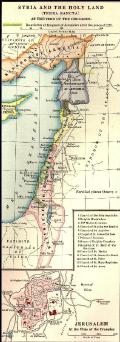 The Crusades were expeditions
undertaken, in fulfilment of a solemn vow, to deliver the Holy Places
from Mohammedan tyranny.
The Crusades were expeditions
undertaken, in fulfilment of a solemn vow, to deliver the Holy Places
from Mohammedan tyranny.
The origin of the word may be traced to the cross made of cloth and worn as a badge on the outer garment of those who took part in these enterprises. Medieval writers use the terms crux (pro cruce transmarina, Charter of 1284, cited by Du Cange s.v. crux), croisement (Joinville), croiserie (Monstrelet), etc. Since the Middle Ages the meaning of the word crusade has been extended to include all wars undertaken in pursuance of a vow, and directed against infidels, i.e. against Mohammedans, pagans, heretics, or those under the ban of excommunication. The wars waged by the Spaniards against the Moors constituted a continual crusade from the eleventh to the sixteenth century; in the north of Europe crusades were organized against the Prussians and Lithuanians; the extermination of the Albigensian heresy was due to a crusade, and, in the thirteenth century the popes preached crusades against John Lackland and Frederick II. But modern literature has abused the word by applying it to all wars of a religious character, as, for instance, the expedition of Heraclius against the Persians in the seventh century and the conquest of Saxony by Charlemagne.
The idea of the crusade corresponds to a political conception which was realized in Christendom only from the eleventh to the fifteenth century; this supposes a union of all peoples and sovereigns under the direction of the popes. All crusades were announced by preaching. After pronouncing a solemn vow, each warrior received a cross from the hands of the pope or his legates, and was thenceforth considered a soldier of the Church. Crusaders were also granted indulgences and temporal privileges, such as exemption from civil jurisdiction, inviolability of persons or lands, etc. Of all these wars undertaken in the name of Christendom, the most important were the Eastern Crusades, which are the only ones treated in this article.
DIVISION
It has been customary to describe the Crusades as eight in number:
- the first, 1095-1101;
- the second, headed by Louis VII, 1145-47;
- the third, conducted by Philip Augustus and Richard Coeur-de-Lion, 1188-92;
- the fourth, during which Constantinople was taken, 1204;
- the fifth, which included the conquest of Damietta, 1217;
- the sixth, in which Frederick II took part (1228-29); also Thibaud de Champagne and Richard of Cornwall (1239);
- the seventh, led by St. Louis, 1249-52;
- the eighth, also under St. Louis, 1270.
This division is arbitrary and excludes many important expeditions, among them those of the fourteenth and fifteenth centuries. In reality the Crusades continued until the end of the seventeenth century, the crusade of Lepanto occurring in 1571, that of Hungary in 1664, and the crusade of the Duke of Burgundy to Candia, in 1669. A more scientific division is based on the history of the Christian settlements in the East; therefore the subject will be considered in the following order:
I. Origin of the Crusades;
II. Foundation of Christian states in the East;
III. First destruction of the Christian states (1144-87);
IV. Attempts to restore the Christian states and the crusade against Saint-Jean d'Acre (1192-98);
V. The crusade against Constantinople (1204);
VI. The thirteenth-century crusades (1217-52);
VII. Final loss of the Christian colonies of the East (1254-91);
VIII. The fourteenth-century crusade and the Ottoman invasion;
IX. The crusade in the fifteenth century;
X. Modifications and survival of the idea of the crusade.
I. ORIGIN OF THE CRUSADES
The origin of the Crusades is directly traceable to the moral and political condition of Western Christendom in the eleventh century. At that time Europe was divided into numerous states whose sovereigns were absorbed in tedious and petty territorial disputes while the emperor, in theory the temporal head of Christendom, was wasting his strength in the quarrel over Investitures. The popes alone had maintained a just estimate of Christian unity; they realized to what extent the interests of Europe were threatened by the Byzantine Empire and the Mohammedan tribes, and they alone had a foreign policy whose traditions were formed under Leo IX and Gregory VII. The reform effected in the Church and the papacy through the influence of the monks of Cluny had increased the prestige of the Roman pontiff in the eyes of all Christian nations; hence none but the pope could inaugurate the international movement that culminated in the Crusades. But despite his eminent authority the pope could never have persuaded the Western peoples to arm themselves for the conquest of the Holy Land had not the immemorial relations between Syria and the West favoured his design. Europeans listened to the voice of Urban II because their own inclination and historic traditions impelled them towards the Holy Sepulchre.
From the end of the fifth century there had been no break in their intercourse with the Orient. In the early Christian period colonies of Syrians had introduced the religious ideas, art, and culture of the East into the large cities of Gaul and Italy. The Western Christians in turn journeyed in large numbers to Syria, Palestine, and Egypt, either to visit the Holy Places or to follow the ascetic life among the monks of the Thebaid or Sinai. There is still extant the itinerary of a pilgrimage from Bordeaux to Jerusalem, dated 333; in 385 St. Jerome and St. Paula founded the first Latin monasteries at Bethlehem. Even the Barbarian invasion did not seem to dampen the ardour for pilgrimages to the East. The Itinerary of St. Silvia (Etheria) shows the organization of these expeditions, which were directed by clerics and escorted by armed troops. In the year 600, St. Gregory the Great had a hospice erected in Jerusalem for the accommodation of pilgrims, sent alms to the monks of Mount Sinai ("Vita Gregorii" in "Acta SS.", March 11, 132), and, although the deplorable condition of Eastern Christendom after the Arab invasion rendered this intercourse more difficult, it did not by any means cease.
As early as the eighth century Anglo-Saxons underwent the greatest hardships to visit Jerusalem. The journey of St. Willibald, Bishop of Eichstädt, took seven years (722-29) and furnishes an idea of the varied and severe trials to which pilgrims were subject (Itiner. Latina, 1, 241-283). After their conquest of the West, the Carolingians endeavoured to improve the condition of the Latins settled in the East; in 762 Pepin the Short entered into negotiations with the Caliph of Bagdad. In Rome, on 30 November, 800, the very day on which Leo III invoked the arbitration of Charlemagne, ambassadors from Haroun al-Raschid delivered to the King of the Franks the keys of the Holy Sepulchre, the banner of Jersualem, and some precious relics (Einhard, "Annales", ad an. 800, in "Mon. Germ. Hist.: Script.", I, 187); this was an acknowledgment of the Frankish protectorate over the Christians of Jerusalem. That churches and monasteries were built at Charlemagne's expense is attested by a sort of a census of the monasteries of Jerusalem dated 808 ("Commemoratio de Casis Dei" in "Itiner. Hieros.", I, 209). In 870, at the time of the pilgrimage of Bernard the Monk (Itiner. Hierosol., I, 314), these institutions were still very prosperous, and it has been abundantly proved that alms were sent regularly from the West to the Holy Land. In the tenth century, just when the political and social order of Europe was most troubled, knights, bishops, and abbots, actuated by devotion and a taste for adventure, were wont to visit Jerusalem and pray at the Holy Sepulchre without being molested by the Mohammedans. Suddenly, in 1009, Hakem, the Fatimite Caliph of Egypt, in a fit of madness ordered the destruction of the Holy Sepulchre and all the Christian establishments in Jerusalem. For years thereafter Christians were cruelly persecuted. (See the recital of an eyewitness, Iahja of Antioch, in Schlumberger's "Epopée byzantine", II, 442.) In 1027 the Frankish protectorate was overthrown and replaced by that of the Byzantine emperors, to whose diplomacy was due the reconstruction of the Holy Sepulchre. The Christian quarter was even surrounded by a wall, and some Amalfi merchants, vassals of the Greek emperors, built hospices in Jerusalem for pilgrims, e.g. the Hospital of St. John, cradle of the Order of Hospitallers.
Instead of diminishing, the enthusiasm of Western Christians for the pilgrimage to Jerusalem seemed rather to increase during the eleventh century. Not only princes, bishops, and knights, but even men and women of the humbler classes undertook the holy journey (Radulphus Glaber, IV, vi). Whole armies of pilgrims traversed Europe, and in the valley of the Danube hospices were established where they could replenish their provisions. In 1026 Richard, Abbot of Saint-Vannes, led 700 pilgrims into Palestine at the expense of Richard II, Duke of Normandy. In 1065 over 12,000 Germans who had crossed Europe under the command of Günther, Bishop of Bamberg, while on their way through Palestine had to seek shelter in a ruined fortress, where they defended themselves against a troop of Bedouins (Lambert of Hersfeld, in "Mon. Germ. Hist.: Script.", V, 168). Thus it is evident that at the close of the eleventh century the route to Palestine was familiar enough to Western Christians who looked upon the Holy Sepulchre as the most venerable of relics and were ready to brave any peril in order to visit it. The memory of Charlemagne's protectorate still lived, and a trace of it is to be found in the medieval legend of this emperor's journey to Palestine (Gaston Paris in "Romania", 1880, p. 23).
The rise of the Seljukian Turks, however, compromised the safety of pilgrims and even threatened the independence of the Byzantine Empire and of all Christendom. In 1070 Jerusalem was taken, and in 1091 Diogenes, the Greek emperor, was defeated and made captive at Mantzikert. Asia Minor and all of Syria became the prey of the Turks. Antioch succumbed in 1084, and by 1092 not one of the great metropolitan sees of Asia remained in the possession of the Christians. Although separated from the communion of Rome since the schism of Michael Cærularius (1054), the emperors of Constantinople implored the assistance of the popes; in 1073 letters were exchanged on the subject between Michael VII and Gregory VII. The pope seriously contemplated leading a force of 50,000 men to the East in order to re-establish Christian unity, repulse the Turks, and rescue the Holy Sepulchre. But the idea of the crusade constituted only a part of this magnificent plan. (The letters of Gregory VII are in P.L., CXLVIII, 300, 325, 329, 386; cf. Riant's critical discussion in Archives de l'Orient Latin, I, 56.) The conflict over the Investitures in 1076 compelled the pope to abandon his projects; the Emperors Nicephorus Botaniates and Alexius Comnenus were unfavourable to a religious union with Rome; finally war broke out between the Byzantine Empire and the Normans of the Two Sicilies.
It was Pope Urban II who took up the plans of Gregory VII and gave them more definite shape. A letter from Alexius Comnenus to Robert, Count of Flanders, recorded by the chroniclers, Guibert de Nogent ("Historiens Occidentaux des Croisades", ed. by the Académie des Inscriptions, IV, 13l) and Hugues de Fleury (in "Mon. Germ. Hist.: Script.", IX, 392), seems to imply that the crusade was instigated by the Byzantine emperor, but this has been proved false (Chalandon, Essai sur le règne d'Alexis Comnène, appendix), Alexius having merely sought to enroll five hundred Flemish knights in the imperial army (Anna Comnena, Alexiad., VII, iv). The honour of initiating the crusade has also been attributed to Peter the Hermit, a recluse of Picardy, who, after a pilgrimage to Jerusalem and a vision in the church of the Holy Sepulchre, went to Urban II and was commissioned by him to preach the crusade. However, though eyewitnesses of the crusade mention his preaching, they do not ascribe to him the all-important rôle assigned him later by various chroniclers, e.g. Albert of Aix and especially William of Tyre. (See Hagenmeyer, Peter der Eremite Leipzig, 1879.) The idea of the crusade is chiefly attributed to Pope Urban II (1095), and the motives that actuated him are clearly set forth by his contemporaries: "On beholding the enormous injury that all, clergy or people, brought upon the Christian Faith . . . at the news that the Rumanian provinces had been taken from the Christians by the Turks, moved with compassion and impelled by the love of God, he crossed the mountains and descended into Gaul" (Foucher de Chartres, I, in "Histoire des Crois.", III, 321). Of course it is possible that in order to swell his forces, Alexius Comnenus solicited assistance in the West; however, it was not he but the pope who agitated the great movement which filled the Greeks with anxiety and terror.
II. FOUNDATION OF CHRISTIAN STATES IN THE EAST
After travelling through Burgundy and the south of France, Urban II convoked a council at Clermont-Ferrand, in Auvergne. It was attended by fourteen archbishops, 250 bishops, and 400 abbots; moreover a great number of knights and men of all conditions came and encamped on the plain of Chantoin, to the east of Clermont, 18-28 November, 1095. On 27 November, the pope himself addressed the assembled multitudes, exhorting them to go forth and rescue the Holy Sepulchre. Amid wonderful enthusiasm and cries of "God wills it!" all rushed towards the pontiff to pledge themselves by vow to depart for the Holy Land and receive the cross of red material to be worn on the shoulder. At the same time the pope sent letters to all Christian nations, and the movement made rapid headway throughout Europe. Preachers of the crusade appeared everywhere, and on all sides sprang up disorganized, undisciplined, penniless hordes, almost destitute of equipment, who, surging eastward through the valley of the Danube, plundered as they went along and murdered the Jews in the German cities. One of these bands, headed by Folkmar, a German cleric, was slaughtered by the Hungarians. Peter the Hermit, however, and the German knight, Walter the Pennyless (Gautier Sans Avoir), finally reached Constantinople with their disorganized troops. To save the city from plunder Alexius Comnenus ordered them to be conveyed across the Bosporus (August, 1096); in Asia Minor they turned to pillage and were nearly all slain by the Turks. Meanwhile the regular crusade was being organized in the West and, according to a well-conceived plan, the four principal armies were to meet at Constantinople.
- Godfrey of Bouillon, Duke of Lower Lorraine at the head of the people of Lorraine, the Germans, and the French from the north, followed the valley of the Danube, crossed Hungary, and arrived at Constantinople, 23 December, 1096.
- Hugh of Vermandois, brother of King Philip I of France, Robert Courte-Heuse, Duke of Normandy, and Count Stephen of Blois, led bands of French and Normans across the Alps and set sail from the ports of Apulia for Dyrrachium (Durazzo), whence they took the "Via Egnatia" to Constantinople and assembled there in May, 1097.
- The French from the south, under the leadership of Raymond of Saint-Gilles, Count of Toulouse, and of Adhemar of Monteil, Bishop of Puy and papal legate, began to fight their way through the longitudinal valleys of the Eastern Alps and, after bloody conflicts with the Slavonians, reached Constantinople at the end of April, 1097.
- Lastly, the Normans of Southern Italy, won over by the enthusiasm of the bands of crusaders that passed through their country, embarked for Epirus under the command of Bohemond and Tancred, one being the eldest son, the other the nephew, of Robert Guiscard. Crossing the Byzantine Empire, they succeeded in reaching Constantinople, 26 April, 1097.
The appearance of the crusading armies at Constantinople raised the greatest trouble, and helped to bring about in the future irremediable misunderstandings between the Greeks and the Latin Christians. The unsolicited invasion of the latter alarmed Alexius, who tried to prevent the concentration of all these forces at Constantinople by transporting to Asia Minor each Western army in the order of its arrival; moreover, he endeavoured to extort from the leaders of the crusade a promise that they would restore to the Greek Empire the lands they were about to conquer. After resisting the imperial entreaties throughout the winter, Godfrey of Bouillon, hemmed in at Pera, at length consented to take the oath of fealty. Bohemond, Robert Courte-Heuse, Stephen of Blois, and the other crusading chiefs unhesitatingly assumed the same obligation; Raymond of St-Gilles, however, remained obdurate.
Transported into Asia Minor, the crusaders laid siege to the city of Nicæa, but Alexius negotiated with the Turks, had the city delivered to him, and prohibited the crusaders from entering it (1 June, 1097). After their victory over the Turks at the battle of Dorylæum on 1 July, 1097, the Christians entered upon the high plateaux of Asia Minor. Constantly harrassed by a relentless enemy, overcome by the excessive heat, and sinking under the weight of their leathern armour covered with iron scales, their sufferings were wellnigh intolerable. In September, 1097, Tancred and Baldwin, brothers of Godfrey of Bouillon, left the bulk of the army and entered Armenian territory. At Tarsus a feud almost broke out between them, but fortunately they became reconciled. Tancred took possession of the towns of Cilicia, whilst Baldwin, summoned by the Armenians, crossed the Euphrates in October, 1097, and, after marrying an Armenian princess, was proclaimed Lord of Edessa. Meanwhile the crusaders, revictualled by the Armenians of the Taurus region, made their way into Syria and on 20 October, 1097, reached the fortified city of Antioch, which was protected by a wall flanked with 450 towers, stocked by the Ameer Jagi-Sian with immense quantities of provisions. Thanks to the assistance of carpenters and engineers who belonged to a Genoese fleet that had arrived at the mouth of the Orontes, the crusaders were enabled to construct battering-machines and to begin the siege of the city. Eventually Bohemond negotiated with a Turkish chief who surrendered one of the towers, and on the night of 2 June, 1098, the crusaders took Antioch by storm. The very next day they were in turn besieged within the city by the army of Kerbûga, Ameer of Mosul. Plague and famine cruelly decimated their ranks, and many of them, among others Stephen of Blois, escaped under cover of night. The army was on the verge of giving way to discouragement when its spirits were suddenly revived by the discovery of the Holy Lance, resulting from the dream of a Provençal priest named Pierre Barthélemy. On 28 June, 1098, Kerbûga's army was effectually repulsed, but, instead of marching on Jerusalem without delay, the chiefs spent several months in a quarrel due to the rivalry of Raymond of Saint-Gilles and Bohemond, both of whom claimed the right to Antioch. It was not until April, 1099, that the march towards Jerusalem was begun, Bohemond remaining in possession of Antioch while Raymond seized on Tripoli. On 7 June the crusaders began the siege of Jerusalem. Their predicament would have been serious, indeed, had not another Genoese fleet arrived at Jaffa and, as at Antioch, furnished the engineers necessary for a siege. After a general procession which the crusaders made barefooted around the city walls amid the insults and incantations of Mohammedan sorcerers, the attack began 14 July, 1099. Next day the Christians entered Jerusalem from all sides and slew its inhabitants regardless of age or sex. Having accomplished their pilgrimage to the Holy Sepulchre, the knights chose as lord of the new conquest Godfrey of Bouillon, who called himself "Defender of the Holy Sepulchre". They had then to repulse an Egyptian army, which was defeated at Ascalon, 12 August, 1099. Their position was nevertheless very insecure. Alexius Comnenus threatened the principality of Antioch, and in 1100 Bohemond himself was made prisoner by the Turks, while most of the cities on the coast were still under Mohammedan control. Before his death, 29 July, 1099, Urban II once more proclaimed the crusade. In 1101 three expeditions crossed Europe under the leadership of Count Stephen of Blois, Duke William IX of Aquitaine, and Welf IV, Duke of Bavaria. All three managed to reach Asia Minor, but were massacred by the Turks. On his release from prison Bohemond attacked the Byzantine Empire, but was surrounded by the imperial army and forced to acknowledge himself the vassal of Alexius. On Bohemond's death, however, in 1111, Tancred refused to live up to the treaty and retained Antioch. Godfrey of Bouillon died at Jerusalem 18 July, 1100. His brother and successor, Baldwin of Edessa, was crowned King of Jerusalem in the Basilica of Bethlehem, 25 December, 1100. In 1112, with the aid of Norwegians under Sigurd Jorsalafari and the support of Genoese, Pisan, and Venetian fleets, Baldwin I began the conquest of the ports of Syria, which was completed in 1124 by the capture of Tyre. Ascalon alone kept an Egyptian garrison until 1153.
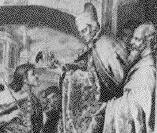
At this period the Christian states formed an extensive and unbroken territory between the Euphrates and the Egyptian frontier, and included four almost independent principalities: the Kingdom of Jerusalem, the Countship of Tripoli, the Principality of Antioch, and the Countship of Rohez (Edessa). These small states were, so to speak, the common property of all Christendom and, as such, were subordinate to the authority of the pope. Moreover, the French knights and Italian merchants established in the newly conquered cities soon gained the upper hand. The authority of the sovereigns of these different principalities was restricted by the fief-holders, vassals, and under-vassals who constituted the Court of Lieges, or Supreme Court. This assembly had entire control in legislative matters; no statute or law could be established without its consent; no baron could be deprived of his fief without its decision; its jurisdiction extended over all, even the king, and it controlled also the succession to the throne. A "Court of the Burgesses" had similar jurisdiction over the citizens. Each fief had a like tribunal composed of knights and citizens, and in the ports there were police and mercantile courts (see ASSIZES OF JERUSALEM). The authority of the Church also helped to limit the power of the king; the four metropolitan sees of Tyre, Cæsarea, Bessan, and Petra were subject to the Patriarch of Jerusalem, similarly seven suffragan sees and a great many abbeys, among them Mount Sion, Mount Olivet, the Temple, Josaphat, and the Holy Sepulchre. Through rich and frequent donations the clergy became the largest property-holders in the kingdom; they also received from the crusaders important estates situated in Europe. In spite of the aforesaid restrictions, in the twelfth century the King of Jerusalem had a large income. The customs duties established in the ports and administered by natives, the tolls exacted from caravans, and the monopoly of certain industries were a fruitful source of revenue. From a military point of view all vassals owed the king unlimited service as to time, though he was obliged to compensate them, but to fill the ranks of the army it was necessary to enroll natives who received a life annuity (fief de soudée). In this way was recruited the light cavalry of the "Turcoples", armed in Saracenic style. Altogether these forces barely exceeded 20,000 men, and yet the powerful vassals who commanded them were almost independent of the king. So it was that the great need of regular troops for the defence of the Christian dominions brought about the creation of a unique institution, the religious orders of knighthood, viz.: the Hospitallers, who at first did duty in the Hospital of St. John founded by the aforesaid merchants of Amalfi, and were then organized into a militia by Gérard du Puy that they might fight the Saracens (1113); and the Templars, nine of whom in 1118 gathered around Hugues de Payens and received the Rule of St. Bernard. These members, whether knights drawn from the nobility, bailiffs, clerks, or chaplains, pronounced the three monastic vows but it was chiefly to the war against the Saracens that they pledged themselves. Being favoured with many spiritual and temporal privileges, they easily gained recruits from among the younger sons of feudal houses and acquired both in Palestine and in Europe considerable property. Their castles, built at the principal strategic points, Margat, Le Crac, and Tortosa, were strong citadels protected by several concentric enclosures. In the Kingdom of Jerusalem these military orders virtually formed two independent commonwealths. Finally, in the cities, the public power was divided between the native citizens and the Italian colonists, Genoese, Venetians, Pisans, and also the Marseillais who, in exchange for their services, were given supreme power in certain districts wherein small self-governing communities had their consuls, their churches, and on the outskirts their farm-land, used for the cultivation of cotton and sugar-cane. The Syrian ports were regularly visited by Italian fleets which obtained there the spices and silks brought by caravans from the Far East. Thus, during the first half of the twelfth century the Christian states of the East were completely organized, and even eclipsed in wealth and prosperity most of the Western states.
III. FIRST DESTRUCTION OF THE CHRISTIAN STATES (1144-87)
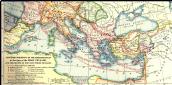
Many dangers, unfortunately, threatened this prosperity. On the south were the Caliphs of Egypt, on the east the Seljuk Ameers of Damascus, Hamah and Aleppo, and on the north the Byzantine emperors, eager to realize the project of Alexius Comnenus and bring the Latin states under their power. Moreover, in the presence of so many enemies the Christian states lacked cohesion and discipline. The help they received from the West was too scattered and intermittent. Nevertheless these Western knights, isolated amid Mohammedans and forced, because of the torrid climate, to lead a life far different from that to which they had been accustomed at home, displayed admirable bravery and energy in their efforts to save the Christian colonies. In 1137 John Comnenus, Emperor of Constantinople, appeared before Antioch with an army, and compelled Prince Raymond to do him homage. On the death of this potentate (1143), Raymond endeavoured to shake off the irksome yoke and invaded Byzantine territory, but was hemmed in by the imperial army and compelled (1144) to humble himself at Constantinople before the Emperor Manuel. The Principality of Edessa, completely isolated from the other Christian states, could not withstand the attacks of Imad-ed-Din, the prince, or atabek, of Mosul, who forced its garrison to capitulate 25 December, 1144. After the assassination of Imad-ed-Din, his son Nour-ed-Din continued hostilities against the Christian states. At news of this, Louis VII of France, Queen Eleanor of Aquitaine, and a great number of knights, moved by the exhortations of St. Bernard, enlisted under the cross (Assembly of Vézelay, 31 March, 1146). The Abbot of Clairvaux became the apostle of the crusade and conceived the idea of urging all Europe to attack the infidels simultaneously in Syria, in Spain, and beyond the Elbe. At first he met with strong opposition in Germany. Eventually Emperor Conrad III acceded to his wish and adopted the standard of the cross at the Diet of Spires, 25 December, 1146. However, there was no such enthusiasm as had prevailed in 1095. Just as the crusaders started on their march, King Roger of Sicily attacked the Byzantine Empire, but his expedition merely checked the progress of Nour-ed-Din's invasion. The sufferings endured by the crusaders while crossing Asia Minor prevented them from advancing on Edessa. They contented themselves with besieging Damascus, but were obliged to retreat at the end of a few weeks (July, 1148). This defeat caused great dissatisfaction in the West; moreover, the conflicts between the Greeks and the crusaders only confirmed the general opinion that the Byzantine Empire was the chief obstacle to the success of the Crusades. Nevertheless, Manuel Comnenus endeavoured to strengthen the bonds that united the Byzantine Empire to the Italian principalities. In 1161 he married Mary of Antioch, and in 1167 gave the hand of one of his nieces to Amalric, King of Jerusalem. This alliance resulted in thwarting the progress of Nour-ed-Din, who, having become master of Damascus in 1154, refrained thenceforth from attacking the Christian dominions.
King Amalric profited by this respite to interpose in the affairs of Egypt, as the only remaining representatives of the Fatimite dynasty were children, and two rival viziers were disputing the supreme power amid conditions of absolute anarchy. One of these disputants, Shawer, being exiled from Egypt, took refuge with Nour-ed-Din, who sent his best general, Shírkúh, to reinstate him. After his conquest of Cairo, Shírkúh endeavoured to bring Shawer into disfavour with the caliph; Amalric, taking advantage of this, allied himself with Shawer. On two occasions, in 1164 and 1167, he forced Shírkúh to evacuate Egypt; a body of Frankish knights was stationed at one of the gates of Cairo, and Egypt paid a tribute of 100,000 dinárs to the Kingdom of Jerusalem. In 1168 Amalric made another attempt to conquer Egypt, but failed. After ordering the assassination of Shawer, Shírkúh had himself proclaimed Grand Vizier. At his death on 3 March, 1169, he was succeeded by his nephew, Salah-ed-Dîn (Saladin). During that year Amalric, aided by a Byzantine fleet, invaded Egypt once more, but was defeated at Damietta. Saladin retained full sway in Egypt and appointed no successor to the last Fatimite caliph, who died in 1171. Moreover, Nour-ed-Din died in 1174, and, while his sons and nephews disputed the inheritance, Saladin took possession of Damascus and conquered all Mesopotamia except Mosul. Thus, when Amalric died in 1173, leaving the royal power to Baldwin IV, "the Leprous", a child of thirteen, the Kingdom of Jerusalem was threatened on all sides. At the same time two factions, led respectively by Guy de Lusignan, brother-in-iaw of the king, and Raymond, Count of Tripoli, contended for the supremacy. Baldwin IV died in 1184, and was soon followed to the grave by his nephew Baldwin V. Despite lively opposition, Guy de Lusignan was crowned king, 20 July, 1186. Though the struggle against Saladin was already under way, it was unfortunately conducted without order or discipline. Notwithstanding the truce concluded with Saladin, Renaud de Châtillon, a powerful feudatory and lord of the trans-Jordanic region, which included the fief of Montréal, the great castle of Karak, and Aïlet, a port on the Red Sea, sought to divert the enemy's attention by attacking the holy cities of the Mohammedans. Oarless vessels were brought to Aïlet on the backs of camels in 1182, and a fleet of five galleys traversed the Red Sea for a whole year, ravaging the coasts as far as Aden; a body of knights even attempted to seize Medina. In the end this fleet was destroyed by Saladin's, and, to the great joy of the Mohammedans, the Frankish prisoners were put to death at Mecca. Attacked in his castle at Karak, Renaud twice repulsed Saladin's forces (1184-86). A truce was then signed, but Renaud broke it again and carried off a caravan in which was the sultan's own sister. In his exasperation Saladin invaded the Kingdom of Jerusalem and, although Guy de Lusignan gathered all his forces to repel the attack, on 4 July, 1187, Saladin's army annihilated that of the Christians on the shores of Lake Tiberias. The king, the grand master of the Temple, Renaud de Châtillon, and the most powerful men in the realm were made prisoners. After slaying Renaud with his own hand, Saladin marched on Jerusalem. The city capitulated 17 September, and Tyre, Antioch, and Tripoli were the only places in Syria that remained to the Christians.
IV. ATTEMPTS TO RESTORE THE CHRISTIAN STATES AND THE CRUSADE AGAINST SAINT-JEAN D'ACRE
The news of these events caused great consternation in Christendom, and Pope Gregory VIII strove to put a stop to all dissensions among the Christian princes. On 21 January, 1188, Philip Augustus, King of France, and Henry II, Plantagenet, became reconciled at Gisors and took the cross. On 27 March, at the Diet of Mainz, Frederick Barbarossa and a great number of German knights made a vow to defend the Christian cause in Palestine. In Italy, Pisa made peace with Genoa, Venice with the King of Hungary, and William of Sicily with the Byzantine Empire. Moreover, a Scandinavian fleet consisting of 12,000 warriors sailed around the shores of Europe, when passing Portugal, it helped to capture Alvor from the Mohammedans. Enthusiasm for the crusade was again wrought up to a high pitch; but, on the other hand, diplomacy and royal and princely schemes became increasingly important in its organization. Frederick Barbarossa entered into negotiations with Isaac Angelus, Emperor of Constantinople, with the Sultan of Iconium, and even with Saladin himself. It was, moreover, the first time that all the Mohammedan forces were united under a single leader; Saladin, while the holy war was being preached, organized against the Christians something like a counter-crusade. Frederick Barbarossa, who was first ready for the enterprise, and to whom chroniclers attribute an army of 100,000 men, left Ratisbon, 11 May, 1189. After crossing Hungary he took the Balkan passes by assault and tried to outflank the hostile movements of Isaac Angelus by attacking Constantinople. Finally, after the sack of Adrianople, Isaac Angelus surrendered, and between 21 and 30 March, 1190, the Germans succeeded in crossing the Strait of Gallipoli. As usual, the march across Asia Minor was most arduous. With a view to replenishing provisions, the army took Iconium by assault. On their arrival in the Taurus region, Frederick Barbarossa tried to cross the Selef (Kalykadnos) on horseback and was drowned. Thereupon many German princes returned to Europe; the others, under the emperor's son, Frederick of Swabia. reached Antioch and proceeded thence to Saint-Jean d'Acre. It was before this city that finally all the crusading troops assembled. In June, 1189, King Guy de Lusignan, who had been released from captivity, appeared there with the remnant of the Christian army, and, in September of the same year, the Scandinavian fleet arrived, followed by the English and Flemish fleets, commanded respectively by the Archbishop of Canterbury and Jacques d'Avesnes. This heroic siege lasted two years. In the spring of each year reinforcements arrived from the West, and a veritable Christian city sprang up outside the walls of Acre. But the winters were disastrous to the crusaders, whose ranks were decimated by disease brought on by the inclemency of the rainy season and lack of food. Saladin came to the assistance of the city, and communicated with it by means of carrier pigeons. Missile-hurtling machines (pierrières), worked by powerful machinery, were used by the crusaders to demolish the walls of Acre, but the Mohammedans also had strong artillery. This famous siege had already lasted two years when Philip Augustus, King of France, and Richard Coeur de Lion, King of England, arrived on the scene. After long deliberation they had left Vézelay together, 4 July, 1190. Richard embarked at Marseilles, Philip at Genoa, and they met at Messina. During a sojourn in this place, lasting until March, 1191, they almost quarrelled, but finally concluded a treaty of peace. While Philip was landing at Acre, Richard was shipwrecked on the coast of Cyprus, then independent under Isaac Comnenus. With the aid of Guy de Lusignan, Richard conquered this island. The arrival of the Kings of France and England before Acre brought about the capitulation of the city, 13 July 1191. Soon, however, the quarrel of the French and English kings broke out again, and Philip Augustus left Palestine, 28 July. Richard was now leader of the crusade, and, to punish Saladin for the non-fulfilment of the treaty conditions within the time specified, had the Mohammedan hostages put to death. Next, an attack on Jerusalem was meditated, but, after beguiling the Christians by negotiations, Saladin brought numerous troops from Egypt. The enterprise failed, and Richard compensated himself for these reverses by brilliant but useless exploits which made his name legendary among the Mohammedans. Before his departure he sold the Island of Cyprus, first to the Templars, who were unable to settle there, and then to Guy de Lusignan, who renounced the Kingdom of Jerusalem in favour of Conrad of Montferrat (1192). After a last expedition to defend Jaffa against Saladin, Richard declared a truce and embarked for Europe, 9 October, 1192, but did not reach his English realm until he had undergone a humiliating captivity at the hands of the Duke of Austria, who avenged in this way the insults offered him before Saint-Jean d'Acre.
While Capetians and Plantagenets, oblivious of the Holy War, were settling at home their territorial disputes, Emperor Henry VI, son of Barbarossa, took in hand the supreme direction of Christian politics in the East. Crowned King of the Two Sicilies, 25 December, 1194, he took the cross at Bari, 31 May, 1195, and made ready an expedition which, he thought, would recover Jerusalem and wrest Constantinople from the usurper Alexius III. Eager to exercise his imperial authority he made Amaury de Lusignan King of Cyprus and Leo II King of Armenia. In September, 1197, the German crusaders started for the East. They landed at Saint-Jean d'Acre and marched on Jerusalem, but were detained before the little town of Tibnin from November, 1197, to February 1198. On raising the siege, they learned that Henry VI had died, 28 September, at Messina, where he had gathered the fleet that was to convey him to Constantinople. The Germans signed a truce with the Saracens, but their future influence in Palestine was assured by the creation of the Order of the Teutonic Knights. In 1143, a German pilgrim had founded a hospital for his fellow-countrymen; the religious who served it moved to Acre and, in 1198, were organized in imitation of the plan of the Hospitallers, their rule being approved by Innocent III in 1199.
V. THE CRUSADE AGAINST CONSTANTINOPLE (1204)
In the many attempts made to establish the Christian states the efforts of the crusaders had been directed solely toward the object for which the Holy War had been instituted; the crusade against Constantinople shows the first deviation from the original purpose. For those who strove to gain their ends by taking the direction of the crusades out of the pope's hands, this new movement was, of course, a triumph, but for Christendom it was a source of perplexity. Scarcely had Innocent III been elected pope, in January, 1198, when he inaugurated a policy in the East which he was to follow throughout his pontificate. He subordinated all else to the recapture of Jerusalem and the reconquest of the Holy Land. In his first Encyclicals he summoned all Christians to join the crusade and even negotiated with Alexius III, the Byzantine emperor, trying to persuade him to re-enter the Roman communion and use his troops for the liberation of Palestine. Peter of Capua, the papal legate, brought about a truce between Philip Augustus and Richard Coeur de Lion, January, 1199, and popular preachers, among others the parish priest Foulques of Neuilly, attracted large crowds. During a tournament at Ecry-sur-Aisne, 28 November, 1199, Count Thibaud de Champagne and a great many knights took the cross; in southern Germany, Martin, Abbot of Pairis, near Colmar, won many to the crusade. It would seem, however, that, from the outset, the pope lost control of this enterprise. Without even consulting Innocent III, the French knights, who had elected Thibaud de Champagne as their leader, decided to attack the Mohammedans in Egypt and in March, 1201, concluded with the Republic of Venice a contract for the transportation of troops on the Mediterranean. On the death of Thibaud the crusaders chose as his successor Boniface, Marquis of Montferrat, and cousin of Philip of Swabia, then in open conflict with the pope. Just at this time the son of Isaac Angelus, the dethroned Emperor of Constantinople, sought refuge in the West and asked Innocent III and his own brother-in-law, Philip of Swabia, to reinstate him on the imperial throne. The question has been raised whether it was pre-arranged between Philip and Boniface of Montferrat to turn the crusade towards Constantinople, and a passage in the "Gesta Innocentii" (83, in P. L., CCXIV, CXXXII) indicates that the idea was not new to Boniface of Montferrat when, in the spring of 1202, he made it known to the pope. Meanwhile the crusaders assembled at Venice could not pay the amount called for by their contract, so, by way of exchange, the Venetians suggested that they help recover the city of Zara in Dalmatia. The knights accepted the proposal, and, after a few days' siege, the city capitulated, November, 1202. But it was in vain that Innocent III urged the crusaders to set out for Palestine. Having obtained absolution for the capture of Zara, and despite the opposition of Simon of Montfort and a part of the army, on 24 May, 1203, the leaders ordered a march on Constantinople. They had concluded with Alexius, the Byzantine pretender, a treaty whereby he promised to have the Greeks return to the Roman communion, give the crusaders 200,000 marks, and participate in the Holy War. On 23 June the crusaders' fleet appeared before Constantinople; on 7 July they took possession of a suburb of Galata and forced their way into the Golden Horn; on 17 July they simultaneously attacked the sea walls and land walls of the Blachernæ. The troops of Alexius III made an unsuccessful sally, and the usurper fled, whereupon Isaac Angelus was released from prison and permitted to share the imperial dignity with his son, Alexius IV. But even had the latter been sincere he would have been powerless to keep the promises made to the crusaders. After some months of tedious waiting, those of their number cantoned at Galata lost patience with the Greeks, who not only refused to live up to their agreement, but likewise treated them with open hostility. On 5 February, 1204, Alexius IV and Isaac Angelus were deposed by a revolution, and Alexius Murzuphla, a usurper, undertook the defence of Constantinople against the Latin crusaders who were preparing to besiege Constantinople a second time. By a treaty concluded in March, 1204, between the Venetians and the crusading chiefs, it was pre-arranged to share the spoils of the Greek Empire. On 12 April, 1204, Constantinople was carried by storm, and the next day the ruthless plundering of its churches and palaces was begun. The masterpieces of antiquity, piled up in public places and in the Hippodrome, were utterly destroyed. Clerics and knights, in their eagerness to acquire famous and priceless relics, took part in the sack of the churches. The Venetians received half the booty; the portion of each crusader was determined according to his rank of baron, knight, or bailiff, and most of the churches of the West were enriched with ornaments stripped from those of Constantinople. On 9 May, 1204, an electoral college, formed of prominent crusaders and Venetians, assembled to elect an emperor. Dandolo, Doge of Venice, refused the honour, and Boniface of Montferrat was not considered. In the end, Baldwin, Count of Flanders, was elected and solemnly crowned in St. Sophia. Constantinople and the empire were divided among the emperor, the Venetians, and the chief crusaders; the Marquis of Montferrat received Thessalonica and Macedonia, with the title of king; Henry of Flanders became Lord of Adramyttion; Louis of Blois was made Duke of Nicæa, and fiefs were bestowed upon six hundred knights. Meanwhile, the Venetians reserved to themselves the ports of Thrace, the Peloponnesus, and the islands. Thomas Morosini, a Venetian priest, was elected patriarch.
At the news of these most extraordinary events, in which he had had no hand, Innocent III bowed as in submission to the designs of Providence and, in the interests of Christendom, determined to make the best of the new conquest. His chief aim was to suppress the Greek schism and to place the forces of the new Latin Empire at the service of the crusade. Unfortunately, the Latin Empire of Constantinople was in too precarious a condition to furnish any material support to the papal policy. The emperor was unable to impose his authority upon the barons. At Nicæa, not far from Constantinople, the former Byzantine Government gathered the remnant of its authority and its followers. Theodore Lascaris was proclaimed emperor. In Europe, Joannitsa, Tsar of the Wallachians and Bulgarians, invaded Thrace and destroyed the army of the crusaders before Adrianople, 14 April, 1205. During the battle the Emperor Baldwin fell. His brother and successor, Henry of Flanders, devoted his reign (1206-16) to interminable conflicts with the Bulgarians, the Lombards of Thessalonica, and the Greeks of Asia Minor. Nevertheless, he succeeded in strengthening the Latin conquest, forming an alliance with the Bulgarians, and establishing his authority even over the feudatories of Morea (Parliament of Ravennika, 1209); however, far from leading a crusade into Palestine, he had to solicit Western help, and was obliged to sign treaties with Theodore Lascaris and even with the Sultan of Iconium. The Greeks were not reconciled to the Church of Rome; most of their bishops abandoned their sees and took refuge at Nicæa, leaving their churches to the Latin bishops named to replace them. Greek convents were replaced by Cistercian monasteries, commanderies of Templars and Hospitallers, and chapters of canons. With a few exceptions, however, the native population remained hostile and looked upon the Latin conquerors as foreigners. Having failed in all his attempts to induce the barons of the Latin Empire to undertake an expedition against Palestine, and understanding at last the cause of failure of the crusade in 1204, Innocent III resolved (1207) to organize a new crusade and to take no further notice of Constantinople. Circumstances, however, were unfavourable. Instead of concentrating the forces of Christendom against the Mohammedans, the pope himself disbanded them by proclaiming (1209) a crusade against the Albigenses in the south of France, and against the Almohades of Spain (1213), the pagans of Prussia, and John Lackland of England. At the same time there occurred outbursts of mystical emotion similar to those which had preceded the first crusade. In 1212 a young shepherd of Vendôme and a youth from Cologne gathered thousands of children whom they proposed to lead to the conquest of Palestine. The movement spread through France and Italy. This "Children's Crusade" at length reached Brindisi, where merchants sold a number of the children as slaves to the Moors, while nearly all the rest died of hunger and exhaustion. In 1213 Innocent III had a crusade preached throughout Europe and sent Cardinal Pelagius to the East to effect, if possible, the return of the Greeks to the fold of Roman unity. On 25 July, 1215, Frederick II, after his victory over Otto of Brunswick, took the cross at the tomb of Charlemagne at Aachen. On 11 November, 1215, Innocent III opened the Fourth Lateran Council with an exhortation to all the faithful to join the crusade, the departure being set for 1217. At the time of his death (1216) Pope Innocent felt that a great movement had been started.
VI. THE THIRTEENTH-CENTURY CRUSADES (1217-52)
In Europe, however, the preaching of the crusade met with great opposition. Temporal princes were strongly averse to losing jurisdiction over their subjects who took part in the crusades. Absorbed in political schemes, they were unwilling to send so far away the military forces on which they depended. As early as December, 1216, Frederick II was granted a first delay in the fulfilment of his vow. The crusade as preached in the thirteenth century was no longer the great enthusiastic movement of 1095, but rather a series of irregular and desultory enterprises. Andrew II, King of Hungary, and Casimir, Duke of Pomerania, set sail from Venice and Spalato, while an army of Scandinavians made a tour of Europe. The crusaders landed at Saint-Jean d'Acre in 1217, but confined themselves to incursions on Mussulman territory, whereupon Andrew of Hungary returned to Europe. Receiving reinforcements in the spring of 1218, John of Brienne, King of Jerusalem, resolved to make an attack on the Holy Land by way of Egypt. The crusaders accordingly landed at Damietta in May, 1218, and, after a siege marked by many deeds of heroism, took the city by storm, 5 November, 1219. Instead of profiting by this victory, they spent over a year in idle quarrels, and it was not until May 1221, that they set out for Cairo. Surrounded by the Saracens at Mansurah, 24 July, the Christian army was routed. John of Brienne was compelled to purchase a retreat by the surrender of Damietta to the Saracens. Meanwhile Emperor Frederick II, who was to be the leader of the crusade, had remained in Europe and continued to importune the pope for new postponements of his departure. On 9 November, 1225, he married Isabelle of Brienne, heiress to the Kingdom of Jerusalem, the ceremony taking place at Brindisi. Completely ignoring his father-in-law, he assumed the title of King of Jerusalem. In 1227, however, he had not yet left for Palestine. Gregory IX, elected pope 19 March, 1227, summoned Frederick to fulfil his vow. Finally, 8 September, the emperor embarked but soon turned back; therefore, on 29 September, the pope excommunicated him. Nevertheless, Frederick set sail again 18 June, 1228, but instead of leading a crusade he played a game of diplomacy. He won over Malek-el-Khamil, the Sultan of Egypt, who was at war with the Prince of Damascus, and concluded a treaty with him at Jaffa, February, 1229, according to the terms of which Jerusalem, Bethlehem, and Nazareth were restored to the Christians. On 18 March, 1229, without any religious ceremony, Frederick assumed the royal crown of Jerusalem in the church of the Holy Sepulchre. Returning to Europe, he became reconciled to Gregory IX, August, 1230. The pontiff ratified the Treaty of Jaffa, and Frederick sent knights into Syria to take possession of the cities and compel all feudatories to do him homage. A struggle occurred between Richard Filangieri, the emperor's marshal, and the barons of Palestine, whose leader was Jean d'Ibelin, Lord of Beirut. Filangieri vainly attempted to obtain possession of the Island of Cyprus. and, when Conrad, son of Frederick II and Isabelle of Brienne, came of age in 1243, the High Court, described above, named as regent Alix of Champagne, Queen of Cyprus. In this way German power was abolished in Palestine.
In the meantime Count Thibaud IV of Champagne had been leading a fruitless crusade in Syria (1239). Similarly the Duke of Burgundy and Richard of Cornwall, brother of the King of England, who had undertaken to recover Ascalon, concluded a truce with Egypt (1241). Europe was now threatened with a most grievous disaster. After conquering Russia, the Mongols under Jenghiz Khan appeared in 1241 on the frontiers of Poland, routed the army of the Duke of Silesia at Liegnitz, annihilated that of Bela, King of Hungary, and reached the Adriatic. Palestine felt the consequences of this invasion. The Mongols had destroyed the Mussulman Empire of Kharizm in Central Asia. Fleeing before their conquerors, 10,000 Kharizmians offered their services to the Sultan of Egypt, meanwhile seizing Jerusalem as they passed by, in September, 1244. The news of this catastrophe created a great stir in Europe, and at the Council of Lyons (June-July, 1245) Pope Innocent IV proclaimed a crusade, but the lack of harmony between him and the Emperor Frederick II foredoomed the pontiff to disappointment. Save for Louis IX, King of France, who took the cross in December, 1244, no one showed any willingness to lead an expedition to Palestine. On being informed that the Mongols were well-disposed towards Christianity, Innocent IV sent them Giovanni di Pianocarpini, a Franciscan, and Nicolas Ascelin, a Dominican, as ambassadors. Pianocarpini was in Karakorum 8 April, 1246, the day of the election of the great khan, but nothing came of this first attempt at an alliance with the Mongols against the Mohammedans. However, when St. Louis, who left Paris 12 June, 1248, had reached the Island of Cyprus, he received there a friendly embassy from the great khan and, in return, sent him two Dominicans. Encouraged, perhaps, by this alliance, the King of France decided to attack Egypt. On 7 June, 1249, he took Damietta, but it was only six months later that he marched on Cairo. On 19 December, his advance-guard, commanded by his brother, Robert of Artois, began imprudently to fight in the streets of Mansurah and were destroyed. The king himself was cut off from communication with Damietta and made prisoner 5 April, 1250. At the same time, the Ajoubite dynasty founded by Saladin was overthrown by the Mameluke militia, whose ameers took possession of Egypt. St. Louis negotiated with the latter and was set at liberty on condition of surrendering Damietta and paying a ransom of a million gold bezants. He remained in Palestine until 1254; bargained with the Egyptian ameers for the deliverance of prisoners; improved the equipment of the strongholds of the kingdom, Saint-Jean d'Acre, Cæsarea, Jaffa, and Sidon; and sent Friar William of Rubruquis as ambassador to the great khan. Then, at the news of the death of his mother, Blanche of Castile, who had been acting as regent, he returned to France. Since the crusade against Saint-Jean d'Acre, a new Frankish state, the Kingdom of Cyprus, had been formed in the Mediterranean opposite Syria and became a valuable point of support for the crusades. By lavish distribution of lands and franchises, Guy de Lusignan succeeded in attracting to the island colonists, knights, men-at-arms, and civilians; his successors established a government modelled after that of the Kingdom of Jerusalem. The king's power was restricted by that of the High Court, composed of all the knights, vassals, or under-vassals, with its seat at Nicosia. However, the fiefs were less extensive than in Palestine, and the feudatories could inherit only in a direct line. The Island of Cyprus was soon populated with French colonists who succeeded in winning over the Greeks, upon whom they even imposed their language. Churches built in the French style and fortified castles appeared on all sides. The Cathedral of St. Sophia in Nicosia, erected between 1217 and 1251, was almost a copy of a church in Champagne. Finally, commercial activity became a pronounced characteristic of the cities of Cyprus, and Famagusta developed into one of the busiest of Mediterranean ports.
VII. FINAL LOSS OF THE CHRISTIAN COLONIES OF THE EAST (1254-91)
No longer aided by funds from the West, and rent by internal disorders, the Christian colonies owed their temporary salvation to the changes in Mussulman policy and the intervention of the Mongols. The Venetians drove the Genoese from Saint-Jean d'Acre and treated the city as conquered territory; in a battle where Christians fought against Christians, and in which Hospitallers were pitted against Templars, 20,000 men perished. In revenge the Genoese allied themselves with Michael Palæologus, Emperor of Nicæa, whose general, Alexius Strategopulos, had now no trouble in entering Constantinople and overthrowing the Latin Emperor, Baldwin II, 25 July, 1261. The conquest of the Caliphate of Bagdad by the Mongols (1258) and their invasion of Syria, where they seized Aleppo and Damascus, terrified both Christians and Mohammedans; but the Mameluke ameer, Bibars the Arbelester, defeated the Mongols and wrested Syria from them in September, 1260. Proclaimed sultan in consequence of a conspiracy, in 1260, Bibars began a merciless war on the remaining Christian states. In 1263 he destroyed the church at Nazareth; in 1265 took Cæsarea and Jaffa, and finally captured Antioch (May, 1268). The question of a crusade was always being agitated in the West, but except among men of a religious turn of mind, like St. Louis, there was no longer any earnestness in the matter among European princes. They looked upon a crusade as a political instrument, to be used only when it served their own interests. To prevent the preaching of a crusade against Constantinople, Michael Palæologus promised the pope to work for the union of the Churches; but Charles of Anjou, brother of St. Louis, whom the conquest of the Two Sicilies had rendered one of the most powerful princes of Christendom, undertook to carry out for his own benefit the Eastern designs hitherto cherished by the Hohenstaufen. While Mary of Antioch, granddaughter of Amaury II, bequeathed him the rights she claimed to have to the crown of Jerusalem, he signed the treaty of Viterbo with Baldwin II (27 May, 1267), which assured him eventually the inheritance of Constantinople. In no wise troubled by these diplomatic combinations, St. Louis thought only of the crusade. In a parliament held at Paris, 24 March, 1267, he and his three sons took the cross, but, despite his example, many knights resisted the exhortations of the preacher Humbert de Romans. On hearing the reports of the missionaries, Louis resolved to land at Tunis, whose prince he hoped to convert to Christianity. It has been asserted that St. Louis was led to Tunis by Charles of Anjou, but instead of encouraging his brother's ambition the saint endeavoured to thwart it. Charles had tried to take advantage of the vacancy of the Holy See between 1268 and 1271 in order to attack Constantinople, the negotiations of the popes with Michael Palæologus for religious union having heretofore prevented him. St. Louis received the embassy of the Greek emperor very graciously and ordered Charles of Anjou to join him at Tunis. The crusaders, among whom was Prince Edward of England, landed at Carthage 17 July, 1270, but the plague broke out in their camp, and on 25 August, St. Louis himself was carried off by the scourge. Charles of Anjou then concluded a treaty with the Mohammedans, and the crusaders reimbarked. Prince Edward alone, determined to fulfil his vow, and set out for Saint-Jean d'Acre; however, after a few razzias on Saracenic territory, he concluded a truce with Bibars.
The field was now clear for Charles of Anjou, but the election of Gregory X, who was favourable to the crusade, again frustrated his plans. While the emissaries of the King of the Two Sicilies traversed the Balkan peninsula, the new pope was awaiting the union of the Western and Eastern Churches, which event was solemnly proclaimed at the Council of Lyons, 6 July, 1274; Michael Palæologus himself promised to take the cross. On 1 May, 1275, Gregory X effected a truce between this sovereign and Charles of Anjou. In the meantime Philip III, King of France, the King of England, and the King of Aragon made a vow to go to the Holy Land. Unfortunately the death of Gregory X brought these plans to nought, and Charles of Anjou resumed his scheming. In 1277 he sent into Syria Roger of San Severino, who succeeded in planting his banner on the castle of Acre and in 1278 took possession of the principality of Achaia in the name of his daughter-in-law Isabelle de Villehardouin. Michael Palæologus had not been able to effect the union of the Greek clergy with Rome, and in 1281 Pope Martin IV excommunicated him. Having signed an alliance with Venice, Charles of Anjou prepared to attack Constantinople, and his expedition was set for April, 1283. On 30 March, 1282, however, the revolt known as the Sicilian Vespers occurred, and once more his projects were defeated. In order to subdue his own rebellious subjects and to wage war against the King of Aragon, Charles was at last compelled to abandon his designs on the East. Meanwhile Michael Palæologus remained master of Constantinople, and the Holy Land was left defenceless. In 1280 the Mongols attempted once more to invade Syria, but were repulsed by the Egyptians at the battle of Hims; in 1286 the inhabitants of Saint-Jean d'Acre expelled Charles of Anjou's seneschal and called to their aid Henry II, King of Cyprus. Kelaoun, the successor of Bibars, now broke the truce which he had concluded with the Christians, and seized Margat, the stronghold of the Hospitallers. Tripoli surrendered in 1289, and on 5 April, 1291, Malek-Aschraf, son and successor of Kelaoun, appeared before Saint-Jean d'Acre with 120,000 men. The 25,000 Christians who defended the city were not even under one supreme commander; nevertheless they resisted with heroic valour, filled breaches in the wall with stakes and bags of cotton and wool, and communicated by sea with King Henry II, who brought them help from Cyprus. However, 28 May, the Mohammedans made a general attack and penetrated into the town, and its defenders fled in their ships. The strongest opposition was offered by the Templars, the garrison of whose fortress held out ten days longer, only to be completely annihilated. In July, 1291, the last Christian towns in Syria capitulated, and the Kingdom of Jerusalem ceased to exist.
VIII. THE FOURTEENTH CENTURY CRUSADE AND THE OTTOMAN INVASION
The loss of Saint-Jean d'Acre did not lead the princes of Europe to organize a new crusade. Men's minds were indeed, as usual, directed towards the East, but in the first years of the fourteenth century the idea of a crusade inspired principally the works of theorists who saw in it the best means of reforming Christendom. The treatise by Pierre Dubois, law-officer of the crown at Coutances, "De Recuperatione Terræ Sanctæ" (Langlois, ed., Paris, 1891), seems like the work of a dreamer, yet some of its views are truly modern. The establishment of peace between Christian princes by means of a tribunal of arbitration, the idea of making a French prince hereditary emperor, the secularization of the Patrimony of St. Peter, the consolidation of the Orders of the Hospitallers and Templars, the creation of a disciplined army the different corps of which were to have a special uniform, the creation of schools for the study of Oriental languages, and the intermarriage of Christian maidens with Saracens were the principal ideas it propounded (1307). On the other hand the writings of men of greater activity and wider experience suggested more practical methods for effecting the conquest of the East. Persuaded that Christian defeat in the Orient was largely due to the mercantile relations which the Italian cities Venice and Genoa continued to hold with the Mohammedans, these authors sought the establishment of a commercial blockade which, within a few years, would prove the ruin of Egypt and cause it to fall under Christian control. For this purpose it was recommended that a large fleet be fitted out at the expense of Christian princes and made to do police duty on the Mediterranean so as to prevent smuggling. These were the projects set forth in the memoirs of Fidentius of Padua, a Franciscan (about 1291, Bibliothèque Nationale, Latin MSS., 7247); in those of King Charles II of Naples (1293, Bib. Nat., Frankish MSS., 6049); Jacques de Molay (1307, Baluze, ed., Vitæ paparum Avenion., II, 176-185); Henry II, King of Cyprus (Mas-Latrie, ed., Histoire de Chypre, II, 118); Guillaume d'Adam, Archbishop of Sultanieh (1310, Kohler, ed., Collect. Hist. of the Crusades, Armenian Documents, II); and Marino Sanudo, the Venetian (Bongars, ed., Secreta fidelium Crucis, II). The consolidation of the military orders was also urged by Charles II. Many other memoirs, especially that of Hayton, King of Armenia (1307, ed. Armenian Documents, I), considered an alliance between the Christians and the Mongols of Persia indispensable to success. In fact, from the end of the thirteenth century many missionaries had penetrated into the Mongolian Empire; in Persia, as well as in China, their propaganda flourished. St. Francis of Assisi, and Raymond Lully had hoped to substitute for the warlike crusade a peaceable conversion of the Mohammedans to Christianity. Raymond Lully, born at Palma, on the Island of Majorca, in 1235, began (1275) his "Great Art", which, by means of a universal method for the study of Oriental languages, would equip missionaries to enter into controversies with the Mohammedan doctors. In the same year he prevailed upon the King of Majorca to found the College of the Blessed Trinity at Miramar, where the Friars Minor could learn the Oriental languages. He himself translated catechetical treatises into Arabic and, after spending his life travelling in Europe trying to win over to his ideas popes and kings, suffered martyrdom at Bougie, where he had begun his work of evangelization (1314). Among the Mohammedans this propaganda encountered insurmountable difficulties, whereas the Mongols, some of whom were still members of the Nestorian Church, received it willingly. During the pontificate of John XXII (1316-34) permanent Dominican and Franciscan missions were established in Persia, China, Tatary and Turkestan, and in 1318 the Archbishopric of Sultanieh was created in Persia. In China Giovanni de Monte Corvino, created Archbishop of Cambaluc (Peking), organized the religious hierarchy, founded monasteries, and converted to Christianity men of note, possibly the great khan himself. The account of the journey of Blessed Orderic de Pordenone (Cordier, ed.) across Asia, between 1304 and 1330, shows us that Christianity had gained a foothold in Persia, India, Central Asia, and Southern China.
By thus leading up to an alliance between Mongols and Christians against the Mohammedans, the crusade had produced the desired effect; early in the fourteenth century the future development of Christianity in the East seemed assured. Unfortunately, however, the internal changes which occurred in the West, the weakening of the political influence of the popes, the indifference of temporal princes to what did not directly affect their territorial interests rendered unavailing all efforts towards the re-establishment of Christian power in the East. The popes endeavoured to insure the blockade of Egypt by prohibiting commercial intercourse with the infidels and by organizing a squadron for the prevention of smuggling, but the Venetians and Genoese defiantly sent their vessels to Alexandria and sold slaves and military stores to the Mamelukes. Moreover, the consolidation of the military orders could not be effected. By causing the suppression of the Templars at the Council of Vienne in 1311, King Philip the Fair dealt a cruel blow to the crusade; instead of giving to the Hospitallers the immense wealth of the Templars, he confiscated it. The Teutonic Order having established itself in Prussia in 1228, there remained in the East only the Hospitallers. After the capture of Saint-Jean d'Acre, Henry II, King of Cyprus, had offered them shelter at Limasol, but there they found themselves in very straitened circumstances. In 1310 they seized the Island of Rhodes, which had become a den of pirates, and took it as their permanent abode. Finally, the contemplated alliance with the Mongols was never fully realized. It was in vain that Argoun, Khan of Persia, sent the Nestorian monk, Raban Sauma, as ambassador to the pope and the princes of the West (1285-88); his offers elicited but vague replies. On 23 December, 1299, Cazan, successor to Argoun, inflicted a defeat upon the Christians at Hims, and captured Damascus, but he could not hold his conquests, and died in 1304 just as he was preparing for a new expedition. The princes of the West assumed the cross in order to appropriate to their own use the tithes which, for the defrayal of crusade expenses, they had levied upon the property of the clergy. For these sovereigns the crusade had no longer any but a fiscal interest. In 1336 King Philip VI of France, whom the pope had appointed leader of the crusade, collected a fleet at Marseilles and was preparing to go to the East when the news of the projects of Edward III caused him to return to Paris. War then broke out between France and England, and proved an insurmountable obstacle to the success of any crusade just when the combined forces of all Christendom would have been none too powerful to resist the new storm gathering in the East. From the close of the thirteenth century a band of Ottoman Turks, driven out of Central Asia by Mongol invasions, had founded a military state in Asia Minor and now threatened to invade Europe. They captured Ephesus in 1308, and in 1326 Othman, their sultan, established his residence at Broussa (Prusa) in Bithynia under Ourkhan, moreover, they organized the regular foot-guards of janizaries against whom the undisciplined troops of Western knights could not hold out. The Turks entered Nicomedia in 1328 and Nicæa in 1330; when they threatened the Emperors of Constantinople, the latter renewed negotiations with the popes with a view towards the reconciliation of the Greek and Roman Churches, for which purpose Barlaam was sent as ambassador to Avignon, in 1339. At the same time the Egyptian Mamelukes destroyed the port of Lajazzo, commercial centre of the Kingdom of Armenia Minor, where the remnants of the Christian colonies had sought refuge after the taking of Saint-Jean d'Acre (1337). The commercial welfare of the Venetians themselves was threatened; with their support Pope Clement VI in 1344 succeeded in reorganizing the maritime league whose operations had been prevented by the war between France and England. Genoa, the Hospitallers, and the King of Cyprus all sent their contingents, and, on 28 October, 1344, the crusaders seized Smyrna, which was confided to the care of the Hospitallers. In 1345 reinforcements under Humbert, Dauphin of Viennois, appeared in the Archipelago, but the new leader of the crusade was utterly disqualified for the work assigned him; unable to withstand the piracy of the Turkish ameers, the Christians concluded a truce with them in 1348. In 1356 the Ottomans captured Gallipoli and intercepted the route to Constantinople.
The cause of the crusade then found an unexpected defender in Peter I, King of Cyprus, who, called upon by the Armenians, succeeded in surprising and storming the city of Adalia on the Cilician coast in 1361. Urged by his chancellor, Philip de Méziéres, and Pierre Thomas, the papal legate, Peter I undertook a voyage to the West (1362-65) in the hope of reviving the enthusiasm of the Christian princes. Pope Urban V extended him a magnificent welcome, as did also John the Good, King of France, who took the cross at Avignon, 20 March, 1363; the latter's example was followed by King Edward III, the Black Prince, Emperor Charles IV, and Casimir, King of Poland. Everywhere King Peter was tendered fair promises, but when, in June, 1365, he embarked at Venice he was accompanied by hardly any but his own forces. After rallying the fleet of the Hospitallers, he appeared unexpectedly before the Old Port of Alexandria, landed without resistance, and plundered the city for two days, but at the approach of an Egyptian army his soldiers forced him to retreat, 9-16 October, 1365. Again in 1367 he pillaged the ports of Syria, Tripoli, Tortosa, Laodicea, and Jaffa, thus destroying the commerce of Egypt. Later, in another voyage to the West, he made a supreme effort to interest the princes in the crusade, but on his return to Cyprus he was assassinated, as the result of a conspiracy. Meanwhile the Ottomans continued their progress in Europe, taking Philippopolis in 1363 and, in 1365, capturing Adrianople, which became the capital of the sultans. At the solicitation of Pope Urban V, Amadeus VII, Count of Savoy, took the cross and on 15 August, 1366, his fleet seized Gallipoli; then, after rescuing the Greek emperor, John V, held captive by the Bulgarians, he returned to the West. In spite of the heroism displayed during these expeditions, the efforts made by the crusaders were too intermittent to be productive of enduring results. Philippe de Méziéres, a friend and admirer of Pierre de Lusignan, eager to seek a remedy for the ills of Christendom, dreamed of founding a new militia, the Order of the Passion, an organization whose character was to be at once clerical and military, and whose members, although married, were to lead an almost monastic life and consecrate themselves to the conquest of the Holy Land. Being well received by Charles V, Philippe de Méziéres established himself at Paris and propagated his ideas among the French nobility. In 1390 Louis II, Duke of Bourbon, took the cross, and at the instigation of the Genoese went to besiege el-Mahadia, an African city on the coast of Tunis. In 1392 Charles VI, who had signed a treaty of peace with England, appeared to have been won over to the crusade project just before he became deranged. But the time for expeditions to the Holy Land was now passed, and henceforth Christian Europe was forced to defend itself against Ottoman invasions. In 1369 John V, Palæologus, went to Rome and abjured the schism; thereafter the popes worked valiantly for the preservation of the remnants of the Byzantine Empire and the Christian states in the Balkans. Having become master of Servia at the battle of Kosovo in 1389, the Sultan Bajazet imposed his sovereignty upon John V and secured possession of Philadelphia, the last Greek city in Asia Minor. Sigismund, King of Hungary, alarmed at the progress of the Turks, sent an embassy to Charles VI, and a large number of French lords, among them the Count of Nevers, son of the Duke of Burgundy, enlisted under the standard of the cross and, in July 1396, were joined at Buda by English and German knights. The crusaders invaded Servia, but despite their prodigies of valeur Bajazet completely routed them before Nicopolis, 25 September, 1396. The Count of Nevers and a great many lords became Bajazet's prisoners and were released only on condition of enormous ransoms. Notwithstanding this defeat, due to the misguided ardour of the crusaders, a new expedition left Aiguesmortes in June, 1399, under the command of the Marshal Boucicault and succeeded in breaking the blockade which the Turks had established around Constantinople. Moreover, between 1400 and 1402, John Palæologus made another voyage to the West in quest of reinforcements.
IX. THE CRUSADE IN THE FIFTEENTH CENTURY
An unlooked-for event, the invasion by Timur and the Mongols, saved Constantinople for the time being. They annihilated Bajazet's army at Ancyra, 20 July, 1402, and, dividing the Ottoman Empire among several princes, reduced it to a state of vassalage. The Western rulers, Henry III, King of Castile, and Charles VI, King of France, sent ambassadors to Timur (see the account by Ruy Gonçales de Clavijo, Madrid, 1779), but the circumstances were not favourable, as they had been in the thirteenth century. The national revolt of the Chinese that overthrew the Mongol dynasty in 1368 had resulted in the destruction of the Christian missions in Farther Asia; in Central Asia the Mongols had been converted to Mohammedanism, and Timur showed his hostility to the Christians by taking Smyrna from the Hospitallers. Marshal Boucicault took advantage of the dejection into which the Mongol invasion had thrown the Mohammedan powers to sack the ports of Syria, Tripoli, Beirut, and Sidon in 1403, but he was unable to retain his conquests; while Timur, on the other hand, thought only of obtaining possession of China and returned to Samarkand, where he died in 1405. The civil wars that broke out among the Ottoman princes gave the Byzantine emperors a few years' respite, but Murad II, having re-established the Turkish power, besieged Constantinople from June to September in 1422, and John VIII, Palæologus, was compelled to pay him tribute. In 1430 Murad took Thessalonica from the Venetians, forced the wall of the Hexamilion, which had been erected by Manuel to protect the Peloponnesus, and subdued Servia. The idea of the crusade was always popular in the West, and, on his death-bed, Henry V of England regretted that he had not taken Jerusalem. In her letters to Bedford, the regent, and to the Duke of Burgundy, Joan of Arc alluded to the union of Christendom against the Saracens, and the popular belief expressed in the poetry of Christine de Pisan was that, after having delivered France, the Maid of Orleans would lead Charles VII to the Holy Land. But this was only a dream, and the civil wars in France, the crusade against the Hussites, and the Council of Constance, prevented any action from being taken against the Turks. However, in 1421 Philip the Good, Duke of Burgundy, sent Gilbert de Lannoy, and in 1432, Bertrand de la Brocquière, to the East as secret emissaries to gather information that might be of value for a future crusade. At the same time negotiations for the religious union which would facilitate the crusade were resumed between the Byzantine emperors and the popes. Emperor John VIII came in person to attend the council convoked by Pope Eugene IV at Ferrara, in 1438. Thanks to the good will of Bessarion and of Isidore of Kiev, the two Greek prelates whom the pope had elevated to the cardinalate, the council, which was transferred to Florence, established harmony on all points, and on 6 July, 1439, the reconciliation was solemnly proclaimed. The reunion was received in bad part by the Greeks and did not induce the Western princes to take the cross. Adventurers of all nationalities enrolled themselves under the command of Cardinal Giuliano Cesarini and went to Hungary to join the armies of János Hunyady, Waywode of Transylvania, who had just repulsed the Turks at Hermanstadt, of Wladislaus Jagello, King of Poland, and of George Brankovitch, Prince of Servia. Having defeated the Turks at Nish, 3 November, 1443, the allies were enabled to conquer Servia, owing to the defection of the Albanians under George Castriota (Scanderbeg), their national commander. Murad signed a ten years' truce and abdicated the throne, 15 July, 1444, but Giuliano Cesarini, the papal legate, did not favour peace and wished to push forward to Constantinople. At his instigation the crusaders broke the truce and invaded Bulgaria, whereupon Murad again took command, crossed the Bosporus on Genoese galleys, and destroyed the Christian army at Varna, 10 November, 1444. This defeat left Constantinople defenceless. In 1446 Murad succeeded in conquering Morea, and when, two years later, János Hunyady tried to go to the assistance of Constantinople he was beaten at Kosovo. Scanderbeg alone managed to maintain his independence in Epirus and, in 1449, repelled a Turkish invasion. Mohammed II, who succeeded Murad in 1451, was preparing to besiege Constantinople when, 12 December, 1452, Emperor Constantine XII decided to proclaim the union of the Churches in the presence of the papal legates. The expected crusade, however, did not take place; and when, in March, 1453, the armed forces of Mohammed II, numbering 160,000, completely surrounded Constantinople, the Greeks had only 5000 soldiers and 2000 Western knights, commanded by Giustiniani of Genoa. Notwithstanding this serious disadvantage, the city held out against the enemy for two months, but on the night of 28 May, 1453, Mohammed II ordered a general assault, and after a desperate conflict, in which Emperor Constantine XII perished, the Turks entered the city from all sides and perpetrated a frightful slaughter. Mohammed II rode over heaps of corpses to the church of St. Sophia, entered it on horseback, and turned it into a mosque.
The capture of "New Rome" was the most appalling calamity sustained by Christendom since the taking of Saint-Jean d'Acre. However, the agitation which the news of this event caused in Europe was more apparent than genuine. Philip the Good, Duke of Burgundy, gave an allegorical entertainment at Lille in which Holy Church solicited the help of knights who pronounced the most extravagant vows before God and a pheasant (sur le faisan). Æneas Sylvius, Bishop of Siena, and St. John Capistran, the Franciscan, preached the crusade in Germany and Hungary; the Diets of Ratisbon and Frankfort promised assistance, and a league was formed between Venice, Florence, and the Duke of Milan, but nothing came of it. Pope Callistus III succeeded in collecting a fleet of sixteen galleys, which, under the command of the Patriarch of Aquileia, guarded the Archipelago. However, the defeat of the Turks before Belgrade in 1457, due to the bravery of János Hunyady, and the bloody conquest of the Peloponnesus in 1460 seemed finally to revive Christendom from its torpor. Æneas Sylvius, now pope under the name of Pius II, multiplied his exhortations, declaring that he himself would conduct the crusade, and towards the close of 1463 bands of crusaders began to assemble at Ancona. The Doge of Venice had yielded to the pope's entreaties, whereas the Duke of Burgundy was satisfied with sending 2000 men. But when, in June, 1464, the pope went to Ancona to assume command of the expedition, he fell sick and died, whereupon most of the crusaders, being unarmed, destitute of ammunition, and threatened with starvation, returned to their own countries. The Venetians were the only ones who invaded the Peloponnesus and sacked Athens, but they looked upon the crusade merely as a means of advancing their commercial interests. Under Sixtus IV they had the presumption to utilize the papal fleet for the seizure of merchandise stored at Smyrna and Adalia; they likewise purchased the claims of Catherine Cornaro to the Kingdom of Cyprus. Finally, in 1480, Mohammed II directed a triple attack against Europe. In Hungary Matthias Corvinus withstood the Turkish invasion, and the Knights of Rhodes, conducted by Pierre d'Aubusson, defended themselves victoriously, but the Turks succeeded in gaining possession of Otranto and threatened Italy with conquest. At an assembly held at Rome and presided over by Sixtus IV, ambassadors from the Christian princes again promised help; but the condition of Christendom would have been critical indeed had not the death of Mohammed II occasioned the evacuation of Otranto, while the power of the Turks was impaired for several years by civil wars among Mohammed's sons. At the time of Charles VIII's expedition into Italy (1492) there was again talk of a crusade; according to the plans of the King of France, the conquest of Naples was to be followed by that of Constantinople and the East. For this reason Pope Alexander VI delivered to him Prince Djem, son of Mahommed II and pretender to the throne, who had taken refuge with the Hospitallers. When Alexander VI joined Venice and Maximilian in a league against Charles VIII, the official object of the alliance was the crusade, but it had become impossible to take such projects as seriously meant. The leagues for the crusade were no longer anything but political combinations, and the preaching of the Holy War seemed to the people nothing but a means of raising money. Before his death, Emperor Maximilian took the cross at Metz with due solemnity, but these demonstrations could lead to no satisfactory results. The new conditions that now controlled Christendom rendered a crusade impossible.
X. MODIFICATIONS AND SURVIVAL OF THE IDEA OF THE CRUSADE
From the sixteenth century European policy was swayed exclusively by state interests; hence to statesmen the idea of a crusade seemed antiquated. Egypt and Jerusalem having been conquered by Sultan Selim, in 1517, Pope Leo X made a supreme effort to re-establish the peace essential to the organization of a crusade. The King of France and Emperor Charles V promised their co-operation; the King of Portugal was to besiege Constantinople with 300 ships, and the pope himself was to conduct the expedition. Just at this time trouble broke out between Francis I and Charles V; these plans therefore failed completely. The leaders of the Reformation were unfavourable to the crusade, and Luther declared that it was a sin to make war upon the Turks because God had made them His instruments in punishing the sins of His people. Therefore, although the idea of the crusade was not wholly lost sight of, it took a new form and adapted itself to the new conditions. The Conquistadores, who ever since the fifteenth century had been going forth to discover new lands, considered themselves the auxiliaries of the crusade. The Infante Don Henrique, Vasco da Gama, Christopher Columbus, and Albuquerque wore the cross on their breast and, when seeking the means of doubling Africa or of reaching Asia by routes from the East, thought of attacking the Mohammedans in the rear; besides, they calculated on the alliance of a fabulous sovereign said to be a Christian, Prester John. The popes, moreover, strongly encouraged these expeditions. On the other hand, among the Powers of Europe the House of Austria, which was mistress of Hungary, where it was directly threatened by the Turks, and which had supreme control of the Mediterranean, realized that it would be to its advantage to maintain a certain interest in the crusade. Until the end of the seventeenth century, when a diet of the German princes was held at Ratisbon, the question of war against the Turks was frequently agitated, and Luther himself, modifying his first opinion, exhorted the German nobility to defend Christendom (1528-29). The war in Hungary always partook of the character of a crusade and, on different occasions, the French nobles enlisted under the imperial banner. Thus the Duke of Mercoeur was authorized by Henry IV to enter the Hungarian service. In 1664 Louis XIV, eager to extend his influence in Europe, sent the emperor a contingent which, under the command of the Count of Coligny, repulsed the Turks in the battle of St. Gothard. But such demonstrations were of no importance because, from the time of Francis I, the kings of France, to maintain the balance of power in Europe against the House of Austria, had not hesitated to enter into treaties of alliance with the Turks. When, in 1683, Kara Mustapha advanced on Vienna with 30,000 Turks or Tatars, Louis XIV made no move, and it was to John Sobieski, King of Poland, that the emperor owed his safety. This was the supreme effort made by the Turks in the West. Overwhelmed by the victories of Prince Eugene at the close of the seventeenth century, they became thenceforth a passive power.
On the Mediterranean, Genoa and Venice beheld their commercial monopoly destroyed in the sixteenth century by the discovery of new continents and of new water-routes to the Indies, while their political power was absorbed by the House of Austria. Without allowing the crusaders to deter them from their continental enterprises, the Hapsburgs dreamed of gaining control of the Mediterranean by checking the Barbary pirates and arresting the progress of the Turks. When, in 1571, the Island of Cyprus was threatened by the Ottomans, who cruelly massacred the garrisons of Famagusta and Nicosia, these towns having surrendered on stipulated terms, Pope Pius V succeeded in forming a league of maritime powers against Sultan Selim, and secured the co-operation of Philip II by granting him the right to tithes for the crusade, while he himself equipped some galleys. On 7 October, 1571, a Christian fleet of 200 galleys, carrying 50,000 men under the command of Don Juan of Austria, met the Ottoman fleet in the Straits of Lepanto, destroyed it completely, and liberated thousands of Christians. This expedition was in the nature of a crusade. The pope, considering that the victory had saved Christendom, by way of commemorating it instituted the feast of the Holy Rosary, which is celebrated on the first Sunday of October. But the allies pushed their advantages no further. When, in the seventeenth century, France superseded Spain as the great Mediterranean power, she strove, despite the treaties that bound her to the Turks, to defend the last remnants of Christian power in the East. In 1669 Louis XIV sent the Duke of Beaufort with a fleet of 7000 men to the defence of Candia, a Venetian province, but, notwithstanding some brilliant sallies, he succeeded in putting off its capture for a few weeks only. However, the diplomatic action of the kings of France in regard to Eastern Christians who were Turkish subjects was more efficacious. The regime of "Capitulations", established under Francis I in 1536, renewed under Louis XIV in 1673, and Louis XV in 1740, ensured Catholics religious freedom and the jurisdiction of the French ambassador at Constantinople; all Western pilgrims were allowed access to Jerusalem and to the Holy Sepulchre, which was confided to the care of the Friars Minor. Such was the modus vivendi finally established between Christendom and the Mohammedan world.
Notwithstanding these changes it may be said that, until the seventeenth century, the imagination of Western Christendom was still haunted by the idea of the Crusades. Even the least chimerical of statesmen, such as Père Joseph de Tremblay, the confidential friend of Richelieu, at times cherished such hopes, while the plan set forth in the memorial which Leibniz addressed (1672) to Louis XIV on the conquest of Egypt was that of a regular crusade. Lastly, there remained as the respectable relic of a glorious past the Order of the Knights of St. John of Jerusalem, which was founded in the eleventh century and continued to exist until the French Revolution. Despite the valiant efforts of their grand master, Villiers de l'Isle Adam, the Turks had driven them from Rhodes in 1522, and they had taken refuge in Italy. In 1530 Charles V presented them with the Isle of Malta, admirably situated from a strategic point of view, whence they might exercise surveillance over the Mediterranean. They were obliged to promise to give up Malta on the recovery of Rhodes, and also to make war upon the Barbary pirates. In 1565 the Knights of Malta withstood a furious attack by the Turks. They also maintained a squadron able to put to flight the Barbary pirates. Recruited from among the younger sons of the noblest families of Europe, they owned immense estates in France as well as in Italy, and when the French Revolution broke out, the order quickly lost ground. The property it held in France was confiscated in 1790, and when, in 1798, the Directory undertook an expedition to Egypt, Bonaparte, in passing, seized the Isle of Malta, whose knights had themselves under the protection of the Czar, Paul I. The city of Valetta surrendered at the first summons, and the order disbanded; however, in 1826 it was reorganized in Rome as a charitable association.
The history of the Crusades is therefore intimately connected with that of the popes and the Church. These Holy Wars were essentially a papal enterprise. The idea of quelling all dissensions among Christians, of uniting them under the same standard and sending them forth against the Mohammedans, was conceived in the eleventh century, that is to say, at a time when there were as yet no organized states in Europe, and when the pope was the only potentate in a position to know and understand the common interests of Christendom. At this time the Turks threatened to invade Europe, and the Byzantine Empire seemed unable to withstand the enemies by whom it was surrounded. Urban II then took advantage of the veneration in which the holy places were held by the Christians of the West and entreated the latter to direct their combined forces against the Mohammedans and, by a bold attack, check their progress. The result of this effort was the establishment of the Christian states in Syria. While the authority of the popes remained undisputed in Europe, they were in a position to furnish these Christian colonies the help they required; but when this authority was shaken by dissensions between the priesthood and the empire, the crusading army lost the unity of command so essential to success. The maritime powers of Italy, whose assistance was indispensable to the Christian armies, thought only of using the Crusades for political and economic ends. Other princes, first the Hohenstaufen and afterwards Charles of Anjou, followed this precedent, the crusade of 1204 being the first open rebellion against the pontifical will. Finally, when, at the close of the Middle Ages, all idea of the Christian monarchy had been definitively cast aside, when state policy was the sole influence that actuated the Powers of Europe, the crusade seemed a respectable but troublesome survival. In the fifteenth century Europe permitted the Turks to seize Constantinople, and princes were far less concerned about their departure for the East than about finding a way out of the fulfilment of their vow as crusaders without losing the good opinion of the public. Thereafter all attempts at a crusade partook of the nature of political schemes.
Notwithstanding their final overthrow, the Crusades hold a very important place in the history of the world. Essentially the work of the popes, these Holy Wars first of all helped to strengthen pontifical authority; they afforded the popes an opportunity to interfere in the wars between Christian princes, while the temporal and spiritual privileges which they conferred upon crusaders virtually made the latter their subjects. At the same time this was the principal reason why so many civil rulers refused to join the Crusades. It must be said that the advantages thus acquired by the popes were for the common safety of Christendom. From the outset the Crusades were defensive wars and checked the advance of the Mohammedans who, for two centuries, concentrated their forces in a struggle against the Christian settlements in Syria; hence Europe is largely indebted to the Crusades for the maintenance of its independence. Besides, the Crusades brought about results of which the popes had never dreamed, and which were perhaps the most, important of all. They re-established traffic between the East and West, which, after having been suspended for several centuries, was then resumed with even greater energy; they were the means of bringing from the depths of their respective provinces and introducing into the most civilized Asiatic countries Western knights, to whom a new world was thus revealed, and who returned to their native land filled with novel ideas; they were instrumental in extending the commerce of the Indies, of which the Italian cities long held the monopoly, and the products of which transformed the material life of the West. Moreover, as early as the end of the twelfth century, the development of general culture in the West was the direct result of these Holy Wars. Finally, it is with the Crusades that we must couple the origin of the geographical explorations made by Marco Polo and Orderic of Pordenone, the Italians who brought to Europe the knowledge of continental Asia and China. At a still later date, it was the spirit of the true crusader that animated Christopher Columbus when he undertook his perilous voyage to the then unknown America, and Vasco de Gama when he set out in quest of India. If, indeed, the Christian civilization of Europe has become universal culture, in the highest sense, the glory redounds, in no small measure, to the Crusades.
See also BIBLIOGRAPHY AND SOURCES.
LOUIS BRÉHIER
Crusades (Sources and Bibliography)
See CRUSADES.
PRESENT KNOWLEDGE OF THE CRUSADES (SOURCES)
A history of the Crusades was begun in France in the seventeenth century by the Benedictines of the Congregation of St-Maur. (Bongars had previously published the first collection of texts bearing upon the Latin Orient, under the title of "Gesta Dei per Frances", Hanover, 1611, fol.) The publication of original Oriental texts prepared by Berthereau in the eighteenth century was prevented by the French Revolution, but in the nineteenth century the Academy of Inscriptions and Belles-Lettres adopted the Benedictine plan and, in 1841, began to issue a "Collection de l'histoire des Croisades" -- Western historians, 5 vols.; Eastern or Arabian historians, 4 vols.; Greek, 2 vols.; Armenian documents, 2 vols.; laws, 2 vols.
The historic revival that followed the Restoration of 1815, produced works of a romantic character like those of Michaud (Histoire des Croisades, 1st ed., 3 vols., Paris, 1812-17; and 7 vols. 8vo, 1824-29); Wilken (Gesch. der Kreuzzüge, Leipzig, 7 vols., 8vo, 1807-32); and Mills (History of the Crusades, 2 vols., London, 1820). Between 1839 and 1842 King Louis Philippe established in the Versailles Museum the Halls of the Crusades, decorated with the armorial bearings of families whose ancestors had taken part in the Holy Wars. At this time was brought to light the unduly famous Courtois collection, consisting of receipts for advance-money loaned to French knights by Italian bankers and which, upon being compared with authentic texts, was found to contain a large number of forgeries. (See L. Delisle, "Bibliothèque de l'Ecole des Chartes", 1888, 304; Cartellieri, "Philipp II August", Leipzig, 1906, II, 302 sqq.) It is only within the last thirty years that the history of the Crusades has been studied in a truly scientific manner, thanks to the Société de l'Orient Latin founded by Count Riant in 1875 (principal seats at Paris and Geneva). Its publications were at first divided into geographical and historical series, the former containing the itineraries of pilgrims and the latter, chronicles, letters, and charters. The "Archives de l'Orient Latin" were published in 1881 (2 vols., Paris), but since 1893 the publications have been included in the "Revue de l'Orient Latin", a periodical bibliography of the history of the Crusades. Moreover, in all European countries national collections of documents ("Monumenta Germaniæ"; "Société de l'histoire de France"; "Rerum britannicarum medii ævi scriptores": "Fontes rerum austriacarum", etc.) have done much toward providing us with sources of the history of the Crusades. Owing to these labours the student of the Crusades may now consult:
(1) Documents in Archives
Röhricht's "Regesta regni hierosolymitani, 1097-1291" (Innsbruck, 1893), and Delaville-Leroulx's "Cartulaire général des Hospitaliers de S. Jean de Jérusalem", 4 vols., fol. (Paris, 1894). The correspondence of the popes, preserved in the Vatican archives, is one of the most important sources for the history of the Crusades. After these archives were made accessible to scholars by order of Leo XIII in 1881, the Ecole Française of Rome inaugurated the publication of the registers of the popes of the thirteenth century (Library of the Ecole Française of Rome) -- Gregory IX (Auvray, ed.); Innocent IV (E. Berger, ed.); Alexander IV (de la Roncière, ed.); Urban IV (Guiraud, ed.); Clement IV (Jordan, ed.); Gregory X and John XXI (Guiraud and Cardier, ed.); Nicholas III (Gay, ed.); Martin IV (Soehnée, ed.); Honorius IV (Prou, ed.); Nicholas IV (Langlois, ed.); Boniface VIII (Faucon, ed.); Benedict XI (Grandjean, ed.). To these must be added the registers of Honorius III (Pressuti, ed.; Rome, 1888) and Clement V (Benedictines, ed.; Rome, 1885-88). For the other popes see Migne's "Patrologia Latina" and the "Annales Ecclesiastici" of Baronius and Raynaldi (Mansi, ed., Lucca, 1738-59). The archives of the Italian states of Venice, Genoa, and Naples have also been of great value for throwing new light on the history of the Crusades, e.g. Tafel and Thomas, "Urkunden zur älteren Handels- und Staatsgeschichte der Republik Venedig" (Fontes rerum austriacarum, XII~XIV, Venice, 1856-57); Thomas, "Diplomatarium Veneto-Levantinum" (Venice, 1880).
(2) Judicial Documents
Such are the "Assises de Jérusalem" (Beugnot, ed., 2 vols., Paris, 1841) and the "Règle du Temple" (Curzon, ed., Paris, 1886).
(3) Chronicles
These have not yet been gathered into a single collection. The reader should consult chiefly the "Collection de l'histoire des Croisades", published by the Académie des Inscriptions, and the Série Historique" of the Société de l'Orient Latin. The most detailed account of the Christian states is that in the chronicle of William, Archbishop of Tyre (d. 1190). It comprises twenty-three books (1095-1184) and, from 1143, has the value of an original source (Historiens Occidentaux, I). This work was translated into French under the title of "Livre d'Eracles", the translation being continued until 1229 by Ernoul and until 1231 by Bernard, Treasurer of Saint-Pierre de Corbie.
(4) Accounts of Pilgrimages and Itineraries, Especially in the Latin Orient
The following are important: a geographical series from the fourth to the thirteenth century, issued by the Palestine Pilgrims' Text Society (London, 1884-); "Recueil de voyages et mémoires", published bythe Société de Géographie (Paris, 1824-66); "Recueil de voyages et de documents pour servir à la géographie" (Paris, 1890-).
(5) Oriental Research
The history of the Crusades has profited by the progress made in the study of the Byzantine, Arabian, Armenian, and Mongolian Orient (Collection de l'histoire des Croisades: Greek historians, 2 vols., 1875; Arabian historians, 4 vols., since 1872; and Armenian documents, 2 vols., since 1869).
(6) Archæology
Finally, archæological exploration has added new elements to our knowledge of the Latin Orient. The castles of the crusaders in Palestine and the churches in French style throughout Cyprus and Syria have been discussed by Rey in his "Etudes sur les monuments de l'architecture militaire des croisés" (Paris, 1871) and by Enlart in "L'art gothique et la Renaissance en Chypre" (Paris, 1899); for coins and seals see Schlumberger's "Numismatique de l'Orient Latin" (Paris, 1878). The history of the Crusades becomes henceforth a special field of study. However, many sources of information still remain unpublished, and those that have been published are scattered through numerous collections as yet but little known.
KUGLER, Gesch. der Kreuzzüge in Collect. Oncken (1880); RÖHRICHT, Gesch. der Kreuzzüge im Umriss (Innsbruck, 1898); BREHIER, L'Eglise et l'Orient au moyen-âge. Les croisades (Paris. 1907); PRUTZ, Kulturgesch. der Kreuzzüge (Berlin, 1883); REY, Essai sur la domination française en Syrie pendant le moyen-âge (Paris, 1866); CONDER, The Latin Kingdom of Jerusalem (London, 1897); RÖHRICHT, Gesch. der Königreichs Jerusalem (Innsbruck 1898); MAS-LATRlE, Hist. de l'île de Chypre (Paris, 1852-61); DELAVILLE-LE-ROUX, Les Hospitaliers en Terre Sainte et à Chypre (Paris, 1904); PRUTZ, Entwickelung und Untergang des Tempelherrenordens (Berlin, 1888); RIANT, Expéditions et pélérinages des Scandinaves en Terre Sainte (Paris, 1865); STEVENSON, The Crusades in the East (Cambridge, 1907).
I. POUQUEVILLE, Mémoire sur les établissements français au Levant depuis l'an 500 jusqu'a la fin du XVIIe siècle in Mémoires Acad. des Inscript., 2d series, X; RIANT, La donation de Hugues marquis de Toscane, au Saint Sépulcre et les établissments latins de Jérusalem au Xe siècle, ibid. (1884); IDEM, Inventaire des lettres historiques des croisades in Archives de l'Orient Latin, I.
II. HAGENMEYER, Chronologie de la première croisade (Paris, 1902); SYBEL, Gesch. des ersten Kreuzzüges (Innsbruck, 1901); CHALANDON, Essai sur le règne d'Alexis Comnène (Paris, 1900); HAGENMEYER, Peter der Eremit (Leipzig, 1879); IDEM, Epistuloe et chartoe ad historiam primi belli spectantes (Innsbruck, 1901).
III. NEUMANN, Bernard von Clairvaux und die Anfänge des zweiten Kreuzzüges (Heidelberg, 1882); SCHLUMBERGER, Renaud de Châtillon, prince d'Antioche (Paris. 1898); IDEM, Campagnes du roi Amaury I de Jérusalem en Egypte (Paris, 1906).
IV. FISCHER, Gesch. des Kreuzzüges Kaisers Friedrichs (Leipzig, 1870); ZIMMERT, Der deutsch-byzantinische Konflikt vom Juli 1189 bis Februar 1190 in Byzantinische Zeitschrift (1903); IDEM, Der Friede zu Adrianapol, ibid. (1902); STANLEY LANE POLE, Saladin and the Fall of the Kingdom of Jerusalem (New York, 1898); STUBBS, The Medioeval Kingdoms of Cyprus and Armenia (Oxford, 1887); CARTELLIERI, Philippe II August, II, Der Kreuzzug (Leipzig, 1906); LAVISSE, De Hermano Salzensi ordinis Teutonici magistro (Paris, 1878); ARCHER, The Crusade of Richard I (New York, 1888).
V. HURTER, Hist. du pape Innocent III (Paris, 1867); LUCHAIRE, Innocent III. La question d'Orient (Paris, 1907); WINKELMANN, Philippe von Schwaben (Leipzig, 1873); HANOTAUX, Les Vénitiens ont-ils trahi la chrétienté en 1202 in Revue Hist. (1877); RIANT, Le changement de direction de la quatrième croisade in Revue des questions historiques (1878); LIGEN, Markgraf Conrad von Montferrat (Marburg, 1881); TESSIER, La quatrième croisade (Paris, 1884); NORDEN, Der vierte Kreuzzug in Rahmen der Beziehungen des Abendlandes zu Byzanz (Berlin, 1898); NORDEN, Das Papsitum und Byzanz (Berlin, 1903); PEARS, The Fall of Constantinople (London, 1885); GERLAND, Gesch. der Kaiser Balduin I und Heinrich, 1204-1216 (Homburg, 1905); BUCHON, Recherches hist. sur la principauté française de Morée (Paris, 1845); RODD, The Princes of Achaia and the Chronicles of Morea (London, 1907); RIANT, Exuvioe sacroe Constantinopolitanoe (Geneva, 1877); RÖHRICHT, Der Kinder Kreuzzug in Historische Zeitschrift (1876).
VI. RÖHRICHT, Studien zur Gesch. des fünften Kreuzzüges (Innsbruck, 1891); IDEM, Die Kreuzfahrt Friedrich II (Berlin, 1874); BLOCHET, Les relations diplomatiques des Hohenstaufen avec les Sultans d'Egypte in Revue Hist., XXXI; CAHUN, Introduction a l'hist. de l'Asie; Turcs et Mongols (Paris, 1896); GOLUBOVICH, Biblioteca bio-bibliografica della Terra Santa e dell' Oriente Francescano (Quaracchi, 1906); TILLEMONT, Vie de Saint Louis roi de France, ed. SOCIÉTÉ DE L'HISTOIRE DE FRANCE (1847-51); BERGER, S. Louis et Innocent IV (Paris, 1893); DELABORDE, Jean de Joinville (Paris, 1895).
VII. LECOY DE LA MARCHE, La prédication de la croisade au XIIIe siècle in Rev. des quest. hist. (1890); STERNFELD, Ludwigs des Heiligen Kreuzzzug nach Tunis (Berlin, 1896); RÖHRICHT, Etude sur les deniers temps du royaume de Jérusalem in Archives de l'Orient Latin, I, 619; II, 365; IDEM, Die Eroberung Akkas in Forschung zur deutsche Gesch., XX.
VIII. DELAVILLE-LE-ROUX, La France en Orient au XIVe siècle (Paris, 1885); BRIDREY, La condition juridique des croisés et le privilège de la croix (Paris, 1900); MAGNOCAVALLO, Marino Sanudo (Bergamo, 1901); HAURÉAU, Raimond Lulle in Hist. Litt. de la France, XXIX; ANDRÉ, Le bienheureux Raimond Lulle (Paris, 1900); KOHLER, Etude sur Guillaume d'Adam archevêque de Sultanyeh in Documents Arméniens, II; GAY, Le pape Clément VI et les affaires d'Orient (1342-1352) (Paris, 1904); JORGA, Philippe de Mézièves et la croisade au XIVe siècle (Paris, 1896); IDEM, Latins et Grecs d'Orient in Byzantin. Zeit., XV; PARRAUD, Vie de S. Pierre Thomas (Angers, 1895); JARRY, Le retour de la croisade de Barbarie (Biblioth. Ecole des Chartes, 1893).
IX. DE SACY, Mémoire sur une correspondance inédite de Tamerlan avec Charles VI in Mémoires de l'Académie des Inscriptions, VI-VII; BERGER DE XIVREY, La vie et les ouvrages de l'empereur Manuel Paléologue, ibid., XIX; VAST, Le cardinal Bessarion (Paris, 1878); PEARS, The Destruction of the Greek Empire (London, 1903); VLASTO, Les derniers jours de Constantinople (Paris, 1883); SCHEFER, Le discours du voyage d'Outremer in Rev. de l'Orient Latin, III; JORGA, Notices et extraits pour servir a l'hist. des croisades au XVe siècle (Paris, 1902).
Crutched Friars
(Or Crossed Friars).
An order of mendicant friars who went to England in the thirteenth century from Italy, where they existed for some time, and where they were called "Fratres Cruciferi" (see below). There first appearance in England was at a synod of the Diocese of Rochester in 1244, when they presented documents from the pope and asked to be allowed to settle in the country (Matthew Paris). Each friar carried in his hand a wooden staff surmounted by a cross and also had a cross of red cloth upon his habit, from which circumstances originated the name by which they became commonly known. Their rule was that of St. Augustine and their habit originally brown or black, was later on changed to blue by Pope Pius II. They established eight or nine houses in England, the first being at either Colchester (according to Dugdale), or at Reigate (according to Reyner), founded in 1245.They settled in London in 1249, where they gave their name to the locality, near Tower Hill, still called "Crutched Friars". Other houses were at Oxford (1348), York, Great Weltham (Suffolk), Barham (a cell to Gt. Weltham), Wotten-under-Edge (Gloucestershire), Brackley (Northants) and Kildale (Yorkshire).
Fratres Cruciferi
The origin of these friars is somewhat uncertain. They claimed to have been founded in the East, in the first century, by St. Cletus, and to have been reconstituted by St. Cyriacus, Patriarch of Jerusalem, in the fourth. It is not known when they came to Italy, but they were certainly there in the twelfth century, for in 1169 Pope Alexander III gave them constitutions and a rule of life similar to that of the Augustinians. Pope Pius II prescribed for them a blue habit and substituted a small silver cross for the larger wooden one they had hitherto been accustomed to carry in their hands. It was from this custom that they obtained their name. Their monasteries were at one time numerous in Italy, numbering two hundred and eight, divided into five provinces: Bologna, Venice, Rome, Milan, and Naples. The priory of S. Maria di Morella at Bologna was made chief house of the order by Pope Clement IV, and it was from this that the English Crutched Friars came. In later times corruptions were allowed to creep in, and from that and other causes their numbers dwindled down to no more than fifty houses in 1656, when the order was suppressed by Pope Alexander VII. A similar order of friars, known by the same name and like them claiming to come from the East, also existed in France and the Low Countries, having been introduced or organized in 1211 by Théodore de Celles. Hélyot says their houses were numerous, but the order suffered extinction in the French Revolution. These friars wore a black habit with a red cross upon it. Other Fratres Cruciferi were also to be found in Bohemia in the thirteenth century and some said to have existed in Ireland, but there is practically no reliable information to be obtained about them.
Matthew Paris, Historia Anglorum, Rolls ed. (London 1866), II; Tanner, Notitia Monastica (London 1744); Dugdale, Monasticaon Anglicanum (London 1817-30, VI; Reyner, Apostolatus Benedictinorum in Anglia (Douai, 1626; Gasquet, English Monastic Life (London, 1904); Helyot, Hist. Des ordres religieux (Paris, 1792), II; Heimbucher, Orden und Congregationem (2nd ed., 1907), II, 33-37.
G. CYPRIAN ALSTON
Ramón de la Cruz
Poet, b. at Madrid, Spain, 28 March, 1731; d. in the same city, 4 November, 1795. He was for a time a clerk in the Ministry of Finance, and was a member of the Royal Academy of Seville and of the Arcadians of Rome. Very little is known of his life. He wrote more than three hundred pieces for the stage, many of which were improvised. It was his custom to go to the Prado in the evening and there, seated on one of the stone benches, work out some theme suggested by the scene before him. This he wrote the next day. The theatre anxiously awaited the improvisation, and it was produced within two or three days. In this way he wrote "La Casa de Tócame Roque", which won immediate favour, and has continued to be a favourite almost to the present day. Cruz at first wrote in the several known styles of dramatic composition, including tragedies, zarzuelas, and comedies, but it is as the inventor of a new form of dramatic writing that he is best remembered. This is the sainete, a short farcical sketch of city life and manners, especially of the middle and lower classes. As a writer of these he has never been equalled. They abound in exuberant humour, jokes, and puns, and describe faithfully the customs and manners of the time. His pictures of the middle and lower classes were produced with such exactness, vivacity, grace, and colouring, that for these qualities rather than for any literary merit they might possess his plays won public favour, and many of them continued to be presented with but slight changes, almost down to our own times. His best sainetes are "La Cosa de Tócame Roque", just mentioned, "El Prado por la Noche", "Las Tertulias de Madrid, ó el Por qué de las Tertulias", and "La Comedia de Maravillas". There are several editions of the works of Cruz, among which may be mentioned "Ramón de la Cruz, Sainetes" (1 vol., Madrid, 1877), "La Biblioteca Universal" (XXXV), and "Teatro selecto de don Ramón de la Cruz" (1 vol., Madrid, 1882).
VENTURA FUENTES
Crypt
(Or LOWER CHURCH).
The word originally meant a hidden place, natural or artificial, suitable for the concealment of persons or things. When visits to the burial-places without the walls of Rome fell into disuse there ensued a curious change. The Church, no longer able to go out to honour the martyrs, brought the martyrs within the walls, and instead of building churches above the tombs, dug tombs under the churches in which the precious relics were deposited. This was the origin, first of the confessio of the basilicas, and, at a later period, of the crypt which answered the same purpose in the churches of the early Middle Ages. In this way the Romanesque crypt is the direct descendant of the hypogoeum or excavation of the early Christian catacomb. The term crypt is sometimes used to signify the lower story of a two-storied building, e.g. the lower chapel of the Sainte-Chapelle at Paris, and, of the church San Francesco at Assisi; and in England the overground ground crypt of St. Ethelredra's Chapel in London which is all that remains of the great episcopal palace called Ely Place.
The crypt has a long and venerable history. What was done at Rome set a precedent for Christendom in general. There is an early example of a crypt at Ravenna, at Sant' Apollinare in Classe (534). At first crypts were sometimes as deepsunk as the cubicula of the catacombs themselves, e.g. in Saint-Germain, at Auxerre, and in the Chartres cathedral. Or they were but partly above ground, and were lighted by small windows windows placed in their side walls, e.g. Ernulph's crypt at Canterbury. Occasionally their floor was but little below the surface of the ground, as in the eastern crypt at Canterbury; or it was on a level with the pavement of the nave, as in San Miniato, Florence In these latter cases the crypt practically became a second or lower church, e.g. St. Faith's, under old St. Paul's, London. Such a crypt, however, entailed a raised choir; hence it is that one ascends high flights of steps to such choirs as those of San Miniato, Rochester, Canterbury, etc. Almost all the crypts now found in England were built during the Norman period, or very early, in the pointed style, That at Glasgow, however, belongs to the perfected style of thirteenth century. Here the crypt extends under and beyond the whole choir. Had there been an opening in the centre of the vault (and it is by no means clear that one was not originally intended), it would be more like a German double church than anything found in England. The earliest crypts in England are those of Hexham and Ripon. In eleventh, twelfth, and thirteenth centuries crypts developed into magnificent churches, like those of Gloucester, Rochester, Worcester, Winchester, St. Peter's at Oxford, Bayeux, Chartres, Saintes, Bourges, Holy, Trinity at Caen, Padua, Florence, Pavia, Palermo and Modena.
GAILHABARD, Ancient and Modern Architecture (London, 1844) II; CARTER, Ancient Architecture of England (London, 18877); BOND, Gothic Architecture in England (New York, 1906); BROWN, From Schola to Cathedral (Edinburgh, 1886); LOWERIE, Monuments of the Early Church (London, 1906); SPENCE, The White Robe of Churches (New York, 1905); BANISTER, A History of Arch. (New York, 1905); PARKER, Glossary of Arch. (London, 1845).
THOMAS H. POOLE
Csanád
The Diocese of Csanád includes the counties of Temes, Torontál, Krassó-Szörény, Arad, Csanád, and a part of Csongrád and Békés, Hungary, an area of 13,713 square miles. It is suffragan of Kalocsa, and has a population of 2,060,000 souls, of whom 824,000 are Catholics and 56,000 Uniat Greeks. The diocese has a cathedral chapter, 8 regular and 6 titular canonries, 8 titular abbeys, 1 provostship, 3 titular provostships, 6 archdeaneries, 24 subordinate deaneries, 236 parish churches, 1099 filial churches, 231 parish priests, 122 chaplains, 28 other ecclesiastics, 54 clerics, 8 retired ecclesiastics, 8 priests outside of the diocese. The male orders and congregations have 11 houses and 91 members, divided as follows: Piarists (who also conduct 3 gymnasia), 3 houses; Franciscans, 2; Minorites, 4; Brothers of Charity, 1, and priests of the Order of the Divine Saviour, 1. The School Sisters of Notre-Dame, Sisters of Charity of St. Vincent de Paul, and Holy Cross Sisters have 28 convents and 484 members in the diocese. There is a seminary for priests (with a lyceum), a preparatory one for boys, and two training-schools, for male and female teachers. The cathedral built in barocco style, 1736-54, is dedicated to St. George. The residence of the bishop is at Temesvar. Csanád is one of the oldest sees of Hungary. It was created by King Stephen in 1035 and its first bishop was the Italian Abbot Gerardus, the tutor of Stephen's son, Emmerich. In the thirteenth century the diocese suffered greatly from the invasion of the Mongols; in the fourteenth century, after the Turkish conquest of Servia, from the immigration of schismatic Serbs called Rascians into Hungary; in the sixteenth century from the rebellion of the peasants (1514). By order of Dózsa, the leader of the peasants, Bishop Nicholas Csáky was impaled. After the battle of Mohács (1526) in which Bishop Franz Csaholy (1514-26) was killed, almost the entire diocese fell into the hands of Zápolya, the ally of the Turks. When in 1552 Temesvar also was taken by the Turks the diocese was nearly ruined. The see had henceforth merely a nominal existence and the residence of the bishop was transferred in 1574 to Szegedin. It was only after the Treaty of Passarowitz (1718) freed the land from the yoke of the Turks that Bishop Ladislaus Nádasdy (1710-30) re-entered the diocese; the depopulated territory was largely settled anew by German colonists. During the Revolution of 1848 Bishop Joseph Lonovics von Krivina (1834-48) was driven into exile; later the Hungarian minister of worship, Michael Horvath, was appointed bishop but was not consecrated. During the episcopate of Ladislaus Köszeghy (1800-28) the seminary for priests was founded; during that of Alexander Csajághy (1851-60) the School Sisters of Notre-Dame were brought into the diocese, and during the administration of Alexander Bonnaz (1860-89) the seminary for boys was erected.
SCHWICKER, Geschichte des Temeser Banates (Nagy-Becskerek, 1861); NEHER in Kirchenlex., VII, 935-37; Die katholische Kirche und ihre Diener in Wort und Bild (Munich, 1900), II, 623-26; Schematismus cleri dioecesis Csanadiensis (annual).
JOSEPH LINS
Cuba
Cuba, "The Pearl of the Antilles", is the largest and westernmost island of the West Indies. Its extent, geographical position, the great number of its ports, the fertility of its soil, and its climate make it one of the most interesting countries in the New World. It lies at the entrance to the Gulf of Mexico, between 19° And 23° N. latitude, and 74° And 85° W. longitude. Its western extremity, Cape San Antonio, approaches to within 130 miles of Yucatan, and its easternmost point, Cape Maisí, is within 50 miles of Haiti, the Windward Passage separating the two islands, while the southern end of Florida is less than 100 miles from the northern coast of Cuba. The island thus occupies a very important strategic position, commanding, as it does, the entrances to the Gulf of Mexico. It has a length of almost 750 miles from east to west, and its width varies from 100 miles, at the eastern end, to 30 miles in the western portion. Its area is about 45,000 square miles, including the Isle of Pines, which lies immediately south of its western extremity. It is therefore a little less in size than the State of Virginia, and about the size of England. It is divided politically into six provinces in the following order from west to east: Pinar del Río, Havana, Matanzas, Santa Clara, Puerto Príncipe (Camagüey), and Santiago de Cuba.
NATURAL CHARACTERISTICS
The coast line, especially along the southern shore, is dotted with numerous small islands, while both the north and south coasts have many excellent bays and harbours; those of Bahía Honda, Havana, Matanzas and Cárdenas on the north coast, and Batabanó, Cienfuegos, Santiago de Cuba, and Guantanamo, on the south, being accessible to ships of deep draught. The principal feature in the physical geography of Cuba is a range of mountains which, more or less broken, runs through the central portion of the island from one end to the other. From this backbone the rives run generally north and south, in short course, to the sea. For the most part, low tracts intervene between the central elevation and the sea. The forests are noted for a great variety and abundance of hardwoods, some of which are unsurpassed for their special qualities. Among these are lignum-vitæ, cocoa-wood, which somewhat resembles it, mahogany of superior quality and very abundant, and cedar. Though the forests are extensive and almost impenetrable, there are no large wild animals. There are more than two hundred species of birds, many of the extremely beautiful plumage. The varieties of fish are even more abundant. Insects are extremely numerous and of many troublesome kinds, the most to be feared being the tarantula and scorpion; the most beautiful, the large fire-flies or cucuyos, which emit a mild, steady light. Although the mineral riches of Cuba have not as yet been fully explored, it is known not be deficient in this respect. The precious metals have been found, but not in sufficient quantities to repay the cost of working. There are abundant deposits of copper, alum, iron, marble, and manganese.
Lying just within the tropical zone, Cuba enjoys a arm climate throughout the year. This is tempered, during the summer months, by the cool north-east trade-winds which blow almost every day in the year from early morning until sunset, and also by the rains which are most frequent during those months. The year is divided between the hot, wet season, and the cool, dry season. From May to October rain and thunder are of almost daily occurrence; from November to April is the dry season, during which period the rainfall is comparatively light. The temperature at Havana during the hottest month, August, averages 82° F. fluctuating between a maximum and a minimum of 88 deg F. and 72° F. During January, the coldest month, the average temperature is 72° F., the maximum 78° F. and the minimum 58° F.. The average for the year is about 77° F. In the interior, and especially in the higher portions of the island, the thermometer occasionally drops to the freezing-point, and thin ice may be seen on the surface of pools. Snow, however, is unknown throughout the island. There are no diseases specially endemic to the island. Yellow fever was formerly very common and virulent, especially in Havana and other seacoast towns, though unknown in the interior. During the American occupation, however, such vigorous and thorough sanitary measures were adopted that Havana, from being a plague spot and a menace to the ports of the United States, became one of the cleanest cities in the world.
HISTORY
Cuba was discovered by Columbus during his first voyage, on the 28th of October, 1492. He took possession in the name of the Catholic monarchs of Spain, and named it Juana in honour of the Infante Don Juan. He again visited the island in 1494, and in 1502, and on each occasion explored part of the coast. He then believed that Cuba was part of the mainland, and it was not until 1508 that Sebastian Ocampo, by order of the king, circumnavigated it, and proved it to be an island. IN 1511, Captain Diego Velásquez, who had accompanied Columbus on his second voyage, was sent to Cuba to subjugate and colonize the island. He landed near Cape Maisí, the eastern extremity, and there was founded Baracoa, the first colony in Cuba. In 1514 Velásquez founded Trinidad and Santiago de Cuba on the south coast, Sancti Spiritus, Remedios, and Puerto Príncipe in the central portion; and, on the site of the present city of Batabanó, towards the western extremity of the south coast, San Cristóbal de la Habana; this last name, however, was given, in 1519, to a settlement existing on the present site of Havana. The same year Baracoa was raised to the dignity of a city and a bishopric, and was made the capital, as it continued to be until 1522, when both the capital and bishopric were transferred to Santiago de Cuba. Havana became the capital in 1552, and has remained so ever since.
Upon the death of Ferdinand, 23 January, 1516, Velásquez changed the name of the island to Fernandina in honour of that monarch. Later, the name was changed to Santiago in honour of Spain's patron saint, and still later, to Ave María in honour of the Blessed virgin. During all these official changes, however, the island continued to be known by its original name of Cuba, given it by natives, and it has retained the name to the present day. The aborigines (Siboneys) whom the Spaniards found in Cuba, were a mild, timid, inoffensive people, entirely unable to resist the invaders of their country, or to endure the hardships imposed upon them. They lived under nine independent caciques or chiefs, and possessed a simple religion devoid of rites and ceremonies, but with a belief in a supreme being, and the immortality of the soul. They were reduced to slavery by the white settlers, among whom, however, the energetic and persevering Father BartolomÈ de Las Casas, "The Protector of the Indians", as he was officially called, earned a high reputation in history by his philanthropic efforts. In 1524, the first cargo of negro slaves was landed in Cuba. Then began the iniquitous traffic in African slaves upon which corrupt officials fattened for many years thereafter. The negroes were subjected to great cruelties and hardships, their natural increase was checked, and their numbers had to be recruited by repeated importations. This traffic constantly increased, until at the beginning of the nineteenth century, slaves were being imported at the rate of over 10,000 per year.
In 1538, Havana was reduced to ashes by the French, and was destroyed a second time in 1554. In 1762, the city was taken by the English, but within a year, under the terms of the Treaty of Paris, which ended the Seven Years War, it was returned to Spain in exchange for Florida. From this time the progress of Cuba was rapid. Luis de Las Casas, who was sent to Cuba as captain general, was especially energetic in instituting reforms, and he did much for the prosperity and advancement of the island. During the nineteenth century, however, Cuba was governed by a succession of captains general, some of whom were honourable in their administration, while others seemed to regard their office solely as the means of acquiring a fortune. Various oppressive measures instituted by some of these governors, such as depriving the native Cubans of political and civil liberty, excluding them from public office, and burdening them with taxation, gave rise to the deadly hatred between the Cubans and the Spaniards, which manifested itself from time to time in uprisings for greater privileges and freedom. Of this kind were the conspiracy of the "Black Eagle" (1829, the insurrection of the black population (1844), and the conspiracy of Narciso López (1849-51), all which gave occasion to repressive measures of great cruelty. The rebellion of 1868-78, however, compelled Spain to promise the Cubans representation in the Cortes, together with other needed reforms. She failed to keep many of her promises, and the general discontent continued, with the result that in 1895, a new and formidable revolt broke out. The insurgents, under able leaders, were able to keep the field, in spite of the extremely energetic and even cruel measured that were adopted to crush them. They were able to maintain the semblance of a government, and their heroic resistance, as well as the conduct of Spain, aroused great sympathy for them throughout the United States.
From the time that Florida became a part of the United States, this government had taken a deep interest in Cuba, fearing that the island might pass from Spain to other hands, especially England or France. In 1848, President Polk had authorized the American minister at Madrid to offer $100,000,000 for the purchase of Cuba, but Spain rejected the offer. The subject had been revived in 1854, following the Ostend Manifesto, but again it came to nothing. During the last uprising of the Cuban people, already mentioned, not only the United States government, but the entire American people were watching the struggle with intense interest, when, on the night of 15 February, 1898, a terrific explosion destroyed the United States battleship Maine in Havana harbour, whither she had gone on a friendly visit by invitation of the Spanish Government. Relations between the two governments became strained, and they finally went to war in April of the same year. The war was of only a few months duration, and as a result of it, under the terms of the Treaty of Paris, (10 December, 1898), Spain relinquished her hold on Cuba, which she had held for over 400 years. Beginning 1 January, 1899, the United States occupied the island and appointed a military governor, pending the formation of a native government. This was eventually installed with the inauguration as president of Don Tomás Estrada Palma (20 May, 1902), and the American occupation formally and definitely ceased on that day. Cuba now seemed to be entering upon an era of peace and prosperity, but it was to be of short duration. Differences between the Moderate and Liberal parties occasioned by the second presidential election, in 1905, culminated, in July, 1906, in a revolutionary movement started by the Liberal leaders. The government soon lost control of the situation, so that in September, 1906, the United States was forced to intervene. A provisional government was then established under authority from Washington, with Charles E. Magoon at its head. During 1907, a new census was undertaken, upon which to base new elections for president and members of Congress.
AGRICULTURE
For two hundred and fifty years after the discovery of the island, cattle raising seems to have been the principal industry, and very little attention was paid to agriculture. Now, however, Cuba is essentially an agricultural country. The principal agricultural products are sugar, tobacco, and fruits. As for coffee, little more is grown than is needed for domestic consumption, although the soil and climate of the eastern portion of the island are adapted to the cultivation of a superior quality of coffee. Oranges, limes, lemons, olives, pineapples, and many other fruits are also grown, as well as all kinds of vegetables, which grow almost the year around. The Cuban orange is noted for its exquisite taste, and its cultivation was an important Cuban industry until Californian and Floridan competition impaired its value. Bananas are grown throughout the island, but the best come from the central and eastern portions. The most important of all the products, however, are sugar and tobacco. The former was introduced into Cuba by its first governor, Velásquez, and from a small beginning the industry grew, with improved methods of cultivation and the introduction of improved machinery, until, just before the last insurrection (1895), the annual output amounted to over 1,000,000 tons. The product next in importance to sugar is tobacco. This, unlike the former, is indigenous in Cuba, and was in use by the natives when the Spaniards first visited the island. Cuban tobacco is universally admitted to be the finest in the world, especially that grown in a section of the province of Pinar del Río known as Vuelta Abajo. Many attempts have been made to reproduce the tobacco of this region in other parts of the world, and even in other parts of Cuba, but always without success, the superiority of the Vuelta Abajo product being probably due to the peculiar topography of the country. In 1894-95, the season in which the best crop was grown previous to the last census (1899), the production for the island amounted to 62,000,000 lbs. valued at $22,000,000.
TRANSPORTATION
Cuba had very few railroads until within recent years, when there has been great activity in building new lines and extending old ones. The completion of the road running through the centre of the island, and connecting Havana with Santiago de Cuba, marks the realization of a long-felt commercial need and the attainment of a political end of great importance.
POPULATION
The official census of 1899 showed a total population of 1,572,797 divided by provinces as follows:—
- Havana — 424,804
- Matanzas — 202,444
- Pinar del Río — 173,064
- Puerto Príncipe — 88,234
- Santa Clara — 356,536
- Santiago de Cuba — 327,715
Of the inhabitants 1,400,202 are natives, and 172,535 foreign-born. The white population constitutes 68 per cent. of the total, the remaining 32 per cent. being made up of negroes, mixed elements, and Chinese. The native white population are nearly all descendants of the Spaniards. Although since the evacuation of Cuba by the Spaniards there has been entire freedom of worship, the population is almost exclusively Catholic. Spanish is the official language of Cuba, though it is characterized by certain light local peculiarities of pronunciation.
RELIGION
In 1518 Leo X established the Diocese of all Cuba, which included also the Spanish possessions of Louisiana and Florida. The see was established at Baracoa in Santiago de Cuba, and in 1522, by a Bull of Adrian VI, it was transferred to the city of Santiago de Cuba, where it has remained to the present day. Prior to the nineteenth century, there appears to have been no question regarding the titles of property held by the Church in Spain or in Cuba. But in the beginning of that century, the property held by the Church in Spain was confiscated by the State. This confiscation however, related only to the Church possessions in Spain and did not affect her insular possessions. In 1837, Captain General Tacón sought to make this Spanish confiscation act applicable to the holdings of the monastic orders in Cuba, and in 1841, ValdÈs, who was then governor, actually seized these properties and diverted them to the uses of the State. Among these seizures were the convent of the Franciscans, which has been used since then as the Custom House; the convent of the Dominicans, used for a time by the University of Havana; the convent of the Augustinians, used as the Academy of Sciences; the convent of San Ysidro, used by the Spaniards as military barracks, and later by the Americans, as a relief station. Up to the time of the American occupation these and other valuable properties, formerly held by the Catholic church, had been held by Spain, subject to the results of a long series of negotiations between the Crown of Spain and the Holy See. The Spanish Government also held a large amount of censos, or mortgages, upon property in different parts of the island which had been given to the church for religious purposes, but which had been taken over by the State for purposes of administration. The Crown, however, annually paid the Church a large sum for its maintenance. With the American occupation these annual payments ceased, and the American Government continued to use the property for the same governmental purposes to which it had been put by the Spaniards. The Church thereupon claimed the right to take back the property. This gave rise to a long discussion and investigation, until the whole matter was finally referred to a judicial commission in 1902. This commission decided in favour of the claims of the Church, and the matter was adjusted to the satisfaction of all. The government of Intervention agreed to pay a rental of 5 per cent. upon the appraised value of the property, which amounted to about $2,000,000, with a five year's option to the government of Cuba, when organized, to buy the property at the appraised value, receiving credit against the purchase price for 25 per cent. of the rental paid; and the matter of the censos was adjusted by the Government of Intervention taking them at 50 cents on the dollar and permitting the debtors to take them up at the same rate.
The island at present is divided ecclesiastically into one archdiocese and three suffragan dioceses as follows: the Archdiocese of Santiago de Cuba, created as such in 1804, comprising the civil province of the same name and that of Puerto Príncipe; the Diocese of Havana, established in 1788, comprising the civil provinces of Havana and Matanzas; the Diocese of Cienfuegos, established in 1903, which includes the province of Santa Clara; the diocese of Pinar del Río, established at the same time as the preceding in 1903, and comprising the civil province of the same name and the Isle of Pines. In 1899 the remains of Christopher Columbus, which had been brought from Santo Domingo in 1796 and had since then been preserved in the cathedral of Havana, were once more removed, this time to Seville in Spain. The Archbishop of Santiago de Cuba is metropolitan of the island. Francisco Barnaba Aguilar, the first native incumbent of this metropolitan see, was consecrated by Archbishop Chapelle, 1 July, 1899. Under Spanish rule all the bishops, as well as most of the priests of the island were appointed from Madrid. An Apostolic Delegate for Cuba and Porto Rico now resides at Havana. He is not accredited to the Cuban Government, and Cuba has no official representative at the Vatican. The first delegate was Archbishop Chapelle of New Orleans, who was sent by leo XIII to look after the interests of the Church in Cuba during the American occupation. There are in the island 199 secular, and 129 regular priests. Of institutions conducted by religious orders, there are 13 colleges for boys, 17 schools and academies for girls, 5 orphan asylums, 1 reform school, 2 houses of the Good Shepherd, 2 asylums for the aged, and 2 hospitals. The clergy age exempted from military service and jury duty. There are no chapels in the prisons; wills and inheritances are subject only to civil laws; cemeteries are owned in some instances by the municipalities, in others, as at Havana, by the Church. Church property is held in the name of "the Roman Catholic Church". Both civil and religious marriages are legal and binding and persons may be married according to either or both. Divorce is not legally recognized.
EDUCATION
During the early history of Cuba, the clergy seemed to have been the principal if not the only gents of education. By the Bull of Adrian VI (28 April, 1522), the Scholatria was established at Santiago de Cuba for giving instruction in Latin. In 1689, the college of San Ambrosio was founded in Havana under control of the Jesuits, for the purpose of preparing young men for the priesthood. The foundation of another Jesuit college in Havana was the next step that gave a fresh impulse to education; this was opened in 1724 under the name of the College of San Ignacio. The old College of San Ambrosio was then united with it, although it s till retained its character as a foundation-school for the Church. As early as 1688, the city council of Havana petitioned the royal government to establish a university in that city, in order that young men desirous of pursuing the higher studies might not be compelled to go to Europe to do so. This was not immediately granted, but finally, by a letter of Innocent XIII (12 September, 1721), the fathers of the Convent of San Juan de Letran were authorized to open the institution desired, and, after some years of preparation, the present University of Havana was founded in 1728. The rectors, vice-rectors, counsellors, and secretaries were to be Dominicans. In 1793, under the administration of Don Luis de las Casas, who is always gratefully remembered by the Cubans, was founded La Sociedad Económica de la Habana, which has always been the prime mover in the educational advancement of the island.
Not until the last century was well advanced, was there a free institution in all Cuba were children could be taught to read and write. The first opened was that of the Bethlehemite Fathers in Havana, and that through the generosity of a private citizen.
In 1899, the date of the American occupation, private schools abounded in Cuba, but the benefits of these could be enjoyed only by the children of the rich. The children of the poorer classes who attended the so-called municipal schools, received only a rudimentary education. But soon, after the American intervention the wonderful work of reconstruction was begun. Adequate school buildings were provided, the number of teachers was rapidly increased, and measures were adopted to compel children to attend the classes. When the Cuban government assumed control, it continued the good work along the same lines, so that now it can be said that the public schools are equal, if not superior to the private ones, at least as to furniture and teaching apparatus. Primary education, according to the Constitution, is gratuitous and compulsory. The expenses are paid by the municipality or, in any case of municipal inability to pay, by the Federal Government. Secondary and higher education are controlled by the State. The children of the public schools receive religious instruction in what are known as doctrinas, of which there is one in every parish, and at the head of it is the parish priest. These doctrinas are like Sunday schools, except that sessions are held on Saturday instead of Sunday. The teachers are all volunteers, and are usually ladies who live in the parish. According to the census of 1899, the proportion of illiteracy was about 60 per cent. But with the extraordinary increase in the number of schools and facilities for teaching, this proportion is (in 1908) rapidly decreasing.
Recently the University has been divided into three faculties: Letters and Sciences; Medicine and Pharmacy; Law. The faculty of Letters and Sciences consists of the schools of letters and philosophy, of pedagogy, of sciences, of engineering, electricity, of architecture, and of agriculture. The faculty of Medicine and Pharmacy consists of the schools of medicine, of pharmacy, of dental surgery, and of veterinary surgery. The faculty of Law consists of the schools of civil law, of public law, and of notarial law. There are also in Havana a normal school, a school of painting and sculpture, and a school of arts and trades.
DE LA SAGRA, Historia física, política, y natural de la Isla de Cuba (13 vols., Madrid, 1849-61); VON SIVERS, Cuba, die Perle der Antillen (Leipzig, 1861); CABRERA, Cuba and the Cubans, tr. by GUITERAS (Philadelphia, 1896); ROWAN AND RAMSAY, The Island of Cuba (New York, 1896); CLARK, Commercial Cuba (New York, 1898); PORTER, Industrial Cuba (New York, 1898); CANINI, Four Centuries of Spanish Rule in Cuba (Chicago, 1898); NOA, The Pearl of the Antilles (New York, 1898); CURRIER, Cuba, What shall we do with it? (Baltimore, 1898); Informe sobre el Censo de Cuba, 1899 (Washington, 1900); Senate Documents (1903-04), VII, 58th Congress, 2nd Session; ROBINSON, CUBA AND THE Intervention (New York, 1905). RODRIGUEZ, The Church and Church Property in Cuba in Am. Cath. Quar. Rev. (Philadelphia, 1900), 366 sqq.; CLINCH, Spain and Cuba, ibid. (1897), 809 sqq.
VENTURA FUENTES
Cuenca
DIOCESE OF CUENCA (CONCA IN INDIIS).
A suffragan of Quito, in the Republic of Ecuador, South America, created 13 June, 1779. The episcopal city, which has 30,000 inhabitants, is situated 7700 feet above the sea, in a broad plain of the province of Azuay, about seventy-five miles south-east of Guayaquil. Peruvian antiquities abound in the vicinity. Cuenca is the second see in importance of the Ecuadorian provinces. It includes the civil divisions of Azuay, of which Cuenca is the capital, and Canar, the capital of which is Azogues. The first missions were centred in the eastern portion of the republic owing to the slow progress of civilization elsewhere. The Jesuits were first in the field followed by the Franciscans, Fathers of Mercy, Dominicans, and some secular priests. In 1599 the Jesuit Rafael Ferrer penetrated to Cofanes, and his associates in the Society of Jesus, Lucas de la Cueva and Gaspar Cujia, later organized the work that went on with so much success for religion and civilization during 130 years, until the Society was expelled in 1767. A mission, under the Salesian Fathers, is now in operation in the Vicariate of Gualaquiza, east of Cuenca. To this diocese belonged the Franciscan Vicente Solano (1790-1865), famous as a Catholic controversialist.
The first bishop of the see was José Carrión y Marfil, consecrated in 1786, and he has had nine successors, during whose administrations the faith of the people has been loyally preserved in spite of all difficulties. The organization of the diocese is mainly due to that excellent administrator, Bishop Toral (1861-1883), who also assisted at the Vatican Council. Devotion to the Blessed Sacrament has been so notable a characteristic of the diocese that Cuenca has won the title of the "Eucharistic City". A special Eucharistic feast known as "The Cuenca Septenary" is kept with great fervour. Owing to the domination of radicalism in national politics the Church is not now able to make very special progress in the republic, and the secular spoliation of ecclesiastical property has given rise to scandalous usurpations of her rights. The effects of continual civil strife have been as disastrous to religious progress as they have been debilitating and destructive to commercial and industrial prosperity. The appointment by the Holy See, after a vacancy of seven years, on 11 January, 1907, of Bishop Manuel Maria Polit has had beneficial results.
STATISTICS
Parishes, 60; priests, secular 130, seminarians 18, regular 60; lay brothers 25; Congregations of women, contemplative 70, active 140, novices 50; 1 college, 120 students; 2 literary academies, 40 pupils; 2 schools, Christian Brothers, 1300 pupils; 55 parish schools (boys), 1500 pupils; 48 (girls), 785 pupils; 2 hospitals; 1 home for aged, 20 inmates, 1 orphan asylum, 15 inmates; 1 House of Good Shepherd, 14 penitents; 1 asylum, 50 children. Catholic population 200,000.
TOMAS ALVARADO
Cuenca
(Conca)
Diocese in Spain, suffragan of Toledo. The episcopal city (10,756) is also the capital of the civil province of the same name, and the diocese includes, in addition, a portion of the provinces of Guadalajara and Albacete. Cuenca was made a diocese in 1183 by Lucius III, shortly after its reconquest from the Moors by Alfonso IX (1177). The first bishop was Juan Yanez. Among its famous prelates were (1577) the great jurisconsult Diego de Covarruvias y Leyva, Isidoro de Carvajal y Lancaster (1760), and (1858) Cardinal Miguel Paya, Archbishop of Santiago, one of the most distinguished prelates of the Vatican Council. The cathedral of Cuenca is a magnificent Gothic edifice begun at the end of the twelfth and finished in the thirteenth century. One of its chapels bears the name and was built at the expense of the Albornoz family to which belonged the great cardinal Gil de Albornoz. The church of Santa Maria de Gracia, once a synagogue, is remarkable for its fine sculptures
EDUARDO DE HINOJOSA
Cuernavaca
DIOCESE OF CUERNAVACA (CUERNAVACENSIS).
The Diocese of Cuernavaca, erected 23 June, 1891, comprises all the State of Morelos in the Republic of Mexico, and is bounded on the north and the west by the Archdiocese of Mexico, on the east by the Archdiocese of Puebla, and on the south by the Bishopric of Chilapa. It has an area of 7184 square kilometers, with a population of 161,697. The Gospel was first preached in the territory of the present diocese by the Franciscans who founded the convent of Cuernavaca in 1526. In 1529 the Dominicans established themselves at Oaxtepec, and the Augustinians in 1534 at Ocuituco. Motolinia, the Franciscan historian, asserts that in 1536 all the inhabitants of this region had been converted to the Faith. In the eighteenth century the churches founded by the religious of these three orders were secularized, that of Cuautla alone remaining to the Dominicans, but this also finally passed into the hands of the secular clergy. The diocese is now enjoying a period of peace. Agriculture, the manufacture of alcohol, and the sugar industry, form the principal means of livelihood for the inhabitants. The non-Catholics, who are about 500 in number, form small communities and are permitted absolute freedom.
The first bishop, Fortino Hipólito Vera was consecrated 29 July, 1894. He died 23 September, 1898, and was succeeded by Francisco Plancarte y Navarrete, consecrated first Bishop of Campeche, 16 September, 1896, and translated to the vacant see of Cuernavaca, 28 November, 1898. He took possession 16 February, 1899.
The diocese is divided into 34 parishes and has 42 secular and 6 regular priests, who have charge of the seminary. Eight Marist Brothers have charge of the schools for boys, and 20 sisters (Hijas de Maria Inmaculada de Guadalupe) those for the girls. There are 12 parochial schools with an attendance of more than one thousand, boys and girls. Besides these there are in the episcopal city a seminary with about 36 boarders, a college for boys attended by 262 students, both boarders and day scholars, an orphan asylum with 40 regular inmates and 274 girls who attend classes there, and a Catholic hospital supported by the Society of St. Vincent de Paul. The "Boletín Oficial y Revista Eclesiástica del Obispado de Cuernavaca", published fortnightly, is the only Catholic publication in the diocese. The episcopal residence is in the city of Cuernavaca, whose foundation antedates the thirteenth century. It has a population of 9564. Conquered by the Aztecs about the middle of the fifteenth century, it was taken by the Spaniards in April, 1521. It was the favourite residence of Hernán Cortés and of the unfortunate Emperor Maximilian. since 1870 it has been the capital of the new State of Morelos.
FRANCISCO PLANCARTE Y NAVARRETE
Juan de la Cueva
Poet and dramatist, b. of a noble family at Seville, Spain, in 1550, d. in 1607. Little is known of his life save that in his later years, he visited the West Indies and lived for some time in Portugal. It is as a dramatic writer that Cueva merits notice. He was a prolific writer for the stage, yet but few of his plays have been preserved. They were represented in 1579 and the years following, and are important because most of them are historical. He must be given credit also for his dramatic initiative, for he ignored Greek and Latin traditions, and developed his plots, chararacters, incidents, and situations with little regard for "the unities" of the classical model. He was thus one of the first to forsake the Classical for the romantic drama. In addition he reduced the number of jornadas, or acts, from five to four, and introduced a number of metrical forms hitherto unknown upon the stage. Several of the plays are on national subjects, such as "La Libertad de Espana por Bernardo del Carpio" and "Los Siete Infantes de Lara". Among those dealing with ancient history may be mentioned "La Muerta de Ajax", "Telemon sobre las Armas de Aquiles", and "La Muerte de Virginia y Apio Claudio". One of them, "El Saco de Roma y Muerte de Borbon", deals with a great event which was their recent, and describes the Italian triumphs of Charles V. Another, "El Infamador", foreshadows in one of its characters Leucino, the type of libertine which Tirso de Molina afterwards immortalized with his Don Juan.
These plays are somewhat crude in structure, and a noticeable fault is that the author makes all the characters, whether of high or low degree, talk in the same lofty vein. Again, he involves his characters in difficulties and situations whence escape seems impossible, and then without regard to plausibility, grasps the first solution that presents itself, such as a murder or some supernatural intervention. Among his non-dramatic works are: a collection of lyric poems and sonnets, published under the title "Obras de Juan de la Cueva" (Seville, 1582); "Coro Febeo de Romances historiales", a collection of one hundred romances (1587), of which A. Duran has reproduced sixty-three cantos in his "Romancero"; and an epic poem in twenty-four cantos, "La Conquista de la Betica" (Seville, 1603), describing the conquest of Seville by the King Saint Ferdinand.
VENTURA FUENTES
Culdees
A word so frequently met with in histories of the medieval Churches of Ireland and Scotland, and so variously understood and applied, that a well-informed writer (Reeves) describes it as the best-abused word in Scotic church-history. The etymology of the term, the persons designated by it, their origin, their doctrines, the rule or rules under which they lived, the limits of their authority and privileges have all been matters of controversy; and on these questions much learning and ability has been shown, and not a little partizan zeal. In the Irish language the word was written Ceile-De, meaning companion, or even spouse, of God, with the Latin equivalent in the plural, Colidei, anglicized into Culdees; in Scotland it was often written Kelidei. All admit that, in the beginning at all events, the Culdees were separated from the mass of the faithful, that their lives were devoted to religion, and that they lived in community. But the Scotch writers, unwilling to trace the name to an Irish source, prefer to derive it from "cultores Dei", worshippers of God, or from cuil, a shelter, or from kil, a church. The Irish derivation, however, is the easiest and the most natural, and the one now generally accepted. From Ceile-De the transition is easy to Colideus and Culdee; and in the Irish annals the epithet Ceile-De is appropriately given to St. John, one of the twelve Apostles, to a missioner from abroad whose coming to Ireland is recorded in the Four Masters at the year 806, and to Aengus (q.v.), the well-known monk and author of Tallaght, whose penances and mortifications, whose humility, piety, and religious zeal, would specially mark him out as the companion of God.
Taking him as an example of the class to which he belonged, probably the highest example which could be given, when we remember the character of his life, we find that the Culdees were holy men who loved solitude and lived by the labour of their hands. Gradually they came together in community, still occupying separate cells, still much alone and in communion with God, but meeting in the refectory and in the church, and giving obedience to a common superior. St. Maelruan, under whom Aengus lived, and who died as early as 792, drew up a rule for the Culdees of Tallaght which prescribed the time and manner of their prayers, fasts, and devotions, the frequency with which they ought to go to confession, the penances to be imposed for faults committed. But we have no evidence that this rule was widely accepted even in the other Culdean establishments. Nor could the Culdees at any time be said to have attained to the position of a religious order, composed of many houses, scattered over many lands, bound by a common rule, revering the memory and imitating the virtues of their founder, and looking to the parent house from which they sprang, as the children of Columbanus looked to Luxeuil or Bobbio, or the Columban monks looked to Iona. After the death of Maelruan Tallaght is forgotten, and the name Ceile-De disappears from the Irish annals until 919, when the Four Masters record that Armagh was plundered by the Danes, but that the houses of prayer, "with the people of God, that is Ceile-De", were spared. Subsequent entries in the annals show that there were Culdees at Clonmacnoise, Clondalken, and Clones, at Monahincha in Tipperary, and at Scattery Island.
To those of the eighth century, such as were represented by Aengus, were soon added secular priests who assumed the name of Culdees, lived in community, subjected themselves to monastic discipline, but were not bound by monastic vows. Such an order of priests had, in the middle of the eighth century, been founded at Metz. As they lived according to rules and canons of councils, they came to be called secular canons and were usually attached to collegiate or cathedral churches. They became popular and quickly extended even to Ireland, and it is significant that in the accounts given of the Culdee establishments at Clones, Devenish, and Scattery Island, Culdee and canon are taken as convertible terms. The Danish wars, which brought ruin on so many proud monastic establishments, easily effected the destruction of the Culdee houses with their feebler resisting powers. Some such as Clondalken and Clones, disappeared altogether, or dragged out a miserable existence which differed little from death. At Clonmacnoise, as early as the eleventh century, the Culdees were laymen and married, while those at Monahincha and Scattery Island being utterly corrupt and unable, or unwilling, to reform, gave way to the regular canons, with their [p. 564] purer morals and stricter discipline. (See CANONS AND CANONESSES REGULAR.)
Those at Armagh were more tenacious of existence. Like their brethren throughout Ireland, they had felt the corrupting influence of the Danish wars; and while lay abbots ruled at Armagh the Culdees had so far departed from their primitive piety that in the twelfth century regular canons were introduced in to the cathedral church and henceforth took precedence of the Culdees. But the latter, six in number, a prior and five vicars, still continued a corporate existence at Armagh. They were specially charged with the celebration of the Divine offices and the care of the church building, had separate lands, and sometimes had charges of parishes. When a chapter was formed, about 1160, the prior usually filled the office of precentor, his brethren being vicars choral, and himself ranking in the chapter next to the chancellor. He was elected by his brother Culdees and confirmed by the primate, and had a voice in the election of the archbishop by virtue of his position in the chapter. As Ulster was the last of the Irish provinces to be brought effectually under English rule, the Armagh Culdees long outlived their brethren throughout Ireland. By the end of Elizabeth's reign, however, they had died out, and in 1628, a new body was incorporated by Charles I – the "Prior and Vicars Choral" of the cathedral church of Armagh – to which were transferred the lands formerly held by the Culdees. Five years later, the Catholic primate, O'Reilly, announced to Rome that he had been elected "Prior of the College of the Culdees", and he wanted to know if in assuming the title he had acted in accordance with canon law. We do not know what was the nature of the answer he received, but this is the last mention made of the Irish Culdees.
At York was their only English establishment, where they performed in the tenth century the double duty of officiating in the cathedral church and of relieving the sick and poor. When a new cathedral arose under a Norman archbishop, they ceased their connexion with the cathedral, but, with resources augmented by many donations, they continued to relieve the destitute. The date at which they finally disappeared is unknown. Nor do we know the fate of the single Culdean house in Wales, which existed at Bardsey in the days of Giraldus Cambrensis. In Scotland they were more numerous even than in Ireland. No less than thirteen monastic establishments were peopled by them, eight of which were in connexion with cathedral churches. National pride induced some of the Scotch writers to assert that the Culdees were Scotch and not Irish. But the influence of Ireland on the primitive Christian Church of Scotland was so overwhelming, and facts to show this are so many, that the ablest among the Scotch historians, such as Pinkerton, Innes, and Hill- Burton, are compelled to admit that the first Culdees were Irish, and that from Ireland they spread to Scotland. They were not, however, Columban monks, for there is no mention of any Culdees at any Columban monastery, either in Ireland or in Scotland, until long after Columba was in his grave; nor was it until 1164 that Culdees are mentioned as being in Iona, and then only in a subordinate position. Appearing, then, first in Ireland, they subsequently appeared in Scotland, and in both countries their history and fate are almost identical. Attached to cathedral or collegiate churches, living in monastic fashion, though not taking monastic vows, the Scotch, like the Irish Culdees, were originally men of piety and zeal. The turbulence of the times and the acquisition of wealth sowed the seeds of decay, zeal gave way to indolence and neglect, a celibate community to married men, church property was squandered or alienated, even the altar offering, grasped by avarice, were diverted to personal uses, and by the end of he thirteenth century the Scotch Culdee houses had in almost every case disappeared. Some, like Dunkeld and Abernethy, were superseded by regular canons; others, like Brechin and Dunblane, were extinguished with the introduction of cathedral chapters; and one at least, Monifieth, had passed into the hands of laymen. At St. Andrews they lived on, side by side with the regular canons, and still clung to their ancient privilege of electing the archbishop. But their claim was disallowed at Rome, and in 1273 they were debarred even from voting. Before the Reformation they had finally disappeared, and in 1616 the lands they once held were annexed to the See of St. Andrews.
REEVES, The Culdees in Royal Irish Academy Transactions (Dublin, 1864); LANIGAN, Ecclesiastical History of Ireland (Dublin, 1822); STOKES (ed.), The Felire of Aengus in Royal Irish Academy Transactions (Dublin, 1880); STUART, ed. COLEMAN, Historical Memoirs of Armagh (Dublin, 1900); PINKERTON, An Enquiry into the History of Scotland (Edinburgh, 1814), I; COSMO INNES, Scotland in the Middle Ages (Edinburgh, 1860); THOMAS INNES, A Critical Essay on the Ancient Inhabitants of the Northern Parts of Britain and Scotland (London, 1729).
E.A. D'ALTON
Paul Cullen
Cardinal, Archbishop of Dublin, born at Prospect, Co. Kildare, Ireland, 29 April, 1803; died at Dublin, 24 October, 1878. His first school days were passed at the Shackleton School in the neighboring village of Ballytore. He entered Carlow College as alumnus in 1816, and proceeded, in 1820, to the College of Propaganda in Rome where his name is registered on the roll of students under date of 29 November, 1820. At the close of a distinguished course of studies he was selected to hold a public disputation in the halls of Propaganda on the 11th of September, 1828, in 224 theses from all theology and ecclesiastical history. This theological tournament was privileged in many ways, for Leo XII, attended by his court, presided on the occasion, while no fewer than ten cardinals assisted at it, together with all the élite of ecclesiastical Rome. The youthful Abbate Pecci, the future Leo XIII, was present at the disputation, and referring to it at a later period declared that it made an indelible impression upon him, and that he was filled with admiration for the brilliant talent and singular modesty of the Irish student. During his course of studies, Paul Cullen had acquired a profound knowledge of the classical and Oriental languages, and it was a novel thing to see a young Irish priest immediately on his ordination appointed to the chairs of Hebrew and Sacred Scripture in the schools of Propaganda, and receiving at the same time the charge of the famed printing establishment of the Sacred Congregation. This later charge he resigned in 1832, when appointed rector of the Irish College in Rome, but during the short term of his administration he published a standard edition of the Greek and Latin Lexicon of Hedericus, which still holds its place in the Italian colleges; he also edited the Acts of the Congregation of Propaganda in seven quarto volumes, and other important works.
While rector of the Irish College (1832-1850) he was admitted to the intimate friendship of Gregory XVI and Pius IX. He profited by the influence which he thus enjoyed to safeguard the interests of the Irish Church, and to unmask the intrigues of the British agents who at this period were untiring in their attempts to force their political views upon the Vatican, and to forge fetters for Catholic Ireland. During the troubled period of the Roman Revolution, Dr. Cullen, at the request of the Sacred Congregation, accepted the responsible position of the rector of the College of Propaganda, retaining, however, the charge of Rector of the Irish College. Soon after his appointment the Revolutionary Trimuvirate in the frenzy of their triumph issued orders that within a few hours the College of Propaganda was to be dissolved and the buildings to be appropriated for government purposes. Without a moment's delay the rector appealed to Lewis Cass the United States minister, for the protection of the citizens of the United States who were students of the college. Within an hour the American flag was floating over the Propaganda College. The mandate of Triumvirs was withdrawn, and a decree was issued to the effect that the Propaganda should be maintained as an institution of world-wide fame of which Rome was justly proud. Thus through the Irish rector and the American flag the venerable college was saved from confiscation.
Dr. Cullen was promoted to the primatial See of Armagh on 19 December, 1849 and was consecrated by the Cardinal Prefect of Propaganda at the church of the Irish College, Rome, 24 February, 1850. A wider field was assigned to his zeal and piety when he was transferred to the See of Dublin 1 May 1852. He was elevated to the cardinalate as Cardinal Priest of San Pietro in Montorio in 1867, being the first Irish bishop on whom that high dignity was ever conferred.
The first great duty which as Delegate of the Apostolic See devolved on the newly appointed Archbishop of Armagh was to convene the Synod of Thurles (1850), the first national synod held with due public solemnity in Ireland since the beginning of the Reformation period. The main purpose of the synod was to restore the vigor of ecclesiastical discipline in Ireland, and this was in the fullest measure attained. Twenty-five years later, Cardinal Cullen, once more as Apostolic Delegate, preside at the national synod held in Maynooth in 1875. This second synod added a crowning grace to the manifold blessings that had accrued to the Irish Church from the First Plenary Synod. Throughout his episcopate it was his most anxious care to check proselytism, to promote the beauty of the House of God, and to multiply institutions of enlightenment, charity and benevolence. In all this his efforts were seconded by the clergy and the various sisterhoods whose devotion to the sacred cause of religion was beyond all praise.
He was particularly intent on bringing the blessings of religious education within reach of the poorest Catholics in the land. The system of national education adopted by the Government for Ireland in 1832 was a great improvement on the proselytising systems hitherto carried on by anti-Catholic agencies receiving government aid. The working of the system, however, was for many years practically left in the hands of the Protestant Archbishop of Dublin (Dr. Whately) and his Presbyterian ally, Rev. James Carlile, both of whom were unceasing in unscrupulous efforts to make it an engine of attack on the Catholic faith of the Irish people. Dr. Cullen from the beginning of his episcopate till its closing hour never relaxed his endeavors, on the one hand to counteract those proselytising agencies and to remove all dangers to the faith of the Catholic children, and on the other to bring gradually the literature and methods of the system into harmony with the national traditions and social requirements of Ireland. His evidence on the national system of education in Ireland, given before the Earl Powis' Royal Commission in 1869, has been pronounced by experts to be a most complete statement of the Catholic claims in the matter of primary education. The national system of today is no longer what it was in 1849, and almost all the improvements that have been made are on the lines suggested in the evidence of Cardinal Cullen.
From the first days of his episcopate Archbishop Cullen had set his heart on the erection of a Catholic university for Ireland. The project was hailed with enthusiasm by the Irish race at home and abroad, and the beginnings of the institution in Dublin gave promise of success. Countless difficulties, however, arose over which the Archbishop had no control, and hence the Catholic University of Ireland was attended with only partial success (see Ireland). Throughout his whole episcopate he continued to extend his patronage to it. He used often to repeat: "No one can question the justice of Ireland's claim to a Catholic University". Even when its fortunes were at the lowest ebb, he would say: "We must keep the flag flying", being assured of final triumph. Another project most dear to him was a diocesan seminary for Dublin. The great ecclesiastical College of Holy Cross which he erected at Clonliffe in the immediate suburbs of the city will long remain a conspicuous monument to his munificence and a crown of immortal glory to the holy prelate who raised it.
In political matters Cardinal Cullen was quite heedless of popularity, and he made it a rule to support every measure from whatever political party it came that he considered conducive to the interests of Ireland. He condemned the Young Irelanders as sowers of dissension, and a source of ruin to the Irish cause. He highly esteemed the literary merit of many of the writers for "The Nation", but he felt so convinced that some of those connected with that newspaper were in the secret pay of the British Government that he would have no communication with them, and he regarded them the worst enemies of Ireland. For the same reasons he relentlessly opposed the Fenian movement. It was his constant endeavor to bring together all the friends of Ireland so as to form a united phalanx in order to redress by constitutional means the wrongs of centuries and thus lift up Ireland from her oppressed and prostrate condition.
His policy was attended with success. The Protestant Church in Ireland was disestablished, the condition of the poor in the workhouses was ameliorated, the Industrial Schools' Act was passed, the laws affecting land tenure were amended, and in many other matters victory after victory crowned the constitutional campaign of Ireland's friends.
One of the accusations most frequently repeated to stir up popular prejudice against the cardinal was to the effect that he was a frequent visitor at the vice-regal castle in search of favors for himself or friends. As a matter of fact the only such visit he paid was toward the close of 1867. The Fenian leader, General Thomas F. Burke, had been sentenced to death and every effort to obtain a reprieve had been made in vain. He had fought with distinction in the Civil War of the United States, and the British Government was determined to deter other skilled military leaders from enlisting their services in aid of the Irish cause. The orders of execution from London were peremptory. The scaffold was already erected and the next morning General Burke was to be hanged. Through information received from the Archbishop of New York and other American friends the cardinal was convinced of the upright character of the accused who had been betrayed by false reports to engage in tehe fenian enterprise, impelled by the sole motive of love of his native land. At noon on the vigil of the day fixed for the execution, the cardinal accompanied by his private secretary and Monsignor Forde, his vical general, set out for the viceregal castle on the forlorn errand to obtain a reprieve for the brave man. The interview with the viceroy lasted for more than an hour. The cardinal on personal grounds justified his right to be heard in the case, since none had in public or private more strenuously opposed Fenianism than himself. He insisted that the execution of such a brave man would only had fuel to the flame, while the exercise of clemency would serve to open men's eyes to the recklessness of the whole Fenian enterprise. The viceroy listened the the cardinal's reasoning with due respect, but at the same time was quite inexorable. He telegraphed, however, the whole matter to headquarters in London. Late at night the response came. The reprieve was granted and the life of the brave man was spared. This was the first and last visit of Cardinal Cullen to the viceregal castle to petition for personal favors.
He paid frequent visits to Rome. He took part in the solemn celebrations connected with the definition of the dogma of the Immaculate Conception of the Blessed Virgin Mary in 1854, and with the centenary of the martyrdom of Sts. Peter and Paul in 1867. On these and similar occasions he took up his residence at the Irish College. From the opening of the Vatican Council, Cardinal Cullen took an active part in its deliberations. His first discourse in defence of the perogatives of the Holy See, mainly on historical grounds, in reply to the Bishop of Rottenburg, was regarded as one of the ablest discourses delivered in the council. At its close the hall resounded with applause, and during the afternoon about eighty bishops called at the Irish College to present their congratulations. Pius IX in token of appreciation of the singular ability of the discourse forwarded to the cardinal a gift of a very fine Carrera amrble rilievo representing St. Paul addressing the Areopagus. The work of art now adorns a side chapel in the church attached to the diocesan seminary of Dublin. Towards the close of the sessions of the council at the express wish of the Central Commission, conveyed in person through its secretary, Archbishop Franchi, Cardinal Cullen proposed the precise and accurate formula for the definition of Papal Infallibility. It was a matter of great delicacy, as promoters of the definition were split up into various sections, some anxious to assign a wider range to the pope's decisions, while others would set forth in a somewhat indefinite way the papal perogative. All accepted the form of definition proposed by Cardinal Cullen to have formulated for all timethe solemn definition of this great article of Faith.
The condition of the Catholic Church in Ireland, in1878, in contrast with what it was in 1850, affords abundant proof of the fruitfulness of Cardinal Cullen's zeal and of the beneficent results achieved during his episcopate. Those twenty eight years marked a continuous period of triumphant progress in all matters connected with religion, discipline, education and charity. The elequent Dominican Father Thomas N. Burke wrote in 1878: "The guiding spirit animating, encouraging and directing the wonderful work of the Irish Catholic Church for the last twenty eight years was Paul, Cardinal Cullen, and history will record the events of his administration as, perhaps, the most wonderful and glorious epoch in the whole ecclesiastical history of Ireland. The result of his labors was the wonderful revival of Catholic devotion and piety which in our day was restored so much of our ancient glory of sanctity to the land once called the 'Island of Saints'". No other Church in Christendom during the same period achieved grander religious results or yielded in richer abundance the choicest fruit of genuine Catholic piety. His remains rest beneath the apse of the Church attached to the diocesan seminary at Clonliffe.
PATRICK FRANCIS CARDINAL MORAN
Culm
A bishopric in the north-eastern part of Prussia, founded in 1234, suffragan to Gnessen. The territory on the Vistula and Baltic, which the Teutonic Order had obtained partly by gift and partly by conquest, was divided in this year by the papal legate, William Bishop of Modena, into the four dioceses of Culm, Ermland, Pomesanien, and Samland; in 1255 the Archbishop of Riga became the metropolitan of these dioceses. The Bishopric of Culm embraced the province of Culm, that is, the land between Vistula, Drewenz, and Ossa rivers, and in addition, the city of Löbau and its surrounding district. Pope Innocent IV consecrated as first bishop the Dominican, Heidenreich (1245; died 1263). Originally the seat of the diocese was Culmsee, where Heidenreich began in 1254, the construction of a cathedral. The bishop possessed the highest authority, both spiritual and secular, in his diocese; he was the ruler of the land, but was in some measure dependent on the Teutonic Order. During the episcopate of the first bishop, the cathedral chapter, founded in 1251, followed the Rule of St. Augustine, but the second bishop, Friedrich of Hausen (1264-74), allowed the chapter to enter the Teutonic Order, taking its endowment with it. Not only was Friedrich a member of the Teutonic Order but most of his successors in the episcopal office until 1466 also belonged to it. Under the powerful protection of the Knights rapid progress was made in cultivating the soil and in Christianizing the inhabitants. many flourishing communities and numerous schools and churches were founded, an excellent system of courts was provided, and the Dominican, Franciscan, and Cistercian orders were introduced. As early as the reign of the seventh bishop, Otto (1324-49), who was a secular priest, there were 113 parishes and 538 priests. The most celebrated schools of the diocese were the "Johannes" school at Thorn and the cathedral school at Culm; the latter was changed in 1473 into a studium particulare and had celebrated professors, among whom were Johannes Dantiscus, Eobanus Hessus, etc.
On account of its close connexion with the Teutonic Knights, the diocese was involved in the disputes of the order with Poland. By the second Treaty of Thorn, 1466, the order was obliged to cede the province of Culm, with other territories, to Poland. The bishopric was now reconstructed as a secular diocese, the bishops were named by the kings of Poland, and nobles only were appointed as members of the cathedral chapter. The heresies of Hus and Wyclif found many adherents in the Diocese of Culm in the fifteenth century, and thus the ground was prepared for the religious revolution of the sixteenth. In the larger towns especially, such at Danzig, Elbing, and Thorn, the doctrines of Luther won numerous supporters, against whom the bishop, Johannes IV Konopacki (1508-30), showed himself lacking in moral force. It was only through the exertions of the Dominicans, who had remained loyal, that King Sigismund I took more severe measures against the innovations. The zealous and spiritual-minded Johann V von Höfen, generally called Dantiscus (1530-38), laboured to maintain the Catholic Faith, as did also Tiedemann Giese (1538-49), the friend of Copernicus, and Stanislaus Hosius (1549-51), who, after an episcopate of two years, was transferred to the See of Ermland. Nevertheless Protestantism took firm root in Thorn, Graudenz, Marienburg, and other towns. Peter I Kostka (1574-95) was the reformer of the diocese; through his efforts, a provincial council was held at Gnesen at which the Diocese of Culm was placed under the metropolitan control of Gnesen, the Archbishopric of Riga having been suppressed in 1566. Kostka also held a diocesan synod at Culm in 1583, promulgated the decrees of the Council of Trent, reformed the monasteries of the diocese, and introduced the Jesuits in 1593. The preservation of Catholicism in the diocese, as well as the reconquest of many souls that had gone astray, was due to the effective labours of the Jesuits and of the orders which were successfully re-established.
The fall of the Kingdom of Poland brought the diocese into new relations. In 1772, in consequence of the first Partition of Poland, it came under the control of Prussia, to which, with a short interruption (1807-15), it has ever since belonged. Under Prussian auspices Protestantism again increased largely in the diocese; in 1772, the possessions of the bishop, the cathedral chapter, and many monasteries were confiscated, and Protestant colonists were settled throughout the province. In this way, and also on account of the confusion of the Napoleonic era, the diocese fell into decay. For lack of proper residence, the forty-ninth bishop, Franz Xaver Count Wrbna-Rydzynski, was only once in his diocese. After his death the see was vacant for ten years, and the diocese was administered by the coadjutor bishop, Nalecz Wilkxycki. The Bull "De salute animarum", 1821, which provided for the reorganization of the Prussian dioceses, gave Culm new boundaries; to the old diocese were added parts of the Dioceses of Leslau, Gnesen, Plock, and of the former Diocese of Pomesanian. In 1824 the seat of the bishop and the chapter was fixed at Pelplin, where it still remains. The new diocese suffered above all from the lack of priests, the supression of the monasteries, and the poverty of the Catholic population. Bishop Ignatius Matthy (1824-32) bent all his energies to the founding of a seminary for priests. Anastasius Sedlag (1834-56) made it his aim to give the diocese a uniform administration, to safeguard the property still remaining to the Church after its great losses, to promote the development of a capable clergy, and to increase the number of priests. In the same way Johannes Nepomuk von der Marwitz (1857-86) devoted his entire attention to the founding of new cures and the reorganization of the old parishes. Unfortunately the diocese suffered greatly during the ecclesiatical struggle (Kulturkampf) with the Prussian Government. After peace had been restored the bishopric prospered again under Leo Redner (1886-98) and Augustinus Rosentreter (consecrated 9 July, 1899). In this period the diocese in some measure recovered from its losses, the supressed monasteries have been refilled with religious, and the new institutions of learning under supervision of the Church have been founded. However, it still suffers from the effects of its earlier losses, and from the lack of labourers in the vineyard of the Lord.
Statistics
The present Diocese of Culm includes the Prussian province of West Prussia with the exception of five Government districts; it also includes two districts of East Prussia, two of Pomerania, and that of Bromberg, belonging to Posen. The see embraces altogether 409 square miles. In 1900 it had a Catholic population of 769,166 souls; in 1907, 780,000. The cathedral chapter is composed of two dignitaries, the cathedral provost and the cathedral dean, and eight prebends. In 1907 there were 4 episcopal commissariats, 27 deaneries, 275 parishes, 476 priests, 275 parish churches, 77 dependent churches, 9 other churches, and 37 chapels. Institutions of learning under religious control are: the episcopal seminary for priests at Pelplin with 5 professors; the episcopal seminary for boys with 12 ecclesiastical teachers; the episcopal houses of studies at Clum, Konitz, and Neustadt. In the three towns just mentioned the gymnasia are Catholic in character. The diocese also possesses 4 Catholic seminaries for teachers, and 2 higher schools for girls. Orders for men have not existed in the diocese since the religious struggle (Kulturkampf) with the Government. The orders and congregations for women devote their attention almost exclusively to the care of the sick, the poor, and the children; but they are not permitted to give elementary instruction. In 1906 the orders and congregations of female religious were: Sisters of Mercy of St. Vincent de Paul, 6 houses with 102 religious; Sisters of Mercy of St. Charles Borromeo, 2 houses with 39 religious, Sisters of St. Elizabeth, 12 houses with 103 religious; Sisters of St. Francis, 2 houses with 22 religious. These religious have under their care 11 hospitals and assylums, 8 day-nurseries, 1 housekeeping school, 1 institution for sick and old religious, 1 home for servents, 1 reform institution for girls, 4 orphanages, and 12 stations for visiting nurses.
The cathedral, formerly a Cistercian abbey church, is the most important church building of the diocese; it is a brick Gothic structure with three naves, was erected in the fourteenth century, and completely restored, 1849-99. Other churches of note are: the parish church of Clumsee, built 1254-94 and used as the cathedral until 1824; the parish church of Culm, built in 1223; the churches of St. John, St. James, and St. Mary, all three erected in the thirteenth or fourteenth century. The most frequented places of pilgrimage are Maria-Lonk near Neumark (the miraculous picture of the Mother of God is now in the parish church of Neumark), and Mount Calvary near neustadt with twenty-four chapels.
Schematismus des Bistums Culm mit dem Bischofssitze in Pelplin (Pelplin, 1904) gives exhaustive statistics of the diocese and lists of the bishops of Clum, Pomeanien, and Cujavien (Leslau); Wolky, Katalog der Bischofe von Culm (Braunsburg, 1878); Idem, Urkundenbuch des Bistums Culm (Danzig, 1884-87), II; Fankidejski, Die untergegangenen Kirchen und Kapellen der Diocese Culm (in Polish 1880); Frydrychowicz, Die Culmer Weihbischofe (Danzig, 1905); Consignato totius Cleri saecularis, Sororum piarum Congregationum, etc. (Gedani, 1907); Zeitsschrift des westpreussischen Geschichtsvereins (Danzig, 1880--); Pawlowski, Karte der Cisterciensserabtei Pelplin und ihre Bau-und Kunstdenkmaler (Dusseldorf, 1907); for the churches in general see Bau-und Kunstdenkmaler der Provinz Westpreussen (Danzig, 1884--).
JOSEPH LINS
Jeremiah Williams Cummings
Publicist, b. in Washington, U.S.A., April, 1814; d. at New York, 4 January, 1866.
His father's death caused his mother to move to New York in his boyhood, and he was there accepted as an ecclesiastical student by Bishop Dubois, who sent him to the College of the Propaganda at Rome to make his theological studies. He displayed much ability, and after winning his doctor's degree returned to New York, where he was assigned as one of the assistants at St. Patrick's Cathedral. He there proved himself an accomplished linguist, writer, and musician, and an interesting and popular preacher and lecturer. In 1848 Bishop Hughes selected him to found St. Stephen's parish, New York, and to erect a church. Dr. Cummings was then, and had been for several years previously, the intimate friend and disciple of Orestes A. Brownson, the philosopher and reviewer. He was instrumental in having Brownson change his residence from Boston to New York, took charge of his lecture arrangements, and wrote frequent contributions for the "Review". "It was often complained of in Brownson", says his son (Middle Life, Detroit, 1899, p. 132), "that he was lacking in policy, and no doubt he was in the habit of plain speaking; but Cummings was more so, and some of the most violent attacks on the editor and his 'Review' were occasioned by unpalatable truths plainly stated by Cummings".
Cummings was one of the leading spirits in a little club of priests and laymen, who were opposed to what they called the "Europeanizing" of the Church in the United States by the foreign-born teachers, to the system of teaching in vogue in the Catholic colleges and seminaries, and who were in favour of conciliating those outside the Church by the use of milder polemics. In an article on "Vocations to the Priesthood" that Dr. Cummings contributed to "Brownson's Review" of October, 1860, he severely criticized the management and mode of instruction in Catholic colleges and seminaries which he styled "cheap priest-factories". This aroused a bitter controversy, and brought out one of the noted essays by Archbishop Hughes, his "Reflections on the Catholic Press".
Under the administration of Dr. Cummings St. Stephen's, which he had completed in March, 1854, became the most fashionable and most frequented church in New York, its sermons and music making it a local attraction. He continued as its pastor till his death, which followed a long illness that incapacitated him for active service. Besides his articles in "Brownson's Review" he was also a contributor to "Appleton's Encyclopedia" and published in New York: "Italian Legends" (1859); "Songs for Catholic Schools" (1862); "Spiritual Progress" (1865); "The Silver Stole".
THOMAS F. MEEHAN
Martyrs of Cuncolim
On Monday, 25 July, 1583 (N.S.), the village of Cuncolim in the district of Salcete, territory of Goa, India, was the scene of the martyrdom of five religious of the Society of Jesus: Fathers Rudolph Acquaviva, Alphonsus Pacheco, Peter Berno, and Anthony Francis, also Francis Aranha, lay brother.
Rudolph Acquaviva was born 2 October, 1550, at Atri in the Kingdom of Naples. He was the fifth child of the Duke of Atri, and nephew of Claudius Acquaviva, the fifth General of the Society of Jesus, while on his mother's side he was a cousin of St. Aloysius Gonzaga. Admitted into the Society of Jesus 2 April, 1568, he landed in Goa 13 September, 1578. Shortly after his arrival he was selected for a very important mission to the court of the Great Mogul Akbar, who had sent an embassy to Goa with a request that two learned missionaries might be sent to Fatehpir-Sikri, his favourite residence near Agra. After spending three years at the Mogul court, he returned to Goa, much to the regret of the whole Court and especially of the emperor. On his return to Goa, he was appointed superior of the Salcete mission, which post he held until his martyrdom.
Alphonsus Pacheco was born about 1551, of a noble family of New Castile, and entered the Society on 8 September, 1567. In September, 1574, he arrived in Goa, where he so distinguished himself by his rare prudence and virtue that in 1578 he was sent to Europe on important business. Returning to India in 1581, he was made rector of Rachol. He accompanied two punitive expeditions of the Portuguese to the village of Cuncolim, and was instrumental in destroying the pagodas there.
Peter Berno was born of humble parents in 1550 at Ascona, a Swiss village at the foot of the Alps. After being ordained priest in Rome, he entered the Society of Jesus in 1577, arrived in Goa in 1579, and was soon appointed to Salcete. He accompanied the expeditions to Cuncolim, and assisted in destroying the pagan temples, destroyed an ant-hill which was deemed very sacred, and killed a cow which was also an object of pagan worship. He used to say constantly that no fruit would be gathered from Cuncolim and the hamlets around it till they were bathed in blood shed for the Faith. His superiors declared that he had converted more pagans than all the other fathers put together.
Anthony Francis, born in 1553, was a poor student of Coimbra in Portugal. He joined the Society in 1571, accompanied Father Pacheco to India in 1581, and was shortly afterwards ordained priest in Goa. It is said that whenever he said Mass, he prayed, at the Elevation, for the grace of martyrdom; and that on the day before his death, when he was saying Mass at the church of Orlim, a miracle prefigured the granting of this prayer.
Brother Francis Aranha was born of a wealthy and noble family of Braga in Portugal, about 1551, and went to India with his uncle, the first Archbishop of Goa, Dom Gaspar. There he joined the Society of Jesus, 1 November, 1571. Being a skilled draughtsman and architect, he built several fine chapels in Goa.
These five religious met in the church of Orlim on the 15 of July, 1583, and thence proceeded to Cuncolim, accompanied by some Christians, with the object of erecting a cross and selecting ground for building a church. Seeing an opportunity of doing away with these enemies of their pagodas, the pagan villagers, after holding a council, advanced in large numbers, armed with swords, lances, and other weapons, towards the spot where the Christians were. Gonçalo Rodrigues one of the party, levelled his gun, but Father Pacheco stopped hirn, saying: "Come, come, Senhor Gonçalo, we are not here to fight." Then, speaking to the crowd, he said in Konkani, their native language, "Do not be afraid". The Pagans then fell upon them; Father Rudolph received five cuts from a scimitar and a spear and died praying God to forgive them, and pronouncing the Holy Name. Father Berno was next horribly mutilated, and Father Pacheco, wounded with a spear, fell on his knees extending his arms in the form of a cross, and praying God to forgive his murderers and send other missionaries to them. Father Anthony Francis was pierced with arrows, and his head was split open with a sword. Brother Aranha, wounded at the outset by a Scimitar and a lance, fell down a deep declivity into the thick crop of a rice-field, where he lay until he was discovered. He was then carried to the idol, to which he was bidden to bow his head. Upon his refusal to do this, he was tied to a tree and, like St. Sebastian was shot to death with arrows. The spot where this tree stood is marked with an octagonal monument surmounted by a cross, which was repaired by the Patriarch of Goa in 1885.
The bodies of the five martyrs were thrown into a well, water of which was afterwards sought by people from all parts of Goa for its miraculous healing. The bodies themselves, when found, after two and a half days, allowed no signs of decomposition. They were solemnly buried in the church of Our Lady of the Snows at Rachol, and remained there until 1597, when they were removed to the college of St. Paul in Goa, and in 1862 to the cathedral of Old Goa. Some of these relics have been sent to Europe at various times. All the bones of the entire right arm of Blessed Rudolph were taken to Rome in 1600, and his left arm was sent from Goa as a present to the Jesuit college at Naples. In accordance with the request of the Pacheco family, an arm and leg of Blessed Alphonsus were sent to Europe in 1609. The process of canonization began in 1600, but it was only in 1741 that Benedict XIV declared the martyrdom proved. On the 16th of April, 1893, the solemn beatification of the five martyrs was celebrated at St. Peter's in Rome. It was celebrated in Goa in 1894, and the feast has ever since then been kept with great solemnity at Cuncolim, even by the descendants of the murderers. The Calendar of the Archdiocese of Goa has fixed 26 July as their feast day.
Along with the five religious were also killed Gonçalo Rodrigues, a Portuguese, and fourteen native Christians. Of the latter, one was Dominic, a boy of Cuncolim, who was a student at Rachol, and had accompanied the fathers on their expeditions to Cuncolim and pointed out to them the pagan temples. His own heathen uncle dispatched him. Alphonsus, an altar-boy of Father Pacheco had followed him closely, carrying his breviary, which he would not part with. The pagans therefore cut off his hands and cut through his knee-joints to prevent his escape. In this condition he lived till the next day, when he was found and killed. This boy, a native of either Margao or Verna, was buried in the church of the Holy Ghost at Margao. Francis Rodrigues, who was also murdered, used to say, when he was reproached by the fathers for slight faults, that he hoped to atone for them by shedding his blood as a martyr. Paul da Costa, another of those who died at the hands of the pagans, was an inhabitant of Rachol, and had been distinguished by his desire of dying for the Faith. Speaking of these fifteen courageous Christians, Father Goldie says:
For reasons which we have now no means of judging, the Cause of these companions of the five Martyrs was not brought forward before the Archbishop of the time, nor since then has any special cultus, or the interposition of God by miracle, called the attention of the Church to them. But we may hope that their blood was in the odour of sweetness before God.
D' Souza, Oriente Conquistado; Goldie, First Christian Mission to the Great Mogul, The Blessed Martyrs of Cuncolim; Gracias, Uma Donna Portuegueza na Corte do Grao-Mogol (1907).
A.X. D'SOUZA
Blessed Cunegundes
Poor Clare and patroness of Poland and Lithuania; born in 1224; died 24 July, 1292, at Sandeck, Poland. She was the daughter of King Bela IV and niece of St. Elizabeth of Hungary, and from her infancy it pleased God to give tokens of the eminent sanctity to which she was later to attain. With extreme reluctance she consented to her marriage with Boleslaus II, Duke of Cracow and Sandomir, who afterwards became King of Poland. Not long after their marriage, the pious couple made a vow of perpetual chastity in the presence of the Bishop of Cracow; and Cunegundes, amidst the splendour and pomp of the royal household, gave herself up to the practice of the severest austerities. She often visited the poor and the sick in the hospitals, and cared even for the lepers with a charity scarcely less than heroic. In 1279, King Boleslaus died, and Cunegundes, despite the entreaties of her people that she should take in hand the government of the kingdom, sold all her earthly possessions for the relief of the poor and entered the monastery of the Poor Clares at Sandeck. The remaining thirteen years of her life she spent in prayer and penance, edifying her fellow religious by her numerous virtues, especially by her heroic humility. She never permitted anyone to refer to the fact that she had once been a queen and was foundress of the community at Sandeck.
The cultus of Blessed Cunegundes was approved by Pope Alexander VIII in 1690; in 1695 she was made chief patroness of Poland and Lithuania by a decree of the congregation of Rites, confirmed by Clement XI. Her feast is kept in the Order of Friars Minor on the 27th of July.
STEPHEN M. DONOVAN
Diocese of Cuneo
(CUNEENSIS).
Suffragan to Turin. Cuneo is the capital of the province of that name in Piedmont, Northern Italy, agreeably situated on a hill between the Rivers Stura and the Gesso. Originally the city belonged to the Diocese of Mondovi. In 1817 Pius VII made it an episcopal see. The cathedral is very ancient and beautiful remodelled, however, in the sixteenth century. The painting over the main altar representing St. John the Baptist and St. Michael is the work of the Jesuit Father Pozzi, who painted also at Rome the ceiling of the great Church of St. Ignatius. The first bishop of Cuneo was Amadeo Bruno di Samone. The diocese has a population of 111, 200, with 61 parishes, 190 churches and chapels, 220 secular and 20 regular priests, 3 religious houses of men, 27 of women, and 13 educatinal institutions.
U. BENIGNI
André-Jean Cuoq
Philologist, b. at LePuy, France, 1821; d. at Oka near Montreal, 1898. Jean Cuoq entered the Company of Saint-Sulpice in 1844, and two years later was sent to Canada. In 1847 he was put in charge of the mission at the Lac des Deux-Montagnes. So ambitious was he to fulfil well the duties of his ministry that in a short time he acquired a perfect knowledge of the Iroquois and the Algonquin dialects. His numerous works, all published at Montreal, gained him admission to many scientific societies of Europe and America. We have from his pen: "Le Livre des sept nations" (1861); "Jugement erroné de M. Ernest Renan sur les langues sauvages" (1864); "Etudes philosophiques sur quelques langues sauvages" (1866); "Quels étaient les sauvages que rencontra Jacques Cartier sur les rives du S.-Laurent?" in "Annales de philosophie chrétienne" (1869); "Lexique de la langue iroquoise" (1882); "Lexique de la langue algonquine" (1886); "Grammaire de la langue algonquine, insérée dans les mémoires [IX-X] de la société royale du Canada" (1891-92); "Anoct Kekon" (ibid., 1893); "Nouveau manuel algonquin" (1893). He wrote also many other works destined to further the christianization of the Indians.
Bulletin trimest. des anc. élèves de S.-Sulpice (October, 1898); BERTRAND, Bibl. sulpic. (Paris, 1900). III; Notice biog. sur l'abbé Cuoq (Royal Society of Canada, 1899).
A. FOURNET
Cupola
A spherical ceiling, or a bowl-shaped vault, rising like an inverted cup over a circular, square, or multangular building or any part of it. The term, properly speaking, is confined to the under side, or ceiling, of a dome, and is frequently on a different plane from the dome which surrounds it outside. It is also sometimes applied to the dome (but for this there is no authority), and to a small room, either circular or polygonal, standing on the top of a dome, which is called by some a lantern. A cupola does not necessarily presuppose a dome, and the latter is often found surmounting flat surfaces. The significance of the term is in its form and has nothing to do either with the material used or with its method of construction. According to Lindsay, the cupola of San Vitale, at Ravenna, became the model of all those executed in Europe for several centuries. This cupola is of remarkable construction, being built wholly of hollow earthern pots, laid spirally in cement, a light construction common in the East from early times. The cupolas of the Pantheon at Rome, the cathedral at Florence, the churches of St. Peter at Rome, and Santa Sophia at Constantinople are of solid construction, and the support of the cup-shaped vault is either by pendentives or by a drum. In some cases, however, the cupola is of masonry, and the outer shell of the cupola is of wood covered with lead, as at St. Paul's, London, and at St. Mark's, Venice, the five masonry cupolas have the outer shell of wood and metal. The dome of the Invalides, in Paris, has a wood and metal covering above two inner structures of stone. In the later Byzantine buildings of Greece and other parts of the Levant, many of the cupolas have singularly lofty drums, which are pierced with windows, and the cupola proper becomes a mere roof to a tall cylindrical shaft. Cupolas in modern construction are generally of wrought iron, and the space filled in with some tile formation. The term is sometimes applied to a small roof structure, used for a look out or to give access to the roof.
FLETCHER, A History of Architecture (London and New York, 1896); GWILT, Encycl. of Arch. (London 1881); PARKER, Glossary of Arch. (Oxford, 1850); WEALE, Dict. of Terms; LINDSAY, History of Christian Art, I; STURGIS, Dict. of Arch. (London and New York, 1904).
THOMAS H. POOLE
Curaçao
Vicariate apostolic; includes the islands of the Dutch West Indies: Curaçao, Bonaire, and Aruba; Saba, St. Eustatius, and the Dutch part of St. Martin (Leeward Islands). These islands are situated in the Caribbean Sea, the former off the Venezuelan coast, 12° N. Lat. and 69° W. long., the latter about 621 miles north-east of the former, in 18° N. lat. and 63° W. long. The former were discovered by Alonzo de Ojeda in 1499. The first missionaries were Spanish Hieronymites (Order of St. Jerome) from Santo Domingo, whose names have been forgotten. Until 1634 Curaçao remained subject to Spain, and Spanish priests attended the mission. Two churches, one at Santa Barbara the other at Groot-Kwartier, bore witness to their zeal.
In 1634 Curaçao came into the possession of the Dutch West-Indian Company, which forbade, under severe penalties, the practice of the Catholic religion. A few Jesuits, among them Father Michael Alexius Schnabel, continued to work with success from 1701 to 1742. In 1772 Curaçao received its first prefect Apostolic, Arnold de Bruin, a secular priest. In 1776 Fathers Pirovani and Schenck, Dutch Franciscans, took up the work, but were obliged to leave it on account of the small number of priests in Holland. The last of these priests died in 1821. In 1824 M. J. Nieuwindt (d. 1860), in every respect a great man, was appointed prefect Apostolic. In 1842 Curaçao was made a vicariate Apostolic, the first vicar Apostolic being Monsignor Nieuwindt. In the same year a Catholic sisterhood came to the mission. In 1868 the vicariate was confided to the care of the Dutch Dominicans. Nine-tenths of the people, especially the lower classes, are Catholics, principally because in the past the slaves were not allowed to have the same religion as their masters (Dutch Protestants); as they had to profess some religion, they were allowed to become Catholics. The relations between Catholics and Protestants are most peaceful. Monsignor Nieuwindt (consecrated 1843) was succeeded as vicar Apostolic by J. F. A. Kistemaker (1860); P. H. J. A. van Ewyk (1869); C. H. J. Reynen (1886); H. A. M. Joosten (1887), and J. J. A. van Baars (1897). The Catholic population of the vicariate is about 45,000; the Protestants number 7000 and the Jews 850. There are in the vicariate 35 priests, 3 seculars and 32 regulars, principally Dominicans; 27 brothers; 191 sisters. The parochial schools number 29, with 2626 boys and 2625 girls. There are 17 churches and 11 chapels.
The institutions under religious direction are: a college for young ladies with 70 pupils; a hospital for the insane, 114 patients; a leper hospital, 19 patients; 2 orphan asylums, 87 orphans; a hospital, 166 patients. The theological seminary for Venezuela (Merida) is at present closed. There are 2 Catholic newspapers, the "Amigoe di Curaçao", a Dutch weekly, founded in 1883, and "La Cruz", a weekly in the Papiamento dialect of the island, founded in 1900.
J.J.A. VAN BAARS
Curate
(Lat. curatus, from cura, care)
Literally, one who has the cure (care) or charge of souls, in which sense it is yet used by the Church of England, "All Bishops and Curates". In France, also, the cognate curé (Spanish, cura) is used to denote the chief priest of a parish. In English-speaking countries, however, the word curate has gradually become the title of those priests who are assistants to the rector, or parish priest, in the general parochial work of the parish or mission to which they are sent by the bishop of the diocese or his delegate. Technically speaking the curate is the one who exercises the cure of souls, and his assistants are vicars and coadjutors; but in this article the word curate is used in its accepted English sense, viz. assistant priest, and corresponds, in a general way, to the vicarius temporalis, auxiliaris presbyter, coadjutor parochi.
In the first three centuries of the Church there was but one church in each diocese, located generally in the principal city, i.e. in the city where the bishop resided. To this church the faithful of the city and surroundings villages went on Sundays and feasts to assist at Mass and receive the sacraments. When the faithful became more numerous as the Church developed, the number of churches was increased not only in the city but also in the surrounding country, and services were performed in these churches by priests, who, however, were not permanently appointed; i.e. the bishop remained the only parish priest, but had a certain number of priests to assist him in the administration of the sacraments in his parochia, or diocese (Lesêtre, La Paroisse, Paris, 1906; Duchesne, The Origin of Christian Worship, London, 1906, 11-13). After the fourth century parishes began to be formed in the rural districts, but it was not until after the year 1000 that they were formed in episcopal cities (Lupi, De parochiis ante annum millesimum, Bergamo, 1788; Vering, Kirchenrecht, 3d ed., 1893, p. 598). From this it will be seen that just as the bishop found his diocese too large for individual ministrations and care, so the parish priest, in the course of time, found it necessary to secure the aid of other priests in attending to the spiritual needs of his people.
In English-speaking countries, also in a number of European states, at the present day, the curate holds his faculties directly from the bishop, but exercises them according to the wish and direction of the parish priest or rector. This applies not only in the case of a true parish priest or a missionary rector (both irremovable), but also in the case of simple rector, who by the authority of the bishop governs a given area styled a mission. Curates are, in general, removal at the will of the bishop. Nevertheless, this power of the bishop ought to be exercised with prudence and charity, and in such a way that the curate shall suffer no loss of reputation, e.g. by being sent without just and reasonable cause from one mission to another, such arbitrary change being legitimately interpreted by common consent as tantamount to a punishment. In such a case, if the curate feels that he has been unfairly treated, he has (in England) the right of appeal to the Commission of Investigation, which exists in each diocese. Meanwhile he must obey the order of the bishop. The form of investigation and trial is the same for curates as for rectors and parish priests (see Wernz, op. cit. below, II, 1052). It is to be noted that the Commission of Investigation provided for the United States by a degree of Propaganda (20 July, 1878; cf. Acta et Decr. Conc. Balt. III, 292-96) was abrogated by the Propaganda Instruction of "Cum Magnopere" of 1884, which provides in each diocese for a summary, but substantially just, process in all criminal and disciplinary causes of ecclesiastics (Conc. Plen. Balt. III. Cap. III, 308-66, cf. Acta et Decreta, 287-92). This instruction obtains in Scotland, and has lately been extended to England for the larger dioceses (Taunton, p. 220).
The general law of the Church with regard to curates is mainly concerned with their appointment and their right to proper support. By common ecclesiastical law the appointment of curates belongs to the parish priest and not the bishop (c. 30, X, 3, 5; Council of Trent, Sess. XXI, cap. Iv, de Ref.). But the bishop can oblige the parish priest to accept a curate when the former cannot do his work, either on account of physical or mental weakness or on account of ignorance; and it belongs to the bishop, and not to the parish priest, to judge whether one or more curates are necessary, also to provide for their examination, approbation, and the issuing of faculties to them. In English-speaking countries, also in France, Spain, Germany, and Austria, curates are appointed by the bishop (or vicar-general), who determines their salary and may remove them from one mission to another. By a particular reply of the Congregation of the Council, 14 August, 1863, it is expressly provided that this custom, derogatory to the common law, shall be observed until the Apostolic See makes other provision.
The bishop can assign to the curate a salary from the income of the church. If the income of the church is not sufficient the parish priest is not to suffer; but according to the common opinion, the bishop, as far as he can, must provide from other sources for the curate. By common law the stole fees (q.v.) belong to the parish priest, therefore the bishop cannot make them part of the salary of the curate. Still, the council of Trent says that the bishop can assign a salary from the fruits of the benefice, or otherwise provide; hence it seems to some that he might use the stole fees as part of the salary of the curate. The custom of each diocese is a sure guide on this point; in any case, there is always the opportunity of appeal to Rome in a case of more than ordinary difficulty. The authority of the curate is gathered from his letter of appointment, the diocesan statutes, and legitimate custom. Its actual limitations may also be gathered from the manuals of canon law most used in the various Catholic countries. As a general rule, curates are not moved without good reason from the churches which they serve; such a reason should be the promotion of the curate, the good of a particular parish, or the general good of the diocese. This latter is fairly comprehensive and gives the bishop a wide discretion. Bishops are advised to act as far as possible, in a manner agreeable to the parish priest or rector.
In England the synods of Westminster provide that in each mission one priest is appointed to be the first (primus), with the duty of attending to the cure of souls and the administration of the church or congregation. Alms given for Masses are the property of each individual priest. Stole fees are not always dealt with in the same was in each mission. It is recommended that a course be followed which is most conducive to lightening the burdens of the mission. Curates ought to inform the head priest as often as they are absent from the presbytery, even for a day; they should not be absent for a Sunday or a Holy Day of obligation without the leave of the bishop or vicar-general, except in case of urgency, in which case the curate, on leaving home, ought as soon as possible to inform the bishop of said urgency, and should leave a suitable priest to supply his place. Curates must not consider that they are freed from work merely because they are not charged with the administration of a mission. It is their duty, under the rector, to help him by preaching, by hearing confessions, by teaching children the catechism, by visiting the sick and administering to them the sacraments, and by fulfilling all the other duties of a missionary. Rarely should curates take meals elsewhere than in the presbytery at a common table; much less should this become habitual. In Ireland the synods of Maynooth forbid any curate to incur a debt of over £20; should he do so, he is liable to censure. If disputes arise between the parish priest and the curate, the matter is to be referred to the bishop, and in the meantime the curate is to abide by the decision of the parish priest. Every week the curate is to meet the parish priest in order to receive from him instructions as to the arrangements for the coming week (it is to be noted that in some parts of Ireland the curate resides apart from the parish priest). Absence from the parish, even for one night is to be notified to the parish priest; absence for three days is to be notified to the bishop. Absence for five days requires the written permission of the bishop, as does also absence on Sunday or a Holy Day of obligation. Certain other statutes are incorporated in the synods of Maynooth which apply equally to curates and parish priests. Thus, no person is to be declared excommunicated unless the bishop has given his written authority for such proceedings. Priests are on no account to make personal remarks about their parishioners in church. All parochial moneys received are to be entered in a book which is kept by the parish priest. Sick priests, before they receive the Sacrament of Extreme Unction, are to hand over to the vicar forane or other responsible priest, the pyx, holy oil vessel, registers, and all other things which pertain to the church; should the priest die, his colleagues are to take the utmost care that all papers, letters, etc. are locked up and so safeguarded from the danger of falling into the hands of unauthorized lay people.
The Second Council of Quebec deals in detail with the ecclesiastical status (rights and duties) of curates in French Canada (see Discipline du Diocèse de QuÈbec, Quebec, 1895, pp. 211, 252, and Gignac, Compend. Jur. Eccl. As usum Cleri Canad., ibid., 1901, De personis, 398 sqq.). In the United States also, and in other English-speaking countries, the statutes of various dioceses and the legislation of some provincial synods (e.g. Fifth New York, 1886) regulate similar detail the duties of a curate, e.g. the continuous residence that his office calls for and other statutory priestly obligations. Apropos of the relations between parish priests and their curates, many modern diocesan and provincial synods repeat with insistence the immemorial principles that govern the exercise of ecclesiastical authority in all that pertains to the cure of souls (cura animarum), viz.: on the part of the parish priest, paternal benevolence and mildness of direction, due recognition of the priestly character of his assistants, equitable distribution of the parochial duties and burdens, good example in religious zeal and works, wise counsel of the young and inexperienced, practical guidance in all that pertains to the spiritual and even the temporal welfare of the parish; on the part of the curate, willing obedience to his superior, due consultation in all matters of importance, filial co-operation, respect for the parish priest's office and priestly reputation, a peaceful and even patient attitude when the curate seems wronged, and recourse to the diocesan authority only when charity has exhausted her suggestions (Synod of Münster, 1897, 147 sqq., in Laurentius, op. cit. below, pp. 170-71). Similar advice and suggestions are found in many modern writings on the priesthood (e.g. the works of Cardinals Manning, Gibbons, Vaughan, and those of Mach, Keating, etc.). (See COMPETENCY; CONGRUA; PARISH; PARISH PRIEST; VICAR; CHAPLAIN; PRIEST.)
SMITH, Elements of Ecclesiastical Law (New York, 1887); LAURENTIUS, Institut. Juris eccl. (Freigburg, 1903), nn. 210-11; WERNZ, Jus Decretal. (Rome, 1899), II, nn. 837-39; BARGILLIAT, Praelect. Juris can. (24th ed., Paris, 1908); BOUIX, De parocho (Paris, 1855); HELFERT, TraitÈ de vicaires paroissiaux in Analecta juris pontif. (1861), 838 sqq; DENEUBOURG, Etude canonique sur les vicaires paroissiaux (Paris, 1871); Archiv. F. kath. Kirchenrecht (1878), XXXIX, 3; (1879), XLII, 410.
For the office and condition of curates in the Church of England, see PHILLIMORE, The Ecclesiastical Laws of the Church of England (London, 1873), 1876); MAKOWER, Constitution of The Church of England (London, 1896); and CRIPPS, A Practical Treatise on the Law Relating to the Church and Clergy (6th ed., London, 1886).
DAVID DUNFORD
Curator
(Lat. curare).
A person legally appointed to administer the property of another, who is unable to undertake its management himself, owing to age or physical incompetence, bodily or mental. Curators are often confounded with tutors, but they differ in many respects. Tutors are appointed principally for the guardianship of persons, and only secondarily for the care of property; while curators are deputed mainly and sometimes solely for temporal concerns and only incidentally as guardians of persons. Besides, a tutor is appointed for minors, while a curator may have charge of incompetent persons of any age. Finally, a tutor cannot be commissioned for a particular or determined duty, though a curator may receive such an appointment. When the ward of a tutor has reached his majority, the tutor may become curator until the ward is twenty-five years of age, but he cannot be compelled to undertake such a charge. Curators, according to law, are to be constituted for those who are mentally weak, for prodigals, and those addicted inordinately to gambling. The administration of property cannot, however, be taken from a person merely because he lives luxuriously. Curators may also be appointed for captives, for the absent, and the deaf and dumb. A husband may not be constituted curator for his wife. Before the curator enters upon the administration of property, he is obliged to give proper bond for his fidelity. Whatever salary he receives must be determined by a judge. If he did not demand a salary at the beginning of his administration, but later requests one, the judge is to fix the amount of such salary only for the future, not for the past. The obligation of a curator to render an account of his administration after the time of wardship has passed constitutes an ecclesiastical impediment to entrance into the religious state until such obligation has been duly discharged. As regards the administration of property, curators are obliged to take such care of it as would a diligent parent. They are therefore to see that the rents are collected, that the yearly income be not lessened, that less useful goods be sold, and that money be not allowed to lie idle. In case the property of the ward suffer by the administration of the curator, the latter is obliged in conscience to make restitution, if the deterioration was caused by culpable negligence on his part.
FERRARIS, Bibl. Canon., s. v. Tutela (Rome, 1891), VII; ANDRÉ-WAGNER, Dict. du droit can. (Paris, 1901).
WILLIAM H.W. FANNING
Cure of Souls
(Lat. cura animarum), technically, the exercise of a clerical office involving the instruction, by sermons and admonitions, and the sanctification, through the sacraments, of the faithful in a determined district, by a person legitimately a ppointed for the purpose. Those specially having cure of souls are the pope for the entire Church, the bishops in their dioceses, and the parish priests in their respective parishes. Others may likewise have part in the cure of souls in subordination to these. Thus in missionary countries where espiscopal sees have not yet been erected, those who labour for the salvation of souls are in a special manner sharers of the particular responsibility of the Vicar of Christ for those regions. In like manner, a parish priest may have curates who attend to the wants of a particular portion of the parish, subordinate to himself. The object of the cure of souls is the salvation of men, and hence it is a continuation of Christ's mission on earth. As the Reedeemer established a church which was to govern, teach, and sanctify the world, it necessarily follows that those who are to assist in the work of the Church must obtain their mission from her alone. "How shall they preach, unless they be sent?" (Rom., x, 15).
The canonical mission of a priest is derived from the Apostolic succession in the Church. This succession is twofold: Holy orders and authority. The first is perpetuated by means of bishops; the latter by the living magistracy of the Church, of which the head is the pope, who is the source of jurisdiction. Both elements enter into the mission of him who has cure of souls: Holy orders, that he may offer sacrifice and administer the sacraments, which are the ordinary channels of sanctification employe d by the Holy Ghost; and jurisdiction, that he may teach correct doctrine, free his subjects from sins and censures, and govern them in accordance with the canons of the Church. The power of Holy orders is radically common to all priests by virtue of the ir valid oridination, but the power of jurisdiction is ordinary only in pope, bishops, and parish priests, and extraordinary or delegated in others. It is plain, then, that while valid orders may exsist outside the Catholic Church, jurisdiction cannot, a s its source is the Vicar of Christ and it is possessed only so far as he confers it or does not limit it. The duties of those who have cure of souls are all carefully defined in the sacred cannons. (see Pope; Bishop; Parish Priest.)
We have here touched only upon what is common to the idea of a pastor of the faithful. It is plain that the closer the bond exsisting between the subordinate members of the hierarchy and their superiors, and between pastors and their people, the more ef fective will be the work done for the salvation of souls. If the pastor be earnest in preaching and admonishing, unremitting in the tribunal of penance and visitaion of the sick, charitable to the poor, kind yet firm in his dealings with all the members of his flock, observant of the regulations of the Church as to his office and particularly that of dwelling among his people (see Residence, Ecclesiastical), that he may know them and bring them succour at all times; and if, on the other hand, the people be truly desirous for their own salvation, obedient towards their pastor, zealous to obtain and employ the means of sanctification, and mindful of their obligations as members of a parish to enable their pastor to institute and improve the parochial insti tutions necessary for the proper furtherance of the object of the Church, we shall have the true idea of the cure of souls as intended by Christ and as legislated for in the canons of His Church.
WILLIAM H.W. FANNING
Curityba do Parana
(CURYTUBENSIS DE PARANA)
Diocese; suffragan of São Sebastião (Rio de Janeiro), Brazil. The city of Curityba, on the Iguazú River, was settled in 1654 and became the capital of the State of Paraná in 1831. It lies in a fertile plain 3200 feet above sea-level, and has gold mines in the vicinity. Erected by Bull of Leo XIII, "Ad Universas" (27 April, 1892), the Diocese of Curityba embraces the states of Paraná and Santa Catarina, an area of 114,087 sq. km., and contains a Catholic population of 600,900, with 69 parishes, 68 secular and 21 regular priests, 2 religious orders of men and 3 of women, 1 seminary, 2 colleges, and 1 Catholic school with an attendance of 350.
BATTANDIER, Ann. pont. cath. (Paris, 1906); Ann. eccl. (Rome, 1908).
F.M. RUDGE
Curium
A titular see of Cyprus, suppressed in 1222 by the papal legate, Pelagius. Koureus, son of Kinyras, is said to have founded Kourion on the southwest coast of Cyprus, west of Cape Kourias (now Gata), and to have settled a colony of Argives there in 1595 B.C. The city became the capital of one of the kingdoms in the island. On the site of the ruins is the modern village of Episkopi (Epischope), near the sea, on the right bank of the Lykos; it was here that Cesnola discovered the many precious antiquities now in the Metropolitan Museum, New York City. In the Middle Ages Episkopi belonged first to the Ibelin family, counts of Jaffa, and later to the Venetian family of Cornaro, who owned valuable sugar-cane plantations there. It is still the centre of a very fertile district. The tomb of St. Hermogenes and his relics are preserved in the church. Only two bishops of Curium are recorded: Zeno, present at the Council of Ephesus (431), and Michael, in 1051. Ricaut (The Present State of the Greek and Armenian Churches, London, 1679, p.94) mentions a Bishop Cosmas who resided there, who was, however, probably a titular or a superannuated bishop.
LEQUIEN, Or. Christ., II, 1057; HACKET, A History of the Orthodox Church of Cyprus, 312, 456; MAS-LATRIE, Histoire de Chypre, passim; IDEM, L'île de Chypre, 22; DI CESNOLA, Cyprus.
S. PÉTRIDÈS
James Curley
An astronomer, b. at Athleague, County Roscommon, Ireland, 26 October, 1796; d. at Georgetown, District of Columbia, U.S., 24 July 1889. His early education was limited, though his talent for mathematics was discovered, and to some extent developed, by a teacher in his native town. He left Ireland in his youth, arriving in Philadelphia, 10 October, 1817. Here he worked for two years as a bookkeeper and then taught mathematics at Frederick, Maryland. In 1826 he became a student at the old seminary in Washington, intending to prepare himself for the priesthood, and at the same time taught one of its classes. The seminary, however, which had been established in 1820, was closed in the following year and he entered the Society of Jesus, 29 September, 1827. After completing his novitiate he again taught in Frederick and was sent (1831) to teach natural philosophy at Georgetown College. He also studied theology and was ordained priest on 1 June, 1833. His first Mass was said at the Visitation Convent, Georgetown, where he afterwards acted as chaplain for fifty years. He spent the remainder of his life at Georgetown, where he taught natural philosophy and mathematics for forty-eight years. He planned and superintended the building of the Georgetown Observatory in 1844 and was its first director, filling this position for many years. One of his earliest achievements was the determination of the longitude of Washington. His results did not agree with those obtained at the Naval Observatory, and it was not until after the laying of the first transatlantic cable in 1858 that his determination was found to be near the truth. The coincidence, however, was partly accidental, as the method which he employed was not susceptible of very great precision. Father Curley was also much interested in botany. He is best remembered, however, as a teacher. He wrote "Annals of the Observatory of Georgetown College, D.C., containing the description of the observatory and the description and use of the transit instrument and meridian circle" (New York, 1852).
Woodstock Letters, XVIII, 3; Shea, History of Georgetown College (Washington, 1891); McLaughlin, College Days at Georgetown (Philadelphia, 1899).
H.M. BROCK
Joseph Curr
A priest, controversialist and martyr of charity, b. at Sheffield, England, in the last quarter of the eighteenth century; d. at Leeds, 29 June, 1847. He was educated at Crook Hall, County Durham, and Ushaw College, was ordained a priest and served for some years the missions in Rook Street and Granby Row, Manchester, where he engaged in controversy with the Protestant Bible Association. Later, after a retirement to La Trappe in France, he returned to Ushaw, going thence to Callaly, Northumberland. About 1840 he was at St. Albans, Blackburn, with Dr. Sharples, until the latter was consecrated Bishop of Samaria in partibus. Father Curr then went to Whitby remaining there until about 1846, when he was appointed to Sheffield. During the typhus fever epidemic 1847, Leeds was almost bereft of priests; Father Curr volunteered for service there, and fell a victim to the disease. His principal works are: "The Instructor's Assistant", long used in Manchester Sunday Schools; "Visits to the Blessed Sacrament and to the Blessed Virgin", from the Italian of Liguori (Manchester); "Spiritual Retreat", adapted from Bourdaloue; "Familiar Instructions in Catholic Faith and Morality" (Manchester, 1827). There remain two sermons, also several pamphlets and newspaper letters of a controversial character.
Orthodox Journal (1835), 36, 40; Gillow, Bibli. Dict. of Eng. Cath., I, 608.
PATRICK RYAN
John Curry
Doctor of medicine and Irish historian, b. in Dublin in the first quarter of the eighteenth century; d. there, 1780. He studied medicine at Paris and Reims and returned to Dublin to practise his profession. He was an ardent Catholic and, to refute the calumnies levelled against his coreligionists, published in London, in 1747, a "Brief Account from the most authentic Protestant writers of the Irish Rebellion, 1641". This was bitterly attacked by Walter Harris in a volume published in Dublin, 1752, and in reply Curry published his "Historical Memoirs", afterwards enlarged and published (1775) under the title "An Historical and Critical Review of the Civil Wars in Ireland". This is his best work; a new edition of it, enlarged from Curry's manuscript, was published by Charles O'Connor of Belnagare, in 2 volumes (Dublin, 1786), and in one volume (Dublin, 1810). In this work, after a brief glance over the developments in Ireland after the invasion of Henry II, he takes up the real history at the reign of Elizabeth and carries it down to the Settlement under William III. Curry took a prominent part in the struggle of the Irish Catholics for the repeal of the Penal Laws and was one of the founders of the (Irish) Catholic Committee which met in Essex Street, 1760. Besides the works already mentioned, he published "An Essay on Ordinary Fevers" (London, 1743) and "Some Thoughts on the Nature of Fevers" (London, 1774).
JAMES MACCAFFREY
Cursing
In its popular acceptation cursing is often confounded, especially in the phrase "cursing and swearing", with the use of profane and insulting language; in canon law it sometimes signifies the ban of excommunication pronounced by the Church. In its more common Biblical sense it means the opposite of blessing (cf. Num., xxiii, 27), and is generally either a threat of the Divine wrath, or its actual visitation, or its prophetic announcement, though occasionally it is a mere petition that calamity may be visited by God on persons or things in requital for wrongdoing. Thus among many other instances we find God cursing the serpent (Gen., iii, 14), the earth (Gen., iii, 17), and Cain (Gen., iv, 11). Similarly Noe curses Chanaan (Gen., ix, 25); Josue, him who should build the city of Jericho (Jos., vi, 26-27); and in various books of the Old Testament there are long lists of curses against transgressors of the Law (cf. Lev., xxvi, 14-25; Deut., xxvii, 15, etc.). So, too, in the New Testament, Christ curses the barren fig-tree (Mark, xi, 14), pronounces his denunciation of woe against the incredulous cities (Matt., xi, 21), against the rich, the worldling, the scribes and the Pharisees, and foretells the awful malediction that is to come upon the damned (Matt., xxv, 41). The word curse is also applied to the victim of expiation for sin (Gal., iii, 13), to sins temporal and eternal (Gen., ii, 17; Matt., xxv, 41).
In moral theology, to curse is to call down evil upon God or creatures, rational or irrational, living or dead. St. Thomas treats of it under the name maledictio, and says that imprecation may be made either efficaciously and by way of command, as when made by God, or inefficaciously and as a mere expression of desire. From the fact that we find many instances of curses made by God and his representatives, the Church and the Prophets, it is seen that the act of cursing is not necessarily sinful in itself; like other moral acts it takes its sinful character from the object, the end, and the circumstances. Thus it is always a sin, and the greatest of sins, to curse God, for to do so involves both the irreverence of blasphemy and the malice of hatred of the Divinity. It is likewise blasphemy, and consequently a grievous sin against the Second Commandment, to curse creatures of any kind precisely because they are the work of God. If, however, the imprecation be directed towards irrational creatures not on account of their relation to God, but simply as they are in themselves, the guilt is no greater than that which attaches to vain and idle words, except where grave scandal is given, or the evil wished to the irrational creature cannot be separated from serious loss to a rational creature, as would be the case were one to wish the death of another's horse, or the destruction of his house by fire, for such wishes involved serious violation of charity.
Curses which imply rebellion against Divine Providence, or denial of His goodness or other attributes, such as curses of the weather, the winds, the world, the Christian Faith, are not generally grievous sins, because the full content and implication of such expressions is seldom realized by those who use them. The common imprecations against animate or inanimate objects which cause vexation or pain, those against enterprises which fail of success, so, too, the imprecations that spring from impatience, little outbreaks of anger over petty annoyances, and those spoken lightly, inconsiderately, under sudden impulse or in joke, are, as a rule, only venial sins -- the evil being slight and not seriously desired. To call down moral evil upon a rational creature is always illicit, and the same holds good of physical evil, unless it be desired not as evil, but only in so far as it is good, for example, as a punishment for misdeeds, or a means to amendment, or an obstacle to commission of sin; for in such cases the principal intention, as St. Thomas says, is directed per se towards what is good. When, however, evil is wished another precisely because it is evil and with malice prepense, there is always sin, the gravity of which varies with the seriousness of the evil; if it be of considerable magnitude, the sin will be grievous, if of trifling character, the sin will be venial. It is to be noted that merely verbal curses, even without any desire of fulfilment, become grievous sins when uttered against and in the presence of those who are invested with special claims to reverence. A child, therefore, would sin grievously who should curse father, mother, or grandfather, or those who hold the place of parents in his regard, provided he does so to their very face, even though he does this merely with the lips and not with the heart. Such an act is a serious violation of the virtue of piety. Between other degrees of kindred verbal curses are forbidden only under pain of venial sin. To curse the devil is not of itself a sin; to curse the dead is not ordinarily a grievous sin, because no serious injury is done them, but to curse the saints or holy things, as the sacraments, is generally blasphemy, as their relation to God is generally perceived.
LESÊTRE in VIG., Dict. de la Bible, s.v. Malédiction; LEVIAS in Jewish Encyclopedia, s.v.; ST. THOMAS, Sum. Theol., II-II, xxvi; ST. ALPHONSUS, Theol. Moral., IV, tract. ii; BALLERINI-PALMIERI, Tract. vii, sect. ii; LEHMKUHL, Theol. Moral., I, 183; REUTER, Neo-Confessarius (1905), 104; NOLDIN, Quaes. Moral., I, 231.
J.H. FISHER
Cursores Apostolici
Cursores Apostolici is the Latin title of the ecclesiastical heralds or pursuivants pertaining to the papal court. Their origin is placed in the twelfth century, and they fulfilled for the pontifical government the duties entrusted to heralds by civil states. From the sixteenth century onward they formed part of the Roman Curia in its broader sense, and are at present reckoned members of the pontifical family. Their number is fixed at nineteen, and they are subject to the major-domo. The principal duties of the cursores are to invite those who are to take part in consistories. and functions in the papal chapel; to act as servitors in the pontifical palace and as doorkeepers of the conclave; to affix papal rescripts to the doors of the greater Roman basilicas; to issue the summons for attendance at canonizations, the funerals of cardinals, etc. As the cursores are representatives of the pope, they must be received with the respect becoming the personage in whose name they speak, and their invitation has the force of a judicial summons. In the early ages of the Church, an institution somewhat similar to that of the cursores is found in messengers, chosen from among the clergy, to carry important tidings from one bishop to another or from the bishop to his flock. They were much used in times of persecution and they are frequently referred to in the writings of the Fathers as prœcones, internuntii, etc. As guardians of the assemblies of the faithful, they were called vigiliœ. Despite these resemblances to the modern cursores, however, it seems evident that the latter took their rise from the employment of heralds by civil states, rather than from the prœcones of the early Church. Episcopal courts have likewise cursores or apparitors among their officials.
CRAISSON, Man. jur. can. (Paris, 1899), IV; ANDRÉ-WAGNER, Dict. du droit can. (Paris, 1901).
WILLIAM H. W. FANNING.
Cursor Mundi
(THE RUNNER OF THE WORLD)
A Cursor Mundi is a Middle-English poem of nearly 30,000 lines containing a sort of summary of universal history. From the large number of manuscripts in which it is preserved, it must have been exceptionally popular. It was originally written, as certain peculiarities of construction and vocabulary clearly show, somewhere in the north of England, but of the author nothing can be learnt except the fact, which he himself tells us, that he was a cleric. He must have lived at the close of the thirteenth and at the beginning of the fourteenth century, and his poem is conjecturally assigned to about the year 1300. In form it is written in eight-syllabled couplets, but in his account of the Passion of Christ the author adopts a new metre of lines of eight and six syllables rhyming alternately. Although the poem deals with universal history, the author contrives to give some sort of unity to his work by grouping it around the theme of man's redemption. He explains in an elaborate prologue how folk desire to read old romances relating to Alexander, Julius Cæsar, Troy, Brutus, Arthur, Charlemagne, etc., and how only those men are esteemed that love "paramours". But earthly love is vain and full of disappointments.
That in my need does me soccour
That saves me on earth from sin
And heaven bliss me helps to win.
Therefore of her took Jesu flesh.
He goes on to say that his book is written in honour of Mary and purposes to tell about the Old and the New Law and all the world, of the Trinity, the fall of the Angels, of Adam, Abraham, and the patriarchs, then of Christ's coming, of His birth, and of the three kings, etc., of His public life and of His Passion and Crucifixion, and of the "Harrowing of Hell". Thence he will go on to the Resurrection and Ascension, the Assumption of Our Lady, the Finding of the Cross, and then to Antichrist and to the Day of Doom. As a sort of devotional appendix he also proposes to deal with Mary's mourning beneath the Cross and of her Conception. This work he has undertaken.
For the love of English lede [people]
English lede of England
For the common [folk] to understand.
This ambitious programme is faithfully carried out with considerable literary skill and a devotional feeling quite out of the common. The author shows himself to have been a man of wide reading. Although his main authority is the "Historia Scholastica" of Peter Comestor he has made himself acquainted with a number of other books in English, French, and Latin, and his work may be regarded as a storehouse of legends not all of which have been traced to their original sources. Special prominence is given throughout the work to the history of the Cross which for some reason (possibly because St. Helena, the mother of Constantine, was reputed to have been of British birth) was always exceptionally popular in England.
After commending the author's "keen eye for the picturesque", a recent critic, in the "Cambridge History of English Literature", remarks, "The strong humanity which runs through the whole work is one of its most attractive features and shows that the writer was full of sympathy for his fellow-men."
The main authority upon the Cursor Mundi is the elaborate edition of the poem edited by DR. RICHARD MORRIS for the Early English Text Society (1874-1893, 3 vols.), with appendixes and critical appreciations by several other scholars. The Cursor Mundi also receives full attention in all modern histories of English literature, of which the best is the Cambridge History, edited by A. W. WARD, (Cambridge, 1907). See also especially KALUZA in Englische Studien, Vol. XI.
HERBERT THURSTON.
Curubis
A titular see of Africa Proconsularis. The town was fortified about 46 b.c. by P. Attius Varus and C. Considius Longus, generals of Pompey, and proclaimed by Cæsar a Roman colony under the name of Colonia Julia Curubis. It is mentioned in Pliny, Ptolemy, "The Itinerary of Antoninus", etc. In 257 St. Cyprian was exiled to Curubis for refusing to sacrifice to the gods (Vita Pontii, c. xii, ed. Hartel, III, and the year following he was called thence to Carthage to be put to death. Four bishops are known (one Donatist), from 411 to 646 (Morcelli, Africa christiana, I, 149). Curubis is to-day Kourba, a little village on the coast, east of Tunis, between Cape Mustapha and Ras Mamoura. The region is hilly and woody; it has always been inhabited by more or less savage people, for which reason the Christians were often exiled there.
S. VAILHÉ.
Cusæ
A titular see of Egypt. The Coptic name of this town was Kõskõ; in Greek it becomes Kousos, Akouasa, Akoussa, Kousis, Kousai, Khousai; in Latin we find Cussa, Cusæ, Chusæ, etc. It is now the fellahtown, El-Kousîyet (Alquoussiah, Al-Kussîje, El-Kusîye, Qossieh), on the western bank of the Nile, inland between the railway stations Dêrût esh-Sherif and Montfalût. Near it stands Deir-el-Moharag, the largest, richest, and most peopled of the seven great Coptic monasteries; the Holy Family is said to have sojourned there and it is the centre of an important pilgrimage. The city figures in the "Synecdemus" of Hierocles (730, 9), Georgius Cyprius (764), and Parthey's "Notitia Prima" (about 840). It was a suffragan of Antinoe in Thebais Prima. Lequien (II, 597) mentions two bishops, Achilles, a Meletian, in 325, and Theonas, present at Constantinople in 553. Cusæ is to be distinguished from Kysis in the southern part of the Great Oasis, now Dûsh el-Kal'a.
BRUGSCH, Geogr. des alten Aegyptens, I, 222; BAEDEKER, Aegypten (1891), part II, 45; JULLIEN, L'Egypte, Souvenirs bibliques et chrétiens (Lille, 1896), 249.
S. PÉTRIDÈS.
Cush
(Son of Cham; D. V. Chus)
Cush, like the other names of the ethnological table of Genesis, x, is the name of a race, but it has generally been understood to designate also an individual, the progenitor of the nations and tribes known in the ancient world as Cushites. The list of those descendants of Cush is given in Gen., x, 7-8. The country known to the Greeks as Ethiopia is called Cush (Heb. Kûš) in the Bible. In its broadest extension the term designated the region south of Assuan, on the Upper Nile, now known as Nubia, Senaar, Kardofan, and Northern Abyssinia. This region is referred to in Egyptian inscriptions as Keš or Kaš. More often, however, the name Cush was given to a part of the territory just mentioned, called by the Greeks the Kingdom of Meroë, at the confluence of the Nile and the Astaboras (now Tacassi). It is from this kingdom that came the eunuch of Candace, Queen of Ethiopia (Acts. viii, 26-40). Cush was long a powerful nation. In the course of the eighth century, b.c., its Kings became rulers of Egypt. Shabitku, one of them, was the principal opponent of the great Sennacherib, King of Assyria. It was in vain that Isaias warned his people not to place their trust in such princes (Is., xviii, 1; xx, 3, 5).
The African Cush is best known; but there were Cushites in Asia. The "land of Cush" of Gen., ii, 13 (Heb. text), watered by the Gehon, one of the four rivers of Paradise, was doubtless in Asia. Regma, Saba, and Dadan (Gen., x, 7) were in Arabia. The Madianite wife of Moses, Sephora, is called a Cushite (Ex., ii, 16, 21; Num., xii, 1-Heb. text). Nemrod, son of Cush, rules over cities in the valleys of the Euphrates and Tigris (Gen., x, 8-12). This text points to the foundation of the first empire in this region by Cushites. It is chiefly the relics of a Semitic civilization that have been brought to light by archæological discoveries. But traces are not lacking, according to competent scholars, of an older civilization.
RAWLINSON, Five Great Monarchies (London, 1879), I, iii; MASPERO, Histoire ancienne des peuples de l'Orient (Paris. 1905).
W. S. REILLY.
Johannes Cuspinian
(Properly SPIESHAYM or SPIESHAM)
Distinguished humanist and statesman, born at Schweinfurt, Lower Franconia, in 1473; died at Vienna, 19 April, 1529. In 1490 he matriculated at the University of Leipzig, went to the University of Vienna (1493) to continue his humanistic studies, and in 1494 entered there on a course of medicine. At this early age he edited the "Liber Hymnorum" of Prudentius, and made a reputation by his lectures on Virgil, Horace, Sallust, and Cicero. He was acquainted with Emperor Frederick III. In 1493, in reward for a panegyric on the life of St. Leopold of Austria, he was crowned as poet laureate and received the title of Master of Arts from Maximilian. Soon after this he was made a doctor of medicine, and in 1500 rector of the university. Maximilian made him his confidential councillor and appointed him curator of the university for life. Cuspinian also received the position of chief librarian of the Imperial Library, and superintendent of the archives of the imperial family. As curator of the university he exercised great influence on its development, although he was not able to prevent the decline caused by the political and religious disturbances of the second decade of the sixteenth century. He was on terms of friendship with the most noted humanists and scholars; the calling of his friend Celtes (q. v.) to Vienna is especially due to him. Celtes and he were the heading spirits of the literary association called the "Sodalitas Litterarum Danubiana". In 1515 Cuspinian was prefect of the city of Vienna. Emperor Maximilian, also Charles V at a later date, sent him on numerous diplomatic missions to Hungary, Bohemia, and Poland. He brought about a settlement of the disputed succession between the Hapsburg line and the King of Hungary and Bohemia; another of his missions was to accompany Bona Sforza, the bride of King Sigismund of Poland, to Cracow. His literary activity covered the most varied domains. Although his poetical writings are of little importance, and his manuscript "Collectanea medicin." of no great value, nevertheless he attained a high reputation as a collector and, to some degree, as an editor of ancient and medieval manuscripts. Among other publications, he edited in 1511 L. Florus, in 1515 the "Libellus de lapidibus"of Marboduus, and the medieval chronicler Otto of Freising. Important as a contribution to the study of ancient history is the publication which first appeared, after his death in 1553, namely, the "Fasti consulares", with which were united the "Chronicle" of Cassiodorus and the "Breviarium" of Sextus Rufus. Another valuable work of Cuspinian is the "History of the Roman Emperors", prepared during the years 1512-22 (in Latin, 1540, and in German, 1541). For a long time, especially after the battle of Mohács, he busied himself with the Turkish question and printed both political and historical writings on the subject, the most important of which is his "De Turcarum origine, religione et tyrannide". His best work is "Austria, sive Commentarius de rebus Austriæ" etc., edited by Brusch in 1553 with critical notes. A kind of diary (1502-27), which throws much light on his political activity, was published in "Fontes rerum austriacarum" (1885), I, 1 sqq. A life of Cuspinian, not always reliable, is found in the complete edition of his works by Gerbelius (Commentationes Cusp., Strasburg, 1540); a more complete edition of his works appeared at Frankfort in 1601.
Allg. deutsche Bioqr., IV, 662 sqq.; HASELBACH, Cuspinian als Staatsmann und Gelehrter (Vienna 1867); ASCHBACH, Gesch. der Universität Wien (1877), II, 284-309; BAUCH, Die Reception des Humanismus in Wien (1903), 48 sqq.
JOSEPH SAUER.
Custom (in Canon Law)
A custom is an unwritten law introduced by the continuous acts of the faithful with the consent of the legitimate legislator. Custom may be considered as a fact and as a law. As a fact, it is simply the frequent and free repetition of acts concerning the same thing; as a law, it is the result and consequence of that fact. Hence its name, which is derived from consuesco or consuefacio and denotes the frequency of the action. (Cap. Consuetudo v, Dist. i.)
I. DIVISION
- (a) Considered according to extent, a custom is universal, if received by the whole Church; or general (though under another aspect, particular), if observed in an entire country or province; or special, if it obtains among smaller but perfect societies; or most special (specialissima) if among private individuals and imperfect societies. It is obvious that the last-named cannot elevate a custom into a legitimate law.
- (b) Considered according to duration, custom is prescriptive or non-prescriptive. The former is subdivided, according to the amount of time requisite for a custom of fact to become a custom of law, into ordinary (i. e. ten or forty years) and immemorial.
- (c) Considered according to method of introduction, a custom is judicial or extrajudicial. The first is that derived from forensic usage or precedent. This is of great importance in ecclesiastical circles, as the same prelates are generally both legislators and judges, i. e. the pope and bishops. Extrajudicial custom is introduced by the people, but its sanction becomes the more easy the larger the number of learned or prominent men who embrace it.
- (d) Considered in its relation to law, a custom is according to law (juxta legem) when it interprets or confirms an existing statute; or beside the law (prœter legem) when no written legislation on the subject exists; or contrary to law (contra legem) when it derogates from or abrogates a statute already in force.
II. CONDITIONS
The true efficient cause of an ecclesiastical custom, in as far as it constitutes law, is solely the consent of the competent legislating authority. All church laws imply spiritual jurisdiction, which resides in the hierarchy alone, and, consequently, the faithful have no legislative power, either by Divine right or canonical statute. Therefore, the express or tacit consent of the church authority is necessary to give a custom the force of an ecclesiastical law. This consent is denominated legal when, by general statute and antecedently, reasonable customs receive approbation. Ecclesiastical custom differs, therefore, radically from civil custom. For, though both arise from a certain conspiration and accord between the people and the lawgivers, yet in the Church the entire juridical force of the custom is to be obtained from the consent of the hierarchy while in the civil state, the people themselves are one of the real sources of the legal force of custom. Custom, as a fact, must proceed from the community, or at least from the action of the greater number constituting the community. These actions must be free, uniform, frequent, and public, and performed with the intention of imposing an obligation. The usage, of which there is question. must also be of a reasonable nature. Custom either introduces a new law or abrogates an old one. But a law, by its very concept, is an ordination of reason, and so no law can be constituted by an unreasonable custom. Moreover, as an existing statute cannot be revoked except for just cause, it follows that the custom which is to abrogate the old law must be reasonable, for otherwise the requisite justice would be wanting. A custom, considered as a fact, is unreasonable when it is contrary to Divine law, positive or natural; or when it is prohibited by proper ecclesiastical authority; or when it is the occasion of sin and opposed to the common good.
A custom must also have a legitimate prescription. Such prescription is obtained by a continuance of the act in question during a certain length of time. No canonical statute has positively defined what this length of time is, and so its determination is left to the wisdom of canonists. Authors generally hold that for the legalizing of a custom in accordance with or beside the law (juxta or prœter legem) a space of ten years is sufficient; while for a custom contrary (contra) to law many demand a lapse of forty years. The reason given for the necessity of so long a space as forty years is that the community will only slowly persuade itself of the opportuneness of abrogating the old and embracing the new law. The opinion, however, which holds that ten years suffices to establish a custom even contrary to the law may be safely followed. It is to be noted, however, that in practice the Roman Congregations scarcely tolerate or permit any custom, even an immemorial one, contrary to the sacred canons. (Cf. Gasparri, De Sacr. Ordin., n. 53, 69 sq.) In the introduction of a law by prescription, it is assumed that the custom was introduced in good faith, or at least through ignorance of the opposite law. If, however, a custom be introduced through connivance (viâ conniventiœ), good faith is not required, for, as a matter of fact, bad faith must, at least in the beginning, be presupposed. As, however, when there is question of connivance, the proper legislator must know of the formation of the custom and yet does not oppose it when he could easily do so, the contrary law is then supposed to be abrogated directly by the tacit revocation of the legislator. A custom which is contrary to good morals or to the natural or Divine positive law is always to be rejected as an abuse, and it can never be legalized.
III. FORCE OF CUSTOM
The effects of a custom vary with the nature of the act which has caused its introduction, i. e. according as the act is in accord with (juxta), or beside (prœter), or contrary (contra) to, the written law.
- (a) The first (juxta legem) does not constitute a new law in the strict sense of the word; its effect is rather to confirm and strengthen an already existing statute or to interpret it. Hence the axiom of jurists: Custom is the best interpreter of laws. Custom, indeed, considered as a fact, is a witness to the true sense of a law and to the intention of the legislator. If, then, it bring about that a determinate sense be obligatorily attached to an indeterminate legal phrase, it takes rank as an authentic interpretation of the law and as such acquires true binding-force. Wernz (Jus Decretalium, n. 191) refers to this same principle as explaining why the oft-recurring phrase in ecclesiastical documents, "the existing discipline of the Church, approved by the Holy See", indicates a true norm and an obligatory law.
- (b) The second species of custom (prœter legem) has the force of a new law, binding upon the entire community both in the internal and external forum. Unless a special exception can be proved, the force of such a custom extends to the introduction of prohibitive, permissive, and preceptive statutes, as well as to penal and nullifying enactments.
- (c) Thirdly, a custom contrary (contra) to law has the effect of abrogating, entirely or in part, an already existing ordinance, for it has the force of a new and later law. As regards penal ecclesiastical legislation, such a custom may directly remove an obligation in conscience, while the duty of submission to the punishment for transgressing the old precept may remain, provided the punishment in question be not a censure nor so severe a chastisement as necessarily presupposes a grave fault. On the other hand, this species of custom may also remove the punishment attached to a particular law, while the law itself remains obligatory as to its observance.
Immemorial custom, provided it be shown that circumstances have so changed as to make the custom reasonable, has power to abrogate or change any human law, even though a clause had been originally added to it forbidding any custom to the contrary. To immemorial custom is also attached the unusual force of inducing a presumption of the existence of an Apostolic privilege, provided the said privilege be not reckoned among abuses, and the holder of the presumed privilege be a person legally capable of acquiring the thing in question without first obtaining a special and express Apostolic permission for it (cf. Wernz, op. cit., who has been followed particularly in this paragraph). Ferraris notes that no immemorial custom, if it be not confirmed by Apostolic privilege, express or presumptive, can have any force for the abrogation of ecclesiastical liberties or immunities, inasmuch as both canon and civil law declare such custom to be unreasonable by its very nature. In general, it may be said that a valid custom, in both the constitution and the abrogation of laws, produces the same effects as a legislative act.
IV. CONCERNING TRIDENTINE DECREES
A special question has been raised by some canonists as to whether the laws of the Council of Trent may be changed or abrogated by custom, even if immemorial, or whether all such contrary customs should not be rejected as abuses. Some of these writers restrict their denial of the value of contrary customs to ordinary, some also to immemorial ones (cf. Lucidi, De Vis. Sac. Lim., I, ch. iii, n. 111). It is unquestionably a general principle in canon law, that custom can change the disciplinary statutes even of œcumenical councils. The main reason for rejecting this principle in favour of the Tridentine enactments in particular is that any contrary custom would certainly be unreasonable and therefore unjustifiable. It is by no means evident, however, that all such contrary customs must necessarily be unreasonable, as is plain from the fact that some authors allow and others deny the value of immemorial customs in the premises, even when they agree in reprobating the force of ordinary customs. As a matter of fact, there is no decree of the Sacred Congregation of the Council which declares, absolutely and generally, that all customs contrary to the laws of the Council of Trent are invalid. Moreover, the Tribunal of the Rota has allowed the force of immemorial customs contrary to the disciplinary decrees of Trent, and the Sacred Congregation of the Council has at least tolerated them in secondary matters. A salient instance of the Roman official view is the statement of the Holy Office (11 March, 1868) that the Tridentine decree on clandestine marriages, even after promulgation, was abrogated in some regions by contrary custom (Collect. S. C. de Prop. Fid., n. 1408). The confirmation of the Council of Trent by Pope Pius IV (26 Jan., 1564; 17 Feb., 1565) abolishes, it is true, all contrary existing customs, but the papal letters contain nothing to invalidate future customs. Owing to the comparatively recent date of the Council of Trent and the urgency of the Holy See that its decrees be observed, it is not easy for a contrary custom to arise, but whenever the conditions of a legitimate custom are fulfilled, there is no reason why the Tridentine decrees should be more immune than those of any other œcumenical council (cfr. Laurentius, op. cit., below, n. 307).
V. CESSATION OF CUSTOMS
Any custom is to be rejected whose existence as such cannot be proved legally. A custom is a matter of fact, and therefore its existence must be tested in the same way as the existence of other alleged facts is tested. In this particular, the decrees of synods, the testimony of the diocesan ordinary and of other persons worthy of credence are of great value. Proofs are considered the stronger the more closely they approximate public and official monuments. If there be a question of proving an immemorial custom, the witnesses must be able to affirm that they themselves have been cognizant of the matter at issue for a space of at least forty years, that they have heard it referred to by their progenitors as something always observed, and that neither they nor their fathers have ever been aware of any fact to the contrary. If the fact of the existence of an alleged custom is not sufficiently proved, it is to be rejected as constituting a source of law. Customs may be revoked by a competent ecclesiastical legislator, in the same way and for the same reasons as other ordinances are abrogated. A later general law contrary to a general custom will nullify the latter, but a particular custom will not be abrogated by a general law, unless a clause to that effect be inserted. Even such a nullifying clause will not be sufficient for the abrogation of immemorial customs. The latter must be mentioned explicitly, for they are held not to be included in any general legal phrase, however sweeping its terms may be. Customs may likewise be abrogated by contrary customs, or they may lose their legal force by the mere fact that they fall into desuetude. Finally, an authentic declaration that a custom is absolutely contrary to good morals (rumpens nervum disciplinœ) and detrimental to the interests of the hierarchy or of the faithful deprives it of its supposed legal value.
BAUDUIN, De Consuetudine in Jure Canon. (Louvain, 1888); WERNZ, Jus Decretalium (Rome, 1898), I; LAURENTIUS, Institutiones Juris Eccl. (Freiburg, 1903); FERRARIS, Bibliotheca Canon. (Rome, 1886), II.
WILLIAM H. W. FANNING.
Custos
(1) an under-sacristan. (See Sacristan.) (2) A superior or an official in the Franciscan order.
The word has various acceptations in ancient as well as in modern Franciscan legislation. Nor do the three great existing branches of the order — the Friars Minor, Conventuals, and Capuchins — attach the same meaning to the term at the present day. Saint Francis sometimes applies the word to any superior in the order — guardians, provincials, and even to the general (see Rule, IV and VIII, and Testament). Sometimes he restricts it to officials presiding over a certain number of convents in the larger provinces of the order with restricted powers and subject to their respective provincials. It is in this latter sense that he refers (Rule, VIII) to the custodes as having power, conjointly with the provincials, to elect and to depose the minister general.
The convents over which a custos (in this latter sense) presided were collectively called a custodia. The number of custodiae in a province varied according to its extent. Already at an early period it was deemed expedient that only one of the several custodes of a province should proceed to the general chapter with his respective provincial for the election of the minister general, although the rule accorded the right of vote to each custos. This custom was sanctioned by Gregory IX in 1230 ("Quo elongati", Bull. Rom., III, 450, Turin edition) and by other popes, evidently with the view to prevent unnecessary expense. The custos thus chosen was called Custos custodum, or, among the Observantines until the time of Leo X ("Ite et vos", Bull. Rom., V, 694), discretus discretorum. This ancient legislation, which has long since ceased in the Order of Friars Minor, still obtains in the Order of Friars Minor Conventuals, as may be seen from their constitutions confirmed by Urban VIII (see below). The present-day legislation on the point among the Capuchins and Friars Minor may be briefly summed up as follows: In the Capuchin Order there are two kinds of custodes — custodes general and custodes provincial. Two custodes general are elected every three years at the provincial chapters. The first of these has a right to vote at the election of the minister general should a general chapter be held during his term of office. Besides, he has the obligation of presenting to the general chapter an official report on the state of his province. The provincial custodes, on the contrary, have no voice in the general chapters, and their rights and duties are much restricted and unimportant. In the constitutions of the Order of Friars Minor there is also mention of two kinds of custodes — one called custos provinciae, the other custos regiminis. The former is elected at the provincial chapter and holds office for three years. Besides having a voice in all capitular acts of his province he takes part in the general chapter, should his provincial be impeded. The custos regiminis is a prelate who rules over a custody, or small province. He possesses ordinary jurisdiction and has all the rights and privileges of a provincial. The number of convents in a custodia regiminis ranges from four to eight.
GREGORY CLEARY
St. Cuthbert
Bishop of Lindisfarne, patron of Durham, born about 635; died 20 March, 687. His emblem is the head of St. Oswald, king and martyr, which he is represented as bearing in his hands. His feast is kept in Great Britain and Ireland on the 20th of March, and he is patron of the Diocese of Hexham and Newcastle, where his commemoration is inserted among the Suffrages of the Saints. His early biographers give no particulars of his birth, and the accounts in the "Libellus de ortu", which represent him as the son of an Irish king named Muriahdach, though recently supported by Cardinal Moran and Archbishop Healy, are rejected by later English writers as legendary. Moreover, St. Bede's phrase, Brittania . . . genuit (Vita Metricia, c. i), points to his English birth. He was probably born in the neighbourhood of Mailros (Melrose) of lowly parentage, for as a boy he used to tend sheep on the mountain-sides near that monastery. While still a child living with his foster-mother Kenswith his future lot as bishop had been foretold by a little play-fellow, whose prophecy had a lasting effect on his character. He was influenced, too, by the holiness of the community of Mailros, where St. Eata was abbot and St. Basil prior. In the year 651, while watching his sheep, he saw in a vision the soul of St. Aidan carried to heaven by angels, and inspired by this became a monk at Mailros. Yet it would seem that the troubled state of the country hindered him from carrying out his resolution at once. Certain it is that at one part of his life he was a soldier, and the years which succeed the death of St. Aidan and Oswin of Deira seem to have been such as would call for the military service of most of the able-bodied men of Northumbria, which was constantly threatened at this time by the ambition of its southern neighbor, King Penda of Mercia. Peace was not restored to the land until some four years later, as the consequence of a great battle which was fought between the Northumbrians and the Mercians at Winwidfield. It was probably after this battle that Cuthbert found himself free once more to turn to the life he desired. He arrived at Mailros on horseback and armed with a spear. Here he soon became eminent for holiness and learning, while from the first his life was distinguished by supernatural occurrences and miracles. When the monastery at Ripon was founded he went there as guest-master, but in 661 he, with other monks who adhered to the customs of Celtic Christianity, returned to Mailros owing to the adoption at Ripon of the Roman Usage in celebrating Easter and other matters. Shortly after his return he was struck by a pestilence which then attacked the community, but he recovered, and became prior in place of St. Boisil, who died of the disease in 664. In this year the Synod of Whitby decided in favour of the Roman Usage, and St. Cuthbert, who accepted the decision, was sent by St. Eata to be prior at Lindisfarne, in order that he might introduce the Roman customs into that house. This was a difficult matter which needed all his gentle tact and patience to carry out successfully, but the fact that one so renowned for sanctity, who had himself been brought up in the Celtic tradition, was loyally conforming to the Roman use, did much to support the cause of St. Wilfrid. In this matter St. Cuthbert's influence on his time was very marked. At Lindisfarne he spent much time in evangelizing the people. He was noted for his devotion to the Mass, which he could not celebrate without tears, and for the success with which his zealous charity drew sinners to God.
At length, in 676, moved by a desire to attain greater perfection by means of the contemplative life, he retired, with the abbot's leave, to a spot which Archbishop Eyre identifies with St. Cuthbert's Island near Lindisfarne, but which Raine thinks was near Holburn, where "St. Cuthbert's Cave" is still shown. Shortly afterwards he removed to Farne Island, opposite Bamborough in Northumberland, where he gave himself up to a life of great austerity. After some years he was called from this retirement by a synod of bishops held at Twyford in Northumberland, under St. Theodore, Archbishop of Canterbury. At this meeting he was elected Bishop of Lindisfarne, as St. Eata was now translated to Hexham. For a long time he withstood all pressure and only yielded after a long struggle. He was consecrated at York by St. Theodore in the presence of six bishops, at Easter, 685. For two years he acted as bishop, preaching and labouring without intermission, with wonderful results. At Christmas, 686, foreseeing the near approach of death, he resigned his see and returned to his cell on Farne Island, where two months later he was seized with a fatal illness. In his last days, in March, 687, he was tended by monks of Lindisfarne, and received the last sacraments from Abbot Herefrid, to whom he spoke his farewell words, exhorting the monks to be faithful to Catholic unity and the traditions of the Fathers. He died shortly after midnight, and at exactly the same hour that night his friend St. Herbert, the hermit, also died, as St. Cuthbert had predicted.
St. Cuthbert was buried in his monastery at Lindisfarne, and his tomb immediately became celebrated for remarkable miracles. These were so numerous and extraordinary that he was called the "Wonder-worker of England". In 698 the first transfer of the relics took place, and the body was found incorrupt. During the Danish invasion of 875, Bishop Eardulf and the monks fled for safety, carrying the body of the saint with them. For seven years they wandered, bearing it first into Cumberland, then into Galloway and back to Northumberland. In 883 it was placed in a church at Chester-le-Street, near Durham, given to the monks by the converted Danish king, who had a great devotion to the saint, like King Alfred, who also honoured St. Cuthbert as his patron and was a benefactor to this church. Towards the end of the tenth century, the shrine was removed to Ripon, owing to fears of fresh invasion. After a few months it was being carried back to be restored to Chester-le-Street, when, on arriving at Durham a new miracle, tradition says, indicated that this was to be the resting-place of the saint's body. Here it remained, first in a chapel formed of boughs, then in a wooden and finally in a stone church, built on the present site of Durham cathedral, and finished in 998 or 999. While William the Conqueror was ravaging the North in 1069, the body was once more removed, this time to Lindisfarne, but it was soon restored. In 1104, the shrine was transferred to the present cathedral, when the body was again found incorrupt, with it being the head of St. Oswald, which had been placed with St. Cuthbert's body for safety -- a fact which accounts for the well-known symbol of the saint.
From this time to the Reformation the shrine remained the great centre of devotion throughout the North of England. In 1542 it was plundered of all its treasures, but the monks had already hidden the saint's body in a secret place. There is a well-known tradition, alluded to in Scott's "Marmion", to the effect that the secret of the hiding-place is known to certain Benedictines who hand it down from one generation to another. In 1827 the Anglican clergy of the cathedral found a tomb alleged to be that of the saint, but the discovery was challenged by Dr. Lingard, who showed cause for doubting the identity of the body found with that of St. Cuthbert. Archbishop Eyre, writing in 1849, considered that the coffin found was undoubtedly that of the saint, but that the body had been removed and other remains substituted, while a later writer, Monsignor Consitt, though not expressing a definite view, seems inclined to allow that the remains found in 1827 were truly the bones of St. Cuthbert. Many traces of the former widespread devotion to St. Cuthbert still survive in the numerous churches, monuments, and crosses raised in his honour, and in such terms as "St. Cuthbert's patrimony", "St. Cuthbert's Cross", "Cuthbert ducks" and "Cuthbert down". The centre of modern devotion to him is found at St. Cuthbert's College, Ushaw, near Durham, where the episcopal ring of gold, enclosing a sapphire, taken from his finger in 1537, is preserved, and where under his patronage most of the priests for the northern counties of England are trained. His name is connected with two famous early copies of the Gospel text. The first, known as the Lindisfarne or Cuthbert Gospels (now in the British Museum, Cotton MSS. Nero D 4), was written in the eighth century by Eadfrid, Bishop of Lindisfarne. It contains the four gospels and between the lines a number of valuable Anglo-Saxon (Northumbrian) glosses; though written by an Anglo-Saxon hand it is considered by the best judges (Westwood) a noble work of old-Irish calligraphy and illumination, Lindisfarne as is well known being an Irish foundation. The manuscript, one of the most splendid in Europe, was originally placed by its scribe as an offering on the shrine of Cuthbert, and was soon richly decorated by monastic artists (Ethelwold, Bilfrid) and provided by another (Aldred) with the aforesaid interlinear gloss (Karl Bouterwek, Die vier Evangelian in altnordhumbrischer Sprache, 1857). It has also a history scarcely less romantic than the body of Cuthbert. When in the ninth century the monks fled before the Danes with the latter treasure, they took with them this manuscript, but on one occasion lost it in the Irish Channel. After three days it was found on the seashore at Whithern, unhurt save for some stains of brine. Henceforth in the inventories of Durham and Lindisfarne it was known as "Liber S. Cuthberti qui demersus est in mare" (the book of St. Cuthbert that fell into the sea). Its text was edited by Stevenson and Warning (London, 1854-65) and since then by Kemble and Hardwick, and by Skeat (see LINDISFARNE). The second early Gospel text connected with his name is the seventh-century Gospel of St. John (now in possession of the Jesuit College at Stonyhurst, England) found in 1105 in the grave of St. Cuthbert.
EDWIN BURTON
Cuthbert
Abbot of Wearmouth; a pupil of the Venerable Bede (d. 735). He was a native of Durham, but the dates of his birth and death are unknown. Becoming a monk at Jarrow, he studied under St. Bede and acted as his secretary, writing various works from his dictation. Bede dedicated to him his work "De Arte Metricâ". He was present when Bede died, and wrote to Cuthwin, one of his fellow-pupils, a detailed account of all that happened. After the death of Huitbert, who succeeded Ceolfrid as Abbot of Wearmouth, Cuthbert was elected in his place. His correspondence with Lullus, the disciple and successor of St. Boniface, Archbishop of Mainz, is still preserved. He is also supposed to have written many other letters now lost. Priscus mentions a manuscript bearing his name which contains an addition to Bede's Ecclesiastical History. His letter describing Bede's death is also worthy of note because of the mention therein of the Rogation procession with the relics of the saints.
MABILLON, Annales O. S. B. (Paris, 1703-39), II, 99b, 101a; IDEM, Acta SS. (Venice, 1733, etc.) III, 503, 504, 510 m; CEILLIER, Histoire générale des auteurs sacrés et ecclésiastiques (Paris, 1729-59), s. v. Cuthbert, Abbé de Jarrow; P. L., XCVI, 838, 846.
G.E. HIND
Cuthbert, Archbishop of Canterbury
Date of birth not known; died 25 October, 758. He is first heard of as Abbot of Liminge, Kent. Consecrated bishop by Archbishop Nothelm, he succeeded Wahlstod in the See of Hereford in 736 and was translated to Canterbury about 740. Journeying to Rome he received the palladium, and on his return assisted at the Council of Cloveshoe in 742. At this council Ethelbald, King of Mercia, confirmed many privileges to churches and monasteries. His friendship with St. Boniface, Archbishop of Mainz, accounts for the intimate knowledge that St. Boniface had of the evil life of Ethelbald, which prompted the saint to correspond with the king in the hope of inducing him to reform. Cuthbert, in obedience to the wish of Pope Zachary, called a second Council of Cloveshoe, in 747, which formulated many canons for the guidance of monastic life and the duties of bishops and priests. It especially insisted on catechetical instruction being given in the English tongue. The proceedings of this council were sent to St. Boniface and prompted him to act similarly in Germany. Some have thought that St. Boniface took the initiative and not Cuthbert, but most now admit that the proceedings in Germany for promoting a greater union with Rome took place after this council of Cloveshoe and in imitation of it.
Cuthbert brought about a great change with regard to the precedence of the Cathedral Church of Canterbury. Christ Church, Canterbury, was considered inferior in dignity to the Church of Sts. Peter and Paul where all the archbishops were interred. The pope granted his request for the interment of the archbishops at Christ Church and King Eadbert confirmed this. A chapel was the built at the east end of the cathedral dedicated to St. John the Baptist to serve as the baptistery, the court of the archbishops and their place of burial. Fearing opposition from the monks of Sts. Peter and Paul's church Cuthbert was stealthily buried in the new chapel several days before his death was generally known. From that time until the Conquest at least, every Archbishop of Canterbury except one was buried at Christ Church. A letter of his to Lullus, Archbishop of Mainz, is still extant and also two short poems preserved by William of Malmesbury. Leland speaks of a volume of his epigrams in the library of Malmesbury Abbey. This volume is now lost.
Ang.-Sax. Chronicle, sub ann. 741, 742, 758; HADDON AND STUBBS, Councils, III, 340-96; GERVASE, Actus Pont. Cant. (Twysden, 1640); SIMEON OF DURHAM, Mon. Hist. Brit., 659, 661; WILLIAM OF MALMESBURY, Gesta Regum (Eng. Hist. Soc.), I, 115, 116; IDEM, Gest. Pontiff, 8., 9, 15, 299; HOOK, Lives of the Archbishops, I, 217-34; MIGNE, P.L., LXXXIX, 757, 763; Anglia Sacra, II, Metrical Life of Cuthbert.
G.E. HIND
Cuyabá
(CUYABENSIS)
Diocese; suffragan of São Sebastião (Rio de Janeiro), Brazil. The city, founded by miners about 1720, became the capital of the province of Matto Grosso in 1840. The present population is somewhat over 18,000. The prelature of Cuyabá, erected by Bull of Benedict XIV, "Candor lucis aeternæ" (6 Dec., 1745), was raised to the rank of a bishopric (Senhor Bom Jesus de Cuyabá) by Bull of Leo XII, "Sollicita catholici gregis" (15 July, 1826). The diocese embraces the province of Matto Grosso, an area of 532,705 sq. miles, and has a Catholic population of 100,700, with 17 parishes, 20 churches, 12 secular priests and 10 regular.
BATTANDIER, Ann. pont. cath. (1906); HERDER, Konversations-Lex., s.v.; WERNER, Orbis terrarum Cath. (Freiburg im Br., 1890), 213.
F.M. RUDGE
Diocese of Cuzco
(Cuzcensis).
Suffragan of Lima, Peru. The city of Cuzco, capital of the department of the same name, is located on the eastern end of the Knot of Cuzco, 11,000 feet above sea level. The original Inca city, said to have been founded in the eleventh century, was destroyd by Pizarro in 1535. There are still remains, however, of the palace of the Incas, the Temple of the Sun and the Temple of the Virgins of the Sun. Among the most noteworthy buildings of the city is the cathedral of Santo Domingo. The diocese, erected by Paul III (5 Sept., 1536), comprises the departments of Cuzco and Apurimac, an area of 21, 677 sq. m., containing a Catholic population of 480,000, with 106 parishes, 650 churches and chapels, 150 priests, a seminary and schools.
BATTANDIER, "Ann. Pont.cath" (Paris, 1906); "Ann. Eccl." (Rome, 1908).
F.M. RUDGE
Cybistra
A titular see of Cappadocia in Asia Minor. Ptolemy (5, 7, 7) places this city in Lycaonia; Strabo (12, 535) in Cilicia; Cicero (Epist. ad fam., 15, 2, 4) in Cappadocia extrema, near the boundary of Cilicia and not far from Taurus. It is mentioned as a suffragan of Tyana, metropolis of Cappadocia Secunda, in the "Synecdemus" of Hierocles (700), and in some early "Notitiæ episcopatuum". It was captured by Harun in 805, and by Almamun in 832. Afterwards, probably in the eleventh century, it was made an independent archbishopric (Parthey's Notitiæ, 10 and 11); it still remained a Byzantine possession after a great part of Cappadocia had passed into Turkish hands. From the eighth to the eleventh centuries we hear often of a fortress Heracleia, now known to have been near Cybistra and united with it in one bishopric (Notitia, 10). The name of this fortress has been preserved in the modern form, Eregli, a poor village and the centre of a caza in the vilayet of Konia. Five bishops are quoted by Lequien (I, 403); the first was present at Nicæa in 325, the last at Constantinople at the end of the twelfth century.
RAMSAY, Hist. Geogr. of Asia Minor, 341.
S. PÉTRIDES
Cyclades
A group of islands in the Ægean Sea. The ancients called by this name only Delos and eleven neighbouring islands, Andros, Tenos, Myknos, Siphnos, Seriphos, Naxos, Syros, Paros, Kythmos, Keos, and Gyaros. According to mythology they were nymphs metamorphosed into rocks for having refused to sacrifice to Poseidon. They are in fact remains of an ancient continent that disappeared in the tertiary epoch. Successively Cretan, Dorian, and Ionian colonies, they were made subject to Athens by Miltiades. Under Byzantine rule the Dodekanesoi (twelve islands) were included in the fifth European theme. Plundered by the Saracens in the seventh and eighth centuries, they became, after the Fourth Crusade, a duchy belonging to the Venetian families of Sanudo and Crispo. The turks conquered them in the sixteenth century. The Cyclades are now a nomos, or department, of Greece, but under this name are comprised also Melos, Kimolos, Sikinos, Amorgos (birthplace of Simonides), Thera or Santorin, Ios, Anaphe, and other islands between them. The population is about 130,000. Silk, wine, cotton, fruit, sponges, marble (Paros), and emery (Naxos), are the chief products. There is also a coasting trade; Hermoupolis in Syros is an important port.
There were in the Cyclades many Greek sees suffragan to Rhodes. Under the Frankish rule, Latin sees were also established at Naxos, Andros, Keos, Syros, Tenos, Mykonos, Ios, Melos, and Thera, as suffragans of Rhodes and Athens, later only of Naxos. The Archdiocese of Naxos includes also Paros and Antiparos. It has 500 Catholics, some 10 churches or chapels, and 10 priests. Among the latter are Capuchins, and Oblates of St. Francis de Sales; Ursuline nuns conduct the schools. Naxos and Paros were Greek bishoprics early united under the name of Paronaxia. It was a metropolitan see in 1088, and its episcopal list is in Lequien (I, 937). Several of its metropolitans united with Rome from the fourteenth to the eighteenth century. The list of the Latin archbishops is in Lequien (III, 1001), Gams (448), and Eubel (I, 375, II, 221). The See of Naxos is now confided to the Archbishop of Athens as administrator Apostolic. Andros was likewise a Greek see; its episcopal list is in Lequien (I, s.v.). The Latin list is found there also (III, 859), in Gams (449), and more complete in Eubel (I, 89, II, 99). From 1702 the see was administered by a vicar-Apostolic dependent directly on Propaganda; and in 1824 it was confided to the Bishop of Tenos.
Melos (Milo) is famous for the statue of Venus found there; it has thermal springs and solfataras, and there are ruins of the ancient city. The Greek episcopal list is in Lequien (I, 945). The Latin list is also in Lequien (III, 1055), and Gams (449); see also EUBEL (I, 355, II, 211). In 1700 the see was united with Naxos and in 1830 with Thera. The list of the Latin bishops of Keos (Cea, Zea) is in Lequien (III, 867), Gams (449), Eubel (I, 194, II, 143). Ios (Nio, Nea), according to tradition the site of Homer's death, had a series of Latin bishops (see Lequien, III, 1135, and Gams, 448). As to Mykonos (Micone) we know only that the see was united with Tenos as early as 1400. (See SYROS, TENOS, and THERA.)
S. PÉTRIDÈS
Cydonia
A titular see of Crete. According to old legends Cydonia (or Kydonia) was founded by King Kydon, on the northwest shore of Crete. It was afterwards occupied by the Achæans and Æolians, but remained one of the chief cities of the island till it was taken by Q. C. Metellus (A.D. 69). The Venetians rebuilt and fortified it in 1252; it was taken by the Turks in 1645. The Arabs called it Rabdh el-Djebn, the modern Greeks and Turks Khania, the Western peoples Canea. Lequien (II, 272) knows of only two Greek bishops: Sebon, in 458, and Nicetas, in 692. Gams (404) adds Meliton, in 787. After the Frank occupation there was in Crete a Latin see, Agriensis, or Agiensis, which must have been the same as that of Cydonia, or Canea. Lequien (III, 923-928) knows of sixteen Latin bishops, from 1310 to 1645. Eubel (I, 76;II, 93) numbers seventeen for the period from about 1300 to 1481 (see also ibid., II, 312). The last occupant retired to Italy when the city had been taken by the Turks. The population of Canea is now about 20,000, mostly Greeks, with 200 Latins. It was the residence of the Latin Bishop of Candia, after the see had been re-established by Pius IX. The Catholic parish is held by Capuchins. There are some Christian Brothers and Sisters of St. Joseph de l'Apparition, with two schools and an orphanage. Canea still remains a Greek see. (See CANEA; CANDIA.)
S. PÉTRIDÈS
Cyme
A titular see of Asia Minor. Kyme (Doric, Kyma) was a port on the Kymaios Kolpos (Tchandarli Bay), the most important city of Æolis, and was founded by the Æolians about the eleventh or the thirteenth century B.C., according to old traditions, by Pelops on his return from Greece. After defeating Oenomanos and expelling the native inhabitants, he gave to the city the name of Amazon Kyme. Another uncommon name was Phrykonis. Cyme is mentioned in the "Synecdemus" of Hierocles and in the "Notitiae episcopatuum" as late as the thirteenth or fourteenth century. Five bishops are mentioned in Lequien (I, 729), from 431 to 787. There was another, John, in 1216. Cyme is identified with the small village of Lamourt, in the vilayet of Smyrna. The name is sometimes transcribed Cume, or even Cumae, possibly a source of confusion with Cumae in Italy. There was also a Cyme in Ægyptus Secunda, a suffragan of Cabasa.
S. PÉTRIDÈS
Cynewulf
That certain Anglo-Saxon poems still extant were written by one Cynewulf is beyond dispute, for the author has signed his name in them by spelling it out in runic letters which may be so read as to make sense in the context of the poem. It is, however, quite uncertain who this Cynewulf was. Despite strong expressions of opinion to the contrary, there seems good reason for identifying him with Cynewulf, Bishop of Lindisfarne, though Professor A. S. Cook of Yale advocates the claims of a certain Cynulf, an ecclesiastic whose signature is attached to the Decrees of the Council of Clovesho in 803, and who may have been a priest of the Diocese of Dunwich. In any case it has been conclusively shown of late that Professor Cook's chief reason for rejecting the bishop's claim, viz. the supposed dependence of some of Cynewulf's poems on Alcuin's "De Trinitate", written about 802, is baseless. (See C.F. Brown in Pub's. of Mod. Lang. Ass'n. of N. Am., XVIII, 308.) Apart from conjecture our only certain knowledge about Cynewulf is derived from what he tells us of himself in the four runic passages. He had received gifts in a hall amid scenes of revelry, which may mean that he had been in youth a sort of gleeman or minstrel. He was converted, and had since then devoted himself to sacred song but now in old age he still dreaded the punishment of past sins. Four poems, the "Christ", the "Elene", the "Juliana" and the "Fates of the Apostles" may be attributed to Cynewulf with certainty in virtue of their runic signatures. The "Christ", as it is preserved in "The Exeter Book", the only manuscript containing it, is a glorification of three themes, the Advent of Christ, the Ascension, and His second coming upon Doomsday. As in all the other poems the writer shows literary gifts of a very high order and he must evidently, from his knowledge of earlier writers, especially St. Gregory, have been a man of considerable learning. In the "Christ" he paraphrases several of the anthems, known as the great O's, in the Advent liturgy and in doing so introduces passages of much beauty breathing the most intense devotion to Our Blessed Lady (cf. ll. 33-49, 71-103, etc.), and differing little in feeling from the tone of such verses as those of Lydgate, six hundred years later. The poem also contains a remarkable testimony (ll. 1307-1326) to the practice of confession. "Juliana", also preserved to us in "The Exeter Book", is a poetical version of the Acts of the martyrdom of St. Juliana. The "Elene", with those next mentioned, became known only in 1836 upon the discovery of the Vercelli codex, an Anglo-Saxon manuscript in prose and verse, which for some unknown reason had found its way to Vercelli in Italy. The "Elene" is generally regarded Cynewulf's masterpiece. It contains a narrative based on earlier Latin legends of the discovery of the true cross by St. Helen. The "Fates of the Apostles" is a fragment chiefly important as forming a connecting link between Cynewulf who signs it, and the kindred poem "Andreas" in the same manuscript. This also is consequently by most authorities assigned to Cynewulf, though Knapp, its latest editor (Boston, 1906), regards it as the work of an imitator and possibly disciple of Cynewulf. Of the remaining works conjecturally attributed to this poet the beautiful "Dream of the Rood" is the most important. Some verses apparently derived from this allegory and engraved upon the famous Ruthwell Cross have led to much controversy regarding both the date of the monument and the authorship of the poem. Other doubtful works sometimes attributed to Cynewulf are the "Guthlac", the "Phoenix" and certain riddles in "The Exeter Book." It is safe to say that unless fresh evidence comes to light the authorship can never be settled.
HERBERT THURSTON
Cynic School of Philosophy
The Cynic School, founded at Athens about 400 B.C., continued in existence until about 200 B.C. It sprang from the ethical doctrine of Socrates regarding the necessity of moderation and self-denial. With this ethical element it combined the dialectical and rhetorical methods of the Eleatics and the Sophists. Both these influences, however, it perverted from their primitive uses; the Socratic ethics was interpreted by the Cynics into a coarse and even vulgar depreciation of knowledge, refinement, and the common decencies, while the methods of the Eleatics and the Sophists became in the hands of the Cynics an instrument of contention (Eristic Method) rather than a means of attaining truth. The Cynic contempt for the refinements and conventions of polite society is generally given as the reason for the name dogs (kúnes) by which the first representatives of the school were known. According to some authorities, however, the name Cynic arose from the fact that the first representatives of the school were accustomed to meet in the gymnasium of Cynosarges.
The founder of the school was Antisthenes, an Athenian who was born about 436 B.C., and was a pupil of Socrates. The best known among his followers are Diogenes of Sinope, Crates, Menedemus, and Menippus. Antisthenes himself seems to have been a serious thinker and a writer of ability. In his theory of knowledge he advocated individualistic sensism as opposed to Plato's intellectualistic theory of ideas; that is to say, he taught that the sense-perceived individual alone exists and that there are no universal objects of knowledge. In ethics he maintained that virtue is the only good and that pleasure is always and under all conditions an evil. Self-control, he said, is the essence of virtue, and a wise man will learn above all things to despise material needs and the artificial comforts in which worldly men find happiness.
Diogenes, generally referred to as "Diogenes the Cynic", is one of the most striking figures in Greek history; at least, his personality with its eccentricities, its coarse humour, its originality, and its defiance of the commonplace, has appealed with extraordinary force to the popular imagination. His interview with Alexander, of which the simplest version is to be found in Plutarch, was greatly exaggerated by subsequent tradition. The followers of Diogenes, namely, Crates, Menedemus, and Menippus, imitated all his eccentricities and so exaggerated the anti-social elements in the Cynic system that the school finally fell into disrepute. Nevertheless, there were in the Cynic philosophy elements, especially the ethical element, which later became a source of genuine inspiration in the Stoic School. This element, combined with the broader Stoic idea of the usefulness of intellectual culture and the more enlightened Stoic concept of the scope of logical discussion, reappeared in the philosophy of Zeno and Cleanthes, and was the central ethical doctrine of the last great system of philosophy in Greece.
WILLIAM TURNER
St. Cyprian
Bishop of Toulon, born at Marseilles in 476; died 3 October, 546. He was the favourite pupil of St. Caesarius of Arles by whom he was trained, and who, in 506, ordained him to the diaconate, and, in 516, consecrated him as Bishop of Toulon. St. Cyprian appears to have been present n 524 at the synod of Arles and in the following years to have attended a number of councils. At all these assemblies he showed himself a vigorous opponent of Semipelagianism. Soon after the death of Caesarius (d. 543) Cyprian rote a life of his great teacher in two books, being moved to the undertaking by the entreaty of the Abbess Caesaria the Younger, who had been the head of the convent at Arles since 529. The life is one of the most valuable biographical remains of the sixth century. Cyprian was aided in his task by the two bishops, Firminus and Viventius, friends of Caesarius, as well as by the priest Messianus and the deacon Stephen. The main part of the work up to the fortieth chapter of the first book was most probably written by Cyprian himself. Within the last few years another writing of his has become known, a letter to Bishop Maximus of Geneva, which discusses some of the disputed theological questions of that age. The feast of St. Cyprian falls on 3 October.
Acta SS., Oct., II, 164-178; Hist. litt. de la France, III, 237-241; WAWRA gives the letter to Maximus in Theolog. Quartalschrift (Tubingen, 1903), LXXXV, 576-594; Mon. Germ. Hist.: Epist., III, 434-436, also gives the letter; the life of St. Caesarius can be found in the following collections: Acta SS., Aug. VI, 64-75; P. L., LXVII, 101-1042; and Mon. Germ. Hist.; KRUSCH, Scriptores Meroving., II, 457-501.
GABRIEL MEIER
Sts. Cyprian and Justina
Christians of Antioch who suffered martyrdom during the persecution of Diocletian at Nicomedia, 26 September, 304, the date in September being afterwards made the day of their feast. Cyprian was a heathen magician of Antioch who had dealing with demons. By their aid he sought to bring St. Justina, a Christian virgin, to ruin; but she foiled the threefold attacks of the devils by the sign of the cross. Brought to despair Cyprian made the sign of the cross himself and in this way was freed from the toils of Satan. He was received into the Church, was made pre-eminent by miraculous gifts, and became in succession deacon, priest, and finally bishop, while Justina became the head of a convent. During the Diocletian persecution both were seized and taken to Damascus where they were shockingly tortured. As their faith never wavered they were brought before Diocletian at Nicomedia, where at his command they were beheaded on the bank of the river Gallus. The same fate befell a Christian, Theoctistus, who had come to Cyprian and had embraced him. After the bodies of the saints had lain unburied for six days they were taken by Christian sailors to Rome where they were interred on the estate of a noble lady named Rufina and later were entombed in Constantine's basilica. This is the outline of the legend or allegory which is found, adorned with diffuse descriptions and dialogues, in the unreliable "Symeon Metaphrastes", and was made the subject of a poem by the Empress Eudocia II. The story, however, must have arisen as early as the fourth century, for it is mentioned both by St. Gregory Nazianzen and Prudentius; both, nevertheless, have confounded our Cyprian with St. Cyprian of Carthage, a mistake often repeated. It is certain that no Bishop of Antioch bore the name of Cyprian. The attempt has been made to find in Cyprian a mystical prototype of the Faust legend: Calderon took the story as the basis of a drama: "El magico prodigioso". The legend is given in Greek and Latin in Acta SS. September, VII. Ancient Syriac and Ethiopic versions of it have been published within the last few years.
KAULES in Kirchenlex., s.v.; ZAHN, Cyprian von Antiochien und die deutsche Faustsage (Erlange, 1882); RYSSEL, Urtext d. Cyprianschen Legende in Archiv f. neuere Sprachen u. Litt. (1903), XX, 273-311; Bibl. hagiog. lat., 308; see also BUTLER, Lives of the Saints, 25 September; and (ibid.) BARING-GOULD, Lives of the Saints.
GABRIEL MEIER
St. Cyprian of Carthage
(Thaschus Cæcilius Cyprianus).
Bishop and martyr. Of the date of the saint's birth and of his early life nothing is known. At the time of his conversion to Christianity he had, perhaps, passed middle life. He was famous as an orator and pleader, had considerable wealth, and held, no doubt, a great position in the metropolis of Africa. We learn from his deacon, St. Pontius, whose life of the saint is preserved, that his mien was dignified without severity, and cheerful without effusiveness. His gift of eloquence is evident in his writings. He was not a thinker, a philosopher, a theologian, but eminently a man of the world and an administrator, of vast energies, and of forcible and striking character. His conversion was due to an aged priest named Caecilianus, with whom he seems to have gone to live. Caecilianus in dying commended to Cyprian the care of his wife and family. While yet a catechumen the saint decided to observe chastity, and he gave most of his revenues to the poor. He sold his property, including his gardens at Carthage. These were restored to him (Dei indulgentiâ restituti, says Pontius), being apparently bought back for him by his friends; but he would have sold them again, had the persecution made this imprudent. His baptism probably took place c. 246, presumably on Easter eve, 18 April.
Cyprian's first Christian writing is "Ad Donatum", a monologue spoken to a friend, sitting under a vine-clad pergola. He tells how, until the grace of God illuminated and strengthened the convert, it had seemed impossible to conquer vice; the decay of Roman society is pictured, the gladiatorial shows, the theatre, the unjust law-courts, the hollowness of political success; the only refuge is the temperate, studious, and prayerful life of the Christian. At the beginning should probably be placed the few words of Donatus to Cyprian which are printed by Hartel as a spurious letter. The style of this pamphlet is affected and reminds us of the bombastic unintelligibilty of Pontius. It is not like Tertullian, brilliant, barbarous, uncouth, but it reflects the preciosity which Apuleius made fashionable in Africa. In his other works Cyprian addresses a Christian audience; his own fervour is allowed full play, his style becomes simpler, though forcible, and sometimes poetical, not to say flowery. Without being classical, it is correct for its date, and the cadences of the sentences are in strict rhythm in all his more careful writings. On the whole his beauty of style has rarely ben equalled among the Latin Fathers, and never surpassed except by the matchless energy and wit of St. Jerome.
Another work of his early days was the "Testimonia ad Quirinum", in two books. It consists of passages of Scripture arranged under headings to illustrate the passing away of the Old Law and its fulfillment in Christ. A third book, added later, contains texts dealing with Christian ethics. This work is of the greatest value for the history of the Old Latin version of the Bible. It gives us an African text closely related to that of the Bobbio manuscript known as k (Turin). Hartel's edition has taken the text from a manuscript which exhibits a revised version, but what Cyprian wrote can be fairly well restored from the manuscript cited in Hartel's notes as L. Another book of excerpts on martyrdom is entitled "Ad Fortunatum"; its text cannot be judged in any printed edition. Cyprian was certainly only a recent convert when he became Bishop of Carthage c. 218 or the beginning of 249, but he passed through all the grades of the ministry. He had declined the charge, but was constrained by the people. A minority opposed his election, including five priests, who remained his enemies; but he tells us that he was validly elected "after the Divine judgment, the vote of the people and the consent of the bishops".
THE DECIAN PERSECUTION
The prosperity of the Church during a peace of thirty-eight years had produced great disorders. Many even of the bishops were given up to worldliness and gain, and we hear of worse scandals. In October, 249, Decius became emperor with the ambition of restoring the ancient virtue of Rome. In January, 250, he published an edict against Christians. Bishops were to be put to death, other persons to be punished and tortured till they recanted. On 20 January Pope Fabian was martyred, and about the same time St. Cyprian retired to a safe place of hiding. His enemies continually reproached him with this. But to remain at Carthage was to court death, to cause greater danger to others, and to leave the Church without government; for to elect a new bishop would have been as impossible as it was at Rome. He made over much property to a confessor priest, Rogatian, for the needy. Some of the clergy lapsed, others fled; Cyprian suspended their pay, for their ministrations were needed and they were in less danger than the bishop. Form his retreat he encouraged the confessors and wrote eloquent panegyrics on the martyrs. Fifteen soon died in prison and one in the mines. On the arrival of the proconsul in April the severity of the persecution increased. St. Mappalicus died gloriously on the 17th. Children were tortured, women dishonoured. Numidicus, who had encouraged many, saw his wife burnt to alive, and was himself half burnt, then stoned and left for dead; his daughter found him yet living; he recovered and Cyprian made him a priest. Some, after being twice tortured, were dismissed or banished, often beggared.
But there was another side to the picture. At Rome terrified Christians rushed to the temples to sacrifice. At Carthage the majority apostatized. Some would not sacrifice, but purchased libelli, or certificates, that they had done so Some bought the exemption of their family at the price of their own sin. Of these libellatici there were several thousands in Carthage. Of the fallen some did not repent, others joined the heretics, but most of them clamoured for forgiveness and restoration. Some, who had sacrificed under torture, returned to be tortured afresh. Castus and AEmilius were burnt for recanting, others were exiled; but such cases were necessarily rare. A few began to perform canonical penance. The first to suffer at Rome had been a young Carthaginian, Celerinus. He recovered, and Cyprian made him a lector. His grandmother and two uncles had been martyrs, but his two sisters apostatized under fear of torture, and in their repentance gave themselves to the service of those in prison. Their brother was very urgent for their restoration. His letter from Rome to Lucian, a confessor at Carthage, is extant, with the reply of the latter. Lucian obtained from a martyr named Paul before his passion a commission to grant peace to any who asked for it, and he distributed these "indulgences" with a vague formula: "Let such a one with his family communicate". Tertullian speaks in 197 of the "custom" for those who were not at peace with the Church to beg this peace from the martyrs. Much later, in his Montanist days (c. 220) he urges that the adulterers whom Pope Callistus was ready to forgive after due penance, would now get restored by merely imploring the confessors and those in the mines. Correspondingly we find Lucian issuing pardons in the name of confessors who were still alive, a manifest abuse. The heroic Mappalicus had only interceded for his own sister and mother. It seemed now as if no penance was to be enforced upon the lapsed, and Cyprian wrote to remonstrate.
Meanwhile official news had arrived from Rome of the death of Pope Fabian, together with an unsigned and ungrammatical letter to the clergy of Carthage from some of the Roman clergy, implying blame to Cyprian for the desertion of his flock, and giving advice as to the treatment of the lapsed. Cyprian explained his conduct (Ep. xx), and sent to Rome copies of thirteen of the letter he had written from his hiding-place to Carthage. The five priests who opposed him were now admitting at once to communion all who had recommendations from the confessors, and the confessors themselves issued a general indulgence, in accordance with which the bishops were to restore to communion all whom they had examined. This was an outrage on discipline, yet Cyprian was ready to give some value to the indulgences thus improperly granted, but all must be done in submission to the bishop. He proposed that libellatici should be restored, when in danger of death, by a priest or even by a deacon, but that the rest should await the cessation of persecution, when councils could be held at Rome and at Carthage, and a common decision be agreed upon. Some regard must be had for the prerogative of the confessors, yet the lapsed must surely not be placed in a better position than those who had stood fast, and had been tortured, or beggared, or exiled. The guilty were terrified by marvels that occurred. A man was struck dumb on the very Capitol where he had denied Christ. Another went mad in the public baths, and gnawed the tongue which had tasted the pagan victim. In Cyprian's own presence an infant who had been taken by its nurse to partake at the heathen altar, and then to the Holy Sacrifice offered by the bishop, was though in torture, and vomited the Sacred Species it had received in the holy chalice. A lapsed woman of advanced age had fallen in a fit, on venturing to communicate unworthily. Another, on opening the receptacle in which, according to custom, she had taken home the Blessed Sacrament for private Communion, was deterred from sacrilegiously touching it by fire which came forth. Yet another found nought within her pyx save cinders. About September, Cyprian received promise of support from the Roman priests in two letters written by the famous Novatian in the name of his colleagues. In the beginning of 251 the persecution waned, owing to the successive appearance of two rival emperors. The confessors were released, and a council was convened at Carthage. By the perfidy of some priests Cyprian was unable to leave his retreat till after Easter (23 March). But he wrote a letter to his flock denouncing the most infamous of the five priests, Novatus, and his deacon Felicissimus (Ep. xliii). To the bishop's order to delay the reconciliation of the lapsed until the council, Felicissimus had replied by a manifesto, declaring that none should communicate with himself who accepted the large alms distributed by Cyprian's order. The subject of the letter is more fully developed in the treatise "De Ecclesiae Catholicae Unitate" which Cyprian wrote about this time (Benson wrongly thought it was written against Novatian some weeks later).
This celebrated pamphlet was read by its author to the council which met in April, that he might get the support of the bishops against the schism started by Felicissimus and Novatus, who had a large following. The unity with which St. Cyprian deals is not so much the unity of the whole Church, the necessity of which he rather postulates, as the unity to be kept in each diocese by union with the bishop; the unity of the whole Church is maintained by the close union of the bishops who are "glued to one another", hence whosoever is not with his bishop is cut off from the unity of the Church and cannot be united to Christ; the type of the bishop is St. Peter, the first bishop. Protestant controversialists have attributed to St. Cyprian the absurd argument that Christ said to Peter what He really meant for all, in order to give a type or picture of unity. What St. Cyprian really says is simply this, that Christ, using the metaphor of an edifice, founds His Church on a single foundation which shall manifest and ensure its unity. And as Peter is the foundation, binding the whole Church together, so in each diocese is the bishop. With this one argument Cyprian claims to cut at the root of all heresies and schisms. It has been a mistake to find any reference to Rome in this passage (De Unit., 4).
CHURCH UNITY
About the time of the opening of the council (251), two letters arrived from Rome. One of these, announcing the election of a pope, St. Cornelius, was read by Cyprian to the assembly; the other contained such violent and improbable accusations against the new pope that he thought it better to pass it over. But two bishops, Caldonius and Fortunatus, were dispatched to Rome for further information, and the whole council was to await their return-such was the importance of a papal election. Meantime another message arrived with the news that Novatian, the most eminent among the Roman clergy, had been made pope. Happily two African prelates, Pompeius and Stephanus, who had been present at the election of Cornelius, arrived also, and were able to testify that he had been validly set "in the place of Peter", when as yet there was no other claimant. It was thus possible to reply to the recrimination of Novatian's envoys, and a short letter was sent to Rome, explaining the discussion which had taken place in the council. Soon afterwards came the report of Caldonius and Fortunatus together with a letter from Cornelius, in which the latter complained somewhat of the delay in recognizing him. Cyprian wrote to Cornelius explaining his prudent conduct. He added a letter to the confessors who were the main support of the antipope, leaving it to Cornelius whether it should be delivered or no. He sent also copies of his two treatises, "De Unitate" and "De Lapsis" (this had been composed by him immediately after the other), and he wishes the confessors to read these in order that they may understand what a fearful thing is schism. It is in this copy of the "De Unitate" that Cyprian appears most probably to have added in the margin an alternative version of the fourth chapter. The original passage, as found in most manuscripts and as printed in Hartel's edition, runs thus:
If any will consider this, there is no need of a long treatise and of arguments. 'The Lord saith to Peter: 'I say unto thee that thou art Peter, and upon this rock I will build My Church, and the gates of hell shall not prevail against it; to thee I will give the keys to the kingdom of heaven, and what thou shalt have bound on earth shall be bound in heaven, and what thou shalt have loosed shall be loosed in heaven.' Upon one He builds His Church, and though to all His Apostles after His resurrection He gives an equal power and says: 'As My Father hath sent Me, even so send I you: Receive the Holy Ghost, whosesoever sins you shall have remitted they shall be remitted unto them, and whosesoever sins you shall have retained they shall be retained', yet that He might make unity manifest, He disposed the origin of that unity beginning from one. The other Apostles were indeed what Peter was, endowed with a like fellowship both of honour and of power, but the commencement proceeds from one, that the Church may be shown to be one. This one Church the Holy Ghost in the person of the Lord designates in the Canticle of Canticles, and says, One is My Dove, My perfect one, one is she to her mother, one to her that bare her. He that holds not this unity of the Church, does he believe that he holds the Faith? He who strives against and resists the Church, is he confident that he is in the Church?
The substituted passage is as follows:
. . . bound in heaven. Upon one He builds His Church, and to the same He says after His resurrection, 'feed My sheep'. And though to all His Apostles He gave an equal power yet did He set up one chair, and disposed the origin and manner of unity by his authority. The other Apostles were indeed what Peter was, but the primacy is given to Peter, and the Church and the chair is shown to be one. And all are pastors, but the flock is shown to be one, which is fed by all the Apostles with one mind and heart. He that holds not this unity of the Church, does he think that he holds the faith? He who deserts the chair of Peter, upon whom the Church is founded, is he confident that he is in the Church?
These alternative versions are given one after the other in the chief family of manuscripts which contains them, while in some other families the two have been partially or wholly combined into one. The combined version is the one which has been printed in man editions, and has played a large part in controversy with Protestants. It is of course spurious in this conflated form, but the alternative form given above is not only found in eighth- and ninth-century manuscripts, but it is quoted by Bede, by Gregory the Great (in a letter written for his predecessor Pelagius II), and by St. Gelasius; indeed, it was almost certainly known to St. Jerome and St. Optatus in the fourth century. The evidence of the manuscripts would indicate an equally early date. Every expression and thought in the passage can be paralleled from St. Cyprian's habitual language, and it seems to be now generally admitted that this alternative passage is an alteration made by the author himself when forwarding his work to the Roman confessors. The "one chair" is always in Cyprian the episcopal chair, and Cyprian has been careful to emphasize this point, and to add a reference to the other great Petrine text, the Charge in John, xxi. The assertion of the equality of the Apostles as Apostles remains, and the omissions are only for the sake of brevity. The old contention that it is a Roman forgery is at all events quite out of the question. Another passage is also altered in all the same manuscripts which contain the "interpolation"; it is a paragraph in which the humble and pious conduct of the lapsed "on this hand (hic) is contrasted in a long succession of parallels with the pride and wickedness of the schismatics "on that hand" (illic), but in the delicate manner of the treatise the latter are only referred to in a general way. In the "interpolated" manuscripts we find that the lapsed, whose caused had now been settled by the council, are "on that hand" (illic), whereas the reference to the schismatics -- meaning the Roman confessors who were supporting Novatian, and to whom the book was being sent -- are made as pointed as possible, being brought into the foreground by the repeated hic, "on this hand".
NOVATIANISM
The saint's remonstrance had its effect, and the confessors rallied to Cornelius. But for two or three months the confusion throughout the Catholic Church had been terrible. No other event in these early times shows us so clearly the enormous importance of the papacy in East and West. St. Dionysius of Alexandria joined his great influence to that of the Carthaginian primate, and he was very soon able to write that Antioch, Caesarea, and Jerusalem, Tyre and Laodicea, all Cilicia and Cappadocia, Syria and Arabia, Mesopotamia, Pontus, and Bithynia, had returned to union and that their bishops were all in concord (Eusebius, Hist. Eccl., VII, v). From this we gauge the area of disturbance. Cyprian says that Novatian "assumed the primacy" (Ep. lxix, 8) and sent out his new apostles to very many cities; and where in all provinces and cities there were long established, orthodox bishops, tried in persecution, he dared to create new ones to supplant them, as though he could range through the whole world (Ep. lv, 24). Such was the power assumed by a third-century antipope. Let it be remembered that in the first days of the schism no question of heresy was raised and that Novatian only enunciated his refusal of forgiveness to the lapsed after he had made himself pope. Cyprian's reasons for holding Cornelius to be the true bishop are fully detailed in Ep. lv to a bishop, who had at first yielded to Cyprian's arguments and had commissioned him to inform Cornelius that "he now communicated with him, that is with the Catholic Church", but had afterwards wavered. It is evidently implied that if he did not communicate with Cornelius he would be outside the Catholic Church. Writing to the pope, Cyprian apologizes for his delay in acknowledging him; he had at least urged all those who sailed to Rome to make sure that they acknowledged and held the womb and root of the Catholic Church (Ep. xlviii, 3). By this is probably meant "the womb and root which is the Catholic Church", but Harnack and many Protestants, as well as many Catholics, find here a statement that the Roman Church is the womb and root. Cyprian continues that he had waited for a formal report form the bishops who had been sent to Rome, before committing all the bishops of Africa, Numidia, and Mauretania to a decision, in order that, when no doubt could remain all his colleagues "might firmly approve and hold your communion, that is the unity and charity of the Catholic Church". It is certain that St. Cyprian held that one who was in communion with an antipope held not the root of the Catholic Church, was not nourished at her breast, drank not at her fountain.
So little was the rigorism of Novatian the origin of his schism, that his chief partisan was no other than Novatus, who at Carthage had been reconciling the lapsed indiscriminately without penance. He seems to have arrived at Rome just after the election of Cornelius, and his adhesion to the party of rigorism had the curious result of destroying the opposition to Cyprian at Carthage. It is true that Felicissimus fought manfully for a time; he even procured five bishops, all excommunicated and deposed, who consecrated for the party a certain Fortunatus in opposition to St. Cyprian, in opposition to St. Cyprian, in order not to be outdone by the Novatian party, who had already a rival bishop at Carthage. The faction even appealed to St. Cornelius, and Cyprian had to write to the pope a long account of the circumstances, ridiculing their presumption in "sailing to Rome, the primatial Church (ecclesia principalis), the Chair of Peter, whence the unity of the Episcopate had its origin, not recollecting that these are the Romans whose faith was praised by St. Paul (Rom., i, 8), to whom unfaith could have no access". But this embassy was naturally unsuccessful, and the party of Fortunatus and Felicissimus seems to have melted away.
THE LAPSED
With regard to the lapsed the council had decided that each case must be judged on its merits, and that libellatici should be restored after varying, but lengthy, terms of penance, whereas those who had actually sacrificed might after life-long penance receive Communion in the hour of death. But any one who put off sorrow and penance until the hour of sickness must be refused all Communion. The decision was a severe one. A recrudescence of persecution, announced, Cyprian tells us, by numerous visions, caused the assembling of another council in the summer of 252 (so Benson and Nelke, but Ritsch and Harnack prefer 253), in which it was decided to restore at once all those who were doing penance, in order that they might be fortified by the Holy Eucharist against trial. In this persecution of Gallus and Volusianus, the Church of Rome was again tried, but this time Cyprian was able to congratulate the pope on the firmness shown; the whole Church of Rome, he says, had confessed unanimously, and once again its faith, praised by the Apostle, was celebrated throughout the whole world (Ep. lx). About June 253, Cornelius was exiled to Centumcellae (Civitavecchia), and died there, being counted as a martyr by Cyprian and the rest of the Church. His successor Lucius was at once sent to the same place on his election, but soon was allowed to return, and Cyprian wrote to congratulate him. He died 5 March, 254, and was succeeded by Stephen, 12 May, 254.
REBAPTISM OF HERETICS
Tertullian had characteristically argued long before, that heretics have not the same God, the same Christ with Catholics, therefore their baptism is null. The African Church had adopted this view in a council held under a predecessor of Cyprian, Agrippinus, at Carthage. In the East it was also the custom of Cilicia, Cappadocia, and Galatia to rebaptize Montanists who returned to the church. Cyprian's opinion of baptism by heretics was strongly expresses: "Non abluuntur illic homines, sed potius sordidantur, nec purgantur delicta sed immo cumulantur. Non Deo nativitas illa sed diabolo filios generat" ("De Unit.", xi). A certain bishop, Magnus, wrote to ask if the baptism of the Novatians was to be respected (Ep. lxix). Cyprian's answer may be of the year 255; he denies that they are to be distinguished from any other heretics. Later we find a letter in the same sense, probably of the spring of 255 (autumn, according to d'Ales), from a council under Cyprian of thirty-one bishops (Ep. lxx), addressed to eighteen Numidian bishops; this was apparently the beginning of the controversy. It appears that the bishops of Mauretania did not in this follow the custom of Proconsular Africa and Numidia, and that Pope Stephen sent them a letter approving their adherence to Roman custom.
Cyprian, being consulted by a Numidian bishop, Quintus, sent him Ep. lxx, and replied to his difficulties (Ep. lxxi). The spring council at Carthage in the following year, 256, was more numerous than usual, and sixty-one bishops signed the conciliar letter to the pope explaining their reasons for rebaptizing, and claiming that it was a question upon which bishops were free to differ. This was not Stephen's view, and he immediately issued a decree, couched apparently in very peremptory terms, that no "innovation" was to be made (this is taken by some moderns to mean "no new baptism"), but the Roman tradition of merely laying hands on converted heretics in sign of absolution must be everywhere observed, on pain of excommunication. This letter was evidently addressed to the African bishops, and contained some severe censures on Cyprian himself. Cyprian writes to Jubainus that he is defending the one Church, the Church founded on Peter-Why then is he called a prevaricator of the truth, a traitor to the truth;? (Ep. lxxiii, 11). To the same correspondent he sends Epp. lxx, lxxi, lxxii; he makes no laws for others, but retains his own liberty. He sends also a copy of his newly written treatise "De Bono Patientiae". To Pompeius, who had asked to see a copy of Stephen's rescript, he writes with great violence: "As you read it, you will note his error more and more clearly: in approving the baptism of all the heresies, he has heaped into his own breast the sins of all of them; a fine tradition indeed! What blindness of mind, what depravity!" -- "ineptitude", "hard obstinacy" -- such are the expressions which run from the pen of one who declared that opinion on the subject was free, and who in this very letter explains that a bishop must never be quarrelsome, but meek and teachable. In september, 256, a yet larger council assembled at Carthage. All agreed with Cyprian; Stephen was not mentioned; and some writers have even supposed that the council met before Stephen's letter was received (so Ritschl, Grisar, Ernst, Bardenhewer). Cyprian did not wish the responsibility to be all his own. He declared that no one made himself a bishop of bishops, and that all must give their true opinion. The vote of each was therefore given in a short speech, and the minutes have come down to us in the Cyprianic correspondence under the title of "Sententiae Episcoporum". But the messengers sent to Rome with this document were refused an audience and even denied all hospitality by the pope. They returned incontinently to Carthage, and Cyprian tried for support from the East. He wrote to the famous Bishop of Caesarea in Cappadocia, Firmilian, sending him the treatise "De Unitate" and the correspondence on the baptismal question. By the middle of November Firmilian's reply had arrived, and it has come down to us in a translation made at the time in Africa. Its tone is, if possible, more violent than that of Cyprian. (See FIRMILIAN.) After this we know no more of the controversy.
Stephen died on 27 August, 257, and was succeeded by Sixtus II, who certainly communicated with Cyprian, and is called by Pontius "a good and peace-loving bishop". Probably when it was seen at Rome that the East was largely committed to the same wrong practice, the question was tacitly dropped. It should be remembered that, though Stephen had demanded unquestioning obedience, he had apparently, like Cyprian, considered the matter as a point of discipline. St. Cyprian supports his view by a wrong inference from the unity of the Church, and no one thought of the principle afterwards taught by St. Augustine, that, since Christ is always the principal agent, the validity of the sacrament is independent of the unworthiness of the minister: Ipse est qui baptizat. Yet this is what is implied in Stephen's insistence upon nothing more than the correct form, "because baptism is given in the name of Christ", and "the effect is due to the majesty of the Name". The laying on of hands enjoined by Stephen is repeatedly said to be in poenitentiam, yet Cyprian goes on to argue that the gift of the Holy Ghost by the laying on of hands is not the new birth, but must be subsequent to it and implies it. This has led some moderns into the notion that Stephen meant confirmation to be given (so Duchesne), or at least that he has been so misunderstood by Cyprian (d'Alès). But the passage (Ep. lxxiv, 7) need not mean this, and it is most improbable that confirmation was even thought of in this connection. Cyprian seems to consider the laying on of hands in penance to be a giving of the Holy Ghost. In the East the custom of rebaptizing heretics had perhaps arisen from the fact that so many heretics disbelieved in the Holy Trinity, and possibly did not even use the right form and matter. For centuries the practice persisted, at least in the case of some of the heresies. But in the West to rebaptize was regarded as heretical, and Africa came into line soon after St. Cyprian. St. Augustine, St. Jerome, and St. Vincent of Lérins are full of praise for the firmness of Stephen as befitting his place. But Cyprian's unfortunate letters became the chief support of the puritanism of the Donatists. St. Augustine in his "De Baptismo" goes through them one by one. He will not dwell on the violent words quae in Stephanum irritatus effudit, and expresses his confidence that Cyprian's glorious martyrdom will have atoned for his excess.
APPEALS TO ROME
Ep. lxviii was written to Stephen before the breach. Cyprian has heard twice from Faustinus, Bishop of Lyons, that Marcianus, Bishop of Arles, has joined the party of Novatian. The pope will certainly have been already informed of this by Faustinus and by the other bishops of the province. Cyprian urges:
You ought to send very full letters to our fellow-bishops in Gaul, not to allow the obstinate and proud Marcianus any more to insult our fellowship...Therefore send letters to the province and to the people of Arles, by which, Marcianus having been excommunicated, another shall be substituted in his place...for the whole copious body of bishops is joined together by the glue of mutual concord and the bond of unity, in order that if any of our fellowship should attempt to make a heresy and to lacerate and devastate the flock of Christ, the rest may give their aid...For though we are many shepherds, yet we feed one flock.
It seems incontestable that Cyprian is here explaining to the pope why he ventured to interfere, and that he attributes to the pope the power of deposing Marcanus and ordering a fresh election. We should compare his witness that Novatian usurped a similar power as antipope.
Another letter dates perhaps somewhat later. It emanates form a council of thirty seven bishops, and was obviously composed by Cyprian. It is addressed to the priest Felix and the people of Legio and Asturica, and to the deacon Ælius and the people of Emerita, in Spain. It relates that the bishops Felix and Sabinus had come to Carthage to complain. They had been legitimately ordained by the bishops of the province in the place of the former bishops, Basilides and Martialis, who had both accepted libelli in the persecution. Basilides had further blasphemed God, in sickness, had confessed his blasphemy, had voluntarily resigned his bishopric, and had been thankful to be allowed lay communion. Martialis had indulged in pagan banquets and had buried his sons in a pagan cemetery. He had publicly attested before the procurator ducenarius that he had denied Christ. Wherefore, says the letter, such men are unfit to be bishops, the whole Church and the late Pope Cornelius having decided that such men may be admitted to penance but never to ordination; it does not profit them that they have deceived Pope Stephen, who was afar off and unaware of the facts, so that they obtained to be unjustly restored to their sees; nay, by this deceit they have only increased their guilt. The letter is thus a declaration that Stephen was wickedly deceived. No fault is imputed to him, no is there any claim to reverse his decision or to deny his right to give it; it is simply pointed out that it was founded on false information, and was therefore null. But it is obvious that the African council had heard only one side, whereas Felix and Sabinus must have pleaded their cause at Rome before they came to Africa. On this ground the Africans seem to have made too hasty a judgment. But nothing more is known of the matter.
MARTYRDOM
The empire was surrounded by barbarian hordes who poured in on all sides. The danger was the signal for a renewal of persecution on the part of the Emperor Valerian. At Alexandria St. Dionysius was exiled. On 30 August, 257, Cyprian was brought before the Proconsul Paternus in his secretarium. His interrogatory is extant and forms the first part of the "Acta proconsularia" of his martyrdom. Cyprian declares himself a Christian and a bishop. He serves one God to Whom he prays day and night for all men and for the safety of the emperor. "Do you persevere in this?" asks Paternus. "A good will which knows God cannot be altered." "Can you, then, go into exile at Curubis?" "I go." He is asked for the names of the priests also, but replies that delation is forbidden by the laws; they will be found easily enough in their respective cities. On September he went to Curubis, accompanied by Pontius. The town was lonely, but Pontius tells us it was sunny and pleasant, and that there were plenty of visitors, while the citizens were full of kindness. He relates at length Cyprian's dream on his first night there, that he was in the proconsul's court and condemned to death, but was reprieved at his own request until the morrow. He awoke in terror, but once awake he awaited that morrow with calmness. It came to him on the very anniversary of the dream. In Numidia the measurers were more severe. Cyprian writes to nine bishops who were working in the mines, with half their hair shorn, and with insufficient food and clothing. He was still rich and able to help them. Their replies are preserved, and we have also the authentic Acts of several African martyrs who suffered soon after Cyprian.
In August, 258, Cyprian learned that Pope Sixtus had been put to death in the catacombs on the 6th of that month, together with four of his deacons, in consequence of a new edict that bishops, priests, and deacons should be at once put to death; senators, knights, and others of rank are to lose their goods, and if they still persist, to die; matrons to be exiled; Caesarians (officers of the fiscus) to become slaves. Galerius Maximus, the successor of Paternus, sent for Cyprian back to Carthage, and in his own gardens the bishop awaited the final sentence. Many great personages urged him to fly, but he had now no vision to recommend this course, and he desired above all to remain to exhort others. Yet he hid himself rather than obey the proconsul's summons to Utica, for he declared it was right for a bishop to die in his own city. On the return of Galerius to Carthage, Cyprian was brought from his gardens by two principes in a chariot, but the proconsul was ill, and Cyprian passed the night in the house of the first princeps in the company of his friends. Of the rest we have a vague description by Pontius and a detailed report in the proconsular Acts. On the morning of the 14th a crowd gathered "at the villa of Sextus", by order of the authorities. Cyprian was tried there. He refused to sacrifice, and added that in such a matter there was no room for thought of the consequences to himself. The proconsul read his condemnation and the multitude cried, "Let us be beheaded with him!" He was taken into the grounds, to a hollow surrounded by trees, into which many of the people climbed. Cyprian took off his cloak, and knelt down and prayed. Then he took off his dalmatic and gave it to his deacons, and stood in his linen tunic in silence awaiting the executioner, to whom he ordered twenty-five gold pieces to be given. The brethren cast cloths and handkerchiefs before him to catch his blood. He bandaged his own eyes with the help of a priest and a deacon, both called Julius. So he suffered. For the rest of the day his body was exposed to satisfy the curiosity of the pagans. But at night the brethren bore him with candles and torches, with prayer and great triumph, to the cemetery of Macrobius Candidianus in the suburb of Mapalia. He was the first Bishop of Carthage to obtain the crown of martyrdom.
WRITINGS
The correspondence of Cyprian consists of eighty-one letters. Sixty-two of them are his own, three more are in the name of councils. From this large collection we get a vivid picture of his time. The first collection of his writings must have been made just before or just after his death, as it was known to Pontius. It consisted of ten treatises and seven letters on martyrdom. To these were added in Africa a set of letters on the baptismal question, and at Rome, it seems, the correspondence with Cornelius, except Ep. xlvii. Other letters were successively aggregated to these groups, including letters to Cyprian or connected with him, his collections of Testimonies, and many spurious works. To the treatises already mentioned we have to add a well-known exposition of the Lord's Prayer; a work on the simplicity of dress proper to consecrated virgins (these are both founded on Tertullian); "On the Mortality", a beautiful pamphlet, composed on the occasion of the plague which reached Carthage in 252, when Cyprian, with wonderful energy, raised a staff of workers and a great fund of money for the nursing of the sick and the burial of the dead. Another work, "On Almsgiving", its Christian character, necessity, and satisfactory value, was perhaps written, as Watson has pointed out, in reply to the calumny that Cyprian's own lavish gifts were bribes to attach men to his side. Only one of his writings is couched in a pungent strain, the "ad Demetrianum", in which he replies in a spirited manner to the accusation of a heathen that Christianity had brought the plague upon the world. Two short works, "On Patience" and "On Rivalry and Envy", apparently written during the baptismal controversy, were much read in ancient times. St. Cyprian was the first great Latin writer among the Christians, for Tertullian fell into heresy, and his style was harsh and unintelligible. Until the days of Jerome and Augustine, Cyprian's writings had no rivals in the West. Their praise is sung by Prudentius, who joins with Pacian, Jerome, Augustine, and many others in attesting their extraordinary popularity.
DOCTRINE
The little that can be extracted from St. Cyprian on the Holy Trinity and the Incarnation is correct, judged by later standards. On baptismal regeneration, on the Real Presence, on the Sacrifice of the Mass, his faith is clearly and repeatedly expressed, especially in Ep. lxiv on infant baptism, and in Ep. lxiii on the mixed chalice, written against the sacrilegious custom of using water without wine for Mass. On penance he is clear, like all the ancients, that for those who have been separated from the Church by sin there is no return except by a humble confession (exomologesis apud sacerdotes), followed by remissio facta per sacerdotes. The ordinary minister of this sacrament is the sacerdos par excellence, the bishop; but priests can administer it subject to him, and in case of necessity the lapsed might be restored by a deacon. He does not add, as we should at the present day, that in this case there is no sacrament; such theological distinctions were not in his line. There was not even a beginning of canon law in the Western Church of the third century. In Cyprian's view each bishop is answerable to God alone for his action, though he ought to take counsel of the clergy and of the laity also in all important matters. The Bishop of Carthage had a great position as honorary chief of all the bishops in the provinces of Proconsular Africa, Numidia, and Mauretania, who were about a hundred in number; but he had no actual jurisdiction over them. They seem to have met in some numbers at Carthage every spring, but their conciliar decisions had no real binding force. If a bishop should apostatize or become a heretic or fall into scandalous sin, he might be deposed by his comprovincials or by the pope. Cyprian probably thought that questions of heresy would always be too obvious to need much discussion. It is certain that where internal questions of heresy would always be too obvious to need much discussion. It is certain that where internal discipline was concerned he considered that Rome should not interfere, and that uniformity was not desirable -- a most unpractical notion. We have always to remember that his experience as a Christian was of short duration, that he became a bishop soon after he was converted, and that he had no Christian writings besides Holy Scripture to study besides those of Tertullian. He evidently knew no Greek, and probably was not acquainted with the translation of Irenaeus. Rome was to him the centre of the Church's unity; it was inaccessible to heresy, which had been knocking at its door for a century in vain. It was the See of Peter, who was the type of the bishop, the first of the Apostles. Difference of opinion between bishops as to the right occupant of the Sees of Arles or Emerita would not involve breach of communion, but rival bishops at Rome would divide the Church, and to communicate with the wrong one would be schism. It is controverted whether chastity was obligatory or only strongly urged upon priests in his day. The consecrated virgins were to him the flower of his flock, the jewels of the Church, amid the profligacy of paganism.
SPURIA
A short treatise, "Quod Idola dii non sint", is printed in all editions as Cyprian's. It is made up out of Tertullian and Minucius Felix. Its genuineness is accepted by Benson, Monceaux, and Bardenhewer, as it was anciently by Jerome and Augustine. It has been attributed by Haussleiter to Novatian, and is rejected by Harnack, Watson, and von Soden. "De Spectaculis" and "De bono pudicitiae" are, with some probability, ascribed to Novatian. They are well-written letters of an absent bishop to his flock. "De Laude martyrii" is again attributed by Harnack to Novatian; but this is not generally accepted. "Adversus Judaeos" is perhaps by a Novatianist and Harnack ascribes it to Novatian himself. "Ad Novatianum" is ascribed by Harnack to Pope Sixtus II. Ehrhard, Benson, Nelke, and Weyman agree with him that it was written in Rome. This is denied by Julicher, Bardenhewer, Monceaux. Rombold thinks it is by Cyprian. "De Rebaptismate" is apparently the work attributed by Genadius to a Roman named Ursinus, c. 400. He was followed by some earlier critics, Routh, Oudin, and lately by Zahn. But it was almost certainly written during the baptismal controversy under Stephen. It comes from Rome (so Harnack and others) or from Mauretania (so Ernst, Monceaux, d'Arles), and is directed against the view of Cyprian. The little homily "De Aleatoribus" has had quite a literature of its own within the last few years, since it was attributed by Harnack to Pope Victor, and therefore accounted the earliest Latin ecclesiastical writing. The controversy has at least made it clear that the author was either very early or not orthodox. It has been shown to be improbable that he was very early, and Harnack now admits that the work is by an antipope, either Novatianist or Donatist. References to all the brochures and articles on the subject will be found in Ehrhard, in Bardenhewer, and especially in Harnack (Chronol., II, 370 sqq.).
"De Montibus Sina et Sion" is possibly older than Cyprian's time (see Harnack, and also Turner in Journal of Theol. Studies, July 1906). "Ad Vigilium Episcopum de Judaica incredulitate" is by a certain Celsus, and was once supposed by Harnack and Zahn to be addressed to the well-known Vigilius of Thapsus, but Macholz has now convinced Harnack that it dates from either the persecution of Valerian or that of Maxentius. The two "Orationes" are of uncertain date and authorship. The tract "De Singularitate clericorum" has been attributed by Dom Morin and by Harnack to the Donatist Bishop Macrobius in the fourth century. "De Duplici Martyrio ad Fortunatum" is found in no manuscript, and was apparently written by Erasmus in 1530. "De Paschâ computus" was written in the year preceding Easter, 243. All the above spuria are printed in Hartel's edition of Cyprian. The "Exhortatio de paenitentia" (first printed by Trombelli in 1751) is placed in the fourth or fifth century by Wunderer, but in Cyprian's time or Monceaux. Four letter are also given by Hartel; the first is the original commencement of the "Ad Donatum". The others are forgeries; the third, according to Mercati, is by a fourth-century Donatist. The six poems are by one author, of quite uncertain date. The amusing "Cena Cypriani" is found in a large number of Cyprianic manuscripts. Its date is uncertain; it was re-edited by Blessed Rhabanus Maurus. On the use of it at pageants in the early Middle Ages, see Mann, "History of the Popes", II, 289.
The principal editions of the works of St. Cyprian are: Rome, 1471 (the ed. princeps), dedicated to Paul II; reprinted, Venice, 1471, and 1483; Memmingen, c. 1477; Deventer, c. 1477; Paris, 1500; ed. by Rembolt (Paris, 1512); by Erasmus (Basle, 1520 and frequently; the ed. of 1544 was printed at Cologne). A careful critical edition was prepared by Latino Latini, and published by Manutius (Rome, 1563); Morel also went to the manuscripts (Paris, 1564); so did Pamele (Antwerp, 1568), but with less success; Rigault did somewhat better (Paris, 1648, etc.). John Fell, Bishop of Oxford and Dean of Christ Church, published a well-known edition from manuscripts in England (Oxford, 1682). The dissertations by Dodwell and the "Annales Cyprianici" by Pearson, who arranged the letters in chronological order, make this edition important, though the text is poor. The edition prepared by Etienne Baluze was brought out after his death by Dom Prudence Maran (Paris, 1726), and has been several times reprinted, especially by Migne (P.L., IV and V). The best edition is that of the Vienna Academy (C.S.E.L., vol. III, in 3 parts, Vienna, 1868-1871), edited from the manuscripts by Hartel. Since then much work has been done upon the history of the text, and especially on the order of the letters and treatises as witnessing to the genealogy of the codices.
A stichometrical list, probably made in 354, of the Books of the Bible, and of many works of St. Cyprian, was published in 1886 from a manuscript then at Cheltenham by MOMMSEN, Zur lat. Stichometric; Hermes, XXI, 142; ibid. (1890), XXV, 636, on a second MS. at St. Gall. See SANDAY and TURNER in Studia Biblica (Oxford, 1891), III; TURNER in Classical Review (1892), etc.), VI, 205. On Oxford MSS., see WORDSWORTh in Old Lat. Biblical Texts (Oxford, 1886), II, 123; on Madrid MSS., SCHULZ, Th. Lit. Zeitung (1897), p. 179. On other MSS., TURNER in Journal of Th. St., III, 282, 586, 579; RAMSAY, ibid., III, 585, IV, 86. On the significance of the order, CHAPMAN, ibid., IV, 103; VON SODEN, Die cyprianische Briefsammlung (Leipzig, 1904). There are many interesting points in MERCATI, D'alcuni nuovi sussidi per la critica del testo di S. Cipriano (Rome, 1899).
On the life of St. Cyprian: PEARSON, Annales Cyprianici, ed. FELL; Acta SS., 14 Sept; RETTBERG, Th. Caec. Cyprianus (Gottingen, 1831); FREPPEL, Saint Cyprien et l'Eglise d'Afrique (Paris, 1865, etc.); PETERS, Der hl. Cypr. v. Karth. Ratisbon, 1877); Freppel and Peters occasionally exaggerate in the Catholic interest. FECHTRUP, Der hl. Cyprian (Munster, 1878); RITSCHL, Cyprian v. K. und die Verfassung der Kirche (Gottingen, 1885); BENSON, Cyprian, his life, his times, his work (London, 1897). (This is the fullest and best English life; it is full of enthusiasm, but marred by odium theologicum, and quite untrustworthy when controversial point arise, whether against Nonconformists or against Catholics.) MONCEAUX, Hist. litt. de l'Afrique chret. (Paris, 1902), II, a valuable work. Of the accounts in histories, encyclopedias, and patrologies, the best is that of BARDENHEWER, Gesch. der altkirchl. Lit. (Freiburg, 1903), II. PEARSON's chronological order of the letters is given in HARTEL's edition. Rectifications are proposed by RITSCHL, De Epistulis Cyprianicis (Halle, 1885), and Cyprian v. Karthago (Gottingen, 1885); by NELKE, Die Chronologie der Korresp. Cypr. (Thorn, 1902); by VON SODEN, op. cit.; by BENSON and MONCEAUX. These views are discussed by BARDENHEWER. loc. cit., and HARNACK, Chronol., II. BONACCORSI, Le lettere di S. Cipriano in Riv. storico-critica delle scienze teol. (Rome, 1905), I, 377; STUFLER, Die Behandlung der Gefallenen zur Zeit der decischen Verfolgung in Zeitschrift fur Kathol. Theol., 1907, XXXI, 577; DWIGHT, St. Cyprian and the libelli martyrum in Amer. Cath. Qu. Rev. (1907), XXXII, 478. On the chronology of the baptismal controversy, D'ALES, La question baptismale au temps de Saint-Cyprien in Rev. des Questions Hist. (1907), p. 353.
On Cyprian's Biblical text: CORSSEN, Zur Orientierung uber die bisherige Erforschung der klass. Altertumswiss. (1899); SANDAY in Old Latin Bibl. Texts (1886), II; TURNER in Journ. Theol. St., II, 600, 610; HEIDENREICH, Der ntl. Text bei Cyprian (Bamberg, 1900); MONCEAUX, op. cit.; CORSSEN, Der cypr. Text der Acta Ap. (Berlin, 1892); ZAHN, Forschungen (Erlangen, 1891), IV, 79 (on Cyprian's text of the Apoc.). A new edition (Oxford Univ. Press) is expected of the Testimonia by SANDAY and TURNER. Tentative prolegomena to it by TURNER in Journal Theological Studies (1905), VI, 246, and (1907), IX, 62. The work has been interpolated; see RAMSAY, On early insertions in the third book of St. Cyprian's Text in Journal of Theol. St. (1901), II, 276. Testimonies of the ancients to Cyprian in HARNACK, Gesch. der altchristl. Lit., I; GOTZ, Gesch. der cyprianischen Literatur bis zu der Zeit der ersten erhaltenen Handschriften (Basle, 1891). On the Latin of St. Cyprian an excellent essay by WATSON, The Style and Language of St. Cyprian in Stud. Bibl. (Oxford, 1896), IV; BAYARD, Le Latin de Saint Cyprien (Paris, 1902). The letters of Cornelius are in Vulgar Latin (see MERCATI, op. cit.), and so are Epp. viii (anonymous) and xxi-xxiv (Celerinus, Lucian, Confessors, Caldonius); they have been edited by MIODONSKI, Adversus Alcatores (Erlangen and Leipzig, 1889). On the interpolations in De Unitate Eccl., see HARTEL, Preface; BENSON, pp. 200-21, 547-552; CHAPMAN, Les interpolations dans le traite de Saint Cyprien sur l'unite de l'Eglise in Revue Benedictine (1902), XIX, 246, 357, and (1903), XX, 26; HARNACK in Theo. Litt. Zeitung (1903), no. 9, and in Chronol., II; WATSON in Journal Theol. St. (1904), p. 432; CHAPMAN, ibid., p. 634, etc. On particular points see HARNACK in Texte und Untersuch., IV, 3, VIII, 2; on the letters of the Roman clergy HARNACK in Theol. Abhandl. Carl v. Weisacker gewidmet (Freiburg, 1896).
On Cyprian's theology much has been written. RITSCHL is fanciful and unsympathetic, BENSON untrustworthy. GOTZ, Das Christentum Cyprians (Giessen, 1896). On his trust in visions, HARNACK, Cyprian als Enthusiast in Zeitschr. fur ntl. Wiss. (1902), III, ibid. On the baptismal controversy and Cyprian's excommunication, see GRISAR in Zeitschr. fur kath. Theol. (1881), V; HOENSBROECH, ibid. (1891), XV; ERNST, ibid., XVII, XVIII, XIX. POSCHMANN, Die Sichtbarkeit der Kirche nach der Lehre des h. Cypr. (Breslau, 1907); RIOU, La genese de l'unite catholique et la pensee de Cyprien (Paris, 1907). To merely controversial works it is unnecessary to refer.
The above is only a selection from an immense literature on Cyprian and the pseudo-Cyprianic writings, for which see CHEVALIER, Bio-Bibl., and RICHARDSON, Bibliographical Synopsis. Good lists in VON SODEN, and in HARNACK, Chronol., II; the very full references in BARDENHEWER are conveniently classified.
JOHN CHAPMAN
Cyprus
An island in the Eastern Mediterranean, at the entrance of the Gulf of Alexandretta. It was originally inhabited by Phoenicians and Greeks, and was famous for its temples of Aphrodite. Though long autonomous, in the sixth century B.C. dominion over it was disputed by the Egyptians and the Persians, the latter ruling it till the invasion of Alexander the Great. From the Ptolemies of Egypt it passed to the Romans (59 B.C.). Despite Moslem invasions from the seventh to the tenth century, it remained a part of the Eastern Empire until the end of the twelfth. ln 1191 it was conquered by Richard the Lion-Hearted, who gave it to Guy de Lusignan, King of Jerusalem; in 1373 it fell to the Genoese, in 1489 to the Venetians. Finally, in 1571, it became Moslem territory under Sultan Selim II. In 1878 it was occupied by England and is now administered by an English high commissioner, assisted by a board of four English members (Statesman's Year Book, London, 1908). The island is hilly, with few rivers, and the climate is hot. Its once famous cities have perished; the chief towns are now Larnaca (the best port), Nicosia, and Limasol. Its area is 153,584 square miles. The population in 1901 was 237,000 (51,000 Mussulmans, 1100 Maronites, 850 Latins, 300 Armenians, a few Protestants and Jews, and the rest Greeks). It produces dates, carobs, oranges and other fruits, oil, wine, and corn. It has also sponge fisheries. Gypsum is mined there and copper mines were worked in ancient times. Christianity was successfully preached in Cyprus by St. Paul, St. Barnabas (a native of the island), and St. John Mark. At Paphos the magician Elymas was blinded and the Proconsul Sergius Paulus was converted (Acts, xi, xiii, xv). The Byzantine "Synaxaria" mention many saints, bishops, and martyrs of this early period, e.g. St. Lazarus, St. Heraclides, St. Nicanor (one of the first seven deacons), and others. In the fourth century we find two illustrious names, that of St. Spiridion, the shepherd Bishop of Trimithus, present at the Council of Nicaea in 325 with two other Cypriot bishops, whose relics were removed to Corfù in 1460, and that of St. Epiphanius (d. 403), Bishop of Salamis, the zealous adversary of all heresies and author of many valuable theological works. The Bishop of Salamis (later Constantia) was then metropolitan of the whole island, but was himself subject to the Patriarch of Antioch. During the Arian quarrels and the Eustathian schism, the Cypriote Church began to claim its independence. Pope Innocent I stood out for the rights of the Antiochene patriarch, Alexander I. However, it was not long before the Council of Ephesus (431) in its seventh session acknowledged the ecclesiastical independence of Cyprus: the cause was gained by the metropolitan, Rheginus, who was present at Ephesus with three of his suffragans. In 488 Peter the Dyer (Petrus Fullo), the famous Monophysite patriarch, made an effort to recover the ancient Antiochene jurisdiction over the island. During the conflict, however, the Cypriote metropolitan, Anthimus, claimed to have learned by a revelation that the site of the sepulchre of St. Barnabas was quite near his own city of Salamis; he found there the body of the Apostle with a copy of St. Matthew's Gospel, brought the relics to Constantinople, and presented them to the Emperor Zeno. Acacius of Constantinople decided in favour of Cyprus against Antioch, since which time the ecclesiastical independence (autocephalia) of the island has no more been called in question, the archbishop, known as exarch, ranking immediately after the five great patriarchs.
From the fifth to the twelfth century the following Archbishops of Constantia (Salamis) are worthy of note: Acadius, biographer of St. Symeon Stylites the Younger, and an uncompromising opponent of the Ecthesis of Heraclius (q.v.); Sergius, who condemned this document in a council and sent the pertinent decree to Pope Theodore I, but became afterwards infected with the very error he had formerly condemned; George, a defender of the holy images (icons); Constantine, who played a conspicuous part in their defence at the Second Nicene Council (787); Nicholas Muzalon, appointed Patriarch of Constantinople in 1147. Another remarkable prelate is St. Demetrianus, Bishop of Chytraea (ninth and tenth century). After the conquest of Cyprus by the Arabs, 632-647, the Christian population with its bishops emigrated to the mainland. Justinian II built for them, near the Hellespont, a city which he called Nea Justinianopolis; their archbishop enjoyed there the rights he had in Cyprus, besides exercising jurisdiction over the surrounding country (Quinisext Council, can. xxxix, 692). After the death of Justinian II the Cypriotes returned to their island with their hierarchy. Under Nicephorus Phocas (963-969) Cyprus was freed completely from the Arabs, who had sometimes treated it more kindly than the Byzantine emperors. Christianity, however, gained by the restoration. To this period belongs the foundation of three great monasteries, Our Lady of Pity (Eleusa) of Kykkos, Machaeras, and the Encleistra, the last founded in the twelfth century by the recluse Neophytus, author of several ascetical works. The Frankish rule, though at first accepted rather willingly, was finally the source of profound disturbance. In 1196 King Amaury obtained from Celestine III a Latin hierarchy for his kingdom: a resident archbishop was placed at Nicosia (Leucosia), with three suffragans at Paphos, Limasol (Temessos), and Famagusta (Ammochostos, formerly Arsinoe). Knights Templars, Carmelites, Dominicans, Franciscans, Augustinians, Benedictines, Cistercians, Carthusians, Regular Canons, Premonstratensian nuns soon had many flourishing monasteries. Splendid churches were built in the Gothic or ogival style, and many Greek churches were changed into Latin ones. Ecclesiastical revenues were assigned (in part) to the Latin clergy; the Greek clergy and the faithful were subordinated to Latin jurisdiction. In the execution of the decrees of the Fourth Lateran Council (1215) Cardinal Pelagius, legate of Innocent III, showed himself utterly intransigent. Thirteen refractory Greek monks were cruelly put to death. The Greek archbishop, Neophytus, was deposed and exiled, the Greek sees reduced to four, the bishops ordered to reside in small villages and obey the Latin archbishop (1220-1222). Innocent IV and Alexander IV were more favourable to the Greeks (Hergenröther-Kirsch, Kirchengesch., 4th ed., 1904, II, 726), and the Government often defended them against the Latins. The ecclesiastical history of Cyprus during this sad period is one of conflict between the two rival communions, the Greeks being always looked on as more or less schismatic both by the Latins and by the Greek Patriarch of Constantinople. An attempted union of the two Churches in 1405 did not succeed, nor was the Union of Florence (1439) more lasting. In 1489, through the abdication of Queen Caterina Cornaro, the island became subject to Venice, whose rule was even more intolerable to the Greeks, so that, as stated, in 1571 they welcomed the Turkish conquerors as true deliverers.
Among the more conspicuous Latin Archbishops of Nicosia may be mentioned Eustorge de Montaigu (1217-1250) who died at the siege of Damietta, a stern defender of the rights of his Church and a skilful administrator; he increased the splendour of the church services, established schools, built the archiepiscopal palace and the magnificent cathedral of St. Sophia; Ugo di Fagiano (1251-1261), distinguished for his zeal and piety, but a zealous adversary of the Greeks; Gérard de Langres (1274), deposed by Boniface VIII for siding with Philip the Fair; Giovanni del Conte (1312), renowned for his charity; Cardinal Elie de Nabinals (1332), a great reformer; Andreas of Rhodes (1447), present at the Council of Florence; Filippo Mocenigo (1559), who assisted at the closing sessions of the Council of Trent, helped the Venetians against the Turks, and, after the loss of Cyprus, retired to Italy. The Latin bishops of Cyprus showed themselves generally worthy of their mission, by resisting the encroachments of the kings, sometimes also of the Latin Patriarchs of Jerusalem, and even of the pontifical legates. The only reproach they deserve is a want of tact in their behaviour towards the Greeks, and also that their clergy at certain times were guilty of moral laxity. Few saints appear in Latin Cyprus; we hear only of the saintly Franciscan, Ugo di Fagiano, and the Dominican, Pierre de La Palu, Patriarch of Jerusalem and administrator of the See of Limasol. Blessed Pierre Thomas, a Carmelite and papal legate, who strove hard to convert the Greeks, died at the siege of Famagusta in 1366.
After frightful massacres, the Turks allowed the Greeks to reorganize their Church as they liked: viz, with an archbishop styled "Most Blessed Archbishop of Nea Justiniana [a blunder for Justinianopolis] and all Cyprus", and three bishops at Paphos, Citium, and Karpasia. In the seventeenth century the last-named see was suppressed, and its territory given to the archdiocese; on the other hand the ancient See of Kyrenia was re-established. Cyprus, like the other autocephalous orthodox Churches, has its "Holy Synod", which consists of four bishops and four priests. In the last three centuries there are few events to mention, apart from simoniacal elections and perpetual domestic quarrels. In 1668 Archbishop Nicephorus held a council against the Protestants. In 1821 the four Greek bishops, with many priests, monks, and laymen, were murdered by the Turks. After 1900 strife arose in the ancient Church of St. Barnabas, and it was found impossible to name a successor to the archbishop who died in that year. The Turkish conquest caused the ruin of the Latin Church: two bishops were then killed with many priests and monks, the churches were profaned, and the Latin Catholics left the island. However, as early as 1572, Franciscans could again reside at Larnaca; after a century they had gathered about 2000 Catholics of various rites. Since 1848 Cyprus has been ecclesiastically dependent on the new Latin Patriarchate of Jerusalem. The Franciscans have stations at Larnaca, Limasol, and Nicosia, with schools and five churches; Sisters of St. Joseph of the Apparition conduct schools in these three towns, and have a hospital and an orphanage at Larnaca.
The Maronites were very numerous during the period of Latin rule, but owing to persecutions of Greeks or Turks have mostly all departed or apostatized. The latter are called Linobambaci; some of them returned to Catholicism. Cyprus, with a part of Lebanon, still forms a Maronite diocese, with 30,000 faithful. They have in the island a few churches and four monasteries, but lack good schools (See MARONITES). Among the resident Armenians there is only an insignificant number (12) of Catholics; the rest obey the Gregorian Patriarch of Jerusalem and have two priests and a monastery. Other Christians of Eastern Rites, who lived in Cyprus during the Middle Ages, subject to their own bishops, have now completely disappeared.
COBHAM, An Attempt at a Bibliography of Cyprus (4th ed.. Nicosia, 1900), about 700 titles; IDEM, A Handbook of Cyprus (London, 1901); MAS-LATRIE, Histoire de l'île de Chypre sous le règne des princes de la maison de Lusignan (Paris, 1861-65); IDEM, Histoire des archevèques latins de l'île de Chypre in Archives de l'Orient latin, II, 207-328; HACKETT, A History of the Orthodox Church of Cyprus (London, 1901); PHRANKUDES, Kypris (Athens, 1890); FORTESCUE, The Orthodox Eastern Church (London, 1907).
S. PÉTRIDÈS.
Cyrenaic School of Philosophy
The Cyrenaic School of Philosophy, so called from the city of Cyrene, in which it was founded, flourished from about 400 to about 300 B.C., and had for its most distinctive tenet Hedonism, or the doctrine that pleasure is the chief good. The school is generally said to derive its doctrines from Socrates on the one hand and from the sophist, Protagoras, on the other. From Socrates, by a perversion of the doctrine that happiness is the chief good, it derived the doctrine of the supremacy of pleasure, while from Protagoras it derived its relativistic theory of knowledge. Aristippus (flourished c. 400 B.C.) was the founder of the school, and counted among his followers his daughter Arete and his grandson Aristippus the Younger. The Cyrenaics started their philosophical inquiry by agreeing with Protagoras that all knowledge is relative. That is true, they said, which seems to be true; of things in themselves we can know nothing. From this they were led to maintain that we can know only our feelings, or the impression which things produce upon us. Transferring this theory of knowledge to the discussion of the problem of conduct, and assuming, as has been said, the Socratic doctrine that the chief aim of conduct is happiness, they concluded that happiness is to be attained by the production of pleasurable feelings and the avoidance of painful ones. Pleasure, therefore, is the chief aim in life. The good man is he who obtains or strives to obtain the maximum of pleasure and the minimum of pain. Virtue is not good in itself; it is good only as a means to obtain pleasure. This last point raises the question: What did the Cyrenaics really mean by pleasure? They were certainly sensists, yet it is not entirely certain that by pleasure they meant mere sensuous pleasure. They speak of a hierarchy of pleasures, in which the pleasures of the body are subordinated to virtue, culture, knowledge, artistic enjoyment, which belong to the higher nature of man. Again, some of the later Cyrenaics reduced pleasure to a mere negative state, painlessness; and others, later still, substituted for pleasure "cheerfulness and indifference". The truth seems to be that in this, as in many other instances, sensism was satisfied with a superficial and loosely-jointed system. There was no consistency in the Cyrenaic theory of conduct; probably none was looked for. Indeed, in spite of the example of the founders of the school, the later Cyrenaics fell far below the level of what was expected from philosophers, even in Greece, and their doctrine came to be merely a set of maxims to justify the careless manner of living of men whose chief aim in life was a pleasant time. But, taken at its best, the Cyrenaic philosophy can hardly justify its claim to be considered an ethical System at all. For good and evil it substituted the pleasant and the painful, without reference, direct or indirect, to obligation or duty. In some points of doctrine the school descends to the commonplace, as when it justifies obedience to law by remarking that the observance of the law of the land leads to the avoidance of punishment, and that one should act honestly because one thereby increases the sum of pleasure. The later Cyrenaics made common cause with the Epicureans. Indeed, the difference between the two schools was one of details, not of fundamental principles.
WILLIAM TURNER
Cyrene
A titular see of Northern Africa. The city was founded early in the seventh century B.C. by a Dorian colony from Thera and named after a spring, Kyre, which the Greeks consecrated to Apollo; it stood on the boundary of the Green Mountains (Djebel Akhaar), ten miles from its port, Apollonia (Marsa Sousa). It was the chief town of the Lydian region between Egypt and Carthage (Cyrenaica, now vilayet of Benghazi), kept up commercial relations with all the Greek cities, and reached the height of its prosperity under its own kings in the fifth century B. C. Soon after 460 it became a republic; after the death of Alexander it passed to the Ptolemies and fell into decay. Apion bequeathed it to the Romans, but it kept its self-government. In 74 B.C. Cyrene became a Roman colony. There were many Jews in the region, with their own synagogue at Jerusalem (Mat., xxvii, 32; Acts, ii, 10; vi, 9, xi, 20, sq.), who rebelled, A.D. 73, against Vespasian and in 115 against Trajan.
Cyrene is the birthplace of the philosophers Aristippus, Callimachus, Carneades, Eratosthenes and Synesius; the latter, a convert to Christianity, died Bishop of Ptolemais. Lequien (II, 621) mentions six bishops of Cyrene, and according to Byzantine legend the first was St. Lucius (Acts, xiii, 1); St. Theodorus suffered martyrdom under Diocletian; about 370 Philo dared to consecrate by himself a bishop for Hydra, and was succeeded by his own nephew, Philo; Rufus sided with Dioscorus at the Robber Synod (Latrocinium) of Ephesus in 449; Leontius lived about 600. Lequien (III, 1151) mentions also six Latin bishops, from 1477 to 1557. The Latin titular see was suppressed by a papal decree of 1894. The old city, ruined by the Arab invasion in the seventh century, is not inhabited, but its site is still called Qrennah (Cyrene). Its necropolis is one of the largest and best preserved in the world, and the tombs, mostly rock-hewn, are of Dorian style.
SMITH AND PORCHER, Discoveries at Cyrene (London, 1864); THRIGE, Res Cyrenensium (Copenhagen, 1828); ROSSBERG, Quæstiones de rebus Cyrenarum prov. rom.; STUDNICZKA, Kyrene (Leipzig, 1890); BORSARI, Geografia. . . della Tripolitana, Cirenaica e Fezzan (Turin, 1888); SMITH, Dict. of Greek and Roman Geog. (London, 1878), I, 734-36.
S. PÉTRIDÈS
Sts. Cyril and Methodius
(Or CONSTANTINE and METHODIUS).
These brothers, the Apostles of the Slavs, were born in Thessalonica, in 827 and 826 respectively. Though belonging to a senatorial family they renounced secular honours and became priests. They were living in a monastery on the Bosphorous, when the Khazars sent to Constantinople for a Christian teacher. Cyril was selected and was accompanied by his brother. They learned the Khazar language and converted many of the people. Soon after the Khazar mission there was a request from the Moravians for a preacher of the Gospel. German missionaries had already laboured among them, but without success. The Moravians wished a teacher who could instruct them and conduct Divine service in the Slavonic tongue. On account of their acquaintance with the language, Cyril and Methodius were chosen for their work. In preparation for it Cyril invented an alphabet and, with the help of Methodius, translated the Gospels and the necessary liturgical books into Slavonic. They went to Moravia in 863, and laboured for four and a half years. Despite their success, they were regarded by the Germans with distrust, first because they had come from Constaninople where schism was rife, and again because they held the Church services in the Slavonic language. On this account the brothers were summoned to Rome by Nicholas I, who died, however, before their arrival. His successor, Adrian II, received them kindly. Convinced of their orthodoxy, he commended their missionary activity, sanctioned the Slavonic Liturgy, and ordained Cyril and Methodius bishops. Cyril, however, was not to return to Moravia. He died in Rome, 4 Feb., 869.
At the request of the Moravian princes, Rastislav and Svatopluk, and the Slav Prince Kocel of Pannonia, Adrian II formed an Archdiocese of Moravia and Pannonia, made it independent of the German Church, and appointed Methodius archbishop. In 870 King Louis and the German bishops summoned Methodius to a synod at Ratisbon. Here he was deposed and condemned to prison. After three years he was liberated at the command of Pope John VIII and reinstated as Archbishop of Moravia. He zealously endeavoured to spread the Faith among the Bohemians, and also among the Poles in Northern Moravia. Soon, however, he was summoned to Rome again in consequence of the allegations of the German priest Wiching, who impugned his orthodoxy, and objected to the use of Slavonic in the liturgy. But John VIII, after an inquiry, sanctioned the Slavonic Liturgy, decreeing, however, that in the Mass the Gospel should be read first in Latin and then in Slavonic. Wiching, in the meantime, had been nominated one of the suffragan bishops of Methodius. He continued to oppose his metropolitan, going so far as to produce spurious papal letters. The pope, however, assured Methodius that they were false. Methodius went to Constantinople about this time, and with the assistance of several priests, he completed the translation of the Holy Scriptures, with the exception of the Books of Machabees. He translated also the "Nomocanon", i.e. the Greek ecclesiastico-civil law. The enemies of Methodius did not cease to antagonize him. His health was worn out from the long struggle, and he died 6 April, 885, recommending as his successor Gorazd, a Moravian Slav who had been his disciple.
Formerly the feast of Saints Cyril and Methodius was celebrated in Bohemia and Moravia on 9 March; but Pius IX changed the date to 5 July. Leo XIII, by his Encyclical "Grande Munus" of 30 September, 1880, extended the feast to the universal Church. (See MORAVIA; SLAVONIC LITURGY: BOHEMIA; POLAND; JOHN VIII.)
L. ABRAHAM
St. Cyril of Alexandria
Doctor of the Church. St. Cyril has his feast in the Western Church on the 28th of January; in the Greek Menaea it is found on the 9th of June, and (together with St. Athanasius) on the 18th of January.
He seems to have been of an Alexandrian family and was the son of the brother of Theophilus, Patriarch of Alexandria; if he is the Cyril addressed by Isidore of Pelusium in Ep. xxv of Bk. I, he was for a time a monk. He accompanied Theophilus to Constantinople when that bishop held the "Synod of the Oak" in 402 and deposed St. John Chrysostom. Theophilus died 15 Oct., 412, and on the 18th Cyril was consecrated his uncle's successor, but only after a riot between his supporters and those of his rival Timotheus. Socrates complains bitterly that one of his first acts was to plunder and shut the churches of the Novatians. He also drove out of Alexandria the Jews, who had formed a flourishing community there since Alexander the Great. But they had caused tumults and had massacred the Christians, to defend whom Cyril himself assembled a mob. This may have been the only possible defence, since the Prefect of Egypt, Orestes, who was very angry at the expulsion of the Jews was also jealous of the power of Cyril, which certainly rivaled his own. Five hundred monks came down from Nitria to defend the patriarch. In a disturbance which arose, Orestes was wounded in the head by a stone thrown by a monk named Ammonius. The prefect had Ammonius tortured to death, and the young and fiery patriarch honoured his remains for a time as those of a martyr. The Alexandians were always riotous as we learn from Socrates (VII, vii) and from St. Cyril himself (Hom. for Easter, 419). In one of these riots, in 422, the prefect Callistus was killed, and in another was committed the murder of a female philosopher Hypatia, a highly-respected teacher of neo-Platoism, of advanced age and (it is said) many virtues. She was a friend of Orestes, and many believed that she prevented a reconciliation between the prefect and patriarch. A mob led by a lector, named Peter, dragged her to a church and tore her flesh with potsherds til she died. This brought great disgrace, says Socrates, on the Church of Alexandria and on its bishop; but a lector at Alexandria was not a cleric (Scr., V, xxii), and Socrates does not suggest that Cyril himself was to blame. Damascius, indeed, accuses him, but he is a late authority and a hater of Christians.
Theophilus, the persecutor of Chrysostom, had not the privilege of communion with Rome from that saint's death, in 406, until his own. For some years Cyril also refused to insert the name of St. Chrysostom in the diptychs of his Church, in spite of the requests of Chrysostom's supplanter, Atticus. Later he seems to have yielded to the representations of his spiritual father, Isisdore of Pelusium (Isid., Ep. I, 370). Yet even after the Council of Ephesus that saint still found something to rebuke in him on this matter (Ep. I, 310). But at last Cyril seems to have long since been trusted by Rome.
It was in the winter of 427-28 that the Antiochene Nestorius became Patriarch of Constantinople. His heretical teaching soon became known to Cyril. Against him Cyril taught the use of the term Theotokus in his Paschal letter for 429 and in a letter to the monks of Egypt. A correspondence with Nestorius followed, in a more moderate tone than might have been expected. Nestorius sent his sermons to Pope Celestine, but he received no reply, for the latter wrote to St. Cyril for further information. Rome had taken the side of St. John Chrysostom against Theophilus, but had neither censured the orthodoxy of the latter, nor consented to the patriarchal powers exercised by the bishops of Constantinople. To St. Celestine Cyril was not only the first prelate of the East, he was also the inheritor of the traditions of Athanasius and Peter. The pope's confidence was not misplaced. Cyril had learnt prudence. Peter had attempted unsuccessfully to appoint a Bishop of Constantinople; Theophilus had deposed another. Cyril, though in this case Alexandria was in the right, does not act in his own name, but denounces Nestorius to St. Celestine, since ancient custom, he says, persuaded him to bring the matter before the pope. He relates all that had occurred, and begs Celestine to decree what he sees fit (typosai to dokoun--a phrase which Dr. Bright chooses to weaken into "formulate his opinion"), and communicate it also to the Bishops of Macedonia and of the East (i.e. the Antiochene Patriarchate).
The pope's reply was of astonishing severity. He had already commissioned Cassian to write his well known treatise on the Incarnation. He now summoned a council (such Roman councils had somewhat the office of the modern Roman Congregations), and dispatched a letter to Alexandria with enclosures to Constantinople, Philippi, Jerusalem, and Antioch. Cyril is to take to himself the authority of the Roman See and to admonish Nestorius that unless he recants within ten days from the receipt of this ultimatum, he is separated from "our body" (the popes of the day had the habit of speaking of the other churches as the members, of which they are the head; the body is, of course the Catholic Church). If Nestorius does not submit, Cyril is to "provide for" the Church of Constantinople. Such a sentence of excommunication and deposition is not to be confounded with the mere withdrawal of actual communion by the popes from Cyril himself at an earlier date, from Theophilus, or, in Antioch, from Flavian or Meletius. It was the decree Cyril has asked for. As Cyril had twice written to Nestorius, his citation in the name of the pope is to be counted as a third warning, after which no grace is to be given.
St. Cyril summoned a council of his suffragans, and composed a letter which were appended twelve propositions for Nestorius to anathematize. The epistle was not conciliatory, and Nestorius may well have been taken aback. The twelve propositions did not emanate from Rome, and were not equally clear; one or two of them were later among the authorities invoked by the Monophysite heretics in their own favour. Cyril was the head of the rival theological school to that of Antioch, where Nestorius had studied, and was the hereditary rival of the Constantinopolitan would-be patriarch. Cyril wrote also to John, Patriarch of Antioch, informing him of the facts, and insinuating that if John should support his old friend Nestorius, he would find himself isolated over against Rome, Macedonia, and Egypt. John took the hint and urged Nestorius to yield. Meanwhile, in Constantinople itself large numbers of the people held aloof from Nestorius, and the Emperor Theodosius II had been persuaded to summon a general council to meet at Ephesus. The imperial letters were dispatched 19 November, whereas the bishops sent by Cyril arrived at Constantinople only on 7 December. Nestorius, somewhat naturally, refused to accept the message sent by his rival, and on the 13th and 14th of December preached publicly against Cyril as a calumniator, and as having used bribes (which was probably as true as it was usual); but he declared himself willing to use the word Theotokos. These sermons he sent to John of Antioch, who preferred them to the anathematizations of Cyril. Nestorius, however, issued twelve propositions with appended anathemas. If Cyril's propositions might be might be taken to deny the two natures in Christ, those of Nestorius hardly veiled his belief in two distinct persons. Theodoret urged John yet further, and wrote a treatise against Cyril, to which the latter replied with some warmth. He also wrote an "Answer" in five books to the sermons of Nestorius.
As the fifteenth-century idea of an oecumenical council superior to the pope had yet to be invented, and there was but one precedent for such an assembly, we need not be surprised that St. Celestine welcomed the initiative of the emperor, and hoped for peace through the assembly. (See EPHESUS, COUNCIL OF.) Nestorius found the churches of Ephesus closed to him, when he arrived with the imperial commissioner, Count Candidian, and his own friend, Count Irenaeus. Cyril came with fifty of his bishops. Palestine, Crete, Asia Minor, and Greece added their quotient. But John of Antioch and his suffragans were delayed. Cyril may have believed, rightly or wrongly, that John did not wish to be present at the trial of his friend Nestorius, or that he wished to gain time for him, and he opened the council without John, on 22 June, in spite of the request of sixty-eight bishops for a delay. This was an initial error, which had disastrous results.
The legates from Rome had not arrived, so that Cyril had no answer to the letter he had written to Celestine asking "whether the holy synod should receive a man who condemned what it preached, or, because the time of delay had elapsed, whether the sentence was still in force". Cyril might have presumed that the pope, in agreeing to send legates to the council, intended Nestorius to have a complete trial, but it was more convenient to assume that the Roman ultimatum had not been suspended, and that the council was bound by it. He therefore took the place of president, not only as the highest of rank, but also as still holding the place of Celestine, though he cannot have received any fresh commission from the pope. Nestorius was summoned, in order that he might explain his neglect of Cyril's former monition in the name of the pope. He refused to receive the four bishops whom the council sent to him. Consequently nothing remained but formal procedure. For the council was bound by the canons to depose Nestorius for contumacy, as he would not appear, and by the letter of Celestine to condemn him for heresy, as he had not recanted. The correspondence between Rome, Alexandria, and Constantinople was read, some testimonies where read from earlier writers show the errors of Nestorius. The second letter of Cyril to Nestorius was approved by all the bishops. The reply of Nestorius was condemned. No discussion took place. The letter of Cyril and the ten anathemaizations raised no comment. All was concluded at one sitting. The council declared that it was "of necessity impelled" by the canons and by the letter of Celestine to declare Nestorius deposed and excommunicated. The papal legates, who had been detained by bad weather, arrived on the 10th of July, and they solemnly confirmed the sentence by the authority of St. Peter, for the refusal of Nestorius to appear had made useless the permission which they brought from the pope to grant him forgiveness if he should repent. But meanwhile John of Antioch and his party had arrived on the 26th and 27th of June. They formed themselves into a rival council of fourty-three bishops, and deposed Memnon, Bishop of Ephesus, and St. Cyril, accusing the latter of Apollinarianism and even of Eunomianism. Both parties now appealed to the emperor, who took the amazing decision of sending a count to treat Nestorius, Cyril, and Memnon as being all three lawfully deposed. They were kept in close custody; but eventually the emperor took the orthodox view, though he dissolved the council; Cyril was allowed to return to his diocese, and Nestorius went into retirement at Antioch. Later he was banished to the Great Oasis of Egypt.
Meanwhile Pope Celestine was dead. His successor, St. Sixtus III, confirmed the council and attempted to get John of Antioch to anathematize Nestorius. For some time the strongest opponent of Cyril was Theodoret, but eventually he approved a letter of Cyril to Acacius of Berhoea. John sent Paul, Bishop of Emesa, as his plenipotentiary to Alexandria, and he patched up reconciliation with Cyril. Though Theodoret still refused to denounce the defence of Nestorius, John did so, and Cyril declared his joy in a letter to John. Isidore of Pelusium was now afraid that the impulsive Cyril might have yielded too much (Ep. i, 334). The great patriarch composed many further treatises, dogmatic letters, and sermons. He died on the 9th or the 27th of June, 444, after an episcopate of nearly thirty-two years.
St. Cyril as a theologian
The principal fame of St. Cyril rests upon his defence of Catholic doctrine against Nestorius. That heretic was undoubtedly confused and uncertain. He wished, against Apollinarius, to teach that Christ was a perfect man, and he took the denial of a human personality in Our Lord to imply an Apollinarian incompleteness in His Human Nature. The union of the human and the Divine natures was therefore to Nestorius an unspeakably close junction, but not a union in one hypostasis. St. Cyril taught the personal, or hypostatic, union in the plainest terms; and when his writings are surveyed as a whole, it becomes certain that he always held the true view, that the one Christ has two perfect and distinct natures, Divine and human. But he would not admit two physeis in Christ, because he took physis to imply not merely a nature but a subsistent (i.e. personal) nature. His opponents misrepresented him as teaching that the Divine person suffered, in His human nature; and he was constantly accused of Apollinarianism. On the other hand, after his death Monophysitism was founded upon a misinterpretation of his teaching. Especially unfortunate was the formula "one nature incarnate of God the Word" (mia physis tou Theou Logou sesarkomene), which he took from a treatise on the Incarnation which he believed to be by his great predecessor St. Athanasius. By this phrase he intended simply to emphasize against Nestorius the unity of Christ's Person; but the words in fact expressed equally the single Nature taught by Eutyches and by his own successor Diascurus. He brings out admirably the necessity of the full doctrine of the humanity to God, to explain the scheme of the redemption of man. He argues that the flesh of Christ is truly the flesh of God, in that it is life-giving in the Holy Eucharist. In the richness and depth of his philosophical and devotional treatment of the Incarnation we recognize the disciple of Athanasius. But the precision of his language, and perhaps of his thought also, is very far behind that which St. Leo developed a few years after Cyril's death.
Cyril was a man of great courage and force of character. We can often discern that his natural vehemence was repressed and schooled, and he listened with humility to the severe admonitions of his master and advisor, St. Isidore. As a theologian, he is one of the great writers and thinkers of early times. Yet the troubles that arose out of the Council of Ephesus were due to his impulsive action; more patience and diplomacy might possibly even have prevented the vast Nestorian sect from arising at all. In spite of his own firm grasp of the truth, the whole of his patriarch fell away, a few years after his time, into a heresy based on his writings, and could never be regained by the Catholic Faith. But he has always been greatly venerated in the Church. His letters, especially the second letter to Nestorius, were not only approved by the Council of Ephesus, but by many subsequent councils, and have frequently been appealed to as tests of orthodoxy. In the East he was always honoured as one of the greatest of the Doctors. His Mass and Office as a Doctor of the Church were approved by Leo XIII in 1883.
His writings
The exegetical works of St Cyril are very numerous. The seventeen books "On Adoration in Spirit and in Truth" are an exposition of the typical and spiritual nature of the Old Law. The Glaphyra or "brilliant", Commentaries on Pentateuch are of the same nature. Long explanations of Isaias and of the minor Prophets give a mystical interpretation after the Alexandrian manner. Only fragments are extant of other works on the Old Testament, as well as of expositions of Matthew, Luke, and some of the Epistles, but of that of St. Luke much is preserved in a Syriac version. Of St. Cyril's sermons and letters the most interesting are those which concern the Nestorian controversy. Of a great apologetic work in the twenty books against Julian the Apostate ten books remain. Among his theological treatises we have two large works and one small one on the Holy Trinity, and a number of treatises and tracts belonging to the Nestorian controversy.
The first collected edition of St. Cyril's works was by J. Aubert, 7 vols., Paris, 1638; several earlier editions of some portions in Latin only are enumerated by Fabricius. Cardinal Mai added more material in the second and third volumes of his "Bibliotheca nova Patrum", II-III, 1852; this is incorporated, together with much matter from the Catenae published by Ghislerius (1633), Corderius, Possinus, and Cranor (1838), in Migne's reprint of Aubert's edition (P.G. LXVIII-LXVII, Paris, 1864). Better editions of single works include P. E. Pusey, "Cyrilli Alex. Epistolae tres oecumenicae, libri V c. Nestorium, XII capitum explanatio, XII capitum defensio utraquem schohia de Incarnatione Unigeniti" (Oxford, 1875); "De recta fide ad principissasm de recta fide ad Augustas, quad unus Christus dialogusm apologeticus ad Imp." (Oxford, 1877); "Cyrilli Alex. in XII Prophetas" (Oxford, 1868, 2 vols.); "In divi Joannis Evangelium" (Oxford, 1872, 3 vols., including the fragments on the Epistles). "Three Epistles, with revised text and English translation" (Oxford, 1872); translations in the Oxford "Library of the Fathers"; "Commentary on St. John", I (1874), II (1885); Five tomes against Nestorius" (1881); R. Payne Smith, "S. Cyrilli Alex. Comm. in Lucae evang. quae supersant Syriace c MSS. apud Mus. Brit." (Oxford, 1858); the same translated into English (Oxford, 1859, 2 vols.); W. Wright, "Fragments of the Homilies of Cyril of Alex. on St. Luke, edited from a Nitrian MS." (London, 1874); J. H. Bernard, "On Some Fragments of an Uncial MS. of St. Cyril of Alex. Written on Papyrus" (Trans. of R. Irish Acad., XXIX, 18, Dublin, 1892); "Cyrilli Alex. librorum c. Julianum fragmenta syriaca:, ed. E. Nestle etc. in "Scriptorum grecorum, qui Christianam impugnaverunt religionem", fasc. III (Leipzig, 1880). Fragments of the "Liber Thesaurorum" in Pitra, "Analecta sacra et class.", I (Paris, 1888).
The best biography of St. Cyril is, perhaps, still that by TILLEMONT in Memoires pour servir, etc., XIV. See also KOPALLIK, Cyrillus von Alexandrien (Mainz, 1881), an apology for St. Cyril's teaching and character. A moderate view is taken by BRIGHT in Waymarks of Church History (London, 1894) and The Age of the Fathers (London, 1903), II, but he is recognized as prejudiced wherever the papacy is in question. EHRHARD, Die Cyril v. Alex. zugeschriebene Schrift, peri tes tou K. enanthropeseos, ein Werdes Theodoret (Tubingen, 1888); LOOFS, Nestoriana (Halle, 1905); WEIGL, Die Heilslehre des Cyril v. Alex. (Mainz, 1905). Of review articles may be mentioned: LARGENT Etudes d'hist. eccl.: S. Cyrille d'Al. et le conc. d'Ephese (Paris, 1892); SCHAFER, Die Christologie des Cyril v. Al. in Theolog. Quartalschrift (Tubingen, 1895), 421; MAHE, Les anathematismes de S. Cyrille in Rev. d'hist eccl. (Oct., 1906); BETHUNE-BAKER, Nestorius and his Teaching (Cambridge, 1908); MAHE, L'Eucharistie d' apres S. Cyrille d' Al. in Rev. d' Hist. Eccl. (Oct., 1907); L. J. SICKING defends Cyril in the affair of Hypatia in Der Katholik, CXXIX (1907), 31 and 121; CONYBEARE, The Armenian Version of Revelation and Cyril of Alexandria's scholia on the Incarnation edited from the oldest MSS. and Englished (London, 1907).
JOHN CHAPMAN
St. Cyril of Constantinople
General of the Carmelites, d. about 1235. All that is known is that he was prior of Mount Carmel, some say for twenty-seven, others, more correctly, for three years, and that he had the reputation of being a prophet. One of the pseudo-prophecies, given out towards the end of the thirteenth century by the Franciscan Spirituals, and attributed to St. Cyril of Jerusalem, became known to Guido de Perpignan and other Carmelites at Paris, who ascribed it to their former general, now considered a saint and a doctor of the Church, his feast being introduced in 1399. In the Breviary lessons he was also confounded with Cyril of Alexandria. When the mistake was discovered (1430, but the confusion was maintained in the Venice Breviary, 1542), his title of doctor was justified by attributing to him a work, of which no trace exists, on the procession of the Holy Ghost. The prophecy or angelic oracle "Divinum oraculum S. Cyrillo Carmelitae Constantinopolitano solemni legatione angeli missum (ed. Phllippus a SS. Trinitate, Lyons, 1663), so called because it is supposed to have been brought by an angel while Cyril was saying Mass, is a lengthy document of eleven chapters in incomprehensible language, with a commentary falsely ascribed to Abbot Joachim. It is first mentioned by Arnold of Villanova, c. 1295; Telesphorus of Cosenza applied it to the Western Schism and treated it as an utterance of the Holy Ghost. Another writing erroneously attributed to Cyril is "De processu sui Ordinis", by a contemporary, probably a French author; edited by Daniel a Virgine Mariâ in "Speculurn Carmelitarurn" (Antwerp, 1680), I, 75.
B. ZIMMERMAN
St. Cyril of Jerusalem
Bishop of Jerusalem and Doctor of the Church, born about 315; died probably 18 March, 386. In the East his feast is observed on the 18th of March, in the West on the 18th or 20th. Little is known of his life. We gather information concerning him from his younger contemporaries, Epiphanius, Jerome, and Rufinus, as well as from the fifth-century historians, Socrates, Sozomen and Theodoret. Cyril himself gives us the date of his "Catecheses" as fully seventy years after the Emperor Probus, that is about 347, if he is exact. Constans (d. 350) was then still alive. Mader thinks Cyril was already bishop, but it is usually held that he was at this date only as a priest. St. Jerome relates (Chron. ad ann. 352) that Cyril had been ordained priest by St. Maximus, his predecessor, after whose death the episcopate was promised to Cyril by the metropolitan, Acacius of Caesarea, and the other Arian bishops, on condition that he should repudiate the ordination he had received from Maximus. He consented to minister as deacon only, and was rewarded for this impiety with the see. Maximus had consecrated Heraclius to succeed himself, but Cyril, by various frauds, degraded Heraclius to the priesthood. So says St. Jerome; but Socrates relates that Acacius drove out St. Maximus and substituted St. Cyril. A quarrel soon broke out between Cyril and Acacius, apparently on a question of precedence or jurisdiction. At Nicaea the metropolitan rights of Caesarea had been guarded, while a special dignity had been granted to Jerusalem. Yet St. Maximus had held a synod and had ordained bishops. This may have been as much as the cause of Acacius' enmity to him as his attachment to the Nicene formula. On the other hand, Cyril's correct Christology may have been the real though veiled ground of the hostility of Acacius to him. At all events, in 357 Acacius caused Cyril to be exiled on the charge of selling church furniture during a famine. Cyril took refuge with Silvanus, Bishop of Taraus. He appeared at the Council of Seleucia in 359, in which the Semi-Arian party was triumphant. Acacius was deposed and St. Cyril seems to have returned to his see. But the emperor was displeased at the turn of events, and, in 360, Cyril and other moderates were again driven out, and only returned at the accession of Julian in 361. In 367 a decree of Valens banished all the bishops who had been restored by Julian, and Cyril remained in exile until the death of the persecutor in 378. In 380, St. Gregory of Nyssa came to Jerusalem on the recommendation of a council held at Antioch in the preceding year. He found the Faith in accord with the truth, but the city a prey to parties and corrupt in morals. St. Cyril attended the great Council of Constantinople in 381, at which Theodosius had ordered the Nicene faith, now a law of the empire, to be promulgated. St. Cyril then formally accepted the homoousion; Socrates and Sozomen call this an act of repentance. Socrates gives 385 for St. Cyril's death, but St. Jerome tells us that St. Cyril lived eight years under Theodosius, that is, from January 379.
WRITINGS
The extant works of St. Cyril of Jerusalem include a sermon on the Pool of Bethesda, a letter to the Emperor Constantius, three small fragments, and the famous "Catecheses". The letter describes a wonderful cross of light, extending from Calvary to the Mount of Olives, which appeared in the air on the nones of May, after Pentecost, toward the beginning of the saint's episcopate. The catechetical lectures are among the most precious remains of Christian antiquity. The include an introductory address, eighteen instructions delivered in Lent to those who were preparing for baptism, and five "mystagogical" instructions given during Easter week to the same persons after their baptism. They contain interesting local references as to the finding of the Cross, the position of Calvary in relation to the walls, to the other holy places, and to the great basilica built by Constantine in which these conferences were delivered. They seem to have been spoken extempore, and written down afterwards. The style is admirably clear, dignified, and logical; the tone is serious and full of piety. The subject is thus divided: 1. Hortatory. 2. On sin, and confidence in God's pardon. 3. On baptism, how water receives the power of sanctifying: as it cleanses the body, so the Spirit seals the soul. 4. An abridged account of the Faith. 5. On the nature of faith. 6-18. On the Creed: 6. On the monarchy of God, and the various heresies which deny it. 7. On the Father. 8. His omnipotence. 9. The Creator. 10. On the Lord Jesus Christ. 11. His Eternal Sonship. 12. His virgin birth. 13. His Passion. 14. His Resurrection and Ascension. 15. His second coming. 16-17 On the Holy Ghost. 18. On the resurrection of the body and the Catholic Church. The first mystagogical catechesis explains the renunciations of Satan, etc. which preceded baptism; the second is on the effects of baptism, the third on confirmation, the fourth on Holy Communion, and the fifth on holy Mass for the living and the dead. The hearers are told to observe the disciplina arcani; Rom. they must repeat nothing to heathens and catechumens; the book also has a note to the same effect.
A few points may be noted. The mythical origin of the Septuagint is told, and the story of the phoenix, so popular from Clement onwards. The description of Mass speaks of the mystical washing of the priest's hands, the kiss of peace, the "Sursum Corda", etc., and the Preface with its mention of the angels, the Sanctus, the Epiclesis, the transmutation of the elements by the Holy Ghost, the prayer for the whole Church and for the spirits of the departed, followed by the Paternoster, which is briefly explained. Then come the "Sancta Sanctis" and the Communion. "Approaching do not come with thy palms stretched flat nor with fingers separated. But making thy left hand a seat for thy right, and hollowing thy palm, receive the Body of Christ, responding Amen. And having with care hallowed thine eyes by the touch of the Holy Body, take it, vigilant lest thou drop any of it. For shouldst thou lose any of it, it is as though thou wast deprived of a member of thy own body." "Then after Communion of the Body of Christ, approach the Chalice of His Blood, not extending thy hands, but bending low, and with adoration and reverence saying Amen, sanctify thyself by receiving also the Blood of Christ. And while thy lips are yet wet, touch them with thy hands, and sanctify thy eyes and thy forehead and thy other senses" (Cat. Myst., v, 22, 21-22). We are to make the sign of the cross when we eat and drink, sit, go to bed, get up, talk, walk, in short, in every action (Cat. iv, 14). Again: "if thou should be in foreign cities, do not simply ask where is the church (kyriakon), for the heresies of the impious try to call their caves kyriaka, nor simply where is the Church (ekklesia), but where is the Catholic Church, for this is the proper name of this holy Mother of all" (Cat. xviii, 26).
DOCTRINE
St. Cyril's doctrine is expressed in his creed, which seems to have run thus:
I believe in one God, the Father Almighty, Creator of Heaven and earth and of all things visible and invisible. And in one Lord Jesus Christ, the only-begotten Son of God, begotten by the Father true God before all ages, God of God, Life of Life, Light of Light, by Whom all things were made. Who for us men and for our salvation came down, and was incarnate by the Holy Ghost and the Virgin Mary, and was made man. He was crucified . . . and buried. He rose again on the third day according to the Scriptures, and sat at the right hand of the Father. And He cometh in glory to judge the living and the dead, whose kingdom shall have no end. And in one Holy Ghost, the Paraclete, Who spake by the prophets; and in one baptism of repentance for the remission of sins, and in one holy Catholic Church, and in the resurrection of the body, and in life everlasting.
The italicized words are uncertain. St. Cyril teaches the Divinity of the Son with perfect plainness, but avoids the word "consubstantial", which he probably thought liable to misunderstanding. He never mentions Arianism, though he denounces the Arian formula, "There was a time when the Son was not". He belonged to the Semi-Arian, or Homoean party, and is content to declare that the Son is "in all things like the Father". He communicated freely with bishops such a Basil of Ancyra and Eustathius of Sebaste. He not only does not explain that the Holy Trinity has one Godhead, but he does not even say the Three Persons are one God. The one God for him is always the Father. "There is one God, the Father of Christ, and one Lord Jesus Christ, the only-begotten Son of the only God, and one Holy Ghost, Who sanctifies and deifies all things" (Cat. iv, 16). But he rightly says: "We do not divide the Holy Trinity as some do, neither do we make a melting into one like Sabellius" (Cat. xvi, 4). Cyril never actually calls the Holy Ghost God, but He is to be honoured together with the Father and the Son (Cat. iv, 16). There is therefore nothing incorrect in his doctrine, only the explicit use of the Nicene formulae is wanting, and these, like St. Meletius and others of his party, he fully accepted at a later date.
St. Cyril's teaching about the Blessed Sacrament is of the first importance, for he was speaking freely, untrammelled by the "discipline of the secret". On the Real Presence he is unambiguous: "Since He Himself has declared and said of the bread: This is My Body, who shall dare to doubt any more? And when He asserts and says: This is My Blood, who shall ever hesitate and say it is not His Blood?" Of the Transformation, he argues, if Christ could change water into wine, can He not change wine into His own Blood? The bread and wine are symbols: "In the type of bread is given thee the Body, in the type of wine the Blood is given thee"; but they do not remain in their original condition, they have been changed, though the senses cannot tell us this: "Do not think it mere bread and wine, for it is the Body and Blood of Christ, according to the Lord's declaration". "Having learned this and being assured of it, that appears to be bread is not bread, though perceived by the taste, but the Body of Christ, and what appears to be wine is not wine, though the taste says so, but the Blood of Christ . . . strengthen thy heart, partaking of it as spiritual (food), and rejoice the face of thy soul". It is difficult not to see the whole doctrine of Transubstantiation in these explicit words. Confirmation is with blessed chrism: "As the bread of the Eucharist after the invocation of the Holy Ghost is not bread, but the Body of Christ, so this holy myrrh is no longer simple, as one might say, after the invocation, but a gift of Christ and capable by the presence of the Holy Ghost of giving His divinity" (ii, 4). St. Peter and St. Paul went to Rome, the heads (prostatai) of the Church. Peter is ho koryphaiotatos kai protostates ton apostolon. The Faith is to be proved out of Holy Scripture. St. Cyril, as the Greek Fathers generally, gives the Hebrew canon of the Old Testament omitting the deutero-canonical books. But yet he often quotes them as Scripture. In the New Testament he does not acknowledge the Apocalypse.
There have been many editions of St. Cyril's works:--(Vienna, 1560); G. Morel (Paris, 1564); J. Prévot (Paris, 1608); T. Milles (London, 1703); the Benedictine edition of Dom Touttée (Paris, 1720; reprinted at Venice, 1763); a new edition from manuscripts, by G.C. Reischl, 8vo (Munich, 1848; 2nd vol. by J. Rupp, 1860); Migne gives the Bened. ed. in P.G., XXXIII; Photius Alexandrides (2 vols., Jerusalem, 1867-8); Eng. tr. in Library of the Fathers (Oxford).
TILLEMONT, Memoires pour servir, etc., VIII; TOUTTEE in his edition, and REISCHL; Acta SS., March, II; DELACROIX, Saint-Cyrille de Jerusalem (Paris, 1865); MADER, Der hl. Cyrillus, Bischof von Jerusalem (Einsiedein, 1901).
JOHN CHAPMAN
Cyrrhus
A titular see of Syria. The city of the same name was the capital of the extensive district of Cyrrhestica, between the plain of Antioch and Commagene. The origin of the city is unknown; according to a false tradition, it was said in the sixth century to have been founded by Cyrus, King of Persia; this, however, was only a play upon the name. It became at an early date a suffragan of Hierapolis in Provincia Euphratensis. Eight bishops are known before 536 (Lequien, II, 929; E.W. Brooks, The Sixth Book of the Select Letters of Severus, II, 341). The first was present at Nicæa in 325. The most celebrated is Theodoret (423-58), a prolific writer, well known for his rôle in the history of Nestorianism and Eutychianism. (His works are in Migne, P.G., LXXX-LXXXIV.) He tells us that his small diocese (about forty miles square) contained 800 churches, which supposes a very dense population.
At Cyrrhus a magnificent basilica held the relics of SS. Cosmas and Damian, who had suffered martyrdom in the vicinity about 283, and whose bodies had been transported to the city, whence it was also called Hagioupolis. Many holy personages, moreover, chiefly hermits, had been or were then living in this territory, among them SS. Acepsimas, Zeumatius, Zebinas, Polychronius, Maron (the famous patron of the Maronite Church), Eusebius, Thalassius, Maris, James the Wonder-worker, and others. Theodoret devoted an entire work to the illustration of their virtues and miracles. The city was embellished and fortified by Justinian. At the same time it became an independent metropolis, subject directly to Antioch. The patriarch, Michael the Syrian, names thirteen Jacobite bishops of Cyrrhus from the ninth to the eleventh century (Revue de l'Orient chrétien, 1901, p. 194). Only two Latin titulars are quoted by Lequien (III, 1195). The site of the city is marked by the ruins at Khoros, nine miles northwest of Kilis, in the vilayet of Aleppo; these ruins stand near the river Afrin Marsyas, a tributary of the Orontes, which had been banked up by the aforesaid Theodoret.
TILLEMONT, Mémoires, XV, 217-239.
S. VAILHÉ
Sts. Cyrus and John
Celebrated martyrs of the Coptic Church, surnamed thaumatourgoi anargyroi because they healed the sick gratis (Nilles, Kallendarium utriusque Ecclesiæ, Innsbruck, 1896, I, 89). Their feast day is celebrated by the Copts on the sixth day of Emsir, corresponding to 31 January, the day also observed by the Greeks; on the same day they are commemorated in the Roman Martyrology, regarding which see the observation of Cardinal Baronio (Martyrologium Romanum, Venice, 1586). The Greeks celebrate also the finding and translation of the relics on 28 June (see "Menologium Basil." and "Menaia"). The principal source of information regarding the life, passion and miracles of Sts. John and Cyrus is the encomium written by Sophronius, Patriarch of Jerusalem (d. 638). Of the birth, parents, and first years of the saints we know nothing. According to the Arabic "Synaxarium" (Forget, Synax. Alexandrinum, Beirut, 1906, II, 252), compiled by Michael, Bishop of Athrib and Malig, Cyrus and John were both Alexandrians; this, however, is contradicted by other documents in which it is said that Cyrus was a native of Alexandria and John of Edessa. Cyrus practised the art of medicine, and had a work-shop (ergasterium) which was afterwards transformed into a temple dedicated to the three boy-saints, Ananias, Misael, and Azarias. He ministered to the sick gratis and at the same time laboured with all the ardour of an apostle of the Faith, and won many from pagan superstition. This took place under the Emperor Diocletian. Denounced to the prefect of the city he fled to Arabia of Egypt where he took refuge in a town near the sea called Tzoten. There, having shaved his head and assumed the monastic habit, he abandoned medicine and began a life of asceticism.
John belonged to the army, in which he held a high rank; the "Synaxarium" cited above adds that he was one of the familiars of the emperor. Hearing of the virtues and wonders of Cyrus, he betook himself to Jerusalem in fulfillment of a vow, and thence passed into Egypt where he became the companion of St. Cyrus in the ascetic life. During the persecution of Diocletian three holy virgins, Theoctista (Theopista), fifteen years old, Theodota (Theodora), thirteen years old, and Theodossia (Theodoxia), eleven years old, together with their mother Athanasia, were arrested at Canopus and brought to Alexandria. Cyrus and John, fearing lest these girls, on account of their tender age, might, in the midst of torments, deny the Faith, resolved to go into the city to comfort them and encourage them in undergoing martyrdom. This fact becoming known they also were arrested and after dire torments they were all beheaded on the 31st of January. The bodies of the two martyrs were placed in the church of St. Mark the Evangelist where they remained up to the time of St. Cyril, Patriarch of Alexandria (412-444). At Menuthis (Menouthes or Menouthis) near Canopus there existed at that time a pagan temple reputed for its oracles and cures which attracted even some simple Christians of the vicinity. St. Cyril thought to extirpate this idolatrous cult by establishing in that town the cultus of Sts. Cyrus and John. For this purpose he transferred thither their relics (28 June, 414) and placed them in the church built by his predecessor, Theophilus, in honour of the Evangelists. Before the finding and transfer of the relics by St. Cyril it seems that the names of the two saints were unknown; certain it is that no written records of them existed (Migne, P.G., LXXXVII, 3508 sq.). In the fifth century, during the pontificate of Innocent I, their relics were brought to Rome by two monks, Grimaldus and Arnulfus—this according to a manuscript in the archives of the deaconry of Santa Maria in the Via Lata, cited by Antonio Bosio (Roma Sotterranea, Rome, 1634, p. 123). Mai, however, for historical reasons, justly assigns a later date, namely 634, under Pope Honorius and the Emperor Heraclius (Spicilegium Rom., III, V). The relics were placed in the suburban church of St. Passera (Abbas Cyrus) on the Via Portuense. In the time of Bosio the pictures of the two saints were still visible in this church (Bosio, op. cit., ib.) Upon the door of the hypogeum, which still remains, is the following inscription in marble:--
Bosio, ib.; Mai, Spic. Rom., loc. cit.). At Rome three churches were dedicated to these martyrs, Abbas Cyrus de Militiis, Abbas Cyrus de Valeriis, and Abbas Cyrus ad Elephantum—all of which were transformed afterwards by the vulgar pronunciation into S. Passera, a corruption of Abbas Cyrus; in the Coptic Difnar, Apakiri, Apakyri, Apakyr; in Arabic, 'Abaqir, 'Abuqir (see Armellini, Le Chiese di Roma, Rome, 1891, 179 sq., 563 sq., 681, 945 sq.).
P.J. BALESTRI
Cyrus of Alexandria
A Melchite patriarch of that see in the seventh century, and one of
the authors of Monothelism; d. about 641. He had been since 620 Bishop
of Phasis in Colchis when the Emperor Heraclius, in the course of his
Persian campaign (626), consulted him about a plan for bringing the
Monophysites of Egypt back to the Church and to the support of the
empire. The plan, suggested by Sergius, Patriarch of Constantinople,
consisted of confessing the faith of Chalcedon on the two natures of
Christ, while practically nullifying it by the admission of one
theandric will and operation,
 . Cyrus hesitated at first, but
being assured by Sergius that this formula was opposed to neither the
Fathers nor Chalcedon and was destined to achieve great results, he
became a stanch supporter of it, and was, in return, raised by
Heraclius to the then vacant See of Alexandria (630). Once a patriarch,
he set himself vigorously to effect the desired union. In a synod held
at Alexandria he proposed what is known as the
. Cyrus hesitated at first, but
being assured by Sergius that this formula was opposed to neither the
Fathers nor Chalcedon and was destined to achieve great results, he
became a stanch supporter of it, and was, in return, raised by
Heraclius to the then vacant See of Alexandria (630). Once a patriarch,
he set himself vigorously to effect the desired union. In a synod held
at Alexandria he proposed what is known as the
 or "Satisfactio", an agreement in
nine articles, the seventh of which is a bold assertion of the
Monothelite heresy. The Monophysites (Theodosians or Severians)
welcomed the agreement with, however, the remark that Chalcedon was
coming to them, not they to Chalcedon. The union thus effected was
adroitly exploited, with a view to win over Pope Honorius to
Monothelism; otherwise it proved ineffective, and soon fell into
discredit under the name of
or "Satisfactio", an agreement in
nine articles, the seventh of which is a bold assertion of the
Monothelite heresy. The Monophysites (Theodosians or Severians)
welcomed the agreement with, however, the remark that Chalcedon was
coming to them, not they to Chalcedon. The union thus effected was
adroitly exploited, with a view to win over Pope Honorius to
Monothelism; otherwise it proved ineffective, and soon fell into
discredit under the name of
 , contemptuously called the "washy
union". Cyrus persevered none the less in his adhesion to the
compromise, and even accepted the Ecthesis, a new imperial formulary of
the same error (637). When Omar's general, Amru, threatened the
Prefecture of Egypt, Cyrus was made prefect and entrusted with the
conduct of the war. Certain humiliating stipulations, to which he
subscribed for the sake of peace, angered his imperial master. He was
recalled and harshly accused of connivance with the Saracens; however,
he was soon restored to his former authority, owing to the impending
siege of Alexandria, but could not avert the fall of the great city
(640) and died shortly after.
, contemptuously called the "washy
union". Cyrus persevered none the less in his adhesion to the
compromise, and even accepted the Ecthesis, a new imperial formulary of
the same error (637). When Omar's general, Amru, threatened the
Prefecture of Egypt, Cyrus was made prefect and entrusted with the
conduct of the war. Certain humiliating stipulations, to which he
subscribed for the sake of peace, angered his imperial master. He was
recalled and harshly accused of connivance with the Saracens; however,
he was soon restored to his former authority, owing to the impending
siege of Alexandria, but could not avert the fall of the great city
(640) and died shortly after.
From Cyrus we have three letters to Sergius and the "Satisfactio",
all preserved in the acts of the Roman Synod of the Lateran and of the
Sixth Œcumenical Council (Mansi, X, 1004; XI, 560, 562, 964). The
first letter is an acceptation of the Ecthesis; in the second Cyrus
describes his perplexity between Pope Leo and Sergius; the conversion
of the Theodosians is narrated in the third. The seventh article of the
"Satisfactio" — the others are irrelevant — reads thus:
"The one and same Christ, the Son, performs the works proper to God and
to man by one theandric operation [
 ] according to St. Dionysius".
Cyrus' chief opponents, St. Sophronius, d. in 637 (Epistola synodica,
Mansi, XI, 480), and St. Maximus, d. in 662 (Epistola ad Nicandrum;
disputatio cum Pyrrho, P.G., XCI, 101, 345), reproached him for
falsifying the then much-respected text of Dionysius and substituting
] according to St. Dionysius".
Cyrus' chief opponents, St. Sophronius, d. in 637 (Epistola synodica,
Mansi, XI, 480), and St. Maximus, d. in 662 (Epistola ad Nicandrum;
disputatio cum Pyrrho, P.G., XCI, 101, 345), reproached him for
falsifying the then much-respected text of Dionysius and substituting
 for
for
 (new). They showed, moreover, the
inanity of his claim to the support of the Fathers, and explained how
the Divine and human natures of Christ, sometimes styled one, because
they belong to the same person and work in perfect harmony, can no more
by physically identified than the natures from which they proceed.
Historians are not agreed as to how Cyrus came by this error. Some
think that he was, from the outset, a Monophysite at heart. Others,
with more reason, hold that he was led into error by Sergius and
Heraclius. Cyrus was condemned as a heretic in the Lateran Council of
649 (Denzinger, Enchiridion, 217, 219) and in 680 at the Third
Œcumenical Council of Constantinople (Denzinger, 238; Mansi, XI,
554). (See
Monothelites.)
(new). They showed, moreover, the
inanity of his claim to the support of the Fathers, and explained how
the Divine and human natures of Christ, sometimes styled one, because
they belong to the same person and work in perfect harmony, can no more
by physically identified than the natures from which they proceed.
Historians are not agreed as to how Cyrus came by this error. Some
think that he was, from the outset, a Monophysite at heart. Others,
with more reason, hold that he was led into error by Sergius and
Heraclius. Cyrus was condemned as a heretic in the Lateran Council of
649 (Denzinger, Enchiridion, 217, 219) and in 680 at the Third
Œcumenical Council of Constantinople (Denzinger, 238; Mansi, XI,
554). (See
Monothelites.)
Neale, History of the Holy Eastern Church (London, 1847), II; Hefele, Conciliengesch. (Freiburg, 1877), III; Petavius, Dogmata Catholica (Paris, 1866), V, i, 19; Burt, History of the Later Roman Empire (London, 1880); Mann, Lives of the Popes (London, 1902), Vol. I, Pt. I, 330; Schwane- Degert, Hist. des dogmes (Paris, 1903), II; Turmel, Hist. de la théol. positive (Paris, 1904).
J.F. Sollier
Cyzicus
A titular see of Asia Minor, metropolitan of the ancient ecclesiastical province of Hellespontus. The city was probably founded by Pelasgians from Thessaly; later it received many colonies from Miletus, but its importance began only after the Peloponnesian war, when the decay of Athens and Miletus set in. Alcibiades defeated the Lacedaemonians there (410 B.C.). Alexander captured it from the Persians in 334 B.C.; and Mithridates besieged it with 300,000 men in 74 B.C., but it withstood him stoutly, and the year following was delivered by Lucullus. The Romans favoured it and recognized its municipal independence. Cyzicus was the leading city of Northern Mysia as far as Troas. Under Tiberius it was incorporated with the empire, but remained the capital of Mysia, afterwards of Hellespontus, and became one of the greatest cities in the world. The era of its Olympiads was reckoned from A.D. 135 or 139. Its peculiar coin, the Cyzicenus, was worth 28 drachmae, i.e. nearly five dollars and a half in American money. Cyzicus was captured by the Arabs in 675, and ruined by earthquakes in 443 and 1043; it began to be deserted as early as the eleventh century. Its site is today marked by a huge heap of ruins amid the marshes of Balkiz Serai, in the caza of Erdek, vilayet of Brusa. The walls, dating from the fourth century, are partly preserved; there are also the ruins of a Roman aqueduct and a theatre. The ampitheatre, built in the third century B.C., was one of the largest in the world; its diameter was nearly 500 feet. Colossal foundations of a temple dedicated to Hadrian are still visible: the columns were 21.35 metres high (about 70 feet), while the highest known elsewhere, those at Baalbek in Syria, are only 19.35 metres (about 63 feet). The monuments of Cyzicus were used by Justinian as a quarry for the building of Saint Sophia, and are still exploited by the natives.
As ecclesiastical metropolis of Hellespontus, Cyzicus had a catalogue of bishops beginning with the first century; Lequien (I, 747) mentions fifty-nine. A more complete list is found in Nicodemos, in the Greek "Office of St. Emilian" (Constantinople, 1876), 34-36, which has eighty-five names. We may mention the famous Arian Eunomius; St. Dalmatius; St. Proclus and St. Germanus, who became Patriarchs of Constantinople; and St. Emilian, a martyr in the eighth century. Gelasius, an historian of Arianism, who wrote about 475, was born at Cyzicus. Lequien (III, 941) mentions a Latin bishop in 1477. Cyzicus is still a metropolitan title for the Greeks, the metropolitan residing at Artake (Erdek), a little port on the western shore of the peninsula. Opposite to Artake is another port, Peramos (Perama), where an Assumptionist Father has founded a Greek parish. At Panormos (Panderma), another more important port nine miles south-east of the ruins of Cyzicus (10,000 inhabitants), there is a Catholic Armenian parish. At the Dardanelles, also, there is a Latin parish.
S. VAILHÉ
Czech Literature
The Czech or Bohemian language is spoken by that branch of the Indo-European Slavs who settled in Moravia and Bohemia about the fifth century after Christ. It is closely allied to the Russian, Polish, Bulgarian, and other Slav languages having a common origin. The evolution of Czech literature dates back to 863, when Moravia and Bohemia, through the efforts of Sts. Cyril and Methodius, the apostles of these two countries, were converted to Christianity and thus became participants in the great work of civilization. Of all Slav literature, with the exception of the Bulgarian, the Czech is the oldest and, until the seventeenth century, was also the richest. It may be divided into four periods.
First Period
This era extended from the Christianization of Bohemia to the appearance in public of John Hus, in the year 1404. It may be called the childhood of Czech literature and is characterized by fruitfulness in poetry. From pagan times we have no literary relics, though it is certain that the Bohemians used certain crude characters or letters commonly called the runic. St. Cyril, using the Greek characters as a basis, devised a special Slav alphabet with new marks indicating soft sounds. At the same time he introduced a Slavonic Liturgy and translated part of the Bible. The liturgy, however, was soon superseded by the Latin, written in the Latin language with Roman letters. This was brought about chiefly by the German bishops, who, it is said, feared that this Slavonic Liturgy might finally lead to schism. The Slavonic Liturgy survived longest (until 1055) in the Abbey of Sazava. To re-establish it Emperor Charles I founded an abbey at Prague commonly called "Na Slovanech", or at the present time Emmaus, inducing Slav Benedictine monks from Croatia to settle there. The monks, however, were scattered during the Hussite wars in 1419 and did not return. The older part of the famous "Reims Gospel", it is claimed, dates from the eleventh or twelfth century. The newer part was written at Emmaus in 1395, and is the only relic of Old Slavonic extant. This Gospel was carried away by the Hussites, was taken as far as Turkey, and thence to Reims, where it was used by the French kings when pronouncing the coronation oath. Of the oldest period, that is from the tenth to the twelfth century, only a few manuscripts have been preserved, among them two fragments of liturgical translations written in the Glagolitic or Old Slavonic alphabet. The most precious relic of this period is the hymn "Hospodine, pomiluj ny", a paraphrase of the Kyrie Eleison, which, with its deep choral melody, is very impressive. It is surpassed only by the beautiful song in honour of St. Wenceslaus.
A marked improvement in Czech literature began in the year 1250. The Western lands gave birth to new watchwords, new ideas, and new life. The splendour of tournaments, the pomp of feasts, and the grandeur of knighthood took the fancy of the age, while the Crusades widened the people's knowledge of other countries and customs. The troubadours of France and the minnesingers of Germany went from castle to castle, glorifying heroic deeds of knighthood. Tendencies of this kind found favour also in Bohemia, and because of their origin in Latin or Roman lands, literature of this period is commonly called romance, The deeds and adventures of the knights were extolled in song and poem after foreign models; the best of these was "Alexandreis", written by an unknown author. This piece of literature is remarkable for its almost faultless form and elegant diction. Another effect of the Crusades was the extraordinary revival of religious faith among the people, which gave rise to a new class of literature, to legends and to mystery or spiritual plays. In prose were written spiritual romances, legends, and passionals depicting the passion of Our Lord and of the martyrs. The Crusades further enkindled in the hearts of many a desire to see and know new lands and new peoples. This led to works on travel, geography, etc. in great numbers. The veneration of the Blessed Mother developed rapidly and fostered a deeper respect for women and children. The founding of the University of Prague, in 1348, by Emperor Charles I was a mighty factor in the improvement of Bohemian literature in all branches. The moral condition of the Church at that time cannot be called exemplary. There existed certain disorders which called forth reformers, who honestly and sincerely worked for their elimination. Numbers of devotional and moral tracts were written, the best of which were by Tomás Štítný, who fearlessly assailed the abuses wherever he found them. Štítný's literary activity also made its influence felt in another line. Up to this time the Czech language had been regarded as unfit for scientific writing, the Latin being almost exclusively used here, as in many other countries, for treatises on theological and philosophical subjects. Štítný, however, dispelled this illusion, by using the Czech language even in his scientific writings, and thus created a rich scientific vocabulary. The last of these literary reformers was John Hus. He, however, allowed himself to be led astray by the heresies of John Wyclif and thus become the cause of unhappy dissensions and bloody war in his native country.
Second Period
The appearance of John Hus in 1404 marks the second period of Czech literature. During this the Czech language passed from its old form to the medieval stage, and this epoch may be called the golden age of Bohemian literature. Devotional prose was in preponderance. The literary merit of John Hus consists in his establishing a diacritical orthography, making the written language more simple and stable; but, on the other hand, his activity caused dissensions in the Church, which brought on bloody wars and the ruin of literature. These sad conditions improved only during the reign of George of Podiebrad (1458-71). The sect known as the Bohemian Brethren, founded in 1457, imparted a new character to Czech literature and produced many eminent writers. In religious meetings held in the fashion of the early Christians, spiritual reading, meditation, and religious songs formed the greater part of the services. The practice led to the publishing of a great number of devotional songs and hymn-books, and to the founding of printing establishments. Eight leading members of the Brethren translated from the original Hebrew and Greek the whole of the Bible, which is generally known as the Kralická Bible, from the town of Kralice in which it was printed. This translation is excellent and from a literary standpoint it must be called classical. The greatest writer of the Brethren was their last bishop, Jan Amos Komenský (Johann Amos, called Comenius), a pedagogue of renown, who, in his masterpiece, "The Labyrinth of the World and the Heart's Paradise" — the best devotional and philosophical work in medieval Bohemian literature — proves that all worldly glory, riches, and pleasures are vanities and that true happiness consists only in the possession of God and the fulfilling of His Commandments.
Another important factor in Czech literature was Humanism. As early as the reign of George of Podiebrad (1458-71) many writers turned their attention to the old Roman and Greek literatures. They studied the classics, copied the elegancies of form, and drew upon the verbal riches, many even going so far as to write their works in Latin. But two powerful obstacles stood in the way from the beginning. An article of Hussite dogma condemned the fostering of worldly sciences, and the members of the Bohemian Brethren subscribed to this opinion. For this reason Humanism was cultivated at first only by Catholics. Foremost in this movement must be mentioned the talented poet Bohuslav z Lobkovic and John Hodejovský from Hodejov, who, though not a writer, was a generous patron of literature. When Protestantism superseded Hussitism, John Blahoslav, a member of the Bohemian Brethren, wrote an elaborate defence of humanism, and three religious bodies then began to emulate one another in fostering Humanism: the Catholics, who had suffered greatly during the Hussite wars, the Bohemian Brethren, who at this time were at the zenith of their literary development, and the Protestants, who were growing in force. New schools were founded, of which those conducted by the Brethren were foremost. These, however, were gradually superseded by the Jesuit schools. Humanism indeed revived classic models of poetry, but it was destructive of home, that is Czech, literature, in that Humanistic poetry was exclusively Latin. At the same time it must be acknowledged that through the influence of Humanism Bohemian prose vastly improved, culminating in the works of Daniel Adam of Veleslavín, who rightly wrote: "The Bohemian language, in its present high development, is elegant, rich, graceful, and sublime, and perfectly adapted to the setting forth of any topic, whether in theology or philosophy." This splendid development terminated suddenly in 1620, at the beginning of the era of decline.
Third Period
The Protestant nobility, refusing to recognize Emperor Ferdinand II, chose the Calvinist Elector Frederick V as their king (1619). This rebellion was overthrown at the battle of the White Mountain, 8 Nov., 1620, and the Bohemian nation by the foolhardiness and stubbornness of its nobles was shorn of its independence. The victorious Ferdinand began to enforce the existing motto of the Reformation: Cuius regio illius religio. Some of the leaders of rebellion were executed and their property confiscated, and others were warned either to adopt the Catholic religion or to leave the land. Many left Bohemia and their property was sold or given to German, Spanish, French, or Italian nobles. After the battle of the White Mountain we meet but few writers. Most prominent amongst the Catholic writers of this day was Vilem Slavata of Chlum, who wrote a large history in refutation of that of Skala of Zhor which unduly favoured Protestantism. After the Thirty Years War, however, all literary activity ceased. During the whole of the seventeenth century there was not published a single original work of merit. In the eighteenth century works were written in Latin and German. The German language gradually took the place of the Bohemian, and when, in 1774, Emperor Joseph II excluded it from the schools and from all public offices, it looked as if the Bohemian language was condemned to a gradual but sure death. But just here came a sudden change for the better, and 1780 marks the beginning of the modern period of Bohemian literature.
Fourth Period
A handful of patriotic priests and teachers took up the heroic task of awakening the nation and succeeded. During the course of one century Bohemian literature grew to such proportions in all its branches that to-day it may well compare with the literature of other nations. Foremost among the pioneers of this era of resurrection must be mentioned Josef Dobrovský, a Jesuit, and Prof. Josef Jungman.
BOHEMIAN WRITERS IN VARIOUS FIELDS
Poetry
Fr. Lad. Celakovský (1799-1852); Boleslav Jablonský, Catholic priest (1813-1881); Jan Kollar (1793-1852); Vitezslav Hálek (1835-1874); Adolf Heyduk (1835); Svatopluk Cech (1846-1908); Josef Sládek (1854), translated nearly all of the plays of Shakespeare and the principal works of Longfellow, Byron, Burns, Bret Harte, etc. Jaroslav Vrchlický (1853) is the most prolific Bohemian poet. He wrote sixty-seven volumes of original poems. Besides this he wrote a number of dramas and translated from nearly all the languages of Europe. He translated "Divina Commedia" of Dante, Ariosto's "Orlando Furioso", and a great part of Goethe, Carducci, Andersen, De Amicis, Byron, Hugo, de Lisle, Camoens, Ibsen, Molière, Hamerling, Shelley, etc. Julius Zeyer (1841-1901). Cech, Vrchlický, and Zeyer are the greatest Bohemian poets. The most prominent of the younger generation are: — Otakar Brezina, Jaroslav Kvapil, Jan Machar, Fr. Svoboda; and the following Catholic priests: — Sigismund Bouška, O. S. B.; Xaver Dvorák; Adam Chlumecký and the Bohemian-American poet, Jan Vránek of Omaha, Nebraska.
Novels and Romances
Josef Ehrenberger, Catholic priest (1815-1882); Prokop Chocholoušek (1819-1864); František Pravda, Catholic priest (1817-1904); Fr. Rubeš (1814-1852); Karolina Svetlá (1830-1899); Jan Neruda (1834-1891); Bozena Nemcová (1820-1862); Václav Vlcek (1839); Jakub Arbes (1840); Václav Beneš Trebízský, Catholic priest (1849-1884); Servác Heller (1845); Ignat Herman (1854); Alois Jirásek (1851); Karel Klostermann (1848); Václav Kosmák, Catholic priest (1843-1898); Václav Reznícek, Ph. D. (1861); Antal Stašek (1843); Alois Smilovský (1837-1883). Trebízský and Jirásek are the most famous novelists. The most prominent of the rising generation are: — Bohumil Brodský, Catholic priest (1862); Jan Havlasa (1883); Karel Rais (1859); Matej Šimácek (1860); Alois Dostál, Catholic priest (1858).
Drama
Václav Klicpera (1792-1859); Josef Tyl (1808-1856); Fr. Jerábek (1836-1893); Josef Kolár (1812-1896); Emanuel Bozdech (1841-1889); Fr. Stroupeznický (1850-1892); Jos. Štolba, LL. D. (1846). The best dramatists are Bozdech and Stroupeznický.
Of all the branches of scientific Bohemian literature the theological is the richest. The leading writers are: —
Exegesis
Fr. Sušil, Ph. D. (1804-1868), translated and wrote a very extensive commentary to the New Testament. This is the only work of its kind in all Slav literature. Innocenc Frencl, S. T. D. (1818-1862); Jaroslav Sedlácek, S. T. D.
Pastoral Theology
Antonín Skocdopole, Ph. D. (1828); Xaver Blanda, S. T. D. (1838).
Apologetics
Bishops Jan Valerian Jirsík (1798-1883), Eduard Brynych (1846-1902), and Antonín Lenz, S. T. D. (1829-1901), a master of dogmatic theology, apologetics, Mariology, sociology, and Catholic anthropology. He pointed out with unusual clearness the errors of Wyclif, Hus, Chelcický, and Comenius.
Catholic Philosophy
Jan Kaderábek, S. T. D. (1840); Václav Šimánko, S. T. D. (1844-1897); Pavel Vychodil, O. S. B., Ph. D. (1862); František Konecný; Václav Hlavatý, S. T. D., and Josef Pospíšil, S. T. D.
Canon Law
Klement Borový, S. T. D. (1838-1897); Alois Jirák, S. T. D. (1848-1906).
Moral Theology
Matej Procházka, S. T. D. (1811-1889); Karel Rehák, S. T. D. (1843).
Christian Sociology
Rudolf Horský, S. T. D., and Rudolf Vrba.
Oriental Languages
Fr. Ryzlink, S. T. D.
Biblical Archeology
Melichar Mlcoch, S. T. D. (1833), and Alois Musil, S. T. D., of wide repute.
Hagiography
František Eckert; Hugo Karlík.
Church History
Fr. Krásl, S. T. D. (1844); Fr. Kryštufek, S. T. D.; Josef Svoboda, S. J. (1826-1896).
The leading theological writers (1908) are:
Jan Sýkora, S. T. D.; Josef Tumpach, S. T. D.; Antonín Podlaha, S. T. D.
Law
Albín Bráf, LL. D.; Antonín Randa, LL. D.
Philosophy and Æsthetics
Josef Durdík, Ph. D.; Ottokar Hostinský, Ph. D.; Tomáš Masarík, Ph. D.
Higher Mathematics
Dr. Fr. Studnicka; Václav Šimerka; Brothers Emil and Eduard Weyr.
Medicine
Jan Purkyne, M. D. (1784-1869); Boh. Eiselt, M. D.; Emerich Maixner, M. D.; Josef Thomayer, M. D.
Natural Science
Karel Amerling, M. D. (1807-1884); Jan Pressl M. D. (1791-1849); Jan Krejcí, M. D.; Vladislav Šir, M. D.
Astronomy
Karel Zenger (1830-1908).
Travel
Emil Holub, M. D. (1807-1884); Stanislav Vráz (1859).
History
František Palacký (1798-1876), who wrote a history of the Bohemian people in eleven volumes from the earliest times down to the year 1526; Václav Vladivoj Tomek (1818-1905); Antonín Rezek Ph. D. (1853).
Archœology
Jan Erazim Vocel (1802-1871); Pavel Šafarík (1795-1861).
RIEGRUV, Naucný Slovník; OTTUV, Naucný Slovník; VÁC. STANEK, Stucné déjiny literatury ceské.
FRANCIS VANOUS.
Claude Dablon
Jesuit missionary, born at Dieppe, France, in February, 1618; died at Quebec, 3 May, 1697. At the age of twenty-one he entered the Society of Jesus, and after his course of studies and teaching in France, arrived in Canada in 1655. He was at once deputed with Chaumonot to begin a central mission among the Iroquois at Onondaga. The diary he kept of this journey and of his return to Quebec in the year following gives a graphic account of the terrifying conditions under which these journeys were made. In 1661 he accompanied Druillettes, the Apostle of Maine, on an expedition overland to Hudson Bay, the purpose of which was to establish missions among the Indians in that region and perchance to discover an outlet through Hudson Bay to the China Sea. The expedition was unsuccessful and is only chronicled as another abortive attempt to find the famous Northwest Passage. In 1668 Dablon was on Lake Superior with Allouez and Marquette, forming with them what Bancroft calls the "illustrious triumvirate", and he was the first to inform the world of the rich copper mines of that region, so valuable to the commerce of to-day. It was Dablon who appointed Marquette to undertake the expedition which resulted in the discovery of the Upper Mississippi; he also gave Marquette's letters and charts to the world. In connection with this discovery he called attention to the feasibility of passing from Lake Erie to Florida "by cutting a canal through only half a league of prairie to pass from the end of the Lake of the Illinois [Michigan] to the River of St. Louis" (the Illinois). This canal, projected by Dablon 233 years ago, was the subject of a special message from the Governor of Illinois to the State Legislature in March, 1907. After founding Sault Ste. Marie, Dablon became, in 1670, Superior General of all the Canadian Missions, retaining that office until 1680. He was reappointed in 1686 and remained superior until 1693. His contributions to the "Relations" possess the highest value, his descriptions of places and people and his narration of events being singularly clear and comprehensive.
E.P. SPILLANE
Dacca
DIOCESE OF DACCA (DACCHENSIS)
Diocese in Bengal, India. By the Constitution "Æquam reputamus" Paul III established in 1534 the See of Goa, conferring upon it spiritual jurisdiction over all the Portugese possessions from the Cape of Good Hope to China. Early in the sixteenth century the Portuguese found their way into Eastern Bengal, and the Eurasian and native Christian communities that grew up around the several settlements were, in virtue of the aforesaid Constitution, subject to the ecclesiastical authority of Goa, and later (1606) to the See of Mylapore, suffragan to Goa. When the political power of Portugal was replaced by British rule in India, the Bishop of Mylapore still retained jurisdiction over the Church in Bengal, and seven thousand out of the twenty-two thousand Catholics within the territory of the Diocese of Dacca are still subject to him. In the interest of more effective missionary work, Propaganda, 18 April, 1834, appointed Robert of St. Ledger, a priest of the Society of Jesus, Vicar Apostolic of Calcutta and the territory under its political jurisdiction, which at the time included the entire province of Bengal. In 1850, at the instance of Archbishop Carew, Vicar Apostolic of Bengal, Pius IX divided the province into two vicariates Apostolic, one of Eastern, and other of Western Bengal. A subsequent subdivision (1870) resulted in the establishment of a third allotment, the Vicariate of Central Bengal. The territory of the third vicar Apostolic was taken in part from the Eastern and in part from the Western vicariates.
On the creation of the hierarchy in India, Sept., 1886, the Eastern vicariate became the diocese of Dacca, the district of Arakan (Burma) being substituted for that of Assam, which in 1889 became a prefecture Apostolic. With Dacca City as centre, the diocese is bounded on the north by the Prefecture Apostolic of Assam, on the east by the Vicariates of Northern and Southern Burma, on the south by the Bay of Bengal, and on the west by the Bay of Bengal and the diocese of Kirishnagar. According to he latest Government survey the area thus enclosed measured fifty-nine thousand square miles, the population in the census of 1902 registered slightly above seventeen millions. The first occupant of the new see was Augustine Louage, a priest of the Congregation of the Holy Cross, who on his death in 1894 was succeeded by Bishop Hurth. Except for an interim of twelve years (1876-1888) when the mission was in care of members of the Benedictine Order, religious of the congregation of the Holy Cross have laboured in Eastern Bengal since 1853. Since 1888 the Institute of the Holy Cross has had from Rome exclusive charge of the mission. The nine "centres" into which the Diocese of Dacca is divided give opportunity to the twenty missionaries at work in it to carry on an active propaganda in outlying districts. In each centre there is a school, and in many of the dependent stations there is catechumenate under the immediate supervision of local catechists and the elders of the respective communities. In Dacca, Chittagong, and the Akyab the mission conducts schools in which students, irrespective of religious profession, are prepared for "entrance" or collegiate work. The academy for girls in each of these cities is directed by a staff of 35 nuns, Daughters of Our Lady of the Missions (23), and the Sisters Catechists (12). The diocesan school attendance for 1907 numbered 1768 pupils.
The Church in the Diocese of Dacca experiences all the obstacles common to foreign missionary work the world over. Dacca City is three-fifths Mohammedan, and among the Hindus of Eastern Bengal the traditional caste will oppose, for some time at least, an effective barrier to the rapid spread of the Catholic Faith. As Dacca, however, is the college town of India, the percentage of students being relatively greater here than in any other city of the empire, Catholicism has continually brightening prospects opening before it, in an around the capital of Bengal-Assam. The influential Somaj of Dacca is one of the many present day manifestations of the increasingly accurate appreciation of the part of function of reason in live. The widespread awakening of a critical rationalistic spirit, which has already questioned the feasibility of many caste observances, will eventually work harm to the claims of Hinduism itself. All this augurs well for the cause of truth.
TAVERNIER, Travels in India (1676); BERNIER, Travels in Hindustan (1684); WILKS, Some Account of the City of Dacca (1820); RIORDAN, Directory of the Apostolic Vicariate of Western Bengal (1855); HUNTER, Statistical Account of Bengal (1874), V, VI, IX; BRADLEY BIRT, Romance of an Eastern Capital (1906); numerous references in Journal of the Asiatic Society of Bengal, Calcutta Review, etc.
P.J. HURTH
André Dacier
A French philologist, born at Castres, 6 April, 1651; died 18 September, 1722. He was a Huguenot and studied under Tanneguy Lefèvre at Saumur. While visiting Paris, he was presented to the Duc de Montausier who engaged him to edit Pomponius Festus in the collection of Latin author Ad usum Delphini (Paris, 1681; Amsterdam, 1699). In 1683 he married Anne Lefèvre, the daughter of his former preceptor and two years later he and his wife abjured Protestantism. At this time Dacier published a translation of the works of Horace and a commentary on them (Paris, 1681-89), the text being that of Tanneguy Lefèvre published at Saumur in 1671. The translation is quite accurate for the period, but the commentary is far too diffuse and is distinctly illustrative of the taste for allegory that persisted far into the seventeenth century. According to Dacier, Horace knew everything, and the commentator even discovered that the poet had read the books of Moses and followed the method of Solomon in the Book of Proverbs to inspire a horror of adultery. In Dacier, however, are also found good explanations and judicious observations. He was mainly a translator, and his work in this line included "Marcus Antoninus" (Paris, 1690); Aristotle's "Poetics" (Paris, 1692); the "Oedipus" and "Electra" of Sophocles (Paris, 1692); Plutarch's "Lives" (five lives, Paris, 1694; complete, Paris, 1721; Amsterdam, 1723); Hippocrates (4 works, Paris, 1697); Plato (selections; Paris, 1699); Pythagoras and Hierocles (Paris, 1706) and Epictetus and Simplicius (Paris, 1715). He was appointed keeper of books in the king's study and, in 1695 entered the Academy of Inscriptions and the French Academy of which he became the secretary.
PAUL LEJAY
Anne Dacier
(Née Lefèvre)
The wife of André Dacier, born at Saumur in 1651; died 17 April 1720. She received the same instruction as her brother and at the age of twenty-three published an edition of fragments from the Alexandrian poet Callimachus (Paris, 1674). She divided her time between translations (Anacreon and Sappho, 1681; several plays by Plautus and Aristophanes, 1683-1684; Terence, 1688; Plutarch's "Lives" in her husband's translations, "The Iliad", 1699, "The Odyssey", 1708) and the editions of the collection Ad usum Delphini (Florus, 1674); Dictys and Dares, 1684, and Aurelius Victor, 1681). She had a certain vigour that her husband lacked; "In intellectual productions common to both," says an epigram used by Boileau, "she is the father." In the notice of Dacier in the "Siècle de Louis XIV" Voltaire declares: "Madame Dacier is one of the prodigies of the century of Louis XIV," However, she was no bluestocking and refused to give her opinion in scholarly debates, agreeing with Sophocles that "silence is the ornament of women." She reared her three children admirably.
But Madame Dacier belongs to the history of French literature and, in a measure, to the history of ideas because of her participation in the dispute about the ancients and moderns. In 1699 Madame Dacier published a translation of "The Iliad" with a preface which was a reply to Homer's critics. It was only in 1713 that Houdart de la Motte, a wit and unpoetic versifier, published a translation of "The Iliad" in verse. The poem was reduced to twelve cantos, all its so-called prolixity was eliminated and it was revised in accordance with eighteenth century taste and made "reasonable and elegant". Madame Dacier refuted this attack in "Les causes de la corruption du goût" (Paris, 1714). The dogmatic part of this work consists of an analysis of the "Dialogue on Orators" by Tacitus and Madame Dacier added clever remarks on the influence of climates. La Motte replied humourously and courteously in his "Réflexions sur la critique" (Paris, 1714). In the course of the same year Fénelon, in his letter on the doings of the French Academy, ably and solidly defended the ancients, thus rendering their supporters a signal service. But the quarrel was prolonged, and in 1716 the Jesuit Hardouin published an apology for Homer. It was a new system of interpreting "The Iliad" and Madame Dacier attacked it in "Homère défendu contre l'apologie du P. Hardouin on suite des causes de la corruption du goût" (Paris, 1716).
PAUL LEJAY
Dagon
A Philistine deity. It is commonly admitted that the name Dagon is a diminutive form, hence a term of endearment, derived from the Semitic root dag, and means, accordingly, "little fish". The name, therefore, indicates a fish-shaped god. This the Bible also suggests when speaking of the Dagon worshipped in the temple of Azotus (I K., v, 1-7): he had face and hands and a portion of his body resembled that of a fish, in accordance with the most probable interpretation of "the stump of Dagon" (verse 5). From the received text of the Septuagint it would seem that he possessed even feet, although Swete's edition gives here a different reading; at any rate, this sentence, in the Greek translation, shows all the appearances of a gloss. With the description found in the Bible coincides that which may be seen on the coins of various Philistine or Phænician cities, on most of which Dagon is represented as a composite figure, human as to the upper part of the body, fish-like as to the lower. From this it may well be inferred that Dagon was a fish-god, a fact not in the least surprising, as he seems to have been the foremost deity of such maritime cities as Azotus, Gaza (the early sites of which are supposed to be buried under the sand-mounds that run along the sea-shore), Ascalon, and Arvad. In the monuments -- also most probably in the popular worship -- Dagon is sometimes associated with a female half-fish deity, Derceto or Atargatis, often identified with Astarte.
A few scholars, however, waving aside these evidences, consider Dagon as the god of agriculture. This opinion they rest on the following statement of Philo Byblius: "Dagon, that is, corn' [the Hebrew word for corn is dagan]. "Dagon, after he had discovered corn and the plough, was called Zeus of the plough" (ii, 16). The same writer tells us (in Eusebius, Præp. Evang., i, 6) that, according to an old Phænician legend, Dagon was one of the four sons born of the marriage of Anu, the lord of heaven, with his sister, the earth. Moreover, on a seal bearing certain symbolic signs, among which is an ear of corn, but not, however, the image of a fish, may be read the name of Baal-Dagon, written in Phænician characters. It is open to question whether these arguments outweigh those in favour of the other opinion; so much so that the etymology adopted by Philo Byblius might possibly be due to a misapprehension of the name. It should, perhaps, be admitted that, along the Mediterranean shore, a twofold conception and representation of Dagon were developed in the course of time as a result of the presumed twofold derivation of the name. At, any rate, all scholars agree that the name and worship of Dagon were imported from Babylonia.
The Tell-el-Amarna letters (about 1480-1450 B.C.), which have yielded the names of Yamir-Dagan and Dagan-takala, rulers of Ascalon, witness to the antiquity of the Dagon-worship among the inhabitants of Palestine. We learn from the Bible that the deity had temples at Gaza (Judges, xvi, 21, 23) and Azotus (I K., v, 1-7); we may presume that shrines existed likewise in other Philistine cities. The Dagon-worship seems even to have extended beyond the confines of their confederacy. The testimony of the monuments is positive for the Phænician city of Arvad; moreover, the Book of Josue mentions two towns called Bethdagon, one in the territory of Juda (Jos., xv, 41), and the other on the border of Aser (Jos., xix, 27); Josephus also speaks of a Dagon "beyond Jericho" (Antiq. Jud., XIII, viii, 1; De bell. Jud., I, ii, 3): all these names are earlier than the Israelite conquest, and, unless we derive them from dagan, witness to a wide dissemination of the worship of Dagon throughout Palestine. This worship was kept up, at least in certain Philistine cities, until the last centuries B.C. such was the case at Azotus; the temple of Dagon that stood there was burned by Jonathan Machabeus (l Mach., x, 84; xi, 4).
Unlike the Baals, who, among the Chanaanites, were essentially local deities, Dagon seems to have been considered by the Philistines as a national god (I Par., x, 10). To him they attributed their success in war; him they thanked by great sacrifices, before him they rejoiced over the capture of Samson (Judges, xvi, 23); into his temple they brought the trophies of their victories, the Ark (I K., v, 1, 2), the armour, and the head of Saul (I K., xxxi, 9, 10; I Par., x, 10). A bronze demi-rilievo of Assyro-Phænician workmanship would also suggest that Dagon played a prominent part in the doctrines concerning death and future life. As to the ritual of his worship, little can be gathered either from the documents or from Scripture. The elaborate arrangements for returning the Ark (I K., v, vi) may have been inspired more by the circumstances than by any ceremonies of the Dagon-worship. We only know from ancient writers that, for religious reasons, most of the Syrian peoples abstained from eating fish, a practice that one is naturally inclined to connect with the worship of a fish-god.
CHARLES L. SOUVAY
Henri-François Daguesseau
(Also rendered d'Aguesseau).
Chancellor of France, born at Limoges, 27 November, 1668; died at Paris, 5 February, 1751. He belonged to a distinguished family which had produced many able magistrates, and was educated by his father, who was intendant of Languedoc and afterwards a councillor of state. Having been appointed advocate-general of the Parlement of Paris at the age of twenty-two, Daguesseau performed the duties of his office in the most satisfactory manner for ten years, his speeches being models of elegant diction and clear reasoning. In 1700 he was promoted to the office of attorney-general. In this position he re-established order in the courts, reformed the management of the hospitals, prevented and corrected abuses. In 1709 war, famine, and public distress gave him an opportunity to display all his energy, judgment and goodness of heart. He was consulted on the most difficult points of administration and drew up many memorials for the king. Towards the end of the reign of Louis XIV, however, he was threatened with disgrace for refusing to register the Bull "Unigenitus", of which, as he was a strong Gallican, he was a pronounced opponent.
In 1717 the regent, the Duc d'Orléans, appointed Daguesseau chancellor, but before a year had elapsed, the seals were taken from him because he opposed the projects of the notorious John Law. In 1720, after the failure of Law's schemes, he was recalled to his former office. He repaired the mischief done during his retirement and by his firmness and sagacity prevented total bankruptcy. With a view to conciliation he finally consented to the registration of the Bull "Unigenitus". He was again disgraced in 1722, through the influence of Cardinal Dubois, and retired to his estate at Fresnes, where he passed five years. Here the Scriptures, which he read and compared in various languages, and the jurisprudence of his own and other countries were the principal objects of his study; the rest of his time he devoted to philosophy, literature, and gardening. Daguesseau was recalled to office in 1727. Chancellor now for the third time, he revived public respect for law, introduced several important enactments regarding donations, testaments, and succession, and effected a greater uniformity in the execution of the laws throughout the several provinces. In 1750 he resigned his position, the king bestowing upon him a pension of 100,000 francs, which he enjoyed until his death.
During his long career Daguesseau was a man of spotless honesty and absolute devotion to the public interest. He was an upright magistrate, a fine orator and jurist, and a remarkable linguist. He used his extensive knowledge and intellectual acquirements in the cause of religion and morals. Saint-Simon speaks of him thus: "Talent, industry, penetration, universal knowledge, dignity, purity, equity, piety and innocence of life are the foundation of M. d'Aguesseau's character." The greater part of Daguesseau's writings and letters were edited by Pardessus, "Oeuvres complètes" (Paris, 1818-1820), 16 vols. 8vo; other letters were edited by M. Rives, "Lettres inédites" (Paris, 1823).
JEAN LE BARS
Dahomey
The Vicariate Apostolic of Dahomey, in West Africa, is territorially identical with the French colony of the same name. This colony has a coastline of about 75 miles on the Slave Coast of the Gulf of Guinea, whence it stretches northwards to the French Sudan; it is bounded on the east by the British territory of Lagos and the River Ocpara, and on the west by the German territory of Togo and the river Mono. Its area is estimated at about 59,000 square miles, and its total population in 1902 was probably a little less than half a million. The chief exports of the colony are palm kernels and palm-oil. Its indigenous population is of the pure Negro stock, chiefly of the Fon subdivision of the Ewe family. About the year 1728 the territory now known as Dahomey was subject to three native dynasties, one of which at that date conquered the other two and set up its own despotism under the present territorial designation. This despotism, tempered only by the fear inspired by Fetishism (q.v.), of which Dahomey was said to be the last extant stronghold at the end of the nineteenth century, ended with the capture and exile of King Behanzim by a French military expedition in 1892.
The Faith was first preached in Dahomey in the year 1660, when certain French residents introduced Franciscan missionaries. Against this Catholic enterprise the English adventurers successfully combined with native priests of Fetishism. In 1674 Father Gonsalvez, a Dominican, with two companions, was poisoned; an Augustinian, who visited the coast in 1699, escaped death by flight. No further attempt to plant the Faith in Dahomey is recorded until 1860, when Fathers Borghero and Fernandez, of the then newly founded Lyons Society of African Missions, arrived. Their institute has carried on the work ever since. The French Government, in 1864, obtained in behalf of the missionaries a large territorial concession at Porto Novo, where a flourishing station was soon established. The mission of Agwe, now one of the most flourishing in the vicariate, began its existence in 1874.
The first erection of a Vicariate Apostolic of Dahomey was in 1860, when its jurisdiction was defined to include all the country between the Rivers Niger and Volta. In 1870, however, the title of this vicariate was changed to "The Benin Coasts"; and in 1882 it was divided, the region west of the River Ocpara being then erected into the Prefecture Apostolic of Dahomey, from which, again, the German territory of Togo was ecclesiastically separated in 1892, and the adjacent British possessions in 1894. By decree dated 22 April, 1901, this prefecture of Dahomey was erected into the present Vicariate Apostolic of that name, which is thus seen to differ territorially from that erected in 1860.
The residence of the vicar Apostolic is at the coast town of Whydah, formerly the native capital and a notorious centre of Dahomeyan Fetishism. "Missiones Catholicae" (1907), the official triennial handbook of the Propaganda, gives the following statistics of Dahomey: Total Catholic population, 8900; missionary stations, 6; churches with resident pastor, 4; chapels, 11; total number of priests, 32; catechists, 15; houses of religious women (Sisters of the Queen of the Apostles), 4, with an aggregate of 20 religious; schools for boys, 13 with 1330 pupils; schools for girls, 4, with 480 pupils.
E. MACPHERSON
Adolphus von Dalberg
Prince-Abbot of Fulda and founder of the university in the same city, born 29 May, 1678; died 3 November, 1737, at Hammelburg on the river Saale in Lower Franconia. After holding the office of provost at Zelle in Hanover for some years he was elected Prince-Abbot of the Benedictine monastery of Fulda in 1724. Though he was not a bishop, Dalberg had quasi-episcopal jurisdiction over the territory belonging to the abbey and held a diocesan synod in 1729. This privilege of quasi-episcopal jurisdiction was granted to the abbots of Fulda by Pope Zachary in 1751. Dalberg spared no pains to improve the Catholic educational facilities of Fulda. Its once famous school, which had suffered severely during the religious upheaval of the sixteenth century, had regained some of its ancient prestige by the united efforts of the Jesuits and Benedictines. Dalberg hoped to restore in all its spendour the ancient seat of learning which had made Fulda world-renowned during the Middle Ages. With this end in view he founded a university at Fulda which came to be known after his own name as the Alma Adolphina. The faculties of philosophy and theology he formed by united the two existing schools of the Jesuits and the Benedictines; for the new faculties of jurisprudence and medicine he engaged other professors. Pope Clement XII granted the charter of foundation on 1 July, 1732, and Emperor Charles VI, the charter of confirmation on 12 March, 1733. The solemn inauguration of the university took place on 19 September, 1733. The Adolphina was, however, not destined to be of long duration. After the suppression of the Jesuit Order by Pope Clement XIV in 1773 the university came entirely into the hands of the Benedictines, who were finally obliged to discontinue it in 1805, in consequence of the secularization of the Benedictine monastery in 1802.
MICHAEL OTT
John Dobree Dalgairns
(In religion Father Bernard).
Born in the island of Guernsey, 21 Oct., 1818; d. 6 April, 1876, at St. George's Retreat, Burgess Hill, near Brighton, England. He matriculated at Exeter college, Oxford, 1836, and took a second class in literis humanioribus, 1839. Already an ardent follower of Newman, he had written (1838) to the Paris "Univers" a letter signed "jeune membre de l'Université", on the Catholic movement then spreading in the English Church, which elicited a correspondence with Father Dominic the Passionist. In 1842 he joined Newman at Littlemore; while there he contributed several articles to the "British Critic" and wrote the Lives of St. Stephen Harding, St. Gilbert, St. Helier, St. Aelred, and others for the series of early English saints then being edited by Newman. The grasp of medieval history displayed in these lives, and their picturesque setting evoked high praise even from such a strong Protestant as Dean Milman. Dalgairns's life, work, and studies had drawn him ever closer to the Church, and in September, 1845, he was received into it by his former correspondent, Father Dominic. He then repaired to the Abbé Jovain, canon of Langres, whose acquaintance he had made in 1841 when the abbé was on a visit to Oxford; in December, 1846, he was ordained priest at Langres. A worthless French translation of Newman's "Essay on Development" was described by Dalgairns in the "Univers", 10 Jan., 1847, as "un amas inintelligible de paroles sans idées, et dans lequel en plusieurs endroits le traducteur avait donné une apparence d'hérésie aux phrases de l'auteur", words strangely prophetic of the use made by certain "Modernist" writers of the same work.
At Easter, 1847, he joined Newman in Rome and entered the new English Oratorian novitiate at Santa Croce. As an Oratorian he was successively at Maryvale, St. Wilfrid's, Staffordshire, King William Street, London (1849), Birmingham (1853), and South Kensington, London (1856), where he was elected superior on Father Faber's death, September, 1863. As a preacher he was second only to Faber and as a confessor his knowledge of languages attracted a large circle of penitents, among whom was Queen Marie-Amélie, wife of Louis Philippe. In 1869 he became a member of the Metaphysical Society which was then being formed. With Manning and Ward, Dalgairns had to defend Catholicism against scientific agnostics like Huxley and Tyndall, literary agnostics such as Morley and Leslie Stephen, Thompson the Anglican Archbishop of York, the Unitarian James Martineau, and others of every shade of creed or of no creed. Speaking of these debates Thompson says, "he was more struck by the metaphysical ability of Father Dalgairns and Mr. James Martineau than any of the other debaters". Hutton, then editor of "The Spectator," says of Dalgairns and his coreligionists, "there was in their countenance a blending of genuine humility and genuine thankfulness for the authority on which they had anchored themselves and a sense of the redundance of their provisions for the spiritual life, of which almost all the other members seemed to feel they had but a bare and scanty pasturage". His knowledge of Christian philosophy, and his acquaintance with the writings of German scientists enabled him to meet Huxley successfully on his own grounds. But the attendance at the meetings of the Society broke down Dalgairns's health. He was struck with paralysis, and he died after a year's lingering mental illness. Hutton describes him as "a man of singular sweetness and openness of character with something of a French type of playfulness of expression". His best known works are "The Devotion to the Sacred Heart of Jesus" (London, 1853); "The Holy Communion" (Dublin, 1861); "The German Mystics of the Fourteenth Century" (London, 1858).
Gillow, Bibl. Dict. Eng. Cath., III, 3; The Tablet and The Weekly Register (London, 15 April, 1875), files; Ward, William George Ward and the Oxford Movement (London, 1889); Vie de l'Abbé Jovain.
Sebastian Bowden.
Delilah
(Or Dalila).
Samson, sometime after his exploit at Gaza (Judges, xvi, 1-3), "loved a woman, who dwelt in the valley of Sorec, and she was called Delilah" (verse 4). The village of Sorec was know to Eusebius and to St. Jerome (Onomast.), and rightly placed north of Eleutheropolis near Saraa, the home of Samson. It is now called Khan Sureq. The valley of that name, mentioned in the text, was probably a little lateral valley of the great Wadi Serar, or the Wadi Serar itself (Lagrange, "Le livre des Juges", 247). The railway from Jaffa to Jerusalem passes through this region a little to the west of the station of Deir Aban. The district was on the borderland between the possessions of the Israelites and those of their principle enemies and oppressors at this period, the Philistines. Sorec may have been inhabited by the latter; and although it is not stated to which people Delilah belonged, the story told in this sixteenth chapter of Judges of her relations with the princes of the Philistines, makes it vary unlikely that she was an Israelite. It is not probable either that she became the wife of Samson. The expression above quoted with which Scripture introduces the narrative of her relations with him, and the facility with which the Philistines were brought into her house, not to speak of her readiness to betray the Israelite hero, suggest rather that she was a harlot, an opinion that is now more common among commentators.
The Philistines, thinking that the strength which had made Samson familiar to them must be due to some magical charm, seek to find out what it is. Their princes, probably the five mentioned in Judges, iii, 3, and elsewhere, coming to Delilah, to whose house Samson often resorted -- if he did not live there -- say: "Deceive him, and learn of him wherein his great strength lieth, and how we may be able to overcome him, to bind and afflict him: which if thou shalt do, we will give thee every one of us eleven hundred pieces of silver" (verse 5). This sum must have appeared enormous to Delilah. She undertakes to discover the secret of Samson's strength and the means to overcome it. Four different times she asks him to tell her his secret, having each time a number of Philistines on hand to seize him if she can cajole him into betraying it. Samson at first indulges his humour in answers which allow him to laugh at her attempts to bind him; but finally her importunity prevails, and he tells her of his consecration as a Nazarite and of the necessity of keeping his long hair, the mark of the consecration. Delilah then causes this hair to be cut off while Samson sleeps, and hands him over to his enemies who bring him a prisoner to Gaza.
W.S. REILLY
Dallas
DIOCESE OF DALLAS (DALLASCENSIS).
The Diocese of Dallas, created 1890, comprises 108 counties in the northern and north-western portion of the State of Texas, U.S.A., and El Paso County in the western section, an area of 118,000 square miles. The city of Dallas has a population of 95,000 and stands in the centre of a circle within whose radius of fifty miles is included nearly one-half of the population of Texas. It was settled chiefly by people from Kentucky, Illinois, Indiana, with a sprinkling of foreigners and a considerable number of negroes. It is an important distributing centre, rich in mineral resources and products of the soil (chiefly cotton). As late as 1868 there was only one Catholic family resident there whose members, with several scattering settlers, were attended as a mission station from St. Paul's, Pollin County, by Father Joseph Martinere, later a domestic prelate and vicar-general of the diocese. His visits often necessitated journeys over hundreds of miles through swamp and forest. In 1892 the Catholic population of the diocese had grown to 15,000 with 30 priests ministering to them.
The first bishop, THOMAS FRANCIS BRENNAN, was born October, 1853, in the County Tipperary, Ireland and ordained priest at Brixen in the Tyrol, 4 July, 1880. He was consecrated at Erie, Pennsylvania, 5 April, 1891. Two years later (1 February, 1893) he was transferred to the titular See of Utilla and made coadjutor of the Bishop of St. John's, Newfoundland. He was removed December, 1904, and called to Rome, where he resides (1908), having been transferred, 7 October, 1905, to the titular See of Caesarea in Mauretania.
As his successor the Rev. EDWARD JOSEPH DUNNE, rector of the church of All Saints, Chicago, was chosen. He was born in the County Tipperary, Ireland, 23 April, 1848, emigrated to the United States with his parents when a child, and was ordained priest 29 June, 1871, in Baltimore. His consecration took place in Chicago, 30 November, 1893. He foresaw from the first the religious possibilities assured by the location and resources of Dallas, also by the enterprise of the people and by the climate. To his energy, administrative abilities, and zeal is owing the new cathedral, admittedly the finest in the South-Western States. The Vincentian College, St. Paul's Sanitarium, the Ursuline Academy, novitiate and provincial house (1907), the cathedral parochial school, St. Patrick's church, the industrial school for coloured children are other monuments of religion erected within a short space of time. Fort Worth, Sherman, El Paso, Denison, Munster, Weatherford, Marshall, and several other cities have substantial and even beautiful churches and religious institutions, educational and charitable.
Religious communities represented in the diocese are: Men. — Benedictine Fathers, five charges; Jesuits, six; Oblates; and Vincentians. Women. — School Sisters of Notre Dame; Sisters of Charity (Emmitsburg); Sisters of Charity of the Incarnate Word; Sisters of the Holy Cross; Sisters of Loretto; Sisters of St. Mary; Sisters of Divine Providence; White Benedictine Sisters of the Congregation of Mt. Olive; Sisters of St. Rose of Lima; Ursuline Nuns; Sisters of Mercy.
Statistics of the diocese (1908) give 83 priests (50 diocesan and 33 regulars); 52 churches with resident pastors, 51 with missions, 75 stations, 12 chapels; 12 academies for girls, 24 parochial schools with 3180 pupils, 14 ecclesiastical students, 1 industrial school (50 pupils); 1 orphan asylum (83 inmates); 6 hospitals; total Catholic population (estimated) 60,000.
SISTER M. AUGUSTINE ENRIGHT
William Bede Dalley
Lawyer and statesman, born in Sydney, New South Wales, 1831; died there 28 October, 1888. He was educated in part at St. Mary's College, Sydney, and was called to the Bar in 1856. In 1857 he became a representative of Sydney in the first parliament elected under responsible government in New South Wales; was solicitor-general (1858-9), and attorney-general (1875-7, 1883-5). After the fall of Khartoum (1885) Dalley (then acting-premier) dispatched a contingent of nine hundred men to the Sudan to aid the imperial troops. Dalley, who had declined a knighthood and the office of Chief Justice of New South Wales, was in 1887 appointed a member of the Privy Council -- the first Australian on whom that honour was conferred. He was regarded as the foremost lay representative and champion of the Catholic body, was noted for his parliamentary and forensic eloquence, and was endowed with considerable literary ability. Many of his newspaper articles and sketches were reprinted in 1866 in Barton's "Poets and Prose Writers of New South Wales".
HENRY W. CLEARY
Dalmatia
A part of the Kingdom of Croatia according to a convention entered into between Croatia and Hungary. It stretches along the eastern shore of the Adriatic Sea from Croatia on the north to Montenegro in the south and is bounded by Bosnia and Herzegovina on the east. The Velebic mountains separate it from Croatia, the highest peaks of which are Sveto brdo (5774 ft.) or Holy Mountain, the dwelling of fairies according to popular legend, Viseruna (5350 ft.) and Vaganski vrh (5563 ft.). The eastern frontier lines are formed by the Dinaric Alps, running parallel to the sea, highest elevation being 5940 ft. The highest peak in Dalmatia is Mount Orjen (6225 ft). The coast is steep and rocky and lined by many islands: Pago, Rab, and Krk on the northern Croatian coast; the first rises to a height of 885 ft., the last to 1338 ft. Islands of lesser importance are Cres, Losinj, Osor, Uljan. On the south lies Brac with the mountains of St. Vid (2574 ft.), Hvar with St. Nicholas (2078 ft.), and Korcula (1879 ft.); lastly Lastovo, Mljet, and Vis. The principal natural harbours are: Zadar, Trogir, Sibenik, Gruz, Peljesac, Kotor, Hvar, Vis, and Mljet. Dalmatia is poor in water, though the rainfalls make temporary lakes. The only rivers of importance are: Krka (Titius) and Cetina (Tilurus) flowing from the Dinara mountains; the former has interesting falls and wild scenery. Neretva (Naro) belongs chiefly to Herzegovina. The climate is warm and healthy. The temperature varies between 57° F. at Zadar, 62° at Hvar, and 63° at Dubrovnik. The prevailing wind is the sirocco or south-east, but the terrible Boora or north-east, may blow at any season of the year. The land is fit chiefly for pasture. Barley, wheat, maize, oats, rye, millet, beeroot, hemp, and potatoes are raised in small quantities. Asses and mules are used as beasts of burden. Mines of coal, asphalt, lignite, salt are under development. Among the industries are the distillation of liquors, the manufacture of oil, tile-burning, the raising of timber, wine-growing, and ship-building. Other products of the country are cheese, honey, silk, and sardines. Railroads are nearly unknown in Dalmatia, although there is urgent need of them. Commerce is further hampered by a bureaucratic administration. Coast navigation is gradually taking on greater proportions and extending through the Adriatic and Mediterranean Seas. The capital of Dalmatia is Zadar, where the Diet meets when convoked by the king. It is composed of forty-three members, and is represented in Vienna by eleven delegates elected by direct vote. The archbishop is a member of the Diet. The head of the Royal Dalmation Government is a governor appointed by the king. Dalmatia is the most neglected country under Austrian rule. The population consists of Croats, who are in the majority, Serbs, Italians, and Albanians (about 10 percent). Croatian is now the official language.
RELIGION AND SCHOOLS
The general educational institutions are public schools (with five classes), while in every village or hamlet there is an elementary school. There are also middle schools or gymnasia (with eight classes), colleges and private institutions, a central seminary for priests at Zadar, and a petit séminaire at Dubrovnik. There are also a naval and an agricultural school. The majority of the inhabitants are Catholics. There are also Orthodox Greeks and a few Jews. There are many magnificent churches and ecclesiastical buildings which date back many centuries to the flourishing times of the Church. The archæological museums at Bihac and Knin contain much historical material illustrating early Christianity and the period of the oldest Croatian rulers. There is a literary society, "Matica Dalmatinksa", which publishes valuable books every year. The "Matica Hrvatska", at Zagreb, and the St. Jerome Society do the same for popular books. The Catholic press is represented by weeklies and periodicals such as "Academia Paleoslovenica", at Krk (Veglia). Throughout Dalmatia, including the adjoining islands, as well as on the Croatian coast, the Old Croatian language called Glagolitic is still in use at church services. This comes down from the times of Sts. Cyril and Methodius also. The right to use the Glagolitic language at Mass with the Roman Rite has prevailed for many centuries in all the south-western Balkan countries, and has been sanctioned by long practice and by many popes. The religious orders are well represented in Dalmatia by the Dominicans, Franciscans, Jesuits, and others, as well as by many communities of religious women. In the administration of church affairs the civil authorities accept the principles of canon law. The Concordat was abolished by the laws of 1874, and a civil marriage law was introduced in 1867. The irremovable rectors must contribute to the expenses of worship according to the provisions of the law. The State administers the church property and lays down the conditions for establishing new parishes. The archbishops, bishops, and canons are nominated by the king, and invested by the pope. The ecclesiastical province of Dalmatia was erected by Leo XII in 1828, by the Bull "Locum beati Petri", when the two Archbishoprics of Spljet and Dubrovnik were suppressed, and Zadar was made the see of the archbishop. The province comprises five bishoprics: Sibenik, Spljet, Hvar, Dubrovnik, and Kotor. The Bishopric of Krk was joined by Pope Pius VIII to the province of Goricza. There are 527,500 Catholics in Dalmatia and 80,900 Greek schismatics with two bishoprics at Zadar and in Kotor.
HISTORY
The meaning of the name Dalmatia or Delmatia, which is of Arnautic origin, is "land of shepherds" (delminium — pasture for sheep). The earliest mention of the name occurs at the time of the fall of the southern Illyric kingdom, 167 b.c. The people who dwelt near the rivers Neretva and Krka formed a league against the advancing Romans. Their principal town was Delminium, on the present plain of Sinj, or possibly Duvno in Herzegovina, and after that city the tribes called themselves Delmati, or Dalmati, 170 b.c. The islands were peopled by the Greeks; but the mainland by the Illyrians. The Dalmatian league soon came into conflict with the Romans. In 153 b.c. the Roman Senate sent envoys to negotiate with the Dalmatians, but they returned complaining that they were received in an unfriendly manner, and that they would have been killed if they had not secretly escaped. During the next year war broke out. Finally Publius Cornelius Scipio Nasica conquered the land and demolished the city of Delminium. The Romans' success was incomplete; they must subdue the neighbouring Illyrians and Celts if they wished to retain the whole of Dalmatia. The two new consuls had to march from Gaul to Illyrium and occupy the city of Segestica, now Sisak, thence to invade Dalmatia and capture the city of Salona. The consul Metellus carried out this plan, defeated the enemy in 118 b.c., and celebrated a triumph at Rome, receiving the title Dalmaticus (117). The Roman Senate now created the large province of Illyricum, extending southward to the River Drim, northward as far as the Julian Alps and the River Sava. The principal strategic point and fortress in this new province was the city of Salona (Solin). But the Dalmatians did not patiently bear the Roman yoke and tribute. Many uprisings broke out until the time of Octavian, who came to Illyricum in 40 b.c., and subjugated all the tribes; he made the rivers Drava and Danube the northern boundaries of the Roman possessions and sailed on them in his triremes. Later, when emporer, he broke the power of the Dalmatian and Pannonian tribes who tried again to throw off the Roman rule. The insurrection started in the year 6 b.c. and ended in a.d. 9. The power of the rebels was crushed and their country devastated. Since the Punic wars Rome had not been in as critical a situation as during this insurrection suppressed by Tiberius.
From this date begins the Romanizing of Illyricum. This province now received the name of Dalmatia and comprised all the land south of the River Sava, within which were many famous watering places, such as Aquæ Jassæ (the Varazdinske toplice of today), Aquæ Balissæ (Lipik in Croatia), and much mineral wealth exploited by them, as appears from their remains today. The Roman rule in Dalmatia ended with the entry of Christianity and the invasion of the northern nations. The Romans persecuted the Christians in Dalmatia and Pannonia, but they flourished nevertheless. St. Paul sent his disciple Titus to Dalmatia, who founded the first Christian see in the city of Salona and consecrated it with his blood a.d. 65. St. Peter sent St. Domnius. Salona became the centre from which Christianity spread. In Pannonia St. Andronicus founded the See of Syrmium (Mitrovica) and later those of Siscia and Mursia. The cruel persecution under Diocletian, who was a Dalmatian by birth, left numerous traces in Old Dalmatia and Pannonia. St. Quirinus, Bishop of Siscia, died a martyr a.d. 303. St. Jerome was born in Strido, a city on the border of Pannonia and Dalmatia. After the fall of the Western Empire in 476, peace never came to Dalmatia. She successively fell into the power of Odoacer, Theodoric, and Justinian. The Goths were Arians, but they did not persecute the Catholics. Two provincial church councils were held at Salona — 530 and 532. The Western Empire was succeeded by the Ostro-Goths, after whose fall in 555 Dalmatia came under Byzantine power. In a.d. 598 the khan of the Avars advanced from Syrmium through Bosnia, devastated Dalmatia, and demolished forty cities. In a.d. 600 appeared the Slavs, who entered Dalmatia. Pope Gregory the Great wrote to Maxim, Archbishop of Salona: "Et de Slavorum gente, quæ vobis valde imminet, affligor vehementer et conturbor. Affligor in his, quæ iam in vobis patior; conturbor quia per Istriæ aditum iam Italiam intrare coeperunt".
In the seventh century Dalmatia received the dominant element of its present population, the Croats. In the ninth century we find the Croatian influence at its height, and the Croatian princes recognized as Kings of Dalmatia. At the time of Thomislav there were held two councils at Spljet for the whole of Dalmatia and Croatia. The legates of the Holy See, John, Bishop of Ancona and Leo, Bishop of Præneste, were present. Pope John X wrote a letter to Thomislav, King of the Croats and all the people of Dalmatia. In this he reminded the king of the Anglo-Saxons, to whom Gregory I sent not only Christianity, but also culture and education. The council met in 925 to decide the question of the primacy of the Sees of Nin and Spljet; to re-establish rules of discipline, to settle administrative questions arising from disputes about the boundaries of dioceses, and finally to show the reason for using the Old Croatian language at Mass. On this occasion Bishop Grgur Ninski energetically defended the right of the Croatians to use that language. Pope Leo VI decreed by his Bull that the primate of Dalmatia and Croatia should be the Archbishop of Spljet. All the decisions of the councils were sent to Rome for confirmation. The See of Nin was suppressed in 928, when the See of Spljet renounced the jurisdiction of the Patriarch of Constantinople and submitted to the Holy See. At the next council, held 1059-60 at Spljet, permission was given to use the Greek and Latin languages at Mass. The use of the old Croatian language was often forbidden, but never abolished. During the following centuries the history of Dalmatia is closely connected with that of Croatia. In the course of time, however, Venice extended her authority over Dalmatia. Venice never gained the affection of the Dalmatian people. By the treaty of Campo Formio in 1797 she lost Dalmatia, which came under Austrian rule, under which is has continued to the present time with the exception of Napoleonic times (1805-1814). The feeling towards Austria was not friendly, as the outbreak in 1869 shows. This was put down by force of arms in February of the next year. Influential patriots, the members of the home Diet, and the delegates in the Reichstag at Vienna are working to carry out the provisions of the fundamental law requiring the union of Dalmatia with the mother-country, Croatia, which the king promised in a solemn oath at his coronation.
The literature of Dalmatia from its beginning in the eleventh century was inspired by the Catholic Church and remained so until the rise of Humanism. Numerous private and public libraries existed, containing thousands of volumes (1520). The art of printing found its way to Dalmatia as early as the end of the fifteenth century. The first Humanists such as Mencetic, Bobali, Pucic, Gucetic, Marulic wrote in Latin and Croatian and produced many varieties of literature: the drama, lyrics, epics, bucolics, comedies, religious, and gypsy poetry. Dalmatia has in fact been called the cradle of Croatian literature. The city of Dubrovnik was spoken of as another Athens. Architecture flourished greatly, as is proved by the existing monuments.
FORTIS, Travels in Dalmatia (1778); PATON, Highlands and Islands of the Adriatic (1849); LOUVICH, Dei costumi dei Morlaki (1776); KATALINICH, Memorie degli avvenimenti successi in Dalmazia; MITIS, La Dalmazia ai tempi di Lodovico il Grande; (Zara, 1887)l SCHMIDL, Das Königreich DalmazianI (1843); MASCHEK, Manuale del regno di Dalmazia per l'anno (1875); KOHL, Reisen in Istrien etc. (1850); SCHIFF, Culturbilder ausDalmazien (Vienna, 1875); DON FRANE BULIC, Hrvatski spomenici (Zagreb, 1888); Academia Slavorum Meridionalium,Documenta pars 2, rescripta et synodalia (Zagreb, 1877); LJUBIC, Listine (Zagreb, 1879-1885); GELCICH, Monumenta Ragusina (Zagreb, 1879-1897); GRUBER, Osvajanje Zadra, Vienac, Zagreb (1882); KLAIC, Hrvatski knezovi od plemena Subic (Zagreb, 1897); SURMIN, Hrvatski spomenici (Zagreb); HORVAT, Hrvatska povjest (Zagreb, 1908); MEDINI, Povjest hrvatske knjizevnosti (Zagreb, 1902); VALLA, Povjest novoga viekaI (Zagreb, 1899, 1900); VALLA, Povjest srednjega vieka (Zagreb, 1891, 1893).
M.D. Krmpotic
Dalmatic
PRESENT USAGE
The dalmatic is the outer liturgical vestment of the deacon. It is worn at Mass and at solemn processions and benedictions, except when these processions and benedictions have a penitential character, as in Advent, during the period from Septuagesima Sunday to Easter, at the blessing of candles and the procession on Candlemas Day, etc,; this is because the dalmatic has been regarded from the earliest times as a festal garment. The dalmatic is also worn by bishops under the chasuble at solemn pontifical Mass, but not at private Masses. Priests are not permitted to wear the dalmatic under the chasuble unless a special papal privilege to this effect has been granted, and then only on those days and occasions for which the permission, has been given.
At Rome, and throughout Italy, the dalmatic is a robe with wide sleeves; it reaches to the knees, is closed in front, and is open on the sides as far as the shoulder. Outside of Italy it is customary to slit the under side of the sleeves so that the dalmatic becomes a mantle like a scapular with an opening for the head and two square pieces of the material falling from the shoulder over the upper arm. The distinctive ornamentation of the vestment consists of two vertical stripes running from the shoulder to the hem; according to Roman usage these stripes are narrow and united at the bottom by two narrow cross-stripes. Outside of Rome the vertical stripes are quite broad and the cross-piece is on the upper part of the garment. There are no regulations as to the material of the dalmatic; it is generally made of silk corresponding to that of the chasuble of the priest, with which it must agree in colour, as the ordinances concerning liturgical colours include the dalmatic. As the dalmatic is the distinguishing outer vestment of the deacon, he is clothed with it at his ordination by the bishop, who at the same time says: "May the Lord clothe thee with the garment of salvation and with the vesture of praise, and may he cover thee with the dalmatic of righteousness forever".
HISTORY
According to the "Liber Pontificalis" the dalmatic was introduced by Pope Sylvester I (314-35). It is certain that as early as the first half of the fourth century its use was customary at Rome; then, as today, the deacons wore it as an outer vestment, and the pope put it on under the chasuble. In early Roman practice bishops other than the pope and deacons other than Roman were not permitted to wear the vestment without the express or tacit permission of the pope--such permission, for instance, as Pope Symmachus (498-514) gave to the deacons of St. Cæsarius Arles. The Bishops of Milan most probably wore the dalmatic as early as the fifth century; this is shown by a mosaic of Sts. Ambrosius and Maternus in the chapel of San Satiro near the church of San Ambrogio; mosaics in the church of San Vitale at Ravenna show that it was worn by the archbishops of Ravenna and their deacons at least as early as the sixth century. About the ninth century the dalmatic was adopted almost universally for bishops and deacons in Western Europe, even including Spain and Gaul, where instead of a dalmatic deacons had worn a tunic called an alb. About the tenth century the Roman cardinal-priests were granted the privilege of wearing the dalmatic, at which time also priests outside off Rome, especially abbots, received the same as a mark of distinction. Thus, John XIII in 970 granted the Abbot of St. Vincentius at Metz the right to wear the dalmatic. Benedict VII in 975 granted this privilege to the cardinal-priests of the cathedral of Trier, but limited it to occasions when they assisted the archbishop at a pontifical Mass or celebrated the solemn high Mass in the cathedral as his representatives. According to Roman usage the dalmatic was only worn by prelates at the pontifical Mass, and never under the cope on other occasions, as was often the case in Germany in the later Middle Ages.
The custom of leaving off the dalmatic on penitential days originated, like the vestment itself, in Rome, whence it gradually spread over the rest of Western Europe. In the twelfth century this usage was universal. On such days the deacons either wore no vestment over the alb or put on, instead of the dalmatic the so-called planeta plicata, a dark-coloured chasuble folded in a particular manner. An exception was made in the penitential season for Maundy Thursday on which it had been the custom from ancient times, principally on account of the consecration of the holy oils, to use the vestments appropriate to feast days, In early times the dalmatic was seldom used by deacons at Mass for the dead, but in the latter part of the Middle Ages it was universally worn during solemn requiem Masses. At an early date it was customary at Rome to confer the dalmatic on a deacon at ordination; the usage is recognized in the "Eighth Ordo" (eighth century) and the "Ninth Ordo" (ninth century) of Mabillon. In the rest of Western Europe the custom took root very slowly, and it did not become universal until towards the end of the Middle Ages. The first medieval liturgist to mention it was Sicard of Cremona (c. 1200), from whose language it is evident that the ceremony was not everywhere prevalent. A prayer at the bestowal of the dalmatic was not customary until a later period.
SHAPE AND MATERIAL IN EARLIER AGES
The original form of the vestment as well shown by the remains of the pre-Carolingian period, especially by the mosaics in San Satiro at Milan (fifth century) in San Vitale at Ravenna (sixth century), and in San Venanzo and Sant' Agnese at Rome (seventh century) also in various frescoes, such as the picture of the four holy bishops in the church of San Callisto at Rome. According to these representations it was a long, wide tunic with very large sleeves and reached to the feet. In the above-mentioned pictorial remains the width of the sleeves equalled the half or at least the third of the length of the vestment. Up to the twelfth century the Italian representations show no change in its form. After this, in the Italian remains, the vestment is shorter and the sleeves narrower although the traces of the change are at first only here and there noticeable. As early as the ninth century the shortening of the vestment and the narrowing of the sleeves had begun in Northern countries, but up to the twelfth century no important modification had taken place. In the thirteenth century the length of the dalmatic was still about 51-55 inches. In Italy this measurement was maintained during the fourteenth century; in the sixteenth century the dalmatic, even in Italy, was usually only about 47 1/4 inches long. In the seventeenth century its length everywhere was only a little more than 43 1/4 inches; in the eighteenth century it was only 39 1/3 inches, and at times about 35 1/2 inches. The shortening of the vestment could hardly go further and, as its length decreased, the sleeves became correspondingly narrower. To facilitate the putting on of the dalmatic slits were made in the sides of the vestment in the pre-Carolingian era, and in the twelfth and thirteenth centuries regularly shaped openings were often substituted for the slits. In the latter part of the Middle Ages, especially in the fifteenth century, the sides were very commonly opened as far as the sleeves, unless the dalmatic was widened below by the insertion of a gore. Now and then, in the fifteenth century, the sleeves appear to have been opened for the sake of convenience, but this custom was not general until the sixteenth and seventeenth centuries and then it was not observed in Italy, where, in accordance with the Roman usage, the sleeves were always closed.
Originally the dalmatic was made of linen or wool, but when silk became more common and less expensive, the dalmatic was also made of silk. From about the twelfth century, judging from the inventories, the vestment seems to have been made almost altogether of silk, although up to modern times there were also dalmatics made of fine woollen material. Until after the tenth century the dalmatic was always white. From this time on coloured dalmatics are more often found, especially outside of Italy, in countries where old traditions were not so firmly rooted. Coloured dalmatics were the rule when, about 1200, it was determined what colours should be recognized as liturgical and in consequence their use was definitely regulated. As soon as certain colours were prescribed for the chasuble it must have seemed only proper to employ the same for the outer vestment of the deacon. The ornamentation of the dalmatic at first consisted of two narrow stripes, called clavi, which went in a straight line down the front and back, and of a narrow band on the hem of the sleeves. In the beginning the stripes were more purple than red in shade. In the old representations fringe is found on the dalmatic as early as the seventh century; at times it was placed on the sleeves, at other times along the openings on the sides. About the ninth century the curious custom arose of setting tufts of red fringe on the clavi and on the bands of the sleeves; this usage was kept up until the thirteenth century, but it was more common in Northern countries than in Italy. In the later medieval period there was great diversity in the ornamentation of the dalmatic, and very often it received no ornamentation at all. In Italy it was customary to set a costly, and often richly embroidered, band (aurifrisium, parura, fimbria) above the lower hem on the back and front of the vestment and also above the sleeves; at times narrow vertical bands were added to this adornment. In France and Germany the preference was to ornament the two sides of the vestment with broad and elegantly embroidered bands which were united on the breast and back by cross-bands. Occasionally the dalmatic was entirely covered with embroidered figures. A fine specimen of such decoration is preserved in the imperial treasury at Vienna. This dalmatic is completely covered with a costly ornamentation consisting of human figures very artistically executed in fifteenth-century Burgundian embroidery and was one of the rich Mass-vestments of the Order of the Golden Fleece.
ORIGIN AND SYMBOLISM
The dalmatic was taken from a garment of the same name, which originated, to judge from the designation, in Dalmatia, and which came into common use at Rome probably in the course of the second century. But it was only the garment as such, and not the ornamental bands, that Rome imported, for the clavi were an old Roman adornment of the tunic. The secular dalmatic is often mentioned by writers and is frequently seen in the pictorial remains of the later imperial epoch, e.g. in the so-called consular diptychs. It was part of the clothing of the higher classes; consequently it is not surprising that it was taken into ecclesiastical use and afterwards became a liturgical vestment. The earliest symbolical interpretations of the dalmatic occur at the beginning of the ninth century, in the writings of Rabanus (Hrabanus) Maurus and Amalarius of Metz. On account of the cruciform shape and the red ornamental stripes, Rabanus Maurus regarded it as symbolical of the sufferings of Christ and said that the vestment admonished the servant of the altar to offer himself as an acceptable sacrifice to God. Amalarius saw in the white colour a symbol of purity of soul, and in the red stripes the emblem of love for one's neighbour. What in later times was said of the symbolism of the dalmatic is hardly more than a repetition of the words of Rabanus and Amalarius.
In the Oriental rites deacons do not wear a dalmatic; while instead of the chasuble the bishops wear an outer vestment called the saccòs, which is similar to the dalmatic. The saccòs came into use in the eleventh century.
Dalmatic in England
The English inventories frequently give the dalmatic the same name as that of the wearer: thus (1539. Ludlow Priory. Salop.): "A chasabull and ij deacons of whyte nedell work for lent." According to the old English Consuetudinary of Sarum (Salisbury) (ch. xcvi) the acolytes, thurifers, etc. of the great cathedrals and minsters wore dalmatics in their ministrations. At York Minster they had sets of four tunicles pro thuribulariis et choristis (for the thurifers and chanters) in each of the four colours, white, red, blue, and green (York Fabric Rolls, pp. 228, 233-4). The dalmatic is still worn by the sovereigns of England at their coronation as supertunic, surcoat, colodium. (For the use of the dalmatic in England consult Rock, "Ages of Faith".)
BOCK, Geschichte der liturgischen Gewänder (Bonn, 1860), II, 83-100; MARRIOTT, Vestiarium Christianum (London, 1868), Introduction, lv-lx; ROHAULT DE FLEURY, La Messe (Paris, 1888. richly illustrated), VII, 71-109; DE LINAS, Anciens vétements sacerdotaux in Revue de l'art chrétien (1st series, Paris, 1860). 561-77, 627-59; WILPERT, Die Gewandung der ersten Christen (Cologne, 1898), 20, 36-40; KRIEG in KRAUS. Real-Encyk., s.v. Kleidung; BRAUN, Die liturgische Gewandung im Occident und Orient (Freiburg im Br., 1907) 247-302; LOWRIE, Christian Art and Archeology (London, 1901); MACALISTER, Ecclesiastical Vestments (London, 1896).
JOSEPH BRAUN
John Dalton
Irish author and translator from Spanish and German, born in 1814; died at Maddermarket, Norwich, 15 February, 1874. He spent his early years at Coventry, England, and was educated at Sedgley Park School. He then proceeded to Oscott College, where he was ordained priest in 1837. After serving some time on the mission at Northampton (where he established large schools), he laboured at Norwich for three years, and subsequently built a handsome church at Lynn. During his residence in Lynn he published his best-known book, an English translation of "The Life of St. Teresa, written by herself", showing a perfect mastery of the Spanish language. Father Dalton made an exhaustive study of the life and works of St. Teresa, and caused her writings to become generally known to English readers. On the erection of the Diocese of Northampton, in 1854, he was made a member of the chapter, and lived many years at Bishop's House in that city. In order to acquire a first-hand acquaintance with the Spanish literature pertaining to the life of the foundress of the Discalced Carmelites, he spent nine months during the years 1858-59 at the English College, Valladolid. On his return to England he settled at St. John's, Maddermarket, Norwich, where he ended his days. Canon Dalton is described by contemporary writers as most amiable, zealous, and charitable, and a favourite with all creeds and classes. Among his numerous works translated from the Spanish are the following: "Life of St. Teresa" (London, 1851); "The Interior Castle, or the Mansions" (London, 1852); "The Letters of St. Teresa" (London, 1853); "The Book of the Foundations" (London, 1853), etc. He also published translations from Latin and German, including "The Life of Cardinal Ximenes" from the German of Bishop Von Hefele (London, 1860).
W. H. GRATTAN-FLOOD
Damão
DIOCESE OF DAMÃO (DAMAU, DAMAUN)
Suffragan to Goa, and situated in Portugese India and the British Government of Bombay, was erected by the Bull "Humanæ Salutis" of Leo XIII, 1 September, 1886, which confirmed the concordat then entered into between the Holy See and Dom Luis I, King of Portugal. This concordat effected a settlement of the opposing claims to jurisdiction in India of the Metropolitan of Goa, on the one part, and the Sacred Congregation of Propaganda, on the other (see PADROADO). A pontifical decree, dated 14 March, 1887, confirmed the nomination by the King of Portugal of Dom Antonio Pedro da Costa to be first Bishop of Damão with the titular Archbishopric of Cranganor, and that prelate took possession of his see 19 June, 1887. The church of Bom Jesus, at Damão, then became the cathedral of the new diocese.
The city of Damão, on the Arabian Sea, at the mouth of the Damão River, about 100 miles north of Bombay, formerly belonged to the Mohammedan State of Guzerat. It first came to the notice of the Portuguese in 1523, when Diogo de Mello, overtaken by a storm on his way to Ormuz, took refuge in the harbour. In 1529 an expedition sent by Dom Nuno da Cunha, the Portugese viceroy, sacked and burned the city, and in 1541 da Cunha himself, on his way to the conquest of Diu disembarked his whole army at Damão and caused Mass to be celebrated there for the first time. But it was not until the feast of the Purification in the year 1558 that another viceroy, Dom Constantino de Braganza, undertook to acquire finally the place for his sovereign; the native garrison, although much more numerous than the attacking force of 3000, fled at their approach, and the capture was effected without bloodshed. The victorious commander at once caused a mosque to be prepared for Christian worship; Father Gonsalo da Silveira, Provincial of the Jesuits, celebrated Mass there, and the mosque became the Jesuit church of São Paulo. From that time until its erection as a suffragan diocese, in 1886, Damão belonged to the Archdiocese of Goa.
The territory of the diocese extends along the shores of the Arabian Sea from the Narbada River, on the north, to Ratnagiri, on the south, and is bounded on the east by the Western Ghats. Thee are 71,000 Catholics in the diocese, 51 churches, 21 affiliated chapels, and about 85 priests. The stipends of the clergy are for the most part paid by the Portugese Government. The territory is divided into districts as follows: Damão, 4 churches, 5 affiliated chapels, Diu, 2 churches, 3 chapels; Thana (Vicariate), 25 churches, 6 chapels; Konkan, 2 churches, 1 chapel; Bassein, 12 churches, 1 chapel; Bombay, 6 churches, 5 chapels. To each of the churches of this diocese a parish school is attached, where instruction is given in Catholic doctrine, music, English, and Portugese, as well as, in some instances, Guzerati and Mahratti. Some of these schools receive subsidies from both the Portugese and the British-Indian governments. The spiritual work of the diocese is very largely helped by means of confraternities, of which there are at least 42 in the Vicariate of Thana alone.
Among the churches in the city of Damão the cathedral of Bom Jesus is worthy of note as having been built, in 1559, on the site of an old mosque. At Damão Pequeno (Little Damão) the church of Nossa Senhora do Mar, founded in 1701, in the old fortress, is still used by local Catholics. Another fortress church is that of the Conceição at Diu, which was originally built in 1610 as part of the now extinct convent of São Paulo. The vicariate of Thana includes the island of Salsette, of which Thana itself was formerly the capital. Here, before the mogul invasion of 1318, a community of Nestorians existed. The conquering Mohammedans converted both the Nestorian churches and the Hindu temples into mosques for their own worship. It was also at Thana that the Franciscan missionaries Thomas of Tolentino and Giacomo of Padua, with the lay brothers Demetrius and Peter, were martyred early in the fourteenth century. Fra Jordanus, a Dominican, who buried the bodies of these martyrs, was himself also martyred by the Mohammedans, but the Hindus of the vicinity so highly venerated his memory as to set up a bronze statue of him among the gods in one of their temples; this temple was afterwards destroyed, and in the sixteenth century some workmen who were digging on the spot found among the ruins this pagan tribute to a Christian martyr. Thana was also the field of the fruitful labours of Father Gonçalo Rodrigues, one of the companions of St. Francis Xavier, who founded in the neighbourhood a Christian village. This village was destroyed by the Mahrattas, but the ruins of its church, college, and orphanage are still distinguishable. The church of Nossa Senhora do Carmo at Chaul, in the Konkan district, dates from the year 1580. Bassein, first acquired by Portugal in 1534, is memorable for the martyrdom of five religious burned alive in the orphanage by the Mohammedan invaders in 1540, as well as for the apostolic visits of St. Francis Xavier. Lastly, in the Mazagon suburb of Bombay is the church of Nossa Senhora da Gloria, long regarded locally as the Portugese cathedral; here also is the Bombay residence of the Bishop of Damão, Titular Archbishop of Cranganor.
DE BRITTO, Esboco Historico de Damão; CORREA, Lendas da India, II; WERNER, Orbis Terrarum Cath. (Freiburg im br., 1890).
J. GODINHO
Damaraland
The middle part of the German colony, German Southwest Africa, between 19° and 23° S. lat., 14° and 20° long. Moving from the Atlantic coast towards the interior the traveller meets first a sand-belt of forty-two miles, stripped of all vegetation and covered with gigantic sand-dunes; then a strip of desert land about ninety miles broad, with rugged, bare mountains and wide, barren sand-plains. Then follows Hereroland proper, which rises to a height of 7000 feet, and in which mountain ranges and solitary peaks succeed long-drawn valleys, deep ravines and high plateaux. Towards the north and east, this mountainous district passes over into the undulating plain of the Omaheke and the Kalahari Desert, which is crossed by dry river-beds and is sparsely inhabited. In general, the country suffers from want of rain; it is arid, and fit for cattle-raising only; agriculture is hardly possible except where the land is artificially irrigated. The population is composed of the Hill Damara and the Herero; besides these there are also some 4000 Kaffirs, Bastards, and Nama, and 1500 Christian Ovambo. The Hill Damara, or Klip Kaffirs, about 20,000 in numbers, were the original possessors of the country, but were robbed of their pastures and flocks by the invading Herero. Down to our times they lived among the Herero as slaves, without rights and protection, poor and despised; at the uprising of the Herero they naturally sided with the German Government and thereby improved their lot considerably.
The Herero, or Ovaherero, are a tribe of the Bantu, and immigrated, during the seventeenth and eighteenth centuries, from the north-east into Damaraland. Their bodies are well built, their skin is chocolate-coloured, their hair wavy and jet black. The clothing of the men consists of an apron, made of the skin of sheep por goats, and wound around the hips; that of the women comprises a leather cap with a veil, a long apron, and a hide thrown over the back; numerous rings of iron and pearls adorn their arms and legs, and a number of pearl strings encircle their necks. The Herero are boastful, vain, avaricious, beggarly, given to lying and cheating, dishonest, and cruel and ferocious in their hatred; on the other hand, they are also hospitable, possess a high sense of honour, and great love for their parents. Their religion consists in an ancestral cult, especially of the deceased chiefs of each tribe, and a gruesome belief in ghosts and specters, to whom they frequently offer sacrifices. True they recognize a God of heaven and earth, but they do no worship him; they think of him, but they do not thank him. Previous to the insurrection of 1904-1906, which almost destroyed them, they were divided into tribes; these were ruled by chiefs, who were at the same time the tribal priests. In the fights with the Nama, all the Herero had acknowledged one commander-in-chief, Maherero Kajamuaha. After his death, in 1890, the German Government chose his younger son, Samuel Maherero, as supreme chief, passing by the rightful heir. Generally speaking, monogamy prevails among the Herero, though the chiefs and the wealthier tribesmen often have several wives.
The acquisition of the present German Southwest Africa by Germany was begun in the year 1883. The Bremen merchant Lüderitz acquired the bay of Angra Pequena and a few strips of land from the native chiefs; in 1884 this territory was placed under the protection of the German Empire. The heir to the rights of Lüderitz, the German Colonial Company for Southwest Africa, obtained more land. As Maherero, the supreme chief of the Herero, had formerly sided with the English against the Germans, he was forced, on 21 October, 1885, to conclude a treaty of protection and amity with Germany, and to acknowledge the German supremacy. As this treaty was in many regards obscure, many quarrels arose between the German Government and the Herero chiefs; small uprisings were, however, easily quelled. The love of freedom, predominant in the Herero, numerous injustices committed by the whites, extortions on the part of the the white traders, and other causes finally led to the great insurrection of the Herero in the beginning of 1904, which soon spread throughout the colony. It took almost three years to subdue the sedition and great sacrifices of men and money had to be made. For the nation of the Herero, who before had numbered between 80,000 and 100,000, the revolt resulted in almost complete annihilation. The Herero who had been taken prisoners were accommodated in camps, where hundreds of them were carried off by virulent diseases. After peace was made, the remnant was handed over to officials, farmers, business and private houses, as servants.
Missions in Damaraland were first begun by Protestants. Since 1844 the Rheinidch-evangelische Missionsgesellschaft laboured in Hereroland without interruption. Before the insurrection it numbered 15 stations with 23 missionaries, 46 schools with 875 boys and 1182 girls, and counted 8300 coloured Christians. The Fathers of the Holy Ghost were the first Catholic missionaries who, at the end of the seventies, made the attempt to found a mission among the Herero; owing to the intolerance of the Protestants, however, they were compelled to abandon the work in 1881 (cf. Katholische Missionen, Freiburg, 1882, pp, 107-111). It was only when German rule had been definitely established, that the Catholic mission was at liberty to work in this field. On 1 August, 1892, the Prefecture Apostolic of Cimbebasia Inferior was erected, and under it was placed the whole of Damaraland and Ovamboland; in 1896 the territory was given in charge of the German Oblates of Mary Immaculate. But by the Colonial Government they were forbidden to work among the Ovambo, Hereros, and Kaffirs, and even after they had been put on the same legal footing with the Protestants they still had to fight against odds. All obstacles were finally removed in September, 1905. The Prefecture Apostolic in 1908 numbered 9 stations with 22 fathers and 18 brothers (all Oblates); 10 sisters (Franciscan Sisters from Nonnenwerth); there are 850 white, 210 blacks Catholics; 9 churches or chapels, 10 schools with 236 pupils, 1 trade school with 14 pupils, 1 high school for boys, 1 academy for girls, 1 orphan asylum, and 2 hospitals.
SCHINZ, Deutsch-Sudwestafrika (Oldenburg 1891); FRANCOIS, Nama and Damara (Margdeburg, 1896); DOVE, Deutsch-Sudwestafrika (Gotha, 1896; Berlin, 1903); SCHWABE, Mit Schwert und pfug in Deutsch-Sudwestafrika (Berlin, 1904); PAUL, Dei Missin in unseren Kolonien (Dresden, 1905); MEYER, Wirtschafit und Recht der Herero (Berlin, 1905); IRLE, Dei Herero (Gutersloh, 1906); LEUTWEIN, Eif Jahre Gouverneur Misin Deutsch-Sudwestafrika (Berlin, 1906); Dei Katholischen Mission (Freiburg. 1906-07), XXXV, 176-183; Jahresberichle uber dei Entwicklung der deutschen Schutzgbielke (Berlin).
JOSEPH LINS
Damascus
Damascus, in Syria, is one of the oldest cities in the world. According to Flavius Josephus it was founded by Us, grandson of Shem. It is mentioned in the Bible at the time of Abraham (Gen., xiv, 15; xv, 2); also on the pylons of Karnak, among the Syrian cities captured by the Pharaoh Touthmes III.
KINGDOM OF DAMASCUS
Damascus allied itself with Soba against David, was conquered and obliged to receive a Jewish garrison (II K., viii, 5; I Paral., xviii, 5), but under Solomon it became the capital of an independent kingdom, established by Razon or Rasin (III K., xi, 24). From this time Damascus was frequently at war with the kings of Israel, while it leaned on those of Juda, who sought with its aid to weaken their rivals of Samaria. The most famous of these enemies of Israel was Hazael, who had ascended the throne of Damascus with the help of Elijah and Elisha (III K., xix, 17; IV K., viii, 28; x, 32; xiii 3). His successors were less fortunate. Jeroboam II, King of Samaria, captured Damascus (IV K. xiv, 28). When not engaged in mutual conflict the kings of Damascus and Samaria entered into alliances with the neighbouring princes against the powerful kings of Assyria, hence Damascus, usually at the head of the confederation is often mentioned in cuneiform inscriptions. In 734 B.C. Damascus and Samaria nearly ruined Jerusalem. But Achaz, King of Juda, invoked the help of the Assyrian King Tiglath-Pileser III (Theglathphalasar), who defeated the allies, captured Damascus after a siege of two years, and put an end to the Kingdom of Syria (IV K., xvi, 9-12).
THE GREEK CITY
Thenceforth Damascus seems to have lost its autonomy. Jeremias (xlix, 27) threatens it with new chastisements, a proof that it had risen from its decay; however, it appears only occasionally in the history of the Jews, Greeks and Romans. After the battle of Issus (333 B.C.) the city, which held the wives and treasures of Darius, was betrayed to Parmenion. It soon became, next to Antioch, the most important city of Syria. From 112 to 85 B.C. it was the capital of a little Graeco-Roman kingdom, but fell successively into the power of Aretas III, King of Petra, of Tigranes, King of Armenia, and finally of the Roman general Metellus. In 64 B.C. Pompey received there the ambassadors and gifts of the neighbouring kings; in the following year Syria became a Roman province. Herod the Great built a theatre and a gymnasium at Damascus, though the town was outside his dominion. Its population, though Syrian by race and language, was deeply affected by Greeco-Roman culture, and made rapid progress in trade and industry. Then, as now, Damascus was the chief commercial emporium for the nomad Arabs. In the time of St. Paul there were in Damascus about 50,000 Jews. Most of the women in the upper classes of society had embraced this creed. It was on the road to and near the city that Saul, the severe persecutor of the Christians, recognized and worshipped the Jesus whom he had hated so much. Saul was brought to Damascus, lodged at Juda's in the Via Recta (today Souk el-Taouil), was baptized by Ananias (who is thought to have been the first Bishop of Damascus), preached Christ, and was obliged to flee by night to Arabia (Acts, ix, 3 sqq., xxii, 6 sqq., xxvi, 12 sqq., Gal. i, 17; II Cor., xi, 32). The city then belonged to Aretas, King of the Arabs. Under Nero the heathen slaughtered by treachery 10,000 Jews in the gymnasium of Herod. After the destruction of the Nabatean Kingdom of Petra by Trajan, Damascus became a Roman city. Under Arcadius the great temple of the local god, Rimmon, was transformed into the magnificent church of St. John the Baptist. In 610 the city was used by Chosroes as his headquarters during the long war he then began against Heraclius.
THE SEE OF DAMASCUS
Damascus was then the metropolis of Pheenicia Secunda, or Libanensis, with eleven suffragan sees, it was subject to the Patriarchate of Antioch and held the sixth rank in the hierarchy. Lequien (Oriens christ., II, 833) was acquainted (from the first to the sixteenth century) with the names of only fourteen Greek bishops, among them St. Peter, who suffered martyrdom at the hands of the Arabs in the eighth century. Numerous Jacobite bishops are also known. Among the many illustrious men born at Damascus, we must mention:
- Nicholas, a Greek writer under Augustus,
- Damascius, a heathen philosopher of the sixth century,
- John Moschus, the author of the charming "Pratum spirituale",
- St. Sophronius, Patriarch of Jerusalem (634-638),
- St. Andrew, Metropolitan of Crete, orator and hymnographer,
- finally, the celebrated Greek theologian, St. John Damascene.
Early in 635 Damascus was captured by the Arabs under Khalid and Abou Obeidah. Free public worship was allowed to the Christians in several churches, also in the western aisle of St. John's, the eastern aisle being reserved to the Moslems. It was only at the beginning of the eighth century that Abd el-Melek obtained from the Christians the use of the whole building, in return for which he allowed them four churches. From 660 to 753, under the Ommayad caliphs, Damascus was the capital of the Arabian empire, at that date Abu Abbas removed the seat of government to Baghdad. In the following centuries, amid broils and revolutions, Damascus fell into the hands of the Toulounides of Egypt, later into those of the Ikshidites and of the Fatimites. In 1075-1076 it was taken by the Seljuk Turk Aziz. In 1126 the crusaders, commanded by Baldwin of Jerusalem, defeated Prince Toehtekin near and south of the city but were obliged to retreat. Nor were the allied princes, Conrad III of Germany, Louis VII of France, and Baldwin III of Jerusalem, more successful in their siege of Damascus (1148), owing to the treason of the barons of Syria. Nour-ed-Din, Sultan of Aleppo, captured Damascus in 1158. In 1177 Saladin repulsed a new attack of the Christian army. Damascus then became the commercial, industrial, and scientific centre of Syria; it had a school of medicine and an observatory on the Djebel Kasioun. Under Saladin's successors it had to sustain several sieges; in 1260 it opened its gates to the Mongols of Houlagou. It then fell into the hands of Kotouz, Prince of the Mamelukes of Egypt, whose successor, Bibars, rebuilt its citadel. In 1300 it was plundered and partly burnt by the Tatars commanded by Ghazzen Khan. In 1399 Timur-Leng put to death almost all the inhabitants, except the sword-cutlers. These he brought to Samarkand and Khorassan where they continued to make the beautiful damascened blades, the secret of which has long been lost at Damascus. In 1516 Selim I conquered Syria from the Mamelukes, and Damascus belonged to the Ottoman Empire into the twentieth century. Mention should be made of the Egyptian occupation by Ibrahim Pasha (1832-1840), and the frightful slaughter of the Christians (July, 1860) which caused the flight of many thousands and brought about the occupation of Syria by a French army.
THE TURKISH CITY
Damascus (Arab. Dimisk es-Sham, or simply es-Sham), the eye or the pearl of the East for the Arabs, is now the capital of Syria. The city stands 2267 feet above sea level and enjoys a very mild climate, owing to the Barada, which runs through it and to its numerous fountains or springs. It is surrounded by the groves and gardens of the Ghouta which stretch about ten miles south and east and include twenty-nine villages, the inhabitants of which are devoted to fruit culture (oranges, lemons, etc. especially plums and apricots). Within the city are the tombs of Noured-Din, Saladin, and Bibars, 850 fountains, 64 hammams (baths), 25 bazaars, a stock exchange for the local trade, a half-ruined citadel, 248 mosques, etc. The mosque of the Ommayads (anciently St. John's church) was burned in 1893, on which occasion many manuscripts and works of art were lost.
RELIGIOUS CONDITIONS
Damascus is a Latin archiepiscopal titular see, and three bishops of the sixteenth century are mentioned in the "Revue benedictine" 1907, (82-85). It is also a metropolitan see for the Catholic (also for the non-Catholic) Melchite Greeks, and for the Catholic Syrians, and finally an episcopal see for the Maronites. Since the sixteenth century the non-Catholic Greek Patriarchs of Antioch have lived at Damascus. The Catholic Greek Patriarch of Antioch, as well as the Syrian Catholic patriarch, also resides at Damascus and governs his diocese through a titular bishop. The Lazarists, who replaced the Jesuits at the time of their suppression, have operated a college there; in 1872, the Jesuits began to occupy the reputed house of St. John Damascene. The Franciscans have the Latin parish church and a school for boys. Other religious orders active in Damascus have included the Sisters of Charity and the Mariamet native sisters.
S. VAILHE
Pope St. Damasus I
Born about 304; died 11 December, 384. His father, Antonius, was probably a Spaniard; the name of his mother, Laurentia, was not known until quite recently. Damasus seems to have been born at Rome; it is certain that he grew up there in the service of the church of the martyr St. Laurence. He was elected pope in October, 366, by a large majority, but a number of over-zealous adherents of the deceased Liberius rejected him, chose the deacon Ursinus (or Ursicinus), had the latter irregularly consecrated, and resorted to much violence and bloodshed in order to seat him in the Chair of Peter. Many details of this scandalous conflict are related in the highly prejudiced "Libellus Precum" (P.L., XIII, 83-107), a petition to the civil authority on the part of Faustinus and Marcellinus, two anti-Damasan presbyters (cf. also Ammianus Marcellinus, Rer. Gest., XXVII, c. iii). Valentinian recognized Damasus and banished (367) Ursinus to Cologne, whence he was later allowed to return to Milan, but was forbidden to come to Rome or its vicinity. The party of the antipope (later at Milan an adherent of the Arians and to the end a contentious pretender) did not cease to persecute Damasus. An accusation of adultery was laid against him (378) in the imperial court, but he was exonerated by Emperor Gratian himself (Mansi, Coll. Conc., III, 628) and soon after by a Roman synod of forty-four bishops (Liber Pontificalis, ed. Duchesne, s.v.; Mansi, op. cit., III, 419) which also excommunicated his accusers.
Damasus defended with vigour the Catholic Faith in a time of dire and varied perils. In two Roman synods (368 and 369) he condemned Apollinarianism and Macedonianism; he also sent his legates to the Council of Constantinople (381), convoked against the aforesaid heresies. In the Roman synod of 369 (or 370) Auxentius, the Arian Bishop of Milan, was excommunicated; he held the see, however, until his death, in 374, made way for St. Ambrose. The heretic Priscillian, condemned by the Council of Saragossa (380) appealed to Damasus, but in vain. It was Damasus who induced Saint Jerome to undertake his famous revision of the earlier Latin versions of the Bible (see VULGATE). St. Jerome was also his confidential secretary for some time (Ep. cxxiii, n. 10). An important canon of the New Testament was proclaimed by him in the Roman synod of 374. The Eastern Church, in the person of St. Basil of Cæsarea, besought earnestly the aid and encouragement of Damasus against triumphant Arianism; the pope, however, cherished some degree of suspicion against the great Cappadocian Doctor. In the matter of the Meletian Schism at Antioch, Damasus, with Athanasius and Peter of Alexandria, sympathized with the party of Paulinus as more sincerely representative of Nicene orthodoxy; on the death of Meletius he sought to secure the succession for Paulinus and to exclude Flavian (Socrates, Hist. Eccl., V, xv). He sustained the appeal of the Christian senators to Emperor Gratian for the removal of the altar of Victory from the Senate House (Ambrose, Ep. xvii, n. 10), and lived to welcome the famous edict of Theodosius I, "De fide Catholica" (27 Feb., 380), which proclaimed as the religion of the Roman State that doctrine which St. Peter had preached to the Romans and of which Damasus was supreme head (Cod. Theod., XVI, 1, 2).
When, in 379, Illyricum was detached from the Western Empire, Damasus hastened to safeguard the authority of the Roman Church by the appointment of a vicar Apostolic in the person of Ascholius, Bishop of Thessalonica; this was the origin of the important papal vicariate long attached to that see. The primacy of the Apostolic See, variously favoured in the time of Damasus by imperial acts and edicts, was strenuously maintained by this pope; among his notable utterances on this subject is the assertion (Mansi, Coll. Conc., VIII, 158) that the ecclesiastical supremacy of the Roman Church was based, not on the decrees of councils, but on the very words of Jesus Christ (Matt., xvi, 18). The increased prestige of the early papal decretals, habitually attributed to the reign of Siricius (384-99), not improbably belongs to the reign of Damasus ("Canones Romanorum ad Gallos"; Babut, "La plus ancienne décrétale", Paris, 1904). This development of the papal office, especially in the West, brought with it a great increase of external grandeur. This secular splendour, however, affected disadvantageously many members of the Roman clergy, whose worldly aims and life, bitterly reproved by St. Jerome, provoked (29 July, 370) and edict of Emperor Valentinian addressed to the pope, forbidding ecclesiastics and monks (later also bishops and nuns) to pursue widows and orphans in the hope of obtaining from them gifts and legacies. The pope caused the law to be observed strictly.
Damasus restored his own church (now San Lorenzo in Damaso) and provided for the proper housing of the archives of the Roman Church (see VATICAN ARCHIVES). He built in the basilica of St. Sebastian on the Appian Way the (yet visible) marble monument known as the "Platonia" (Platona, marble pavement) in honour of the temporary transfer to that place (258) of the bodies of Sts. Peter and Paul, and decorated it with an important historical inscription (see Northcote and Brownlow, Roma Sotterranea). He also built on the Via Ardeatina, between the cemeteries of Callistus and Domitilla, a basilicula, or small church, the ruins of which were discovered in 1902 and 1903, and in which, according to the "Liber Pontificalis", the pope was buried with his mother and sister. On this occasion the discoverer, Monsignor Wilpert, found also the epitaph of the pope's mother, from which it was learned not only that her name was Laurentia, but also that she had lived the sixty years of her widowhood in the special service of God, and died in her eighty-ninth year, having seen the fourth generation of her descendants. Damasus built at the Vatican a baptistery in honour of St. Peter and set up therein one of his artistic inscriptions (Carmen xxxvi), still preserved in the Vatican crypts. This subterranean region he drained in order that the bodies buried there (juxta sepulcrum beati Petri) might not be affected by stagnant or overflowing water. His extraordinary devotion to the Roman martyrs is now well known, owing particularly to the labours of Giovanni Battista De Rossi. For a good account of his architectural restoration of the catacombs and the unique artistic characters (Damasan Letters) in which his friend Furius Dionysius Filocalus executed the epitaphs composed by Damasus, see Northcote and Brownlow, "Roma Sotterranea" (2nd ed., London, 1878-79). The dogmatic content of the Damasan epitaphs (tituli) is important (Northcote, Epitaphs of the Catacombs, London, 1878). He composed also a number of brief epigrammata on various martyrs and saints and some hymns, or Carmina, likewise brief. St. Jerome says (Ep. xxii, 22) that Damasus wrote on virginity, both in prose and in verse, but no such work has been preserved. For the few letters of Damasus (some of them spurious) that have survived, see P.L., XIII, 347-76, and Jaffé, "Reg. Rom. Pontif." (Leipzig, 1885), nn. 232-254.
THOMAS J. SHAHAN
Pope Damasus II
(Previously called POPPO)
A native of Bavaria and the third German to be elevated to the See of Peter. On the death of Clement II, July, 1047, the Tusculan faction reasserted its power in Rome, and, with the secret aid of Boniface, Margrave of Tuscany, restored its wretched creature Benedict IX, who continued in his wonted manner to disgrace the papacy for a further period of eight months before disappearing entirely from history. On Christmas Day, 1047, an embassy sent by the Roman people brought the tidings of Clement's death to Henry III, at Pölthe in Saxony, and besought the emperor as Patricius of the Romans to appoint a worthy successor. The envoys, according to their instructions, suggested as a suitable candidate, Halinard, Archbishop of Lyons, who had a perfect command of the Italian tongue and was popular in Rome. Henry, however, in January, 1048, appointed Poppo, Bishop of Brixen, in Tyrol, and at once directed the Margrave Boniface to conduct the pope-designate to Rome. Boniface at first refused, alleging the installation of Benedict, but Henry's decisive threat soon reduced him to obedience. After Benedict's removal, the Bishop of Brixen at length entered the city and was enthroned at the Lateran as Damasus II, 17 July, 1048. His pontificate, however, was of short duration. After the brief space of twenty-three days, he died — a victim of malaria — at Palestrina, whither he had gone shortly after the installation to escape the summer heat of Rome. The pope was buried in S. Lorenzo fuori le mura.
Liber Pontif., ed DUCHESNE, II, 274; JAFFÉ, Regesta RR. PP., 2nd ed., I, 528 sq.; Höfler, Die deutschen Päpste (Regensburg, 1839), I, 269 sqq.
THOMAS OESTEREICH
Joseph Ferdinand Damberger
Church historian, born 1 March, 1795, at Passau, Bavaria; died 1 April, 1859, at Schäftlarn. After completing his earlier studies in the public schools of his native town, he pursued the study of law at Landshut, then studied theology at Salzburg, Landshut, and Munich, and was ordained priest in 1818. While at the Munich Lyceum he had also devoted himself very assiduously to historical studies. Until 1837 he was particularly active as a preacher at Landshut and at St. Cajetan's, Munich. His first historical works appeared at Ratisbon in 1831, three closely related narratives: "Fürstentafel der Staatengeschichte"; "Fürstenbuch zur Fürstentafel der europäischen Staatengeschichte"; Sechzig genealogische, chronologische und statistische Tabellen zur Fürstentafel und Fürstenbuch".
In 1837 he joined the Society of Jesus, completed his novitiate at Brieg, canton of Valais, Switzerland, where he spent about ten years, partly as a mission-preacher and partly as professor of ecclesiastical history at Lucerne. A collection of his mission sermons was printed (Lucerne, 1842; 2nd ed., 1852), but was violently attacked (Missionsunfug der Jesuiten; Bern, 1842). The defeat of the Sonderbund (1847) brought with it the expulsion of the Jesuits from Switzerland. Damberger then passed several years at Innsbruck and Ratisbon, and in 1853 became confessor at the Convent of Schäftlarn in Bavaria, where he died. In these volumes, "Synchronistische Geschichte der Kirche und der Welt im Mittelalter" (Ratisbon, 1850-63). The last volume was finished and published after his death by Father Daniel Rattinger. The narrative reaches the year 1378. For its day it was an important piece of work, though lacking a sufficient degree of the critical quality. It reveals, nevertheless, close application and extensive learning.
J.P. KIRSCH
Father Damien (Joseph de Veuster)
Missionary priest, born at Tremeloo, Belgium, 3 January 1840; died at Molokai, Hawaii, 15 April 1889.
His father, a small farmer, sent him to a college at Braine-le-Comte, to prepare for a commercial profession; but as a result of a mission given by the Redemptorists in 1858, Joseph decided to become a religious. He entered the novitiate of the Fathers of the Sacred Heart of Jesus and Mary at Louvain, and took in religion the name of Damien. He was admitted to the religious profession, 7 Oct. 1860. Three years later, though still in minor orders, he was sent to the mission of the Hawaiian Islands, where he arrived, 19 March, 1864. Ordained priest at Honolulu 24 May of the same year, he was later given charge of various districts on the island of Hawaii, and, animated with a burning zeal, his robust constitution allowed him to give full play to the impulses of his heart. He was not only the missionary of the natives, but also constructed several chapels with his own hands, both in Hawaii and in Molokai.
On the latter island there had grown up a leper settlement where the Government kept segregated all persons afflicted with the loathsome disease. The board of health supplied the unfortunates with food and clothing, but was unable in the beginning to provide them with either resident physicians or nurses. On 10 May, 1873, Father Damien, at his own request and with the sanction of his bishop, arrived at the settlement as its resident priest. There were then 600 lepers. "As long as the lepers can care for themselves", wrote the superintendent of the board of health to Bishop Maigret, "they are comparatively comfortable, but as soon as the dreadful disease renders them helpless, it would seem that even demons themselves would pity their condition and hasten their death." For a long time, however, Father Damien was the only one to bring them the succour they so greatly needed. He not only administered the consolations of religion, but also rendered them such little medical service and bodily comforts as were within his power. He dressed their ulcers, helped them erect their cottages, and went so far as to dig their graves and make their coffins. After twelve years of this heroic service he discovered in himself the first symptoms of the disease. This was in 1885. He nevertheless continued his charitable ministrations, being assisted at this period by two other priests and two lay brothers. On 28 March, 1889, Father Damien became helpless and passed away shortly after, closing his fifteenth year in the service of the lepers.
Certain utterances concerning his morality called forth Robert Louis Stevenson's well-known philippic against the Rev. Dr. Hyde, wherein the memory of the Apostle of the Lepers is brilliantly vindicated. In addition a correspondence in the "Pacific Commercial Advertiser", 20 June, 1905, completely removes from the character of Father Damien every vestige of suspicion, proving beyond a doubt that Dr. Hyde's insinuations rested merely on misunderstandings.
LIBERT H. BOEYNAEMS
Damietta
(Gr. Tamiathis, Arab. Doumiât).
An Egyptian titular see for the Latins and the Catholic Melchite Greeks, in Augustamnica Prima. Damietta, first mentioned by Stephanus Byzantius, was situated at the mouth of the Phatnitic branch of the Nile, on the right bank; its prosperity seems to have coincided with the decline of its religious metropolis Pelusium. Only four bishops are known, from 431 to 879. Under Caliph Omar the Arabs took it by treachery and successfully defended it against the Greeks who tried to recover it, particularly in 739, 821, 921 and 968. The Arabs also repulsed several attacks of Amaury I, King of Jerusalem. It was finally captured by Jean de Brienne, 1219, after a siege of 15 months; of its 70,000 inhabitants only 3000 survived. St. Francis of Assisi visited the camp of the crusaders and went thence to that of Sultan Malek Kemel to preach the Christian Faith. In 1221 the Franks were defeated and obliged to abandon the town. In June, 1249, it was again captured by St. Louis, who transformed into a church the magnificent mosque El-Fatah and established there a Latin bishop, Gilles; but having been taken prisoner with his army, April, 1250, he was obliged to surrender Damietta as ransom. In 1251 the Sultan, hearing that the pious king was preparing a new crusade, ordered the town and its citadel to be destroyed, except the mosque El-Fatah. Later on fishermen built their shelters among the ruins; in this way the modern town has gradually arisen. The site of ancient Damietta is erroneously placed by some historians at Esbeh el-Bordj, six miles from the modern town. Damietta is no longer at the mouth of the Nile, but ten miles from the sea; it is not heavily Moslem in population. Franciscans have resided there since the time of St. Francis. Wealthy inhabitants of Cairo are wont to retire to Damietta during the heated season. The harbour is of little importance. Damietta is also, probably since the fifth century, a see for the Monophysite Copts; moreover, one of the non-Catholic Greek metropolitans subject to the Patriarch of Alexandria bears the title of Pelusium and Damietta.
S. VAILHÉ
Dan
(Heb. dn, Sept. Dán),–(1) The fifth son of Jacob, being the elder of the two sons born to him by Bala, the handmaid of Rachel, and the eponymous ancestor of the tribe bearing the same name. Etymologically, the word is referred to the Hebrew root dyn signifying "to rule" or "judge", and in the passage, Gen., xix, 17, it is interpreted "judge", but in Gen. xxx, 6, the explanation of the name rests rather on the passive sense of the word–the child Dan being represented as the result of God's judgment in favour of Rachel. In accordance with the meaning expressed in the latter passage, Josephus (Antiq., I, xix, 7) gives as the equivalent of the name Dan the Greek Theókritos. A cognate feminine form of the same word, likewise in the passive sense, is recognized in Dina (dynh), name of the daughter of Jacob by Lia, doubtless with reference to the judgment or vindication she received at the hands of her two brothers Simeon and Levi (Gen., xxxiv). Apart from the account connected with his birth in Gen., xxx, the Bible gives very little information concerning Dan the son of Jacob. In Gen., xxxv, 25, his name is mentioned together with those of the other sons of Israel, and in Gen., xlvi, which contains a genealogical list of their immediate descendants, we read (23), "The sons of Dan: Husim". This last, being a Hebrew plural form, refers most likely not to an individual, but to a clan or tribe. In Numbers, xxvi, 42, we find "Suham" instead of "Husim". In Jacob's blessing (Gen., xlix), as well as in Deut., xxxiii, 22, and various other passages, the name Dan refers not to the son of the patriarch, but to the tribe of which he was the acknowledged father.
(2) One of the twelve tribes of Israel. According to the census related in the first chapter of Numbers (a section ascribed to the priestly writer), there were reckoned among the "sons of Dan" in the second year after the Exodus, 62,700 men "able to go forth to war", being the largest number given to any of the tribes except that of Juda. Confining ourselves to the Biblical data, and prescinding from all criticism of sources, it would appear from these figures that the tribe must have suffered a considerable diminution ere its establishment in Canaan, where, from various indications, it appears as one of the smallest of the twelve. The territory occupied by the tribe lay to the south-west of Ephraim; it was bounded on the south by Juda and on the west by the Shephela. Whether the Danites occupied also the latter or were confined to the mountainous inland district is uncertain. A passage of the Canticle of Debbora (Judges, v, 17) would seem to indicate that the territory extended down to the sea, and moreover, among the towns enumerated in Josue, xix, 40-48 (P.) mention is made of Acron and Joppe. Be that as it may, it was doubtless because of their narrow territorial limits that later the Danites undertook an expedition northward and created a new settlement at Lais. For, notwithstanding the narrative contained in Josue, xix, 40- 48, indicating with detail the district and the cities allotted to Dan in the distribution after the conquest, we find later in the Book of Judges (xviii, 1) that "the tribe of Dan sought them an inheritance to dwell in: for unto that day they had not received their lot among the other tribes". This was perhaps another way of conveying the idea already set forth in the first chapter, viz. that "the Amorrhite straitened the children of Dan in the mounbtain, and gave them not place to go down to the plain". Being thus cramped and restricted in their territory, they resolved to seek a home elsewhere. The interesting story of this expedition is told, with many traits characteristic of that period of Hebrew civilization, in the eighteenth chapter of Judges. Having previously sent spies to reconnoitre the ground, the Danites sent a detachment of six hundred men who plundered and burnt the city of Lais, and butchered its inhabitants, after which they "rebuilt the city and dwelt therein". At least a remnant of the tribe must have remained in the south, as is evidenced in the story of Samson, who was a Danite. Several references to the activities of the tribe of Dan in the early period of the monarchy are found in the Books of Chronicles. Thus, 28,600 armed men of the tribe are represented as taking part in the election of David in Hebron (I Par., xii, 35), and among the skilled artists sent by Hiram of Tyre to Solomon was the metal-worker Hiram, whose mother was of the tribe of Dan (II Par., ii, 13 sq.).
(3) A city of Palestine, originally Lais, or Lesem, and called Dan after it had been destroyed and rebuilt by the six hundred emissaries from the tribe of that name (Judges, xviii). Its location marked the northern boundary of Palestine as did Bersabee the southern extremity, whence the popular expression "from Dan to Bersabee" used to designate the entire extent of the country. Although nothing now remains of the city of Dan, its situation on the confines of Nephthali has been pretty accurately determined by means of various Scriptural and other ancient indications. That Lais was a Sidonian settlement at a distance from the parent city is clear from Judges, xviii, 7, 28, and the great fertility of the spot is affirmed in the same chapter (9, 12). Josephus, who calls the town Dána, and elsewhere Dánon, places it "in the neighbourhood of Mt. Libanus, near the fountains of the Lesser Jordan, in the great plain of Sidon, a day's journey from the city" (Antiq., V, iii, 1). According to Eusebius and St. Jerome, the village of Dan was situated within four miles of Paneas (Banias, or Cæsarea-Philippi), on the road to Tyre, at the rise of the Jordan. Its proximity to Paneas has led to a confusion of the two towns in certain ancient works, as, for instance, in the Babylonian Talmud; and a few modern scholars, among whom is G. A. Smith, still identify Dan with Banias, but the generally received opinion places it at Tell el-Qadi, and this identification has in its favour, among other reasons, the practical identity of the name, as "Tell el-Qadi" signifies the "hill of the Judge". This quadrangular mound is situated about a mile and a half south-west of Mt. Hermon, and to the west of Banias. The site and surroundings are remarkably picturesque, and close to the mound on the west is a spring from which clear, cold water flows in abundance, forming a nahr, or torrent, which the Arabs call Nahr Leddân–probably a corruption of ed-Dân. This torrent is the main source of the Jordan, and it is doubtless the "Lesser Jordan" mentioned by Josephus.
Dan is mentioned in the fourteenth chapter of Genesis in connection with the expedition of Abraham against Chodorlahomor, but it is doubtful if the place there referred to is the same as the ancient Lais. Though the identification is affirmed by both Eusebius and Jerome, many modern scholars place the Dan of Genesis, xiv, in the vicinity of Galaad, and identify it with Dan-Yuan mentioned in II Kings, xxiv, 6. The conquest of Lais by the Danites, referred to above under (2), is related in Judges, xviii. The portion of the tribe which took up its abode there was addicted to certain forms of idolatry from the beginning (cf. Judges, xviii, 30, 31), and it was in this frontier town that Jeroboam set up one of the golden calves which were intended to draw the Israelites of the Northern Kingdom away from the Sanctuary in Jerusalem (III Kings, xii, 29, 30; IV Kings, x, 29).
For (1) Vigoroux, for f(2) and (3) Legendre, both in Dict. de la Bible, s. v.; also for (1) and (2) Peake, for (3) Mackie, both in Hastings, Dict. of the Bible, s. v.
James F. Driscoll.
Danaba
A titular see of Phænicia Secunda. Danaba is mentioned by Ptolemy (V, xv, 24) as a town in the territory of Palmyra. According to Peutinger's table (where it is called Danova) it was a Roman military station between Damascus and Palmyra, twenty miles from Nezala. Danaba figures in an Antiochene "Notitia episcopatuum" of the sixth century as a suffragan of Damascus, and remained so till perhaps the tenth century. Only two bishops are known: Theodore, who attended the Council of Chalcedon in 451, and subscribed the letter of the bishops of the province to Emperor Leo I in 458, and Eulogius, present at the Second Council of Constantinople in 553 (Lequien, Or. Christ., III, 847). Today Danaba is probably represented by Hafer, a village five miles southeast of Sadad, in the vilayet of Damascus. About 300 Jacobite Syrians live there, most of whom have been converted to Catholicism.
S. PÉTRIDÈS
Dance of Death
(French, Dance Macabre, Germ. Todtentanz)
The "Dance of Death" was originally a species of spectacular play akin to the English moralities. It has been traced back to the middle of the fourteenth century. The epidemics so frequent and so destructive at that time, such as the Black Death, brought before popular imagination the subject of death and its universal sway. The dramatic movement then developing led to its treatment in the dramatic form. In these plays Death appeared not as the destroyer, but as the messenger of God summoning men to the world beyond the grave, a conception familiar both to the Holy Bible and to the ancient poets. The dancing movement of the characters was a somewhat later development, as at first Death and his victims moved at a slow and dignified gait. But Death, acting the part of a messenger, naturally took the attitude and movement of the day, namely the fiddlers and other musicians, and the dance of death was the result.
The purpose of these plays was to teach the truth that all men must die and should therefore prepare themselves to appear before their Judge. The scene of the play was usually the cemetery or churchyard, though sometimes it may have been the church itself. The spectacle was opened by a sermon on the certainty of death delivered by a monk. At the close of the sermon there came forth from the charnel-house, usually found in the churchyard, a series of figures decked out in the traditional mask of death, a close-fitting, yellowish linen suit painted so as to resemble a skeleton. One of them addresses the intended victim, who is invited to accompany him beyond the grave. The first victim was usually the pope or the emperor. The invitation is not regarded with favour and various reasons are given for declining it, but these are found insufficient and finally death leads away his victim. A second messenger then seizes the hand of a new victim, a prince or a cardinal, who is followed by others representing the various classes of society, the usual number being twenty-four. The play was followed by a second sermon reinforcing the lesson of the representation.
The oldest traces of these plays are found in Germany, but we have the Spanish text for a similar dramatic performance dating back to the year 1360, "La Danza General de la Muerte". We read of similar dramatic representations elsewhere: in Bruges before Duke Philip the Good of Burgundy in 1449; in 1453 at Besançon, and in France in the Cimetière des Innocents near Paris in 1424. That similar spectacles were known in England we infer from John Lydgate's "Dance of Death" written in the first half of the fifteenth century. In Italy besides the traditional dance of death we find spectacular representations of death as the all-conqueror in the so-called "Trionfo della Morte". The earliest traces of this conception may be found in Dante and Petrarch. In Florence (1559) the "triumph of death" formed a part of the carnival celebration. We may describe it as follows: After dark a huge wagon, draped in black and drawn by oxen, drove through the streets of the city. At the end of the shaft was seen the Angel of Death blowing the trumpet. On the top of the wagon stood a great figure of Death carrying a scythe and surrounded by coffins. Around the wagons were covered graves which opened whenever the procession halted. Men dressed in black garments on which were painted skulls and bones came forth and, seated on the edge of the graves, sang dirges on the shortness of human life. Before and behind the wagon appeared men in black and white bearing torches and death masks, followed by banners displaying skulls and bones and skeletons riding on scrawny nags. While they marched the entire company sang the Miserere with trembling voices.
Specimens of the dramatic dance of death have been preserved in the Altsfeld Passion Plays, in the French morality entitled "Charité", and in the Neumarkt Passion Play which opens with the triumph of Death. As the painter's art developed, the dance of death was in a way made permanent by being painted on the enclosing walls of cemeteries, on charnel-houses, in mortuary chapels, and even in churches. These representations are found in most of the countries of Europe. One of the most famous is the "Triumph of Death" in the cemetery of Pisa, painted between 1450 and 1500. One of the oldest pictures of the dance of death proper is that in the Cemetière des Innocents at Paris (1425). Bäumker, in Herder's "Kirchenlexikon", enumerates seven French dances of death dating back to the fifteenth century, three of the sixteenth century, three of the seventeenth century, seven of uncertain date, five in England, and four in Italy. Within the limits of the old German Empire there still exist some thirty painted dances of death scattered throughout Germany, Austria, and Switzerland. In many representations underneath the several couples are found a rhymed dialogue between Death and his victims, being the invitation of the former and the reply of his victim.
Engravings
With the development of his art the dance of death naturally became a popular theme for the engraver. Many such prints were produced by various German artists, but the most famous version is that of the younger Holbein, issued in 1538 by the brothers Trechsel at Lyons. It appears to be clear from the researches of Wornum and Woltmann, of Paul Mantz, of W. J. Linton, the Rev. G. Davies, C. Dodgson, and others, that the drawings were undoubtedly the work of Hans Holbein the younger, who was resident in Basle up to the autumn of 1526, before which time the drawings must have been produced. They were distinctly in his manner and of extraordinarily high merit. There is no evidence that Holbein ever cut a block himself, and when these were issued it was expressly stated that the artist or engraver, who is now generally accepted as Hans Lütszelberger, one of the greatest of German engravers, was dead. But little is known of his career. He was certainly dead before 1526. The designs appear to have been cut on the wood eleven years before the book was published, and their issue was probably held back by reason of the unsettled state of religious opinion in Basle. The series comprises forty-two engravings, the subject expressed with masterly dramatic power, marvellous clearness, and marked reticence of line. Technically they are as perfect as woodcuts can be. There are five sets of proof impressions in existence, and the little book passed through nine editions at Lyons and was printed also in Venice, Augsburg, and Basle. There have been many reissues and reproductions of it, and a facsimile of the first edition was published in Munich in 1884.
Besides the "Dance of Death" Holbein designed a series of initials consisting of an alphabet in which it is the motif. Of Holbein's larger "Dance of Death" more than one hundred editions have appeared. Since Holbein this subject has been treated again and again, especially by German engravers. The most noted of recent dances of death is that by Alfred Rethel, 1848, in which Death is represented as the hero of the Red Republic. Both the conception and the execution of Rethel's engravings are highly artistic and impressive.
CHARLES G. HERBERMANN & GEORGE CHARLES WILLIAMSON
Dancing
The origin of dancing is to be sought in the natural tendency to employ gesture either to supplement or to replace speech. Strong emotions, in particular, key up the organs to a pitch of exaltation which spontaneously manifests itself through more or less rhythmical movements that constitute what may be considered as elementary and natural dances. But in the same manner as speech soon developed into poetry and song, so also did these bodily movements gradually develop into the art of dancing. Both spontaneous and artistic dancing may be described as "an expression of the feelings by movements of the body more or less controlled by a sense of rhythm"(J. Millar), and are to some degree practised by all peoples. The Hebrews were no exception; their language contains no less than eight verbs to express the idea of dancing. However, many of the allusions found in the Bible point to mere spontaneous expressions of merriment by leaping, circling, or otherwise. Of this description were very likely the dances of Mary and the women of Israel after the crossing of the Red Sea (Exod., xv, 20), of the people around the golden calf (Exod., xxii, 19), of Jephte's daughter coming to meet her father after the latter's victory (Judges, xi, 34), of the inhabitants of the cities on the way of the army commanded by Holophernes (Judith, iii, 10), even of David before the Ark (II K., vi, 5, 22). From these various places it might be inferred that dancing was a manifestation of joy ordinarily exhibited by women, and we know how David, in the occurrence above referred to, excited Michol's wonder. In later times dancing was positively looked upon as unbecoming men; such also was the opinion in Rome, where the saying ran that a man, to indulge in dancing, must be either intoxicated or mad.
Dancing as an art was made subservient to various purposes. Its use as an aid to heighten the splendour of religious celebrations should be first considered. Religious dances consisted mostly of slow and stately processions through the streets of the city or around the altar. Usually they were performed by colleges of priests; but occasionally citizens of both sexes and all ranks, without any disparagement to the gravity of their characters or dignity of position, took a part in these exhibitions (Liv., I, xx; Quintil., I, ii, 18; Macrob., Sat. ii, 10). All religious dances, however, were not performed with the gravity above referred to. In Rome, the salii, carrying the sacred shields through the streets, leapt and jumped clumsily "like stamping fullers" (Senec. Ep. xv). The Bible describes likewise the priests of Baal limping (so Heb.; D.V.: "leaping") around the altar (III K., xviii, 26). Throughout the East sacred dances were a prominent feature in religious worship. In Egypt even colleges of female singers and dancers were annexed to certain shrines. That dancing was also an accompaniment of the Jahweh worship is probable from Judges, xxi, 21, for early times, and clearly evidenced by Pss. cxlix, 3, and cl, 4, for the epoch following the captivity. The texts seem further to indicate that, in the second Temple, persons engaged in dancing and singing in God's honour formed choirs similar to those of the pagan rites (Cic., Phil., v, 6; Virg., Aen., VIII, 718; Hor., Od., I, i, 31).
War dances, so common among many peoples, and which were frequently introduced to enhance the pageants of public festivities among the Greeks and Romans, have left no trace among the Hebrews and their neighbours, although they are not unknown to modern inhabitants of Palestine and Arabia. Mimetic dances were as little known in the East as those of a military character. They consisted of expressive movements of the features, body, arms, and hands, executed to a musical accompaniment and meant vividly to represent historical or fabulous events and the actions and passions of well-known characters. How much such performances were relished by the Romans, we learn from many passages of Latin writers, such, e.g., as Macrob., Sat. ii, 7; Suet., "Calig.", 57, "Nero", 54, "Tit.", 7; Ovid, "Ars Am.", I, 595, etc. Still more was scenic dancing in favour in Rome and Greece. It consisted of harmonious movements principally of the arms, body, and feet, intended to show forth all the flexibility, agility, and grace of the human body. Such exhibitions were usually given for the pleasure of the guests, at great banquets, and performed by professional dancers hired for the occasion. Female dancers --there were also male dancers -- were preferred. They were generally persons of considerable beauty and indifferent morals, and their performances were calculated to set forth, even at the cost of modesty for which they cared little, all the charms and attractiveness of their graceful figures. This class of persons, common in ancient Greece and Italy, were not altogether unknown in Palestine, at least in later times, if we believe the indication of Ecclus., ix, 4. The author Eccles, impersonating Solomon, relates he had procured for his own enjoyment "singing men and singing women" (ii, 8), that is to say, very likely, dancers, for singing and dancing were scarcely distinct. At any rate, the performance of Herodias' daughter, recorded in Matt., xiv, 6, and the pleasure it afforded to Herod and his guests, show how Greek and Roman corruption had, about the time of Christ, made headway among the higher classes of Palestine.
Although perhaps less common, and certainly less elaborate than with us, social dancing appears nevertheless to have been a pleasurable diversion in ancient times, at least among the Jews. For, understood in the light of Judges, xxi, 21, such statements as those of Is., xvi, 10, and Jer., xxv, 30, indicate that the vintage season was one of public merriment exhibited in dances. Dancing was likewise indulged in, even by most grave persons (Bab. Talm., Ketuboth, 16b), at weddings and the Feast of Tabernacles. Men and women danced apart, as is still the custom in the East. Social dancing has undergone considerable development in the last few centuries, both as to prevalence and elaborateness. The introduction into modern fashion of the so-called round dances has quickened the interest of the old question anent the morality of dancing. As an exercise of physical culture, aside from the generally unhealthful conditions of dancing-halls, dancing may have advantages; we should not wonder, therefore, that from this viewpoint Plato would recommend it. From the moral standpoint, religious and military dancing has never met with any criticism. Mimetic shows, on the contrary, mostly representing love-stories and mythological subjects, were at times so offensive to modesty that even the pagan emperors deemed it their duty to banish them repeatedly from Italy. In no wise better, as has been shown above, were scenic dances; and male and female dancers were in Rome considered, as are nowadays in Egypt, India, and Japan, the almehs, the bayaderes, and the geishas, as a lower and degraded class. According to Roman law, such persons were infames. Against their performances the Fathers of the Church raised a strong voice. The Decretals went farther, forbidding clerics to attend any mimic or histrionic exhibitions and enacting that any cleric taking active part in them should forfeit all his privileges, and that all persons engaged in professional dancing, mimic or histrionic performances, should incur irregularity and be thereby forever debarred from the clerical state and rendered incapable of receiving orders. As to social dancing, now so much in vogue, whilst in itself it is an indifferent act, moralists are inclined to place it under the ban, on account of the various dancers associated with it. Undoubtedly old national dances in which the performers stand apart, hardly, if at all, holding the partner's hand, fall under ethical censure scarcely more than any other kind of social intercourse. But, aside from the concomitants -- place, late hours, décolleté, escorting, etc. -- common to all such entertainments, round dances, although they may possibly be carried on with decorum and modesty, are regarded by moralists as fraught, by their very nature, with the greatest danger to morals. To them perhaps, but unquestionably still more obviously to masked balls, should be applied the warning of the Second Council of Baltimore, against "those fashionable dances, which, as at present carried on, are revolting to every feeling of delicacy and propriety". Needless to add that decency as well as the oft-repeated decrees of particular and general councils forbid clerics to appear, in any capacity whatever, on public dancing floors.
READ, Characteristic National Dances (London, 1853); TRISTRAM, Eastern customs; RICH, Dictionary of Greek and Roman Antiquities (London, 1884), s. v. Saltatio, etc.; DARENBERG AND SAGLIO, Dictionnaire des antiquites grecques et romaines (Paris); MASPERO, Histoire ancienne des peuples de l'Orient (Paris, 1895), I, 126; II, 220; DALMAN, Palaestinischer Diwan (Leipzig, 1901); FERRARIS, Bibliotheca canonica (Rome, 1886), s. v. Choreae, Clericus, Irregularitas; Acta et Decreta Conc. Baltimor. II, Pastoral Letter; Decr. n. 472.
CHARLES L. SOUVAY
Enrico Dandolo
Doge of Venice from 1192 to 1205; died, aged about a hundred years, in 1205. He belonged to one of the electoral families who claimed descent from the twelve tribunes by whom the first doge had been elected in 697. In the course of the twelth century one of his relations was Patriarch of Grado for fifty years (Mon. Germ. Hist.: Script., XIV, 71). Of his life, we only know the role he played in history, but he appears to have been a man of uncommon physical and mental strength. At the age of almost a hundred he took the cross, and led the expedition against Constantinople; a fearless knight and the first to scale the walls of a city, he was also a distinguished diplomat, and his influence seems to have been predominant in the Fourth Crusade. He is first mentioned as taking part in the war between Venice and the Emperor Manuel Comnenus in 1171. The Venetians, decimated by the plague, were at Chios, and Dandolo was sent to Constantinople to make a treaty of peace. According to a tradition quoted by the "Chronicle of Novgrod", the emperor burnt out his eyes. Andrea Dandolo (1307-1354), a descendant of the same family, makes the statement that he was partly deprived of his sight in the services, of his country (pro salute patriae constanter resistens, visu aliqualiter obtenebratus est, "Chronic.", ed. Muratori, xii, 298). It would seem that in spite of all the torture he underwent Dandolo was not completely deprived of sight (see Luchaire in "Journal des Savants", 1907, p. 110). In 1172 he went on a mission to William II of Sicily, then once more to Constantinople. In 1178 Dandolo was one of the forty electors commissioned, for the first time, to elect the doge. He himself was elected doge in his turn (1 June, 1192). In spite of his advanced age he displayed great activity, put an end to the commercial quarrels with Verona, declared war against the inhabitants of Zara for uniting their city to Hungary, and against the Pisans, who had attempted to establish themselves in Istria. In 1198 he concluded a treaty of alliance with the Emperor Alexis III of Constantinople, but as early as 1201 Venice had disagreements with Alexis who broke all his promises and granted numerous privileges to the Genoese and the Pisans.
At this time (March, 1201) the leaders of the Fourth Crusade came to negotiate with Venice for the transport of the troops to the Orient; Dandolo himself took the cross as well as several other Venetian nobles. In consequence of circumstances not yet clearly explained, the crusade, originally directed against Egypt, was turned first against Zara and then against Constantinople. Streit (Venedig und die Wendung des vierten Kreuzzuges, 1877) attributes to Enrico Dandolo the principal role in the intrigues which preceded these events. Riant (Revue des question historiques, XXIII, 109) has pointed out very truly that the initiative of the doge was strictly limited by the Constitution of Venice. If Dandolo directed the negotiations he did it in agreement with the councils of Venice. With this reservation it may be admitted that Dandolo took the leading part in the negotiations which ended in the capture of Constantinople. In fact it was to the interest of Venice to re-establish order and security in the Byzantine Empire. Dandolo proposed the expedition against Zara (October, 1212) to the crusaders, as a way to pay off their debt to Venice. In the council of war held after the capture of Zara, according to the testimony of Robert de Clare, Dandolo was the first to suggest that the preliminary occupation of Greece would greatly facilitate the conquest of the Holy Land. Thereafter, duuring the entire expedition, his influence over the leaders of the Crusade grew from day to day. He presided at the council of war held the Abbey of San Stefano, 23 June, 1203, and gave the wisest advice to the barons. In spite of his age he took an active part in the operations of the siege of Constantinople. While the barons attacked the walls in the Blachernae quarter, Dandolo directed the assault of the Venetians against the sea walls and hoisted the gonfalon of St. Mark on his galley. The city captured, he wished to force Alexis IV to keep the promises made to the crusaders. Upon his refusal, Dandolo boldly defied him and advised the barons to undertake a second siege of the city. In the council of war, 1 May, 1204, Dandolo signed with them the treaty partitioning the empire between Venice and the crusaders.
After the capture of the city he had Boniface of Montferrat driven out of the empire; the barons offered him the imperial crown, but he loyally refused it, so as not to violate the Constitution of Venice. The new emperor Baldwin gave him the title of "Despot", and he settled in Constantinople. In 1205 he took part in the disastrous expedition against the Bulgarians; he died shortly afterwards and was buried in St. Sophia. Dandolo by his skill and energy established the political and commercial power of Venice in the Orient.
For bibliography see CRUSADES.
LOUIS BREHIER
Daniel
The hero and traditional author of the book which bears his name.
This name (Heb. dnyal or dnal; Sept. Daniél), which is also that of two other persons in the Old Testament [cf. I Paral., iii, 1; I Esd., viii, 2, and II Esd. (Nehem.), x, 6], means "God is my judge", and is thus a fitting appellation for the writer of the Book of Daniel, wherein God's judgments are repeatedly pronounced upon the Gentile powers.
Nearly all that is known concerning the Prophet Daniel is derived from the book ascribed to him. He belonged to the tribe of Juda (i, 6), and was of noble, or perhaps of royal, descent (i, 3; cf. Josephus, Antiquities of the Jews, Bk. X, ch. x, § 1). When still a youth, probably about fourteen years of age, he was carried captive to Babylon by Nabuchodonosor in the fourth year of the reign of Joakim (605 b.c.). There, with three other youths of equal rank named Ananias, Misael and Azarias, he was entrusted to the care of Asphenez, the master of the king's eunuchs, and was educated in the language and learning of the "Chaldeans", whereby are meant the professors of divination, magic, and astrology in Babylon (i, 3, 4). From this passage Jewish tradition has inferred that Daniel and his companions were made eunuchs; but this does not necessarily follow; the master of the eunuchs simply trained these Jewish youths, among others, with a view to their entering the king's service (i, 5). Daniel now received the new name of Baltassar (Babyl. Balâtsu-usur, "Bel protect his life"), and, in agreement with Ananias, Misael, and Azarias, who received similarly the new names of Sidrach, Misach, and Abdenago, respectively, asked and obtained permission not to use the special food from the royal table provided for those under training, and to be limited to vegetable diet. At the end of three years Daniel and his three companions appeared before the king, who found that they excelled all the others who had been educated with them, and thereupon promoted them to a place in his court. Henceforth, whenever the prince tested them, they proved superior to "all the diviners, and wise men, that were in all his kingdom" (i, 7-20). Soon afterwards–either in the second or in the twelfth year of Nabuchodonosor's reign–Daniel gave a signal proof of his marvellous wisdom. On the failure of all the other wise men, he repeated and interpreted, to the monarch's satisfaction, the king's dream of a colossal statue which was made up of various materials, and which, on being struck by a stone, was broken into pieces, while the stone grew into a mountain and filled the whole earth. On this account, Daniel in Babylon, as Joseph of old in Egypt, rose into high favour with the prince, who not only bestowed on him numerous gifts, but also made him ruler of "the whole province of Babylon" and chief governor of "all the wise men". At Daniel's request, too, his three friends received important promotions (ii). The next opportunity afforded Daniel to give proof of his wisdom was another dream of Nabuchodonosor which, once more, he alone was able to interpret. The dream was of a mighty tree concerning which the king heard the command given that it should be cut down, and that "seven times" should "pass over" its stump, which had been left standing. This, explained Daniel, portended that in punishment of his pride the monarch would for a while lose his throne, be bereft of his reason, imagining himself an ox, and live in the open fields, but be again restored to his power, finally convinced of the supreme might and goodness of the Most High. With holy freedom, although in vain, the Prophet exhorted the king to forestall such punishment by atoning for his sins by deeds of mercy; and Daniel's prediction was fulfilled to the letter (iv). For a parallel to this, see Abydenus' account (second century b.c.) quoted in Eusebius (Præp. Evang. IX, xl).
Nothing is expressly said as to what became of Daniel upon the death of Nabuchodonosor (561 b.c.); it is simply intimated in Daniel, v, 11 sqq., that he lost his high office at the court and lived long in retirement. The incident which brought him to public notice again was the scene of revelry in Baltasar's palace, on the eve of Cyrus's conquest of Babylon (538 b.c.). While Baltasar (Heb. Belsh’aççar, corresponding to the Babyl. Balâtsu-usur, "Bel protect the king") and his lords feasted, impiously drinking their wine from precious vessels which had been taken from the Temple at Jerusalem, there appeared the fingers of a man writing on the wall: "Mane, Thecel, Phares". These mysterious words, which none of the king's wise men was able to interpret, were explained by Daniel, who at length had been summoned, and who for his reward became one of the three chief ministers in the kingdom. The prophet, now at least eighty years of age, remained in that exalted position under Darius the Mede, a prince possibly to be identified with Darius Hystaspes (485 b.c.). Darius, moreover, thought of setting him over all the kingdom (vi, 4), when Daniel's fellow-officers, fearing such an elevation, sought to compass his ruin by convicting him of disloyalty to the Crown. They secured from the king a decree forbidding anyone, under penalty of being cast into the lions' den, to ask any petition of either god or man, except the monarch, for thirty days. As they had anticipated, Daniel nevertheless prayed, three times a day, at his open window, towards Jerusalem. This they reported to the king, and they forced him to apply the threatened punishment to the violator of the decree. Upon Daniel's miraculous preservation in the lions' den, Darius published a decree that all in his realm should honour and revere the God of Daniel, proclaiming that He is "the living and eternal God". And so Daniel continued to prosper through the rest of the reign of Darius, and in that of his successor, Cyrus the Persian (vi).
Such, in substance, are the facts which may be gathered for a biography of the Prophet Daniel from the narrative portion of his book (i-vi). Hardly any other facts are contributed to this biography from the second, and more distinctly apocalyptic, portion of the same work (vii-xii). The visions therein described represent him chiefly as a seer favoured with Divine communications respecting the future punishment of the Gentile powers and the ultimate setting up of the Messianic Kingdom. These mysterious revelations are referred to the reigns of Darius, Baltasar, and Cyrus, and as they are explained to him by the Angel Gabriel from an ever clearer disclosure of what is to happen in "the time of the end". In the deuterocanonical appendix to his book (xiii-xiv), Daniel reappears in the same general character as in the first part of his work (i-vi). Chapter xiii sets him forth as an inspired youth whose superior wisdom puts to shame and secures the punishment of the false accusers of the chaste Susanna. The concluding chapter (xiv), which tells the history of the destruction of Bel and the dragon, represents Daniel as a fearless and most successful champion of the true and living God. Outside of the Book of Daniel, Holy Writ has but few references to the prophet of that name. Ezechiel (xiv, 14) speaks of Daniel, together with Noe and Job, as a pattern of righteousness and, in chapter xxviii, 3, as the representative of perfect wisdom. The writer of the First Book fo the Machabees (ii, 60) refers to his deliverance out of the mouth of the lions, and St. Matthew (xxiv, 15) to "the abomination of desolation, which was spoken of by Daniel the prophet". As might well be expected, Jewish tradition had been busy with completing the meagre account of Daniel's life as supplied by the Sacred Scriptures. Allusion has already been made to the tradition of the Jews, accepted by many Fathers of the Church, which states that he was made a eunuch in Babylon. Other Jewish traditions represent him as refusing divine honours profferred to him by Nabuchodonosor; they explain the reason why he was not forced with his three friends to worship that prince's statue in the plain of Dura (Dan., iii), he had been sent away by the king, who wanted to spare Daniel's life, for he knew full well that the prophet would never agree to commit such an act of idolatry; they give many fanciful details, as for instance concerning what happened to Daniel in the lions' den. Others endeavour to account for what they assume to be a fact, viz. that Yahweh's devout prophet did not return to God's land and city after the decree of restoration issued by Cyrus; while others again affirm that he actually went back to Judea and died there. Hardly less incredible and conflicting legends concerning Daniel's life and place of burial are met with in Arabic literature, although his name is not mentioned in the Koran. During the Middle Ages there was a widespread and persistent tradition that Daniel was buried at Susa, the modern Shuster, in the Persian province of Khuzistan. In the account of his visit to Susa in a.d. 1165, Rabbi Benjamin of Tudela narrates that Daniel's tomb was shown him in the façade of one of the synagogues of that city; and it is shown there to the present day. The Roman martyrology assigns Daniel's feast as a holy prophet to 21 July, and apparently treats Babylon as his burial-place.
Vigoroux, La Bible et les découvertes modernes (Paris, 1889), IV, Bk. III; Drane, Daniel, His Life and Times (London, 1888). See also the commentaries and introductions in bibliography of Daniel, Book of. .
Francis E. Gigot
Anthony Daniel
Huron missionary, born at Dieppe, in Normandy, 27 May 1601, slain by the Iroquois at Teanaostae, near Hillsdale, Limcoe County, Ontario, Canada, 4 July, 1648. After two years' study of philosophy and one of law, he entered the Society of Jesus in Rome, 1 October, 1621. Sent to Canada in 1633 he was first stationed at Cape Breton, where his brother Captain Daniel had established a French fort in 1629. For two years he had charge at Quebec of a school for Indian boys, but with this exception he was connected with the Mission at Ihonatiria, in the Huron country, from July, 1634, until his death fourteen years later. In the summer of 1648, the Iroquois made a sudden attack on the mission while most of the Huron braves were absent. Father Daniel did all in his power to aid his people. Before the palisades had been scaled he hurried to the chapel where the women, children, and old men were gathered gave them general absolution and baptized the catechumens. Daniel himself made no attempt to escape, but calmly advanced to meet the enemy. Seized with amazement the savages halted for a moment, then recovering themselves they discharged at him a shower of arrows. "The victim to the heroism of charity", says Bancroft, "died, the name of Jesus on his lips, the wilderness gave him a grave; the Huron nation were his mourners" (vol. II, ch. xxxii). Here Bancroft is in error. The lifeless body was flung into the burning chapel and both were consumed together. Daniel was the second to receive the martyr's crown among the Jesuits sent to New France, and the first of the missionaries to the Hurons. Father Ragueneau, his superior, speaks of him in a letter to the general of the order as "a truly remarkable man, humble, obedient, united with God, of never failing patience and indomitable courage in adversity" (Thwaites, tr. Relations, XXXIII, 253-269).
EDWARD P. SPILLANE
Book of Daniel
In the Hebrew Bible, and in most recent Protestant versions, the Book of Daniel is limited to its proto-canonical portions. In the Septuagint, the Vulgate, and many other ancient and modern translations of the Bible, it comprises both its proto- and its deutero-canonical parts, both of which have an equal right to be considered as inspired, and to be included in a treatment of the Book of Daniel. As in the Vulgate nearly all the deutero-canonical portions of that prophetical writing form a kind of appendix to its proto-canonical contents in the Hebrew text. This article will deal first with the Book of Daniel as it is found in the Hebrew Bible, and next, with its deutero-canonical portions.
PROTO-CANONICAL PORTIONS
(1) Contents
The Book of Daniel, as it now stands in the ordinary Hebrew Bibles, is generally divided into two main parts. The first includes a series of narratives which are told in the third person (chaps. i-vi), and the second, a series of visions which are described in the first person (chaps. vii-xii). The opening chapter of the first series may be considered as a preface to the whole work. It introduces to the reader the Hebrew heroes of the book, Daniel and his three fellow-captives, Ananias, Misael, and Azarias, and records the manner in which these noble youths obtained a high rank in Nebuchadnezzer's service, although they had refused to be defiled by eating of the royal food. The second chapter relates a disquieting dream of the king which Daniel alone was able accurately to set forth and interpret. Nebuchadnezzer's dream was that of a great statue made up of various materials and broken in pieces by a small stone which became a mountain and filled the whole earth. Daniel's interpretation was to the effect that the several parts of the statue with their various materials symbolized as many monarchies with their respective power, while the stone which destroyed them and grew into a great mountain prefigured a universal and everlasting kingdom which would break in pieces all the other kingdoms, and which, of course, is no other than that of the Messiah.
The next section (iii, 1-30, Vulgate, iii, 1-23, 91-97) narrates how Daniel's three companions, having refused to worship a colossal statue set up by Nebuchadnezzer, were cast into a highly-heated furnace in which they were preserved unharmed, whereupon the king issued a decree in favour of their God and promoted them to places of dignity. The following section (iii, 31-iv, Vulgate, iii, 98-iv) contains Nebuchadnezzer's letter to all peoples and nations, recounting his dream of a mighty tree cut down at God's bidding, and its interpretation by Daniel, together with its fulfilment in the form of a seven years' madness which befell the king, and the recovery from which was the occasion of his thankful letter. The fifth chapter (Heb. Bible, v-vi, 1) describes Balthasar's profane banquet, the mysterious handwriting on the wall, Daniel's interpretation of that writing, and the overthrow, on that same night, of Balthasar's kingdom. In the sixth chapter Daniel is represented as the object of the special favour of Darius the Mede, and also of the persistent jealousy of the other officers of the Crown, who finally succeed in having him thrown into the lions' den, because of his faithfulness in praying to God three times a day; upon Daniel's miraculous preservation, Darius decrees that all in his kingdom should "dread and fear the God of Daniel".
The second main part of the book in the Hebrew Bible (vii-xii) is taken up with four visions which Daniel describes in the first person. The first of these visions (ch. vii) is referred to the first year of Balthasar's reign, and offers a close parallel to the dream set forth and explained in the second chapter of the book. The nightly vision was of four several beasts coming out of the sea, and symbolical of the Gentile powers judged in due time by "the Ancient of days", and finally replaced by the universal and everlasting Messianic kingdom. Like the first, the second vision (ch. viii) is ascribed to the reign of Balthasar, and represents worldly powers under the figure of animals. Daniel sees a ram with two horns (the Medes and the Persians) pushing victoriously towards the west, north and south, until it is struck by a he-goat (the Greeks) with a great horn (Alexander) between its eyes. This great horn is soon broken in its turn, and gives place to four others (the Greek kingdoms of Egypt, Syria, Macedonia, and Thrace), from one of which grows out a "little horn", namely Antiochus Epiphanes. This prince is not, indeed, named by the Angel Gabriel, who explains the vision to Daniel, but is clearly designated by the description of the doings of the "little horn" against the host of heaven and its prince (God), desecrating "the sanctuary", interrupting the daily sacrifice for about three years and a half, and finally "broken without hand".
The next chapter contains the prophecy of the seventy weeks, which is referred to the first year of Darius, the son of Assuerus. As Daniel was supplicating God for the fulfilment of His promises of mercy in Jeremiah, xxix, 10 sq., or xxv, 11, he was favoured with the vision of the Angel Gabriel. The heavenly messenger explained to him how the seventy years of desolation foretold by Jeremiah should be understood. They are seventy weeks of years, falling into three periods of seven, sixty-two, and one weeks of years, respectively. The first period one of seven weeks, or forty-nine years, will extend from the going forth of "the word" for the rebuilding of Jerusalem to "an anointed one, a prince". During the second, of sixty-two weeks or four hundred and thirty-four years, the Holy City will be built, though "in straitness of times". At the end of this period "an anointed one" will be cut off, and the people of a prince who shall come will "destroy" the city and the sanctuary, he will make a firm covenant with many for one week (or seven years), and during a half of this week he will cause sacrifice and oblation to cease and the abomination of desolation to be set up, until he meets with his fate. The last vision, ascribed to the third year of Cyrus, is recorded in chapters x-xii. Its opening part (x-xi, 1) gives a description of the vision with a reference to Media, Persia, and Greece. The second part (xi) announces many events connected with four Persian kings, with Alexander and his successors and more particularly with the deeds of a king of the North, i.e. Antiochus Epiphanes, against Egypt, the Jews, the Temple, etc., until he should come to an end. The conclusion of the vision (xii) declares how Michael (the guardian angel of Israel) will deliver the people. Mention is made of a resurrection of the dead, followed by rewards and punishments. For 1290 days, or about three and one half years, the daily sacrifice will cease and the abomination of desolation will be set up. Blessed is he who continues steadfast till 1335 days.
(2) Object and Unity
From these contents it readily appears that the Book of Daniel has not for its object to give a summary historical account of the period of the Babylonian Exile, or of the life of Daniel himself, since both its parts profess to give only a few isolated facts connected with either the Exile or the Prophet's life. From the same contents it can also be readily seen that the object of that sacred writing is not to record in substance prophetical addresses similar to those which make up the works ascribed to distinct prophets in the Old Testament literature. In respect to both matter and form, the contents of the Prophecy of Daniel are of a peculiar kind which has no exact parallel in the Bible, except in the Apocalypse of St. John. In Daniel, as in this last book of the Bible, one is in presence of contents whose general purpose is undoubtedly to comfort God's people under the ordeal of a cruel persecution, chiefly by means of symbolical visions bearing on "the time of the end". This is the obvious purpose of the four visions recorded in the second part of the Book of Daniel (chaps. vii-xii), and also of Nebuchadnezzer's dream as given and explained in the second chapter of the first part of that inspired writing: the persecution therein in view is that of Antiochus Epiphanes, and the Jews are to be comforted by the assured prospect both of the fate that awaits their oppressor and of the setting up of God's universal and eternal kingdom. Nor have the narratives in chapters iii-vi a different general purpose: in each and in all of them the generous and constant servants of the true God -- Daniel and his fellow captives -- triumph in the end, while their oppressors, however mighty or numerous, are ultimately punished or made to acknowledge and promote the glory of the God of Israel. This apocalyptic object of the Book of Daniel is admitted by most scholars of the present day, and is in harmony with the place assigned to that sacred writing in the Hebrew Bible, where it appears not among "the Prophets", or second great division of the original text, but among "the Writings", or third main division of that text.
As apocalyptic writings usually bear the impress of compilation, one might naturally be tempted to regard the Book of Daniel -- whose apocalyptic character has just been described -- as a compilatory work. In fact, many scholars of the last century -- some of whom were Catholic -- have set forth positive grounds to prove that the author of the book has actually put together such documents as could make for his general purpose. At the present day, however, the opposite view, which maintains the literary unity of the Prophecy of Daniel, is practically universal. It is felt that the uniform plan of the book, the studied arrangement of its subject-matter, the strong similarity in language of its two main parts, etc. are arguments which tell very powerfully in favour of the latter position.
(3) Authorship and Date of Composition
Once it is admitted that the Book of Daniel is the work of one single author, there naturally arises the important question: Is this sole writer the Prophet Daniel who composed the work during the Exile (586-536 B.C.), or, on the contrary, some author, now unknown, who wrote this inspired book at a later date, which can still be made out? The traditional view, in vigour chiefly among Catholics, is to the effect that the whole work, as found in the Hebrew Bible, should be directly referred to Daniel, whose name it bears. It admits, indeed, that numerous alterations have been introduced into the primitive text of the book in the course of ages. It maintains, nevertheless, that both the narratives (chaps. i-vi) wherein Daniel seems to be described by some one else as acting as recorded, and the symbolic visions (chaps. vii-xiu) wherein he describes himself as favoured with heavenly revelations, were written, not simply by an author who was contemporary with that prophet and lived in Babylon in the sixth century B.C., but by Daniel himself. Such difference in the use of persons is regarded as arising naturally from the respective contents of the two parts of the book: Daniel employed the third person in recording events, for the event is its own witness; and the first person in relating prophetical visions, for such communications from above need the personal attestation of those to whom they are imparted. Over against this time-honoured position which ascribes to Daniel the authorship of the book which bears his name, and admits 570-536 B.C. as its date of composition, stands a comparatively recent theory which has been widely accepted by contemporary scholars. Chiefly on the basis of historical and linguistic grounds, this rival theory refers the origin of the Book of Daniel, in its present form, to a later writer and period. It regards that apocalyptic writing as the work of an unknown author who composed it during the period of the Machabees, and more precisely in the time of Antiochus IV, Epiphanes (175-164 B.C.).
The following are the extrinsic testimonies which conservative scholars usually and confidently set forth as proving that the Book of Daniel must be referred to the well-known Prophet of that name and consequently to a much earlier date than that advocated by their opponents. Christian tradition, both in the East and in the West, has been practically unanimous from Christ's time to the present day in admitting the genuineness of the Book of Daniel. Its testimony is chiefly based on Matthew, xxiv, 15: "When therefore you shall see the abomination of desolation, which was spoken of by Daniel the prophet, standing in the holy place: he that readeth let him understand", in which passage Christ treats Daniel's visions as true oracles, and expressly names that Prophet as their writer. In so doing, it is argued, Christ endorsed and confirmed by His authority the view which was then received among the Jews, and which regarded Daniel as the author of the book which bears his name. Jewish tradition, both during and before Christ's time, bears also distinct witness to the genuineness of the Prophecy of Daniel. In his "Antiquities of the Jews" (Bk. XI, ch. viii, 5), the learned Jewish priest and Pharisee, Josephus (about A.D. 40-100), writes: "When the Book of Daniel was shown to Alexander the Great (d. 323 B.C.), wherein Daniel declared that one of the Greeks should destroy the empire of the Persians, he supposed that himself was the person intended". Before the Christian Era the First Book of the Machabees (written very early in the first century B.C.) shows acquaintance with the Septuagint version of the Prophecy of Daniel (cf. I Mach., i, 54, with Dan., ix, 27, I Mach., ii, 59, 60 with Dan., iii, vi), whence it is inferred
- that at that date the Book of Daniel must have been for some considerable time rendered into Greek, and
- that its composition must have preceded this translation by some considerable time more, so that its origin under Antiochus Epiphanes is hardly probable.
Again, the Sibylline Oracles (Bk. III, verses 388 sqq.), supposed to have been written about 170 B.C., contain an allusion to Antiochus IV, and to the ten horns of Dan., vii, 7, 24, and therefore point to an earlier date than that which is proposed by the advocates of the recent theory. More particularly still, the Septuagint translation of the Pentateuch, made about 285 B.C., exhibits in Deut., xxxii, 8, a doctrine of guardian angels which it has apparently borrowed from the Book of Daniel, and thus tends to prove the existence of that inspired writing long before the time of Antiochus Epiphanes. Finally, according to Josephus (Contra Apion, VIII), the Old Testament Canon of the Jews of Palestine, which has always included Daniel among "the Writings", was closed by Esdras (middle of the fifth century B.C.), that is to say, at a date so near the composition of the book that its genuineness could then be easily ascertained, and would naturally be the reason for the insertion of the work into the Palestinian Canon.
To strengthen the inference drawn from these external testimonies, conservative scholars appeal to the following direct and indirect intrinsic grounds. Throughout the second part of his book Daniel speaks in the first person and thereby gives himself implicitly as the writer of chapters vii-xii. Even more, in the words: "Then he [Daniel] wrote the dream and told the sum of the matters", we have a statement which ascribes expressly to him the writing of the first vision (chap. vii) and, implicitly, that of the subsequent visions, which are indissolubly bound up with the opening one. Now, if the visions described in the second part of the book were recorded by Daniel himself, the same thing must be admitted in regard to narratives which make up the first part of the book (chaps. i-vi), because of the acknowledged unity of the work. And in this way direct intrinsic evidence is considered as making for the Danielic authorship. The indirect intrinsic grounds point in the same direction, inasmuch as they tend to show that the author of the Book of Daniel was
- a resident in Babylon
- one who wrote in the period to which the Prophet Daniel belonged, and
- one who is best identified with that Prophet himself.
The first of these positions, it is said, is borne out by the close acquaintance which the author evinces in the historical portion of the work (chaps. i-vi) with the manners, customs, history, religion, etc. of the Babylonians the minute details he refers to, the local colouring of his descriptions, his exact references to facts, are such as only a resident in Babylon could be fairly supposed to possess. It is likewise borne out by a comparison of the form of Daniel's prophecies in chapters vii-xii with the general surroundings of one living in Babylon and with the Babylonian monuments in particular; the imagery of Daniel's vision in the seventh chapter, for instance, is nearly the same as that found on monuments in the ruins of Ninive; and in chapters viii, 2 (Heb. text), and x, 4, the river banks are most appropriately given as the scenes of Daniel's visions. While thus very familiar with Babylonia, the author of the Book of Daniel betrays no such special knowledge of Persia and Greece as would be natural to expect if, instead of living in the sixth century B.C., he had been a contemporary of Antiochus Epiphanes.
This absence of distinct knowledge of the times subsequent to the Babylonian period has sometimes been urged to prove the second position: that the writer belonged to that period, and to no other. More often, however, and more strongly, the linguistic features of the Book of Daniel have been brought forth to establish that second position. It has been affirmed, on the one hand, that the Hebrew of Daniel with its numerous Aramaisms, bears a close affinity to that of Ezechiel, and is therefore that of the period of the Exile; and, on the other hand, that the Aramaic portions of Daniel (ii, 4-vii) are in wonderful agreement with those of Esdras, while they are distinguished by many Hebrew idioms from the language of the earliest Aramaic Paraphrases of the Old Testament. In particular, the easy transition from the Hebrew to the Aramaic (ii, 4), and the reverse (viii, 1 sqq.), is explicable, we are told, only on the supposition that the writer and the readers of the book were equally familiar with both; this free handling of both languages suits not the Machabean age but that of Daniel, or of the Exile, in which both tongues were naturally in equal use. The intrinsic grounds making for the last position (that the author of the Book of Daniel is best identified with the Prophet of that name), may be summed up in this simple statement: while no other seer during the Babylonian Exile has been, and indeed can be, named as the probable recorder of the visions described in that inspired writing, Daniel, owing to his position at the court of Babylon, to his initiation into the wisdom of the Chaldees, and to the problem of his calling as God had shown it to him, was eminently fitted at that time for writing the prophecies which had been imparted to him for the comfort of the Jews of his time and of subsequent ages.
Scholars who have examined this evidence, closely and without bias, have concluded that rationalistic critics are decidedly wrong in denying totally the historical character of the Book of Daniel. At the same time, many among them still question the absolute cogency of the extrinsic and intrinsic grounds set forth to prove the Danielic authorship. These latter scholars rightly reject as untrue the statement of Josephus, which refers the close of the Old Testament Canon to the time of Esdras; and in the well-known bias of the same Jewish historian for magnifying whatever concerns his nation they have a valid reason for doubting his assertion that the prophecies of Daniel were shown to Alexander the Great when this prince passed through Palestine. The alleged reference to Daniel's expressions in the Septuagint version of Deuteronomy they easily explain as a later gloss, and the actual acquaintance of the First Book of the Machabees with the Prophecy of Daniel they naturally regard as compatible with the non-Danielic authorship, and indeed with the composition of the Book of Daniel in the time of Antiochus IV. As regards the last external testimony in favour of the genuineness of that sacred writing, viz. Christ's words concerning Daniel and his prophecy, these same scholars think that, without going against the reverence due to Christ's Person, and the credence due His words, they have a right not to consider the passage appealed to in Matt., xxiv, 15, as absolutely conclusive: Jesus does not say explicitly that Daniel wrote the prophecies that bear his name to infer this from His words is to assume something which may well be questioned, viz. that in referring to the contents of a book of the Bible, He necessarily confirmed the traditional view of His day concerning authorship; in point of fact, many scholars whose belief in Christ's truthfulneess and Divinity is beyond question -- such Catholics, for instance, as Father Souciet, S.J., Bishop Hanneberg, Francois Lenormant, and others -- have thought that Christ's reference to Daniel in Matt., xxiv 15, does not bear out the Danielic authorship as it is claimed by conservative scholars chiefly on the basis of His words.
Having thus shown, to their own satisfaction, the inconclusive character of the external evidence, or mainstay in favour of the traditional view, the opponents of the Danielic authorship endeavour to prove that internal evidence points decisively to the late origin which they ascribe to the Book of Daniel. Briefly stated, the following are their principal arguments:
- As it is now found in the Hebrew Bible, the Book of Daniel contains historical references which tend to prove that its author is not an eyewitness of the events alluded to, as would be the case if he were the Prophet Daniel. Had this author lived during the Exile, it is argued, he would not have stated that "in the third year of the reign of Joakim, king of Juda, Nebuchadnezzer, king of Babylon, came to Jerusalem and besieged it" (Dan., i, 1), since this conflicts with Jeremiah, xxxvi, 9, 29.
- He would not have repeatedly used the word "Chaldeans" as the name of a learned caste, this sense being foreign to the Assyro-Babylonian language, and of an origin later than the Exile; he would not have spoken of Balthasar as "king" (v, 1, 2 3, 5, etc., viii, 1), as the "son of Nebuchadnezzer" (v, 2, 18, etc.), since Balthasar was never king, and neither he nor his father had any blood-relationship to Nebuchadnezzer;
- he would have avoided the statement that "Darius the Mede succeeded to the kingdom" of Balthasar (v. 31), since there is no room for such a ruler between Nabonahid, Balthasar's father, and Cyrus, the conqueror of Babylon;
- he could not have spoken of "the Books" (Dan., ix, 2-Heb. text), an expression which implies that the prophecies of Jeremiah formed part of a well-known collection of sacred books, which assuredly was not the case in the time of Nebuchadnezzer and Cyrus, etc.
- The linguistic features of the book, as it exists in the Hebrew Bible, point also, it is said, to a date later than that of Daniel: its Hebrew is of the distinctly late type which followed Nehemias' time; in both its Hebrew and its Aramaic portions there are Persian words and at least three Greek words, which of course should be referred to a period later than the Babylonian Exile.
Not satisfied with the merely negative inference that the Book of Daniel was not composed during the Captivity, the opponents of the Danielic authorship strive to reach a positive conclusion as to the date of its origin. For this purpose, they examine the contents of that inspired writing, and they think that by viewing both its parts in the light of history, they are led to refer definitely its composition to the time of Antiochus Epiphanes. It can be readily seen, we are told, that the interest of the visions which make up the second part of Daniel culminates in the relations subsisting between the Jews and Antiochus. It is this prince who manifestly is the subject of Dan. viii, 9-13, 23-25, and who is very probably "the little horn" spoken of in Dan., vii, 8, 20, 21, 25, while events of his reign are apparently described in Dan., ix, 25-27, and undoubtedly so in xi, 21-45; xii, 6, 7, 10-12. Whoever bears this in mind, it is argued, is led by the analogy of Scripture to admit that the book belongs to the period of Antiochus. The rule is that "even when the prophets of the Old Testament deliver a Divine message for far distant days, they have in view the needs of the people of their own day. They rebuke their sins, they comfort their sorrows, they strengthen their hopes, they banish their fears. But of all this there is no trace in Daniel, if the book was written in the time of Cyrus. Its message is avowedly for the time of the end, for the period of Antiochus and the Machabees". And this inference is confirmed by the fact that the narratives told in the first part, when studied in reference to the events of Antiochus's reign are found to impart lessons especially suited to the Jews of that period. The question of eating meat (Dan., i. 8 sqq.) was at that time a test of faith (cf. I Mach., i, 65 sq.; II Mach., vi, 18 sqq.; vii). The lessons of the fiery furnace and the lions' den (Dan., iii vi) were most appropriate in the time of the Machabees when the Jews were ordered on the pain of death to worship foreign deities (cf. I Mach. i, 43-54). The accounts of the humbling of Nebuchadnezzer (Dan., iv) and the fate of Balthasar (Dan., v) were also particularly calculated to comfort the Jews so cruelly oppressed by Antiochus and his officers. Such a view of the date of the Book of Daniel is in harmony with the apocalyptic character of the whole work, and can be confirmed, it is said, by certain facts in the external history of the book, such for instance as its place among "the Writings" in the Palestinian Canon, the absence of all traces of Daniel's influence upon the post-exilic literature before the Machabean period, etc. Despite the fact that some of these arguments against the Danielic authorship have not yet been fully disproved, Catholic scholars generally abide by the traditional view, although they are not bound to it by any decision of the Church.
(4) Prophecy of the Seventy Weeks
Several sections of the Book of Daniel contain Messianic predictions, the general import of which has been sufficiently pointed out in setting forth the contents and object of that inspired writing. One of these predictions, however, claims a further notice, owing to the special interest connected with its contents. It is known as the prophecy of the seventy weeks, and is found in an obscure passage (ix, 24-27), of which the following is a literal rendering:
24. Seventy weeks [literally heptads] have been decreed upon thy people and thy holy city, to close transgression and to make an end of sins, and to expiate iniquity, and to bring in everlasting righteousness, and to seal vision and prophet and to anoint a most holy [literally: holiness of holinesses]. 25. Know then and discern: from the going forth of the word to build again Jerusalem until an anointed one, a prince, [there are] seven weeks, and for sixty-two weeks it shall be built again [with] broad place and moat, and that in straitness of times. 26. And after the sixty-two weeks an anointed one will be cut off and he will have no . . . [Sept. kai ouk estai]; and the people of a prince who shall come will destroy the city and the sanctuary, and the end thereof [will be] in a flood, and until the end [shall be] war, a sentence of desolations. 27. He will make a firm covenant with many for a week, and for half a week he shall cause sacrifice and oblation to cease, and instead thereof the abomination that makes desolate, and that until the consummation and that which is determined be poured upon the desolator.
The difficulty of rendering this passage of the Hebrew text is only surpassed by that of interpreting its contents. Most commentators admit, indeed, that the seventy weeks are weeks of years, which fall into three periods of 7, 62, and 1 weeks of years, respectively, but they are still at variance with regard to both the exact starting point and the precise terminus of the seventy weeks. Most of them, too, regard the prophecy of the seventy weeks as having a Messianic reference, but even all Catholic interpreters do not agree as to the precise nature of this reference. Some among them, after Hardouin, S.J., Calmet, O.S.B., etc., seeing in the contents of the prophecy a typical reference to Christ, in preference to the literal one which has been, and is still, more prevalent in the Church. Briefly stated, the following are the three principal interpretations which have been given by Dan., ix, 24-27.
- The first is the ancient view, which may be called traditional, and which maintains that the prophecy of the seventy weeks refers directly to the appearance of Christ in the flesh, His death, His establishment of the New Covenant, and the destruction of Jerusalem by the Romans.
- The second is that of most recent scholars, chiefly non-Catholic, who refer the whole passage directly to the time of Antiochus Epiphanes, with (Christians generally) or without (Rationalists at large) a typical reference to Christ.
- The third is that of some Fathers of the Church and some recent theologians who understand the prophecy in an eschatological sense, as a prediction of the development of the Kingdom of God from the end of the Exile to the fulfilment of that kingdom at Christ's second Advent.
(5) Text and Principal Ancient Versions
One of the chief reasons of the obscurity which surrounds the interpretation of Dan., ix, 24-27, is found in the imperfect condition in which the original text of the Book of Daniel has come to us. Not only in the prophecy of the seventy weeks, but also throughout both its Hebrew (Dan., i-ii, 4; viii-xii) and its Aramaic (ii, 4-vii) sections, that text betrays various defects which it is easier to notice and to point out than to correct. Linguistics, the context, and the ancient translations of Daniel are most of the time insufficient guides towards the sure restoration of the primitive reading. The oldest of these translations is the Greek version known as the Septuagint, whose text has come down to us, not in its original form, but in that given to it by Origen (died about A.D. 254) for the composition of his Hexapla. Before this revision by Origen, the text of the Septuagint was regarded as so unreliable, because of its freedom in rendering, and of the alterations which had been introduced into it etc., that, during the second century of our era, it was discarded by the Church, which adopted in its stead the Greek version of Daniel made in that same century by the Jewish proselyte, Theodotion. This version of Theodotion was apparently a skilful revision of the Septuagint by means of the original text, and is the one embodied in the authentic edition of the Septuagint published by Sixtus V in 1587. In Dr. H.B. Swete's edition of the Septuagint, Origen's revision and Theodotion's version are conveniently printed side by side on opposite pages (vol. III, pp. 498 sqq.). The version of the proto-canonical portions of the Book of Daniel in the Latin Vulgate is St. Jerome's rendering from practically the same Hebrew and Aramaic text as is found in the current Hebrew Bibles.
DEUTERO-CANONICAL PORTIONS
The Hebrew and Aramaic sections of the Book of Daniel thus far dealt with, are the only ones found in the Hebrew Bible and recognized by Protestants as sacred and canonical. But besides those sections, the Vulgate, the Greek translations of Daniel (Septuagint and Theodotion) together with other ancient and modern versions, contain three important portions, which are deuterocanonical. These are:
- the Prayer of Azarias and the Song of the Three Children, usual}y inserted in the third chapter between the twenty-third and the twenty-fourth verses;
- the history of Susanna, found as ch. xiii, at the end of the book;
- the history of the destruction of Bel and the dragon, terminating the book as ch. xiv.
The first of these fragments (Dan., iii, 24-90) consists of a prayer in which Azarias, standing in the midst of the furnace, asks that God may deliver him and his companions, Ananias and Misael, and put their enemies to shame (verses 24-45); a brief notice of the fact that the Angel of the Lord saved the Three Children from all harm, whereas the flame consumed the Chaldeans above the furnace (46-50); and a doxology (52-56) leading on to the hymn familiarly known as the "Benedicite" (57-90). The second fragment (ch. xiii) tells the history of Susanna. She was the faithful wife of a wealthy Jew named Joakim, and resident in Babylon. Accused falsely of adultery by two unworthy elders whose criminal advances she had repelled, she was sentenced to death by the tribunal before which she had been arraigned. As Susanna was led forth to execution, Daniel, moved by God, remonstrated with the people upon permitting without sufficient inquiry the condemnation of a daughter of Israel. He examined himself the two pretended witnesses separately, and proved their testimony to be self-contradictory. In fulfilment of the Law of Moses (Deut., xix, 18, 19), the two elders were put to death, "and Daniel became great in the sight of the people from that day, and thenceforward." The last deuterocanonical part of Daniel (ch. xiv) contains the narrative of the destruction of Bel and the dragon. It recounts first the clever manner in which Daniel undeceived the king, Cyrus, who regarded a Babylonian idol, called Bel, as "a living god" that actually ate ample offerings, whereas these were really consumed at night by the pagan priests and their families: in consequence, these impostors were put to death, and Bel and its temple destroyed. It records, in the second place, how Daniel caused to die a great dragon that the Babylonians worshipped, and that the king wished him to adore as "a living god". Enraged at this, the people forced the king to deliver Daniel to them, and cast the Prophet into a lions' den. Daniel remained there unharmed for six days, and fed by the prophet Habakkuk who was miraculously transported from Judea to Babylon. On the seventh day, the king having found Daniel alive in the midst of the lions, praised aloud the God of Daniel and delivered the Prophet's accusers to the fate which Daniel had miraculously escaped.
The Greek is, indeed the oldest form under which these deutero-canonical parts of the Book of Daniel have come down to us; but this is no decisive proof that they were composed in that language. In fact, the greater probability is in favour of a Hebrew original no longer extant. It is plain that the view which regards these three fragments as not originally written in Greek makes it easier to suppose that they were from the beginning integrant parts of the book. Yet, it does not settle the question of their date and authorship. It is readily granted by conservative scholars (Vigouroux, Gilly, etc.) that the last two are probably from a different and later author than the rest of the book. On the other hand, it is maintained by nearly all Catholic writers, that the Prayer of Azarias and the Song of the Three Children cannot be dissociated from the preceding and the following context in Dan., iii, and that therefore they should be referred to the time of Daniel, if not to that Prophet himself. In reality, there are wellnigh insuperable difficulties to such an early date for Dan., iii, 24-90, so that this fragment also, like the other two, should most likely be ascribed to some unknown Jewish author who lived long after the Exile. Lastly, although the deuterocanonical portions of Daniel seem to contain anachronisms, they should not be treated -- as was done by St Jerome -- as mere fables. More sober scholarship will readily admit that they embody oral or written traditions not altogether devoid of historical value. But, whatever may be thought concerning these literary or historical questions, there cannot be the least doubt that in decreeing the sacred and canonical character of these fragments the Council of Trent proclaimed the ancient and morally unanimous belief of the Church of God.
FRANCIS E. GIGOT
Charles Daniel
Born 31 December, 1818, at Beauvais, France; died 1 January, 1893, at Paris. He joined the Society of Jesus in 1841, was professor of rhetoric in the novitiate at Saint Acheul, and in 1857, with the assistance of Father Gagarin, founded the "Etudes de théologie et d' histoire", a magazine that soon became a monthly publication. Father Daniel edited it with ability until 1870. He was a man of extensive and accurate learning, of unquestionable taste, and he had an unusually receptive and assimilative mind. He contributed to the "Etudes" many articles on philosophical subjects: "Optimism" (1859), "Positivism" (1860), "Leibniz and Saisset" (1861), "The Vatican Council" (1869-1870); "Protestantism: the Crisis of Protestantism in France" (1862), "The Organization of Protestants in France" (1863); biographies of Père Beauregard (1858), Mme. Swetchine (1864), Ch. Lenormand (1860), and P. Léon Ducoudray, martyr of the Paris Commune (1892).
Other more important works are: "Des Etudes classiques dans la société Chrétienne" (1853); "Histoire de la bienheureuse Marguerite Marie et des origines de la dévotion au Sacré Coeur" (1865), translated into Italian, Polish, and Chinese; "La vie du P. Alexis Clerc, marin et Jésuite" (1876, English tr., New York, 1880), and "Les Jésuites instituteurs de la jeunesse au XVIIe et au XVIIIe siècle" (1880). His "Questions actuelles: religion, philosophie, histoire, art et littérature" is preceded by a sketch of the author by Fathers Mercier and Fontaine, S. J. (Poitiers, 1895).
J. LIONNET
Gabriel Daniel
Historian and controversialist, born at Rouen, France, 8 Feb., 1649; died at Paris, 23 June, 1728. He entered the Society of Jesus at Paris in 1667, and after making his last vows at Rennes, 1683, was assigned to the professed house of Paris where his extraordinary talents resulted in his being appointed historiographer of France by Louis XIV. Of the published writings of Father Daniel, consisting of philosophical, theological, and historical treatises, many have been translated into German, English, Spanish, Italian, and Latin. In the first class perhaps the most famous was the oft-reprinted "Voyage du monde de Descartes", a refutation of the vortex theory of that philosopher. His refutation of Pascal's "Provincial Letters", which underwent several revisions and reprints, and his published correspondence with Natalis Alexander respecting the Dominican and Jesuit doctrines of Probabilism, Grace, Predestination, etc., stand out conspicuously among his theological works. He published also many shorter works, principally against the Jansenists, and one volume of a projected course of theology for seminaries.
But it is as the author of the celebrated "Histoire de France" that Father Daniel has achieved his most lasting fame. This work in seventeen volumes was the fruit of his ripest years and was the most complete and accurate history of France that had then appeared (1713). It is still valuable, though overshadowed by more recent works. It went through many editions, and an abridgment of it in eight volumes made by the author was translated into German, English, and Italian. Besides this, a valuable work from original sources, the "Histoire de la milice française", contributed much to Daniel's reputation as a scholarly historian. The best edition of his great history is that of Paris (1755-60), in seventeen quarto volumes.
JOHN F.X. MURPHY
John Daniel
Born 1745; died in Paris, 3 October, 1823; son of Edward Daniel of Durton, Lancashire, and great-nephew of the Rev. Hugh Tootell, better known as Dodd the historian. He was educated first at Dame Alice's School, Fernyhalgh, and then at Douai, where he was ordained priest and made professor of philosophy (1778) and afterwards of theology. When the president, Edward Kitchen, alarmed by the French Revolution, resigned his office in 1792, Daniel was appointed president, and was soon after, with his professors and students, taken prisoner and confined first at Arras and then at Dourlens. They were taken back, 27 Nov., 1794, to the Irish College at Douai and in February, 1795, were allowed to return to England. It is usually stated that Mr. Daniel was then appointed president of the college at Crook Hall (since removed to Ushaw), but this is difficult to reconcile with contemporary documents in the Westminster diocesan archives; he did not in fact take up residence at Crook Hall, but retired to Lancashire till 1802, when he went to Paris in order to recover the property of Douai College and other British establishments. After 1815 compensation amounting to half a million pounds was paid by the French Government, but the English Government confiscated this money, neither returning it to France nor allowing the English Catholics to receive it. Mr. Daniel was the last de facto president of Douai, though the Rev. Francis Tuite was appointed titular president, to succeed him in prosecuting the claims. Mr. Daniel wrote an "Ecclesiastical History of the Britons and Saxons" (London, 1815, 1824).
EDWIN BURTON
St. Daniel and Companions
Friars Minor and martyrs; dates of birth unknown; died 10 October, 1227. The martyrdom of St. Berard and his companions in 1219 had inflamed many of the religious of the Order of Friars Minor with the desire of preaching the Gospel in heathen lands; and in 1227, the year following St. Francis's death, six religious of Tuscany, Agnellus, Samuel, Donulus, Leo, Hugolinus, and Nicholas, petitioned Brother Elias of Cortona, then vicar-general of the order, for permission to preach the Gospel to the infidels of Morocco. The six missionaries went first to Spain, where they were joined by Daniel, Minister Provincial of Calabria, who became their superior. They set sail from Spain and on 20 September reached the coast of Africa, where they remained for a few days in a small village inhabited mostly by Christian merchants just beyond the walls of the Saracen city of Ceuta. Finally, very early on Sunday morning, they entered the city, and immediately began to preach the Gospel and to denounce the religion of Mahomet. They were soon apprehended and brought before the sultan who, thinking that they were mad, ordered them to be cast into prison. Here they remained until the following Sunday when they were again brought before the sultan, who, by promises and threats, endeavoured in vain to make them deny the Christian religion. They were all condemned to death. Each one approached Daniel, the superior, to ask his blessing and permission to die for Christ. They were all beheaded. St. Daniel and his companions were canonized by Leo X in 1516. Their feast is kept in the order on the thirteenth of October.
STEPHEN M. DONOVAN
Daniel of Winchester
(Danihel), Bishop of the West Saxons, and ruler of the See of Winchester from 705 to 744; died in 745. The prominent position which he held among the English clergy of his time can best be appreciated from the fact that he was the intimate friend of St. Aldhelm at Sherborne, of the Venerable Bede at Jarrow and of St. Boniface in Germany. Daniel was consecrated to succeed Bishop Hedda of Wessex whose vast diocese was then broken up;. Dorsetshire, Wiltshire, Somerset, and Berkshire became the see of Sherborne under St. Aldhelm, while Daniel retained only Hampshire, Surrey, and Sussex, and of these Sussex soon after was constituted a separate diocese. Daniel like Aldhelm (q.v.) had been educated under the Irish scholar Maildubh at Malmesbury and it was to Malmesbury that he retired in his old age when loss of sight compelled him to resign the bishopric. There, no doubt, he had also learnt the scholarship for which he was famous among his contemporaries and which made Bede turn to him as the man best able to supply information regarding the church history of the south and west of Britain. Daniel, however, is best remembered for his intimate connection with St. Boniface. It was from Daniel that the latter received commendatory letters when he started for Rome, and to Daniel he continually turned for counsel during his missionary labours in Germany. Two letters of the Bishop of Winchester to Boniface are preserved (see Haddan and Stubbs, "Councils", III, 304 and 343) and give an admirable impression of his piety and good sense. In the second of these epistles, which was written after his loss of sight, Daniel takes a touching farewell of his correspondent: "Farewell, farewell, thou hundredfold dearest one." Daniel had made a pilgrimage to Rome in 721 and in 731 assisted at the consecration of Archbishop Tatwine. He seems never to have been honoured as a saint. A vision recorded in "Monumenta Moguntina", No. 112, perhaps implies that he was considered to be lacking in energy; none the less it would follow from William of Malmesbury's reference (Gest. Pont., I, 357) to a certain stream in which Daniel used to stand the whole night long to cool his passions, that he was a man of remarkable austerity.
HERBERT THURSTON
Dansara
A titular see in Osrhoene. Stephanus Byzantius mentions Dansara as a town near Edessa (Orfa). Procopius (De ædif., II, 6) says it was one of the castles around Theodosiopolis (Rhæsina), which were fortified by Justinian. Dansara, probably at the same time, became an episcopal see suffragan to Edessa, for it figures in the "Notitia episcopatuum" of the Patriarch of Antioch, Anastasius (Vailhé in Echos d'Orient, X, 90 sqq. and 139 sqq.), and its bishop Nonnus was present at the Fifth Oecumenical Council, held at Constantinople in 553 (Lequien, Or. Christ., II, 983). The see must have disappeared on account of the Arabian invasions, as no other bishop is known. It is not certain that it was still in existence in the tenth century (Vailhé in Echos d'Orient, X, 90 sqq.). The site of the city has not been identified. Its name is often written Dausara; such forms as Lansara, etc. are incorrect. The Latin titular see has recently been suppressed.
S. PÉTRIDÈS
Dante Alighieri
Italian poet, born at Florence, 1265; died at Ravenna, Italy, 14 September, 1321. His own statement in the "Paradiso" (xxii, 112-117) that he was born when the sun was in Gemini, fixes his birthday between 18 May and 17 June.
He was the son of Alighiero di Bellincione Alighieri, a notary belonging to an ancient but decadent Guelph family, by his first wife, Bella, who was possibly a daughter of Durante di Scolaio Abati, a Ghibelline noble. A few months after the poet's birth, the victory of Charles of Anjou over King Manfred at Benevento (26 February, 1266) ended the power of the empire in Italy, placed a French dynasty upon the throne of Naples, and secured the predominance of the Guelphs in Tuscany. Dante thus grew up amidst the triumphs of the Florentine democracy, in which he took some share fighting in the front rank of the Guelph cavalry at the battle of Campaldino (11 June, 1289), when the Tuscan Ghibellines were defeated by the forces of the Guelph league, of which Florence was the head. This victory was followed by a reformation of the Florentine constitution, associated with the name of Giano della Bella, a great-hearted noble who had joined the people. By the Ordinances of Justice (1293) all nobles and magnates were more strictly excluded from the government, and subjected to severe penalties for offences against plebeians. To take any part in public life, it was necessary to be enrolled in one or other of the "Arts" (the guilds in which the burghers and artisans were banded together), and accordingly Dante matriculated in the guild of physicians and apothecaries. On 6 July, 1295, he spoke in the General Council of the Commune in favour of some modification in the Ordinances of Justice after which his name is frequently found recorded as speaking or voting in the various councils of the republic.
Already Dante had written his first book, the "Vita Nuova", or "New Life", an exquisite medley of lyrical verse and poetic prose, telling the story of his love for Beatrice, whom he had first seen at the end of his ninth year. Beatrice, who was probably the daughter of Folco Portinari, and wife of Simone de' Bardi, died in June, 1290, and the "Vita Nuova" was completed about the year 1294. Dante's love for her was purely spiritual and mystical, the amor amicitiae defined by St. Thomas Aquinas: "That which is loved in love of friendship is loved simply and for its own sake". Its resemblance to the chivalrous worship that the troubadours offered to married women is merely superficial. The book is dedicated to the Florentine poet, Guido Cavalcanti, whom Dante calls "the first of my friends", and ends with the promise of writing concerning Beatrice "what has never before been written of any woman".
At the beginning of 1300 the papal jubilee was proclaimed by Boniface VIII. It is doubtful whether Dante was among the pilgrims who flocked to Rome. Florence was in a disastrous condition, the ruling Guelph party having split into two factions, known as Bianchi and Neri, "Whites" and "Blacks", which were led by Vieri de' Cerchi and Corso Donati, respectively. Roughly speaking, the Bianchi were the constitutional party, supporting the burgher government and the Ordinances of Justice; the Neri, at once more turbulent and more aristocratic, relied on the support of the populace, and were strengthened by the favour of the pope, who disliked and mistrusted the recent developments of the democratic policy of the republic. The discovery of a plot on the part of certain Florentines in the papal service (18 April) and a collision between the two factions, in which blood was shed (1 May), brought things to a crisis. On 7 May Dante was sent on an unimportant embassy to San Gemignano. Shortly after his return he was elected one of the six priors who for two months, together with the gonfaloniere, formed the Signoria, the chief magistracy of the republic. His term of office was from 15 June to 15 August. Together with his colleagues. he confirmed the anti-Papal measures of his predecessors, banished the leaders of both factions, and offered such opposition to the papal legate, Cardinal Matteo d'Acquasparta, that the latter returned to Rome and laid Florence under an interdict. Guido Cavalcanti had been among the exiled Bianchi; having contracted a fatal illness at Sarzana, he was allowed, together with the rest of his faction, to return to Florence, where he died at the end of August. This, however, was after Dante's term of office had ended. Enraged at this partial treatment, Corso Donati, in understanding with his adherents in Florence, appealed to the pope, who decided to send a French prince, Charles of Valois, with an armed force, as peacemaker. We find Dante, in 1301, prominent among the ruling Bianchi in Florence. On 19 June, in the Council of the Hundred, he returned his famous answer, Nihil fiat, to the proposed grant of soldiers to the pope, which the Cardinal of Acquasparta had demanded by letter. After 28 September he is lost sight of. He is said to have been sent on a mission to the pope at the beginning of October, but this is disputed. On 1 November Charles of Valois entered Florence with his troops, and restored the Neri to power. Corso Donati and his friends returned in triumph, and were fully revenged on their opponents. Dante was one of the first victims. On a trumped-up charge of hostility to the Church and corrupt practices, he was sentenced (27 January, 1302), together with four others, to a heavy fine and perpetual exclusion from office. On 10 March, together with fifteen others, he was further condemned, as contumacious, to be burned to death, should he ever come into the power of the Commune. At the beginning of April the whole of the White faction were driven out of Florence.
A few years before his exile Dante had married Gemma di Manetto Donati, a distant kinswoman of Corso, by whom he had four children. He never saw his wife again; but his sons, Pietro and Jacopo, and one of his daughters, Beatrice, joined him in later years. At first, he made common cause with his fellow-exiles at Siena, Arezzo, and Forli, in attempting to win his way back to Florence with the aid of Ghibelline arms. Dante's name occurs in a document of 8 June, 1302 among the exiled Bianchi who at San Godenzo in the Apennines were forming an alliance with the Ubaldini to make war upon the Florentine Republic; but, in a similar agreement signed at Bologna on 18 June, 1303, he no longer appears among them. Between these two dates he had made his resolution to form a party by himself (Par., xvii, 61-68), and had sought refuge in the hospitality of Bartolommeo della Scala, the lord of Verona, where he first saw Can Grande della Scala, Bartolommeo's younger brother, then a boy of fourteen years, who became the hero of his later days.
Dante now withdrew from all active participation in politics. In one of his odes written at this time, the "Canzone of the Three Ladies" (Canz. xx), he finds himself visited in his banishment by Justice and her spiritual children, outcasts even as he, and declares that, since such are his companions in misfortune, he counts his exile an honour. His literary work at this epoch centres round his rime, or lyrical poems, more particularly round a series of fourteen canzoni or odes, amatory in form, but partly allegorical and didactic in meaning, a splendid group of poems which connect the "Vita Nuova" with the "Divina Commedia". Early in 1304 he seems to have gone to Bologna. Here he began, but left unfinished, a Latin treatise, "De Vulgari Eloquentia", in which he attempts to discover the ideal Italian language, the noblest form of the vernacular, and then to show how it should be employed in the composition of lyrical poetry. Even in its unfinished state it is a most illuminating book to all who wish to understand the metrical form of the Italian canzone. On 10 March, 1306, the Florentine exiles were expelled from Bologna. In August we find Dante at Padua, and some weeks later in Lunigiana, where, on 6 October he acted as the representative of the Marquess Franceschino Malaspina in making peace between his family and the Bishop of Luni. About this time (1306-08) he began the "Convivio", or "Banquet" in Italian prose, a kind of popularization of Scholastic philosophy in the form of a commentary upon his fourteen odes already mentioned. Only four of the fifteen projected treatises were actually written, an introduction and three commentaries. In allegorical fashion they tell us how Dante became the lover of Philosophy, that mystical lady whose soul is love and whose body is wisdom, she "whose true abode is in the most secret place of the Divine Mind".
All certain traces of Dante are now lost for some years. He is said to have gone to Paris some time between 1307 and 1309, but this is open to question. In November, 1308, Henry of Luxemburg was elected emperor as Henry VII. In him Dante saw a possible healer of the wounds of Italy, a renovator of Christendom, a new "Lamb of God" (the expression is the poet's) who would take away the sins of the world. This drew him back again into the tempestuous sea of politics and the life of action. It was probably in 1309, in anticipation of the emperor's coming to Italy, that Dante wrote his famous work on the monarchy, "De Monarchiâ", in three books. Fearing lest he "should one day be convicted of the charge of the buried talent", and desirous of "keeping vigil for the good of the world", he proceeds successively to show that such a single supreme temporal monarchy as the empire is necessary for the well-being of the world, that the Roman people acquired universal sovereign sway by Divine right, and that the authority of the emperor is not dependent upon the pope, but descends upon him directly from the fountain of universal authority which is God. Man is ordained for two ends: blessedness of this life, which consists in the exercise of his natural powers and is figured in the terrestrial paradise; blessedness of life eternal, which consists in the fruition of the Divine aspect in the celestial paradise to which man's natural powers cannot ascend without the aid of the Divine light. To these two ends man must come by diverse means: "For to the first we attain by the teachings of philosophy, following them by acting in accordance with the moral and intellectual virtues. To the second by spiritual teachings, which transcend human reason, as we follow them by acting according to the theological virtues." But, although these ends and means are made plain to us by human reason and by revelation, men in their cupidity would reject them, were not they restrained by bit and rein. "Wherefore man had need of a twofold directive power according to his twofold end, to wit, the Supreme Pontiff, to lead the human race in accordance with things revealed, to eternal life; and the Emperor, to direct the human race to temporal felicity in accordance with the teachings of philosophy." It is therefore the special duty of the emperor to establish freedom and peace "on this threshing floor of mortality". Mr. Wicksteed (whose translation is quoted) aptly notes that in the, "De Monarchiâ" "we first find in its full maturity the general conception of the nature of man, of government, and of human destiny, which was afterwards transfigured, without being transformed, into the framework of the Sacred Poem".
The emperor arrived in Italy in September, 1310. Dante had already announced this new sunrise for the nations in an enthusiastic letter to the princes and peoples of Italy (Epist. v). He paid homage to Henry in Milan, early in 1311, and was much gratified by his reception. He then passed into the Casentino, probably on some imperial mission. Thence, on 31 March, he wrote to the Florentine Government (Epist. vi), "the most wicked Florentines within", denouncing them in unmeasured language for their opposition to the emperor, and, on 16 April, to Henry (Epist. vii), rebuking him for his delay, urging him to proceed at once against the rebellious city, "this dire plague which is named Florence". By a decree of 2 September (the reform of Baldo d'Aguglione), Dante is included in the list of those who are permanently excepted from all amnesty and grace by the commune of Florence. In the spring of 1312 he seems to have gone with the other exiles to join the emperor at Pisa, and it was there that Petrarch, then a child in his eighth year, saw his great predecessor for the only time. Reverence for his fatherland, Leonardo Bruni tells us, kept Dante from accompanying the imperial army that vainly besieged Florence in September and October; nor do we know what became of him in the disintegration of his party on the emperor's death in the following August, 1313. A vague tradition makes him take refuge in the convent of Santa Croce di Fonte Avellana near Gubbio. It was possibly from thence that, after the death of Clement V, in 1314, he wrote his noble letter to the Italian cardinals (Epist. viii), crying aloud with the voice of Jeremias, urging them to restore the papacy to Rome.
A little later, Dante was at Lucca under the protection of Uguccione della Faggiuola, a Ghibelline soldier who had temporarily made himself lord of that city. Probably in consequence of his association with Uguccione the Florentines renewed the sentence of death against the poet (6 Nov. 1315), his two sons being included in the condemnation. In 1316 several decrees of amnesty were passed, and (although Dante was undoubtedly excluded under a provision of 2 June) some attempt was made to get it extended to him. The poet's answer was his famous letter to an unnamed Florentine friend (Epist. ix), absolutely refusing to return to his country under shameful conditions. He now went again to Verona, where he found his ideal of knightly manhood realized in Can Grande della Scala, who was ruling a large portion of Eastern Lombardy as imperial vicar, and in whom he doubtless saw a possible future deliverer of Italy. It is a plausible theory, dating from the fifteenth century, that identifies Can Grande with the "Veltro", or greyhound, the hero whose advent is prophesied at the beginning of the "Inferno", who is to effectuate the imperial ideals of the "De Monarchiâ", and succeed where Henry of Luxemburg had failed.
In 1317 (according to the more probable chronology) Dante settled at Ravenna, at the invitation of Guido Novello da Polenta. Here he completed the "Divina Commedia". From Ravenna he wrote the striking letter to Can Grande (Epist. x), dedicating the "Paradiso" to him, commenting upon its first canto, and explaining the intention and allegorical meaning of the whole poem. A letter in verse (1319) from Giovanni del Virgilio, a lecturer in Latin at the University of Bologna, remonstrating with him for treating such lofty themes in the vernacular, inviting him to come and receive the laurel crown in that City, led Dante to compose his first "Eclogue" a delightful poem in pastoral Latin hexameters, full of human kindness and gentle humour. In it Dante expresses his unalterable resolution to receive the laurel from Florence alone, and proposes to win his correspondent to an appreciation of vernacular poetry by the gift of ten cantos of the "Paradiso". A second "Eclogue" was sent to Giovanni after Dante's death, but it is doubtful whether it was really composed by the poet. This correspondence shows that in 1319 the "Inferno" and "Purgatorio" were already generally known while the "Paradiso" was still unfinished. This was now sent in installments to Can Grande, as completed, between 1319 and 1321. If the "Quaestio de Aqua et Terra" is authentic, Dante was at Verona on 20 January, 1320, where he delivered a discourse on the relative position of earth and water on the surface of the globe; but, although the authenticity of this treatise has recently found strenuous defenders, it must still be regarded as doubtful. In July, 1321, Dante went on an embassy from Guido da Polenta to Venice. Two months later he died, at Ravenna, on the feast of the Exaltation of the Cross, and was buried in the church of San Francesco in that city. The whole of the "Divina Commedia" had been published, with the exception of the last thirteen cantos of the "Paradiso", which were afterwards discovered by his son Jacopo and forwarded by him to Can Grande.
The "Divina Commedia" is an allegory of human life, in the form of a vision of the world beyond the grave, written avowedly with the object of converting a corrupt society to righteousness: "to remove those living in this life from the state of misery, and lead them to the state of felicity". It is composed of a hundred cantos, written in the measure known as terza rima, with its normally hendecasyllabic lines and closely linked rhymes, which Dante so modified from the popular poetry of his day that it may be regarded as his own invention. He is relating, nearly twenty years after the event, a vision which was granted to him (for his own salvation when leading a sinful life) during the year of jubilee, 1300, in which for seven days (beginning on the morning of Good Friday) he passed through hell, purgatory, and paradise, spoke with the souls in each realm, and heard what the Providence of God had in store for himself and to world. The framework of the poem presents the dual scheme of the "De Monarchiâ" transfigured. Virgil, representing human philosophy acting in accordance with the moral and intellectual virtues, guides Dante by the light of natural reason from the dark wood of alienation from God (where the beasts of lust pride, and avarice drive man back from ascending the Mountain of the Lord), through hell and purgatory to the earthly paradise, the state of temporal felicity, when spiritual liberty has been regained by the purgatorial pains. Beatrice, representing Divine philosophy illuminated by revelation, leads him thence, up through the nine moving heavens of intellectual preparation, into the true paradise, the spaceless and timeless empyrean, in which the blessedness of eternal life is found in the fruition of the sight of God. There her place is taken by St. Bernard, type of the loving contemplation in which the eternal life of the soul consists, who commends him to the Blessed Virgin, at whose intercession he obtains a foretaste of the Beatific Vision, the poem closing with all powers of knowing and loving fulfilled and consumed in the union of the understanding with the Divine Essence, the will made one with the Divine Will, "the Love that moves the sun and the other stars".
The sacred poem, the last book of the Middle Ages, sums up the knowledge and intellectual attainment of the centuries that passed between the fall of the Roman Empire and the beginning of the Renaissance; it gives a complete picture of Catholicism in the thirteenth century in Italy. In the "Inferno", Dante's style is chiefly influenced by Virgil, and, in a lesser degree, by Lucan. The heir in poetry of the great achievement of St. Albertus Magnus and St. Thomas Aquinas in christianizing Aristotle, his ethical scheme and metaphysics are mainly Aristotelean while his machinery is still that of popular medieval tradition. It is doubtful whether he had direct acquaintance with any other account of a visit to the spirit world, save that in the sixth book of the "Æneid". But over all this vast field his dramatic sense played at will, picturing human nature in its essentials, laying bare the secrets of the heart with a hand as sure as that of Shakespeare. Himself the victim of persecution and injustice, burning with zeal for the reformation and renovation of the world, Dante's impartiality is, in the main, sublime. He is the man (to adopt his own phrase) to whom Truth appeals from her immutable throne, as such, he relentlessly condemns the "dear and kind paternal image" of Brunetto Latini to hell, though from him he had learned "how man makes himself eternal" while he places Constantine, to whose donation he ascribes the corruption of the Church and the ruin of the world in paradise. The pity and terror of certain episodes in the "Inferno" — the fruitless magnanimity of Farinata degli Uberti, the fatal love of Francesca da Rimini, the fall of Guido da Montefeltro, the doom of Count Ugolino — reach the utmost heights of tragedy.
The "Purgatorio", perhaps the most artistically perfect of the three canticles, owes less to the beauty of the separate episodes. Dante's conception of purgatory as a lofty mountain, rising out of the ocean in the southern hemisphere, and leading up to the Garden of Eden, the necessary preparation for winning back the earthly paradise, and with it all the prerogatives lost by man at the fall of Adam, seems peculiar to him; nor do we find elsewhere the purifying process carried on beneath the sun and stars, with the beauty of transfigured nature only eclipsed by the splendour of the angelic custodians of the seven terraces. The meeting with Beatrice on the banks of Lethe, with Dante's personal confession of an unworthy past, completes the story of the "Vita Nuova" after the bitter experiences and disillusions of a lifetime.
The essence of Dante's philosophy is that all virtues and all vices proceed from love. The "Purgatorio" shows how love is to be set in order, the "Paradiso" shows how it is rendered perfect in successive stages of illumination, until it attains to union with the Divine Love. The whole structure and spiritual arrangement of Dante's paradise, in which groups of saints make a temporary appearance in the lower spheres in token of the "many mansions", is closely dependent upon the teachings of the Pseudo-Dionysius and St. Bernard concerning the different offices of the nine orders of angels. It is doubtful whether he knew the "Celestial Hierarchy" of Dionysius at first hand, in the translation of Scotus Erigena; but St. Bernard's "De Consideratione" certainly influenced him profoundly. Dante's debt to the Fathers and Doctors of the Church has not yet been investigated with the fullness of research that has been devoted to elucidating his knowledge of the classical writers. His theology is mainly that of St. Thomas Aquinas, though he occasionally (as when treating of primal matter and of the nature of the celestial intelligences) departs from the teaching of the Angelical Doctor. On particular points, the influence of St. Gregory, St. Isidore, St. Anselm, and St. Bonaventure may be traced; that of Boethius is marked and deep throughout. His mysticism is professedly based upon St. Augustine, St. Bernard, and Richard of St. Victor, while in many places it curiously anticipates that of St. John of the Cross. Mr. Wicksteed speaks of "many instances in which Dante gives a spiritual turn to the physical speculations of the Greeks". Even in the "Paradiso" the authority of Aristotle is, next to that of the Scriptures, supreme; and it is noteworthy that, when questioned by St. John upon charity, Dante appeals first of all to the Stagirite (in the "Metaphysics") as showing us the cause for loving God for Himself and above all things (Par., xxvi, 37-39). The harmonious fusion of the loftiest mysticism with direct transcripts from nature and the homely circumstance of daily life, all handled with poetic passion and the most consummate art, gives the "Divina Commedia" its unique character. The closing canto is the crown of the whole work sense and music are wedded in perfect harmony; the most profound mystery of faith is there set forth in supreme song with a vivid clearness and illuminating precision that can never be surpassed.
Dante's vehement denunciation of the ecclesiastical corruption of his times, and his condemnation of most of the contemporary popes (including the canonized Celestine V) to hell have led to some questioning as to the poet's attitude towards the Church. Even in the fourteenth century attempts were made to find heresy in the "Divina Commedia", and the "De Monarchiâ" was burned at Bologna by order of a papal legate. In more recent times Dante has been hailed as a precursor of the Reformation. His theological position as an orthodox Catholic has been amply and repeatedly vindicated, recently and most notably by Dr. Moore, who declares that "there is no trace in his writings of doubt or dissatisfaction respecting any part of the teaching of the Church in matters of doctrine authoritatively laid down". A strenuous opponent of the political aims of the popes of his own day, the beautiful episodes of Casella and Manfred in the "Purgatorio", no less than the closing chapter of the "De Monarchiâ" itself, bear witness to Dante's reverence for the spiritual power of the papacy, which he accepts as of Divine origin. Not the least striking testimony to his orthodoxy is the part played by the Blessed Virgin in the sacred poem from the beginning to the end. It is, as it were, the working out in inspired poetry of the sentence of Richard of St. Victor: "Through Mary not only is the light of grace given to man on earth but even the vision of God vouchsafed to souls in Heaven."
Our earliest account of the life and works of Dante is contained in a chapter in the "Croniche Fiorentine" of Giovanni Villani (d. 1348), who speaks of the poet as "our neighbour". There are six commentaries extant on the "Divina Commedia", in whole or in part, composed within ten years of the poet's death. Three of these by Graziolo de' Bambaglioli, then chancellor of the commune of Bologna; an unidentified Florentine known as Selmi's Anonimo, and Fra Guido da Pisa, a Carmelite extend to the "Inferno" alone; those by Jacopo Alighieri, the poet's second son, Jacopo della Lana of Bologna, and the author of the "Ottimo Commento" deal with the entire poem. Graziolo appears as the first defender of Dante's orthodoxy (then fiercely assailed in Bologna); the author of the "Ottimo" (plausibly identified with a Florentine notary and poet, Andrea Lancia) professes to have actually spoken with Dante, and gives us various interesting details concerning his life. About 1340 Dante's elder son, Pietro Alighieri, set himself to elucidate his father's work; two versions of his Latin commentary have been preserved, the later containing additions which (if really his) are of considerable importance. Some time after 1348, Giovanni Boccaccio wrote the first formal life of Dante, the "Trattatello in laude di Dante", the authority of which once much derided, has been largely rehabilitated by more recent research. His commentary on the "Inferno" is the substance of lectures delivered at Florence in 1373. A few years later came the commentaries of Benvenuto da Imola and Francesco Buti, which were originally delivered as lectures at Bologna and Pisa respectively. Benvenuto's is a living book, full of humour and actuality as well as learning. The little "Life" by Leonardo Bruni (d. 1444), the famous chancellor of the Florentine Republic, which supplements Boccaccio's work with fresh information and quotes letters of the poet other than those which are now known and the slighter notice by Filippo Villani (c. 1404), who is the first commentator who refers in explicit terms to the "Letter to Can Grande", bring the first age of Dante interpretation to an appropriate close. The title of father of modern Dante scholarship unquestionably belongs to Karl Witte (1800-83), whose labours set students of the nineteenth century on the right path both in interpretation and in textual research. More recently, mainly through the influence of G.A. Scartazzini (d. 1901), a wave of excessive scepticism swept over the field, by which the traditional events of Dante's life were regarded as little better than fables and the majority of his letters and even some of his minor works were declared to be spurious. This has now happily abated. The most pressing needs of Dante scholarship today are more textual study of the "Divina Commedia", a closer and more thorough acquaintance with every aspect of the minor works and a fuller investigation of Dante's position with regard to the great philosophies of the Middle Ages; such as will justify or restate the pregnant opening of the epitaph that Giovanni del Virgilio composed for his tomb: Theologus Dantes, nullius dogmatis expers quod foveat claro philosophia sinu ("Dante the theologian, skilled in every branch of knowledge that philosophy may cherish in her illustrious bosom").
Dante may be said to have made Italian poetry, and to have stamped the mark of his lofty and commanding personality upon all modern literature. It can even be claimed that his works have had a direct share in shaping the aspirations and destinies of his native country. His influence upon English literature begins with the poetry of Chaucer, who hails him worthily in the "Monkes Tale", and refers his readers to him as "the grete poete of Itaille that highte Dant". Eclipsed for a while in Tudor times by the greater popularity of Petrarch, he was afterwards ignored or contemned from the Restoration until the end of the eighteenth century. The first complete translation of the "Divina Commedia" into English, the work of an Irishman, Henry Boyd, was published in 1802 (that of the "Inferno" having been issued in 1785). Dante came again into his heritage among us with the great flood of noble poetry that the beginning of the nineteenth century witnessed. The eloquent tributes rendered to him by Shelley (in "Epipsychidion", the "Triumph of Life", and "A Defence of Poetry") and by Byron (especially in the "Prophecy of Dante") as after them by Browning and Tennyson, need not be repeated here. Through Dante Gabriel Rossetti and the Pre-Raphaelites, he has been a fruitful influence in art no less than in letters. In the interpretation and criticism of Dante, English-speaking scholars at present stand second only to the Italians.
Never, perhaps, has Dante's fame stood so high as at the present day, when he is universally recognized as ranking with Homer, Æschylus, Sophocles, and Shakespeare, among the few supreme poets of the world. It has been well observed that his inspiration resembles that of the Hebrew prophet more than that of the poet as ordinarily understood. His influence moreover, is by no means confined to mere literature. A distinguished Unitarian divine has pointed out that the modern cult of Dante is "a sign of enlarging and deepening spiritual perception as well as literary appreciation", and that it is one of the chief indications of "the renewed hold which the later Middle Ages have gained upon modern Europe" (Wicksteed, "The Religion of Time and of Eternity"). The poet's own son Pietro Alighieri, declared that, if the Faith were extinguished, Dante would restore it, and it is noteworthy today that many serious non-Catholic students of life and letters owe a totally different conception of the Catholic religion to the study of the "Divina Commedia". The power of the sacred poem in popularizing Catholic theology and Catholic philosophy, and rendering it acceptable, or at least intelligible to non-Catholics, is at the present day almost incalculable.
The place of honour among Dante societies belongs unquestionably and in every sense to the "Societa Dantesca Italiana", an admirably conducted association with its headquarters at Florence, which welcomes foreign students among its members, and is distinguished for its high and liberal scholarship. In addition to courses of lectures delivered under its auspices in various Italian cities, it publishes a quarterly "Bulletino", a survey of contemporary Dante literature, and has begun a series of critical editions of the minor works. Of these latter, volumes dealing with the "De Vulgari Eloquentia" and the "Vita Nuova", by Pio Rajna and Michele Barbi respectively, have already appeared, and may be truly said to mark an epoch in the critical and textual study of Dante's Latin and Italian writings alike. The association known as the "Dante Alighieri", on the other hand, is essentially a national and political society, and is only indirectly concerned with the poet whose name it bears. Of Dante societies other than Italian, the "American Dante Society" of Cambridge, Massachusetts, stands first in importance. The small but distinguished "Oxford Dante Society" does work of a high order of scholarship. The "Dante Society of London" is noteworthy for its large number of members, and publishes its sessional lectures in volume form; but its aims appear to be social rather than scholarly.
EDMUND G. GARDNER
Ignazio Danti
Mathematician and cosmographer, b. at Perugia, Italy, 1537; d. at Alatri, 19 Oct., 1586. As a boy he learned the rudiments of painting and architecture from his father and aunt, but mathematics and science were his favorite studies. He received the Dominican habit 7 March, 1555, changing his baptismal name Pellegrino to Ignazio. After completing his philosophy and theology he gave some time to preaching, but soon devoted himself zealously to mathematics, astronomy, and geography. About 1567 he was invited to Florence by Cosmo I, Duke of Tuscany, who wished to avail himself of his services in reviving mathematical and astronomical studies in his newly acquired dominion. About the same time Pope Sixtus V, who belonged to the Order of Preachers, is said to have commissioned him to furnish plans for the construction of a Dominican church and convent at Bosco. During his stay in Florence Danti taught mathematics with much success and may be said to have prepared the way for Galileo and his contemporaries. He resided at the convent of Sta Maria Novella, and designed the first gnomon on the facade of its church in 1572. He was chosen to direct the building of a canal which was to place Florence in communication with both the Mediterranean and the Adriatic. Cosmo did not live to carry out his project and shortly after his death (1574) Danti became professor of mathematics at the University of Bologna. While occupying this chair he spent some time in his native city, at the invitation of the governor, where he prepared maps of the Perugian republic.
On account of his mathematical attainments Gregory XIII invited him to Rome, appointed him pontifical mathematician and made him a member of the commission for the reform of the calendar. He also placed him in charge of the painters whom he had summoned to the Vatican to continue the work so brilliantly begun by Raphael during the reign of Leo X and at the same time desired him to make a number of maps of ancient and modern Italy. When the pontiff commissioned the architect Fontana to repair the Claudian harbour it was Danti who furnished the necessary plans. While at Rome Danti published a translation of a portion of Euclid with annotations and wrote a life of the architect Vignola, preparing also notes for the latter's work on perspective. In recognition of his labours Gregory, in 1583, made him Bishop of Alatri in the Campagna. Danti showed himself a zealous pastor in his new office. He convoked a diocesan synod, corrected many abuses, and showed great solicitude for the poor. Shortly before his death Sixtus V summoned him to Rome to assist in the erection of the grand obelisk in the piazza of the Vatican. Besides the works already mentioned, Danti was the author of "Trattato del'uso e della fabbrica dell'astrolabo con la giunta del planifero del Raja"; "Le Scienze matematiche ridotte in tavole", also a revised and annotated edition of "La Sfera di Messer G. Sacrobosco tradotta da Pier Vincenzio Danti".
H.M. BROCK
Vincenzo Danti
Sculptor, brother of Ignazio, b. at Perugia, 1530; d. 24 May, 1576. He also enjoyed some reputation as a goldsmith, a military architect, and a poet. The statue of Pope Julius III on the cathedral square at Perugia is one of his early works. Later he modelled the "Decapitation of St. John the Baptist" over the south portal of the baptistery at Florence, and finished Andrea Sansovino's noble group of the "Baptism of Christ" over the east gate of the same baptistery. He competed against Cellini and Gian Bologna for the statue of Neptune in the fountain of Piazza della Signoria, which was ultimately given to an inferior artist, and he executed a marble group at the entrance to the Boboli Gardens in Florence, a youth raising and attempting to carry an old man bound hand and foot. This is supposed to be an allegory of the victory of honesty over deceit.
M.L. HANDLEY
Maurus Dantine
Benedictine of the Congregation of Saint-Maur, and chronologist, born at Gourieux near Namur, Belgium, 1 April, 1688; died in the monastery of the "Blancs-Manteaux", Paris, 3 November, 1746. Like many of the members of his congregation he was one of the so-called Appelants who in 1713 did not accept the Bull "Unigenitus", but appealed to a general council. Dantine's chief merit is the work he did in chronology; he can, in reality, be called on of the founders of this important branch of history, on account of the carefully elaborated plan he drew up for the great publication: "L'Art de vérifier les dates historiques, des chartes, des chroniques et autres monuments, depuis la naissance de J.-C.". He did most of the preparatory work for this publication, constructing more exact chronological tables and introducing a better method for calculating historical dates. On account of illness, however, he was not able to continue his labours and was obliged to leave their completion to other members of his order, his chief successor being Clémencet. Besides this, he devoted himself to thorough linguistic studies and as a result of these published a translation with commentary of the Psalms under the title: "Les psaumes traduits sur l'hébreu avec des notes" (Paris, 1739). This work attracted so much attention that in the same year a second, and in the following year a third, edition became necessary. In collaboration with Dom Carpentier he prepared a new edition of the great lexicon originally published in 1678 by Du Cange, and afterwards continued by the Maurists, its first Benedictine editor being Dom Guesnié, who was followed by Nicolas Toustain and Louis Le Pelletier. The edition of Dantine and Carpentier, half as large again as that of Du Cange, appeared in six volumes at Paris, 1733-36, under the title: "Glossarium ad scriptores mediæ et infimæ latinitatis, editio locupletior operâ et studio monachorum O.S.B." Dantine's labours greatly increased the value of this admirable work, which is not only of the utmost importance for the knowledge of Latin, but is also a rich source for the study of law and morals in the Middle Ages.
PATRICIUS SCHLAGER
Lorenzo Da Ponte
Poet, b. at Cenada, Italy, 1749; d. in New York, 17 Aug., 1838. He was the son of a Jew and was at first named Emmanuel Conegliano. When he was fourteen years old his father and the other members of the family embraced Christianity and were baptized, 20 Aug., 1763, in the cathedral of Ceneda. The bishop of the see, Lorenzo Da Ponte, seeing the talents of the lad, gave him his own name and sent him to the local seminary to be educated. Here Da Ponte remained for five years, and then went to teach in the University of Treviso. Political complications sent him to Vienna, where he met Mozart and composed for him the librettos of the operas "Le Nozze di Figaro", "Don Giovanni", and "Cosi fan tutte". He did not remain long in Vienna, but went to London, whence, after a somewhat chequered career, he emigrated to New York. Unsuccessful commercial ventures and unprofitable efforts to establish opera in that city followed, and he then settled down as a teacher of Italian with a nominal connection with Columbia College. Da Ponte enjoys the distinction of being the first teacher in America to lecture on Dante's "Divina Commedia". He was buried in the old Catholic cemetry in East Eleventh Street, and as the grave was never marked it cannot now be located. His daughter married Dr. Henry James Anderson, for many years professor of mathematics and astronomy in Columbia College, and a prominent Catholic philanthropist.
MARCHESAN, Della vita e delle opere di Lorenzo da Ponte (Treviso, 1900); GROVE, Dictionary of Music and Musicians (London, 1904), III; U.S. Cath. Hist. Soc. Hist., Records and Studies (New York, Nov., 1907), V, Part I.
THOMAS F. MEEHAN
Georges Darboy
Archbishop of Paris and ecclesiastical writer, b. at Fayl-Billot, near Langres, 1813; killed by Communists at Paris, 24 May, 1871. Ordained priest in 1836, he served for a time as curate of Notre-Dame at Saint-Dizier and as professor at the Grand Séminaire of Langres, then joined Mgr. Affre at Paris, 1845, where from "prêtre auxiliaire à la maison des carmes" and chaplain of the Lycée Henri-IV, he soon rose to the position of canon of Notre-Dame, vicar-general and archdeacon of Saint-Denis, having previously been made prothonotary Apostolic. In 1859 he was appointed to the See of Nancy. During his three years as incumbent of that see, he took a special interest in educational matters, established the Ecole-Saint-Léopold, enlarged the Grand Séminaire, and wrote (1862) his famous letter, "Sur la nécessité de l'étude". Promoted by an imperial decree of 10 January, 1863, to the Archbishopric of Paris, made vacant by the death of Mgr. Morlot, he consecrated within a year the basilica of Notre-Dame, then completely restored, and was honoured with the titles of Grand Almoner, Senator, and Imperial Councillor. Though lacking the independence of Mgr. Affre, the administrative skill of Mgr. Sibour, and the affability of Cardinal Morlot, Darboy was a learned, conscientious, and respected prelate. With the help of such men as Buquet, Isoard, Langénieux, Meignan, and Foulon, he gave a new impetus to the somewhat remiss administration of his aged predecessor. The Gallicanism of Darboy made him unduly subservient to imperial wishes and caused him to assume against the exemptions of the religious an attitude which Rome (1869) compelled him to abandon. It was his chief motive for siding, during the Vatican Council, with the minority which deemed inopportune the definition of papal infallibility, his reasons being more of a political than of a theological nature. Darboy was one of those who suggested diplomatic intervention as a means of ending difficulties. He left Rome before the final vote of 18 July, 1870, and expressed sentiments which, however, he generously retracted when, several months after the definition, he subscribed to it. During the siege of Paris Darboy showed himself a true pastor and won the admiration of all. Arrested 4 April, 1871, by order of the Commune, and confined to Mazas Prison, the best efforts of his friends failed to save him; he was shot at Roquette, 24 May, and died blessing his executioners. As soon as order could be restored a national funeral was celebrated for him and the other victims of the Commune. The Abbé Perraud delivered his eulogy at Paris, and Père Didon at Nancy. Darboy was the author of the following works: "OEuvres de saint Denys l'Aréopagite, traduites du grec" (Paris, 1845); "Les femmes de la Bible" (Paris, 1846-9); "Les saintes femmes" (Paris, 1850); "Lettres à Combalot" (Paris, 1851); "Jérusalem et la terre sainte" (Paris, 1852); "L'imitation de Jésus-Christ, traduction nouvelle" (Paris, 1852); "Statistique religieuse du diocèse de Paris" (Paris, 1856); "Saint Thomas Becket" (Paris, 1858). He also contributed to the "Correspondant" (1847-1855) and was for a year (1850) director of the "Moniteur Catholique". His pastoral works (2 vols., Paris, 1876) were edited by his biographer, Foulon.
FOULON, Histoire de la vie et des oeuvres de Mgr Darboy (Paris, 1889); JÉROME in L'épiscopat français, 1802-1905 (Paris, 1907), 390; PISANI (ibid., 463) gives an exhaustive bibliography; Darboy et le Saint-Siège, documents inédits in Rev. d'hist. et de lit. relig. (May-June, 1907).
J.F. SOLLIER
Dardanus
A titular see in the province of Hellespont, suffragan of Cyzicus. Four or five bishops are known, from 431 or 451 to 879 (Lequien, Or. Christ., I, 775). Dardanus figures in "Notititiæ episcopatuum" as late as the twelfth or thirteenth century. The town seems to have been situated some seven miles south-west of the Dardanelles, near Kefez Bournou. However, the town called Dardanelles (Gr. Dardanellia; Turk. Kaleh-i-Sultanieh, "imperial fortress"; and commonly Tchanak Kaleh, "the fortress of pottery") is the modern representative of the ancient Dardanus. It is an important port on the straits which unite the Marmora with the Mediterranean (Straits of Dardanelles, the ancient Hellespont). The population is about 8000 (Turks, Greeks, Jews, a few Armenians, and Europeans). The little Catholic parish is conducted by a secular priest and the school is under Georgian Sisters, Servants of Mary. There is also an American Protestant mission. Dardanelles is the chief town of a sanjak, which depends directly on the Sublime Porte, and is strongly fortified. Every ship entering or quitting the straits must stop at Dardanelles and show the imperial firman, or permit, to enter or leave. Trade is rather active. Industry is represented by curious earthenware. Not far from the town is the hill of Hissaalik, the scene of some of Schliemann's important excavations. The entire region is covered with interesting ruins.
CUINET, La Turquie d'Asie (Paris, 1894), III, 689 sqq.
S. PÉTRIDÈS
Jean Dardel
Friar Minor of the French province of the order, chronicler of Armenia in the fourteenth century, adviser and confessor to King Leo V (or VI) of Armenia. Nothing is known regarding him except what he himself tells us in his "Chronique d'Arménie", a work unknown until recent times. Dardel was born at Estampes, and became a Franciscan about the middle of the fourteenth century. Not earlier than 1375 he went with other pilgrims to Jerusalem and Mount Sinai. Arriving at Cairo he found the unhappy Leo, last King of Armenia (Cilicia), who after a nine-months siege in the fortress of Gaban was made prisoner by the Emir of Aleppo and brought to Jerusalem: and from there sent, together with his family, to Cairo (July, 1375). In Cairo Dardel accepted the invitation of the imprisoned monarch to act as his adviser, confessor, and secretary. With Dardel was a companion named Brother Anthony da Monopoli. Dardel saw the king frequently and said Mass before him, a privilege easily obtained from the sultan. He remained at Cairo till 1379, and, as he tells us, wrote some of the letters which the king sent to Europe seeking to procure his freedom. Eventually King Leo entrusted him with his royal seal and letters of credence, and sent him as ambassador to King Peter IV of Aragon, and, failing success with him, to all the other kings of Christendom to obtain his freedom. Dardel and his companion, Brother Anthony, set out from Cairo II Sept., 1379, and reached Barcelona, 1 March, 1380. After travelling over half of Europe he barely succeeded in inducing the King of Aragon to send an embassy with gifts to the sultan. Under the leadership of the pilgrim Gian-Alfonso di Loric, with some support from John I, King of Castile, the release of King Leo was thus secured, and he arrived at Venice, 12 December, 1382. He set out for France, paid homage there to Clement VII (the antipope), and then went on to Spain where the King of Castile received him royally.
Clement VII appointed Dardel Bishop of Tortiboli in the Kingdom of Naples, 11 April, 1383, as a reward for his labours on behalf of the Armenian king. He has left us an important "Chronique d'Arménie", hitherto unknown to Orientalists. It was discovered by Canon Ulysse Robert, who came across the MS. in the Library of Dôle in France, and it has recently been published by the Institut des belles lettres of France in the second tome of the "Recueil des Historiens des Croisades".
Original text in Recueil des Historiens des Croisades: Documents Arméniens (Paris, 1906), II, 274-1038; Armenian version by G. ERGEANTZ, Jowhannu Dardeli Zhamanakagruthiun Hajoz (St. Petersburg, 1891); ROBERT, La Chronique d'Arménie de Jean Dardel, evêque de Tortoboli in Archives de l'Orient Latin (1884), II, 1-15; TEZA, Leone VI e frate Giovanni in Atti del R. Instituto Veneto di scienze, LXVI, ser. VIII, vol. IX, pt. II, 322-328; MAYER in Romania (July, 1907), 450-455.
GIROLAMO GOLUBOVICH
St. Darerca
St. Darerca, of Ireland, a sister of St. Patrick. Much obscurity attaches to her history, and it is not easy to disentangle the actual facts of her history from the network of legend which medieval writers interwove with her acts. However, her fame, apart from her relationship to Ireland's national apostle, stands secure as not only a great saint but as the mother of many saints. When St. Patrick visited Bredach, as we read in the "Tripartite Life," he ordained Aengus mac Ailill, the local chieftain of Moville, now a seaside resort for the citizens of Derry. Whilst there he found "the three deacons," his sister's sons, namely, St. Reat, St. Nenn, and St. Aedh, who are commemorated respectively on 3 March, 25 April, and 31 August. St. Darerca was twice married, her second husband, Chonas, founded the church of Both-chonais, now Binnion, Parish of Clonmany, in the barony of Inishowen, County Donegal. She had families by both husbands, some say seventeen sons, all of whom, according to Colgan, became bishops. From the "Tripartite Life of St. Patrick" it is evident that there were four sons of Darerca by Chonas, namely four bishops, St. Mel of Ardagh, St. Rioc of Inisboffin, St. Muinis of Forgney, County Longford, and St. Maelchu. It is well to note that another St. Muinis, son of Gollit, is described as of Tedel in Ara-cliath.
St. Darerca had two daughters, St. Eiche of Kilglass and St. Lalloc of Senlis. Her first husband was Restitutus the Lombard, after whose death she married Chonas the Briton. By Restitutus she was mother of St. Sechnall of Dunshaughlin; St. Nectan of Killunche, and of Fennor (near Slane); of St. Auxilius of Killossey (near Naas, County Kildare); of St. Diarmaid of Druim-corcortri (near Navan); of Dabonna, Mogornon, Drioc, Luguat, and Coemed Maccu Baird (the Lombard) of Cloonshaneville, near Frenchpark, County Roscommon. Four other sons are assigned her by old Irish writers, namely St. Crummin of Lecua, St. Miduu, St. Carantoc, and St. Maceaith. She is identical with Liamania, according to Colgan, but must not be confounded with St. Monennia, or Darerca, whose feast is on 6 July. St. Darerca is honoured on 22 March, and is patroness of Valencia Island.
STOKES, The Tripartite Life of St. Patrick (Rolls Series, London, 1887); COLGAN, Trias Thaumaturga (Louvain, 1647); ARCHDALL, Monasticon Hibernicum, ed. MORAN (Dublin, 1873-76); COLGAN, Acta Sanctorum Hiberniæ (Louvain, 1645); Martyrology of Donegal (Dublin, 1864); O'HANLON, Lives of the Irish Saints(Dublin, 1879), III; HEALY, Life and Writings of St. Patrick (Dublin, 1905).
W. H. GRATTAN-FLOOD
Antoine-Elisabeth Dareste de la Chavanne
Historian and professor, b. in Paris, 25 October, 1820; d. at Lucenay-lès-Aix, 6 August, 1882. Having completed his studies in the Ecole Normale and taken his degree of Doctor of Literature, he taught history at the lyceums of Versailles and Rennes and at the College Stanislas, the largest Catholic school in Paris. In 1847 he was given a professorship at the University of Grenoble, and two years after was appointed to the chair of history at the University of Lyons. This latter position he retained for twenty years, being elected dean of the faculty of literature in 1865. While discharging with the greatest zeal and ability the duties of his position, he wrote a number of works, several of which received an award from the French Academy. Among them are "Eloge de Turgot" (Paris, 1847); "Histoire de ladministration en France depuis Philippe-Auguste" (Paris 1848, 2 vols. in 8 vo); Histoire des classes agricoles en France depuis saint Louis jusqu à Louis XVI (Paris, 1853); "Histoire de France depuis ses origines jusqu à nos jours" (Paris, 1865-1873, 8 vols.; 2nd ed., 1879, 9 vols.) All his writings are clear, accurate and complete without being diffuse. Although somewhat imbued with Gallican ideas, he invariable does justice to the Roman Church and the popes. In 1873 he was appointed rector of the academy at Lyons, but was placed on the unattached list in 1878, because of his devotion to Catholic interests, and the active part he took in the establishment of the Catholic University of Lyons.
HEINRICH, Notice biographique sur M. Dareste de la Chavanne (Lyons, 1883).
LOUIS N. DELAMARRE
Darnis
A metropolitan titular see of Libya, in Egypt. Ptolemy (IV, 4, 2; 5; 6) and Ammian. Marcell., (XXII, 16, 4) locate it in Pentapolis. It became a civil and later the religious metropolis of Libya Secunda, on Inferior, i.e. Marmarica (Hierocles, "Synecdemus" 734,3; Lequien, "Orens. Christ.", II, 631; Gelzer, "Georgii Cyprii descripto orbis Romani", 142). Darne is another form of the name; Dardanis is due to an eror. Only three, perhaps four, bishops are known, from the fourth or sixth century to about 600. The city is now known as Derneh or Dernah, Terneh or Ternah, and is a little port at the end of a bay formed by the Mediterranean, where the French admiral Gantheaume landed in 1700. It is situated east of Benhasi in the vilayet of that name (Tripolitana), and has 2000 inhabitants, who live by fishing and the coasting trade.
S. PÉTRIDÈS
Joseph-Epiphane Darras
Church historian, b. at Troyes, France, 1825; d. at Paris, Nov. 8, 1878. He completed his classical training and his theological studies in the Petit Seminaire and the Grand Seminaire of Troyes, in the former of which he became a teacher after his ordination to the priesthood, but had to resign apropos of a panegyric on the Bishop of Troyes, Etienne-Antoine de Boulogne (1809-1825), disgraced by Napoleon I, for his firm attitude on the occasion of the assembly of the French bishops in 1811. He then became tutor of Prince Eugene de Bauffremont, devoted himself to historical studies, and after the education of his pupil continued to live with the de Bauffremont family. He was a zealous antagonist of Gallicanism and devoted to the honour and the rights of the Holy See. He was at Rome during the Vatican Council as secretary to the meetings of the French bishops. His first literary work was the translation of Pallavicino's "Storia del Concilio Tridentino" for the Migne collection. To the same period belongs the "Légende de Notre-Dame" (Paris, 1848), written under the influence of Montalembert. The early theological studies of Darras did not include a good foundation in ecclesiastical history; this defect he sought to make good by private studies. His "Histoire générale de l'Eglise" in four volumes appeared at Paris in 1854 (14th ed., 1890). It follows the reigns of the popes, but betrays in the author a lack of methodical training and critical skill, defects noticeable also in his other works. In the following years Darras published a "Histoire de St. Dénis l'Aréopagite, premier évêque de Paris" (Paris, 1863); a "Histoire de Notre Seigneur Jésus-Christ" (Paris, 1864), two volumes, and a "Notice biographique de Mgr. Jager" (Paris, 1868). He collaborated with Collin in the "Grande Vie des Saints" (Paris, 1873-75) twenty-five volumes. In the meantime he had prepared the material for his chief work: "Histoire de l'Eglise depuis la création", the first twenty-five volumes of which appeared before his death (Paris, 1875-77). They brought the narrative down to the twelfth century. After his death, J. Bareille continued the work to the pontificate of Clement VII (volumes XXVI-XXXII, Paris, 1879-84). It was completed by J. Fevre to the pontificate of Leo XIII, inclusive (volumes XXXIII-XLIV, Paris, 1884-1907, with two volumes of Index). This work discloses the defects mentioned above. For a sharp criticism of it by the Bollandist Charles de Smedt, S.J., see the latter's "Principes de la critique historique" (Liège, 1885), 137 sqq., 285.
J.P. KIRSCH
William Darrell
Theologian, b. 1651, in Buckinghamshire, England; d. 28 Feb., 1721, at St. Omer's, France. He was a member of the ancient Catholic family of Darrell of Scotney Castle, Sussex, being the only son of Thomas Darrell and his wife, Thomassine Marcham. He joined the Society of Jesus on 7 Sept., 1671, was professed 25 March, 1689. He wrote: "A Vindication of St. Ignatius from Phanaticism and of the Jesuits from the calumnies laid to their charge in a late book (by Henry Wharton) entitled The Enthusiasm of the Church of Rome" (London, 1688); "Moral Reflections on the Epistles and Gospels of every Sunday throughout the Year" (London, 1711, and frequently reprinted); "The Gentleman Instructed in the conduct of a virtuous and happy life" (10th ed., London, 1732; frequently reprinted and translated into Italian and Hungarian); "Theses Theologicæ" (Liège, 1702); "The Case Reviewed" in answer to Leslie's "Case Stated" (2nd ed., London, 1717); "A Treatise of the Real Presence" (London,1721). He translated "Discourses of Cleander and Eudoxus upon the Provincial Letters from the French" (1701). Jones in his edition of Peck's "Popery Tracts" (1859), also attributes to Father Darrell: "A Letter on King James the Second's most gracious Letter of Indulgence" (1687); "The Layman's Opinion sent . . . to a considerable Divine in the Church of England" (1687); "A Letter to a Lady" (1688); "The Vanity of Human Respects" (1688).
FOLEY, Records Eng. Prov. S. J. (London, 1878), III, 477, VII, i, 196; PECK, Catalogue of Popery Tracts (1735), ed. JONES (Chetham Society, 1859); GILLOW, Bibl. Dict. Eng. Cath. (London, 1886), II; COOPER in Dict. Nat. Biog. (London, 1888), XIV.
EDWIN BURTON
Dates and Dating
In classical Latin even before the time of Christ it was usual for correspondents to indicate when and where their letters were written. This was commonly done by such words as dabam Romanæante diem quartum Kalendas Januarias, i.e. I gave or delivered this at Rome on December 29th. For this the later formula was data Romæ (given at Rome). Hence data, the first word of the formula, came to be used for the time and place therein specified. The principle that imperial decrees and charters must be "dated" as a condition of validity, i.e. that they must bear upon them the indication of the day and year when they were delivered, may be traced back to the time of Constantine. In the course of the Middle Ages this principle was generally admitted, and we find, for example, that at Cologne in the twelfth century the validity of a certain instrument was contested because it lacked a date. "Those who have seen it say that the document which John brought does not bear the day or the indiction . . . now the Roman decrees lay down that letters which lack the day and the indiction have no binding force." (Westdeutsche Zeitschrift für Geschichte, I, 377.) But although this principle was recognized in theory it was not always carried out in practice. Even down to the beginning of the twelfth century not only royal and imperial letters but even charters (Urkunden), properly so called, were occasionally through the carelessness of officials sent out without a date. (Bresslau, Handbuch, I, 891.) In this matter the Italian chancery officials seem to have been much more careful than those of the rest of Europe. The same is true with regard to the correctness of the dates which do appear in official documents, especially those of the early Middle Ages. As a rule the charters emanating from the chancery of the Western Emperors are much more liable to this form of error than those of the Holy See (Bresslau, ib., 844). But even the bulls of such a pontiff as Innocent III are not unfrequently at fault, and as Léopold Delisle has shown, an erroneous calculation of the indiction may be perpetuated through a whole series of authentic documents (Bib. de l'Ecole des chartes, 1858, p. 55). In any case it remains certain and is admitted by all serious writers upon diplomatics that the mere fact that an erroneous date occurs in a document, especially when we are dealing with the earlier Middle Ages, cannot by itself be accepted as a proof, or even a presumption, of the spuriousness of the document.
THE CHRISTIAN ERA
The point of main interest in this connection is to determine the source and period of the introduction of our present system of dating by the Christian Era. Although, as explained in the article GENERAL CHRONOLOGY, the monk known as Dionysius Exiguus, when resident in Rome, c. 527, seems to have been the first to initiate the practice of calculating years from the birth of Christ and although it was undoubtedly he who identified the year of Christ's birth with the year 753 of the foundation of Rome, as is still done in our current chronology, nevertheless it was not until long after the age of Dionysius Exiguus that the system came into common use. For example, no trace of it will be found in that great historian of the Gallic Church, St. Gregory of Tours, the contemporary of our St. Augustine of England; and in the writings of Pope St. Gregory the Great the Dionysian Era is not adopted. It was the pope's habit to date his letters by the regnal years of the emperor and letters so dated may be seen in Bede's "Ecclesiastical History", just as they were copied from the Roman archives. Apparently it was the Englishman Bede himself who was the first to bring the Dionysian system into general use, for it was through him that it was adopted in literature, having been employed systematically not only in his "De Temporum Ratione" but especially in his "Ecclesiastical History". What is more, we may notice the striking fact that the regular employment of the Christian Era in English charters began just at the period of Bede's pre-eminent influence. It is only from about the year 679 that we are able to appeal to English charters of indisputable authenticity. Taking eight such documents, the eight earliest which we can quote with confidence and dated respectively 679, 692, 697, 732, 734, 736, 740, 759, we may notice says Professor Earle (Land Charters, Introduc., p. xxxiii) that "of this series the first five though all more or less dated, whether by the month or the regnal year, or by the Indiction, or by all these at once, have not the Anno Domini. On the other hand, the last three agree in using the Christian Era and from this time the practice is continuous. In the intervening year which breaks this series into two parts falls the death of Bede A.D. 735." Very noteworthy is the decree of an English synod held in 816, wherein it is prescribed that the bishop shall put the acts of the synod into writing and date them by the Era of the Incarnation. This points no doubt to a time "when ecclesiastics knew the era well enough but had not yet acquired the punctual habit of using it". It is in any case certain that neither in the papal chancery nor in that of the Western Empire was the system introduced until considerably later. In the empire it only became general in the latter part of the ninth century, while although it occurs occasionally in papal documents of the time of John XIII (965-972), it was not the rule before the twelfth century. But for the dating of papal documents and for the so-called "double date" see the article BULLS AND BRIEFS.
RECKONING OF YEARS
Before the Christian Era was generally adopted in the dating of documents various other systems were employed at different periods and in different countries. The best known of these was the counting by "indictions". The indiction was a cycle of fifteen years, the first of these cycles being conceived to have started at a point three years before the beginning of the present Christian Era. It was usual to indicate only the position of the year in the current indiction, and no notice was taken of the number of cycles already completed. Thus, for example, indictio quarta meant the fourth year of some particular indiction and not the fourth cycle of fifteen years after B.C. 3; from which it follows that merely to know the year of the indiction is useless for determining the absolute date of any document unless we know otherwise approximately the period to which the document belongs. In reckoning the beginning and consequently the determining-point of the indiction-cycles four different systems were adopted: the indictio Græca according to which the indiction began on September 1st; the indictio Cæsarea (or indiction of Bede) beginning September 24th; the indictio Romana beginning December 25th or January 1st; and the indictio Senensis beginning September 8th. The indictio Græca was the oldest of these and it remained in use in papal bulls until 1087 and in imperial documents until 832. It was partly supplanted, especially in the Carlovingian sphere of influence, by the indictio Cæsarea.
Concurrently with the year of the indiction it was customary both in papal and imperial documents to mention the regnal year of the pope or emperor. So far as regards the emperors this was prescribed by Justinian (Novella xlvii). In the case of the popes we do not know any instance earlier than 787. Generally speaking (though the rule admitted of many exceptions, especially later) the regnal year was calculated from the day of coronation or consecration. In the official acts of most of the countries of Christendom, and notably in England, the regnal year of the sovereign was always given and sometimes this was the only indication of the year. As a continuous system of year enumeration the oldest era in practical use appears to have been that known as the "Era of the Martyrs" or "of Diocletian" (anni Diocletiani). Its starting-point was the accession of the Emperor Diocletian, 29 August, 284. The Spanish Era (æra Hispanica) was in familiar use in Spain from the fifth century down to late in the Middle Ages. It adds about thirty-eight years to the ordinary numbering of the Christian Era. Where Byzantine influences prevailed the years were generally numbered from the beginning of the world (ab origine mundi). This era was calculated from 1 September, and the birth of Christ, which is the point of departure of our present chronology, took place in the year 5509 of the Byzantine system. Several other methods of reckoning, of which the best known is the Era of the Hegira followed in Mahommedan countries, have also prevailed in various localities, but they cannot be discussed in detail here. After the Christian Era had been universally adopted an important source of confusion as regards the dating of documents still remained in the diversity of practice about the beginning of the year. For the details of this the reader must be referred to the article GENERAL CHRONOLOGY, but we may notice here that among the Anglo-Saxons, as also at many different periods in the papal chancery, the new year was calculated to begin on December 25th. On the other hand, in England from the twelfth century onwards, largely under Norman influences, the years were numbered from the 25th of March. This arrangement was often called the mos Anglicanus or computatio Anglicana, though it also prevailed in Florence, Siena, Pisa, and at least occasionally in other parts of the Continent as well as in many papal documents. In England it lasted on down to the eighteenth century, though after Elizabethan times it became increasingly common in the dating of letters to indicate the system of dating adopted, N.S. often standing for the New or Continental Style in which the year began on January 1st, and 0.S. for the Old Style in which the year was counted from March 25th. Further N.S. was still more frequently used for dates which followed the reformed calendar of Gregory XIII, as explained in the article GENERAL CHRONOLOGY.
The Reckoning of Days
The early converts to Christianity in the West not unnaturally retained the method of indicating the days of the month which was current among their pagan contemporaries. According to this, three fixed points were taken in each month, the kalends on the first day, the ides on the thirteenth (or in some months on the fifteenth), and the nones on the ninth day before the ides and consequently on the fifth or seventh. The dates which fell between these fixed points were designated by the number of days by which they fell short of the next fixed point. Thus the twenty-fourth of May was called ante diem nonum kalendas Junias (i.e. the ninth day before the kalends of June). During the early Middle Ages this system was retained practically unaltered except that the long Roman form was somewhat contracted, for example decimo kalendas Julii was written instead of the ante diem decimum kalendas Julias.
A curious arrangement prevailed at Bologna (it was called from its place of origin the consuetudo Bononiensis) and extended over a large part of the north of Italy. According to this the first half of the month was numbered forwards and called menses intrans, but the last half of the month was called mensis exiens and numbered backwards, as in the Roman system; thus the seventeenth of May was called die quinto decimo exeuntis mensis Maii. Our present system of numbering the days straight on from the first of each month began to appear in the sixth century and gradually became more prevalent throughout the Middle Ages, but it never came into general use on account of the custom of indicating the day by the feasts of the local calendar. Not only did the common festivals serve for this purpose, but the Sundays were also often used, and were designated by the first words of their Introit in the Mass. For instance in Dominica lætare means on the Sunday whose Introit begins with Lætare in Domino, i.e. the fourth Sunday of Lent. Moreover the vigil of a feast, or the previous day, or the octave, or a specified day within the octave, were all familiarly designated by their relation to the feast, e.g. in pervigilio Nativitatis Beatæ Mariæ; postridie Sancti Laurentii; in octava Sti. Laurentii, etc. In this method of dating, which was constantly employed both in Latin and ill the vernacular, the use of the English word utas for octave should be noticed. This method of dating by saints' days, as will be readily understood, depended much upon local conditions and was always apt to become both complicated and inexact.
HERBERT THURSTON
Gabriel-Auguste Daubrée
French geologist, b. at Metz, 25 June, 1814; d. at Paris, 29 May, 1896. He studied mining engineering at the Ecole Polytechnique in Paris and in 1834 entered the Government service. After being sent on commissions to England, Sweden, and Norway, he was attached to the department of the Lower Rhine. He was a close observer of geological phenomena and during this time published a paper on the ore deposits of Scandinavia which attracted the attention of Berzelius, and also issued his "Description géologique et minéralogique du département du Bas-Rhin". His appointment as professor of geology and mineralogy at Strasburg furnished him with a laboratory suitable for his experimental work in synthetic geology, begun in 1849. His brilliant experimental researches at Strasburg, and later at Paris, extended over a number of years and have served to make him famous in the annals of geology. They comprised the artificial production of minerals, the geological action of superheated aqueous vapour, the effect of mutual abrasion, the influence of pressure and strain in mountain-making, etc. During the years 1857-61 he made a detailed study of the hot springs of Plombières, observing at the same time the chemical action of thermal waters. In 1861 he was admitted to the Académie des Sciences and succeeded Cordier as professor of geology at the Museum of Natural History in Paris and curator of the collections; to the latter he made extensive additions, particularly of meteorites. It may be mentioned in this connexion that daubréelite (CrS), a grayish granular mineral found in meteoric iron, was named after him. From 1862 he also lectured on mineralogy at the Ecole des Mines of which he became director in 1872. Daubrée's career was a long and active one. He was one of the foremost of Catholic geologists, and was much esteemed for his amiability and nobility of character. One of his friends and admirers was Dom Pedro, Emperor of Brazil. Besides the works already mentioned, he was the author of: "Observations sur le métamorphisme" (Paris, 1858); "Etudes synthétiques de géologie expérimentale" (Paris, 1879); "Les eaux souterraines" (Paris, 1887); "La classification des météorites du Muséum", and many articles in the "Journal des savants" and the "Revue des deux mondes".
LAPPARENT in Revue des quest. scientifiques, XL, 89; VON ZITTEL, History of Geology and Palæontology (London, 1901); KNELLER, Das Christenthum u. die Vertreter der neueren Naturwissenschaft (Freiburg, 1904), 264.
HENRY M. BROCK
Daulia
A titular see of Greece. Daulis, later Daulia, Dauleion, often Diauleia, even Davalia, was a town of Phocis, on the Cephissus, fifteen Roman miles north-east of Delphi. It is mentioned by Hierocles (Synecd., 643, 10), and at the end of the seventh century had become a suffragan of Athens. In 1393 Talantion was cut off from Daulia and made a distinct see: this was a town at the foot of Mount Knemis, the ancient name of which was Atalante. The bishops of Daulia long protested against this division; at last, about the end of the fifteenth century the two sees were reunited as "Daulia and Talantion"; they remained so, except for a brief period about 1567. In 1653 the double see was made an archbishopric, owing to the influence of a Turkish pasha, but after two years was reduced to its former status. Talantion was then commonly named in the first place, and finally was the only name in use. The bishop resided there, as Daulia was almost in ruins. The See of Daulia was suppressed in 1833, when the Church of the Kingdom of Greece was organized on an independent basis. We know about fifteen Greek bishops of Daulia, the first of whom, Germanos, died in 919; the last, Neophytos Metaxas, died as Metropolitan of Athens. As early as 1205 Daulia became a Latin see; many of the bishops are known from the thirteenth to the fifteenth century, among them one William, bearer, in 1384, of a letter from Urban VI to the Patriarch Nilus, concerning the reunion of the Churches. Since 1441, at least, the see has been titular.
BOUSQUET, L'évêché de Daulia-Talantion in Echos d'Orient (1907). X, 295-299.
S. PÉTRIDÈS
Georg Friedrich Daumer
German poet and philosopher, b. at Nuremberg, 5 March, 1800; d. at Wurzburg, 14 December, 1875. He was educated at the gymnasium of his native city, at that time directed by the famous philosopher Hegel. In 1817 he entered the University of Erlangen as a student of theology, but abandoned that study for philosophy. For a number of years Daumer was professor at the gymnasium of Nuremberg; owing to ill-health he was pensioned in 1832 and henceforth devoted himself entirely to literary work. While at Erlangen he came strongly under the influence of Pietism. Soon, however, he became sceptical and exhibited decided leanings towards pantheism. From an orthodox Protestant he gradually became a bitter enemy of Christianity, which he attacked in a number of writings and for which he strove to substitute a new religion "of love and peace", formulated in his work "Religion des neuen Weltalters" (Hamburg, 1850). Previous to this he had published a number of works, all of a distinctly anti-theological tendency, of which the more important are: "Philosophie, Religion, und Altertum" (Nuremberg, 1833); "Züge zu einer neuen Philosophie der Religion und Religionsgeschichte" (Nuremberg, 1835); "Der Feuer-und Molochdienst der Hebraer" (Brunswick, 1842); "Die Geheimnisse des christlichen Altertums" (Hamburg, 1847). Shortly after 1850 Daumer left Nuremberg and settled at Frankfort, where a great change soon came over him. In 1858 at Mainz he publicly embraced the Catholic Faith and thenceforth became its zealous defender. Among the works written after his conversion are: "Meine Konversion" (Mainz, 1859); "Aus der Mansarde" (1860-62); "Das Christentum und sein Urheber" (Mainz, 1864); "Das Wunder, seine Bedeutung, Wahrheit und Notwendigkeit" (Ratisbon, 1874). The last mentioned work is directed expressly against the opinions of David Strauss.
Undoubtedly the best part of Daumer's work is his poetry. His "Hafis" (Hamburg, 1846; a second collection, 1852) contains graceful but very free imitations of the songs of the famous Persian poet. In fact, these poems are really original productions, and some of them have become widely known through the musical settings of Brahms. This collection, as well as "Mahomed und sein Werk" (Hamburg, 1848), is distinctly directed against the hypocrisy and asceticism which at that time Daumer believed to be inseparable from orthodox Christianity. Among other poems may be mentioned: "Glorie der heiligen Jungfrau Maria" (Nuremberg, 1841); "Frauenbilder und Huldigungen" (Leipzig, 1853); "Marianische Legenden und Gedichte" (Munster, 1859) and "Schone Seelen" (Mainz, 1862).
ARTHUR F.J. REMY
Sir William D'Avenant
Poet and dramatist, b. Feb., 1605-6, at Oxford, England; d. in London, 7 April, 1668. He was the second son of John D'Avenant, a prosperous vintner and owner of an inn afterwards known as the Crown Tavern, where Shakespeare frequently stayed. The story which would make William D'Avenant the natural son of Shakespeare seems to have no real foundation, though he may have been the poet's godson. D'Avenant was educated at the grammar school of All Saints, Oxford, and went for a short time to Lincoln College. Then he became page to Frances, Duchess of Richmond, and was afterwards taken into the service of Fulke Greville, Lord Brooke. In 1628 he began writing plays and ten years later succeeded Ben Jonson as Poet Laureate. He took up warmly the side of the king in the Civil War, and was knighted by Charles I in 1643. After the king's defeat, in 1644, he took refuge in France where he became a Catholic. He was employed by Queen Henrietta Maria in her correspondence with the king in England, and was faithful to the royal cause to the end. More than once he was imprisoned and in danger of losing his life, but was finally released in 1651. In 1656 he was instrumental in reviving theatrical performances in England which had ceased since 1641. After the Restoration he was patronized by Charles II and continued, to the end of his life, to write and superintend the production of plays. His poetical work consists of the epic of "Gondibert" with other shorter poems (Chalmer, English Poets, London, 1810, vi), together with nearly thirty plays (Edinburgh, 1872-4, 5 vols., edited by Maidment and Logan). "Gondibert" is an unfinished poem in fifteen hundred heroic stanzas. Modern critics find it dull, but it has its place in English literature as marking a stage in the movement towards the so-called classical school of poetry which culminated in Dryden and Pope. D'Avenant's dramas do not rise much above mediocrity, but they are considered "exceptionally decorous and moral" for their time.
LEE in Dict. Nat. Biog., s.v.; Prefatory Memoir to above edition of plays; DOWNES, Roscius Anglicanus, ed. KNIGHT (London, 1886); GILLOW, Bibl. Dict. of Eng. Cath., s.v.
K.M. WARREN
Christopher Davenport
Also known as FRANCISCUS À SANCTA CLARA and sometimes by the alias of FRANCIS HUNT and FRANCIS COVENTRY.
Theologian, b. 1598, at Coventry, England, d. 31 May, 1680. He was the son of Alderman John Davenport and Elizabeth Wolley, and from the grammar school at Coventry went to Dublin where he spent fifteen months, leaving it 22 Nov., 1611. In 1613 he and his brother John proceeded to Merton College, Oxford, entering as "battelers" and taking Cook's commons; but the warden required them to enter as commoners or to leave the college; whereon in 1614 they migrated to Magdalen Hall. Here Christopher became B. A. on 28 May, his Dublin residence being allowed to count. (Oxford University Register.) John subsequently became a noted Puritan divine and emigrated to New England, where with a band of colonists he founded the city of New Haven, Connecticut (1638). Christopher was converted to Catholicism by a priest living near Oxford and in 1615 went to Douay. Attracted by the efforts restore the English Franciscan Province, he joined the Flemish Franciscans at Ypres, 7 Oct., 1617. When he was professed (under the name of Franciscan à Sancta Clara) he joined the English Recollects at the newly-established convent of St. Bonaventure at Douay (18 Oct., 1618). He was sent to the University of Salamanca in Spain, where he took is degree in divinity and won reputation theologian. Returning to Douay, he became first professor of theology at St. Bonaventure's and filled the office of guardian. At length he was sent to England and was appointed chaplain to Queen Henrietta Maria, in which capactity he attended the Court and became acquainted with King Charles I, Archbishop Laud, Montague, Bishop of Norwich, and Goodman, Bishop of Gloucester. Inspired with the idea of converting England by means of corporate reunion, he wrote a treatise to show that the Thirty-nine Articles were susceptible of an interpretation more in accordance with Catholic teaching than was usually supposed. This was the "Paraphrastica Expositio Articulorum Confessionis Anglicanae", published as an appendix to his book, "Deus, Nature, Gratia", in 1634. It offended many Catholics and was put on the Index in Spain, though a condemnation at Rome was averted by Panzani, the pope's nuncio in London.
On 19, June, 1637, Davenport was elected provincial of the order, an office to which he was subsequently re-elected, 10 July 1650, and 4 June, 1665. After the Restoration he was appointed chaplain to Queen Catharine of Braganza, and returned to London, where he spent most of his remaining years with occasional visits to Flanders. His intellectual ability and attractive manner won him the friendship of many, and aided in reconciling numerous converts, among whom was Anne, Duchess of York. He lived to celebrate three jubilees -- of religious profession, of the priesthood, and of the mission.
His works are:
- "Epistolium, continens confutationem duarum proposititionem astrologicarum" (Douay, 1626);
- "Deus, Natura, Gratia" with the important appendix described above (Lyons, 1634);
- "Apologia Episcoporum" (Cologne, 1640);
- "The Practice of the Presence of God" (Douay, 1642);
- "Systema Fidei" (Liège, 1648);
- "De Definibilitate Controversiae Immaculate Conceptionis Dei Genitricis Opusculum" (Douay, 1651);
- "Explanation of the Mundo Peripatetico" (Antwerp, 1652);
- "An Echiridion of Faith" (Douay, 1655);
- "Explanation of the Catholic Belief" (1656);
- "Manuale Missionariorum Regularium praecipue Anglorum Ordinis Sacti Francisci" (Douay, 1658, 1661);
- "Fragmenta: seu Historia Minor. Provine. Angl. Fratrum Minorum";
- "Tractatus de Schismate praesertim Anglicano";
- "Vindication of Roman Catholics" (1659);
- "Liber Dialogorum" (Douay, 1661);
- "Problemata Scholastica et controversialia speculativa";
- "Corollarium Dialogi de Medio Aninarum Statu",
- "Religio Philosophia Peripati discutienda" (Douay, 1662, 1667);
- "Opera omnia Francisci a S. Clara" (Douay, 1665-1667);
- "Disputatio de antiqua Provinciae Praecedentia" (1670);
- "Supplementum Historiae Provinciae Angliae" (Douay, 1671).
ANTHONY A WOOD Athence Oxonienese, ed. BLISS (London, 1817), III, 1221; Gillow. Bibl. Dict. Cath., s. v.; Oxford Historical Society, Oxford University Register (Ocford, 1887), X. 374; PERRY in Dict. Nat. Biog. (London, 1888), XIV; Foster, Alumni Oxonienses (Oxford, 1891), I. 376; Shahan, Christopher Daveenport in U. S. Cath. Hist. Magazine (Philadelphia, April, 1888), II, 153.
EDWIN BURTON
Davenport
DIOCESE OF DAVENPORT (DAVENPORTENSIS)
The Diocese of Davenport, erected 8 May, 1881, embraces the four southern tiers of counties of the State of Iowa, U.S.A., an area of about 22,873 square miles. From the time of the Louisiana Purchase down to 1827 the present Diocese of Davenport was included in the Diocese of New Orleans; from 1827 to 1837 it formed part of the Diocese of St. Louis; and from 1837 to 1881 it belonged to the Diocese of Dubuque. When Bishop Loras arrived in Dubuque in April, 1839, his diocese contained two churches. St. Raphael's in Dubuque, built in 1836, and St. Anthony's in Davenport, built in 1838. In all the vast territory subject to him there was but one priest, the Rev. Samuel Mazzuchelli, O.P., who had been labouring in the territory since 1835 and under whose direction the two churches referred to had been built. Bishop Loras brought with him two priests, the Rev. Joseph Cretin, afterwards first Bishop of St. Paul, and the Rev. J. A. M. Pelamourgues, whom the people of St. Anthony's parish, Davenport, and indeed of the whole Diocese of Davenport, venerate as their first resident pastor. Father Pelamourgues, the first citizen of Davenport in his day, a leader in every good work, was pastor of St. Anthony's from 1839 to 1868. Of the generous, zealous laity associated with him in his work in those early days, Mr. and Mrs. Antoine Le Claire deserve special mention. Notable among their benefactions was the donation to the church of the block of ground in the heart of the city on which St. Anthony's church was built.
GROWTH OF CATHOLICISM
Bishop Loras and his successors in the See of Dubuque did much to promote the immigration to Iowa of German and Irish Catholics, with the result that Iowa has a large Catholic rural population. Between the years 1840 and 1850 the number of resident pastors in the present Diocese of Davenport increased from one to five. By the year 1860 the number had increased to thirteen, and by 1870 to twenty. During the decade following 1870 the tide of Catholic immigration was heavy, and at the time of its formation, in 1881, the diocese contained seventy priests and a Catholic population estimated at 45,000. Since its formation the diocese has had a continuous, healthy growth.
BISHOPS
(1) JOHN McMULLEN, was born in Ballynahinich, Co. Down, Ireland, 8 January, 1832, and ordained priest in Rome, 20 June, 1858. He was consecrated, 25 July, 1881, at Chicago, where at the time of his appointment to Davenport, he was vicar-general. He entered with zeal and vigour into the work of organizing the new diocese. The cause of Catholic education was his especial concern. St. Ambrose College was founded by him in September, 1882. His health soon failed, and he died 4 July, 1883.
(2) HENRY COSGROVE, second bishop, was born at Williamsport, Pennsylvania, U.S.A., 19 December, 1834. He emigrated to Dubuque in 1845 and was ordained priest 7 August, 1857. He was assigned at once to St. Marguerite's, Davenport, with which church he was ever afterwards connected. When bishop McMullen went to Davenport, he chose St. Marguerite's for his cathedral church and made Father Cosgrove his vicar-general. Father Cosgrove was consecrated Bishop of Davenport, 14 September, 1884, and for more than twenty-two years gave his best efforts to the cause of religion in his diocese. Under his guidance many new churches were erected; schools and other institutions established or enlarged. Worthy of special mention are the Sacred Heart cathedral, St. Vincent's home for orphans, and St. Ambrose College.
(3) Two years before his death, Bishop Cosgrove, enfeebled in health, was given a coadjutor in the person of his vicar-general, the Very Rev. James Davis. Bishop Davis was born in Ireland in 1852, ordained priest in 1878, was consecrated coadjutor to bishop Cosgrove, 30 Nov., 1904, and on the death of the latter became Bishop of Davenport.
STATISTICS
The religious communities represented in the diocese include the Benedictines, who have charge of four parishes, and the Redemptorists who have one; the Sisters of St. Benedict, Sisters of Charity B.V.M., Sisters of Charity of St. V. de Paul, Hospital Sisters of St. Francis, School Sisters of St. Francis, Franciscan Sisters of Perpetual Adoration, Sisters of the Holy Humility of Mary, Sisters of Mary, School Sisters of Notre Dame, Sisters of St. Francis of Assisi, Sisters of the Holy Cross. The number of priests in 1908 was 138, and the number of Catholics 75,518. The diocese then contained 154 churches, 105 of which had resident pastors, 43 parochial schools, 9 hospitals, 7 academies for young ladies, 1 college for boys, and 1 orphan asylum.
WM. P. SHANNAHAN
St. David
(DEGUI, DEWI).
Bishop and Confessor, patron of Wales. He is usually represented standing on a little hill, with a dove on his shoulder. From time immemorial the Welsh have worn a leek on St. David's day, in memory of a battle against the Saxons, at which it is said they wore leeks in their hats, by St. David's advice, to distinguish them from their enemies. He is commemorated on 1 March. The earliest mention of St. David is found in a tenth-century manuscript Of the "Annales Cambriae", which assigns his death to A.D. 601. Many other writers, from Geoffrey of Monmouth down to Father Richard Stanton, hold that he died about 544, but their opinion is based solely on data given in various late "lives" of St. David, and there seems no good reason for setting aside the definite statement of the "Annales Cambriae", which is now generally accepted. Little else that can claim to be historical is known about St. David. The tradition that he was born at Henvynyw (Vetus-Menevia) in Cardiganshire is not improbable. He was prominent at the Synod of Brevi (Llandewi Brefi in Cardiganshire), which has been identified with the important Roman military station, Loventium. Shortly afterwards, in 569, he presided over another synod held at a place called Lucus Victoriae. He was Bishop (probably not Archbishop) of Menevia, the Roman port Menapia in Pembrokeshire, later known as St. David's, then the chief point of departure for Ireland. St. David was canonized by Pope Callistus II in the year 1120.
This is all that is known to history about the patron of Wales. His legend, however, is much more elaborate, and entirely unreliable. The first biography that has come down to us was written near the end of the eleventh century, about 500 years after the saint's death, by Rhygyfarch (Ricemarchus), a son of the then bishop of St. David's, and is chiefly a tissue of inventions intended to support the claim of the Welsh episcopate to be independent of Canterbury. Giraldus Cambriensis, William of Malmesbury, Geoffrey of Monmouth, John de Tinmouth, and John Capgrave all simply copy and enlarge upon the work of Rhygyfarch, whilst the anonymous author of the late Welsh life printed in Rees, "Cambro-British Saints" (Cott. MS. Titus, D. XXII) adds nothing of value. According to these writers St. David was the son of Sant or Sandde ab Ceredig ab Cunnedda, Prince of Keretica (Cardiganshire) and said by some to be King Arthur's nephew, though Geoffrey of Monmouth calls St. David King Arthur's uncle. The saint's mother was Nonna, or Nonnita (sometimes called Melaria), a daughter of Gynyr of Caergawch. She was a nun who had been violated by Sant. St. David's birth had been foretold thirty years before by an angel to St. Patrick. It took place at "Old Menevia" somewhere about A.D. 454. Prodigies preceded and accompanied the event, and at his baptism at Porth Clais by St. Elvis of Munster, "whom Divine Providence brought over from Ireland at that conjuncture", a blind man was cured by the baptismal water. St. David's early education was received from St. Illtyd at Caerworgorn (Lanwit major) in Glamorganshire. Afterwards he spent ten years studying the Holy Scriptures at Witland in Carmarthenshire, under St. Paulinus, (Pawl Hen), whom he cured of blindness by the sign of the cross. At the end of this period St. Paulinus, warned by an agnel, sent out the young saint to evangelize the British. St. David journeyed throughout the West, founding or restoring twelve monasteries (among which occur the great names of Glastonbury, Bath, and Leominster), and finally settled in the Vale of Ross, where he and his monks lived a life of extreme austerity. Here occurred the temptations of his monks by the obscene antics of the maid-servants of the wife of Boia, a local chieftan. Here also his monks tried to poison him, but St. David, warned by St. Scuthyn, who crossed from Ireland in one night on the back of a sea-monster, blessed the poisoned bread and ate it without harm. From thence, with St. Teilo and St. Padarn, he set out for Jerusalem, where he was made bishop by the patriarch. Here too St. Dubric and St. Daniel found him, when they came to call him to the Synod of Brevi "against the Pelagians". St. David was with difficulty persuaded to accompany them; on his way he raised a widow's son to life, and at the synod preached so loudly, from the hill that miraculously rose under him, that all could hear him, and so eloquently that all the heretics were confounded. St. Dubric resigned the "Archbishopric of Caerleon", and St. David was appointed in his stead. One of his first acts was to hold, in the year 569, yet another synod called "Victory", against the Pelagians, of which the decrees were confirmed by the pope. With the permission of King Arthur he removed his see from Caerleon to Menevia, whence he governed the British Church for many years with great holiness and wisdom. He died a the great age of 147, on the day predicted by himself a week earlier. His body is said to have been translated to Glastonbury in the year 966.
It is impossible to discover in this story how much, if any, is true. Some of it has obviously been invented for controversial purposes. The twelve monasteries, the temptation by the women, the attempt on his life, all suggest an imitation of the life of St. Benedict. Wilder legends, such as the Journey on the Sea-Monster, are commonplaces of Celtic hagiography. Doubtless Rhygyfarch and his imitators collected many floating local traditions, but how much of these had any historical foundation and how much was sheer imagination is no longer possible to decide.
"Annales Cambriae", ed. AB ITHEL in "Rolls Series" (London, 1860), 3-6; "Acta SS., March 1, 38-47; "Buhez Santez Nonn" ed. SIONNET (Paris, 1837); CHALLONER, "Britannia Sancta" (London, 1745), I, 140-45; HOLE in "Dict. Christ. Biog." (London, 1877), I, 791-93; BRADLEY in "Dict. Nat. Biog.", s.v.: GIRALDUS CAMBRENSIS, "Opera", ed. BREWER in "Rolls Series" (London, 1863), III, 375-404; HADDON AND STUBBS, "Councils and Ecclesiastical documents relating to Great Britain and Ireland" (Oxford, 1869), I, 121, 143, 148; "Lives of the Cambro-British Saints", ed. REES (Llandovery, Wales, 1853), 102-44, 412-48; MONTALEMBERT, "Les moines d'Occident" (Paris, 1866), III, 48-55; NEDELEC, "Cambria Sacra" (London, 1879), 446-479; REES, "Essay on the Welsh Saints" (London, 1836), 43, 162, 191, 193; STANTON, "Menology of England and Wales" (London, 1887), 92-93, 203; WHARTON, "Anglia Sacra" (London, 1691), II, 628-53.
LESLIE A. ST.L. TOKE
Armand David
Missionary priest and zoologist, b. 1826; d. 1900. He entered the Congregation of the Mission in 1848, having already displayed great fondness for the natural sciences. Ordained in 1862, he was shortly afterwards sent to Peking, and began there a collection of material for a museum of natural history, mainly zoological, but in which botany and geology and palæontology were also well represented. At the request of the French Government important specimens from his collection were sent to Paris and aroused the greatest interest. The Jardin des Plantes commissioned him to undertake scientific journeys through China to make further collections. He succeeded in obtaining many specimens of hitherto unknown animals and plants, and the value of his comprehensive collections for the advance of systematic zoology and especially for the advancement of animal geography received universal recognition from the scientific world. He himself summed up his labours in an address delivered before the International Scientific Congress of Catholics at Paris in April, 1888. He had found in China altogether 200 species of wild animals, of which 63 were hitherto unknown to zoologists; 807 species of birds, 65 of which had not been described before. Besides, a large collection of reptiles, batrachians, and fishes was made and handed over to specialists for further study, also a large number of moths and insects, many of them hitherto unknown, were brought to the museum of the Jardin des Plantes. What Father David's scientific journeys meant for botany may be inferred from the fact that among the rhododendrons which he collected no less than fifty-two new species were found and among the primulæ about forty, while the Western Mountains of China furnished an even greater number of hitherto unknown species of gentian. The most remarkable of hitherto unknown animals found by David was a species of bear (ursus melanoleucus, the black-white bear) which is a connecting link between the cats and bears. Another remarkable animal found by him received the scientific name of elaphurus davidianus. Of this animal the Chinese say that it has the horns of the stag, the neck of the camel, the foot of the cow, and the tail of the ass. It had disappeared with the exception of a few preserved in the gardens of the Emperor of China, but David succeeded in securing a specimen and sent it to Europe. In the midst of his work as a naturalist Father David did not neglect his missionary labours, and was noted for his careful devotion to his religious duties and for his obedience to every detail of his rules.
BERTHOLD, Katholische Studien, Die Forschungsreisen des französischen Missionärs und Naturforschers Armand David (Würzburg, 1878); Revue des Deux Mondes (1861); Annales de la Congrégation de la Mission (Paris, 1901), XLVI; Congrès Scientifique International des Catholiques (Paris, 1888).
JAMES J. WALSH
Gheeraert David
Son of John David, painter and illuminator, b. at Oudewater, South Holland, c. 1450, d. 13 August, 1523, at Bruges, where he had been admitted, 14 January, 1484, as master-painter into the Guild of St. Luke, of which, after filling minor offices, he was elected dean in 1501. It is not known where he learned his art, probably at Haarlem. On the completion of his apprenticeship, he no doubt, as was the custom, travelled to improve himself, working as an assistant under various masters wherever he found employment. He probably travelled to Italy, as his works show traces of Florentine and Venetian influence. Their landscape backgrounds prove that he knew the valley of the Meuse. On his way to Flanders he would not have failed to visit Louvain and study the works of his fellow-countryman, Dirk Bouts, nor to halt a while at Ghent to admire the polyptych of the Van Eycks. At Bruges he found the churches full of paintings by all the great masters, and one of these, Hans Memling, still living. He probably worked under him until he himself received commissions, for which he had not long to wait. In 1496 he married Cornelia Cnoop, daughter of the dean of the guild of goldsmiths, by whom he had one daughter, Barbara. Gheeraert was buried in the church of Our Lady, at the foot of the tower. He was not one of the greatest masters, nor did he strike out any new line like Van der Goes, but he gathered up all the best traditions of his predecessors, to which he faithfully adhered all through his life. His saints and angels compared with those of Memling are more sedate. One new type he created, the charming figure of the Child Jesus, which made a lasting impression on the succeeding generation of painters. His portraits are very good, his brocaded stuffs, embroidery, and jewellery have never been surpassed, and his landscapes are remarkably fine. His works show that he was a great religious painter; he was also a pious and charitable man. One of his finest paintings, the "Virgo inter Virgines", now in the museum at Rouen, was presented by him in 1509 to the Carmelite nuns of Sion at Bruges, to whom he lent a large sum of money free of interest. Gheeraert excelled in miniature-painting and illumination, which arts his wife also practised with success. David's principal works are in the National Gallery, London (2), National Gallery, Dublin (1), Town Gallery, Bruges (5), Town Gallery, Rouen (1), Museum, Sigmaringen (2), Imperial Gallery, Vienna (1).
W.H. JAMES WEALE
King David
In the Bible the name David is borne only by the second king of Israel, the great-grandson of Boaz and Ruth (Ruth, iv, 18 sqq.). He was the youngest of the eight sons of Isai, or Jesse (I Kings, xvi, 8; cf. I Par., ii, 13), a small proprietor, of the tribe of Juda, dwelling at Bethlehem, where David was born. Our knowledge of David's life and character is derived exclusively from the pages of Sacred Scripture, viz., I K., xvi; III K., ii; I Par., ii, iii, x-xxix; Ruth, iv, 18-22, and the titles of many Psalms. According to the usual chronology, David was born in 1085 and reigned from 1055 to 1015 B.C. Recent writers have been induced by the Assyrian inscriptions to date his reign from 30 to 50 years later. Within the limits imposed it is impossible to give more than a bare outline of the events of his life and a brief estimate of his character and his significance in the history of the chosen people, as king, psalmist, prophet, and type of the Messias.
The history of David falls naturally into three periods: (1) before his elevation to the throne; (2) his reign, at Hebron over Juda, and at Jerusalem over all Israel, until his sin; (3) his sin and last years. He first appears in sacred history as a shepherd lad, tending his father's flocks in the fields near Bethlehem, "ruddy and beautiful to behold and of a comely face". Samuel, the Prophet and last of the judges, had been sent to anoint him in place of Saul, whom God had rejected for disobedience. The relations of David do not seem to have recognized the significance of this unction, which marked him as the successor to the throne after the death of Saul.
During a period of illness, when the evil spirit troubled Saul, David was brought to court to soothe the king by playing on the harp. He earned the gratitude of Saul and was made an armour-bearer, but his stay at court was brief. Not long afterwards, whilst his three elder brothers were in the field, fighting under Saul against the Philistines, David was sent to the camp with some provisions and presents; there he heard the words in which the giant, Goliath of Geth, defied all Israel to single combat, and he volunteered with God's help to slay the Philistine. His victory over Goliath brought about the rout of the enemy. Saul's questions to Abner at this time seem to imply that he had never seen David before, though, as we have seen, David had already been at court. Various conjectures have been made to explain this difficulty. As the passage which suggests a contradiction in the Hebrew text is omitted by Septuagint codices, some authors have accepted the Greek text in preference to the Hebrew. Others suppose that the order of the narratives has become confused in our present Hebrew text. A simpler and more likely solution maintains that on the second occasion Saul asked Abner only about the family of David and about his earlier life. Previously he had given the matter no attention.
David's victory over Goliath won for him the tender friendship of Jonathan, the son of Saul. He obtained a permanent position at court, but his great popularity and the imprudent songs of the women excited the jealousy of the king, who on two occasions attempted to kill him. As captain of a thousand men, he encountered new dangers to win the hand of Merob, Saul's eldest daughter, but, in spite of the king's promise, she was given to Hadriel. Michol, Saul's other daughter, loved David, and, in the hope that the latter might be killed by the Philistines, her father promised to give her in marriage, provided David should slay one hundred Philistines. David succeeded and married Michol. This success, however, made Saul fear the more and finally induced him to order that David should be killed. Through the intervention of Jonathan he was spared for a time, but Saul's hatred finally obliged him to flee from the court.
First he went to Ramatha and thence, with Samuel, to Naioth. Saul's further attempts to murder him were frustrated by God's direct interposition. An interview with Jonathan convinced him that reconciliation with Saul was impossible, and for the rest of the reign he was an exile and an outlaw. At Nobe, whither he proceeded, David and his companions were harboured by the priest Achimelech, who was afterwards accused of conspiracy and put to death with his fellow-priests. From Nobe David went to the court of Achis, king of Geth, where he escaped death by feigning madness. On his return he became the head of a band of about four hundred men, some of them his relations, others distressed debtors and malcontents, who gathered at the cave, or stronghold, of Odollam (Adullam). Not long after their number was reckoned at six hundred. David delivered the city of Ceila from the Philistines, but was again obliged to flee from Saul. His next abode was the wilderness of Ziph, made memorable by the visit of Jonathan and by the treachery of the Ziphites, who sent word to the king. David was saved from capture by the recall of Saul to repel an attack of the Philistines. In the deserts of Engaddi he was again in great danger, but when Saul was at his mercy, he generously spared his life. The adventure with Nabal, David's marriage with Abigail, and a second refusal to slay Saul were followed by David's decision to offer his serves to Achis of Geth and thus put an end to Saul's persecution. As a vassal of the Philistine king, he was set over the city of Siceleg, whence he made raids on the neighbouring tribes, wasting their lands and sparing neither man nor woman. By pretending that these expeditions were against his own people of Israel, he secured the favour of Achis. When, however, the Philistines prepared at Aphec to wage war against Saul, the other princes were unwilling to trust David, and he returned to Siceleg. During his absence it had been attacked by the Amalecites. David pursued them, destroyed their forces, and recovered all their booty. Meanwhile the fatal battle on Mount Gelboe (Gilboa) had taken place, in which Saul and Jonathan were slain. The touching elegy, preserved for us in II Kings, i, is David's outburst of grief at their death.
By God's command, David, who was now thirty years old, went up to Hebron to claim the kingly power. The men of Juda accepted him as king, and he was again anointed, solemnly and publicly. Through the influence of Abner, the rest of Israel remained faithful to Isboseth, the son of Saul. Abner attacked the forces of David, but was defeated at Gabaon. Civil war continued for some time, but David's power was ever on the increase. At Hebron six sons were born to him: Amnon, Cheleab, Absalom, Adonias, Saphathia, and Jethraam. As the result of a quarrel with Isboseth, Abner made overtures to bring all Israel under the rule of David; he was, however, treacherously murdered by Joab without the king's consent. Isboseth was murdered by two Benjamites, and David was accepted by all Israel and anointed king. His reign at Hebron over Juda alone had lasted seven years and a half.
By his successful wars David succeeded in making Israel an independent state and causing his own name to be respected by all the surrounding nations. A notable exploit at the beginning of his reign was the conquest of the Jebusite city of Jerusalem, which he made the capital of his kingdom, "the city of David", the political centre of the nation. He built a palace, took more wives and concubines, and begat other sons and daughters. Having cast off the yoke of the Philistines, he resolved to make Jerusalem the religious centre of his people by transporting the Ark of the Covenant (q.v.) from Cariathiarim. It was brought to Jerusalem and placed in the new tent constructed by the king. Later on, when he proposed to build a temple for it, he was told by the prophet Nathan, that God had reserved this task for his successor. In reward for his piety, the promise was made that God would build him up a house and establish his kingdom forever.
No detailed account has been preserved of the various wars undertaken by David; only some isolated facts are given. The war with the Ammonites is recorded more fully because, whilst his army was in the field during this campaign, David fell into the sins of adultery and murder, bringing thereby great calamities on himself and his people. He was then at the height of his power, a ruler respected by all the nations from the Euphrates to the Nile. After his sin with Bethsabee and the indirect assassination of Urias, her husband, David made her his wife. A year elapsed before his repentance for the sin, but his contrition was so sincere that God pardoned him, though at the same time announcing the severe penalties that were to follow. The spirit in which David accepted these penalties has made him for all time the model of penitents. The incest of Amnon and the fratricide of Absalom (q.v.) brought shame and sorrow to David. For three years Absalom remained in exile. When he was recalled, David kept him in disfavour for two years more and then restored him to his former dignity, without any sign of repentance. Vexed by his father's treatment, Absalom devoted himself for the next four years to seducing the people and finally had himself proclaimed king at Hebron. David was taken by surprise and was forced to flee from Jerusalem. The circumstances of his flight are narrated in Scripture with great simplicity and pathos. Absalom's disregard of the counsel of Achitophel and his consequent delay in the pursuit of the king made it possible for the latter to gather his forces and win a victory at Manahaim, where Absalom was killed. David returned in triumph to Jerusalem. A further rebellion under Seba at the Jordan was quickly suppressed.
At this point in the narrative of II Kings we read that "there was a famine in the days of David for three years successively", in punishment for Saul's sin against the Gabaonites. At their request seven of Saul's race were delivered up to be crucified. It is not possible to fix the exact date of the famine. On other occasions David showed great compassion for the descendants of Saul, especially for Miphiboseth, the son of his friend Jonathan. After a brief mention of four expeditions against the Philistines, the sacred writer records a sin of pride on David's part in his resolution to take a census of the people. As a penance for this sin, he was allowed to choose either a famine, an unsuccessful war, or pestilence. David chose the third and in three days 70,000 died. When the angel was about to strike Jerusalem, God was moved to pity and stayed the pestilence. David was commanded to offer sacrifice at the threshing-floor of Areuna, the site of the future temple.
The last days of David were disturbed by the ambition of Adonias, whose plans for the succession were frustrated by Nathan, the prophet, and Bethsabee, the mother of Solomon. The son who was born after David's repentance was chosen in preference to his older brothers. To make sure that Solomon would succeed to the throne, David had him publicly anointed. The last recorded words of the aged king are an exhortation to Solomon to be faithful to God, to reward loyal servants, and to punish the wicked. David died at the age of seventy, having reigned in Jerusalem thirty-three years. He was buried on Mount Sion. St. Peter spoke of his tomb as still in existence on the day of Pentecost, when the Holy Ghost descended on the Apostles (Acts, ii, 29). David is honoured by the Church as a saint. He is mentioned in the Roman Martyrology on 29 December.
The historical character of the narratives of David's life has been attacked chiefly by writers who have disregarded the purpose of the narrator in I Par. He passes over those events that are not connected with the history of the Ark. In the Books of Kings all the chief events, good and bad, are narrated. The Bible records David's sins and weaknesses without excuse or palliation, but it also records his repentance, his acts of virtue, his generosity towards Saul, his great faith, and his piety. Critics who have harshly criticized his character have not considered the difficult circumstances in which he lived or the manners of his age. It is uncritical and unscientific to exaggerate his faults or to imagine that the whole history is a series of myths. The life of David was an important epoch in the history of Israel. He was the real founder of the monarchy, the head of the dynasty. Chosen by God "as a man according to His own heart", David was tried in the school of suffering during the days of exile and developed into a military leader of renown. To him was due the complete organization of the army. He gave Israel a capital, a court, a great centre of religious worship. The little band at Odollam became the nucleus of an efficient force. When he became King of all Israel there were 339,600 men under his command. At the census 1,300,000 were enumerated capable of bearing arms. A standing army, consisting of twelve corps, each 24,000 men, took turns in serving for a month at a time as the garrison of Jerusalem. The administration of his palace and his kingdom demanded a large retinue of servants and officials. Their various offices are set down in I Par., xxvii. The king himself exercised the office of judge, though Levites were later appointed for this purpose, as well as other minor officials.
When the Ark had been brought to Jerusalem, David undertook the organization of religious worship. The sacred functions were entrusted to 24,000 Levites; 6,000 of these were scribes and judges, 4000 were porters, and 4000 singers. He arranged the various parts of the ritual, allotting to each section its tasks. The priests were divided into twenty-four families; the musicians into twenty-four choirs. To Solomon had been reserved the privilege of building God's house, but David made ample preparations for the work by amassing treasures and materials, as well as by transmitting to his son a plan for the building and all its details. We are told in I Par. how he exhorted his son Solomon to carry out this great work and made known to the assembled princes the extent of his preparations.
The prominent part played by song and music in the worship of the temple, as arranged by David, is readily explained by his poetic and musical abilities. His skill in music is recorded in I Kings, xvi, 18 and Amos, vi, 5. Poems of his composition are found in II Kings, i, iii, xxii, xxiii. His connection with the Book of Psalms, many of which are expressly attributed to various incidents of his career, was so taken for granted in later days that many ascribed the whole Psalter to him. The authorship of these hymns and the question how far they can be considered as supplying illustrative material for David's life will be treated in the article PSALMS.
David was not merely king and ruler, he was also a prophet. "The spirit of the Lord hath spoken by me and his word by my tongue" (II Kings, xxiii, 2) is a direct statement of prophetic inspiration in the poem there recorded. St. Peter tells us that he was a prophet (Acts, ii, 30). His prophecies are embodied in the Psalms he composed that are literally Messianic and in "David's last words" (II K., xxiii). The literal character of these Messianic Psalms is indicated in the New Testament. They refer to the suffering, the persecution, and the triumphant deliverance of Christ, or to the prerogatives conferred on Him by the Father. In addition to these his direct prophecies, David himself has always been regarded as a type of the Messias. In this the Church has but followed the teaching of the Old Testament Prophets. The Messias was to be the great theocratic king; David, the ancestor of the Messias, was a king according to God's own heart. His qualities and his very name are attributed to the Messias. Incidents in the life of David are regarded by the Fathers as foreshadowing the life of Christ; Bethlehem is the birthplace of both; the shepherd life of David points out Christ, the Good Shepherd; the five stones chosen to slay Goliath are typical of the five wounds; the betrayal by his trusted counsellor, Achitophel, and the passage over the Cedron remind us of Christ's Sacred Passion. Many of the Davidic Psalms, as we learn from the New Testament, are clearly typical of the future Messias.
JOHN CORBETT
David of Augsburg
(DE AUGUSTA).
Medieval German mystic, b. probably at Augsburg, Bavaria, early in the thirteenth century; d. at Augsburg, 19 November, 1272. He entered the Franciscan Order probably at Ratisbon, where a monastery of this order was in existence as early as 1226; the Franciscan monastery at Augsburg was not erected until 1243. At Ratisbon David filled the position of master of novices and wrote for the spiritual benefit of the latter his celebrated "Formula Novitiorum". Whether the distinguished Franciscan preacher Berthold of Ratisbon was one of his pupils is at least very doubtful. In 1246 Berthold and David were appointed inspectors of the convent of Niedermünster at Ratisbon. From about 1250 David accompanied Berthold on his missionary tours and most probably took part in the preaching himself; he also had a share in the proceedings of the Inquisition against the Waldenses. On the day of David's death it is said that Berthold, who was preaching in a distant place, stopped in the midst of his sermon and quoted, in reference to his friend who had just passed away, the following lines of the hymn, "Iste Confessor":--
--etc. David wrote both in Latin and German. For a long period his Latin works were attributed to others, at times to St. Bernard of Clairvaux and St. Bonaventure, a proof of the high esteem in which they were held. The most striking case of this mistaken ascription is that of the "Formula Novitiorum" which in addition to two letters of David form three books: (1) "De Compositione hominis exterioris" (treats of the external life of the member of an order); (2) "De Reformatione hominis interioris"; (3) "De septem processibus regiliosorum". This work, of which the different parts often appeared separately, is a rational and progressive introduction to monastic and mystical life. It was first published under the name of St. Bonaventure (Brescia, 1485; Venice, 1487; Antwerp,1591; Cologne, 1618); it appeared also in the editio Vaticana of the works of St. Bonaventure (Rome, 1588-96), and consequently in all of the reprints of this edition. It also appeared in the "Magna Bibliotheca veterum Patrum" (Cologne, 1618), vol. XIII, in the "Maxima Bibliotheca vet. Patr." (Lyons, 1675, vol. XXV, and, in part, among the doubtful works of St. Bernard of Clairvaux in Migne, P. L., CLXXXIII, col. 1189. The Latin edition published at Augsburg in 1596 was issued in German at the same place in 1597. The latest and by far the best edition is that which appeared at Quaracchi (1889), in the introduction to which the work is positively ascribed to Brother David of Augsburg; a list of 370 manuscripts is also given. David's treatise "De hæresi pauperum de Lugduno" was erroneously issued, in an incomplete form, by Martène and Durand (Thesaurus novus anecdot., V, 1777 sqq.) under the name of the Dominican Yvonnet; but it has been proved by Pfeiffer and Preger to be one of David's writings and the full text was edited by Preger for the first time. Extracts from David's "Expositio Regulæ", an explanation of the monastic rules of St. Francis of Assisi, have been edited by E. Lempp.
Attention was first called to David's German writings by Pfeiffer, who in 1845 published the following eight treatises and ascribed them to David: (1) "Die sieben Vorregeln der Tugend"; (2) "Der Spiegel der Tugend"; (3) "Christi Leben unser Vorbild" (to this treatise Pfeiffer found later a continuation five times larger than the part published); (4) "Die vier Fittiche geistlicher Betrachtung"; (5) "Von der Anschauung Gottes"; (6) "Von der Erkenntnis der Wahrheit"; (7) "Von der unergründlichen Fülle Gottes; (8) "Betrachtungen und Gebete". Preger raised doubts as to the correctness of ascribing these tractates, with the exception of the firt three, to David, but his attack proved a failure and Pfeiffer's views have been successfully defended by Hecker and Telinegg. It must, however, be acknowledged that the eighth contains much that was common property in the Middle Ages. David's German treatises are fine examples of German prose and assure him a permanent place in the history of German literature. Like the radiance of a gently burning flame they attract the heart and spirit of the reader to the beautiful and the Divine. They turn the mind from vice and error with most convincing eloquence and kindle in it the love of God. In these writing, as in the treatises for novices, David is at all times the circumspect mystic, averse to fantastic ecstasy and exaggeration. A sober good sense pervades his profound yet animated expositions, which have nothing in common with the vagaries of the German mystics of the fourteenth centuiry, although David's influence on the latter is not to be denied. His writings exerted some influence also on the "Schwabenspiegel" (Swabian Mirror), the well-known compilation of civil law used in Southern Germany, which appeared about 1268. Personally David belonged to the earlier school mystics.
PFEIFFER, Deutsche Mystiker des XIV. Jahrhunderts (Leipzig, 1845-57), I; IDEM in HAUPT, Zeitschrift für deutsches Altertum (Leipzig, 1853), IX, 1 sqq.; PREGER, Gesch. der deutschen Mystik im M. A. (Leipzig, 1874-93), I, 268 sqq.; DENIFLE in Historisch-politische Blätter, LXXV, 679 sqq.; LEMPP in Zeitschrift für Kirchengesch. (1898), XIX, 345 sqq.; DAVID OF AUGSBURG, De exterioris et interioris hominis compositione libri III (Quaracchi, 1899), Introduct., 4 sqq.; Ger. tr. by THOMAS VILLANOVA, Wegweiser zur christ. Vollkommenheit von D. von A., with supplementary matter; PREGER, Der Tractat des D. von A. über die Waldenser in Abhandlungen der k. Akademie der Wiss. (Munich, 1878), cl. III, vol. XIV, Pt. II, 183-235, also published separately; RIEDER, Das Leben Bertholds von Regensburg (Freiburg, 1901), 10-16; MICHAEL, Gesch. des deutschen Volkes vom XIII. Jahrhunderts bis zum Ausgang des M. A. (Freiburg im Br., 1897--), II, III, passim; TELLINEGG, David von Augsburg, dessen deutsche Schriften auf ihre Echtheit untersucht (St. Paul, 1904, 1905), not completed; HECKER, Kritische Beiträge zu D. von A. Persönlichkeit und Schriften (Hamburg, 1905).
MICHAEL BIHL
David of Dinant
A pantheistic philosopher who lived in the first decades of the thirteenth century. Very little is known about his life. It is not certain whether he was born at Dinant in Belgium, or at Dinan in Brittany. He is believed to have lived for some time at the Roman Court under Innocent III. He was a magister, or teacher, perhaps at Paris; at any rate, it was at Paris that his work, entitled "Quaternuli" (little note-books), was condemned by a provincial council in 1210, a condemnation which was confirmed in 1215 by a letter of Cardinal Robert Courçon, papal legate. From a work ascribed to Albert the Great, "Compilatio de Novo Spiritu", in the Munich Library (MS. lat. 311, fol. 92 b), we learn further that in consequence of the condemnation, David fled from France, and so escaped punishment. When and where he died is unknown; all we are warranted in saying is that he died after the year 1215. Besides the "Quaternuli", condemned in the council of 1215, and ordered to be burned "before Christmas", another work entitled "De Tomis, seu Divisionibus" is mentioned. It is not improbable, however, that this was merely another title for the "Quaternuli". The effect of the order issued by the council was to cause all the writing of David to disappear. Whatever is known, therefore, about his doctrines is derived from the assertions of his contemporaries and opponents, chiefly Albert the Great and St. Thomas. From these sources we learn that David was a Pantheist. He identified God with the material substratum of all things, materia prima (St. Thomas, Summa Theol., I, Q. iii, a. 8). He reduced all reality to three categories, namely bodies, minds, and eternal separate substances. The indivisible substrate or constituent of bodies is matter (yle); of minds, or souls, intellect (nous); and of eternal separate substances, God (Deus). These three, matter, intellect, and God, are one and the same. Consequently all things, material, intellectual, and spiritual, have one and the same essence -- God (St. Thomas, In II Sent., dist. xvii, Q. i; Albert the Great, Sum. Theol., II, Tract. xii, Q. lxxii, a. 2). The phraseology, which must be David's own, as well as the title above mentioned, "De Tomis", suggests at once the influence of John Scotus Eriugena, an influence which cannot be denied. Eriugena's work must have been widely known and read in the first decades of the thirteenth century, as is evident from many undeniable facts. Whether David was influenced also by Amalric of Chartres (see Amalricians) is a matter of debate. Albert, who was a contemporary of David, says that David merely renewed the heresy of Alexander, "who taught that God and intellect and matter are one substance". It is impossible to determine whom Albert here means by Alexander, "a disciple of Xenophanes"; probably the reference is to some Arabian work that went under the name of a Greek philosopher. There were several works of that kind current in the early part of the thirteenth century. Some critics, however, put forward the surmise that David's immediate source was Avicebron's "Fons Vitæ", or the work "De Unitate", written by Archdeacon Gundisalvi of Segovia, who was well versed in Arabian philosophical literature. Whatever the source, the doctrines were, as all our authorities concur in describing them, the expression of the most thoroughgoing pantheism. This of itself would justify the drastic measures to which the Council of Paris had recourse. There were, moreover, circumstances which rendered summary condemnation necessary. On the one hand the University of Paris was being made the scene of an organized attempt to foist the Arabian pantheistic interpretation of Greek philosophy on the schools of Latin Christendom. Texts, translations, and commentaries were introduced every day from Spain, in which doctrines incompatible with Christian dogma were openly taught. On the other hand, there was the popular movement in the South of France which found its principal expression in the Albigensian heresy, while in learned and ascetic communities in the North, the anti-hierarchical mysticism of the Calabrian Joachim of Floris was being combined with the more speculative pantheistic mysticism of John Scotus Eriugena. In view of these conditions the condemnation of the errors of David of Dinant, the complete extirpation of the sect of Amalricians to which he apparently belonged, and the unwonted harshness of St. Thomas's reference to him cannot be judged untimely or intemperate.
ST. THOMAS and ALBERT THE GREAT, loc. cit.; Chartular. Univ. Paris., ed. DENIFLE, I, 70. 71; BARDENHEWER, Die pseudoaristotelische Schrit über das reine Gute (Freiburg, 1882), 214 sqq.; UEBERWEG-HEINZE, Gesch. der Phil., 9th ed., II, 226; BÄUMKER, Jahr. f. Phil. u. spek. Theol. (1893); HAURÉAU, Hist. de la phil. scol. (Paris, 1880), II, i, 73 sqq.; DE WULF, Hist. de la phil. médiévale, 225 sqq.; TURNER, History of Philosophy (Boston, 1903), 307 sqq.
WILLIAM TURNER
David Scotus
A medieval Irish chronicler, date of birth unknown; d. 1139. Early in the twelfth century there was at Würzburg an ecclesiastic and teacher known as David. His surname Scotus shows that he very probably came from Ireland; perhaps from Wales, if he is identical with the homonymous Bishop of Bangor (see below). According to Ekkehard (Chronicon, ed., Mon. Germ. Hist.: Script., VI, 243), Emperor Henry V received him, was charmed with his virtue and knowledge, and made him one of the imperial chaplains. With other scholars David accompanied the king on his expedition to Italy in 1100, and was appointed royal historiographer for the occasion. His work in three books is now known only from excerpts of it in later historians, especially in Ekkehard (op. cit. above) and William of Malmesbury. The latter (Gesta regum Anglorum, in P. L., CLXXIX, 1375) says that David described the expedition with partiality for the king. A certain David was consecrated Bishop of Bangor in Wales, 4 April, 1120; according to Malmesbury (loc. cit.) he was none other than the chaplain, David Scotus. As bishop he took part in several English synods, and probably died in 1139, since his successor was then consecrated. But it is not easy to reconcile with the foregoing, the statement of a later historian (Trithemius, Annales Hirsaugienses, I, 349), that David became a monk under St. Macharius in the monastery of St. James in Würzburg, as this abbey was not founded until 1140.
TOUT in Dict. Nat. Biog., s. v.; FABRICIUS, Bibliotheca Latina (FLORENCE, 1858), I, 433; HURTER, Nomenclator, (3rd ed. Innsbruck, 1906), II, 63.
J.P. KIRSCH
Ven. William Davies
Martyr, one of the most illustrious of the priests who suffered under Queen Elizabeth, b. in North Wales, probably and Crois in Yris, Denbighshire, date uncertain; d. At Beaumaris, 27 July, 1593. He studied at Reims, where he arrived 6 April 1582 just in time to assist a the first Mass of the venerable martyr Nicholas Garlick. He received tonsure and minor orders 23 Sept., 1583, together with seventy-three other English students. Ordained priest in April, 1585, he laboured with wonderful zeal and success in Wales till March, 1591-2, when he was arrested at Holyhead with four students whom he was sending via Ireland to the English College at Valladolid. He was thrown into a loathsome dungeon in Beaumaris Castle and separated from his companions, having frankly confessed that he was a priest. After a month his sanctity and patience gained him some relaxation of his close confinement and he was able to join the students for and hour in the day, and even to celebrate Mass. By degrees the jailor became so indulgent that they might have escaped had they so willed. The fame of the priest's sanctity and wisdom brought Catholics from all parts to consult him and Protestant ministers came to dispute with him. At the assizes he and his companions were condemned to death, on which the martyr intoned the "Te Deum", which the others took up. The injustice of the sentence was so apparent that to still the people's murmurs the judge reprieved the condemned till the queen's pleasure be known. Sent to Ludlow, to be examined by the Council of the Marches, Father Davies had to submit to fresh assaults by the ministers. Here too he foiled the artifices of his enemies who took him to the church under pretext of a disputation, and then began the Protestant service. He at once began to recite the Latin Vespers in a louder voice than the ministers', and afterwards publicly exposed the trick of which he had been a victim. From Ludlow he was sent to Bewdley, where he had to share a foul dungeon with felons, and from thence to other prisons until at last he was sent back to Beaumaris, where, to their mutual consolation, he rejoined his young companions. For some six moths he lived with them the life of a religious community, dividing the time between prayer and study, "with so much comfort to themselves that they seemed to be rather in heaven than in prison". At the summer assizes it was decided that the priest must die as a traitor, though he was offered his life if he would go but once to church. In spite of the then open opposition of the people, who honoured him as a saint, the cruel sentence was carried out and he was hanged, drawn, and quartered at Beaumaris. As he put the rope round his neck, the martyr said: "Thy yoke, O Lord is sweet and Thy burden is light." His cassock stained with his blood was brought by his companions and preserved as a relic. They, though condemned to imprisonment for life, managed in time to escape, and the youngest found his way at last to Valladolid, where he recounted the whole story to Bishop Yepes, who wrote it in his "Historia particular de la Persecucion en Inglaterra". There is now a chapel in Anglesey built as a memorial to the martyr.
Challoner, Missionary Priests (London, 1741); Gillow, Bibl. Dict. Eng. Cath., II, s v.; Douay Diaries (London, 1878); Yepes, Hist. de la Persecucion en Inglaterra; Camm, In the Brave Days of Old (London, 1899).
BEDE CAMM
Dávila Padilla
(AGUSTÍN)
A native of the City of Mexico, b. 1562; d. 1604. At the age of sixteen he graduated at the University of Mexico as master of arts and soon after entered the Dominican Order. He held the chairs of philosophy and theology at Puebla and Mexico. He was successively definitor and procurator of the Mexican province of his order and was sent to Rome and Madrid as its representative. In 1601 he was made Bishop of Santo Domingo, where he died. Dávila Padilla was not a prolific writer. He left, however, one very important, though unfortunately rare, work, the "Historia de la Fundacion y Discurso de la Provincia de Santiago de México" (Madrid, 1596; Brussels, 1625). Beristain mentions a third edition of 1634. While not free from mistakes, it still stands as the foremost chronicle of the Dominican Order and its missions in America up to the end of the sixteenth century.
NICOLÁS ANTONIO, Bibliotheca hispana nova (2d ed., Madrid, 1733-1738); LEÓN Y PINELO, Epitome de la Biblioteca oriental y occidental (2d ed., Madrid, 1737); EGUIARA, Biblioteca mexicana (Mexico, 1755); BERISTAIN DE SOUZA, Biblioteca hispano-americana (2d ed., Mexico, 1883); YCAZBALCETA, Bibliografia mexicana (Mexico, 1886); Diccionario universal de Historia y Geografía (Mexico); GIL GONZALES DÁVILA, Teatro eclesiástico de la primitiva Iglesia de las Indias occidentales (Madrid, 1654).
AD. F. BANDELIER
Æneas McDonnell Dawson
Author, b. in Scotland, 30 July, 1810; d. in Ottawa, Canada, 29 Dec., 1894. He studied at the seminary of Paris and was ordained priest in 1835. Until 1840 he laboured on the mission of Dumfries, Scotland, and subsequently in Edinburgh. Before emigrating to Canada in 1855 he had charge successively of the Counties of Fife, Kinross, and Clackmannan, during all this time rendering valuable service to the cause of the Church. On his arrival in Canada he was given the parish of St. Andrew's, Ottawa, and later became preacher at the cathedral. Father Dawson was a lecturer of repute and a frequent contributor to the provincial press. He is the author of "The Temporal Sovereignty of the Pope" (Ottawa and London, 1860), the first book printed and published in Ottawa; "St. Vincent de Paul: A Biography" (London, 1865); "Seven Letters together with a Lecture on the Colonies of Great Britain" (Ottawa, 1870); "The Late Hon. Thomas D'Arcy McGee. A Funeral Oration" (Ottawa, 1870); "Our Strength and Their Strength: The Northwest Territory and Other Papers, Chiefly Relating to the Dominion of Canada" (Ottawa, 1870) — the first title heads a refutation of Goldwin Smith's anti-clerical views; under the last comes a series of poems, discourses, lectures, critical reviews; "Pius IX and his Time" (London, 1880). He translated from the French: (1) "Maître Pierre. Conversations on Morality, by M. Delcasott" (Paris, 1836); (2) "The Parish Priest and His Parishioners, or Answer to Popular Prejudices against Religion, by M. B. D'Exauvillez" (Glasgow, 1842), reviewed in "The Tablet", London, 12 Feb., 1842; (3) Letters of same author on the Spanish Inquisition (London, 1848); (4) "Count Joseph de Maistre's celebrated work on the Pope" (London, 1850), and his "Soirées de S. Pétersbourg" (London, 1851), "an excellent and careful translation. . . . Another instance of enlightened zeal from one of the small band of Scottish Catholics" ("The Tablet", London, 23 Nov., 1850). A list of his poems and other works is given in the "Proceedings and Transactions of the Royal Society of Canada" (1894, XII, 23), of which he was a member.
MORGAN, Bibliotheca Canadensis, or Manual of Canadian Literature (Ottawa, 1867); JAMES, Bibliography of Canadian Poetry (Toronto, 1899); Public Testimonial to the Rev. Æ. McD. Dawson (Ottawa, 1890); TANGUAY, Répertoire Général du Clergé Canadien (Quebec, 1868). In this Tanguay inaccurately gives the date of Father Dawson's birth as 1830.
EDWARD P. SPILLANE
George Day
Bishop of Chichester; b. in Shropshire, England, c. 1501; d. 2 August, 1556. He was graduated at Cambridge in 1520-1 and admitted Fellow of St. John's, 19 September, 1522. Though apparently always a Catholic in belief, Day submitted like too many others to the assumption by Henry VIII of ecclesiastical supremacy. He was made Master of St. John's in 1537, Vice-Chancellor of the University, and Provost of King's College (though not a fellow of it) by special exercise of the royal authority, in 1538. Consecrated Bishop of Chichester in 1543 by Cranmer, he firmly opposed the spread of the Reformation under Edward VI. He answered in a Catholic sense Cranmer's written questions on the "Sacrament of the Altar", defended the Catholic doctrine in the House of Lords, and voted against the bills for Communion under both kinds, and for the introduction of the new Prayer Book. In his own diocese his preaching was so effective that, in October, 1550, the Council felt it necessary to send "Dr. Cox, the king's almoner, to appease the people by his good doctrine, which are troubled through the seditious preaching of the Bishop of Chichester and others", and, in the following December, Day was brought before the Council to answer for his disregard of an injunction to have "all the altars in every church taken down, and in lieu of them a table set up", — himself preaching on the occasion, if possible in his cathedral. After repeated interrogations, his final answer was that "he would never obey to do this thing, thinking it a less evil to suffer the body to perish than to corrupt the soul with that thing that his conscience would not bear". For this "contempt" he was imprisoned in the Fleet, and after further questionings was deprived of his bishopric in October, 1551. From the Fleet he was transferred in June of 1552 into the keeping of Bishop Goodrich of Ely, then Lord Chancellor, in whose custody he remained until the death of Edward VI. Queen Mary restored him at once to his dignity, besides naming him her almoner. In re-establishing the ancient worship she had, however, to proceed cautiously. Thus contemporary chroniclers record that Cranmer conducted Edward's funeral "without any cross or light", and "with a communion in English", though "the Bishop of Chichester preached a good sermon". Day again preached at Mary's coronation. His previous sufferings prove the sincerity of his conversion from the schism, and his reconciliation to the Church had doubtless already been privately effected. His formal absolution and confirmation in his bishopric by Cardinal Pole, as Papal Legate, is dated 31 January, 1555. His death occurred only a year and a half later and he was buried in Chichester cathedral.
Privy Council Acts, III, IV (London, 1891); GASQUET AND BISHOP, Edward VI and the Common Prayer Book (London, 1890); CAMDEN SOCIETY, Grey Friar's and Wriothesley's Chronicles (London, 1852-1877); STOWE, Annals (London, 1615), II; ESTCOURT, Anglican Ordinations (London, 1873); GILLOW, Bibl. Dict. Eng. Cath., s. v.; GAIRDNER, Eng. Church in the Sixteenth Century (London, 1902).
G.E. PHILLIPS
Sir John Charles Day
Jurist, b. near Bath, England, 1826; d. 13 June, 1908, at Newbury. He was educated at Rome and at Fribourg, finally with the Benedictines at Downside, who prepared him to graduate with honours at the London University and attain subsequent distinction at the Bar. He was called to the Middle Temple, 1849; took silk, 1872; Bencher of the Middle Temple, 1873; raised to the Bench as Judge of the Queen's Bench Division of High Court of Justice and knighted, 1882; resigned, 1901; created Privy Councillor, 1902. His first ten years at the Bar were a constant struggle, and then his book, "Common Law Procedure Acts", brought him fame and fortune. As a judge his severe sentences, especially for crimes of violence, made him the terror of evildoers, among whom he was in consequence nicknamed "Day of Reckoning" and "Judgment Day". He was also eminent as an art connoisseur and his collection of pictures by painters of the Barbizon School was one of the best in England. In 1888-90 he served as a judge on the famous Parnell Special Commission. Two of his sons, Henry and Arthur, joined the Society of Jesus and a third, Samuel, selected the law. Judge Day also edited Roscoe's "Evidence at Nisi Prius" (1870).
The Tablet (London, 20 June, 1908); The Catholic Times (London, 19 June, 1908); The Catholic Who's Who (London, 1908).
THOMAS F. MEEHAN
Deacons
The name
deacon
(diakonos) means only minister or servant, and is employed in
this sense both in the Septuagint (though only in the book of Esther,
e.g. 2:2; 6:3) and in the New Testament (e.g.
ORIGIN AND EARLY HISTORY OF THE DIACONATE
According to the constant tradition of the Catholic Church, the
narrative of
the multitude of the disciples and said: It is not reason that we should leave the word of God and serve (diakonein) tables. Wherefore, brethren, look ye out seven men of good reputation, full of the Holy Ghost and wisdom, whom we may appoint over this business. But we will give ourselves continuously to prayer, and to the ministry of the word (te diakonia tou logou). And the saying was liked by all the multitude. And they chose Stephen, a man full of faith, and of the Holy Ghost
(with six others who are named). These they placed "before the Apostles; and they, praying, imposed hands upon them."
Now, on the ground that the Seven are not expressly called deacons
and that some of them (e.g. St. Stephen, and later Phillip (
They that have spots are the deacons that exercised their office ill and plundered the livelihood of widows and orphans and made gains for themselves from the ministrations they had received to perform.
Or, again, St. Ignatius (Ep. ii to the Trallians):
Those who are deacons of the mysteries of Jesus Christ must please all men in all ways. For they are not deacons of meats and drinks [only] but servants of the church of God.
St. Clement of Rome (about A.D. 95) clearly describes the institution of deacons along with that of bishops as being the work of the Apostles themselves (Ep. Clem., xlii). Further, it should be noted that ancient tradition limited the number of deacons at Rome to seven (Eusebius, Hist. Eccl., VI, xliii), and that a canon of the council of Neo-Caesarea (325) prescribed the same restriction for all cities, however large, appealing directly to the Acts of the Apostles as a precedent. We seem, therefore, thoroughly justified in identifying the functions of the Seven with those of the deacons of whom we hear so much in the Apostolic Fathers and the early councils. Established primarily to relieve the bishops and presbyters of their more secular and invidious duties, notably in distributing the alms of the faithful, we need not do more than recall the large place occupied by the agapae, or love feasts, in the early worship of the Church, to understand how readily the duty of serving at tables may have passed into the privilege of serving at the altar. They became the natural intermediaries between the celebrant and the people. Inside the Church they made public announcements, marshaled the congregation, preserved order, and the like. Outside of it they were the bishop's deputies in secular matters, and especially in the relief of the poor. Their subordination and general duties of service seem to have been indicated by their standing during the public assemblies of the Church, while the bishops and priests were seated. It should be noticed that along with these functions probably went a large share in the instruction of catechumens and preparation of the altar services. Even in the Acts of the Apostles (8:38) the Sacrament of Baptism is administered by the deacon Phillip.
An attempt has recently been made, though regarded by many as somewhat fanciful, to trace the origin of the diaconate to the organization of those primitive Hellenistic Christian communities, which in the earliest age of the Church had all things in common, being supported by the alms of the faithful. For these it is contended that some steward (oeconomus) must have been appointed to administer their temporal affairs. (See Leder, Die Diakonen der Bischöfe und Presbyter, 1905). The full presentment of the subject is somewhat too intricate and confused to find place here. We must content ourselves with noting that less difficulty attends the same writer's theory of the derivation of the judicial and administrative functions of the archdeacon from the duties imposed upon one selected member of the diaconal college, who was called the bishop's deacon (diaconus episcopi) because to him was committed the temporal administration of funds and charities for which the bishop was primarily responsible. This led in time to a certain judicial and legal position and to the surveillance of the subordinate clergy. But for all this see Archdeacon.
DUTIES OF DEACONS
1. That some, if not all, members of the diaconal college were everywhere stewards of the Church funds and of the alms collected for widows and orphans is beyond dispute. We find St. Cyprian speaking of Nicostratus as having defrauded widows and orphans as well as robbed the Church (Cypr., Ep. xlix, ad cornelium). Such speculation was all the easier because the offerings passed through their hands, at any rate to a large degree. Those gifts which the people brought and which were not made directly to the bishop were presented to him through them (Apost. Const., II, xxvii) and on the other hand they were to distribute the oblations (eulogias) which remained over after the Liturgy had been celebrated among the different orders of the clergy according to certain fixed proportions. It was no doubt that from such functions as these that St. Jerome calls the deacon mensarum et viduarum minister (Hieron. Ep. Ad. Evang.). They sought out the sick and the poor, reporting to the bishop upon their needs and following his direction in all things (Apost. Const., III, xix, and xxxi, xxxii). They were also to invite aged women and probably others as well, to the agapae. Then with regard to the bishop they were to relieve him of his more laborious and less important functions and in this way they came to exercise a certain measure of jurisdiction in the simpler cases which were submitted to his decision. Similarly, they sought out and reproved offenders as his deputies. In fine, as the Apostolic Constitutions declare (II, xliv) they were to be his "ears and eyes and mouth and heart", or, as it is laid down elsewhere, "his soul and his senses." (psyche kai aisthesis) (Apost., Const., III, xix).
2. Again, as the Apostolic Constitutions further explain in some detail, the deacons were the guardians of order in the church. They saw that the faithful occupied their proper places, that none gossiped or slept. They were to welcome the poor and aged and to take care that they were not at a disadvantage as to their position in church. They were to stand at the men's gate ass janitors to see that during the Liturgy none came in or went out, and as St. Chrysostom says in general terms: "if anyone misbehave let the deacon be summoned" (Hom. xxiv, in Act. Apost.). Besides this they were largely employed in the direct ministry of the altar, preparing the sacred vessels and bringing water for the ablutions, etc., though in later times many of these duties devolved upon clerics of an inferior grade. Most especially were they conspicuous by their marshaling and directing the congregation during the service. Even to the present day, as will be remembered, such announcements as Ite, missa est, Flectamus genua, Procedamus in pace, are always made by the deacon; though this function was more pronounced in the early ages. The following from the newly discovered "Testament of Our Lord", a document of the end of the fourth century, may be quoted as an interesting example of a proclamation such as was made by the deacon just before the Anaphora:
Let us arise; let each know his own place. Let the catechumens depart. See that no unclean, no careless person is here. Lift up the eyes of your hearts. Angels look upon us. See, let him who is without faith depart. Let no adulterer, no angry man be here. If anyone be a slave of sin let him depart. See, let us supplicate as children of the light. Let us supplicate our Lord and God and Savior, Jesus Christ.
3. The special duty of the deacon to read the Gospel seems to have been recognized from an early period, but it does not at first appear to have been so distinctive as it has become in the Western Church. Sozomen says of the church of Alexandria that the Gospel might only be read by the archdeacon, but elsewhere ordinary deacons performed that office, while in other churches, again it devolved upon the priests. It may be this relation to the Gospel which led to the direction in the Apostolic Constitutions (VIII, iv), that the deacons should hold the book of the Gospels open over the head of a bishop elect during the ceremony of his consecration. With the reading of the Gospel should also probably be connected the occasional, though rare, appearance of the deacon in the office of preacher. The second Council of Vaison (529) declared that a priest might preach in his own parish, but that when he was ill a deacon should read a homily by one of the Fathers of the Church, urging that deacons, being held worthy to read the Gospel were a fortiori worthy of reading a work of human authorship. Actual preaching by a deacon, however, despite the precedent of the deacon Philip, was at all periods rare, and the Arian bishop of Antioch, Leontius, was censured for letting his deacon Aetius preach. (Philostorgias, III, xvii). On the other hand, the greatest preacher of the East Syrian Church, Ephraem Syrus, is said by all the early authorities to have been only a deacon, though a phase in his own writings (Opp. Syr., III, 467, d) throws some doubt upon the fact. But the statement attributed to Hilarius Diaconus, nunc neque diaconi in popolo praedicant (nor do the deacons now preach to the people), undoubtedly represents the ordinary rule, both in the fourth century and later.
4. With regard to the great action of the Liturgy it seems clear that the deacon held at all times, both in East and West, a very special relation to the sacred vessels and to the host and chalice both before and after consecration. The Council of Laodicea (can, xxi) forbade the inferior orders of the clergy to enter the diaconicum or touch the sacred vessels, and a canon of the first Council of Toledo pronounces that deacons who have been subjected to public penance must in future remain with the subdeacons and thus be withdrawn from the handling of these vessels. On the other hand, though the subdeacon afterward invaded their functions, it was originally the deacons alone who
- presented the offerings of the faithful at the altar and especially the bread and wine for the sacrifice,
- proclaimed the names of those who had contributed (Jerome, Com. in Ezech., xviii)
- carried away the remnants of the consecrated elements to be reserved in the sacristy, and
- administered the chalice and, on occasion, the sacred host, to communicants.
A question arose as to whether deacons might give communion to priests but the practice was forbidden as unseemly by the first Council of Nicaea (Hefele-LeClercq, I, 610-614). In these functions which we may trace back to the time of Justin Martyr (Apol., I, lxv, lxvii; cf. Tertullian, De Spectac., xxv, and Cyprian, De Lapsis, xxv) it was repeatedly insisted, in restraint of certain pretensions, that the deacon's office was entirely subordinate to that of the celebrant, whether bishop or priest (Apost. Const., VIII, xxviii, xlvi; and Hefele-LeClercq, I, 291 and 612). Although certain deacons seem locally to have usurped the power of offering the Holy Sacrifice (offerre), this abuse was severely repressed in the Council of Arles (314), and there is nothing to support the idea that the deacon was in any proper sense was held to consecrate the chalice, as even Onslow (in Dict. Christ., Ant., I, 530) fully allows, though a rather rhetorical phrase of St. Ambrose (De Offic., Min., I, xli) has suggested the contrary. Still the care of the chalice has remained the deacon's special province down to modern times. Even now in a high Mass the rubrics direct that when the chalice is offered, the deacon is to support the foot of the chalice or the arm of the priest and to repeat with him the words: Offerimus tibi, Domine, calicem salutris, etc. As a careful study of the first "Ordo Romanus" shows, the archdeacon of the papal Mass seems in a sense to preside over the chalice, and it is he and his fellow-deacons who, after the people have communicated under the form of bread, present to them the calicem ministerialem with the Precious Blood.
5. The deacons were also intimately associated with the administration of the Sacrament of Baptism. They were not, indeed, as a rule allowed themselves to baptize apart from grave necessity (Apost. Const., VII, xlvi expressly rejects any inference that might be drawn from Philip's baptism of the eunuch), but inquiries about the candidates, their instruction and preparation, the custody of the chrism -- which the deacons were to fetch when consecrated -- and occasionally the actual administration of the Sacrament as the bishop's deputies, seem to have formed part of their recognized functions. Thus, St. Jerome writes: "sine chrismate et episcopi jussione neque presbyteri neque diaconi jus habiant baptizandi." (Without chrism and the command of the bishop neither presbyters nor deacons have the right of baptizing. -- "Dial. c. Luciferum", iv) Analogous to this charge was their position in the penitential system. As a rule their action was only intermediary and preparative, and it is interesting to note how prominent is the part played by the archdeacon as intercessor in the form for the reconciliation of penitents on Maundy Thursday still printed in the Roman Pontifical. But certain phrases in early documents suggest that in cases of necessity the deacons sometimes absolved. Thus St. Cyprian writes (Ep., xviii, 1) that if "no priest can be found and death seems imminent, sufferers can also make the confession of their sins to a deacon, that by laying his hand upon them in penance they may come to the Lord in peace" (ut mano eis in poenitetiam imposita veniant ad dominum cum pace). Whether in this and similar cases their can have been question of sacramental absolution is much debated, but certain Catholic theologians have not hesitated about returning an affirmative answer. (See, e.g. Rauschen, Eucharistie und Buss-Sakrament, 1908, p.132) Their can be no doubt that in the Middle Ages confession in case of necessity was often made to the deacon; but then it was equally made to a layman, and, in the impossibility of Holy Viaticum, even grass was devoutly eaten as a sort of spiritual communion.
To sum up, the various functions discharged by the deacons are thus concisely stated by St. Isidore of Seville, in the seventh century, in his epistle to Leudefredus: "To the deacons it belongs to assist the priests and to serve [ ministrare] in all that is done in the Sacraments of Christ, in baptism, to wit, in the holy chrism, in the paten and chalice, to bring the oblation to the altar and to arrange them, to lay the table of the Lord and to drape it, to carry the cross, to declaim [ proedicare] the Gospel and Epistle, for as the charge is given to lectors to declaim the Old Testament, so it is given to deacons to declaim the New. To him also pertains the office of prayers [ officium precum] and the recital of the names. It is he who gives warning to open our ears to the Lord, it is he who exhorts with his cry, it is he also who announces peace." (Migne., P.L., LXXXII, 895) In the early period, as many extant Christian epitaphs testify, the possession of a good voice was a qualification expected in candidates for the diaconate. Dulcea nectareo promebat mella canore was written of the deacon Redemptus in the time of Pope Damasus, and the same epitaphs make it clear that the deacon then had much to do with the chanting, not only of the Epistle and Gospel, but also of the psalms as a solo. Thus of the archdeacon Deusdedit in the fifth century it was written:
Hic levitarum primus, in ordine vivens
Davidici cantor carminis iste fuit.
But Pope Gregory the Great in the council of 595 abolished the privileges of the deacons in regard to the chanting of Psalms (Duchesne, Christian Worship, vi) and regular cantors succeeded to their functions. However, even as it is, some of the most beautiful chants in the Church's Liturgy are confided to the deacon, noteably, the proeconium paschale, better known as the Exultet, the consecratory prayer by which the paschal candle is blessed on Holy Saturday. This has often been praised as the most perfect piece of Gregorian music, and it is sung throughout by the deacon.
DRESS AND NUMBER OF DEACONS
The early developments of ecclesiastical costume are very obscure and are complicated by the difficulty of identifying securely the objects indicated merely by a name. It is certain, however, that in both East and West a stole, or orarium (orarion) which seems to have been in substance identical with what we now understand by the term, has been from an early period the distinctive attire of the deacon. Both in East and West also, it has been worn by the deacon over the left shoulder, and not round the neck, like that of a priest. Deacons, according to the fourth Council of Toledo (633), were to wear a plain stole (orarium -- orarium quia orat, id est, proedicat) on the left shoulder, the right being left free to typify the expedition with which they were to discharge their sacred functions. It is interesting to note as a curious survival of an ancient tradition that the deacon during a Lenten high Mass in the Middle Ages took off his chasuble, rolled it up, and placed it over his left shoulder to leave his right arm free. At the present day he still takes off his chasuble during the central part of the Mass and replaces it with a broad stole. In the East, the Council of Laodicea, in the fourth century, forbids subdeacons to wear the stole (orarion), and a passage in St. John Chrysostom (Hom. in Fil. Prod.) refers to the light fluttering draperies over the left shoulder of those ministering at the altar, evidently describing the stoles of the deacons. The deacon still wears his stole over the left shoulder, only, although, except in the Ambrosian Rite at Milan, he now wears it under his dalmatic. The dalmatic itself, which is now regarded as distinctive of the deacon, was originally confined to the deacons of Rome, and to wear such a vestment outside of Rome was conceded by early popes as a special privilege. Such a grant was apparently made, for example, by Pope Stephen II (752-757) of Abbot Fulrad of St-Denis, allowing six deacons to array themselves in the stola dalmaticae decoris (sic) when discharging their sacred functions (Braun, die liturgische Gewandung, p.251) According to the "Liber Pontificalis", Pope St. Sylvester (314-335) constituit ut diaconi dalmaticis in ecclesia uterentur (ordained that deacons should use dalmatics in church), but this statement is quite unreliable. On the other hand it is practically certain that dalmatics were worn in Rome both by the pope and by his deacons in the latter half of the fourth century (Braun, op. cit., p.249). As to the manner of wearing, after the tenth century it was only in Milan and southern Italy that deacons carried the stole over the dalmatic, but at an earlier date, this had been common in many parts of the West.
As regards the number of deacons, much variation existed. In more
considerable cities there were normally seven, according to the type of
the Church of Jerusalem in
SACRAMENTAL CHARACTER OF THE DIACONATE
Although certain theologians such as Cajetan and Durandus, have ventured to doubt whether the Sacrament of Order is received by deacons, it may be said that the decrees of the Council of Trent are now generally held to have decided the point against them. The council not only lays down that order is truly and properly a sacrament but it forbids under anathema (Sess. XXIII, can. ii) that anyone should deny "that there are in the Church other orders both greater and minor as which as by certain steps advance is made to the priesthood", and it insists that the ordaining bishop does not vainly say "receive ye the Holy Ghost", but by that a character is imprinted by the rite of ordination. Now, not only do we find in the Acts of the Apostles, as noticed above, both prayer and the laying on of hands in the initiation of the Seven, but the same sacramental character suggestive of the imparting of the Holy Spirit is conspicuous in the ordination rite as practiced in the early Church and at the present day. In the Apostolic Constitutions we read:
A deacon thou shalt appoint, O Bishop, laying thy hands upon him, with all the presbytery and the deacons standing by thee; and praying over him thou shalt say: Almighty God. . . .let our supplication come unto Thy ears and make Thy face to shine upon this Thy servant who is appointed unto the office of deacon [eis diakonian] and fill him with the Spirit and with power, as Thou didst fill Stephen, the martyr and follower of the sufferings of Thy Christ.
The ritual of the ordination of deacons at the present day is as follows: The bishop first asks the archdeacon if those who are to be promoted to the diaconate are worthy of the office and then he invites the clergy and people to propose any objections which they may have. After a short pause the bishop explains to the ordinandi the duties and the privileges of a deacon, they remaining the while upon their knees. When he has finished his discourse they prostrate themselves, and the bishop and the clergy recite the litanies of the Saints, in the course of which the bishop thrice imparts his benediction. After certain other prayers in which the bishop continues to invoke the grace of God upon the candidates, he sings a short preface, which expresses the joy of the Church to see the multiplication of her ministers. Then comes the more essential part of the ceremony. The bishop puts out his right hand and puts it upon the head of each of the ordinandi, saying, "Receive the Holy Ghost for strength, and to resist the devil and his temptations, in the name of the Lord". Then stretching out his hand over all the candidates together he says: Send down upon them, we beseech Thee, O Lord, the Holy Ghost by which they may be strengthened in the faithful discharge of the work of Thy ministry, through the bestowal of Thy sevenfold grace". After this the bishop delivers to the deacons the insignia of the order which they have received, to wit, the stole and the dalmatic, accompanying them with the formulae which express their special significance. Finally, he makes all the candidates touch the book of the Gospels, saying to them: "Receive the power of reading the Gospel in the Church of God, both for the living and for the dead, in the name of the Lord." Although the actual form of words which accompanies the laying on of the bishop's hands, Accipe Spiritum Sanctum ad robur, etc., cannot be traced back further than the twelfth century, the whole spirit of the ritual is ancient, and some of the elements, notably the conferring of the stole and the prayer which follows the delivery of the book of the Gospels, are of much older date. It is noteworthy that in the "Decretum pro Armenis" of Pope Eugene IV the delivery of the Gospels is spoken of as the "matter" of the diaconate, Diaconatus vero per libri evangeliorum dationem (traditur).
In the Russian Church the candidate, after having been led three times around the altar and kissed each corner, kneels before the bishop. The bishop lays the end of his omophorion upon his neck and marks the sign of the cross three times upon his head. Then he lays his hand upon the candidate's head and says two prayers of some length which speak of the conferring of the Holy Ghost and of strength bestowed upon the ministers of the altar and recall the words of Christ that "he who would be first among you must become as a servant" (diakonos): then there are delivered to the deacon the insignia of his office, which, besides the stole, include the liturgical fan, and as each of these is given the bishop calls aloud, axios, "worthy", in a tone increasing in strength with each repetition (see Maltzew, Die Sacramente der orthodox-katholische Kirche, 318-333).
In later times the diaconate was so entirely regarded as a stage of preparation for the priesthood that interest no longer attached to its precise duties and privileges. A deacon's functions were practically reduced to the ministration at high Mass and to exposing the Blessed Sacrament at Benediction. But he could, as the deputy of the parish priest, distribute the Communion in case of need. Of the condition of celibacy, see the article, CELIBACY OF THE CLERGY.
DEACONS OUTSIDE THE CATHOLIC CHURCH
It is only in the Church of England and in the Episcopal communions of Scotland and North America that a deacon receives ordination by the imposition of hands of a bishop. In consequence of such ordination, however, he is considered empowered to perform any sacred office except that of consecrating the elements and pronouncing absolution, and he habitually preaches and assists in the communion-service. Among the Lutherans, however, in Germany, the word deacon is generally applied to assistant, though fully ordained, ministers who aid the minister in charge of a particular cure or parish. However, it is also used in certain localities for lay helpers who take part in the work of instruction, finance, district visiting, and relieving distress. This last is also the use of the word which is common in many nonconformist communions of England and America.
Seidl in Kirchenlex., s. v. Diacon; Idem, Der diaconat in der kath. Kirche (Ratisbon, 1884); Onslow, in Dict. of Christ. Antiq., s. v. Deacon; Zoeckler, Diaconen und Evangelisten in Biblische und Kirchenhistorische Studien (Munich, 1893); II, Bruder, Verfassung der Kirche (Freiburg, 1904), 348 sqq.; Lamothe-Tenet, Le Diaconat, (Paris, 1900); Leder, Der Diaconen, Bischöfe, und Presbyter (Stuttgart, 1905); Achelis in Realencyk. f. prot. Theol., s. v. Diakonen; Thomassin, Vetus et Nova Eccl. Dicipl., Part I, Bk. II; Hefele-LeClercq, Les Conciles, I, 610-614; Münz in Kraus, Real-Encyk., s.v. Diakon; Gasparri, Tractatus Canonicus de Sacra Ordinatione; Wernz, Jus Decretalium, II.
HERBERT THURSTON
Deaconesses
We cannot be sure that any formal recognition of deaconesses as an
institution of consecrated women aiding the clergy is to be found in
the New Testament. There is indeed the mention of Phebe (
History and Consecration
Most Catholic scholars incline to the view that it is not always possible to draw a clear distinction in the early Church between deaconesses and widows (cherai). The Didascalia, Apostolic Constitutions and kindred documents undoubtedly recognize them as separate classes and they prefer the deaconess to the widow in the duty of assisting the clergy. Indeed, the Apostolic Constitutions (III, 6) enjoin the widows to be obedient to the deaconesses. It is probable also, as Funk maintains, that in the earlier period it was only a widow who could become a deaconess, but undoubtedly the strict limits of age, sixty years, which were at first prescribed for widows, were relaxed, at least at certain periods and in certain localities, in the case of those to be appointed to be deaconesses; for example, the Council of Trullo in 692 fixed the age at forty. Tertullian speaks with reprobation of a girl of twenty in viduatu ab episcopo collocatam, by which he seems to mean ordained as a deaconess. There can again be no question that the deaconesses in the fourth and fifth centuries had a distinct ecclesiastical standing, though there are traces of much variety of custom. According to the newly discovered "Testament of Our Lord" (c. 400), widows had a place in the sanctuary during the celebration of the liturgy, they stood at the anaphora behind the presbyters, they communicated after the deacons, and before the readers and subdeacons, and strange to say they had a charge of, or superintendence over the deaconesses. Further it is certain that a ritual was in use for the ordination of deaconesses by the laying on of hands which was closely modeled on the ritual for the ordination of a deacon. For example, the Apostolic Constitutions say:
Concerning a deaconess, I, Bartholomew enjoin O Bishop, thou shalt lay thy hands upon her with all the Presbytery and the Deacons and the Deaconesses and thou shalt say: Eternal God, the Father of Our Lord Jesus Christ, the creator of man and woman, that didst fill with the Spirit Mary and Deborah, and Anna and Huldah, that didst not disdain that thine only begotten Son should be born of a woman; Thou that in the tabernacle of witness and in the temple didst appoint women guardians of thy holy gates: Do thou now look on this thy handmaid, who is appointed unto the office of a Deaconess and grant unto her the Holy Spirit, and cleanse her from all pollution of the flesh and of the spirit, that she may worthily accomplish the work committed unto her, to thy glory and the praise of thy Christ.
Comparing this form with that given in the same work with that for the ordination of deacons we may notice that the reference to the outpouring of Holy Ghost in the latter case is much more strongly worded: "fill him with the spirit and with power as thou didst fill Stephen the martyr and follower of the sufferings of thy Christ". Moreover, in the case of the deacon, prayer is made that he "may be counted worthy of a higher standing", a clause which not improbably has reference to the possibility of advance to a higher ecclesiastical dignity as priest or bishop, no such praise being used in the case of the deaconess.
The subject of the precise status of the deaconess is confessedly obscure and confused, but two or three points at any rate seem worth insisting on. In the first place there were no doubt influences at work at one time or another which tended to exaggerate the position of these women-helpers. This tendency has found expression in certain documents which have come down to us and of which it is difficult to gauge the value. Still there is no more reason to attach importance to these pretensions than there is to regard seriously the spasmodic attempts of certain deacons to exceed their powers and to claim, for example, authority to consecrate. Both in the one and the other case the voice of the Church made itself heard in conciliar decrees and the abuse in the end was repressed without difficulty. Such restrictive measures seem to be found in the rather obscure 11th canon of Laodicea, and in the more explicit 19th canon of the Council of Nicaea, which last distinctly lays down that deaconesses are to be accounted as lay persons and that they receive no ordination properly so called (Hefele-LeClercq, Conciles, I, 618). In the West there seems always to have been considerable reluctance to accept the deaconesses, at any rate under that name, as a recognized institution of the Church. The Council of Nismes in 394 reproved in general the assumption of the levitical ministry by women, and other decrees, notably that of Orange in 411 (can. 26) forbid the ordaining of deaconesses altogether. It follows from what has been said that the Church as a whole repudiated the idea that women could in any proper sense be recipients of the Sacrament of Order. None the less in the East, and among the Syrians and Nestorians much more than among the Greeks (Hefele-LeClercq, Conciles, II, 448), the ecclesiastical status of deaconesses was greatly exaggerated.
Another source of confusion has always been introduced by those who have interpreted the word diaconissae, on the analogy of presbyterae and presbytides, episcopae and episcopissae, as the wives of deacons who, living apart from their husbands, acquired ipso facto an ecclesiastical character. No doubt such matrons who generously accepted this separation from their husbands were treated with special distinction and were supported by the Church, but if they became deaconesses, as in some cases they did, they had, like other women to fulfill certain conditions and to receive a special consecration. With regard to the duration of the order of deaconesses we note that when adult baptism became uncommon, this institution, which seems primarily to have been devised for the needs of women catechumens, gradually waned and in the end died out altogether. In the time of Justinian (d. 565) the deaconesses still held a position of importance. At the church of St. Sophia in Constantinople the staff consisted of sixty priests, one hundred deacons, forty deaconesses, and ninety subdeacons; but Balsamon, Patriarch of Antioch about A.D. 1070 states that deaconesses in any proper sense had ceased to exist in the Church though the title was borne by certain nuns (Robinson, Ministry of Deaconesses, p. 93), while Matthew Blastares declared of the tenth century that the civil legislation concerning deaconesses, which ranked them rather among the clergy than the laity had then been abandoned or forgotten (Migne, P.G., CXIX, 1272). In the West in spite of the hostile decrees of several councils of Gaul in the fifth and sixth centuries, we still find mention of deaconesses considerably after that date, though it is difficult to say whether the title was more than an honorific name attributed to consecrated virgins and widows. Thus we read in Fortunatus that St. Radegund was "ordained deaconess" by St. Medard (about A.D. 540 -- Migne, P.L., LXXXVIII, 502) So also the ninth Ordo Romanus mentions, as forming part of the papal procession, the "feminae diaconissae et presbyterissae quae eodem die benedicantur" and diaconissae are mentioned in the procession of Leo III in the ninth century (Duchesne, Lib. Pont., II, 6) Further the Anglo-Saxon Leofric missal in the eleventh century still retained a prayer ad diaconissam faciendam which appears in the form Exaudi Domine, common to both deacons and deaconesses. The only surviving relic of the ordination of deaconesses in the West seems to be the delivery by the bishop of a stole and maniple to Carthusian nuns in the ceremony of their profession.
Functions of Deaconesses
There can be no doubt that in their first institution the deaconesses were intended to discharge those same charitable offices, connected with the temporal well being of their poorer fellow Christians, which were performed for the men by the deacons. But in one particyular, viz., the instruction and baptism of catechumens, their duties involved service of a more spiritual kind. The universal prevelance of baptism by immersion and the annointing of the whole body which preceded it, rendered it a matter of propriety that in this ceremony the functions of the deacons should be discharged by women. The Didascalia Apostolorum (III, 12; see Funk, Didascalia, etc., I, 208) explicitly direct that the deaconesses are to perform this function. It is probable that this was the starting point for the intervention of women in many other ritual observances even in the sanctuary. The Apostolic Constitutions expressly attribute to them the duty of guarding the doors and maintaining order amongst those of their own sex in the church, and they also (II, c. 26) assign to them the office of acting as intermediaries between the clergy and the women of the congregation; but on the other hand, it is laid down (Const. Apost., VIII, 27) that "the deaconess gives no blessing, she fulfills no function of priest or deacon", and there can be no doubt that the extravagances permitted in some places, especially in the churches of Syria and Asia, were in contravention of the canons generally accepted. We hear of them presiding over assemblies of women, reading the Epistle and Gospel, distributing the Blessed Eucharist to nuns, lighting the candles, burning incense in the thuribles, adorning the sanctuary, and anointing the sick (see Hefele-LeClercq, II, 448). All these things must be regarded as abuses which ecclesiastical legislation was not long in repressing.
Deaconesses in Protestant Communions
Outside the Catholic Church the name of deaconesses has been adopted for a modern revival which has had great vogue in Germany and to some extent in the United States. It was begun in 1833 by the Lutheran pastor Fliedner at Kaiserswerth near Düsseldorf. His first inspiration is said to have been derived from the Quakeress Elizabeth Fry, and though the celebrated Miss Florence Nightingale, who organized a staff of nurses in the Crimean War and who had previously been trained at Kaiserswerth, the revival at a later date attracted a good deal of attention in England. The main work of deaconesses is the tending of the sick and poor, instruction and district visiting, but with more subordination to parish needs than is usually compatible with the life of an Anglican sisterhood. In the United States more particularly, community life is usually not insisted upon, but a good deal of attention is given to training and intellectual development. Both in the Anglican Church, and in the Protestant Episcopal Church, and Methodist Episcopal Church of America, deaconesses are "admitted" in solemn form by the bishop with benediction and the laying on of hands. In Germany the movement has taken such hold that the Kaiserswerth organization alone claims to number over 16,000 sisters, but it is curious that relatively to the population the institution is more popular in Catholic districts, where probably the familiar spectacle of Catholic nuns has accustomed the people to the idea of a community life for women.
Permaneder and Hundhausen in Kirchenlex., III, 1675-1692; Kraus, R. Encyc. d. Christ. Alterthum., s.v. Diakonissen, I, 358-361; and Vidua, II, 947-951; Hefele-LeClercq, Conciles, (Paris, 1907), I, 615 sq., and especially II, 447-452, where the subject is treated very fully, but not without inaccuracies; Onslow in Dict. Christ. Antiq., s.v. Deaconess; Wordsworth, The Ministry of Grace, (London, 1901), 264-282; Robinson, The Ministry of Deaconesses, (London, 1898); Schaefer, Die Weib, Diakonie (Hamburg, 1887-1894); Zscharnack, Dienst der Frau in d. erst. Christ. Jahrh. (Gottingen, 1902); Goltz, Dienst der Frau in d. Christ. Kirche (Leipzig, 1905) Achelis, in R.E.f. Prot. Theol., IV, 616-620; Reville, Le Role des Veuves, etc. Bibliotheque des Hautes Etudes et Sciences Religieuses, V, 231-251; Church Quarterly Review (1899).
HERBERT THURSTON
Prayers for the Dead
This subject will be treated under the following three heads:
I. General Statement and Proof of Catholic Doctrine;
II. Questions of Detail;
III. Practice in the British and Irish Churches.
I. GENERAL STATEMENT AND PROOF
Catholic teaching regarding prayers for the dead is bound up inseparably with the doctrine of purgatory and the more general doctrine of the communion of the saints, which is an article of the Apostle's Creed. The definition of the Council of Trent (Sess. XXV), "that purgatory exists, and that the souls detained therein are helped by the suffrages of the faithful, but especially by the acceptable sacrifice of the altar", is merely a restatement in brief of the traditional teaching which had already been embodied in more than one authoritative formula -- as in the creed prescribed for converted Waldenses by Innocent III in 1210 (Denzinger, Enchiridion, n. 3 73) and more fully in the profession of faith accepted for the Greeks by Michael Palaeologus at the Second Ecumenical Council of Florence in 1439: "[We define] likewise, that if the truly penitent die in the love of God, before they have made satisfaction by worthy fruits of penance for their sins of commission and omission, their souls are purified by purgatorial pains after death; and that for relief from these pains they are benefitted by the suffrages of the faithful in this life, that is, by Masses, prayers, and almsgiving, and by the other offices of piety usually performed by the faithful for one another according to the practice [ instituta] of the Church" (ibid., n. 588). Hence, under "suffrages" for the dead, which are defined to be legitimate and efficacious, are included not only formal supplications, but every kind of pious work that may be offered for the spiritual benefit of others, and it is in this comprehensive sense that we speak of prayers in the present article. As is clear from this general statement, the Church does not recognize the limitation upon which even modern Protestants often insist, that prayers for the dead, while legitimate and commendable as a private practice, are to be excluded from her public offices. The most efficacious of all prayers, in Catholic teaching, is the essentially public office, the Sacrifice of the Mass.
Coming to the proof of this doctrine, we find, in the first place, that it is an integral part of the great general truth which we name the communion of saints. This truth is the counterpart in the supernatural order of the natural law of human solidarity. Men are not isolated units in the life of grace, any more than in domestic and civil life. As children in Christ's Kingdom they are as one family under the loving Fatherhood of God; as members of Christ's mystical body they are incorporated not only with Him, their common Head, but with one another, and this not merely by visible social bonds and external co-operation, but by the invisible bonds of mutual love and sympathy, and by effective co-operation in the inner life of grace. Each is in some degree the beneficiary of the spiritual activities of the others, of their prayers and good works, their merits and satisfactions; nor is this degree to be wholly measured by those indirect ways in which the law of solidarity works out in other cases, nor by the conscious and explicit altruistic intentions of individual agents. It is wider than this, and extends to the bounds of the mysterious. Now, as between the living, no Christian can deny the reality of this far-reaching spiritual communion; and since death, for those who die in faith and grace, does not sever the bonds of this communion, why should it interrupt its efficacy in the case of the dead, and shut them out from benefits of which they are capable and may be in need? Of very few can it be hoped that they have attained perfect holiness at death; and none but the perfectly holy are admitted to the vision of God. Of few, on the other hand, will they at least who love them admit the despairing thought that they are beyond the pale of grace and mercy, and condemned to eternal separation from God and from all who hope to be with God. On this ground alone it has been truly said that purgatory is a postulate of the Christian reason; and, granting the existence of the purgatorial state, it is equally a postulate of the Christian reason in the communion of saints, or, in other words, be helped by the prayers of their brethren on earth and in heaven. Christ is King in purgatory as well as in heaven and on earth, and He cannot be deaf to our prayers for our loved ones in that part of His Kingdom, whom he also loves while He chastises them. For our own consolation as well as for theirs we want to believe in this living intercourse of charity with our dead. We would believe it without explicit warrant of Revelation, on the strength of what is otherwise revealed and in obedience to the promptings of reason and natural affection. Indeed, it is largely for this reason that Protestants in growing numbers are giving up today the joy-killing doctrine of the Reformers, and reviving Catholic teaching and practice. As we shall presently see, there is no clear and explicit warrant for prayers for the dead in the Scriptures recognized by Protestants as canonical, while they do not admit the Divine authority of extra-Scriptural traditions. Catholics are in a better position.
A. Arguments from Scripture
Omitting some passages in the Old Testament which are sometimes invoked, but which are too vague and uncertain in their reference to be urged in proof (v.g. Tobias, iv, 18; Ecclus., vii, 37; etc.), it is enough to notice here the classical passage in II Machabees, xii, 40-46. When Judas and his men came to take away for burial the bodies of their brethren who had fallen in the battle against Gorgias, "they found under the coats of the slain some of the donaries of the idols of Jamnia, which the law forbiddeth to the Jews: so that all plainly saw, that for this cause they were slain. Then they all blessed the just judgment of the Lord, who had discovered the things that were hidden. And so betaking themselves to prayers, they besought him, that the sin which had ben committed might be forgotten...And making a gathering, he [Judas] sent twelve [al. two] drachms of silver to Jerusalem for sacrifice to be offered for the sins of the dead, thinking well and religiously concerning the resurrection (for if he had not hoped that they that were slain should rise again, it would have seemed superfluous and vain to pray for the dead), and because he considered that they who had fallen asleep in godliness, had great grace laid up for them. It is therefore a holy and wholesome thought to pray for the dead, that they may be loosed from sins." For Catholics who accept this book as canonical, this passage leaves nothing to be desired. The inspired author expressly approves Judas's action in this particular case, and recommends in general terms the practice of prayers for the dead. There is no contradiction in the particular case between the conviction that a sin had been committed, calling down the penalty of death, and the hope that the sinners had nevertheless died in godliness -- an opportunity for penance had intervened.
But even for those who deny the inspired authority of this book, unequivocal evidence is here furnished of the faith and practice of the Jewish Church in the second century B.C. -- that is to say, of the orthodox Church, for the sect of the Sadducees denied the resurrection (and, by implication at least, the general doctrine of immortality), and it would seem from the argument of which the author introduces in his narrative that he had Sadducean adversaries in mind. The act of Judas and his men in praying for their deceased comrades is represented as if it were a matter of course; nor is there anything to suggest that the procuring of sacrifices for the dead was a novel or exceptional thing; from which it is fair to conclude that the practice -- both private and liturgical -- goes back beyond the time of Judas, but how far we cannot say. It is reasonable also to assume, in the absence of positive proof to the contrary, that this practice was maintained in later times, and that Christ and the Apostles were familiar with it; and whatever other evidence is available from Talmudic and other sources strongly confirms this assumption, if it does not absolutely prove it as a fact (see, v.g., Luckock, "After Death", v, pp. 50 sq.). This is worth noting because it helps us to understand the true significance of Christ's silence on the subject -- if it be held on the incomplete evidence of the Gospels that He was indeed altogether silent -- and justifies us in regarding the Christian practice as an inheritance from orthodox Judaism.
We have said that there is no clear and explicit Scriptural text in favour of prayers for the dead, except the above text of II Machabees. Yet there are one or two sayings of Christ recorded by the Evangelists, which are most naturally interpreted as containing an implicit reference to a purgatorial state after death; and in St. Paul's Epistles a passage of similar import occurs, and one or two other passages that bear directly on the question of prayers for the dead. When Christ promises forgiveness for all sins that a man may commit except the sin against the Holy Ghost, which "shall not be forgiven him, neither in this world nor in the world to come" (Matt., xii, 31-32), is the concluding phrase nothing more than a periphrastic equivalent for "never"? Or, if Christ meant to emphasize the distinction of worlds, is "the world to come" to be understood, not of the life after death, but of the Messianic age on earth as imagined and expected by the Jews? Both interpretations have been proposed; but the second is far-fetched and decidedly improbable (cf. Mark, iii, 29); while the first, though admissible, is less obvious and less natural than that which allows the implied question at least to remain: May sins be forgiven in the world to come? Christ's hearers believed in this possibility, and, had He Himself wished to deny it, He would hardly have used a form of expression which they would naturally take to be a tacit admission of their belief. Precisely the same argument applies to the words of Christ regarding the debtor who is cast into prison, from which he shall not go out till he has paid the last farthing (Luke, xii, 59).
Passing over the well-known passage, I Cor., iii, 14 sq., on which an argument for purgatory may be based, attention may be called to another curious text in the same Epistle (xv, 29), where St. Paul argues thus in favour of the resurrection: "Otherwise what shall they do that are baptized for the dead, if the dead rise not again at all? Why are they then baptized form them?" Even assuming that the practice here referred to was superstitious, and that St. Paul merely uses it as the basis of an argumentum ad hominem, the passage at least furnishes historical evidence of the prevalence at the time of belief in the efficacy of works for the dead; and the Apostle's reserve in not reprobating this particular practice is more readily intelligible if we suppose him to have recognized the truth of the principle of which it was merely an abuse. But it is probable that the practice in question was something in itself legitimate, and to which the Apostle gives his tacit approbation. In his Second Epistle to Timothy (i, 16-18; iv, 19) St. Paul speaks of Onesiphorus in a way that seems obviously to imply that the latter was already dead: "The Lord give mercy to the house of Onesiphorus" -- as to a family in need of consolation. Then, after mention of loyal services rendered by him to the imprisoned Apostle at Rome, comes the prayer for Onesiphorus himself, "The Lord grant unto him to find mercy of the Lord in that day" (the day of judgment); finally, in the salutation, "the household of Onesiphorus" is mentioned once more, without mention of the man himself. The question is, what had become of him? Was he dead, as one would naturally infer from what St. Paul writes? Or had he for any other cause become separated permanently from his family, so that prayer for them should take account of present needs while prayers for him looked forward to the day of judgment? Or could it be that he was still at Rome when the Apostle wrote, or gone elsewhere for a prolonged absence from home? The first is by far the easiest and most natural hypothesis; and if it be admitted, we have here an instance of prayer by the Apostle for the soul of a deceased benefactor.
B. Arguments from Tradition
The traditional evidence in favour of prayers for the dead, which has been preserved
- in monumental inscriptions (especially those of the catacombs),
- in the ancient liturgies, and
- in Christian literature generally, is so abundant that we cannot do more in this article than touch very briefly on a few of the more important testimonies.
1. Monumental inscriptions The inscriptions in the Roman Catacombs range in date from the first century (the earliest dated is from A.D. 71) to the early part of the fifth; and though the majority are undated, archaeologists have been able to fix approximately the dates of a great many by comparison with those that are dated. The greater number of the several thousand extant belong to the ante-Nicene period -- the first three centuries and the early part of the fourth. Christian sepulchral inscriptions from other parts of the Church are few in number compared with those in the catacombs, but the witness of such as have come down to us agrees with that of the catacombs. Many inscriptions are exceedingly brief and simple (PAX, IN PACE, etc.), and might be taken for statements rather than prayers, were it not that in other cases they are so frequently and so naturally amplified into prayers (PAX TIBI, etc.). There are prayers, called acclamatory, which are considered to be the most ancient, and in which there is the simple expression of a wish for some benefit to the deceased, without any formal address to God. The benefits most frequently prayed for are: peace, the good (i.e. eternal salvation), light, refreshment, life, eternal life, union with God, with Christ, and with the angels and saints -- e.g. PAX (TIBI, VOBIS, SPIRITUI TUO, IN AETERNUM, TIBI CUM ANGELIS, CUM SANCTIS); SPIRITUS TUUS IN BONO (SIT, VIVAT, QUIESCAT); AETERNA LUX TIBI; IN REFREGERIO ESTO; SPIRITUM IN REFRIGERIUM SUSCIPIAT DOMINUS; DEUS TIBI REFRIGERET; VIVAS, VIVATIS (IN DEO, IN [ Chi-Rho] IN SPIRITO SANCTO, IN PACE, IN AETERNO, INTER SANCTOS, CUM MARTYRIBUS). For detailed references see Kirsch, "Die Acclamationen", pp. 9-29; Cabrol and Leclercq, "Monumenta Liturgica" (Paris, 1902), I, pp. ci-cvi, cxxxix, etc. Again there are prayers of a formal character, in which survivors address their petitions directly to God the Father, or to Christ, or even to the angels, or to the saints and martyrs collectively, or to some one of them in particular. The benefits prayed for are those already mentioned, with the addition sometimes of liberation from sin. Some of these prayers read like excepts from the liturgy: e.g. SET PATER OMNIPOTENS, ORO, MISERERE LABORUM TANTORUM, MISERE(re) ANIMAE NON DIG (na) FERENTIS (De Rossi, Inscript. Christ., II a, p. ix). Sometimes the writers of the epitaphs request visitors to pray for the deceased: e.g. QUI LEGIS, ORA PRO EO (Corpus Inscript. Lat., X, n. 3312), and sometimes again the dead themselves ask for prayers, as in the well-known Greek epitaph of Abercius (see ABERCIUS, INSCRIPTION OF), in tow similar Roman epitaphs dating form the middle of the second century (De Rossi, op. cit., II, a, p. xxx, Kirsch, op. cit., p. 51), and in many later inscriptions. That pious people often visited the tombs to pray for the dead, and sometimes even inscribed a prayer on the monument, is also clear form a variety of indications (see examples in De Rossi, "Roma Sotteranea", II, p. 15). In a word, so overwhelming is the witness of the early Christian monuments in favour of prayer for the dead that no historian any longer denies that the practice and the belief which the practice implies were universal in the primitive Church. There was no break of continuity in this respect between Judaism and Christianity.
2. Ancient liturgies
The testimony of the early liturgies is in harmony with that of the monuments. Without touching the subject of the various liturgies we possess, without even enumerating and citing them singly, it is enough to say here that all without exception -- Nestorian and Monophysite as well as Catholic, those in Syriac, Armenian, and Coptic as well as those in Greek and Latin -- contain the commemoration of the faithful departed in the Mass, with a prayer for peace, light, refreshment and the like, and in many cases expressly for the remission of sins and the effacement of sinful stains. The following, from the Syriac Liturgy of S.t James, may be quoted as a typical example: "we commemorate all the faithful dead who have died in the true faith...We ask, we entreat, we pray Christ our God, who took their souls and spirits to Himself, that by His many compassions He will make them worthy of the pardon of their faults and the remission of their sins" (Syr. Lit. S. Jacobi, ed. Hammond, p. 75).
3. Early Christian literature
Turning finally to early literary sources, we find evidence in the apocryphal "Acta Joannis", composed about A.D. 160-170, that at that time anniversaries of the dead were commemorated by the application of the Holy Sacrifice of the Mass (Lipsius and Bonnet, "Acta Apost. Apocr.", I, 186). The same fact is witnessed by the "Canons of Hippolytus" (Ed. Achelis, p. 106), by Tertullian (De Cor. Mil., iii, P. L., II, 79), and by many later writers. Tertullian also testifies to the regularity of the practice of praying privately for the dead (De Monogam., x, P.L., II, 942); and of the host of later authorities that may be cited, both for public and private prayers, we must be content to refer to but a few. St. Cyprian writes to Cornelius that their mutual prayers and good offices ought to be continued after either should be called away by death (Ep. lvii, P. L., III, 830 sq.), and he tells us that before his time (d. 258) the African bishops had forbidden testators to nominate a priest as executor and guardian in their wills, and had decreed, as the penalty for violating this law, deprivation after death of the Holy Sacrifice and the other offices of the Church, which were regularly celebrated for the repose of each of the faithful; hence, in the case of one Victor who had broken the law, "no offering might be made for his repose, or any prayer offered in the Church in his name" (Ep. lxvi, P. L., IV, 399). Arnobius speaks of the Christian churches as "conventicles in which...peace and pardon is asked for all men...for those still living and for those already freed from the bondage of the body" (Adv. Gent., IV, xxxvi, P. L., V, 1076). In his funeral oration for his brother Satyrus St. Ambrose beseeches God to accept propitiously his "brotherly service of priestly sacrifice" (fraternum munus, sacrificium sacerdotis) for the deceased ("De Excessu Satyri fr.", I, 80, P. L., XVI, 1315); and, addressing Valentinian and Theodosius, he assures them of happiness if his prayers shall be of any avail; he will let no day or night go past without remembering them in his prayers and at the altar ("De Obitu Valent.", 78, ibid., 1381). As a further testimony from the Western Church we may quote one of the many passages in which St. Augustine speaks of prayers for the dead: "The universal Church observes this law, handed down from the Fathers, that prayers should be offered for those who have died in the communion of the Body and Blood of Christ, when they are commemorated in their proper place at the Sacrifice" (Serm. clxxii, 2, P.L., XXXVIII, 936). As evidence of the faith of the Eastern Church we may refer to what Eusebius tells us, that at the tomb of Constantine "a vast crowd of people together with the priests of God offered their prayers to God for the Emperor's soul with tears and great lamentation" (Vita Const., IV, lxxi, P. G., XX, 1226). Acrius, a priest of Pontus, who flourished in the third quarter of the fourth century, was branded as a heretic for denying the legitimacy and efficacy of prayers for the dead. St. Epiphanius, who records and refutes his views, represent the custom of praying for the dead as a duty imposed by tradition (Adv. Haer., III, lxxx, P. G., XLII, 504 sq.), and St. Chrysotom does not hesitate to speak of it as a "law laid down by the Apostles" (Hom., iii, in Philipp., i, 4, P.G., LXII, 203).
Objections alleged
No rational difficulty can be urged against the Catholic doctrine of prayers for the dead; on the contrary, as we have seen, the rational presumption in its favour is strong enough to induce belief in it on the part of many whose rule of faith does to allow them to prove with entire certainty that it is a doctrine of Divine revelation. Old-time Protestant objections, based on certain texts of the Old Testament and on the parable of Dives and Lazarus in the New, are admitted by modern commentators to be either irrelevant or devoid of force.
The saying of Ecclesiastes (xi, 3) for instance, "if the tree fall to the south, or to the north, in what place soever it shall fall, there shall it be", is probably intended merely to illustrate the general theme with which the writer is detailing in the context, viz. the inevitableness of natural law in the present visible world. But even if it be understood of the fate of the soul after death, it can mean nothing more than what Catholic teaching affirms, that the final issue -- salvation or damnation -- is determined irrevocably at death; which is not incompatible with a temporary state of purgatorial purification for the saved.
The imagery of the parable of Lazarus is too uncertain to be made the basis of dogmatic inference, except as regards the general truth of rewards and punishments after death; but in any case it teaches merely that one individual may be admitted to happiness immediately after death while another may be cast into hell, without hinting anything as to the proximate fate of the man who is neither a Lazarus nor a Dives.
II. QUESTIONS OF DETAIL
Admitting the general teaching that prayers for the dead are efficacious, we are naturally led on to inquire more particularly:
- What prayers are efficacious?
- For whom and how far are they efficacious?
- How are we, theoretically, to conceive and explain their efficacy?
- What disciplinary laws has the Church imposed regarding her public offices for the dead?
We shall state briefly what is needful to be said in answer to these questions, mindful of the admonition of the Council of Trent, to avoid in this matter those "more difficult and subtle questions that do not make for edification" (Sess. XXV).
A. What prayers are efficacious?
The Sacrifice of the Mass has always occupied the foremost place among prayers for the dead, as will be seen from the testimonies quoted above; but in addition to the Mass and to private prayers, we have mention in the earliest times of almsgiving, especially in connection with funeral agapae, and of fasting for the dead (Kirsch, Die Lehre von der Gemeinschaft der Heiligen, etc., p. 171; Cabrol, Dictionnaire d'archeologie, I, 808-830). Believing in the communion of saints in which the departed faithful shared, Christians saw no reason for excluding them from any of the offices of piety which the living were in the habit of performing for one another. The only development to be noted in this connection is the application of Indulgences (q.v.) for the dead. Indulgences for the living were a development from the ancient penitential discipline, and were in use for a considerable time before we have any evidence of their being formally applied for the dead. The earliest instance comes from the year 1457. Without entering into the subject here, we would remark that the application of Indulgences for the dead, when properly understood and explained, introduces no new principle, but is merely an extension of the general principle underlying the ordinary practice of prayer and good works for the dead. The church claims no power of absolving the souls in purgatory from their pains, as on earth she absolves men from sins. It is only per modum suffragii, i.e. by way of prayer, that Indulgences avail for the dead, the Church adding her official or corporate intercession to that of the person who performs and offers the indulgenced work, and beseeching God to apply, for the relief of those souls whom the offerer intends, some portion of the superabundant satisfactions of Christ and His saints, or, in view of those same satisfactions, to remit some portion of their pains, in what measure may seem good to His own infinite mercy and love.
B. For whom and how far are they efficacious?
To those who die in wilful, unrepented mortal sin, which implies a deliberate turning away from God as the last end and ultimate good of man, Catholic teaching holds out no hope of eventual salvation by a course of probation after death. Eternal exile from the face of God is, by their own choice, the fate of such unhappy souls, and prayers are unavailing to reverse that awful doom. This was the explicit teaching of Christ, the meek and merciful Saviour, and the Church can but repeat the Master's teaching (see HELL). But the Church does not presume to judge individuals, even those for whom, on other grounds, she refuses to offer her Sacrifice and her prayers [see below, (4)], while it may happen, on the contrary, that some of those for whom her oblations are made are among the number of the damned. What of such prayers? If they cannot avail to the ultimate salvation of the damned, may it at least be held that they are not entirely unavailing to procure some alleviation of their sufferings, some temporary refrigeria, or moments of mitigation, as a few Fathers and theologians have suggested? All that can be said in favour of this speculation is, that the Church has never formally reprobated it. But the great majority of theologians, following St. Thomas (In Sent. IV, xlv, q. ii, a. 2), consider it rash and unfounded. If certain words in the Offertory of the Mass for the Dead, "Lord Jesus Christ, deliver the souls of all the faithful departed from the pains of hell, and the deep abyss", seem originally to have suggested an idea of deliverance from the hell of the damned, this is to be understood not of rescue, but of preservation from that calamity. The whole requiem Office is intensely dramatic, and in this particular prayer the Church suppliant is figured as accompanying the departed soul into the presence of its Judge, and praying, ere yet sentence is pronounced, for its deliverance from the sinner's doom. On the other hand, prayers are needless for the blessed who already enjoy the vision of God face to face. Hence in the Early Church, as St. Augustine expressly assures us (Serm. cclxxv, 5, P.L., XXXVIII, 1295), and as is otherwise abundantly clear, prayers were not offered for martyrs, but to them, to obtain the benefit of their intercession, martyrdom being considered an act of perfect charity and winning as such an immediate entrance into glory. And the same is true of saints whom the Church has canonized: they no longer need the aid of our prayers on earth. It is only, then, for the souls in purgatory that our prayers are really beneficial. But we do not and cannot know the exact degree in which benefits actually accrue to them, collectively or individually. The distribution of the fruits of the communion of saints among the dead, as among the living, rests ultimately in the hands of God, and is one of the secrets of His economy. We cannot doubt that it is His will that we should pray not only for the souls in purgatory collectively, but individually with whom we have been bound on earth by special personal ties. Nor can we doubt the general efficacy of our rightly disposed prayers for our specially chosen ones as well as for those whom we leave it to Him to choose. This is sufficient to inspire and to guide us in our offices of charity and piety towards the dead; we may confidently commit the application of their fruits to the wisdom and justice of God.
C. How are we, theoretically, to conceive and explain their efficacy?
For a theoretical statement of the manner in which prayers for the dead are efficacious we must refer to the articles MERIT and SATISFACTION, in which the distinction between these terms and their technical meanings will be explained. Since merit, in the strict sense, and satisfaction, as inseparable from merit, are confined to this life, it cannot be said in the strict sense that the souls in purgatory merit or satisfy by their own personal acts. But the purifying and expiatory value of their discipline of suffering, technically called satispassio, is often spoken of in a loose sense as satisfaction. Speaking of satisfaction in the rigorous sense, the living can offer to God, and by impetration move Him graciously to accept, the satisfactory value of their own good works on behalf of the souls in purgatory, or in view of it to remit some part of their discipline; in this sense we may be said to satisfy for the dead. But in order that the personal works of the living may have any satisfactory value, the agents must be in the state of grace. The prayers of the just are on this account more efficacious in assisting the dead than the prayers of those in sin, though it does not follow that the general impetratory efficacy is altogether destroyed by sin. God may hear the prayers of a sinner for others as well as for the supplicant himself. The Sacrifice of the Mass, however, retains its essential efficacy in spite of the sinfulness of the minister; ad the same is true in lesser degree, of the other prayers and offices offered by the Church's ministers in her name.
D. Church laws regarding public offices for the dead
There is no restriction by Divine or ecclesiastical law as to those of the dead for whom private prayer may be offered -- except that they may not be offered formally either for the blessed in heaven or for the damned. Not only for the faithful who have died in external communion with the Church, but for deceased non-Catholics, even the unbaptized, who may have died in the state of grace, one is free to offer his personal prayers and good works; nor does the Church's prohibition of her public offices for those who have died out of external communion with her affect the strictly personal element in her minister's acts. For all such she prohibits the public offering of the Sacrifice of the Mass (and of other liturgical offices); but theologians commonly teach that a priest is not forbidden to offer the Mass in private for the repose of the soul of any one who, judging by probable evidence, may be presumed to have died in faith and grace, provided, at least, he does not say the special requiem Mass with the special prayer in which the deceased is named, since this would give the offering a public and official character. This prohibition does not extend to catechumens who have died without being able to receive baptism (see, v.g., Lehmkuhl, "Theol. Moralis", II, n. 175 sq.). For other cases in which the Church refuses her public offices for the dead, the reader is referred to the article CHRISTIAN BURIAL. (See also MASS; INDULGENCE; PURGATORY.)
III. PRACTICE IN THE BRITISH AND IRISH CHURCHES
The belief of our forefathers in the efficacy of prayers for the dead is most strikingly shown by the liturgy and ritual, in particular by the collects at Mass and by the burial service. See, for instance, the prayers in the Bobbio Missal, the Durham Ritual, Leofric's Missal, the Salisbury Rite, the Stowe Missal, etc. But it should also be noted that this belief was clearly formulated, and that is was expressed by the people at large in numerous practices and customs. Thus, Venerable Bede declares that "some who for their good works have been preordained to the lot of the elect, but whom because of some bad deeds stained with which they went forth out of the body, are after death seized upon by the flames of the purgatorial fire, to be severely chastised, and either are being cleansed until the day of judgment from the filth of their vices by this long trial, or, being set free from punishment by the prayers, the alms-deeds, the fasts, the tears of faithful friends, they enter, undoubtedly before that time, into the rest of the blessed" (Homily xlix, ed. Martène, Thes. Aneed., p. 326).
The Council of Calcuth (816) ordained that at a bishop's death the bell of every parish church should call the people together to sing thirty Psalms for the soul of the departed (Wilkins, Concilia, I, 171.). In the Missal of Leofric (d. 1072) are found special prayers varying according t the condition and sex of the departed. Archbishop Theodore (d. 690), in the penitential ascribed to him, and St. Dunstan (d. 988), in his "Concordia", explain at length the commemoration of the departed on the third, seventh, and thirtieth day after death. The month's mind (moneth's mynde) in that age signified constant prayer for the dead person during the whole month following his decease. In every church was kept a "Book of Life", or register of those to be prayed for, and it was read at the Offertory of the Mass. This catalogue was also known as the "bead-roll" and the prayers as "bidding the beads". The "death-bill" was a list of the dead which was sent around at stated times from one monastery to another as a reminder of the agreement to pray for the departed fellow-members. These rolls were sometimes richly illustrated, and in passing from one religious house to another they were filled in with verses in honour of the deceased. The laity also were united in the fellowship or prayer for the dead through the guilds, which were organized in every parish. These associations enjoined upon their members various duties in behalf of the departed, such as taking part in the burial services, offering the Mass-penny, and giving assistance to the alms-folks, who were summoned at least twice a day to bid their beads at church for the departed fellows of the guild. Among other good works for the dead may be mentioned: the "soul-shot", a donation of money to the church at which the funeral service took place, the "doles", i.e. alms distributed to the poor, the sick, and the aged for the benefit of a friend's soul; the founding of chantries (q.v.) for the support of one or more priests who were to offer Mass daily for the founder's soul; and the "certain", a smaller endowment which secured for the donor's special benefit the recitation of the prayers usually said by the priest for all the faithful departed. The universities were often the recipients of benefactions, e.g. to their libraries, the terms of which included prayers for the donor's soul; and these obligations are set down in the university statutes. These various forms of charity were practised not only by the common people but also, and on a very generous scale, by the nobility and royalty. Besides the bequests they made, they often provided in their will for granting freedom to a certain number of bondmen, and left lands to the Church on condition that the anniversary of their death should be kept by fasting, prayer, and the celebration of Masses. For a more complete account see Lingard, "History and Antiquities of the Anglo-Saxon Church", ch. ix; and Rock, "The Church of Our Fathers" (London, 1852), II, III.
Strange as it must seem to any one acquainted with the history of Ireland, various attempts have been made to prove that in the early Irish Church the practice of praying for the dead was unknown. Notable among these is Ussher's "Discourse of the Religion anciently professed by the Irish and British" (1631; Vol. IV of "Complete Works", Dublin, 1864). Cf. Killen, "The Ecclesiastical History of Ireland" (London, 1875), I; and Cathcart, "The Ancient British and Irish Churches" (London, 1894). The weakness of Ussher's argument has been shown by several Catholic writers, e.g. Lanigan, "Ecclesiastical History of Ireland" (Dublin, 864), appendix. More careful study has convinced competent non-Catholic writers also that "to pray for the dead was a recognized custom in the ancient Celtic as in every other portion of the primitive Church" (Warren, The Liturgy and Ritual of the Celtic Church, Oxford, 1881). This statement is borne out by various documents. The Synod of St. Patrick ("Synodus alia S. Patricii" in Wilkins, "Concilia") declares, ch. vii: "Hear the Apostle saying: "there is a sin unto death; I do not say that for it any one do pray". And the Lord: "Do not give the holy to dogs". For he who did not deserve to receive the Sacrifice during life, how can it help him after his death?" The reference to the custom of offering Mass for the departed is obvious; the synod discriminates between those who had observed, and those who had neglected, the laws of the Church concerning the reception of the Eucharist.
Still more explicit is the declaration found in the ancient collection of canons known as the "Hibernensis" (seventh or eighth century): "Now the Church offers to the Lord in many ways; firstly, for herself, secondly for the Commemoration of Jesus Christ who says "Do this for a commemoration of me", and thirdly, for the souls of the departed" (Bk. II, ch. ix; Wasserschleben, "Die irische Kononensammlung", 2nd. ed., Leipzig, 1885). In the fifteenth book of the "Hibernensis", entitled "On Care for the Dead", there is a first chapter "On the four ways in which the living assist the dead". Quoting from Origen, it is said that "the souls of the departed are released in four ways: by the oblations of priests or bishops to God, by the prayers of Saints, by the alms of Christians, by the fasting of friends". There follow eight chapters entitled: (2) On those for whom we should offer; (3) On sacrificing for the dead; (4) On prayer for the dead; (5) On fasting for the dead; (6) On almsgiving for the dead; (7) On the value of a redeemed soul; (8) On not seeking remission after death when it has not been sought for in life; (9) On the care of those who have been snatched away by sudden death (Wasserschleben, op. cit.). Each of these chapters cites passages from the Fathers -- Augustine, Gregory, Jerome -- thus showing that the Irish maintained the belief and practice of the Early Church. that prayers were to be offered only for those who died in the Faith is evident from certain prescriptions in St. Cummian's Penitential according to which a bishop or abbot was not to be obeyed if he commanded a monk to sing Mass for deceased heretics; likewise, if it befell a priest singing Mass that another, in reciting the names of the dead, included heretics with the Catholic departed, the priest, on becoming aware of this was to perform a week's penance. In the Leabhar Breae, various practices on behalf of the faithful departed are commended. "There is nothing which one does on behalf of the soul of him who has died that doth not help it, both prayer on knees, and abstinence and singing requiems and frequent blessings. Some are bound to do penance for their deceased parents." (Whitley Stokes, Introd. to "Vita Tripartita"). It is not, then, surprising that the Irish Culdees of the eighth century has as part of their duty to offer "intercessions, in the shape of litanies, on behalf of the living and the dead" (Rule of the Culdees, ed. Reeves, Dublin, 1864, p. 242). The old Irish civil law (Senchus Mor, A.D. 438-441) provided that the Church should offer requiem for all tenants of ecclesiastical lands. But no such enactments were needed to stir up individual piety.
Devotion to the souls departed is a characteristic that one meets continually in the lives of the Irish saints. In the life of St. Ita, written about the middle of the seventh century, it is related that the soul of her uncle was released from purgatory through her earnest prayers and the charity which, at her instance, his eight sons bestowed (Colgan, Acta SS. Hiberniae, pp. 69-70).
St. Pulcherius (Mochoemog), in the seventh century, prayed for the repose of the soul of Ronan, a chieftain of Ele, and recommended the faithful to do likewise. In the life of St. Brendan, quoted, singularly enough, by Ussher, we read, "that the prayer of the living doth profit much the dead." In the "Acta S. Brendani", edited by Cardinal Moran, the following prayer is given (p. 39):
Vouchsafe to the souls of my father and mother, my brothers, sisters, and relations, and of my friends, enemies and benefactors, living and dead, remission of all their sins, and particularly those persons for whom I have undertaken to pray.
At the death of St. Columbanus (615), his disciple, St. Gall, said: After this night's watch, I understood by a vision that my master and father, Columbanus, today departed out of the miseries of this life into the joys of paradise. For his repose, therefore, the sacrifice of salvation ought to be offered; and "at a signal from the bell [the brethren] entered the oratory, prostrated themselves in prayer and began to say masses and to offer earnest petitions in commemoration of the blessed Columbanus" (Walafrid Strabo, Vita B. Galli, I, Cap. xxvi). Cathcart (op. cit., 332) cites only the words narrating the vision, and says: "they show conclusively that heaven was the immediate home after death of all the early Christians of Great Britain and Ireland." But the truth is that praying for the dead was a traditional part of the religious life. Thus, when St. Gall himself died, a bishop who was his intimate friend offered the Holy Sacrifice for him -- "pro carissimo salutares hostias immolavit amico" (ibid., ch. xxx). The same is recorded of St. Columba when he learned of the death of Columbanus of Leinster (Adamnan, Vita S. Col., III, 12). These facts are the more significant because they show that prayers were offered even for those who had been models of holy living. Other evidences are furnished in donations to monasteries, ancient inscriptions on gravestones, and the requests for prayers with which the writers of manuscripts closed their volumes. These and the like pious practices were after all but other means of expressing what the faithful heard day by day at the memento for the dead in the Mass, when prayer was offered for those "who have gone before us with the sign of faith and rest in the sleep of peace" (Stowe Missal). (See Salmon, "The Ancient Irish Church", Dublin, 1897; Bellesheim, "Gesch. d. katholischen Kirche in Irland", Mainz, 1890, I, and bibliography there given.)
In addition to works mentioned in the text see, among theologians: BELLARMINE, De Purgatorio, Bk. II: PERRONE, Praelectiones Theol., De Deo Creatore, n. 683 sq.; JUNGMANN, De Novissimis, n. 104 sq.; CHR. PESCH, Praelectiones Dogmat., IX, n. 607 sq.; also BERNARD and BOUR, Communion des Saints in Dict. de theologie cath.; GIBBONS, The Faith of Our Fathers (Baltimore, 1871), xvi. To the historical authorities mentioned should be added ATZBERGER, Geschichte der christlichen Eschatologie innerhalb der vornicanischen Zeit (Freiburg im Br., 1896). Cf. also OXENHAM, Catholic Eschatology (2nd ed., London, 1878), ii; and among Anglicans, LUCKOCK, After Death (new ed., London, 1898), Part I; and PLUMPTRE, The Spirits in Prison and other Studies on the Life after Death (popular ed., London, 1905), ix.
P.J. TONER
Dead Sea
The name given to the lake that lies on the south-eastern border of Palestine. The Old Testament makes frequent reference to it under a variety of titles; once only, however, by its present one. The Vulgate's rendering of Josue (iii, 16) reads, mare solitudinis (quod nunc vocatur Mortuum) translated in the D.V. "the sea of the wilderness (which now is called the Dead Sea)". In the Septuagint the verse reads ten thalassan Araba, thalassan halos, which the A.V. gives thus: "towards the sea of the plain, even the salt sea" and the R.V., "the sea of the Arabah, even the salt sea". In Joel (ii, 20) the prophet speaks of "the east sea"; and the apocryphal Fourth Book of Esdras (v, 7) speaks of the mare Sodomiticum — the Sodomitish Sea. Josephus, Pliny, and other profane writers, among other names, called it the Lake of Asphalt; Asphaltitis limne and Lacus Asphaltites. The present-day inhabitants of its vicinity call it Bahr Lut — the Sea of Lot.
The Dead Sea is the final link of the chain of rivers and lakes that lies in the valley of the Jordan. Taking its rise on the southern slopes of Mt. Hermon, the Jordan in its southern course first spreads out into Lake Merom, emerging from which it flows into the Lake of Tiberias, whence it descends into the Dead Sea. To convey a proper idea of the size and shape of the Dead Sea travellers often compare it to the Lake of Geneva. The resemblance between the two is striking in almost every particular. The great lake of the Holy Land is forty-seven miles long and about ten miles across at its widest part. Its area is approximately 360 square miles. The surface of the water is 1292 feet below the level of the Mediterranean, which is only a few miles to the west. This extraordinary feature alone singles out the Dead Sea from all other bodies of water. A low-lying peninsula about ten miles wide, called el-Lisan, "the tongue", which runs out from the south-eastern shore to within three miles of the opposite shore, divides the sea into two unequal parts. The northern and larger part is very deep, reaching at one point a depth of 1310 feet. The southern bay is, on the contrary, very shallow, averaging hardly a depth of thirteen feet. In two places it is possible to cross from the peninsula to the opposite shore by means of two fords which are known to the Arabs.
The water in the Dead Sea is salt. Every day the Jordan and other affluents pour into it over six and one half million tons of fresh water. There is, however, no outlet to the ocean, and the sole agent whereby this increase is disposed of is evaporation. The power of the sun's rays in this great pit is, however, so intense that save for a small fluctuation between the wet and dry seasons, the level of the sea does not change, despite the great volume that is added to it. In the water that remains after evaporation solid matters make up 26 per cent of the whole; 7 per cent being chloride of sodium (common salt), the rest being chiefly chlorides of magnesium, calcium, and derivatives of bromium. The chloride of magnesium gives the water a very loathsome taste; the chloride of calcium an oily appearance. The specific gravity of the water is 1.166. The presence of so much salt explains well the weird name of the sea, since save for a few microbes, no organic life can exist in it. Even fish from the ocean perish when put into it. The human body will not sink below the surface. Bathing, however, in the Dead Sea can hardly be styled a pleasure, as the water is very irritating to the skin and eyes. There is, it need hardly be said, no foundation for the statement sometimes made, that birds cannot fly across the water, as occasionally sea-birds can be seen resting on its surface. From time to time large quantities of bitumen rise to the surface from the bottom. Bitumen is also found along the shores and is referred to in Genesis (xiv, 10) where it speaks of the puteos multos bituminis — "many pits of slime". This feature caused the ancients to speak of the sea as the "Lake of Asphalt".
The Dead Sea is mentioned in the Old Testament mostly as a boundary. Its formation comes into discussion in the Book of Genesis (xiv, 3) where, speaking of the kings against whom Chodorlahomor fought, the text says: "All these came together into the woodland vale, which is now the salt sea". According to the geologists who have explored the region, the formation of this depression of the earth's surface does not date from any historical period, but from the later tertiary or early quaternary period. Their theory is that at some remote time the western part of this region, owing to some profound disturbance of the strata, sank far below the eastern part, thus causing the great dissimilarity of the strata of the two sides of the sea. Besides this, the beds of gypsum, marl, flint, and alluvium found at different heights all along the Jordan valley indicate at that one time the entire valley, from the Lake of Tiberias to the Dead Sea, was a lake. Just what were the conditions at the time of the destruction of Sodom and Gomorrha is only a matter of conjecture. But the words of the text, taken as they stand, prove that in the great catastrophe there was an inundation from the sea. The mooted question as to the sites of Sodom and Gomorrha does not properly enter into this article.
It is a very strange sight that this region presents to the eye, especially when seen from some height. On the eastern and western sides great mountains rise up in some places sheer from the water. To the north, the silvery line of the Jordan can be traced as far as the eye can reach. To the south, the hills of solid salt, called Jebel Usdum — Mt. Sodom — and, on a clear day, mountains close to the Red Sea may be seen. Now all is deserted and dead. No vegetation or sign of human occupation greets the traveller. In other days the scene was different. Vessels plied the surface of the sea and many people lived near its shores. The prophecies of Esechiel (xlvii) and of Zacharies (xiv, 8) give one subject of thought on the scene here when the life-giving streams pouring forth from the Temple will have transformed it anew.
SMITH, Hist. Geog. of the Holy Land (London, 1895); BULL, Memoir on the Physical Geology and Geography of Arabia Petrœa, Palestine, etc. (London, 1886, Mount Seir, 1889); LYNCH, Narrative of the U. S. Expedition to . . . the Dead Sea (Washington, 1849); Official Report of the U. S. Expedition, etc. (Washington, 1852); DE LUYNES, Voyage d' Exploration à la Mer Morte (1875 LARTET, Geologie, in Vol. III of the collection of Duc de Luynes; DE SAULCY, Voyage autour de la Mer Morte (1853); TRISTRAM, The Land of Israel (London, 1882); VIGOUROUX, Manuel Biblique (Paris, 1901), I, 678; Les Livres Saints et la critique rationaliste, 5th ed., IV, 311; GAUTIER in Ency. Biblica, I, col. 1042.
JOSEPH V. MOLLOY.
Dean
(Gk. déka, ten; Lat. decanus).
One of the principal administrative officials of a diocese. The term was first used to denote a military officer having authority over ten soldiers; in the fourth century it came to be used as a title for certain minor officials in the imperial household. A completely civil aspect was given to the office in Anglo-Saxon times in England, the dean having jurisdiction within his district or tithing for trials of first instance.
In the monastic life we find the term used by St. Benedict (Rule, c. xxi) to denote a monk who was placed over ten other monks, his duty being to see that their work was properly done and that they observed the rules of the house in which they were living. The custom which the monks thus introduced soon found its counterpart in diocesan pastoral work. The early Christian communities were always desirous of uniting themselves to the urban bishop, but for people who lived far away from the city communication with the bishop was naot always easy; hence they were provided for by the appointment of a priest or deacon whose position was sometimes permanent, sometimes temporary. These ecclesiastics were merely assistants to the bishop and in the early fourth century became known as chorepiscopi. Special decrees were made concerning them at the Councils of Ancyra (314) and Antioch (341). The chorepiscopi, though frequently having the charge of several parishes, were nevertheless always subject to the bishop of that city from whom they received their jurisdiction. They could only confer minor orders. Most of them were simple priests, but they had extensive faculties. (See Gillmann, "Die Chorbischöfe im Orient", Munich, 1903.) For the East the office of chorepiscopus was abolished at the Council of Laodicea (between 343 and 381) because episcopal rights had been usurped by many who held the office; in their place (can. lvii) were substituted circuitores, visitatores. But it was only in and after the eighth century that it finally disappeared in the East, though yet customary among the Jacobites. In the West, during and after the tenth century, there appeared another representative officer, the archdeacon, who took the chief burden in administering the temporal affairs of the diocese and enjoyed, after the bishop, the greatest consideration. He was present at councils as the representative of the bishop, and on the death of the bishop he became the administrator of the diocese, to which he usually succeeded.
The immediate administrative necessities of the numerous rural parishes were provided for by the appointment of several archpriests, who represented either the bishop or the archdeacon, and were originally the priests having charge of baptismal churches. In the West, after the restoration of the vita canonica in the latter half of the eighth century, their number and influence grew. They were charged with the supervision of ecclesiastical life and conduct, with the execution of episcopal commands, and were wont to convoke more or less frequently the clergy of their district (capitula ruralia, concilia, calendœ;). They made a yearly report to the bishop. It is to these ancient offices that the modern dean has succeeded (see Sägmüller, Entwickelung des Archipresbyterats, 1898). There are at present two classes of deans: deans of chapters (cathedral or collegiate) and deans of parochial districts. The latter act as representatives of the bishop in certain matters, as heads of aggregations of parishes, either urban or rural. The dean is also known by the name of vicar forane (vicarius foraneus).
Rural Deans
In the Catholic Church it is to be noted that the dean has only delegated jurisdiction, restricted to a particular area and to certain matters specified by the bishop. His powers are generally determined by the diocesan statutes, by custom, or by special mandate of the bishop. In countries where canon law is in full force deans have power to dispense and absolve in certain cases. They can also institute an inquiry or informative process to be afterwards transmitted to the bishop. Furthermore, they are to see that the churches in their district are well-ordered both in spiritual and in temporal affairs, and they can grant leave of absence to priests for short periods. They also have charge of the solemn installation of parish priests, care for them in grave illness, and provide for their decent burial. They possess also, in some places, certain honorary rights, e.g. precedence, and occasionally some distinction in dress. In countries where canon law is not in full vigour the powers and rights of rural deans vary greatly; in fact, each diocese may be said to have its own peculiar customs and regulations. In some English dioceses the deans merely preside at the monthly conference; in others the bishop gives them faculties to dispense in certain cases, and they have care of the temporalities of the churches in their districts when there is a change of rector. In Ireland the deans can grant certain dispensations, and absolve from reserved sins; they also have to guard against the growth of abuses among the clergy. They transmit to the clergy the orders of the bishop and render to him an annual account as to the state of the parishes in their care. Quite similar are the provisions of the Third Plenary Council of Baltimore (cap. iv, nos. 27-30) for the office of dean in the United States.
Deans of Chapters
The first dignitary of a chapter is variously styled. Sometimes he is called archdeacon, or archpriest; in other places he is called the provost or dean. The office is in the appointment of the pope. The dean takes precedence of all the other members of the chapter in choir and processions and deliberations. His rights or prerogatives are to celebrate Mass when the bishop is prevented from so doing. He also administers the last sacraments to the ordinary and celebrates the funeral Mass. During Divine Office he gives the signal to commence etc., and he also corrects mistakes and remedies abuses at variance with the diocesan decrees and local approved custom. He is bound to be present in choir and to give a good example to the chapter, both in his behaviour and in the manner in which he recites or sings the various portions of the Divine liturgy.
In modern Catholic universities the dean is an officer chosen by the professors of his faculty to represent them as a body, to preside over their meetings, and to supervise the regularity of the ordinary academic exercises. His authority is based partly on the papal documents of foundation, partly on the enactments of the university authorities, and partly on custom.
The following are the decanal offices now existing in the Church of England: honorary deans, e. g. the dean of the Chapels Royal; dean of peculiars, i.e. having jurisdiction but no cure of souls; provincial dean, an office always held by the (Protestant) Bishop of London; deans of chapters, who rule over the canons of cathedral or collegiate churches, and are bound to be in residence for eight months in the year; rural deans who act as deputies for the bishop or archdeacon. In the English universities (Cambridge, Oxford), the dean has the care of the discipline of the college and the arranging of the chapel services.
(See also Archdeacon ; Archpriest ; Deacon ; Vicar ; General . For the office of Dean of the Sacred College, see CARDINAL.)
Bargilliat, Prœ;lect. Jur. eccl. (24th ed., Paris, 1907); Deshayes, Memento Juris eccl. (Paris, 1897); A Thomassen, Vetus ac nova ecc. discipl. III, lib. II; Benedict XIV, De synodo diœ;cesanâ III, 3; Bouis, De capitulis (Paris, 1862); Wernz, Jus decretalium, II, 1013 sqq.; da Scherer, Handbuch d. Kirchenrechts (Graz, 1886), I, 618-22; Rev. cath. de Louvain, 1863, III; Phillimore, Eccl. Laws of the Church of England (London, 1873). See the fActa et Decreta of the Synods of Westminster, Maynooth (1900), the Third Plenary Council of Baltimore (1884), and the important Acts of the Roman Council of 1725; Canon Law, Rural Deans in Am. Eccl. Rev. (Philadelphia, 1890), 90-97.
David Dunford.
Ven. William Dean
Born in Yorkshire, England, date uncertain, martyred 28 August, 1588. He studied at Reims and was ordained priest at Soissons, 21 December, 1581, together with the martyrs George Haydock and Robert Nutter. Their ordination coincided with the time that the news of Campion's martyrdom reached the college. Dean said his first Mass 9 January and left for England 25 January, 1581. He is called by Champney "a man distinguished by the soundness of his morals and learning". He was banished with a number of other priests in 1585, put ashore on the coast of Normandy, and threatened with death if he dared to go back to England. Nevertheless he quickly returned to his labours there and was again arrested, tried, and condemned for his priesthood, 22 August, 1588. The failure of the Spanish Armada, in spite of the loyalty manifested by English Catholics at that crisis, brought about a fierce persecution and some twenty-seven martyrs suffered that year. Six new gibbets were erected in London, it is said at Leicester's instigation, and Dean, who had been condemned with five other priests and four laymen, was the first to suffer on the gallows erected at Mile End. With him suffered a layman, the Venerable Henry Webley, for relieving and assisting him. At the martyrdom Dean tried to speak to the people, "but his mouth was stopped by some that were in the cart, in such a violent manner that they were like to have prevented the hangman of his wages". Seven martyrs suffered on the same day. Leicester died on 5 September, within a week of their execution.
CHALLONER, Missionary Priests (1741), I, 209; STOW, Annales (1615), 749; Douay Diaries; MORRIS, Troubles of Our Catholic Forefathers, II, 72, 156, 157.
BEDE CAMM
Thomas Dease
Born in Ireland, 1568; died at Galway, 1651. He sprang from an ancient Irish family at one time possessing considerable landed property in Cavan and Westmeath. In youth he acquired some proficiency in the Irish language, in which language he wrote some poems. Having determined to become a priest, he proceeded to Paris, where after ordination he spent the first years of his priesthood. During this time he became rector of the Irish Seminary, the precursor of the present Irish College. In 1622 he was consecrated Bishop of Meath, returning to Ireland the same year. In spite of persecution and penal laws he continued loyal to England and preached loyalty to his flock. He regarded with disfavour the Confederation of Kilkenny, and resisted all the arguments and entreaties of the primate to join it. This conduct brought him toleration, if not favour, from the Government, though it made him unpopular with his Catholic fellow-countrymen. And it specially annoyed the nuncio, Rinuccini, who charged him with having sown the seeds of enmity between the Confederate generals Preston and O'Neill. The news of Dease's death was therefore received, in 1648, by the nuncio with little regret. But the news turned out false, and the nuncio writing to Rome reported that the bishop still lived "to try the patience of the good".
BRADY, Episcopal Succession (Rome, 1876); MEEHAN, Irish Hierarchy in the Seventeenth Century (Dublin, 1872); GILBERT, History of Irish Affairs (Dublin, 1880); BOYLE, The Irish College in Paris (Dublin, 1901); HUTTON, The Embassy to Ireland (Dublin, 1873).
E.A. D'ALTON
Preparation for Death
- The basic preparation for death
- When should a priest be called?
- Winding up our earthly affairs
- Confession
- Viaticum
- Extreme Unction
- The "last blessing"
- As death approaches
- Cases of special need
- In medieval England
The basic preparation for death
Spiritual writers are as one in declaring that ordinarily the only adequate preparation for death is a righteous life. It is a commonplace with them that the tendency to think of this preparation as a set exercise without much, if any, reference to one's previous career represents a miserable error. There is no way, of course, to combat the obviousness of this position.
Nevertheless, in what follows here we are contemplating that array of actions, mental and moral attitudes, ministrations, etc. which are commonly rated as the proximate making ready for the coming of the supreme moment. No matter how carefully conformed to the law of God and the precepts of the Church one's life may have been, no Christian will want to enter eternity without some immediate forearming against the terrors of that last passage.
When should a priest be called?
We shall deal first with the case of those to whom the dread summons comes after an illness which has not bereft them of consciousness. The Roman Ritual is explicit in its injunction to the pastor to hasten to the bedside of the sick person at the first intimation that one of his flock is ill. This he is to do without even waiting for an invitation: "Cum primum noverit quempiam ex fidelibus curae suae commissis aegrotare, non exspectabit ut ad eum vocetur, sed ultro ad eum accedat" (I, cap. iv). Indeed, it is impossible to unduly accentuate the importance of this timely coming of the priest to offer opportune spiritual succours to the one who is ill. Practically, in the actual conditions of modern life, it must often happen that the priest can only know of this need for his services through information furnished by the relatives or friends of the sick person. They, therefore, have a very definite obligation in this matter.
Too often there is a mistaken interpretation of the claims of affection or, even worse, a weakly surrender to a lamentable human respect, and so the minister of God is sent for, if at all, only when the patient is unconscious, and death is imminent. For the Catholic Christian, getting ready for death is not simply the being submitted passively to the administration of certain religious rites. It is, as far as may be, the conscious, deliberate employment of prayer; the forming or deepening of a special temper of soul and acceptance of such sacramental help as will fit the human spirit to appear with some confidence before its Judge.
Hence the failure to call the clergyman in time may, far from being an exhibition of tenderness or consideration, be the most irreparable of cruelties. To be sure it is not always necessary that the patient should be told that his case is past remedy; even when the approach of death is fairly discernible, and even when such distressing information must for any reason be conveyed, there is room for the exercise of a great deal of prudence and tact. It may be that the sick person will have important affairs to set in order, and that a hint of the probability of a fatal issue of his illness will be the only adequate stimulus to quicken him into a discharge of his obligations. In such instances it may be not only a kindness but a duty to impart such knowledge straightforwardly, but gently. It is plain that a special measure of delicacy is necessary when this office falls to the attending priest to perform.
Winding up our earthly affairs
Beyond question it is of paramount importance that all such matters as the disposition of temporalities, payment of debts, satisfaction of burdens of restitution, etc. should have been settled so as to leave an undivided attention for the momentous considerations which are to engage the mind of the one who is presently to pass through the portals of death into eternity.
Confession
So far as priestly assistance goes the first step in the process of preparation for death is the receiving of the patient's confession and the conferring of sacramental absolution. Indeed, inasmuch as it offers the ordinary means of reconciliation with God, it is the most indispensable factor in helping the soul to qualify for its departure from the body. The Roman Ritual (I, cap. iv, 8) indicates that the priest is to draw upon all the resources of his prudence and charity in order to obtain a confession from the sick person, even though the danger apprehended be as yet remote.
The confession need not necessarily be of the sort that is described as general, unless, of course, the reasons exist that would make it obligatory at any other time of life as well. It will often be useful where, with due regard to the remaining strength of the stricken penitent, it is possible to make, at least in some sense, this general avowal of the sins of one's life. Whether there be question of a general confession or merely the ordinary one, the clergyman has often to remember that in this trying juncture the Divine precept exacting entirety in the recital of offenses admits of more than usually benignant interpretation.
Where the person is incapable of sustained mental effort without serious prejudice to his failing powers, the priest need give himself no scruple about being satisfied with incomplete, or less specific, forms of accusation. The law of integrity is not to be rigorously urged under such circumstances. Even when nothing but the most general acknowledgment of one's sinful condition can be obtained, it is incontrovertible that in the premises this is a valid substitute for a more detailed confession.
Viaticum
After the confession comes the reception of the Holy Eucharist as viaticum (per modum viatici). "Sacred writers", according to the Catechism of the Council of Trent, "called it 'the Viaticum', as well because it is the spiritual bread by which we are supported in our mortal pilgrimage, as also because it prepares for us a passage to eternal glory and happiness." The concordant teaching of theologians, as well as the inference from the uniform discipline of the Church, is that there is a Divine precept binding one to receive the Holy Eucharist when in danger of death.
At this time the communicant is exempted from the traditional natural fast. The Council of Constance witnesses to the custom of the Church in this matter, and the Roman Ritual (I, cap. iv, 4) says: "potest quidem Viaticum brevi morituris dari non jejunis". This privilege may be enjoyed repeatedly by the dying person during the illness. Strictly speaking, it is not extended to persons whose danger of death comes from a cause other than sickness, such as soldiers about to engage in battle or criminals about to be executed= Still, even they, as appears from a declaration of the Sacred Congregation of Propaganda, 21 July, 1841, may receive the Viaticum even though they are not fasting, if they find any considerable difficulty in observing the law.
So far as is possible, nothing should be omitted which can help to confer upon the administration of the Viaticum becoming solemnity. This is all the more desirable in that sometimes the demeanor of those who are present on such occasions, and even of the sick person, is not such as to betray any very alert sense of the Presence that has come to hallow this last stage of life's journey. It is needless to add that whatever the enlightened zeal of the priest or the careful piety of the bystanders can suggest ought to be done to awaken in the communicant a special degree of fervour, a more than ordinarily penetrating faith and ardent love on the occasion of what may be his final eating of the Bread of Life.
Extreme Unction
There follows the Sacrament of Extreme Unction, or anointing, as it is popularly designated.
Here the clergyman may find himself confronted with prejudices which in spite of reiterated explanations seem to have an extraordinary vitality. His announcement that he purposes to anoint the sick person is often accepted by the patient and his friends as the reading of the death-warrant. It is necessary to point out that the Sacrament of Extreme Unction gives health not only to the soul, but also sometimes to the body. The basis for the teaching is of course to be found in the well-known utterance of St. James (v, 14, 15): "Is any man sick among you? Let him bring in the priests of the church, and let them pray over him, anointing him with oil in the name of the Lord. And the prayer of faith shall save the sick man; and the Lord shall raise him up; and if he be in sins they shall be forgiven him."
Anciently it was the custom to confer this sacrament before the Viaticum; the maintenance of the existing usage has been prescribed by the Roman Ritual (V, cap. i, 2). Although the existence of a precept to receive this sacrament cannot be established, still the failure to avail oneself of its efficacy out of sheer sloth would be a venial sin. It cannot be administered more than once during the same illness, unless, after some notable betterment which has either certainly or probably taken place, a new danger should supervene. In chronic diseases, therefore, such as tuberculosis, it will often happen that the sacrament may and ought to be repeated because of the recurrence of what is, morally speaking, a new danger.
According to the discipline in vogue in the Latin Church, the unctions essential to the validity of the sacrament are those of the organs of the five senses--the eyes, ears, nostrils, mouth, and hands. There is a diversity in the custom as to the unctions to be added to those already enumerated; in the United States, besides the parts mentioned, only the feet are anointed=
The sick-room ought to be made ready for the visit of the priest on the occasion of his giving the last sacrament, it can at least be cleaned and aired. On a table covered with a white cloth there ought to be a lighted blessed candle, a crucifix, a glass of water, a spoon, a vessel containing holy water, and a towel. According to the rubric of the Roman Ritual the priest is to remind those who are present to pray for the sick person during the anointing, and it suggests that the Seven Penitential Psalms with the litanies might be employed for this purpose.
Extreme unction, like other sacraments, produces sanctifying grace in the soul. It has, however, certain results proper to itself. Of these the principal one seems to be the getting rid of that spiritual torpor and weakness which are the baneful output of actual sin, and which would be such a serious handicap in this supreme moment. From the viewpoint of the Christian, the struggle to be maintained with the devil is now more formidable than ever, and a special endowment of heaven-sent strength is necessary for the soul's final victory.
The "last blessing"
The anointing is ordinarily succeeded by the conferring of the Apostolic benediction, or "last blessing", as it is commonly called. To this blessing a plenary indulgence is attached, to be gained, however, only at the hour of death, i e. it is given nunc pro tunc. It is conferred in virtue of a special faculty granted to the bishops and by them delegated quite generally to their priests. The conditions requisite for gaining it are the invocation of the Holy Name of Jesus at least mentally, acts of resignation by which the dying person professes his willingness to accept all his sufferings in reparation for his sins and submits himself entirely to the will of God.
As death approaches
The cardinal disposition of soul at the approach of death are: a frequent eliciting of the acts of faith, hope, love, and contrition; a striving towards a more and more perfect conformity with the will of God and the constant maintaining of a penitential spirit. The words of St. Augustine are in point: "However innocent your life may have been, no Christian ought to venture to die in any other state than that of the penitent."
As the hour of the agony approaches, the clergyman, according to the Roman Ritual, is to be called to pronounce the pathetically beautiful "Recommendation of a departing soul". Where the presence of the priest cannot for any reason be had, these prayers ought not to be omitted; they are nowadays easily obtainable in the vernacular and ought to be recited by those who watch beside the deathbed. The dying person should be invited to join in these petitions, without, however, harassing or fatiguing him.
As the person is about to expire, the Ritual directs those who are by to pray more earnestly than ever; the Holy Name of Jesus is to be invoked, and such ejaculations as the following whispered in his ear: "Into thy hands, Lord, I commend my spirit"; "O Lord, Jesus Christ, receive my spirit"; "Holy Mary, pray for me"; "Mary Mother of grace, Mother of mercy, do thou protect me from the enemy and receive me at the hour of my death".
Cases of special need
When death is apprehended as imminent after a sudden seizure even in the act of sin, an accident, attempted suicide, and the like, and the person is meanwhile deprived of consciousness, the method of proceeding is as follows: Conditional absolution is imparted, Viaticum of course is omitted, as it is likewise when the person, though in possession of his senses, is subject to an almost unintermittent vomiting. Extreme unction and the last blessing are given as usual. In such an extremity, when the person is unable to make a confession, extreme unction may prove to be the most effective and necessary means of alleviation.
It is interesting to note that recent investigations have made it plain that it is no longer possible to determine even within a considerable margin the precise moment of death. Father Ferreres, S. J., in his work, gathers as the conclusion of his researches that the only absolutely certain sign of death is decomposition. The practical value of this statement is that absolution and extreme unction may be given conditionally for some time after the person would have hitherto been reputed to be dead.
In what has been said, it is taken for granted that the person to be gotten ready for death is baptized. If this is not so, or if there be a doubt about it, either as to fact or validity, then of course baptism must first be administered, either absolutely or conditionally, as the case warrants after some instruction on the principal truths of religion. Baptism may be conferred conditionally on those who are unconscious in as far as they can be presumed to have the desire of receiving it.
It is perhaps worth while to add here that, when there is question of the dying, it is the mind of the Church that her minister should avail himself of any sort of probability, no matter how slight, in order to be able to give absolution, at least conditionally. He then applies with great amplitude the principle, Sacramenta propter homines. Practically, therefore, the only case in which the priest in these circumstances may not absolve is when the person refuses the sacraments, or is manifestly discerned to have a perverse disposition of soul.
In medieval England
Lingard, in his "Antiquities of the Anglo-Saxon Church", gives a description of the discipline in force among the Anglo-Saxons of the medieval period with regard to the preparation of the dying for the end.
He says: "At the first appearance of danger, recourse was had to the ministry of the parish priest or of some distinguished clergyman in the neighborhood. He was bound to obey the summons and no plea but that. of inability could justify his negligence. Attended by his inferior clergy, arrayed in the habits of their respective orders, he repaired to the chamber of the sick man, offered him the sacred rites of religion and exhorted him to prepare his soul to appear before the tribunal of his Creator.
"The first duty which he was bound to require from his dying disciple was the arrangement of his temporal concerns. Till provision had been made for the payment of his debts and the indemnification of those whom he had injured, it was in vain to solicit the succours of religion, but as soon as these obligations had been fulfilled the priest was ordered to receive his confession, to teach him to form sentiments of compunction and resignation, to exact from him a declaration that he died in peace with all mankind, and to pronounce over him the prayer of reconciliation.
"Thus prepared he might with confidence demand the Sacrament of Extreme Unction. With consecrated oil the principal parts of the body were successively anointed in the form of a cross; each unction was accompanied with an appropriate prayer and the promise of St. James was renewed, 'that the prayer of faith should save the sick man and if he be in sins they should be forgiven'.
"The administration of the Eucharist concluded these religious rites at the termination of which the friends of the sick man ranged themselves around his bed, received the presents which he distributed among them as memorials of his affection, and gave him the kiss of peace and bade him a last and melancholy farewell."
Dr. Lingard mentions a curious attitude with regard to extreme unction as prevalent among the illiterate Anglo-Saxons of this time. He says, "It [extreme unction] appears to have been sometimes received with reluctance by the illiterate from an idea that it was a kind of ordination which induced the obligation of continency and abstinence from flesh on those who afterwards recovered. The clergy were ordered to preach against the erroneous notion."
(See also VIATICUM; EXTREME UNCTION.)
JOSEPH F. DELANY
Debbora
Prophetess and judge: she was the wife of Lapidoth and was endowed by God with prophetic gifts which secured for her the veneration of the divided Israelitic tribes and gave her great authority over them. Her wisdom was first displayed in settling litigious matters submitted to her: "She sat under a palm-tree, which was called by her name, between Rama and Bethel, in Mount Ephraim, and the children of Israel came up to her for all judgment" (Judges, iv, 5). Debbora was thus a judge in the ordinary sense of the word. In the case of the other persons whose history is recorded in the book of Judges, the title seems to be given them as "deliverers and leaders" of the chosen people, no mention being made of ordinary judicial functions; but it was rather the confidence inspired by Debbora in the discharge of such functions which enabled her to bring about the deliverance of the nation, which was then suffering under the oppression of the Chanaanites.
The main army of the enemy was rendered particularly formidable by the fact that it possessed nine hundred iron chariots. It was commanded by Sisara, whose headquarters were at Haroseth, probably identical with the actual el Haritiyeh, between Haifa and Nazareth, on the banks of the Nahr Muquatt’a (Cison) in the plain of Esdraelon. Occupying this position in the centre of the country, the Chanaanites could harass the tribes to the north and south, and render it very difficult for them to unite in a common effort. For "twenty years" the enemy had "grievously oppressed" the children of Israel, when Debbora declared it was God's will that His people should be freed. This will of God she first made known to Barac, who dwelt in Cedes of Nephthali, today Qedeis, one of the principal ruins of Northern Galilee. She charged him to gather and lead to Thabor, a mountain to the east of the plain of Esdraelon, an army of ten thousand men, promising him that God would deliver into his hand Sisara and the Chanaanite army. Barac undertook to carry out those instructions only on the condition that the prophetess herself should accompany him. She agreed to do so, foretelling, however, that the glory of ridding the land of Sisara would belong to a woman. This prophecy refers not to Debbora herself, but to Jahel whose story is told in the last part of the fourth chapter. Debbora, however, did certainly share in the glory of Barac. The call to battle was not merely issued to the northern tribes of Nephthali and Zabulon; the "Canticle of Debbora", given in chapter fifth, praises the tribes of Ephraim and Benjamin, in the midst of which the prophetess had lived, as well as the tribes of West Manasses and Issachar, for furnishing their contingents, while it reproves Ruben, Gad, and Aser for their refusal to take part in the contest. Juda and Simeon were apparently not called upon.
In the battle of Thabor, which marked an era in the history of Israel, Debbora had an important part. She indicated the time to attack the enemy, and encouraged Barac to go down boldly from the mountain to fight in the plain notwithstanding the advantages which the chariot troops gave the Chanaanites on level ground. God justified this assurance which He had inspired by the prophetess. A violent rain storm swelled the torrent of Cison and rendered the ground unfit for the movements of the dreaded chariots. A panic seized upon Sisara's army, and its rout was complete. The general himself died at the hands of Jahel. The "Canticle of Debbora" is in the sacred text attributed to Barac and Debbora. This very early poem is one of the most precious documents for the history of the period of the Judges. The faith in the God of Sinai of the still loosely connected tribes finds vivid expression in the song. It strikingly describes the distress of the land "until Debbora arose, a mother arose in Israel", and the heroic fight for freedom to which she aroused her countrymen. After the deliverance "the land rested for forty years". We are not told what part was taken by Debbora in the affairs of her country during this period of peace; but it is likely that her influence was increased by the glorious event to which her name ever remained attached.
Lagrange, Le livre des Juges (Paris, 1903); de Hummelauer, Commentarius in libros Judicum et Ruth (Paris, 1888); Palis in Vig. Dict. de la Bible, s. v.; da Orelli in Realencyk. für prot. Theol., s. v.
W.S. Reilly.
Debt
(debitum)
That which is owed or due to another; in general, anything which one person is under an obligation to pay or render to another. In a wide sense of the word this obligation may arise from a variety of sources. Thus we say that one who has received a favour from another lies under a debt of gratitude to make him some return for it. The superfluous wealth of the rich is due to the poor; it is a debt to the payment of which, according to the expression of many Fathers and theologians, the poor have a right, not of justice but of charity. We here take the word in the ordinary and strict sense, according to which it signifies something which is due to another in justice. We treat the matter, too, from the ethical rather than from the legal point of view, and so we consider debts of honour as true debts though they cannot be enforced in the civil court.
A debt arises not merely from a contract of borrowing; something may be due to another in justice for many different reasons, but all these may be reduced to two. When one has wilfully caused unjust damage to another, he is bound to make good the loss which he has inflicted, and when he finds himself in possession of what belongs to another, he must restore the property to its owner. Justice requires this, that each one should have his own, and one who has suffered loss unjustly at the hands of another has not his own, as long as the loss is not made good, any more than one whose property is unjustly detained by another. A state of indebtedness, then, of one to another arises from either of these two roots, as theologians call them. A debt must be paid to the owner of the property or to one who has the right to receive payment for him. Sometimes, however, the true owner is unknown, and then payment must be made to the poor or to charitable purposes. At any rate, one who is the unjust cause of wrong to another cannot be allowed to become a gainer by injustice, and inasmuch as society is injured by injustice, if reparation cannot be made to the individual who has been wronged, it must be made to society, and this cannot be done better than by paying the debt to charitable purposes or to the poor. In general, debts must be paid as they become due, or at the time and in the manner agreed upon. If the debtor is unable to meet his obligations at the proper time he will be made a bankrupt, his property will vest in the official receiver or trustee, and will be distributed among the creditors in proportion to their claims. Certain debts, however, have priority over others by law. In England the order among these is as follows: rates and taxes; the wages or salary of any clerk or servant not exceeding fifty pounds in respect of services rendered during four months prior to the receiving order; wages of any labourer or workman not exceeding twenty-five pounds for services, whether time- or piece-work, rendered during two months prior to the date of the receiving order. If the assets are sufficient for the purpose these debts must be paid in full before all others, otherwise they will abate equally among themselves. In the United States the National Bankruptcy Act of 1898, as amended in 1903, gives priority to certain debts in the following order: all taxes legally due and owing by the bankrupt to the United States, State, County, District, or Municipality; costs of preserving the estate subsequent to filing the petition; the filing fees; the costs of administration; wages due to workmen, clerks, or servants which have been earned within three months before the date of the commencement of proceedings, not exceeding three hundred dollars to each claimant; and finally debts owing to any person who by the laws of the States or of the United States is entitled to priority. Similarly, the debts of a person lately deceased must be paid by the executor or administrator in the order prescribed by law. According to English law funeral expenses and the expenses of probate or taking out administration come first. Then the debts of the deceased in the following order: Crown debts; debts having priority by statute; debts of record; debts by specialty and simple contract. Similarly also in the United States, after costs of administration and funeral expenses the debts due to the general government come next. Then follow other debts similar to those mentioned above as having priority in English law, but the order is not identical in all the States.
In certain circumstances the obligation of paying a debt ceases. This will be the case when a creditor freely condones the debt, as of course he may do if he chooses. Moreover, physical or moral impossibility excuses the debtor from paying the debt as long as the impossibility lasts. If a man has no money and no means of getting any, he is excused on the ground of impossibility from paying his debts. Even if he could not pay without reducing himself and his family to beggary, it will be held morally impossible for him, as long as those conditions last, to satisfy his obligations. Even justice must take account of other virtues and obligations. (How far a discharge in bankruptcy excuses from payment of debts in full out of subsequently acquired property is laid down in the article BANKRUPTCY.) The popes have sometimes for just cause used their authority as the supreme heads of Christian society to grant partial remissions or compositions for debts due to unknown creditors. One of the clauses of the Bulla Cruciayœ granted to the Spanish dominions confers such a privilege on the recipient on certain conditions. When a debt is barred by lapse of time, the civil authority refuses its help to enable the creditor to recover what is due to him, but the debtor is not freed in conscience; he is still under a moral obligation to pay his debt. Finally, it may be mentioned that by ecclesiastical law those who have incurred heavy debts which they are unable to pay are prohibited from entering a religious order, at least if they have been reduced to that state through grave fault of their own.
BALLERINI, Opus Morale (Prato, 1892), III; LEHMKUHL, Theologia Moralis (Freiburg, 1898), I; SLATER, A Manual of Moral Theology (New York, 1908), I.
T. SLATER.
Decalogue
(Greek deka, ten and logos, word).
The term employed to designate the collection of precepts written on
two tables of stone and given by God to Moses on Mount Sinai. The
injunctions and prohibitions of which it is composed are set forth in
Exodus (20:1-17) and in Deuteronomy (5:6-21). The differences
discernible in the style of enumerating them in Exodus as contrasted
with Deuteronomy are not essential and pertain rather to the reasons
alleged for the precepts in either instance than to the precepts
themselves. The division and ordering of the commandments in use in the
Catholic Church is that adopted by St. Augustine (Quæstiones in
Exodum, q. 71). That which is commonly in vogue amongst Protestants
seems to have Origen for its sponsor. He regarded
JOSEPH F. DELANY
Decapolis
(From Gr. Deka, ten, and polis, city)
Decapolis is the name given in the Bible and by ancient writers to a region in Palestine lying to the east and south of the Sea of Galilee. It took its name from the confederation of the ten cities that dominated its extent. The Decapolis is referred to in the New Testament three times: Matt., iv, 25; Mark, v, 20; vii, 31. Josephus, Ptolemy, Strabo, Pliny, and other ancient geographers and historians make frequent reference to it.
At the disruption of the army of Alexander the Great, after his burial at Sidon, great numbers of his veterans, their occupation gone, settled down to a life of peace. The coast towns being already peopled, many of the Greeks sought homes farther inland. There they either laid out new cities or rebuilt and transformed older ones. In 218 b.c., according to Polybius, several of these towns were looked upon as strong fortresses. As long as the Seleucidæ ruled in the North and the Ptolemies in the South, the influence of the Greeks remained paramount in Syria; but when, with the rise of the Romans, the power of the descendants of Alexander's soldiers weakened, the Greek cities were in sore straits. Especially perilous was the plight of these towns in Palestine after the successful rise of the Machabees. In the years 64-63 b.c., however, Pompey overran Syria and made it a Roman province. The Grecian cities, being regarded as bulwarks of Roman rule against any native uprisings, were granted many favours. They enjoyed the right of coinage, preserved their municipal freedom, and were allowed a certain sway over the near-by country.
It was after Pompey's conquest that the league of the Decapolis was formed. There is no record of the year, and although most likely it was soon after the coming of Pompey, yet it may not have been until Herod's time. The earliest list of the ten cities of the Decapolis is Pliny's, which mentions Scythopolis, Pella, Hippo, Dion, Gerasa, Philadelphia, Raphana, Canatha, and Damascus. Later, Ptolemy enumerates eighteen cities, thus showing that the term Decapolis was applied to a region. The importance of this league was greatly strengthened by the advantageous positions of the principal towns. Scythopolis, the capital of the Decapolis, lay at the head of the plain of Esdraelon, to the west of the Jordan, guarding the natural portal from the sea to the great interior plateau of Basan and Galaad. The other cities were situated to the east of the Jordan on the great routes along which passed the commerce of the whole country. To-day the cities of the Decapolis, with the exception of Damascus, are deserted and in ruins. Yet even in their ruined state they offer a striking contrast to the near-by cities of the Semites. Their temples, theatres and forums built on a lavish scale, give even to this day clear indication of the genius of the people who built them.
Among the cities of the Decapolis of special interest are: Damascus, so often referred to in the Old and New Testament; Gadara, on the Sea of Galilee, whose inhabitants were the Gerasens of the Evangelists — the Gadarenon of one reading of Matt., viii, 28 — whose swine were driven by the devil into the sea; and Pella, the city in the valley of the Jordan to which the Christians withdrew at the first siege of Jerusalem.
SMITH in Encyc. Biblica (New York, 1899), 1, and Historical Geography of Holy Land (1896), c. 28; CONDER, Handbook to the Bible; JOSEPHUS, Autobiography, 65, 74; IDEM, History of the Jewish War, ix, 7.
JOSEPH V. MOLLOY.
Adolphe Dechamps
Belgian statesman and publicist, brother of Cardinal Dechamps, born at Melle near Ghent, 17 June, 1807, died at Manage, 19 July, 1875. He entered public life about 1830 and soon became popular through his brilliant contributions to several Catholic newspapers. Having founded with his friend de Decker "La Revue de Bruxelles", he advocated in that paper a system of parliamentary government which was termed "government of the centres", The ministries were to be composed of Catholics and Liberals and to be supported by the moderate elements of the two parties. The scheme was not without merit under the circumstances, and it worked successfully for some years, but no great political shrewdness was needed to foresee that, unless the Catholics were willing to surrender their principles, they must sooner or later part company with the Liberals. In 1834 Dechamps was elected to the Chamber of Representatives, where his talent as an orator and his practical sagacity soon secured him a prominent position. In 1836 he participated very actively in the discussion of the bill on the organization of the communes, and in 1839 he opposed the treaty with Holland. The great Powers had imposed that treaty on Belgium and Holland in 1834, but the latter had delayed accepting it in the hope that she might eventually obtain better conditions, Dechamps, with many others, held that by this delay Holland had forfeited her right to the advantages granted her by the Powers and they urged the Government to appeal to arms rather than to surrender any part of Belgian territory. This warlike policy, however, would have been unwise in view of the opposition of the Powers, and peace was finally signed with Holland.
The most remarkable event of Dechamps's political career is perhaps the leading part he played in the passing of the bill on elementary instruction. Up to 1842 there had been no elementary public schools in Belgium, although there were numerous schools organized under the direction of the clergy. One of the provisions of the new bill enacted that religious instruction was to form an essential part of public education and to be under the control of the clergy. The bill was passed almost unanimously by the votes of both Catholics and Liberals; From 1843 to 1848 Dechamps was a member of several ministries and showed himself a competent administrator. After the defeat of his party in 1848 he became the leader of the Catholic minority in the Chamber of Representatives and retained that position for several years. In 1864 he retired from politics and engaged in financial enterprises, but his ventures proved unfortunate. The following are his most important works: "Le second Empire" (Brussels, 1859); "Le second Empire et l'Angleterre" (Brussels, 1865); "Jules César; l'empire jugé par l'empereur" (Brussels, 1865); "La France et l'Allemagne" (Brussels, 1865); "La Convention de Gastein" (Brussels, 1865); "Les partis en Belgique et le nouveau règne" (Brussels, 1866); "L'école daBs ses rapports avec l'Eglise, l'Etat et la liberté" (Brussels, 1869); "Le prince de Bismarck et l'entrevue des trois empereurs" (Brussels, 1873).
HYMANS, Histoire Parlementaire de la Belqique (Brussels, 1878-82); GOBLET D'ALVIELLA, Cinquante ans de liberté. La. vie politique (Brussels, 1880); THONISSEN, La Belgique sous Léopold 1er (Louvain, 1861); HYMANS, La Belgique Contemporaine (Brussels. 1884).
PIERRE MARIQUE.
Victor Augustin Isidore Dechamps
Cardinal, Archbishop of Mechlin, and Primate of Belgium; born at Melle near Ghent 6 Dec., 1810; died 29 Sept., 1883, at Mechlin. He and his brothers made rapid progress in science under their father's direction. One, Adolphe, entered on a political career. Victor pursued his ecclesiastical studies first at the seminary of Tournai and then in the Catholic University begun at Mechlin and afterwards transferred to Louvain. Ordained priest 20 Dec., 1834, he entered the Congregation of the Most Holy Redeemer in 1835, and made his vows 13 June, 1836. The next four years he spent at Wittem as prefect of students and lector in dogmatic theology. In 1840 he began his missionary life and in 1842 was nominated rector at Liége. He took an active part in the founding of the Confraternity of the Holy Family, which he considered his most salutary work. In the historic jubilee of Liège he had a large share both by his "Le plus beau souvenir de l'histoire de Liège", and by his preaching (1845-46). He visited England and saw the wonderful effects of the Tractarian movement. In 1849 he was nominated consultor general of his congregation, and took up his residence at Pagani near Naples just when Pius IX was in exile at Gaeta. He had several audiences with the pope and was instrumental in arranging the transfer of the superior general from Pagani to Rome. This was not effected till 1855, when Pius IX invited Father Dechamps to the first general chapter held in Rome. The question of his appointment to the See of Liège was considered in 1852, but the pope, touched by his personal appeal, did not insist. In 1865 Dechamps bee ame Bishop of Namur, whence he was transferred in 1875 to the Archdiocese of Mechlin and made primate. At all times devoted to the Church and the pope, he took an active part in the formation of the pontifical zouaves, and persuaded General Lamoricière to offer his services to Pius IX. But his prominence in the history of his country and of the Church is due to his battle for Catholic schools and his defence of papal infallibility before and during the Vatican Council. Manning and Dechamps were indefatigable; and they became cardinals in the same consistory, 15 March, 1875. Dechamps worked to the very end. He said Mass on 28 Sept., 1883, and died the day following in the arms of a Redemptorist who happened to be present. He was buried, as he had desired, by the side of Venerable Passerat at Rumilliers.
The complete works of Dechamps, revised by himself, were published in Seventeen volumes at Mechlin. In presenting fourteen of the seventeen volumes to Leo XIII on 7 Feb., 1879, the author writes: "There is one thing that consoles me, Holy Father, in sending you my poor works: they are all consecrated to the truths of our holy Faith. . . . Volume I is consecrated to the truths of faith; II to Our Lord Jesus Christ; V to the Blessed Virgin Mary; III and IV to the Church and St. Peter; VI to the pope and his infallibility; VII, VIII, and IX to the refutation of modern errors; X, XI, XII, XIII, and XIV to my preaching as bishop and to acts by which I governed my diocese." Of the remaining volumes, XV, "Mélanges", deals with many important questions; XVI and XVII contain letters on questions in philosophy, theology, and other subjects. Cardinal Dechamps's brother, Adolphe, was made Prime Minister of Belgium, 4 April, 1843. He was also minister of public works, and minister of foreign affairs from 30 July, 1845, to 12 June, 1847.
SAINTRAIN, Vie du Cardinal Dechamps, C. SS. R. Archevêque de Malines et Primat de Belgique (Tournai, 1884); LEJEUNE, L'Archiconfrérie de la Sainte Famille, son histoire et ses fruits (Bruges, 1894) Bibliographie catholique, XVII, 110; XX, 282; XXVI, 151; XXVII, 272; VAN WEDDINGEN, Revue genérale (1881); XXXIV, 793.
J. MAGNIER.
Decius
(Caius Messius Quintus Trajanus Decius).
Roman Emperor 249-251. He was born, date uncertain, near Sirmium in Pannonia of a Roman or a Romanized family. Practically nothing is known about his career, but the greater part of his life seems to have been passed in the army. He was the first of the great soldier- emperors from the Danubian provinces under whom the senatorial regime ended and the government became an absolute monarchy. No sooner was his position as emperor made certain by the defeat of Philip at Verona, than Decius commenced to put into effect extensive plans for the reorganization of the empire. Problems of administration, internal as well as external, at once claimed his attention. To the latter he principally devoted his own energies and consequently the greater part of his reign was spent at the head of the legions attempting to repel the Gothic invaders from the Balkan lands. After several campaigns during which he gave no evidence of military genius he met with a signal defeat in the marshes of the Dobrudscha in which he lost his life. This overthrow, attributed by some writers to the treachery of some of the Roman generals, was so complete that the emperor's body was never recovered. In the administration of the internal affairs of the empire, Decius showed himself to be an unstatesmanlike theorist. He conceived the unpractical policy of reforming the morals of his time by a forcible restoration of the old religion. He revived the obsolete office of censor as a sop to the senatorial party, permitted them to name its first incumbent, whom he invested with the most autocratic prowers in matters of civil service and over the private lives of the citizens. Oblivious of the changes wrought by time and the march of ideas, he pinned his faith to the almost abandoned paganism of old Rome as the solution of the problems of his time. Such sweeping reforms necessarily brought into prominence the growing power of the Christian Church, and made it clear that any attempt to realize or enforce the absolutism of earlier Roman politics must necessarily be futile as long as any considerable body of citizens professing the Christian creed was allowed the free exercise of their religion. Belief in the freedom on conscience and the higher estimate of religion found among the Christians could find no part in such schemes as those of Decius and would necessarily prove an insuperable obstacle to the complete realization of his plans. Various reasons have been assigned for the emperor's hatred of Christianity, some seeing in it an evidence of innate cruelty, others a desire to be avenged on the friends of his predecessor; but there can be little doubt that the main motives for his hostility were political, conceived not in the form of fanaticism but in purposes of political expediency. The scope of the anti-Christian legislation of Decius was broader than that of his predecessors and much more far-reaching in its effects. The text of his edicts has not survived but their general tenor can be judged from the manner in which they were executed. The object of the emperor was not the extermination of the Christians, but the complete extinction of Christianity itself. Bishops and priests were unconditionally punished with death. To all others was given an opportunity to recant and, to ensure the abandonment of Christianity, all were compelled to submit to some test of their loyalty to Paganism, such as the offering of sacrifice, the pouring of libations, or the burning of incense to the idols. The unexpectedness of the attack, coupled with the fact that an appalling amount of laxity and corruption had manifested themselves during the long peace which the Church had just enjoyed, produced the most deplorable effect in the Christian fold. Multitudes presented themselves to the magistrates to express their compliance with the imperial edict and to these apostates tickets were issued attesting the fact that they had offered sacrifice (sacrificati) or burned incense (thurificati), while others, without actually performing these rites, availed themselves of the venality of the magistrates to purchase certificates attesting their renunciation (libellatici). These defections, though numerous, were more than counterbalanced by the multitudes who suffered death, exile, confiscation, or torture in all parts of the empire. The Decian persecution was the severest trial to which the Church up to that time had been subjected and the loss suffered by the Church in consequence of apostasy was almost as damaging as the losses by martyrdom. The problem of deciding on what conditions the lapsi should be admitted to the church and what weight was to be attached to the pardon of confessors, produced the bitterest dissensions and led directly to two dangerous schisms.
Duchesne, Histoire ancienne de l'église (Paris, 1906), I, 367-368; Allard, Histoire des persécutions pendant la premiére moitié du III e siècle (Paris, 1885-090; 2nd ed. 1892); Gregg, The Decian Persecution (Edinburgh, 1897).
P.J. Healy.
Hans Decker
A German sculptor of the middle of the fifteenth century. Very little is recorded concerning Decker, but that his home was in Nuremberg. His name is mentioned in a register for the year 1449, and certain early productions in the years 1432 and 1437 are attributed to him. Though his carving in stone is rather rough, he stands alone among his contemporaries for his energy and realism. The few works known to us appear to inaugurate a new style. His principal sculptures are the colossal statue of St. Christopher with the Child Christ on his shoulder, at the south-west portal of the church of St. Sebald, a memorial of the Schlüsselfeld family, and the great "Entombment", dated 1446, in the chapel of St. Wolfgang, in the church of St. Egidius. The group is composed of eight figures of heroic proportions powerfully disposed. In the body of Christ the handling is hard, but there is a distinct attempt at correct anatomy. The head is noble and manly; Mary is full of grief; John raises his Master's arm to kiss it. The draperies are simple and finely arranged. This work is not only a masterpiece in itself, but is so full of the new naturalistic tendency, that it may be said to open up the second epoch of sculpture in Nuremberg.
LÖBKE, History of Sculpture (London, 1872); BODE, Gesch. der deutschen Plastik (Berlin, 1887); NAGLER, Künstler-Lexicon (Stuttgart, 1857); Deutsche Biographie (Leipzig, 1877).
M.L. HANDLEY
Pontifical Decorations
Pontifical decorations are the titles of nobility, orders of Christian knighthood and other marks of honour and distinction which the papal court confers upon men of unblemished character who have in any way promoted the interests of society, the Church, and the Holy See. The titles range all the way from prince to baron inclusive, and are bestowed by the pope as temporal sovereign. The title ordinarily conferred is that of count prefixed to the family name, which title is either merely personal or transferable by right of primogeniture in the male line. Bishops assistant at the throne are de jure Roman counts. There is another title which is usually called Count Palatine, but the true designation is Count of the Sacred Palace of Lateran, which is attached to many offices in the papal court. The papal orders of knighthood, ranking according to their importance and dignity, are:
- Supreme Order of Christ;
- Order of Pius IX;
- Order of St. Gregory the Great;
- Order of St. Sylvester;
- Order of the Golden Militia, also called of the Golden Spur;
- Order of The Holy Sepulchre (semi-official note of the Cardinal Chancellor of Equestrian Orders, "Osservatore Romano", 12 Feb., 1905).
Pius X decreed that the Orders of Christ and the Golden Militia should have only one, the other four orders, three grades or classes ("Multum ad excitandos"; 7 Feb., 1905); that occasionally, but very rarely, in matters of special importance and by special papal permission, a commander eminently distinguished might be allowed to wear the badge (smaller size than that of the first class) on the left breast. According to critical historians, these orders do not antedate the Crusades. After the Crusades, the kings of Europe founded and placed under the protection of the Blessed Virgin Mary, or the Saints, orders of chivalry. Of these, some were intended to protect their kingdoms from the incursions of the infidel, and were in reality religious military orders; others were designed as a desirable and honourable recompense for eminent services to king and country. The lavish and indiscriminate creation of knights of the latter orders led in course of time to a loss of prestige and desire on the part of men of eminent merits to be knighted. The Roman pontiffs, in their dual capacity of spiritual and temporal rulers, either founded or approved, or remodelled and restored to their pristine glory, the six papal orders afore-mentioned.
Supreme Order of Christ
The Supreme Order of Christ is of Portuguese origin (see CHRIST, ORDER OF THE KNIGHT OF). The papal and Portuguese order are one and the same, for a two-fold reason; the pope is the head of every religious order and can admit to solemn profession in any order without the permission of its superior general, and, further, in the Bull of approvals he reserved to himself and his successors the right to create knights of the order, a right which was exercised by the popes and recognized by the kings of Portugal. The decoration is a long red cross, bordered with a narrow gold band, whose extremities are of a trapezoidal form, surmounted by a royal crown, which, in turn, is surmounted by a military trophy attached to the ribbon. Upon the centre of the long red cross is superimposed a small, simple, white enamelled Latin cross. The white upon the red symbolizes the triumph of the Immaculate Lamb of God, by His blood, over the world of sin. Until within a few years ago, this decoration was worn suspended by a red ribbon which encircled the wearer's neck. Pope Pius X, in memory of the ancient collar composed of alternate swords and tiaras which the knights of old wore, decreed that the decoration should henceforth be worn suspended from a collar composed of shields bearing alternately the cross of the order and the papal emblems connected with golden knots. The "plaque", or badge, worn on the breast, is a silver eight-rayed star ornamented with jewels, bearing on its centre the cross of the order, which is encircled by a crown of gold oak leaves wound with a green fillet. The uniform is of a bright scarlet with facings of white cloth and rich gold embroideries on the collar, breast and cuffs (Moroni, Diz., XVIII, 216). Knee breeches of white smooth silk with gold side stripes, shoes of white silk with gold buckles, hat with white plumes and ornamented with a knot of twisted gold cord terminating in tassels of gold, and a sword with a gold ornamented mother-of-pearl hilt and pendant tassels of twisted gold cord complete this official costume (Pius X, 3 May 1905). The official dress of a professed knight of this order when it was a religious military body was white.
Order of Pius IX
This had for its founder (17 June, 1847) the pope whose name it bears. Its object is to fittingly reward noble and conspicuous deeds which merit well of Church and society, and to stimulate others to follow the illustrious example set them. At first it comprised only two classes, knights of the first class, who, upon receiving the decoration, were made nobles with hereditary succession, and knights of the second class, whose title of nobility was personal. Shortly after (17 June, 1849, "Cum hominum mentes") the order was divided into four classes, viz.:
- Knights of the Great Ribbon;
- Commanders with the Badge;
- Commanders, and
- Knights.
Knights of the Great Ribbon wear a wide ribbon extending from the left shoulder saltier-wise to the right side where from a rosette attached to the ribbon the star of the order is suspended. They also wear on the breast the large badge set with diamonds. Commanders wear the decoration at the neck. Commanders with the Badge, besides the star at the neck, wear a badge of smaller design than the large plaque on the breast, and simple knights wear the star on the left breast. The decoration is an eight-pointed blue enamelled star. The spaces between the rays are filled in with undulating golden flames. On the centre is a white enamelled medallion on which is engraved the words PIUS IX and around it, in a golden circle, are stamped in characters of blue, the motto, VIRTUTI ET MERITO. The reverse is identical with the obverse side except that the inscription ANNO 1847 is used instead of PIUS IX. There are two forms of badges. One is a large silver medal similar to the star, and the other is of the same design but larger and adorned with brilliant gems. The ribbon of the decoration is dark blue silk bordered with red. The official costume (rarely worn) is a dark blue evening dress coat closed in front by one row of gold buttons. The collar and cults and breast of the coat are covered with golden embroideries more or less elaborate, according to the grade or class of the wearer. Golden epaulettes, white trousers with gold side stripes, a bicornered hat with white plumes, complete the official dress. This order may be conferred also upon non-Catholics.
Order of St. Gregory the Great
Gregory XVI founded this order to reward the civil and military virtues of subjects of the Papal States by brief "Quod Summis", 1 Sept., 1831, and placed it under the patronage of the great pope whose name it bears. It has two divisions, civil and military, and each division is divided into four classes, viz.:
- Grand Cross Knights of the First Class;
- Grand Cross Knights of the Second Class;
- Commanders, and
- simple Knights.
The decoration is a bifurcated or eight-pointed red enamelled gold cross, in the centre of which is a blue medallion on which is impressed in gold the image of St. Gregory, and at the side of his head near the right ear is a dove; in a circle around the image appears in golden letters "S. Gregorius Magnus". On the reverse side is the device, "Pro Deo et Principe", and in the centre around it, GREGORIUS XVI. P. M. ANNO. 1. The badge is the cross of the order surrounded with silver rays. The ribbon of the order is red with orange borders. The cross worn by a knight of the military division is surmounted by a military trophy; the cross of a knight of the civil division is surmounted by a crown of gold oak leaves. The costume of ceremony is a dress coat of dark green open in front, and covered on breast and back with embroideries in the form of oak leaves. White trousers with silver side stripes, a bicornered ornamented hat, and the usual knightly sword, complete the costume, which is rarely worn.
Order of St. Sylvester, Before the Regulations of Pius X
This was the Order of the Golden Militia under a new name. Prior to the year 1841 it was known as the Militia of the Golden Spur or Golden Militia, and though it is not historically established who among the many supposed founders is the true one, yet it undoubtedly is the oldest and, at one time, was one of the most prized of the papal orders. Faculties granted to the Sforza family (Paul III "Hinc est quod nos", 14 Apr., 1539), to the College of Abbreviators (Leo X Const. 14 "Summi") and to bishops assistant at the throne (Julius III, 6 Apr., 1557) to create Knights of the Golden Militia resulted in lavish bestowal and diminished prestige of the decoration. Pope Gregory XVI ("Quod hominum mentes", 31 Oct., 1841), retaining the ancient name, placed the order under the patronage of St. Sylvester (one of its alleged founders), withdrew all faculties to whom and by whomsoever given, and forbade the use of the title or the decoration to all knights created by other than by papal Brief. The better to restore it to its ancient glory and splendour, he limited the number of commanders to one hundred and fifty and knights to three hundred (for Papal States only), and appointed the Cardinal of Apostolic Briefs as Chancellor of the Order, with the duty of preserving the name, grade, number and date of admission of each knight. He divided it into two classes, commanders and knights. The former wore the large sized decoration suspended at the neck, the latter the small sized one on the left side of the breast. The decoration, according to the Gregorian Brief, was an eight-pointed gold cross with an image of St. Sylvester wearing the tiara on its white enamelled centre, and around this centre a blue enamelled circle bearing in letters of gold the inscription SANC. SYLVESTER P. M. On the reverse side, in golden characters, was stamped MDCCCXLI GREGORIUS XVI RESTITUIT. A golden spur hung suspended from the sides of the bifurcated foot of the cross of the order to mark the unity of the Sylvestrine order with that of the Golden Militia. The ribbon of the decoration was of silk composed of five strands, three of which were red, and two black. Commanders wore the decoration at the neck, the knights on the breast. The ribbon of the former was larger than that of the latter, the cross of the former was also more elegant than that of the latter. The official costume was a red evening dress coat with two rows of gold buttons with green collar and facing. The gold embroideries of the coat were of a more ornate design for commanders than for knights. White trousers, with gold side bands, hat with white plumes and a sword with a silver hilt and also gilt spurs, completed this rarely used costume. Knights of both classes wore around the neck a gold chain from which was suspended a tiny golden spur commemorative of the ancient order of that denomination. Pius X (Motu Proprio, "Multum ad excitandos", 7 Feb., 1905) divided the Sylvestrine into two orders of knighthood, one retaining the name of St. Sylvester and the other taking the ancient name of the order, i. e. Order of the Golden Militia, or Golden Spur.
Order of St. Sylvester, Since the Regulations of Pius X
The order now has three classes of knights:
- Knights Grand Cross,
- Commanders, and
- Knights.
The present decoration is a gold cross of white enamelled surface, in the centre of which is impressed the image of St. Sylvester P. M., surrounded by a blue enamelled circle bearing the inscription in letters of gold SANC. SYLVESTER P. M. On the opposite side, in the centre, are the pontifical emblems with the date of the Gregorian restoration, MDCCCXXXXR, and that of the Pius X renovation, MDCCCCV, impressed in characters of gold upon a blue circle. The badge is the cross of the order attached to a silver star. The new costume consists of a black (formerly red) coat with one row (formerly two) of gilt buttons, and cuffs and collar of black velvet embroidered in gold; black trousers, with gold stripes, a bicornered hat of rough silk adorned with papal-coloured cockade, and finally a sword with a hilt of mother-of-pearl ornamented with gold and worn suspended from a gilt belt. The ribbon of the decoration is black silk bordered with red. Simple knights wear the cross on the left breast of the tunic. Commanders wear a larger cross suspended by the ribbon of the order encircling the neck, and the Knights of the Grand Cross wear a cross of largest form pendant from the right shoulder and the badge on the left side of the breast. The hat of the commander is adorned with a black, that of the grand cross knight with a white, plume.
The Order of the Golden Militia, or the Golden Spur
Pius X, in commemoration of the high prestige to which this order had attained long years before it was absorbed into the Gregorian Order of St. Sylvester, and as a souvenir of the golden jubilee of the dogmatic definition of the Immaculate Conception of the B. V. M., gave back to it the separate existence, name and grade of ancient days, and rendered it still more illustrious by placing it under the patronage of the Immaculate Conception. To this order are to be admitted only those who have distinguished themselves in an eminent degree, and either by feat of arms, or by their writings, or by any other conspicuous work, have spread the Catholic Faith, and by their bravery have safeguarded, or by their learning made illustrious, the Church of God. To insure its continued high grade of excellence and desirability, its founder limited it to one class and one hundred knights for the entire world ("Multum ad excitandos", 7 Feb., 1905). It can be conferred on those already knighted in the highest orders, even that of Christ, as well as on those who have never received any order of knighthood. The honour is bestowed by a "Motu Proprio" (Pope's own motion) and as such is expedited through the secretariat of State, and free from all chancery fees. The decoration is an eight-pointed or bifurcated yellow enamelled gold cross, with a gold trophy on top and pendent from the inner sides of its bifurcated foot a gold spur. On a small white medal in the centre of the cross the word MARIA surrounded by a golden circle, and on the reverse side in the centre is stamped the year MDCCCCV and in the surrounding circle the inscription PIUS X RESTITUIT. The badge is the cross upon the rays of a silver star. The ribbon used for both decoration and badge is red bordered with white. The knights of to-day do not wear the ancient collar. The cross is worn suspended by the ribbon of the order which encircles the neck. The badge is attached by the ribbon to the left breast of the tunic. The present official dress consists of a red tunic with two rows of gilt buttons, the collar and cuffs of which are black velvet embroidered with threads of gold, long, black cloth trousers with gold side stripes; epaulettes ornamented with gold fringes and surmounted on top with emblems of the order, gold spurs, oblong two-peaked hat fringed with gold and adorned with a gold knob displaying papal colours, a sword whose hilt is a gilt cross and scabbard black, and finally a gilt sword belt with red fringe. All former concessions of noble titles, even that of count palatine to Knights of the Golden Spur, were revoked by Pope Pius X, who desired to have the personal merit and worth of the knights their sole and only title to honour and respect among men.
Order of The Holy Sepulchre
St. James, first Bishop of Jerusalem, the Empress St. Helena, Charlemagne, Godfrey of Bouillon and Baldwin I, are among the reputed founders of this order. According to the opinion of critical historians, the order is a branch of the Knights of S. John of Jerusalem which was approved (1113) by Pope Pascal II. Whoever may have been its real founder, it is certain that in the twelfth century there was another order following the Rule of St. Basil that proceeded on a line of action parallel with that of Knights of Jerusalem. Upon the fall of the Latin Kingdom of Jerusalem, the Knights of the Holy Sepulchre were driven out of Palestine, and some of them settled at Perugia. Gradually the order lost its prestige, and was by Pope Innocent VIII (1489) united to the Knights Hospitallers. Pope Alexander VI (1496) restored (Hélyot says, instituted) this order that by offering a most desirable and honourable distinction as a reward for the great labour, fatigue and expense of a journey to the Holy Land, he might incite wealthy and noble Europeans to visit and aid the holy places. He reserved to himself and his successors the title and office of supreme head; but empowered the Franciscan Custodian of Mount Sion, the Commissary Apostolic of the Holy Land — as long, and no longer than, the Jerusalem Latin Patriarchate remained vacant — to confer in the name of the pope the Knighthood of the Holy Sepulchre upon worthy persons. Popes Alexander VII (1665) and Benedict XIII (1727) confirmed the privilege. Benedict XIV ("In Supremo Militantis Ecclesiæ", 17 Jan., 1746) remodelled the rules of the order, fixed the forms by which the Franciscan Custodian should be guided in bestowing the decoration, renewed its ancient privileges (similar in part to those granted to the Golden Militia), and granted to the Knights the right to use the title of Count of the Sacred Palace of Lateran. Pius IX, upon the restoration of the Latin Jerusalem Patriarchate (1847), withdrew the Alexandrine faculty, and gave it to the new patriarch and his successors. The patriarchs alone can in future create Knights of the Holy Sepulchre, and this they do not of their own right, but in the name and by virtue of the pope's authority. It was required that a knight should, except in an exceptional case, give an alms of 100 sequins in gold (equal to $200) towards the Holy Places. This money was by decree (S. C. P. F., 1847) ordered to be turned over to the patriarch for the needs of the Holy Land. Pope Pius IX ("Cum multa", Jan. 24, 1868) remodelled and approved the ancient statutes, and divided the order into three (practically four) classes:
- Grand Cross Knights,
- Commanders, and
- Knights.
Commanders of conspicuous ability and eminent virtue were, in rare cases, and by special papal faculty, permitted to wear the badge on the breast, and so constituted a grade between the grand cross knight and the commander. Pius X "(Quam multa te Ordinemque", 3 May, 1907) fixed the number of grades at three, granted the privilege of affixing a military trophy to the cross, approved the creation of patriarchal representatives in other lands, as the good of the order may demand, prescribed the uniform for them, reserved to himself and successors the title of grand master, and appointed the Latin Patriarch of Jerusalem his lieutenant and administrator in the bestowing of this papal decoration. He also arranged that in the event of the death of the patriarch and the vacancy of the see, the powers of the patriarch as papal lieutenant and administrator of the Order of Holy Sepulchre should by law devolve upon the cardinal secretary of state. The decoration is a large red enamelled gold cross, with a narrow border of gold, and surmounted by a royal crown. Prior to the last century the cross was simply gold without the red enamel. The form of the cross is what is called "potentiate", that is, crutched or gibbet-shaped. The four extremities are shaped as the large cross and four small red enamelled crosses of simple form are attached. The ribbon is of black watered silk. A mulberry trophy connects the cross with the ribbon. The plaque or badge is an eight-pointed or rayed silver star, on whose centre is the red cross encircled by the two green enamelled branches, one oak and the other Laurel. The collar, worn only on solemn occasions, is composed of little Jerusalem crosses, and rings of burnished gold. Knights of the first class wear the grand cross suspended from the wide black watered silk ribbon running saltier-wise from the right shoulder to the left side, and the badge on the breast. Commanders carry the cross and Ribbon fastened at the neck. Knights wear the badge on the left breast.
Patriarchal representatives, besides the usual decorations, are permitted to wear the grand cross prominently placed on the breast of the uniform, but on the right side of the breast of the civil dress. The costume is a white evening dress coat with collar, cuffs and breast facings of black velvet with gold embroideries, epaulet of twisted gold cord, white trousers with gold side stripes, a sword and plumed hat. Pius X added to the costume a large white woolen mantle with a red Jerusalem cross on the left breast. The knights rarely don this official robe; they content themselves with wearing the decorations on the civil dress. This decoration may be conferred upon ladies who are then styled Dames or Matrons of the Holy Sepulchre. The dames wear the insignia of their grade, no matter what grade it may be, always on the left side of the breast (Leo XIII, 3 Aug., 1888).
In addition to these principal, there are other minor papal distinctions, of which some are temporary and others permanent. Permanent minor decorations are the medals:
- The Pro Ecclesia et Pontifice,
- Benemerenti,
- The Holy Land.
The medal Pro Ecclesia et Pontifice was instituted by Pope Leo XIII (17 July, 1888, "Quod Singulari") in memory of his golden sacerdotal jubilee, and bestowed on those women and men who had merited well by aiding and promoting, and by other excellent ways and means assisted in making the jubilee and the Vatican Exposition successful. This decoration was made a permanent distinction only in October, 1898 (Giobbio, see below). Its object is to reward those who in a general way deserve well of the pope on account of services done for the Church and its head. The medal is of gold, silver or bronze. The decoration is not subject to chancery fees. The medal is a cross made octangular in form by fleurs-de-lis fixed in the angles of the cross in a special manner. The extremities of the cross are of a slightly patonce form. In the centre of the cross is a small medal with an image of its founder, and encircling the image are the words LEO XIII P. M. ANNO X (tenth year of his pontificate). On the obverse side are the papal emblems in the centre, and in the circle surrounding the emblems the motto PRO DEO ET PONTIFICE is stamped. On the obverse surface of the branches of the cross are comets — which with the fleurs-de-lis form the coat of arms of the Pecci family. On the reverse side are stamped the words, PRIDIE (left branch); KAL. (top branch); JANUAR. (right branch); 1888 (at the foot). The ribbon is purple, with delicate lines of white and yellow on each border. The decoration is worn on the right side of breast.
Benemerenti Medals
Pope Gregory XVI (1832) instituted two medals which he called merit-medals to reward civil and military daring and courage. The military medal bears on one side the image of the founder, and on the other side an angel holding a scroll with the word BENEMERENTI, surmounted by the papal emblems (sometimes this medal is found encircled by a crown of laurels). It is worn on the breast suspended by a white and yellow ribbon. The civil merit-medal has engraved on its face surface only the word BENEMERENTI, surrounded by a crown of oak leaves. The ribbon is of the papal colours.
Medal of the Holy Land
This was designed by Leo XIII (Dec. S.C.P.F. 2 May. 1901), who empowered the Custodian of the Holy Land to bestow it upon pilgrims who presented a certificate of good, moral Christian life from their parish priest and a genuinely religious intention in making the journey to the Holy Land. It serves as a testimonial and souvenir of the pilgrimage. The decoration is a cross similar to that of the Knights of the Holy Sepulchre, save that the four small crosses are crutched instead of being simple of form. A medallion with the inscription LEO XIII CREAVIT. ANNO M.C.M. occupies the centre of the large cross. On each branch of the large cross are graven figures of the Annunciation, Nativity, Baptism of Christ, and Last Supper respectively. On the crutched-shaped extremities are the words, CHRISTI AMOR CRUCIFIXI TRAXIT NOS. On the reverse side of the cross, the figure of Christ appears in the centre of the medallion. On the branches are representations of the Agony in the Garden, Flagellation, Crowning with Thorns and Crucifixion, and on the extremities of the branches the words SIGNUM SACRI ITINERIS HIERSOLIMITANI. It is worn on the left breast suspended from a red ribbon with four small blue transverse bars bordered with white, which in turn are edged with dark yellow. There are three classes of medals: gold, silver, and bronze, adapted to the condition of pilgrims and the services they have rendered to the Holy Land. The recipient must pay the cost of the medal and bestow an alms of at least two dollars towards the maintenance of the Holy Places. Each year the custodian must inform the Propaganda how many decorations have been bestowed and the amount of the alms given (Dec. S. C. P. F., 10 June, 1901).
Popes Pius VII and Pius IX conferred special decorations which were temporary and not permanent. The former bestowed a medal for military bravery, and another for zeal and courage in stamping out the brigandage, which had taken such hold in the Papal States during the seven years of the French occupation. The latter conferred the Mentana and Castelfidardo medals upon the papal and French soldiers who came to his help at those places.
Pontifical decorations are bestowed either by motu pro prio, and then forwarded by the secretary of state, or upon petition, when they are expedited through the chancery. The most certain and expeditious mode of procuring the coveted decoration is by a petition from the bishop of the diocese of the person to be honoured. The petition must state the name, age, country, in short, a brief history of the life of the applicant, bringing out in relief the eminent labours or work in science, literature, arts, controversial or other religious writings, or generous and self-sacrificing gifts or endowments made or done for society, the Church or its head, which are deemed worthy of papal recognition and reward. This petition must be endorsed by the ordinary of the applicant. The endorsement of another than the diocesan bishop will not suffice. The petition is sent to an agent at Rome, who presents it to the cardinal chancellor of the orders, who not only registers the petition and the endorsement of it by the bishop, but also seeks information from other sources as to the character of the party and his eminent good works.
MORONI, Diz., XI, 6 sqq.; XVIII, 210 sqq.; XLIX, 81 sq q.; LXIV, 91 sqq.; LXVIII, 238 sqq. GIOBBIO, Lezioni di diplomazia ecclesiastica (Rome, 1899), Part I, lib. I, cap. x, art. iv, 514 sqq.; ANDRÉ-WAGNER, Dict. de Droit Canonique, III, 83, 501; IV, 361; BATTANDIER, Ann. Pont. Cath., 1901, 483 sqq.; 1902, 468 sqq.; 1908, 646 sq. For list of knights of all the decorations see Ann. for 1905. 1907, and 1908; Pii IX P. M. Acta, Part I, 43 sq., 195 sq.; IV, 391 sq.; BERNASCONI, Acta Gregorii papæ XVI, 48; III, 179 sq.; Analecta Ecclesiastica (Rome, 1905), 99 sq.; 1907, 189; Leonis XIII Pont. Max. Acta (Rome), VIII, 259, 282; XXI, 74.
P.M.J. ROCK
Decree
(Lat. decretum, from decerno, I judge).
In a general sense, an order or law made by a superior authority for the direction of others. In ecclesiastical use it has various meanings. Any papal Bull, Brief, or Motu Proprio is a decree inasmuch as these documents are legislative acts of the Holy Father. In this sense the term is quite ancient. Pope Siricius speaks (Ep. i, ad Himer., c. ii) of the decreta generalia of Pope Liberius. The Roman Congregations are empowered to issue decrees in matters which come under their particular jurisdiction. Each ecclesiastical province, and also each diocese may issue decrees in their periodical synods within their sphere of authority. The word is also used to denote certain specified collections of church law, e.g. The Decree of Gratian (Decretum Gratiani). In respect of the general legislative acts of the pope there is never doubt as to the universal extent of the obligation; the same may be said of the decrees of a General Council, e.g. those of the Vatican Council. The Council of Trent was the first to apply the term indiscriminately to rulings concerning faith and discipline (decreta de fide, de reformatione). The decrees of the Roman Congregations (q. v.) are certainly binding in each case submitted for judgment. But there are varying opinions as to whether such judgment is to be taken as a rule or general law applying to all similar cases. The common opinion is that when the decisions are enlargements of the law (declaratio extensiva legis) the decisions do not bind except in the particular case for which the decree is made. If, however, the decision is not an enlargement, but merely an explanation of the law (declaratio comprehensiva legis), such decree binds in similar cases. The decrees of a national council may not be promulgated until they have received the approval of the pope. The decrees of a provincial synod have no force until they have been approved by Rome. This approval is twofold: ordinary (in formâ communi), and specific (in formâ specificâ). The former means that there is nothing which needs correction in the decrees of the synod, and they thereby have force in the province. This is the approval generally given to such decrees. If approval is given in formâ specificâ the decrees have the same force as if they emanated from the Apostolic See, though they are binding only in the province for which they are made. The decrees of a diocesan bishop deal with the administration and good order of his diocese. If they are made during a synod, they are diocesan laws, are usually known as "diocesan statutes", or "synodal statutes", and bind until revoked by the bishop or his successor. If the decrees are extra-synodal, they have force only during the lifetime of the bishop or until he revokes them himself. For the so-called "Decretum Gelasianum" see GELASIUS I. For the use of judicial decreta in canonical procedure see Permaneder in Kirchenlexikon, III, 1442-44. (See CONSTITUTIONS, ECCLESIASTICAL; RESCRIPTS.)
TAUNTON, The Law of the Church (London, 1906); SMITH, Elements of Ecclesiastical Law (New York, 1886); BENEDICT XIV, De Synodo di cesanâ; BOUIX De Principiis Juris Canonici; FERRARIS Theoria et praxis regiminis di cesani.
DAVID DUNFORD
Papal Decretals
I. DEFINITION AND EARLY HISTORY
(1) In the wide sense of the term decretalis (i.e. epistola decretalis) signifies a pontifical letter containing a decretum, or pontifical decision.
(2) In a narrower sense it denotes a decision on a matter of discipline.
(3) In the strictest sense of the word, it means a rescript (rescriptum), i. e. an answer of the pope when he has been appealed to or his advice has been sought on a matter of discipline.
Papal decretals, therefore, are not necessarily general laws of the Church. But frequently the pope ordered the recipient of his letter to communicate the papal answer to the ecclesiastical authorities of the district to which he belonged; and it was their duty then to act in conformity with that decree when analogous cases arose. It is generally stated that the most ancient decretal is the letter of Pope Saint Siricius (384-398) to Himerius, Bishop of Tarragona in Spain, dating from 385; but it would seem that the document of the fourth century known as "Canones Romanorum ad Gallos episcopos" is nothing else than an epistola decretalis of his predecessor, Pope Damasus (366-384), addressed to the bishops of Gaul (Babut, La plus ancienne décrétale, Paris, 1904). The decretals ought to be carefully distinguished from the canons of the councils; from the epistol dogmatic, i. e. the pontifical documents touching on Catholic doctrine; from the constitutiones, or pontifical documents given motu proprio, that is, documents issued by the pope without his being asked to do so or consulted upon a subject.
(4) Finally, under the name decretals are known certain collections, containing especially, but not exclusively, pontifical decretals. These are the canonical collections of a later date than the "Decretum" of Gratian (about 1150). The commentators on these collections are named decretalists, in contradistinction to the decretists, or those who commented upon the "Decretum" of Gratian. Eventually some of these collections received official recognition; they form what is now known as the "Corpus Juris Canonici". An account will be given here of the collections of decretals, but particularly of those of Gregory IX.
II. TUE "QUINQUE COMPILATIONES ANTIQUÆ DECRETALIUM"
The "Decretum" of Gratian was considered in the middle of the twelfth century as a corpus juris canonici, i. e. a code of the ecclesiastical laws then in force. As such, however, it was incomplete; moreover, many new laws were made by succeeding popes; hence the necessity of new collections (see CORPUS JURIS CANONICI). Five of these collections exhibited pontifical legislation from the "Decretum" of Gratian to the pontificate of Gregory IX (1150-1227). These are known as the "Quinque compilationes antiquæ". On account of their importance they were made the text of canonical instruction at the University of Bologna, and, like the "Decretum" of Gratian, were glossed, i. e. notes bearing on the explanation and interpretation of the text were added to the manuscripts. The first collection, the "Breviarium extravagantium", or summary of the decretals not contained in the "Decretum" of Gratian (vagantes extra Decretum), was the work of Bernard of Pavia (q. v.) and was compiled 1187-1191. It contains papal decretals to the pontificate of Clement III inclusive (1187-1191). The compilation known as the third (Compilatio tertia), written however prior to the second collection (Compilatio secunda), contains the documents of the first twelve years of the pontificate of Innocent III (8 January, 1198 — 7 January, 1210) which are of a later date than those of the second compilation, the latter containing especially the decretals of Clement III and Celestine III (1191-1198). The "Compilatio tertia" is the oldest official collection of the legislation of the Roman Church; for it was composed by Cardinal Petrus Collivacinus of Benevento by order of Innocent III (1198-1216), by whom it was approved in the Bull "Devotioni vestræ" of 28 December, 1210.
The second compilation, also called "Decretales mediæ" or "Decretales intermediæ", was the work of a private individual, the Englishman John of Wales (de Walesio, Walensis, or Galensis). About 1216 an unknown writer formed the "Compilatio quarta", the fourth collection, containing the decretals of the pontificate of Innocent III which are of a later date than 7 January, 1210, and the canons of the Fourth Lateran Council held in 1215. Finally, the fifth compilation is, like the third, an official code, compiled by order of Honorius III (1216-1227) and approved by this pope in the Bull "Novæ causarumn" (1226 or 1227). It must also be noted that several of these collections contain decretals anterior to the time of Gratian, but not inserted by him in the "Decretum". Bernard of Pavia divided his collection into five books arranged in titles and chapters. The first book treats of persons possessing jurisdiction (judex), the second of the civil legal processes (judicium), the third of clerics and regulars (clerus), the fourth of marriage (connubium), the fifth of delinquencies and of criminal procedure (crimen). In the four other collections the same logical division of the subject-matter was adopted. (For the text see Friedberg, Quinque compilationes antiquæ, Leipzig, 1882.)
III. THE DECRETALS OF GREGORY IX
Gregory IX, in 1230, ordered his chaplain and confessor, St. Raymond of Peñaforte (Pennafort), a Dominican, to form a new canonical collection destined to replace all former collections. It has been said that the pope by this measure wished especially to emphasize his power over the Universal Church. The papacy had, indeed, arrived at the zenith of its power. Moreover, a pope less favourably circumstanced would, perhaps, not have thought of so important a measure. Nevertheless, the utility of a new collection was so evident that it is needless to seek other motives than those which the pope himself gives in the Bull "Rex pacificus" of 5 September, 1234, viz., the inconvenience of recurring to several collections containing decisions most diverse and sometimes contradictory, exhibiting in some cases gaps and in others tedious length; moreover, on several matters the legislation was uncertain.
St. Raymond executed the work in about four years, and followed in it the method of the aforesaid "Quinque compilationes antiquæ". He borrowed from them the order of the subject-matter, the division into five books, of the books into titles and of the titles into chapters. Of the 1971 chapters which the Decretals of Gregory IX contain, 1771 are taken from the "Quinque compilationes antiquæ", 191 are due to Gregory IX himself, 7 are taken from decretals of Innocent III not inserted in the former collections, and 2 are of unknown origin. They are arranged, as a general rule, according to the order of the ancient collections, i. e. each title opens with the chapters of the first collection, followed by those of the second, and so on in regular order; then come those of Innocent III and finally those of Gregory IX. Almost all the rubrics, or headings of the titles, have also been borrowed from these collections, but several have been modified as regards detail. This method considerably lightened St. Raymond's task. However, he did more than simply compile the documents of former collections. He left out 383 decisions, modified several others, omitted parts when he considered it prudent to do So, filled up the gaps, and, to render his collection complete and concordant, cleared up doubtful points of the ancient ecclesiastical law by adding some new decretals. He indicated by the words et infra the passages excised by him in the former collections. They are called partes decis. The new compilation bore no special title, but was called "Decretales Gregorii IX" or sometimes "Compilatio sexta", i. e. the sixth collection with reference to the "Quinque compilationes antiquæ". It was also called "Collectio seu liber extra", i. e. the collection of the laws not contained (vagantes extra) in the "Decretum" of Gratian. Hence the custom of denoting this collection by the letter X (i. e. extra).
Quotations from this collection are made by indicating the number of the chapter, the name the work goes by (X), the number of the book, and that of the title. Usually the heading of the title and sometimes the first words of the chapter are quoted; for instance, "c. 3, X, III, 23", or "c. Odoardus, X, De solutionibus, HI, 23", refers to the third chapter, commencing with the word Odoardus, in the Decretals of Gregory IX, book III, title 23, which is entitled "De solutionibus". If the number of the chapter or of the title is not indicated it will easily be learned on consulting the alphabetical indexes of the rubrics and of the introductory words of the chapters, which are to be found in all editions of the "Corpus Juris Canonici". Gregory IX sent this new collection to the Universities of Bologna and Paris, and, as already stated, declared, by the Bull "Rex pacificus" of 5 September, 1234, that this compilation was the official code of the canon law. All its decisions have the force of law whether they be authentic or not, whatever the juridical value of the texts considered in themselves, and whatsoever the original text. It is a unique (unica) collection; all its decisions were simultaneously promulgated, and are equally obligatory, even if they appear to contain, or if in fact they do contain, antinomies, i. e. contradictions. In this peculiar case it is not possible to overcome the difficulty by recourse to the principle that a law of later date abrogates that of an earlier period. Finally, it is an exclusive collection, that is to say, it abrogates all the collections, even the official ones, of a later date than the "Decretum" of Gratian. Some authors (Schulte, Launin) maintain that Gregory IX abrogated even those laws prior to Gratian's time which the latter had not included in his "Decretum", but this opinion is contested by several others (von Scherer, Schneider, Wernz, etc.). The controversy is no longer of practical interest.
The Decretals of Gregory IX differ widely from our modern codes. Instead of containing in one concise statement a legislative decision, they generally contain, in the beginning, an account of a controversy, the allegations of the parties in dispute, and a demand or the solution of the question. This is the species facti or the pars historica and has no juridical value whatever. The enacting part of the chapter (pars dispositiva) alone has the force of law. It is this part which contains the solution of the case or the statement of the rule of conduct. The rubrics of the titles have the force of law when their sense is complete, as for instance, Ne sede vacante aliquid innovetur (Let there be no innovation while the see is vacant). This is because the headings form an integral part of the official code of the laws. However, they ought always to be interpreted according to the decisions contained in the chapters. The historical indications concerning each chapter are often far from being exact, even since they were corrected in the Roman edition of 1582. It may be regretted that St. Raymond did not have recourse to the original documents themselves, of which a large number must have been at his disposal. The summaries (summaria) which precede the chapters are the work of the canonists and may assist in the elucidation of the text. The partes decis are sometimes of like use, but never when these parts were designedly omitted from a desire to extinguish their legal force or because they contain decisions irreconcilable with the actual text of the law.
As in the case of the former canonical collections, the Decretals of Gregory IX were soon glossed. It was customary to add to the manuscript copies textual explanations written between the lines (glossa interlinearis) and on the margin of the page (glossa marginalis). Explanations of the subject-matter were also added. The most ancient glossarist of the Decretals of Gregory IX is Vincent of Spain; then follow Godefridus de Trano (died 1245), Bonaguida Aretinus (thirteenth century), and Bernard of Botone or Parmensis (died 1263), the author of the "Glossa ordinaria", i. e. of that gloss to which authoritative credence was generally given. At a later date some extracts were added to the "Glossa ordinaria" from the "Novella sive commentarius in decretales epistolas Gregorii IX" by Giovanni d'Andrea (Johannes Andreæ). After the invention of printing, the Decretals of Gregory IX were first published at Strasburg from the press of Heinrich Eggesteyn. Among the numerous editions which followed special mention must be made of that published in 1582, in dibus populi romani, by order of Gregory XIII. The text of this edition, revised by the Correctores Romani, a pontifical commission established for the revision of the text of the "Corpus Juris", has the force of law, even when it differs from that of St. Raymond. It is forbidden to introduce any change into that text (Brief "Cum pro munere", 1 July, 1580). Among the other editions, mention may be made of that by Le Conte (Antwerp, 1570), of prior date to the Roman edition and containing the partes decis; that of the brothers Pithou (Paris, 1687); that of Böhmer (Halle, 1747), which did not reproduce the text of the Roman edition and was in its textual criticism more audacious than happy; the edition of Richter (Leipzig, 1839); and that of Friedberg (Leipzig, 1879-1881). All these authors added critical notes and the partes decis.
To indicate the principal commentators on the Decretals would necessitate the writing of a history of canon law in the Middle Ages. Mere mention will be made of Innocent IV (died 1254), Enrico de Segusio or Hostiensis (died 1271), the "Abbas antiquus" (thirteenth century), Johannes Andreæ, already mentioned, Baldus de Ubaldis (died 1400), Petrus de Ancharano (died 1416), Franciscus de Zabarellis (died 1417), Dominicus a Sancto Geminiano (fifteenth century), Joannes de Imola (died 1436), Nicolò Tudesco also called the "Abbas Siculus", or "Modernus", or "Panormitanus" (died 1453). Among the modern commentators, Manuel Gonzalez Tellez and Fagnanus may be consulted advantageously for the interpretation of the text of the Decretals. The Decretals of Gregory IX still form the basis of canon law so far as it has not been modified by subsequent collections and by the general laws of the Church (see CORPUS JURIS CANONICI).
IV. LATER COLLECTIONS OF DECRETALS
The decretals of the successors of Gregory IX were also arranged in collections, of which several were official, notably those of Innocent IV, Gregory X, and Nicholas III, who ordered their decretals to be inserted among those of Gregory IX. In addition to these, several unofficial collections were drawn up. The inconveniences which Gregory IX had wished to remedy presented themselves again. For this reason Boniface VIII made a new collection of decretals which he promulgated by the Bull "Sacrosanctæ" of 3 March, 1298. This is the "Sextus Liber Decretalium"; it has a value similar to that of the Decretals of Gregory IX. Boniface VIII abrogated all the decretals of the popes subsequent to the appearance of the Decretals of Gregory IX which were not included or maintained in force by the new collection; but as this collection is of later date than that of Gregory IX, it modifies those decisions of the latter collection which are irreconcilable with its own. Clement V, also, undertook to make an official collection, but death prevented him from perfecting this work. His collection was published by John XXII on 25 October, 1317, under the title of "Liber septimus Decretalium", but it is better known under the name of "Constitutiones Clementis V" or "Clementinæ". This is the last official collection of decretals. The two following collections, the last in the "Corpus Juris Canonici", are the work of private individuals. They are called "Extravagantes", because they are not included in the official collections. The first contains twenty Constitutions of John XXII, and is named "Extravagantes Joannis XXII"; the second is called "Extravagantes communes" and contains the decretals of different popes commonly met with in the manuscripts and editions. They were brought to their present form by Jean Chappuis in 1500 and 1503. (See CORPUS JURIS CANONICI; EXTRAVAGANTES; DECRETALS.)
LAURIN, Introductio in corpus juris canonici (Freiburg, 1889); SCHNEIDER, Die Lehre von den Kirchenrechtsquellen (2nd ed., Ratisbon, 1892); SCHULTE, Geschichte der Quellen und der Literatur des kanonischen Rechts (Stuttgart, 1875-1880); TAUNTON, The Law of the Church (London, 1906); the manuals of canon law of VON SCHERER, WERNZ, SÄGMÜLLER, SMITH.
A. VAN HOVE
Dedication
A term which, though sometimes used of persons who are consecrated to God's service, is more properly applied to the "setting aside" of places for a special and sacred purpose (cf. Hastings, Dict. of the Bible). The Christian, indeed, believes that God is everywhere and that the Divine Immensity fills all space; but this faith does not exclude the idea of reserving a special spot in which the creature may hold communion with his Creator and worship Him. That the setting aside of this hallowed place was ever done with a certain show and ceremony is evident from the examples of Jacob (Gen., xxviii, 18), of Moses (Lev., viii, 10), and above all, of Solomon (III Kings, viii). This precedent of the Old Law was too obvious to be overlooked in the New, and we may be sure that the modern custom was consecrated by Apostolic usage. In a fragment of a martyrology ascribed to St. Jerome (cf. D'Achéry, Spicilegium IV) this passage occurs: "Romæ dedicatio primæ Ecclesiæ a beato Petro constructæ et consecratæ". It is not strange, however, that owing to the persecutions of the first three centuries, references to the dedication of churches are extremely rare. The first authentic accounts of this kind are furnished by Eusebius (Hist. Eccl., X, iii, iv; De Vitâ Const., IV, xliii, in P. G., XX), and Sozomen (Hist. Eccl., II, xxvi in P. G., XLVII) in regard to the cathedral of Tyre (314) and Constantine's church at Jerusalem. The well-known historical document entitled "Peregrinatio Silviæ" (Etheria) has a full description of the celebration of the dedicatory festival of the church of Jerusalem as it was witnessed by our pilgrim-authoress in the fourth century (cf. Cabrol, Livre de la prière antique, p. 311). Here it will suffice to emphasize, in connexion with the dedication of churches, (1) the ritual employed, (2) the minister, (3) necessity and effects, and (4) festival and its days.
(1) In the beginning the dedication ceremony was very simple. A letter of Pope Vigilius to the Bishop of Bracara (538) states: "Consecrationem cujuslibet ecclesiæ, in quâ non ponuntur sanctuaria (reliquiæ) celebritatem tantum scimus esse missarum" (We know that the consecration of any church in which shrines (relics) are not placed consists merely in the celebrations of Masses). That the primitive ceremonial consisted mainly in the celebration of Mass, where there were no relics, is also shown from the old "Ordines Romani" (cf. Mabillon, "Museum Italicum", II in P. L. LXXVIII, 857). Where relics were used the ceremony of translating and depositiing them under the altar formed a notable feature of the dedication rite (cf. "Ordo of St. Amand" in Duchesne, "Christian Worship", London, 1903, Appendix; "Ordo of Verona" in Bianchini, ed., "Lib. Pont.", III). The first complete formulary is found in the Gelasian Sacramentary (in P. L., LXXIV), which embodies the Roman liturgical usages of the seventh century. Here the rite consists of prayers, sprinklings with holy water, and blessings. So quickly, however, was this ritual elaborated that in the ninth century it attained the completeness which it enjoys at the present time (cf. the eighth- century "Liber Sacramentorum" in P. L., LXXVIII; "Ordines Romani", ed. Martène, "De Ant. Eccl. Rit.", III; Daniel, "Cod. Lit.", I). The modern dedicatory ceremonial assumes two forms according as a church is simply blessed or solemnly consecrated. In the former case the function consists of prayers, sprinklings of holy water, and Mass (cf. Roman Ritual; Schulte, "Benedicenda", p. 155, etc.). The solemn rite of consecration is described in the article Consecration.
(2) The solemn ceremony of dedication, or consecration is found in the Roman Pontifical and is performed de jure by a bishop (see Consecration). The simpler rite, which is given in the Roman Ritual, is generally reserved to bishops, but may be also undertaken by a priest with episcopal delegation.
(3) All churches, public oratories and semi-public, if destined for Divine worship in perpetuum, must be at least blessed before the Sacred Mysteries can be regularly celebrated in them (Cong. of Rites, Sept., 1871). Purely private or domestic oratories may not be thus dedicated, but simply blessed with the Benedictio loci (cf. Roman Ritual or Missal) on each occasion Mass is said in them. As a rule the principal churches in every district should be consecrated in the solemn manner, but as certain conditions are required for licit consecration that are not always feasible (cf. Irish Ecclesiastical Record, April, 1908, p. 430) the ordinary simple dedication rite is regarded as practically adequate. Both forms render the place sacred, and contribute, as sacramentals, to the sanctification of the faithful, but they differ in this that while a church that is consecrated must, if polluted, be reconciled by a bishop, a church that is simply blessed may be reconciled in similar circumstances by a priest (cf. Roman Ritual).
(4) Another difference in the effects of the two forms of dedication is that a consecrated church is entitled to celebrate each year the anniversary feast of its consecration, which is to be held as a double of the first class with an octave, by all the priests attached to the church. A church that is only blessed has no right to this anniversary feast unless per accidens, that is, when it is included in the special indult granted for the simultaneous celebration of the anniversaries of all the churches in a district or diocese. In this case the Office and Mass must be celebrated in every church, within the limits of the indult independently of their consecration (Cong. of Rites, n. 3863). Though any day may be selected for the dedication of a church, yet the Roman Pontifical suggests those "Sundays and solemn festive days" which admit the dedicatory Office and Mass, as well as the anniversary celebration.
In addition to the authorities cited the following may be usefully consulted: Catalani, Commentarium in Pontificale Romanum (Paris, 1850); Ferraris, Bibliotheca, s. v. Ecclesia (Paris, 1865); De Herdt, Praxis Pontificalis (Louvain, 1905); Bernard, Le Pontifical (Paris, 1902), II; Many, De Locis Sacris (Paris, 1904); Schultz, Benedicendo; Consecranda (New York, 1906), very full on ceremonial.
Patrick Morrisroe
Feast of the Dedication (Scriptural)
Also called the Feast of the Machabees and Feast of Lights (Josephus
and Talmudic writings), mentioned in the Old Testament (I Machabees
4:56), and in the New (
LIGHTFOOT, Horæ Hebraicæ (Oxford, 1859), s. v.; The Jewish Encyclopedia, s. v. Hanukkah, the Hebrew name of the feast; SCHÜRER, A Hist. of the Jewish People, etc., 2nd ed. of Eng. tr., I, 217, for complete bibliography.
ARTHUR L. MCMAHON
Deduction
(Lat. de ducere, to lead, draw out, derive from; especially, the function of deriving truth from truth). The topic will be treated in two sections:
I. As an argument or reasoning process: that kind of mediate inference by which from truths already known we advance to a knowledge of other truths necessarily implied in the former; the mental product or result of that process.
II. As a method: the deductive method, by which we increase our knowledge through a series of such inferences.
I. AS AN ARGUMENT OR REASONING PROCESS
The typical expression of deductive inference is the syllogism. The essential feature of deduction is the necessary character of the connexion between the antecedent or premises and the consequent or conclusion. Granted the truth of the antecedent judgments, the consequent must follow; and the firmness of our assent to the latter is conditioned by that of our assent to the former. The antecedent contains the ground or reason which is the motive of our assent to the consequent; the latter, therefore, cannot have greater firmness or certainty than the former. This relation of necessary sequence constitutes the formal aspect of deduction. It can be realized most clearly when the argument is expressed symbolically, either in the hypothetical form:
- "If anything (S) is M it is P;
- but this S is M;
- therefore this S is P",
or in the categorial form,
- "Whatever (S) is M is P;
- but this S is M;
- therefore this S is P".
The material aspect of the deductive argument is the truth or falsity of the judgments which constitute it. If these be certain and evident the deduction is called demonstration, the Aristotelian apodeixis. Since the conclusion is necessarily implied in the premises, these must contain some abstract, general principle, of which the conclusion is a special application; otherwise the conclusion could not be necessarily derived from them; and all mediate inferences must be deductive, at least in this sense, that they involve the recognition of some universal truth and do not proceed directly from particular to particular without the intervention of the universal.
AS A METHOD
When, starting from general principles, we advance by a series of deductive steps to the discovery and proof of new truths, we employ the deductive or synthetic method. But how do we become certain of those principles which form our starting-points?
- We may accept them on authority as, for example, Christians accept the deposit of Christian revelation on Divine authority and proceed to draw out their implications by the deductive reasoning which has shaped and moulded the science of theology.
- Or we may apprehend them by intellectual intuition as self-evident, abstract truths concerning the nature of thought, of being, of matter, of quantity, number, etc., and thence proceed to build up the deductive sciences of logic, metaphysics, mathematics, etc. Down through the Middle Ages enlightened thought was fixed almost exclusively on those two groups of data, both sacred and profane; and that accounts for the fulness of the scholastic development of deduction.
- But besides being and quantity, the universe presents change, evolution, regular recurrences or repetition of particular facts, from the careful observation and analysis of which we may ascend to the discovery of a third great class of general truths or laws.
This ascent from the particular to the general is called induction, or the inductive or analytic method. Comparatively little attention was paid to this method during the Middle Ages. Apparatus for the accurate observation and exact measurement of natural phenomena was needed to give the first real impetus to the cultivation of the physical, natural, or inductive sciences. In these departments of research the mind approaches reality from the side of the concrete and particular and ascends to the abstract and general, while in deduction it descends from the general to the particular. But although the mind moves in opposite directions in both methods, nevertheless the reasoning or inference proper, employed in induction, is in no sense different from deductive reasoning, for it too implies and is based on abstract, necessary truths.
P. COFFEY
Abbey of Deer
A once famous Scotch monastery. According to the Celtic legend St. Columcille, his disciple Drostan, and others, went from Hy (Iona) into Buchan and established an important missionary centre at Deer on the banks of the Ugie on lands given him by the mormaer or chief of the district whose son he had by his prayers freed of a dangerous illness. This happened probably in the last quarter of the sixth century. Columcille soon after continued his missionary journeys and left Drostan as abbot at Deer. Drostan died here about 606. The legend receives confirmation from the fact that the parish of Aberdour venerated St. Drostan as patron. In later years the Normans had little sympathy with the Celtic institutions, so we find the Earl of Buchan in 1219 founding the Cistercian abbey of New Deer about two miles westward of Columcille's foundation, granting to the new abbey a portion of the lands of Old Deer, the rest going to the maintenance of a parochial church. In 1551 the son of the Earl Marischal succeeded his uncle Robert Keith as titular Abbot of Deer holding the abbey lands in commendam. The flourishing monastery soon fell a prey to the Scottish Reformers. Among its treasures is the venerable document known as the "Book of Deer". This is one of the oldest monuments of Scottish literature, and was ably edited in 1869 for the Spalding Club by its secretary, Dr. John Stuart. It had become known to scholars in 1858 when it was found in the University of Cambridge. It was then also discovered that the university had come into its possession in 1715 among the books of Dr. John Moore, Bishop of Norwich, which had been purchased by George I and presented by him to the university; how Bishop Moore had obtained it is not known. The manuscript is a small, nearly square octavo numbering eighty-six folios of parchment, written on both sides of the leaf in a dark brown ink, in a hand wonderfully clear and legible. The pages had been ruled with a sharp pointed instrument and the letters had been placed under the lines, not on them. It contains the first six chapters of the Gospel of St. Matthew, a part of the fifth chapter of St. Mark, the entire Gospel of St. John, a part of the office for visiting the sick and the Apostles' Creed. The text is from the Latin Vulgate with some peculiarities common to Irish Bible editions, and is written in the well-known minuscule lettering of the Irish scribes; the initial letters were greatly enlarged and ornamented with patches of colour in dragonesque forms, and the pages have ornamental borders. There are also full portraits of the Evangelists. The Book then contains entries in the Gaelic tongue, the most important being that giving an account of the foundation of the Abbey of Deer. The author was probably a member of that community and lived perhaps in the eighth century. He gives no clue to his identity, but signs himself a poor wretch and asks for a blessing. The last document in the Book is a Latin charter from the great and good King David.
MONTALEMBERT, Monks of the West (New York, 1896), II, 53; The irish Ecclesiastical Record (1892), 865; O'HANLON, Lives of the Irish Saints (Dublin, 1875), VI, 389; BELLESHEIM. Gesch. der kath. Kirche in Schottland (Mainz, 1883), I, 193 and passim (tr. HUNTER-BLAIR); JANAUSCHEK, Orig. Cist. (1877), I, 223; SKENE, Celtic Scotland, II.
FRANCIS MERSHMAN.
Defender of the Matrimonial Tie
(Defensor matrimonii)
The Defender of the Matrimonial Tie is an official whose duty is to defend the marriage-bond in the procedure prescribed for the hearing of matrimonial causes which involve the validity or nullity of a marriage already contracted. Benedict XIV, by his Bull "Dei Miseratione", 3 November, 1741, introduced this official into the marriage procedure to guard against abuses occurring from the ordinary procedure. An annulment of a marriage might result from the appearance of only one of the married couple who desired freedom to enter upon a new marriage, while the other was apathetic and conniving at the annulment, or at times unable or indisposed to incur expense to uphold the marriage-tie, especially if it implied an appeal to a higher court. Perhaps, too, the judicial decision might induce change of opinion without sufficient warrant. Scandal arose from the frequency of dissolution of marriages with the freedom to enter new contracts. The Bull "Dei Miseratione" requires that in each diocese the ordinary shall appoint a defender of marriage, upright in character, and learned in the law, an ecclesiastic if possible, a layman if necessary. The bishop may suspend him or remove him for cause, and, if he is prevented from taking part in the procedure, substitute one with the requisite qualifications. He must be summoned to any trial in which there is question, before a competent judge, of the validity or nullity of a marriage, and any proceeding will be null if he is not duly cited. He must have the opportunity to examine the witnesses, and, orally or in writing, to bring forward whatever arguments may favour the validity of the marriage. He must be cited even though the party interested in the defence of the marriage be present, and all the acts of the court are always to be accessible to him, and at any time he has a right to bring forward new documents or witnesses favourable to the marriage. On assuming his office he must take an oath to fulfil its duties and he is expected to renew the oath in each case. If the judge decides in favour of the marriage the defender takes no further action unless its opponent appeals to a higher court. Here a defender undertakes anew the defence of its validity. If the judge of first instance decides against the validity of the marriage and no one else appeals, the defender of marriage is required by the Bull "Dei Miseratione" in all cases to appeal to the higher court. If the first two courts agree upon the nullity of a marriage the defender need not appeal, unless his conscience tells him that a serious mistake was made. If he feels it his duty to appeal a new marriage may not be contracted till his plea is heard. The decision in matrimonial cases is never absolutely final; so that if new, serious reason appears for the validity of a marriage, it must be judicially investigated.
This legislation was extended and enforced in the United States by an Instruction of Propaganda in 1883, published with the "Acts and Decrees of the Third Plenary Council of Baltimore". Though the Bull "Dei Miseratione" does not require it, the practice of the Roman Congregations extends the intervention of the defender to cases of true marriages not consummated where the Holy See is requested to grant a dispensation for a new marriage. The obligation of the defender to appeal from the decision of first instance, adverse to the validity of a marriage, has been modified by the Holy See in several cases, where the invalidity depends upon facts indisputably proven, through the Congregation of the Holy Office (5 June, 1889) whose decree was declared (16 June, 1894) to extend to the whole Church. Where the decree "Tametsi" of the Council of Trent was binding, requiring the presence of the parish priest for the validity, if only a civil ceremony was used, the bishop may declare the marriage null without the participation of the defender. in view of the new matrimonial legislation contained in the decree "Ne Temere" of Pius X this also holds anywhere if a marriage is attempted only before a civil authority or non-Catholic minister of religion. Yet if an ecclesiastical form had been used, and the nullity from clandestinity was questioned, his presence is required; but if the impediment of clandestinity clearly appears he need not appeal. This is true also if, through absence of ecclesiastical dispensation, there is an impediment of disparity of worship, or of consanguinity, or of affinity from lawful intercourse, or of spiritual relationship, or of certain previous legitimate marriage still existing. In these cases the ordinary may, with the participation of the defender, declare the marriage null, and the defender is not required to appeal. This, however, was declared by the Holy Office (27 May, 1901) to be understood only of cases in which certainly and clearly the impediment is proven; otherwise the defender must proceed to the higher court. The defender is exhorted to exercise his office gratuitously, but he may be compensated from fees imposed by the court or from other diocesan resources.
BENEDICT XIV, Bull "Dei Miseratione" (3 Nov., 1741), in Bullar. Magn., XVI, 48 sq.; Collectanea S. Cong. de Prop. Fide, nos. 1572, 1573, 1575; GASPARRI, De Matrimonio (Paris, 1904), ch. viii.; LAURENTIUS, Inst. Jur. Eccl. (Freiburg, 1903), V, no. 159; SMITH, Elements of Eccl. Law (New York, 1886), II; TAUNTON, The Law of the Church (London, 1906); BASSIBEY, Le Défenseur du lien matr. in Revue des Sciences Ecclés. (May-June, 1899); BOUDINHON, Le Mariage Religieux (Paris, 1900).
R.L. BURTSELL
Theological Definition
The Vatican Council (Sess. iv, cap. iv) solemnly taught the doctrine of papal infallibility in the following terms:
"The Roman Pontiff, when he speaks ex cathedrâ, that is to say, when in the exercise of his office of pastor and teacher of all Christians he, in virtue of his supreme Apostolic authority, defines that a doctrine on faith or morals is to be held by the whole Church, by the assistance of God promised to him in the person of Blessed Peter, has that infallibility with which it was the will of Our Divine Redeemer that His Church should be furnished in defining a doctrine on faith or morals."
From this teaching we obtain an authoritative notion of the meaning of definition in its theological, as distinct from its philosophical, or canonical, sense. It is an irrevocable decision, by which the supreme teaching authority in the Church decides a question appertaining to faith or morals, and which binds the whole Church. From this explanation it will be seen that four conditions are required for a theological definition.
(1) It must be a decision by the supreme teaching authority in the Church
There are two organs of supreme doctrinal authority, viz.: the pope, speaking in his official capacity of pastor and teacher of all Christians, and the bishops of the Catholic Church dispersed throughout the world or assembled in a general council. The pope, as successor of St. Peter, has definitive authority, in the exercise of which he speaks neither as a private individual, nor as a mere theologian, nor as Bishop of the Diocese of Rome, nor as Metropolitan of the Roman Province, nor as Primate of Italy, nor as Patriarch of the Western Church, nor as head of any Roman Congregation, but as supreme pastor of the whole Church. The bishops of the Catholic Church assembled with the pope in a general council have the same doctrinal authority with which the pope is endowed; and so have the bishops dispersed throughout the Catholic world when, in conjunction with the pope, they teach a doctrine of faith or morals to be irrevocably held by all Christians. These two supreme teaching authorities are the organs of active infallibility from which alone a theological definition can proceed.
(2) The decision must concern a doctrine of faith or morals
Faith means the speculative doctrines of revelation; morals, the practical doctrines of revelation. Faith is what we have to believe, morals what we have to do, in order to obtain eternal life. Both faith and morals are parts of the deposit which Christ left for the guidance of His Church; so far as the obligation of assent is concerned, there is no difference between them; the distinction is made for the sake of convenience rather than for the sake of any substantial difference between them so far as they are the objects of active infallibility. Doctrines of faith or morals which are formally revealed are called the direct object of infallibility, while doctrines which are only virtually revealed, or are only intimately connected with revelation, such as dogmatic or moral facts, are called the indirect object of infallibility. The Church has authority to issue definitions in connexion with both the direct and the indirect objects of active infallibility. It is not, however, de fide that the Church has infallible authority over the indirect doctrines of faith and morals, though it cannot be denied without theological censure.
(3) The decision must bind the Universal Church
Decrees which bind only a part of the Church are not definitions; but only those which command the assent of all the faithful. It is not, however, absolutely necessary that the decree should be directly sent or addressed to the whole Church; it is quite sufficient if it is made clear that the supreme teaching authority means to bind the Universal Church. Thus, St. Leo addressed his famous dogmatic definition to Flavian, yet it was rightly considered as binding the Universal Church; and Pope Innocent sent his decree to the African Church alone, yet St. Augustine exclaimed: Causa finita est, utinam aliquando finiatur error! (Serm. ii, de Verb. Ap., c. vii).
(4) The decision must be irrevocable or, as it is called, definitive
Arguments contained in conciliar definitions are proposed by the supreme teaching authority in the Church, they concern faith and morals, and they bind the Universal Church; yet they are not definitions, because they lack this fourth condition — they are not definitively proposed for the assent of the whole Church. Two things are implied by the statement that a decree, to be a definition, must be final and irrevocable. The decree must be the last word of supreme teaching authority; there must be no possibility of re-opening the question in a spirit of doubt; the decree must settle the matter for ever. The decree must also, and in consequence of its final nature, bind the whole Church to an irrevocable internal assent. This assent is at least an assent of ecclesiastical faith; and in doctrines which are formally revealed it is also an assent of Divine faith. When the definition commands an irrevocable assent of Divine faith as well as of ecclesiastical faith, the defined dogma is said to be de fide in the technical sense of this phrase. It is well to note that the definitive nature of a decree does not prevent the defined doctrine from being examined anew and defined again by the pope or a general council; what it excludes is a re-opening of the question in a spirit of doubt about the truth of the doctrine which has been already definitively settled.
It has been sometimes said that it is impossible to know whether or not a theological definition has been issued; but very few words are needed to show that the assertion is without foundation. At times, doubt will remain about the definitive nature of a decree, but as a rule no possibility of doubt is consistent with the terminology of a definitive decree. Thus in the doctrinal teaching of a general council, anathema attached to condemned errors is a certain sign of an infallible definition. Words also like those in which Pius IX solemnly defined the doctrine of the Immaculate Conception of the Blessed Virgin give irrefutable proof of the definitive nature of the decree: "By the authority of Our Lord Jesus Christ and of the Blessed Apostles Peter and Paul, and by Our own authority, We declare, pronounce and define the doctrine . . . to be revealed by God and as such to be firmly and immutably held by all the faithful." No set form of words is necessary; any form which clearly indicates that the four requisite conditions are present suffices to show that the decree is a definition in the strict sense. It should be noted that not everything contained in a definition is infallibly defined. Thus, arguments from Scripture, tradition, or theological reason, do not come under the exercise of definitive authority. Incidental statements, called obiter dicta, are also examples of non-definitive utterances. Only the doctrine itself, to which those arguments lead and which these obiter dicta illustrate, is to be considered as infallibly defined. (See INFALLIBILITY; CENSURES, THEOLOGICAL; DOGMATIC FACTS; BEATIFICATION AND CANONIZATION; FAITH.)
HUNTER, Outlines of Dogmatic Theology (New York, 1896), I; WILHELM AND SCANNELL, A Manual of Catholic Theology (New York, 1898), I; DENZINGER, Enchiridion (Freiburg, 1899).
J. M. HARTY.
Definitor (in Canon Law)
An official in secular deaneries and in certain religious orders. Among regulars, a definitor is appointed as a counsellor of the provincial or general superior with certain determinate powers. (See DEFINITORS IN RELIGIOUS ORDERS.) Dioceses are usually divided into deaneries, and these deaneries are again sub-divided into districts which are sometimes called definitiones. Over each district is placed an official styled definitor, who oversees the administration of ecclesiastical property and also gives aid to the dean in the more important duties of his office. Such definitors are elected by the rural chapters with the bishop's approval, or in some cases are directly appointed by the ordinary. Anciently, their principal duty was to care for and divide the revenues of a prebend between the heirs of the deceased and the new occupant, and likewise to determine what proportion of income belonged to outgoing and incoming beneficiaries of a church. The definitor acts as the representative of the dean when the latter is absent or incapacitated by illness or irregularity. It is his duty to announce to the bishop, likewise, the death of the dean and conduct preparations for the election of a successor. It is to be observed that definitors are in no sense necessary officials of a diocese, and that the duties here assigned to them are sometimes fulfilled by others. In some decanal or rural chapters the title given to the definitor is chamberlain or treasurer.
LAURENTIUS, Institutiones Jur. Eccl. (Freiburg, 1903). Corpus Juris Canonici, c. 4, X, I, 24 (c. xiii, Cone. Tiein., an. 850).
WILLIAM H.W. FANNING
Definitors (in Religious Orders)
Generally speaking, the governing council of an order. Bergier describes them as those chosen to represent the order in general or provincial chapters, but this is not altogether correct, for the usage varies in different orders. With the Dominicans all who are sent to represent the provinces in a general chapter are definitors; amongst the Cluniac monks there existed a similar regulation (though normally in the Benedictine Order definitors have no place). On the other hand, in the Franciscan Order, definitors are elected by the general and provincial chapters to assist the general or provincial superiors in the government of the order and a similar rule exists amongst the Carmelites and the Hermits of St. Augustine. But in this case it would seem that the definitors form a sort of executive committee of the chapter, since they are subject to the legislative enactments of the chapter. Definitors, strictly so called, have a decisive vote in congregation equally with the general or provincial superior; in this they differ from mere consultors such as exist in some orders and in the Society of Jesus. Nor may the general or provincial superior act in matters of greater moment without taking the vote of the definitors. A definitor, however, has the right to vote only when present in congregation. When called to give his opinion in congregation he is bound in conscience to speak candidly according to his own judgment, even if he knows his opinion to be contrary to that of the other definitors, and if he fails to do so in matters of gravity, he is held to sin gravely. Yet when the vote is taken, he is bound to sign the declaration of the minority report. In some orders, e.g. the Capuchin, the junior definitor gives his opinion first, that the may not be influenced by the seniors; but in other orders the senior speaks first. Again, in some orders the local superiors are appointed by the definitors; in others they are elected by the local community. Thus, amongst the Franciscans, the provincial superior is selected by the provincial chapter, subject to confirmation by the minister general and his definitors, whereas the superiors of houses are appointed directly by the provincial definitors: whilst amongst the Dominicans all local superiors are elected by the local community.
BERGIER, Dictionnair de theologie (Toulouse, 1819), II; PLATUS, Praelectiones Juris Regularis (Tournai, 1890).
FATHER CUTHBERT
Ernst Deger
Historical painter, born in Bockenem, Hanover, 15 April, 1809; died in Düsseldorf, 27 Jan., 1885. Little is known concerning his early life. In 1828 he went to the Berlin Academy of Fine Arts to begin the study of art under Professor Wach, and was there so impressed by pictures of the Düsseldorf School that he placed himself under Schadow, the director of the Dusseldorf Academy. Deger, says Dr. Banz, "lived in religion, had a profound conviction of the nobility of his art, and painted what he felt, believed and hoped." He was only twenty-one when his "Pietà" brought him fame, and thenceforth he devoted himself to religious painting. In 1837 he went to Italy with Ittenbach and the Müller brothers to study the frescoes by the old masters in Florence and Rome. Overbeck, leader of the German pre-Raphaelites and head of the "Nazarene School", gave advice and encouragement to these young zealots, and Deger especially gained much from contact with this master; Deger was intrusted with the most important frescoes in the church of St. Apollinaris (Remagen), and, fully equipped after his four years' study, he returned from Rome in 1843 and began the work. In eight years he finished a noble series of paintings, representing the events in the life of Christ; these Apollinaris frescoes, the most remarkable productions of the "Nazarites", mark the zenith of the German school of religious painting, called by Cardinal Wiseman "the restorer of Christian taste throughout all Europe."
In 1851 Frederick William IV, King of Prussia, commissioned Deger to paint twelve scenes in the chapel of the castle of Stolzenfels (Coblenz), and for this Deger chose subjects illustrating the redemption of mankind. When this monumental work was finished, Deger settled permanently in Düsseldorf, commenced again to paint in oil, and spent the rest of his life on easel pictures, chiefly Madonnas. Of these the most beautiful are the idyllic "Madonna 'mid the Green" and the inspiring "Regina Cœli". He frequently visited Munich where he painted a "Virgin and Child" and an "Ascension" for the Maximilianeum of that city. In 1857 and 1859 two of his notable canvases, both religious subjects, were hung in the Paris Salon. Deger was made professor in the Munich Academy of Fine Arts, a member of the Berlin Academy of Fine Arts, and, in 1869, professor in the Düsseldorf Academy of Fine Arts. His style was vigorous, direct, and simple; his handling careful and precise; his drawing and power of characterization masterful; and his colour rich and harmonious. Deger exerted a powerful influence in ridding German art of its baroque element and in stimulating its votaries to poetry, loftiness, and profound conviction. Two of his notable works are "Adam and Eve", in the Raczynski Gallery, Berlin, and the "Virgin and Child", in St. Andrew's Chapel, Düsseldorf.
ATKINSON, School of Modern Art in Germany (London); BANZ, Ernst Deger, the Religious Painter in Benziger's Magazine (New York, Sept., 1907); VON KÖNIGSWINTER, Düsseldorfer Künstler (Leipzig, 1854); WIEGMAN, Die Kunstakademie zu Düsseldorf (Düsseldorf, 1856).
LEIGH HUNT.
Degradation
(Lat. degradatio).
A canonical penalty by which an ecclesiastic is entirely and perpetually deprived of all office, benefice, dignity, and power conferred on him by ordination; and by a special ceremony is reduced to the state of a layman, losing the privileges of the clerical state and being given over to the secular arm. Degradation, however, cannot deprive an ecclesiastic of the character conferred in ordination, nor does it dispense him from the law of celibacy and the recitation of the Breviary. Degradation is twofold: verbal, i.e. the mere sentence of degradation; and real or actual, i.e. the execution of that sentence. They are not two distinct penalties, but parts of the same canonical punishment. Degradation is a perpetual punishment, and the clergyman so punished has never any right to release from it. It differs from deposition in so far as it deprives, and always totally, of all power of orders and jurisdiction and also of the privileges of the ecclesiastical state, thus in all things subjecting the delinquent to civil authority. While a bishop, even before his consecration can inflict deposition or pronounce a sentence of verbal degradation and can reinstate those so punished, it is only a consecrated bishop who can inflict actual degradation, and only the Holy See which can reinstate ecclesiastics actually degraded.
Solemn degradation owes its origin to the military practice of thus expelling soldiers from the army; the Church adopted this institution in order to remove grievously delinquent clerics from the ecclesiastical order. The first mention of clerical degradation is found in the eighty-third Novel of Justinian; subsequently it was adopted with its external solemnities by early medieval councils as a repressive measure against heretics. It did not originally differ from deposition, and degraded ecclesiastics were still privileged and remained exclusively subject to ecclesiastical jurisdiction. The laity, however, complained that churchmen, even when degraded, secured in this way impunity for their crimes. Hence, Innocent III (c. viii, Decrim. falsi, X, v, 20) made it a permanent rule that clerical offenders, after degradation, should be handed over to the secular power, to be punished according to the law of the land. Degradation cannot be inflicted except for crimes clearly designated in the law, or for any other enormous crime when deposition and excommunication have been applied in vain, and the culprit has proved incorrigible. According to the Council of Trent (Sess. XIII, c.iv, De ref.), a bishop, when inflicting degradation on a priest, must have with him six mitred abbots as associate judges, and three such prelates for the degradation of a deacon or subdeacon. If abbots cannot be had, a like number of church dignitaries of mature age, and skilled in canon law, may take their place. All these must give their vote, which is decisive, and must be unanimous for the imposition of so grave a penalty.
The ceremony of actual degradation consists chiefly in bringing before the ecclesiastical superior the culprit vested in the robes corresponding to his order; in gradually divesting him of his sacred vestments, beginning with the last he received at his ordination; finally, in surrendering him to the lay judge (who must always be present) with a plea for lenient treatment and avoidance of bloodshed. The words pronounced by the ecclesiastical superior during the ceremony, also other rubrical details, are laid down by Boniface VIII (c. Degradatio, ii, de poenis, in VI) and by the Roman Pontifical (pt. III, c.vii). Degradation is now rarely, if ever, inflicted; dismissal, with perpetual deprivation, takes its place.
For bibliography see Deposition.
S. LUZIO
Joseph Deharbe
Theologian, catechist, b. at Straburg, Alsace, 11 April, 1800; d. at Maria-Laach, 8 November, 1871. He entered the Society of Jesus in 1817 and after teaching for eleven years at the Jesuit College at Brieg, Switzerland, he became in 1840 a missionary and catechist in Cöthen. With Father Rohe, S.J., he established at Lucerne in 1845 the academy of St. Charles Borromeo. When in 1847 a persecution broke out against the Jesuits in Switzerland, Deharbe barely escaped with his life. After that he was chiefly engaged in giving missions in Germany. As a catechist in Cöthen he felt very keenly the lack of a good catechism, and was encouraged by his superior, Fr. Devis, to compose a serviceable textbook, but always hesitated, feeling himself incompetent. His superior, knowing Deharbe's spirit of obedience, simply commanded him to undertake the task. As a model he took the Mainz catechism of 1842 and made use also of other good textbooks, notably of Bossuet's catechism. He completed his first catechism, called "Katholischer Katechismus oder Lehrbegriff" in 1847. In 1848 it appeared anonymously at Ratisbon and immediately won universal approval. Bishop Blum of Linsburg introduced officially into his diocese the same year; the following year the bishops of Trier and Hildesheim did likewise for their dioceses. In 1850 the Bavarian bishops resolved to introduce a common catechism for the entire kingdom, and accepted Deharbe's catechism, which was then introduced in 1853. Other German dioceses adopted it as follows: Cologne, 1854; Main and Paderborn, 1855; Fulda, 1858; Ermland, 1861; Culm, 1863; Gnesen-Posen, 1868. At the same time it spread outside of Germany, in Switzerland, Austria-Hungary, and the United States. It was translated in 1851 into Magyar, then into Bohemian, Italian, and French; into Swedish and Marathi, 1861; into Polish and Lithuanian, 1862; into Slovenian, 1868; into Danish, 1869; and later repeatedly into Spanish and Portuguese. It was reintroduced into Bavaria in 1908; and it is still in use in most German dioceses, in Denmark and Sweden, in Brazil, Chile, East India, and in many schools in the United States. In a revised form, Austria adopted it in 1897. Deharbe himself prepared and published at Ratisbon four extracts of his first work, entitled(1) "Katholischer Katechismus" (1847); (2) "Kleiner katholischer Katechismus" (1847); (3) "Anfangsgründe der katholichen Lehre für die kleinen Schüler" (1847); "Kleiner katholischer Katechismus" (1849-50). According to Father Linder, S. J., Deharbe's catechism possesses theological correctness, brevity of sentences, preciseness of expression, clearness, and good order; according to the same authority, its defects consists of redundancy of memory-matter, abstraction of expression, incomplete sentences. It is to Deharbe's credit that in his catechism he preserved catechetical tradition, but abandoned the Canisian division, arranging the text-matter under chapters on Faith, Commandments, and Means of Grace. Deharbe's catechisms have been frequently edited and revised. His other works, all published at Ratisbon, are: "Die vollkommene Liebe Gottes" (1855); "Erklärung des katholischen Katechismus (4 vols., 1857-64, fifth ed., (1880—); "Kürzeres Handbuch zum Religionsunterrichte" (1865-68, sixth ed., Linden ed., 1898).
Spirago-Mesmer, Method of Christian Doctrine (Cincinnati, 1901); Linden, Der mittlere Deharbesche Katischismus (Ratisbon, 1900); Thalhoffer, Entwicklung des katholischen Katechismus in Deutschland (Freiburg, 1899); Rolfus and Pfister, Realencyclopädie des Erziehungs und Unterrichtswesens (Mainz, 1874), passim; Krieg, Katechtik (Freiburg, 1907); Herder, Konversationslexicon, s. v.; Baier, Methodik (Würzburg, 1897).
FRANCIS L. KERZE
St. Deicolus
(DICHUIL)
Elder brother of St. Gall, b. in Leinster, Ireland, c. 530; d. at Lure, France, 18 January, 625. Having studied at Bangor he was selected as one of the twelve disciples to accompany St. Columbanus in his missionary enterprise. After a short stay in England he journeyed to Gaul, in 576, and laboured with St. Columbanus in Austrasia and Burgundy. At Luxeuil he was unwearied in his ministrations, and yet was always serene and even joyous. When St. Columbanus was expelled by Thierry, in 610, St. Deicolus, then eighty tears of age, determined to follow his master, but was forced, after a short time, to give up the journey, and settled in a deserted place called Lutre, or Lure (French Jura), in the Diocese of Besançon, to which he had been directed by a swineherd. Till his death, he was thenceforth the apostle of this district, where he was given a little church and a tract of land by Berthelde, widow of Weifar, the lord of Lure. Soon a noble abbey was erected for his many disciples, and the Rule of St. Columbanus was adopted. Numerous miracles are recorded of St. Deicolus, including the suspension of his cloak on a sunbeam and the taming of wild beasts. Clothaire II, King of Burgundy, recognised the virtues of the saint and considerably enriched the Abbey of Lure, also granting St. Deicolus the manor, woods, fisheries, etc. of the town which had grown around the monastery. Feeling his end approaching, St. Deicolus gave over the government of his abbey to Columbanus, one of his young monks, and spent his remaining days in prayer and meditation. His feast is celebrated on 18 January. So revered was his memory that his name (Dichuil), under the slightly disguised form of Deel and Deela, is still borne by most of the children of the Lure district. His Acts were written by a monk of his own monastery in the tenth century.
COLGAN, Acta Sanctorum Hiberniæ (Louvain, 1645); MABILLON, Annal. Benedict; O'HANLON, Lives of the Irish Saints, I; O'LAVERTY, Down and Connor (Dublin, 1880), II; STOKES, Early Christian Art in Ireland (London, 1887).
W.H. GRATTAN-FLOOD
Dei gratia; Dei et Apostolicæ Sedis gratia
(By the grace of God; By the grace of God and the Apostolic See)
A formulæ added to the titles of ecclesiastical dignitaries. The first (N. Dei gratiâ Episcopus N.) has been used in that form or in certain equivalents since the fifth century. Among the signatures of the Councils of Ephesus (431) and Chalcedon (451) we find names to which are added: Dei gratiâ, per gratiam Dei, Dei miseratione Episcopus N. (Mansi, Sacr. Conc. Coll., IV, 1213; VII, 137, 139, 429 sqq.). Though afterwards employed occasionally, it did not become prevalent until the eleventh century. The second form (N. Dei et Apostolicœ Sedis gratiâ Episcopus N.) is current since the eleventh century; but came into general use by archbishops and bishops only since the twelfth and thirteenth centuries. The first formula expresses the Divine origin of the episcopal office; the second exhibits the union of the bishops and their submission to the See of Rome. Temporal rulers since King Pepin the Short, in the eighth century, also made use of the first formula; from the fifteenth it was employed to signify complete and independent sovereignty, in contradistinction to the sovereignty conferred by the choice of the people. For this reason the bishops in some parts of Southern Germany (Baden, Bavaria, Wurtemberg) are not allowed to use it, but must say instead: Dei Miseratione et Apostolicœ Sedis gratiâ.
BINTERIM in Katholik (1823), VII, 129 sqq.; IDEM Denkwürdigkeiten (Mainz, 1838), I; THOMASSIN, Disipline de l'eglise (Bar-le-Duc, 1864), I; PERMANEDER in Kirchenlex., s. v. Dei qratiâ; HEFELE in Kirchenlex., s. v. Apostolicœ Sedis gratiâ.
FRANCIS J. SCHAEFER.
Deism
(Lat. Deus, God).
The term used to denote certain doctrines apparent in a tendency of thought and criticism that manifested itself principally in England towards the latter end of the seventeenth century. The doctrines and tendency of deism were, however, by no means entirely confined to England, nor to the seventy years or so during which most of the deistical productions were given to the world; for a similar spirit of criticism aimed at the nature and content of traditional religious beliefs, and the substitution for them of a rationalistic naturalism has frequently appeared in the course of religious thought. Thus there have been French and German deists as well as English; while Pagan, Jewish, or Moslem deists might be found as well as Christian.
Because of the individualistic standpoint of independent criticism which they adopt, it is difficult, if not impossible, to class together the representative writers who contributed to the literature of English deism as forming any one definite school, or to group together the positive teachings contained in their writings as any one systematic expression of a concordant philosophy. The deists were what nowadays would be called freethinkers, a name, indeed, by which they were not infrequently known; and they can only be classed together wholly in the main attitude that they adopted, viz. in agreeing to cast off the trammels of authoritative religious teaching in favour of a free and purely rationalistic speculation. Many of them were frankly materialistic in their doctrines; while the French thinkers who subsequently built upon the foundations laid by the English deists were almost exclusively so. Others rested content with a criticism of ecclesiastical authority in teaching the inspiration of the Sacred Scriptures, or the fact of an external revelation of supernatural truth given by God to man. In this last point, while there is a considerable divergence of method and procedure observable in the writings of the various deists, all, at least to a very large extent, seem to concur. Deism, in its every manifestation was opposed to the current and traditional teaching of revealed religion.
In England the deistical movement seems to be an almost necessary outcome of the political and religious conditions of the time and country. The Renaissance had fairly swept away the later scholasticism and with it, very largely, the constructive philosophy of the Middle Ages. The Protestant Reformation, in its open revolt against the authority of the Catholic Church, had inaugurated a slow revolution, in which all religious pretensions were to be involved. The Bible as a substitute for the living voice of the Church and the State religion as a substitute for Catholicism might stand for a time; but the very mentality that brought them into being as substitutes could not logically rest content with them. The principle of private judgment in matters of religion had not run its full course in accepting the Bible as the Word of God. A favourable opportunity would spur it forward once more; and from such grudging acceptance as it gave to the Scriptures it would proceed to a new examination and a final rejection of their claims. The new life of the empirical sciences, the enormous enlargement of the physical horizon in such discoveries as those of astronomy and geography, the philosophical doubt and rationalistic method of Descartes, the advocated empiricism of Bacon, the political changes of the times--all these things were factors in the preparation and arrangement of a stage upon which a criticism levelled at revelational religion might come forward and play its part with some chance of success. And though the first essays of deism were somewhat veiled and intentionally indirect in their attack upon revelation, with the revolution and the civil and religious liberty consequent upon it, with the spread of the critical and empirical spirit as exemplified in the philosophy of Locke, the time was ripe for the full rehearsal of the case against Christianity as expounded by the Establishment and the sects. The wedge of private judgment had been driven into authority. It had already split Protestantism into a great number of conflicting sects. It was now to attempt the wreck of revealed religion in any shape or form.
The deistical tendency passed through several more or less clearly defined phases. All the forces possible were mustered against its advance. Parliaments took cognizance of it. Some of the productions of the deists were publicly burnt. The bishops and clergy of the Establishment were strenuous in resisting it. For every pamphlet or book that a deist wrote, several "answers" were at once put before the public as antidotes. Bishops addressed pastoral letters to their dioceses warning the faithful of the danger. Woolston's "Moderator" provoked no less than five such pastorals from the Bishop of London. All that was ecclesiastically official and respectable was ranged in opposition to the movement, and the deists were held up to general detestation in the strongest terms. When the critical principles and freethought spirit filtered down to the middle classes and the masses, when such men as Woolston and Chubb put pen to paper, a perfect storm of counter-criticism arose. As a matter of fact, not a few educated and cultured men were really upon the side of a broad toleration in matters of religion. The "wit and ridicule" by which the Earl of Shaftesbury would have all tested meant, as Brown rightly notes, no more than urbanity and good nature. But Shaftesbury himself would by no means allow that he was a deist, except in the sense in which the term is interchangeable with theist; and Herbert of Cherbury, by far the most cultured representative of the movement, is noted as having been the most moderate and the least opposed of them all to the teachings of Christianity.
One phase through which deism may be said to have passed was that of a critical examination of the first principles of religion. It asserted its right to perfect tolerance on the part of all men. Freethought was the right of the individual; it was, indeed, but one step in advance of the received principle of private judgment. Such representatives of deism as Toland and Collins may be taken as typical of this stage. So far, while critical and insisting on its rights to complete toleration, it need not be, though as a matter of fact it undoubtedly was, hostile to religion.
A second phase was that in which it criticized the moral or ethical part of religious teaching. The Earl of Shaftesbury, for example, has much to urge against the doctrine of doctrine of future rewards and punishments as the sanction of the moral law. Such an attitude is obviously incompatible with the accepted teaching of the Churches. Upon this follows a critical examination of the writings of the Old and New Testaments, with a particular regard to the verification of prophecy and to the miraculous incidents therein recorded. Antony Collins performed the first part of this task, while Woolston gave his attention principally to the latter, applying to Scriptural records the principles put forward by Blount in his notes to the "Apollonius Tyanæus". Lastly, there was the stage in which natural religion as such was directly opposed to revealed religion. Tindal, in his "Christianity as old as the Creation", reduces, or attempts to reduce, revelation to reason, making the Christian statement of revelational truths either superfluous, in that it is contained in reason itself, or positively harmful, in that it goes beyond or contradicts reason.
It is thus clear that, in the main, deism is no more than an application of critical principles to religion. But in its positive aspect it is something more, for it offers as a substitute for revealed truth that body of truths which can be built up by the unaided efforts of natural reason. The term deism, however, has come in the course of time to have a more specific meaning. It is taken to signify a peculiar metaphysical doctrine supposed to have been maintained by all the deists. They are thus grouped together roughly as members of a quasi-philosophical school, the chief and distinguishing tenet of which is the relationship asserted to obtain between the universe and God. God, in this somewhat inferential and constructive thesis, is held to be the first cause of the world, and to be a personal God.
So far the teaching is that of the theists, as contrasted with that of atheists and pantheists. But, further, deism not only distinguishes the world and God as effect and cause; it emphasizes the transcendence of the Deity at the sacrifice of His indwelling and His providence. He is apart from the creation which He brought into being, and unconcerned as to the details of its working. Having made Nature, He allows it to run its own course without interference on His part. In this point the doctrine of deism differs clearly from that of theism.
The verbal distinction between the two, which are originally convertible terms--deism, of Latin origin, being a translation of the Greek theism--seems to have been introduced into English literature by the deists themselves, in order to avoid the denomination of naturalists by which they were commonly known. As naturalism was the epithet generally given to the teaching of the followers of the Spinozistic philosophy, as well as to the so-called atheists, deism seemed to its professors at once to furnish a disavowal of principles and doctrines which they repudiated, and to mark off their own position clearly from that of the theists. The word seems however, to have been first employed in France and Italy about the middle of the sixteenth century, for it occurs in the epistle dedicatory prefixed to the second volume of Viret's "Instruction Chrétienne" (1563), where the reforming divine speaks of some persons who had called themselves by a new name--deists. It was principally upon account of their methods of investigation and their criticism of the traditional Protestant religious teaching that they had also come to to be called rationalists, opposing, as has been pointed out, the findings of unaided reason to the truths held on faith as having come from God through external revelation. Whether it was by ignoring this altogether, or by attempting actively to refute it and prove its worthlessness, rationalism was the obvious term of their procedure. And it was also, in very much the same manner, by their claiming the freedom to discuss on these lines the doctrines set forth in the Bible and taught by the Churches, that they earned for themselves the no less commonly given title of "freethinkers."
There are notable distinctions and divergences among the English deists as to the whole content of truth given by reason. The most important of these distinctions is undoubtedly that by which they are classed as "mortal" and "immortal" deists; for, while many conceded the philosophical doctrine of a future life, the rejection of future rewards and punishments carried with it for some the denial of the immortality of the human soul. The five articles laid down by Lord Herbert of Cherbury, however, with their expansion into six (and the addition of a seventh) by Charles Blount, may be taken--and especially the former--as the format professions of deism. They contain the following doctrines:
- that there exists one supreme God,
- who is chiefly to be worshipped;
- that the principal part of such worship consists in piety and virtue;
- that we must repent of our sins and that, if we do so, God will pardon us;
- that there are rewards for good men and punishments for evil men both here and hereafter.
Blount, while he enlarged slightly upon each of these doctrines, broke one up into two and added a seventh in which he teaches that God governs the world by His providence.
This can hardly be accepted as a doctrine common to the deists; while, as has been said, future rewards and punishments were not allowed by them all. In general they rejected the miraculous element in Scripture and ecclesiastical tradition. They would not admit that there was any one "peculiar people", such as the Jews or the Christians, singled out for the reception of a truth-message, or chosen to be the recipients of any special grace or supernatural gift of God. They denied the doctrine of the Trinity and altogether refused to admit any mediatorial character in the person of Jesus Christ. The atonement, the doctrine of the "imputed righteousness" of Christ--especially popular with orthodoxy at the time--shared the fate of all Christological doctrines at their hands. And above all things and upon every occasion--but with at least one notable exception--they raised their voices against ecclesiastical authority. They never tired of inveighing against priestcraft in every shape or form, find they went so far as to assert that revealed religion was an imposture, an invention of the priestly caste to subdue, and so the more easily govern and exploit, the ignorant.
As deism took its rise, in the logical sequence of events, from the principles asserted at the Protestant Reformation, so it ran its short and violent course in a development of those principles and ended in a philosophical scepticism. For a time it caused an extraordinary commotion in all circles of thought in England, provoked a very large and, in a sense, interesting polemical literature, and penetrated from the highest to the lowest strata of society. Then it fell flat, whether because the controversy had lost the keen interest of its acuter stage or because people in general were drifting with the current of criticism towards the new views, it would be difficult to say. With most of the arguments of the deists we are nowadays quite familiar, thanks to the efforts of modern freethought and rationalism to keep them before the public. Though caustic, often clever, and sometimes extraordinarily blasphemous, we open the shabby little books to find them for the most part out-of-date, commonplace, and dull. And while several of the "replies" they evoked may still be reckoned as standard works of apologetics, the majority of them belong, in more senses than one, to the writings of a bygone age.
When Viscount Bolingbroke's works were published posthumously in 1754, and even when, six years previously, David Hume's "Essay on the Human Understanding" was given to the public, little stir was caused. Bolingbroke's attacks upon revealed religion, aimed from the standpoint of a sensationalistic theory of knowledge, were, as a recent writer puts it, "insufferably wearisome"; nor could all his cynicism and satire, any more than the scepticism of the Scottish philosopher, renew general interest in a controversy that was practically dead. The deistical controversy traceable to the philosophy of Hobbes and Locke is preeminently an English one, and it is to the English deists that reference is usually made when there is question of deism. But the same or a similar movement took place in France also. Says Ueberweg,
In the eighteenth century, the prevailing character of French philosophy . . . was that of opposition to the received dogmas and the actual conditions in Church and State, and the efforts of its representatives were chiefly directed to the establishment of a new theoretical and practical philosophy resting on naturalistic principles. (Gesch. d. Philosophie, Berlin, 1901, III, 237)
Men like Voltaire, and even the materialistic Encyclopædists, exemplify a tendency of philosophic thought which has very much in common with what in England ended in deism. It had the same basis, the theory of knowledge propounded by Locke and subsequently pushed to an extreme point by Condillac, and the general advance of scientific thought. From Voltaire's criticisms of ecclesiastical organization and theology, his unwearying attacks upon Christianity, the Bible, the Church, and revelation, the tendency turned towards pantheism and materialism. Rousseau would have a religion of nature substituted for the traditional forms of revelation, and bring it, as he would bring philosophy and politics, to the point of view of individualism. Helvetius would have the moral system based upon the principle of present self-interest. And thus, as in England the logical development of deism ended in the scepticism of Hume, so in France it came to rest in the materialism of La Mettrie and Holbach.
PROMINENT DEIST WRITERS
Reference has been made above to several of the more important representatives of English deism. Ten or twelve writers are usually enumerated as noteworthy contributors to the literature and thought of the movement, of whom the following brief sketches may be given.
Lord Herbert of Cherbury (1581-1648)
Lord Herbert, a contemporary of the philosopher Hobbes, was the most learned of the deists and at the same time the least disposed to submit Christian revelation to a destructive criticism. He was the founder of a rationalistic form of religion--the religion of nature--which consisted of no more than the residuum of truth common to all forms of positive religion when their distinctive characteristics were left aside. The profession of faith of Herbert's rationalism is summed up in the five articles given above. His principal contributions to deistical literature are the "Tractatus de Veritate prout distinguitur a Revelatione, a Verisimili, a Possibili et a Falso" (1624); "De Religione Gentilium Errorumque apud eos Causis" (1645, 1663); "De Religione Laici."
Charles Blount (1654-93)
Blount was noted as a critic of both the Old and New Testaments. His methods of attack upon the Christian position were characterized by an indirectness and a certain duplicity that has ever since come to be in some degree associated with the whole deistical movement. The notes that he appended to his translation of Apollonius are calculated to weaken or destroy credence in the miracles of Christ, for some of which he actually suggests explanations upon natural grounds, thus arguing against the trustworthiness of the New Testament. In a similar manner, by employing the argument of Hobbes against the Mosaic authorship of the Pentateuch, and by attacking the miraculous events therein recorded, he had impeached the accuracy and veracity of the Old Testament. He rejects utterly the doctrine of a mediatorial Christ and contends that such a doctrine is subversive of true religion; while the many falsehoods he perceives in the traditional and positive forms of Christianity he puts down to the political invention (for purposes of power and of easy government) of priests and religious teachers. The seven articles into which Blount expanded the five articles of Lord Herbert have been noticed above. His notes to the translation of Philostratus' "Life of Apollonius Tyanæus" were published in 1680. He wrote also the "Anima Mundi" (1678-9); "Religio Laici", practically a translation of Lord Herbert's book of the same title (1683); and "The Oracles of Reason" (1893).
John Toland (1670-1722)
Toland, while originally a believer in Divine revelation and not opposed to the doctrines of Christianity, advanced to the rationalistic position with strong pantheistic tendencies by taking away the supernatural element from religion. His principal thesis consisted in the argument that "there is nothing in the Gospels contrary to reason, nor above it; and that no Christian doctrine can properly be called a mystery. "This statement he made on the assumption that whatever is contrary to reason is untrue, and whatever is above reason is inconceivable. He contended, therefore, that reason is the safe and only guide to truth, and that the Christian religion lays no claim to being mysterious. Toland also raised questions as to the Canon of Scripture and the origins of the Church. He adopted the view that in the Early Church there were two opposing factions, the liberal and the Judaizing; and he compared some eighty spurious writings with the New Testament Scriptures, in order to cast doubt upon the authenticity and reliability of the canon. His "Amyntor" evoked a reply from the celebrated Dr. Clarke, and a considerable number of books and tracts were published in refutation of his doctrine. The chief works for which he was responsible are--"Christianity not Mysterious" (l696); "Letters to Serena" (1704); "Pantheisticon" (1720); "Amyntor" (1699); "Nazarenus" (1718).
Antony Ashley Cooper, third Earl of Shaftesbury (1671-1713)
The Earl of Shaftesbury, one of the most popular, elegant, and ornate of these writers, is generally classed among the deists on account of his "Characteristics". He himself would not admit that he was such, except in the sense in which deist is contrasted with atheist; of him Bishop Butler said that, had he lived in a later age, when Christianity was better understood, he would have been a good Christian. Thus, in a preface that Shaftesbury contributed to a volume of the sermons of Dr. Whichcot (1698), he "finds fault with those in this profane age, that represent not only the institution of preaching, but even the Gospel itself, and our holy religion, to be a fraud". There are also passages in "Several Letters Written by a Noble Lord to a Young Man in the University" (1716) in which he shows a very real regard for the doctrines and practice of the Christian religion. But the "Characteristics of Men, Matters, Opinions, and Times" (1711-1723) gives clear evidence of Shaftesbury's deistical tendencies. It contains frequent criticisms of Christian doctrines, the Scriptures, and revelation. He contends that this last is not only useless but positively mischievous, on account of its doctrine of rewards and punishments. The virtue of morality he makes to consist in a conformity of our affections to our natural sense of the sublime and beautiful, to our natural estimate of the worth of men and things. The Gospel, he asserts with Blount, was only the fruit of a scheme on the part of the clergy to secure their own aggrandizement and enhance their power. With such professions it is difficult to reconcile his statement that he adheres to the doctrines and mysteries of religion; but this becomes clear in the light of the fact that he shared the peculiar politico-religious view of Hobbes. Whatever the absolute power of the State sanctions is good; the opposite is bad. To oppose one's private religious convictions to the religion sanctioned by the State is of the nature of a revolutionary act. To accept the established state religion is the duty of the citizen. Shaftesbury's more important contributions to this literature are the "Characteristics" and the "Several Letters", mentioned above.
Antony Collins (1676-1729)
Collins caused a considerable stir by the publication (1713) of his "Discourse of Freethinking, occasioned by the Rise and Growth of a Sect call'd Freethinkers". He had previously conducted an argument against the immateriality and immortality of the soul and against human liberty. In this he had been answered by Dr. Samuel Clarke. The "Discourse" advocated unprejudiced and unfettered enquiry, asserted the right of human reason to examine and interpret revelation, and attempted to show the uncertainty of prophecy and of the New Testament record. In another work Collins puts forth an argument to prove the Christian religion false, though he does not expressly draw the conclusion indicated. He asserts that Christianity is dependent upon Judaism, and that its proof is the fulfilment of the prophetic utterances contained in the Old Testament. He then proceeds to point out that all such Prophetic utterance is allegorical in nature and cannot be considered to furnish a real proof of the truth of its event. He further points out that the idea of the Messiah among the Jews was of recent growth before the time of Christ, and that the Hebrews may have derived many of their theological ideas from their contact with other peoples, such as the Egyptians and Chaldeans. In particular, when his writings on prophecy were attacked he did his utmost to discredit the book of Daniel. The "Discourse on the Grounds and Reasons of the Christian Religion" (1724) called forth a great number of answers, principal among which were those of the Bishop of Richfield, Dr. Chandler ("Defence of Christianity from the Prophecies of the Old Testament"), and Dr. Sherlock ("The Use and Intent of Prophecy"). It was in Collins' "Scheme of Literal Prophecy" that the antiquity and authority of the Book of Daniel were discussed. The "prophecies were made to be a record of past and contemporary events rather than a prevision of the future. But the "Scheme" was weak, and though it was answered by more than one critic it cannot be said to have added much weight to the discourse". Altogether Collins' attacks upon prophecy were considered to be of so serious a nature that they called forth no less than thirty-five replies. Of his works, the following may be noticed, as bearing especially upon the subject of deism: "Essay Concerning the Use of Reason in Theology" (1707); "Discourse of Freethinking" (1713); "Discourse on the Grounds and Reasons of the Christian Religion" (1724); "The Scheme of Literal Prophecy Considered" (1727).
Thomas Woolston (1669-1733)
Woolston appeared as a moderator in the acrimonious controversy that was being waged between Collins and his critics with his "Moderator between an Infidel and an Apostate". As Collins had succeeded in allegorizing the prophecies of the Old Testament until nothing remained of them, so Woolston tried to allegorize away the miracles of Christ. During the years 1728-9, six discourses on the miracles of Our Lord came out in three parts, in which Woolston asserted, with an extraordinary violence of language and blasphemy that could only be attributed to a madman, that the miracles of Christ, when taken in a literal and historical sense, are false, absurd, and fictitious. They must therefore, he urges, be received in a mystical and allegorical sense. In particular, he argued at great length against the miracles of resurrection from the dead wrought by Christ, and against the resurrection of Christ Himself. The Bishop of London issued five pastoral letters against him, and many ecclesiastics wrote in refutation of his work. The most noteworthy reply to his doctrines was "The Tryal of the Witnesses" (1729) by Dr. Sherlock. In 1729-30, Woolston published "A Defense of his Discourse against the Bishops of London and St. David's", an extremely weak production.
Matthew Tindal (1657-1733)
Tindal gave to the controversy the work that soon became known as the "Deists' Bible". His "Christianity as Old as the Creation" was published in his extreme old age in 1730. As its sub-title indicates, its aim was to show that the Gospel is no more than a republication of the Law of Nature. This it undertakes to make plain by eviscerating the Christian religion of all that is not a mere statement of natural religion. External revelation is declared to be needless and useless, indeed impossible, and both the Old and New Testaments to be full of oppositions and contradictions. The work was taken as a serious attack upon the traditional position of Christianity in England, as is evinced by the hostile criticism it at once provoked. The Bishop of London issued a pastoral; Waterland, Law, Conybeare, and others replied to it, Conybeare's "Defence" creating a considerable stir at the time. More than any other work, "Christianity as Old as the Creation" was the occasion of the writing of Butler's well known "Analogy".
Thomas Morgan (d. 1743)
Morgan makes professions of Christianity, the usefulness of revelation, etc., but criticizes and at the same time rejects as revelational the Old Testament history, both as to its personages and its narratives of fact. He advances the theory that the Jews "accomodated" the truth, and even goes so far as to extend this "accomodation" to the Apostles and to Christ as well. His account of the origin of the Church is similar to that of Toland, in that he holds the two elements, Judaizing and liberal, to have resulted in a fusion. His principal work is "The Moral Philosopher, a Dialogue between Philalethes, a Christian Deist, and Theophanes, a Christian Jew" (1737, 1739, 1740). This was answered by Dr. Chapman, whose reply called forth a defense on the part of Morgan in "The Moral Philosopher, or a farther Vindication of Moral Truth and Reason".
Thomas Chubb (1679-1746)
Chubb -- a man of humble origin and of poor and elementary education, by trade a glove-maker and tallow-chandler -- is the most plebeian representative of deism. In 1731 he published "A Discourse Concerning Reason" in which he disavows his intention of opposing revelation or serving the cause of infidelity. But "The True Gospel of Jesus Christ", in which Lechler sees "an essential moment in the historical development of Deism", announces Christianity as a life rather than as a collection of doctrinal truths. The true gospel is that of natural religion, and as such Chubb treats it in his work. In his posthumous works a sceptical advance is made. These were published in 1748, and after the "Remarks on the Scriptures" contain the author's "Farewel to His Readers". This "Farewel" embraces a number of tracts on various religious subjects. A marked tendency to scepticism regarding a particular providence pervades them. The efficacy of prayer, as well as the future state, is called in question. Arguments are urged against prophecy and miracle. There are fifty pages devoted to those against the Resurrection alone. Finally, Christ is presented as a mere man, who founded a religious sect among the Jews. Chubb published also "The Supremacy of the Father" (1715) and "Tracts" (1730). He is also responsible for the sentiments of "The Case of Deism Fairly Stated", an anonymous tract which he revised.
Henry St. John, Viscount Bolingbroke (1678-1751)
Viscount Bolingbroke belongs to the deists chiefly by reason of his posthumous works. They are ponderously cynical in style and generally dull and uninteresting, Containing arguments against the truth and value of Scriptural history, and asserting that Christianity is a system footed upon the unlettered by the cunning of the clergy to further their own ends.
Peter Annet (1693-1769)
Annet was the author, among other works, of "Judging for Ourselves, or Freethinking the great Duty of Religion" (1739), "The Resurrection of Jesus Considered" (1744), "Supernatural Examined" (1747), and nine numbers of the "Free Inquirer" (1761). In the second of these works he denies the resurrection of Christ and accuses the Holy Bible of fraud and imposture.
Henry Dodged (d. 1748)
Dodged, who wrote "Christianity not Founded on Argument", is also generally reckoned, with Annet, as among the representative deists. (See GOD; PROVIDENCE; RATIONALISM; SCEPTICISM; THEISM.)
FRANCIS AVELING
Deity
(Fr. déité; L.L. deitas; Lat. deue, divus, "the divine nature", "godhead", "god").
The original meaning of the word is shown in the Sanskrit dyaus, gen. divas, root div, which root appears in an adjective formation as deva, "bright", "heavenly" -- attributes of God -- hence devas, "the bright beings", or, as a noun substantive, dyaus. In its substantive form, dyaus is either masculine e.g. "heaven", "sky" -- or feminine, as Heaven (personified). Hence, in the Avesta daeva, "evil spirit" Lith. deva, "a god"; Gael. and Irish dia, "god"; O. Teut. tiu; A.S. Tiw (e.g. Tuesday, i.e. Tiwesday); Gr. Zeus (gen. Dios Lat. Jupiter (i.e. Jov-pater). From the same root we have the Lat. names of deities: Diana, Janus, Juno, Dis, the genitive Jovis (Diovis), and the word dies.
The present article is confined to the non-Christian notion of the Deity. The Christian idea is set forth elsewhere under the section GOD. The data, therefore, are drawn from the new science of the history of religions. They embrace written records, customs, laws, life, language. The earliest documents of history show that religion had long existed at the time of their composition. For a long time some deity had been adored, had received sacrifices, and no one could recall the beginning of these ancient rites. Many histories of religion published in recent years are made up of hypotheses pure and simple, often far removed from the facts on which they are based -- often absolutely arbitrary. The scientific spirit demands statements of facts verified beyond dispute or inductions in accord with facts. Thus viewed, the history of religions shows on the subject of the Deity:
- as an actual fact, the mingling of polytheistic and monotheistic elements;
- that the farther back we go in the history of religious thought, the purer becomes the notion, so that traces of a primitive monotheism are forced upon us;
- that the ghost-theory, advanced by Spencer and other writers, to account for the origin of the Deity is narrow, partial, and unscientific.
Religion, in its most general sense, is a universal phenomenon of mankind. At times this conception appears lofty and pure, again it is comparatively crude and involved in a mass of superstitious fancy. Yet, however imperfect and childish the expression may seem, it represents the highest idea of the Deity which the mind, for the time and under the circumstances, grasped.
I. DEITY CONCEIVED AS A MIX OF POLYTHEISTIC AND MONOTHEISTIC ELEMENTS
Religious life among savage peoples of today -- as among pagan nations before Christianity -- resembles the entangled confusion of a forest where trees, brambles, and creepers, of all ages and sizes, are to be seen interlacing, supporting and crushing each other with their earthy growths, while, above the topmost branches, is caught a glimpse of the blue sky of heaven.
The religion of paganism in general is Polytheism, which has been accounted for by theories of Animism, Fetishism, Naturism, and the concrete forms of Anthropomorphism and Idolatry. The advocates of these various theories should be classed as theorists rather than historians. Taking the theory of evolution as a common starting point they hold that man arose from mere animals and that he is an animal gradually transformed. They differ only in the cause and nature of the religious development which resulted in the notion of the Deity. Here we reject all presuppositions and deal only with the historical aspect of the problem. In the words of one scholar, the primitive man of modern anthropology is "a pure fiction, however convenient a fiction he may be."
Paganism presents not a doctrine, but a grouping of customs and teachings different and often opposed, an incoherent mass of beliefs with various origins. Close analysis enables the student to separate the doctrinal streams and trace them to their proper sources. The luminous truth presented by this study is the corruption of religious ideas on the nature of the Deity by the tangled confusion of human growth. Sir A. C. Lyall (Asiatic Studies, Ser. II, p. 234), while rejecting the theory of a primitive revelation admits that "beyond doubt we find many beliefs and traditions running downward, spreading at a level much below their source". Following are some of the causes which contributed to produce this tangled profusion in the pagan conception of the Deity.
Deification of nature and her powers and of sensible objects
Of necessity the result was an inexhaustible variety of deities. As time went on, the divine assumed thousands of fanciful and fortuitous images and forms. Deification of the powers of nature led first to the worship of the elements. One divinity of the heavens stood in contrast with one of the earth. Fire, as the warming, nourishing, consuming, and destroying power, was early worshipped as a separate deity. Hence the Vestal Virgins in Rome, the Vedic Agni, the Fire-worshippers of Mazdeism, and the sacred fire of Shintoism. So also moisture or water, not only in general, but in its concrete forms, e.g. sea, lake, river, spring, cloud; and thus was had a fourth elemental deity. In the East, Astrolatry, or Sabaeism -- i.e. the worship of the stars that illumine the earth -- developed above all the worship of the sun. Where soil and vegetation was rich, the earth was regarded as a nursing mother, and Geolatry in many forms arose. In the Vedic hymns we can trace the transition from natural phenomena into natural deities -- e.g. Agni, i.e. fire, Varuna, i.e. heaven, Indra, i.e. the rain-clouds -- but even then doubts spring up, and the poetic writers ask themselves whether, after all, there are such things as the Devas. In Homer and Hesiod the forces of nature are conceived as persons -- e.g. Uranos (heaven); Nyx (night); Hypnos (sleep), Oneiros (dream), Oceanos (ocean) -- the answer of Achilles to the river Scamander "in human form, confessed before his eyes" (Iliad, XXI), and his prayer to the winds Boreas and Zephyrus, that they kindle the flames on the funeral pyre of Patroclus (Iliad, XXIII). Observation of the fact that in nature two energies -- one active and generative, the other passive and feminine -- combine, led men to associate heaven and earth, sun and moon, day and night, as common primal and motherly deities cooperating in the production of being. Hence the distinction of male divinities -- e.g. heaven, ether, sun -- and of female divinities e.g. earth, air, moon. From this only a step to the deification of the generative principle and the worship of the phallus.
Anthropomorphosis
The powers of nature were at first worshipped without form or name, afterwards humanized and regarded as persons. Thus Gaia, of ancient Pelasgic worship, appears as Rhea in Cretan traditions, as the Cybele of Asia Anterior, as Hera in Arcadia and Samos, as the goddess of nature Aphrodite, as Demeter. In Rome the Bona Dea of mystic rite, whose proper name was not to be spoken, was later akin to, or identified with, a number of Greek or Italian deities. De la Saussaye writes of ancient Babylono-Assyrian religion: "Among the influential words which could avert or expel evil, the most prominent were the names of the great gods; but these names were considered to be secret, and therefore people appealed to the god himself to pronounce them." In Samothrace the Cabiri -- i.e. great and mighty deities, the supreme powers of nature -- were adored at first without specific names. In old Latium the pontifices concealed the names of the gods. Herodotus says the Pelasgian deities were nameless. In the Vedic hymns the sacrificial tree, to which the sacrifices were attached, is thus addressed: "Where thou knowest, O Tree, the sacred names of the gods, to that place make the offerings go." According to de la Saussaye the deities of the Rig-Veda are but slightly individualized. To the formless gods of nature succeeded the deities of Homeric imagination, in human shape and with human feelings. In the judgment of Herodotus it was Homer and Hesiod who settled the theogony of the Greeks -- in fact laid the basis of the later Hellenic religion. The Greeks lavished the rich stores of their intellectual life upon their deities, humanized and severed them from natural phenomena. Hence the whole of nature was pervaded by a family of deities descending from the elements as primal gods, the individual members of which family were of kin to one another and in mutual relations of higher and lower older and younger, male and female, stronger and weaker; so that man, feeling himself surrounded on all sides by deities, discovered in the course of nature, and in her various phenomena, their actions, histories, and manifestations of their will. The conception of these deities was anthropopathic, in their motives and passions they were more powerful and more perfect men, they had a human body and a human countenance, human thoughts and feelings, they resided in the clouds or on a high mountain; they dwelt in a heavenly palace. Such an idea is incoherent and contradictory. In reality the Deity was nature. If its inanimate forms were personified and worshipped, why not animals and plants -- e.g. tree-worship?
Human Apotheosis
Human Apotheosis is another cause and equally prolific in later pagan times. Plutarch (in his "Romulus") enters at length into the question, how the soul, when separated from the body, advances into the state of heroism, and from a hero develops into a demon and from a demon becomes a god. To Cicero the doctrine of Euhemerism is the core and fundamental principle of the mysteries (de Nat. Deor., III xxi). With the Greeks it had been a custom to honour renowned or well-deserving men as heroes after death, e.g. Herakles, Theseus; but to pay divine honours to the living never entered into their minds in early times. Heroes or saintly men were regarded
- as sons of the gods, e.g. in Hesiod;
- as incarnations of the great gods. The growth of popular Polytheism in modern India is due to the fact that the Brahmins, by their doctrine of divine embodiments (avatara), create holy men into deities actually worshipped. Thus the older gods of India, i.e. nature personifications, are in turn obscured by the swarm of earth-born deifications. Colebrooke says that the worship of deified heroes is a later phase not to be found in the Vedas, though the heroes themselves not yet deified are therein mentioned occasionally.
- The hero was identified with one of the great gods. Thus hero-worship was strange to the early Romans. Romulus, according to Plutarch, was not worshipped as a hero properly speaking, but as a god, and that after he had been identified with the Sabine god Quirinus.
- Hero-worship properly speaking, e.g. in the Odyssey.
- Apotheosis. Plutarch tells us that Lysander (d. 394 B.C.) was the first man to whom the Greeks erected altars and offered sacrifices as to a god. Farnell states that one of the most fruitful offshoots of the older Hellenic system was hero-worship. And Pliny writes, "Of all ways of paying due thanks to men of great desert, the most time-honoured is to enroll them as gods". The Jaina faith, an offshoot of Buddhism, is nothing but the worship of deified men. In Egypt divine honours were paid to kings even during their lifetime. Cicero makes a formal profession of Euhemerism. "Knowest that thou art a god?" he represents the glorified Scipio addressing himself in a dream (de Rep. VI, xxiv). Men and women after death had been raised to be gods; therefore he would have his daughter Tullia exalted to the same honour, as having best deserved it, and he would dedicate a temple to her (ep. ad Att., xii). The Christian apologists, who stood face to face with Heathendom, positively declared that all the deities of Paganism were deified men. Among the Romans the worship of the genius was to men the deification of manhood, as that of Juno was to women the deification of womanhood. Pliny saw in this belief a formal self-deification, proceeding upon the theory that the genius, or Juno, was nothing else than the spiritual element of man, or woman. Not only the individual, but every place and, above all, the Roman people and Rome itself had its genius. The time-honoured worship of the latter was naturally associated with, and passed into, a worship of the emperor. Thus pre-Christian heathenism culminated in the worship of Augustus. In the Book of Wisdom the various stages in the process of human deification are clearly described (Wis dom, xiv).
St. Augustine's Observations
St. Augustine (Civ. Dei, IV, ii) discusses the opinion of Roman writers that all the manifold gods and goddesses of the Romans were in the final analysis but one Jupiter, for these deities melt away into each other on closer inspection. Thus we have a single god who by the dissection of his nature into various aspects of his powers, and by the personifying of his individual powers, has been resolved into a multiplicity of deities. The Romans thus broke up the idea of deity by hypostasizing particular powers, modes of operation, physical functions, and properties. By this process not only events in nature and in human life, but their various phases, qualities, and circumstances were considered apart as endowed with proper personalities, and worshipped as deities. Thus in the life of a child; Vaticanus opens his mouth, Cunina guards the cradle, Educa and Potina teach him to eat and drink, Fabulinus to speak, Statalinus helps him to stand up, Adeona and Abeona watch over his first footsteps. Since every act required a god, there was scarcely any limit to the inventive work of the imagination. And St. Augustine tells us (Civ. Dei, IV viii) that the Roman farmer was in the hands of a host of deities who assisted him at each stage of ploughing, hoeing, sowing, and reaping. Under such conditions we can understand how easily the cultured Roman could embrace the pantheism of Stoic philosophy, teaching the one creative all-ruling power of Nature -- itself a personification -- and at the same time permit the ignorant to personify and worship as distinct deities the various acts and phases by which this power was manifested.
Political element
A political element enters into the multiplication of deities in the Pagan world. To make a nation several tribes must unite. Each has its god, and the nation is apt to receive them all equally in its Pantheon. Or in time of war the victorious nation was not content to impose laws and tribute upon the conquered, it must displace the conquered deities by its own. Again, where ancient nations each having its own religion and mythology, were brought by commerce into close contact, the deities who showed a certain similarity were identified, and even their names were adopted by one language from another. According to Max Müller, Durga and Siva are not natural developments, nor mere corruptions of Vedic deities, but importations or adaptations from without. A striking illustration is furnished in the history of Rome. In the earlier times the chief deities were general nature-powers or mere abstractions of the State or family. They had no real personality. Thus the Lares came from Etruria, the chief of them being the Lar Familiaris, the divine head of the family, the personification of the creative power assuring the duration of the family; Vesta, the fire of the domestic hearth the protectress of the family, became identified later with the Greek Hestia. Afterwards, when Rome spread out into a world-power, it received into its Pantheon the deities of the nations conquered by its armies. Again, the political element becomes a more potent factor when deities are created by human enactment. Thus, in ancient Rome the pontifices had the right and care of making new deities. And in China today the Government orders posthumous honours and titles and deifications of men, gives titles and rewards to deities for supposed public service and exercises a control over Buddhist incarnations. The Emperor of China used the monopoly of deification as a constitutional prerogative, like the right of creating peers.
Language
A final explanation can be found in language. The words employed by the mind to designate spiritual facts are all drawn from conscious individual experience. In the beginning man naturally expressed the power and attributes of the deity in different words drawn from nature and from life. According to de la Saussaye the opinion is even expressed in the Rig-Veda that the many names of the gods are only different ways of denoting a single being. Now the tendency of language is to become crystallized. Words gradually lose their etymological force, and their original meaning is forgotten. They stand out as distinct and independent facts in our mental life. What was at first a sign becomes itself an object. Thus in the Vedic religion the Sun has many names -- Surya, Savitri, Mitra, Pushan, Aditya. Each of these names grew by itself into some kind of active personality after its original meaning had been forgotten. Originally all were meant to express one and the same object viewed from different points, e.g. Surya meant the Sun as offspring of the sky; Savitri the Sun as quickener or enlivener, Mitra the bright Sun of the morn; Pushan the Sun of the shepherds; Varuna was the sky as all-embracing; Aditya the sky as boundless. In this sense the Hindu gods have no more right to substantive existence than Eos or Nyx; they are nomina, not numina, i.e. words, not deities. So also in Egypt the Sun is Horus in the morning, Ra at midday, Tum in the evening, Osiris during the night. In another manner language may lead into error, as when Bancroft remarks that in many of the American languages the same word is used for storm and god. Brinton writes, "The descent is almost imperceptible which leads to the personification of wind as god". Goldzeher states that the Baghirami in Central Africa use the same term for storm and deity. The Akra people on the Gold Coast of Africa say, "Will God come?" for "Will it rain?" Here we have the same word with two meanings. Thus the Odjis, or Ashantis, call the deity by the same word as the sky, but mean a personal god who created all things and is the giver of all good things.
All pagan religions have zoomorphic, or partially zoomorphic, idols, deities in the shape of lower animals. Especially is this true of the Egyptian deities. But it is the sphere of totem-lore or mythology to explain these strange metamorphoses, which scandalized philosophers, and which Ovid set in verse for the cultured of his time.
II. EARLY MONOTHEISTIC NOTIONS OF DEITY
The human race has at all times and in various ways sought to express the notion of the deity. The history of religions, however, lays bare another truth: that the farther back we go in the history of religious thought, the purer becomes the notion of the deity. In the Rig-Veda, the most ancient of the Hindu sacred books, traces of a primitive monotheism are clearly shown. The Deity is called "the only existing being" who breathed, calmly self-contained, in the beginning before there was sky or atmosphere day or night, light or darkness. This being is not the barren philosophical entity found in the later Upanishads, for he is called "our Father", "our Creator", omniscient, who listens to prayers. Father Calmette maintains that the true God is taught in the Vedas. Again, "That which is and is one, the poets call in various ways", and it is declared to exist "in the form of the unborn being". Traces of a nature-religion are found in the Vedas. To a later date, however, must be ascribed the mythology of the Vedic hymns in which the "bright ones" (the heavens and earth, the sun and moon, with various elemental powers of storm and wind) are the only distinctly recognized deities. D'Harlez, F.C. Cook, and Phillips hold that the moral and spiritual basis is older. Pictet, A.B. Smith, Banergia, Ellingwood Wilson, Muir do not hesitate to declare that the loftier conceptions of the Vedas are unquestionably the earlier, and that they show clear traces of a primitive monotheism. The use of different divine names in the Vedas does not warrant us in concluding without other evidence that different deities are designated. On this basis we could conclude, with Tiele, that the Jews at different times worshiped three different gods, e.g. Elohim, Yahweh, Adonai. The use of the different names may be due to personification of natural forces or to crystallization of language, but such a use marks a later stage in religious thought. Why could not these names originally be employed to express the many perfections and attributes of the great God? Thus the Vedic poet writes, "Agni, many are the names of Thee, the Immortal One", and, "The father adoring gives many names to Thee, O Agni, if thou shouldst take pleasure therein". Of the Egyptian deity Ra it is written, "His names are manifold and unknown, even the gods know them not". Farnell states that "many deities, some of whom were scarcely known outside a narrow area, were invoked as polyonyme all possible titles of power being summed up in one word". Thus, the farther back we go in the history of the Indian people the purer becomes the form of religious belief. Idolatry is shown to be a degeneration. "It is true", says Sir A.C. Lyall, "that in India, as elsewhere, the idea of one Supreme Being, vaguely imagined, stands behind all the phantasmagoria of supernatural personages". A luminous proof of this inference is furnished by an analysis of the word Jupiter. Jupiter in Latin is Zeus pater in Greek and is Dyaus pitar in Sanskrit. The Teutonic form is Tiu. The meaning is "Heaven-Father". The designation of the Deity in all these branches of the Aryan family points to a time, 5000 years ago or earlier, when the Aryans before their dispersion, before they spoke Sanskrit, Greek, Latin, or German, united in calling on the Deity as the Heaven-Father. In the Vedas Dyauss-pitar is found, but even in these documents Dyaus is already a fading star, he is crowded out by Indra Rudra, Agni, and other purely Indian deities. In the Vedas Dyaus has two forms -- a masculine and a feminine. But the Vedic Dyu or Dyaus-pitar is first of all a masculine, while in later Sanskrit only it becomes exclusively a feminine. Hence it is not true to say that the name originally was a feminine to designate heaven, and that the nation afterwards changed it into a proper name to express the Deity.
The Gathas, the most ancient hymns of the Avesta, form the kernel about which the sacred literature of the Iranians clustered in an aftergrowth. They inculcate belief in Ahura Mazda, the self-existent omnipotent being. He is the all-powerful Lord who made heaven and earth, and all that is therein, and who governs everything with wisdom. Tiele says that the sole really personal being is Ahura, and that the two spirits in antagonism are below him (Elem of the Science of Rel., Ser. I, p. 47). The opposition of Ahriman is of a later date. Pfleiderer holds that originally he was a good spirit created by Ahura (Phil. Of Rel., III, p. 84). The Amesha-Spentos of the Gathas have the nature of abstract ideas or qualities, i.e. attributes of Ahura; afterwards they formed a kind of celestial council. L. H. Mills (New World, March, 1895) holds that the spiritual, unique nature of Ahura is attested beyond question, and he unites with d'Harlez Darmesteter, and Tiele in teaching that the primitive form of Iranian belief was monotheistic. The Paganism of Greece and Rome with its family of deities in human shapes and with human passions bears upon its face evident marks of degradation and corruption. Thus a critical study of the Aryan beliefs convinces the student that in them we find no illustration of an evolution from a primitive, low, to a later, and higher, form. "The religion of the Indo-European race", writes Darmesteter (Contemp. Rev., Oct., 1879), "while still united, recognized a supreme God, an organizing God, almighty, omniscient, moral. The conception was a heritage of the past."
The same truth is evident from a study of the religions of Egypt and of China. In the most ancient monuments of Egypt the simplest and most precise conception of one God is expressed. He is one and alone; no other beings are with Him; He is the only being living in truth; He is the self-existing one who made all things, and He alone has not been made. Brugsch accepts this view, but calls it Pantheism. The ethical element in the Deity, however, is adverse to this. Renouf finds a similar Pantheism, but prefers the word Henotheism. De la Saussaye admits that "one can maintain that Egyptian Monotheism and Pantheism have never been denied by any serious enquirer, though the majority do not look on them as general and original". The sublime portions of the Egyptian religion are not the comparatively late result of a process of purification from earlier and grosser forms. In the outlines of History of Religion Tiele so taught; but in a later work, Egyptian Religion, he expresses the contrary opinion. Lieblein, Ed Meyer, and Renouf admit degeneration in Egyptian religion. Thus de Rougé, Tiele, Pierret, Ellingwood, Rawlinson, Wilkinson hold that belief in one Supreme Deity, the Creator and Lawgiver of men, is a truth clearly expressed in that ancient civilization, and Polytheism is an aftergrowth and corruption. The popular religion of China rests on the worship of natural powers and of ancestral spirits. Underneath, however, is the conviction of the existence of a higher creative power, which, according to Edkins (Religions in China, p. 95), is a tradition handed down from the earliest period of their history. D'Harlez (New World Dec., 1893) and F.M. James (New World June, 1899) teach that the primitive Chinese worshipped Shang-Ti, the Supreme Lord, one, invisible, spiritual, the only true god. Dr. Legge (Religion of China, p. 18) asserts that Ti was the one supreme object of homage as far back as we can go, and unites with d'Harlez, Faber, Happel in declaring that 5000 years ago the Chinese were monotheists. Lenormant bases the Babylono-Assyrian religion on an original monotheism. He claims to have discovered a reliable trace of this in the word Ilu (el in Babel) which is said originally to mean "the only god". De la Saussaye advances as an objection that "this word is nothing else than the name for the conception of God, just like the Indian Deva and other epithets of the same sort"; yet he holds that "the goddesses of Babylono-Assyrian religion are really only one and the same thing under different names, and these again must be looked on partly as titles".
Even among the lowest and most barbarous tribes illustrations of the same truth are found. "Nothing in savage religion" writes A. Lang, "is better vouched for than the belief in a Being whom narrators of every sort call a Creator, who holds all things in His power, and who makes for righteousness." The aborigines of Canada call Him Andouagne, according to Father Le Jeune. This Being is seldom or never addressed in prayer. The fact of an otiose or unworshipped Supreme Being is fatal to some modern theories on the origin and evolution of the deity. Tylor admits that a Supreme Being is known to African natives, but ascribes it to Islam, or to Christian influence. If this were so, we should expect to find prayer and sacrifice. Fraser holds that the deity was invented in despair of magic as a power out of which something could be got. But how could the savage expect anything from a deity he did not address in prayer? Spencer teaches that the deity was a development out of ancestral spirits. But the Maker of things, not approached in prayer as a rule, is said to exist where ancestor spirits are not reported to be worshipped. William Strachey, writing from Virginia in 1611 says that Okeus was only "a magisterial deputy of the great God who governs all the world and makes the sun to shine ... him they call Ahone. The good and peaceable god requires no such duties [as are paid to Okeus] nor needs to be sacrificed to, for He intendeth all good unto them, He has no image." Winslow writes from New England in 1622 that the god Kiehtan is a being of ancient credit among the natives. He made all the other gods. Canadians, Algonquins, Virginians, and the natives of Massachusetts had a Great Spirit before the advent of the Christian missionaries.
The Australian mystery-rites reveal a moral creative being whose home is in or above the heavens, and his name is Maker (Baiame), Master (Biamban) and Father (Papang). The Benedictine monks of Australia say that the natives believe in an omnipotent Being, the creator of heaven and earth, whom they call Motogon. The Australian will say, "No, not seen him [i.e. Baiamel, but I have felt him". Waitz tells us that the religious ideas of the African tribes are so high that if we do not like to call them monotheistic, we may say at least that they have come very near the boundaries of true monotheism. "However degraded these people maybe," writes Livingstone (Missionary Travels, p. 158), "there is no need telling them of the existence of God or of a future life. These two truths are universally admitted in Africa. If we speak to them of a dead man, they reply: He is gone to God." Among savage tribes, where the supreme Being is regarded as too remote and impassive, he is naturally supplied with a deputy. Thus, e.g., Ahone has Okeus, Kiehtan has Hobancok, Boyma has Grogoragally, Baiame has Tundun, or in places Daramulun, Nypukupon in West Africa has Bobowissi. Sometimes, as in Australia, these active deputies are sons of the supreme Being. In other cases -- e.g. Finnish Num, Zulu Unkulunkulu, and Algonquin Atahocan -- this being is quite neglected in favour of spirits who receive sacrifices of meat and grease. In northwest central Queensland Roth describes Mulkari as "a benevolent omnipresent supernatural being, whose home is in the skies". In Australia the supreme Being cannot have been evolved out of ghost-worship for the natives do not worship ancestral spirits. Sir A.B. Ellis has repudiated his theory of borrowing a god in the case of the Tshi-speaking races. Waitz also denies that the higher religious beliefs of the Australians were borrowed from Christianity. His position is sustained by Howitt, Palmer, Dawson, Ridley, Gunther, and Greenway, who studied the natives on the spot. The esoteric and hidden nature of the beliefs, the usual though not universal absence of prayer, show their indigenous and ancient source.
In "The Golden Bough" (2d ed.), Fraser has raised the question, whether magic has not everywhere preceded religion. Yet among the blacks of Australia, the most backward race known, we find abundant testimony of a belief speculative, moral, emotional, but not practical. These deities are not propitiated by sacrifice and very seldom by prayer, yet they are makers, friends, and judges. In the conception of them the ethical element predominates. An all-knowing Being observes and rewards the conduct of men, He is named with reverence if named at all; His abode is in the heavens; He is Maker and Lord of all things; His lessons soften the heart. Mariner says concerning the Tongan deity Ta-li-y-Tooboo: "Of his origin they had no idea, rather supposing him to be eternal". In Guinea the natives worship "The Ancient One", "The Ancient One in Skyland", "Our Maker", "Our Father", "Our Great Father". Wilson writes that their belief in one supreme Being who made and upholds all things is universal. In America the same truth obtains. To the Indians God is "The Great Spirit". With some the idea of the Deity is very lofty; again it is found in cruder and lower expression. Darwin's description of the Patagonians as having very low religious beliefs is refuted by Giacomo Bove. The Pawnees worship A-ti-us ta-kaw-a, i.e. our Father in all places, or Ti-ra-wa, i.e. the Spirit-Father, with whom they expect to live after death. The Zunis speak of the deity as Awonawilona, i.e. the All-Father. The Indians of Missouri worship "Old Man Immortal" "the Great Spirit", "the Great Mystery". The Tinne of British America have the term Nayeweri, i.e. "He-who-creates-by-thought". The Algonquin speaks of Kitche-Maneto who created the world 'by an act of his will". If the supreme Being in barbarous tribes is regarded as otiose and inactive, so as to become a mere name and a byword, it is due to the fact that He has been thrust into the background by the competition either of ancestral spirits -- e.g. Unkulunkulu of the Zulus -- or of friendly and helpful spirits -- as, e.g., the Australian Baiame and Mungau-ngaur. Thus in West Africa the natives believe in Motogon who created by breathing, he is long since dead and they pay him no worship. From a study of savage tribes Mr. Lang holds that first in order of evolution came belief in a supreme Being by some way only to be guessed at (to him St. Paul's explanation is the most probable); that this belief was subsequently obscured and overlaid by belief in ghosts and in a pantheon of lesser deities; that in many cases the savage creative Being has a deputy, often a demiurge, who exercises authority; that when this is the case, where ancestor worship is the working religion, the deputy easily comes to be envisaged as the first man. If to this we add the tradition, universal both among civilized -- e.g. Hindus, Greeks, Romans -- and savage nations, that formerly heaven was nearer to man than it now is, that the Creator Himself gave lessons of wisdom to human beings, but afterwards withdrew from them to heaven, where He now dwells, the line of reasoning will be even more cogent.
Therefore we can consider as conclusions well established:
- That the farther back we go in the history of any religion, the purer becomes the conception of the deity, hence the fact of primitive purity;
- That everywhere evident traces are found of the corruption of the primitive belief, hence the fact of degeneracy;
- That all nations point in tradition to the time when the Deity was nearer to man, hence traces of primitive revelation.
Tylor concedes that "the degeneration theory, no doubt in some instances with fairness, may claim these beliefs as mutilated and perverted remains of a higher religion" (Primitive Culture, ed. 1871, p. 305).
III. MODERN ANTHROPOLOGICAL NOTIONS OF DEITY
The modern science of anthropology proposed an explanation of its own for the origin and existence of the Deity. It was called the anthropological theory. Its principal advocates were Tylor and Spencer. In purpose they agree, i.e. to show that the Deity has no real existence outside the mind of men; in method only they differed. With Tylor the method was biological, and we have Animism; with Spencer it was psychological, and we have what is termed the ghost-theory. According to Spencer, primitive man derived the conception of spirit from reflections on phenomena of sleep, dreams, shadow, trance, and hallucionation. In these experiences the ghosts of the departed came to him, he grew to dread them, and so worshiped them. From the departed souls of his kindred, first worshipped, the idea was gradually extended; they then became gods; finally, one of these deities in imagmation became supreme and was regarded as the one only God.
It is a fact that ancestor-worship is found in various nations, in China, India, ancient Greece and Rome it is, or was, an organized system. Here it formed the basis of family religion and of civil law. The Romans had their dii manes, i.e. divine ancestral spirits ("Eos leto datos divos habento" -- Laws of the Twelve Tables as cited by Cicero in "De Leg.", II, ii, 22). As lar familiaris, the first ancestor was considered the protector and genius of the house. In Greece the ancestral spirits of families became theoi patrooi i.e. paternal gods. How the ancestor watches. over the race is shown in the "Antigone". In India we find the pitris, the companions of the devas, and later above the devas. In ancient Persia the fravashis helped Ahura Mazda in all his works. The songs of the Shih-King describe the ancestral festivals of China. With the Slavs was deeply rooted the belief in vampires, the souls of dead people, who suck the blood from the living. Among some savage nations the malignant character of ghosts prevails and gives rise to magic. On these facts Spencer constructs a theory to explain the origin and development of the deity among all nations. The theory is purely materialistic and unscientific.
- Superior or supreme beings are found among races who do not worship ancestral spirits. It was not shown, it was denied by Waitz, it was not even alleged by Spencer, that the Australians steadily propitiate or sacrifice at all to any ghosts of dead men. The Dieri of Central Australia pray for rain to the Mura Mura, a good spirit, not a set of remote ancestral spirits. Thus the Australians and Andamanese worship a relatively supreme Being and Maker, and do not worship ghosts.
- The Zulus are ancestor-worshippers; yet the recent dead parent, i.e. the father of tie family actually worshipping, is far above all others. Thus the supreme ancestral spirit changes with each generation. If, therefore, ancestors are forgotten in proportion as they recede from their living descendants, how can we on Spencer's hypothesis maintain that as they gradually recede into the past, they develop into the conception of a supreme Deity and Creator? And how can we explain that savages can forget the very names of their great grandfathers and yet remember traditional persons from generation to generation? The Aborigines of Australia will often, by peculiar devices, avoid mentioning the names of the dead, a practice hostile to the development of ancestor-worship, yet these same people have a belief in a deity and in a future state of some kind. The Wathi-Wathi call this being Tha-tha-pali; the Ta-ta-thi call him Tulong.
- The otiose, unworshipped supreme Being, often credited with the charge of future rewards and punishments among ancestor-worshipping peoples, cannot be explained in Spencer's theory. On the contrary, it shows the corruption of Theism by Animism. "Among the negroes of Central Africa", writes de la Saussaye "we find belief in a Highest God, the Creator of the world; but of course this God is not worshipped since as a general rule negroes worship cruel dreaded gods much more than friendly gods. Worship of ancestors is also general. In Dahomey and Ashantee huge human hecatombs are offered to deceased rulers". The Kaffirs acknowledge a deity, Molunga, but neither adore nor pray to him. The Zulu religion, now almost exclusively ancestor-worship, seems to contain a broken and almost obliterated element of belief in a high, unworshisped Deity presiding over a future life. The Zulu Unkulunkulu made things, as the Australian Baiame. Unlike them, he is subject to the competition of ancestral ghosts, the more recent the more powerful, in receipt of prayer and sacrifice. Hence he is neglected, by many believed to be dead or the mere shadow of a children's tale. Or this being exists in repose, remote from men with whom he acts through a deputy or deputies.
- Spencer, to support his theory, appealed to the crude languages of savages; he said that they were unable to say, "I dreamed that I saw", instead of "I saw". Now, in many savage speculations are found ideas as metaphysical as in Hegel. Again, the Australian languages have the noun sleep and the verb to see. They make an essential distinction between waking hallucinations and the hallucinations of sleep; anyone can have the latter, only a wizard the former. Furthermore, Spencer contradicted himself; he credited these low savages with great ingenuity and strong powers of abstract reasoning -- an admission fatal to his premises. Again Spencer held that the idea of the Deity was formed after the analogy of human rulers. But whence comes the great God in tribes which have neither chief nor king nor distinction of rank, e.g. the Fuegians, Bushmen, Australians? The Deity cannot be a reflection from human kings where there are no kings. Furthermore, Spencer's assumption was false, viz. that deities improve morally and otherwise according to the rising grades in the evolution of culture and civilization. Usually, the reverse is the case. "In its highest aspect", writes A. Lang "that simplest theology of Australia is free from the faults of the popular theology in Greece. The God discourages sin, He does not set the example of sinning. He is almost too sacred to be named (except in mythology) and far too sacred to be represented by idols. It would scarcely be a paradox to say that the popular Zeus or Ares is degenerate from Darumulum or the Fuegian being who forbids the slaying of an enemy".
- The real difficulty in Spencer's theory was to account for the evolution from ghosts of the eternal creative moral Deity found in the belief of the lowest savages. The Bushmen, Fuegians, Australians believe in moral, practically omniscient, deities, makers of things, fathers in heaven, friends, guardians of morality, seeing what is good or bad in the hearts of men. So widely is this belief diffused that it cannot be ignored. The only recourse is to account for these deities as "loan-gods". This explanation was refuted by A. Lang. Waitz wrote, "Among branches where foreign influence is least to be suspected we discover behind their more conspicuous fetishisms and superstitions something which we cannot strictly call monotheism, but which tends in that direction." In the belief of the savages morality and religion are united. The savage, who lives in terror of the souls of the dead might worship a devil, not a deity who is moral and benevolent. The Andamanese have Pulusha, "Likefire", but invisible, never born, and so immortal, who knows the thoughts of the heart, is angered by wrongdoing, pitiful to the distressed, sometimes deigning to grant relief, the judge of souls. Huxley's contention in "Science and Hebrew Tradition", that the Australians had merely a non-moral belief in ghost-like entities, usually malignant, and that in this state theology is wholly independent of ethics, is refuted by an exact study of these very beliefs. He claims that the religion of Israel arose from ghost-worship. But how does he explain the silence of the prophets or the Hebrew apparent indifference to the departed soul? Elohim differs from a ghost, in Hebrew belief He is ethical, immortal, and without beginnings. "In all ancient primitive peoples", writes Wellhausen, "religion furnished a motive for law and morals; in case of none did it become so with such purity and power as in that of the Israelites". The problem which Spencer's theory cannot solve is, how the Australians could bridge the gulf between the ghost of a soon-forgotten fighting man and that conception of a Father in Heaven, omniscient, moral, which under various names is found all over a continent. The distinction between the creative supreme Deity of the savage, unpropitiated by sacrifice, and the waning, easily-forgotten, cheaply propitiated ghost of a tribesman is vital and essential.
- Finally, the two conceptions (i.e. ghost and god) have different sources. According to de la Saussaye, "The sentiments which men entertain towards spirits and gods are different. Fear and egoistic calculation, which prevail in Animism, have been replaced by more exalted sentiments and a less selfish interest. This by itself would speak against a derivation of the whole belief in gods from Animism." Spencer spoke of medicine men adored as gods after death; but this supposed the idea of the Deity. In Rome, Greece, and India, ancestor-worship supposes the worship of the great gods. The departed, the fathers, the ancestors, the heroes are admitted to the society of the gods -- they are often called "half-gods" - but the gods are always there before them. Again the Deity of savage faith as a rule never died at all; yet the very idea of ghost implies the previous death; a ghost is a phantom of a dead man. Now anthropologists tell us that the idea of death as a universal ordinance is unnatural to the savage (A. Lang; de la Saussaye). Diseases and death once did not exist and normally ought not to exist, the savage thinks. The Supreme Deity of the savage is minus death; he was active before death entered the world, and was not affected by the entry of death. The essential characteristic of Darumutum, of Baiame, of Cogn, of Bunjil is that they never died at all. They belong to the period before death entered the world. Hence between the high deities of savages and the apotheosized first ancestors exists a great gulf, i.e. death.
It is interesting to compare this savage belief with the dii immortales of the Romans, the of the Greeks, theoi athanatoi the Amartya of the Hindus, the deathless gods of Babylonia, and the Egyptian deities, kings over death and the dead. The Banks Islanders have two orders of intelligent beings different from living men: ghosts of the dead and beings who are not, nor ever have been, human. The beings who never were human and who never died are called vui; the ghosts are named tamate. A vui is not a spirit who has been a ghost. This is the usual savage doctrine. The distinction, therefore, between eternal being and ghost is radical and common. The fault of some anthropologists is in neglecting the distinction, in confusing both under the name of spirits, and in deriving both from the ghosts of the dead. In Polynesia the gods are called atua; the spirits and souls of the departed tiki. Their conceptions of the heavenly dwellings of the gods and the underground kingdom of the dead (Po, Pulotu) are greatly developed and not clearly defined. The Fijians have the term kalou, which signifies beings other than men. All gods are kalou, but not all beings that are kalou are gods. Gods are kalou vu, deified ghosts are kalou yalo; the former are eternal the latter subject to infirmity and even death. Their supreme deity, Udengei, is neglected. But so would Jehova have been neglected, and become a mere name, if not for the Prophets. A. Lang says, "The Old Testament is the story of the prolonged effort to keep Jehova in the supreme place. To make and succeed in this was the differentia of Israel." The Zulus believe their first ancestor Unkulunkulu was the Creator and prior to death. Reville does not understand, in Spencer's system, "why, in so many places, the first ancestor is the Maker, if not the Creator of the world, Master of life and death, and possessor of divine powers not held by any of his descendants. This proves that it was not the first ancestor who became God, in the belief of his descendants, but rather the Divine Maker and Beginner of all who, in the creed of his adorers, became the first ancestor." Miss Kingsley maintains that a clear line of demarcation exists between ghosts who are worshipped and gods, that the former never developed into the latter; warns us against confusing the offerings to the dead with sacrifices made to the gods; she says West Africa has never deified ancestors.
Finally, as de La Saussaye states, in Greece other names are applied to the altars, sacrifices, and offerings connected with the dead than those used in the worship of the Olympian gods. The altar of the ancestors is eschara, of the gods Bomos; the offering of sacrifice to the ancestors is enagizein or entemnein to the gods thyein; the libations to the ancestors choai, to the gods spondai. Again, the temples of the gods in Greece were so constructed that the statue in the main shrine should face the rising sun, the temple of the hero opened to the west and looked toward Rebus and the region of gloom. With Aeschylus the homage of the highest gods is kept apart from that of the powers below. The Greeks sacrificed to the gods by day, to the heroes in the evening or by night; not on high altars, but on a low sacrificial hearth, black-colored animals of the male sex were killed for them, and the heads of the victims were not, as in the case of those intended for the gods, turned toward the sky, but pressed down to the ground. M. Müller tells us that in the Vedas the exclamation used in sacrificing to the gods is svaha, to the departed sradha. Rightly, therefore, Jevons holds that the ghost never became a god and rejects the theory that all the deities of the earlier races, without exception, were the spirits of dead men divinized. "If Mr. Spencer", writes M. Muller, "can find a single scholar to accept this view of the origin of Zeus in Greek or Dyaus in Sanscrit, I shall never write another word on mythology or religion." Thus the Ghost-theory is needed only for the rise of ghost-propitiation and genuine ancestor worship. It reveals something in man apart and distinct from the material elements of the body. Thus viewed, its arguments are so many reasons for the belief in the future life of the soul after dissolution of the body.
Thus the history of religion reveals
- the belief in a powerful, moral, eternal, omniscient Father and Judge of men;
- the belief in somewhat of man which exists beyond the grave.
These truths are found in every nation historically known to us. The latter belief, developed into an animistic ghost-worship, obscures, but does not obliterate, the former. "Christianity", writes A. Lang, "combined what was good in Animism, the care for the individual soul as an immortal spirit under eternal responsibilities, with the One Righteous Eternal of prophetic Israel."
JOHN T. DRISCOLL
Charles De La Croix
Missionary, b. at Hoorbeke-St-Corneille, Belgium, 28 Oct., 1792; d. at Ghent, 20 Aug., 1869. He was educated at the seminary in Ghent. With his fellow-students he resisted the bishop forced upon the diocese by Napoleon I and was imprisoned with his brother Joseph in the fortress of Wesel, where the latter died. After the fall of the Empire, De La Croix resumed his studies, was ordained in Ghent by Bishop Dubourg of Louisiana and, with several other seminarians and some Flemish workmen, followed the bishop to the United States. In May, 1818, he was sent to Barrens, Perry County, Missouri, where, beside his missionary duties, he was to superintend the building of a seminary for the Louisiana diocese. After the arrival of Father Rosati, president of the new seminary, Father De La Croix went to Florisant, also called St. Ferdinand, near St. Louis (3 Dec., 1818). Here, with the help of the newly arrived colony of Religious of the Sacred Heart, he laboured zealously and successfully, not only among the Catholic families of the district, but also among the Osage Indians of the Missouri plains. He prepared the way for De Smet and the other Jesuit missionaries, who came to Florissant in 1823. When Father Van Quickenborne, S. J., arrived with his eight companions, all Belgians like himself, De La Croix had almost completed and paid for the brick church, started a farm, and opened a missionary field for the work of the young Jesuits. Having been appointed to St. Michael's parish in Lower Louisiana, Father De La Croix prepared for the Religious of the Sacred Heart the convent in which they opened a boarding-school in 1828. The following year he went to Belgium, broken in health, but returned to his mission with funds collected in Belgium to build a substantial church which was completed in 1832. In 1833 he went back to Belgium, where he became a canon of the cathedral of Ghent, a position which he held until his death.
DE RIEMAECKER, Joseph et Charles De La Croix: notice biographique (Ghent, 1894); Catholic Directory (1822, 1833); American Catholic Historical Researches (Philadelphia, Jan., 1907).
P.P. LIBERT
Ferdinand-Victor-Eugène Delacroix
French painter, b. at Charenton-St-Maurice, near Paris, 26 April, 1798; d. 13 August, 1863. He was the son of Charles Delacroix, minister of foreign relations under the Convention from 1795 to 1797, and a grandson, by his mother of Aben, the famous pupil of Boulle. From his earliest childhood his love for music was intense and exercised throughout his life a decided influence on his work. He always attributed his success in his representation of the Magdalen (Saint-Denis of the Holy Sacrament), fainting from grief for her crucified Master, to an impression made upon him by the canticles of the month of May; while it was under the emotion produced by the music of the Dies Irae that he brought forth the terrible angel of the fresco of Heliodorus (Saint Sulpice). After his studies at the Lycee Louis-le-Grand, he entered the school of Fine Arts in Paris and studied there under Guérin.
The extreme poverty which fell to the lot of Delacroix after the death of his parents in 1819 drove him to the production of lithographs, caricatures, etc. In the mean time, however (1818), a distinct promise of his future eminence had been manifested in the first of his recorded canvases, "Roman Matrons Sacrificing their Jewelry to Their Country". Against the advice of his master, Guérin, he exhibited at the Salon of 1822 the "Dante and Virgil", which had the immediate effect of bringing to its creator notoriety, if not fame, for it aroused a whirlwind of critical controversy. In the then existing state of French public opinion in matters of art, it is not wonderful that Delacroix should have failed to win the much coveted Prix de Rome, for which he was a competitor; but two years later (1824) his "Massacre of Scio" renewed the strife of the critics which his earlier Salon picture had first kindled, and brought him a little nearer to the goal of success. The conservative classicists condemned his work, as they condemned that of all the new romanticists, for its contempt of established traditions; the sublequent triumph of romanticism brought with it in good time his personal triumph, to be eventually signalized and confirmed by the acquisition of the two bitterly criticized early canvases, the "Roman Matrons"and the "Massacre of Scio", for the national collection of the Louvre. But only after the revolution of 1830 did official recognition and approval visit him. In the year next following that event he travelled through Spain and Morocco, whence he brought back an inspiration of Southern light, colour, and vital force which was to make itself effectively felt in all his later and more widely known work. The new government made him a chevalier of the Legion of Horour; the day of nineteenth-century romanticism had begun in France, and Delacroix, always a leader of this new school, was fairly arrivé. From the exhibition of his "Murder of the Bishop of Liège" in the Salon (1831) his progress was never seriously interrupted, in spite of incessant criticism, until, in 1857, it brought him into the fold of the Institute of France. It was during this quarter of a century of his career that he produced those great compositions on medieval and Arabian themes with which his name is nowadays most commonly associated.
The bitter opposition which Delacroix had all his life to endure drew him into discussions on which he displayed a really literary talent. No one who would arrive at a true idea of the man should omit the perusal of his essays on art and his correspondence. The number of his pictorial works is immense, aggregating about 9140 subjects, classified by Ernest Chesneau as follows: 853 canvases, 1525 pastels, water-colours, etc., 6629 drawings, 24 engravings, 109 lithographs, and 60 albums. The following may be mentioned as marking important moments in the development of his genius: "The 28th of July, 1830" (1830); "Charge of Arab Cavalry" (Montellier Museum-1832); "Algerian Women" (Louvre--1834); "Jewish Wedding in Morocco" (Louvre-1841); "Taking of Constantinople by the Crusaders" (Versailles Museum-1841); "Muley-abd-el-Rahman leaving his palace at Mequinez" (Toulouse Museum-1845); "The Two Foscari" (Collection of the Duc d'Aumale at Chantilly-1855). To his early period belong the famous lithographs of Faust which bought him warm praise from Goethe himself. "Sardanapalus" (Salon, 1828), another early chef-d'oeuvre, drew from Vitet the remark that "Delacroix etait devenu la pierre de scandale des Expositions", while Delécluze called it "une erreur de peintre". "Richelieu Saying Mass", was ordered by the Duke Louis Philippe d'Orléans, while "The Death of Charles the Bold" was ordered by the Minister of the Interior. "The Murder of the Archbishop of Liège", the canvas which actually assured his contemporary fame, was probably the best of all his pictures. From this on, masterpieces follow one another until adverse criticism could no longer seriously affect his position in the world of art.
Appreciation of His Work
The real founder of the nineteenth-century French School of art, Delacroix stands alone and unsurpassed. The difficulties he had to contend with came from his forcing upon an ignorant public a new school wholly opposed to that of David, which was insincere in its coldness and artificiality, conventional, and absolutely unsympathetic. Though one can find in Delacroix almost all of the best points of men like Rembrandt, Rubens, and Correggio, from the moment he shook off the influence of Géricault — so manifest in "Dante and Virgil" — he threw himself entirely on the resources of his own genius. On the eve of finishing "Massacre of Scio" he had occasion to notice some works of Constable, and there discovered and made his own a principle of art which so many masters have failed to appreciate, viz. that in nature, what seems to be of one colour is really made up of many shades, discovered only by the eye which knows how to see. Thereafter colouring had no secret for him. Delacroix was an artist in a supreme degree. Possessed of a deep knowledge of history, he studied each group and each individual in a series of sketches, which were retouched again and again; only then did they take place in the ensemble. With the instinct of a poet he saw vividly the scene he was painting. His artistic sense kept him from falling into the melodramatic but he remains tragic, and it is for this tragic note, which finds expression in so many bloody themes, that he is generally criticized. Delacroix worked with an unerring instinct of composition, avoiding the monotony of regular line by the varied attitudes of his figures. He excelled in the various branches of his art, and his decorative pictures in the Gallery of Apollo at the Louvre, the drawing-room of the king, the chamber of deputies, and St-Sulpice are as excellent as his canvases. There is hardly a tragedy of the human soul which is not reproduced in his work. He is not popular because the multitude wants pleasure, and Delacroix, like Pascal, does not make one laugh; he terrifies. In the "Murder of the Bishop of Liège", before admiration comes one has shivered at the vivid portrayal of human ferocity; in the "Christ in the Garden of Gethsemani" there is no human sorrow equal to that. Delacroix is the highest manifestation of French genius in art; he not only honours France, but mankind, and is one of those who emerson said were "representative of humanity".
GOETHE, "Conversations", tr. DELEROT; "Les Beaux-Arts en Europe" (Paris, 1856); "Eugène Delacroix" in "Fine Arts Quarterly Review", III; ATHERTON, "Some Masters of Lithograpy" (1897); "New York Catalogue of Celebrated Paintings"; "L'Oeuvre Complet d'Eugène Delacroix", ed. ROBERT (1885); TOURNEUX, "Delacroix devant ses contemporains" (Paris, 1886); VACHON, "Etude sur Delacroix" (Paris, 1885); VÉRON, "E. Delacroix" in "Les Artistes célèbres" (Paris).
HENRY ANGER
Hippolyte Delaroche
(Known also as Paul)
Painter, born at Paris, 17 July, 1797; died 4 November, 1856. A pupil of Watelet, a landscape painter of mediocre ability, and afterwards of Gros, a great painter but a very poor teacher and incapable of harmonizing his doctrines with his genius, Delaroche was consequently badly trained. Without any deep conception of mankind or of life, without style, and lacking even a novel idea along the lines of art or beauty, Delaroche was nevertheless gifted with a certain commonplace skill and aptitude which satisfied the public, and, whilst fully realizing his narrow limitations, he was astute enough to supply the want of artistic ability by an ingenious choice of subjects. Herein lay his genius, if indeed it may so be called. In this he appealed to the taste of the bourgeoisie which, devoid of artistic culture, had in the rôle of Mæcenas succeeded the aristocracy of the old regime and definitively come into power during the Restoration and the July Monarchy. The artist's debut in the salon of 1819 with "Naphtali in the Desert" passed by unnoticed. Another Biblical subject appeared in the salon of 1822, and in 1824 he won the gold medal. Delaroche discovered his vein and thenceforth, except for the occasional treatment of some current event (The Capture of the Trocadero, 1827), he worked upon that series of historical incidents, that vast repertory of anecdotes generally taken from the civil wars of France and England and which, when multiplied by the engravings of Goupil, the publisher, who thereby made a fortune, became equally valuable to the author in Paris and London. We must admit that Delaroche was admirably served by his engravers, of whom Henriquel Dupont was the best known. His inartistic painting gained much by being translated into engraving as, in this way, only the subject had to be reproduced. It must be admitted that, in all these works, Delaroche shows himself an incomparable scene-setter. In his masterpiece, "The Assassination of the Duke of Guise" (1835, Condé Museum), he is most realistic and furnishes, as it were, the retrospective photograph of a sixteenth-century drama. Therein accuracy of detail, naturalness of composition, and the extremely careful treatment of the decoration copied from the Château of Blois replaced, if indeed they do not equal, the impression made by real art. And yet the unique success of this small picture does not attend the larger ones, which do not so fully reflect the painter's fancy.
In 1833 there was question of entrusting him with the decoration of the church of the Madeleine, but the large order was divided and the artist refused to accept half of the task that was to have been his in its entirety. By way of compensation he was commissioned to decorate the hemicycle of the Ecole des Beaux-Arts. This work, completed in 1841 and which was for some time regarded as a masterpiece of decorative painting, is an ideal assemblage, or œcumenical council, of all the great artists from Ictinus to Bramante, from Cimabue to Velazquez, and from Phidias to Erwin von Steinbach, a composition in which the disconnectedness of the whole rivals the absence of character in each personage taken individually. Few great "machines" convey a more cruel impression of the utter lack of ideas and the incurable debility of the poetic or plastic conception. This frieze, officially praised, marked the decline of the artist in the eyes of competent judges and gave unmistakable evidence of his indigence. Delaroche endeavoured to reinstate himself by working up different familiar and pious subjects. He also followed the vogue of the imperial cult and produced several scenes from the life of Napoleon. But even this ingenious idea did not restore the artist to his pristine glory. Then, as a last resource, he returned to his first subjects: "The Last Prayer of the Children of Edward IV" (1852); "The Last Communion of Mary Stuart" (1854), etc. His declining years were very sad. In 1835 he married the only daughter of Horace Vernet, but she died in 1848. At this time, although retaining popular favour, he was keenly sensible of the contempt of his fellow artists and realized not only that they would never regard him as one of their number but that, despite his glory, his fortunes, and his titles, he must ever remain in their eyes a Philistine painter. He exhibited nothing in the salon subsequently to 1837 and had not the courage to participate in the great manifestation of 1855, which was the dazzling triumph of the French School. His "Christian Martyr" (Louvre, 1855), so feebly delineated and poorly painted, nevertheless exhales exquisite sentiment and is, as it were, the last sigh of a Christian Ophelia. But the shortcomings of the artist should not blind us to the purity of his character and the uprightness of his life. Besides, faulty as his style may be, he nevertheless has the merit of being an inventor. He created anecdotal painting and the special order of illustrations to which we owe, among so many inferior works, the most creditable productions of J.P. Laurens. Delaroche had an "idea", whatever its value, and this fact alone is unusual enough to be taken into account.
BLANC, Histoire des peintres; DE LOMÉNIE, P. Delaroche par un homme de rien (1844); DELABORDE, Etudes sur les Beaux-Arts, II; DE LALAING, Les Vernet, Géricault et Delaroche; GAUTIER, Portraits contemporains; Œuvre de P. Delaroche reproduit et photographié par Bingham et accompagné d'une notice par H. Delaborde et d'un catalogue raisonné par J. Goddé (Paris, 1858); ROSENTHAL, La Peinture romantique (Paris, 1903).
LOUIS GILLET,
Delatores
(Lat. for DENOUNCERS)
A term used by the Synod of Elvira (c. 306) to stigmatize those Christians who appeared as accusers of their brethren. This synod decided (can. lxxiii, Hefele, Conciliengeschichte, 2d ed., I, 188) that if any Christian was proscribed or put to death through the denunciation (delatio) of another Christian, such a delator was to suffer perpetual excommunication. No distinction is made between true and false accusation, but the synod probably meant only the accusation of Christianity before the heathen judge, or at most a false accusation. Any false accusation against a bishop, priest, or deacon was visited with a similar punishment by the same synod (can. lxxv, op. cit., 189). The punishment for false witness in general was proportioned by can. lxxiv to the gravity of the accusation. The Council of Arles of 314 issued a similar decree (can. xiv, op. cit., p. 213), when it decided that Christians who accused falsely their brethren were to be forever excluded from communion with the faithful. During the persecutions of the early Christians it sometimes happened that apostates denounced their fellow-Christians. The younger Pliny relates in a letter to Trajan (Apostolic Fathers ed. Lightfoot, 2d ed., I. i, 50 sqq.), that an anonymous bill of indictment was presented to him on which were many names of Christians; we do not know, however, that the author of this libellus was a Christian. According to can. xiii of the Council of Arles (op. cit., 211 sqq.), during the persecution of Diocletian Christians were denounced by their own brethren to the heathen judges. If it appeared from the public acts that an ecclesiastic had done this, he was punished by the synod with perpetual deposition; however, his ordinations were considered valid. In general, false accusation is visited with severe punishments in later synods, e. g. Second Council of Arles (443 or 453, can. xxiv), the Council of Agde (506, can. viii) and others. These decrees appear in the later medieval collections of canons (q. v.). New punitive decrees against calumny were issued by Gregory IX in his Decretals (de calumniatoribus, V, 3 in Corp. Jur. Can). KRÜLL in KRAUS, Real-Encyk. (Freiburg im Br., 1882), I, 361; HINSCHIUS, Kirchenrecht, IV (Berlin, 1888), 699, 770; IV (Berlin, 1893), 20 sqq.
J. P. KIRSCH.
Delaware
Delaware, one of the original thirteen of the United States of America. It lies between 38°28' and 39°47' of N. lat. and between 74°56' and 75°46' of long. West of Greenwich, and is bounded on the N. by the State of Pennsylvania, on the E. by the Delaware River and Bay, and on the S. and W. by the State of Maryland. Its area is 2370 square miles, of which 1965 square miles are of land area, and 405 square miles of water area. Delaware is an agricultural state, its soil is fertile and a large portion of it in a high state of cultivation.
HISTORY
In 1609 Henry Hudson, in the employ of the Dutch East India Company, on his third voyage of discovery, sailed into Delaware Bay. This was the first visit of a European, so far as known, to the territory now called Delaware. The bay was so named about the year 1610 by the Virginians in honour of their first Governor, Thomas West, Lord Delawarr. The Dutch, basing their claims on rights acquired by Hudson's discovery, made the first attempt at settlement. In 1629, under the authority of the Dutch West India company, and with the countenance of the Governor and council of New Netherlands, a tract of land from Cape Henlopen to the mouth of the Delaware River was purchased from the natives, and a company formed in Holland to colonize it. In the spring of 1631 a ship carrying emigrants reached the Delaware, and a colony was planted near Cape Henlopen, on Lewes Creek, the colonists giving the country the name of Swaanendael. The life of this colony was ended after a few months. Trouble with the Indians arose, and a fort which had been erected was destroyed, and all the colonists murdered. In 1638 an expedition consisting of two ships carrying some fifty Swedish emigrants, and commanded by Peter Minuit, the deposed Governor of the New Netherlands colony, commissioned by the Swedish Queen Christina, entered Delaware Bay, and the present site of Wilmington was chosen as the place for the first settlement. The colony was known as New Sweden. A fort called Christina was built. After about two years of prosperity sickness began to prevail, and the colony was on the eve of breaking up when another Dutch expedition, though under the patronage of the Swedish Company, appeared, and the new colonists located their settlement several miles from fort Christina. The new arrivals revived the spirits of the Swedes, who decided to remain. Additional colonists from Sweden arrived in 1640, and the colony became well established and prosperous. In 1655, on the appearance of a Dutch fleet, all the forts and settlements were surrendered, and such Swedes as would not take the oath of allegiance were sent to the home country. In 1656 the West India company sold its interests on the South River (called South as distinguished from the North River, as the Hudson was then called) to the City of Amsterdam, and the colony was called "New Amstel" and the authority of New Netherlands over it was ended. In 1664, after the surrender of New Amsterdam to the English, the Delaware settlements were also taken. The name of New Amstel was changed to New Castle, and the settlements were annexed as an appendage to New York, then also under English rule.
According to the charter to William Penn in 1681, the territory of Pennsylvania was bounded on the south by a circle drawn twelve miles distant from the town of New Castle northward and westward, the territory on the Delaware as far down as what was then called Cape Henlopen remaining to the Duke of York. In the same year Penn's authority, with the consent of York, was extended to include this territory also. As early as 1685 a controversy began between Penn and Lord Baltimore as to the ascertainment of the southern and western boundaries of the country along the bay as transferred by York to Penn. Numerous agreements were entered into between the respective proprietors for determining the boundaries, but none gave promise of ever being carried out. This quarrel retarded the settlement of the country and oftentimes caused bloodshed. In 1750 the present boundaries between Delaware, Maryland and Pennsylvania, as mentioned in an agreement between the heirs of Penn and Baltimore in 1732, were decreed by the English court of Chancery, and in1763, Charles Mason and Jeremiah Dixon, two surveyors, were engaged and sent over from England to mark the lines. In 1764 the work was started. The present south and west lines of Delaware are the result of a part of this work. The east and west line (between the present States of Pennsylvania and Maryland), which they ran and marked, is the historical Mason and Dixon's Line, the boundary between the former free and slaves States. In 1691, with Penn's consent, the lower counties, now the State of Delaware, became a separate Government, only to be again united to Pennsylvania in 1693. In 1702 Pennsylvania convened its legislature apart, and the two colonies were never again united. The "Counties of New Castle, Kent and Sussex upon Delaware" as they were called, began to be governed by a separate assembly, and though the authority of the Governor of Pennsylvania was still acknowl4edged, the legislature and tribunals were not appreciably affected by any external authority. This was the form of government until a separate constitution was adopted in 1776. The representatives of the three lower counties upon the Delaware were members of the continental Congresses of 1774 and 1775, and voted for the adoption of the Declaration of Independence in 1776. Among the most noteworthy Articles of the Constitution of 1776 was the following: "There shall be no establishment of any one religious sect in this State, in preference to another, and no clergyman or preacher of the gospel of any denomination shall be capable of holding a civil office in the State, or of being a member of either of the branches of the legislature, while they continue in the exercise of the pastoral function." In 1779 the State's delegates were instructed to ratify the "Articles of Confederation and Perpetual Union" adopted by Congress.
During the Revolutionary War Delaware enlisted, including Continental soldiers and militia, a total of 3763 men. On 7 Dec., 1787, the Delaware legislature ratified the Federal Constitution, being the first State to give its approval. The population of the State in 1790 was 59,094, of whom 8887 were slaves. Constitutional conventions were held in 1791 and 1831, and the present Constitution was adopted at a convention in 1897. The common law procedure is followed in the courts, and the judges are appointed for terms of twelve years. In the war of 1812 Delaware was well represented in both the land and naval forces, her best known representative in the latter being commodore Thomas Macdonough, the hero of Lake Champlain. Prior to the Civil War, Delaware was classed with the Southern, or slave-holding, States. In the election of November, 1860, the State's electoral vote was given to John C. Breckinridge, who stood for the constitutional rights of the Southern States, while at the same time all the political parties within the State pledge their loyalty to the Union. In January, 1861, a commissioner from Mississippi appeared before the Delaware legislature and invited the State to join the Southern confederacy. The House unanimously and the Senate by a majority vote, expressed their disapproval of such a remedy for existing difficulties. While there was considerable respect and some sympathy for the rights of the seceding States, there was at all times constant adherence to the National government. Delaware being a border State, there was some distrust on the part of the Government, particularly as to the souther portion, and at times martial law prevailed. Out of a total white population in the State in 1860 of 90,589, the aggregate number of troops furnished to the Union army during the war by Delaware was 13,651. Admiral Samuel F. Dupont was one of the ranking officers in the Union service credited to Delaware. On 5 Feb., 1867, the State legislature in accordance with the Governor's recommendation rejected the Fourteenth Amendment to the Federal Constitution. At the legislative session of 1869 the Fifteenth Amendment to the Constitution was also rejected.
POPULATION
The estimated population of the State in 1906 was 194,479. Wilmington, with an estimated population in 1906 of 85,140, is the largest city. In 1900, in a population of 184,735 there were 94,158 males and 90,577 females. Classified by race, there were 153,977 whites, 30,697 negroes and 61 persons of other races; 170,925 of the population were natives and 13,810 were foreign born. There were 40,029 males of military age, and 54,018 males of voting age, of whom 45,592 were whites, and 8,374 were negroes. The total number of families was 39,446 and the average number of persons to a family was 4.7.
EDUCATION
The first school in the State was opened before 1700, under the direction of the pastor of Old Swedes' Church. During the last half of the eighteenth century, the leading educational institution in the State was the Wilmington Academy, which was built in 1765. Prior to the constitution of 1791, no provision was had for free schools in the State. In that instrument provision was made "for establishing schools and promoting the arts and sciences", and in 1796 an act was passed by the legislature applying all the moneys received from marriage and tavern licenses to a school fund. This was the beginning of the public school system in the State. In 1829 a "Free School Law" was passed, which divided the counties into many self-governing school districts, each district being the judge of the tax requisite for its own needs. The present school law was passed in 1875, and provided for a fixed tax to be raised annually in each district fore the support of the schools therein. Each country has a superintendent of schools, who as such is a member of the State Board of Education. In addition to the tax raised in each school district, there is the income of a large permanent school fund, and regular legislative appropriations. The constitution ordains that not less than $100,000 annually shall be provided by the legislature, which, with the income of the permanent school fund, shall be used exclusively for payment of teachers' salaries, and for furnishing free text-books. Separate schools are provided for coloured children. In 1900 the total attendance in the free schools of the State was 28,753, nearly equally as to sex, of which number 24,868 were whites, and 3883 were negroes. The total amount expended on the free schools of the State for the school year 1905-1906, including amounts derived from school tax, legislative appropriations, and income from school fund, was $501,745.80.
In 1907 a compulsory education law was passed providing for the continuous attendance for at least five months in each year, at either public or private school in which the common English branches are taught, of all children between the ages of seven and fourteen years, unless excused for certain reasons specified. Delaware college, the chief institution of learning in the State, is located at Newark. Chartered in 1833, it was opened in 1834, and has had a very successful career. It is governed by a board of trustees, one-half of whom are named by the State. In 1869 the legislature adopted this college as the institution to be provided as an Agricultural college in accordance with the congressional Enabling Act of 1862. Technological and agricultural, as well as classical courses of instruction are provided. The number of professors and teachers is twenty- two, and the number of students in attendance is 158. Women are excluded from attendance at the college. Wilmington Conference Academy (Methodist), located at Dover, was founded in 1873. St. Mary's College, founded in Wilmington in 1841, by the Rev. Patrick Reilly, became a well-known institution, and numbered some of the best-known Catholics in the country among its graduates. In 1857 there were 120 resident students. It prospered till the opening of the Civil War, and in 1866 closed its doors. There are a number of excellent private schools and academies scattered through the State. A State College for coloured students founded in 1892, is located at Dover. Manual and agricultural, as well as classical and technical, instruction is there furnished. Reform schools for both boys and girls are supported in part by the State. There is also a State Hospital and Insane Asylum. Delaware having no institution for the instruction of the deaf and dumb or the blind, the State bears the expense of having a certain number of them cared for and instructed in proper institutions in other States.
CATHOLIC PROGRESS
Prior to 1772 no definite records are obtainable regarding any regularly established Catholic church in the present State of Delaware. The Catholics in the State prior to the latter part of the eighteenth century were very few in number. In 1730 Cornelius Hallahan, an Irish Catholic, settled in Mill Creek Hundred, in New Castle country, on an estate called by him Cuba Rock, near the present location of Mount Cuba. The first Catholic services in the State were probably held at his house. The Apoquiniminck Mission, in the lower part of New Castle Country, was established before 1750 by Jesuits from St. Xavier's Mission in Cecil County, Maryland. The latter mission, founded in 1706 by Father Thomas Mansell, S. J., near the junction of the Great and Little Bohemia Rivers, is still in existence, and known as Bohemia Manor. In a report from the Episcopal Mission at Dover (Kent Country) to the clergymen of the Pennsylvania province, made in 1748, it is stated that the "Quakers and Roman Catholics were long accustomed to bury their dead at their own plantations." Again in 1751 a like report from the Dover Mission states: "There are about five or six families of Papists, who are attended once a month from Maryland with a priest." In January, 1772, Father Matthew Sittensperger, a Jesuit known at the Bohemian Mission under the name of Manners, purchased a farm in Mill Creek Hundred, which was known as coffee Run, and here a log chapel called St. Mary's and a residence were erected. Father Sittensperger was succeeded by the Rev. Stephen Faure, who, with other Frenchmen, driven from St. Domingo by negro uprisings, settled at Wilmington. He was assisted by the Rev. John Rosseter, an officer in Rochambeau's army during the Revolutionary War, and then an Augustinian. In 1798 he was succeeded by the Rev. Mr. Cibot, who had been Vice-Prefect Apostolic in St. Domingo. In 1800 the Rev. Charles Whelan became pastor, to be succeeded in 1805 by the Rev. Patrick Kenny. From this church the Catholics of the surrounding country as far as at West Chester, Pennsylvania, and Wilmington, were attended. Father Kenny was assisted for a time by the Rev. George A. Carrell, who afterwards became Bishop of Covington, Kentucky. The arduous labours and personality of Father Kenny have made him probably the best known priest in the early Catholic history of the State. Some portions of Coffee Run Church are still standing. The site of the church is about six miles from Wilmington on the Lancaster Pike. In 1785 Delaware was one of the four states (the others being Pennsylvania, Maryland, and Virginia) where Catholics were not virtually under civil disabilities.
From its earliest settlement, at no time did religious intolerance ever appear in the government of the Swedish colony which grew into the State of Delaware. In 1816 St. Peter's, the second church in the State, was built by Father Kenny. This church, often enlarged and beautified since, is now the cathedral of the diocese. Father Kenny was first assisted in 1834, and later succeeded by the Rev. Patrick Reilly, who, as priest and educator, was one of the most respected clergymen in the country. In 1830 the first Catholic Orphan Asylum in the state was opened in Wilmington. In 1839 the first parochial school in the State was built adjoining St. Peter's. Until 1868 the State formed a portion of the Diocese of Philadelphia, but in that year the present Diocese of Wilmington was created. It comprises the State of Delaware and the Eastern Shore counties of Maryland and Virginia. The Right Rev. Thomas A. Becker was the first bishop. Bishop Becker, on being transferred to Georgia in 1886, was succeeded by the Right Rev. Alfred A. Curtis, who, after a service of ten years, resigned, and was succeeded by the Right Rev. John J. Monaghan, 26 January, 1897. The Delaware diocese from its creation has been distinguished by the excellences in ability and temperament of its bishops. The years 1825 to 1860 marked the first important period of Catholic immigration, and the chief nationality found among the Catholic population has been the Irish. The Catholic population of the diocese (1908) is 31,000, of whom 500 are negroes. The Catholic population of the State is 25,000. There are 46 churches in the diocese, of which 20 are in Delaware. The one Catholic church for negroes is situated in Wilmington. The number of priests in the diocese is 43, and the number in the State is 34. Of the whole number in the diocese 30 are seculars and 13 belong to various orders. There are twelve parochial schools in the State, with an attendance of 3100. Orphan asylums for white boys and girls, for former near Delaware City and the latter at Wilmington, are under the care, respectively, of the sisters of St. Francis and the Sisters of charity. A coloured orphan asylum in Wilmington is conducted by the Josephite Fathers. A coloured Industrial and Agricultural School is also maintained by the Josephite Fathers at Clayton. A Home for the Aged, at Wilmington, is under the care of the Little sisters of the Poor. All these institutions are well housed, admirably managed, and speak well for Catholic benevolence in the state. A Summer Home for the teaching orders of the Sisters in the State and for poor girls has been opened at Rehobeth, a seaside town. Salesianum, a preparatory school, located at Wilmington, under the care of the Oblates of St. Francis de Sales, and the Ursuline Academy, a boarding and day school for girls, are the present chief Catholic educational institutions in the State. Within the diocese is a novitiate of the order of Oblates of St. Francis de Sales and a convent of Visitation nuns.
OTHER RELIGIONS
The first religion in the State was that brought by the Swedish settlers, namely, the Lutheran. The first church erected was in 1638 within Fort Christina, and the second in 1643 near New Castle. Dutch and Swedes worshipped there. Old Swedes' Church, built in 1698 under the direction of the celebrated Swedish minister Bjork, is still in use and in a splendid state of preservation. After the arrival of the English, the Swedish and English churches were, for the greater part of the time, attended by the same minister. About 1791 the Swedish Lutheran Church merged into the Protestant Episcopal. The Society of Friends erected their first meeting house in Delaware about 1687, and for the greater part of the State's history, they were probably the most influential and respected class in the State, particularly in the northern portion. The first Presbyterian church in the State is known to have ben established with elders and trustees as early as 1705, but the precise year of its institution is not known. The Baptist Church in the State was founded in 1703 by emigrants from South Wales, who settled upon the "Welsh Tract", a portion of the Penn grant in Pencader Hundred, New Castle county, and erected a meeting house. This was the third Baptist meeting house erected in America. Meetings of the Methodist denomination were held at Wilmington as early as 1766, and in 1780 "Barratt's Chapel" in Kent County (still in use) was erected. This was one of the cradles of the Methodist church in America, and here the first General Conference of American Methodism was appointed. The active church membership and the Sunday-school membership of the leading Protestant denominations are (1908): Methodist Episcopal, 40,000; Protestant Episcopal, 6280; Baptist, 5000; Presbyterian, 12,700. There are many churches for coloured people in the State, among which the Baptist and Methodist, particularly the latter, predominate. Among other creeds and denominations represented in the State, are the Lutheran, Unitarian, Swedenborgian, Christian Science, Methodist Protestant, various divisions of the Baptist Church, Seventh Day Adventist, and Hebrew.
LEGISLATION
The first article of the State constitution, adopted in 1897, states, "No man shall or ought to be compelled to attend any religious worship, to contribute to the erection or support of any place of worship, or to the maintenance of any ministry, against his own free will and consent"; and also states that "No religious test shall be required as a qualification to any office or public trust under this State". This same language is found in the constitution adopted in 1831. Blasphemy is punishable as a misdemeanour. By statute any worldly employment, labour or business (works of necessity or charity excepted), peddling goods, droving, fishing, fowling, gaming, horseracing, cock fighting or hunting game, and playing and dancing, on the Sabbath day, are all prohibited and made punishable as misdemeanours. The usual form of oath is swearing upon the Holy Evangels of Almighty God. A person believing in any other than the Christian religion may be sworn according to the peculiar ceremonies of his religion, if there be any such. A person conscientiously scrupulous of taking an oath may be permitted to affirm to the truth of the matters to be testified. A chaplain is appointed by either branch of the legislature, and the daily sessions (by force of custom only) are opened with prayer. Christmas and Sunday are the only religious holidays recognized as legal holidays. There is neither statute nor court decision in the State, regarding the seal of confession.
Prior to 1893 the provisions of one statute covered the incorporation of congregations or societies of whatsoever denomination. At that time, a statute was passed providing exclusively for the incorporation of Catholic congregations. It gives a simple method for incorporating a church congregation. Under a statute, all real and personal property belonging to any church or religious society is not liable to assessment and taxation for public purposes, unless the property is in the form of a school where the tuition is not free. The constitution provides: "No portion of any fund now existing, or which may hereafter be appropriated or raised by taxation, for educational purposes, shall be appropriated to, or used for, or in aid of any sectarian church or denominational school, provided, that ll real or personal property used for school purposes where tuition is free, shall be exempt from taxation and assessment for public purposes". The right of any charitable or educational corporation to take by devise or bequest in undoubted. While the language of the statute under which Catholic congregations are formed into church corporations is not beyond cavil in this regard, the assumption is that such a corporation may take by devise or bequest, without qualification or condition. In this respect, the rights of Catholic church corporations are clearer and more liberal than those enjoyed by church corporations of any other denomination. Ordained minsters of the Gospel are not liable to serve as jurors. Military service is voluntary. By the constitution, no divorce may be granted except by the judgment of a court. Annulment of marriage for certain causes, existing at the time of marriage, is provided for. For divorce, the reasons are adultery, bigamy, imprisonment, cruelty, desertion, habitual drunkenness, and hopeless insanity. Hearings and trials in divorce matters must in all cases be had before the court and in public. Marriage within the degrees of the established table of consanguinity, or between whites and blacks, is unlawful and void, and the parties thereto are guilty of a misdemeanour. A regularly issued license is a condition precedent to marriage, unless the banns are published at some place of stated religious worship, within the Hundred of the woman's residence on two Sabbaths, and no objection made to such marriage.
The sale of liquor is licenses by the State, but with many restrictions. The State is divided into four local option districts, in two of which prohibition laws are now in force.
Legacies for religious, charitable and educational purposes are not subject to taxation. The right to dispose of property by will may be exercised by any person of the age of twenty-one years or upwards who is of sound mind. Such will must be in writing except a nuncupative will, by which an estate not exceeding $200 may be disposed of. Cemetery corporations are now formed under the provisions of a general incorporation law. No taxes are paid on lands used for cemetery purposes.
The constitution places no limit to direct taxation, but no State tax on assessed property is levied. County and municipal assessment and taxation is employed. There is no tax on income. A collateral inheritance tax is collected, where the recipient is a stranger in blood, and the estate exceeds $500.
FERRIS, History of the Original Settlements on the Delaware (Wilmington, 1846); BANCROFT, History of the United States (New York, 1881); SCHARF, History of Delaware (Philadelphia, 1888); CONRAD, History of Delaware (Wilmington, 1908); PERRY, Historical Collections (Hartford, 1886); SHEA, Catholic Church in Colonial Days (New York, 1886); Penn. Historical Society Memoirs (Philadelphia, 1864); U. S. Twelfth Census (Washington, 1901); Bulletin 71, Estimates of Population, ibid. (Washington, 1907); Bulletin 31, Census of Manufactures, ibid., (Washington, 1906); Del. Laws, Revised Code.
CHARLES F. CURLEY
Delaware Indians
An important tribal confederacy of Algonquian stock originally holding the basin of the Delaware River, in Eastern Pennsylvania, U.S.A., together with most of New Jersey and Delware. They call themselves Lenapé or Leni-lenapé, about equivalent to "real men". The English knew them as Delawares, from the name of the river; the French called them Loups (wolves); under which term they included also the cognate Mahican; while to most of their Algonquian neighbours they were known as Wapanaki (Easterners). By reason of being the parent body of a number of cognate tribes, and holding the ancestral territory, they were accorded precedence in intertribal assemblies, under the respectful title of "grandfather".
The Lenapé proper consisted of three tribes-Munsee, Unami, and Unalaqtgo-symbolized respectively under the totems of the Wolf, Turtle, and Turkey. Of these the Munsee held the Upper Delaware and were considered the defenders of the frontier against the incursions of the hostile Iroquois. Their dialect differed considerably from that of the other two. The Unami held the middle course of the river, together with the hereditary chieftaincy, while the third tribe occupied the lower country. Each tribe was organized into clans or gentes, numbering about thirty-five in all, with descent in the female line, as usual among the Eastern Indians. In habit they were sedentary, depending chiefly upon agriculture rather than upon hunting, cultivating large quantities of corn, beans, squashes, and tobacco. Their houses, consisting of a framework of poles covered with bark or mats woven of rushes, were of wagon-top shape and accommodated several families each.
The most ancient traditions of the Lenapé are contained in the sacred pictograph record known as the Walam Olum or "Red Score", first brought to notice by Rafinesque in 1836 and published with translation and notes by Brinton in 1885. They made their first treaty, with Penn, in 1682, at Shackamaxon within the present limits of Philadelphia. To this period belongs their noted chief Tamenend, from whom the Tammany Society derives its name. As the whites pressed upon them the Delawares gradually retired westward, first to the Susquehanna and thence to the Alleghany, until in 1751 they began to make settlements in Ohio, where the greater part of the tribe was established at the outbreak of the French and Indian war in 1754. In common with all the other tribes of the Ohio region, they sided with the French against the English in this war and continued the struggle independently for some time after the French garrisons had been withdrawn. Throughout the Revolution and the war of 1812 they were allies of the English against the Americans. As early as 1746 zealous Moravian missionaries had begun work in the tribe in Eastern Pennsylvania, and succeeded in winning a considerable number to Christianity, despite persecutions and removals forced upon them by the whites, culminating in the massacre of an entire community of Christian Delawares at Gnadenhutton, in Ohio, in 1782.
The war of 1812 was followed by treaty cessions and other removals, most of the Christian Delawares emigrating to Canada, while the others, after various halts by different bands in Indiana, Missouri, Arkansas, and Kansas, were finally collected chiefly in the present Oklahoma, the main body incorporating with the Cherokee in 1867. They have greatly decreased, but number (1908) altogether about 1900 souls, including about 870 with the Cherokee and 95 more with the Wichita, in Oklahoma; about 250 Munsee in Wisconsin and some 50 more in Kansas; and the rest, under the names of Munsees and Moravians, on reservations in Ontario, Canada.
BRINTON, The Lenapé and their Legends (Philadelphia, 1885); DRAKE, Aboriginal Races of North America (Book of the Indians), (15th ed., New York, 1882); HECKEWELDER, Indian Nations of Pennsylvania (Philadelphia, 1876); RUTTENBER, Indian Tribes of Hudson's River (Albany, 1872); THOMPSON, Moravian Missions (New York, 1890).
JAMES MOONEY
Delcus
A titular see of Thrace, suffragan of Philippopolis. The Greek name of the place was Delkos or Delkoi, later Derkos or Derkoi; the latter forms have prevailed. The Turkish and common name is Derkos. It is now a little village south-west of Kara Bournou, a promontory on the Black Sea, and on the southern bank of Lake Derkos, the waters of which are brought to Constantinople by an aqueduct. There are about 300 inhabitants. The see, though some have connected its origin with the preaching of St. Andrew, is not mentioned before the eighth century; however a rather obscure record of Balsamon (P. G., CXXXVII. 548) permits the supposition that it was established shortly after the Trullan Council of 692; The first known bishop is Gregory, who attended the Second Council of Nicæa in 787. In the records of the councils under Photius are found the signatures of his partisan Neophytus and of Macarius, the partisan of St. Ignatius. About 840 the see stood twentieth among the autocephalous archbishoprics. Its archbishop, John, subscribed a synodal sentence in 997. Balsamon (P. G., CXXXVIII, 273) speaks of another prelate who sought permission to reside in the larger and richer city of Phileas. Another was reproached in the Holy Synod by the Patriarch Michael with having ordained a bishop native of Constantinople and before the canonical age (ibid., 213); he was perhaps the John who was present in 1166 at the council of Constantinople, known as "Pater major me est". One Gregory subscribed another council in 1193. In 1316 the see was given to the Archbishop of Nymphæum, who had been deprived of his own (Miklosich and Müller, "Acta et diplomata græca", I,50). Luke was archbishop in 1329 (ibid., 98). In 1356 the see was per adjunctionem in the hands of the Metropolitan of Bizye (ibid., 355). In 1365 it had again an occupant, and its bishop in 1379 and 1381 was Paul; in 1389 Joseph was bishop (op. cit., II, 6, 39, and 129). In 1466 it was and probably had long been ruled directly by the Patriarch of Constantinople [Kambouroglous, Monuments for History of Athens (Gr.), II, 354]. It was not re-established until the beginning of the seventeenth century, when the titular resided at Therapia on the Bosphorus. Delcus was made a metropolis in 1655. In October, 1746, it was raised to the eighth rank of the Greek hierarchy (Mansi, Col. concil., XXXVIII, 527). The diocese now includes 41 villages in the vicinity of Constantinople and along the shores of the Black Sea and the Sea of Marmora, among them San Stefano, Makri-Keui, and Beuyuk-Déré, with Catholic parishes conducted by Capuchins, Dominicans, and Minor Conventuals.
LEQUIEN, Oriens christianus, I, 1163; GEDEON, Engraved Stones and Bricks (Constantinople, 1893), 169-175; BAKALOPOULOS, Eastern Calendar for 1896 (Constantinople, 1895), 103-34; IDEM, Calendar of the National Philanthropic Establishments for 1906 (Constantinople, 1905), 145-58.
L. PETIT.
Delegation
(Lat. delegare)
A delegation is the commission to another of jurisdiction, which is to be exercised in the name of the person delegating. Jurisdiction is defined as the power of anyone who has public authority and pre-eminence over others for their rule and government.
I. In ancient Roman law, delegation was the substitution of one debtor for another; the second debtor making payment in the name of the first. In modern civil law, the term delegations is used for committees of representatives or judges, who in the name of the parliament of the judiciary consider and determine the special matters confided to them. In canon law, delegation is the spiritual jurisdiction or power which a person exercises in virtue of a commission from one having ordinary jurisdiction (see JURISDICTION), with the understanding that such delegate must act in the name of the one delegating. The canons distinguish between delegation ab homine, and delegation a jure. The former is that which comes from a person in the strict sense of the word; while the latter may have its source in a juridical or moral person. Thus, it is through delegation a jure, that is in virtue of jurisdiction granted by the Council of Trent, that bishops have certain powers in regard to exempted regulars. Whenever the common law designates a person as having powers which belong to another by ordinary right, the one upon whom they are conferred is said to be a delegate a jure. If bishops exercise such powers "as delegates of the Apostolic See", an appeal against their actions would have to be made to the pope, for it is really his jurisdiction they are employing; while if the common law refers to them as acting "also as delegates of the Holy See", an appeal could be taken to the metropolitan, as in such a case the bishop acts in virtue of both ordinary and delegated jurisdiction. Historically, the origin of canonical delegation is to be sought most probably in the fifth (in the Latin version, the seventh) canon of the Council of Sardica (a.d. 347), which speaks of judges delegated for Roman appeals. From the fifth century onwards, instances of appointment of delegates by the popes are distinctly recorded, and such delegation became more frequent as time went on, particularly since the pontificate of Gregory I (590-604).
II. Anyone having ordinary jurisdiction may delegate another, unless such power be expressly withheld from him. It is necessary to mention this restriction, for although parish priests have ordinary jurisdiction for the tribunal of penance, yet they cannot strictly delegate another for that task, because the hearing of confessions belongs to the external forum and all confessions need episcopal approbation. The person delegated by the lawful superior must be a cleric well versed in the matter for which he receives delegation, and he must not be excommunicate. While the age of twenty years is prescribed by law for the delegate, it is also provided that the age of eighteen will suffice, if those concerned are satisfied. Several delegates may be appointed for the same matter. In this case each may receive such a commission that if he undertake the matter alone the other delegates may no longer interfere, unless the first be hindered from determining it (delegatus in solidum); or the power in a cause may be delegated to several persons so that they must act together to make the effect of their delegation valid (delegatus simpliciter). If the delegate be commissioned by the pope, he should ordinarily be an ecclesiastical dignitary or a cathedral canon, and the case should be heard in a city or place of some religious or civic distinction. It is evident, however, that the sovereign pontiff may, if he choose, derogate from these laws in all their aspects. General defects disqualifying a person to receive delegation are infamy, deafness, insanity, dumbness, slavery, and the like. It was stated that the person delegated should be a cleric; for neither bishops nor those inferior to them can delegate a layman for spiritual matters or for criminal causes of ecclesiastics. It is disputed whether a delegation made by them to lay judges to determine even civil causes of clerics would be valid. The pope, however, may delegate laymen for such cases when there is question of an individual instance. Reiffenstuel says that to commit in general all causes of ecclesiastics to laymen, would be to do away with the forensic privilege of clerics (privilegium fori) and therefore is outside the sphere of papal prerogatives, as the exemption of clerics is probably of Divine right. The granting of a delegation may be verbal, except in cases where the law expressly prescribes that it be in writing. The delegation must also be the free act of the superior, for delegated faculties obtained absolutely against the will of the donor would be invalid. If, however, they be extorted by fear, they will not be void, for then they would not be absolutely against the will of the superior.
III. Delegated powers are necessary, either for the liceity or validity of an act performed by the delegate. If there be question only of the liceity of an act, permission reasonably presumed is sufficient. This would be the case, for example, in the administration of the sacraments, except penance and possibly matrimony. If, however, it be a question of the validity of an act, the delegation must be express, or at least rest upon a presumption of outward signs indicating actual consent. Such, for example, would be the delegation requisite for valid absolution in the tribunal of penance. In general, a delegate may not proceed to the exercise of his power until it be formally notified to him, for, according to an axiom of law, jurisdiction is acquired only by one knowing and accepting. In certain cases, this knowledge and acceptance may be only implicitly implied, but it is then considered sufficient. The fact of delegation must be proved to those concerned in the matter at stake, either by showing them the written instrument or exhibiting unexceptionable testimony that the power has been received. The delegate must also carefully observe the form of procedure specified by the superior who has empowered him to act. In case of grievance, an appeal may be made against the delegate to the tribunal of the person who delegated him. This fact shows that the power of the vicar-general of a diocese is not delegated power, for there is no appeal from his tribunal to that of the bishop, because their tribunal is declared to be one and the same. The power of a vicar-general is most correctly characterized as quasi-ordinary, for on the one hand, he holds an office to which certain faculties are annexed, and on the other, he exercises his powers in the name of another. Some canonists, however, maintain that a vicar-general has delegated, and others that he has ordinary jurisdiction. Finally, no inferior ordinaries can delegate their entire authority to others in perpetuity without the license of the Roman pontiff, because such delegation would be equivalent to abdication, which is not permissible without the consent of the supreme authority. What has been said in this respect of inferior ordinaries, holds good also for those delegated to certain classes of cases in general (ad universitatem causarum). As the powers delegated by the Holy See are generally for very important matters, the Council of Trent (Sess. XXV, c. 10, de ref.) made an effort to provide by law for a certain number of qualified persons whom the pope could appoint as his delegates. The council ordered that several such ecclesiastics should be elected in provincial synods and that their names should be forwarded to Rome by the bishops. The decree, however, was seldom acted on and gradually became entirely obsolete.
IV. Delegated jurisdiction can sometimes be subdelegated to others. If the delegate was appointed by the pope, even for a particular case, he has the power of subdelegation. The latter is prohibited only when the matter has been committed to his personal care in an especial manner, or when it is of unusual importance or of a merely executive nature. Hence, when a confessor has received by Apostolic privilege the faculty of absolving all the faithful from certain sins and censures, or of dispensing in certain irregularities and vows, he can not subdelegate this ministry. In like manner, one who has been charged with the execution of matrimonial dispensations may not subdelegate the ministry itself, yet he may employ others to assist him in matters connected with his delegated jurisdiction, provided their work be only supplementary, not principal. If the delegate was appointed by an ordinary other than the pope, he can not subdelegate, unless he has been commissioned ad universitatem causarum, or when the person delegating has given him the special authority to subdelegate. The subdelegate cannot make a new delegation, but he can call in the assistance of others for the details of his work. When a delegate has confided all his authority in a particular matter to a subdelegate an appeal from the decision of the latter does not lie to the delegate, but to the superior who had originally commissioned the delegate.
V. Delegation ceases if the work assigned to the delegate has been completed; if the delegate abdicates his power or declares the rescript of his appointment invalid; if the term fixed for the conduct of the matter has expired, unless in a contentious case both parties have agreed to a prorogation; if the delegation be revoked; if the delegate die, unless he was one of a number of delegates simpliciter and their commission had provided for its continuance in such an emergency; if the person delegating die, and the case had not yet begun; if the person die on whose account the delegation was constituted, unless some matter concerning the Church or a prelacy be at stake. SMITH, Elements of Ecclesiastical Law (New York, 1895); LAURENTIUS, Institutiones Jur. Eccl. (Freiburg, 1903); FERRARIS, Bibliotheca Canonica (Rome, 1886), III.
WILLIAM H. W. FANNING.
François Delfau
Theologian, born 1637 at Montel in Auvergne, France; died 13 Oct., 1676, at Landevenec in Normandy. He joined the Order of St. Benedict when he was seventeen years of age, and made his solemn profession at the Abbey of St. Allire, 2 May, 1656. He was a profound student of the Fathers of the Church and the history of the councils. Constant application to study speedily matured the powers of his exceptionally keen and brilliant mind, and he soon came to be looked upon as a foremost authority on all questions connected with patristic theology. When the Congregation of St. Maur in 1670 determined to undertake a critical edition of the works of St. Augustine, Delfau was commissioned by his superiors to prepare it. The task was a difficult one, but together with six other members of the order, among them his intimate friend Dom Robert Guérard, he began with energy and courage this great labour of love, and prosecuted it with an ardour truly Benedictine. In 1671 he prepared an elaborate prospectus, setting forth the general scope and character of the new edition and the principles by which the editors were to be guided. Manuscripts came to the learned Maurists from various countries, and Pope Clement X even sent them priceless codices of the Vatican Library together with all the materials that had been gathered there under Clement VIII for a projected edition of the Opera Augustini. When the first two volumes were about to be printed, the work was suddenly arrested, 18 Sept., 1675, by two lettres de cachet from Louis XIV, decreeing the banishment of both Delfau and Guérard from Paris. The occasion for this drastic measure seems to have been Delfau's book "L'abbé commendataire", published at Cologne, 1673, in which the young monk had severely commented on the abuses connected with the system of commendam as it was then shamelessly carried on in France to the great detriment of the Church. The fearless work greatly aroused the king's anger, of which the enemies of the Maurists did not fail to take advantage. Delfau was obliged to withdraw to the monastery of Landevenec; he lived there but little more than a year when, at the early age of thirty-eight, he was drowned as he was crossing to the Carmelite convent at Brest, where he was to deliver a eulogy on the feast-day of St. Teresa. Delfau's works are: "Apologia Cardinalis Fürstenbergii"; a masterly epitaph on Casimir, King of Poland, who died as Abbot of St. Germain des Prés; and a dissertation on the authorship of the "Imitatio Christi", in his edition of that book (Paris, 1673).
BÄUMER, Johannes Mabillon (Augsburg, 1592). 97 Sq.; TASSIN, Hist. littéraire de la Congrégation de Saint-Maur (Paris, 1770); ZIEGELBAUER, Hist. rei lit. O. S. B. (Augsburg. 1754), III, 395 sq.
THOMAS OESTREICH.
Pietro Delfino
A theologian, born at Venice in 1444; died 16 Jan., 1525. He entered the Camaldolese Monastery of San Michele at Murano, and in 1479 was elected abbot of the same community. The following year he was made general of the order and held that office until the year 1513 when he resigned in favour of his fellow-countryman Blessed Paul Giustiniani, whom he had invested with the Camaldolese habit in 1510. Delfino was the forty-sixth general from St. Romuald, the founder of the Camaldolese and the last elected for life, the office after him being held for three years only. In 1488 he received the votes of his countrymen in Venice for the cardinalate, but refused to accept this dignity from Innocent VIII. The letters of Delfino, which number more than four thousand, addressed to different religious of his own and other orders and to various secular dignitaries, are valuable not only on account of the trustworthiness of their author, but more especially because of the accounts they contain of contemporary events in his own order and the Church in general. A collection of his Latin letters was published at Venice in 1524. Several others that had been omitted in the Venetian editions were included later in Martène's "Veterum Scriptorum amplissima collectio". The "Apothegmata Patrum" and the "Dialogues" on Savonarola are still unedited.
MARTENE, Veterum Scriptorum et monumentorum ecclesiasticorum et dogmaticorum amplissima collectio, III, 915.
STEPHEN M. DONOVAN.
Jacques Delille
French abbé and litterateur, born at Aigueperse, 22 June, 1738; died at Paris, 1 May, 1813. He received his education at the Collège de Lisieux in Paris and became an instructor at the Collège de la Marche in the same city. His translation into verse of Virgil's "Georgics", which appeared in 1770, had very great success and eventually won for him a seat in the French Academy. He was afterwards appointed to the chair of poetry in the Collège de France and through the patronage of the Count d' Artois he received as a benefice the Abbey of Saint-Severin, but took only minor orders. In 1786 he accompanied the Count de Choiseul to Constantinople and visited Greece; his stay in the East does not seem, however, to have much influenced his literary career. The French Revolution deprived him of his position and benefice, and in 1794 he had to leave France; his exile was spent in Switzerland, Germany, and England. He returned to France in 1802 and again took his seat in the French Academy. For some years Delille was considered a great poet, Voltaire at one time even going so far as to call him the French Virgil; but he did not enjoy very long this unwarranted reputation. All agree to-day that he was a wonderful versifier, having at his command all the secrets of his art, but it is also recognized that his long descriptive poems betray a complete lack of poetic feeling and inspiration. They are a striking illustration of the difference between versification and poetry. His best known works are: "Traduction des géorgiques de Virgile" (Paris, 1770); "Dithyrambe sur l'immortalité de l'âme" (Paris, 1793); "L'Imagination" (Paris, 1806); "Les Trois Règnes de la nature" (Paris, 1806); "La Conversation" (Paris, 1812).
SAINTE-BEUVE, Portraits Littéraires (Paris, 1846); LINGAY, Eloge de Delille (Paris 1814); LIANÇON, Histoire de la littérature française (Paris, 1895).
PIERRE MARIQUE.
Ambrose Lisle March Phillipps De Lisle
Born 17 March, 1809; died 5 March, 1878. He was the son of Charles March Phillipps of Garendon Park, Leicestershire, and Harriet Ducarel, a lady of Huguenot descent. He assumed the name of de Lisle in 1862, when on the death of his father he inherited the estates of the ancient family of de Lisle.
He spent his earliest years at his birthplace and was brought up as a member of the Church of England, receiving his first religious instruction from his uncle, William March Phillipps, a high-church clergyman. In 1818 Ambrose was sent to a private school at South Croxton, whence he was removed in 1820 to Maizemore Court School, near Gloucester, kept by the Rev. George Hodson; The Bishop of Gloucester, having married Sophia March Phillipps, was his uncle by marriage, and so the boy had the advantage of spending Sundays and holidays at the bishop's palace. At school he met for the first time a Catholic, the Abbé Giraud, a French émigré priest, whose holy life struck the boy as inconsistent with what he had always heard of Catholics. On one of his journeys to Gloucester he took the opportunity of questioning the priest as to the real belief of Catholics. The answers he received so excited his interest that he began to read all the books on the subject he could find in his father's library. A visit to Paris in 1823 gave him his first acquaintance with Catholic liturgy. The effect on his mind was shown on his return home when he persuaded the Anglican rector to place a cross on the communion table, but this first effort to restore the cross to English churches was promptly suppressed by the Bishop of Peterborough as savouring of Popery. At this time an incident occurred which left an indelible impression on his mind, and which he thus related to his subsequent biographer: "One day in the year 1823, as I was rambling along the foot of the hills in the neighbourhood of the school, and meditating, as was my wont in those boyish days, over the strange Protestant theory that the Pope of Rome is the Anti-Christ of Prophecy, all of a sudden I saw a bright light in the heavens, and I heard a voice which said: 'Mahomet is the Anti-Christ, for he denieth the Father and the Son.' On my return home in the next holidays I looked for a Koran and there I found those remarkable words, 'God neither begetteth nor is begotten.'"
About this time Mr. Hodson's school was removed to Edgbaston, near Birmingham, and here it was that the boy, now sixteen years old, had a remarkable dream "in which Our Lord seemed to reproach him with not having fully complied with the light he had received." Moved by this, he wrote to a Catholic priest, the Rev. Thomas Macdonnell, asking him to meet him at Loughborough and receive him into the Catholic Church. Mr. Macdonnell met him and was surprised to find him so thoroughly instructed in Catholic doctrine, and after a few days he considered him sufficiently prepared to be received into the Church. Ambrose informed both his father and his schoolmaster, with the result that he was immediately removed from Mr. Hodson's school, at that gentleman's desire, and returned home with his father, who arranged for him to continue his preparation for the university under the private tuition of the Rev. William Wilkinson. He was obliged every Sunday to attend the Protestant church, but did not join in the service. His own account of his conversion will be found in Appendix I, in the first chapter of his biography below.
Ambrose Phillipps went into residence at Trinity College, Cambridge, 16 October, 1826. He found at the university a congenial friend in Kenelm Digby (q. v.), author of "Mores Catholici" and "The Broadstone of Honour", and, like himself, a recent convert. There was no Catholic chapel then at Cambridge, and every Sunday for two years these two young Catholics used to ride over, fasting, to St. Edmund's College, Old Hall, a distance of twenty-five miles, for Mass and Communion. It was on one of these visits to St. Edmund's, in April, 1828, that Phillipps was seized with a serious illness, having broken a blood-vessel on the lungs. The doctors recommended his father to take him to Italy for the winter, and this necessarily cut short his Cambridge career, so that he had to leave the university without taking his degree. On his return to England in 1829, he became acquainted with the Hon. and Rev. George Spencer, then an Anglican clergyman, and his conversation was largely instrumental in leading to Spencer's conversion, as the latter admits in his "Account of my Conversion" — "I passed many hours daily in conversation with Phillipps and was satisfied beyond all expectations with the answers he gave me to the different questions I proposed about the principal tenets and practices of Catholics." The following winter (1830-1831) he again spent in Italy, on which occasion he met Rosmini, who made a great impression on him.
On 25 July, 1833, Ambrose Phillipps married Laura Mary, eldest daughter of the Hon. Thomas Clifford, son of Hugh, fourth Lord Clifford of Chudleigh. The marriage proved a most happy union, and on this occasion Mr. Charles March Phillipps gave his son possession of the second family estate, the manor of Grace-Dieu in Leicestershire, which before the Reformation had been a priory of Augustinian nuns. Here Ambrose Phillipps built a new manor-house during the years 1833-34, and in the mean time he and his wife resided at Leamington, or at Garendon Park. Marriage made no difference to the ardour with which he devoted himself to the interests of the Church and the spread of Catholicism, and this at a time when the great influences of later days had not made themselves felt. Writing a few years before his death (Letter to the Rev. W. R. Brownlow, 10 Dec., 1869, Life, I, 349) he thus summed up the chief aims of his own life: "There were three great objects to which I felt after my own conversion as a boy of fifteen specially drawn by internal feeling for the whole space of forty-five years which have since elapsed. The first was to restore to England the primitive monastic contemplative observance, which God enabled me to do in the foundation of the Trappist monastery of Mount St. Bernard. The second was the restoration of the primitive ecclesiastical chant, my edition of which is now recommended by the Archbishop of Westminster for the use of churches and chapels. The third was the restoration of the Anglican Church to Catholic Unity." In the foundation of the Cistercian Abbey he received generous support from his friend John, Earl of Shrewsbury, but it was he himself who conceived the idea, believing it necessary that the ascetic aspect of Catholic life should be presented to the English people. He gave both land and money, even crippling his own resources in providing the necessary buildings. This work was begun in 1835 and completed in 1844, while, during the same period, he founded missions at Grace-Dieu and Whitwick. His disappointment was great when he found that the Trappists were prevented by their rule from undertaking active missionary work, because he attached the greatest importance to a supply of zealous missionary priests who would labour in English villages. "I would have them go about and preach everywhere on the foreign plan, in the fields or in the high roads even" (Letter to Lord Shrewsbury, 1839; Life, I, 105).
Besides the material assistance thus given to the spread of Catholicism, he devoted himself with persistent energy and faith to spiritual means in which he believed even more strongly. In 1838 he joined his friend Rev. George Spencer in establishing and propagating the Association of Universal Prayer for the Conversion of England. This remarkable crusade, the results of which cannot be estimated, met with deserved success due to the untiring efforts which Spencer and Phillipps put forth. The sanguine hopes which both entertained of a speedy, if not immediate, return of England to the Catholic Faith lent force to the vehemence with which they urged their point, and accounts for the co-operation they everywhere met with. In a continental tour they made together, accompanied by Mrs. Phillipps and two of her children, in 1844, they passed through Belgium, Germany, and North Italy, meeting many distinguished Catholics and everywhere enlisting the sympathy of prelates and clergy in the cause. Wiseman was co-operating in Rome, and soon the movement spread widely through the Catholic world. In this work Mr. Phillipps laboured without ceasing; by interviews and by letters he aroused the interest and awakened the enthusiasm of others, so that he became the lay apostle of prayer for the conversion of England; It is natural to see the first-fruits of this prayer in the numerous conversions that resulted from the Oxford Movement, and in that movement Mr. Phillipps played a unique part. He was for some time the only Catholic who was in confidential correspondence with the leaders of the party at Oxford; His ideal of the conversion of England had always been corporate reunion; the reconciliation of the Anglican Church as a body, rather than individual conversions however numerous; and in the Oxford Movement his sanguine spirit saw the beginning of this process. Accordingly, he set himself to remove obstacles on both sides and to act as a mediator, the more useful as he was unofficial; This he looked upon as his vocation, as his son has stated (Life and Letters, I, 254, note): "National Conversion by means of Corporate Reunion he likened unto the Apostolic practice of fishing with a net 'gathering in multitudes of all kinds of fishes.' And this he considered to be his own special call from on High, to prepare the way and hasten the time when the Divine Word should again be spoken to Peter, 'Cast your nets into the deep'." With this end in view Mr. Phillipps did much to obviate misunderstandings by promoting at Oxford fuller knowledge of Catholic life; This he did by personal intercourse and correspondence with Newman and others, and by receiving several Oxford men as his guests at Grace-Dieu. His efforts were rewarded by the numerous conversions that took place and the impetus given to the Catholic cause.
The restoration of the hierarchy in 1850 was an event after his own heart, and he exerted himself to reconcile to it some of the Catholic laymen who thought it inexpedient. During the excitement that ensued throughout the country he wrote two pamphlets which met with much success: "A Letter to Lord Shrewsbury on the Re-establishment of the Hierarchy and the Present Position of Catholic Affairs", and "A few words on Lord John Russell's Letter to the Bishop of Durham". The progress of events raised his hopes so high that he regarded the reconciliation of the Anglican Church to the Holy See as imminent, and to hasten its fulfilment entered on a new crusade of prayer, in which the co-operation of non-Catholics was desired. "The Association for promoting the Unity of Christendom", known as A. P. U. C., was founded on 8 September, 1857, by fourteen persons including Father Lockhart, Fr. Collins, O. Cist., and Mr. de Lisle; the rest were Anglicans, with one exception, a Russo-Greek priest. The only obligation incumbent on members, who might be either Catholics, Anglicans, or Greeks, was to pray to God for the unity of the baptized body. At first the association progressed rapidly. Mr. de Lisle writing to Lord John Manners (Life, I, 415) said: "We soon counted among our ranks many Catholic Bishops and Archbishops and Dignitaries of all descriptions from Cardinals downwards; the Patriarch of Constantinople and other great Eastern prelates, the Primate of the Russlart Church. . . . I do not think any Anglican Bishops joined us, but a large number of clergy of the second order". He gave the number of members as nine thousand. The formation of this association was, however, regarded with distrust by Dr. Manning (afterwards Cardinal and Archbishop of Westminster) and other Catholics, who also took exception to Mr. de Lisle's treatise "On the Future Unity of Christendom". The matter was referred to Rome and was finally settled by a papal rescript addressed "Ad omnes episcopos Angliæ", dated 16 September, 1864, which condemned the association and directed the bishops to take steps to prevent Catholics from joining it. This was a great blow to Mr. de Lisle, who considered that "the authorities had been deceived by a false relation of facts" (Letter to Editor of Union Review, 20 Dec., 1864; Life, I, 400). He however withdrew his name from the A. P. U. C. "under protest, as an act of submission to the Holy See". The ground on which the association was condemned was that it subverted the Divine constitution of the Church, inasmuch as its aim rested on the supposition that the true Church consists partly of the Catholic Church in communion with Rome, "partly also of the Photian Schism and the Anglican heresy, to which equally with the Roman Church belong the one Lord, the one faith and one baptism" (Rescript, in Life, I, 388). Mr. de Lisle's own pamphlet was not censured, but the condemnation of the A. P. U. C. was regarded by him as the death-blow of his hopes for the reunion of Christendom during his own lifetime. But his own belief in it persevered and influenced his views in other Catholic affairs. Thus he warmly supported the attendance of Catholics at the English universities, and he even approved of the abortive project of a Uniat English Church.
The rest of his life passed without any very special incident, though he continued ever to take an interest in public affairs as affecting the fortunes of the Church, and in the same connexion he carried on intimate and cordial correspondence with men so different as Newman, Gladstone, and Montalembert. He counted among his friends John, Earl of Shrewsbury, Cardinal Wiseman, Pugin, Faber, and many other well-known Catholics, and though he differed on many points from Cardinal Manning and Dr. W. G. Ward he remained on friendly terms with both. He died a holy death at Garendon, leaving his saintly wife and eleven of his sixteen children surviving him. Besides the pamphlets mentioned above he wrote a remarkable work, "Mahometanism in its relation to Prophecy; or an Inquiry into the prophecies concerning Anti-Christ, with some reference to their bearing on the events of the present day" (1855). He also translated Father Dominic's "Lamentations of England" (1831); Manzoni's "Vindication of Catholic Morality" (1836); Montalembert's "St. Elizabeth of Hungary" (1839); Rio's "La petite Chouannerie" (1842); "Maxims and Examples of the Saints" (1844); and he compiled: "Manual of Devotion for the Confraternity of the Living Rosary" (1843); "Catholic Christian's Complete Manual" (1847); "The Little Gradual" (1847); "Thesaurus animæ Christianæ" (1847); "Sequentiæ de Festis per Annum" (1862). He also wrote many articles for the press, of which many were issued in pamphlet form, but a complete bibliography has not hitherto been compiled.
PURCELL, Life and Letters of Ambrose Phillipps de Lisle, edited and finished by EDWIN DE LISLE (2 vols., London, 1900); ANON., Two Sermons Preached on the Death of Ambrose Lisle March Phillipps de Lisle, Esq., preceded by a short sketch of his life (privately printed. 1878); ANON., Life of Blessed Paul of the Cross (London, 1853), containing some letters; Life of Fr. Ignatius of St. Paul (Dublin, 1866); GILLOW, Bibl. Dict. Enq. Cath., II, 38 (London, 1885); COOPER ln Dict. Nat. Biog., XIV (London, 1888); WARD, Life of Cardinal Wiseman, II, 479 (London, 1897); CRUIKSHANK, Laura de Lisle, her Life and Character (1897).
EDWIN BURTON.
Guillaume Delisle
Reformer of cartography, born 28 February, 1675, in Paris; died there 25 January, 1726. His father, Claude Delisle (1644-1720), having completed his law studies, settled in Paris as private teacher in geography and history, and afterwards filled the office of royal censor; He was also a cartographer, and in 1696 drew up a map in manuscript and also took part in his son's first works, "The Map of the World" and "The Map of the Continents", both published in 1700. These and the terrestrial maps produced subsequently, which surpassed all similar publications, established the son's fame. In 1702 he became élève, in 1716 adjoint, and in 1718 associé of the Académie des Sciences; and, as the young king's instructor in geography, received the title of First Royal Geographer with a fixed salary, an office which was then created for the first time.
Guillaume Delisle adopted entirely new principles in cartography and set about making a thorough reform in that subject. The map-publishers of the time did not know how to utilize the material supplied mainly by the French astronomers of the latter half of the seventeenth century, and Delisle recognized that the new methods of measuring by scale and of marking the places were very valuable for cartography; with this help he therefore produced a new and perfect picture of the world. When his astronomical information fell short he carefully examined and sifted all the books of travel and all the maps he could find, and the products of this reading were dovetailed neatly into the facts which he had already at hand. According to a fixed method he worked up the several continents and countries one by one, France in particular. In disputed points he named his source on the map or wrote additional notes, the majority of which were published in the writings of the Academy; One particular recommendation of his charts is that he employed a fixed scale of measurement for regions closely connected with one another. No less famous than his astronomical corrections are the completeness of his topography and the care displayed in the orthography of the names.
An accurate summary of his charts and treatises with the highest commendation is given by CHRISTIAN SANDLER, Die Reformation der Kartoqraphie um 1700 (Munich, 1905).
OTTO HARTIG.
Philibert De L'Orme
Celebrated architect of the French Renaissance, born at Lyons, c. 1515 or a little later; died at Paris, 8 January, 1570; Of the exact date of his birth there exists no documentary evidence; He was the son of Jehan de L'Orme, a master builder of Lyons, from whom he received his training. At an age when he speaks of himself as being "of great youth" Philibert was at Rome, where his curiously careful and scientific study of classic antiquities attracted the attention of the learned Cardinal of Santa Croce, then a bishop, later Pope Marcellus II, through whose influence he was employed by Paul III. From this service he was recalled to Lyons two years later, in 1536, by Guillaume du Bellay and his brother Cardinal Jean du Bellay. Soon after his return de L'Orme was made military controller, an office he held until 1545, when he was named by the king "master architect and general conductor of buildings works and fortifications." In this capacity he ingeniously averted a threatened attack of the English upon the dismantled château of Brest by means of mock cannon and an improvised soldiery. At various subsequent periods, he was endowed by royal favour with the title of counsellor and almoner ordinary of the king, and was made Abbé of Géveton, of Barthélemy, of Saint-Eloy-les-Noyon, besides receiving other such sinecures; he was also appointed a canon of Notre-Dame at Paris. Though it was the usage of the time for the king to bestow upon laymen the title and benefices of an abbé as reward or salary, it has been conjectured from the double title of king's almoner and canon of Notre-Dame, that de L'Orme had received minor orders. Between the years 1541 and 1559, during which he held the position of royal architect under Francis I and Henry II, de L'Orme altered, enlarged, and restored numerous châteaux, notably those of Villers-Cotterets, Saint-Germain-en-Laye, Fontainebleau, and Vincennes. His first individual achievement of importance, however, was the château of Saint-Maur-les-Fossés, originally designed for Cardinal du Bellay, Bishop of Paris, but afterwards taken over by Catherine de' Medici. Of this notable work almost nothing remains. In 1552 the château d'Anet, regarded as the best example of de L'Orme's genius, was begun for Diana of Poitiers, mistress of Henry II. Benvenuto Cellini's famous bronze Diana, now in the Louvre, was executed for this building and other eminent artists assisted in its decoration.
The death of Henry II (1559) marked the turning-point of de L'Orme's prosperity. His large revenues, as well as his rugged independence had made for him envious and contentious enemies, not the least formidable of whom was the poet Ronsard. During the period of unpopularity which succeeded he issued, in 1561, the work "Nouvelles inventions pour bien bastir et a petits fraiz" (How to Build Well and at Small Expense). This was subsequently a part of his notable treatise on architecture which contains much lively autobiography; the first volume of this work appeared at Paris in 1567 under the title: "Le premier tome de 1'architecture de Philibert de L'Orme". In 1564 he laid the foundations of the historic château of the Tuileries for Catherine de' Medici. The initial part of the structure, however, suffered a complete change under other hands. The Tuileries was the last important undertaking of the architect, who was buried with the honours of a canon of Notre-Dame. The claim has been made by some biographers that de L'Orme designed for Saint-Denis the Valois Chapel, now destroyed; there is much doubt as to his exact share in various other works with which he is known to have been associated. The only great work of de L'Orme now actually remaining is the tomb of Francis I in Saint-Denis at Paris.
DILKE, Renaissance of Art in France (London, 1879); BERTY, Les grands architectes français de la Renaissance (Paris, 1860); PASSERON, Philibert de L'Orme in Bibliographie des artistes lyonnais (Lyons, 1835); CALLET, Notice historique sur la vie artistique et les ouvrages de quelques architectes français du XVI e siècle (Paris, 1842); DESTAILLEUR, Notice sur quelques artistes français (Paris, 1863): DU CERCEAU, Les plus excellents bastiments de France (Paris, 1870); VACHON, Philibert de L'Orme in Les artistes célèbres (Paris, 1887); ROUSSEL, Le château de Diane de Poitiers à Anet (Paris, 1883); CHARVET, Philibert de L'Orme à Saint-Denis in Biographies d'architectes.
CHARLES D. MAGINNIS.
Blessed Delphine
A member of the Third Order of St. Francis, born in Provence, France, in 1284; died 26 November, 1358. Left an orphan in her infancy, she was placed under the guardianship of her uncles, and under the direction of her aunt, the Abbess of St. Catherine of Sorbo. She grew up in the practice of every virtue, and took a vow of virginity which she kept faithfully to the end of her life. In her twentieth year she was married to Elzéar, Count of Sarban, and the couple, having received the habit of the Third Order of St. Francis, lived together in the edifying practice of prayer, penance, and charity towards the poor until the death of St. Elzéar in 1323. After the death of her husband, Blessed Delphine sold all her vast possessions for the benefit of the poor and retired first to Naples and then to Cabrières. She finally returned to Apt where her husband had been buried. During the last years of her life she endured the greatest sufferings without the slightest complaint or sign of impatience. The cult that had long been paid to Blessed Delphine was confirmed by Pope Urban V, godson of St. Elzéar. Her feast is kept in the Franciscan Order on the twenty-seventh of November.
STEPHEN M. DONOVAN
Martin Anton Delrio
Scholar, statesman, Jesuit theologian, born at Antwerp, 17 May, 1551; died at Louvain, 19 October, 1608. He studied at Paris, Douai, Louvain, and Salamanca where he received the degree of Doctor of Law in 1574. Returning to the Low Countries with the reputation of being "the miracle of his age", a title given him by Justus Lipsius, he held the offices of senator, auditor of the army, vice-chancellor, and procurator general. In 1580 he entered the Society of Jesus, made his novitiate at Valladolid, and returned to Louvain for further studies. He afterwards held the chairs of philosophy, moral theology, and Scripture at the Universities of Douai, Liège, Louvain, Graz, and Salamanca. He possessed a speaking-knowledge of at least nine languages, wrote in a pure though somewhat diffuse style, and was careful to the extreme in the preparation of his books, as may be seen from the fact that his second work, published at the age of twenty-three, contains citations from nearly eleven hundred authors. His principal works comprise: Commentaries on Claudius, Ennius, Florus, and Seneca; on the ancient geographer and historian, C. J. Silvius Polyhistor; notes on the Christian poets, St. Orientius and St. Aldhelm; an exhaustive treatise on civil law; a "Historia Belgica", on the contemporary disorders in the Low Countries; some controversial pamphlets written against Joseph Scaliger; commentaries on Genesis, on the Canticle of Canticles, and on the Lamentations of Jeremias; an explanation of various proverbial expressions in the Old Testament called "Adagialia sacra Veteris Testamenti"; panegyrics and other works on the virtues of the Blessed Virgin; and a treatise on magic, called "Disquisitionum magicarum libri sex". This last work, the one by which Delrio is best known, was much praised in its day and went through many editions, but can no longer be accepted in full.
DELAULNAYE in Biog. Univ., s. v.; HURTER, Nomenclator, I, 191; DÜX in Kirchenlex., III, 1493; SOMMERVOGEL, Bibl. de la c. de. J., s. v.; SOMMERVOGEL in Vig., Dict. de la Bible, s. v.
J. H. FISHER.
Prefecture Apostolic of the Delta of the Nile
The Prefecture Apostolic of the Delta of the Nile is situated in the north of Egypt and comprises four of the six provinces forming Lower Egypt, namely: Gharbieh, Charkieb, Menufieh, and Kalyiubieh. Prior to the establishment of the prefecture, the four provinces contained 1000 Catholics belonging to different rites. The prefecture was erected by Propaganda, 17 March, 1887. In 1888 the Rev. Augustin Duret of the Lyons Society for African Missions was appointed first prefect Apostolic and the prefecture confided to the care of this society. It had at first only two missionary posts, one at Tantah and the other at Zagazig, but a new post was founded at Zifteh in 1887 and another at Mahalla-el-Kebir in 1891. About this time the city of Cairo, which had already outgrown its former limits, developed considerably on the north, and populous quarters grew up within the Prefecture of the Delta. For the convenience of resident Catholics a Latin parish was formed in the Choubra quarter in 1894 and given to the Fathers of the Society for African Missions; in 1896 another Latin parish under the same direction was established at Zeïtoun for the outlying districts of Koubbeh, Zeïtoun, and Matarieh.
STATISTICS
The last official census (1897) gave for the four provinces of the Delta a total population of 3,282,457; 73,365 being schismatics of different rites; 3091 Catholics of various rites; and 241 Protestants. These figures do not distinguish the population of the quarters or outskirts from that of Cairo; on the basis of other returns, the total population of the prefecture may be estimated at about 3,500,000; 100,000 of this number being schismatics and 15,000 Catholics of various rites; over 5000, perhaps, belonging to the Latin Rite.
Clergy and Religious
Priests of the African Missions, 49; Jesuits, 47; Brothers of the Christian Schools, 17; Petits Fréres de Marie, 8; Sisters of Notre-Dame des Apôtres, 92; Sisters of the Good Shepherd of Angers, 77; Ladies of the Sacred Heart, 34; Religious of Marie Réparatrice, 14; Filles de la Charité, 14; Filles de Notre-Dame des Douleurs, 9; Pieuses Mères de la Nigritie, 16.
Parishes
There are 4 Latin parishes: at Choubra (Cairo quarter), Zeïtoun (suburb of Cairo), Tantah, and Zagazig; 2 succursal parishes (mission churches): at Mahalla-el-Kebir, and Zifteh.
Educational Institutions
1 Jesuit college with 450 pupils; 3 schools conducted by the Priests of the African Missions; at Tantah (231), Zeïtoun (75), and Zifteh (50); 2 Christian Brothers' schools at Choubra (250), and Zagazig (50); the Sisters of Notre-Dame des Apôtres have 6 institutions: at Tantah (249), Zagazig (150), Zeïtoun (110), Zifteh (100), Mahalla (80), and Matarieh (38); 1 boarding-school conducted by the Ladies of the Sacred Heart (60); and 1 institution of the Sisters of the Good Shepherd of Angers (220), making a total of 2113 pupils.
Charitable Institutions
3 hospitals: 1 conducted by the Filles de la Charité, and 2 by the Pieuses Mères de la Nigritie (150 to 200 sick); 2 orphanages: 1 for boys, conducted by the Filles de la Charité (60 orphans), and 1 for girls by the Sisters of the Good Shepherd of Angers (78 orphans); 5 dispensaries in charge of the Sisters of Notre-Dame des Apôtres, where several hundreds of sick daily receive gratuitous treatment; I home for the aged conducted by the Filles de Notre-Dame des Douleurs where from 50 to 60 inmates, both men and women, are cared for gratuitously; 1 house of refuge in charge of the Sisters of the Good Shepherd of Angers.
The Prefecture of the Delta owes its development chiefly to the prodigious growth of the city of Cairo which, in extending its limits, had to stretch out upon prefectorial territory. Here, as in all cosmopolitan and growing centres, the missionaries have found their chief obstacle in religious indifference.
Gerarchia Cattolica (Rome, 1908); Missiones Catholicœ (Rome, 1907), 352-54; LANE, Modern Egyptians (London, 1871); BAEL Cairo of To-day (London, 1902); DICEY, The Eqypt of the Future (London, 1906).
AUGUSTIN DURET.
Deluge
Deluge is the name of a catastrophe fully described in Gen., vi, 1-ix, 19, and referred to in the following passages of Sacred Scripture: Wisd., x, 4; xiv, 6-7; Ecclus., xvi, 8, xliv, 17-19; Is., liv, 9; Matt., xxiv, 37-39; Luke, xvii, 26-27; Hebr., xi, 7; I Peter, iii, 20-21; II Peter, ii, 5. In the present article we shall consider:
II. Its Historicity;
III. The Universality of the Flood;
IV. Collateral Questions.
I. BIBLICAL ACCOUNT OF THE DELUGE
The Book of Genesis gives the following brief account of the Deluge: God sees the wickedness of men, and determines to destroy them excepting Noe and his family (vi, 1-8). He reveals his decree to Noe and instructs him how he may save himself and the seed of all animal life by means of an ark to be built according to certain dimensions (vi, 9-22). Seven days before the Flood, God commands the patriarch to enter the ark (vii, 1-5). Noe completes his entrance into the ark on the very day on which the Flood begins; the rain falls for forty days and nights; all living things outside the ark are destroyed; the waters prevail upon the earth a hundred and fifty days (vii, 6-24). The waters decrease, the earth dries up; Noe ascertains its condition by means of a raven and a dove sent out from the ark (viii, 1-14). Noe obeys the Divine command to leave the ark, builds an altar, offers sacrifice, makes a covenant with God, and begins to be a husbandman (ix, 1-27).
Simple as this account seems to be, the Biblical critics maintain that it is a mosaic made up of two Flood stories, differing in authorship and in contents. They assign one to the Yahwistic writer usually designated by the letter J; the other, to the post-exilic priestly writer generally known as P. According to Kautzsch, the sections vi, 1-8; vii, 1-5, 7-10, 12, 16b-17, 22-23; viii, 2b-3a, 6-12, 13b, 20-22; ix, 18-27, belong to J, while P claims vi, 9-22; vii, 6, 11, 13-16a, 18-21; vii, 24-viii, 2a; viii, 3b-5, 13a, 14-19; ix, 1-17. This division of the text is based on the following grounds:
- J uses the divine name Yahweh, P employs Elohim;
- J and P narrate the same series of events;
- J and P differ in language;
- J and P disagree in their statements.
The composite character of the Flood story does not conflict with its Mosaic authorship. The most conservative Bible student will grant that Moses was not an eye-witness of the Deluge. Prescinding from Divine revelation, he must have derived his information about the event either from tradition or from written documents. If Biblical criticism has succeeded in restoring the main sources utilized by Moses in his history of the Flood, it has rendered a most signal service to exegesis. Happily we are in the position to be able to control the value of the critical conclusions by means of the Babylonian or Akkadian account of the Deluge. Without delaying over its form as contained in the fragments of Berosus which are of comparatively recent date, we find that the version given in a cuneiform inscription on tablets preserved in the British Museum, and first deciphered by George Smith in 1872, contains a combination of the P and J elements of the Flood story. This version is said by experts to date back at least to about 3000 b.c. It is certain, therefore, that the so-called P and J documents reconstructed by the critics were combined long before the Biblical text was put in writing. This fact is confirmed by a Deluge story contained in Scheil's recently discovered fragment, which cannot be dated much later than 2140 b.c. Critics can no longer deny the existence of a Flood tradition similar to the history contained in the Book of Genesis, antedating our Biblical account. In order to uphold their division of the inspired text into the so-called J and P documents, they maintain that the Akkadian story was copied partially in the J and partially in the P documents, and that the Biblical "Redactor" reunited these two partial accounts into one. This series of assumptions, however, is at best an awkward attempt to explain away a fact which stands in the way of their theory. But we are prepared to admit the critical division of the Flood account in spite of its disagreement with the results of recent discoveries, if the critical arguments are really cogent.
(1) We are told the J uses the Divine name Yahweh, while P employs Elohim. But the following considerations must be kept in mind: First, we are hardly sufficiently sure of the use of the Divine names in the primitive inspired text to build a solid argument on their occurrence in the present text-form. Secondly, in the present text-form Elohim occurs twice in the Yahwistic document, vi, 2, and vii, 9. Thirdly, six passages in the section vii, 16-viii, 20, are assigned to the Yahwistic writer, though the name Yahweh does not occur once. Fourthly, the variation of the Divine names in the Deluge story can be explained satisfactorily without resorting to the violent measure of dividing up the text between two distinct writers.
(2) It is alleged that J and P report the same events. If we examine the two documents as reconstructed by the critics, in the light of this contention, we find that they are fragmentary and that they do not contain two series of events. J passes from God's determination to destroy the world (vi, 1-8) to the Divine command that Noe should enter the ark without telling him where to find or how to procure an ark (vii, 1-5). Noe builds an altar and offers burnt offerings without leaving the ark (viii, 20). P does not inform us of the real nature of the corruption of all flesh (vi, 9-12); he knows of God's order to save the animals, but knows nothing of God's command concerning Noe and his family (vi, 17-22; vii, 13); even eleven months after the beginning of the Flood and two months after the appearance of the tops of the mountains, he knows of no attempt on the part of Noe to ascertain the condition of the earth (viii, 13 sq.); finally, he gives no ethical motive for the Divine blessing bestowed on Noe (ix, 1, sqq.). The critics are aware of these gaps in the two documents, and explain them by supposing that the "Redactor", who had the original Flood stories before him, did not insert their complete text into the Biblical account. But if the "Redactor" omitted certain parts of the original documents in order to avoid repetitions, why did he not omit the repetitions discovered by the critics? Or are we to assume that he introduced certain repetitions, while he carefully avoided others? Is it not more likely that he considered the repetitions alleged by the critics as mere rhetorical devices, as recapitulary transitions, e. g. (vi, 9-12). or gradations (vii, 17-20; vii, 21-23), or amplifications (vii, 7, 13-16a)?
(3) J and P are said to differ in language; but the critical division being what it is, it would be strange if the two documents did not differ in language. The sections which contain chronological, systematic, and scientific material are attributed to P, the rest is left to J. Is it surprising that J does not describe the measurements of the ark, seeing that the critics do not give him any ark to describe? Or is it remarkable that P lacks the poetic style found in J's description of the raven and the dove, seeing that no section is assigned to him, which would admit such a treatment? The care with which only set subjects and determined expressions are assigned to J and P respectively is well illustrated by the fact that in spite of their minute dissection of the Flood story, the critics must remove part of vi, 7; vii, 3, 7, 17, 22, 23; ix, 18, 22, 23, 26; and the whole of vii, 8, 9, from the J document, and part of vi, 17; vii, 6; ix, 4, from the P document, in order not to allow inconsistencies in their sources.
(4) Finally, J and P are said to disagree with regard to the animals to be taken into the ark, as to the duration of the flood, and as to God's behaviour towards man after the Flood. In vi, 19, indeed, P records God's command, "thou shalt bring two of a sort into the ark"; but is it inconsistent with this, if 120 years later, when Noe is about to enter the ark, J relates the more accurate Divine specification, "of all clean beasts take seven and seven ... but of the beasts that are not clean two and two" (vii, 2, 3)? It cannot be said that the fulfilment shows that only two of every kind were taken into the ark; both vii 9 and vii, 15, 16, read "two and two... male and female", so that they express couples fit for generation rather than any absolute number. The discrepancy as to chronology between J and P is more artificial than true; there is no inconsistency in the chronology of the Biblical account of the Flood, so that the discrepancy between the documents, if there be one, is of critical manufacture. Besides, a simple reading of the J document taken separately will show that its chronology is not satisfactory. Finally, if in ix, 15, P knows of a Divine covenant which according to J is the result of the self-deliberation of Yahweh in consequence of the patriarch's sacrifice (viii, 21-22), the two documents are rather supplementary than contradictory; J supplies the ethical motive for God's action as described by P.
II. HISTORICITY OF THE BIBLICAL DELUGE ACCOUNT
It has been contended that the Flood story of the Bible and the Flood legends of other peoples, looked at from a merely historical point of view, stand on a similar footing, the Biblical account being a mere late variant of one of them. And on inquiring into their origin, we find that four theories have been advanced:
- The Flood story is a mere product of fancy. This theory contradicts the analogy of similar legends among all peoples.
- The Deluge story is by others considered as a nature-myth, representing the phenomena of winter, which in Babylonia especially is the time of rain. This nature-myth again is by some writers believed to have grown out of an archaic ether-myth, according to which the sun was imagined as a man voyaging on a boat in the heavenly ocean. The fact that the sea was to be found on the earth, not in heaven, and the damage wrought by the incessant winter-rain and the inundation of great rivers, transferred the myth from heaven to earth, changing the ether-myth into a nature-myth. But this theory, too, neglects the numerous Flood stories existing among many nations, which do not lend themselves to a similar explanation.
- Connected with the preceding theory is the explanation which makes the Deluge story a cosmogonic fable. It has been seen that the hero rescued in the ship must have been the sun-god (cf. the ether-myth). Thus the Deluge becomes ultimately a variant of the Babylonian creation-myth. It is for this reason that the mythological text published by Peiser calls the time of the Deluge "the year of the great serpent". For this "great serpent" is the personified ocean which on old Babylonian maps encircles Babylonia, just as leviathan is the world-encircling ocean personified as a serpent; it is the same monster which is a central figure in the Creation story. We need not add that this theory too leaves the great bulk of the existing Flood traditions unexplained.
- It has been inferred from the improbability of the preceding theories, that the Flood story must be a poetical or legendary presentation of some natural occurrence. Furthermore, it is maintained that the immediate basis of the legend is a local disturbance. It may have been a great inundation caused by an overflow of the Tigris and Euphrates, or the incursion of a tidal wave resulting from an earthquake south of the mouth of the two rivers. But however terrible the ruin wrought by such inundations may be, this theory does not account for the universality of the Flood tradition, unless we suppose that the ruin affected the ancestors of all human races.
Thus far we have considered the Biblical Flood story from a merely historical point of view. But the student who believes in the inspiration of the Sacred Scriptures and admits the value of tradition in their exegesis can hardly rest satisfied with the results thus far obtained. It will not even be enough to grant that the ancient Flood legend became the vehicle of religious and spiritual truth by means of a divinely guided religious feeling and insight of the inspired writer. The Deluge is referred to in several passages of Scripture as a historical fact; the writings of the Fathers consider the event in the same light, and this view of the subject is confirmed by the numerous variants under which the Flood tradition lives in the most distant nations of the earth.
(a) The following are some of the New Testament passages which imply that the Deluge was a real historical event: "And as in the days of Noe, so shall also the coming of the Son of man be. For as in the days before the flood, they were eating and drinking, marrying and giving in marriage, even till that day in which Noe entered into the ark, and they knew not. till the flood came, and took them all away; so also shall the coming of the Son of man be" (Matt., xxiv, 37-39). In these words Christ regards the Flood with its circumstances as being not less real than the last days will be of which He speaks in the passage. The same view concerning the Flood, Christ implies in Luke, xvii, 26-27. In the Epistle to the Hebrews (xi, 7) the inspired writer is not less clear about the historicity of the Flood: "By faith, Noe having received an answer concerning those things which as yet were not seen, moved with fear, framed the ark for the saving of his house, by the which he condemned the world; and was instituted heir of the justice which is by faith." St. Peter (I Peter, iii, 20) too refers to the ark and the Flood as historical facts: "When they waited for the patience of God in the days of Noe, when the ark was a building: wherein a few, that is, eight souls, were saved by water". He returns to the same teaching in II Peter, ii, 5. We might appeal to Is., liv, 9; Nah., i, 8; Ezech., xiv, 14; Ecclus., xliv, 18 sq.; Ps. xxviii, 10; xxxi, 6; but what has been said sufficiently shows that the Bible urges the historicity of the Deluge story.
(b) As to the view of Christian tradition, it suffices to appeal here to the words of Father Zorell who maintains that the Bible story concerning the Flood has never been explained or understood in any but a truly historical sense by any Catholic writer (cf. Hagen, Lexicon Biblicum). It would be useless labour and would exceed the scope of the present article to enumerate the long list of Fathers and Scholastic theologians who have touched upon the question. The few stray discordant voices belonging to the last fifteen or twenty years are simply drowned in this unanimous chorus of Christian tradition.
(c) The historicity of the Biblical Flood account is confirmed by the tradition existing in all places and at all times as to the occurrence of a similar catastrophe. F. von Schwarz (Sintfluth und Völkerwanderungen, pp. 8-18) enumerates sixty-three such Flood stories which are in his opinion independent of the Biblical account. R. Andree (Die Flutsagen ethnographisch betrachtet) discusses eighty-eight different Flood stories, and considers sixty-two of them as independent of the Chaldee and Hebrew tradition. Moreover, these stories extend through all the races of the earth excepting the African; these are excepted, not because it is certain that they do not possess any Flood traditions, but because their traditions have not as yet been sufficiently investigated. Lenormant pronounces the Flood story as the most universal tradition in the history of primitive man, and Franz Delitzsch was of opinion that we might as well consider the history of Alexander the Great a myth, as to call the Flood tradition a fable. It would, indeed, be a greater miracle than that of the Deluge itself, if the various and different conditions surrounding the several nations of the earth had produced among them a tradition substantially identical. Opposite causes would have produced the same effect.
III. UNIVERSALITY OF THE DELUGE
The Biblical account ascribes some kind of a universality to the Flood. But it may have been geographically universal, or it may have been only anthropologically universal. In other words, the Flood may have covered the whole earth, or it may have destroyed all men, covering only a certain part of the earth. Till about the seventeenth century, it was generally believed that the Deluge had been geographically universal, and this opinion is defended even in our days by some conservative scholars (cf. Kaulen in Kirchenlexikon). But two hundred years of theological and scientific study devoted to the question have thrown so much light on it that we may now defend the following conclusions:
(1) The geographical universality of the Deluge may be safely abandoned.
Neither Sacred Scripture nor universal ecclesiastical tradition, nor again scientific considerations, render it advisable to adhere to the opinion that the Flood covered the whole surface of the earth.
(a) The words of the original text, rendered "earth" in our version, signify "land" as well as "earth"; in fact, "land" appears to have been their primary meaning, and this meaning fits in admirably with Gen., iv, v, and Gen., x; why not adhere to this meaning also in Gen., vi-ix, or the Flood story. Why not read, the waters "filled all on the face of the land", "all flesh was destroyed that moved in the land", "all things wherein there is the breath of life in the land died", "all the high mountains under the whole heaven (corresponding to the land) were covered"? The primary meaning of the inspired text urges therefore a universality of the flood covering the whole land or region in which Noe lived, but not the whole earth.
(b) As to the cogency of the proof from tradition for the geographical universality of the Flood, it must be remembered that very few of the Fathers touched upon this question ex professo. Among those who do so there are some who restrict the Deluge to certain parts of the earth's surface without incurring the blame of offending against tradition.
- The earthly paradise, e.g., was exempted by many, irrespective of its location on the top of a high mountain or elsewhere;
- the same must be said of the place in which Mathusala must have lived during the Flood according to the Septuagint reading;
- St. Augustine knows of writers who exempted the mountain Olympus from the Flood, though he himself does not agree with them;
- Pseudo-Justin hesitatingly rejects the opinion of those who restrict the Flood to the parts of the earth actually inhabited by men;
- Cajetan revived the opinion that the Flood did not cover Olympus and other high mountains, believing that Genesis spoke only of the mountains under the aerial heaven;
- Tostatus sees a figure of speech in the expression of the Bible which implies the universality of the Flood; at any rate, he exempts the earthly Paradise from the Deluge, since Henoch had to be saved.
If the Fathers had considered the universality of the Flood as part of the body of ecclesiastical tradition, or of the deposit of faith, they would have defended it more vigorously. It is true that the Congregation of the Index condemned Vossius's treatise "De Septuaginta Interpretibus" in which he defended, among other doctrines, the view that the Flood covered only the inhabited part of the earth; but theologians of great weight maintained that the work was condemned on account of its Protestant author, and not on account of its doctrine.
(c) There are also certain scientific considerations which oppose the view that the Flood was geographically universal. Not that science opposes any difficulty insuperable to the power of God; but it draws attention to a number of most extraordinary, if not miraculous phenomena involved in the admission of a geographically universal Deluge.
- First, no such geological traces can be found as ought to have been left by a universal Deluge; for the catastrophe connected with the beginning of the ice-age, or the geological deluge, must not be connected with the Biblical.
- Secondly, the amount of water required by a universal Deluge, as described in the Bible, cannot be accounted for by the data furnished in the Biblical account. If the surface of the earth, in round numbers, amounts to 510,000,000 square kilometres, and if the elevation of the highest mountains reaches about 9000 metres, the water required by the Biblical Flood, if it be universal, amounts to about 4,600,000,000 cubic kilometres. Now, a forty days' rain, ten times more copious than the most violent rainfall known to us, will raise the level of the sea only about 800 metres; since the height to be attained is about 9000 metres, there is still a gap to be filled by unknown sources amounting to a height of more than 8000 metres, in order to raise the water to the level of the greatest mountains.
- Thirdly, if the Biblical Deluge was geographically universal, the sea water and the fresh water would mix to such an extent that neither the marine animals nor the fresh-water animals could have lived in the mixture without a miracle.
- Fourthly, there are serious difficulties connected with the animals in the ark, if the Flood was geographically universal: How were they brought to Noe from the remote regions of the earth in which they lived? How could eight persons take care of such an array of beasts? Where did they obtain the food necessary for all the animals? How could the arctic animals live with those of the torrid zone for a whole year and under the same roof?
No Catholic commentator will repudiate an explanation merely for fear of having to admit a miracle; but no Catholic has a right to admit Biblical miracles which are not well attested either by Scripture or tradition. What is more, there are traces in the Biblical Flood story which favour a limited extent of the catastrophe: Noe could have known the geographical universality of the Deluge only by revelation; still the Biblical account appears to have been written by an eye-witness. If the Flood had been universal, the water would have had to fall from the height of the mountains in India to the level of those in Armenia on which the ark rested, i.e. about 11,500 feet, within the space of a few days. The fact that the dove is said to have found "the waters . . . upon the whole earth", and that Noe "saw that the face of the earth was dried", leaves the impression that the inspired writer uses the word "earth" in the restricted sense of "land". Attention has been drawn also to the "bough of an olive tree, with green leaves" carried by the dove in her mouth on her second return to the ark.
(2) The Deluge must have been anthropologically universal, i.e. it must have destroyed the whole human race.
After limiting the extent of the Flood to a part of the earth, we naturally ask whether any men lived outside the region covered by its waters. It has been maintained that not all men can have perished in the Flood for the following reasons: Tribes which certainly sprang from Noe were preceded in their earliest settlements by other tribes whose origin is unknown to us: the Dravidic tribes preceded the Aryans in India; the proto-Medians preceded the Medians; the Akkadians preceded the Cushites and Semites in Chaldea; the Chanaanites were preceded in Palestine by other races. Besides, the oldest Egyptian monuments present the Negro race just as we find it to-day, so that even at that remote age, it was wholly different from the Caucasian race. Again, the languages of the races springing from Noe are said to be in a state of development different from that in which we find the languages of the peoples of unknown origin. Finally, the Biblical account of the Flood is said to admit a restriction of its anthropological universality as readily as a limitation of its geographical completeness; for if "land" be substituted in our translation for earth, the Book of Genesis speaks only of the men inhabiting a certain district, and not of the men of the whole earth, as being the victims of the waters. Considerations like these have induced several Catholic writers to regard as quite tenable the opinion that the Deluge did not destroy all men outside the ark.
But if the reason advanced for limiting the Flood to a certain part of the human race be duly examined, they are found to be more specious than true. The above scientific arguments do not favour a partial destruction of the human race absolutely, but only in so far as the uninterrupted existence of the various races in question gives them more time for the racial development and the historical data that have to be harmonized with the text of Genesis. Those who urge these arguments grant, therefore, implicitly that the allowance of a proper length of time will explain the facts on which their arguments are based. As there is nothing in the teaching of the Bible preventing us from assigning the Flood to a much earlier date than has usually been done, the difficulties urged on the part of science against the anthropological universality of the Flood may be easily evaded. Nor can the distribution of the nations as described in the tenth chapter of Genesis be appealed to, seeing that this section does not enumerate all races of the earth, but confines itself probably to the Caucasian.
Science, therefore, may demand an early date for the Deluge, but it does not necessitate a limitation of the Flood to certain parts of the human race. The question, whether all men perished in the Deluge, must be decided by the teaching of the Bible, and of its authoritative interpreter. As to the teachings of the Bible, the passage which deals ex professo with the Flood (Gen., vi-ix), if taken by itself, may be interpreted of a partial destruction of man; it insists on the fact that all inhabitants of the "land", not of the "earth", died in the waters of the Deluge, and it does not explicitly tell us whether all men lived in the "land". It may also be granted, that of the passages which refer incidentally to the flood, Wis., x, 4; xiv, 6; Ecclus., xliv, 17 sqq., and Matt., xxiv, 37 sqq., may be explained, more or less satisfactorily, of a partial destruction of the human race by the inundation of the Deluge; but no one can deny that the prima facie meaning of I Peter, iii, 20 sq., II Peter, ii, 4-9, and II Peter, iii, 5 sqq., refers to the death of all men not contained in the ark. The explanations of these passages, offered by the opponents of the anthropological universality of the Deluge, are hardly sufficient to remove all reasonable doubt. We turn, therefore, to authority in order to arrive at a final settlement of the question. Here we are confronted, in brief, with the following facts: Up to the sixteenth and seventeenth centuries the belief in the anthropological universality of the Deluge was general. Moreover, the Fathers regarded the ark and the Flood as types of baptism and of the Church; this view they entertained not as a private opinion, but as a development of the doctrine contained in I Peter, iii, 20 sq. Hence, the typical character of both ark and Flood belongs to the "matters of faith and morals" in which the Tridentine and the Vatican Councils oblige all Catholics to follow the interpretation of the Church.
IV. COLLATERAL QUESTIONS
These may be reduced to the time of the Deluge, its place, and its natural causes.
(1) Time of the Deluge
Genesis places the Deluge in the six-hundredth year of Noe; the Masoretic text assigns it to the year 1656 after the creation, the Samaritan to 1307, the Septuagint to 2242, Flavius Josephus to 2256. Again, the Masoretic text places it in b.c. 2350 (Klaproth) or 2253 (Lüken), the Samaritan in 2903, the Septuagint in 3134. According to the ancient traditions (Lüken), the Assyrians placed the Deluge in 2234 b.c. or 2316, the Greeks in 2300, the Egyptians in 2600, the Phoenicians in 2700, the Mexicans in 2900, the Indians in 3100, the Chinese in 2297, while the Armenians assigned the building of the Tower of Babel to about 2200 b.c. But as we have seen, we must be prepared to assign earlier dates to these events.
(2) Place of the Flood
The Bible teaches only that the ark rested on a mountain in Armenia. Hence the Flood must have occurred in a place whence the ark could be carried towards this mountain. The Babylonian tradition places the Deluge in the lower valley of the Tigris and Euphrates.
(3) Natural Causes of the Flood
Scripture assigns as the causes of the Deluge the heavy forty days' rains, the breaking up of the fountains of the great deep, and the opening of the flood-gates of heaven. This does not exclude the opinion that certain natural forces were at play in the catastrophe. It has been suggested that the axis of the earth was shifted on account of the earth's collision with a comet, or that powerful volcanic eruptions raised new mountains in the sea, or that an earthquake caused a tidal wave to overrun certain portions of the dry land. Thus, Süss speaks of the frequency of earthquakes and of storms in the Gulf of Persia; but this would enclose the Flood within too narrow limits both of space and of time. Another conjecture has been proposed by von Schwartz. He supposes that an inland Mongolian sea, in size about equal to the Mediterranean, situated at a height of about 6000 feet above the level of the ocean and 5000 feet above the surrounding Aralo-Caspian plain, at the time of an earthquake broke through one of its walls, and sent its 3,000,000 cubic kilometres of water into the region north of Persia, Armenia, and the Caucasus, covering the whole plain, until the waters were drained by way of the Black Sea and the Mediterranean into the Atlantic Ocean. Here we have the breaking of the bonds of the great deep, we have an outflow of water lasting for several months, and we find that the ark must have been carried westward by the general drift of the waters till it rested on the mountains of Armenia. But not to mention the improbability of the supposition urged by several scientists, we do not understand why the tops of the mountains should not have been visible even after the mooring of the ark. A number of other hypotheses have been proposed in order to explain by natural causes the phenomena implied in the Biblical account of the Deluge, but thus far they have not satisfied the various details given in the Book of Genesis.
Complete bibliographies may be found in VON HUMMELAUER, Commentarius in Genesim (Paris,1895); MANGENOT in Vig., Dict. de la Bible (Paris 1899) II; CORNELY, Introductio (2nd ed. Paris, 1887), II, Pt. I, 161; HAGEN, Lexicum Biblicum (Paris, 1907), II; DE RÉGNON, Le déluge biblique et les races antédiluviennes; SCHÖPFER, Geschichte d. A. T. (3rd ed. Brixen, 1902); WOODS, Dict. of the Bible (New York, 1900), II; LÜKEN, Die Traditionen des Menschengeschlechts (Münster, 1869); ANDREE, Die Flutsagen ethnographisch betrachtet (Brunswick, 1891); VON SCHWARZ, Sintfluth und Völkerwanderungen (Stuttgart. 1894); PRESTWICH, On Certain Phenomena Belonging to the Close of the Last Geological Period (New York, 1895); SÜSS, Das Antlitz der Erde (Prague, 1883); MILLER, Testimony of the Rocks, 1858; KAULEN in Kirchenlexikon; REUSCH, Bibel und Natur (4th ed., Bonn, 1876); The Tablet (London, 1884), flIes.
A.J. MAAS
Modeste Demers
An apostle of the Pacific Coast of North America, and the first Catholic missionary among most of the Indian tribes of Oregon, Washington, and British Columbia; born at St. Nicholas, Quebec, 11 Oct., 1809; died at Victoria, B. C., 21 July, 1871. His father, Michel Demers, and his mother, Rosalie Foucher were two worthy representatives of the French Canadian farmer class. Endowed with a delicate conscience and a distinctly religious disposition, young Demers resolved to enter the ecclesiastical state, and studied first privately and then at the seminary of Quebec. He was ordained 7 Feb., 1836, by Bishop Signay, and after fourteen months passed as assistant priest at Trois-Pistoles, he volunteered for the far-off mission of Oregon, where the white population, made up mostly of French Canadian employés of the Hudson Bay Company, was clamouring for the ministrations of a priest. Having crossed the American continent in the company of the Rev. F. N. Blanchet, his superior, he reached Walla-Walla, on the lower Columbia, 18 Nov., 1838, and immediately applied himself to the care of the lowliest, that is the Indian tribes, which were then very numerous and not any too meek. He studied their languages and visited their homes regularly, preaching, catechizing the adults, and baptizing the children, especially those whose habitat lay to the north of the Columbia. His apostolic zeal even led him on along the coast of British Columbia, and in 1842 he proceeded inland as far north as Stuart Lake, evangelizing as he went all the interior tribes of that province.
His companion, the Rev. F.N. Blanchet, having been elevated to the episcopate, Demers had to submit to what he considered a burden beyond his strength. He was consecrated bishop on 30 Nov., 1847, and appointed to the spiritual care of Vancouver Island, making the incipient town of Victoria his headquarters. As a bishop he continued his favourite work among the Indians, though he soon had to give his best attention to the rough and cosmopolitan element which now formed his white flock. For its benefit he procured in 1858 the services of the Sisters of St. Anne, who established schools at Victoria and elsewhere, and of the Oblate Fathers, who took in hand the evangelization of the natives and also founded a college in his cathedral city. In 1866 he assisted at the Second Plenary Council of Baltimore, and shortly afterwards he was one of the fathers of the cumenical Council of the Vatican. He died soon after his return, beloved alike by Protestants and Catholics, and revered for his gentleness and his apostolic zeal on behalf of the poor and lowly.
Historical Sketches of the Catholic Church in Oregon (Portland, 1878); PAQUET, Fragments de l'histoire de la paroisse de Saint-Nicolas (Lévis, 1894).
A.G. MORICE
St. Demetrius
Bishop of Alexandria from 188 to 231. Julius Africanus, who visited Alexandria in the time of Demetrius, places his accession as eleventh bishop after St. Mark in the tenth year of Commodus (tenth of Severus, Eus. His. Eccl., VI, ii, is a slip). A legendary history of him is given in the Coptic "Synaxaria", in an Abyssinian poem cited by the Bollandists, and in the "Chronicon Orientale" of Abraham Ecchellensis the Maronite. Three of their statements, however, may have some truth: one that he died at the age of 105 (born, therefore, in 126); another, found also in the Melchite Patriarch Eutychius [Sa'id Ibn Batrik, (d. about 940), Migne, P.G., CXI, 999], that he wrote about the calculation of Easter to Victor of Rome, Maximus (i.e. Maximinus) of Antioch and Gabius or Agapius (?) of Jerusalem (cf. Eus., H.E., V, xxv). Eutychius relates that from Mark to Demetrius there was but one see in Egypt, that Demetrius was the first to establish three other bishoprics, and that his successor Heraclas made twenty more.
At all events Demetrius is the first Alexandrian bishop of whom anything is known. St. Jerome has it that he sent Pantaenus on a mission to India, but it is likely that Clement had succeeded Pantaenus as the head of the famous Catechetical School before the accession of Demetrius. When Clement retired (c. 203-4), Demetrius appointed the young Origen, who was in his eighteenth year, in Clement's place. Demetrius encouraged Origen when blamed for his too literal execution of an allegorical counsel of our Lord, and is said to have shown him great favour. He sent Origen to the governor of Arabia, who had requested his presence in letters to the prefect of Egypt as well as to the bishop. In 215-16 Origen was obliged to take refuge in Caesarea from the cruelty of Caracalla. There he preached at the request of the bishops present. Demetrius wrote to him complaining that this was unheard of presumption in a layman. Alexander of Jerusalem and Theoctistus of Caesarea wrote to defend the invitation they had given, mentioning precedents; but Demetrius recalled Origen. In 230 Demetrius gave Origen a recommendation to take with him on his journey to Athens. But Origen was ordained priest at Caesarea without leave, and Demetrius with a synod of some bishops and a few priests condemned him to banishment, then from another synod sent a formal condemnation of him to all the churches. It is impossible to doubt that heresy, and not merely unauthorized ordination, must have been alleged by Demetrius for such a course. Rome accepted the decision, but Palestine, Phoenicia, Arabia, Achaia rejected it, and Origen retired to Caesarea, whence he sent forth letters in his own defence, and attacked Demetrius. The latter placed at the head of the Catechetical School the first pupil of Origen, Heraclas, who had long been his assistant. But the bishop died very soon, and Heraclas succeeding him, Origen returned to Alexandria.
Acta SS., 9 Oct.; Westcott in Dict. Christ. Biog., s. v. Demetrius; Harnack, Gesch. der altchr. Lit., I, 330, II, ii (i.e. Chronol., II), 23; Bardenhewer, Gesch. der altkirchl. Lit., II, 158; see also Origen; on the Alexandrian succession and the date see Harnack, Gesch. der altchrist. Lit., II, i, 202-7; Chapman in Rev. bened. (Jan., 1902), 34. On the Creation of New Sees by Heracla: Lightfoot, Comm. on Philippians (1895), 230; the essay on the Christ. Ministry is reprinted in his Biblical Essays; Michiels, Origine de l'episcopat (Louvain, 1901), 348; Harnack, Expansion of Christianity, II, 79, 90, 308 (tr., London and New York, 1905). A fragment ascribed to Demetrius by Pitra in his Analecta Sacra, II, 345, is probably by a certain Demetrius Callatianus mentioned by Strabo.
JOHN CHAPMAN
Demetrius
The name of two Syrian kings mentioned in the Old Testament and two other persons in the New Testament.
1. Demetrius Soter ("Saviour")
So called because he saved the Babylonians from the tyranny of the satrap Heraclides, reigned from 162 to 150 B.C. He was the son of Seleucus Phlopator, and spent his early years as a hostage in Rome, petitioning the Senate in vain for permission to return to his country. With the assistance, however, of his friend, the historian Polybius, he escaped to Tripolis in Phoenicia, formed a party, murdered Antiochus V, his cousin, with Lysias, the chancellor, ascended the throne of the Seleucidae, and was acknowledged by Rome. A Jewish party, dissatisfied with Judas Machabeus, invited Demetrius to interfere in their favour. Demetrius appointed Alcimus as high-priest and sent his general Bacchides with an army in his support. Soon after, as Alcimus' position seemed secure, Bacchides left. As Judas, however, grew stronger, Alcimus again appealed for help. Demetrius sent as general Nicanor, who first tried to capture Judas by strategy, but then met him at Kapharsalama and lost the battle. Nicanor entered Jerusalem, vented his wrath on the priests, and threatened to destroy the Temple. Judas met Nicanor again at Beth-Horon and utterly routed his army. Nicanor fell in the battle (161 B.C.). Two months later Demetrius, for the third time, sent a Syrian army into Palestine under Bacchides, who defeated and slew Judas in the battle of Berea, garrisoned some Jewish towns, and returned. A Syrian army entered Palestine under the same Bacchides for the fourth time in 158 B.C., but the Machabean party had recovered its strength, and a treaty ended the campaign. Meanwhile a pretender had arisen to the Syrian throne in the person of Alexander Balas. Both Demetrius and Alexander were anxious to gain the support of the Jews. Alexander offered to Jonathan Machabeus the purple and a diadem, which he accepted in 153 B.C. Demetrius subsequently offered still greater privileges to the Jews and their leader, but the Jews remained faithful to Alexander. In 150 B.C. Alexander and his allies defeated Demetrius, "who valiantly fought with undaunted courage in the thick of the battle and was slain". (I Mach., vii, ix, x; II Mach., xiv, xv; Justin, XXXV, i.)
2. Demetrius Nikator ("Conqueror")
Son of the above, succeeded four years after the death of his father in gaining the Syrian throne. Jonathan Machabeus, remaining faithful to Alexander unto the end, had opposed the succession of Demetrius II. Demetrius' viceroy, Apollonius, who ruled over Coelesyria, held Joppe and Ashdod for his king, but was driven out and defeated by Jonathan, who destroyed Ashdod and brought a rich booty to Jerusalem. Jonathan tried to throw off the Syurian yoke altogether and besieged the fortress of Jerusalem. Demetrius first cited Jonathan to Ptolemais to answer for his rebellion, relying upon a pro-Syrian party among the Jews; but Jonathan boldly continued the siege of Jerusalem and then, nothing daunted, faced Demetrius at Ptolemais. He demanded an extension of territory and several privileges for the Jews, and supported his demand by costly gifts. Demetrius did not dare to refuse, but agreed to the addition of three Samaritan districts, Ephraim, Lydda, and Ramathaim, to Judea; he freed this extension of Judea from all taxes and confirmed Jonathan in all his dignities. Demetrius had thus escaped further danger from his Jewish vassal but soon after had to encounter Trypho, a former general of Alexander Balas. This man proclaimed Alexander's son Antiochus VI king, though as yet only a boy, and the threatening attitude of the people of Antioch brought the throne of Demetrius II into imminent danger. In his distress he appealed to Jonathan, who sent 3000 men to quell the insurrection at Antioch. Demetrius promised to hand over Jerusalem and some other fortresses of Judea to Jonathan. Jonathan stamped out the revolution at Antioch, but Demetrius did not fulfil his promise. Shortly after, Trypho and Antiochus the Pretender captured Antioch and sought the assistance of Jonathan. As Demetrius II had proved himself faithless, Jonathan left his side and went over to Trypho. In consequence Demetrius gathered an army against Jonathan, to punish his defection, but never risked a battle. Then Trypho had murdered Antiochus VI, Jonathan returned to Demetrius' allegiance. Trypho was finally defeated by the brother of Demetrius, but Demetrius was mad prisoner in a campaign against the Parthians, in whose hands he remained for ten years, the daughter of whose king Mithridates he received in marriage and by whom, under Phraates, he was restored to the Syrian throne after defeating his brother Antiochus Sidetes. He was then persuaded to attack the King of Egypt, Ptolemy Physcon. This caused the rise of another Syrian pretender, Alexander Zabinas, who defeated Demetrius near Damascus. Demetrius fled to Tyre, and on landing was there assassinated in 128 B.C. His wife Cleopatra is said to have been privy to the crime. (I Mach., xiii, 41; x, 67; xiv, 3.)
3. Demetrius of Acts 19:24
4. Demetrius of III John 5 :12
St. John the Apostle, in his Third Epistle (v. 12), praises Demetrius to whom "testimony is given by all, and by the truth itself" and apparently opposes him to Diotrephes, who did not receive St. John, and cast out of the Church those that did (verses 9, 10). Nothing more is known of him. Possibly he was the bearer of the letter.
For Demetrius Soter, see JOSEPHUS, Antiquities, XII, x; XIII, ii; Histories, III, v; XXXI, xii, xix; XXXII, iv; XXXIII, xiv sqql; JUSTIN, Hist. Phil. Lib. XXXIX, i; APPIAN, Syriaca, lxviii. SCHURER, Geschichte des jud. Volk. (4th ed., Leipzig, 1901), I, 216-48; MILMAN, History of the Jews, X, The Asmoneans.
J.P. ARENDZEN
Demiurge
The word means literally a public worker, demioergós, demiourgós, and was originally used to designate any craftsman plying his craft or trade for the use of the public. Soon, however, technítes and other words began to be used to designate the common artisan while demiurge was set aside for the Great Artificer or Fabricator, the Architect of the universe. At first the words toû kósmou were added to distinguish the great Workman from others, but gradually demiourgós became the technical term for the Maker of heaven and earth. In this sense it is used frequently by Plato in his "Timæus". Although often loosely employed by the Fathers and others to indicate the Creator, the word never strictly meant "one who produces out of nothing" (for this the Greeks used ktístes), but only "one who fashions, shapes, and models". A creator in the sense of Christian theology has no place in heathen philosophy, which always presupposes the existence of matter. Moreover, according to Greek philosophy the world-maker is not necessarily identical with God, as first and supreme source of all things; he may be distinct from and inferior to the supreme spirit, though he may also be the practical expression of the reason of God, the Logos as operative in the harmony of the universe. In this sense, i.e. that of a world-maker distinct from the Supreme God, Demiurge became a common term in Gnosticism. The Gnostics, however, were not satisfied merely to emphasize the distinction between the Supreme God, or God the Father, and the Demiurge, but in many of their systems they conceived the relation of the Demiurge to the Supreme God as one of actual antagonism, and the Demiurge became the personification of the power of evil, the Satan of Gnosticism, with whom the faithful had to wage war to the end that they might be pleasing to the Good God. The Gnostic Demiurge then assumes a surprising likeness to Ahriman, the evil counter-creator of Ormuzd in Mazdean philosophy. The character of the Gnostic Demiurge became still more complicated when in some systems he was identified with Jehovah, the God of the Jews or of the Old Testament, and was brought in opposition to Christ of the New Testament, the Only-Begotten Son of the Supreme and Good God. The purpose of Christ's coming as Saviour and Redeemer was to rescue us from the power of the Demiurge, the lord of the world of this darkness, and bring us to the light of the Good God, His Father in heaven. The last development in the character of the Demiurge was due to Jehovah being primarily considered as he who gave the Law on Sinai, and hence as the originator of all restraint on the human will. As the Demiurge was essentially evil, all his work was such; in consequence all law was intrinsically evil and the duty of the children of the Good God was to transgress this law and to trample upon its precepts. This led to the wildest orgies of Antinomian Gnosticism.
According to Valentinus the Demiurge was the offspring of a union of Achamoth (he káta sophía or lower wisdom) with matter. And as Achamoth herself was only the daughter of Sophía the last of the thirty Æons, the Demiurge was distant by many emanations from the Propatôr, or Supreme God. The Demiurge in creating this world out of Chaos was unconsciously influenced for good by Jesus Soter; and the universe, to the surprise even of its Maker, became almost perfect. The Demiurge regretted even its slight imperfection, and as he thought himself the Supreme God, he attempted to remedy this by sending a Messias. To this Messias, however, was actually united Jesus the Saviour, Who redeemed men. These are either hulikoí, or pneumatikoí. The first, or carnal men, will return to the grossness of matter and finally be consumed by fire; the second, or psychic men, together with the Demiurge as their master, will enter a middle state, neither heaven (pleroma) nor hell (hyle); the purely spiritual men will be completely freed from the influence of the Demiurge and together with the Saviour and Achamoth, his spouse, will enter the pleroma divested of body (húle) and soul (psuché). In this most common form of Gnosticism the Demiurge had an inferior though not intrinsically evil function in the universe as the head of the psychic world. According to Marcion, the Demiurge was to be sharply distinguished from the Good God; the former was díkaios, severely just, the latter agathós, or loving-kind; the former was the God of the Jews, the latter the true God of the Christians. Christ, though in reality the Son of the Good God, pretended to be the Messias of the Demiurge, the better to spread the truth concerning His heavenly Father. The true believer in Christ entered into God's kingdom, the unbeliever remained forever the slave of the Demiurge. To this form of Gnosticism, the Demiurge has assumed already a more evil aspect. According to the Naassenes the God of the Jews is not merely díkaios, but he is the great tyrant Jaldabaoth, or Son of Chaos. He is Demiurge and maker of man, but as a ray of light from above enters the body of mall and gives him a soul; Jaldabaoth is filled with envy; he tries to limit man's knowledge by forbidding him the fruit of knowledge in paradise. The Demiurge, fearing lest Jesus, whom he had intended as his Messias, should spread the knowledge of the Supreme God, had him crucified by the Jews. At the consummation of all things all light will return to the pleroma; but Jaldabaoth, the Demiurge, with the material world, will be cast into the lower depths. Some of the Ophites or Naassenes venerated all persons reprobated in the Old Testament, such as Cain, or the people of Sodom, as valiant resisters of the Demiurge. In these weird systems the idea of the world-maker was degraded to the uttermost. Amongst the Gnostics, however, who as a rule set some difference between the Demiurge and the Supreme God, there was one exception; for according to the Ebionites, whose opinions have come down to us in the Pseudo-Clementine literature, there is no difference between the Highest God and the Demiurge. They are identical, and the God Who made heaven and earth is worthy of the adoration of men. On the other hand the Gnostic system is tainted with pantheism, and its Demiurge is not a creator but only a world-builder. (See GNOSTICISM; VALENTINUS; MARCION.)
J. P. ARENDZEN
Christian Democracy
In Christian Democracy, the name and the reality have two very different histories, and therefore they must be carefully distinguished.
THE REALITY
What Christian democracy is was authoritatively laid down by Pope Leo XIII in his Encyclical "Graves de communi" wherein it is declared to be the same as "popular Catholic action". Such a definition is certainly intensive so that not everything done by Catholics, among the people or for the people, can be technically termed Christian democracy, or popular Catholic action. Action in this definition is taken to mean an organized movement with a definite programme to deal with the pressing problems that come before it. Popular has reference to the people, not inasmuch as they are a nation or collective whole, but as the fourth estate: the plebs, the tenuiores, and the tenuissimi of classical antiquity. Lastly, Catholic (and therefore Christian through and through) signifies that this organized action in favour of the people (plebs) is the work of Catholics as such. Popular Catholic action, therefore, means that the scope mapped out for the activity of the organization is the well-being of the people; and that the movement proceeds along Catholic lines, under the guidance of Catholic leaders. Having stated this, it is easy to understand that the existence of Christian democracy is not a thing of yesterday. In the very nature of Christianity, in the spirit of the Church, in the mission of the clergy (cf. Benigni, Storia sociale della Chiesa, Milan, 1907, I) lies the germ of popular Catholic action technically so called; in other words, of Christian democracy. As soon, therefore, as political and social circumstances allowed it, the Church set her hand to this work, and she has continued without interruption her traditional action in behalf of the people. To prove this there is no need of distorting the facts of history. Even if we exclude the marvellous economic organization of the Church of the first three centuries (see the last part of the "Storia" referred to above), it is certain that from the time of Constantine the Church began the practical work of Christian democracy, when the clergy showed their zeal in establishing hospices for orphans, for the aged and infirm, and for wayfarers.
Constantine in a period of famine chose the bishops rather than the civil officials to distribute corn among a starving people, and thus showed his appreciation of Christian democracy. Julian the Apostate showed even a clearer insight when in his famous letter to the pagan high-priest of Galatia he urged him strongly to admonish the pagan priesthood that they must rival the Christian clergy in this field of popular work. But when the fall of the Empire of the West under the shock of the barbarian invasion brought civilization to the verge of ruin and shook the very foundation of the people's welfare; when it became necessary to build up again laboriously the neo-Roman culture of the West out of the remnants that escaped the catastrophe and the raw material of the scarcely civilized races, then shone forth in its real light the true Christian democracy of the Catholic Church. Suffice it to say that an entire system of laws and customs in furtherance of the civil and material well-being of the people was established, or at least strengthened and developed, by the united action of clergy and laity. The right of sanctuary, the art guilds and trade guilds, the relentless war against usury, the numberless benevolent institutions, the protection afforded to labour in general, and the special provision made for the unemployed, all these form a golden thread of Christian democracy that runs through the whole course of medieval Church history, unbroken and untarnished amid its surroundings of iron and stone. The Truce of God (which proclaimed the inviolability of the lands and dominions of a lord who had gone to the Crusades) was not only a safeguard of that lord's interests, but above all of his people, who, in the absence of their military chief could offer but a sorry defence against the frequent inroads of neighbouring lords or princes. The montes pietatis, too, were an admirable Catholic institution that delivered the poor from the clutches of the extortioner from whom they were obliged to borrow. The many thousand confraternities scattered up and down Europe were religious associations, but in nearly every instance they had a common fund for the benefit and protection of their members. Thus, in the Papal States, up to the time of the French Revolution, many guilds (such as shoemakers, carpenters, etc.) had a notary public and a lawyer who were bound to transact for a few pence the legal business of the members of the guild. These few examples, chosen from widely different fields, suffice to show that an organized action, really Catholic and really of the people, is one of the time-honoured traditions of Catholicism.
But the last definitive stage of Christian democracy, and one that has given the name a fixed and technical meaning, dates from the time that elapsed between the fall of Napoleon I and the international Revolution of 1848. Among the many calumnies heaped upon the Church during the French Revolution was the charge that she was anti-democratic, and this not only in a political, but also in a larger social sense it meant that the Church favoured the great and mighty, and sided with the monarchical oligarchy against the just political and economic demands of the middle and lower classes. The horrors of the Revolution and, later on, the illusions of the Restoration, drove the clergy and a number of the thinking laity into the movement of the Counter-Revolution, which, in the hands of politicians like Metternich, developed into a "reaction", i.e. it was not deemed sufficient to struggle against the evil of revolution and uphold the social order; it was thought necessary to restore the old regime, bury everything good and bad that savoured of democracy, and thereby deprive the people of a means of improving their politico-economic conditions. This reactionary programme looked on the social question as one to be solved by fear of the Government's armed hand, by charitable subsidies, and by the creation of holidays. This programme found support in a saying attributed to the King of Naples: To rule the mob you must use three f's: feste, farina, and forca (festivals, food, and gallows). But a new revolution was in the air. The Carbonari began their work in 1821 and kept on until it resulted in the general upheaval of 1848. The mass of the clergy and of militant Catholics stood by the "reaction" as far as it was a counter-revolution in the better sense of the word; but in the general public opinion the clergy and the Catholics, partly through mistakes of their own, but chiefly through the malice of their enemies, came to be looked upon as reactionaries who favoured the oppression of the people.
Then there began among Catholics "a reaction against reaction", and there arose, especially in France, the de Lamennais party which had as a mouthpiece the newspaper known as "L'Avenir," and for its motto, "God and Liberty". There is no doubt that Ozanam, with his conferences of St. Vincent de Paul, had the true practical idea of charity, at once thoroughly Christian and thoroughly adapted to actual needs; he was not content with the passing touch of the hand that gave and the hand that received, but he sent the charitable into the very homes of the needy and brought them face to face with the hard reality in order to give them a better understanding and a stronger sense of brotherhood. De Lamennais had an insight, confused but keenly felt, into a popular Catholic action not restricted to works of material and immediate beneficence, but extending beyond these to an assertion of justice and social equity for the lower classes. De Lamennais, therefore, was in reality a pioneer of Christian democracy. Unfortunately, he also led the way in errors that even to-day we deplore. By involving the ethico-juridical and economical action of Christian democracy in political agitation, he fell into a mistake which was the more unfortunate as the parties of his day made use of it to bring about a violent political crisis. He was wrong, too, in believing that liberty was the positive foundation of everything; hence the justice of the reproach cast upon his formula, "God and Liberty": either Liberty was superfluous, since that is already implied in God, or the phrase was illogical, since there can be no question of liberty unless it harmonizes with social order. And so de Lamennais and his movement ended in failure.
The revolution of 1848 and the consequent reaction of 1850 hindered the Catholics from availing themselves of such good as there was in de Lamennais' attempt. Then came the political and religious struggles which the Church had to face during the long pontificate of Pius IX and the early years of Leo XIII's rule. But the latter pontiff soon issued his Encyclicals on the political, ethical, juridical, and economical questions of the day, and in dealing with the social question in its popular aspects he published, 15 May, 1891, the immortal "Rerum Novarum" which has become the Magna Charta of Christian democracy. Measures were at once taken to secure popular Catholic action; and it quickly appeared how unequal most Catholics were to the doctrinal and practical requirements of the situation. On the one hand, many of them, terrified by the evils of the Revolution (especially in Latin countries), would not hear of the burning questions of the day or of new organizations, but confined themselves to the old traditional methods of material and spiritual assistance, occasionally venturing on the establishment of conferences of St. Vincent de Paul and of workingmen's mutual benefit societies, such as were already widely organized by the middle-class liberal party. On the other hand, there were some who thought that the best means of combating Socialism was to imitate it; and they encouraged ideas, attitudes, and expressions of a socialistic type, which resulted in a distorted viewpoint and an undisciplined activity, to the great injury of genuine popular Catholic action.
But these various turnings in the course of modern Christian democracy are hardly as yet matters of history; they are rather items in a chronicle that is still being written; and this is not the place to discuss them. Only let it be noted that Leo XIII over and over again, especially in receiving pilgrimages of workingmen, laid down clearly the limits and the nature of popular Catholic action, and that Pius X has repeatedly confirmed and approved of them. Christian democracy is the ensemble of Catholic doctrine, organization, and action in the field of popular social questions, i. e. the vast field occupied by the proletariat, called by some (inexactly, because the term is not wide enough) the labour question. Christian democracy recognizes in principle and in fact that the popular social question cannot be limited to the question of justice, nor of charity; but that it ought to establish a harmony between the claims of the first and the pleadings of the second, avoiding the excesses of anarchistic individualism as well as those of communism, socialistic or otherwise. Christian democracy, then, disapproves of the conduct of those "socialistic" Catholics who despise or minimize the social function of Christian charity; just as it disapproves the position of those other Catholics who would ignore and disregard the question of social justice in such matters as minimum salary and maximum number of working hours, obligatory insurance of workingmen, and proportionate sharing of profits. But real Christian democracy seeks to be, and is, absolutely neutral on political matters. It is not, and never can be monarchical, or republican, or oligarchical, or parliamentarian, or partisan in politics. So much follows from its very nature. On this foundation Christian democracy, emerging from the present crisis, will develop its vast programme for the moral and material redemption of the people, and will be one of the grandest and most fortunate applications of the programme of Pius X, "to restore all things in Christ".
THE NAME
After the appearance of the Encyclical "Rerum Novarum", the rapid growth of popular Catholic action called for a suitable name to describe it. The old name, indeed, "Popular Catholic Action", was both accurate and comprehensive; but a discussion arose as to selecting a nom de guerre, and the choice eventually lay between "Catholic Socialism" and "Christian Democracy". The discussion was carried on especially in Belgium, where popular Catholic action had been highly developed. Those in favour of "Catholic Socialism" pointed out that the name socialism signified purely social questions, while democracy implied the idea of government and therefore savoured of politics. Their opponents answered that socialism was a branded word, and belonged to the materialistic and revolutionary party known by that name, while democracy had lost its political meaning and actually signified nothing else than" popular question" or merely "popularity"; so much so that a king who loves his people and is loved by them is called a "democratic" king. In the end the word democracy won; and Leo XIII in the Encyclical "Graves de communi" (18 January, 1901) declared as acceptable and accepted the expression "Christian democracy" as meaning neither more not less than popular Catholic action and as having for its aim to comfort and uplift the lower classes (studium solandœ erigendœque plebis), excluding expressly every appearance and implication of political meaning. Thus the name was officially accepted at once (e. g. by the "Opera dei Congressi e Comitati Cattolici d'Italia") in the sense laid down by the encyclical. But unfortunate complications soon arose through the action of a few, who were not unjustly likened to the Roman revolutionaries of 1848 who besought Pius IX to give them a constitution, nothing but a constitution, and, when they got it, wanted to pass off anything and everything under the name of the Constitution. There were formed soon (in France, Italy, and Belgium) groups of "Christian Democrats" who made it their business to war against conservative Catholics and to consort with Socialists. On their leaflets and calendars the Italian demo-Christians printed the dilemma: "either Bourbonist or Christian-Democrats", as though to be a Bourbon in politics hindered one from belonging to the party of popular Catholic action, i. e. to Christian Democracy. While insisting that it is still at the chronicle stage, we may state in conclusion that the term Christian Democracy seems to have been seriously compromised by the action of those who distorted its meaning from that laid down in the Encyclical "Graves de communi"; it therefore inclines to lose the meaning of "popular Catholic action", and tends more and more to denote a school and a political party. (See BELGIUM; FRANCE; GERMANY; ITALY; SPAIN.)
Acta Leonis XIII (Rome. 1903); Acta Pii X (Rome, 1904); Rivista internazionale di studi sociali (Rome, 1893).
U. BENIGNI.
Demons
(Greek daimon and daimonion, Lat. daemonium).
In Scripture and in Catholic theology this word has come to mean
much the same as
devil and denotes one of the evil spirits or fallen angels. And
in fact in some places in the New Testament where the Vulgate, in
agreement with the Greek, has
daemonium, our vernacular versions read
devil. The precise distinction between the two terms in
ecclesiastical usage may be seen in the phrase used in the decree of
the Fourth Lateran Council: "Diabolus enim et alii daemones" (The devil
and the other demons), i.e. all are demons, and the chief of the demons
is called the devil. This distinction is observed in the Vulgate New
Testament, where
diabolus represents the Greek
diabolos and in almost every instance refers to Satan himself,
while his subordinate angels are described, in accordance with the
Greek, as
daemones or
daemonia This must not be taken, however, to indicate a
difference of nature; for Satan is clearly included among the
daemones in
We have a curious instance of the confusion caused by the ambiguity and variations in the meaning of the word, in the case of the celebrated "Daemon" of Socrates. This has been understood in a bad sense by some Christian writers who have made it a matter of reproach that the great Greek philosopher was accompanied and prompted by a demon. But, as Cardinal Manning clearly shows in his paper on the subject, the word here has a very different meaning. He points to the fact that both Plato and Xenophon use the form daimonion, which Cicero rightly renders as divinum aliguid, "something divine". And after a close examination of the account of the matter given by Socrates himself in the reports transmitted by his disciples, he concludes that the promptings of the "Daemon" were the dictates of conscience, which is the voice of God.
It may be observed that a similar change and deterioration of meaning has taken place in the Iranian languages in the case of the word daeva. Etymologically this is identical with the Sanskrit deva, by which it is rendered in Neriosengh's version of the Avesta. But whereas the devas of Indian theology are good and beneficent gods, the daevas of the Avesta are hateful spirits of evil. (See also DEMONOLOGY.)
W.H. KENT
Demoniacs
(See also DEMONOLOGY, EXORCISM, EXORCIST, POSSESSION.)
(Gr. daimonikos, daimonizomenos, possessed by a demon).
The idea of demonic possession by which a man becomes demonized, that is possessed or controlled by a demon, was present in many ancient ethnic religions, and in fact it is found in one form or another wherever there is a belief in the existence of demons, and that is practically everywhere (cf. DEMONOLOGY). Here, however, we are chiefly concerned with the demonic possession in the New Testament, for this is in many ways the most worthy of special attention, and serves as a standard by which we may judge of cases occurring elsewhere. Further questions in regard to these other cases and the general practice of the Church in dealing with those who are possessed by evil spirits will be treated in other articles (EXORCISM, OBSESSION).
Among the many miracles recorded in the synoptic Gospels, special
prominence is given to the casting out of devils or demons
(daimon, daimonion). Thus, in St. Mark, the first of all the
wonders is the casting out of the devil from a demoniac, the man "with
an unclean spirit"
(en pneumati akatharto) in the synagogue at Capharnaum. And St.
Peter thus describes the mission and the miracles of Christ: "Jesus of
Nazareth: how God anointed him with the Holy Ghost, and with power, who
went about doing good, and healing all that were oppressed by the
devil"
(tous katadynasteuomenous upo tou diabolou --
The reason for the stress thus laid on this casting out of the
devils is not far to seek. For the miracles of Christ, as St. Augustine
says, are both deeds and words. They are works done in testimony of His
power and His Divine mission -- and they are words because they have a
deep significance. In both these aspects the casting out of devils
seems to have a special preeminence. Few, if any, of the wonders can be
said to give such a striking proof of a power above the order of
nature. And for this reason we find that the disciples seem to have
been more impressed by this than by the other powers given to them:
"Even the devils are subject to us." And as, when He calmed the storm
at sea, they cried: "Who do you think this is this, who commands both
the winds and the sea, and they obey Him?" (Luke, viii, 25). So those
who saw the devil cast out at Capharnaum asked: "What thing is this?
What is this new doctrine? For with power He commands even the unclean
spirits, and they obey Him" (Mark, i, 27). In the same way it may be
said that these wonders speak in a special manner and show forth the
meaning of His mission, for He had come to break the power of Satan and
deliver men from their state of servitude. It is thus that Christ
Himself, on the eve of His Passion, speaks of the great victory which
He was about to accomplish by His Cross on Calvary: "Now is the
judgment of the world: now shall the prince of this world be cast out"
(John, xii, 31). That casting-out is symbolized in the deliverance of
every demoniac. They might also be in the slavery of sin and in need of
forgiveness. They might possibly have some bodily infirmity and need
healing; still, it was not for this that they were said to be
demoniacs, but because an evil spirit had literally entered into, and
taken possession of, them to control and direct, or perhaps hinder
their physical powers, e.g. to speak through their vocal organs, or to
tie their tongues. And though this possession might be associated with
sin, this was not necessarily the case; for sometimes this affliction
might befall an innocent person, as in the case of the boy who had been
possessed from his infancy (
It is in this way that these cases of demonic possession have been constantly understood by Catholic commentators, that is to say, the words of Scripture have been taken literally, and understood to mean that an evil spirit, one of the fallen angels, has entered into the demoniac, that this spirit may speak through the voice of the demonized person, but that it is not the man, but the spirit, who is speaking, and that by the command of Christ or that of one of His servants the evil spirit may be cast out, and the possessed person set free. And though our commentators and theologians have treated the subject of obsession with their wonted fullness of detail and critical discrimination, for a long time there was little occasion for any determined defense of this literal interpretation and acceptance of the Scriptural doctrine on this matter. For even in the days of the first Reformers, when so many traditional doctrines were rudely called in question, there was no disposition to dispute the reality of demonic possession. The primitive Protestants might not accept the claims of the Church to the power of exorcizing evil spirits, as they plainly denied the higher sacramental powers of the Christian priesthood but they had no mind to doubt or deny the existence of evil spirits and the reality of Satanic influence and activity. Nor is this surprising, since the beginning of Protestantism was marked by an increase in practices of superstition, and for a long while, both in Catholic and in Protestant countries, men were prone to be too credulous in these matters, and to exaggerate the extent of obsession, witchcraft, and intercourse with evil spirits.
Needless to say, the whole traditional doctrine on this matter was rejected by the Sceptical philosophers of the eighteenth century. And with the spread of new ideas in the age of revolution and political economy and practical science, it seemed, for a time at any rate, in the early nineteenth century, that the old superstitious beliefs in spirits and witchcraft were dying a natural death. Most educated men were incredulous of any diabolical agency in this world, even if they retained some shadowy belief in the existence. of the evil spirits in another sphere. But with a happy inconsistency, many who rejected as superstitious all other alleged cases of obsession still professed their belief in the Gospel narrative, with its numerous demoniacs and its miraculous exorcisms. Of course it was possible, at least in the abstract, and without i making a too curious examination of the facts, to hold a theory that possession had really happened of old and had since ceased altogether. For all must admit that in any case it does not occur with the same frequency in all ages or in every land alike. But it is one thing to dispute the fact and another to deny the possibility of demonic possession in medieval or modern times. It may be a great mistake, but there is no contradiction involved in saying that obsession did happen of old but does not happen now; it is surely another matter if we say that these things cannot happen now, that they are intrinsically impossible. And though they may not be fully conscious of their own motives it is to be feared that this is really the position adopted by those who reject all cases of demonic possession except those that are recorded in the New Testament. It is true that some are provided with a theological, or Biblical, reason for this limitation. For they tell us that possession was indeed possible before the Death of Christ, but that since that great victory the power of Satan has been broken, or, in the language of Scripture, he has been bound, so that he can no longer gain possession of the bodies of men. It may be freely allowed that there is no contradiction or inconsistency involved in admitting the Gospel cases of obsession and denying the others, if this be the real reason for making the distinction. But it is difficult to believe that this is really the ground on which all later instances are rejected as unreal. For after all, this doctrine about the binding of Satan and the consequent ceasing of obsession is at best a theological conjecture (see DEVIL) and a plausible interpretation of a mysterious text, and as such it can hardly afford a basis for a certain conclusion. And it may be safely said that those who deny all modern or medieval cases of obsession are generally very certain of their conclusion. There is a further difficulty in the fact that cases of obsession are recorded in the New Testament as having taken place after the death of Christ.
It was no doubt due to the force of these objections or to a desire to find some means of meeting or evading them, that the Rationalistic school of German Biblical criticism set about the task of providing a new interpretation of the Gospel cases of demonic possession. Older free-thinking philosophers and assailants of revealed religion had bluntly denied the fact of obsession, and asserted that the demoniacs were merely madmen, that they were suffering from epilepsy, or mania, or some other form of mental alienation, and that Jewish superstition had ascribed the disease to the presence of an evil spirit. The earlier school of German Rationalist theologians endeavoured to modify this view of the matter and so interpret the Sacred Text as to reconcile the naturalistic explanation with due reverence for the Gospel and for the wisdom of the Divine Redeemer. Thus they accepted the view that the demoniacs were merely lunatics, and that it was only popular superstition that imagined that they were possessed by devils. So far these theologians agreed with the infidel writers. But, instead of making the confusion between lunacy and possession a ground of attack on the Gospel, they went on to explain that Christ indeed knew the truth and only accommodated Himself to the ideas of His ignorant hearers, who were incapable of grasping the true facts, and that this was the wisest way to lead them on to the truth. One of these interpreters seeks to explain the answers to the evil spirit at Capharnaum by the method adopted by doctors in dealing with those who are suffering under a delusion. The best means of curing them is often found in an affected adoption of the patient's delusion, e.g., if he imagines that he has to undergo some operation, the doctor will pretend to perform it. In the same way it is suggested that the superstitious belief in demonic possession prevailed among the Jews in the time of Christ (and whether true or false it certainly did prevail among them), and in these circumstances a lunatic might very well be under the delusion that he was a subject of this imaginary obsession- and thus a wise physician might cure the delusion by means of an affected exorcism of the non-existent evil spirit.
The fallacy of this crude Rationalism was searchingly criticized and exposed by Strauss in his critical Life of Christ in the nineteenth century (Das Leben Jesu, ix). He points out that such interpretations not only have no basis in the text, but that there is much there that plainly contradicts them. The critic, he observes, is really ascribing the ideas of his own time to those who lived in the first century. And indeed a closer scrutiny of the evidence may well be enough to show that this Rationalistic exegesis is inconsistent in itself and in conflict with the testimony of the very documents on which it professes to be founded. It may be admitted that there is an element of truth in the general notion that there may be some condescension or accommodation where an enlightened teacher is addressing a rude and uncultured audience, and one who cannot in some measure adapt himself to their crude conceptions and habits of thought and expression might as well address them in a foreign tongue. It may be added that in the case of a Divine teacher there must needs be some condescension or accommodation to the lowly ways of men. And for this reason St. Gregory Nazianzen likens the inspired words of Holy Scripture to the simple language in which a mother speaks to her lisping little ones. It need not surprise us, therefore, did we find that Christ accommodated His words to the limitations of those who heard Him. But this principle will not serve to explain His manner of speaking and acting in regard to this matter of demonic possession, for it simply will not fit the facts. It is not a question of some isolated and possibly ambiguous action or utterance, but of many and various acts and utterances all consistent with each other, and with the belief or knowledge that there is real demonic possession, and utterly incompatible with the interpretation that has been put upon them by these critics. It may be a wise course to humour a madman who imagines himself to be possessed, by pretending to accept his belief and bidding the devil depart from him, and in the case of some modern missionary, of whom we knew no more than the fact that he had used some words in a case of supposed possession there might be room to doubt whether he himself believed in the possession, or was merely seeking to pacify a lunatic by making use of his delusion. But it would surely be otherwise if we found the same missionary speaking in this way about demons and demonic possession to others who were not lunatics suffering from this painful monomania: if we found him teaching how evil spirits enter into a man and how, when they are cast out, they wander in desolate places. Yet this is what we actually find in the Gospels, where Christ not only addresses the devils and bids them depart or be silent, and thus treats them as personalities distinct from the man who is the subject of possession, but speaks of them in the same way to His disciples, to whom he teaches a doctrine about demonic possession. So again, it may sometimes be a wise course for a religious teacher to deal gently with the beliefs of the ignoranth; may feel that it is impossible to do all at once, and that some errors can only be destroyed by gentle means and gradual enlightenment. It may be that the best and most enlightened teacher, who found him self in the midst of a simple, credulous, and superstitious population, would shrink from adopting harsh and drastic measures to get rid of these cherished superstitions and popular errors. And though on this point we must speak with some reserve, it is possible that in such a case the teacher, in endeavouring to make himself understood by his hearers, will use their own language and convey his own message of truth through the medium of words and phrases which, taken literally, may seem to give some countenance to these popular errors. But whether this be permissible or no, it may be safely asserted that a wise and good teacher will not carry his accommodation to the point of confirming his hearers in their delusions. And these critics themselves can hardly question the fact that the whole treatment of demonic possession in the Gospels has had this effect and has confirmed and perpetuated the belief in real demonic possession.
And at least in these latter days there must be many who would have abandoned all belief in the reality or even the bare possibility of any such possession, but that they felt constrained to believe it on the authority of Christ and the testimony of the Gospels. Certainly, if it were possible to accept this interpretation of the early Rationalists, and regard the attitude of Christ as an accommodation to popular beliefs and superstitions, it must be confessed that the alleged economy has had very unfortunate consequences. Later Rationalists, who see the difficulty, or rather the impossibility, of reconciling this view with the evidence of the Gospels, have turned to other ways of escape, and, like the other supernatural and miraculous elements in the Gospel narrative, the instances of demonic possession and the casting out of devils have been explained as parts of a mythical legend that has grown up around the figure of Christ or again they have furnished grounds for disputing tie fullness of His knowledge, or the authenticity and veracity of the narrative. This is not the place to deal with these problems of apologetics; but it may be well to say a word on the true ground for the rejection of belief in real demonic possession. The tendency has been to deny the possibility of miracles or demonic possession. And it is sometimes curious that critics who are so bold in setting limits to the knowledge of Christ are often strangely oblivious of their own natural knowledge. On metaphysical principles we can have no valid ground for deciding that such a thing as demonic obsession is impossible, and it is a more reasonable, as well as a more modest, course to keep to means of knowledge within our reach and examine the evidence adducible for the actual occurrence of obsession. If any one has examined this evidence and found it insufficient, his denial of demonic agency, whether we accept it or not, is at any rate entitled to respect. But few of those who have been most decided in their rejection of obsession or other preternatural or miraculous manifestations have taken any pains to examine the adducible evidence. On the contrary, they have generally dismissed it with contempt, as unworthy of serious consideration. And Baader is surely well warranted when he complains of what he calls "Rationalistic obscurantism and dogmatism" in this matter (Werke, IX, 109). Of late years the magnetism to which this acute thinker was calling the attention of philosophers in the work we have cited, and more recently the phenomena of hypnotism and spiritism, have helped to bring the critics to a more rational attitude. And with the weakening of this credulous prejudice many of the difficulties raised against the demonic possession in the New Testament will naturally disappear.
The instances of obsession mentioned in the New Testament may be roughly divided into two classes. In the first group we are given some facts which, even apart from the use of demonized or some equivalent term might suffice to show that it is a case of demonic possession properly so called. Such are the cases of the "man with an unclean spirit" in the synagogue at Capharnaum (Mark, i) and the Gerasene demoniac (Luke, xi). In both of these instances we have evidence of the presence of an evil spirit who betrays knowledge beyond the ken of the demonized person or (in the latter case) manifests his power elsewhere after he has been cast out. In the second group may be placed those cases in which we are not given such distinct and unmistakable signs of true demonic possession, e.g. the woman who had a spirit of infirmity (Luke, xiii, 11). Here, apart from the words, spirit and whom Satan hath bound, there is apparently nothing to distinguish the case from an ordinary healing of infirmity. A careful consideration of the medical aspect of demonic possession has often been associated with a denial of the demonic agency. But this is by no means necessary, and, rightly understood, the medical evidence may even help to establish the truth of the record. This was done by Dr. Wm. Menzies Alexander in his "Demonic Possession in the New Testament: Its Relations, Historical, Medical and Theological" (Edinburgh, 1902). In his view, the Gospel records of the chief eases of demonic possession exhibit all the symptoms of such diseases as epilepsy, acute mania, and so on with such accuracy of detail that the narrative can only owe its origin to a faithful report of the actual facts. At the same time Dr. Alexander is equally impressed by the cogency of the evidence for real demonic possession at least in these cases. Even those readers who are unable to accept his conclusions -- and in regard to later instances of obsession we are unable to follow him -- will find the book helpful and suggestive and it may be commended to the attention of Catholic theologians.
W.H. KENT
Demonology
As the name sufficiently indicates, demonology is the science or doctrine concerning demons. Both in its form and in its meaning it has an obvious analogy with theology, which is the science or doctrine about God. And with reference to the many false and dangerous forms of this demonic science we may fitly adapt the well-known words of Albertus Magnus on the subject of theology and say of demonology, A daemonibus docetur, de daemonibus docet, et ad daemones ducit ("It is taught by the demons, it teaches about the demons, and it leads to the demons"). For very much of the literature that comes under this head of demonology is tainted with errors that may well owe their origin to the father of falsehood, and much of it again, especially those portions which have a practical purpose (what may be called the ascetical and mystical demonology) is designed to lead men to give themselves to the service of Satan.
There is, of course, a true doctrine about demons or evil spirits, namely, that portion of Catholic theology which treats of the creation and fall of the rebel angels, and of the various ways in which these fallen spirits are permitted to tempt and afflict the children of men. But for the most part these questions will be dealt with elsewhere in this work. Here, on the contrary, our chief concern is with the various ethnic, Jewish, and heretical systems of demonology. These systems are so many that it will be out of the question to deal with them all or to set forth their doctrines with completeness. And indeed a full treatment of these strange doctrines of demons might well seem somewhat out of place in these pages. It will be enough to give some indication of the main features of a few of the more important systems in various lands and in distant ages. This may enable the reader to appreciate the important part played by these ideas in the course of human history and their influence on the religion and morals and social life of the people. At the same time some attempt may be made to distinguish the scattered elements of truth which may still be found in this vast fabric of falsehood -- truths of natural religion, recorded experience of actual facts, even perhaps remnants of revealed teaching that come from the Jewish and Christian Scriptures or from primitive tradition. This point has some importance at the present day, when the real or apparent agreement between heathen legend and Christian theology is so often made a ground of objection against the truth of revealed religion.
Perhaps the first fact that strikes one who approaches the study of this subject is the astonishing universality and antiquity of demonology, of some belief in the existence of demons or evil spirits, and of a consequent recourse to incantations or other magical practices. There are some things which flourished in the past and have long since disappeared from the face of the earth; and there are others whose recorded origin may be traced in comparatively modern times, and it is no surprise to find that they are still flourishing. There are beliefs and practices, again, which seem to be confined to certain lands and races of men, or to some particular stage of social culture. But there is something which belongs at once to the old world and the new, and is found flourishing among the most widely different races, and seems to be equally congenial to the wild habits of savages and the refinements of classical or modern culture. Its antiquity may be seen not only from the evidence of ancient monuments, but from the fact that a yet more remote past is still present with us in the races which remain, as one may say, in the primitive and prehistoric condition. And even amid these rude races, apparently innocent of all that savours of science and culture, we may find a belief in evil spirits, and some attempts to propitiate them and avert their wrath, or maybe to secure their favour and assistance. This belief in spirits, both good and evil, is commonly associated with one or other of two widespread and primitive forms of religious worship -- and accordingly some modern folklorists and mythologists are led to ascribe its origin either to the personification of the forces of nature -- in which many have found a "key to all the mythologies" -- or else to Animism, or a belief in the powerful activity of the souls of the dead, who were therefore invoked and worshipped. On this last theory all spirits were at first conceived of as being the souls of dead men, and from this aboriginal Animism there were gradually developed the various elaborate systems of mythology, demonology, and angelology. But here it is well to distinguish between the facts themselves and the theory devised for their interpretation. It is a fact that these rude forms of worship are found among primitive peoples. But the manner in which they began and the motives of the first prehistoric worshippers are and must remain matters of conjecture. In the same way, with regard to the later phases, it is a fact that these primitive beliefs and practices have some features in common with later and more elaborate ethnic systems -- e.g. the Iranian demonology of the Avesta -- and these again have many points which find some counterpart in the pages of Scripture and Catholic theology; but it by no means follows from these facts that these facile theories are right as to the nature of the connection between these various ethnic and Christian systems. And a further consideration of the subject may serve to show that it may be explained in another and more satisfactory manner.
Assyrian and Akkadian Demonology
Some idea of the antiquity of demonology and magical practices might be gathered from notices in the Bible or in classic literature, to say nothing of the argument that might be drawn from the universality of these beliefs and practices. But still more striking evidence has been brought to light by the decipherment of the cuneiform hieroglyphics which has opened a way to the study of the rich literature of Babylon and Assyria. In consequence of their bearing on the problems of Biblical history, attention has been attracted to the evidence of the monuments in regard to such matters as the cosmology, the tradition of the Deluge, or the relations of Assyria and Babylon with the people of Israel. And possibly less interest has been taken in the religious beliefs and practices of the Assyrians themselves. In this question of demonology, however, some of the Assyrian monuments may be said to have a special importance. From certain cuneiform texts which are more especially described as "religious", it appears that besides the public and official cult of the "twelve great gods" and their subordinate divinities, the Assyrians had a more sacred and secret religion, a religion of mystery and magic and sorcery. These "religious" texts, moreover, together with a mass of talismanic inscriptions on cylinders and amulets, prove the presence of an exceedingly rich demonology. Below the greater and lesser gods there was a vast host of spirits, some of them good and beneficent and some of them evil and hurtful. And these spirits were described and classified with an exactness which leads some to liken the arrangement to that of the choirs and orders of our own angelic hierarchy. The antiquity and importance of this secret religion, with its magic and incantations of the good spirits or evil demons, may be gathered from the fact that by order of King Assurbanipal his scribes made several copies of a great magical work according to an exemplar which had been preserved from a remote antiquity in the priestly school of Erech in Chaldea. This work consisted of three books, the first of which is entirely consecrated to incantations, conjurations, and imprecations against the evil spirits. These cuneiform books, it must be remembered, are really written on clay tablets. And each of the tablets of these first books which has come down to us ends with the title, "Tablet No. - of the Evil Spirits". The ideogram which is here rendered as kullulu -- "accursed" or "evil" -- might also be read as limuttu -- "baneful". Besides being known by the generic name of udukku -- "spirit" -- a demon is called more distinctly ecimmu, or maskimmu. One special class of these spirits was the sedu, or divine bull, which is represented in the well-known figure of a man-headed bull so common on the Assyrian monuments. This name, it may be remarked, is probably the source of the Hebrew word for demon. The Assyrian sedu, it is true, was more commonly a beneficent or tutelary spirit. But this is hardly an obstacle to the derivation, for the good spirits of one nation were often regarded as evil by men of rival races.
Iranian Demonology
In many ways one of the most remarkable demonologies is that presented in the Avesta, the sacred book of the Mazdean religion of Zoroaster. In this ancient religion, which unlike that of the Assyrians, still exists in the Parsee community, the war between light and darkness, good and evil comes into greater prominence. Over against the good God, Ahura Mazda, with his hierarchy of holy spirits, there is arrayed the dark kingdom of demons, or daevas, under Anro Mainyus (Ahriman), the cruel Evil Spirit, the Demon of Demons (Daevanam Daeva), who is ever warring against Ahura Mazda and his faithful servants such as Zoroaster. It may be remarked that the name of Daeva is an instance of that change from a good to a bad sense which is seen in the case of the Greek word daimon. For the original meaning of the word is "shining one", and it comes from a primitive Aryan root div, which is likewise the source of the Greek Zeus and the Latin deus. But while these words, like the Sanskrit deva, retain the good meaning, daeva has come to mean "an evil spirit". There is at least a coincidence, if no deeper significance, in the fact that, while the word in its original sense was synonymous with Lucifer, it has now come to mean much the same as devil. There is also a curious coincidence in the similarity in sound between daeva, the modern Persian dev, and the word devil. Looking at the likeness both in sound and in significance, one would be tempted to say that they must have a common origin, but for the fact that we know with certainty that the word devil comes from diabolus (diabolos -- diaballein) and can have no connection with the Persian or Sanskrit root.
Although there are marked differences between the demons of the Avesta and the devil in Scripture and Christian theology (for Christian doctrine is free from the dualism of the Mazdean system), the essential struggle between good and evil is still the same in both cases. And the pictures of the holiness and fidelity of Zoroaster when he is assailed by the temptations and persecutions of Anro Mainyus and his demons may well recall the trials of saints under the assaults of Satan or suggest some faint analogy with the great scene of the temptation of Christ in the wilderness. Fortunately for English readers, a portion of the Vendidad (Fargard xix), which contains the temptation of Zoroaster, has been admirably rendered in a doctrinal paraphrase in Dr. Casartelli's "Leaves from my Eastern Garden". The important part played by the demons in the Mazdean system may be seen from the title of the Vendidad, which is the largest and most complete part of the Avesta, so much so that when the sacred book is written or printed without the commentaries it is generally known as Vendidad Sade which means something that is "given against the demons" -- vidaevodata, i.e. contra daimones datus or antidaemoniacus.
Jewish Demonology
When we turn from the Avesta to the Sacred Books of the Jews, that is to say to the canonical Scripture, we are struck by the absence of an elaborate demonology such as that of the Persians and Assyrians. There is much, indeed, about the angels of the Lord, the hosts of heaven, the seraphim and cherubim, and other spirits who stand before the throne or minister to men. But the mention of the evil spirits is comparatively slight. Not that their existence is ignored, for we have the temptation by the serpent, in which Jews as well as Christians recognize the work of the Evil Spirit. In Job, again, Satan appears as the tempter and the accuser of the just man; in Kings it is he who incites David to murder the prophet; in Zacharias he is seen in his office of accuser. An evil spirit comes upon the false prophets. Saul is afflicted or apparently possessed, by an evil spirit. The activity of the demon in magic arts is indicated in the works wrought by the magicians of Pharaoh, and in the Levitical laws against wizards or witches.. The scapegoat is sent into the wilderness to Azazael, who is supposed by some to be a demon (see ATONEMENT, DAY OF), and to this may be added a remarkable passage in Isaias which seems to countenance the common belief that demons dwell in waste places: "And demons and monsters shall meet, and the hairy ones shall cry out one to another, there hath the lamia lain down, and found rest for herself" (Isaias, xxxiv, 14). It is true that the Hebrew word here rendered by "demons" may merely mean wild animals. But on the other hand, the Hebrew word which is rendered very literally as "hairy ones" is translated "demons" by Targum and Peshitta, and is supposed to mean a goat shaped deity analogous to the Greek Pan. And "lamia" represents the original Lilith, a spirit of the night who in Hebrew legend is the demon wife of Adam.
A further development of the demonology of the Old Testament is seen in the Book of Tobias, which though not included in the Jewish Canon was written in Hebrew or Chaldean, and a version in the latter language has been recovered among some rabbinical writings. Here we have the demon Asmodeus who plays the part assigned to demons in many ethnic demonologies and folk-legends. He has been identified by some good authorities with the Aeshmo Daeva of the Avesta; but Whitehouse doubts this identification and prefers the alternative Hebrew etymology. In any case Asmodeus became a prominent figure in later Hebrew demonology, and some strange tales told about him in the Talmud are quite in the vein of "The Arabian Nights". The rabbinical demonology of the Talmud and Midrashim is very far from the reticence and sobriety of the canonical writings in regard to this subject. Some modern critics ascribe this rich growth of demonology among the Jews to the effects of the Captivity, and regard it as the result of Babylonian or Persian influence. But though in its abundance and elaboration it may bear some formal resemblance to these external systems, there seems no reason to regard it as simply a case of appropriation from the doctrines of strangers. For when we come to compare them more closely, we may well feel that the Jewish demonology has a distinctive character of its own, and should rather be regarded as an outgrowth from beliefs and ideas which were present in the mind of the chosen people before they came into contact with Persians and Babylonians. It is certainly significant that, instead of borrowing from the abundant legends and doctrines ready to their hand in the alien systems, the rabbinical demonologists sought their starting point in some text of their own scriptures and drew forth all they wanted by means of their subtle and ingenious methods of exegesis. Thus the aforesaid text of Isaias furnished, under the name of Lilith, a mysterious female night spirit who apparently lived in desolate places, and forthwith they made her the demon wife of Adam and the mother of demons. But whence, it may be asked, had these exponents of the sacred text any warrant for saying that our first father contracted a mixed marriage with a being of another race and begot children other than human? They simply took the text of Genesis, v: "And Adam lived a hundred and thirty years, and begot a son to his own image and likeness". This explicit statement they said, plainly implies that previous to that time he had begotten sons who were not to his own image and likeness; for this he must needs have found some help meet of another race than his own, to wit a demon wife, to become the mother of demons. This notice of a union between mankind and beings of a different order had long been a familiar feature in pagan mythology and demonology, and, as will presently appear, some early Christian commentators discovered some countenance for it in Genesis, vi, 2, which tells how the sons of God "took to themselves wives of the daughters of men". One characteristic of Jewish demonology was the amazing multitude of the demons. According to all accounts every man has thousands of them at his side. The air is full of them, and, since they were the causes of various diseases, it was well that men should keep some guard on their mouths lest, swallowing a demon, they might be afflicted with some deadly disease. This may recall the common tendency to personify epidemic diseases and speak of "the cholera fiend", "the influenza fiend", etc. And it may be remarked that the old superstition of these Jewish demonologists presents a curiously close analogy to the theory of modern medical science. For we now know that the air is full of microbes and germs of disease, and that by inhaling any of these living organisms we receive the disease into our systems.
Demonology of the Early Christian Writers
Whatever may be said of this theory of the Rabbis, that the air is full of demons, and that men are in danger of receiving them into their systems it may certainly be said that in the days of the early Christians the air was dangerously full of demonologies, and that men were in peculiar peril of adopting erroneous doctrines on this matter. It must be remembered, on the one hand, that many of the Gospel miracles, and particularly the casting out of devils, must in any case have given the faithful a vivid sense of the existence and power of the evil spirits. At the same time, as we have seen, Scripture itself did not furnish any full and clear information in regard to the origin and the nature of these powerful enemies; on the other hand, it may be observed that the first Christian converts and the first Christian teachers were for the most part either Jews or Greeks, and many of them were living in the midst of those who professed some or other of the old Oriental religions. Thus, while they naturally wished to know something about these matters, they had but little definite knowledge of the truth, and on the other hand their ears were daily filled with false and misleading information. In these circumstances it is scarcely surprising to find that some of the earliest ecclesiastical writers, as St. Justin, Origen, and Tertullian, are not very happy in their treatment of this topic. There was, moreover, one fruitful source of error which is rather apt to be forgotten. Now that common consent of Catholic commentators has furnished a better interpretation of Genesis, vi, 2, and conciliar definitions and theological arguments have established the fact that the angels are purely spiritual beings, it may seem strange that some early Christian teachers should have supposed that the phrase, sons of God, could possibly mean the angels or that these pure spirits could have taken unto themselves wives of the daughters of men. But it must be borne in mind that the old commentators, who read the Septuagint or some derivative version, did not put this interpretation on the passage; the word itself was in the text before them, that is to say, the old Greek Bible expressly said that "the Angels of God took wives of the daughters of men". This unfortunate reading was certainly enough to give a wrong direction to much of the demonology of early Christian writers and those who went astray in other matters also naturally adopted peculiar ideas on this subject. In some ways one of the most remarkable examples of this mistaken demonology is that to be found in the pseudo-Clementine Homilies (Hom. viii, ix). The writer gives a very full account of the mysterious episode of Genesis, vi, 2, which, in common with so many others, he takes to be the origin of the demons who were in his view, the offspring of the supposed union of the angels of God and the daughters of men. But on one point, at any rate, he improves the story and does something to lighten our initial difficulty. The first objection to the legend was, that the angels as pure spirits, were plainly incapable of feeling sensual passions; and it was possibly a keen sense of this difficulty that led some who had adopted the story to deny the spirituality of the angelic nature. But the moralist evades it in a more ingenious manner. According to his account, the angels were not overpowered with the passion of sensual love while they were as yet in their purely spiritual state; but when they looked down and witnessed the wickedness and ingratitude of men whose sins were defiling the fair creation of God, they asked of their Creator that they might be endowed with bodies like those of men, so that coming down to earth, they might set things right and lead a righteous life in the visible creation. Their wish was granted, they were clothed in bodies and came down to dwell on earth. But now they found that with their raiment of mortal flesh they had acquired also the weakness and passions which had wrought such havoc in men, and they too, like the sons of men, became enamoured of the beauty of women and, forgetting the noble purpose of their descent to earth, gave themselves up to the gratification of their lust, and so rushed headlong to their ruin. The offspring of their union with the daughters of men were the giants -- the mighty men of superhuman build and superhuman powers, as became the sons of incarnate angels, yet at the same time mortal, like their mortal mothers. And when these giants perished in the Flood their disembodied souls wandered through the world as the race of demons.
Medieval and Modern Demonology
Throughout the Christian Middle Ages the external systems of demonology among the uncultured races or in the ancient civilizations of the East continued their course, and may still be found flourishing in the home of their origin or in other lands. Within the Catholic fold there was less scope for the worse form of the old errors. The early heresies had been cast out, and theological speculation had been directed in the true way by the decision of the Fifth Ecumenical Council (545), which condemned certain Origenist errors on the subject of demons. But while the theologians of the great scholastic period were setting forth and elucidating the Catholic doctrine concerning angels and devils there was withal a darker side in the popular superstitions, and in the men who at all times continued to practise the black arts of magic, and witchcraft, and dealing with the devil. In the troubled period of the Renaissance and the Reformation there appears to have been a fresh outbreak of old superstitions and evil practices, and for a time both Catholic and Protestant countries were disturbed by the strange beliefs and the strange doings of real or supposed professors of the black arts and by the credulous and cruel persecutors who sought to suppress them. In the new age of the Revolution and the spread of practical ideas and exact methods of science it was at first thought by many that these medieval superstitions would speedily pass away. When men, materialized by the growth of wealth and the comforts of civilization, and enlightened by science and new philosophies, could scarce find faith to believe in the pure truths of revealed religion, there could be little room for any belief in the doctrines of demons. The whole thing was now rudely rejected as a dream and a delusion. Learned men marvelled at the credulity of their fathers, with their faith in ghosts, and demons, and black magic, but felt it impossible to take any serious interest in the subject in their age of enlightenment. Yet in fact there was still stranger delusion in the naive faith of the early Rationalists, who fondly fancied that they had found the key to all knowledge and that there were no things in heaven or earth beyond the reach of their science and philosophy. And much of the history of the last hundred years forms a curious comment on these proud pretentions. For far from disappearing from the face of the earth, much of the old occultism has been revived with a new vigour, and has taken new form in modern Spiritism At the same time, philosophers, historians, and men of science have been led to make a serious study of the story of demonology and occultism in past ages or in other lands, in order to understand its true significance.
Conclusion
With all their variations and contradictions, the multitudinous systems of demonology yet have much in common. In some cases this may be accounted for by the fact that one has freely borrowed from another. Thus, the demonology of early Christian writers would naturally owe much both to the systems of Jewish and Greek demonology, and these in their turn can hardly have been free from other foreign influences. And since not only heretical opinions, but orthodox teaching on this subject has at any rate some elements in common with the ethnic systems -- from the Animism of the simple savage to the elaborate demonology of the Chaldeans and Iranians -- the mythologist or folklorist bids us come to the conclusion that all are from the same source, and that the Biblical and Catholic doctrine on evil spirits must be no more than a development from Animism and a more refined form of ethnic demonology. But it may be well to observe that at best this solution is but a plausible hypothesis and that the facts of the case may be explained just as well by another hypothesis which some philosophic writers do not seem to have considered, to wit: the hypothesis that the teaching of revealed religion on this topic is true after all. Can it be said that if this were so there would be no trace of belief in demons among races outside the Christian fold or in religious systems older than the Bible? If, as our theology teaches, the fallen angels really exist and are permitted to try and tempt the sons of men, should we not expect to find some belief in their existence and some traces of their evil influence in every land and in every age of human history? Should we not expect to find that here as elsewhere the elements of truth would be overlaid with error, and that they should take different shapes in each nation and each succeeding age, according to the measure of knowledge, and culture, and new ideas current in the minds of men? This hypothesis, to say no more, will fit well all the facts -- for instance, the universality of the belief in evil spirits and any evidence adducible for actual influence on men, whether in the records of demonic possession and magic in the past or in the phenomena of modern Spiritism. And we can scarcely say the same of the other hypothesis.
W.H. KENT
Thomas Dempster
Savant, professor, author; b., as he himself states at Cliftbog, Scotland, 23 August, 1579; d. at Bologna Italy, 6 September 1625: son of Thomas, Baron of Muresk, Auchterless, and Killesmont, Aberdeenshire, and Jane Leslie, sister to the Baron of Balquhain; educated t the schools of Turriff and Aberdeen. His troubulous life began early. On leaving school, aged ten he went to Cambridge, leaving it shortly for Paris. Illness occasioned his removal to Louvain, whence, having attracted the notice of a representative of the Holy See, he was taken to Rome, and there provided with a pension for his education in a papal seminary. Through failing health he returned northwards to Tournai, but was immediately transferred to Douai, means being forthcoming through royal bounty. On completion of a three years' course he returned to Tournai as professor of humanities. Tournai, however, he forsook for Paris, where, after graduating in canon law, he occupied at the age of seventeen, a professorial chair in the College de Navarre. He could not remain here either, and, after an interval in Poitou, he became professor of humanities again, this time at Toulouse. Before long, zeal in local dissentions sent him adrift once more. Declining a chair of philosophy at Montpellier, he successfully competed for one of oratory at Nimes. From this he was suspended, a lawsuit followed in vindication of his integrity. The post of tutor to the son of Marechal de Saint-Luc he lost through unfriendly relations with the family of his patron. Once more adrift, he visited Scotland vainly begged assistance from Kith and kin, and, through Protestant intrigue, failed to recover his family estates, which had been parted with by his father. Seven years of professorship followed in Paris, at the end of which he was invited to reside in London in the capacity of historian to James I. He married in England, but only to bring on himself domestic misfortune. Anglican influence having procured royal dismissal, he left for Italy, and occupied under grand ducal auspices the chair of Civil law in Florence. Further trouble led to his last change. In disgrace with the grand duke, he passed through Bologna, and there was provided with a chair in humanities. Even here he had his troubles, and had to clear himself of a suspicion of unorthodoxy before the Inquisition. He lies buried in the church of St. Dominic at Bologna,
Dempster's worth as an autobiographer and historian is much discounted by manifest errors and by immoderate self-praise and zeal for the exaltation of his country. An unrestrained temper and resentful disposition, added to a harsh exterior, were, in spite of learning and good qualities, the cause of his unpopularity and many misfortunes. The seventeenth century Irish ecclesiastical historians generally resented Dempster's dishonest attempts to claim for Scotland many saints and worthies of Irish birth. John Colgan, John Lynch and Stephen White, all eminent scholars entered against him (see W.T. Doherty, Inis-Owen and Triconnell, Dublin 1895, pp108-16).
The chief of his many writings are: "Historia Ecclesiastica Gentis Scotorum" published posthumously at Bologna, 1627; republished by Bannatyne Club, Edinburgh, 1829; "Antiquitatum Romanarum Corpus Absolutissimum" "(Paris, 1613,1743); "De Erutruria Regali", brought out during the Florentine professorship (latest edition, 1723-4); "Keraunos kai Hobellos" in Glossam librorum IV. Institutionum Justiniani" (Bologna, 1622), edition of Claudian; annotated edition of Benedetto Accolti's "De Bello a Christianis contra Barbaros Gesto" (Florence, 1623; Groningen, 1731); annotated edition of Aldrovandi's "Quadrupedum omnium bisulcorum Historia" (Florence, 1623,1647). His minor works include: tragedies, poems, especially "Musica Recidiva" thrice reprinted during his life.
DEMPSTER, Autobiography., n. 1210 in Hist Eccl Scotia(Edinburgh 1829); IRVING , Preface to DEMPSTER, Hist Eccl Scotae; CHAMBERS, Dictionary of Eminent Scotsmen (Edinburgh, 1855); BRADLEY in Dict. of Nat Biog.(London, 1888), s.v.; BAYLE, Dictionary.
JEROME POLLARD-URQUHART
Pierre Denaut
Tenth Bishop of Quebec, b. at Montreal, 20 July, 1743; d. at Longueuil in 1806. After studying at Montreal and Quebec, he was ordained priest in 1767, and appointed pastor of Soulanges, when only twenty-four years old. During the American invasion (1775) he maintained his flock faithful to their sovereign. Transferred to Longueuil (1787), appointed vicar-general (1791), he succeeded Bishop Bailly as coadjutor to Bishop Hubert, and was consecrated 29 June, 1795. He remained at Longueuil even after his appointment to the See of Quebec (1797), always taking a predominant part in the government of the diocese, with the efficacious cooperation of Bishop Plessis, appointed coadjutor in 1801. He visited his entire diocese, travelling through Upper Canada on his way to Detroit, in 1801 and 1802. In 1803, via Burlington and Boston, he visited the Maritime Provinces, where the Acadians and Indians beheld a bishop for the first time. An enlightened patron of education, he founded Nicolet College (1803), and aided in enlarging Montreal College in 1804. He resisted the encroachments of a British governor claiming the right of presentation to parishes, and opposed the "Royal Institution" investing Protestants with the control of public instruction. Courteous towards temporal authorities and firm in the defence of episcopal rights, he prepared the way for the civil recognition of the Bishop of Quebec and the freedom of the Church.
TETU, Les évêques de Québec (Quebec, 1889); Archives of the archbishop's palace, Quebec.
LIONEL LINDSAY
Dénés
(men or people, in most of their dialects)
An aboriginal race of North America, also called Athapaskans and known earlier among earlier ethnologists as Tinne or Tinneh. They are the northernmost of American Indians, and, as regards territorial extension, may perhaps be considered as the most important native family on the American Continent. They are divided into three groups; the Southern, composed of the Apaches and the Navahoes, to whom in The Catholic Encyclopedia, special articles are devoted to their habitat; the Pacific Dénés composed mainly of the remnants of the tribes in Washington, Oregon and Northern California; and the Northern Dénés, by far the most important division, which covers the territory extending from the Churchill River and the Northern branch of Saskatchewan to the confines of the Eskimo fishing grounds. In British Columbia they range from 51°30' N. lat., and are likewise to be found over the whole of Alaska with the exception of its coasts. The southern branch of the family is today in a thriving condition and relatively numerous; but the uncertainty of life in the dreary wastes or dense forests which have long been the home of the Northerners precludes the possibility of a population even distantly commensurate with the enormous area claimed by them. The latest and most reliable statistics give the following figures for the numbers of the three divisions: Southern Dénés 27,365; Pacific Dénés, 846; Northern Dénés, 19,390. It is but fair to add that the whole tribes or septs were almost wiped out of existence by epidemics and disorders consequent on the advent of the whites among them. The principal Northeren tribes are; the Loucheux, neighbors to the Eskimos in Alaska and the lower Mackenzie, contiguous to which are, from north to south; the Hares, the Dog-Ribs, the Slaves, the Yellow Knives and the Chippewayans. Ignoring several intermediate or Rocky Mountain tribes we find in Northern British Colombia the Nahanais the Sekanais, the Babines, the Carriers, and the Chilcotins. The Yellow knives receive their name from the tools of native copper which were common among them in in prehistoric times; the Babines are so called from wearing labrets, wood or stone ornaments inserted in the lip, and the Carriers owe their name to the custom of the women caring on their back s the charred remains of their husbands.
Though the Navahos have at last adopted pastoral life, all the Déné tribes were originally made up of hunters and have remained so in the north. Yet in British Columbia the abundance of fish, especially of salmon, had made fishing of at least as great economic importance to the Dénés stationed there as hunting. Most of the hard work was done by the women, who generally occupied a low place in the social scale. They were united to the men by ties, which were never considered indissoluble, and polygamy was everywhere prevalent. As to society itself, it was of the crudest description. The original form of government among the entire stock was a sort of anarchy tempered by patriarchal proclivities. The septs were led by the most influential fathers of the families, whose children succeeded in the male line of their rank, such as it was, and inherited their earthly belongings. But contact with aliens made the Western tribes adopt in course of time, matriarchy or mother-right, and its consequent institutions: the clans with their petty chiefs, the totems, and more or less elaborate social observances. These totems, or emblems, were of at least two kinds, gentile and personal. The former represented the clan, and though probably evolved from the latter, they came to be regarded as more social than religious in import. The nature of the personal totem is better understood by a reference to the theogonistic and cosmogonic notions of the Indians. In common with most American aborigines they believed in a twofold world; t he one visible and purely material now inhabited by man; the other invisible, though in some way coexistive with the first, which is the home of the spirits. Of these there are two kinds, good and bad, all more or less under the control of a Supreme Being whose personality and attributes are not well defined. By some he is known as "he" (or it) whereby the earth exists, or simply "the powerful"; others, like the Hares designate him as "he that sees in front and behind", while the prehistoric Carriers knew him as "that which is on high", apparently confounding him with the dynamic forces of nature and the cause of rain, snow, wind and the other celestial phenomena. As to the spirits, the noxious ones are constantly lurking among men and cause disease and all evils. The good ones are closely connected with the various elements of the created world, and are ever ready to adopt and protect individuals in return for some sort of respect and implied veneration of the animal, tree, plant celestial body, or terrestrial entity which is their normal seat or representative. These are the personal totems or tutelary genii, of which every Déné has at least one, communion with which is supposed to be established through the agency of dreams, apparitions etc.
It sometimes happens that the totem suddenly prostrated the native while awake and rendered him unconscious. The individual thus affected was believed to have commune with some powerful spirit and, on being restored to consciousness by means of a loud chanting and the rhythmical beating of drums, was considered as endowed with supernatural powers over the evil spirits and their works. Hence his services were called into requisition to cast out the evil spirits from those who were afflicted with illness, or to obtain some particular end in the order of nature, such as calm in tempestuous weather, a plentiful run of salmon, a successful hunt, and the like. These ideas were so firmly rooted among the tribes that they long remained proof against the influence of civilization. The first encounter of the Dénés with this was in the south, as shown in the articles on the Apaches and the Navahoes. In the north, the fur of the animals on whose flesh they mostly subsisted and whose skins were utilized as garments was the principal cause of the intrusion of the white races on their desolate wilderness. As early as 1670was established the celebrated Hudson Bay Company, whose agents were gradually drawn into close intercourse with the easternmost tribes. One of these agents, Samuel Hearne, was the first to penetrate any considerable inland distance. In the years 1769-72 he discovered Lake Athabascs, and went as far north as the mouth of the Coppermine with a horde of Eastern Dénés who proved to be unruly, brutal, and lustful as the explorer himself was timid and gentlemanly. On the other hand the latter extols the virtue and meekness of their women. Then came the Northwest Fur Trading Company, a member of which, Laurent Leroux, was the first to visit Great Slave Lake (1784). This energetic corporation soon dotted the country with trading establishments, whereupon the Hudson Bay Company began a keen competition, which was the source of many disorders among the natives, intoxicants being used by each party to win them over to its own side. Then came the explorations of Mackenzie in 1789 and 1792-93; Franklin's in 1820-22; Back's in 1833-35; and a number of other journeys in the course of which the Dénés proved valuable, if somewhat fickle helpers. They were strictly honest, anxious to please the whites and to adopt their ways as far as compatible with their own condition.
The Dénés had already learned something of the Catholic religion through the French Canadian traders and voyagers. From the very beginning they showed themselves ready converts, which is not to be wondered at when we consider that the Déné, when of pure stock, is by nature eminently religious. The first missionaries were Catholic priests. In 1842 the Rev. J. B. Thibault, one of the pioneers of the Red River Settlement (now Manitoba) reached the Rocky Mountains in his apostolic wanderings and must have evangelized some of the border tribes. Three years later he visited the Chippewayans of Ile-à-la-Crosse, which locality was soon to become the center of far reaching missionary operations. That very year there arrived at St. Boniface the first two representatives of the Oblate order, which has since had charge of the evangelization of all the Northern Déné tribes. In 1847 Father (afterwards archbishop) Taché visited Lake Athabasca, where he was kindly received and accomplished much good. Year after year the sphere of religious activity was enlarged, new missions being established, until that of Our Lady of Good Hope was founded by Father Grollier, 32 Aug., 1859, within the Arctic Circle. Thence apostolic excursions were made into Alaska, first Father Petitot in 1870, and then by Bishop I Clut in 1872. But the Western Loucheux remained hostile to Catholicism by itinerant Protestant ministers and fanatical traders, proved generally rebellious. Serious Protestant missionary efforts among the Dénés date from 1858. The Rev. J. Hunter then made reconnoitering visit to the Mackenzie, and as a result a mission was established on that stream at Fort Simpson. After this work was undertaken among the Loucheauz of the Yukon with some measure of success. However, in spite of the assertions of the late Anglican bishop, W.C. Bompas, that "the number under instruction of each Church many not greatly differ" (Diocese of Mackenzie, London, 1888, p.108) among the Northern Dénés taken as a whole the number of Protestant Dénés is insignificant compared with those who have embraced the Catholic Faith. In British Columbia they are practically all Catholic, and East of the Rocky Mountains there is not one Protestant among the natives who repair to some fifteen Hudson Bay Company's fur-trading posts. Even at Fort Simpson, the headquarters of the Church of England in the Mackenzie, half of the aboriginal population is Catholic.
PETITOT, Monographie des Déné-Dindjie (Paris 1876); IDEM, Traditions indiennes du Canada nord-ouest(Paris 1883); IDEM, Quinze ans sous le cercle polaire (Paris, 1889): IDEM, Autour du grand lac des Esclaves (Paris 1891); IDEM, Exploration de la région du grand lac des Ours (Paris, 1893), and many other works. MORICE, The Western Dénés (Toronto 1889); IDEM Notes on the Western Dénés (Toronto 1894); IDEM Au pays de l'ours noir (Paris 1897) IDEM, The Great Déné Race (2 vols., Vienna Austria), and about a dozen monographs on the Dénés.
A.G. MORICE
Heinrich Seuse Denifle
(Baptized JOSEPH.)
Paleographer and historian, born at Imst in the Austrian Tyrol, 16 Jan., 1844, d. at Munich, 10 June, 1905. His father, who was the village schoolmaster and church organist, had him educated in the episcopal seminary of Brixen. On his reception, at Graz, 22 Sept., 1861, into the Dominican Order, he took the name of Heinrich. His studies of Aristotle and St. Thomas were begun in Graz and continued in Rome and Marseilles. After his return to Graz, Father Denifle taught philosophy and theology for ten years (1870-1880), and during this period also he was one of the best preachers in Austria. A course of apologetic sermons delivered in Graz cathedral "Die katholische Kirche und das Ziel der Menschheit" was printed in 1872. Denifle, who had loved music from his boyhood and composed pieces at fifteen, also published in 1872, as his first literary essay, an article on the Gregorian Chant: "Schonheit und Würde des Chorals". That even then his mind was occupied with a subject about which his last and perhaps his greatest work was destined to be written, is evident from a series of articles entitled "Tetzel und Luther", which appeared in 1873. From that time onward, though he preached occasionally, the biography of Denifle is the description of his literary achievements. His life therefore may be divided into four periods characterized respectively by work on theology and mysticism, medieval universities, the Hundred Years War between France and England with its consequences to the Church, and Luther and Lutheranism.
A subject to which in early years he devoted much of his attention was the relation existing between scholastic theology and medieval mysticism. It was comparatively unknown, and had in fact been grossly misrepresented by some flippant writers according to whom the German mystics were the precursors of the German Reformers. Denifle's researches put the matter in its true light. He discovered in various libraries of Austria, Germany, and Switzerland copious materials in fourteenth century manuscripts, and a selection of 2500 texts was given to the public in his book "Das geistliche Leben. Eine Blumenlese as den deutschen Mystikern des 14. Jahrhunderts" (Graz, 1873). He also began a critical edition of Blessed Henry Suso's works (the first and only volume of Denifle's edition appeared in 1888 -- another edition is in progress 1908), and on Suso and other mystics he wrote several articles (fifteen in all with appendices) published in various periodicals from 1873 to 1889. His fame as a palæographer, German philologist, and textual critic arose from these investigations and especially from his studies on Tauler, Eckhart, and Blessed Henry Suso. Up to 1875 the most disputed problem in the history of German mysticism was that of the "Gottesfreund" and his marvellous influence. Denifle solved it simply by showing that the "Gottesfreund" was a myth. This discovery, which created quite a sensation, and several others brought him into controversy with Preger and Schmidt, who had till then been looked up to as authorities on the history of mysticism, and also into controversy with Jundt. He proved and demonstrated that Catholic mysticism rests on scientific theology. Denifle's remarks were often sharp, but there could be no doubt that his arguments and his destructive criticism were unanswerable. Catholic and non-Catholic savants. alike, as Schrörs, Kirsch, Müller, Schönbach, etc., have recognized that he was immeasurably superior to his adversaries. This was owing to his intimate knowledge of the Fathers, of theology -- both scholastic and mystic -- of medieval history, and lastly of Middle-High German with its dialects.
In 1880 Denifle was made socius, or assistant, to the general of his order, and summoned to Rome, where a new field of inquiry awaited him. Leo XIII had commanded that a critical edition of the works of St. Thomas Aquinas should be begun, and Denifle was commissioned to search for the best manuscripts. He visited the libraries in Italy, Austria, Germany, Bavaria, Holland, England, France, Spain, and Portugal. Nothing escaped his eagle eye, and while preparing for the new edition, before his return to Italy in 1883, he had also gathered abundant materials for his own special study. In the autumn of 1880 Leo XIII had opened the secret archives of the Vatican to scholars; he had in 1789 appointed as archivist Cardinal Hergenröther. On the latter's recommendation the pope now (1 Dec., 1883) mace Denifle sub-archivist, a post which he held till his death. Since the beginning of his residence in Rome, Denifle, who found nothing there for his contemplated history of mysticism, had been investigating the career of a celebrated prophet, i.e. the Abbot Joachim, and the reasons of the condemnation of his "Evangelium Æternum" by the University of Paris. This led him to study the controversy between the university and the mendicant orders. As he found du Boulay's history of the university inaccurate, Denifle, who was a foe to adventurous statements and hasty generalizations, resolved to write a history based on original documents, and as an introduction to it, to commence with a volume on the origin of the medieval university system, for which he already had prepared copious transcripts and notes. His leading idea was that to appreciate the mystics one should understand not only the theology they had learned, but also the genius of the place where it was commonly taught. The first and only volume appeared in 1885 under the title "Die Universitäten des Mittelalters bis 1400" (xlv-814). The wealth of erudition it contains is extraordinary. The work was everywhere applauded; it led, however, to a somewhat bitter controversy. G. Kaufmann attacked it, but was worsted by the erudite and unsparing author. The most copious collection on the subject to be found in any archives is that possessed by the Vatican, and this Denifle was the first to use. Munich, Vienna, and other centres supplied the rest. Among his discoveries two may be mentioned, namely, that the universities did not, as a rule, owe their origin to cathedral schools, and that in the majority of them at first theology was not taught. The University of Paris formed an exception. Denifle had planned four other volumes; viz. a second on the development of the organization of universities, a third on the origin of the University of Paris, a fourth on its development to the end of the thirteenth century, and a fifth on its controversies with the mendicant orders. But the Conseil Général des Facultés de Paris, which had in 1885 decided on publishing the "Chartularium", or records of the University of Paris, resolved on 27 March, 1887, to entrust the work of Denifle, with Emile Chatelain, the Sorbonne librarian, as collaborateur. This quite suited Denifle, for he had resolved not to write before he had collected all the relevant documents, so with the assistance of Chatelain he began his gigantic task. In less than ten years four folio volumes of the "Chartularium" appeared as follows: 1889, volume I, A.D. 1200-1286 (xxxvi-714 pp.), 530 original documents, with fifty-five from the preparatory period, 1163-1200; 1891, volume II, 1286-1350 (xxiii-808 pp.), 661 documents; 1894, volume III, 1350-1384 (xxxvii-777 pp.), 520 documents; 1897, volume IV, 1384-1452 (xxxvi-835 pp.), 988 documents, and two volumes of the "Auctarium". This monumental work, the "Chartularium Universitatis Parisiensis", contains invaluable information regarding its inner life, organization, famous professors and students, relations with popes and kings, controversies, etc., during the period when this university was the chief centre of theological learning. "With its aid", as Kirsch remarks, "a history of medieval theology has at last become possible." Some idea of the labour involved in its preparation may be gathered from the fact that all the great libraries and archives in Europe were visited, that Denifle travelled from Paris to Rome forty times, and that in the Vatican archives alone he examined 200,000 letters, of which he utilized 80,000 in his notes (see II, p. 17), though of course more material was found in Paris than in Rome. In order to preserve the unity of the "Chartularium", any reference to the "nations" was relegated to the "Auctarium". The two volumes published contain the "Liber Procuratorum Nationis Anglicanæ 1333-1446". Fournier, who rashly criticized Denifle and Chatelain, fared badly at their hands. After Denifle's death the materials he had collected for another volume were entrusted to Chatelain, so that the work right be continued. Owing to the vastness and completeness of his research and to his amazing erudition, what Denifle gave to the world, even though for him it was only a preliminary study, has sufficed to make him the great authority on medieval universities. (See Merkle, Dreves, etc., or Rashdall's "Universities of Europe in the Middle Ages", Oxford, 1895.) In order to publish valuable texts which he had deciphered and the results of his studies on various subjects, together with Father Ehrle, S. J., the sub-librarian of the Vatican, he founded in 1885 the "Archiv für Literatur und Kirchengeschichte des Mittelalters". The two friends were the only contributors. The first five years of this serial contain several articles from his pen, on various universities, on Abelard and other scholars, on religious orders, on popes, etc., Denifle's extensive acquaintance with manuscripts and his skill in palæography were also put at the service of beginners in the art of deciphering by his annotated "Specimina palæographica Regestorum Pontificum ab Innocentio III ad Urbanum V" (Rome, 1888). Among its sixty-four plates, that representing the Vatican transcript of the "Unam Sanctam" is especially valuable. The work was the offering of the papal archivists to Leo XIII on his golden jubilee.
A work of another kind suggested itself to him while gathering in the Vatican archives materials for his annotations on the "Chartularium' . Denifle noticed in the three hundred volumes of "Registers of Petitions" addressed to Clement VI and Urban V, between 1342 and 1393, that many came from France during the Hundred Years War between that country and England. So for the sake of a change of occupation, or " un travail accessoire" as he calls it, Denifle went again through these volumes (each about 600 pages folio). In 1897 he published: "La désolation des églises, monasteres, hôpitaux, en France vers le milieu du XV e siècle ". It contains a harrowing description of the state of France, based on 1063 contemporary documents, most of which were discovered in the Vatican. Then, in order to give an explanation a similar account of the cause of all these calamities, he published in 1889: "La guerre de cent ans et la désolation des églises, monastères, et hôpitaux, tom. I, jusqu'à la mort de Charles V" (1385). Though the work was not continued the enormous amount of recondite information brought together and illustrated for the first time makes the volume indispensable to historians (see e.g., his account of the Battle of Crécy and the Black Prince).
Denifle had for years been studying the history of medieval theology and mysticism, as well as the lives of saints and scholars by whom in both departments progress had been effected, on the other hand his investigations revealed the decadence of ecclesiastical life during the Hundred Years War and caused him to amass documents (about 1200) showing the many abuses then prevalent among the clergy both secular and regular. The contrast was marked. As was his wont he resolved to solve the problem that arose, to see what could have been the result of such moral corruption. These new researches were not confined to France, they gradually extended to Germany. Denifle found proof that in both countries, with praiseworthy exceptions, during the fourteenth century things went from bad to worse, but he saw that the end had not been reached yet. He traced the downward course of profligacy to the third decade of the sixteenth century, and there he stopped for he had found the abyss. Crimes which ecclesiastics and religious were ashamed of in the preceding era now became to one section a cause of self-glorification, and were even regarded as miracles and signs of sanctity. At the beginning of this painful investigation Denifle had not a thought about Luther, but now he saw that he could not avoid him; to estimate the new departure it was necessary to understand Luther, for of this appalling depravity he was the personification as well as the preacher. So Denifle devoted many years to the task of ascertaining for himself how, and why, and when Luther fell. The Vatican archives and various libraries, particularly those of Rostock and Kiel, supplied original documents to which this independent study was confined. As usual Denifle made a series of discoveries. His work, which is divided into three parts, if we take its second edition, is in no sense a biography. The first part is a critique of Luther's treatise on monastic vows. It examines his views on the vow of chastity in detail, and convicts him of ignorance, mendaciousness, etc. The second part which is entitled "a contribution to the history of exegesis, literature and dogmatic theology in the Middle Ages", refutes Luther's assertion that his doctrine of justification by faith, i.e. his interpretation of Rom., i, 17, was the traditional one, by giving the relevant passages from no fewer than sixty-five commentators. Of these works many exist only in manuscript. To discover them it was necessary to traverse Europe; this part which appeared posthumously is a masterpiece of critical erudition. The third part shows that the year 1515 was the turning point in Luther's career, and that his own account of his early life is utterly untrustworthy, that his immorality was the real source of his doctrine, etc. No such analysis of Luther's theology and exegesis was ever given to the learned world for which it was written.
For some time previous it had been known that Denifle was engaged on such a work, but when in 1904 the first volume of 860 pages of "Luther und Luthertum in der ersten Entwicklung quelienmässig darstellt" appeared, it fell like a bomb into the midst of the Reformer's admirers. The edition was exhausted in a month. The leading Protestants and rationalists in Germany, Seeberg, Harnack, and seven other professors, besides a host of newspaper writers attempted to defend Luther, but in vain. Denifle's crushing answer to Harnack and Seeberg, "Luther in rationalistischer und christlicher Beleuchtung" appeared in March, 1904, and two months afterwards he issued a revised edition of the first part of the first volume; the second was brought out in 1905 and the third in 1906 by A. Weiss, O.P. He has the second volume on Lutheranism, for which the author left materials, ready (1908) for the press.
Denifle has been censured by some and praised by others for the tone of this work. Perhaps if it were less indignant the amazing erudition displayed would produce a greater effect. There was no need of hard words in a work, to use the words of Cambridge University when it honoured Denifle, on "Lutherum ab eodem ad fidem documentorum depictum". He has thrown more light on Luther's career and character than all the editors of Luther's works and all Luther's biographers taken together. Denifle wished to offend no man, but he certainly resolved on showing once and for all the Reformer in his true colours. He makes Luther exhibit himself. Protestant writers, he remarks betray an utter lack of the historical method in dealing with the subject, and the notions commonly accepted are all founded on fable. As he pointedly observes: "Critics, Harnack and Ritschl more than others, may say what they like about God Incarnate; but let no one dare to say a word of disapproval about Luther before 1521". Denifle's impeachment is no doubt a terrible one, but apart from some trifling inaccuracies in immaterial points it is established by irrefragable proofs.
Denifle, who was beloved by Leo XIII and Pius X was a conductor of the cardinalitial Commission of Studies, a member of the Imperial Academy of Sciences (Vienna), and of those of Paris, Prague, Berlin, Göttingen, honorary Doctor of the Universities of Münster and Innsbruck, member of the Legion of Honour, of the Order of the Iron Crown, etc. He was on his way to Cambridge, where he and his friend Father Ehrle were to be made Honorary Doctors of that university, when he was struck down by the hand of death.
Denifle's Works in Acta Cap. Gen. Ord. Praed. 1907 (official obituary notice); KIRCH, Le P. Henri Suso Denifle O.P. (reprint Louvain, 1905); GRABMANN, P. Heinrich Denifle, O.P., Eine Würdigung seiner Forschungearbeit (Mainz, 1905); GRAUERT, P. Heinrich Denifle, O.P., Ein Wort zum Gedächtniss und zum Frieden. Ein Beitrag auch zum Luther-Streit (Freiburg 1906); WEISS, Lutherpsychologie als Schlüssel zur Lutherlegende -- Denifle's Untersuchungen kritisch nachgeprüft (Mainz, 1906).
REGINALD WALSH
St. Denis
Bishop of Paris, and martyr. Born in Italy, nothing is definitely known of the time or place, or of his early life. His feast is kept on 9 October. He is usually represented with his head in his hands because, according to the legend, after his execution the corpse rose again and carried the head for some distance. That, however, while still very young he was distinguished for his virtuous life, knowledge of sacred things, and firm faith, is proved by the fact that Pope Fabian (236-250) sent him with some other missionary bishops to Gaul on a difficult mission. The Church of Gaul had suffered terribly under the persecution of the Emperor Decius and the new messengers of Faith were to endeavour to restore it to its former flourishing condition. Denis with his inseparable companions, the priest Rusticus and the deacon Eleutherius, arrived in the neighbourhood of the present city of Paris and settled on the island in the Seine. The earliest document giving an account of his labours and of his martyrdom (Passio SS. Dionsyii, Rustici et Eleutherii), dating from the end of the sixth or the beginning of the seventh century and wrongly attributed to the poet Venantius Fortunatus, is interwoven with much legend, from which, however, the following facts can be gleaned.
On the island in the Seine Denis built a church and provided for a regular solemnization of the Divine service. His fearless and indefatigable preaching of the Gospel led to countless conversions. This aroused the envy, anger and hatred of the heathen priests. They incited the populace against the strangers and importuned the governor Fescenninus Sisinnius to put a stop by force to the new teaching. Denis with his two companions were seized and as they persevered in their faith were beheaded (about 275) after many tortures. Later accounts give a detailed description of the confessors' sufferings. They were scourged, imprisoned, racked, thrown to wild beasts, burnt at the stake, and finally beheaded. Gregory of Tours simply states: "Beatus Dionysius Parisiorum episcopus diversis pro Christi nomine adfectus poenis praesentem vitam gladio immente finivit" (Hist. Franc. I, 30). The bodies of the three holy martyrs received an honourable burial through the efforts of a pious matron named Catulla and a small shrine was erected over their graves. This was later on replaced by a beautiful basilica (egregium templum) which Venantius celebrated in verse (Carm. I, ii).
From the reign of King Dagobert (622-638) the church and the Benedictine monastery attached to it were more and more beautifully adorned; the veneration of St. Denis became by degrees a national devotion, rulers and princes vying with one another to promote it. This development is due in no small degree to an error prevailing throughout the Middle Ages, which identified St. Denis of Paris with St. Dionysius the Areopagite, and with the Pseudo-Dionysius, the composer of the Areopagitic writings. The combining of these three persons in one was doubtless effected as early as the eighth or perhaps the seventh century, but it was only through the "Areopagitica" written in 836 by Hilduin, Abbot of Saint-Denis, at the request of Louis the Pious, that this serious error took deep root. The investigations of Launoy first threw doubt on the story and the Bollandist de Bye entirely rejected it. Hilduin was probably deceived by the same apocryphal Latin and Greek fictions. The possession of the Areopagitic writings (since 827 in Saint-Denis) strengthened his conviction of this truth. Historiographers of the present day do not dispute this point. All attempts of Darras, Vidieu, C. Schneider, and others to throw some light on the subject have proved fruitless.
JOS. STIGLMAYR
Johann Nepomuk Cosmas Michael Denis
Bibliographer and poet, b. at Schärding, Bavaria, 27 September, 1729; d. at Vienna, 29 Sept., 1800. He received his early training in the gymnasium at Passau, conducted by the Jesuits, and became a member of the Society of Jesus at Vienna in 1747. For some years he taught Latin and rhetoric, first at Graz, then at Klagenfurt. After four more years devoted to the study of theology at Graz he was ordained priest in 1757, and began preaching at Pressburg. In 1759 he was made professor of belles-lettres at the famous Theresian Academy in Vienna where he remained until 1773, when the Society of Jesus was suppressed. Denis now became assistant library at the Garelli Library connected with the Theresianum, and when the academy ceased to exist in 1784, he was appointed assistant librarian of the imperial court library and in 1791 was advanced to be chief librarian, receiving at the same time the title of privy councillor. He is specially known as a poet, as he was one of the chief members of the group of so-called bards whose aim was to revive German patriotism by treating subjects connected with Germanic antiquity. Confusing Germanic and Celtic materials they conceived themselves as bards, in the belief that these were ancient German poets, and adopted fanciful bardic names. Thus Denis called himself "the bard Sined", the anagram of his name. They were all admirers of Klopstock and of Ossian, whose poems had been made known only a few years before by the Scotchsman Macpherson, and which had been translated into German in 1764. Ossian was really the inspiration of the bardic movement. Denis's first poems appeared in 1760 under the title "Poetische bilder der meisten kriegerischen Vorgänge in Europa seit dem Jahre 1756". These are poems celebrating the events of the Seven Year's War, and, as the German poems of a Jesuit, created quite a stir. His German translations of Ossian appeared in three volumes (1768-69). A second collection of poems, "Die Lieder Sineds des Barden", followed in 1772. A new edition, including his version of Ossian, was published at Vienna in five volumes under the title, "Ossian und Sineds Lieder" (Vienna, 1784-85). Besides the purely bardic poems these collections contain many poems composed for special occasions, for Denis was held in high esteem by the Court. A number of religious poems had been published separately as "Geistliche Lieder" in 1774. The quality of these poetical efforts is not high, but Denis certainly deserves praise for his efforts to bring the literature of Austria into contact with that of northern Germany. For both Klopstock and Gellert he felt great enthusiasm, and largely helped to make them known in Austria.
As a bibliographer he compiled a number of important works, notably "Einleitung in der Bucherkunde", part I, bibliography (1777); part II, "Literaturgeschicte", (1778); "Die Murkwürigkeiten der Garellischen Bibliotek" (Vienna, 1780); "Wiens Buchdruckergeschicte bis MDLX" (Vienna, 1782-83). His posthumous works were published by his pupil, J. F. de Retzer, "Nachlese zu Sineds Liedern" (Vienna, 1802).
Hoffman-Wellenhoff, Michael Denis, ein Beitrag zur deutsch-österreichischen Litteraturgeschichte des XVIII. Jahrhunderts (Innsbruck, 1881); Hamel in Kürrsschner, Deutsche National-Litteratur, XLVIII, 149 sqq.
ARTHUR F.J. REMY
Joseph Denis
(Baptized JACQUES).
Born 6 November, 1657, at Three Rivers, Canada; died 25 January, 1736. He was the first Canadian to join the Recollects of the Friars Minor. His father, Pierre Denis de la Ronde and his mother Catherine Leneuf de la Poterie, were natives of Normandy. In 1669 he entered the seminary at Quebec and on 9 May, 1677, joined the Recollects in the same city, taking in religion the name of Joseph. When professed he went to France to study theology. After being ordained he returned to Canada in 1682, where in 1685, he completed the installation of the Recollects at Ile Percée. He founded the house of the order at Plaisance in 1689 and that at Montreal in 1692. After holding the office of provincial commissary, superior of the convent of Quebec, and master of novices, he was named, in 1709, superior of the Recollects and parish priest of Three Rivers, where he rebuilt in stone the old church. In 1719 he carried to France, to be forwarded to Rome, the Acts of Brother Didace (Les actes du tres-religieux Frere Didace), a Canadian Recollect whose confessor he was for many years. He died shortly after his return to New France.
ODORIC-M. JOUVE
William Denman
Publisher, b. in Edinburgh, Scotland, 17 March, 1784; d. in Brooklyn, New York, U.S.A., 12 September, 1870. His father was a German, his mother an Alsatian, and he claimed to have been in the English army before he emigrated to New York in 1824. He was an associate of William E. Andrews, the London publisher, and after settling down in New York, he began, in conjunction with George Pardow, on 2 April, 1825, the publication of "The Truth Teller", the first Catholic paper issued there. It was a weekly, and for a time enjoyed considerable local influence which gave Denman political prominence. Tainted, however, with the prevailing error of trusteeism, it lost the support of the local ecclesiastical authorities, rival publications were started and its prestige waned until he sold the paper 31 March, 1855, to the proprietors of "The Irish American", who merged it in that journal a short time after. Three of his sons were in the United States service: Adjutant Frederic J. Denman, of the Artillery, killed by accident in Texas in 1854; Ensign Joseph A. Denman, of the Navy, died 1862; Colonel Charles L. Denman, who served in the Mexican War and as consul in South America, died 17 March, 1893. The youngest son, William was for some years editor of the New York "Tablet".
U.S. CATH. HIST. Soc., Hist. Records and Studies (New York, Jan., 1903), III, part I.
THOMAS F. MEEHAN
Denmark
(Lat. Dania).
This kingdom had formerly a much larger extent than at present. It once included the southern provinces of Sweden: Skåne, Halland, Blekinge, Bohuslån (till 1658); the Duchies of Schleswig (Sönderjylland) and Holstein (till 1864); the Kingdom of Norway (from 1537 till 1814). The present kingdom comprises 16,000 square miles (between lat. 54°33' and 57°45' N.; long. 8°4' and 15°10' E.). It now includes the northern part of Jutland (anciently the Cimbric Chersonese) between the North Sea, Skager Rack, and Cattegat, whose southern part borders on the German Empire; the islands which lie between the Baltic and Cattegat (partly also in the latter) -- Zealand (Själland), Falster, Möen, Laaland, Fünen (Fyan), Ærö, Samsö, Anholt, Læsö -- together with a few smaller isles (Amager, Saltholm, Seierö, etc.) and Bornholm, which lies far towards the east in the Baltic. To this must be added the group of the Faroe Islands (q. v.), situated in the Atlantic Ocean, 180 miles north-west of the Shetland Islands and 410 miles west from Bergen, and finally Iceland (q. v.), whose northern coast is washed by the Arctic Ocean, and which, though very extensive (40,000 square miles), is but thinly inhabited (80,000 souls). Iceland is very loosely connected with Denmark, is independent in its laws and government, and since 1874 has its own constitution. Other Danish possessions are Greenland (q. v.), which in size is almost a continent, but is very sparsely settled (only 12,000 souls), and the three islands in the West Indies, St. Croix, St. John, and St. Thomas, with a total area of 120 square miles and a population of 30,000.
The physical character of Denmark, which geologically is a continuation of the plain of Central Europe, shows only moderate contrasts. The Baltic Islands, surrounded by arms of the sea that are nowhere deeper than 200 feet and contain little salt, are partly monotonous flats, partly rolling ground. Only a few points, as Gyldenloeveshoei on Zealand, Aborrebjerg on Möen and Froebjerg on Fünen, rise to a height of 400 feet and more. Similar conditions prevail in Jutland. The high plateau that crosses it in a northerly direction slopes abruptly down towards the east. Here are elevations of 486 to 573 feet (Himmelsbjerg, Ejers Bavnehoej), lines of low, wooded hills, deep-cut valleys, fertile fields and meadows, bubbling rivulets, and beautiful lakes. On the other hand the dune-bound west coast of Jutland from Blaavandshuk to Skagen presents nothing to the eye but heath and moor. Bornholm resembles in its structural character the neighbouring Sweden. The northern and eastern coasts rise abruptly out of the sea, and the southern shore and the interior are monotonous, although the hill of Rytterknägten reaches a height of 543 feet. There are no large rivers in Denmark, but with its numerous islands and peninsulas -- its coast-line aggregating a length of 3100 miles -- there is no lack of deep brooks, and the River Gudenaa, in Jutland, is over 100 miles long. The lakes are numerous, but small and shallow, only that known as the Furusee having a depth of 300 feet. The climate is comparatively mild, hardly differing from that of South Germany, but somewhat more severe in Jutland than on the islands. Only one-seventh of the soil is woodland. In the last few decades, however, successful measures have been taken to husband the forest. Beech and birch trees, ash and alder, some oaks, linden, and pines are found. Three-fourths of the total area of the islands and of the east coast of Jutland is tilled land; the cultivation of grain, potatoes, and beets yields a large return. Walnuts and mulberries ripen in due season, and in some places juicy grapes ripen on trellises. The flora of Denmark, with its 1500 species of wild-growing plants, is quite extensive but the same cannot be said of its fauna. The larger beasts of prey are extinct; even the red deer and wild boar have almost disappeared. Foxes, martens, roes, and hares are still numerous, and along the shores seals may be seen. Its birds, amphibia, and fishes resemble those of Germany. In the Little Belt, between Jutland and Fünen, the pilot whale (grindhval) is sometimes found. The domestic animals are those of Central Europe. As the soil is for the most part made up of marl -- though there are also other strata on Bornholm -- the country is not rich in minerals. It yields common clay, kaolin, chalk, and some lignite. The absence of metals and still more of good anthracite coal is greatly felt. Luckily, extensive turf-bogs provide the necessary fuel.
Denmark is inhabited by 2,600,000 people, most of them natives. Together with the Swedes and Norwegians, the Danes belong to the Germanic stock (North Germans, Scandinavians), and in body as well as character differ but little from the North Germans. Their written language has much in common with Low German. The language of the common people is divided into a number of strikingly divergent dialects. Nearly all of the population (981/2 per cent) belong officially to the Evangelical Lutheran Church, which, as the Established Church, enjoys Government support. In 1849 complete freedom of religious belief was legally guaranteed. Since then many have joined the Baptists, Irvingites, the Reformed Church, and other sects. Particularly gratifying is the modern revival of Catholicism, which had disappeared from Denmark for three centuries (see below under RELIGIOUS HISTORY). With regard to general education, Denmark compares well with other States. Education is compulsory. The primary schools are kept up by the municipalities. Latin schools and modern high schools provide the necessary preparation for the university in the capital, the polytechnic institute, and the agricultural college. Very useful institutions are the "people's high schools", private continuation schools for the rural population. There is no lack of libraries, art collections, and collections of antiquities, nor of literary and artistic societies with ideal aims. Many Danish scholars and poets, sculptors, and musicians have acquired fame that has spread far beyond the narrow limits of their country. We need mention only the names of Oersted, Woorsaae, Madvig, Oehlenschläger, Thorvaldsen, Gade. The relatively small number of Danish-speaking people forces many writers to compose their works in one of the four better-known languages, German, English, French, Spanish, or at least to translate them into one of these.
Denmark is a constitutional monarchy with strong democratic tendencies. By the national constitution of 1849, revised in 1866, Landsthing and Folkething share the government with the king, who has a civil list of a little more than 1,000,000 kroner ($268,000). The national colours are red, white, red; the flag shows the Danebrog, i. e., an upright white cross on a red field. Justice is administered by irremovable judges who are subject to the supreme court in Copenhagen (Hoeiesteret), and who conduct trials orally and in public. The executive power is vested in the king alone. For the sake of political administration the country is divided into eighteen districts, presided over by district judges. The larger cities have self-government and their own police. A general supervision is exercised by the head of the Copenhagen police.
The established Evangelical Church is divided into seven dioceses: Zealand, Fünen-Ærö, Laaland-Falster, Aalborg, Viborg, Aarhus, and Ribe. At the head of each diocese is a superintendent who is called "bishop", a name that has been preserved from Catholic times. The Bishop of Zealand is primus inter pares. The dioceses are made up of provostships and parishes. The provost exercises his office under the supervision of the bishop.
Since 1892 the Catholics of Denmark, who (including about 7000 Polish labourers) number 57,000, are under a vicar Apostolic (Johannes von Euch, Titular Bishop of Anastasiopolis). Of these 3000 live in Copenhagen, and they are found in other important towns. Communities of good size are found in Fredericksborg (1500), Aarhus, Odense, Horsens, Fredericia, Ordrup, Sundby (400). Besides these, missions have been established in Aalborg, Esbjerg, Glorup, Grenaa, Elsinore, Kolding, Köge, Ledreborg, Næstved, Randers, Ringsted, Röskilde, Silkeborg, Slagelse, Struer, Svendborg, Thisted, Vejle and Viborg, also in Bornholm and Iceland. These are equipped with churches or chapels, some of them handsome, in which secular or regular clergy act as pastors. Among the cities Copenhagen (q. v.) far surpasses all others in importance. Its population, including that of the suburbs, was in 1906 over half a million. It is the residence of the king, the seat of the ministries of public affairs and of the state university; it is the centre of industry and commerce, of science and the arts. Formerly unprotected, it was a few years ago strongly fortified. Besides Copenhagen, only few places claim particular attention: Randers in Jutland, for its domestic trade; Aarhus, for its commerce and cathedral; Aalborg, for its ancient buildings; Horsens for its manufactures; Odense for its cathedral and commerce; Svendborg on Fünen for its manufactures. The ancient towns of Ribe, Viborg, and Röskilde bask in the glory of the past; their stately churches, built in the time of Catholicism, are yet reminders of their former splendour.
Bimetallism prevails in Denmark. The standard coin is the krone ($0.268). In weights and measures the country has not yet adapted itself to the decimal system of Southern and Central Europe. The Government finances are in a good condition; the national debt is small. The principal means of livelihood is agriculture. Its products (oats, barley, rye, wheat) represent a value of 400 million kroner ($107,200,000). Of late, a change is going on in favour of cattle-raising and of dairy industry (domestic animals, 1903: horses 490,000; beeves 1,900,000; hogs 1,600,000; sheep 900,000; goats 40,000; chickens 12,000,000. In 1903, 300 million pounds of pork and butter alone were exported. Eggs to the value of 24 million kroner were shipped to foreign countries. The fishing industry is less prominent than might be expected; still, the total income from this branch amounts to 10 million kroner. Manufactures give occupation to about one-fourth of the population and are rapidly increasing. However, only the smaller part of the products is exported; by far the greater part is used to supply the home demand. In some branches of manufacture Denmark excels, and the royal porcelain factory of Copenhagen rivals successfully those of the best establishments in France and Germany.
The high standing of Denmark as a commercial country may be inferred from the one fact that its yearly business transactions are almost one-half of those of Italy, which is thirteen times as large. In 1903 the merchant marine could boast a total of 430,000 tons, and it increases from year to year. To safeguard navigation, which is exposed to many dangers, especially along the coasts of Jutland, there are 350 lighthouses, 15 lightships, and 50 life-saving stations. Being shallow, most of its harbours admit only small vessels. For the same reason the canals are of small importance, but 2000 miles of railways, telegraph connexions, etc. amply supply the country with the conveniences of modern traffic.
Beside the gigantic armies and fleets of Germany and England, Denmark's fighting strength appears insignificant. Military service is compulsory. The period of service is, however, considerably shorter than in other states. The peace footing is 800 officers and 9000 men; the war strength is given as 1500 officers, 60,000 rank and file. The naval strength aggregates 50,000 tons, about 80,000 horse power, and 400 guns. Army and navy combined entail an outlay of 20 million kroner.
The Royal House belongs to the dynasty of Schleswig-Holstein-Sonderburg-Glücksburg and is, consequently, of German origin. At present (1908), Frederick VIII (born 3 June, 1843) wears the crown, having succeeded his father, Christian IX, 29 January, 1906. His consort, Louise, is a princess of Sweden; his son Charles governs the Kingdom of Norway under the name of Haakon VII. His brother William has occupied the throne of Greece as King George since 6 June, 1863. A second brother of the sovereign, Prince Waldemar, is married to the Catholic Princess Marie of Orléans Bourbon; their sons are, according to the constitution, brought up in the Protestant faith, while their daughter Margaret follows the religion of her mother.
RELIGIOUS HISTORY
The first attempts to win the rough Danish warriors over to the mild yoke of Christ are said to have been made by the Frisian Bishop Willibrord, who died in 739. But for this there is no reliable evidence. A missionary journey which Archbishop Ebbo of Reims undertook to Jutland, in 823, proved a failure. But when, a few years later, the Danish chief Harold (Klack) went to Ingelheim to ask aid from Louis the Pious, he was baptized with his whole retinue, and on his return took the Frankish monk Ansgar (Anschar, q. v.) as missionary. Interior disturbances made it impossible for the apostle to work successfully. In 831 the zealous priest was nominated Bishop of Hamburg and thereby recognized as Apostolic delegate to the Scandinavian nations. In 849 he was also appointed to the see of Bremen. From this place he laboured untiringly for the extension of the Faith and was able to consecrate a church in Schleswig (Hedeby). Owing to the expulsion of Erik (854), who had favoured his cause, heathenism regained its ground for a while, and many of the faithful lost their lives and property. Two years later affairs took a turn for the better. The church in Schleswig was reopened, and a new one was built in Ribe. When the saintly man died, in 865, he beheld a flourishing band of Christians around him. So far, Christianity had gained no no entrance to the islands, and when Gorm the Old, a fanatical worshipper of Odin, succeeded in extending his power over Jutland, he raged with fire and sword against the Christians. He met his master in Henry I of Germany, who conquered him, in 934, in a bloody battle, and forced him to at least tolerate Christianity. Gorm himself died a heathen. Under his son Harold (Bluetooth), who was compelled to acknowledge the supremacy of Otto I, it became possible to erect the dioceses of Schleswig, Ribe, and Aarhus. During the reign of Canute the Great (1014-35) Christianity gradually spread all over the country. The new dioceses of Viborg and Börglum were formed in Jutland, and to these were added Odense in Fünen and Röskilde in Zealand. At this time also the first monasteries arose. When, under Sven Estridson, the Diocese of Lund was founded, the whole kingdom had been won for the Faith. Under Canute II (the Saint) the bishops became powerful feudal lords, ecclesiastical dignitaries, and commanders of armies. Absorbed by their secular occupations, they not seldom lost sight of their spiritual duties. Some, like Bishop Absalon (Axel) of Lund and Odense, who died at Soröe, 1201, largely contributed to the extension and influence of the State by their shrewdness and energy. Others, however, became involved in conflicts with king himself, in which cases the Roman See often imposed the severest spiritual punishments. At the same time the number of monasteries increased almost too rapidly, so that towards the end of the Middle Ages there were 134 belonging to different orders.
The external constitution of the Church in Denmark was settled definitely in 1104, when the country was separated from the metropolitan See of Hamburg-Bremen, and its seven bishops were subordinated to the Archbishop of Lund as primate. About the religious life of the clergy and laity we are not sufficiently informed, much historical material having been lost during the later changes in ecclesiastical government. The conditions were, however, hardly satisfactory. The higher ecclesiastics, supported by the lower clergy and the people, led a sumptuous life and did little to cultivate the minds and morals of their flocks. We must not forget, however, that, previous to the invention of the printing press, education, as we understand it at present, was not possible. Only thus can we explain the fact that the earlier zeal of the Danish people, proved by the erection of many splendid churches, rich donations, and countless foundations for the benefit of the poor, was swept away, as it were, in a few years by the hurricanes of the Reformation. Christian II was the first who tried to overthrow the power of the princely hierarchy, and for this purpose invited (1520) a German, Martin Reinhard, to preach in Copenhagen in the spirit of Luther, but as the people did not understand him, he remained in the country only a short time. His successor, the notorious Karlstadt, met with the same fate. After the deposition of King Christian, his uncle Frederick I ascended the throne. Contrary to his sworn promise at the election, he at once allowed the Lutheran preachers to spread the new creed. Prominent among them was a disciple of Luther, Hans Tausen, who seems to have found a worthy and effective adversary in only one man, the learned Carmelite Paulus Eliæ (Helgesen), the first historian of Denmark. Soon (1526) the king openly professed the Lutheran heresy, and after he had secured its triumph in the duchies of Schleswig and Holstein, he proclaimed at the Diet of Odense (1527) religious freedom for Denmark proper, but, as a matter of fact, systematically undermined the Church. Three years later the adherents of the new doctrine accepted the Confessio Hafnica as their symbol. It was Frederick's son, Christian III, who after the overthrow of his political enemies made Lutheranism the established religion. On the same day he cause all bishops to be imprisoned and to be deprived of their possessions; the monks and nuns were permitted to leave the monasteries; if they preferred to remain, they were forced to admit Lutheran preachers and to suffer all possible persecution. The church property, when not appropriated by the nobility, was confiscated and added to the royal treasury. In 1539 John Bugenhagen came to Denmark with the avowed purpose of establishing a new liturgy and to consecrate Lutheran bishops. A Danish translation of the Bible, done in the spirit of the prophet of Wittenberg, was begun and completed in 1550. (For an earlier Danish translation see below.) With the exception of Bishop Joachim Roöñow of Röskilde, all the prelates yielded to force; one of them even became a Protestant. Many religious fell away and married, but most of them went into exile. A shining example of loyalty to their faith was set by the nuns of St. Bridget at Maribo on Laaland. Also several priests and monks, like Iversen, a canon of Lund, the Carmelite prior Kristinsen, the Franciscan Ludolf Naaman, of Flensburg, the parish priest Anders Jepsen, and numerous laymen clung to the true Church in spite of all persecutions.
The Catholic customs and usages never died out completely. Thus the Protestant historian Vedel (d. 1616) held himself bound by the commandment of fasting. To some extent the rural population even yet believe in the assistance of the saints; the Lutheran names for religious persons and ceremonies have never been in common use; as in former times, the people speak of bishops and priests, of saying mass, etc. The ministers wear vestments similar to those used in the Catholic Church, and the altars are decorated with lighted candles. For a long time the elevation of the Host, auricular confession, and the ancient hymns were retained. All this was calculated to confirm the people in the belief that nothing essential had been changed in their religion.
Though, towards the end of the sixteenth century, Catholicism may in general be considered as suppressed in the Danish kingdom, it still counted some adherents in the higher circles, whose sons occasionally frequented the Jesuit college of Braunsberg, and there were strengthened in their faith or led back to it. At the beginning of the seventeenth century therefore, an attempt was made by the Propaganda to provide in a regular way for the spiritual welfare of the scattered faithful, and several mission stations were established. We are not sufficiently informed about these missions, but they seem to have been by no means insignificant. The royal rescript of 10 June, 1613, which forbade Catholic priests to perform any religious functions, under penalty of death, and the Danske Lov of Christian V (1683), which threatened converts with the confiscation of their property and with banishment, were evidently intended to prevent conversions. While the Catholic religion was thus excluded for a time from Denmark proper, it could never be wholly extirpated in Holstein, then a Danish province, but within the German Empire. As early as 1597 a small Catholic community was formed at Altona, followed, in 1625, by a second at Friedrichstadt. To these was added, in 1661, a church on Nordsrand; in 1662 a chapel at Glückstadt. As to Denmark proper, French diplomacy succeeded (1630) in obtaining permission to erect at Copenhagen a chapel for the French embassy; Catholic services were allowed at Fredericia in 1682.
After the Treaty of Westphalia (1648), which abolished the jurisdiction of bishops over the North-German Protestant territory, an Apostolic vicariate was erected to govern these scattered parishes and those in Scandinavia. Valerius Maccioni, Titular Bishop of Morocco, was the first vicar; his successor was the famous Danish scholar and convert Niels Steno. The duties of this office were subsequently discharged by the Bishop of Hildesheim (1686) and by the Bishop of Osnabrück; in 1761 the vicariate was entrusted to Joseph Gondola, Bishop of Paderborn. When Dr. Lüpke, coadjutor of Osnabrück, was chosen Pro-vicar Apostolic of the North German missions (1841), he was allowed to exercise his authority only under severe restrictions. The number of Catholics amounted at that time to 865, of whom 550 lived in Copenhagen and 58 on Fredericia; the rest were scattered in the cities and over the country. So far conditions had been deplorable; they underwent, however, an unforeseen change when, by the new Danish constitution (Danmarks Riges Grundlov) of 5 June, 1849, complete religious freedom was granted, and political and ecclesiastical equality was guaranteed to all dissenters. Even before the enactment of this law the Catholics had succeeded in building at Copenhagen (1843) a church in honour of St. Ansgar. New religious life began to spring up under the pastors Zurstrassen and Grüder; in 1853 the latter, for the first time since the Reformation, preached a Catholic sermon in Danish. The number of the faithful now grew visibly. Several societies and fraternities sprang into life. A Catholic paper (now the "Nordisk Ugeblad") endeavoured to unite the Catholics more closely and at the same time to enlighten Protestants. The beginnings of a Catholic literature appeared (translations of the Scriptures, catechisms, polemics). In the summer of 1859 the Bishop of Osnabrück (later cardinal), Melchers, made his first visit as pro-vicar Apostolic, and on several occasions officiated clad in his episcopal robes. A mission held by the Jesuits in 1862 bore rich fruit.
Conditions in Schleswig-Holstein, where the Danish constitution was not in force, improved only after its annexation by Prussia in 1866 (see Kleffner-Woker, "Der Bonifatiusverein", Paderborn, 1899). Progress was rapid in Denmark itself. As early as 1867 the station of Odense was founded, in 1870 Randers; 1872 saw Horsens added; 1873, Aarhus; and several missions quickly followed. Pius IX raised the mission (1869) to a prefecture (first prefect, Hermann Grüder, d. 1883). Leo XIII made it (1892) a vicariate, and nominated the prefect, Johannes von Euch, Bishop of Anastasiopolis and vicar Apostolic. Thereby were secured the necessary conditions for a solid growth of the Church. Since then the number of Catholics has considerably increased. To-day it is estimated at over 8000, to which number we must add 7000 Polish workmen. There are in Copenhagen three parishes and four chapels with connected institutions. In the Stenosgade the Jesuits have established a high school and, close to the city, the fine college of St. Andrew at Ordrupshoi, both institutions numerously attended by pupils of every denomination. For a complete list of the present stations see above. Among the secular clergy there are several native Danes and converts. The regular clergy are represented by foundations of the Society of Jesus, Redemptorists, Marists, Lazarists, Premonstratensians, Camillans, etc. Hundreds of sisters are engaged in teaching and in nursing the sick in the hospitals. Among the converts are prominent Count Holstein-Ledreburg and family, Count Moltke Hvitfeld, and the gifted author and poet John Jörgensen.
How little the religion of Luther has penetrated the hearts of the Danish people, is witnessed by the Protestant Bishop Pontoppidan almost 200 years after the establishment of heresy. This bishop expressly admits in a pastoral (translated into German by Schonfeldt, Rostock, 1756) that an "almost pagan blindness" prevailed throughout the country. This is easily understood when we bear in mind that at the end of the seventeenth century the mass of the country population were unable to read and write, catechetical instruction was lacking, and the sermons, mostly of a polemical nature, were not understood by the people. On the other hand this state of affairs had prevented the formation of sects. For a time all spiritual life appeared to have died among the clergy, completely subject to the will of the royal "Sumepiskopus". Towards the end of the eighteenth century, rigid Lutheran orthodoxy gave way quite generally to a rationalistic tendency. Bishop Balle of Zealand (1783-1808) and his successor Jacob Peter Münster tried in vain to stem this current. Grundtvig (d. 1872) was the first who earnestly endeavoured to restore to their former position of honour the Libri Symbolici, or ecclesiastical creeds. Afterwards he changed his views and came so near the Catholic doctrine that he found himself forced to renounce entirely the Protestant view of the Bible. His contemporary Sören Kierkegaard (d. 1875), at first an opponent of both Rationalism and the orthodox theology, then an enemy of the State Church and of official, or rather of all positive, Christianity, did more than Grundtvig to shatter to its very foundation the Danish Church as reconstructed by the kings of the Reformation period. As mentioned above, the legislation of 1849 and 1852 granted complete religious liberty. Thereby the Evangelical-Lutheran church ceased to be the "established church". Since, however, the greater part of the nation exteriorly still adheres to it, the State guaranteed to it a subsidy as being the people's Church; this leaves the Church subordinate to the civil authority; its ministers may be nominated and deposed by the Government. It exercises no influence over its own legislation. Its laws are made by the majority of the Reichstag, which has already enacted many that threaten an internal dissolution. Attendance in the city churches is slender, and the frequentation of the Lord's Supper is not large. The people incline strongly to infidelity and Socialism, or find a substitute for religion in secret societies. Of the Protestant sects the following may be mentioned: Baptists, Mormons, Methodists, and Irvingites. A few thousand Jews are scattered over the land.
The Protestant clergy is divided, generally speaking, into three parties: the infidel-rationalistic school, no longer very numerous; the conservative majority, holding fast to the "symbolic books", or creeds, of the sixteenth century; lastly, the Grundtvigites, who recognize the necessity of an ecclesiastical tradition in addition to the Bible, and in this way come closer to the Catholic Church. The revival of Catholicism not unnaturally called forth protests. The first to raise his voice was Bishop Martensen, who published divers little pamphlets and in particular a small work translated into German (Gütersloh, 1874). The feud was also taken up by the Copenhagen preacher Schepelern, more particularly by Professor, now Bishop, Nielsen, the author of various polemical works and essays (cf. Hermens-Kohlschmidt, "Protest. Taschenbuch", col. 508). In conclusion it may be mentioned that, at the request of Frederick IV, the first Protestant mission was opened (1705) at Trankebar (East India) and another followed (1730) in Greenland.
POLITICAL HISTORY
Many thousands of years ago the northern countries were were covered with slowly moving masses of ice and snow, just as inland ice occupies the greater part of Greenland even to-day. Only after these masses had melted could the land be settled. At the end of the Glacial Period, the Baltic was at first one immense landlocked sea, for South Sweden was still joined to Denmark and Germany. The ocean later forced its way through and separated the Danish islands by the Sound and the two Belts. Frequent risings and subsidences of the ground gave it its present appearance. Denmark was settled very early. In Maglemoor near Mullerup, on Zealand, a habitation was discovered which was built during the Stone Age, and numerous are the Kjükkenmödinger (piles of refuse) from that age, which contain not only remnants of meals -- clams, shells, bones of fishes and other animals -- but also implements of flint, kaolin, and horn. The so-called Later Stone Age must be placed between 5000 and 2000 B. C. That forestry, fishing, and agriculture were then flourishing, is shown by axes, sickles of flint, nets, and similar finds. The attention paid to the repose of the dead and the sacrifices at the graves indicate that a life after death was recognized. At some period between 2000 B. C. and 500 B. C. stone was superseded by bronze, which was thenceforth used for vessels, tools, weapons, and ornaments. The dead were commonly buried in oaken coffins. Chairs, bowls, boxes, and similar articles were constructed of wood. The art of weaving clothes from wool and of making caps was not unknown, as excavations at Trindhöi and Borum-Eshöi, in Jutland, have shown. Scandinavian bronze objects, the raw material for which was imported, were always cast. The Iron Age lasted from 500 B. C. to about A. D. 1100, and is divided into four periods: the ante-Roman, the Roman, the time of the migrations, the Viking epoch. At first the use of bronze prevailed. In the course of time, however, iron became more general. As early as in the fourth century B. C. vessels were built of wood, like those which are in use nowadays.
It seems that the Germanic North began hostilities with the civilized nations of Europe at a comparatively late date. A serious conflict arose for the first time when Charlemagne, after the overthrow of the Saxons, set his face against the Danes who, as allies of the Saxons, had inflicted great damage on him (see CHARLEMAGNE). After their warlike king Gottfried had been assassinated, the war was ended (811). It was decided that in future the Eider River should be the boundary between the two kingdoms. Quarrels shortly arose in the interior; one of the pretenders (Harold) sought the protection of Louis the Pious and was baptized. At his request, Ansgar, a monk of Corbie (q. v.), preached for the first time, though with small success, the Christian Faith among the heathen nations of the North. Even before his arrival, some of them had begun the so-called viking expeditions, predatory incursions under their chiefs, which were directed as well against the Slavic kingdoms in the East as against the German and Roman peoples in the West and South. The Danish freebooters infested especially the coasts of England and of France. In time they gained a footing in both countries and founded new States which gradually coalesced with the native, civilized population into one powerful whole. This cut off the possibility of predatory expeditions for their fellow-tribesmen who had remained at home.
Meanwhile the German Empire had acquired new strength, and King Henry I endeavoured, no less from conviction than from political prudence, to persuade his northern neighbour to embrace the Christian religion. Gorm the Old, under whom the famous Danawerk was built as a protection against the Germans, was the last pagan King of Denmark. Under his successors, Christianity became firmly established and outwardly well organized (see above). After the treacherous murder of Canute Lavard, son of King Erik Ejgod (1131), bloody civil wars broke out, which ravaged the country for more than twenty-eight years and greatly weakened its strength. It was not until Waldemar the Great ascended the throne (1157) that better times dawned, especially through the co-operation of Archbishop Absalon of Lund (q. v.), who was equally prominent as prince of the Church, statesman, and warrior. The fleets of Wendish sea-robbers were destroyed, the Wends themselves were attacked in their own land, and the island of Rügen subdued. At the same time, the power of the ecclesiastical dignitaries and nobles increased, a fact which on the one hand ensured better order, but on the other also provoked the hatred of the oppressed classes. Waldemar's son, Canute VI, added to his possessions Pomerania and Mecklenburg, and assumed the title of King of the Slavs. This childless prince was succeeded by his brother, Waldemar II (1202), who extended his sway along the Baltic especially by means of a crusade against Esthonia, for which feat he became known as Sejr (Conqueror). This apparently splendid power was, however, of short duration. One of the German vassals, Count Henry of Schwerin, raised the standard of revolt and made prisoner his Danish lord (1223), whereupon the subjugated nations cast off the yoke. Later on Waldemar sought revenge, but lost the battle of Bornhöved in Holstein (1227). Most of his conquests eventually melted away, and the Eider became once more the southern boundary. This noble king, who deserves great praise for his improvement of the laws of Denmark, died in 1241. His sons Erik, Abel, and Christopher waged war with one another, and all died a violent death. Murder and arson were of daily occurrence, and the land groaned under the wickedness of its rulers, who brought it to the brink of ruin. Erik Glipping, Christopher's successor, died at the hands of an assassin (1286). His heir apparent, Erik Menved, succeeded in restoring order for a time. Meanwhile important parts of the kingdom were pledged to German nobles, whose power was steadily on the increase. His brother, Christopher II, was compelled to swear to a capitulation, at his election, and, since he did not abide by it, was expelled by the magnates under Count Gert of Holstein, who obtained the election of his sister's son, Duke Waldemar, as the third king of that name. The legitimate prince indeed soon recovered his dominions, but held only the shadow of sovereignty. The real power lay in the hands of the nobles. New civil wars ended with the victory of the Danish element, which chose again, in Christopher's youngest son, Waldemar IV, a national ruler. By diplomacy and force he regained the pledged districts and added Gotaland to his kingdom; thereby, however, he became involved in a war with the Hanseatic League, Sweden, and the Count of Holstein. Hard conditions were imposed on him in the Treaty of Stralsund (1370). Waldemar IV died in 1375.
Meanwhile Danish affairs had undergone a great change. King Hakon of Norway and Sweden had married (1362) Waldemar's daughter, Margaret, a child of eleven, and thus the three Scandinavian kingdoms had become united. In 1389 this able woman caused her relative, Duke Erik of Pomerania, who was only seven years old, to be acknowledged as King of Norway. Seven years later the Swedes and Danes also paid him homage. At Calmar (1397) representatives of the three kingdoms swore allegiance to him. But Margaret's attempt to perpetuate the Union of Calmar proved unsuccessful. She succeeded, however, by reclaiming fiefs, in strengthening the power of the Crown, and in compelling the adhesion of both ecclesiastical and secular magnates. Erik's imprudence thwarted her plans and sapped the promising structure. As early as 1410 new conflicts arose with the Counts of Holstein, which, after Margaret's death (1412), led to a sanguinary war, lasting twenty-five years; at its close the Counts of Holstein retained their Schleswig possessions, and the Hanseatic cities their ancient privileges. While Erik's rule was thus unfortunate abroad, his avarice and harshness alienated the hearts of his subjects. The Swedes were the first to fall away; then an insurrection broke out in Norway, and the Danes themselves assumed such a threatening attitude that he thought it best to leave the kingdom. Abjuring their allegiance, the vassals now besought his sister's son, Duke Christopher of Bavaria (of the house of Wittelsbach) to take up the reins of government. The Swedish crown also fell to his lot, but under conditions that greatly limited his power. With the help of the nobility he checked the uprising in Jutland. It was Christopher, also, who in 1443 removed the residence of the Danish kings from Röskilde to Copenhagen. Though a German by birth, he tried to check the power of the Hanseatic League, but did not succeed. He met with an untimely end in 1448.
Immediately the weak bond which had united Sweden and Denmark was rent. In the former kingdom Charles Knutsson was raised to the throne; in Denmark and in Norway Count Christian of Oldenburg, the husband of Christopher's widow, and with him the house of Oldenburg, succeeded to the sovereignty. A feud sprang up between the countries. In 1452 the Swedes ravaged Skåne; the following year the Danes sought revenge, but in vain. A conspiracy among his nobles drove Knutsson from Sweden, which was subdued by Christian. During the latter's reign the union between Holstein and Schleswig, which was later to have such disastrous consequences for Denmark, became an acknowledged fact. Christian's rule over Sweden was only nominal. Internal troubles made it illusory, and after the battle of Brunkeberg, near Stockholm, he was obliged to evacuate the kingdom. Even in his own State he was hated for his extravagance. He deserves credit, however, for founding the University of Copenhagen (1479). His son Hans succeeded him in Denmark, while Frederick remained Duke of Holstein. The former was also acknowledged King of Sweden and Norway (1483), but with notable restrictions. Thus, in Sweden, the regent Sten Sture was the actual ruler until an unlucky campaign against the Russians drew on him the contempt of the people. King Hans thereupon recovered his authority, but maintained it only for a short time, as Bishop Hemminggad of Linköping succeeded in arousing his countrymen against the foreigner. King Hans died before he was able to overpower the rebels. His son Christian II relied on the middle class, tried to break the power of the nobles, and in repeated expeditions against the Swedes, succeeded in crushing their resistance (1521). But his excessive cruelty towards the Swedish leaders caused the Swedes to rise unanimously against him. Gustavus I (Gustavus Vasa) not only drove the Danes out of the Swedish provinces, but moreover invaded their country. Christian's efforts in favour of the peasantry led to a conspiracy among the nobles. With their aid his uncle Frederick seized the reins of government, and even forced his nephew to flee to a foreign country (1523). After the former's death the Hanseatic League made an attempt to restore Christian to the throne. He conquered, indeed, the greater part of his country, but the activity of Gustavus Vasa, on the one hand, and the combined action of the nobility on the other, soon changed the condition of affairs. In spite of this, Christian III, son of the deceased Frederick, could take Copenhagen only after a siege of twelve months (1536).
Under King Frederick, the teachings of Luther had already struck root in Denmark, but they did not entirely prevail either here or in Norway until the reign of his son. Immediately after the capture of Copenhagen the bishops were imprisoned, the churches confiscated, the monks and nuns expelled, and a new form of worship introduced (see above). Instead of the relatively mild rule of the bishops, the country now suffered under the galling tyranny of the nobles, who kept the lion's share of the ecclesiastical property and reduced the peasantry to helpless helots. Despite these facts, partial Protestant writers still laud Christian III as the benefactor of his people, as a noble and godly man; Scandinavian historians blame him only for introducing too many Germans and for sharing Schleswig-Holstein with his brothers. He died in 1559. His successor, Frederick II, was a very warlike character. His four-year's war with Sweden, in which the countries on the Baltic took part, ended in the barren Treaty of Stettin (1570). Christian IV, his son, and recognized as the heir apparent during the lifetime of his father, succeeded him, though a minor (1588), but did not enter upon the government till 1596. During his long life (he died in 1648) he left nothing undone to perfect the administration of the country and to increase its power. He advanced trade and industry, founded colonies in India and supplied them with missionaries. He established higher institutions of learning, and did everything in his power to improve the condition of the peasantry. Hostile complications with Sweden began anew. They ended with the Peace of Knäröd, which proved favourable to Denmark. As Duke of Holstein the king belonged to the Estates of the lower Saxon circle. These relations to North Germany obliged Christian to take an active part in the Thirty Years' War. His hesitation was his bane. When, in spite of the repeated warnings of Tilly, the general of the Catholic League, he did not discontinue his military preparations, Tilly crossed the Weser with his troops (June, 1625). After some minor engagements and long manoeuvrings, a decisive battle was fought near Lutter (27 Aug., 1626), which ended in the total defeat of Christian. Wallenstein, Tilly's successor, changed the defensive into an offensive war. He fought his way into Holstein, stormed Rendsburg, Flensburg, and subdued the whole of Jutland. Nothing remained to the king but to retreat to the islands, and he was forced to conclude the relatively favourable Treaty of Lübeck. The subsequent thirteen years of peace so restored Denmark's military strength that in 1643 it could resist honourably, if not successfully, the unjust attack of its Swedish neighbor. The peace of Brömsebro nevertheless demanded fresh sacrifices from the unhappy kingdom (1645). Hardly ten years had elapsed, when the Swedes fell again upon Christian's successor, Frederick III, without any previous declaration of war. King Charles X (Gustavus) marched 8,000 picked Swedish troops into Jutland and, profiting by an unusually hard frost, which had covered the straits between the Danish islands with a thick crust of ice, crossed over to Zealand. He forced the capital to surrender and the king to accept the peace of Röskilde (1658), by which Denmark forever lost the provinces of Skåne, Halland, Blekinge, Bohuslän. Not content with these successes, Charles immediately regretted his leniency towards King Frederick, embarked at Kiel, and landed again on Zealand. Too weak to storm the capital at once, he was compelled to wait and in the meantime behold his adversary's active measures of defence. A Dutch fleet also approached, forced its way through the Sound, brought troops and provisions to the defenders, and obliged the Swedes to erect a fortified camp. Meanwhile an auxiliary army, consisting of Poles, Austrians, and Brandenburgers, drove the Swedish garrisons out of Jutland. Moreover, the population of the newly acquired provinces assumed a menacing attitude; on Bornholm all the Swedes were slain in one night. Nevertheless Charles Gustavus did not give up the siege of Copenhagen, and in February, 1659, undertook a night attack which was repelled by the heroism of the besieged. Soon after, the allies crossed over to Fünen and captured the Swedish garrison. The early death of the Swedish king (13 Feb., 1660) preserved Denmark from impending ruin; the guardians of the Swedish heir apparent, then only five years of age, were content that the Peace of Copenhagen (1660) guaranteed them the possession of the newly acquired territory with the exception of Bornholm and a few Norwegian districts. These disastrous years had one good effect on the Danish people: the clergy, middle classes, and peasants upheld their king; his crown was declared hereditary, and with their help he annihilated the power of the nobility and secured for himself absolute authority. The government was altered to meet the needs of the times; the tax system was regulated, and the growing revenue made it possible to increase the nation's military strength. At the same time the pitiful condition of the peasants remained unchanged. Christian V (1670-1699) adopted the French regime as far as possible, invited German nobles into his country, and granted them extensive privileges. Naturally, the youthful sovereign attempted to bring back to Denmark its former greatness; in 1675 he began war with Sweden. His fleet destroyed that of the enemy off Oeland (1676). He himself crossed over to Skåne, and his Norwegian troops made an inroad into Westgötland. The loss of the battle of Lund (8 Dec., 1676) forced him to make peace in that city. Sweden kept its possessions, and Denmark received only a small indemnity (1679). King Christian survived these events twenty peaceful years. His son, Frederick IV (1690-1730), had to take an active part in the Northern War; but no great battles took place, nor was Denmark subject to grievous devastation. Eventually (1720) the Gottorp section of Schleswig was retained by Denmark. Frederick was succeeded by the pietistic Christian VI, under whose rule hardly any changes took place. His consort induced him, however, to erect extravagant structures, which proved a heavy burden on the finances. Under Frederick V (1746-1766) commerce and industry, sciences and arts throve, though the economic situation was very unsatisfactory. His son, Christian VII, ruined himself by his debaucheries. The infidel German physician Strünse, in whom the queen reposed her entire confidence, gained a great, and partly baleful, influence over the administration. He fell a victim to a conspiracy, whereupon the queen had to leave Denmark. The crown prince, who had been actual ruler during the lifetime of his father, reigned fifty-five years as Frederick VI. In concert with his excellent minister Bernstorff, he devoted himself to the welfare of his people, abolished serfdom (1788), and advanced, as far as lay in him, the happiness of his subjects. In 1801, however, he was involved in a conflict with Great Britain, which resented Denmark's resolution to remain neutral in the conflict between Great Britain and France. An indecisive naval engagement took place before Copenhagen. After the Treaty of Tilsit, England sought to paralyze Denmark, then under the influence of Russia and France, and disembarking 30,000 men near Copenhagen, forced the Danes to surrender their splendid fleet. The ensuing war with Great Britain ruined Denmark financially. Moreover, it was forced to cede Norway to Sweden by the treaty of Kiel (1814). The modern tendency towards the increase of civil liberty prevailed also in Denmark. In 1835 the monarch granted a constitution which remained in force under King Christian VIII (1838-48). In the latter reign occurred the first friction of the Danes with the German element in Schleswig, where the latter constituted a strong majority. Still, an open rupture was avoided during the king's life. The contest began in earnest when Frederick VII ascended the throne. The Germans desired that the two duchies of Schleswig and Holstein should be made one State, which should belong to the German Confederation and be connected with Denmark only by a personal union. The Government sought to counteract this movement by various measures, partly of an odious character. Representatives of the German party at last (23-24 March, 1848) proclaimed the independence of the duchies and appointed a provisional government whose head was Prince Frederick of Sonderburg-Augustenburg. The garrisons at Kiel, Eckernförde, and Glückstadt went over to him, and the fortress of Rendsburg fell into his hands without a blow. Volunteers from all sides rallied round his standard. As the King of Denmark did not yield to the wishes of the rebels, war began. The army of Schleswig-Holstein was at first worsted (at Bau and Flensburg), but when Prussian reinforcements under Wrangel arrived, the Danes were forced to retreat. The intervention of King Oscar of Sweden brought about the truce of Malmö, but its negotiations proved fruitless. Hostilities began again in the spring of 1849, and were continued with varying success (defeat of the Danes at Eckernförde, Düppel, Kolding, their victory of Fredericia). The diplomatic intrigues of the Great Powers compelled Prussia to make peace with Denmark (2 July, 1850) and to withdraw her soldiers. Unassisted, the small army of the duchies now opposed the Danes, but was completely routed in the battle of Idstedt (29 July, 1850). On 27 August of the same year the European Powers signed a declaration at London by which the unity of the Danish monarchy was guaranteed. An Austrian contingent occupied Holstein, restored Danish rule, and dissolved the army of the duchies.
During the truce of Malmö (1848) the first Danish Parliament was assembled by the king. After long and excited debates, a really liberal constitution was accepted 5 June, 1849, according to which the administrative power is substantially divided between the king and the representatives of the people (Folkething and Landsthing). All efforts to regulate the relations with the duchies were fruitless. In the autumn of 1863, therefore, the Government proposed a bill according to which Denmark and Schleswig should receive a common constitution, while Holstein-Lauenburg, as a member of the German Confederacy, was not included. This so-called "November Law", which was to go into effect the first day of January, 1864, was accepted by an overwhelming majority. After the death of Frederick VII, King Christian IX, in spite of many warnings, approved of this new law. For this reason complications arose with the German Confederacy and later with its principal members, Prussia and Austria. Saxon and Hanoverian troops now occupied Holstein. An army consisting of Prussians and Austrians crossed the Eider (6 Feb., 1864) and, within three months, occupied the whole of Schleswig and Jutland as far as Lymfjord. A conference in London produced no results, and the war started anew. Düppel soon fell, Alsen was occupied, and even the island of Fünen was threatened. At this juncture the Treaty of Vienna was signed, by which the duchies were ceded to Austria and Prussia. By its victorious war of 1866 Prussia became finally the sole possessor of these Danish territories.
The loss of Schleswig having made useless the November law, the Constitution of 1849 was modified 26 July, 1866, and it is this revised and more liberal constitution which is still in force. Years of internal discord now followed, as the Radicals strove constantly to diminish the rights of the king, and as he was compelled to adopt extraordinary measures owing to his non-acceptance of the proposed budget. Not till the resignation of the conservative ministry of Estrup (1894) was there a temporary cessation of strife. Party rivalries and the steadily increasing propaganda of Socialism kept the country in a state of turmoil, and caused no little difficulty both to Christian IX and to Frederick VIII, who succeeded to the throne on the death of his aged father (29 January, 1906).
LITERARY HISTORY
It is manifest that no literature proper could exist in Denmark in pre-Christian times. There exist, however, some 200 rune-stones, some of whose inscriptions possess historical value. The exploits of the vikings were first recorded by Saxon and some Icelandic chroniclers. These records are not always original, but are partly influenced by foreign myths. The principal subject is piratical exploits. With the adoption of Christianity the influence and use of the Latin tongue becomes predominant. The first products (twelfth century) here, as everywhere else, were lives of saints, followed in Lund and Röskilde by annalistic necrologies. The energetic Archbishop Absalon (q. v.), a man of much intellectual power, fostered greatly the growth of historical literature. To his initiative we owe two important works: the "Compendiosa historia regum Daniæ", by Svend Aageson, and the voluminous "Gesta Danorum", by Saxo Grammaticus, the latter part of which chronicles events of his own personal experience or such as were related to him by eyewitnesses, while its introductory chapters often rest on pure tradition. Among the poetical creations of the earliest times must be mentioned the didactic poem "Hexaemeron", by Anders Suneson (b. 1165), who also composed a poem, now lost, on the seven sacraments, and various hymns. The first attempts to put the ancient "folk-law" into writing were made in the thirteenth century. The "Jydske Lov", also accepted in Schleswig, was reduced to writing by order of Waldemar the Victorious (1241). Simultaneously the ancient laws of Skåne and Zealand were written down. The ecclesiastical law also was soon a subject for literary treatment. The thirteenth century, moreover, saw the appearance of popular treatises on herbs and stones, cookery-books, and a kind of encyclopedia, the "Lucidarius", whose pages contain not only catechetical instruction, but also information as to geography and nature. Fanciful descriptions of voyages and translations of French romances of knightly adventures gained a wide circle of readers. The "Rhymed Chronicle" (supposed to be written by a monk of Soröe) sought to kindle in the hearts of its readers love for their country. From Peter Laale's "Collection of Proverbs" we obtain a fairly definite picture of the contemporary civilization of Denmark.
Religious literature owes much to the Brigittines (see BRIDGET OF SWEDEN). Apart from the "Revelations" of their foundress, they produced homilies, prayer-books, lives of the saints, hymns to the Blessed Virgin; a translation of the Bible was also undertaken (1480). The most important religious poet of the Danish Middle Ages was Michael Nicolai, parish priest of St. Alban's at Odense. There is still extant a large work by him entitled "Rosary of the Most Bl. Virgin" (1496), not entirely original, however. He also composed short poems. Some of his writings, printed at Copenhagen (1514), were incorporated with changes in the Lutheran hymn-book.
In literature, Denmark, for easily intelligible reasons, has accomplished less than the great nations of Europe. Folk-songs of varied character, however, were always abundant. These compositions were not written down till late, and even now they are a rich mine for Danish poets. When the religious upheaval carried Denmark away from the Catholic Church, the Scandinavians had reached a comparatively low degree of culture. Since 1497 there had been a university at Copenhagen, but this was scarcely more than an enlarged cathedral-school, and was even discontinued for a time (1531). The Reformation did little to raise the plane of general culture. After the property of the Church had been confiscated, literature and science were no longer maintained, and there arose a universal complaint of the encroachment of barbarism. Few were willing to send their children to school; still smaller was the number of those who matriculated at the university. More than half of the forty professors whom Christian III appointed at its reopening were Germans. The king and his court never used the Danish language. Students of theology were forced to frequent Wittenberg or Rostock. A denationalized civilization and an exaggerated interest in theology were the natural consequences. For literature it was a poor and barren epoch, and in it, apart from Bible-translations, church hymns, and polemical essays, there appeared only lifeless academic dramas and spiritless, imperfect poetry.
Towards the middle of the seventeenth century theology lost its sway over men's minds. Other fields, especially the exact sciences, began to absorb the attention of scholars. During this period Denmark produced men like Steno and his relative Minslöw (both of whom became Catholics), Tycho Brahe, and others, all of whom may be regarded as pioneers in their respective branches. At the same time, a keen interest was displayed in antiquarian research, and called forth the first editions of Icelandic sagas. By contact with other countries, secular poetry, uncultivated during the Reformation period, began to awake. However, the poets of the seventeenth century were unable to rise above the purely formal conception of poetry; they slavishly followed German writers and were satisfied with translations and adaptations. Even the hymn-writer Ringo was not free from foreign influence. At last the conflict between English utilitarianism and the rapidly growing pietism under Christian IV prepared the way for genuine national poetry. The first Danish poet, in the proper sense of the word, is Holberg (1684-1754). His comedies and epistles faithfully mirror the conceptions of the Danish provincial townsman. The sensualism of Bellman and other Swedish poets did not find a favourable soil in Denmark. Neither did the French illuministic literature at first strike deep roots. It was not till the end of the French Revolution that the new tendencies found an enthusiastic champion in Heiberg, who created a stir as a satirist and composer of political poems. Then, also, was inaugurated the necessary reaction against the undue intellectual sway of Germany. Though the dramatist John Ewald (1743-1781) was unable to throw off the yoke of German influence, he succeeded in eliciting purely national strains from his lyre. The same is true of Hens Baggesen (b. 1764), whose tales show clearly the influence of Wieland. Married to a German lady, and on friendly terms with the prominent German poets of his time, he produced almost as many and as good lyrics in that language as in his mother tongue. Both in success and popularity he was surpassed by the greatest poetical genius of Denmark, Adam Gottlob Oehlenschläger (1779-1850), the son of a German father. Oehlenschläger first became famous as a lyric poet, then treated myths in an epic form, and later cultivated the drama. It was his purpose, no less than his merit, to breathe new life into the heroic tales of olden times. But even he did not use Danish exclusively. Rich in honour and glory, he died in 1850, at Copenhagen. J. G. Hauch (1790-1872) a writer of mystical drama succeeded him. Ad. Will. Schack of Stafeld (1764-1826), whose ancestors were German, won renown as a lyric poet. While these men may be regarded as fathers and representatives of romanticism in Denmark, Nik. Fred. Sev. Grundtvig (1783-1872) was more "Old Scandinavian" than Ohlenschläger, and of course occasionally blundered. Far superior to his dramatic works are his religious and secular songs. (For his relation to Christianity and theology, see above.)
The path pointed out by Oehlenschläger was pursued by many younger writers. Among them Ingemann (1789-1862), by his elegant dramas and popular historical romances, was the acknowledged favourite of large circles, especially of ladies. Some became famous outside of their country. Bredahl (1784-1860), an imitator of Shakespeare; Blicher (1782-1842); and the poet of sensual love, Winther (1796-1876), whose novels strikingly reproduce the peculiar charms of the Danish landscape. A world-wide fame rewarded the renowned author of fairy-tales, Hans Christian Andersen (1805-1875). In opposition to the poetry of the Romanticists. Louis Heiberg (1791-1860) wrote his satires and theatrical pieces. Frederick Paludan Müller (1809-1876) showed traces of the influence of Byron. The vigorous, highly original Soeren Kirkegaard (1815-65) showed how poor a substitute for religion is æsthetics. Molbech, Boegh, Rumohr, Etlar, finally the Danish Jew Meir Goldschmidt and William Bergsoe must be considered as the heralds and pioneers of that Anglo-Gallic realism which under the favour of the Jewish critic George Brandes (b. 1842) found its way to the North, and has ever since influenced the literature of Denmark in every direction. Its controlling power is seen in the novels of the pessimist Jacobsen, whose "Marie Grubbe" and "Niels Lyhne" created a new school. Among other representatives of this school of literature (Gyennembruds literature) may be mentioned the lately deceased marine painter and poet Holger Drachmann, Sophus Schandorf, Erik Gram, Hermann Bang. Drachmann (b. 1846) was in his youth influenced by Socialism, but later changed his views and wrote lyrics and prose successfully. Great popularity was attained by his patriotic work "Derovre fra Gransen" and his collections of poems "Sange ved Havet", "Ranker och Roser", "Gamle Guder og nye". Schandorf's power lies in his vivid portrayal of peasants and the lower middle class. Erik Gram, in his novel "Gertrude Colbjörnsen", follows in the footsteps of Jacobsen, while a warm patriotism breathes in his book "Hinsides Grensen". Hermann Bang's writings have force, but his style is at times obscure. He has shown his many-sidedness as a dramatist, journalist, critic, actor, and lecturer.
Among the many modern Danish authors may be mentioned Pontoppidan, Topso, Mariager, Bauditz, Nielsen, and Amalie Skram (novels); von der Recke, Magdalene Thoresen (lyrics and dramas), Budde (juvenile works), Lange (translations). Within the last two decades have appeared numerous works of more or less value in different fields. We mention here only two Catholics: John Jörgensen and John Fredericksen; the former is now reckoned among the most fertile writers of his nation, while the delicate "Digte" (poems) of the latter are worthy of wider recognition.
THE FINE ARTS
a. Architecture
As mentioned above, the first Christian temple on Danish soil was the church at Hedeby (Schleswig). According to Adam of Bremen (d. 1075), Denmark possessed in his time 300 churches in Skåne, 250 in Zealand, 100 on Fünen; probably all were constructed of wood. Even the cathedral of Röskilde was originally of this material. The same holds good for the churches ad S. Mariam and ad S. Albanum at Odense, in which Saint Canute met his death and which was not torn down till after the Reformation. The wooden cathedral of St. Olaf at Aarhus fell down in 1548. Wooden churches remained long in use in South Jutland (Schleswig). But in North Jutland and on the islands, as early as the middle of the twelfth century, other material was used, according as the quarries were close at hand or easily accessible, e. g. granite, sandstone, limestone, or chalk-stone; sometimes tufa from the Rhine was employed. Frequently only the exterior of the walls was constructed of stronger material, the intervals were filled up with a mixture. The use of burned brick was soon adopted everywhere. Waldemar I (d. 1182) substituted for the wooden palisades of the Danawerk (see above) a wall of brick. After him most of the new buildings were exclusively constructed of this material, e. g., the churches at Aarhus, Randers, Elsinore, Röskilde, Ringsted, Næstved, Maribo, etc. Often free-stone was used for the foundations (up to a certain height), while walls and arches were built of brick. In some places (e. g. in Kjöge) layers of different stone alternate. The variations of style (basilica, round arches, pointed arches) succeed each other as in the rest of Europe, though they were partly influenced by Cistercian and Brigittine forms. Alongside of churches with parallel naves are others with transepts, and even round churches. Church steeples seem to have occasionally served as means of defence. After the religious schism, people confined themselves in the main to preserving the existing buildings. The beautiful temples now used in Protestant worship were all built in Catholic times. On the other hand, the Evangelical kings spent large amounts in erecting and furnishing splendid castles, among which we may mention Kronborg (sixteenth) and Frederiksborg (seventeenth century). Only Copenhagen exhibits important edifices of modern times, e. g. St. Mary's church, the Thorwaldsen museum; Peter Fenger, who won fame as a designer of churches and as an author; Chr. Fr. Hansen, builder of churches and public buildings; Theophilus Hansen, an eminent master whose works embellish Austria and Greece; Henry Hansen, whose influence on artistic handicrafts in Denmark can hardly be over-estimated; finally, Harsdorf, Melbye, and Uldall; the last deserves special credit as the historian of bell-casting.
b. Sculpture
That the art of carving and chiselling was practised diligently and with some success ever since the introduction of Christianity, is proved by altars, crucifixes, choir stalls, etc. still found in churches or museums. The names of the masters can, however, rarely be ascertained with any degree of certainty. We know, e. g., that a certain Liutger is the maker of a very fine crucifix carved from a walrus-tooth. This cross now adorns the Danish National Museum and bears the inscription: "Qui in Christum crucifixum credunt, Liutgeri memoriam orando faciant". The sixteenth century seems to have been barren of skilful sculptors. We only know that a certain Berg, a German born in Lübeck, carved beautiful ivory ornaments and also distinguished himself as a painter. Many artists from various countries worked either permanently or temporarily in Denmark (Germans: as Rössler, Preisler, Reinhardt, Schwabe; Englishmen: as Stanley; Frenchmen: as Villars, Boudan, Prieur; Italians: as Gianelli, Miani, Guioni; Spaniards: as Molinedo, de Corte; Dutchmen: as Vermehren, van Egen; Jews: as Levi, Levisohn, Saly, Salamon). Among the native sculptors, Bissen, Jerichau, Peters, and Wiedewelt deserve mention, and above all the famous Thorwaldsen (1770-1844); the engravers Clemns and Lund; the engravers Adzer and Christiansen.
c. Painting
There was never a lack of painters in Denmark. This is proved by the great number of beautiful frescoes in the cathedrals of Aarhus, Ribe, Röskilde, Viborg, etc., whitewashed in the sixteenth century, but re-discovered of late and restored at great cost. Abildgaard (1743-1809), himself a notable artist (historical painter), must be considered as the father of the Danish school of painting in modern times, which has produced excellent works of art along various lines. Among the historical painters are Eckersberg, C. C. C. Hansen, Christ, Höyer, Marstrand, Müller, Paulsen, Simonsen, and Albert Küchler (died a Catholic and Franciscan lay-brother at Rome 1886). The pictures of his youth exhibit a joyous mood; the creations of his later life show a deep earnestness. Skilful portrait-painters are Bache, Bendz, Baerentzen, Copmann, H. Hansen, Juel, Roed; genre painters are Exner, Hammer, Sönne; Ottesen was distinguished as a flower-painter; miniature-painters: Höyer as a miniaturist. Especial preference is given to landscapes, marine and animal canvases. Excellent landscape painters were (or are) Aegard, Kröyer, Lundbye, Hens Müller, Skovgaard; marine painters: Larsen, Melbye, Neumann; beautiful reproductions of animal life are to be credited to Gebauer and Lundbye.
GEOGRAPHY.--TRAP, Beskrivelse af Kongeriget Danmark (1898--); LÖFFLER, Omrids af Geographien (Denmark, 1893-98); ID., Danmarks Natur und Volk (Copenhagen, 1905, with literary notes on the Faroe Islands and Iceland, 111-114).
RELIGIOUS HISTORY.--H. PETERSEN, Om Nordboernes og Gudetro i Heldenold (Copenhagen, 1876); JOERGENSSEN, Den nordiske Kirkes Grundlaeggelse og Förste Udvikling (Copenhagen, 1874); MÜNSTER, Kirchengeschichte v. Dänemark und Norwegen (Leipzig, 1823); KARUP (convert), Geschichte der katholischen Kirche in Dänemark, tr. from the Danish (Münster, 1863); JENSEN, Schleswig-Holsteinische Kirchengeschichte, ed. by MICHELSEN (4 vols., Kiel, 1873-79; index, 1881); WITT, Der Katholizismus in Schleswig-Holstein seit der Reformation, in Proceedings of the Society for Schleswig-Holstein Church-History, 2d series, number 5; HELVEG, Den danske Kirkes Historie til Reformationen (1862-70); KOCH, Den danske Kirkes Historie, 1801-1854 (1879-83); FUNK, Lehrbuch der Kirchengeschichte (4th ed., 1902); CORNELIUS, Kristna Kyrkans historia (5th ed., Stockholm, 1809); Det nittonde århundradets Kyrkohistoria (2d ed., Upsala, 1899); ENGELN (Catholic), Den Kristne Kirkes Historie (2d ed., Copenhagen, 1896), a popular treatise, but based on original sources; BERLAGE in Kirchenelex. s. v. Dänemark; Katholische Missionen (Freiburg, 1880, 1881, 1883, 1891, 1897, 1898, 1900-1901, 1904-1905, 1906-1907); Nordisk Ugeblad for Katholske Kristne -- former title, Nordisk Kirketidende (published since 1856); O. ANDERSEN, Varden (1903--), a literary periodical; Kirkehistoriske Samlinger utg. af Selskabet for Danmarks Kirkenhistorie (Copenhagen, 1849--); DAUGAARD, Om de danske Klostre i Middelalderen (Copenhagen, 1830); HELVEG, De danske Domkapitler für Reformationen (Copenhagen, 1855); BAXTER in The Ave Maria (Notre Dame, Ind.), LXIV, no. 22.
POLITICAL HISTORY.--LANGEBECK, Scriptores rerum Danicarum medii ævi cont. by SUHM (Copenhagen, 1772-92); 8th vol. by ENGELSTOFT AND WERLAUFF (Copenhagen, 1834); RÖRDAM ed., Monumenta historiæ Danicæ (Copenhagen, 1871-84); Regesta diplomatica hist. Danicæ (Copenhagen, 1847-85); BRICKA, Dansk biographisk Lexicon (Copenhagen, 1877); ALLEN, Haandbog i Fäderneslandets Historie, 18th ed. (Copenhagen, 1881), German tr. by FALK (2d ed., Kiel, 1846); WHITTE, Fädrelands Historie (Copenhagen, 1884); STEENSTRUP, ERSLEY, AND OTHERS, Danmarks Riges Historie (Copenhagen, 1896); ODHNER, Laerobok i Sveriges, Norges och Danmarks Historia (Stockholm, 1886 -- a very good outline); DAHLMANN-SCHÄFER, Geschichte Dänemarks in the Geschichte der europischen Staaten, of HEEREN UCKERT. For Schleswig-Holstein, the wars waged on its account, and the relations of the Hanseatic League to Denmark, see DAHLMANN-WAITZ, Quellenkunde (7th ed., Leipzig, 1906-07); LAVISSE-RAMBAUD ed., Histoire générale du 4e siècle à nos jours (12 vols., Paris, 1893-1901); NILSSON, The Primitive Inhabitants of Scandinavia, ed., with introduction, by LUBBOCK (London, 1868); MONTELIUS, Kultursgeschichte Schwedens (Leipzig, 1906); ENGELHARDT, Denmark in the Early Iron Age (London, 1866); PETERSEN, Danmarks Historie i Hedenold (2d ed., 1854-56); WORSAAE, Danmarks Oldtid (Copenhagen, 1843); ID., Den danske Kultur i Vikingstiden (Copenhagen, 1873); ID., Den danske Erobring af England og Normandiet (Copenhagen, 1873); BUGGE, Vikingerne (Copenhagen, 1904); STYFFE, Skandinavien under unionstiden (Stockholm, 1880); THRIGE, Danmarks Historie i vort Aarhundrede (2 vols., Copenhagen, 1889-90); GOSCH, Denmark and Germany since 1815 (London, 1862); THORSANDER, Dansk-tyska Kriget, 1864 (Stockholm, 1888); ROSENVINGE, Samlingar af gamle danske Love (Copenhagen, 1821-46); MATZEN, Forelaesninger over den danske Retshistorie (Copenhagen, 1893-97); VAUPELL, De danske Hoers Historie (Copenhagen, 1872-76); GARDE, Den dansknorske Sjoemagts Historic, 1534-1814 (Copenhagen, 1852-61); Aarböger for Nord Oldkyndighed (Copenhagen, 1866); Hist. Tidskrift (Copenhagen, 1870).
LITERATURE.--For the extensive historical literature of the past century, as far as it concerns Catholics, see PERGER, in Kirchenlex., III, 1319 sqq., where is also given the specifically Catholic literature which developed from 1849 to 1884. Since then it has grown in a gratifying way, both in volume and depth; see FORTEGNELSE, Dansk Katholsk Litteratur som faas igennem (Copenhagen, --); MIKKELSEN, Dansk Sproglaere (Copenhagen, 1894); WIMMER, De danske Runemindsmaeker (Copenhagen, 1895-1904), I-III; VOLDEMAR, Helteliv (Copenhagen, 1904); GRUNDTVIG, Danmarks gamle Folkeviser (Copenhagen, 1843-1904), I-VIII; PALUDAN, Renaissance-bevoegelsen i Danske Litteraturen (Copenhagen, 1887); BERNARDINI, La littérature scandinave (Paris, 1894); M. AND W. HOWITT, The Literature and Romance of Northern Europe (London, 1852); HANSEN, Illustr. Dansk Litteratur-Historie (Copenhagen, 1902); W. OETERGAARD, Illustr. Dansk Litt. Historie (Copenhagen, 1907); SCHWEITZER, Geschichte der skandinavischen Literatur (Leipzig, 1885 -- detailed account of the literature, with characteristics of the authors and extracts from their writings in German version, but superficial and full of Protestant prejudices); SCHUCK, Sveriges Literaturhistoria (Stockholm, 1890); ID., Die Anfänge der neuskandinavischen Literatur in Internat. Wochenschr. f. Wissensch. und Technik, I, Nos. 12-13 (short but very clear sketch).
FINE ARTS.--DEHIO-BEZOLD, Die kirchliche Baukunst des Abendlands, p. 397 -- its introductory chapters contain a detailed literature, e. g. monographs on Ribe (HELMS), Röskilde (LÖFFLER, LANGE, KERNERUP), Odense (Momme, Lauritsen); LÖFFLER, Udsigt over Danmarks Kirkebygninger fra den tidligere Middelalder (Copenhagen, 1883); DIETRICHSOHN, De Norske Stavkirker (Christiania, 1892); WRANGEL, Tegelarkitektur i norra Europa (Antqu. Tidskr. für Sverige); STEFFEN, Romanska smakirker i Oestersjöländerna (Bidrag till var odlings häfder, Stockholm, 1901); WEILBACH, Nyt Dansk Kunstnerlexikon (Copenhagen, 1896-97).
P. WITTMAN
Seigneur and Marquis de Denonville
(JACQUES-RENE DE BRISAY, SEIGNEUR AND MARQUIS DE DENONVILLE)
Born in 1638 at Denonville in the department of Eure-et-Loir, France; died 1710. Nothing is known of him prior to his arrival in Canada, except that he was colonel of a regiment of dragoons and in 1668 had married Catherine Courtin, daughter of Germain Courtin, Seigneur de Tanqueux, Beauval, Moncel, etc., and of Catherine Laffemas. Appointed governor of New France, Denonville, accompanied by his wife and two young daughters, left La Rochelle early in June, 1685, and arrived at Quebec 1 August. His special mission was to win the sympathies of the Indians, establish peace with them, and make war upon the Tsonnontouans, a branch of the Iroquois who were even more to be feared than the Agniers. Denonville soon realized that he did not have troops enough at his disposal, and asked assistance from France. Moreover, a powerful enemy confronted him in the person of Thomas Dongan, Governor of New York, who was constantly urging the Iroquois against the French. During the winter of 1686-87 preparations were under way for a campaign in the following summer; forts were put in a state of defence, and the savage allies of the French, such as the Miami, the Illinois, and the Ottawas, were asked to send warriors to Niagara there to join the main body in the early part of July. In the spring of 1687, 800 naval recruits reached Quebec under the command of the Chevalier de Vaudreuil, and on 11 June about 2000 men, under Denonville, repaired to Catarocony, thence to invade the country of the Tsonnontouans. Had he been less humane Denonville could have completely subjected the Tsonnontouans, but he erred by allowing them too much liberty. The position of the colony was consequently still insecure, and the other Iroquois tribes, affected but little or not at all by the routing of the Tsonnontouans, continued their attacks and depredations. Denonville believed that the Iroquois would come of their own accord and propose peace. But Sir Edmund Andros, governor of New England, still less tractable than Governor Dongan, had agitated the question of boundaries between the possessions of the King of England and those of France, the climax to his claims being his seizure of Fort Saint-Castin (1688). New peace negotiations took place between the French and the Iroquois, but the diplomacy of a Huron chief Tionnontate, called Kondiaronk, or the "Rat", upset everything. By the autumn of 1688 the colony was in a lamentable state, sickness had decimated its troops, 1400 of the 12,000 who formed the entire population of New France had fallen victims to the destructive scourge, and the forts were abandoned.
The winter of 1688-89 was one of wild alarms, especially in the vicinity of Montreal, which was easiest of access to the Iroquois, and during the summer these merciless barbarians, to the number of 1400, invaded the island of Montreal and slew the inhabitants of Lachine. This onslaught caused the utmost consternation among the colonists. Great joy prevailed when it was announced that the Comte de Frontenac, who had already governed the colony for ten years (1672-82), would replace the Marquis de Denonville. When Denonville left the country he was looked upon as lacking in ability to deal with the savages, besides being too much inclined to follow every one's advice; nevertheless, he was a fine soldier, a good Christian, and a governor admirably disposed towards the colony, which he was most eager to rescue from the clutches of the Iroquois. On his return to France the king gave him further proof of his confidence by appointing him assistant tutor to the children of the royal household.
N.E. DIONNE
Peter Dens
Theologian, b. at Boom, near Antwerp, Belgium, 12 September, 1690; d. at Mechlin, 15 February, 1775. He completed his earlier studies under the direction of the Fathers of the Oratory at Mechlin, and in 1711 became a master of arts of the University of Louvain, where he afterwards devoted himself to the study of theology. He lectured on this subject to the religious of the Afflighem Abbey (1717-1723), and after receiving the licentiate in theology at the University of Louvain (5 October, 1723), he was successively professor of theology at the seminary of Mechlin (until 1729), pastor of the metropolitan church there (1729-1737), president of the seminary (1735-1775), canon and Scholasticus (1737), then penitentiary (1751), and finally archpriest of the chapter (1754-1775). The work which he had undertaken of enlarging the seminary compelled him to relinquish the chair of theology which he had again occcupied 1741-1747. He was always distinguished by his simplicity, solid piety, and love for the poor, and above all by his zeal for the moral and scientific training of the clergy. The organization of the concursus for the collation of the cures and the reform of the theological instruction in the Diocese of Mechlin were in great measure his work. He is not the author of the complete course of theological lectures entitled "Theologia ad usum seminariorum" which was pulished under his name in 1777, and is still published, though greatly modified, by the professors fo the seminary of Mechlin (Theologia ad usum seminarii Mechliniensis, olim sub nomine P. Dens edita); but he published a treatise on penance and on the virture of religion (Supplementum theologiae Laur. Neesen. De virtute religionis; Dictata de sacramento Poenitentiae. Mechlin, 1758), and several tracts against the Recollet John Tomson, in favour of the custom existing in some parishes of the Diocese of Mechlin, of asking and inscribing in a register the names of those who went to confession (Reponsio P. Dens ad dissertationem et apologiam Joannis Tomson. Mechlin, 1759), and against the Augustinian monk Maugis, professor at the University of Louvain (Collectio scriptorum quae separatim in lucem edita sunt circa quaestionem theologicam an sacerdos vel beneficiarius recitans horas canonicas in affectu peccati mortalis satisfaciat praecepto seu obligationi recitandi horas canonicas. Louvain, 1765).
Biographical notice in the first volume of the oldest editions of the Theologia ad usum seminariorum Journal historique et litteraire (Liege, 1839), VI, 243; DEWALQUE in Biographie nationale (Brussels, 1876), V 599; HURTER, Nomenclator literarius, III, 41; BAETEN Naamrollen betrekkelijk de kerkelijke geschiedenis van het aartsbisdom van Mechelen (Mechlin, 1881), I, 308.
A. VAN HOVE
Denunciation
Denunciation (Lat. denunciare) is making known the crime of another to one who is his superior. The employment of denunciation has its origin in the Scriptures. Christ ordains (Matt., xviii, l5- 17), "If thy brother shall offend against thee, go, and rebuke him between thee and him alone. If he shall hear thee thou shalt gain thy brother. And if he will not hear thee, take with thee one or two more: that in the mouth of two or three witnesses every word may stand. And if he will not hear them: tell the church. And if he will not hear the church, let him be to thee as the heathen and publican". As the object of this denunciation was the bettering of one's neighbour, by admonition, not vindictive punishment, it has re- ceived the name of charitable or evangelical denunciation. The term paternal correction is also applied to it.
After the Church had obtained an official status before the world, it built up a process of criminal law, and judicial denunciation took the place of evangelical. The difference consists in this, that the judicial declaration is made not merely for the reformation, but also for the punishment of the guilty person. By ordinary process of law, it is an accuser who evokes the dormant power of the judge. If the charge be false, such accuser is obliged to sustain the punishment that would have been inflicted on the guilty party. In modern ecclesiastical law proceedings, however, this law of reprisals has gone into desuetude, and in diocesan courts the promotor fiscalis takes the place of the accuser. The difference between the accuser and denouncer is that the latter does not assume the obligation of proving the charge which he brings, and so is not amenable to the law of risks or retaliation. To avoid, however, the multiplication of unfounded charges, a denouncer whose accusation can not be proved, is ordinarily suspended from his benefice and dignities until it is made manifest that his denunciation did not proceed from malice. If the person denounced be declared judicially innocent of the crime laid to him, then the denouncer must make oath that he acted in good faith in bringing the charges. It is allowed to the denouncer to appear also as a witness in the trial. The person denounced is, by that very fact, considered to have suffered in his good name and as a consequence he becomes incapable for a year of receiving any sacred order or benefice, unless he be found innocent. It is to be remarked that denunciation is not supposed to take place until private admonitions have been tried fruitlessly. Denunciation in the strict sense of the law has practically gone in into desuetude, and its place is taken by a simple statement to a superior who has the right of proceeding canonically against delinquents, without subjecting the informer to the obligations incumbent on denouncers.
There is a special obligation imposed by a decree of the Holy Office to denounce heretics, magicians, those who have abused the Sacrament of Penance (see SOLICITATION) and others guilty of similar crimes to the Inquisition (see INQUISITION). Where Catholics, however, live in places where they are mixed with heretics, they are not bound to denounce the latter. The term denunciation is also applied to matters connected with the Sacrament of Matrimony (see BANNS). Finally, as to the obligation of denouncing transgressors, every person is bound to do so, when he can fulfil the duty without grave detriment to himself and with corresponding utility to society or individuals. In certain cases only, is denunciation strictly prescribed, as in those relating to matrimonial impediments, to abuse of the confessional, and to the names of leaders of secret societies.
Laurentius, Institutiones Jur. Can. (Freiburg, 1903); Ferraris, Bibl. Canon. (Rome, 1886), III; Reiffenstuel, Jus Canonicum (Paris, 1865), VI.
WILLIAM H.W. FANNING
Denver
(Denveriensis).
A suffragan of the Archdiocese of Santa Fé, erected in 1887 and comprising the entire State of Colorado, an area of 103,645 square miles. The first permanent civilized settlement within its borders was made in 1852, when a Spanish colony from New Mexico settled in what is now the southern part of Colorado on the Conejos River, where they built the first church in 1858. Similar settlements followed during the fifties, their spiritual needs being provided for by priests, sent by Bishop Lamy of Santa Fé, whose diocese then extended as far north as the Arkansas River, the boundary of the Mexican cession. The discovery of gold, in 1858, near the site of the present city of Denver, soon brought a great increase of population from the Eastern States. Mining camps and towns sprang up in great numbers throughout the whole Pike's Peak region. This territory was then a part of the vicariate of Bishop Miège of Leavenworth, and that prelate visited Denver in 1860. Finding it practically impossible to attend these distant missions, Bishop Miège secured their transfer to the jurisdiction of the Bishop of Santa Fé. Bishop Lamy sent his vicar-general, the Very Rev. Joseph P Machebeuf, and a young priest, Rev, John B. Raverdy, to care for the mining regions and the new settlements. Father Machebeuf had spent eleven years in the missions of Northern Ohio, and ten years in similar work in New Mexico and Arizona, and was thus admirably adapted for the work before him. The two missionaries arrived at Denver in October, 1860, and for over seven years they laboured, almost unaided, visiting the immense territory confided to them, building churches wherever the prospects warranted such an undertaking.
The increase of population was so great during those early years, and the prospects of permanency became so favourable that the Fathers of the Second Plenary Council of Baltimore recommended to the Holy See the creation of the Vicariate Apostolic of Colorado and Utah. Consequently Father Machebeuf was nominated to that office and was consecrated titular Bishop of Epiphania at Cincinnati by Archbishop Purcell, 16 August, 1868. The new prelate was born 11 August, 1812, at Riom, Puy-de-Dome, France. He was ordained priest 21 December, 1836, at Clermont-Ferrand, the see of his native diocese. When he took charge as Vicar Apostolic he had but three priests within his jurisdiction, but he returned to the field of his work and redoubled his own efforts, visiting every portion of his vast vicariate, doing the work of priest and bishop and endeavouring at the same time to secure priests for the rapidly increasing population. His zeal for religion was shown also by his many efforts to secure locations for future churches, charitable and educational institutions, several of which were built in his own time—notably, the Loretto Academy at Denver, in 1864, and later St. Joseph's Hospital, the House of the Good Shepherd, and the College of the Sacred Heart. In 1871 his burdens were somewhat lightened by the transfer of the Territory of Utah to the jurisdiction of the Archbishop of San Francisco.
By Brief of 16 August, 1887, the Vicariate of Colorado was made a diocese with the episcopal see at Denver; and the Rev. Nicholas C. Matz appointed coadjutor with right of succession (19 August, 1887). He was consecrated titular Bishop of Telmessa, at Denver, by Archbishop Salpointe of Santa Fé, 28 October, 1887. Bishop Machebeuf nevertheless relaxed but little of his missionary work after this, and retained the administration of the diocese until his death, on 10 July, 1889, leaving in the diocese 34 secular and 30 regular priests, 112 churches and chapels, 1 college, 9 academies, 9 hospitals, 2 asylums, and over 3000 children in Catholic schools.
Bishop Matz, who was born 6 April, 1850, at Munster, Lorraine, France, and ordained priest at Denver, 31 May, 1874, continued the good work of his predecessor.
The diocese contains (1908) 62 secular priests, 71 priests of religious orders: Jesuits, Benedictines, Franciscans, Dominicans, Redemptorists, Servites, and Theatines, engaged in parish and educational work, 2 colleges for young men with 261 students, 531 religious women of 15 different institutes: the Sisters of Loretto, Charity (Mt. St. Joseph, Ohio), Charity (Leavenworth, Kansas), St. Joseph, Mercy, the Good Shepherd, Third Order of St. Dominic, St. Francis, St. Benedict (Chicago, Illinois), Charity B.V.M. (Dubuque, Iowa), St. Francis of the Perpetual Adoration, Missionary Sisters of the Sacred Heart, St. Benedict (Erie, Pennsylvania), St. Joseph (Wichita, Kansas), St. Francis of Assisi. There are 4 orphan asylums with 588 children; an industrial and reform school with 225 inmates, a home, 15 hospitals with 11,300 patients annually, 10 academies with 900 pupils and 25 parish schools with 6600 children. The theological students number 10. There are 60 churches, 91 chapels, 140 stations, and a Catholic population of 99, 485. The Sacred Heart Orphanage at Pueblo sheltering 150 children, owes its existence and partial endowment to the generosity of Captain John J. Lambert of Pueblo, an exemplary Catholic prominent in works of charity and zeal. The English language is generally used, but in many of the mining districts and industrial centres there is a necessity for the Italian and Slav languages, while Spanish is usually spoken in the southern parishes. There is no diocesan debt, and the individual churches and institutions are solvent and prosperous.
HOWLETT, Life of Bishop Machebeuf (Denver, 1908); REUSS, Biog. Cycl. Of the Cath. Hierarchy of the U.S. (Milwaukee, 1898).
W.J. HOWLETT
Denys the Carthusian
(Denys van Leeuwen, also Leuw or Lieuwe).
Born in 1402 in that part of the Belgian province of Limburg which was formerly comprised in the county of Hesbaye; died 12 March, 1471. His birthplace was Ryckel, a small village a few miles from Saint-Trond, whence ancient writers have often surnamed him Ryckel or à Ryckel. His parents, historians say, were of noble rank; he himself says, however, that when a child he kept his father's sheep. His remarkable aptitude for intellectual pursuits and his eagerness to learn induced his parents to give him a liberal education, and they sent him to a school at Saint-Trond. In 1415 he went to another school at Zwolle (Overijssel), which was then of great repute and attracted many students from various parts of Germany. He there entered upon the study of philosophy and became acquainted with the principles and practice of religious life, which the rector, John Cele, a very holy man, himself taught. Shortly after the rector's death (1417) he returned home, having learnt all that the masters of the school could teach him. His feverish quest for human science and the success his uncommon intellectual powers had rapidly obtained seem, according to his own account, to have rather dulled his piety. Nevertheless a supernatural leaning to cloistral life, which had taken root in his mind from the early age of ten and had grown stronger during his stay at Zwolle, finally triumphed over worldly ambition and the instincts of nature, and at the age of eighteen he determined to acquire the "science of saints" in St. Bruno's order
Having applied for admittance at the Carthusian monastery at Roermond (Dutch Limburg), he was refused because he had not reached the age (twenty years) required by the statutes of the order; but the prior gave him hopes that he would be received later on, and advised him to continue meanwhile his ecclesiastical studies. So he went forthwith to the then celebrated University of Cologne, where he remained three years, studying philosophy, theology, the Holy Scriptures, etc. After taking his degree of Master of Arts, he returned to the monastery at Roermond and this time was admitted (1423). In his cell Denys gave himself up heart and soul to the duties of Carthusian life, performing all with his characteristic earnestness and strength of will, and letting his zeal carry him even far beyond what the rule demanded. Thus, over and above the time–about eight hours–every Carthusian spends daily in hearing and saying Mass, reciting Divine Office, and in other devotional exercises, he was wont to say the whole Psalter–his favourite prayer book–or at least a great part of it, and he passed long hours in meditation and contemplation; nor did material occupations usually hinder him from praying. Reading and writing took up the rest of his time. The list he drew up, about two years before his death, of some of the books he had read while a monk bears the names of all the principal ecclesiastical writers down to his time. He had read, he says, every summa and every chronicle, many commentaries on the Bible, and the works of a great number of Greek, and especially Arab, philosophers, and he had studied the whole of canon as well as civil law. His favourite author was Dionysius the Areopagite. His quick intellect seized the author's meaning at first reading and his wonderful memory retained without much effort all that he had ever read.
It seems marvellous that, spending so much time in prayer, he should have been able to peruse so vast a number of books; but what passes all comprehension is that he found time to write, and to write so much that his works might make up twenty-five folio volumes. No other pen, whose productions have come down to us, has been so prolific. It is true that he took not more than three hours' sleep a night, and that he was known to spend sometimes whole nights in prayer and study. There is evidence, too, that his pen was a swift one. Nevertheless the mystery still remains insolvable, and all the more so that, besides the occupations already mentioned, he had, at least for some time, others which will be presently noted, and which alone would have been enough to absorb the attention of any ordinary man. He began (1434) by commenting the Psalms and then went on to comment the whole of the Old and the New Testament. He commented also the works of Boethius, Peter Lombard, John Climacus, as well as those of, or attributed to, Dionysius the Areopagite, and translated Cassian into easier Latin. It was after seeing one of his commentaries that Pope Eugene IV exclaimed: "Let Mother Church rejoice to have such a son!" He wrote theological treatises, such as his "Summa Fidei Orthodoxæ"; "Compendium Theologicum", "De Lumine Christianæ Theoriæ", "De Laudibus B. V. Mariæ", and "De Præconio B. V. Mariæ" (in both of which treatises he upholds the doctrine of the Immaculate Conception), "De quatuor Novissimus", etc.; philosophical treatises, such as his "Compendium philosophicum", "De venustate mundi et pulchritudine Dei" (a most remarkable æsthetic dissertation), "De ente et essentiâ", etc.; a great many treatises relating to morals, asceticism, church discipline, liturgy, etc.; sermons and homilies for all the Sundays and festivals of the year, etc. His writings, taken as a whole, show him to be a compiler rather than an original thinker; they contain more unction and piety than deep speculation. He was no innovator, no builder of systems, and especially no quibbler. Indeed he had a decided dislike for metaphysical subtleties of no positive use, for he was of far too practical a turn of mind to waste time in idle dialectic niceties, and sought only to do immediate good to souls and tend their spiritual needs, drawing them away from sin and guiding and urging them on in the path to heaven.
As an expounder of Scripture, he generally does no more than reproduce or recapitulate what other commentators had said before him. If his commentaries bring no light to modern exegetics they are at least an abundant mine of pious reflections. As a theologian and a philosopher he is a servile follower of no one master and belongs to no particular school. Although an admirer of Aristotle and Aquinas, he is neither an Aristotelian nor a Thomist in the usual sense of the words, but seems inclined rather to the Christian Platonism of Dionysius the Areopagite, St. Augustine, and St. Bonaventure. As a mystical writer he is akin to Hugh and Richard of St. Victor, St. Bonaventure, and the writers of the Wildesheim School, and in his treatises may be found summed up the doctrine of the Fathers of the Church, especially of Dionysius the Areopagite, and of Eckart, Suso, Ruysbroeck, and other writers of the German and Flemish Schools. He has been called the last of the Schoolmen, and he is so in the sense that he is the last important Scholastic writer, and that his works may be considered to form a vast encyclopedia, a complete summary of the Scholastic teaching of the Middle Ages; this is their primary characteristic and their chief merit.
His renown for learning and especially for saintliness, drew upon him considerable intercourse with the outer world. He was consulted as an oracle by men of different social standing, from bishops and princes downwards; they flocked to his cell, and numberless letters came to him from all parts of the Netherlands and Germany. The topic of such correspondence was often the grievous state of the Church in Europe, i. e. the evils ensuing from relaxed morals and discipline and from the invasion of Islam. Deploring these evils he exerted himself to the utmost, like all pious Catholics of that day, to counteract them. For that purpose, soon after the fall of Constantinople (1453), impressed by revelations God made to him concerning the terrific woes threatening Christendom, he wrote a letter to all the princes of Europe, urging them to amend their lives, to cease their dissensions, and to join in war against their common enemy, the Turks. A general council being in his eyes the only means of procuring serious reform, he exhorted all prelates and others to unite their efforts to bring it about. He wrote also a series of treatises, laying down rules of Christian living for churchmen and for laymen of every rank and profession. "De doctrinâ et regulis vitæ Christianæ", the most important of these treatises, was written at the request, and for the use, of the famous Franciscan preacher John Brugman. These and others which he wrote of a similar import, inveighing against the vices and abuses of the time, insisting on the need of a general reform, and showing how it was to be effected, give a curious insight into the customs, the state of society, and ecclesiastical life of that period. To refute Mohammedanism he wrote two treatises: "Contra perfidiam Mahometi", at the request of Cardinal Nicholas of Cusa. The latter, named papal legate by Nicholas V to reform the Church in Germany and to preach a crusade against the Turks, took Denys with him during a part, if not the whole, of his progress (Jan., 1451-March, 1452), and received from his tongue and his pen valuable assistance, especially in the work of reforming monasteries and of rooting out magical and superstitious practices. This mission was not the only charge which drew Denys from his much-loved cell. He was for some time (about 1459) procurator of his monastery, and in July, 1466, was appointed to superintend the building of a monastery at Bois-le-Duc. A three- years' struggle against;the inextricable difficulties of the new foundation broke down his health, already impaired by a long life of ceaseless work and privations, and he was obliged to return to Roermond in 1469. His treatise "De Meditatione" bears the date of the same year and was the last he wrote.
The immense literary activity of Denys had never been detrimental to his spirit of prayer. On the contrary he always found in study a powerful help to contemplation; the more he knew, the more he loved. While still a novice he had ecstasies which lasted two or three hours, and later on they lasted sometimes seven hours and more. Indeed, towards the end of his life he could not hear the singing of "Veni Sancte Spiritus" or some verses of the Psalms, nor converse on certain devotional subjects without being lifted off the ground in a rapture of Divine love. Hence posterity has surnamed him "Doctor ecstaticus". During his ecstasies many things were revealed to him which he made known only when it could profit others, and the same may be said of what he learnt from the souls in purgatory, who appeared to him very frequently, seeking relief through his powerful intercession. Loving souls as he did, it is no wonder that he should have become odious to the great hater of souls. His humility responded to his learning, and his mortification, especially with regard to food and sleep, far excelled what the generality of men can attain to. It is true that in point of physical austerities, virtue was assisted by a strong constitution, for he was a man of athletic build and had, as he said, "an iron head and a brazen stomach".
During the last two years of his life he suffered intensely and with heroic patience from paralysis, stone, and other infirmities. He had been a monk for forty-eight years when he died at the age of sixty-nine. Upon his remains being disinterred one hundred and thirty-seven years after, day for day (12 March, 1608), his skull emitted a sweet perfume and the fingers he had most used in writing, i. e. the thumb and forefinger of the right hand, were found in a perfect state of preservation. Although the cause of his beatification has never yet been introduced, St. Francis de Sales, St. Alphonsus Liguori, and other writers of note style him "Blessed"; his life is in the "Acta Sanctorum" of the Bollandists (12 March), and his name is to be found in many martyrologies. An accurate edition of all his works still extant, which will comprise forty-one quarto volumes, is now being issued by the Carthusian Press at Tournai, Belgium.
Loer, Vita Dionysii Cartus, (Tournai, 1904); Mougel, Denys le Chartreux (Montreuilsurmer, 1896); Welters, Denys le Chartreux (Roermond, 1882); Albers, Dyonysius de Kartuizer (Utrecht, 1897); Krogh- Tonning, Der letzte Scholstiker (Freiburg im Br., 1904); Keiser, Dionys des Kartaüsers Leben und pädagogische Schriften (Freiburg im Br., 1904); Siegfried, Dionysius the Carthusian in Am. Eccl. Review (Philadelphia, 1899), 512-27; Stiglmayr, Neuplatonisches bei Dionysius dem Karthäuser in Hist. Jahrbuch (1899), XX, 367-88.
Edmund Gurdon
Francesco Denza
Italian meteorologist and astronomer, b. at Naples, 7 June, 1834; d. at Rome, 14 December, 1894. He joined the Barnabites at the age of sixteen, and during his theological course at Rome studied at the same time meteorology and astronomy under Father Secchi. From 1856 until 1890 he was attached to the Barnabite college at Moncalieri where he became widely known for his work in meteorology, a science which he greatly advanced not merely by his personal observations and studies but also by the interest which he roused in it throughout Italy. In 1859 Denza founded the "Bullettino mensile di Meteorolgia", which was continued until 1894, and established a meteorological observatory at Moncalieri; it was largely through his influence that similar observatories, more than 200 in number, were gradually built in various parts of Italy. The success which attended his efforts gave him a national reputation, and in 1866 Senator Matteucci and Signor Berti, minister of public instruction, urged him to take charge of the department of meteorology at Florence. Denza did not accept the post, but in the following year, at Berti's invitation, he read a paper on meteors at the "Instituto Superiore" in Florence. In 1872 he began a series of researches on terrestrial magnetism with special reference to magnetic declination, which illness, however, prevented him from completing. In 1883 the Duke of Aosta invited him to take charge of the scientific education of his three sons. In the same year he was director of the literary and scientific section of the National Exposition at Turin and chairman of its jury of awards. He represented Leo XIII in 1884 at the Congress of Scientific Societies of France, presiding over the meteorological section. He visited England and Holland on this occasion, where he was received with much honour. He likewise represented the pope at the Paris astronomical congress of 1887, when the plan was formulated of making a photographic map of all the stars in the heavens down to the fourteenth magnitude; through his influence the Vatican observatory was one of the eighteen chosen to carry out this important project. Denza was appointed director of the Vatican Observatory in September, 1890, and thenceforth lived at the Vatican. Here he inaugurated the work of this observatory in stellar photography. At the time of his death, which was due to apoplexy, he was President of the Accademia dei Nuovi Lincei. In character Denza was a man of simple piety and humility.
Among his published works may be mentioned: "Meteore cosmiche" in "Scienza di populo" (Milan, 1869); "Stelle cadente del periodo di Agosto 1868" (ibid.); "Le aurore pol. d. 1869 ed i fonom. cosmiche che accompagnarono" (1869); "Distribuzione di pioggia in Italia" (1871-72); "Valeurs de l'électricité et l'ozone à Moncalieri à l'époque du choléra" in "Comptes Rendus" (1868) LXVI; "Le armonie dei cieli, Nozioni di astron." (1881); "Amplitudes d'oscillations diurn. magnet. à Moncalieri 1880-81"; "Osserv. di declin. magnet. ad Aosta, Moncalieri e Firenze in occas. d'eclisse sol 26/5 1873" in "Proc. Acc. dei Nuov. Lincei".
Civiltà cattolica, Ser. 16 (1895), I, 93, 94; KNELLER, Das Christenthum u. die Vertreter der neueren Naturwissentschaft (Freiburg, 1904).
HENRY M. BROCK
Heinrich Joseph Dominicus Denzinger
One of the leading theologians of the modern Catholic German school and author of the "Enchiridion" universally used, b. 10 Oct., 1819, at Liege; d. 19 June, 1883, at Würzburg. In 1831 his father, who was a professor at the Liege University, took him to Würzburg, the original home of the family. Here he attended the gymnasium and studied philosophy at the university, where he received the Ph. D. degree. In 1838 he entered the Würzburg seminary, went to the German College at Rome in 1841, was ordained priest in 1844, and the following year took a degree in theology. On his return home he was first curate at Hassfurt-on-the-Main, became professor extraordinary of dogmatic theology at Würzburg in 1848, and ordinary professor in 1854. He continued to occupy this position, in spite of ill-health, till his death. Denzinger was one of the pioneers of positive theology and historical dogmatic (Dogmengeschichte) in Catholic Germany. In the generation after Johann Adam Mohler (d. 1838) and Dollinger (1799-1890) he carried on their methods and helped to establish what is the special character of the German school, exact investigation of the historical development of theology, rather than philosophical speculation about the corollaries of dogma. Nearly all his important works are in the nature of historic theology. The best-known and most useful is his "Enchiridion Symbolorum et Definitionum" (first ed., Würzburg, 1854), a handbook containing a collection of the chief decrees and definitions of councils, list of condemned propositions, etc., beginning with the oldest forms of the Apostles' Creed. It has often been republished, with considerable additions, of which the most important are part of the Bull defining the Immaculate Conception (Ineffabilis Deus, 1854), the Syllabus of 1864, and the Vatican decrees. After Denzinger's death Professor Ignatius Stahl continued the work of re-editing the "Enchiridion" with additional decrees of Leo XIII. A revised and enlarged edition (10th ed., Freiburg, 1908), prepared by Clemens Bannwart, S. J., includes decrees of Pius X. Other works are "Ritus Orientalium, Coptorum, Syrorum et Armenorum" (2 vols., Würzburg, 1863-1864), a long treatise on Eastern rites; "Vier Bücher von der religiosen Erkenntniss" (2 vols., Würzburg, 1856-1857), "Ueber die Aechtheit des bisherigen Textes der Ignatianischen Briefe" (Würzburg, 1849), "Die spekulative Theologie Günthers" (Würzburg, 1853). He also wrote a number of shorter treatises, on Philo Judaeus (1840, his first work), on the Immaculate Conception (1855), and papal infallibility (1870). At the time of his death he was preparing a complete compendium of dogmatic theology. He edited a number of medieval theological works: Habert, "Theologia Graecorum Patrum vindicata circa materiam gratiae" (1853); De Rubeis, "De peccato originali", (1857); P. Marani, "Divinitas D. N. Jesu Christi" (1859). He was appointed a consultor of Propaganda for Eastern rites in 1866.
Hurter, Nomenclator Litterarius, III, 1178-1179; Hettinger, Dreifaches Lehramt, Gedachtnissrede auf H.J.D. Denzinger (Freiburg, 1883); Der Katholik (Mainz), 1883, II, 428.
ADRIAN FORTESCUE
Deo Gratias
("Thanks be to God"). An old liturgical formula of the Latin Church to give thanks to God for graces received. It is found in Scripture, I Cor., xv, 57 and II Cor., ii, 14.
In liturgy
Deo Gratias occurs in the Mass
- as an answer of the server to the Epistle or Prophecies; in High Mass this answer should not be sung by the choir. In the Mozarabic and Old Gallican Liturgy the Deo Gratias follows the title of the Epistle or the Prophecy; at its end the Amen is said. The Greek and its daughter churches do not use this formula in connection with the Epistle. In the Latin Church the Deo Gratias is not said on Ember Saturday after the fifth lesson, which is followed by the canticle of the Three Young Men in the furnace, in order not to interrupt the sense; neither is it said after the lessons on Good Friday or after the Prophecies on Holy Saturday and the eve of Pentecost;
- in answer to the Ite Missa est and the Benedicamus Domino, in thanksgiving for the graces received at Mass;
- after the last Gospel; after the first Gospel the server answer Lau tibi Christe. Quarti (Rubr. Miss. Rom. Comment. illustr., 2, 12, ad 4) says that the first Gospel signifies the preaching of Christ, wherefore we praise Christ by saying: Laus tibi Christe; the second Gospels signifies the preaching of the Apostles, wherefore only Deo Gratias is answered, but such interpretations are artificial and arbitrary;
- in the Breviary the Deo Gratias is used more frequently; in Matins (except the last three days of Holy Week and the office of the Dead) after every lesson answering to the invocation: Tu autem Domine miserere nobis; also after the capitula, the short lesson in Prime and Compline; and in answer to the Benedicamus Domino Compline; and in answer to the Benedicamus Domino at the close of every Hour. The Mozarabic Breviary puts the Deo Gratias after the title of the lesson, the Amen to the end.
Outside of liturgy
The formula Deo Gratias was used in extra-liturgical prayers and customs by the Christians of all ages. The rule of St. Benedict prescribes that the doorkeeper shall say Deo Gratias, as often as a stranger knocks at the door or a beggar asks for assistance. When St. Augustine announce to the people the election of his coadjutor and successor Evodius, they called out Deo Gratias thirty-six times (St. Aug., Ep. ccxiii al. cx, De Actis Eraclii). In Africa it was the salutation used by the Catholics to distinguish themselves from the Donatists who said: Deo laudes (St. Aug., In Ps. cxxxi). Therefore in Africa Deo Gratias occurs as a Catholic name, e.g. St. Deogratias, Bishop of Carthage (453-456). The name of the deacon for whom St. Augustine wrote his treatise "De catechizandis rudibus", was Deogratias. St. Felix of Cantalizio (1515-87) used this interjection so often, that the people called him Brother Deogratias.
F.G. HOLWECK
Deposition
A deposition is an ecclesiastical vindictive penalty by which a cleric is forever deprived of his office or benefice and of the right of exercising the functions of his orders. Of its own nature this punishment is perpetual and irremissible in the sense that those on whom it is inflicted, even after having done full penance, have no right to be released from it, though the superior may, if he wishes, reinstate them if truly amended. Deposition can be inflicted only on ecclesiastics, secular or regular; it may be either total or partial, according as it deprives them of all powers of orders and jurisdiction or of only a portion of them. It differs from simple privation because in addition to the deprivation of benefices and offices it disqualifies an ecclesiastic from obtaining them in future; from suspension because it is always a perpetual vindictive penalty, not a mere suspension of the use of the powers of orders and jurisdiction, but an entire and perpetual withdrawal of them; from actual degradation in as much as it never deprives of the privileges of the ecclesiastical state.
This punishment can be traced to the early centuries of the Church when ecclesiastics guilty of heinous crimes were expelled from their rank and removed to lay communion. Although preserving the character of their orders, they were then considered, for all purposes and in the eyes of the law, as ordinary laymen, and were bound to appear with the ordinary faithful when receiving Holy Communion. The word deposition, it is alleged, was first used in the Synod of Agde (506, can. xxxv) to indicate such a penalty. Down to the twelfth century the expressions deposition and degradation meant one and the same canonical punishment. We know, for instance, that Paul, Patriarch of Alexandria (541), and Ignatius, Patriarch of Constantinople (861), met with the same kind of punishment; yet in the first case it is styled deposition and in the second degradation. Moreover, deposition always deprived ecclesiastics of the office they held by the ordinary title of ordination, and it was nearly always coupled with the ceremony of divesting delinquents of the garments used in the functions of their sacred ministry. In process of time, when, first by custom and subsequently by decree of Alexander III (c. At si clericis, IV, De judiciis), bishops were allowed to dispense from that penalty in crimes of lesser gravity than adultery, the solemn stripping of the sacred vestments was discontinued, to save the trouble of restoring their use in case of reinstatement. The new practice created uncertainty and variety in the execution of deposition, hence Boniface VIII (c. ii. De pœnis, in VIº) at the request of the Bishop of Béziers decreed that the formal removal of vestments, which now means and effects total exclusion from the ecclesiastical state, was to take place only in cases of actual degradation.
As stated above, total deposition prohibits the exercise of powers conferred by ordination, and effects a complete and perpetual deprivation of ecclesiastical offices, benefices, and dignities. It also disqualifies from obtaining them in future, while public disgrace or infamy and irregularity are inflicted on those who disregard this punishment. The character impressed by ordination being indelible, deposition from orders can only deprive a person of the right of exercising them. Deposition from office always effects the loss of the benefice annexed to it, as benefices are given on account of the spiritual office. On the other hand, deposition from benefice never renders an ecclesiastic incapable of licitly exercising his ministry; it is maintained, however, that it deprives him even of the right to a share of the temporal emoluments for his decent support. According to the present discipline of the Church deposition is inflicted only for enormous crimes, such as cause public scandal and do great harm to religion or morals, e. g. murder, public concubinage, blasphemy, a sinful and incorrigible tenor of life, etc. It is largely left, however, to the prudent judgment of the superior to determine in each case the gravity of the crime which deserves this punishment. In fact, deposition is now rarely inflicted; simple dismissal, together with perpetual suspension, usually takes its place. (See LAY COMMUNION.)
SMITH Elem of Eccl. Law (New York, 1889); STREMLER, Traité des peines ecclésiastiques (Paris, 1860); HOLLWECK, Kirchl. Strafgesetze (Mains, 1899); VON KOBER, Deposition und Degradation, etc. (Tübingen, 1867); GENNARI, Privazione del beneficio ecclesiastico (Rome, 1905); all commentators on the title De Pœnis, X (V, 37); HERGENROTHER, The Papal Depriving Power (1876); Roma Sacra in The Dublin Review (London, July, 1907).
S. LUZIO.
Josquin Deprés
Diminutive of "Joseph"; latinized Josquinus Pratensis.
Born probably c. 1450 at Condé, Hainault, Belgium; died there 27 August, 1521. He was the most gifted and most learned contrapuntist and composer before Palestrina and was the head of the Second Netherland School. At an early age he became choir boy in the collegiate church of Saint-Quentin in his native town. After his voice changed he studied counterpoint under Okeghem (1430-1494). In 1471 he was at the court of the Sforza in Milan and, in 1480, in the service of Lorenzo the Magnificent in Florence. From 1486 to 1494 (except the year 1487-1488, which he spent in Ferrara), Josquin was a member of the papal choir under Pope Innocent VIII. He then entered the service of King Louis XII of France. The opinion that, towards the end of his career, he was identified with the musical personnel of the court of the Emperor Maximilian I lacks confirmation. Deprés dominated the musical world of his time, not only on account of his learning and skill but particularly because of his originality. His vivid conception of the meaning and dramatic possibilities of the sacred texts, as well as his great inventiveness, enabled Josquin to free himself more than any other composer before Palestrina from the conventions of his time. In consequence, most of the works of Deprés show the storm and stress of a transition period, in contrast to the productions of his successor, Palestrina, which breathe serenity and repose. Josquin's fame was overshadowed by Palestrina and his school, and the subsequent change in taste caused his works to be neglected and finally forgotten. The present age, however, is doing justice to those early masters in music who laid the foundation for that which is greatest in sacred polyphony. Josquin wrote thirty-two masses, seventeen of which were printed by Petrucci (1466-1539) in Fossombrone and Venice. Others were preserved in Manuscript in the archives of the papal choir in Rome and in the libraries of Munich, Vienna, Basle, Berlin, the Ratisbon cathedral, and Cambrai. Motets by Deprés were published by Petrucci, Pierre Attaignant (1533), Tylman Susato (1544), and by Le Roy and Ballard (1555). Numerous fragments and shorter works are reproduced in the historical works of Forkel, Burney, Hawkins, Busby, and in Choron's collection.
AMBROS, Gesch. der Musik (Leipzig, 1881), III; MÉNIL, Josquin de Prés et son école (Paris, 1896); HABERL, Die römische Schola Cantorum (Ratisbon, 1888).
JOSEPH OTTEN.
De Profundis
("Out of the depths"). First words of
F.G. HOLWECK
Derbe
A titular see of Lycaonia, Asia Minor. This city was the fortress of a famous leader of banditti, when it was captured by Amyntas, the last King of Galatia (Strabo, XII, i, 4; vi, 3; Dio Cassius, XLIX, xxxii). In Roman times it struck its own coins. It was successfully evangelized by St. Paul and St. Barnabas (Acts, xiv, 6, 20, 21), and again visited by St. Paul (Acts, xvi, 1). Derbe became a suffragan see of Iconium; it is not mentioned by later "Notitiæ Episcopatuum", and we know but four bishops, from 381 to 672 (Lequien, Oriens Christ., I, 1081). The site of the city has not yet been surely identified; the discussions are based on the above-mentioned texts of Strabo and Dio Cassius. It has been placed at Bin Bir Kilissé, at Divlé, south of Ak Göl (the White Lake), between Bossola and Zosta, and at Güdelissin in the vilayet of Konia, which seems more probable.
LEAKE, Journal of a Tour in Asia Minor (London, 1824), 101; HAMILTON, Researches in Asia Minor (London, 1842), II, 313; STERRET, The Wolfe Expedition in Asia Minor (Boston, 1888), 23; RAMSAY, Hist. Geogr. of Asia Minor (London, 1890), 336; IDEM, The Church and the Roman Empire (London, 1894), 54-56.
S. PÉTRIDÈS.
Anton Dereser
(Known also as THADDAEUS A S. ADAMO).
Born at Fahr in Franconia, 3 February, 1757; died at Breslau, 15 or 16 June, 1807. He was a Discalced Carmelite, professed at Cologne 18 Oct., 1777. During his studies at Heidelberg, where he graduated, acquired such renown that contrary to the custom of the order he was allowed to accept a professorship in hermeneutics and oriental languages, first at his own alma mater, then at Bonn (1783-1791). In the last-named year he was sent to Strasburg where he also filled the posts of preacher and of rector at the episcopal seminary. Having refused the Constitutional oath he was imprisoned and sentenced to death, but the capital punishment was commuted into one of deportation. It is not quite clear whether this was put into execution; certain it is that with the fall of Robespierre he regained his liberty and returned with shattered health to the convent at Heidelberg (1796). The Margrave of Baden withholding his consent to Dereser's acceptance of the office of coadjutor to the Bishop of Strasburg, he was transferred with the whole university to Freiburg (1807), but having given offence by a funeral sermon (1810) had to leave suddenly for Constance. Thence he went to Lucerne as professor and rector of the seminary, but was expelled on account of his rationalistic teaching, and turned, on invitation, to Breslau as canon and professor (1815). Dereser's combative character got him in trouble everywhere, and, though believing himself a good Catholic, he was imbued with rationalistic, anti- Roman spirit, and with the shallow Rationalism of his time, explaining away everything supernatural in Scripture and religion. All his writings are thus tainted, thought only one, and that without the name of the author, has been placed on the Index, "Commentario biblica in . . . Tu es Petrus" (Bonn, 1789). His principal work, the continuation of Dominic de Brentano's German Bible (Frankfort, 1815-1828, 16 vols.) received permanent value only through the revision by J. M. A. Scholz (1828-1837, 17 vols.). Other works, chiefly Latin, were on the "Necessity of the Knowledge of Oriental Languages for the Study of Scripture" (Cologne, 1783); Hermeneutics of the Old and New Testament (1784 and 1786); Dissertations on the Destruction of Sodom (1784); on St. John Baptist (1785); on the Power and Duties of the Pope according to St. Bernard (1787); on a number of books and portions of the Old Testament with translations (partly metrical) and annotations; on the "Temptation of Christ (1789); on His Divinity and on Pharisaism" (Strasburg, 1791); on the "Foundation of the University of Bonn (1786); a "German Breviary" (Augsburg, 1793, several times reprinted) and a "German Prayer Book (Rottenburg, 1808). He also edited A. Frenzel's Treatise on Matrimony (Breslau, 1818), in which the indissolubility is denied; the author afterwards retracted it.
B. ZIMMERMAN
Derogation
(Latin derogatio).
The partial revocation of a law, as opposed to abrogation or the total abolition of a law. This definition of derogation first introduced by the Roman jurisconsult Modestinus (XVI, 102, De verb. significatione) was soon adopted in the canonical legislation. Even yet, however, derogation in a loose sense means also abrogation, hence the common saying: Lex posterior derogat priori, i.e. a subsequent law imports the abolition of a previous one. Dispensation differs from derogation principally in the fact that the latter affects the law itself which is thereby partially revoked, while the former affects the persons bound by the law, from whose obligation some of them are in particular cases totally or partially released. Derogation is often accomplished by special clauses inserted in papal documents, e.g. Non obstantibus etc. (see RESCRIPTS). The absence of such derogatory clauses as are always employed in papal rescripts makes them defective in form. The following rules are helpful for the interpretation of derogations:
- Apart from special cases, derogations are to be strictly interpreted, any correction of the law being regularly of an odious nature.
- A simple derogation, that imposes no obligation contrary to that of the existing law, does not require a formal promulgation.
- No clause expressly derogatory of the existing law is requisite in making derogations from any kind of general ecclesiastical laws; exception is made only when it is proposed to derogate from the rules of the Apostolic Chancery.
- Derogations couched in general terms are not upheld; they must be made in specific and formal terms.
- The rule of law that a special enactment is derogatory of the previous general one (Generi derogatur per speciem; Reg. 34 in VI) means that a particular law which is a derogation of a general one must always produce its derogatory effect, it being immaterial whether it was issued before the general law or after it. In the latter case the special law is maintained as it was intentionally made by the competent superior; nor in the former instance does it lose its value, because the superior had no intention of abolishing it by a subsequent general law, it being a presumption that superiors are not cognizant of particular laws or customs. (see CUSTOM; LAW).
S. LUZIO
Giovanni Battista de Rossi
A distinguished Christian archaeologist, best known for his work in connection with the Roman catacombs, born at Rome, 23 February, 1822; died at Castel Gandolfo on Lake Albano, 20 September, 1894. De Rossi, the modern founder of the science of Christian archaeology, was well-skilled in secular archaeology, a master of epigraphy, an authority on the ancient and medieval topography of Rome, an excellent historian, and a very productive and many-sided author. In addition to his professional acquaintance with archaeology De Rossi had a thorough knowledge of law, philology, and theology. He was the son of Commendatore Camillo Luigi De Rossi and Marianna Marchesa Bruti, his wife, who had two sons, Giovanni and Michele Stefano. Two days after birth Giovanni was baptized in the parish church of Santa Maria sopra Minerva and, according to Roman custom was confirmed while still very young, by Cardinal Franzoni, Prefect of the Propaganda. Up to 1838 De Rossi attended the preparatory department of the well-known Jesuit institution, the Collegio Romano, and through his entire course ranked as its foremost pupil. From 1838 to 1840 he studied philosophy there, and jurisprudence (1840-44) at the Roman University (Sapienza), where he was a disciple of the celebrated professors Villani and Capalti. At the close of his university studies he received, after a severe examination, the degree of doctor utriusque juris ad honorem.
De Rossi showed so strong an interest in Christian antiquity that on his eleventh birthday his father wished to give him the great work of Antonio Bosio, "La Roma Sotterranea". In 1843, before he received the doctor's degree, he matured a plan for a systematic and critical collection of all Christian inscriptions. In 1841, notwithstanding the protests of his anxious father, he visited, for the first time, under the guidance of the Jesuit Father Marchi, one of the then much neglected catacombs. After this De Rossi and Marchi pursued their archaeological studies together, so that they were no as the inseparable friends", though the difference in years was great. As soon as he had finished his studies De Rossi was appointed scriptor at the Vatican Library and bore this modest but honourable title, in which he took especial pride, all his life. Great credit is due him for his careful cataloguing of hundreds of Vatican manuscripts. The free use of the treasures of the Vatican Library and archives was a rich source of development for his intellectual powers, especially in the sense of breadth and catholicity of interest. His official duties were not heavy, and he was able to carry on his private studies without hindrance. In 1838, in company with his parents, he went on his first journey and visited Tuscany, where the innumerable treasures of art completely absorbed his attention. During the summers of 1844-50 he visited the territory of the ancient Hernici in Latium and also Naples; in this way the knowledge he attained of the period of the Roman Republic was not purely theoretical. In 1853 he travelled for the first time by himself and went again to Tuscany, also to the Romagna, Lombardy, and Venice. In 1856 he visited Liguria, Piedmont, Switzerland, France, and Belgium; in 1858 he went again to Piedmont, visited the western part of Switzerland, and the district of the Rhine as far as Cologne; from Cologne he went by way of Aachen, Trier, and Frankfort to Bavaria and Austria, and back to Rome by way of Venice and the Romagna. On a second trip to France in 1862 he visited the northern part of that country, and after going for a short time to London returned by way of Paris and Switzerland to Rome. In 1864 he went to Naples for a second time, and in 1865 was in France for the third time, visiting particularly the southern French cities. In 1868 he was again in France, and in 1869 and 1870 he went to Tuscany and Umbria; in 1872-75 he explored the vicinity of Rome; in 1876 and 1879 he investigated the treasures of Naples and the surrounding country, and in 1878 he made a trip again to Venice and Lombardy.
These journeys of De Rossi are of much importance for the proper appreciation of his scientific labours. Such long and fatiguing expeditions were undertaken solely in order to inspect museums, libraries, galleries, archives, and other institutions of learning and art, to form personal relations with the scholars of the countries visited, and to increase the range of his mental outlook, always fixed on a subject as a whole. De Rossi's extraordinary knowledge of the most obscure monuments of the civilized countries of Europe, and his thorough familiarity with manuscript sources, made it possible for him, as undisputed leader and master, to guide the science of Christian archaeology, during several decades, into new paths. These journeys help to explain De Rossi's remarkable literary productiveness, when considered in connection with his minute investigation of all the monuments, both on the surface and underground, of the city of Rome and the Roman Campagna. These investigations covered the ancient pagan life of Rome, the early Christian period, also the Middle Ages.
De Rossi's personal relations with the leading scholars of Italy and other countries began in his early youth. When he was fourteen the famous Cardinal Mai, Librarian of the Holy Roman Church, found him copying Greek inscriptions in the inscription gallery of the Vatican and became greatly interested in the lad; the acquaintance later ripened into a warm friendship. In 1847 began his connection as a scholar with the famous egpigraphist Bartolommeo Borghesi of San Marino; at a later date Borghesi's works were issued at the expense of Napoleon III under De Rossi's direction. A few years after forming the acquaintance of Borghesi a correspondence was begun between De Rossi and the Benedictine Dom Pitra, of Solesmes, later Cardinal, and Librarian the Holy Roman Church, which ended in a warm friendship with Pitra. This, however, led to an estrangement between Leo XIII and De Rossi. Father Bruzza, the learned Barnabite, was also an intimate friend of De Rossi. Wilhelm Henzen, long director of the German archaeological institute at Rome, lived in friendship and daily communication with De Rossi for forty years. When the Berlin Academy of Sciences, urged by Theodor Mommsen, undertook its monumental publication, the Corpus Inscriptionum Latinarum", it sent a flattering letter to De Rossi to request his co-operation. This led to an intimate friendship with Mommsen. The latter's numerous collaborators on the "Corpus", among them Edwin Bormann, the noted authority of epigraphy, found De Rossi ever ready to assist and guide them. Martigny, the editor of the Bullettino (see below), as well as Paul Allard, editor of the French edition of "Roma Sotterranea", and Desbassyns de Richemont, were all closely united to De Rossi by the interests of their common work. To these must be added Louis Duchesne, the brilliant director of the Ecole de Rome, and collaborator with De Rossi on the recent edition (1894) of the "Martyrologium Hieronymianum". Léopold Delisle, the celebrated savant, palaeographer, and historian, for many years the head of the Bibliothèque Nationale at Paris, was a man of the same learned tastes as De Rossi; their meeting led to a very active scientific correspondence, and later to a strong attachment, based on their scholarly interests. When, about 1850, Edouard Le Blant formed the acquaintance of De Rossi, he was totally ignorant of archaeology, but an accidental remark of De Rossi led him to take up this science; eventually he became a distinguished archaeologist and the director of the Ecole de Rome.
Among German Catholics De Rossi's closest friendship as a scholar was with Franz Xaver Kraus. The cool reception he had from Döllinger, whom he once met at Munich, prevented the forming of any lasting relations. From 1884 Joseph Wilpert came into closer relations with De Rossi, who, up to his death, gave this scholar all the possible aid and showed the younger man the greatest friendship. The same may be said of Johann Peter Kirsch, archaeologist, patrologist, and historian. De Rossi also encouraged the labours of Anton de Waal, the founder and editor of the "Römische Quartalschrift", and was a helpful friend to numerous other German scholars. For many years De Rossi's relations were especially intimate with Giuseppe Gatti, his assistant in various kinds of learned work. Gatti's fine scholarship enabled De Rossi to carry on daily confidential discussions of learned questions which, after the death of Henzen, had apparently come to an end. Gatti continues De Rossi's labours in the province of ancient inscriptions. Henry Stevenson, who died too soon, Mariano Armellini, an enthusiast in archeology, Luigi Scagliosi, the numismatist, Orazio Marucchi, a popularizer of Christian archeology, Cosimo Stornaiolo, the "Grecian", besides many other Italians, among whom Gennaro Aspreno Galante of Naples deserves to be named, found in De Rossi a fatherly friend and counsellor. Among his English disciples and friends were especially J. Spencer Northcote and W. R. Brownlow who made known to the English-speaking world the results of De Rossi's scholarly investigations and publications. For years Northcote and Brownlow, and Lewis at Oxford, were in constant correspondence with De Rossi.
Stress is thus laid on the important personal acquaintance and friendships of De Rossi, in order to emphasize with what skill he stimulated interest in Christian archeology in all directions. Equally important, perhaps, were the relations established by him in the years 1850-70 during which he conducted many strangers, often of high rank, through the catacombs, or acted as their guide among the monumental ruins of Rome. The friendships thus made often secured for him the loan of monuments and documents which otherwise would never have been sent, even temporarily to a foreign country, but which were brought to him at Rome by the diplomatic couriers of all countries, not excepting Russia, using his opportunity to examine these objects at his leisure. The immediate superiors of De Rossi in the Vatican Archives treated him always as a friend and an equal, and allowed him entire freedom in all his studies. Pius IX honoured him with a fatherly affection, striking evidence of which was given on more than one occasion. Though the science of Christian archaeology was rather foreign to the mental temper of Leo XIII that pope often showed that, on the proper occasion, he could do justice to De Rossi's great reputation. In Rome De Rossi was exceedingly popular; nearly all the educated citizens, as well as the foreign residents, knew and honoured him. Without some knowledge of these facts De Rossi's learned labours and extraordinary success would be only superficially understood.
By his peculiar training, therefore, De Rossi was well fitted to understand sympathetically the early Christian literature, as well the rise and development of the Roman State as shown in the monuments it has left. In regard to the Roman State, he never held the somewhat mechanical and no longer undisputed theory of Mommsen. He penetrated also with marvellous insight the growth of the primitive Christian hierarchy. Amid his books and papers De Rossi pondered over the ruins of the temples and palaces of antiquity; reviewed his own subterranean explorations; followed the early Christians in their thoughts, wishes, hopes, and ideals; contemplated the triumph of the Church, liberated by Constantine the Great and entering triumphantly the basilicas; and gathered from yellowed manuscripts the traditions that a learned multitude of pious and painstaking monks had written concerning the Christian past, and in addition the accounts they have left us of their own times. In this way De Rossi was soon universally acknowledged, even in his lifetime, as the prince of Christian archaeologists.
Owing to his extraordinary literary productivity, which was the natural result of the conditions outlined above, a distinction must be drawn between his minor and his greater works. The list of his minor writings (monographs) begins in 1849 with the memoir: "Inscrizione onoraria di Nicomaco Flaviano", which appeared in the Annali dell Instituto di corrispondenza archeologica (pp. 283-363). These archaeological and ecclesiastico-historical papers number 203, not including the so- called literary letters in which De Rossi answered the questions addressed him by various scholars. Most of these letters were given publicity in books or periodicals by those to whom they were sent. Nor does this total include an almost countless series of Latin inscriptions, expressions of literary homage, congratulatory epigrams, etc. Most of the monographs, often quite lengthy, appeared in "Bulletino dell Instituto di corrispondenza archeologica"; "Bullettino archeologico Napolitano"; "Revue archéologique"; "Bullettino della commissione archeologica communale di Roma"; "Bibliothèque de l'école des chartes"; "Ephemeris epigraphica"; "Studi e documenti di storia e diritto"; "Dissertazioni dell accademia romana pontificia di archeologia"; "Mélanges d'archéologie et d'histoire de l'école française de Rome"; "Römische Quartalschrift", and in other Italian and foreign periodicals and reviews. A few of these papers appeared as separate volumes or as learned tributes on anniversary occasions. They vary in length from one to one hundred and thirty-two printed pages.
The titles of his larger and monumental works are as follows:
- "Inscriptiones christianae Urbis Romae septimo saeculo antiquiores" (vol. I, Rome, 1861; part I of vol. II, Rome, 1888); Giuseppe Gatti is completing this work (cf. "Archivio dell R. SocietàRomana di storia patria", 1887, 696 sqq.; also the same society's "Conferenze pel corso di metodologia della storia", part III, Rome, 1888).
- "La Roma Sotterranea Cristiana" (vol. I with an atlas of forty plates, Rome, 1864; vol. II with an atlas of sixty-two and A, B, C, D plates, Rome, 1867; vol. III with an atlas of fifty-two plates, Rome, 1877). The plates for the fourth volume were already printed in part when De Rossi died (see "Bullettino di archeologia cristiana", 1864, I, 1864, 63-64; 1867, II, 89-90; 1876, III, 155--57).
- "Bullettino di archeologia cristiana"; the first series, in quarto, appeared in monthly numbers (1863-69), with illustrations in the text and coloured plates; it consisted of one hundred and twenty-six monographs and communications. The second series, in octavo, appeared quarterly (1870-75), with twelve lithographic plates in each volume, and contained altogether fifty-three papers. The third series, also in octavo, appeared (1876-81), in quarterly numbers, each volume having twelve lithographic plates; the papers numbered altogether fifty-one. The fourth series, in octavo, appeared in yearly volumes (1882-89), each volume having twelve lithographic plates; the six volumes contain altogether forty-three papers. The fifth series, in octavo, appeared annually (1889-94), with zincotype plates and illustrations in the text; the last number was issued in 1894 by Giuseppe Gatti. The final volume of each series contained a full index which De Rossi prepared with the greatest care.
- "Musaici delle chiese di Roma anteriori al secolo XV" (Rome, 1872), an imperial folio consisting of chromolithographic plates with a text in French and Italian. The work closed with the twenty-fifth number, issued after De Rossi's death.
- "Codicum latinorum bibliothecae Vaticanae", vol. X, Pt. I, Nos. 7245-8066, Pt. II, Nos. 8067-8471; vol. XI, Nos. 8472-9019; vol. XII, Nos. 9020-9445; vol. XIII, Nos. 9446-9849. The indexes to vols. XI, XII, XIII, "Codicum lat. Vat." are: Pt. I, index of authors; Pt. II, index of places, things, and persons. These manuscript indexes are used as reference books in the Vatican Library.
- "Inscriptiones Urbis Romae latinae. Collegerunt Gulielmus Henzen et Johannes Baptista de Rossi. Ediderunt Eugenius Bormann et Gulielmus Henzen" (Berlin, 1876--). This constitutes the sixth volume of the "Corpus Inscriptionum Latinarum consilio et auctoritate academiae litterarum regiae Borussicae editum" (Berlin). The invitation to De Rossi to act as one of the leading editors was given 22 January, 1854.
- The five annual reports (1854-58), concerning the preparatory work for the above-mentioned "Corpus Inscriptionum", which appeared in the monthly bulletins of the Royal Academy of Science of Berlin. The other annual reports have not been published; this is also the case with De Rossi's synopses of the epigraphical manuscripts in the libraries of Italy, France, Germany Switzerland, and Austria. The last named summaries are of the greatest importance.
- "Oeuvres complètes de Bartolommeo Borghesi" (9 vols., Paris, 1862-84). Napoleon III entrusted the task of collecting and editing the works and letters of the celebrated Borghesi to a committee of French, German, and Italian scholars, among whom De Rossi may be said to have been the most important and assiduous.
- "Martyrologium Hieronymianum", prepared and edited in collaboration with Louis Duchesne in vol. 1, November, of the Acta SS. (Brussels, 1894). This edition is a masterpiece and most of the objections raised against it by German scholars are of little importance.
The works briefly described above give some conception of the learned labours De Rossi carried on during his life. They are proofs of the genius with which he grasped a subject, of his extraordinary industry, his learned mastery of the most varied subjects, and the unwavering determination with which he unearthed obscure points; they also show the triumphs with which his toils were so richly crowned. The estimation in which his work was field is proved by the two international celebrations in 1882 and 1892 upon his sixtieth and seventieth birthdays.
De Rossi's father died in 1850, and his mother in 1861. In the latter year he married Costanza, daughter of Count Pietro Bruno di San Giorgio Tornafort of Piedmont, by whom he had two daughters; Marianna, the elder, died in 1864. The second, Natalia, born in 1866, married the Marchese Filippo Ferraioli. De Rossi's brother Michele Stefano was his zealous assistant in the exploration of the catacombs; the geological questions connected with these subterranean places of burial and all kindred subjects are treated by Michele in separate papers in "Roma Soterranea". He also prepared the very accurate plans of the catacombs De Rossi was a portly man of fine appearance, somewhat over the middle height. The full, well-proportioned face was surrounded by a grayish beard which left the chin free. The clear, calm eyes lost much of their strength, so that he could not always supervise properly the work of his painters and this explains the numerous inaccurate illustrations in his works which Wilpert has corrected. The smoothly brushed hair gave greater prominence to the high domed forehead. In walking De Rossi bent slightly forward, which mannerism gave to his gait an appearance of much deliberateness. On the street he was generally busy with a book or pamphlet. De Rossi heard Mass every day and went to Communion nearly every week. Generous, unobtrusive charity was a second nature with him. Every evening he gathered all the members of his household about him for the recitation of the rosary. Although he very often received tempting offers to desert the cause of the Holy See and join the party of United Italy, he rejected all such proposals, even when they came from the highest authorities. On this point he was absolutely immovable. A few months after the international celebration of his seventieth birthday in 1892, De Rossi had an attack of apoplexy from which he never entirely recovered. Unable after this to use his right hand he continued to write with the left for the "Bullettino" and in making the corrections to the "Martyrologium". But his days were numbered. In the summer of 1894 Leo XIII offered him the use of an apartment in the papal palace at Castel Gandolfo, where he peacefully passed away, a true son of the Church. He was buried in the Agro Verano (general cemetery) at Rome.
PAUL MARIA BAUMGARTEN
Derry (Deria)
DIOCESE OF DERRY (DERRIENSIS).
Includes nearly all the County Derry, part of Donegal, and a large portion of Tyrone, Ireland; it is a suffragan of Armagh. The diocese owes its origin to the monastic establishment founded there by St. Columba between 546 and 562. But there does not seem to have been a bishop resident at Derry before Gervase O'Cervallen (c. 1230). The entry in the "Annals" by which O'Brolchain is represented as Bishop of Derry is due to a mistranslation. He was merely the superior of the Columban monastic houses, and was accorded the honour of a seat in the assembly of the bishops. The present Diocese of Derry was formed by a union of the old Sees of Rathlure and Ardstraw founded by St. Eugene, at what time cannot be accurately determined, and it was fully defined about the middle of the thirteenth century. The ancient monastery of Derry was one of the most important in Ireland, and eventually the chief house of the Columban monks. Gilla MacLeag (Gelasius) who succeeded St. Malachy as Archbishop of Armagh (1136) had been abbot of the monastery.
After the formation of the diocese in the thirteenth century the succession of bishops was uninterrupted till the Reformation period. Redmond O'Gallagher, appointed bishop in 1569, was one of the leading ecclesiastics in the province of Armagh at that period. He was appointed Administrator of Armagh during the absence of the primate in 1575, and according to a State paper (1592) he seems to have been the most active upholder of the Catholic Church in Ulster. He was killed by a body of soldiers in 1601. From 1601 till 1683 the Diocese of Derry was administered by vicars. From the appointment of Bernard O'Cahan in 1683, the line of bishops in Derry has been continued without interruption.
The population of Derry according to the census of 1901 was 222,505, 127,387 of whom were Catholics. It is divided into thirty-nine parishes, two of these being mensal parishes; the remainder are held by parish priests. The number of priests in the diocese is about 108. There is no chapter (1908), nor is there any house of the regular clergy in the diocese. The seat of the bishop is in the city of Derry where are also situated the new cathedral and St. Columb's College which serves at the same time the purpose of a seminary and a general intermediate school, and is one of the most successful educational establishments in Ireland. There is also a flourishing intermediate school at Omagh conducted by the Irish Christian Brothers. The Sisters of Mercy have convents in Derry, Moville, Strabane, and Carndonagh; the Loretto Community have a house at Omagh, while the sisters of Nazareth conduct a home for the aged of both sexes and one for children in Derry. The primary schools are conducted according to the rules of the Board of National Education, while the Model Schools in Derry have been completely boycotted by the Catholic population.
JAMES MacCAFFREY
School of Derry
This was the first foundation of St. Columba, the great Apostle of Scotland, and one of the three patron saints of Ireland. When a terrible plague, known as the Buidhe Connaill or the Yellow Plague, dispersed the monks of the monastery of Glasnevin in the year 544, Columba instinctively turned his footsteps towards his native territory, and, full of the spirit of monasticism, bethought himself of founding his first monastery there, amongst his own kith and kin. An excellent site of 200 acres was offered to him by his princely cousin, Aedh, son of Ainmire, and the necessary permission of his master, St. Mobhi Clarainech, given with his dying breath, was immediately forthcoming. And so, a few miles from Ailech, "the stone-hill fortress of the Hy-Neill", and close beside a beautiful oak grove which gave the place its name — Doire Colgaigh, or the oak wood of Colgagh — Columba built his church and several cells for his first monks and disciples. This, according to the "Annals of Ulster", was in the year 545 (correctly, 546). Students both clerical and lay flocked hither from all sides attracted by the immediate fame of the new school, and the character of its founder. For several years Columba himself guided its destinies, and then, in pursuance of his apostolic vocation, he left to establish and govern the second of his great schools amid the oak woods of Durrow in the King's County. But whether in Derry or away from it, in Durrow or Kells, or in distant Iona, the saint's heart was ever with his first foundation, and often in the tenderest poetry he poured out his love for "My Derry, mine own little grove", with its "crowds of white angels from one end to the other".
For centuries after Columba's death the School of Derry continued to flourish, and in the twelfth century, it was said to be the most important of the Columban foundations in Ireland. To this period, the most glorious of its history, belong the names of several members of the illustrious family of Brolchain — saints, scholars, and builders — as well as that of the illustrious Gelasius, successor of St. Malachy in the primacy of Ireland. Like all similar institutions it suffered severely from the ravages of the Danes. It survived these, to disappear completely, however, in the general devastation of monasteries that took place in Ireland in the sixteenth century. (See COLUMBA, SAINT.)
ADAMNAN, Vita Columbæ, ed. FOWLER (London, 1895); WHITLEY STOKES, Lives of Saints from the Book of Lismore, in Anecdota Oxonien (Oxford, 1890), V; HEALY, Ireland's Ancient Schools and Scholars (Dublin, 1890).
JOHN HEALY
Paul-Quentin Desains
Physicist, b. at St-Quentin, France, 12 July, 1817; d. at Paris, 3 May, 1885. He made his literary studies at the Collège des Bons-Enfants in his native town and then entered the Lycée Louis-le-Grand in Paris. Here he distinguished himself, taking the first prize in physics. In 1835 he entered the science section of the Ecole Normale where his brother Edouard had preceded him. He made the acquaintance there of La Provostaye who was at the time a surveillant and who became his lifelong friend and his associate in his researches. After completing his course, he accepted a professorship in 1839 at Caen, and in 1841 returned to Paris where he received similar appointments, first at the Lycée St-Louis and later at the Lycée Condorcet, where he succeeded La Provostaye who was forced to retire on account of ill-health. His growing reputation won for him in 1853 the chair of physics at the Sorbonne which he held for thirty-two years. His lectures were characterized by great clearness and precision and many of his experimental illustrations were devised or improved by him.
Between 1858 and 1861 he made many observations in connexion with terrestrial magnetism. His most important contributions to physics, however, were his researches on radiant heat made in conjunction with La Provostaye. With rare experimental skill the two physicists proved that radiant heat, like light, is a disturbance set up in the ether and propagated in all directions by transverse waves. They showed in a series of "Mémoires" published in the "Annals de Chimie et de Physique" that it manifests the characteristic phenomena of reflection, refraction, and polarization, as well as of emission and absorption. They also made a study of the latent heat of fusion of ice, and a careful investigation of the range of applicability of the formula of Dulong and Petit representing the law of cooling. Of no less importance, however, was Desain's work in connexion with the establishment and development of laboratory instruction in physics. When the "Ecole pratique des hautes études" was founded in 1869 he was commissioned to organize the physical laboratory. He made it a model of its kind both in completeness and in convenience of detail. During the siege of Paris in 1870, he succeeded after many difficulties in establishing electrical communication with d'Alméida who was outside the lines. The exposure he underwent brought on a rheumatism which greatly weakened his constitution. Desains published a "Traiteé de Physique" (Paris, 1855) and numerous articles, chiefly with La Provostaye. Among them are: "Recherches sur la chaleur latente de fusion de la glace" (Ann. de chim. et de phys. [3], VIII, 5); "Notes et mémoires sur les lois du rayonnement de la chaleur" (ibid., XII, 129, XVI, 337, XXII, 358); "Mémoire sur la polarisation de la chaleur" (ibid., XXVII, 109, 232, XXVIII, 252, XXX, 159); "Mémoire sur les anneaux colorés" (ibid., XXX, 276); "Mémoires sur la détermination du pouvoir absorbant des corps pour la chaleur rayonnante" (XXX, 431); etc.
TROOST in Comptes-Rendus, ix, 1259; MÉZIÈRES, ibid.
H. M. BROCK
Pierre-Joseph Desault
Surgeon and anatomist, b. at Magny-Vernois a small town of Franche-Comté, France, in 1744; d. 1 June, 1795. His parents were poor and he received his education from the Jesuits. He began his studies for the priesthood but gave this up for the study of medicine. His means not permitting him to go to a regular school of medicine he became an assistant to the barber-surgeon of his native village and then took a similar post at the military hospital of Belfort. His favourite studies were anatomy and mathematics and he applied mathematical principles to his anatomical investigations. Borelli had done this with excellent results and Desault translated Borelli's "De Motu Animalium" with notes and illustrations. He was not yet twenty when he went to Paris where, in 1766, after two years, he opened a school of anatomy. So practical and thorough were his methods of teaching that he soon had three hundred students, many of them older than himself. In order to protect himself form professional jealousy, as he had no degree, he opened his school under the name of a man already privileged to teach but whose name is not now known. Teaching brought him reputation but not much profit, and when in 1776 he was admitted to the Academy of Surgeons, he was allowed to pay his fees by instalments. In 1782 he became chief surgeon to the Charity Hospital and not long after surgeon to the Hôtel-Dieu. He was now looked upon as the most prominent surgeon in Paris and founded a school of clinical surgery which attracted students from all sides. In 1793 he was imprisoned by the revolutionary authorities but after three days was liberated through the influence of his patients. He died from pneumonia, the result of exposure while attending the Dauphin in the Temple. He wrote a treatise on surgical operations in three volumes; a treatise on fractures and luxations, edited by Xavier Bichat, was published after his death and was translated into English in 1805 going through three American editions. Desault's contributions to surgery are contained in the "Journal de Chirurgie" published by himself and pupils.
PETIT, Eloge de Desault (Lyons, 1795); GUÉRIN, Discours in Bulletin de l'Académie de médicine (Paris, 1876).
JAMES J. WALSH
René Descartes
(Renatus Cartesius), philosopher and scientist, born at La Haye France, 31 March, 1596; died at Stockholm, Sweden, 11 February 1650. He studied at the Jesuit college of La Flèche, one of the most famous schools of the time. In 1613 he went to Paris, where he formed a lasting friendship with Father Mersenne, O. F. M., and made the acquaintance of the mathematician Mydorge. He afterwards enlisted in the armies of Maurice of Nassau, and of the Duke of Bavaria. On 10 November, 1619, he felt a strong impulse to set aside the prejudices of his childhood and of his environment, and to devote his life to the restoration of human knowledge, which was then in a state of decadence; and for him this mission took on quite a mystical character. He had a dream which he interpreted as a revelation, and he became convinced that "it was the Spirit of Truth that willed to open for him all the treasures of knowledge". After much journeying in Brittany, Poitou, Switzerland, and Italy, he returned to Paris in 1625. There he remained for two years during which it was his fortune to meet Cardinal Bérulle who encouraged him in his scientific vocation. But as Paris offered neither the peace nor the independence his work demanded, he set out in 1629 for Holland, and there in the midst of a commercial people he enjoyed the advantage of living as quietly as in a desert. From this retreat he gave to the world his "Discours de la méthode" (1637), "Méditations" (1641), "Principes" (1644), and "Passions"(l649). "Le Monde" had been completed in 1633, but the condemnation of Galileo frightened Descartes who preferred to avoid all collision with ecclesiastical authority. He deferred the publication of this clever work without, however, losing hope of eventually bringing it out. In 1649, yielding to the entreaties of Queen Christina, he went to Sweden, and died at Stockholm of inflammation of the lungs.
Descartes' work is important rather because of its quality than of its quantity. Let us see first of all wherein his method is new. He observed, as Bacon had already done before him, that there is no question on which men agree. "There is nothing", he says "so evident or so certain that it may not be controverted. Whence then this widespread and deep-rooted anarchy? From the fact that our inquiries are haphazard" (Règles pour la direction de l'esprit, 4e Règle). The first problem, then, is to discover a scientific method. How is success in this difficult task to be assured? To begin with, we must cease to rely on authority; and for two principal reasons. "In whom can we trust" when "there is hardly a statement made by one man, of which the opposite is not loudly supported by some other?" And even "if all were agreed, the knowledge of their teaching would not suffice us." "Had we by rote all the arguments of Plato and Aristotle, we should not be any the more philosophers unless we were able to bring to bear on any given question a solid judgment of our own. We should have indeed learned history but not mastered a science" (3e Règle) Philosophy presupposes the understanding of problems--and consequently its method cannot be external, it must be essentially immanent. The true method is to seek for reasonable evidence and the norm of such evidence is to be found in the science of mathematics (Discours de la méthode, 2e partie). "It is not that arithmetic and geometry are the only sciences to be learned, but that he who would progress on the road to truth must not delay over any object about which he cannot have a certainty equal to that given by arithmetical and geometrical demonstrations" (2e Règle).
Is everything, then, capable of being known in this way, and consequently can human knowledge become the complete counterpart of reality? Descartes says so over and over again; it is his controlling idea; and he endeavours to prove it both from the nature of our thought and from the universal connexion of things. The mind is equally intelligent however diverse the objects it considers; and those objects because of their perfect enchainment are always equally intelligible. There is, therefore, no question "so far removed from us as to be beyond our reach or so deeply hidden that we cannot discover it", provided only that we persevere and follow the right method (Disc. de la méth. 2e partie; 4e Règle). Such is the rationalism of Descartes, surpassing even that of Plato, in which under the name of "the Infinite" three-fourths of reality remains for ever unknowable. How then is this mathematical evidence to be obtained. Two methods, dangerous at once and sterile, must be avoided. We cannot build on the experience of our senses; "for they are often deceptive", and consequently need a control which they have not in themselves. Bacon was misled on this point (2e Règle). Neither can we adopt the syllogistic method; for this is not, as was formerly thought, a means of discovery. It is simply a process in which, two terms being given, we find by means of a third that the former two are linked together, i. e. that they have some common characteristic. Now if they have this common characteristic it is useless to search for it with any light other than their own. Let them pass under direct scrutiny; let their natures be studied, and in time the common trait will reveal itself. This is the mind's straight road to discovery, passing on from one idea to another without the aid of a third. The syllogism is of no use until the discovery has been made; it simply serves the purpose of exposition (14e Règle). There are but two ways leading to mathematical evidence: intuition and deduction (3e Règle). Intuition "is the conception formed by an attentive mind so clear and distinct that it admits of no doubt: or what amounts to the same thing, it is the clear conception of a sound and attentive mind, the product of unaided reason" (3e Règle). Intuition is not, therefore, perception by the senses--it is an act of the understanding brought to bear on an idea. The senses do not supply the object but merely the occasion. A movement, for instance, awakens in us the idea of motion, and it is that idea we must regard as the object of intuition. In very simple matters intuition acts quickly; thus "everyone can know intuitively that he exists; that a triangle is terminated by three angles, neither more nor less, and that a globe has but one surface" (3e Règle; 12e Règle; Rép. aux deux objections). In the case of objects more or less complex, intuition proceeds by way of analysis. Since it deals with ideas, and ideas are but one aspect of thought, everything must be reduced to clear and distinct elements, to ultimate or "indecomposable" parts. These ultimate parts must be inspected one after another, until the object is exhausted, "by passing from those that are easily known to those that are less easily known" (6e Règle). In the long run everything will be spread out in full light.
Deduction is the process in which by a continuous movement of thought we draw from a thing that we certainly know the conclusions that of necessity flow from it. This procedure may be carried on in two ways. "If, for instance, after various calculations I discover the relation between the quantities A and B, between B and C, between C and D, and lastly between D and E, I do not yet know the relation between A and E"; but I can infer it by retracting the several steps of the series. This is the first form of deduction (7e Règle). There is a second form in which, the connecting links of the series being too numerous to enter the mental field of vision all at once, we are content to draw conclusions from the general impression we have of the series (7e Règle). Deduction is an intellectual process, but it differs from intuition by bringing in memory as a factor. And this is noteworthy in view of the important role that memory plays in the Cartesian explanation of certitude, and the desperate effort he makes to defend this procedure. From the conspicuous place that reason holds in the Cartesian method, one might infer that there was no room for experience. Nothing could be less true. For Descartes, as for Bacon, the one purpose of science is utility. He also expects from it a continual betterment of the conditions of human life, and his hopes in that direction go very far, as, for instance, when he says of medicine that in the end it would procure us the boon of immortality (Disc. de la méth. 6e partie). And as he who wills the end wills the means also, Descartes accepts in its entirety the experimental part of the Baconian method (letter to Mersenne, 1631), and acts accordingly. He put himself in touch with all the experimental work of his day (letter, April, 1632), urged others to take up research (letter to Mersenne, 1632), and carried on experiments of his own that covered a wide range of subjects: the weight of air (letter, 2 June, 1631), the laws of sound and light (letter, 1633); the essential differences between oils, spirits, eaux-de-vie, common waters, aquafortis, and salts. He dissected the heads of various animals to show the workings of memory and imagination (cf. letters to Mersenne, 1633 April, 1637; 13 November, 1639; 4 January, 1643, ed. Cousin, Paris, 1826). There was hardly a fact that escaped this apologist of Reason nor anything into whose hidden nature he did not inquire; even the "Chasse de Pan" he followed with his accustomed ardour.
But if the mind, moving as it does in the realm of intelligible objects, have a power of intuition sufficient to master them all, why these researches? Are they not a hindrance rather than a help? Let deduction but go on to the end, and it must assuredly attain that exhaustive knowledge which is the goal of investigation, but such is not the case. Experiment helps reasoning in more ways than one. It supplies the fact that calls forth in our intelligence the idea of the problem to be solved. That idea once aroused, the intelligence takes hold of it, and may produce many others, according to the nature of which experience and reason play reciprocal, yet different, roles. The idea of a problem may be so simple as to allow a mathematical deduction of the properties of the object in question and nothing more. In this case experiment is called in only by way of illustration, as happens, for instance, in the study of the laws of motion. (Cf. Principes, 2e partie.) But again the idea of a problem may be so complex as to suggest various hypotheses, since principles as a rule are so fruitful that we can draw from them more than we see in the world around us. We must then choose from among the hypotheses presented by the intellect that which corresponds most nearly to the facts: and experiment is our only resource. It acts as a sort of guide to rational deduction. It sets up, so to say, a number of sign-posts which point out, at the cross-roads of logic the right direction to the world of facts. Finally, we may be confronted with two or more hypotheses equally applicable to the known facts, observations must then be multiplied until we discover some peculiarity which determines our choice: and thus experiment becomes a real means of verification (Principes, 4e partie.) In every case experiment is, as it were, the matter, while calculation becomes the form. In the physical world there is nothing but motion and extension, nothing but quantity. Everything can be reduced to numerical proportions, and this reduction is the final object of science. To understand means to know in terms of mathematics. When this final stage is reached, intelligence and experience unite in closest bonds: the intellect setting its seal on experience and endowing it with intelligibility.
Such is the method of Descartes. There remains to be seen what use he makes of it. Recourse must be had to provisional doubt as the only means of distinguishing the true from the false in the labyrinth of contradictory opinions which are held in the schools and in the world at large. We must needs imitate those builders who, in order to erect a lofty structure, begin by digging deep, so that the foundations may be laid on the rock and solid ground (Remarques sur les 7es objections, ed. Charpentier, Paris; cf. Disc. de la m´thode, 3e partie.) And this provisional doubt goes very deep indeed. We may reject the evidence of the senses for they are deceptive, "and it is but the part of prudence never to trust absolutely what has once deceived us" (1re Méditation). We may even question whether there be "any earth or sky or other extended body"; for, supposing that nothing of the sort exist, I can still have the impression of their existence as I had before; this is plain from the phenomena of madness and dreams. What is more, the very simplest and clearest truths are not free from suspicion." How do I know that God has not so arranged it that I am deceived each time I add two and three together, or number the sides of a square, or form some judgment still more simple, if indeed anything more simple can be imagined" (3e Méditation). What then remains intact? One thing only, the fact of my thought itself. But if I think it is because I exist, for from the one to the other of these terms we pass by simple inspection-- Cogito, ergo sum: Behold the long-sought rock on which the edifice of knowledge must be built (Disc. de la méth., 4e partie, 2e Méd.). But how is this to be done? how are we to make our way out of the abyss into which we have descended? By analysing the basic fact, i. e. the content of our thought. I observe that, since my thought gropes amid doubt, I must be imperfect: and this idea calls forth this other, viz. of a being that is not imperfect, and therefore is perfect and infinite (Disc. de la méth., 4e partie.) Let us consider this other idea. It must necessarily include existence otherwise something would be wanting to it; it would not be perfect or infinite. Therefore, God exists, and "I know no less clearly and distinctly that an actual and eternal existence belongs to His nature than I know that whatever I can demonstrate of any figure or number belongs truly to the nature of that figure or number" (Disc. de la méth., 4e partie; 5e Médit.; Rép. aux premières obj.).
God, therefore, is known to us at the outset, the moment we take the trouble to look into the nature of our own minds; and this is enough to eliminate the hypothesis of an evil genius that would take pleasure in deceiving us; it is enough also to secure the validity of all our deductions, whatever be their length, for "I recognize that it is impossible that He should ever deceive me, since in all fraud and deceit there is a certain imperfection" (4e Méd.). Otherwise how would this idea of God be anything more than an idle fancy? It has immensity; it has infinity, and therefore it must of itself be capable of existing. Spinoza, and after him Hegel, will teach that the possible infolds, as it were, an essential tendency to existence, and that this tendency is greater in proportion as the possible is perfect. It is on this principle that they will build their vast synthetic systems. Descartes anticipates them and when closely pressed he replies just as do these later philosophers. (Rép. aux premières objections.) It is a fact worth noting with reference to the genesis of modern systems.
The presence in us of this idea of God must also be explained; and here we find a new ray of light. The objective reality of our ideas must have some cause, and this is readily found when there is question of secondary qualities; these may be illusory or they may result from the imperfection of our nature. The question also can be solved without too much difficulty when it concerns primary qualities. May not these arise perchance from some depth of my own mental being that is beyond the control of my will? But such explanations are of no avail when we try to account for the idea of a being infinite and perfect. I myself am limited, finite; and from the finite, turn it about as we may, we can never derive the infinite the lesser never gives us the greater (3e Méd. cf. Princ., 7e partie). Considered from any and every point of view, the idea of God enlightens us as to His existence. Whatever the manner of our questioning it gives us always from the depth of its fulness the one reply, Ego sum qui sum. Since then the veracity of God Himself guarantees our faculties in their natural exercise, we may go forward in our inquiry; and the first question that meets us concerns the subject in which the process of thought takes place, i.e. the soul. Understanding, conceiving, doubting, affirming, denying, willing, refusing, imagining, feeling, desiring--these are the activities of what I call my soul. Now all these activities have one common quality: they cannot take place without thought or perception, without consciousness or knowledge. Thought then is the essential attribute of the soul. The soul is "a thing that thinks" (2e Méd., Princ., 1re partie) and it is nothing else. There is no substratum underlying and supporting its various states; its whole being issues in each of its activities; thought and soul are equivalent (12e Règle).
Is thought, then, always in some mode of activity? Descartes leans to the belief that it is. "I exist", he says, "but for how long? Just as long as I am thinking; for perhaps if I should wholly cease to think, I should at the same time altogether cease to be" (2e Méd.). It is only with reluctance and under the pressure of objections that he concedes to the soul a simple potentia or power of thinking (5es Obj.); and, as may be easily seen, the concession is quite illogical. Thought, though in itself a unitary process, takes on different forms; it begins with confused ideas or perceptions which require the co-operation of the body; such are the feelings of pleasure and pain, sensations imagination, and local memory. Then the soul has clear and distinct ideas, which it begets and develops within itself as immanent activities. Under this head come the ideas of substance, duration, number, order extension, figure, motion, thought, intelligence, and will (6e Méd.; Princ., I).
These clear and distinct notions constitute of themselves the object of the understanding, and one may say that they are all involved in the idea of perfect being. Whether I understand, or pass judgment or reason, it is always that idea which I perceive and my understanding could have no other object, seeing that its sphere of action is always the infinite, the eternal and the necessary. To advance in knowledge is to progress in the knowledge of God Himself. (Rep. aux 2es obj.) But thought has another dominant form, viz. freedom. For Descartes this function of the mind is a fact "of which reason can never convince us", but one which "we experience in ourselves", and this fact is so evident" that it may be considered one of the most generally known ideas" (Rep. aux 3es obj.; Rep. aux 5es obj.- Princ., 1re partie). Not only is this freedom a primordial and undeniable datum of consciousness: it is, in a way, infinite like God, "since there is no object to which it cannot turn". (4e Méd.; Princ., 1re partie.) It does not creep round in a sort of semi-ignorance, as St. Thomas Aquinas holds, but it grows as the influencing motives become clearer; indifference is but its lowest stage (letter to Mersenne, 20 May, 1630). The part it plays in our lives is considerable: it enters into each of our judgments, and it is the formal cause of all our errors. It makes itself felt in every part of our organism, and through this it influences the external world. Nevertheless, the sum total of motion in the world is always constant; for while our wills may change the direction of movement they do not affect its quantity. (Letter to Regius.) Confronting the soul is the external world: but the soul does not see it as it really is. Heat, odour taste, light, sound, resistance, weight are qualities which we attribute to bodies but which are really in ourselves, since we only conceive them in relation to ourselves. In reality there is nothing in the physical world but motion and extension. Motion imitates as far as possible the immutability of God who is its first cause; hence its principal laws, viz. that the sum of motion in the world is always constant; that a body will continue in its actual state unless disturbed by some other body outside itself; that "once a body is in motion we have no reason for thinking its present velocity will ever cease provided it impinges on no other body which would slacken or destroy its motion". All movement is primarily rectilinear (on this point Aristotle was mistaken). When two bodies moving in different directions collide, a change takes place in their directions, but "such change is always the least possible". When two moving bodies impinge on each other, one cannot transmit any motion to the other without losing what it transmits (Princ., 2e partie). Extension is not infinite in duration but it is infinite in space. "It seems to me that one cannot prove or even conceive that there are limits to the matter of which the world is composed, for I find it is composed of nothing but extension in length, breadth, and depth. So that whatever possesses these three dimensions is a portion of such matter": and however far back in imagination we push the limits of space we still find these three dimensions; they are bounded by no limits (letter to Chanut; letter to Marus). Extension is therefore one block, continuous from end to end; and this proves at the same time that there is no such thing as a vacuum, either in bodies or between them. Moreover extension is divisible ad infinitum since the divided particles, however small, are still extended. It is everywhere homogeneous, since it is made up of spatial dimensions only, and these of themselves give rise to no qualitative differences. And this brilliant idea suggested to Descartes many hypotheses that were to prove fruitful. In his view the matter of the earth and of the stars was the same; and spectrum analysis subsequently proved that he was correct. He held that the primordial state of the sun and planets was nebulous, that under the influence of a cooling process the heavenly bodies formed their crusts, and to changes in these crusts is due the variation in brilliance of the stars and the emergence of the continents on our earth. (Cf. Traité du Monde; Princ., 3e and 4e p.) It does not follow that the world is self-sufficient; but the finality, of which so much is said, leads to nothing. God gave matter a first impulse and the rest followed in the course of nature's laws. "Even if the chaos of the poets be granted, one could always show that, thanks to the laws of nature, this confusion would eventually work itself out to our present order"; the laws of nature being such that "matter is constrained to pass through all the forms of which it is capable".
The older Descartes grew, the more he busied himself with morals, and his aim was to end up with a treatise on ethics. As a matter of fact, we have his treatise on the passions, and a few brief disquisitions scattered among his letters to Chanut and to the Princess Elizabeth. The passions are perceptions generated and nurtured in the soul "through the medium of the nerves" (Passions, 1re partie, art. 3-22). The nerves are bundles of fine threads: these threads contain the animal spirits which are the subtlest parts of the blood: and they all meet at the pineal gland which is the seat of the soul. By means of this mechanism the thinking subject receives impressions from the world without, perceives them, and transforms them into passions (Pass., 1re p, art. 31). And though our organism thus contains the cause of our passions, it is not their subject either entirely or partially; on this point also Aristotle was mistaken. There are perceptions arising from the body and localizing themselves in one or other portion of it--such as hunger, thirst, pain--but the passions are different. They originate in the body, but belong to the soul alone; they are purely psychological facts (Passions, 1re p., art.25). There are as many passions as there are ways in which objects capable of affecting our senses may be hurtful or profitable to us. The primary passions to which all others may be reduced are the six following:
- admiration or surprise, produced by an object as to which we are as yet ignorant whether it is useful or hurtful;
- love and hate, caused by the impression produced on our organs of sense by objects which are already known to us as beneficial or harmful;
- desire, which is but the love or the hate we bear an object considered as future;
- joy and sadness, which result from the presence of an object that is loved or hated (Passions, 2e partie, art. 52).
Perhaps on the whole St. Thomas and Bossuet will be found to have surpassed Descartes, by reducing all the passions to love. In the Cartesian teaching the passions are good in themselves, but they must be kept in subjection to the law of moral order. What this law is he does not clearly indicate; he gives only some scattered precepts in which one may discern a noble effort to build up a Stoico-Christian system of ethics.
The foregoing account may perhaps give the impression that Descartes was a great savant rather than a great philosopher; but the significance of his scientific work should be properly understood. What remains of value is not so much his theories, but the impetus given by his genius, his method, his discoveries. His quantitative conception of the world is being gradually abandoned, and today men's minds are turning to a philosophy of nature wherein quality plays a controlling part.
CLODIUS PIAT
Eustache Deschamps
Also called Morel, on account of his dark complexion; b. at Vertus in Champagne between 1338 and 1340; d. about 1410. After having finished his classical studies at the episcopal school of Reims, under the poet Guillaume de Marchault, who was a canon of Reims, he studied law at the University of OrlÈans. He then travelled for some time as the king's messenger in various parts of Europe, in Syria, Palestine, and Egypt; in the last country, it is said, he was made a slave. On his return to France he was appointed gentleman-usher by Charles V, and was confirmed in his position by Charles VI, whom he accompanied in that capacity on various campaigns in Flanders. In 1381 King Charles VI made him governor of the town of Fismes, and in 1388 bailiff of Senlis; at a later date he lost the position of bailiff, together with his pension and his office at court. Deschamps was a poet of no little merit. His numerous poems, ballads, rondels, lays, and virelays are full of valuable information concerning the political and moral history of his time. He was an honest, religious man, and although a courtier was also a moralist who did not hesitate to condemn the injustice and wrongs that he had seen and experienced. His style is somewhat heavy, but it is vigourous and not lacking in grace.
SARRADIN, Etude sur Eustache Deschamps (Paris, 1879); PETIT DE JULLEVILLE, Histoire de la langue et de la literature françaises (Paris, 1894), II; DE QUEUX AND RAYNAUD, Œuvres complètes d'Eustache Deschamps (Paris, 1878-1891).
LOUIS N. DELAMARRE
Nicolas Deschamps
Polemical writer, born at Villefranche (Rhône), France, 1797; died at Aix-en-Provence, 1872. He entered the Society of Jesus in 1826; taught literature and rhetoric in several colleges and wrote extensively. apart from a few didactic and devotional books like "Cours élémentaire de littérature" (Avignon, 1860) and "Les fleurs de Marie" (Paris, 1863), his works are largely polemical and bear on all the burning questions of his day, the monopoly of the University of France, the state faculties of theology, the Organic Articles, the liberty of association, Communism, Paganism in education, etc. The most important is undoubtedly "Les Sociétés secrètes" published after the author's death (Avignon, 1874-1876), re-edited and brought up to date by Claudio Janet (Paris, 1880 and 1881). Deschamps sees in European Freemasonry, whose origins he traces back to Manichæism, a baneful force working, under the cover of philanthropy, not only against religion but also against the social order, patriotism, and even morality. If his conclusions are severe, they are not advanced at random, but supported by numerous facts and grave authorities.
Sommervogel, Bibl. de la c. de J., II, 1956; Janet, introd. to his edition of Les Sociétés secrètes. See also Polybiblion (1874 and 1876).
J.F. SOLLIER
Desecration
Desecration is the loss of that peculiar quality of sacredness, which inheres in places and things in virtue of the constitutive blessing of the Church. When material objects are destined for purposes of Divine worship they are set aside with a view to this end by the solemn form of consecration or by the simpler formula of a blessing, so that they assume a sacred and inviolable character which renders unlawful their employment for profane uses. Now when they lose this stamp or character of sacredness they are said to become desecrated. As a general principle it may be set down that places and things, which have been either consecrated or blessed, retain their consecration and blessing so long as they remain, morally speaking, the same as they were in the beginning, and consequently, so long as they continue fit to serve the purposes for which they were originally destined. The opinion was formerly held by some that sacred utensils, such as chalices, which are anointed with holy oil should, before being sent to a mechanic for repairs, be deprived of their sacred character by a special ceremony of desecration. This view was condemned by the Congregation of Rites (n. 2620, ed. 1900). Such a ceremony is entirely superfluous. For if a sacred utensil becomes broken and unfit for use it thereby loses its consecration; while if it is still fit for use but requires regilding, no ceremony could desecrate it. In this instance permission, express or implied, should be obtained from the ordinary to hand it over to a mechanic for repairs (cf. Gardellini, Commentary on Decrees of C. S. R., 225). Should consecrated vessels become altogether unfit for altar use, they may be melted down and devoted to profane uses. But vestments, altar cloths and linens must, in similar circumstances, be destroyed, because they retain the form under which they were originally blessed (cf. Gardellini, loc. cit).
The word desecration is commonly used in regard to churches, altars, chalices, etc.
(1) A church loses its consecration or blessing when the building is destroyed either wholly or in greater part, or when an addition is made to it of larger extent than the original edifice. It does not become desecrated:
- (a) if a portion of the walls and roof falls in, provided the main portion stands, or
- (b) if all the interior plastering becomes detached, or
- (c) if all the crosses disappear, or
- (d) if all the walls are gradually renewed, provided on each occasion the old part is greater than the new, or
- (e) if converted for a while to profane uses, provided it is not polluted (cf. Many, De Locis Sacris).
(2) An altar (fixed) loses its consecration:
- (a) by a notable fracture of table or its support; as, for instance, if the table were broken into two large pieces, or if an anointed corner were broken off, or if the support were seriously impaired, or if one of the columns were displaced;
- (b) by removal of the table from its support, so as to disjoint them;
- (c) by displacing the relics, or cover of the sepulchre (cf. Schulte, Consecranda, p. 222).
(3) An altar-stone loses its consecration:
- (a) by removal of the relics;
- (b) by fracture or removal of the cover of the sepulchre;
- (c) by a notable fracture of the stone;
- (d) by breakage of the anointed corner of stone.
(4) As to the chalice and paten, see ALTAR, under subtitle Loss of Consecration.
Decretalium, III, Tit., xl, xlviii; WERNZ, Jus Decretalium (Rome, 1901), Tit., xvii; MANY, De Locis Sacris (Paris, 1904); SCHULTE, Consecranda (New York, 1907).
PATRICK MORRISROE.
Desert (in the Bible)
The Hebrew words translated in the Douay Version of the Bible by "desert" or "wilderness", and usually rendered by the Vulgate desertum, "solitude", or occasionally eremus, have not the same shade of meaning as the English word desert. The word wilderness, which is more frequently used than desert of the region of the Exodus, more nearly approaches the meaning of the Hebrew, though not quite expressing it. When we speak of the desert our thoughts are naturally borne to such places as the Sahara, a great sandy waste, incapable of vegetation, impossible as a dwelling-place for men, and where no human being is found except when hurrying through as quickly as he can. No such ideas are attached to the Hebrew words for desert. Four words are chiefly used in Hebrew to express the idea:
(1) Midbar
The more general word. It is from the root dabar, "to lead" (cattle to pasture) [cf. German Trift from treiben]. Hence midbar among its other meanings has that of tracts of pasturage for flocks. So Joel, ii, 22: "The beautiful places of the wilderness are sprung", or literally: "The pastures of the wilderness shoot forth". So, too, the desert was not necessarily uninhabited. Thus (Is., xlii, 11) we read: "Let the desert (midbar) and the cities thereof be exalted: Cedar shall dwell in houses", or rather, "the villages that Cedar doth inhabit". Not that there were towns in the desert occupied by a stable population. The inhabitants were mostly nomads. For the desert was not a place regularly cultivated like the fields and gardens of ordinary civilized districts. Rather, it was a region in which was to be found pasturage, not rich, but sufficient for sheep and goats, and more abundant after the rainy season. The desert, too, was looked upon as the abode of wild beasts — lions (Ecclus., xiii, 23), wild asses (Job, xxiv, 5), jackals (Mal., i, 3), etc. It was not fertilized by streams of water, but springs were to be found there (Gen., xvi, 7), and in places cisterns to collect the rainfall. Midbar is the word generally used in the Pentateuch for the desert of the Exodus; but of the regions of the Exodus various districts are distinguished as the desert of Sin (Ex., xvi, 1), the desert of Sinai (Ex., xix, 1), the desert of Sur (Ex., xv, 22), the desert of Sin (zin) (Num., xiii, 22), etc. Moreover, it is used of other districts, as in Western Palestine of the wilderness of Juda (Judges, i, 16), and again in the east of the desert of Moab (Deut., ii, 8).
(2) `Arabah
`Arabah, derived from the root 'arab, "to be arid", is another word for desert, which seems to express more than one of its natural characteristics. The word means a steppe, a desert plain; and it conveys the idea of a stretch of country, arid, unproductive, and desolate. In poetic passages it is used in parallelism with the word midbar. Thus Is., xxxv, 1: "The land that was desolate [ midbar] and impassable shall be glad, and the wilderness [ 'arabah] shall rejoice"; cf. also Jer., xvii, 6, etc. Although the Septuagint frequently renders the word by eremos, it often uses other translations, as ge dipsosa and elos. The Vulgate employs the words solitudo, desertum. Very frequently the word 'arabah has a mere geographical sense. Thus it refers to the strange depression extending from the base of Mount Hermon, through the Jordan Valley and the Dead Sea, to the Gulf of Akabah. So, too, there are the Arboth Moab (Num., xxii, 1), the Arboth Jericho (Jos., iv, 13), etc., referring to the desolate districts connected with these places.
(3) Horbah
Horbah, derived from the root harab, "to lie waste", is translated in the Septuagint by the words eremos, eremosis, eremia. In the Vulgate are found the renderings ruinœ, solitudo, desolatio. A strange translation occurs in Ps. ci, 7. The word in the Greek is oikopedon and in the Vulgate domicilium; and the passage in which the word occurs is rendered in the Douay version: "I am like a night raven in the house". St. Jerome, however, in his translation of the Psalm direct from the Hebrew employs the word solitudinum, which seems more correct: "I am like a night raven of the wastes". The lexicon of Gesenius gives as the first meaning of horbah, "dryness"; then as a second meaning, "a desolation", "ruins". A combination of these senses seems to have been the reason why in the poetical books the word is used of the wilderness. The word conveys the idea of ruin or desolation caused by hostile lands, as when God says to Jerusalem (Es., v, 14): "I will make thee desolate"; or when the Psalmist, referring to the punishment inflicted by Jehovah, says (Ps., ix, 7): "The enemy are consumed, left desolate for ever".
(4) Jeshimon
Jeshimon, derived from jasham, "to be desolate". It was looked upon as a place without water, thus Is., xliii, 19: "Behold I shall set up streams in the desert [ jeshimon]". It was a waste, a wilderness. In poetical passages it is used as a parallel to midbar, cf. Deut., xxxii, 10; Ps., lxxviii, 40 (Heb.): "How often did ye provoke him in the wilderness [ midbar], and grieve him in the desert [ jeshimon]?" Frequently it is used of the wilderness of the Exodus. Besides such uses of the word, it seems when used with the article often to have assumed the force of a proper name. In such cases it refers at times to the wilderness of the Exodus (cf. Ps., lxxviii, 40; cvi, 14 — Heb.; etc.). Parts of the waste region about the Dead Sea are called the jeshimon; and to the north-east of the same sea there is a place called Beth-Jeshimoth (cf. Num., xxxiii, 49), where the Israelites are said to have encamped at the end of the wanderings. These are the principal words used for desert in the Bible. There are, however, others less frequently used, only one or two of which can be mentioned here: such as tohu, used in Gen., i, 2: "the earth was void". In Deut., xxxii, 10, it is used in parallelism with midbar, and in Ps. cvii, 40 it refers to the desert directly. Such also is çiyyah, which means, literally, dryness, but refers at times to the desert: so, 'areç çiyyah, "a land of drought", or "a desert" (Osee, ii, 5).
Biblical deserts
A word may be said here concerning the chief deserts referred to in the Bible. Perhaps the most interesting is that of Exodus. In the Pentateuch this tract is treated as a whole as "the desert", but, as a rule, special parts of it are referred to, as the desert of Sin, the desert of Sinai, the desert of Cades, the desert of Pharan, etc. Books have been written to discuss the geography of this region. Suffice it to say that it comprises the ground over which the Israelites travelled from their crossing of the Red Sea till their arrival in the Promised Land. We do not enter into the question raised by modern critics as to whether the geography of the Exodus had different meanings in different parts of the Pentateuch. The desert of Juda, too, plays an important part in the Bible. It lies to the west of the 'arabah, the Jordan, and the Dead Sea. To it belong the deserts of Engaddi, that of Thecua, and that of Jericho, near the city of the same name. To the east of Palestine are the deserts of Arabia, Moab, and the desert of Idumea, near the Dead Sea. We are told (Ex., iii, 1) that Moses fed the flocks of Jethro, and led them to the interior parts of the desert. This desert was in the land of Madian, close to the Red Sea, and in it was Mount Horeb, which St. Jerome says was the same as Sinai. The desert to which David fled from Saul (cf. I Kings, xxiii, 14) was the desert of Ziph, which lies south of the Dead Sea and Hebron. John the Baptist lived and taught in the desert of Judea, west of the Jordan and the Dead Sea, near Jericho. Finally, the scene of Christ's temptation (Matt., iv, 1-11), of which St. Mark adds (i, 13): "He was with wild beasts", was most likely in the 'arabah to the west of the Jordan. But this is only speculation.
SMITH, Historical Geography of the Holy Land (London, 1897); CHEYNE, Encyclopedia Biblica (London, 1899); HASTINGS. Dict. of the Bible; VIGOUROUX, Dict. de la Bible.
J.A. HOWLETT
Desertion
The culpable abandonment of a state, of a stable situation, the obligations of which one had freely accepted. In civil life the word usually designates the offence committed by a soldier who, by flight, forsakes his military obligations. As regards Christian life, desertion may have for its object any state, from the highest to the lowliest, to which Christians may be called. The first kind of deserton is the abandonment of the state and obligations imposed by baptism and is known as apostasy (apostasia a fide). A second kind of desertion is when the baptized has been admitted by ordination to the ranks of the clergy and thereafter abandons his clerical state and its obligations (apostasia ab ordine). The abandonment of the religious state is still another kind of apostasy (apostasia a religione). (See APOSTASY.) But this expression is used only in connexion with those orders which take solemn vows; abandonment of the religious life as followed in congregations under simple vows, is mere desertion, although by some it is incorrectly designated as apostasy. This desertion does not incur the excommunication to which religious apostates are sentenced, though it entails suspension for clerics (Decr. Auctis admodum of the S.C. of Bishops and Regulars, 4 Nov., 1892), and generally terminates in dismissal or expulsion.
The term desertion is also applied to a cleric's abandonment of his benefice, whether it be residential or non-residential. If the benefice be residential, there is occasion to proceed against the culprit according to the Council of Trent (Sess. VI, c. i; Sess. XXIII, c. i; Sess. XXIV, c. xii). The first text applies to bishops and provides that, after six months, the abasent prelate be deprived ipso facto of a quarter of the annual revenue of his benefice; that if he remain absent for six additional months he be denied another quarter's revenue and finally, that if he fail to return to his charge the metropoolitan or the suffragan bishops must denounce him to the pope within three months, and his punishment may even amount to the privation of his benefice. The second text concerns parish priests and other clerics having the care of souls: it deprives the guilty party of the revenue of his benefice in proportion to the length of absence; at the same time the bishop can proceed against the absentee by ecclesiastical censures, and finally deprive him of his benefice if he does not return within six months after receiving a warning or official summons. The third text relates to canons and other clerics who possess even a simple benefice, obliging them to residence for the choir-office, the celebration of Mass and other analogous charges: the absentee loses ipso facto the daily distributions (see BENEFICE); the number of days of absence may not exceed three months in any year; otherwise he forfeits half the revenue of his benefice; if he repeats the offence a second year, he forfeits all the revenue; and if his absence be still prolonged he can be deprived of the benefices by canonical sentence. For the very rare case of non-residential benefice which the beneficiary has totally abandoned, canonists consider that it becomes vacant after ten years, according to the terms of c. viii, De cler. non resid., III, tit. iv.
In judicial matters there is desertion of suit or of appeal when the plaintiff, after instituting a proceeding or lodging an appeal, fails to comply withinn the required time with the judicial acts demanded by the court. In the first instance, the judge, having established the neglect of the plaintiff, declares the suit abandoned. The judge from whom appeal is taken should appoint a time for the apellant to present his appeal to the new judge (c. xxxiii, and Clem., iv, De appell., II, tit. xxviii). The appeal should be terminated within a year or two (c. v, and Clem., iii, De appell.). However, this system is not strictly observed.
Finally, since the married state supposes that man and wife dwell together, desertion is the unjustified abandonment of the conjugal domicile by one or the other, especially by the wife who is bound to follow her husband to his new domicile. This desertion, which recent civil legislation considers a legitimate cause for separation and even for divorce, is considered by canon law merely a delict that gives the deserted party the right to recall the fugitive through judicial authority, either ecclesiastical or secular (c. xiii, De restit. spol., II tit. xiii). If the wife separates for a legitimate reason, on account of the adultery or heresy of her husband, because of ill-treatment by him or in order to escape a serious danger that would result from continued dwelling with him, such desertion is not held to be malicious; it is, however, the duty of the proper judge to pass upon it.
For the first case see the canonnists, De clericis non residentibus, III, tit. iv; for the second, De appellationibus, II, tit. xxviii; for the third, SANCHEZ, De Matrimonio, 1, ix, disp. iv; ESMEIN, Le mariage en droit canonique (Paris, 1891), II, 96, 308.
A. BOUDINHON
George Deshon
Priest of the Congregation (or Institute) of St. Paul the Apostle, b. at New London, Conn., U.S.A., 30 January, 1823; d. in New York, 30 December, 1903. He was a graduate (1843) of the United States Military Academy at West Point, where he was a classmate and roommate of General U.S. Grant. His standing in class was high (second) and he afterwards taught mathematics and ethics at the Academy. Deshon was promoted to the rank of captain, but resigned his commission, was received into the Church in 1851, and soon after became a novice in the Redemptorist Order. He was ordained priest in 1855 and became associated with Fathers Hecker, Walworth, Hewit, and Baker, all regularly employed in missionary work. With them he obtained in 1858 a dispensation from his vows as a Redemptorist, and assisted in the formation of the new Paulist Institute, the first house and church of which were built in New York in 1859. He remained in this house during the rest of this life, being novice-master for several years, and afterwards assistant superior and in charge generally of the temporal interests of the community, which owed much to his business ability. He also superintended throughout the building of the church of St. Paul the Apostle, in which his skill and knowledge as an engineer, acquired at West Point, were of great service.
Father Deshon spent a considerable part of his time on the missions, in which he was specially eminent in the practical instructions, though his sermons were also most effective. A volume of his parochial sermons was issued in 1901. He published in 1860 a book entitled "Guide for Catholic Young Women", which acquired an abiding popularity. Father Deshon was elected superior general of the Paulist Institute in 1897. At that time houses had been founded in San Francisco, and at Winchester, Tennessee. The last important act of his life was the founding of the Paulist house in Chicago, for which he arranged with Archbishop Quigley in the fall of 1903. Though his life-work was so largely practical, he was noted for his interior spirituality, his favourite saints being the hermits and cenobites of the desert, and his spare time was always devoted to recollection and spiritual reading, in which he had evidently been occupied on the last night of his life, before retiring. He died suddenly of heart failure about midnight, having been just able to ring for assistance, and to receive the last rites of the Church.
SEARLE, The Very Rev. George Deshon, C.S.P., in The Catholic World (1904), LXXXVIII, 569-73. See also contemporary files, The Catholic News (New York).
GEORGE M. SEARLE
St. Desiderius of Cahors
Bishop, b. at Obrege (perhaps Antobroges, name of a Gaulish tribe), on the frontier of the Provincia Narbonnensis, of a noble Frankish family from Aquitaine, which possessed large estates in the territory of Albi; d. 15 Nov., 655==though Krusch has called this date in question. In his childhood Desiderius was profoundly impressed by the religious atmosphere of his home. His father Salvius was a pious Christian, and his mother Herchenefreda shows herself a woman of serious religious sentiment in three letters to her son, mentioned in his "Vita". With his two brothers, Rusticus and Syagrius, the boy Desiderius came to the court of the Frankish king Chlotar II (584-629; from 613 sovereign of the whole Frankish Empire), and with other boys o noble family received an excellent education at the Merovingian court-school, whence in the seventh century went forth many capable and holy bishops. Rusticus became a priest and finally Bishop of Cahors; Syagrius became count of the territory of Albi and prefect of the city of Marseilles; Desiderius stayed on at the court where he held the important office of royal treasurer, an office that he retained under the new king, Dagobert (629-639), whose confidant he was. After the death of Syagrius (629), he is said to have obtained also the prefectship of Marseilles, but this is not certain.
Faithful to the admonitions of his pious mother, Desiderius led at court the serious holy life of a monk, and administered his office with great fidelity. In 630 his brother Resticus, the Bishop of Cahors, was murdered, whereupon the clergy and people of that city requested from the king Desiderius as his successor. By a letter of 8 April, 630, Dagobert made known his consent, and Desiderius was consecrated Bishop of Cahors. His close relations with the Court he used in the interests of his Church. With the most important bishops of his time, many of them educated with him at the royal court, he maintained an active intercourse, as his letters prove. He was a zealous promoter of monastic life and founded a monastery in the vicinity of Cahors, the church of which was dedicated to St. Amantius; later on the convent was called after its founder St. Géry (i.e. Dierius, from Desiderius). He directed also a convent of women, as we see from a letter written by him to the Abbess Aspasia. Under him and with his support was likewise founded in his diocese the monastery of St. Peter of Moissac, later so celebrated. Desiderius was very zealous for Divine service and the perfection of the religious life; he built three large basilicas in and near Cahors (St. Maria, St. Peter, St. Julian) and an oratory in honour of St. Martin. For the clergy he was a severe disciplinarian, but was himself foremost with the example of a holy life. He also promoted the temporal welfare of the inhabitants of Cahors, built an aqueduct, and erected or restored the walls and towers that protected the city. Desiderius persuaded the nobles of his diocese to endow richly the churches and monasteries. By his testament (649-650) he gave all his possessions to the cathedral, the churches, and the monasteries of his episcopal city. While resident on his estates in the district of Albi he fell ill and died at his villa of Wistrilingo, which he had presented to the monastery of St. Amantius. His body was carried to Cahors and interred in the church of St. Amantius. We possess a "Vita" of Desiderius written shortly after his death, a collection of his letters, also of letters addressed to him, and an account of miracles that took place at his tomb. His feast is celebrated on the 15th of November.
Vita Desiderii, Cadurcae urbis episcopi, ed. HRUSCH, in Mon. Germ. Hist: Script. (Hanover, 1902), IV, 547-602; ed. Migne, P.L., LXXXVII, 219-239; Miracula, ed. MIGNE, loc. cit., 239-246; Desiderii episcopi Cadurcensis epistolae, ed. ARNDT in Mon. Germ. Hist: Epistolae (Berlin, 1892), III, 191-214; MABILLON, Dissertatio de anno et die ordinationis itemque obitus Desiderii episc. Cadurcensis in Analecta vet., III, 528 sqq.; VACANDARD, La Schola du palais merovingien in Revue des questions histor. (1897), LXI, 498 sqq.; CABIE, Rapports de S. Didier, eveque de Cahors, et de S. Didier, eveque D'Auzerre, avec l'Albigeois in Annales du Midi (Toulouse, 1894), 407 sqq.
J.P. KIRSCH
Jean Desmarets de Saint-Sorlin
A French dramatist and novelist, born in Paris, 1595, died there, 1676. Early in life he held various offices at court, was counsellor of the king, and secretary of the marine in the Levant. He became a member of the salon of the Hôtel Rambouillet, and contributed the well-known verses on the violet for the "Guirlande de Julie". Later he became a member of the French Academy and its first chancellor. Cardinal Richelieu, his protector, induced him to write for the theatre. His first tragedy "Aspasie", although a work of no great merit, had a brilliant success, 1636, owing to the cardinal's protection. Among the plays that followed we may mention: "Les Visionnaires", "Scipion", "Roxane", "Mirame", and "L'Europe". The plots of the last two had evidently been inspired by the cardinal; "L'Europe" gives a picture of Richelieu's conception of the political situation in Europe. Of his novel, "Ariane", La Fontaine declares that its plot is very good; another novel, "Roxane", was left unfinished.
In 1645 he became a devout Christian, and thereafter he devoted his literary abilities chiefly to pious works. He wrote a metrical version of the Office of the Blessed Virgin, and of the "Imitation of Christ", and other religious poems, e. g. "Marie-Magdeleine" or "Grâce Triomphante".
In his "Clovis ou la France chrétienne", an epic poem in twenty-six cantos, he attempts to describe the Divine origin of the French monarchy. In this, his greatest work, in spite of its many faults, his patriotism and his love of old legends, which pervade the poem, often give it a peculiar charm. Owing to the criticism of Boileau, who opposed the introduction of the miraculous in literature, the poem proved a failure. In its defence Desmarets wrote an essay comparing French prose and poetry with that of the Greeks and Latins, and thus opened the celebrated controversy between the ancients and the moderns which lasted for many years. In this work he maintained that the French language is superior to all others, that modern can surpass ancient literature, and that the miraculous intervention of Providence is to be preferred to the machinery of the pagan poets. Desmarets was a consistent adversary of the Jansenists of Port-Royal.
PELLISSON, Histoire de l'Académie française; BAILLET, Jugements des savants (La Haye, 1690); BEAUCHAMPS. Recherches sur le théâtre français; PETIT DE JULLEVILLE, La Littérature française (Paris, 1900); KERVILLER, J. Desmaretz (Paris, 1879).
FRANCIS L. ROUGIER.
Pierre-Jean De Smet
Missionary among the North American Indians, b. at Termonde (Dendermonde), Belgium, 30 Jan., 1801; d. at St. Louis, Missouri, U.S.A., 23 May, 1873. He emigrated to the United States in 1821 through a desire for missionary labours, and entered the Jesuit novitiate at Whitemarsh, Maryland. In 1823, however, at the suggestion of the United States Government a new Jesuit establishment was determined on and located at Florissant near St. Louis, Missouri, for work among the Indians. De Smet was among the pioneers and thus became one of the founders of the Missouri Province of the Society of Jesus.
His first missionary tour among the red men was in 1838 when he founded St. Joseph's Mission at Council Bluffs for the Pottawatomies. At this time also he visited the Sioux to arrange a peace between them and the Pottawatomies, the first of his peace missions. What may be called his life work did not begin, however, until 1840 when he set out for the Flathead country in the Far North-west. As early as 1831, some Rocky Mountain Indians, influenced by Iroquois descendants of converts of one hundred and fifty years before, had made a trip to St. Louis begging for a "black-robe". Their request could not be complied with at the time. Curiously enough, the incident excited Protestant missionary enterprise, owing to the wide dissemination of a mythical speech of one of the delegation expressing the disappointment of the Indians at not finding the Bible in St. Louis. Four Indian delegations in succession were dispatched from the Rocky Mountains to St. Louis to beg for "black-robes" and the last one, in 1839, composed of some Iroquois who dwelt among the Flatheads and Nez Percês, was successful. Father De Smet was assigned to the task and found his life-work.
He set out for the Rocky Mountain country in 1840 and his reception by the Flatheads and the Pend d'Oreilles was an augury of the great power over the red men which was to characterize his career. Having imparted instruction, surveyed the field, and promised a permanent mission he returned to St. Louis; he visited the Crows, Gros Ventres, and other tribes on his way back, travelling in all 4814 miles. In the following year he returned to the Flatheads with Father Nicholas Point and established St. Mary's Mission on the Bitterroot river, some thirty miles south of [present-day] Missoula, visiting also the Coeur-d'Alênes. Realizing the magnitude of the task before him, De Smet went to Europe in 1843 to solicit funds and workers, and in 1844 with new labourers for the missions, among them being six Sisters of Notre-Dame de Namur, he returned, rounding Cape Horn and casting anchor in the mouth of the Columbia River at Astoria. Two days after, De Smet went by canoe to Fort Vancouver to confer with Bishop Blanchet, and on his return founded St. Ignatius Mission among the Kalispels of the Bay, who dwelt on Clark's Fork of the Columbia river, forty miles above its mouth. Ten years later the mission was transferred to its present site in Missoula County, Montana [present-day Lake County == Ed.].
As the Blackfeet were a constant menace to other Indians for whom De Smet was labouring, he determined to influence them personally. This he accomplished in 1846 in the Yellowstone valley, where after a battle with the Crows, the Blackfeet respectfully listened to the "black-robe". He accompanied them to Fort Lewis in their own country where he induced them to conclude peace with the other Indians to whom they were hostile, and he left Father Point to found a mission among this formidable tribe. His return to St. Louis after an absence of three years and six months marks the end of his residence among the Indians, not from his own choice but by the arrangement of his religious superiors who deputed him to other work at St. Louis University. He coadjutors in his mission labours, Fathers Point, Mangarini, Nobili, Ravalli, De Bos, Adrian and Christian Hoecken, Joset and others, made De Smet's foundations permanent by dwelling among the converted tribes.
De Smet was now to enter upon a new phase of his career. Thus far his life might be called a private one, though crowded with stirring dangers from man and beast, from mountain and flood, and marked by the successful establishment of numerous stations over the Rocky Mountain region. But his almost inexplicable and seemingly instantaneous ascendancy over every tribe with which he came in contact, and his writings which had made him famous in both hemispheres, caused the United States Government to look to him for help in its difficulties with the red men, and to invest him with a public character. Henceforth he was to aid the Indians by pleading their cause before European nations and by becoming their intermediary at Washington. In 1851 owing to the influx of whites into California and Oregon, the Indians had grown restless and hostile. A general congress of tribes was determined on, and was held in the Creek Valley near Fort Laramie, and the Government requested De Smet's presence as pacificator. He made the long journey and his presence soothed the ten thousand Indians at the council and brought about a satisfactory understanding.
In 1858 he accompanied General Harney as a chaplain in his expedition against the Utah Mormons, at the close of which campaign the Government requested him to accompany the same officer to Oregon and Washington Territories, where, it was feared, an uprising of the Indians would soon take place. Here again his presence had the desired effect, for the Indians loved him and trusted him implicitly. A visit to the Sioux country a the beginning of the Civil War convinced him that a serious situation confronted the Government. The Indians rose in rebellion in August, 1862, and at the request of the government De Smet made a tour of the North-west. When he found that a punitive expedition had been determined on, he refused to lend to it the sanction of his presence. The condition of affairs becoming more critical, the government again appealed to him in 1867 to go to the red men, who were enraged by white men's perfidy and cruelty, and "endeavour to bring them back to peace and submission, and prevent as far as possible the destruction of property and the murder of the whites." Accordingly he set out for the Upper Missouri, interviewing thousands of Indians on his way, and receiving delegations from the most hostile tribes, but before the Peace Commission could deal with them, he was obliged to return to St. Louis, where he was taken seriously ill.
In 1868, however, he again started on what Chittenden calls (Life, Letters and Travels of Pierre Jean De Smet, p. 92), "the most important mission of his whole career." He travelled with the Peace Commissioners for some time, but later determined to penetrate alone into the very camp of the hostile Sioux. General Stanley says (ibid.): "Father De Smet alone of the entire white race could penetrate to these cruel savages and return safe and sound." The missionary crossed the Bad Lands, and reached the main Sioux camp of some five thousand warriors under the leadership of Sitting Bull. He was received with extraordinary enthusiasm. His counsels were at once agreed to, and representatives sent to meet the Peace Commission. A treaty of peace was signed, 2 July, 1868, by all the chiefs. This result has been looked on as the most remarkable event in the history of the Indian wars. Once again, in 1870, he visited the Indians, to arrange for a mission among the Sioux. In such a crowded life allusion can be made only to the principal events. His strange adventures among the red men his conversions and plantings of missions, his explorations and scientific observations may be studied in detail in his writings. On behalf of the Indians he crossed the ocean nineteen times, visiting popes, kings, and presidents, and traversing almost every European land. By actual calculation he travelled 180,000 miles on his errands of charity.
His writings are numerous and vivid in descriptive power, rich in anecdote, and form an important contribution to our knowledge of Indian manners, customs, superstitions, and traditions. The general correctness of their geographical observations is testified to by later explorers, though scientific researches have since modified some minor details. Almost childlike in the cheerful bouyancy of his disposition, he preserved this characteristic to the end, though honoured by statesmen and made Chevalier of the Order of Leopold by the King of the Belgians. That he was not wanting in personal courage is evinced by many events in his wonderful career. Though he had frequent narrow escapes from death in his perilous travels, and often took his life in his hands when penetrating among hostile tribes, he never faltered. But his main title to fame is his extraordinary power over the Indians, a power not other man is said to have equalled. To give a list of the Indian tribes with whom he came in contact, and over whom he acquired an ascendancy, would be to enumerate almost all the tribes west of the Mississippi. Even Protestant writers declare him the sincerest friend the Indians ever had. The effects of his work for them were not permanent to the extent which he had planned, solely because the Indians have been swept away or engulfed by the white settlers of the North-west. If circumstances had allowed it, the reductions of Paraguay would have found a counterpart in North America. The archives of St. Louis University contain all the originals of De Smet's writings known to be extant. Among these is the "Linton Album", containing his itinerary from 1821 to the year of his death, also specimens of various Indian dialects, legends, poems, etc. The principal works of Father De Smet are: "Letters and Sketches, with a Narrative of a Year's Residence among the Indian Tribes of the Rocky Mountains" (Philadelphia, 1843), translated into French, German, Dutch, and Italian; "Oregon Missions and Travels over the Rocky Mountains in 1845-46" (New York, 1847), translated into French and Flemish; "Voyage au grand désert en 1851" (Brussels, 1853); "Western Missions and Missionaries" (New York, 1863), translated into French; "New Indian Sketches" (New York, 1865).
CHITTENDEN AND RICHARDSON, Life, Letters and Travels of Pierre Jean De Smet, S.J. (New York, 1905). It contains many hitherto unpublished letters and a map of De Smet's travels; DEYNOODT, P. J. De Smet, missionaire Belge aux Etas-Unis (Brussels, 1878); PALLANDINO, Indian and White in the North-west (Baltimore, 1894); U.S. CATH. HIST. SOC., Hist. Records and Studies (New York, 1907), VII.
WILLIAM H.W. FANNING
Hernando De Soto
Explorer and conqueror, born at Villanueva de la Serena, Badajoz, Spain, 1496 or 1500; died on the banks of the Mississippi the latter part of June, 1542.
He was given the rank of captain of a troop of horsemen in 1516 by Pedrarias Dávila (also known as Pedro Arias de Avila), governor of Darien, who admired his courage, and he took an active part in the conquest of portions of Central America. In 1523 he accompanied Francisco Fernández de Córdoba who, by order of Pedrarias, set out from Panama with an expedition which explored Nicaragua and Honduras, conquering and colonizing the country as they proceeded. In 1532 he joined the expedition of Francisco Pizzaro starting from Panama for the conquest of Peru. Recognizing his importance, Pizzaro made de Soto second in command, though this caused some opposition from Pizzaro's brothers. In 1533 he was sent at the head of a small party to explore the highlands of Peru, and he discovered the great national road which led to the capital. Soon afterwards he was selected by Pizzaro as ambassador to visit the Inca Atahualpa, lord of Peru, and he was the first Spaniard who spoke with that chief. After the imprisonment of Atahualpa, de Soto became very friendly with him and visited him often in his confinement. De Soto played a prominent part in the engagements which completed the conquest of Peru, including the battle which resulted in the capture of Cuzco, the capital. Upon his return from an expedition, he learned that Pizzaro had treacherously ordered Atahualpa to be put to death in spite of Atahualpa's having paid a large ransom. He was much displeased at the crime, and, becoming disgusted with Pizzaro and his brothers, he returned to Spain in 1536, taking back with him about 18,000 ounces of gold which represented his share of the booty taken from the Incas.
He settled in Seville, and with the gold he had brought home, he was able to set up an elaborate establishment with ushers, pages, equerry, chamberlain, and other servants required for the household of a gentleman. In 1537 he married Inés de Bobadilla (sometimes called Leonor or Isabel), the daughter of his former patron, Pedrarias Dávila. He had settled down in Seville to enjoy life quietly, when the exaggerated accounts of Cabeza de Vaca concerning the vast region then called Florida fired his ambition to undertake the conquest of this land which he considered no less rich than Peru. He therefore sold all his property, and devoted the proceeds to equipping an expedition for this purpose. He readily obtained from Charles V, to whom he had lent some money, the titles of Adelantado of Florida and Governor of Cuba, and in addition, the title of marquis of a certain portion of the territory he might conquer, said portion to be chosen by himself.
The expedition consisted of 950 fighting men, eight secular priests, two Dominicans, a Franciscan and a Trinitarian, all to be transported in ten ships. To this armada was added one of twenty more ships which was on its way to Vera Cruz, but was to be under the orders of de Soto while the courses of the two fleets lay along the same route. The whole squadron set sail from Sanlúcar, 6 April, 1538. On Easter Sunday morning, fifteen days later, they arrived safely at Gomera, one of the Canary Islands, where they stopped for one week and then continued their way without incident. When near Cuba, the twenty vessels destined for Mexico separated from the others and proceeded on their way. The ten ships of de Soto shortly after arrived in the harbour of Santiago de Cuba where the members of the expedition were well received by the Cubans, whose fêtes in honour of the new-comers lasted several weeks. The new governor visited the towns in the vicinity of Santiago and did every thing in his power to better their condition. At the same time, he gathered as many horses as he could, and, as good ones were plentiful in Cuba, it was not long before he had a fair number of mounts for the men of the Florida expedition. Just about this time, the city of Havana was sacked and burned by the French, and de Soto, upon learning of it, despatched Captain Aceituno with some men to repair the ruins. As he was contemplating an early departure for his conquest of Florida, he named Gonzalo de Guzmán as lieutenant-governor to administer justice in Santiago and vicinity, while for affairs of state, he gave full powers to his wife. Meanwhile, he continued his preparations for the expedition to Florida. In the latter part of August, 1538, the ships sailed for Havana, while de Soto started by land with 350 horses and the remainder of the expedition. The two parties arrived at Havana within a few days of each other, and de Soto immediately made plans for the rebuilding of the city. He also entrusted to Captain Aceituno the building of a fortress for the protection of the harbour and the city from any possible future attack. At the same time he ordered Juan de Añasco, a skilled and experienced sailor, to set out in advance to explore the coasts and harbours of Florida so that it would facilitate matters when the main expedition sailed. Añasco returned at the end of a few months and made a satisfactory report.
The expedition was finally made ready, and on 18 May, 1539, de Soto set sail with a fleet of nine vessels. He had with him 1000 men exclusive of the sailors, all well armed and making up what was considered to be the best equipped expedition that had ever set out for conquest in the New World. They proceeded with favourable weather until 25 May, when land was seen and they cast anchor in a bay to which they gave the name of Espiritu Santo (now Tampa Bay). The army landed on Friday, 30 May, two leagues from an Indian village. From this point the Spaniards began their explorations of the wild unknown country to the north and west which lasted for nearly three years. They passed through a region already made hostile by the violence of the invader Narvaez, and they were constantly deceived by the Indians, who tried to get them as far away as possible by telling them stories of great wealth which was to be found at remote points. They wandered from place to place, always disappointed in their expectations, but still lured onward by the tales they heard of the vast riches which lay just beyond. They treated the Indians brutally whenever they met them, and they were, as a result, constantly at war with them. Setting out from Espiritu Santo, de Soto, with considerable loss of men, went through the provinces of Acuera, Ocali, Vitachuco, and Osachile (all situated in the western part of the Florida peninsula), with the purpose of finally reaching the territory of Apalache (situated in the northwestern part of Florida on the Gulf of Mexico), as he considered the fertility and maritime conditions of that country well suited to his purposes. He finally reached the province, and after some fighting with the Indians, subjugated it. In October, 1539, de Soto sent Juan Añasco with thirty men to Espiritu Santo Bay where he had left his ships and a portion of his expedition, with orders to start from there with the ships and follow the coast until he reached the bay of Aute (St. Marks on Apalachee Bay) in the province of Apalache. Here he was to be joined by Pedro Calderón, who had orders to proceed by land with the remainder of the expedition and the provisions and camp equipment that had been left on the coast. At the same time, Gómez Arias was to sail to Havana to acquaint de Soto's wife with the progress of the expedition. After many hardships, Añasco reached Espiritu Santo Bay, whence he started with the ships to carry out de Soto's orders. He arrived at Aute in safety, and was there joined by Calderón with the land forces according to arrangement. Meanwhile, Gómez Arias had fulfilled his mission to Havana and the triumphs of the Spaniards in Florida were fitly celebrated in that city. De Soto now ordered Diego Maldonado, a captain of infantry who had served him well, to give up his command, and take two ships with which he was to explore the coast of Florida for a distance of one hundred leagues to the west of Aute, and map out its bays and inlets. Maldonado did his work successfully and upon his return, in February, 1540, was sent to Havana, with orders to inform the Governor's wife and announce to the Cubans as well all that they had seen and done. De Soto gave him further orders to return in October and meet him in the Bay of Achusi which Maldonado had discovered during his exploration. He was to bring back with him as many ships as he could procure, and also munitions of war, provisions, and clothing for the soldiers. But de Soto was destined never to see Maldonado again, nor was he to have the benefit of the supplies for which he was sending him, for, though Maldonado was able to carry out his orders to the letter, when he arrived at Achusi in the fall he found neither trace nor tidings of de Soto. He waited for some time and explored the country quite a distance, but without finding him, and was forced to return to Havana. He tried again the next year and againa the following, but always with the same result.
Meanwhile, de Soto had started in March, 1540, from the province of Apalache with the intention of exploring the country to the north. He explored the provinces of Altapaha (or Altamaha), Achalaque, Cofa, and Cofaque, all situated in eastern and northern Georgia, meeting with fair success. He then worked his way in a southwesterly direction, intending to reach the coast at Achusi where he had agreed to meet Maldonado with the supply ships. But when he reached the province of Tuscaluza in southern Alabama, where he had been told there were immense riches, the Indians in large numbers offered a more stubborn resistance and gave him the worst battle he had yet had. The battle lasted nine hours and was finally won by the Spaniards, though nearly all the officers and men, including de Soto himself, were wounded. According to Barcilasso, there were 70 Spaniards and 11,000 Indians killed in the battle, and in addition the town of Mauvila (now Mobile) was destroyed by a fire which also consumed the provisions of the Spaniards. While in Tuscaluza, de Soto heard of some Spanish ships which were on the coast at Achusi. These were the ships which Maldonado had brought back from Havana with the supplies. De Soto thought he would be able to reach them in a short time for he had been informed that he was then but thirty leagues from the coast. But his troops were so exhausted that he was forced to rest for a few days. Worn out by the long marches and the hardships they had undergone, and disappointed at not finding any treasure, some of de Soto's followers secretly plotted to abandon him, make their way to Achusi, and sail to Mexico or Peru. Learning of this, de Soto changed his plans, and, instead of marching toward the coast to join Maldonado, he led his men toward the interior in a westerly direction, knowing that they would not dare to desert him with the ships so far away. He hoped to reach New Spain (Mexico) by land. In a night battle (December, 1540), he lost forty men and fifty horses besides having many wounded, and during the next four months he was attacked almost nightly. In April, 1541, he came upon a fort surrounded with a stockade, and in storming it nearly all his men were wounded and many were killed. It is said that over 2000 Indians were killed in this battle, but so many of the Spaniards were wounded that de Soto was compelled to stop for a few days in order to care for them. Notwithstanding his repeated losses de Soto continued toward the interior, traversing several provinces constituting the present Gulf States, until he reached the Mississippi at a point in the northern part of the present state of Mississippi.
He crossed the river and pushed on to the northwest until he reached the province of Autiamque in the northwestern corner of Arkansas, where he passed the winter of 1541-42 on the Dayas River, now the Washita. In the spring of 1542, retracing his steps, he reached the Mississippi in May or June. Here, on 20 June, 1542 (according to some authorities on 21 May), he was stricken with a fever, and prepared for death. He made his will, named Luis de Moscoso de Alvarado as his successor in command of the expedition, and took leave of all. On the fifth day de Soto succumbed without having reached New Spain by land. His companions buried the body in a large hole which the natives had dug near one of their villages to get materials to build their houses. However, as de Soto had given the Indians to understand that the Christians were immortal, they afterwards disinterred the body, fearing the hostile savages might possibly discover it, and, finding him dead, make an attack. They then hollowed out the trunk of a large tree and, placing the body in it, sank it in the Mississippi which they called the Grande. The shattered remnant of the expedition under Moscoso then attempted to work their way eastward, but, driven back by the Indians, they floated down the Mississippi and, after many hardships, finally reached Pánuco in Mexico. This expedition of de Soto, though it ended so disastrously, was one of the most elaborate and persistent efforts made by the Spaniards to explore the interior of North America. It was the first extensive exploration of at least six of the Southern states: South Carolina, Georgia, Florida, Alabama, Mississippi, and Arkansas, and their written history often begins with narratives which tell the story of de Soto's expedition. From these same narratives we also get our first description of the Cherokees, Seminoles, Creeks, Appalachians, Choctaws, and other famous tribes of southern Indians. The story of this expedition also records the discovery of the Mississippi and the first voyage of Europeans upon it. It must be noted that Alonso de Pineda discovered the mouth of the Mississippi in 1519, and that Cabeza de Vaca crossed it near its mouth in 1528.
Smith tr., Narrative of the Career of Hernando de Soto in the Discovery of Florida, by a Knight of Elvas (New York, 1866); Shipp, History of Hernando de Soto (Philadelphia, 1881); Bancroft, History of the United States (New York, 1883-85); Lowery, The Spanish Settlements within the Present Limits of the United States (1901); Graham, Hernando de Soto (1903); Bourne, A Narrative of de Soto (New York, 1904).
Ventura Fuentes
Despair
(Latin desperare, to be hopeless.)
Despair, ethically regarded, is the voluntary and complete abandonment of all hope of saving one's soul and of having the means required for that end. It is not a passive state of mind: on the contrary it involves a positive act of the will by which a person deliberately gives over any expectation of ever reaching eternal life. There is presupposed an intervention of the intellect in virtue of which one comes to decide definitely that salvation is impossible. This last is motived by the persuasion either that the individual's sins are too great to be forgiven or that it is too hard for human nature to cooperate with the grace of God or that Almighty God is unwilling to aid the weakness or pardon the offenses of his creatures, etc.
It is obvious that a mere anxiety, no matter how acute, as to the hereafter is not to be identified with despair. This excessive fear is usually a negative condition of soul and adequately discernible from the positive elements which clearly mark the vice which we call despair. The pusillanimous person has not so much relinquished trust in God as he is unduly terrified at the spectacle of his own shortcomings of incapacity.
The sin of despair may sometimes, although not necessarily, contain the added malice of heresy in so far as it implies an assent to a proposition which is against faith, e.g. that God has no mind to supply us with what is needful for salvation.
Despair as such and as distinguished from a certain difference, sinking of the heart, or overweening dread is always a mortal sin. The reason is that it contravenes with a special directness certain attributes of Almighty God, such as His goodness, mercy, and faith-keeping. To be sure despair is not the worst sin conceivable: that evil primacy is held by the direct and explicit hatred of God; neither is it as great as sins against faith like formal heresy or apostasy. Still its power for working harm in the human soul is fundamentally far greater than other sins inasmuch as it cuts off the way of escape and those who fall under its spell are frequently, as a matter of fact, found to surrender themselves unreservedly to all sorts of sinful indulgence.
Nolkin, Summa Theologiae Moralis (Innsbruck, 1904); Rickaby, Aquinas Ethicus (London, 1896); Genicot, Theologiae Moralis Institutiones (Louvain, 1898).
JOSEPH F. DELANY
César-Mansuète Despretz
Chemist and physicist, b. at Lessines, Belgium, 11 May, 1798; d. at Paris, 11 May, 1863. He was appointed early in life master of studies in the lyceum of Bruges, and later went to Paris to complete his studies. Here he attracted the attention of Gay-Lusac, who had him appointed tutor of the chemical course which the former was then giving at the Ecole Polytechnique. In 1824 Despretz was made adjunct and the titular professor of physics at the College Henri IV, and in 1837 received the chair of physics at the Sorbonne. He was naturalized as a Frenchman in 1838, and in 1841 he was elected to the Academy of Sciences in the division of general physics, being the successor of Savart. The researches of Despretz did much to establish the foundation of modern physics, notably in the domain of heat. In 1818 he investigated latent heat and the elasticity of vapours. In 1821, following the same line, he studied the heat-conductivity of solids, vapour density, and the latent heat of steam at different pressures; his memoir of 1822 on the causes animal heat was crowned by the Academy. In 1823 the results of his investigation of the compressibility of liquids were published, and in 1827 his researches on the density of gases at different pressures; the latter investigation proved that Mariotte's law was not exactly followed by gases. The titles of some of his leading memoirs and their dates of publication are as follows: "The Heat of Combustion" (1828); "Investigation of the Mercurial Thermometer" (1837); "The Laws of Conductivity of Heat in Liquids" (1838); "The limit of Appreciable Sound" (1845).
After this he turned his attention the voltaic cell and voltaic arc. By uniting the heat from a very large burning glass with the heat of the voltaic arc and with the oxy-hydrogen flame, he experimented on the diffusion and volatilization of refractory solids, performing some experiments of remarkable interest in those days when electricity was not so highly developed as at the present time. Under the discharge of the Ruhmkorff coil he approximated the formation of diamonds. Among his books may be cited "Recherches expérimentales su les causes de la chaleur animale" (Paris, 1824); "Traité élémentaire de physique" (Paris, 1825, and many later editions); "Eléments de chimie théorique et pratique" (Paris, 1828-30); in addition to these some fifty memoirs were published by him between 1817 and 1863, the list of which is given in the "Catalogue of Scientific Papers of the Royal Society" (London, 1868), VII. Despretz was a true Catholic; he constantly resisted assaults upon the Church and the clerical body, was always ready to lead in their defence, and died a devout member of the Church.
Dictionnaire Larousse, s. v.; Moigno in Les Mondes (Paris, 1863), I.
T. O'CONOR SLOANE
Desservants
The name of a class of French parish priests. Under the old regime, a priest who performed the parochial duties in a vacant parish, or where the parish priest was under censure of some kind (Héricourt, Les lois ecclesiastiques de France, II, xv, Paris, 1771) was known as a desservant; he was the vicar, or économe-curé, whom the Council of Trent (Sess. XXIV, c. xviii, De ref.) desired to be appointed in each vacant parish. After the Concordat of 1801, however, the name desservants was applied to a second class of parish priests who were named by the bishop without the sanction of the Government, but could also be removed at any time by the bishop. This institution owed its origin to custom rather than any law, though later on it was fully legalized. Article 9 of the new concordat decreed that "the bishops are to make a new circumscription of the parishes in their dioceses, which will only go into effect after the consent of the Government is obtained". Article 10 adds: "bishops shall make the appointments to parishes; they shall choose only persons approved by the Government." Finally, art. 14 provides "a suitable salary for bishops and parish priests". These clauses applied to only one kind of parish and parish priests; but the Organic Articles, added by the Government to the concordat, established parishes of a second order, succursal parishes (mission churches), whose titulars were not canonically parish priests (curés) and received no remuneration from the State. Organic Articles 31, 60, 61, 63 provide that "there shall be at least one parish for every justice of the peace", that "the bishop in conjunction with the prefect shall regulate the number and extent of succursal parishes"; that "the officiating priests in succursal parishes shall be appointed by the bishop"; that they shall also be removable by him; preference nevertheless should be given to ecclesiastics pensioned by the Assemblee Constituante (art. 68). By degrees the succursal parishes increased and equalled in number the municipalities of France; gradually, also, the Government allowed these desservants a small salary. From an ecclesiastical point of view, they were parish priests except for the removability clause.
This condition of affairs, which the concordat had not anticipated, was advantageous to the Church, because it left the bishops free to appoint to most parishes without consulting the State; it was also of advantage to the episcopal administration, which would have been much hampered had all the parish priests been irremovable. It was not formally approved by Rome, however, until May, 1845, under Gregory XVI (reply of the Congregation of the Council to the Bishop of Liège). The pope authorized the continuance of the existing situation until the Holy See decided otherwise. From various quarters, however, arose protests in favour of canonical irremovability of the desservants. In 1839 the Allignol brothers published "De l'état actuel du clergé de France, et en particulier des curés ruraux, appelés desservants" (The present condition of the clergy of France, particularly of the rural parish priests, known as desservants). It was the cause of several meetings of the French bishops at Rome and finally of the aforesaid rescript of Gregory XVI. Later on (5 Oct., 1864) the Congregation of Bishops and Regulars reproved a similar work by the Abbé Dagomer, "Réhabilitation du desservant". Occasionally, some of the desservants refused to give up their places at the bishop's order, maintaining a common-law right of irremovability; but in this they were always unsuccessful. In this respect the ecclesiastical discipline of France had become fixed and accepted; nor was it modified by the Separation Law of 1905; except that some bishops have ceased to use the terms succursale and desservant, replacing them by parish and parish priest, both, however, long since in ordinary ecclesiastical use.
A. BOUDINHON
Achille Desurmont
Ascetical writer, b. at Tourcoing, France, 23 Dec., 1828; d. 23 July, 1898. He attended first the college of the Jesuits at Brugelette, Belgium, and afterwards (1848) the theological college of Cambrai. Drawn to the religious state, he was received into the Congregation of the Most Holy Redeemer in 1850, made his profession the following year, and was ordained priest 24 Sept., 1853. His talent was at once recognised and he was appointed prefect of students and professor of theology, which offices he retained till 1865, when he became superior of the French province. He was a man of surpassing energy and an excellent organiser, his kindness winning him the affection and confidence of his subjects, whom he directed with prudence and fatherly firmness. Under his care subjects and foundations multiplied; the congregation spread into Spain for a second time, and he made foundations in Peru, Ecuador, Chile, and Colombia in South America. Forced to transfer his numerous religious from France to Holland, he so communicated to others his own spirit of faith and confidence that in all their troubles not one of his subjects failed him. On his return to France he soon organized missions and retreats as before. In 1887, he was given the important work of Apostolic visitor to the Little Sisters of the Poor. As a preacher few surpassed him in the retreats he gave to priests and religious all over France. At the age of seventy he was again nominated provincial. Although in poor health, he set to work with his wonted activity, but the result was a complete break-down. He wrote much and well. He was the founder (1875) of the ascetical review, "La Sainte Famille", and a constant contributor to it. His works are edited in three series: 1. Vie Chrétienne. — "L'Art d' assurer son Salut"; "Le Credo et la Providence"; "Le Monde et l'Evangile"; "La Vie vraiment chrétienne"; "Dévotions de l'âme chrétienne"; "Le Vén. Passarat et les Rédemptoristes". 2. Vie Religieuse. — "Exercises Spirituels" (Retraites). — "Renouvellements spirituels" (Retraites); "Conversion quotidienne et retour continuel à Dieu" (Retraites); "Une Vertu pour chaque mois de l'année"; "La Vie vraiment religieuse"; "Manuel de méditations quotidiennes". 3. Vie Sacerdotale. — "Dieu et la parole de Dieu"; "Discours et plans de retraites ecclésiastiques"; "L'esprit Apostolique"; "L'art de sauver les âmes"; "La charité sacerdotale" (Paris, Libraire de la "Sainte Famille", 1907-8).
La Sainte Famille (1898), 450; Archives Congr. SS. R.
J. MAGNIER
Determinism
Determinism is a name employed by writers, especially since J. Stuart Mill, to denote the philosophical theory which holds -- in opposition to the doctrine of free will -- that all man's volitions are invariably determined by pre-existing circumstances. It may take diverse forms, some cruder, some more refined. Biological and materialistic Determinism maintains that each of our voluntary acts finds its sufficient and complete cause in the physiological conditions of the organism. Psychological Determinism ascribes efficiency to the psychical antecedents. In this view each volition or act of choice is determined by the character of the agent plus the motives acting on him at the time. Advocates of this theory, since Mill, usually object to the names, Necessarianism and Fatalism, on the ground that these words seem to imply some form of external compulsion, whilst they affirm only the fact of invariable sequence or uniform causal connectedness between motives and volition. Opposed to this view is the doctrine of Indeterminism, or what perhaps may more accurately be called Anti-determinism, which denies that man is thus invariably determined in all his acts of choice. This doctrine has been stigmatized by some of its opponents as the theory of "causeless volition", or "motiveless choice"; and the name Indeterminism, is possibly not the best selection to meet the imputation. The objection is, however, not justified. The Anti-determinists, while denying that the act of choice is always merely the resultant of the assemblage of motives playing on the mind, teach positively that the Ego, or Self, is the cause of our volitions; and they describe it as a "free" or "self-determining" cause. The presence of some reason or motive, they ordinarily hold, is a necessary condition for every act of free choice, but they insist that the Ego can decide between motives. Choice is not, they maintain, uniformly determined by the pleasantest or the worthiest motive or collection of motives. Nor is it the inevitable consequent of the strongest motive, except in that tautological sense in which the word strongest simply signifies that motive which as a matter of fact prevails. Determinism and the denial of free will seem to be a logical consequence of all monistic hypotheses. They are obviously involved in all materialistic theories. For Materialism of every type necessarily holds that every incident in the history of the universe is the inevitable outcome of the mechanical and physical movements and changes which have gone before. But Determinism seems to be an equally necessary consequence of monistic Idealism. Indeed the main argument against monistic and pantheistic systems will always be the fact of free will. Self-determination implies separateness of individuality and independence in each free agent, and thus entails a pluralistic conception of the universe. (See DUALISM; MONISM.) In spite of the assertions of Determinists, no true logical distinction can be made between their view and that of Fatalism. In both systems each of my volitions is as inexorably fated, or pre-determined, in the past conditions of the universe as the movements of the planets or the tides. The opponents of Determinism usually insist on two lines of argument, the one based on the consciousness of freedom in the act of deliberate choice, the other on the incompatibility of Determinism with our fundamental moral convictions. The notions of responsibility, moral obligation, merit, and the like, as ordinarily understood, would be illusory if Determinism were true. The theory is in fact fatal to ethics, as well as to the notion of sin and the fundamental Christian belief that we can merit both reward and punishment. (See FREE WILL; ETHICS; FATALISM.)
MICHAEL MAHER
Detraction
(From Latin detrahere, to take away).
Detraction is the unjust damaging of another's good name by the revelation of some fault or crime of which that other is really guilty or at any rate is seriously believed to be guilty by the defamer. An important difference between detraction and calumny is at once apparent. The calumniator says what he knows to be false, whilst the detractor narrates what he at least honestly thinks is true. Detraction in a general sense is a mortal sin, as being a violation of the virtue not only of charity but also of justice. It is obvious, however, that the subject-matter of the accusation may be so inconspicuous or, everything considered, so little capable of doing serious hurt that the guilt is not assumed to be more than venial. The same judgment is to be given when, as not unfrequently happens, there has been little or no advertence to the harm that is being done.
The determination of the degree of sinfulness of detraction is in general to be gathered from the consideration of the amount of harm the defamatory utterance is calculated to work. In order to adequately measure the seriousness of the damage wrought, due regard must be had not only to the imputation itself but also to the character of the person by whom and against whom the charge is made. That is, we must take into account not only the greater or lesser criminality of the thing alleged but also the more or less distinguished reputation of the detractor for trustworthiness, as well as the more or less notable dignity or estimation of the person whose good name has been assailed. Thus it is conceivable that a relatively small defect alleged against a person of eminent station, such as a bishop, might seriously tarnish his good name and be a mortal sin, whilst an offence of considerable magnitude attributed to an individual of a class in which such things frequently happen might constitute only a venial sin, such as, for instance, to say that a common sailor had been drunk. It is worthy of note that the manifestation of even inculpable defects may be a real defamation, such as to charge a person with gross ignorance, etc. When this is done in such circumstances as to bring upon the person so disparaged a more than ordinary measure of disgrace, or perhaps seriously prejudice him, the sin may even be a grievous one.
There are times, nevertheless, when one may lawfully make known the offense of another even though as a consequence the trust hitherto reposed in him be rudely shaken or shattered. If a person's misdoing is public in the sense that sentence has been passed by the competent legal tribunal or that it is already notorious, for instance, in a city, then in the first case it may licitly be referred to in any place; in the second, within the limits of the town, or even elsewhere, unless in either instance the offender in the lapse of time should have entirely reformed or his delinquency been quite forgotten. When, however, knowledge of the happening is possessed only by the members of a particular community or society, such as a college or monastery and the like, it would not be lawful to publish the fact to others than those belonging to such a body. Finally, even when the sin is in no sense public, it may still be divulged without contavening the virtues of justice or charity whenever such a course is for the common weal or is esteemed to make for the good of the narrator, of his listeners, or even of the culprit. The right which the latter has to an asumed good name is extinguished in the presence of the benefit which may be conferred in this way.
The employment of this teaching, however, is limited by a twofold restriction. (1) The damage which one may soberly apprehend as emerging from the failure to reveal another's sin or vicious propensity must be a notable one as contrasted with the evil of defamation. (2) No more in the way of exposure should be done than is required, and even a fraternal admonition ought rather to be substituted if it can be discerned to adequately meet the needs of the situation. Journalists are entirely within their rights in inveighing against the official shortcomings of public men. Likewise, they may lawfully present whatever information about the life or character of a candidate for public office is necessary to show his unfitness for the station he seeks. Historians have a still greater latitude in the performance of their task. This is not of course because the dead have lost their claim to have their good name respected. History must be something more than a mere calendar of dates and incidents; the causes and connection of events are a proper part of its province. This consideration, as well as that of the general utility in elevating and strengthening the public conscience, may justify the historian in telling many things hitherto unknown which are to the disgrace of those of whom they are related.
Those who abet another's defamation in a matter of moment by directly or indirectly inciting or encouraging the principal in the case are guilty of grievous injustice. When, however, one's attitude is simply a passive one, i.e. that of a mere listener, prescinding from any interior satisfaction at the blackening of another's good name, ordinarily the sin is not mortal unless one happens to be a superior. The reason is that private persons are seldom obliged to administer fraternal correction under pain of mortal sin (see CORRECTION, FRATERNAL). The detractor having violated an unimpeachable right of another is bound to restitution. He must do his best to put back the one whom he has thus outraged in possession of the fair fame which the latter hitherto enjoyed. He must likewise make good whatever other loss he in some measure foresaw his victim would sustain as a result of this unfair defamation, such as damage measurable in terms of money. The obligation in either instance is perfectly clear. The method of discharging this plain duty is not so obvious in the first case. In fact, since the thing alleged is assumed to be true, it cannot be formally taken back, and some of the suggestions of theologians as to the style of reparation are more ingenious than satisfactory. Generally the only thing that can be done is to bide one's time until an occasion presents itself for a favorable characterization of the person defamed. The obligation of the detractor to make compensation for pecuniary loss and the like is not only personal but becomes a burden on his heirs as well.
NOLDIN, Summa Theologiae Moralis (Innsbruck, 1905); GENICOT, Theologiae Moralis Institutiones (Louvain, 1898); LEHMKUHL, Theologia Moralis (Freiburg, 1887).
JOSEPH F. DELANY
William Detré
Missionary, b. in France in 1668, d. in South America, at an advanced age, date uncertain. After his admission to the Society of Jesus, he was sent by his superiors to the missions of South America in 1706, and seven years later was appointed superior-general and visitor of all the missions of the Amazon embracing a tract of over 3000 miles. He is credited with translating the catechism into eighteen different languages for the various Indian tribes under his jurisdiction. It was he who sent to Europe the celebrated map of the Amazon drawn by Father Samuel Fritz, S.J., and engraved at Quito in 1707. In 1727 he was appointed rector of the College of Cuenca, where he continued the zealous exercise of the foundations of the ministry. He left an interesting "Relation" dated 1 June 1731, giving curious details about the uncivilized races of the Amazon. It is inserted in volume XXIII of the "Lettres Edifiantes", original edition.
Michaud, Biog. Univ. (Paris, 1814); Sommervogel, Bibl. de la C. de J. (Brussels, 1892), s.v. Samuel Fritz, III, 1003.
EDWARD P. SPILLANE
Detroit
(Detroitensis)
Diocese established 8 March, 1838, comprises the counties of the lower peninsula of the State of Michigan, U.S.A., south of the Counties of Ottawa, Kent, Montcalm, Gratiot, and Saginaw, and east of the Counties of Saginaw and Bay; an area of 18,558 miles. Suffragan of Cincinnati.
To the martyr Father Isaac Jogues and his fellow Jesuit Father Charles Raynbaut, belongs the honour of planting the Cross in Michigan when, in 1642, they began their mission to the Chippeways of the Sault Ste. Marie. Father René Menard, also a Jesuit, followed them in 1660, and was martyred the next year by a band of prowling savages. His death did not deter others of his brethren in the Society of Jesus from hastening to this field of labour, and we find Father Claude Allouez, at Chegoimegon, 1 October, 1665, preaching to the Ottawas and Hurons, and with him these other missionaries: Fathers Claude Dablon, Louis André, Gabriel Druilletes, and the famous Jacques Marquette. The last, in 1671, began at Michilimackinaw, his mission of St. Ignatius, where the first chapel for white men in Michigan was established. France took formal possession of the West in 1671, but England entering the field to dispute for the mastery, political intrigue followed, to the disaster of the old missions among the Indians. Fort St. Joseph, established at Detroit in 1688, developed into the post established there in 1700 by La Mothe Cadillac, who brought with him a number of Canadian families. This mission was served by the Recollects and under the pastorate of the Rev. Nicholas Benedict Constantin de l'Halle, on 26 July, 1701, the church of St. Anne was dedicated. This is the mother-church of the Northwest, and the parish records are preserved in an unbroken series in the archives of the St. Anne's Church of the present, the building being the sixth of the name in the line of succession. The first entry in this registry is that of the baptism of a child of Cadillac, the founder of the colony. It is asserted that no other parish in the United States can present a similar record. This church was burned by discontented Indians in 1704, and again during an Indian outbreak in 1712. Father de l'Halle was killed by the Indians in 1706.
Other pastors during this period were the Recollect Fathers Bonaventure, Dominic de la Marche, Cherubin Denieau, Hyacinth Pelifresne, and Simplicius Bouquet (1752-82) and the Sulpitian Fathers Calvarin, Mercier, and Thaumur de la Somce. Detroit remained under English domination until 1796, when with the change of political control the spiritual jurisdiction passed to Bishop Carroll of Baltimore, and the Bishop of Quebec recalled his priests from the Michigan territory. Among those ministering at Detroit during the English occupation were Father Thomas Portier, who died in 1781, and Father John Francis Hubert, who was made Coadjutor Bishop of Quebec in June, 1785.
At the dawn of the nineteenth century Detroit, still a military post, had a population of about 2000, mainly French Catholics. St. Anne's parish then comprised the whole of the present State of Michigan and most of Wisconsin. In 1796 Bishop Carroll sent the Sulpitian Father Michael Levadoux to take charge at Detroit. In June of the same year Fathers Gabriel Richard and Dilhet were appointed to assist him, the latter taking up his residence at Raisin River. Father Levadoux was recalled to Baltimore in 1801. Father Richard succeeded him and became not only pastor of St. Anne's, but one of the leading figures in the development of the West. This remarkable priest was born at Saintes, France, 15 October, 1767. His father was a government employee, and his mother Geneviève Bossuet, a scion of the same family as the great Bishop of Meaux. He was ordained as a Sulpitian at Paris, in October, 1791. The Revolution drove him from his native land, and with Fathers Maréchal, Ciquard, and Matigonon, he arrived in Baltimore, 24 June, 1792. It was intended that they should be teachers at St. Mary's Seminary, but they were assigned to missionary work instead, as the seminary was not then ready for them. Father Richard was sent to Prairie du Rocher and Kaskaskia, Illinois, where he spent six years of hardship and privation, but fruitful in the results of his zealous ministrations. When he arrived at Detroit in June, 1798, he found religious conditions far from ideal, the town having been for years an Indian trading centre. He began at once to exert a salutary influence for the reformation of existing abuses and devoted himself also to promoting the welfare of the numerous Indian missions in the surrounding country. In the summer of 1801 he had Bishop Denaut of Quebec visit Detroit on the invitation of Bishop Carroll and confirm 521 persons of ages ranging from thirteen to eighty years. His manuscript list of their names and ages is still kept in St. Anne's archives. In 1804 he started a Young Ladies' Academy and a seminary to foster vocations for the priesthood for young men, but a fire which destroyed the town 11 June, 1805, swept these away as well as the church and priests' residence. So active were his resourceful methods that within three years another church was provided, the Catholic schools of Detroit were again in operation, and tuition given in six primary schools and two academies for girls. He was one of the founders of the University of Michigan, which began with the act of the legislature passed 26 August, 1817, establishing "the Catholepistemiad or University of Michigan" of which he was vice president and professor for six of the thirteen departments of which its curriculum was made up. In 1807 the governor and other officials requested him to lecture to them and thus afforded him the opportunity to be the first priest in the United States to deliver a series of religious lectures to non-Catholics. He spoke to them on the general principles of religion and morality at noon every Sunday in the Council House. Explaining this action to Bishop Carroll, he wrote: "As there was no English minister here of any denomination, I thought it might be of some utility to take possession of the ground." The following year he went to Baltimore and brought back type and a printing press which he set up in Detroit. From this, on 31 August, 1809, he issued the "Michigan Essay or Impartial Observer", the first paper published in Michigan and the first Catholic paper in the United States. It had several columns printed in French and the rest in English and had only one advertisement — that of St. Anne's school. Between 1809 and 1812 he printed on this press seven books of a religious and educational character, one, "The Epistles and Gospels for all the Sundays and Feast-days of the Year", being the first publication in the Northwest of a part of the Holy Scriptures.
The war of 1812 with England demoralized conditions in Detroit, which fell into the hands of the British. Father Richard was arrested and kept a prisoner in Canada during the contest. On being released he returned to his parish and was at once busy helping everybody to repair the ravages of the war. In 1823 he was elected a Delegate to Congress from Michigan Territory, the only instance in which a priest has held a seat in the House of Representatives. He had five opponents at the polls, but many non-Catholics voted for him, which outweighed the bitter opposition of a number of members of his parish led by one of the trustees who had long been at enmity with him. He gave his salary for the improvement of the church. Just before he left for Washington he was put in prison by one of his parishioners who had obtained a divorce in a civil court and remarried. Father Richard declared him excommunicated, and the man sued for damages to his reputation and business and got a judgment of $1,116. This Father Richard refused to pay, and he was imprisoned until three of his friends gave a bond for him. The judgment was eventually reversed. In Congress he worked assiduously for the interests of Michigan, but the only notable speech he made was that advocating the bill for the opening of a post-road from Detroit to Chicago. He sought re-election at the end of his term, but was defeated, mainly through the exertions of his trustee opponents. When Bishop Fenwick was consecrated first Bishop of Cincinnati in 1822 Michigan passed from Bardstown to that jurisdiction. Father Richard prepared for him a statement of the condition of the Territory, in which he then estimated there were about 6000 Catholics with five churches and two priests — himself and his assistant. An epidemic of cholera broke out in Detroit in the summer of 1832, and the venerable missionary, while unstintingly devoting himself to the help of the suffering, fell a victim to the disease, of which he died, 13 September, 1832. Preparations had been under way even then to raise Detroit to a bishopric, of which, had he lived, he would probably have received the mitre.
BISHOPS
(1) John Frederic Reze (the name is also given as Reese in the German ecclesiastical records), who had been a zealous missionary throughout the territory, was appointed the first bishop 25 February, 1833, and was consecrated at Cincinnati 6 October of the same year. He was born 6 February, 1791, at Viennenberg, Hanover, and enjoys the distinction of being the first German-born bishop of the American hierarchy. Drafted into military service in his youth, he served under Blücher as a dragoon at the battle of Waterloo. He was ordained in Rome, in 1822, and emigrated to the American missions in 1825, affiliating himself with Bishop Fenwick in Ohio. In 1827 he was sent to Europe to secure Gemnan priests and financial aid for the struggling missions and returned in a year, after success in both efforts. Through his exertions the famous Leopoldine Association that gave so much substantial help to the Church in the United States was founded in Austria in 1829. When he look charge of the Diocese of Detroit there were eight churches and the Ottawa Indian mission within its limits. Under his auspices the Poor Glares opened a convent in Detroit and a school at Green Bay (1833). Holy Trinity church was built at Detroit, and parishes established at Monroe, Grand River, and Bertrand. A hospital was opened in Detroit in 1834 during an outbreak of cholera, where also St. Philip's College, an orphan asylum, Trinity Academy, and a house of the Ladies of Providence were established, with several parochial schools. The bishop, however, was attacked with softening of the brain and expressed in a letter to the Provincial Council of Baltimore, in 1837, a wish to resign or transfer the administration to a coadjutor. He was suspended from all episcopal jurisdiction and went to Rome, where he remained until the disorders in the city by the revolutionists in 1848, and then retired to his native Diocese of Hildesheim, Germany, where he died at the mother-house of the Sisters Of Charity, 30 December, 1871, and was buried in the cathedral of that place.
(2) Peter Paul Lefebre, another active and successful missionary of the Diocese of Cincinnati, was named as the coadjutor and administrator of Detroit, and consecrated titular Bishop of Zella, at Philadelphia, 21 November, 1841. He was born 30 April, 1804, at Roulers, near Ghent, Belgium, and, emigrating to the United States in 1828, was ordained priest at St. Louis, 17 July, 1831. He was in Europe when he was appointed bishop, but returned at once for his consecration. He was a careful and conservative prelate, forecasting the future in his selection of church sites, and devoting himself actively to the expansion of the facilities for the practice of the Faith in his diocese and the spread of sound Catholic education. The Redemptorists and the Religious of the Sacred Heart were established in Detroit, and for the parochial schools the Christian Brothers, the Sisters of Notre Dame, the Sisters of Charity, and the Sisters of the Immaculate Heart of Mary were brought into the diocese. In 1844 the creation of the new See of Milwaukee relieved the Bishop of Detroit of the care of that section and enabled him to devote more attention to his Indian missions, which were developed splendidly. In 1857 the separation of the Diocese of Sault-Ste-Marie was made at Bishop Lefebre's suggestion. With Bishop Spalding he was mainly instrumental in founding, in 1857, the American College at Louvain. He died, 4 March, 1869.
(3) Casper H. Borgess was appointed his successor and consecrated titular Bishop of Calyson and coadjutor and administrator of Detroit, 24 April, 1870. On the death of Bishop Reze, 30 December, 1871, he assumed the title of Detroit. He resigned 16 April, 1888, and died 3 May, 1890.
(4) John Samual Foley was named the fourth bishop and consecrated at Baltimore, 4 November, 1888. He was born in that city 5 November, 1833, and ordained priest in Rome 20 December, 1856. His brother was Bishop Thomas Foley, administrator of Chicago (1870-79). The early settlers of Detroit had been French; these were followed, at different intervals, by Belgians, Germans, Poles, Slavs, and Italians. Bishop Foley established a special seminary for the Poles and secured the ministrations of religious of that nationality. A schism among them of several years' duration, and of disastrous results, was healed through his forbearance. In 1907 the priests and laity of the diocese, in honour of the golden jubilee of his priesthood, presented Bishop Foley with St. Francis's Home for Orphan Boys, built at a cost of $250,000.
RELIGIOUS ORDERS
The Congregation of the Sisters Servants of the Immaculate Heart of Mary was founded at Monroe, Michigan, 28 Nov., 1845, by the Rev. Louis Gillet, C. SS. R. Three young ladies, two from Baltimore and one from Detroit, formed the new community, whose rule was taken from that of St. Alphonsus, and whose secondary object was the education of youth. In 1859 some of the sisters went to Pennsylvania; there are now three distinct mother-houses, one in the Archdiocese of Philadelphia, one in the Diocese of Scranton, and the original at Monroe, in the Diocese of Detroit. Besides these the sisters have schools in the Dioceses of Harrisburg, Altoona, Boise, Grand Rapids, Cleveland, Seattle, and Oregon.
The following religious orders and congregations have foundations in the diocese. — Communities of men: Fathers of St. Basil, Capuchins, Fathers of the Holy Ghost, Fathers of the Precious Blood, Redemptorists, Jesuits, Franciscans, Brothers of the Christian Schools, Xaverian Brothers. Communities of women: Sisters of Charity (Mt. St. Joseph, Ohio), Sisters of Charity (Emmitsburg, Md.), Sisters of Christian Charity, Sisters of St. Dominic (New York City), Sisters of St. Dominic (Racine, Wis.), School Sisters of St. Francis, Felician Sisters, Sisters of the Good Shepherd, Sisters of the Holy Names of Jesus and Mary, Sisters Servants of the Immaculate Heart of Mary, Sisters of St. Joseph, Religious of the Sacred Heart, Little Sisters of the Poor, School Sisters of Notre Dame, Polish Sisters of St. Joseph, Sisters of St. Dominic of the Perpetual Adoration.
STATISTICS
1 bishop, 237 priests (193 secular and 44 regular), 146 churches with resident priests, 66 missions with churches, 20 stations, 23 chapels, 1 theological seminary for the secular clergy with 320 students, 40 Polish students, 1 theological seminary for religious; 3 colleges and academies for boys, students 600; 7 academies for girls, students 870; 70 parishes and missions with schools, pupils 23,086; 3 orphan asylums, inmates 600; 1 House of the Good Shepherd, inmates in preservation class 125. Total number of children under Catholic care, 23,811; 4 hospitals; 1 home for aged poor, inmates 250; 1 home for feeble-minded; 1 infant asylum, 1 home for working boys. Estimated Catholic population 256,500 (Catholic families 50,041).
Shea, History of Cath. Missions among the Indian Tribes of U.S. New York, 1855); Idem, Life and Times of Most Rev. John Carroll (New York, 1888); Idem, History of Cath. Ch. in U.S. (New York, 1904); Campbell, Pioneer Priests of North America (New York, 1908); U.S. Cath. Hist. Soc., Hist. Records and Studies (New York, November, 1907), V, Pt. I; Reuss, Biog. Cycl. of the Catholic Hierarchy of U.S. (Milwaukee, 1889); Clarke, Lives of Deceased Bishops (New York, 1872); Catholic Directory (1908); Cooley, Michigan: a History of Governments (Boston, 1885); Mclaughlin, History of Education in Michigan (Washington, 1891).
THOMAS F. MEEHAN
Pope St. Deusdedit
(Adeodatus I).
Date of birth unknown; consecrated pope, 19 October (13 November), 615; d. 8 November (3 December), 618; distinguished for his charity and zeal. He encouraged and supported the clergy, who were impoverished in consequence of the political troubles of the time; and when his diocese was visited by a violent earthquake and the terrible scourge of leprosy he set an heroic example by his efforts to relieve the suffering. The few decretals ascribed to him are unauthenticated. He is said to have been the first pope to use leaden seals (bullæ) for pontifical documents. One dating from his reign is still preserved, the obverse of which represents the Good Shepherd in the midst of His sheep, with the letters Alpha and Omega underneath, while the reverse bears the inscription: Deusdedit Papæ. His feast occurs 8 November.
LEO A. KELLY
St. Deusdedit
A native of Wessex, England, whose Saxon name was Frithona, and of whose early life nothing is known; d. 14 July, 664. He was the sixth Archbishop of Canterbury (655-664), and was the first Anglo-Saxon to hold the primacy. He was consecrated at Canterbury in 655, by Ithamar, the first Saxon Bishop of Rochester, in succession to Honorius, thus commencing the long line of English archbishops, which was broken but once, and that by his immediate successor, Theodore. Little is known of the primacy of Deusdedit. Most of the other bishops during his time were of either Celtic or French origin. Of the seven or eight consecrated during the nine years of his primacy only one received consecration from him, viz. Damian, Bishop of Rochester, consecrated in 656, and this is the sole official act of his that is known with absolute certainly. He is said to have hallowed Wulfhere's church Medehampstede (Peterborough) in Mercia, the charter of which, dated 657, contains his signature, but from the fact that it also contains the names of Ithamar and Tuda a difficulty arises. Haddan and Stubbs, who print the charter (Councils of Great Britain and Ireland), consider the foundation of this monastery to have been not earlier than 664. The archbishop's name is given by Simeon of Durham as the consecrator of the seventy nuns of St. Eormenburga's convent in Thanet, but the statement lacks confirmation. St. Deusdedit died on the same day as Erconbert, King of Kent, and was buried in St. Peter's porch at Canterbury.
GOZELIN, "Life of Deusdedit," printed in the BOLLANDISTS under 15 July; HOOK, "Lives of the Abps. Of Canterbury" (London, 1860-75); HOLE in "Dict.Christ. Biog. (London, 1877); STANTON, "Menology of England and Wales" (London, 1887); ARCHER in "Dict. Nt. Biog." (London, 1888).
G. CYPRIAN ALSTON
Cardinal Deusdedit
Born at Todi, Italy; died between 1097 and 1100. He was a friend of St. Gregory VII and defender of his reformation measures; Deusdedit joined the Benedictine Order and became a zealous promoter of ecclesiastical reforms in the latter half of the eleventh century. Pope Gregory VII raised him to the cardinalate with the title of S. Pietro in Vincoli. According to the superscription of chapter 420 (former reckoning 161) in the fourth book of his "Collectio canonum", Deusdedit had sojourned in Germany; but it is not known, however, when and from what motive he did so. In 1078, he took part in a Roman synod, at which he represented the opinions of Berengarius of Tours (Mansi, Conc. Coll., XIX, 762). In the long conflict for the freedom of the ecclesiastical authority from the oppression of the civil power Deusdedit sided with Gregory VII, and was one of his chief agents and defenders. At the suggestion evidently of this pope, he undertook the compilation of a collection of canons which he completed in 1087 and dedicated to Victor III (Collectio canonum, ed. Martinucci, Venice, 1869; ed. Victor Wolf von Glanfell, Paderborn, 1905). It consists of four books: the first book (327 chapters) treats of the power of the Roman Church; the second (163 chapters) of the Roman clergy; the third (289 chapters) of ecclesiastical matters; the fourth (437 chapters) of the liberty of the Church and her ministers and of the immunities of the clergy. These canons were partly taken from earlier collections, e. g. that of Burchard of Worms, partly from the original documents found in the archives and the library of the Lateran palace. The sources of the collections are to be found in Holy Scripture, the councils, letters of popes, writings of the Fathers, letters of temporal rulers, and civil laws. He meant this work to defend the rights and liberty of the Church and the authority of the Holy See, in keeping with the measures of Gregory VII and his adherents. At the same time, this Collection reveals Deusdedit as one of the most important of the pre-Gratian canonists. Under Urban II (1088-1099) he published in the interest of the Gregorian reforms another work: "Libellus contra invasores et symoniacos et reliquos schismaticos" (ed. Mai, Nova Bibliotheca Patrum, VII, III, 77-114; ed. Sackur, Mon. Germ. Hist. Libelli de lite, II, 300-365). This work was first published in a short, then in an enlarged form, the latter completed in 1099. In this work, important for the history of the investitures conflict under Urban II, the author points out that the temporal power has no authority in ecclesiastical matters and particularly no right to exercise ecclesiastical investiture. Sackur (see below) has made it probable that the so-called "Dictatus Papæ" (see GREGORY VII) were composed by Deusdedit. These are twenty-seven short theses concerning the privileges of the Roman Church and the pope [ed. Jaffé, Bibl. Rer. Germ., (Berlin, 1864-) II, 174]. Until quite recently Gregory VII himself was generally regarded as the author; Löwenfeld (see below) continued to maintain the authorship of Gregory, but Sackur, however, has shown that the "Indices capitulorum" in the "Collectio canonum" of Deusdedit are closely related to the brief theses known as "Dictatus Papæ" both in respect of sense and verbal text. Most probably, therefore, the latter are taken from the collection of Deusdedit, who put them together from the "Registrum Epistolarum" or letterbook of Gregory. Possibly also Deusdedit was the editor of this famous and important collection of Gregory's correspondence. In this case, the cardinal appears in a new light as intimate counsellor and intellectual heir of Gregory VII. On 4 April, 1100, a certain Albericus appears as titular priest of S. Pietro in Vincoli; therefore Deusdedit was then no longer alive.
Die Kanonessammlung des Kardinals Deusdedit, VON GLANVELL, ed. (Paderborn, 1905); GIESEBRECHT, Die Gesetzgebung der röm. Kirche zur Zeit Gregors VII. in München. Hist. Jahrbuch für 1866, 180 sqq.; STEVENSON, Osservazioni sulla "Collectio canonum" di Deusdedit in Archivio della società romana di sloria patria (1885), 300-398; LÖWENFELD, Die Canonsammlung des Kard. Deusdedit und das Register Gregors VII. in Neues Archiv (1885), 311 sqq.; IDEM, Der Dictatus papœ Gregors VII, und eine Ueberarbeitung desselben im 12. Jahrh., ibid. (1891), 193 sqq.; SACKUR, Der Dictatus papœ und die Canonsammlung des Deusdedit, ibid. (1893), 135 sqq.; IDEM, Zu den Streitschriften des Deusdedit und des Hugo von Fleury, ibid. (1891), 349 sqq.; HIRSH, Kard. Deusdedits Stellung zur Laieninvestitur in Archiv f. kath. Kirchenrecht (1908), 34 sqq.; MIRBT, Die Publizistik im Zeitalter Gregors VII (Leipzig, 1894).
J. P. KIRSCH.
Deus in Adjutorium Meum Intende
"Deus in adjutorium meum intende," with the response: "Domine ad adjuvandum me festina," first verse of the sixty-ninth Psalm. These words form the introductory prayer to every Hour of the Roman, monastic, and Ambrosian Breviaries, except during the last three days of Holy Week, and in the Office of the Dead. While they are said, or sung, all present sign themselves with the sign of the cross. Tradition says that St. Benedict introduced this custom into the monastic Office and that St. Gregory I extended it to all the Roman churches; Cassian (Coll., X, 10), however, says that from the earliest Christian times the monks used this introduction very often, probably outside of the liturgical prayers. In placing this supplication at the beginning of every Hour the Church implores the assistance of God against distractions in prayer. In the Roman Rite the "Deus in adjutorium" is preceded in Matins by the "Domine labia mea aperies", whilst in the monastic Breviary the order is reversed. In Complin it is always preceded by the "Converte nos Deus". In the Mozarabic Liturgy the Hours commence with the triple Kyrie Eleison. In all the Latin countries north, east, and west of the Alps the introduction to the solemn Vespers of Easter Sunday was formed by the nine Kyrie Eleison and Christe Eleison of the Easter Mass. In the churches which observe the Greek Rite, the Trisagion and other prayers open the Hours. The "Deus in adjutorium" is repeated three times during the conclusional prayers of Prime. In the monasteries Prime was finished immediately after the prayer: "Domine Deus omnipotens"; then the monks went from the choir to the chapter-room, where the Martyrology was read, and the day's work was given out; before dispersing to their several occupations they sang three times the "Deus in adjutorium", to emphasize the union of prayer and labour.
WOLTER, Psallite sapienter (Freiburg, 1905), II, 658; Nord-amerikanisches Pastoralblatt (Dec., 1907); BATIFFOL, Tr. BAY-LAY, History of the Roman Breviary (London, 1898); BERNARD, Cours de liturgie romaine: le Breviare (Paris, 1887), II, 148-50.
FREDERICK G. HOLYWECK
Deuteronomy
This term occurs in Deut., xvii, 18 and Jos., viii, 32, and is the title of one of the five books of the Pentateuch. In both passages it renders the Latin Deuteronomium, the Greek to deuteronomion, the Hebrew mshnh, and signifies "copy" or "duplicate" rather than "repetition". The texts themselves appear to demand this meaning; for Deut., xvii, 18 reads: "But after he is raised to the throne of his kingdom, he shall copy out to himself the Deuteronomy of this law in a volume, taking the copy of the priests of the Levitical tribe"; and Jos., viii, 32 relates: "And he wrote upon stones the Deuteronomy of the law of Moses, which he had ordered before the children of Israel." The Targum of the latter passage favours the same meaning. As title of the fifth book of the Pentateuch, Deuteronomy corresponds to the Hebrew alh hrvrys. Pseudo-Athanasius maintains that the title signifies "the second law" promulgated by Moses in accordance with the Divine precept. But it is more commonly understood as meaning "explanation" of the law, or "exhortation" inducing to the observance of the law. The introductory questions concerning the Book of Deuteronomy are treated in the article PENTATEUCH.
HAGEN, Lexicon Biblicum (Paris, 1905).
A. J. MAAS.
Martin Deutinger
Philosopher and religious writer, b. in Langenpreising, Bavaria, 24 March, 1815; d. at Pfäfers, Switzerland, 9 Sept., 1864. He was ordained priest in 1837, and after filling several clerical positions, taught philosophy at Freising (1841), Munich (1846), and Dillingen (1847-52). Like his predecessors, Baader (q. v.) and Anton Günther, he endeavoured to construct a philosophy that should mediate between Catholicism and the idealistic philosophy then prevailing in Germany, and thus conciliate the truths of faith with what he considered the demands of reason. The effort at conciliation, while no more successful than that of his predecessors, involved less sacrifice of the content of Faith and of objective reason. Deutinger's system is based on a scheme of trilogies. He places anthropology at the centre. Starting with universal methodical doubt, he finds in that doubt the Ego revealed as an independent self-conscious person. Further reflection shows the self to be conditioned by the non-self (nature), while both self and nature suppose a supreme, free cause. Hence the first trilogy -- Man, Nature, God. The evolution of the Ego is effected by the interaction of Nature and God, and this results in a triple life. The first element and stage proceeds from nature (the body), the second from God (the spirit), the third, the intermediating ground, is the soul. Hence the second trilogy constituting man's nature and stages of his development -- Body, Soul, Spirit. The attributes of the spirit are being, knowing, willing. But the unity of these attributes is merely subjective; personality is only potentially in them. The spirit comes to actual personality through interaction with nature. The vital process, consisting in the interplay of nature (i.e. the necessitated factor) with the personal (i.e. the free) element, unfolds in three stages: as movement inward from without (thought, Denken); as outward from within (power, Können); and as proceeding from both together (doing, acting, Tun.). Hence the trilogy of human faculty: Thought, Power, Action; and the departments of the philosophical system: science of thought (Denklehre), of art (Kunstlehre) and of conduct (moral philosophy). Outside these departments lie psychology and the philosophy of nature, while on the circumference extend jurisprudence and the philosophy of religion. Sensation and imagination are insufficient to explain the genesis of thought, the concept. The representation wherein the external and the internal factors unite is but one basis of conscious knowledge, the concept; the other lies in the free personal element, inward intuition, the idea. Idea, therefore, and representation must interact in order to engender the concept. Hence cognition is the product of the two opposing factors, representation and idea, between which it intermediates as concept. But just as the antinomy between the free personality and the necessitated outer nature urges to conciliation in action, so the antinomy between subject and object presses towards unification in thought. Now all intermediate unity comes of likeness, unlikeness, and the blending unity. Likeness lies in the subject; unlikeness in the object; unity in the interrelation of these two. From the first we get the principle of identity; from the second that of sequence, or reason; from the third that of disjunction, or exclusion. Hence the final trilogy of the laws of thought.
Each of the foregoing "ternalities" is developed with considerable insight, but with much artificiality and still more mistiness, which is felt at once in the distinction he makes between soul and spirit, and in the genesis of personality by the play of the necessitating nature-object on the free spirit. The similarity to the Hegelian idealism, if not the borrowed influence of that elusive system, is at once apparent.
Deutinger possessed a richly-endowed mind, a soaring, though somewhat exuberant, imagination, an ardent love of the beautiful in nature and in art, and a comprehensive, though not always sufficiently critical, intelligence. He failed in his main purpose not because he lacked philosophical power or energy, but chiefly because he broke with philosophical tradition to go his own way. He is said to have boasted that "he had builded a house of his own in philosophy, regardless of the form and material employed by other builders". "This is all very fine", observes Stöckl, "and it may well be that Deutinger wanted to do perfect justice to the faith which he strove to conciliate with a modernised philosophy. But just because he wrought by himself independently of the claims of the Christian philosophical tradition, his system manifests the characteristic of all other modern systems constructed, in a like spirit. Subjectivism predominates throughout, and therefore it enjoyed but an ephemeral existence." As a critic, Deutinger was brilliant and prolific. His style, though somewhat luxuriant is marked by a sparkling wit and sarcasm that is specially captivating with the young. His works comprise: "Grundlinien der positiven Philosophie" (Ratisbon, 1843-49); "Geschichte der griechischen Philosophie" (Ratisbon, 1852-53); "Bilder des Geistes im Kunst u. Natur" (Augsburg, 1846-49, and Ratisbon, 1851); "Grundriss der Moralphilosophie" (Dillingen, 1847); "Grundriss der Logik" (Dillingen, 1848); "Wallfahrt nach Oberammergau" (Munich, 1851); "Geist der christl. Ueberlieferung" (Augsburg, 1850); "Das Princip der neueren Philosophie und die christl. Wissenschaft" (Ratisbon, 1857); "Ueber das Verhaltniss der Poesie zur Religion" (Augsburg, 1861); "Das Reich Gottes nach dem Apostel Joannes" (Freiburg, 1862); "Renan und das Wunder" (Munich, 1864). Among his posthumous works, edited by his pupil Lorenz Kastner, are: "Der gegenwartige Zustand der deutschen Philosophie"; a third volume of "Das Reich Gottes" (Ratisbon, 1867); and an additional part to the "Bilder des Geistes" (Munich, 1866).
KASTNER, Deutingers Leben und Schriften, (Munich, 1875); STOCKL, Geschichte der neueren Philosophie (Mainz, 1883); NEUDECKER, Das Grundproblem der Erkenntnisstheorie (Nordlingen, l881), favourable to Deutinger; on the opposite side, BECKER, Die Philosophie Deutingers in ihrem Verhältniss zur Scholastik und Philosophie der Neuzeit in the Katholik (1866) I, 693; II, 156; SCHMID in Kirchenlexikon, s. v.; SATTEL, Deutingers Gotteslehre (Ratisbon, 1905).
F.P. SIEGFRIED
Charles Stanton Devas
Political economist, b. at Woodside, Old Windsor, England, of Protestant parents, 26 August, 1848; d. 6 November, 1906. He was educated at Eton and Balliol College, Oxford, where he took a first class in the honours School of Law and History. Before proceeding to the university he had been received into the Catholic Church and his subsequent career was entirely devoted to the service of religion. By treating political economy, both in books and lectures, from a definitely Catholic standpoint, he was one of the earliest to oppose the current teaching, which declined to consider history or ethics as relevant to the subject.
"The Groundwork of Economics" (1883), the first work published in his own name (for the translation into English of Hergenröther's "Church and State" was anonymous), attracted considerable attention and was translated into German in 1896 by Dr. Walter Kämpfe. The "Manual of Political Economy" (Stonyhurst Philosophical Series), published in 1892 (third edition, 1907), has achieved a more permanent success, and is now a recognised textbook in English-speaking schools and seminaries. In 1886 he published "Studies in Family Life", an historical inquiry into this branch of economics, with a view to justify the contention that Christianity is an essential factor in the problem of social well-being. This book was translated into German in 1887 by Paul Maria Baumgarten. In 1895 he published anonymously in London a poetical version of the story of Sintram.
Besides his books he wrote frequently for "The Dublin Review", "The Month", and other periodicals, both English and American, and read papers before The British Association, The Manchester Statistical Society, The Catholic Truth Society, and other bodies. A considerable number of his later essays and lectures dealing with modern social problems have been issued by The Catholic Truth Society in pamphlet form, and his premature death was a severe loss to English Catholics in the confusion of the controversies raised by Socialism. His last, and perhaps his most important, book, "The Key to the World's Progress", was published in 1906. This, unlike his earlier works, is directly apologetic, being an elaborate defence of the Catholic Church written with a view to meeting the difficulties and questionings of the twentieth century. A popular edition has been issued since his death.
In 1874 he married Eliza Mary Katherine, the daughter of Francis Ridout Ward. She died in 1889, leaving nine children. Devas was a man of singular piety, a zealous member of the Society of St. Vincent of Paul, and an active friend of the poor; he had no other ambition except to propose the Catholic Faith to the reasonable acceptance of a troubled and sceptical age. He took a leading part in all Catholic enterprises of his time in England — notably in that which enabled Catholics to frequent the universities — and though always unwilling to make himself personally prominent, he exercised considerable influence over the thought and conduct of English Catholics. He was examiner in Political Economy at the Royal University of Ireland from 1889 to 1898.
FRANCIS CHARLES DEVAS
Aubrey Thomas Hunt de Vere
Poet, critic, and essayist, b. at Curragh Chase, County Limerick, Ireland, 10 January, 1814; died there, 21 January, 1902. He was the third son of Sir Aubrey de Vere and Mary Spring Rice, sister of the first Lord Monteagle. Aubrey Vere, second son of the sixteenth Earl of Oxford, was his direct ancestor. Aubrey de Vere early showed his rare poetic temperament. His young imagination was strongly influenced by his friendship with the astronomer, Sir William Rowan Hamilton, through whom he came to a knowledge and reverent admiration for Wordsworth and Coleridge. In 1832 he entered Trinity College, Dublin, where he devoted himself to the study of metaphysics, reading Kant and Coleridge. Later he visited Oxford, Cambridge, and Rome, and came under the potent influence of Newman. He also visited the Lake Country of England, and he afterwards spoke of the days under Wordsworth's roof as the greatest honour of his life. His veneration for Wordsworth was singularly shown in after life, when he never omitted a yearly pilgrimage to the grave of that poet until advanced age made the journey impossible.
From his study of Coleridge, Aubrey de Vere received his first impulse towards Catholicity, which was developed by events following the conversion of Manning, and he was received into the Church, November, 1857, in the archbishop's chapel at Avignon. His unusual sweetness of character won for him many friends, and this important change in his life did not separate him from them. Among these friends Sara Coleridge and Sir Henry Taylor are pre-eminent, and his long correspondence with them, with Miss Fenwick, with Gladstone, and many others of literary and political fame, is of marked interest. The famine year in Ireland was one of the most important in his earlier life, and he then showed a practical and vigorous interest in politics. In 1848 he had published a book on English misrule and Irish misdeeds, which was criticized as a work of great value, notably by Mill and Carlyle and Lord John Manners. His brother, Sir Stephen de Vere, the translator of the Odes and Epodes of Horace, also made heroic efforts at this time to better the condition of Irish emigrants; and the intimate friendship between the brothers led to their almost daily correspondence throughout their long lives.
It is as a poet that Aubrey de Vere is best known. His work is in part historical and in part literary, his aim being to illustrate the supernatural in the form of supernatural truth by recording the conversion to Christianity of Ireland and England. The quality of his verse is strong and vigorous, musical, and remarkably spiritual. A critic in the "Quarterly Review" of 1896 says of his poetry, that next to Browning's it shows the fullest vitality, resumes the largest sphere of ideas, covers the broadest intellectual field since the poetry of Wordsworth. He never strove for ornate effect in his poetry, which is marked by sublime and serious conviction as he traces the progress of spiritual thought in the development of the nations, notably Ireland, in "The Legend of St. Patrick" (London, 1872), and of Spain in his eloquent portrayal of the Cid. "The Children of Lir" is one of the most exquisite lyrics in the language, and his classic knowledge, his richness of imagination, his combined grace and dignity of thought are revealed in his "Search after Proserpine" (London, 1843). In his "Alexander the Great" (London, 1874) he represents the Greek ideal in remarkable purity, and this historical play, with his "Saint Thomas of Canterbury" (ibid.), reveals him as a dramatist unequalled in his century, except by Sir Henry Taylor, Browning, and his father, the elder de Vere. His memorial sonnets are characterized by strong and deep thought, and his odes show a descriptive power, and a spontaneous lyric charm and grace.
In addition to the above-mentioned works, all published in London, he also wrote: "Legends and Records of the Church and Empire" (1887); "May Carols and Legends of Saxon Saints" (1857); "Mediæval Records and Sonnets" (1898); "Legends of the Saxon Saints" (1879); "May Carols" (1857); "Saint Patrick's Chains" (1888); "Essays Literary and Ethical" (1889); "Essays chiefly on Poetry" (1887); "Picturesque Sketches of Greece and Turkey" (1850).
As a critic, Aubrey de Vere shows discriminating power in the two volumes of "Essays" in which he writes of Sir Henry Taylor, Keats, Landor, and others, and of the power and passion of Wordsworth. He would have been satisfied to be known solely as the interpreter of Wordsworth, whom he considered the greatest poet after Milton. His charm of description is shown in two early volumes of "Sketches of Greece and Turkey". In a volume of "Recollections" (London, 1897) may be found reminiscences of many notable people and events. The personality of Aubrey de Vere was singularly charming. He was of tall and slender physique, thoughtful and grave in character, of exceeding dignity and grace of manner, and retained his vigorous mental powers to a great age. He was undoubtedly one of the most profoundly intellectual poets of his time. As he never married, the name of de Vere at his death became extinct for the second time, and has been assumed by his nephew.
Sir Stephen Edward de Vere
Poet and philanthropist, born at Curragh Chase, 12 July, 1812, died at Foynes Island, 10 November, 1904, second son of Sir Aubrey Hunt de Vere, and brother of the above. At the death of his eldest brother, Sir Vere de Vere, succeeded as fourth baronet to the title, which became extinct at his death. From his early youth he laboured for the amelioration of the conditions, social and political, of the Irish people. In 1847 he made the voyage to Canada in the steerage of a ship, sharing the privations of the emigrants that an accurate report of their treatment might be given to the public and to Parliament. On his return to England in 1848, his letter describing the sufferings he had witnessed was read in the House of Lords, and the "Passenger Act" was amended. Sir Stephen de Vere became a Catholic from his observation of the peasantry whom he had taught, fed, and nursed in his own house. He had his residence at Foynes Island in the river Shannon, where he made his remarkable translations from Horace. He also built there a charming Gothic church, and died at the great age of ninety years. He was of small and slender physique, and, like his brother, was unmarried. He was Member of Parliament for Limerick, 1854-59.
WARD, Aubrey de Vere, A Memoir (London, 1904); The Poetry of the de Veres, in the Quarterly Review (London, April, 1896); GEORGE, Aubrey de Vere in the Atlantic Monthly (Boston, June, 1902); O'KENNEDY, Aubrey de Vere in The Ave Maria (Notre Dame, June, 1902); WALTER GEORGE SMITH, Aubrey de Vere in The Messenger (New York, 1907); The Tablet (London, 25 January, 1902); Odes and Epodes of Horace, translated by Sir Stephen E. de Vere (London); ARNOLD, Recollections of Aubrey de Vere (London).
HELEN GRACE SMITH
Devil
(Greek diabolos; Lat. diabolus).
The name commonly given to the fallen angels, who are also known as
demons
(see DEMONOLOGY). With the article
(ho) it denotes Lucifer, their chief, as in
Mention is made of the Devil in many passages of the Old and New Testaments, but there is no full account given in any one place, and the Scripture teaching on this topic can only be ascertained by combining a number of scattered notices from Genesis to Apocalypse, and reading them in the light of patristic and theological tradition. The authoritative teaching of the Church on this topic is set forth in the decrees of the Fourth Lateran Council (cap. i, "Firmiter credimus"), wherein, after saying that God in the beginning had created together two creatures, the spiritual and the corporeal, that is to say the angelic and the earthly, and lastly man, who was made of both spirit and body, the council continues:
"Diabolus enim et alii dæmones a Deo quidem naturâ creati sunt boni, sed ipsi per se facti sunt mali." ("the Devil and the other demons were created by God good in their nature but they by themselves have made themselves evil.")
Here it is clearly taught that the Devil and the other demons are spiritual or angelic creatures created by God in a state of innocence, and that they became evil by their own act. It is added that man sinned by the suggestion of the Devil, and that in the next world the wicked shall suffer perpetual punishment with the Devil. The doctrine which may thus be set forth in a few words has furnished a fruitful theme for theological speculation for the Fathers and Schoolmen, as well as later theologians, some of whom, Suarez for example, have treated it very fully. On the other hand it has also been the subject of many heretical or erroneous opinions, some of which owe their origin to pre-Christian systems of demonology. In later years Rationalist writers have rejected the doctrine altogether, and seek to show that it has been borrowed by Judaism and Christianity from external systems of religion wherein it was a natural development of primitive Animism (q. v.).
As may be gathered from the language of the Lateran definition, the
Devil and the other demons are but a part of the angelic creation, and
their natural powers do not differ from those of the angels who
remained faithful. Like the other angels, they are pure spiritual
beings without any body, and in their original state they are endowed
with supernatural grace and placed in a condition of probation. It was
only by their fall that they became devils. This was before the sin of
our first parents, since this sin itself is ascribed to the instigation
of the Devil: "By the envy of the Devil, death came into the world"
(
The parallel prophetic passage is Ezekiel's lamentation upon the king of Tyre:
You were the seal of resemblance, full of wisdom, and perfect in beauty. You were in the pleasures of the paradise of God; every precious stone was thy covering; the sardius, the topaz, and the jasper, the chrysolite, and the onyx, and the beryl, the sapphire, and the carbuncle, and the emerald; gold the work of your beauty: and your pipes were prepared in the day that you were created. You a cherub stretched out, and protecting, and I set you in the holy mountain of God, you have walked in the midst of the stones of fire. You were perfect in your wave from the day of creation, until iniquity was found in you. (Ezekiel 28:12-15 )
There is much in the context that can only be understood literally of an earthly king concerning whom the words are professedly spoken, but it is clear that in any case the king is likened to an angel in Paradise who is ruined by his own iniquity.
Even for those who in no way doubt or dispute it, the doctrine set forth in these texts and patristic interpretations may well suggest a multitude of questions, and theologians have not been loath to ask and answer them. And in the first place what was the nature of the sin of the rebel angels? In any case this was a point presenting considerable difficulty, especially for theologians, who had formed a high estimate of the powers and possibilities of angelic knowledge, a subject which had a peculiar attraction for many of the great masters of scholastic speculation. For if sin be, as it surely is, the height of folly, the choice of darkness for light, of evil for good, it would seem that it can only be accounted for by some ignorance, or inadvertence, or weakness, or the influence of some overmastering passion. But most of these explanations seem to be precluded by the powers and perfections of the angelic nature. The weakness of the flesh, which accounts for such a mass of human wickedness, was altogether absent from the angels. There could be no place for carnal sin without the corpus delicti. And even some sins that are purely spiritual or intellectual seem to present an almost insuperable difficulty in the case of the angels. This may certainly be said of the sin which by many of the best authorities is regarded as being actually the great offense of Lucifer, to wit, the desire of independence of God and equality with God. It is true that this seems to be asserted in the passage of Isaiah (14:13). And it is naturally suggested by the idea of rebellion against an earthly sovereign, wherein the chief of the rebels very commonly covets the kingly throne. At the same time the high rank which Lucifer is generally supposed to have held in the hierarchy of angels might seem to make this offense more likely in his case, for, as history shows, it is the subject who stands nearest the throne who is most open to temptations of ambition. But this analogy is not a little misleading. For the exaltation of the subject may bring his power so near that of his sovereign that he may well be able to assert his independence or to usurp the throne; and even where this is not actually the case he may at any rate contemplate the possibility of a successful rebellion. Moreover, the powers and dignities of an earthly prince may be compatible with much ignorance and folly. But it is obviously otherwise in the case of the angels. For, whatever gifts and powers may be conferred on the highest of the heavenly princes, he will still be removed by an infinite distance from the plenitude of God's power and majesty, so that a successful rebellion against that power or any equality with that majesty would be an absolute impossibility. And what is more, the highest of the angels, by reason of their greater intellectual illumination, must have the clearest knowledge of this utter impossibility of attaining to equality with God. This difficulty is clearly put by the Disciple in St. Anselm's dialogue "De Casu Diaboli" (cap. iv); for the saint felt that the angelic intellect, at any rate, must see the force of the "ontological argument" (see ONTOLOGY). "If", he asks, "God cannot be thought of except as sole, and as of such an essence that nothing can be thought of like to Him [then] how could the Devil have wished for what could not be thought of?--He surely was not so dull of understanding as to be ignorant of the inconceivability of any other entity like to God" (Si Deus cogitari non potest, nisi ita solus, ut nihil illi simile cogitari possit, quomodo diabolus potuit velle quod non potuit cogitari? Non enim ita obtusæ mentis erat, ut nihil aliud simile Deo cogitari posse nesciret). The Devil, that is to say, was not so obtuse as not to know that it was impossible to conceive of anything like (i.e. equal) to God. And what he could not think he could not will. St. Anselm's answer is that there need be no question of absolute equality; yet to will anything against the Divine will is to seek to have that independence which belongs to God alone, and in this respect to be equal to God. In the same sense St. Thomas (I:63:3) answers the question, whether the Devil desired to be "as God". If by this we mean equality with God, then the Devil could not desire it, since he knew this to be impossible, and he was not blinded by passion or evil habit so as to choose that which is impossible, as may happen with men. And even if it were possible for a creature to become God, an angel could not desire this, since, by becoming equal with God he would cease to be an angel, and no creature can desire its own destruction or an essential change in its being. These arguments are combated by Scotus (In II lib. Sent., dist. vi, Q. i.), who distinguishes between efficacious volition and the volition of complaisance, and maintains that by the latter act an angel could desire that which is impossible. In the same way he urges that, though a creature cannot directly will its own destruction, it can do this consequenter, i.e. it can will something from which this would follow.
Although St. Thomas regards the desire of equality with God as
something impossible, he teaches nevertheless (loc. cit.) that Satan
sinned by desiring to be "as God", according to the passage in the
prophet (
Although nothing definite can be known as to the precise nature of
the probation of the angels and the manner in which many of them fell,
many theologians have conjectured, with some show of probability, that
the mystery of the Divine Incarnation was revealed to them, that they
saw that a nature lower than their own was to be hypostatically united
to the Person of God the Son, and that all the hierarchy of heaven must
bow in adoration before the majesty of the Incarnate Word; and this, it
is supposed, was the occasion of the pride of Lucifer (cf. Suarez, De
Angelis, lib. VII, xiii). As might be expected, the advocates of this
view seek support in certain passages of Scripture, notably in the
words of the Psalmist as they are cited in the Epistle to the Hebrews:
"And again, when he bringeth in the first-begotten into the world, he
saith: And let all the angels of God adore Him" (
It would seem that this account of the trial of the angels is more in accordance with what is known as the Scotist doctrine on the motives of the Incarnation than with the Thomist view, that the Incarnation was occasioned by the sin of our first parents. For since the sin itself was committed at the instigation of Satan, it presupposes the fall of the angels. How, then, could Satan's probation consist in the fore-knowledge of that which would, ex hypothesi, only come to pass in the event of his fall? In the same way it would seem that the aforesaid theory is incompatible with another opinion held by some old theologians, to wit, that men were created to fill up the gaps in the ranks of the angels. For this again supposes that if no angels had sinned no men would have been made, and in consequence there would have been no union of the Divine Person with a nature lower than the angels.
As might be expected from the attention they had bestowed on the question of the intellectual powers of the angels, the medieval theologians had much to say on the time of their probation. The angelic mind was conceived of as acting instantaneously, not, like the mind of man, passing by discursive reasoning from premises to conclusions. It was pure intelligence as distinguished from reason. Hence it would seem that there was no need of any extended trial. And in fact we find St. Thomas and Scotus discussing the question whether the whole course might not have been accomplished in the first instant in which the angels were created. The Angelic Doctor argues that the Fall could not have taken place in the first instant. And it certainly seems that if the creature came into being in the very act of sinning the sin itself might be said to come from the Creator. But this argument, together with many others, is answered with his accustomed acuteness by Scotus, who maintains the abstract possibility of sin in the first instant. But whether possible or not, it is agreed that this is not what actually happened. For the authority of the passages in Isaiah and Ezekiel, which were generally accepted as referring to the fall of Lucifer, might well suffice to show that for at least one instant he had existed in a state of innocence and brightness. To modern readers the notion that the sin was committed in the second instant of creation may seem scarcely less incredible than the possibility of a fall in the very first. But this may be partly due to the fact that we are really thinking of human modes of knowledge, and fail to take into account the Scholastic conception of angelic cognition. For a being who was capable of seeing many things at once, a single instant might be equivalent to the longer period needed by slowly-moving mortals.
This dispute, as to the time taken by the probation and fall of
Satan, has a purely speculative interest. But the corresponding
question as to the rapidity of the sentence and punishment is in some
ways a more important matter. There can indeed be no doubt that Satan
and his rebel angels were very speedily punished for their rebellion.
This would seem to be sufficiently indicated in some of the texts which
are understood to refer to the fall of the angels. It might be
inferred, moreover, from the swiftness with which punishment followed
on the offense in the case of our first parents, although man's mind
moves more slowly than that of the angels, and he had more excuse in
his own weakness and in the power of his tempter. It was partly for
this reason, indeed, that man found mercy, whereas there was no
redemption for the angels. For, as St. Peter says, "God spared not the
angels that sinned" (
The language of the prophets (
Besides exercising this authority over those who were called "his
angels", Satan has extended his empire over the minds of evil men.
Thus, in the passage just cited from St. Paul, we read, "And you, when
you were dead in your offenses and sins, wherein in times past you
walked according to the course of this world, according to the prince
of the power of this air, of the spirit that now worketh on the
children of unbelief" (
What has been said so far may suffice to show the part played by the
Devil in human history, whether in regard to the individual soul or the
whole race of Adam. It is indicated, indeed, in his name of Satan, the
adversary, the opposer, the accuser, as well as by his headship of the
wicked ranged under his banner in continual warfare with the kingdom of
Christ. The two cities whose struggle is described by St. Augustine are
already indicated in the words of the Apostle, "In this the children of
God are manifest and the children of the devil: for the devil sinneth
from the beginning. For this purpose the Son of God appeared, that He
might destroy the works of the devil" (
W.H. KENT
Devil Worship
The meaning of this compound term is sufficiently obvious, for all must be familiar with the significance of its two component parts. But the thing denoted by the name is by no means so easy to understand. For there is such a strange startling incompatibility between the notion of devil and that of an object of worship, that the combination in this case may well present a grave difficulty. And the more we are able to understand about the character and history of the Devil and about the true nature of worship, the more difficult is it to believe that men can have been led, even in the utmost extremity of folly and wickedness, to worship the Devil. Yet, incredible as it may seem, it is unfortunately true that some worship of this kind has prevailed at many times and among widely different races of mankind. The following considerations may help in some degree to lighten the difficulty presented by this singular phenomenon.
In the first place it may be well to recall the analogy between the worship given to a divine being and the tribute paid to a king. Both alike are sensible proofs of service and subjection. In the case of kings, besides the willing service paid to a just and legitimate sovereign, there may be tribute paid to some alien oppressors or blackmail grudgingly given to some pirate Chief or marauder in order to deprecate the evils that may be feared at his hands. And so in the case of religious worship, we may find that in the rude polytheism of barbarous races, where the gods were not only many in number but various in character, besides the willing worship given to good and beneficent beings in the service of love and gratitude, there is a sort of liturgical blackmail offered to the evil and malignant gods or demons in order to placate them and avert their anger. In like manner, when we pass from Polytheism to the philosophic Dualism--where the worlds of light and darkness, good and evil, sharply defined, are constantly warring against each other over against the good men, who offer worship to the good god, Ahura Mazda, there are the wicked Daeva-worshippers who sacrifice to the Demons and to Ahriman their chief, the principle of evil.
Another source of this strange worship may be found in the fact that in the early days each nation had its own natural gods; hence racial rivalry and hatred sometimes led one nation to regard the protecting divinities of its enemies as evil demons. In this way many who merely worshipped gods whom they themselves regarded as good beings would be called devil worshippers by men of other nations. Such may be the case with the Daeva-worshippers in the Avesta. In the same way the Greeks and Romans may have worshipped their divinities, fondly believing them to be good. But the Christian Scriptures declare that all the gods of the Gentiles are demons.
This declaration, it may be added, was not the utterance of a rival race but the teaching of Holy Scripture. For as the Fathers and theologians explain the matter, the fallen angels besides tempting and assailing men in other ways have, by working on their fears or exciting their cupidity, brought them to give worship to themselves under the guise of idols. If not in all cases, it would seem that much of the heathen idolatrous worship, especially in its worst and most degraded forms, was offered to the devils. This may explain some of the manifestations in the old pagan oracles. And something of the same kind occurs in the demonic manifestations among the modern demonolaters in India. Nor has this been confined to heathen nations, for in connection with magical practices and occultism some forms of devil worship appear in the heresy history of medieval Europe. Görres, in his great work on Christian Mysticism, gives some curious and repulsive details of their obscene ceremonial. Of late years there seems to have been a recrudescence of this evil superstition in certain countries of Europe. While there is some authentic evidence as to the existence of these evil practices, the truth is overlaid with a mass of legend, many charges of this kind are false or grossly exaggerated, and a number of innocent persons have been cruelly put to death on charges of witchcraft or devil worship. It is well also to remember St. Augustine's words: "Non uno modo sacrificatur traditoribus angelis"; and possibly calumny and cruelty may be more dangerous forms of devil worship than all the dark rites of African Medicine men or medieval magicians.
W. H. KENT
Devolution
(Lat. devolutio from devolvere)
Devolution is the right of an ecclesiastical superior to provide for a benefice, when the ordinary patron or collator has failed to do so, either through negligence or by the nomination of an improper candidate. There is no permanent loss of right in such a case, but only for the time being and for that particular instance. The right of devolution passes to the bishop of the diocese when the chapter or private individuals who have the right of patronage do not present a new and acceptable beneficiary within six months of the vacancy. When the bishop himself is negligent, the right devolves upon the metropolitan. Where, however, the right of appointing belongs to both the bishop and the chapter, if only one of the parties has been found wanting in the exercise of the right, the law declares that the power of nomination remains to the other. When there is a vacancy in an episcopal see, the metropolitan appoints a vicar capitular to rule the vacant diocese, if the cathedral chapter has failed to elect such an official within eight days. In case of negligence on the part of metropolitans or exempt bishops, the right devolves upon the pope of providing for the benefices not conferred within the legal time or when the election was uncanonical. Chapters having power to elect an archbishop, bishop, or abbot must do so within three months, or the appointment devolves upon the Roman pontiff. The same holds for the case where an election was not celebrated according to canonical prescriptions. Custom, however, allows a second election by the chapter when the first has been declared void. In countries where a concordat exists between the Holy See and the civil government, the right of devolution is often either to be held in abeyance or certain restrictions are placed upon it. In France no right of devolution was recognized by the State. In some ecclesiastical provinces of Germany and of Holland and Belgium, it is expressly stipulated that in the event of an uncanonical election of an archbishop or bishop, the chapters are to be allowed to proceed to another election. In case the right of presentation to archiepiscopal and episcopal sees has been conceded to the civil government, the latter does not lose the right by the nomination of an unacceptable candidate, nor does the election devolve upon the pope when a bishopric has not been filled within the canonical term of three months, unless such has been expressly stipulated in the concordat. When the pope, himself, does not exercise the right of devolution within the canonical term of months, the power of conferring the benefice returns to the ordinary patron. Canonists deduce this conclusion not from any explicit law, but from the common regulations governing the provisions for filling benefices and dignities. In practice this custom is observed by the Holy See. Historically, the law of devolution does not seem to be more ancient than the Third Council of the Lateran (1179) for benefices, and the Fourth Council of the Lateran (1215) for elective prelacies. The object of the law is both to provide through higher authority a remedy for the correction of abuses or negligences on the part of inferiors and also to punish them for the improper use of their powers.
KREMSKI, De Jure Devolutionis (Berlin, 1853); LAURENTIUS, Institutiones Jur. Eccl. (Freiburg, 1903); WERNZ, Jus Decretalium (Rome, 1899), II.
WILLIAM H. W. FANNING.
Giovani Devoti
Canonist, born at Rome, 11 July, 1744; died there 18 Sept., 1820. At the age of twenty he occupied a chair of canon law at the Roman University (Sapienza). After twenty-five years service in this position Pius VI appointed him Bishop of Anagni, which see he resigned in 1804, to become titular Archbishop of Carthage, As such he filled several important positions at Rome. He also accompanied Pius VII during his exile in France. His works are: "De notissimis in jure legibus libri duo" (Rome, 1766); "Juris canonici universi publici et privati libri quinque", an unfinished work of which only three volumes appeared (Rome, 1803-1815; new edition, Rome, 1827), containing an introduction to canon law and a commentary on the first and second book of the Decretals; "Institutionum canonicarum libri quatuor" (Rome, 1785; fourth ed., Rome, 1814). This last work is distinguished by its clearness and conciseness, and by its numerous historical notes, attributed, but without any reason, to Cardinal Castiglione, afterwards Pius VIII. In 1817, the King of Spain made obligatory the study of the "Institutiones" of Devoti at the University of Alcalá in 1836, the University of Louvain accepted it as a classical manual of canon law. The work is now more useful for the history than for the practice of canon law.
SCHULTE, Geschichte der Quellen und Litteratur des canonischen Rechts (Stuttgart, 1880), III, 1, 528; HURTER, Nomenclator Literarius (1895), III, 677; WERNZ, Jus Decretalium (Rome, 1898), I, 401.
A. VAN HOVE.
Clementine Deymann
Born at Klein-Stavern, Oldenburg, Germany, 24 June, 1844; died at Phoenix, Arizona, U. S. A., 4 December, 1896. He came to America with his parents in 1863, studied at Teutopolis, Illinois, received the habit of St. Francis and the name Clementine at the same place, 8 December, 1867, finished his theological studies, and was ordained priest at St. Louis, Missouri, 19 May, 1872. Father Clementine was stationed as professor at the college of Teutopolis until July, 1879, when he was transferred to Joliet, to act as chaplain of the State prison. At Joliet he was also spiritual director of the School Sisters of St. Francis. In August, 1880, he was appointed superior and pastor of the German parish of Joliet, and in July, 1882, he received a like position at Chillicothe, Missouri. In 1885 and in 1891 Father Clementine was elected definitor of the Franciscan province of the Sacred Heart; in 1886 he was made superior of the boys' orphanage at Watsonville, California. He was appointed 22 July, 1896, the first commissary for the newly erected Franciscan commissariat of the Pacific Coast, but died shortly after receiving this office and was buried at Santa Barbara. Father Clementine was a very industrious man, who in his spare time translated a number of useful works, some of which have been published. Among these are: "The Seraphic Octave", or "Retreat" (1883); "Life of St. Francisco Solano"; "Life of Blessed Crescentia Hoess"; "May Devotions" (1884). His original writings are: "Manual for the Sisters of the Third Order" (1884); "St. Francis Manual" (1884). He also wrote for several periodicals, and left in manuscript translations from the Spanish of the lives of Father Junipero Serra and Father Antonio Margil.
ENGLEHARDT, The Franciscans in California (1897); Archives of the Province and Commissariat of the Sacred Heart.
ZEPHYRIN ENGLEHARDT.
Dhuoda
Wife of Bernard, Duke of Septimania. The only source of information on her life is her "Liber Manualis" which was written for the education of her son William. The name Dhuoda which is indicated in the "Manual" is latinized by her as Dodana, Duodana, and Dhuodana; Dhuoda was a member of a noble family, and married, 24 June, 824, Bernard, son of St. William of Gellone, godson and favourite of King Louis the Pious, Duke of Septimania, and also, either at that time or a little later, Count of Barcelona. Her first son, William, was horn 29 November, 826, and the second, Bernard, 22 March, 841. The "Manual" was begun 30 November, 841, at Uzès (now Department of Gard), and completed 2 February, 843; She was then separated from both her husband and her two sons, William being at the Court of Charles the Bald, and Bernard having been taken away before baptism to his father in Aquitaine. Probably Dhuoda did not live long after completing her work, as she speaks of herself as weak and near death, expresses her sorrow at the thought that she will not see William in his manhood, and writes herself the epitaph which she desires him to engrave on her tomb. Thus she may have been spared the sorrow of knowing her husband's condemnation for rebellion (844), and the death of her two sons who were also killed, William in 850, and Bernard in 872, after wilfully disregarding their mother's good lessons. The "Manual", consisting of seventy-three chapters (not including the introduction, invocation, prologue, etc.), is an important document for general history and especially for the history of education; It was published by Bondurand in 1887 from a manuscript of the seventeenth century in the Bibliothèque Nationale, Paris, and from fragments of a manuscript of the Carlovingian epoch, found in the library of Nîmes. Before that date, only a few passages had been published by Mabillon and reproduced in Migne's "Patrology". it is a treatise on Christian virtues, revealing the author's remarkable qualities of heart and mind, her intense affection for her sons and her husband, notwithstanding the latter's intrigues at the Court (see Martin, Histoire de France, II, 386 sqq;); We find numerous quotations from Holy Scripture, allusions to Scriptural facts, and some references to profane writers. The expression is in some instances obscure and even incorrect from the point of view of classical latinity, but the many images, comparisons, and allegories, the use in some chapters of verse and acrostics, the beauty and nobleness of the thoughts, the earnestness and love of the writer which are manifest throughout the whole work, always keep the reader's interest alive. It was really a "honeyed beverage" which Dhuoda had prepared for her son: —
Velut mellifluum potum, favisque permixtum,
In cibum oris, ut degustes semper adhortor.
BONDURAND. Le Manuel de Dhuoda (Paris, 1887); Comptesrendus de l'Académie des inscriptions (Paris, 1885), 223, 236; KUNZ, Bibliothek der katholischen Pädagogik (Freiburg, 1890), III, 52 (German translation of the Manual with a short introduction); MABILLON, Acta sanctorum ord. S. Bened. (Venice, 1735), sæc. IV, pars I, 704; MIGNE, P. L., CVI, 109; Histoire littéraire de la France (Paris, 1733-), V, 17.
C. A. DUBRAY.
Diaconicum
(Gr. diakonikon)
The Diaconicum in the Greek Church is the liturgical book specifying the functions of the deacon; it is also the name given to the Orationes pro pace (diakonika) to be said by him before the people. Primarily, however, the word denoted an annex to the Christian basilica, where necessary supplies for the service of the altar were kept and preparations were made for the Holy Sacrifice. The diaconicum is distinct from the prothesis, a small room where the offerings of the people were received. In large churches the diaconicum majus comprised several rooms: the salutatorium, for reception and audiences of the bishop; the thesaurarium, where sacred vessels and books were kept; and the diaconicum properly so called. Possibly the Greek pastophorion, where the Holy Eucharist was reserved, was simply the diaconicum. Prothesis and diaconicum are ordinarily on either side of the apse. In Syrian churches, where they are regularly found, they are built on a rectangular plan and have two stories. They also exist in Byzantine churches, in the basilicas of Africa and frequently even in the churches of other regions.
KRAUS, Geschichte der christlichen Kunst (Freiburg im Br., 1896), I, 300; IDEM, Real-Encyckl. d. christl. Alterthümer (Freiburg, 1882), I, 358.
R. MAERE.
Diakovár
(Croatian, Djakovo).
See of the Bishop of the united Dioceses of Bosnia or Diakovár and Syrmia (Szerem) (Bosniensis seu Diacovensis et Sirmiensis), a municipality of Slavonia (Austria-Hungary), in the county of Virovititz (Hungarian Verocze). Diakovár is also the seat of a district court; in 1900 it contained 6824 inhabitants, mostly Catholics, of whom 65 per cent were Serbs and 28 per cent Germans. The fine cathedral, completed in 1883 by Friedrich Schmidt from the plans of Karl Rösner, is a Romanesque-Gothic edifice, 256 feet long and 197 feet wide; it has two towers, each about 276 feet high, and, in addition, a cupola about 203 feet high. The interior is decorated with frescoes by Seitz, father and son, and the organ has 3000 pipes. Among the other important buildings are the episcopal seminary founded by Bishop Mandic in 1807 and altered in 1858 by Bishop Strossmayer, the provincial house of the Sisters of Charity of the Holy Cross, and the episcopal palace. Diakovár is of Roman origin. On the imperial road from Sissek to Sirmium there was a large station named Certissa, which disappeared during the migrations of the fourth and fifth centuries. The site is not again mentioned before the thirteenth century, when Coloman, brother of King Béla IV, gave the "Possessio Diaco" to the Bishop of Bosnia. After the re-establishment of the Diocese of Syrmia (q.v.) by Gregory IX, 20 January, 1229, the bishop lived at Bosna Seraj in Bosnia, but in 1246 he transferred his see to Diakovár after Gregory IX, on account of the troubles with the Bogomili, withdrew the Diocese of Bosnia from its subjection to the Archdiocese of Ragusa and made it a suffragan to the Archdiocese of Kalocsa.
In 1735 the territory of the Diocese of Bosnia became the Vicariate Apostolic of Bosnia and Herzegovina (q.v.), while by a Bull of Clement XIV of 9 July, 1773, the See of Syrmia was united in perpetuity with Diakovár. Since this date the Bishops of Diakovár have borne the title "of Bosnia, or Diakovár and Syrmia". Since 1852 the diocese has been a suffragan of Agram (Zágráb), which was founded in that year.
Among the most important medieval bishops of Diakovár were Blessed Johannes Teutonicus (1233-41) who died in 1253 as fourth Master General of the Dominican Order, and the Franciscan Blessed Peregrinus (1349-56). In the nineteenth century Bishop Joseph Georg Strossmayer (q.v.) exceeded all his predecessors, not only in the length of his episcopate (1849-1905), but also in the fruitful results of his labours for his diocese, especially as a patron of art and learning. After his death the see was administered by the vicar capitular, Dr. Engelbert Vorsak. The cathedral chapter, established in 1239, disappeared after the invasion of the Turks in 1453. It was restored in 1773 by Maria Teresa and it consists of 8 regular and 6 honorary canons. Since 1881 the diocese is limited to the Croatian-Slavonian counties of Verovititz (Verocze), Szerém, and Pozhega, and includes, according to the statistics for 1908: 4 archdeaconries; 11 vice-archdeaconries; 90 parishes with 376 dependent chapels and stations, and 4 expositures; 174 secular and regular priests; 294,674 Catholics and 6205 Uniat Greeks in a total population of 515,897. The male religious orders in the diocese are: Franciscans, 6 monasteries; Capuchins, 1 monastery in Esseg (Eszek or Osjek) with 6 religious. The female communities include 37 Sisters of Charity of St. Vincent de Paul, and 39 Sisters of Charity of the Holy Cross. Besides the seminary for priests at Diakovár, mentioned above, there is a seminary for boys at Esseg established by Bishop Strossmayer in 1899. The most celebrated place of pilgrimage in the Diocese of Diakovár is Mariaschnee near Peterwardein. The patron saint for Diakovár is St. Elias, for Szerem, St. Demetrius.
GREGOR REINHOLD
Dialectic
[Greek dialektike (techne or methodos), the dialectic art or method, from dialegomai I converse, discuss, dispute; as noun also dialectics; as adjective, dialectical].
(1) In Greek philosophy the word originally signified "investigation by dialogue", instruction by question and answer, as in the heuristic method of Socrates and the dialogues of Plato. The word dialectics still retains this meaning in the theory of education.
(2) But as the process of reasoning is more fundamental than its oral expression, the term dialectic came to denote primarily the art of inference or argument. In this sense it is synonymous with logic. It has always, moreover, connoted special aptitude or acuteness in reasoning, "dialectical skill"; and it was because of this characteristic of Zeno's polemic against the reality of motion or change that this philosopher is said to have been styled by Aristotle the master or founder of dialectic.
(3) Further, the aim of all argumentation being presumably the acquisition of truth or knowledge about reality, and the process of cognition being inseparably bound up with its content or object, i. e. with reality, it was natural that the term dialectic should be again extended from function to object, from thought to thing; and so, even as early as Plato, it had come to signify the whole science of reality, both as to method and as to content, thus nearly approaching what has been from a somewhat later period universally known as metaphysics. It is, however, not quite synonymous with the latter in the objective sense of the science of real being, abstracting from the thought processes by which this real being is known, but rather in the more subjective sense in which it denotes the study of being in connection with the mind, the science of knowledge in relation to its object, the critical investigation of the origin and validity of knowledge as pursued in psychology and epistemology. Thus Kant describes as "transcendental dialectic" his criticism of the (to him futile) attempts of speculative human reason to attain to a knowledge of such ultimate realities as the soul, the universe, and the Deity; while the monistic system, in which Hegel identified thought with being and logic with metaphysics, is commonly known as the "Hegelian dialectic".
A. THE DIALECTIC METHOD IN THEOLOGY
[For dialectic as equivalent to logic, see art. LOGIC, and cf. (2) above. It is in this sense we here speak of dialectic in theology.] The traditional logic, or dialectic, of Aristotle's "Organon"--the science and art of (mainly deductive) reasoning--found its proper application in exploring the domain of purely natural truth, but in the early Middle Ages it began to be applied by some Catholic theologians to the elucidation of the supernatural truths of the Christian Revelation. The perennial problem of the relation of reason to faith, already ably discussed by St. Augustine in the fifth century, was thus raised again by St. Anselm in the eleventh. During the intervening and earlier centuries, although the writers and Fathers of the Church had always recognized the right and duty of natural reason to establish those truths preparatory to faith, the existence of God and the fact of revelation, those praeambula fidei which form the motives of credibility of the Christian religion and so make the profession of the Christian Faith a rationabile obsequium, a "reasonable service", still their attitude inclined more to the Crede ut intelligas (Believe that you may understand) than to the Intellige ut credas (understand that you may believe); and their theology was a positive exegesis of the contents of Scripture and tradition. In the eleventh and twelfth centuries, however, rational speculation was applied to theology not merely for the purpose of proving the praeambula fidei, but also for the purpose of analysing, illustrating and showing forth the beauty and the suitability of the mysteries of the Christian Faith. This method of applying to the contents of Revelation the logical forms of rational discussion was called "the dialectic method of theology". Its introduction was opposed more or less vigorously by such ascetic and mystic writers as St. Peter Damian, St. Bernard, and Walter of St. Victor; chiefly, indeed, because of the excess to which it was carried by those rationalist and theosophist writers who, like Peter Abelard and Raymond Lully, would fain demonstrate the Christian mysteries, subordinating faith to private judgment. The method was saved from neglect and excess alike by the great Scholastics of the thirteenth century, and was used to advantage in their theology. After five or six centuries of fruitful development, under the influence, mainly, of this deductive dialectic, theology has again been drawing, for a century past, abundant and powerful aid from a renewed and increased attention to the historical and exegetical studies that characterized the earlier centuries of Christianity.
B. DIALECTIC AS FUNDAMENTAL PHILOSOPHY OF HUMAN KNOWLEDGE
[cf. (3) above]
(1) The Platonic Dialectic
From the beginnings of Greek philosophy reflection has revealed a twofold element in the contents of the knowing human mind: an abstract, permanent, immutable element, usually referred to the intellect or reason; and a concrete, changeable, ever-shifting element, usually referred to the imagination and the external senses. Now, can the real world possess such opposite characteristics? Or, if not, which set really represents it? For Heraclitus and the earlier Ionians, stability is a delusion; all reality is change-- panta hrei. For Parmenides and the Eleatics, change is delusion; reality is one, fixed, and stable. But then, whence the delusion, if such there be, in either alternative? Why does our knowledge speak with such uncertain voice, or which alternative are we to believe? Both, answers Plato, but intellect more than sense. What realities, the latter asks, are revealed by those abstract, universal notions we possess of being, number, cause, goodness, etc., by the necessary, immutable truths we apprehend and the comparison of those notions? The dialectic of the Platonic "Ideas" is a noble, if unsuccessful, attempt to answer this question. These notions and truths, says Plato, have for objects ideas which constitute the real world, the mundus intelligibilis, of which we have thus a direct and immediate intellectual intuition. These beings, which are objects of our intellectual knowledge, these ideas, really exist in the manner in which they are represented by the intellect, i. e. as necessary, universal, immutable, eternal, etc. But where is this mundus intelligibilis? It is a world apart (choris), separate from the world of fleeting phenomena revealed to the senses. And is this latter world, then, real or unreal? It is, says Plato, but a shadowy reflex of reality, a dissolving-view of the ideas, about which our conscious sense-impressions can give us mere opinion (doxa), but not that reliable, proper knowledge (episteme) which we have of the ideas. This is unsatisfactory. It is an attempt to explain an admitted connection between the noumenal and the phenomenal elements in knowledge by suppressing the reality of the latter altogether. Nor is Plato any more successful in his endeavour to show how the idea, which for him is a really existing being, can be at the same time one and manifold, or, in other words, how it can be universal, like the mental notion that represents it.
(2) Aristotelean and Scholastic Dialectic
Aristotle taught, in opposition to his master Plato, that these "ideas" or objects of our intellectual notions do not exist apart from, but are embodied in, the concrete, individual data of sense. It is one and the same reality that reveals itself under an abstract, universal, static aspect to the intellect, and under a concrete, manifold, dynamic aspect to the senses. The Christian philosophers of the Middle Ages took up and developed this Aristotelean conception, making it one of the cardinal doctrines of Scholastic philosophy, the doctrine of modern Realism. The object of the abstract, universal notion, they taught, is real being; it constitutes and is identical with the individual data of sense-knowledge; it is numerically multiplied and individualized in them, while it is unified as a class-concept or universal notion (unum commune pluribus) by the abstractive power of the intellect which apprehends the element common to the individuals of a class without their differentiating characteristics. The universal notion thus exists as universal only in the intellect, but it has a foundation in the individual data of sense, inasmuch as the content of the notion really exists in these sense-data, though the mode of its existence there is other than the mode in which the notion exists in the intellect: universale est formaliter in mente, fundamentaliter in re. Nor does the intellect, in thus representing individual phenomena by universal notions, falsify its object or render intellectual knowledge unreliable; it represents the Real inadequately, no doubt, not exhaustively or comprehensively, yet faithfully so far as it goes; it does not misrepresent reality, for it merely asserts of the latter the content of its universal notion, not the mode (or universality) of the latter, as Plato did.
But if we get all our universal notions, necessary judgments, and intuitions of immutable truth through the ever-changing, individual data of sense, how are we to account for the timeless, spaceless, changeless, necessary character of the relations we establish between these objects of abstract, intellectual thought: relations such as "Two and two are four", "Whatever happens has a cause", "Vice is blameworthy"? Not because our own or our ancestors' perceptive faculties have been so accustomed to associate certain elements of consciousness that we are unable to dissociate them (as materialist and evolutionist philosophers would say); nor yet, on the other hand, because in apprehending these necessary relations we have a direct and immediate intuition of the necessary, self-existent, Divine Being (as the Ontologists have said, and as some interpret Plato to have meant); but simply because we are endowed with an intellectual faculty which can apprehend the data of sense in a static condition and establish relations between them abstracting from all change.
By means of such necessary, self-evident truths, applied to the data of sense-knowledge, we can infer that our own minds are beings of a higher (spiritual) order than material things and that the beings of the whole visible universe--ourselves included--are contingent, i. e. essentially and entirely dependent on a necessary, all-perfect Being, who created and conserves them in existence. In opposition to this creationist philosophy of Theism, which arrives at an ultimate plurality of being, may be set down all forms of Monism or Pantheism, the philosophy which terminates in the denial of any real distinction between mind and matter, thought and thing, subject and object of knowledge, and the assertion of the ultimate unity of being.
(3) The Kantian Dialectic
While Scholastic philosophers understand by reality that which is the object directly revealed to, and apprehended by, the knowing mind through certain modifications wrought by the reality in the sensory and intellectual faculties, idealist or phenomenalist philosophers assume that the direct object of our knowledge is the mental state or modification itself, the mental appearance, or phenomenon, as they call it; and because we cannot clearly understand how the knowing mind can transcend its own revealed, or phenomenal, self or states in the act of cognition, so as to apprehend something other than the immediate, empirical, subjective content of that act, these philosophers are inclined to doubt the validity of the "inferential leap" to reality, and consequently to maintain that the speculative reason is unable to reach beyond subjective, mental appearances to a knowledge of things-in-themselves. Thus, according to Kant, our necessary and universal judgments about sense-data derive their necessity and universality from certain innate, subjective equipments of the mind called categories, or forms of thought, and are therefore validly applicable only to the phenomena or states of sense-consciousness. We are, no doubt, compelled to think of an unperceived real world, underlying the phenomena of external sensation, of an unperceived real ego, or mind, or soul, underlying the conscious flow of phenomena which constitute the empirical or phenomenal ego, and of an absolute and ultimate underlying, unconditioned Cause of the ego and the world alike; but these three ideas of the reason--the soul, the world, and God--are mere natural, necessary products of the mental process of thinking, mere regulative principles of thought, devoid of all real content, and therefore incapable of revealing reality to the speculative reason of man. Kant, nevertheless, believed in these realities, deriving a subjective certitude about them from the exigencies of the practical reason, where he considered the speculative reason to have failed.
(4) The Hegelian Dialectic.
Post-Kantian philosophers disagreed in interpreting Kant. Fichte, Schelling, and Hegel developed some phases of his teaching in a purely monistic sense. If what Kant called the formal element in knowledge--i. e. the necessary, universal, immutable element--comes exclusively from within the mind, and if, moreover, mind can know only itself, what right have we to assume that there is a material element independent of, and distinct from, mind? Is not the content of knowledge, or in other words the whole sphere of the knowable, a product of the mind or ego itself? Or are not individual human minds mere self-conscious phases in the evolution of the one ultimate, absolute Being? Here we have the idealistic monism or pantheism of Fichte and Schelling. Hegel's dialectic is characterized especially by its thoroughgoing identification of the speculative thought process with the process of Being. His logic is what is usually known as metaphysics: a philosophy of Being as revealed through abstract thought. His starting-point is the concept of pure, absolute, indeterminate being; this he conceives as a process, as dynamic. His method is to trace the evolution of this dynamic principle through three stages:
- the stage in which it affirms, or posits, itself as thesis;
- the stage of negation, limitation, antithesis, which is a necessary corollary of the previous stage;
- the stage of synthesis, return to itself, union of opposites, which follows necessarily on (l) and (2).
Absolute being in the first stage is the idea simply (the subject-matter of logic); in the second stage (of otherness) it becomes nature (philosophy of nature); in the third stage (of return or synthesis) it is spirit (philosophy of spirit--ethics, politics, art, religion, etc.).
Applied to the initial idea of absolute Being, the process works out somewhat like this: All conception involves limitation, and limitation is negation; positing or affirming the notion of Being involves its differentiation from non-being and thus implies the negation of being. This negation, however, does not terminate in mere nothingness; it implies a relation of affirmation which leads by synthesis to a richer positive concept than the original one. Thus: absolutely indeterminate being is no less opposed to, than it is identical with, absolutely indeterminate nothing: or BEING-NOTHING; but in the oscillation from the one notion to the other both are merged in the richer synthetic notion, of BECOMING.
This is merely an illustration of the a priori dialectic process by which Hegel seeks to show how all the categories of thought and reality (which he identifies) are evolved from pure, indeterminate, absolute, abstractly-conceived Being. It is not an attempt at making his system intelligible. To do so in a few sentences would be impossible, if only for the reason, that Hegel has read into ordinary philosophical terms meanings that are quite new and often sufficiently remote from the currently accepted ones. To this fact especially is due the difficulty experienced by Catholics in deciding with any degree of certitude whether, or how far, the Hegelian Dialectic--and the same in its measure is true of Kant's critical philosophy also--may be compatible with the profession of the Catholic Faith. That these philosophies have proved dangerous, and have troubled the minds of many, was only to be expected from the novelty of their view-points and the strangeness of their methods of exposition. Whether, in the minds of their leading exponents, they contained much, or little, or anything incompatible with Theism and Christianity, it would be as difficult as it would be perhaps idle to attempt to decide. Be that as it may, the attitude of the Catholic Church towards philosophies that are new and strange in their methods and terminology must needs be an attitude of alertness and vigilance. Conscious of the meaning traditionally attached by her children to the terms in which she has always expounded those ultimate philosophico-religious truths that lie partly along and partly beyond the confines of natural human knowledge, and realizing the danger of their being led astray by novel systems of thought expressed in ambiguous language, she has ever wisely warned them to "beware lest any man cheat [them] by philosophy, and vain deceit" (Coloss., ii, 8).
For the use of dialectic in the early Christian and medieval schools, see THE SEVEN LIBERAL ARTS.
P. COFFEY
Diamantina
DIOCESE OF DIAMANTINA (ADAMANTINA).
Located in the north of the State of Minas Geraes, Brazil, South America; created under the Brazilian Empire, 10 Aug., 1853, and confirmed by the Holy See, 6 June, 1854. This territory was part of the ancient Diocese of Marianna (now the Archdiocese of Minas Geraes), which had four suffragans: Marianna, Diamantina, Pouso Alegre and Uberaba, in the centre, north, south and far west of the State of Minas Geraes. The present territory comprises twenty municipalities or townships divided in 106 parishes and 173 districts (an area of 33,708 square miles or half the territory of the State of Minas). According to the last official census (31 Dec., 1900) the population of the Diocese of Diamantina was 829,018. There are about 200 churches in as many villages and towns; and 100 priests, belonging to the regular and parochial clergy of the diocese. A seminary and diocesan college (recognized by a decree of the Federal Government, and modeled on the National Gymnasium of Rio de Janeiro) are directed by the Lazarists, and a college for girls, also in Diamantina, and directed by religious, are the principal educational institutions of the diocese. Premonstratensian missionaries in Montes Claros, and Franciscans in Theophilo Ottoni and Itambacury, are engaged in Christianizing the Indian tribes of Botocudos. About 7,000 have been converted along the Mucury River, and in the mountains of Aimores and forests of Itambacury. In addition to these there are Dutch Redemptorists in Curvello and a few (Spanish and Italian) priests.
Charity hospitals (Diamantina, 2, Curvelho, 1, Montes Claros, 1 Serro, 1 Conceicao, 1) are attended by the Sisters of St. Vincent de Paul, and of Our Lady of Providence. Catholic leagues, charitable societies and confraternities are organized in the parishes; and there is an institution at Serro for invalid or poor priests. There were formerly two missions, in Poaya (forests of Urupuca river and Suassuhy-Grande) and in Figueira (Dom Manoel Harbour), and Indian aldeamentos which prospered under the apostolical zeal of Italian Franciscan missionaries.
Since its erection the Diocese of Diamantina has had three bishops. The first was the Right Rev. Marcos Cardoso de Paiva (a native of Rio de Janeiro). His successor was the Right Rev. Joao Antonio dos Santos who died in Diamantina, 17 May, 1905, after an episcopacy of forty-one years. Born in the village of Rio Preto, 1819, he served as professor of philosophy in the seminary of Marianna before his appointment as Bishop of Diamantina, 1 May, 1864. During the last years of his episcopacy, the Holy See named as his coadjutor the Right Rev. J. Silverio de Sousa who succeeded him, having been consecrated titular Bishop of Bagis, 2 Feb., 1902. He was the author of "Sitios e Personagens", "O Lar Catholico", "Novenas do Natal e da Immaculada Conceicao", "Finezas de Mae e Pastoraes", all well known works published in Brazil. The Catholic press in the diocese is represented by two periodicals "Estrella Polar" (official) of Diamantina, and "A Verdade", of Montes-Claros. The latter is in charge of the Premonstratensian priests.
NELSON DE SENNA
Antonino Diana
Moral theologian, born of a noble family at Palermo, Sicily, in 1586; died at Rome, 20 July, 1663. He took his vows as a regular clerk of the Theatine Order in 1630. He became celebrated as a casuists while he was yet a young man, and cases of conscience were sent to him for solution from all parts. His "Resolutiones Morales" met with universal esteem and approbation. The brothers Prost, who brought out the eighth edition of the first three parts of his work at Lyons, in 1635, sent it forth, with a play on the author's name, as the Diana of him who might be hunting for truth in the woods of moral theology, and as the Diana of the crossways who would show the right path to anyone in doubt or perplexity. Popes Urban VIII, Innocent X, and Alexander VII, esteemed him for his learning, and he was made a consultor of the Holy Office of the Kingdom of Sicily and an examiner of bishops. Diana himself claimed that as a rule his solutions followed the milder opinion. On the frontspiece of the volume just mentioned round a figure of the Cross runs the legend Non ferro sed ligno. According to St. Alphonsus and the common opinion of modern theologians, Diana not infrequently went too far in the direction of laxity. Besides several editions of the unabridged works, epitomes and compendiums of them that began to appear even in the author's lifetime, in spite of his vigorous protests that his real meaning was being distorted by his too ardent admirers.
T. SLATER
Diano
(Dianensis)
Diocese and small city in the province of Salermo, Italy; the ancient Tegianum and seat of the Tegyani, a tribe of Lucania. Pius IX established this see 29 Sept., 1850, at the instance of King Ferdinand II of Naples, and ordered the Bishop of Capaccio to fix his residence in the town of Diano; thenceforth the see was to be known as Capaccio and Diano. But under the second bishop Domenico Fanello (1858-83), Capaccio was again separated from Diano and united with the Diocese of Vallo, in which town the bishop now resides. In 1882 Diano received the name of Teggiano. The see is a suffragan of Salerno, has 44 parishes, about 250 secular priests, 3 religious houses of men and one of women; the population is about 100,000.
Annuario Eccl. (Rome, 1908).
U. BENIGNI
Diario Romano
(It. For "Roman Daybook")
A booklet published annually at Rome, with papal authorization, giving the routine of feasts and fasts to be observed in Rome and the ecclesiastical functions to be performed in the city.
The Diario for 1908 gives the days on which the Roman Congregations -- Index, Rites, Propaganda, etc. -- hold their sessions. A table is then given for the ringing of the bell for evening Angelus, which varies with the time of sunset, and ranges from 5.15 p.m. to 8.15 p.m. In quoting the time of day at which an exercised is to take place, the Diario uses the regular style for the morning hours, but says, "before" or "after the Angelus", for the afternoon. The Diario notes the phases of the moon, the eclipses, the movable feasts, the ember days, the ecclesiastical cycles, the time for the solemnization of marriage, a list of days on which certain specially honoured images of the Blessed Virgin are exposed for veneration, and a list of saints and blessed honoured on each day of the year and of the churches at which the feast is celebrated. In the body of the work the statement is frequently made that images and relics of Christ and of the saints, ordinarily veiled, are uncovered and put in a prominent place. Such relics are: the table on which Christ instituted the Holy Eucharist; the manger or crib in which Christ is said to have been placed after his birth; the heads of Sts. Peter and Paul; the Chair of St. Peter (Cathedra Petri). Next are given the various functions as follows: --
(1) Ordinary
(a) Daily
In all churches where canons or religious communities reside the canonical Hours of the Breviary are recited and conventual Mass is sung. Mass is said in all the churches, the earliest at 5 o'clock, and the latest at 12, the latter at S. Maria della Pace and always a votive Mass in honour of the Holy Trinity in thanksgiving for the favours conferred by the Blessed Virgin. At S. Giuseppe alla Lungara dei Pii Operai a daily foundation Mass with sermon and "Libera" is offered for the souls in purgatory. The Exposition of the Blessed Sacrament takes place daily at S. Gioacchino ai Monti, at S. Claudia dei Borgognoni, at S. Croce of the convent of S. Maria Riparatrice, at S. Brigida, at the church of Corpus Domini, in the chapel of the Daughters of the Sacred Heart. In these churches and chapels special devotions are held during the day and are always well attended. The recitation of the Rosary is a favourite practice of the Romans; it takes place at Mass in twenty-one churches in which Benediction is then given with the pyx; in the afternoon the Rosary, or, in some instances, the beads of the Seven Dolours or of the Precious Blood, is said daily in thirty-seven churches and chapels, in some of which a sermon is added. On feast days Exposition of the Blessed Sacrament is held in the morning in six churches, Rosary and Benediction in the afternoon in eight; in five also sermon is preached, and in five others the chaplet of the Sacred Heart is added.
(b) Weekly
In the parish churches high Mass and sermon are held at eight or nine o'clock on Sundays, and in the afternoon Christian doctrine is taught. At St. John Lateran there is a procession before Mass; at S. Gioacchino the Blessed Sacrament is exposed at Mass and prayers of reparation are said, in the afternoon Benediction is given after the Rosary has been recited before the Blessed Sacrament. In nine other churches there is Exposition in the morning, to which, at S. Prassede, prayers for a good death are added. Benediction is given in many churches at various times of the day together with an explanation of the Holy Scriptures, an instruction, a sermon, Rosary, etc. The Way of the Cross is made in four churches. The Diario notes the following devotions to be held for Monday: Exposition during Mass at Santi XII Apostoli and Ara Coeli, in the evening at four churches, with special prayers to St. Jude Thaddeus at S. Eusebio. Tuesday: Exposition in the morning for four churches and for the same number in the evening, a devotion to St. Anne, and a meditation. Wednesday: for five churches Exposition in the forenoon; for four in the afternoon, Rosary, chaplet of the Immaculate, chaplet of Sorrows and Joys of St. Joseph, prayers to the Mother of Sorrows. Thursday: Exposition during the whole day at S. Giacchino in Prati with Rosary and Benediction in the evening, Exposition in five other churches, to which a discourse is added at N. S. di S. Cuore; in S. Andrea at the Quirinal catechetical instruction for boys. Friday: Exposition, chaplet of the Sacred Heart, Holy Hour for the dying, prayers in honour of the Passion, Way of the Cross, Way of the Mater Dolorosa, chaplet of the Seven Dolours. Saturday: Exposition, devotion to the Mother of Mercy against lightning, in honour of the Queen of the Holy Rosary, special prayers for the conversion of England, chaplet of the Immaculate, of the Seven Dolours, sermon, singing of the litany, and Benediction.
(c) Monthly
For the first Sunday is ordered, in one church or another: Exposition in the form of the Forty Hours, procession, prayers for a good death, Way of the Cross, Corona dei Morti, Communion of the Pages of Honour of St. Aloysius. For the second Sunday: Exposition in the morning and in the evening, procession of the Blessed Sacrament, at S. Maria sopra Minerva procession with the Bambino and prayers for blasphemers. For the third Sunday: Exposition in the morning or in the evening, and procession. For the fourth Sunday the same is prescribed for several churches, also the Way of the Cross. For the last Sunday: Exposition and procession for two churches in the morning, for others in the evening; Way of the Cross at the Campo Santo. Similarly, the Diario makes announcements for the first Tuesday, the first Wednesday, etc. Among the devotions noted for these days special mention may be made of prayers for obstinate sinners said on the first Wednesday at S. Giacomo in Augusta, Mass of reparation for the insults offered to the Blessed Sacrament, Mass in the morning and Benediction in the evening with prayers for the conversion of England, supplications for the reunion of Christendom, English sermon on the first Friday at S. Giorgio e santi Inglesi.
(2) Extraordinary devotions
Sermon two hours before the angelus on all feasts of Christ and of Our Lady at S. Alfonso on the Esquiline; at S. Andrea delle Fratte Way of the Cross on all Sundays of February, March, November, and December, and on the eight days of Carnival; at S. Agnese Outside the walls Exposition on all Sundays and Holy Days at two hours before the Angelus, with chaplet of the Five Wounds during Lent; at S. Andrea at the Ponte Milvio a Mass is said on all Sundays and Holy Days for the deceased members, two hours before the Angelus; Office of the Dead, absolution given in the adjoining cemetery, then Benediction in church after the recitation of a litany. On Septuagesima Sunday at S. Filippo on the Via Giulia Exposition all day, closing with litany and Benediction. On the Saturday before Sexagesima some churches perform a pious exercise called Carnivale santificato. On the Friday after Sexagesima and on the Fridays of Lent, in nearly all churches, the Way of the Cross is made or the Via Dolorosa. Lenten sermons are preached on Wednesday and Fridays. The Lenten preaches are received in audience by the pope. For the Apostolic Palace a special preacher is appointed. On Lætare Sunday the holy Father blesses the golden Rose, which he then sends to persons of rank, to cities, or corporations as a token of gratitude; on this Sunday also begin the catechetical instructions prescribed by Benedict XIV as a preparation for Easter. The Holy Week exercises are performed in all the parish churches, and additional devotions are held in many, as the washing of the papal altar at St. Peter's on Maundy Thursday, sermons on the Passion, Way of the Cross or of the Desolata, or honouring the Hours of the Agony. The Ruthenian Rite is used for the functions of Holy Week at SS. Sergio e Bacco, the Armenian Rite at S. Nicola da Tolentino on 1 January. At S. Andrea della Valle the Veni Creator is sung after Mass and the baptismal vows are renewed; at S. Maria in Campitelli the faithful consecrate themselves to the patron chosen for the year; at S. Carlo a Catinari the spiritual testament of St. Charles Borromeo is read on 5 January. At S. Atanasio water is blessed in the Greek rite and S. Andrea della Valle and at other churches in the Latin Rite. This water the pious faithful take home to sprinkle the sick, their houses, fields, vineyards, and themselves. The 6th of January is the titular feast of the Propaganda; Mass is celebrated in the Oriental Rites, and sermons are preached in the different languages. On 3 February takes place the blessing of throats with a relic of St. Blaise, and in the churches of the Blessed Virgin the pious custom obtains, throughout the year, of anointing the throats with blessed oil. On 31 December, in nearly all the churches and oratories, the year is closed with Exposition of the Blessed Sacrament and Te Deum. Formerly greater solemnity was imparted to some feasts by the presence of the Holy Father, who would celebrate the Mass or Vespers, or would assist at them pontifically in one of the greater basilicas and impart the Apostolic blessing to the world from the outer loggia. The Diario mentions some twenty days on which such a cappella papale, as it was called, used to take place before 1870. For the year 1908 only two are noted: for 20 July, the anniversary of the death of Leo XIII, and for 9 August, the anniversary of the coronation of the reigning pontiff [1908], Pius X.
The special feasts of the churches are ushered in by preparatory triduums, novenas, or devotions of seven or of eight days, on which pious exercises are performed in common and Benediction is given; entire months are dedicated to saints or mysteries -- as the month of St. Joseph, the month of Mary, of the Sacred Heart of Jesus, of the Precious Blood, of the Sacred Heart of Mary, of the Seven Dolours, of the Rosary and of the Dead. Holy communion for a series of fixed days of the week, together with special prayers, is much in use. We read in the Diario of six Sundays of St. Aloysius, seven of St. Camillus, nine of St. Cajetan, ten of St. Ignatius, fifteen of the Rosary; nine Mondays of the Archangel St. Gabriel; nine Tuesdays of St. Anne, and thirteen of St. Anthony of Padua; seven Wednesdays of Our Lady of Mount Carmel; seven Fridays of the Seven Dolours; seven of St. Juliana Falconieri, nine of the Sacred Heart of Jesus, ten of St. Francis Xavier, thirteen of St. Francis of Paul, thirteen of St. Onuphrius; five Saturdays of the Name of Mary, twelve of the Immaculate conception, fifteen of the Holy Rosary.
To encourage the faithful in the frequent reception of the sacraments, in visiting the churches, venerating the Blessed Sacrament or the relics of the saints, and in performing other acts of devotion, the Church has opened wide her treasure and granted almost innumerable Indulgences. Of special note is the toties quoties Indulgences. The Vatican Basilica has this Indulgence for every day of the year; the church of S. Andrea delle Fratte on the feast of St. Francis of Paul (3 May); the churches of the Trinitarians on Trinity Sunday; SS. Cuore at the Castro Pretorio on the feast of the Sacred Heart; the churches of the Carmelites on 16 July; in several churches the Indulgence of Portiuncula on 2 August; the churches of the Servites on the feast of the Seven Dolours in September; where the Confraternity of the Rosary is canonically established, on Rosary Sunday; in several churches on the feast of the Holy Redeemer; in the Benedictine churches on 2 November. Only lately (20 February, 1908) the Holy Father has granted a toties quoties Indulgence to the pious practice of the Scala Santa (Acta S. Sedis, XLI, 294). Spiritual retreats are given for men twice a year at the Caravita, and once for women; for both sexes at the Crociferi, and a special one preparatory to Easter, for both sexes, at SS. Vincenzo e Anastasio.
Diario Romano for 1908; CHANDLERY, Pilgrim Walks in Rome (St. Louis, Mo., and London, 1905); BELLESHEIM in Kirchenlex., s.v.; SALVATORIANER, Die ewige Stadt (Rome, 1904); GSELL-FELLS, Rom und die Campagna (1887); DE BLESER, Rome et ses monuments (Louvain, 1866).
FRANCIS MERSHMAN
St. Diarmaid
Born in Ireland, date unknown; d. in 851 or 852. He was made Archbishop of Armagh in 834, but was driven from his see by the usurper Foraunan in 835. However, he claimed his rights and collected his cess in Connacht, in 836, as primate. He lived in a stormy age, as the Scandinavian rovers under Turgesius seized Armagh, in 841, and levelled the churches. The "Annals of Ulster" (ed. B. McCarthy, Dublin, 1887; I, 361) describe him as "the wisest of the doctors of Europe". His feast is celebrated 24 April.
St. Diarmaid the Just
A famous Irish confessor of the mid-sixth century; d. 542. His name is associated with the great monastery of Inisclothran (Iniscleraun) on Lough Ree, in the Dioeese of Ardagh, which he founded about the year 530. He was of princely origin and a native of Connacht. Wishing to found an oratory far from the haunts of men, he selected the beautiful but lonely island associated with the memory of Queen Meave, now known as Quaker Island. Here his fame soon attracted disciples, and among them St. Ciaran of Clonmacnoise. He was not only a good teacher, but also a distinguished writer and poet. On the island seven churches are traditionally said to have been erected, and the traces of six are still in evidence, including Teampul Diarmada, or the church of St. Diarmaid, the saint's own church an oratory eight feet by seven. His feast is celebrated 10 January. After his death the monastic school kept up its reputation for fully six centuries, and the island itself was famous for pilgrimages in pre-Reformation days.
Martyrology of Donegal (Dublin, 1864); O'HANLON, Lives ot the Irish Saints (Dublin 1875), IV, 476; I, 152; STUART, History of Armagh, ed. COLEMAN (Dublin, 1900); Acta SS., April, III; COLGAN, Acta SS. Hiberniae (LOUVAIN, 1645); BIGGER, Inis clothrarann, its History and Antiquities (Dublin, 1900); STOKES AND STRACHAN, Thesaurus Palaeohibernicus (Cambridge, 1903).
W. H. GRATTAN-FLOOD
Bartolomeu Dias
A famous Portuguese navigator of the fifteenth century, discoverer of the Cape of Good Hope; died at sea, 29 May, 1500.
Several Portuguese historians state that he was a relative or descendant of João Dias who sailed around Cape Bojador in 1434, and of Diniz Dias who is said to have discovered the Cape Verde Islands. As early as 1481 Bartolomeu Dias had accompanied Diogo d'Azambuja on an expedition to the Gold Coast.
Dias was a cavalier of the royal court, superintendent of the royal warehouses and sailing-master of the man-of-war "San Christovao", when King John (João) II appointed him on 10 October, 1486, as the head of an expedition which was to endeavor to sail around the southern end of Africa. Its chief purpose was to find the country of the Christian African king known as Prester John, concerning whom recent reports had arrived (1486) through João Alfonso d'Aveiro, and with whom the Portuguese wished to enter into friendly relations.
After ten months of preparation Dias left Lisbon the latter part of July or the beginning of August, 1487, with two armed caravels of fifty tons each and one supply-ship. Among his companions were Pero d'Alemquer, who wrote a description of Vasco da Gama's first voyage, Leitao, João Infante, Alvaro Martins, and João Grego. The supply-ship was commanded by Bartolomeu's brother, Pero Dias. There were also two negroes and four negresses on board who were to be set ashore at suitable spots to explain to the natives the purpose of the expedition.
Dias sailed first towards the mouth of the Congo, discovered the year before by Cao and Behaim, then following the African coast, he entered Walfisch Bay, and probably erected the first of his stone columns near the present Angra Pequena. From 29° south latitude (Port Nolloth) he lost sight of the coast and was driven by a violent storm, which lasted thirteen days, far beyond the cape to the south. When calm weather returned he sailed again in an easterly direction and, when no land appeared, turned northward, landing in the Bahia dos Vaqueiros (Mossel Bay). Following the coast he reached Algoa Bay, and then the limit of his exploration, the Great Fish River, which he named after the commander of the accompanying vessel, Rio Infante. It was only on his return voyage that he discovered the Cape, to which, according to Barros, he gave the name of Cabo Tormentoso. King John, in view of the success of the expedition, is said to have proposed the name it has since borne, Cape of Good Hope. In December, 1488, Dias returned to Lisbon after an absence of sixteen months and seventeen days. He had shown the way to Vasco da Gama whom in 1497 he accompanied, but in a subordinate position, as far as the Cape Verde Islands.
In 1500 Dias commanded a ship in the expedition of Cabral; his vessel, however, was one of those wrecked not far from the Cape of Good Hope, which he had discovered thirteen years before. An official report of the expedition to the cape has not yet been found. Besides the account by Barros there is a note written on the margin of page 13 of a manuscript copy of Cardinal Pierre d'Ailly's "Imago Mundi", which is of importance, as this copy was once the property of Christopher Columbus. Ravenstein has attempted, and not unsuccessfully, by the aid of contemporary charts to reconstruct the entire voyage with the different stopping-points of the route.
BARROS, Decadas da Asia, Dec. I, bk. III, iv; RAVENSTEIN, The Voyages of Diogo Cao and Bartholomew Dias in The Geographical Journal (London, 1900), XVI, 625-55; BEHRENS, Die erste Umsegelung des Kaps der Guten Hoffnung, durch Bartholomeu Dias in Die Natur (Halle, 1901), L, 7-9, 15 19.
OTTO HARTIG
Diaspora
(Or DISPERSION).
Diaspora was the name given to the countries (outside of Palestine) through which the Jews were dispersed, and secondarily to the Jews living in those countries. The Greek term, diaspora, corresponds to the Hebrew word meaning "exile" (cf. Jer., xxiv, 5). It occurs in the Greek version of the Old Testament, e.g. Deut., xxviii, 25; xxx, 4, where the dispersion of the Jews among the nations is foretold as the punishment of their apostasy. In John, vii, 35, the word is used implying disdain: "The Jews therefore said among themselves: Whither will he go, that we shall not find him? Will he go unto the dispersed among the Gentiles?" Two of the Catholic Epistles, viz. that of James and I Peter, are addressed to the neophytes of the Diaspora. In Acts, ii, are enumerated the principal countries from which the Jews came who heard the Apostles preach at Pentecost, everyone "in his own tongue". The Diaspora was the result of the various deportations of Jews which invariably followed the invasion or conquest of Palestine. The first deportation took place after the capture of Samaria by Shalmaneser (Salmanasar) and Sargon, when a portion of the Ten Tribes were carried into the regions of the Euphrates and into Media, 721 B.C. (IV Kings, xvii). In 587 B.C. the Kingdom of Juda was transported into Mesopotamia. When, about fifty years later, Cyrus allowed the Jews to return to their country, only the poorer and more fervent availed themselves of the permission The richer families remained in Babylonia forming the beginning of a numerous and influential community. The conquests of Alexander the Great caused the spreading of Jews throughout Asia and Syria. Seleucus Nicator made the Jews citizens in the cities he built in his dominions, and gave them equal rights with the Greeks and Macedonians. (Josephus, Antiquities, XII, iii, l.) Shortly after the transportation of Juda into Babylonia a number of Jews who had been left in Palestine voluntarily emigrated into Egypt. (Jer., xlii-xliv.) They formed the nucleus of the famous Alexandrine colony. But the great transportation into Egypt was effected by Ptolemy Soter. "And Ptolemy took many captives both from the mountainous parts of Judea and from the places about Jerusalem and Samaria and led them into Egypt and settled them there" (Antiquities, XII, I, 1). In Rome there was already a community of Jews at the time of Caesar. It is mentioned in a decree of Caesar cited by Josephus (Ant., XLV, x, 8). After the destruction of Jerusalem by Titus thousands of Jewish slaves were placed upon the market. They formed the nucleus of settlements in Africa, Italy, Spain, and Gaul. At the time of the Apostles the number of Jews in the Diaspora was exceedingly great. The Jewish author of the Sibylline Oracles (2nd century B.C.) could already say of his countrymen: "Every land and every sea is full of them" (Or. Sib., III, 271). Josephus mentioning the riches of the temple says: "Let no one wonder that there was so much wealth in our temple since all the Jews throughout the habitable earth sent their contributions" (Ant., XIV, vii, 2). The Jews of the Diaspora paid a temple tax, a kind of Peter's-pence; a didrachma being required from every male adult. The sums transmitted to Jerusalem were at times so large as to cause an inconvenient drainage of gold, which more than once induced the Roman government either to stop the transmittance or even to confiscate it.
Though the Diaspora Jews were, on the whole, faithful to their religion, there was a noticeable difference of theological opinion between the Babylonian and Alexandrine Jew. In Mesopotamia the Jews read and studied the Bible in Hebrew. This was comparatively easy to them since Chaldee, their vernacular, was kindred to the Hebrew. The Jews in Egypt and throughout Europe, commonly called Hellenistic Jews, soon forgot Hebrew. A Greek ver- sion of the Bible, the Septuagint, was made for them. The consequence was that they were less ardent in the punctilious observance of their Law. Like the Samaritans they showed a schismatic tendency by erecting a rival temple to that in Jerusalem. It was built by the son of Onias the high-priest in Leontopolis in Lower Egypt during the reign of Ptolemy Philometor, 160 B.C., and was destroyed 70 B.C. (Ant., XIII, iii, sects. 2, 3). It is a curious fact that whereas Hellenistic Judaism became the soil in which Christianity took root and waxed strong, the colony in Babylonia remained a stronghold of orthodox Judaism and produced its famous Talmud. The deeply-rooted antagonism between the Jews and Greeks made the amalgamation of the two races impossible. Though some of the Seleucids and Ptolemies, such as Seleucus Nicator and Antiochus the Great, were favourable towards the Jews, there was constant friction between the two elements in Syria and Egypt. Occasional pillage and massacre were the inevitable result. Thus on one occasion the Greeks in Seleucia and Syria massacred some 50,000 Jews (Ant., XVIII, ix, 9). On another occasion the Jews, getting the upper hand in Cyprus, killed the Greek inhabitants of Salamis and were in consequence banished from the island (Dio Cassius, LXVIII, 23). In Alexandria it was found necessary to confine the Jews to a separate quarter, or ghetto. The Roman Empire was on the whole well-disposed towards the Jews of the Diaspora. They had everywhere the right of residence and could not be expelled. The two exceptions were the expulsion of the Jews from Rome under Tiberius (Ant., XVIII, iii, 5) and under Claudius (Acts, xviii, 2). But both these instances were of short duration. Their cult was declared a religio licita. All communities had their synagogue, proseuchai or sabbateia, which served also as libraries and places of assembly. The most famous was that in Antioch (De bell. Jud., VII, iii 3). They had their cemeteries; in Rome, like the Christians, they buried their dead in catacombs. They were allowed freely to observe their sabbaths, festivals, and dietary laws. They were exempt from the emperor-worship and from military service. Many Jews enjoyed Roman citizenship, e.g. St. Paul (Acts, xvi, 37-39). In many places the Jewish community formed a recognized organization with administrative, judicial, and financial powers. It was ruled by a council called gerousia, composed of elders, presbyteroi, at the head of which was the archon. Another token of the freedom which the Jews enjoyed throughout the empire was their active propagandism (cf. Matt., xxiii, 15). The neophytes were called phoboumenoi or sebomenoi, i.e. God-fearing (Acts, xiii, 16, 26, 43; Antiquities, XIV, vii, 2). Their number appears to have been very great. St. Paul met them in almost all the cities he visited. Josephus, praising the excellence of the Law, says: "the multitude of mankind itself has had a great inclination to follow our religious observances. There is not a city of the Grecians or Sabarians, where our customs and the prohibition as to our food are not observed" etc. (Contra Apion., II, xl). Many of the converts were distinguished persons, e.g. Aguila, the chamberlain of the Queen of Candace (Acts, viii, 26 sq.); Azizus, King of Emesa, and Polemo, King of Cilicia (Ant.,.xx, vii); the patrician lady Fulvia (Ant., XVIII, iii, 5).
Jewish Encyc. s. v. Dispersion; SCHURER, Geschichte des judischen Volkes (Leipzig, 1890); GRATZ, Geschichte der Juden; RENAN, Les Apétres; MOMMSEN, The Provinces of the Roman Empire (tr. London, l886). A list of the countries of the Diaspora is given by PHILO, Leg. ad Caium, 36.
C. VAN DEN BIESEN
Pedro Díaz
Missionary, b. at Lupedo, Diocese of Toledo, Spain, in 1546; d. in Mexico, 12 Jan., 1618. Though but twenty years of age when he joined the Society of Jesus he had already been a teacher of philosophy for two years. In 1572 he was sent by St. Francis Borgia to Mexico with the first band of Jesuits assigned to that mission, and was the first master of novices in the Province of Mexico. His distinguished merits as a preacher and and a superior were enhanced by a great reputation for holiness. As rector of the colleges of Guadalajara and Mexico, superior of the professed house, provincial, and founder of the colleges of Oaxaca and Guadalajara in Mexico and of Merida in Mexico, and twice procurator to Rome, he occupies a prominent place in the early history of the Jesuits in Mexico. He was also the first to start the mission work of his brethren among the Indians of New Spain. The only contribution we have from his pen is "Letteras de Missionibus per Indiam Occidentalem a Nostris de Societate Institutis per annos 1590 et 1591". Several biographical encyclopedias confound him with Pedro Dias, a Portuguese Jesuit of the sixteenth century.
Alegre, Historia de la c. de J. en Neuva España (Mexico, 1842), II, 112; Bancroft, History of Mexico (San Francisco, 1883), II, xxxii; Alegamba, Bibl. Scriptorium S. J. (Antwerp, 1643); Sommervogel, Bibl. de la c. de J., III, 46; Alcazar, Chron. hist. de l a prov. de Tolède, II, 401; Boero, Menologia, I, 244-6; de Backer, I, 1588.
EDWARD P. SPILLANE
Bernal Díaz del Castillo
(Corruption of Bernardo), Spanish historian, one of the chief chroniclers of the conquest of Mexico by the Spaniards, b. at Medina del Campo, Spain, c. 1498; d. after 1568. Born of poor parents, he began his military career as a common soldier. In 1514, he went to America with Pedrarias Dávila who had shortly before been appointed governor of Darien. Thence he betook himself to Cuba and enlisted in the expedition to Yucatan under Francisco de Córdoba in 1517. He proceeded to Mexico with Grijalva in 1518 and returning to Cuba, set out a third time for Mexico under the banner of Hernando Cortés. He took part, he tells us, in 119 battles, and was present at the surrender of the city of Mexico im 1521. As a reward for distinguished services he received a commission as regidor or governor of Santiago de los Caballeros in Guatemala, where he made his home. In 1552, Gómara, secretary and chaplain to Cortés, published at Saragossa his "Crónica de la Conquista de Nueva España", in which Díaz thought he gave undue credit to Cortés. Díaz, therefore, in 1568 undertook to write his "Verdadera Historia de la Conquista de Nueva España", and though despairing of his ability to equal Gómara's literary polish, he determined to write a faithful narrative of the stirring events in which he had taken part, in order to correct the gross inaccuracies of Gómara, who had never even been in America, and to vindicate the valour of himself and others who had been completely overshadowed by the exaggerated reputation of Cortés. The work lay neglected and unpublished until, in 1632, Father Alonso Remón of the Order of Our Lady of Mercy, found it in a private library and had it published at Madrid. The work is crude and devoid of style, and shows the ignorance and vanity of the author, but it will always be read with interest as being the work of an eyewitness and participant in the events described.
In 1689, Francisco de Fuentes, in his history of Guatemala, set forth his claim to be a descendant of Díaz, and gave certain facts concerning him and his work that had been until then unknown. It would seem that, although poor, the family of Díaz was noble and distinguished, for his father was regidor of the important town of Medina del Campo. Fuentes also declared that the work was not published as written by Díaz, as it was not printed from the original manuscript but from an unauthorized copy in the library of one Ramírez del Prado which fell into the hands of Father Remón. The original manuscript, he claims, was in his own possession. "La Biblioteca de Autores Espanoles" (1848-86) of Rivadeneira contains the entire works of Díaz. A German translation by P.J. de Rehfues-Bonn-Marcas was published in 1838.
KEATINGE, Verdadera Historia de ta Conquista de Nueva España (tr. London, 1800); DIAZ DEL CASTILLO, Verdadera Historia de la Conquista de Nueva España (Madrid, 1796); LOCKHART, Memoirs of Bernal Díaz del Castillo, written by himself (London, 1844).
VENTURA FUENTES
Juan Díaz de Solís
Spanish navigator and explorer, b. about 1470 at Lebrija (Seville), or, according to some accounts, in Asturias; d. in South America in 1516. After some explorations in Central America in 1506 and in Brazil in 1508, he succeeded Amerigo Vespucci as pilot-major, upon the latter's death in 1512. This title had been conferred upon Vespucci by Ferdinand of Spain 22 March, 1509, and carried with it a high salary. Two years after appointment to this office, de Solís prepared an expedition to explore the southern part of the new continent. His ships sailed from Lepe on 8 Oct., 1515, following the eastern coast as far as the mouth of the Rio de la Plata. He went up that river for some distance, and, wishing to take possession of the country in the name of the Crown, landed on the eastern bank of the river, somewhere near the junction of the Uruguay and Paraná Rivers, with two officers and seven men. This region was inhabited by wild tribes, and the little party had not proceeded far when they were attacked from ambush, and Díaz de Solís and most of his folIowers were killed. When he did not come back, those who had remained behind on the ships determined to return to Spain. Francisco de Torres, the brother-in-law of Díaz de Solís, then took charge, and after naming the river Río de Solís, they set sail, arriving in Spain, 4 Sept., 1516. The news of the disastrous ending of the expedition was communicated to Cardinal Ximenes de Cisneros who was then regent of Spain. Varnhagen, in his "History of Brazil", published in Portuguese (Rio de Janeiro, 1854-58), states that Nuño Manuel visited the La Plata before Díaz de Solís. Manuel Trelles gives the same honor to Diego García in a pamphlet published in Buenos Aires in 1879.
FREJEIRO, Juan Díaz de Solís y el Descubrimiento del Rio de la Plata (1879-80); TRELLES, Diego Garcia, Primer Descubridor del Rio de la Plata (Buenos Aires, 1879); BERRA, Bosquejo Historico de la Republica Oriental del Uruguay (Montevideo, 1881).
VENTURA FUENTES
Juan Díaz de Solís
A titular see in Palæstina Tertia. Dîbîn (Sept.,
Daibon or
Debon) is mentioned in
SAYCE, Fresh Light from the Ancient Monuments, 77; TRISTRAM, The Land of Moab; BLISS in Palestine Explor. Fund, Quart. Statement (1895), 227; SCHICK, a plan of the ruins, in Zeitschr. d. Deutschen Palästina-Vereins, II.
S. PÉTRIDÈS
Juan de Dicastillo
Theologian, b. of Spanish parents at Naples, 28 December, 1584; d. at Ingolstadt 6 March, 1653. He entered the novitiate of the Society of Jesus in 1600, and was professor of theology for twenty-five years at Toledo, Muricia, and Vienna. In moral questions, Dicastillo followed the principles of the probabilists. His principal works are: "De justiti et jure ceterisque virtutibus cardinalibus libriduo" (Antwerp, 1641); "De Sacramentis in genere disputationes scholastic et morales" (Antwerp, 1646-52); "Tractatus duo de juramento, perjurio, et adjuratione, necnon de censuris et p nis ecclesiasticis" (Antwerp, 1662); "Tractatus de incarnatione" (Antwerp, 1642).
Hurter, Nomenclator; Sommervogel, Biblioth que de la c. de J.,III, col. 49; Langhorst in Kirchenlex., s.v.
Edward Dicconson
Titular Bishop of Malla, or Mallus, Vicar Apostolic of the English Northern District; b. 30 Nov., 1670; d. 5 May, 1752. He was the son of Hugh Dicconson of Wrightington Hall, Lancashire. At the age of thirteen or fourteen he was sent to the English College at Douai where he completed his course of philosophy im 1691. He returned to Douai about 1698, having resolved to become a priest, and on being ordained in June, 1701, remained at the college many years as procurator and professor and became vice-president in 1713, while still continuing to teach theology. At Ushaw there is preserved a portion of a diary kept by him at this period, which gives a glimpse of the life he then led at Douai, besides mentioning some other events of interest. In it he has recorded a visit paid by him to Paris in June, 1704, when he and his brother "at St. Germain made the compliments of the College to King and Queen on the King's birthday." The king here referred to was James II's youthful son, who was recognized as king, both by the exiled English Catholics and by Louis XIV of France, and to whom Dicconson's oldest brother William was tutor. The queen was of course his mother, the widowed Mary of Modena, whose kindly interest in Douai College is shown by more than one entry in the diary. He mentions also a week spent by him in May, 1705, at Cambrai, whither himself and the President of Douai conducted three of the young Howards, then students at the college, to meet their brother the Duke of Norfolk. The illustrious Fenelon was then Archbishop of Cambrai, of whose "extremely obliging and respectful" reception of the duke the diary makes particular mention.
After being employed for some time at Paris in connection with the college funds, Dicconson left Douai to work upon the English mission in 1720, and for some years was chaplain to Mr. Giffard of Chillington in Staffordshire, acting at the same time as vicar-general to Bishop Stonor, Vicar Apostolic of the Midland District. At the time of his own nomination to the Northern Vicariate Dicconson had gone to Rome as envoy-extraordinary of the secular clergy. He was consecrated on 19 March, 1741, at Ghent; passing from there to Douai, he confirmed some of the students besides ordaining others. On reaching his vicariate he fixed his residence at Finch Mill in Lancashire, a place belonging to his family. He had then reached the age of seventy, and in 1750 he had to petition for a coadjutor in the person of Dr. Francis Petrel After an episcopate not marked by any great events he died at Finch Mill and was buried in the family vault beneath the parish church of Standish. In the reports supplied to the Holy See on the several occasions when his name was brought forward for a bishopric, he is described as "a wise man of singular merit, of learning, application to business, and dexterity in managing affairs—though not very successful in the economy of Douai, and with an impediment of tongue, which made preaching difficult." The fact is also noted that in 1714 "he had accepted the Constitution Unigenitus [against Jansenism], and insisted on its acceptance by the students." He collected a large number of controversial works of the seventeenth and eighteenth centuries (now in the Library of Ushaw College), on the fly-leaves of which he wrote valuable biographical and bibliographical comments.
BRADY, Episcopal Succession (Rome, 1877), III; Douai Papers in Ushaw Magazine (December, 1903); Gillow, Bibl. Dict. Eng. Cath. (London, 1885), B.V.
G.E. PHILLIPS
Ralph de Diceto
Dean of St. Paul's, London, and chronicler. The name "Dicetum" cannot be correctly connected with any place in England; it is possible therefore that Ralph was born in France. The date of his birth must be placed between 1120 and 1130; he died 22 Nov., 1202. He was twice a student at Paris. His first preferment was the archdeaconry of Middlesex to which he was nominated in 1152. In 1180 he became dean of St. Paul's. He was the friend, during fifty years, of the successive bishops of London, including Gilbert Foliot, the leader of the royalist party among the bishops and the adversary of the Archbishop, St. Thomas. This friendship and his admiration for Henry II drew him towards the royalist side in the Becket controversy, but not altogether; he had something of the wide, cosmopolitan, twelfth century outlook, and he showed his sympathy with his archbishop at the Council of Northampton in 1164. He was an active dean and took part in the survey of the lands belonging to the chapter which is known as the Domesday of St. Paul's. His writings include two substantial historical works: "Abbreviations Chronicorum", a compilation from many sources going back to 1147, and "Ymagines Historiarum", a much more important work. It covers the years 1149 to 1202, and in its earlier portion is based on the historical writings of Robert de Monte (or "de Torigny"). It was begunprobably in the closing years of Henry II's reign. Ralph's important position in ecclesiastical circles, his friendship with many prominent men, such as William Longchamp and Walter of Coutances, the help he received from them, the documents he incorporates, and his own moderate temper render his work of capital importance in spite of some chronological vagueness. The best edition of Ralph's historical works is that edited for the "Rolls Series" by Bishop Stubbs in 1876. The prefaces to the two volumes contain an admirable account of the historian, of the society in which he moved, and of the writings themselves.
F.F. URQUHART
St. Dichu
The son of an Ulster chieftain, was the first convert of St. Patrick in Ireland. Born in the last decade of the fourth century, he succeeded to the petty kingdom of Lecale, which included Saul, in the present County Down. On St. Patrick's arrival at Tubber Slain (the estuary of the Slaney near Loch Cuan or Strangford Lough), in 432, Dichu, then a pagan, strongly opposed his landing, and even attacked the saint, but was miraculously touched with Divine grace and embraced the Faith of Christ. Thereupon Dichu, after baptism, presented St. Patrick with the Sabhall (Saul), for a church, and thus Saul became the first Irish foundation of the national apostle, being afterwards known as Sabhall-Padhraic. Saul was a particular favorite with St. Patrick, and he frequently sought a resting-place there during his arduous missionary labors. St. Dichu, from the day of his conversion, was a model of sanctity and, from a man of warlike proclivities, became a man of peace. The details of his later career are obscure, but we know that two of his sons, who had been detained as hostages by Laoghaire, King of Ireland, were released at the prayer of St. Patrick. His feast is noted in the "Martyrology of Donegal" as "Diochu of Sabhall", under date of 29 April. As is well known, it was at Saul that St. Patrick died, and this monastery became in afterdays a famous abbey, under the rule of the Regular Canons of St. Augustine.
COLGAN, Trias Thaumaturga; Acta Sanctorum, III; TODD AND REEVES, Martyrology of Donegal (Dublin, 1864); O'LAVERTY, Down and Connor (Dublin, 1878), I; O'HANLON, Lives of the Irish Saints, IV; HEALY, Life and Writings of St. Patrick (Dublin, 1905).
W.H. GRATTAN-FLOOD
Dicuil
Irish monk and geographer, b. in the second half of the eighth century; date of death unknown. Of his life nothing is known except that he belonged probably to one of the numerous Irish monasteries of the Frankish Kingdom, became acquainted, by personal observation, with the islands near England and Scotland, and wrote between 814 and 816 an astronomical, and in 825 a geographical, work. The astronomical work is a sort of computus in four books, in prose and verse, preserved only in a manuscript which formerly belonged to the monastery of Saint-Amand, and is now at Valenciennes. More famous is the "De mensura Orbis terrae", a summary of geography, giving concise information about various lands. This work was based upon a "Mensuratio orbis" prepared by order of Theodosius II (435), a manuscript copy of which had found its way to the Carlovingian court. Godescale had already made use of this copy (781-83) in the composition of his celebrated "Evangelistarium". Dicuil draws also upon Pliny, Solinus, Orosius, Isidore of Seville, and other authors, and adds the results of his own investigations. In the nine sections he treats in turn of Europe, Asia, Africa, Egypt, and Ethiopia, the area of the earth's surface, the five great rivers, certain islands, the length and breadth of the Tyrrhenian Sea, and the six (highest) mountains. Although mainly a compilation, this work is not without value. Dicuil is our only source for detailed information of the surveys carried out under Theodosius II; his quotations, generally exact, are of service for the textual criticism of the authors mentioned; of great interest, too, are the few reports which he got from the travelers of his time; as, for instance, from the monk Fidelis who (762?) journeyed along the canal then still existing, between the Nile and the Red Sea; and from clerics who had lived in Iceland six months. The manuscript was known to Welser, Isaac Vossius, Salmasius, Hardouin, and Schopflin; it first appeared in print under the title: "Dicuili Liber de mensura orbis terrae ex duobus codd. mss. bibliothecae imperialis nunc primum in lucem editus a Car. Athan. Walckenaer" (Paris, 1807). The latest and best edition is that of G. Parthey (Berlin, 1870).
An excellent commentary is that by LETRONNE in his Recherches geographiques et critiques sur le livre De mensura orbis terrae compose . . . par Dicuil (Paris, l814).
SCHWEDER, Beitrdge zur Kritik der Chorographie des Augustus (Kiel, 1876), I; DUMMLER, Die handschriftiche Ueberlieferung der lateinischen Dichtunges aus der Zeit der Karolinger in Neues Archiv fur altere deutsche Geschichtskunde (Hanover, 1897), IV, 256-258; ARCHER in Dict. Nat. Biog., TRAUBE, Zur Chorographie des Augustus in Sitzungsberichte der philosophisch-historischen Classe der K. B. Akademie der Wissenschaften, 1891 (Munich, 1892), 406-409.
OTTO HARTIG
Didache
(Doctrine of the Twelve Apostles)
A short treatise which was accounted by some of the Fathers as next to Holy Scripture. It was rediscovered in 1883 by Bryennios, Greek Orthodox metropolitan of Nicomedia, in the codex from which, in 1875, he had published the full text of the Epistles of St. Clement. The title in the MS. is Didache kyriou dia ton dodeka apostolon ethesin, but before this it gives the heading Didache ton dodeka apostolon. The old Latin translation of cc. i-v, found by Dr. J. Schlecht in 1900, has the longer title, omitting "twelve", and has a rubric De doctrinâ Apostolorum. For convenience the contents may be divided into three parts: the first is the "Two Ways", the Way of Life and the Way of Death; the second part is a rituale dealing with baptism, fasting, and Holy Communion; the third speaks of the ministry. Doctrinal teaching is presupposed, and none is imparted.
The Didache is mentioned by Eusebius after the books of Scripture (H. E., III, xxv, 4): "Let there be placed among the spuria the writing of the Acts of Paul, the so-called Shepherd and the Apocalypse of Peter, and besides these the Epistle known as that of Barnabas, and what are called the Teachings of the Apostles, and also . . . the Apocalypse of John, if this be thought fit . . ." St. Athanasius and Rufinus add the "Teaching" to the sapiential and other deutero-canonical books. (Rufinus gives the curious alternative title "Judicium Petri".) It has a similar place in the lists of Nicephorus, Pseudo-Anastasius, and Pseudo-Athanasius (Synopsis). The Pseudo Cyprianic "Adversus Aleatores" quotes it by name. Unacknowledged citations are very common, if less certain. The "Two Ways" appears in Barnabas, cc. xviii-xx, sometimes word for word, sometimes added to, dislocated, or abridged, and Barn., iv, 9 is from Didache, xvi, 2-3, or vice versa. Hermas, Irenæus, Clement of Alexandria, and Origen seem to use the work, and so in the West do Optatus and the "Gesta apud Zenophilum". The Didascalia Apostolorum (q. v.) are founded upon the Didache. The Apostolic church ordinance has used a part, the Apostolic Constitutions have embodied the Didascalia. There are echoes in Justin, Tatian, Theophilus, Cyprian, and Lactantius.
CONTENTS
First Part
The Way of Life is the love of God and of our neighbour. The latter only is spoken of at length. We first find the Golden Rule in the negative form (cf. the "Western" text of Acts, xv, 19 and 29). Then short extracts from the Sermon on the Mount, together with a curious passage on giving and receiving, which is cited with variations by Hermas (Mand., ii, 4-6). The Latin omits ch. i, 3-6 and ch. ii, 1, and these sections have no parallel in Barnabas; they may therefore be a later addition, and Hermas and the present text of the Didache may have used a common source, or Hermas may be the original. The second chapter contains the Commandments against murder, adultery, theft, coveting, and false witness — in this order - and additional recommendations depending on these. In ch. iii we are told how one vice leads to another: anger to murder, concupiscence to adultery, and so forth. This section shows some close likenesses to the Babylonian Talmud. The whole chapter is passed over in Barnabas. A number of precepts are added in ch. iv, which ends: "This is the Way of Life." The Way of Death is a mere list of vices to be avoided (v). Ch. vi exhorts to the keeping in the Way of this Teaching: "If thou canst bear the whole yoke of the Lord, thou wilt be perfect; but if thou canst not, do what thou canst. But as for food, bear what thou canst; but straitly avoid things offered to idols; for it is a service of dead gods." Many take this to be a recommendation to abstain from flesh, as some explain Rom., xiv, 2. But the "let him eat herbs" of St. Paul is a hyperbolical expression like I Cor., viii, 13: "I will never eat flesh, lest I should scandalize my brother", and gives no support to the notion of vegetarianism in the Early Church. The Didache is referring to Jewish meats. The Latin version substitutes for ch. vi a similar close, omitting all reference to meats and to idolothyta, and concluding with per d. n. j. C . . . . in sæcula sæculorum, amen. This is the end of the translation. We see that the translator lived at a day when idolatry had disappeared, and when the remainder of the Didache was out of date. He had no such reason for omitting ch. i, 3-6, so that this was presumably not in his copy.
Second Part
This (vii-x) begins with an instruction on baptism, which is to be conferred "in the Name of the Father, and of the Son and of the Holy Ghost" in living water, if it can be had — if not, in cold or even hot water. The baptized and, if possible, the baptizer, and other persons must fast for one or two days previously. If the water is insufficient for immersion, it may be poured thrice on the head. This is said by Bigg to show a late date; but it seems a natural concession for hot and dry countries, when baptism was not as yet celebrated exclusively at Easter and Pentecost and in churches, where a columbethra and a supply of water would not be wanting. Fasts are not to be on Monday and Thursday "with the hypocrites" (i.e. the Jews), but on Wednesday and Friday (viii). Nor must Christians pray with the hypocrites, but they shall say the Our Father thrice a day. The text of the prayer is not quite that of St. Matthew, and it is given with the doxology "for Thine is the power and the glory for ever", whereas all but a few MSS. of St. Matthew have this interpolation with "the kingdom and the power" etc.
Ch. ix runs thus: "Concerning the Eucharist, thus shall you give thanks: 'We give Thee thanks, our Father, for the holy Vine of David Thy Child, which Thou hast made known to us through Jesus Thy Child; to Thee be the glory for ever'. And of the broken Bread: 'We give Thee thanks, our Father, for the Life and knowledge which Thou hast made known to us through Jesus Thy Child; to Thee be glory for ever. For as this broken Bread was dispersed over the mountains, and being collected became one, so may Thy Church be gathered together from the ends of the earth into Thy kingdom, for Thine is the glory and the power through Jesus Christ for ever.' And let none eat or drink of your Eucharist but those who have been baptized in the Name of Christ; for of this the Lord said: 'Give not the holy Thing to the dogs'." These are clearly prayers after the Consecration and before Communion. Ch. x gives a thanksgiving after Communion, slightly longer, in which mention is made of the "spiritual food and drink and eternal Life through Thy Child". After a doxology, as before, come the remarkable exclamations: "Let grace come, and this world pass away! Hosanna to the Son of David! If any is holy, let him come. If any be not, let him repent. Maranatha. Amen". We are not only reminded of the Hosanna and Sancta sanctis of the liturgies, but also of Apoc., xxii, 17, 20, and I Cor., xvi, 22. In these prayers we find deep reverence, and the effect of the Eucharist for eternal Life, though there is no distinct mention of the Real Presence. The words in thanksgiving for the chalice are echoed by Clement of Alexandria, "Quis div.", 29: "It is He [Christ] Who has poured out the Wine, the Blood of the Vine of David, upon our wounded souls"; and by Origen, "In i Judic.", Hom. vi: "Before we are inebriated with the Blood of the True Vine Which ascends from the root of David." The mention of the chalice before the bread is in accordance with St. Luke, xxii, 17-19, in the "Western" text (which omits verse 20), and is apparently from a Jewish blessing of wine and bread, with which rite the prayers in ch. ix have a close affinity.
The Third Part
The Third Part speaks first of teachers or doctors (didaskaloi) in general. These are to be received if they teach the above doctrine; and if they add the justice and knowledge of the Lord they are to be received as the Lord. Every Apostle is to be received as the Lord, and he may stay one day or two, but if he stay three, he is a false prophet. On leaving he shall take nothing with him but bread. If he ask for money, he is a false prophet. Similarly with the order of prophets: to judge them when they speak in the spirit is the unpardonable sin; but they must be known by their morals. If they seek gain, they are to be rejected. All travellers who come in the name of the Lord are to be received, but only for two or three days; and they must exercise their trade, if they have one, or at least must not be idle. Anyone who will not work is a Christemporos — one who makes a gain out of the name of Christ. Teachers and prophets are worthy of their food. Firstfruits are to be given to the prophets, "for they are your High Priests; but if you have not a prophet, give the firstfruits to the poor". The breaking of bread and Thanksgiving [Eucharist] is on Sunday, "after you have confessed your transgressions, that your Sacrifice may be pure", and those who are at discord must agree, for this is the clean oblation prophesied by Malachias, i, 11, 14. "Ordain therefore for yourselves bishops and deacons, worthy of the Lord . . . for they also minister to you the ministry of the prophets and teachers". Notice that it is for the sacrifice that bishops and deacons are to be ordained. The last chapter (xvi) exhorts to watching and tells the signs of the end of the world.
SOURCES
It is held by very many critics that the "Two Ways" is older than the rest of the Didache, and is in origin a Jewish work, intended for the instruction of proselytes. The use of the Sibylline Oracles and other Jewish sources may be probable, and the agreement of ch. ii with the Talmud may be certain; but on the other hand Funk has shown that (apart from the admittedly Christian ch. i, 3-6, and the occasional citations of the N. T.) the 0. T. is often not quoted directly, but from the Gospels. Bartlet suggests an oral Jewish catechesis as the source. But the use of such material would surprise us in one whose name for the Jews is "the hypocrites", and in the vehemently anti-Jewish Barnabas still more. The whole base of this theory is destroyed by the fact that the rest of the work, vii-xvi, though wholly Christian in its subject-matter, has an equally remarkable agreement with the Talmud in cc. ix and x. Beyond doubt we must look upon the writer as living at a very early period when Jewish influence was still important in the Church. He warns Christians not to fast with the Jews or pray with them; yet the two fasts and the three times of prayer are modelled on Jewish custom. Similarly the prophets stand in the place of the High Priest.
DATE
There are other signs of early date: the simplicity of the baptismal rite, which is apparently neither preceded by exorcisms nor by formal admission to the catechumenate; the simplicity of the Eucharist, in comparison with the elaborate quasi-Eucharistic prayer in Clem., I Cor., lix-lxi; the permission to prophets to extemporize their Eucharistic thanksgiving; the immediate expectation of the second advent. As we find the Christian Sunday already substituted for the Jewish Sabbath as the day of assembly in Acts, xx, 7 and I Cor., xvi, 2, and called the Lord's day (Apoc., i, 10), there is no difficulty in supposing that the parallel and consequent shifting of the fasts to Wednesday and Friday may have taken place at an equally early date, at least in some places. But the chief point is the ministry. It is twofold: (1) local and (2) itinerant. — (1) The local ministers are bishops and deacons, as in St. Paul (Phil., i, 1) and St. Clement. Presbyters are not mentioned, and the bishops are clearly presbyter-bishops, as in Acts, xx, and in the Pastoral Epistles of St. Paul. But when St. Ignatius wrote in 107, or at the latest 117, the three orders of bishops, priests, and deacons were already considered necessary to the very name of a Church, in Syria, Asia Minor, and Rome. If it is probable that in St. Clement's time there was as yet no "monarchical" bishop at Corinth, yet such a state of things cannot have lasted long in any important Church. On this ground therefore the Didache must be set either in the first century or else in some backwater of church life. The itinerant ministry is obviously yet more archaic. In the second century prophecy was a charisma only and not a ministry, except among the Montanists. — (2) The itinerant ministers are not mentioned by Clement or Ignatius. The three orders are apostles, prophets, and teachers, as in I Cor., xii, 28 sq.: "God hath set some in the Church; first apostles, secondly prophets, thirdly doctors [teachers]; after that miracles, then the graces of healings, helps, governments, kinds of tongues, interpretations of speeches. Are all apostles? Are all prophets? Are all doctors?" The Didache places teachers below apostles and prophets, the two orders which St. Paul makes the foundation of the Church (Eph., ii, 20). The term apostle is applied by St. Paul not only to the Twelve, but also to himself, to Barnabas, to his kinsmen, Andronicus and Junias, who had been converted before him, and to a class of preachers of the first rank. But apostles must have "seen the Lord" and have received a special call. There is no instance in Holy Scripture or in early literature of the existence of an order called apostles later than the Apostolic age. We have no right to assume a second-century order of apostles, who had not seen Christ in the flesh, for the sake of bolstering up a preconceived notion of the date of the Didache. Since in that work the visit of an apostle or of a pretended apostle is contemplated as a not improbable event, we cannot place the book later than about 80. The limit, would seem to be from 65 to 80. Harnack gives 131-160, holding that Barnabas and the Didache independently employ a Christianized form of the Jewish "Two Ways", while Did., xvi, is citing Barnabas — a somewhat roundabout hypothesis. He places Barnabas in 131, and the Didache later than this. Those who date Barnabas under Vespasian mostly make the Didache the borrower in cc. i-v and xvi. Many, with Funk, place Barnabas under Nerva. The commoner view is that which puts the Didache before 100. Bartlet agrees with Ehrhard that 80-90 is the most probable decade. Sabatier, Minasi, Jacquier, and others have preferred a date even before 70.
As to the place of composition, many suggest Egypt because they think the "Epistle of Barnabas" was written there. The corn upon the mountains does not suit Egypt, though it might be a prayer borrowed from Palestine. There are really no materials even for a conjecture on the subject.
A Latin fragment of the Two Ways was published in 1723 by Pez in Thesaurus Anecdotorum, IV. The first Greek edition is Didache ton dodeka apostolon ek tou Hierosolymitikou CHeirographou noun proton ekdedomene meta prolegomenon kai semeioseon . . . Hypo philotheou Brouenniou, metropolitou Nikomedeias. En Konstantinoupolei (1883). The MS. was reproduced in phototype in the fine edition by Harris, The Teaching of the Apostles, newly edited with facsimile text and a commentary (Baltimore and London, 1887). The Latin version was published by Schlecht, first in a shilling brochure, then in a larger edition with the Greek and notes (Freiburg im Br., 1900-1901). Of the Greek a very large number of editions have appeared, mostly with translations: De Romestin (Oxford, 1884); Spence (London, 1885); Hitchcock and Brown (New York 1884-5); Fitzgerald (New York, 1884); Orris (New York 1884); Schaff (New York, 1884-9); also by Sabatier (Paris, 1885); Jacquier (Lyons, 1881); Minasi (Rome, 1891). It was included in Hilgenfeld, Nov. Test. extra canonem receptum (1884), fasc. iv, and in the editions of the Apostolic Fathers by Lightfoot-Harmer (with Eng. tr., 1891-3-8), Gebhardt, Harnack and Zahn (Leipzig, 1900), Funk (Tübingen, 1901', and Vizzini (Rome, 1902). Special notice is called for by the following: Taylor, The Teaching of the Twelve Apostles, with Illustrations from the Talmud (Cambridge, 1908); Idem, An Essay on the Theology of the Didache (Cambridge, 1889); Idem in Journal of Philol., XVIII, XIX, XXI, and in Journal of Theol. Studies (Oct., 1906); Bartlet in Hastings, Dict. of Bib. (extra vol., 1904); Harnack, Die Lehre der zwölf Apostel (larger ed., Leipzig, 1884) and Die Apostellehre and die jüdischen zwei Wege (smaller ed., Leipzig, 1886 and 1896); Idem, Gesch. der altchr. Litt., I, 86 and II (Chronol., I), 428; Funk, Doctrina XII Apostolorum (Tübingen, 1887); and the introduction to his ed. of the Ap. Fathers, supra; Idem in Tüb. Theol. Quartalschr., LXVI, LXVIII, LXIX LXXVI, LXXIX (1884-86-87-94-97); much of the matter of these articles is republished by Funk in his Kirchengeschichtliche Abhandlungen, (Paderborn, 1899), II. Among other matter also Savi, La Dottrina dei XII Ap., ricerche critiche sull' origine del testo (Rome, 1893); and in Studi e docum. di storia e diritto (1892), XIII; Hennecke, Die Grundschrift der Didache und ihre Recensionen in Zeitschr. für N.-T. Wiss. (1901), II; Koch, Die Did. bei Cyprian, ibid. (1907), VIII; Chiappelli, Studi di antica letteratura cristiana (Turin 1887); Ladeuze in Rev. d'hist. eccl. (Louvain, 1901), II. On the ministry in the Didache, see RÉVILLE (Prot.) Origines de l'Episcopat (Paris, 1894); Michiels (Cath.), Origine de l'Episc. (Louvain, 1900). On baptism, Bigg in Jour. of Theol. Studies (July, 1904), v. Dr. Bigg (ibid., VI, April, 1905) places the Didache in the fourth century. On the saying (Did., i, 6), "Let thy alms sweat in thy hands, till thou know to whom to give", see Taylor in Jour. of Philol., XIX (as above); Turner in Jour. of Theol. Studies (July, 1906), VII. On the relation of the Didache to the Didascalia Apostolorum and to the Ap. Constitutions, see also Funk, Die Ap. Const. (Rottenburg, 1891) and his Didasc. et Const. Apost. (Paderborn, 1906). Holzhey, Die Abhängigkeit der Syr. Didask. von der Didache (Munich, 1898). This list is but an excerpt from the enormous literature since 1884. Bibliography to 1895 in Chevalier, Topo-bibliographie; summaries in Schlecht, loc. cit., to 1900; in Ehrhard, Altchr. Litt., to 1900; in Bardenhewer, Gesch. der altchr. Litt., to 1902.
JOHN CHAPMAN
St. Didacus
[Spanish = San Diego.]
Lay brother of the Order of Friars Minor, date of birth uncertain; died at Alcalá, Spain, 12 Nov., 1463.
He was born of poor parents who placed him under the direction of a hermit living in the neighborhood of San Nicolas del Puerto, his native town. Feeling himself called to the religious life, he applied for admission to the Franciscan Order at the convent of Arizafa and was received as a lay brother. In 1445 he was chosen guardian of the Franciscan community on the Canary Island of Fortaventura; and though it was an exception to the ordinary rules for a lay brother to be made superior, his great zeal, prudence, and sanctity fully justified his choice by the religious of Castile. He remained superior at Fortaventura until 1449 when he was recalled to Spain, whence he went to Rome to be present at the canonization of St. Bernardine of Siena in 1450. At Rome he fulfilled the humble office of infirmarian in the convent of Ara Coeli; and his biographers record the miraculous cure of many whom he attended, through his pious intercession. He was finally recalled to Spain and was sent by his superiors to Alcalá where he spent the remaining years of his life in penance, solitude, and the delights of contemplation. St. Didacus was canonized by Sixtus V in 1588. His feast is kept in the order on the twelfth of November.
WADDING, Annales Minorum (Rome, 1732), XIII, 281-321; LEO, Lives of the Saints and Blessed of the Three Orders of St. Francis (Taunton, 1887), IV, 53-60.
STEPHEN M. DONOVAN
Didascalia Apostolorum
A treatise which pretends to have been written by the Apostles at the time of the Council of Jerusalem (Acts, xv), but is really a composition of the third century. It was first published in 1854, in Syriac. In 1900 a Latin translation, perhaps of the fourth century, was discovered, more than half of which has perished. The original was in Greek, and this can be to some extent restored by a comparison with the Apostolic Constitutions, the first eight books of which are simply a revised and enlarged edition of the Didascalia. The attempt at restoration made by Lagard was a failure but an excellent guide is now at hand in the new edition (1906) by Funk, in which the Greek of the Apostolic Constitutions is printed side by side with the Latin of the Didascalia, a translation from the Syriac supplying the lacunae of the old Latin version. Everything in the Apostolic Constitutions which is not found in the Didascalia is underlined, so that the relations of the two documents, and to a great extent the original Greek of the Didascalia, can be seen at a glance.
The full title given in the Syriac is "Didascalia, that is, the Catholic doctrine of the twelve Apostles and the holy disciples of our Lord". The contents are the same as those of the corresponding books of the Apostolic Constitutions. Especially noticeable is the treatment which bishops are ordered to give to penitents. Even great sinners, on repentance, are to be received with kindness. No sins are excepted. The canonical penance is to be of two to seven weeks. This legislation is obviously subsequent to Novatianism; it is not so certainly aimed against Novatianism. The church officials are bishops, deacons, priests, widows (and orphans); deaconesses are also added, in one place rectors, and once subdeacons. These last may have been interpolated. This organization is behind that of Rome under Pope Cornelius in 251; hence Funk in 1891 placed the date of the work in the first half of the third century. But the whole Western system never spread to the East, and the development was uneven. Funk therefore withdrew this opinion in 1901, giving the second half of the century as the true date. The heresies mentioned are those of Simon Magus and Cleobius (this name is given also by Hegesippus), with Gnostics and Ebionites. Against these, Christians must believe in the Trinity, the Scriptures, and the Resurrection. The original Law of Moses is to be observed, but not the Second Law, or Deuterosis, which was given to the Jews on account of the hardness of their hearts. The Old Testament is frequently quoted, and often at great length. The Gospel is cited by name, usually that of St. Matthew, the others less often, and that of St. John least of all, as it was traditionally held to have been written at a much later date than that which the Didascalia claims for itself. Acts and nearly all the Epistles are freely employed, including Hebrews, but the Apocalypse is not cited. None of these could be named. Harnack has gone quite wrong in arguing that the only place in which the Fourth Gospel is quoted formally as the Gospel is an interpolation, with the inference (at which he naturally expresses his surprise) that the author did not know or did not esteem that Gospel. (A quotation of the pericope de adulterâ, John, viii, is important.) Harnack further holds that the gentle treatment of sinners is an interpolation intended against Novatianism, and that the deaconesses as well as the subdeacon are a later addition, He dates the original form in the first half of the third century, and the additions in the last quarter of it; but the reasons given are very weak. Achelis leaves the whole of the century open, but says that the later the work is placed in it, the better he feels he understands it.
The earliest mention of the work is by St. Epiphanius, who believed it to be Apostolic. He found it in use among the Audiani, Syrian heretics. The few extracts he gives do not quite tally with our present text; but then he is notoriously inexact in his quotations. Next we find the whole work incorporated into the Apostolic Constitutions, at the end of the fourth century, and soon afterwards it is quoted in the Pseudo-Chrysostom's "Opus Imperfectum in Matt." But the work never had a great vogue, and it was superseded by the Apostolio Constitutions. The place of composition was Syria, though what part cannot be determined. The author was apparently a bishop, and presumably a Catholic. His book is badly put together, without logic, but not without some good sense. It never touches upon dogma but concerns itself entirely with praotice. It has been called the earliest attempt to compile a Corpus juris canonici.
A few specimens of the text in German were published in 1843 by BICKELL in his Gesch. des Kirchenrechts; the whole in Syriac by LAGARDE (under his earlier name of BOTTICHER), Didascalia A postolorum Syriace (Leipzig, 1854). His attempted restoration of the Greek text was published in BUNBEN, Analecta Antenicaena (London, 1854), with the title Didascalia purior, for he gratuitously omitted a good deal as interpolated. Another Syriac ed. from other MSS. by GIBSON, The Didascalia Ap. in Syriac, tr. EADEM, The Didasc. Ap. in English (both at Cambridge Univ. Press, 1903, as Horae Semiticae, I and II); French tr. by NAU, Ancienne litterature syriaque (extrait du Canoniste Contemporain, Feb., 1901, May, 1902). The Latin version, from a palimpsest at Verona, was published by HAULER Didascaliae Apostolorum fragmenta Veronensia latina (Leipzig, 1900). FUNK'S writings on the subject include the monograph Die apostolischen Konstitutionen (Rottenburg, 1891), La date de la Didascalie des Apôtres (Rev. d'hist. eccl., 1891, Oct.), reprinted in German in his Kirchengesch. Abhandlungen (Paderborn 1907), III, 13, articles in the Theol. Quartalschrift (1893, and 1903-4), and the great edition already mentioned, Didascalia et Constitutiones Apostolorum edidit F. X. Funk (2 vols. Paderborn, 1906). HARNACK's views are found in Texte und Untersuchungen, II, i, 2 (1884) and v (1886), IX, ii, 2 (1893), and in Gesch. der atlchr. Lit., I, 515, and II, 2 (i.e. Chronol., II), 488, where a good bibliography will be found; HOLZHEY, Die Abhangigkeit der Syr. Didasc. v. d. Didache (Compterendu du 4me Congres sc. internat. des Cath., 1898, I), Die beiden Rezensionen der Ign. Briefe u. die ap. Didasc.(Theol. Quartalschr., 1898, 380), and Dionys v. Alex. und die Didasc. (Theol.-pract. Monatschr., 1901, 515 he attempts to distinguish three recensions, the first being known to Dionysius, but he has not convinced Funk or Harnack). ACHELIS AND FLEMMING, Die syrische Didascalia ubersetzt und erklart (Texte und Unters., XXV, ii, 1904, an important contribution). See also BABDENHEWER, Gesch. der altkirchl. Lit. II, and EHRHARD, Altchr. Lit. bis 1900, for further bibliography. The so-called Arabic Didascalia is merely a version of the Apostolic Constitutions. Only fragments of it have been published; they will be found in FUNK'S ed. of the Apostolic Constitutions, II (1906), 120, see also p. xxviii, and his earlier monograph (1901), 207; RIEDEL, Die Kirchenrechts Quellen des Patriarchats Alex. (1900). A variety of this version was found lately in the Propaganda library, by BAUMSTARK. He describes it in Oriens Christianus, III, 201 (1903). On this discovery see FUNK in Th. Quartalschr. (1904), 233, reprinted in his Kirchengesch. Abh. (1907), III, xviii.
JOHN CHAPMAN
Henri Didon
Preacher, writer, and educator, b. 17 March, 1840, at Touvet (Isère), France; d. 13 March, 1900, at Toulouse. At the age of eighteen he left the seminary of Grenoble to enter the Dominican Order at Flavigny. Four years later he went to Rome to complete his studies at the Minerva. Returning to France a lector of sacred theology he taught Scripture for a brief time, and began at Paris in 1868 a brilliant career as a preacher. A sincere desire to communicate his faith to others, coupled with accomplished art, enabled him to make the most of the qualities of an orator with which nature had endowed him. He had a majestic carriage, strong features, a massive forehead, black eyes, a vibrating voice which he perfectly controlled, and an ease in emphasizing his words by superb gestures. Frank, straightforward, and sympathetic, he readily won the hearts of his hearers, whom he dominated by his presence and startled by his boldness. He was essentially a man of his time, an advocate of progress; but withal loyal to the Church whose place in modern civilization he strenuously endeavored to strengthen. He was at his best when preaching on social subjects. He delivered the funeral oration of Archbishop Darboy, of Paris, who had been shot hy the Communists 24 May, 1871. In the following year he preached Lenten and Advent conferences in the principal churches of Paris, many of which he published. In 1879 he was bitterly assailed by the secular press of Paris for the attitude he took in a series of conferences on the burning question of the indissolubility of marriage, which he discontinued at the request of the Archbishop of Paris, but published in book form. A year later he was bitterly attacked by other critics while delivering Lenten conferences on the Church and modern society, and the accusation was made that he was in contradiction with the Syllabus. Although his preaching was orthodox, he was sent by the master general of his order to Corbara in Corsica. There for seven years he labored at a "Life of Christ", leaving his retreat for an extended visit in Palestine and again for a sojourn at the Universities of Leipsig, Göttingen, and Berlin. In 1887 he returned to France, where, in 1890, he completed his "Life of Christ". It met with a remarkable sale and was soon translated into several languages: two English translations were made in 1891-2.
In January, 1892 Father Didon reappeared in the French pulpit when he preached at Bordeaux a religious-political sermon in favor of the Republic. He then delivered at the Madeleine in Paris a series of Lenten conferences on Jesus Christ (tr. Belief in the Divinity of Jesus Christ, 1894). Thereafter he gave only occasional sermons and lectures, his time and energies being devoted to the education of youth. At the Dominican colleges in and near Paris, cultivating educational theories but little developed elsewhere in France, he did away with compulsion as much as possible, taught the students that discipline is the way to liberty, fostered in them a spirit of self-reliance together with a loving reverence for authority, and checked the development of a critical spirit. Some of his educational theories may be seen in his work "Les Allemands" (tr. The Germans, 1884), which is a study of the German universities with application to France; others may be found developed at length in his college addresses published in pamphlet form. The deeply religious character of Father Didon is especially manifest in his "Lettres à Mlle Th. V." (Paris, 1900), which quickly went through thirty editions and appeared in English, in his "Lettres à un ami" (Paris, 1902); and "Lettres a Mère Samuel" (Année Dominicaine, 1907-8). Besides the works mentioned above many of his sermons and addresses have been published in French and some have been done into English.
DE COULANGES, Le Pere Didon, 3d ed. (Paris, 1901); REYNAUD, Le Pere Didon: Sa Vie et son (Euvre (Paris, 1904); BRISSON, L'Envers de la gloire; Enquete de doc. ined. sur Didon (Paris, 1905); CHAPOTIN, Le Pere Didon; ROBlERE, Un Moine Moderne (Paris, 1904), HEINRICH, Le Pere Didon et l'Allemagne in Le Correspondant. Cf. THIEME, Guide Bibliographique de la Litterature Francaise de 1800-1906 (Paris, 1907) for complete list of books, brochures, and magazine articles on Didon, as well as for an incomplete list of his works.
ARTHUR L. MCMAHON
Didot
Name of a family of French printers and publishers.
François Didot
Son of Denis Didot, a merchant, was born in Paris, 1689, and died 1757. In 1713 he opened a bookstore on the Quai des Grands-Augustins, the sign of which was "A la Bible d'or". The celebrated Abbé de Bernis served for a time there as a clerk, after leaving the seminary. FranFrancoisccedil;ois Didot was a learned man, and held by his colleagues in so great esteem that he was elected to the dignity of Syndic of the Booksellers' Corporation in 1735. He received his printer's charter from the king in 1754. Among the. books he published should be mentioned the "Histoire des voyages" (20 vols., quarto), the first seventeen volumes of which are attributed to the Abbé Prévost.
FranFrancoisccedil;ois-Ambroise Didot
Born 1730, died 1804, succeeded his father FranFrancoisccedil;ois, and was appointed printer to the clergy in 1788. All the lovers of fine books highly appreciate the editions known as "D'Artois" (Recueil de romans français, 64 vols.) and "du Dauphin", a collection of French classics in 32 vols., edited by order of Louis XVI. He also published a Bible. He invented a new printing-press, improved type-founding, and was the first to print on vellum paper.
Pierre-FranFrancoisccedil;ois Didot
Born 1732; died 1795, brother of the preceding, founded the paper factory of Essonne and made improvements in type-founding. The most important of his publications are: "L'Imitation de Jésus-Christ" (folio), "Télémaque" (quarto), "Tableau de L'Empire Ottoman" (folio). One of his daughters married Bernardin de Saint-Pierre.
Henri Didot
Born 1765, died 1862, son of Pierre-FranFrancoisccedil;ois, made a name as engraver, founder, and engine-maker. When sixty-six years old, he engraved the microscopic type which was used for the editions of the "Maximes" of La Rochefoucauld and Horace's works. This type was so small that, to cast it, he had to invent a new mould which he called polyamatype (1819), because it founded one hundred letters at a time. He engraved the assignats, the paper money used during the French Revolution.
Saint-Léger Didot
Born 1767; died 1829, second son of Pierre-FranFrancoisccedil;ois, devoted his attention to papermaking in the famous factory of Essonne, and, after ten years of patient experiment, invented a machine to make "endless" paper.
Edouard Didot
Born 1797; died 1825, son of Saint-Léger, made a good translation of Johnson's "Lives of the Poets", which was printed by Jules Didot.
Pierre Didot
Born 1760; died 1853, eldest son of FranFrancoisccedil;ois-Ambroise, obtained a gold medal at the exhibition. of 1798, for his edition of Virgil. By order of the Government, his presses were established in the Louvre, where they remained during the Consulate. The celebrated Louvre editions are Virgil, Racine, Horace, and La Fontaine. The board of examiners of the 1806 exhibition pronounced the Racine edition "the most perfect typographical production of all ages". Pierre Didot was also a poet and translated in verse the fourth book of Georgies, the first books of Horace s Odes, and also wrote a number of original poems.
Jules Didot
Born 1794; died 1871, son of Pierre, is famous for his invention of round-edged initials, to take the place of the sharp-edged ones. In 1825 he took his printing plant to Brussels and founded the Royal Printing House.
Firmin Didot
Born 1764; died 1836, second son of FranFrancoisccedil;ois-Ambroise was the inventor of stereotypography, which entirely changed the book trade, and was the first to engrave slips of so-called "English" and round hand-writing. Among the works which issued from his press were "Les ruines de Pompéi", "Le panthéon égyptien" of Champollion-Figeac, and "Historial du jongleur", printed in Gothic type, with tail-pieces and vignettes, like the editions of the fifteenth century. In 1827, Firmin Didot gave up business to devote himself to politics and literature. He was a member of the Chamber of Deputies and wrote tragedies ("La Reine de Portugal", "La Mort d'Annibal") and essays on literary topics.
Ambroise-Firmin Didot
Eldest son of Firmin, born 1790; d. 1876, followed first a diplomatic career and was for a time attache of the French Embassy at Constantinople. He took advantage of his position to visit the East and Greece, being the first to discover the location of Pergamacum. When his father retired in 1827, he, together with his brother Hyacinthe, took the management of the publishing business. They published "Bibliothèque des auteurs Grecs", "Bibliothèque des auteurs Latins", and "Bibliothèque des auteurs français", an immense collection of two hundred and fifty volumes. Their greatest work was a new edition of the "Thesaurus Graecae Linguae", of Henry Stephens, edited by Boissonade, Dindorf, and Hase (9 vols., 1855-59).
PITON, Famille Firmin-Didot (Paris, 1856); WERDET, Etude biographique sur la famille des Didot (Paris, 1864); BRUNET, Firmin Didot et sa famille (Paris, 1870).
LOUIS N. DELAMARRE
Adolphe-Napoleon Didron
Also called Didron aîné; archaeologist; together with Viollet-le-Duc and Caumont, one of the principal revivers of Christian art in France; b. 13 March, 1806, at Hautvillers, near Reims, where his father was a collector of taxes, d. at Paris, 13 November, 1867.
After completing his early studies at the preparatory seminaries of Meaux and Reims, he went to Paris in 1826, became there a professor of history, and devoted his leisure hours to following courses of law, medicine, etc. The reading of Victor Hugo's "Notre Dame de Paris" gave him a taste for the study of the antiquities of the Middle Ages. Having been admitted to the circle of the poet in 1829, he there formed the plan of a tour in Normandy, a province noted above all others for its historical buildings. His reading of the legends of the saints, his knowledge of Scripture, and certain abstract notions of theology directed the young amateur to the study of iconography. In 1835 Guizot named him secretary to the committee entrusted with the publication of the unedited documents concerning the history of France. Didron published, entirely unaided, the first four volumes of the reports of the committee. In 1839 the portion concerning the iconography of the monumental monographs of the cathedral of Chartres was reserved for him. This work did not appear in complete form. In 1838 he opened a course of iconography at the Royal Library. He published (under the title of "Manuel d'Iconographie") a French version of the famous "Painters' Book of Mount Athos", discovered there by him, and wrote the "Histoire de Dieu", the first part of a more general work. His greatest work is the review known as "Annales archéologiques", in which are to be found accounts of his travels and numerous studies in iconography. For many years Didron published in the "Univers" letters on archaeology. He also founded a library of archaeological literature, and finally, in 1849, constructed a glass-manufactory, which produced some remarkable pieces of work and continued to exist after his death. He also produced some good examples of work from the goldsmiths' workshop which he had established in 1858, but which was short-lived.
His principal works are: "Bulletin arehéologique du comité des arts et monuments" (4 vols., Paris, 1840-1847); "Histoire de Dieu, iconographie des personnel divines" (Paris, 1843); "Manuel d'iconographie chrétienne, grecque et latine" (Paris, 1845); "Annales archéologiques" (Paris, 1844-81). See also "Ann. arch." (1881), XXVIII, 184.
GUILHERMY, Didron in Ann. arch. (1868), XXV, 377-395.
R. MAERE
Didymus the Blind
Didymus the Blind, of Alexandria, b. about 310 or 313; d. about 395 or 398, at the age of eighty-five. Didymus lost the use of his eyes when four years old, yet he became one of the most learned men of his period. He prayed earnestly in his youth, we are told by Rufinus, not for the sight of his bodily eyes, but for the illumination of the heart. He admitted to St. Anthony that the loss of his sight was a grief to him; the saint replied that he wondered how a wise man could regret the loss of that which he had in common with ants and flies and gnats, and not rather rejoice that he possessed a spiritual sight like that of the saints and Apostles. St. Jerome indeed habitually spoke of him not at "the blind" but as "the Seer". Didymus studied with ardor, and his vigils were long and frequent, not for reading but for listening, that he might gain by hearing what others obtained by seeing. When the reader fell asleep for weariness, Didymus did not repose, but as it were chewed the cud (says Rufinus) of what he had heard, until he seemed to have inscribed it on the pages of his mind. Thus in a short time he amassed a vast knowledge of grammar, rhetoric, logic, music, arithmetic, and geometry, and a perfect familiarity with Holy Scripture. He was early placed at the head of the famous catechetical school of Alexandria, over which he presided for about half a century. St. Athanasius highly esteemed him. The orator Libanius wrote to an official in Egypt: "You cannot surely be ignorant of Didymus, unless you are ignorant of the great city wherein he has been night and day pouring out his learning for the good of others. He is similarly extolled by his contemporaries and by the historians of the following century, Rufinus was six years his pupil. Palladius visited him four times in ten years (probably 388-398). Jerome came to him for a month in order to have his doubts resolved with regard to difficult passages of Scripture. Later ages have neglected this remarkable man. He was a follower of Origen, and adopted many of his errors. Consequently when St. Jerome quarrelled with Rufinus and made war on Origenism, he ceased to boast of being a disciple of Didymus and was ashamed of the praise he had formerly given to the "Seer". When Origen was condemned by Justinian and then by the Fifth General Council, Didymus was not mentioned. But he was anathematized together with Evagrius Ponticus in the edict by which the Patriarch Eutychus of Constantinople gave effect to the decree of the council; and he was (perhaps in consequence of this) included in the condemnation of the Origenists by the sixth and seventh councils. But this censure is to be taken as applying to his doctrine and not to his person. It has had the unfortunate effect of causing the loss to us of most of his very numerous writings, which, as the works of a supposed heretic, were not copied in the Middle Ages.
Didymus always remained a layman. the idea that he was married rests on a mistaken identification of him with a Didymus to whom one of the letters of St. Isadore of Pelusium is addressed. He seemed on the contrary to have lived the life of an ascetic, although in the city and not in the desert. A curious story was told by him to Palladius. One day, when dwelling on the thought of Julian as a persecutor, and on this account having taken no food, he fell asleep in his chair and saw white horses running in different directions, while the riders cried out, "Tell Didymus, to-day at the seventh hour Julian died; arise and eat, and inform Athanasius the bishop, that he may also know it." Didymus noted the hour and the month and the week, and it was even so.
Doctrine
Didymus was one of the principal opponents of Arianism. His Trinitarian and Christological doctrine is perfectly;y orthodox; one may even say that he is more explicit than St. Athanasius as to the Unity in Trinity and the Divinity of the Holy Ghost. He has combined the theological vocabulary of St. Athanasius with that of the younger generation, Basil and Gregory Nazianzen. He continually uses the formula treis hypostaseis, mia ousia, which St. Athanasius admitted in his later years, and which has become the catholic watchword. Didymus has been credited with the invention of this formula, and Leipoldt is in favor of the attribution, whereas K. Holl rejects it. Until the fourth century the Greek-speaking Church had no means of expressing the doctrine of the Trinity. the use of hypostasis to express the Latin persona was in itself a clumsy device, for Didymus agrees with St. Jerome (who rejected the expression) that philosophically ousia and hypostasis are synonyms. Didymus, however, carefully safeguarded his doctrine from any wrong interpretation. His work on the Holy Spirit is preserved only in the Latin translation made by St. Jerome. It is free from the reproach of "economy" which attaches to the more famous work of St. Basil, who avoided (as he himself admits) calling the Holy Ghost "God". A yet more important work is the "De Trinitate", the three books of which are preserved almost entire; it was composed after 379. A treatise against the Manichæans is also nearly complete. Of the exegetical fragments, those on the Psalms are the most important. A commentary on the Catholic Epistles is known to us through the Latin translation made by a certain Epiphanius for Cassiodorus. Didymus comments on II Peter, and elsewhere frequently quotes that Epistle, although in one place he declares it to be spurious (falsata — the Greek is lost). In his commentaries Didymus shows himself to be much influenced by Origen, both in his care for the text and the grammar, and in his wide allegorizing, but of Origenistic heresies the traces in extant works are slight. He seems to have held the pre-existence of the soul. The doctrine of the "restitution of all things" is attributed to him by St. Jerome; but he speaks very often of eternal punishment, though he seems to teach that the fallen angels and even Satan himself are saved by Christ. He is fond of explaining that God's punishments are remedial. He deliberately rejects some of Origen's views and in his Trinitarian and Christological teaching is wholly uninfluenced by his great predecessor. His style is poor and careless. He is gentle in controversy. His earnestness and piety sometimes supply the place of the eloquence and energy which he lacks.
Didymi in omnes Epistolas canonicas enarratio (Cologne, 1531); Mingarellius, veterum testimonia de Didymo Alex. Cæco (Rome, 1764), reprinted in Didymi Alex. libri tres de Trinitate, first edited by J. A. Mingarelli, brother of the preceding (Bologna, 1769); Lucke, Quæstiones et vindiciæ Didymianæ, giving Greek fragments on the Comm. on Cath. Epp. by the side of the Latin (Göttingen, 1829-32); the exegetical fragments are found in Mai, Nova Patrum. Bibl. IV; in the Catenæ of Corderius and Cramer; in Wolf's A necdota Græca, IV: in J. A. Mingarelli's ed. of De Trinitate (above); in Junius (Patrick Young) Catena Gr. in Job (London, 1637) and in the Catena of Nicephorus. The only complete collection of Didymus's works is that of Migne. P.G., XXXIX, 1863, in which the prefatory matter of the two Mingarelii is reprinted. There is a good life in Tillmont, X. The best account, with full catalogue of writings, extant and lost, is by Leipoldt, Didymus der Blinde in Texte und Unters., N. F., XIV, 3, vol. XXVIII, 3, of th e whole series (Leipzig, 1905). The materials for a judgment on the theology of Didymus have been industriously collected in this study (more completely than by Mingarelli), but the decision of the writer is not always quite to be trusted. Holl, in Zeitsch r. für Kirchgeschicte, XXV, 3, (1904), has shown that the work Contra Arium et Sabellium, which goes under the name of Gregory of Nyssa, is probably by Didymus. Funk, in Kirchengesch. Abhandlungen, II, xv, p, 291 (Paderborn, 1899), ascribes to Didymus the fourth and fifth books of Basil, Adv. Eunomium (which are certainly not by Basil), and has been followed by Krüger, Jülicher, and Von Schubert, but Holl and Leipoldt are not convinced. Dräseke, Athanasiana in his Gesammelte Patrist.Untersuchungen (Altoona and Leipzig, 1889), reprinted from Studien und Kritiken, LXII (1889), attributes to Didymus the former of the two books De incarnatione d. n. J. C. contra Apollonarium, the latter being possibly by his scholar Ambrosius; against this view, Stücklen, Athana siana in Texte und Unters., N. F., IV, 4 (1899), and Leipoldt, loc. cit. On the authenticity of the Commentary on the Cath. Epp. see Klostermann, Ueber des Didymus von Alex. in Epp. Canon. enarratio in Texte und Unters., N. F., XIII, 2 (1915).
JOHN CHAPMAN
Francisco Garcia Diego y Moreno
First bishop of California, b. 17 Sept., 1785, at Lagos in the state of Jalisco, Mexico; d. 30 April, 1846, at Santa Barbara. In 1801 he received the habit of St. Francis at the missionary college of Guadalupe, Zacatecas, made his vows the following year and was ordained priest at Monterey, Nuevo Leon, 13 Nov., 1808. For the next twenty years Father Diego was mainly occupied in preaching missions, and during this period compiled a small work, "Metodo de Misionar", or "Method for Giving Missions". From 1816 to 1819 he was master of novices, in 1822 he was made discretos, and in February, 1832, guardian or superior of the missionary college of Guadalupe. At the request of the Mexican Government, which had resolved to expel all Spanish friars from California, the college, whose members were natives, in April, 1832, sent eleven Mexican Franciscans to California, Father Diego going as commissary. They reached Cape San Lucas in September 1832, and Monterey, the head-quarters, in February 1833. The Guadalupan friars took charge of the missions from San Antonio to Sonoma, and on 6 March, Father Diego chose Santa Clara for his field of labor. He remained here until the end of 1835, when he visited Mexico to induce the Government to have a bishop appointed, in order to preserve the Church in California. On 19 Sept., 1836, the Mexican Government decided to petition the pope to create California a diocese and congress at the same time decreed to pay the new bishop an annual salary of $6,000 until the diocese should have a sufficient income. Of the three candidates proposed by the metropolitan chapter on 22 June, 1839, the Mexican Government 6 April, 1840, recommended Father Francisco Garcia Diego.
On 27 April Pope Gregory XVI withdrew California from the jurisdiction of the Bishop of Sonora, and at the same time appointed Father Diego first Bishop of Upper and Lower California with the see at San Diego. He was consecrated at the Franciscan church of Guadalupe, Zacatecas, on 4 October, 1840, and on 11 Dec., 1841, landed at San Diego. Owing to the poverty and insignificance of the place, he removed his residence to Santa Barbara on 11 Jan., 1842. When he arrived, there were only seventeen Franciscan Fathers, mostly aged and infirm, in charge of the twenty-one secularized Indian missions and six Spanish towns. The bishop began with great plans and a sincere desire to promote the welfare of the Church in his territory. The Mexican Government had encouraged him by giving him a fixed salary, and entrusting to him the management of the famous "Pious Fund", but in February, 1842, President Santa Anna confiscated the Fund. The bishop received no aid whatever, so that he was obliged to depend upon the contributions from the few white settlers in the territory, many of whom refused to pay the tithes which he had found it necessary to impose. Nevertheless he opened the first seminary on the Pacific coast at the former mission of Santa Inez, about fifteen miles from the ocean and forty-five miles from Santa Barbara, made one visitation of all the churches in the diocese, and to some places even went a second time. Worn out by hardships and disheartened at the deplorable conditions which he could not remedy, Bishop Diego died, and was buried in the old Mission Santa Barbara.
Archives of the Archbishop (San Francisco), Archives of the Mission of Santa Barbara: SOTOMAYOR, Historia del Colegio de Guadalupe (Zacatecas. 1874); REUSS, Biographical Cyclopoedia (Milwaukee, 1898); BANCROFT, History of California (San Francisco, 1886), V; ENGELHARDT, The Franciscans in California (1897).
ZEPHYRIN ENGELHARDT
Wilhelm Diekamp
Historian, b. at Geldern, 13 May, 1854; d. at Rome, 25 Dec., 1885. Soon after his birth the parents of Diekamp removed to Münster in Westphalia, where he made his collegiate studies (1867-72). From 1872 to 1875 he studied theology at Würzburg and at Münster. Feeling uncertain, however, as to his ecclesiastical calling, he abandoned his desire of entering the priesthood, and took up the study of philology. In 1877 he graduated as doctor of philosophy with the dissertation: "Widukind, der Sachsenführer nach Geschichte und Sage" (Münster, 1877). Excessive study led to grave pulmonary disease, in spite of which he did not spare himself. For some time he taught in the public schools of Münster, Arnsberg, and Aachen, developing in the meantime his scientific historical training. An excellent evidence of this was his "Vitae S. Ludgeri" (Geschichtsquellen des Bistums Münster, IV, Münster, 1881). In 1881 the Westfalischer Verein fur Geschichte und Altertumskunde confided to him the continuation of the "Westfälisches Urkundenbuch". Thereupon he returned to Münster and in 1882 he became Privatdozent for history at that academy. Previously, however, he spent a year at Vienna for improvement in diplomatics at the "Institut fur oesterreichische Geschichtsforschung" under the direction of Professor Sickel. At Easter, 1883, he began his teaching at Münster, continuing at the same time his historical investigations, specially on Westphalian documents, the history of the papal chancery, and papal diplomatics. In 1885 he published at Münster the first part of the supplement of the "Westfälisches Urkundenbuch" In the autumn of this year he went to Rome, chiefly to collect in the Vatican archives the material for the large works he had in mind. But typhoid fever carried him off in the midst of his labours. He was buried in the German Campo Santo near St. Peter's. Diekamp also published between 1878 and 1885 several important studies in different reviews concerning the history of the Middle Ages and diplomatics or official style of the medieval papal documents.
HULSKAMP in Literarischer Handlweiser (1886), 1-10; SCHULTE in Historisches Jahrbuch (1886), 266-277; DAHLMANN in Allgemeine deutsche Biographie, Nachtrage bis /899 (Leipzig, 1903), XLVII, 679 sq.
J.P. KIRSCH
Diemoth
Diemoth, an old German word for the present "Demuth", the English "humility", was the name of a pious recluse at the monastery of Wessobrunn in Upper Bavaria, b. about 1060 of a noble Bavarian or Swabian family; d. 30 March, probably in 1130. At an early age she entered the Benedictine nunnery which was connected with the Benedictine monastery of Wessobrunn. After a long period of severe probation in the nunnery she obtained permission to live the life of a recluse and, following the custom of many recluses of those times, had herself enclosed in a cell adjoining the church, where she spent the remainder of her life in prayer and in transcribing valuable books. On account of her exceptionally beautiful handwriting she was styled the beautiful scribe. She copied about 45 volumes the titles of which are given by Becker in his Catalogi bibliothecarum antiqui (Bonn 1885), 155-136. The most important are: the Bible, the Moralia and other works of St. Gregory the Great, 7 works of St. Augustine, 4 of St. Jerome, 2 of Origen, and about 15 liturgical works. Diemoth was a great friend of the Blessed Herluka with whom she exchanged numerous letters while the latter was a recluse at the neighboring monastery of Epfach. The letters were long preserved at the monastery of Bernried where Herluka spent the last years of her life, but they unhappily fell a prey to the ravages of the Swedes during the Thirty Years War. A few of Diemoth's manuscripts are still preserved at the Staatsbibliothek in Munich, whither they were transferred after the secularization of Wessobrunn in 1803. Diemoth was buried in the basilica of Our Lady at Wessobrunn, aside of the bodies of Abbot Thiento and his six companions, who suffered martyrdom at the hands of the Hungarians in 955. In 1709 her remains were transferred to the Abbey Church of St. Peter. Some hagiologists style her "Blessed," though she has never received public veneration and was never formally beat
HEFNER, Ueber die Nonne Diemud von Wessobrunn und ihr literarisches Wirken, with a facsimile of her handwriting, in Oberbayerisches Archiv (Munich, 1839), I, 355-373; LEUTNER, Historia Monasterii Wessofontani (Augsburg and Freiburg, 1753), 160-175; STEELE, Anchoresses of the West (London and St Louis, 1903), 165 sq.; BRAUNMULLER in Kirchenlex.
MICHAEL OTT
Abraham van Diepenbeeck
An erudite and accomplished painter of the Flemish School, b. at Bois-le-Duc in the Netherlands, 1599; d. at Antwerp, 1675. After having received a classical education he became one of Ruben's best pupils and assistants. He handled mythological and historical subjects, as well as portraits, with great skill and vigor and was a good, sound colourist. He went to Antwerp about 1629 and made his first successes in painting on glass, among his productions being windows in the cathedral there representing the "Acts of Mercy". Similar work at the church of the Dominicans shows scenes from the "Life of Saint Paul". Van Diepenbeeek was admitted to the guild of painters in 1638, and became director of the academy in 1641. It was after a visit to Italy that the artist began to paint chiefly in oil and to illustrate. Among his illustrations are fifty-eight designs engraved by Cornelis Bloemaert for the Abbe de Marolles' "Tableaux du Temple des Muses". During the reign of Charles I, van Diepenbeeek was in England where, besides painting portraits of the Duke of Newcastle and his family, the artist illustrated that nobleman's book on "Horsemanship".
At the church of the Carmelites in Antwerp is one of the painter's masterworks, "The Virgin in the Clouds with Saint Ely". In the cathedral is his "St. Norbert", while the saint appears with the first Abbot of St. Michel in a church at Deurne. In the galleries are: Louvre, "The Flight of Clcelia" and "Portraits of a Man and a Woman"; Vienna, a "Descent from the Cross" and "Allegory of Mortality"; Munich, "Abraham and the Angels" and "Feeding the Poor"; Dresden, "Neptune and Amphitrite"; Berlin, "The Marriage of St. Catherine" and the "Flight of Clcelia"; Brussels, "St. Francis Adoring the Holy Sacrament"; Antwerp, "The Eestasy of St. Bonaventure"; Brunswick, "The Entombment" and "Children's Bacchanal"; Frankfort, "Portraits of a Young Man and a Young Woman"; Bordeaux, "The Rape of Ganymede".
BRYAN, Dictionary of Painters and Engravers (London and New York, 1903-5); CHAMPLIN AND PERKINS, Cyclopedia of Painters and Paintings (New York, 1886).
AUGUSTUS VAN CLEEF
Melchior, Baron (Freiherr) von Diepenbrock
Cardinal and Prince-Bishop of Breslau, b. 6 January, 1798, at Boeholt in Westphalia; d. at the castle of Johannisberg in Upper Silesia, 20 January, 1853. He attended the military academy at Bonn and took part in the campaign against France in 1815 as an officer of the militia. Upon his return he was much attracted by the personality of Johann Michael Sailer, a friend of the family, at that time professor at the University of Landshut in Bavaria, and studied public finance at that institution. When Sailer was made Bishop of Ratisbon, Diepenbrock followed him thither, took up the study of theology, and was ordained priest 27 December, 1823. In 1835 he was made dean of the cathedral and vicar-general by the successor of Bishop Sailer. His knowledge of modern languages and his administrative ability, together with his profound understanding of the interior life and his ascetical character, paved the way for his elevation to the episcopal See of Breslau, to which he was elected 15 January, 1845. He at first declined the honor, but finally accepted out of filial obedience to the mandate of Pope Gregory XVI.
From the beginning of his reign he was called to face difficult problems and momentous political events. Sectarian propagandism was especially aggressive in his diocese and was furthered by state officials as well as by the traditional enemies of the Church. The famine in Upper Silesia appealed to his sympathetic and generous nature. The Revolution of 1848 showed him one of the firmest and most loyal supporters of government, law, and order. The pastoral letter which he issued on this occasion was, by order of the king, read in all the Protestant churches of the realm. He devoted his best energies to the training of the clergy, opened a preparatory seminary, and improved the conditions of the higher seminary. He was a watchful guardian of ecclesiastical discipline and, when necessary, employed severe measures to enforce it. He reintroduced, with great success, retreats for the priests and missions for the people.
In 1849 he was appointed Apostolic delegate for the Prussian army and relieved, to a great extent, the sore needs of the Catholic soldiers. He was created cardinal in the consistory of 20 September, 1850, and received the purple 4 November. This event gave occasion to one of the most magnificent public demonstrations ever witnessed in Germany. It was soon followed by another demonstration, equally striking, but sorrowful in character, on the occasion of the cardinal's death from a disease which had long afflicted him. His will bequeathed his estate to his diocese. Cardinal Diepenbrock's episcopate was fruitful in blessings for Upper Silesia, he was a champion of Catholicity for the whole of Germany and an ornament to the entire Church. In personal appearance he was of dignified presence, but pleasant and affable to all. The cardinal was a noted preacher and poet, and his writings bear evidence to his talents. His principal publications are: "Spiritual Bouquet, Gathered in Spanish and German Gardens of Poesy" (Sulzbach, 1826); "Life and Writings of Heinrich Suso" (Ratisbon, 1829); "Sermons" (Ratisbon, 1841); "Pastoral Letters" (Munster, 1853); "Personal Letters" (Frankfort, 1860).
CHOWANETZ, Life of Cardinal von Diepenbrock (Osnabruck, 1853); FORSTER, Life of Cardinal von Diepenbrock (Ratisbon, 1859); Cardinal von Diepenbrock (Bonn, 1878); KARKER in Kirchenlex., s.v.
B. LUEBBERMANN
Franz Xaver Dieringer
Catholic theologian, b. 22 August, 1811, at Rangeningen (Hohenzollern-Hechingen); d. 8 September, 1876, at Veringendorf. He studied theology at Tubingen, was ordained at Freiburg, 19 Sept., 1835, and appointed instructor at the archiepiscopal seminary there. In the autumn of 1840 he became professor of dogma at the ecclesiastical seminary of Speier and at Easter, 1841, was also made professor of philosophy in the lyceum of the same city. In the spring of 1843 he was appointed professor in ordinary of dogma and homiletics at the University of Bonn, and provisional inspector of the preparatory seminary. When at his instance a homiletic-catechetical seminary was established in 1844, he took charge of the homiletic section. The prestige of the faculty of Bonn had suffered sadly because of the inroads of Hermesianism, and this learned theologian, who was eminently qualified for the work of academic teaching, set about to restore its fallen glory. His brilliant and zealous activity, especially during the first two decades of his office, placed him in the first rank among the shining lights of the university. Besides performing the duties of his professorship, he published the "Katholische Zeitschrift fur Wissenschaft und Kunst," a periodical devoted to science and church interests, which he had founded in 1844 in opposition to the periodical of the Hermesians, and conducted in a truly Catholic spirit.From 1847 to 1849 it appeared as the "Katholische Vierteljahresschrift". Dieringer took a prominent part in the founding of the Society of St. Charles Borromeo in 1845, of which he was at first secretary and then president from 1846-1871. In 1853, though retaining his professorship and residing at Bonn, he was made canon of Cologne and ecclesiastical councillor. In 1848 he represented the district of Neuss in the parliament at Frankfort.
His name was among those proposed in 1856 for the vacant See of Paderborn and in 1864 for that of Trier, but it was removed by the Prussian Government. Though his earlier teaching, especially in his "Laienkatechismus", had been in accordance with the doctrine of papal infallibility, he yielded, at the time of the Vatican Council, to personal motives and to the influence of his colleagues at Bonn and joined the opposition. He had no thought, however, of leaving the Church, and, after negotiations of some length, he yielded to the demand of Archbishop Melchers and made his submission. In order to escape from the strained relations which existed among the divided faculty, Dieringer resigned his offices and dignities during the spring of 1871 and took charge of the parish of Veringendorf in Hohenzollern. In 1874 he was among those recommended for the archiepiscopal See of Freiburg, but he could not accede to the demands of the Baden Govermnent. After 1874 he was constantly in failing health.
Dieringer's principal publications are: "System der göttlichen Thaten des Christenthums, oder, Selbst-begründung des Christenthums, voilzogen durch seine göttlichen Thaten" (Mainz, 1841, 2nd ea., 1857), a work which clearly shows the influence of Staudenmaier, especially in its first edition; and the "Lehrbuch der katholischen Dogmatik" (Mainz, 1847; 5th ed., 1865), a book of great merit and formerly much used. An excellent work on theology in popular form is his "Laienkatechismus über Religion, Offenbarung and Kirche" (Mainz, 1865; 2nd ed. 1868). Another book also in popular style, "Der heil. Karl Borromäus und die Kirchenverbesserung seiner Zeit" (Cologne, 1846), appeared as the first publication of the Society of St. Charles Borromeo and had a wide circulation. Besides these publications there remain to be mentioned the two homiletic works: "Kanzelvorträge an gebildete Katholiken auf alle Sonn- und Festtage des Kirchenjahres" (Mainz, 1844) and "Das Epistelbuch der katholischen Kirche, theologisch erklärt" (Mainz, 1863); the polemical writings: "Offenes Sendschreiben über die kirchlichen Zustände der Gegenwart an Dr. J. B. von Hirscher" (Mainz, 1849, against Hirseher's publication under the same title); "Dogmatische Erorterungen mit einem Güntherianer" (Mainz, 1852);, "Die Theologie der Vor- und Jetztzeit, ein Beitrag zur Verständigung" (Bonn, 1868; 2nd ed., 1869; against Kleutgen's "Theologie der Vorzeit"), which appeared first in the "Theologisches Literaturblatt" of Bonn 1868); and: "Expositio doctrinae Tertulliani de republica et de officiis ac iuribus civium christianorum" (University Program; Bonn, 1850).
KAULEN in Kirchenlex., s. v.; REUSCH in Allgemeine deutsche Biographie, s. v.; SCHILL in Freiburger Kathol. Kirchenblatt (1889), Nr. 23, p. 177 sqq.; FRANZ KAUFMANN, Leopold Kaufmann (Cologne, 1903), 154 sqq., 158-61, 170-77; Die Grundung und Thatigkeit des Vereins vom heil. Karl Borromäus, Jubilee number (Cologne, 1895), 53-55, with Portrait.
FRIEDRICH LAUCHERT
Dies Iræ
This name by which the sequence in requiem Masses is commonly known. They are the opening words of the first verse: Dies iræ, dies illa. The rubrics af the Roman Missal prescribe the recitation of the sequence by the celebrant on the following occasions: (1) in the Mass of All Souls' Day (In commemoratione Omnium Fidelium Defunctorum); (2) in funeral Masses (In die obitus seu depositionis defuncti);and (3) whensoever in requiem Masses, only one oratio, or collect, is to be said, namely in the anniversary Mass, and when Mass is solemnly celebrated on the third, the seventh, or the thirtieth (month's mind) day after death or burial. Its recitation in other requiem Masses (In Missis quotidianis defunctorum) is optional with the celebrant. It should be noted here that the decree of the Congregation of Sacred Rites (12 August, 1854) permitting the choir to omit such stanzas as do not contain a prayer is not included in the new edition of the "Decreta Authentica S. R. C" (Rome, 1898-1900). From this fact may be inferred that the more ancient rule is now in force and that the whole sequence must either be sung by the choir or be "recited" in a high and clear voice with organ accompaniment (cf. American Ecclesiastical Review, August, 1907, p. 201).
As found in the Roman Missal, the Dies Iræ is a Latin poem of fifty-seven lines in accentual (non-quantitative), rhymed, trochaic metre. It comprises nineteen stanza, of which the first seventeen follow the type of the first stanza:
The remaining stanzas discard the scheme of triple rhymes in favour of rhymed couplets, while the last two lines use assonance instead of rhyme and are, moreover, catalectic:
Thus the last two stanzas are printed in the typical 1900) edition of the Missal, and in the Ratisbon edition of the plain-chant setting. The Vatican edition (1907) of the plain-chant melody however, apparently takes account of the fact that the last six lines did not, in all probability, originally belong to the sequence, and divides them into three couplets.
This Missal text of the sequence is found, with light verbal variations, in a thirteenth-century manuscript in the Biblioteca. Nazionale at Naples (cf. Haberl, Magister Choralis, Ratisbon, 1900, pp. 237-238). Father Eusebius Clop, O.F.M., in the "Revue du chant Grégorien" (November-December, 1907, p. 49) argues a date between 1253-1255 for the MS.==a. Franciscan Missal whose calendar does not contain the name of St. Clare, who was canonized in 1255, and whose name would have been inserted if the MS. were later date. The same writer would assign (pp. 48, 49) a still earlier date (1250) to a copy of the Dies Iræ inserted at the end of a so-called "Breviary of St. Clare" dating about 1228. Into his arguments it is not necessary to enter here; but it is important to notice that these dates are much anterior to the dates of the MSS. which, until recently, hymnologists had cognizance of when they attempted to fix the probable authorship of the sequence. Thus Mone found none anterior to the fifteenth century; Chevalier mentions only a Magdeburg Missal of 1480 and a MS. Franciscan Misssal of 1477; the first edition of Julian's "Dictionary of Hymnology" (1892) declared the "oldest form known to the present time" to be found in a Dominican Missal "written at the end of the fourteenth century and apparently for use at Pisa"; Warren, in his "Dies Irae" (London, 1902, p. 5), knows no earlier MS. The second edition of Julian (1907) mentions the Naples MS. in its supplement (p. 1629), but not the "Breviary of St. Clare". Father Clop describes also a third contemporary MS. (p. 49), Italian, like the others: "Toutes trois enfin appartenant également à la liturgie des Frères Mineurs". All this renders very probable the conjecture generally entertained by hym nologists, that the Dies Iræ was composed by a Franciscan in the thirteenth century.
Its authorship has been most generally ascribed to Thomas of Celano, the friend, fellow-friar, and biographer of St. Francis. Reasons for this particularity of ascription are given by Keyser (Beiträge zur Geschichte und Erklärung der alten Kirchenhymnen, Paderborn und Münster, 1886, II, 194-196 and 230-235); also by Duffield (Latin Hymn Writers and Their Hymns, New York, 1889, 245-247), an ardent champion of the ascription to Thomas; also in "The Dolphin" (Nov., 1904, 514-516) which corrects a fundamental error in one of Duffield's main arguments. Ten other names have been suggested by various writers as the probable author of the Dies Iræ: (1) St. Gregory the Great (d. 604); (2) St. Bernard of Clairvaux (d. 1153); (3) St. Bonaventure (d. 1274); (4) Cardinal Matthew d'Acquasparta (d. 1302); (5) Innocent III (d. 1216) (6) Thurstan, Archbishop of York (d. 1140); (7) Cardinal Latino Orsini, or Frangipani, a Dominican (d. 1296); (8) Humbert, a general of the Dominicans (d. 1277); (9) Agostino Biella, an Augustinian (d. 1491); (10) Felix Haemmerlein, a priest of Zurich (d. 1457). The ascription to Haemmerlein was due to the discovery, after his death, of a variant text of the sequence among his papers. Its eighteenth and nineteenth stanzas are:
To these are added five stanzas of the same form. This Haemmerlein text is given by Keyser (op. cit., 211), Warren (op. cit., 11), and by others. Still another text, known as tho "Mantuan Marble" text (first printed in 1594), prefaces the Dies Iræ with four similar stanzas, and replaces stanzas 17-19 with the single stanza:
Daniel gives both texts in his "Thesaurus Hymnologicus" (II, 103-106), except the two concluding stanzas of the Haemmerlein text. Coles (Dies Irae in Thirteen Original Versions, New York, 1868) gives (xv-xxi) both texts together with versified English translation.
All of these additional stanzas rather detract from the vigorous beauty of the original hymn, whose oldest known form is, with slight verbal changes, that which is found in the Roman Missal. It appears most likely that this text originally ended with the seventeenth stanza, the first four of the concluding six lines having been found among a series of verses on the responsory "Libera me, Domine" in a MS. of the end of the twelfth or the beginning of the thirteenth century (cf. Mone, Lateinische Hymnen des Mittelalters, Freiburg im Br., 1863, I, 406). It is quite probable that the sequence was first intended for private devotion and that subsequently the six lines were added to it in order to adapt it to liturgical use. The composer found his Biblical text in Soph. (i. 15, 16): "Dies iræ dies illa. ... dies tubæ et clangoris"; and it may be that he obtained a suggestion for his wonderful rhythm (cf. Trench, Sacred Latin Poetry, 3rd ed., London, 1874, p, 302, foot-note) from a tenth-century judgment hymn (given in two forms by Dreves, Analecta Hymnica, Leipzig, 1896, XXIII, pp. 53, 54) containing this rhythmized text of Sophonias:
The sequence has been translated many times in various tongues, the largest recorded number (234) being English renderings. Among the names of those who have given complete or fragmentary translations are those of Crashaw (1646); Dryden (1696); Scott (1805); Macaulay (1819); Father Caswall (1849). Amongst American translators we find Dr. Abraham Coles, a physician of Newark, credited with eighteen versions; W. W. Nevin, with nine; and Rev. Dr. Samuel W. Duffield, with six. Space will not permit here an analysis of the Dies Iræ or any quotation of the wealth of eulogy passed upon it by hymnologists of every shade of religious conviction, save fragment from the appreciations of Daniel: "Sacræ poeseos summum decus et Ecclesiæ Latinæ keimelion est pretiosissimum" (It is the chief glory of sacred poety and the most precious treasure of the Latin Church); of Orby Shipley, in the "Dublin Review" of Jan., 1883, who, after enumerating some hymns "which are only not inspired, or which, more truly, are in their degree inspired", says: "But beyond them all, and before them all, and above them all may, perhaps be placed Dies irae, by Thomas of Celano"; of Coles: "Among gems it is the diamond. It is solitary in its excellence "; of Dr. Schaff: "This marvellous hymn is the acknowledged masterpiece of Latin poetry and the most sublime of all uninspired hymns"; of Dr. Neale: ". . . the Dies iræ in its unapproached glory".
JULIAN, Dictionary of Hymnology (Revised ed., London, 1907), 295-301, 1551, 1629, gives very serviceable references, but strangely omits WARREN, Dies Iræ (London. 1902), who devotes 170 pages to his theme, prefacing it with references under the heading of Literature of the Dies Iræ. To their lists should be added: SHIPLEY, Annus Sanctus (London, 1884); ANON., The Seven Great Hymns of the Mediæval Church (New York, 1868); HENRY in The Amer. Ecclesiastical Review (April, 1890), 247-261; IDEM in The Dolphin (November, 1904, to May 1905), an extensive series of articles (144 pages) on the history, literary uses, and translations of the Dies iræ: CLOP in Revue du Chant Grégorien (Nov.-Dec., 1907), 48-53, who discusses the authorship and the plain-song melody of the sequence; JOHNER, A New School of Gregorian Chant (New York, 1906), 116.
H.T. HENRY
Johann Dietenberger
Theologian, b. about 1475 at Frankfort-on-the-Main, d. 4 Sept., 1537, at Mainz. He was educated in his native city, joined the Dominican Order, and soon distinguished himself by his attainments, both religious and intellectual. On 3 June, 1511, he registered at Cologne as a theological student; three years later, 23 September, 1514, he was admitted to the licentiate, and the next year, after some time spent at Heidelberg and Mainz, received the doctor's degree. Towards the end of 1517 Dietenberger was appointed Regens studiorum and interpreter of St. Thomas at Trier, where he opened his lectures 27 January, 1518. In the meantime he had been elected (1516) prior of his convent at Frankfort, and he retained this office until 1526, when he became prior at Coblenz. In 1530 Dietenberger attended the Diet of Augshurg and was chosen a member of the committee of twenty Catholic theologians selected at the meeting of 27 June and presided over by Eck, to draw up a refutation of the Protestant Confession. About the same time he received the appointment of general inquisitor for the Dioceses of Mainz and Cologne. His last years, from 1532, were devoted to teaching theology and exegesis in the Academy of Mainz.
Foremost among Dietenberger's works stands his catechism: "Evangelischer Bericht und Christliche Unterweisung der furnehmlichsten Stuck des waren heyligen Christlichen Glaubens", published first at Mainz in 1537 and often re-edited, lastly by Moufang (Die Mainzer Katechismen). Next should be mentioned Dietenberger's German Bible: "Biblia beider Allt und Newen Testamenten, new verdeutscht ", published at Mainz in 1534. This work, repeatedly corrected, especially by Caspar Ulenberg (Cologne, 1630) and the Jesuit theologians of Mainz (1661), was destined to become for the German people "Die Katholische Bibel", a title bespeaking its excellence. Dietenberger has been frequently charged with having purloined Luther's version. True, he used freely the New Testament of Emser (1527), of whom Luther was wont to say that "he had ploughed with his heifers"; he used likewise other translations compiled in pre-Reformation times, and so did Luther. These facts may account for many similarities; moreover, he was well acquainted with the versions of Luther and of Leo of Juda, and confessedly profited by them to improve his own. Besides these two important works, Dietenberger composed fifteen polemical tracts, treating various subjects then much mooted: Mass, confession, vows, faith, etc.
WEDEWER, Johannes Dietenberger, sein Leben und Wirken (Freiburg im Br., 1888); WEDEWER in Kirchenlex., s.v.; PANZER, Versuch einer kurzen Gesch. der romischkathol. deutschen Bibelubersetzung (Nuremberg; 1781); FRITSCHE, Deutsche Bibelubersetzungen in HERZOG'S Real-Encyc. (2d ed.), III, 543.
CHARLES L. SOUVAY
Diether of Isenburg
Archbishop and Elector of Mainz, b. about 1412; d. 7 May, 1482, at Aschaffenburg. He studied at the University of Erfurt, of which he became Rector in 1434. At the age of sixteen he was already canon at the cathedral of Mainz and, somewhat later, held prebends in the cathedrals of Cologne and Trier. In 1442 he became provost in the collegiate churches of St. Victor and St. John in Mainz, and in 1453 custos of the cathedral chapter in the same city. In 1456, Diether aspired to the vacant See of Trier, probably attempting to gain votes through simony; but the majority of the voters decided in favor of John of Baden. But after the death of Dietrich of Erbach, the Archbishop and Elector of Mainz (d. 6 May, 1459), Diether's ambitious aspirations were realized. Probably through simony he was elected to this see on 18 June, 1459, and entered upon his office without awaiting the approval either of pope or emperor. Pope Pius II was then holding a congress at Mantua with the object of influencing the princes of Europe to undertake a crusade against the Turks, and was greatly disappointed at the small number of princes that appeared at the congress. Upon hearing that Diether did not intend to come to Mantua, but had sent envoys to obtain the papal confirmation, he sent word to him that, if he desired the Bull of confirmation and the pallium, he would have to come to Mantua in person. By pleading sickness and lack of funds, Diether finally prevailed upon Pius II to send the Bull of confirmation and the pallium, but only after promising under oath to appear personally before the papal court within a year and to pay the annates, which amounted to 20,550 Rhenish florins. When Diether kept neither of these promises, the Curia punished him with minor excommunication. Angered at this act, he convened a diet at Nuremberg in February, 1461, at which he made a formal appeal to a future general council, despite the fact that Pius II in his Bull "Exsecrabilis" (18 Jan., 1460) had condemned such appeals as heretical. When all the efforts of the pope to bring about an amicable settlement were frustrated by the rebellious archbishop, the pope excommunicated and deposed Diether in a Bull dated 21 August, 1461, and appointed Adolf of Nassau in his place. Diether tried to retain his see by arms but was compelled to yield to the superior forces of Adolph of Nassau in October, 1463. After submitting to the new archbishop and apologizing to the papal plenipotentiary, Pietro Ferrici, he was absolved from the sentence of excommunication. Upon the death of Adolf of Nassau, on 6 Sept., 1475, Diether was again elected archbishop of Mainz and received both papal and imperial approbation. His past misfortune had made him a better man. He enforced strict ecclesiastical discipline among the clergy, watched carefully over the integrity of faith, and worked strenuously for the advancement of commerce and education. At the northern end of Mainz he erected the Martinsburg as an archiepiscopal residence, and in 1477 founded the University of Mainz, which continued to exist until 1798.
MENZEL, Diether von Isenburg (Erlangen, 1867); Annalen des Vereins fur nassauische Alterthumskunde (Wiesbaden), X and XII; PASTOR, Geschichte der Papste (2 ed., Freiburg l894), II, 122 sqq., tr. ANTROBUS (London, 1894), III, 164 sqq.; GUNDLACH, Hessen und die Mainzer Stiftsfehde, 1461-63 (Marburger Dissertation, 1898).
MICHAEL OTT
Dietrich von Nieheim
(Niem).
Born in the Diocese of Paderborn, between 1338 and 1340; d. at Maastricht, 22 March, 1418, a medieval German historian, best known for his contributions to the history of the Western Schism. He took his surname from the little town of Nieheim (in the Prussian district of Minden). Nothing is known about his family, and but little about his life previous to his entry into the service of the papal Curia. He spent some time in Italy in the study of law, but never obtained the degree of Doctor. Under Urban V (1362-70) he came to Avignon, and obtained in the papal chancery the office of notary (notarius s. palati), to keep which he had to take orders, if he had not already taken them. When Gregory XI returned to Rome (1377) Dietrich accompanied him. Urban VI conferred on him the lucrative and important office of abbreviator et scriptor in the papal chancery (see ABBREVIATORS); this post he retained under succeeding popes. Boniface IX made him Bishop of Verden (July, 1395), but he never obtained possession of this German bishopric; probably, as Eubel suggests (Hierarchia catholica medii ævi, I, 553), because Dietrich did not expedite with due promptness the documents of his nomination. In August, 1399, another Bishop of Verden was nominated, Konrad von Soltau; Dietrich remained as before a papal abbreviator. In his writings Dietrich is silent about this Verden incident; in a manuscript of the archives of St. Peter at Rome Dr. Göller has discovered twenty-six letters of the years 1398-99 which refer to Dietrich; when published they will probably cast more light on this period of his life (cf. Römische Quartalschrift, 1905, 82-83). About Easter, 1401, Dietrich was at Erfurt in Germany, where he matriculated at the university; in 1403 we find him again active at Rome as abbreviator. Towards the end of the fourteenth century Johann Peters of Dordrecht had founded at Rome a hospital for German pilgrims, known as Santa Maria dell' Anima, still in existence and united with the German national church at Rome. Dietrich was an energetic promoter of the new foundation, to such an extent that after Peters he deserves to be considered its chief founder.
Meanwhile the Western Schism, began in 1378, was still dividing the Catholic world. As a member of the papal Curia, Dietrich was thoroughly informed concerning the origin and development of this unhappy division, and was very active in an effort to close the schism. Dissatisfied with the proceedings of the two popes, Gregory XII (1406-15) at Rome, and Benedict XIII (1394-1417) at Avignon, he adhered to the Council of Pisa convoked (1408) by the cardinals. He took no part in the council itself, being then in Germany, but he worked for the party of the council, recognized as legitimate the Pisan pope, Alexander V (1409-160, also his successor, John XXIII (1410-15), and entered their service. During these years his pen was ever active in the interest of ecclesiastical unity. He is certainly the author of the work known as "Nemus Unionis", in which he describes the various ways (viæ) for putting an end to the schism, and gives important letters and acts (the work was finished 25 July, 1408; ed. Schard, Basle, 1566). He also wrote "Die scismate libri tres", his most important work, finished in May, 1410 (ed. Erler, Leipzig, 1890), in which he delineates the origin and the history of the schism up to the coronation of John XXIII; the abundance of its materials makes this work one of the most important authorities for the last stages of the schism. His judgments, however, concerning persons and facts must be taken with caution, Dietrich being strongly partisan. To John XXIII himself he addressed (perhaps in 1410) a letter about the proper administration of his office ("Epistola ad dominum Johannem XXIII transmissa de bono Romani pontificis regimine", ed. Rattinger, in "Historisches Jahrbuch", 1884, 163-78). This was preceded by a letter of admonition to the cardinals who were to elect John XXIII ("Informatio facta cardinalibus in conclavi ante electionem Papæ Johannis XXIII moderni", written in 1410; ed. Erler, "Dietrich von Nieheim", Documents, XXX-XLI). Of other works ascribed to him mention shall be made later.
Towards the end of 1414 was opened the Council of Constance, destined, if not to remedy all the evils of the time, at least to put an end to the schism. From March, 1415, Dietrich was present at Constance and exerted his best efforts for the restoration of ecclesiastical unity. He was dissatisfied with the attitude of John XXIII, and when the latter fled from Constance (20 March, 1415), Dietrich renounced him. Later, in continuation of his aforesaid work on the schism, Dietrich wrote a history of John XXIII to June, 1416 ("Historia de Vitâ Johannis XXIII", first printed at Frankfort, 1620). This work is at the same time a history of the Council of Constance to the middle of 1416; it is to be noted, however, that the author's judgment is seriously affected by his passionate opposition to John XXIII. Another violent lampoon against this pope, the "Invectiva in diffugientem e Constantiensi concilio Johannem XXIII" (ed. von der Hardt, "Const. Conc.", III, XIV, 296-330) is attributed to Dietrich; it is not certain, however, that he is the author of this fierce pamphlet; Finke rejects quite positively the authorship of Dietrich (Römische Quartalschrift für christl. Altertumskunde und für Kirchengesch., 1887, 48 sqq.). During the council Dietrich kept a diary, as he himself mentions in his "Vita Johannis XXIII"; some fragments of it, according to Finke, are still recognizable (op. cit., 1887, 46-58).
Any final judgment on the attitude and influence of Dietrich at Constance must depend on the authorship of three publications often attributed to him, and dealing particularly with the schism and the efforts at reunion. These are: (1) "De necessitate reformationis Ecclesiæ in capite et in membris"; also entitled "Avisamenta pulcherrima de unione et reformatione membrorum et capitis fienda" (written 1414; ed. von der Hardt, in "Constant. Concil.", I, VII, 277-309; the latter part of it ed. by Finke in "Forschungen zur Geschichte der Konstanzer Konzils", Paderborn, 1890, 267-268); (2) "De modis uniendi ac reformandi ecclesiam in concilio universali" (written 1410, ed. von der Hardt, op. cit., I, V, 68-142); (3) "De difficultate reformationis Ecclesiæ in concilio universali" (written August, 1410; ed. von der Hardt, op. cit., I, VI, 255-69). Von der Hardt attributed the treatise "De modis uniendi" to Johannes Gerson, the two others to Pierre d'Ailly, but was of the opinion that perhaps Dietrich von Nieheim might be the author of the "De necessitate reformationis". Schwab has shown (Johannes Gerson, Würzburg, 1858) that neither Gerson nor d'Ailly can be regarded as the author of these works; he ascribed "De modis uniendi" to the Spanish Benedictine abbot and professor at Bologna, Andreas of Randuf. The other two treatises, he believed, were composed by Dietrich von Nieheim. Sägmüller also saw in the aforesaid Abbot Andreas the author of "De modis uniendi" (Historisches Jahrbuch, 1893, 562- 82). Lenz, however, attributes to Dietrich all three works (see below), and his opinion has been accepted by most later historians; Finke, especially, has confirmed it by numerous arguments. Erler, however, to whom we owe a detailed life of Dietrich (see below), does not admit his authorship of the works in question, while Haller agreees with him in respect to the treatise "De modis uniendi". Mulder has examined (1907) fully (see below) the attitude of Dietrich towards the theological theories prevalent at the council and the contemporary plans for extinction of the schism. He concludes that Dietrich certainly wrote the "De necessitate reformationis" but not the other two treatises. In these three works there is developed a detailed programme of ecclesiastical reform: all three popes are to be removed and the election of the new pope is to be committed to a special electoral assembly. The new pope must execute, during the council, the desired reforms in the administration of the Roman Curia, and the particular practical measures are specified. Erler, as has been seen, denies Dietrich's authorship of these treatises, and therefore sees in him only a very clever papal functionary, who had no higher aims than the extinction of the schism and a reform of the papal chancery. Finke on the contrary, accepting the authorship of Dietrich, thinks that with time his views grew broader, and that, in spite of his weakness as an historian, his bold and influential ideas on ecclesiastical reforms made him eventually one of the most important figures of the early fifteenth century. He calls him the greatest publicist of the later Middle Ages.
After the council we find Dietrich at Maastricht, where he possessed a canonicate; there he fell ill, and on 15 March, 1418, made his testament, by which he bequeathed his property on the German side of the Alps to the hospital newly built by him at Hameln, and his Italian possessions to the German hospital of Santa Maria dell' Anima at Rome. He died in the same month, probably, as stated above, 22 March. Besides the works already mentioned Dietrich composed several others, among them an historical work entitled "Privilegia aut jura imperii circa investituras episcopatuum et abbatiarum," etc. (ed. Schard, Sylloge de jurisdictione imp., Basle, 1566, 785-859), chiefly an account of the Holy Roman Empire. Of the "Chronicon" composed by him only fragments are extant, discovered and published by Sauerland (Mitteilungen des Instituts für œsterr. Gesch., 1885, 589-614; also separately at Frankfort, 1885) and by Mulder (see below). A chronicle of the popes, part of the Liber Pontificalis (Vitæ pontificum Romanorum a Nicolao IV usque ad Urbanum V) formerly ascribed to Dietrich, it is now known, was not written by him. Probably, also, he is not the author of a pamphlet against Cardinal Johannes Dominici ("Epistola Luciferi seu Satanæ ad Johannem Dominici, ord. Præd. presb. card. S. Sixti", ed. in "Nemus unionis"). A geographical work entitled "De regionibus orbis et qualitatibus habitantium in eisdem" written in 1407-1408 is lost. In 1411 he composed a treatise against the heresies of Wyclif: "Tractatus contra dampnatos Wiclivitas Pragæ" (ed. Erler in "Zeitschrift für vaterländische Gesch. und Altertumskunde", Münster, 1885, I, 178-98). For the functionaries of the papal chancery he compiled the guide known as "Liber cancellariæ apostolicæ". He also compiled a short guide to the regular praxis of curial administration, "Stilus palatii abbreviatus" (both edited by Erler, "Der Liber cancellariæ apostolicæ vom Jahre 1380 und der Stilus palatii abbreviatus vom Dietrich von Nieheim", Leipzig, 1888).
Von der Hardt, Magnum et ’cumenicum Constantiense Concilium (6 vols., Helmstadt, 1700); Schwab, Johannes Gerson (Würzburg, 1858); Sauerland, Das Leben des Dietrich von Nieheim (Göttingen, 1875); Idem, Anmerkung zu Dietrich von Nieheims Werke de scismate in Historisches Jahrbuch (1886), 59-66; Idem, Der sogen. Briefwechsel des Trierer Erzbischofs Hillin und Dietrich von Nieheims Chronik in Neues Archiv (1887), 599-601; Lenz, Drei Traktate aus dem Schriftencyclus der Constanzer Concils (Marburg, 1876); Krause, Dietrich von Niem, Konrad von Vechta, Konrad von Soltau, Bischöfe von Verden in Forschungen zur deutschen Gesch., XIX (1879), 592 sqq., XXII (1882), 248 sqq.; Houben, Eine Studie über Theodorich von Nieheim in Der Katholik (1880), I, 62 sqq.;Lindner, Beiträge zu dem Leben und den Schriften Dietrichs von Niem in Forschungen zur deutsches Gesch., XXI (1881), 67 sqq.; Idem, Dietrich von Niem in Zeitschrift für allgemeine Gesch. I (1885), 401 sqq., 516 sqq.; Fritz, Zur Quellencritik der Schriften Dietrichs von Niem (Paderborn, 1886); Idem, Ist Dietrich v. N. der Verfasser der drei Constanzer Tractate in Zeitschr. für vaterl. Gesch., XLVI, 157 sqq.; Erler, Dietrich von Nieheim, sein Leben und seine Schriften (Leipzig, 1887); Finke, Zwei Tagebücher der das Konstanzer Konzil in Römische Quartalschrift für christl. Altertumskunde und für Kirchengesch. (1887), 46 sqq.; Idem, Zu Dietrich von Niem und Marsilius von Padua, ibid. (1893), 244 sqq.; Idem, Forschungen und Quellen zur Gesch. des Konstanzer Konzils (Paderborn, 1889), 132 sqq.; SÄgmÜller, Der Verfasser des Traktates de modis uniendi vom Jahre 1410 in Historisches Jahrbuch (1893), 562 sqq.; Idem, Dietrich von Niem und der Liber pontificalis, ibid. (1894), 802 sqq.; Idem, Über den 5. Traktat des Nemus unionis, ibid. (1904), 531 sqq.; Haller, Papsttum und Kirchenreform: vier Kapitel zur Gesch. des ausgehenden M. A. (Berlin, 1903), I, 186 sqq., 483 sqq.; Schmidlin, Gesch. der deutschen Nationalkirche in Rom S. Maria dell' Anima (Freiburg, 1906); Mulder, Dietrich von Nieheim zijn oppvating van het Concilie en zijn Kronik (Amsterdam, 1907); Potthast, Bibliotheca historica medii ævi (Berlin, 1906), II, 1051 sqq.
J.P. KIRSCH
George Digby
Second Earl of Bristol, b. at Madrid, Spam, where his father, the first earl, was ambassador, l612; d. at Chelsea, England, 1677. As a boy of twelve he presented a petition at the bar of the House of Commons on behalf of his father who had been committed to the Tower by the Duke of Buckingham. He was educated at Magdalen College, Oxford, where he became M. A., 31 Aug., 1636. Shortly afterwards he entered into a correspondence with his kinsman, Sir Kenelm Digby, in which he attacked the Catholic Church. In the struggle between king and Parliament he was at first on the side of the Parliament. He was elected member for Dorset in 1640 and was shortly afterwards made a member of the committee which undertook to impeach Strafford. When the impeachment was abandoned for process of attainder, however, he vigorously opposed it and thus incurred unpopularity with his own party. In 1641 he took his seat in the House of Lords as Baron Digby and joined the king's party. His advice to the king upon the retreat of the five members to the city, that they should be seized by force, was rejected by Charles, but, becoming known, added greatly to his unpopularity. Shortly afterwards, being summoned before the House of Lords to answer for his conduct, he fled to Holland. Returning during the Civil War he fought at Edgehill and Lichfield, but resigned his command by reason of a quarrel with Prinee Rupert. In Sept., 1643, he was made secretary of state and privy councillor, in which offices he was not successful.
In 1645 Digby replaced Rupert as lieutenant-general of the king's forces north of the Trent, but was de- feated at Carlisle Sands and fled to the Isle of Man. He next took service under the King of France, and he became a 1ieutenant-general in the French army in 1651. On 6 Jan., 1653, he succeeded his father as Earl of Bristol and was made Knight of the Garter. Owing to an unsuccessful intrigue against Mazarin he was ordered to leave France, and he proceeded to the Netherlands, where he visited Charles II then in exile. In 1657 he was reappointed secretary of state but again lost office on his conversion to the Catholic Faith. On the Restoration he returned to England, becoming a political opponent of Clarendon. This displeased the king, and Digby spent two years in concealment, till Clarendon's fall. Though a Catholic he spoke in favour of the Test Act, drawing a distinction between a "Catholic of the Church of Rome" and a "Catholic of the Court of Rome". He was high Steward of Oxford University 1643-46 and again 1660-1663. He published "The Lord George Digbie's Apology for Himself" (1642) and "Elvira, a Comedy" (1667). Many of his speeches and letters were also published.
WOOD, Athenae Oxon.,BLISS ed. (London, 1817), III, 1100 sqq.; CLARENDON, History of the Rebellion, ed. MACRAY (OXFORD, I888); DODD, Church History (Brussels, 1739), III; WALPOLE, Catalogue of Royal and Noble Authors (London, 18O6); GILLOW, Bibl. Dict. Eng., Cath.., s.v.; RUSSELL BARKER in Dict. Nat. Biog., s.v.
EDWIN BURTON
Kenelm Henry Digby
Miscellaneous writer, b. in Ireland, 1800; d. at Kensington, Middlesex, England, 22 March, 1880. He came of an ancient English stock branching, in Elizabeth's reign, into Ireland, by the marriage of Sir Robert Digby, of Coleshill, Co. Warwick, with Lettice FitzGerald, only daughter and heir of Gerald, Lord Offaly, eldest son of the eleventh Earl of Kildare. The eldest son of this Robert and Lettice became the first Lord Digby. Their second son, Essex Digby, Bishop of Dromore, was father of Simon Digby, Bishop successively of Limerick and Elphin whose son John Digby, of Landenstown, Co. Kildare, was father of William Digby, Dean of Clonfert. Kenelm Henry Digby was this latter's youngest son. Thus his early surroundings and associations were strongly Protestant. His father died in 1812, when his eldest brother, William, was already Archdeacon of Elphin. Unlike these, who had graduated in Dublin University, Kenelm Henry matriculated at the University of Cambridge, entering at Trinity College there. His B.A. degree he took in 1819, but he never proceeded M.A. Amid the many venerable and suggestive monuments of Catholic antiquity which Cambridge shows, he gradually gave his mind more and more to those "Ages of Faith" which he had been taught to despise and afterwards to the scholastic system of theology. The result of his deep study of these lofty subjects was his conversion, in youth, to the Catholic Faith. His first book, "The Broadstone of Honour", he published anonymously in 1822, while still nominally a Protestant, and an enlarged edition, again anonymously, the year following. After his conversion he rewrote the work, dividing it into four volumes, which appeared, each with a separate subtitle, in 1826-7. Two other editions followed, and lastly an edition de luxe, in five volumes, published by Quaritch, in 1876-7. According to its various secondary titles, this masterpiece treats of "the Origin, Spirit, and Institutions of Christian Chivalry", or "the True Sense and Practice of Chivalry". Archdeacon Hare, in his "Guesses at Truth", says that in this work the author "identifies himself as few have ever done with the good and great and heroic and holy in former times, and ever rejoices in passing out of himself into them".
Digby's second literary performance, entitled "Mores Catholici, or Ages of Faith", came out in 1831-40 in eleven volumes, in a later edition reduced to three. In this work he collected, mostly from the original sources, a vast mass of information concerning the religious, social, and artistic life of the medieval peoples of Europe. It is, indeed, a kind of encyclopedia of the medieval life, from the viewpoint of an ardently Catholic soul. It has been well said that in it he collected like a truly pious pilgrim the fragrance of ancient times. Various other publications, some in prose, some in verse, dropped from his prolific pen from time to time down to 1876; but these, in comparison with his "Broadstone of Honour" and "Mores Catholici", are but minor performances. The most important of them is a work entitled "Compitum, or the Meeting of Ways at the Catholic Church". The complete list of his published works may be seen in Gillow's "Dictionary". His long, studious, and retired life closed at Shaftesbury House, Kensington, in his eighty-first year, after a very short illness. His wife was Jane Mary, daughter of Thomas Dillon, of Mount Dillon, Co. Dublin, who bore him a son and four daughters.
COOPER in Dict. Nat. Biog. s. v., Gillow. Bibl. Dict. Eng. Cath., s. v., Tablet (London, 27 March, l880); Weekly Register (London, 27 March, l880); Times, (London, 24 March, l880); Dublin Review (London), XXV, 463, XLVIII, 526; Athenaeum (London, 1880), I, 411, 440.
C.T. BOOTHMAN
Sir Everard Digby
Born 16 May, 1578, died 30 Jan., 1606. Everard Digby, whose father bore the same Christian name, succeeded in his fourteenth year to large properties in the Counties of Lincoln, Leicester, and Rutland. Arrived at man's estate, he was distinguished for his great stature and bodily strength as well as for his accomplished horsemanship and skill in field sports generally, to which he was much devoted. For some time he frequented the court of Queen Elizabeth. In 1596 he married Mary, only daughter and heiress of William Mulsho of Goathurst, Buckingham-shire, with whom he obtained a large accession of fortune, and by whom he had two sons, Kenelm, born in 1603, and John, in 1605. About 1599 Digby, who, although his parents seem to have been Catholics, had been brought up a Protestant, made the acquaintance of the Jesuit Father, John Gerard, with the result that both he and his wife were converted to the Catholic Faith, and he formed with Gerard so close a friendship that they were accustomed to speak of each other as "brothers". In 1603 he was one of those who assembled at Belvoir Castle to welcome James I on his progress towards London, and he was knighted by the new king on the 23rd of April in that year.
In spite of what might have appeared so auspicious a commencement, there soon followed the fatal Powder Plot, which brought Sir Everard's career to an ignominious close by a traitor's death, while yet only in his twenty-eighth year. It is for his share in this, almost exclusively, that he is now remembered. In the "Dictionary of National Biography" he is compendiously described as "Conspirator", and one of his descendants has recently published his biography under the title "Life of a Conspirator". In truth, however, of all who had a share in the criminal folly of that deplorable enterprise, there is none to whom the title can less properly be applied, for he had no part either in the conception of the plot, or in the preparation for its accomplishment, and was not even aware of its existence till the eleventh hour. His initiation in the secret was due to the lack of funds. Owing to the delay occasioned by an unexpected prorogation of Parliament, Catesby, the ringleader of the whole design, finding his own treasury exhausted, sought to enlist as associates some men of substance. One of these was Digby, who was inducted and sworn in "about a week after Michaelmas", 1605, or just a month before the fatal 5th of November.
When the time of action approached, Digby was assigned the part of preparing for the rising which was to follow the explosion in London, and to put the conduct of affairs into the hands of the conspirators once the blow was struck. For this purpose he rented Coughton Hall, the seat of the Throckmortons, near Alcester, and arranged for a great "hunting match" upon Dunsmoor Heath, near Rugby, to which many Catholic gentlemen were to be gathered, and which was fixed for the 5th of November itself. When the news of the catastrophe at Westminster should arrive, it was hoped that the party so assembled, when they heard what had happened, would form the nucleus of a force by means of which the further designs of the conspirators might be carried out.
When, on the evening of the 5th, Catesby and others arrived with tidings of the discovery of their design and the arrest of Faukes, Digby joined them in their desperate attempt to raise a rebellion, and was captured with the survivors of the party at Holbeche on the 8th. At their trial on the 27th of January, Digby, who alone pleaded guilty, was arraigned separately from the rest, but received the same sentence of death, with all the ghastly barbarities usual in cases of treason. Three days later, 30 January, with three of his accomplices, Robert Winter, Grant, and Bates, he suffered in St. Paul's churchyard, being the first to mount the scaffold where he confessed his guilt, expressed shame for his infatuation, and solemnly protested that his friend, Father Gerard, had no knowledge of the plot, in or out of confession, adding, "I never durst tell him of it, for fear he would have drawn me out of it". It is a remarkable circumstance, lending some color to the belief that in later days the king did not believe in the genuine character of the danger he was said to have escaped, that Sir Everard's son, Kenelm, was knighted by James in October, 1623, when he had not completed his twenty-first year. His description of the behavior of James on that occasion has been borrowed by Sir Walter Scott in the "Fortunes of Nigel", for the knighting of Richard Moniplies. The younger son, John, was knighted by Charles I, in 1635, and fell in the Civil War as a major-general in the royal army.
GARDINER, Hist. of England (l883-84), I; ID., What the Gunpowder Plot Was; JARDINE, Criminal Trials, II; JOHN GERARD (THE ELDER), ed. MORRIS, Condition of Catholics; The Life of a Conspirator, by one of his Descendants; JOHN GERARD (THE YOUNGER), What was the Gunpowder Plot; FOLEY, Records of the English Province, S. J., II; Calendar of State Papers.
JOHN GERARD
Sir Kenelm Digby
Physicist, naval commander and diplomatist, b. at Gayhurst (Goathurst), Buckinghamshire, England, 11 July, 1603; d. in Covent Garden, Westminster, 11 June, 1665. He was the eldest son of Sir Everard Digby, Kt., of Drystoke, Rutland, by Mary, daughter and coheir of William Mulshaw (Mulsho) of Gayhurst. His father was drawn into the Gunpowder Plot and was executed; nevertheless, after litigation, young Kenelm inherited unconfiscated lands worth $15,000 a year. In 1618 he entered Gloucester Hall, now Worcester College, Oxford. Here he was under the care of Thomas Allen, the mathematician and occultist, under whose congenial teaching he made wonderful progress in physical science. Allen eventually bequeathed to his brilliant pupil his books and MSS., which Sir Kenelm gave to the Bodleian Library. In 1620, Digby left Oxford without a degree. By this time he was deeply in love with Venitia, the beautiful daughter of Sir Edward Stanley, Kt., of Tonge Castle, Shropshire. His mother opposing the match, he withdrew to the Continent, visiting France and Italy and finally Spain. In March, 1623, shortly after his arrival at Madrid, the Prince of Wales (afterwards King Charles I) reached that city upon his well-known matrimonial project, and Digby became one of his household, accompanying the prince back to England upon that project's failure. Digby was now dubbed a knight by King James I. The next momentous event in his career was his marriage with Venitia, which took place privily in 1625. Though the lady's ante-nuptial reputation was not spotless, yet their conjugal life was happy, and she bore him four sons and a daughter. In 1627 Digby undertook a privateering expedition against the French ships anchored in the Venetian haven of Iskanderun or Alexandretta. Having got King Charles's leave and taken out letters of marque, he sailed from Deal with two well-equipped ships about Christmas, and after various adventures on the voyage, he reached Iskanderun 10 June, 1628. On the morrow he gave battle to the French and Venetian galleys there found in the bay, coming off victorious and returning leisurely to England, where he landed in the following February.
Digby's fame was now great, and in 1632 there was even talk of his becoming a secretary of state, but misfortune was nigh. On May Day, 1633, his beloved wife, whose marriage with him had for some years been made public, died suddenly. Various poets, Ben Jonson and William Habington among them, put forth rapturous poems in her praise. Digby withdrew into Gresham College, where he spent two years, leading in strange mourning garb a life of study and seclusion. By this time he had forsaken the Catholic Church, to which, however, he was reconciled in 1636, apparently in France. In 1639 he was back in England, where the times were daily growing worse and worse. His intimacy as a Catholic with the king and queen roused the ire of the Long Parliament, who summoned him to their Bar in 1641, and next year imprisoned him. He was discharged, however, after a while, on condition of his immediate departure for France. His property they afterwards proceeded to confiscate. Digby accordingly transferred his abode to Paris, where in 1644 he brought out his two great philosophical treatises of the "Nature of Bodies" and the "Immortality of Reasonable Souls". In 1645 he was sent by the English Catholic Committee at Paris upon a diplomatic mission to Rome, whither he went again in 1647, but failed to accomplish anything to the purpose. After another journey to England in 1649 and another banishment, he got leave to return and came back in 1654. He now became intimate with Cromwell, who employed him abroad upon various diplomatic affairs. He returned to England for good at the Restoration. Upon the incorporation of the Royal Society in 1663, Sir Kenelm was appointed one of the council. He died of stone on the anniversary of his sea-fight off Iskanderun, and was buried beside his wife in Christ Church, Newgate. Van Dyck painted several (extant) portraits of Sir Kenelm and Lady Digby, and Cornelius Janssen one of the latter.
LEE in Dict. Nat. Biog., XV, 60 sqq., Gillow, Bibl. Dict. Eng. Cath., II, 70.Sqq.; WOOD, Athenae; Oxon., III, 688; Journey of Scanderoon Voyage. ed. CAMDEN SOC. (Westminster, 1868); Evelyn's Diary, passim.
C.T. BOOTHMAN
Digne
(Dinia; Diniensis)
Diocese comprising the entire department of the Basses Alpes; suffragan of the Archbishopric of Aix. By the Concordat of 1801, this diocese was made to include the two departments of the Hautes and Basses Alpes, in addition to the former Diocese of Digne, the Archdiocese of Embrun, the Dioceses of Gap, Sisteron and Senez, a very considerable part of the Dioceses of Glandèves and Riez, and fourteen parishes in the Archdiocese of Aix and the Diocese of Apt. In 1822 Gap was made an episcopal see and, thus divested of the department of the Hautes Alpes, the present Diocese of Digne covers the territory formerly included in the Dioceses of Digne, Senez, Glandèves, Riez, and Sisteron.
Former Diocese of Digne
This diocese was evangelized by Sts. Domninus and Vincentius who came from Africa in the second half of the fourth century with St. Marcellinus, the Apostle of Embrun. It is not certain that they were bishops. The first historically known bishop was Pentadius who attended the Council of Agde in 506. Among the incumbents of the See of Digne may be mentioned: Elzéar de Villeneuve (1334-41), author of a celebrated form of oath to be taken by Jews; Pierre III de Verceil (1432-39), who represented the clergy and the Count of Provence at the Council of Basle; Guillaume V d'Estoute ville (1439-55), closely connected with the history of the Pragmatic Sanction (q.v.) and later Archbishop of Rouen; Antoine III Hérouet (1552-68), poet and translator of Plato; Forbin Janson (1664-68), afterwards a cardinal and ambassador to Poland; Miollis (1805-38), whose kindness was proverbial, and who was the original of "Mgr. Myriel" in Victor Hugo's "Les Misérables", and Sibour (1839-48), who died Archbishop of Paris.
Diocese of Senez.
Marcellus I, the first known Bishop of the Diocese of Senez, attended the Council of Agde in 506; nevertheless, Senez must have been an episcopal city as early as 439. Jean IV Soanen, the Oratorian, noted for his opposition to the Bull "Unigenitus", was Bishop of Senez from 1696 until the time of his deposition in 1727.
Diocese of Glandèves
Claudius, the first known bishop of the diocese, ascended the episcopal throne in 541, but Glandèves was probably a see as early as 439. Among its bishops were Symphorien Bullioud (1508-20), also ambassador from Francis I to Julius II and chaplain to Francis I; Francis I Faure (1651-53), the pulpit orator, later Bishop of Amiens, and de Belloy (1752-55), who died a centenarian in 1808, as Archbishop of Paris.
Diocese of Sisteron
Johannes, the first known Bishop of Sisteron, appears early in the sixth century. Owing to the ungracious reception accorded Bishop Gérard by the Chapter of Sisteron, the bishops of that see remained at Forcalquier from 1061 to 1169 and, until the time of the Revolution, the church at Forcalquier bore the title of cathedral. Laffittau, the Jesuit who was agent of Cardinal Dubois, and also an historian, occupied the See of Sisteron from 1719 to 1764.
Diocese of Riez According to an unsupported tradition, the establishment of the Church in this diocese is attributed to the first century and to Eusebius of Eudochius, companion of St. Lazarus. A certain St. Prosper of Reggio in Emilia (at the beginning of the fifth century) figures in the history of Riez and was perhaps its bishop; however, the first certainly known bishop is St. Maximus (433-60), who succeeded St. Honoratus as Abbot of Lérins and who, in 439, held a council at Riez with a view to improving the deplorable condition of the churches of Southern Gaul. His successor, St. Faustus (461-93), also Abbot of Lérins, was noted for his writings against Predestinationists; it was to him that Sidonius Apollinaris dedicated his "Carmen Eucharisticum" in gratitude for hospitality received at Riez. Robert Ceneau, the pulpit orator (1530-32), afterwards Bishop of Avranches and Gui Bentivoglio (1622-25), who was nuncio in France and defender of French interests at Rome and who played an important role under Louis XIII, are also mentioned among the bishops of Riez.
The Diocese of Digne numbers the following saints: St. Thyrsus of Sisteron and St. Promatius of Forcalquier, both perhaps of the third century; the abbots St. Marius and St. Donatus (fifth, sixth centuries), natives of Orléans, and founders of monasteries near Forcalquier and Sisteron; St. Mayeul (or Majolus) (910-94), born at Valensole and noted as Abbot of Cluny and a friend of Emperor Otto II; St. Bevon (tenth century), born at Noyers, helped to deliver Provence from the Saracens; Blessed Gérard, founder of the Hospitallers of Jerusalem, who died in 1120, his relics being preserved at Manosque; St. John of Matha (1160-1213), born at Faucon and founder of the Trinitarians; Blessed Hugh, a great Franciscan preacher who was attached to the doctrines of Joachim of Floris and died in 1255; his sister St. Douceline, who was born at Digne, founded the Beguines of Hyères and died in 1274; St. Elzear of Sabran who died in 1332, and his wife St. Delphina of Sabran (1284-1360); and the Venerable Jacques Chastan (1803-38), born at Marcoux and martyred in Korea. During the Middle Ages the Franciscan convent in Digne produced François de Meyronnes, conspicuous at the Sorbonne and known as the "enlightened doctor", and Gassendi, the philosopher who, from 1634 to 1655, was provost of the Church of Digne, on which he wrote a learned work. The principal places of pilgrimage are: Notre Dame des Anges at Lure, frequented annually by over 10,000 of the faithful, a shrine founded in the century by a recluse from Orléans; Notre Dame de Romigier at Manosque, dating back to the fifth century, Notre Dame du Roc at Castellane, established in the eighth century; and Notre Dame de Beauvoir at Moustiers Ste Marie. This last named shrine was visited in the time of Sidonius Apollinaris. Two rocks overhang the chapel of Our Lady and are held together by an iron chain, from which is sus pended a golden star presented by a Knight of Rhodes who, having been taken prisoner, invoked Our Lady of Moustiers and was delivered.
Prior to the enforcement of the law of 1905 there were in the diocese, Benedictines, the Missionaries of Ste Garde, the Brothers of Christian Schools and Brothers of Christian Instruction of St. Gabriel. Local orders of women especially worthy of mention are: the Congregation of Our Lady of the Presentation, a teaching order at Manosque, and that of the Sisters of Christian Doctrine of the Holy Childhood, whose mother house is at Digne, and who devote themselves alike to teaching and hospital work. In 1899 the following institutions in the diocese were under the care of religious: 12 infant schools, 2 orphanages for boys and girls, 13 hospitals and hospices, 1 house of retreat and 4 houses for religious nurses. In 1905 (the last year of the Concordatory period) the Diocese of Digne had a population of 115,021, 35 pastorates, 314 succursal parishes (mission churches), and 13 curacies subventioned by the State.
GEORGES GOYAU
Ecclesiastical Dignitary
An Ecclesiastical Dignitary is a member of a chapter, cathedral or collegiate, possessed not only of a foremost place, but also of a certain jurisdiction. These dignitates, as they are called, are usually the provost and the dean (see those articles), sometimes also the custos and the scholasticus. Their nomination and canonical institution, to a great extent reserved to the pope, are governed partly by common ecclesiastical law, partly by special legislation (e. g. concordats) and custom. The dignitates of a chapter differ from the personatus, inasmuch as the latter officers have merely a fixed right of precedence, and again from the officia (e. g. canon theologian, canon penitentiary), inasmuch as these places imply only an administrative charge or duty (see PERSON, ECCLESIASTICAL; CANON; CHAPTER).
WERNZ, Jus Decretalium, II, n. 780 sqq.; LAURENTITIS, Inst. Juris Eccl. (Freiburg, 1903), n. 255; SÄGMÜLLER, Kirchenrecht (Freiburg, 1902), s. v. Dignitas; HILGENREINER, in BUCHBERGER, Kirchl. Handlexikon (Munich, 1907), s. v. Domkapitel.
THOMAS J. SHAHAN.
Dijon
The Diocese of Dijon comprises the entire department of Côte-d'Or and is a suffragan of Lyons. According to the Concordat of 1801 it also included the department of Haute-Marne, which, however, it was called upon to relinquish in 1821, owing to the re-establishment of the Diocese of Langres.
Between the years 506 and 540 it was revealed to St. Gregory, Bishop of Langres, and an ancestor of St. Gregory of Tours, that a tomb which the piety of the peasants led them to visit contained the remains of St. Benignus. He had a large basilica erected over it, and soon travellers from Italy brought him the acts of this saint's martyrdom. These acts are part of a collection of documents according to which Burgundy was evangelized in the second century by St. Benignus, an Asiatic priest and the disciple of St. Polycarp, assisted by two ecclesiastics, Andochius and Thyrsus. The good work is said to have prospered at Autun, where it received valuable support from the youthful Symphorianus; at Saulieu where Andochius and Thyrsus had established themselves; at Langres where the three brothers, Speusippus, Eleusippus, and Meleusippus, were baptized, and finally at Dijon. In the meantime the persecution of Marcus Aurelius broke out, and St. Benignus and his companions were put to death. The doubts first raised by Boulliau and Tillemont in the seventeenth century concerning the authenticity of these acts seem justified by the conclusions of Père Van Hooff and Monseigneur Duchesne, according to which the Acts of St. Benignus and the martyrdom of the three brothers of Langres, on which the aforesaid traditions are based, are apocryphal and copied from Cappadocian legends. This controversy, however, does not alter the fact that before the fifth century a saint named Benignus was venerated by the Christians of Dijon; nor does it dim the splendour of the saint's miracles, as related by Gregory of Tours and by the "Book of the Miracles of St. Benignus". During the last generation no question has given rise to more animated polemics among the Catholic scholars of France than the apostolate of St. Benignus.
Under the Merovingians and Carolingians most of the bishops of Langres resided at Dijon, e. g. St. Urbanus (fifth century), St. Gregory, and St. Tetricus (sixth century), who were buried there. When, in 1016, Lambert, Bishop of Langres, ceded the seigniory and county of Dijon to King Robert, the Bishops of Langres made Langres their place of residence. In 1731, Clement XII made Dijon a bishopric. The Abbey of Saint-Etienne of Dijon (fifth century) long had a regular chapter that observed the Rule of St. Augustine; it was given over to secular canons by Paul V in 1611, and Clement XI made its church the cathedral of Dijon; during the Revolution it was transformed into a forage storehouse. The abbatial church of Saint-Bénigne became the cathedral of Dijon early in the nineteenth century. Cardinal Lecot, later Archbishop of Bordeaux, was Bishop of Dijon from 1886 to 1890. Pope Pius X's request in 1904 for the resignation of Monseigneur Le Nordez, Bishop of Dijon since 1899, was one of the incidents which led to the rupture of relations between France and the Holy See.
Romanesque architecture was very popular in Burgundy; its masterpiece is the Cathedral of Saint-Bénigne of Dijon, consecrated by Paschal II in 1106 and completed in 1288. The Gothic style, although less used, characterizes the churches of Notre-Dame de Dijon (1252-1334), Notre-Dame de Semur, and l'Abbaye Saint-Seine; it was also the style of the Sainte-Chapelle of Dijon, which is no longer in existence. Under the dukes of Burgundy, at the close of the fourteenth and beginning of the fifteenth century, Burgundian art flourished in a surprising degree. The Chartreuse of Champmol, on which Philip the Bold had Claus Sluter, the sculptor, at work from 1389 to 1406, and which was the acme of artistic excellence, was almost totally destroyed during the Revolution; however, two superb traces of it may still be seen, namely the Puits des prophètes and the portal of the church. The Beaune hospital (1443) is a fine specimen of the Gothic style, and the church of Saint-Michel in Dijon (1497) has sixteenth- and seventeenth-century porches covered with fantastic bas-reliefs. The Abbeys of Cîteaux, Fontenay, and Flavigny (where in the nineteenth century Père Lacordaire installed a Dominican novitiate) were all within the territory of Dijon. (See CISTERCIANS and CÎTEAUX.)
The following saints are specially honoured: Saint Sequanus (Seine), b. at Magny, d. 580, founder of the monastery of Réomais around which sprang up the little town of Saint-Seine; St. William (961-1031), a native of Novara, Abbot of Saint Bénigne at Dijon in 990, and reformer of the Benedictine Order in the eleventh century; St. Robert of Molesme, joint founder with Sts. Alberic and Stephen Harding of the monastery of Cîteaux in 1098; St. Stephen Harding, who died in 1134, third Abbot of Cîteaux, under whose administration the monasteries of La Ferté, Pontigny, Clairvaux, and Morimond were established; St. Bernard (1090-1153); St. Jane Frances de Chantal (1572-1641), b. at Dijon, who, having heard St. Francis de Sales' Lenten discourses at Dijon in 1604, conceived a holy friendship for him; the Venerable Bénigne Joly, canon of Saint-Etienne de Dijon (seventeenth century); and the Venerable Sister Marguerite of the Blessed Sacrament (1619-48), surnamed the "little saint of Beaune", noted for the apparitions of the Infant Jesus with which she was favoured, in consequence of which the pious association known as the Family of the Holy Child Jesus was organized and later raised by Pius IX to the dignity of an archconfraternity. Among the famous persons of the diocese the Seneschal Philippe Pot (1428-94) is remembered for his exploits against the Turks in 1452 and his miraculous deliverance from his captors. The illustrious Bossuet was a native of Dijon. Hubert Languet, the Protestant publicist (1518-81), was born at Vitteaux.
The chief places of pilgrimage are: Notre-Dame de Beaune, at Beaune (antedating 1120); Notre-Dame du Bon-Espoir at Dijon, dedicated in 1334; Notre-Dame du Chemin, near Serrigny (twelfth or thirteenth century); Notre-Dame de Cîteaux (end of the eleventh century) visited by many famous rulers of Europe and the East; Notre-Dame d'Etang at Vélars (fifteenth century), visited by St. Jane Frances de Chantal, St. Francis de Sales, Louis XIV, and Bossuet; and Notre-Dame de Lée (tenth or eleventh century) visited by St. Benedict Labre. The room in which St. Bernard was born was transformed into a chapel at Fontaine-les-Dijon and visited by Louis XIV, Anne of Austria, Condé, St. Jane Frances de Chantal, St. Francis de Sales, and M. Olier. St. Regina (Reine), who was martyred at Alise in the third century and whose body was transported to Flavigny in 864, is honoured by pilgrims; formerly it was customary to hold a theatrical procession in which the saint and her persecutors were represented.
In 1905, prior to the enforcement of the law against congregations, there were in the diocese Trappists, Jesuits, Dominicans, Sulpicians, and diocesan missionaries, also the following local congregations of women: Sisters of the Good Shepherd, founded at Dijon in the seventeenth century by Venerable Bénigne Joly; Sisters of the Perpetual Adoration of the Blessed Sacrament; Sisters of Providence, whose mother-house is at Vitteaux, and who conduct a great many schools; the Ursulines, with mother-house at Dijon; the Sisters of St. Martha, devoted alike to hospital work and teaching (founded in 1628) at Dijon. In 1899 the following institutions were conducted by religious: 32 infant schools; 3 orphanages, with agricultural training; 9 orphanages for girls, 5 industrial schools; 1 institution for penitent women; 1 servants' guild; 18 hospitals or hospices; 25 houses for nursing sisters; 3 houses of retreat; and 1 insane asylum. In 1905 (end of the Concordatory period) the Diocese of Dijon had a population of 361,626; 38 parishes (cures), 447 succursal parishes (mission churches), and 13 curacies subventioned by the State.
BOULLIAU, Diatriba de sancto Benigno (Paris, 1657); BOUGAUD, Etude historique et critique sur la mission, les actes et le culte de saint Bénigne (Autun, 1859); LUCOTTE, Origines du diocèse de Langres et de Dijon (Dijon, 1888); VAN HOOFF, Introduction to Acta Benigni in Acta SS. (Paris, 1887), Nov., I, 134-94; DUCHESNE, Fastes épiscopaux, I, 48 sqq.; SAUTEREAU, L'évêché de Dijon et ses évêques (Dijon, 1885); DUMAY, Les évêques de Dijon (Dijon, 1889); CHOMPTON, Histoire de l'église Saint-Bénigne de Dijon (Dijon, 1904); CHEVALIER, Le vénérable Guillaume, abbé de Saint-Bénigne de Dijon, réformateur de l'ordre bénédictin au XIe siècle (Dijon, 1875); CORBOLIN, Monographie de l'abbaye de Fontenay (Cîteaux, 1882); GRIGNARD, L'Abbaye de Flavigny en Bourgogne (Autun, 1885); KLEINCLAUSZ, La Bourgogne (Paris, 1905); IDEM, Claus Sluter et la sculpture bourguignonne au 15e siècle (Paris, 1906); IDEM, Dijon (Paris, 1907); CHEVALIER, Rép. hist.: Topo-bibl., 892 sqq.
GEORGES GOYAU
University of Dillingen
Located in Swabia, a district of Bavaria. Its founder was Cardinal Otto Truchsess von Waldburg, Prince-Bishop of Augsburg (1543-1573). He first established it under the title, "College of St. Jerome", and endowed it with the revenues of several monasteries which had been suppressed at the Reformation. His aim was to provide for the education of the clergy and the protection of the Catholic Faith in an institution which, by the virtue and diligence of its students, should counterbalance the laxity of morals and insubordination so prevalent in other universities of Southern Germany. With this end in view, he drew up special rules regarding the practice of religion, application to study, and conduct which each student bound himself by oath to observe. In 1551 Pope Julius III raised the college to the rank of a university and conferred on it the privileges enjoyed by other universities. Emperor Charles V ratified these privileges, and the formal inauguration took place 21 May, 1554. Some of the professors, as Peter Endavianus, the first rector of Dillingen, came from Louvain; others from Spain, among them the well-known Peter de Soto, O.P., afterwards professor at Oxford. In order to secure the existence of this institution which had been founded with great effort and sacrifice, and to strengthen its intellectual and moral influence over the clergy, Bishop Otto in 1563 gave the Jesuits, whose provincial at that time was Peter Canisius, charge of the instruction in the university, and authorized them to follow their own rules in all that pertained to organization and administration. As, however, the cathedral chapter of Augsburg would not admit the legality of this complete transfer, disputes often arose on questions of right, especially in regard to episcopal visitation, the foundation of chairs of civil law, and the appointment of professors. Nevertheless the chapter paid regularly the sums stipulated in the original document of transfer, and finally accepted the transfer as arranged June 14, 1606, by Bishop Henry von Knöringen (1598-1646), who for that reason is called the second founder of the university. From this date the chapter guaranteed a fixed contribution for the university and convictus (hall for clerical and some lay students). In 1641 Emperor Ferdinand III ratified the new charter in a special document which recognized the great service rendered by the scientific work of the university and by the preparation which it gave young men for their duties toward Church and State. During the Swedish invasion in the Thirty Years War the revenues of the university became less regular, some of its professors were imprisoned, its students scattered, and the lectures discontinued. But after peace had been concluded the institution gradually recovered, and in 1688 a fine building for university lectures was erected under Bishop John Christopher von Freyberg.
The university's charter guaranteed to all its members freedom from civil and political obligations, separate jurisdictions, and the right of precedenee on public occasions. The exemption from taxes and imposts was frequently disputed by the city council and other officials. The Jesuits, in accordance with the rules of their order, renounced jurisdiction in civil and penal matters. This was exercised by the gubernator, one of the episcopal counsellors well versed in jurisprudence, while matters relating to discipline were in the hands of the rector. The right of precedence at processions and funerals occasioned several bitter feuds between the officials of the episcopal court and the faculty. In 1610 Bishop Henry von Knöringen granted to the rector and the professors of theology the privilege of censorship; in 1747 this was modified to the effect that books printed in Dillingen needed also the approbation of the episcopal censor at Augsburg. The courses which, from the beginning, were given at the university and which were taken over by the Jesuits were humanities, philosophy, and theology. The humanities were taught in the gymnasium, which was at that time a part of the university, and they served as a preparation for the higher studies. In the beginning of the seventeenth century a faculty of jurisprudence was added with one professor of canon and one of civil law. In 1738 church history was included in the curriculum of theology. A department of medicine and surgery, rather loosely connected with the university, was established about the same time.
The statutes concerning degrees were taken from the University of Ingolstadt. The baccalaureate in theology was conferred for the first time in 1564. Between this date and 1770 the degree of bachelor of arts was conferred on 7704, that of master of arts on 5997 which numbers show the flourishing condition of letters at the university. Although the frequent changing of professors was prejudicial to their literary activity, many of them acquired fame in the fields of moral theology, canon law, philosophy, mathematics, and astronomy. Thus Jakob Illsung, Georg Stengel, and Joseph Monschein were distinguished theologians; Christopher Scheiner, professor of mathematics, invented the pantograph; while Paul Laymann, F. X. Schmalzgrueber, and Joseph Biner were famous jurists. In order to foster a truly religious spirit among the students and to secure the faithful performance of their duties, a large and a small sodality were organized besides one for the religious. It was at Dillingen that the first sodality of the Blessed Virgin was established in Upper Germany; this sodality carried on an active correspondence with the original sodality, the B. V. Annuntiatae in Rome, and with various local organizations. Other associations were formed for special purposes, e.g. for the veneration of the Blessed Sacrament. Some of these sodalities numbered several hundred resident members. In the summer of 1585 a seminary was founded by Pope Gregory XIII to provide for the religious needs of Upper Germany. Its students, 20-25 in number, were young men of brilliant parts, who, after completing the course of humanities and dialectics, pledged themselves to take their degrees at the university. The students promised under oath to enter the ecclesiastical state and not to join any religious order without leave from the pope. Their expenses were defrayed by the Holy See. This seminary existed up to the year 1798 and educated more than 4,000 priests. Through the efforts Bishop Henry von Knöringen and several member the secular clergy, a diocesan seminary accommodating twelve students was founded in 1610; its rules were identical with those of the papal seminary. A third seminary under the title of St. Joseph owed its origin to the contributions of Cardinal Otto and other benefactors. It received poor students who could no longer be accommodated in the convictus itself; they lived in special lodgings and were not obliged to receive Holy orders. Finally, another seminary for clerics was built as a supplement to the existing papal seminary; but in 1747 it was transferred to Pfaffenhausen under Bishop Joseph. In 1582 the total number of students, including those in the gymnasium, was 600; in 1618 it was 306, and in the year of the suppression of the Society of Jesus, only 210 attended, of whom 116 were studying theology, 25 jurisprudence, 74 philosophy. The gymnasium counted 125 students. The scholars did not belong exclusively to the Diocese of Augsburg; they came from all parts of Germany, and from Poland, Italy, France, and Switzerland.
In 1773 the Society of Jesus was suppressed, and consequently, in the autumn of the same year, the activity of the Jesuits as professors at the University of Dillingen came to an end. Prince-Bishop Clement Wenceslaus ordered that henceforth the university as well as the convictus should be directly subject to the bishop. For the new scholastic year other professors, some of whom were ex-Jesuits, were installed; but theology and canon law were taught by secular priests exclusively. The former Jesuit college took the name "Academic House". At first the number of students was nearly the same as formerly, but the institution soon began to labor under severe financial difficulties owing to the confiscation of lands and revenues which had belonged to the Jesuit college. In 1786 a new charter approved by the Holy See was introduced at the university. In conformity with the practice in other universities, deans with a yearly tenure of office were placed at the head of the different faculties. The curriculum and the methods of teaching were adapted to the needs of the time; in theology the difference between primary branches (scholastic theology and philosophy) and secondary branches (canon and civil law and Biblical exegesis) was done away with. The lectures in the three faculties were given partly in Latin as before, partly in German. Rationalism and liberalism were repeatedly checked by episcopal visitations and enactments. Among the best known professors of that period were F. M. Sailer in moral philosophy and pastoral theology, Zimmer in dogmatic theology, and Weber in philosophy and mathematics. A last regulation of the prince-bishop, dated 1799, contained rules regarding attendance at church, discipline, and methods of teaching and studying. The endowments of several institutions and corporations were transferred in 1789 to the "Academic House" in order to relieve its financial difficulties, and its administration was simplified by uniting the St. Joseph Seminary and the convictus. The patronage of the city parish of Dillingen was ceded to the bishop in favor of the university with which it was incorporated. Nevertheless the expenses of the institutions so far exceeded their revenues that the existence of the university became very precarious. Hence it was several times proposed to transfer the university to a religious order, e.g. the Benedictines or the newly organized Societas de Fide Jesu. During the scholastic year of 1798-1799, the number of students had dwindled to 109, of whom 51 were theologians distributed over three courses, 10 were attending the lectures on law and 48 those on philosophy. In 1802 the cathedral chapter of Augsburg and the university were secularized and became part of Bavaria, whose elector, by rescript of 3 Nov., 1803, abolished the University of Dillingen. In its stead a classical gymnasium and a Iyceum for philosophy and theology were founded for the Swabian District, and these institutions are still in existence.
SPECHT. Geschichte der ehemaligen Universitat Dillingen (Freiburg, 1902); EULENBURG, Die Frequenz der deutschen Universituten (Leipzig, 1904).
KARL HOEBER
Arthur-Richard Dillon
A French prelate, b. at St-Germain-en-Laye, near Paris, 1721; d. in London, 1806. The fifth son of Arthur Dillon, an Irish officer who, outlawed as a Jacobite, had passed to the service of France, he was educated for the Church, became cure of Elan near Mezieres; Vicar-General of Pontoise, 1747; Bishop of Evreux, 1753; Archbishop of Toulouse, 1758; Archbishop of Narbonne and Primate of France, 1763. Dillon was a man of broad sympathies and varied accomplishments. A staunch Catholic, he, nevertheless, publicly applauded the recognition of Protestant marriages in the Assembly of the Clergy of 1788, over which he presided. His appointment to the primatial See of Narbonne made him practically Viceroy of Languedoc. He won there great popularity not only as bishop but also as promoter of great public works, such as roads, bridges, canals, harbors, etc. When the French Revolution broke out, Dillon, rather than take the constitutional oath, emigrated to Coblenz with the French nobility, and from Coblenz went to London, where he was at the time the Concordat was signed. Pope Pius VII having requested within ten days the unconditional resignation of all the French bishops, Dillon with thirteen other prelates who, like himself, had sought refuge in England, sent but a wavering and dilatory answer and even signed the "Réclamations canoniques et très-respectueuses addressées à Notre très-Saint Père le Pape" (London, 1803). Such an attitude was prompted not by a spirit of schism, but by an excessive attachment to the old regime and the mistaken Gallican idea that the pope could not take a step of that importance without the deliberation and consent of the French hierarchy. Although Dillon consented to communicate his spiritual jurisdiction to the Concordataire bishop whose territory comprised the suppressed primatial See of Narbonne, nevertheless, by placing himself resolutely at the head of the Anticoncordataires, he not only failed in due obedience to the Holy See but also gave countenance to that incongruous movement which resulted in the "Petite-Eglise".
AUDIBERT, Le dernier president des etats du'Languedoc (Paris, 1868); SICARD, Les eveques pendant la Revolultion (Paris, 1903); MATHIEU, Le concordat de 1801 (Paris. 1903); DROCHON, La Petite-Eglise (Paris, 1904); MANGENOT, Anticoncordataires in Dict. de theol. cath.; ALGER in Dict. of Nat. Biog. s. v.
J.F. SOLLIER
Dimissorial Letters
(Lat. litteræ dimissoriales, from dimittere), letters given by an ecclesiastical superior to his subjects to have effect in territory outside his jurisdiction. The term is sometimes extended so as to include testimonial letters, which certify to a priest's freedom from canonical impediments or to the fact that a candidate for a religious order has the requisite qualities, and commendatory letters, which testify that a traveling ecclesiastic is unexceptionable as to morals and doctrine, and letters of excorporation (see EXEAT), by which clerics are freed from the jurisdiction of one diocesan bishop (see EXCARDINATION)that they may be affiliated to another diocese. Properly the name "dimissorial letters" refers to those given by a bishop or regular prelate to his subjects in order that they may be ordained by another bishop. The pope alone may concede such dimissorial letters for the whole world, but any bishop can give them to those under his authority, whether they be so by origin, domicile, or benefice. A bishop, as well as cardinals, can likewise grant them to those who for three years have been actually or equivalently members of his household (familiares). In the absence of the bishop, his vice-general is empowered to grant dimissorial letters, but not while the bishop is at home, unless he has received special permission to do so. During the vacancy of the episcopal see, the vicar capitular cannot give these letters, unless a year has elapsed since the diocese became vacant, except to one who is obliged to receive orders owing to his having acquired a benefice. After the lapse of a year, the vicar capitular, independent of the chapter, has the right to grant dimissorial letters for the reception of Holy orders. If the vicar capitular give the letters illegitimately, the person ordained is not entitled to clerical privileges, if he be in minor orders; and if in major orders, he is suspended from the exercise of them until the future bishop free him from the penalty. Abbots, even though exempt, cannot grant dimissorial letters to seculars who are subject to them. When a bishop grants letters directed to other ordinaries, this phrase does not include exempt abbots. Regular prelates can give letters to those religious who live under their obedience, but such letters must be directed to the diocesan bishop, unless there be a special privilege. In case of the absence of the ordinary bishop, or if he does not desire to hold ordinations, religious superiors may send their subjects to any other bishop. When regulars live in a monastery nullius dioecesis, these letters are to be directed to the neighbouring bishop (vicinior). Religious orders, which have received such special privilege since the Council of Trent, may send their subjects for ordination to any Catholic bishop whatsoever. As regards the city of Rome, those who dwell in the city for four months cannot be ordained outside the city in virtue of dimissorial letters from their ordinary bishops, but they must present themselves to the Cardinal Vicar of Rome for ordination. The Roman pontiff can ordain anyone without letters from his bishop, and the person so ordained cannot later be promoted to higher orders without papal licence Although dimissorial letters be required for ordaining the subject of one bishop in another diocese, yet it does seem necessary to obtain them for the purpose of receiving a benefice in the other diocese, though it is considered proper and expedient.
WILLIAM H.W. FANNING
Ven. Sir Thomas Dingley
Martyr, prior of the Knights of St. John of Jerusalem, found guilty of high treason 28 April, 1539, and beheaded on Tower Hill, 9 July, together with the Blessed Sir Adrian Fortescue. He was accused, together with Robert Granceter, merchant, of "going to several foreign princes and persuading them to make war with the King". He had no trial, and no proof of treasonable practices was ever brought against him. In the same bill of attainder were included many other innocent victims of Henry's tyranny, including the Blessed Margaret Pole, Countes of Salisbury. There is a discrepancy among the chroniclers as to the date of the martyrdom. Stow gives 10 July, the Gray Friars' "Chronicle" and Wriothesley, 9 July. For the story of the suppression of the Knights of St. John in England, see Stow, "Chronicle", pp. 579, 580. The gateway tower and the crypt of the church of their great priory at Clerkenwell are still standing.
BEDE CAMM
St. Dinooth
(DINOTHUS, DUNAWD, DUNOD).
Founder and first Abbot of Bangor Iscoed (Flintshire); flourished between 500 and 542. He was originally a North British chieftain driven by reverses of fortune into Wales. In conjunction with his three sons, Deiniol, Cynwyl, and Gwarthan, and under the patronage of Cyngen, Prince of Powys, he founded the monastery of Bangor on the Dee, which must not be confounded with Bangor in Carnarvonshire, founded by St. Deiniol in 514, and afterwards a cathedral city. The community at Bangor was very numerous, and the laus perennis was established there. The Triads say there were 2400 monks, who in turn, 100 each hour, sang the Divine Service day and night. More is known of this famous monastery than of its founder. He is mentioned by Bede (Hist. Eccl., ii. 2) in connection with the second conference at Augustine's Oak, but no authority is given for the statement, and there are arguments against its correctness. The Conference was probably held in 602 or 603, at which time St. Dinooth would have been far advanced in years, and the journey from North Wales to the Lower Severn would have been a difficult one for an aged man. It is true that delegates from Bangor attended the conference which was convened by St. Augustine to raise the moral and spiritual condition of the British clergy, to wean them from their old method of computing Easter, to which they clung with great tenacity, and to induce them to co-operate with him in converting the Anglo-Saxons. The document purporting to be St. Dinooth's "Answer" (printed in Haddan and Stubbs, Councils of Gt. Britain and Ireland, i, 122) is the sole ground for connecting his name with this conference; but it is extremely doubtful whether the "Answer" has anything to do with this conference at all. St. Augustine's name is not mentioned in it, neither is there any allusion to the evangelization of the English. It contains merely a firm repudiation of papal authority and an assertion of the supremacy of "the Bishop of Caerleon upon Usk" over the British Church. Some time before the supposed date of the document St. David had transferred the primatial See of Wales to Menevia. What is more authentic, however, is the fact that in consequence of the British delegates' refusal to agree to St. Augustine's proposals he prophesied their destruction by the English. In 613, when the monks of Bangor were praying for the success of their countrymen in battle against the army of Ethelfrid of Northumbria, twelve hundred of them were slain, being mistaken for combatants. The monastery itself was probably burnt about sixty years later (Haddan and Stubbs, i, 125), and extensive ruins remained for several centuries, which are described by William of Malmesbury, Camden, and Leland.
REES Lives of Cambro-British Saints (Llandovery, 1853); HOLE in Dict. of Christ. Biog., s. v.
G. CYPRIAN ALSTON
Diocaesarea
(1), a titular see in Palsestina Secunda. Diocaesarea is a later name of the town known to the Rabbis as Sippori, "the bird", also called Sepphoris. Though not mentioned in the Bible it was in its time one of the largest towns of Galilee. Gabinius established there (56 B.C.) one of the five provincial sanhedrins (Josephus, Ant. Jud., XIV, v, 4). Herod the Great easily retook it from Antigonus, 39 B.C. (Ant. Jud., XIV, xv, 4). In A.D. 3, it was captured by a rebel, Judas, and his banditti, but was retaken by Aretas, the Arab King of Petra and ally of the Romans. He destroyed it completely, and sold the inhabitants as slaves. In the following year Herod Antipas, Tetrarch of Galilee, rebuilt the town and dedicated it to the emperor (Ant. Jud., XVIII, ii, 1), at which time it must have been called Diocaesarea. When, in A. D. 66, the great Jewish revolt broke out, the inhabitants would have no share in it, sent away their governor, the celebrated historian Flavius Josephus, and invited Cestius.Gallus, Prefect of Syria to occupy their town with his troops. About 180 the Great Sanhedrin left the neighboring village of Shefr Amar and resided at Sepphoris till it was removed to Tiberias. When Count Joseph, a con- verted Jew, built a church at Sepphoris (323-37) it was not yet an episcopal see (St. Epiph., Adversus haeres., in Migne, P.G., XLI, 409). In 353 the Jews rebelled again, and the town was destroyed by Emperor Gallus (Socrates, Hist. eccl., II, xxxiii Sozomen, Hist. eccl., IV, vii). lt was soon rebuilt (Theodoret, Hist. eccl., IV, xxii). It served as a place of exile for many bishops and monks during the persecution of Valens. When Sepphoris became an episcopal see and suffragan of Scythopolis, is unknown. Only two bishops are known, Marcellinus in 518 and Cyriacus in 536 (Lequien, Or. christ., III, 713). During the Crusades Sepphoris played an important role, though only the necropolis was occupied by a Frankish garrison. The springs, at half an hour's distance southwest of the town, were naturally the site where the Christian armies awaited the coming of the Saracens from beyond the Jordan, thus King Guy of Lusignan encamped there before the battle of Hattin, which caused the loss of Palestine (July, 1187). There also in April 1799, Kleber and Junot rested their troops before the battle of Mount Thabor. Today Sefourieh, as it is now called, is inhabited by 3000 fanatic Mussulmans; there are preserved the ruins of the former acropolis, a high tower, two synagogues, the beautiful church of Sts. Joachim and Anna, who, according to a medieval tradition, were born at Sepphoris. This church, which has been partly demolished, has three naves and is 115 by 65 feet in dimensions. It belongs to the Franciscans, who say Mass there from time to time. (See Guerin, "Description de la Palestine: Galilée", Paris, 1880, I, 369-79.)
(2) Another Diocaesarea, the native name of which was Prakana, site unknown (Ramsey, Asia Minor, 364 and 454), was situated in Cilicia and a suffragan of Seleucia. Five Greek bishops are known from 381 to 787 (Lequien, II, 1019); for Succensus, about 433, see Vailhé, in "Echos d'Orient" (IX, 221). Three Latin titular bishops are known in the fifteenth century (Lequien, III, 1239; Eubel, II, 160).
(3) Finally, in the fourth century, Nazianzus was also called Diocaesarea (Lequien, I, 409). S.
S. VAILHÉ
Diocesan Chancery
That branch of administration which handles all written documents used in the official government of a diocese. It is in the diocesan chancery that, under the direction of the bishop or his representative, all documents which concern the diocese are drawn up, copied, forwarded, and a record kept of all official writings expedited or received. The official charged with the execution of these duties is known as the diocesan chancellor. In many dioceses the chancellor exercises some of the faculties which in other dioceses are exclusively reserved to the vicar-general. This happens more frequently in smaller dioceses, administered directly by the bishop himself, and in which the vicar-general (often not resident in the episcopal city) is called on only when the bishop is absent or hindered. In such cases the chancellor is also the confidential secretary of the bishop. A similar system obtains even in many extensive dioceses which are administered by the bishop with the aid of one or more vicars-general and the diocesan chancery. There are, however, some large dioceses in which all matters personally reserved to the bishop are executed by him with the aid of a secretary or chancellor, usually a priest, while the greater part of the diocesan administration is handed over to a body of officials under the direction of the bishop or his vicar-general. For the correspondence, registration, and care of the archives, such administrative bureaux are provided with a secretariat or chancery. The chancery is a necessary element of administration in every diocese. Some provision for its duties must be made, even in missionary dioceses, in Apostolic prefectures and vicariates. Unless the official correspondence were properly cared for, there would be no tradition in diocesan management, important documents would be lost, and the written evidence necessary in lawsuits and trials would be lacking. The famous Apostolic Chancery (Cancellaria Apostolica) developed in time from the chancery of the primitive Bishop of Rome. By reason of the latter's primacy in the Church, his chancery naturally had far wider relations than that of any other Christian diocese.
It is somewhat strange, given the necessity and, generally speaking, the universality of diocesan chanceries, to find that there is nothing in the common ecclesiastical law concerning their creation and equipment. The explanation lies in the very nature of this law, which provides only for what is general and common, and takes no account of local means of administration, which it abandons to the proper authority in each diocese, the concrete circumstances offering always great variety and calling for all possible freedom of action. Nor has the Apostolic See ever legislated concerning diocesan chanceries; even the appointment of a vicar-general is not made obligatory by the common law. Although, as above described, the methods of diocesan administration exhibit no little variety, there exists on the other hand a certain uniformity. Each diocese, after all, is bound to observe the common law, has an identical range of freedom, and identical limits to its authority. Each diocese, therefore, is likely, a priori, to develop its administration along similar lines, but does so regularly in harmony with others, particularly neighbouring dioceses. In this way the dioceses of a given country come to have similar official administration. In the course of the last century the diocesan system was generally introduced in many countries whose churches had hitherto been under a more or less provisional government (e.g. United States, England, Scotland, India). Naturally, the bishops of these new dioceses sought at once to provide for an orderly administration and the establishment of suitable methods for the same. Thus we see that the more recent national and provincial synods lay much stress on the creation of diocesan chanceries. The First Plenary Council of Baltimore (1852) expressed the wish that in every diocese there should be a chancery, to facilitate ecclesiastical administration and establish for its conduct a more or less identical system. The National Synod of Thurles in Ireland (1850) made provision for the establishment and preservation of diocesan archives. Similarly for England the Provincial Synod of Westminster (1852).
In keeping with these recommendations the diocesan chancery consists of a certain number of officials named by the bishop. In the United States, England, and Australia there are usually, besides the vicar-general, a diocesan chancellor and a secretary. In European dioceses the chancery is organized variously, according to the extent of the diocese. There is generally in each diocese a chancellor or secretary with the necessary personnel. In the dioceses of Germany much of the administration is carried on by an official bureau (Offizialat) as described above, i.e. the vicariate-general, to which are adjoined a secretariat, a registry office, and a chancery. In the Diocese of Breslau there exists an institution known as the "Secret Chancery" (Geheimkanzlei) which expedites only matters decided by the prince-bishop personally or with the advice of this body. The prince-bishop presides over its sessions with the help of the vicar-general. Its members are three priests and one lay counsellor to whom are added a secretary, a chief of the chancery, two private secretaries, a registrar, etc. The ordinary diocesan administration is carried on by two other bureaux, the vicariate-general and the diocesan consistory, mutually independent, but both acting in the name of the prince-bishop. For the office of diocesan chancellor in the United States, see "Acta et Decreta" of the Third Plenary Council of Baltimore, in index, p. 303, and of the Synod of Maynooth (1900), s. v. "Archiva". (See also VICAR-GENERAL; ARCHIVES, ECCLESIASTICAL.)
LAMMER, Institutionen des katholischen Kirchenrechts, 2nd ed. (Freiburg, 1892); BAART, Legal Formulary, 3d ed. (New York, 1899); MEISTER, Das Beamtenrecht der Erzdiözese Freiburg(Stuttgart, 1904); MULLER, Die bischöflichen Diözesanbehörden, insbesondere das bischöfliche Ordinariat (Stuttgart, 1905); FOURNIER, Les officialités au moyen-âge, etc. (Paris, 1880); KREUTZWALD in Kirchenlex, s. v. Officialat, IX, 781-83; ANDRE WAGNER, Dict. de droit canon (Paris, 1901), 3d ed., s. v. Official, Officialité.
JOSEPH LAURENTIUS